1
CONTENTS
• INTRODUCTION
• DEFINITION
• WHY HYBRID VEHICLES?
• HOW DOES TRANSPORTATIONCONTRIBUTETO CLIMATECHANGE?
• HOW DOES A PHEV OR EREV WORK?
• WORKING
• VEHICLE POWER PLANT
• CONFIGURATIONS
• ARCHITECTURE
• TECHNIQUES
• DC-DC CONVERTERS FOR EV AND HEV APPLICATIONS
• DESIGN PRICNCIPLE
• ALTERNATIVESOURCES
• CONTROL SYSTEMS FOR THE HEV AND EVS
• REGENERATIVEBRAKING
• RECENTADVANCEMENTS
• PRESENTOF HYBRID ELECTRIC VEHICLE
• FUTURE OF HYBRID ELECTRICAL VEHICLE
• CHALLENGES
• ADVANTAGES
• CONCLUSION
• REFERENCES
2
INTRODUCTION
What is a hybrid? A hybrid vehicle combines any two power (energy) sources. Possible
combinations include diesel/electric, gasoline/fly wheel, and fuel cell (FC)/battery.
Typically, one energy source is storage, and the other is conversion of a fuel to energy.
The combination of two power sources may support two separate propulsion systems.
Thus to be a True hybrid, the vehicle must have at least two modes of propulsion.
DEFINITION OF ELECTRIC VEHICLES
Pev-Plug inelectric vehicleconsists of twocategories:-
1 . EV: Electric Vehicle or BEV: Battery-only Electric Vehicle
Fig.1 Electrical vehicle
3
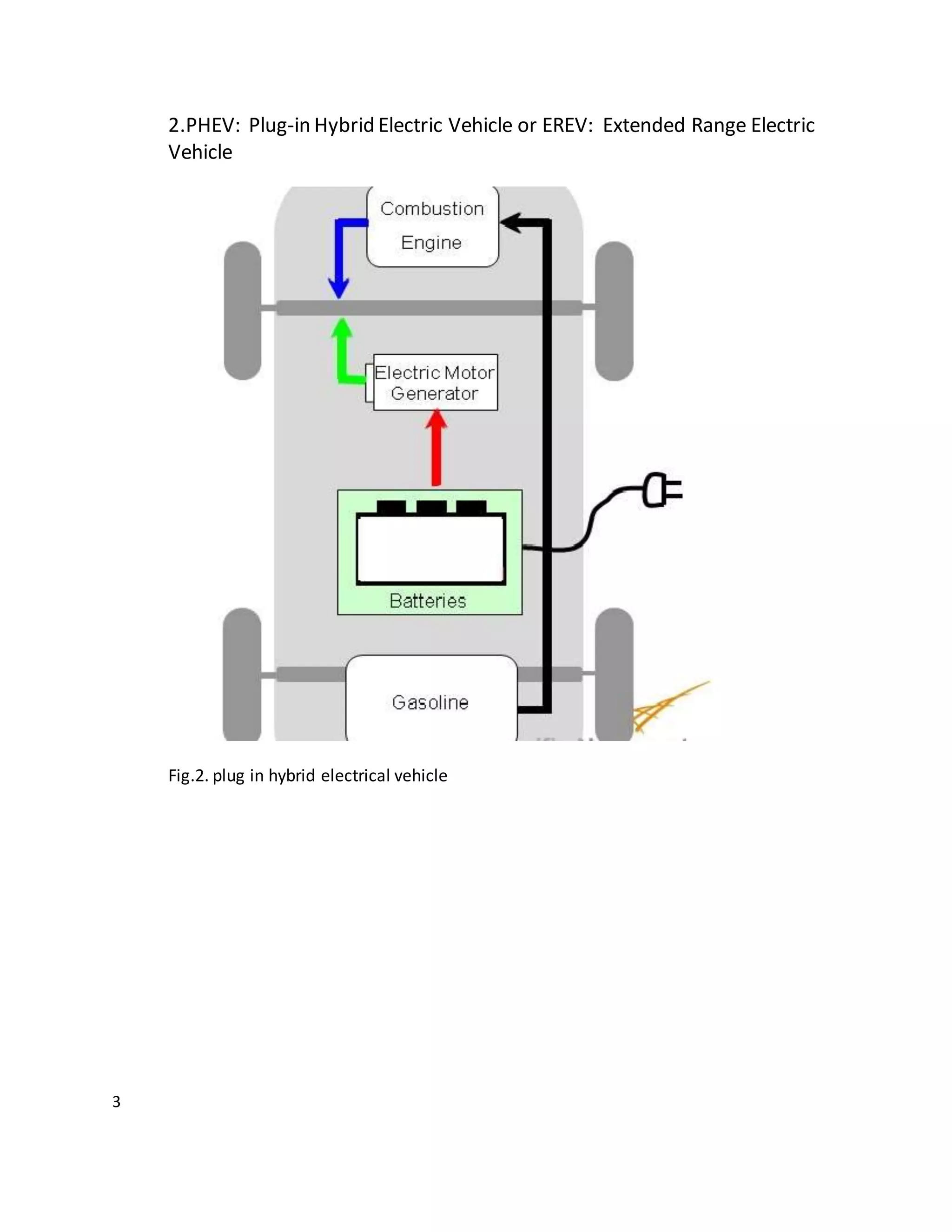
2.PHEV: Plug-in Hybrid Electric Vehicle or EREV: Extended Range Electric
Vehicle
Fig.2. plug in hybrid electrical vehicle
4
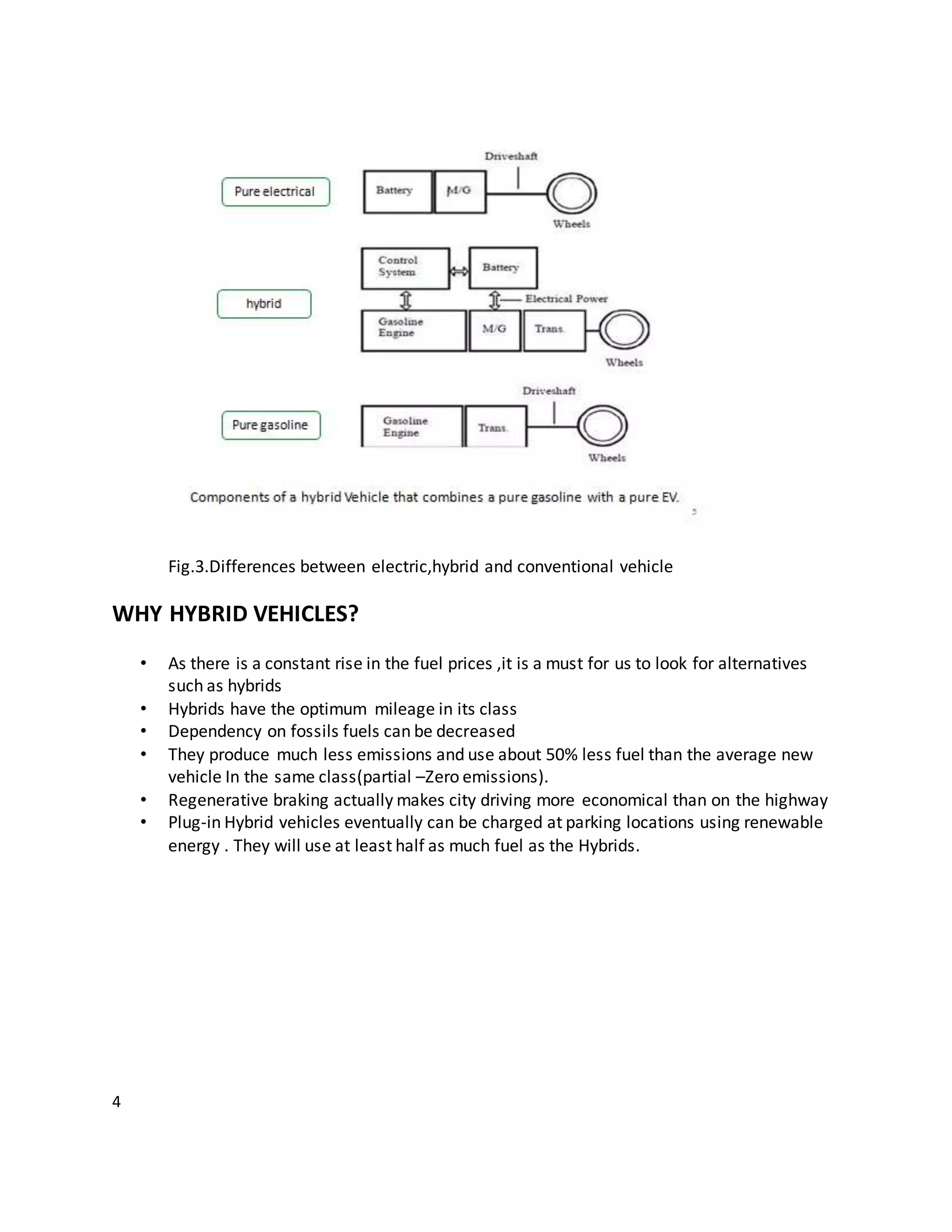
Fig.3.Differences between electric,hybrid and conventional vehicle
WHY HYBRID VEHICLES?
• As there is a constant rise in the fuel prices ,it is a must for us to look for alternatives
such as hybrids
• Hybrids have the optimum mileage in its class
• Dependency on fossils fuels can be decreased
• They produce much less emissions and use about 50% less fuel than the average new
vehicle In the same class(partial –Zero emissions).
• Regenerative braking actually makes city driving more economical than on the highway
• Plug-in Hybrid vehicles eventually can be charged at parking locations using renewable
energy . They will use at least half as much fuel as the Hybrids.
5
HOW DOES TRANSPORTATION CONTRIBUTE TO CLIMATE CHANGE?
Fig.4.Role of transportation in harmful emissions
HOW DOES A PHEV OR EREV WORK?
• PHEVs overcome the range problem of BEVs
• Electric-only range vary with battery size
• PHEV20 = 20 miles range
• PHEV40 = 40 miles range
• PHEVs well suited for our daily driving patterns
• 50% of all daily drives <25 miles
• 80% of all daily drives <50 miles
• Average daily driving=33 miles
0
500
1,000
1,500
2,000
2,500
3,000
2000 2005 2010 2015 2020 2025 2030
milliontonsofC02
Transportation
Industrial
Residential
Commercial
6
Fig.5.An HEV
7
Fig.6 PHEV
WORKING
• Integrate power of gasoline engine with electric motor
• High powered battery pack provides energy to motor
• Electric motor assist whenever surplus power is needed
8
VEHICLE POWER PLANT
Fig.7 An automatic mobile train
THREE FACTORS ARE CONSIDERED WHILE SELECTING SUITABLE POWER PLANT
 operating performance
 economy
 environmental friendliness
MAIN COMPONENTS ARE:
 internal combustion engine
 electric motor
 gear box
HEV CONFIGURATIONS
• series configuration
• parallel configuration
• series-parallel configuration
• complex configuration
9
FIG.8 Showing possible configurations
10
SERIES HYBRID
PARALLEL HYBRID
11
SERIES-PARALLEL HYBRID
COMPLEX HYBRID
12
BASIC ARCHITECTURE OF ELECTRIC DRIVE TRAINS
The EV has three major subsystems:
• Electric propulsion
• Energy source
• Auxiliary system
Electric propulsion consists of
• The electronic controller
• Power converter
• Electric Motor (EM)
• Mechanical transmission
• Driving wheels
Energy sources consists of
• The energy source (battery, fuel cell, ultracapacitor)
• Energy management unit
• Energy refueling unit
Auxiliary systemconsists of
• Power steering unit
• Temperature control unit
• Auxiliary power supply
13
Fig.9 Showing detailed components
ADVANCED TECHNIQUES USED BY PHEV
• Regenerative braking
• Electric motor drive/assist
• Automatic start /shut off
• Use low rolling resistance tires
• Use lightweight materials
14
DC-DC CONVERTERS FOR EV AND HEV APPLICATIONS
Fig.10. Role of converters
• The most commonly DC-DC converters used in an HEV or an EV are:
• Unidirectional Converters: They cater to various onboard loads such as sensors,
controls, entertainment, utility and safety equipments.
• Bidirectional Converters: They are used in places where battery charging and
regenerative braking is required. During regenerative braking, the power flows back to
the low voltage bus to recharge the batteries.
DESIGN PRINCIPLES OF HEVS
• DEFINITION OF HYBRIDNESS
H=(sum of power of all traction motors)/(sum of traction motors+ engine power)
• For example; Diesel engine: 110 kW at 3000 rpm
• Electric motor: 23 kW; maximum torque 243 N-m at 500 rpm
• H=17%
15
ALTERNATIVE AND NOVEL ENERGY SOURCES
• Solar Photovoltaics
• Flywheels
• Supercapacitor
CONTROL SYSTEMS FOR THE HEV AND EVS
• The major functions of the control systemare:
• to maximize the fuel efficiency
• to minimize the exhaust emissions.
• The minor functions of the control systemare component monitoring and protection
such as:
• battery state of charge (SOC) monitoring
• Battery temperature monitoring
• EM overheating
• ICE overheating
CONTROL SYSTEM FOR VEHICLE SPEED CONTROL
Fig.11.control system
16
REGENERATIVE BRAKING
• The electric motors in EVs and HEVs can be controlled to operate as generators to
convert the kinetic or potential energy of the vehicle mass into electric energy that can
be stored in the energy storage and reused. A successfully designed braking systemfor a
vehicle must always meet two distinct demands:
– In emergency braking, the braking systemmust bring the vehicle to rest in the
shortest possible distance.
– The braking systemmust maintain control over the vehicle’s direction, which
requires braking force to be distributed equally on all the wheels.
• When the vehicle experiences braking, the traction motor, EM or both can produce
braking torque and recapture part of the braking energy to charge the electrical energy
storage device (also known as peaking power source). In this mode of operation the
engine is switched off and the energy flow path is shown in Figure
Fig.12.Regenerative braking with TM alone
Fig.13 Regenerative braking with EM alone
17
Fig.14 Regenerative braking with both EM and TM
RECENT ADVANCEMENTS
• Today’s automotive starter batteries:lead acid
• RAV4 EV(toyota prius hybrid battery),Nickel Metal hydride
• New batteries based on lithium I-ion or Li-polymer;5x lighter for same energy!
• These advancements make it possible for larger battery storage in vehicles.
PRESENT OF HYBRID ELECTRIC VEHICLE
• Toyota is the most prominent of all manufacturers when it comes to hybrid cars. As well
as the specialist hybrid range they have produced hybrid versions of many of their
existing model lines, including several Lexus (now owned and manufactured by Toyota)
vehicles. They have also stated that it is their intention to release a hybrid version of
every single model they release in the coming decade. As well as cars and SUVs, there
are a select number of hybrid motorcycles, pickups, vans, and other road going vehicles
available to the consumer and the list is continually increasing.
FUTURE OF HYBRID ELECTRICAL VEHICLE
• Since petroleum is limited and will someday run out of supply. In the arbitrary year
2037, an estimated one billion petroleum-fueled vehicles will be on the world’s roads.
gasoline will become prohibitively expensive. The world need to have solutions for the
“400 million otherwise useless cars”. So year 2037 “gasoline runs out year” means,
petroleum will no longer be used for personal mobility. A market may develop for solar-
powered EVs of the size of a scooter or golf cart. Since hybrid technology applies to
heavy vehicles, hybrid buses and hybrid trains will be more significant.
18
EV & WHY THAT IS NOT THE SOLUTION NOW
• High Initial Cost- Many times that of conventional vehicles
• Short Driving Range- Range anxiety
• Recharging takes much longer time than refueling gasoline-lack of charging
infrastructure
• Battery pack takes space and weight of the vehicle which otherwise is available to the
people
• Grid load
• Very sensitive to overcharge/undercharge(Battery life reduces dramatically)
ADVANTAGES
• Use less oil than ICE
• Reduce emissions
• Fuel efficiency increased
• Regenerative braking
• Quiet operation
CONCLUSIONS
• Using the concept of Hybridization of cars results in better efficiency and also
saves a lot of fuel in today’s fuel deficit world.
• A hybrid gives a solution to all the problems to some extent.
• If proper research and development is done in this field, hybrid vehicle promises a
practical, efficient, low pollution vehicle for the coming era.
• One can surely conclude that this concept and the similar ones to follow with even
better efficiency & conservation rate are very much on the anvil in today’s energy deficit
world.
19
REFERENCES
[1] A. E. Fuhs, Hybrid Vehicles and the Future of Personal Transportation, CRC Press, 2009
[2]Gianfranco, Electric and Hybrid Vehicles: power sources, models, sustainability,
infrastructure and the market, Pistoia Consultant, Rome, Italy, 2010
[3]I. Husain, Electric and Hybrid Electric Vehicles, CRC Press, 2003
[4]M. Ehsani, Modern Electric, Hybrid Electric and Fuel Cell Vehicles: Fundamentals, Theory and
Design, CRC Press, 2005
[5]” Introduction to Hybrid and Electric Vehicles”, Electrical Engineering ,NPTEL

Phev report

  • 1.
    1 CONTENTS • INTRODUCTION • DEFINITION •WHY HYBRID VEHICLES? • HOW DOES TRANSPORTATIONCONTRIBUTETO CLIMATECHANGE? • HOW DOES A PHEV OR EREV WORK? • WORKING • VEHICLE POWER PLANT • CONFIGURATIONS • ARCHITECTURE • TECHNIQUES • DC-DC CONVERTERS FOR EV AND HEV APPLICATIONS • DESIGN PRICNCIPLE • ALTERNATIVESOURCES • CONTROL SYSTEMS FOR THE HEV AND EVS • REGENERATIVEBRAKING • RECENTADVANCEMENTS • PRESENTOF HYBRID ELECTRIC VEHICLE • FUTURE OF HYBRID ELECTRICAL VEHICLE • CHALLENGES • ADVANTAGES • CONCLUSION • REFERENCES
  • 2.
    2 INTRODUCTION What is ahybrid? A hybrid vehicle combines any two power (energy) sources. Possible combinations include diesel/electric, gasoline/fly wheel, and fuel cell (FC)/battery. Typically, one energy source is storage, and the other is conversion of a fuel to energy. The combination of two power sources may support two separate propulsion systems. Thus to be a True hybrid, the vehicle must have at least two modes of propulsion. DEFINITION OF ELECTRIC VEHICLES Pev-Plug inelectric vehicleconsists of twocategories:- 1 . EV: Electric Vehicle or BEV: Battery-only Electric Vehicle Fig.1 Electrical vehicle
  • 3.
    3 2.PHEV: Plug-in HybridElectric Vehicle or EREV: Extended Range Electric Vehicle Fig.2. plug in hybrid electrical vehicle
  • 4.
    4 Fig.3.Differences between electric,hybridand conventional vehicle WHY HYBRID VEHICLES? • As there is a constant rise in the fuel prices ,it is a must for us to look for alternatives such as hybrids • Hybrids have the optimum mileage in its class • Dependency on fossils fuels can be decreased • They produce much less emissions and use about 50% less fuel than the average new vehicle In the same class(partial –Zero emissions). • Regenerative braking actually makes city driving more economical than on the highway • Plug-in Hybrid vehicles eventually can be charged at parking locations using renewable energy . They will use at least half as much fuel as the Hybrids.
  • 5.
    5 HOW DOES TRANSPORTATIONCONTRIBUTE TO CLIMATE CHANGE? Fig.4.Role of transportation in harmful emissions HOW DOES A PHEV OR EREV WORK? • PHEVs overcome the range problem of BEVs • Electric-only range vary with battery size • PHEV20 = 20 miles range • PHEV40 = 40 miles range • PHEVs well suited for our daily driving patterns • 50% of all daily drives <25 miles • 80% of all daily drives <50 miles • Average daily driving=33 miles 0 500 1,000 1,500 2,000 2,500 3,000 2000 2005 2010 2015 2020 2025 2030 milliontonsofC02 Transportation Industrial Residential Commercial
  • 6.
  • 7.
    7 Fig.6 PHEV WORKING • Integratepower of gasoline engine with electric motor • High powered battery pack provides energy to motor • Electric motor assist whenever surplus power is needed
  • 8.
    8 VEHICLE POWER PLANT Fig.7An automatic mobile train THREE FACTORS ARE CONSIDERED WHILE SELECTING SUITABLE POWER PLANT  operating performance  economy  environmental friendliness MAIN COMPONENTS ARE:  internal combustion engine  electric motor  gear box HEV CONFIGURATIONS • series configuration • parallel configuration • series-parallel configuration • complex configuration
  • 9.
  • 10.
  • 11.
  • 12.
    12 BASIC ARCHITECTURE OFELECTRIC DRIVE TRAINS The EV has three major subsystems: • Electric propulsion • Energy source • Auxiliary system Electric propulsion consists of • The electronic controller • Power converter • Electric Motor (EM) • Mechanical transmission • Driving wheels Energy sources consists of • The energy source (battery, fuel cell, ultracapacitor) • Energy management unit • Energy refueling unit Auxiliary systemconsists of • Power steering unit • Temperature control unit • Auxiliary power supply
  • 13.
    13 Fig.9 Showing detailedcomponents ADVANCED TECHNIQUES USED BY PHEV • Regenerative braking • Electric motor drive/assist • Automatic start /shut off • Use low rolling resistance tires • Use lightweight materials
  • 14.
    14 DC-DC CONVERTERS FOREV AND HEV APPLICATIONS Fig.10. Role of converters • The most commonly DC-DC converters used in an HEV or an EV are: • Unidirectional Converters: They cater to various onboard loads such as sensors, controls, entertainment, utility and safety equipments. • Bidirectional Converters: They are used in places where battery charging and regenerative braking is required. During regenerative braking, the power flows back to the low voltage bus to recharge the batteries. DESIGN PRINCIPLES OF HEVS • DEFINITION OF HYBRIDNESS H=(sum of power of all traction motors)/(sum of traction motors+ engine power) • For example; Diesel engine: 110 kW at 3000 rpm • Electric motor: 23 kW; maximum torque 243 N-m at 500 rpm • H=17%
  • 15.
    15 ALTERNATIVE AND NOVELENERGY SOURCES • Solar Photovoltaics • Flywheels • Supercapacitor CONTROL SYSTEMS FOR THE HEV AND EVS • The major functions of the control systemare: • to maximize the fuel efficiency • to minimize the exhaust emissions. • The minor functions of the control systemare component monitoring and protection such as: • battery state of charge (SOC) monitoring • Battery temperature monitoring • EM overheating • ICE overheating CONTROL SYSTEM FOR VEHICLE SPEED CONTROL Fig.11.control system
  • 16.
    16 REGENERATIVE BRAKING • Theelectric motors in EVs and HEVs can be controlled to operate as generators to convert the kinetic or potential energy of the vehicle mass into electric energy that can be stored in the energy storage and reused. A successfully designed braking systemfor a vehicle must always meet two distinct demands: – In emergency braking, the braking systemmust bring the vehicle to rest in the shortest possible distance. – The braking systemmust maintain control over the vehicle’s direction, which requires braking force to be distributed equally on all the wheels. • When the vehicle experiences braking, the traction motor, EM or both can produce braking torque and recapture part of the braking energy to charge the electrical energy storage device (also known as peaking power source). In this mode of operation the engine is switched off and the energy flow path is shown in Figure Fig.12.Regenerative braking with TM alone Fig.13 Regenerative braking with EM alone
  • 17.
    17 Fig.14 Regenerative brakingwith both EM and TM RECENT ADVANCEMENTS • Today’s automotive starter batteries:lead acid • RAV4 EV(toyota prius hybrid battery),Nickel Metal hydride • New batteries based on lithium I-ion or Li-polymer;5x lighter for same energy! • These advancements make it possible for larger battery storage in vehicles. PRESENT OF HYBRID ELECTRIC VEHICLE • Toyota is the most prominent of all manufacturers when it comes to hybrid cars. As well as the specialist hybrid range they have produced hybrid versions of many of their existing model lines, including several Lexus (now owned and manufactured by Toyota) vehicles. They have also stated that it is their intention to release a hybrid version of every single model they release in the coming decade. As well as cars and SUVs, there are a select number of hybrid motorcycles, pickups, vans, and other road going vehicles available to the consumer and the list is continually increasing. FUTURE OF HYBRID ELECTRICAL VEHICLE • Since petroleum is limited and will someday run out of supply. In the arbitrary year 2037, an estimated one billion petroleum-fueled vehicles will be on the world’s roads. gasoline will become prohibitively expensive. The world need to have solutions for the “400 million otherwise useless cars”. So year 2037 “gasoline runs out year” means, petroleum will no longer be used for personal mobility. A market may develop for solar- powered EVs of the size of a scooter or golf cart. Since hybrid technology applies to heavy vehicles, hybrid buses and hybrid trains will be more significant.
  • 18.
    18 EV & WHYTHAT IS NOT THE SOLUTION NOW • High Initial Cost- Many times that of conventional vehicles • Short Driving Range- Range anxiety • Recharging takes much longer time than refueling gasoline-lack of charging infrastructure • Battery pack takes space and weight of the vehicle which otherwise is available to the people • Grid load • Very sensitive to overcharge/undercharge(Battery life reduces dramatically) ADVANTAGES • Use less oil than ICE • Reduce emissions • Fuel efficiency increased • Regenerative braking • Quiet operation CONCLUSIONS • Using the concept of Hybridization of cars results in better efficiency and also saves a lot of fuel in today’s fuel deficit world. • A hybrid gives a solution to all the problems to some extent. • If proper research and development is done in this field, hybrid vehicle promises a practical, efficient, low pollution vehicle for the coming era. • One can surely conclude that this concept and the similar ones to follow with even better efficiency & conservation rate are very much on the anvil in today’s energy deficit world.
  • 19.
    19 REFERENCES [1] A. E.Fuhs, Hybrid Vehicles and the Future of Personal Transportation, CRC Press, 2009 [2]Gianfranco, Electric and Hybrid Vehicles: power sources, models, sustainability, infrastructure and the market, Pistoia Consultant, Rome, Italy, 2010 [3]I. Husain, Electric and Hybrid Electric Vehicles, CRC Press, 2003 [4]M. Ehsani, Modern Electric, Hybrid Electric and Fuel Cell Vehicles: Fundamentals, Theory and Design, CRC Press, 2005 [5]” Introduction to Hybrid and Electric Vehicles”, Electrical Engineering ,NPTEL