Prepared by
Valencia V. Fernandes
Department of pharmacology
NIPER-AHMEDABAD
1
2
TRANSMEMBRANE
GLYCOPROTEIN PORES
that open and close in a regulated
manner and allow passage of ions
through it.
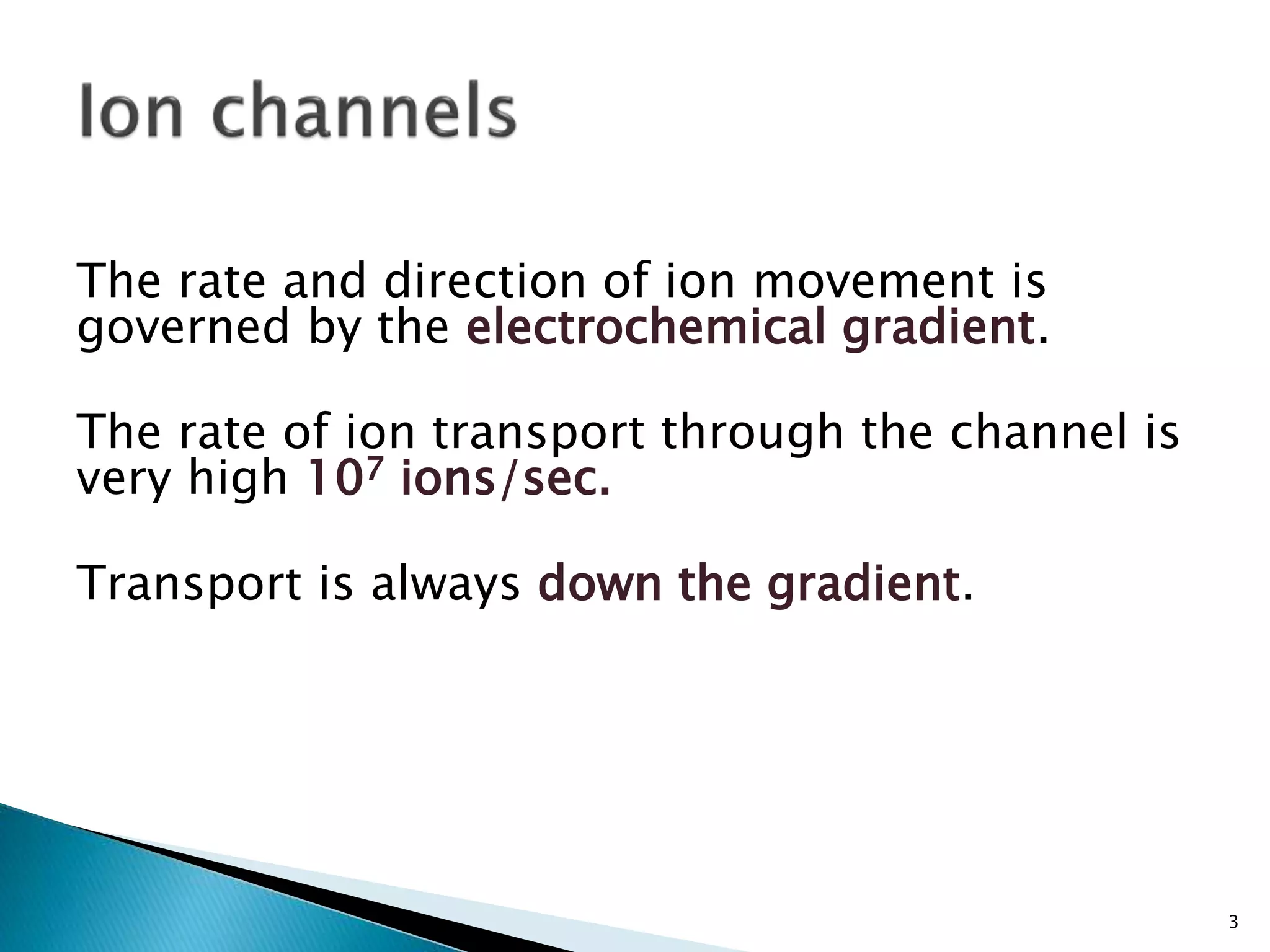
The rate and direction of ion movement is
governed by the electrochemical gradient.
The rate of ion transport through the channel is
very high 107 ions/sec.
Transport is always down the gradient.
3
In the late1800s, the chemical mechanism
underlying nerve and muscle tissue messaging
was not known.
Ludimar Hermann was able to conclude that nerve
and muscle cells were capable of exhibiting a "self-
propagating wave of negative charge which
advances in steps along the tissue ".
4
In 1880s, Sidney Ringer used a solution of water and
ran it through the vessels of an isolated heart from
a frog and discovered that in order for the heart to
continue beating salts needed to be present in the
water.
Sodium, calcium, and potassium salts were
important and had to be in specific concentration
relative to each other.
5
In 1970s, the existence of ion channels was
confirmed by the invention of ‘patch clamp’
technique by Erwin Neher and Bert Sakmann who
won a Nobel Prize for it.
In 2003, the Nobel Prize was awarded to American
scientists, Roderick MacKinon and Peter Agre for
their x-ray crystallographic structure studies on
ion channels.
6
 Permit ions of a specific size and charge.
 The permeating ions will lose their
dissociated water molecules and pass
through the hole in the channel which is
known as SELECTIVITY FILTER.
 This limits their rate of passage.
7
 Two discrete states – open(conducting) or
closed(nonconducting)
8
change in the voltage
across the membrane
(voltage-gated channels)
the binding of a ligand
(ligand-gated
channels)
9
Confirmational Changes
10
VOLTAGE
GATED ION
CHANNEL
LIGAND
GATED ION
CHANNEL
11
12
TRANSMEMBRANE ION
CHANNEL that are activated
by changes in electrical
membrane potential.
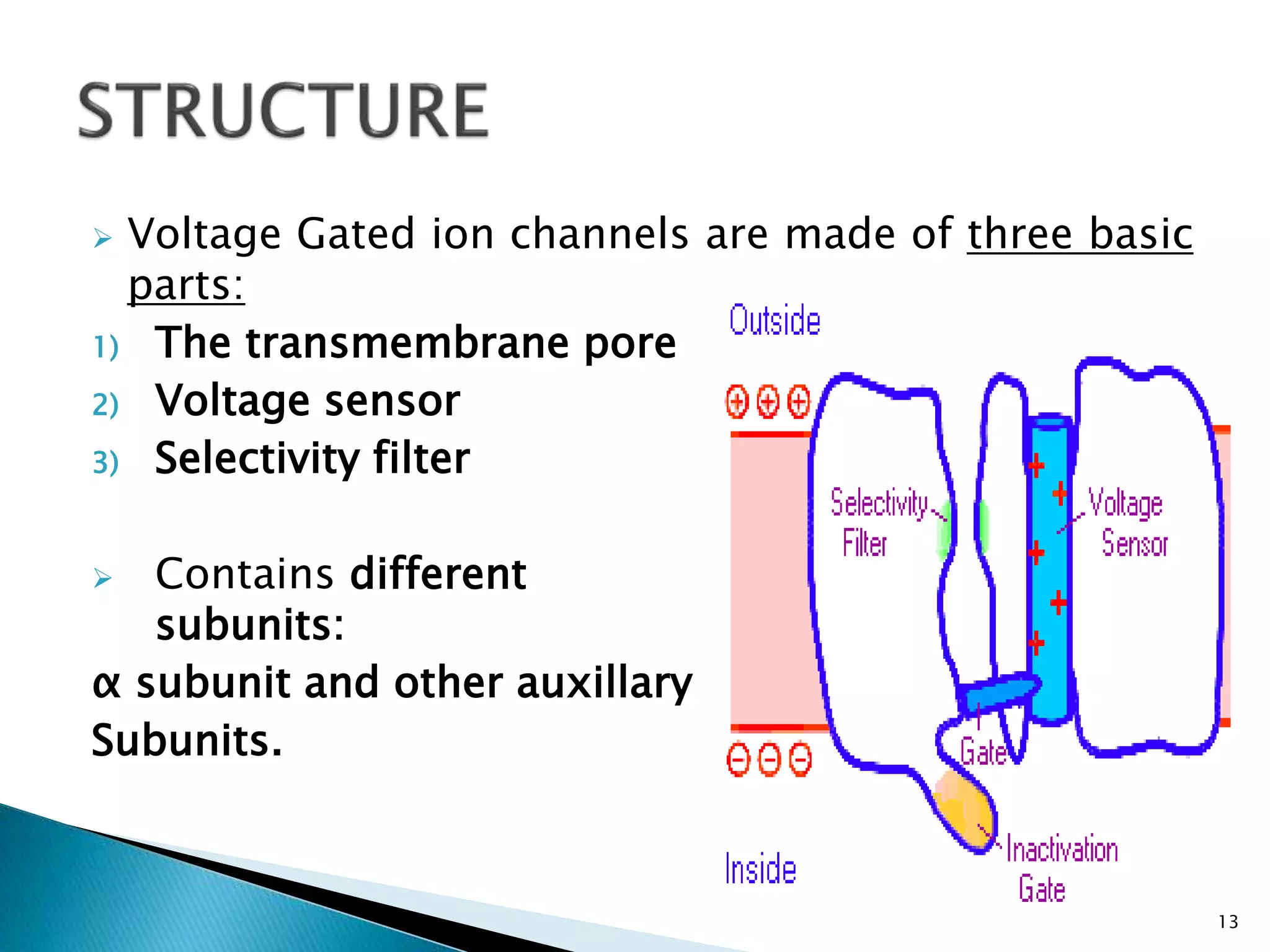
 Voltage Gated ion channels are made of three basic
parts:
1) The transmembrane pore
2) Voltage sensor
3) Selectivity filter
 Contains different
subunits:
α subunit and other auxillary
Subunits.
13
14
15
16
 These channels are responsible for the rapid
influx of sodium ions during the action
potential in nerve, muscle, and endocrine
cells.
17
18
VOLTAGE GATED ION CHANNELS
ION CHANNELS AGONIST ANTAGONIST
V.G. SODIUM
CHANNEL
Aconitine Local anaesthetics,
Type 1 anti-
arrythmic drugs
Voltage-gated calcium channels mediate calcium
influx in response to membrane depolarization and
regulate intracellular processes such as contraction,
secretion, neurotransmission.
There are several different kinds of voltage-gated
calcium channels:
o L-type: skeletal, smooth, cardiac muscle
(contraction) and for aldosterone secretion
in endocrine cells of the adrenal cortex.
19
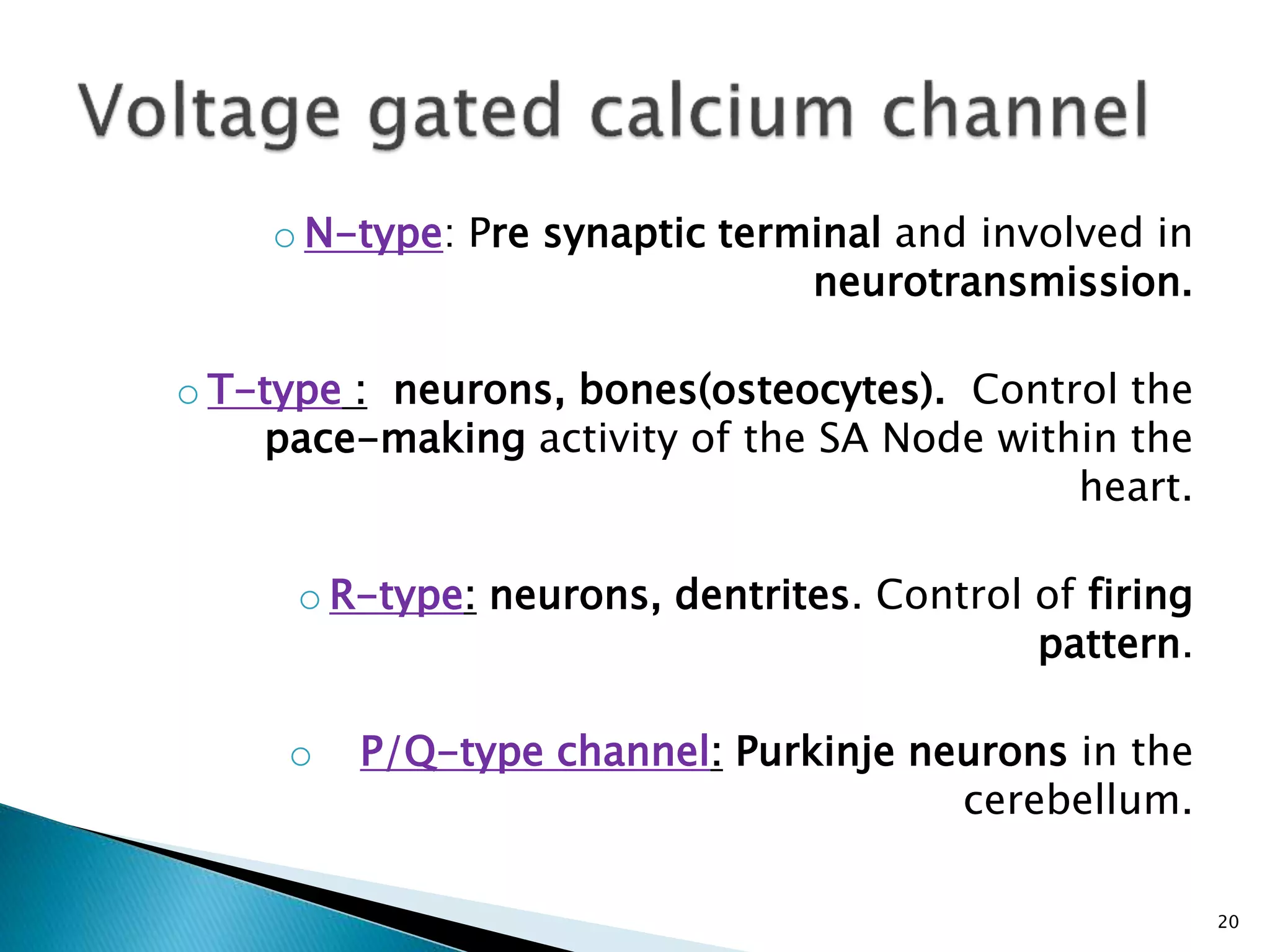
o N-type: Pre synaptic terminal and involved in
neurotransmission.
o T-type : neurons, bones(osteocytes). Control the
pace-making activity of the SA Node within the
heart.
o R-type: neurons, dentrites. Control of firing
pattern.
o P/Q-type channel: Purkinje neurons in the
cerebellum.
20
21
ION CHANNELS AGONIST ANTAGONIST
CALCIUM
CHANNEL
L Bay K8644 Dihydropyridines,
verapamil, diltiazem
N ____ ω conotoxin,
gabapentin,
lamotrigin,
levetiracetam
T ____ Mibefradil
P/Q ___ ω agatoxin
 Voltage-gated K+ channels are one of the key
components in generation and propagation of electrical
impulses in nervous system. Upon changes in
transmembrane potential, these channels open and
allow passive flow of K+ ions from the cell to restore the
membrane potential.
Agonist: Retigabine; Antagonist: 4-amino pyridine,
TEA.
22
These channels are present in every type
of neuron, where they control excitability, restore
the resting membrane potential and help regulate
cell volume.
23
24
TRANSMEMBRANE PROTEIN which
open to allow ions such as Na+, K+,
Ca2+, or Cl− to pass through the
membrane in response to the
binding of a chemical messenger (i.e.
a ligand).
They are all receptors.
25
Tansmembrane
domain
Extracellular
domain
26
BASIC
MECHANISM
OF ACTION:
(1) Extracellularly activated ligand-gated ion channel :
 The receptors of the cys-loop family (nicotinic
receptors, 5-HT3, GABAA and GABAC, glycine and
serotonin)
 The glutamate activated cationic channels (NMDA,
AMPA, kainate receptors)
(2) Intracellularly activated ligand-gated ion channel:
 ATP sensitive potassium pump
 Calcium activated-potassium pump, chloride pump
 G-protein activated potassium pump
 Aquaporin (cGMP gated ion channels)
27
(2) Nicotinic receptor:
(1)
28
(3) Ionotropic glutamate receptor:
29
30
(4) G protein activated potassium channel:
31
LIGAND GATED ION CHANNELS
ION CHANNELS AGONIST ANTAGONIST
Nicotinic receptor Acetycholine D-tubocurarine,
suxamethonium
GABAA gated chloride
channel
Muscimol
(BZD, barbiturates-
positive modulators)
Bicuculline
(flumazenil-negative
modulator)
ATP sensitive potassium
channel
Diazoxide, nicorandil Sulfonylurease
Glutamate NMDA
receptor
Glutamate Phencyclidine,
memantine, ketamine
Glutamate AMPA receptor AMPA, glutamate
(Piracetam –positive
modulators)
Kyenurenic acid
Glutamate kainate
receptor
Glutamate ______
Glycine receptor Glycine Strychnine
32
Sulfonyurease activity on ATP sensitive K+ channel:
1) Ion channel History:
http://www2.montana.edu/cftr/ionchannelprimers/i
on_channel_history2.htm
2) Rang and Dale, seventh edition
3) K D Tripathi
4) Glutamate and glutamate receptors in the vertebrate
retina by Victoria Connaughton
5) Molecular Cell Biology, Sixth Edition
6) Helen C. Lai and Lily Y. Jan; The distribution and
targeting of neuronal voltage-gated ion channels;
Nature Reviews Neuroscience 7, 548-562 (July
2006)
7) Beverly hills; Scholarpedia; Ion Channels
8) Ligand gated ion channels:
http://lenoverelab.org/LGICdb/LGICdb.php
9) http://www.britannica.com/science/ion-channel
10) http://www.snipview.com/q/Ion%20channel
33
34

Ion channels

  • 1.
    Prepared by Valencia V.Fernandes Department of pharmacology NIPER-AHMEDABAD 1
  • 2.
    2 TRANSMEMBRANE GLYCOPROTEIN PORES that openand close in a regulated manner and allow passage of ions through it.
  • 3.
    The rate anddirection of ion movement is governed by the electrochemical gradient. The rate of ion transport through the channel is very high 107 ions/sec. Transport is always down the gradient. 3
  • 4.
    In the late1800s,the chemical mechanism underlying nerve and muscle tissue messaging was not known. Ludimar Hermann was able to conclude that nerve and muscle cells were capable of exhibiting a "self- propagating wave of negative charge which advances in steps along the tissue ". 4
  • 5.
    In 1880s, SidneyRinger used a solution of water and ran it through the vessels of an isolated heart from a frog and discovered that in order for the heart to continue beating salts needed to be present in the water. Sodium, calcium, and potassium salts were important and had to be in specific concentration relative to each other. 5
  • 6.
    In 1970s, theexistence of ion channels was confirmed by the invention of ‘patch clamp’ technique by Erwin Neher and Bert Sakmann who won a Nobel Prize for it. In 2003, the Nobel Prize was awarded to American scientists, Roderick MacKinon and Peter Agre for their x-ray crystallographic structure studies on ion channels. 6
  • 7.
     Permit ionsof a specific size and charge.  The permeating ions will lose their dissociated water molecules and pass through the hole in the channel which is known as SELECTIVITY FILTER.  This limits their rate of passage. 7
  • 8.
     Two discretestates – open(conducting) or closed(nonconducting) 8
  • 9.
    change in thevoltage across the membrane (voltage-gated channels) the binding of a ligand (ligand-gated channels) 9 Confirmational Changes
  • 10.
  • 11.
  • 12.
    12 TRANSMEMBRANE ION CHANNEL thatare activated by changes in electrical membrane potential.
  • 13.
     Voltage Gatedion channels are made of three basic parts: 1) The transmembrane pore 2) Voltage sensor 3) Selectivity filter  Contains different subunits: α subunit and other auxillary Subunits. 13
  • 14.
  • 15.
  • 16.
  • 17.
     These channelsare responsible for the rapid influx of sodium ions during the action potential in nerve, muscle, and endocrine cells. 17
  • 18.
    18 VOLTAGE GATED IONCHANNELS ION CHANNELS AGONIST ANTAGONIST V.G. SODIUM CHANNEL Aconitine Local anaesthetics, Type 1 anti- arrythmic drugs
  • 19.
    Voltage-gated calcium channelsmediate calcium influx in response to membrane depolarization and regulate intracellular processes such as contraction, secretion, neurotransmission. There are several different kinds of voltage-gated calcium channels: o L-type: skeletal, smooth, cardiac muscle (contraction) and for aldosterone secretion in endocrine cells of the adrenal cortex. 19
  • 20.
    o N-type: Presynaptic terminal and involved in neurotransmission. o T-type : neurons, bones(osteocytes). Control the pace-making activity of the SA Node within the heart. o R-type: neurons, dentrites. Control of firing pattern. o P/Q-type channel: Purkinje neurons in the cerebellum. 20
  • 21.
    21 ION CHANNELS AGONISTANTAGONIST CALCIUM CHANNEL L Bay K8644 Dihydropyridines, verapamil, diltiazem N ____ ω conotoxin, gabapentin, lamotrigin, levetiracetam T ____ Mibefradil P/Q ___ ω agatoxin
  • 22.
     Voltage-gated K+channels are one of the key components in generation and propagation of electrical impulses in nervous system. Upon changes in transmembrane potential, these channels open and allow passive flow of K+ ions from the cell to restore the membrane potential. Agonist: Retigabine; Antagonist: 4-amino pyridine, TEA. 22 These channels are present in every type of neuron, where they control excitability, restore the resting membrane potential and help regulate cell volume.
  • 23.
  • 24.
    24 TRANSMEMBRANE PROTEIN which opento allow ions such as Na+, K+, Ca2+, or Cl− to pass through the membrane in response to the binding of a chemical messenger (i.e. a ligand). They are all receptors.
  • 25.
  • 26.
  • 27.
    (1) Extracellularly activatedligand-gated ion channel :  The receptors of the cys-loop family (nicotinic receptors, 5-HT3, GABAA and GABAC, glycine and serotonin)  The glutamate activated cationic channels (NMDA, AMPA, kainate receptors) (2) Intracellularly activated ligand-gated ion channel:  ATP sensitive potassium pump  Calcium activated-potassium pump, chloride pump  G-protein activated potassium pump  Aquaporin (cGMP gated ion channels) 27
  • 28.
  • 29.
  • 30.
    30 (4) G proteinactivated potassium channel:
  • 31.
    31 LIGAND GATED IONCHANNELS ION CHANNELS AGONIST ANTAGONIST Nicotinic receptor Acetycholine D-tubocurarine, suxamethonium GABAA gated chloride channel Muscimol (BZD, barbiturates- positive modulators) Bicuculline (flumazenil-negative modulator) ATP sensitive potassium channel Diazoxide, nicorandil Sulfonylurease Glutamate NMDA receptor Glutamate Phencyclidine, memantine, ketamine Glutamate AMPA receptor AMPA, glutamate (Piracetam –positive modulators) Kyenurenic acid Glutamate kainate receptor Glutamate ______ Glycine receptor Glycine Strychnine
  • 32.
    32 Sulfonyurease activity onATP sensitive K+ channel:
  • 33.
    1) Ion channelHistory: http://www2.montana.edu/cftr/ionchannelprimers/i on_channel_history2.htm 2) Rang and Dale, seventh edition 3) K D Tripathi 4) Glutamate and glutamate receptors in the vertebrate retina by Victoria Connaughton 5) Molecular Cell Biology, Sixth Edition 6) Helen C. Lai and Lily Y. Jan; The distribution and targeting of neuronal voltage-gated ion channels; Nature Reviews Neuroscience 7, 548-562 (July 2006) 7) Beverly hills; Scholarpedia; Ion Channels 8) Ligand gated ion channels: http://lenoverelab.org/LGICdb/LGICdb.php 9) http://www.britannica.com/science/ion-channel 10) http://www.snipview.com/q/Ion%20channel 33
  • 34.