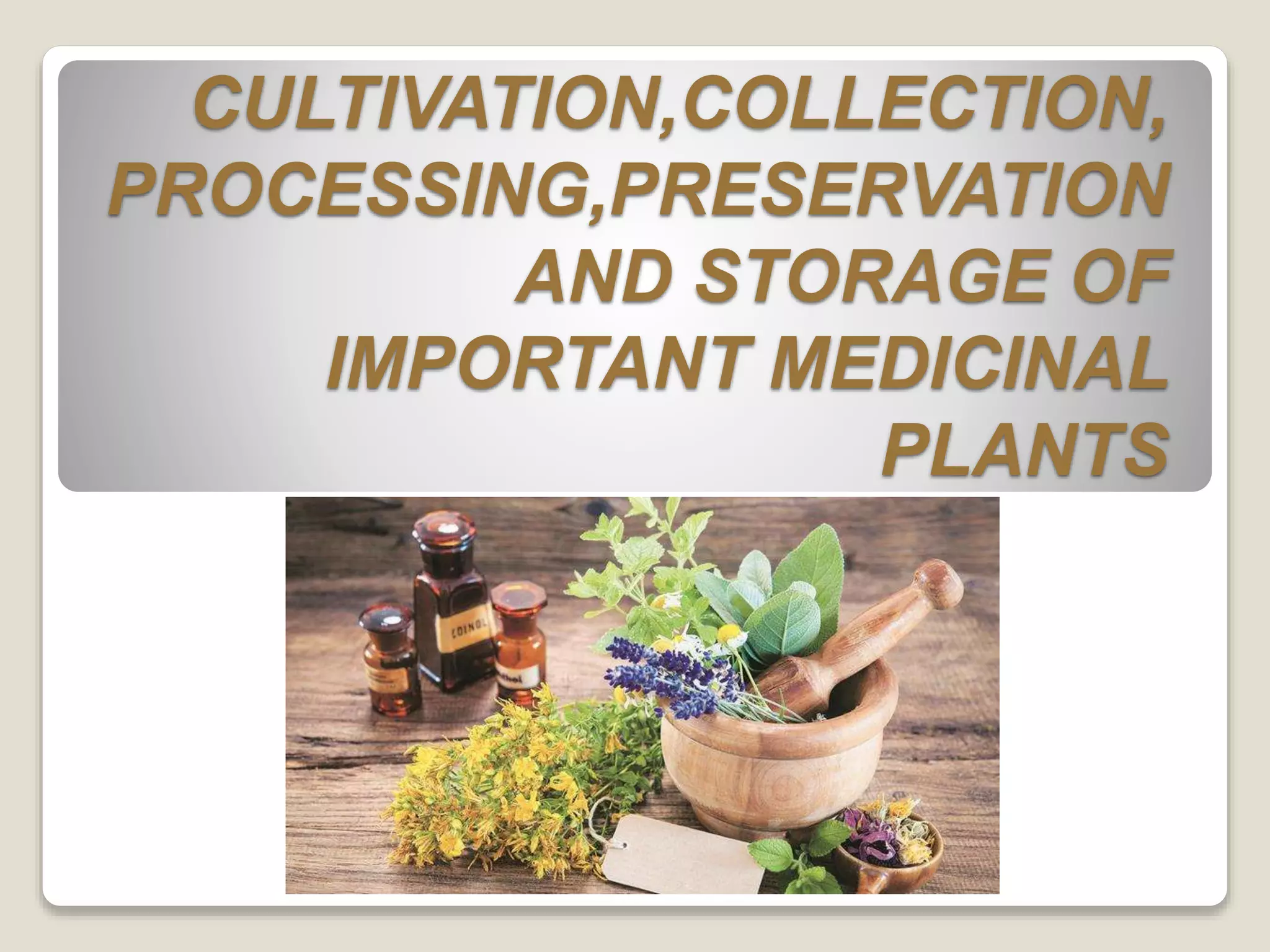
CULTIVATION,COLLECTION,
PROCESSING,PRESERVATION
AND STORAGE OF
IMPORTANT MEDICINAL
PLANTS
Presented By,
Ujjwal Mandal
B.pharm , 4th year,7th sem.
Roll no: 20801914101
Reg No: 142080210103
Under Guidance
of
associate prof.
Mr. Manis Das
(Pharmacognosy Department)
BHARAT TECHNOLOGY.
1. CULTIVATION.
2. COLLECTION.
3. PROCESSING.
4. PRESERVATION.
5. STORAGE.
6. USES
Topic
Cultivation
 The crude drugs which reach the market
and pharmaceutical industries will have
passed through different stages that have
some effect in the nature and amount of
active constituents responsible for
therapeutic activity. Those stages are to be
concerned more in order to make a drug
useful to the mankind by all means.
Methods of Plant Propagation
Medicinal plants can be propagated by
two usual methods as applicable to non-
medicinal plants or crops. These methods are
referred as sexual method and asexual
method. Each of these methods has certain
advantages, and also, disadvantages.
 1. Sexual method
 2. Asexual method
Sexual method
 In case of sexual method, the plants are raised
from seeds and such plants are known as
seedlings.
 Seedlings are long-lived and bear more heavily
Plants are more sturdier.
 Seedlings are comparatively cheaper and easy
to raise.
ASEXUAL METHOD
 In case of asexual method of vegetative propagation,
the vegetative part of a plant, such as stem or root,
is placed in such an environment that it develops into
a new plant.
Advantages:
1. There is no variation between the plant grown and
plant from which it is grown. As such, the plants are
uniform in growth and yielding capacity.
2. Seedless varieties of fruits can only be propagated
vegetativel e.g. grapes, pomegranates and lemon.
3. Plants start bearing earlier as compared to seedling
trees.
4. Budding or grafting encourages disease-resistant
varieties of plants.
5. Modifying influence of root-stocks on scion can be
availed of Inferior or unsuitable varieties can be over-
looked.
FACTORS AFFECTING
CULTIVATION
ALTITUDE
Altitude is a very important factor in cultivation
of medicinal plants. Tea, cinchona and eucalyptus are
cultivated favourably at an altitude of 1,000–2,000
metres. Cinnamon and cardamom are grown at a
height of 500 1000 metres, while senna can be
cultivated at sea level.
TEMPERATURE
Temperature is a crucial factor controlling the
growth, Many plants will grow better in temperate
regions during summer.
RAINFALL
For the proper development of plant, rainfall is
required in proper measurements. The effects of
rainfall on plants must be considered in relation to
the annual rainfall throughout the year with the water
holding properties of the soil.
SOIL
Each and every plant species have its own soil
and nutritive requirements. The three important basic
characteristics of soils are their physical, chemical
and microbiological properties. Soil provides
mechanical support, water and essential foods for the
development of plants.
SOIL FERTILITY:
It is the capacity of soil to provide nutrients in
adequate amounts and in balanced proportion to
plants.
FERTILIZER AND MANURES:
Plant also needs food for their growth and
development. What plants need basically for their
growth are the carbon dioxide, sun-rays, water and
mineral matter from the soil.
PLANT HORMONES AND GROWTH
REGULATOR
Plant hormones are physiological intercellular
messengers that control the complete plant lifecycle,
including germination, rooting, growth, flowering,
fruit ripening, foliage and death.
FUNCTION OF AXUINS
 Stimulates cell elongation
 Auxin stimulates root initiation on stem cuttings and
lateral root development in tissue culture .
 Auxin has various effects on leaf fruit set,
development, and ripening, and flowering.
FUNCTION OF CYTOKININ
 Stimulate cell division.
 Stimulate leaf expansion resulting from cell
enlargement.
 Enhance stomatal opening in some species.
DRYING OF CRUDE DRUG
 Drying consists of removal of sufficient moisture
content of crude drug, so as to improve its quality
and make it resistant to the growth of
microorganisms.
 Drying inhibits partially enzymatic reactions.
 The slicing and cutting into smaller pieces is done to
enhance drying
STORAGE OF CRUDE DRUG
 Preservation of crude drugs needs knowledge of their
physical and chemical properties.
 All the drugs should be preserved in well closed and,
possibly in the filled containers. They should be stored
in the premises which are water-proof, fire proof and
rodent proof.
 A number of drugs absorb moisture during their
storage and become susceptible to the microbial
growth.
PACKING OF CRUDE DRUG
 The morphological and chemical nature of drug, its
ultimate use and effects of climatic conditions during
transportation and storage should be taken into
consideration while packing the drugs.
 Aloe is packed in goat skin.
 Cod liver oil, being sensitive to sunlight, should be stored
in such containers, which will not have effect of sunlight.
 The drugs which are very sensitive to moisture and also
costly at the same time need special attention, e.g.
digitalis, ergot and squill.
ASHWAGANDHA
 Synonyms: Withania root, Asgandh,Winter
cherry.
 Biological Source: It consits of dried roots and
stem bases of Withania Somnifera
(linn),belonging to family Solanaceae.
Cultivation And Collection :
 It is cultivate as various morpholgical and
therapeutic properties.
 The cultivation is mainly done in Madhya
Pradesh.
 The propagation is done by seeds.
 The sowings is done towards june-july and during
growth.
 The propagation is done by seeds.
 The sowings is done towards june-july.
 The nitrogenous fertilzers lead formation of
small.
 Towards December or january ,the plants bear
flowers and furits and during january harvesting
is intiated which lasts upto march.
 The roots are collected by uprooting.
Chemical Constituents:
The main constituents of ashwagandha are alkaloids
and steroidal lactones.
Important alkaloids are Withanine, Somniferine,
Somnine, Tropine, Choline etc.
Steroids are Withaferin, Withanolide etc.
Uses:
1. Ashwagandha use aslo as sedative and hypnotic
effects.
2. It is use as treatment of Rehumastism, Gout,
Hypertension, Skin diseases.
3. It is use as anti-stress activity as mood stabilizer
revives mind and body.
4. Ashwagandha use widely as sex stimulant.
TULSI
Synonyms : Sacred Basil, Holy Basil
Biological Source:
Tulsi consists o fresh and dried leaves of Ocimum
Sanctum Linn.
family Lamiaceae.
Chemical Constituents:
 Tulsi leaves contain bright, yellow coloured and
pleasent volatile oil.
 The plant is also contain alkaloid , glycoside,
saponin, tannins, vitamin C and tartaric acid. Tulsi
contain 70 percent eugenol, carvacrol 3 percent.
 It also contain caryophyllin.
USES:
 The oil of tulsi is antibacterial and insecticidal.
 The leavess are used as stimulant, aromatic,
anticatarrhal and diaphoretic.
 Several preparation for skin diseases and to cure ear-
ache.
 Tulsi has expectorant and anti inflammatory
properties.
CONCLUSION
On this project work, I have disscussed about
cultivation,collection, preservatio and storage of only
a few medicinal plant,but there are more medicinal
plant grow in our country. Medicinal herbs can be a
good alternative for many diseases and conditions.If
we do proper management and cultivation of
medicinal plant, our country will be developed in
herbal medicine and many peopole will be benefited
by medicinal as use it medicine.
References
 C.k. Kokate, A.P. purohit ,S.B. Gokhale
Pharmacognosy Golden Jubilee 50 Edition,
Nirali Prakashan Page-04.01-04.12(14.77-
14.80)
 Shah Biren ,Seth A.K. Text book of
Pharmacognosy and Phytochemistry,
second edition , CBS publishers pvt. ltd,
Chapter- Cultivation collection and
processing of some medicinal plants, pg
67-78.
Cultivation,collection, processing,Preservation and Storage of Important Medicinal Plants...

Cultivation,collection, processing,Preservation and Storage of Important Medicinal Plants...

  • 1.
  • 2.
    Presented By, Ujjwal Mandal B.pharm, 4th year,7th sem. Roll no: 20801914101 Reg No: 142080210103 Under Guidance of associate prof. Mr. Manis Das (Pharmacognosy Department) BHARAT TECHNOLOGY.
  • 3.
    1. CULTIVATION. 2. COLLECTION. 3.PROCESSING. 4. PRESERVATION. 5. STORAGE. 6. USES Topic
  • 4.
    Cultivation  The crudedrugs which reach the market and pharmaceutical industries will have passed through different stages that have some effect in the nature and amount of active constituents responsible for therapeutic activity. Those stages are to be concerned more in order to make a drug useful to the mankind by all means.
  • 5.
    Methods of PlantPropagation Medicinal plants can be propagated by two usual methods as applicable to non- medicinal plants or crops. These methods are referred as sexual method and asexual method. Each of these methods has certain advantages, and also, disadvantages.  1. Sexual method  2. Asexual method
  • 6.
    Sexual method  Incase of sexual method, the plants are raised from seeds and such plants are known as seedlings.  Seedlings are long-lived and bear more heavily Plants are more sturdier.  Seedlings are comparatively cheaper and easy to raise.
  • 7.
    ASEXUAL METHOD  Incase of asexual method of vegetative propagation, the vegetative part of a plant, such as stem or root, is placed in such an environment that it develops into a new plant.
  • 8.
    Advantages: 1. There isno variation between the plant grown and plant from which it is grown. As such, the plants are uniform in growth and yielding capacity. 2. Seedless varieties of fruits can only be propagated vegetativel e.g. grapes, pomegranates and lemon. 3. Plants start bearing earlier as compared to seedling trees. 4. Budding or grafting encourages disease-resistant varieties of plants. 5. Modifying influence of root-stocks on scion can be availed of Inferior or unsuitable varieties can be over- looked.
  • 9.
    FACTORS AFFECTING CULTIVATION ALTITUDE Altitude isa very important factor in cultivation of medicinal plants. Tea, cinchona and eucalyptus are cultivated favourably at an altitude of 1,000–2,000 metres. Cinnamon and cardamom are grown at a height of 500 1000 metres, while senna can be cultivated at sea level. TEMPERATURE Temperature is a crucial factor controlling the growth, Many plants will grow better in temperate regions during summer.
  • 10.
    RAINFALL For the properdevelopment of plant, rainfall is required in proper measurements. The effects of rainfall on plants must be considered in relation to the annual rainfall throughout the year with the water holding properties of the soil. SOIL Each and every plant species have its own soil and nutritive requirements. The three important basic characteristics of soils are their physical, chemical and microbiological properties. Soil provides mechanical support, water and essential foods for the development of plants.
  • 11.
    SOIL FERTILITY: It isthe capacity of soil to provide nutrients in adequate amounts and in balanced proportion to plants. FERTILIZER AND MANURES: Plant also needs food for their growth and development. What plants need basically for their growth are the carbon dioxide, sun-rays, water and mineral matter from the soil.
  • 12.
    PLANT HORMONES ANDGROWTH REGULATOR Plant hormones are physiological intercellular messengers that control the complete plant lifecycle, including germination, rooting, growth, flowering, fruit ripening, foliage and death. FUNCTION OF AXUINS  Stimulates cell elongation  Auxin stimulates root initiation on stem cuttings and lateral root development in tissue culture .  Auxin has various effects on leaf fruit set, development, and ripening, and flowering.
  • 13.
    FUNCTION OF CYTOKININ Stimulate cell division.  Stimulate leaf expansion resulting from cell enlargement.  Enhance stomatal opening in some species. DRYING OF CRUDE DRUG  Drying consists of removal of sufficient moisture content of crude drug, so as to improve its quality and make it resistant to the growth of microorganisms.  Drying inhibits partially enzymatic reactions.  The slicing and cutting into smaller pieces is done to enhance drying
  • 15.
    STORAGE OF CRUDEDRUG  Preservation of crude drugs needs knowledge of their physical and chemical properties.  All the drugs should be preserved in well closed and, possibly in the filled containers. They should be stored in the premises which are water-proof, fire proof and rodent proof.  A number of drugs absorb moisture during their storage and become susceptible to the microbial growth.
  • 16.
    PACKING OF CRUDEDRUG  The morphological and chemical nature of drug, its ultimate use and effects of climatic conditions during transportation and storage should be taken into consideration while packing the drugs.  Aloe is packed in goat skin.  Cod liver oil, being sensitive to sunlight, should be stored in such containers, which will not have effect of sunlight.  The drugs which are very sensitive to moisture and also costly at the same time need special attention, e.g. digitalis, ergot and squill.
  • 17.
  • 18.
     Synonyms: Withaniaroot, Asgandh,Winter cherry.  Biological Source: It consits of dried roots and stem bases of Withania Somnifera (linn),belonging to family Solanaceae. Cultivation And Collection :  It is cultivate as various morpholgical and therapeutic properties.  The cultivation is mainly done in Madhya Pradesh.  The propagation is done by seeds.
  • 19.
     The sowingsis done towards june-july and during growth.  The propagation is done by seeds.  The sowings is done towards june-july.  The nitrogenous fertilzers lead formation of small.  Towards December or january ,the plants bear flowers and furits and during january harvesting is intiated which lasts upto march.  The roots are collected by uprooting.
  • 20.
    Chemical Constituents: The mainconstituents of ashwagandha are alkaloids and steroidal lactones. Important alkaloids are Withanine, Somniferine, Somnine, Tropine, Choline etc. Steroids are Withaferin, Withanolide etc. Uses: 1. Ashwagandha use aslo as sedative and hypnotic effects. 2. It is use as treatment of Rehumastism, Gout, Hypertension, Skin diseases. 3. It is use as anti-stress activity as mood stabilizer revives mind and body. 4. Ashwagandha use widely as sex stimulant.
  • 21.
  • 22.
    Synonyms : SacredBasil, Holy Basil Biological Source: Tulsi consists o fresh and dried leaves of Ocimum Sanctum Linn. family Lamiaceae. Chemical Constituents:  Tulsi leaves contain bright, yellow coloured and pleasent volatile oil.  The plant is also contain alkaloid , glycoside, saponin, tannins, vitamin C and tartaric acid. Tulsi contain 70 percent eugenol, carvacrol 3 percent.  It also contain caryophyllin.
  • 23.
    USES:  The oilof tulsi is antibacterial and insecticidal.  The leavess are used as stimulant, aromatic, anticatarrhal and diaphoretic.  Several preparation for skin diseases and to cure ear- ache.  Tulsi has expectorant and anti inflammatory properties.
  • 24.
    CONCLUSION On this projectwork, I have disscussed about cultivation,collection, preservatio and storage of only a few medicinal plant,but there are more medicinal plant grow in our country. Medicinal herbs can be a good alternative for many diseases and conditions.If we do proper management and cultivation of medicinal plant, our country will be developed in herbal medicine and many peopole will be benefited by medicinal as use it medicine.
  • 25.
    References  C.k. Kokate,A.P. purohit ,S.B. Gokhale Pharmacognosy Golden Jubilee 50 Edition, Nirali Prakashan Page-04.01-04.12(14.77- 14.80)  Shah Biren ,Seth A.K. Text book of Pharmacognosy and Phytochemistry, second edition , CBS publishers pvt. ltd, Chapter- Cultivation collection and processing of some medicinal plants, pg 67-78.