Computer Modeling Capabilities and
Challenges for Earth System Predictions
Hosted by the University Corporation for Atmospheric Research • April 24, 2018
Gokhan Danabasoglu, NCAR
Senior Scientist and CESM Chief Scientist
THE OCEANS & FORECASTING • 2018
Outline
• Importance of predictions
• Role of Earth System Models
• Examples of promising predictions
• Challenges and summary
THE OCEANS & FORECASTING • 2018
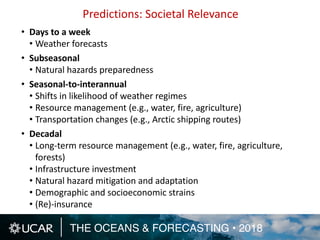
Predictions: Societal Relevance
• Days to a week
• Weather forecasts
• Subseasonal
• Natural hazards preparedness
• Seasonal-to-interannual
• Shifts in likelihood of weather regimes
• Resource management (e.g., water, fire, agriculture)
• Transportation changes (e.g., Arctic shipping routes)
• Decadal
• Long-term resource management (e.g., water, fire, agriculture,
forests)
• Infrastructure investment
• Natural hazard mitigation and adaptation
• Demographic and socioeconomic strains
• (Re)-insurance
THE OCEANS & FORECASTING • 2018
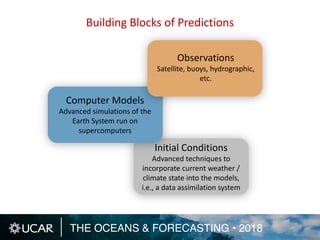
Building Blocks of Predictions
Computer Models
Advanced simulations of the
Earth System run on
supercomputers
Observations
Satellite, buoys, hydrographic,
etc.
Initial Conditions
Advanced techniques to
incorporate current weather /
climate state into the models,
i.e., a data assimilation system
THE OCEANS & FORECASTING • 2018
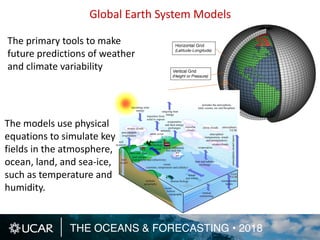
The primary tools to make
future predictions of weather
and climate variability
Global Earth System Models
The models use physical
equations to simulate key
fields in the atmosphere,
ocean, land, and sea-ice,
such as temperature and
humidity.
THE OCEANS & FORECASTING • 2018
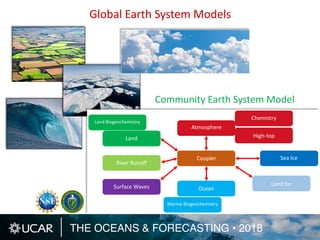
Global Earth System Models
Community Earth System Model
THE OCEANS & FORECASTING • 2018
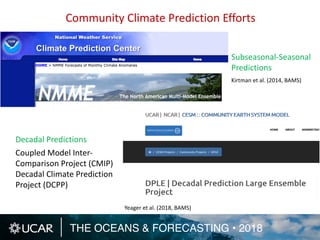
Yeager et al. (2018, BAMS)
Kirtman et al. (2014, BAMS)
Subseasonal-Seasonal
Predictions
Decadal Predictions
Coupled Model Inter-
Comparison Project (CMIP)
Decadal Climate Prediction
Project (DCPP)
Community Climate Prediction Efforts
THE OCEANS & FORECASTING • 2018
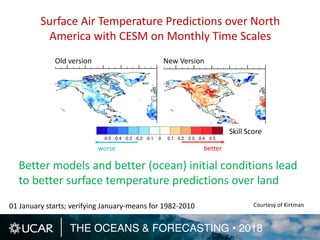
Surface Air Temperature Predictions over North
America with CESM on Monthly Time Scales
01 January starts; verifying January-means for 1982-2010 Courtesy of Kirtman
Old version New Version
Skill Score
betterworse
Better models and better (ocean) initial conditions lead
to better surface temperature predictions over land
THE OCEANS & FORECASTING • 2018
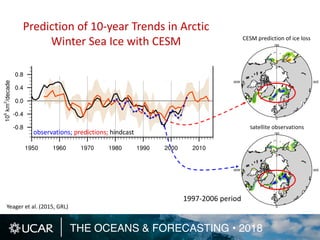
CESM prediction of ice loss
Satellite observations
Prediction of 10-year Trends in Arctic
Winter Sea Ice with CESM
Yeager et al. (2015, GRL)
observations; predictions; hindcast
1997-2006 period
THE OCEANS & FORECASTING • 2018
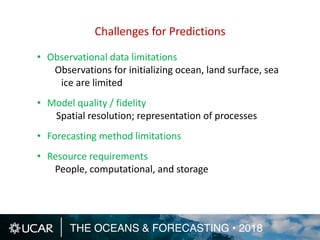
• Observational data limitations
Observations for initializing ocean, land surface, sea
ice are limited
• Model quality / fidelity
Spatial resolution; representation of processes
• Forecasting method limitations
• Resource requirements
People, computational, and storage
Challenges for Predictions
THE OCEANS & FORECASTING • 2018
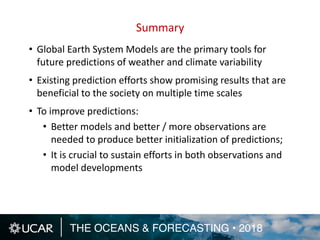
Summary
• Global Earth System Models are the primary tools for
future predictions of weather and climate variability
• Existing prediction efforts show promising results that are
beneficial to the society on multiple time scales
• To improve predictions:
• Better models and better / more observations are
needed to produce better initialization of predictions;
• It is crucial to sustain efforts in both observations and
model developments

Computer Modeling Capabilities + Challenges for Earth System Predictions

  • 1.
    Computer Modeling Capabilitiesand Challenges for Earth System Predictions Hosted by the University Corporation for Atmospheric Research • April 24, 2018 Gokhan Danabasoglu, NCAR Senior Scientist and CESM Chief Scientist
  • 2.
    THE OCEANS &FORECASTING • 2018 Outline • Importance of predictions • Role of Earth System Models • Examples of promising predictions • Challenges and summary
  • 3.
    THE OCEANS &FORECASTING • 2018 Predictions: Societal Relevance • Days to a week • Weather forecasts • Subseasonal • Natural hazards preparedness • Seasonal-to-interannual • Shifts in likelihood of weather regimes • Resource management (e.g., water, fire, agriculture) • Transportation changes (e.g., Arctic shipping routes) • Decadal • Long-term resource management (e.g., water, fire, agriculture, forests) • Infrastructure investment • Natural hazard mitigation and adaptation • Demographic and socioeconomic strains • (Re)-insurance
  • 4.
    THE OCEANS &FORECASTING • 2018 Building Blocks of Predictions Computer Models Advanced simulations of the Earth System run on supercomputers Observations Satellite, buoys, hydrographic, etc. Initial Conditions Advanced techniques to incorporate current weather / climate state into the models, i.e., a data assimilation system
  • 5.
    THE OCEANS &FORECASTING • 2018 The primary tools to make future predictions of weather and climate variability Global Earth System Models The models use physical equations to simulate key fields in the atmosphere, ocean, land, and sea-ice, such as temperature and humidity.
  • 6.
    THE OCEANS &FORECASTING • 2018 Global Earth System Models Community Earth System Model
  • 7.
    THE OCEANS &FORECASTING • 2018 Yeager et al. (2018, BAMS) Kirtman et al. (2014, BAMS) Subseasonal-Seasonal Predictions Decadal Predictions Coupled Model Inter- Comparison Project (CMIP) Decadal Climate Prediction Project (DCPP) Community Climate Prediction Efforts
  • 8.
    THE OCEANS &FORECASTING • 2018 Surface Air Temperature Predictions over North America with CESM on Monthly Time Scales 01 January starts; verifying January-means for 1982-2010 Courtesy of Kirtman Old version New Version Skill Score betterworse Better models and better (ocean) initial conditions lead to better surface temperature predictions over land
  • 9.
    THE OCEANS &FORECASTING • 2018 CESM prediction of ice loss Satellite observations Prediction of 10-year Trends in Arctic Winter Sea Ice with CESM Yeager et al. (2015, GRL) observations; predictions; hindcast 1997-2006 period
  • 10.
    THE OCEANS &FORECASTING • 2018 • Observational data limitations Observations for initializing ocean, land surface, sea ice are limited • Model quality / fidelity Spatial resolution; representation of processes • Forecasting method limitations • Resource requirements People, computational, and storage Challenges for Predictions
  • 11.
    THE OCEANS &FORECASTING • 2018 Summary • Global Earth System Models are the primary tools for future predictions of weather and climate variability • Existing prediction efforts show promising results that are beneficial to the society on multiple time scales • To improve predictions: • Better models and better / more observations are needed to produce better initialization of predictions; • It is crucial to sustain efforts in both observations and model developments