The Neo-Classical
Period
Prepared by Trushali Dodiya
A Student at the Department of English
Maharaja Krishnakumarsihnji Bhavnagar University
5th September 2023
Virtual Teacher’s Day celebration
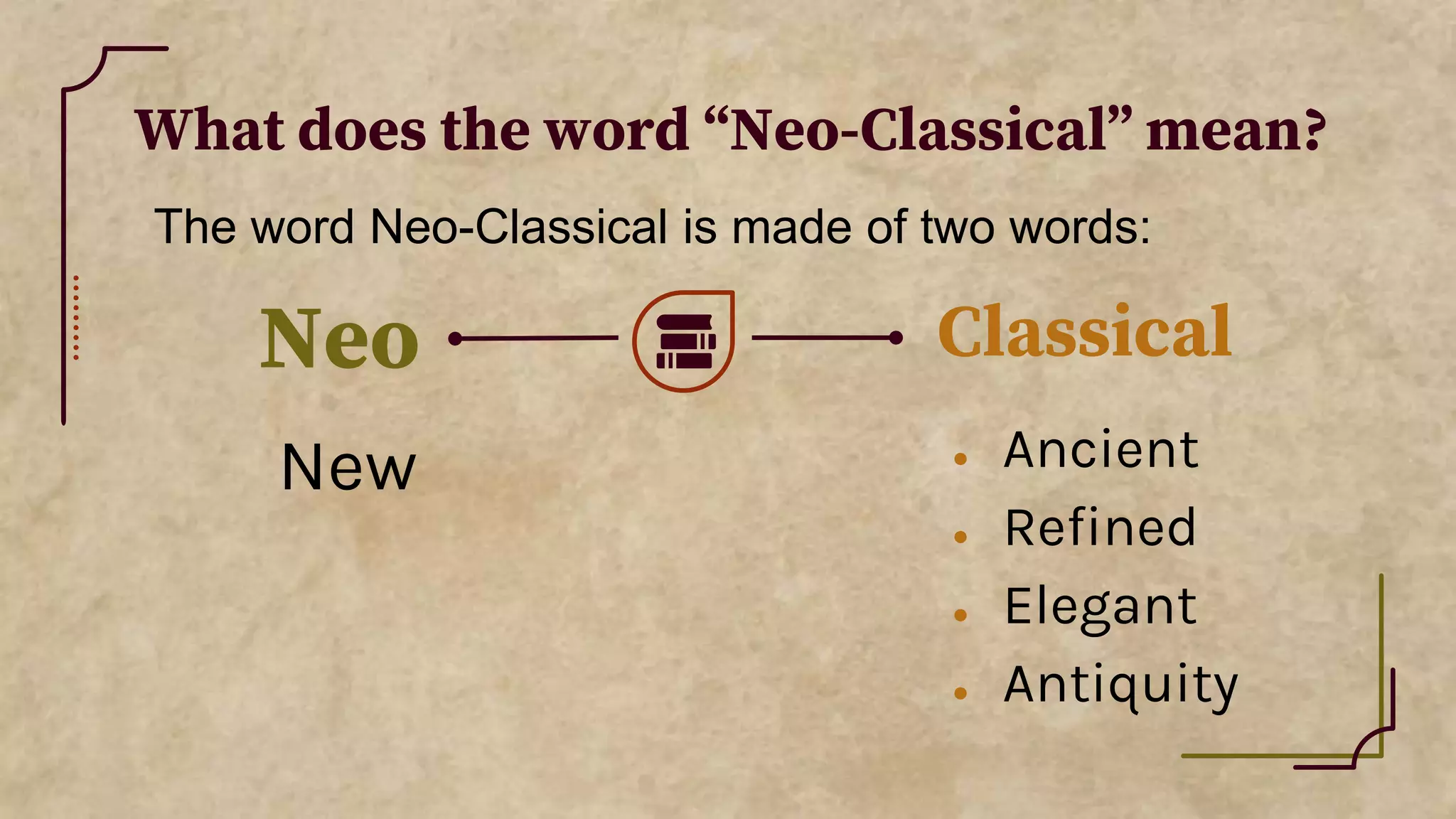
What does the word “Neo-Classical” mean?
New
Neo
● Ancient
● Refined
● Elegant
● Antiquity
Classical
The word Neo-Classical is made of two words:
Characteristics
 Writers looked back to the ideals and art forms of classical
times, i,.e, Greek and Roman Literature
 Revival of Classical Values
 Emphasized the classical ideals of order and rational
control.
 Appropriateness in Characterization, Plot, meter and
language
 A widespread and influential movement in painting and
other visual arts.
 Neoclassical poetry marked a return to the classic Greek
and Roman conventions of poetry.
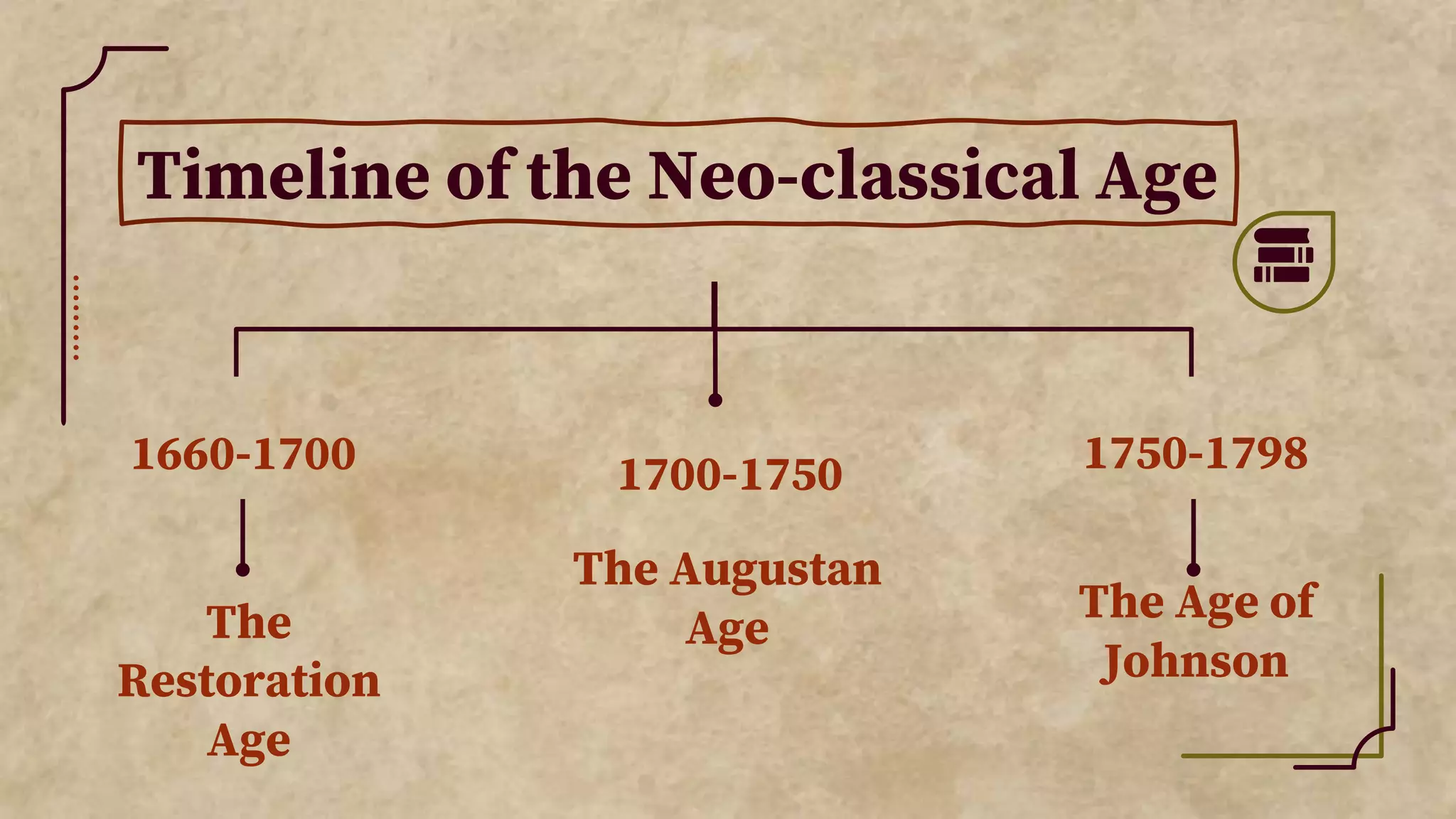
Timeline of the Neo-classical Age
The
Restoration
Age
The Augustan
Age
The Age of
Johnson
1660-1700 1700-1750 1750-1798
The Restoration Age(1660-1700)
 Restoration of the monarchy after the return of
Charles II.
 The rise of Neo-classicism
 Imitations of ancients
 Writers of the time looked back to the style of
the Greeks and Romans. They emphasized
restraint, self-control, and common sense.
The Augustan Age(1700-1750)
 The term was coined by the poet Oliver Goldsmith
 Named after the Roman emperor Augustus, who ruled when
Virgil, Horace, and Ovid were writing.
 The English Augustans translated and modeled their own
verse after these poets
 Writers of this age was imitating the Greek and Roman
traditions in their writings and adopting similar genres, as
such as epic or pastoral.
 Predominance of prose.
 Alexander Pope's 1711 long poem, "An essay on criticism”
and his versions of two Homeric epic The Iliad and The
Odyssey
The Age of Johnson(1750-1798)
 Last stage of the Neo classical age in literature.
 Dominated in writing by Samuel Johnson and that's
why this period is named as age of Johnson.
 Focused on neoclassical aesthetics - the study of
natural and artistic beauty with an eye toward the
great classical writers
 Few years after his death, Neo classical age ends
with publication of "Lyrical Ballads" by Wordsworth.
The Age of Enlightenment(1685-1815)
 Intellectual and philosophical movement
 Use and Celebration of reasons
 The ideas concerning God, reason, nature, and humanity
were synthesized(Knowledge, freedom, and happiness)
 Rejection of supernatural ideas
 Deism, Skepticism in Church/ questioning traditionally
rooted beliefs
 Revolutionary developments in art, philosophy, and
politics
 Scientific Revolution(Newton, Kepler, Galelio)
Characteristics
Reason
Rationality
Artificiality
Accuracy
Aristocracy
Predominance of Prose
 The rise of new prose forms: Periodicals, Pamphlets,
Magazines, Newspapers, Criminal biographies,
Travelogues, Political allegories, Romantic tales.
 Addison’s Essays
 Swift’s Satires
 Henry Fielding’s Novels
 Gibbon’s History
 Burke’s Orations
 Poetry also became prosaic
 Samuel Johnson’s Dictionary
Satire
Golden age of Satires
Political unrest, Sharp wit and personal
contention
Whigs and Tories
 Dryden’s Mac Flecknoe
Jonathan Swifts ‘A Tale of a Tub’
Alexander Pope
Novel
 The Industrial Revolution
created a demand for reading
about everyday events.
 The middle class expanded,
and more people became
literate.
 The Industrial Revolution also
expanded newspapers and
the periodical press, making
novels more accessible.
 Henry Fielding – the Father of
Novels
Four
Wheels
of Novel
Henry
Fielding
Lawerence
Sterne
Richard
Steel
Tobias
Smollet
Major Literary Figures
Alexander Pope: Essay on Criticism, The Rape of the
Lock
Jonathan Swift: The Battle of Books, A Tale of A Tub,
Gulliver’s Travel
Joseph Addison: Essays
Samuel Johnson: First English Dictionary, Lives of
Poet
Henry Fielding: The History of Tom Jones, a
Foundling, Joseph Andrews, The Life and Death of
The publication of the Lyrical Ballads in
1798 marked the end of the Neo-Classical
period and beginning of the Romantic
period
The Neo Classical Age

The Neo Classical Age

  • 1.
    The Neo-Classical Period Prepared byTrushali Dodiya A Student at the Department of English Maharaja Krishnakumarsihnji Bhavnagar University 5th September 2023 Virtual Teacher’s Day celebration
  • 2.
    What does theword “Neo-Classical” mean? New Neo ● Ancient ● Refined ● Elegant ● Antiquity Classical The word Neo-Classical is made of two words:
  • 3.
    Characteristics  Writers lookedback to the ideals and art forms of classical times, i,.e, Greek and Roman Literature  Revival of Classical Values  Emphasized the classical ideals of order and rational control.  Appropriateness in Characterization, Plot, meter and language  A widespread and influential movement in painting and other visual arts.  Neoclassical poetry marked a return to the classic Greek and Roman conventions of poetry.
  • 4.
    Timeline of theNeo-classical Age The Restoration Age The Augustan Age The Age of Johnson 1660-1700 1700-1750 1750-1798
  • 5.
    The Restoration Age(1660-1700) Restoration of the monarchy after the return of Charles II.  The rise of Neo-classicism  Imitations of ancients  Writers of the time looked back to the style of the Greeks and Romans. They emphasized restraint, self-control, and common sense.
  • 6.
    The Augustan Age(1700-1750) The term was coined by the poet Oliver Goldsmith  Named after the Roman emperor Augustus, who ruled when Virgil, Horace, and Ovid were writing.  The English Augustans translated and modeled their own verse after these poets  Writers of this age was imitating the Greek and Roman traditions in their writings and adopting similar genres, as such as epic or pastoral.  Predominance of prose.  Alexander Pope's 1711 long poem, "An essay on criticism” and his versions of two Homeric epic The Iliad and The Odyssey
  • 7.
    The Age ofJohnson(1750-1798)  Last stage of the Neo classical age in literature.  Dominated in writing by Samuel Johnson and that's why this period is named as age of Johnson.  Focused on neoclassical aesthetics - the study of natural and artistic beauty with an eye toward the great classical writers  Few years after his death, Neo classical age ends with publication of "Lyrical Ballads" by Wordsworth.
  • 8.
    The Age ofEnlightenment(1685-1815)  Intellectual and philosophical movement  Use and Celebration of reasons  The ideas concerning God, reason, nature, and humanity were synthesized(Knowledge, freedom, and happiness)  Rejection of supernatural ideas  Deism, Skepticism in Church/ questioning traditionally rooted beliefs  Revolutionary developments in art, philosophy, and politics  Scientific Revolution(Newton, Kepler, Galelio)
  • 9.
  • 10.
    Predominance of Prose The rise of new prose forms: Periodicals, Pamphlets, Magazines, Newspapers, Criminal biographies, Travelogues, Political allegories, Romantic tales.  Addison’s Essays  Swift’s Satires  Henry Fielding’s Novels  Gibbon’s History  Burke’s Orations  Poetry also became prosaic  Samuel Johnson’s Dictionary
  • 11.
    Satire Golden age ofSatires Political unrest, Sharp wit and personal contention Whigs and Tories  Dryden’s Mac Flecknoe Jonathan Swifts ‘A Tale of a Tub’ Alexander Pope
  • 12.
    Novel  The IndustrialRevolution created a demand for reading about everyday events.  The middle class expanded, and more people became literate.  The Industrial Revolution also expanded newspapers and the periodical press, making novels more accessible.  Henry Fielding – the Father of Novels Four Wheels of Novel Henry Fielding Lawerence Sterne Richard Steel Tobias Smollet
  • 13.
    Major Literary Figures AlexanderPope: Essay on Criticism, The Rape of the Lock Jonathan Swift: The Battle of Books, A Tale of A Tub, Gulliver’s Travel Joseph Addison: Essays Samuel Johnson: First English Dictionary, Lives of Poet Henry Fielding: The History of Tom Jones, a Foundling, Joseph Andrews, The Life and Death of
  • 14.
    The publication ofthe Lyrical Ballads in 1798 marked the end of the Neo-Classical period and beginning of the Romantic period