This presentation is a part of Ph.D. Coursework presentation, Presented at the Department of English, Maharaja Krishnakumarsinhji Bhavnagar University.
Digital Literary Cartography:
ExploringLiterary Texts
Through Mapping
Prepared by Trushali Dodiya
Research Scholar
Department of English,
MK Bhavnagar University,
Bhavnagar, Gujarat.
Presented at
Department of English
MK Bhavnagar University,
Bhavnagar
Date: 16.07.2025
Ph.D. Coursework Presentation
On
2.
Research Questions…
Whatis literary cartography?
How can digital mapping tools enhance the analysis of
spatial relationships in literary texts?
What are the advantages and limitations of using GIS
for representing fictional and hybrid literary spaces?
How does digital literary cartography influence reader
engagement and interpretation of a narrative?
In what ways can mapping reveal patterns of
movement, setting, and cultural geography in
literature?
3.
Points to bediscussed…
What is Digital Literary?
What is Literary Cartography?
History of Mapping
Digital Literary Cartography
Core Component of Digital Literary Cartography
Tools & Technologies
Application in Literary Studies
Literary Mapping Projects
Pros
Cons
Future of Digital Literary Cartography
4.
A good mapis worth a thousand
words… (Moretti, 3)
The true ground, the ‘it’, is
everywhere and nowhere. It can be
located on no map.
(J. Hillis Miller, Topographies 52)
What is LiteraryCartography?
• Maps are regularly used to study the geographic nature of stories(Caquard and
Cartwright)
• How a narrative is placed in a geography, how a geography has influenced an
author or how the narrative is ‘locked’ to a particular geography or landscape.
• Where is literature set and why there? (“Cartographies of Fictional Worlds”)
• Making connection between Geography and Literature
• Literary Geography explained by Franco Moretti
• Study of Space in Literature – Fictional one Ex., Hardy’s Wessex and R.K.
Narayan’s Malgudi
• Literature in Space – Real Places Ex. Amitav Ghosh’s Bengal
• Highlights place bound nature of literary forms, geometry, boundaries, Spatial
taboos, favorite route
• It brings light to the internal logic of narrative, semiotic domain around which a
plot coalesces and self organizes. (Moretti)
7.
• This involvesmapping:
1. Events and locations mentioned in texts, oral traditions,
films, etc.
2. Journeys and timelines of characters or historical
figures.
• A map itself can tell a story about space, decisions, and
meaning. (Thomas)
• Maps are not fixed, objective representations but
dynamic, emergent practices that are continually
produced, interpreted, and reshaped through the interplay
of people, tools, and contexts. (Kitchin and Dodge)
8.
• Literary Geography– Examines the spatial dimension
of fiction, from realistic to entirely imaginary settings;
investigates how place, space, and geography influence
narrative structure and meaning.
• Literary Cartography – A spacialised approach within
literary geography that maps fictional spaces using
cartographic symbols, enabling visual analysis of
narrative geographies. (“Cartographies of Fictional Worlds”)
Literary Geography vs. Literary
Cartography
9.
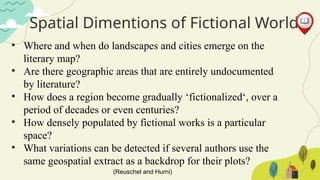
Spatial Dimentions ofFictional Worlds
• Where and when do landscapes and cities emerge on the
literary map?
• Are there geographic areas that are entirely undocumented
by literature?
• How does a region become gradually ‘fictionalized‘, over a
period of decades or even centuries?
• How densely populated by fictional works is a particular
space?
• What variations can be detected if several authors use the
same geospatial extract as a backdrop for their plots?
(Reuschel and Hurni)
10.
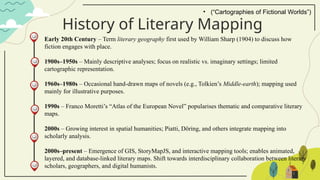
History of LiteraryMapping
Early 20th Century – Term literary geography first used by William Sharp (1904) to discuss how
fiction engages with place.
1900s–1950s – Mainly descriptive analyses; focus on realistic vs. imaginary settings; limited
cartographic representation.
1960s–1980s – Occasional hand-drawn maps of novels (e.g., Tolkien’s Middle-earth); mapping used
mainly for illustrative purposes.
1990s – Franco Moretti’s “Atlas of the European Novel” popularises thematic and comparative literary
maps.
2000s – Growing interest in spatial humanities; Piatti, Döring, and others integrate mapping into
scholarly analysis.
2000s–present – Emergence of GIS, StoryMapJS, and interactive mapping tools; enables animated,
layered, and database-linked literary maps. Shift towards interdisciplinary collaboration between literary
scholars, geographers, and digital humanists.
• (“Cartographies of Fictional Worlds”)
11.
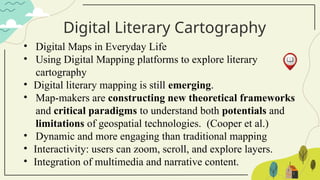
Digital Literary Cartography
•Digital Maps in Everyday Life
• Using Digital Mapping platforms to explore literary
cartography
• Digital literary mapping is still emerging.
• Map-makers are constructing new theoretical frameworks
and critical paradigms to understand both potentials and
limitations of geospatial technologies. (Cooper et al.)
• Dynamic and more engaging than traditional mapping
• Interactivity: users can zoom, scroll, and explore layers.
• Integration of multimedia and narrative content.
12.
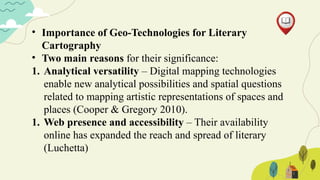
• Importance ofGeo-Technologies for Literary
Cartography
• Two main reasons for their significance:
1. Analytical versatility – Digital mapping technologies
enable new analytical possibilities and spatial questions
related to mapping artistic representations of spaces and
places (Cooper & Gregory 2010).
1. Web presence and accessibility – Their availability
online has expanded the reach and spread of literary
(Luchetta)
13.
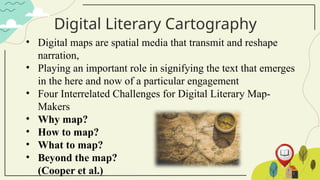
Digital Literary Cartography
•Digital maps are spatial media that transmit and reshape
narration,
• Playing an important role in signifying the text that emerges
in the here and now of a particular engagement
• Four Interrelated Challenges for Digital Literary Map-
Makers
• Why map?
• How to map?
• What to map?
• Beyond the map?
(Cooper et al.)
14.
Tools & Technologies
GoogleMy Maps
ArcGIS
StoryMap
• Narrative-cartographic relationships across different media types (oral, written,
audio-visual).
• Cartographic innovation and critical reflection: the potential of new techniques
and approaches—including emotional or affective mapping—to enhance the
narrative power of cartographic representation.
• Post-representational emphasis: shifting focus from static map outputs to the
narratives encapsulating their creation, purpose, and use—reflecting a dynamic,
process-aware understanding of cartography. (Caquard and Cartwright)
15.
Applications in LiteraryStudies
Literary mapping involves diverse communities:
• Graphic designers, amateur readers, creative writers,
journalists, scholars.
• Crowdsourced projects allow user participation in
data collection. (Luchetta)
• Mapping Lake Districts - David Cooper and Ian N. Gregory—
demonstrate how Geographic Information Systems (GIS) can be
applied to the literary study of historical texts, focusing on accounts of
the English Lake District by Thomas Gray (1769) and Samuel
Taylor Coleridge (1802).
• ArcGIS
• (Cooper and Gregory)
16.
Literary Mapping Projects
•A Map of Paradise Lost
• Mapping Emotions in Victorian London project
• OpenStreetMap
• Mapping St Petersburg
• Mrs. Dalloway Mapping Project
• Mapping The 1920s New York City Of The Grea
t Gatsby
(Luchetta)
17.
Challenges
• Ambiguity andUncertainty (Piatti)
• Ambiguity in literature is valued for interpretation but
problematic for mapping.
• GIS can handle some uncertainty, but literary cartography faces
multiple uncertainty factors:
• Author’s creative freedom.
• Multiple names/terms for the same place.
• Vague geographical concepts.
• Variations in reader interpretations.
• Difficulty representing “fuzzy” geographies
18.
• Additional complication:sometimes mapping
increases ambiguity.
• Maps are not binding interpretations — they are
tools for exploration and question generation.
• Mapping is one stage in interpretation, not the
conclusion.
• Potential for blending narrative time and
spatiality(Luchetta)
• Emotion and subjectivity(Thomas)
19.
Challenges
• Mapping isframed as interpretive, not just representational.
• Digital literary maps:
• Prompt further questions through both what they show and
what they omit.
• May not always provide definitive literary-geographical
explanations.
• Function as catalysts for rethinking and reconceptualising.
Initial interdisciplinary aspirations often fade; many projects are
monologic, focusing on tools rather than theory.
• Textual complexity is often reduced to place-name mapping
without deeper narrative engagement. (Cooper et. all)
20.
• Fictional placesmay be vague, transformed, or
unmappable.
• Subjectivity in interpretation and data collection.
• Issues with vanished places, incomplete routes, and
non-linear journeys.
• Need to balance cartographic precision with literary
complexity.
21.
Future of DigitalLiterary Cartography
• Use of digital and interactive media (e.g., story
maps, web GIS, cinematic maps).
• Integration of multiple narratives (personal stories,
historical accounts) into mapping.
• Maps as tools for critical storytelling, not just
geographic visualization.
• The future of literary cartography will perhaps rely
on digital literary mapping practices. (Cooper et. all) (Thomas)
22.
References
OpenStreetMap, https://www.openstreetmap.org/#map=7/38.001/129.820. Accessed13 August 2025.
Alberts, Hana R. “Mapping The 1920s New York City Of The Great Gatsby.” Curbed NY, 9 May 2013,
https://ny.curbed.com/maps/mapping-the-1920s-new-york-city-of-the-great-gatsby. Accessed 13 August
2025.
Caquard, Sébastien, and William Cartwright. “Narrative Cartography: From Mapping Stories to the Narrative of
Maps and Mapping.” The Cartographic Journal, vol. 51, no. 2, 2014, pp. 101-106. Taylor & Francis,
https://doi.org/10.1179/0008704114Z.000000000130.
“Cartographies of Fictional Worlds.” The Cartographic Journal, vol. 48, no. 4, 2011, pp. 218-223. Taylor &
Francis, https://www.tandfonline.com/doi/full/10.1179/174327711X13190991350051.
Cooper, David, et al., editors. Literary Mapping in the Digital Age. Routledge, 2017.
Cooper, David, et al. “Rethinking Literary Mapping.” Literary Mapping in the Digital Age, edited by David
Cooper, et al., Routledge, 2017.
Cooper, David, and Ian N. Gregory. “Mapping the English Lake District: a literary GIS.” Transactions of the
Institute of British Geographers, vol. 36, no. 1, 2011, pp. 89-108. JSTOR,
https://www.jstor.org/stable/23020843.
23.
Khatib, Randa El,and Marcel Schaeben. “A Map of Paradise Lost.” A Map of Paradise Lost,
https://olvidalo.github.io/paradise-lost/. Accessed 13 August 2025.
Kitchin, Rob, and Martin Dodge. “Rethinking Maps.” Progress in Human Geography, vol. 31, no. 3,
2007. Routledge, https://www.routledge.com/Rethinking-Maps-New-Frontiers-in-
Cartographic-Theory/Dodge-Kitchin-Perkins/p/book/9780415676670?srsltid=AfmBOorvF-
f5K3In-V694gKuhRliSvEQBaYJ_0XBQRlqhCXhB_2DNWns.
Luchetta, Sara. “Exploring the literary map: An analytical review of online literary mapping projects.”
Geography Compass, vol. 11, no. 1, 2017. Wiley,
https://compass.onlinelibrary.wiley.com/doi/10.1111/gec3.12303.
“Mapping emotions in Victorian London.” historypin, https://www.historypin.org/en/victorian-
london/geo/51.5128,-0.116085,7/bounds/49.300723,-2.785763,53.622446,2.553593/
paging/1.
“Mapping St Petersburg.” Mapping St Petersburg, https://www.mappingpetersburg.org/site/?
page_id=20.
24.
Miller, Joseph Hillis.Topographies. Stanford University Press, 1995.
Moretti, Franco. Atlas of the European Novel 1800-1900. Verso, 1998.
Piatti, Barbara. “Mapping Fiction The Theories, Tools and Potentials of Literary Cartography.”
Literary Mapping in the Digital Age, edited by David Cooper, et al., Routledge, 2017.
Reuschel, Anne-Kathrin, and Lorenz Hurni. “Mapping Literature: Visualisation of Spatial
Uncertainty in Fiction.” The Cartographic Journal, vol. 48, no. 4, 2011, pp. 293–308.
Taylor & Francis,
https://www.tandfonline.com/doi/full/10.1179/1743277411Y.0000000023.
Sharp, William. Literary Geography. London, Offices of the "Pall Mall Publications", 1904.
Thomas, Leah. “Cartographic and Literary Intersections: Digital Literary Cartographies, Digital
Humanities, and Libraries and Archives.” Journal of Map & Geography Libraries, vol. 9,
no. 3, 2013, pp. 335-349. Routledge, https://doi.org/10.1080/15420353.2013.823901.