Levels of
Communication
Prepared by Trushali Dodiya
Assistant Professor
The School of Arts,
Birsa Munda Tribal University
1. Extra Personal Communication
2. Intrapersonal communication
3. Interpersonal communication
4. Organizational communication
5. Mass communication
6. Group communication
Levels of Communication
Examples:
1.Talking to a pet dog or cat and interpreting their
reactions as a form of communication.
2.Speaking to plants while watering them, which some
people believe helps in their growth.
3.Expressing emotions by talking to objects like a diary,
a favorite chair, or even a wall when no one is around.
4.Giving commands to virtual assistants like Alexa or
Siri, which can also be categorized under this type of
communication.
1. Extra-Personal Communication
Extra-personal communication refers to communication between humans and
non-human entities. This includes interactions with animals, plants, or even
inanimate objects.
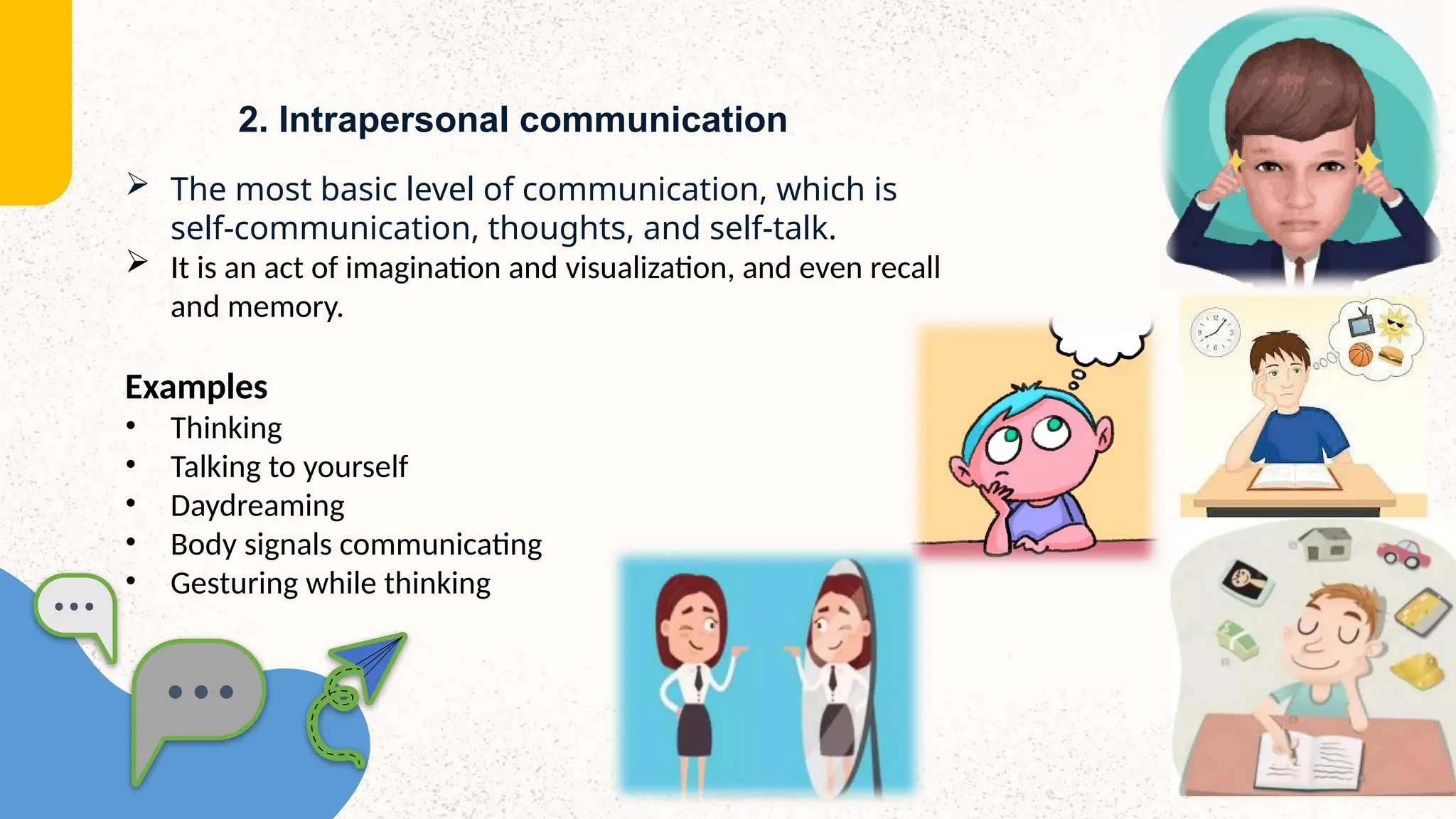
2. Intrapersonal communication
 The most basic level of communication, which is
self-communication, thoughts, and self-talk.
 It is an act of imagination and visualization, and even recall
and memory.
Examples
• Thinking
• Talking to yourself
• Daydreaming
• Body signals communicating
• Gesturing while thinking
3. Interpersonal communication
• Direct communication between two people, which can be verbal,
nonverbal, or mediated
• It involves the whole process of Communication
• Ex., Talking to friends, giving an interview, Attending a meeting, Giving
a presentation, etc.
Skills required for Interpersonal Communicatio
1. Listening skills
2. Communication skills
3. Verbal communication
4. Non-verbal communication
5. Persuasion skills, etc.
1. Internal Communication Examples:
1.Sending emails or memos to colleagues or teams within
the organization.
2.Participating in team meetings to discuss project goals.
3.Conducting training sessions for employees.
2. External Communication Examples:
1.Addressing customers through newsletters or marketing
campaigns.
2.Negotiating contracts with vendors or clients.
3.Sharing annual reports with stakeholders and investors.
4. Organizational Communication
Organizational communication refers to the exchange of information within and
outside an organization. It is further divided into internal
communication (within the organization) and external communication (with
external stakeholders).
• Examples:
• Newspaper, Magazines
• Television
• Film
• Radio
• Advertisemtns
• Using social media platforms like Twitter, Instagram, or
Facebook to reach millions with a single post.
• Designing hoardings, billboards, or posters to promote
products or ideas to the masses.
5. Mass Communication
Mass communication involves sharing information, ideas, or messages with a large
audience, often through various media channels. The goal is to reach a vast group of
people simultaneously
6. Group communication
Communication within small groups, projects,
teams, or departments.
It can be Round-table discussions,
Boards, Committees, Weekly
meetings, Emails, and Collaborative
platforms.
Thank you

Levels of Communication: _______________

  • 1.
    Levels of Communication Prepared byTrushali Dodiya Assistant Professor The School of Arts, Birsa Munda Tribal University
  • 2.
    1. Extra PersonalCommunication 2. Intrapersonal communication 3. Interpersonal communication 4. Organizational communication 5. Mass communication 6. Group communication Levels of Communication
  • 3.
    Examples: 1.Talking to apet dog or cat and interpreting their reactions as a form of communication. 2.Speaking to plants while watering them, which some people believe helps in their growth. 3.Expressing emotions by talking to objects like a diary, a favorite chair, or even a wall when no one is around. 4.Giving commands to virtual assistants like Alexa or Siri, which can also be categorized under this type of communication. 1. Extra-Personal Communication Extra-personal communication refers to communication between humans and non-human entities. This includes interactions with animals, plants, or even inanimate objects.
  • 4.
    2. Intrapersonal communication The most basic level of communication, which is self-communication, thoughts, and self-talk.  It is an act of imagination and visualization, and even recall and memory. Examples • Thinking • Talking to yourself • Daydreaming • Body signals communicating • Gesturing while thinking
  • 5.
    3. Interpersonal communication •Direct communication between two people, which can be verbal, nonverbal, or mediated • It involves the whole process of Communication • Ex., Talking to friends, giving an interview, Attending a meeting, Giving a presentation, etc. Skills required for Interpersonal Communicatio 1. Listening skills 2. Communication skills 3. Verbal communication 4. Non-verbal communication 5. Persuasion skills, etc.
  • 6.
    1. Internal CommunicationExamples: 1.Sending emails or memos to colleagues or teams within the organization. 2.Participating in team meetings to discuss project goals. 3.Conducting training sessions for employees. 2. External Communication Examples: 1.Addressing customers through newsletters or marketing campaigns. 2.Negotiating contracts with vendors or clients. 3.Sharing annual reports with stakeholders and investors. 4. Organizational Communication Organizational communication refers to the exchange of information within and outside an organization. It is further divided into internal communication (within the organization) and external communication (with external stakeholders).
  • 7.
    • Examples: • Newspaper,Magazines • Television • Film • Radio • Advertisemtns • Using social media platforms like Twitter, Instagram, or Facebook to reach millions with a single post. • Designing hoardings, billboards, or posters to promote products or ideas to the masses. 5. Mass Communication Mass communication involves sharing information, ideas, or messages with a large audience, often through various media channels. The goal is to reach a vast group of people simultaneously
  • 8.
    6. Group communication Communicationwithin small groups, projects, teams, or departments. It can be Round-table discussions, Boards, Committees, Weekly meetings, Emails, and Collaborative platforms.
  • 9.