Literary characteristics prepared by Dipti
Vaghela
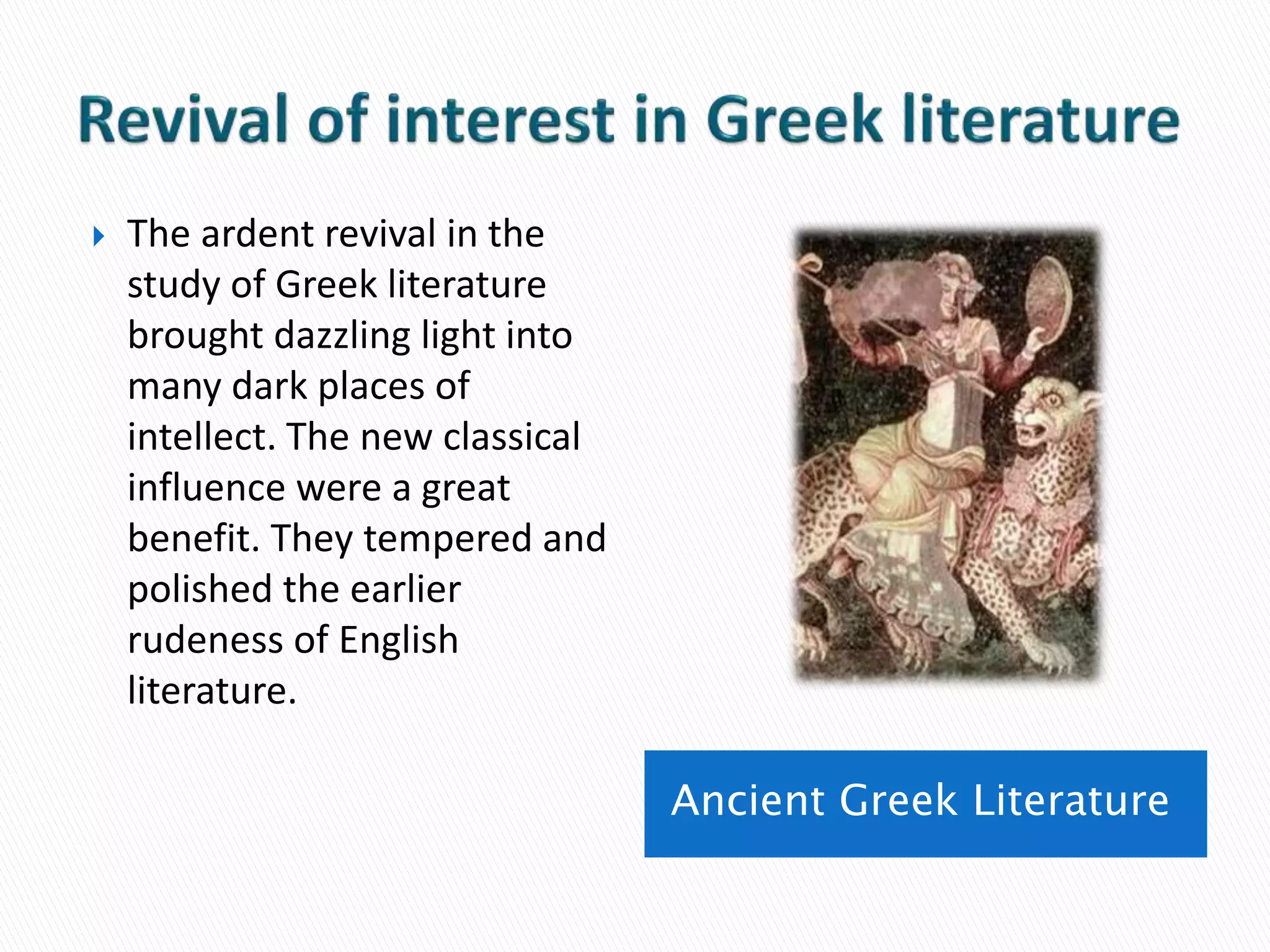
Ancient Greek Literature
 The ardent revival in the
study of Greek literature
brought dazzling light into
many dark places of
intellect. The new classical
influence were a great
benefit. They tempered and
polished the earlier
rudeness of English
literature.
 The Elizabethan age was
rich in literary productions
of all kinds. In the
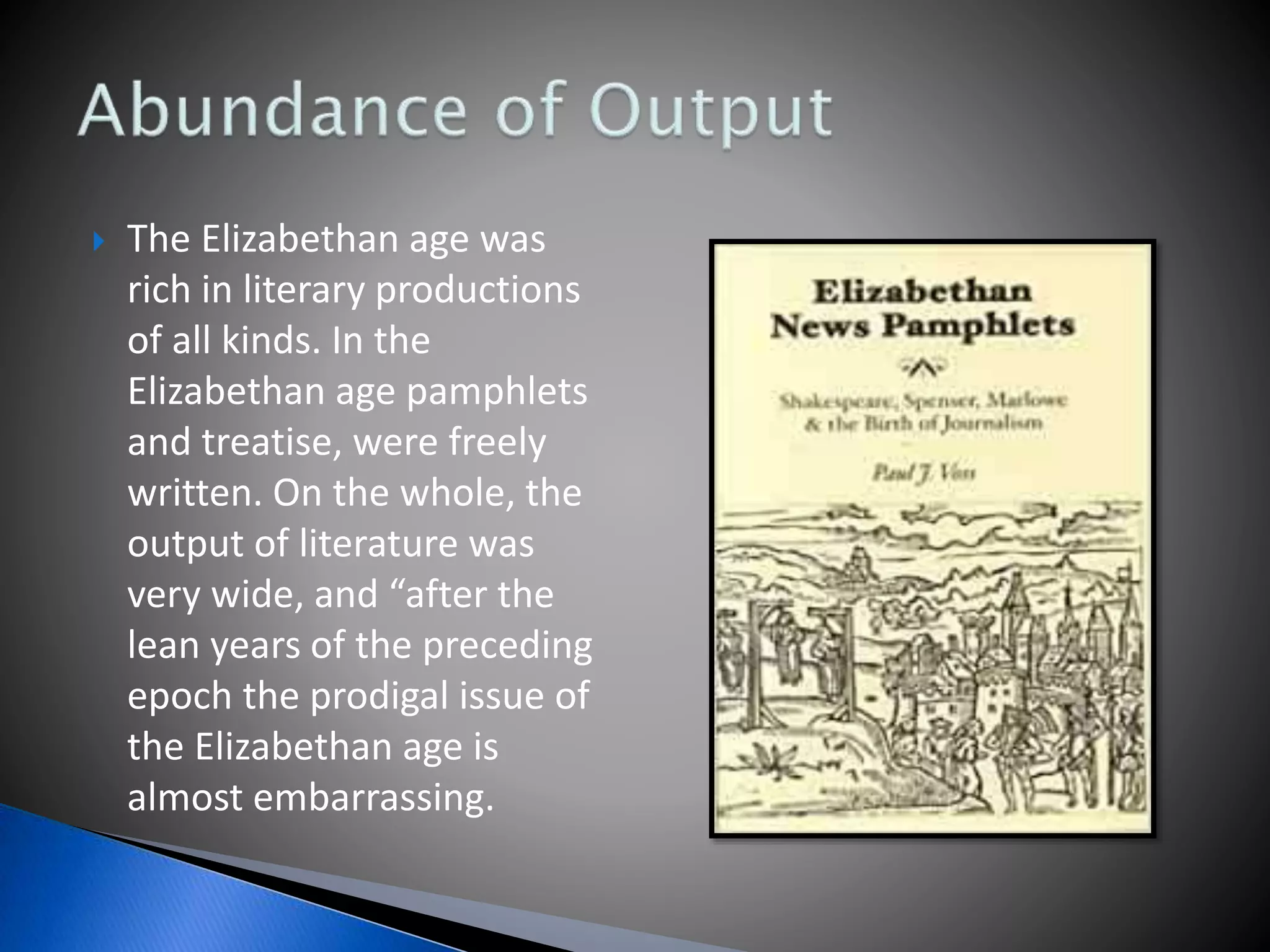
Elizabethan age pamphlets
and treatise, were freely
written. On the whole, the
output of literature was
very wide, and “after the
lean years of the preceding
epoch the prodigal issue of
the Elizabethan age is
almost embarrassing.
 The romantic quest is for the
remote, the wonderful and
the beautiful. All these desires
were abundantly fed during
the Elizabethan age, which is
the first and the greatest
romantic epoch. There was a
daring and resolute spirit of
adventure in literary as well as
other regions, and most
important of all these was
buoyanc e and freshness in
the strong wind of the spirit.
 The Elizabethan age
witnessed translation into
English of several important
foreign books. In this
respect Legouis remarks,
‘The rich soil was fertilized
by a deep layer of
translations. By 1579, many
of the great books of
ancient and modern times
had been translated into
English, almost all of them
by 1603.
 Some of these translations formed current
reading and some became as popular as the
writing of English authors. Many translations
were as popular as the original works. The
Thomas North translated Plutarch’s ‘Lives’ and
John Florio translated Montaigne’s ‘Essais’. No
less popular were the translations in verse e.g.,
‘Metamorphoses by Arthur Golding, Aristo’s
‘Orlando Furioso’ by Sir John Harrington, Tasso’s
‘Jerusalum Liberata’ by Richard Carew.
 In spite of borrowing from
abroad, the authors of this age
showed a spirit of independence
and creativeness. Shakespeare
borrowed freely, but by the
alembic of his creative
imagination he transformed the
dross into gold. Spenser
introduced the Spenserian
Stanzas and from his works we
get the impression of
inventiveness. On the whole the
outlook of the writers during this
age was broad and independent.
 Drama made a swift
and wonderful leap into
maturity. The drama
reached the splendid
consummation in the
hands of Shakespeare
and Ben Johnson. Three
types of drama wrote in
this age tragedy,
comedy and historical.
 Poetry enjoyed its heyday
during this period. The
whole age lived in a state
of poetic favor. Songs,
lyrics and sonnets were
produced in plenty, and
England became a nest of
singing birds. In
versification there was a
marked improvement.
Melody and pictorialism
were introduced in
poetry by Spenser.
 For the first time prose
rose to the position of
first rate importance. The
dead weight of Latin
tradition gradually passed
away and English prose
acquired a tradition and
universal application.
English novel made its
first proper appearance
during this age.
Elizabethan age (Literary characteristics)

Elizabethan age (Literary characteristics)

  • 1.
  • 2.
    Ancient Greek Literature The ardent revival in the study of Greek literature brought dazzling light into many dark places of intellect. The new classical influence were a great benefit. They tempered and polished the earlier rudeness of English literature.
  • 3.
     The Elizabethanage was rich in literary productions of all kinds. In the Elizabethan age pamphlets and treatise, were freely written. On the whole, the output of literature was very wide, and “after the lean years of the preceding epoch the prodigal issue of the Elizabethan age is almost embarrassing.
  • 4.
     The romanticquest is for the remote, the wonderful and the beautiful. All these desires were abundantly fed during the Elizabethan age, which is the first and the greatest romantic epoch. There was a daring and resolute spirit of adventure in literary as well as other regions, and most important of all these was buoyanc e and freshness in the strong wind of the spirit.
  • 5.
     The Elizabethanage witnessed translation into English of several important foreign books. In this respect Legouis remarks, ‘The rich soil was fertilized by a deep layer of translations. By 1579, many of the great books of ancient and modern times had been translated into English, almost all of them by 1603.
  • 6.
     Some ofthese translations formed current reading and some became as popular as the writing of English authors. Many translations were as popular as the original works. The Thomas North translated Plutarch’s ‘Lives’ and John Florio translated Montaigne’s ‘Essais’. No less popular were the translations in verse e.g., ‘Metamorphoses by Arthur Golding, Aristo’s ‘Orlando Furioso’ by Sir John Harrington, Tasso’s ‘Jerusalum Liberata’ by Richard Carew.
  • 7.
     In spiteof borrowing from abroad, the authors of this age showed a spirit of independence and creativeness. Shakespeare borrowed freely, but by the alembic of his creative imagination he transformed the dross into gold. Spenser introduced the Spenserian Stanzas and from his works we get the impression of inventiveness. On the whole the outlook of the writers during this age was broad and independent.
  • 8.
     Drama madea swift and wonderful leap into maturity. The drama reached the splendid consummation in the hands of Shakespeare and Ben Johnson. Three types of drama wrote in this age tragedy, comedy and historical.
  • 9.
     Poetry enjoyedits heyday during this period. The whole age lived in a state of poetic favor. Songs, lyrics and sonnets were produced in plenty, and England became a nest of singing birds. In versification there was a marked improvement. Melody and pictorialism were introduced in poetry by Spenser.
  • 10.
     For thefirst time prose rose to the position of first rate importance. The dead weight of Latin tradition gradually passed away and English prose acquired a tradition and universal application. English novel made its first proper appearance during this age.