Business
Communication
What is Communication?
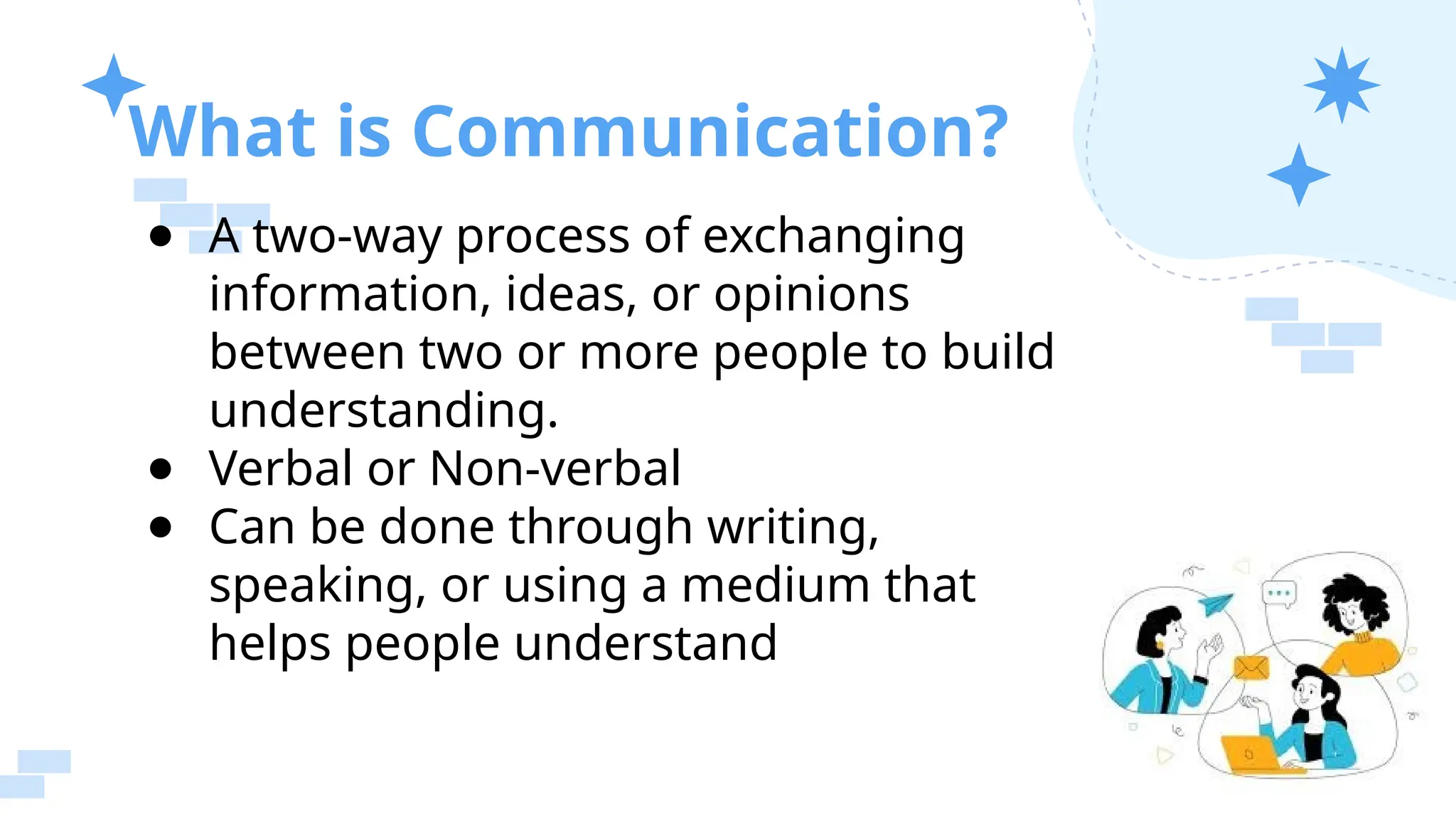
● A two-way process of exchanging
information, ideas, or opinions
between two or more people to build
understanding.
● Verbal or Non-verbal
● Can be done through writing,
speaking, or using a medium that
helps people understand
What is Business Communication?
● The process of sharing information between
people within and outside of a company.
● Interaction between employees and
management to reach organizational goals.
● Purpose: To improve organizational practices
and reduce errors.
● It’s important to work on both your
communication skills and communication
Importance
● Presenting options/new business ideas
● Making plans and proposals (business writing)
● Executing decisions
● Reaching agreements
● Sending and fulfilling orders
● Successful selling
● Effective meetings
● Providing feedback to employees and customers
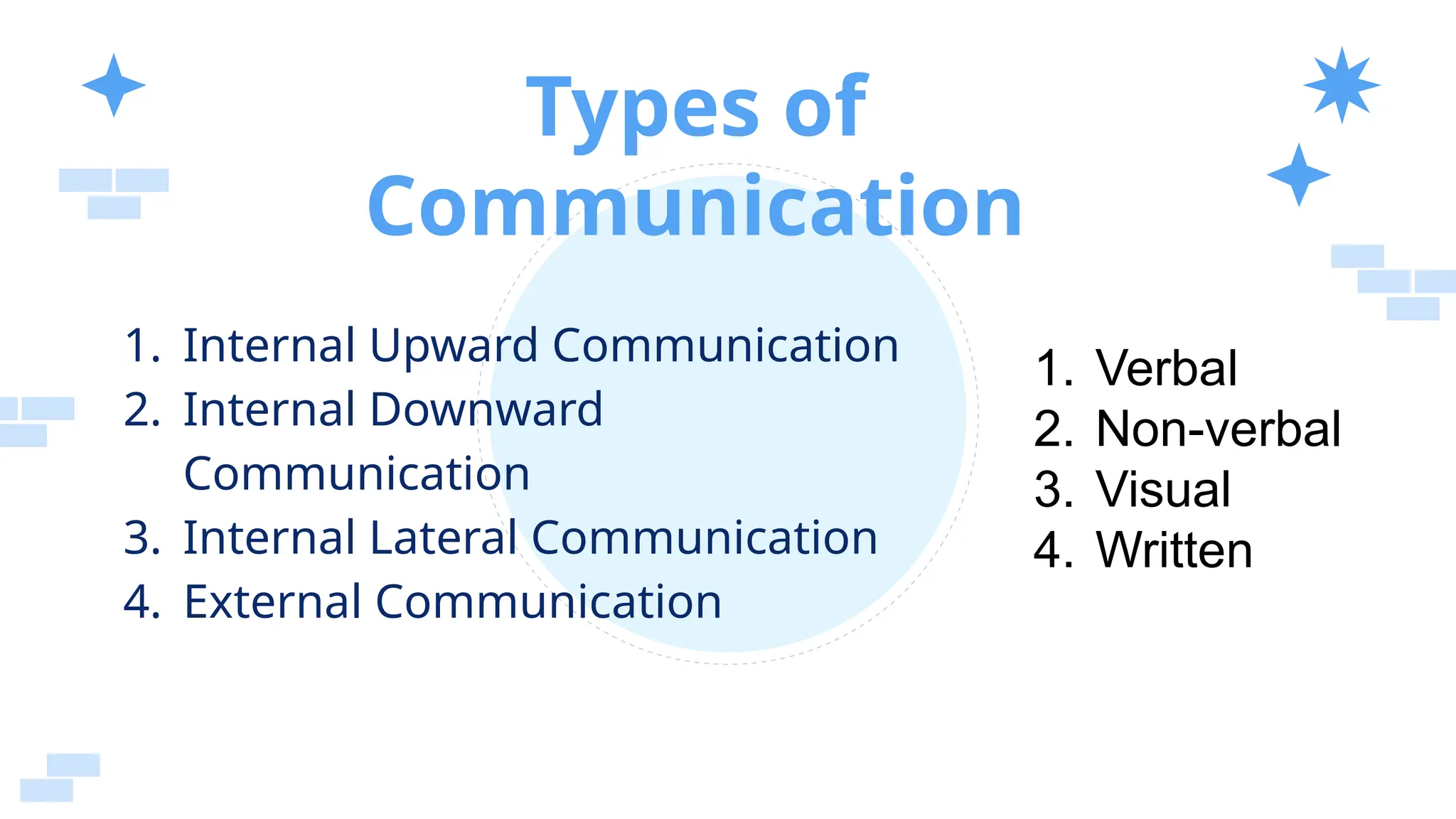
1. Internal Upward Communication
2. Internal Downward
Communication
3. Internal Lateral Communication
4. External Communication
Types of
Communication
1. Verbal
2. Non-verbal
3. Visual
4. Written
Types of Communication
Visual
Verbal Non-verbal
Written
Internal Upward
Communication
● From lower levels of a hierarchy
to the upper levels
● Ex., Performance reports, giving
feedback to superiors about
different aspects, and allowing
employees to communicate
their experiences and suggest
improvements
Internal Downward Communication
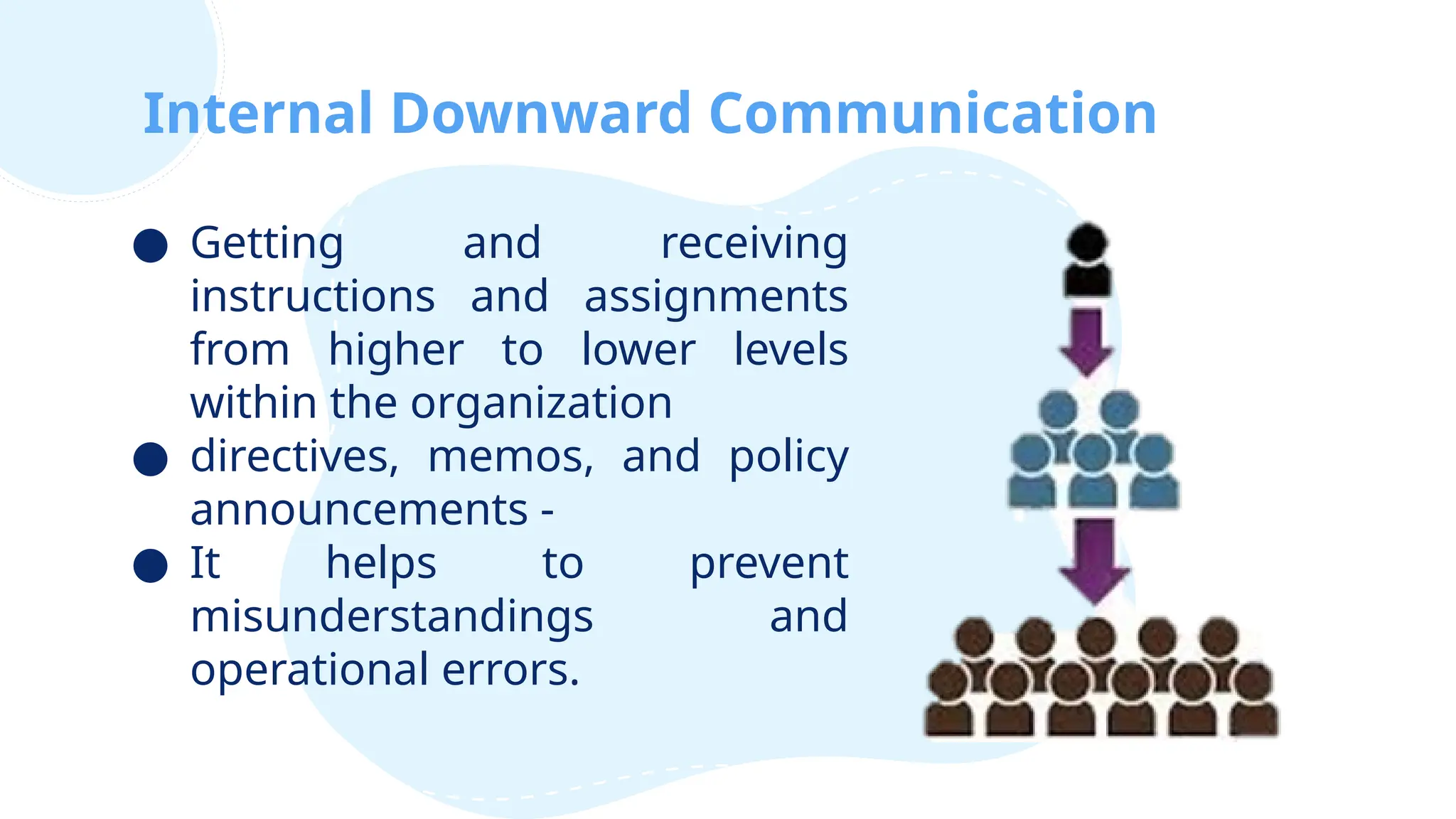
● Getting and receiving
instructions and assignments
from higher to lower levels
within the organization
● directives, memos, and policy
announcements -
● It helps to prevent
misunderstandings and
operational errors.
Internal Lateral Communication/Horizontal
Communication
Between and among staff members at the same
level
Facilitating coordination and collaboration
Ex., meetings, emails, and team briefings.
External Communication
● All communications between the organization and external
parties, such as customers, vendors, and the public- includes
marketing materials, press releases, and customer service
communications.
● It impacts brand reputation and is essential for maintaining
positive relationships outside the company.
● Part of a strategic communication
plan that aims to reach external
stakeholders through various
channels, such as mass media, social
media, and newsletters.
Which Business
Communication Services Does
My Business Need?
Process of Communication?
● A systematic series of actions or operations of a
series of changes directed to some end
● Two or more persons participating through a
medium that carries the information or message for
a particular purpose that is mutually understood by
both the sender and receiver.
1. Sender
● The person who initiates the communication process is
normally referred to as the sender.
● The originator of the idea.
● Can be an individual or a group or an individual
representing a group.
● The sender selects ideas from his personal data bank,
encodes and finally transmits them to the receiver.
● Also known as a source.
● The source in organisational communication is often
the manager giving directions to employees.
Encoding
● The sender may prepare his message for transmission by
converting it into a signal.
● The signal is composed of a systematic group of symbols.
● Each symbol has its own predetermined meaning and conventional
usage and when taken as a whole the complete set of symbols is a
type of code or language.
● If the sender uses defective or incorrect language, partial or total
breakdown of communication is likely to occur.
● The receiver will be in a position to decode the message only if he
is conversant with the symbols used by the sender.
Receiver
● A person who notices and attaches some meaning to a message.
● A person for whom the message is intended.
● If the sender and the receiver are operating on the same mental level,
the receiver becomes more receptive.
● In such a case the decoding of the message is done in almost entirely
the same terms as were intended by the sender.
● Exactly a reverse process to that of the encoding process.
● The receiver receives the message and translates the symbols, and
messages into ideas, this process is called decoding.
● At the receiving end of the channel, decoding is the transformation of
the received signal back into a message using an appropriate
systematic code.
Decoding
Message
● Information, written or spoken, which is to be sent from one person
to another.
● Composed of symbols having a certain meaning to the receiver.
● A message is like a coin-two sides.
○ There is the message as seen by the sender and
○ The message as seen by the receiver.
● A message is any signal that triggers the response of a receiver.
● Could be verbal (written or spoken) or non-verbal (body language,
silence, sounds etc.).
● The selection and interpretation of messages may differ
dramatically because of differences in psychology and situation
Channel/Medium
● Any medium that couples or joins the source to the receiver.
● There are a number of channels at the communicator's disposal.
● The communicator is free to choose from among several channel
types for a given situation.
● The entire process of encoding and decoding depends upon the
proper selection of channels.
● The choice of channel or medium depends upon several factors.
○ The choice of channel (written or oral ) or medium is influenced
by the interrelationships between the sender and the receiver.
○ Depends upon the urgency of the message being sent.
Feedback
● Receiver's response to the message.
● Verifies the message by telling the sender/ source whether the
receiver received and understood the message.
● When the sender transmits a message, he expects a response-
interested in knowing how his message has been received- can judge
the extent of success of his communication on the basis of
observation of Receiver's behaviour.
● This return information is called feedback.
● The receiver communicates his reaction back to the sender either
through words, symbols or gestures.
● The reversal of the communication process where the receiver
becomes the sender and the sender becomes the receiver.
● Feedback is a two-way communication.
References:
Alagiya, Kavisha. “Process of Communication.” Blogger,
https://kavishaalagiya.blogspot.com/2022/08/process-of-
communication.html. Accessed 4 May 2024.
Sehgal, M K and Vandana Khetarpal. Business Communication. New Delhi:
Excel Books, 2006. Paperback.
Singh, Nirmal. Business Communication Principles, Methods and
Techniques. Delhi: Deep and Deep Publications pvt. ltd., 2006.
Paperback.
Sinha, K. K. (2000). Business Communication. Delhi, 2000. Paperback
Thank you

Business Communication: It's Types and Process

  • 1.
  • 2.
    What is Communication? ●A two-way process of exchanging information, ideas, or opinions between two or more people to build understanding. ● Verbal or Non-verbal ● Can be done through writing, speaking, or using a medium that helps people understand
  • 3.
    What is BusinessCommunication? ● The process of sharing information between people within and outside of a company. ● Interaction between employees and management to reach organizational goals. ● Purpose: To improve organizational practices and reduce errors. ● It’s important to work on both your communication skills and communication
  • 4.
    Importance ● Presenting options/newbusiness ideas ● Making plans and proposals (business writing) ● Executing decisions ● Reaching agreements ● Sending and fulfilling orders ● Successful selling ● Effective meetings ● Providing feedback to employees and customers
  • 5.
    1. Internal UpwardCommunication 2. Internal Downward Communication 3. Internal Lateral Communication 4. External Communication Types of Communication 1. Verbal 2. Non-verbal 3. Visual 4. Written
  • 6.
  • 7.
    Internal Upward Communication ● Fromlower levels of a hierarchy to the upper levels ● Ex., Performance reports, giving feedback to superiors about different aspects, and allowing employees to communicate their experiences and suggest improvements
  • 8.
    Internal Downward Communication ●Getting and receiving instructions and assignments from higher to lower levels within the organization ● directives, memos, and policy announcements - ● It helps to prevent misunderstandings and operational errors.
  • 9.
    Internal Lateral Communication/Horizontal Communication Betweenand among staff members at the same level Facilitating coordination and collaboration Ex., meetings, emails, and team briefings.
  • 10.
    External Communication ● Allcommunications between the organization and external parties, such as customers, vendors, and the public- includes marketing materials, press releases, and customer service communications. ● It impacts brand reputation and is essential for maintaining positive relationships outside the company. ● Part of a strategic communication plan that aims to reach external stakeholders through various channels, such as mass media, social media, and newsletters.
  • 11.
  • 12.
    Process of Communication? ●A systematic series of actions or operations of a series of changes directed to some end ● Two or more persons participating through a medium that carries the information or message for a particular purpose that is mutually understood by both the sender and receiver.
  • 14.
    1. Sender ● Theperson who initiates the communication process is normally referred to as the sender. ● The originator of the idea. ● Can be an individual or a group or an individual representing a group. ● The sender selects ideas from his personal data bank, encodes and finally transmits them to the receiver. ● Also known as a source. ● The source in organisational communication is often the manager giving directions to employees.
  • 15.
    Encoding ● The sendermay prepare his message for transmission by converting it into a signal. ● The signal is composed of a systematic group of symbols. ● Each symbol has its own predetermined meaning and conventional usage and when taken as a whole the complete set of symbols is a type of code or language. ● If the sender uses defective or incorrect language, partial or total breakdown of communication is likely to occur. ● The receiver will be in a position to decode the message only if he is conversant with the symbols used by the sender.
  • 16.
    Receiver ● A personwho notices and attaches some meaning to a message. ● A person for whom the message is intended. ● If the sender and the receiver are operating on the same mental level, the receiver becomes more receptive. ● In such a case the decoding of the message is done in almost entirely the same terms as were intended by the sender. ● Exactly a reverse process to that of the encoding process. ● The receiver receives the message and translates the symbols, and messages into ideas, this process is called decoding. ● At the receiving end of the channel, decoding is the transformation of the received signal back into a message using an appropriate systematic code. Decoding
  • 17.
    Message ● Information, writtenor spoken, which is to be sent from one person to another. ● Composed of symbols having a certain meaning to the receiver. ● A message is like a coin-two sides. ○ There is the message as seen by the sender and ○ The message as seen by the receiver. ● A message is any signal that triggers the response of a receiver. ● Could be verbal (written or spoken) or non-verbal (body language, silence, sounds etc.). ● The selection and interpretation of messages may differ dramatically because of differences in psychology and situation
  • 18.
    Channel/Medium ● Any mediumthat couples or joins the source to the receiver. ● There are a number of channels at the communicator's disposal. ● The communicator is free to choose from among several channel types for a given situation. ● The entire process of encoding and decoding depends upon the proper selection of channels. ● The choice of channel or medium depends upon several factors. ○ The choice of channel (written or oral ) or medium is influenced by the interrelationships between the sender and the receiver. ○ Depends upon the urgency of the message being sent.
  • 19.
    Feedback ● Receiver's responseto the message. ● Verifies the message by telling the sender/ source whether the receiver received and understood the message. ● When the sender transmits a message, he expects a response- interested in knowing how his message has been received- can judge the extent of success of his communication on the basis of observation of Receiver's behaviour. ● This return information is called feedback. ● The receiver communicates his reaction back to the sender either through words, symbols or gestures. ● The reversal of the communication process where the receiver becomes the sender and the sender becomes the receiver. ● Feedback is a two-way communication.
  • 20.
    References: Alagiya, Kavisha. “Processof Communication.” Blogger, https://kavishaalagiya.blogspot.com/2022/08/process-of- communication.html. Accessed 4 May 2024. Sehgal, M K and Vandana Khetarpal. Business Communication. New Delhi: Excel Books, 2006. Paperback. Singh, Nirmal. Business Communication Principles, Methods and Techniques. Delhi: Deep and Deep Publications pvt. ltd., 2006. Paperback. Sinha, K. K. (2000). Business Communication. Delhi, 2000. Paperback
  • 21.