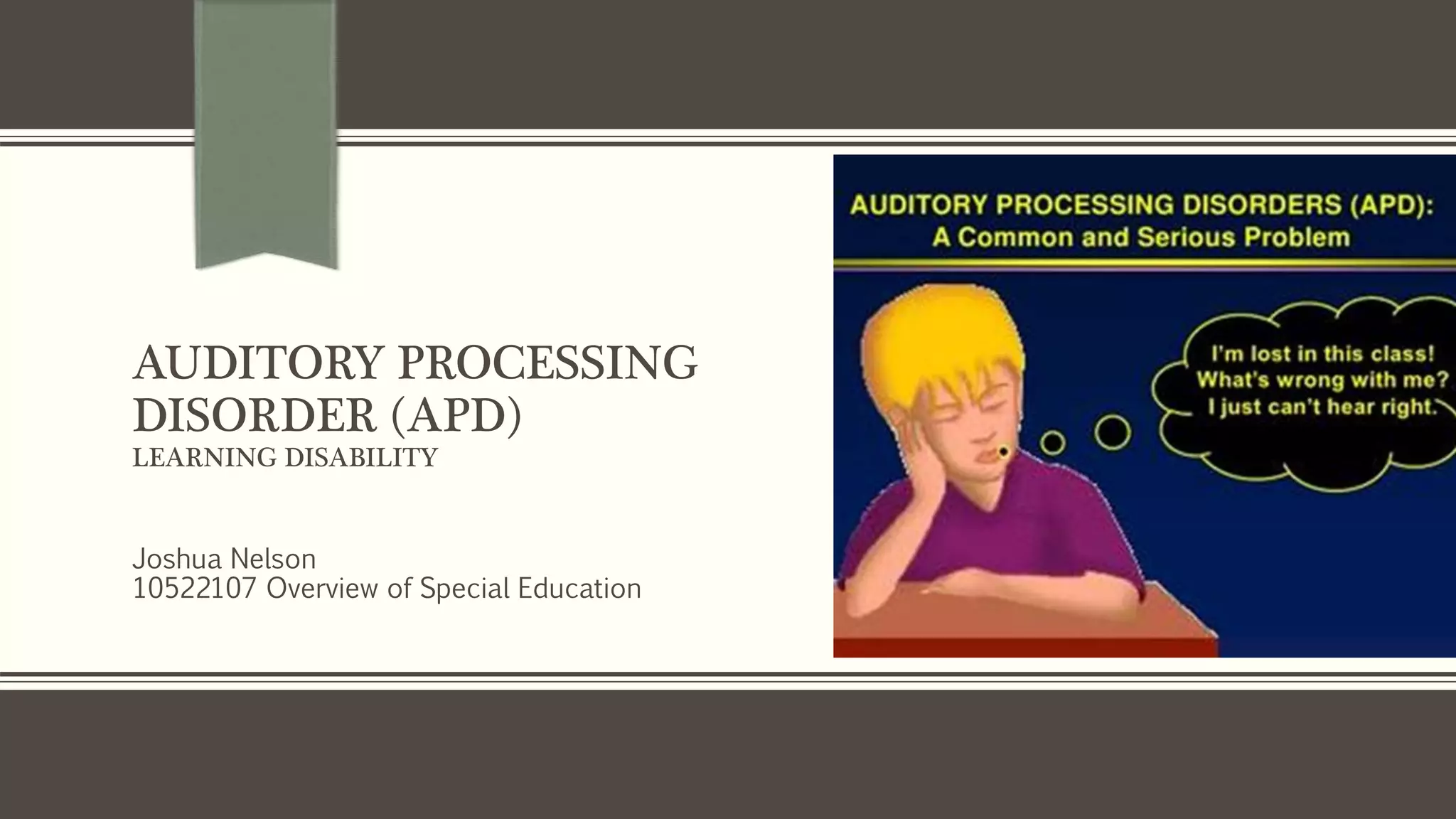
AUDITORY PROCESSING
DISORDER (APD)
LEARNING DISABILITY
Joshua Nelson
10522107 Overview of Special Education
What is Auditory Processing Disorder (APD)?
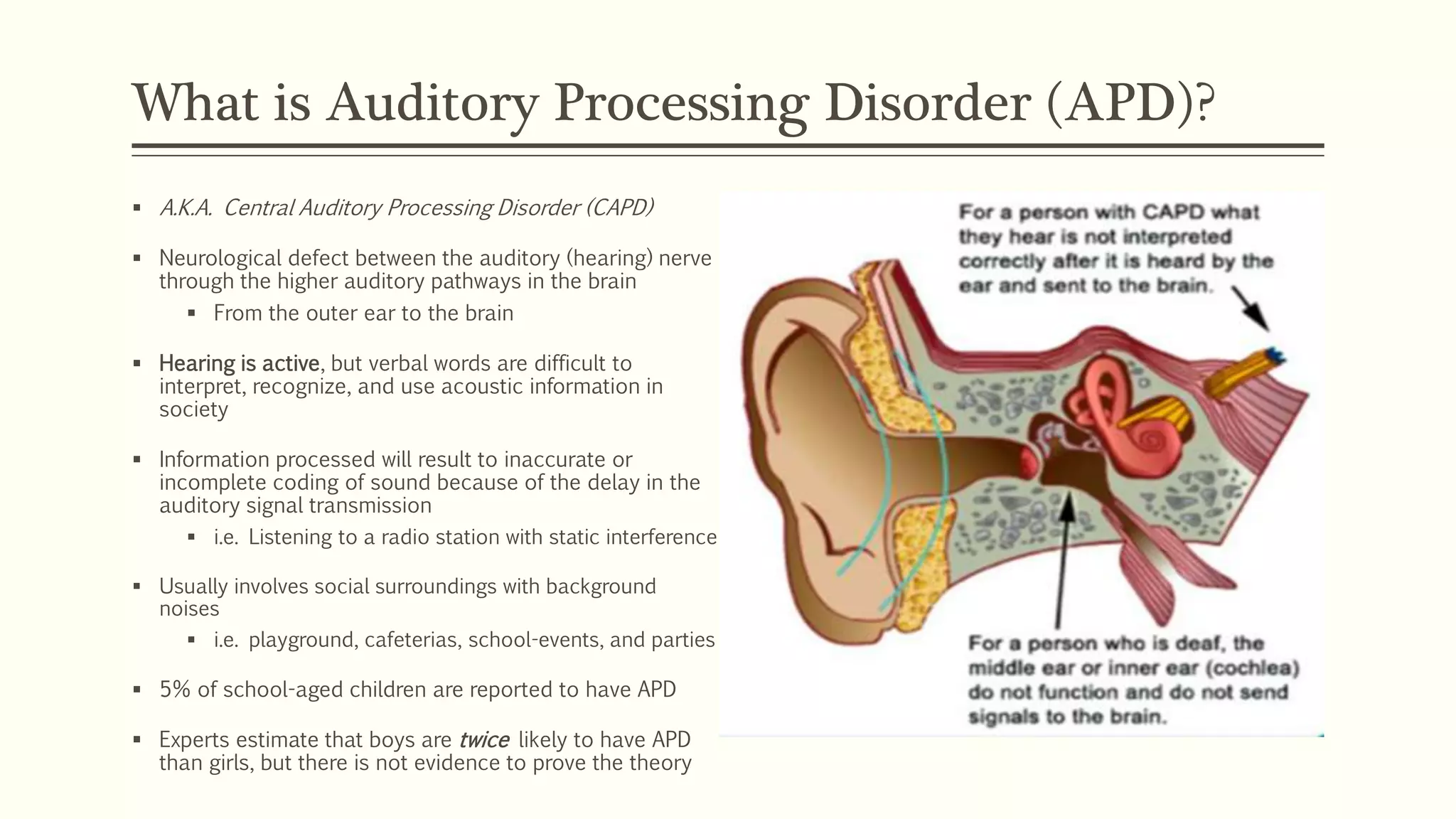
 A.K.A. Central Auditory Processing Disorder (CAPD)
 Neurological defect between the auditory (hearing) nerve
through the higher auditory pathways in the brain
 From the outer ear to the brain
 Hearing is active, but verbal words are difficult to
interpret, recognize, and use acoustic information in
society
 Information processed will result to inaccurate or
incomplete coding of sound because of the delay in the
auditory signal transmission
 i.e. Listening to a radio station with static interference
 Usually involves social surroundings with background
noises
 i.e. playground, cafeterias, school-events, and parties
 5% of school-aged children are reported to have APD
 Experts estimate that boys are twice likely to have APD
than girls, but there is not evidence to prove the theory
What are the common symptoms and questions to ask to identify APD?
Symptoms
 Common Symptoms
 Constantly saying, “huh?” or “what?”
 Ask speakers to repeat what they’ve said
 Difficulty remembering detailed information read or
heard
 Hard to follow with conversations
 Distracted with background noises
 Interprets words too literally
 Frustrated with certain tasks
 Easily distracted or bored when conversations or
activities do not include visuals
 Difficult to find the right words in responses
 Inability to sing in tune or poor music ability
Questions
 Is child easily distracted or unusually bothered by loud or
sudden noises?
 Are noisy environments upsetting the child?
 Does child’s behavior and performance improve in quieter
settings?
 Does child have difficulty following directions, whether
simple or complicated?
 Does child have reading, spelling, writing, or other
speech-language difficulties?
 Are verbal (oral) math problems difficult for child?
 Is child disorganized and forgetful?
 Are conversations hard for child to follow?
Causes and Prevalence of APD
 What causes APD?
 Exact causes are unknown, but research suggests:
 Premature birth or low birthweight
 Head Trauma
 Chronic Ear Infections
 Lead poisoning
 Multiple Causes
 What is the Prevalence of APD?
 Auditory Processing Disorder is often un/misdiagnosed because of other coexisting disorders
 i.e. inattentive, ADHD, dyslexic, LD, PDD, behavior problems, or receptive language disorder
 25% children with learning disabilities have APD and Dyslexia
 Up to 43% of children with learning difficulties have APD
 50% children with dyslexia also have APD
What is it like to have Auditory Processing Disorder (APD)?
 Here is a story by Jaziah
 “Jaziah’s Story Part 1” https://www.youtube.com/watch?v=fj2TYS9dOa4
 Skills that are in concern with the affect of APD
 Communication – may not speak clearly
 Might confuse similar sounds (i.e. free instead of three)
 Academics – difficult in subjects of reading, spelling, and writing
 Understanding verbal instructions is challenging
 Social Skills – trouble telling stories or jokes
 May avoid conversations with peers because it’s difficult to process what’s been said and think an appropriate
response
Auditory Processing Disorder (APD) Simulation
 “Misunderstood Minds” (Activity)
 http://www.pbs.org/wgbh/misunderstoodmi
nds/experiences/attexp2b.html
 How did this activity make you feel?
 ???
 Confused!
 Angry!
 Frustrated!
 This is where an educator will
consider asking parents/caregivers
for diagnosis and treatments
How is Auditory Processing Disorder (APD) diagnosed?
 Audiologist is properly trained to
conduct tests to diagnose APD
 Audiologist is a healthcare professional
trained to evaluate hearing loss and related
disorders
(http://www.medicinenet.com/script/main/a
rt.asp?articlekey=10752).
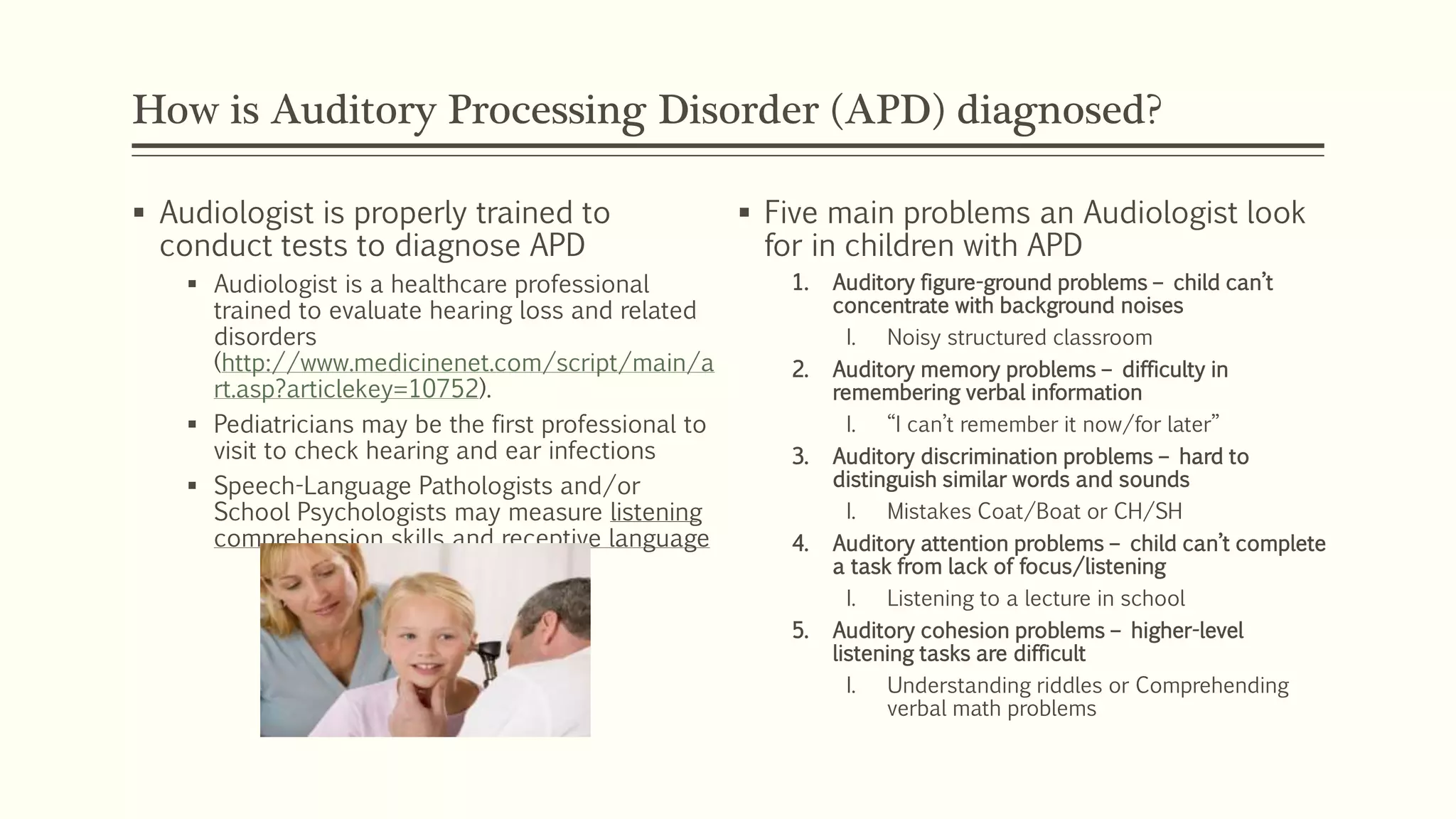
 Pediatricians may be the first professional to
visit to check hearing and ear infections
 Speech-Language Pathologists and/or
School Psychologists may measure listening
comprehension skills and receptive language
 Five main problems an Audiologist look
for in children with APD
1. Auditory figure-ground problems – child can’t
concentrate with background noises
I. Noisy structured classroom
2. Auditory memory problems – difficulty in
remembering verbal information
I. “I can’t remember it now/for later”
3. Auditory discrimination problems – hard to
distinguish similar words and sounds
I. Mistakes Coat/Boat or CH/SH
4. Auditory attention problems – child can’t complete
a task from lack of focus/listening
I. Listening to a lecture in school
5. Auditory cohesion problems – higher-level
listening tasks are difficult
I. Understanding riddles or Comprehending
verbal math problems
How to support children with Auditory Processing Disorder (APD)?
Accommodations at School
 Seating arrangement
 Insist students be seated in front of
classroom
 Improved acoustics
 Close doors and windows to minimize outside
noises
 Assistive Technology
 Headset with a clip on microphone
 Classroom Visuals
 Images and gestures as reinforcements
 Quiet rooms for taking tests
 Special Instruction
 Computer programs
At Home
 Provide a quiet space for studying, with
background noises at a minimum
 Eye contact when speaking
 Use one-step directions
 Speak slightly slower rate and slightly
high volume
 Ask child to repeat directions back to
you, or ask child to write notes as a
reminder
Resources and More Information
 “Auditory Processing Disorder” Auditory Processing Center, LLC. 541 Hwy 80 West
Suite C, Clinton, MS 39056. Web 17 May 2017. http://auditorycenter.com/what-is-
auditory-processing-disorder/
 The Understood Team. “Understanding Auditory Processing Disorder.”
Understood.org. Web 18 May 2017. https://www.understood.org/en/learning-
attention-issues/child-learning-disabilities/auditory-processing-
disorder/understanding-auditory-processing-disorder
 “Auditory Processing Disorder (APD).” KidsHealth.org. Web 19 May 2017.
http://kidshealth.org/en/parents/central-auditory.html

Auditory processing disorder apd

  • 1.
    AUDITORY PROCESSING DISORDER (APD) LEARNINGDISABILITY Joshua Nelson 10522107 Overview of Special Education
  • 2.
    What is AuditoryProcessing Disorder (APD)?  A.K.A. Central Auditory Processing Disorder (CAPD)  Neurological defect between the auditory (hearing) nerve through the higher auditory pathways in the brain  From the outer ear to the brain  Hearing is active, but verbal words are difficult to interpret, recognize, and use acoustic information in society  Information processed will result to inaccurate or incomplete coding of sound because of the delay in the auditory signal transmission  i.e. Listening to a radio station with static interference  Usually involves social surroundings with background noises  i.e. playground, cafeterias, school-events, and parties  5% of school-aged children are reported to have APD  Experts estimate that boys are twice likely to have APD than girls, but there is not evidence to prove the theory
  • 3.
    What are thecommon symptoms and questions to ask to identify APD? Symptoms  Common Symptoms  Constantly saying, “huh?” or “what?”  Ask speakers to repeat what they’ve said  Difficulty remembering detailed information read or heard  Hard to follow with conversations  Distracted with background noises  Interprets words too literally  Frustrated with certain tasks  Easily distracted or bored when conversations or activities do not include visuals  Difficult to find the right words in responses  Inability to sing in tune or poor music ability Questions  Is child easily distracted or unusually bothered by loud or sudden noises?  Are noisy environments upsetting the child?  Does child’s behavior and performance improve in quieter settings?  Does child have difficulty following directions, whether simple or complicated?  Does child have reading, spelling, writing, or other speech-language difficulties?  Are verbal (oral) math problems difficult for child?  Is child disorganized and forgetful?  Are conversations hard for child to follow?
  • 4.
    Causes and Prevalenceof APD  What causes APD?  Exact causes are unknown, but research suggests:  Premature birth or low birthweight  Head Trauma  Chronic Ear Infections  Lead poisoning  Multiple Causes  What is the Prevalence of APD?  Auditory Processing Disorder is often un/misdiagnosed because of other coexisting disorders  i.e. inattentive, ADHD, dyslexic, LD, PDD, behavior problems, or receptive language disorder  25% children with learning disabilities have APD and Dyslexia  Up to 43% of children with learning difficulties have APD  50% children with dyslexia also have APD
  • 5.
    What is itlike to have Auditory Processing Disorder (APD)?  Here is a story by Jaziah  “Jaziah’s Story Part 1” https://www.youtube.com/watch?v=fj2TYS9dOa4  Skills that are in concern with the affect of APD  Communication – may not speak clearly  Might confuse similar sounds (i.e. free instead of three)  Academics – difficult in subjects of reading, spelling, and writing  Understanding verbal instructions is challenging  Social Skills – trouble telling stories or jokes  May avoid conversations with peers because it’s difficult to process what’s been said and think an appropriate response
  • 6.
    Auditory Processing Disorder(APD) Simulation  “Misunderstood Minds” (Activity)  http://www.pbs.org/wgbh/misunderstoodmi nds/experiences/attexp2b.html  How did this activity make you feel?  ???  Confused!  Angry!  Frustrated!  This is where an educator will consider asking parents/caregivers for diagnosis and treatments
  • 7.
    How is AuditoryProcessing Disorder (APD) diagnosed?  Audiologist is properly trained to conduct tests to diagnose APD  Audiologist is a healthcare professional trained to evaluate hearing loss and related disorders (http://www.medicinenet.com/script/main/a rt.asp?articlekey=10752).  Pediatricians may be the first professional to visit to check hearing and ear infections  Speech-Language Pathologists and/or School Psychologists may measure listening comprehension skills and receptive language  Five main problems an Audiologist look for in children with APD 1. Auditory figure-ground problems – child can’t concentrate with background noises I. Noisy structured classroom 2. Auditory memory problems – difficulty in remembering verbal information I. “I can’t remember it now/for later” 3. Auditory discrimination problems – hard to distinguish similar words and sounds I. Mistakes Coat/Boat or CH/SH 4. Auditory attention problems – child can’t complete a task from lack of focus/listening I. Listening to a lecture in school 5. Auditory cohesion problems – higher-level listening tasks are difficult I. Understanding riddles or Comprehending verbal math problems
  • 8.
    How to supportchildren with Auditory Processing Disorder (APD)? Accommodations at School  Seating arrangement  Insist students be seated in front of classroom  Improved acoustics  Close doors and windows to minimize outside noises  Assistive Technology  Headset with a clip on microphone  Classroom Visuals  Images and gestures as reinforcements  Quiet rooms for taking tests  Special Instruction  Computer programs At Home  Provide a quiet space for studying, with background noises at a minimum  Eye contact when speaking  Use one-step directions  Speak slightly slower rate and slightly high volume  Ask child to repeat directions back to you, or ask child to write notes as a reminder
  • 9.
    Resources and MoreInformation  “Auditory Processing Disorder” Auditory Processing Center, LLC. 541 Hwy 80 West Suite C, Clinton, MS 39056. Web 17 May 2017. http://auditorycenter.com/what-is- auditory-processing-disorder/  The Understood Team. “Understanding Auditory Processing Disorder.” Understood.org. Web 18 May 2017. https://www.understood.org/en/learning- attention-issues/child-learning-disabilities/auditory-processing- disorder/understanding-auditory-processing-disorder  “Auditory Processing Disorder (APD).” KidsHealth.org. Web 19 May 2017. http://kidshealth.org/en/parents/central-auditory.html

Editor's Notes

  • #2 NOTE: To change the image on this slide, select the picture and delete it. Then click the Pictures icon in the placeholder to insert your own image.