Sensory Impairments: 
Hearing and Vision 
Chapter 6 in The Exceptional Child: Inclusion in Early Childhood 
Education; Allen, K. Eileen and Cowdery, Glynnis E.; 2015
Sensory Impairments 
• Most all early learning occurs through the senses 
• Vision and hearing impairments are the most common and most 
serious of the sensory impairments, with hearing having the greater 
potential for interfering with development. 
• Hearing impacts language development negatively; in turn, language 
delays impact cognitive development negatively. 
• Hearing also interferes more with social development. 
• Specialists for children with hearing and with vision impairments are 
essential in the early years.
Deafness and Hearing Loss 
• Deafness – even with hearing aids, a person with deafness cannot 
process spoken language 
• Hard of hearing – a lesser hearing loss, but still has an impact on 
development in other domains (social, language, cognitive) 
• Pre-lingual hearing loss – happens prior to the child developing 
language; generally speaking, this is the more likely to negatively 
impact development in other domains. 
• Post-lingual hearing loss – happens after the child has developed 
language.
Types of Hearing Loss 
• Conductive hearing loss – occurs in the outer or middle ear and can 
be corrected with hearing aids (amplification devices); there is no 
interference with the brain processing the messages 
• Sensorineural hearing loss – loss is in the inner ear, either the cochlea 
or auditory nerve; may cause sounds to be intelligible; cochlear 
implant may help, but child is generally 12 months or more before 
this can be done. 
• Higher auditory cortex – causes central deafness
Signs of Hearing Loss 
• Infants who do not exhibit behaviors associated with startle 
responses or localization of sounds (turning head towards sounds or 
mother’s voice) may have a hearing loss 
• Some people have residual hearing – intermittent hearing due to 
allergies, ear infections, or other problems that interfere with 
hearing; this may be harder to recognize. 
• Signs such as tugging at the ears, discharge from the ears, ear 
infections, or delays in language development may all be signs of 
hearing loss. 
• The text provides many symptoms on pp. 122 & 123.
Problems Caused by Hearing Loss 
• Hearing loss has a cumulative effect on a child’s social, language, and 
cognitive development. 
• Children with “moderate to severe hearing loss are educationally 
delayed by as much as three to five years” (Allen & Cowdery; 2015) 
• They may exhibit social and behavioral problems 
• They may fall even further behind as school becomes more difficult
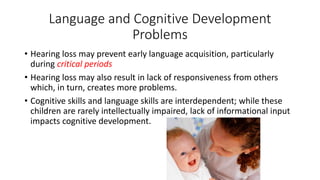
Language and Cognitive Development 
Problems 
• Hearing loss may prevent early language acquisition, particularly 
during critical periods 
• Hearing loss may also result in lack of responsiveness from others 
which, in turn, creates more problems. 
• Cognitive skills and language skills are interdependent; while these 
children are rarely intellectually impaired, lack of informational input 
impacts cognitive development.
Social Development Problems 
• Children with a hearing loss are often left out of social experiences 
and stimulation because of a lack of responsiveness. 
• Evidence of negative social behaviors during preschool years for 
children with hearing loss 
• Give and take skills associated with making friends and interacting 
with others may be lacking. 
• These children miss out on many of the nuances of natural social 
development facilitated by interactions with others and language.
Family Challenges 
• The more severe the hearing loss, the more challenging the problems 
are likely to be 
• Parents may have a hard time imposing limits, from the child 
understanding to the time required to fully help a child with these 
serious challenges. 
• Many approaches are necessary, including language for the child and 
the family and behavior intervention. 
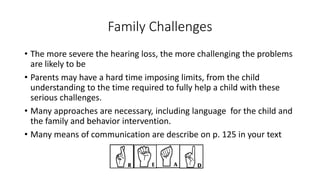
• Many means of communication are describe on p. 125 in your text
What to Use? 
• Generally speaking, a total approach to communication is preferred. 
• Children with hearing loss face further discrimination if their language 
is a language that no one around them speaks (i.e. only American Sign 
Language) 
• Signing has been shown to be effective even with typically developing 
children who are acquiring spoken language or children with an 
intellectual disability with little or no oral language. 
• No matter what is chosen, children must receive language stimulation 
and adults must become trained in best communicating with a child 
with hearing loss.
Suggestions for Teachers 
• The text provides a list of several suggestions for supporting and 
communicating with a child with a hearing loss. 
• Many of these suggestions are relevant for any young children 
acquiring language. 
• Finally, the text describes a teacher’s responsibilities for helping a 
child maintain his or her amplification devices.
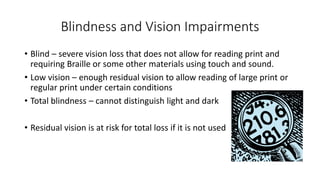
Blindness and Vision Impairments 
• Blind – severe vision loss that does not allow for reading print and 
requiring Braille or some other materials using touch and sound. 
• Low vision – enough residual vision to allow reading of large print or 
regular print under certain conditions 
• Total blindness – cannot distinguish light and dark 
• Residual vision is at risk for total loss if it is not used
Types of Vision Problems 
• Most vision problems are caused by physical abnormalities 
• Cataracts and glaucoma 
• Retinopathy of prematurity – less occurrence of this now that oxygen levels 
are controlled better for premature babies 
• Cortical blindness – visual impairments associated with the brain 
• Visual acuity, astigmatism, myopia, and hyperopia – generally corrected with 
glasses 
• Other vision problems are caused by muscle abnormalities 
• Strabismus, amblyopia, and nystagmus
Identifying Vision Problems 
• Blindness is identified relatively early 
• Partial losses may not be detected until a child is in school, especially 
once print gets smaller. 
• Children do not know what they are supposed to be seeing, so they 
do not realize they have vision problems. 
• Warning signs of vision problems are on pp. 132 in your text.
Vision Problems and Development 
• Learning comes from seeing, watching others, and observing. 
• Vision problems impact development in all of the developmental 
domains 
• Children with severe vision impairments may not be able to interact 
with the environment safely and freely 
• Children with severe vision problems may engage in blindisms, which 
are atypical behaviors that children with severe vision loss may have. 
• Language acquisition happens when children learn to identify objects; 
visually impaired children must rely on other senses to interact with 
objects.
Vision Problems and Development (Cont.) 
• Children with vision problems generally fall behind their typically 
developing peers the first few years of life, but are often able to catch 
up by five or six with appropriate interventions. 
• Motor development is impacted because children with vision 
problems cannot judge where things are in relation to them. 
• Social development and play skills may develop more slowly with a 
child with visual impairments. Adults need to use language as they 
describe events and promote socialization.
Families and Early Intervention 
• Parents can be encouraged to interact; visually impaired children can 
sense smiles and other social cues. 
• Early programs focus on family interactions 
• Toddlers and preschoolers may attend center-based care 
• Children learn adaptive behaviors for getting around 
• Orientation and mobility specialists help classroom teachers provide safe and 
appropriate environments for children with visual impairments. 
• Adults may need to learn appropriate responses to mishaps involving children 
with visual impairments. 
• Guidelines for teachers are on pp. 136 – 137 in your text.

Sensory impairments fa2014

  • 1.
    Sensory Impairments: Hearingand Vision Chapter 6 in The Exceptional Child: Inclusion in Early Childhood Education; Allen, K. Eileen and Cowdery, Glynnis E.; 2015
  • 2.
    Sensory Impairments •Most all early learning occurs through the senses • Vision and hearing impairments are the most common and most serious of the sensory impairments, with hearing having the greater potential for interfering with development. • Hearing impacts language development negatively; in turn, language delays impact cognitive development negatively. • Hearing also interferes more with social development. • Specialists for children with hearing and with vision impairments are essential in the early years.
  • 3.
    Deafness and HearingLoss • Deafness – even with hearing aids, a person with deafness cannot process spoken language • Hard of hearing – a lesser hearing loss, but still has an impact on development in other domains (social, language, cognitive) • Pre-lingual hearing loss – happens prior to the child developing language; generally speaking, this is the more likely to negatively impact development in other domains. • Post-lingual hearing loss – happens after the child has developed language.
  • 4.
    Types of HearingLoss • Conductive hearing loss – occurs in the outer or middle ear and can be corrected with hearing aids (amplification devices); there is no interference with the brain processing the messages • Sensorineural hearing loss – loss is in the inner ear, either the cochlea or auditory nerve; may cause sounds to be intelligible; cochlear implant may help, but child is generally 12 months or more before this can be done. • Higher auditory cortex – causes central deafness
  • 5.
    Signs of HearingLoss • Infants who do not exhibit behaviors associated with startle responses or localization of sounds (turning head towards sounds or mother’s voice) may have a hearing loss • Some people have residual hearing – intermittent hearing due to allergies, ear infections, or other problems that interfere with hearing; this may be harder to recognize. • Signs such as tugging at the ears, discharge from the ears, ear infections, or delays in language development may all be signs of hearing loss. • The text provides many symptoms on pp. 122 & 123.
  • 6.
    Problems Caused byHearing Loss • Hearing loss has a cumulative effect on a child’s social, language, and cognitive development. • Children with “moderate to severe hearing loss are educationally delayed by as much as three to five years” (Allen & Cowdery; 2015) • They may exhibit social and behavioral problems • They may fall even further behind as school becomes more difficult
  • 7.
    Language and CognitiveDevelopment Problems • Hearing loss may prevent early language acquisition, particularly during critical periods • Hearing loss may also result in lack of responsiveness from others which, in turn, creates more problems. • Cognitive skills and language skills are interdependent; while these children are rarely intellectually impaired, lack of informational input impacts cognitive development.
  • 8.
    Social Development Problems • Children with a hearing loss are often left out of social experiences and stimulation because of a lack of responsiveness. • Evidence of negative social behaviors during preschool years for children with hearing loss • Give and take skills associated with making friends and interacting with others may be lacking. • These children miss out on many of the nuances of natural social development facilitated by interactions with others and language.
  • 9.
    Family Challenges •The more severe the hearing loss, the more challenging the problems are likely to be • Parents may have a hard time imposing limits, from the child understanding to the time required to fully help a child with these serious challenges. • Many approaches are necessary, including language for the child and the family and behavior intervention. • Many means of communication are describe on p. 125 in your text
  • 10.
    What to Use? • Generally speaking, a total approach to communication is preferred. • Children with hearing loss face further discrimination if their language is a language that no one around them speaks (i.e. only American Sign Language) • Signing has been shown to be effective even with typically developing children who are acquiring spoken language or children with an intellectual disability with little or no oral language. • No matter what is chosen, children must receive language stimulation and adults must become trained in best communicating with a child with hearing loss.
  • 11.
    Suggestions for Teachers • The text provides a list of several suggestions for supporting and communicating with a child with a hearing loss. • Many of these suggestions are relevant for any young children acquiring language. • Finally, the text describes a teacher’s responsibilities for helping a child maintain his or her amplification devices.
  • 12.
    Blindness and VisionImpairments • Blind – severe vision loss that does not allow for reading print and requiring Braille or some other materials using touch and sound. • Low vision – enough residual vision to allow reading of large print or regular print under certain conditions • Total blindness – cannot distinguish light and dark • Residual vision is at risk for total loss if it is not used
  • 13.
    Types of VisionProblems • Most vision problems are caused by physical abnormalities • Cataracts and glaucoma • Retinopathy of prematurity – less occurrence of this now that oxygen levels are controlled better for premature babies • Cortical blindness – visual impairments associated with the brain • Visual acuity, astigmatism, myopia, and hyperopia – generally corrected with glasses • Other vision problems are caused by muscle abnormalities • Strabismus, amblyopia, and nystagmus
  • 14.
    Identifying Vision Problems • Blindness is identified relatively early • Partial losses may not be detected until a child is in school, especially once print gets smaller. • Children do not know what they are supposed to be seeing, so they do not realize they have vision problems. • Warning signs of vision problems are on pp. 132 in your text.
  • 15.
    Vision Problems andDevelopment • Learning comes from seeing, watching others, and observing. • Vision problems impact development in all of the developmental domains • Children with severe vision impairments may not be able to interact with the environment safely and freely • Children with severe vision problems may engage in blindisms, which are atypical behaviors that children with severe vision loss may have. • Language acquisition happens when children learn to identify objects; visually impaired children must rely on other senses to interact with objects.
  • 16.
    Vision Problems andDevelopment (Cont.) • Children with vision problems generally fall behind their typically developing peers the first few years of life, but are often able to catch up by five or six with appropriate interventions. • Motor development is impacted because children with vision problems cannot judge where things are in relation to them. • Social development and play skills may develop more slowly with a child with visual impairments. Adults need to use language as they describe events and promote socialization.
  • 17.
    Families and EarlyIntervention • Parents can be encouraged to interact; visually impaired children can sense smiles and other social cues. • Early programs focus on family interactions • Toddlers and preschoolers may attend center-based care • Children learn adaptive behaviors for getting around • Orientation and mobility specialists help classroom teachers provide safe and appropriate environments for children with visual impairments. • Adults may need to learn appropriate responses to mishaps involving children with visual impairments. • Guidelines for teachers are on pp. 136 – 137 in your text.