Auditory and visual processing disorders
Presented by:
Samhitha J
Assistant professor
Department of child health
nursing
Narayana college of nursing
Learning Disabilities
 The term learning disabilities was only founded in
1963 by Samuel Kirk. At that time, children with LD
were referred to by such terms as:
“perceptually handicapped,” “brain-injured,” and
“neurologically impaired”
 were served in classrooms for students with MR or in
most cases, were not receiving any specialized
services in the public schools.
Definition by Learning Disability under
IDEA (individuals with disabilities act)
LEARNING DISABILITY:
(1) A disorder in the processing of information involved
in understanding and using language (spoken or written)
(2) Difficulties in learning, particularly reading, writing,
mathematics, and/or spelling
(3) The problem is not primarily due to other causes
(4) Special educational services needed to succeed in
school
**Severe discrepancy between potential and achievement
Processing of Information
Information processing refers to how the brain:
 Takes in information,
 Uses information,
 Stores the information in memory,
 Retrieves the information from memory,
 and Expresses the information
Visual and Auditory Processing
Disorders
 Visual and auditory processing are the processes of
recognizing and interpreting information taken in
through the senses of sight and sound.
 The terms, "visual and auditory processing" and "visual
and auditory perception", are often used
interchangeably.
 Although there are many types of perception, the two
most common areas of difficulty involved with a
learning disability are visual and auditory perception.
Cont..
 Other terms which refer to the same set of disorders
include
 visual or auditory perceptual disorders,
 visual or auditory processing deficits,
 central auditory processing disorders,
 and other similar combinations of these terms.
Visual processing disorder
 A visual processing, or perceptual, disorder refers to “a
hindered ability to make sense of information taken in
through the eyes”.
 This is different from problems involving sight or
sharpness of vision.
 Difficulties with visual processing affect how visual
information is interpreted, or processed by the brain.
Common Visual Processing
Disorders
 The common abnormalities of visual processing
involves
 Visual Discrimination
 Visual Figure-Ground Discrimination
 Visual Sequencing
 Visual Motor Processing
 Visual Memory
 Visual Closure
 Spatial Relationships
Visual Discrimination: Using the sense of sight to notice
and compare the features of different items to
distinguish one item from another
Difficulties Observed
 Seeing the difference between two similar letters, shapes
or objects
 Noticing the similarities and differences between certain
colors, shapes and patterns
Types of Helpful Strategies:
 Clearly space words/problems on a page
 Anticipate confusions and point out examples of correct
responses
Visual Figure-Ground Discrimination:
Discriminating a shape or printed character from its
background
Difficulties Observed
 Finding a specific bit of information on a printed page
full of words and numbers
 Seeing an image within a competing background
Types of Helpful Strategies:
 Practice with 'find the item' challenges, such as
"Where's Waldo?"
 Use an index card or marker when reading to blot out
distraction of other words
 Highlight useful information while reading
Visual Sequencing: The ability to see and distinguish
the order of symbols, words or images
Difficulties Observed
 Using a separate answer sheet
 Staying in the right place while reading a paragraph.
Example: skipping lines, reading the same line over
and over
 Reversing or misreading letters, numbers and words
 Understanding math equations
Types of Helpful Strategies:
 Combine reading with oral presentation.
 Color code written instruction
Visual Motor Processing: Using feedback from the eyes
to coordinate the movement of other parts of the body
Difficulties Observed
 Writing within lines or margins of a piece of paper
 Copying from a board or book
 Moving around without bumping into things
 Participating in sports that require well-timed and
precise movements in space
Types of Helpful Strategies:
 Allow use of a computer and tape recorder
 Substitute oral reports for written ones
 Provide a "note buddy" to check that topic notes are
clear and well-organized
Visual Memory: There are two kinds of visual memory:
 Long-term visual memory is the ability to recall
something seen some time ago
 Short-term visual memory is the ability to remember
something seen very recently
Difficulties Observed
 Remembering the spelling of familiar words with
irregular spelling
 Reading comprehension
 Using a calculator or keyboard with speed and accuracy
 Remembering phone numbers
Types of Helpful Strategies:
 Provide handouts that are clearly written.
 Provide oral instruction to reinforce written directions
Visual Closure: The ability to know what an object is
when only parts of it are visible
 Recognizing a picture of a familiar object from a partial
image. Example: A truck without its wheels
 Identifying a word with a letter missing
 Recognizing a face when one feature (such as the nose)
is missing
 Types of Helpful Strategies:
 Practice with jigsaw puzzles and rebus-type games
Spatial Relationships: The ability to understand how
objects are positioned in space in relation to oneself.
This involves the understanding of distance (near or far),
as well as the relationship of objects and characters
described on paper or in a spoken narrative
Difficulties Observed
 Getting from one place to another
 Spacing letters and words on paper
 Judging time
 Reading maps
Types of Helpful Strategies:
 Practice estimating distance with ball games and using
a tape measure
 Create maps and travel logs
 Practice social skills that focus on judging appropriate
physical proximity to others
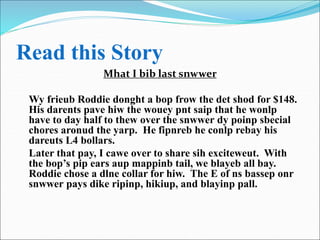
Read this Story
Mhat I bib last snwwer
Wy frieub Roddie donght a bop frow the det shod for $148.
His darents pave hiw the wouey pnt saip that he wonlp
have to day half to thew over the snwwer dy poinp sbecial
chores aronud the yarp. He fipnreb he conlp rebay his
dareuts L4 bollars.
Later that pay, I cawe over to share sih exciteweut. With
the bop’s pip ears aup mappinb tail, we blayeb all bay.
Roddie chose a dlne collar for hiw. The E of ns bassep onr
snwwer pays dike ripinp, hikiup, and blayinp pall.
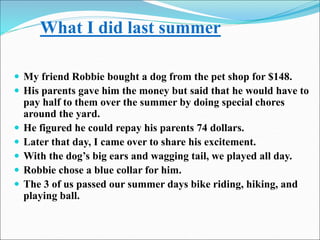
What I did last summer
 My friend Robbie bought a dog from the pet shop for $148.
 His parents gave him the money but said that he would have to
pay half to them over the summer by doing special chores
around the yard.
 He figured he could repay his parents 74 dollars.
 Later that day, I came over to share his excitement.
 With the dog’s big ears and wagging tail, we played all day.
 Robbie chose a blue collar for him.
 The 3 of us passed our summer days bike riding, hiking, and
playing ball.
1. Auditory Processing
Auditory Processing- involves how well a student
can use auditory information.
 When he hears something, especially something
detailed, does he understand it quickly and easily?
Can he “hear" things (like sounds, numbers, words,
etc.) in his head? Can he remember information that
he hears?
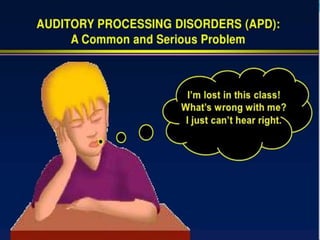
 APD is a difficulty in the way auditory information
is processed. It is not a sensory (inner ear) hearing
impairment. ... APD is a term that describes a variety
of listeningproblems that can interfere with
the processing of auditory information.
 Common areas of difficulty and some educational
implications:
 Phonological awareness :understanding that
language is made up of individual sounds (phonemes)
which are put together to form the words we write and
speak.
Abnormality: unable to recognize or isolate the
individual sounds in a word, recognize similarities
between words (as in rhyming words), or be able to
identify the number of sounds in a word.
Interventions: Though phonological awareness develops
naturally in most children, the necessary knowledge
and skills can be taught through direct instruction for
those who have difficulty in this area.
 Auditory discrimination
 Auditory discrimination is the ability to recognize
differences in phonemes (sounds). This includes the
ability to identify words and sounds that are similar and
those which are different.
 Auditory memory
 Auditory memory is the ability to store and recall
information which was given verbally. An individual
with difficulties in this area may not be able to follow
instructions given verbally or may have trouble recalling
information from a story read aloud.
 Auditory sequencing
 Auditory sequencing is the ability to remember or
reconstruct the order of items in a list or the order of
sounds in a word or syllable. One example is saying or
writing "ephelant" for "elephant."
 Auditory blending
 Auditory blending is the process of putting together
phonemes to form words. For example, the individual
phonemes "c", "a", and "t" are blended to from the
word, "cat".
Interventions
 If instructions are given orally, try to supplement this
with written or other visual cues.
 A simple accommodation like backing up verbal
directions with visual or written cues is one way to
facilitate this.
 Simplifying verbal directions, slowing the rate of
speech, and minimalizing distractions
 Rhyming games, Sorting games can help build
auditory memory.
 Learning materials should easily accessible, well
organized and stored in the same place each day
Cont…
 Make sure that the child's desk is free from all
unnecessary materials.
 Try to separate him from students who may be
distracting.
SAMHITHA AUDITORY VISUAL.ppt

SAMHITHA AUDITORY VISUAL.ppt

  • 1.
    Auditory and visualprocessing disorders Presented by: Samhitha J Assistant professor Department of child health nursing Narayana college of nursing
  • 2.
    Learning Disabilities  Theterm learning disabilities was only founded in 1963 by Samuel Kirk. At that time, children with LD were referred to by such terms as: “perceptually handicapped,” “brain-injured,” and “neurologically impaired”  were served in classrooms for students with MR or in most cases, were not receiving any specialized services in the public schools.
  • 3.
    Definition by LearningDisability under IDEA (individuals with disabilities act) LEARNING DISABILITY: (1) A disorder in the processing of information involved in understanding and using language (spoken or written) (2) Difficulties in learning, particularly reading, writing, mathematics, and/or spelling (3) The problem is not primarily due to other causes (4) Special educational services needed to succeed in school **Severe discrepancy between potential and achievement
  • 4.
    Processing of Information Informationprocessing refers to how the brain:  Takes in information,  Uses information,  Stores the information in memory,  Retrieves the information from memory,  and Expresses the information
  • 5.
    Visual and AuditoryProcessing Disorders  Visual and auditory processing are the processes of recognizing and interpreting information taken in through the senses of sight and sound.  The terms, "visual and auditory processing" and "visual and auditory perception", are often used interchangeably.  Although there are many types of perception, the two most common areas of difficulty involved with a learning disability are visual and auditory perception.
  • 6.
    Cont..  Other termswhich refer to the same set of disorders include  visual or auditory perceptual disorders,  visual or auditory processing deficits,  central auditory processing disorders,  and other similar combinations of these terms.
  • 7.
    Visual processing disorder A visual processing, or perceptual, disorder refers to “a hindered ability to make sense of information taken in through the eyes”.  This is different from problems involving sight or sharpness of vision.  Difficulties with visual processing affect how visual information is interpreted, or processed by the brain.
  • 8.
    Common Visual Processing Disorders The common abnormalities of visual processing involves  Visual Discrimination  Visual Figure-Ground Discrimination  Visual Sequencing  Visual Motor Processing  Visual Memory  Visual Closure  Spatial Relationships
  • 9.
    Visual Discrimination: Usingthe sense of sight to notice and compare the features of different items to distinguish one item from another Difficulties Observed  Seeing the difference between two similar letters, shapes or objects  Noticing the similarities and differences between certain colors, shapes and patterns Types of Helpful Strategies:  Clearly space words/problems on a page  Anticipate confusions and point out examples of correct responses
  • 10.
    Visual Figure-Ground Discrimination: Discriminatinga shape or printed character from its background Difficulties Observed  Finding a specific bit of information on a printed page full of words and numbers  Seeing an image within a competing background Types of Helpful Strategies:  Practice with 'find the item' challenges, such as "Where's Waldo?"  Use an index card or marker when reading to blot out distraction of other words  Highlight useful information while reading
  • 11.
    Visual Sequencing: Theability to see and distinguish the order of symbols, words or images Difficulties Observed  Using a separate answer sheet  Staying in the right place while reading a paragraph. Example: skipping lines, reading the same line over and over  Reversing or misreading letters, numbers and words  Understanding math equations Types of Helpful Strategies:  Combine reading with oral presentation.  Color code written instruction
  • 12.
    Visual Motor Processing:Using feedback from the eyes to coordinate the movement of other parts of the body Difficulties Observed  Writing within lines or margins of a piece of paper  Copying from a board or book  Moving around without bumping into things  Participating in sports that require well-timed and precise movements in space Types of Helpful Strategies:  Allow use of a computer and tape recorder  Substitute oral reports for written ones  Provide a "note buddy" to check that topic notes are clear and well-organized
  • 13.
    Visual Memory: Thereare two kinds of visual memory:  Long-term visual memory is the ability to recall something seen some time ago  Short-term visual memory is the ability to remember something seen very recently Difficulties Observed  Remembering the spelling of familiar words with irregular spelling  Reading comprehension  Using a calculator or keyboard with speed and accuracy  Remembering phone numbers Types of Helpful Strategies:  Provide handouts that are clearly written.  Provide oral instruction to reinforce written directions
  • 14.
    Visual Closure: Theability to know what an object is when only parts of it are visible  Recognizing a picture of a familiar object from a partial image. Example: A truck without its wheels  Identifying a word with a letter missing  Recognizing a face when one feature (such as the nose) is missing  Types of Helpful Strategies:  Practice with jigsaw puzzles and rebus-type games
  • 15.
    Spatial Relationships: Theability to understand how objects are positioned in space in relation to oneself. This involves the understanding of distance (near or far), as well as the relationship of objects and characters described on paper or in a spoken narrative Difficulties Observed  Getting from one place to another  Spacing letters and words on paper  Judging time  Reading maps
  • 16.
    Types of HelpfulStrategies:  Practice estimating distance with ball games and using a tape measure  Create maps and travel logs  Practice social skills that focus on judging appropriate physical proximity to others
  • 17.
    Read this Story MhatI bib last snwwer Wy frieub Roddie donght a bop frow the det shod for $148. His darents pave hiw the wouey pnt saip that he wonlp have to day half to thew over the snwwer dy poinp sbecial chores aronud the yarp. He fipnreb he conlp rebay his dareuts L4 bollars. Later that pay, I cawe over to share sih exciteweut. With the bop’s pip ears aup mappinb tail, we blayeb all bay. Roddie chose a dlne collar for hiw. The E of ns bassep onr snwwer pays dike ripinp, hikiup, and blayinp pall.
  • 18.
    What I didlast summer  My friend Robbie bought a dog from the pet shop for $148.  His parents gave him the money but said that he would have to pay half to them over the summer by doing special chores around the yard.  He figured he could repay his parents 74 dollars.  Later that day, I came over to share his excitement.  With the dog’s big ears and wagging tail, we played all day.  Robbie chose a blue collar for him.  The 3 of us passed our summer days bike riding, hiking, and playing ball.
  • 20.
    1. Auditory Processing AuditoryProcessing- involves how well a student can use auditory information.  When he hears something, especially something detailed, does he understand it quickly and easily? Can he “hear" things (like sounds, numbers, words, etc.) in his head? Can he remember information that he hears?
  • 21.
     APD isa difficulty in the way auditory information is processed. It is not a sensory (inner ear) hearing impairment. ... APD is a term that describes a variety of listeningproblems that can interfere with the processing of auditory information.
  • 22.
     Common areasof difficulty and some educational implications:  Phonological awareness :understanding that language is made up of individual sounds (phonemes) which are put together to form the words we write and speak. Abnormality: unable to recognize or isolate the individual sounds in a word, recognize similarities between words (as in rhyming words), or be able to identify the number of sounds in a word. Interventions: Though phonological awareness develops naturally in most children, the necessary knowledge and skills can be taught through direct instruction for those who have difficulty in this area.
  • 23.
     Auditory discrimination Auditory discrimination is the ability to recognize differences in phonemes (sounds). This includes the ability to identify words and sounds that are similar and those which are different.  Auditory memory  Auditory memory is the ability to store and recall information which was given verbally. An individual with difficulties in this area may not be able to follow instructions given verbally or may have trouble recalling information from a story read aloud.
  • 24.
     Auditory sequencing Auditory sequencing is the ability to remember or reconstruct the order of items in a list or the order of sounds in a word or syllable. One example is saying or writing "ephelant" for "elephant."  Auditory blending  Auditory blending is the process of putting together phonemes to form words. For example, the individual phonemes "c", "a", and "t" are blended to from the word, "cat".
  • 25.
    Interventions  If instructionsare given orally, try to supplement this with written or other visual cues.  A simple accommodation like backing up verbal directions with visual or written cues is one way to facilitate this.  Simplifying verbal directions, slowing the rate of speech, and minimalizing distractions  Rhyming games, Sorting games can help build auditory memory.  Learning materials should easily accessible, well organized and stored in the same place each day
  • 26.
    Cont…  Make surethat the child's desk is free from all unnecessary materials.  Try to separate him from students who may be distracting.