RAY 
GALLON 
C U L T U R E C O M 
Presentation 
@RayGallon 
© 
2014 
Ray 
Gallon 
A Dive Into the Quantum Funnel 
Filling 
the 
Black 
Holes 
of 
Knowledge 
Transformation 
The 
Society
RAY 
GALLON 
C U LT U R E C O M 
Presentation 
@RayGallon 
© 
2014 
Ray 
Gallon 
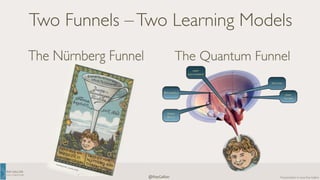
Two Funnels – Two Learning Models
RAY 
GALLON 
C U LT U R E C O M 
Presentation 
@RayGallon 
© 
2014 
Ray 
Gallon 
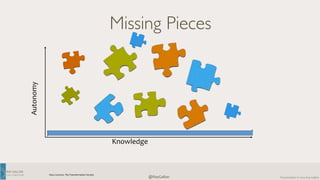
Missing Pieces 
Knowledge 
Autonomy 
Neus 
Lorenzo, 
The 
Transformation 
Society
RAY 
GALLON 
C U LT U R E C O M 
http://upload.wikimedia.org/wikipedia/commons/5/5e/BH_LMC.png http://wallse.net/search/t/e3/b3b.jpg 
Presentation 
The Black Holes of Knowledge! 
What Are Yours? 
@RayGallon 
© 
2014 
Ray 
Gallon 
http://upload.wikimedia.org/wikipedia/commons/c/cd/Black_Hole_Milkyway.jpg 
Image 
by 
Mark 
Van 
Norden 
http://farm9.staticflickr.com/8342/8275081235_35eb0091a9_z.jpg
RAY 
GALLON 
C U LT U R E C O M 
Presentation 
@RayGallon 
© 
2014 
Ray 
Gallon 
What We Used to Use
RAY 
GALLON 
C U LT U R E C O M 
Presentation 
@RayGallon 
© 
2014 
Ray 
Gallon 
What We Use Today
RAY 
GALLON 
C U LT U R E C O M 
Presentation 
@RayGallon 
© 
2014 
Ray 
Gallon 
How it’s Different 
Predetermined 
Static 
Structure 
Flexible, 
Emergent 
Structure, 
based 
on 
Contingent 
Need
RAY 
GALLON 
C U LT U R E C O M 
Presentation 
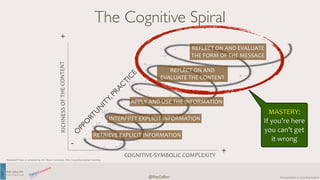
REFLECT 
ON 
AND 
EVALUATE 
THE 
FORM 
OF 
THE 
MESSAGE 
REFLECT 
ON 
AND 
EVALUATE 
THE 
CONTENT 
APPLY 
AND 
USE 
THE 
INFORMATION 
RETRIEVE 
EXPLICIT 
INFORMATION 
@RayGallon 
© 
2014 
Ray 
Gallon 
OPPORTUNITY, PRACTICE 
COGNITIVE-­‐SYMBOLIC 
COMPLEXITY 
+ 
CONTENT 
THE 
OF 
RICHNESS 
+ 
- 
The Cognitive Spiral 
Adapted from a scheme by Dr. Neus Lorenzo, The Transformation Society 
INTERPRET 
EXPLICIT 
INFORMATION 
MASTERY: 
If 
you’re 
here 
you 
can’t 
get 
it 
wrong
RAY 
GALLON 
C U LT U R E C O M 
Presentation 
Pay Being 
seated Eat 
Choose 
@RayGallon 
© 
2014 
Ray 
Gallon 
Active Learning: Learning by Doing 
Roger 
C. 
Schank’s 
Schema 
-­‐ 
We 
remember 
independent, 
self-­‐ 
contained 
scripts, 
or 
Memory 
Organization 
Packets 
(MOP’s) 
Restaurant Airplane Clothing 
Shop 
Pay Being 
seated Eat 
Choose 
Romantic 
Conversation 
Pay 
Choose 
Fasten 
Seatbelt 
Try 
on 
MOP’s 
are 
composed 
of 
scenes, 
which 
can 
be 
generalized 
from 
one 
MOP 
to 
another 
Serve 
wine 
REF: 
http://cogprints.org/637/1/LearnbyDoing_Schank.html
RAY 
GALLON 
C U LT U R E C O M 
If 
we 
learn 
about 
“paying” 
in 
a 
restaurant... 
Are 
we 
learning 
something 
specific 
to 
the 
MOP 
“Restaurant?” 
Are 
we 
learning 
something 
generalizable 
to 
multiple 
MOP’s 
-­‐ 
i.e. 
a 
scene 
called 
“paying?” 
Are 
we 
learning 
something 
about 
some 
more 
abstract 
MOP 
that 
has 
nothing 
to 
do 
with 
the 
current 
MOP 
or 
scene 
(e.g. 
“economy”)? 
Presentation 
@RayGallon 
© 
2014 
Ray 
Gallon 
Questions
RAY 
GALLON 
C U LT U R E C O M 
Presentation 
@RayGallon 
© 
2014 
Ray 
Gallon 
Active Learning: Learning by Doing 
Networks 
of 
Scenes 
Pay 
Network 
Restaurant Airplane Clothing 
Shop 
Pay Being 
seated Eat 
Choose 
Pay Being 
seated Eat 
Choose 
Pay 
Choose 
Fasten 
Seatbelt 
Try 
on 
MOP’s 
are 
composed 
of 
scenes, 
which 
can 
be 
generalized 
from 
one 
MOP 
to 
another 
Serve 
wine 
REF: 
http://cogprints.org/637/1/LearnbyDoing_Schank.html 
Choose 
Network 
Eat 
Network
RAY 
GALLON 
C U LT U R E C O M 
Presentation 
@RayGallon 
© 
2014 
Ray 
Gallon 
Networks of Networks 
understandings 
Exchanging 
of 
of 
networks 
expands 
communicate 
scenes 
our 
to 
ability 
mutually 
to 
them 
beginners 
http://socialpsychologyeye.files.wordpress.com/2011/04/strange_group.jpg
RAY 
GALLON 
C U LT U R E C O M 
Presentation 
@RayGallon 
© 
2014 
Ray 
Gallon 
Exper t customers are 
less prone to 
making errors
RAY 
GALLON 
C U LT U R E C O M 
Presentation 
REFLECT 
ON 
AND 
EVALUATE 
THE 
FORM 
OF 
THE 
MESSAGE 
REFLECT 
ON 
AND 
EVALUATE 
THE 
CONTENT 
APPLY 
AND 
USE 
THE 
INFORMATION 
RETRIEVE 
EXPLICIT 
INFORMATION 
@RayGallon 
© 
2014 
Ray 
Gallon 
OPPORTUNITY, PRACTICE 
COGNITIVE-­‐SYMBOLIC 
COMPLEXITY 
+ 
CONTENT 
THE 
OF 
RICHNESS 
+ 
- 
The Cognitive Spiral 
Adapted from a scheme by Dr. Neus Lorenzo, The Transformation Society 
INTERPRET 
EXPLICIT 
INFORMATION 
If 
you’re 
here 
you 
can’t 
get 
it 
wrong: 
EXPERT!
RAY 
GALLON 
C U LT U R E C O M 
Presentation 
@RayGallon 
© 
2014 
Ray 
Gallon 
Build Cognitive Demand 
to Build Expert Users 
Any 
Ideas?
RAY 
GALLON 
C U LT U R E C O M 
Presentation 
@RayGallon 
© 
2014 
Ray 
Gallon 
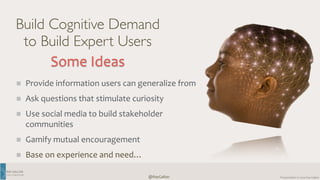
Build Cognitive Demand 
to Build Expert Users 
Some 
Ideas 
Provide 
information 
users 
can 
generalize 
from 
Ask 
questions 
that 
stimulate 
curiosity 
Use 
social 
media 
to 
build 
stakeholder 
communities 
Gamify 
mutual 
encouragement 
Base 
on 
experience 
and 
need…
RAY 
GALLON 
C U LT U R E C O M 
Picture: Greg Scullin. http://www.weeklytimesnow.com.au/article/2013/03/20/563539_business-news.html 
What Kind of Mastery? 
The 
Gardener 
Knows 
the 
Flower 
Because 
He 
is 
an 
Expert 
in 
his 
Field 
Presentation 
@RayGallon 
© 
2014 
Ray 
Gallon
RAY 
GALLON 
C U LT U R E C O M 
Presentation 
@RayGallon 
© 
2014 
Ray 
Gallon 
The bee knows the flower 
from experience and need 
h"p://es.slideshare.net/gretacalinda/natures-­‐beauty
RAY 
GALLON 
C U LT U R E C O M 
Presentation 
Criteria Selection 
Complexity 
Cognition 
Communication 
@RayGallon 
© 
2014 
Ray 
Gallon 
The Linguistic Competency Funnel 
Integrated Learning 
Quantity 
Quality 
Literal Content 
C2 Mastery 
B1 Threshold 
A2 Basic 
A1 Beginner 
Community 
C1 Functional 
B2 Advanced 
Interfaces, hardware, software, 
user assistance, hands-on and 
conceptual combined 
In moving from contingent need to 
confusion, we still learn more. 
COMPLEXITY ≠ CHAOS! 
Quantity of information > contingent 
need 
!l 
earner gets confused, 
sense of chaos 
! 
Can’t keep track of it all 
Neus 
Lorenzo, 
The 
Transformation 
Society
RAY 
GALLON 
C U LT U R E C O M 
Presentation 
@RayGallon 
© 
2014 
Ray 
Gallon 
The OECD Has Added 
Collaborative Problem-Solving To 
Its Pisa Tests Of Basic 
Competencies For 2015 And 
Beyond
Components of Collaborative Problem-Solving 
RAY 
GALLON 
C U LT U R E C O M 
Presentation 
@RayGallon 
© 
2014 
Ray 
Gallon 
PISA 2015 
Ref: 
http://www.agenciaeducacion.cl/wp-­‐content/uploads/2013/04/Presentacion-­‐Looi-­‐Chee-­‐Kit.pdf
RAY 
GALLON 
C U LT U R E C O M 
Presentation 
D3 Team Feedback and adaptation 
organisation 
Monitoring/evaluating results 
D2 Action 
C3 Team 
organisation Planning and 
Enacting plans 
Identify tasks 
C2 Action 
B2 Action 
A3 Team organisation Understanding roles 
Choose type of collaborative 
interaction 
@RayGallon 
© 
2014 
Ray 
Gallon 
The Collaborative Mastery Funnel 
Integrated Learning 
Quantity 
Quality 
Discovering team’s 
abilities 
A2 Action 
A1 Understanding 
Exploring and 
Understanding 
Common ground 
B1 Understanding 
Describe team roles 
(rules of engagement) 
B3 Team 
organisation 
Representing 
and Formulating 
Communicating about tasks 
C1 Understanding 
Mutual engagement 
per rules 
Executing 
Monitoring/repairing 
shared understanding 
D1 Understanding 
Monitoring and 
Reflecting 
Neus 
Lorenzo, 
The 
Transformation 
Society
RAY 
GALLON 
C U LT U R E C O M 
Presentation 
@RayGallon 
© 
2014 
Ray 
Gallon 
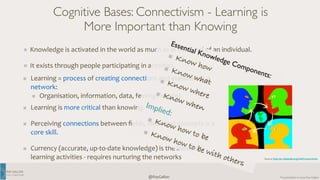
Cognitive Bases: Connectivism - Learning is 
More Important than Knowing 
Knowledge 
is 
activated 
in 
the 
world 
as 
much 
as 
in 
the 
head 
of 
an 
individual. 
It 
exists 
through 
people 
participating 
in 
activities. 
Learning 
= 
process 
of 
creating 
connections 
and 
elaborating 
a 
network: 
Organisation, 
information, 
data, 
feelings 
images. 
Learning 
is 
more 
critical 
than 
knowing. 
Perceiving 
connections 
between 
fields, 
ideas 
and 
concepts 
is 
a 
core 
skill. 
Currency 
(accurate, 
up-­‐to-­‐date 
knowledge) 
is 
the 
intent 
of 
learning 
activities 
-­‐ 
requires 
nurturing 
the 
networks Source: 
http://en.wikipedia.org/wiki/Connectivism 
Essential Knowledge Components: 
Know how 
Know what 
Know where 
Know when 
Implied: 
Know how to be 
Know how to be with others
RAY 
GALLON 
C U LT U R E C O M 
Presentation 
@RayGallon 
© 
2014 
Ray 
Gallon 
Learn from Users: 
Data Mine the Questions 
The 
top 
level 
of 
user 
feedback 
integration 
is 
simply 
to 
integrate 
questions. 
Questions 
tell 
you 
what 
a 
person 
wants 
to 
know, 
but 
also 
what 
s/he 
already 
knows. 
Example: 
in 
a 
webinar, 
someone 
asked, 
It 
strikes 
me 
that 
there's 
similarities 
with 
the 
Lean 
methodology: 
particularly 
Kanban, 
progressive 
disclosure, 
the 
Neme's 
Why? 
questioning 
and 
a 
focus 
on 
interruptions. 
Is 
this 
something 
Ray 
has 
looked 
at? 
If 
so, 
does 
he 
think 
there 
are 
similarities?
RAY 
GALLON 
C U LT U R E C O M 
Presentation 
@RayGallon 
© 
2014 
Ray 
Gallon 
What the Question Tells Us1/2 
The 
questioner 
has 
already 
looked 
at 
the 
ideas 
of 
Lean 
Information 
Flow, 
and 
has 
some 
understanding 
of 
them. 
S/he 
attended 
the 
first 
webinar 
in 
the 
series, 
where 
I 
talked 
about 
progressive 
disclosure. 
Her/his 
understanding 
of 
the 
ideas 
presented 
in 
session 
2 
are 
functioning 
near 
the 
top 
of 
the 
cognitive 
spiral, 
as 
he 
s/has 
been 
able 
to 
integrate 
them, 
reflect 
and 
evaluate 
them, 
and 
frame 
a 
question 
that 
goes 
beyond 
what 
is 
specifically 
discussed 
in 
the 
session.
RAY 
GALLON 
C U LT U R E C O M 
Presentation 
@RayGallon 
© 
2014 
Ray 
Gallon 
What the Question Tells Us 2/2 
In 
asking 
the 
question, 
the 
participant 
is 
also 
sharing 
his/her 
observation 
with 
the 
community 
– 
those 
attending 
the 
session, 
and 
those 
who 
will 
watch 
the 
recording. 
Community 
members 
might 
be 
motivated 
to 
look 
into 
Lean 
Information 
Flow 
and 
make 
their 
own 
conclusions. 
If 
we 
had 
an 
appropriate 
forum, 
they 
also 
might 
be 
motivated 
to 
express 
their 
conclusions 
to 
the 
community.
RAY 
GALLON 
C U LT U R E C O M 
enter Search 
Presentation 
search 
bubble”) 
@RayGallon 
© 
2014 
Ray 
Gallon 
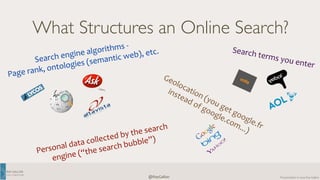
What Structures an Online Search? 
Search 
terms 
you 
engine 
algorithms 
-­‐ 
Page 
rank, 
ontologies 
(semantic 
web), 
etc. 
Geolocation 
(you 
get 
google.fr 
instead 
of 
google.com...) 
data 
Personal 
by 
collected 
the 
(“the 
engine 
search
RAY 
GALLON 
C U LT U R E C O M 
Presentation 
@RayGallon 
© 
2014 
Ray 
Gallon 
User Assistance has 
to be Googleable! 
And needs to come up first… 
“Finding is the new Do ing” 
–Ian Ba rker 
This means…
RAY 
GALLON 
C U LT U R E C O M 
How Do We Fill the Gaps in UA? 
Presentation 
(Structures) 
Level 
2 
-­‐ 
external, 
contextual 
Level 
1 
-­‐ 
internal, 
contextual 
@RayGallon 
© 
2014 
Ray 
Gallon 
Level 
3 
-­‐ 
interactive, 
contextual
RAY 
GALLON 
C U LT U R E C O M 
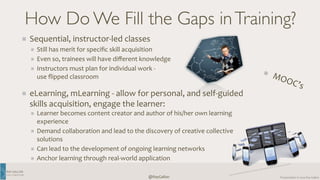
How Do We Fill the Gaps in Training? 
MOOC’s 
Presentation 
Sequential, 
instructor-­‐led 
classes 
Still 
has 
merit 
for 
specific 
skill 
acquisition 
Even 
so, 
trainees 
will 
have 
different 
knowledge 
Instructors 
must 
plan 
for 
individual 
work 
-­‐ 
use 
flipped 
classroom 
eLearning, 
mLearning 
-­‐ 
allow 
for 
personal, 
and 
self-­‐guided 
skills 
acquisition, 
engage 
the 
learner: 
Learner 
becomes 
content 
creator 
and 
author 
of 
his/her 
own 
learning 
experience 
Demand 
collaboration 
and 
lead 
to 
the 
discovery 
of 
creative 
collective 
solutions 
Can 
lead 
to 
the 
development 
of 
ongoing 
learning 
networks 
Anchor 
learning 
through 
real-­‐world 
application 
@RayGallon 
© 
2014 
Ray 
Gallon 
http://www.learningreview.com/mobile-social-learning/3412-m-learning-en-accion
RAY 
GALLON 
C U LT U R E C O M 
Presentation 
@RayGallon 
© 
2014 
Ray 
Gallon 
Mooc’s 
Massive Open Online Course 
Social 
learning: 
Mutual 
exchange 
of 
knowledge 
& 
expertise 
Instructor 
is 
a 
moderator 
and 
guide 
Limited 
in 
time 
Self 
organizing 
– 
users 
fill 
their 
own 
particular 
gaps 
Social networking 
Formal structure 
Multimedia
RAY 
GALLON 
C U LT U R E C O M 
Presentation 
X 
h"p://cdn.mactrast.com/wp-­‐content/uploads/2011/09/Rotary-­‐iPhone.png@RayGallon 
© 
2014 
Ray 
Gallon 
Curators, Not Gate Keepers
RAY 
GALLON 
C U LT U R E C O M 
Presentation 
The Curator as Story-Teller 
@RayGallon 
© 
2014 
Ray 
Gallon 
Knowledge Autonomy 
Neus 
Lorenzo, 
The 
Transformation 
Society
RAY 
GALLON 
C U LT U R E C O M 
Owner/Consultant, 
Culturecom 
– 
specialist 
in 
business 
process 
improvement 
through 
communication 
Research 
collaborator 
and 
principal, 
The 
Transformation 
Society, 
a 
new 
research 
and 
training 
institute 
in 
Barcelona, 
Spain 
Presentation 
@RayGallon 
© 
2014 
Ray 
Gallon 
I’m Ray Gallon - The Humanist Nerd 
20 
years 
in 
technical 
communication 
with 
major 
companies 
such 
as 
G.E. 
Healthcare, 
IBM, 
etc. 
Member, 
board 
of 
directors, 
Society 
for 
Technical 
Communication 
(STC) 
Past 
president, 
STC 
France 
Award-­‐winning 
radio 
producer 
and 
journalist 
– 
CBC, 
NPR, 
France 
Culture, 
etc. 
and 
former 
programme 
manager, 
WNYC-­‐FM, 
New 
York 
Public 
Radio
Portions of this presentation based on research by the Transformation 
Presentation 
@RayGallon 
© 
2014 
Ray 
Gallon 
Thank 
Email: 
infodesign@culturecom.net 
Google 
Plus: 
+Ray 
Gallon 
Twitter: 
@RayGallon 
LinkedIn: 
Ray 
Gallon 
RAY 
GALLON 
C U L T U R E C O M 
Pass 
me 
your 
business 
card: 
Let’s 
talk! 
Society Research group. 
Member, Board of Directors

A Dive Into the Quantum Funnel

  • 1.
    RAY GALLON CU L T U R E C O M Presentation @RayGallon © 2014 Ray Gallon A Dive Into the Quantum Funnel Filling the Black Holes of Knowledge Transformation The Society
  • 2.
    RAY GALLON CU LT U R E C O M Presentation @RayGallon © 2014 Ray Gallon Two Funnels – Two Learning Models
  • 3.
    RAY GALLON CU LT U R E C O M Presentation @RayGallon © 2014 Ray Gallon Missing Pieces Knowledge Autonomy Neus Lorenzo, The Transformation Society
  • 4.
    RAY GALLON CU LT U R E C O M http://upload.wikimedia.org/wikipedia/commons/5/5e/BH_LMC.png http://wallse.net/search/t/e3/b3b.jpg Presentation The Black Holes of Knowledge! What Are Yours? @RayGallon © 2014 Ray Gallon http://upload.wikimedia.org/wikipedia/commons/c/cd/Black_Hole_Milkyway.jpg Image by Mark Van Norden http://farm9.staticflickr.com/8342/8275081235_35eb0091a9_z.jpg
  • 5.
    RAY GALLON CU LT U R E C O M Presentation @RayGallon © 2014 Ray Gallon What We Used to Use
  • 6.
    RAY GALLON CU LT U R E C O M Presentation @RayGallon © 2014 Ray Gallon What We Use Today
  • 7.
    RAY GALLON CU LT U R E C O M Presentation @RayGallon © 2014 Ray Gallon How it’s Different Predetermined Static Structure Flexible, Emergent Structure, based on Contingent Need
  • 8.
    RAY GALLON CU LT U R E C O M Presentation REFLECT ON AND EVALUATE THE FORM OF THE MESSAGE REFLECT ON AND EVALUATE THE CONTENT APPLY AND USE THE INFORMATION RETRIEVE EXPLICIT INFORMATION @RayGallon © 2014 Ray Gallon OPPORTUNITY, PRACTICE COGNITIVE-­‐SYMBOLIC COMPLEXITY + CONTENT THE OF RICHNESS + - The Cognitive Spiral Adapted from a scheme by Dr. Neus Lorenzo, The Transformation Society INTERPRET EXPLICIT INFORMATION MASTERY: If you’re here you can’t get it wrong
  • 9.
    RAY GALLON CU LT U R E C O M Presentation Pay Being seated Eat Choose @RayGallon © 2014 Ray Gallon Active Learning: Learning by Doing Roger C. Schank’s Schema -­‐ We remember independent, self-­‐ contained scripts, or Memory Organization Packets (MOP’s) Restaurant Airplane Clothing Shop Pay Being seated Eat Choose Romantic Conversation Pay Choose Fasten Seatbelt Try on MOP’s are composed of scenes, which can be generalized from one MOP to another Serve wine REF: http://cogprints.org/637/1/LearnbyDoing_Schank.html
  • 10.
    RAY GALLON CU LT U R E C O M If we learn about “paying” in a restaurant... Are we learning something specific to the MOP “Restaurant?” Are we learning something generalizable to multiple MOP’s -­‐ i.e. a scene called “paying?” Are we learning something about some more abstract MOP that has nothing to do with the current MOP or scene (e.g. “economy”)? Presentation @RayGallon © 2014 Ray Gallon Questions
  • 11.
    RAY GALLON CU LT U R E C O M Presentation @RayGallon © 2014 Ray Gallon Active Learning: Learning by Doing Networks of Scenes Pay Network Restaurant Airplane Clothing Shop Pay Being seated Eat Choose Pay Being seated Eat Choose Pay Choose Fasten Seatbelt Try on MOP’s are composed of scenes, which can be generalized from one MOP to another Serve wine REF: http://cogprints.org/637/1/LearnbyDoing_Schank.html Choose Network Eat Network
  • 12.
    RAY GALLON CU LT U R E C O M Presentation @RayGallon © 2014 Ray Gallon Networks of Networks understandings Exchanging of of networks expands communicate scenes our to ability mutually to them beginners http://socialpsychologyeye.files.wordpress.com/2011/04/strange_group.jpg
  • 13.
    RAY GALLON CU LT U R E C O M Presentation @RayGallon © 2014 Ray Gallon Exper t customers are less prone to making errors
  • 14.
    RAY GALLON CU LT U R E C O M Presentation REFLECT ON AND EVALUATE THE FORM OF THE MESSAGE REFLECT ON AND EVALUATE THE CONTENT APPLY AND USE THE INFORMATION RETRIEVE EXPLICIT INFORMATION @RayGallon © 2014 Ray Gallon OPPORTUNITY, PRACTICE COGNITIVE-­‐SYMBOLIC COMPLEXITY + CONTENT THE OF RICHNESS + - The Cognitive Spiral Adapted from a scheme by Dr. Neus Lorenzo, The Transformation Society INTERPRET EXPLICIT INFORMATION If you’re here you can’t get it wrong: EXPERT!
  • 15.
    RAY GALLON CU LT U R E C O M Presentation @RayGallon © 2014 Ray Gallon Build Cognitive Demand to Build Expert Users Any Ideas?
  • 16.
    RAY GALLON CU LT U R E C O M Presentation @RayGallon © 2014 Ray Gallon Build Cognitive Demand to Build Expert Users Some Ideas Provide information users can generalize from Ask questions that stimulate curiosity Use social media to build stakeholder communities Gamify mutual encouragement Base on experience and need…
  • 17.
    RAY GALLON CU LT U R E C O M Picture: Greg Scullin. http://www.weeklytimesnow.com.au/article/2013/03/20/563539_business-news.html What Kind of Mastery? The Gardener Knows the Flower Because He is an Expert in his Field Presentation @RayGallon © 2014 Ray Gallon
  • 18.
    RAY GALLON CU LT U R E C O M Presentation @RayGallon © 2014 Ray Gallon The bee knows the flower from experience and need h"p://es.slideshare.net/gretacalinda/natures-­‐beauty
  • 19.
    RAY GALLON CU LT U R E C O M Presentation Criteria Selection Complexity Cognition Communication @RayGallon © 2014 Ray Gallon The Linguistic Competency Funnel Integrated Learning Quantity Quality Literal Content C2 Mastery B1 Threshold A2 Basic A1 Beginner Community C1 Functional B2 Advanced Interfaces, hardware, software, user assistance, hands-on and conceptual combined In moving from contingent need to confusion, we still learn more. COMPLEXITY ≠ CHAOS! Quantity of information > contingent need !l earner gets confused, sense of chaos ! Can’t keep track of it all Neus Lorenzo, The Transformation Society
  • 20.
    RAY GALLON CU LT U R E C O M Presentation @RayGallon © 2014 Ray Gallon The OECD Has Added Collaborative Problem-Solving To Its Pisa Tests Of Basic Competencies For 2015 And Beyond
  • 21.
    Components of CollaborativeProblem-Solving RAY GALLON C U LT U R E C O M Presentation @RayGallon © 2014 Ray Gallon PISA 2015 Ref: http://www.agenciaeducacion.cl/wp-­‐content/uploads/2013/04/Presentacion-­‐Looi-­‐Chee-­‐Kit.pdf
  • 22.
    RAY GALLON CU LT U R E C O M Presentation D3 Team Feedback and adaptation organisation Monitoring/evaluating results D2 Action C3 Team organisation Planning and Enacting plans Identify tasks C2 Action B2 Action A3 Team organisation Understanding roles Choose type of collaborative interaction @RayGallon © 2014 Ray Gallon The Collaborative Mastery Funnel Integrated Learning Quantity Quality Discovering team’s abilities A2 Action A1 Understanding Exploring and Understanding Common ground B1 Understanding Describe team roles (rules of engagement) B3 Team organisation Representing and Formulating Communicating about tasks C1 Understanding Mutual engagement per rules Executing Monitoring/repairing shared understanding D1 Understanding Monitoring and Reflecting Neus Lorenzo, The Transformation Society
  • 23.
    RAY GALLON CU LT U R E C O M Presentation @RayGallon © 2014 Ray Gallon Cognitive Bases: Connectivism - Learning is More Important than Knowing Knowledge is activated in the world as much as in the head of an individual. It exists through people participating in activities. Learning = process of creating connections and elaborating a network: Organisation, information, data, feelings images. Learning is more critical than knowing. Perceiving connections between fields, ideas and concepts is a core skill. Currency (accurate, up-­‐to-­‐date knowledge) is the intent of learning activities -­‐ requires nurturing the networks Source: http://en.wikipedia.org/wiki/Connectivism Essential Knowledge Components: Know how Know what Know where Know when Implied: Know how to be Know how to be with others
  • 24.
    RAY GALLON CU LT U R E C O M Presentation @RayGallon © 2014 Ray Gallon Learn from Users: Data Mine the Questions The top level of user feedback integration is simply to integrate questions. Questions tell you what a person wants to know, but also what s/he already knows. Example: in a webinar, someone asked, It strikes me that there's similarities with the Lean methodology: particularly Kanban, progressive disclosure, the Neme's Why? questioning and a focus on interruptions. Is this something Ray has looked at? If so, does he think there are similarities?
  • 25.
    RAY GALLON CU LT U R E C O M Presentation @RayGallon © 2014 Ray Gallon What the Question Tells Us1/2 The questioner has already looked at the ideas of Lean Information Flow, and has some understanding of them. S/he attended the first webinar in the series, where I talked about progressive disclosure. Her/his understanding of the ideas presented in session 2 are functioning near the top of the cognitive spiral, as he s/has been able to integrate them, reflect and evaluate them, and frame a question that goes beyond what is specifically discussed in the session.
  • 26.
    RAY GALLON CU LT U R E C O M Presentation @RayGallon © 2014 Ray Gallon What the Question Tells Us 2/2 In asking the question, the participant is also sharing his/her observation with the community – those attending the session, and those who will watch the recording. Community members might be motivated to look into Lean Information Flow and make their own conclusions. If we had an appropriate forum, they also might be motivated to express their conclusions to the community.
  • 27.
    RAY GALLON CU LT U R E C O M enter Search Presentation search bubble”) @RayGallon © 2014 Ray Gallon What Structures an Online Search? Search terms you engine algorithms -­‐ Page rank, ontologies (semantic web), etc. Geolocation (you get google.fr instead of google.com...) data Personal by collected the (“the engine search
  • 28.
    RAY GALLON CU LT U R E C O M Presentation @RayGallon © 2014 Ray Gallon User Assistance has to be Googleable! And needs to come up first… “Finding is the new Do ing” –Ian Ba rker This means…
  • 29.
    RAY GALLON CU LT U R E C O M How Do We Fill the Gaps in UA? Presentation (Structures) Level 2 -­‐ external, contextual Level 1 -­‐ internal, contextual @RayGallon © 2014 Ray Gallon Level 3 -­‐ interactive, contextual
  • 30.
    RAY GALLON CU LT U R E C O M How Do We Fill the Gaps in Training? MOOC’s Presentation Sequential, instructor-­‐led classes Still has merit for specific skill acquisition Even so, trainees will have different knowledge Instructors must plan for individual work -­‐ use flipped classroom eLearning, mLearning -­‐ allow for personal, and self-­‐guided skills acquisition, engage the learner: Learner becomes content creator and author of his/her own learning experience Demand collaboration and lead to the discovery of creative collective solutions Can lead to the development of ongoing learning networks Anchor learning through real-­‐world application @RayGallon © 2014 Ray Gallon http://www.learningreview.com/mobile-social-learning/3412-m-learning-en-accion
  • 31.
    RAY GALLON CU LT U R E C O M Presentation @RayGallon © 2014 Ray Gallon Mooc’s Massive Open Online Course Social learning: Mutual exchange of knowledge & expertise Instructor is a moderator and guide Limited in time Self organizing – users fill their own particular gaps Social networking Formal structure Multimedia
  • 32.
    RAY GALLON CU LT U R E C O M Presentation X h"p://cdn.mactrast.com/wp-­‐content/uploads/2011/09/Rotary-­‐iPhone.png@RayGallon © 2014 Ray Gallon Curators, Not Gate Keepers
  • 33.
    RAY GALLON CU LT U R E C O M Presentation The Curator as Story-Teller @RayGallon © 2014 Ray Gallon Knowledge Autonomy Neus Lorenzo, The Transformation Society
  • 34.
    RAY GALLON CU LT U R E C O M Owner/Consultant, Culturecom – specialist in business process improvement through communication Research collaborator and principal, The Transformation Society, a new research and training institute in Barcelona, Spain Presentation @RayGallon © 2014 Ray Gallon I’m Ray Gallon - The Humanist Nerd 20 years in technical communication with major companies such as G.E. Healthcare, IBM, etc. Member, board of directors, Society for Technical Communication (STC) Past president, STC France Award-­‐winning radio producer and journalist – CBC, NPR, France Culture, etc. and former programme manager, WNYC-­‐FM, New York Public Radio
  • 35.
    Portions of thispresentation based on research by the Transformation Presentation @RayGallon © 2014 Ray Gallon Thank Email: infodesign@culturecom.net Google Plus: +Ray Gallon Twitter: @RayGallon LinkedIn: Ray Gallon RAY GALLON C U L T U R E C O M Pass me your business card: Let’s talk! Society Research group. Member, Board of Directors