B U I L D I N G C O N N E C T I O N S T H A T L A S T
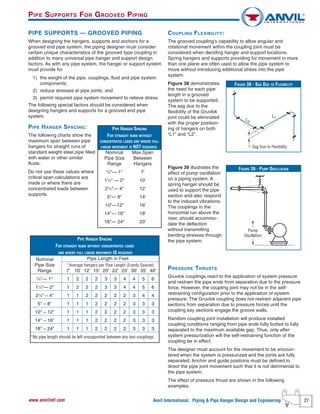
We built our reputation from the ground up.
Anvil’s history stretches back to the mid 1800s,
when a company named Grinnell®
began providing
its customers with the finest quality pipe products.
Since 2000, those quality products and services—
and the people who provide them—have been
known as Anvil®
International. Anvil®
customers
receive the quality and integrity that have been
building strong connections in both products
and business relationships for over 150 years.
TRUSTED
FOR 150 YEARS
Focused Product Line:
Anvil®
Malleable and Cast
Iron Fittings
Anvil®
Hangers, Supports
and Struts
Beck Welded Pipe Nipples
Anvil®
Seamless Pipe
Nipples
Anvil®
Steel Pipe Couplings
and Small Steel Fittings
Merit®
Tee-Lets and Drop
Nipples
Gruvlok®
Couplings,
Fittings and Valves
SPFTM
Malleable and Cast
and Ductile Iron Fittings
SPFTM
Grooved Fittings
and O’Lets
J.B. Smith Swage Nipples
and Bull Plugs
Catawissa®
Wing Unions
and Check Valves
Today Anvil®
International is the largest and most complete fitting and hanger
manufacturer in the world.
2004 Anvil®
International acquires Star Pipe Products, Building and Construction
Divisions (SPF) and forms AnvilStar
TM
Fire Products Division.
2001 Anvil®
International acquires Merit®
Manufacturing
and Beck Manufacturing.
2000 The industry’s trusted manufacturer of pipe
fittings, hangers and grooved fittings is
renamed Anvil®
International, Inc.
1999 Tyco sells the distribution and manufacturing
operations known up to this point as ”Grinnell
Supply Sales”, but keeps the Grinnell®
trademark.
1994 J.B. Smith™
and Catawissa™
join the Grinnell
Supply Sales and Manufacturing division.
1850 Providence Steam & Gas Pipe Co. is formed, and
Frederick Grinnell purchases a controlling interest.
1909 Frederick Grinnell opens a foundry in Cranston, RI.
Companies express interest in buying its piping
products, laying the groundwork for what would
become the Grinnell Supply Sales Division. It would
be these manufacturing and sales operations that
eventually become Anvil®
International.
1919 General Fire Extinguisher Co. becomes Grinnell Co.
1960 Gruvlok®
line of grooved fittings is introduced.
1969 Grinnell Co. acquired by International Telephone
and Telegraph. Two years later, ITT divests the Fire
Protection Division, but keeps the manufacturing
and sales divisions that will become known as
Anvil®
International.
Grinnell®
is a registered trademark of Grinnell Corporation, a Tyco International Ltd. company.
ANVIL
BRANDS: ®
Anvil International, Piping & Pipe Hanger Design and Engineering 3www.anvilintl.com
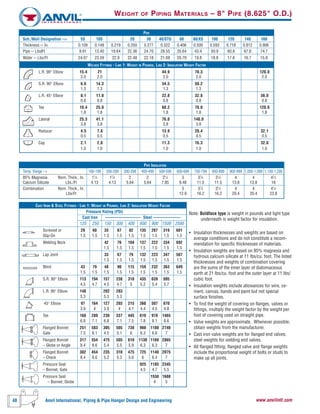
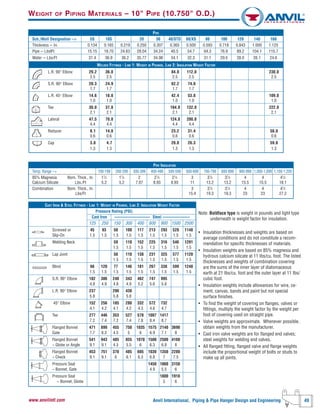
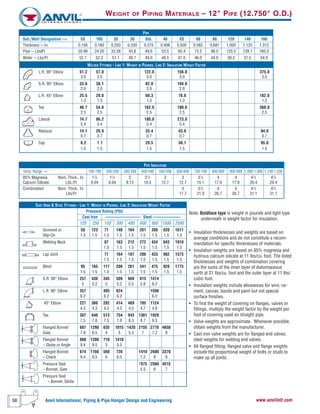
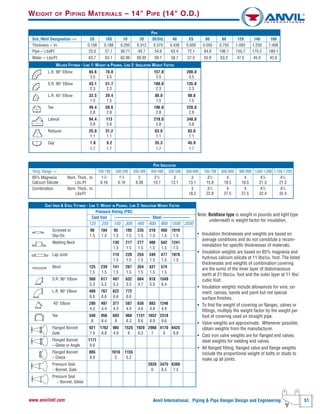
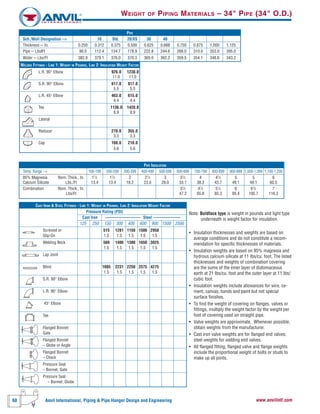
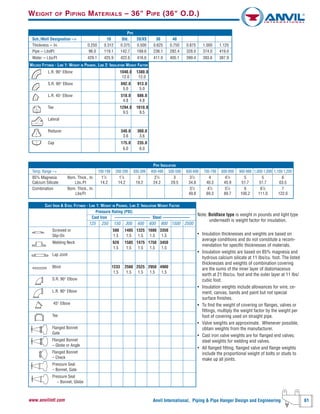
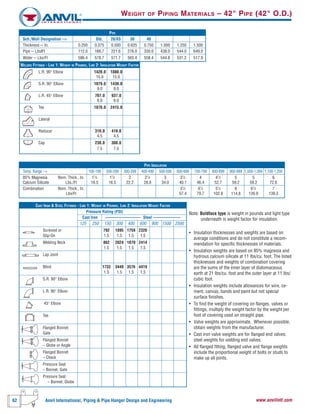
WEIGHTS OF PIPING MATERIALS
The material in this booklet has been compiled to furnish pipe
hanger engineers with the necessary data and procedures to
determine pipe hanger loads and thermal movements of the
pipe at each hanger location.
The tabulation of weights has been arranged for convenient
selection of data that formerly consumed considerable time to
develop. In many instances this information was not available
for general distribution. This made it necessary to develop
average or approximate weights that may be substituted with
actual weights whenever practical.
LOAD CALCULATION PROBLEM
The "Hanger Load Calculation Problem" is typical of the actual
steps required in the solution of any pipe hanger installation.
Great care was taken in collecting and printing data in this
booklet to assure accuracy throughout. However, no
representation or warranty of accuracy of the contents of this
booklet is made by Anvil. The only warranties made by Anvil
are those contained in sales contracts for design services or
products.
CONTENTS .............................................................................. Page
Design of Pipe Hangers ................................................................4
Determination of Hanger Locations.............................................4
Hanger Load Calculations ............................................................6
Thermal Movement Calculations ............................................... 11
Selection of the Proper Hangers ................................................ 13
Typical Pipe Support Specification............................................21
Nuclear pipe Hangers..................................................................24
Seismic Supports ........................................................................24
Supports for Grooved Piping .....................................................27
Application Examples .................................................................30
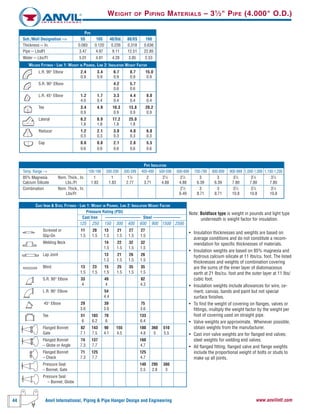
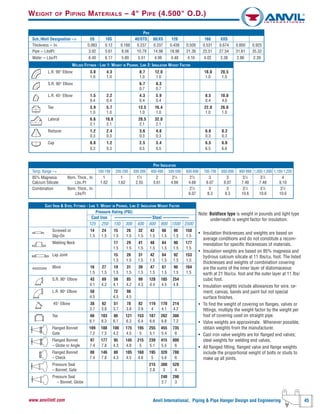
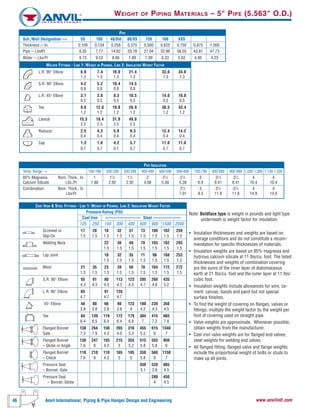
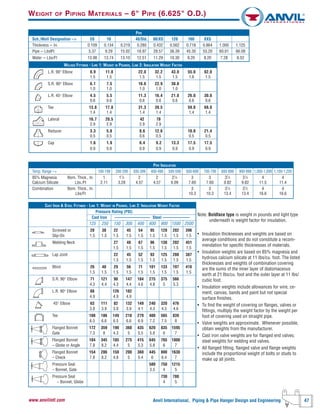
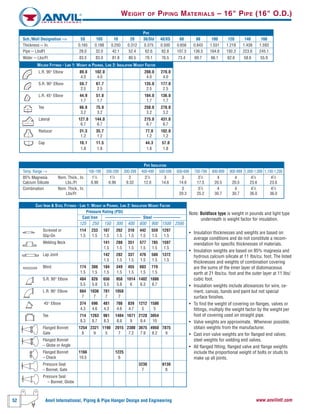
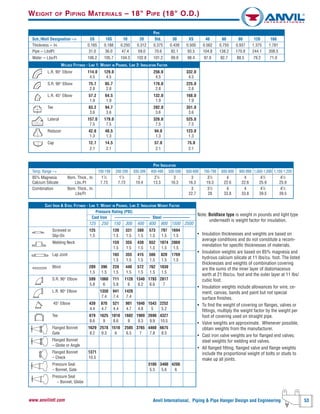
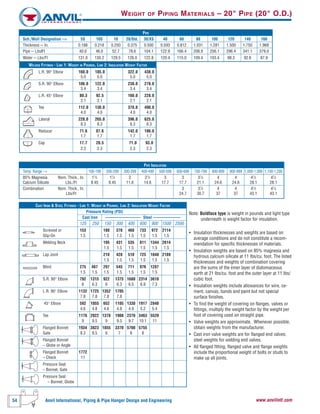
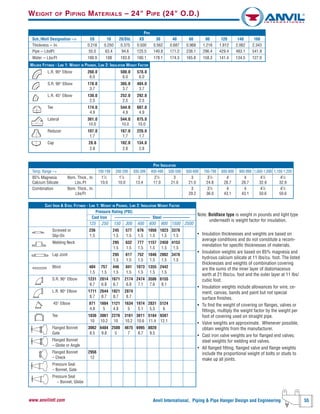
Weights of Piping Materials........................................................37
Charts and Tables........................................................................63
Copyright © 2003 Anvil International, North Kingstown, R.I.
sales offices and warehouses on back cover
PIPING and PIPE HANGER
DESIGN
and
ENGINEERING
4 Anvil International, Piping & Pipe Hanger Design and Engineering www.anvilintl.com
The steps in which the engineer applies this information are:
(1) Determine hanger locations.
(2) Calculate hanger loads.
(3) Determine thermal movement of the piping at each
hanger location.
(4) Select hanger types: spring assembly, either constant
support, variable spring type, rigid assembly, etc.
(5) Check clearance between the hanger components and
nearby piping, electrical cable trays, conduits, ventilating
ducts, and equipment.
The final step will not be discussed to any great degree. This
aspect of design is governed solely by the requirements and
layouts of the individual job. Instead, attention will be devoted
to steps 1 to 4, where the scope of good hanger practice can
be generally defined for any installation.
Recognizing that each new piping design presents many new
challenges to the engineer, no attempt is made to state fixed
rules and limits applicable to every hanger design. Rather, the
intention is to illustrate ideas which will serve as a guide to a
simple, practical solution to any pipe support problem.
INTEGRAL ATTACHMENTS
Integral attachments are fabricated so that the attachment is
an integral part of the piping component. Examples of integral
attachments include ears, shoes, lugs, cylindrical attachments,
rings and skirts. Integral attachments are used in conjunction
with restraints or braces where multi-axial restraint in a single
member is required. Of particular importance is the localized
stresses induced into the piping or piping component by the
integral attachments. Several methods to determine the local
stresses are available including relatively simple hand/
cookbook calculations provided in Welding Research Council
(WRC) Bulletins 107, 198, and 297, ASME Code Cases N-318
and N-392, or through a detailed finite element analysis.
Section 121 of ASME B31.1 discusses additional consider-
ations for integral attachments.
HANGER SPANS
Support locations are dependent on pipe size, piping
configuration, the location of heavy valves and fittings, and the
structure that is available for the support of the piping.
No firm rules or limits exist which will positively fix the location
of each support on a piping system. Instead, the engineer
must exercise his own judgement in each case to determine
the appropriate hanger location.
The suggested maximum spans between hangers listed in
table below reflect the practical considerations involved in
determining support spacings on straight runs of standard wall
pipe. They are normally used for the support spacings of
critical systems.
SPAN BETWEEN SUPPORTS
Nom. Pipe
Size (In.)
1 11
⁄2 2 21
⁄2 3 31
⁄2 4 5 6 8 10 12 14 16 18 20 24 30
Span
Water (Ft.)
7 9 10 11 12 13 14 16 17 19 22 23 25 27 28 30 32 33
Steam,
Gas, Air (Ft.)
9 12 13 14 15 16 17 19 21 24 26 30 32 35 37 39 42 44
INTRODUCTION
To avoid confusion, it is necessary to define the terms pipe
hanger and pipe support and clarify the difference between
the two. Pipe hangers are generally considered to be those
metal elements which carry the weight from above with the
supporting members being mainly in tension. Pipe supports
are considered to be those elements which carry the weight
from below with the supporting members being mainly in
compression.
It has become widely recognized that the selection and design
of pipe hangers is an important part of the engineering study
of any modern steam generating or process installation.
Problems of pipe design for high temperature, high pressure
installations have become critical to a point where it is
imperative that such aspects of design as the effect of
concentrated hanger loads on building structure, pipe weight
loads on equipment connections, and physical clearances of
the hanger components with piping and structure be taken
into account at the early design stages of a project.
Engineers specializing in the design of pipe hangers have
established efficient methods of performing the work required
to arrive at appropriate hanger designs. However, the
engineer who devotes varying portions of his time to the
design of pipe hangers often must gather a considerable
amount of reference data peculiar only to the hanger
calculations for his current project.
It is the purpose of this article to present a compilation of all
information necessary for the design of hangers, including a
technical section devoted to the listing of piping material,
weights, and thermal expansion data. Also, the discussions of
the various steps involved in designing supports, presented
here in their proper sequence, should serve as a good
reference source for the engineer who only occasionally
becomes involved in the essentials of hanger design.
The first of these steps is that of determining and obtaining
the necessary amount of basic information before proceeding
with calculations and detailing of the pipe supports. No design
is complete unless the engineer has had the opportunity to
review the equivalent of the following project data:
• The pipe hanger specification, when available (A typical
hanger specification is shown on pages 21 and 22).
• A complete set of piping drawings.
• A complete set of steel and structural drawings including
equipment foundation and boiler structure details.
• A complete set of drawings showing the location of
ventilating ducts, electrical trays, pumps, tanks, etc.
• The appropriate piping specifications and data, which will
include pipe sizes and composition identification, wall
thicknesses, and operating temperatures.
• A copy of the insulation specifications with densities.
• Valve and special fittings lists, which will indicate weights.
• The movements of all critical equipment connections such
as boiler headers, steam drums, turbine connections, etc.
• The results of the stress, flexibility and movement
calculation performed for critical systems such as Main
Steam, High Temperature Reheat, etc.
THE DESIGN OF PIPE HANGERS
Anvil International, Piping & Pipe Hanger Design and Engineering 5www.anvilintl.com
H-4
H-5
BGate
Valve
H-6
H-8
H-3
5'-0"
15'-0"
7'-0"
2'-0"
5'-0"
10'-0"
40'-0"
5'-0"
5'-0"
5'-0"
2'-0"
2'-0"
3'-0"
8'-0"
5'-0"
12" Pipe5'-0"
5'-0"
1'-0"
11'-0"
2'-0"
3'-0"
A
4'-0"
H-2
H-1
Check
Valve 6'-0"
H-7
6" Pipe
4'-0"
5'-0"
3'-6"
12'-0"
12'-0"
4'-0"
To Suit
H-9
C
GateValve
45°
three fourths the suggested maximum span shown in the table
on the previous page.
In considering the vertical section of the pipe on which H-3 and
H-4 are shown, it should first be noted that this section of the
pipe could be supported by one hanger rather than two as
indicated. Two hangers will certainly provide greater stability
than will a single hanger. Another deciding factor as to whether
one hanger or a multiple hangers should be used is the
strength of the supporting steel members of the structure. The
use of two hangers will permit the total riser weight to be
proportioned to two elevations of the structure, avoiding the
concentration of all the riser load at one building elevation.
The locations for hangers H-5 and H-6 are governed by the
suggested maximum span as well as the position of the
concentrated valve weight. Consequently, H-6 has been
located adjacent to the valve, and H-5 at a convenient location
between the valve and the 12 inch riser.
The location of hanger H-7 will be determined by calculation to
satisfy the condition that no pipe load is to be applied to
terminal connection C. It is obvious that by moving the hanger
along the 12 foot section of pipe, the amount of load on
connection C will vary. One support location exists where the
entire section will be "balanced", and the load at C equal to
zero.
The calculations to determine the exact location of H-7 are
shown in the section entitled "Hanger Load Calculation".
NOTE:
Allowable load at connection A is 500 lbs.
Allowable load at connection B and C is zero.
All bends are 5 diameter bends.
All elbows are L.R. Ells.
Operating temperature is 1,050°F.
All pipe is Sch. 160 A 335 P12.
FIGURE 1 – SAMPLE PROBLEM
The spans in table are in accordance with MSS Standard
Practice SP-69. They do not apply where concentrated
weights such as valves or heavy fittings or where changes in
direction of the piping system occur between hangers.
For concentrated loads, supports should be placed as close
as possible to the load in order to minimize bending stresses.
Where changes in direction of the piping of any critical system
occur between hangers; it is considered good practice to keep
the total length of pipe between the supports less than 3
⁄4 the
full spans in table below.
When practical, a hanger should be located immediately
adjacent to any change in direction of the piping.
SAMPLE PROBLEM
In the sample problem (Figure 1) seven supports are shown on
the 12 inch line, and two on the 6 inch pipe.
Note that the hanger H-1 has been placed adjacent to the
valve weight concentration. The proximity of the hanger to the
valve is helpful in keeping the load at terminal connection A to
a minimum. Also, the bending stresses induced in the pipe by
the valve weight are kept to a minimum.
The selection of the location for hanger H-2 entails a change in
direction of the pipe between two hangers. In order to avoid
excessive overhang of the pipe between hangers H-1 and H-2,
the length of pipe between these hangers is made less than
THE DESIGN OF PIPE HANGERS
6 Anvil International, Piping & Pipe Hanger Design and Engineering www.anvilintl.com
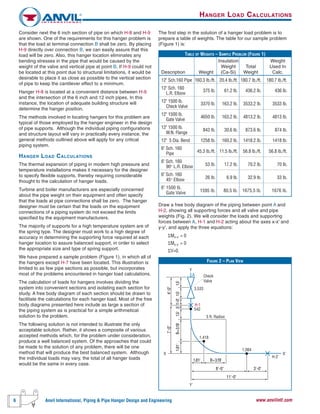
TABLE OF WEIGHTS – SAMPLE PROBLEM (FIGURE 1)
Insulation Weight
Weight Total Used In
Description Weight (Ca-Si) Weight Calc.
12" Sch.160 Pipe 160.3 lb./ft. 20.4 lb./ft. 180.7 lb./ft. 180.7 lb./ft.
12" Sch. 160
L.R. Elbow
375 lb. 61.2 lb. 436.2 lb. 436 lb.
12" 1500 lb.
Check Valve
3370 lb. 163.2 lb. 3533.2 lb. 3533 lb.
12" 1500 lb.
Gate Valve
4650 lb. 163.2 lb. 4813.2 lb. 4813 lb.
12" 1500 lb.
W.N. Flange
843 lb. 30.6 lb. 873.6 lb. 874 lb.
12" 5 Dia. Bend 1258 lb. 160.2 lb. 1418.2 lb. 1418 lb.
6" Sch. 160
Pipe 45.3 lb./ft. 11.5 lb./ft. 56.8 lb./ft. 56.8 lb./ft.
6" Sch. 160
90° L.R. Elbow 53 lb. 17.2 lb. 70.2 lb. 70 lb.
6" Sch. 160
45° Elbow 26 lb. 6.9 lb. 32.9 lb. 33 lb.
6" 1500 lb.
Gate Valve 1595 lb. 80.5 lb. 1675.5 lb. 1676 lb.
The first step in the solution of a hanger load problem is to
prepare a table of weights. The table for our sample problem
(Figure 1) is:
Draw a free body diagram of the piping between point A and
H-2, showing all supporting forces and all valve and pipe
weights (Fig. 2). We will consider the loads and supporting
forces between A, H-1 and H-2 acting about the axes x-x' and
y-y', and apply the three equations:
ΣMx-x' = 0
ΣMy-y' = 0
ΣV=0.
FIGURE 2 – PLAN VIEW
1.5'1.5'B=3.19'1.81'
B=3.19'1.81'
8'-0"
11'-0"
3'-0"
1.5'.5'1'-0"
4'-0"7'-0"
Y
Y'
A Check
Valve
3,533
1,418
5 ft. Radius
H-1
542
H-2'
X'X
1,084
Consider next the 6 inch section of pipe on which H-8 and H-9
are shown. One of the requirements for this hanger problem is
that the load at terminal connection B shall be zero. By placing
H-9 directly over connection B, we can easily assure that this
load will be zero. Also, this hanger location eliminates any
bending stresses in the pipe that would be caused by the
weight of the valve and vertical pipe at point B. If H-9 could not
be located at this point due to structural limitations, it would be
desirable to place it as close as possible to the vertical section
of pipe to keep the cantilever effect to a minimum.
Hanger H-8 is located at a convenient distance between H-9
and the intersection of the 6 inch and 12 inch pipes. In this
instance, the location of adequate building structure will
determine the hanger position.
The methods involved in locating hangers for this problem are
typical of those employed by the hanger engineer in the design
of pipe supports. Although the individual piping configurations
and structure layout will vary in practically every instance, the
general methods outlined above will apply for any critical
piping system.
HANGER LOAD CALCULATIONS
The thermal expansion of piping in modern high pressure and
temperature installations makes it necessary for the designer
to specify flexible supports, thereby requiring considerable
thought to the calculation of hanger loads.
Turbine and boiler manufacturers are especially concerned
about the pipe weight on their equipment and often specify
that the loads at pipe connections shall be zero. The hanger
designer must be certain that the loads on the equipment
connections of a piping system do not exceed the limits
specified by the equipment manufacturers.
The majority of supports for a high temperature system are of
the spring type. The designer must work to a high degree of
accuracy in determining the supporting force required at each
hanger location to assure balanced support, in order to select
the appropriate size and type of spring support.
We have prepared a sample problem (Figure 1), in which all of
the hangers except H-7 have been located. This illustration is
limited to as few pipe sections as possible, but incorporates
most of the problems encountered in hanger load calculations.
The calculation of loads for hangers involves dividing the
system into convenient sections and isolating each section for
study. A free body diagram of each section should be drawn to
facilitate the calculations for each hanger load. Most of the free
body diagrams presented here include as large a section of
the piping system as is practical for a simple arithmetical
solution to the problem.
The following solution is not intended to illustrate the only
acceptable solution. Rather, it shows a composite of various
accepted methods which, for the problem under consideration,
produce a well balanced system. Of the approaches that could
be made to the solution of any problem, there will be one
method that will produce the best balanced system. Although
the individual loads may vary, the total of all hanger loads
would be the same in every case.
HANGER LOAD CALCULATIONS
Anvil International, Piping & Pipe Hanger Design and Engineering 7www.anvilintl.com
Note that the value for H-2 on this section of the piping system
represents only a part of the total hanger force at H-2. For
clarity, we have labeled this force H-2'. In the calculations for
the next section of pipe beginning at H-2, we will call the
hanger force at this point H-2".
Also, note that we have considered the weight of the 90° bend
acting at the center of gravity of the bend. The distance B is
determined from the Chart on page 10 which has been drawn
for convenience:
B = Radius x .637, or 5 ft. x .637 = 3.185 ft.
STEP 1 - TAKING MOMENTS ABOUT AXIS Y-Y' (FIG. 2),
ΣMy-y' = 0, 1.81(1418) + 8(1 084) - 11(H-2') = 0
2,567 + 8,672 = 11(H-2')
H-2' = 1,022 Ib.
STEP II - TAKING MOMENTS ABOUT AXIS X-X' (FIG. 2),
ΣMx-x'= 0, 1.81(1418) + 6.5(542) - 7(H-1) + 9.5(3,533) - 11(A)=0
2,567 + 3,523 + 33,564 = 7(H-1) + 11(A)
39,564 = 7(H-1) + 11(A)
STEP III - ADDING FORCES ΣV = 0,
A + H-1 + H-2' - 3,533 - 542 - 1,418 - 1,084 = 0
A + H-1+ H-2' = 6,577 Ib.
Substituting the value H-2', calculated as 1,022 Ib. in Step I,
A + H-1 + 1,022 = 6,577 lb.
A = 5,555 - H-1
STEP IV – SOLVING THE THREE EQUATIONS
(1) H-2' = 1,022 Step I
(2) 39,654 = 7(H-1) + 11(A) Step II
(3) A = 5,555 - (H-1) Step III
Solving Equation (2) by subsitituting for A = 5555 - H-1,
39,654 = 7(H-1) + 11(5,555 - H-1)
H-1 = 5,363 Ib.
Substituting for H-1 in Equation 3,
A = 5,555 Ib - 5,363 Ib.
A=192 lb.; which is below the allowable load at A of 500 Ib.
Next, consider the section of pipe between H-2 and H-3 to
determine the weight distribution, between these two points, of
the 4ft. section of pipe and the five diameter bend.
ΣMH-2" =0, 2(723)+7.19(1418)-9(H-3')=0
H-3' =1,293 Ib.
ΣMH-3' =0, 1.81(1,418) +7(723)-9(H-2")=0
H-2"= 848 Ib.
H-2 = H-2' + H-2" = 1,022 lb. + 848 lb. =1,870 Ib.
In the next free body diagram (Figure 4) consider the 65 ft.
vertical section of the piping system to determine the
supporting forces for H-3" and H-4'.
It is apparent that the combined forces
H-3" and H-4' equals 65 ft. x 180.7 Ib./ft.
Further, both H-3" and H-4' could be
any value, provided the relationship
H-3" + H-4' = 11,746 lb.
is maintained. It is not recommended,
however, to select arbitrary values for
these two forces; instead, the load for
each hanger should be such that the
elevation of the pipe attachment is
above the midpoint of the length of pipe
supported by the hanger. Thus, the
support will be located above the point
where one could consider the weight of
the pipe column acting, thereby
avoiding a condition where the location
of the support lends itself to the
"tipping" tendency of the pipe when the
support is located below this point.
Since there is 10 ft. of vertical pipe
above H-3" and 40 ft. of pipe between H-3" and H-4', let H-3"
support 10 ft. plus 30 ft. of pipe load:
H-3" = (10 ft. + 30 ft.)(180.7 Ib./ft.) = 7,228 Ib.
Since H-3 = H-3' + H-3" and H-3' = 1293 lb. (see Figure 3),
H-3=1,293 lb. + 7,228 Ib. = 8,521 Ib.
H-4' = (10 ft. + 15 ft.)(18O.7 Ib./ft.) = 4518 Ib.
Consider the piping between H-4' and H-5 to determine the
weight distribution of the 5 diameter bend and the 5 ft. of
horizontal pipe:
ΣMH-4" = 0
1.81(1,418) + 7.5(904)-10(H-5') = 0
H-5' = 935 Ib.
ΣMH-5' = O
2 .5(904)+8.1 9(148)-10(H-4")=0
H-4"=1,387 Ib.
H-4 = H-4' + H-4"= 4518 lb. +1,387 lb. = 5,905 Ib.
FIGURE 3 – ELEVATION VIEW
1,418
723
2'-0" 5.19'
9'-0"
2'-0"
H-2' H-3'
5 ft. Radius
FIGURE 2A– CALCULATING H-2
H-2' H-2"+ = H-2
HANGER LOAD CALCULATIONS
FIGURE 4 – ELEVATION VIEW
10'-0"40'-0"
65'-0"
15'-0"
H-4'
H-3"
8 Anvil International, Piping & Pipe Hanger Design and Engineering www.anvilintl.com
FIGURE 7 – PLAN VIEWFIGURE 6 – ELEVATION VIEWFIGURE 5
16'-0"
3.78'
5'-0"
2.66'
4'-0"
.03'
.07'
2.34'
H-9
12'-0"
.27'
4.81'
5'-0"
Y'
R1
Y
70 (Elbow)
14.94' x 56.8 lbs/ft
= 849 lbs
H-8
33
(Elbow)
6.01' x 56.8 lbs/ft = 341 lbs
.19'
70
X'X
1,676 (Valve)
355 (Pipe)
2,031 Total
HANGER LOAD CALCULATIONS
10'-0"30'-0"10'-0"15'-0"
H-4'
H-3"
9041,418
2.5'7.5'
1.81'
10'-0"
H-4" H-5'
5 ft. Radius
It is obvious that some portion of the weight of the 6 in. pipe
between the 12 in. line and H-8 must be supported by H-5 and
H-6. Therefore, before proceeding through H-5 and H-6,
calculate this pipe weight load R1, and introduce it into the free
body diagram for H-5 and H-6.
∑My-y'=0 .07(33) + 2.34(341) + 4.81(70)+5(2,031) - 5(H-9) = 0
H-9 = 2,258 Ib.
∑Mx-x''=0 19(70) + 2.66(341) + 5.03(33) - 9(H-8) + 12.78(849)
+ 20.73(70) - 21R1=0
13,387 = 9(H-8)21 (R1)
∑V=0, R1 + H-8 + H-9 - 2,031- 70 - 341 - 33 - 849 - 70 = 0
R1 + H-8 + H-9 = 3,394 Ib.
Since H-9 has been calculated as 2,258 Ib.
R1 + H-8 = 3,394 lb. - 2,258 lb. = 1,136 Ib.
H-8 = 1,136 lb. - R1
Substituting this value for H-8 in the Equation
13,387= 9(H-8) + 21R1
13,387 = 9(1,136 lb. - R1) + 21(R1)
R1 =264 Ib.
H-8 = 1,136 - R1= 1136 lb. - 264 Ib = 872 Ib.
Anvil International, Piping & Pipe Hanger Design and Engineering 9www.anvilintl.com
H-7
C
1⁄2 Weight of Ell
= 218 lbs
1,626 436
1.09' 4.91' 5.46'
C=.96'
1.5'
Radius
.54'
2' x 180.7 lbs./Ft.
= 361 lbs.
12" Flange = 874 lbs.
Total = 1235 lbs.
4.5'
X
1.5'
FIGURE 10 – ELEVATION VIEW
FIGURE 8 – ELEVATION VIEW
1.5' 1.5'
.75'
E=1.09'
1.5'
5'-0"3'-0"
.75'3.25'
3.5'
5'-0"15'-0"
2'-0"'
2'-0"'
H-5" H-6
994 1⁄2 Weight
12" ELL = 218
4,8133.25 Ft. x 56.8 = 185
R1 = 264
TOTAL = 449
1,807
HANGER LOAD CALCULATIONS
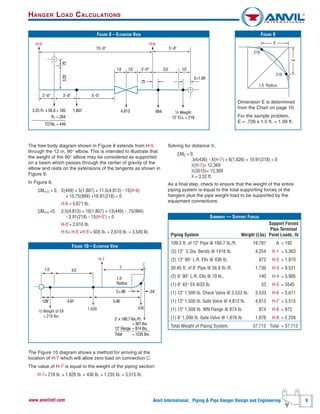
SUMMARY –– SUPPORT FORCES
Support Forces
Plus Terminal
Piping System Weight (Lbs) Point Loads, Ib
109.5 ft. of 12" Pipe @ 180.7 Ib./ft. 19,787 A = 192
(3) 12" 5 Dia. Bends @ 1418 lb. 4,254 H-1 = 5,363
(2) 12" 90° L.R. Ells @ 436 lb. 872 H-2 = 1,870
30.45 ft. of 6" Pipe @ 56.8 Ib./ft. 1,730 H-3 = 8,521
(2) 6" 90° L.R. Ells @ 70 lb.. 140 H-4 = 5,905
(1) 6" 45° Ell @33 lb. 33 H-5 = 3545
(1) 12" 1,500 lb. Check Valve @ 3,533 Ib. 3,533 H-6 = 5,671
(1) 12" 1,500 lb. Gate Valve @ 4,813 lb. 4,813 H-7 = 3,515
(1) 12" 1,500 Ib. WN Flange @ 874 lb. 874 H-8 = 872
(1) 6" 1,500 lb. Gate Valve @ 1,676 lb. 1,676 H-9 = 2,258
Total Weight of Piping System. 37,712 Total = 37,712
The free body diagram shown in Figure 8 extends from H-5
through the 12 in. 90° elbow. This is intended to illustrate that
the weight of the 90° elbow may be considered as supported
on a beam which passes through the center of gravity of the
elbow and rests on the extensions of the tangents as shown in
Figure 9.
In Figure 8,
ΣMH-5" = 0, 2(449) + 5(1,807) + 11.5(4,813) - 15(H-6)
+ 15.75(994) +18.91(218) = 0
H-6 = 5,671 Ib.
ΣMH-6 =0, 3.5(4,813) + 10(1,807) + 13(449) - .75(994)
- 3.91(218) - 15(H-5") = 0
H-5"= 2,610 Ib.
H-5= H-5'+H-5"= 935 lb. + 2,610 Ib. = 3,545 Ib.
The Figure 10 diagram shows a method for arriving at the
location of H-7 which will allow zero load on connection C.
The value of H-7 is equal to the weight of the piping section:
H-7= 218 lb. + 1,626 lb. + 436 lb. + 1,235 Ib. = 3,515 Ib.
Solving for distance X,
ΣMC = 0,
.54(436) - X(H-7) + 6(1,626) + 10.91(218) = 0
X(H-7)= 12,369
X(3515)= 12,369
X = 3.52 ft.
As a final step, check to ensure that the weight of the entire
piping system is equal to the total supporting forces of the
hangers plus the pipe weight load to be supported by the
equipment connections:
FIGURE 9
E
E
1.5' Radius
218
218
Dimension E is determined
from the Chart on page 10.
For the sample problem,
E = .726 x 1.5 ft. = 1.09 ft.
10 Anvil International, Piping & Pipe Hanger Design and Engineering www.anvilintl.com
HANGER LOAD CALCULATIONS
CALCULATED ARC DISTANCES FOR BENDS AND WELDING ELBOWS
0.0
0.2
0.1
0.3
0.4
0.6
0.8
1.0
1.1
1.2
0.5
0.7
0.9
0 10 20 30 40 50 60 70 80 90 100 110 120 130 140 150 160 170 180
"D" Curve
"E" Curve
TE
R
A
D
cg
T
E
D
θ
θ/2
D = R x [TAN(θ/2) + 2/θ - 2 x CSC(θ)]
E = 2 x R x [CSC(θ) 1/θ]
T = R x TAN(θ/2)
CENTER OF GRAVITY OF AN ARC
0.0
0.2
0.1
0.3
0.4
0.6
0.8
1.0
0.5
0.7
0.9
0 10 20 30 40 50 60 70 80 90 100 110 120 130 140 150 160 170 180
"A" Curve
"C" Curve
"B" Curve
B
C
cg
R
A
θ/2
θ
A = [2 x R x SIN(θ/2)]
θ
B = R x [1 - COS(θ)
θ
C = R x SIN(θ)
θ
A,B&CinInchesfor1"Radius
ø in Degrees
D&EinInchesfor1"Radius
ø in Degrees
Anvil International, Piping & Pipe Hanger Design and Engineering 11www.anvilintl.com
THERMAL MOVEMENTS
The next step in the design of pipe hangers involves the
calculation of the thermal movements of the pipe at each
hanger location. Based on the amount of vertical movement
and the supporting force required, the engineer can most
economically select the proper type hanger (i.e. Constant
Support, Variable Spring, or Rigid Assembly).
The determination of piping movements to a high degree of
accuracy necessitates a highly complicated study of the piping
system. The simplified method shown here is one which gives
satisfactory approximations of the piping movements.
Whenever differences occur between the approximations and
actual movements, the approximation of the movement will
always be the greater amount.
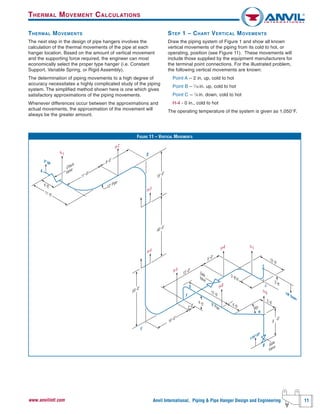
STEP 1 – CHART VERTICAL MOVEMENTS
Draw the piping system of Figure 1 and show all known
vertical movements of the piping from its cold to hot, or
operating, position (see Figure 11). These movements will
include those supplied by the equipment manufacturers for
the terminal point connections. For the illustrated problem,
the following vertical movements are known:
Point A -- 2 in. up, cold to hot
Point B -- 1
⁄16 in. up, cold to hot
Point C -- 1
⁄8 in. down, cold to hot
H-4 - 0 in., cold to hot
The operating temperature of the system is given as 1,050°F.
THERMAL MOVEMENT CALCULATIONS
FIGURE 11 – VERTICAL MOVEMENTS
H-4
H-5
B Gate
Valve
1⁄16" UP
H
H-6
H-8
H-3
D
20'-0"
E
F
9 '-0"
15'-0"
40'-0"
5'-0"
10'-0"
2'-0"
13'-0"
12" Pipe
11'-0"
4'-0"
H-1
2" UP
A
9'-0"
H-2
Check
Valve
11'-0"
H-7
6" Pipe
4'-0"
5'-0"
3'-6"
1⁄8" Down
12'-0"
12'-0"
4'-0"
3'-61
⁄8"
H-9
C
J
Gate
Valve
G
45°
12 Anvil International, Piping & Pipe Hanger Design and Engineering www.anvilintl.com
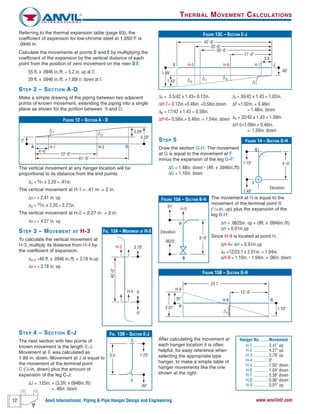
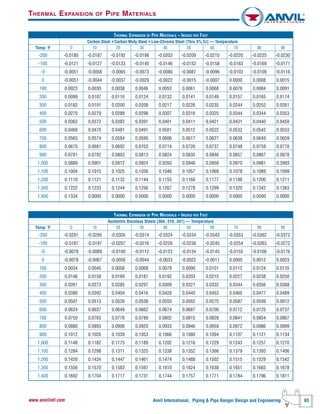
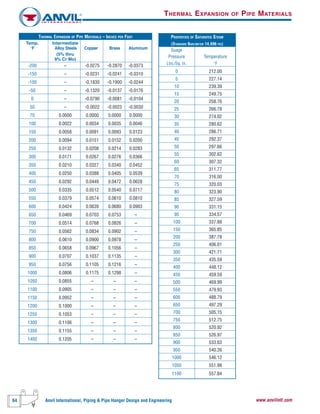
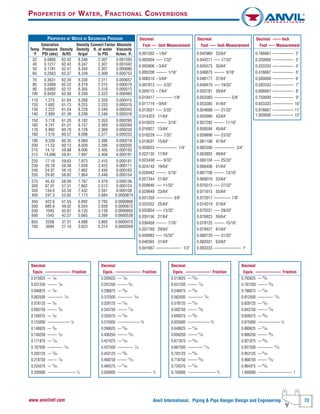
Referring to the thermal expansion table (page 63), the
coefficient of expansion for low-chrome steel at 1,050°F is
.0946 in.
Calculate the movements at points D and E by multiplying the
coefficient of the expansion by the vertical distance of each
point from the position of zero movement on the riser D E:
55 ft. x .0946 in./ft. = 5.2 in. up at D
20 ft. x .0946 in./ft. = 1.89i n. down at E
STEP 2 – SECTION A-D
Make a simple drawing of the piping between two adjacent
points of known movement, extending the piping into a single
plane as shown for the portion between A and D.
The vertical movement at any hanger location will be
proportional to its distance from the end points:
Δ1 = 4⁄31 x 3.20 = .41in.
The vertical movement at H-1 = .41 in. + 2 in.
ΔH-1 = 2.41 in. up
Δ2 = 22⁄31 x 3.20 = 2.27in.
The vertical movement at H-2 = 2.27 in. + 2 in.
ΔH-2 = 4.27 in. up
STEP 3 – MOVEMENT AT H-3
To calculate the vertical movement at
H-3, multiply its distance from H-4 by
the coefficient of expansion.
ΔH-3 =40 ft. x .0946 in./ft. = 3.78 in.up
ΔH-3 = 3.78 in. up
THERMAL MOVEMENT CALCULATIONS
Δ7 = 3.5/42 x 1.43= 0.12in.
ΔH-7= 0.12in.+0.46in. =0.58in.down
Δ6 = 17/42 x 1.43 = 0.58in.
ΔH-6= 0.58in.+ 0.46in. = 1.04in. downFIGURE 12 – SECTION A - D
31'-0"
22'-0"
H-2
1
H-1
4'-0"
2"
A D
3.20"
5.20"
2
FIG. 13A – MOVEMENT AT H-3
40'-0"
H-4
H-3
0"
3.78"
0"
STEP 4 – SECTION E-J
The next section with two points of
known movement is the length E-J.
Movement at E was calculated as
1.89 in. down. Movement at J is equal to
the movement at the terminal point
C (1
/8 in. down) plus the amount of
expansion of the leg C-J:
ΔJ = .125in. + (3.5ft. x 0946in./ft)
= .46in. down
FIG. 13B – SECTION E-J
C
J
.46"
1.25"3.5'
FIGURE 13C – SECTION E-J
17'-0"
3.5'
42'-0"
H-6 H-7H-5
1.89"
1.43"
32'-0"
30'-0"
E J
.46"
5
6
7
f
FIGURE 14 – SECTION G-H
G
F
1.48"
1.10" 4'-0"
Elevation
FIGURE 15A – SECTION B-H
H-9
H
B
.91"
Elevation
.0625"
9'-0"
STEP 5
Draw the section G-H. The movement
at G is equal to the movement at F
minus the expansion of the leg G-F:
ΔG = 1.48in. down - (4ft. x .0946in./ft)
ΔG = 1.10in. down
FIGURE 15B – SECTION G-H
Δf = 30/42 x 1.43 = 1.02in.
ΔF =1.02in. + 0.46in.
= 1.48in. down
Δ5 = 32/42 x 1.43 = 1.09in.
ΔH-5=1.09in.+ 0.46in.
= 1.55in. down
The movement at H is equal to the
movement of the terminal point B
(1
⁄16 in. up) plus the expansion of the
leg B-H:
ΔH = .0625in. up + (9ft. x .0946in./ft)
ΔH = 0.91in.up
Since H-9 is located at point H,
ΔH-9= ΔH = 0.91in.up
ΔY =12/23.1 x 2.01in. = 1.04in.
ΔH-8 = 1.10in. - 1.04in. = .06in. down
12'-0"
23.1'
H-9
H-8 G
H
.91"
1.10"2.01"
y{
After calculating the movement at
each hanger location it is often
helpful, for easy reference when
selecting the appropriate type
hanger, to make a simple table of
hanger movements like the one
shown at the right.
Hanger No. ..... Movement
H-1 ............. 2.41" up
H-2 ............. 4.27" up
H-3 ............. 3.78" up
H-4 ............. 0"
H-5 ............. 1.55" down
H-6 ............. 1.04" down
H-7 ............. 0.58" down
H-8 ............. 0.06" down
H-9 ............. 0.91" up
Anvil International, Piping & Pipe Hanger Design and Engineering 13www.anvilintl.com
cause a change in the actual
supporting effect of the hanger. The
variation in supporting force is equal to
the product of the amount of vertical
expansion and the spring scale of the
hanger. Since the pipe weight is the
same during any condition, cold or
operating, the variation in supporting
force results in pipe weight transfer to
equipment and adjacent hangers and
consequently additional stresses in the
piping system. When Variable Spring hangers are used, the
effect of this variation must be considered.
Variable Spring hangers are recommended for general use on
non-critical piping systems and where vertical movement is of
small magnitude on critical systems. Accepted practice is to
limit the amount of supporting force variation to 25% for critical
system applications on horizontal piping.
To illustrate the difference in the effect of using a Variable
Spring as compared with a Constant Support hanger, refer to
the sample problem shown in Figure 1, page 5.
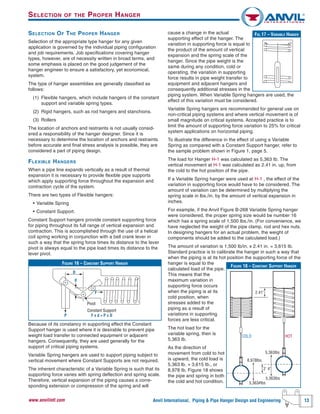
The load for Hanger H-1 was calculated as 5,363 Ib. The
vertical movement at H-1 was calculated as 2.41 in. up, from
the cold to the hot position of the pipe.
If a Variable Spring hanger were used at H-1 , the effect of the
variation in supporting force would have to be considered. The
amount of variation can be determined by multiplying the
spring scale in lbs./in. by the amount of vertical expansion in
inches.
For example, if the Anvil Figure B-268 Variable Spring hanger
were considered, the proper spring size would be number 16
which has a spring scale of 1,500 lbs./in. (For convenience, we
have neglected the weight of the pipe clamp, rod and hex nuts.
In designing hangers for an actual problem, the weight of
components should be added to the calculated load.)
The amount of variation is 1,500 Ib/in. x 2.41 in. = 3,615 Ib.
Standard practice is to calibrate the hanger in such a way that
when the piping is at its hot position the supporting force of the
hanger is equal to the
calculated load of the pipe.
This means that the
maximum variation in
supporting force occurs
when the piping is at its
cold position, when
stresses added to the
piping as a result of
variations in supporting
forces are less critical.
The hot load for the
variable spring, then is
5,363 Ib.
As the direction of
movement from cold to hot
is upward, the cold load is
5,363 lb. + 3,615 Ib., or
8,978 Ib. Figure 18 shows
the pipe and spring in both
the cold and hot condition.
SELECTION OF THE PROPER HANGER
Selection of the appropriate type hanger for any given
application is governed by the individual piping configuration
and job requirements. Job specifications covering hanger
types, however, are of necessity written in broad terms, and
some emphasis is placed on the good judgement of the
hanger engineer to ensure a satisfactory, yet economical,
system.
The type of hanger assemblies are generally classified as
follows:
(1) Flexible hangers, which include hangers of the constant
support and variable spring types.
(2) Rigid hangers, such as rod hangers and stanchions.
(3) Rollers
The location of anchors and restraints is not usually consid-
ered a responsibility of the hanger designer. Since it is
necessary to determine the location of anchors and restraints
before accurate and final stress analysis is possible, they are
considered a part of piping design.
FLEXIBLE HANGERS
When a pipe line expands vertically as a result of thermal
expansion it is necessary to provide flexible pipe supports
which apply supporting force throughout the expansion and
contraction cycle of the system.
There are two types of Flexible hangers:
• Variable Spring
• Constant Support.
Constant Support hangers provide constant supporting force
for piping throughout its full range of vertical expansion and
contraction. This is accomplished through the use of a helical
coil spring working in conjunction with a bell crank lever in
such a way that the spring force times its distance to the lever
pivot is always equal to the pipe load times its distance to the
lever pivot.
Because of its constancy in supporting effect the Constant
Support hanger is used where it is desirable to prevent pipe
weight load transfer to connected equipment or adjacent
hangers. Consequently, they are used generally for the
support of critical piping systems.
Variable Spring hangers are used to support piping subject to
vertical movement where Constant Supports are not required.
The inherent characteristic of a Variable Spring is such that its
supporting force varies with spring deflection and spring scale.
Therefore, vertical expansion of the piping causes a corre-
sponding extension or compression of the spring and will
SELECTION OF THE PROPER HANGER
FIGURE 16 – CONSTANT SUPPORT HANGER
D
F
Pivot
Constant Support
F x d = P x DP
d
FIG.17 – VARIABLE HANGER
FIGURE 18 – CONSTANT SUPPORT HANGER
8,978lbs.
5,363#lbs
2' 4"
2.41"
5,363lbs
COLD HOT
5,363lbs
14 Anvil International, Piping & Pipe Hanger Design and Engineering www.anvilintl.com
The purpose of the considerations given to the variation in
supporting effect is apparent when you recall that the pipe
weight does not change throughout its cold to hot cycle, while
the supporting force varies. In Figure 18 (hot condition), the
supporting force is equal to the pipe weight. However, in the
cold condition, the supporting force is 8,978 lb. while the pipe
weight is 5,363 Ib. The hanger would exert an unbalanced
force on the pipe equal to the amount of variation, or 3,615 Ib.
Most of this force would be imposed directly on connection A,
where limits are established for the force which may be
applied.
Further, safe piping design must be based on total pipe stress
which includes bending, torsional, shear, longitudinal, and
circumferential stresses. The addition of large forces resulting
from spring variations can cause stresses which will greatly
reduce the factor of safety of the entire spring system.
It is possible to reduce the amount of variability by using a
variable spring which has a smaller spring scale, as an Anvil
Figure 98 (Variable Spring Hanger).
The #16 Fig. 98 has a spring scale of 750 Ib/in., one-half that
of the B268. The amount of variability would be reduced by
one-half, or 2.41 x 750 = 1,808 Ib. However, it should be
obvious that even this change in supporting force is too great
for the critical location at H-1.
The appropriate hanger type for H-1 is a constant support
hanger. This hanger would be calibrated to the calculated pipe
weight. It would apply a constant supporting force, ensuring
complete support of the pipe throughout the piping expansion.
That is, its supporting force would be 5,363 lb. when the pipe
was at its cold position, and 5,363 lb. also when the pipe was
at its hot position.
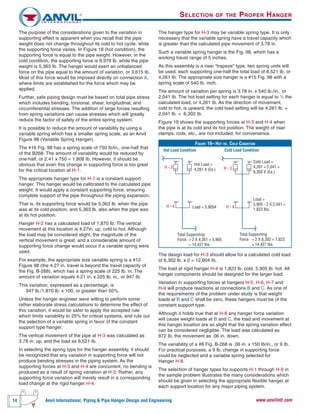
Hanger H-2 has a calculated load of 1,870 Ib. The vertical
movement at this location is 4.27in. up, cold to hot. Although
the load may be considered slight, the magnitude of the
vertical movement is great, and a considerable amount of
supporting force change would occur if a variable spring were
used.
For example, the appropriate size variable spring is a #12
Figure 98 (the 4.27 in. travel is beyond the travel capacity of
the Fig. B-268), which has a spring scale of 225 lb. in. The
amount of variation equals 4.21 in. x 225 lb. in., or 947 Ib.
This variation, expressed as a percentage, is
947 lb./1,870 lb. x 100, or greater than 50%.
Unless the hanger engineer were willing to perform some
rather elaborate stress calculations to determine the effect of
this variation, it would be safer to apply the accepted rule
which limits variability to 25% for critical systems, and rule out
the selection of a variable spring in favor of the constant
support type hanger.
The vertical movement of the pipe at H-3 was calculated as
3.78 in. up, and the load as 8,521 Ib.
In selecting the spring type for the hanger assembly, it should
be recognized that any variation in supporting force will not
produce bending stresses in the piping system. As the
supporting forces at H-3 and H-4 are concurrent, no bending is
produced as a result of spring variation at H-3. Rather, any
supporting force variation will merely result in a corresponding
load change at the rigid hanger H-4.
SELECTION OF THE PROPER HANGER
The hanger type for H-3 may be variable spring type. It is only
necessary that the variable spring have a travel capacity which
is greater than the calculated pipe movement of 3.78 in.
Such a variable spring hanger is the Fig. 98, which has a
working travel range of 5 inches.
As this assembly is a riser “trapeze” type, two spring units will
be used, each supporting one-half the total load of 8,521 Ib, or
4,261 Ib. The appropriate size hanger is a #15 Fig. 98 with a
spring scale of 540 Ib. inch.
The amount of variation per spring is 3.78 in. x 540 lb./in., or
2,041 Ib. The hot load setting for each hanger is equal to 1
⁄2 the
calculated load, or 4,261 Ib. As the direction of movement,
cold to hot, is upward, the cold load setting will be 4,261 lb. +
2,041 lb. = 6,302 Ib.
Figure 19 shows the supporting forces at H-3 and H-4 when
the pipe is at its cold and its hot position. The weight of riser
clamps, rods, etc., are not included, for convenience.
The design load for H-3 should allow for a calculated cold load
of 6,302 lb. x 2 = 12,604 Ib.
The load at rigid hanger H-4 is 1,823 lb. cold, 5,905 lb. hot. All
hanger components should be designed for the larger load.
Variation in supporting forces at hangers H-5, H-6, H-7 and
H-9 will produce reactions at connections B and C. As one of
the requirements of the problem under study is that weight
loads at B and C shall be zero, these hangers must be of the
constant support type.
Although it holds true that at H-8 any hanger force variation
will cause weight loads at B and C, the load and movement at
this hanger location are so slight that the spring variation effect
can be considered negligible. The load was calculated as
872 Ib, the movement as .06 in. down.
The variability of a #8 Fig. B-268 is .06 in. x 150 Ib/in., or 9 Ib.
For practical purposes, a 9 lb. change in supporting force
could be neglected and a variable spring selected for
Hanger H-8.
The selection of hanger types for supports H-1 through H-9 in
the sample problem illustrates the many considerations which
should be given in selecting the appropriate flexible hanger at
each support location for any major piping system.
FIGURE 19– HOT VS. COLD CONDITION
Anvil International, Piping & Pipe Hanger Design and Engineering 15www.anvilintl.com
In selecting flexible hanger types the engineer should consider
that:
• Wherever constant support hangers are used, the
supporting force equals the pipe weight throughout its
entire expansion cycle, and no pipe weight reactions are
imposed at equipment connections and anchors.
• Wherever variable spring hangers are used, the engineer
must check to assure that the total variation in supporting
effect does not result in harmful stresses and forces within
the piping system.
• Where piping stresses and reactions are known to be
close to allowable, the simplest and, in the long run, most
economical type of flexible support is obviously the
constant support hanger.
• Where piping stresses and end reactions are known to be
low, variable spring hangers can be used satisfactorily for
most non-critical piping support, and for the support of
critical systems where vertical movements are of small
magnitude.
RIGID HANGERS
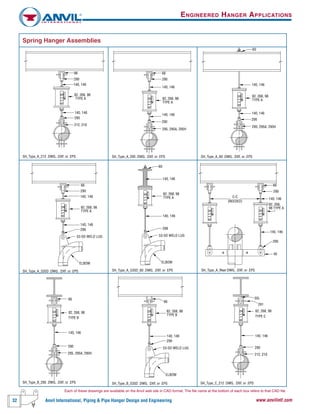
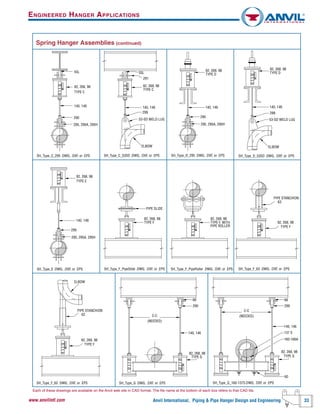
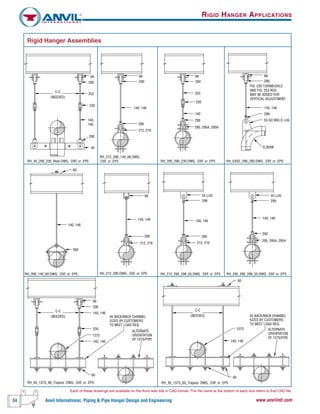
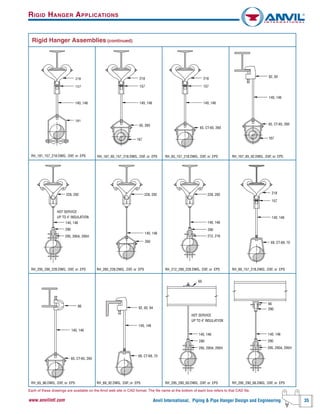
Rigid hangers are normally used at locations where no vertical
movement of the piping occurs.
The design considerations for a rigid hanger are pipe
temperature, for selection of appropriate pipe clamp material,
and load, for selection of components suitable for the pipe
weights involved.
Pipe clamp material is usually carbon steel for temperatures
up to 750°F, and alloy steel for temperatures above 750°F.
Malleable iron pipe clamps may be used at temperatures up to
450°F.
For piping systems of low operating temperature, where
vertical expansion is usually not a factor, the rigid hanger
assembly components are selected and designed on the basis
of calculated or approximated loads.
In some instances, however, the rigid hanger is used in a
manner where it does more than merely support the pipe
weight, but acts as a restraint against vertical piping move-
ments. It is in these cases that the engineer should exercise
care in the location of the rigid hanger and the design load he
uses in the selection of components.
The location and effect of any restraint, guide or anchor on a
high temperature and high pressure system is of necessity a
function of the stress analyst. The indiscriminate placing of a
restraining device on a piping system could alter the piping
stresses and end reactions to a serious degree, changing a
conservatively designed system into one which exceeds the
limits of good design practices.
The hanger engineer, though not as well acquainted with the
total stress picture of a piping system as is the stress analyst,
must usually decide if the problem is of this “critical” nature, or
whether the system under study is such that the effect of
adding a restraint for convenience will be negligible. The
decision is based on the factors of operating temperature,
operating pressure, and the configuration of the system.
Recognizing that pipe design is based on total pipe stress, one
must determine whether the stresses produced by the addition
of a rigid hanger, or vertical restraint, are critical.
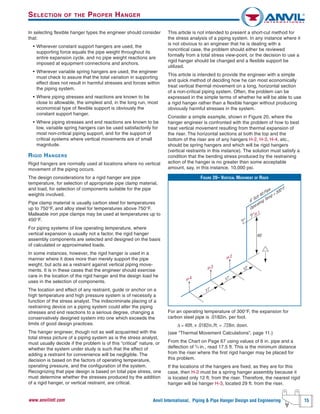
This article is not intended to present a short-cut method for
the stress analysis of a piping system. In any instance where it
is not obvious to an engineer that he is dealing with a
noncritical case, the problem should either be reviewed
formally from a total stress view-point, or the decision to use a
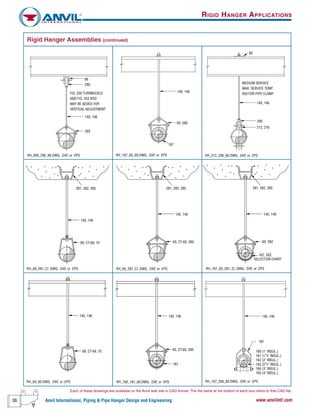
rigid hanger should be changed and a flexible support be
utilized.
This article is intended to provide the engineer with a simple
and quick method of deciding how he can most economically
treat vertical thermal movement on a long, horizontal section
of a non-critical piping system. Often, the problem can be
expressed in the simple terms of whether he will be able to use
a rigid hanger rather than a flexible hanger without producing
obviously harmful stresses in the system.
Consider a simple example, shown in Figure 20, where the
hanger engineer is confronted with the problem of how to best
treat vertical movement resulting from thermal expansion of
the riser. The horizontal sections at both the top and the
bottom of the riser are of any hangers H-2, H-3, H-4, etc.,
should be spring hangers and which will be rigid hangers
(vertical restraints in this instance). The solution must satisfy a
condition that the bending stress produced by the restraining
action of the hanger is no greater than some acceptable
amount, say, in this instance, 10,000 psi.
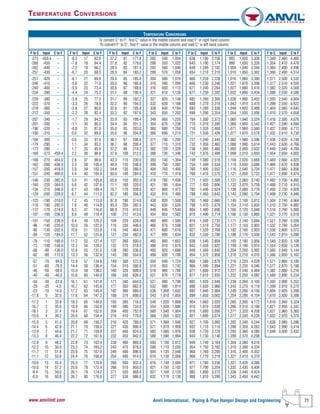
For an operating temperature of 300°F, the expansion for
carbon steel pipe is .0182in. per foot.
Δ = 40ft. x .0182in./ft. = .728in. down.
(see “Thermal Movement Calculations”, page 11.)
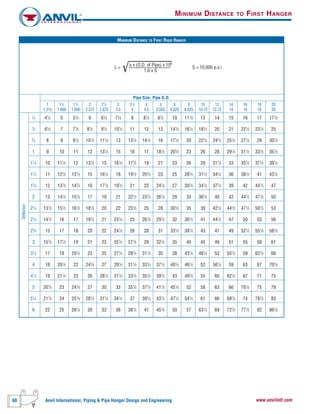
From the Chart on Page 67 using values of 6 in. pipe and a
deflection of 3
⁄4 in., read 17.5 ft. This is the minimum distance
from the riser where the first rigid hanger may be placed for
this problem.
If the locations of the hangers are fixed, as they are for this
case, then H-2 must be a spring hanger assembly because it
is located only 12 ft. from the riser. Therefore, the nearest rigid
hanger will be hanger H-3, located 29 ft. from the riser.
FIGURE 20– VERTICAL MOVEMENT OF RISER
40'
H-1
H-4
17'
17'
12'H-3
H-2
6" Sch 40 Pipe
Operating Temp = 300°F
SELECTION OF THE PROPER HANGER
16 Anvil International, Piping & Pipe Hanger Design and Engineering www.anvilintl.com
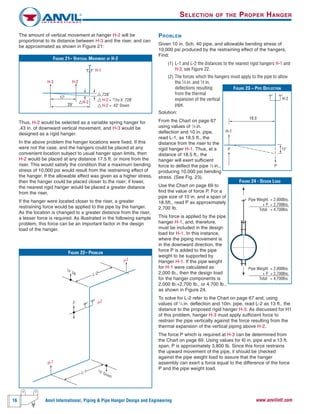
The amount of vertical movement at hanger H-2 will be
proportional to its distance between H-3 and the riser, and can
be approximated as shown in Figure 21:
Thus, H-2 would be selected as a variable spring hanger for
.43 in. of downward vertical movement, and H-3 would be
designed as a rigid hanger.
In the above problem the hanger locations were fixed. If this
were not the case, and the hangers could be placed at any
convenient location subject to usual hanger span limits, then
H-2 would be placed at any distance 17.5 ft. or more from the
riser. This would satisfy the condition that a maximum bending
stress of 10,000 psi would result from the restraining effect of
the hanger. If the allowable effect was given as a higher stress,
then the hanger could be placed closer to the riser; if lower,
the nearest rigid hanger would be placed a greater distance
from the riser.
If the hanger were located closer to the riser, a greater
restraining force would be applied to the pipe by the hanger.
As the location is changed to a greater distance from the riser,
a lesser force is required. As illustrated in the following sample
problem, this force can be an important factor in the design
load of the hanger.
PROBLEM
Given 10 in. Sch. 40 pipe, and allowable bending stress of
10,000 psi produced by the restraining effect of the hangers,
Find:
(1) L-1 and L-2 the distances to the nearest rigid hangers H-1 and
H-3, see Figure 22.
(2) The forces which the hangers must apply to the pipe to allow
the 1⁄4 in. and 1⁄2 in.
deflections resulting
from the thermal
expansion of the vertical
pipe.
Solution:
From the Chart on page 67
using values of 1
⁄2 in.
deflection and 10 in. pipe,
read L-1, as 18.5 ft., the
distance from the riser to the
rigid hanger H-1. Thus, at a
distance of 18.5 ft., the
hanger will exert sufficient
force to deflect the pipe 1
⁄2 in.,
producing 10,000 psi bending
stress. (See Fig. 23).
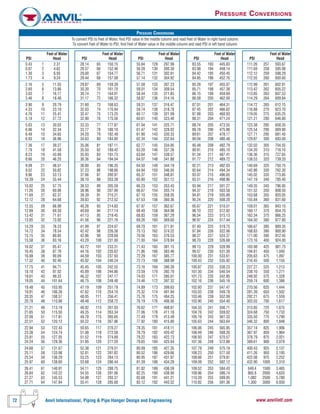
Use the Chart on page 69 to
find the value of force P. For a
pipe size of 10 in. and a span of
18.5ft., read P as approximately
2,700 Ib.
This force is applied by the pipe
hanger H-1, and, therefore,
must be included in the design
load for H-1. In this instance,
where the piping movement is
in the downward direction, the
force P is added to the pipe
weight to be supported by
Hanger H-1. If the pipe weight
for H-1 were calculated as
2,000 lb., then the design load
for the hanger components is
2,000 lb.+2,700 Ib., or 4,700 lb.,
as shown in Figure 24.
To solve for L-2 refer to the Chart on page 67 and, using
values of 1
⁄4 in. deflection and 10in. pipe, read L-2 as 13 ft., the
distance to the proposed rigid hanger H-3. As discussed for H1
of this problem, hanger H-3 must apply sufficient force to
restrain the pipe vertically against the force resulting from the
thermal expansion of the vertical piping above H-2.
The force P which is required at H-3 can be determined from
the Chart on page 69. Using values for l0 in. pipe and a 13 ft.
span, P is approximately 3,800 Ib. Since this force restrains
the upward movement of the pipe, it should be checked
against the pipe weight load to assure that the hanger
assembly can exert a force equal to the difference of the force
P and the pipe weight load.
FIGURE 21– VERTICAL MOVEMENT AT H-2
H-2 = 17⁄29 X .728"
H-2 = .43" Down
H-1
H-2
H-2
.728"
17'
29'
H-3
FIGURE 22– PROBLEM
H-3
H-20"
1
⁄2" Down
1
⁄4" Up
L-1
L-2
H-1
FIGURE 23 – PIPE DEFLECTION
H-1
18.5'
H-2
1⁄2"
P
P
FIGURE 24 - DESIGN LOAD
Pipe Weight = 2,000lbs.
+ P = 2,700lbs.
Total = 4,700lbs
Pipe Weight = 2,000lbs.
+ P = 2,700lbs.
Total = 4,700lbs
SELECTION OF THE PROPER HANGER
Anvil International, Piping & Pipe Hanger Design and Engineering 17www.anvilintl.com
FIGURE 29 - ILLUSTRATIVE EXAMPLE
FIGURE 28 - P FORCES
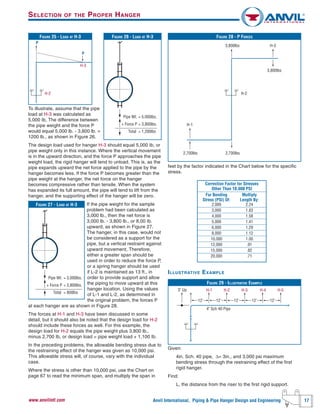
To illustrate, assume that the pipe
load at H-3 was calculated as
5,000 Ib, The difference between
the pipe weight and the force P
would equal 5,000 lb. - 3,800 lb. =
1200 lb., as shown in Figure 26.
The design load used for hanger H-3 should equal 5,000 Ib, or
pipe weight only in this instance. Where the vertical movement
is in the upward direction, and the force P approaches the pipe
weight load, the rigid hanger will tend to unload. This is, as the
pipe expands upward the net force applied to the pipe by the
hanger becomes less. If the force P becomes greater than the
pipe weight at the hanger, the net force on the hanger
becomes compressive rather than tensile. When the system
has expanded its full amount, the pipe will tend to lift from the
hanger, and the supporting effect of the hanger will be zero.
If the pipe weight for the sample
problem had been calculated as
3,000 lb., then the net force is
3,000 lb. - 3,800 lb., or 8,00 Ib.
upward, as shown in Figure 27.
The hanger, in this case, would not
be considered as a support for the
pipe, but a vertical restraint against
upward movement, Therefore,
either a greater span should be
used in order to reduce the force P,
or a spring hanger should be used
if L-2 is maintained as 13 ft., in
order to provide support and allow
the piping to move upward at this
hanger location. Using the values
of L-1 and L-2, as determined in
the original problem, the forces P
at each hanger are as shown in Figure 28.
The forces at H-1 and H-3 have been discussed in some
detail, but it should also be noted that the design load for H-2
should include these forces as well. For this example, the
design load for H-2 equals the pipe weight plus 3,800 lb.,
minus 2,700 Ib, or design load = pipe weight load + 1,100 Ib.
In the preceding problems, the allowable bending stress due to
the restraining effect of the hanger was given as 10,000 psi.
This allowable stress will, of course, vary with the individual
case.
Where the stress is other than 10,000 psi, use the Chart on
page 67 to read the minimum span, and multiply the span in
feet by the factor indicated in the Chart below for the specific
stress.
ILLUSTRATIVE EXAMPLE
Given:
4in. Sch. 40 pipe, Δ= 3in., and 3,000 psi maximum
bending stress through the restraining effect of the first
rigid hanger.
Find:
L, the distance from the riser to the first rigid support.
FIGURE 25 - LOAD AT H-3
H-3
H-2
P
P
FIGURE 26 - LOAD AT H-3
Pipe Wt. = 5,000lbs.
+ Force P = 3,800lbs.
Total = 1,200lbs
FIGURE 27 - LOAD AT H-3
Pipe Wt. = 3,000lbs.
+ Force P = 3,800lbs.
Total = 800lbs
H-1
2,700lbs 2,700lbs
H-33,800lbs
3,800lbs
H-2
Correction Factor for Stresses
Other Than 10,000 PSI
For Bending Multiply
Stress (PSI) Of: Length By:
2,000 2.24
3,000 1.83
4,000 1.58
5,000 1.41
6,000 1.29
8,000 1.12
10,000 1.00
12,000 .91
15,000 .82
20,000 .71
H-2H-1
4" Sch 40 Pipe
12'
3" Up
12' 12' 12' 12'
H-3 H-4 H-5
SELECTION OF THE PROPER HANGER
18 Anvil International, Piping & Pipe Hanger Design and Engineering www.anvilintl.com
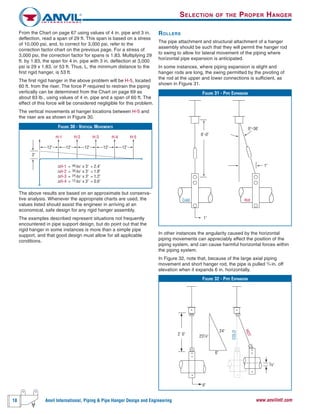
From the Chart on page 67 using values of 4 in. pipe and 3 in.
deflection, read a span of 29 ft. This span is based on a stress
of 10,000 psi, and, to correct for 3,000 psi, refer to the
correction factor chart on the previous page. For a stress of
3,000 psi, the correction factor for spans is 1.83. Multiplying 29
ft. by 1.83, the span for 4 in. pipe with 3 in. deflection at 3,000
psi is 29 x 1.83, or 53 ft. Thus, L, the minimum distance to the
first rigid hanger, is 53 ft.
The first rigid hanger in the above problem will be H-5, located
60 ft. from the riser. The force P required to restrain the piping
vertically can be determined from the Chart on page 69 as
about 83 lb., using values of 4 in. pipe and a span of 60 ft. The
effect of this force will be considered negligible for this problem.
The vertical movements at hanger locations between H-5 and
the riser are as shown in Figure 30.
The above results are based on an approximate but conserva-
tive analysis. Whenever the appropriate charts are used, the
values listed should assist the engineer in arriving at an
economical, safe design for any rigid hanger assembly.
The examples described represent situations not frequently
encountered in pipe support design, but do point out that the
rigid hanger in some instances is more than a simple pipe
support, and that good design must allow for all applicable
conditions.
ROLLERS
The pipe attachment and structural attachment of a hanger
assembly should be such that they will permit the hanger rod
to swing to allow for lateral movement of the piping where
horizontal pipe expansion is anticipated.
In some instances, where piping expansion is slight and
hanger rods are long, the swing permitted by the pivoting of
the rod at the upper and lower connections is sufficient, as
shown in Figure 31.
In other instances the angularity caused by the horizontal
piping movements can appreciably effect the position of the
piping system, and can cause harmful horizontal forces within
the piping system.
In Figure 32, note that, because of the large axial piping
movement and short hanger rod, the pipe is pulled 3
/4 in. off
elevation when it expands 6 in. horizontally.
FIGURE 30 - VERTICAL MOVEMENTS
H-2H-1
ΔH-1 = 48'⁄60' x 3" = 2.4"
ΔH-2 = 36'⁄60' x 3" = 1.8"
ΔH-3 = 24'⁄60' x 3" = 1.2"
ΔH-4 = 12'⁄60' x 3" = 0.6"
12'
3"
12' 12' 12' 12'
H-3 H-4 H-5
FIGURE 31 - PIPE EXPANSION
1"
Cold
8'-0"
Hot
0°-36'
1"
FIGURE 32 - PIPE EXPANSION
24"
231⁄4"
6"
2' 0"
6"
COLD
HOT
3⁄4"
SELECTION OF THE PROPER HANGER
Anvil International, Piping & Pipe Hanger Design and Engineering 19www.anvilintl.com
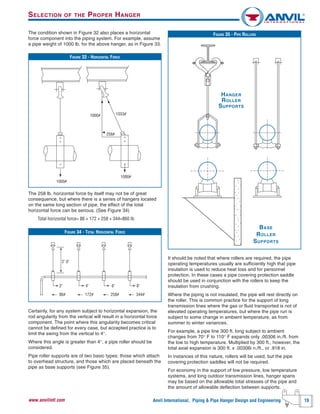
The condition shown in Figure 32 also places a horizontal
force component into the piping system. For example, assume
a pipe weight of 1000 lb. for the above hanger, as in Figure 33.
The 258 lb. horizontal force by itself may not be of great
consequence, but where there is a series of hangers located
on the same long section of pipe, the effect of the total
horizontal force can be serious. (See Figure 34)
Total horizontal force= 86 + 172 + 258 + 344=860 Ib
Certainly, for any system subject to horizontal expansion, the
rod angularity from the vertical will result in a horizontal force
component. The point where this angularity becomes critical
cannot be defined for every case, but accepted practice is to
limit the swing from the vertical to 4°.
Where this angle is greater than 4°, a pipe roller should be
considered.
Pipe roller supports are of two basic types: those which attach
to overhead structure, and those which are placed beneath the
pipe as base supports (see Figure 35).
It should be noted that where rollers are required, the pipe
operating temperatures usually are sufficiently high that pipe
insulation is used to reduce heat loss and for personnel
protection. In these cases a pipe covering protection saddle
should be used in conjunction with the rollers to keep the
insulation from crushing.
Where the piping is not insulated, the pipe will rest directly on
the roller. This is common practice for the support of long
transmission lines where the gas or fluid transported is not of
elevated operating temperatures, but where the pipe run is
subject to some change in ambient temperature, as from
summer to winter variances.
For example, a pipe line 300 ft. long subject to ambient
changes from 70° F to 110° F expands only .00306 in./ft. from
the low to high temperature. Multiplied by 300 ft., however, the
total axial expansion is 300 ft. x .00306i n./ft., or .918 in.
In instances of this nature, rollers will be used, but the pipe
covering protection saddles will not be required.
For economy in the support of low pressure, low temperature
systems, and long outdoor transmission lines, hanger spans
may be based on the allowable total stresses of the pipe and
the amount of allowable deflection between supports.
FIGURE 33 - HORIZONTAL FORCE
FIGURE 34 - TOTAL HORIZONTAL FORCE
1000#
1000# 1033#
258#
1000#
2' 0"
2"
86#
4" 6" 8"
172# 258# 344#
FIGURE 35 - PIPE ROLLERS
BASE
ROLLER
SUPPORTS
HANGER
ROLLER
SUPPORTS
SELECTION OF THE PROPER HANGER
20 Anvil International, Piping & Pipe Hanger Design and Engineering www.anvilintl.com
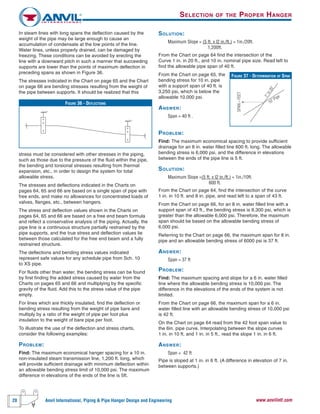
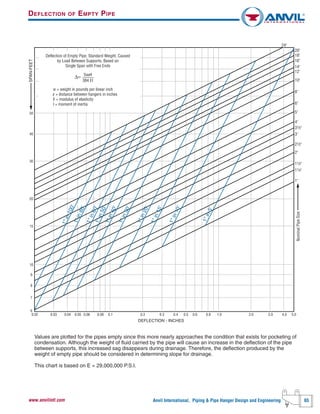
In steam lines with long spans the deflection caused by the
weight of the pipe may be large enough to cause an
accumulation of condensate at the low points of the line.
Water lines, unless properly drained, can be damaged by
freezing. These conditions can be avoided by erecting the
line with a downward pitch in such a manner that succeeding
supports are lower than the points of maximum deflection in
preceding spans as shown in Figure 36.
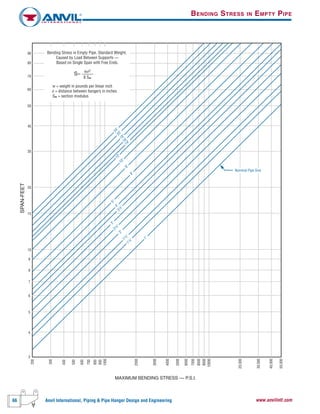
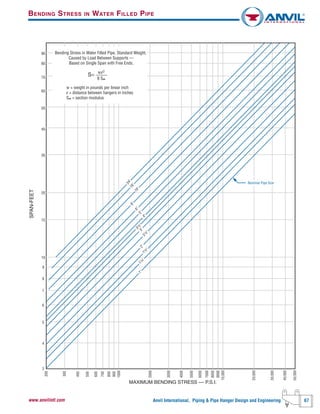
The stresses indicated in the Chart on page 65 and the Chart
on page 66 are bending stresses resulting from the weight of
the pipe between supports. It should be realized that this
stress must be considered with other stresses in the piping,
such as those due to the pressure of the fluid within the pipe,
the bending and torsional stresses resulting from thermal
expansion, etc., in order to design the system for total
allowable stress.
The stresses and deflections indicated in the Charts on
pages 64, 65 and 66 are based on a single span of pipe with
free ends, and make no allowances for concentrated loads of
valves, flanges, etc., between hangers.
The stress and deflection values shown in the Charts on
pages 64, 65 and 66 are based on a free end beam formula
and reflect a conservative analysis of the piping. Actually, the
pipe line is a continuous structure partially restrained by the
pipe supports, and the true stress and deflection values lie
between those calculated for the free end beam and a fully
restrained structure.
The deflections and bending stress values indicated
represent safe values for any schedule pipe from Sch. 10
to XS pipe.
For fluids other than water, the bending stress can be found
by first finding the added stress caused by water from the
Charts on pages 65 and 66 and multiplying by the specific
gravity of the fluid. Add this to the stress value of the pipe
empty.
For lines which are thickly insulated, find the deflection or
bending stress resulting from the weight of pipe bare and
multiply by a ratio of the weight of pipe per foot plus
insulation to the weight of bare pipe per foot.
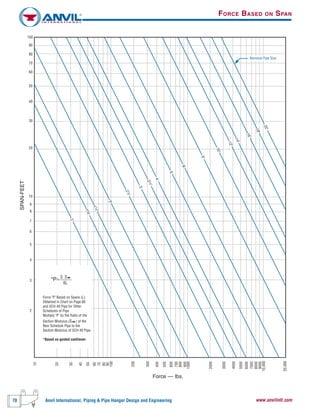
To illustrate the use of the deflection and stress charts,
consider the following examples:
PROBLEM:
Find: The maximum economical hanger spacing for a 10 in.
non-insulated steam transmission line, 1,200 ft. long, which
will provide sufficient drainage with minimum deflection within
an allowable bending stress limit of 10,000 psi. The maximum
difference in elevations of the ends of the line is 5ft.
SOLUTION:
Maximum Slope = (5 ft. x l2 in./ft.) = 1in./20ft.
1,200ft.
From the Chart on page 64 find the intersection of the
Curve 1 in. in 20 ft., and 10 in. nominal pipe size. Read left to
find the allowable pipe span of 40 ft.
From the Chart on page 65, the
bending stress for 10 in. pipe
with a support span of 40 ft. is
3,250 psi, which is below the
allowable 10,000 psi.
ANSWER:
Span = 40 ft .
PROBLEM:
Find: The maximum economical spacing to provide sufficient
drainage for an 8 in. water filled line 600 ft. long. The allowable
bending stress is 6,000 psi, and the difference in elevations
between the ends of the pipe line is 5 ft.
SOLUTION:
Maximum Slope =(5 ft. x l2 in./ft.) = 1in./10ft.
600 ft.
From the Chart on page 64, find the intersection of the curve
1 in. in 10 ft. and 8 in. pipe, and read left to a span of 43 ft.
From the Chart on page 66, for an 8 in. water filled line with a
support span of 43 ft., the bending stress is 8,300 psi, which is
greater than the allowable 6,000 psi. Therefore, the maximum
span should be based on the allowable bending stress of
6,000 psi.
Referring to the Chart on page 66, the maximum span for 8 in.
pipe and an allowable bending stress of 6000 psi is 37 ft.
ANSWER:
Span = 37 ft
PROBLEM:
Find: The maximum spacing and slope for a 6 in. water filled
line where the allowable bending stress is 10,000 psi. The
difference in the elevations of the ends of the system is not
limited.
From the Chart on page 66, the maximum span for a 6 in.
water filled line with an allowable bending stress of 10,000 psi
is 42 ft.
On the Chart on page 64 read from the 42 foot span value to
the 6in. pipe curve. Interpolating between the slope curves
1 in. in 10 ft. and 1 in. in 5 ft., read the slope 1 in. in 6 ft.
ANSWER:
Span = 42 ft
Pipe is sloped at 1 in. in 6 ft. (A difference in elevation of 7 in.
between supports.)
FIGURE 36 - DEFLECTIONS
+
+
+
+
+
+
FIGURE 37 - DETERMINATION OF SPAN
SPAN–FEET
1"in20'
10" Pipe
SELECTION OF THE PROPER HANGER
Anvil International, Piping & Pipe Hanger Design and Engineering 21www.anvilintl.com
TYPICAL PIPE HANGER SPECIFICATION
1. SCOPE
This specification shall apply for the design and fabrication
of all hangers, supports, anchors, and guides. Where
piping design is such that exceptions to this specification
are necessary, the particular system will be identified, and
the exceptions clearly listed through an addendum which
will be made a part of the specification.
2. DESIGN
(a) All supports and parts shall conform to the latest
requirements of the ASME Code for Pressure Piping
B31.1.0, and MSS Standard Practice SP-58, SP-69,
SP-89 and SP-90 except as supplemented or modified
by the requirements of this specification.
(b) Designs generally accepted as exemplifying good
engineering practice, using stock or production parts,
shall be utilized wherever possible.
(c) Accurate weight balance calculations shall be made to
determine the required supporting force at each hanger
location and the pipe weight load at each equipment
connection.
(d) Pipe hangers shall be capable of supporting the pipe in
all conditions of operation. They shall allow free
expansion and contraction of the piping, and prevent
excessive stress resulting from transferred weight
being introduced into the or connected equipment.
(e) Wherever possible, pipe attachments for horizontal
piping shall be pipe clamps.
(f) For critical high-temperature piping, at hanger locations
where the vertical movement of the piping is 1
/2 in. or
more, or where it is necessary to avoid the transfer of
load to adjacent hangers or connected equipment, pipe
hangers shall be an approved constant support design,
as Anvil Fig. 80-V and Fig.81-H Where transfer of load
to adjacent hangers or equipment is not critical, and
where the vertical movement of the piping is less than
1
/2 in., variable spring hangers may be used, provided
the variation in supporting effect does not exceed 25%
of the calculated piping load through its total vertical
travel.
(g) The total travel for constant support hangers will be
equal to actual travel plus 20%. In no case will the
difference between actual and total travel be less than
1 in. The constant support hanger will have travel
scales on both sides of the support frame to accommo-
date inspections.
(h) Each constant support hanger should be individually
calibrated before shipment to support the exact loads
specified. The calibration record of each constant
support shall be maintained for a period of 20 years to
assist the customer in any redesign of the piping
system. Witness marks shall be stamped on the Load
Adjustment Scale to establish factory calibration
reference point.
(i) In addition to the requirements of ASTM A-125 all alloy
springs shall be shot peened and examined by
magnetic particle. The spring rate tolerance shall be
±5%. All three critical parameters (free height, spring
rate and loaded height) of spring coils must be
purchased with a C.M.T.R. and be of domestic
manufacture.
(j) Constant supports should have a wide range of load
adjustability. No less than 10% of this adjustability
should be provided either side of the calibrated load for
plus or minus field adjustment. Load adjustment scale
shall be provided to aid the field in accurate adjustment
of loads. Additionally, the constant support should be
designed so that the load adjustments can be made
without use of special tools and not have an impact on
the travel capabilities of the supports.
(k) Constant supports shall be furnished with travel stops
which shall prevent upward and downward movement
of the hanger. The travel stops will be factory installed
so that the hanger level is at the “cold” position. The
travel stops will be of such design as to permit future
re-engagement, even in the event the lever is at a
position other than “cold”, without having to make
hanger adjustments.
(I) For non-critical, low temperature systems, where
vertical movements up to 2 in. are anticipated, an
approved pre-compressed variable spring design
similar to Anvil Fig. B268 may be used. Where the
vertical movement is greater than 2 in., a variable
spring hanger similar to Anvil Fig. 98 may be used.
Where movements are of a small magnitude, spring
hangers similar to Anvil Fig. 82 may be used.
(m) Each variable spring shall be individually calibrated at
the factory and furnished with travel stops. Spring coils
must be square to within 1° to insure proper alignment.
Each spring coil must be purchased with a C.M.T.R.
and be of domestic manufacture.
(n) All rigid rod hangers shall provide a means of vertical
adjustment after erection.
(o) Where the piping system is subject to shock loads,
such as seismic disturbances or thrusts imposed by the
actuation of safety valves, hanger design shall include
provisions for rigid restraints or shock absorbing
devices of approved design, such as Anvil Fig. 200
shock and sway suppressor.
(p) Selection of vibration control devices shall not be part
of the standard hanger contract. If vibration is
encountered after the piping system is in operation,
appropriate vibration control equipment shall be
installed.
(q) Hanger rods shall be subject to tensile loading only
(see Table III, Page 37). At hanger locations where
lateral or axial movement is anticipated, suitable
linkage shall be provided to permit swing.
TYPICAL HANGER SPECIFICATION
22 Anvil International, Piping & Pipe Hanger Design and Engineering www.anvilintl.com
(r) Where horizontal piping movements are greater than
1
⁄2 in. and where as the hanger rod angularity from the
vertical is less than or equal to 4° from the cold to hot
position of the pipe, the hanger pipe and structural
attachments shall be offset in such manner that the rod
is vertical in the hot position. When the hanger rod
angularity is greater than 4° from vertical, then
structural attachment will be offset so that at no point
will the rod angularity exceed 4° from vertical.
(s) Hangers shall be spaced in accordance with Tables I
and II (Shown below).
(t) Where practical, riser piping shall be supported
independently of the connected horizontal piping. Pipe
support attachments to the riser piping shall be riser
clamp lugs. Welded attachments shall be of material
comparable to that of the pipe, and designed in
accordance with governing codes.
(u) Supports, guides, and anchors shall be so designed
that excessive heat will not be transmitted to the
building steel. The temperature of supporting parts
shall be based on a temperature gradient of 100°F per
1 in. distance from the outside surface of the pipe.
(v) Hanger components shall not be used for purposes
other than for which they were designed. They shall not
be used for rigging and erection purposes.
(w) Hydraulic Snubbers — The hydraulic units shall have a
temperature stable control valve. The valve shall
provide a locking and bleed rate velocity that provides
for tamper proof settings. The fluid system shall utilize
a silicone fluid with proven compatible seals made of
approved compounds. The reservoir shall provide a
fluid level indicator for exact reading of reservoir fluid
level in any snubber orientation.
The valve device shall offer a minimum amount of
resistance to thermal movement. Any shock force shall
cause the suppressor valve to close. With the
suppressor valve closed the fluid flow shall essentially
stop, thereby causing the unit to resist and absorb the
disturbing forces. After the disturbing forces subside the
suppressor valve shall open again to allow free thermal
movement of the piping. The suppressor shall have a
means of regulating the amount of movement under
shock conditions up to the design load for faulted
conditions without release of fluid. The suppressor
design shall include a fluid bleed system to assure
continued free thermal movement after the shock force
subsides. The suppressor shall have a hard surfaced,
corrosion resistant piston rod supported by a bronze
rod bushing. The assembly shall have self-aligning
lubricated bushings and shall be designed so that it is
capable of exerting the required force in tension and
compression, utilizing the distance.
(y) Paint — Variable spring and constant support units will
be furnished prime painted. All other material will
receive one shop coat of a red chromate primer
meeting the requirements of Federal Specification TT-
P-636. For corrosive conditions, hangers will be
galvanized or painted with Garbo-Zinc #11.
3. HANGER DESIGN SERVICE
Hangers for piping 21
⁄2 in. and larger, and all spring support
assemblies, shall be completely engineered.
(a) Engineered hanger assemblies shall be detailed on
81
⁄2 in. x 11 in. sheets. Each sketch will include a
location plan showing the location of the hanger in
relation to columns of equipment. Each sketch will
include an exact bill of material for the component parts
making up each assembly.
(b) Each engineered hanger assembly will be individually
bundled and tagged as far as practical, ready for
installation. Hanger material for piping 2 in. and smaller
shall be shipped as loose material, identified by piping
system only. A piping drawing marked with approximate
hanger locations and types, and hanger sketches
showing typical support arrangements will be furnished.
(c) Hanger inspections shall be performed in accordance
with MSS-SP89 (Section 7.7) and ASME B31.1
(Appendix V).
TYPICAL HANGER SPECIFICATION
TABLE II
MAXIMUM HORIZONTAL SPACING BETWEEN COPPER TUBING SUPPORTS
Nom. Pipe Size (in) ––> 1
/2
3
/4 1 1 1/4 1 1
/2 2 2 1
/2 3 3 1
/2 4
Max Span, Water Serv. (ft.) ––> 5 5 6 7 8 8 9 10 11 12
Max Span, Vapor Serv. (ft.) ––> 6 7 8 9 10 11 13 14 15 16
TABLE I
MAXIMUM HORIZAONTAL SPACING BETWEEN PIPE SUPPORTS FOR STANDARD WEIGHT STEEL PIPE
Nom. Pipe Size (in) ––> 1
/2
3
/4 1 1 1
/2 2 2 1
/2 3 3 1
/2 4 5 6 8 10 12 14 16 18 20 24
Max Span, Water Serv. (ft.) ––> 7 7 7 9 10 11 12 13 14 16 17 19 22 23 24 27 28 30 32
Max Span, Vapor Serv. (ft.) ––> 8 9 9 12 13 14 15 16 17 19 21 24 26 30 32 35 37 39 42
Anvil International, Piping & Pipe Hanger Design and Engineering 23www.anvilintl.com
FIELD ENGINEERING WALKDOWNS
Critical piping systems shall be observed visually, as frequently
as deemed necessary, and any unusual conditions shall be
brought to the attention of the operating company. Only
qualified and trained personnel shall be utilized for these
observations. Observations shall include determination of
interferences with or from other piping or equipment,
vibrations, and general condition of the supports, hangers,
guides, anchors, supplementary steel, and attachments, etc.
Hanger position scale readings of variable and constant
support hangers shall be determined periodically. It is
recommended that readings be obtained while the piping is in
its fully hot position, and if practical, when the system is
reasonably cool or cold sometime during the year as permitted
by plant operation. Pipe temperature at time of reading
hangers shall be recorded.
Variable and constant support hangers, vibration control
devices, shock suppressors, dampeners, slide supports and
rigid rod hangers shall be maintained in accordance with the
limits specified by the manufacturers and designers. Mainte-
nance of these items shall include, but not necessarily be
limited to, cleaning, lubrication and corrosion protection.
Pipe location readings and travel scale readings of variable
and constant support hangers shall be recorded on permanent
log sheets in such a manner that will be simple to interpret.
Records of settings of all hangers shall be made before the
original commercial operation of the plant and again after
startup.
After visually observing piping, hangers, and supports, repairs
and/or modifications are to be carried out by qualified
maintenance personnel for all of the following items:
A. Excessively corroded hangers and other support
components
B. Broken springs or any hardware item which is part of
the complete hanger or support assembly
C. Excessive piping vibration; valve operator shaking or
movements
D. Piping interferences
E. Excessive piping deflection which may require the
installation of spring units having a greater travel range
F. Pipe sagging which may require hanger adjustment or
the reanalysis and redesign of the support system
G. Hanger unit riding at either the top or the bottom of the
available travel
H. Need for adjustment of hanger load carrying capacity
I. Need for adjustments of hanger rods or turnbuckle for
compensation of elevation changes
J. Loose or broken anchors
K. Inadequate clearances at guides
L. Inadequate safety valve vent clearances at outlet of
safety valves
M. Any failed or deformed hanger, guide, U-bolt, anchor,
snubber, or shock absorber, slide support, dampener,
or supporting steel
N. Leaks at flanges, valve bonnets and valve stems
O. Excessively corroded valves
P. Defective traps, separators, strainers, silencers, flexible
hose, flexible fittings, and water level gage glasses
Q. Unacceptable movements in expansion joints
The use of photographs can be an important tool in recording
piping systems, hangers and supports. These can be stored
with the other records and are beneficial for future reference
and will establish a system history for future reference.
Each plant should maintain and file the following documenta-
tion that exists for each unit:
A. current piping drawings
B. construction isometrics
C. pipeline specifications covering material, outside
diameter, and wall thickness
D. flow diagrams
E. support drawings
F. support setting charts
G. records of any piping system modifications
FIELD ENGINEERING WALKDOWNS
24 Anvil International, Piping & Pipe Hanger Design and Engineering www.anvilintl.com
NUCLEAR PIPE SUPPORTS
Nuclear pipe support design has evolved from a relatively
simple design-by-rule approach to a complex design-by-
analysis approach. Pipe support design has presented some
major challenges for the nuclear power industry. The ASME
Boiler and Pressure Vessel Code, Section III, Division 1 ,
Subsection NF, “Component Supports”, contains very detailed
requirements for nuclear pipe supports. The NF Code contains
requirements for material design, fabrication and installation,
examination, nameplates, stamping, and reports. The principal
differences between nuclear and non-nuclear pipe supports lie
in the more sophisticated and demanding design, analysis,
additional non-destructive examination (NDE), quality
assurance, and Code inspection and stamping. However, the
type of pipe supports and materials used for nuclear pipe
supports are essentially the same as those used for non-
nuclear.
The design of nuclear pipe supports is dependent upon a
piping analysis which provides the appropriate support loading
and displacements. The pipe support designer/analyst must be
aware of specific assumptions that the piping analyst used in
performing the piping analysis. Typical assumptions are:
(1) no excessive support mass on pipe;
(2) support is provided in directions shown with type support
shown;
(3) support is sufficiently rigid to permit decoupling of the
analysis of the support from the pipe;
(4) support allows for essentially unrestricted movement in
the unsupported direction.
Nuclear pipe supports are designed to the same loadings that
fossil power plants experience, i.e, thermal, deadweight,
thermal equipment displacement loadings, and operating
loadings, including turbine trip, rapid valve closure, etc. In
addition to these normal loadings, nuclear power plants require
detailed analysis for seismic loadings on the piping system.
This detailed seismic requirement results in the significant
difference between the design of nuclear pipe support versus a
conventional power plant.
The seismic requirement resulted in piping systems which
were considerably stiffer when compared to similar systems
without seismic requirements. This was the direct result of
providing additional lateral and vertical restraints to resist the
seismic loadings on the piping system. The additional
restraints reduced seismic stresses, but resulted in increased
thermal stresses. To minimize this impact, pipe snubbers were
utilized in piping systems. Snubbers are devices which are
essentially only active during an earthquake or other dynamic
event and offer little resistance to the slow pipe movement
resulting from thermal growth. Although snubbers have seen
limited use in conventional plants, their primary use was in
nuclear facilities. Since the use of snubbers requires a
significant amount of functional testing and inspection, their
use has been considerably reduced. In addition, most nuclear
plants have initiated programs to eliminate as many snubbers
as possible. Although the use of snubbers should generally be
avoided, they may, in certain circumstances, present the most
simple and cost effective solution.
SEISMIC SUPPORTS
The following is for reference only. Refer to MSS-SP127 for
detailed requirements). Seismology and its effect on building
structures, components and attachments affect almost every
building code and standard. Increasingly, codes and standards
are requiring seismic restraints in critical areas. There are
several codes and standards across the country that contain
entire sections devoted to seismic restraints and bracing.
Some of the more common codes are the Uniform Building
Code 1991 and the 1991 California Building Standard Code
(CAC Title 24, Part II.
The progressive CAC Title 24 states in Section 2330 (a):
“Every building or structure and every portion thereof,
including the nonstructural components, shall be
designed and constructed to resist stresses and limit
deflections calculated on the basis of dynamic analysis
or equivalent static lateral forces analysis …”
It continues in Section 2336(a)
“Parts and portions of structure and their attachments,
permanent nonstructural components and their
attachments, and the attachments for permanent
equipment supported by a structure shall be designed
to resist the total design lateral seismic force, Fp, given
by the following formula:
Fp=Z x I x Cp x Wp, Where:
Fp = Total Design Lateral Seismic Force.
Z = Seismic Zone Factor, Numerical Coefficient as shown in
Table 23-1 and derived from Seismic Zones Map on
Page 26.
I = Importance Factor, as shown on Table No. 23-L and
derived from Occupancy Categories shown on
Table No. 23-K.
Cp = Horizontal Force Factor (“… conduit, ductwork and
piping …” has a Cp of 0.75 per the CAC Title 24 and
a Cp of 0.45 per the 1991 Uniform Building Code).
Wp = Weight of Element or Component (Weight of pipe,
ductwork and conduit)
The following conduit, ductwork and piping do NOT require
bracing per CAC Title 24, Part II: Table No. 23-P, note 12.
a. Gas piping less than 1 in. diameter.
b. Piping in boiler and mechanical equipment rooms less
than 1.25 in. inside diameter.
c. All piping less than 2.5 in. inside diameter.
d. All piping suspended by individual hangers 12 in. or
less in length from the top of pipe to the bottom of the
support for the hanger.
e. All electrical conduit less than 2.5 in. inside diameter.
f. All rectangular air-handling ducts less than 6 sq. ft. in
cross-sectional area.
g. All round air handling ducts less than 28 in. in diameter.
h. All ducts suspended by hangers 12 in. or less in length
from the top of the duct to the bottom of the support for
the hanger.
NUCLEAR & SEISMIC APPLICATIONS
Anvil International, Piping & Pipe Hanger Design and Engineering 25www.anvilintl.com
SEISMIC CATEGORIES
TABLE 23-K
OCCUPANCY CATEGORIES
(I) Essential Facilities (Essential facilities are those structures which are necessary for the emergency operations subsequent
to a natural disaster.)
• Hospitals and other medical facilities having surgery and emergency treatment areas.
• Fire, Sheriff and Police Stations
• Municipal, county and state government disaster operation and communication centers deemed vital in emergencies.
• Tanks of other structures containing, housing or supporting water or other fire-suppression materials or equipment required for the
protection of essential or hazardous facilities, or special occupancy structures.
• Emergency vehicle shelters and garages.
• Standby power-generating equipment for essential facilities.
(II) Hazardous Facilities
• Structures housing, supporting or containing sufficient quantities of toxic or explosive substances to be dangerous to the safety of
general public if released.
(III) Special Occupancy Structure
• Covered structures whose primary occupancy is public assembly - capacity ≥ 300 persons.
• Buildings for schools through secondary or day-care centers - capacity ≥ 250 students.
• Buildings for colleges or adult education schools - capacity ≥ 500 students
• Medical facilities with 50 or more resident incapacitated patients, not included above.
• Jails and detention facilities.
• All structures with occupancy ≥ 5,000 persons.
• Structures and equipment in power-generating stations and other public utility facilities not included above, and required for
continued operation.
(IV) Standard Occupancy Structure
• All structures having occupancies or functions not listed above.
TABLE 23-L
EARTHQUAKE IMPORTANCE FACTOR (I), BASED ON OCCUPANCY CATEGORY
1991 Uniform CAC
Occupancy Category Building Code Title 24
I. Essential Facility 1.25 1.50
II. Hazardous Facilities 1.25 1.50
III. Special Occupancy Structures 1.00 1.15
IV. Standard Occupancy Structures 1.00 1.00
TABLE 23-I
SEISMIC ZONE FACTOR "Z"
Zone --> 1 2A 28 3 4
Zone Factor --> 0.075 0.15 0.20 0.30 0.40
Refer to zone map on the following page for
general information purposes, or visit
"http://eqhazmaps.usgs.gov" for current seismic
zone information.
26 Anvil International, Piping & Pipe Hanger Design and Engineering www.anvilintl.com
SEISMIC CATEGORIES
2A
2A
2B
2B
2B
2B
2B
2A
2A
2A
2A
2A
1
1
1
11
1
1
0
0
0
0
0
0
3
3
3
3
3
4
4
4
4
3
3
3
3
1
1
1
1
125 W130 W 120 W 115 W 110 W 105 W 100 W 95 W 90 W 85 W 80 W 75 W 70 W 65 W 60 W
45 N
40 N
35 N
30 N
25 N
45 N
40 N
35 N
30 N
25 N
115 W 110 W 105 W 100 W 95 W 90 W 85 W 80 W 75 W
The maps shown above are for general information purposes, please visit "http://earthquake.usgs.gov/hazmaps/"
for current seismic zone information.
1994 Uniform Building Code zone map. Zones are identified by the numbers from 0 to 4.
Seismic zone factors are assigned to each zone; Zone 0 = 0, Zone1 = 0.075, Zone 2A = 0.15, Zone 2B = 0.20, Zone 3 = 0.3, and Zone 4 = 0.4.
Each zone also has specific structural detailing requirements.
1
2B
3
Hawaii
158 W159 W160 W161 W 157 W 156 W 155 W 130135140145150155160165170175180175170154 W
158 W159 W160 W
0 50 100 MIles50
161 W 157 W 156 W 155 W 154 W
23
22
21
20
19
18
23
22
21
20
19
18
2B
2B
1
0
3
4
3
Alaska
55
60
65
70
55
4
3 4
Puerto Rico
250 50
Anvil International, Piping & Pipe Hanger Design and Engineering 27www.anvilintl.com
PIPE SUPPORTS — GROOVED PIPING
When designing the hangers, supports and anchors for a
grooved end pipe system, the piping designer must consider
certain unique characteristics of the grooved type coupling in
addition to many universal pipe hanger and support design
factors. As with any pipe system, the hanger or support system
must provide for
1) the weight of the pipe, couplings, fluid and pipe system
components;
2) reduce stresses at pipe joints; and
3) permit required pipe system movement to relieve stress.
The following special factors should be considered when
designing hangers and supports for a grooved end pipe
system.
PIPE HANGER SPACING:
The following charts show the
maximum span between pipe
hangers for straight runs of
standard weight steel pipe filled
with water or other similar
fluids.
Do not use these values where
critical span calculations are
made or where there are
concentrated loads between
supports.
COUPLING FLEXIBILITY:
The grooved coupling’s capability to allow angular and
rotational movement within the coupling joint must be
considered when deciding hanger and support locations.
Spring hangers and supports providing for movement in more
than one plane are often used to allow the pipe system to
move without introducing additional stress into the pipe
system.
Figure 38 demonstrates
the need for each pipe
length in a grooved
system to be supported.
The sag due to the
flexibility of the Gruvlok
joint could be eliminated
with the proper position-
ing of hangers on both
“L1” and “L2”.
Figure 39 illustrates the
effect of pump oscillation
on a piping system. A
spring hanger should be
used to support the pipe
section and also respond
to the induced vibrations.
The couplings in the
horizontal run above the
riser, should accommo-
date the deflection
without transmitting
bending stresses through
the pipe system.
PRESSURE THRUSTS
Gruvlok couplings react to the application of system pressure
and restrain the pipe ends from separation due to the pressure
force. However, the coupling joint may not be in the self-
restraining configuration prior to the application of system
pressure. The Gruvlok coupling does not restrain adjacent pipe
sections from separation due to pressure forces until the
coupling key sections engage the groove walls.
Random coupling joint installation will produce installed
coupling conditions ranging from pipe ends fully butted to fully
separated to the maximum available gap. Thus, only after
system pressurization will the self-restraining function of the
coupling be in effect.
The designer must account for the movement to be encoun-
tered when the system is pressurized and the joints are fully
separated. Anchor and guide positions must be defined to
direct the pipe joint movement such that it is not detrimental to
the pipe system.
The effect of pressure thrust are shown in the following
examples.
PIPE HANGER SPACING
FOR STRAIGHT RUNS WITHOUT
CONCENTRATED LOADS AND WHERE FULL
LINEAR MOVEMENT IS NOT REQUIRED.
Nominal Max.Span
Pipe Size Between
Range Hangers
3
⁄4"— 1" 7'
11
⁄4" — 2" 10'
21
⁄2"— 4" 12'
5"— 8" 14'
10"—12" 16'
14"— 16" 18'
18"— 24" 20'
PIPE HANGER SPACING
FOR STRAIGHT RUNS WITHOUT CONCENTRATED LOADS
AND WHERE FULL LINEAR MOVEMENT IS REQUIRED
Nominal Pipe Length in Feet
Pipe Size *Average Hangers per Pipe Length (Evenly Spaced)
Range 7' 10' 12' 15' 20' 22' 25' 30' 35' 40'
3
⁄4"— 1" 1 2 2 2 3 3 4 4 5 6
11
⁄4"— 2" 1 2 2 2 3 3 4 4 5 6
21
⁄2" – 4" 1 1 2 2 2 2 2 3 4 4
5" – 8" 1 1 1 2 2 2 2 3 3 3
10" – 12" 1 1 1 2 2 2 2 3 3 3
14" – 16" 1 1 1 2 2 2 2 3 3 3
18" – 24" 1 1 1 2 2 2 2 3 3 3
*No pipe length should be left unsupported between any two couplings.
FIGURE 38 - SAG DUE TO FLEXIBILITY
L1
L2
Sag Due to Flexibility
FIGURE 39 - PUMP OSCILLATION
Pump
Oscillation
PIPE SUPPORTS FOR GROOVED PIPING
28 Anvil International, Piping & Pipe Hanger Design and Engineering www.anvilintl.com
Figure 40 - The coupling joints have been installed butted or
partially open. When pressurized the pipe ends in the coupling
joints will separate to the maximum amount permitted by the
coupling design.
The coupling key sections will make contact with the groove
walls and restrain the pipe from further separation.
The movement at each coupling joint will add with all other
joints and produce ΔL.
Figure 41 - In the system shown here, the pipe will move and
deflect at the elbow joint due to pressure thrust.
The pipe designer must assure himself that the system has the
capability of deflecting sufficiently to absorb this movement
without introducing additional stresses into the pipe system.
In the deflected condition shown, temperature increases would
produce further expansion of the pipe system thus increasing
the deflection.
Figure 42 - To restrain this system provide a pressure thrust
anchor at “R1” to resist the pressure thrust acting through the
tee “D1” at the cap “C”. Provide a hanger at Point “R2”, or a
base support at Point “D2” to support the vertical column. If the
offsets L1, L2, and L3 are of adequate length to handle
expected pipe movements, no additional anchoring is required.
Thermal movement of the pipe system should also be
considered, and intermediate anchors located as required, to
direct the pipe movement so as to prevent introducing bending
stresses into the system.
Figure 43 - Anchor at “A” to support weight of vertical water
column. Use spring hanger at “D” and “E” to allow movement
of vertical piping.
Anchors at “B” and “C” if offsets at L1and L2 are insufficiently
long to handle expected pipe movements.
Figure 44 [Lateral Restraint] - A grooved coupling joint
installed in a partially deflected condition between anchor
locations will deflect to its fully deflected condition when
pressurized. Hangers and supports must be selected with
consideration of the hanger’s capability to provide lateral
restraint.
Light duty hangers, while acceptable in many installations,
may deflect against the application of lateral forces and result
in “snaking” conditions of the pipe system.
FIGURE 40 - PRESSURE THRUST
System With No Pressure
ΔL
System Pressurized
FIGURE 41 - PRESSURE THRUST
ΔM-MOVEMENT DUE
TO PRESSURE THRUST
SUFFICIENT LENGTH
TO OFFSET
PRESSURE THRUST
FIGURE 42 - PRESSURE THRUST
L2
D2
D1
R C
2R1
L3
L1
FIGURE 43 - PRESSURE THRUST
FIGURE 44 - LATERAL RESTRAINT
System with no pressure
partially deflected
System pressurized
fully deflected
PIPE SUPPORTS FOR GROOVED PIPING
L2
L1
E
C
A
D
B
VERTICAL
COLUMN
VERTICAL
COLUMN
HORIZONTAL RUN
Anvil International, Piping & Pipe Hanger Design and Engineering 29www.anvilintl.com
RISER DESIGN:
Risers assembled with Gruvlok couplings are generally
installed in either of two ways, In the most common method,
the pipe ends are butted together within the coupling joint.
Note that when installing risers, the gasket is first placed onto
the lower pipe and rolled back away from the pipe end prior to
positioning the upper pipe. Anchoring of the riser may be done
prior to pressurization with the pipe ends butted or while
pressurized, when, due to pressure thrust, the pipe ends will
be fully separated.
An alternative method of riser installation is to place a metal
spacer of a predetermined thickness, between the pipe ends
when an additional length of pipe is added to the riser stack,
The upper pipe length is anchored, the spacer removed and
the coupling is then installed, This method creates a predeter-
mined gap at each pipe joint which can be utilized in pipe
systems where thermal movement is anticipated and in
systems with rigid (threaded, welded, flanged) branch
connections where shear forces due to pressure thrust could
damage the rigid connections.
The following examples illustrate methods of installing
commonly encountered riser designs.
RISERS WITHOUT BRANCH
CONNECTIONS
Install the riser with the pipe
ends butted.
Locate an anchor at the base of
the riser (A) to support the total
weight of the pipe, couplings
and fluid. Provide pipe guides
on every other pipe length, as a
minimum, to prevent possible
deflection of the pipe line at the
coupling joints as the riser
expands due to pressure thrust
or thermal growth. Note that no
intermediate anchors are
required.
When the system is pressur-
ized the pipe stack will “grow”
due to pressure thrust which
causes maximum separation of
pipe ends within the couplings.
The maximum amount of stack
growth can be predetermined
(see Linear Movement). In this
example the pipe length “L” at
the top of the riser must be long enough to permit sufficient
deflection (see Angular Movement) to accommodate the total
movement “M” from both pressure thrust and thermal
gradients.
FIGURE 45
RISER WITHOUT BRANCH CONNECTIONS
A
L
M
RISERS WITH BRANCH CONNECTIONS
Install the riser with the
predetermined gap method.
Anchor the pipe at or near the
base with a pressure thrust
anchor “A” capable of
supporting the full pressure
thrust, weight of pipe and the
fluid column. Anchor at “B” with
an anchor capable of with-
standing full pressure thrust at
the top of the riser plus weight
of pipe column.
Place intermediate anchors “C”
as shown, between anchors “A”
and “B”. Also place intermedi-
ate clamps at every other pipe
length as a minimum.
When this system is pressur-
ized, the pipe movement due to
pressure thrust will be
restrained and there will be no
shear forces acting at the
branch connections.
FIGURE 46
RISER WITH BRANCH CONNECTIONS
C
C
B
C
A
PIPE SUPPORTS FOR GROOVED PIPING
30 Anvil International, Piping & Pipe Hanger Design and Engineering www.anvilintl.com
ENGINEERED HANGER APPLICATIONS
Constant Hanger Assemblies
140, 146
80V TYPE E
290
295, 295A, 295H
140, 146
80V TYPE D
290
295, 295A, 295H
(NEEDED)
C-C
290
140, 146
60
160-166A
66
80 V TYPE G137 S
140, 146
80V TYPE A
290
295, 295A, 295H
C-C
(NEEDED)
140, 146
290
40
66
80 V
TYPE B
66
140, 146
140, 146
290
81-H TYPE A
224, 246
290
290
295, 295A, 295H
66
140, 146
290
81-H TYPE A
140, 146
224, 246
55L
80 V
TYPE C
291
Fig_80V_Type_A .DWG, .DXF, or .EPS Fig_80V_Type_B .DWG, .DXF, or .EPS
Fig_80V_Type_C .DWG, .DXF, or .EPS Fig_80V_Type_D .DWG, .DXF, or .EPS Fig_80V_Type_E .DWG, .DXF, or .EPS
Fig_80V_Type_G .DWG, .DXF, or .EPS Fig_81H_Type_A_224 .DWG, .DXF, or .EPS Fig_81H_Type_A_295 .DWG, .DXF, or .EPS
Each of these drawings are available on the Anvil web site in CAD format. The file name at the bottom of each box refers to that CAD file.
Anvil International, Piping & Pipe Hanger Design and Engineering 31www.anvilintl.com
ENGINEERED HANGER APPLICATIONS
Constant Hanger Assemblies (continued)
140, 146
290
295, 295A, 295H
81-H TYPE C
55 LUG
291
81-H TYPE D
299
ELBOW
140, 146
53-SD WELD LUG
81 H
TYPE F
299
ELBOW
140, 146
53-SD WELD LUG
66
81-H TYPE B
140, 146
66
290
295, 295A, 295H
81-H TYPE B
Fig_81H_Type_B_295 .DWG, .DXF, or .EPS Fig_81H_Type_B_53_SD .DWG, .DXF, or .EPS Fig_81H_Type_C .DWG, .DXF, or .EPS
Fig_81H_Type_D .DWG, .DXF, or .EPS Fig_81H_Type_F .DWG, .DXF, or .EPS
Each of these drawings are available on the Anvil web site in CAD format. The file name at the bottom of each box refers to that CAD file.
32 Anvil International, Piping & Pipe Hanger Design and Engineering www.anvilintl.com
ENGINEERED HANGER APPLICATIONS
Spring Hanger Assemblies
290
140, 146
66
82, 268, 98
TYPE A
290
295, 295A, 295H
140, 146
290
140, 146
ELBOW
TYPE A
82, 268, 98
66
299
140, 146
53-SD WELD LUG
140, 146
82, 268, 98
TYPE A
290
295, 295A, 295H
140, 146
60
C-C
(NEEDED)
290
140, 146
140, 146
290
40
82, 268,
98 TYPE A
66
290
140, 146
66
82, 268, 98
TYPE A
290
212, 216
140, 146
60
140, 146
140, 146
ELBOW
TYPE A
82, 268, 98
299
53-SD WELD LUG
82, 268, 98
295, 295A, 295H
290
TYPE B
66
140, 146
82, 268, 98
55L
TYPE C
212, 216
290
291
140, 146140, 146
ELBOW
TYPE B
82, 268, 98
299
53-SD WELD LUG
66
SH_Type_A_212 .DWG, .DXF, or .EPS SH_Type_A_295 .DWG, .DXF, or .EPS SH_Type_A_60 .DWG, .DXF, or .EPS
SH_Type_A_53SD .DWG, .DXF, or .EPS SH_Type_A_53SD_60 .DWG, .DXF, or .EPS SH_Type_A_Riser.DWG, .DXF, or .EPS
SH_Type_B_295 .DWG, .DXF, or .EPS SH_Type_B_53SD .DWG, .DXF, or .EPS SH_Type_C_212 .DWG, .DXF, or .EPS
Each of these drawings are available on the Anvil web site in CAD format. The file name at the bottom of each box refers to that CAD file.
Anvil International, Piping & Pipe Hanger Design and Engineering 33www.anvilintl.com
ENGINEERED HANGER APPLICATIONS
Spring Hanger Assemblies (continued)
(NEEDED)
C-C
290
140, 146
137 S
60
160-166A
TYPE G
66
82, 268, 98
(NEEDED)
C-C
290
140, 146
TYPE G
66
82, 268, 98
140, 146
ELBOW
TYPE C
82, 268, 98
299
53-SD WELD LUG
55L
291
82, 268, 98
TYPE F
PIPE STANCHION
63
82, 268, 98
TYPE F
PIPE STANCHION
ELBOW
62
140, 146
82, 268, 98
TYPE E
290
295, 295A, 295H
299
ELBOW
140, 146
53-SD WELD LUG
82, 268, 98
TYPE D
82, 268, 98
TYPE F, WITH
PIPE ROLLER
82, 268, 98
55L
TYPE C
295, 295A, 295H
290
140, 146 140, 146
82, 268, 98
TYPE D
290
295, 295A, 295H
82, 268, 98
TYPE F
PIPE SLIDE
SH_Type_C_295 .DWG, .DXF, or .EPS SH_Type_C_53SD .DWG, .DXF, or .EPS SH_Type_D_295 .DWG, .DXF, or .EPS SH_Type_D_53SD .DWG, .DXF, or .EPS
SH_Type_E .DWG, .DXF, or .EPS SH_Type_F_PipeSlide .DWG, .DXF, or .EPS SH_Type_F_PipeRoller .DWG, .DXF, or .EPS SH_Type_F_63 .DWG, .DXF, or .EPS
SH_Type_F_62 .DWG, .DXF, or .EPS SH_Type_G .DWG, .DXF, or .EPS SH_Type_G_160-137S.DWG, .DXF, or .EPS
Each of these drawings are available on the Anvil web site in CAD format. The file name at the bottom of each box refers to that CAD file.
34 Anvil International, Piping & Pipe Hanger Design and Engineering www.anvilintl.com
RIGID HANGER APPLICATIONS
Rigid Hanger Assemblies
(NEEDED)
C-C
290
140,
146
290
40
230
253
66
290
140, 146
66
290
212, 216
290
66
140
253
230
295, 295A, 295H
290
140, 146
260
60
66
290
212, 216
140, 146 140, 146
55 LUG
299
212, 216
290
(NEEDED)
C-C
66
290
230
60
140, 146
140, 146
ALTERNATE
ORIENTATION
OF 137S/PIPE
137S
45 BACK/BACK CHANNEL
SIZED BY CUSTOMERS
TO MEET LOAD REQ.
45 BACK/BACK CHANNEL
SIZED BY CUSTOMERS
TO MEET LOAD REQ.
ALTERNATE
ORIENTATION
OF 137S/PIPE
(NEEDED)
C-C
60
140, 146
60
137S
140, 146
290
295, 295A, 295H
55 LUG
299
290
140, 146
FIG. 230 TURNBUCKLE
AND FIG. 253 ROD
MAY BE ADDED FOR
VERTICAL ADJUSTMENT
ELBOW
66
299
53-SD WELD LUG
RH_40_290_230_Riser.DWG, .DXF, or .EPS
RH_212_290_140_66.DWG,
.DXF, or .EPS RH_295_290_230.DWG, .DXF, or .EPS RH_53SD_299_290.DWG, .DXF, or .EPS
RH_260_140_60.DWG, .DXF, or .EPS RH_212_290.DWG, .DXF, or .EPS RH_212_290_299_55.DWG, .DXF, or .EPS RH_295_290_299_55.DWG, .DXF, or .EPS
RH_45_137S_66_Trapeze .DWG, .DXF, or .EPS RH_45_137S_60_Trapeze .DWG, .DXF, or .EPS
Each of these drawings are available on the Anvil web site in CAD format. The file name at the bottom of each box refers to that CAD file.
Anvil International, Piping & Pipe Hanger Design and Engineering 35www.anvilintl.com
RIGID HANGER APPLICATIONS
Rigid Hanger Assemblies (continued)
218
157
140, 146
181
218
157
65, 260
140, 146
218
157
65, CT-65, 260
140, 146
167
92, 93
140, 146
65, CT-65, 260
65, CT-65, 260
140, 146
86 92, 93, 94
140, 146
69, CT-69, 70
60
295, 295A, 295H
290
140, 146
HOT SERVICE
UP TO 4" INSULATION
290
66
140, 146
295, 295A, 295H
290
260
228, 292
140, 146
295, 295A, 295H
290
HOT SERVICE
UP TO 4" INSULATION
228, 292
140, 146
212, 216
290
140, 146
228, 292
140, 146
69, CT-69, 70
218
157
167
RH_181_157_218.DWG, .DXF, or .EPS RH_167_65_157_218.DWG, .DXF, or .EPS RH_65_157_218.DWG, .DXF, or .EPS RH_167_65_92.DWG, .DXF, or .EPS
RH_295_290_228.DWG, .DXF, or .EPS RH_212_290_228.DWG, .DXF, or .EPS RH_69_157_218.DWG, .DXF, or .EPS
RH_65_86.DWG, .DXF, or .EPS RH_69_92.DWG, .DXF, or .EPS RH_295_290_60.DWG, .DXF, or .EPS RH_295_290_66.DWG, .DXF, or .EPS
RH_260_228.DWG, .DXF, or .EPS
Each of these drawings are available on the Anvil web site in CAD format. The file name at the bottom of each box refers to that CAD file.
36 Anvil International, Piping & Pipe Hanger Design and Engineering www.anvilintl.com
RIGID HANGER APPLICATIONS
Rigid Hanger Assemblies (continued)
290
140, 146
260
FIG. 230 TURNBUCKLE
AND FIG. 253 ROD
MAY BE ADDED FOR
VERTICAL ADJUSTMENT
66
60
212, 216
290
MEDIUM SERVICE
MAX. SERVICE TEMP.
650 FOR PIPE CLAMP
140, 146
140, 146
65, 260
140, 146
281, 282, 285
65, 260
167, SEE
SELECTION CHART
140, 146
281, 282, 285
65, CT-65, 260
140, 146
69, CT-69, 70
281, 282, 285
140, 146
69, CT-69, 70 65, CT-65, 260
167
140, 146 140, 146
181
160 (1" INSUL.)
161 (11⁄2" INSUL.)
162 (2" INSUL.)
163 (21⁄2" INSUL.)
164 (3" INSUL.)
165 (4" INSUL.)
167
RH_260_290_66.DWG, .DXF, or .EPS RH_167_65_60.DWG, .DXF, or .EPS RH_212_290_60.DWG, .DXF, or .EPS
RH_69_281_CI .DWG, .DXF, or .EPS RH_65_281_CI .DWG, .DXF, or .EPS RH_167_65_281_CI .DWG, .DXF, or .EPS
RH_69_60.DWG, .DXF, or .EPS RH_160_181_60.DWG, .DXF, or .EPS RH_167_260_60.DWG, .DXF, or .EPS
Each of these drawings are available on the Anvil web site in CAD format. The file name at the bottom of each box refers to that CAD file.
Anvil International, Piping & Pipe Hanger Design and Engineering 37www.anvilintl.com
WEIGHTS OF PIPING MATERIALS – INTRODUCTION
The tabulation of weights of standard piping materials
presented on the following pages has been arranged for
convenience of selection of data that formerly consumed
considerable time to develop. For special materials, the three
formulae listed below for weights of tubes, weights of contents
of tubes, and weights of piping insulation will be helpful.
Weight of tube = F x 10.68 x T x (D - T) Ib/ft
T = wall thickness in inches
D = outside diameter in inches
F = relative weight factor
The weight of tube furnished in this piping data is based on
low carbon steel weighing 0.2833 lb/in3
.
RELATIVE WEIGHT FACTOR F
Aluminum............................... 0.35
Brass ..................................... 1.12
Cast Iron ................................ 0.91
Copper ................................... 1.14
Ferritic stainless steel ........... 0.95
Austenitic stainless steel ....... 1.02
Steel ...................................... 1.00
Wrought iron .......................... 0.98
WEIGHT OF CONTENTS OF A TUBE
Weight of Tube Contents = G x .3405 x (D - 2T)2
Ib/ft
G = specific gravity of contents
T = tube wall thickness in inches
D = tube outside diameter in inches
WEIGHT TOLERANCES
The weight per foot of steel pipe is subject to the following
tolerances:
SPECIFICATION ................... TOLERANCE
ASTM A-120 & ASTM A-53
STD WT ........................... +5% -5%
XS WT .............................. +5% -5%
XXS WT .......................... +10% -10%
ASTM A-106
SCH 10-120 ................... +6.5% -3.5%
SCH 140-160 .................. +10% -3.5%
ASTM A-335
12" and under ................ +6.5% -3.5%
over l2" ............................ +10% -5%
ASTM A-312 & ASTM A-376
12"and under.................. +6.5% -3.5%
API 5L All sizes.................... +6.5% -3.5%
The weight of welding tees and laterals are for full size fittings.
The weights of reducing fittings are approximately the same as
for full size fittings.
The weights of welding reducers are for one size reduction,
and are approximately correct for other reductions.
Weights of valves of the same type may vary because of
individual manufacturer's designs. Listed valve weights are
approximate only. Specific valve weights should be used when
available.
Where specific insulation thicknesses and densities differ from
those shown, refer to "Weight of Piping Insulation" formula
below.
WEIGHT OF PIPING INSULATION
Pipe Insulation Weight = I x .0218 x T x (D+T ) Ib/ft
I = insulation density in pounds per cubic foot
T = insulation thickness in inches
D = outside diameter of pipe in inches
WEIGHT OF PIPING MATERIALS
TABLE III - LOAD CAPACITY OF THREADED HANGER RODS
IN ACCORDANCE WITH MSS-SP58
Nominal Root Area Max Recommended
Rod Diam. of Coarse Thread Load at Rod Temp 650°
Inch Sq. In. Lbs
3
⁄8 0.068 730
1
⁄2 0.126 1,350
5
⁄8 0.202 2,160
3
⁄4 0.302 3,230
7
⁄8 0.419 4,480
1 0.551 5,900
11
⁄4 0.890 9,500
11
⁄2 1.29 13,800
13
⁄4 1.74 18,600
2 2.30 24,600
21
⁄4 3.02 32,300
21
⁄2 3.72 39,800
23
⁄4 4.62 49,400
3 5.62 60,100
31
⁄4 6.72 71,900
31
⁄2 7.92 84,700
33
⁄4 9.21 98,500
4 10.6 114,000
41
⁄4 12.1 129,000
41
⁄2 13.7 146,000
43
⁄4 15.4 165,000
5 17.2 184,000
38 Anvil International, Piping & Pipe Hanger Design and Engineering www.anvilintl.com
WEIGHT OF PIPING MATERIALS – 1" PIPE (1.313" O.D.)
Note: Boldface type is weight in pounds and light type
underneath is weight factor for insulation.
• Insulation thicknesses and weights are based on
average conditions and do not constitute a recom-
mendation for specific thicknesses of materials.
• Insulation weights are based on 85% magnesia and
hydrous calcium silicate at 11 Ibs/cu. foot. The listed
thicknesses and weights of combination covering
are the sums of the inner layer of diatomaceous
earth at 21 Ibs/cu. foot and the outer layer at 11 Ibs/
cubic foot.
• Insulation weights include allowances for wire, ce-
ment, canvas, bands and paint but not special
surface finishes.
• To find the weight of covering on flanges, valves or
fittings, multiply the weight factor by the weight per
foot of covering used on straight pipe.
• Valve weights are approximate. Whenever possible,
obtain weights from the manufacturer.
• Cast iron valve weights are for flanged end valves;
steel weights for welding end valves.
• All flanged fitting, flanged valve and flange weights
include the proportional weight of bolts or studs to
make up all joints.
CAST IRON & STEEL FITTINGS - LINE 1: WEIGHT IN POUNDS, LINE 2: INSULATION WEIGHT FACTOR
Pressure Rating (PSI)
Cast Iron –––––––––––––––––Steel ––––––––––––
125 250 150 300 400 600 900 1500 2500
Screwed or 2.3 4 2.5 4 5 5 12 12 15
Slip-On 1.5 1.5 1.5 1.5 1.5 1.5 1.5 1.5 1.5
Welding Neck 3 5 7 7 12 12 16
1.5 1.5 1.5 1.5 1.5 1.5 1.5
Lap Joint 2.5 4 5 5 12 12 15
1.5 1.5 1.5 1.5 1.5 1.5 1.5
Blind 2.5 5 2.5 5 5 5 12 12 15
1.5 1.5 1.5 1.5 1.5 1.5 1.5 1.5 1.5
S.R. 90° Elbow 15 28
3.7 3.8
L.R. 90° Elbow
45° Elbow 14 26
3.4 3.6
Tee 20 39
5.6 5.7
Flanged Bonnet 20 25 80
Gate 1.2 1.5 4.3
Flanged Bonnet 84
– Globe or Angle 3.5
Flanged Bonnet
– Check
Pressure Seal 31 31
– Bonnet, Gate 1.7 1.7
Pressure Seal
– Bonnet, Globe
PIPE INSULATION
Temp. Range --> 100-199 200-299 300-399 400-499 500-599 600-699 700-799 800-899 900-999 1,000-1,099 1,100-1,200
85% Magnesia Nom. Thick., In. 1 1 11
⁄2 2 2
Calcium Silicate Lbs./Ft 0.72 0.72 1.23 1.94 1.94
Combination Nom. Thick., In. 21
⁄2 21
⁄2 21
⁄2 3 3 3
Lbs/Ft 3.3 3.3 3.3 4.7 4.7 4.7
WELDED FITTINGS - LINE 1: WEIGHT IN POUNDS, LINE 2: INSULATION WEIGHT FACTOR
L.R. 90° Elbow 0.2 0.4 0.4 0.4 0.6 1.0
0.3 0.3 0.3 0.3 0.3 0.3
S.R. 90° Elbow 0.3
0.2
L.R. 45° Elbow 0.1 0.3 0.3 0.3 0.4 0.5
0.2 0.2 0.2 0.2 0.2 0.2
Tee 0.4 0.6 0.8 0.9 1.1 1.3
0.4 0.4 0.4 0.4 0.4 0.4
Lateral 0.7 1.2 1.7 2.5
1.1 1.1 1.1 1.1
Reducer 0.2 0.4 0.3 0.4 0.5 0.5
0.2 0.2 0.2 0.2 0.2 0.2
Cap 0.1 0.1 0.3 0.3 0.4 0.5
0.3 0.3 0.3 0.3 0.3 0.3
PIPE
Sch./Wall Designation --> 5S 10S 40/Std. 80/XS 160 XXS
Thickness -- In. 0.065 0.109 0.133 0.179 0.25 0.358
Pipe -- LbslFt 0.868 1.404 1.68 2.17 2.84 3.66
Water -- Lbs/Ft 0.478 0.409 0.37 0.31 0.23 0.12
Anvil International, Piping & Pipe Hanger Design and Engineering 39www.anvilintl.com
WEIGHT OF PIPING MATERIALS – 11
⁄4" PIPE (1.660" O.D.)
Note: Boldface type is weight in pounds and light type
underneath is weight factor for insulation.
• Insulation thicknesses and weights are based on
average conditions and do not constitute a recom-
mendation for specific thicknesses of materials.
• Insulation weights are based on 85% magnesia and
hydrous calcium silicate at 11 Ibs/cu. foot. The listed
thicknesses and weights of combination covering
are the sums of the inner layer of diatomaceous
earth at 21 Ibs/cu. foot and the outer layer at 11 Ibs/
cubic foot.
• Insulation weights include allowances for wire, ce-
ment, canvas, bands and paint but not special
surface finishes.
• To find the weight of covering on flanges, valves or
fittings, multiply the weight factor by the weight per
foot of covering used on straight pipe.
• Valve weights are approximate. Whenever possible,
obtain weights from the manufacturer.
• Cast iron valve weights are for flanged end valves;
steel weights for welding end valves.
• All flanged fitting, flanged valve and flange weights
include the proportional weight of bolts or studs to
make up all joints.
CAST IRON & STEEL FITTINGS - LINE 1: WEIGHT IN POUNDS, LINE 2: INSULATION WEIGHT FACTOR
Pressure Rating (PSI)
Cast Iron ––––––––––––––––– Steel –––––––––––––
125 250 150 300 400 600 900 1500 2500
Screwed or 2.5 4.8 3.5 5 7 7 13 13 23
Slip-On 1.5 1.5 1.5 1.5 1.5 1.5 1.5 1.5 1.5
Welding Neck 3 7 8 8 13 13 25
1.5 1.5 1.5 1.5 1.5 1.5 1.5
Lap Joint 3.5 5 7 7 13 13 22
1.5 1.5 1.5 1.5 1.5 1.5 1.5
Blind 2.8 5.5 3.5 4 7 7 13 13 23
1.5 1.5 1.5 1.5 1.5 1.5 1.5 1.5 1.5
S.R. 90° Elbow 17 18 33
3.7 3.8 3.9
L.R. 90° Elbow 18
3.9
45° Elbow 15 16 31
3.4 3.5 3.7
Tee 23 28 49
5.6 5.7 5.9
Flanged Bonnet 40 60 97
Gate 4 4.2 4.6
Flanged Bonnet
– Globe or Angle
Flanged Bonnet 21
– Check 4
Pressure Seal 38 38
– Bonnet, Gate 1.1 1.1
Pressure Seal
– Bonnet, Globe
PIPE INSULATION
Temp. Range --> 100-199 200-299 300-399 400-499 500-599 600-699 700-799 800-899 900-999 1,000-1,099 1,100-1,200
85% Magnesia Nom. Thick., In. 1 1 11
⁄2 2 2 21
⁄2 21
⁄2 21
⁄2 3 3 3
Calcium Silicate Lbs./Ft 0.65 0.65 1.47 1.83 1.83 2.65 2.65 2.65 3.58 3.58 3.58
Combination Nom. Thick., In. 21
⁄2 21
⁄2 21
⁄2 3 3 3
Lbs/Ft 3.17 3.17 3.17 5.76 5.76 5.76
WELDED FITTINGS - LINE 1: WEIGHT IN POUNDS, LINE 2: INSULATION WEIGHT FACTOR
L.R. 90° Elbow 0.3 0.5 0.6 0.8 1 1.3
0.3 0.3 0.3 0.3 0.3 0.3
S.R. 90° Elbow 0.4
0.2
L.R. 45° Elbow 0.2 0.3 0.3 0.5 0.6 0.7
0.2 0.2 0.2 0.2 0.2 0.2
Tee 0.7 1.1 1.6 1.6 1.9 2.4
0.5 0.5 0.5 0.5 0.5 0.5
Lateral 1.1 1.9 2.4 3.8
1.2 1.2 1.2 1.2
Reducer 0.3 0.4 0.5 0.6 0.7 0.8
0.2 0.2 0.2 0.2 0.2 0.2
Cap 0.1 0.1 0.4 0.4 0.6 0.6
0.3 0.3 0.3 0.3 0.3 0.3
PIPE
Sch./Wall Designation --> 5S 10S 40/Std. 80/XS 160 XXS
Thickness -- In. 0.065 0.109 0 0.191 0 0.382
Pipe -- LbslFt 1.11 1.81 2.27 3.00 3.77 5.22
Water -- Lbs/Ft 0.8 0.71 0.65 0.56 0.46 0.27
40 Anvil International, Piping & Pipe Hanger Design and Engineering www.anvilintl.com
WEIGHT OF PIPING MATERIALS – 11
⁄2" PIPE (1.900" O.D.)
Note: Boldface type is weight in pounds and light type
underneath is weight factor for insulation.
• Insulation thicknesses and weights are based on
average conditions and do not constitute a recom-
mendation for specific thicknesses of materials.
• Insulation weights are based on 85% magnesia and
hydrous calcium silicate at 11 Ibs/cu. foot. The listed
thicknesses and weights of combination covering
are the sums of the inner layer of diatomaceous
earth at 21 Ibs/cu. foot and the outer layer at 11 Ibs/
cubic foot.
• Insulation weights include allowances for wire, ce-
ment, canvas, bands and paint but not special
surface finishes.
• To find the weight of covering on flanges, valves or
fittings, multiply the weight factor by the weight per
foot of covering used on straight pipe.
• Valve weights are approximate. Whenever possible,
obtain weights from the manufacturer.
• Cast iron valve weights are for flanged end valves;
steel weights for welding end valves.
• All flanged fitting, flanged valve and flange weights
include the proportional weight of bolts or studs to
make up all joints.
CAST IRON & STEEL FITTINGS - LINE 1: WEIGHT IN POUNDS, LINE 2: INSULATION WEIGHT FACTOR
Pressure Rating (PSI)
Cast Iron –––––––––––––––––Steel ––––––––––––
125 250 150 300 400 600 900 1500 2500
Screwed or 3 6 3.5 6 9 9 19 19 31
Slip-On 1.5 1.5 1.5 1.5 1.5 1.5 1.5 1.5 1.5
Welding Neck 4.5 8 12 12 19 19 34
1.5 1.5 1.5 1.5 1.5 1.5 1.5
Lap Joint 3.5 6 9 9 19 19 30
1.5 1.5 1.5 1.5 1.5 1.5 1.5
Blind 4 6 3.5 8 10 10 19 19 31
1.5 1.5 1.5 1.5 1.5 1.5 1.5 1.5 1.5
S.R. 90° Elbow 9 12 23 26 46
3.7 3.7 3.8 3.9 4
L.R. 90° Elbow 12 13 24
4 4 4
45° Elbow 8 11 21 23 39
3.4 3.4 3.5 3.5 3.7
Tee 15 20 30 37 70
5.6 5.6 5.7 5.8 6
Flanged Bonnet 27 55 70 125
Gate 6.8 4.2 4.5 5
Flanged Bonnet 40 45 170
– Globe or Angle 4.2 4.2 5
Flanged Bonnet 30 35 40 110
– Check 4.1 4.1 4.2 4.5
Pressure Seal 42 42
– Bonnet, Gate 1.9 1.2
Pressure Seal
– Bonnet, Globe
PIPE INSULATION
Temp. Range --> 100-199 200-299 300-399 400-499 500-599 600-699 700-799 800-899 900-999 1,000-1,099 1,100-1,200
85% Magnesia Nom. Thick., In. 1 1 11
⁄2 2 2 21
⁄2 21
⁄2 21
⁄2 3 3 3
Calcium Silicate Lbs./Ft 0.84 0.84 1.35 2.52 2.52 3.47 3.47 3.47 4.52 4.52 4.52
Combination Nom. Thick., In. 21
⁄2 21
⁄2 21
⁄2 3 3 3
Lbs/Ft 4.2 4.2 4.2 5.62 5.62 5.62
WELDED FITTINGS - LINE 1: WEIGHT IN POUNDS, LINE 2: INSULATION WEIGHT FACTOR
L.R. 90° Elbow 0.4 0.8 0.9 1.2 1.5 2.0
0.4 0.4 0.4 0.4 0.4 0.4
S.R. 90° Elbow 0.6 0.8
0.3 0.3
L.R. 45° Elbow 0.3 0.5 0.5 0.7 0.8 1.0
0.2 0.2 0.2 0.2 0.2 0.2
Tee 0.9 1.5 2.0 2.4 3.0 3.7
0.6 0.6 0.6 0.6 0.6 0.6
Lateral 1.3 2.1 3.3 5.5
1.3 1.3 1.3 1.3
Reducer 0.3 0.6 0.6 0.8 1.0 1.2
0.2 0.2 0.2 0.2 0.2 0.2
Cap 0.1 0.2 0.4 0.5 0.7 0.8
0.3 0.3 0.3 0.3 0.3 0.3
PIPE
Sch./Wall Designation --> 5S 10S 40/Std. 80/XS 160 XXS
Thickness -- In. 0.065 0.109 0.145 0.200 0.281 0.400 0.525 0.650
Pipe -- LbslFt 1.27 2.09 2.72 3.63 4.86 6.41 7.71 8.68
Water -- Lbs/Ft 1.07 0.96 0.88 0.77 0.61 0.41 0.25 0.12
Anvil International, Piping & Pipe Hanger Design and Engineering 41www.anvilintl.com
WEIGHT OF PIPING MATERIALS – 2" PIPE (2.375" O.D.)
Note: Boldface type is weight in pounds and light type
underneath is weight factor for insulation.
• Insulation thicknesses and weights are based on
average conditions and do not constitute a recom-
mendation for specific thicknesses of materials.
• Insulation weights are based on 85% magnesia and
hydrous calcium silicate at 11 Ibs/cu. foot. The listed
thicknesses and weights of combination covering
are the sums of the inner layer of diatomaceous
earth at 21 Ibs/cu. foot and the outer layer at 11 Ibs/
cubic foot.
• Insulation weights include allowances for wire, ce-
ment, canvas, bands and paint but not special
surface finishes.
• To find the weight of covering on flanges, valves or
fittings, multiply the weight factor by the weight per
foot of covering used on straight pipe.
• Valve weights are approximate. Whenever possible,
obtain weights from the manufacturer.
• Cast iron valve weights are for flanged end valves;
steel weights for welding end valves.
• All flanged fitting, flanged valve and flange weights
include the proportional weight of bolts or studs to
make up all joints.
CAST IRON & STEEL FITTINGS - LINE 1: WEIGHT IN POUNDS, LINE 2: INSULATION WEIGHT FACTOR
Pressure Rating (PSI)
Cast Iron –––––––––––––––––Steel ––––––––––––
125 250 150 300 400 600 900 1500 2500
Screwed or 5 7 6 9 11 11 32 32 49
Slip-On 1.5 1.5 1.5 1.5 1.5 1.5 1.5 1.5 1.5
Welding Neck 7 11 14 14 32 32 53
1.5 1.5 1.5 1.5 1.5 1.5 1.5
Lap Joint 6 9 11 11 32 32 48
1.5 1.5 1.5 1.5 1.5 1.5 1.5
Blind 5 8 5 10 12 12 32 32 50
1.5 1.5 1.5 1.5 1.5 1.5 1.5 1.5 1.5
S.R. 90° Elbow 14 20 19 29 35 83
3.8 3.8 3.8 3.8 4 4.2
L.R. 90° Elbow 16 27 22 31
4.1 4.1 4.1 4.1
45° Elbow 12 18 16 24 33 73
3.4 3.5 3.4 3.5 3.7 3.9
Tee 21 32 27 41 52 129
5.7 5.7 5.7 5.7 6 6.3
Flanged Bonnet 37 52 40 65 80 190
Gate 6.9 7.1 4 4.2 4.5 5
Flanged Bonnet 30 64 30 45 85 235
– Globe or Angle 7 7.3 3.8 4 4.5 5.5
Flanged Bonnet 26 51 35 40 60 300
– Check 7 7.3 3.8 4 4.2 5.8
Pressure Seal 150
– Bonnet, Gate 2.5
Pressure Seal 165
– Bonnet, Globe 3
PIPE INSULATION
Temp. Range --> 100-199 200-299 300-399 400-499 500-599 600-699 700-799 800-899 900-999 1,000-1,099 1,100-1,200
85% Magnesia Nom. Thick., In. 1 1 11
⁄2 2 2 21
⁄2 21
⁄2 3 3 3 31
⁄2
Calcium Silicate Lbs./Ft 1.01 1.01 1.71 2.53 2.53 3.48 3.48 4.42 4.42 4.42 5.59
Combination Nom. Thick., In. 21
⁄2 21
⁄2 3 3 3 31
⁄2
Lbs/Ft 4.28 4.28 5.93 5.93 5.93 7.80
WELDED FITTINGS - LINE 1: WEIGHT IN POUNDS, LINE 2: INSULATION WEIGHT FACTOR
L.R. 90° Elbow 0.6 1.1 1.5 2.1 3.0 4.0
0.5 0.5 0.5 0.5 0.5 0.5
S.R. 90° Elbow 1.0 1.4
0.3 0.3
L.R. 45° Elbow 0.4 0.6 0.9 1.1 1.6 2.0
0.2 0.2 0.2 0.2 0.2 0.2
Tee 1.1 1.8 2.9 3.7 4.9 5.7
0.6 0.6 0.6 0.6 0.6 0.6
Lateral 1.9 3.2 5.0 7.7
1.4 1.4 1.4 1.4
Reducer 0.4 0.9 0.9 1.2 1.6 1.9
0.3 0.3 0.3 0.3 0.3 0.3
Cap 0.2 0.3 0.6 0.7 1.1 1.2
0.4 0.4 0.4 0.4 0.4 0.4
PIPE
Sch./Wall Designation --> 5S 10S 40/Std. 80/XS 160 XXS
Thickness -- In. 0.065 0.109 0.154 0.218 0.343 0.436 0.562 0.687
Pipe -- LbslFt 1.60 2.64 3.65 5.02 7.44 9.03 10.88 12.39
Water -- Lbs/Ft 1.72 1.58 1.46 1.28 0.97 0.77 0.53 0.34
42 Anvil International, Piping & Pipe Hanger Design and Engineering www.anvilintl.com
WEIGHT OF PIPING MATERIALS – 21
⁄2" PIPE (2.875" O.D.)
Note: Boldface type is weight in pounds and light type
underneath is weight factor for insulation.
• Insulation thicknesses and weights are based on
average conditions and do not constitute a recom-
mendation for specific thicknesses of materials.
• Insulation weights are based on 85% magnesia and
hydrous calcium silicate at 11 Ibs/cu. foot. The listed
thicknesses and weights of combination covering
are the sums of the inner layer of diatomaceous
earth at 21 Ibs/cu. foot and the outer layer at 11 Ibs/
cubic foot.
• Insulation weights include allowances for wire, ce-
ment, canvas, bands and paint but not special
surface finishes.
• To find the weight of covering on flanges, valves or
fittings, multiply the weight factor by the weight per
foot of covering used on straight pipe.
• Valve weights are approximate. Whenever possible,
obtain weights from the manufacturer.
• Cast iron valve weights are for flanged end valves;
steel weights for welding end valves.
• All flanged fitting, flanged valve and flange weights
include the proportional weight of bolts or studs to
make up all joints.
CAST IRON & STEEL FITTINGS - LINE 1: WEIGHT IN POUNDS, LINE 2: INSULATION WEIGHT FACTOR
Pressure Rating (PSI)
Cast Iron ––––––––––––––––– Steel –––––––––––––
125 250 150 300 400 600 900 1500 2500
Screwed or 7 12.5 8 14 17 17 46 46 69
Slip-On 1.5 1.5 1.5 1.5 1.5 1.5 1.5 1.5 1.5
Welding Neck 11 16 22 22 46 46 66
1.5 1.5 1.5 1.5 1.5 1.5 1.5
Lap Joint 8 14 16 16 45 45 67
1.5 1.5 1.5 1.5 1.5 1.5 1.5
Blind 7.8 10 8 16 19 19 45 45 70
1.5 1.5 1.5 1.5 1.5 1.5 1.5 1.5 1.5
S.R. 90° Elbow 20 33 27 42 50 114
3.8 3.9 3.8 3.9 4.1 4.4
L.R. 90° Elbow 24 30 47
4.2 4.2 4.2
45° Elbow 18 31 22 35 46 99
3.5 3.6 3.5 3.6 3.8 3.9
Tee 31 49 42 61 77 169
5.7 5.8 5.7 5.9 6.2 6.6
Flanged Bonnet 50 82 60 100 105 275
Gate 7 7.1 4 4.2 4.6 5.2
Flanged Bonnet 43 87 50 70 120 325
– Globe or Angle 7.1 7.4 4 4.1 4.6 5.5
Flanged Bonnet 36 71 40 50 105 320
– Check 7.1 7.4 4 4 4.6 5.5
Pressure Seal 215
– Bonnet, Gate 2.5
Pressure Seal 230
– Bonnet, Globe 2.8
PIPE INSULATION
Temp. Range --> 100-199 200-299 300-399 400-499 500-599 600-699 700-799 800-899 900-999 1,000-1,099 1,100-1,200
85% Magnesia Nom. Thick., In. 1 1 11
⁄2 2 2 21
⁄2 21
⁄2 3 3 31
⁄2 31
⁄2
Calcium Silicate Lbs./Ft 1.14 1.14 2.29 3.23 3.23 4.28 4.28 5.46 5.46 6.86 6.86
Combination Nom. Thick., In. 21
⁄2 21
⁄2 3 3 31
⁄2 31
⁄2
Lbs/Ft 5.2 5.2 7.36 7.36 9.58 9.58
WELDED FITTINGS - LINE 1: WEIGHT IN POUNDS, LINE 2: INSULATION WEIGHT FACTOR
L.R. 90° Elbow 1.2 1.8 3.0 3.8 5.0 7.0
0.6 0.6 0.6 0.6 0.6 0.6
S.R. 90° Elbow 2.2 2.5
0.4 0.4
L.R. 45° Elbow 0.7 1.0 1.6 2.1 3.0 3.5
0.3 0.3 0.3 0.3 0.3 0.3
Tee 2.1 3.0 5.2 6.4 7.8 9.8
0.8 0.8 0.8 0.8 0.8 0.8
Lateral 3.5 4.9 9.0 13
1.5 1.5 1.5 1.5
Reducer 0.6 1.2 1.6 2.0 2.7 3.3
0.3 0.3 0.3 0.3 0.3 0.3
Cap 0.3 0.4 0.9 1.0 1.9 2.0
0.4 0.4 4.0 0.4 0.4 0.4
PIPE
Sch./Wall Designation --> 5S 10S 40/Std. 80/XS 160 XXS
Thickness -- In. 0.083 0.120 0.203 0.276 0.375 0.552 0.675 0.800
Pipe -- LbslFt 2.48 3.53 5.79 7.66 10.01 13.70 15.86 17.73
Water -- Lbs/Ft 2.5 2.36 2.08 1.84 1.54 1.07 0.79 0.55
Anvil International, Piping & Pipe Hanger Design and Engineering 43www.anvilintl.com
WEIGHT OF PIPING MATERIALS – 3" PIPE (3.500" O.D.)
Note: Boldface type is weight in pounds and light type
underneath is weight factor for insulation.
• Insulation thicknesses and weights are based on
average conditions and do not constitute a recom-
mendation for specific thicknesses of materials.
• Insulation weights are based on 85% magnesia and
hydrous calcium silicate at 11 Ibs/cu. foot. The listed
thicknesses and weights of combination covering
are the sums of the inner layer of diatomaceous
earth at 21 Ibs/cu. foot and the outer layer at 11 Ibs/
cubic foot.
• Insulation weights include allowances for wire, ce-
ment, canvas, bands and paint but not special
surface finishes.
• To find the weight of covering on flanges, valves or
fittings, multiply the weight factor by the weight per
foot of covering used on straight pipe.
• Valve weights are approximate. Whenever possible,
obtain weights from the manufacturer.
• Cast iron valve weights are for flanged end valves;
steel weights for welding end valves.
• All flanged fitting, flanged valve and flange weights
include the proportional weight of bolts or studs to
make up all joints.
CAST IRON & STEEL FITTINGS - LINE 1: WEIGHT IN POUNDS, LINE 2: INSULATION WEIGHT FACTOR
Pressure Rating (PSI)
Cast Iron ––––––––––––––––– Steel –––––––––––––
125 250 150 300 400 600 900 1500 2500
Screwed or 8.6 15.8 9 17 20 20 37 61 102
Slip-On 1.5 1.5 1.5 1.5 1.5 1.5 1.5 1.5 1.5
Welding Neck 12 19 27 27 38 61 113
1.5 1.5 1.5 1.5 1.5 1.5 1.5
Lap Joint 9 17 19 19 36 60 99
1.5 1.5 1.5 1.5 1.5 1.5 1.5
Blind 9 17.5 10 20 24 24 38 61 105
1.5 1.5 1.5 1.5 1.5 1.5 1.5 1.5 1.5
S.R. 90° Elbow 25 44 32 53 67 98 150
3.9 4 3.9 4 4.1 4.3 4.6
L.R. 90° Elbow 29 40 63
4.3 4.3 4.3
45° Elbow 21 39 28 46 60 93 135
3.5 3.6 3.5 3.6 3.8 3.9 4
Tee 38 62 52 81 102 151 238
5.9 6 5.9 6 6.2 6.5 6.9
Flanged Bonnet 66 112 70 125 155 260 410
Gate 7 7.4 4 4.4 4.8 5 5.5
Flanged Bonnet 56 87 60 95 155 225 495
– Globe or Angle 7.2 7.6 4.3 4.5 4.8 5 5.5
Flanged Bonnet 46 100 60 70 120 150 440
– Check 7.2 7.6 4.3 4.4 4.8 4.9 5.8
Pressure Seal 208 235
– Bonnet, Gate 3 3.2
Pressure Seal 135 180
– Bonnet, Globe 2.5 3
PIPE INSULATION
Temp. Range --> 100-199 200-299 300-399 400-499 500-599 600-699 700-799 800-899 900-999 1,000-1,099 1,100-1,200
85% Magnesia Nom. Thick., In. 1 1 11
⁄2 2 2 21
⁄2 3 3 3 31
⁄2 31
⁄2
Calcium Silicate Lbs./Ft 1.25 1.25 2.08 3.01 3.01 4.07 5.24 5.24 5.24 6.65 6.65
Combination Nom. Thick., In. 21
⁄2 3 3 3 31
⁄2 31
⁄2
Lbs/Ft 5.07 6.94 6.94 6.94 9.17 9.17
WELDED FITTINGS - LINE 1: WEIGHT IN POUNDS, LINE 2: INSULATION WEIGHT FACTOR
L.R. 90° Elbow 1.7 2.5 4.7 6.0 8.5 11.0
0.8 0.8 0.8 0.8 0.8 0.8
S.R. 90° Elbow 3.3 4.1
0.5 0.5
L.R. 45° Elbow 0.9 1.3 2.5 3.3 4.5 5.5
0.3 0.3 0.3 0.3 0.3 0.3
Tee 2.7 3.9 7.0 10.0 12.2 14.8
0.8 0.8 0.8 0.8 0.8 0.8
Lateral 4.5 6.4 12.5 18.0
1.8 1.8 1.8 1.8
Reducer 0.8 1.5 2.1 2.8 3.7 4.6
0.3 0.3 0.3 0.3 0.3 0.3
Cap 0.5 0.7 1.4 1.8 3.5 3.6
0.5 0.5 0.5 0.5 0.5 0.5
PIPE
Sch./Wall Designation --> 5S 10S 40/Std. 80/XS 160 XXS
Thickness -- In. 0.083 0.120 0.216 0.300 0.438 0.600 0.725 0.850
Pipe -- LbslFt 3.03 4.33 7.58 10.25 14.32 18.58 21.49 24.06
Water -- Lbs/Ft 3.78 3.61 3.20 2.86 2.35 1.80 1.43 1.10
44 Anvil International, Piping & Pipe Hanger Design and Engineering www.anvilintl.com
WEIGHT OF PIPING MATERIALS – 31
⁄2" PIPE (4.000" O.D.)
Note: Boldface type is weight in pounds and light type
underneath is weight factor for insulation.
• Insulation thicknesses and weights are based on
average conditions and do not constitute a recom-
mendation for specific thicknesses of materials.
• Insulation weights are based on 85% magnesia and
hydrous calcium silicate at 11 Ibs/cu. foot. The listed
thicknesses and weights of combination covering
are the sums of the inner layer of diatomaceous
earth at 21 Ibs/cu. foot and the outer layer at 11 Ibs/
cubic foot.
• Insulation weights include allowances for wire, ce-
ment, canvas, bands and paint but not special
surface finishes.
• To find the weight of covering on flanges, valves or
fittings, multiply the weight factor by the weight per
foot of covering used on straight pipe.
• Valve weights are approximate. Whenever possible,
obtain weights from the manufacturer.
• Cast iron valve weights are for flanged end valves;
steel weights for welding end valves.
• All flanged fitting, flanged valve and flange weights
include the proportional weight of bolts or studs to
make up all joints.
CAST IRON & STEEL FITTINGS - LINE 1: WEIGHT IN POUNDS, LINE 2: INSULATION WEIGHT FACTOR
Pressure Rating (PSI)
Cast Iron ––––––––––––––––– Steel –––––––––––––
125 250 150 300 400 600 900 1500 2500
Screwed or 11 20 13 21 27 27
Slip-On 1.5 1.5 1.5 1.5 1.5 1.5
Welding Neck 14 22 32 32
1.5 1.5 1.5 1.5
Lap Joint 13 21 26 26
1.5 1.5 1.5 1.5
Blind 13 23 15 25 35 35
1.5 1.5 1.5 1.5 1.5 1.5
S.R. 90° Elbow 33 49 82
4 4 4.3
L.R. 90° Elbow 54
4.4
45° Elbow 29 39 75
3.6 3.6 3.6
Tee 51 103 70 133
6 6.2 6 6.4
Flanged Bonnet 82 143 90 155 180 360 510
Gate 7.1 7.5 4.1 4.5 4.8 5 5.5
Flanged Bonnet 74 137 160
– Globe or Angle 7.3 7.7 4.7
Flanged Bonnet 71 125 125
– Check 7.3 7.7 4.7
Pressure Seal 140 295 380
– Bonnet, Gate 2.5 2.8 3
Pressure Seal
– Bonnet, Globe
PIPE INSULATION
Temp. Range --> 100-199 200-299 300-399 400-499 500-599 600-699 700-799 800-899 900-999 1,000-1,099 1,100-1,200
85% Magnesia Nom. Thick., In. 1 1 11
⁄2 2 21
⁄2 21
⁄2 3 3 31
⁄2 31
⁄2 31
⁄2
Calcium Silicate Lbs./Ft 1.83 1.83 2.77 3.71 4.88 4.88 6.39 6.39 7.80 7.80 7.80
Combination Nom. Thick., In. 21
⁄2 3 3 31
⁄2 31
⁄2 31
⁄2
Lbs/Ft 6.49 8.71 8.71 10.8 10.8 10.8
WELDED FITTINGS - LINE 1: WEIGHT IN POUNDS, LINE 2: INSULATION WEIGHT FACTOR
L.R. 90° Elbow 2.4 3.4 6.7 8.7 15.0
0.9 0.9 0.9 0.9 0.9
S.R. 90° Elbow 4.2 5.7
0.6 0.6
L.R. 45° Elbow 1.2 1.7 3.3 4.4 8.0
4.0 0.4 0.4 0.4 0.4
Tee 3.4 4.9 10.3 13.8 20.2
0.9 0.9 0.9 0.9
Lateral 6.2 8.9 17.2 25.0
1.8 1.8 1.8 1.8
Reducer 1.2 2.1 3.0 4.0 6.8
0.3 0.3 0.3 0.3 0.3
Cap 0.6 0.8 2.1 2.8 5.5
0.6 0.6 0.6 0.6 0.6
PIPE
Sch./Wall Designation --> 5S 10S 40/Std. 80/XS 160
Thickness -- In. 0.083 0.120 0.226 0.318 0.636
Pipe -- LbslFt 3.47 4.97 9.11 12.51 22.85
Water -- Lbs/Ft 5.01 4.81 4.28 3.85 2.53
Anvil International, Piping & Pipe Hanger Design and Engineering 45www.anvilintl.com
WEIGHT OF PIPING MATERIALS – 4" PIPE (4.500" O.D.)
Note: Boldface type is weight in pounds and light type
underneath is weight factor for insulation.
• Insulation thicknesses and weights are based on
average conditions and do not constitute a recom-
mendation for specific thicknesses of materials.
• Insulation weights are based on 85% magnesia and
hydrous calcium silicate at 11 Ibs/cu. foot. The listed
thicknesses and weights of combination covering
are the sums of the inner layer of diatomaceous
earth at 21 Ibs/cu. foot and the outer layer at 11 Ibs/
cubic foot.
• Insulation weights include allowances for wire, ce-
ment, canvas, bands and paint but not special
surface finishes.
• To find the weight of covering on flanges, valves or
fittings, multiply the weight factor by the weight per
foot of covering used on straight pipe.
• Valve weights are approximate. Whenever possible,
obtain weights from the manufacturer.
• Cast iron valve weights are for flanged end valves;
steel weights for welding end valves.
• All flanged fitting, flanged valve and flange weights
include the proportional weight of bolts or studs to
make up all joints.
CAST IRON & STEEL FITTINGS - LINE 1: WEIGHT IN POUNDS, LINE 2: INSULATION WEIGHT FACTOR
Pressure Rating (PSI)
Cast Iron –––––––––––––––––Steel ––––––––––––
125 250 150 300 400 600 900 1500 2500
Screwed or 14 24 15 26 32 43 66 90 158
Slip-On 1.5 1.5 1.5 1.5 1.5 1.5 1.5 1.5 1.5
Welding Neck 17 29 41 48 64 90 177
1.5 1.5 1.5 1.5 1.5 1.5 1.5
Lap Joint 15 26 31 42 64 92 153
1.5 1.5 1.5 1.5 1.5 1.5 1.5
Blind 16 27 19 31 39 47 67 90 164
1.5 1.5 1.5 1.5 1.5 1.5 1.5 1.5 1.5
S.R. 90° Elbow 43 69 59 85 99 128 185 254
4.1 4.2 4.1 4.2 4.3 4.4 4.5 4.8
L.R. 90° Elbow 50 72 98
4.5 4.5 4.5
45° Elbow 38 62 51 78 82 119 170 214
3.7 3.8 3.7 3.8 3.9 4 4.1 4.2
Tee 66 103 86 121 153 187 262 386
6.1 6.3 6.1 6.3 6.4 6.6 6.8 7.2
Flanged Bonnet 109 188 100 175 195 255 455 735
Gate 7.2 7.5 4.2 4.5 5 5.1 5.4 6
Flanged Bonnet 97 177 95 145 215 230 415 800
– Globe or Angle 7.4 7.8 4.3 4.8 5 5.1 5.5 6
Flanged Bonnet 80 146 80 105 160 195 320 780
– Check 7.4 7.8 4.3 4.5 4.8 5 5.6 6
Pressure Seal 215 380 520
– Bonnet, Gate 2.8 3 4
Pressure Seal 240 290
– Bonnet, Globe 2.7 3
PIPE INSULATION
Temp. Range --> 100-199 200-299 300-399 400-499 500-599 600-699 700-799 800-899 900-999 1,000-1,099 1,100-1,200
85% Magnesia Nom. Thick., In. 1 1 11
⁄2 2 21
⁄2 21
⁄2 3 3 31
⁄2 31
⁄2 4
Calcium Silicate Lbs./Ft 1.62 1.62 2.55 3.61 4.66 4.66 6.07 6.07 7.48 7.48 9.10
Combination Nom. Thick., In. 21
⁄2 3 3 31
⁄2 31
⁄2 31
⁄2
Lbs/Ft 6.07 8.3 8.3 10.6 10.6 10.6
WELDED FITTINGS - LINE 1: WEIGHT IN POUNDS, LINE 2: INSULATION WEIGHT FACTOR
L.R. 90° Elbow 3.0 4.3 8.7 12.0 18.0 20.5
1.0 1.0 1.0 1.0 1.0 1.0
S.R. 90° Elbow 6.7 8.3
0.7 0.7
L.R. 45° Elbow 1.5 2.2 4.3 5.9 8.5 10.0
0.4 0.4 0.4 0.4 0.4 4.0
Tee 3.9 5.7 13.5 16.4 22.8 26.6
1.0 1.0 1.0 1.0 1.0 1.0
Lateral 6.6 10.0 20.5 32.0
2.1 2.1 2.1 2.1
Reducer 1.2 2.4 3.6 4.8 6.6 8.2
0.3 0.3 0.3 0.3 0.3 0.3
Cap 0.8 1.2 2.5 3.4 6.5 6.6
0.3 0.3 0.5 0.5 6.5 6.6
PIPE
Sch./Wall Designation --> 5S 10S 40/STD. 80/XS 120 160 XXS
Thickness -- In. 0.083 0.12 0.188 0.237 0.337 0.438 0.500 0.531 0.674 0.800 0.925
Pipe -- LbslFt 3.92 5.61 8.56 10.79 14.98 18.96 21.36 22.51 27.54 31.61 35.32
Water -- Lbs/Ft 6.40 6.17 5.80 5.51 4.98 4.48 4.16 4.02 3.38 2.86 2.39
46 Anvil International, Piping & Pipe Hanger Design and Engineering www.anvilintl.com
WEIGHT OF PIPING MATERIALS – 5" PIPE (5.563" O.D.)
CAST IRON & STEEL FITTINGS - LINE 1: WEIGHT IN POUNDS, LINE 2: INSULATION WEIGHT FACTOR
Pressure Rating (PSI)
Cast Iron ––––––––––––––––– Steel –––––––––––––
125 250 150 300 400 600 900 1500 2500
Screwed or 17 28 18 32 37 73 100 162 259
Slip-On 1.5 1.5 1.5 1.5 1.5 1.5 1.5 1.5 1.5
Welding Neck 22 36 49 78 103 162 293
1.5 1.5 1.5 1.5 1.5 1.5 1.5
Lap Joint 18 32 35 71 98 168 253
1.5 1.5 1.5 1.5 1.5 1.5 1.5
Blind 21 35 23 39 50 78 104 172 272
1.5 1.5 1.5 1.5 1.5 1.5 1.5 1.5 1.5
S.R. 90° Elbow 55 91 80 113 123 205 268 435
4.3 4.3 4.3 4.3 4.5 4.7 4.8 5.2
L.R. 90° Elbow 65 91 128
4.7 4.7 4.7
45° Elbow 48 80 66 98 123 180 239 350
3.8 3.8 3.8 3.8 4 4.2 4.3 4.5
Tee 84 139 119 172 179 304 415 665
6.4 6.5 6.4 6.4 6.8 7 7.2 7.8
Flanged Bonnet 138 264 150 265 310 455 615 1340
Gate 7.3 7.9 4.3 4.9 5.3 5.5 6 7
Flanged Bonnet 138 247 155 215 355 515 555 950
– Globe or Angle 7.6 8 4.3 5 5.2 5.8 5.8 6
Flanged Bonnet 118 210 110 165 185 350 560 1150
– Check 7.6 8 4.3 5 5 5.8 6 7
Pressure Seal 350 520 865
– Bonnet, Gate 3.1 3.8 4.5
Pressure Seal 280 450
– Bonnet, Globe 4 4.5
PIPE INSULATION
Temp. Range --> 100-199 200-299 300-399 400-499 500-599 600-699 700-799 800-899 900-999 1,000-1,099 1,100-1,200
85% Magnesia Nom. Thick., In. 1 11
⁄2 11
⁄2 2 21
⁄2 21
⁄2 3 31
⁄2 31
⁄2 4 4
Calcium Silicate Lbs./Ft 1.86 2.92 2.92 4.08 5.38 5.38 6.9 8.41 8.41 10.4 10.4
Combination Nom. Thick., In. 21
⁄2 3 31
⁄2 31
⁄2 4 4
Lbs/Ft 7.01 9.3 11.8 11.8 14.9 14.9
Note: Boldface type is weight in pounds and light type
underneath is weight factor for insulation.
• Insulation thicknesses and weights are based on
average conditions and do not constitute a recom-
mendation for specific thicknesses of materials.
• Insulation weights are based on 85% magnesia and
hydrous calcium silicate at 11 Ibs/cu. foot. The listed
thicknesses and weights of combination covering
are the sums of the inner layer of diatomaceous
earth at 21 Ibs/cu. foot and the outer layer at 11 Ibs/
cubic foot.
• Insulation weights include allowances for wire, ce-
ment, canvas, bands and paint but not special
surface finishes.
• To find the weight of covering on flanges, valves or
fittings, multiply the weight factor by the weight per
foot of covering used on straight pipe.
• Valve weights are approximate. Whenever possible,
obtain weights from the manufacturer.
• Cast iron valve weights are for flanged end valves;
steel weights for welding end valves.
• All flanged fitting, flanged valve and flange weights
include the proportional weight of bolts or studs to
make up all joints.
WELDED FITTINGS - LINE 1: WEIGHT IN POUNDS, LINE 2: INSULATION WEIGHT FACTOR
L.R. 90° Elbow 6.0 7.4 16.0 21.4 33.0 34.0
1.3 1.3 1.3 1.3 1.3 1.3
S.R. 90° Elbow 4.2 5.2 10.4 14.5
0.8 0.8 0.8 0.8
L.R. 45° Elbow 3.1 3.8 8.3 10.5 14.0 18.0
0.5 0.5 0.5 0.5 0.5 0.5
Tee 9.8 12.0 19.8 26.9 38.5 43.4
1.2 1.2 1.2 1.2 1.2 1.2
Lateral 15.3 18.4 31.0 49.0
2.5 2.5 2.5 2.5
Reducer 2.5 4.3 5.9 8.3 12.4 14.2
0.4 0.4 0.4 0.4 0.4 0.4
Cap 1.3 1.6 4.2 5.7 11.0 11.0
0.7 0.7 0.7 0.7 0.7 0.7
PIPE
Sch./Wall Designation --> 5S 10S 40/Std 80/XS 120 160 XXS
Thickness -- In. 0.109 0.134 0.258 0.375 0.500 0.625 0.750 0.875 1.000
Pipe -- LbslFt 6.35 7.77 14.62 20.78 27.04 32.96 38.55 43.81 47.73
Water -- Lbs/Ft 9.73 9.53 8.66 7.89 7.09 6.33 5.62 4.95 4.23
Anvil International, Piping & Pipe Hanger Design and Engineering 47www.anvilintl.com
WEIGHT OF PIPING MATERIALS – 6" PIPE (6.625" O.D.)
Note: Boldface type is weight in pounds and light type
underneath is weight factor for insulation.
• Insulation thicknesses and weights are based on
average conditions and do not constitute a recom-
mendation for specific thicknesses of materials.
• Insulation weights are based on 85% magnesia and
hydrous calcium silicate at 11 Ibs/cu. foot. The listed
thicknesses and weights of combination covering
are the sums of the inner layer of diatomaceous
earth at 21 Ibs/cu. foot and the outer layer at 11 Ibs/
cubic foot.
• Insulation weights include allowances for wire, ce-
ment, canvas, bands and paint but not special
surface finishes.
• To find the weight of covering on flanges, valves or
fittings, multiply the weight factor by the weight per
foot of covering used on straight pipe.
• Valve weights are approximate. Whenever possible,
obtain weights from the manufacturer.
• Cast iron valve weights are for flanged end valves;
steel weights for welding end valves.
• All flanged fitting, flanged valve and flange weights
include the proportional weight of bolts or studs to
make up all joints.
CAST IRON & STEEL FITTINGS - LINE 1: WEIGHT IN POUNDS, LINE 2: INSULATION WEIGHT FACTOR
Pressure Rating (PSI)
Cast Iron ––––––––––––––––– Steel –––––––––––––
125 250 150 300 400 600 900 1500 2500
Screwed or 20 38 22 45 54 95 128 202 396
Slip-On 1.5 1.5 1.5 1.5 1.5 1.5 1.5 1.5 1.5
Welding Neck 27 48 67 96 130 202 451
1.5 1.5 1.5 1.5 1.5 1.5 1.5
Lap Joint 22 45 52 93 125 208 387
1.5 1.5 1.5 1.5 1.5 1.5 1.5
Blind 26 48 29 56 71 101 133 197 418
1.5 1.5 1.5 1.5 1.5 1.5 1.5 1.5 1.5
S.R. 90° Elbow 71 121 90 147 184 275 375 566
4.3 4.4 4.3 4.4 4.6 4.8 5 5.3
L.R. 90° Elbow 88 126 182
4.9 4.9 4.9
45° Elbow 63 111 82 132 149 240 320 476
3.8 3.9 3.8 3.9 4.1 4.3 4.3 4.6
Tee 108 186 149 218 279 400 565 839
6.5 6.6 6.5 6.6 6.9 7.2 7.5 8
Flanged Bonnet 172 359 190 360 435 620 835 1595
Gate 7.3 8 4.3 5 5.5 5.8 6 7
Flanged Bonnet 184 345 185 275 415 645 765 1800
– Globe or Angle 7.8 8.2 4.4 5 5.3 5.8 6 7
Flanged Bonnet 154 286 150 200 360 445 800 1630
– Check 7.8 8.2 4.8 5 5.4 6 6.4 7
Pressure Seal 580 750 1215
– Bonnet, Gate 3.5 4 5
Pressure Seal 730 780
– Bonnet, Globe 4 5
PIPE INSULATION
Temp. Range --> 100-199 200-299 300-399 400-499 500-599 600-699 700-799 800-899 900-999 1,000-1,099 1,100-1,200
85% Magnesia Nom. Thick., In. 1 11
⁄2 2 2 21
⁄2 3 3 31
⁄2 31
⁄2 4 4
Calcium Silicate Lbs./Ft 2.11 3.28 4.57 4.57 6.09 7.60 7.60 9.82 9.82 11.5 11.4
Combination Nom. Thick., In. 3 3 31
⁄2 31
⁄2 4 4
Lbs/Ft 10.3 10.3 13.4 13.4 16.6 16.6
WELDED FITTINGS - LINE 1: WEIGHT IN POUNDS, LINE 2: INSULATION WEIGHT FACTOR
L.R. 90° Elbow 8.9 11.0 22.8 32.2 43.0 55.0 62.0
1.5 1.5 1.5 1.5 1.5 1.6 1.5
S.R. 90° Elbow 6.1 7.5 16.6 22.9 30.0
1.0 1.0 1.0 1.0 1.0
L.R. 45° Elbow 4.5 5.5 11.3 16.4 21.0 26.0 30.0
0.6 0.6 0.6 0.6 0.6 0.6 0.6
Tee 13.8 17.0 31.3 39.5 59.0 68.0
1.4 1.4 1.4 1.4 1.4 1.4
Lateral 16.7 20.5 42 78
2.9 2.9 2.9 2.9
Reducer 3.3 5.8 8.6 12.6 18.8 21.4
0.5 0.5 0.6 0.5 0.5 0.5
Cap 1.6 1.9 6.4 9.2 13.3 17.5 17.5
0.9 0.9 0.9 0.9 0.9 0.9 0.9
PIPE
Sch./Wall Designation --> 5S 10 40/Std. 80/XS 120 160 XXS
Thickness -- In. 0.109 0.134 0.219 0.280 0.432 0.562 0.718 0.864 1.000 1.125
Pipe -- LbslFt 5.37 9.29 15.02 18.97 28.57 36.39 45.30 53.20 60.01 66.08
Water -- Lbs/Ft 13.98 13.74 13.10 12.51 11.29 10.30 9.20 8.20 7.28 6.52
48 Anvil International, Piping & Pipe Hanger Design and Engineering www.anvilintl.com
WEIGHT OF PIPING MATERIALS – 8" PIPE (8.625" O.D.)
Note: Boldface type is weight in pounds and light type
underneath is weight factor for insulation.
• Insulation thicknesses and weights are based on
average conditions and do not constitute a recom-
mendation for specific thicknesses of materials.
• Insulation weights are based on 85% magnesia and
hydrous calcium silicate at 11 Ibs/cu. foot. The listed
thicknesses and weights of combination covering
are the sums of the inner layer of diatomaceous
earth at 21 Ibs/cu. foot and the outer layer at 11 Ibs/
cubic foot.
• Insulation weights include allowances for wire, ce-
ment, canvas, bands and paint but not special
surface finishes.
• To find the weight of covering on flanges, valves or
fittings, multiply the weight factor by the weight per
foot of covering used on straight pipe.
• Valve weights are approximate. Whenever possible,
obtain weights from the manufacturer.
• Cast iron valve weights are for flanged end valves;
steel weights for welding end valves.
• All flanged fitting, flanged valve and flange weights
include the proportional weight of bolts or studs to
make up all joints.
CAST IRON & STEEL FITTINGS - LINE 1: WEIGHT IN POUNDS, LINE 2: INSULATION WEIGHT FACTOR
Pressure Rating (PSI)
Cast Iron ––––––––––––––––– Steel –––––––––––––
125 250 150 300 400 600 900 1500 2500
Screwed or 29 60 33 67 82 135 207 319 601
Slip-On 1.5 1.5 1.5 1.5 1.5 1.5 1.5 1.5 1.5
Welding Neck 42 76 104 137 222 334 692
1.5 1.5 1.5 1.5 1.5 1.5 1.5
Lap Joint 33 67 79 132 223 347 587
1.5 1.5 1.5 1.5 1.5 1.5 1.5
Blind 43 79 48 90 115 159 232 363 649
1.5 1.5 1.5 1.5 1.5 1.5 1.5 1.5 1.5
S.R. 90° Elbow 113 194 157 238 310 435 639 995
4.5 4.7 4.5 4.7 5 5.2 5.4 5.7
L.R. 90° Elbow 148 202 283
5.3 5.3 5.3
45° Elbow 97 164 127 203 215 360 507 870
3.9 4 3.9 4 4.1 4.4 4.5 4.8
Tee 168 289 230 337 445 610 978 1465
6.8 7.1 6.8 7.1 7.5 7.8 8.1 8.6
Flanged Bonnet 251 583 305 505 730 960 1180 2740
Gate 7.5 8.1 4.5 5.1 6 6.3 6.6 7
Flanged Bonnet 317 554 475 505 610 1130 1160 2865
– Globe or Angle 8.4 8.6 5.4 5.5 5.9 6.3 6.3 7
Flanged Bonnet 302 454 235 310 475 725 1140 2075
– Check 8.4 8.6 5.2 5.3 5.6 6 6.4 7
Pressure Seal 925 1185 2345
– Bonnet, Gate 4.5 4.7 5.5
Pressure Seal 1550 1680
– Bonnet, Globe 4 5
PIPE INSULATION
Temp. Range --> 100-199 200-299 300-399 400-499 500-599 600-699 700-799 800-899 900-999 1,000-1,099 1,100-1,200
85% Magnesia Nom. Thick., In. 11
⁄2 11
⁄2 2 2 21
⁄2 3 31
⁄2 31
⁄2 4 4 41
⁄2
Calcium Silicate Lbs./Ft 4.13 4.13 5.64 5.64 7.85 9.48 11.5 11.5 13.8 13.8 16
Combination Nom. Thick., In. 3 31
⁄2 31
⁄2 4 4 41
⁄2
Lbs/Ft 12.9 16.2 16.2 20.4 20.4 23.8
WELDED FITTINGS - LINE 1: WEIGHT IN POUNDS, LINE 2: INSULATION WEIGHT FACTOR
L.R. 90° Elbow 15.4 21 44.9 70.3 120.0
2.0 2.0 2.0 2.0 2.0
S.R. 90° Elbow 6.6 14.3 34.5 50.2
1.3 1.3 1.3 1.3
L.R. 45° Elbow 8.1 11.0 22.8 32.8 56.0
0.8 0.8 0.8 0.8 0.8
Tee 18.4 25.0 60.2 78.0 120.0
1.8 1.8 1.8 1.8 1.8
Lateral 25.3 41.1 76.0 140.0
3.8 3.8 3.8 3.8
Reducer 4.5 7.8 13.9 20.4 32.1
0.5 0.5 0.5 0.5 0.5
Cap 2.1 2.8 11.3 16.3 32.0
1.0 1.0 1.0 1.0 1.0
PIPE
Sch./Wall Designation --> 5S 10S 20 30 40/STD 60 80/XS 100 120 140 160
Thickness -- In. 0.109 0.148 0.219 0.250 0.277 0.322 0.406 0.500 0.593 0.718 0.812 0.906
Pipe -- LbslFt 9.91 13.40 19.64 22.36 24.70 28.55 35.64 43.4 50.9 60.6 67.8 74.7
Water -- Lbs/Ft 24.07 23.59 22.9 22.48 22.18 21.69 20.79 19.8 18.8 17.6 16.7 15.8
Anvil International, Piping & Pipe Hanger Design and Engineering 49www.anvilintl.com
WEIGHT OF PIPING MATERIALS – 10" PIPE (10.750" O.D.)
Note: Boldface type is weight in pounds and light type
underneath is weight factor for insulation.
• Insulation thicknesses and weights are based on
average conditions and do not constitute a recom-
mendation for specific thicknesses of materials.
• Insulation weights are based on 85% magnesia and
hydrous calcium silicate at 11 Ibs/cu. foot. The listed
thicknesses and weights of combination covering
are the sums of the inner layer of diatomaceous
earth at 21 Ibs/cu. foot and the outer layer at 11 Ibs/
cubic foot.
• Insulation weights include allowances for wire, ce-
ment, canvas, bands and paint but not special
surface finishes.
• To find the weight of covering on flanges, valves or
fittings, multiply the weight factor by the weight per
foot of covering used on straight pipe.
• Valve weights are approximate. Whenever possible,
obtain weights from the manufacturer.
• Cast iron valve weights are for flanged end valves;
steel weights for welding end valves.
• All flanged fitting, flanged valve and flange weights
include the proportional weight of bolts or studs to
make up all joints.
CAST IRON & STEEL FITTINGS - LINE 1: WEIGHT IN POUNDS, LINE 2: INSULATION WEIGHT FACTOR
Pressure Rating (PSI)
Cast Iron ––––––––––––––––– Steel –––––––––––––
125 250 150 300 400 600 900 1500 2500
Screwed or 45 93 50 100 117 213 293 528 1148
Slip-On 1.5 1.5 1.5 1.5 1.5 1.5 1.5 1.5 1.5
Welding Neck 59 110 152 225 316 546 1291
1.5 1.5 1.5 1.5 1.5 1.5 1.5
Lap Joint 50 110 138 231 325 577 1120
1.5 1.5 1.5 1.5 1.5 1.5 1.5
Blind 66 120 77 146 181 267 338 599 1248
1.5 1.5 1.5 1.5 1.5 1.5 1.5 1.5 1.5
S.R. 90° Elbow 182 306 240 343 462 747 995
4.8 4.9 4.8 4.9 5.2 5.6 5.8
L.R. 90° Elbow 237 290 438
5.8 5.8 5.8
45° Elbow 152 256 185 288 332 572 732
4.1 4.2 4.1 4.2 4.3 4.6 4.7
Tee 277 446 353 527 578 1007 1417
7.2 7.4 7.2 7.4 7.8 8.4 8.7
Flanged Bonnet 471 899 455 750 1035 1575 2140 3690
Gate 7.7 8.3 4.5 5 6 6.9 7.1 8
Flanged Bonnet 541 943 485 855 1070 1500 2500 4160
– Globe or Angle 9.1 9.1 4.5 5.5 6 6.3 6.8 8
Flanged Bonnet 453 751 370 485 605 1030 1350 2280
– Check 9.1 9.1 6 6.1 6.3 6.8 7 7.5
Pressure Seal 1450 1860 3150
– Bonnet, Gate 4.9 5.5 6
Pressure Seal 1800 1910
– Bonnet, Globe 5 6
PIPE INSULATION
Temp. Range --> 100-199 200-299 300-399 400-499 500-599 600-699 700-799 800-899 900-999 1,000-1,099 1,100-1,200
85% Magnesia Nom. Thick., In. 11
⁄2 11
⁄2 2 21
⁄2 21
⁄2 3 31
⁄2 31
⁄2 4 4 41
⁄2
Calcium Silicate Lbs./Ft 5.2 5.2 7.07 8.93 8.93 11 13.2 13.2 15.5 15.5 18.1
Combination Nom. Thick., In. 3 31
⁄2 31
⁄2 4 4 41
⁄2
Lbs/Ft 15.4 19.3 19.3 23 23 27.2
WELDED FITTINGS - LINE 1: WEIGHT IN POUNDS, LINE 2: INSULATION WEIGHT FACTOR
L.R. 90° Elbow 29.2 36.0 84.0 112.0 230.0
2.5 2.5 2.5 2.5 2.5
S.R. 90° Elbow 20.3 24.9 62.2 74.0
1.7 1.7 1.7 1.7
L.R. 45° Elbow 14.6 18.0 42.4 53.8 109.0
1.0 1.0 1.0 1.0 1.0
Tee 30.0 37.0 104.0 132.0 222.0
2.1 2.1 2.1 2.1 2.1
Lateral 47.5 70.0 124.0 200.0
4.4 4.4 4.4 4.4
Reducer 8.1 14.0 23.2 31.4 58.0
0.6 0.6 0.6 0.6 0.6
Cap 3.8 4.7 20.0 26.3 59.0
1.3 1.3 1.3 1.3 1.3
PIPE
Sch./Wall Designation --> 5S 10S 20 30 40/STD 60/XS 80 100 120 140 160
Thickness -- In. 0.134 0.165 0.219 0.250 0.307 0.365 0.500 0.593 0.718 0.843 1.000 1.125
Pipe -- LbslFt 15.15 18.70 24.63 28.04 34.24 40.5 54.7 64.3 76.9 89.2 104.1 115.7
Water -- Lbs/Ft 37.4 36.9 36.2 35.77 34.98 34.1 32.3 31.1 29.5 28.0 26.1 24.6
50 Anvil International, Piping & Pipe Hanger Design and Engineering www.anvilintl.com
WEIGHT OF PIPING MATERIALS – 12" PIPE (12.750" O.D.)
Note: Boldface type is weight in pounds and light type
underneath is weight factor for insulation.
• Insulation thicknesses and weights are based on
average conditions and do not constitute a recom-
mendation for specific thicknesses of materials.
• Insulation weights are based on 85% magnesia and
hydrous calcium silicate at 11 Ibs/cu. foot. The listed
thicknesses and weights of combination covering
are the sums of the inner layer of diatomaceous
earth at 21 Ibs/cu. foot and the outer layer at 11 Ibs/
cubic foot.
• Insulation weights include allowances for wire, ce-
ment, canvas, bands and paint but not special
surface finishes.
• To find the weight of covering on flanges, valves or
fittings, multiply the weight factor by the weight per
foot of covering used on straight pipe.
• Valve weights are approximate. Whenever possible,
obtain weights from the manufacturer.
• Cast iron valve weights are for flanged end valves;
steel weights for welding end valves.
• All flanged fitting, flanged valve and flange weights
include the proportional weight of bolts or studs to
make up all joints.
CAST IRON & STEEL FITTINGS - LINE 1: WEIGHT IN POUNDS, LINE 2: INSULATION WEIGHT FACTOR
Pressure Rating (PSI)
Cast Iron ––––––––––––––––– Steel –––––––––––––
125 250 150 300 400 600 900 1500 2500
Screwed or 58 123 71 140 164 261 388 820 1611
Slip-On 1.5 1.5 1.5 1.5 1.5 1.5 1.5 1.5 1.5
Welding Neck 87 163 212 272 434 843 1919
1.5 1.5 1.5 1.5 1.5 1.5 1.5
Lap Joint 71 164 187 286 433 902 1573
1.5 1.5 1.5 1.5 1.5 1.5 1.5
Blind 95 165 117 209 261 341 475 928 1775
1.5 1.5 1.5 1.5 1.5 1.5 1.5 1.5 1.5
S.R. 90° Elbow 257 430 345 509 669 815 1474
5 5.2 5 5.2 5.5 5.8 6.2
L.R. 90° Elbow 357 485 624 1598
6.2 6.2 6.2 6.2
45° Elbow 227 360 282 414 469 705 1124
4.3 4.3 4.3 4.3 4.5 4.7 4.8
Tee 387 640 513 754 943 1361 1928
7.5 7.8 7.5 7.8 8.3 8.7 9.3
Flanged Bonnet 687 1298 635 1015 1420 2155 2770 4650
Gate 7.8 8.5 4 5 5.5 7 7.2 8
Flanged Bonnet 808 1200 710 1410
– Globe or Angle 9.4 9.5 5 5.5
Flanged Bonnet 674 1160 560 720 1410 2600 3370
– Check 9.4 9.5 6 6.5 7.2 8 8
Pressure Seal 1975 2560 4515
– Bonnet, Gate 5.5 6 7
Pressure Seal
– Bonnet, Globe
PIPE INSULATION
Temp. Range --> 100-199 200-299 300-399 400-499 500-599 600-699 700-799 800-899 900-999 1,000-1,099 1,100-1,200
85% Magnesia Nom. Thick., In. 11
⁄2 11
⁄2 2 21
⁄2 3 3 31
⁄2 4 4 41
⁄2 41
⁄2
Calcium Silicate Lbs./Ft 6.04 6.04 8.13 10.5 12.7 12.7 15.1 17.9 17.9 20.4 20.4
Combination Nom. Thick., In. 3 31
⁄2 4 4 41
⁄2 41
⁄2
Lbs/Ft 17.7 21.9 26.7 26.7 31.1 31.1
WELDED FITTINGS - LINE 1: WEIGHT IN POUNDS, LINE 2: INSULATION WEIGHT FACTOR
L.R. 90° Elbow 51.2 57.0 122.0 156.0 375.0
3.0 3.0 3.0 3.0 3.0
S.R. 90° Elbow 33.6 38.1 82.0 104.0
2.0 2.0 2.0 2.0
L.R. 45° Elbow 25.5 29.0 60.3 78.0 182.0
1.3 1.3 1.3 1.3 1.3
Tee 46.7 54.0 162.0 180.0 360.0
2.5 2.5 2.5 2.5 2.5
Lateral 74.7 86.2 180.0 273.0
5.4 5.4 5.4 5.4
Reducer 14.1 20.9 33.4 43.6 94.0
0.7 0.7 0.7 0.7 0.7
Cap 6.2 7.1 29.5 38.1 95.0
1.5 1.5 1.5 1.5 1.5
PIPE
Sch./Wall Designation --> 5S 10S 20 30 Std. 40 XS 60 80 120 140 160
Thickness -- In. 0.156 0.180 0.250 0.330 0.375 0.406 0.500 0.562 0.687 1.000 1.125 1.312
Pipe -- LbslFt 20.99 24.20 33.38 43.8 49.6 53.5 65.4 73.2 88.5 125.5 139.7 160.3
Water -- Lbs/Ft 52.7 52.2 51.1 49.7 49.0 48.5 47.0 46.0 44.0 39.3 37.5 34.9
Anvil International, Piping & Pipe Hanger Design and Engineering 51www.anvilintl.com
WEIGHT OF PIPING MATERIALS – 14" PIPE (14" O.D.)
Note: Boldface type is weight in pounds and light type
underneath is weight factor for insulation.
• Insulation thicknesses and weights are based on
average conditions and do not constitute a recom-
mendation for specific thicknesses of materials.
• Insulation weights are based on 85% magnesia and
hydrous calcium silicate at 11 Ibs/cu. foot. The listed
thicknesses and weights of combination covering
are the sums of the inner layer of diatomaceous
earth at 21 Ibs/cu. foot and the outer layer at 11 Ibs/
cubic foot.
• Insulation weights include allowances for wire, ce-
ment, canvas, bands and paint but not special
surface finishes.
• To find the weight of covering on flanges, valves or
fittings, multiply the weight factor by the weight per
foot of covering used on straight pipe.
• Valve weights are approximate. Whenever possible,
obtain weights from the manufacturer.
• Cast iron valve weights are for flanged end valves;
steel weights for welding end valves.
• All flanged fitting, flanged valve and flange weights
include the proportional weight of bolts or studs to
make up all joints.
CAST IRON & STEEL FITTINGS - LINE 1: WEIGHT IN POUNDS, LINE 2: INSULATION WEIGHT FACTOR
Pressure Rating (PSI)
Cast Iron ––––––––––––––––– Steel –––––––––––––
125 250 150 300 400 600 900 1500 2500
Screwed or 90 184 95 195 235 318 460 1016
Slip-On 1.5 1.5 1.5 1.5 1.5 1.5 1.5 1.5
Welding Neck 130 217 277 406 642 1241
1.5 1.5 1.5 1.5 1.5 1.5
Lap Joint 119 220 254 349 477 1076
1.5 1.5 1.5 1.5 1.5 1.5
Blind 125 239 141 267 354 437 574
1.5 1.5 1.5 1.5 1.5 1.5 1.5
S.R. 90° Elbow 360 617 497 632 664 918 1549
5.3 5.5 5.3 5.5 5.7 5.9 6.4
L.R. 90° Elbow 480 767 622 772
6.6 6.6 6.6 6.6
45° Elbow 280 497 377 587 638 883 1246
4.3 4.4 4.3 4.4 4.6 4.8 4.9
Tee 540 956 683 968 1131 1652 2318
8 8.4 8 8.3 8.6 8.9 9.6
Flanged Bonnet 921 1762 905 1525 1920 2960 4170 6425
Gate 7.9 8.8 4.9 6 6.3 7 8 8.8
Flanged Bonnet 1171
– Globe or Angle 9.9
Flanged Bonnet 885 1010 1155
– Check 9.9 5 5.2
Pressure Seal 2620 3475 6380
– Bonnet, Gate 6 6.5 7.5
Pressure Seal
– Bonnet, Globe
PIPE INSULATION
Temp. Range --> 100-199 200-299 300-399 400-499 500-599 600-699 700-799 800-899 900-999 1,000-1,099 1,100-1,200
85% Magnesia Nom. Thick., In. 11
⁄2 11
⁄2 2 21
⁄2 3 3 31
⁄2 4 4 41
⁄2 41
⁄2
Calcium Silicate Lbs./Ft 6.16 6.16 8.38 10.7 13.1 13.1 15.8 18.5 18.5 21.3 21.3
Combination Nom. Thick., In. 3 31
⁄2 4 4 41
⁄2 41
⁄2
Lbs/Ft 18.2 22.8 27.5 27.5 32.4 32.4
WELDED FITTINGS - LINE 1: WEIGHT IN POUNDS, LINE 2: INSULATION WEIGHT FACTOR
L.R. 90° Elbow 65.6 78.0 157.0 200.0
3.5 3.5 3.5 3.5
S.R. 90° Elbow 43.1 51.7 108.0 135.0
2.3 2.3 2.3 2.3
L.R. 45° Elbow 32.5 39.4 80.0 98.0
1.5 1.5 1.5 1.5
Tee 49.4 59.6 196.0 220.0
2.8 2.8 2.8 2.8
Lateral 94.4 113 218.0 340.0
5.8 5.8 5.8 5.8
Reducer 25.0 31.2 63.0 83.0
1.1 1.1 1.1 1.1
Cap 7.6 9.2 35.3 45.9
1.7 1.7 1.7 1.7
PIPE
Sch./Wall Designation --> 5S 10S 10 20 30/Std. 40 XS 60 80 120 140 160
Thickness -- In. 0.156 0.188 0.250 0.312 0.375 0.438 0.500 0.593 0.750 1.093 1.250 1.406
Pipe -- LbslFt 23.0 27.7 36.71 45.7 54.6 63.4 72.1 84.9 106.1 150.7 170.2 189.1
Water -- Lbs/Ft 63.7 63.1 62.06 60.92 59.7 58.7 57.5 55.9 53.2 47.5 45.0 42.6
52 Anvil International, Piping & Pipe Hanger Design and Engineering www.anvilintl.com
WEIGHT OF PIPING MATERIALS – 16" PIPE (16" O.D.)
Note: Boldface type is weight in pounds and light type
underneath is weight factor for insulation.
• Insulation thicknesses and weights are based on
average conditions and do not constitute a recom-
mendation for specific thicknesses of materials.
• Insulation weights are based on 85% magnesia and
hydrous calcium silicate at 11 Ibs/cu. foot. The listed
thicknesses and weights of combination covering
are the sums of the inner layer of diatomaceous
earth at 21 Ibs/cu. foot and the outer layer at 11 Ibs/
cubic foot.
• Insulation weights include allowances for wire, ce-
ment, canvas, bands and paint but not special
surface finishes.
• To find the weight of covering on flanges, valves or
fittings, multiply the weight factor by the weight per
foot of covering used on straight pipe.
• Valve weights are approximate. Whenever possible,
obtain weights from the manufacturer.
• Cast iron valve weights are for flanged end valves;
steel weights for welding end valves.
• All flanged fitting, flanged valve and flange weights
include the proportional weight of bolts or studs to
make up all joints.
CAST IRON & STEEL FITTINGS - LINE 1: WEIGHT IN POUNDS, LINE 2: INSULATION WEIGHT FACTOR
Pressure Rating (PSI)
Cast Iron ––––––––––––––––– Steel –––––––––––––
125 250 150 300 400 600 900 1500 2500
Screwed or 114 233 107 262 310 442 559 1297
Slip-On 1.5 1.5 1.5 1.5 1.5 1.5 1.5 1.5
Welding Neck 141 288 351 577 785 1597
1.5 1.5 1.5 1.5 1.5 1.5
Lap Joint 142 282 337 476 588 1372
1.5 1.5 1.5 1.5 1.5 1.5
Blind 174 308 184 349 455 603 719
1.5 1.5 1.5 1.5 1.5 1.5 1.5
S.R. 90° Elbow 484 826 656 958 1014 1402 1886
5.5 5.8 5.5 5.8 6 6.3 6.7
L.R. 90° Elbow 684 1036 781 1058
7 7 7 7
45° Elbow 374 696 481 708 839 1212 1586
4.3 4.6 4.3 4.6 4.7 5 5
Tee 714 1263 961 1404 1671 2128 3054
8.3 8.7 8.3 8.6 9 9.4 10
Flanged Bonnet 1254 2321 1190 2015 2300 3675 4950 7875
Gate 8 9 5 7 7.2 7.9 8.2 9
Flanged Bonnet
– Globe or Angle
Flanged Bonnet 1166 1225
– Check 10.5 6
Pressure Seal 3230 8130
– Bonnet, Gate 7 8
Pressure Seal
– Bonnet, Globe
PIPE INSULATION
Temp. Range --> 100-199 200-299 300-399 400-499 500-599 600-699 700-799 800-899 900-999 1,000-1,099 1,100-1,200
85% Magnesia Nom. Thick., In. 11
⁄2 11
⁄2 2 21
⁄2 3 3 31
⁄2 4 4 41
⁄2 41
⁄2
Calcium Silicate Lbs./Ft 6.90 6.90 9.33 12.0 14.6 14.6 17.5 20.5 20.5 23.6 23.6
Combination Nom. Thick., In. 3 31
⁄2 4 4 41
⁄2 41
⁄2
Lbs/Ft 20.3 25.2 30.7 30.7 36.0 36.0
WELDED FITTINGS - LINE 1: WEIGHT IN POUNDS, LINE 2: INSULATION WEIGHT FACTOR
L.R. 90° Elbow 89.8 102.0 208.0 270.0
4.0 4.0 4.0 4.0
S.R. 90° Elbow 59.7 67.7 135.0 177.0
2.5 2.5 2.5 2.5
L.R. 45° Elbow 44.9 51.0 104.0 136.0
1.7 1.7 1.7 1.7
Tee 66.8 75.9 250.0 278.0
3.2 3.2 3.2 3.2
Lateral 127.0 144.0 275.0 431.0
6.7 6.7 6.7 6.7
Reducer 31.3 35.7 77.0 102.0
1.2 1.2 1.2 1.2
Cap 10.1 11.5 44.3 57.0
1.8 1.8 1.8 1.8
PIPE
Sch./Wall Designation --> 5S 10S 10 20 30/Std 40/XS 60 80 100 120 140 160
Thickness -- In. 0.165 0.188 0.250 0.312 0.375 0.500 0.656 0.843 1.031 1.218 1.438 1.593
Pipe -- LbslFt 28.0 32.0 42.1 52.4 62.6 82.8 107.5 136.5 164.8 192.3 223.6 245.1
Water -- Lbs/Ft 83.5 83.0 81.8 80.5 79.1 76.5 73.4 69.7 66.1 62.6 58.6 55.9
Anvil International, Piping & Pipe Hanger Design and Engineering 53www.anvilintl.com
WEIGHT OF PIPING MATERIALS – 18" PIPE (18" O.D.)
Note: Boldface type is weight in pounds and light type
underneath is weight factor for insulation.
• Insulation thicknesses and weights are based on
average conditions and do not constitute a recom-
mendation for specific thicknesses of materials.
• Insulation weights are based on 85% magnesia and
hydrous calcium silicate at 11 Ibs/cu. foot. The listed
thicknesses and weights of combination covering
are the sums of the inner layer of diatomaceous
earth at 21 Ibs/cu. foot and the outer layer at 11 Ibs/
cubic foot.
• Insulation weights include allowances for wire, ce-
ment, canvas, bands and paint but not special
surface finishes.
• To find the weight of covering on flanges, valves or
fittings, multiply the weight factor by the weight per
foot of covering used on straight pipe.
• Valve weights are approximate. Whenever possible,
obtain weights from the manufacturer.
• Cast iron valve weights are for flanged end valves;
steel weights for welding end valves.
• All flanged fitting, flanged valve and flange weights
include the proportional weight of bolts or studs to
make up all joints.
CAST IRON & STEEL FITTINGS - LINE 1: WEIGHT IN POUNDS, LINE 2: INSULATION WEIGHT FACTOR
Pressure Rating (PSI)
Cast Iron ––––––––––––––––– Steel –––––––––––––
125 250 150 300 400 600 900 1500 2500
Screwed or 125 139 331 380 573 797 1694
Slip-On 1.5 1.5 1.5 1.5 1.5 1.5 1.5
Welding Neck 159 355 430 652 1074 2069
1.5 1.5 1.5 1.5 1.5 1.5
Lap Joint 165 355 415 566 820 1769
1.5 1.5 1.5 1.5 1.5 1.5
Blind 209 396 228 440 572 762 1030
1.5 1.5 1.5 1.5 1.5 1.5 1.5
S.R. 90° Elbow 599 1060 711 1126 1340 1793 2817
5.8 6 5.8 6 6.2 6.6 7
L.R. 90° Elbow 1350 941 1426
7.4 7.4 7.4
45° Elbow 439 870 521 901 1040 1543 2252
4.4 4.7 4.4 4.7 4.8 5 5.2
Tee 879 1625 1010 1602 1909 2690 4327
8.6 9 8.6 9 9.3 9.9 10.5
Flanged Bonnet 1629 2578 1510 2505 3765 4460 6675
Gate 8.2 9.3 6 6.5 7 7.8 8.5
Flanged Bonnet
– Globe or Angle
Flanged Bonnet 1371
– Check 10.5
Pressure Seal 3100 3400 4200
– Bonnet, Gate 5.5 5.6 6
Pressure Seal
– Bonnet, Globe
PIPE INSULATION
Temp. Range --> 100-199 200-299 300-399 400-499 500-599 600-699 700-799 800-899 900-999 1,000-1,099 1,100-1,200
85% Magnesia Nom. Thick., In. 11
⁄2 11
⁄2 2 21
⁄2 3 3 31
⁄2 4 4 41
⁄2 41
⁄2
Calcium Silicate Lbs./Ft 7.73 7.73 10.4 13.3 16.3 16.3 19.3 22.6 22.6 25.9 25.9
Combination Nom. Thick., In. 3 31
⁄2 4 4 41
⁄2 41
⁄2
Lbs/Ft 22.7 28 33.8 33.8 39.5 39.5
WELDED FITTINGS - LINE 1: WEIGHT IN POUNDS, LINE 2: INSULATION FACTOR
L.R. 90° Elbow 114.0 129.0 256.0 332.0
4.5 4.5 4.5 4.5
S.R. 90° Elbow 75.7 85.7 176.0 225.0
2.8 2.8 2.8 2.8
L.R. 45° Elbow 57.2 64.5 132.0 168.0
1.9 1.9 1.9 1.9
Tee 83.2 94.7 282.0 351.0
3.6 3.6 3.6 3.6
Lateral 157.0 179.0 326.0 525.0
7.5 7.5 7.5 7.5
Reducer 42.6 48.5 94.0 123.0
1.3 1.3 1.3 1.3
Cap 12.7 14.5 57.0 75.0
2.1 2.1 2.1 2.1
PIPE
Sch./Wall Designation --> 5S 10S 10 20 Std. 30 XS 40 60 80 120 160
Thickness -- In. 0.165 0.188 0.250 0.312 0.375 0.438 0.500 0.562 0.750 0.937 1.375 1.781
Pipe -- LbslFt 31.0 36.0 47.4 59.0 70.6 82.1 93.5 104.8 138.2 170.8 244.1 308.5
Water -- Lbs/Ft 106.2 105.7 104.3 102.8 101.2 99.9 98.4 97.0 92.7 88.5 79.2 71.0
54 Anvil International, Piping & Pipe Hanger Design and Engineering www.anvilintl.com
WEIGHT OF PIPING MATERIALS – 20" PIPE (20" O.D.)
Note: Boldface type is weight in pounds and light type
underneath is weight factor for insulation.
• Insulation thicknesses and weights are based on
average conditions and do not constitute a recom-
mendation for specific thicknesses of materials.
• Insulation weights are based on 85% magnesia and
hydrous calcium silicate at 11 Ibs/cu. foot. The listed
thicknesses and weights of combination covering
are the sums of the inner layer of diatomaceous
earth at 21 Ibs/cu. foot and the outer layer at 11 Ibs/
cubic foot.
• Insulation weights include allowances for wire, ce-
ment, canvas, bands and paint but not special
surface finishes.
• To find the weight of covering on flanges, valves or
fittings, multiply the weight factor by the weight per
foot of covering used on straight pipe.
• Valve weights are approximate. Whenever possible,
obtain weights from the manufacturer.
• Cast iron valve weights are for flanged end valves;
steel weights for welding end valves.
• All flanged fitting, flanged valve and flange weights
include the proportional weight of bolts or studs to
make up all joints.
CAST IRON & STEEL FITTINGS - LINE 1: WEIGHT IN POUNDS, LINE 2: INSULATION WEIGHT FACTOR
Pressure Rating (PSI)
Cast Iron ––––––––––––––––– Steel –––––––––––––
125 250 150 300 400 600 900 1500 2500
Screwed or 153 180 378 468 733 972 2114
Slip-On 1.5 1.5 1.5 1.5 1.5 1.5 1.5
Welding Neck 195 431 535 811 1344 2614
1.5 1.5 1.5 1.5 1.5 1.5
Lap Joint 210 428 510 725 1048 2189
1.5 1.5 1.5 1.5 1.5 1.5
Blind 275 487 297 545 711 976 1287
1.5 1.5 1.5 1.5 1.5 1.5 1.5
S.R. 90° Elbow 792 1315 922 1375 1680 2314 3610
6 6.3 6 6.3 6.5 6.9 7.3
L.R. 90° Elbow 1132 1725 1352 1705
7.8 7.8 7.8 7.8
45° Elbow 592 1055 652 1105 1330 1917 2848
4.6 4.8 4.6 4.8 4.9 5.2 5.4
Tee 1178 2022 1378 1908 2370 3463 5520
9 9.5 9 9.5 9.7 10.1 11
Flanged Bonnet 1934 3823 1855 3370 5700 5755
Gate 8.3 9.5 6 7 8 8
Flanged Bonnet
– Globe or Angle
Flanged Bonnet 1772
– Check 11
Pressure Seal
– Bonnet, Gate
Pressure Seal
– Bonnet, Globe
PIPE INSULATION
Temp. Range --> 100-199 200-299 300-399 400-499 500-599 600-699 700-799 800-899 900-999 1,000-1,099 1,100-1,200
85% Magnesia Nom. Thick., In. 11
⁄2 11
⁄2 2 21
⁄2 3 3 31
⁄2 4 4 41
⁄2 41
⁄2
Calcium Silicate Lbs./Ft 8.45 8.45 11.6 14.6 17.7 17.7 21.1 24.6 24.6 28.1 28.1
Combination Nom. Thick., In. 3 31
⁄2 4 4 41
⁄2 41
⁄2
Lbs/Ft 24.7 30.7 37 37 43.1 43.1
WELDED FITTINGS - LINE 1: WEIGHT IN POUNDS, LINE 2: INSULATION WEIGHT FACTOR
L.R. 90° Elbow 160.0 185.0 322.0 438.0
5.0 5.0 5.0 5.0
S.R. 90° Elbow 106.0 122.0 238.0 278.0
3.4 3.4 3.4 3.4
L.R. 45° Elbow 80.3 92.5 160.0 228.0
2.1 2.1 2.1 2.1
Tee 112.0 130.0 378.0 490.0
4.0 4.0 4.0 4.0
Lateral 228.0 265.0 396.0 625.0
8.3 8.3 8.3 8.3
Reducer 71.6 87.6 142.0 186.0
1.7 1.7 1.7 1.7
Cap 17.7 20.5 71.0 93.0
2.3 2.3 2.3 2.3
PIPE
Sch./Wall Designation --> 5S 10S 10 20/Std. 30/XS 40 60 80 100 120 140 160
Thickness -- In. 0.188 0.218 0.250 0.375 0.500 0.593 0.812 1.031 1.281 1.500 1.750 1.968
Pipe -- LbslFt 40.0 46.0 52.7 78.6 104.1 122.9 166.4 208.9 256.1 296.4 341.1 379.0
Water -- Lbs/Ft 131.0 130.2 129.5 126.0 122.8 120.4 115.0 109.4 103.4 98.3 92.6 87.9
Anvil International, Piping & Pipe Hanger Design and Engineering 55www.anvilintl.com
WEIGHT OF PIPING MATERIALS – 24" PIPE (24" O.D.)
Note: Boldface type is weight in pounds and light type
underneath is weight factor for insulation.
• Insulation thicknesses and weights are based on
average conditions and do not constitute a recom-
mendation for specific thicknesses of materials.
• Insulation weights are based on 85% magnesia and
hydrous calcium silicate at 11 Ibs/cu. foot. The listed
thicknesses and weights of combination covering
are the sums of the inner layer of diatomaceous
earth at 21 Ibs/cu. foot and the outer layer at 11 Ibs/
cubic foot.
• Insulation weights include allowances for wire, ce-
ment, canvas, bands and paint but not special
surface finishes.
• To find the weight of covering on flanges, valves or
fittings, multiply the weight factor by the weight per
foot of covering used on straight pipe.
• Valve weights are approximate. Whenever possible,
obtain weights from the manufacturer.
• Cast iron valve weights are for flanged end valves;
steel weights for welding end valves.
• All flanged fitting, flanged valve and flange weights
include the proportional weight of bolts or studs to
make up all joints.
CAST IRON & STEEL FITTINGS - LINE 1: WEIGHT IN POUNDS, LINE 2: INSULATION WEIGHT FACTOR
Pressure Rating (PSI)
Cast Iron ––––––––––––––––– Steel –––––––––––––
125 250 150 300 400 600 900 1500 2500
Screwed or 236 245 577 676 1056 1823 3378
Slip-On 1.5 1.5 1.5 1.5 1.5 1.5 1.5
Welding Neck 295 632 777 1157 2450 4153
1.5 1.5 1.5 1.5 1.5 1.5
Lap Joint 295 617 752 1046 2002 3478
1.5 1.5 1.5 1.5 1.5 1.5
Blind 404 757 446 841 1073 1355 2442
1.5 1.5 1.5 1.5 1.5 1.5 1.5
S.R. 90° Elbow 1231 2014 1671 2174 2474 3506 6155
6.7 6.8 6.7 6.8 7.1 7.6 8.1
L.R. 90° Elbow 1711 2644 1821 2874
8.7 8.7 8.7 8.7
45° Elbow 871 1604 1121 1634 1974 2831 5124
4.8 5 4.8 5 5.1 5.5 6
Tee 1836 3061 2276 3161 3811 5184 9387
10 10.2 10 10.2 10.6 11.4 12.1
Flanged Bonnet 3062 6484 2500 4675 6995 8020
Gate 8.5 9.8 5 7 8.7 9.5
Flanged Bonnet
– Globe or Angle
Flanged Bonnet 2956
– Check 12
Pressure Seal
– Bonnet, Gate
Pressure Seal
– Bonnet, Globe
PIPE INSULATION
Temp. Range --> 100-199 200-299 300-399 400-499 500-599 600-699 700-799 800-899 900-999 1,000-1,099 1,100-1,200
85% Magnesia Nom. Thick., In. 11
⁄2 11
⁄2 2 21
⁄2 3 3 31
⁄2 4 4 41
⁄2 41
⁄2
Calcium Silicate Lbs./Ft 10.0 10.0 13.4 17.0 21.0 21.0 24.8 28.7 28.7 32.9 32.9
Combination Nom. Thick., In. 3 31
⁄2 4 4 41
⁄2 41
⁄2
Lbs/Ft 29.2 36.0 43.1 43.1 50.6 50.6
WELDED FITTINGS - LINE 1: WEIGHT IN POUNDS, LINE 2: INSULATION WEIGHT FACTOR
L.R. 90° Elbow 260.0 500.0 578.0
6.0 6.0 6.0
S.R. 90° Elbow 178.0 305.0 404.0
3.7 3.7 3.7
L.R. 45° Elbow 130.0 252.0 292.0
2.5 2.5 2.5
Tee 174.0 544.0 607.0
4.9 4.9 4.9
Lateral 361.0 544.0 875.0
10.0 10.0 10.0
Reducer 107.0 167.0 220.0
1.7 1.7 1.7
Cap 28.6 102.0 134.0
2.8 2.8 2.8
PIPE
Sch./Wall Designation --> 5S 10 20/Std. XS 30 40 60 80 120 140 160
Thickness -- In. 0.218 0.250 0.375 0.500 0.562 0.687 0.968 1.218 1.812 2.062 2.343
Pipe -- LbslFt 55.0 63.4 94.6 125.5 140.8 171.2 238.1 296.4 429.4 483.1 541.9
Water -- Lbs/Ft 188.9 188 183.8 180.1 178.1 174.3 165.8 158.3 141.4 134.5 127.0
56 Anvil International, Piping & Pipe Hanger Design and Engineering www.anvilintl.com
WEIGHT OF PIPING MATERIALS – 26" PIPE (26" O.D.)
Note: Boldface type is weight in pounds and light type
underneath is weight factor for insulation.
• Insulation thicknesses and weights are based on
average conditions and do not constitute a recom-
mendation for specific thicknesses of materials.
• Insulation weights are based on 85% magnesia and
hydrous calcium silicate at 11 Ibs/cu. foot. The listed
thicknesses and weights of combination covering
are the sums of the inner layer of diatomaceous
earth at 21 Ibs/cu. foot and the outer layer at 11 Ibs/
cubic foot.
• Insulation weights include allowances for wire, ce-
ment, canvas, bands and paint but not special
surface finishes.
• To find the weight of covering on flanges, valves or
fittings, multiply the weight factor by the weight per
foot of covering used on straight pipe.
• Valve weights are approximate. Whenever possible,
obtain weights from the manufacturer.
• Cast iron valve weights are for flanged end valves;
steel weights for welding end valves.
• All flanged fitting, flanged valve and flange weights
include the proportional weight of bolts or studs to
make up all joints.
CAST IRON & STEEL FITTINGS - LINE 1: WEIGHT IN POUNDS, LINE 2: INSULATION WEIGHT FACTOR
Pressure Rating (PSI)
Cast Iron ––––––––––––––––– Steel –––––––––––––
125 250 150 300 400 600 900 1500 2500
Screwed or 292 699 650 950 1525
Slip-On 1.5 1.5 1.5 1.5 1.5
Welding Neck 342 799 750 1025 1575
1.5 1.5 1.5 1.5 1.5
Lap Joint
Blind 567 1179 1125 1525 2200
1.5 1.5 1.5 1.5 1.5
S.R. 90° Elbow
L.R. 90° Elbow
45° Elbow
Tee
Flanged Bonnet
Gate
Flanged Bonnet
– Globe or Angle
Flanged Bonnet
– Check
Pressure Seal
– Bonnet, Gate
Pressure Seal
– Bonnet, Globe
PIPE INSULATION
Temp. Range --> 100-199 200-299 300-399 400-499 500-599 600-699 700-799 800-899 900-999 1,000-1,099 1,100-1,200
85% Magnesia Nom. Thick., In. 11
⁄2 11
⁄2 2 21
⁄2 3 31
⁄2 4 41
⁄2 5 5 6
Calcium Silicate Lbs./Ft 10.4 10.4 14.1 18.0 21.9 26.0 30.2 34.6 39.1 39.1 48.4
Combination Nom. Thick., In. 31
⁄2 41
⁄2 51
⁄2 6 61
⁄2 7
Lbs/Ft 37.0 51.9 67.8 76.0 84.5 93.2
WELDED FITTINGS - LINE 1: WEIGHT IN POUNDS, LINE 2: INSULATION WEIGHT FACTOR
L.R. 90° Elbow 602.0 713.0
8.5 8.5
S.R. 90° Elbow 359.0 474.0
5.0 5.0
L.R. 45° Elbow 269.0 355.0
3.5 3.5
Tee 634.0 794.0
6.8 6.8
Lateral
Reducer 200.0 272.0
2.5 2.5
Cap 110.0 145.0
4.3 4.3
PIPE
Sch./Wall Designation --> 10 Std. 20/XS
Thickness -- In. 0.250 0.312 0.375 0.500 0.625 0.750 0.875 1.000 1.125
Pipe -- LbslFt 67.0 85.7 102.6 136.2 169.0 202.0 235.0 267.0 299.0
Water -- Lbs/Ft 221.4 219.2 216.8 212.5 208.6 204.4 200.2 196.1 192.1
Anvil International, Piping & Pipe Hanger Design and Engineering 57www.anvilintl.com
WEIGHT OF PIPING MATERIALS – 28" PIPE (28" O.D.)
Note: Boldface type is weight in pounds and light type
underneath is weight factor for insulation.
• Insulation thicknesses and weights are based on
average conditions and do not constitute a recom-
mendation for specific thicknesses of materials.
• Insulation weights are based on 85% magnesia and
hydrous calcium silicate at 11 Ibs/cu. foot. The listed
thicknesses and weights of combination covering
are the sums of the inner layer of diatomaceous
earth at 21 Ibs/cu. foot and the outer layer at 11 Ibs/
cubic foot.
• Insulation weights include allowances for wire, ce-
ment, canvas, bands and paint but not special
surface finishes.
• To find the weight of covering on flanges, valves or
fittings, multiply the weight factor by the weight per
foot of covering used on straight pipe.
• Valve weights are approximate. Whenever possible,
obtain weights from the manufacturer.
• Cast iron valve weights are for flanged end valves;
steel weights for welding end valves.
• All flanged fitting, flanged valve and flange weights
include the proportional weight of bolts or studs to
make up all joints.
CAST IRON & STEEL FITTINGS - LINE 1: WEIGHT IN POUNDS, LINE 2: INSULATION WEIGHT FACTOR
Pressure Rating (PSI)
Cast Iron ––––––––––––––––– Steel –––––––––––––
125 250 150 300 400 600 900 1500 2500
Screwed or 334 853 780 1075 1800
Slip-On 1.5 1.5 1.5 1.5 1.5
Welding Neck 364 943 880 1175 1850
1.5 1.5 1.5 1.5 1.5
Lap Joint
Blind 669 1408 1425 1750 2575
1.5 1.5 1.5 1.5 1.5
S.R. 90° Elbow
L.R. 90° Elbow
45° Elbow
Tee
Flanged Bonnet
Gate
Flanged Bonnet
– Globe or Angle
Flanged Bonnet
– Check
Pressure Seal
– Bonnet, Gate
Pressure Seal
– Bonnet, Globe
PIPE INSULATION
Temp. Range --> 100-199 200-299 300-399 400-499 500-599 600-699 700-799 800-899 900-999 1,000-1,099 1,100-1,200
85% Magnesia Nom. Thick., In. 11
⁄2 11
⁄2 2 21
⁄2 3 31
⁄2 4 41
⁄2 5 5 6
Calcium Silicate Lbs./Ft 11.2 11.2 15.1 19.2 23.4 27.8 32.3 36.9 41.6 41.6 51.4
Combination Nom. Thick., In. 31
⁄2 41
⁄2 51
⁄2 6 61
⁄2 7
Lbs/Ft 39.5 55.4 72.2 80.9 89.8 99.0
WELDED FITTINGS - LINE 1: WEIGHT IN POUNDS, LINE 2: INSULATION WEIGHT FACTOR
L.R. 90° Elbow 626.0 829.09
9.0 9.0
S.R. 90° Elbow 415.0 551.0
5.4 5.4
L.R. 45° Elbow 312.0 413.0
3.6 3.6
Tee 729.0 910.0
7.0 7.0
Lateral
Reducer 210.0 290.0
2.7 2.7
Cap 120.0 160.0
4.5 4.5
PIPE
Sch./Wall Designation --> 10 Std. 20/XS 30
Thickness -- In. 0.250 0.312 0.375 0.500 0.625 0.750 0.875 1.000 1.125
Pipe -- LbslFt 74.0 92.4 110.6 146.9 182.7 218.0 253.0 288.0 323.0
Water -- Lbs/Ft 257.3 255.0 252.7 248.1 243.6 238.9 234.4 230.0 225.6
58 Anvil International, Piping & Pipe Hanger Design and Engineering www.anvilintl.com
WEIGHT OF PIPING MATERIALS – 30" PIPE (30" O.D.)
Note: Boldface type is weight in pounds and light type
underneath is weight factor for insulation.
• Insulation thicknesses and weights are based on
average conditions and do not constitute a recom-
mendation for specific thicknesses of materials.
• Insulation weights are based on 85% magnesia and
hydrous calcium silicate at 11 Ibs/cu. foot. The listed
thicknesses and weights of combination covering
are the sums of the inner layer of diatomaceous
earth at 21 Ibs/cu. foot and the outer layer at 11 Ibs/
cubic foot.
• Insulation weights include allowances for wire, ce-
ment, canvas, bands and paint but not special
surface finishes.
• To find the weight of covering on flanges, valves or
fittings, multiply the weight factor by the weight per
foot of covering used on straight pipe.
• Valve weights are approximate. Whenever possible,
obtain weights from the manufacturer.
• Cast iron valve weights are for flanged end valves;
steel weights for welding end valves.
• All flanged fitting, flanged valve and flange weights
include the proportional weight of bolts or studs to
make up all joints.
CAST IRON & STEEL FITTINGS - LINE 1: WEIGHT IN POUNDS, LINE 2: INSULATION WEIGHT FACTOR
Pressure Rating (PSI)
Cast Iron ––––––––––––––––– Steel –––––––––––––
125 250 150 300 400 600 900 1500 2500
Screwed or 365 975 900 1175 2075
Slip-On 1.5 1.5 1.5 1.5 1.5
Welding Neck 410 1095 1000 1300 2150
1.5 1.5 1.5 1.5 1.5
Lap Joint
Blind 770 1665 1675 2000 3025
1.5 1.5 1.5 1.5 1.5
S.R. 90° Elbow
L.R. 90° Elbow
45° Elbow
Tee
Flanged Bonnet
Gate
Flanged Bonnet
– Globe or Angle
Flanged Bonnet
– Check
Pressure Seal
– Bonnet, Gate
Pressure Seal
– Bonnet, Globe
PIPE INSULATION
Temp. Range --> 100-199 200-299 300-399 400-499 500-599 600-699 700-799 800-899 900-999 1,000-1,099 1,100-1,200
85% Magnesia Nom. Thick., In. 11
⁄2 11
⁄2 2 21
⁄2 3 31
⁄2 4 41
⁄2 5 5 6
Calcium Silicate Lbs./Ft 11.9 11.9 16.1 20.5 25.0 29.5 34.3 39.1 44.1 44.1 54.4
Combination Nom. Thick., In. 31
⁄2 41
⁄2 51
⁄2 6 61
⁄2 7
Lbs/Ft 42.1 58.9 76.5 85.7 95.1 104.7
WELDED FITTINGS - LINE 1: WEIGHT IN POUNDS, LINE 2: INSULATION WEIGHT FACTOR
L.R. 90° Elbow 478.0 775.0 953.0 596.0
10.0 10.0 10.0 10.0
S.R. 90° Elbow 319.0 470.0 644.0 388.0
5.9 5.9 5.9 5.9
L.R. 45° Elbow 239.0 358.0 475.0 298.0
3.9 3.9 3.9 3.9
Tee 855.0 1065.0
7.8 7.8
Lateral
Reducer 220.0 315.0
3.9 3.9
Cap 125.0 175.0
4.8 4.8
PIPE
Sch./Wall Designation --> 5S 10 & 10S Std. 20/XS 30
Thickness -- In. 0.250 0.312 0.375 0.500 0.625 0.750 0.875 1.000 1.125
Pipe -- LbslFt 79.0 98.9 118.7 157.6 196.1 234.0 272.0 310.0 347.0
Water -- Lbs/Ft 296.3 293.5 291.0 286.0 281.1 276.6 271.8 267.0 262.2
Anvil International, Piping & Pipe Hanger Design and Engineering 59www.anvilintl.com
WEIGHT OF PIPING MATERIALS – 32" PIPE (32" O.D.)
Note: Boldface type is weight in pounds and light type
underneath is weight factor for insulation.
• Insulation thicknesses and weights are based on
average conditions and do not constitute a recom-
mendation for specific thicknesses of materials.
• Insulation weights are based on 85% magnesia and
hydrous calcium silicate at 11 Ibs/cu. foot. The listed
thicknesses and weights of combination covering
are the sums of the inner layer of diatomaceous
earth at 21 Ibs/cu. foot and the outer layer at 11 Ibs/
cubic foot.
• Insulation weights include allowances for wire, ce-
ment, canvas, bands and paint but not special
surface finishes.
• To find the weight of covering on flanges, valves or
fittings, multiply the weight factor by the weight per
foot of covering used on straight pipe.
• Valve weights are approximate. Whenever possible,
obtain weights from the manufacturer.
• Cast iron valve weights are for flanged end valves;
steel weights for welding end valves.
• All flanged fitting, flanged valve and flange weights
include the proportional weight of bolts or studs to
make up all joints.
CAST IRON & STEEL FITTINGS - LINE 1: WEIGHT IN POUNDS, LINE 2: INSULATION WEIGHT FACTOR
Pressure Rating (PSI)
Cast Iron ––––––––––––––––– Steel –––––––––––––
125 250 150 300 400 600 900 1500 2500
Screwed or 476 1093 1025 1375 2500
Slip-On 1.5 1.5 1.5 1.5 1.5
Welding Neck 516 1228 1150 1500 2575
1.5 1.5 1.5 1.5 1.5
Lap Joint
Blind 951 1978 1975 2300 3650
1.5 1.5 1.5 1.5 1.5
S.R. 90° Elbow
L.R. 90° Elbow
45° Elbow
Tee
Flanged Bonnet
Gate
Flanged Bonnet
– Globe or Angle
Flanged Bonnet
– Check
Pressure Seal
– Bonnet, Gate
Pressure Seal
– Bonnet, Globe
PIPE INSULATION
Temp. Range --> 100-199 200-299 300-399 400-499 500-599 600-699 700-799 800-899 900-999 1,000-1,099 1,100-1,200
85% Magnesia Nom. Thick., In. 11
⁄2 11
⁄2 2 21
⁄2 3 31
⁄2 4 41
⁄2 5 5 6
Calcium Silicate Lbs./Ft 12.7 12.7 17.1 21.7 26.5 31.3 36.3 41.4 46.6 46.6 57.5
Combination Nom. Thick., In. 31
⁄2 41
⁄2 51
⁄2 6 61
⁄2 7
Lbs/Ft 44.7 62.3 80.9 90.5 100.4 110.5
WELDED FITTINGS - LINE 1: WEIGHT IN POUNDS, LINE 2: INSULATION WEIGHT FACTOR
L.R. 90° Elbow 818.0 1090.0
10.5 10.5
S.R. 90° Elbow 546.0 722.0
6.3 6.3
L.R. 45° Elbow 408.0 541.0
4.2 4.2
Tee 991.0 1230.0
8.4 8.4
Lateral
Reducer 255.0 335.0
3.1 3.1
Cap 145.0 190.0
5.2 5.2
PIPE
Sch./Wall Designation --> 10 Std. 20/XS 30 40
Thickness -- In. 0.250 0.312 0.375 0.500 0.625 0.688 0.750 0.875 1.000 1.125
Pipe -- LbslFt 85.0 105.8 126.7 168.2 209.4 229.9 250.0 291.0 331.0 371.0
Water -- Lbs/Ft 337.8 335.0 323.3 327.0 321.8 319.2 316.7 311.6 306.4 301.3
60 Anvil International, Piping & Pipe Hanger Design and Engineering www.anvilintl.com
WEIGHT OF PIPING MATERIALS – 34" PIPE (34" O.D.)
Note: Boldface type is weight in pounds and light type
underneath is weight factor for insulation.
• Insulation thicknesses and weights are based on
average conditions and do not constitute a recom-
mendation for specific thicknesses of materials.
• Insulation weights are based on 85% magnesia and
hydrous calcium silicate at 11 Ibs/cu. foot. The listed
thicknesses and weights of combination covering
are the sums of the inner layer of diatomaceous
earth at 21 Ibs/cu. foot and the outer layer at 11 Ibs/
cubic foot.
• Insulation weights include allowances for wire, ce-
ment, canvas, bands and paint but not special
surface finishes.
• To find the weight of covering on flanges, valves or
fittings, multiply the weight factor by the weight per
foot of covering used on straight pipe.
• Valve weights are approximate. Whenever possible,
obtain weights from the manufacturer.
• Cast iron valve weights are for flanged end valves;
steel weights for welding end valves.
• All flanged fitting, flanged valve and flange weights
include the proportional weight of bolts or studs to
make up all joints.
CAST IRON & STEEL FITTINGS - LINE 1: WEIGHT IN POUNDS, LINE 2: INSULATION WEIGHT FACTOR
Pressure Rating (PSI)
Cast Iron ––––––––––––––––– Steel –––––––––––––
125 250 150 300 400 600 900 1500 2500
Screwed or 515 1281 1150 1500 2950
Slip-On 1.5 1.5 1.5 1.5 1.5
Welding Neck 560 1406 1300 1650 3025
1.5 1.5 1.5 1.5 1.5
Lap Joint
Blind 1085 2231 2250 2575 4275
1.5 1.5 1.5 1.5 1.5
S.R. 90° Elbow
L.R. 90° Elbow
45° Elbow
Tee
Flanged Bonnet
Gate
Flanged Bonnet
– Globe or Angle
Flanged Bonnet
– Check
Pressure Seal
– Bonnet, Gate
Pressure Seal
– Bonnet, Globe
PIPE INSULATION
Temp. Range --> 100-199 200-299 300-399 400-499 500-599 600-699 700-799 800-899 900-999 1,000-1,099 1,100-1,200
85% Magnesia Nom. Thick., In. 11
⁄2 11
⁄2 2 21
⁄2 3 31
⁄2 4 41
⁄2 5 5 6
Calcium Silicate Lbs./Ft 13.4 13.4 18.2 23.0 28.0 33.1 38.3 43.7 49.1 49.1 60.5
Combination Nom. Thick., In. 31
⁄2 41
⁄2 51
⁄2 6 61
⁄2 7
Lbs/Ft 47.2 65.8 85.3 95.4 105.7 116.3
WELDED FITTINGS - LINE 1: WEIGHT IN POUNDS, LINE 2: INSULATION WEIGHT FACTOR
L.R. 90° Elbow 926.0 1230.0
11.0 11.0
S.R. 90° Elbow 617.0 817.0
5.5 5.5
L.R. 45° Elbow 463.0 615.0
4.4 4.4
Tee 1136.0 1420.0
8.9 8.9
Lateral
Reducer 270.0 355.0
3.3 3.3
Cap 160.0 210.0
5.6 5.6
PIPE
Sch./Wall Designation --> 10 Std. 20/XS 30 40
Thickness -- In. 0.250 0.312 0.375 0.500 0.625 0.688 0.750 0.875 1.000 1.125
Pipe -- LbslFt 90.0 112.4 134.7 178.9 222.8 244.6 266.0 310.0 353.0 395.0
Water -- Lbs/Ft 382.0 379.1 376.0 370.3 365.0 362.2 359.5 354.1 348.6 343.2
Anvil International, Piping & Pipe Hanger Design and Engineering 61www.anvilintl.com
WEIGHT OF PIPING MATERIALS – 36" PIPE (36" O.D.)
Note: Boldface type is weight in pounds and light type
underneath is weight factor for insulation.
• Insulation thicknesses and weights are based on
average conditions and do not constitute a recom-
mendation for specific thicknesses of materials.
• Insulation weights are based on 85% magnesia and
hydrous calcium silicate at 11 Ibs/cu. foot. The listed
thicknesses and weights of combination covering
are the sums of the inner layer of diatomaceous
earth at 21 Ibs/cu. foot and the outer layer at 11 Ibs/
cubic foot.
• Insulation weights include allowances for wire, ce-
ment, canvas, bands and paint but not special
surface finishes.
• To find the weight of covering on flanges, valves or
fittings, multiply the weight factor by the weight per
foot of covering used on straight pipe.
• Valve weights are approximate. Whenever possible,
obtain weights from the manufacturer.
• Cast iron valve weights are for flanged end valves;
steel weights for welding end valves.
• All flanged fitting, flanged valve and flange weights
include the proportional weight of bolts or studs to
make up all joints.
CAST IRON & STEEL FITTINGS - LINE 1: WEIGHT IN POUNDS, LINE 2: INSULATION WEIGHT FACTOR
Pressure Rating (PSI)
Cast Iron ––––––––––––––––– Steel –––––––––––––
125 250 150 300 400 600 900 1500 2500
Screwed or 588 1485 1325 1600 3350
Slip-On 1.5 1.5 1.5 1.5 1.5
Welding Neck 628 1585 1475 1750 3450
1.5 1.5 1.5 1.5 1.5
Lap Joint
Blind 1233 2560 2525 2950 4900
1.5 1.5 1.5 1.5 1.5
S.R. 90° Elbow
L.R. 90° Elbow
45° Elbow
Tee
Flanged Bonnet
Gate
Flanged Bonnet
– Globe or Angle
Flanged Bonnet
– Check
Pressure Seal
– Bonnet, Gate
Pressure Seal
– Bonnet, Globe
PIPE INSULATION
Temp. Range --> 100-199 200-299 300-399 400-499 500-599 600-699 700-799 800-899 900-999 1,000-1,099 1,100-1,200
85% Magnesia Nom. Thick., In. 11
⁄2 11
⁄2 2 21
⁄2 3 31
⁄2 4 41
⁄2 5 5 6
Calcium Silicate Lbs./Ft 14.2 14.2 19.2 24.2 29.5 34.8 40.3 45.9 51.7 51.7 63.5
Combination Nom. Thick., In. 31
⁄2 41
⁄2 51
⁄2 6 61
⁄2 7
Lbs/Ft 49.8 69.3 89.7 100.2 111.0 122.0
WELDED FITTINGS - LINE 1: WEIGHT IN POUNDS, LINE 2: INSULATION WEIGHT FACTOR
L.R. 90° Elbow 1040.0 1380.0
12.0 12.0
S.R. 90° Elbow 692.0 913.0
5.0 5.0
L.R. 45° Elbow 518.0 686.0
4.8 4.8
Tee 1294.0 1610.0
9.5 9.5
Lateral
Reducer 340.0 360.0
3.6 3.6
Cap 175.0 235.0
6.0 6.0
PIPE
Sch./Wall Designation --> 10 Std. 20/XS 30 40
Thickness -- In. 0.250 0.312 0.375 0.500 0.625 0.750 0.875 1.000 1.125
Pipe -- LbslFt 96.0 119.1 142.7 189.6 236.1 282.4 328.0 374.0 419.0
Water -- Lbs/Ft 429.1 425.9 422.6 416.6 411.0 405.1 399.4 393.6 387.9
62 Anvil International, Piping & Pipe Hanger Design and Engineering www.anvilintl.com
WEIGHT OF PIPING MATERIALS – 42" PIPE (42" O.D.)
Note: Boldface type is weight in pounds and light type
underneath is weight factor for insulation.
• Insulation thicknesses and weights are based on
average conditions and do not constitute a recom-
mendation for specific thicknesses of materials.
• Insulation weights are based on 85% magnesia and
hydrous calcium silicate at 11 Ibs/cu. foot. The listed
thicknesses and weights of combination covering
are the sums of the inner layer of diatomaceous
earth at 21 Ibs/cu. foot and the outer layer at 11 Ibs/
cubic foot.
• Insulation weights include allowances for wire, ce-
ment, canvas, bands and paint but not special
surface finishes.
• To find the weight of covering on flanges, valves or
fittings, multiply the weight factor by the weight per
foot of covering used on straight pipe.
• Valve weights are approximate. Whenever possible,
obtain weights from the manufacturer.
• Cast iron valve weights are for flanged end valves;
steel weights for welding end valves.
• All flanged fitting, flanged valve and flange weights
include the proportional weight of bolts or studs to
make up all joints.
CAST IRON & STEEL FITTINGS - LINE 1: WEIGHT IN POUNDS, LINE 2: INSULATION WEIGHT FACTOR
Pressure Rating (PSI)
Cast Iron ––––––––––––––––– Steel –––––––––––––
125 250 150 300 400 600 900 1500 2500
Screwed or 792 1895 1759 2320
Slip-On 1.5 1.5 1.5 1.5
Welding Neck 862 2024 1879 2414
1.5 1.5 1.5 1.5
Lap Joint
Blind 1733 3449 3576 4419
1.5 1.5 1.5 1.5
S.R. 90° Elbow
L.R. 90° Elbow
45° Elbow
Tee
Flanged Bonnet
Gate
Flanged Bonnet
– Globe or Angle
Flanged Bonnet
– Check
Pressure Seal
– Bonnet, Gate
Pressure Seal
– Bonnet, Globe
WELDED FITTINGS - LINE 1: WEIGHT IN POUNDS, LINE 2: INSULATION WEIGHT FACTOR
L.R. 90° Elbow 1420.0 1880.0
15.0 15.0
S.R. 90° Elbow 1079.0 1430.0
9.0 9.0
L.R. 45° Elbow 707.0 937.0
6.0 6.0
Tee 1870.0 2415.0
Lateral
Reducer 310.0 410.0
4.5 4.5
Cap 230.0 300.0
7.5 7.5
PIPE
Sch./Wall Designation --> Std. 20/XS 30 40
Thickness -- In. 0.250 0.375 0.500 0.625 0.750 1.000 1.250 1.500
Pipe -- LbslFt 112.0 166.7 221.6 276.0 330.0 438.0 544.0 649.0
Water -- Lbs/Ft 586.4 578.7 571.7 565.4 558.4 544.8 531.2 517.9
PIPE INSULATION
Temp. Range --> 100-199 200-299 300-399 400-499 500-599 600-699 700-799 800-899 900-999 1,000-1,099 1,100-1,200
85% Magnesia Nom. Thick., In. 11
⁄2 11
⁄2 2 21
⁄2 3 31
⁄2 4 41
⁄2 5 5 6
Calcium Silicate Lbs./Ft 16.5 16.5 22.2 28.0 34.0 40.1 46.4 52.7 59.2 59.2 72.6
Combination Nom. Thick., In. 31
⁄2 41
⁄2 51
⁄2 6 61
⁄2 7
Lbs/Ft 57.4 79.7 102.8 114.8 126.9 139.3
Anvil International, Piping & Pipe Hanger Design and Engineering 63www.anvilintl.com
THERMAL EXPANSION OF PIPE MATERIALS – INCHES PER FOOT
Carbon Steel • Carbon Moly Steel • Low-Chrome Steel (Thru 3% Cr) –– Temperature
Temp °F O 10 20 30 40 50 60 70 80 90
-200 -0.0180 -0.0187 -0.0192 -0.0198 -0.0203 -0.0209 -0.0215 -0.0220 -0.0225 -0.0230
-100 -0.0121 -0.0127 -0.0133 -0.0140 -0.0146 -0.0152 -0.0158 -0.0163 -0.0169 -0.0171
-0 -0.0051 -0.0058 -0.0065 -0.0073 -0.0080 -0.0087 -0.0096 -0.0103 -0.0109 -0.0116
0 -0.0051 -0.0044 -0.0037 -0.0029 -0.0022 -0.0015 -0.0007 0.0000 0.0008 0.0015
100 0.0023 0.0030 0.0038 0.0046 0.0053 0.0061 0.0068 0.0076 0.0084 0.0091
200 0.0099 0.0107 0.0116 0.0124 0.0132 0.0141 0.0149 0.0157 0.0165 0.0174
300 0.0182 0.0191 0.0200 0.0208 0.0217 0.0226 0.0235 0.0244 0.0252 0.0261
400 0.0270 0.0279 0.0288 0.0298 0.0307 0.0316 0.0325 0.0344 0.0344 0.0353
500 0.0362 0.0372 0.0382 0.0391 0.0401 0.0411 0.0421 0.0431 0.0440 0.0450
600 0.0460 0.0470 0.0481 0.0491 0.0501 0.0512 0.0522 0.0532 0.0542 0.0553
700 0.0563 0.0574 0.0584 0.0595 0.0606 0.0617 0.0627 0.0638 0.0649 0.0659
800 0.0670 0.0681 0.0692 0.0703 0.0714 0.0726 0.0737 0.0748 0.0759 0.0770
900 0.0781 0.0792 0.0803 0.0813 0.0824 0.0835 0.0846 0.0857 0.0867 0.0878
1,000 0.0889 0.0901 0.0912 0.0924 0.9350 0.0946 0.0958 0.0970 0.0981 0.3993
1,100 0.1004 0.1015 0.1025 0.1036 0.1046 0.1057 0.1068 0.1078 0.1089 0.1099
1,200 0.1110 0.1121 0.1132 0.1144 0.1155 0.1166 0.1177 0.1188 0.1200 0.1211
1,300 0.1222 0.1233 0.1244 0.1256 0.1267 0.1278 0.1299 0.1320 0.1342 0.1363
1,400 0.1334 0.0000 0.0000 0.0000 0.0000 0.0000 0.0000 0.0000 0.0000 0.0000
THERMAL EXPANSION OF PIPE MATERIALS – INCHES PER FOOT
Austenitic Stainless Steels (304, 316, 347) –– Temperature
Temp °F O 10 20 30 40 50 60 70 80 90
-200 -0.0281 -0.0295 -0.0305 -0.0314 -0.0324 -0.0334 -0.0343 -0.0353 -0.0362 -0.0372
-100 -0.0187 -0.0197 -0.0207 -0.0216 -0.0226 -0.0236 -0.0245 -0.0254 -0.0263 -0.0272
-0 -0.0078 -0.0089 -0.0100 -0.0112 -0.0123 -0.0134 -0.0145 -0.0155 -0.0166 -0.0176
0 -0.0078 -0.0067 -0.0056 -0.0044 -0.0033 -0.0022 -0.0011 0.0000 0.0012 0.0023
100 0.0034 0.0045 0.0056 0.0068 0.0079 0.0090 0.0101 0.0112 0.0124 0.0135
200 0.0146 0.0158 0.0169 0.0181 0.0192 0.0203 0.0215 0.0227 0.0238 0.0250
300 0.0261 0.0273 0.0285 0.0297 0.0309 0.0321 0.0332 0.0344 0.0356 0.0368
400 0.0380 0.0392 0.0404 0.0416 0.0428 0.0440 0.0453 0.0465 0.0477 0.0489
500 0.0501 0.0513 0.0526 0.0538 0.0550 0.0562 0.0575 0.0587 0.0599 0.0612
600 0.0624 0.0637 0.0649 0.0662 0.0674 0.0687 0.0700 0.0712 0.0725 0.0737
700 0.0750 0.0763 0.0776 0.0789 0.0802 0.0815 0.0828 0.0841 0.0854 0.0867
800 0.0880 0.0893 0.0906 0.0920 0.0933 0.0946 0.0959 0.0972 0.0986 0.0999
900 0.1012 0.1026 0.1039 0.1053 0.1066 0.1080 0.1094 0.1107 0.1121 0.1134
1,000 0.1148 0.1162 0.1175 0.1189 0.1202 0.1216 0.1229 0.1243 0.1257 0.1270
1,100 0.1284 0.1298 0.1311 0.1325 0.1338 0.1352 0.1366 0.1379 0.1393 0.1406
1,200 0.1420 0.1434 0.1447 0.1461 0.1474 0.1488 0.1502 0.1515 0.1529 0.1542
1,300 0.1556 0.1570 0.1583 0.1597 0.1610 0.1624 0.1638 0.1651 0.1665 0.1678
1,400 0.1692 0.1704 0.1717 0.1731 0.1744 0.1757 0.1771 0.1784 0.1796 0.1811
THERMAL EXPANSION OF PIPE MATERIALS
64 Anvil International, Piping & Pipe Hanger Design and Engineering www.anvilintl.com
THERMAL EXPANSION OF PIPE MATERIALS
THERMAL EXPANSION OF PIPE MATERIALS – INCHES PER FOOT
Temp. Intermediate
°F Alloy Steels Copper Brass Aluminum
(5% thru
9% Cr Mo)
-200 – -0.0275 -0.2870 -0.0373
-150 – -0.0231 -0.0241 -0.0310
-100 – -0.1830 -0.1900 -0.0244
-50 – -0.1320 -0.0137 -0.0176
0 – -0.0790 -0.0081 -0.0104
50 – -0.0022 -0.0023 -0.0030
70 0.0000 0.0000 0.0000 0.0000
100 0.0022 0.0034 0.0035 0.0046
150 0.0058 0.0091 0.0093 0.0123
200 0.0094 0.0151 0.0152 0.0200
250 0.0132 0.0208 0.0214 0.0283
300 0.0171 0.0267 0.0276 0.0366
350 0.0210 0.0327 0.0340 0.0452
400 0.0250 0.0388 0.0405 0.0539
450 0.0292 0.0449 0.0472 0.0628
500 0.0335 0.0512 0.0540 0.0717
550 0.0379 0.0574 0.0610 0.0810
600 0.0424 0.0639 0.0680 0.0903
650 0.0469 0.0703 0.0753 –
700 0.0514 0.0768 0.0826 –
750 0.0562 0.0834 0.0902 –
800 0.0610 0.0900 0.0978 –
850 0.0658 0.0967 0.1056 –
900 0.0707 0.1037 0.1135 –
950 0.0756 0.1105 0.1216 –
1000 0.0806 0.1175 0.1298 –
1050 0.0855 – – –
1100 0.0905 – – –
1150 0.0952 – – –
1200 0.1000 – – –
1250 0.1053 – – –
1300 0.1106 – – –
1350 0.1155 – – –
1400 0.1205 – – –
PROPERTIES OF SATURATED STEAM
(STANDARD BAROMETER 14,696 PSI)
Guage
Pressure Temperature
Lbs./Sq. In. °F
0 212.00
5 227.14
10 239.39
15 249.75
20 258.76
25 266.78
30 274.02
35 280.62
40 286.71
45 292.37
50 297.66
55 302.62
60 307.32
65 311.77
70 316.00
75 320.03
80 323.90
85 327.59
90 331.15
95 334.57
100 337.88
150 365.85
200 387.78
250 406.01
300 421.71
350 435.59
400 448.12
450 459.59
500 469.99
550 479.93
600 488.79
650 497.29
700 505.15
750 512.75
800 520.92
850 526.97
900 533.63
950 540.26
1000 546.12
1050 551.98
1100 557.84
Anvil International, Piping & Pipe Hanger Design and Engineering 65www.anvilintl.com
0.02 0.03 0.04 0.05 0.06 0.08 0.1 0.2 0.3 0.4 0.5 0.6 0.8 1.0 2.0 3.0 4.0 5.0
50
40
30
20
15
10
9
8
7
6
DEFLECTION - INCHES
SPAN-FEET
Values are plotted for the pipes empty since this more nearly approaches the condition that exists for pocketing of
condensation. Although the weight of fluid carried by the pipe will cause an increase in the deflection of the pipe
between supports, this increased sag disappears during drainage. Therefore, the deflection produced by the
weight of empty pipe should be considered in determining slope for drainage.
This chart is based on E = 29,000,000 P.S.I.
1"
11⁄4"
11⁄2"
21⁄2"
31⁄2"
2"
3"
4"
5"
6"
8"
NominalPipeSize
10"
12"
14"
16"
18"
20"
24"
Deflection of Empty Pipe, Standard Weight, Caused
by Load Between Supports, Based on
Single Span with Free Ends
5wl4
384 EI
Δ=
w = weight in pounds per linear inch
l = distance between hangers in inches
E = modulus of elasticity
I = moment of inertia
▲
▲
1"in100'
1"in80'
1"in60'1"in50'1"in40'
1"in30'
1"in20'
1"in15'
1"in10'
1"in5'
DEFLECTION OF EMPTY PIPE
66 Anvil International, Piping & Pipe Hanger Design and Engineering www.anvilintl.com
200
300
400
500
600
700
800
900
1000
2000
3000
4000
5000
6000
7000
8000
9000
10000
50
60
70
80
90
40
30
20
15
8
9
10
7
3
4
5
6
MAXIMUM BENDING STRESS –– P.S.I.
SPAN-FEET
1"
1
1 ⁄4"1
1 ⁄2"
2
1 ⁄2"
3
1 ⁄2"
2"
3"
4"
5"
6"
8"
10"
12"
14"
16"
18"
20"
24"
Bending Stress in Empty Pipe, Standard Weight,
Caused by Load Between Supports ––
Based on Single Span with Free Ends.
wl2
8 Sm
S=
w = weight in pounds per linear inch
l = distance between hangers in inches
Sm = section modulus
20,000
30,000
40,000
50,000
▲ Nominal Pipe Size
BENDING STRESS IN EMPTY PIPE
Anvil International, Piping & Pipe Hanger Design and Engineering 67www.anvilintl.com
200
300
400
500
600
700
800
900
1000
2000
3000
4000
5000
6000
7000
8000
9000
10,000
20,000
30,000
40,000
50,000
50
60
70
80
90
40
30
20
15
8
9
10
7
3
4
5
6
MAXIMUM BENDING STRESS –– P.S.I.
SPAN-FEET
▲ Nominal Pipe Size
1"
1
1 ⁄4"
1
1 ⁄2"
2
1 ⁄2"
3
1 ⁄2"
2"
3"
4"
5"
6"
8"
10"
16"
24"
Bending Stress in Water Filled Pipe, Standard Weight,
Caused by Load Between Supports ––
Based on Single Span with Free Ends.
wl2
8 Sm
S=
w = weight in pounds per linear inch
l = distance between hangers in inches
Sm = section modulus
BENDING STRESS IN WATER FILLED PIPE
68 Anvil International, Piping & Pipe Hanger Design and Engineering www.anvilintl.com
MINIMUM DISTANCE TO FIRST HANGER
MINIMUM DISTANCE TO FIRST RIGID HANGER
Pipe Size, Pipe O.D.
1 11
⁄4 11
⁄2 2 21
⁄2 3 31
⁄2 4 5 6 8 10 12 14 16 18 20
1.315 1.660 1.900 2.375 2.875 3.5 4 4.5 5.563 6.625 8.625 10.75 12.75 14 16 18 20
1
⁄4 41
⁄2 5 51
⁄2 6 61
⁄2 71
⁄2 8 81
⁄2 91
⁄2 10 111
⁄2 13 14 15 16 17 171
⁄2
1
⁄2 61
⁄2 7 71
⁄2 81
⁄2 91
⁄2 101
⁄2 11 12 13 141
⁄2 161
⁄2 181
⁄2 20 21 221
⁄2 231
⁄2 25
3
⁄4 8 9 91
⁄2 101
⁄2 111
⁄2 13 131
⁄2 141
⁄2 16 171
⁄2 20 221
⁄2 241
⁄2 251
⁄2 271
⁄2 29 301
⁄2
1 9 10 11 12 131
⁄2 15 16 17 181
⁄2 201
⁄2 23 26 28 291
⁄2 311
⁄2 331
⁄2 351
⁄2
11
⁄4 10 111
⁄2 12 131
⁄2 15 161
⁄2 171
⁄2 19 21 23 26 29 311
⁄2 33 351
⁄2 371
⁄2 391
⁄2
11
⁄2 11 121
⁄2 131
⁄2 15 161
⁄2 18 191
⁄2 201
⁄2 23 25 281
⁄2 311
⁄2 341
⁄2 36 381
⁄2 41 431
⁄2
13
⁄4 12 131
⁄2 141
⁄2 16 171
⁄2 191
⁄2 21 22 241
⁄2 27 301
⁄2 341
⁄2 371
⁄2 39 42 441
⁄2 47
2 13 141
⁄2 151
⁄2 17 19 21 221
⁄2 231
⁄2 261
⁄2 29 33 361
⁄2 40 42 441
⁄2 471
⁄2 50
21
⁄4 131
⁄2 151
⁄2 161
⁄2 181
⁄2 20 22 231
⁄2 25 28 301
⁄2 35 39 421
⁄2 441
⁄2 471
⁄2 501
⁄2 53
21
⁄2 141
⁄2 16 17 191
⁄2 21 231
⁄2 25 261
⁄2 291
⁄2 32 361
⁄2 41 441
⁄2 47 50 53 56
23
⁄4 15 17 18 20 22 241
⁄2 26 28 31 331
⁄2 381
⁄2 43 47 49 521
⁄2 551
⁄2 581
⁄2
3 151
⁄2 171
⁄2 19 21 23 251
⁄2 271
⁄2 29 321
⁄2 35 40 45 49 51 55 58 61
31
⁄2 17 19 201
⁄2 23 25 271
⁄2 291
⁄2 311
⁄2 35 38 431
⁄2 481
⁄2 53 551
⁄2 59 621
⁄2 66
4 18 201
⁄2 22 241
⁄2 27 291
⁄2 311
⁄2 331
⁄2 371
⁄2 401
⁄2 461
⁄2 52 561
⁄2 59 63 67 701
⁄2
41
⁄2 19 211
⁄2 23 26 281
⁄2 311
⁄2 331
⁄2 351
⁄2 391
⁄2 43 491
⁄2 55 60 621
⁄2 67 71 75
5 201
⁄2 23 241
⁄2 27 30 33 351
⁄2 371
⁄2 411
⁄2 451
⁄2 52 58 63 66 701
⁄2 75 79
51
⁄2 211
⁄2 24 251
⁄2 281
⁄2 311
⁄2 341
⁄2 37 391
⁄2 431
⁄2 471
⁄2 541
⁄2 61 66 691
⁄2 74 781
⁄2 83
6 22 25 261
⁄2 30 33 36 381
⁄2 41 451
⁄2 50 57 631
⁄2 69 721
⁄2 771
⁄2 82 861
⁄2
Δ x (O.D. of Pipe) x 106
1.6 x S
S = 10,000 p.s.iL =
Deflection
Anvil International, Piping & Pipe Hanger Design and Engineering 69www.anvilintl.com
AMERICAN STANDARD CHANNELS
Y Wt./Ft. Width Z
in Ib in in
4.1 13
⁄8
3 5.0 11
⁄2 0.250
6.0 15
⁄8
4
5.4 15
⁄8
0.313
7.25 13
⁄4
5
6.7 13
⁄4
0.313
9.0 17
⁄8
8.2 17
⁄8
6 10.5 2 0.375
13.0 21
⁄8
9.8 21
⁄8
7 12.15 21
⁄4 0.375
14.75 23
⁄8
11.5 21
⁄4
8 13.75 21
⁄4 0.375
18.75 21
⁄2
13.4 23
⁄8
9 15.0 21
⁄2 0.438
20.0 25
⁄8
15.3 25
⁄8
10
20.0 23
⁄4
0.438
25.0 27
⁄8
30.0 3
20.7 3 0.500
12 25.0 3
30.0 31
⁄8
33.9 33
⁄8
15 40.0 31
⁄2 0.625
50.0 33
⁄4
42.7 4
18
45.8 4
0.625
51.9 41
⁄8
58.0 41
⁄4
S SHAPES
Y Wt./Ft. Width Z
in Ib in in
3
5.7 23
⁄8
0.250
7.5 21
⁄2
4
7.7 25
⁄8
0.313
9.5 23
⁄4
5
10.0 3
0.313
14.75 31
⁄4
6
12.5 33
⁄8
0.375
12.25 35
⁄8
7
15.3 35
⁄8
0.375
20.0 37
⁄8
8
18.4 4
0.438
23.0 41
⁄8
10
25.4 45
⁄8
0.500
35.0 5
31.8 5
0.563
12
35.0 51
⁄8
40.8 51
⁄4
0.688
50.0 51
⁄2
15 42.9 51
⁄2
0.625
50.0 55
⁄8
18
54.7 6
0.688
70.0 61
⁄4
20
66.0 61
⁄4
0.813
75.5 63
⁄8
20.3
86.0 7
0.938
96.0 71
⁄4
80.0 7
24 90.0 71
⁄8 0.875
100.0 71
⁄4
W SHAPES
Y Wt./Ft. Width Z
in Ib in in
5 19.0 5 0.430
6 25.0 61
⁄8 0.455
18.0 51
⁄4 0.330
21.0 51
⁄4 0.400
24.0 61
⁄2 0.400
28.0 61
⁄2 0.465
8 31.0 8 0.435
35.0 8 0.495
40.0 81
⁄8 0.560
48.0 81
⁄8 0.685
58.0 81
⁄4 0.810
67.0 81
⁄4 0.935
22.0 53
⁄4 0.360
26.0 53
⁄4 0.440
30.0 53
⁄4 0.510
33.0 8 0.435
39.0 8 0.530
10 45.0 8 0.620
49.0 10 0.560
54.0 10 0.615
60.0 101
⁄8 0.680
68.0 101
⁄8 0.770
77.0 101
⁄4 0.870
88.0 101
⁄4 0.990
26.0 61
⁄2 0.380
30.0 61
⁄2 0.440
35.0 61
⁄2 0.520
40.0 8 0.515
45.0 8 0.575
50.0 81
⁄8 0.640
53.0 10 0.575
12 58.0 10 0.640
65.0 12 0.605
72.0 12 0.670
79.0 121
⁄8 0.735
87.0 121
⁄8 0.810
96.0 121
⁄8 0.900
106.0 121
⁄4 0.990
30.0 63
⁄4 0.385
34.0 63
⁄4 0.455
38.0 63
⁄4 0.515
43.0 8 0.530
48.0 8 0.595
53.0 8 0.660
61.0 10 0.645
14 68.0 10 0.720
74.0 101
⁄8 0.785
82.0 101
⁄8 0.855
90.0 141
⁄2 0.710
99.0 145
⁄8 0.780
109.0 145
⁄8 0.860
120.0 145
⁄8 0.940
132.0 143
⁄4 1.030
Y Wt./Ft. Width Z
in Ib in in
36.0 7 0.430
40.0 7 0.505
45.0 7 0.565
50.0 71
⁄8 0.630
16 57.0 71
⁄8 0.715
67.0 101
⁄4 0.665
77.0 101
⁄4 0.760
89.0 103
⁄8 0.875
100.0 103
⁄8 0.985
50.0 71
⁄2 0.570
55.0 71
⁄2 0.630
60.0 71
⁄2 0.695
65.0 75
⁄8 0.750
18 71.0 75
⁄8 0.810
76.0 11 0.680
86.0 111
⁄8 0.770
97.0 111
⁄8 0.870
106.0 111
⁄4 0.940
62.0 81
⁄4 0.615
68.0 81
⁄4 0.685
73.0 81
⁄4 0.740
21 83.0 83
⁄8 0.835
93.0 83
⁄8 0.930
101.0 121
⁄4 0.800
111.0 123
⁄8 0.875
122.0 123
⁄8 0.960
76.0 9 0.680
84.0 9 0.770
24 94.0 91
⁄8 0.875
104.0 123
⁄4 0.750
117.0 123
⁄4 0.850
131.0 127
⁄8 0.960
94.0 10 0.745
27
102.0 10 0.830
114.0 101
⁄8 0.930
146.0 14 0.975
108.0 101
⁄2 0.760
30
116.0 101
⁄2 0.850
124.0 101
⁄2 0.930
132.0 101
⁄2 1.000
118.0 111
⁄2 0.740
33 130.0 111
⁄2 0.855
141.0 111
⁄2 0.960
135.0 12 0.790
36 150.0 12 0.940
160.0 12 1.020
Y (Depth of Section)
Z (Mean Thickness of Flange)
Y (Depth of Section)
Z (Mean Thickness of Flange)
Y (Depth of Section)
Z (Mean Thickness of Flange)
BEAM DIMENSIONS
70 Anvil International, Piping & Pipe Hanger Design and Engineering www.anvilintl.com
200
100
90
80
70
60
50
40
30
20
10
300
400
500
600
700
800
900
1000
2000
3000
4000
5000
6000
7000
8000
9000
10,000
20,000
50
60
70
80
90
100
40
30
20
10
9
8
7
3
2
4
5
6
Force –– lbs.
SPAN-FEET
20"
18"
16"
14"
12"
10"
8"
6"
5"
4"
3"
1"
2"
31⁄2"
21⁄2"
11⁄2"
11⁄4"
Force "P" Based on Spans (L)
Obtained in Chart on Page 66
and SCH 40 Pipe for Other
Schedules of Pipe.
Multiply "P" by the Ratio of the
Section Modulus (Sm) of the
New Schedule Pipe to the
Section Modulus of SCH 40 Pipe.
*Based on guided cantilever
S Sm
6L
*P=
▲ Nominal Pipe Size
FORCE BASED ON SPAN
Anvil International, Piping & Pipe Hanger Design and Engineering 71www.anvilintl.com
F to C Input C to F
-273 -459.4 –
-268 -450 –
-262 -440 –
-257 -430 –
-251 -420 –
-246 -410 –
-240 -400 –
-234 -390 –
-229 -380 –
-223 -370 –
-218 -360 –
-212 -350 –
-207 -340 –
-201 -330 –
-196 -320 –
-190 -310 –
-184 -300 –
-179 -290 –
-173 -280 –
-169 -273 -459.4
-168 -270 -454.0
-162 -260 -436.0
-157 -250 -418.0
-151 -240 -400.0
-146 -230 -382.0
-140 -220 -364.0
-134 -210 -346.0
-129 -200 -328.0
-123 -190 -310.0
-118 -180 -292.0
-112 -170 -274.0
-107 -160 -256.0
-101 -150 -238.0
-96 -140 -220.0
-90 -130 -202.0
-84 -120 -184.0
-79 -110 -166.0
-73 -100 -148.0
-68 -90 -130.0
-62 -80 -112.0
-57 -70 -94.0
-51 -60 -76.0
-46 -50 -58.0
-40 -40 -40.0
-34 -30 -22.0
-29 -20 -4.0
-23 -10 14.0
-17.8 0 32.0
-17.2 1 33.8
-16.7 2 35.6
-16.1 3 37.4
-15.6 4 39.2
-15.0 5 41.0
-14.4 6 42.8
-13.9 7 44.6
-13.3 8 46.4
-12.8 9 48.2
-12.2 10 50.0
-11.7 11 51.8
-11.1 12 53.6
-10.6 13 55.4
-10.0 14 57.2
-9.4 15 59.0
-8.9 16 60.8
F to C Input C to F
-8.3 17 62.6
-7.8 18 64.4
-7.2 19 66.2
-6.7 20 68.0
-6.1 21 69.8
-5.6 22 71.6
-5.0 23 73.4
-4.4 24 75.2
-3.9 25 77.0
-3.3 26 78.8
-2.8 27 80.6
-2.2 28 82.4
-1.7 29 84.2
-1.1 30 86.0
-0.6 31 87.8
0.0 32 89.6
0.6 33 91.4
1.1 34 93.2
1.7 35 95.0
2.2 36 96.8
2.8 37 98.6
3.3 38 100.4
3.9 39 102.2
4.4 40 104.0
5.0 41 105.8
5.6 42 107.6
6.1 43 109.4
6.7 44 111.2
7.2 45 113.0
7.8 46 114.8
8.3 47 116.6
8.9 48 118.4
9.4 49 120.2
10.0 50 122.0
10.6 51 123.8
11.1 52 125.6
11.7 53 127.4
12.2 54 129.2
12.8 55 131.0
13.3 56 132.8
13.9 57 134.6
14.4 58 136.4
15.0 59 138.2
15.6 60 140.0
16.1 61 141.8
16.7 62 143.6
17.2 63 145.4
17.8 64 147.2
18.3 65 149.0
18.9 66 150.8
19.4 67 152.6
20.0 68 154.4
20.6 69 156.2
21.1 70 158.0
21.7 71 159.8
22.2 72 161.6
22.8 73 163.4
23.3 74 165.2
23.9 75 167.0
24.4 76 168.8
25.0 77 170.6
25.6 78 172.4
26.1 79 174.2
26.7 80 176.0
F to C Input C to F
27.2 81 177.8
27.8 82 179.6
28.3 83 181.4
28.9 84 183.2
29.4 85 185.0
30.0 86 186.8
30.6 87 188.6
31.1 88 190.4
31.7 89 192.2
32.2 90 194.0
32.8 91 195.8
33.3 92 197.6
33.9 93 199.4
34.4 94 201.2
35.0 95 203.0
35.6 96 204.8
36.1 97 206.6
36.7 98 208.4
37.2 99 210.2
37.8 100 212.0
43.3 110 230.0
48.9 120 248.0
54.4 130 266.0
60.0 140 284.0
65.6 150 302.0
71.1 160 320.0
76.7 170 338.0
82.2 180 356.0
87.8 190 374.0
93.3 200 392.0
98.9 210 410.0
100 212 413.6
104 220 428.0
110 230 446.0
116 240 464.0
121 250 482.0
127 260 500.0
132 270 518.0
138 280 536.0
143 290 554.0
149 300 572.0
154 310 590.0
160 320 608.0
166 330 626.0
171 340 644.0
177 350 662.0
182 360 680.0
188 370 698.0
193 380 716.0
199 390 734.0
204 400 752.0
210 410 770.0
216 420 788.0
221 430 806.0
227 440 824.0
232 450 842.0
238 460 860.0
243 470 878.0
249 480 896.0
254 490 914.0
260 500 932.0
266 510 950.0
271 520 968.0
277 530 986.0
F to C Input C to F
282 540 1,004
288 550 1,022
293 560 1,040
299 570 1,058
304 580 1,076
310 590 1,094
316 600 1,112
321 610 1,130
327 620 1,148
332 630 1,166
338 640 1,184
343 650 1,202
349 660 1,220
354 670 1,238
360 680 1,256
366 690 1,274
371 700 1,292
377 710 1,310
382 720 1,328
388 730 1,346
393 740 1,364
399 750 1,382
404 760 1,400
410 770 1,418
416 780 1,436
421 790 1,454
427 800 1,472
432 810 1,490
438 820 1,508
443 830 1,526
449 840 1,544
454 850 1,562
460 860 1,580
466 870 1,598
471 880 1,616
477 890 1,634
482 900 1,652
488 910 1,670
493 920 1,688
499 930 1,706
504 940 1,724
510 950 1,742
516 960 1,760
521 970 1,778
527 980 1,796
532 990 1,814
538 1,000 1,832
543 1,010 1,850
549 1,020 1,868
554 1,030 1,886
560 1,040 1,904
566 1,050 1,922
571 1,060 1,940
577 1,070 1,958
582 1,080 1,976
588 1,090 1,994
593 1,100 2,012
599 1,110 2,030
604 1,120 2,048
610 1,130 2,066
616 1,140 2,084
621 1,150 2,102
627 1,160 2,120
632 1,170 2,138
F to C Input C to F
638 1,180 2,156
643 1,190 2,174
649 1,200 2,192
654 1,210 2,210
660 1,220 2,228
666 1,230 2,246
671 1,240 2,264
677 1,250 2,282
682 1,260 2,300
688 1,270 2,318
693 1,280 2,336
699 1,290 2,354
704 1,300 2,372
710 1,310 2,390
716 1,320 2,408
721 1,330 2,426
727 1,340 2,444
732 1,350 2,462
738 1,360 2,480
743 1,370 2,498
749 1,380 2,516
754 1,390 2,534
760 1,400 2,552
766 1,410 2,570
771 1,420 2,588
777 1,430 2,606
782 1,440 2,624
788 1,450 2,642
793 1,460 2,660
799 1,470 2,678
804 1,480 2,696
810 1,490 2,714
816 1,500 2,732
821 1,510 2,750
827 1,520 2,768
832 1,530 2,786
838 1,540 2,804
843 1,550 2,822
849 1,560 2,840
854 1,570 2,858
860 1,580 2,876
866 1,590 2,894
871 1,600 2,912
877 1,610 2,930
882 1,620 2,948
888 1,630 2,966
893 1,640 2,984
899 1,650 3,002
904 1,660 3,020
910 1,670 3,038
916 1,680 3,056
921 1,690 3,074
927 1,700 3,092
932 1,710 3,110
938 1,720 3,128
943 1,730 3,146
949 1,740 3,164
954 1,750 3,182
960 1,760 3,200
966 1,770 3,218
971 1,780 3,236
977 1,790 3,254
982 1,800 3,272
988 1,810 3,290
F to C Input C to F
993 1,820 3,308
999 1,830 3,326
1,004 1,840 3,344
1,010 1,850 3,362
1,016 1,860 3,380
1,021 1,870 3,398
1,027 1,880 3,416
1,032 1,890 3,434
1,038 1,900 3,452
1,043 1,910 3,470
1,049 1,920 3,488
1,054 1,930 3,506
1,060 1,940 3,524
1,066 1,950 3,542
1,071 1,960 3,560
1,077 1,970 3,578
1,082 1,980 3,596
1,088 1,990 3,614
1,093 2,000 3,632
1,099 2,010 3,650
1,104 2,020 3,668
1,110 2,030 3,686
1,116 2,040 3,704
1,121 2,050 3,722
1,127 2,060 3,740
1,132 2,070 3,758
1,138 2,080 3,776
1,143 2,090 3,794
1,149 2,100 3,812
1,154 2,110 3,830
1,160 2,120 3,848
1,166 2,130 3,866
1,171 2,140 3,884
1,177 2,150 3,902
1,182 2,160 3,920
1,188 2,170 3,938
1,193 2,180 3,956
1,199 2,190 3,974
1,204 2,200 3,992
1,210 2,210 4,010
1,216 2,220 4,028
1,221 2,230 4,046
1,227 2,240 4,064
1,232 2,250 4,082
1,238 2,260 4,100
1,243 2,270 4,118
1,249 2,280 4,136
1,254 2,290 4,154
1,260 2,300 4,172
1,266 2,310 4,190
1,271 2,320 4,208
1,277 2,330 4,226
1,282 2,340 4,244
1,288 2,350 4,262
1,293 2,360 4,280
1,299 2,370 4,298
1,304 2,380 4,316
1,310 2,390 4,334
1,316 2,400 4,352
1,321 2,410 4,370
1,327 2,420 4,388
1,332 2,430 4,406
1,338 2,440 4,424
1,343 2,450 4,442
F to C Input C to F
1,349 2,460 4,460
1,354 2,470 4,478
1,360 2,480 4,496
1,366 2,490 4,514
1,371 2,500 4,532
1,377 2,510 4,550
1,382 2,520 4,568
1,388 2,530 4,586
1,393 2,540 4,604
1,399 2,550 4,622
1,404 2,560 4,640
1,410 2,570 4,658
1,416 2,580 4,676
1,421 2,590 4,694
1,427 2,600 4,712
1,432 2,610 4,730
1,438 2,620 4,748
1,443 2,630 4,766
1,449 2,640 4,784
1,454 2,650 4,802
1,460 2,660 4,820
1,466 2,670 4,838
1,471 2,680 4,856
1,477 2,690 4,874
1,482 2,700 4,892
1,488 2,710 4,910
1,493 2,720 4,928
1,499 2,730 4,946
1,504 2,740 4,964
1,510 2,750 4,982
1,516 2,760 5,000
1,521 2,770 5,018
1,527 2,780 5,036
1,532 2,790 5,054
1,538 2,800 5,072
1,543 2,810 5,090
1,549 2,820 5,108
1,554 2,830 5,126
1,560 2,840 5,144
1,566 2,850 5,162
1,571 2,860 5,180
1,577 2,870 5,198
1,582 2,880 5,216
1,588 2,890 5,234
1,593 2,900 5,252
1,599 2,910 5,270
1,604 2,920 5,288
1,610 2,930 5,306
1,616 2,940 5,324
1,621 2,950 5,342
1,627 2,960 5,360
1,632 2,970 5,378
1,638 2,980 5,396
1,643 2,990 5,414
1,649 3,000 5,432
TEMPERATURE CONVERSIONS
To convert C° to F°, find C° value in the middle column and read F° in right hand column.
To convert F° to C°, find F° value in the middle column and read C° in left hand column.
TEMPERATURE CONVERSIONS
72 Anvil International, Piping & Pipe Hanger Design and Engineering www.anvilintl.com
Feet of Water
PSI Head
0.43 1 2.31
0.87 2 4.62
1.30 3 6.93
1.73 4 9.24
2.16 5 11.55
2.60 6 13.86
3.03 7 16.17
3.46 8 18.48
3.90 9 20.79
4.33 10 23.10
4.76 11 25.41
5.19 12 27.72
5.63 13 30.03
6.06 14 32.34
6.49 15 34.65
6.93 16 36.96
7.36 17 39.27
7.79 18 41.58
8.23 19 43.89
8.66 20 46.20
9.09 21 48.51
9.52 22 50.82
9.96 23 53.13
10.39 24 55.44
10.82 25 57.75
11.26 26 60.06
11.69 27 62.37
12.12 28 64.68
12.55 29 66.99
12.99 30 69.30
13.42 31 71.61
13.85 32 73.92
14.29 33 76.23
14.72 34 78.54
15.15 35 80.85
15.58 36 83.16
16.02 37 85.47
16.45 38 87.78
16.88 39 90.09
17.32 40 92.40
17.75 41 94.71
18.18 42 97.02
18.61 43 99.33
19.05 44 101.64
19.48 45 103.95
19.91 46 106.26
20.35 47 108.57
20.78 48 110.88
21.21 49 113.19
21.65 50 115.50
22.08 51 117.81
22.51 52 120.12
22.94 53 122.43
23.38 54 124.74
23.81 55 127.05
24.24 56 129.36
24.68 57 131.67
25.11 58 133.98
25.54 59 136.29
25.97 60 138.60
26.41 61 140.91
26.84 62 143.22
27.27 63 145.53
27.71 64 147.84
Feet of Water
PSI Head
28.14 65 150.15
28.57 66 152.46
29.00 67 154.77
29.44 68 157.08
29.87 69 159.39
30.30 70 161.70
30.74 71 164.01
31.17 72 166.32
31.60 73 168.63
32.03 74 170.94
32.47 75 173.25
32.90 76 175.56
33.33 77 177.87
33.77 78 180.18
34.20 79 182.49
34.63 80 184.80
35.06 81 187.11
35.50 82 189.42
35.93 83 191.73
36.36 84 194.04
36.80 85 196.35
37.23 86 198.66
37.66 87 200.97
38.10 88 203.28
38.53 89 205.59
38.96 90 207.90
39.39 91 210.21
39.83 92 212.52
40.26 93 214.83
40.69 94 217.14
41.13 95 219.45
41.56 96 221.76
41.99 97 224.07
42.42 98 226.38
42.86 99 228.69
43.29 100 231.00
43.72 101 233.31
44.16 102 235.62
44.59 103 237.93
45.02 104 240.24
45.45 105 242.55
45.89 106 244.86
46.32 107 247.17
46.75 108 249.48
47.19 109 251.79
47.62 110 254.10
48.05 111 256.41
48.48 112 258.72
48.92 113 261.03
49.35 114 263.34
49.78 115 265.65
50.22 116 267.96
50.65 117 270.27
51.08 118 272.58
51.52 119 274.89
51.95 120 277.20
52.38 121 279.51
52.81 122 281.82
53.25 123 284.13
53.68 124 286.44
54.11 125 288.75
54.55 126 291.06
54.98 127 293.37
55.41 128 295.68
Feet of Water
PSI Head
55.84 129 297.99
56.28 130 300.30
56.71 131 302.61
57.14 132 304.92
57.58 133 307.23
58.01 134 309.54
58.44 135 311.85
58.87 136 314.16
59.31 137 316.47
59.74 138 318.78
60.17 139 321.09
60.61 140 323.40
61.04 141 325.71
61.47 142 328.02
61.90 143 330.33
62.34 144 332.64
62.77 145 334.95
63.20 146 337.26
63.64 147 339.57
64.07 148 341.88
64.50 149 344.19
64.94 150 346.50
65.37 151 348.81
65.80 152 351.12
66.23 153 353.43
66.67 154 355.74
67.10 155 358.05
67.53 156 360.36
67.97 157 362.67
68.40 158 364.98
68.83 159 367.29
69.26 160 369.60
69.70 161 371.91
70.13 162 374.22
70.56 163 376.53
71.00 164 378.84
71.43 165 381.15
71.86 166 383.46
72.29 167 385.77
72.73 168 388.08
73.16 169 390.39
73.59 170 392.70
74.03 171 395.01
74.46 172 397.32
74.89 173 399.63
75.32 174 401.94
75.76 175 404.25
76.19 176 406.56
76.62 177 408.87
77.06 178 411.18
77.49 179 413.49
77.92 180 415.80
78.35 181 418.11
78.79 182 420.42
79.22 183 422.73
79.65 184 425.04
80.09 185 427.35
80.52 186 429.66
80.95 187 431.97
81.39 188 434.28
81.82 189 436.59
82.25 190 438.90
82.68 191 441.21
83.12 192 443.52
Feet of Water
PSI Head
83.55 193 445.83
83.98 194 448.14
84.42 195 450.45
84.85 196 452.76
85.28 197 455.07
85.71 198 457.38
86.15 199 459.69
86.58 200 462.00
87.01 201 464.31
87.45 202 466.62
87.88 203 468.93
88.31 204 471.24
88.74 205 473.55
89.18 206 475.86
89.61 207 478.17
90.04 208 480.48
90.48 209 482.79
90.91 210 485.10
91.34 211 487.41
91.77 212 489.72
92.21 213 492.03
92.64 214 494.34
93.07 215 496.65
93.51 216 498.96
93.94 217 501.27
94.37 218 503.58
94.81 219 505.89
95.24 220 508.20
95.67 221 510.51
96.10 222 512.82
96.54 223 515.13
96.97 224 517.44
97.40 225 519.75
97.84 226 522.06
98.27 227 524.37
98.70 228 526.68
99.13 229 528.99
99.57 230 531.30
100.00 231 533.61
100.43 232 535.92
100.87 233 538.23
101.30 234 540.54
101.73 235 542.85
102.16 236 545.16
102.60 237 547.47
103.03 238 549.78
103.46 239 552.09
103.90 240 554.40
104.33 241 556.71
104.76 242 559.02
105.19 243 561.33
105.63 244 563.64
106.06 245 565.95
106.49 246 568.26
106.93 247 570.57
107.36 248 572.88
107.79 249 575.19
108.23 250 577.50
108.66 251 579.81
109.09 252 582.12
109.52 253 584.43
109.96 254 586.74
110.39 255 589.05
110.82 256 591.36
Feet of Water
PSI Head
111.26 257 593.67
111.69 258 595.98
112.12 259 598.29
112.55 260 600.60
112.99 261 602.91
113.42 262 605.22
113.85 263 607.53
114.29 264 609.84
114.72 265 612.15
116.88 270 623.70
119.05 275 635.25
121.21 280 646.80
123.38 285 658.35
125.54 290 669.90
127.71 295 681.45
129.87 300 693.00
132.03 305 704.55
134.20 310 716.10
136.36 315 727.65
138.53 320 739.20
140.69 325 750.75
142.86 330 762.30
145.02 335 773.85
147.19 340 785.40
149.35 345 796.95
151.52 350 808.50
153.68 355 820.05
155.84 360 831.60
158.01 365 843.15
160.17 370 854.70
162.34 375 866.25
164.50 380 877.80
166.67 385 889.35
168.83 390 900.90
171.00 395 912.45
173.16 400 924.00
183.98 425 981.75
194.81 450 1,040
205.63 475 1,097
216.45 500 1,155
227.27 525 1,213
238.10 550 1,271
248.92 575 1,328
259.74 600 1,386
270.56 625 1,444
281.39 650 1,502
292.21 675 1,559
303.03 700 1,617
313.85 725 1,675
324.68 750 1,733
335.50 775 1,790
346.32 800 1,848
357.14 825 1,906
367.97 850 1,964
378.79 875 2,021
389.61 900 2,079
400.43 925 2,137
411.26 950 2,195
422.08 975 2,252
432.90 1000 2,310
649.4 1500 3,465
865.8 2000 4,620
1,082 2500 5,780
1,300 3000 6,930
PRESSURE CONVERSIONS
To convert PSI to Feet of Water, find PSI value in the middle column and read Feet of Water in right hand column.
To convert Feet of Water to PSI, find Feet of Water value in the middle column and read PSI in left hand column.
PRESSURE CONVERSIONS
Anvil International, Piping & Pipe Hanger Design and Engineering 73www.anvilintl.com
Decimal
Equiv. –––––––––––– Fraction
0.015625 –– 1
⁄64
0.031250 ––––– 1
⁄32
0.046875 –– 3
⁄64
0.062500 –––––––– 1
⁄16
0.078125 –– 5
⁄64
0.093750 ––––– 3
⁄32
0.109375 –– 7
⁄64
0.125000 –––––––––––– 1
⁄8
0.140625 –– 9
⁄64
0.156250 ––––– 5
⁄32
0.171875 –– 11
⁄64
0.187500 –––––––– 3
⁄16
0.203125 –– 13
⁄64
0.218750 ––––– 7
⁄32
0.234375 –– 15
⁄64
0.250000 ––––––––––––––– 1
⁄4
Decimal
Equiv. –––––––––––– Fraction
0.265625 –– 17
⁄64
0.281250 ––––– 9
⁄32
0.296875 –– 19
⁄64
0.312500 –––––––– 5
⁄16
0.328125 –– 21
⁄64
0.343750 ––––– 11
⁄32
0.359375 –– 23
⁄64
0.375000 –––––––––––– 3
⁄8
0.390625 –– 25
⁄64
0.406250 ––––– 13
⁄32
0.421875 –– 27
⁄64
0.437500 –––––––– 7
⁄16
0.453125 –– 29
⁄64
0.468750 ––––– 15
⁄32
0.484375 –– 31
⁄64
0.500000 –––––––––––––––––– 1
⁄2
Decimal
Foot –– Inch Measurement
0.001302 – 1/64"
0.002604 ––– 1/32"
0.003906 – 3/64"
0.005208 ––––– 1/16"
0.006510 – 5/64"
0.007813 ––– 3/32"
0.009115 – 7/64"
0.010417 –––––––– 1/8"
0.011719 – 9/64"
0.013021 ––– 5/32"
0.014323 11/64"
0.015625 ––––– 3/16"
0.016927 13/64"
0.018229 ––– 7/32"
0.019531 15/64"
0.020833 –––––––––– 1/4"
0.022135 17/64"
0.023438 ––– 9/32"
0.024740 19/64"
0.026042 ––––– 5/16"
0.027344 21/64"
0.028646 ––– 11/32"
0.029948 23/64"
0.031250 –––––––– 3/8"
0.032552 25/64"
0.033854 ––– 13/32"
0.035156 27/64"
0.036458 ––––– 7/16"
0.037760 29/64"
0.039063 ––– 15/32"
0.040365 31/64"
0.041667 –––––––––––– 1/2"
Decimal
Foot ––– Inch Measurement
0.042969 33/64"
0.044271 ––– 17/32"
0.045573 35/64"
0.046875 ––––– 9/16"
0.048177 37/64"
0.049479 ––– 19/32"
0.050781 39/64"
0.052083 –––––––– 5/8"
0.053385 41/64"
0.054688 ––– 21/32"
0.055990 43/64"
0.057292 ––––– 11/16"
0.058594 45/64"
0.059896 ––– 23/32"
0.061198 47/64"
0.062500 –––––––––– 3/4"
0.063802 49/64"
0.065104 ––– 25/32"
0.066406 51/64"
0.067708 ––––– 13/16"
0.069010 53/64"
0.070313 ––– 27/32"
0.071615 55/64"
0.072917 –––––––– 7/8"
0.074219 57/64"
0.075521 ––– 29/32"
0.076823 59/64"
0.078125 ––––– 15/16"
0.079427 61/64"
0.080729 ––– 31/32"
0.082031 63/64"
0.083333 ––––––––––––– 1"
Decimal –––– Inch
Foot ––– Measurement
0.166667 –––––––––– 2"
0.250000 –––––––––– 3"
0.333333 –––––––––– 4"
0.416667 –––––––––– 5"
0.500000 –––––––––– 6"
0.583333 –––––––––– 7"
0.666667 –––––––––– 8"
0.750000 –––––––––– 9"
0.833333 –––––––––– 10"
0.916667 –––––––––– 11"
1.000000 –––––––––– 12"
Decimal
Equiv. –––––––––––– Fraction
0.515625 –– 33
⁄64
0.531250 ––––– 17
⁄32
0.546875 –– 35
⁄64
0.562500 –––––––– 9
⁄16
0.578125 –– 37
⁄64
0.593750 ––––– 19
⁄32
0.609375 –– 39
⁄64
0.625000 –––––––––––– 5
⁄8
0.640625 –– 41
⁄64
0.656250 ––––– 21
⁄32
0.671875 –– 43
⁄64
0.687500 –––––––– 11
⁄16
0.703125 –– 45
⁄64
0.718750 ––––– 23
⁄32
0.734375 –– 47
⁄64
0.750000 ––––––––––––––– 3
⁄4
Decimal
Equiv. –––––––––––– Fraction
0.765625 –– 49
⁄64
0.781250 ––––– 25
⁄32
0.796875 –– 51
⁄64
0.812500 –––––––– 13
⁄16
0.828125 –– 53
⁄64
0.843750 ––––– 27
⁄32
0.859375 –– 55
⁄64
0.875000 –––––––––––– 7
⁄8
0.890625 –– 57
⁄64
0.906250 ––––– 29
⁄32
0.921875 –– 59
⁄64
0.937500 –––––––– 15
⁄16
0.953125 –– 61
⁄64
0.968750 ––––– 31
⁄32
0.984375 –– 63
⁄64
1.000000 –––––––––––––––––– 1
PROPERTIES OF WATER AT SATURATION PRESSURE
Saturation Density Convert Factor Absolute
Temp Pressure Density Density ft. of water Viscosity
°F PSI (abs) lb/ft3 lb/gal to PSI lb/sec. ft.
32 0.0885 62.42 8.346 2.307 0.001203
40 0.1217 62.43 8.347 2.307 0.001042
50 0.1781 62.41 8.344 2.307 0.000880
60 0.2563 62.37 8.339 2.309 0.000753
70 0.3631 62.30 8.330 2.311 0.000657
80 0.5069 62.22 8.319 2.315 0.000579
90 0.6982 62.12 8.305 2.318 0.000513
100 0.9492 62.00 8.289 2.323 0.000460
110 1.275 61.84 8.268 2.328 0.000415
120 1.692 61.73 8.253 2.333 0.000376
130 2.222 61.54 8.228 2.340 0.000343
140 2.889 61.39 8.208 2.346 0.000316
150 3.718 61.20 8.182 2.353 0.000290
160 4.741 61.01 8.157 2.360 0.000269
170 5.992 60.79 8.128 2.369 0.000250
180 7.510 60.57 8.098 2.377 0.000233
190 9.339 60.35 8.069 2.386 0.000218
200 11.53 60.13 8.039 2.395 0.000205
210 14.12 59.88 8.006 2.405 0.000193
212 14.696 59.81 7.997 2.408 0.000191
220 17.19 59.63 7.973 2.415 0.000181
230 20.78 59.38 7.939 2.425 0.000171
240 24.97 59.10 7.902 2.436 0.000163
250 29.82 58.82 7.864 2.448 0.000154
275 45.42 58.09 7.767 2.479 0.000136
300 67.01 57.31 7.662 2.513 0.000124
350 134.6 55.59 7.432 2.591 0.000108
400 247.3 53.65 7.173 2.684 0.0000874
450 422.6 51.55 6.892 2.793 0.0000806
500 680.8 49.02 6.554 2.938 0.0000672
550 1045 45.87 6.133 3.139 0.0000605
600 1543 42.37 5.665 3.399 0.0000538
650 2208 37.31 4.988 3.860 0.0000470
700 3094 27.10 3.623 5.314 0.0000269
PROPERTIES OF WATER, FRACTIONAL CONVERSIONS
74 Anvil International, Piping & Pipe Hanger Design and Engineering www.anvilintl.com
Inch Millimeters
0 0
1
⁄128 0.1984375
1
⁄64 0.396875
3
⁄128 0.5953125
1
⁄32 0.79375
5
⁄128 0.9921875
3
⁄64 1.190625
7
⁄128 1.3890625
1
⁄16 1.5875
1
⁄16 1.5875
1
⁄8 3.175
3
⁄16 4.7625
1
⁄4 6.35
5
⁄16 7.9375
3
⁄8 9.525
7
⁄16 11.1125
1
⁄2 12.7
9
⁄16 14.2875
5
⁄8 15.875
11
⁄16 17.4625
3
⁄4 19.05
13
⁄16 20.6375
7
⁄8 22.225
15
⁄16 23.8125
1 25.4
11
⁄16 26.9875
11
⁄8 28.575
13
⁄16 30.1625
11
⁄4 31.75
15
⁄16 33.3375
13
⁄8 34.925
17
⁄16 36.5125
11
⁄2 38.1
19
⁄16 39.6875
15
⁄8 41.275
111
⁄16 42.8625
13
⁄4 44.45
113
⁄16 46.0375
17
⁄8 47.625
115
⁄16 49.2125
2 50.8
Inch Millimeters
21
⁄16 52.3875
21
⁄8 53.975
23
⁄16 55.5625
21
⁄4 57.15
25
⁄16 58.7375
23
⁄8 60.325
27
⁄16 61.9125
21
⁄2 63.5
29
⁄16 65.0875
25
⁄8 66.675
211
⁄16 68.2625
23
⁄4 69.85
213
⁄16 71.4375
27
⁄8 73.025
215
⁄16 74.6125
3 76.2
31
⁄16 77.7875
31
⁄8 79.375
33
⁄16 80.9625
31
⁄4 82.55
35
⁄16 84.1375
33
⁄8 85.725
37
⁄16 87.3125
31
⁄2 88.9
39
⁄16 90.4875
35
⁄8 92.075
311
⁄16 93.6625
33
⁄4 95.25
313
⁄16 96.8375
37
⁄8 98.425
315
⁄16 100.0125
4 101.6
Inch Millimeters
41
⁄16 103.1875
41
⁄8 104.775
43
⁄16 106.3625
41
⁄4 107.95
45
⁄16 109.5375
43
⁄8 111.125
47
⁄16 112.7125
41
⁄2 114.3
49
⁄16 115.8875
45
⁄8 117.475
411
⁄16 119.0625
43
⁄4 120.65
413
⁄16 122.2375
47
⁄8 123.825
415
⁄16 125.4125
5 127
51
⁄16 128.5875
51
⁄8 130.175
53
⁄16 131.7625
51
⁄4 133.35
55
⁄16 134.9375
53
⁄8 136.525
57
⁄16 138.1125
51
⁄2 139.7
59
⁄16 141.2875
55
⁄8 142.875
511
⁄16 144.4625
53
⁄4 146.05
513
⁄16 147.6375
57
⁄8 149.225
515
⁄16 150.8125
6 152.4
InchMillimeters
61
⁄16 153.9875
61
⁄8 155.575
63
⁄16 157.1625
61
⁄4 158.75
65
⁄16 160.3375
63
⁄8 161.925
67
⁄16 163.5125
61
⁄2 165.1
69
⁄16 166.6875
65
⁄8 168.275
611
⁄16 169.8625
63
⁄4 171.45
613
⁄16 173.0375
67
⁄8 174.625
615
⁄16 176.2125
7 177.8
71
⁄16 179.3875
71
⁄8 180.975
73
⁄16 182.5625
71
⁄4 184.15
75
⁄16 185.7375
73
⁄8 187.325
77
⁄16 188.9125
71
⁄2 190.5
79
⁄16 192.0875
75
⁄8 193.675
711
⁄16 195.2625
73
⁄4 196.85
713
⁄16 198.4375
77
⁄8 200.025
715
⁄16 201.6125
8 203.2
InchMillimeters
81
⁄16 204.7875
81
⁄8 206.375
83
⁄16 207.9625
81
⁄4 209.55
85
⁄16 211.1375
83
⁄8 212.725
87
⁄16 214.3125
81
⁄2 215.9
89
⁄16 217.4875
85
⁄8 219.075
811
⁄16 220.6625
83
⁄4 222.25
813
⁄16 223.8375
87
⁄8 225.425
815
⁄16 227.0125
9 228.6
91
⁄16 230.1875
91
⁄8 231.775
93
⁄16 233.3625
91
⁄4 234.95
95
⁄16 236.5375
93
⁄8 238.125
97
⁄16 239.7125
91
⁄2 241.3
99
⁄16 242.8875
95
⁄8 244.475
911
⁄16 246.0625
93
⁄4 247.65
913
⁄16 249.2375
97
⁄8 250.825
915
⁄16 252.4125
10 254
InchMillimeters
101
⁄16 255.5875
101
⁄8 257.175
103
⁄16 258.7625
101
⁄4 260.35
105
⁄16 261.9375
103
⁄8 263.525
107
⁄16 265.1125
101
⁄2 266.7
109
⁄16 268.2875
105
⁄8 269.875
1011
⁄16 271.4625
103
⁄4 273.05
1013
⁄16 274.6375
107
⁄8 276.225
1015
⁄16 277.8125
11 279.4
111
⁄16 280.9875
111
⁄8 282.575
113
⁄16 284.1625
111
⁄4 285.75
115
⁄16 287.3375
113
⁄8 288.925
117
⁄16 290.5125
111
⁄2 292.1
119
⁄16 293.6875
115
⁄8 295.275
1111
⁄16 296.8625
113
⁄4 298.45
1113
⁄16 300.0375
117
⁄8 301.625
1115
⁄16 303.2125
12 304.8
Feet Meters
1 0.3048
2 0.6096
3 0.9144
4 1.2192
5 1.524
6 1.8288
7 2.1336
8 2.4384
9 2.7432
10 3.048
11 3.3528
12 3.6576
13 3.9624
14 4.2672
15 4.572
16 4.8768
17 5.1816
18 5.4864
19 5.7912
20 6.096
Feet Meters
21 6.4008
22 6.7056
23 7.0104
24 7.3152
25 7.62
26 7.9248
27 8.2296
28 8.5344
29 8.8392
30 9.144
31 9.4488
32 9.7536
33 10.0584
34 10.3632
35 10.668
36 10.9728
37 11.2776
38 11.5824
39 11.8872
40 12.192
Feet Meters
41 12.4968
42 12.8016
43 13.1064
44 13.4112
45 13.716
46 14.0208
47 14.3256
48 14.6304
49 14.9352
50 15.24
51 15.5448
52 15.8496
53 16.1544
54 16.4592
55 16.764
56 17.0688
57 17.3736
58 17.6784
59 17.9832
60 18.288
Feet Meters
61 18.5928
62 18.8976
63 19.2024
64 19.5072
65 19.812
66 20.1168
67 20.4216
68 20.7264
69 21.0312
70 21.336
71 21.6408
72 21.9456
73 22.2504
74 22.5552
75 22.86
76 23.1648
77 23.4696
78 23.7744
79 24.0792
80 24.384
Feet Meters
81 24.6888
82 24.9936
83 25.2984
84 25.6032
85 25.908
86 26.2128
87 26.5176
88 26.8224
89 27.1272
90 27.432
91 27.7368
92 28.0416
93 28.3464
94 28.6512
95 28.956
96 29.2608
97 29.5656
98 29.8704
99 30.1752
100 30.48
METRIC CONVERSIONS
METRIC CONVERSION TABLE
Example: Convert 3.7664 meters to feet, inches and fractions Example: Convert 15 ft. 67⁄16 in. to meters
Using the feet to meter table, 12 ft. = 3.6576 Using the feet to meter table,
So now convert 3.7664m - 3.6576m = 108.8mm 15 ft. = 4.572 meters
Using the inch to millimeter table, 41⁄4 in. = 107.95mm Using the inch to millimeter table,
So now convert 108.8mm - 107.95mm = 0.85mm 67⁄16 in. = .1635125 meters
Using the inch to millimeter table, 1⁄32 = 0.79375 Thus, 15 ft. 67⁄16 in. = 4.7355125 meters
Anvil International, Piping & Pipe Hanger Design and Engineering 75www.anvilintl.com
Nom. Pipe Weight
Size, Schedule Wall Inside Inside Metal Outside Inside Weight of Water Moment Section Radius
O.D. Number* Thickness Diameter Area Area Surface Surface per Foot per Foot of Inertia Modulus Gyration
Inches a b c Inch Inch Sq. In. Sq. In. Sq. Ft./Ft. Sq. Ft./Ft. Lbs.† Lbs. In.4
In.3
In.
1
⁄8 – – 10S 0.049 0.307 0.0740 0.0548 0.106 0.0804 0.186 0.0321 0.00088 0.00437 0.1271
0.4050 40 Std 40S 0.068 0.269 0.0568 0.0720 0.106 0.0704 0.245 0.0246 0.00106 0.00525 0.1215
80 XS 80S 0.095 0.215 0.0363 0.0925 0.106 0.0563 0.315 0.0157 0.00122 0.00600 0.1146
1
⁄4 – – 10S 0.065 0.410 0.132 0.0970 0.141 0.1073 0.330 0.0572 0.00279 0.0103 0.1695
0.5400 40 Std 40S 0.088 0.364 0.104 0.125 0.141 0.0953 0.425 0.0451 0.00331 0.0123 0.1628
80 XS 80S 0.119 0.302 0.072 0.157 0.141 0.0791 0.535 0.0311 0.00377 0.0139 0.1547
3
⁄8 – – 10S 0.065 0.545 0.233 0.125 0.177 0.1427 0.423 0.1011 0.00586 0.0174 0.2169
0.6750 40 Std 40S 0.091 0.493 0.191 0.167 0.177 0.1291 0.568 0.0828 0.00729 0.0216 0.2090
80 XS 80S 0.126 0.423 0.141 0.217 0.177 0.1107 0.739 0.0609 0.00862 0.0255 0.1991
– – 5S 0.065 0.710 0.396 0.158 0.220 0.1859 0.538 0.172 0.01197 0.0285 0.2750
– – 10S 0.083 0.674 0.357 0.197 0.220 0.1765 0.671 0.155 0.01431 0.0341 0.2692
1
⁄2 40 Std 40S 0.109 0.622 0.304 0.250 0.220 0.1628 0.851 0.132 0.01709 0.0407 0.2613
0.8400 80 XS 80S 0.147 0.546 0.234 0.320 0.220 0.1429 1.09 0.102 0.02008 0.0478 0.2505
160 – – 0.187 0.466 0.171 0.384 0.220 0.1220 1.30 0.074 0.02212 0.0527 0.2402
– XXS – 0.294 0.252 0.050 0.504 0.220 0.0660 1.71 0.022 0.02424 0.0577 0.2192
– – 5S 0.065 0.920 0.665 0.201 0.275 0.2409 0.684 0.288 0.02450 0.0467 0.349
– – 10S 0.083 0.884 0.614 0.252 0.275 0.2314 0.857 0.266 0.02969 0.0566 0.343
3
⁄4 40 Std 40S 0.113 0.824 0.533 0.333 0.275 0.2157 1.13 0.231 0.03704 0.0705 0.334
1.0500 80 XS 80S 0.154 0.742 0.432 0.433 0.275 0.1943 1.47 0.187 0.04479 0.0853 0.321
160 – – 0.218 0.614 0.296 0.570 0.275 0.1607 1.94 0.128 0.05269 0.1004 0.304
– XXS – 0.308 0.434 0.148 0.718 0.275 0.1136 2.44 0.064 0.05792 0.1103 0.284
– – 5S 0.065 1.185 1.103 0.255 0.344 0.3102 0.868 0.478 0.04999 0.0760 0.443
– – 10S 0.109 1.097 0.945 0.413 0.344 0.2872 1.40 0.410 0.07569 0.1151 0.428
1 40 Std 40S 0.133 1.049 0.864 0.494 0.344 0.2746 1.68 0.375 0.08734 0.1328 0.421
1.3150 80 XS 80S 0.179 0.957 0.719 0.639 0.344 0.2505 2.17 0.312 0.10561 0.1606 0.407
160 – – 0.250 0.815 0.522 0.836 0.344 0.2134 2.84 0.226 0.12512 0.1903 0.387
– XXS – 0.358 0.599 0.282 1.076 0.344 0.1568 3.66 0.122 0.14046 0.2136 0.361
– – 5S 0.065 1.530 1.839 0.326 0.435 0.4006 1.11 0.797 0.10375 0.1250 0.564
– – 10S 0.109 1.442 1.633 0.531 0.435 0.3775 1.81 0.708 0.16049 0.1934 0.550
11
⁄4 40 Std 40S 0.140 1.380 1.496 0.669 0.435 0.3613 2.27 0.648 0.19471 0.2346 0.540
1.6600 80 XS 80S 0.191 1.278 1.283 0.881 0.435 0.3346 3.00 0.556 0.24179 0.2913 0.524
160 – – 0.250 1.160 1.057 1.107 0.435 0.3037 3.76 0.458 0.28386 0.3420 0.506
– XXS – 0.382 0.896 0.631 1.534 0.435 0.2346 5.21 0.273 0.34110 0.4110 0.472
The following formulas are used in the computation of the values
shown in the table:
†weight of pipe per foot (pounds) = 10.6802t (D - t)
weight of water per foot (pounds) = 0.3405 x d2
square feet outside surface per foot = π/12 x D
squarefeet inside surface perfoot = π/12 x d
inside area (square inches) = π/4 x d2
area of metal (square inches) = π/4 x (D2
- d2
)
moment of inertia (inches4) = π/64 x (D2
- d2
) = AmR
2
g
section modulus (inches3) = π/32 x (D4
- d4
)/D
radius of gyration (inches) = (D2
- d2
)/4
Where:
Am = area of metal (square inches)
d = inside diameter (inches)
D = outside diameter (inches)
Rg = radius of gyration (inches)
t = pipewall thickness(inches)
Note:
† The ferritic steels may be about 5% less, and the austenitic stainless
steels about 2% greater than the values shown in this table which
are based on weights for carbon steel.
* Schedule Numbers
Standard weight pipe and schedule 40 are the same in all sizes
through l0-inch from 12-inch through 24-inch, standard weight pipe
has a wall thickness of 3/8-inch.
Extra strong weight pipe and schedule 80 are the same in all sizes
through 8-inch; from 8-inch through 24-inch, extra strong weight
pipe has a wall thickness of 1
⁄2".
Double extra strong weight pipe has no corresponding schedule
number.
a: ANSI B36.10 steel pipe schedule numbers
b: ANSI B36.10 steel pipe nominal wall thickness designation
c: ANSI B36.19 stainless steel pipe schedule numbers
PROPERTIES OF PIPE
76 Anvil International, Piping & Pipe Hanger Design and Engineering www.anvilintl.com
Nom. Pipe Weight
Size, Schedule Wall Inside Inside Metal Outside Inside Weight of Water Moment Section Radius
O.D. Number* Thickness Diameter Area Area Surface Surface per Foot per Foot of Inertia Modulus Gyration
Inches a b c Inch Inch Sq. In. Sq. In. Sq. Ft./Ft. Sq. Ft./Ft. Lbs.† Lbs. In.4
In.3
In.
– – 5S 0.065 1.770 2.461 0.375 0.497 0.4634 1.27 1.067 0.15792 0.1662 0.649
– – 10S 0.109 1.682 2.222 0.613 0.497 0.4403 2.08 0.963 0.24682 0.2598 0.634
40 Std 40S 0.145 1.610 2.036 0.799 0.497 0.4215 2.72 0.883 0.30989 0.3262 0.623
11
⁄2 80 XS 80S 0.200 1.500 1.767 1.068 0.497 0.3927 3.63 0.766 0.39121 0.4118 0.605
1.9000 160 – – 0.281 1.338 1.406 1.429 0.497 0.3503 4.86 0.610 0.48239 0.5078 0.581
– XXS – 0.400 1.100 0.950 1.885 0.497 0.2880 6.41 0.412 0.56784 0.5977 0.549
– – – 0.525 0.850 0.567 2.268 0.497 0.2225 7.71 0.246 0.61409 0.6464 0.520
– – – 0.650 0.600 0.283 2.553 0.497 0.1571 8.68 0.123 0.63335 0.6667 0.498
– – 5S 0.065 2.245 3.958 0.472 0.622 0.5877 1.60 1.716 0.31489 0.2652 0.817
– – 10S 0.109 2.157 3.654 0.776 0.622 0.5647 2.64 1.584 0.49919 0.4204 0.802
40 Std 40S 0.154 2.067 3.356 1.075 0.622 0.5411 3.65 1.455 0.66575 0.5606 0.787
2 80 XS 80S 0.218 1.939 2.953 1.477 0.622 0.5076 5.02 1.280 0.86792 0.7309 0.766
2.3750 160 – – 0.343 1.689 2.241 2.190 0.622 0.4422 7.44 0.971 1.16232 0.9788 0.729
– XXS – 0.436 1.503 1.774 2.656 0.622 0.3935 9.03 0.769 1.31130 1.104 0.703
– – – 0.562 1.251 1.229 3.201 0.622 0.3275 10.9 0.533 1.44157 1.214 0.671
– – – 0.687 1.001 0.787 3.643 0.622 0.2621 12.4 0.341 1.51251 1.274 0.644
– – 5S 0.083 2.709 5.764 0.728 0.753 0.7092 2.47 2.499 0.71002 0.4939 0.988
– – 10S 0.120 2.635 5.453 1.039 0.753 0.6898 3.53 2.364 0.98725 0.6868 0.975
40 Std 40S 0.203 2.469 4.788 1.704 0.753 0.6464 5.79 2.076 1.52955 1.064 0.947
21
⁄2 80 XS 80S 0.276 2.323 4.238 2.254 0.753 0.6082 7.66 1.837 1.92423 1.339 0.924
2.8750 160 – – 0.375 2.125 3.547 2.945 0.753 0.5563 10.0 1.538 2.35274 1.637 0.894
– XXS – 0.552 1.771 2.463 4.028 0.753 0.4636 13.7 1.068 2.87079 1.997 0.844
– – – 0.675 1.525 1.827 4.665 0.753 0.3992 15.9 0.792 3.08819 2.148 0.814
– – – 0.800 1.275 1.277 5.215 0.753 0.3338 17.7 0.554 3.22396 2.243 0.786
– – 5S 0.083 3.334 8.730 0.891 0.916 0.8728 3.03 3.785 1.30116 0.7435 1.208
– – 10S 0.120 3.260 8.347 1.274 0.916 0.8535 4.33 3.619 1.82196 1.041 1.196
40 Std 40S 0.216 3.068 7.393 2.228 0.916 0.8032 7.58 3.205 3.01716 1.724 1.164
3 80 XS 80S 0.300 2.900 6.605 3.016 0.916 0.7592 10.3 2.864 3.89432 2.225 1.136
3.5000 160 – – 0.437 2.626 5.416 4.205 0.916 0.6875 14.3 2.348 5.03192 2.875 1.094
– XXS – 0.600 2.300 4.155 5.466 0.916 0.6021 18.6 1.801 5.99251 3.424 1.047
– – – 0.725 2.050 3.301 6.320 0.916 0.5367 21.5 1.431 6.49924 3.714 1.014
– – – 0.850 1.800 2.545 7.076 0.916 0.4712 24.1 1.103 6.85088 3.915 0.984
– – 5S 0.083 3.834 11.545 1.021 1.05 1.004 3.47 5.005 1.95972 0.9799 1.385
31
⁄2 – – 10S 0.120 3.760 11.104 1.463 1.05 0.9844 4.97 4.814 2.75519 1.378 1.372
4.0000 40 Std 40S 0.226 3.548 9.887 2.680 1.05 0.9289 9.11 4.286 4.78772 2.394 1.337
80 XS 80S 0.318 3.364 8.888 3.678 1.05 0.8807 12.5 3.853 6.28009 3.140 1.307
– XXS – 0.636 2.728 5.845 6.721 1.05 0.7142 22.9 2.534 9.84776 4.924 1.210
– – 5S 0.083 4.334 14.753 1.152 1.18 1.135 3.92 6.396 2.80979 1.249 1.562
– – 10S 0.120 4.260 14.253 1.651 1.18 1.115 5.61 6.179 3.96268 1.761 1.549
– – – 0.188 4.124 13.358 2.547 1.18 1.080 8.66 5.791 5.93033 2.636 1.526
40 Std 40S 0.237 4.026 12.730 3.174 1.18 1.054 10.8 5.519 7.23260 3.214 1.510
4 80 XS 80S 0.337 3.826 11.497 4.407 1.18 1.002 15.0 4.984 9.61049 4.271 1.477
4.5000 120 – – 0.437 3.626 10.326 5.578 1.18 0.9493 19.0 4.477 11.6433 5.175 1.445
– – – 0.500 3.500 9.621 6.283 1.18 0.9163 21.4 4.171 12.7627 5.672 1.425
160 – – 0.531 3.438 9.283 6.621 1.18 0.9001 22.5 4.025 13.2710 5.898 1.416
– XXS – 0.674 3.152 7.803 8.101 1.18 0.8252 27.5 3.383 15.2837 6.793 1.374
– – – 0.800 2.900 6.605 9.299 1.18 0.7592 31.6 2.864 16.6570 7.403 1.338
– – – 0.925 2.650 5.515 10.389 1.18 0.6938 35.3 2.391 17.7081 7.870 1.306
PROPERTIES OF PIPE
Anvil International, Piping & Pipe Hanger Design and Engineering 77www.anvilintl.com
Nom. Pipe Weight
Size, Schedule Wall Inside Inside Metal Outside Inside Weight of Water Moment Section Radius
O.D. Number* Thickness Diameter Area Area Surface Surface per Foot per Foot of Inertia Modulus Gyration
Inches a b c Inch Inch Sq. In. Sq. In. Sq. Ft./Ft. Sq. Ft./Ft. Lbs.† Lbs. In.4
In.3
In.
– – 5S 0.109 5.345 22.438 1.868 1.46 1.399 6.35 9.728 6.94713 2.498 1.929
– – 10S 0.134 5.295 22.020 2.285 1.46 1.386 7.77 9.547 8.42536 3.029 1.920
40 Std 40S 0.258 5.047 20.006 4.300 1.46 1.321 14.6 8.673 15.1622 5.451 1.878
5 80 XS 80S 0.375 4.813 18.194 6.112 1.46 1.260 20.8 7.888 20.6707 7.431 1.839
5.5630 120 – – 0.500 4.563 16.353 7.953 1.46 1.195 27.0 7.090 25.7317 9.251 1.799
160 – – 0.625 4.313 14.610 9.696 1.46 1.129 33.0 6.334 30.0259 10.79 1.760
– XXS – 0.750 4.063 12.965 11.340 1.46 1.064 38.6 5.621 33.6348 12.09 1.722
– – – 0.875 3.813 11.419 12.887 1.46 0.9982 43.8 4.951 36.6355 13.17 1.686
– – – 1.000 3.563 9.971 14.335 1.46 0.9328 48.7 4.323 39.1007 14.06 1.652
– – 5S 0.109 6.407 32.240 2.231 1.73 1.677 7.59 13.98 11.8454 3.576 2.304
– – 10S 0.134 6.357 31.739 2.733 1.73 1.664 9.29 13.76 14.3974 4.346 2.295
– – – 0.129 6.367 31.839 2.633 1.73 1.667 8.95 13.80 13.8918 4.194 2.297
40 Std 40S 0.280 6.065 28.890 5.581 1.73 1.588 19.0 12.53 28.1422 8.496 2.245
6 80 XS 80S 0.432 5.761 26.067 8.405 1.73 1.508 28.6 11.30 40.4907 12.22 2.195
6.6250 120 – – 0.562 5.501 23.767 10.705 1.73 1.440 36.4 10.30 49.6106 14.98 2.153
160 – – 0.718 5.189 21.147 13.324 1.73 1.358 45.3 9.168 58.9732 17.80 2.104
– XXS – 0.864 4.897 18.834 15.637 1.73 1.282 53.2 8.165 66.3326 20.02 2.060
– – – 1.000 4.625 16.800 17.671 1.73 1.211 60.1 7.284 72.1009 21.77 2.020
– – – 1.125 4.375 15.033 19.439 1.73 1.145 66.1 6.517 76.5775 23.12 1.985
– – 5S 0.109 8.407 55.510 2.916 2.26 2.201 9.91 24.07 26.4402 6.131 3.011
– – 10S 0.148 8.329 54.485 3.941 2.26 2.181 13.4 23.62 35.4145 8.212 2.998
– – – 0.219 8.187 52.643 5.783 2.26 2.143 19.7 22.82 51.1172 11.85 2.973
20 – – 0.250 8.125 51.849 6.578 2.26 2.127 22.4 22.48 57.7220 13.38 2.962
30 – – 0.277 8.071 51.162 7.265 2.26 2.113 24.7 22.18 63.3527 14.69 2.953
40 Std 40S 0.322 7.981 50.027 8.399 2.26 2.089 28.6 21.69 72.4892 16.81 2.938
8 60 – – 0.406 7.813 47.943 10.483 2.26 2.045 35.6 20.79 88.7363 20.58 2.909
8.6250 80 XS 80S 0.500 7.625 45.664 12.763 2.26 1.996 43.4 19.80 105.716 24.51 2.878
100 – – 0.593 7.439 43.463 14.963 2.26 1.948 50.9 18.84 121.324 28.13 2.847
120 – – 0.718 7.189 40.591 17.836 2.26 1.882 60.6 17.60 140.535 32.59 2.807
140 – – 0.812 7.001 38.496 19.931 2.26 1.833 67.8 16.69 153.722 35.65 2.777
160 – – 0.906 6.813 36.456 21.970 2.26 1.784 74.7 15.80 165.887 38.47 2.748
– – – 1.000 6.625 34.472 23.955 2.26 1.734 81.4 14.94 177.087 41.06 2.719
– – – 1.125 6.375 31.919 26.507 2.26 1.669 90.1 13.84 190.572 44.19 2.681
– – 5S 0.134 10.482 86.294 4.469 2.81 2.744 15.2 37.41 62.9675 11.71 3.75
– – 10S 0.165 10.420 85.276 5.487 2.81 2.728 18.7 36.97 76.8638 14.30 3.74
– – – 0.219 10.312 83.517 7.245 2.81 2.700 24.6 36.21 100.485 18.69 3.72
20 – – 0.250 10.250 82.516 8.247 2.81 2.683 28.0 35.77 113.714 21.16 3.71
30 – – 0.307 10.136 80.691 10.072 2.81 2.654 34.2 34.98 137.420 25.57 3.69
40 Std 40S 0.365 10.020 78.854 11.908 2.81 2.623 40.5 34.19 160.734 29.90 3.67
10 60 XS 80S 0.500 9.750 74.662 16.101 2.81 2.553 54.7 32.37 211.950 39.43 3.63
10.7500 80 – – 0.593 9.564 71.840 18.922 2.81 2.504 64.3 31.15 244.844 45.55 3.60
100 – – 0.718 9.314 68.134 22.629 2.81 2.438 76.9 29.54 286.132 53.23 3.56
120 – – 0.843 9.064 64.525 26.237 2.81 2.373 89.2 27.97 324.225 60.32 3.52
– – – 0.875 9.000 63.617 27.145 2.81 2.356 92.3 27.58 333.485 62.04 3.51
140 – – 1.000 8.750 60.132 30.631 2.81 2.291 104 26.07 367.806 68.43 3.47
160 – – 1.125 8.500 56.745 34.018 2.81 2.225 116 24.60 399.308 74.29 3.43
– – – 1.250 8.250 53.456 37.306 2.81 2.160 127 23.18 428.149 79.66 3.39
– – – 1.500 7.750 47.173 43.590 2.81 2.029 148 20.45 478.464 89.02 3.31
PROPERTIES OF PIPE
78 Anvil International, Piping & Pipe Hanger Design and Engineering www.anvilintl.com
Nom. Pipe Weight
Size, Schedule Wall Inside Inside Metal Outside Inside Weight of Water Moment Section Radius
O.D. Number* Thickness Diameter Area Area Surface Surface per Foot per Foot of Inertia Modulus Gyration
Inches a b c Inch Inch Sq. In. Sq. In. Sq. Ft./Ft. Sq. Ft./Ft. Lbs.† Lbs. In.4
In.3
In.
– – 5S 0.156 12.438 121.504 6.172 3.34 3.256 21.0 52.68 122.389 19.20 4.45
– – 10S 0.180 12.390 120.568 7.108 3.34 3.244 24.2 52.27 140.419 22.03 4.44
20 – – 0.250 12.250 117.859 9.817 3.34 3.207 33.4 51.10 191.824 30.09 4.42
30 – – 0.330 12.090 114.800 12.876 3.34 3.165 43.8 49.77 248.453 38.97 4.39
– Std 40S 0.375 12.000 113.097 14.579 3.34 3.142 49.6 49.03 279.335 43.82 4.38
40 – – 0.406 11.938 111.932 15.745 3.34 3.125 53.5 48.53 300.209 47.09 4.37
– XS 80S 0.500 11.750 108.434 19.242 3.34 3.076 65.4 47.01 361.544 56.71 4.33
12 60 – – 0.562 11.626 106.157 21.519 3.34 3.044 73.2 46.02 400.420 62.81 4.31
12.7500 80 – – 0.687 11.376 101.641 26.035 3.34 2.978 88.5 44.07 475.104 74.53 4.27
– – – 0.750 11.250 99.402 28.274 3.34 2.945 96.1 43.09 510.926 80.15 4.25
100 – – 0.843 11.064 96.142 31.534 3.34 2.897 107 41.68 561.650 88.10 4.22
– – – 0.875 11.000 95.033 32.643 3.34 2.880 111 41.20 578.523 90.75 4.21
120 – – 1.000 10.750 90.763 36.914 3.34 2.814 125 39.35 641.664 100.7 4.17
140 – – 1.125 10.500 86.590 41.086 3.34 2.749 140 37.54 700.551 109.9 4.13
– – – 1.250 10.250 82.516 45.160 3.34 2.683 154 35.77 755.378 118.5 4.09
160 – – 1.312 10.126 80.531 47.145 3.34 2.651 160 34.91 781.126 122.5 4.07
– – 5S 0.156 13.688 147.153 6.785 3.67 3.584 23.1 63.80 162.564 23.22 4.89
– – 10S 0.188 13.624 145.780 8.158 3.67 3.567 27.7 63.20 194.566 27.80 4.88
– – – 0.210 13.580 144.840 9.098 3.67 3.555 30.9 62.79 216.308 30.90 4.88
– – – 0.219 13.562 144.457 9.481 3.67 3.551 32.2 62.63 225.142 32.16 4.87
10 – – 0.250 13.500 143.139 10.799 3.67 3.534 36.7 62.06 255.300 36.47 4.86
– – – 0.281 13.438 141.827 12.111 3.67 3.518 41.2 61.49 285.047 40.72 4.85
20 – – 0.312 13.376 140.521 13.417 3.67 3.502 45.6 60.92 314.384 44.91 4.84
– – – 0.344 13.312 139.180 14.758 3.67 3.485 50.2 60.34 344.242 49.18 4.83
14 30 Std – 0.375 13.250 137.886 16.052 3.67 3.469 54.6 59.78 372.760 53.25 4.82
14.0000 40 – – 0.437 13.126 135.318 18.620 3.67 3.436 63.3 58.67 428.607 61.23 4.80
– – – 0.469 13.062 134.001 19.937 3.67 3.420 67.8 58.09 456.819 65.26 4.79
– XS – 0.500 13.000 132.732 21.206 3.67 3.403 72.1 57.54 483.756 69.11 4.78
60 – – 0.593 12.814 128.961 24.977 3.67 3.355 84.9 55.91 562.287 80.33 4.74
– – – 0.625 12.750 127.676 26.262 3.67 3.338 89.3 55.35 588.530 84.08 4.73
80 – – 0.750 12.500 122.718 31.220 3.67 3.272 106 53.20 687.318 98.19 4.69
100 – – 0.937 12.126 115.485 38.453 3.67 3.175 131 50.07 824.436 117.8 4.63
120 – – 1.093 11.814 109.618 44.320 3.67 3.093 151 47.52 929.521 132.8 4.58
140 – – 1.250 11.500 103.869 50.069 3.67 3.011 170 45.03 1027.20 146.7 4.53
160 – – 1.406 11.188 98.309 55.629 3.67 2.929 189 42.62 1116.65 159.5 4.48
– – 5S 0.165 15.670 192.854 8.208 4.19 4.102 27.9 83.61 257.303 32.16 5.60
– – 10S 0.188 15.624 191.723 9.339 4.19 4.090 31.7 83.12 291.904 36.49 5.59
10 – – 0.250 15.500 188.692 12.370 4.19 4.058 42.1 81.81 383.664 47.96 5.57
20 – – 0.312 15.376 185.685 15.377 4.19 4.025 52.3 80.50 473.248 59.16 5.55
30 Std – 0.375 15.250 182.654 18.408 4.19 3.992 62.6 79.19 562.084 70.26 5.53
16 40 – – 0.500 15.000 176.715 24.347 4.19 3.927 82.8 76.61 731.942 91.49 5.48
16.0000 60 – – 0.656 14.688 169.440 31.622 4.19 3.845 108 73.46 932.336 116.5 5.43
80 – – 0.843 14.314 160.921 40.141 4.19 3.747 136 69.77 1156.29 144.5 5.37
100 – – 1.031 13.938 152.578 48.484 4.19 3.649 165 66.15 1364.43 170.6 5.30
120 – – 1.218 13.564 144.499 56.563 4.19 3.551 192 62.65 1555.41 194.4 5.24
140 – – 1.437 13.126 135.318 65.744 4.19 3.436 224 58.67 1759.86 220.0 5.17
160 – – 1.593 12.814 128.961 72.101 4.19 3.355 245 55.91 1893.54 236.7 5.12
PROPERTIES OF PIPE
Anvil International, Piping & Pipe Hanger Design and Engineering 79www.anvilintl.com
Nom. Pipe Weight
Size, Schedule Wall Inside Inside Metal Outside Inside Weight of Water Moment Section Radius
O.D. Number* Thickness Diameter Area Area Surface Surface per Foot per Foot of Inertia Modulus Gyration
Inches a b c Inch Inch Sq. In. Sq. In. Sq. Ft./Ft. Sq. Ft./Ft. Lbs.† Lbs. In.4
In.3
In.
– – 5S 0.165 17.670 245.224 9.245 4.71 4.626 31.4 106.3 367.621 40.85 6.31
– – 10S 0.188 17.624 243.949 10.520 4.71 4.614 35.8 105.8 417.258 46.36 6.30
– – – 0.250 17.500 240.528 13.941 4.71 4.581 47.4 104.3 549.138 61.02 6.28
20 – – 0.312 17.376 237.132 17.337 4.71 4.549 58.9 102.8 678.244 75.36 6.25
– Std – 0.375 17.250 233.705 20.764 4.71 4.516 70.6 101.3 806.631 89.63 6.23
30 – – 0.437 17.126 230.357 24.112 4.71 4.484 82.0 99.87 930.264 103.4 6.21
18 – XS – 0.500 17.000 226.980 27.489 4.71 4.451 93.5 98.40 1053.17 117.0 6.19
18.0000 40 – – 0.562 16.876 223.681 30.788 4.71 4.418 105 96.97 1171.49 130.2 6.17
60 – – 0.750 16.500 213.825 40.644 4.71 4.320 138 92.70 1514.64 168.3 6.10
80 – – 0.937 16.126 204.241 50.228 4.71 4.222 171 88.55 1833.47 203.7 6.04
100 – – 1.156 15.688 193.297 61.172 4.71 4.107 208 83.80 2179.69 242.2 5.97
120 – – 1.375 15.250 182.654 71.815 4.71 3.992 244 79.19 2498.09 277.6 5.90
140 – – 1.562 14.876 173.805 80.664 4.71 3.895 274 75.35 2749.11 305.5 5.84
160 – – 1.781 14.438 163.721 90.748 4.71 3.780 309 70.98 3019.96 335.6 5.77
– – 5S 0.188 19.624 302.458 11.701 5.24 5.138 39.8 131.1 574.172 57.42 7.00
– – 10S 0.218 19.564 300.611 13.548 5.24 5.122 46.1 130.3 662.796 66.28 6.99
10 – – 0.250 19.500 298.648 15.512 5.24 5.105 52.7 129.5 756.434 75.64 6.98
20 Std – 0.375 19.250 291.039 23.120 5.24 5.040 78.6 126.2 1113.47 111.3 6.94
30 XS – 0.500 19.000 283.529 30.631 5.24 4.974 104 122.9 1456.86 145.7 6.90
20 40 – – 0.593 18.814 278.005 36.155 5.24 4.925 123 120.5 1703.71 170.4 6.86
20.0000 60 – – 0.812 18.376 265.211 48.948 5.24 4.811 166 115.0 2256.74 225.7 6.79
– – – 0.875 18.250 261.587 52.573 5.24 4.778 179 113.4 2408.69 240.9 6.77
80 – – 1.031 17.938 252.719 61.440 5.24 4.696 209 109.6 2771.62 277.2 6.72
100 – – 1.281 17.438 238.827 75.332 5.24 4.565 256 103.5 3315.02 331.5 6.63
120 – – 1.500 17.000 226.980 87.179 5.24 4.451 296 98.40 3754.15 375.4 6.56
140 – – 1.750 16.500 213.825 100.335 5.24 4.320 341 92.70 4215.62 421.6 6.48
160 – – 1.968 16.064 202.674 111.486 5.24 4.206 379 87.87 4585.21 458.5 6.41
– – SS 0.188 21.624 367.250 12.883 5.76 5.661 43.8 159.2 766.190 69.65 7.71
– – 10S 0.218 21.564 365.215 14.918 5.76 5.645 50.7 158.3 884.816 80.44 7.70
10 – – 0.250 21.500 363.050 17.082 5.76 5.629 58.1 157.4 1010.26 91.84 7.69
20 Std – 0.375 21.250 354.656 25.476 5.76 5.563 86.6 153.8 1489.67 135.4 7.65
30 XS – 0.500 21.000 346.361 33.772 5.76 5.498 115 150.2 1952.45 177.5 7.60
22 – – – 0.625 20.750 338.163 41.970 5.76 5.432 143 146.6 2399.00 218.1 7.56
22.0000 – – – 0.750 20.500 330.064 50.069 5.76 5.367 170 143.1 2829.69 257.2 7.52
60 – – 0.875 20.250 322.062 58.070 5.76 5.301 197 139.6 3244.91 295.0 7.48
80 – – 1.125 19.750 306.354 73.778 5.76 5.171 251 132.8 4030.43 366.4 7.39
100 – – 1.375 19.250 291.039 89.094 5.76 5.040 303 126.2 4758.50 432.6 7.31
120 – – 1.625 18.750 276.117 104.016 5.76 4.909 354 119.7 5432.00 493.8 7.23
140 – – 1.875 18.250 261.587 118.546 5.76 4.778 403 113.4 6053.72 550.3 7.15
160 – – 2.125 17.750 247.450 132.683 5.76 4.647 451 107.3 6626.39 602.4 7.07
PROPERTIES OF PIPE
80 Anvil International, Piping & Pipe Hanger Design and Engineering www.anvilintl.com
Nom. Pipe Weight
Size, Schedule Wall Inside Inside Metal Outside Inside Weight of Water Moment Section Radius
O.D. Number* Thickness Diameter Area Area Surface Surface per Foot per Foot of Inertia Modulus Gyration
Inches a b c Inch Inch Sq. In. Sq. In. Sq. Ft./Ft. Sq. Ft./Ft. Lbs.† Lbs. In.4
In.3
In.
10 – – 0.250 23.500 433.736 18.653 6.28 6.152 63.4 188.0 1315.34 109.6 8.40
20 Std – 0.375 23.250 424.557 27.833 6.28 6.087 94.6 184.1 1942.30 161.9 8.35
– XS – 0.500 23.000 415.476 36.914 6.28 6.021 125 180.1 2549.35 212.4 8.31
30 – – 0.562 22.876 411.008 41.382 6.28 5.989 141 178.2 2843.20 236.9 8.29
– – – 0.625 22.750 406.493 45.897 6.28 5.956 156 176.2 3136.93 261.4 8.27
40 – – 0.687 22.626 402.073 50.316 6.28 5.923 171 174.3 3421.28 285.1 8.25
24 – – – 0.750 22.500 397.608 54.782 6.28 5.890 186 172.4 3705.46 308.8 8.22
24.0000 – – 5S 0.218 23.564 436.102 16.288 6.28 6.169 55.4 189.1 1151.59 95.97 8.41
– – – 0.875 22.250 388.821 63.568 6.28 5.825 216 168.6 4255.34 354.6 8.18
60 – – 0.968 22.064 382.348 70.042 6.28 5.776 238 165.8 4652.61 387.7 8.15
80 – – 1.218 21.564 365.215 87.174 6.28 5.645 296 158.3 5671.82 472.7 8.07
100 – – 1.531 20.938 344.318 108.071 6.28 5.482 367 149.3 6851.69 571.0 7.96
120 – – 1.812 20.376 326.083 126.307 6.28 5.334 429 141.4 7824.55 652.0 7.87
140 – – 2.062 19.876 310.276 142.114 6.28 5.204 483 134.5 8625.01 718.8 7.79
160 – – 2.343 19.314 292.978 159.412 6.28 5.056 542 127.0 9455.42 788.0 7.70
– – – 0.250 25.500 510.705 20.224 6.81 6.676 68.8 221.4 1676.38 129.0 9.10
10 – – 0.312 25.376 505.750 25.179 6.81 6.643 85.6 219.3 2077.16 159.8 9.08
– Std – 0.375 25.250 500.740 30.189 6.81 6.610 103 217.1 2478.42 190.6 9.06
26 20 XS – 0.500 25.000 490.874 40.055 6.81 6.545 136 212.8 3257.00 250.5 9.02
26.0000 – – – 0.625 24.750 481.105 49.824 6.81 6.480 169 208.6 4012.56 308.7 8.97
– – – 0.750 24.500 471.435 59.494 6.81 6.414 202 204.4 4745.57 365.0 8.93
– – – 0.875 24.250 461.863 69.066 6.81 6.349 235 200.2 5456.48 419.7 8.89
– – – 1.000 24.000 452.389 78.540 6.81 6.283 267 196.1 6145.74 472.7 8.85
– – – 1.125 23.750 443.014 87.916 6.81 6.218 299 192.1 6813.80 524.1 8.80
– – – 0.250 27.500 593.957 21.795 7.33 7.199 74.1 257.5 2098.09 149.9 9.81
10 – – 0.312 27.376 588.613 27.139 7.33 7.167 92.3 255.2 2601.02 185.8 9.79
– Std – 0.375 27.250 583.207 32.545 7.33 7.134 111 252.8 3105.12 221.8 9.77
28 20 XS – 0.500 27.000 572.555 43.197 7.33 7.069 147 248.2 4084.81 291.8 9.72
28.0000 30 – – 0.625 26.750 562.001 53.751 7.33 7.003 183 243.6 5037.66 359.8 9.68
– – – 0.750 26.500 551.546 64.206 7.33 6.938 218 239.1 5964.16 426.0 9.64
– – – 0.875 26.250 541.188 74.564 7.33 6.872 253 234.6 6864.82 490.3 9.60
– – – 1.000 26.000 530.929 84.823 7.33 6.807 288 230.2 7740.10 552.9 9.55
– – – 1.125 25.750 520.768 94.984 7.33 6.741 323 225.8 8590.49 613.6 9.51
– – 5S 0.250 29.500 683.493 23.366 7.85 7.723 79.4 296.3 2585.18 172.3 10.52
10 – 10S 0.312 29.376 677.759 29.099 7.85 7.691 98.9 293.8 3206.31 213.8 10.50
– Std – 0.375 29.250 671.957 34.901 7.85 7.658 119 291.3 3829.44 255.3 10.47
20 XS – 0.500 29.000 660.520 46.338 7.85 7.592 158 286.4 5042.21 336.1 10.43
30 30 – – 0.625 28.750 649.181 57.678 7.85 7.527 196 281.4 6224.01 414.9 10.39
30.0000 40 – – 0.750 28.500 637.940 68.919 7.85 7.461 234 276.6 7375.38 491.7 10.34
– – – 0.875 28.250 626.797 80.062 7.85 7.396 272 271.7 8496.84 566.5 10.30
– – – 1.000 28.000 615.752 91.106 7.85 7.330 310 267.0 9588.93 639.3 10.26
– – – 1.125 27.750 604.806 102.053 7.85 7.265 347 262.2 10652.1 710.1 10.22
– – – 0.250 29.500 683.493 23.366 7.85 7.723 79.4 296.3 2585.18 172.3 10.52
10 – – 0.312 31.376 773.188 31.060 8.38 8.214 106 335.2 3898.89 243.7 11.20
– Std – 0.375 31.250 766.990 37.257 8.38 8.181 127 332.5 4658.48 291.2 11.18
20 XS – 0.500 31.000 754.768 49.480 8.38 8.116 168 327.2 6138.62 383.7 11.14
32 30 – – 0.625 30.750 742.643 61.605 8.38 8.050 209 322.0 7583.39 474.0 11.09
32.0000 40 – – 0.688 30.624 736.569 67.678 8.38 8.017 230 319.3 8298.32 518.6 11.07
– – – 0.750 30.500 730.617 73.631 8.38 7.985 250 316.8 8993.35 562.1 11.05
– – – 0.875 30.250 718.688 85.559 8.38 7.919 291 311.6 10369.1 648.1 11.01
– – – 1.000 30.000 706.858 97.389 8.38 7.854 331 306.5 11711.1 731.9 10.97
– – – 1.125 29.750 695.126 109.121 8.38 7.789 371 301.4 13020.0 813.7 10.92
PROPERTIES OF PIPE
Anvil International, Piping & Pipe Hanger Design and Engineering 81www.anvilintl.com
Nom. Pipe Weight
Size, Schedule Wall Inside Inside Metal Outside Inside Weight of Water Moment Section Radius
O.D. Number* Thickness Diameter Area Area Surface Surface per Foot per Foot of Inertia Modulus Gyration
Inches a b c Inch Inch Sq. In. Sq. In. Sq. Ft./Ft. Sq. Ft./Ft. Lbs.† Lbs. In.4
In.3
In.
– – – 0.250 33.500 881.413 26.507 8.90 8.770 90.1 382.1 3774.38 222.0 11.93
10 – – 0.312 33.376 874.900 33.020 8.90 8.738 112 379.3 4684.65 275.6 11.91
– Std – 0.375 33.250 868.307 39.614 8.90 8.705 135 376.4 5599.28 329.4 11.89
20 XS – 0.500 33.000 855.288 52.632 8.90 8.639 179 370.8 7384.89 434.4 11.85
34 30 – – 0.625 32.750 842.389 65.532 8.90 8.574 223 365.2 9127.59 536.9 11.80
34.0000 40 – – 0.688 32.624 835.919 72.001 8.90 8.541 245 362.4 9991.61 587.7 11.78
– – – 0.750 32.500 829.577 78.343 8.90 8.508 266 359.7 10832.2 637.2 11.76
– – – 0.875 32.250 816.863 91.057 8.90 8.443 310 354.1 12497.9 735.2 11.72
– – – 1.000 32.000 804.248 103.673 8.90 8.378 352 348.7 14125.4 830.9 11.67
– – – 1.125 31.750 791.730 116.190 8.90 8.312 395 343.2 15715.1 924.4 11.63
– – – 0.250 35.500 989.798 28.078 9.42 9.294 95.5 429.1 4485.90 249.2 12.64
10 – – 0.312 35.376 982.895 34.981 9.42 9.261 119 426.1 5569.48 309.4 12.62
– Std – 0.375 35.250 975.906 41.970 9.42 9.228 143 423.1 6658.92 369.9 12.60
36 20 XS – 0.500 35.000 962.113 55.763 9.42 9.163 190 417.1 8786.20 488.1 12.55
36.0000 30 – – 0.625 34.750 948.417 69.459 9.42 9.098 236 411.2 10868.4 603.8 12.51
40 – – 0.750 34.500 934.820 83.056 9.42 9.032 282 405.3 12906.1 717.0 12.47
– – – 0.875 34.250 921.321 96.555 9.42 8.967 328 399.4 14900.0 827.8 12.42
– – – 1.000 34.000 907.920 109.956 9.42 8.901 374 393.6 16850.7 936.2 12.38
– – – 1.125 33.750 894.618 123.258 9.42 8.836 419 387.9 18758.9 1042.2 12.34
– – – 0.250 41.500 1352.652 32.790 11.00 10.86 111 586.4 7144.71 340.2 14.76
– Std – 0.375 41.250 1336.404 49.038 11.00 10.80 167 579.4 10621.6 505.8 14.72
20 XS – 0.500 41.000 1320.254 65.188 11.00 10.73 222 572.4 14035.8 668.4 14.67
42 30 – – 0.625 40.750 1304.203 81.240 11.00 10.67 276 565.4 17388.1 828.0 14.63
42.0000 40 – – 0.750 40.500 1288.249 97.193 11.00 10.60 330 558.5 20679.3 984.7 14.59
– – – 1.000 40.000 1256.637 128.805 11.00 10.47 438 544.8 27081.3 1289.6 14.50
– – – 1.250 39.500 1225.417 160.025 11.00 10.34 544 531.3 33247.7 1583.2 14.41
– – – 1.500 39.000 1194.591 190.852 11.00 10.21 649 517.9 39184.3 1865.9 14.33
PROPERTIES OF PIPE
82 Anvil International, Piping & Pipe Hanger Design and Engineering www.anvilintl.com
NOTES
Pipe Hangers & Support Catalog
Order Document #165
Anvil Interactive CD
Order Document #899
AnvilStar Fire Protection Brochure
Order Document #215
Pipe Fittings Catalog
Order Document #010
Gruvlok Catalog
Order Document #040
Pipe Fitters Handbook
Order Document #030
•	 Browse the latest Gruvlok Catalog, Submittal Sheets,
Technical Data, CAD drawings, Fire-Rite™ Training
•	 Browse the Pipe Hanger Catalog  Submittal Sheets
•	 Browse the Pipe Fittings Catalog
•	 Packed with Anvil Literature -
	 	 1. Power-Strut Engineering Catalog
	 	 2. Pipe Fitters Handbook
	 	 3. Gruvlok HVAC Piping Products
	 	 4. Engineered Hangers
	 	 5. Data Sheets
	 	 6. and many more...
•	 General Information on Design Services (with an
example video)
•	 More of what you need...
#170 / Printed in USA  / 4.07 / 2.5M / © 2007  Anvil International, Inc.
U.S. Regional Service Centers
EASTERN Region
Servicing: Connecticut, Delaware, Florida, Georgia, Maine,
Maryland, Massachusetts, New Hampshire, New Jersey, New York,
East Pennsylvania, Rhode Island, Vermont, Virginia
800 Malleable Road
Columbia, PA 17512
Tel: 708-534-1414 • Fax: 708-534-5441
Toll Free: 1-800-301-2701
Northern Region
Servicing: Illinois, Indiana, Iowa, Kentucky, Michigan, Minnesota,
Nebraska, North and South Dakota, Ohio, West Pennsylvania, West
Virginia, Wisconsin
750 Central Avenue
University Park, IL 60466
Tel: 708-534-1414 • Fax: 708-534-5441
Toll Free: 1-800-301-2701
SOUTHern Region
Servicing: Alabama, Arkansas, Kansas, Louisiana, Mississippi,
Missouri, Oklahoma, Tennessee, Texas
1313 Avenue R
Grand Prairie, TX 75050
Tel: 972-343-9206 • Fax: 972-641-8946
Toll Free: 1-800-451-4414
WESTERN Region
Servicing: Alaska, Arizona, California, Colorado, Hawaii, Idaho,
Montana, Nevada, New Mexico, Oregon, Utah, Washington,
Wyoming
1385 Greg Street
Sparks, NV 89431
Tel: 775-331-7029 • Fax: 775-331-5075
Toll Free: 1-800-572-0051
International Sales
Canada
Corporate Office
Michael J. Warne, General Manager
470 Seaman St.
Stoney Creek, Ontario L8E 2V9
Tel: 905-664-1459 • Fax: 905-664-3190
EUROPE  MIDDLE EAST REGION
Rick van Meesen, Director of Sales
The Netherlands
Tel: +31 53 5725570 • Fax: +31 53 5725579
U.S. Customer Service
Tel: 708-534-1414 • Fax: 708-534-5441
LATIN AMERICA
U.S. Customer Service
Tel: 708-534-1414 • Fax: 708-534-5441
Puerto Rico
R.R. Barril, Inc.
Tel: +1 787-982-1550 • Fax: +1 787-982-1570
U.S. Customer Service
Tel: 708-534-1414 • Fax: 708-534-5441
Mexico
Jose Antonio Bueno
Mexico Tel: +52 777 169 4546
U.S. Customer Service
Tel: 708-534-1414 • Fax: 708-534-5441
Corporate Offices
110 Corporate Drive, Suite 10 • P.O. Box 3180
Portsmouth, NH 03802-3180
Tel: 603-422-8000 • Fax: 603-422-8033
E-mail address — Webmaster@anvilintl.com
www.anvilintl.com
For Sales and Service Information Contact the
Regional Service Center Nearest You or Visit Our
Website at www.anvilintl.com

178680732 pipe-hanger-design

  • 2.
    B U IL D I N G C O N N E C T I O N S T H A T L A S T We built our reputation from the ground up. Anvil’s history stretches back to the mid 1800s, when a company named Grinnell® began providing its customers with the finest quality pipe products. Since 2000, those quality products and services— and the people who provide them—have been known as Anvil® International. Anvil® customers receive the quality and integrity that have been building strong connections in both products and business relationships for over 150 years. TRUSTED FOR 150 YEARS Focused Product Line: Anvil® Malleable and Cast Iron Fittings Anvil® Hangers, Supports and Struts Beck Welded Pipe Nipples Anvil® Seamless Pipe Nipples Anvil® Steel Pipe Couplings and Small Steel Fittings Merit® Tee-Lets and Drop Nipples Gruvlok® Couplings, Fittings and Valves SPFTM Malleable and Cast and Ductile Iron Fittings SPFTM Grooved Fittings and O’Lets J.B. Smith Swage Nipples and Bull Plugs Catawissa® Wing Unions and Check Valves Today Anvil® International is the largest and most complete fitting and hanger manufacturer in the world. 2004 Anvil® International acquires Star Pipe Products, Building and Construction Divisions (SPF) and forms AnvilStar TM Fire Products Division. 2001 Anvil® International acquires Merit® Manufacturing and Beck Manufacturing. 2000 The industry’s trusted manufacturer of pipe fittings, hangers and grooved fittings is renamed Anvil® International, Inc. 1999 Tyco sells the distribution and manufacturing operations known up to this point as ”Grinnell Supply Sales”, but keeps the Grinnell® trademark. 1994 J.B. Smith™ and Catawissa™ join the Grinnell Supply Sales and Manufacturing division. 1850 Providence Steam & Gas Pipe Co. is formed, and Frederick Grinnell purchases a controlling interest. 1909 Frederick Grinnell opens a foundry in Cranston, RI. Companies express interest in buying its piping products, laying the groundwork for what would become the Grinnell Supply Sales Division. It would be these manufacturing and sales operations that eventually become Anvil® International. 1919 General Fire Extinguisher Co. becomes Grinnell Co. 1960 Gruvlok® line of grooved fittings is introduced. 1969 Grinnell Co. acquired by International Telephone and Telegraph. Two years later, ITT divests the Fire Protection Division, but keeps the manufacturing and sales divisions that will become known as Anvil® International. Grinnell® is a registered trademark of Grinnell Corporation, a Tyco International Ltd. company. ANVIL BRANDS: ®
  • 3.
    Anvil International, Piping& Pipe Hanger Design and Engineering 3www.anvilintl.com WEIGHTS OF PIPING MATERIALS The material in this booklet has been compiled to furnish pipe hanger engineers with the necessary data and procedures to determine pipe hanger loads and thermal movements of the pipe at each hanger location. The tabulation of weights has been arranged for convenient selection of data that formerly consumed considerable time to develop. In many instances this information was not available for general distribution. This made it necessary to develop average or approximate weights that may be substituted with actual weights whenever practical. LOAD CALCULATION PROBLEM The "Hanger Load Calculation Problem" is typical of the actual steps required in the solution of any pipe hanger installation. Great care was taken in collecting and printing data in this booklet to assure accuracy throughout. However, no representation or warranty of accuracy of the contents of this booklet is made by Anvil. The only warranties made by Anvil are those contained in sales contracts for design services or products. CONTENTS .............................................................................. Page Design of Pipe Hangers ................................................................4 Determination of Hanger Locations.............................................4 Hanger Load Calculations ............................................................6 Thermal Movement Calculations ............................................... 11 Selection of the Proper Hangers ................................................ 13 Typical Pipe Support Specification............................................21 Nuclear pipe Hangers..................................................................24 Seismic Supports ........................................................................24 Supports for Grooved Piping .....................................................27 Application Examples .................................................................30 Weights of Piping Materials........................................................37 Charts and Tables........................................................................63 Copyright © 2003 Anvil International, North Kingstown, R.I. sales offices and warehouses on back cover PIPING and PIPE HANGER DESIGN and ENGINEERING
  • 4.
    4 Anvil International,Piping & Pipe Hanger Design and Engineering www.anvilintl.com The steps in which the engineer applies this information are: (1) Determine hanger locations. (2) Calculate hanger loads. (3) Determine thermal movement of the piping at each hanger location. (4) Select hanger types: spring assembly, either constant support, variable spring type, rigid assembly, etc. (5) Check clearance between the hanger components and nearby piping, electrical cable trays, conduits, ventilating ducts, and equipment. The final step will not be discussed to any great degree. This aspect of design is governed solely by the requirements and layouts of the individual job. Instead, attention will be devoted to steps 1 to 4, where the scope of good hanger practice can be generally defined for any installation. Recognizing that each new piping design presents many new challenges to the engineer, no attempt is made to state fixed rules and limits applicable to every hanger design. Rather, the intention is to illustrate ideas which will serve as a guide to a simple, practical solution to any pipe support problem. INTEGRAL ATTACHMENTS Integral attachments are fabricated so that the attachment is an integral part of the piping component. Examples of integral attachments include ears, shoes, lugs, cylindrical attachments, rings and skirts. Integral attachments are used in conjunction with restraints or braces where multi-axial restraint in a single member is required. Of particular importance is the localized stresses induced into the piping or piping component by the integral attachments. Several methods to determine the local stresses are available including relatively simple hand/ cookbook calculations provided in Welding Research Council (WRC) Bulletins 107, 198, and 297, ASME Code Cases N-318 and N-392, or through a detailed finite element analysis. Section 121 of ASME B31.1 discusses additional consider- ations for integral attachments. HANGER SPANS Support locations are dependent on pipe size, piping configuration, the location of heavy valves and fittings, and the structure that is available for the support of the piping. No firm rules or limits exist which will positively fix the location of each support on a piping system. Instead, the engineer must exercise his own judgement in each case to determine the appropriate hanger location. The suggested maximum spans between hangers listed in table below reflect the practical considerations involved in determining support spacings on straight runs of standard wall pipe. They are normally used for the support spacings of critical systems. SPAN BETWEEN SUPPORTS Nom. Pipe Size (In.) 1 11 ⁄2 2 21 ⁄2 3 31 ⁄2 4 5 6 8 10 12 14 16 18 20 24 30 Span Water (Ft.) 7 9 10 11 12 13 14 16 17 19 22 23 25 27 28 30 32 33 Steam, Gas, Air (Ft.) 9 12 13 14 15 16 17 19 21 24 26 30 32 35 37 39 42 44 INTRODUCTION To avoid confusion, it is necessary to define the terms pipe hanger and pipe support and clarify the difference between the two. Pipe hangers are generally considered to be those metal elements which carry the weight from above with the supporting members being mainly in tension. Pipe supports are considered to be those elements which carry the weight from below with the supporting members being mainly in compression. It has become widely recognized that the selection and design of pipe hangers is an important part of the engineering study of any modern steam generating or process installation. Problems of pipe design for high temperature, high pressure installations have become critical to a point where it is imperative that such aspects of design as the effect of concentrated hanger loads on building structure, pipe weight loads on equipment connections, and physical clearances of the hanger components with piping and structure be taken into account at the early design stages of a project. Engineers specializing in the design of pipe hangers have established efficient methods of performing the work required to arrive at appropriate hanger designs. However, the engineer who devotes varying portions of his time to the design of pipe hangers often must gather a considerable amount of reference data peculiar only to the hanger calculations for his current project. It is the purpose of this article to present a compilation of all information necessary for the design of hangers, including a technical section devoted to the listing of piping material, weights, and thermal expansion data. Also, the discussions of the various steps involved in designing supports, presented here in their proper sequence, should serve as a good reference source for the engineer who only occasionally becomes involved in the essentials of hanger design. The first of these steps is that of determining and obtaining the necessary amount of basic information before proceeding with calculations and detailing of the pipe supports. No design is complete unless the engineer has had the opportunity to review the equivalent of the following project data: • The pipe hanger specification, when available (A typical hanger specification is shown on pages 21 and 22). • A complete set of piping drawings. • A complete set of steel and structural drawings including equipment foundation and boiler structure details. • A complete set of drawings showing the location of ventilating ducts, electrical trays, pumps, tanks, etc. • The appropriate piping specifications and data, which will include pipe sizes and composition identification, wall thicknesses, and operating temperatures. • A copy of the insulation specifications with densities. • Valve and special fittings lists, which will indicate weights. • The movements of all critical equipment connections such as boiler headers, steam drums, turbine connections, etc. • The results of the stress, flexibility and movement calculation performed for critical systems such as Main Steam, High Temperature Reheat, etc. THE DESIGN OF PIPE HANGERS
  • 5.
    Anvil International, Piping& Pipe Hanger Design and Engineering 5www.anvilintl.com H-4 H-5 BGate Valve H-6 H-8 H-3 5'-0" 15'-0" 7'-0" 2'-0" 5'-0" 10'-0" 40'-0" 5'-0" 5'-0" 5'-0" 2'-0" 2'-0" 3'-0" 8'-0" 5'-0" 12" Pipe5'-0" 5'-0" 1'-0" 11'-0" 2'-0" 3'-0" A 4'-0" H-2 H-1 Check Valve 6'-0" H-7 6" Pipe 4'-0" 5'-0" 3'-6" 12'-0" 12'-0" 4'-0" To Suit H-9 C GateValve 45° three fourths the suggested maximum span shown in the table on the previous page. In considering the vertical section of the pipe on which H-3 and H-4 are shown, it should first be noted that this section of the pipe could be supported by one hanger rather than two as indicated. Two hangers will certainly provide greater stability than will a single hanger. Another deciding factor as to whether one hanger or a multiple hangers should be used is the strength of the supporting steel members of the structure. The use of two hangers will permit the total riser weight to be proportioned to two elevations of the structure, avoiding the concentration of all the riser load at one building elevation. The locations for hangers H-5 and H-6 are governed by the suggested maximum span as well as the position of the concentrated valve weight. Consequently, H-6 has been located adjacent to the valve, and H-5 at a convenient location between the valve and the 12 inch riser. The location of hanger H-7 will be determined by calculation to satisfy the condition that no pipe load is to be applied to terminal connection C. It is obvious that by moving the hanger along the 12 foot section of pipe, the amount of load on connection C will vary. One support location exists where the entire section will be "balanced", and the load at C equal to zero. The calculations to determine the exact location of H-7 are shown in the section entitled "Hanger Load Calculation". NOTE: Allowable load at connection A is 500 lbs. Allowable load at connection B and C is zero. All bends are 5 diameter bends. All elbows are L.R. Ells. Operating temperature is 1,050°F. All pipe is Sch. 160 A 335 P12. FIGURE 1 – SAMPLE PROBLEM The spans in table are in accordance with MSS Standard Practice SP-69. They do not apply where concentrated weights such as valves or heavy fittings or where changes in direction of the piping system occur between hangers. For concentrated loads, supports should be placed as close as possible to the load in order to minimize bending stresses. Where changes in direction of the piping of any critical system occur between hangers; it is considered good practice to keep the total length of pipe between the supports less than 3 ⁄4 the full spans in table below. When practical, a hanger should be located immediately adjacent to any change in direction of the piping. SAMPLE PROBLEM In the sample problem (Figure 1) seven supports are shown on the 12 inch line, and two on the 6 inch pipe. Note that the hanger H-1 has been placed adjacent to the valve weight concentration. The proximity of the hanger to the valve is helpful in keeping the load at terminal connection A to a minimum. Also, the bending stresses induced in the pipe by the valve weight are kept to a minimum. The selection of the location for hanger H-2 entails a change in direction of the pipe between two hangers. In order to avoid excessive overhang of the pipe between hangers H-1 and H-2, the length of pipe between these hangers is made less than THE DESIGN OF PIPE HANGERS
  • 6.
    6 Anvil International,Piping & Pipe Hanger Design and Engineering www.anvilintl.com TABLE OF WEIGHTS – SAMPLE PROBLEM (FIGURE 1) Insulation Weight Weight Total Used In Description Weight (Ca-Si) Weight Calc. 12" Sch.160 Pipe 160.3 lb./ft. 20.4 lb./ft. 180.7 lb./ft. 180.7 lb./ft. 12" Sch. 160 L.R. Elbow 375 lb. 61.2 lb. 436.2 lb. 436 lb. 12" 1500 lb. Check Valve 3370 lb. 163.2 lb. 3533.2 lb. 3533 lb. 12" 1500 lb. Gate Valve 4650 lb. 163.2 lb. 4813.2 lb. 4813 lb. 12" 1500 lb. W.N. Flange 843 lb. 30.6 lb. 873.6 lb. 874 lb. 12" 5 Dia. Bend 1258 lb. 160.2 lb. 1418.2 lb. 1418 lb. 6" Sch. 160 Pipe 45.3 lb./ft. 11.5 lb./ft. 56.8 lb./ft. 56.8 lb./ft. 6" Sch. 160 90° L.R. Elbow 53 lb. 17.2 lb. 70.2 lb. 70 lb. 6" Sch. 160 45° Elbow 26 lb. 6.9 lb. 32.9 lb. 33 lb. 6" 1500 lb. Gate Valve 1595 lb. 80.5 lb. 1675.5 lb. 1676 lb. The first step in the solution of a hanger load problem is to prepare a table of weights. The table for our sample problem (Figure 1) is: Draw a free body diagram of the piping between point A and H-2, showing all supporting forces and all valve and pipe weights (Fig. 2). We will consider the loads and supporting forces between A, H-1 and H-2 acting about the axes x-x' and y-y', and apply the three equations: ΣMx-x' = 0 ΣMy-y' = 0 ΣV=0. FIGURE 2 – PLAN VIEW 1.5'1.5'B=3.19'1.81' B=3.19'1.81' 8'-0" 11'-0" 3'-0" 1.5'.5'1'-0" 4'-0"7'-0" Y Y' A Check Valve 3,533 1,418 5 ft. Radius H-1 542 H-2' X'X 1,084 Consider next the 6 inch section of pipe on which H-8 and H-9 are shown. One of the requirements for this hanger problem is that the load at terminal connection B shall be zero. By placing H-9 directly over connection B, we can easily assure that this load will be zero. Also, this hanger location eliminates any bending stresses in the pipe that would be caused by the weight of the valve and vertical pipe at point B. If H-9 could not be located at this point due to structural limitations, it would be desirable to place it as close as possible to the vertical section of pipe to keep the cantilever effect to a minimum. Hanger H-8 is located at a convenient distance between H-9 and the intersection of the 6 inch and 12 inch pipes. In this instance, the location of adequate building structure will determine the hanger position. The methods involved in locating hangers for this problem are typical of those employed by the hanger engineer in the design of pipe supports. Although the individual piping configurations and structure layout will vary in practically every instance, the general methods outlined above will apply for any critical piping system. HANGER LOAD CALCULATIONS The thermal expansion of piping in modern high pressure and temperature installations makes it necessary for the designer to specify flexible supports, thereby requiring considerable thought to the calculation of hanger loads. Turbine and boiler manufacturers are especially concerned about the pipe weight on their equipment and often specify that the loads at pipe connections shall be zero. The hanger designer must be certain that the loads on the equipment connections of a piping system do not exceed the limits specified by the equipment manufacturers. The majority of supports for a high temperature system are of the spring type. The designer must work to a high degree of accuracy in determining the supporting force required at each hanger location to assure balanced support, in order to select the appropriate size and type of spring support. We have prepared a sample problem (Figure 1), in which all of the hangers except H-7 have been located. This illustration is limited to as few pipe sections as possible, but incorporates most of the problems encountered in hanger load calculations. The calculation of loads for hangers involves dividing the system into convenient sections and isolating each section for study. A free body diagram of each section should be drawn to facilitate the calculations for each hanger load. Most of the free body diagrams presented here include as large a section of the piping system as is practical for a simple arithmetical solution to the problem. The following solution is not intended to illustrate the only acceptable solution. Rather, it shows a composite of various accepted methods which, for the problem under consideration, produce a well balanced system. Of the approaches that could be made to the solution of any problem, there will be one method that will produce the best balanced system. Although the individual loads may vary, the total of all hanger loads would be the same in every case. HANGER LOAD CALCULATIONS
  • 7.
    Anvil International, Piping& Pipe Hanger Design and Engineering 7www.anvilintl.com Note that the value for H-2 on this section of the piping system represents only a part of the total hanger force at H-2. For clarity, we have labeled this force H-2'. In the calculations for the next section of pipe beginning at H-2, we will call the hanger force at this point H-2". Also, note that we have considered the weight of the 90° bend acting at the center of gravity of the bend. The distance B is determined from the Chart on page 10 which has been drawn for convenience: B = Radius x .637, or 5 ft. x .637 = 3.185 ft. STEP 1 - TAKING MOMENTS ABOUT AXIS Y-Y' (FIG. 2), ΣMy-y' = 0, 1.81(1418) + 8(1 084) - 11(H-2') = 0 2,567 + 8,672 = 11(H-2') H-2' = 1,022 Ib. STEP II - TAKING MOMENTS ABOUT AXIS X-X' (FIG. 2), ΣMx-x'= 0, 1.81(1418) + 6.5(542) - 7(H-1) + 9.5(3,533) - 11(A)=0 2,567 + 3,523 + 33,564 = 7(H-1) + 11(A) 39,564 = 7(H-1) + 11(A) STEP III - ADDING FORCES ΣV = 0, A + H-1 + H-2' - 3,533 - 542 - 1,418 - 1,084 = 0 A + H-1+ H-2' = 6,577 Ib. Substituting the value H-2', calculated as 1,022 Ib. in Step I, A + H-1 + 1,022 = 6,577 lb. A = 5,555 - H-1 STEP IV – SOLVING THE THREE EQUATIONS (1) H-2' = 1,022 Step I (2) 39,654 = 7(H-1) + 11(A) Step II (3) A = 5,555 - (H-1) Step III Solving Equation (2) by subsitituting for A = 5555 - H-1, 39,654 = 7(H-1) + 11(5,555 - H-1) H-1 = 5,363 Ib. Substituting for H-1 in Equation 3, A = 5,555 Ib - 5,363 Ib. A=192 lb.; which is below the allowable load at A of 500 Ib. Next, consider the section of pipe between H-2 and H-3 to determine the weight distribution, between these two points, of the 4ft. section of pipe and the five diameter bend. ΣMH-2" =0, 2(723)+7.19(1418)-9(H-3')=0 H-3' =1,293 Ib. ΣMH-3' =0, 1.81(1,418) +7(723)-9(H-2")=0 H-2"= 848 Ib. H-2 = H-2' + H-2" = 1,022 lb. + 848 lb. =1,870 Ib. In the next free body diagram (Figure 4) consider the 65 ft. vertical section of the piping system to determine the supporting forces for H-3" and H-4'. It is apparent that the combined forces H-3" and H-4' equals 65 ft. x 180.7 Ib./ft. Further, both H-3" and H-4' could be any value, provided the relationship H-3" + H-4' = 11,746 lb. is maintained. It is not recommended, however, to select arbitrary values for these two forces; instead, the load for each hanger should be such that the elevation of the pipe attachment is above the midpoint of the length of pipe supported by the hanger. Thus, the support will be located above the point where one could consider the weight of the pipe column acting, thereby avoiding a condition where the location of the support lends itself to the "tipping" tendency of the pipe when the support is located below this point. Since there is 10 ft. of vertical pipe above H-3" and 40 ft. of pipe between H-3" and H-4', let H-3" support 10 ft. plus 30 ft. of pipe load: H-3" = (10 ft. + 30 ft.)(180.7 Ib./ft.) = 7,228 Ib. Since H-3 = H-3' + H-3" and H-3' = 1293 lb. (see Figure 3), H-3=1,293 lb. + 7,228 Ib. = 8,521 Ib. H-4' = (10 ft. + 15 ft.)(18O.7 Ib./ft.) = 4518 Ib. Consider the piping between H-4' and H-5 to determine the weight distribution of the 5 diameter bend and the 5 ft. of horizontal pipe: ΣMH-4" = 0 1.81(1,418) + 7.5(904)-10(H-5') = 0 H-5' = 935 Ib. ΣMH-5' = O 2 .5(904)+8.1 9(148)-10(H-4")=0 H-4"=1,387 Ib. H-4 = H-4' + H-4"= 4518 lb. +1,387 lb. = 5,905 Ib. FIGURE 3 – ELEVATION VIEW 1,418 723 2'-0" 5.19' 9'-0" 2'-0" H-2' H-3' 5 ft. Radius FIGURE 2A– CALCULATING H-2 H-2' H-2"+ = H-2 HANGER LOAD CALCULATIONS FIGURE 4 – ELEVATION VIEW 10'-0"40'-0" 65'-0" 15'-0" H-4' H-3"
  • 8.
    8 Anvil International,Piping & Pipe Hanger Design and Engineering www.anvilintl.com FIGURE 7 – PLAN VIEWFIGURE 6 – ELEVATION VIEWFIGURE 5 16'-0" 3.78' 5'-0" 2.66' 4'-0" .03' .07' 2.34' H-9 12'-0" .27' 4.81' 5'-0" Y' R1 Y 70 (Elbow) 14.94' x 56.8 lbs/ft = 849 lbs H-8 33 (Elbow) 6.01' x 56.8 lbs/ft = 341 lbs .19' 70 X'X 1,676 (Valve) 355 (Pipe) 2,031 Total HANGER LOAD CALCULATIONS 10'-0"30'-0"10'-0"15'-0" H-4' H-3" 9041,418 2.5'7.5' 1.81' 10'-0" H-4" H-5' 5 ft. Radius It is obvious that some portion of the weight of the 6 in. pipe between the 12 in. line and H-8 must be supported by H-5 and H-6. Therefore, before proceeding through H-5 and H-6, calculate this pipe weight load R1, and introduce it into the free body diagram for H-5 and H-6. ∑My-y'=0 .07(33) + 2.34(341) + 4.81(70)+5(2,031) - 5(H-9) = 0 H-9 = 2,258 Ib. ∑Mx-x''=0 19(70) + 2.66(341) + 5.03(33) - 9(H-8) + 12.78(849) + 20.73(70) - 21R1=0 13,387 = 9(H-8)21 (R1) ∑V=0, R1 + H-8 + H-9 - 2,031- 70 - 341 - 33 - 849 - 70 = 0 R1 + H-8 + H-9 = 3,394 Ib. Since H-9 has been calculated as 2,258 Ib. R1 + H-8 = 3,394 lb. - 2,258 lb. = 1,136 Ib. H-8 = 1,136 lb. - R1 Substituting this value for H-8 in the Equation 13,387= 9(H-8) + 21R1 13,387 = 9(1,136 lb. - R1) + 21(R1) R1 =264 Ib. H-8 = 1,136 - R1= 1136 lb. - 264 Ib = 872 Ib.
  • 9.
    Anvil International, Piping& Pipe Hanger Design and Engineering 9www.anvilintl.com H-7 C 1⁄2 Weight of Ell = 218 lbs 1,626 436 1.09' 4.91' 5.46' C=.96' 1.5' Radius .54' 2' x 180.7 lbs./Ft. = 361 lbs. 12" Flange = 874 lbs. Total = 1235 lbs. 4.5' X 1.5' FIGURE 10 – ELEVATION VIEW FIGURE 8 – ELEVATION VIEW 1.5' 1.5' .75' E=1.09' 1.5' 5'-0"3'-0" .75'3.25' 3.5' 5'-0"15'-0" 2'-0"' 2'-0"' H-5" H-6 994 1⁄2 Weight 12" ELL = 218 4,8133.25 Ft. x 56.8 = 185 R1 = 264 TOTAL = 449 1,807 HANGER LOAD CALCULATIONS SUMMARY –– SUPPORT FORCES Support Forces Plus Terminal Piping System Weight (Lbs) Point Loads, Ib 109.5 ft. of 12" Pipe @ 180.7 Ib./ft. 19,787 A = 192 (3) 12" 5 Dia. Bends @ 1418 lb. 4,254 H-1 = 5,363 (2) 12" 90° L.R. Ells @ 436 lb. 872 H-2 = 1,870 30.45 ft. of 6" Pipe @ 56.8 Ib./ft. 1,730 H-3 = 8,521 (2) 6" 90° L.R. Ells @ 70 lb.. 140 H-4 = 5,905 (1) 6" 45° Ell @33 lb. 33 H-5 = 3545 (1) 12" 1,500 lb. Check Valve @ 3,533 Ib. 3,533 H-6 = 5,671 (1) 12" 1,500 lb. Gate Valve @ 4,813 lb. 4,813 H-7 = 3,515 (1) 12" 1,500 Ib. WN Flange @ 874 lb. 874 H-8 = 872 (1) 6" 1,500 lb. Gate Valve @ 1,676 lb. 1,676 H-9 = 2,258 Total Weight of Piping System. 37,712 Total = 37,712 The free body diagram shown in Figure 8 extends from H-5 through the 12 in. 90° elbow. This is intended to illustrate that the weight of the 90° elbow may be considered as supported on a beam which passes through the center of gravity of the elbow and rests on the extensions of the tangents as shown in Figure 9. In Figure 8, ΣMH-5" = 0, 2(449) + 5(1,807) + 11.5(4,813) - 15(H-6) + 15.75(994) +18.91(218) = 0 H-6 = 5,671 Ib. ΣMH-6 =0, 3.5(4,813) + 10(1,807) + 13(449) - .75(994) - 3.91(218) - 15(H-5") = 0 H-5"= 2,610 Ib. H-5= H-5'+H-5"= 935 lb. + 2,610 Ib. = 3,545 Ib. The Figure 10 diagram shows a method for arriving at the location of H-7 which will allow zero load on connection C. The value of H-7 is equal to the weight of the piping section: H-7= 218 lb. + 1,626 lb. + 436 lb. + 1,235 Ib. = 3,515 Ib. Solving for distance X, ΣMC = 0, .54(436) - X(H-7) + 6(1,626) + 10.91(218) = 0 X(H-7)= 12,369 X(3515)= 12,369 X = 3.52 ft. As a final step, check to ensure that the weight of the entire piping system is equal to the total supporting forces of the hangers plus the pipe weight load to be supported by the equipment connections: FIGURE 9 E E 1.5' Radius 218 218 Dimension E is determined from the Chart on page 10. For the sample problem, E = .726 x 1.5 ft. = 1.09 ft.
  • 10.
    10 Anvil International,Piping & Pipe Hanger Design and Engineering www.anvilintl.com HANGER LOAD CALCULATIONS CALCULATED ARC DISTANCES FOR BENDS AND WELDING ELBOWS 0.0 0.2 0.1 0.3 0.4 0.6 0.8 1.0 1.1 1.2 0.5 0.7 0.9 0 10 20 30 40 50 60 70 80 90 100 110 120 130 140 150 160 170 180 "D" Curve "E" Curve TE R A D cg T E D θ θ/2 D = R x [TAN(θ/2) + 2/θ - 2 x CSC(θ)] E = 2 x R x [CSC(θ) 1/θ] T = R x TAN(θ/2) CENTER OF GRAVITY OF AN ARC 0.0 0.2 0.1 0.3 0.4 0.6 0.8 1.0 0.5 0.7 0.9 0 10 20 30 40 50 60 70 80 90 100 110 120 130 140 150 160 170 180 "A" Curve "C" Curve "B" Curve B C cg R A θ/2 θ A = [2 x R x SIN(θ/2)] θ B = R x [1 - COS(θ) θ C = R x SIN(θ) θ A,B&CinInchesfor1"Radius ø in Degrees D&EinInchesfor1"Radius ø in Degrees
  • 11.
    Anvil International, Piping& Pipe Hanger Design and Engineering 11www.anvilintl.com THERMAL MOVEMENTS The next step in the design of pipe hangers involves the calculation of the thermal movements of the pipe at each hanger location. Based on the amount of vertical movement and the supporting force required, the engineer can most economically select the proper type hanger (i.e. Constant Support, Variable Spring, or Rigid Assembly). The determination of piping movements to a high degree of accuracy necessitates a highly complicated study of the piping system. The simplified method shown here is one which gives satisfactory approximations of the piping movements. Whenever differences occur between the approximations and actual movements, the approximation of the movement will always be the greater amount. STEP 1 – CHART VERTICAL MOVEMENTS Draw the piping system of Figure 1 and show all known vertical movements of the piping from its cold to hot, or operating, position (see Figure 11). These movements will include those supplied by the equipment manufacturers for the terminal point connections. For the illustrated problem, the following vertical movements are known: Point A -- 2 in. up, cold to hot Point B -- 1 ⁄16 in. up, cold to hot Point C -- 1 ⁄8 in. down, cold to hot H-4 - 0 in., cold to hot The operating temperature of the system is given as 1,050°F. THERMAL MOVEMENT CALCULATIONS FIGURE 11 – VERTICAL MOVEMENTS H-4 H-5 B Gate Valve 1⁄16" UP H H-6 H-8 H-3 D 20'-0" E F 9 '-0" 15'-0" 40'-0" 5'-0" 10'-0" 2'-0" 13'-0" 12" Pipe 11'-0" 4'-0" H-1 2" UP A 9'-0" H-2 Check Valve 11'-0" H-7 6" Pipe 4'-0" 5'-0" 3'-6" 1⁄8" Down 12'-0" 12'-0" 4'-0" 3'-61 ⁄8" H-9 C J Gate Valve G 45°
  • 12.
    12 Anvil International,Piping & Pipe Hanger Design and Engineering www.anvilintl.com Referring to the thermal expansion table (page 63), the coefficient of expansion for low-chrome steel at 1,050°F is .0946 in. Calculate the movements at points D and E by multiplying the coefficient of the expansion by the vertical distance of each point from the position of zero movement on the riser D E: 55 ft. x .0946 in./ft. = 5.2 in. up at D 20 ft. x .0946 in./ft. = 1.89i n. down at E STEP 2 – SECTION A-D Make a simple drawing of the piping between two adjacent points of known movement, extending the piping into a single plane as shown for the portion between A and D. The vertical movement at any hanger location will be proportional to its distance from the end points: Δ1 = 4⁄31 x 3.20 = .41in. The vertical movement at H-1 = .41 in. + 2 in. ΔH-1 = 2.41 in. up Δ2 = 22⁄31 x 3.20 = 2.27in. The vertical movement at H-2 = 2.27 in. + 2 in. ΔH-2 = 4.27 in. up STEP 3 – MOVEMENT AT H-3 To calculate the vertical movement at H-3, multiply its distance from H-4 by the coefficient of expansion. ΔH-3 =40 ft. x .0946 in./ft. = 3.78 in.up ΔH-3 = 3.78 in. up THERMAL MOVEMENT CALCULATIONS Δ7 = 3.5/42 x 1.43= 0.12in. ΔH-7= 0.12in.+0.46in. =0.58in.down Δ6 = 17/42 x 1.43 = 0.58in. ΔH-6= 0.58in.+ 0.46in. = 1.04in. downFIGURE 12 – SECTION A - D 31'-0" 22'-0" H-2 1 H-1 4'-0" 2" A D 3.20" 5.20" 2 FIG. 13A – MOVEMENT AT H-3 40'-0" H-4 H-3 0" 3.78" 0" STEP 4 – SECTION E-J The next section with two points of known movement is the length E-J. Movement at E was calculated as 1.89 in. down. Movement at J is equal to the movement at the terminal point C (1 /8 in. down) plus the amount of expansion of the leg C-J: ΔJ = .125in. + (3.5ft. x 0946in./ft) = .46in. down FIG. 13B – SECTION E-J C J .46" 1.25"3.5' FIGURE 13C – SECTION E-J 17'-0" 3.5' 42'-0" H-6 H-7H-5 1.89" 1.43" 32'-0" 30'-0" E J .46" 5 6 7 f FIGURE 14 – SECTION G-H G F 1.48" 1.10" 4'-0" Elevation FIGURE 15A – SECTION B-H H-9 H B .91" Elevation .0625" 9'-0" STEP 5 Draw the section G-H. The movement at G is equal to the movement at F minus the expansion of the leg G-F: ΔG = 1.48in. down - (4ft. x .0946in./ft) ΔG = 1.10in. down FIGURE 15B – SECTION G-H Δf = 30/42 x 1.43 = 1.02in. ΔF =1.02in. + 0.46in. = 1.48in. down Δ5 = 32/42 x 1.43 = 1.09in. ΔH-5=1.09in.+ 0.46in. = 1.55in. down The movement at H is equal to the movement of the terminal point B (1 ⁄16 in. up) plus the expansion of the leg B-H: ΔH = .0625in. up + (9ft. x .0946in./ft) ΔH = 0.91in.up Since H-9 is located at point H, ΔH-9= ΔH = 0.91in.up ΔY =12/23.1 x 2.01in. = 1.04in. ΔH-8 = 1.10in. - 1.04in. = .06in. down 12'-0" 23.1' H-9 H-8 G H .91" 1.10"2.01" y{ After calculating the movement at each hanger location it is often helpful, for easy reference when selecting the appropriate type hanger, to make a simple table of hanger movements like the one shown at the right. Hanger No. ..... Movement H-1 ............. 2.41" up H-2 ............. 4.27" up H-3 ............. 3.78" up H-4 ............. 0" H-5 ............. 1.55" down H-6 ............. 1.04" down H-7 ............. 0.58" down H-8 ............. 0.06" down H-9 ............. 0.91" up
  • 13.
    Anvil International, Piping& Pipe Hanger Design and Engineering 13www.anvilintl.com cause a change in the actual supporting effect of the hanger. The variation in supporting force is equal to the product of the amount of vertical expansion and the spring scale of the hanger. Since the pipe weight is the same during any condition, cold or operating, the variation in supporting force results in pipe weight transfer to equipment and adjacent hangers and consequently additional stresses in the piping system. When Variable Spring hangers are used, the effect of this variation must be considered. Variable Spring hangers are recommended for general use on non-critical piping systems and where vertical movement is of small magnitude on critical systems. Accepted practice is to limit the amount of supporting force variation to 25% for critical system applications on horizontal piping. To illustrate the difference in the effect of using a Variable Spring as compared with a Constant Support hanger, refer to the sample problem shown in Figure 1, page 5. The load for Hanger H-1 was calculated as 5,363 Ib. The vertical movement at H-1 was calculated as 2.41 in. up, from the cold to the hot position of the pipe. If a Variable Spring hanger were used at H-1 , the effect of the variation in supporting force would have to be considered. The amount of variation can be determined by multiplying the spring scale in lbs./in. by the amount of vertical expansion in inches. For example, if the Anvil Figure B-268 Variable Spring hanger were considered, the proper spring size would be number 16 which has a spring scale of 1,500 lbs./in. (For convenience, we have neglected the weight of the pipe clamp, rod and hex nuts. In designing hangers for an actual problem, the weight of components should be added to the calculated load.) The amount of variation is 1,500 Ib/in. x 2.41 in. = 3,615 Ib. Standard practice is to calibrate the hanger in such a way that when the piping is at its hot position the supporting force of the hanger is equal to the calculated load of the pipe. This means that the maximum variation in supporting force occurs when the piping is at its cold position, when stresses added to the piping as a result of variations in supporting forces are less critical. The hot load for the variable spring, then is 5,363 Ib. As the direction of movement from cold to hot is upward, the cold load is 5,363 lb. + 3,615 Ib., or 8,978 Ib. Figure 18 shows the pipe and spring in both the cold and hot condition. SELECTION OF THE PROPER HANGER Selection of the appropriate type hanger for any given application is governed by the individual piping configuration and job requirements. Job specifications covering hanger types, however, are of necessity written in broad terms, and some emphasis is placed on the good judgement of the hanger engineer to ensure a satisfactory, yet economical, system. The type of hanger assemblies are generally classified as follows: (1) Flexible hangers, which include hangers of the constant support and variable spring types. (2) Rigid hangers, such as rod hangers and stanchions. (3) Rollers The location of anchors and restraints is not usually consid- ered a responsibility of the hanger designer. Since it is necessary to determine the location of anchors and restraints before accurate and final stress analysis is possible, they are considered a part of piping design. FLEXIBLE HANGERS When a pipe line expands vertically as a result of thermal expansion it is necessary to provide flexible pipe supports which apply supporting force throughout the expansion and contraction cycle of the system. There are two types of Flexible hangers: • Variable Spring • Constant Support. Constant Support hangers provide constant supporting force for piping throughout its full range of vertical expansion and contraction. This is accomplished through the use of a helical coil spring working in conjunction with a bell crank lever in such a way that the spring force times its distance to the lever pivot is always equal to the pipe load times its distance to the lever pivot. Because of its constancy in supporting effect the Constant Support hanger is used where it is desirable to prevent pipe weight load transfer to connected equipment or adjacent hangers. Consequently, they are used generally for the support of critical piping systems. Variable Spring hangers are used to support piping subject to vertical movement where Constant Supports are not required. The inherent characteristic of a Variable Spring is such that its supporting force varies with spring deflection and spring scale. Therefore, vertical expansion of the piping causes a corre- sponding extension or compression of the spring and will SELECTION OF THE PROPER HANGER FIGURE 16 – CONSTANT SUPPORT HANGER D F Pivot Constant Support F x d = P x DP d FIG.17 – VARIABLE HANGER FIGURE 18 – CONSTANT SUPPORT HANGER 8,978lbs. 5,363#lbs 2' 4" 2.41" 5,363lbs COLD HOT 5,363lbs
  • 14.
    14 Anvil International,Piping & Pipe Hanger Design and Engineering www.anvilintl.com The purpose of the considerations given to the variation in supporting effect is apparent when you recall that the pipe weight does not change throughout its cold to hot cycle, while the supporting force varies. In Figure 18 (hot condition), the supporting force is equal to the pipe weight. However, in the cold condition, the supporting force is 8,978 lb. while the pipe weight is 5,363 Ib. The hanger would exert an unbalanced force on the pipe equal to the amount of variation, or 3,615 Ib. Most of this force would be imposed directly on connection A, where limits are established for the force which may be applied. Further, safe piping design must be based on total pipe stress which includes bending, torsional, shear, longitudinal, and circumferential stresses. The addition of large forces resulting from spring variations can cause stresses which will greatly reduce the factor of safety of the entire spring system. It is possible to reduce the amount of variability by using a variable spring which has a smaller spring scale, as an Anvil Figure 98 (Variable Spring Hanger). The #16 Fig. 98 has a spring scale of 750 Ib/in., one-half that of the B268. The amount of variability would be reduced by one-half, or 2.41 x 750 = 1,808 Ib. However, it should be obvious that even this change in supporting force is too great for the critical location at H-1. The appropriate hanger type for H-1 is a constant support hanger. This hanger would be calibrated to the calculated pipe weight. It would apply a constant supporting force, ensuring complete support of the pipe throughout the piping expansion. That is, its supporting force would be 5,363 lb. when the pipe was at its cold position, and 5,363 lb. also when the pipe was at its hot position. Hanger H-2 has a calculated load of 1,870 Ib. The vertical movement at this location is 4.27in. up, cold to hot. Although the load may be considered slight, the magnitude of the vertical movement is great, and a considerable amount of supporting force change would occur if a variable spring were used. For example, the appropriate size variable spring is a #12 Figure 98 (the 4.27 in. travel is beyond the travel capacity of the Fig. B-268), which has a spring scale of 225 lb. in. The amount of variation equals 4.21 in. x 225 lb. in., or 947 Ib. This variation, expressed as a percentage, is 947 lb./1,870 lb. x 100, or greater than 50%. Unless the hanger engineer were willing to perform some rather elaborate stress calculations to determine the effect of this variation, it would be safer to apply the accepted rule which limits variability to 25% for critical systems, and rule out the selection of a variable spring in favor of the constant support type hanger. The vertical movement of the pipe at H-3 was calculated as 3.78 in. up, and the load as 8,521 Ib. In selecting the spring type for the hanger assembly, it should be recognized that any variation in supporting force will not produce bending stresses in the piping system. As the supporting forces at H-3 and H-4 are concurrent, no bending is produced as a result of spring variation at H-3. Rather, any supporting force variation will merely result in a corresponding load change at the rigid hanger H-4. SELECTION OF THE PROPER HANGER The hanger type for H-3 may be variable spring type. It is only necessary that the variable spring have a travel capacity which is greater than the calculated pipe movement of 3.78 in. Such a variable spring hanger is the Fig. 98, which has a working travel range of 5 inches. As this assembly is a riser “trapeze” type, two spring units will be used, each supporting one-half the total load of 8,521 Ib, or 4,261 Ib. The appropriate size hanger is a #15 Fig. 98 with a spring scale of 540 Ib. inch. The amount of variation per spring is 3.78 in. x 540 lb./in., or 2,041 Ib. The hot load setting for each hanger is equal to 1 ⁄2 the calculated load, or 4,261 Ib. As the direction of movement, cold to hot, is upward, the cold load setting will be 4,261 lb. + 2,041 lb. = 6,302 Ib. Figure 19 shows the supporting forces at H-3 and H-4 when the pipe is at its cold and its hot position. The weight of riser clamps, rods, etc., are not included, for convenience. The design load for H-3 should allow for a calculated cold load of 6,302 lb. x 2 = 12,604 Ib. The load at rigid hanger H-4 is 1,823 lb. cold, 5,905 lb. hot. All hanger components should be designed for the larger load. Variation in supporting forces at hangers H-5, H-6, H-7 and H-9 will produce reactions at connections B and C. As one of the requirements of the problem under study is that weight loads at B and C shall be zero, these hangers must be of the constant support type. Although it holds true that at H-8 any hanger force variation will cause weight loads at B and C, the load and movement at this hanger location are so slight that the spring variation effect can be considered negligible. The load was calculated as 872 Ib, the movement as .06 in. down. The variability of a #8 Fig. B-268 is .06 in. x 150 Ib/in., or 9 Ib. For practical purposes, a 9 lb. change in supporting force could be neglected and a variable spring selected for Hanger H-8. The selection of hanger types for supports H-1 through H-9 in the sample problem illustrates the many considerations which should be given in selecting the appropriate flexible hanger at each support location for any major piping system. FIGURE 19– HOT VS. COLD CONDITION
  • 15.
    Anvil International, Piping& Pipe Hanger Design and Engineering 15www.anvilintl.com In selecting flexible hanger types the engineer should consider that: • Wherever constant support hangers are used, the supporting force equals the pipe weight throughout its entire expansion cycle, and no pipe weight reactions are imposed at equipment connections and anchors. • Wherever variable spring hangers are used, the engineer must check to assure that the total variation in supporting effect does not result in harmful stresses and forces within the piping system. • Where piping stresses and reactions are known to be close to allowable, the simplest and, in the long run, most economical type of flexible support is obviously the constant support hanger. • Where piping stresses and end reactions are known to be low, variable spring hangers can be used satisfactorily for most non-critical piping support, and for the support of critical systems where vertical movements are of small magnitude. RIGID HANGERS Rigid hangers are normally used at locations where no vertical movement of the piping occurs. The design considerations for a rigid hanger are pipe temperature, for selection of appropriate pipe clamp material, and load, for selection of components suitable for the pipe weights involved. Pipe clamp material is usually carbon steel for temperatures up to 750°F, and alloy steel for temperatures above 750°F. Malleable iron pipe clamps may be used at temperatures up to 450°F. For piping systems of low operating temperature, where vertical expansion is usually not a factor, the rigid hanger assembly components are selected and designed on the basis of calculated or approximated loads. In some instances, however, the rigid hanger is used in a manner where it does more than merely support the pipe weight, but acts as a restraint against vertical piping move- ments. It is in these cases that the engineer should exercise care in the location of the rigid hanger and the design load he uses in the selection of components. The location and effect of any restraint, guide or anchor on a high temperature and high pressure system is of necessity a function of the stress analyst. The indiscriminate placing of a restraining device on a piping system could alter the piping stresses and end reactions to a serious degree, changing a conservatively designed system into one which exceeds the limits of good design practices. The hanger engineer, though not as well acquainted with the total stress picture of a piping system as is the stress analyst, must usually decide if the problem is of this “critical” nature, or whether the system under study is such that the effect of adding a restraint for convenience will be negligible. The decision is based on the factors of operating temperature, operating pressure, and the configuration of the system. Recognizing that pipe design is based on total pipe stress, one must determine whether the stresses produced by the addition of a rigid hanger, or vertical restraint, are critical. This article is not intended to present a short-cut method for the stress analysis of a piping system. In any instance where it is not obvious to an engineer that he is dealing with a noncritical case, the problem should either be reviewed formally from a total stress view-point, or the decision to use a rigid hanger should be changed and a flexible support be utilized. This article is intended to provide the engineer with a simple and quick method of deciding how he can most economically treat vertical thermal movement on a long, horizontal section of a non-critical piping system. Often, the problem can be expressed in the simple terms of whether he will be able to use a rigid hanger rather than a flexible hanger without producing obviously harmful stresses in the system. Consider a simple example, shown in Figure 20, where the hanger engineer is confronted with the problem of how to best treat vertical movement resulting from thermal expansion of the riser. The horizontal sections at both the top and the bottom of the riser are of any hangers H-2, H-3, H-4, etc., should be spring hangers and which will be rigid hangers (vertical restraints in this instance). The solution must satisfy a condition that the bending stress produced by the restraining action of the hanger is no greater than some acceptable amount, say, in this instance, 10,000 psi. For an operating temperature of 300°F, the expansion for carbon steel pipe is .0182in. per foot. Δ = 40ft. x .0182in./ft. = .728in. down. (see “Thermal Movement Calculations”, page 11.) From the Chart on Page 67 using values of 6 in. pipe and a deflection of 3 ⁄4 in., read 17.5 ft. This is the minimum distance from the riser where the first rigid hanger may be placed for this problem. If the locations of the hangers are fixed, as they are for this case, then H-2 must be a spring hanger assembly because it is located only 12 ft. from the riser. Therefore, the nearest rigid hanger will be hanger H-3, located 29 ft. from the riser. FIGURE 20– VERTICAL MOVEMENT OF RISER 40' H-1 H-4 17' 17' 12'H-3 H-2 6" Sch 40 Pipe Operating Temp = 300°F SELECTION OF THE PROPER HANGER
  • 16.
    16 Anvil International,Piping & Pipe Hanger Design and Engineering www.anvilintl.com The amount of vertical movement at hanger H-2 will be proportional to its distance between H-3 and the riser, and can be approximated as shown in Figure 21: Thus, H-2 would be selected as a variable spring hanger for .43 in. of downward vertical movement, and H-3 would be designed as a rigid hanger. In the above problem the hanger locations were fixed. If this were not the case, and the hangers could be placed at any convenient location subject to usual hanger span limits, then H-2 would be placed at any distance 17.5 ft. or more from the riser. This would satisfy the condition that a maximum bending stress of 10,000 psi would result from the restraining effect of the hanger. If the allowable effect was given as a higher stress, then the hanger could be placed closer to the riser; if lower, the nearest rigid hanger would be placed a greater distance from the riser. If the hanger were located closer to the riser, a greater restraining force would be applied to the pipe by the hanger. As the location is changed to a greater distance from the riser, a lesser force is required. As illustrated in the following sample problem, this force can be an important factor in the design load of the hanger. PROBLEM Given 10 in. Sch. 40 pipe, and allowable bending stress of 10,000 psi produced by the restraining effect of the hangers, Find: (1) L-1 and L-2 the distances to the nearest rigid hangers H-1 and H-3, see Figure 22. (2) The forces which the hangers must apply to the pipe to allow the 1⁄4 in. and 1⁄2 in. deflections resulting from the thermal expansion of the vertical pipe. Solution: From the Chart on page 67 using values of 1 ⁄2 in. deflection and 10 in. pipe, read L-1, as 18.5 ft., the distance from the riser to the rigid hanger H-1. Thus, at a distance of 18.5 ft., the hanger will exert sufficient force to deflect the pipe 1 ⁄2 in., producing 10,000 psi bending stress. (See Fig. 23). Use the Chart on page 69 to find the value of force P. For a pipe size of 10 in. and a span of 18.5ft., read P as approximately 2,700 Ib. This force is applied by the pipe hanger H-1, and, therefore, must be included in the design load for H-1. In this instance, where the piping movement is in the downward direction, the force P is added to the pipe weight to be supported by Hanger H-1. If the pipe weight for H-1 were calculated as 2,000 lb., then the design load for the hanger components is 2,000 lb.+2,700 Ib., or 4,700 lb., as shown in Figure 24. To solve for L-2 refer to the Chart on page 67 and, using values of 1 ⁄4 in. deflection and 10in. pipe, read L-2 as 13 ft., the distance to the proposed rigid hanger H-3. As discussed for H1 of this problem, hanger H-3 must apply sufficient force to restrain the pipe vertically against the force resulting from the thermal expansion of the vertical piping above H-2. The force P which is required at H-3 can be determined from the Chart on page 69. Using values for l0 in. pipe and a 13 ft. span, P is approximately 3,800 Ib. Since this force restrains the upward movement of the pipe, it should be checked against the pipe weight load to assure that the hanger assembly can exert a force equal to the difference of the force P and the pipe weight load. FIGURE 21– VERTICAL MOVEMENT AT H-2 H-2 = 17⁄29 X .728" H-2 = .43" Down H-1 H-2 H-2 .728" 17' 29' H-3 FIGURE 22– PROBLEM H-3 H-20" 1 ⁄2" Down 1 ⁄4" Up L-1 L-2 H-1 FIGURE 23 – PIPE DEFLECTION H-1 18.5' H-2 1⁄2" P P FIGURE 24 - DESIGN LOAD Pipe Weight = 2,000lbs. + P = 2,700lbs. Total = 4,700lbs Pipe Weight = 2,000lbs. + P = 2,700lbs. Total = 4,700lbs SELECTION OF THE PROPER HANGER
  • 17.
    Anvil International, Piping& Pipe Hanger Design and Engineering 17www.anvilintl.com FIGURE 29 - ILLUSTRATIVE EXAMPLE FIGURE 28 - P FORCES To illustrate, assume that the pipe load at H-3 was calculated as 5,000 Ib, The difference between the pipe weight and the force P would equal 5,000 lb. - 3,800 lb. = 1200 lb., as shown in Figure 26. The design load used for hanger H-3 should equal 5,000 Ib, or pipe weight only in this instance. Where the vertical movement is in the upward direction, and the force P approaches the pipe weight load, the rigid hanger will tend to unload. This is, as the pipe expands upward the net force applied to the pipe by the hanger becomes less. If the force P becomes greater than the pipe weight at the hanger, the net force on the hanger becomes compressive rather than tensile. When the system has expanded its full amount, the pipe will tend to lift from the hanger, and the supporting effect of the hanger will be zero. If the pipe weight for the sample problem had been calculated as 3,000 lb., then the net force is 3,000 lb. - 3,800 lb., or 8,00 Ib. upward, as shown in Figure 27. The hanger, in this case, would not be considered as a support for the pipe, but a vertical restraint against upward movement, Therefore, either a greater span should be used in order to reduce the force P, or a spring hanger should be used if L-2 is maintained as 13 ft., in order to provide support and allow the piping to move upward at this hanger location. Using the values of L-1 and L-2, as determined in the original problem, the forces P at each hanger are as shown in Figure 28. The forces at H-1 and H-3 have been discussed in some detail, but it should also be noted that the design load for H-2 should include these forces as well. For this example, the design load for H-2 equals the pipe weight plus 3,800 lb., minus 2,700 Ib, or design load = pipe weight load + 1,100 Ib. In the preceding problems, the allowable bending stress due to the restraining effect of the hanger was given as 10,000 psi. This allowable stress will, of course, vary with the individual case. Where the stress is other than 10,000 psi, use the Chart on page 67 to read the minimum span, and multiply the span in feet by the factor indicated in the Chart below for the specific stress. ILLUSTRATIVE EXAMPLE Given: 4in. Sch. 40 pipe, Δ= 3in., and 3,000 psi maximum bending stress through the restraining effect of the first rigid hanger. Find: L, the distance from the riser to the first rigid support. FIGURE 25 - LOAD AT H-3 H-3 H-2 P P FIGURE 26 - LOAD AT H-3 Pipe Wt. = 5,000lbs. + Force P = 3,800lbs. Total = 1,200lbs FIGURE 27 - LOAD AT H-3 Pipe Wt. = 3,000lbs. + Force P = 3,800lbs. Total = 800lbs H-1 2,700lbs 2,700lbs H-33,800lbs 3,800lbs H-2 Correction Factor for Stresses Other Than 10,000 PSI For Bending Multiply Stress (PSI) Of: Length By: 2,000 2.24 3,000 1.83 4,000 1.58 5,000 1.41 6,000 1.29 8,000 1.12 10,000 1.00 12,000 .91 15,000 .82 20,000 .71 H-2H-1 4" Sch 40 Pipe 12' 3" Up 12' 12' 12' 12' H-3 H-4 H-5 SELECTION OF THE PROPER HANGER
  • 18.
    18 Anvil International,Piping & Pipe Hanger Design and Engineering www.anvilintl.com From the Chart on page 67 using values of 4 in. pipe and 3 in. deflection, read a span of 29 ft. This span is based on a stress of 10,000 psi, and, to correct for 3,000 psi, refer to the correction factor chart on the previous page. For a stress of 3,000 psi, the correction factor for spans is 1.83. Multiplying 29 ft. by 1.83, the span for 4 in. pipe with 3 in. deflection at 3,000 psi is 29 x 1.83, or 53 ft. Thus, L, the minimum distance to the first rigid hanger, is 53 ft. The first rigid hanger in the above problem will be H-5, located 60 ft. from the riser. The force P required to restrain the piping vertically can be determined from the Chart on page 69 as about 83 lb., using values of 4 in. pipe and a span of 60 ft. The effect of this force will be considered negligible for this problem. The vertical movements at hanger locations between H-5 and the riser are as shown in Figure 30. The above results are based on an approximate but conserva- tive analysis. Whenever the appropriate charts are used, the values listed should assist the engineer in arriving at an economical, safe design for any rigid hanger assembly. The examples described represent situations not frequently encountered in pipe support design, but do point out that the rigid hanger in some instances is more than a simple pipe support, and that good design must allow for all applicable conditions. ROLLERS The pipe attachment and structural attachment of a hanger assembly should be such that they will permit the hanger rod to swing to allow for lateral movement of the piping where horizontal pipe expansion is anticipated. In some instances, where piping expansion is slight and hanger rods are long, the swing permitted by the pivoting of the rod at the upper and lower connections is sufficient, as shown in Figure 31. In other instances the angularity caused by the horizontal piping movements can appreciably effect the position of the piping system, and can cause harmful horizontal forces within the piping system. In Figure 32, note that, because of the large axial piping movement and short hanger rod, the pipe is pulled 3 /4 in. off elevation when it expands 6 in. horizontally. FIGURE 30 - VERTICAL MOVEMENTS H-2H-1 ΔH-1 = 48'⁄60' x 3" = 2.4" ΔH-2 = 36'⁄60' x 3" = 1.8" ΔH-3 = 24'⁄60' x 3" = 1.2" ΔH-4 = 12'⁄60' x 3" = 0.6" 12' 3" 12' 12' 12' 12' H-3 H-4 H-5 FIGURE 31 - PIPE EXPANSION 1" Cold 8'-0" Hot 0°-36' 1" FIGURE 32 - PIPE EXPANSION 24" 231⁄4" 6" 2' 0" 6" COLD HOT 3⁄4" SELECTION OF THE PROPER HANGER
  • 19.
    Anvil International, Piping& Pipe Hanger Design and Engineering 19www.anvilintl.com The condition shown in Figure 32 also places a horizontal force component into the piping system. For example, assume a pipe weight of 1000 lb. for the above hanger, as in Figure 33. The 258 lb. horizontal force by itself may not be of great consequence, but where there is a series of hangers located on the same long section of pipe, the effect of the total horizontal force can be serious. (See Figure 34) Total horizontal force= 86 + 172 + 258 + 344=860 Ib Certainly, for any system subject to horizontal expansion, the rod angularity from the vertical will result in a horizontal force component. The point where this angularity becomes critical cannot be defined for every case, but accepted practice is to limit the swing from the vertical to 4°. Where this angle is greater than 4°, a pipe roller should be considered. Pipe roller supports are of two basic types: those which attach to overhead structure, and those which are placed beneath the pipe as base supports (see Figure 35). It should be noted that where rollers are required, the pipe operating temperatures usually are sufficiently high that pipe insulation is used to reduce heat loss and for personnel protection. In these cases a pipe covering protection saddle should be used in conjunction with the rollers to keep the insulation from crushing. Where the piping is not insulated, the pipe will rest directly on the roller. This is common practice for the support of long transmission lines where the gas or fluid transported is not of elevated operating temperatures, but where the pipe run is subject to some change in ambient temperature, as from summer to winter variances. For example, a pipe line 300 ft. long subject to ambient changes from 70° F to 110° F expands only .00306 in./ft. from the low to high temperature. Multiplied by 300 ft., however, the total axial expansion is 300 ft. x .00306i n./ft., or .918 in. In instances of this nature, rollers will be used, but the pipe covering protection saddles will not be required. For economy in the support of low pressure, low temperature systems, and long outdoor transmission lines, hanger spans may be based on the allowable total stresses of the pipe and the amount of allowable deflection between supports. FIGURE 33 - HORIZONTAL FORCE FIGURE 34 - TOTAL HORIZONTAL FORCE 1000# 1000# 1033# 258# 1000# 2' 0" 2" 86# 4" 6" 8" 172# 258# 344# FIGURE 35 - PIPE ROLLERS BASE ROLLER SUPPORTS HANGER ROLLER SUPPORTS SELECTION OF THE PROPER HANGER
  • 20.
    20 Anvil International,Piping & Pipe Hanger Design and Engineering www.anvilintl.com In steam lines with long spans the deflection caused by the weight of the pipe may be large enough to cause an accumulation of condensate at the low points of the line. Water lines, unless properly drained, can be damaged by freezing. These conditions can be avoided by erecting the line with a downward pitch in such a manner that succeeding supports are lower than the points of maximum deflection in preceding spans as shown in Figure 36. The stresses indicated in the Chart on page 65 and the Chart on page 66 are bending stresses resulting from the weight of the pipe between supports. It should be realized that this stress must be considered with other stresses in the piping, such as those due to the pressure of the fluid within the pipe, the bending and torsional stresses resulting from thermal expansion, etc., in order to design the system for total allowable stress. The stresses and deflections indicated in the Charts on pages 64, 65 and 66 are based on a single span of pipe with free ends, and make no allowances for concentrated loads of valves, flanges, etc., between hangers. The stress and deflection values shown in the Charts on pages 64, 65 and 66 are based on a free end beam formula and reflect a conservative analysis of the piping. Actually, the pipe line is a continuous structure partially restrained by the pipe supports, and the true stress and deflection values lie between those calculated for the free end beam and a fully restrained structure. The deflections and bending stress values indicated represent safe values for any schedule pipe from Sch. 10 to XS pipe. For fluids other than water, the bending stress can be found by first finding the added stress caused by water from the Charts on pages 65 and 66 and multiplying by the specific gravity of the fluid. Add this to the stress value of the pipe empty. For lines which are thickly insulated, find the deflection or bending stress resulting from the weight of pipe bare and multiply by a ratio of the weight of pipe per foot plus insulation to the weight of bare pipe per foot. To illustrate the use of the deflection and stress charts, consider the following examples: PROBLEM: Find: The maximum economical hanger spacing for a 10 in. non-insulated steam transmission line, 1,200 ft. long, which will provide sufficient drainage with minimum deflection within an allowable bending stress limit of 10,000 psi. The maximum difference in elevations of the ends of the line is 5ft. SOLUTION: Maximum Slope = (5 ft. x l2 in./ft.) = 1in./20ft. 1,200ft. From the Chart on page 64 find the intersection of the Curve 1 in. in 20 ft., and 10 in. nominal pipe size. Read left to find the allowable pipe span of 40 ft. From the Chart on page 65, the bending stress for 10 in. pipe with a support span of 40 ft. is 3,250 psi, which is below the allowable 10,000 psi. ANSWER: Span = 40 ft . PROBLEM: Find: The maximum economical spacing to provide sufficient drainage for an 8 in. water filled line 600 ft. long. The allowable bending stress is 6,000 psi, and the difference in elevations between the ends of the pipe line is 5 ft. SOLUTION: Maximum Slope =(5 ft. x l2 in./ft.) = 1in./10ft. 600 ft. From the Chart on page 64, find the intersection of the curve 1 in. in 10 ft. and 8 in. pipe, and read left to a span of 43 ft. From the Chart on page 66, for an 8 in. water filled line with a support span of 43 ft., the bending stress is 8,300 psi, which is greater than the allowable 6,000 psi. Therefore, the maximum span should be based on the allowable bending stress of 6,000 psi. Referring to the Chart on page 66, the maximum span for 8 in. pipe and an allowable bending stress of 6000 psi is 37 ft. ANSWER: Span = 37 ft PROBLEM: Find: The maximum spacing and slope for a 6 in. water filled line where the allowable bending stress is 10,000 psi. The difference in the elevations of the ends of the system is not limited. From the Chart on page 66, the maximum span for a 6 in. water filled line with an allowable bending stress of 10,000 psi is 42 ft. On the Chart on page 64 read from the 42 foot span value to the 6in. pipe curve. Interpolating between the slope curves 1 in. in 10 ft. and 1 in. in 5 ft., read the slope 1 in. in 6 ft. ANSWER: Span = 42 ft Pipe is sloped at 1 in. in 6 ft. (A difference in elevation of 7 in. between supports.) FIGURE 36 - DEFLECTIONS + + + + + + FIGURE 37 - DETERMINATION OF SPAN SPAN–FEET 1"in20' 10" Pipe SELECTION OF THE PROPER HANGER
  • 21.
    Anvil International, Piping& Pipe Hanger Design and Engineering 21www.anvilintl.com TYPICAL PIPE HANGER SPECIFICATION 1. SCOPE This specification shall apply for the design and fabrication of all hangers, supports, anchors, and guides. Where piping design is such that exceptions to this specification are necessary, the particular system will be identified, and the exceptions clearly listed through an addendum which will be made a part of the specification. 2. DESIGN (a) All supports and parts shall conform to the latest requirements of the ASME Code for Pressure Piping B31.1.0, and MSS Standard Practice SP-58, SP-69, SP-89 and SP-90 except as supplemented or modified by the requirements of this specification. (b) Designs generally accepted as exemplifying good engineering practice, using stock or production parts, shall be utilized wherever possible. (c) Accurate weight balance calculations shall be made to determine the required supporting force at each hanger location and the pipe weight load at each equipment connection. (d) Pipe hangers shall be capable of supporting the pipe in all conditions of operation. They shall allow free expansion and contraction of the piping, and prevent excessive stress resulting from transferred weight being introduced into the or connected equipment. (e) Wherever possible, pipe attachments for horizontal piping shall be pipe clamps. (f) For critical high-temperature piping, at hanger locations where the vertical movement of the piping is 1 /2 in. or more, or where it is necessary to avoid the transfer of load to adjacent hangers or connected equipment, pipe hangers shall be an approved constant support design, as Anvil Fig. 80-V and Fig.81-H Where transfer of load to adjacent hangers or equipment is not critical, and where the vertical movement of the piping is less than 1 /2 in., variable spring hangers may be used, provided the variation in supporting effect does not exceed 25% of the calculated piping load through its total vertical travel. (g) The total travel for constant support hangers will be equal to actual travel plus 20%. In no case will the difference between actual and total travel be less than 1 in. The constant support hanger will have travel scales on both sides of the support frame to accommo- date inspections. (h) Each constant support hanger should be individually calibrated before shipment to support the exact loads specified. The calibration record of each constant support shall be maintained for a period of 20 years to assist the customer in any redesign of the piping system. Witness marks shall be stamped on the Load Adjustment Scale to establish factory calibration reference point. (i) In addition to the requirements of ASTM A-125 all alloy springs shall be shot peened and examined by magnetic particle. The spring rate tolerance shall be ±5%. All three critical parameters (free height, spring rate and loaded height) of spring coils must be purchased with a C.M.T.R. and be of domestic manufacture. (j) Constant supports should have a wide range of load adjustability. No less than 10% of this adjustability should be provided either side of the calibrated load for plus or minus field adjustment. Load adjustment scale shall be provided to aid the field in accurate adjustment of loads. Additionally, the constant support should be designed so that the load adjustments can be made without use of special tools and not have an impact on the travel capabilities of the supports. (k) Constant supports shall be furnished with travel stops which shall prevent upward and downward movement of the hanger. The travel stops will be factory installed so that the hanger level is at the “cold” position. The travel stops will be of such design as to permit future re-engagement, even in the event the lever is at a position other than “cold”, without having to make hanger adjustments. (I) For non-critical, low temperature systems, where vertical movements up to 2 in. are anticipated, an approved pre-compressed variable spring design similar to Anvil Fig. B268 may be used. Where the vertical movement is greater than 2 in., a variable spring hanger similar to Anvil Fig. 98 may be used. Where movements are of a small magnitude, spring hangers similar to Anvil Fig. 82 may be used. (m) Each variable spring shall be individually calibrated at the factory and furnished with travel stops. Spring coils must be square to within 1° to insure proper alignment. Each spring coil must be purchased with a C.M.T.R. and be of domestic manufacture. (n) All rigid rod hangers shall provide a means of vertical adjustment after erection. (o) Where the piping system is subject to shock loads, such as seismic disturbances or thrusts imposed by the actuation of safety valves, hanger design shall include provisions for rigid restraints or shock absorbing devices of approved design, such as Anvil Fig. 200 shock and sway suppressor. (p) Selection of vibration control devices shall not be part of the standard hanger contract. If vibration is encountered after the piping system is in operation, appropriate vibration control equipment shall be installed. (q) Hanger rods shall be subject to tensile loading only (see Table III, Page 37). At hanger locations where lateral or axial movement is anticipated, suitable linkage shall be provided to permit swing. TYPICAL HANGER SPECIFICATION
  • 22.
    22 Anvil International,Piping & Pipe Hanger Design and Engineering www.anvilintl.com (r) Where horizontal piping movements are greater than 1 ⁄2 in. and where as the hanger rod angularity from the vertical is less than or equal to 4° from the cold to hot position of the pipe, the hanger pipe and structural attachments shall be offset in such manner that the rod is vertical in the hot position. When the hanger rod angularity is greater than 4° from vertical, then structural attachment will be offset so that at no point will the rod angularity exceed 4° from vertical. (s) Hangers shall be spaced in accordance with Tables I and II (Shown below). (t) Where practical, riser piping shall be supported independently of the connected horizontal piping. Pipe support attachments to the riser piping shall be riser clamp lugs. Welded attachments shall be of material comparable to that of the pipe, and designed in accordance with governing codes. (u) Supports, guides, and anchors shall be so designed that excessive heat will not be transmitted to the building steel. The temperature of supporting parts shall be based on a temperature gradient of 100°F per 1 in. distance from the outside surface of the pipe. (v) Hanger components shall not be used for purposes other than for which they were designed. They shall not be used for rigging and erection purposes. (w) Hydraulic Snubbers — The hydraulic units shall have a temperature stable control valve. The valve shall provide a locking and bleed rate velocity that provides for tamper proof settings. The fluid system shall utilize a silicone fluid with proven compatible seals made of approved compounds. The reservoir shall provide a fluid level indicator for exact reading of reservoir fluid level in any snubber orientation. The valve device shall offer a minimum amount of resistance to thermal movement. Any shock force shall cause the suppressor valve to close. With the suppressor valve closed the fluid flow shall essentially stop, thereby causing the unit to resist and absorb the disturbing forces. After the disturbing forces subside the suppressor valve shall open again to allow free thermal movement of the piping. The suppressor shall have a means of regulating the amount of movement under shock conditions up to the design load for faulted conditions without release of fluid. The suppressor design shall include a fluid bleed system to assure continued free thermal movement after the shock force subsides. The suppressor shall have a hard surfaced, corrosion resistant piston rod supported by a bronze rod bushing. The assembly shall have self-aligning lubricated bushings and shall be designed so that it is capable of exerting the required force in tension and compression, utilizing the distance. (y) Paint — Variable spring and constant support units will be furnished prime painted. All other material will receive one shop coat of a red chromate primer meeting the requirements of Federal Specification TT- P-636. For corrosive conditions, hangers will be galvanized or painted with Garbo-Zinc #11. 3. HANGER DESIGN SERVICE Hangers for piping 21 ⁄2 in. and larger, and all spring support assemblies, shall be completely engineered. (a) Engineered hanger assemblies shall be detailed on 81 ⁄2 in. x 11 in. sheets. Each sketch will include a location plan showing the location of the hanger in relation to columns of equipment. Each sketch will include an exact bill of material for the component parts making up each assembly. (b) Each engineered hanger assembly will be individually bundled and tagged as far as practical, ready for installation. Hanger material for piping 2 in. and smaller shall be shipped as loose material, identified by piping system only. A piping drawing marked with approximate hanger locations and types, and hanger sketches showing typical support arrangements will be furnished. (c) Hanger inspections shall be performed in accordance with MSS-SP89 (Section 7.7) and ASME B31.1 (Appendix V). TYPICAL HANGER SPECIFICATION TABLE II MAXIMUM HORIZONTAL SPACING BETWEEN COPPER TUBING SUPPORTS Nom. Pipe Size (in) ––> 1 /2 3 /4 1 1 1/4 1 1 /2 2 2 1 /2 3 3 1 /2 4 Max Span, Water Serv. (ft.) ––> 5 5 6 7 8 8 9 10 11 12 Max Span, Vapor Serv. (ft.) ––> 6 7 8 9 10 11 13 14 15 16 TABLE I MAXIMUM HORIZAONTAL SPACING BETWEEN PIPE SUPPORTS FOR STANDARD WEIGHT STEEL PIPE Nom. Pipe Size (in) ––> 1 /2 3 /4 1 1 1 /2 2 2 1 /2 3 3 1 /2 4 5 6 8 10 12 14 16 18 20 24 Max Span, Water Serv. (ft.) ––> 7 7 7 9 10 11 12 13 14 16 17 19 22 23 24 27 28 30 32 Max Span, Vapor Serv. (ft.) ––> 8 9 9 12 13 14 15 16 17 19 21 24 26 30 32 35 37 39 42
  • 23.
    Anvil International, Piping& Pipe Hanger Design and Engineering 23www.anvilintl.com FIELD ENGINEERING WALKDOWNS Critical piping systems shall be observed visually, as frequently as deemed necessary, and any unusual conditions shall be brought to the attention of the operating company. Only qualified and trained personnel shall be utilized for these observations. Observations shall include determination of interferences with or from other piping or equipment, vibrations, and general condition of the supports, hangers, guides, anchors, supplementary steel, and attachments, etc. Hanger position scale readings of variable and constant support hangers shall be determined periodically. It is recommended that readings be obtained while the piping is in its fully hot position, and if practical, when the system is reasonably cool or cold sometime during the year as permitted by plant operation. Pipe temperature at time of reading hangers shall be recorded. Variable and constant support hangers, vibration control devices, shock suppressors, dampeners, slide supports and rigid rod hangers shall be maintained in accordance with the limits specified by the manufacturers and designers. Mainte- nance of these items shall include, but not necessarily be limited to, cleaning, lubrication and corrosion protection. Pipe location readings and travel scale readings of variable and constant support hangers shall be recorded on permanent log sheets in such a manner that will be simple to interpret. Records of settings of all hangers shall be made before the original commercial operation of the plant and again after startup. After visually observing piping, hangers, and supports, repairs and/or modifications are to be carried out by qualified maintenance personnel for all of the following items: A. Excessively corroded hangers and other support components B. Broken springs or any hardware item which is part of the complete hanger or support assembly C. Excessive piping vibration; valve operator shaking or movements D. Piping interferences E. Excessive piping deflection which may require the installation of spring units having a greater travel range F. Pipe sagging which may require hanger adjustment or the reanalysis and redesign of the support system G. Hanger unit riding at either the top or the bottom of the available travel H. Need for adjustment of hanger load carrying capacity I. Need for adjustments of hanger rods or turnbuckle for compensation of elevation changes J. Loose or broken anchors K. Inadequate clearances at guides L. Inadequate safety valve vent clearances at outlet of safety valves M. Any failed or deformed hanger, guide, U-bolt, anchor, snubber, or shock absorber, slide support, dampener, or supporting steel N. Leaks at flanges, valve bonnets and valve stems O. Excessively corroded valves P. Defective traps, separators, strainers, silencers, flexible hose, flexible fittings, and water level gage glasses Q. Unacceptable movements in expansion joints The use of photographs can be an important tool in recording piping systems, hangers and supports. These can be stored with the other records and are beneficial for future reference and will establish a system history for future reference. Each plant should maintain and file the following documenta- tion that exists for each unit: A. current piping drawings B. construction isometrics C. pipeline specifications covering material, outside diameter, and wall thickness D. flow diagrams E. support drawings F. support setting charts G. records of any piping system modifications FIELD ENGINEERING WALKDOWNS
  • 24.
    24 Anvil International,Piping & Pipe Hanger Design and Engineering www.anvilintl.com NUCLEAR PIPE SUPPORTS Nuclear pipe support design has evolved from a relatively simple design-by-rule approach to a complex design-by- analysis approach. Pipe support design has presented some major challenges for the nuclear power industry. The ASME Boiler and Pressure Vessel Code, Section III, Division 1 , Subsection NF, “Component Supports”, contains very detailed requirements for nuclear pipe supports. The NF Code contains requirements for material design, fabrication and installation, examination, nameplates, stamping, and reports. The principal differences between nuclear and non-nuclear pipe supports lie in the more sophisticated and demanding design, analysis, additional non-destructive examination (NDE), quality assurance, and Code inspection and stamping. However, the type of pipe supports and materials used for nuclear pipe supports are essentially the same as those used for non- nuclear. The design of nuclear pipe supports is dependent upon a piping analysis which provides the appropriate support loading and displacements. The pipe support designer/analyst must be aware of specific assumptions that the piping analyst used in performing the piping analysis. Typical assumptions are: (1) no excessive support mass on pipe; (2) support is provided in directions shown with type support shown; (3) support is sufficiently rigid to permit decoupling of the analysis of the support from the pipe; (4) support allows for essentially unrestricted movement in the unsupported direction. Nuclear pipe supports are designed to the same loadings that fossil power plants experience, i.e, thermal, deadweight, thermal equipment displacement loadings, and operating loadings, including turbine trip, rapid valve closure, etc. In addition to these normal loadings, nuclear power plants require detailed analysis for seismic loadings on the piping system. This detailed seismic requirement results in the significant difference between the design of nuclear pipe support versus a conventional power plant. The seismic requirement resulted in piping systems which were considerably stiffer when compared to similar systems without seismic requirements. This was the direct result of providing additional lateral and vertical restraints to resist the seismic loadings on the piping system. The additional restraints reduced seismic stresses, but resulted in increased thermal stresses. To minimize this impact, pipe snubbers were utilized in piping systems. Snubbers are devices which are essentially only active during an earthquake or other dynamic event and offer little resistance to the slow pipe movement resulting from thermal growth. Although snubbers have seen limited use in conventional plants, their primary use was in nuclear facilities. Since the use of snubbers requires a significant amount of functional testing and inspection, their use has been considerably reduced. In addition, most nuclear plants have initiated programs to eliminate as many snubbers as possible. Although the use of snubbers should generally be avoided, they may, in certain circumstances, present the most simple and cost effective solution. SEISMIC SUPPORTS The following is for reference only. Refer to MSS-SP127 for detailed requirements). Seismology and its effect on building structures, components and attachments affect almost every building code and standard. Increasingly, codes and standards are requiring seismic restraints in critical areas. There are several codes and standards across the country that contain entire sections devoted to seismic restraints and bracing. Some of the more common codes are the Uniform Building Code 1991 and the 1991 California Building Standard Code (CAC Title 24, Part II. The progressive CAC Title 24 states in Section 2330 (a): “Every building or structure and every portion thereof, including the nonstructural components, shall be designed and constructed to resist stresses and limit deflections calculated on the basis of dynamic analysis or equivalent static lateral forces analysis …” It continues in Section 2336(a) “Parts and portions of structure and their attachments, permanent nonstructural components and their attachments, and the attachments for permanent equipment supported by a structure shall be designed to resist the total design lateral seismic force, Fp, given by the following formula: Fp=Z x I x Cp x Wp, Where: Fp = Total Design Lateral Seismic Force. Z = Seismic Zone Factor, Numerical Coefficient as shown in Table 23-1 and derived from Seismic Zones Map on Page 26. I = Importance Factor, as shown on Table No. 23-L and derived from Occupancy Categories shown on Table No. 23-K. Cp = Horizontal Force Factor (“… conduit, ductwork and piping …” has a Cp of 0.75 per the CAC Title 24 and a Cp of 0.45 per the 1991 Uniform Building Code). Wp = Weight of Element or Component (Weight of pipe, ductwork and conduit) The following conduit, ductwork and piping do NOT require bracing per CAC Title 24, Part II: Table No. 23-P, note 12. a. Gas piping less than 1 in. diameter. b. Piping in boiler and mechanical equipment rooms less than 1.25 in. inside diameter. c. All piping less than 2.5 in. inside diameter. d. All piping suspended by individual hangers 12 in. or less in length from the top of pipe to the bottom of the support for the hanger. e. All electrical conduit less than 2.5 in. inside diameter. f. All rectangular air-handling ducts less than 6 sq. ft. in cross-sectional area. g. All round air handling ducts less than 28 in. in diameter. h. All ducts suspended by hangers 12 in. or less in length from the top of the duct to the bottom of the support for the hanger. NUCLEAR & SEISMIC APPLICATIONS
  • 25.
    Anvil International, Piping& Pipe Hanger Design and Engineering 25www.anvilintl.com SEISMIC CATEGORIES TABLE 23-K OCCUPANCY CATEGORIES (I) Essential Facilities (Essential facilities are those structures which are necessary for the emergency operations subsequent to a natural disaster.) • Hospitals and other medical facilities having surgery and emergency treatment areas. • Fire, Sheriff and Police Stations • Municipal, county and state government disaster operation and communication centers deemed vital in emergencies. • Tanks of other structures containing, housing or supporting water or other fire-suppression materials or equipment required for the protection of essential or hazardous facilities, or special occupancy structures. • Emergency vehicle shelters and garages. • Standby power-generating equipment for essential facilities. (II) Hazardous Facilities • Structures housing, supporting or containing sufficient quantities of toxic or explosive substances to be dangerous to the safety of general public if released. (III) Special Occupancy Structure • Covered structures whose primary occupancy is public assembly - capacity ≥ 300 persons. • Buildings for schools through secondary or day-care centers - capacity ≥ 250 students. • Buildings for colleges or adult education schools - capacity ≥ 500 students • Medical facilities with 50 or more resident incapacitated patients, not included above. • Jails and detention facilities. • All structures with occupancy ≥ 5,000 persons. • Structures and equipment in power-generating stations and other public utility facilities not included above, and required for continued operation. (IV) Standard Occupancy Structure • All structures having occupancies or functions not listed above. TABLE 23-L EARTHQUAKE IMPORTANCE FACTOR (I), BASED ON OCCUPANCY CATEGORY 1991 Uniform CAC Occupancy Category Building Code Title 24 I. Essential Facility 1.25 1.50 II. Hazardous Facilities 1.25 1.50 III. Special Occupancy Structures 1.00 1.15 IV. Standard Occupancy Structures 1.00 1.00 TABLE 23-I SEISMIC ZONE FACTOR "Z" Zone --> 1 2A 28 3 4 Zone Factor --> 0.075 0.15 0.20 0.30 0.40 Refer to zone map on the following page for general information purposes, or visit "http://eqhazmaps.usgs.gov" for current seismic zone information.
  • 26.
    26 Anvil International,Piping & Pipe Hanger Design and Engineering www.anvilintl.com SEISMIC CATEGORIES 2A 2A 2B 2B 2B 2B 2B 2A 2A 2A 2A 2A 1 1 1 11 1 1 0 0 0 0 0 0 3 3 3 3 3 4 4 4 4 3 3 3 3 1 1 1 1 125 W130 W 120 W 115 W 110 W 105 W 100 W 95 W 90 W 85 W 80 W 75 W 70 W 65 W 60 W 45 N 40 N 35 N 30 N 25 N 45 N 40 N 35 N 30 N 25 N 115 W 110 W 105 W 100 W 95 W 90 W 85 W 80 W 75 W The maps shown above are for general information purposes, please visit "http://earthquake.usgs.gov/hazmaps/" for current seismic zone information. 1994 Uniform Building Code zone map. Zones are identified by the numbers from 0 to 4. Seismic zone factors are assigned to each zone; Zone 0 = 0, Zone1 = 0.075, Zone 2A = 0.15, Zone 2B = 0.20, Zone 3 = 0.3, and Zone 4 = 0.4. Each zone also has specific structural detailing requirements. 1 2B 3 Hawaii 158 W159 W160 W161 W 157 W 156 W 155 W 130135140145150155160165170175180175170154 W 158 W159 W160 W 0 50 100 MIles50 161 W 157 W 156 W 155 W 154 W 23 22 21 20 19 18 23 22 21 20 19 18 2B 2B 1 0 3 4 3 Alaska 55 60 65 70 55 4 3 4 Puerto Rico 250 50
  • 27.
    Anvil International, Piping& Pipe Hanger Design and Engineering 27www.anvilintl.com PIPE SUPPORTS — GROOVED PIPING When designing the hangers, supports and anchors for a grooved end pipe system, the piping designer must consider certain unique characteristics of the grooved type coupling in addition to many universal pipe hanger and support design factors. As with any pipe system, the hanger or support system must provide for 1) the weight of the pipe, couplings, fluid and pipe system components; 2) reduce stresses at pipe joints; and 3) permit required pipe system movement to relieve stress. The following special factors should be considered when designing hangers and supports for a grooved end pipe system. PIPE HANGER SPACING: The following charts show the maximum span between pipe hangers for straight runs of standard weight steel pipe filled with water or other similar fluids. Do not use these values where critical span calculations are made or where there are concentrated loads between supports. COUPLING FLEXIBILITY: The grooved coupling’s capability to allow angular and rotational movement within the coupling joint must be considered when deciding hanger and support locations. Spring hangers and supports providing for movement in more than one plane are often used to allow the pipe system to move without introducing additional stress into the pipe system. Figure 38 demonstrates the need for each pipe length in a grooved system to be supported. The sag due to the flexibility of the Gruvlok joint could be eliminated with the proper position- ing of hangers on both “L1” and “L2”. Figure 39 illustrates the effect of pump oscillation on a piping system. A spring hanger should be used to support the pipe section and also respond to the induced vibrations. The couplings in the horizontal run above the riser, should accommo- date the deflection without transmitting bending stresses through the pipe system. PRESSURE THRUSTS Gruvlok couplings react to the application of system pressure and restrain the pipe ends from separation due to the pressure force. However, the coupling joint may not be in the self- restraining configuration prior to the application of system pressure. The Gruvlok coupling does not restrain adjacent pipe sections from separation due to pressure forces until the coupling key sections engage the groove walls. Random coupling joint installation will produce installed coupling conditions ranging from pipe ends fully butted to fully separated to the maximum available gap. Thus, only after system pressurization will the self-restraining function of the coupling be in effect. The designer must account for the movement to be encoun- tered when the system is pressurized and the joints are fully separated. Anchor and guide positions must be defined to direct the pipe joint movement such that it is not detrimental to the pipe system. The effect of pressure thrust are shown in the following examples. PIPE HANGER SPACING FOR STRAIGHT RUNS WITHOUT CONCENTRATED LOADS AND WHERE FULL LINEAR MOVEMENT IS NOT REQUIRED. Nominal Max.Span Pipe Size Between Range Hangers 3 ⁄4"— 1" 7' 11 ⁄4" — 2" 10' 21 ⁄2"— 4" 12' 5"— 8" 14' 10"—12" 16' 14"— 16" 18' 18"— 24" 20' PIPE HANGER SPACING FOR STRAIGHT RUNS WITHOUT CONCENTRATED LOADS AND WHERE FULL LINEAR MOVEMENT IS REQUIRED Nominal Pipe Length in Feet Pipe Size *Average Hangers per Pipe Length (Evenly Spaced) Range 7' 10' 12' 15' 20' 22' 25' 30' 35' 40' 3 ⁄4"— 1" 1 2 2 2 3 3 4 4 5 6 11 ⁄4"— 2" 1 2 2 2 3 3 4 4 5 6 21 ⁄2" – 4" 1 1 2 2 2 2 2 3 4 4 5" – 8" 1 1 1 2 2 2 2 3 3 3 10" – 12" 1 1 1 2 2 2 2 3 3 3 14" – 16" 1 1 1 2 2 2 2 3 3 3 18" – 24" 1 1 1 2 2 2 2 3 3 3 *No pipe length should be left unsupported between any two couplings. FIGURE 38 - SAG DUE TO FLEXIBILITY L1 L2 Sag Due to Flexibility FIGURE 39 - PUMP OSCILLATION Pump Oscillation PIPE SUPPORTS FOR GROOVED PIPING
  • 28.
    28 Anvil International,Piping & Pipe Hanger Design and Engineering www.anvilintl.com Figure 40 - The coupling joints have been installed butted or partially open. When pressurized the pipe ends in the coupling joints will separate to the maximum amount permitted by the coupling design. The coupling key sections will make contact with the groove walls and restrain the pipe from further separation. The movement at each coupling joint will add with all other joints and produce ΔL. Figure 41 - In the system shown here, the pipe will move and deflect at the elbow joint due to pressure thrust. The pipe designer must assure himself that the system has the capability of deflecting sufficiently to absorb this movement without introducing additional stresses into the pipe system. In the deflected condition shown, temperature increases would produce further expansion of the pipe system thus increasing the deflection. Figure 42 - To restrain this system provide a pressure thrust anchor at “R1” to resist the pressure thrust acting through the tee “D1” at the cap “C”. Provide a hanger at Point “R2”, or a base support at Point “D2” to support the vertical column. If the offsets L1, L2, and L3 are of adequate length to handle expected pipe movements, no additional anchoring is required. Thermal movement of the pipe system should also be considered, and intermediate anchors located as required, to direct the pipe movement so as to prevent introducing bending stresses into the system. Figure 43 - Anchor at “A” to support weight of vertical water column. Use spring hanger at “D” and “E” to allow movement of vertical piping. Anchors at “B” and “C” if offsets at L1and L2 are insufficiently long to handle expected pipe movements. Figure 44 [Lateral Restraint] - A grooved coupling joint installed in a partially deflected condition between anchor locations will deflect to its fully deflected condition when pressurized. Hangers and supports must be selected with consideration of the hanger’s capability to provide lateral restraint. Light duty hangers, while acceptable in many installations, may deflect against the application of lateral forces and result in “snaking” conditions of the pipe system. FIGURE 40 - PRESSURE THRUST System With No Pressure ΔL System Pressurized FIGURE 41 - PRESSURE THRUST ΔM-MOVEMENT DUE TO PRESSURE THRUST SUFFICIENT LENGTH TO OFFSET PRESSURE THRUST FIGURE 42 - PRESSURE THRUST L2 D2 D1 R C 2R1 L3 L1 FIGURE 43 - PRESSURE THRUST FIGURE 44 - LATERAL RESTRAINT System with no pressure partially deflected System pressurized fully deflected PIPE SUPPORTS FOR GROOVED PIPING L2 L1 E C A D B VERTICAL COLUMN VERTICAL COLUMN HORIZONTAL RUN
  • 29.
    Anvil International, Piping& Pipe Hanger Design and Engineering 29www.anvilintl.com RISER DESIGN: Risers assembled with Gruvlok couplings are generally installed in either of two ways, In the most common method, the pipe ends are butted together within the coupling joint. Note that when installing risers, the gasket is first placed onto the lower pipe and rolled back away from the pipe end prior to positioning the upper pipe. Anchoring of the riser may be done prior to pressurization with the pipe ends butted or while pressurized, when, due to pressure thrust, the pipe ends will be fully separated. An alternative method of riser installation is to place a metal spacer of a predetermined thickness, between the pipe ends when an additional length of pipe is added to the riser stack, The upper pipe length is anchored, the spacer removed and the coupling is then installed, This method creates a predeter- mined gap at each pipe joint which can be utilized in pipe systems where thermal movement is anticipated and in systems with rigid (threaded, welded, flanged) branch connections where shear forces due to pressure thrust could damage the rigid connections. The following examples illustrate methods of installing commonly encountered riser designs. RISERS WITHOUT BRANCH CONNECTIONS Install the riser with the pipe ends butted. Locate an anchor at the base of the riser (A) to support the total weight of the pipe, couplings and fluid. Provide pipe guides on every other pipe length, as a minimum, to prevent possible deflection of the pipe line at the coupling joints as the riser expands due to pressure thrust or thermal growth. Note that no intermediate anchors are required. When the system is pressur- ized the pipe stack will “grow” due to pressure thrust which causes maximum separation of pipe ends within the couplings. The maximum amount of stack growth can be predetermined (see Linear Movement). In this example the pipe length “L” at the top of the riser must be long enough to permit sufficient deflection (see Angular Movement) to accommodate the total movement “M” from both pressure thrust and thermal gradients. FIGURE 45 RISER WITHOUT BRANCH CONNECTIONS A L M RISERS WITH BRANCH CONNECTIONS Install the riser with the predetermined gap method. Anchor the pipe at or near the base with a pressure thrust anchor “A” capable of supporting the full pressure thrust, weight of pipe and the fluid column. Anchor at “B” with an anchor capable of with- standing full pressure thrust at the top of the riser plus weight of pipe column. Place intermediate anchors “C” as shown, between anchors “A” and “B”. Also place intermedi- ate clamps at every other pipe length as a minimum. When this system is pressur- ized, the pipe movement due to pressure thrust will be restrained and there will be no shear forces acting at the branch connections. FIGURE 46 RISER WITH BRANCH CONNECTIONS C C B C A PIPE SUPPORTS FOR GROOVED PIPING
  • 30.
    30 Anvil International,Piping & Pipe Hanger Design and Engineering www.anvilintl.com ENGINEERED HANGER APPLICATIONS Constant Hanger Assemblies 140, 146 80V TYPE E 290 295, 295A, 295H 140, 146 80V TYPE D 290 295, 295A, 295H (NEEDED) C-C 290 140, 146 60 160-166A 66 80 V TYPE G137 S 140, 146 80V TYPE A 290 295, 295A, 295H C-C (NEEDED) 140, 146 290 40 66 80 V TYPE B 66 140, 146 140, 146 290 81-H TYPE A 224, 246 290 290 295, 295A, 295H 66 140, 146 290 81-H TYPE A 140, 146 224, 246 55L 80 V TYPE C 291 Fig_80V_Type_A .DWG, .DXF, or .EPS Fig_80V_Type_B .DWG, .DXF, or .EPS Fig_80V_Type_C .DWG, .DXF, or .EPS Fig_80V_Type_D .DWG, .DXF, or .EPS Fig_80V_Type_E .DWG, .DXF, or .EPS Fig_80V_Type_G .DWG, .DXF, or .EPS Fig_81H_Type_A_224 .DWG, .DXF, or .EPS Fig_81H_Type_A_295 .DWG, .DXF, or .EPS Each of these drawings are available on the Anvil web site in CAD format. The file name at the bottom of each box refers to that CAD file.
  • 31.
    Anvil International, Piping& Pipe Hanger Design and Engineering 31www.anvilintl.com ENGINEERED HANGER APPLICATIONS Constant Hanger Assemblies (continued) 140, 146 290 295, 295A, 295H 81-H TYPE C 55 LUG 291 81-H TYPE D 299 ELBOW 140, 146 53-SD WELD LUG 81 H TYPE F 299 ELBOW 140, 146 53-SD WELD LUG 66 81-H TYPE B 140, 146 66 290 295, 295A, 295H 81-H TYPE B Fig_81H_Type_B_295 .DWG, .DXF, or .EPS Fig_81H_Type_B_53_SD .DWG, .DXF, or .EPS Fig_81H_Type_C .DWG, .DXF, or .EPS Fig_81H_Type_D .DWG, .DXF, or .EPS Fig_81H_Type_F .DWG, .DXF, or .EPS Each of these drawings are available on the Anvil web site in CAD format. The file name at the bottom of each box refers to that CAD file.
  • 32.
    32 Anvil International,Piping & Pipe Hanger Design and Engineering www.anvilintl.com ENGINEERED HANGER APPLICATIONS Spring Hanger Assemblies 290 140, 146 66 82, 268, 98 TYPE A 290 295, 295A, 295H 140, 146 290 140, 146 ELBOW TYPE A 82, 268, 98 66 299 140, 146 53-SD WELD LUG 140, 146 82, 268, 98 TYPE A 290 295, 295A, 295H 140, 146 60 C-C (NEEDED) 290 140, 146 140, 146 290 40 82, 268, 98 TYPE A 66 290 140, 146 66 82, 268, 98 TYPE A 290 212, 216 140, 146 60 140, 146 140, 146 ELBOW TYPE A 82, 268, 98 299 53-SD WELD LUG 82, 268, 98 295, 295A, 295H 290 TYPE B 66 140, 146 82, 268, 98 55L TYPE C 212, 216 290 291 140, 146140, 146 ELBOW TYPE B 82, 268, 98 299 53-SD WELD LUG 66 SH_Type_A_212 .DWG, .DXF, or .EPS SH_Type_A_295 .DWG, .DXF, or .EPS SH_Type_A_60 .DWG, .DXF, or .EPS SH_Type_A_53SD .DWG, .DXF, or .EPS SH_Type_A_53SD_60 .DWG, .DXF, or .EPS SH_Type_A_Riser.DWG, .DXF, or .EPS SH_Type_B_295 .DWG, .DXF, or .EPS SH_Type_B_53SD .DWG, .DXF, or .EPS SH_Type_C_212 .DWG, .DXF, or .EPS Each of these drawings are available on the Anvil web site in CAD format. The file name at the bottom of each box refers to that CAD file.
  • 33.
    Anvil International, Piping& Pipe Hanger Design and Engineering 33www.anvilintl.com ENGINEERED HANGER APPLICATIONS Spring Hanger Assemblies (continued) (NEEDED) C-C 290 140, 146 137 S 60 160-166A TYPE G 66 82, 268, 98 (NEEDED) C-C 290 140, 146 TYPE G 66 82, 268, 98 140, 146 ELBOW TYPE C 82, 268, 98 299 53-SD WELD LUG 55L 291 82, 268, 98 TYPE F PIPE STANCHION 63 82, 268, 98 TYPE F PIPE STANCHION ELBOW 62 140, 146 82, 268, 98 TYPE E 290 295, 295A, 295H 299 ELBOW 140, 146 53-SD WELD LUG 82, 268, 98 TYPE D 82, 268, 98 TYPE F, WITH PIPE ROLLER 82, 268, 98 55L TYPE C 295, 295A, 295H 290 140, 146 140, 146 82, 268, 98 TYPE D 290 295, 295A, 295H 82, 268, 98 TYPE F PIPE SLIDE SH_Type_C_295 .DWG, .DXF, or .EPS SH_Type_C_53SD .DWG, .DXF, or .EPS SH_Type_D_295 .DWG, .DXF, or .EPS SH_Type_D_53SD .DWG, .DXF, or .EPS SH_Type_E .DWG, .DXF, or .EPS SH_Type_F_PipeSlide .DWG, .DXF, or .EPS SH_Type_F_PipeRoller .DWG, .DXF, or .EPS SH_Type_F_63 .DWG, .DXF, or .EPS SH_Type_F_62 .DWG, .DXF, or .EPS SH_Type_G .DWG, .DXF, or .EPS SH_Type_G_160-137S.DWG, .DXF, or .EPS Each of these drawings are available on the Anvil web site in CAD format. The file name at the bottom of each box refers to that CAD file.
  • 34.
    34 Anvil International,Piping & Pipe Hanger Design and Engineering www.anvilintl.com RIGID HANGER APPLICATIONS Rigid Hanger Assemblies (NEEDED) C-C 290 140, 146 290 40 230 253 66 290 140, 146 66 290 212, 216 290 66 140 253 230 295, 295A, 295H 290 140, 146 260 60 66 290 212, 216 140, 146 140, 146 55 LUG 299 212, 216 290 (NEEDED) C-C 66 290 230 60 140, 146 140, 146 ALTERNATE ORIENTATION OF 137S/PIPE 137S 45 BACK/BACK CHANNEL SIZED BY CUSTOMERS TO MEET LOAD REQ. 45 BACK/BACK CHANNEL SIZED BY CUSTOMERS TO MEET LOAD REQ. ALTERNATE ORIENTATION OF 137S/PIPE (NEEDED) C-C 60 140, 146 60 137S 140, 146 290 295, 295A, 295H 55 LUG 299 290 140, 146 FIG. 230 TURNBUCKLE AND FIG. 253 ROD MAY BE ADDED FOR VERTICAL ADJUSTMENT ELBOW 66 299 53-SD WELD LUG RH_40_290_230_Riser.DWG, .DXF, or .EPS RH_212_290_140_66.DWG, .DXF, or .EPS RH_295_290_230.DWG, .DXF, or .EPS RH_53SD_299_290.DWG, .DXF, or .EPS RH_260_140_60.DWG, .DXF, or .EPS RH_212_290.DWG, .DXF, or .EPS RH_212_290_299_55.DWG, .DXF, or .EPS RH_295_290_299_55.DWG, .DXF, or .EPS RH_45_137S_66_Trapeze .DWG, .DXF, or .EPS RH_45_137S_60_Trapeze .DWG, .DXF, or .EPS Each of these drawings are available on the Anvil web site in CAD format. The file name at the bottom of each box refers to that CAD file.
  • 35.
    Anvil International, Piping& Pipe Hanger Design and Engineering 35www.anvilintl.com RIGID HANGER APPLICATIONS Rigid Hanger Assemblies (continued) 218 157 140, 146 181 218 157 65, 260 140, 146 218 157 65, CT-65, 260 140, 146 167 92, 93 140, 146 65, CT-65, 260 65, CT-65, 260 140, 146 86 92, 93, 94 140, 146 69, CT-69, 70 60 295, 295A, 295H 290 140, 146 HOT SERVICE UP TO 4" INSULATION 290 66 140, 146 295, 295A, 295H 290 260 228, 292 140, 146 295, 295A, 295H 290 HOT SERVICE UP TO 4" INSULATION 228, 292 140, 146 212, 216 290 140, 146 228, 292 140, 146 69, CT-69, 70 218 157 167 RH_181_157_218.DWG, .DXF, or .EPS RH_167_65_157_218.DWG, .DXF, or .EPS RH_65_157_218.DWG, .DXF, or .EPS RH_167_65_92.DWG, .DXF, or .EPS RH_295_290_228.DWG, .DXF, or .EPS RH_212_290_228.DWG, .DXF, or .EPS RH_69_157_218.DWG, .DXF, or .EPS RH_65_86.DWG, .DXF, or .EPS RH_69_92.DWG, .DXF, or .EPS RH_295_290_60.DWG, .DXF, or .EPS RH_295_290_66.DWG, .DXF, or .EPS RH_260_228.DWG, .DXF, or .EPS Each of these drawings are available on the Anvil web site in CAD format. The file name at the bottom of each box refers to that CAD file.
  • 36.
    36 Anvil International,Piping & Pipe Hanger Design and Engineering www.anvilintl.com RIGID HANGER APPLICATIONS Rigid Hanger Assemblies (continued) 290 140, 146 260 FIG. 230 TURNBUCKLE AND FIG. 253 ROD MAY BE ADDED FOR VERTICAL ADJUSTMENT 66 60 212, 216 290 MEDIUM SERVICE MAX. SERVICE TEMP. 650 FOR PIPE CLAMP 140, 146 140, 146 65, 260 140, 146 281, 282, 285 65, 260 167, SEE SELECTION CHART 140, 146 281, 282, 285 65, CT-65, 260 140, 146 69, CT-69, 70 281, 282, 285 140, 146 69, CT-69, 70 65, CT-65, 260 167 140, 146 140, 146 181 160 (1" INSUL.) 161 (11⁄2" INSUL.) 162 (2" INSUL.) 163 (21⁄2" INSUL.) 164 (3" INSUL.) 165 (4" INSUL.) 167 RH_260_290_66.DWG, .DXF, or .EPS RH_167_65_60.DWG, .DXF, or .EPS RH_212_290_60.DWG, .DXF, or .EPS RH_69_281_CI .DWG, .DXF, or .EPS RH_65_281_CI .DWG, .DXF, or .EPS RH_167_65_281_CI .DWG, .DXF, or .EPS RH_69_60.DWG, .DXF, or .EPS RH_160_181_60.DWG, .DXF, or .EPS RH_167_260_60.DWG, .DXF, or .EPS Each of these drawings are available on the Anvil web site in CAD format. The file name at the bottom of each box refers to that CAD file.
  • 37.
    Anvil International, Piping& Pipe Hanger Design and Engineering 37www.anvilintl.com WEIGHTS OF PIPING MATERIALS – INTRODUCTION The tabulation of weights of standard piping materials presented on the following pages has been arranged for convenience of selection of data that formerly consumed considerable time to develop. For special materials, the three formulae listed below for weights of tubes, weights of contents of tubes, and weights of piping insulation will be helpful. Weight of tube = F x 10.68 x T x (D - T) Ib/ft T = wall thickness in inches D = outside diameter in inches F = relative weight factor The weight of tube furnished in this piping data is based on low carbon steel weighing 0.2833 lb/in3 . RELATIVE WEIGHT FACTOR F Aluminum............................... 0.35 Brass ..................................... 1.12 Cast Iron ................................ 0.91 Copper ................................... 1.14 Ferritic stainless steel ........... 0.95 Austenitic stainless steel ....... 1.02 Steel ...................................... 1.00 Wrought iron .......................... 0.98 WEIGHT OF CONTENTS OF A TUBE Weight of Tube Contents = G x .3405 x (D - 2T)2 Ib/ft G = specific gravity of contents T = tube wall thickness in inches D = tube outside diameter in inches WEIGHT TOLERANCES The weight per foot of steel pipe is subject to the following tolerances: SPECIFICATION ................... TOLERANCE ASTM A-120 & ASTM A-53 STD WT ........................... +5% -5% XS WT .............................. +5% -5% XXS WT .......................... +10% -10% ASTM A-106 SCH 10-120 ................... +6.5% -3.5% SCH 140-160 .................. +10% -3.5% ASTM A-335 12" and under ................ +6.5% -3.5% over l2" ............................ +10% -5% ASTM A-312 & ASTM A-376 12"and under.................. +6.5% -3.5% API 5L All sizes.................... +6.5% -3.5% The weight of welding tees and laterals are for full size fittings. The weights of reducing fittings are approximately the same as for full size fittings. The weights of welding reducers are for one size reduction, and are approximately correct for other reductions. Weights of valves of the same type may vary because of individual manufacturer's designs. Listed valve weights are approximate only. Specific valve weights should be used when available. Where specific insulation thicknesses and densities differ from those shown, refer to "Weight of Piping Insulation" formula below. WEIGHT OF PIPING INSULATION Pipe Insulation Weight = I x .0218 x T x (D+T ) Ib/ft I = insulation density in pounds per cubic foot T = insulation thickness in inches D = outside diameter of pipe in inches WEIGHT OF PIPING MATERIALS TABLE III - LOAD CAPACITY OF THREADED HANGER RODS IN ACCORDANCE WITH MSS-SP58 Nominal Root Area Max Recommended Rod Diam. of Coarse Thread Load at Rod Temp 650° Inch Sq. In. Lbs 3 ⁄8 0.068 730 1 ⁄2 0.126 1,350 5 ⁄8 0.202 2,160 3 ⁄4 0.302 3,230 7 ⁄8 0.419 4,480 1 0.551 5,900 11 ⁄4 0.890 9,500 11 ⁄2 1.29 13,800 13 ⁄4 1.74 18,600 2 2.30 24,600 21 ⁄4 3.02 32,300 21 ⁄2 3.72 39,800 23 ⁄4 4.62 49,400 3 5.62 60,100 31 ⁄4 6.72 71,900 31 ⁄2 7.92 84,700 33 ⁄4 9.21 98,500 4 10.6 114,000 41 ⁄4 12.1 129,000 41 ⁄2 13.7 146,000 43 ⁄4 15.4 165,000 5 17.2 184,000
  • 38.
    38 Anvil International,Piping & Pipe Hanger Design and Engineering www.anvilintl.com WEIGHT OF PIPING MATERIALS – 1" PIPE (1.313" O.D.) Note: Boldface type is weight in pounds and light type underneath is weight factor for insulation. • Insulation thicknesses and weights are based on average conditions and do not constitute a recom- mendation for specific thicknesses of materials. • Insulation weights are based on 85% magnesia and hydrous calcium silicate at 11 Ibs/cu. foot. The listed thicknesses and weights of combination covering are the sums of the inner layer of diatomaceous earth at 21 Ibs/cu. foot and the outer layer at 11 Ibs/ cubic foot. • Insulation weights include allowances for wire, ce- ment, canvas, bands and paint but not special surface finishes. • To find the weight of covering on flanges, valves or fittings, multiply the weight factor by the weight per foot of covering used on straight pipe. • Valve weights are approximate. Whenever possible, obtain weights from the manufacturer. • Cast iron valve weights are for flanged end valves; steel weights for welding end valves. • All flanged fitting, flanged valve and flange weights include the proportional weight of bolts or studs to make up all joints. CAST IRON & STEEL FITTINGS - LINE 1: WEIGHT IN POUNDS, LINE 2: INSULATION WEIGHT FACTOR Pressure Rating (PSI) Cast Iron –––––––––––––––––Steel –––––––––––– 125 250 150 300 400 600 900 1500 2500 Screwed or 2.3 4 2.5 4 5 5 12 12 15 Slip-On 1.5 1.5 1.5 1.5 1.5 1.5 1.5 1.5 1.5 Welding Neck 3 5 7 7 12 12 16 1.5 1.5 1.5 1.5 1.5 1.5 1.5 Lap Joint 2.5 4 5 5 12 12 15 1.5 1.5 1.5 1.5 1.5 1.5 1.5 Blind 2.5 5 2.5 5 5 5 12 12 15 1.5 1.5 1.5 1.5 1.5 1.5 1.5 1.5 1.5 S.R. 90° Elbow 15 28 3.7 3.8 L.R. 90° Elbow 45° Elbow 14 26 3.4 3.6 Tee 20 39 5.6 5.7 Flanged Bonnet 20 25 80 Gate 1.2 1.5 4.3 Flanged Bonnet 84 – Globe or Angle 3.5 Flanged Bonnet – Check Pressure Seal 31 31 – Bonnet, Gate 1.7 1.7 Pressure Seal – Bonnet, Globe PIPE INSULATION Temp. Range --> 100-199 200-299 300-399 400-499 500-599 600-699 700-799 800-899 900-999 1,000-1,099 1,100-1,200 85% Magnesia Nom. Thick., In. 1 1 11 ⁄2 2 2 Calcium Silicate Lbs./Ft 0.72 0.72 1.23 1.94 1.94 Combination Nom. Thick., In. 21 ⁄2 21 ⁄2 21 ⁄2 3 3 3 Lbs/Ft 3.3 3.3 3.3 4.7 4.7 4.7 WELDED FITTINGS - LINE 1: WEIGHT IN POUNDS, LINE 2: INSULATION WEIGHT FACTOR L.R. 90° Elbow 0.2 0.4 0.4 0.4 0.6 1.0 0.3 0.3 0.3 0.3 0.3 0.3 S.R. 90° Elbow 0.3 0.2 L.R. 45° Elbow 0.1 0.3 0.3 0.3 0.4 0.5 0.2 0.2 0.2 0.2 0.2 0.2 Tee 0.4 0.6 0.8 0.9 1.1 1.3 0.4 0.4 0.4 0.4 0.4 0.4 Lateral 0.7 1.2 1.7 2.5 1.1 1.1 1.1 1.1 Reducer 0.2 0.4 0.3 0.4 0.5 0.5 0.2 0.2 0.2 0.2 0.2 0.2 Cap 0.1 0.1 0.3 0.3 0.4 0.5 0.3 0.3 0.3 0.3 0.3 0.3 PIPE Sch./Wall Designation --> 5S 10S 40/Std. 80/XS 160 XXS Thickness -- In. 0.065 0.109 0.133 0.179 0.25 0.358 Pipe -- LbslFt 0.868 1.404 1.68 2.17 2.84 3.66 Water -- Lbs/Ft 0.478 0.409 0.37 0.31 0.23 0.12
  • 39.
    Anvil International, Piping& Pipe Hanger Design and Engineering 39www.anvilintl.com WEIGHT OF PIPING MATERIALS – 11 ⁄4" PIPE (1.660" O.D.) Note: Boldface type is weight in pounds and light type underneath is weight factor for insulation. • Insulation thicknesses and weights are based on average conditions and do not constitute a recom- mendation for specific thicknesses of materials. • Insulation weights are based on 85% magnesia and hydrous calcium silicate at 11 Ibs/cu. foot. The listed thicknesses and weights of combination covering are the sums of the inner layer of diatomaceous earth at 21 Ibs/cu. foot and the outer layer at 11 Ibs/ cubic foot. • Insulation weights include allowances for wire, ce- ment, canvas, bands and paint but not special surface finishes. • To find the weight of covering on flanges, valves or fittings, multiply the weight factor by the weight per foot of covering used on straight pipe. • Valve weights are approximate. Whenever possible, obtain weights from the manufacturer. • Cast iron valve weights are for flanged end valves; steel weights for welding end valves. • All flanged fitting, flanged valve and flange weights include the proportional weight of bolts or studs to make up all joints. CAST IRON & STEEL FITTINGS - LINE 1: WEIGHT IN POUNDS, LINE 2: INSULATION WEIGHT FACTOR Pressure Rating (PSI) Cast Iron ––––––––––––––––– Steel ––––––––––––– 125 250 150 300 400 600 900 1500 2500 Screwed or 2.5 4.8 3.5 5 7 7 13 13 23 Slip-On 1.5 1.5 1.5 1.5 1.5 1.5 1.5 1.5 1.5 Welding Neck 3 7 8 8 13 13 25 1.5 1.5 1.5 1.5 1.5 1.5 1.5 Lap Joint 3.5 5 7 7 13 13 22 1.5 1.5 1.5 1.5 1.5 1.5 1.5 Blind 2.8 5.5 3.5 4 7 7 13 13 23 1.5 1.5 1.5 1.5 1.5 1.5 1.5 1.5 1.5 S.R. 90° Elbow 17 18 33 3.7 3.8 3.9 L.R. 90° Elbow 18 3.9 45° Elbow 15 16 31 3.4 3.5 3.7 Tee 23 28 49 5.6 5.7 5.9 Flanged Bonnet 40 60 97 Gate 4 4.2 4.6 Flanged Bonnet – Globe or Angle Flanged Bonnet 21 – Check 4 Pressure Seal 38 38 – Bonnet, Gate 1.1 1.1 Pressure Seal – Bonnet, Globe PIPE INSULATION Temp. Range --> 100-199 200-299 300-399 400-499 500-599 600-699 700-799 800-899 900-999 1,000-1,099 1,100-1,200 85% Magnesia Nom. Thick., In. 1 1 11 ⁄2 2 2 21 ⁄2 21 ⁄2 21 ⁄2 3 3 3 Calcium Silicate Lbs./Ft 0.65 0.65 1.47 1.83 1.83 2.65 2.65 2.65 3.58 3.58 3.58 Combination Nom. Thick., In. 21 ⁄2 21 ⁄2 21 ⁄2 3 3 3 Lbs/Ft 3.17 3.17 3.17 5.76 5.76 5.76 WELDED FITTINGS - LINE 1: WEIGHT IN POUNDS, LINE 2: INSULATION WEIGHT FACTOR L.R. 90° Elbow 0.3 0.5 0.6 0.8 1 1.3 0.3 0.3 0.3 0.3 0.3 0.3 S.R. 90° Elbow 0.4 0.2 L.R. 45° Elbow 0.2 0.3 0.3 0.5 0.6 0.7 0.2 0.2 0.2 0.2 0.2 0.2 Tee 0.7 1.1 1.6 1.6 1.9 2.4 0.5 0.5 0.5 0.5 0.5 0.5 Lateral 1.1 1.9 2.4 3.8 1.2 1.2 1.2 1.2 Reducer 0.3 0.4 0.5 0.6 0.7 0.8 0.2 0.2 0.2 0.2 0.2 0.2 Cap 0.1 0.1 0.4 0.4 0.6 0.6 0.3 0.3 0.3 0.3 0.3 0.3 PIPE Sch./Wall Designation --> 5S 10S 40/Std. 80/XS 160 XXS Thickness -- In. 0.065 0.109 0 0.191 0 0.382 Pipe -- LbslFt 1.11 1.81 2.27 3.00 3.77 5.22 Water -- Lbs/Ft 0.8 0.71 0.65 0.56 0.46 0.27
  • 40.
    40 Anvil International,Piping & Pipe Hanger Design and Engineering www.anvilintl.com WEIGHT OF PIPING MATERIALS – 11 ⁄2" PIPE (1.900" O.D.) Note: Boldface type is weight in pounds and light type underneath is weight factor for insulation. • Insulation thicknesses and weights are based on average conditions and do not constitute a recom- mendation for specific thicknesses of materials. • Insulation weights are based on 85% magnesia and hydrous calcium silicate at 11 Ibs/cu. foot. The listed thicknesses and weights of combination covering are the sums of the inner layer of diatomaceous earth at 21 Ibs/cu. foot and the outer layer at 11 Ibs/ cubic foot. • Insulation weights include allowances for wire, ce- ment, canvas, bands and paint but not special surface finishes. • To find the weight of covering on flanges, valves or fittings, multiply the weight factor by the weight per foot of covering used on straight pipe. • Valve weights are approximate. Whenever possible, obtain weights from the manufacturer. • Cast iron valve weights are for flanged end valves; steel weights for welding end valves. • All flanged fitting, flanged valve and flange weights include the proportional weight of bolts or studs to make up all joints. CAST IRON & STEEL FITTINGS - LINE 1: WEIGHT IN POUNDS, LINE 2: INSULATION WEIGHT FACTOR Pressure Rating (PSI) Cast Iron –––––––––––––––––Steel –––––––––––– 125 250 150 300 400 600 900 1500 2500 Screwed or 3 6 3.5 6 9 9 19 19 31 Slip-On 1.5 1.5 1.5 1.5 1.5 1.5 1.5 1.5 1.5 Welding Neck 4.5 8 12 12 19 19 34 1.5 1.5 1.5 1.5 1.5 1.5 1.5 Lap Joint 3.5 6 9 9 19 19 30 1.5 1.5 1.5 1.5 1.5 1.5 1.5 Blind 4 6 3.5 8 10 10 19 19 31 1.5 1.5 1.5 1.5 1.5 1.5 1.5 1.5 1.5 S.R. 90° Elbow 9 12 23 26 46 3.7 3.7 3.8 3.9 4 L.R. 90° Elbow 12 13 24 4 4 4 45° Elbow 8 11 21 23 39 3.4 3.4 3.5 3.5 3.7 Tee 15 20 30 37 70 5.6 5.6 5.7 5.8 6 Flanged Bonnet 27 55 70 125 Gate 6.8 4.2 4.5 5 Flanged Bonnet 40 45 170 – Globe or Angle 4.2 4.2 5 Flanged Bonnet 30 35 40 110 – Check 4.1 4.1 4.2 4.5 Pressure Seal 42 42 – Bonnet, Gate 1.9 1.2 Pressure Seal – Bonnet, Globe PIPE INSULATION Temp. Range --> 100-199 200-299 300-399 400-499 500-599 600-699 700-799 800-899 900-999 1,000-1,099 1,100-1,200 85% Magnesia Nom. Thick., In. 1 1 11 ⁄2 2 2 21 ⁄2 21 ⁄2 21 ⁄2 3 3 3 Calcium Silicate Lbs./Ft 0.84 0.84 1.35 2.52 2.52 3.47 3.47 3.47 4.52 4.52 4.52 Combination Nom. Thick., In. 21 ⁄2 21 ⁄2 21 ⁄2 3 3 3 Lbs/Ft 4.2 4.2 4.2 5.62 5.62 5.62 WELDED FITTINGS - LINE 1: WEIGHT IN POUNDS, LINE 2: INSULATION WEIGHT FACTOR L.R. 90° Elbow 0.4 0.8 0.9 1.2 1.5 2.0 0.4 0.4 0.4 0.4 0.4 0.4 S.R. 90° Elbow 0.6 0.8 0.3 0.3 L.R. 45° Elbow 0.3 0.5 0.5 0.7 0.8 1.0 0.2 0.2 0.2 0.2 0.2 0.2 Tee 0.9 1.5 2.0 2.4 3.0 3.7 0.6 0.6 0.6 0.6 0.6 0.6 Lateral 1.3 2.1 3.3 5.5 1.3 1.3 1.3 1.3 Reducer 0.3 0.6 0.6 0.8 1.0 1.2 0.2 0.2 0.2 0.2 0.2 0.2 Cap 0.1 0.2 0.4 0.5 0.7 0.8 0.3 0.3 0.3 0.3 0.3 0.3 PIPE Sch./Wall Designation --> 5S 10S 40/Std. 80/XS 160 XXS Thickness -- In. 0.065 0.109 0.145 0.200 0.281 0.400 0.525 0.650 Pipe -- LbslFt 1.27 2.09 2.72 3.63 4.86 6.41 7.71 8.68 Water -- Lbs/Ft 1.07 0.96 0.88 0.77 0.61 0.41 0.25 0.12
  • 41.
    Anvil International, Piping& Pipe Hanger Design and Engineering 41www.anvilintl.com WEIGHT OF PIPING MATERIALS – 2" PIPE (2.375" O.D.) Note: Boldface type is weight in pounds and light type underneath is weight factor for insulation. • Insulation thicknesses and weights are based on average conditions and do not constitute a recom- mendation for specific thicknesses of materials. • Insulation weights are based on 85% magnesia and hydrous calcium silicate at 11 Ibs/cu. foot. The listed thicknesses and weights of combination covering are the sums of the inner layer of diatomaceous earth at 21 Ibs/cu. foot and the outer layer at 11 Ibs/ cubic foot. • Insulation weights include allowances for wire, ce- ment, canvas, bands and paint but not special surface finishes. • To find the weight of covering on flanges, valves or fittings, multiply the weight factor by the weight per foot of covering used on straight pipe. • Valve weights are approximate. Whenever possible, obtain weights from the manufacturer. • Cast iron valve weights are for flanged end valves; steel weights for welding end valves. • All flanged fitting, flanged valve and flange weights include the proportional weight of bolts or studs to make up all joints. CAST IRON & STEEL FITTINGS - LINE 1: WEIGHT IN POUNDS, LINE 2: INSULATION WEIGHT FACTOR Pressure Rating (PSI) Cast Iron –––––––––––––––––Steel –––––––––––– 125 250 150 300 400 600 900 1500 2500 Screwed or 5 7 6 9 11 11 32 32 49 Slip-On 1.5 1.5 1.5 1.5 1.5 1.5 1.5 1.5 1.5 Welding Neck 7 11 14 14 32 32 53 1.5 1.5 1.5 1.5 1.5 1.5 1.5 Lap Joint 6 9 11 11 32 32 48 1.5 1.5 1.5 1.5 1.5 1.5 1.5 Blind 5 8 5 10 12 12 32 32 50 1.5 1.5 1.5 1.5 1.5 1.5 1.5 1.5 1.5 S.R. 90° Elbow 14 20 19 29 35 83 3.8 3.8 3.8 3.8 4 4.2 L.R. 90° Elbow 16 27 22 31 4.1 4.1 4.1 4.1 45° Elbow 12 18 16 24 33 73 3.4 3.5 3.4 3.5 3.7 3.9 Tee 21 32 27 41 52 129 5.7 5.7 5.7 5.7 6 6.3 Flanged Bonnet 37 52 40 65 80 190 Gate 6.9 7.1 4 4.2 4.5 5 Flanged Bonnet 30 64 30 45 85 235 – Globe or Angle 7 7.3 3.8 4 4.5 5.5 Flanged Bonnet 26 51 35 40 60 300 – Check 7 7.3 3.8 4 4.2 5.8 Pressure Seal 150 – Bonnet, Gate 2.5 Pressure Seal 165 – Bonnet, Globe 3 PIPE INSULATION Temp. Range --> 100-199 200-299 300-399 400-499 500-599 600-699 700-799 800-899 900-999 1,000-1,099 1,100-1,200 85% Magnesia Nom. Thick., In. 1 1 11 ⁄2 2 2 21 ⁄2 21 ⁄2 3 3 3 31 ⁄2 Calcium Silicate Lbs./Ft 1.01 1.01 1.71 2.53 2.53 3.48 3.48 4.42 4.42 4.42 5.59 Combination Nom. Thick., In. 21 ⁄2 21 ⁄2 3 3 3 31 ⁄2 Lbs/Ft 4.28 4.28 5.93 5.93 5.93 7.80 WELDED FITTINGS - LINE 1: WEIGHT IN POUNDS, LINE 2: INSULATION WEIGHT FACTOR L.R. 90° Elbow 0.6 1.1 1.5 2.1 3.0 4.0 0.5 0.5 0.5 0.5 0.5 0.5 S.R. 90° Elbow 1.0 1.4 0.3 0.3 L.R. 45° Elbow 0.4 0.6 0.9 1.1 1.6 2.0 0.2 0.2 0.2 0.2 0.2 0.2 Tee 1.1 1.8 2.9 3.7 4.9 5.7 0.6 0.6 0.6 0.6 0.6 0.6 Lateral 1.9 3.2 5.0 7.7 1.4 1.4 1.4 1.4 Reducer 0.4 0.9 0.9 1.2 1.6 1.9 0.3 0.3 0.3 0.3 0.3 0.3 Cap 0.2 0.3 0.6 0.7 1.1 1.2 0.4 0.4 0.4 0.4 0.4 0.4 PIPE Sch./Wall Designation --> 5S 10S 40/Std. 80/XS 160 XXS Thickness -- In. 0.065 0.109 0.154 0.218 0.343 0.436 0.562 0.687 Pipe -- LbslFt 1.60 2.64 3.65 5.02 7.44 9.03 10.88 12.39 Water -- Lbs/Ft 1.72 1.58 1.46 1.28 0.97 0.77 0.53 0.34
  • 42.
    42 Anvil International,Piping & Pipe Hanger Design and Engineering www.anvilintl.com WEIGHT OF PIPING MATERIALS – 21 ⁄2" PIPE (2.875" O.D.) Note: Boldface type is weight in pounds and light type underneath is weight factor for insulation. • Insulation thicknesses and weights are based on average conditions and do not constitute a recom- mendation for specific thicknesses of materials. • Insulation weights are based on 85% magnesia and hydrous calcium silicate at 11 Ibs/cu. foot. The listed thicknesses and weights of combination covering are the sums of the inner layer of diatomaceous earth at 21 Ibs/cu. foot and the outer layer at 11 Ibs/ cubic foot. • Insulation weights include allowances for wire, ce- ment, canvas, bands and paint but not special surface finishes. • To find the weight of covering on flanges, valves or fittings, multiply the weight factor by the weight per foot of covering used on straight pipe. • Valve weights are approximate. Whenever possible, obtain weights from the manufacturer. • Cast iron valve weights are for flanged end valves; steel weights for welding end valves. • All flanged fitting, flanged valve and flange weights include the proportional weight of bolts or studs to make up all joints. CAST IRON & STEEL FITTINGS - LINE 1: WEIGHT IN POUNDS, LINE 2: INSULATION WEIGHT FACTOR Pressure Rating (PSI) Cast Iron ––––––––––––––––– Steel ––––––––––––– 125 250 150 300 400 600 900 1500 2500 Screwed or 7 12.5 8 14 17 17 46 46 69 Slip-On 1.5 1.5 1.5 1.5 1.5 1.5 1.5 1.5 1.5 Welding Neck 11 16 22 22 46 46 66 1.5 1.5 1.5 1.5 1.5 1.5 1.5 Lap Joint 8 14 16 16 45 45 67 1.5 1.5 1.5 1.5 1.5 1.5 1.5 Blind 7.8 10 8 16 19 19 45 45 70 1.5 1.5 1.5 1.5 1.5 1.5 1.5 1.5 1.5 S.R. 90° Elbow 20 33 27 42 50 114 3.8 3.9 3.8 3.9 4.1 4.4 L.R. 90° Elbow 24 30 47 4.2 4.2 4.2 45° Elbow 18 31 22 35 46 99 3.5 3.6 3.5 3.6 3.8 3.9 Tee 31 49 42 61 77 169 5.7 5.8 5.7 5.9 6.2 6.6 Flanged Bonnet 50 82 60 100 105 275 Gate 7 7.1 4 4.2 4.6 5.2 Flanged Bonnet 43 87 50 70 120 325 – Globe or Angle 7.1 7.4 4 4.1 4.6 5.5 Flanged Bonnet 36 71 40 50 105 320 – Check 7.1 7.4 4 4 4.6 5.5 Pressure Seal 215 – Bonnet, Gate 2.5 Pressure Seal 230 – Bonnet, Globe 2.8 PIPE INSULATION Temp. Range --> 100-199 200-299 300-399 400-499 500-599 600-699 700-799 800-899 900-999 1,000-1,099 1,100-1,200 85% Magnesia Nom. Thick., In. 1 1 11 ⁄2 2 2 21 ⁄2 21 ⁄2 3 3 31 ⁄2 31 ⁄2 Calcium Silicate Lbs./Ft 1.14 1.14 2.29 3.23 3.23 4.28 4.28 5.46 5.46 6.86 6.86 Combination Nom. Thick., In. 21 ⁄2 21 ⁄2 3 3 31 ⁄2 31 ⁄2 Lbs/Ft 5.2 5.2 7.36 7.36 9.58 9.58 WELDED FITTINGS - LINE 1: WEIGHT IN POUNDS, LINE 2: INSULATION WEIGHT FACTOR L.R. 90° Elbow 1.2 1.8 3.0 3.8 5.0 7.0 0.6 0.6 0.6 0.6 0.6 0.6 S.R. 90° Elbow 2.2 2.5 0.4 0.4 L.R. 45° Elbow 0.7 1.0 1.6 2.1 3.0 3.5 0.3 0.3 0.3 0.3 0.3 0.3 Tee 2.1 3.0 5.2 6.4 7.8 9.8 0.8 0.8 0.8 0.8 0.8 0.8 Lateral 3.5 4.9 9.0 13 1.5 1.5 1.5 1.5 Reducer 0.6 1.2 1.6 2.0 2.7 3.3 0.3 0.3 0.3 0.3 0.3 0.3 Cap 0.3 0.4 0.9 1.0 1.9 2.0 0.4 0.4 4.0 0.4 0.4 0.4 PIPE Sch./Wall Designation --> 5S 10S 40/Std. 80/XS 160 XXS Thickness -- In. 0.083 0.120 0.203 0.276 0.375 0.552 0.675 0.800 Pipe -- LbslFt 2.48 3.53 5.79 7.66 10.01 13.70 15.86 17.73 Water -- Lbs/Ft 2.5 2.36 2.08 1.84 1.54 1.07 0.79 0.55
  • 43.
    Anvil International, Piping& Pipe Hanger Design and Engineering 43www.anvilintl.com WEIGHT OF PIPING MATERIALS – 3" PIPE (3.500" O.D.) Note: Boldface type is weight in pounds and light type underneath is weight factor for insulation. • Insulation thicknesses and weights are based on average conditions and do not constitute a recom- mendation for specific thicknesses of materials. • Insulation weights are based on 85% magnesia and hydrous calcium silicate at 11 Ibs/cu. foot. The listed thicknesses and weights of combination covering are the sums of the inner layer of diatomaceous earth at 21 Ibs/cu. foot and the outer layer at 11 Ibs/ cubic foot. • Insulation weights include allowances for wire, ce- ment, canvas, bands and paint but not special surface finishes. • To find the weight of covering on flanges, valves or fittings, multiply the weight factor by the weight per foot of covering used on straight pipe. • Valve weights are approximate. Whenever possible, obtain weights from the manufacturer. • Cast iron valve weights are for flanged end valves; steel weights for welding end valves. • All flanged fitting, flanged valve and flange weights include the proportional weight of bolts or studs to make up all joints. CAST IRON & STEEL FITTINGS - LINE 1: WEIGHT IN POUNDS, LINE 2: INSULATION WEIGHT FACTOR Pressure Rating (PSI) Cast Iron ––––––––––––––––– Steel ––––––––––––– 125 250 150 300 400 600 900 1500 2500 Screwed or 8.6 15.8 9 17 20 20 37 61 102 Slip-On 1.5 1.5 1.5 1.5 1.5 1.5 1.5 1.5 1.5 Welding Neck 12 19 27 27 38 61 113 1.5 1.5 1.5 1.5 1.5 1.5 1.5 Lap Joint 9 17 19 19 36 60 99 1.5 1.5 1.5 1.5 1.5 1.5 1.5 Blind 9 17.5 10 20 24 24 38 61 105 1.5 1.5 1.5 1.5 1.5 1.5 1.5 1.5 1.5 S.R. 90° Elbow 25 44 32 53 67 98 150 3.9 4 3.9 4 4.1 4.3 4.6 L.R. 90° Elbow 29 40 63 4.3 4.3 4.3 45° Elbow 21 39 28 46 60 93 135 3.5 3.6 3.5 3.6 3.8 3.9 4 Tee 38 62 52 81 102 151 238 5.9 6 5.9 6 6.2 6.5 6.9 Flanged Bonnet 66 112 70 125 155 260 410 Gate 7 7.4 4 4.4 4.8 5 5.5 Flanged Bonnet 56 87 60 95 155 225 495 – Globe or Angle 7.2 7.6 4.3 4.5 4.8 5 5.5 Flanged Bonnet 46 100 60 70 120 150 440 – Check 7.2 7.6 4.3 4.4 4.8 4.9 5.8 Pressure Seal 208 235 – Bonnet, Gate 3 3.2 Pressure Seal 135 180 – Bonnet, Globe 2.5 3 PIPE INSULATION Temp. Range --> 100-199 200-299 300-399 400-499 500-599 600-699 700-799 800-899 900-999 1,000-1,099 1,100-1,200 85% Magnesia Nom. Thick., In. 1 1 11 ⁄2 2 2 21 ⁄2 3 3 3 31 ⁄2 31 ⁄2 Calcium Silicate Lbs./Ft 1.25 1.25 2.08 3.01 3.01 4.07 5.24 5.24 5.24 6.65 6.65 Combination Nom. Thick., In. 21 ⁄2 3 3 3 31 ⁄2 31 ⁄2 Lbs/Ft 5.07 6.94 6.94 6.94 9.17 9.17 WELDED FITTINGS - LINE 1: WEIGHT IN POUNDS, LINE 2: INSULATION WEIGHT FACTOR L.R. 90° Elbow 1.7 2.5 4.7 6.0 8.5 11.0 0.8 0.8 0.8 0.8 0.8 0.8 S.R. 90° Elbow 3.3 4.1 0.5 0.5 L.R. 45° Elbow 0.9 1.3 2.5 3.3 4.5 5.5 0.3 0.3 0.3 0.3 0.3 0.3 Tee 2.7 3.9 7.0 10.0 12.2 14.8 0.8 0.8 0.8 0.8 0.8 0.8 Lateral 4.5 6.4 12.5 18.0 1.8 1.8 1.8 1.8 Reducer 0.8 1.5 2.1 2.8 3.7 4.6 0.3 0.3 0.3 0.3 0.3 0.3 Cap 0.5 0.7 1.4 1.8 3.5 3.6 0.5 0.5 0.5 0.5 0.5 0.5 PIPE Sch./Wall Designation --> 5S 10S 40/Std. 80/XS 160 XXS Thickness -- In. 0.083 0.120 0.216 0.300 0.438 0.600 0.725 0.850 Pipe -- LbslFt 3.03 4.33 7.58 10.25 14.32 18.58 21.49 24.06 Water -- Lbs/Ft 3.78 3.61 3.20 2.86 2.35 1.80 1.43 1.10
  • 44.
    44 Anvil International,Piping & Pipe Hanger Design and Engineering www.anvilintl.com WEIGHT OF PIPING MATERIALS – 31 ⁄2" PIPE (4.000" O.D.) Note: Boldface type is weight in pounds and light type underneath is weight factor for insulation. • Insulation thicknesses and weights are based on average conditions and do not constitute a recom- mendation for specific thicknesses of materials. • Insulation weights are based on 85% magnesia and hydrous calcium silicate at 11 Ibs/cu. foot. The listed thicknesses and weights of combination covering are the sums of the inner layer of diatomaceous earth at 21 Ibs/cu. foot and the outer layer at 11 Ibs/ cubic foot. • Insulation weights include allowances for wire, ce- ment, canvas, bands and paint but not special surface finishes. • To find the weight of covering on flanges, valves or fittings, multiply the weight factor by the weight per foot of covering used on straight pipe. • Valve weights are approximate. Whenever possible, obtain weights from the manufacturer. • Cast iron valve weights are for flanged end valves; steel weights for welding end valves. • All flanged fitting, flanged valve and flange weights include the proportional weight of bolts or studs to make up all joints. CAST IRON & STEEL FITTINGS - LINE 1: WEIGHT IN POUNDS, LINE 2: INSULATION WEIGHT FACTOR Pressure Rating (PSI) Cast Iron ––––––––––––––––– Steel ––––––––––––– 125 250 150 300 400 600 900 1500 2500 Screwed or 11 20 13 21 27 27 Slip-On 1.5 1.5 1.5 1.5 1.5 1.5 Welding Neck 14 22 32 32 1.5 1.5 1.5 1.5 Lap Joint 13 21 26 26 1.5 1.5 1.5 1.5 Blind 13 23 15 25 35 35 1.5 1.5 1.5 1.5 1.5 1.5 S.R. 90° Elbow 33 49 82 4 4 4.3 L.R. 90° Elbow 54 4.4 45° Elbow 29 39 75 3.6 3.6 3.6 Tee 51 103 70 133 6 6.2 6 6.4 Flanged Bonnet 82 143 90 155 180 360 510 Gate 7.1 7.5 4.1 4.5 4.8 5 5.5 Flanged Bonnet 74 137 160 – Globe or Angle 7.3 7.7 4.7 Flanged Bonnet 71 125 125 – Check 7.3 7.7 4.7 Pressure Seal 140 295 380 – Bonnet, Gate 2.5 2.8 3 Pressure Seal – Bonnet, Globe PIPE INSULATION Temp. Range --> 100-199 200-299 300-399 400-499 500-599 600-699 700-799 800-899 900-999 1,000-1,099 1,100-1,200 85% Magnesia Nom. Thick., In. 1 1 11 ⁄2 2 21 ⁄2 21 ⁄2 3 3 31 ⁄2 31 ⁄2 31 ⁄2 Calcium Silicate Lbs./Ft 1.83 1.83 2.77 3.71 4.88 4.88 6.39 6.39 7.80 7.80 7.80 Combination Nom. Thick., In. 21 ⁄2 3 3 31 ⁄2 31 ⁄2 31 ⁄2 Lbs/Ft 6.49 8.71 8.71 10.8 10.8 10.8 WELDED FITTINGS - LINE 1: WEIGHT IN POUNDS, LINE 2: INSULATION WEIGHT FACTOR L.R. 90° Elbow 2.4 3.4 6.7 8.7 15.0 0.9 0.9 0.9 0.9 0.9 S.R. 90° Elbow 4.2 5.7 0.6 0.6 L.R. 45° Elbow 1.2 1.7 3.3 4.4 8.0 4.0 0.4 0.4 0.4 0.4 Tee 3.4 4.9 10.3 13.8 20.2 0.9 0.9 0.9 0.9 Lateral 6.2 8.9 17.2 25.0 1.8 1.8 1.8 1.8 Reducer 1.2 2.1 3.0 4.0 6.8 0.3 0.3 0.3 0.3 0.3 Cap 0.6 0.8 2.1 2.8 5.5 0.6 0.6 0.6 0.6 0.6 PIPE Sch./Wall Designation --> 5S 10S 40/Std. 80/XS 160 Thickness -- In. 0.083 0.120 0.226 0.318 0.636 Pipe -- LbslFt 3.47 4.97 9.11 12.51 22.85 Water -- Lbs/Ft 5.01 4.81 4.28 3.85 2.53
  • 45.
    Anvil International, Piping& Pipe Hanger Design and Engineering 45www.anvilintl.com WEIGHT OF PIPING MATERIALS – 4" PIPE (4.500" O.D.) Note: Boldface type is weight in pounds and light type underneath is weight factor for insulation. • Insulation thicknesses and weights are based on average conditions and do not constitute a recom- mendation for specific thicknesses of materials. • Insulation weights are based on 85% magnesia and hydrous calcium silicate at 11 Ibs/cu. foot. The listed thicknesses and weights of combination covering are the sums of the inner layer of diatomaceous earth at 21 Ibs/cu. foot and the outer layer at 11 Ibs/ cubic foot. • Insulation weights include allowances for wire, ce- ment, canvas, bands and paint but not special surface finishes. • To find the weight of covering on flanges, valves or fittings, multiply the weight factor by the weight per foot of covering used on straight pipe. • Valve weights are approximate. Whenever possible, obtain weights from the manufacturer. • Cast iron valve weights are for flanged end valves; steel weights for welding end valves. • All flanged fitting, flanged valve and flange weights include the proportional weight of bolts or studs to make up all joints. CAST IRON & STEEL FITTINGS - LINE 1: WEIGHT IN POUNDS, LINE 2: INSULATION WEIGHT FACTOR Pressure Rating (PSI) Cast Iron –––––––––––––––––Steel –––––––––––– 125 250 150 300 400 600 900 1500 2500 Screwed or 14 24 15 26 32 43 66 90 158 Slip-On 1.5 1.5 1.5 1.5 1.5 1.5 1.5 1.5 1.5 Welding Neck 17 29 41 48 64 90 177 1.5 1.5 1.5 1.5 1.5 1.5 1.5 Lap Joint 15 26 31 42 64 92 153 1.5 1.5 1.5 1.5 1.5 1.5 1.5 Blind 16 27 19 31 39 47 67 90 164 1.5 1.5 1.5 1.5 1.5 1.5 1.5 1.5 1.5 S.R. 90° Elbow 43 69 59 85 99 128 185 254 4.1 4.2 4.1 4.2 4.3 4.4 4.5 4.8 L.R. 90° Elbow 50 72 98 4.5 4.5 4.5 45° Elbow 38 62 51 78 82 119 170 214 3.7 3.8 3.7 3.8 3.9 4 4.1 4.2 Tee 66 103 86 121 153 187 262 386 6.1 6.3 6.1 6.3 6.4 6.6 6.8 7.2 Flanged Bonnet 109 188 100 175 195 255 455 735 Gate 7.2 7.5 4.2 4.5 5 5.1 5.4 6 Flanged Bonnet 97 177 95 145 215 230 415 800 – Globe or Angle 7.4 7.8 4.3 4.8 5 5.1 5.5 6 Flanged Bonnet 80 146 80 105 160 195 320 780 – Check 7.4 7.8 4.3 4.5 4.8 5 5.6 6 Pressure Seal 215 380 520 – Bonnet, Gate 2.8 3 4 Pressure Seal 240 290 – Bonnet, Globe 2.7 3 PIPE INSULATION Temp. Range --> 100-199 200-299 300-399 400-499 500-599 600-699 700-799 800-899 900-999 1,000-1,099 1,100-1,200 85% Magnesia Nom. Thick., In. 1 1 11 ⁄2 2 21 ⁄2 21 ⁄2 3 3 31 ⁄2 31 ⁄2 4 Calcium Silicate Lbs./Ft 1.62 1.62 2.55 3.61 4.66 4.66 6.07 6.07 7.48 7.48 9.10 Combination Nom. Thick., In. 21 ⁄2 3 3 31 ⁄2 31 ⁄2 31 ⁄2 Lbs/Ft 6.07 8.3 8.3 10.6 10.6 10.6 WELDED FITTINGS - LINE 1: WEIGHT IN POUNDS, LINE 2: INSULATION WEIGHT FACTOR L.R. 90° Elbow 3.0 4.3 8.7 12.0 18.0 20.5 1.0 1.0 1.0 1.0 1.0 1.0 S.R. 90° Elbow 6.7 8.3 0.7 0.7 L.R. 45° Elbow 1.5 2.2 4.3 5.9 8.5 10.0 0.4 0.4 0.4 0.4 0.4 4.0 Tee 3.9 5.7 13.5 16.4 22.8 26.6 1.0 1.0 1.0 1.0 1.0 1.0 Lateral 6.6 10.0 20.5 32.0 2.1 2.1 2.1 2.1 Reducer 1.2 2.4 3.6 4.8 6.6 8.2 0.3 0.3 0.3 0.3 0.3 0.3 Cap 0.8 1.2 2.5 3.4 6.5 6.6 0.3 0.3 0.5 0.5 6.5 6.6 PIPE Sch./Wall Designation --> 5S 10S 40/STD. 80/XS 120 160 XXS Thickness -- In. 0.083 0.12 0.188 0.237 0.337 0.438 0.500 0.531 0.674 0.800 0.925 Pipe -- LbslFt 3.92 5.61 8.56 10.79 14.98 18.96 21.36 22.51 27.54 31.61 35.32 Water -- Lbs/Ft 6.40 6.17 5.80 5.51 4.98 4.48 4.16 4.02 3.38 2.86 2.39
  • 46.
    46 Anvil International,Piping & Pipe Hanger Design and Engineering www.anvilintl.com WEIGHT OF PIPING MATERIALS – 5" PIPE (5.563" O.D.) CAST IRON & STEEL FITTINGS - LINE 1: WEIGHT IN POUNDS, LINE 2: INSULATION WEIGHT FACTOR Pressure Rating (PSI) Cast Iron ––––––––––––––––– Steel ––––––––––––– 125 250 150 300 400 600 900 1500 2500 Screwed or 17 28 18 32 37 73 100 162 259 Slip-On 1.5 1.5 1.5 1.5 1.5 1.5 1.5 1.5 1.5 Welding Neck 22 36 49 78 103 162 293 1.5 1.5 1.5 1.5 1.5 1.5 1.5 Lap Joint 18 32 35 71 98 168 253 1.5 1.5 1.5 1.5 1.5 1.5 1.5 Blind 21 35 23 39 50 78 104 172 272 1.5 1.5 1.5 1.5 1.5 1.5 1.5 1.5 1.5 S.R. 90° Elbow 55 91 80 113 123 205 268 435 4.3 4.3 4.3 4.3 4.5 4.7 4.8 5.2 L.R. 90° Elbow 65 91 128 4.7 4.7 4.7 45° Elbow 48 80 66 98 123 180 239 350 3.8 3.8 3.8 3.8 4 4.2 4.3 4.5 Tee 84 139 119 172 179 304 415 665 6.4 6.5 6.4 6.4 6.8 7 7.2 7.8 Flanged Bonnet 138 264 150 265 310 455 615 1340 Gate 7.3 7.9 4.3 4.9 5.3 5.5 6 7 Flanged Bonnet 138 247 155 215 355 515 555 950 – Globe or Angle 7.6 8 4.3 5 5.2 5.8 5.8 6 Flanged Bonnet 118 210 110 165 185 350 560 1150 – Check 7.6 8 4.3 5 5 5.8 6 7 Pressure Seal 350 520 865 – Bonnet, Gate 3.1 3.8 4.5 Pressure Seal 280 450 – Bonnet, Globe 4 4.5 PIPE INSULATION Temp. Range --> 100-199 200-299 300-399 400-499 500-599 600-699 700-799 800-899 900-999 1,000-1,099 1,100-1,200 85% Magnesia Nom. Thick., In. 1 11 ⁄2 11 ⁄2 2 21 ⁄2 21 ⁄2 3 31 ⁄2 31 ⁄2 4 4 Calcium Silicate Lbs./Ft 1.86 2.92 2.92 4.08 5.38 5.38 6.9 8.41 8.41 10.4 10.4 Combination Nom. Thick., In. 21 ⁄2 3 31 ⁄2 31 ⁄2 4 4 Lbs/Ft 7.01 9.3 11.8 11.8 14.9 14.9 Note: Boldface type is weight in pounds and light type underneath is weight factor for insulation. • Insulation thicknesses and weights are based on average conditions and do not constitute a recom- mendation for specific thicknesses of materials. • Insulation weights are based on 85% magnesia and hydrous calcium silicate at 11 Ibs/cu. foot. The listed thicknesses and weights of combination covering are the sums of the inner layer of diatomaceous earth at 21 Ibs/cu. foot and the outer layer at 11 Ibs/ cubic foot. • Insulation weights include allowances for wire, ce- ment, canvas, bands and paint but not special surface finishes. • To find the weight of covering on flanges, valves or fittings, multiply the weight factor by the weight per foot of covering used on straight pipe. • Valve weights are approximate. Whenever possible, obtain weights from the manufacturer. • Cast iron valve weights are for flanged end valves; steel weights for welding end valves. • All flanged fitting, flanged valve and flange weights include the proportional weight of bolts or studs to make up all joints. WELDED FITTINGS - LINE 1: WEIGHT IN POUNDS, LINE 2: INSULATION WEIGHT FACTOR L.R. 90° Elbow 6.0 7.4 16.0 21.4 33.0 34.0 1.3 1.3 1.3 1.3 1.3 1.3 S.R. 90° Elbow 4.2 5.2 10.4 14.5 0.8 0.8 0.8 0.8 L.R. 45° Elbow 3.1 3.8 8.3 10.5 14.0 18.0 0.5 0.5 0.5 0.5 0.5 0.5 Tee 9.8 12.0 19.8 26.9 38.5 43.4 1.2 1.2 1.2 1.2 1.2 1.2 Lateral 15.3 18.4 31.0 49.0 2.5 2.5 2.5 2.5 Reducer 2.5 4.3 5.9 8.3 12.4 14.2 0.4 0.4 0.4 0.4 0.4 0.4 Cap 1.3 1.6 4.2 5.7 11.0 11.0 0.7 0.7 0.7 0.7 0.7 0.7 PIPE Sch./Wall Designation --> 5S 10S 40/Std 80/XS 120 160 XXS Thickness -- In. 0.109 0.134 0.258 0.375 0.500 0.625 0.750 0.875 1.000 Pipe -- LbslFt 6.35 7.77 14.62 20.78 27.04 32.96 38.55 43.81 47.73 Water -- Lbs/Ft 9.73 9.53 8.66 7.89 7.09 6.33 5.62 4.95 4.23
  • 47.
    Anvil International, Piping& Pipe Hanger Design and Engineering 47www.anvilintl.com WEIGHT OF PIPING MATERIALS – 6" PIPE (6.625" O.D.) Note: Boldface type is weight in pounds and light type underneath is weight factor for insulation. • Insulation thicknesses and weights are based on average conditions and do not constitute a recom- mendation for specific thicknesses of materials. • Insulation weights are based on 85% magnesia and hydrous calcium silicate at 11 Ibs/cu. foot. The listed thicknesses and weights of combination covering are the sums of the inner layer of diatomaceous earth at 21 Ibs/cu. foot and the outer layer at 11 Ibs/ cubic foot. • Insulation weights include allowances for wire, ce- ment, canvas, bands and paint but not special surface finishes. • To find the weight of covering on flanges, valves or fittings, multiply the weight factor by the weight per foot of covering used on straight pipe. • Valve weights are approximate. Whenever possible, obtain weights from the manufacturer. • Cast iron valve weights are for flanged end valves; steel weights for welding end valves. • All flanged fitting, flanged valve and flange weights include the proportional weight of bolts or studs to make up all joints. CAST IRON & STEEL FITTINGS - LINE 1: WEIGHT IN POUNDS, LINE 2: INSULATION WEIGHT FACTOR Pressure Rating (PSI) Cast Iron ––––––––––––––––– Steel ––––––––––––– 125 250 150 300 400 600 900 1500 2500 Screwed or 20 38 22 45 54 95 128 202 396 Slip-On 1.5 1.5 1.5 1.5 1.5 1.5 1.5 1.5 1.5 Welding Neck 27 48 67 96 130 202 451 1.5 1.5 1.5 1.5 1.5 1.5 1.5 Lap Joint 22 45 52 93 125 208 387 1.5 1.5 1.5 1.5 1.5 1.5 1.5 Blind 26 48 29 56 71 101 133 197 418 1.5 1.5 1.5 1.5 1.5 1.5 1.5 1.5 1.5 S.R. 90° Elbow 71 121 90 147 184 275 375 566 4.3 4.4 4.3 4.4 4.6 4.8 5 5.3 L.R. 90° Elbow 88 126 182 4.9 4.9 4.9 45° Elbow 63 111 82 132 149 240 320 476 3.8 3.9 3.8 3.9 4.1 4.3 4.3 4.6 Tee 108 186 149 218 279 400 565 839 6.5 6.6 6.5 6.6 6.9 7.2 7.5 8 Flanged Bonnet 172 359 190 360 435 620 835 1595 Gate 7.3 8 4.3 5 5.5 5.8 6 7 Flanged Bonnet 184 345 185 275 415 645 765 1800 – Globe or Angle 7.8 8.2 4.4 5 5.3 5.8 6 7 Flanged Bonnet 154 286 150 200 360 445 800 1630 – Check 7.8 8.2 4.8 5 5.4 6 6.4 7 Pressure Seal 580 750 1215 – Bonnet, Gate 3.5 4 5 Pressure Seal 730 780 – Bonnet, Globe 4 5 PIPE INSULATION Temp. Range --> 100-199 200-299 300-399 400-499 500-599 600-699 700-799 800-899 900-999 1,000-1,099 1,100-1,200 85% Magnesia Nom. Thick., In. 1 11 ⁄2 2 2 21 ⁄2 3 3 31 ⁄2 31 ⁄2 4 4 Calcium Silicate Lbs./Ft 2.11 3.28 4.57 4.57 6.09 7.60 7.60 9.82 9.82 11.5 11.4 Combination Nom. Thick., In. 3 3 31 ⁄2 31 ⁄2 4 4 Lbs/Ft 10.3 10.3 13.4 13.4 16.6 16.6 WELDED FITTINGS - LINE 1: WEIGHT IN POUNDS, LINE 2: INSULATION WEIGHT FACTOR L.R. 90° Elbow 8.9 11.0 22.8 32.2 43.0 55.0 62.0 1.5 1.5 1.5 1.5 1.5 1.6 1.5 S.R. 90° Elbow 6.1 7.5 16.6 22.9 30.0 1.0 1.0 1.0 1.0 1.0 L.R. 45° Elbow 4.5 5.5 11.3 16.4 21.0 26.0 30.0 0.6 0.6 0.6 0.6 0.6 0.6 0.6 Tee 13.8 17.0 31.3 39.5 59.0 68.0 1.4 1.4 1.4 1.4 1.4 1.4 Lateral 16.7 20.5 42 78 2.9 2.9 2.9 2.9 Reducer 3.3 5.8 8.6 12.6 18.8 21.4 0.5 0.5 0.6 0.5 0.5 0.5 Cap 1.6 1.9 6.4 9.2 13.3 17.5 17.5 0.9 0.9 0.9 0.9 0.9 0.9 0.9 PIPE Sch./Wall Designation --> 5S 10 40/Std. 80/XS 120 160 XXS Thickness -- In. 0.109 0.134 0.219 0.280 0.432 0.562 0.718 0.864 1.000 1.125 Pipe -- LbslFt 5.37 9.29 15.02 18.97 28.57 36.39 45.30 53.20 60.01 66.08 Water -- Lbs/Ft 13.98 13.74 13.10 12.51 11.29 10.30 9.20 8.20 7.28 6.52
  • 48.
    48 Anvil International,Piping & Pipe Hanger Design and Engineering www.anvilintl.com WEIGHT OF PIPING MATERIALS – 8" PIPE (8.625" O.D.) Note: Boldface type is weight in pounds and light type underneath is weight factor for insulation. • Insulation thicknesses and weights are based on average conditions and do not constitute a recom- mendation for specific thicknesses of materials. • Insulation weights are based on 85% magnesia and hydrous calcium silicate at 11 Ibs/cu. foot. The listed thicknesses and weights of combination covering are the sums of the inner layer of diatomaceous earth at 21 Ibs/cu. foot and the outer layer at 11 Ibs/ cubic foot. • Insulation weights include allowances for wire, ce- ment, canvas, bands and paint but not special surface finishes. • To find the weight of covering on flanges, valves or fittings, multiply the weight factor by the weight per foot of covering used on straight pipe. • Valve weights are approximate. Whenever possible, obtain weights from the manufacturer. • Cast iron valve weights are for flanged end valves; steel weights for welding end valves. • All flanged fitting, flanged valve and flange weights include the proportional weight of bolts or studs to make up all joints. CAST IRON & STEEL FITTINGS - LINE 1: WEIGHT IN POUNDS, LINE 2: INSULATION WEIGHT FACTOR Pressure Rating (PSI) Cast Iron ––––––––––––––––– Steel ––––––––––––– 125 250 150 300 400 600 900 1500 2500 Screwed or 29 60 33 67 82 135 207 319 601 Slip-On 1.5 1.5 1.5 1.5 1.5 1.5 1.5 1.5 1.5 Welding Neck 42 76 104 137 222 334 692 1.5 1.5 1.5 1.5 1.5 1.5 1.5 Lap Joint 33 67 79 132 223 347 587 1.5 1.5 1.5 1.5 1.5 1.5 1.5 Blind 43 79 48 90 115 159 232 363 649 1.5 1.5 1.5 1.5 1.5 1.5 1.5 1.5 1.5 S.R. 90° Elbow 113 194 157 238 310 435 639 995 4.5 4.7 4.5 4.7 5 5.2 5.4 5.7 L.R. 90° Elbow 148 202 283 5.3 5.3 5.3 45° Elbow 97 164 127 203 215 360 507 870 3.9 4 3.9 4 4.1 4.4 4.5 4.8 Tee 168 289 230 337 445 610 978 1465 6.8 7.1 6.8 7.1 7.5 7.8 8.1 8.6 Flanged Bonnet 251 583 305 505 730 960 1180 2740 Gate 7.5 8.1 4.5 5.1 6 6.3 6.6 7 Flanged Bonnet 317 554 475 505 610 1130 1160 2865 – Globe or Angle 8.4 8.6 5.4 5.5 5.9 6.3 6.3 7 Flanged Bonnet 302 454 235 310 475 725 1140 2075 – Check 8.4 8.6 5.2 5.3 5.6 6 6.4 7 Pressure Seal 925 1185 2345 – Bonnet, Gate 4.5 4.7 5.5 Pressure Seal 1550 1680 – Bonnet, Globe 4 5 PIPE INSULATION Temp. Range --> 100-199 200-299 300-399 400-499 500-599 600-699 700-799 800-899 900-999 1,000-1,099 1,100-1,200 85% Magnesia Nom. Thick., In. 11 ⁄2 11 ⁄2 2 2 21 ⁄2 3 31 ⁄2 31 ⁄2 4 4 41 ⁄2 Calcium Silicate Lbs./Ft 4.13 4.13 5.64 5.64 7.85 9.48 11.5 11.5 13.8 13.8 16 Combination Nom. Thick., In. 3 31 ⁄2 31 ⁄2 4 4 41 ⁄2 Lbs/Ft 12.9 16.2 16.2 20.4 20.4 23.8 WELDED FITTINGS - LINE 1: WEIGHT IN POUNDS, LINE 2: INSULATION WEIGHT FACTOR L.R. 90° Elbow 15.4 21 44.9 70.3 120.0 2.0 2.0 2.0 2.0 2.0 S.R. 90° Elbow 6.6 14.3 34.5 50.2 1.3 1.3 1.3 1.3 L.R. 45° Elbow 8.1 11.0 22.8 32.8 56.0 0.8 0.8 0.8 0.8 0.8 Tee 18.4 25.0 60.2 78.0 120.0 1.8 1.8 1.8 1.8 1.8 Lateral 25.3 41.1 76.0 140.0 3.8 3.8 3.8 3.8 Reducer 4.5 7.8 13.9 20.4 32.1 0.5 0.5 0.5 0.5 0.5 Cap 2.1 2.8 11.3 16.3 32.0 1.0 1.0 1.0 1.0 1.0 PIPE Sch./Wall Designation --> 5S 10S 20 30 40/STD 60 80/XS 100 120 140 160 Thickness -- In. 0.109 0.148 0.219 0.250 0.277 0.322 0.406 0.500 0.593 0.718 0.812 0.906 Pipe -- LbslFt 9.91 13.40 19.64 22.36 24.70 28.55 35.64 43.4 50.9 60.6 67.8 74.7 Water -- Lbs/Ft 24.07 23.59 22.9 22.48 22.18 21.69 20.79 19.8 18.8 17.6 16.7 15.8
  • 49.
    Anvil International, Piping& Pipe Hanger Design and Engineering 49www.anvilintl.com WEIGHT OF PIPING MATERIALS – 10" PIPE (10.750" O.D.) Note: Boldface type is weight in pounds and light type underneath is weight factor for insulation. • Insulation thicknesses and weights are based on average conditions and do not constitute a recom- mendation for specific thicknesses of materials. • Insulation weights are based on 85% magnesia and hydrous calcium silicate at 11 Ibs/cu. foot. The listed thicknesses and weights of combination covering are the sums of the inner layer of diatomaceous earth at 21 Ibs/cu. foot and the outer layer at 11 Ibs/ cubic foot. • Insulation weights include allowances for wire, ce- ment, canvas, bands and paint but not special surface finishes. • To find the weight of covering on flanges, valves or fittings, multiply the weight factor by the weight per foot of covering used on straight pipe. • Valve weights are approximate. Whenever possible, obtain weights from the manufacturer. • Cast iron valve weights are for flanged end valves; steel weights for welding end valves. • All flanged fitting, flanged valve and flange weights include the proportional weight of bolts or studs to make up all joints. CAST IRON & STEEL FITTINGS - LINE 1: WEIGHT IN POUNDS, LINE 2: INSULATION WEIGHT FACTOR Pressure Rating (PSI) Cast Iron ––––––––––––––––– Steel ––––––––––––– 125 250 150 300 400 600 900 1500 2500 Screwed or 45 93 50 100 117 213 293 528 1148 Slip-On 1.5 1.5 1.5 1.5 1.5 1.5 1.5 1.5 1.5 Welding Neck 59 110 152 225 316 546 1291 1.5 1.5 1.5 1.5 1.5 1.5 1.5 Lap Joint 50 110 138 231 325 577 1120 1.5 1.5 1.5 1.5 1.5 1.5 1.5 Blind 66 120 77 146 181 267 338 599 1248 1.5 1.5 1.5 1.5 1.5 1.5 1.5 1.5 1.5 S.R. 90° Elbow 182 306 240 343 462 747 995 4.8 4.9 4.8 4.9 5.2 5.6 5.8 L.R. 90° Elbow 237 290 438 5.8 5.8 5.8 45° Elbow 152 256 185 288 332 572 732 4.1 4.2 4.1 4.2 4.3 4.6 4.7 Tee 277 446 353 527 578 1007 1417 7.2 7.4 7.2 7.4 7.8 8.4 8.7 Flanged Bonnet 471 899 455 750 1035 1575 2140 3690 Gate 7.7 8.3 4.5 5 6 6.9 7.1 8 Flanged Bonnet 541 943 485 855 1070 1500 2500 4160 – Globe or Angle 9.1 9.1 4.5 5.5 6 6.3 6.8 8 Flanged Bonnet 453 751 370 485 605 1030 1350 2280 – Check 9.1 9.1 6 6.1 6.3 6.8 7 7.5 Pressure Seal 1450 1860 3150 – Bonnet, Gate 4.9 5.5 6 Pressure Seal 1800 1910 – Bonnet, Globe 5 6 PIPE INSULATION Temp. Range --> 100-199 200-299 300-399 400-499 500-599 600-699 700-799 800-899 900-999 1,000-1,099 1,100-1,200 85% Magnesia Nom. Thick., In. 11 ⁄2 11 ⁄2 2 21 ⁄2 21 ⁄2 3 31 ⁄2 31 ⁄2 4 4 41 ⁄2 Calcium Silicate Lbs./Ft 5.2 5.2 7.07 8.93 8.93 11 13.2 13.2 15.5 15.5 18.1 Combination Nom. Thick., In. 3 31 ⁄2 31 ⁄2 4 4 41 ⁄2 Lbs/Ft 15.4 19.3 19.3 23 23 27.2 WELDED FITTINGS - LINE 1: WEIGHT IN POUNDS, LINE 2: INSULATION WEIGHT FACTOR L.R. 90° Elbow 29.2 36.0 84.0 112.0 230.0 2.5 2.5 2.5 2.5 2.5 S.R. 90° Elbow 20.3 24.9 62.2 74.0 1.7 1.7 1.7 1.7 L.R. 45° Elbow 14.6 18.0 42.4 53.8 109.0 1.0 1.0 1.0 1.0 1.0 Tee 30.0 37.0 104.0 132.0 222.0 2.1 2.1 2.1 2.1 2.1 Lateral 47.5 70.0 124.0 200.0 4.4 4.4 4.4 4.4 Reducer 8.1 14.0 23.2 31.4 58.0 0.6 0.6 0.6 0.6 0.6 Cap 3.8 4.7 20.0 26.3 59.0 1.3 1.3 1.3 1.3 1.3 PIPE Sch./Wall Designation --> 5S 10S 20 30 40/STD 60/XS 80 100 120 140 160 Thickness -- In. 0.134 0.165 0.219 0.250 0.307 0.365 0.500 0.593 0.718 0.843 1.000 1.125 Pipe -- LbslFt 15.15 18.70 24.63 28.04 34.24 40.5 54.7 64.3 76.9 89.2 104.1 115.7 Water -- Lbs/Ft 37.4 36.9 36.2 35.77 34.98 34.1 32.3 31.1 29.5 28.0 26.1 24.6
  • 50.
    50 Anvil International,Piping & Pipe Hanger Design and Engineering www.anvilintl.com WEIGHT OF PIPING MATERIALS – 12" PIPE (12.750" O.D.) Note: Boldface type is weight in pounds and light type underneath is weight factor for insulation. • Insulation thicknesses and weights are based on average conditions and do not constitute a recom- mendation for specific thicknesses of materials. • Insulation weights are based on 85% magnesia and hydrous calcium silicate at 11 Ibs/cu. foot. The listed thicknesses and weights of combination covering are the sums of the inner layer of diatomaceous earth at 21 Ibs/cu. foot and the outer layer at 11 Ibs/ cubic foot. • Insulation weights include allowances for wire, ce- ment, canvas, bands and paint but not special surface finishes. • To find the weight of covering on flanges, valves or fittings, multiply the weight factor by the weight per foot of covering used on straight pipe. • Valve weights are approximate. Whenever possible, obtain weights from the manufacturer. • Cast iron valve weights are for flanged end valves; steel weights for welding end valves. • All flanged fitting, flanged valve and flange weights include the proportional weight of bolts or studs to make up all joints. CAST IRON & STEEL FITTINGS - LINE 1: WEIGHT IN POUNDS, LINE 2: INSULATION WEIGHT FACTOR Pressure Rating (PSI) Cast Iron ––––––––––––––––– Steel ––––––––––––– 125 250 150 300 400 600 900 1500 2500 Screwed or 58 123 71 140 164 261 388 820 1611 Slip-On 1.5 1.5 1.5 1.5 1.5 1.5 1.5 1.5 1.5 Welding Neck 87 163 212 272 434 843 1919 1.5 1.5 1.5 1.5 1.5 1.5 1.5 Lap Joint 71 164 187 286 433 902 1573 1.5 1.5 1.5 1.5 1.5 1.5 1.5 Blind 95 165 117 209 261 341 475 928 1775 1.5 1.5 1.5 1.5 1.5 1.5 1.5 1.5 1.5 S.R. 90° Elbow 257 430 345 509 669 815 1474 5 5.2 5 5.2 5.5 5.8 6.2 L.R. 90° Elbow 357 485 624 1598 6.2 6.2 6.2 6.2 45° Elbow 227 360 282 414 469 705 1124 4.3 4.3 4.3 4.3 4.5 4.7 4.8 Tee 387 640 513 754 943 1361 1928 7.5 7.8 7.5 7.8 8.3 8.7 9.3 Flanged Bonnet 687 1298 635 1015 1420 2155 2770 4650 Gate 7.8 8.5 4 5 5.5 7 7.2 8 Flanged Bonnet 808 1200 710 1410 – Globe or Angle 9.4 9.5 5 5.5 Flanged Bonnet 674 1160 560 720 1410 2600 3370 – Check 9.4 9.5 6 6.5 7.2 8 8 Pressure Seal 1975 2560 4515 – Bonnet, Gate 5.5 6 7 Pressure Seal – Bonnet, Globe PIPE INSULATION Temp. Range --> 100-199 200-299 300-399 400-499 500-599 600-699 700-799 800-899 900-999 1,000-1,099 1,100-1,200 85% Magnesia Nom. Thick., In. 11 ⁄2 11 ⁄2 2 21 ⁄2 3 3 31 ⁄2 4 4 41 ⁄2 41 ⁄2 Calcium Silicate Lbs./Ft 6.04 6.04 8.13 10.5 12.7 12.7 15.1 17.9 17.9 20.4 20.4 Combination Nom. Thick., In. 3 31 ⁄2 4 4 41 ⁄2 41 ⁄2 Lbs/Ft 17.7 21.9 26.7 26.7 31.1 31.1 WELDED FITTINGS - LINE 1: WEIGHT IN POUNDS, LINE 2: INSULATION WEIGHT FACTOR L.R. 90° Elbow 51.2 57.0 122.0 156.0 375.0 3.0 3.0 3.0 3.0 3.0 S.R. 90° Elbow 33.6 38.1 82.0 104.0 2.0 2.0 2.0 2.0 L.R. 45° Elbow 25.5 29.0 60.3 78.0 182.0 1.3 1.3 1.3 1.3 1.3 Tee 46.7 54.0 162.0 180.0 360.0 2.5 2.5 2.5 2.5 2.5 Lateral 74.7 86.2 180.0 273.0 5.4 5.4 5.4 5.4 Reducer 14.1 20.9 33.4 43.6 94.0 0.7 0.7 0.7 0.7 0.7 Cap 6.2 7.1 29.5 38.1 95.0 1.5 1.5 1.5 1.5 1.5 PIPE Sch./Wall Designation --> 5S 10S 20 30 Std. 40 XS 60 80 120 140 160 Thickness -- In. 0.156 0.180 0.250 0.330 0.375 0.406 0.500 0.562 0.687 1.000 1.125 1.312 Pipe -- LbslFt 20.99 24.20 33.38 43.8 49.6 53.5 65.4 73.2 88.5 125.5 139.7 160.3 Water -- Lbs/Ft 52.7 52.2 51.1 49.7 49.0 48.5 47.0 46.0 44.0 39.3 37.5 34.9
  • 51.
    Anvil International, Piping& Pipe Hanger Design and Engineering 51www.anvilintl.com WEIGHT OF PIPING MATERIALS – 14" PIPE (14" O.D.) Note: Boldface type is weight in pounds and light type underneath is weight factor for insulation. • Insulation thicknesses and weights are based on average conditions and do not constitute a recom- mendation for specific thicknesses of materials. • Insulation weights are based on 85% magnesia and hydrous calcium silicate at 11 Ibs/cu. foot. The listed thicknesses and weights of combination covering are the sums of the inner layer of diatomaceous earth at 21 Ibs/cu. foot and the outer layer at 11 Ibs/ cubic foot. • Insulation weights include allowances for wire, ce- ment, canvas, bands and paint but not special surface finishes. • To find the weight of covering on flanges, valves or fittings, multiply the weight factor by the weight per foot of covering used on straight pipe. • Valve weights are approximate. Whenever possible, obtain weights from the manufacturer. • Cast iron valve weights are for flanged end valves; steel weights for welding end valves. • All flanged fitting, flanged valve and flange weights include the proportional weight of bolts or studs to make up all joints. CAST IRON & STEEL FITTINGS - LINE 1: WEIGHT IN POUNDS, LINE 2: INSULATION WEIGHT FACTOR Pressure Rating (PSI) Cast Iron ––––––––––––––––– Steel ––––––––––––– 125 250 150 300 400 600 900 1500 2500 Screwed or 90 184 95 195 235 318 460 1016 Slip-On 1.5 1.5 1.5 1.5 1.5 1.5 1.5 1.5 Welding Neck 130 217 277 406 642 1241 1.5 1.5 1.5 1.5 1.5 1.5 Lap Joint 119 220 254 349 477 1076 1.5 1.5 1.5 1.5 1.5 1.5 Blind 125 239 141 267 354 437 574 1.5 1.5 1.5 1.5 1.5 1.5 1.5 S.R. 90° Elbow 360 617 497 632 664 918 1549 5.3 5.5 5.3 5.5 5.7 5.9 6.4 L.R. 90° Elbow 480 767 622 772 6.6 6.6 6.6 6.6 45° Elbow 280 497 377 587 638 883 1246 4.3 4.4 4.3 4.4 4.6 4.8 4.9 Tee 540 956 683 968 1131 1652 2318 8 8.4 8 8.3 8.6 8.9 9.6 Flanged Bonnet 921 1762 905 1525 1920 2960 4170 6425 Gate 7.9 8.8 4.9 6 6.3 7 8 8.8 Flanged Bonnet 1171 – Globe or Angle 9.9 Flanged Bonnet 885 1010 1155 – Check 9.9 5 5.2 Pressure Seal 2620 3475 6380 – Bonnet, Gate 6 6.5 7.5 Pressure Seal – Bonnet, Globe PIPE INSULATION Temp. Range --> 100-199 200-299 300-399 400-499 500-599 600-699 700-799 800-899 900-999 1,000-1,099 1,100-1,200 85% Magnesia Nom. Thick., In. 11 ⁄2 11 ⁄2 2 21 ⁄2 3 3 31 ⁄2 4 4 41 ⁄2 41 ⁄2 Calcium Silicate Lbs./Ft 6.16 6.16 8.38 10.7 13.1 13.1 15.8 18.5 18.5 21.3 21.3 Combination Nom. Thick., In. 3 31 ⁄2 4 4 41 ⁄2 41 ⁄2 Lbs/Ft 18.2 22.8 27.5 27.5 32.4 32.4 WELDED FITTINGS - LINE 1: WEIGHT IN POUNDS, LINE 2: INSULATION WEIGHT FACTOR L.R. 90° Elbow 65.6 78.0 157.0 200.0 3.5 3.5 3.5 3.5 S.R. 90° Elbow 43.1 51.7 108.0 135.0 2.3 2.3 2.3 2.3 L.R. 45° Elbow 32.5 39.4 80.0 98.0 1.5 1.5 1.5 1.5 Tee 49.4 59.6 196.0 220.0 2.8 2.8 2.8 2.8 Lateral 94.4 113 218.0 340.0 5.8 5.8 5.8 5.8 Reducer 25.0 31.2 63.0 83.0 1.1 1.1 1.1 1.1 Cap 7.6 9.2 35.3 45.9 1.7 1.7 1.7 1.7 PIPE Sch./Wall Designation --> 5S 10S 10 20 30/Std. 40 XS 60 80 120 140 160 Thickness -- In. 0.156 0.188 0.250 0.312 0.375 0.438 0.500 0.593 0.750 1.093 1.250 1.406 Pipe -- LbslFt 23.0 27.7 36.71 45.7 54.6 63.4 72.1 84.9 106.1 150.7 170.2 189.1 Water -- Lbs/Ft 63.7 63.1 62.06 60.92 59.7 58.7 57.5 55.9 53.2 47.5 45.0 42.6
  • 52.
    52 Anvil International,Piping & Pipe Hanger Design and Engineering www.anvilintl.com WEIGHT OF PIPING MATERIALS – 16" PIPE (16" O.D.) Note: Boldface type is weight in pounds and light type underneath is weight factor for insulation. • Insulation thicknesses and weights are based on average conditions and do not constitute a recom- mendation for specific thicknesses of materials. • Insulation weights are based on 85% magnesia and hydrous calcium silicate at 11 Ibs/cu. foot. The listed thicknesses and weights of combination covering are the sums of the inner layer of diatomaceous earth at 21 Ibs/cu. foot and the outer layer at 11 Ibs/ cubic foot. • Insulation weights include allowances for wire, ce- ment, canvas, bands and paint but not special surface finishes. • To find the weight of covering on flanges, valves or fittings, multiply the weight factor by the weight per foot of covering used on straight pipe. • Valve weights are approximate. Whenever possible, obtain weights from the manufacturer. • Cast iron valve weights are for flanged end valves; steel weights for welding end valves. • All flanged fitting, flanged valve and flange weights include the proportional weight of bolts or studs to make up all joints. CAST IRON & STEEL FITTINGS - LINE 1: WEIGHT IN POUNDS, LINE 2: INSULATION WEIGHT FACTOR Pressure Rating (PSI) Cast Iron ––––––––––––––––– Steel ––––––––––––– 125 250 150 300 400 600 900 1500 2500 Screwed or 114 233 107 262 310 442 559 1297 Slip-On 1.5 1.5 1.5 1.5 1.5 1.5 1.5 1.5 Welding Neck 141 288 351 577 785 1597 1.5 1.5 1.5 1.5 1.5 1.5 Lap Joint 142 282 337 476 588 1372 1.5 1.5 1.5 1.5 1.5 1.5 Blind 174 308 184 349 455 603 719 1.5 1.5 1.5 1.5 1.5 1.5 1.5 S.R. 90° Elbow 484 826 656 958 1014 1402 1886 5.5 5.8 5.5 5.8 6 6.3 6.7 L.R. 90° Elbow 684 1036 781 1058 7 7 7 7 45° Elbow 374 696 481 708 839 1212 1586 4.3 4.6 4.3 4.6 4.7 5 5 Tee 714 1263 961 1404 1671 2128 3054 8.3 8.7 8.3 8.6 9 9.4 10 Flanged Bonnet 1254 2321 1190 2015 2300 3675 4950 7875 Gate 8 9 5 7 7.2 7.9 8.2 9 Flanged Bonnet – Globe or Angle Flanged Bonnet 1166 1225 – Check 10.5 6 Pressure Seal 3230 8130 – Bonnet, Gate 7 8 Pressure Seal – Bonnet, Globe PIPE INSULATION Temp. Range --> 100-199 200-299 300-399 400-499 500-599 600-699 700-799 800-899 900-999 1,000-1,099 1,100-1,200 85% Magnesia Nom. Thick., In. 11 ⁄2 11 ⁄2 2 21 ⁄2 3 3 31 ⁄2 4 4 41 ⁄2 41 ⁄2 Calcium Silicate Lbs./Ft 6.90 6.90 9.33 12.0 14.6 14.6 17.5 20.5 20.5 23.6 23.6 Combination Nom. Thick., In. 3 31 ⁄2 4 4 41 ⁄2 41 ⁄2 Lbs/Ft 20.3 25.2 30.7 30.7 36.0 36.0 WELDED FITTINGS - LINE 1: WEIGHT IN POUNDS, LINE 2: INSULATION WEIGHT FACTOR L.R. 90° Elbow 89.8 102.0 208.0 270.0 4.0 4.0 4.0 4.0 S.R. 90° Elbow 59.7 67.7 135.0 177.0 2.5 2.5 2.5 2.5 L.R. 45° Elbow 44.9 51.0 104.0 136.0 1.7 1.7 1.7 1.7 Tee 66.8 75.9 250.0 278.0 3.2 3.2 3.2 3.2 Lateral 127.0 144.0 275.0 431.0 6.7 6.7 6.7 6.7 Reducer 31.3 35.7 77.0 102.0 1.2 1.2 1.2 1.2 Cap 10.1 11.5 44.3 57.0 1.8 1.8 1.8 1.8 PIPE Sch./Wall Designation --> 5S 10S 10 20 30/Std 40/XS 60 80 100 120 140 160 Thickness -- In. 0.165 0.188 0.250 0.312 0.375 0.500 0.656 0.843 1.031 1.218 1.438 1.593 Pipe -- LbslFt 28.0 32.0 42.1 52.4 62.6 82.8 107.5 136.5 164.8 192.3 223.6 245.1 Water -- Lbs/Ft 83.5 83.0 81.8 80.5 79.1 76.5 73.4 69.7 66.1 62.6 58.6 55.9
  • 53.
    Anvil International, Piping& Pipe Hanger Design and Engineering 53www.anvilintl.com WEIGHT OF PIPING MATERIALS – 18" PIPE (18" O.D.) Note: Boldface type is weight in pounds and light type underneath is weight factor for insulation. • Insulation thicknesses and weights are based on average conditions and do not constitute a recom- mendation for specific thicknesses of materials. • Insulation weights are based on 85% magnesia and hydrous calcium silicate at 11 Ibs/cu. foot. The listed thicknesses and weights of combination covering are the sums of the inner layer of diatomaceous earth at 21 Ibs/cu. foot and the outer layer at 11 Ibs/ cubic foot. • Insulation weights include allowances for wire, ce- ment, canvas, bands and paint but not special surface finishes. • To find the weight of covering on flanges, valves or fittings, multiply the weight factor by the weight per foot of covering used on straight pipe. • Valve weights are approximate. Whenever possible, obtain weights from the manufacturer. • Cast iron valve weights are for flanged end valves; steel weights for welding end valves. • All flanged fitting, flanged valve and flange weights include the proportional weight of bolts or studs to make up all joints. CAST IRON & STEEL FITTINGS - LINE 1: WEIGHT IN POUNDS, LINE 2: INSULATION WEIGHT FACTOR Pressure Rating (PSI) Cast Iron ––––––––––––––––– Steel ––––––––––––– 125 250 150 300 400 600 900 1500 2500 Screwed or 125 139 331 380 573 797 1694 Slip-On 1.5 1.5 1.5 1.5 1.5 1.5 1.5 Welding Neck 159 355 430 652 1074 2069 1.5 1.5 1.5 1.5 1.5 1.5 Lap Joint 165 355 415 566 820 1769 1.5 1.5 1.5 1.5 1.5 1.5 Blind 209 396 228 440 572 762 1030 1.5 1.5 1.5 1.5 1.5 1.5 1.5 S.R. 90° Elbow 599 1060 711 1126 1340 1793 2817 5.8 6 5.8 6 6.2 6.6 7 L.R. 90° Elbow 1350 941 1426 7.4 7.4 7.4 45° Elbow 439 870 521 901 1040 1543 2252 4.4 4.7 4.4 4.7 4.8 5 5.2 Tee 879 1625 1010 1602 1909 2690 4327 8.6 9 8.6 9 9.3 9.9 10.5 Flanged Bonnet 1629 2578 1510 2505 3765 4460 6675 Gate 8.2 9.3 6 6.5 7 7.8 8.5 Flanged Bonnet – Globe or Angle Flanged Bonnet 1371 – Check 10.5 Pressure Seal 3100 3400 4200 – Bonnet, Gate 5.5 5.6 6 Pressure Seal – Bonnet, Globe PIPE INSULATION Temp. Range --> 100-199 200-299 300-399 400-499 500-599 600-699 700-799 800-899 900-999 1,000-1,099 1,100-1,200 85% Magnesia Nom. Thick., In. 11 ⁄2 11 ⁄2 2 21 ⁄2 3 3 31 ⁄2 4 4 41 ⁄2 41 ⁄2 Calcium Silicate Lbs./Ft 7.73 7.73 10.4 13.3 16.3 16.3 19.3 22.6 22.6 25.9 25.9 Combination Nom. Thick., In. 3 31 ⁄2 4 4 41 ⁄2 41 ⁄2 Lbs/Ft 22.7 28 33.8 33.8 39.5 39.5 WELDED FITTINGS - LINE 1: WEIGHT IN POUNDS, LINE 2: INSULATION FACTOR L.R. 90° Elbow 114.0 129.0 256.0 332.0 4.5 4.5 4.5 4.5 S.R. 90° Elbow 75.7 85.7 176.0 225.0 2.8 2.8 2.8 2.8 L.R. 45° Elbow 57.2 64.5 132.0 168.0 1.9 1.9 1.9 1.9 Tee 83.2 94.7 282.0 351.0 3.6 3.6 3.6 3.6 Lateral 157.0 179.0 326.0 525.0 7.5 7.5 7.5 7.5 Reducer 42.6 48.5 94.0 123.0 1.3 1.3 1.3 1.3 Cap 12.7 14.5 57.0 75.0 2.1 2.1 2.1 2.1 PIPE Sch./Wall Designation --> 5S 10S 10 20 Std. 30 XS 40 60 80 120 160 Thickness -- In. 0.165 0.188 0.250 0.312 0.375 0.438 0.500 0.562 0.750 0.937 1.375 1.781 Pipe -- LbslFt 31.0 36.0 47.4 59.0 70.6 82.1 93.5 104.8 138.2 170.8 244.1 308.5 Water -- Lbs/Ft 106.2 105.7 104.3 102.8 101.2 99.9 98.4 97.0 92.7 88.5 79.2 71.0
  • 54.
    54 Anvil International,Piping & Pipe Hanger Design and Engineering www.anvilintl.com WEIGHT OF PIPING MATERIALS – 20" PIPE (20" O.D.) Note: Boldface type is weight in pounds and light type underneath is weight factor for insulation. • Insulation thicknesses and weights are based on average conditions and do not constitute a recom- mendation for specific thicknesses of materials. • Insulation weights are based on 85% magnesia and hydrous calcium silicate at 11 Ibs/cu. foot. The listed thicknesses and weights of combination covering are the sums of the inner layer of diatomaceous earth at 21 Ibs/cu. foot and the outer layer at 11 Ibs/ cubic foot. • Insulation weights include allowances for wire, ce- ment, canvas, bands and paint but not special surface finishes. • To find the weight of covering on flanges, valves or fittings, multiply the weight factor by the weight per foot of covering used on straight pipe. • Valve weights are approximate. Whenever possible, obtain weights from the manufacturer. • Cast iron valve weights are for flanged end valves; steel weights for welding end valves. • All flanged fitting, flanged valve and flange weights include the proportional weight of bolts or studs to make up all joints. CAST IRON & STEEL FITTINGS - LINE 1: WEIGHT IN POUNDS, LINE 2: INSULATION WEIGHT FACTOR Pressure Rating (PSI) Cast Iron ––––––––––––––––– Steel ––––––––––––– 125 250 150 300 400 600 900 1500 2500 Screwed or 153 180 378 468 733 972 2114 Slip-On 1.5 1.5 1.5 1.5 1.5 1.5 1.5 Welding Neck 195 431 535 811 1344 2614 1.5 1.5 1.5 1.5 1.5 1.5 Lap Joint 210 428 510 725 1048 2189 1.5 1.5 1.5 1.5 1.5 1.5 Blind 275 487 297 545 711 976 1287 1.5 1.5 1.5 1.5 1.5 1.5 1.5 S.R. 90° Elbow 792 1315 922 1375 1680 2314 3610 6 6.3 6 6.3 6.5 6.9 7.3 L.R. 90° Elbow 1132 1725 1352 1705 7.8 7.8 7.8 7.8 45° Elbow 592 1055 652 1105 1330 1917 2848 4.6 4.8 4.6 4.8 4.9 5.2 5.4 Tee 1178 2022 1378 1908 2370 3463 5520 9 9.5 9 9.5 9.7 10.1 11 Flanged Bonnet 1934 3823 1855 3370 5700 5755 Gate 8.3 9.5 6 7 8 8 Flanged Bonnet – Globe or Angle Flanged Bonnet 1772 – Check 11 Pressure Seal – Bonnet, Gate Pressure Seal – Bonnet, Globe PIPE INSULATION Temp. Range --> 100-199 200-299 300-399 400-499 500-599 600-699 700-799 800-899 900-999 1,000-1,099 1,100-1,200 85% Magnesia Nom. Thick., In. 11 ⁄2 11 ⁄2 2 21 ⁄2 3 3 31 ⁄2 4 4 41 ⁄2 41 ⁄2 Calcium Silicate Lbs./Ft 8.45 8.45 11.6 14.6 17.7 17.7 21.1 24.6 24.6 28.1 28.1 Combination Nom. Thick., In. 3 31 ⁄2 4 4 41 ⁄2 41 ⁄2 Lbs/Ft 24.7 30.7 37 37 43.1 43.1 WELDED FITTINGS - LINE 1: WEIGHT IN POUNDS, LINE 2: INSULATION WEIGHT FACTOR L.R. 90° Elbow 160.0 185.0 322.0 438.0 5.0 5.0 5.0 5.0 S.R. 90° Elbow 106.0 122.0 238.0 278.0 3.4 3.4 3.4 3.4 L.R. 45° Elbow 80.3 92.5 160.0 228.0 2.1 2.1 2.1 2.1 Tee 112.0 130.0 378.0 490.0 4.0 4.0 4.0 4.0 Lateral 228.0 265.0 396.0 625.0 8.3 8.3 8.3 8.3 Reducer 71.6 87.6 142.0 186.0 1.7 1.7 1.7 1.7 Cap 17.7 20.5 71.0 93.0 2.3 2.3 2.3 2.3 PIPE Sch./Wall Designation --> 5S 10S 10 20/Std. 30/XS 40 60 80 100 120 140 160 Thickness -- In. 0.188 0.218 0.250 0.375 0.500 0.593 0.812 1.031 1.281 1.500 1.750 1.968 Pipe -- LbslFt 40.0 46.0 52.7 78.6 104.1 122.9 166.4 208.9 256.1 296.4 341.1 379.0 Water -- Lbs/Ft 131.0 130.2 129.5 126.0 122.8 120.4 115.0 109.4 103.4 98.3 92.6 87.9
  • 55.
    Anvil International, Piping& Pipe Hanger Design and Engineering 55www.anvilintl.com WEIGHT OF PIPING MATERIALS – 24" PIPE (24" O.D.) Note: Boldface type is weight in pounds and light type underneath is weight factor for insulation. • Insulation thicknesses and weights are based on average conditions and do not constitute a recom- mendation for specific thicknesses of materials. • Insulation weights are based on 85% magnesia and hydrous calcium silicate at 11 Ibs/cu. foot. The listed thicknesses and weights of combination covering are the sums of the inner layer of diatomaceous earth at 21 Ibs/cu. foot and the outer layer at 11 Ibs/ cubic foot. • Insulation weights include allowances for wire, ce- ment, canvas, bands and paint but not special surface finishes. • To find the weight of covering on flanges, valves or fittings, multiply the weight factor by the weight per foot of covering used on straight pipe. • Valve weights are approximate. Whenever possible, obtain weights from the manufacturer. • Cast iron valve weights are for flanged end valves; steel weights for welding end valves. • All flanged fitting, flanged valve and flange weights include the proportional weight of bolts or studs to make up all joints. CAST IRON & STEEL FITTINGS - LINE 1: WEIGHT IN POUNDS, LINE 2: INSULATION WEIGHT FACTOR Pressure Rating (PSI) Cast Iron ––––––––––––––––– Steel ––––––––––––– 125 250 150 300 400 600 900 1500 2500 Screwed or 236 245 577 676 1056 1823 3378 Slip-On 1.5 1.5 1.5 1.5 1.5 1.5 1.5 Welding Neck 295 632 777 1157 2450 4153 1.5 1.5 1.5 1.5 1.5 1.5 Lap Joint 295 617 752 1046 2002 3478 1.5 1.5 1.5 1.5 1.5 1.5 Blind 404 757 446 841 1073 1355 2442 1.5 1.5 1.5 1.5 1.5 1.5 1.5 S.R. 90° Elbow 1231 2014 1671 2174 2474 3506 6155 6.7 6.8 6.7 6.8 7.1 7.6 8.1 L.R. 90° Elbow 1711 2644 1821 2874 8.7 8.7 8.7 8.7 45° Elbow 871 1604 1121 1634 1974 2831 5124 4.8 5 4.8 5 5.1 5.5 6 Tee 1836 3061 2276 3161 3811 5184 9387 10 10.2 10 10.2 10.6 11.4 12.1 Flanged Bonnet 3062 6484 2500 4675 6995 8020 Gate 8.5 9.8 5 7 8.7 9.5 Flanged Bonnet – Globe or Angle Flanged Bonnet 2956 – Check 12 Pressure Seal – Bonnet, Gate Pressure Seal – Bonnet, Globe PIPE INSULATION Temp. Range --> 100-199 200-299 300-399 400-499 500-599 600-699 700-799 800-899 900-999 1,000-1,099 1,100-1,200 85% Magnesia Nom. Thick., In. 11 ⁄2 11 ⁄2 2 21 ⁄2 3 3 31 ⁄2 4 4 41 ⁄2 41 ⁄2 Calcium Silicate Lbs./Ft 10.0 10.0 13.4 17.0 21.0 21.0 24.8 28.7 28.7 32.9 32.9 Combination Nom. Thick., In. 3 31 ⁄2 4 4 41 ⁄2 41 ⁄2 Lbs/Ft 29.2 36.0 43.1 43.1 50.6 50.6 WELDED FITTINGS - LINE 1: WEIGHT IN POUNDS, LINE 2: INSULATION WEIGHT FACTOR L.R. 90° Elbow 260.0 500.0 578.0 6.0 6.0 6.0 S.R. 90° Elbow 178.0 305.0 404.0 3.7 3.7 3.7 L.R. 45° Elbow 130.0 252.0 292.0 2.5 2.5 2.5 Tee 174.0 544.0 607.0 4.9 4.9 4.9 Lateral 361.0 544.0 875.0 10.0 10.0 10.0 Reducer 107.0 167.0 220.0 1.7 1.7 1.7 Cap 28.6 102.0 134.0 2.8 2.8 2.8 PIPE Sch./Wall Designation --> 5S 10 20/Std. XS 30 40 60 80 120 140 160 Thickness -- In. 0.218 0.250 0.375 0.500 0.562 0.687 0.968 1.218 1.812 2.062 2.343 Pipe -- LbslFt 55.0 63.4 94.6 125.5 140.8 171.2 238.1 296.4 429.4 483.1 541.9 Water -- Lbs/Ft 188.9 188 183.8 180.1 178.1 174.3 165.8 158.3 141.4 134.5 127.0
  • 56.
    56 Anvil International,Piping & Pipe Hanger Design and Engineering www.anvilintl.com WEIGHT OF PIPING MATERIALS – 26" PIPE (26" O.D.) Note: Boldface type is weight in pounds and light type underneath is weight factor for insulation. • Insulation thicknesses and weights are based on average conditions and do not constitute a recom- mendation for specific thicknesses of materials. • Insulation weights are based on 85% magnesia and hydrous calcium silicate at 11 Ibs/cu. foot. The listed thicknesses and weights of combination covering are the sums of the inner layer of diatomaceous earth at 21 Ibs/cu. foot and the outer layer at 11 Ibs/ cubic foot. • Insulation weights include allowances for wire, ce- ment, canvas, bands and paint but not special surface finishes. • To find the weight of covering on flanges, valves or fittings, multiply the weight factor by the weight per foot of covering used on straight pipe. • Valve weights are approximate. Whenever possible, obtain weights from the manufacturer. • Cast iron valve weights are for flanged end valves; steel weights for welding end valves. • All flanged fitting, flanged valve and flange weights include the proportional weight of bolts or studs to make up all joints. CAST IRON & STEEL FITTINGS - LINE 1: WEIGHT IN POUNDS, LINE 2: INSULATION WEIGHT FACTOR Pressure Rating (PSI) Cast Iron ––––––––––––––––– Steel ––––––––––––– 125 250 150 300 400 600 900 1500 2500 Screwed or 292 699 650 950 1525 Slip-On 1.5 1.5 1.5 1.5 1.5 Welding Neck 342 799 750 1025 1575 1.5 1.5 1.5 1.5 1.5 Lap Joint Blind 567 1179 1125 1525 2200 1.5 1.5 1.5 1.5 1.5 S.R. 90° Elbow L.R. 90° Elbow 45° Elbow Tee Flanged Bonnet Gate Flanged Bonnet – Globe or Angle Flanged Bonnet – Check Pressure Seal – Bonnet, Gate Pressure Seal – Bonnet, Globe PIPE INSULATION Temp. Range --> 100-199 200-299 300-399 400-499 500-599 600-699 700-799 800-899 900-999 1,000-1,099 1,100-1,200 85% Magnesia Nom. Thick., In. 11 ⁄2 11 ⁄2 2 21 ⁄2 3 31 ⁄2 4 41 ⁄2 5 5 6 Calcium Silicate Lbs./Ft 10.4 10.4 14.1 18.0 21.9 26.0 30.2 34.6 39.1 39.1 48.4 Combination Nom. Thick., In. 31 ⁄2 41 ⁄2 51 ⁄2 6 61 ⁄2 7 Lbs/Ft 37.0 51.9 67.8 76.0 84.5 93.2 WELDED FITTINGS - LINE 1: WEIGHT IN POUNDS, LINE 2: INSULATION WEIGHT FACTOR L.R. 90° Elbow 602.0 713.0 8.5 8.5 S.R. 90° Elbow 359.0 474.0 5.0 5.0 L.R. 45° Elbow 269.0 355.0 3.5 3.5 Tee 634.0 794.0 6.8 6.8 Lateral Reducer 200.0 272.0 2.5 2.5 Cap 110.0 145.0 4.3 4.3 PIPE Sch./Wall Designation --> 10 Std. 20/XS Thickness -- In. 0.250 0.312 0.375 0.500 0.625 0.750 0.875 1.000 1.125 Pipe -- LbslFt 67.0 85.7 102.6 136.2 169.0 202.0 235.0 267.0 299.0 Water -- Lbs/Ft 221.4 219.2 216.8 212.5 208.6 204.4 200.2 196.1 192.1
  • 57.
    Anvil International, Piping& Pipe Hanger Design and Engineering 57www.anvilintl.com WEIGHT OF PIPING MATERIALS – 28" PIPE (28" O.D.) Note: Boldface type is weight in pounds and light type underneath is weight factor for insulation. • Insulation thicknesses and weights are based on average conditions and do not constitute a recom- mendation for specific thicknesses of materials. • Insulation weights are based on 85% magnesia and hydrous calcium silicate at 11 Ibs/cu. foot. The listed thicknesses and weights of combination covering are the sums of the inner layer of diatomaceous earth at 21 Ibs/cu. foot and the outer layer at 11 Ibs/ cubic foot. • Insulation weights include allowances for wire, ce- ment, canvas, bands and paint but not special surface finishes. • To find the weight of covering on flanges, valves or fittings, multiply the weight factor by the weight per foot of covering used on straight pipe. • Valve weights are approximate. Whenever possible, obtain weights from the manufacturer. • Cast iron valve weights are for flanged end valves; steel weights for welding end valves. • All flanged fitting, flanged valve and flange weights include the proportional weight of bolts or studs to make up all joints. CAST IRON & STEEL FITTINGS - LINE 1: WEIGHT IN POUNDS, LINE 2: INSULATION WEIGHT FACTOR Pressure Rating (PSI) Cast Iron ––––––––––––––––– Steel ––––––––––––– 125 250 150 300 400 600 900 1500 2500 Screwed or 334 853 780 1075 1800 Slip-On 1.5 1.5 1.5 1.5 1.5 Welding Neck 364 943 880 1175 1850 1.5 1.5 1.5 1.5 1.5 Lap Joint Blind 669 1408 1425 1750 2575 1.5 1.5 1.5 1.5 1.5 S.R. 90° Elbow L.R. 90° Elbow 45° Elbow Tee Flanged Bonnet Gate Flanged Bonnet – Globe or Angle Flanged Bonnet – Check Pressure Seal – Bonnet, Gate Pressure Seal – Bonnet, Globe PIPE INSULATION Temp. Range --> 100-199 200-299 300-399 400-499 500-599 600-699 700-799 800-899 900-999 1,000-1,099 1,100-1,200 85% Magnesia Nom. Thick., In. 11 ⁄2 11 ⁄2 2 21 ⁄2 3 31 ⁄2 4 41 ⁄2 5 5 6 Calcium Silicate Lbs./Ft 11.2 11.2 15.1 19.2 23.4 27.8 32.3 36.9 41.6 41.6 51.4 Combination Nom. Thick., In. 31 ⁄2 41 ⁄2 51 ⁄2 6 61 ⁄2 7 Lbs/Ft 39.5 55.4 72.2 80.9 89.8 99.0 WELDED FITTINGS - LINE 1: WEIGHT IN POUNDS, LINE 2: INSULATION WEIGHT FACTOR L.R. 90° Elbow 626.0 829.09 9.0 9.0 S.R. 90° Elbow 415.0 551.0 5.4 5.4 L.R. 45° Elbow 312.0 413.0 3.6 3.6 Tee 729.0 910.0 7.0 7.0 Lateral Reducer 210.0 290.0 2.7 2.7 Cap 120.0 160.0 4.5 4.5 PIPE Sch./Wall Designation --> 10 Std. 20/XS 30 Thickness -- In. 0.250 0.312 0.375 0.500 0.625 0.750 0.875 1.000 1.125 Pipe -- LbslFt 74.0 92.4 110.6 146.9 182.7 218.0 253.0 288.0 323.0 Water -- Lbs/Ft 257.3 255.0 252.7 248.1 243.6 238.9 234.4 230.0 225.6
  • 58.
    58 Anvil International,Piping & Pipe Hanger Design and Engineering www.anvilintl.com WEIGHT OF PIPING MATERIALS – 30" PIPE (30" O.D.) Note: Boldface type is weight in pounds and light type underneath is weight factor for insulation. • Insulation thicknesses and weights are based on average conditions and do not constitute a recom- mendation for specific thicknesses of materials. • Insulation weights are based on 85% magnesia and hydrous calcium silicate at 11 Ibs/cu. foot. The listed thicknesses and weights of combination covering are the sums of the inner layer of diatomaceous earth at 21 Ibs/cu. foot and the outer layer at 11 Ibs/ cubic foot. • Insulation weights include allowances for wire, ce- ment, canvas, bands and paint but not special surface finishes. • To find the weight of covering on flanges, valves or fittings, multiply the weight factor by the weight per foot of covering used on straight pipe. • Valve weights are approximate. Whenever possible, obtain weights from the manufacturer. • Cast iron valve weights are for flanged end valves; steel weights for welding end valves. • All flanged fitting, flanged valve and flange weights include the proportional weight of bolts or studs to make up all joints. CAST IRON & STEEL FITTINGS - LINE 1: WEIGHT IN POUNDS, LINE 2: INSULATION WEIGHT FACTOR Pressure Rating (PSI) Cast Iron ––––––––––––––––– Steel ––––––––––––– 125 250 150 300 400 600 900 1500 2500 Screwed or 365 975 900 1175 2075 Slip-On 1.5 1.5 1.5 1.5 1.5 Welding Neck 410 1095 1000 1300 2150 1.5 1.5 1.5 1.5 1.5 Lap Joint Blind 770 1665 1675 2000 3025 1.5 1.5 1.5 1.5 1.5 S.R. 90° Elbow L.R. 90° Elbow 45° Elbow Tee Flanged Bonnet Gate Flanged Bonnet – Globe or Angle Flanged Bonnet – Check Pressure Seal – Bonnet, Gate Pressure Seal – Bonnet, Globe PIPE INSULATION Temp. Range --> 100-199 200-299 300-399 400-499 500-599 600-699 700-799 800-899 900-999 1,000-1,099 1,100-1,200 85% Magnesia Nom. Thick., In. 11 ⁄2 11 ⁄2 2 21 ⁄2 3 31 ⁄2 4 41 ⁄2 5 5 6 Calcium Silicate Lbs./Ft 11.9 11.9 16.1 20.5 25.0 29.5 34.3 39.1 44.1 44.1 54.4 Combination Nom. Thick., In. 31 ⁄2 41 ⁄2 51 ⁄2 6 61 ⁄2 7 Lbs/Ft 42.1 58.9 76.5 85.7 95.1 104.7 WELDED FITTINGS - LINE 1: WEIGHT IN POUNDS, LINE 2: INSULATION WEIGHT FACTOR L.R. 90° Elbow 478.0 775.0 953.0 596.0 10.0 10.0 10.0 10.0 S.R. 90° Elbow 319.0 470.0 644.0 388.0 5.9 5.9 5.9 5.9 L.R. 45° Elbow 239.0 358.0 475.0 298.0 3.9 3.9 3.9 3.9 Tee 855.0 1065.0 7.8 7.8 Lateral Reducer 220.0 315.0 3.9 3.9 Cap 125.0 175.0 4.8 4.8 PIPE Sch./Wall Designation --> 5S 10 & 10S Std. 20/XS 30 Thickness -- In. 0.250 0.312 0.375 0.500 0.625 0.750 0.875 1.000 1.125 Pipe -- LbslFt 79.0 98.9 118.7 157.6 196.1 234.0 272.0 310.0 347.0 Water -- Lbs/Ft 296.3 293.5 291.0 286.0 281.1 276.6 271.8 267.0 262.2
  • 59.
    Anvil International, Piping& Pipe Hanger Design and Engineering 59www.anvilintl.com WEIGHT OF PIPING MATERIALS – 32" PIPE (32" O.D.) Note: Boldface type is weight in pounds and light type underneath is weight factor for insulation. • Insulation thicknesses and weights are based on average conditions and do not constitute a recom- mendation for specific thicknesses of materials. • Insulation weights are based on 85% magnesia and hydrous calcium silicate at 11 Ibs/cu. foot. The listed thicknesses and weights of combination covering are the sums of the inner layer of diatomaceous earth at 21 Ibs/cu. foot and the outer layer at 11 Ibs/ cubic foot. • Insulation weights include allowances for wire, ce- ment, canvas, bands and paint but not special surface finishes. • To find the weight of covering on flanges, valves or fittings, multiply the weight factor by the weight per foot of covering used on straight pipe. • Valve weights are approximate. Whenever possible, obtain weights from the manufacturer. • Cast iron valve weights are for flanged end valves; steel weights for welding end valves. • All flanged fitting, flanged valve and flange weights include the proportional weight of bolts or studs to make up all joints. CAST IRON & STEEL FITTINGS - LINE 1: WEIGHT IN POUNDS, LINE 2: INSULATION WEIGHT FACTOR Pressure Rating (PSI) Cast Iron ––––––––––––––––– Steel ––––––––––––– 125 250 150 300 400 600 900 1500 2500 Screwed or 476 1093 1025 1375 2500 Slip-On 1.5 1.5 1.5 1.5 1.5 Welding Neck 516 1228 1150 1500 2575 1.5 1.5 1.5 1.5 1.5 Lap Joint Blind 951 1978 1975 2300 3650 1.5 1.5 1.5 1.5 1.5 S.R. 90° Elbow L.R. 90° Elbow 45° Elbow Tee Flanged Bonnet Gate Flanged Bonnet – Globe or Angle Flanged Bonnet – Check Pressure Seal – Bonnet, Gate Pressure Seal – Bonnet, Globe PIPE INSULATION Temp. Range --> 100-199 200-299 300-399 400-499 500-599 600-699 700-799 800-899 900-999 1,000-1,099 1,100-1,200 85% Magnesia Nom. Thick., In. 11 ⁄2 11 ⁄2 2 21 ⁄2 3 31 ⁄2 4 41 ⁄2 5 5 6 Calcium Silicate Lbs./Ft 12.7 12.7 17.1 21.7 26.5 31.3 36.3 41.4 46.6 46.6 57.5 Combination Nom. Thick., In. 31 ⁄2 41 ⁄2 51 ⁄2 6 61 ⁄2 7 Lbs/Ft 44.7 62.3 80.9 90.5 100.4 110.5 WELDED FITTINGS - LINE 1: WEIGHT IN POUNDS, LINE 2: INSULATION WEIGHT FACTOR L.R. 90° Elbow 818.0 1090.0 10.5 10.5 S.R. 90° Elbow 546.0 722.0 6.3 6.3 L.R. 45° Elbow 408.0 541.0 4.2 4.2 Tee 991.0 1230.0 8.4 8.4 Lateral Reducer 255.0 335.0 3.1 3.1 Cap 145.0 190.0 5.2 5.2 PIPE Sch./Wall Designation --> 10 Std. 20/XS 30 40 Thickness -- In. 0.250 0.312 0.375 0.500 0.625 0.688 0.750 0.875 1.000 1.125 Pipe -- LbslFt 85.0 105.8 126.7 168.2 209.4 229.9 250.0 291.0 331.0 371.0 Water -- Lbs/Ft 337.8 335.0 323.3 327.0 321.8 319.2 316.7 311.6 306.4 301.3
  • 60.
    60 Anvil International,Piping & Pipe Hanger Design and Engineering www.anvilintl.com WEIGHT OF PIPING MATERIALS – 34" PIPE (34" O.D.) Note: Boldface type is weight in pounds and light type underneath is weight factor for insulation. • Insulation thicknesses and weights are based on average conditions and do not constitute a recom- mendation for specific thicknesses of materials. • Insulation weights are based on 85% magnesia and hydrous calcium silicate at 11 Ibs/cu. foot. The listed thicknesses and weights of combination covering are the sums of the inner layer of diatomaceous earth at 21 Ibs/cu. foot and the outer layer at 11 Ibs/ cubic foot. • Insulation weights include allowances for wire, ce- ment, canvas, bands and paint but not special surface finishes. • To find the weight of covering on flanges, valves or fittings, multiply the weight factor by the weight per foot of covering used on straight pipe. • Valve weights are approximate. Whenever possible, obtain weights from the manufacturer. • Cast iron valve weights are for flanged end valves; steel weights for welding end valves. • All flanged fitting, flanged valve and flange weights include the proportional weight of bolts or studs to make up all joints. CAST IRON & STEEL FITTINGS - LINE 1: WEIGHT IN POUNDS, LINE 2: INSULATION WEIGHT FACTOR Pressure Rating (PSI) Cast Iron ––––––––––––––––– Steel ––––––––––––– 125 250 150 300 400 600 900 1500 2500 Screwed or 515 1281 1150 1500 2950 Slip-On 1.5 1.5 1.5 1.5 1.5 Welding Neck 560 1406 1300 1650 3025 1.5 1.5 1.5 1.5 1.5 Lap Joint Blind 1085 2231 2250 2575 4275 1.5 1.5 1.5 1.5 1.5 S.R. 90° Elbow L.R. 90° Elbow 45° Elbow Tee Flanged Bonnet Gate Flanged Bonnet – Globe or Angle Flanged Bonnet – Check Pressure Seal – Bonnet, Gate Pressure Seal – Bonnet, Globe PIPE INSULATION Temp. Range --> 100-199 200-299 300-399 400-499 500-599 600-699 700-799 800-899 900-999 1,000-1,099 1,100-1,200 85% Magnesia Nom. Thick., In. 11 ⁄2 11 ⁄2 2 21 ⁄2 3 31 ⁄2 4 41 ⁄2 5 5 6 Calcium Silicate Lbs./Ft 13.4 13.4 18.2 23.0 28.0 33.1 38.3 43.7 49.1 49.1 60.5 Combination Nom. Thick., In. 31 ⁄2 41 ⁄2 51 ⁄2 6 61 ⁄2 7 Lbs/Ft 47.2 65.8 85.3 95.4 105.7 116.3 WELDED FITTINGS - LINE 1: WEIGHT IN POUNDS, LINE 2: INSULATION WEIGHT FACTOR L.R. 90° Elbow 926.0 1230.0 11.0 11.0 S.R. 90° Elbow 617.0 817.0 5.5 5.5 L.R. 45° Elbow 463.0 615.0 4.4 4.4 Tee 1136.0 1420.0 8.9 8.9 Lateral Reducer 270.0 355.0 3.3 3.3 Cap 160.0 210.0 5.6 5.6 PIPE Sch./Wall Designation --> 10 Std. 20/XS 30 40 Thickness -- In. 0.250 0.312 0.375 0.500 0.625 0.688 0.750 0.875 1.000 1.125 Pipe -- LbslFt 90.0 112.4 134.7 178.9 222.8 244.6 266.0 310.0 353.0 395.0 Water -- Lbs/Ft 382.0 379.1 376.0 370.3 365.0 362.2 359.5 354.1 348.6 343.2
  • 61.
    Anvil International, Piping& Pipe Hanger Design and Engineering 61www.anvilintl.com WEIGHT OF PIPING MATERIALS – 36" PIPE (36" O.D.) Note: Boldface type is weight in pounds and light type underneath is weight factor for insulation. • Insulation thicknesses and weights are based on average conditions and do not constitute a recom- mendation for specific thicknesses of materials. • Insulation weights are based on 85% magnesia and hydrous calcium silicate at 11 Ibs/cu. foot. The listed thicknesses and weights of combination covering are the sums of the inner layer of diatomaceous earth at 21 Ibs/cu. foot and the outer layer at 11 Ibs/ cubic foot. • Insulation weights include allowances for wire, ce- ment, canvas, bands and paint but not special surface finishes. • To find the weight of covering on flanges, valves or fittings, multiply the weight factor by the weight per foot of covering used on straight pipe. • Valve weights are approximate. Whenever possible, obtain weights from the manufacturer. • Cast iron valve weights are for flanged end valves; steel weights for welding end valves. • All flanged fitting, flanged valve and flange weights include the proportional weight of bolts or studs to make up all joints. CAST IRON & STEEL FITTINGS - LINE 1: WEIGHT IN POUNDS, LINE 2: INSULATION WEIGHT FACTOR Pressure Rating (PSI) Cast Iron ––––––––––––––––– Steel ––––––––––––– 125 250 150 300 400 600 900 1500 2500 Screwed or 588 1485 1325 1600 3350 Slip-On 1.5 1.5 1.5 1.5 1.5 Welding Neck 628 1585 1475 1750 3450 1.5 1.5 1.5 1.5 1.5 Lap Joint Blind 1233 2560 2525 2950 4900 1.5 1.5 1.5 1.5 1.5 S.R. 90° Elbow L.R. 90° Elbow 45° Elbow Tee Flanged Bonnet Gate Flanged Bonnet – Globe or Angle Flanged Bonnet – Check Pressure Seal – Bonnet, Gate Pressure Seal – Bonnet, Globe PIPE INSULATION Temp. Range --> 100-199 200-299 300-399 400-499 500-599 600-699 700-799 800-899 900-999 1,000-1,099 1,100-1,200 85% Magnesia Nom. Thick., In. 11 ⁄2 11 ⁄2 2 21 ⁄2 3 31 ⁄2 4 41 ⁄2 5 5 6 Calcium Silicate Lbs./Ft 14.2 14.2 19.2 24.2 29.5 34.8 40.3 45.9 51.7 51.7 63.5 Combination Nom. Thick., In. 31 ⁄2 41 ⁄2 51 ⁄2 6 61 ⁄2 7 Lbs/Ft 49.8 69.3 89.7 100.2 111.0 122.0 WELDED FITTINGS - LINE 1: WEIGHT IN POUNDS, LINE 2: INSULATION WEIGHT FACTOR L.R. 90° Elbow 1040.0 1380.0 12.0 12.0 S.R. 90° Elbow 692.0 913.0 5.0 5.0 L.R. 45° Elbow 518.0 686.0 4.8 4.8 Tee 1294.0 1610.0 9.5 9.5 Lateral Reducer 340.0 360.0 3.6 3.6 Cap 175.0 235.0 6.0 6.0 PIPE Sch./Wall Designation --> 10 Std. 20/XS 30 40 Thickness -- In. 0.250 0.312 0.375 0.500 0.625 0.750 0.875 1.000 1.125 Pipe -- LbslFt 96.0 119.1 142.7 189.6 236.1 282.4 328.0 374.0 419.0 Water -- Lbs/Ft 429.1 425.9 422.6 416.6 411.0 405.1 399.4 393.6 387.9
  • 62.
    62 Anvil International,Piping & Pipe Hanger Design and Engineering www.anvilintl.com WEIGHT OF PIPING MATERIALS – 42" PIPE (42" O.D.) Note: Boldface type is weight in pounds and light type underneath is weight factor for insulation. • Insulation thicknesses and weights are based on average conditions and do not constitute a recom- mendation for specific thicknesses of materials. • Insulation weights are based on 85% magnesia and hydrous calcium silicate at 11 Ibs/cu. foot. The listed thicknesses and weights of combination covering are the sums of the inner layer of diatomaceous earth at 21 Ibs/cu. foot and the outer layer at 11 Ibs/ cubic foot. • Insulation weights include allowances for wire, ce- ment, canvas, bands and paint but not special surface finishes. • To find the weight of covering on flanges, valves or fittings, multiply the weight factor by the weight per foot of covering used on straight pipe. • Valve weights are approximate. Whenever possible, obtain weights from the manufacturer. • Cast iron valve weights are for flanged end valves; steel weights for welding end valves. • All flanged fitting, flanged valve and flange weights include the proportional weight of bolts or studs to make up all joints. CAST IRON & STEEL FITTINGS - LINE 1: WEIGHT IN POUNDS, LINE 2: INSULATION WEIGHT FACTOR Pressure Rating (PSI) Cast Iron ––––––––––––––––– Steel ––––––––––––– 125 250 150 300 400 600 900 1500 2500 Screwed or 792 1895 1759 2320 Slip-On 1.5 1.5 1.5 1.5 Welding Neck 862 2024 1879 2414 1.5 1.5 1.5 1.5 Lap Joint Blind 1733 3449 3576 4419 1.5 1.5 1.5 1.5 S.R. 90° Elbow L.R. 90° Elbow 45° Elbow Tee Flanged Bonnet Gate Flanged Bonnet – Globe or Angle Flanged Bonnet – Check Pressure Seal – Bonnet, Gate Pressure Seal – Bonnet, Globe WELDED FITTINGS - LINE 1: WEIGHT IN POUNDS, LINE 2: INSULATION WEIGHT FACTOR L.R. 90° Elbow 1420.0 1880.0 15.0 15.0 S.R. 90° Elbow 1079.0 1430.0 9.0 9.0 L.R. 45° Elbow 707.0 937.0 6.0 6.0 Tee 1870.0 2415.0 Lateral Reducer 310.0 410.0 4.5 4.5 Cap 230.0 300.0 7.5 7.5 PIPE Sch./Wall Designation --> Std. 20/XS 30 40 Thickness -- In. 0.250 0.375 0.500 0.625 0.750 1.000 1.250 1.500 Pipe -- LbslFt 112.0 166.7 221.6 276.0 330.0 438.0 544.0 649.0 Water -- Lbs/Ft 586.4 578.7 571.7 565.4 558.4 544.8 531.2 517.9 PIPE INSULATION Temp. Range --> 100-199 200-299 300-399 400-499 500-599 600-699 700-799 800-899 900-999 1,000-1,099 1,100-1,200 85% Magnesia Nom. Thick., In. 11 ⁄2 11 ⁄2 2 21 ⁄2 3 31 ⁄2 4 41 ⁄2 5 5 6 Calcium Silicate Lbs./Ft 16.5 16.5 22.2 28.0 34.0 40.1 46.4 52.7 59.2 59.2 72.6 Combination Nom. Thick., In. 31 ⁄2 41 ⁄2 51 ⁄2 6 61 ⁄2 7 Lbs/Ft 57.4 79.7 102.8 114.8 126.9 139.3
  • 63.
    Anvil International, Piping& Pipe Hanger Design and Engineering 63www.anvilintl.com THERMAL EXPANSION OF PIPE MATERIALS – INCHES PER FOOT Carbon Steel • Carbon Moly Steel • Low-Chrome Steel (Thru 3% Cr) –– Temperature Temp °F O 10 20 30 40 50 60 70 80 90 -200 -0.0180 -0.0187 -0.0192 -0.0198 -0.0203 -0.0209 -0.0215 -0.0220 -0.0225 -0.0230 -100 -0.0121 -0.0127 -0.0133 -0.0140 -0.0146 -0.0152 -0.0158 -0.0163 -0.0169 -0.0171 -0 -0.0051 -0.0058 -0.0065 -0.0073 -0.0080 -0.0087 -0.0096 -0.0103 -0.0109 -0.0116 0 -0.0051 -0.0044 -0.0037 -0.0029 -0.0022 -0.0015 -0.0007 0.0000 0.0008 0.0015 100 0.0023 0.0030 0.0038 0.0046 0.0053 0.0061 0.0068 0.0076 0.0084 0.0091 200 0.0099 0.0107 0.0116 0.0124 0.0132 0.0141 0.0149 0.0157 0.0165 0.0174 300 0.0182 0.0191 0.0200 0.0208 0.0217 0.0226 0.0235 0.0244 0.0252 0.0261 400 0.0270 0.0279 0.0288 0.0298 0.0307 0.0316 0.0325 0.0344 0.0344 0.0353 500 0.0362 0.0372 0.0382 0.0391 0.0401 0.0411 0.0421 0.0431 0.0440 0.0450 600 0.0460 0.0470 0.0481 0.0491 0.0501 0.0512 0.0522 0.0532 0.0542 0.0553 700 0.0563 0.0574 0.0584 0.0595 0.0606 0.0617 0.0627 0.0638 0.0649 0.0659 800 0.0670 0.0681 0.0692 0.0703 0.0714 0.0726 0.0737 0.0748 0.0759 0.0770 900 0.0781 0.0792 0.0803 0.0813 0.0824 0.0835 0.0846 0.0857 0.0867 0.0878 1,000 0.0889 0.0901 0.0912 0.0924 0.9350 0.0946 0.0958 0.0970 0.0981 0.3993 1,100 0.1004 0.1015 0.1025 0.1036 0.1046 0.1057 0.1068 0.1078 0.1089 0.1099 1,200 0.1110 0.1121 0.1132 0.1144 0.1155 0.1166 0.1177 0.1188 0.1200 0.1211 1,300 0.1222 0.1233 0.1244 0.1256 0.1267 0.1278 0.1299 0.1320 0.1342 0.1363 1,400 0.1334 0.0000 0.0000 0.0000 0.0000 0.0000 0.0000 0.0000 0.0000 0.0000 THERMAL EXPANSION OF PIPE MATERIALS – INCHES PER FOOT Austenitic Stainless Steels (304, 316, 347) –– Temperature Temp °F O 10 20 30 40 50 60 70 80 90 -200 -0.0281 -0.0295 -0.0305 -0.0314 -0.0324 -0.0334 -0.0343 -0.0353 -0.0362 -0.0372 -100 -0.0187 -0.0197 -0.0207 -0.0216 -0.0226 -0.0236 -0.0245 -0.0254 -0.0263 -0.0272 -0 -0.0078 -0.0089 -0.0100 -0.0112 -0.0123 -0.0134 -0.0145 -0.0155 -0.0166 -0.0176 0 -0.0078 -0.0067 -0.0056 -0.0044 -0.0033 -0.0022 -0.0011 0.0000 0.0012 0.0023 100 0.0034 0.0045 0.0056 0.0068 0.0079 0.0090 0.0101 0.0112 0.0124 0.0135 200 0.0146 0.0158 0.0169 0.0181 0.0192 0.0203 0.0215 0.0227 0.0238 0.0250 300 0.0261 0.0273 0.0285 0.0297 0.0309 0.0321 0.0332 0.0344 0.0356 0.0368 400 0.0380 0.0392 0.0404 0.0416 0.0428 0.0440 0.0453 0.0465 0.0477 0.0489 500 0.0501 0.0513 0.0526 0.0538 0.0550 0.0562 0.0575 0.0587 0.0599 0.0612 600 0.0624 0.0637 0.0649 0.0662 0.0674 0.0687 0.0700 0.0712 0.0725 0.0737 700 0.0750 0.0763 0.0776 0.0789 0.0802 0.0815 0.0828 0.0841 0.0854 0.0867 800 0.0880 0.0893 0.0906 0.0920 0.0933 0.0946 0.0959 0.0972 0.0986 0.0999 900 0.1012 0.1026 0.1039 0.1053 0.1066 0.1080 0.1094 0.1107 0.1121 0.1134 1,000 0.1148 0.1162 0.1175 0.1189 0.1202 0.1216 0.1229 0.1243 0.1257 0.1270 1,100 0.1284 0.1298 0.1311 0.1325 0.1338 0.1352 0.1366 0.1379 0.1393 0.1406 1,200 0.1420 0.1434 0.1447 0.1461 0.1474 0.1488 0.1502 0.1515 0.1529 0.1542 1,300 0.1556 0.1570 0.1583 0.1597 0.1610 0.1624 0.1638 0.1651 0.1665 0.1678 1,400 0.1692 0.1704 0.1717 0.1731 0.1744 0.1757 0.1771 0.1784 0.1796 0.1811 THERMAL EXPANSION OF PIPE MATERIALS
  • 64.
    64 Anvil International,Piping & Pipe Hanger Design and Engineering www.anvilintl.com THERMAL EXPANSION OF PIPE MATERIALS THERMAL EXPANSION OF PIPE MATERIALS – INCHES PER FOOT Temp. Intermediate °F Alloy Steels Copper Brass Aluminum (5% thru 9% Cr Mo) -200 – -0.0275 -0.2870 -0.0373 -150 – -0.0231 -0.0241 -0.0310 -100 – -0.1830 -0.1900 -0.0244 -50 – -0.1320 -0.0137 -0.0176 0 – -0.0790 -0.0081 -0.0104 50 – -0.0022 -0.0023 -0.0030 70 0.0000 0.0000 0.0000 0.0000 100 0.0022 0.0034 0.0035 0.0046 150 0.0058 0.0091 0.0093 0.0123 200 0.0094 0.0151 0.0152 0.0200 250 0.0132 0.0208 0.0214 0.0283 300 0.0171 0.0267 0.0276 0.0366 350 0.0210 0.0327 0.0340 0.0452 400 0.0250 0.0388 0.0405 0.0539 450 0.0292 0.0449 0.0472 0.0628 500 0.0335 0.0512 0.0540 0.0717 550 0.0379 0.0574 0.0610 0.0810 600 0.0424 0.0639 0.0680 0.0903 650 0.0469 0.0703 0.0753 – 700 0.0514 0.0768 0.0826 – 750 0.0562 0.0834 0.0902 – 800 0.0610 0.0900 0.0978 – 850 0.0658 0.0967 0.1056 – 900 0.0707 0.1037 0.1135 – 950 0.0756 0.1105 0.1216 – 1000 0.0806 0.1175 0.1298 – 1050 0.0855 – – – 1100 0.0905 – – – 1150 0.0952 – – – 1200 0.1000 – – – 1250 0.1053 – – – 1300 0.1106 – – – 1350 0.1155 – – – 1400 0.1205 – – – PROPERTIES OF SATURATED STEAM (STANDARD BAROMETER 14,696 PSI) Guage Pressure Temperature Lbs./Sq. In. °F 0 212.00 5 227.14 10 239.39 15 249.75 20 258.76 25 266.78 30 274.02 35 280.62 40 286.71 45 292.37 50 297.66 55 302.62 60 307.32 65 311.77 70 316.00 75 320.03 80 323.90 85 327.59 90 331.15 95 334.57 100 337.88 150 365.85 200 387.78 250 406.01 300 421.71 350 435.59 400 448.12 450 459.59 500 469.99 550 479.93 600 488.79 650 497.29 700 505.15 750 512.75 800 520.92 850 526.97 900 533.63 950 540.26 1000 546.12 1050 551.98 1100 557.84
  • 65.
    Anvil International, Piping& Pipe Hanger Design and Engineering 65www.anvilintl.com 0.02 0.03 0.04 0.05 0.06 0.08 0.1 0.2 0.3 0.4 0.5 0.6 0.8 1.0 2.0 3.0 4.0 5.0 50 40 30 20 15 10 9 8 7 6 DEFLECTION - INCHES SPAN-FEET Values are plotted for the pipes empty since this more nearly approaches the condition that exists for pocketing of condensation. Although the weight of fluid carried by the pipe will cause an increase in the deflection of the pipe between supports, this increased sag disappears during drainage. Therefore, the deflection produced by the weight of empty pipe should be considered in determining slope for drainage. This chart is based on E = 29,000,000 P.S.I. 1" 11⁄4" 11⁄2" 21⁄2" 31⁄2" 2" 3" 4" 5" 6" 8" NominalPipeSize 10" 12" 14" 16" 18" 20" 24" Deflection of Empty Pipe, Standard Weight, Caused by Load Between Supports, Based on Single Span with Free Ends 5wl4 384 EI Δ= w = weight in pounds per linear inch l = distance between hangers in inches E = modulus of elasticity I = moment of inertia ▲ ▲ 1"in100' 1"in80' 1"in60'1"in50'1"in40' 1"in30' 1"in20' 1"in15' 1"in10' 1"in5' DEFLECTION OF EMPTY PIPE
  • 66.
    66 Anvil International,Piping & Pipe Hanger Design and Engineering www.anvilintl.com 200 300 400 500 600 700 800 900 1000 2000 3000 4000 5000 6000 7000 8000 9000 10000 50 60 70 80 90 40 30 20 15 8 9 10 7 3 4 5 6 MAXIMUM BENDING STRESS –– P.S.I. SPAN-FEET 1" 1 1 ⁄4"1 1 ⁄2" 2 1 ⁄2" 3 1 ⁄2" 2" 3" 4" 5" 6" 8" 10" 12" 14" 16" 18" 20" 24" Bending Stress in Empty Pipe, Standard Weight, Caused by Load Between Supports –– Based on Single Span with Free Ends. wl2 8 Sm S= w = weight in pounds per linear inch l = distance between hangers in inches Sm = section modulus 20,000 30,000 40,000 50,000 ▲ Nominal Pipe Size BENDING STRESS IN EMPTY PIPE
  • 67.
    Anvil International, Piping& Pipe Hanger Design and Engineering 67www.anvilintl.com 200 300 400 500 600 700 800 900 1000 2000 3000 4000 5000 6000 7000 8000 9000 10,000 20,000 30,000 40,000 50,000 50 60 70 80 90 40 30 20 15 8 9 10 7 3 4 5 6 MAXIMUM BENDING STRESS –– P.S.I. SPAN-FEET ▲ Nominal Pipe Size 1" 1 1 ⁄4" 1 1 ⁄2" 2 1 ⁄2" 3 1 ⁄2" 2" 3" 4" 5" 6" 8" 10" 16" 24" Bending Stress in Water Filled Pipe, Standard Weight, Caused by Load Between Supports –– Based on Single Span with Free Ends. wl2 8 Sm S= w = weight in pounds per linear inch l = distance between hangers in inches Sm = section modulus BENDING STRESS IN WATER FILLED PIPE
  • 68.
    68 Anvil International,Piping & Pipe Hanger Design and Engineering www.anvilintl.com MINIMUM DISTANCE TO FIRST HANGER MINIMUM DISTANCE TO FIRST RIGID HANGER Pipe Size, Pipe O.D. 1 11 ⁄4 11 ⁄2 2 21 ⁄2 3 31 ⁄2 4 5 6 8 10 12 14 16 18 20 1.315 1.660 1.900 2.375 2.875 3.5 4 4.5 5.563 6.625 8.625 10.75 12.75 14 16 18 20 1 ⁄4 41 ⁄2 5 51 ⁄2 6 61 ⁄2 71 ⁄2 8 81 ⁄2 91 ⁄2 10 111 ⁄2 13 14 15 16 17 171 ⁄2 1 ⁄2 61 ⁄2 7 71 ⁄2 81 ⁄2 91 ⁄2 101 ⁄2 11 12 13 141 ⁄2 161 ⁄2 181 ⁄2 20 21 221 ⁄2 231 ⁄2 25 3 ⁄4 8 9 91 ⁄2 101 ⁄2 111 ⁄2 13 131 ⁄2 141 ⁄2 16 171 ⁄2 20 221 ⁄2 241 ⁄2 251 ⁄2 271 ⁄2 29 301 ⁄2 1 9 10 11 12 131 ⁄2 15 16 17 181 ⁄2 201 ⁄2 23 26 28 291 ⁄2 311 ⁄2 331 ⁄2 351 ⁄2 11 ⁄4 10 111 ⁄2 12 131 ⁄2 15 161 ⁄2 171 ⁄2 19 21 23 26 29 311 ⁄2 33 351 ⁄2 371 ⁄2 391 ⁄2 11 ⁄2 11 121 ⁄2 131 ⁄2 15 161 ⁄2 18 191 ⁄2 201 ⁄2 23 25 281 ⁄2 311 ⁄2 341 ⁄2 36 381 ⁄2 41 431 ⁄2 13 ⁄4 12 131 ⁄2 141 ⁄2 16 171 ⁄2 191 ⁄2 21 22 241 ⁄2 27 301 ⁄2 341 ⁄2 371 ⁄2 39 42 441 ⁄2 47 2 13 141 ⁄2 151 ⁄2 17 19 21 221 ⁄2 231 ⁄2 261 ⁄2 29 33 361 ⁄2 40 42 441 ⁄2 471 ⁄2 50 21 ⁄4 131 ⁄2 151 ⁄2 161 ⁄2 181 ⁄2 20 22 231 ⁄2 25 28 301 ⁄2 35 39 421 ⁄2 441 ⁄2 471 ⁄2 501 ⁄2 53 21 ⁄2 141 ⁄2 16 17 191 ⁄2 21 231 ⁄2 25 261 ⁄2 291 ⁄2 32 361 ⁄2 41 441 ⁄2 47 50 53 56 23 ⁄4 15 17 18 20 22 241 ⁄2 26 28 31 331 ⁄2 381 ⁄2 43 47 49 521 ⁄2 551 ⁄2 581 ⁄2 3 151 ⁄2 171 ⁄2 19 21 23 251 ⁄2 271 ⁄2 29 321 ⁄2 35 40 45 49 51 55 58 61 31 ⁄2 17 19 201 ⁄2 23 25 271 ⁄2 291 ⁄2 311 ⁄2 35 38 431 ⁄2 481 ⁄2 53 551 ⁄2 59 621 ⁄2 66 4 18 201 ⁄2 22 241 ⁄2 27 291 ⁄2 311 ⁄2 331 ⁄2 371 ⁄2 401 ⁄2 461 ⁄2 52 561 ⁄2 59 63 67 701 ⁄2 41 ⁄2 19 211 ⁄2 23 26 281 ⁄2 311 ⁄2 331 ⁄2 351 ⁄2 391 ⁄2 43 491 ⁄2 55 60 621 ⁄2 67 71 75 5 201 ⁄2 23 241 ⁄2 27 30 33 351 ⁄2 371 ⁄2 411 ⁄2 451 ⁄2 52 58 63 66 701 ⁄2 75 79 51 ⁄2 211 ⁄2 24 251 ⁄2 281 ⁄2 311 ⁄2 341 ⁄2 37 391 ⁄2 431 ⁄2 471 ⁄2 541 ⁄2 61 66 691 ⁄2 74 781 ⁄2 83 6 22 25 261 ⁄2 30 33 36 381 ⁄2 41 451 ⁄2 50 57 631 ⁄2 69 721 ⁄2 771 ⁄2 82 861 ⁄2 Δ x (O.D. of Pipe) x 106 1.6 x S S = 10,000 p.s.iL = Deflection
  • 69.
    Anvil International, Piping& Pipe Hanger Design and Engineering 69www.anvilintl.com AMERICAN STANDARD CHANNELS Y Wt./Ft. Width Z in Ib in in 4.1 13 ⁄8 3 5.0 11 ⁄2 0.250 6.0 15 ⁄8 4 5.4 15 ⁄8 0.313 7.25 13 ⁄4 5 6.7 13 ⁄4 0.313 9.0 17 ⁄8 8.2 17 ⁄8 6 10.5 2 0.375 13.0 21 ⁄8 9.8 21 ⁄8 7 12.15 21 ⁄4 0.375 14.75 23 ⁄8 11.5 21 ⁄4 8 13.75 21 ⁄4 0.375 18.75 21 ⁄2 13.4 23 ⁄8 9 15.0 21 ⁄2 0.438 20.0 25 ⁄8 15.3 25 ⁄8 10 20.0 23 ⁄4 0.438 25.0 27 ⁄8 30.0 3 20.7 3 0.500 12 25.0 3 30.0 31 ⁄8 33.9 33 ⁄8 15 40.0 31 ⁄2 0.625 50.0 33 ⁄4 42.7 4 18 45.8 4 0.625 51.9 41 ⁄8 58.0 41 ⁄4 S SHAPES Y Wt./Ft. Width Z in Ib in in 3 5.7 23 ⁄8 0.250 7.5 21 ⁄2 4 7.7 25 ⁄8 0.313 9.5 23 ⁄4 5 10.0 3 0.313 14.75 31 ⁄4 6 12.5 33 ⁄8 0.375 12.25 35 ⁄8 7 15.3 35 ⁄8 0.375 20.0 37 ⁄8 8 18.4 4 0.438 23.0 41 ⁄8 10 25.4 45 ⁄8 0.500 35.0 5 31.8 5 0.563 12 35.0 51 ⁄8 40.8 51 ⁄4 0.688 50.0 51 ⁄2 15 42.9 51 ⁄2 0.625 50.0 55 ⁄8 18 54.7 6 0.688 70.0 61 ⁄4 20 66.0 61 ⁄4 0.813 75.5 63 ⁄8 20.3 86.0 7 0.938 96.0 71 ⁄4 80.0 7 24 90.0 71 ⁄8 0.875 100.0 71 ⁄4 W SHAPES Y Wt./Ft. Width Z in Ib in in 5 19.0 5 0.430 6 25.0 61 ⁄8 0.455 18.0 51 ⁄4 0.330 21.0 51 ⁄4 0.400 24.0 61 ⁄2 0.400 28.0 61 ⁄2 0.465 8 31.0 8 0.435 35.0 8 0.495 40.0 81 ⁄8 0.560 48.0 81 ⁄8 0.685 58.0 81 ⁄4 0.810 67.0 81 ⁄4 0.935 22.0 53 ⁄4 0.360 26.0 53 ⁄4 0.440 30.0 53 ⁄4 0.510 33.0 8 0.435 39.0 8 0.530 10 45.0 8 0.620 49.0 10 0.560 54.0 10 0.615 60.0 101 ⁄8 0.680 68.0 101 ⁄8 0.770 77.0 101 ⁄4 0.870 88.0 101 ⁄4 0.990 26.0 61 ⁄2 0.380 30.0 61 ⁄2 0.440 35.0 61 ⁄2 0.520 40.0 8 0.515 45.0 8 0.575 50.0 81 ⁄8 0.640 53.0 10 0.575 12 58.0 10 0.640 65.0 12 0.605 72.0 12 0.670 79.0 121 ⁄8 0.735 87.0 121 ⁄8 0.810 96.0 121 ⁄8 0.900 106.0 121 ⁄4 0.990 30.0 63 ⁄4 0.385 34.0 63 ⁄4 0.455 38.0 63 ⁄4 0.515 43.0 8 0.530 48.0 8 0.595 53.0 8 0.660 61.0 10 0.645 14 68.0 10 0.720 74.0 101 ⁄8 0.785 82.0 101 ⁄8 0.855 90.0 141 ⁄2 0.710 99.0 145 ⁄8 0.780 109.0 145 ⁄8 0.860 120.0 145 ⁄8 0.940 132.0 143 ⁄4 1.030 Y Wt./Ft. Width Z in Ib in in 36.0 7 0.430 40.0 7 0.505 45.0 7 0.565 50.0 71 ⁄8 0.630 16 57.0 71 ⁄8 0.715 67.0 101 ⁄4 0.665 77.0 101 ⁄4 0.760 89.0 103 ⁄8 0.875 100.0 103 ⁄8 0.985 50.0 71 ⁄2 0.570 55.0 71 ⁄2 0.630 60.0 71 ⁄2 0.695 65.0 75 ⁄8 0.750 18 71.0 75 ⁄8 0.810 76.0 11 0.680 86.0 111 ⁄8 0.770 97.0 111 ⁄8 0.870 106.0 111 ⁄4 0.940 62.0 81 ⁄4 0.615 68.0 81 ⁄4 0.685 73.0 81 ⁄4 0.740 21 83.0 83 ⁄8 0.835 93.0 83 ⁄8 0.930 101.0 121 ⁄4 0.800 111.0 123 ⁄8 0.875 122.0 123 ⁄8 0.960 76.0 9 0.680 84.0 9 0.770 24 94.0 91 ⁄8 0.875 104.0 123 ⁄4 0.750 117.0 123 ⁄4 0.850 131.0 127 ⁄8 0.960 94.0 10 0.745 27 102.0 10 0.830 114.0 101 ⁄8 0.930 146.0 14 0.975 108.0 101 ⁄2 0.760 30 116.0 101 ⁄2 0.850 124.0 101 ⁄2 0.930 132.0 101 ⁄2 1.000 118.0 111 ⁄2 0.740 33 130.0 111 ⁄2 0.855 141.0 111 ⁄2 0.960 135.0 12 0.790 36 150.0 12 0.940 160.0 12 1.020 Y (Depth of Section) Z (Mean Thickness of Flange) Y (Depth of Section) Z (Mean Thickness of Flange) Y (Depth of Section) Z (Mean Thickness of Flange) BEAM DIMENSIONS
  • 70.
    70 Anvil International,Piping & Pipe Hanger Design and Engineering www.anvilintl.com 200 100 90 80 70 60 50 40 30 20 10 300 400 500 600 700 800 900 1000 2000 3000 4000 5000 6000 7000 8000 9000 10,000 20,000 50 60 70 80 90 100 40 30 20 10 9 8 7 3 2 4 5 6 Force –– lbs. SPAN-FEET 20" 18" 16" 14" 12" 10" 8" 6" 5" 4" 3" 1" 2" 31⁄2" 21⁄2" 11⁄2" 11⁄4" Force "P" Based on Spans (L) Obtained in Chart on Page 66 and SCH 40 Pipe for Other Schedules of Pipe. Multiply "P" by the Ratio of the Section Modulus (Sm) of the New Schedule Pipe to the Section Modulus of SCH 40 Pipe. *Based on guided cantilever S Sm 6L *P= ▲ Nominal Pipe Size FORCE BASED ON SPAN
  • 71.
    Anvil International, Piping& Pipe Hanger Design and Engineering 71www.anvilintl.com F to C Input C to F -273 -459.4 – -268 -450 – -262 -440 – -257 -430 – -251 -420 – -246 -410 – -240 -400 – -234 -390 – -229 -380 – -223 -370 – -218 -360 – -212 -350 – -207 -340 – -201 -330 – -196 -320 – -190 -310 – -184 -300 – -179 -290 – -173 -280 – -169 -273 -459.4 -168 -270 -454.0 -162 -260 -436.0 -157 -250 -418.0 -151 -240 -400.0 -146 -230 -382.0 -140 -220 -364.0 -134 -210 -346.0 -129 -200 -328.0 -123 -190 -310.0 -118 -180 -292.0 -112 -170 -274.0 -107 -160 -256.0 -101 -150 -238.0 -96 -140 -220.0 -90 -130 -202.0 -84 -120 -184.0 -79 -110 -166.0 -73 -100 -148.0 -68 -90 -130.0 -62 -80 -112.0 -57 -70 -94.0 -51 -60 -76.0 -46 -50 -58.0 -40 -40 -40.0 -34 -30 -22.0 -29 -20 -4.0 -23 -10 14.0 -17.8 0 32.0 -17.2 1 33.8 -16.7 2 35.6 -16.1 3 37.4 -15.6 4 39.2 -15.0 5 41.0 -14.4 6 42.8 -13.9 7 44.6 -13.3 8 46.4 -12.8 9 48.2 -12.2 10 50.0 -11.7 11 51.8 -11.1 12 53.6 -10.6 13 55.4 -10.0 14 57.2 -9.4 15 59.0 -8.9 16 60.8 F to C Input C to F -8.3 17 62.6 -7.8 18 64.4 -7.2 19 66.2 -6.7 20 68.0 -6.1 21 69.8 -5.6 22 71.6 -5.0 23 73.4 -4.4 24 75.2 -3.9 25 77.0 -3.3 26 78.8 -2.8 27 80.6 -2.2 28 82.4 -1.7 29 84.2 -1.1 30 86.0 -0.6 31 87.8 0.0 32 89.6 0.6 33 91.4 1.1 34 93.2 1.7 35 95.0 2.2 36 96.8 2.8 37 98.6 3.3 38 100.4 3.9 39 102.2 4.4 40 104.0 5.0 41 105.8 5.6 42 107.6 6.1 43 109.4 6.7 44 111.2 7.2 45 113.0 7.8 46 114.8 8.3 47 116.6 8.9 48 118.4 9.4 49 120.2 10.0 50 122.0 10.6 51 123.8 11.1 52 125.6 11.7 53 127.4 12.2 54 129.2 12.8 55 131.0 13.3 56 132.8 13.9 57 134.6 14.4 58 136.4 15.0 59 138.2 15.6 60 140.0 16.1 61 141.8 16.7 62 143.6 17.2 63 145.4 17.8 64 147.2 18.3 65 149.0 18.9 66 150.8 19.4 67 152.6 20.0 68 154.4 20.6 69 156.2 21.1 70 158.0 21.7 71 159.8 22.2 72 161.6 22.8 73 163.4 23.3 74 165.2 23.9 75 167.0 24.4 76 168.8 25.0 77 170.6 25.6 78 172.4 26.1 79 174.2 26.7 80 176.0 F to C Input C to F 27.2 81 177.8 27.8 82 179.6 28.3 83 181.4 28.9 84 183.2 29.4 85 185.0 30.0 86 186.8 30.6 87 188.6 31.1 88 190.4 31.7 89 192.2 32.2 90 194.0 32.8 91 195.8 33.3 92 197.6 33.9 93 199.4 34.4 94 201.2 35.0 95 203.0 35.6 96 204.8 36.1 97 206.6 36.7 98 208.4 37.2 99 210.2 37.8 100 212.0 43.3 110 230.0 48.9 120 248.0 54.4 130 266.0 60.0 140 284.0 65.6 150 302.0 71.1 160 320.0 76.7 170 338.0 82.2 180 356.0 87.8 190 374.0 93.3 200 392.0 98.9 210 410.0 100 212 413.6 104 220 428.0 110 230 446.0 116 240 464.0 121 250 482.0 127 260 500.0 132 270 518.0 138 280 536.0 143 290 554.0 149 300 572.0 154 310 590.0 160 320 608.0 166 330 626.0 171 340 644.0 177 350 662.0 182 360 680.0 188 370 698.0 193 380 716.0 199 390 734.0 204 400 752.0 210 410 770.0 216 420 788.0 221 430 806.0 227 440 824.0 232 450 842.0 238 460 860.0 243 470 878.0 249 480 896.0 254 490 914.0 260 500 932.0 266 510 950.0 271 520 968.0 277 530 986.0 F to C Input C to F 282 540 1,004 288 550 1,022 293 560 1,040 299 570 1,058 304 580 1,076 310 590 1,094 316 600 1,112 321 610 1,130 327 620 1,148 332 630 1,166 338 640 1,184 343 650 1,202 349 660 1,220 354 670 1,238 360 680 1,256 366 690 1,274 371 700 1,292 377 710 1,310 382 720 1,328 388 730 1,346 393 740 1,364 399 750 1,382 404 760 1,400 410 770 1,418 416 780 1,436 421 790 1,454 427 800 1,472 432 810 1,490 438 820 1,508 443 830 1,526 449 840 1,544 454 850 1,562 460 860 1,580 466 870 1,598 471 880 1,616 477 890 1,634 482 900 1,652 488 910 1,670 493 920 1,688 499 930 1,706 504 940 1,724 510 950 1,742 516 960 1,760 521 970 1,778 527 980 1,796 532 990 1,814 538 1,000 1,832 543 1,010 1,850 549 1,020 1,868 554 1,030 1,886 560 1,040 1,904 566 1,050 1,922 571 1,060 1,940 577 1,070 1,958 582 1,080 1,976 588 1,090 1,994 593 1,100 2,012 599 1,110 2,030 604 1,120 2,048 610 1,130 2,066 616 1,140 2,084 621 1,150 2,102 627 1,160 2,120 632 1,170 2,138 F to C Input C to F 638 1,180 2,156 643 1,190 2,174 649 1,200 2,192 654 1,210 2,210 660 1,220 2,228 666 1,230 2,246 671 1,240 2,264 677 1,250 2,282 682 1,260 2,300 688 1,270 2,318 693 1,280 2,336 699 1,290 2,354 704 1,300 2,372 710 1,310 2,390 716 1,320 2,408 721 1,330 2,426 727 1,340 2,444 732 1,350 2,462 738 1,360 2,480 743 1,370 2,498 749 1,380 2,516 754 1,390 2,534 760 1,400 2,552 766 1,410 2,570 771 1,420 2,588 777 1,430 2,606 782 1,440 2,624 788 1,450 2,642 793 1,460 2,660 799 1,470 2,678 804 1,480 2,696 810 1,490 2,714 816 1,500 2,732 821 1,510 2,750 827 1,520 2,768 832 1,530 2,786 838 1,540 2,804 843 1,550 2,822 849 1,560 2,840 854 1,570 2,858 860 1,580 2,876 866 1,590 2,894 871 1,600 2,912 877 1,610 2,930 882 1,620 2,948 888 1,630 2,966 893 1,640 2,984 899 1,650 3,002 904 1,660 3,020 910 1,670 3,038 916 1,680 3,056 921 1,690 3,074 927 1,700 3,092 932 1,710 3,110 938 1,720 3,128 943 1,730 3,146 949 1,740 3,164 954 1,750 3,182 960 1,760 3,200 966 1,770 3,218 971 1,780 3,236 977 1,790 3,254 982 1,800 3,272 988 1,810 3,290 F to C Input C to F 993 1,820 3,308 999 1,830 3,326 1,004 1,840 3,344 1,010 1,850 3,362 1,016 1,860 3,380 1,021 1,870 3,398 1,027 1,880 3,416 1,032 1,890 3,434 1,038 1,900 3,452 1,043 1,910 3,470 1,049 1,920 3,488 1,054 1,930 3,506 1,060 1,940 3,524 1,066 1,950 3,542 1,071 1,960 3,560 1,077 1,970 3,578 1,082 1,980 3,596 1,088 1,990 3,614 1,093 2,000 3,632 1,099 2,010 3,650 1,104 2,020 3,668 1,110 2,030 3,686 1,116 2,040 3,704 1,121 2,050 3,722 1,127 2,060 3,740 1,132 2,070 3,758 1,138 2,080 3,776 1,143 2,090 3,794 1,149 2,100 3,812 1,154 2,110 3,830 1,160 2,120 3,848 1,166 2,130 3,866 1,171 2,140 3,884 1,177 2,150 3,902 1,182 2,160 3,920 1,188 2,170 3,938 1,193 2,180 3,956 1,199 2,190 3,974 1,204 2,200 3,992 1,210 2,210 4,010 1,216 2,220 4,028 1,221 2,230 4,046 1,227 2,240 4,064 1,232 2,250 4,082 1,238 2,260 4,100 1,243 2,270 4,118 1,249 2,280 4,136 1,254 2,290 4,154 1,260 2,300 4,172 1,266 2,310 4,190 1,271 2,320 4,208 1,277 2,330 4,226 1,282 2,340 4,244 1,288 2,350 4,262 1,293 2,360 4,280 1,299 2,370 4,298 1,304 2,380 4,316 1,310 2,390 4,334 1,316 2,400 4,352 1,321 2,410 4,370 1,327 2,420 4,388 1,332 2,430 4,406 1,338 2,440 4,424 1,343 2,450 4,442 F to C Input C to F 1,349 2,460 4,460 1,354 2,470 4,478 1,360 2,480 4,496 1,366 2,490 4,514 1,371 2,500 4,532 1,377 2,510 4,550 1,382 2,520 4,568 1,388 2,530 4,586 1,393 2,540 4,604 1,399 2,550 4,622 1,404 2,560 4,640 1,410 2,570 4,658 1,416 2,580 4,676 1,421 2,590 4,694 1,427 2,600 4,712 1,432 2,610 4,730 1,438 2,620 4,748 1,443 2,630 4,766 1,449 2,640 4,784 1,454 2,650 4,802 1,460 2,660 4,820 1,466 2,670 4,838 1,471 2,680 4,856 1,477 2,690 4,874 1,482 2,700 4,892 1,488 2,710 4,910 1,493 2,720 4,928 1,499 2,730 4,946 1,504 2,740 4,964 1,510 2,750 4,982 1,516 2,760 5,000 1,521 2,770 5,018 1,527 2,780 5,036 1,532 2,790 5,054 1,538 2,800 5,072 1,543 2,810 5,090 1,549 2,820 5,108 1,554 2,830 5,126 1,560 2,840 5,144 1,566 2,850 5,162 1,571 2,860 5,180 1,577 2,870 5,198 1,582 2,880 5,216 1,588 2,890 5,234 1,593 2,900 5,252 1,599 2,910 5,270 1,604 2,920 5,288 1,610 2,930 5,306 1,616 2,940 5,324 1,621 2,950 5,342 1,627 2,960 5,360 1,632 2,970 5,378 1,638 2,980 5,396 1,643 2,990 5,414 1,649 3,000 5,432 TEMPERATURE CONVERSIONS To convert C° to F°, find C° value in the middle column and read F° in right hand column. To convert F° to C°, find F° value in the middle column and read C° in left hand column. TEMPERATURE CONVERSIONS
  • 72.
    72 Anvil International,Piping & Pipe Hanger Design and Engineering www.anvilintl.com Feet of Water PSI Head 0.43 1 2.31 0.87 2 4.62 1.30 3 6.93 1.73 4 9.24 2.16 5 11.55 2.60 6 13.86 3.03 7 16.17 3.46 8 18.48 3.90 9 20.79 4.33 10 23.10 4.76 11 25.41 5.19 12 27.72 5.63 13 30.03 6.06 14 32.34 6.49 15 34.65 6.93 16 36.96 7.36 17 39.27 7.79 18 41.58 8.23 19 43.89 8.66 20 46.20 9.09 21 48.51 9.52 22 50.82 9.96 23 53.13 10.39 24 55.44 10.82 25 57.75 11.26 26 60.06 11.69 27 62.37 12.12 28 64.68 12.55 29 66.99 12.99 30 69.30 13.42 31 71.61 13.85 32 73.92 14.29 33 76.23 14.72 34 78.54 15.15 35 80.85 15.58 36 83.16 16.02 37 85.47 16.45 38 87.78 16.88 39 90.09 17.32 40 92.40 17.75 41 94.71 18.18 42 97.02 18.61 43 99.33 19.05 44 101.64 19.48 45 103.95 19.91 46 106.26 20.35 47 108.57 20.78 48 110.88 21.21 49 113.19 21.65 50 115.50 22.08 51 117.81 22.51 52 120.12 22.94 53 122.43 23.38 54 124.74 23.81 55 127.05 24.24 56 129.36 24.68 57 131.67 25.11 58 133.98 25.54 59 136.29 25.97 60 138.60 26.41 61 140.91 26.84 62 143.22 27.27 63 145.53 27.71 64 147.84 Feet of Water PSI Head 28.14 65 150.15 28.57 66 152.46 29.00 67 154.77 29.44 68 157.08 29.87 69 159.39 30.30 70 161.70 30.74 71 164.01 31.17 72 166.32 31.60 73 168.63 32.03 74 170.94 32.47 75 173.25 32.90 76 175.56 33.33 77 177.87 33.77 78 180.18 34.20 79 182.49 34.63 80 184.80 35.06 81 187.11 35.50 82 189.42 35.93 83 191.73 36.36 84 194.04 36.80 85 196.35 37.23 86 198.66 37.66 87 200.97 38.10 88 203.28 38.53 89 205.59 38.96 90 207.90 39.39 91 210.21 39.83 92 212.52 40.26 93 214.83 40.69 94 217.14 41.13 95 219.45 41.56 96 221.76 41.99 97 224.07 42.42 98 226.38 42.86 99 228.69 43.29 100 231.00 43.72 101 233.31 44.16 102 235.62 44.59 103 237.93 45.02 104 240.24 45.45 105 242.55 45.89 106 244.86 46.32 107 247.17 46.75 108 249.48 47.19 109 251.79 47.62 110 254.10 48.05 111 256.41 48.48 112 258.72 48.92 113 261.03 49.35 114 263.34 49.78 115 265.65 50.22 116 267.96 50.65 117 270.27 51.08 118 272.58 51.52 119 274.89 51.95 120 277.20 52.38 121 279.51 52.81 122 281.82 53.25 123 284.13 53.68 124 286.44 54.11 125 288.75 54.55 126 291.06 54.98 127 293.37 55.41 128 295.68 Feet of Water PSI Head 55.84 129 297.99 56.28 130 300.30 56.71 131 302.61 57.14 132 304.92 57.58 133 307.23 58.01 134 309.54 58.44 135 311.85 58.87 136 314.16 59.31 137 316.47 59.74 138 318.78 60.17 139 321.09 60.61 140 323.40 61.04 141 325.71 61.47 142 328.02 61.90 143 330.33 62.34 144 332.64 62.77 145 334.95 63.20 146 337.26 63.64 147 339.57 64.07 148 341.88 64.50 149 344.19 64.94 150 346.50 65.37 151 348.81 65.80 152 351.12 66.23 153 353.43 66.67 154 355.74 67.10 155 358.05 67.53 156 360.36 67.97 157 362.67 68.40 158 364.98 68.83 159 367.29 69.26 160 369.60 69.70 161 371.91 70.13 162 374.22 70.56 163 376.53 71.00 164 378.84 71.43 165 381.15 71.86 166 383.46 72.29 167 385.77 72.73 168 388.08 73.16 169 390.39 73.59 170 392.70 74.03 171 395.01 74.46 172 397.32 74.89 173 399.63 75.32 174 401.94 75.76 175 404.25 76.19 176 406.56 76.62 177 408.87 77.06 178 411.18 77.49 179 413.49 77.92 180 415.80 78.35 181 418.11 78.79 182 420.42 79.22 183 422.73 79.65 184 425.04 80.09 185 427.35 80.52 186 429.66 80.95 187 431.97 81.39 188 434.28 81.82 189 436.59 82.25 190 438.90 82.68 191 441.21 83.12 192 443.52 Feet of Water PSI Head 83.55 193 445.83 83.98 194 448.14 84.42 195 450.45 84.85 196 452.76 85.28 197 455.07 85.71 198 457.38 86.15 199 459.69 86.58 200 462.00 87.01 201 464.31 87.45 202 466.62 87.88 203 468.93 88.31 204 471.24 88.74 205 473.55 89.18 206 475.86 89.61 207 478.17 90.04 208 480.48 90.48 209 482.79 90.91 210 485.10 91.34 211 487.41 91.77 212 489.72 92.21 213 492.03 92.64 214 494.34 93.07 215 496.65 93.51 216 498.96 93.94 217 501.27 94.37 218 503.58 94.81 219 505.89 95.24 220 508.20 95.67 221 510.51 96.10 222 512.82 96.54 223 515.13 96.97 224 517.44 97.40 225 519.75 97.84 226 522.06 98.27 227 524.37 98.70 228 526.68 99.13 229 528.99 99.57 230 531.30 100.00 231 533.61 100.43 232 535.92 100.87 233 538.23 101.30 234 540.54 101.73 235 542.85 102.16 236 545.16 102.60 237 547.47 103.03 238 549.78 103.46 239 552.09 103.90 240 554.40 104.33 241 556.71 104.76 242 559.02 105.19 243 561.33 105.63 244 563.64 106.06 245 565.95 106.49 246 568.26 106.93 247 570.57 107.36 248 572.88 107.79 249 575.19 108.23 250 577.50 108.66 251 579.81 109.09 252 582.12 109.52 253 584.43 109.96 254 586.74 110.39 255 589.05 110.82 256 591.36 Feet of Water PSI Head 111.26 257 593.67 111.69 258 595.98 112.12 259 598.29 112.55 260 600.60 112.99 261 602.91 113.42 262 605.22 113.85 263 607.53 114.29 264 609.84 114.72 265 612.15 116.88 270 623.70 119.05 275 635.25 121.21 280 646.80 123.38 285 658.35 125.54 290 669.90 127.71 295 681.45 129.87 300 693.00 132.03 305 704.55 134.20 310 716.10 136.36 315 727.65 138.53 320 739.20 140.69 325 750.75 142.86 330 762.30 145.02 335 773.85 147.19 340 785.40 149.35 345 796.95 151.52 350 808.50 153.68 355 820.05 155.84 360 831.60 158.01 365 843.15 160.17 370 854.70 162.34 375 866.25 164.50 380 877.80 166.67 385 889.35 168.83 390 900.90 171.00 395 912.45 173.16 400 924.00 183.98 425 981.75 194.81 450 1,040 205.63 475 1,097 216.45 500 1,155 227.27 525 1,213 238.10 550 1,271 248.92 575 1,328 259.74 600 1,386 270.56 625 1,444 281.39 650 1,502 292.21 675 1,559 303.03 700 1,617 313.85 725 1,675 324.68 750 1,733 335.50 775 1,790 346.32 800 1,848 357.14 825 1,906 367.97 850 1,964 378.79 875 2,021 389.61 900 2,079 400.43 925 2,137 411.26 950 2,195 422.08 975 2,252 432.90 1000 2,310 649.4 1500 3,465 865.8 2000 4,620 1,082 2500 5,780 1,300 3000 6,930 PRESSURE CONVERSIONS To convert PSI to Feet of Water, find PSI value in the middle column and read Feet of Water in right hand column. To convert Feet of Water to PSI, find Feet of Water value in the middle column and read PSI in left hand column. PRESSURE CONVERSIONS
  • 73.
    Anvil International, Piping& Pipe Hanger Design and Engineering 73www.anvilintl.com Decimal Equiv. –––––––––––– Fraction 0.015625 –– 1 ⁄64 0.031250 ––––– 1 ⁄32 0.046875 –– 3 ⁄64 0.062500 –––––––– 1 ⁄16 0.078125 –– 5 ⁄64 0.093750 ––––– 3 ⁄32 0.109375 –– 7 ⁄64 0.125000 –––––––––––– 1 ⁄8 0.140625 –– 9 ⁄64 0.156250 ––––– 5 ⁄32 0.171875 –– 11 ⁄64 0.187500 –––––––– 3 ⁄16 0.203125 –– 13 ⁄64 0.218750 ––––– 7 ⁄32 0.234375 –– 15 ⁄64 0.250000 ––––––––––––––– 1 ⁄4 Decimal Equiv. –––––––––––– Fraction 0.265625 –– 17 ⁄64 0.281250 ––––– 9 ⁄32 0.296875 –– 19 ⁄64 0.312500 –––––––– 5 ⁄16 0.328125 –– 21 ⁄64 0.343750 ––––– 11 ⁄32 0.359375 –– 23 ⁄64 0.375000 –––––––––––– 3 ⁄8 0.390625 –– 25 ⁄64 0.406250 ––––– 13 ⁄32 0.421875 –– 27 ⁄64 0.437500 –––––––– 7 ⁄16 0.453125 –– 29 ⁄64 0.468750 ––––– 15 ⁄32 0.484375 –– 31 ⁄64 0.500000 –––––––––––––––––– 1 ⁄2 Decimal Foot –– Inch Measurement 0.001302 – 1/64" 0.002604 ––– 1/32" 0.003906 – 3/64" 0.005208 ––––– 1/16" 0.006510 – 5/64" 0.007813 ––– 3/32" 0.009115 – 7/64" 0.010417 –––––––– 1/8" 0.011719 – 9/64" 0.013021 ––– 5/32" 0.014323 11/64" 0.015625 ––––– 3/16" 0.016927 13/64" 0.018229 ––– 7/32" 0.019531 15/64" 0.020833 –––––––––– 1/4" 0.022135 17/64" 0.023438 ––– 9/32" 0.024740 19/64" 0.026042 ––––– 5/16" 0.027344 21/64" 0.028646 ––– 11/32" 0.029948 23/64" 0.031250 –––––––– 3/8" 0.032552 25/64" 0.033854 ––– 13/32" 0.035156 27/64" 0.036458 ––––– 7/16" 0.037760 29/64" 0.039063 ––– 15/32" 0.040365 31/64" 0.041667 –––––––––––– 1/2" Decimal Foot ––– Inch Measurement 0.042969 33/64" 0.044271 ––– 17/32" 0.045573 35/64" 0.046875 ––––– 9/16" 0.048177 37/64" 0.049479 ––– 19/32" 0.050781 39/64" 0.052083 –––––––– 5/8" 0.053385 41/64" 0.054688 ––– 21/32" 0.055990 43/64" 0.057292 ––––– 11/16" 0.058594 45/64" 0.059896 ––– 23/32" 0.061198 47/64" 0.062500 –––––––––– 3/4" 0.063802 49/64" 0.065104 ––– 25/32" 0.066406 51/64" 0.067708 ––––– 13/16" 0.069010 53/64" 0.070313 ––– 27/32" 0.071615 55/64" 0.072917 –––––––– 7/8" 0.074219 57/64" 0.075521 ––– 29/32" 0.076823 59/64" 0.078125 ––––– 15/16" 0.079427 61/64" 0.080729 ––– 31/32" 0.082031 63/64" 0.083333 ––––––––––––– 1" Decimal –––– Inch Foot ––– Measurement 0.166667 –––––––––– 2" 0.250000 –––––––––– 3" 0.333333 –––––––––– 4" 0.416667 –––––––––– 5" 0.500000 –––––––––– 6" 0.583333 –––––––––– 7" 0.666667 –––––––––– 8" 0.750000 –––––––––– 9" 0.833333 –––––––––– 10" 0.916667 –––––––––– 11" 1.000000 –––––––––– 12" Decimal Equiv. –––––––––––– Fraction 0.515625 –– 33 ⁄64 0.531250 ––––– 17 ⁄32 0.546875 –– 35 ⁄64 0.562500 –––––––– 9 ⁄16 0.578125 –– 37 ⁄64 0.593750 ––––– 19 ⁄32 0.609375 –– 39 ⁄64 0.625000 –––––––––––– 5 ⁄8 0.640625 –– 41 ⁄64 0.656250 ––––– 21 ⁄32 0.671875 –– 43 ⁄64 0.687500 –––––––– 11 ⁄16 0.703125 –– 45 ⁄64 0.718750 ––––– 23 ⁄32 0.734375 –– 47 ⁄64 0.750000 ––––––––––––––– 3 ⁄4 Decimal Equiv. –––––––––––– Fraction 0.765625 –– 49 ⁄64 0.781250 ––––– 25 ⁄32 0.796875 –– 51 ⁄64 0.812500 –––––––– 13 ⁄16 0.828125 –– 53 ⁄64 0.843750 ––––– 27 ⁄32 0.859375 –– 55 ⁄64 0.875000 –––––––––––– 7 ⁄8 0.890625 –– 57 ⁄64 0.906250 ––––– 29 ⁄32 0.921875 –– 59 ⁄64 0.937500 –––––––– 15 ⁄16 0.953125 –– 61 ⁄64 0.968750 ––––– 31 ⁄32 0.984375 –– 63 ⁄64 1.000000 –––––––––––––––––– 1 PROPERTIES OF WATER AT SATURATION PRESSURE Saturation Density Convert Factor Absolute Temp Pressure Density Density ft. of water Viscosity °F PSI (abs) lb/ft3 lb/gal to PSI lb/sec. ft. 32 0.0885 62.42 8.346 2.307 0.001203 40 0.1217 62.43 8.347 2.307 0.001042 50 0.1781 62.41 8.344 2.307 0.000880 60 0.2563 62.37 8.339 2.309 0.000753 70 0.3631 62.30 8.330 2.311 0.000657 80 0.5069 62.22 8.319 2.315 0.000579 90 0.6982 62.12 8.305 2.318 0.000513 100 0.9492 62.00 8.289 2.323 0.000460 110 1.275 61.84 8.268 2.328 0.000415 120 1.692 61.73 8.253 2.333 0.000376 130 2.222 61.54 8.228 2.340 0.000343 140 2.889 61.39 8.208 2.346 0.000316 150 3.718 61.20 8.182 2.353 0.000290 160 4.741 61.01 8.157 2.360 0.000269 170 5.992 60.79 8.128 2.369 0.000250 180 7.510 60.57 8.098 2.377 0.000233 190 9.339 60.35 8.069 2.386 0.000218 200 11.53 60.13 8.039 2.395 0.000205 210 14.12 59.88 8.006 2.405 0.000193 212 14.696 59.81 7.997 2.408 0.000191 220 17.19 59.63 7.973 2.415 0.000181 230 20.78 59.38 7.939 2.425 0.000171 240 24.97 59.10 7.902 2.436 0.000163 250 29.82 58.82 7.864 2.448 0.000154 275 45.42 58.09 7.767 2.479 0.000136 300 67.01 57.31 7.662 2.513 0.000124 350 134.6 55.59 7.432 2.591 0.000108 400 247.3 53.65 7.173 2.684 0.0000874 450 422.6 51.55 6.892 2.793 0.0000806 500 680.8 49.02 6.554 2.938 0.0000672 550 1045 45.87 6.133 3.139 0.0000605 600 1543 42.37 5.665 3.399 0.0000538 650 2208 37.31 4.988 3.860 0.0000470 700 3094 27.10 3.623 5.314 0.0000269 PROPERTIES OF WATER, FRACTIONAL CONVERSIONS
  • 74.
    74 Anvil International,Piping & Pipe Hanger Design and Engineering www.anvilintl.com Inch Millimeters 0 0 1 ⁄128 0.1984375 1 ⁄64 0.396875 3 ⁄128 0.5953125 1 ⁄32 0.79375 5 ⁄128 0.9921875 3 ⁄64 1.190625 7 ⁄128 1.3890625 1 ⁄16 1.5875 1 ⁄16 1.5875 1 ⁄8 3.175 3 ⁄16 4.7625 1 ⁄4 6.35 5 ⁄16 7.9375 3 ⁄8 9.525 7 ⁄16 11.1125 1 ⁄2 12.7 9 ⁄16 14.2875 5 ⁄8 15.875 11 ⁄16 17.4625 3 ⁄4 19.05 13 ⁄16 20.6375 7 ⁄8 22.225 15 ⁄16 23.8125 1 25.4 11 ⁄16 26.9875 11 ⁄8 28.575 13 ⁄16 30.1625 11 ⁄4 31.75 15 ⁄16 33.3375 13 ⁄8 34.925 17 ⁄16 36.5125 11 ⁄2 38.1 19 ⁄16 39.6875 15 ⁄8 41.275 111 ⁄16 42.8625 13 ⁄4 44.45 113 ⁄16 46.0375 17 ⁄8 47.625 115 ⁄16 49.2125 2 50.8 Inch Millimeters 21 ⁄16 52.3875 21 ⁄8 53.975 23 ⁄16 55.5625 21 ⁄4 57.15 25 ⁄16 58.7375 23 ⁄8 60.325 27 ⁄16 61.9125 21 ⁄2 63.5 29 ⁄16 65.0875 25 ⁄8 66.675 211 ⁄16 68.2625 23 ⁄4 69.85 213 ⁄16 71.4375 27 ⁄8 73.025 215 ⁄16 74.6125 3 76.2 31 ⁄16 77.7875 31 ⁄8 79.375 33 ⁄16 80.9625 31 ⁄4 82.55 35 ⁄16 84.1375 33 ⁄8 85.725 37 ⁄16 87.3125 31 ⁄2 88.9 39 ⁄16 90.4875 35 ⁄8 92.075 311 ⁄16 93.6625 33 ⁄4 95.25 313 ⁄16 96.8375 37 ⁄8 98.425 315 ⁄16 100.0125 4 101.6 Inch Millimeters 41 ⁄16 103.1875 41 ⁄8 104.775 43 ⁄16 106.3625 41 ⁄4 107.95 45 ⁄16 109.5375 43 ⁄8 111.125 47 ⁄16 112.7125 41 ⁄2 114.3 49 ⁄16 115.8875 45 ⁄8 117.475 411 ⁄16 119.0625 43 ⁄4 120.65 413 ⁄16 122.2375 47 ⁄8 123.825 415 ⁄16 125.4125 5 127 51 ⁄16 128.5875 51 ⁄8 130.175 53 ⁄16 131.7625 51 ⁄4 133.35 55 ⁄16 134.9375 53 ⁄8 136.525 57 ⁄16 138.1125 51 ⁄2 139.7 59 ⁄16 141.2875 55 ⁄8 142.875 511 ⁄16 144.4625 53 ⁄4 146.05 513 ⁄16 147.6375 57 ⁄8 149.225 515 ⁄16 150.8125 6 152.4 InchMillimeters 61 ⁄16 153.9875 61 ⁄8 155.575 63 ⁄16 157.1625 61 ⁄4 158.75 65 ⁄16 160.3375 63 ⁄8 161.925 67 ⁄16 163.5125 61 ⁄2 165.1 69 ⁄16 166.6875 65 ⁄8 168.275 611 ⁄16 169.8625 63 ⁄4 171.45 613 ⁄16 173.0375 67 ⁄8 174.625 615 ⁄16 176.2125 7 177.8 71 ⁄16 179.3875 71 ⁄8 180.975 73 ⁄16 182.5625 71 ⁄4 184.15 75 ⁄16 185.7375 73 ⁄8 187.325 77 ⁄16 188.9125 71 ⁄2 190.5 79 ⁄16 192.0875 75 ⁄8 193.675 711 ⁄16 195.2625 73 ⁄4 196.85 713 ⁄16 198.4375 77 ⁄8 200.025 715 ⁄16 201.6125 8 203.2 InchMillimeters 81 ⁄16 204.7875 81 ⁄8 206.375 83 ⁄16 207.9625 81 ⁄4 209.55 85 ⁄16 211.1375 83 ⁄8 212.725 87 ⁄16 214.3125 81 ⁄2 215.9 89 ⁄16 217.4875 85 ⁄8 219.075 811 ⁄16 220.6625 83 ⁄4 222.25 813 ⁄16 223.8375 87 ⁄8 225.425 815 ⁄16 227.0125 9 228.6 91 ⁄16 230.1875 91 ⁄8 231.775 93 ⁄16 233.3625 91 ⁄4 234.95 95 ⁄16 236.5375 93 ⁄8 238.125 97 ⁄16 239.7125 91 ⁄2 241.3 99 ⁄16 242.8875 95 ⁄8 244.475 911 ⁄16 246.0625 93 ⁄4 247.65 913 ⁄16 249.2375 97 ⁄8 250.825 915 ⁄16 252.4125 10 254 InchMillimeters 101 ⁄16 255.5875 101 ⁄8 257.175 103 ⁄16 258.7625 101 ⁄4 260.35 105 ⁄16 261.9375 103 ⁄8 263.525 107 ⁄16 265.1125 101 ⁄2 266.7 109 ⁄16 268.2875 105 ⁄8 269.875 1011 ⁄16 271.4625 103 ⁄4 273.05 1013 ⁄16 274.6375 107 ⁄8 276.225 1015 ⁄16 277.8125 11 279.4 111 ⁄16 280.9875 111 ⁄8 282.575 113 ⁄16 284.1625 111 ⁄4 285.75 115 ⁄16 287.3375 113 ⁄8 288.925 117 ⁄16 290.5125 111 ⁄2 292.1 119 ⁄16 293.6875 115 ⁄8 295.275 1111 ⁄16 296.8625 113 ⁄4 298.45 1113 ⁄16 300.0375 117 ⁄8 301.625 1115 ⁄16 303.2125 12 304.8 Feet Meters 1 0.3048 2 0.6096 3 0.9144 4 1.2192 5 1.524 6 1.8288 7 2.1336 8 2.4384 9 2.7432 10 3.048 11 3.3528 12 3.6576 13 3.9624 14 4.2672 15 4.572 16 4.8768 17 5.1816 18 5.4864 19 5.7912 20 6.096 Feet Meters 21 6.4008 22 6.7056 23 7.0104 24 7.3152 25 7.62 26 7.9248 27 8.2296 28 8.5344 29 8.8392 30 9.144 31 9.4488 32 9.7536 33 10.0584 34 10.3632 35 10.668 36 10.9728 37 11.2776 38 11.5824 39 11.8872 40 12.192 Feet Meters 41 12.4968 42 12.8016 43 13.1064 44 13.4112 45 13.716 46 14.0208 47 14.3256 48 14.6304 49 14.9352 50 15.24 51 15.5448 52 15.8496 53 16.1544 54 16.4592 55 16.764 56 17.0688 57 17.3736 58 17.6784 59 17.9832 60 18.288 Feet Meters 61 18.5928 62 18.8976 63 19.2024 64 19.5072 65 19.812 66 20.1168 67 20.4216 68 20.7264 69 21.0312 70 21.336 71 21.6408 72 21.9456 73 22.2504 74 22.5552 75 22.86 76 23.1648 77 23.4696 78 23.7744 79 24.0792 80 24.384 Feet Meters 81 24.6888 82 24.9936 83 25.2984 84 25.6032 85 25.908 86 26.2128 87 26.5176 88 26.8224 89 27.1272 90 27.432 91 27.7368 92 28.0416 93 28.3464 94 28.6512 95 28.956 96 29.2608 97 29.5656 98 29.8704 99 30.1752 100 30.48 METRIC CONVERSIONS METRIC CONVERSION TABLE Example: Convert 3.7664 meters to feet, inches and fractions Example: Convert 15 ft. 67⁄16 in. to meters Using the feet to meter table, 12 ft. = 3.6576 Using the feet to meter table, So now convert 3.7664m - 3.6576m = 108.8mm 15 ft. = 4.572 meters Using the inch to millimeter table, 41⁄4 in. = 107.95mm Using the inch to millimeter table, So now convert 108.8mm - 107.95mm = 0.85mm 67⁄16 in. = .1635125 meters Using the inch to millimeter table, 1⁄32 = 0.79375 Thus, 15 ft. 67⁄16 in. = 4.7355125 meters
  • 75.
    Anvil International, Piping& Pipe Hanger Design and Engineering 75www.anvilintl.com Nom. Pipe Weight Size, Schedule Wall Inside Inside Metal Outside Inside Weight of Water Moment Section Radius O.D. Number* Thickness Diameter Area Area Surface Surface per Foot per Foot of Inertia Modulus Gyration Inches a b c Inch Inch Sq. In. Sq. In. Sq. Ft./Ft. Sq. Ft./Ft. Lbs.† Lbs. In.4 In.3 In. 1 ⁄8 – – 10S 0.049 0.307 0.0740 0.0548 0.106 0.0804 0.186 0.0321 0.00088 0.00437 0.1271 0.4050 40 Std 40S 0.068 0.269 0.0568 0.0720 0.106 0.0704 0.245 0.0246 0.00106 0.00525 0.1215 80 XS 80S 0.095 0.215 0.0363 0.0925 0.106 0.0563 0.315 0.0157 0.00122 0.00600 0.1146 1 ⁄4 – – 10S 0.065 0.410 0.132 0.0970 0.141 0.1073 0.330 0.0572 0.00279 0.0103 0.1695 0.5400 40 Std 40S 0.088 0.364 0.104 0.125 0.141 0.0953 0.425 0.0451 0.00331 0.0123 0.1628 80 XS 80S 0.119 0.302 0.072 0.157 0.141 0.0791 0.535 0.0311 0.00377 0.0139 0.1547 3 ⁄8 – – 10S 0.065 0.545 0.233 0.125 0.177 0.1427 0.423 0.1011 0.00586 0.0174 0.2169 0.6750 40 Std 40S 0.091 0.493 0.191 0.167 0.177 0.1291 0.568 0.0828 0.00729 0.0216 0.2090 80 XS 80S 0.126 0.423 0.141 0.217 0.177 0.1107 0.739 0.0609 0.00862 0.0255 0.1991 – – 5S 0.065 0.710 0.396 0.158 0.220 0.1859 0.538 0.172 0.01197 0.0285 0.2750 – – 10S 0.083 0.674 0.357 0.197 0.220 0.1765 0.671 0.155 0.01431 0.0341 0.2692 1 ⁄2 40 Std 40S 0.109 0.622 0.304 0.250 0.220 0.1628 0.851 0.132 0.01709 0.0407 0.2613 0.8400 80 XS 80S 0.147 0.546 0.234 0.320 0.220 0.1429 1.09 0.102 0.02008 0.0478 0.2505 160 – – 0.187 0.466 0.171 0.384 0.220 0.1220 1.30 0.074 0.02212 0.0527 0.2402 – XXS – 0.294 0.252 0.050 0.504 0.220 0.0660 1.71 0.022 0.02424 0.0577 0.2192 – – 5S 0.065 0.920 0.665 0.201 0.275 0.2409 0.684 0.288 0.02450 0.0467 0.349 – – 10S 0.083 0.884 0.614 0.252 0.275 0.2314 0.857 0.266 0.02969 0.0566 0.343 3 ⁄4 40 Std 40S 0.113 0.824 0.533 0.333 0.275 0.2157 1.13 0.231 0.03704 0.0705 0.334 1.0500 80 XS 80S 0.154 0.742 0.432 0.433 0.275 0.1943 1.47 0.187 0.04479 0.0853 0.321 160 – – 0.218 0.614 0.296 0.570 0.275 0.1607 1.94 0.128 0.05269 0.1004 0.304 – XXS – 0.308 0.434 0.148 0.718 0.275 0.1136 2.44 0.064 0.05792 0.1103 0.284 – – 5S 0.065 1.185 1.103 0.255 0.344 0.3102 0.868 0.478 0.04999 0.0760 0.443 – – 10S 0.109 1.097 0.945 0.413 0.344 0.2872 1.40 0.410 0.07569 0.1151 0.428 1 40 Std 40S 0.133 1.049 0.864 0.494 0.344 0.2746 1.68 0.375 0.08734 0.1328 0.421 1.3150 80 XS 80S 0.179 0.957 0.719 0.639 0.344 0.2505 2.17 0.312 0.10561 0.1606 0.407 160 – – 0.250 0.815 0.522 0.836 0.344 0.2134 2.84 0.226 0.12512 0.1903 0.387 – XXS – 0.358 0.599 0.282 1.076 0.344 0.1568 3.66 0.122 0.14046 0.2136 0.361 – – 5S 0.065 1.530 1.839 0.326 0.435 0.4006 1.11 0.797 0.10375 0.1250 0.564 – – 10S 0.109 1.442 1.633 0.531 0.435 0.3775 1.81 0.708 0.16049 0.1934 0.550 11 ⁄4 40 Std 40S 0.140 1.380 1.496 0.669 0.435 0.3613 2.27 0.648 0.19471 0.2346 0.540 1.6600 80 XS 80S 0.191 1.278 1.283 0.881 0.435 0.3346 3.00 0.556 0.24179 0.2913 0.524 160 – – 0.250 1.160 1.057 1.107 0.435 0.3037 3.76 0.458 0.28386 0.3420 0.506 – XXS – 0.382 0.896 0.631 1.534 0.435 0.2346 5.21 0.273 0.34110 0.4110 0.472 The following formulas are used in the computation of the values shown in the table: †weight of pipe per foot (pounds) = 10.6802t (D - t) weight of water per foot (pounds) = 0.3405 x d2 square feet outside surface per foot = π/12 x D squarefeet inside surface perfoot = π/12 x d inside area (square inches) = π/4 x d2 area of metal (square inches) = π/4 x (D2 - d2 ) moment of inertia (inches4) = π/64 x (D2 - d2 ) = AmR 2 g section modulus (inches3) = π/32 x (D4 - d4 )/D radius of gyration (inches) = (D2 - d2 )/4 Where: Am = area of metal (square inches) d = inside diameter (inches) D = outside diameter (inches) Rg = radius of gyration (inches) t = pipewall thickness(inches) Note: † The ferritic steels may be about 5% less, and the austenitic stainless steels about 2% greater than the values shown in this table which are based on weights for carbon steel. * Schedule Numbers Standard weight pipe and schedule 40 are the same in all sizes through l0-inch from 12-inch through 24-inch, standard weight pipe has a wall thickness of 3/8-inch. Extra strong weight pipe and schedule 80 are the same in all sizes through 8-inch; from 8-inch through 24-inch, extra strong weight pipe has a wall thickness of 1 ⁄2". Double extra strong weight pipe has no corresponding schedule number. a: ANSI B36.10 steel pipe schedule numbers b: ANSI B36.10 steel pipe nominal wall thickness designation c: ANSI B36.19 stainless steel pipe schedule numbers PROPERTIES OF PIPE
  • 76.
    76 Anvil International,Piping & Pipe Hanger Design and Engineering www.anvilintl.com Nom. Pipe Weight Size, Schedule Wall Inside Inside Metal Outside Inside Weight of Water Moment Section Radius O.D. Number* Thickness Diameter Area Area Surface Surface per Foot per Foot of Inertia Modulus Gyration Inches a b c Inch Inch Sq. In. Sq. In. Sq. Ft./Ft. Sq. Ft./Ft. Lbs.† Lbs. In.4 In.3 In. – – 5S 0.065 1.770 2.461 0.375 0.497 0.4634 1.27 1.067 0.15792 0.1662 0.649 – – 10S 0.109 1.682 2.222 0.613 0.497 0.4403 2.08 0.963 0.24682 0.2598 0.634 40 Std 40S 0.145 1.610 2.036 0.799 0.497 0.4215 2.72 0.883 0.30989 0.3262 0.623 11 ⁄2 80 XS 80S 0.200 1.500 1.767 1.068 0.497 0.3927 3.63 0.766 0.39121 0.4118 0.605 1.9000 160 – – 0.281 1.338 1.406 1.429 0.497 0.3503 4.86 0.610 0.48239 0.5078 0.581 – XXS – 0.400 1.100 0.950 1.885 0.497 0.2880 6.41 0.412 0.56784 0.5977 0.549 – – – 0.525 0.850 0.567 2.268 0.497 0.2225 7.71 0.246 0.61409 0.6464 0.520 – – – 0.650 0.600 0.283 2.553 0.497 0.1571 8.68 0.123 0.63335 0.6667 0.498 – – 5S 0.065 2.245 3.958 0.472 0.622 0.5877 1.60 1.716 0.31489 0.2652 0.817 – – 10S 0.109 2.157 3.654 0.776 0.622 0.5647 2.64 1.584 0.49919 0.4204 0.802 40 Std 40S 0.154 2.067 3.356 1.075 0.622 0.5411 3.65 1.455 0.66575 0.5606 0.787 2 80 XS 80S 0.218 1.939 2.953 1.477 0.622 0.5076 5.02 1.280 0.86792 0.7309 0.766 2.3750 160 – – 0.343 1.689 2.241 2.190 0.622 0.4422 7.44 0.971 1.16232 0.9788 0.729 – XXS – 0.436 1.503 1.774 2.656 0.622 0.3935 9.03 0.769 1.31130 1.104 0.703 – – – 0.562 1.251 1.229 3.201 0.622 0.3275 10.9 0.533 1.44157 1.214 0.671 – – – 0.687 1.001 0.787 3.643 0.622 0.2621 12.4 0.341 1.51251 1.274 0.644 – – 5S 0.083 2.709 5.764 0.728 0.753 0.7092 2.47 2.499 0.71002 0.4939 0.988 – – 10S 0.120 2.635 5.453 1.039 0.753 0.6898 3.53 2.364 0.98725 0.6868 0.975 40 Std 40S 0.203 2.469 4.788 1.704 0.753 0.6464 5.79 2.076 1.52955 1.064 0.947 21 ⁄2 80 XS 80S 0.276 2.323 4.238 2.254 0.753 0.6082 7.66 1.837 1.92423 1.339 0.924 2.8750 160 – – 0.375 2.125 3.547 2.945 0.753 0.5563 10.0 1.538 2.35274 1.637 0.894 – XXS – 0.552 1.771 2.463 4.028 0.753 0.4636 13.7 1.068 2.87079 1.997 0.844 – – – 0.675 1.525 1.827 4.665 0.753 0.3992 15.9 0.792 3.08819 2.148 0.814 – – – 0.800 1.275 1.277 5.215 0.753 0.3338 17.7 0.554 3.22396 2.243 0.786 – – 5S 0.083 3.334 8.730 0.891 0.916 0.8728 3.03 3.785 1.30116 0.7435 1.208 – – 10S 0.120 3.260 8.347 1.274 0.916 0.8535 4.33 3.619 1.82196 1.041 1.196 40 Std 40S 0.216 3.068 7.393 2.228 0.916 0.8032 7.58 3.205 3.01716 1.724 1.164 3 80 XS 80S 0.300 2.900 6.605 3.016 0.916 0.7592 10.3 2.864 3.89432 2.225 1.136 3.5000 160 – – 0.437 2.626 5.416 4.205 0.916 0.6875 14.3 2.348 5.03192 2.875 1.094 – XXS – 0.600 2.300 4.155 5.466 0.916 0.6021 18.6 1.801 5.99251 3.424 1.047 – – – 0.725 2.050 3.301 6.320 0.916 0.5367 21.5 1.431 6.49924 3.714 1.014 – – – 0.850 1.800 2.545 7.076 0.916 0.4712 24.1 1.103 6.85088 3.915 0.984 – – 5S 0.083 3.834 11.545 1.021 1.05 1.004 3.47 5.005 1.95972 0.9799 1.385 31 ⁄2 – – 10S 0.120 3.760 11.104 1.463 1.05 0.9844 4.97 4.814 2.75519 1.378 1.372 4.0000 40 Std 40S 0.226 3.548 9.887 2.680 1.05 0.9289 9.11 4.286 4.78772 2.394 1.337 80 XS 80S 0.318 3.364 8.888 3.678 1.05 0.8807 12.5 3.853 6.28009 3.140 1.307 – XXS – 0.636 2.728 5.845 6.721 1.05 0.7142 22.9 2.534 9.84776 4.924 1.210 – – 5S 0.083 4.334 14.753 1.152 1.18 1.135 3.92 6.396 2.80979 1.249 1.562 – – 10S 0.120 4.260 14.253 1.651 1.18 1.115 5.61 6.179 3.96268 1.761 1.549 – – – 0.188 4.124 13.358 2.547 1.18 1.080 8.66 5.791 5.93033 2.636 1.526 40 Std 40S 0.237 4.026 12.730 3.174 1.18 1.054 10.8 5.519 7.23260 3.214 1.510 4 80 XS 80S 0.337 3.826 11.497 4.407 1.18 1.002 15.0 4.984 9.61049 4.271 1.477 4.5000 120 – – 0.437 3.626 10.326 5.578 1.18 0.9493 19.0 4.477 11.6433 5.175 1.445 – – – 0.500 3.500 9.621 6.283 1.18 0.9163 21.4 4.171 12.7627 5.672 1.425 160 – – 0.531 3.438 9.283 6.621 1.18 0.9001 22.5 4.025 13.2710 5.898 1.416 – XXS – 0.674 3.152 7.803 8.101 1.18 0.8252 27.5 3.383 15.2837 6.793 1.374 – – – 0.800 2.900 6.605 9.299 1.18 0.7592 31.6 2.864 16.6570 7.403 1.338 – – – 0.925 2.650 5.515 10.389 1.18 0.6938 35.3 2.391 17.7081 7.870 1.306 PROPERTIES OF PIPE
  • 77.
    Anvil International, Piping& Pipe Hanger Design and Engineering 77www.anvilintl.com Nom. Pipe Weight Size, Schedule Wall Inside Inside Metal Outside Inside Weight of Water Moment Section Radius O.D. Number* Thickness Diameter Area Area Surface Surface per Foot per Foot of Inertia Modulus Gyration Inches a b c Inch Inch Sq. In. Sq. In. Sq. Ft./Ft. Sq. Ft./Ft. Lbs.† Lbs. In.4 In.3 In. – – 5S 0.109 5.345 22.438 1.868 1.46 1.399 6.35 9.728 6.94713 2.498 1.929 – – 10S 0.134 5.295 22.020 2.285 1.46 1.386 7.77 9.547 8.42536 3.029 1.920 40 Std 40S 0.258 5.047 20.006 4.300 1.46 1.321 14.6 8.673 15.1622 5.451 1.878 5 80 XS 80S 0.375 4.813 18.194 6.112 1.46 1.260 20.8 7.888 20.6707 7.431 1.839 5.5630 120 – – 0.500 4.563 16.353 7.953 1.46 1.195 27.0 7.090 25.7317 9.251 1.799 160 – – 0.625 4.313 14.610 9.696 1.46 1.129 33.0 6.334 30.0259 10.79 1.760 – XXS – 0.750 4.063 12.965 11.340 1.46 1.064 38.6 5.621 33.6348 12.09 1.722 – – – 0.875 3.813 11.419 12.887 1.46 0.9982 43.8 4.951 36.6355 13.17 1.686 – – – 1.000 3.563 9.971 14.335 1.46 0.9328 48.7 4.323 39.1007 14.06 1.652 – – 5S 0.109 6.407 32.240 2.231 1.73 1.677 7.59 13.98 11.8454 3.576 2.304 – – 10S 0.134 6.357 31.739 2.733 1.73 1.664 9.29 13.76 14.3974 4.346 2.295 – – – 0.129 6.367 31.839 2.633 1.73 1.667 8.95 13.80 13.8918 4.194 2.297 40 Std 40S 0.280 6.065 28.890 5.581 1.73 1.588 19.0 12.53 28.1422 8.496 2.245 6 80 XS 80S 0.432 5.761 26.067 8.405 1.73 1.508 28.6 11.30 40.4907 12.22 2.195 6.6250 120 – – 0.562 5.501 23.767 10.705 1.73 1.440 36.4 10.30 49.6106 14.98 2.153 160 – – 0.718 5.189 21.147 13.324 1.73 1.358 45.3 9.168 58.9732 17.80 2.104 – XXS – 0.864 4.897 18.834 15.637 1.73 1.282 53.2 8.165 66.3326 20.02 2.060 – – – 1.000 4.625 16.800 17.671 1.73 1.211 60.1 7.284 72.1009 21.77 2.020 – – – 1.125 4.375 15.033 19.439 1.73 1.145 66.1 6.517 76.5775 23.12 1.985 – – 5S 0.109 8.407 55.510 2.916 2.26 2.201 9.91 24.07 26.4402 6.131 3.011 – – 10S 0.148 8.329 54.485 3.941 2.26 2.181 13.4 23.62 35.4145 8.212 2.998 – – – 0.219 8.187 52.643 5.783 2.26 2.143 19.7 22.82 51.1172 11.85 2.973 20 – – 0.250 8.125 51.849 6.578 2.26 2.127 22.4 22.48 57.7220 13.38 2.962 30 – – 0.277 8.071 51.162 7.265 2.26 2.113 24.7 22.18 63.3527 14.69 2.953 40 Std 40S 0.322 7.981 50.027 8.399 2.26 2.089 28.6 21.69 72.4892 16.81 2.938 8 60 – – 0.406 7.813 47.943 10.483 2.26 2.045 35.6 20.79 88.7363 20.58 2.909 8.6250 80 XS 80S 0.500 7.625 45.664 12.763 2.26 1.996 43.4 19.80 105.716 24.51 2.878 100 – – 0.593 7.439 43.463 14.963 2.26 1.948 50.9 18.84 121.324 28.13 2.847 120 – – 0.718 7.189 40.591 17.836 2.26 1.882 60.6 17.60 140.535 32.59 2.807 140 – – 0.812 7.001 38.496 19.931 2.26 1.833 67.8 16.69 153.722 35.65 2.777 160 – – 0.906 6.813 36.456 21.970 2.26 1.784 74.7 15.80 165.887 38.47 2.748 – – – 1.000 6.625 34.472 23.955 2.26 1.734 81.4 14.94 177.087 41.06 2.719 – – – 1.125 6.375 31.919 26.507 2.26 1.669 90.1 13.84 190.572 44.19 2.681 – – 5S 0.134 10.482 86.294 4.469 2.81 2.744 15.2 37.41 62.9675 11.71 3.75 – – 10S 0.165 10.420 85.276 5.487 2.81 2.728 18.7 36.97 76.8638 14.30 3.74 – – – 0.219 10.312 83.517 7.245 2.81 2.700 24.6 36.21 100.485 18.69 3.72 20 – – 0.250 10.250 82.516 8.247 2.81 2.683 28.0 35.77 113.714 21.16 3.71 30 – – 0.307 10.136 80.691 10.072 2.81 2.654 34.2 34.98 137.420 25.57 3.69 40 Std 40S 0.365 10.020 78.854 11.908 2.81 2.623 40.5 34.19 160.734 29.90 3.67 10 60 XS 80S 0.500 9.750 74.662 16.101 2.81 2.553 54.7 32.37 211.950 39.43 3.63 10.7500 80 – – 0.593 9.564 71.840 18.922 2.81 2.504 64.3 31.15 244.844 45.55 3.60 100 – – 0.718 9.314 68.134 22.629 2.81 2.438 76.9 29.54 286.132 53.23 3.56 120 – – 0.843 9.064 64.525 26.237 2.81 2.373 89.2 27.97 324.225 60.32 3.52 – – – 0.875 9.000 63.617 27.145 2.81 2.356 92.3 27.58 333.485 62.04 3.51 140 – – 1.000 8.750 60.132 30.631 2.81 2.291 104 26.07 367.806 68.43 3.47 160 – – 1.125 8.500 56.745 34.018 2.81 2.225 116 24.60 399.308 74.29 3.43 – – – 1.250 8.250 53.456 37.306 2.81 2.160 127 23.18 428.149 79.66 3.39 – – – 1.500 7.750 47.173 43.590 2.81 2.029 148 20.45 478.464 89.02 3.31 PROPERTIES OF PIPE
  • 78.
    78 Anvil International,Piping & Pipe Hanger Design and Engineering www.anvilintl.com Nom. Pipe Weight Size, Schedule Wall Inside Inside Metal Outside Inside Weight of Water Moment Section Radius O.D. Number* Thickness Diameter Area Area Surface Surface per Foot per Foot of Inertia Modulus Gyration Inches a b c Inch Inch Sq. In. Sq. In. Sq. Ft./Ft. Sq. Ft./Ft. Lbs.† Lbs. In.4 In.3 In. – – 5S 0.156 12.438 121.504 6.172 3.34 3.256 21.0 52.68 122.389 19.20 4.45 – – 10S 0.180 12.390 120.568 7.108 3.34 3.244 24.2 52.27 140.419 22.03 4.44 20 – – 0.250 12.250 117.859 9.817 3.34 3.207 33.4 51.10 191.824 30.09 4.42 30 – – 0.330 12.090 114.800 12.876 3.34 3.165 43.8 49.77 248.453 38.97 4.39 – Std 40S 0.375 12.000 113.097 14.579 3.34 3.142 49.6 49.03 279.335 43.82 4.38 40 – – 0.406 11.938 111.932 15.745 3.34 3.125 53.5 48.53 300.209 47.09 4.37 – XS 80S 0.500 11.750 108.434 19.242 3.34 3.076 65.4 47.01 361.544 56.71 4.33 12 60 – – 0.562 11.626 106.157 21.519 3.34 3.044 73.2 46.02 400.420 62.81 4.31 12.7500 80 – – 0.687 11.376 101.641 26.035 3.34 2.978 88.5 44.07 475.104 74.53 4.27 – – – 0.750 11.250 99.402 28.274 3.34 2.945 96.1 43.09 510.926 80.15 4.25 100 – – 0.843 11.064 96.142 31.534 3.34 2.897 107 41.68 561.650 88.10 4.22 – – – 0.875 11.000 95.033 32.643 3.34 2.880 111 41.20 578.523 90.75 4.21 120 – – 1.000 10.750 90.763 36.914 3.34 2.814 125 39.35 641.664 100.7 4.17 140 – – 1.125 10.500 86.590 41.086 3.34 2.749 140 37.54 700.551 109.9 4.13 – – – 1.250 10.250 82.516 45.160 3.34 2.683 154 35.77 755.378 118.5 4.09 160 – – 1.312 10.126 80.531 47.145 3.34 2.651 160 34.91 781.126 122.5 4.07 – – 5S 0.156 13.688 147.153 6.785 3.67 3.584 23.1 63.80 162.564 23.22 4.89 – – 10S 0.188 13.624 145.780 8.158 3.67 3.567 27.7 63.20 194.566 27.80 4.88 – – – 0.210 13.580 144.840 9.098 3.67 3.555 30.9 62.79 216.308 30.90 4.88 – – – 0.219 13.562 144.457 9.481 3.67 3.551 32.2 62.63 225.142 32.16 4.87 10 – – 0.250 13.500 143.139 10.799 3.67 3.534 36.7 62.06 255.300 36.47 4.86 – – – 0.281 13.438 141.827 12.111 3.67 3.518 41.2 61.49 285.047 40.72 4.85 20 – – 0.312 13.376 140.521 13.417 3.67 3.502 45.6 60.92 314.384 44.91 4.84 – – – 0.344 13.312 139.180 14.758 3.67 3.485 50.2 60.34 344.242 49.18 4.83 14 30 Std – 0.375 13.250 137.886 16.052 3.67 3.469 54.6 59.78 372.760 53.25 4.82 14.0000 40 – – 0.437 13.126 135.318 18.620 3.67 3.436 63.3 58.67 428.607 61.23 4.80 – – – 0.469 13.062 134.001 19.937 3.67 3.420 67.8 58.09 456.819 65.26 4.79 – XS – 0.500 13.000 132.732 21.206 3.67 3.403 72.1 57.54 483.756 69.11 4.78 60 – – 0.593 12.814 128.961 24.977 3.67 3.355 84.9 55.91 562.287 80.33 4.74 – – – 0.625 12.750 127.676 26.262 3.67 3.338 89.3 55.35 588.530 84.08 4.73 80 – – 0.750 12.500 122.718 31.220 3.67 3.272 106 53.20 687.318 98.19 4.69 100 – – 0.937 12.126 115.485 38.453 3.67 3.175 131 50.07 824.436 117.8 4.63 120 – – 1.093 11.814 109.618 44.320 3.67 3.093 151 47.52 929.521 132.8 4.58 140 – – 1.250 11.500 103.869 50.069 3.67 3.011 170 45.03 1027.20 146.7 4.53 160 – – 1.406 11.188 98.309 55.629 3.67 2.929 189 42.62 1116.65 159.5 4.48 – – 5S 0.165 15.670 192.854 8.208 4.19 4.102 27.9 83.61 257.303 32.16 5.60 – – 10S 0.188 15.624 191.723 9.339 4.19 4.090 31.7 83.12 291.904 36.49 5.59 10 – – 0.250 15.500 188.692 12.370 4.19 4.058 42.1 81.81 383.664 47.96 5.57 20 – – 0.312 15.376 185.685 15.377 4.19 4.025 52.3 80.50 473.248 59.16 5.55 30 Std – 0.375 15.250 182.654 18.408 4.19 3.992 62.6 79.19 562.084 70.26 5.53 16 40 – – 0.500 15.000 176.715 24.347 4.19 3.927 82.8 76.61 731.942 91.49 5.48 16.0000 60 – – 0.656 14.688 169.440 31.622 4.19 3.845 108 73.46 932.336 116.5 5.43 80 – – 0.843 14.314 160.921 40.141 4.19 3.747 136 69.77 1156.29 144.5 5.37 100 – – 1.031 13.938 152.578 48.484 4.19 3.649 165 66.15 1364.43 170.6 5.30 120 – – 1.218 13.564 144.499 56.563 4.19 3.551 192 62.65 1555.41 194.4 5.24 140 – – 1.437 13.126 135.318 65.744 4.19 3.436 224 58.67 1759.86 220.0 5.17 160 – – 1.593 12.814 128.961 72.101 4.19 3.355 245 55.91 1893.54 236.7 5.12 PROPERTIES OF PIPE
  • 79.
    Anvil International, Piping& Pipe Hanger Design and Engineering 79www.anvilintl.com Nom. Pipe Weight Size, Schedule Wall Inside Inside Metal Outside Inside Weight of Water Moment Section Radius O.D. Number* Thickness Diameter Area Area Surface Surface per Foot per Foot of Inertia Modulus Gyration Inches a b c Inch Inch Sq. In. Sq. In. Sq. Ft./Ft. Sq. Ft./Ft. Lbs.† Lbs. In.4 In.3 In. – – 5S 0.165 17.670 245.224 9.245 4.71 4.626 31.4 106.3 367.621 40.85 6.31 – – 10S 0.188 17.624 243.949 10.520 4.71 4.614 35.8 105.8 417.258 46.36 6.30 – – – 0.250 17.500 240.528 13.941 4.71 4.581 47.4 104.3 549.138 61.02 6.28 20 – – 0.312 17.376 237.132 17.337 4.71 4.549 58.9 102.8 678.244 75.36 6.25 – Std – 0.375 17.250 233.705 20.764 4.71 4.516 70.6 101.3 806.631 89.63 6.23 30 – – 0.437 17.126 230.357 24.112 4.71 4.484 82.0 99.87 930.264 103.4 6.21 18 – XS – 0.500 17.000 226.980 27.489 4.71 4.451 93.5 98.40 1053.17 117.0 6.19 18.0000 40 – – 0.562 16.876 223.681 30.788 4.71 4.418 105 96.97 1171.49 130.2 6.17 60 – – 0.750 16.500 213.825 40.644 4.71 4.320 138 92.70 1514.64 168.3 6.10 80 – – 0.937 16.126 204.241 50.228 4.71 4.222 171 88.55 1833.47 203.7 6.04 100 – – 1.156 15.688 193.297 61.172 4.71 4.107 208 83.80 2179.69 242.2 5.97 120 – – 1.375 15.250 182.654 71.815 4.71 3.992 244 79.19 2498.09 277.6 5.90 140 – – 1.562 14.876 173.805 80.664 4.71 3.895 274 75.35 2749.11 305.5 5.84 160 – – 1.781 14.438 163.721 90.748 4.71 3.780 309 70.98 3019.96 335.6 5.77 – – 5S 0.188 19.624 302.458 11.701 5.24 5.138 39.8 131.1 574.172 57.42 7.00 – – 10S 0.218 19.564 300.611 13.548 5.24 5.122 46.1 130.3 662.796 66.28 6.99 10 – – 0.250 19.500 298.648 15.512 5.24 5.105 52.7 129.5 756.434 75.64 6.98 20 Std – 0.375 19.250 291.039 23.120 5.24 5.040 78.6 126.2 1113.47 111.3 6.94 30 XS – 0.500 19.000 283.529 30.631 5.24 4.974 104 122.9 1456.86 145.7 6.90 20 40 – – 0.593 18.814 278.005 36.155 5.24 4.925 123 120.5 1703.71 170.4 6.86 20.0000 60 – – 0.812 18.376 265.211 48.948 5.24 4.811 166 115.0 2256.74 225.7 6.79 – – – 0.875 18.250 261.587 52.573 5.24 4.778 179 113.4 2408.69 240.9 6.77 80 – – 1.031 17.938 252.719 61.440 5.24 4.696 209 109.6 2771.62 277.2 6.72 100 – – 1.281 17.438 238.827 75.332 5.24 4.565 256 103.5 3315.02 331.5 6.63 120 – – 1.500 17.000 226.980 87.179 5.24 4.451 296 98.40 3754.15 375.4 6.56 140 – – 1.750 16.500 213.825 100.335 5.24 4.320 341 92.70 4215.62 421.6 6.48 160 – – 1.968 16.064 202.674 111.486 5.24 4.206 379 87.87 4585.21 458.5 6.41 – – SS 0.188 21.624 367.250 12.883 5.76 5.661 43.8 159.2 766.190 69.65 7.71 – – 10S 0.218 21.564 365.215 14.918 5.76 5.645 50.7 158.3 884.816 80.44 7.70 10 – – 0.250 21.500 363.050 17.082 5.76 5.629 58.1 157.4 1010.26 91.84 7.69 20 Std – 0.375 21.250 354.656 25.476 5.76 5.563 86.6 153.8 1489.67 135.4 7.65 30 XS – 0.500 21.000 346.361 33.772 5.76 5.498 115 150.2 1952.45 177.5 7.60 22 – – – 0.625 20.750 338.163 41.970 5.76 5.432 143 146.6 2399.00 218.1 7.56 22.0000 – – – 0.750 20.500 330.064 50.069 5.76 5.367 170 143.1 2829.69 257.2 7.52 60 – – 0.875 20.250 322.062 58.070 5.76 5.301 197 139.6 3244.91 295.0 7.48 80 – – 1.125 19.750 306.354 73.778 5.76 5.171 251 132.8 4030.43 366.4 7.39 100 – – 1.375 19.250 291.039 89.094 5.76 5.040 303 126.2 4758.50 432.6 7.31 120 – – 1.625 18.750 276.117 104.016 5.76 4.909 354 119.7 5432.00 493.8 7.23 140 – – 1.875 18.250 261.587 118.546 5.76 4.778 403 113.4 6053.72 550.3 7.15 160 – – 2.125 17.750 247.450 132.683 5.76 4.647 451 107.3 6626.39 602.4 7.07 PROPERTIES OF PIPE
  • 80.
    80 Anvil International,Piping & Pipe Hanger Design and Engineering www.anvilintl.com Nom. Pipe Weight Size, Schedule Wall Inside Inside Metal Outside Inside Weight of Water Moment Section Radius O.D. Number* Thickness Diameter Area Area Surface Surface per Foot per Foot of Inertia Modulus Gyration Inches a b c Inch Inch Sq. In. Sq. In. Sq. Ft./Ft. Sq. Ft./Ft. Lbs.† Lbs. In.4 In.3 In. 10 – – 0.250 23.500 433.736 18.653 6.28 6.152 63.4 188.0 1315.34 109.6 8.40 20 Std – 0.375 23.250 424.557 27.833 6.28 6.087 94.6 184.1 1942.30 161.9 8.35 – XS – 0.500 23.000 415.476 36.914 6.28 6.021 125 180.1 2549.35 212.4 8.31 30 – – 0.562 22.876 411.008 41.382 6.28 5.989 141 178.2 2843.20 236.9 8.29 – – – 0.625 22.750 406.493 45.897 6.28 5.956 156 176.2 3136.93 261.4 8.27 40 – – 0.687 22.626 402.073 50.316 6.28 5.923 171 174.3 3421.28 285.1 8.25 24 – – – 0.750 22.500 397.608 54.782 6.28 5.890 186 172.4 3705.46 308.8 8.22 24.0000 – – 5S 0.218 23.564 436.102 16.288 6.28 6.169 55.4 189.1 1151.59 95.97 8.41 – – – 0.875 22.250 388.821 63.568 6.28 5.825 216 168.6 4255.34 354.6 8.18 60 – – 0.968 22.064 382.348 70.042 6.28 5.776 238 165.8 4652.61 387.7 8.15 80 – – 1.218 21.564 365.215 87.174 6.28 5.645 296 158.3 5671.82 472.7 8.07 100 – – 1.531 20.938 344.318 108.071 6.28 5.482 367 149.3 6851.69 571.0 7.96 120 – – 1.812 20.376 326.083 126.307 6.28 5.334 429 141.4 7824.55 652.0 7.87 140 – – 2.062 19.876 310.276 142.114 6.28 5.204 483 134.5 8625.01 718.8 7.79 160 – – 2.343 19.314 292.978 159.412 6.28 5.056 542 127.0 9455.42 788.0 7.70 – – – 0.250 25.500 510.705 20.224 6.81 6.676 68.8 221.4 1676.38 129.0 9.10 10 – – 0.312 25.376 505.750 25.179 6.81 6.643 85.6 219.3 2077.16 159.8 9.08 – Std – 0.375 25.250 500.740 30.189 6.81 6.610 103 217.1 2478.42 190.6 9.06 26 20 XS – 0.500 25.000 490.874 40.055 6.81 6.545 136 212.8 3257.00 250.5 9.02 26.0000 – – – 0.625 24.750 481.105 49.824 6.81 6.480 169 208.6 4012.56 308.7 8.97 – – – 0.750 24.500 471.435 59.494 6.81 6.414 202 204.4 4745.57 365.0 8.93 – – – 0.875 24.250 461.863 69.066 6.81 6.349 235 200.2 5456.48 419.7 8.89 – – – 1.000 24.000 452.389 78.540 6.81 6.283 267 196.1 6145.74 472.7 8.85 – – – 1.125 23.750 443.014 87.916 6.81 6.218 299 192.1 6813.80 524.1 8.80 – – – 0.250 27.500 593.957 21.795 7.33 7.199 74.1 257.5 2098.09 149.9 9.81 10 – – 0.312 27.376 588.613 27.139 7.33 7.167 92.3 255.2 2601.02 185.8 9.79 – Std – 0.375 27.250 583.207 32.545 7.33 7.134 111 252.8 3105.12 221.8 9.77 28 20 XS – 0.500 27.000 572.555 43.197 7.33 7.069 147 248.2 4084.81 291.8 9.72 28.0000 30 – – 0.625 26.750 562.001 53.751 7.33 7.003 183 243.6 5037.66 359.8 9.68 – – – 0.750 26.500 551.546 64.206 7.33 6.938 218 239.1 5964.16 426.0 9.64 – – – 0.875 26.250 541.188 74.564 7.33 6.872 253 234.6 6864.82 490.3 9.60 – – – 1.000 26.000 530.929 84.823 7.33 6.807 288 230.2 7740.10 552.9 9.55 – – – 1.125 25.750 520.768 94.984 7.33 6.741 323 225.8 8590.49 613.6 9.51 – – 5S 0.250 29.500 683.493 23.366 7.85 7.723 79.4 296.3 2585.18 172.3 10.52 10 – 10S 0.312 29.376 677.759 29.099 7.85 7.691 98.9 293.8 3206.31 213.8 10.50 – Std – 0.375 29.250 671.957 34.901 7.85 7.658 119 291.3 3829.44 255.3 10.47 20 XS – 0.500 29.000 660.520 46.338 7.85 7.592 158 286.4 5042.21 336.1 10.43 30 30 – – 0.625 28.750 649.181 57.678 7.85 7.527 196 281.4 6224.01 414.9 10.39 30.0000 40 – – 0.750 28.500 637.940 68.919 7.85 7.461 234 276.6 7375.38 491.7 10.34 – – – 0.875 28.250 626.797 80.062 7.85 7.396 272 271.7 8496.84 566.5 10.30 – – – 1.000 28.000 615.752 91.106 7.85 7.330 310 267.0 9588.93 639.3 10.26 – – – 1.125 27.750 604.806 102.053 7.85 7.265 347 262.2 10652.1 710.1 10.22 – – – 0.250 29.500 683.493 23.366 7.85 7.723 79.4 296.3 2585.18 172.3 10.52 10 – – 0.312 31.376 773.188 31.060 8.38 8.214 106 335.2 3898.89 243.7 11.20 – Std – 0.375 31.250 766.990 37.257 8.38 8.181 127 332.5 4658.48 291.2 11.18 20 XS – 0.500 31.000 754.768 49.480 8.38 8.116 168 327.2 6138.62 383.7 11.14 32 30 – – 0.625 30.750 742.643 61.605 8.38 8.050 209 322.0 7583.39 474.0 11.09 32.0000 40 – – 0.688 30.624 736.569 67.678 8.38 8.017 230 319.3 8298.32 518.6 11.07 – – – 0.750 30.500 730.617 73.631 8.38 7.985 250 316.8 8993.35 562.1 11.05 – – – 0.875 30.250 718.688 85.559 8.38 7.919 291 311.6 10369.1 648.1 11.01 – – – 1.000 30.000 706.858 97.389 8.38 7.854 331 306.5 11711.1 731.9 10.97 – – – 1.125 29.750 695.126 109.121 8.38 7.789 371 301.4 13020.0 813.7 10.92 PROPERTIES OF PIPE
  • 81.
    Anvil International, Piping& Pipe Hanger Design and Engineering 81www.anvilintl.com Nom. Pipe Weight Size, Schedule Wall Inside Inside Metal Outside Inside Weight of Water Moment Section Radius O.D. Number* Thickness Diameter Area Area Surface Surface per Foot per Foot of Inertia Modulus Gyration Inches a b c Inch Inch Sq. In. Sq. In. Sq. Ft./Ft. Sq. Ft./Ft. Lbs.† Lbs. In.4 In.3 In. – – – 0.250 33.500 881.413 26.507 8.90 8.770 90.1 382.1 3774.38 222.0 11.93 10 – – 0.312 33.376 874.900 33.020 8.90 8.738 112 379.3 4684.65 275.6 11.91 – Std – 0.375 33.250 868.307 39.614 8.90 8.705 135 376.4 5599.28 329.4 11.89 20 XS – 0.500 33.000 855.288 52.632 8.90 8.639 179 370.8 7384.89 434.4 11.85 34 30 – – 0.625 32.750 842.389 65.532 8.90 8.574 223 365.2 9127.59 536.9 11.80 34.0000 40 – – 0.688 32.624 835.919 72.001 8.90 8.541 245 362.4 9991.61 587.7 11.78 – – – 0.750 32.500 829.577 78.343 8.90 8.508 266 359.7 10832.2 637.2 11.76 – – – 0.875 32.250 816.863 91.057 8.90 8.443 310 354.1 12497.9 735.2 11.72 – – – 1.000 32.000 804.248 103.673 8.90 8.378 352 348.7 14125.4 830.9 11.67 – – – 1.125 31.750 791.730 116.190 8.90 8.312 395 343.2 15715.1 924.4 11.63 – – – 0.250 35.500 989.798 28.078 9.42 9.294 95.5 429.1 4485.90 249.2 12.64 10 – – 0.312 35.376 982.895 34.981 9.42 9.261 119 426.1 5569.48 309.4 12.62 – Std – 0.375 35.250 975.906 41.970 9.42 9.228 143 423.1 6658.92 369.9 12.60 36 20 XS – 0.500 35.000 962.113 55.763 9.42 9.163 190 417.1 8786.20 488.1 12.55 36.0000 30 – – 0.625 34.750 948.417 69.459 9.42 9.098 236 411.2 10868.4 603.8 12.51 40 – – 0.750 34.500 934.820 83.056 9.42 9.032 282 405.3 12906.1 717.0 12.47 – – – 0.875 34.250 921.321 96.555 9.42 8.967 328 399.4 14900.0 827.8 12.42 – – – 1.000 34.000 907.920 109.956 9.42 8.901 374 393.6 16850.7 936.2 12.38 – – – 1.125 33.750 894.618 123.258 9.42 8.836 419 387.9 18758.9 1042.2 12.34 – – – 0.250 41.500 1352.652 32.790 11.00 10.86 111 586.4 7144.71 340.2 14.76 – Std – 0.375 41.250 1336.404 49.038 11.00 10.80 167 579.4 10621.6 505.8 14.72 20 XS – 0.500 41.000 1320.254 65.188 11.00 10.73 222 572.4 14035.8 668.4 14.67 42 30 – – 0.625 40.750 1304.203 81.240 11.00 10.67 276 565.4 17388.1 828.0 14.63 42.0000 40 – – 0.750 40.500 1288.249 97.193 11.00 10.60 330 558.5 20679.3 984.7 14.59 – – – 1.000 40.000 1256.637 128.805 11.00 10.47 438 544.8 27081.3 1289.6 14.50 – – – 1.250 39.500 1225.417 160.025 11.00 10.34 544 531.3 33247.7 1583.2 14.41 – – – 1.500 39.000 1194.591 190.852 11.00 10.21 649 517.9 39184.3 1865.9 14.33 PROPERTIES OF PIPE
  • 82.
    82 Anvil International,Piping & Pipe Hanger Design and Engineering www.anvilintl.com NOTES
  • 83.
    Pipe Hangers &Support Catalog Order Document #165 Anvil Interactive CD Order Document #899 AnvilStar Fire Protection Brochure Order Document #215 Pipe Fittings Catalog Order Document #010 Gruvlok Catalog Order Document #040 Pipe Fitters Handbook Order Document #030 • Browse the latest Gruvlok Catalog, Submittal Sheets, Technical Data, CAD drawings, Fire-Rite™ Training • Browse the Pipe Hanger Catalog Submittal Sheets • Browse the Pipe Fittings Catalog • Packed with Anvil Literature - 1. Power-Strut Engineering Catalog 2. Pipe Fitters Handbook 3. Gruvlok HVAC Piping Products 4. Engineered Hangers 5. Data Sheets 6. and many more... • General Information on Design Services (with an example video) • More of what you need...
  • 84.
    #170 / Printedin USA / 4.07 / 2.5M / © 2007 Anvil International, Inc. U.S. Regional Service Centers EASTERN Region Servicing: Connecticut, Delaware, Florida, Georgia, Maine, Maryland, Massachusetts, New Hampshire, New Jersey, New York, East Pennsylvania, Rhode Island, Vermont, Virginia 800 Malleable Road Columbia, PA 17512 Tel: 708-534-1414 • Fax: 708-534-5441 Toll Free: 1-800-301-2701 Northern Region Servicing: Illinois, Indiana, Iowa, Kentucky, Michigan, Minnesota, Nebraska, North and South Dakota, Ohio, West Pennsylvania, West Virginia, Wisconsin 750 Central Avenue University Park, IL 60466 Tel: 708-534-1414 • Fax: 708-534-5441 Toll Free: 1-800-301-2701 SOUTHern Region Servicing: Alabama, Arkansas, Kansas, Louisiana, Mississippi, Missouri, Oklahoma, Tennessee, Texas 1313 Avenue R Grand Prairie, TX 75050 Tel: 972-343-9206 • Fax: 972-641-8946 Toll Free: 1-800-451-4414 WESTERN Region Servicing: Alaska, Arizona, California, Colorado, Hawaii, Idaho, Montana, Nevada, New Mexico, Oregon, Utah, Washington, Wyoming 1385 Greg Street Sparks, NV 89431 Tel: 775-331-7029 • Fax: 775-331-5075 Toll Free: 1-800-572-0051 International Sales Canada Corporate Office Michael J. Warne, General Manager 470 Seaman St. Stoney Creek, Ontario L8E 2V9 Tel: 905-664-1459 • Fax: 905-664-3190 EUROPE MIDDLE EAST REGION Rick van Meesen, Director of Sales The Netherlands Tel: +31 53 5725570 • Fax: +31 53 5725579 U.S. Customer Service Tel: 708-534-1414 • Fax: 708-534-5441 LATIN AMERICA U.S. Customer Service Tel: 708-534-1414 • Fax: 708-534-5441 Puerto Rico R.R. Barril, Inc. Tel: +1 787-982-1550 • Fax: +1 787-982-1570 U.S. Customer Service Tel: 708-534-1414 • Fax: 708-534-5441 Mexico Jose Antonio Bueno Mexico Tel: +52 777 169 4546 U.S. Customer Service Tel: 708-534-1414 • Fax: 708-534-5441 Corporate Offices 110 Corporate Drive, Suite 10 • P.O. Box 3180 Portsmouth, NH 03802-3180 Tel: 603-422-8000 • Fax: 603-422-8033 E-mail address — Webmaster@anvilintl.com www.anvilintl.com For Sales and Service Information Contact the Regional Service Center Nearest You or Visit Our Website at www.anvilintl.com