


A (very) gentle introduction to
Generative Adversarial
Networks (a.k.a. GANs)
Thomas Paula
#4 Porto Alegre ML Meetup
Who am I
2
Thomas Paula
Software Engineer
Machine Learning Engineer
Twitter
@tsp_thomas
Why study GANs?
3
“(…) (GANs) and the
variations that are now
being proposed is the most
interesting idea in the last
10 years in ML (…)”
Yann LeCun
Director of Facebook
AI Research
Source: https://www.quora.com/What-are-some-recent-and-potentially-upcoming-breakthroughs-in-deep-learning/answer/Yann-LeCun
Background
5
Recalling supervised learning
• Labelled data;
• Algorithms try to predict an output value based on a
given input;
• Examples include
• Classification algorithms such as SVM
• Regression algorithms such as Linear Regression
6
Recalling unsupervised learning
• Unlabelled data;
• Algorithms try to discover hidden structures in the data;
• Examples include
• Clustering algorithms such as K-means
• Generative models such as GANs
7
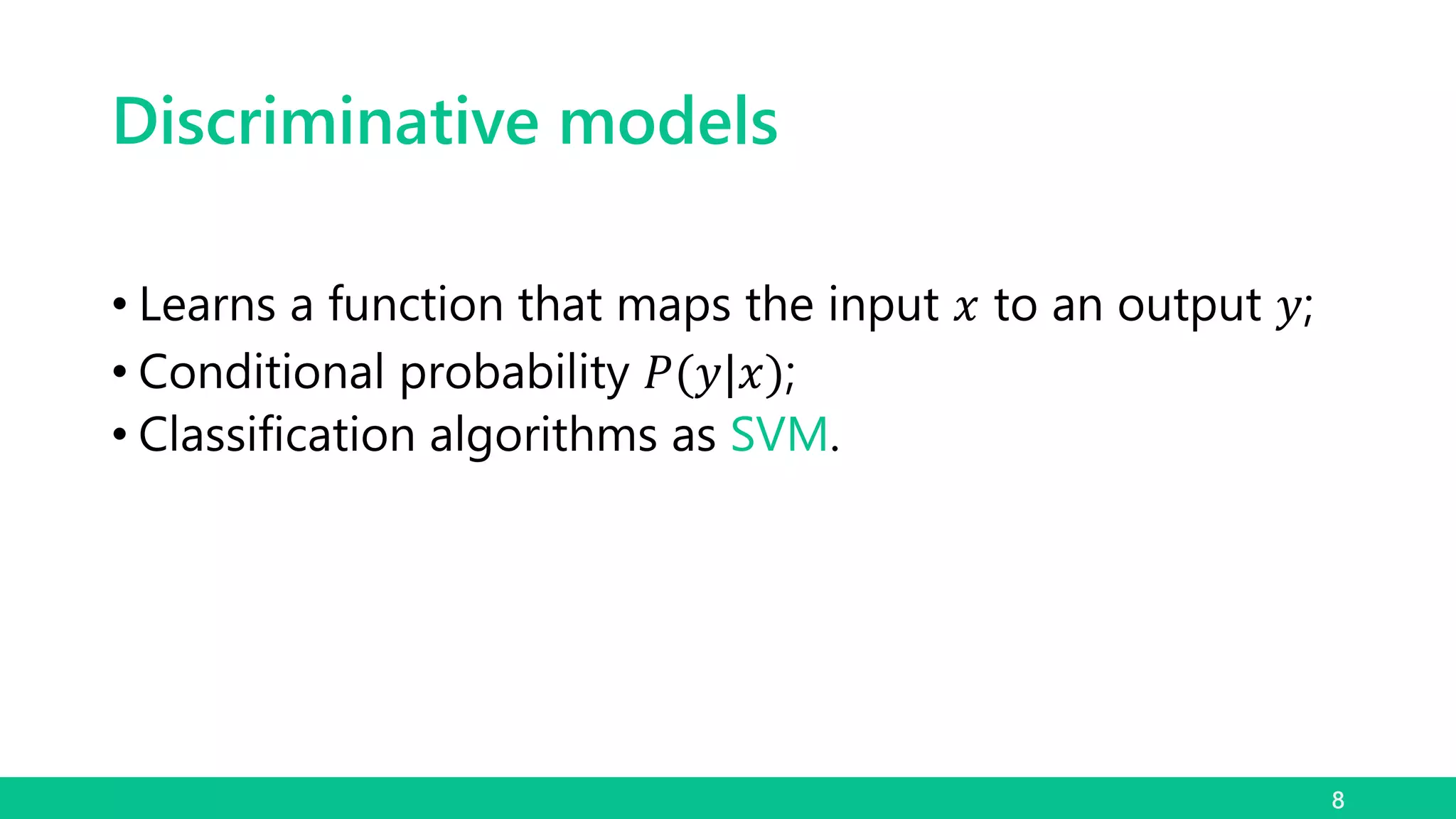
Discriminative models
• Learns a function that maps the input 𝑥 to an output 𝑦;
• Conditional probability 𝑃(𝑦|𝑥);
• Classification algorithms as SVM.
8
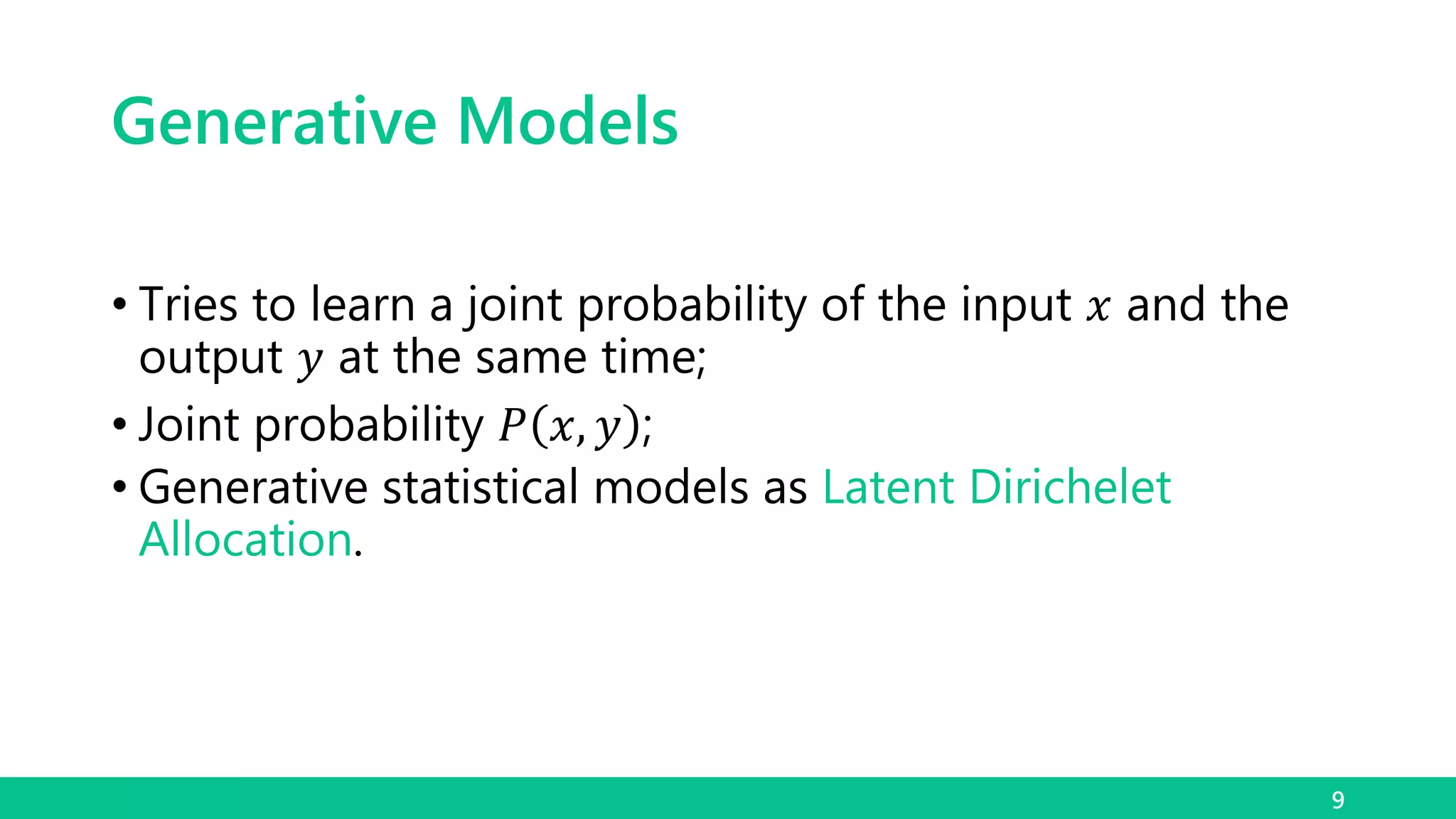
Generative Models
9
• Tries to learn a joint probability of the input 𝑥 and the
output 𝑦 at the same time;
• Joint probability 𝑃 𝑥, 𝑦 ;
• Generative statistical models as Latent Dirichelet
Allocation.
“What I do not understand,
I cannot create.”
Richard Feynman
Nobel in Physics in
1965
Source: https://openai.com/blog/generative-models/
GANs
11
What are GANs?
12
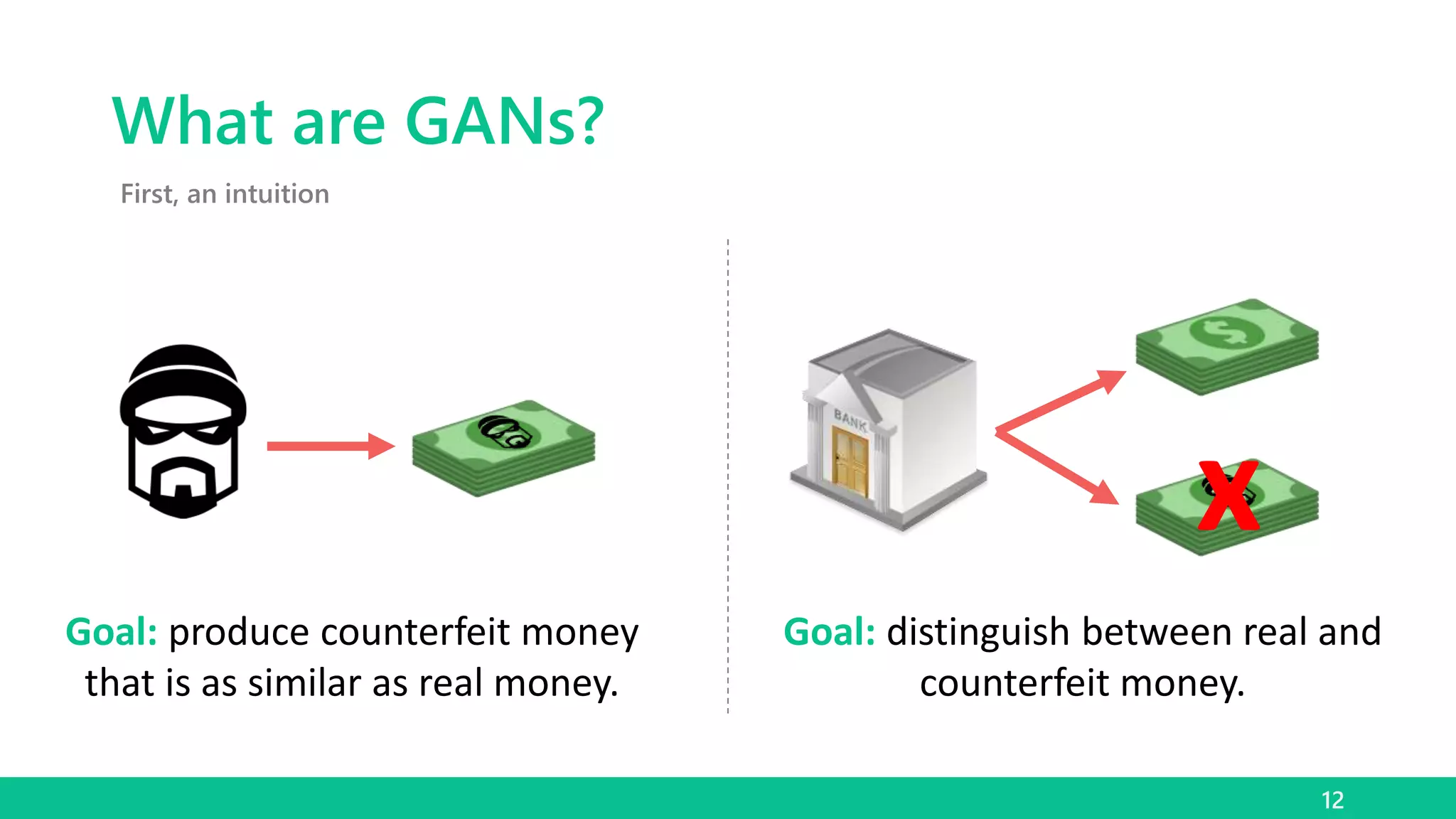
First, an intuition
Goal: produce counterfeit money
that is as similar as real money.
Goal: distinguish between real and
counterfeit money.
x
What are GANs?
13
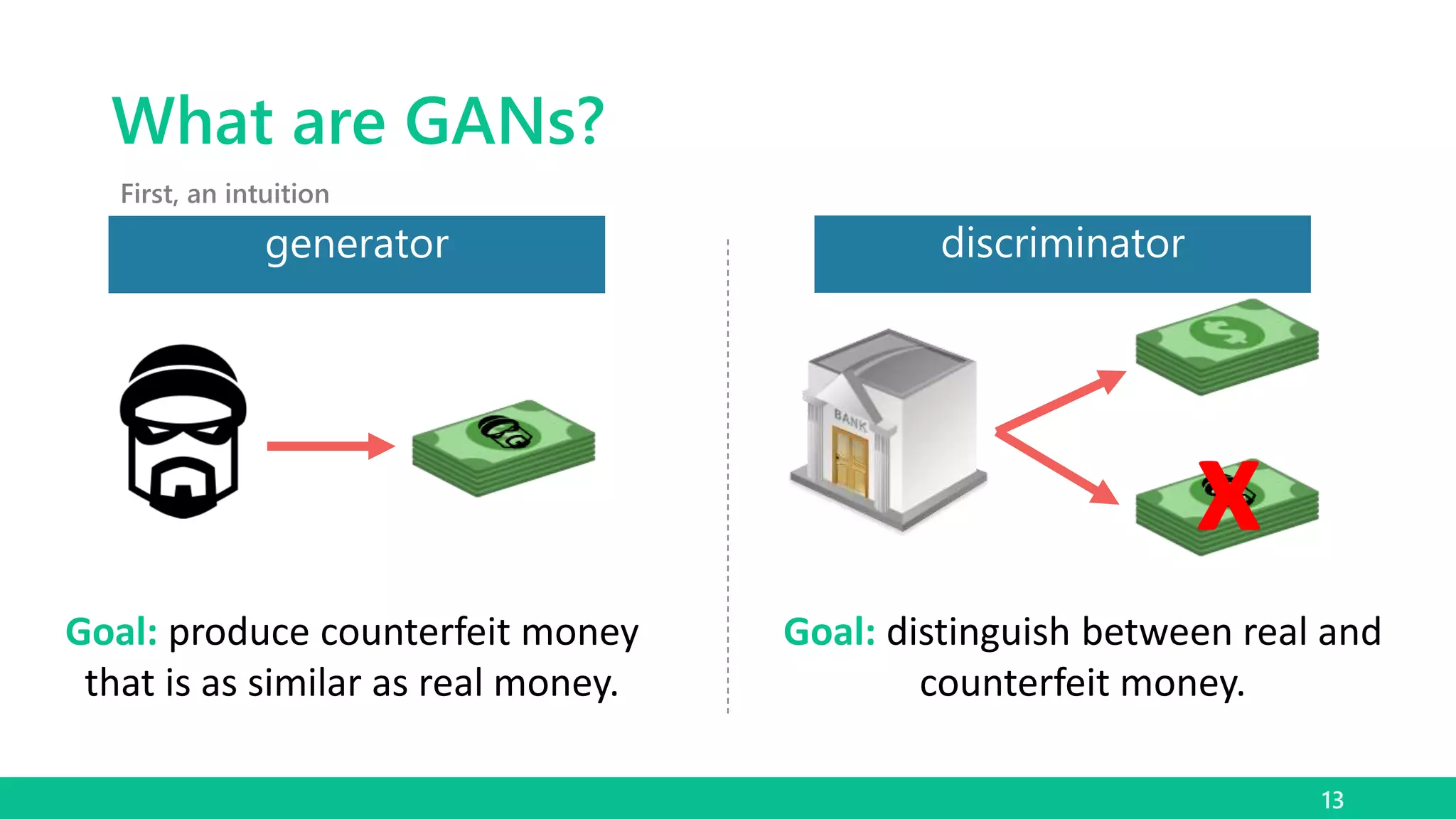
First, an intuition
Goal: distinguish between real and
counterfeit money.
x
generator discriminator
Goal: produce counterfeit money
that is as similar as real money.
What are GANs?
14
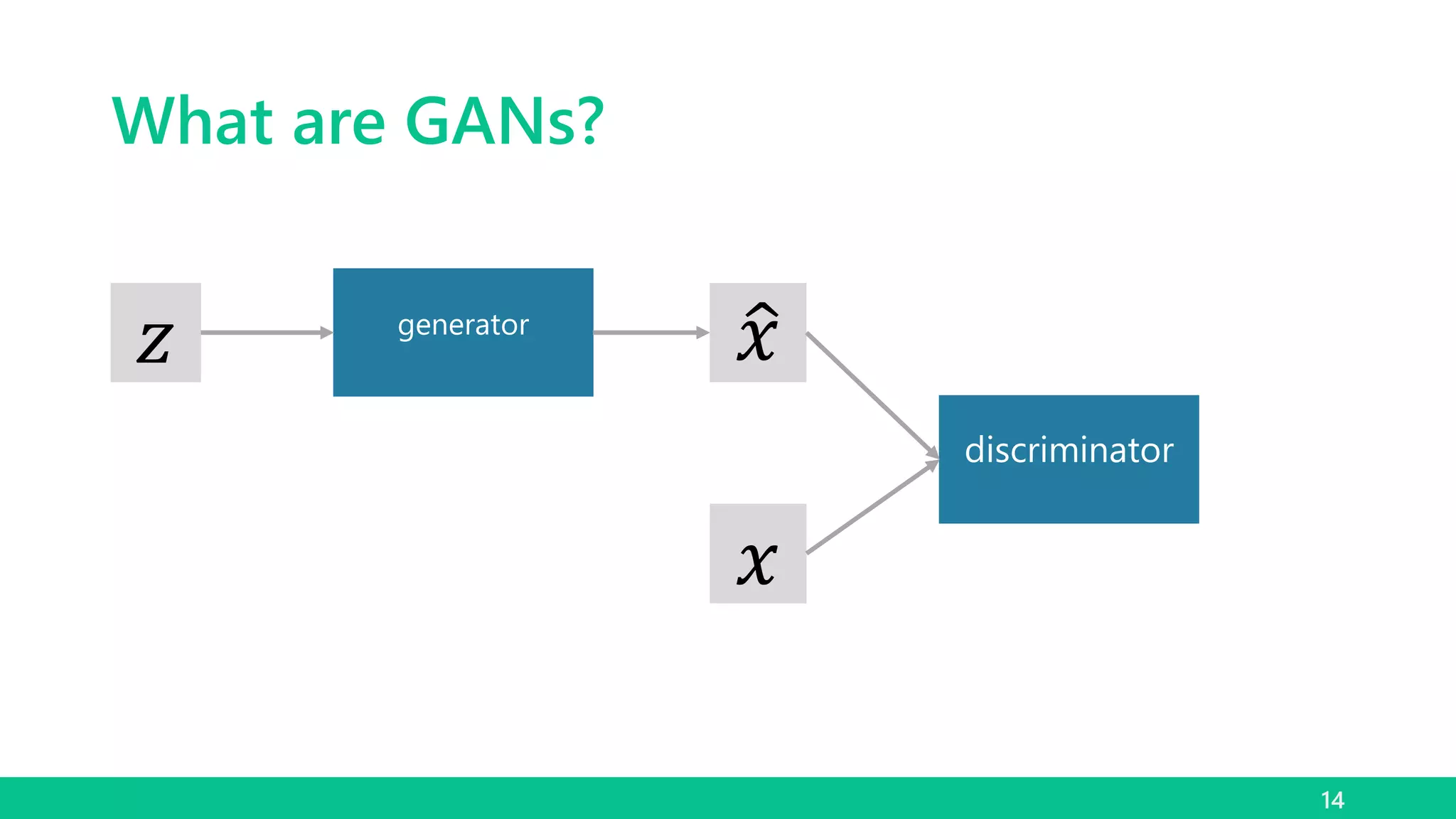
generator
discriminator
𝑧 𝑥
𝑥
What are GANs?
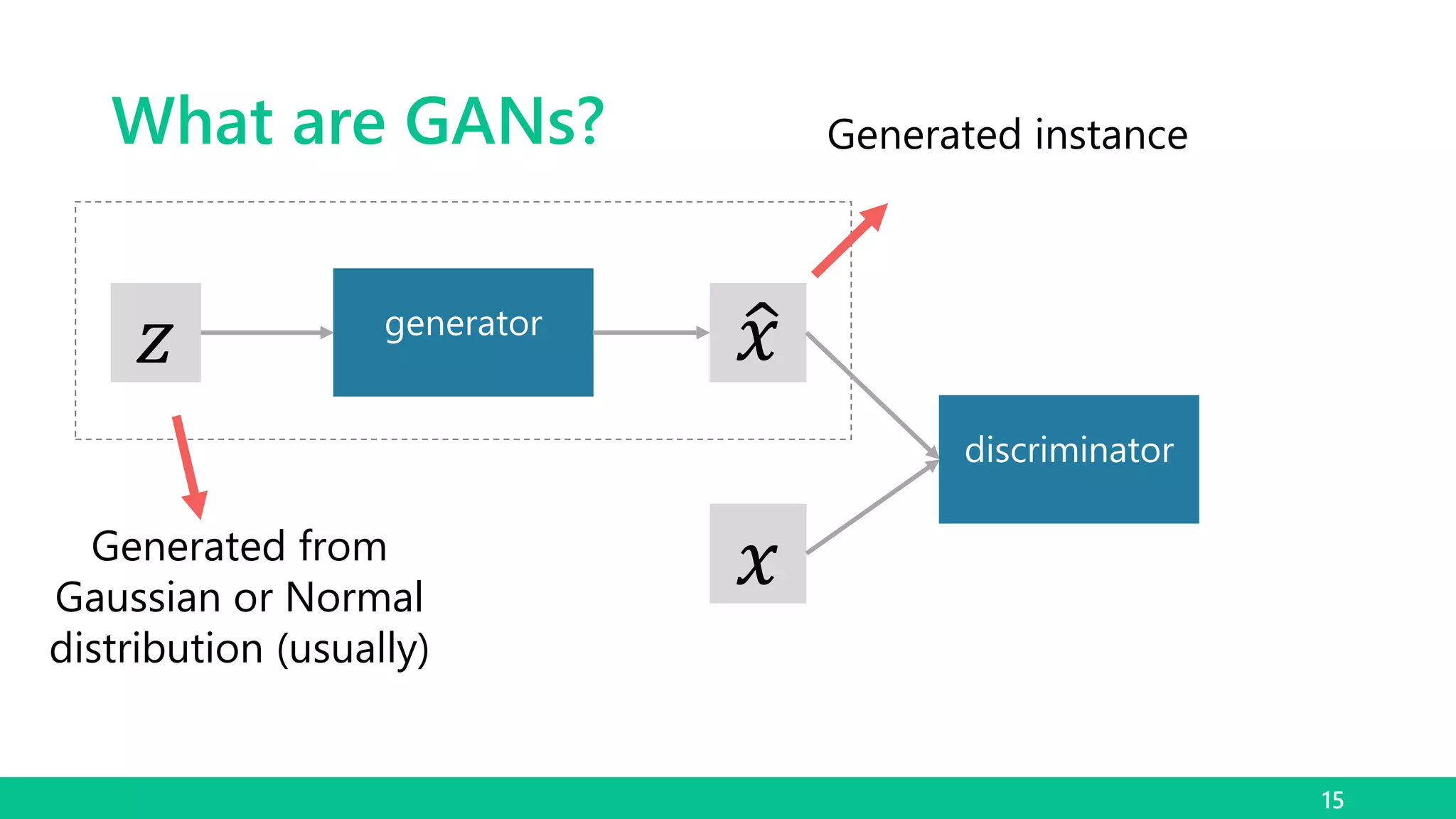
15
generator
discriminator
𝑧 𝑥
𝑥Generated from
Gaussian or Normal
distribution (usually)
Generated instance
What are GANs?
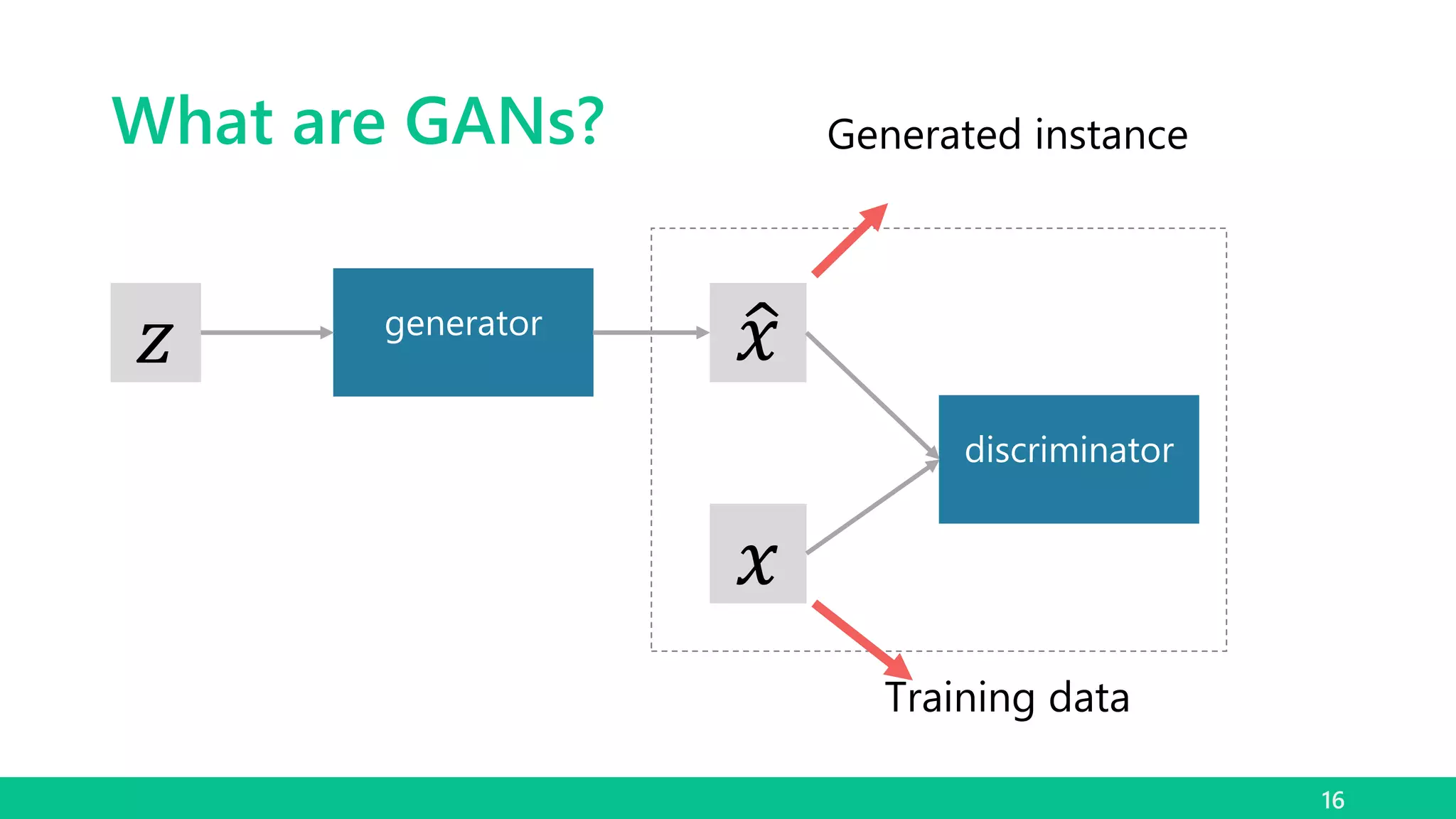
16
generator
discriminator
𝑧 𝑥
𝑥
Generated instance
Training data
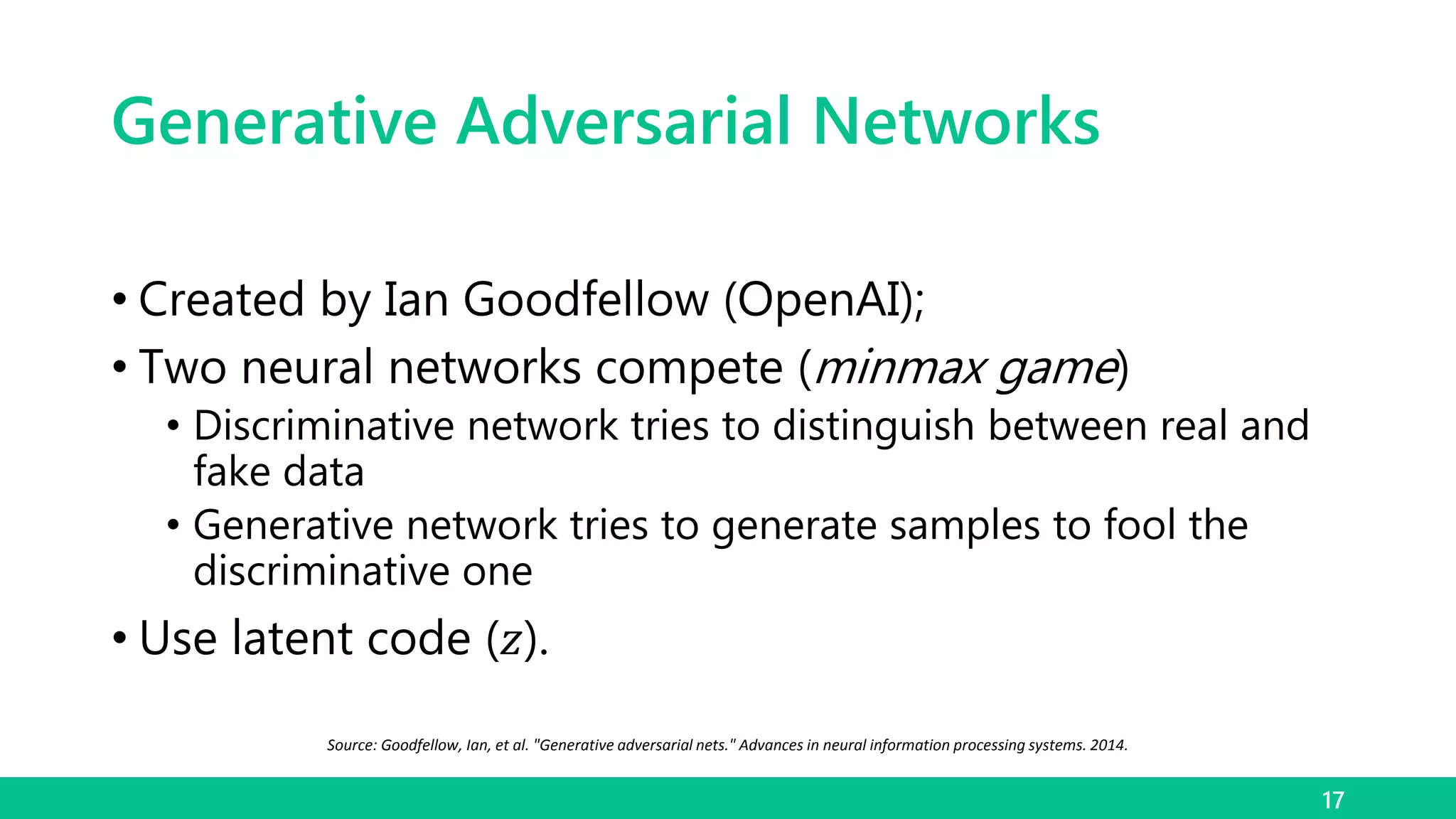
Generative Adversarial Networks
• Created by Ian Goodfellow (OpenAI);
• Two neural networks compete (minmax game)
• Discriminative network tries to distinguish between real and
fake data
• Generative network tries to generate samples to fool the
discriminative one
• Use latent code (𝑧).
17
Source: Goodfellow, Ian, et al. "Generative adversarial nets." Advances in neural information processing systems. 2014.
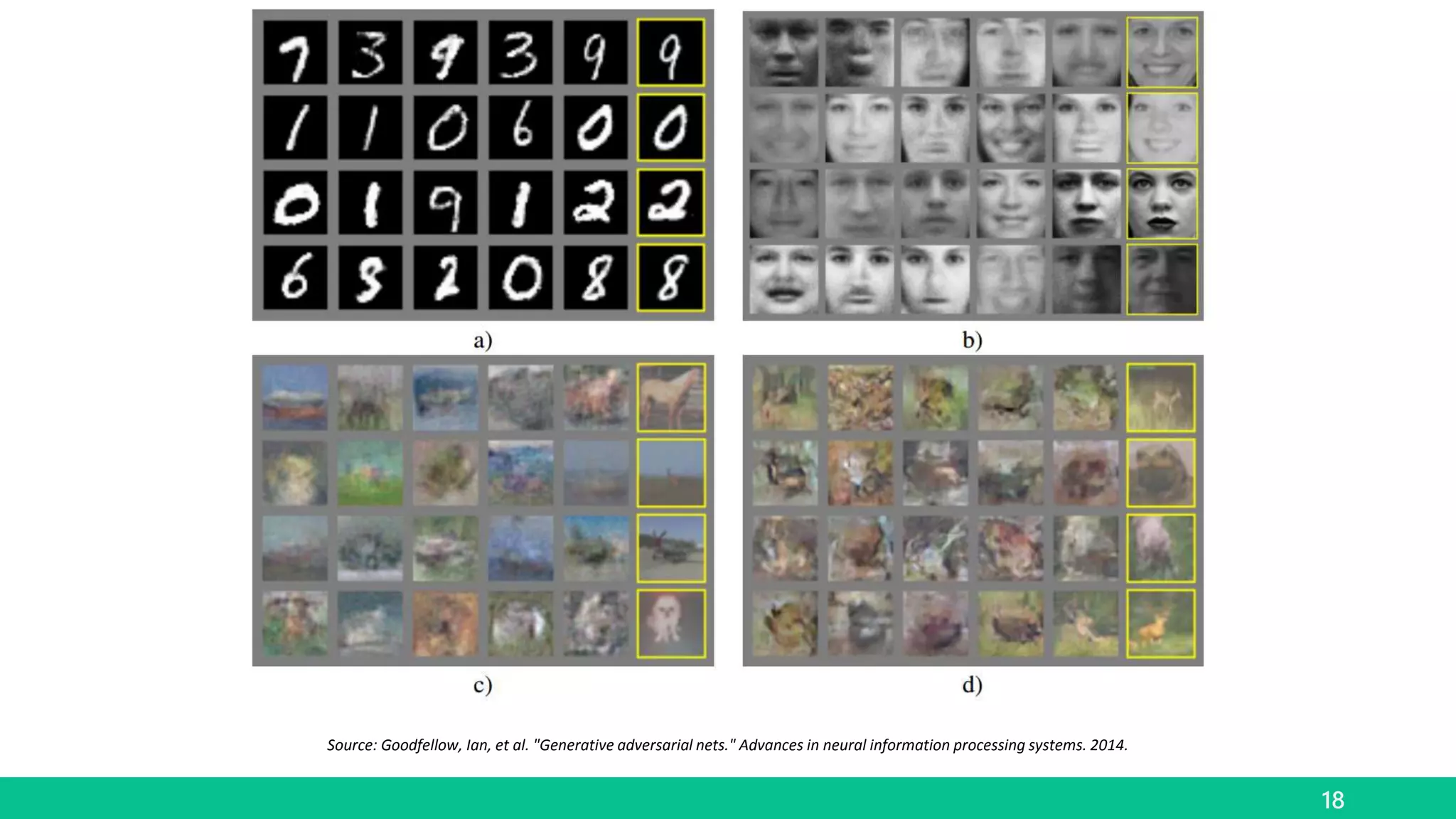
18
Source: Goodfellow, Ian, et al. "Generative adversarial nets." Advances in neural information processing systems. 2014.
Training process
19
“It should happen until the
generator exactly reproduces
the true data distribution and
the discriminator is guessing at
random, unable to find a
difference.”
OpenAI
Source: https://openai.com/blog/generative-models/
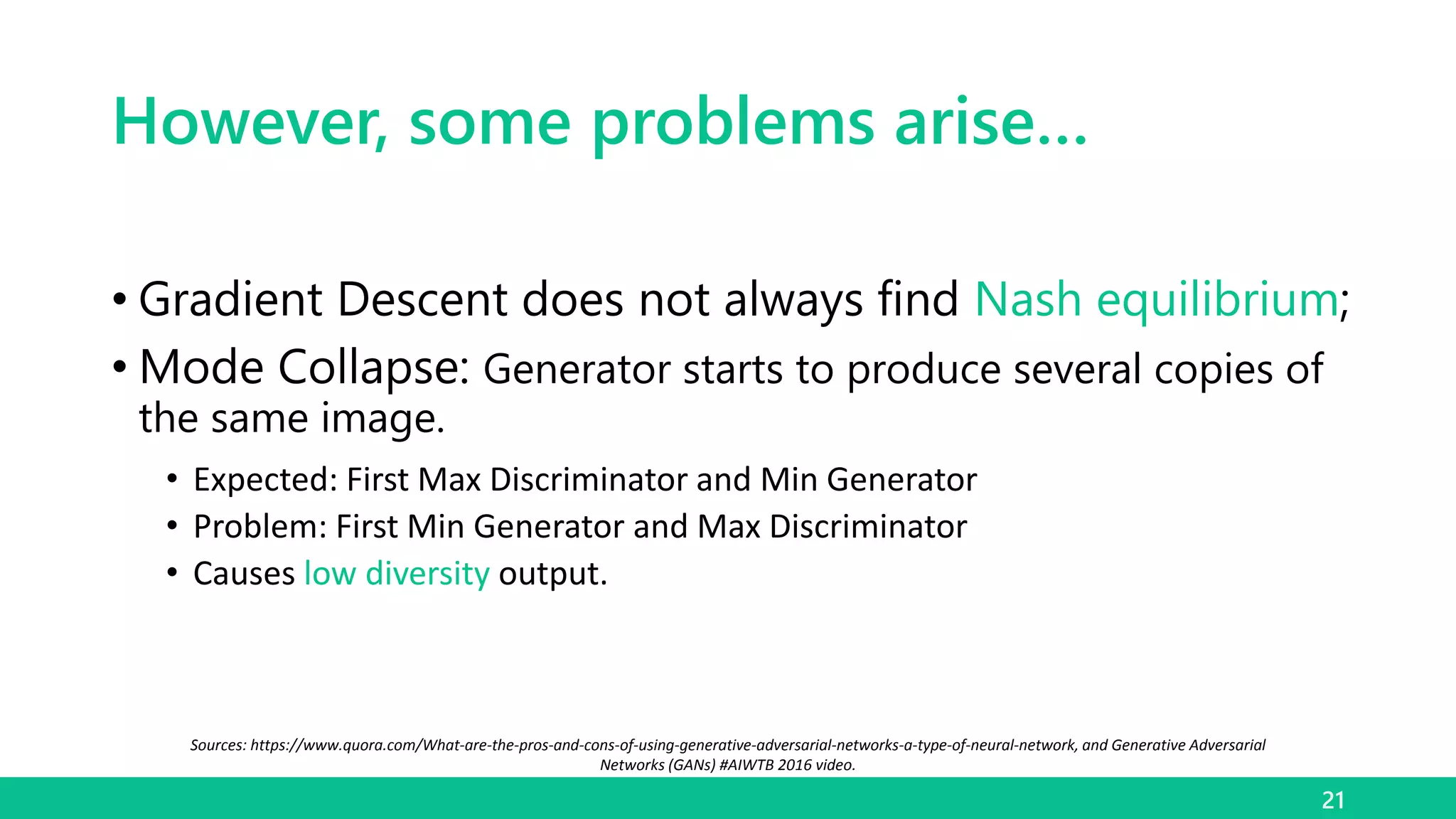
However, some problems arise…
• Gradient Descent does not always find Nash equilibrium;
• Mode Collapse: Generator starts to produce several copies of
the same image.
• Expected: First Max Discriminator and Min Generator
• Problem: First Min Generator and Max Discriminator
• Causes low diversity output.
21
Sources: https://www.quora.com/What-are-the-pros-and-cons-of-using-generative-adversarial-networks-a-type-of-neural-network, and Generative Adversarial
Networks (GANs) #AIWTB 2016 video.
Some Advances
22
Since GANs’ creation, in 2014 (not necessarily in chronological order)
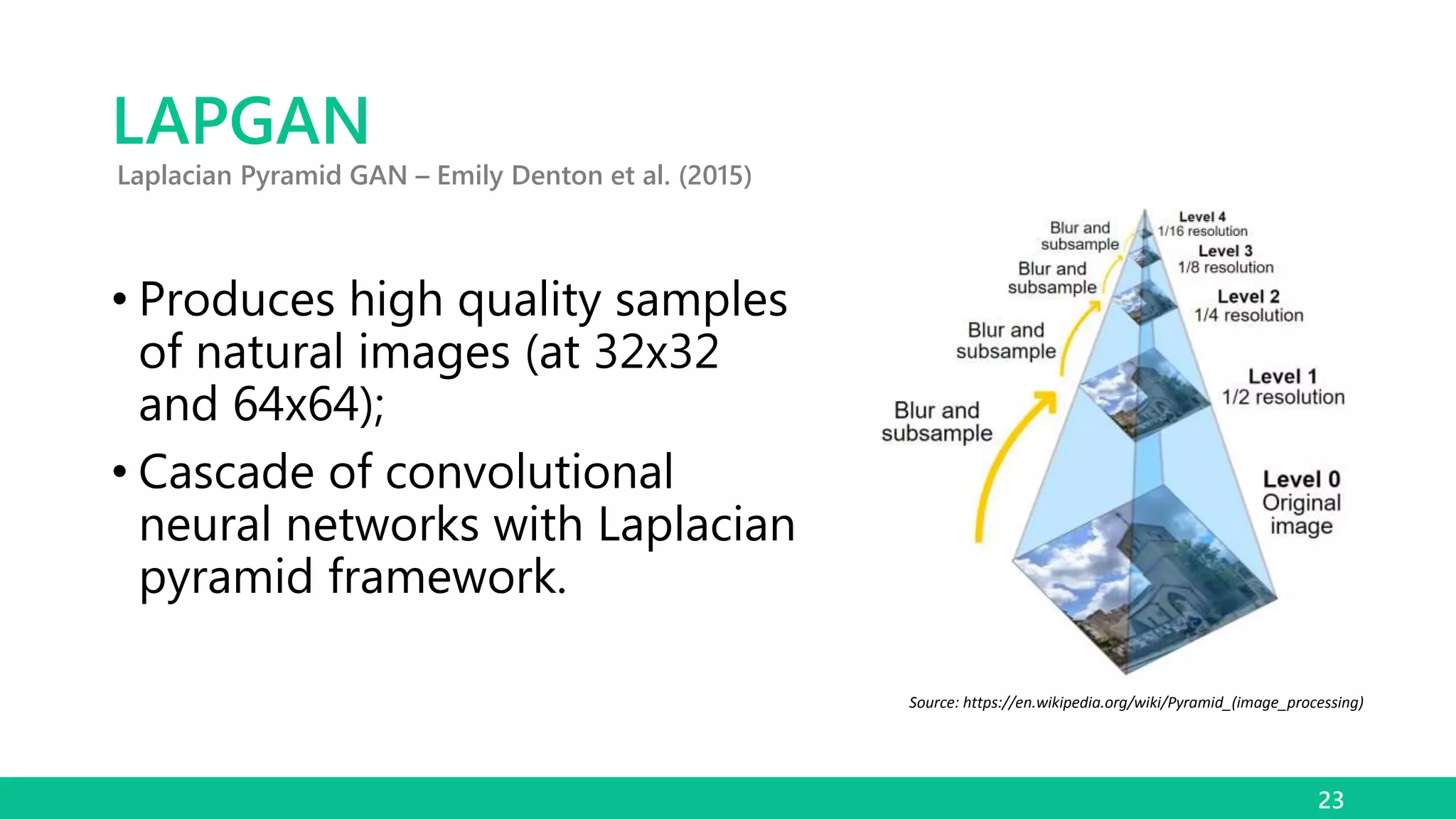
LAPGAN
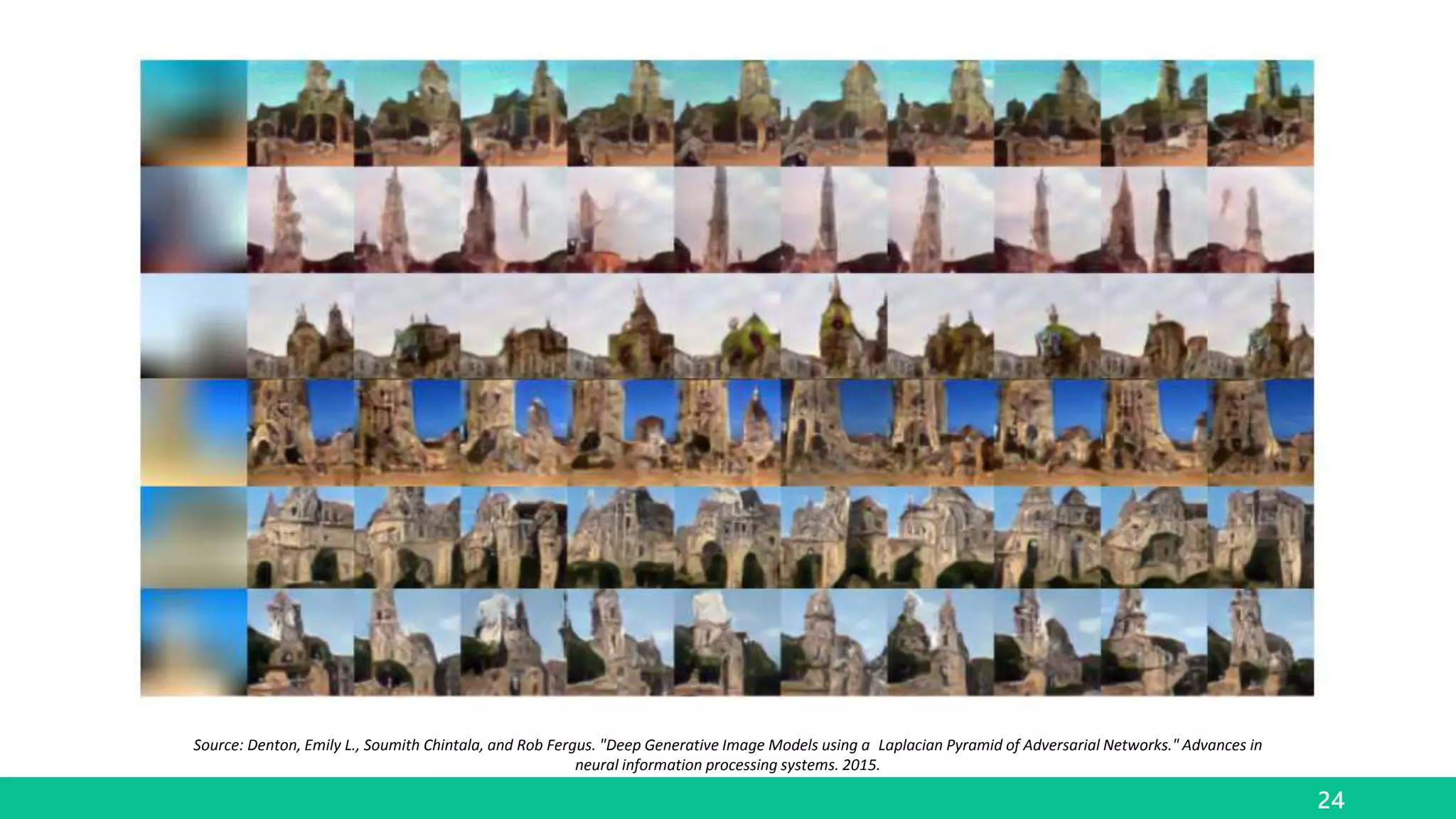
• Produces high quality samples
of natural images (at 32x32
and 64x64);
• Cascade of convolutional
neural networks with Laplacian
pyramid framework.
23
Laplacian Pyramid GAN – Emily Denton et al. (2015)
Source: https://en.wikipedia.org/wiki/Pyramid_(image_processing)
24
Source: Denton, Emily L., Soumith Chintala, and Rob Fergus. "Deep Generative Image Models using a Laplacian Pyramid of Adversarial Networks." Advances in
neural information processing systems. 2015.
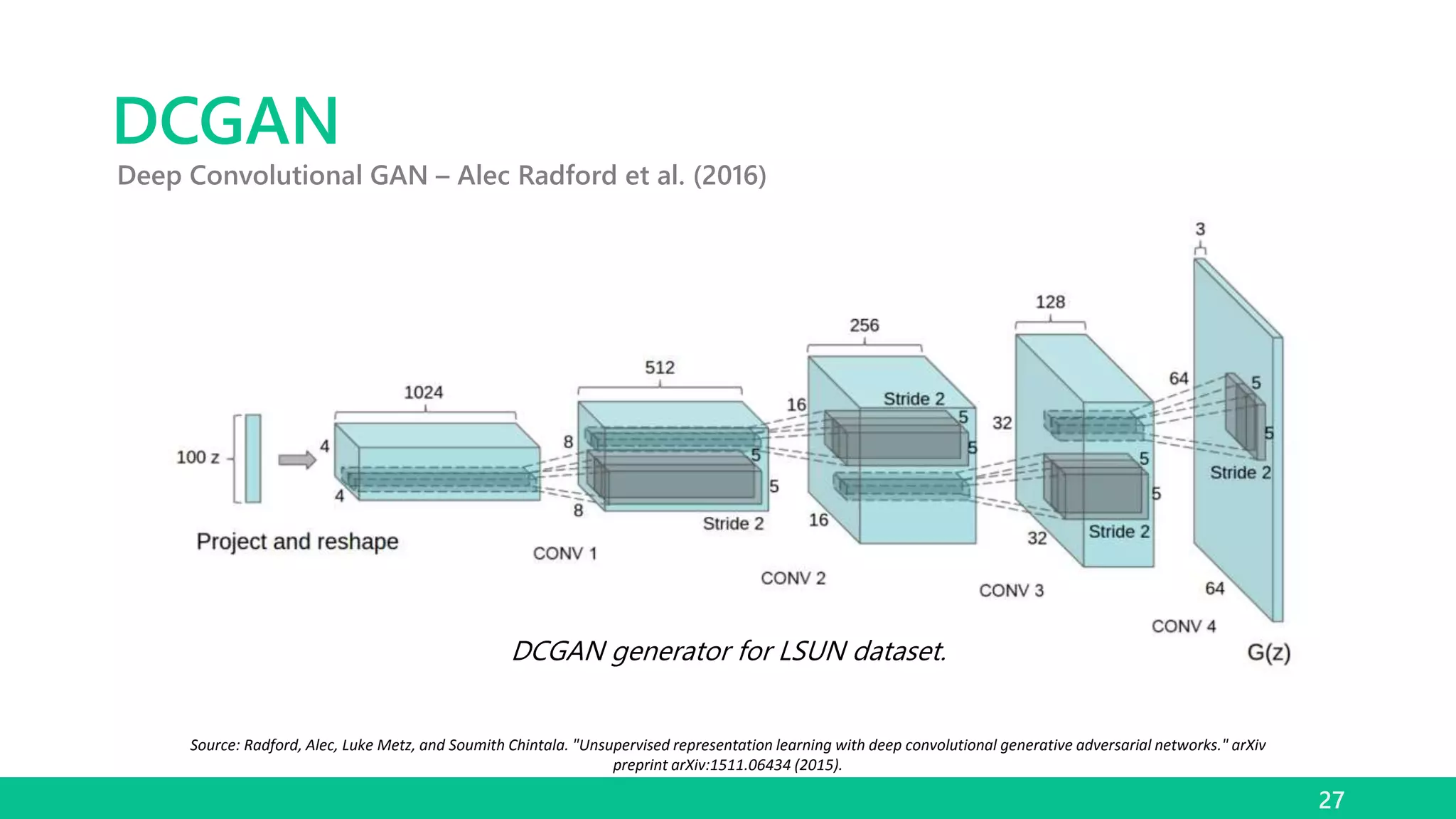
DCGAN
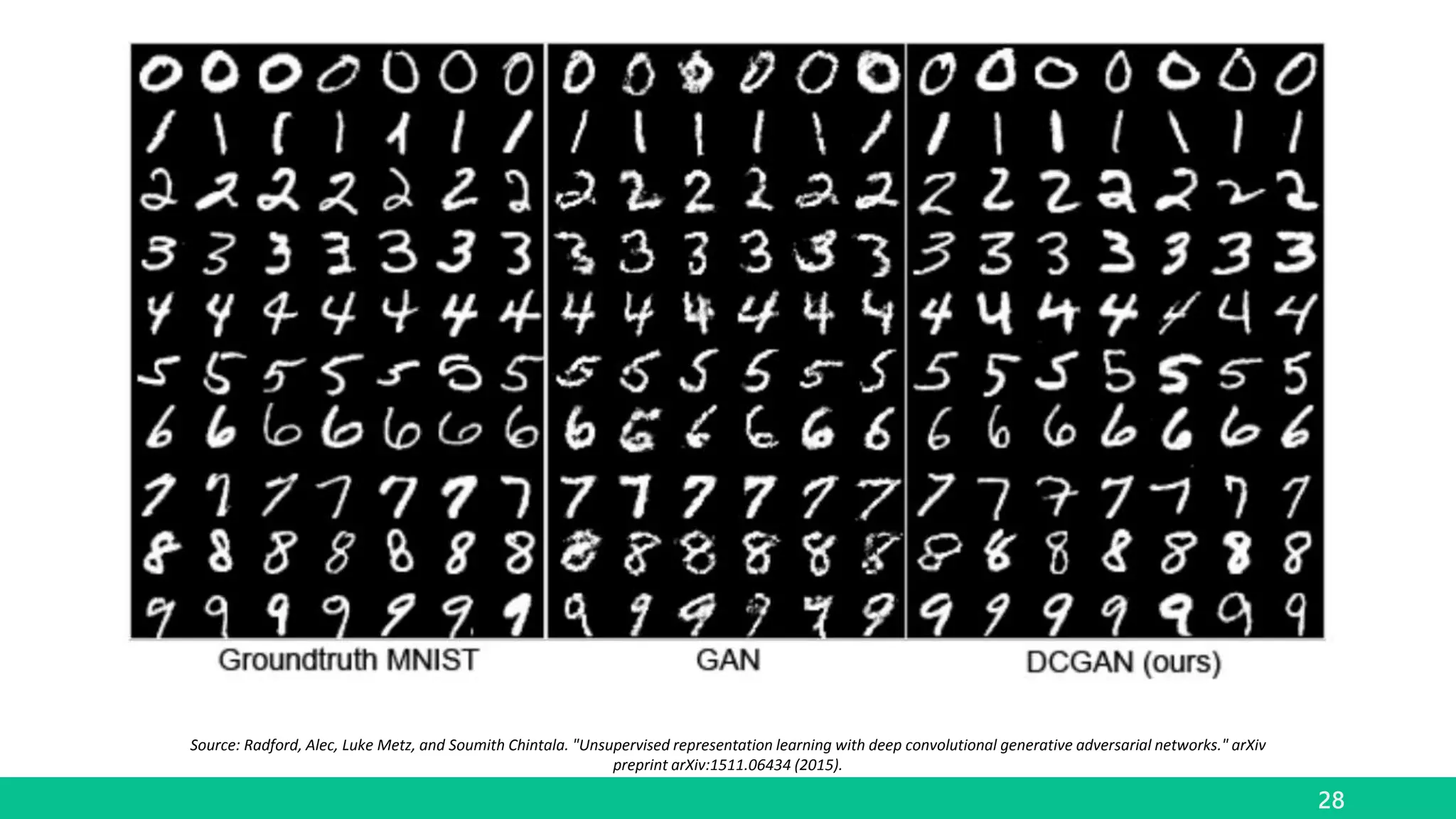
• CNNs combined with GANs;
• Train GANs and later use learned feature extractors for
supervised tasks;
• Successful use of CNNs after LAPGAN;
• Created guidelines for stable Deep Convolutional GANs.
25
Deep Convolutional GAN – Alec Radford et al. (2016)
Source: Radford, Alec, Luke Metz, and Soumith Chintala. "Unsupervised representation learning with deep convolutional generative adversarial networks." arXiv
preprint arXiv:1511.06434 (2015).
DCGAN
Used three recent changes in CNNs:
• All convolutional network – strided convolutions;
• Elimination of fully-connected layers;
• Batch normalization.
26
Deep Convolutional GAN – Alec Radford et al. (2016)
Source: Radford, Alec, Luke Metz, and Soumith Chintala. "Unsupervised representation learning with deep convolutional generative adversarial networks." arXiv
preprint arXiv:1511.06434 (2015).
DCGAN
27
Deep Convolutional GAN – Alec Radford et al. (2016)
Source: Radford, Alec, Luke Metz, and Soumith Chintala. "Unsupervised representation learning with deep convolutional generative adversarial networks." arXiv
preprint arXiv:1511.06434 (2015).
DCGAN generator for LSUN dataset.
28
Source: Radford, Alec, Luke Metz, and Soumith Chintala. "Unsupervised representation learning with deep convolutional generative adversarial networks." arXiv
preprint arXiv:1511.06434 (2015).
29
Source: Radford, Alec, Luke Metz, and Soumith Chintala. "Unsupervised representation learning with deep convolutional generative adversarial networks." arXiv
preprint arXiv:1511.06434 (2015).
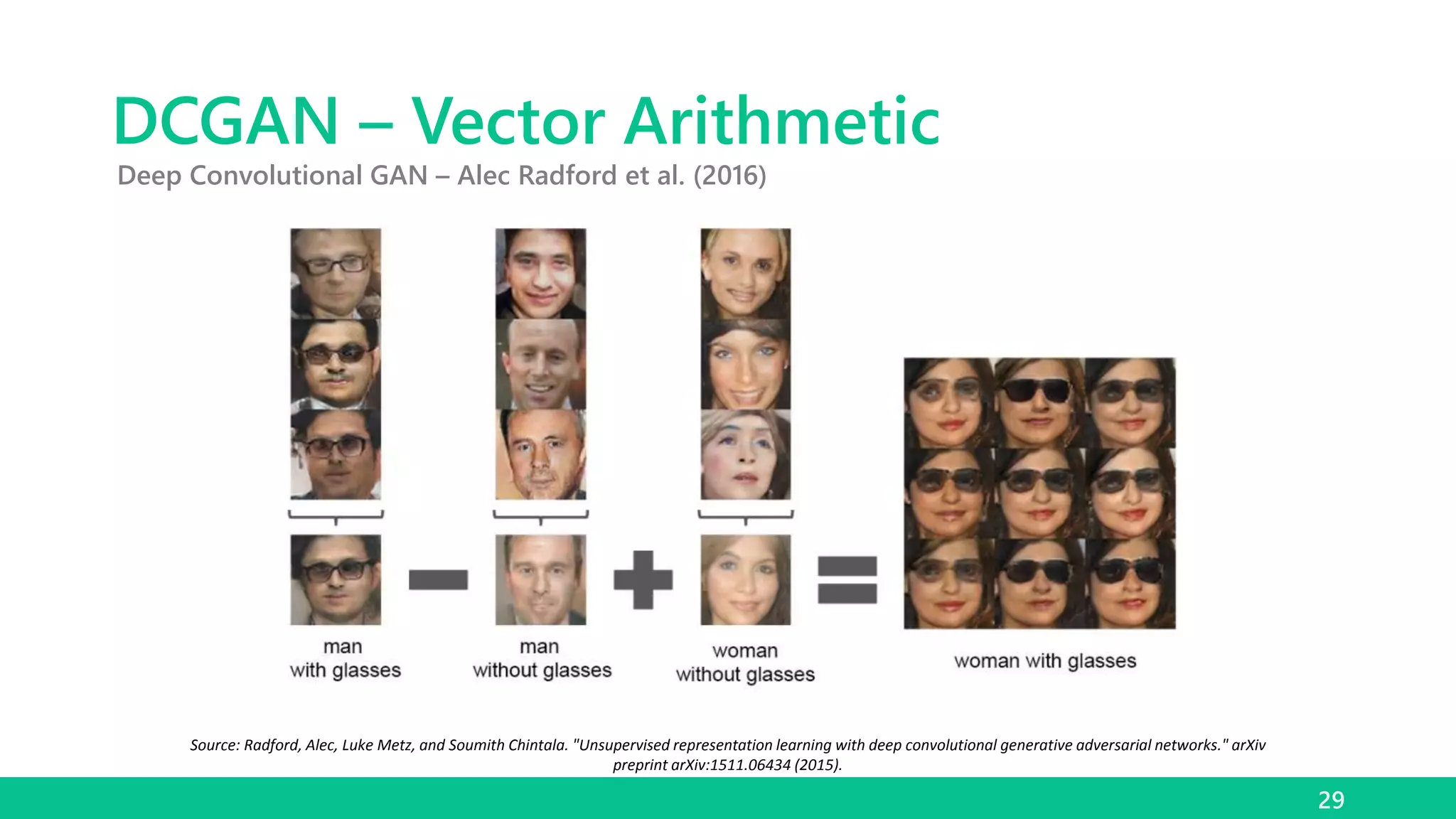
DCGAN – Vector Arithmetic
Deep Convolutional GAN – Alec Radford et al. (2016)
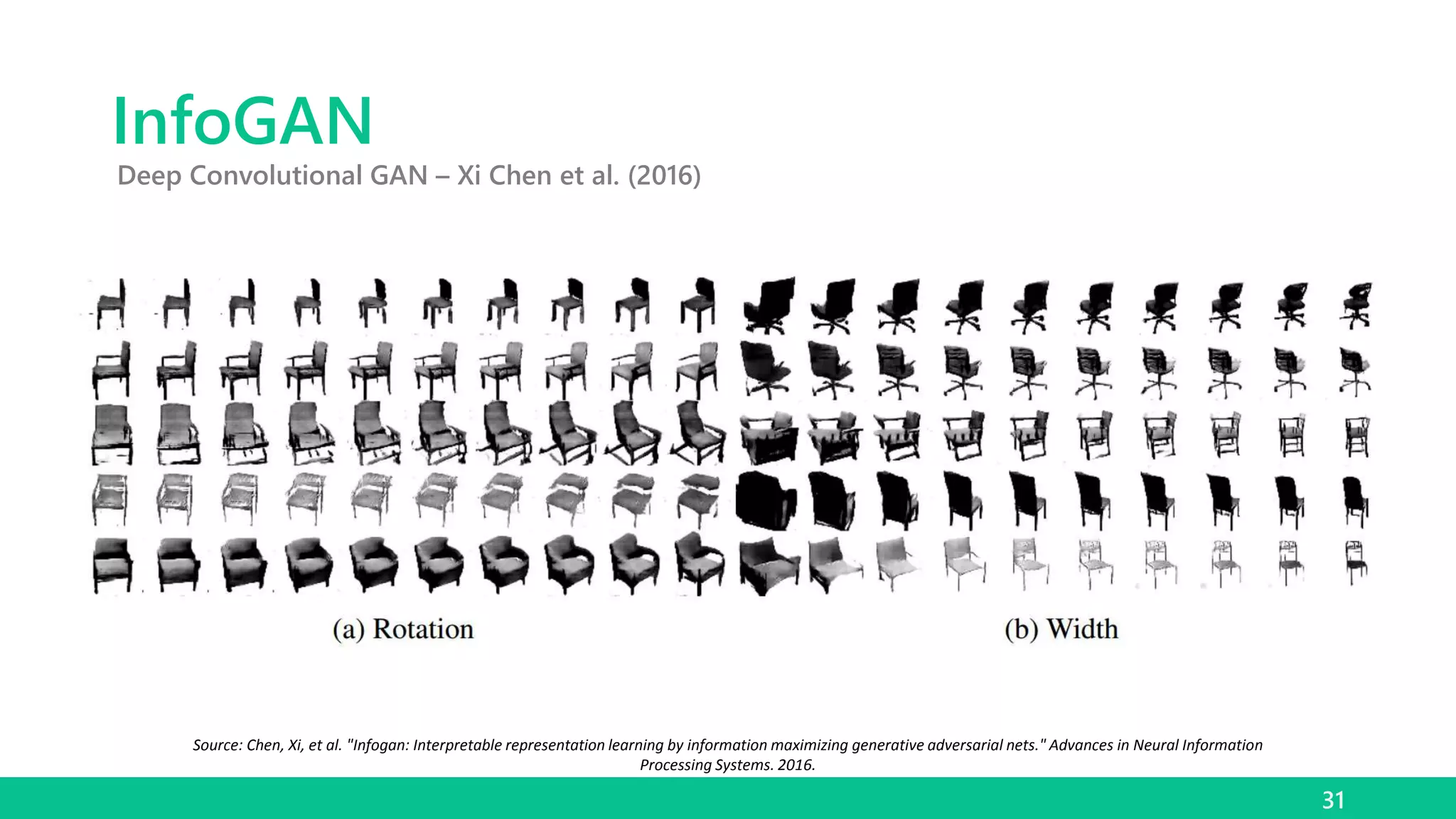
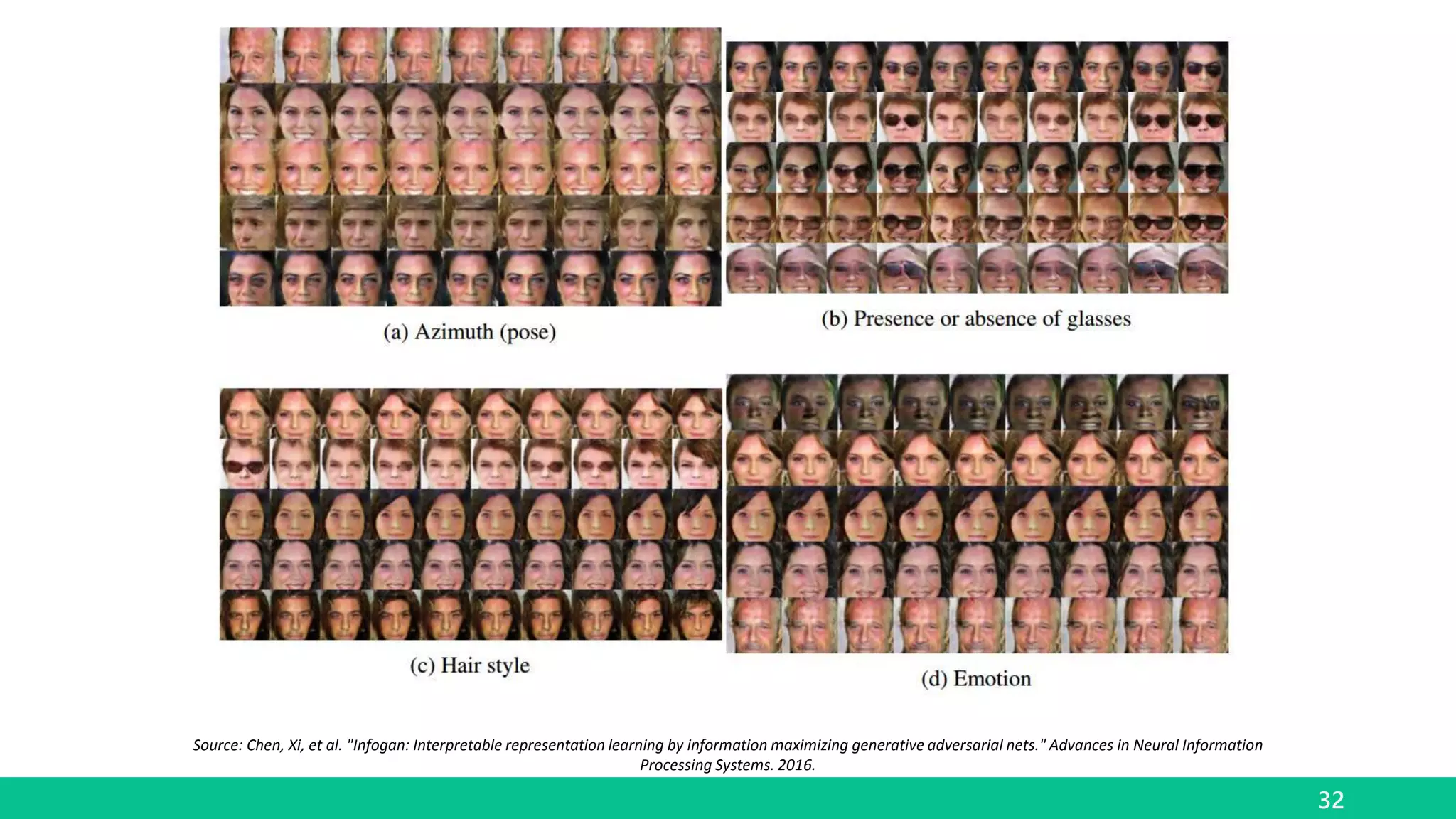
InfoGAN
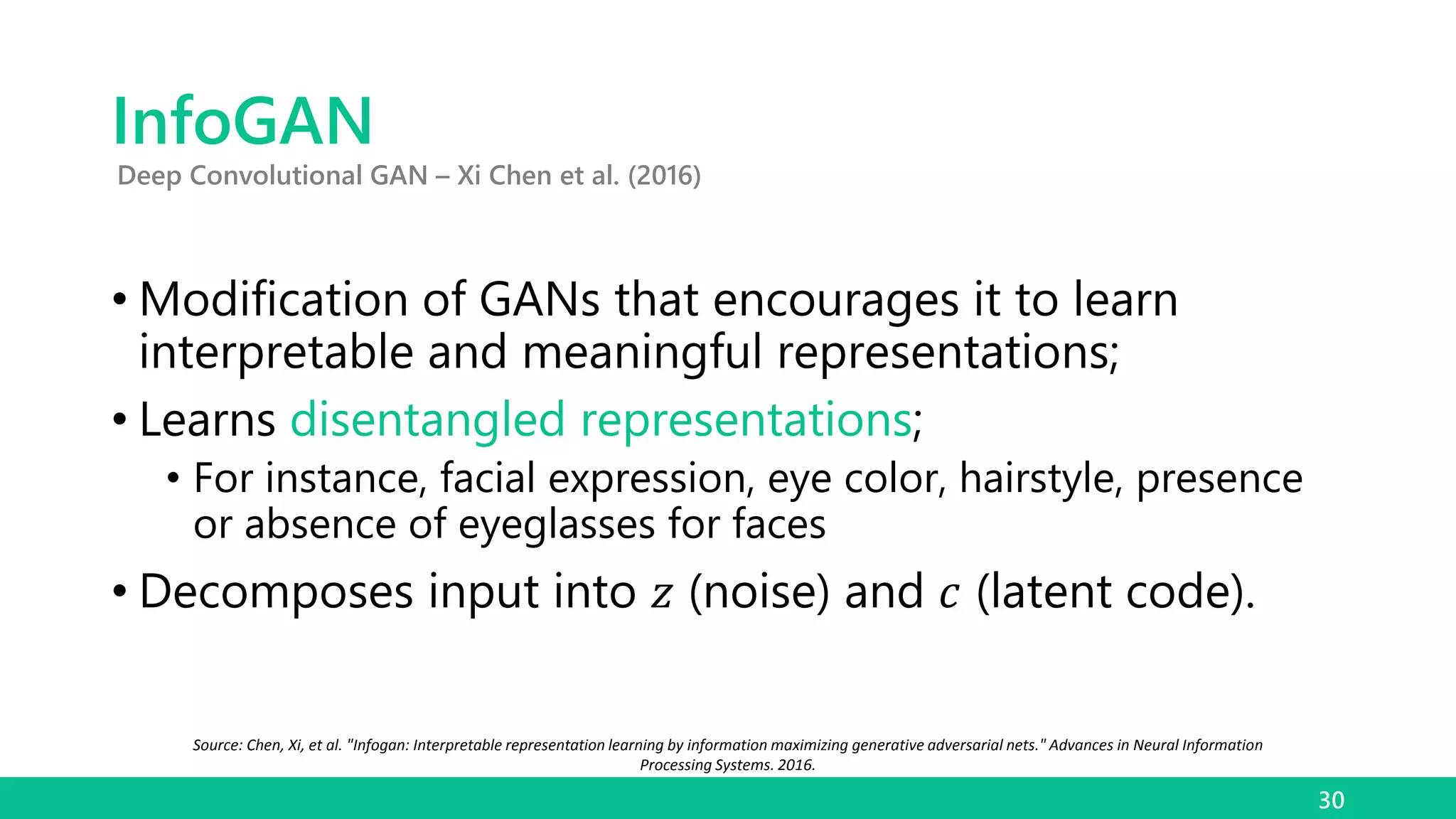
• Modification of GANs that encourages it to learn
interpretable and meaningful representations;
• Learns disentangled representations;
• For instance, facial expression, eye color, hairstyle, presence
or absence of eyeglasses for faces
• Decomposes input into 𝑧 (noise) and 𝑐 (latent code).
30
Deep Convolutional GAN – Xi Chen et al. (2016)
Source: Chen, Xi, et al. "Infogan: Interpretable representation learning by information maximizing generative adversarial nets." Advances in Neural Information
Processing Systems. 2016.
31
Source: Chen, Xi, et al. "Infogan: Interpretable representation learning by information maximizing generative adversarial nets." Advances in Neural Information
Processing Systems. 2016.
InfoGAN
Deep Convolutional GAN – Xi Chen et al. (2016)
32
Source: Chen, Xi, et al. "Infogan: Interpretable representation learning by information maximizing generative adversarial nets." Advances in Neural Information
Processing Systems. 2016.
Let’s pause for a while…
33
Paper regarding improvements on training GANs
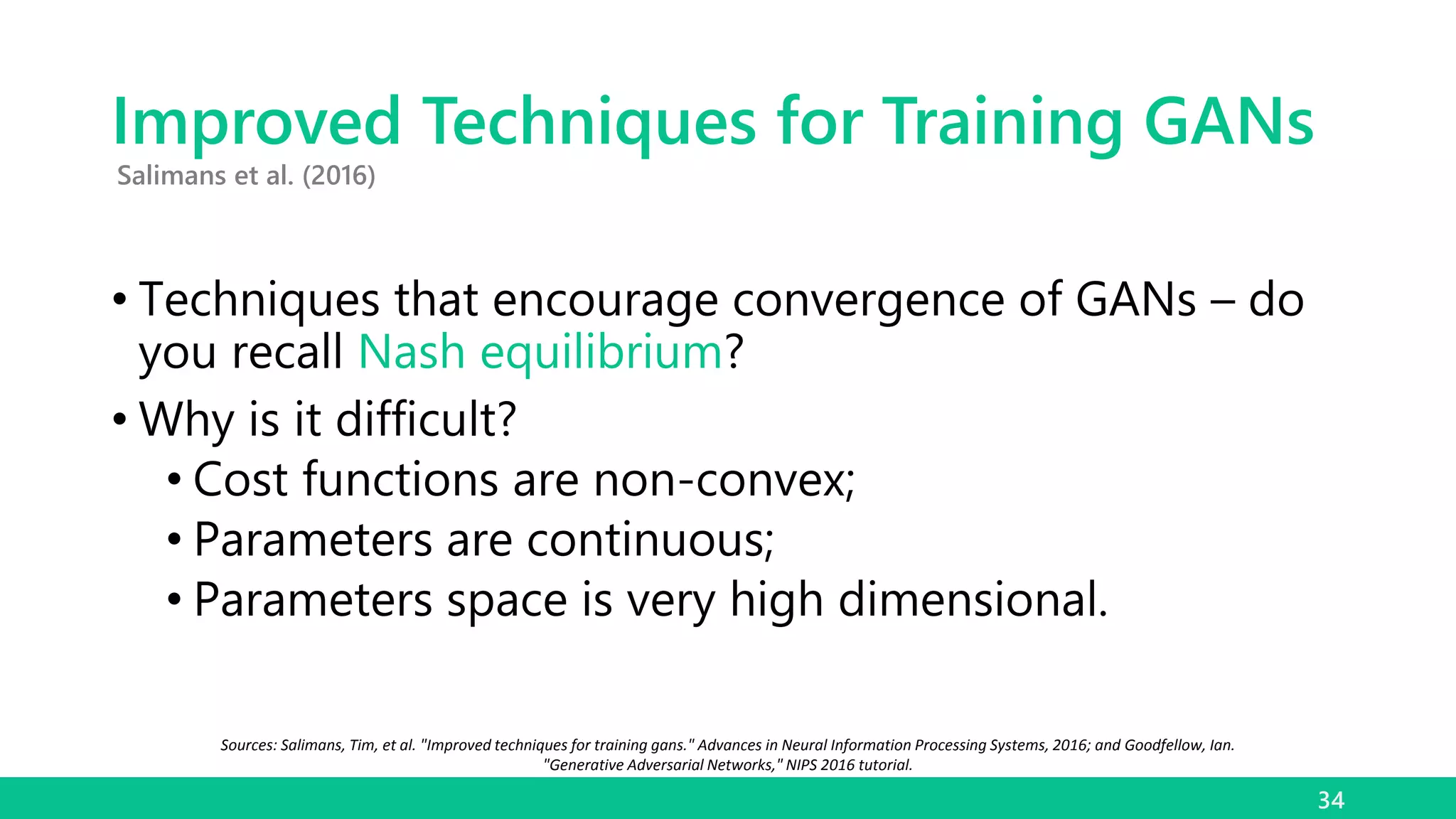
Improved Techniques for Training GANs
• Techniques that encourage convergence of GANs – do
you recall Nash equilibrium?
• Why is it difficult?
• Cost functions are non-convex;
• Parameters are continuous;
• Parameters space is very high dimensional.
34
Salimans et al. (2016)
Sources: Salimans, Tim, et al. "Improved techniques for training gans." Advances in Neural Information Processing Systems, 2016; and Goodfellow, Ian.
"Generative Adversarial Networks," NIPS 2016 tutorial.
Improved Techniques for Training GANs
Feature matching
• Instead of maximizing the output of the
discriminator, requires the generator to generate
data that matches statistics of real data;
• Generator trained to match expected value of an
intermediate layer of the discriminator.
35
Salimans et al. (2016)
Sources: Salimans, Tim, et al. "Improved techniques for training gans." Advances in Neural Information Processing Systems, 2016; and Goodfellow, Ian.
"Generative Adversarial Networks," NIPS 2016 tutorial.
Improved Techniques for Training GANs
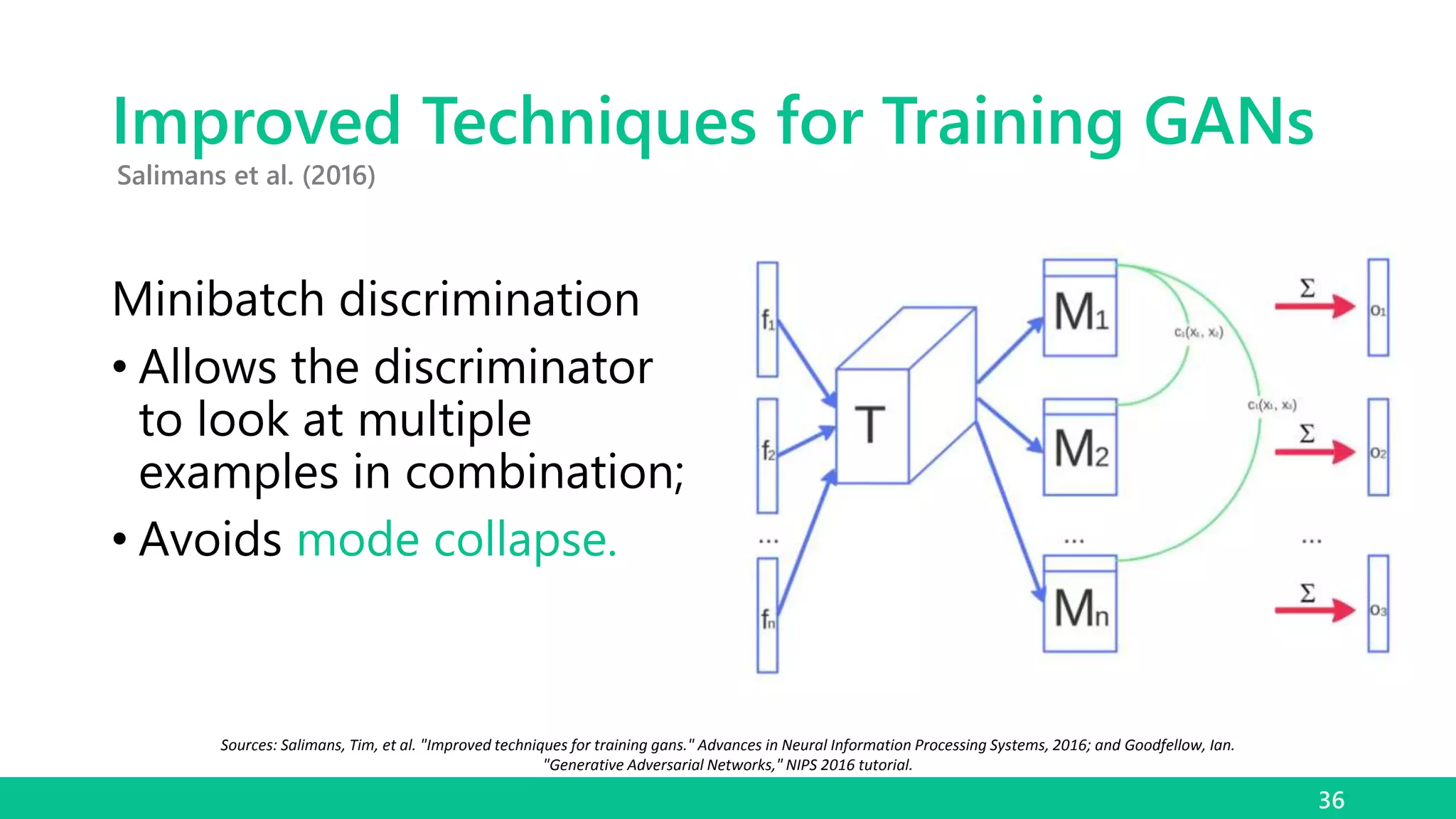
Minibatch discrimination
• Allows the discriminator
to look at multiple
examples in combination;
• Avoids mode collapse.
36
Salimans et al. (2016)
Sources: Salimans, Tim, et al. "Improved techniques for training gans." Advances in Neural Information Processing Systems, 2016; and Goodfellow, Ian.
"Generative Adversarial Networks," NIPS 2016 tutorial.
Improved Techniques for Training GANs
Historical averaging
• Adds a term in cost functions to consider past
parameters;
• Inspired on Fictitious Play (based on frequency of play).
37
Salimans et al. (2016)
Sources: Salimans, Tim, et al. "Improved techniques for training gans." Advances in Neural Information Processing Systems, 2016; and Goodfellow, Ian.
"Generative Adversarial Networks," NIPS 2016 tutorial.
Improved Techniques for Training GANs
One-sided label smoothing
• Reduces confidence, considering targets of 0.1 and 0.9
instead of 0 and 1;
• Prevents discriminator from giving very large gradient
signal to generator.
38
Salimans et al. (2016)
Sources: Salimans, Tim, et al. "Improved techniques for training gans." Advances in Neural Information Processing Systems, 2016; and Goodfellow, Ian.
"Generative Adversarial Networks," NIPS 2016 tutorial.
Improved Techniques for Training GANs
Virtual Batch Normalization (VBN)
• Regular batch normalization can cause strong intra-batch
correlation;
• VBN avoids the problem by using a reference batch and its
statistics to combine with the given instances;
• It is computationally expensive.
39
Salimans et al. (2016)
Sources: Salimans, Tim, et al. "Improved techniques for training gans." Advances in Neural Information Processing Systems, 2016; and Goodfellow, Ian.
"Generative Adversarial Networks," NIPS 2016 tutorial.
Coming Back to Advances
40
Since GANs’ creation, in 2014 (not necessarily in chronological order)
Advances... and some Applications
41
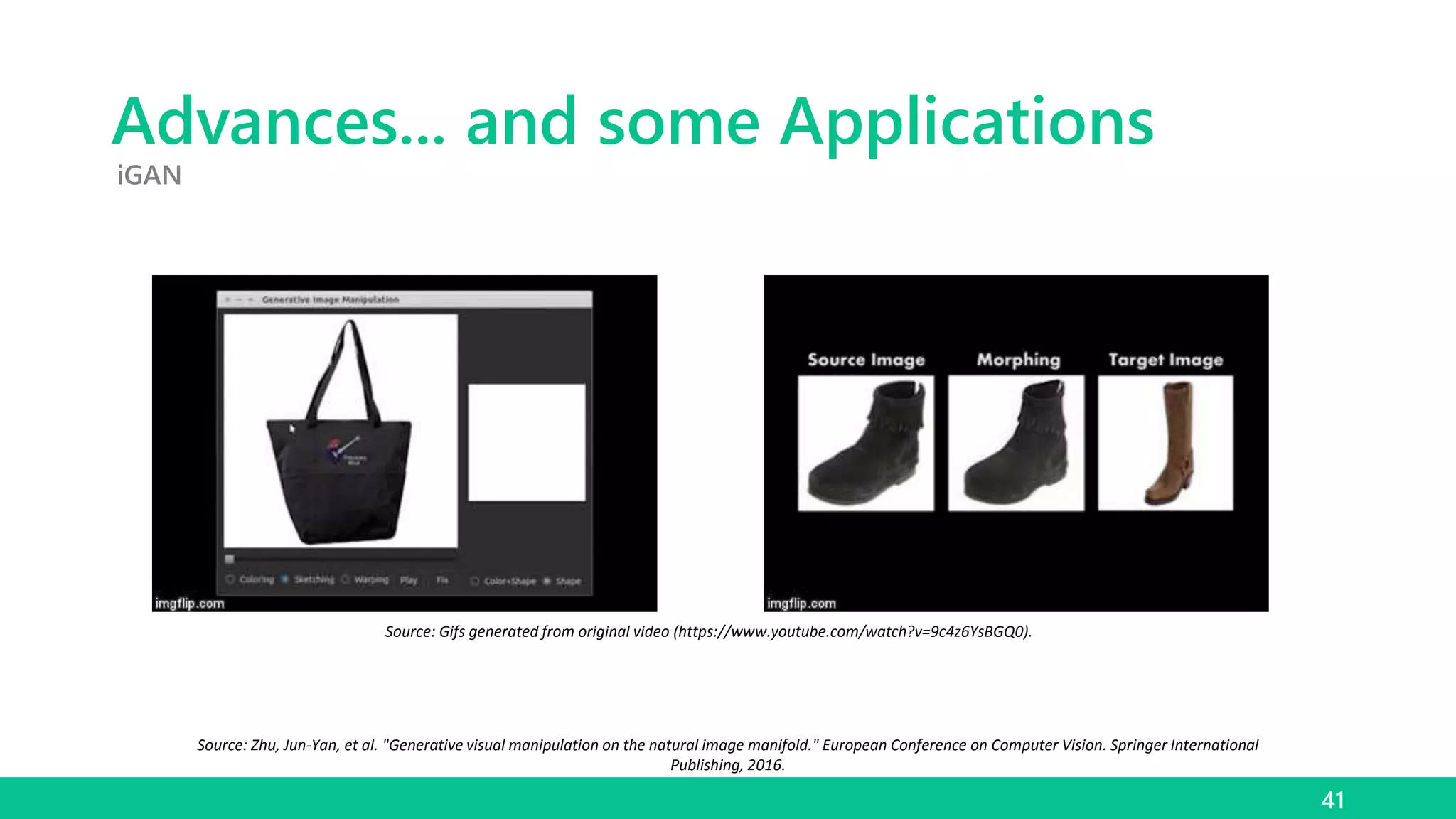
iGAN
Source: Zhu, Jun-Yan, et al. "Generative visual manipulation on the natural image manifold." European Conference on Computer Vision. Springer International
Publishing, 2016.
Source: Gifs generated from original video (https://www.youtube.com/watch?v=9c4z6YsBGQ0).
Advances... and some Applications
42
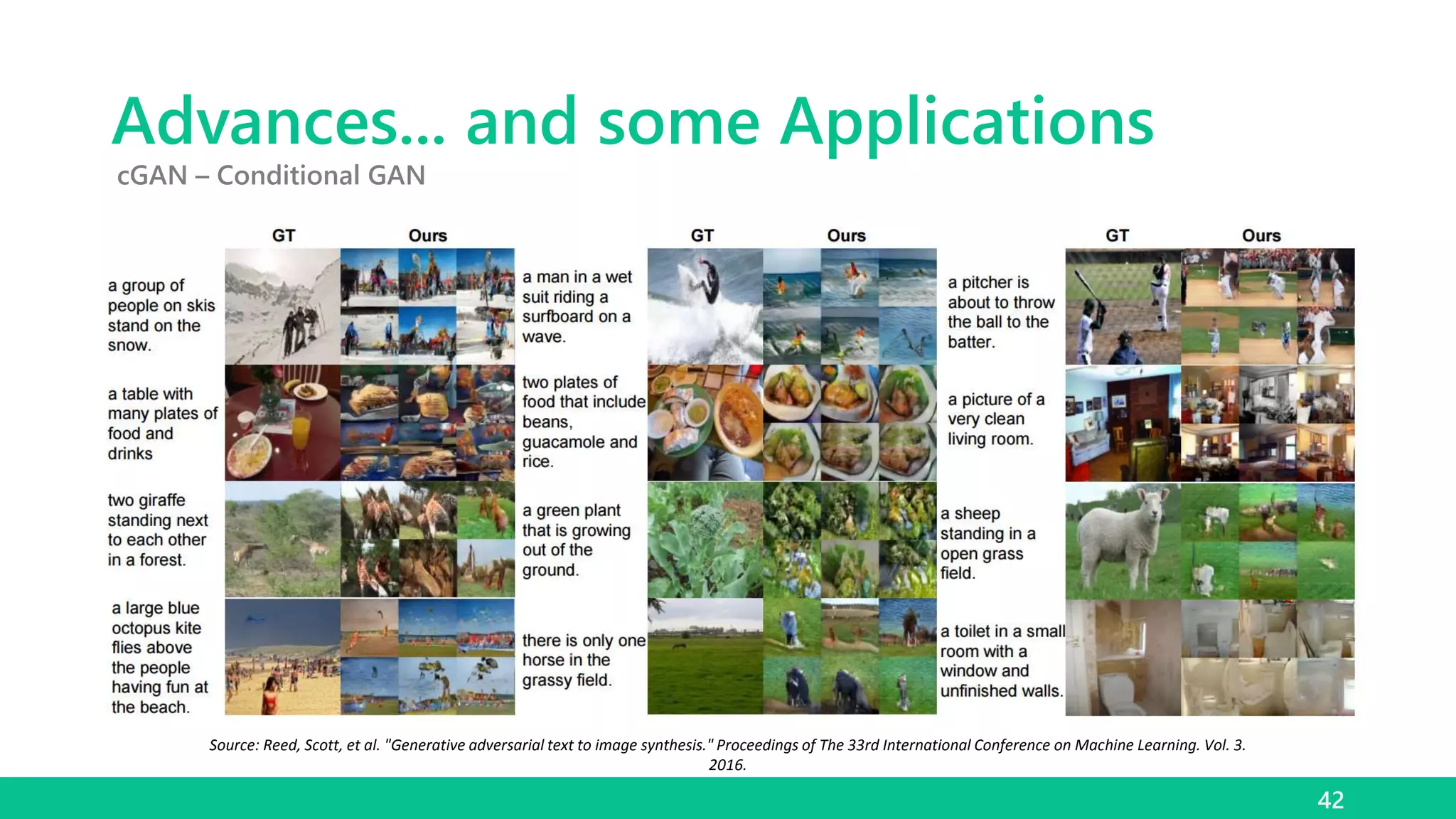
cGAN – Conditional GAN
Source: Reed, Scott, et al. "Generative adversarial text to image synthesis." Proceedings of The 33rd International Conference on Machine Learning. Vol. 3.
2016.
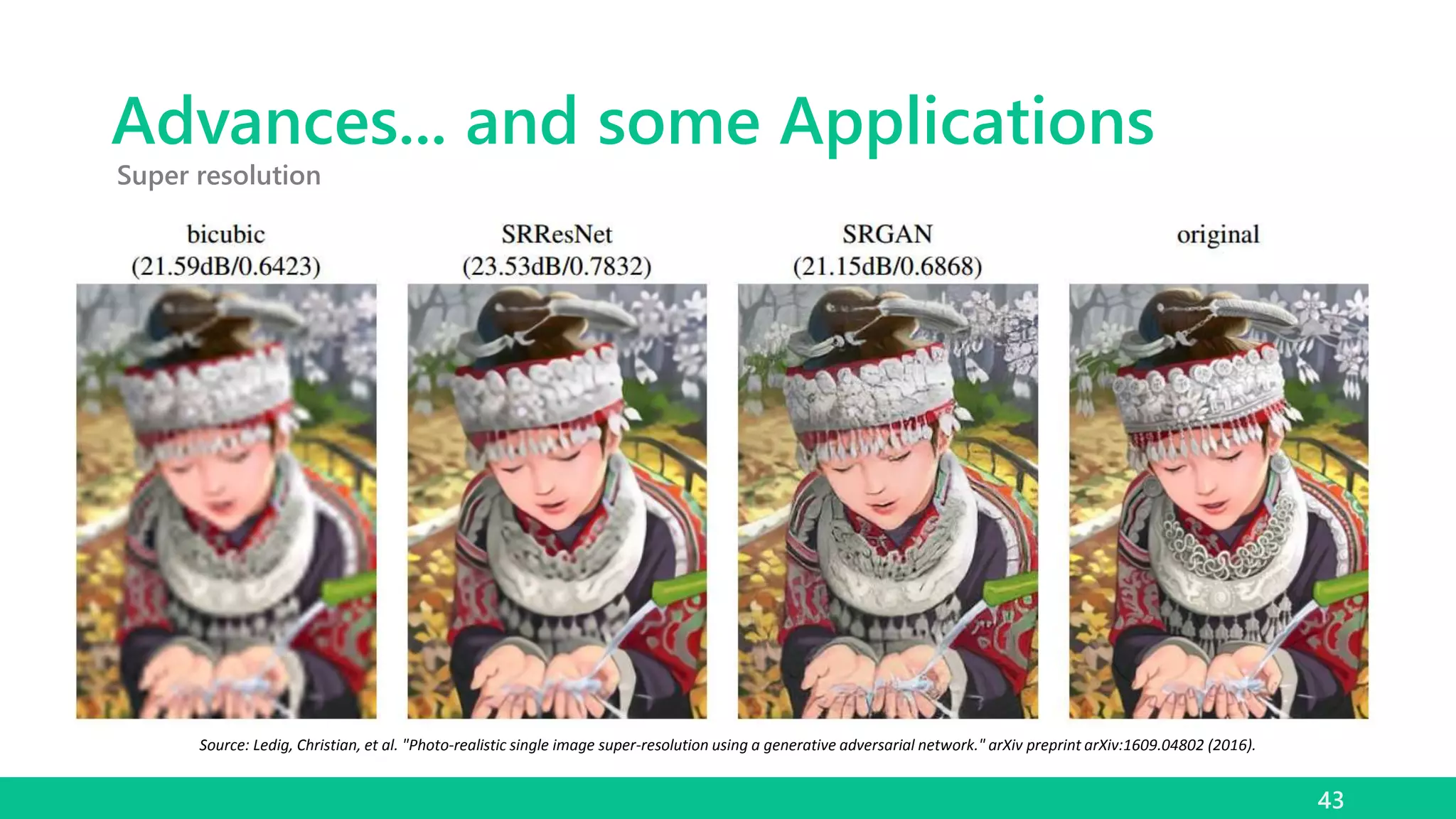
43
Source: Ledig, Christian, et al. "Photo-realistic single image super-resolution using a generative adversarial network." arXiv preprint arXiv:1609.04802 (2016).
Advances... and some Applications
Super resolution
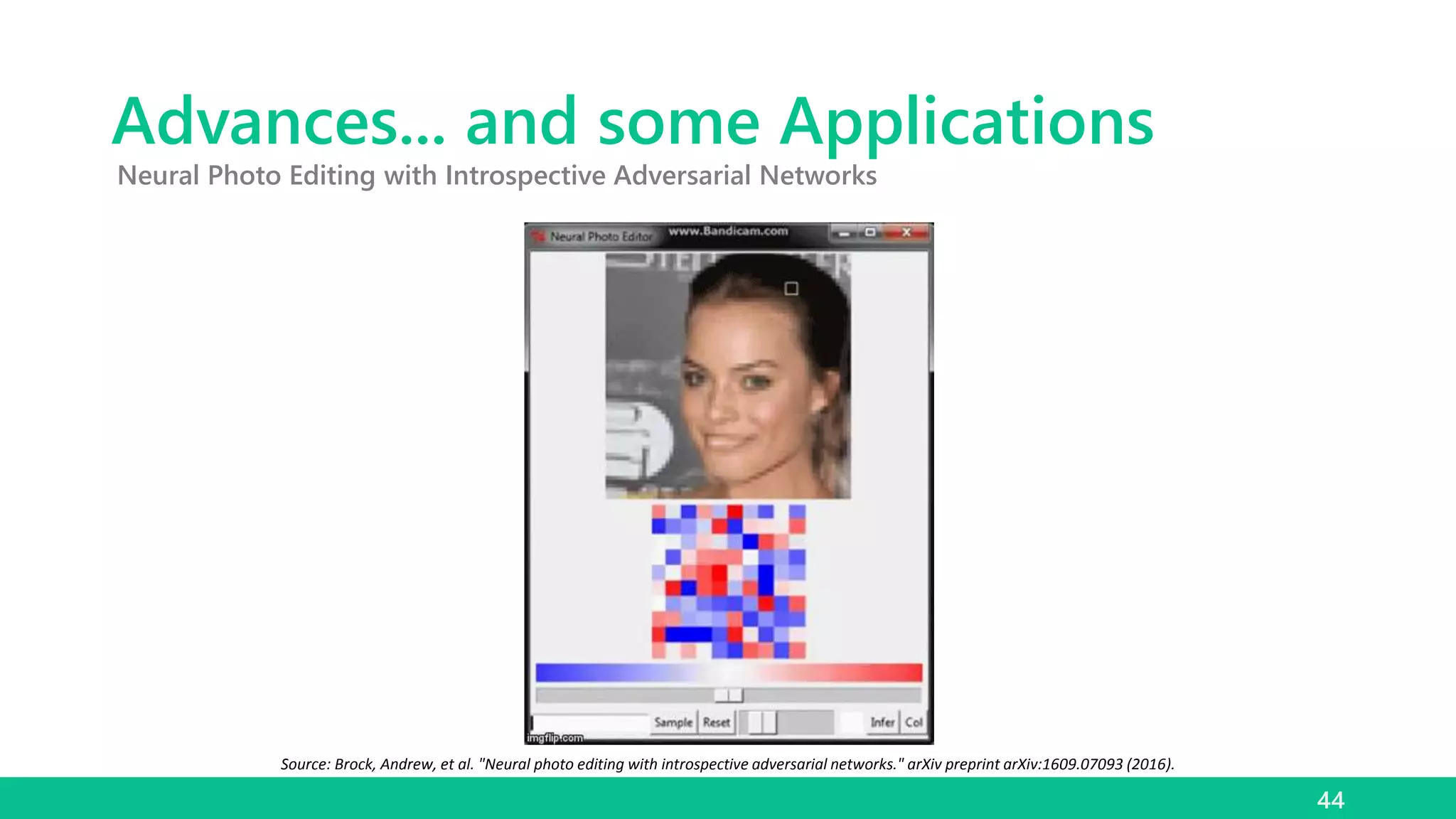
44
Source: Brock, Andrew, et al. "Neural photo editing with introspective adversarial networks." arXiv preprint arXiv:1609.07093 (2016).
Advances... and some Applications
Neural Photo Editing with Introspective Adversarial Networks
Is that all, then?
45
Nope!
• Around 72 papers cite GAN’s original paper (all from
this year!)*;
• The latest is called WGAN (Wasserstein GAN)
• It was submitted to arxiv in 26 Jan!
• “We empirically show that WGANs cure the main training problems of GANs”
46
Sources: Wasserstein GAN - https://arxiv.org/abs/1701.07875. * Simple search in Google Scholar.
Conclusion
47
Bottom line (in a nutshell)
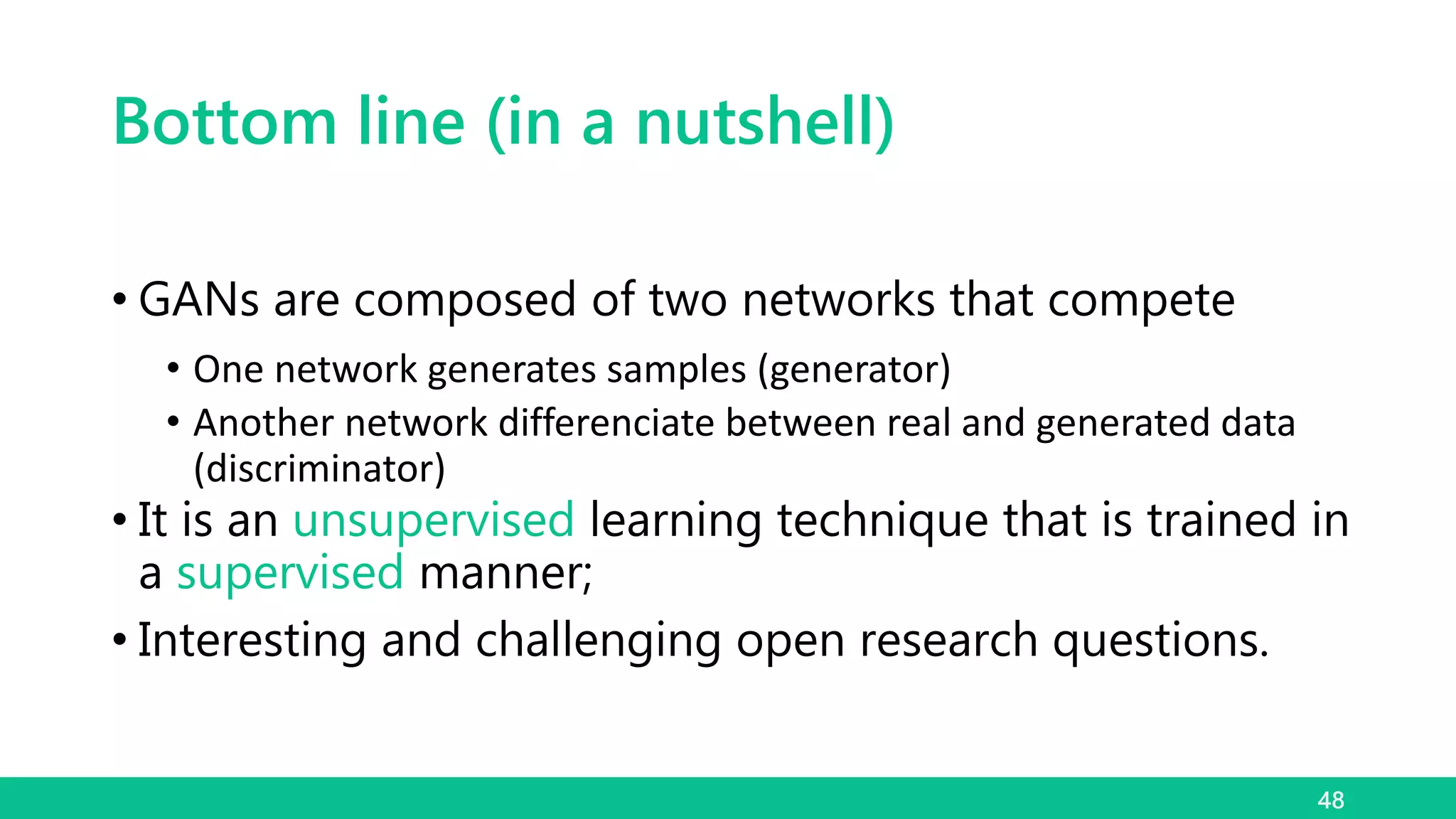
• GANs are composed of two networks that compete
• One network generates samples (generator)
• Another network differenciate between real and generated data
(discriminator)
• It is an unsupervised learning technique that is trained in
a supervised manner;
• Interesting and challenging open research questions.
48
Bottom line (in a nutshell)
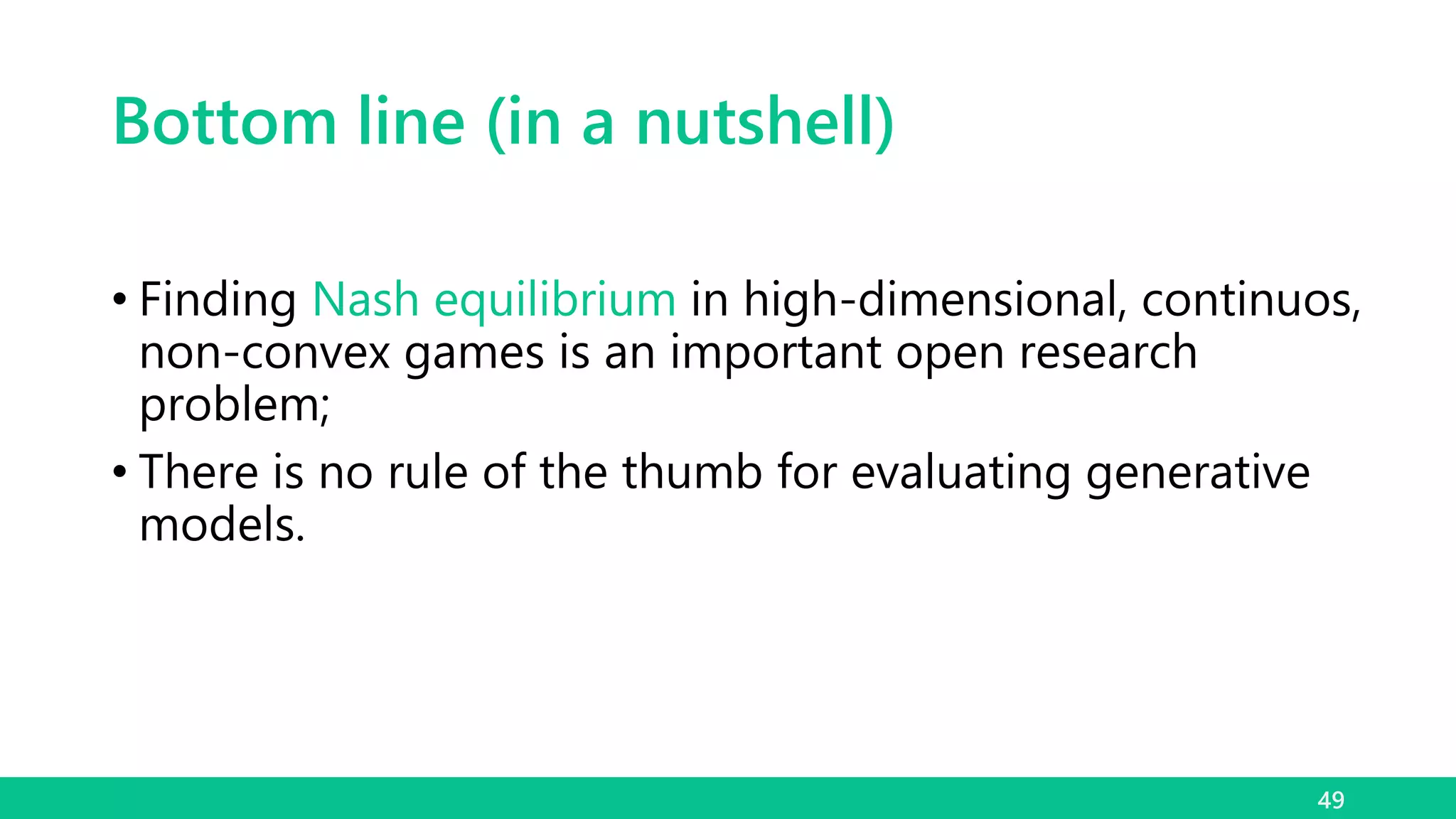
• Finding Nash equilibrium in high-dimensional, continuos,
non-convex games is an important open research
problem;
• There is no rule of the thumb for evaluating generative
models.
49
“(…) in the process of
training generative
models, we will endow the
computer with an
understanding of the
world and what it is made
up of.” OpenAI
Source: https://openai.com/blog/generative-models/
Thank you!
Thomas Paula
Software Engineer
Machine Learning Engineer
Twitter
@tsp_thomas

A (Very) Gentle Introduction to Generative Adversarial Networks (a.k.a GANs)

  • 1.
    A (very) gentleintroduction to Generative Adversarial Networks (a.k.a. GANs) Thomas Paula #4 Porto Alegre ML Meetup
  • 2.
    Who am I 2 ThomasPaula Software Engineer Machine Learning Engineer Twitter @tsp_thomas
  • 3.
  • 4.
    “(…) (GANs) andthe variations that are now being proposed is the most interesting idea in the last 10 years in ML (…)” Yann LeCun Director of Facebook AI Research Source: https://www.quora.com/What-are-some-recent-and-potentially-upcoming-breakthroughs-in-deep-learning/answer/Yann-LeCun
  • 5.
  • 6.
    Recalling supervised learning •Labelled data; • Algorithms try to predict an output value based on a given input; • Examples include • Classification algorithms such as SVM • Regression algorithms such as Linear Regression 6
  • 7.
    Recalling unsupervised learning •Unlabelled data; • Algorithms try to discover hidden structures in the data; • Examples include • Clustering algorithms such as K-means • Generative models such as GANs 7
  • 8.
    Discriminative models • Learnsa function that maps the input 𝑥 to an output 𝑦; • Conditional probability 𝑃(𝑦|𝑥); • Classification algorithms as SVM. 8
  • 9.
    Generative Models 9 • Triesto learn a joint probability of the input 𝑥 and the output 𝑦 at the same time; • Joint probability 𝑃 𝑥, 𝑦 ; • Generative statistical models as Latent Dirichelet Allocation.
  • 10.
    “What I donot understand, I cannot create.” Richard Feynman Nobel in Physics in 1965 Source: https://openai.com/blog/generative-models/
  • 11.
  • 12.
    What are GANs? 12 First,an intuition Goal: produce counterfeit money that is as similar as real money. Goal: distinguish between real and counterfeit money. x
  • 13.
    What are GANs? 13 First,an intuition Goal: distinguish between real and counterfeit money. x generator discriminator Goal: produce counterfeit money that is as similar as real money.
  • 14.
  • 15.
    What are GANs? 15 generator discriminator 𝑧𝑥 𝑥Generated from Gaussian or Normal distribution (usually) Generated instance
  • 16.
    What are GANs? 16 generator discriminator 𝑧𝑥 𝑥 Generated instance Training data
  • 17.
    Generative Adversarial Networks •Created by Ian Goodfellow (OpenAI); • Two neural networks compete (minmax game) • Discriminative network tries to distinguish between real and fake data • Generative network tries to generate samples to fool the discriminative one • Use latent code (𝑧). 17 Source: Goodfellow, Ian, et al. "Generative adversarial nets." Advances in neural information processing systems. 2014.
  • 18.
    18 Source: Goodfellow, Ian,et al. "Generative adversarial nets." Advances in neural information processing systems. 2014.
  • 19.
  • 20.
    “It should happenuntil the generator exactly reproduces the true data distribution and the discriminator is guessing at random, unable to find a difference.” OpenAI Source: https://openai.com/blog/generative-models/
  • 21.
    However, some problemsarise… • Gradient Descent does not always find Nash equilibrium; • Mode Collapse: Generator starts to produce several copies of the same image. • Expected: First Max Discriminator and Min Generator • Problem: First Min Generator and Max Discriminator • Causes low diversity output. 21 Sources: https://www.quora.com/What-are-the-pros-and-cons-of-using-generative-adversarial-networks-a-type-of-neural-network, and Generative Adversarial Networks (GANs) #AIWTB 2016 video.
  • 22.
    Some Advances 22 Since GANs’creation, in 2014 (not necessarily in chronological order)
  • 23.
    LAPGAN • Produces highquality samples of natural images (at 32x32 and 64x64); • Cascade of convolutional neural networks with Laplacian pyramid framework. 23 Laplacian Pyramid GAN – Emily Denton et al. (2015) Source: https://en.wikipedia.org/wiki/Pyramid_(image_processing)
  • 24.
    24 Source: Denton, EmilyL., Soumith Chintala, and Rob Fergus. "Deep Generative Image Models using a Laplacian Pyramid of Adversarial Networks." Advances in neural information processing systems. 2015.
  • 25.
    DCGAN • CNNs combinedwith GANs; • Train GANs and later use learned feature extractors for supervised tasks; • Successful use of CNNs after LAPGAN; • Created guidelines for stable Deep Convolutional GANs. 25 Deep Convolutional GAN – Alec Radford et al. (2016) Source: Radford, Alec, Luke Metz, and Soumith Chintala. "Unsupervised representation learning with deep convolutional generative adversarial networks." arXiv preprint arXiv:1511.06434 (2015).
  • 26.
    DCGAN Used three recentchanges in CNNs: • All convolutional network – strided convolutions; • Elimination of fully-connected layers; • Batch normalization. 26 Deep Convolutional GAN – Alec Radford et al. (2016) Source: Radford, Alec, Luke Metz, and Soumith Chintala. "Unsupervised representation learning with deep convolutional generative adversarial networks." arXiv preprint arXiv:1511.06434 (2015).
  • 27.
    DCGAN 27 Deep Convolutional GAN– Alec Radford et al. (2016) Source: Radford, Alec, Luke Metz, and Soumith Chintala. "Unsupervised representation learning with deep convolutional generative adversarial networks." arXiv preprint arXiv:1511.06434 (2015). DCGAN generator for LSUN dataset.
  • 28.
    28 Source: Radford, Alec,Luke Metz, and Soumith Chintala. "Unsupervised representation learning with deep convolutional generative adversarial networks." arXiv preprint arXiv:1511.06434 (2015).
  • 29.
    29 Source: Radford, Alec,Luke Metz, and Soumith Chintala. "Unsupervised representation learning with deep convolutional generative adversarial networks." arXiv preprint arXiv:1511.06434 (2015). DCGAN – Vector Arithmetic Deep Convolutional GAN – Alec Radford et al. (2016)
  • 30.
    InfoGAN • Modification ofGANs that encourages it to learn interpretable and meaningful representations; • Learns disentangled representations; • For instance, facial expression, eye color, hairstyle, presence or absence of eyeglasses for faces • Decomposes input into 𝑧 (noise) and 𝑐 (latent code). 30 Deep Convolutional GAN – Xi Chen et al. (2016) Source: Chen, Xi, et al. "Infogan: Interpretable representation learning by information maximizing generative adversarial nets." Advances in Neural Information Processing Systems. 2016.
  • 31.
    31 Source: Chen, Xi,et al. "Infogan: Interpretable representation learning by information maximizing generative adversarial nets." Advances in Neural Information Processing Systems. 2016. InfoGAN Deep Convolutional GAN – Xi Chen et al. (2016)
  • 32.
    32 Source: Chen, Xi,et al. "Infogan: Interpretable representation learning by information maximizing generative adversarial nets." Advances in Neural Information Processing Systems. 2016.
  • 33.
    Let’s pause fora while… 33 Paper regarding improvements on training GANs
  • 34.
    Improved Techniques forTraining GANs • Techniques that encourage convergence of GANs – do you recall Nash equilibrium? • Why is it difficult? • Cost functions are non-convex; • Parameters are continuous; • Parameters space is very high dimensional. 34 Salimans et al. (2016) Sources: Salimans, Tim, et al. "Improved techniques for training gans." Advances in Neural Information Processing Systems, 2016; and Goodfellow, Ian. "Generative Adversarial Networks," NIPS 2016 tutorial.
  • 35.
    Improved Techniques forTraining GANs Feature matching • Instead of maximizing the output of the discriminator, requires the generator to generate data that matches statistics of real data; • Generator trained to match expected value of an intermediate layer of the discriminator. 35 Salimans et al. (2016) Sources: Salimans, Tim, et al. "Improved techniques for training gans." Advances in Neural Information Processing Systems, 2016; and Goodfellow, Ian. "Generative Adversarial Networks," NIPS 2016 tutorial.
  • 36.
    Improved Techniques forTraining GANs Minibatch discrimination • Allows the discriminator to look at multiple examples in combination; • Avoids mode collapse. 36 Salimans et al. (2016) Sources: Salimans, Tim, et al. "Improved techniques for training gans." Advances in Neural Information Processing Systems, 2016; and Goodfellow, Ian. "Generative Adversarial Networks," NIPS 2016 tutorial.
  • 37.
    Improved Techniques forTraining GANs Historical averaging • Adds a term in cost functions to consider past parameters; • Inspired on Fictitious Play (based on frequency of play). 37 Salimans et al. (2016) Sources: Salimans, Tim, et al. "Improved techniques for training gans." Advances in Neural Information Processing Systems, 2016; and Goodfellow, Ian. "Generative Adversarial Networks," NIPS 2016 tutorial.
  • 38.
    Improved Techniques forTraining GANs One-sided label smoothing • Reduces confidence, considering targets of 0.1 and 0.9 instead of 0 and 1; • Prevents discriminator from giving very large gradient signal to generator. 38 Salimans et al. (2016) Sources: Salimans, Tim, et al. "Improved techniques for training gans." Advances in Neural Information Processing Systems, 2016; and Goodfellow, Ian. "Generative Adversarial Networks," NIPS 2016 tutorial.
  • 39.
    Improved Techniques forTraining GANs Virtual Batch Normalization (VBN) • Regular batch normalization can cause strong intra-batch correlation; • VBN avoids the problem by using a reference batch and its statistics to combine with the given instances; • It is computationally expensive. 39 Salimans et al. (2016) Sources: Salimans, Tim, et al. "Improved techniques for training gans." Advances in Neural Information Processing Systems, 2016; and Goodfellow, Ian. "Generative Adversarial Networks," NIPS 2016 tutorial.
  • 40.
    Coming Back toAdvances 40 Since GANs’ creation, in 2014 (not necessarily in chronological order)
  • 41.
    Advances... and someApplications 41 iGAN Source: Zhu, Jun-Yan, et al. "Generative visual manipulation on the natural image manifold." European Conference on Computer Vision. Springer International Publishing, 2016. Source: Gifs generated from original video (https://www.youtube.com/watch?v=9c4z6YsBGQ0).
  • 42.
    Advances... and someApplications 42 cGAN – Conditional GAN Source: Reed, Scott, et al. "Generative adversarial text to image synthesis." Proceedings of The 33rd International Conference on Machine Learning. Vol. 3. 2016.
  • 43.
    43 Source: Ledig, Christian,et al. "Photo-realistic single image super-resolution using a generative adversarial network." arXiv preprint arXiv:1609.04802 (2016). Advances... and some Applications Super resolution
  • 44.
    44 Source: Brock, Andrew,et al. "Neural photo editing with introspective adversarial networks." arXiv preprint arXiv:1609.07093 (2016). Advances... and some Applications Neural Photo Editing with Introspective Adversarial Networks
  • 45.
    Is that all,then? 45
  • 46.
    Nope! • Around 72papers cite GAN’s original paper (all from this year!)*; • The latest is called WGAN (Wasserstein GAN) • It was submitted to arxiv in 26 Jan! • “We empirically show that WGANs cure the main training problems of GANs” 46 Sources: Wasserstein GAN - https://arxiv.org/abs/1701.07875. * Simple search in Google Scholar.
  • 47.
  • 48.
    Bottom line (ina nutshell) • GANs are composed of two networks that compete • One network generates samples (generator) • Another network differenciate between real and generated data (discriminator) • It is an unsupervised learning technique that is trained in a supervised manner; • Interesting and challenging open research questions. 48
  • 49.
    Bottom line (ina nutshell) • Finding Nash equilibrium in high-dimensional, continuos, non-convex games is an important open research problem; • There is no rule of the thumb for evaluating generative models. 49
  • 50.
    “(…) in theprocess of training generative models, we will endow the computer with an understanding of the world and what it is made up of.” OpenAI Source: https://openai.com/blog/generative-models/
  • 51.
    Thank you! Thomas Paula SoftwareEngineer Machine Learning Engineer Twitter @tsp_thomas