Financial Analysis Presentation

Presented By - Dhruv Shah
Khusboo Shah
Trilok Upadhyay
Prasad Kadam
Akash Dhar
History
“If we wanted to start a great company we must be optimistic about it .“

•
•
•
•

Idea began on Jan 1981 in Pune
Started the company on Jul 2, 1981
Previously known as Infosys Consultants Pvt. Ltd.
Started with a capital on $250
Vision & Mission
Vision
To be a globally respected corporation
that provides best-of-breed business
solutions, leveraging technology,
delivered by best-in-class people."

Mission
To achieve our objectives in an
environment of fairness, honesty, and
courtesy towards our clients,
employees, vendors and society at
large."
Shareholdings
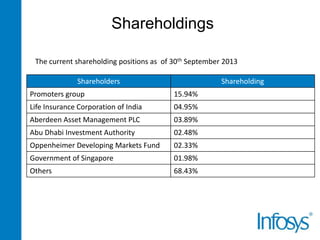
The current shareholding positions as of 30th September 2013

Shareholders

Shareholding

Promoters group

15.94%

Life Insurance Corporation of India

04.95%

Aberdeen Asset Management PLC

03.89%

Abu Dhabi Investment Authority

02.48%

Oppenheimer Developing Markets Fund

02.33%

Government of Singapore

01.98%

Others

68.43%
Stock market Position
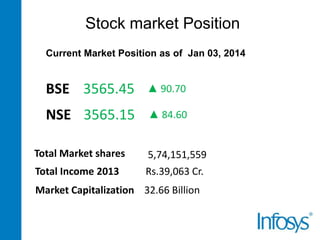
Current Market Position as of Jan 03, 2014

BSE 3565.45

▲ 90.70

NSE 3565.15

▲ 84.60

Total Market shares

5,74,151,559

Total Income 2013

Rs.39,063 Cr.

Market Capitalization 32.66 Billion
Ratio Analysis
Liquidity and Solvency Ratios

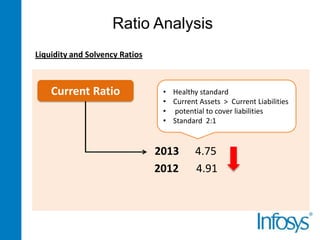
Current Ratio

• Healthy standard
• Current Assets > Current Liabilities
• potential to cover liabilities
• Standard 2:1

2013
2012

4.75
4.91
Ratio Analysis
Liquidity and Solvency Ratios

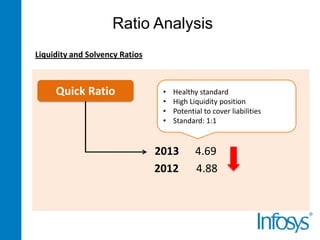
Quick Ratio

•
•
•
•

Healthy standard
High Liquidity position
Potential to cover liabilities
Standard: 1:1

2013
2012

4.69
4.88
Ratio Analysis
Management Efficiency Ratios

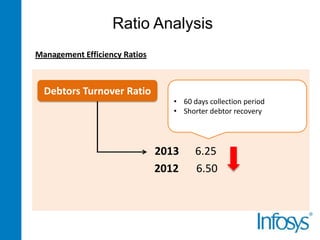
Debtors Turnover Ratio

• 60 days collection period
• Shorter debtor recovery

2013
2012

6.25
6.50
Ratio Analysis
Management Efficiency Ratios

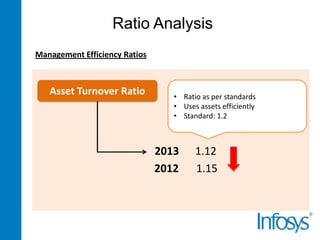
Asset Turnover Ratio

• Ratio as per standards
• Uses assets efficiently
• Standard: 1.2

2013
2012

1.12
1.15
Ratio Analysis
Management Efficiency Ratios

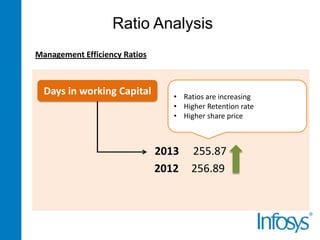
Days in working Capital

• Ratios are increasing
• Higher Retention rate
• Higher share price

2013
2012

255.87
256.89
Ratio Analysis
Profitability Ratios

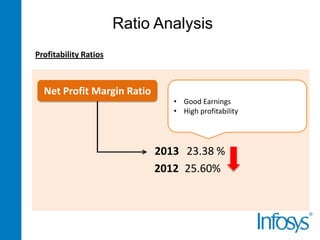
Net Profit Margin Ratio

• Good Earnings
• High profitability

2013 23.38 %
2012 25.60%
Ratio Analysis
Cashflow indicator Ratios

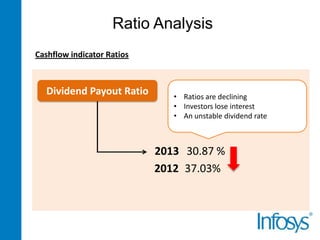
Dividend Payout Ratio

• Ratios are declining
• Investors lose interest
• An unstable dividend rate

2013 30.87 %
2012 37.03%
Ratio Analysis
Cashflow indicator Ratios

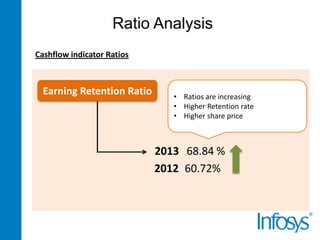
Earning Retention Ratio

• Ratios are increasing
• Higher Retention rate
• Higher share price

2013 68.84 %
2012 60.72%
Ratio Analysis
Cashflow indicator Ratios

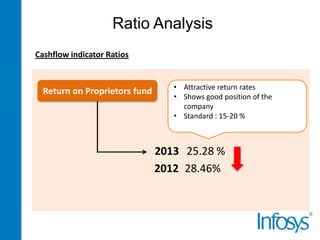
Return on Proprietors fund

• Attractive return rates
• Shows good position of the
company
• Standard : 15-20 %

2013 25.28 %
2012 28.46%
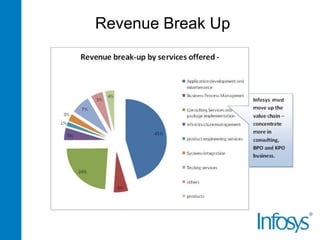
Revenue Break Up
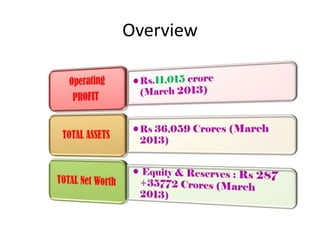
Overview
Just to Conclude ..
•They will continue to focus on and collaborate with
leading national and international universities,
product vendors and technology start-up
companies.
•Plans to hire 30,000 employees this fiscal year.
•Target to be the top IT Industry
THANK YOU ALL

‘‘ The primary purpose of corporate leadership is to
create wealth legally and ethically ‘’
N. R. Narayana Murthy
Chairman of the Board and Chief Mentor

Infosys - Financial Analysis

  • 1.
    Financial Analysis Presentation PresentedBy - Dhruv Shah Khusboo Shah Trilok Upadhyay Prasad Kadam Akash Dhar
  • 2.
    History “If we wantedto start a great company we must be optimistic about it .“ • • • • Idea began on Jan 1981 in Pune Started the company on Jul 2, 1981 Previously known as Infosys Consultants Pvt. Ltd. Started with a capital on $250
  • 3.
    Vision & Mission Vision Tobe a globally respected corporation that provides best-of-breed business solutions, leveraging technology, delivered by best-in-class people." Mission To achieve our objectives in an environment of fairness, honesty, and courtesy towards our clients, employees, vendors and society at large."
  • 4.
    Shareholdings The current shareholdingpositions as of 30th September 2013 Shareholders Shareholding Promoters group 15.94% Life Insurance Corporation of India 04.95% Aberdeen Asset Management PLC 03.89% Abu Dhabi Investment Authority 02.48% Oppenheimer Developing Markets Fund 02.33% Government of Singapore 01.98% Others 68.43%
  • 5.
    Stock market Position CurrentMarket Position as of Jan 03, 2014 BSE 3565.45 ▲ 90.70 NSE 3565.15 ▲ 84.60 Total Market shares 5,74,151,559 Total Income 2013 Rs.39,063 Cr. Market Capitalization 32.66 Billion
  • 6.
    Ratio Analysis Liquidity andSolvency Ratios Current Ratio • Healthy standard • Current Assets > Current Liabilities • potential to cover liabilities • Standard 2:1 2013 2012 4.75 4.91
  • 7.
    Ratio Analysis Liquidity andSolvency Ratios Quick Ratio • • • • Healthy standard High Liquidity position Potential to cover liabilities Standard: 1:1 2013 2012 4.69 4.88
  • 8.
    Ratio Analysis Management EfficiencyRatios Debtors Turnover Ratio • 60 days collection period • Shorter debtor recovery 2013 2012 6.25 6.50
  • 9.
    Ratio Analysis Management EfficiencyRatios Asset Turnover Ratio • Ratio as per standards • Uses assets efficiently • Standard: 1.2 2013 2012 1.12 1.15
  • 10.
    Ratio Analysis Management EfficiencyRatios Days in working Capital • Ratios are increasing • Higher Retention rate • Higher share price 2013 2012 255.87 256.89
  • 11.
    Ratio Analysis Profitability Ratios NetProfit Margin Ratio • Good Earnings • High profitability 2013 23.38 % 2012 25.60%
  • 12.
    Ratio Analysis Cashflow indicatorRatios Dividend Payout Ratio • Ratios are declining • Investors lose interest • An unstable dividend rate 2013 30.87 % 2012 37.03%
  • 13.
    Ratio Analysis Cashflow indicatorRatios Earning Retention Ratio • Ratios are increasing • Higher Retention rate • Higher share price 2013 68.84 % 2012 60.72%
  • 14.
    Ratio Analysis Cashflow indicatorRatios Return on Proprietors fund • Attractive return rates • Shows good position of the company • Standard : 15-20 % 2013 25.28 % 2012 28.46%
  • 15.
  • 16.
  • 17.
    Just to Conclude.. •They will continue to focus on and collaborate with leading national and international universities, product vendors and technology start-up companies. •Plans to hire 30,000 employees this fiscal year. •Target to be the top IT Industry
  • 18.
    THANK YOU ALL ‘‘The primary purpose of corporate leadership is to create wealth legally and ethically ‘’ N. R. Narayana Murthy Chairman of the Board and Chief Mentor

Editor's Notes

  • #7 Current RatioCurrent ratio is the ratio of current assets of a business to its liablities.Although the ratio has decreased from the previous year 2012, but this ratio is very healthy as compared to the industry standards.Which means the company can easily meet their current liabilities.And the current assets are very high or the current liabilities are less.In this case the company is able to cover its immediate current liabilities… with the heavy amount of short assets it has.
  • #8 Quick RatioQuick ratio is the ratio of the sum of cash and cash equivalents, marketable securities and accounts receivable to the current liabilities of a business. It measures the ability of a company to pay its debts by cash and near cash current assets.Quick ratio showed a very negligible decline.. Comparing to the previous financial year.As discussed the current ratio showed a good position of the company, this too reflects in the Quick Ratio.
  • #9 Debtors Turnover ratioThis ratio is to quantify a firm's effectiveness in extending credit as well as collecting debts. It also measures how efficiently a firm uses its assets.Compared to the previous year there is a small decline in the average debtor collection period.The ratio shows that the company has a good debt recovery period which rounds about to 60 days.This shows that the company is able to recover amounts of cash at a shorter span of time.
  • #10 Asset Turnover RatioThe asset turnover ratio is the ratio of a company’s sales to its assets.Its an efficiency ratio which tells as to how the company is utilizing its assets to generate revenue.In this case .. The asset ratio seems to be good as is as close to the industry standard of 1.2.Which implies that the company is able to generate more sales with lesser number of assets.Because total asset turnover ratio is a key driver of return on equity 
  • #11 Days in working capitalIs an accounting term used to describe how many days it will take for a company to convert its working capital into revenue. The faster a company does this, the better.It is calculated by average working capital * 365/annual sales revenue.
  • #12 Net Profit MarginNet profit margin is calculated by dividing net income and net sales.It measures how much out of every rupee of sales a company actually keeps in earnings.Profitability has declined a bit this year, but its till on a good position.This percentage shows us that the company is able to earn 23.38 paise per 1Re. Of sales.
  • #13 Dividend payout ratio on net profitThis ratio identified the percentage of earnings per common share allocated to paying cash dividends of earnings..It is calculated by dividing earnings per share to dividends per common share.The dividend payout ratio is an indicator of how well earnings support the dividend payment.The dividend payout ratio is seen to be declining … from the past year,A reduction in the ratio is looked upon poorly by the investors and the stock price usually depreciates as investors seek other dividend-paying stocks.A stable dividend payout ratio throughout the years shows a solid dividend policy by the company's board of directors. 
  • #14 Earning Retention Ratio Retention rateis the ratio of earnings for the year retained to total earnings for the period. It is a measure of how much of the total earnings for a period a company is reinvesting as compared with paying out to shareholders.Retention rate can also be calculated as 1 minus payout ratio.Companies do generally retain a portion of their earnings for future profitable capital expenditures.For Infosys its is seen to be increased this year, this will lead to increase in higher retention rate and the company will there will be sustainable growth in the company and higher share price .
  • #15 Return on Proprietors FundThis ratio is of practical importance to the proprietors as well as prospective investors. It enables them to compare the earning capacity of the enterprise with that of other enterprise. Return on Proprietors Fund Ratio = Net Profit After tax x 100 ----------------------- Proprietors FundAlthough its seen that the net profit has risen from 8470cr to 9116Cr.The return on proprietors fund is found to be lesser than the previous year mark.But still the rate of return to the stakeholders on is quite impressive Par exceeding the benchmark of 15-20%.