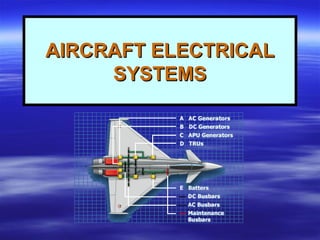
AIRCRAFT ELECTRICALAIRCRAFT ELECTRICAL
SYSTEMSSYSTEMS
ObjectivesObjectives
Students will be able to:Students will be able to:
 Describe the basic components of aircraftDescribe the basic components of aircraft
electrical systemelectrical system
 Explain operation of electrical systemExplain operation of electrical system
 Interpret aircraft electrical diagramInterpret aircraft electrical diagram
 Select proper size of wire for installationSelect proper size of wire for installation
 Describe basic causes of electrical systemDescribe basic causes of electrical system
malfunctionsmalfunctions
Elements of aircraft electricalElements of aircraft electrical
systemssystems
 An aircraft electrical system is mainlyAn aircraft electrical system is mainly
composed of :composed of :
 Power sourcesPower sources
 ComponentsComponents
- Control devices- Control devices
- Conversion devices- Conversion devices
- Protection devices.- Protection devices.
 Power distribution systemsPower distribution systems
 Electrical loadsElectrical loads
Electrical Power SourcesElectrical Power Sources
Electricity power sources on an aircraft mayElectricity power sources on an aircraft may
be classified into two groups :be classified into two groups :
 BatteriesBatteries
- Lead-acid- Lead-acid
- Nickel-cadmium- Nickel-cadmium
 GeneratorsGenerators
- DC generators- DC generators
- AC generators- AC generators
 A battery is a device that convertsA battery is a device that converts
chemical energy into electrical energy.chemical energy into electrical energy.
 It is a power reservoir that stores energy inIt is a power reservoir that stores energy in
chemical form.It does not produce energy.chemical form.It does not produce energy.
 Its functions are:Its functions are:
- To provide power when no other power- To provide power when no other power
source is availablesource is available
- To assist in damping transient loads in- To assist in damping transient loads in
the dc systemthe dc system
BatteryBattery
- To provide a short term source during- To provide a short term source during
emergency conditionemergency condition
 The capacity of battery is measured inThe capacity of battery is measured in
ampere-hoursampere-hours..
 Its normal rate is a little over 24vdc in aIts normal rate is a little over 24vdc in a
28vdc system.28vdc system.
 It is automatically recharged when theIt is automatically recharged when the
engine-driven generator is operational.engine-driven generator is operational.
 Two types of batteries are used in aircraftTwo types of batteries are used in aircraft
- Lead-acid batteries- Lead-acid batteries
- Nickel cadmium batteries- Nickel cadmium batteries
Lead-acid batteryLead-acid battery
 It is usually found in piston aircraft.It is usually found in piston aircraft.
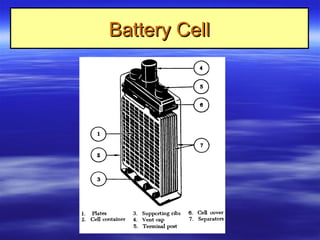
 It is made up of cells which haveIt is made up of cells which have
positive/negative plates of lead and filledpositive/negative plates of lead and filled
with electrolyte of sulfuric acid and water.with electrolyte of sulfuric acid and water.
 Each cell has app. 2.2v, but is simplyEach cell has app. 2.2v, but is simply
rated as 2 v.rated as 2 v.
 It has corrosive effects.It has corrosive effects.
 Frequent total discharge and remainingFrequent total discharge and remaining
battery in discharged condition for a longbattery in discharged condition for a long
time will shorten the life of the battery.time will shorten the life of the battery.
Battery CellBattery Cell
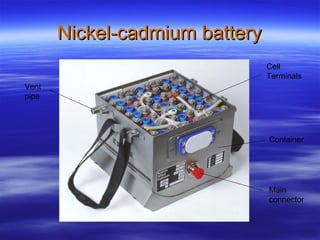
Nickel cadmium batteryNickel cadmium battery
 They are the most common type of batteryThey are the most common type of battery
used in turboprop and turbojet aircraft.used in turboprop and turbojet aircraft.
 They provide electrical discharge at a highThey provide electrical discharge at a high
rate without voltage drop and accept highrate without voltage drop and accept high
charge rates that shorten recharge timecharge rates that shorten recharge time
 They may be subject toThey may be subject to thermal runawaythermal runaway
condition caused by overheating, in whichcondition caused by overheating, in which
the battery destructs itself.the battery destructs itself.
Nickel-cadmium batteryNickel-cadmium battery
Cell
Terminals
Container
Main
connector
Vent
pipe
GENERATORSGENERATORS
 A generator is a machine that convertsA generator is a machine that converts
mechanical energy into electrical energy bymechanical energy into electrical energy by
the process of electromagnetic inductionthe process of electromagnetic induction
 They are driven by the engine(s), andThey are driven by the engine(s), and
sometimes by APU.sometimes by APU.
 A generator must be rated at adequateA generator must be rated at adequate
amperage to drive all the operatingamperage to drive all the operating
components on its circuit(s). The currentcomponents on its circuit(s). The current
required to operate each electricalrequired to operate each electrical
component is known as itscomponent is known as its loadload..
 All generators produce alternating currentAll generators produce alternating current
naturally.The method which is used tonaturally.The method which is used to
take it from the coil will determine if thetake it from the coil will determine if the
generator provides ac or dc to the circuit.generator provides ac or dc to the circuit.
 If aIf a commutatorcommutator is used for this purpose itis used for this purpose it
will be a dc generator.will be a dc generator.
 If aIf a slip ringslip ring is used it will be an acis used it will be an ac
generator.generator.
 DC GENERATORS:DC GENERATORS:
 CommutatorCommutator in the generator converts thein the generator converts the
ac current to dc current.ac current to dc current.
 DC generator is designed to supply nearlyDC generator is designed to supply nearly
constant voltage. Usually the voltage isconstant voltage. Usually the voltage is
28vdc, but there are 270vdc systems28vdc, but there are 270vdc systems
developed recently.developed recently.
 They supply current up to 400 A.They supply current up to 400 A.
 Most aircraft do not have a separate dcMost aircraft do not have a separate dc
generator, but ac produced by acgenerator, but ac produced by ac
generator is converted to dc to power dcgenerator is converted to dc to power dc
systems.systems.
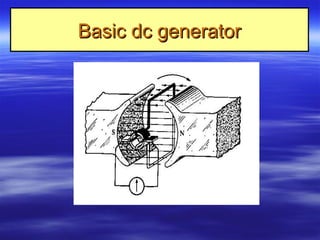
Basic dc generatorBasic dc generator
Operation of a basic dc generatorOperation of a basic dc generator
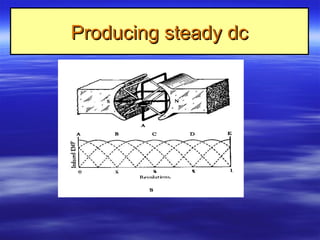
Producing steady dcProducing steady dc
AC generator (AlternatorAC generator (Alternator))
 On most large aircraft high-load electricalOn most large aircraft high-load electrical
devices are usually AC powered.devices are usually AC powered.
 AC is produced by ac generator which isAC is produced by ac generator which is
usually called alternator.usually called alternator.
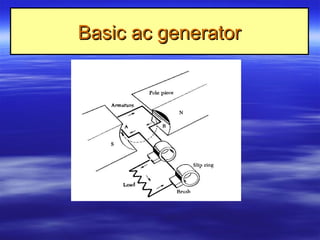
 AC generators use slip rings instead ofAC generators use slip rings instead of
commutators to provide the current to thecommutators to provide the current to the
circuits.circuits.
 Alternator generates three-phase current,Alternator generates three-phase current,
and standard aircraft voltage is 115 vacand standard aircraft voltage is 115 vac
with 400 Hz.with 400 Hz.
Basic ac generatorBasic ac generator
Modern electrical power generationModern electrical power generation
typestypes
Mainly two types of electrical powerMainly two types of electrical power
generation currently in use on aircraft.generation currently in use on aircraft.
- Constant frequency Integrated drive- Constant frequency Integrated drive
generators (IDG)generators (IDG)
- Variable speed constant frequency- Variable speed constant frequency
(VSCF) generators(VSCF) generators
Constant Speed IDGConstant Speed IDG
 It is essential that the alternator outputIt is essential that the alternator output
have a frequency of 400 Hz with a veryhave a frequency of 400 Hz with a very
small tolerance. Thus rotational speed ofsmall tolerance. Thus rotational speed of
alternator must remain absolutelyalternator must remain absolutely
constant.constant.
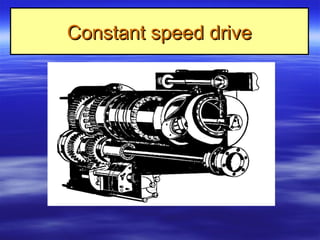
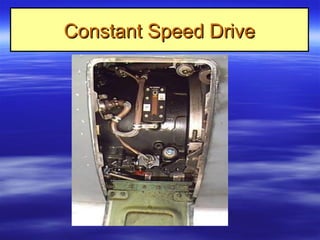
 This is accomplished by using a ConstantThis is accomplished by using a Constant
Speed Drive (CSD) unit between theSpeed Drive (CSD) unit between the
engine and alternator.engine and alternator.
 CSD provides a constant alternator rpmCSD provides a constant alternator rpm
within a specified engine rpm range.within a specified engine rpm range.
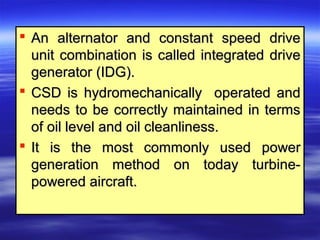
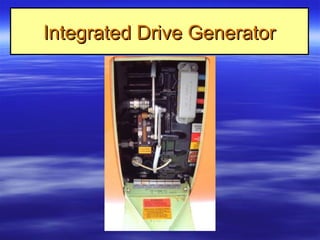
 An alternator and constant speed driveAn alternator and constant speed drive
unit combination is called integrated driveunit combination is called integrated drive
generator (IDG).generator (IDG).
 CSD is hydromechanically operated andCSD is hydromechanically operated and
needs to be correctly maintained in termsneeds to be correctly maintained in terms
of oil level and oil cleanliness.of oil level and oil cleanliness.
 It is the most commonly used powerIt is the most commonly used power
generation method on today turbine-generation method on today turbine-
powered aircraft.powered aircraft.
Integrated Drive GeneratorIntegrated Drive Generator
Constant speed driveConstant speed drive
Constant Speed DriveConstant Speed Drive
VSCFVSCF
 In this method, the variable frequency powerIn this method, the variable frequency power
produced by the alternator is converted toproduced by the alternator is converted to
constant frequency 400 Hz, 115 vac byconstant frequency 400 Hz, 115 vac by
solid-state devices electronically.solid-state devices electronically.
 Thus there is no need for CSD unit.Thus there is no need for CSD unit.
 It is a new technique and limited in use.It is a new technique and limited in use.
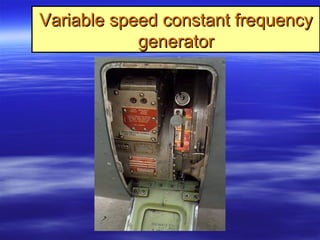
Variable speed constant frequencyVariable speed constant frequency
generatorgenerator
Power Generation ControlPower Generation Control
 Power produced by generators is usuallyPower produced by generators is usually
controlled by generator control unit (GCU).controlled by generator control unit (GCU).
 The main functions of this device are:The main functions of this device are:
- Act as a voltage regulator- Act as a voltage regulator
- Direct current to battery for recharging- Direct current to battery for recharging
- Provide circuit and generator protection- Provide circuit and generator protection
by disconnecting the generator from theby disconnecting the generator from the
system when electrical abnormalitiessystem when electrical abnormalities
occur.occur.
Control DevicesControl Devices
 These devices are use to initiate and controlThese devices are use to initiate and control
the operation of the circuits.Control devicesthe operation of the circuits.Control devices
includeinclude
 SwitchesSwitches
 RheostatsRheostats
 RelaysRelays
 SolenoidsSolenoids
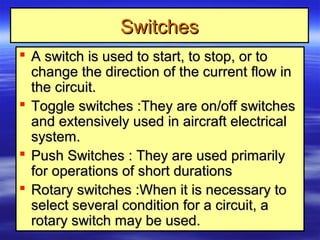
SwitchesSwitches
 A switch is used to start, to stop, or toA switch is used to start, to stop, or to
change the direction of the current flow inchange the direction of the current flow in
the circuit.the circuit.
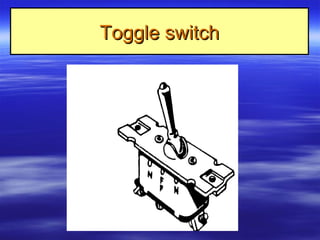
 Toggle switches :They are on/off switchesToggle switches :They are on/off switches
and extensively used in aircraft electricaland extensively used in aircraft electrical
system.system.
 Push Switches : They are used primarilyPush Switches : They are used primarily
for operations of short durationsfor operations of short durations
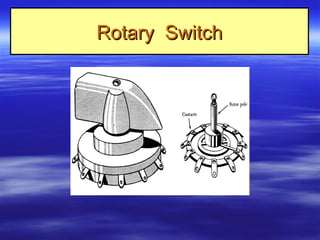
 Rotary switches :When it is necessary toRotary switches :When it is necessary to
select several condition for a circuit, aselect several condition for a circuit, a
rotary switch may be used.rotary switch may be used.
Rotary SwitchRotary Switch
Toggle switchToggle switch
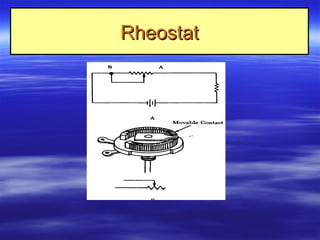
Rheostats : control the amount of current thatRheostats : control the amount of current that
flows throughout the circuit and used asflows throughout the circuit and used as
dimmer devices for instrument and cockpitdimmer devices for instrument and cockpit
lights.lights.
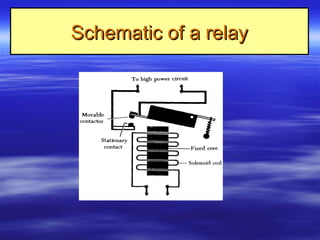
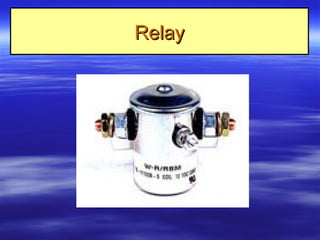
Relays :Electromagnetic switching devicesRelays :Electromagnetic switching devices
which are used to remotely control electricwhich are used to remotely control electric
circuits carrying large amount of current.circuits carrying large amount of current.
Solenoids : Remote control devices quiteSolenoids : Remote control devices quite
similar to relays; but they are designed tosimilar to relays; but they are designed to
move a shaft over a short distance. Thus,move a shaft over a short distance. Thus,
solenoids are used as mechanical controlsolenoids are used as mechanical control
devices to operate hydraulic or pneumaticdevices to operate hydraulic or pneumatic
valves, locking pins, etc.valves, locking pins, etc.
RheostatRheostat
Schematic of a relaySchematic of a relay
RelayRelay
Conversion DevicesConversion Devices
There are many occasions within anThere are many occasions within an
aircraft electrical system where it isaircraft electrical system where it is
required to convert power from one formrequired to convert power from one form
to another.to another.
Typical examples of power conversion are :Typical examples of power conversion are :
- Conversion from dc to ac power- Conversion from dc to ac power
- Conversion from 115vac to 28 vdc- Conversion from 115vac to 28 vdc
- Conversion from one ac voltage level to- Conversion from one ac voltage level to
anotheranother
- Battery charging (from 115vac to 28vdc)- Battery charging (from 115vac to 28vdc)
Following devices are used for theseFollowing devices are used for these
purposes :purposes :
 TransformersTransformers
 RectifiersRectifiers
 Transformer-rectifier units (TRUs)Transformer-rectifier units (TRUs)
 InvertersInverters
 TransistorsTransistors
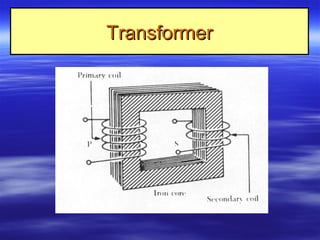
 Transformers : Used to change ac voltageTransformers : Used to change ac voltage
level.level.
 Rectifiers : Used to convert ac into high-Rectifiers : Used to convert ac into high-
amperage, low-voltage dc.amperage, low-voltage dc.
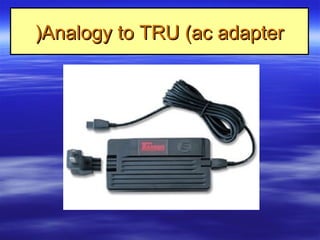
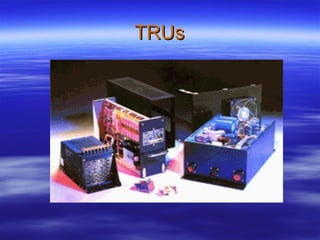
 TRUs: Combination of transformers andTRUs: Combination of transformers and
rectifiers and used as main unit to convertrectifiers and used as main unit to convert
alternator output to dc in an aircraftalternator output to dc in an aircraft
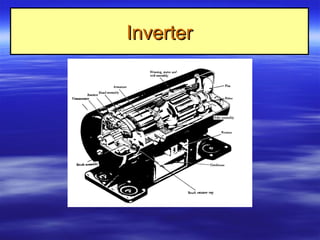
 Inverters : convert 28 vdc power to 26 vacInverters : convert 28 vdc power to 26 vac
power particularly for flight instruments orpower particularly for flight instruments or
115 vac.115 vac.
 Transistors : Electronic devices thatTransistors : Electronic devices that
control electron flow and convert ac to dc.control electron flow and convert ac to dc.
TransformerTransformer
Analogy to TRU (ac adapterAnalogy to TRU (ac adapter))
TRUsTRUs
InverterInverter
Analogy to inverter (ups forAnalogy to inverter (ups for
computercomputer((
Protection DevicesProtection Devices
 These devices are used to protect circuits,These devices are used to protect circuits,
cables and system components fromcables and system components from
damage due to failures.damage due to failures.
 FusesFuses
 Circuit breakersCircuit breakers
 DiodesDiodes
 GCUsGCUs
 Fuses : They are designed to protect theFuses : They are designed to protect the
cables against the flow of short-circuit andcables against the flow of short-circuit and
excessive current. They break the circuitexcessive current. They break the circuit
and stop the current flow when the currentand stop the current flow when the current
exceeds a predetermined value.exceeds a predetermined value.
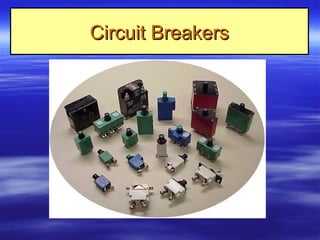
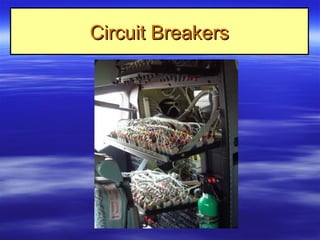
 Circuit breakers :They have sameCircuit breakers :They have same
function with the fuses.The difference fromfunction with the fuses.The difference from
the fuse is that they are resettable, while athe fuse is that they are resettable, while a
fuse must be replaced.fuse must be replaced.
 Diodes : They are the electronicDiodes : They are the electronic
equivalent to the check valves in hydraulicequivalent to the check valves in hydraulic
system. They allow electricity to flow insystem. They allow electricity to flow in
one way only.one way only.
Circuit BreakersCircuit Breakers
Primary Causes of Electrical CircuitPrimary Causes of Electrical Circuit
FailuresFailures
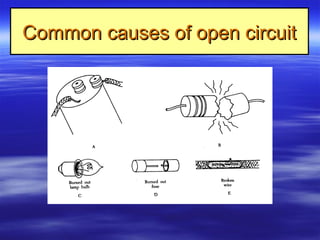
 Open circuit :Open circuit :
It is a circuit that is not complete orIt is a circuit that is not complete or
continuous. This is an uncommandedcontinuous. This is an uncommanded
interruption of electrical power tosomeinterruption of electrical power tosome
components or systems. When an opencomponents or systems. When an open
occurs the affected component stop tooccurs the affected component stop to
operate, but the other components stilloperate, but the other components still
remain in operative condition.remain in operative condition.
Common causes of open circuitCommon causes of open circuit
 Short CircuitShort Circuit
It occurs when electricity is allowed toIt occurs when electricity is allowed to
take a shortcut through or around atake a shortcut through or around a
component or system. This is the mostcomponent or system. This is the most
serious problem. It has two effects :serious problem. It has two effects :
- Affected components have no power- Affected components have no power
and fail to operateand fail to operate
- Since current will not flow through- Since current will not flow through
affected components, the otheraffected components, the other
components will be subjected to highercomponents will be subjected to higher
level of current causing them to burnlevel of current causing them to burn
out.out.
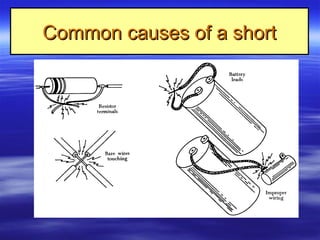
Common causes of a shortCommon causes of a short
Power DistributionPower Distribution
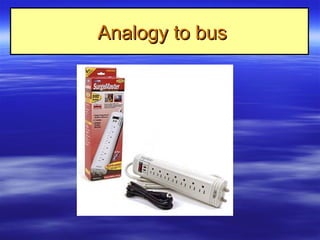
An electrical distribution system isAn electrical distribution system is
required in order to convey the electricalrequired in order to convey the electrical
power to the equipments and systems thatpower to the equipments and systems that
need it.need it.
 Busbar systemsBusbar systems
 Wire and cablesWire and cables
Busbar SystemBusbar System
 In most types of aircraft, output from theIn most types of aircraft, output from the
generators is sent to one or moregenerators is sent to one or more
conductors before distribution throughoutconductors before distribution throughout
the system.the system.
 These conductors are called busbars andThese conductors are called busbars and
they act as distribution centers for electricthey act as distribution centers for electric
power.power.
 A busbar system is set up so that eachA busbar system is set up so that each
power source supplies one or morepower source supplies one or more
specific buses.specific buses.
Analogy to busAnalogy to bus
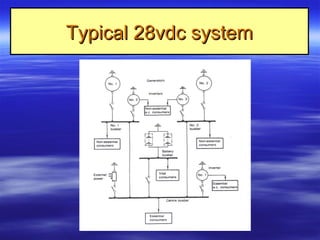
 A variety of electrical items are hooked upA variety of electrical items are hooked up
to each bus for power.to each bus for power.
 The buses are interconnected via circuitThe buses are interconnected via circuit
protection devices which are called busprotection devices which are called bus
ties.ties.
 Bus tiesBus ties are switches or relays used toare switches or relays used to
connect or disconnect buses from oneconnect or disconnect buses from one
another.another.
 They serve to isolate failed buses fromThey serve to isolate failed buses from
working ones and/or send electrical powerworking ones and/or send electrical power
to buses that lost their normal powerto buses that lost their normal power
sources.sources.
 Each engine-driven generator, forEach engine-driven generator, for
example, normally drives its ownexample, normally drives its own
generator bus. High-current drawn itemsgenerator bus. High-current drawn items
are connected to these buses.are connected to these buses.
 Items like fixed fire extinguishers andItems like fixed fire extinguishers and
emergency lights are usually powered offemergency lights are usually powered off
battery bus. That way they are poweredbattery bus. That way they are powered
for use even when no generator power isfor use even when no generator power is
available.available.
Typical 28vdc systemTypical 28vdc system
WIRES AND CABLESWIRES AND CABLES
 Wires and cables conduct electrical powerWires and cables conduct electrical power
in its various forms and quantities to andin its various forms and quantities to and
between equipments.between equipments.
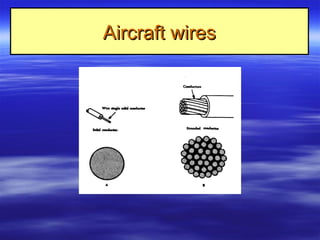
 There are various types of wires used inThere are various types of wires used in
aircraft electrical system. The conductor isaircraft electrical system. The conductor is
made of copper or aluminum. Themade of copper or aluminum. The
insulation material may be nylon, PVC, orinsulation material may be nylon, PVC, or
fiberglass.fiberglass.
Aircraft wiresAircraft wires
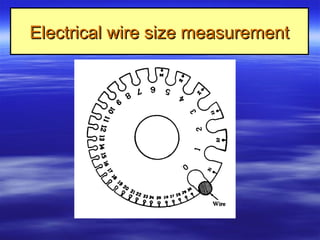
Wire size selectionWire size selection
 The wires installed in an aircraft electricalThe wires installed in an aircraft electrical
system are chosen on the basis of ability tosystem are chosen on the basis of ability to
carry the required currentcarry the required current
- without overheating and- without overheating and
- without producing an excessive voltage- without producing an excessive voltage
drop.drop.
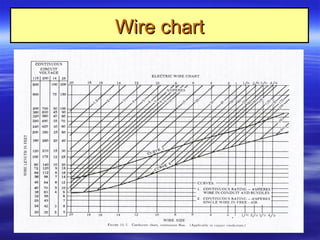
 Electrical wire charts may be used for thisElectrical wire charts may be used for this
purposes.purposes.
Maximum voltage drop in loadMaximum voltage drop in load
circuitscircuits
Wire chartWire chart
Electrical wire size measurementElectrical wire size measurement
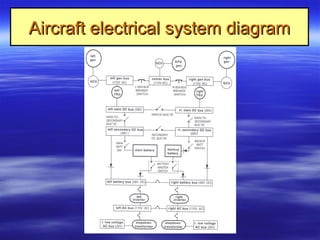
Aircraft wiring diagramsAircraft wiring diagrams
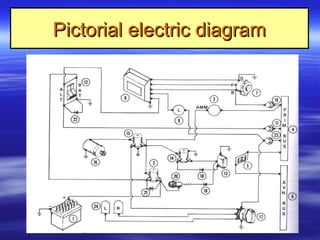
 There are different types of electricalThere are different types of electrical
diagrams available to understanddiagrams available to understand
electrical systems. These diagrams mayelectrical systems. These diagrams may
be in the following forms :be in the following forms :
- Block diagrams- Block diagrams
- Pictorial diagrams- Pictorial diagrams
- Schematic diagrams- Schematic diagrams
 Many symbols are used in theseMany symbols are used in these
diagrams.diagrams.
Pictorial electric diagramPictorial electric diagram
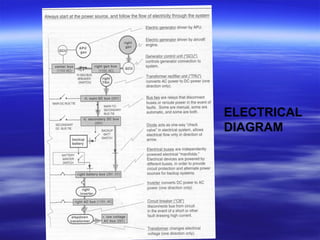
ELECTRICAL
DIAGRAM
Aircraft electrical system diagramAircraft electrical system diagram
Electrical loadsElectrical loads
 Once the aircraft electrical power hasOnce the aircraft electrical power has
been generated and distributed then it isbeen generated and distributed then it is
available to the aircraft services.available to the aircraft services.
 These electrical services are distributedThese electrical services are distributed
throughout the aircraft and may be broadlythroughout the aircraft and may be broadly
subdivided into following categories.subdivided into following categories.
 MotorsMotors
 Lighting servicesLighting services
 Heating servicesHeating services
 AvionicsAvionics
Aircraft Lighting SystemAircraft Lighting System
Lighting system represent an importantLighting system represent an important
element of the aircraft electrical services.element of the aircraft electrical services.
 External lighting systemsExternal lighting systems
 Internal lighting systemsInternal lighting systems
External lighting systemExternal lighting system
Provides illumination for such operation asProvides illumination for such operation as
landing at night, inspection of icinglanding at night, inspection of icing
condition, and safety from midair collision.condition, and safety from midair collision.
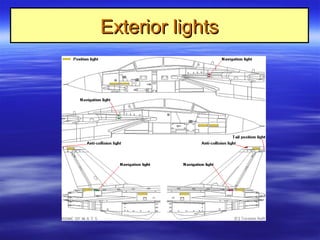
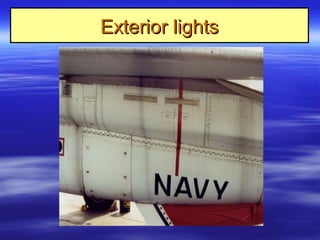
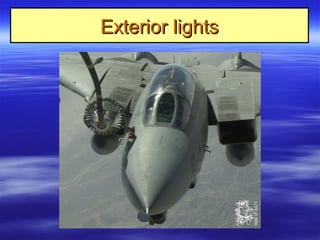
Most common aircraft exterior lights :Most common aircraft exterior lights :
 Position lights (navigation lights)Position lights (navigation lights)
 Landing/taxi lightsLanding/taxi lights
 Anti-collision lightsAnti-collision lights
 Inspection lightsInspection lights
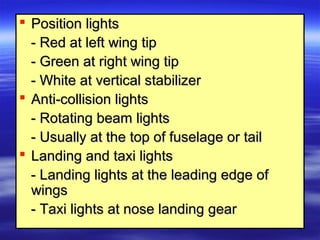
 Position lightsPosition lights
- Red at left wing tip- Red at left wing tip
- Green at right wing tip- Green at right wing tip
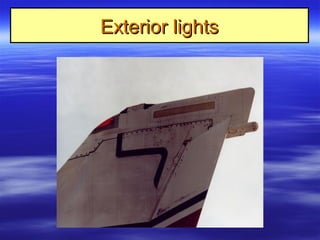
- White at vertical stabilizer- White at vertical stabilizer
 Anti-collision lightsAnti-collision lights
- Rotating beam lights- Rotating beam lights
- Usually at the top of fuselage or tail- Usually at the top of fuselage or tail
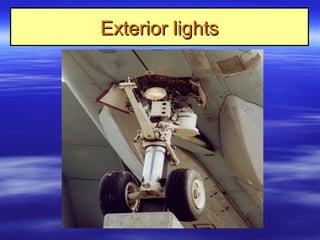
 Landing and taxi lightsLanding and taxi lights
- Landing lights at the leading edge of- Landing lights at the leading edge of
wingswings
- Taxi lights at nose landing gear- Taxi lights at nose landing gear
Exterior lightsExterior lights
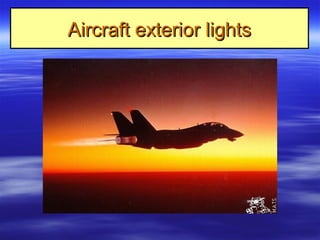
Aircraft exterior lightsAircraft exterior lights
Exterior lightsExterior lights

9. aircraft electrical systems

  • 1.
  • 2.
    ObjectivesObjectives Students will beable to:Students will be able to:  Describe the basic components of aircraftDescribe the basic components of aircraft electrical systemelectrical system  Explain operation of electrical systemExplain operation of electrical system  Interpret aircraft electrical diagramInterpret aircraft electrical diagram  Select proper size of wire for installationSelect proper size of wire for installation  Describe basic causes of electrical systemDescribe basic causes of electrical system malfunctionsmalfunctions
  • 3.
    Elements of aircraftelectricalElements of aircraft electrical systemssystems  An aircraft electrical system is mainlyAn aircraft electrical system is mainly composed of :composed of :  Power sourcesPower sources  ComponentsComponents - Control devices- Control devices - Conversion devices- Conversion devices - Protection devices.- Protection devices.  Power distribution systemsPower distribution systems  Electrical loadsElectrical loads
  • 4.
    Electrical Power SourcesElectricalPower Sources Electricity power sources on an aircraft mayElectricity power sources on an aircraft may be classified into two groups :be classified into two groups :  BatteriesBatteries - Lead-acid- Lead-acid - Nickel-cadmium- Nickel-cadmium  GeneratorsGenerators - DC generators- DC generators - AC generators- AC generators
  • 5.
     A batteryis a device that convertsA battery is a device that converts chemical energy into electrical energy.chemical energy into electrical energy.  It is a power reservoir that stores energy inIt is a power reservoir that stores energy in chemical form.It does not produce energy.chemical form.It does not produce energy.  Its functions are:Its functions are: - To provide power when no other power- To provide power when no other power source is availablesource is available - To assist in damping transient loads in- To assist in damping transient loads in the dc systemthe dc system BatteryBattery
  • 6.
    - To providea short term source during- To provide a short term source during emergency conditionemergency condition  The capacity of battery is measured inThe capacity of battery is measured in ampere-hoursampere-hours..  Its normal rate is a little over 24vdc in aIts normal rate is a little over 24vdc in a 28vdc system.28vdc system.  It is automatically recharged when theIt is automatically recharged when the engine-driven generator is operational.engine-driven generator is operational.  Two types of batteries are used in aircraftTwo types of batteries are used in aircraft - Lead-acid batteries- Lead-acid batteries - Nickel cadmium batteries- Nickel cadmium batteries
  • 7.
    Lead-acid batteryLead-acid battery It is usually found in piston aircraft.It is usually found in piston aircraft.  It is made up of cells which haveIt is made up of cells which have positive/negative plates of lead and filledpositive/negative plates of lead and filled with electrolyte of sulfuric acid and water.with electrolyte of sulfuric acid and water.  Each cell has app. 2.2v, but is simplyEach cell has app. 2.2v, but is simply rated as 2 v.rated as 2 v.  It has corrosive effects.It has corrosive effects.  Frequent total discharge and remainingFrequent total discharge and remaining battery in discharged condition for a longbattery in discharged condition for a long time will shorten the life of the battery.time will shorten the life of the battery.
  • 8.
  • 9.
    Nickel cadmium batteryNickelcadmium battery  They are the most common type of batteryThey are the most common type of battery used in turboprop and turbojet aircraft.used in turboprop and turbojet aircraft.  They provide electrical discharge at a highThey provide electrical discharge at a high rate without voltage drop and accept highrate without voltage drop and accept high charge rates that shorten recharge timecharge rates that shorten recharge time  They may be subject toThey may be subject to thermal runawaythermal runaway condition caused by overheating, in whichcondition caused by overheating, in which the battery destructs itself.the battery destructs itself.
  • 10.
  • 11.
    GENERATORSGENERATORS  A generatoris a machine that convertsA generator is a machine that converts mechanical energy into electrical energy bymechanical energy into electrical energy by the process of electromagnetic inductionthe process of electromagnetic induction  They are driven by the engine(s), andThey are driven by the engine(s), and sometimes by APU.sometimes by APU.  A generator must be rated at adequateA generator must be rated at adequate amperage to drive all the operatingamperage to drive all the operating components on its circuit(s). The currentcomponents on its circuit(s). The current required to operate each electricalrequired to operate each electrical component is known as itscomponent is known as its loadload..
  • 12.
     All generatorsproduce alternating currentAll generators produce alternating current naturally.The method which is used tonaturally.The method which is used to take it from the coil will determine if thetake it from the coil will determine if the generator provides ac or dc to the circuit.generator provides ac or dc to the circuit.  If aIf a commutatorcommutator is used for this purpose itis used for this purpose it will be a dc generator.will be a dc generator.  If aIf a slip ringslip ring is used it will be an acis used it will be an ac generator.generator.
  • 13.
     DC GENERATORS:DCGENERATORS:  CommutatorCommutator in the generator converts thein the generator converts the ac current to dc current.ac current to dc current.  DC generator is designed to supply nearlyDC generator is designed to supply nearly constant voltage. Usually the voltage isconstant voltage. Usually the voltage is 28vdc, but there are 270vdc systems28vdc, but there are 270vdc systems developed recently.developed recently.  They supply current up to 400 A.They supply current up to 400 A.  Most aircraft do not have a separate dcMost aircraft do not have a separate dc generator, but ac produced by acgenerator, but ac produced by ac generator is converted to dc to power dcgenerator is converted to dc to power dc systems.systems.
  • 14.
  • 15.
    Operation of abasic dc generatorOperation of a basic dc generator
  • 16.
  • 17.
    AC generator (AlternatorACgenerator (Alternator))  On most large aircraft high-load electricalOn most large aircraft high-load electrical devices are usually AC powered.devices are usually AC powered.  AC is produced by ac generator which isAC is produced by ac generator which is usually called alternator.usually called alternator.  AC generators use slip rings instead ofAC generators use slip rings instead of commutators to provide the current to thecommutators to provide the current to the circuits.circuits.  Alternator generates three-phase current,Alternator generates three-phase current, and standard aircraft voltage is 115 vacand standard aircraft voltage is 115 vac with 400 Hz.with 400 Hz.
  • 18.
  • 19.
    Modern electrical powergenerationModern electrical power generation typestypes Mainly two types of electrical powerMainly two types of electrical power generation currently in use on aircraft.generation currently in use on aircraft. - Constant frequency Integrated drive- Constant frequency Integrated drive generators (IDG)generators (IDG) - Variable speed constant frequency- Variable speed constant frequency (VSCF) generators(VSCF) generators
  • 20.
    Constant Speed IDGConstantSpeed IDG  It is essential that the alternator outputIt is essential that the alternator output have a frequency of 400 Hz with a veryhave a frequency of 400 Hz with a very small tolerance. Thus rotational speed ofsmall tolerance. Thus rotational speed of alternator must remain absolutelyalternator must remain absolutely constant.constant.  This is accomplished by using a ConstantThis is accomplished by using a Constant Speed Drive (CSD) unit between theSpeed Drive (CSD) unit between the engine and alternator.engine and alternator.  CSD provides a constant alternator rpmCSD provides a constant alternator rpm within a specified engine rpm range.within a specified engine rpm range.
  • 21.
     An alternatorand constant speed driveAn alternator and constant speed drive unit combination is called integrated driveunit combination is called integrated drive generator (IDG).generator (IDG).  CSD is hydromechanically operated andCSD is hydromechanically operated and needs to be correctly maintained in termsneeds to be correctly maintained in terms of oil level and oil cleanliness.of oil level and oil cleanliness.  It is the most commonly used powerIt is the most commonly used power generation method on today turbine-generation method on today turbine- powered aircraft.powered aircraft.
  • 22.
  • 23.
  • 24.
  • 25.
    VSCFVSCF  In thismethod, the variable frequency powerIn this method, the variable frequency power produced by the alternator is converted toproduced by the alternator is converted to constant frequency 400 Hz, 115 vac byconstant frequency 400 Hz, 115 vac by solid-state devices electronically.solid-state devices electronically.  Thus there is no need for CSD unit.Thus there is no need for CSD unit.  It is a new technique and limited in use.It is a new technique and limited in use.
  • 26.
    Variable speed constantfrequencyVariable speed constant frequency generatorgenerator
  • 27.
    Power Generation ControlPowerGeneration Control  Power produced by generators is usuallyPower produced by generators is usually controlled by generator control unit (GCU).controlled by generator control unit (GCU).  The main functions of this device are:The main functions of this device are: - Act as a voltage regulator- Act as a voltage regulator - Direct current to battery for recharging- Direct current to battery for recharging - Provide circuit and generator protection- Provide circuit and generator protection by disconnecting the generator from theby disconnecting the generator from the system when electrical abnormalitiessystem when electrical abnormalities occur.occur.
  • 28.
    Control DevicesControl Devices These devices are use to initiate and controlThese devices are use to initiate and control the operation of the circuits.Control devicesthe operation of the circuits.Control devices includeinclude  SwitchesSwitches  RheostatsRheostats  RelaysRelays  SolenoidsSolenoids
  • 29.
    SwitchesSwitches  A switchis used to start, to stop, or toA switch is used to start, to stop, or to change the direction of the current flow inchange the direction of the current flow in the circuit.the circuit.  Toggle switches :They are on/off switchesToggle switches :They are on/off switches and extensively used in aircraft electricaland extensively used in aircraft electrical system.system.  Push Switches : They are used primarilyPush Switches : They are used primarily for operations of short durationsfor operations of short durations  Rotary switches :When it is necessary toRotary switches :When it is necessary to select several condition for a circuit, aselect several condition for a circuit, a rotary switch may be used.rotary switch may be used.
  • 30.
  • 31.
  • 32.
    Rheostats : controlthe amount of current thatRheostats : control the amount of current that flows throughout the circuit and used asflows throughout the circuit and used as dimmer devices for instrument and cockpitdimmer devices for instrument and cockpit lights.lights. Relays :Electromagnetic switching devicesRelays :Electromagnetic switching devices which are used to remotely control electricwhich are used to remotely control electric circuits carrying large amount of current.circuits carrying large amount of current. Solenoids : Remote control devices quiteSolenoids : Remote control devices quite similar to relays; but they are designed tosimilar to relays; but they are designed to move a shaft over a short distance. Thus,move a shaft over a short distance. Thus, solenoids are used as mechanical controlsolenoids are used as mechanical control devices to operate hydraulic or pneumaticdevices to operate hydraulic or pneumatic valves, locking pins, etc.valves, locking pins, etc.
  • 33.
  • 34.
    Schematic of arelaySchematic of a relay
  • 35.
  • 36.
    Conversion DevicesConversion Devices Thereare many occasions within anThere are many occasions within an aircraft electrical system where it isaircraft electrical system where it is required to convert power from one formrequired to convert power from one form to another.to another. Typical examples of power conversion are :Typical examples of power conversion are : - Conversion from dc to ac power- Conversion from dc to ac power - Conversion from 115vac to 28 vdc- Conversion from 115vac to 28 vdc - Conversion from one ac voltage level to- Conversion from one ac voltage level to anotheranother - Battery charging (from 115vac to 28vdc)- Battery charging (from 115vac to 28vdc)
  • 37.
    Following devices areused for theseFollowing devices are used for these purposes :purposes :  TransformersTransformers  RectifiersRectifiers  Transformer-rectifier units (TRUs)Transformer-rectifier units (TRUs)  InvertersInverters  TransistorsTransistors
  • 38.
     Transformers :Used to change ac voltageTransformers : Used to change ac voltage level.level.  Rectifiers : Used to convert ac into high-Rectifiers : Used to convert ac into high- amperage, low-voltage dc.amperage, low-voltage dc.  TRUs: Combination of transformers andTRUs: Combination of transformers and rectifiers and used as main unit to convertrectifiers and used as main unit to convert alternator output to dc in an aircraftalternator output to dc in an aircraft  Inverters : convert 28 vdc power to 26 vacInverters : convert 28 vdc power to 26 vac power particularly for flight instruments orpower particularly for flight instruments or 115 vac.115 vac.  Transistors : Electronic devices thatTransistors : Electronic devices that control electron flow and convert ac to dc.control electron flow and convert ac to dc.
  • 39.
  • 40.
    Analogy to TRU(ac adapterAnalogy to TRU (ac adapter))
  • 41.
  • 42.
  • 43.
    Analogy to inverter(ups forAnalogy to inverter (ups for computercomputer((
  • 44.
    Protection DevicesProtection Devices These devices are used to protect circuits,These devices are used to protect circuits, cables and system components fromcables and system components from damage due to failures.damage due to failures.  FusesFuses  Circuit breakersCircuit breakers  DiodesDiodes  GCUsGCUs
  • 45.
     Fuses :They are designed to protect theFuses : They are designed to protect the cables against the flow of short-circuit andcables against the flow of short-circuit and excessive current. They break the circuitexcessive current. They break the circuit and stop the current flow when the currentand stop the current flow when the current exceeds a predetermined value.exceeds a predetermined value.  Circuit breakers :They have sameCircuit breakers :They have same function with the fuses.The difference fromfunction with the fuses.The difference from the fuse is that they are resettable, while athe fuse is that they are resettable, while a fuse must be replaced.fuse must be replaced.  Diodes : They are the electronicDiodes : They are the electronic equivalent to the check valves in hydraulicequivalent to the check valves in hydraulic system. They allow electricity to flow insystem. They allow electricity to flow in one way only.one way only.
  • 46.
  • 47.
  • 48.
    Primary Causes ofElectrical CircuitPrimary Causes of Electrical Circuit FailuresFailures  Open circuit :Open circuit : It is a circuit that is not complete orIt is a circuit that is not complete or continuous. This is an uncommandedcontinuous. This is an uncommanded interruption of electrical power tosomeinterruption of electrical power tosome components or systems. When an opencomponents or systems. When an open occurs the affected component stop tooccurs the affected component stop to operate, but the other components stilloperate, but the other components still remain in operative condition.remain in operative condition.
  • 49.
    Common causes ofopen circuitCommon causes of open circuit
  • 50.
     Short CircuitShortCircuit It occurs when electricity is allowed toIt occurs when electricity is allowed to take a shortcut through or around atake a shortcut through or around a component or system. This is the mostcomponent or system. This is the most serious problem. It has two effects :serious problem. It has two effects : - Affected components have no power- Affected components have no power and fail to operateand fail to operate - Since current will not flow through- Since current will not flow through affected components, the otheraffected components, the other components will be subjected to highercomponents will be subjected to higher level of current causing them to burnlevel of current causing them to burn out.out.
  • 51.
    Common causes ofa shortCommon causes of a short
  • 52.
    Power DistributionPower Distribution Anelectrical distribution system isAn electrical distribution system is required in order to convey the electricalrequired in order to convey the electrical power to the equipments and systems thatpower to the equipments and systems that need it.need it.  Busbar systemsBusbar systems  Wire and cablesWire and cables
  • 53.
    Busbar SystemBusbar System In most types of aircraft, output from theIn most types of aircraft, output from the generators is sent to one or moregenerators is sent to one or more conductors before distribution throughoutconductors before distribution throughout the system.the system.  These conductors are called busbars andThese conductors are called busbars and they act as distribution centers for electricthey act as distribution centers for electric power.power.  A busbar system is set up so that eachA busbar system is set up so that each power source supplies one or morepower source supplies one or more specific buses.specific buses.
  • 54.
  • 55.
     A varietyof electrical items are hooked upA variety of electrical items are hooked up to each bus for power.to each bus for power.  The buses are interconnected via circuitThe buses are interconnected via circuit protection devices which are called busprotection devices which are called bus ties.ties.  Bus tiesBus ties are switches or relays used toare switches or relays used to connect or disconnect buses from oneconnect or disconnect buses from one another.another.  They serve to isolate failed buses fromThey serve to isolate failed buses from working ones and/or send electrical powerworking ones and/or send electrical power to buses that lost their normal powerto buses that lost their normal power sources.sources.
  • 56.
     Each engine-drivengenerator, forEach engine-driven generator, for example, normally drives its ownexample, normally drives its own generator bus. High-current drawn itemsgenerator bus. High-current drawn items are connected to these buses.are connected to these buses.  Items like fixed fire extinguishers andItems like fixed fire extinguishers and emergency lights are usually powered offemergency lights are usually powered off battery bus. That way they are poweredbattery bus. That way they are powered for use even when no generator power isfor use even when no generator power is available.available.
  • 57.
  • 58.
    WIRES AND CABLESWIRESAND CABLES  Wires and cables conduct electrical powerWires and cables conduct electrical power in its various forms and quantities to andin its various forms and quantities to and between equipments.between equipments.  There are various types of wires used inThere are various types of wires used in aircraft electrical system. The conductor isaircraft electrical system. The conductor is made of copper or aluminum. Themade of copper or aluminum. The insulation material may be nylon, PVC, orinsulation material may be nylon, PVC, or fiberglass.fiberglass.
  • 59.
  • 60.
    Wire size selectionWiresize selection  The wires installed in an aircraft electricalThe wires installed in an aircraft electrical system are chosen on the basis of ability tosystem are chosen on the basis of ability to carry the required currentcarry the required current - without overheating and- without overheating and - without producing an excessive voltage- without producing an excessive voltage drop.drop.  Electrical wire charts may be used for thisElectrical wire charts may be used for this purposes.purposes.
  • 61.
    Maximum voltage dropin loadMaximum voltage drop in load circuitscircuits
  • 62.
  • 63.
    Electrical wire sizemeasurementElectrical wire size measurement
  • 64.
    Aircraft wiring diagramsAircraftwiring diagrams  There are different types of electricalThere are different types of electrical diagrams available to understanddiagrams available to understand electrical systems. These diagrams mayelectrical systems. These diagrams may be in the following forms :be in the following forms : - Block diagrams- Block diagrams - Pictorial diagrams- Pictorial diagrams - Schematic diagrams- Schematic diagrams  Many symbols are used in theseMany symbols are used in these diagrams.diagrams.
  • 65.
  • 66.
  • 67.
    Aircraft electrical systemdiagramAircraft electrical system diagram
  • 68.
    Electrical loadsElectrical loads Once the aircraft electrical power hasOnce the aircraft electrical power has been generated and distributed then it isbeen generated and distributed then it is available to the aircraft services.available to the aircraft services.  These electrical services are distributedThese electrical services are distributed throughout the aircraft and may be broadlythroughout the aircraft and may be broadly subdivided into following categories.subdivided into following categories.  MotorsMotors  Lighting servicesLighting services  Heating servicesHeating services  AvionicsAvionics
  • 69.
    Aircraft Lighting SystemAircraftLighting System Lighting system represent an importantLighting system represent an important element of the aircraft electrical services.element of the aircraft electrical services.  External lighting systemsExternal lighting systems  Internal lighting systemsInternal lighting systems
  • 70.
    External lighting systemExternallighting system Provides illumination for such operation asProvides illumination for such operation as landing at night, inspection of icinglanding at night, inspection of icing condition, and safety from midair collision.condition, and safety from midair collision. Most common aircraft exterior lights :Most common aircraft exterior lights :  Position lights (navigation lights)Position lights (navigation lights)  Landing/taxi lightsLanding/taxi lights  Anti-collision lightsAnti-collision lights  Inspection lightsInspection lights
  • 71.
     Position lightsPositionlights - Red at left wing tip- Red at left wing tip - Green at right wing tip- Green at right wing tip - White at vertical stabilizer- White at vertical stabilizer  Anti-collision lightsAnti-collision lights - Rotating beam lights- Rotating beam lights - Usually at the top of fuselage or tail- Usually at the top of fuselage or tail  Landing and taxi lightsLanding and taxi lights - Landing lights at the leading edge of- Landing lights at the leading edge of wingswings - Taxi lights at nose landing gear- Taxi lights at nose landing gear
  • 72.
  • 73.
  • 74.
  • 75.
  • 76.
  • 77.