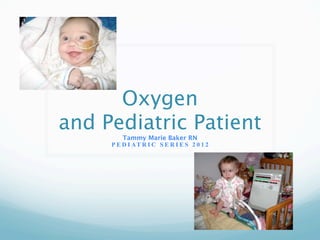
Oxygen
and Pediatric Patient
         Tammy Marie Baker RN
     P E D I AT R I C S E R I E S 2 0 1 2
Oxygen use in the Home:

 Oxygen is considered a medication
 MD orders are required with parameters for usage
 If child is not compensating on prescribed dose
  call MD and notify MD if distress persists.
 Oxygen should be on the MAR and Med profile and
  signed off by the SN.
Nebulizer Treatments
 Nebulizer treatments are used to open airway and break
  up secretions
 Method of Delivery :Mask or mouth piece
 Types of Medications include Bronchodilators, Mucolytics,
  
    Steroids and Antibiotics

 PSS bullets may also be used to humidify or break up secreations


                        Note: Equipment must be sanitized
                        after each use and stored clean and dry
Oxygen Safety in the Home
 No smoking in the home
 Oxygen sign placed on the door of home and
  available through DME
 Local fire dept. notified of oxygen at address of
  home
 Storage in secured area away from furnace or heat
 No Vaseline or petroleum products used on face or
  neck of patient
 Pediatric regulator will limit O2 to 1-3 l/min
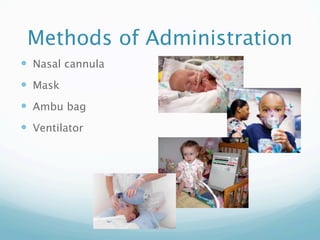
Methods of Administration
 Nasal cannula
 Mask
 Ambu bag
 Ventilator
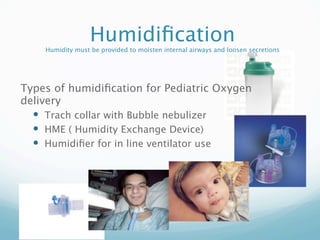
Humidification
    Humidity must be provided to moisten internal airways and loosen secretions


Types of humidification for Pediatric Oxygen
delivery
   Trach collar with Bubble nebulizer
   HME ( Humidity Exchange Device)
   Humidifier for in line ventilator use
How to open Oxygen tank:
            cracking the tank and attaching the regulator
   Wash your hands. Remove the white or blue plastic tape from the top of the tank. Remove and discard the disposable crush
    gasket. Caution: never use the crush gasket for setting up the tank.

   Crack the tank Point the oxygen outlet away from yourself and others.

   Place the wrench (included with the oxygen tank) on the valve on top of the tank Turn the valve to the left (counterclockwise). A
    hissing sound means gas is coming out.

   Stop once you hear the hissing sound, and turn the valve off by turning it to the right (clockwise). Don’t over tighten.

   Always be sure the valve, regulator, and sealing washer are free of oil or grease. Oil or grease can cause a fire.

   Next place the sealing washer on the tank. Attach the regulator on the tank by lining up the three regulator pins to the three
    holes on the tank. Tighten the regulator onto the tank with the T-bar handle. Open the tank by turning the valve with the
    wrench one complete turn counterclockwise. Turn the wrench slowly.

   A hissing sound designates a leaking tank. If this occurs there is a leak. Immediately Close the tank by turning the wrench
    clockwise. Call your oxygen supply company right away.

   Check the pressure gauge. Place the oxygen tubing on the regulator’s outlet or nipple. Turn the flow meter knob to the LPM
    setting prescribed by your child’s doctor .

       wait until the valve is fully open, to get an accurate reading of how much oxygen is in the tank.

    
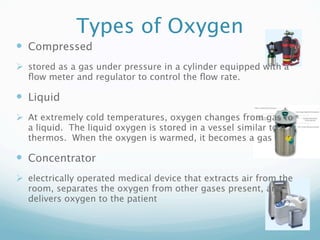
Types of Oxygen
 Compressed
 stored as a gas under pressure in a cylinder equipped with a
  flow meter and regulator to control the flow rate. 

 Liquid
 At extremely cold temperatures, oxygen changes from gas to
  a liquid.  The liquid oxygen is stored in a vessel similar to a
  thermos.  When the oxygen is warmed, it becomes a gas

 Concentrator
 electrically operated medical device that extracts air from the
  room, separates the oxygen from other gases present, and
  delivers oxygen to the patient
Ambu Bag
 A bag valve mask, ( BVM )also Known as an
  Ambu bag
 A hand hand-held device used to provide positive
  pressure ventilation manually when a patient is not
  breathing or breathing inadequately
 Used to manually air rate the patient for transport,
  between circuit changes on a vent, after suctioning
 Ambu bags Emergancy management Equipement
  for
Types of Ambu Bags
 Flow-inflating bags : Termed "anesthesia bags" or
  "flow-inflating bags" these bags require an
  external flow source to inflate.
 *Self-inflating bags: The bag portion of the BVM is
  rigid and self-inflates when released; this does not
  require an external flow source.
 The self inflating bag would be more likely to be
  used in the home and home care setting.
Methods of Application
 *Mask placed over mouth and or nose
 Endotracheal tube – direct attachment
 *Trach – direct attachment
 Used over nasal airway
 Oral pharengeal airway
 Laryngeal mask airway
 * more commonly found in HC setting
Potential Complications of
     Ambu Bag usage:
 Hyper inflation
 Gastric distention
 Vomitus and aspiration
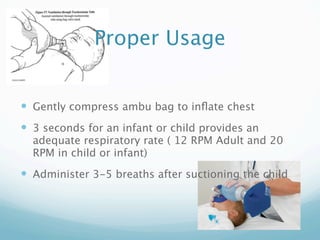
Proper Usage


 Gently compress ambu bag to inflate chest
 3 seconds for an infant or child provides an
  adequate respiratory rate ( 12 RPM Adult and 20
  RPM in child or infant)
 Administer 3-5 breaths after suctioning the child
Tracheotomy in Children
Feeding Tubes in Children
G-Tubes in Children
          Nutritional support for Nutritionally Challenged, Dysphasic or
                          Gastric malfunctioning children

 Types of Gastric Feeding Tubes for children:
Nasogastic tube

Gastric tubes
   Mickey Button
   MCI Mini button
   Peg tube
   Mick G
   Nutriport
Jejunostomy tubes
    G/J tube
    jejunostomy
   Gastric tubes are placed in OR or Radiology

   Most gastric tubes can be replaced by PCG/SN once stoma is matured if not sutured in place.

   G-Tubes are changed per MD orders every 1-3 months unless dislodged, or damage of balloon occurs.

   G-tubes are cleansed every shift or daily and prn. Warm soapy water or ½ strength peroxide , PSS may also be
    used. MD orders are followed for care. Check POC.

   If redness or irritation occurs notify MD. Assess for excoriation and S/S of infection and report to MD.

   MD may order antibacterial cream, antifungals or stoma powder. MD orders needed for these treatments.

    Children whom experience gastric tube dislodgement should have their Gastric tubes replaced and placement
    checked immediately after dislodgement unless resistance met or stoma unable to be threaded.

   A nutritionally dependent child must have GT tube replaced ASAP. Delay may impede child's Fluids/
    Electrolytes/Nutritional status ASAP.

   If stoma is unable to be re cannulated child should be taken to EMD for evaluation and replacement of tube. Notify
    MD if G-tube out and unable to be replaced. Reassure parent and offer support.

   EMD can Dilate of stoma via via red rubber catheter with surgi-lube will allow re-access of stoma


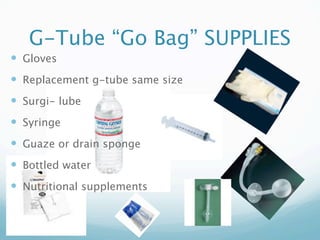
G-Tube “Go Bag” SUPPLIES
 Gloves
 Replacement g-tube same size
 Surgi- lube
 Syringe
 Guaze or drain sponge
 Bottled water
 Nutritional supplements
Pediatric oxygen

Pediatric oxygen

  • 1.
    Oxygen and Pediatric Patient Tammy Marie Baker RN P E D I AT R I C S E R I E S 2 0 1 2
  • 2.
    Oxygen use inthe Home:  Oxygen is considered a medication  MD orders are required with parameters for usage  If child is not compensating on prescribed dose call MD and notify MD if distress persists.  Oxygen should be on the MAR and Med profile and signed off by the SN.
  • 3.
    Nebulizer Treatments  Nebulizertreatments are used to open airway and break up secretions  Method of Delivery :Mask or mouth piece  Types of Medications include Bronchodilators, Mucolytics, Steroids and Antibiotics  PSS bullets may also be used to humidify or break up secreations Note: Equipment must be sanitized after each use and stored clean and dry
  • 4.
    Oxygen Safety inthe Home  No smoking in the home  Oxygen sign placed on the door of home and available through DME  Local fire dept. notified of oxygen at address of home  Storage in secured area away from furnace or heat  No Vaseline or petroleum products used on face or neck of patient  Pediatric regulator will limit O2 to 1-3 l/min
  • 5.
    Methods of Administration Nasal cannula  Mask  Ambu bag  Ventilator
  • 6.
    Humidification Humidity must be provided to moisten internal airways and loosen secretions Types of humidification for Pediatric Oxygen delivery  Trach collar with Bubble nebulizer  HME ( Humidity Exchange Device)  Humidifier for in line ventilator use
  • 7.
    How to openOxygen tank: cracking the tank and attaching the regulator  Wash your hands. Remove the white or blue plastic tape from the top of the tank. Remove and discard the disposable crush gasket. Caution: never use the crush gasket for setting up the tank.  Crack the tank Point the oxygen outlet away from yourself and others.  Place the wrench (included with the oxygen tank) on the valve on top of the tank Turn the valve to the left (counterclockwise). A hissing sound means gas is coming out.  Stop once you hear the hissing sound, and turn the valve off by turning it to the right (clockwise). Don’t over tighten.  Always be sure the valve, regulator, and sealing washer are free of oil or grease. Oil or grease can cause a fire.  Next place the sealing washer on the tank. Attach the regulator on the tank by lining up the three regulator pins to the three holes on the tank. Tighten the regulator onto the tank with the T-bar handle. Open the tank by turning the valve with the wrench one complete turn counterclockwise. Turn the wrench slowly.  A hissing sound designates a leaking tank. If this occurs there is a leak. Immediately Close the tank by turning the wrench clockwise. Call your oxygen supply company right away.  Check the pressure gauge. Place the oxygen tubing on the regulator’s outlet or nipple. Turn the flow meter knob to the LPM setting prescribed by your child’s doctor .  wait until the valve is fully open, to get an accurate reading of how much oxygen is in the tank.   
  • 8.
    Types of Oxygen Compressed  stored as a gas under pressure in a cylinder equipped with a flow meter and regulator to control the flow rate.   Liquid  At extremely cold temperatures, oxygen changes from gas to a liquid.  The liquid oxygen is stored in a vessel similar to a thermos.  When the oxygen is warmed, it becomes a gas  Concentrator  electrically operated medical device that extracts air from the room, separates the oxygen from other gases present, and delivers oxygen to the patient
  • 9.
    Ambu Bag  Abag valve mask, ( BVM )also Known as an Ambu bag  A hand hand-held device used to provide positive pressure ventilation manually when a patient is not breathing or breathing inadequately  Used to manually air rate the patient for transport, between circuit changes on a vent, after suctioning  Ambu bags Emergancy management Equipement for
  • 10.
    Types of AmbuBags  Flow-inflating bags : Termed "anesthesia bags" or "flow-inflating bags" these bags require an external flow source to inflate.  *Self-inflating bags: The bag portion of the BVM is rigid and self-inflates when released; this does not require an external flow source.  The self inflating bag would be more likely to be used in the home and home care setting.
  • 11.
    Methods of Application *Mask placed over mouth and or nose  Endotracheal tube – direct attachment  *Trach – direct attachment  Used over nasal airway  Oral pharengeal airway  Laryngeal mask airway  * more commonly found in HC setting
  • 12.
    Potential Complications of Ambu Bag usage:  Hyper inflation  Gastric distention  Vomitus and aspiration
  • 13.
    Proper Usage  Gentlycompress ambu bag to inflate chest  3 seconds for an infant or child provides an adequate respiratory rate ( 12 RPM Adult and 20 RPM in child or infant)  Administer 3-5 breaths after suctioning the child
  • 14.
  • 15.
  • 16.
  • 17.
  • 18.
  • 19.
    G-Tubes in Children Nutritional support for Nutritionally Challenged, Dysphasic or Gastric malfunctioning children  Types of Gastric Feeding Tubes for children: Nasogastic tube Gastric tubes  Mickey Button  MCI Mini button  Peg tube  Mick G  Nutriport Jejunostomy tubes  G/J tube  jejunostomy
  • 20.
    Gastric tubes are placed in OR or Radiology  Most gastric tubes can be replaced by PCG/SN once stoma is matured if not sutured in place.  G-Tubes are changed per MD orders every 1-3 months unless dislodged, or damage of balloon occurs.  G-tubes are cleansed every shift or daily and prn. Warm soapy water or ½ strength peroxide , PSS may also be used. MD orders are followed for care. Check POC.  If redness or irritation occurs notify MD. Assess for excoriation and S/S of infection and report to MD.  MD may order antibacterial cream, antifungals or stoma powder. MD orders needed for these treatments.  Children whom experience gastric tube dislodgement should have their Gastric tubes replaced and placement checked immediately after dislodgement unless resistance met or stoma unable to be threaded.  A nutritionally dependent child must have GT tube replaced ASAP. Delay may impede child's Fluids/ Electrolytes/Nutritional status ASAP.  If stoma is unable to be re cannulated child should be taken to EMD for evaluation and replacement of tube. Notify MD if G-tube out and unable to be replaced. Reassure parent and offer support.  EMD can Dilate of stoma via via red rubber catheter with surgi-lube will allow re-access of stoma 
  • 21.
    G-Tube “Go Bag”SUPPLIES  Gloves  Replacement g-tube same size  Surgi- lube  Syringe  Guaze or drain sponge  Bottled water  Nutritional supplements