DepartmentofPediatrics
L.N.MedicalCollege&ResearchCentre,
OXYGEN DELIVERY SYSTEMS
PRESENTER –DR. RAJENDER SINGH
MODERATOR – DR . SHWETA ANAND
INTRODUCTION
•Classified into LOW FLOW and HIGH FLOW
•Depending on whether the oxygen flow through the delivery device is able to
meet the inspiratory flow of the patient & whether entrainment of atmospheric
air is required to meet the flow requirement.
LOW FLOW OXYGEN DELIVERY SYSTEMS
 Oxygen flow to the delivery device is less than the child's inspiratory flow rate
There is entrainment of atmospheric air, mixing and dilution of the delivered
fio2
Provides a variable inspired oxygen concentration of about 22%-60%
Used when child is relatively stable requires low fio2
 These devices cannot fulfil high fio2 needs
NASAL CANNULA
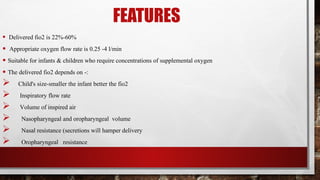
FEATURES
• Delivered fio2 is 22%-60%
• Appropriate oxygen flow rate is 0.25 -4 l/min
• Suitable for infants & children who require concentrations of supplemental oxygen
• The delivered fio2 depends on -:
 Child's size-smaller the infant better the fio2
 Inspiratory flow rate
 Volume of inspired air
 Nasopharyngeal and oropharyngeal volume
 Nasal resistance (secretions will hamper delivery
 Oropharyngeal resistance
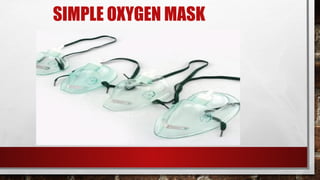
SIMPLE OXYGEN MASK
FEATURES
• Delivers fio2 of 35%-60%
• Appropriate flow rate-6-10 l/min
•Cannot deliver fio2 of more than 60% because air enters space between mask
and face through side ports during inspirations .
CONTINUED……………………
• Delivered fio2 decreases if-:
 Child's inspiratory flow is high
 Mask is ill fitting
 Flow rate into the mask is low
•The oxygen mask tends to increase agitation in a younger child but may be
used easily in older children.
HIGH FLOW OXYGEN DELIVERY SYSTEMS
•These systems reliably deliver an fio2 of greater than 60%
• Oxygen flow rate is high, at least 10 l/min
•High flow systems must be used in emergency settings whenever the child has
respiratory distress or shock
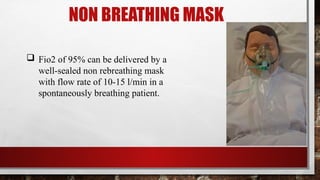
NON BREATHING MASK
 Fio2 of 95% can be delivered by a
well-sealed non rebreathing mask
with flow rate of 10-15 l/min in a
spontaneously breathing patient.
•This device has two one way valves-:
 A valve in one or both exhalation port(s) to prevent entrainment of room air during
inhalation
A valve between the reservoir bag and the mask to prevent the flow of exhaled gas into the
reservoir
 The oxygen flow should be adjusted to prevent collapse of the bag (usually greater than
10 l/min)
The reservoir gets filled with 100% oxygen which the child draws in during inspiration
Room air does not flow in and there is no admixture with oxygen if the mask is tight
OXYGEN HOOD
FEATURES
• Clear plastic shell that encompasses the head of a new born or infant
•Fio2 delivered is about 80%-90% with flow rates of > 10 l/min
•Adequate flow rate (>10l/min) is important to prevent rebreathing of expired air
ADVANTAGES-:
•Well tolerated by infants
•Allows easy access to chest, trunk and abdomen
•Allows control of concentration, temperature and humidification of inspired oxygen
VENTURI MASK
 Venturi type mask is designed to provide controlled and
graded low to moderate (25 % -60% ) inspired oxygen
concentrations.
 This system uses as special oxygen outlet at the mask
that creates a sub atmospheric pressure designed to
entrain a specific quantity of room air to mix with the
oxygen.
 Has limited use in emergency situations.
 It is used where gradual weaning of FiO2concentration is
required.
BUBBLE (CPAP)
PRINCIPLES
•Increases functional residual capacity (frc) and improves lung compliance and oxygenation
•Maintains and splints collapsed airways
•Reduce work of breathing and oxygen consumption
•Reverses hypoventilation( increases tidal volume)
•Improves diaphragmatic activity
•Less requirement of sedation
INDICATIONS
•Increased work of breathing as indicated by severe recessions
•Barely able to maintain spo2 in the range of 92 -94% despite the increased work of
breathing
•Progressive respiratory failure
• Useful in bronchial asthma pulmonary edema, atelectasis, and neuromuscular diseases.
• Weaning from invasive ventilation
• Not to be used in presence of apnoea or impending cardio-respiratory collapse
THINGS REQUIRED FOR ASSEMBLY OF CIRCUIT
• Pressurized oxygen source
•Oxygen flow meter
•Nasal prongs appropriate for patient’s age
• Underwater seal (glass bottle with markings or chest bag)
• T-piece /t-tube
CIRCUIT
•From central source of oxygen pressurized oxygen is delivered through a flow meter to the
patient via appropriate size nasal prongs
•Glass bottle with markings or chest drainage bag is used to make underwater seal which is
connected between the oxygen source and patient with a t-piece/t-tube, which act as a blow
off valve
• The amount of cpap to be delivered is determined by adjusting the height of the water
column from tip of the tube under water: 1 cm equal to 1 cm h20 pressure
• With oxygen flow at 5-8l/min, the constant bubbling of gas delivers the cpap effect
TARGETS TO ACHIEVE /MONITORING
• TARGETS TO BE ACHIEVED -:
Spo2 92-95%
Pao2 >60 mm hg
Paco2<50 mm hg
• MONITORING-:
• Vital parameters every 2 hourly
• Arterial blood gases every 12h or more frequently depending on clinical need and availability
• Abdominal distension and local redness
• The water level and bubbling every 2 hourly
COMPLICATIONS
• NASAL DRYNESS
• SKIN IRRITATION
• AIR LEAKS
• GASTRIC PERFORATION
• ASPIRATION
ESSENCE
• Remember oxygen is a drug
• Requires a prescription just like any other drug clearly stating-:
The delivery device
Flow in litres/min
Target spo2 to be achieved
• Humidification is mandatory
• In a conscious child with respiratory distress, give oxygen in a position of comfort without increasing agitation
• For an unconscious child, the first priority is to open airway before giving oxygen
• Oxygen supplementation is a temporary measure till underlying pathology heals
• Avoid overzealous 02 and aiming for idealspo2 targets
REFERENCE
• IAP ALS HANDBOOK ,FIRST EDITION © 2018 , INDIAN ACADEMY OF PEDIATRICS, CHAPTER 4.5 PAGE 058-
061.
oxygen flow devices.pptx important pediatrics

oxygen flow devices.pptx important pediatrics

  • 1.
  • 2.
    OXYGEN DELIVERY SYSTEMS PRESENTER–DR. RAJENDER SINGH MODERATOR – DR . SHWETA ANAND
  • 3.
    INTRODUCTION •Classified into LOWFLOW and HIGH FLOW •Depending on whether the oxygen flow through the delivery device is able to meet the inspiratory flow of the patient & whether entrainment of atmospheric air is required to meet the flow requirement.
  • 4.
    LOW FLOW OXYGENDELIVERY SYSTEMS  Oxygen flow to the delivery device is less than the child's inspiratory flow rate There is entrainment of atmospheric air, mixing and dilution of the delivered fio2 Provides a variable inspired oxygen concentration of about 22%-60% Used when child is relatively stable requires low fio2  These devices cannot fulfil high fio2 needs
  • 5.
  • 6.
    FEATURES • Delivered fio2is 22%-60% • Appropriate oxygen flow rate is 0.25 -4 l/min • Suitable for infants & children who require concentrations of supplemental oxygen • The delivered fio2 depends on -:  Child's size-smaller the infant better the fio2  Inspiratory flow rate  Volume of inspired air  Nasopharyngeal and oropharyngeal volume  Nasal resistance (secretions will hamper delivery  Oropharyngeal resistance
  • 7.
  • 8.
    FEATURES • Delivers fio2of 35%-60% • Appropriate flow rate-6-10 l/min •Cannot deliver fio2 of more than 60% because air enters space between mask and face through side ports during inspirations .
  • 9.
    CONTINUED…………………… • Delivered fio2decreases if-:  Child's inspiratory flow is high  Mask is ill fitting  Flow rate into the mask is low •The oxygen mask tends to increase agitation in a younger child but may be used easily in older children.
  • 10.
    HIGH FLOW OXYGENDELIVERY SYSTEMS •These systems reliably deliver an fio2 of greater than 60% • Oxygen flow rate is high, at least 10 l/min •High flow systems must be used in emergency settings whenever the child has respiratory distress or shock
  • 11.
    NON BREATHING MASK Fio2 of 95% can be delivered by a well-sealed non rebreathing mask with flow rate of 10-15 l/min in a spontaneously breathing patient.
  • 12.
    •This device hastwo one way valves-:  A valve in one or both exhalation port(s) to prevent entrainment of room air during inhalation A valve between the reservoir bag and the mask to prevent the flow of exhaled gas into the reservoir  The oxygen flow should be adjusted to prevent collapse of the bag (usually greater than 10 l/min) The reservoir gets filled with 100% oxygen which the child draws in during inspiration Room air does not flow in and there is no admixture with oxygen if the mask is tight
  • 13.
  • 14.
    FEATURES • Clear plasticshell that encompasses the head of a new born or infant •Fio2 delivered is about 80%-90% with flow rates of > 10 l/min •Adequate flow rate (>10l/min) is important to prevent rebreathing of expired air ADVANTAGES-: •Well tolerated by infants •Allows easy access to chest, trunk and abdomen •Allows control of concentration, temperature and humidification of inspired oxygen
  • 15.
    VENTURI MASK  Venturitype mask is designed to provide controlled and graded low to moderate (25 % -60% ) inspired oxygen concentrations.  This system uses as special oxygen outlet at the mask that creates a sub atmospheric pressure designed to entrain a specific quantity of room air to mix with the oxygen.  Has limited use in emergency situations.  It is used where gradual weaning of FiO2concentration is required.
  • 16.
    BUBBLE (CPAP) PRINCIPLES •Increases functionalresidual capacity (frc) and improves lung compliance and oxygenation •Maintains and splints collapsed airways •Reduce work of breathing and oxygen consumption •Reverses hypoventilation( increases tidal volume) •Improves diaphragmatic activity •Less requirement of sedation
  • 18.
    INDICATIONS •Increased work ofbreathing as indicated by severe recessions •Barely able to maintain spo2 in the range of 92 -94% despite the increased work of breathing •Progressive respiratory failure • Useful in bronchial asthma pulmonary edema, atelectasis, and neuromuscular diseases. • Weaning from invasive ventilation • Not to be used in presence of apnoea or impending cardio-respiratory collapse
  • 19.
    THINGS REQUIRED FORASSEMBLY OF CIRCUIT • Pressurized oxygen source •Oxygen flow meter •Nasal prongs appropriate for patient’s age • Underwater seal (glass bottle with markings or chest bag) • T-piece /t-tube
  • 20.
    CIRCUIT •From central sourceof oxygen pressurized oxygen is delivered through a flow meter to the patient via appropriate size nasal prongs •Glass bottle with markings or chest drainage bag is used to make underwater seal which is connected between the oxygen source and patient with a t-piece/t-tube, which act as a blow off valve • The amount of cpap to be delivered is determined by adjusting the height of the water column from tip of the tube under water: 1 cm equal to 1 cm h20 pressure • With oxygen flow at 5-8l/min, the constant bubbling of gas delivers the cpap effect
  • 22.
    TARGETS TO ACHIEVE/MONITORING • TARGETS TO BE ACHIEVED -: Spo2 92-95% Pao2 >60 mm hg Paco2<50 mm hg • MONITORING-: • Vital parameters every 2 hourly • Arterial blood gases every 12h or more frequently depending on clinical need and availability • Abdominal distension and local redness • The water level and bubbling every 2 hourly
  • 23.
    COMPLICATIONS • NASAL DRYNESS •SKIN IRRITATION • AIR LEAKS • GASTRIC PERFORATION • ASPIRATION
  • 24.
    ESSENCE • Remember oxygenis a drug • Requires a prescription just like any other drug clearly stating-: The delivery device Flow in litres/min Target spo2 to be achieved • Humidification is mandatory • In a conscious child with respiratory distress, give oxygen in a position of comfort without increasing agitation • For an unconscious child, the first priority is to open airway before giving oxygen • Oxygen supplementation is a temporary measure till underlying pathology heals • Avoid overzealous 02 and aiming for idealspo2 targets
  • 25.
    REFERENCE • IAP ALSHANDBOOK ,FIRST EDITION © 2018 , INDIAN ACADEMY OF PEDIATRICS, CHAPTER 4.5 PAGE 058- 061.