THE DESCENT OF MAN
AND
SELECTION IN RELATION TO SEX
Works by Charles Darwin, F.R.S.
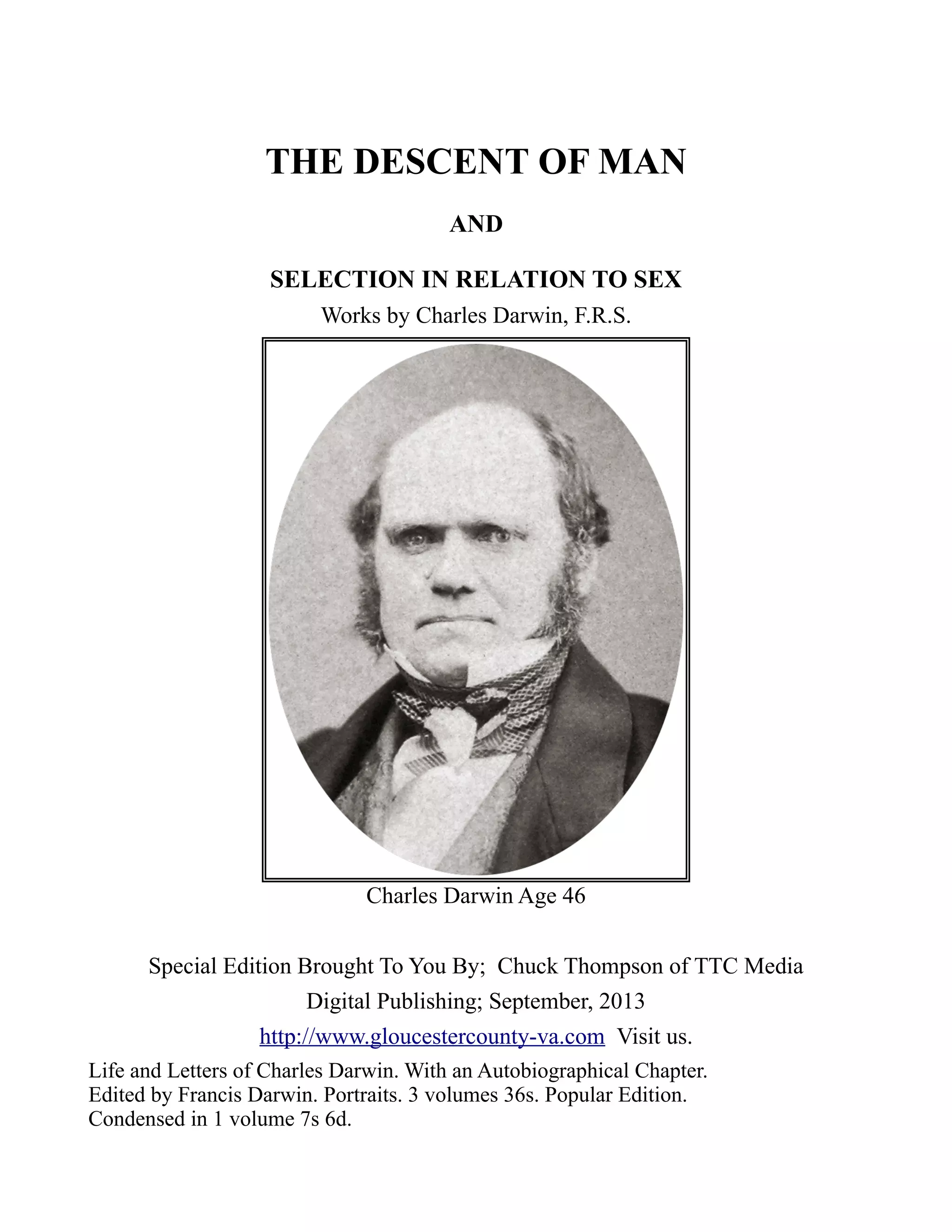
Charles Darwin Age 46
Special Edition Brought To You By; Chuck Thompson of TTC Media
Digital Publishing; September, 2013
http://www.gloucestercounty-va.com Visit us.
Life and Letters of Charles Darwin. With an Autobiographical Chapter.
Edited by Francis Darwin. Portraits. 3 volumes 36s. Popular Edition.
Condensed in 1 volume 7s 6d.
Naturalist's Journal of Researches into the Natural History and Geology of Countries
Visited during a Voyage Round the World. With 100 Illustrations by Pritchett. 21s.
Popular Edition. Woodcuts. 3s 6d. Cheaper Edition, 2s. 6d. net.
Origin of Species by means of Natural Selection; or, The Preservation of Favoured
Races in the Struggle for Life. Large Type Edition, 2 volumes 12s. Popular Edition, 6s.
Cheaper Edition with Portrait, 2s. 6d.
Various Contrivances by which Orchids are Fertilized by Insects. Woodcuts. 7s. 6d.
Variation of Animals and Plants under Domestication. Illustrations. 15s.
Descent of Man, and Selection in relation to Sex. Illustrations. Large Type Edition, 2
volumes 15s. Popular Edition, 7s 6d. Cheaper Edition, 2s. 6d. net.
Expression of the Emotions in Man and Animals. Illustrations. 12s.
Insectivorous Plants. Illustrations. 9s.
Movements and Habits of Climbing Plants. Woodcuts. 6s.
Cross and Self-Fertilization in the Vegetable Kingdom. Illustrations. 9s.
Different Forms of Flowers on Plants of the Same Species. Illustrations. 7s. 6d.
Formation of Vegetable Mould through the Action of Worms. Woodcuts. 6s.
The above works are Published by John Murray.
Structure and Distribution of Coral Reefs. Smith, Elder, & Co.
Geological Observations on Volcanic Islands and Parts of South America.
Smith, Elder, & Co.
Monograph of the Cirripedia. Illustrations. 2 volumes. 8vo. Ray
Society.
Monograph of the Fossil Lepadidae, or Pedunculated Cirripedes of Great
Britain. Palaeontographical Society.
Monograph of the Fossil Balanidae and Verrucidae of Great Britain.
Palaeontographical Society.
THE DESCENT OF MAN
AND
SELECTION IN RELATION TO SEX
BY
CHARLES DARWIN, M.A., F.R.S.
Uniform with this Volume
The Origin of Species, by means of Natural Selection; or, The Preservation of Favoured
Races in the Struggle for Life. Popular Edition, with a Photogravure Portrait. Large
Crown 8vo. 2s. 6d. net.
A Naturalist's Voyage. Journal of Researches into the Natural History and Geology of
the Countries visited during the Voyage of H.M.S. "Beagle" round the World, under the
Command of Capt. Fitz Roy, R.N. Popular Edition, with many Illustrations. Large
Crown 8vo. 2s. 6d. net.
PREFACE TO THE SECOND EDITION.
During the successive reprints of the first edition of this work, published in 1871, I was
able to introduce several important corrections; and now that more time has elapsed, I
have endeavoured to profit by the fiery ordeal through which the book has passed, and
have taken advantage of all the criticisms which seem to me sound. I am also greatly
indebted to a large number of correspondents for the communication of a surprising
number of new facts and remarks. These have been so numerous, that I have been able
to use only the more important ones; and of these, as well as of the more important
corrections, I will append a list. Some new illustrations have been introduced, and four
of the old drawings have been replaced by better ones, done from life by Mr. T.W.
Wood. I must especially call attention to some observations which I owe to the kindness
of Prof. Huxley (given as a supplement at the end of Part I.), on the nature of the
differences between the brains of man and the higher apes. I have been particularly glad
to give these observations, because during the last few years several memoirs on the
subject have appeared on the Continent, and their importance has been, in some cases,
greatly exaggerated by popular writers.
I may take this opportunity of remarking that my critics frequently assume that I
attribute all changes of corporeal structure and mental power exclusively to the natural
selection of such variations as are often called spontaneous; whereas, even in the first
edition of the 'Origin of Species,' I distinctly stated that great weight must be attributed
to the inherited effects of use and disuse, with respect both to the body and mind. I also
attributed some amount of modification to the direct and prolonged action of changed
conditions of life. Some allowance, too, must be made for occasional reversions of
structure; nor must we forget what I have called "correlated" growth, meaning, thereby,
that various parts of the organisation are in some unknown manner so connected, that
when one part varies, so do others; and if variations in the one are accumulated by
selection, other parts will be modified. Again, it has been said by several critics, that
when I found that many details of structure in man could not be explained through
natural selection, I invented sexual selection; I gave, however, a tolerably clear sketch of
this principle in the first edition of the 'Origin of Species,' and I there stated that it was
applicable to man. This subject of sexual selection has been treated at full length in the
present work, simply because an opportunity was here first afforded me. I have been
struck with the likeness of many of the half-favourable criticisms on sexual selection,
with those which appeared at first on natural selection; such as, that it would explain
some few details, but certainly was not applicable to the extent to which I have
employed it. My conviction of the power of sexual selection remains unshaken; but it is
probable, or almost certain, that several of my conclusions will hereafter be found
erroneous; this can hardly fail to be the case in the first treatment of a subject. When
naturalists have become familiar with the idea of sexual selection, it will, as I believe, be
much more largely accepted; and it has already been fully and favourably received by
several capable judges.
DOWN, BECKENHAM, KENT,
September, 1874.
First Edition February 24, 1871.
Second Edition September, 1874.
CONTENTS.
INTRODUCTION.
PART I. THE DESCENT OR ORIGIN OF MAN.
CHAPTER I.
The Evidence of the Descent of Man from some Lower Form.
Nature of the evidence bearing on the origin of man—Homologous structures in man
and the lower animals—Miscellaneous points of correspondence— Development—
Rudimentary structures, muscles, sense-organs, hair, bones, reproductive organs, etc.—
The bearing of these three great classes of facts on the origin of man.
CHAPTER II.
On the Manner of Development of Man from some Lower Form.
Variability of body and mind in man—Inheritance—Causes of variability— Laws of
variation the same in man as in the lower animals—Direct action of the conditions of
life—Effects of the increased use and disuse of parts— Arrested development—
Reversion—Correlated variation—Rate of increase— Checks to increase—Natural
selection—Man the most dominant animal in the world—Importance of his corporeal
structure—The causes which have led to his becoming erect—Consequent changes of
structure—Decrease in size of the canine teeth—Increased size and altered shape of the
skull—Nakedness —Absence of a tail—Defenceless condition of man.
CHAPTER III.
Comparison of the Mental Powers of Man and the Lower Animals.
The difference in mental power between the highest ape and the lowest savage, immense
—Certain instincts in common—The emotions—Curiosity— Imitation—Attention—
Memory—Imagination—Reason—Progressive improvement —Tools and weapons used
by animals—Abstraction, Self-consciousness— Language—Sense of beauty—Belief in
God, spiritual agencies, superstitions.
CHAPTER IV.
Comparison of the Mental Powers of Man and the Lower Animals—continued.
The moral sense—Fundamental proposition—The qualities of social animals— Origin
of sociability—Struggle between opposed instincts—Man a social animal—The more
enduring social instincts conquer other less persistent instincts—The social virtues alone
regarded by savages—The self-regarding virtues acquired at a later stage of
development—The importance of the judgment of the members of the same community
on conduct—Transmission of moral tendencies—Summary.
CHAPTER V.
On the Development of the Intellectual and Moral Faculties during Primeval and
Civilised times.
Advancement of the intellectual powers through natural selection— Importance of
imitation—Social and moral faculties—Their development within the limits of the same
tribe—Natural selection as affecting civilised nations—Evidence that civilised nations
were once barbarous.
CHAPTER VI.
On the Affinities and Genealogy of Man.
Position of man in the animal series—The natural system genealogical— Adaptive
characters of slight value—Various small points of resemblance between man and the
Quadrumana—Rank of man in the natural system— Birthplace and antiquity of man—
Absence of fossil connecting-links—Lower stages in the genealogy of man, as inferred
firstly from his affinities and secondly from his structure—Early androgynous condition
of the Vertebrata —Conclusion.
CHAPTER VII.
On the Races of Man.
The nature and value of specific characters—Application to the races of man—
Arguments in favour of, and opposed to, ranking the so-called races of man as distinct
species—Sub-species—Monogenists and polygenists— Convergence of character—
Numerous points of resemblance in body and mind between the most distinct races of
man—The state of man when he first spread over the earth—Each race not descended
from a single pair—The extinction of races—The formation of races—The effects of
crossing— Slight influence of the direct action of the conditions of life—Slight or no
influence of natural selection—Sexual selection.
PART II. SEXUAL SELECTION.
CHAPTER VIII.
Principles of Sexual Selection.
Secondary sexual characters—Sexual selection—Manner of action—Excess of males—
Polygamy—The male alone generally modified through sexual selection—Eagerness of
the male—Variability of the male—Choice exerted by the female—Sexual compared
with natural selection—Inheritance at corresponding periods of life, at corresponding
seasons of the year, and as limited by sex—Relations between the several forms of
inheritance—Causes why one sex and the young are not modified through sexual
selection— Supplement on the proportional numbers of the two sexes throughout the
animal kingdom— The proportion of the sexes in relation to natural selection.
CHAPTER IX.
Secondary Sexual Characters in the Lower Classes of the Animal Kingdom.
These characters are absent in the lowest classes—Brilliant colours—
Mollusca—Annelids—Crustacea, secondary sexual characters strongly
developed; dimorphism; colour; characters not acquired before maturity—
Spiders, sexual colours of; stridulation by the males—Myriapoda.
CHAPTER X.
Secondary Sexual Characters of Insects.
Diversified structures possessed by the males for seizing the females— Differences
between the sexes, of which the meaning is not understood— Difference in size between
the sexes—Thysanura—Diptera—Hemiptera— Homoptera, musical powers possessed
by the males alone—Orthoptera, musical instruments of the males, much diversified in
structure; pugnacity; colours—Neuroptera, sexual differences in colour—Hymenoptera,
pugnacity and odours—Coleoptera, colours; furnished with great horns, apparently as an
ornament; battles; stridulating organs generally common to both sexes.
CHAPTER XI.
Insects, continued.—Order Lepidoptera.
(Butterflies and Moths.)
Courtship of Butterflies—Battles—Ticking noise—Colours common to both sexes, or
more brilliant in the males—Examples—Not due to the direct action of the conditions of
life—Colours adapted for protection—Colours of moths—Display—Perceptive powers
of the Lepidoptera—Variability— Causes of the difference in colour between the males
and females—Mimicry, female butterflies more brilliantly coloured than the males—
Bright colours of caterpillars—Summary and concluding remarks on the secondary
sexual character of insects—Birds and insects compared.
CHAPTER XII.
Secondary Sexual Characters of Fishes, Amphibians, and Reptiles.
Fishes: Courtship and battles of the males—Larger size of the females— Males, bright
colours and ornamental appendages; other strange characters— Colours and appendages
acquired by the males during the breeding-season alone—Fishes with both sexes
brilliantly coloured—Protective colours—The less conspicuous colours of the female
cannot be accounted for on the principle of protection—Male fishes building nests, and
taking charge of the ova and young. AMPHIBIANS: Differences in structure and colour
between the sexes—Vocal organs. REPTILES: Chelonians—Crocodiles— Snakes,
colours in some cases protective—Lizards, battles of—Ornamental appendages—
Strange differences in structure between the sexes—Colours— Sexual differences
almost as great as with birds.
CHAPTER XIII.
Secondary Sexual Characters of Birds.
Sexual differences—Law of battle—Special weapons—Vocal organs— Instrumental
music—Love-antics and dances—Decorations, permanent and seasonal—Double and
single annual moults—Display of ornaments by the males.
CHAPTER XIV.
Birds—continued.
Choice exerted by the female—Length of courtship—Unpaired birds—Mental qualities
and taste for the beautiful—Preference or antipathy shewn by the female for particular
males—Variability of birds—Variations sometimes abrupt—Laws of variation—
Formation of ocelli—Gradations of character— Case of Peacock, Argus pheasant, and
Urosticte.
CHAPTER XV.
Birds—continued.
Discussion as to why the males alone of some species, and both sexes of others are
brightly coloured—On sexually-limited inheritance, as applied to various structures and
to brightly-coloured plumage—Nidification in relation to colour—Loss of nuptial
plumage during the winter.
CHAPTER XVI.
Birds—concluded.
The immature plumage in relation to the character of the plumage in both sexes when
adult—Six classes of cases—Sexual differences between the males of closely-allied or
representative species—The female assuming the characters of the male—Plumage of
the young in relation to the summer and winter plumage of the adults—On the increase
of beauty in the birds of the world—Protective colouring—Conspicuously coloured
birds—Novelty appreciated—Summary of the four chapters on birds.
CHAPTER XVII.
Secondary Sexual Characters of Mammals.
The law of battle—Special weapons, confined to the males—Cause of absence of
weapons in the female—Weapons common to both sexes, yet primarily acquired by the
male—Other uses of such weapons—Their high importance— Greater size of the male
—Means of defence—On the preference shewn by either sex in the pairing of
quadrupeds.
CHAPTER XVIII.
Secondary Sexual Characters of Mammals—continued.
Voice—Remarkable sexual peculiarities in seals—Odour—Development of the hair—
Colour of the hair and skin—Anomalous case of the female being more ornamented than
the male—Colour and ornaments due to sexual selection— Colour acquired for the sake
of protection—Colour, though common to both sexes, often due to sexual selection—On
the disappearance of spots and stripes in adult quadrupeds—On the colours and
ornaments of the Quadrumana—Summary.
PART III. SEXUAL SELECTION IN RELATION TO MAN, AND
CONCLUSION.
CHAPTER XIX.
Secondary Sexual Characters of Man.
Differences between man and woman—Causes of such differences, and of certain
characters common to both sexes—Law of battle—Differences in mental powers, and
voice—On the influence of beauty in determining the marriages of mankind—Attention
paid by savages to ornaments—Their ideas of beauty in women—The tendency to
exaggerate each natural peculiarity.
CHAPTER XX.
Secondary Sexual Characters of Man—continued.
On the effects of the continued selection of women according to a different standard of
beauty in each race—On the causes which interfere with sexual selection in civilised and
savage nations—Conditions favourable to sexual selection during primeval times—On
the manner of action of sexual selection with mankind—On the women in savage tribes
having some power to choose their husbands—Absence of hair on the body, and
development of the beard—Colour of the skin—Summary.
CHAPTER XXI.
General Summary and Conclusion.
Main conclusion that man is descended from some lower form—Manner of
development—Genealogy of man—Intellectual and moral faculties—Sexual selection—
Concluding remarks.
SUPPLEMENTAL NOTE.
INDEX.
THE DESCENT OF MAN; AND SELECTION IN RELATION TO SEX.
…
INTRODUCTION.
The nature of the following work will be best understood by a brief account of how it
came to be written. During many years I collected notes on the origin or descent of man,
without any intention of publishing on the subject, but rather with the determination not
to publish, as I thought that I should thus only add to the prejudices against my views. It
seemed to me sufficient to indicate, in the first edition of my 'Origin of Species,' that by
this work "light would be thrown on the origin of man and his history;" and this implies
that man must be included with other organic beings in any general conclusion
respecting his manner of appearance on this earth. Now the case wears a wholly
different aspect. When a naturalist like Carl Vogt ventures to say in his address as
President of the National Institution of Geneva (1869), "personne, en Europe au moins,
n'ose plus soutenir la creation indépendante et de toutes pièces, des espèces," it is
manifest that at least a large number of naturalists must admit that species are the
modified descendants of other species; and this especially holds good with the younger
and rising naturalists. The greater number accept the agency of natural selection; though
some urge, whether with justice the future must decide, that I have greatly overrated its
importance. Of the older and honoured chiefs in natural science, many unfortunately are
still opposed to evolution in every form.
In consequence of the views now adopted by most naturalists, and which will ultimately,
as in every other case, be followed by others who are not scientific, I have been led to
put together my notes, so as to see how far the general conclusions arrived at in my
former works were applicable to man. This seemed all the more desirable, as I had never
deliberately applied these views to a species taken singly. When we confine our attention
to any one form, we are deprived of the weighty arguments derived from the nature of
the affinities which connect together whole groups of organisms—their geographical
distribution in past and present times, and their geological succession. The homological
structure, embryological development, and rudimentary organs of a species remain to be
considered, whether it be man or any other animal, to which our attention may be
directed; but these great classes of facts afford, as it appears to me, ample and conclusive
evidence in favour of the principle of gradual evolution. The strong support derived
from the other arguments should, however, always be kept before the mind.
The sole object of this work is to consider, firstly, whether man, like every other species,
is descended from some pre-existing form; secondly, the manner of his development;
and thirdly, the value of the differences between the so-called races of man. As I shall
confine myself to these points, it will not be necessary to describe in detail the
differences between the several races—an enormous subject which has been fully
described in many valuable works. The high antiquity of man has recently been
demonstrated by the labours of a host of eminent men, beginning with M. Boucher de
Perthes; and this is the indispensable basis for understanding his origin. I shall,
therefore, take this conclusion for granted, and may refer my readers to the admirable
treatises of Sir Charles Lyell, Sir John Lubbock, and others. Nor shall I have occasion to
do more than to allude to the amount of difference between man and the
anthropomorphous apes; for Prof. Huxley, in the opinion of most competent judges, has
conclusively shewn that in every visible character man differs less from the higher apes,
than these do from the lower members of the same order of Primates.
This work contains hardly any original facts in regard to man; but as the conclusions at
which I arrived, after drawing up a rough draft, appeared to me interesting, I thought that
they might interest others. It has often and confidently been asserted, that man's origin
can never be known: but ignorance more frequently begets confidence than does
knowledge: it is those who know little, and not those who know much, who so positively
assert that this or that problem will never be solved by science. The conclusion that man
is the co-descendant with other species of some ancient, lower, and extinct form, is not
in any degree new. Lamarck long ago came to this conclusion, which has lately been
maintained by several eminent naturalists and philosophers; for instance, by Wallace,
Huxley, Lyell, Vogt, Lubbock, Buchner, Rolle, etc. (1. As the works of the first- named
authors are so well known, I need not give the titles; but as those of the latter are less
well known in England, I will give them:—'Sechs Vorlesungen über die Darwin'sche
Theorie:' zweite Auflage, 1868, von Dr L. Buchner; translated into French under the title
'Conférences sur la Théorie Darwinienne,' 1869. 'Der Mensch im Lichte der Darwin'sche
Lehre,' 1865, von Dr. F. Rolle. I will not attempt to give references to all the authors who
have taken the same side of the question. Thus G. Canestrini has published ('Annuario
della Soc. d. Nat.,' Modena, 1867, page 81) a very curious paper on rudimentary
characters, as bearing on the origin of man. Another work has (1869) been published by
Dr. Francesco Barrago, bearing in Italian the title of "Man, made in the image of God,
was also made in the image of the ape."), and especially by Haeckel. This last naturalist,
besides his great work, 'Generelle Morphologie' (1866), has recently (1868, with a
second edition in 1870), published his 'Natürliche Schöpfungsgeschichte,' in which he
fully discusses the genealogy of man. If this work had appeared before my essay had
been written, I should probably never have completed it. Almost all the conclusions at
which I have arrived I find confirmed by this naturalist, whose knowledge on many
points is much fuller than mine. Wherever I have added any fact or view from Prof.
Haeckel's writings, I give his authority in the text; other statements I leave as they
originally stood in my manuscript, occasionally giving in the foot-notes references to his
works, as a confirmation of the more doubtful or interesting points.
During many years it has seemed to me highly probable that sexual selection has played
an important part in differentiating the races of man; but in my 'Origin of Species' (first
edition, page 199) I contented myself by merely alluding to this belief. When I came to
apply this view to man, I found it indispensable to treat the whole subject in full detail.
(2. Prof. Haeckel was the only author who, at the time when this work first appeared,
had discussed the subject of sexual selection, and had seen its full importance, since the
publication of the 'Origin'; and this he did in a very able manner in his various works.)
Consequently the second part of the present work, treating of sexual selection, has
extended to an inordinate length, compared with the first part; but this could not be
avoided.
I had intended adding to the present volumes an essay on the expression of the various
emotions by man and the lower animals. My attention was called to this subject many
years ago by Sir Charles Bell's admirable work. This illustrious anatomist maintains that
man is endowed with certain muscles solely for the sake of expressing his emotions. As
this view is obviously opposed to the belief that man is descended from some other and
lower form, it was necessary for me to consider it. I likewise wished to ascertain how far
the emotions are expressed in the same manner by the different races of man. But owing
to the length of the present work, I have thought it better to reserve my essay for
separate publication.
PART I. THE DESCENT OR ORIGIN OF MAN.
CHAPTER I.
THE EVIDENCE OF THE DESCENT OF MAN FROM SOME LOWER FORM.
Nature of the evidence bearing on the origin of man—Homologous structures in man
and the lower animals—Miscellaneous points of correspondence— Development—
Rudimentary structures, muscles, sense-organs, hair, bones, reproductive organs, etc.—
The bearing of these three great classes of facts on the origin of man.
He who wishes to decide whether man is the modified descendant of some pre- existing
form, would probably first enquire whether man varies, however slightly, in bodily
structure and in mental faculties; and if so, whether the variations are transmitted to his
offspring in accordance with the laws which prevail with the lower animals. Again, are
the variations the result, as far as our ignorance permits us to judge, of the same general
causes, and are they governed by the same general laws, as in the case of other
organisms; for instance, by correlation, the inherited effects of use and disuse, etc.? Is
man subject to similar malconformations, the result of arrested development, of
reduplication of parts, etc., and does he display in any of his anomalies reversion to
some former and ancient type of structure? It might also naturally be enquired whether
man, like so many other animals, has given rise to varieties and sub-races, differing but
slightly from each other, or to races differing so much that they must be classed as
doubtful species? How are such races distributed over the world; and how, when
crossed, do they react on each other in the first and succeeding generations? And so with
many other points.
The enquirer would next come to the important point, whether man tends to increase at
so rapid a rate, as to lead to occasional severe struggles for existence; and consequently
to beneficial variations, whether in body or mind, being preserved, and injurious ones
eliminated. Do the races or species of men, whichever term may be applied, encroach on
and replace one another, so that some finally become extinct? We shall see that all these
questions, as indeed is obvious in respect to most of them, must be answered in the
affirmative, in the same manner as with the lower animals. But the several
considerations just referred to may be conveniently deferred for a time: and we will first
see how far the bodily structure of man shews traces, more or less plain, of his descent
from some lower form. In succeeding chapters the mental powers of man, in comparison
with those of the lower animals, will be considered.
THE BODILY STRUCTURE OF MAN.
It is notorious that man is constructed on the same general type or model as other
mammals. All the bones in his skeleton can be compared with corresponding bones in a
monkey, bat, or seal. So it is with his muscles, nerves, blood-vessels and internal viscera.
The brain, the most important of all the organs, follows the same law, as shewn by
Huxley and other anatomists. Bischoff (1. 'Grosshirnwindungen des Menschen,' 1868, s.
96. The conclusions of this author, as well as those of Gratiolet and Aeby, concerning the
brain, will be discussed by Prof. Huxley in the Appendix alluded to in the Preface to this
edition.), who is a hostile witness, admits that every chief fissure and fold in the brain of
man has its analogy in that of the orang; but he adds that at no period of development do
their brains perfectly agree; nor could perfect agreement be expected, for otherwise their
mental powers would have been the same. Vulpian (2. 'Lec. sur la Phys.' 1866, page 890,
as quoted by M. Dally, 'L'Ordre des Primates et le Transformisme,' 1868, page 29.),
remarks: "Les différences réelles qui existent entre l'encephale de l'homme et celui des
singes supérieurs, sont bien minimes. Il ne faut pas se faire d'illusions a cet égard.
L'homme est bien plus près des singes anthropomorphes par les caractères anatomiques
de son cerveau que ceux-ci ne le sont non seulement des autres mammifères, mais même
de certains quadrumanes, des guenons et des macaques." But it would be superfluous
here to give further details on the correspondence between man and the higher mammals
in the structure of the brain and all other parts of the body.
It may, however, be worth while to specify a few points, not directly or obviously
connected with structure, by which this correspondence or relationship is well shewn.
Man is liable to receive from the lower animals, and to communicate to them, certain
diseases, as hydrophobia, variola, the glanders, syphilis, cholera, herpes, etc. (3. Dr. W.
Lauder Lindsay has treated this subject at some length in the 'Journal of Mental Science,'
July 1871; and in the 'Edinburgh Veterinary Review,' July 1858.); and this fact proves
the close similarity (4. A Reviewer has criticised ('British Quarterly Review,' Oct. 1st,
1871, page 472) what I have here said with much severity and contempt; but as I do not
use the term identity, I cannot see that I am greatly in error. There appears to me a strong
analogy between the same infection or contagion producing the same result, or one
closely similar, in two distinct animals, and the testing of two distinct fluids by the same
chemical reagent.) of their tissues and blood, both in minute structure and composition,
far more plainly than does their comparison under the best microscope, or by the aid of
the best chemical analysis. Monkeys are liable to many of the same non-contagious
diseases as we are; thus Rengger (5. 'Naturgeschichte der Säugethiere von Paraguay,'
1830, s. 50.), who carefully observed for a long time the Cebus Azarae in its native land,
found it liable to catarrh, with the usual symptoms, and which, when often recurrent, led
to consumption. These monkeys suffered also from apoplexy, inflammation of the
bowels, and cataract in the eye. The younger ones when shedding their milk-teeth often
died from fever. Medicines produced the same effect on them as on us. Many kinds of
monkeys have a strong taste for tea, coffee, and spiritous liquors: they will also, as I
have myself seen, smoke tobacco with pleasure. (6. The same tastes are common to
some animals much lower in the scale. Mr. A. Nichols informs me that he kept in
Queensland, in Australia, three individuals of the Phaseolarctus cinereus; and that,
without having been taught in any way, they acquired a strong taste for rum, and for
smoking tobacco.) Brehm asserts that the natives of north-eastern Africa catch the wild
baboons by exposing vessels with strong beer, by which they are made drunk. He has
seen some of these animals, which he kept in confinement, in this state; and he gives a
laughable account of their behaviour and strange grimaces. On the following morning
they were very cross and dismal; they held their aching heads with both hands, and wore
a most pitiable expression: when beer or wine was offered them, they turned away with
disgust, but relished the juice of lemons. (7. Brehm, 'Thierleben,' B. i. 1864, s. 75, 86.
On the Ateles, s. 105. For other analogous statements, see s. 25, 107.) An American
monkey, an Ateles, after getting drunk on brandy, would never touch it again, and thus
was wiser than many men. These trifling facts prove how similar the nerves of taste
must be in monkeys and man, and how similarly their whole nervous system is affected.
Man is infested with internal parasites, sometimes causing fatal effects; and is plagued
by external parasites, all of which belong to the same genera or families as those
infesting other mammals, and in the case of scabies to the same species. (8. Dr. W.
Lauder Lindsay, 'Edinburgh Vet. Review,' July 1858, page 13.) Man is subject, like other
mammals, birds, and even insects (9. With respect to insects see Dr. Laycock, "On a
General Law of Vital Periodicity," 'British Association,' 1842. Dr. Macculloch,
'Silliman's North American Journal of Science,' vol. XVII. page 305, has seen a dog
suffering from tertian ague. Hereafter I shall return to this subject.), to that mysterious
law, which causes certain normal processes, such as gestation, as well as the maturation
and duration of various diseases, to follow lunar periods. His wounds are repaired by the
same process of healing; and the stumps left after the amputation of his limbs, especially
during an early embryonic period, occasionally possess some power of regeneration, as
in the lowest animals. (10. I have given the evidence on this head in my 'Variation of
Animals and Plants under Domestication,' vol. ii. page 15, and more could be added.)
The whole process of that most important function, the reproduction of the species, is
strikingly the same in all mammals, from the first act of courtship by the male (11.
Mares e diversis generibus Quadrumanorum sine dubio dignoscunt feminas humanas a
maribus. Primum, credo, odoratu, postea aspectu. Mr. Youatt, qui diu in Hortis
Zoologicis (Bestiariis) medicus animalium erat, vir in rebus observandis cautus et sagax,
hoc mihi certissime probavit, et curatores ejusdem loci et alii e ministris confirmaverunt.
Sir Andrew Smith et Brehm notabant idem in Cynocephalo. Illustrissimus Cuvier etiam
narrat multa de hac re, qua ut opinor, nihil turpius potest indicari inter omnia hominibus
et Quadrumanis communia. Narrat enim Cynocephalum quendam in furorem incidere
aspectu feminarum aliquarem, sed nequaquam accendi tanto furore ab omnibus. Semper
eligebat juniores, et dignoscebat in turba, et advocabat voce gestuque.), to the birth and
nurturing of the young. Monkeys are born in almost as helpless a condition as our own
infants; and in certain genera the young differ fully as much in appearance from the
adults, as do our children from their full-grown parents. (12. This remark is made with
respect to Cynocephalus and the anthropomorphous apes by Geoffroy Saint-Hilaire and
F. Cuvier, 'Histoire Nat. des Mammifères,' tom. i. 1824.) It has been urged by some
writers, as an important distinction, that with man the young arrive at maturity at a much
later age than with any other animal: but if we look to the races of mankind which
inhabit tropical countries the difference is not great, for the orang is believed not to be
adult till the age of from ten to fifteen years. (13. Huxley, 'Man's Place in Nature,' 1863,
p. 34.) Man differs from woman in size, bodily strength, hairiness, etc., as well as in
mind, in the same manner as do the two sexes of many mammals. So that the
correspondence in general structure, in the minute structure of the tissues, in chemical
composition and in constitution, between man and the higher animals, especially the
anthropomorphous apes, is extremely close.
EMBRYONIC DEVELOPMENT.
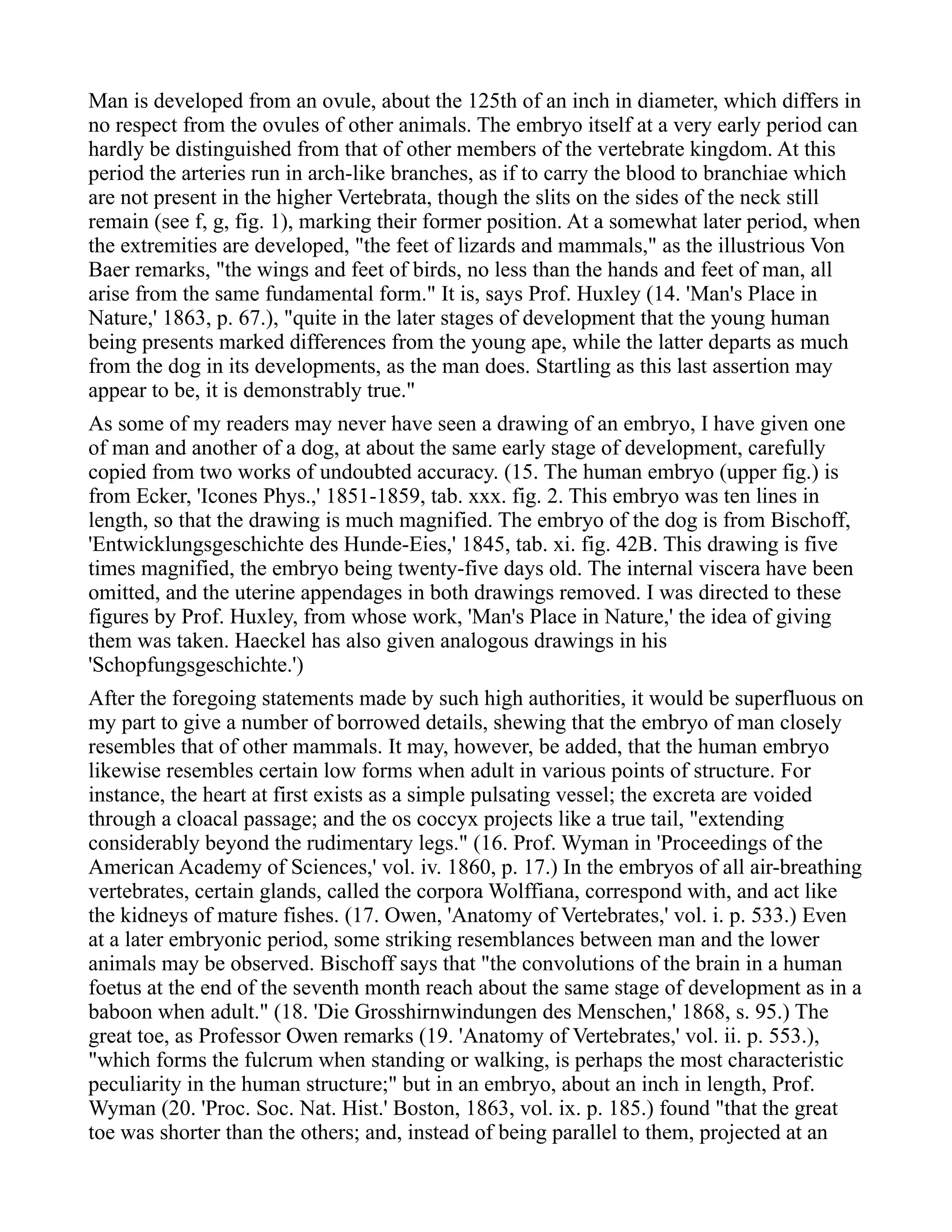
[Fig. 1. Shows a human embryo, from Ecker, and a dog embryo, from
Bischoff. Labelled in each are:
a. Fore-brain, cerebral hemispheres, etc. b. Mid-brain, corpora quadrigemina. c. Hind-
brain, cerebellum, medulla oblongata. d. Eye. e. Ear. f. First visceral arch. g. Second
visceral arch. H. Vertebral columns and muscles in process of development. i. Anterior
extremities. K. Posterior extremities. L. Tail or os coccyx.]
Man is developed from an ovule, about the 125th of an inch in diameter, which differs in
no respect from the ovules of other animals. The embryo itself at a very early period can
hardly be distinguished from that of other members of the vertebrate kingdom. At this
period the arteries run in arch-like branches, as if to carry the blood to branchiae which
are not present in the higher Vertebrata, though the slits on the sides of the neck still
remain (see f, g, fig. 1), marking their former position. At a somewhat later period, when
the extremities are developed, "the feet of lizards and mammals," as the illustrious Von
Baer remarks, "the wings and feet of birds, no less than the hands and feet of man, all
arise from the same fundamental form." It is, says Prof. Huxley (14. 'Man's Place in
Nature,' 1863, p. 67.), "quite in the later stages of development that the young human
being presents marked differences from the young ape, while the latter departs as much
from the dog in its developments, as the man does. Startling as this last assertion may
appear to be, it is demonstrably true."
As some of my readers may never have seen a drawing of an embryo, I have given one
of man and another of a dog, at about the same early stage of development, carefully
copied from two works of undoubted accuracy. (15. The human embryo (upper fig.) is
from Ecker, 'Icones Phys.,' 1851-1859, tab. xxx. fig. 2. This embryo was ten lines in
length, so that the drawing is much magnified. The embryo of the dog is from Bischoff,
'Entwicklungsgeschichte des Hunde-Eies,' 1845, tab. xi. fig. 42B. This drawing is five
times magnified, the embryo being twenty-five days old. The internal viscera have been
omitted, and the uterine appendages in both drawings removed. I was directed to these
figures by Prof. Huxley, from whose work, 'Man's Place in Nature,' the idea of giving
them was taken. Haeckel has also given analogous drawings in his
'Schopfungsgeschichte.')
After the foregoing statements made by such high authorities, it would be superfluous on
my part to give a number of borrowed details, shewing that the embryo of man closely
resembles that of other mammals. It may, however, be added, that the human embryo
likewise resembles certain low forms when adult in various points of structure. For
instance, the heart at first exists as a simple pulsating vessel; the excreta are voided
through a cloacal passage; and the os coccyx projects like a true tail, "extending
considerably beyond the rudimentary legs." (16. Prof. Wyman in 'Proceedings of the
American Academy of Sciences,' vol. iv. 1860, p. 17.) In the embryos of all air-breathing
vertebrates, certain glands, called the corpora Wolffiana, correspond with, and act like
the kidneys of mature fishes. (17. Owen, 'Anatomy of Vertebrates,' vol. i. p. 533.) Even
at a later embryonic period, some striking resemblances between man and the lower
animals may be observed. Bischoff says that "the convolutions of the brain in a human
foetus at the end of the seventh month reach about the same stage of development as in a
baboon when adult." (18. 'Die Grosshirnwindungen des Menschen,' 1868, s. 95.) The
great toe, as Professor Owen remarks (19. 'Anatomy of Vertebrates,' vol. ii. p. 553.),
"which forms the fulcrum when standing or walking, is perhaps the most characteristic
peculiarity in the human structure;" but in an embryo, about an inch in length, Prof.
Wyman (20. 'Proc. Soc. Nat. Hist.' Boston, 1863, vol. ix. p. 185.) found "that the great
toe was shorter than the others; and, instead of being parallel to them, projected at an
angle from the side of the foot, thus corresponding with the permanent condition of this
part in the quadrumana." I will conclude with a quotation from Huxley (21. 'Man's Place
in Nature,' p. 65.) who after asking, does man originate in a different way from a dog,
bird, frog or fish? says, "the reply is not doubtful for a moment; without question, the
mode of origin, and the early stages of the development of man, are identical with those
of the animals immediately below him in the scale: without a doubt in these respects, he
is far nearer to apes than the apes are to the dog."
RUDIMENTS.
This subject, though not intrinsically more important than the two last, will for several
reasons be treated here more fully. (22. I had written a rough copy of this chapter before
reading a valuable paper, "Caratteri rudimentali in ordine all' origine dell' uomo"
('Annuario della Soc. d. Naturalisti,' Modena, 1867, p. 81), by G. Canestrini, to which
paper I am considerably indebted. Haeckel has given admirable discussions on this
whole subject, under the title of Dysteleology, in his 'Generelle Morphologie' and
'Schöpfungsgeschichte.') Not one of the higher animals can be named which does not
bear some part in a rudimentary condition; and man forms no exception to the rule.
Rudimentary organs must be distinguished from those that are nascent; though in some
cases the distinction is not easy. The former are either absolutely useless, such as the
mammae of male quadrupeds, or the incisor teeth of ruminants which never cut through
the gums; or they are of such slight service to their present possessors, that we can
hardly suppose that they were developed under the conditions which now exist. Organs
in this latter state are not strictly rudimentary, but they are tending in this direction.
Nascent organs, on the other hand, though not fully developed, are of high service to
their possessors, and are capable of further development. Rudimentary organs are
eminently variable; and this is partly intelligible, as they are useless, or nearly useless,
and consequently are no longer subjected to natural selection. They often become
wholly suppressed. When this occurs, they are nevertheless liable to occasional
reappearance through reversion— a circumstance well worthy of attention.
The chief agents in causing organs to become rudimentary seem to have been disuse at
that period of life when the organ is chiefly used (and this is generally during maturity),
and also inheritance at a corresponding period of life. The term "disuse" does not relate
merely to the lessened action of muscles, but includes a diminished flow of blood to a
part or organ, from being subjected to fewer alternations of pressure, or from becoming
in any way less habitually active. Rudiments, however, may occur in one sex of those
parts which are normally present in the other sex; and such rudiments, as we shall
hereafter see, have often originated in a way distinct from those here referred to. In some
cases, organs have been reduced by means of natural selection, from having become
injurious to the species under changed habits of life. The process of reduction is
probably often aided through the two principles of compensation and economy of
growth; but the later stages of reduction, after disuse has done all that can fairly be
attributed to it, and when the saving to be effected by the economy of growth would be
very small (23. Some good criticisms on this subject have been given by Messrs. Murie
and Mivart, in 'Transact. Zoological Society,' 1869, vol. vii. p. 92.), are difficult to
understand. The final and complete suppression of a part, already useless and much
reduced in size, in which case neither compensation nor economy can come into play, is
perhaps intelligible by the aid of the hypothesis of pangenesis. But as the whole subject
of rudimentary organs has been discussed and illustrated in my former works (24.
'Variation of Animals and Plants under Domestication,' vol. ii pp. 317 and 397. See also
'Origin of Species,' 5th Edition p. 535.), I need here say no more on this head.
Rudiments of various muscles have been observed in many parts of the human body (25.
For instance, M. Richard ('Annales des Sciences Nat.,' 3rd series, Zoolog. 1852, tom.
xviii. p. 13) describes and figures rudiments of what he calls the "muscle pedieux de la
main," which he says is sometimes "infiniment petit." Another muscle, called "le tibial
posterieur," is generally quite absent in the hand, but appears from time to time in a
more or less rudimentary condition.); and not a few muscles, which are regularly present
in some of the lower animals can occasionally be detected in man in a greatly reduced
condition. Every one must have noticed the power which many animals, especially
horses, possess of moving or twitching their skin; and this is effected by the panniculus
carnosus. Remnants of this muscle in an efficient state are found in various parts of our
bodies; for instance, the muscle on the forehead, by which the eyebrows are raised. The
platysma myoides, which is well developed on the neck, belongs to this system. Prof.
Turner, of Edinburgh, has occasionally detected, as he informs me, muscular fasciculi in
five different situations, namely in the axillae, near the scapulae, etc., all of which must
be referred to the system of the panniculus. He has also shewn (26. Prof. W. Turner,
'Proceedings of the Royal Society of Edinburgh,' 1866-67, p. 65.) that the musculus
sternalis or sternalis brutorum, which is not an extension of the rectus abdominalis, but
is closely allied to the panniculus, occurred in the proportion of about three per cent. in
upwards of 600 bodies: he adds, that this muscle affords "an excellent illustration of the
statement that occasional and rudimentary structures are especially liable to variation in
arrangement."
Some few persons have the power of contracting the superficial muscles on their scalps;
and these muscles are in a variable and partially rudimentary condition. M. A. de
Candolle has communicated to me a curious instance of the long-continued persistence
or inheritance of this power, as well as of its unusual development. He knows a family,
in which one member, the present head of the family, could, when a youth, pitch several
heavy books from his head by the movement of the scalp alone; and he won wagers by
performing this feat. His father, uncle, grandfather, and his three children possess the
same power to the same unusual degree. This family became divided eight generations
ago into two branches; so that the head of the above-mentioned branch is cousin in the
seventh degree to the head of the other branch. This distant cousin resides in another part
of France; and on being asked whether he possessed the same faculty, immediately
exhibited his power. This case offers a good illustration how persistent may be the
transmission of an absolutely useless faculty, probably derived from our remote semi-
human progenitors; since many monkeys have, and frequently use the power, of largely
moving their scalps up and down. (27. See my 'Expression of the Emotions in Man and
Animals,' 1872, p. 144.)
The extrinsic muscles which serve to move the external ear, and the intrinsic muscles
which move the different parts, are in a rudimentary condition in man, and they all
belong to the system of the panniculus; they are also variable in development, or at least
in function. I have seen one man who could draw the whole ear forwards; other men can
draw it upwards; another who could draw it backwards (28. Canestrini quotes Hyrtl.
('Annuario della Soc. dei Naturalisti,' Modena, 1867, p. 97) to the same effect.); and
from what one of these persons told me, it is probable that most of us, by often touching
our ears, and thus directing our attention towards them, could recover some power of
movement by repeated trials. The power of erecting and directing the shell of the ears to
the various points of the compass, is no doubt of the highest service to many animals, as
they thus perceive the direction of danger; but I have never heard, on sufficient
evidence, of a man who possessed this power, the one which might be of use to him. The
whole external shell may be considered a rudiment, together with the various folds and
prominences (helix and anti-helix, tragus and anti-tragus, etc.) which in the lower
animals strengthen and support the ear when erect, without adding much to its weight.
Some authors, however, suppose that the cartilage of the shell serves to transmit
vibrations to the acoustic nerve; but Mr. Toynbee (29. 'The Diseases of the Ear,' by J.
Toynbee, F.R.S., 1860, p. 12. A distinguished physiologist, Prof. Preyer, informs me that
he had lately been experimenting on the function of the shell of the ear, and has come to
nearly the same conclusion as that given here.), after collecting all the known evidence
on this head, concludes that the external shell is of no distinct use. The ears of the
chimpanzee and orang are curiously like those of man, and the proper muscles are
likewise but very slightly developed. (30. Prof. A. Macalister, 'Annals and Magazine of
Natural History,' vol. vii. 1871, p. 342.) I am also assured by the keepers in the
Zoological Gardens that these animals never move or erect their ears; so that they are in
an equally rudimentary condition with those of man, as far as function is concerned.
Why these animals, as well as the progenitors of man, should have lost the power of
erecting their ears, we cannot say. It may be, though I am not satisfied with this view,
that owing to their arboreal habits and great strength they were but little exposed to
danger, and so during a lengthened period moved their ears but little, and thus gradually
lost the power of moving them. This would be a parallel case with that of those large and
heavy birds, which, from ihabiting oceanic islands, have not been exposed to the attacks
of beasts of prey, and have consequently lost the power of using their wings for flight.
The inability to move the ears in man and several apes is, however, partly compensated
by the freedom with which they can move the head in a horizontal plane, so as to catch
sounds from all directions. It has been asserted that the ear of man alone possesses a
lobule; but "a rudiment of it is found in the gorilla" (31. Mr. St. George Mivart,
'Elementary Anatomy,' 1873, p. 396.); and, as I hear from Prof. Preyer, it is not rarely
absent in the negro.
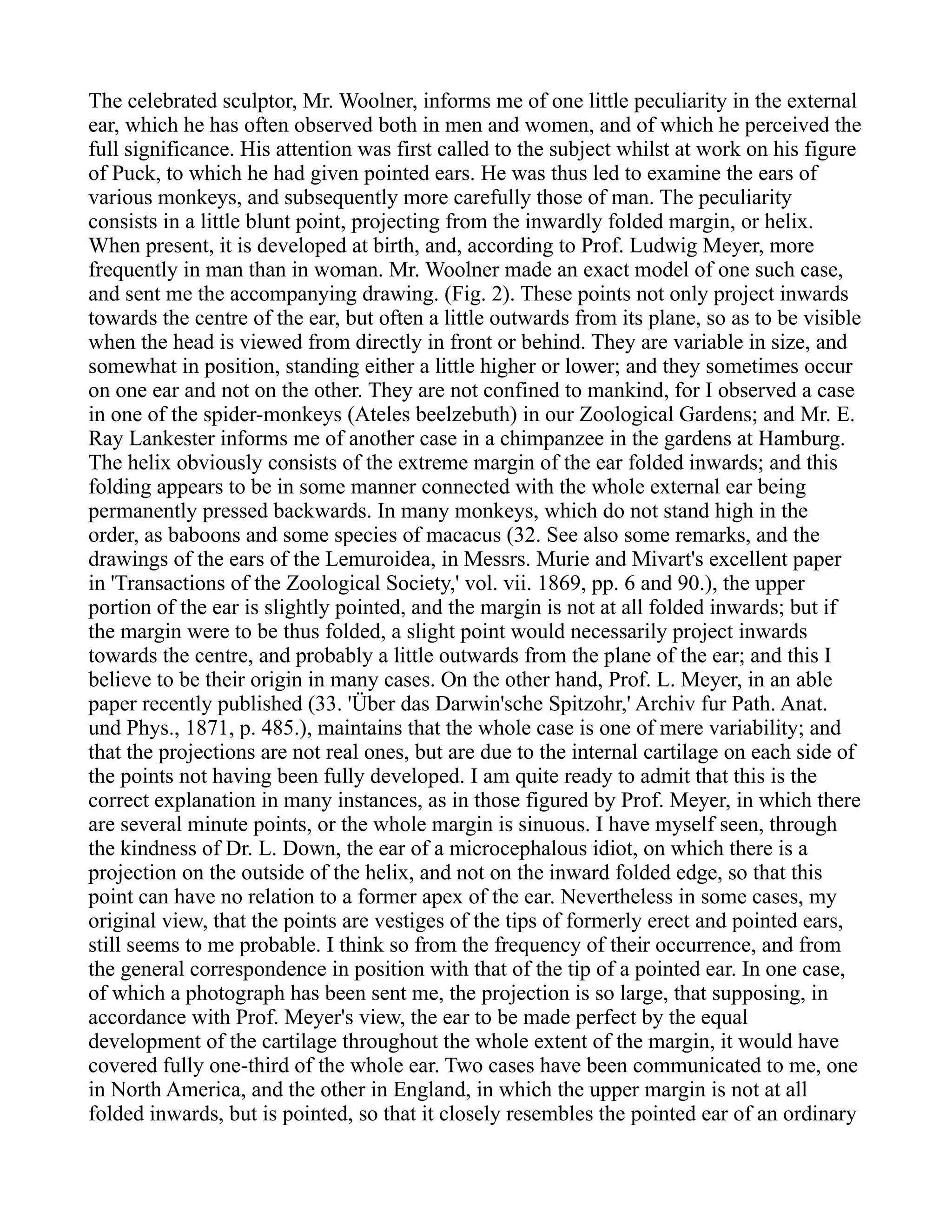
[Fig. 2. Human Ear, modelled and drawn by Mr. Woolner. The projecting point is
labelled a.]
The celebrated sculptor, Mr. Woolner, informs me of one little peculiarity in the external
ear, which he has often observed both in men and women, and of which he perceived the
full significance. His attention was first called to the subject whilst at work on his figure
of Puck, to which he had given pointed ears. He was thus led to examine the ears of
various monkeys, and subsequently more carefully those of man. The peculiarity
consists in a little blunt point, projecting from the inwardly folded margin, or helix.
When present, it is developed at birth, and, according to Prof. Ludwig Meyer, more
frequently in man than in woman. Mr. Woolner made an exact model of one such case,
and sent me the accompanying drawing. (Fig. 2). These points not only project inwards
towards the centre of the ear, but often a little outwards from its plane, so as to be visible
when the head is viewed from directly in front or behind. They are variable in size, and
somewhat in position, standing either a little higher or lower; and they sometimes occur
on one ear and not on the other. They are not confined to mankind, for I observed a case
in one of the spider-monkeys (Ateles beelzebuth) in our Zoological Gardens; and Mr. E.
Ray Lankester informs me of another case in a chimpanzee in the gardens at Hamburg.
The helix obviously consists of the extreme margin of the ear folded inwards; and this
folding appears to be in some manner connected with the whole external ear being
permanently pressed backwards. In many monkeys, which do not stand high in the
order, as baboons and some species of macacus (32. See also some remarks, and the
drawings of the ears of the Lemuroidea, in Messrs. Murie and Mivart's excellent paper
in 'Transactions of the Zoological Society,' vol. vii. 1869, pp. 6 and 90.), the upper
portion of the ear is slightly pointed, and the margin is not at all folded inwards; but if
the margin were to be thus folded, a slight point would necessarily project inwards
towards the centre, and probably a little outwards from the plane of the ear; and this I
believe to be their origin in many cases. On the other hand, Prof. L. Meyer, in an able
paper recently published (33. 'Über das Darwin'sche Spitzohr,' Archiv fur Path. Anat.
und Phys., 1871, p. 485.), maintains that the whole case is one of mere variability; and
that the projections are not real ones, but are due to the internal cartilage on each side of
the points not having been fully developed. I am quite ready to admit that this is the
correct explanation in many instances, as in those figured by Prof. Meyer, in which there
are several minute points, or the whole margin is sinuous. I have myself seen, through
the kindness of Dr. L. Down, the ear of a microcephalous idiot, on which there is a
projection on the outside of the helix, and not on the inward folded edge, so that this
point can have no relation to a former apex of the ear. Nevertheless in some cases, my
original view, that the points are vestiges of the tips of formerly erect and pointed ears,
still seems to me probable. I think so from the frequency of their occurrence, and from
the general correspondence in position with that of the tip of a pointed ear. In one case,
of which a photograph has been sent me, the projection is so large, that supposing, in
accordance with Prof. Meyer's view, the ear to be made perfect by the equal
development of the cartilage throughout the whole extent of the margin, it would have
covered fully one-third of the whole ear. Two cases have been communicated to me, one
in North America, and the other in England, in which the upper margin is not at all
folded inwards, but is pointed, so that it closely resembles the pointed ear of an ordinary
quadruped in outline. In one of these cases, which was that of a young child, the father
compared the ear with the drawing which I have given (34. 'The Expression of the
Emotions,' p. 136.) of the ear of a monkey, the Cynopithecus niger, and says that their
outlines are closely similar. If, in these two cases, the margin had been folded inwards in
the normal manner, an inward projection must have been formed. I may add that in two
other cases the outline still remains somewhat pointed, although the margin of the upper
part of the ear is normally folded inwards—in one of them, however, very narrowly.
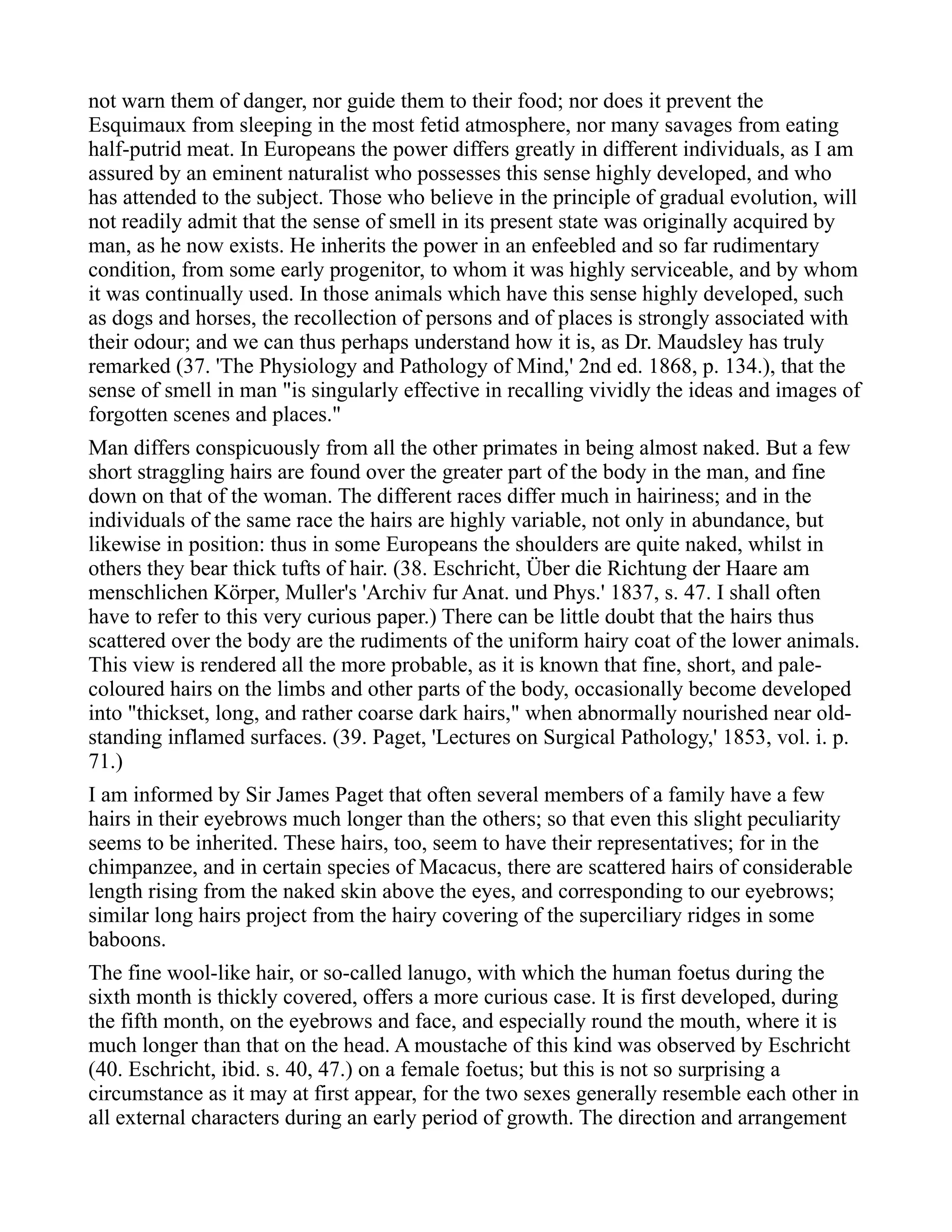
[Fig.3. Foetus of an Orang(?). Exact copy of a photograph, shewing the form of the ear
at this early age.] The following woodcut (No. 3) is an accurate copy of a photograph of
the foetus of an orang (kindly sent me by Dr. Nitsche), in which it may be seen how
different the pointed outline of the ear is at this period from its adult condition, when it
bears a close general resemblance to that of man. It is evident that the folding over of the
tip of such an ear, unless it changed greatly during its further development, would give
rise to a point projecting inwards. On the whole, it still seems to me probable that the
points in question are in some cases, both in man and apes, vestiges of a former
condition.
The nictitating membrane, or third eyelid, with its accessory muscles and other
structures, is especially well developed in birds, and is of much functional importance to
them, as it can be rapidly drawn across the whole eye-ball. It is found in some reptiles
and amphibians, and in certain fishes, as in sharks. It is fairly well developed in the two
lower divisions of the mammalian series, namely, in the monotremata and marsupials,
and in some few of the higher mammals, as in the walrus. But in man, the quadrumana,
and most other mammals, it exists, as is admitted by all anatomists, as a mere rudiment,
called the semilunar fold. (35. Muller's 'Elements of Physiology,' Eng. translat. 1842,
vol. ii. p. 1117. Owen, 'Anatomy of Vertebrates,' vol. iii. p. 260; ibid. on the Walrus,
'Proceedings of the Zoological Society,' November 8, 1854. See also R. Knox, 'Great
Artists and Anatomists,' p. 106. This rudiment apparently is somewhat larger in Negroes
and Australians than in Europeans, see Carl Vogt, 'Lectures on Man,' Eng. translat. p.
129.)
The sense of smell is of the highest importance to the greater number of mammals—to
some, as the ruminants, in warning them of danger; to others, as the Carnivora, in
finding their prey; to others, again, as the wild boar, for both purposes combined. But the
sense of smell is of extremely slight service, if any, even to the dark coloured races of
men, in whom it is much more highly developed than in the white and civilised races.
(36. The account given by Humboldt of the power of smell possessed by the natives of
South America is well known, and has been confirmed by others. M. Houzeau ('Études
sur les Facultés Mentales,' etc., tom. i. 1872, p. 91) asserts that he repeatedly made
experiments, and proved that Negroes and Indians could recognise persons in the dark
by their odour. Dr. W. Ogle has made some curious observations on the connection
between the power of smell and the colouring matter of the mucous membrane of the
olfactory region as well as of the skin of the body. I have, therefore, spoken in the text of
the dark-coloured races having a finer sense of smell than the white races. See his paper,
'Medico-Chirurgical Transactions,' London, vol. liii. 1870, p. 276.) Nevertheless it does
not warn them of danger, nor guide them to their food; nor does it prevent the
Esquimaux from sleeping in the most fetid atmosphere, nor many savages from eating
half-putrid meat. In Europeans the power differs greatly in different individuals, as I am
assured by an eminent naturalist who possesses this sense highly developed, and who
has attended to the subject. Those who believe in the principle of gradual evolution, will
not readily admit that the sense of smell in its present state was originally acquired by
man, as he now exists. He inherits the power in an enfeebled and so far rudimentary
condition, from some early progenitor, to whom it was highly serviceable, and by whom
it was continually used. In those animals which have this sense highly developed, such
as dogs and horses, the recollection of persons and of places is strongly associated with
their odour; and we can thus perhaps understand how it is, as Dr. Maudsley has truly
remarked (37. 'The Physiology and Pathology of Mind,' 2nd ed. 1868, p. 134.), that the
sense of smell in man "is singularly effective in recalling vividly the ideas and images of
forgotten scenes and places."
Man differs conspicuously from all the other primates in being almost naked. But a few
short straggling hairs are found over the greater part of the body in the man, and fine
down on that of the woman. The different races differ much in hairiness; and in the
individuals of the same race the hairs are highly variable, not only in abundance, but
likewise in position: thus in some Europeans the shoulders are quite naked, whilst in
others they bear thick tufts of hair. (38. Eschricht, Über die Richtung der Haare am
menschlichen Körper, Muller's 'Archiv fur Anat. und Phys.' 1837, s. 47. I shall often
have to refer to this very curious paper.) There can be little doubt that the hairs thus
scattered over the body are the rudiments of the uniform hairy coat of the lower animals.
This view is rendered all the more probable, as it is known that fine, short, and pale-
coloured hairs on the limbs and other parts of the body, occasionally become developed
into "thickset, long, and rather coarse dark hairs," when abnormally nourished near old-
standing inflamed surfaces. (39. Paget, 'Lectures on Surgical Pathology,' 1853, vol. i. p.
71.)
I am informed by Sir James Paget that often several members of a family have a few
hairs in their eyebrows much longer than the others; so that even this slight peculiarity
seems to be inherited. These hairs, too, seem to have their representatives; for in the
chimpanzee, and in certain species of Macacus, there are scattered hairs of considerable
length rising from the naked skin above the eyes, and corresponding to our eyebrows;
similar long hairs project from the hairy covering of the superciliary ridges in some
baboons.
The fine wool-like hair, or so-called lanugo, with which the human foetus during the
sixth month is thickly covered, offers a more curious case. It is first developed, during
the fifth month, on the eyebrows and face, and especially round the mouth, where it is
much longer than that on the head. A moustache of this kind was observed by Eschricht
(40. Eschricht, ibid. s. 40, 47.) on a female foetus; but this is not so surprising a
circumstance as it may at first appear, for the two sexes generally resemble each other in
all external characters during an early period of growth. The direction and arrangement
of the hairs on all parts of the foetal body are the same as in the adult, but are subject to
much variability. The whole surface, including even the forehead and ears, is thus
thickly clothed; but it is a significant fact that the palms of the hands and the soles of the
feet are quite naked, like the inferior surfaces of all four extremities in most of the lower
animals. As this can hardly be an accidental coincidence, the woolly covering of the
foetus probably represents the first permanent coat of hair in those mammals which are
born hairy. Three or four cases have been recorded of persons born with their whole
bodies and faces thickly covered with fine long hairs; and this strange condition is
strongly inherited, and is correlated with an abnormal condition of the teeth. (41. See my
'Variation of Animals and Plants under Domestication,' vol. ii. p. 327. Prof. Alex. Brandt
has recently sent me an additional case of a father and son, born in Russia, with these
peculiarities. I have received drawings of both from Paris.) Prof. Alex. Brandt informs
me that he has compared the hair from the face of a man thus characterised, aged thirty-
five, with the lanugo of a foetus, and finds it quite similar in texture; therefore, as he
remarks, the case may be attributed to an arrest of development in the hair, together with
its continued growth. Many delicate children, as I have been assured by a surgeon to a
hospital for children, have their backs covered by rather long silky hairs; and such cases
probably come under the same head.
It appears as if the posterior molar or wisdom-teeth were tending to become rudimentary
in the more civilised races of man. These teeth are rather smaller than the other molars,
as is likewise the case with the corresponding teeth in the chimpanzee and orang; and
they have only two separate fangs. They do not cut through the gums till about the
seventeenth year, and I have been assured that they are much more liable to decay, and
are earlier lost than the other teeth; but this is denied by some eminent dentists. They are
also much more liable to vary, both in structure and in the period of their development,
than the other teeth. (42. Dr. Webb, 'Teeth in Man and the Anthropoid Apes,' as quoted
by Dr. C. Carter Blake in Anthropological Review, July 1867, p. 299.) In the Melanian
races, on the other hand, the wisdom-teeth are usually furnished with three separate
fangs, and are generally sound; they also differ from the other molars in size, less than in
the Caucasian races. (43. Owen, 'Anatomy of Vertebrates,' vol. iii. pp. 320, 321, and
325.) Prof. Schaaffhausen accounts for this difference between the races by "the
posterior dental portion of the jaw being always shortened" in those that are civilised
(44. 'On the Primitive Form of the Skull,' Eng. translat., in 'Anthropological Review,'
Oct. 1868, p. 426), and this shortening may, I presume, be attributed to civilised men
habitually feeding on soft, cooked food, and thus using their jaws less. I am informed by
Mr. Brace that it is becoming quite a common practice in the United States to remove
some of the molar teeth of children, as the jaw does not grow large enough for the
perfect development of the normal number. (45. Prof. Montegazza writes to me from
Florence, that he has lately been studying the last molar teeth in the different races of
man, and has come to the same conclusion as that given in my text, viz., that in the
higher or civilised races they are on the road towards atrophy or elimination.)
With respect to the alimentary canal, I have met with an account of only a single
rudiment, namely the vermiform appendage of the caecum. The caecum is a branch or
diverticulum of the intestine, ending in a cul-de-sac, and is extremely long in many of
the lower vegetable-feeding mammals. In the marsupial koala it is actually more than
thrice as long as the whole body. (46. Owen, 'Anatomy of Vertebrates,' vol. iii. pp. 416,
434, 441.) It is sometimes produced into a long gradually-tapering point, and is
sometimes constricted in parts. It appears as if, in consequence of changed diet or habits,
the caecum had become much shortened in various animals, the vermiform appendage
being left as a rudiment of the shortened part. That this appendage is a rudiment, we may
infer from its small size, and from the evidence which Prof. Canestrini (47. 'Annuario
della Soc. d. Nat.' Modena, 1867, p. 94.) has collected of its variability in man. It is
occasionally quite absent, or again is largely developed. The passage is sometimes
completely closed for half or two-thirds of its length, with the terminal part consisting of
a flattened solid expansion. In the orang this appendage is long and convoluted: in man
it arises from the end of the short caecum, and is commonly from four to five inches in
length, being only about the third of an inch in diameter. Not only is it useless, but it is
sometimes the cause of death, of which fact I have lately heard two instances: this is due
to small hard bodies, such as seeds, entering the passage, and causing inflammation. (48.
M. C. Martins ("De l'Unité Organique," in 'Revue des Deux Mondes,' June 15, 1862, p.
16) and Haeckel ('Generelle Morphologie,' B. ii. s. 278), have both remarked on the
singular fact of this rudiment sometimes causing death.)
In some of the lower Quadrumana, in the Lemuridae and Carnivora, as well as in many
marsupials, there is a passage near the lower end of the humerus, called the supra-
condyloid foramen, through which the great nerve of the fore limb and often the great
artery pass. Now in the humerus of man, there is generally a trace of this passage, which
is sometimes fairly well developed, being formed by a depending hook-like process of
bone, completed by a band of ligament. Dr. Struthers (49. With respect to inheritance,
see Dr. Struthers in the 'Lancet,' Feb. 15, 1873, and another important paper, ibid. Jan.
24, 1863, p. 83. Dr. Knox, as I am informed, was the first anatomist who drew attention
to this peculiar structure in man; see his 'Great Artists and Anatomists,' p. 63. See also an
important memoir on this process by Dr. Gruber, in the 'Bulletin de l'Acad. Imp. de St.
Petersbourg,' tom. xii. 1867, p. 448.), who has closely attended to the subject, has now
shewn that this peculiarity is sometimes inherited, as it has occurred in a father, and in
no less than four out of his seven children. When present, the great nerve invariably
passes through it; and this clearly indicates that it is the homologue and rudiment of the
supra-condyloid foramen of the lower animals. Prof. Turner estimates, as he informs me,
that it occurs in about one per cent. of recent skeletons. But if the occasional
development of this structure in man is, as seems probable, due to reversion, it is a
return to a very ancient state of things, because in the higher Quadrumana it is absent.
There is another foramen or perforation in the humerus, occasionally present in man,
which may be called the inter-condyloid. This occurs, but not constantly, in various
anthropoid and other apes (50. Mr. St. George Mivart, 'Transactions Phil. Soc.' 1867, p.
310.), and likewise in many of the lower animals. It is remarkable that this perforation
seems to have been present in man much more frequently during ancient times than
recently. Mr. Busk (51. "On the Caves of Gibraltar," 'Transactions of the International
Congress of Prehistoric Archaeology,' Third Session, 1869, p. 159. Prof. Wyman has
lately shewn (Fourth Annual Report, Peabody Museum, 1871, p. 20), that this
perforation is present in thirty-one per cent. of some human remains from ancient
mounds in the Western United States, and in Florida. It frequently occurs in the negro.)
has collected the following evidence on this head: Prof. Broca "noticed the perforation
in four and a half per cent. of the arm-bones collected in the 'Cimetière du Sud,' at Paris;
and in the Grotto of Orrony, the contents of which are referred to the Bronze period, as
many as eight humeri out of thirty-two were perforated; but this extraordinary
proportion, he thinks, might be due to the cavern having been a sort of 'family vault.'
Again, M. Dupont found thirty per cent. of perforated bones in the caves of the Valley of
the Lesse, belonging to the Reindeer period; whilst M. Leguay, in a sort of dolmen at
Argenteuil, observed twenty-five per cent. to be perforated; and M. Pruner-Bey found
twenty-six per cent. in the same condition in bones from Vaureal. Nor should it be left
unnoticed that M. Pruner-Bey states that this condition is common in Guanche
skeletons." It is an interesting fact that ancient races, in this and several other cases,
more frequently present structures which resemble those of the lower animals than do
the modern. One chief cause seems to be that the ancient races stand somewhat nearer in
the long line of descent to their remote animal-like progenitors.
In man, the os coccyx, together with certain other vertebrae hereafter to be described,
though functionless as a tail, plainly represent this part in other vertebrate animals. At an
early embryonic period it is free, and projects beyond the lower extremities; as may be
seen in the drawing (Fig. 1.) of a human embryo. Even after birth it has been known, in
certain rare and anomalous cases (52. Quatrefages has lately collected the evidence on
this subject. 'Revue des Cours Scientifiques,' 1867-1868, p. 625. In 1840 Fleischmann
exhibited a human foetus bearing a free tail, which, as is not always the case, included
vertebral bodies; and this tail was critically examined by the many anatomists present at
the meeting of naturalists at Erlangen (see Marshall in Niederlandischen Archiv für
Zoologie, December 1871).), to form a small external rudiment of a tail. The os coccyx
is short, usually including only four vertebrae, all anchylosed together: and these are in a
rudimentary condition, for they consist, with the exception of the basal one, of the
centrum alone. (53. Owen, 'On the Nature of Limbs,' 1849, p. 114.) They are furnished
with some small muscles; one of which, as I am informed by Prof. Turner, has been
expressly described by Theile as a rudimentary repetition of the extensor of the tail, a
muscle which is so largely developed in many mammals.
The spinal cord in man extends only as far downwards as the last dorsal or first lumbar
vertebra; but a thread-like structure (the filum terminale) runs down the axis of the sacral
part of the spinal canal, and even along the back of the coccygeal bones. The upper part
of this filament, as Prof. Turner informs me, is undoubtedly homologous with the spinal
cord; but the lower part apparently consists merely of the pia mater, or vascular
investing membrane. Even in this case the os coccyx may be said to possess a vestige of
so important a structure as the spinal cord, though no longer enclosed within a bony
canal. The following fact, for which I am also indebted to Prof. Turner, shews how
closely the os coccyx corresponds with the true tail in the lower animals: Luschka has
recently discovered at the extremity of the coccygeal bones a very peculiar convoluted
body, which is continuous with the middle sacral artery; and this discovery led Krause
and Meyer to examine the tail of a monkey (Macacus), and of a cat, in both of which
they found a similarly convoluted body, though not at the extremity.
The reproductive system offers various rudimentary structures; but these differ in one
important respect from the foregoing cases. Here we are not concerned with the vestige
of a part which does not belong to the species in an efficient state, but with a part
efficient in the one sex, and represented in the other by a mere rudiment. Nevertheless,
the occurrence of such rudiments is as difficult to explain, on the belief of the separate
creation of each species, as in the foregoing cases. Hereafter I shall have to recur to
these rudiments, and shall shew that their presence generally depends merely on
inheritance, that is, on parts acquired by one sex having been partially transmitted to the
other. I will in this place only give some instances of such rudiments. It is well known
that in the males of all mammals, including man, rudimentary mammae exist. These in
several instances have become well developed, and have yielded a copious supply of
milk. Their essential identity in the two sexes is likewise shewn by their occasional
sympathetic enlargement in both during an attack of the measles. The vesicula
prostatica, which has been observed in many male mammals, is now universally
acknowledged to be the homologue of the female uterus, together with the connected
passage. It is impossible to read Leuckart's able description of this organ, and his
reasoning, without admitting the justness of his conclusion. This is especially clear in
the case of those mammals in which the true female uterus bifurcates, for in the males of
these the vesicula likewise bifurcates. (54. Leuckart, in Todd's 'Cyclopaedia of Anatomy'
1849-52, vol. iv. p. 1415. In man this organ is only from three to six lines in length, but,
like so many other rudimentary parts, it is variable in development as well as in other
characters.) Some other rudimentary structures belonging to the reproductive system
might have been here adduced. (55. See, on this subject, Owen, 'Anatomy of
Vertebrates,' vol. iii. pp. 675, 676, 706.)
The bearing of the three great classes of facts now given is unmistakeable. But it would
be superfluous fully to recapitulate the line of argument given in detail in my 'Origin of
Species.' The homological construction of the whole frame in the members of the same
class is intelligible, if we admit their descent from a common progenitor, together with
their subsequent adaptation to diversified conditions. On any other view, the similarity
of pattern between the hand of a man or monkey, the foot of a horse, the flipper of a seal,
the wing of a bat, etc., is utterly inexplicable. (56. Prof. Bianconi, in a recently published
work, illustrated by admirable engravings ('La Théorie Darwinienne et la création dite
indépendante,' 1874), endeavours to shew that homological structures, in the above and
other cases, can be fully explained on mechanical principles, in accordance with their
uses. No one has shewn so well, how admirably such structures are adapted for their
final purpose; and this adaptation can, as I believe, be explained through natural
selection. In considering the wing of a bat, he brings forward (p. 218) what appears to
me (to use Auguste Comte's words) a mere metaphysical principle, namely, the
preservation "in its integrity of the mammalian nature of the animal." In only a few cases
does he discuss rudiments, and then only those parts which are partially rudimentary,
such as the little hoofs of the pig and ox, which do not touch the ground; these he shews
clearly to be of service to the animal. It is unfortunate that he did not consider such cases
as the minute teeth, which never cut through the jaw in the ox, or the mammae of male
quadrupeds, or the wings of certain beetles, existing under the soldered wing-covers, or
the vestiges of the pistil and stamens in various flowers, and many other such cases.
Although I greatly admire Prof. Bianconi's work, yet the belief now held by most
naturalists seems to me left unshaken, that homological structures are inexplicable on
the principle of mere adaptation.) It is no scientific explanation to assert that they have
all been formed on the same ideal plan. With respect to development, we can clearly
understand, on the principle of variations supervening at a rather late embryonic period,
and being inherited at a corresponding period, how it is that the embryos of wonderfully
different forms should still retain, more or less perfectly, the structure of their common
progenitor. No other explanation has ever been given of the marvellous fact that the
embryos of a man, dog, seal, bat, reptile, etc., can at first hardly be distinguished from
each other. In order to understand the existence of rudimentary organs, we have only to
suppose that a former progenitor possessed the parts in question in a perfect state, and
that under changed habits of life they became greatly reduced, either from simple disuse,
or through the natural selection of those individuals which were least encumbered with a
superfluous part, aided by the other means previously indicated.
Thus we can understand how it has come to pass that man and all other vertebrate
animals have been constructed on the same general model, why they pass through the
same early stages of development, and why they retain certain rudiments in common.
Consequently we ought frankly to admit their community of descent: to take any other
view, is to admit that our own structure, and that of all the animals around us, is a mere
snare laid to entrap our judgment. This conclusion is greatly strengthened, if we look to
the members of the whole animal series, and consider the evidence derived from their
affinities or classification, their geographical distribution and geological succession. It is
only our natural prejudice, and that arrogance which made our forefathers declare that
they were descended from demi-gods, which leads us to demur to this conclusion. But
the time will before long come, when it will be thought wonderful that naturalists, who
were well acquainted with the comparative structure and development of man, and other
mammals, should have believed that each was the work of a separate act of creation.
CHAPTER II.
ON THE MANNER OF DEVELOPMENT OF MAN FROM SOME LOWER FORM.
Variability of body and mind in man—Inheritance—Causes of variability— Laws of
variation the same in man as in the lower animals—Direct action of the conditions of
life—Effects of the increased use and disuse of parts— Arrested development—
Reversion—Correlated variation—Rate of increase— Checks to increase—Natural
selection—Man the most dominant animal in the world—Importance of his corporeal
structure—The causes which have led to his becoming erect—Consequent changes of
structure—Decrease in size of the canine teeth—Increased size and altered shape of the
skull—Nakedness —Absence of a tail—Defenceless condition of man.
It is manifest that man is now subject to much variability. No two individuals of the
same race are quite alike. We may compare millions of faces, and each will be distinct.
There is an equally great amount of diversity in the proportions and dimensions of the
various parts of the body; the length of the legs being one of the most variable points. (1.
'Investigations in Military and Anthropological Statistics of American Soldiers,' by B.A.
Gould, 1869, p. 256.) Although in some quarters of the world an elongated skull, and in
other quarters a short skull prevails, yet there is great diversity of shape even within the
limits of the same race, as with the aborigines of America and South Australia—the
latter a race "probably as pure and homogeneous in blood, customs, and language as any
in existence"—and even with the inhabitants of so confined an area as the Sandwich
Islands. (2. With respect to the "Cranial forms of the American aborigines," see Dr.
Aitken Meigs in 'Proc. Acad. Nat. Sci.' Philadelphia, May 1868. On the Australians, see
Huxley, in Lyell's 'Antiquity of Man,' 1863, p. 87. On the Sandwich Islanders, Prof. J.
Wyman, 'Observations on Crania,' Boston, 1868, p. 18.) An eminent dentist assures me
that there is nearly as much diversity in the teeth as in the features. The chief arteries so
frequently run in abnormal courses, that it has been found useful for surgical purposes to
calculate from 1040 corpses how often each course prevails. (3. 'Anatomy of the
Arteries,' by R. Quain. Preface, vol. i. 1844.) The muscles are eminently variable: thus
those of the foot were found by Prof. Turner (4. 'Transactions of the Royal Society of
Edinburgh,' vol. xxiv. pp. 175, 189.) not to be strictly alike in any two out of fifty
bodies; and in some the deviations were considerable. He adds, that the power of
performing the appropriate movements must have been modified in accordance with the
several deviations. Mr. J. Wood has recorded (5. 'Proceedings Royal Society,' 1867, p.
544; also 1868, pp. 483, 524. There is a previous paper, 1866, p. 229.) the occurrence of
295 muscular variations in thirty-six subjects, and in another set of the same number no
less than 558 variations, those occurring on both sides of the body being only reckoned
as one. In the last set, not one body out of the thirty-six was "found totally wanting in
departures from the standard descriptions of the muscular system given in anatomical
text books." A single body presented the extraordinary number of twenty-five distinct
abnormalities. The same muscle sometimes varies in many ways: thus Prof. Macalister
describes (6. 'Proc. R. Irish Academy,' vol. x. 1868, p. 141.) no less than twenty distinct
variations in the palmaris accessorius.
The famous old anatomist, Wolff (7. 'Act. Acad. St. Petersburg,' 1778, part ii. p. 217.),
insists that the internal viscera are more variable than the external parts: Nulla particula
est quae non aliter et aliter in aliis se habeat hominibus. He has even written a treatise on
the choice of typical examples of the viscera for representation. A discussion on the
beau-ideal of the liver, lungs, kidneys, etc., as of the human face divine, sounds strange
in our ears.
The variability or diversity of the mental faculties in men of the same race, not to
mention the greater differences between the men of distinct races, is so notorious that
not a word need here be said. So it is with the lower animals. All who have had charge
of menageries admit this fact, and we see it plainly in our dogs and other domestic
animals. Brehm especially insists that each individual monkey of those which he kept
tame in Africa had its own peculiar disposition and temper: he mentions one baboon
remarkable for its high intelligence; and the keepers in the Zoological Gardens pointed
out to me a monkey, belonging to the New World division, equally remarkable for
intelligence. Rengger, also, insists on the diversity in the various mental characters of
the monkeys of the same species which he kept in Paraguay; and this diversity, as he
adds, is partly innate, and partly the result of the manner in which they have been treated
or educated. (8. Brehm, 'Thierleben,' B. i. ss. 58, 87. Rengger, 'Säugethiere von
Paraguay,' s. 57.)
I have elsewhere (9. 'Variation of Animals and Plants under Domestication,' vol. ii. chap.
xii.) so fully discussed the subject of Inheritance, that I need here add hardly anything. A
greater number of facts have been collected with respect to the transmission of the most
trifling, as well as of the most important characters in man, than in any of the lower
animals; though the facts are copious enough with respect to the latter. So in regard to
mental qualities, their transmission is manifest in our dogs, horses, and other domestic
animals. Besides special tastes and habits, general intelligence, courage, bad and good
temper, etc., are certainly transmitted. With man we see similar facts in almost every
family; and we now know, through the admirable labours of Mr. Galton (10. 'Hereditary
Genius: an Inquiry into its Laws and Consequences,' 1869.), that genius which implies a
wonderfully complex combination of high faculties, tends to be inherited; and, on the
other hand, it is too certain that insanity and deteriorated mental powers likewise run in
families.
With respect to the causes of variability, we are in all cases very ignorant; but we can see
that in man as in the lower animals, they stand in some relation to the conditions to
which each species has been exposed, during several generations. Domesticated animals
vary more than those in a state of nature; and this is apparently due to the diversified and
changing nature of the conditions to which they have been subjected. In this respect the
different races of man resemble domesticated animals, and so do the individuals of the
same race, when inhabiting a very wide area, like that of America. We see the influence
of diversified conditions in the more civilised nations; for the members belonging to
different grades of rank, and following different occupations, present a greater range of
character than do the members of barbarous nations. But the uniformity of savages has
often been exaggerated, and in some cases can hardly be said to exist. (11. Mr. Bates
remarks ('The Naturalist on the Amazons,' 1863, vol. ii p. 159), with respect to the
Indians of the same South American tribe, "no two of them were at all similar in the
shape of the head; one man had an oval visage with fine features, and another was quite
Mongolian in breadth and prominence of cheek, spread of nostrils, and obliquity of
eyes.") It is, nevertheless, an error to speak of man, even if we look only to the
conditions to which he has been exposed, as "far more domesticated" (12. Blumenbach,
'Treatises on Anthropology.' Eng. translat., 1865, p. 205.) than any other animal. Some
savage races, such as the Australians, are not exposed to more diversified conditions
than are many species which have a wide range. In another and much more important
respect, man differs widely from any strictly domesticated animal; for his breeding has
never long been controlled, either by methodical or unconscious selection. No race or
body of men has been so completely subjugated by other men, as that certain individuals
should be preserved, and thus unconsciously selected, from somehow excelling in utility
to their masters. Nor have certain male and female individuals been intentionally picked
out and matched, except in the well-known case of the Prussian grenadiers; and in this
case man obeyed, as might have been expected, the law of methodical selection; for it is
asserted that many tall men were reared in the villages inhabited by the grenadiers and
their tall wives. In Sparta, also, a form of selection was followed, for it was enacted that
all children should be examined shortly after birth; the well-formed and vigorous being
preserved, the others left to perish. (13. Mitford's 'History of Greece,' vol. i. p. 282. It
appears also from a passage in Xenophon's 'Memorabilia,' B. ii. 4 (to which my attention
has been called by the Rev. J.N. Hoare), that it was a well recognised principle with the
Greeks, that men ought to select their wives with a view to the health and vigour of their
children. The Grecian poet, Theognis, who lived 550 B.C., clearly saw how important
selection, if carefully applied, would be for the improvement of mankind. He saw,
likewise, that wealth often checks the proper action of sexual selection. He thus writes:
"With kine and horses, Kurnus! we proceed
By reasonable rules, and choose a breed
For profit and increase, at any price:
Of a sound stock, without defect or vice.
But, in the daily matches that we make,
The price is everything: for money's sake,
Men marry: women are in marriage given
The churl or ruffian, that in wealth has thriven,
May match his offspring with the proudest race:
Thus everything is mix'd, noble and base!
If then in outward manner, form, and mind,
You find us a degraded, motley kind,
Wonder no more, my friend! the cause is plain,
And to lament the consequence is vain."
(The Works of J. Hookham Frere, vol. ii. 1872, p. 334.))
If we consider all the races of man as forming a single species, his range is enormous;
but some separate races, as the Americans and Polynesians, have very wide ranges. It is
a well-known law that widely-ranging species are much more variable than species with
restricted ranges; and the variability of man may with more truth be compared with that
of widely- ranging species, than with that of domesticated animals.
Not only does variability appear to be induced in man and the lower animals by the same
general causes, but in both the same parts of the body are affected in a closely analogous
manner. This has been proved in such full detail by Godron and Quatrefages, that I need
here only refer to their works. (14. Godron, 'De l'Espèce,' 1859, tom. ii. livre 3.
Quatrefages, 'Unité de l'Espèce Humaine,' 1861. Also Lectures on Anthropology, given
in the 'Revue des Cours Scientifiques,' 1866-1868.) Monstrosities, which graduate into
slight variations, are likewise so similar in man and the lower animals, that the same
classification and the same terms can be used for both, as has been shewn by Isidore
Geoffroy St.-Hilaire. (15. 'Hist. Gen. et Part. des Anomalies de l'Organisation,' in three
volumes, tom. i. 1832.) In my work on the variation of domestic animals, I have
attempted to arrange in a rude fashion the laws of variation under the following heads:—
The direct and definite action of changed conditions, as exhibited by all or nearly all the
individuals of the same species, varying in the same manner under the same
circumstances. The effects of the long- continued use or disuse of parts. The cohesion of
homologous parts. The variability of multiple parts. Compensation of growth; but of this
law I have found no good instance in the case of man. The effects of the mechanical
pressure of one part on another; as of the pelvis on the cranium of the infant in the
womb. Arrests of development, leading to the diminution or suppression of parts. The
reappearance of long-lost characters through reversion. And lastly, correlated variation.
All these so-called laws apply equally to man and the lower animals; and most of them
even to plants. It would be superfluous here to discuss all of them (16. I have fully
discussed these laws in my 'Variation of Animals and Plants under Domestication,' vol.
ii. chap. xxii. and xxiii. M. J.P. Durand has lately (1868) published a valuable essay, 'De
l'Influence des Milieux,' etc. He lays much stress, in the case of plants, on the nature of
the soil.); but several are so important, that they must be treated at considerable length.
THE DIRECT AND DEFINITE ACTION OF CHANGED CONDITIONS.
This is a most perplexing subject. It cannot be denied that changed conditions produce
some, and occasionally a considerable effect, on organisms of all kinds; and it seems at
first probable that if sufficient time were allowed this would be the invariable result. But
I have failed to obtain clear evidence in favour of this conclusion; and valid reasons may
be urged on the other side, at least as far as the innumerable structures are concerned,
which are adapted for special ends. There can, however, be no doubt that changed
conditions induce an almost indefinite amount of fluctuating variability, by which the
whole organisation is rendered in some degree plastic.
In the United States, above 1,000,000 soldiers, who served in the late war, were
measured, and the States in which they were born and reared were recorded. (17.
'Investigations in Military and Anthrop. Statistics,' etc., 1869, by B.A. Gould, pp. 93,
107, 126, 131, 134.) From this astonishing number of observations it is proved that local
influences of some kind act directly on stature; and we further learn that "the State
where the physical growth has in great measure taken place, and the State of birth,
which indicates the ancestry, seem to exert a marked influence on the stature." For
instance, it is established, "that residence in the Western States, during the years of
growth, tends to produce increase of stature." On the other hand, it is certain that with
sailors, their life delays growth, as shewn "by the great difference between the statures
of soldiers and sailors at the ages of seventeen and eighteen years." Mr. B.A. Gould
endeavoured to ascertain the nature of the influences which thus act on stature; but he
arrived only at negative results, namely that they did not relate to climate, the elevation
of the land, soil, nor even "in any controlling degree" to the abundance or the need of the
comforts of life. This latter conclusion is directly opposed to that arrived at by Villerme,
from the statistics of the height of the conscripts in different parts of France. When we
compare the differences in stature between the Polynesian chiefs and the lower orders
within the same islands, or between the inhabitants of the fertile volcanic and low barren
coral islands of the same ocean (18. For the Polynesians, see Prichard's 'Physical History
of Mankind,' vol. v. 1847, pp. 145, 283. Also Godron, 'De l'Espèce,' tom. ii. p. 289.
There is also a remarkable difference in appearance between the closely-allied Hindoos
inhabiting the Upper Ganges and Bengal; see Elphinstone's 'History of India,' vol. i. p.
324.) or again between the Fuegians on the eastern and western shores of their country,
where the means of subsistence are very different, it is scarcely possible to avoid the
conclusion that better food and greater comfort do influence stature. But the preceding
statements shew how difficult it is to arrive at any precise result. Dr. Beddoe has lately
proved that, with the inhabitants of Britain, residence in towns and certain occupations
have a deteriorating influence on height; and he infers that the result is to a certain extent
inherited, as is likewise the case in the United States. Dr. Beddoe further believes that
wherever a "race attains its maximum of physical development, it rises highest in energy
and moral vigour." (19. 'Memoirs, Anthropological Society,' vol. iii. 1867-69, pp. 561,
565, 567.)
Whether external conditions produce any other direct effect on man is not known. It
might have been expected that differences of climate would have had a marked
influence, inasmuch as the lungs and kidneys are brought into activity under a low
temperature, and the liver and skin under a high one. (20. Dr. Brakenridge, 'Theory of
Diathesis,' 'Medical Times,' June 19 and July 17, 1869.) It was formerly thought that the
colour of the skin and the character of the hair were determined by light or heat; and
although it can hardly be denied that some effect is thus produced, almost all observers
now agree that the effect has been very small, even after exposure during many ages.
But this subject will be more properly discussed when we treat of the different races of
mankind. With our domestic animals there are grounds for believing that cold and damp
directly affect the growth of the hair; but I have not met with any evidence on this head
in the case of man.
EFFECTS OF THE INCREASED USE AND DISUSE OF PARTS.
It is well known that use strengthens the muscles in the individual, and complete disuse,
or the destruction of the proper nerve, weakens them. When the eye is destroyed, the
optic nerve often becomes atrophied. When an artery is tied, the lateral channels increase
not only in diameter, but in the thickness and strength of their coats. When one kidney
ceases to act from disease, the other increases in size, and does double work. Bones
increase not only in thickness, but in length, from carrying a greater weight. (21. I have
given authorities for these several statements in my 'Variation of Animals and Plants
under Domestication,' vol. ii. pp. 297- 300. Dr. Jaeger, "Über das Langenwachsthum der
Knochen," 'Jenäischen Zeitschrift,' B. v. Heft. i.) Different occupations, habitually
followed, lead to changed proportions in various parts of the body. Thus it was
ascertained by the United States Commission (22. 'Investigations,' etc., by B.A. Gould,
1869, p. 288.) that the legs of the sailors employed in the late war were longer by 0.217
of an inch than those of the soldiers, though the sailors were on an average shorter men;
whilst their arms were shorter by 1.09 of an inch, and therefore, out of proportion,
shorter in relation to their lesser height. This shortness of the arms is apparently due to
their greater use, and is an unexpected result: but sailors chiefly use their arms in
pulling, and not in supporting weights. With sailors, the girth of the neck and the depth
of the instep are greater, whilst the circumference of the chest, waist, and hips is less,
than in soldiers.
Whether the several foregoing modifications would become hereditary, if the same
habits of life were followed during many generations, is not known, but it is probable.
Rengger (23. 'Säugethiere von Paraguay,' 1830, s. 4.) attributes the thin legs and thick
arms of the Payaguas Indians to successive generations having passed nearly their whole
lives in canoes, with their lower extremities motionless. Other writers have come to a
similar conclusion in analogous cases. According to Cranz (24. 'History of Greenland,'
Eng. translat., 1767, vol. i. p. 230.), who lived for a long time with the Esquimaux, "the
natives believe that ingenuity and dexterity in seal-catching (their highest art and virtue)
is hereditary; there is really something in it, for the son of a celebrated seal-catcher will
distinguish himself, though he lost his father in childhood." But in this case it is mental
aptitude, quite as much as bodily structure, which appears to be inherited. It is asserted
that the hands of English labourers are at birth larger than those of the gentry. (25.
'Intermarriage,' by Alex. Walker, 1838, p. 377.) From the correlation which exists, at
least in some cases (26. 'The Variation of Animals under Domestication,' vol. i. p. 173.),
between the development of the extremities and of the jaws, it is possible that in those
classes which do not labour much with their hands and feet, the jaws would be reduced
in size from this cause. That they are generally smaller in refined and civilised men than
in hard-working men or savages, is certain. But with savages, as Mr. Herbert Spencer
(27. 'Principles of Biology,' vol. i. p. 455.) has remarked, the greater use of the jaws in
chewing coarse, uncooked food, would act in a direct manner on the masticatory
muscles, and on the bones to which they are attached. In infants, long before birth, the
skin on the soles of the feet is thicker than on any other part of the body; (28. Paget,
'Lectures on Surgical Pathology,' vol. ii, 1853, p. 209.) and it can hardly be doubted that
this is due to the inherited effects of pressure during a long series of generations.
It is familiar to every one that watchmakers and engravers are liable to be short-sighted,
whilst men living much out of doors, and especially savages, are generally long-sighted.
(29. It is a singular and unexpected fact that sailors are inferior to landsmen in their
mean distance of distinct vision. Dr. B.A. Gould ('Sanitary Memoirs of the War of the
Rebellion,' 1869, p. 530), has proved this to be the case; and he accounts for it by the
ordinary range of vision in sailors being "restricted to the length of the vessel and the
height of the masts.") Short-sight and long-sight certainly tend to be inherited. (30. 'The
Variation of Animals under Domestication,' vol. i. p. 8.) The inferiority of Europeans, in
comparison with savages, in eyesight and in the other senses, is no doubt the
accumulated and transmitted effect of lessened use during many generations; for
Rengger (31. 'Säugethiere von Paraguay,' s. 8, 10. I have had good opportunities for
observing the extraordinary power of eyesight in the Fuegians. See also Lawrence
('Lectures on Physiology,' etc., 1822, p. 404) on this same subject. M. Giraud-Teulon has
recently collected ('Revue des Cours Scientifiques,' 1870, p. 625) a large and valuable
body of evidence proving that the cause of short-sight, "C'est le travail assidu, de près.")
states that he has repeatedly observed Europeans, who had been brought up and spent
their whole lives with the wild Indians, who nevertheless did not equal them in the
sharpness of their senses. The same naturalist observes that the cavities in the skull for
the reception of the several sense- organs are larger in the American aborigines than in
Europeans; and this probably indicates a corresponding difference in the dimensions of
the organs themselves. Blumenbach has also remarked on the large size of the nasal
cavities in the skulls of the American aborigines, and connects this fact with their
remarkably acute power of smell. The Mongolians of the plains of northern Asia,
according to Pallas, have wonderfully perfect senses; and Prichard believes that the great
breadth of their skulls across the zygomas follows from their highly-developed sense
organs. (32. Prichard, 'Physical History of Mankind,' on the authority of Blumenbach,
vol. i. 1851, p. 311; for the statement by Pallas, vol. iv. 1844, p. 407.)
The Quechua Indians inhabit the lofty plateaux of Peru; and Alcide d'Orbigny states (33.
Quoted by Prichard, 'Researches into the Physical History of Mankind,' vol. v. p. 463.)
that, from continually breathing a highly rarefied atmosphere, they have acquired chests
and lungs of extraordinary dimensions. The cells, also, of the lungs are larger and more
numerous than in Europeans. These observations have been doubted, but Mr. D. Forbes
carefully measured many Aymaras, an allied race, living at the height of between 10,000
and 15,000 feet; and he informs me (34. Mr. Forbes' valuable paper is now published in
the 'Journal of the Ethnological Society of London,' new series, vol. ii. 1870, p.193.) that
they differ conspicuously from the men of all other races seen by him in the
circumference and length of their bodies. In his table of measurements, the stature of
each man is taken at 1000, and the other measurements are reduced to this standard. It is
here seen that the extended arms of the Aymaras are shorter than those of Europeans,
and much shorter than those of Negroes. The legs are likewise shorter; and they present
this remarkable peculiarity, that in every Aymara measured, the femur is actually shorter
than the tibia. On an average, the length of the femur to that of the tibia is as 211 to 252;
whilst in two Europeans, measured at the same time, the femora to the tibiae were as 244
to 230; and in three Negroes as 258 to 241. The humerus is likewise shorter relatively to
the forearm. This shortening of that part of the limb which is nearest to the body, appears
to be, as suggested to me by Mr. Forbes, a case of compensation in relation with the
greatly increased length of the trunk. The Aymaras present some other singular points of
structure, for instance, the very small projection of the heel.
These men are so thoroughly acclimatised to their cold and lofty abode, that when
formerly carried down by the Spaniards to the low eastern plains, and when now
tempted down by high wages to the gold-washings, they suffer a frightful rate of
mortality. Nevertheless Mr. Forbes found a few pure families which had survived during
two generations: and he observed that they still inherited their characteristic
peculiarities. But it was manifest, even without measurement, that these peculiarities had
all decreased; and on measurement, their bodies were found not to be so much elongated
as those of the men on the high plateau; whilst their femora had become somewhat
lengthened, as had their tibiae, although in a less degree. The actual measurements may
be seen by consulting Mr. Forbes's memoir. From these observations, there can, I think,
be no doubt that residence during many generations at a great elevation tends, both
directly and indirectly, to induce inherited modifications in the proportions of the body.
(35. Dr. Wilckens ('Landwirthschaft. Wochenblatt,' No. 10, 1869) has lately published an
interesting essay shewing how domestic animals, which live in mountainous regions,
have their frames modified.)
Although man may not have been much modified during the latter stages of his
existence through the increased or decreased use of parts, the facts now given shew that
his liability in this respect has not been lost; and we positively know that the same law
holds good with the lower animals. Consequently we may infer that when at a remote
epoch the progenitors of man were in a transitional state, and were changing from
quadrupeds into bipeds, natural selection would probably have been greatly aided by the
inherited effects of the increased or diminished use of the different parts of the body.
ARRESTS OF DEVELOPMENT.
There is a difference between arrested development and arrested growth, for parts in the
former state continue to grow whilst still retaining their early condition. Various
monstrosities come under this head; and some, as a cleft palate, are known to be
occasionally inherited. It will suffice for our purpose to refer to the arrested brain-
development of microcephalous idiots, as described in Vogt's memoir. (36. 'Mémoire sur
les Microcephales,' 1867, pp. 50, 125, 169, 171, 184-198.) Their skulls are smaller, and
the convolutions of the brain are less complex than in normal men. The frontal sinus, or
the projection over the eye-brows, is largely developed, and the jaws are prognathous to
an "effrayant" degree; so that these idiots somewhat resemble the lower types of
mankind. Their intelligence, and most of their mental faculties, are extremely feeble.
They cannot acquire the power of speech, and are wholly incapable of prolonged
attention, but are much given to imitation. They are strong and remarkably active,
continually gambolling and jumping about, and making grimaces. They often ascend
stairs on all-fours; and are curiously fond of climbing up furniture or trees. We are thus
reminded of the delight shewn by almost all boys in climbing trees; and this again
reminds us how lambs and kids, originally alpine animals, delight to frisk on any
hillock, however small. Idiots also resemble the lower animals in some other respects;
thus several cases are recorded of their carefully smelling every mouthful of food before
eating it. One idiot is described as often using his mouth in aid of his hands, whilst
hunting for lice. They are often filthy in their habits, and have no sense of decency; and
several cases have been published of their bodies being remarkably hairy. (37. Prof.
Laycock sums up the character of brute-like idiots by calling them "theroid;" 'Journal of
Mental Science,' July 1863. Dr. Scott ('The Deaf and Dumb,' 2nd ed. 1870, p. 10) has
often observed the imbecile smelling their food. See, on this same subject, and on the
hairiness of idiots, Dr. Maudsley, 'Body and Mind,' 1870, pp. 46-51. Pinel has also given
a striking case of hairiness in an idiot.)
REVERSION.
Many of the cases to be here given, might have been introduced under the last heading.
When a structure is arrested in its development, but still continues growing, until it
closely resembles a corresponding structure in some lower and adult member of the
same group, it may in one sense be considered as a case of reversion. The lower
members in a group give us some idea how the common progenitor was probably
constructed; and it is hardly credible that a complex part, arrested at an early phase of
embryonic development, should go on growing so as ultimately to perform its proper
function, unless it had acquired such power during some earlier state of existence, when
the present exceptional or arrested structure was normal. The simple brain of a
microcephalous idiot, in as far as it resembles that of an ape, may in this sense be said to
offer a case of reversion. (38. In my 'Variation of Animals under Domestication' (vol. ii.
p. 57), I attributed the not very rare cases of supernumerary mammae in women to
reversion. I was led to this as a probable conclusion, by the additional mammae being
generally placed symmetrically on the breast; and more especially from one case, in
which a single efficient mamma occurred in the inguinal region of a woman, the
daughter of another woman with supernumerary mammae. But I now find (see, for
instance, Prof. Preyer, 'Der Kampf um das Dasein,' 1869, s. 45) that mammae erraticae,
occur in other situations, as on the back, in the armpit, and on the thigh; the mammae in
this latter instance having given so much milk that the child was thus nourished. The
probability that the additional mammae are due to reversion is thus much weakened;
nevertheless, it still seems to me probable, because two pairs are often found
symmetrically on the breast; and of this I myself have received information in several
cases. It is well known that some Lemurs normally have two pairs of mammae on the
breast. Five cases have been recorded of the presence of more than a pair of mammae
(of course rudimentary) in the male sex of mankind; see 'Journal of Anat. and
Physiology,' 1872, p. 56, for a case given by Dr. Handyside, in which two brothers
exhibited this peculiarity; see also a paper by Dr. Bartels, in 'Reichert's and du Bois-
Reymond's Archiv.,' 1872, p. 304. In one of the cases alluded to by Dr. Bartels, a man
bore five mammae, one being medial and placed above the navel; Meckel von
Hemsbach thinks that this latter case is illustrated by a medial mamma occurring in
certain Cheiroptera. On the whole, we may well doubt if additional mammae would ever
have been developed in both sexes of mankind, had not his early progenitors been
provided with more than a single pair.
In the above work (vol. ii. p. 12), I also attributed, though with much hesitation, the
frequent cases of polydactylism in men and various animals to reversion. I was partly
led to this through Prof. Owen's statement, that some of the Ichthyopterygia possess
more than five digits, and therefore, as I supposed, had retained a primordial condition;
but Prof. Gegenbaur ('Jenaischen Zeitschrift,' B. v. Heft 3, s. 341), disputes Owen's
conclusion. On the other hand, according to the opinion lately advanced by Dr. Gunther,
on the paddle of Ceratodus, which is provided with articulated bony rays on both sides
of a central chain of bones, there seems no great difficulty in admitting that six or more
digits on one side, or on both sides, might reappear through reversion. I am informed by
Dr. Zouteveen that there is a case on record of a man having twenty-four fingers and
twenty-four toes! I was chiefly led to the conclusion that the presence of supernumerary
digits might be due to reversion from the fact that such digits, not only are strongly
inherited, but, as I then believed, had the power of regrowth after amputation, like the
normal digits of the lower vertebrata. But I have explained in the second edition of my
Variation under Domestication why I now place little reliance on the recorded cases of
such regrowth. Nevertheless it deserves notice, inasmuch as arrested development and
reversion are intimately related processes; that various structures in an embryonic or
arrested condition, such as a cleft palate, bifid uterus, etc., are frequently accompanied
by polydactylism. This has been strongly insisted on by Meckel and Isidore Geoffroy
St.-Hilaire. But at present it is the safest course to give up altogether the idea that there
is any relation between the development of supernumerary digits and reversion to some
lowly organised progenitor of man.) There are other cases which come more strictly
under our present head of reversion. Certain structures, regularly occurring in the lower
members of the group to which man belongs, occasionally make their appearance in
him, though not found in the normal human embryo; or, if normally present in the
human embryo, they become abnormally developed, although in a manner which is
normal in the lower members of the group. These remarks will be rendered clearer by
the following illustrations.
In various mammals the uterus graduates from a double organ with two distinct orifices
and two passages, as in the marsupials, into a single organ, which is in no way double
except from having a slight internal fold, as in the higher apes and man. The rodents
exhibit a perfect series of gradations between these two extreme states. In all mammals
the uterus is developed from two simple primitive tubes, the inferior portions of which
form the cornua; and it is in the words of Dr. Farre, "by the coalescence of the two
cornua at their lower extremities that the body of the uterus is formed in man; while in
those animals in which no middle portion or body exists, the cornua remain ununited. As
the development of the uterus proceeds, the two cornua become gradually shorter, until
at length they are lost, or, as it were, absorbed into the body of the uterus." The angles of
the uterus are still produced into cornua, even in animals as high up in the scale as the
lower apes and lemurs.
Now in women, anomalous cases are not very infrequent, in which the mature uterus is
furnished with cornua, or is partially divided into two organs; and such cases, according
to Owen, repeat "the grade of concentrative development," attained by certain rodents.
Here perhaps we have an instance of a simple arrest of embryonic development, with
subsequent growth and perfect functional development; for either side of the partially
double uterus is capable of performing the proper office of gestation. In other and rarer
cases, two distinct uterine cavities are formed, each having its proper orifice and
passage. (39. See Dr. A. Farre's well-known article in the 'Cyclopaedia of Anatomy and
Physiology,' vol. v. 1859, p. 642. Owen, 'Anatomy of Vertebrates,' vol. iii. 1868, p. 687.
Professor Turner, in 'Edinburgh Medical Journal,' February, 1865.) No such stage is
passed through during the ordinary development of the embryo; and it is difficult to
believe, though perhaps not impossible, that the two simple, minute, primitive tubes
should know how (if such an expression may be used) to grow into two distinct uteri,
each with a well-constructed orifice and passage, and each furnished with numerous
muscles, nerves, glands and vessels, if they had not formerly passed through a similar
course of development, as in the case of existing marsupials. No one will pretend that so
perfect a structure as the abnormal double uterus in woman could be the result of mere
chance. But the principle of reversion, by which a long-lost structure is called back into
existence, might serve as the guide for its full development, even after the lapse of an
enormous interval of time.
Professor Canestrini, after discussing the foregoing and various analogous cases, arrives
at the same conclusion as that just given. He adduces another instance, in the case of the
malar bone (40. 'Annuario della Soc. dei Naturalisti,' Modena, 1867, p. 83. Prof.
Canestrini gives extracts on this subject from various authorities. Laurillard remarks,
that as he has found a complete similarity in the form, proportions, and connection of the
two malar bones in several human subjects and in certain apes, he cannot consider this
disposition of the parts as simply accidental. Another paper on this same anomaly has
been published by Dr. Saviotti in the 'Gazzetta delle Cliniche,' Turin, 1871, where he
says that traces of the division may be detected in about two per cent. of adult skulls; he
also remarks that it more frequently occurs in prognathous skulls, not of the Aryan race,
than in others. See also G. Delorenzi on the same subject; 'Tre nuovi casi d'anomalia
dell' osso malare,' Torino, 1872. Also, E. Morselli, 'Sopra una rara anomalia dell' osso
malare,' Modena, 1872. Still more recently Gruber has written a pamphlet on the
division of this bone. I give these references because a reviewer, without any grounds or
scruples, has thrown doubts on my statements.), which, in some of the Quadrumana and
other mammals, normally consists of two portions. This is its condition in the human
foetus when two months old; and through arrested development, it sometimes remains
thus in man when adult, more especially in the lower prognathous races. Hence
Canestrini concludes that some ancient progenitor of man must have had this bone
normally divided into two portions, which afterwards became fused together. In man the
frontal bone consists of a single piece, but in the embryo, and in children, and in almost
all the lower mammals, it consists of two pieces separated by a distinct suture. This
suture occasionally persists more or less distinctly in man after maturity; and more
frequently in ancient than in recent crania, especially, as Canestrini has observed, in
those exhumed from the Drift, and belonging to the brachycephalic type. Here again he
comes to the same conclusion as in the analogous case of the malar bones. In this, and
other instances presently to be given, the cause of ancient races approaching the lower
animals in certain characters more frequently than do the modern races, appears to be,
that the latter stand at a somewhat greater distance in the long line of descent from their
early semi-human progenitors.
Various other anomalies in man, more or less analogous to the foregoing, have been
advanced by different authors, as cases of reversion; but these seem not a little doubtful,
for we have to descend extremely low in the mammalian series, before we find such
structures normally present. (41. A whole series of cases is given by Isidore Geoffroy
St.-Hilaire, 'Hist. des Anomalies,' tom, iii, p. 437. A reviewer ('Journal of Anatomy and
Physiology,' 1871, p. 366) blames me much for not having discussed the numerous
cases, which have been recorded, of various parts arrested in their development. He says
that, according to my theory, "every transient condition of an organ, during its
development, is not only a means to an end, but once was an end in itself." This does not
seem to me necessarily to hold good. Why should not variations occur during an early
period of development, having no relation to reversion; yet such variations might be
preserved and accumulated, if in any way serviceable, for instance, in shortening and
simplifying the course of development? And again, why should not injurious
abnormalities, such as atrophied or hypertrophied parts, which have no relation to a
former state of existence, occur at an early period, as well as during maturity?)
In man, the canine teeth are perfectly efficient instruments for mastication. But their true
canine character, as Owen (42. 'Anatomy of Vertebrates,' vol. iii. 1868, p. 323.) remarks,
"is indicated by the conical form of the crown, which terminates in an obtuse point, is
convex outward and flat or sub-concave within, at the base of which surface there is a
feeble prominence. The conical form is best expressed in the Melanian races, especially
the Australian. The canine is more deeply implanted, and by a stronger fang than the
incisors." Nevertheless, this tooth no longer serves man as a special weapon for tearing
his enemies or prey; it may, therefore, as far as its proper function is concerned, be
considered as rudimentary. In every large collection of human skulls some may be
found, as Haeckel (43. 'Generelle Morphologie,' 1866, B. ii. s. clv.) observes, with the
canine teeth projecting considerably beyond the others in the same manner as in the
anthropomorphous apes, but in a less degree. In these cases, open spaces between the
teeth in the one jaw are left for the reception of the canines of the opposite jaw. An inter-
space of this kind in a Kaffir skull, figured by Wagner, is surprisingly wide. (44. Carl
Vogt's 'Lectures on Man,' Eng. translat., 1864, p. 151.) Considering how few are the
ancient skulls which have been examined, compared to recent skulls, it is an interesting
fact that in at least three cases the canines project largely; and in the Naulette jaw they
are spoken of as enormous. (45. C. Carter Blake, on a jaw from La Naulette,
'Anthropological Review,' 1867, p. 295. Schaaffhausen, ibid. 1868, p. 426.)
Of the anthropomorphous apes the males alone have their canines fully developed; but
in the female gorilla, and in a less degree in the female orang, these teeth project
considerably beyond the others; therefore the fact, of which I have been assured, that
women sometimes have considerably projecting canines, is no serious objection to the
belief that their occasional great development in man is a case of reversion to an ape-like
progenitor. He who rejects with scorn the belief that the shape of his own canines, and
their occasional great development in other men, are due to our early forefathers having
been provided with these formidable weapons, will probably reveal, by sneering, the line
of his descent. For though he no longer intends, nor has the power, to use these teeth as
weapons, he will unconsciously retract his "snarling muscles" (thus named by Sir C.
Bell) (46. The Anatomy of Expression, 1844, pp. 110, 131.), so as to expose them ready
for action, like a dog prepared to fight.
Many muscles are occasionally developed in man, which are proper to the Quadrumana
or other mammals. Professor Vlacovich (47. Quoted by Prof. Canestrini in the 'Annuario
della Soc. dei Naturalisti,' 1867, p. 90.) examined forty male subjects, and found a
muscle, called by him the ischio- pubic, in nineteen of them; in three others there was a
ligament which represented this muscle; and in the remaining eighteen no trace of it. In
only two out of thirty female subjects was this muscle developed on both sides, but in
three others the rudimentary ligament was present. This muscle, therefore, appears to be
much more common in the male than in the female sex; and on the belief in the descent
of man from some lower form, the fact is intelligible; for it has been detected in several
of the lower animals, and in all of these it serves exclusively to aid the male in the act of
reproduction.
Mr. J. Wood, in his valuable series of papers (48. These papers deserve careful study by
any one who desires to learn how frequently our muscles vary, and in varying come to
resemble those of the Quadrumana. The following references relate to the few points
touched on in my text: 'Proc. Royal Soc.' vol. xiv. 1865, pp. 379-384; vol. xv. 1866, pp.
241, 242; vol. xv. 1867, p. 544; vol. xvi. 1868, p. 524. I may here add that Dr. Murie and
Mr. St. George Mivart have shewn in their Memoir on the Lemuroidea ('Transactions,
Zoological Society,' vol. vii. 1869, p. 96), how extraordinarily variable some of the
muscles are in these animals, the lowest members of the Primates. Gradations, also, in
the muscles leading to structures found in animals still lower in the scale, are numerous
in the Lemuroidea.), has minutely described a vast number of muscular variations in
man, which resemble normal structures in the lower animals. The muscles which closely
resemble those regularly present in our nearest allies, the Quadrumana, are too numerous
to be here even specified. In a single male subject, having a strong bodily frame, and
well-formed skull, no less than seven muscular variations were observed, all of which
plainly represented muscles proper to various kinds of apes. This man, for instance, had
on both sides of his neck a true and powerful "levator claviculae," such as is found in all
kinds of apes, and which is said to occur in about one out of sixty human subjects. (49.
See also Prof. Macalister in 'Proceedings, Royal Irish Academy,' vol. x. 1868, p. 124.)
Again, this man had "a special abductor of the metatarsal bone of the fifth digit, such as
Professor Huxley and Mr. Flower have shewn to exist uniformly in the higher and lower
apes." I will give only two additional cases; the acromio-basilar muscle is found in all
mammals below man, and seems to be correlated with a quadrupedal gait, (50. Mr.
Champneys in 'Journal of Anatomy and Physiology,' Nov. 1871, p. 178.) and it occurs in
about one out of sixty human subjects. In the lower extremities Mr. Bradley (51. Ibid.
May 1872, p. 421.) found an abductor ossis metatarsi quinti in both feet of man; this
muscle had not up to that time been recorded in mankind, but is always present in the
anthropomorphous apes. The muscles of the hands and arms—parts which are so
eminently characteristic of man—are extremely liable to vary, so as to resemble the
corresponding muscles in the lower animals. (52. Prof. Macalister (ibid. p. 121) has
tabulated his observations, and finds that muscular abnormalities are most frequent in
the fore-arms, secondly, in the face, thirdly, in the foot, etc.) Such resemblances are
either perfect or imperfect; yet in the latter case they are manifestly of a transitional
nature. Certain variations are more common in man, and others in woman, without our
being able to assign any reason. Mr. Wood, after describing numerous variations, makes
the following pregnant remark. "Notable departures from the ordinary type of the
muscular structures run in grooves or directions, which must be taken to indicate some
unknown factor, of much importance to a comprehensive knowledge of general and
scientific anatomy." (53. The Rev. Dr. Haughton, after giving ('Proc. R. Irish Academy,'
June 27, 1864, p. 715) a remarkable case of variation in the human flexor pollicis
longus, adds, "This remarkable example shews that man may sometimes possess the
arrangement of tendons of thumb and fingers characteristic of the macaque; but whether
such a case should be regarded as a macaque passing upwards into a man, or a man
passing downwards into a macaque, or as a congenital freak of nature, I cannot
undertake to say." It is satisfactory to hear so capable an anatomist, and so embittered an
opponent of evolutionism, admitting even the possibility of either of his first
propositions. Prof. Macalister has also described ('Proceedings Royal Irish Academy,'
vol. x. 1864, p. 138) variations in the flexor pollicis longus, remarkable from their
relations to the same muscle in the Quadrumana.)
That this unknown factor is reversion to a former state of existence may be admitted as
in the highest degree probable. (54. Since the first edition of this book appeared, Mr.
Wood has published another memoir in the Philosophical Transactions, 1870, p. 83, on
the varieties of the muscles of the human neck, shoulder, and chest. He here shews how
extremely variable these muscles are, and how often and how closely the variations
resemble the normal muscles of the lower animals. He sums up by remarking, "It will be
enough for my purpose if I have succeeded in shewing the more important forms which,
when occurring as varieties in the human subject, tend to exhibit in a sufficiently marked
manner what may be considered as proofs and examples of the Darwinian principle of
reversion, or law of inheritance, in this department of anatomical science.") It is quite
incredible that a man should through mere accident abnormally resemble certain apes in
no less than seven of his muscles, if there had been no genetic connection between them.
On the other hand, if man is descended from some ape-like creature, no valid reason can
be assigned why certain muscles should not suddenly reappear after an interval of many
thousand generations, in the same manner as with horses, asses, and mules, dark-
coloured stripes suddenly reappear on the legs, and shoulders, after an interval of
hundreds, or more probably of thousands of generations.
These various cases of reversion are so closely related to those of rudimentary organs
given in the first chapter, that many of them might have been indifferently introduced
either there or here. Thus a human uterus furnished with cornua may be said to
represent, in a rudimentary condition, the same organ in its normal state in certain
mammals. Some parts which are rudimentary in man, as the os coccyx in both sexes, and
the mammae in the male sex, are always present; whilst others, such as the
supracondyloid foramen, only occasionally appear, and therefore might have been
introduced under the head of reversion. These several reversionary structures, as well as
the strictly rudimentary ones, reveal the descent of man from some lower form in an
unmistakable manner.
CORRELATED VARIATION.
In man, as in the lower animals, many structures are so intimately related, that when one
part varies so does another, without our being able, in most cases, to assign any reason.
We cannot say whether the one part governs the other, or whether both are governed by
some earlier developed part. Various monstrosities, as I. Geoffroy repeatedly insists, are
thus intimately connected. Homologous structures are particularly liable to change
together, as we see on the opposite sides of the body, and in the upper and lower
extremities. Meckel long ago remarked, that when the muscles of the arm depart from
their proper type, they almost always imitate those of the leg; and so, conversely, with
the muscles of the legs. The organs of sight and hearing, the teeth and hair, the colour of
the skin and of the hair, colour and constitution, are more or less correlated. (55. The
authorities for these several statements are given in my 'Variation of Animals under
Domestication,' vol. ii. pp. 320-335.) Professor Schaaffhausen first drew attention to the
relation apparently existing between a muscular frame and the strongly-pronounced
supra-orbital ridges, which are so characteristic of the lower races of man.
Besides the variations which can be grouped with more or less probability under the
foregoing heads, there is a large class of variations which may be provisionally called
spontaneous, for to our ignorance they appear to arise without any exciting cause. It can,
however, be shewn that such variations, whether consisting of slight individual
differences, or of strongly-marked and abrupt deviations of structure, depend much more
on the constitution of the organism than on the nature of the conditions to which it has
been subjected. (56. This whole subject has been discussed in chap. xxiii. vol. ii. of my
'Variation of Animals and Plants under Domestication.')
RATE OF INCREASE.
Civilised populations have been known under favourable conditions, as in the United
States, to double their numbers in twenty-five years; and, according to a calculation, by
Euler, this might occur in a little over twelve years. (57. See the ever memorable 'Essay
on the Principle of Population,' by the Rev. T. Malthus, vol. i. 1826. pp. 6, 517.) At the
former rate, the present population of the United States (thirty millions), would in 657
years cover the whole terraqueous globe so thickly, that four men would have to stand
on each square yard of surface. The primary or fundamental check to the continued
increase of man is the difficulty of gaining subsistence, and of living in comfort. We
may infer that this is the case from what we see, for instance, in the United States, where
subsistence is easy, and there is plenty of room. If such means were suddenly doubled in
Great Britain, our number would be quickly doubled. With civilised nations this primary
check acts chiefly by restraining marriages. The greater death-rate of infants in the
poorest classes is also very important; as well as the greater mortality, from various
diseases, of the inhabitants of crowded and miserable houses, at all ages. The effects of
severe epidemics and wars are soon counterbalanced, and more than counterbalanced, in
nations placed under favourable conditions. Emigration also comes in aid as a temporary
check, but, with the extremely poor classes, not to any great extent.
There is reason to suspect, as Malthus has remarked, that the reproductive power is
actually less in barbarous, than in civilised races. We know nothing positively on this
head, for with savages no census has been taken; but from the concurrent testimony of
missionaries, and of others who have long resided with such people, it appears that their
families are usually small, and large ones rare. This may be partly accounted for, as it is
believed, by the women suckling their infants during a long time; but it is highly
probable that savages, who often suffer much hardship, and who do not obtain so much
nutritious food as civilised men, would be actually less prolific. I have shewn in a
former work (58. 'Variation of Animals and Plants under Domestication,' vol ii. pp. 111-
113, 163.), that all our domesticated quadrupeds and birds, and all our cultivated plants,
are more fertile than the corresponding species in a state of nature. It is no valid
objection to this conclusion that animals suddenly supplied with an excess of food, or
when grown very fat; and that most plants on sudden removal from very poor to very
rich soil, are rendered more or less sterile. We might, therefore, expect that civilised
men, who in one sense are highly domesticated, would be more prolific than wild men.
It is also probable that the increased fertility of civilised nations would become, as with
our domestic animals, an inherited character: it is at least known that with mankind a
tendency to produce twins runs in families. (59. Mr. Sedgwick, 'British and Foreign
Medico-Chirurgical Review,' July 1863, p. 170.)
Notwithstanding that savages appear to be less prolific than civilised people, they would
no doubt rapidly increase if their numbers were not by some means rigidly kept down.
The Santali, or hill-tribes of India, have recently afforded a good illustration of this fact;
for, as shewn by Mr. Hunter (60. 'The Annals of Rural Bengal,' by W.W. Hunter, 1868, p.
259.), they have increased at an extraordinary rate since vaccination has been
introduced, other pestilences mitigated, and war sternly repressed. This increase,
however, would not have been possible had not these rude people spread into the
adjoining districts, and worked for hire. Savages almost always marry; yet there is some
prudential restraint, for they do not commonly marry at the earliest possible age. The
young men are often required to shew that they can support a wife; and they generally
have first to earn the price with which to purchase her from her parents. With savages
the difficulty of obtaining subsistence occasionally limits their number in a much more
direct manner than with civilised people, for all tribes periodically suffer from severe
famines. At such times savages are forced to devour much bad food, and their health can
hardly fail to be injured. Many accounts have been published of their protruding
stomachs and emaciated limbs after and during famines. They are then, also, compelled
to wander much, and, as I was assured in Australia, their infants perish in large numbers.
As famines are periodical, depending chiefly on extreme seasons, all tribes must
fluctuate in number. They cannot steadily and regularly increase, as there is no artificial
increase in the supply of food. Savages, when hard pressed, encroach on each other's
territories, and war is the result; but they are indeed almost always at war with their
neighbours. They are liable to many accidents on land and water in their search for food;
and in some countries they suffer much from the larger beasts of prey. Even in India,
districts have been depopulated by the ravages of tigers.
Malthus has discussed these several checks, but he does not lay stress enough on what is
probably the most important of all, namely infanticide, especially of female infants, and
the habit of procuring abortion. These practices now prevail in many quarters of the
world; and infanticide seems formerly to have prevailed, as Mr. M'Lennan (61.
'Primitive Marriage,' 1865.) has shewn, on a still more extensive scale. These practices
appear to have originated in savages recognising the difficulty, or rather the
impossibility of supporting all the infants that are born. Licentiousness may also be
added to the foregoing checks; but this does not follow from failing means of
subsistence; though there is reason to believe that in some cases (as in Japan) it has been
intentionally encouraged as a means of keeping down the population.
If we look back to an extremely remote epoch, before man had arrived at the dignity of
manhood, he would have been guided more by instinct and less by reason than are the
lowest savages at the present time. Our early semi- human progenitors would not have
practised infanticide or polyandry; for the instincts of the lower animals are never so
perverted (62. A writer in the 'Spectator' (March 12, 1871, p. 320) comments as follows
on this passage:—"Mr. Darwin finds himself compelled to reintroduce a new doctrine of
the fall of man. He shews that the instincts of the higher animals are far nobler than the
habits of savage races of men, and he finds himself, therefore, compelled to re-
introduce,—in a form of the substantial orthodoxy of which he appears to be quite
unconscious,—and to introduce as a scientific hypothesis the doctrine that man's gain of
KNOWLEDGE was the cause of a temporary but long-enduring moral deterioration as
indicated by the many foul customs, especially as to marriage, of savage tribes. What
does the Jewish tradition of the moral degeneration of man through his snatching at a
knowledge forbidden him by his highest instinct assert beyond this?") as to lead them
regularly to destroy their own offspring, or to be quite devoid of jealousy. There would
have been no prudential restraint from marriage, and the sexes would have freely united
at an early age. Hence the progenitors of man would have tended to increase rapidly; but
checks of some kind, either periodical or constant, must have kept down their numbers,
even more severely than with existing savages. What the precise nature of these checks
were, we cannot say, any more than with most other animals. We know that horses and
cattle, which are not extremely prolific animals, when first turned loose in South
America, increased at an enormous rate. The elephant, the slowest breeder of all known
animals, would in a few thousand years stock the whole world. The increase of every
species of monkey must be checked by some means; but not, as Brehm remarks, by the
attacks of beasts of prey. No one will assume that the actual power of reproduction in the
wild horses and cattle of America, was at first in any sensible degree increased; or that,
as each district became fully stocked, this same power was diminished. No doubt, in this
case, and in all others, many checks concur, and different checks under different
circumstances; periodical dearths, depending on unfavourable seasons, being probably
the most important of all. So it will have been with the early progenitors of man.
NATURAL SELECTION.
We have now seen that man is variable in body and mind; and that the variations are
induced, either directly or indirectly, by the same general causes, and obey the same
general laws, as with the lower animals. Man has spread widely over the face of the
earth, and must have been exposed, during his incessant migrations (63. See some good
remarks to this effect by W. Stanley Jevons, "A Deduction from Darwin's Theory,"
'Nature,' 1869, p. 231.), to the most diversified conditions. The inhabitants of Tierra del
Fuego, the Cape of Good Hope, and Tasmania in the one hemisphere, and of the arctic
regions in the other, must have passed through many climates, and changed their habits
many times, before they reached their present homes. (64. Latham, 'Man and his
Migrations,' 1851, p. 135.) The early progenitors of man must also have tended, like all
other animals, to have increased beyond their means of subsistence; they must,
therefore, occasionally have been exposed to a struggle for existence, and consequently
to the rigid law of natural selection. Beneficial variations of all kinds will thus, either
occasionally or habitually, have been preserved and injurious ones eliminated. I do not
refer to strongly-marked deviations of structure, which occur only at long intervals of
time, but to mere individual differences. We know, for instance, that the muscles of our
hands and feet, which determine our powers of movement, are liable, like those of the
lower animals, (65. Messrs. Murie and Mivart in their 'Anatomy of the Lemuroidea'
('Transact. Zoolog. Soc.' vol. vii. 1869, pp. 96-98) say, "some muscles are so irregular in
their distribution that they cannot be well classed in any of the above groups." These
muscles differ even on the opposite sides of the same individual.) to incessant
variability. If then the progenitors of man inhabiting any district, especially one
undergoing some change in its conditions, were divided into two equal bodies, the one
half which included all the individuals best adapted by their powers of movement for
gaining subsistence, or for defending themselves, would on an average survive in greater
numbers, and procreate more offspring than the other and less well endowed half.
Man in the rudest state in which he now exists is the most dominant animal that has ever
appeared on this earth. He has spread more widely than any other highly organised form:
and all others have yielded before him. He manifestly owes this immense superiority to
his intellectual faculties, to his social habits, which lead him to aid and defend his
fellows, and to his corporeal structure. The supreme importance of these characters has
been proved by the final arbitrament of the battle for life. Through his powers of
intellect, articulate language has been evolved; and on this his wonderful advancement
has mainly depended. As Mr. Chauncey Wright remarks (66. Limits of Natural
Selection, 'North American Review,' Oct. 1870, p. 295.): "a psychological analysis of the
faculty of language shews, that even the smallest proficiency in it might require more
brain power than the greatest proficiency in any other direction." He has invented and is
able to use various weapons, tools, traps, etc., with which he defends himself, kills or
catches prey, and otherwise obtains food. He has made rafts or canoes for fishing or
crossing over to neighbouring fertile islands. He has discovered the art of making fire,
by which hard and stringy roots can be rendered digestible, and poisonous roots or herbs
innocuous. This discovery of fire, probably the greatest ever made by man, excepting
language, dates from before the dawn of history. These several inventions, by which
man in the rudest state has become so pre-eminent, are the direct results of the
development of his powers of observation, memory, curiosity, imagination, and reason. I
cannot, therefore, understand how it is that Mr. Wallace (67. 'Quarterly Review,' April
1869, p. 392. This subject is more fully discussed in Mr. Wallace's 'Contributions to the
Theory of Natural Selection,' 1870, in which all the essays referred to in this work are
re-published. The 'Essay on Man,' has been ably criticised by Prof. Claparede, one of the
most distinguished zoologists in Europe, in an article published in the 'Bibliotheque
Universelle,' June 1870. The remark quoted in my text will surprise every one who has
read Mr. Wallace's celebrated paper on 'The Origin of Human Races Deduced from the
Theory of Natural Selection,' originally published in the 'Anthropological Review,' May
1864, p. clviii. I cannot here resist quoting a most just remark by Sir J. Lubbock
('Prehistoric Times,' 1865, p. 479) in reference to this paper, namely, that Mr. Wallace,
"with characteristic unselfishness, ascribes it (i.e. the idea of natural selection)
unreservedly to Mr. Darwin, although, as is well known, he struck out the idea
independently, and published it, though not with the same elaboration, at the same
time.") maintains, that "natural selection could only have endowed the savage with a
brain a little superior to that of an ape."
Although the intellectual powers and social habits of man are of paramount importance
to him, we must not underrate the importance of his bodily structure, to which subject
the remainder of this chapter will be devoted; the development of the intellectual and
social or moral faculties being discussed in a later chapter.
Even to hammer with precision is no easy matter, as every one who has tried to learn
carpentry will admit. To throw a stone with as true an aim as a Fuegian in defending
himself, or in killing birds, requires the most consummate perfection in the correlated
action of the muscles of the hand, arm, and shoulder, and, further, a fine sense of touch.
In throwing a stone or spear, and in many other actions, a man must stand firmly on his
feet; and this again demands the perfect co-adaptation of numerous muscles. To chip a
flint into the rudest tool, or to form a barbed spear or hook from a bone, demands the use
of a perfect hand; for, as a most capable judge, Mr. Schoolcraft (68. Quoted by Mr.
Lawson Tait in his 'Law of Natural Selection,' 'Dublin Quarterly Journal of Medical
Science,' Feb. 1869. Dr. Keller is likewise quoted to the same effect.), remarks, the
shaping fragments of stone into knives, lances, or arrow-heads, shews "extraordinary
ability and long practice." This is to a great extent proved by the fact that primeval men
practised a division of labour; each man did not manufacture his own flint tools or rude
pottery, but certain individuals appear to have devoted themselves to such work, no
doubt receiving in exchange the produce of the chase. Archaeologists are convinced that
an enormous interval of time elapsed before our ancestors thought of grinding chipped
flints into smooth tools. One can hardly doubt, that a man-like animal who possessed a
hand and arm sufficiently perfect to throw a stone with precision, or to form a flint into a
rude tool, could, with sufficient practice, as far as mechanical skill alone is concerned,
make almost anything which a civilised man can make. The structure of the hand in this
respect may be compared with that of the vocal organs, which in the apes are used for
uttering various signal-cries, or, as in one genus, musical cadences; but in man the
closely similar vocal organs have become adapted through the inherited effects of use
for the utterance of articulate language.
Turning now to the nearest allies of men, and therefore to the best representatives of our
early progenitors, we find that the hands of the Quadrumana are constructed on the same
general pattern as our own, but are far less perfectly adapted for diversified uses. Their
hands do not serve for locomotion so well as the feet of a dog; as may be seen in such
monkeys as the chimpanzee and orang, which walk on the outer margins of the palms, or
on the knuckles. (69. Owen, 'Anatomy of Vertebrates,' vol. iii. p. 71.) Their hands,
however, are admirably adapted for climbing trees. Monkeys seize thin branches or
ropes, with the thumb on one side and the fingers and palm on the other, in the same
manner as we do. They can thus also lift rather large objects, such as the neck of a bottle,
to their mouths. Baboons turn over stones, and scratch up roots with their hands. They
seize nuts, insects, or other small objects with the thumb in opposition to the fingers, and
no doubt they thus extract eggs and young from the nests of birds. American monkeys
beat the wild oranges on the branches until the rind is cracked, and then tear it off with
the fingers of the two hands. In a wild state they break open hard fruits with stones.
Other monkeys open mussel-shells with the two thumbs. With their fingers they pull out
thorns and burs, and hunt for each other's parasites. They roll down stones, or throw
them at their enemies: nevertheless, they are clumsy in these various actions, and, as I
have myself seen, are quite unable to throw a stone with precision.
It seems to me far from true that because "objects are grasped clumsily" by monkeys, "a
much less specialised organ of prehension" would have served them (70. 'Quarterly
Review,' April 1869, p. 392.) equally well with their present hands. On the contrary, I
see no reason to doubt that more perfectly constructed hands would have been an
advantage to them, provided that they were not thus rendered less fitted for climbing
trees. We may suspect that a hand as perfect as that of man would have been
disadvantageous for climbing; for the most arboreal monkeys in the world, namely,
Ateles in America, Colobus in Africa, and Hylobates in Asia, are either thumbless, or
their toes partially cohere, so that their limbs are converted into mere grasping hooks.
(71. In Hylobates syndactylus, as the name expresses, two of the toes regularly cohere;
and this, as Mr. Blyth informs me, is occasionally the case with the toes of H. agilis, lar,
and leuciscus. Colobus is strictly arboreal and extraordinarily active (Brehm,
'Thierleben,' B. i. s. 50), but whether a better climber than the species of the allied
genera, I do not know. It deserves notice that the feet of the sloths, the most arboreal
animals in the world, are wonderfully hook- like.
As soon as some ancient member in the great series of the Primates came to be less
arboreal, owing to a change in its manner of procuring subsistence, or to some change in
the surrounding conditions, its habitual manner of progression would have been
modified: and thus it would have been rendered more strictly quadrupedal or bipedal.
Baboons frequent hilly and rocky districts, and only from necessity climb high trees (72.
Brehm, 'Thierleben,' B. i. s. 80.); and they have acquired almost the gait of a dog. Man
alone has become a biped; and we can, I think, partly see how he has come to assume his
erect attitude, which forms one of his most conspicuous characters. Man could not have
attained his present dominant position in the world without the use of his hands, which
are so admirably adapted to act in obedience to his will. Sir C. Bell (73. 'The Hand,' etc.,
'Bridgewater Treatise,' 1833, p. 38.) insists that "the hand supplies all instruments, and
by its correspondence with the intellect gives him universal dominion." But the hands
and arms could hardly have become perfect enough to have manufactured weapons, or
to have hurled stones and spears with a true aim, as long as they were habitually used for
locomotion and for supporting the whole weight of the body, or, as before remarked, so
long as they were especially fitted for climbing trees. Such rough treatment would also
have blunted the sense of touch, on which their delicate use largely depends. From these
causes alone it would have been an advantage to man to become a biped; but for many
actions it is indispensable that the arms and whole upper part of the body should be free;
and he must for this end stand firmly on his feet. To gain this great advantage, the feet
have been rendered flat; and the great toe has been peculiarly modified, though this has
entailed the almost complete loss of its power of prehension. It accords with the
principle of the division of physiological labour, prevailing throughout the animal
kingdom, that as the hands became perfected for prehension, the feet should have
become perfected for support and locomotion. With some savages, however, the foot has
not altogether lost its prehensile power, as shewn by their manner of climbing trees, and
of using them in other ways. (74. Haeckel has an excellent discussion on the steps by
which man became a biped: 'Natürliche Schöpfungsgeschichte,' 1868, s. 507. Dr.
Buchner ('Conférences sur la Théorie Darwinienne,' 1869, p. 135) has given good cases
of the use of the foot as a prehensile organ by man; and has also written on the manner
of progression of the higher apes, to which I allude in the following paragraph: see also
Owen ('Anatomy of Vertebrates,' vol. iii. p. 71) on this latter subject.
If it be an advantage to man to stand firmly on his feet and to have his hands and arms
free, of which, from his pre-eminent success in the battle of life there can be no doubt,
then I can see no reason why it should not have been advantageous to the progenitors of
man to have become more and more erect or bipedal. They would thus have been better
able to defend themselves with stones or clubs, to attack their prey, or otherwise to
obtain food. The best built individuals would in the long run have succeeded best, and
have survived in larger numbers. If the gorilla and a few allied forms had become
extinct, it might have been argued, with great force and apparent truth, that an animal
could not have been gradually converted from a quadruped into a biped, as all the
individuals in an intermediate condition would have been miserably ill-fitted for
progression. But we know (and this is well worthy of reflection) that the
anthropomorphous apes are now actually in an intermediate condition; and no one
doubts that they are on the whole well adapted for their conditions of life. Thus the
gorilla runs with a sidelong shambling gait, but more commonly progresses by resting
on its bent hands. The long-armed apes occasionally use their arms like crutches,
swinging their bodies forward between them, and some kinds of Hylobates, without
having been taught, can walk or run upright with tolerable quickness; yet they move
awkwardly, and much less securely than man. We see, in short, in existing monkeys a
manner of progression intermediate between that of a quadruped and a biped; but, as an
unprejudiced judge (75. Prof. Broca, La Constitution des Vertèbres caudales; 'La Revue
d'Anthropologie,' 1872, p. 26, (separate copy).) insists, the anthropomorphous apes
approach in structure more nearly to the bipedal than to the quadrupedal type.
As the progenitors of man became more and more erect, with their hands and arms more
and more modified for prehension and other purposes, with their feet and legs at the
same time transformed for firm support and progression, endless other changes of
structure would have become necessary. The pelvis would have to be broadened, the
spine peculiarly curved, and the head fixed in an altered position, all which changes
have been attained by man. Prof. Schaaffhausen (76. 'On the Primitive Form of the
Skull,' translated in 'Anthropological Review,' Oct. 1868, p. 428. Owen ('Anatomy of
Vertebrates,' vol. ii. 1866, p. 551) on the mastoid processes in the higher apes.)
maintains that "the powerful mastoid processes of the human skull are the result of his
erect position;" and these processes are absent in the orang, chimpanzee, etc., and are
smaller in the gorilla than in man. Various other structures, which appear connected with
man's erect position, might here have been added. It is very difficult to decide how far
these correlated modifications are the result of natural selection, and how far of the
inherited effects of the increased use of certain parts, or of the action of one part on
another. No doubt these means of change often co-operate: thus when certain muscles,
and the crests of bone to which they are attached, become enlarged by habitual use, this
shews that certain actions are habitually performed and must be serviceable. Hence the
individuals which performed them best, would tend to survive in greater numbers.
The free use of the arms and hands, partly the cause and partly the result of man's erect
position, appears to have led in an indirect manner to other modifications of structure.
The early male forefathers of man were, as previously stated, probably furnished with
great canine teeth; but as they gradually acquired the habit of using stones, clubs, or
other weapons, for fighting with their enemies or rivals, they would use their jaws and
teeth less and less. In this case, the jaws, together with the teeth, would become reduced
in size, as we may feel almost sure from innumerable analogous cases. In a future
chapter we shall meet with a closely parallel case, in the reduction or complete
disappearance of the canine teeth in male ruminants, apparently in relation with the
development of their horns; and in horses, in relation to their habit of fighting with their
incisor teeth and hoofs.
In the adult male anthropomorphous apes, as Rutimeyer (77. 'Die Grenzen der
Thierwelt, eine Betrachtung zu Darwin's Lehre,' 1868, s. 51.), and others, have insisted,
it is the effect on the skull of the great development of the jaw-muscles that causes it to
differ so greatly in many respects from that of man, and has given to these animals "a
truly frightful physiognomy." Therefore, as the jaws and teeth in man's progenitors
gradually become reduced in size, the adult skull would have come to resemble more
and more that of existing man. As we shall hereafter see, a great reduction of the canine
teeth in the males would almost certainly affect the teeth of the females through
inheritance.
As the various mental faculties gradually developed themselves the brain would almost
certainly become larger. No one, I presume, doubts that the large proportion which the
size of man's brain bears to his body, compared to the same proportion in the gorilla or
orang, is closely connected with his higher mental powers. We meet with closely
analogous facts with insects, for in ants the cerebral ganglia are of extraordinary
dimensions, and in all the Hymenoptera these ganglia are many times larger than in the
less intelligent orders, such as beetles. (78. Dujardin, 'Annales des Sciences Nat.' 3rd
series, Zoolog., tom. xiv. 1850, p. 203. See also Mr. Lowne, 'Anatomy and Phys. of the
Musca vomitoria,' 1870, p. 14. My son, Mr. F. Darwin, dissected for me the cerebral
ganglia of the Formica rufa.) On the other hand, no one supposes that the intellect of any
two animals or of any two men can be accurately gauged by the cubic contents of their
skulls. It is certain that there may be extraordinary mental activity with an extremely
small absolute mass of nervous matter: thus the wonderfully diversified instincts, mental
powers, and affections of ants are notorious, yet their cerebral ganglia are not so large as
the quarter of a small pin's head. Under this point of view, the brain of an ant is one of
the most marvellous atoms of matter in the world, perhaps more so than the brain of a
man.
The belief that there exists in man some close relation between the size of the brain and
the development of the intellectual faculties is supported by the comparison of the skulls
of savage and civilised races, of ancient and modern people, and by the analogy of the
whole vertebrate series. Dr. J. Barnard Davis has proved (79. 'Philosophical
Transactions,' 1869, p. 513.), by many careful measurements, that the mean internal
capacity of the skull in Europeans is 92.3 cubic inches; in Americans 87.5; in Asiatics
87.1; and in Australians only 81.9 cubic inches. Professor Broca (80. 'Les Selections,' M.
P. Broca, 'Revue d'Anthropologies,' 1873; see also, as quoted in C. Vogt's 'Lectures on
Man,' Engl. translat., 1864, pp. 88, 90. Prichard, 'Physical History of Mankind,' vol. i.
1838, p. 305.) found that the nineteenth century skulls from graves in Paris were larger
than those from vaults of the twelfth century, in the proportion of 1484 to 1426; and that
the increased size, as ascertained by measurements, was exclusively in the frontal part of
the skull—the seat of the intellectual faculties. Prichard is persuaded that the present
inhabitants of Britain have "much more capacious brain-cases" than the ancient
inhabitants. Nevertheless, it must be admitted that some skulls of very high antiquity,
such as the famous one of Neanderthal, are well developed and capacious. (81. In the
interesting article just referred to, Prof. Broca has well remarked, that in civilised
nations, the average capacity of the skull must be lowered by the preservation of a
considerable number of individuals, weak in mind and body, who would have been
promptly eliminated in the savage state. On the other hand, with savages, the average
includes only the more capable individuals, who have been able to survive under
extremely hard conditions of life. Broca thus explains the otherwise inexplicable fact,
that the mean capacity of the skull of the ancient Troglodytes of Lozere is greater than
that of modern Frenchmen.) With respect to the lower animals, M.E. Lartet (82.
'Comptes-rendus des Sciences,' etc., June 1, 1868.), by comparing the crania of tertiary
and recent mammals belonging to the same groups, has come to the remarkable
conclusion that the brain is generally larger and the convolutions are more complex in
the more recent forms. On the other hand, I have shewn (83. The 'Variation of Animals
and Plants under Domestication,' vol. i. pp. 124-129.) that the brains of domestic rabbits
are considerably reduced in bulk, in comparison with those of the wild rabbit or hare;
and this may be attributed to their having been closely confined during many
generations, so that they have exerted their intellect, instincts, senses and voluntary
movements but little.
The gradually increasing weight of the brain and skull in man must have influenced the
development of the supporting spinal column, more especially whilst he was becoming
erect. As this change of position was being brought about, the internal pressure of the
brain will also have influenced the form of the skull; for many facts shew how easily the
skull is thus affected. Ethnologists believe that it is modified by the kind of cradle in
which infants sleep. Habitual spasms of the muscles, and a cicatrix from a severe burn,
have permanently modified the facial bones. In young persons whose heads have
become fixed either sideways or backwards, owing to disease, one of the two eyes has
changed its position, and the shape of the skull has been altered apparently by the
pressure of the brain in a new direction. (84. Schaaffhausen gives from Blumenbach and
Busch, the cases of the spasms and cicatrix, in 'Anthropological Review,' Oct. 1868, p.
420. Dr. Jarrold ('Anthropologia,' 1808, pp. 115, 116) adduces from Camper and from
his own observations, cases of the modification of the skull from the head being fixed in
an unnatural position. He believes that in certain trades, such as that of a shoemaker,
where the head is habitually held forward, the forehead becomes more rounded and
prominent.) I have shewn that with long-eared rabbits even so trifling a cause as the
lopping forward of one ear drags forward almost every bone of the skull on that side; so
that the bones on the opposite side no longer strictly correspond. Lastly, if any animal
were to increase or diminish much in general size, without any change in its mental
powers, or if the mental powers were to be much increased or diminished, without any
great change in the size of the body, the shape of the skull would almost certainly be
altered. I infer this from my observations on domestic rabbits, some kinds of which have
become very much larger than the wild animal, whilst others have retained nearly the
same size, but in both cases the brain has been much reduced relatively to the size of the
body. Now I was at first much surprised on finding that in all these rabbits the skull had
become elongated or dolichocephalic; for instance, of two skulls of nearly equal breadth,
the one from a wild rabbit and the other from a large domestic kind, the former was 3.15
and the latter 4.3 inches in length. (85. 'Variation of Animals and Plants under
Domestication,' vol. i. p. 117, on the elongation of the skull; p. 119, on the effect of the
lopping of one ear.) One of the most marked distinctions in different races of men is that
the skull in some is elongated, and in others rounded; and here the explanation suggested
by the case of the rabbits may hold good; for Welcker finds that short "men incline more
to brachycephaly, and tall men to dolichocephaly" (86. Quoted by Schaaffhausen, in
'Anthropological Review,' Oct. 1868, p. 419.); and tall men may be compared with the
larger and longer-bodied rabbits, all of which have elongated skulls or are
dolichocephalic.
From these several facts we can understand, to a certain extent, the means by which the
great size and more or less rounded form of the skull have been acquired by man; and
these are characters eminently distinctive of him in comparison with the lower animals.
Another most conspicuous difference between man and the lower animals is the
nakedness of his skin. Whales and porpoises (Cetacea), dugongs (Sirenia) and the
hippopotamus are naked; and this may be advantageous to them for gliding through the
water; nor would it be injurious to them from the loss of warmth, as the species, which
inhabit the colder regions, are protected by a thick layer of blubber, serving the same
purpose as the fur of seals and otters. Elephants and rhinoceroses are almost hairless;
and as certain extinct species, which formerly lived under an Arctic climate, were
covered with long wool or hair, it would almost appear as if the existing species of both
genera had lost their hairy covering from exposure to heat. This appears the more
probable, as the elephants in India which live on elevated and cool districts are more
hairy (87. Owen, 'Anatomy of Vertebrates,' vol. iii. p. 619.) than those on the lowlands.
May we then infer that man became divested of hair from having aboriginally inhabited
some tropical land? That the hair is chiefly retained in the male sex on the chest and
face, and in both sexes at the junction of all four limbs with the trunk, favours this
inference—on the assumption that the hair was lost before man became erect; for the
parts which now retain most hair would then have been most protected from the heat of
the sun. The crown of the head, however, offers a curious exception, for at all times it
must have been one of the most exposed parts, yet it is thickly clothed with hair. The
fact, however, that the other members of the order of Primates, to which man belongs,
although inhabiting various hot regions, are well clothed with hair, generally thickest on
the upper surface (88. Isidore Geoffroy St.-Hilaire remarks ('Histoire Nat. Generale,'
tom. ii. 1859, pp. 215-217) on the head of man being covered with long hair; also on the
upper surfaces of monkeys and of other mammals being more thickly clothed than the
lower surfaces. This has likewise been observed by various authors. Prof. P. Gervais
('Histoire Nat. des Mammifères,' tom. i. 1854, p. 28), however, states that in the Gorilla
the hair is thinner on the back, where it is partly rubbed off, than on the lower surface.),
is opposed to the supposition that man became naked through the action of the sun. Mr.
Belt believes (89. The 'Naturalist in Nicaragua,' 1874, p. 209. As some confirmation of
Mr. Belt's view, I may quote the following passage from Sir W. Denison ('Varieties of
Vice-Regal Life,' vol. i. 1870, p. 440): "It is said to be a practice with the Australians,
when the vermin get troublesome, to singe themselves.") that within the tropics it is an
advantage to man to be destitute of hair, as he is thus enabled to free himself of the
multitude of ticks (acari) and other parasites, with which he is often infested, and which
sometimes cause ulceration. But whether this evil is of sufficient magnitude to have led
to the denudation of his body through natural selection, may be doubted, since none of
the many quadrupeds inhabiting the tropics have, as far as I know, acquired any
specialised means of relief. The view which seems to me the most probable is that man,
or rather primarily woman, became divested of hair for ornamental purposes, as we shall
see under Sexual Selection; and, according to this belief, it is not surprising that man
should differ so greatly in hairiness from all other Primates, for characters, gained
through sexual selection, often differ to an extraordinary degree in closely related forms.
According to a popular impression, the absence of a tail is eminently distinctive of man;
but as those apes which come nearest to him are destitute of this organ, its disappearance
does not relate exclusively to man. The tail often differs remarkably in length within the
same genus: thus in some species of Macacus it is longer than the whole body, and is
formed of twenty-four vertebrae; in others it consists of a scarcely visible stump,
containing only three or four vertebrae. In some kinds of baboons there are twenty-five,
whilst in the mandrill there are ten very small stunted caudal vertebrae, or, according to
Cuvier (90. Mr. St. George Mivart, 'Proc. Zoolog. Soc.' 1865, pp. 562, 583. Dr. J.E.
Gray, 'Cat. Brit. Mus.: 'Skeletons.' Owen, 'Anatomy of Vertebrates,' vol. ii. p. 517.
Isidore Geoffroy, 'Hist. Nat. Gen.' tom. ii. p. 244.), sometimes only five. The tail,
whether it be long or short, almost always tapers towards the end; and this, I presume,
results from the atrophy of the terminal muscles, together with their arteries and nerves,
through disuse, leading to the atrophy of the terminal bones. But no explanation can at
present be given of the great diversity which often occurs in its length. Here, however,
we are more specially concerned with the complete external disappearance of the tail.
Professor Broca has recently shewn (91. 'Revue d'Anthropologie,' 1872; 'La Constitution
des vertèbres caudales.') that the tail in all quadrupeds consists of two portions, generally
separated abruptly from each other; the basal portion consists of vertebrae, more or less
perfectly channelled and furnished with apophyses like ordinary vertebrae; whereas
those of the terminal portion are not channelled, are almost smooth, and scarcely
resemble true vertebrae. A tail, though not externally visible, is really present in man and
the anthropomorphous apes, and is constructed on exactly the same pattern in both. In
the terminal portion the vertebrae, constituting the os coccyx, are quite rudimentary,
being much reduced in size and number. In the basal portion, the vertebrae are likewise
few, are united firmly together, and are arrested in development; but they have been
rendered much broader and flatter than the corresponding vertebrae in the tails of other
animals: they constitute what Broca calls the accessory sacral vertebrae. These are of
functional importance by supporting certain internal parts and in other ways; and their
modification is directly connected with the erect or semi-erect attitude of man and the
anthropomorphous apes. This conclusion is the more trustworthy, as Broca formerly held
a different view, which he has now abandoned. The modification, therefore, of the basal
caudal vertebrae in man and the higher apes may have been effected, directly or
indirectly, through natural selection.
But what are we to say about the rudimentary and variable vertebrae of the terminal
portion of the tail, forming the os coccyx? A notion which has often been, and will no
doubt again be ridiculed, namely, that friction has had something to do with the
disappearance of the external portion of the tail, is not so ridiculous as it at first appears.
Dr. Anderson (92. 'Proceedings Zoological Society,' 1872, p. 210.) states that the
extremely short tail of Macacus brunneus is formed of eleven vertebrae, including the
imbedded basal ones. The extremity is tendinous and contains no vertebrae; this is
succeeded by five rudimentary ones, so minute that together they are only one line and a
half in length, and these are permanently bent to one side in the shape of a hook. The
free part of the tail, only a little above an inch in length, includes only four more small
vertebrae. This short tail is carried erect; but about a quarter of its total length is doubled
on to itself to the left; and this terminal part, which includes the hook-like portion,
serves "to fill up the interspace between the upper divergent portion of the callosities;"
so that the animal sits on it, and thus renders it rough and callous. Dr. Anderson thus
sums up his observations: "These facts seem to me to have only one explanation; this
tail, from its short size, is in the monkey's way when it sits down, and frequently
becomes placed under the animal while it is in this attitude; and from the circumstance
that it does not extend beyond the extremity of the ischial tuberosities, it seems as if the
tail originally had been bent round by the will of the animal, into the interspace between
the callosities, to escape being pressed between them and the ground, and that in time
the curvature became permanent, fitting in of itself when the organ happens to be sat
upon." Under these circumstances it is not surprising that the surface of the tail should
have been roughened and rendered callous, and Dr. Murie (93. 'Proceedings Zoological
Society,' 1872, p. 786.), who carefully observed this species in the Zoological Gardens,
as well as three other closely allied forms with slightly longer tails, says that when the
animal sits down, the tail "is necessarily thrust to one side of the buttocks; and whether
long or short its root is consequently liable to be rubbed or chafed." As we now have
evidence that mutilations occasionally produce an inherited effect (94. I allude to Dr.
Brown- Sequard's observations on the transmitted effect of an operation causing
epilepsy in guinea-pigs, and likewise more recently on the analogous effects of cutting
the sympathetic nerve in the neck. I shall hereafter have occasion to refer to Mr. Salvin's
interesting case of the apparently inherited effects of mot-mots biting off the barbs of
their own tail- feathers. See also on the general subject 'Variation of Animals and Plants
under Domestication,' vol. ii. pp. 22-24.), it is not very improbable that in short-tailed
monkeys, the projecting part of the tail, being functionally useless, should after many
generations have become rudimentary and distorted, from being continually rubbed and
chafed. We see the projecting part in this condition in the Macacus brunneus, and
absolutely aborted in the M. ecaudatus and in several of the higher apes. Finally, then, as
far as we can judge, the tail has disappeared in man and the anthropomorphous apes,
owing to the terminal portion having been injured by friction during a long lapse of
time; the basal and embedded portion having been reduced and modified, so as to
become suitable to the erect or semi- erect position.
I have now endeavoured to shew that some of the most distinctive characters of man
have in all probability been acquired, either directly, or more commonly indirectly,
through natural selection. We should bear in mind that modifications in structure or
constitution which do not serve to adapt an organism to its habits of life, to the food
which it consumes, or passively to the surrounding conditions, cannot have been thus
acquired. We must not, however, be too confident in deciding what modifications are of
service to each being: we should remember how little we know about the use of many
parts, or what changes in the blood or tissues may serve to fit an organism for a new
climate or new kinds of food. Nor must we forget the principle of correlation, by which,
as Isidore Geoffroy has shewn in the case of man, many strange deviations of structure
are tied together. Independently of correlation, a change in one part often leads, through
the increased or decreased use of other parts, to other changes of a quite unexpected
nature. It is also well to reflect on such facts, as the wonderful growth of galls on plants
caused by the poison of an insect, and on the remarkable changes of colour in the
plumage of parrots when fed on certain fishes, or inoculated with the poison of toads
(95. The 'Variation of Animals and Plants under Domestication,' vol. ii. pp. 280, 282.);
for we can thus see that the fluids of the system, if altered for some special purpose,
might induce other changes. We should especially bear in mind that modifications
acquired and continually used during past ages for some useful purpose, would probably
become firmly fixed, and might be long inherited.
Thus a large yet undefined extension may safely be given to the direct and indirect
results of natural selection; but I now admit, after reading the essay by Nageli on plants,
and the remarks by various authors with respect to animals, more especially those
recently made by Professor Broca, that in the earlier editions of my 'Origin of Species' I
perhaps attributed too much to the action of natural selection or the survival of the
fittest. I have altered the fifth edition of the 'Origin' so as to confine my remarks to
adaptive changes of structure; but I am convinced, from the light gained during even the
last few years, that very many structures which now appear to us useless, will hereafter
be proved to be useful, and will therefore come within the range of natural selection.
Nevertheless, I did not formerly consider sufficiently the existence of structures, which,
as far as we can at present judge, are neither beneficial nor injurious; and this I believe
to be one of the greatest oversights as yet detected in my work. I may be permitted to
say, as some excuse, that I had two distinct objects in view; firstly, to shew that species
had not been separately created, and secondly, that natural selection had been the chief
agent of change, though largely aided by the inherited effects of habit, and slightly by
the direct action of the surrounding conditions. I was not, however, able to annul the
influence of my former belief, then almost universal, that each species had been
purposely created; and this led to my tacit assumption that every detail of structure,
excepting rudiments, was of some special, though unrecognised, service. Any one with
this assumption in his mind would naturally extend too far the action of natural
selection, either during past or present times. Some of those who admit the principle of
evolution, but reject natural selection, seem to forget, when criticising my book, that I
had the above two objects in view; hence if I have erred in giving to natural selection
great power, which I am very far from admitting, or in having exaggerated its power,
which is in itself probable, I have at least, as I hope, done good service in aiding to
overthrow the dogma of separate creations.
It is, as I can now see, probable that all organic beings, including man, possess
peculiarities of structure, which neither are now, nor were formerly of any service to
them, and which, therefore, are of no physiological importance. We know not what
produces the numberless slight differences between the individuals of each species, for
reversion only carries the problem a few steps backwards, but each peculiarity must
have had its efficient cause. If these causes, whatever they may be, were to act more
uniformly and energetically during a lengthened period (and against this no reason can
be assigned), the result would probably be not a mere slight individual difference, but a
well-marked and constant modification, though one of no physiological importance.
Changed structures, which are in no way beneficial, cannot be kept uniform through
natural selection, though the injurious will be thus eliminated. Uniformity of character
would, however, naturally follow from the assumed uniformity of the exciting causes,
and likewise from the free intercrossing of many individuals. During successive periods,
the same organism might in this manner acquire successive modifications, which would
be transmitted in a nearly uniform state as long as the exciting causes remained the same
and there was free intercrossing. With respect to the exciting causes we can only say, as
when speaking of so-called spontaneous variations, that they relate much more closely
to the constitution of the varying organism, than to the nature of the conditions to which
it has been subjected.
CONCLUSION.
In this chapter we have seen that as man at the present day is liable, like every other
animal, to multiform individual differences or slight variations, so no doubt were the
early progenitors of man; the variations being formerly induced by the same general
causes, and governed by the same general and complex laws as at present. As all animals
tend to multiply beyond their means of subsistence, so it must have been with the
progenitors of man; and this would inevitably lead to a struggle for existence and to
natural selection. The latter process would be greatly aided by the inherited effects of the
increased use of parts, and these two processes would incessantly react on each other. It
appears, also, as we shall hereafter see, that various unimportant characters have been
acquired by man through sexual selection. An unexplained residuum of change must be
left to the assumed uniform action of those unknown agencies, which occasionally
induce strongly marked and abrupt deviations of structure in our domestic productions.
Judging from the habits of savages and of the greater number of the Quadrumana,
primeval men, and even their ape-like progenitors, probably lived in society. With
strictly social animals, natural selection sometimes acts on the individual, through the
preservation of variations which are beneficial to the community. A community which
includes a large number of well-endowed individuals increases in number, and is
victorious over other less favoured ones; even although each separate member gains no
advantage over the others of the same community. Associated insects have thus acquired
many remarkable structures, which are of little or no service to the individual, such as
the pollen-collecting apparatus, or the sting of the worker-bee, or the great jaws of
soldier-ants. With the higher social animals, I am not aware that any structure has been
modified solely for the good of the community, though some are of secondary service to
it. For instance, the horns of ruminants and the great canine teeth of baboons appear to
have been acquired by the males as weapons for sexual strife, but they are used in
defence of the herd or troop. In regard to certain mental powers the case, as we shall see
in the fifth chapter, is wholly different; for these faculties have been chiefly, or even
exclusively, gained for the benefit of the community, and the individuals thereof have at
the same time gained an advantage indirectly.
It has often been objected to such views as the foregoing, that man is one of the most
helpless and defenceless creatures in the world; and that during his early and less well-
developed condition, he would have been still more helpless. The Duke of Argyll, for
instance, insists (96. 'Primeval Man,' 1869, p. 66.) that "the human frame has diverged
from the structure of brutes, in the direction of greater physical helplessness and
weakness. That is to say, it is a divergence which of all others it is most impossible to
ascribe to mere natural selection." He adduces the naked and unprotected state of the
body, the absence of great teeth or claws for defence, the small strength and speed of
man, and his slight power of discovering food or of avoiding danger by smell. To these
deficiencies there might be added one still more serious, namely, that he cannot climb
quickly, and so escape from enemies. The loss of hair would not have been a great injury
to the inhabitants of a warm country. For we know that the unclothed Fuegians can exist
under a wretched climate. When we compare the defenceless state of man with that of
apes, we must remember that the great canine teeth with which the latter are provided,
are possessed in their full development by the males alone, and are chiefly used by them
for fighting with their rivals; yet the females, which are not thus provided, manage to
survive.
In regard to bodily size or strength, we do not know whether man is descended from
some small species, like the chimpanzee, or from one as powerful as the gorilla; and,
therefore, we cannot say whether man has become larger and stronger, or smaller and
weaker, than his ancestors. We should, however, bear in mind that an animal possessing
great size, strength, and ferocity, and which, like the gorilla, could defend itself from all
enemies, would not perhaps have become social: and this would most effectually have
checked the acquirement of the higher mental qualities, such as sympathy and the love
of his fellows. Hence it might have been an immense advantage to man to have sprung
from some comparatively weak creature.
The small strength and speed of man, his want of natural weapons, etc., are more than
counterbalanced, firstly, by his intellectual powers, through which he has formed for
himself weapons, tools, etc., though still remaining in a barbarous state, and, secondly,
by his social qualities which lead him to give and receive aid from his fellow-men. No
country in the world abounds in a greater degree with dangerous beasts than Southern
Africa; no country presents more fearful physical hardships than the Arctic regions; yet
one of the puniest of races, that of the Bushmen, maintains itself in Southern Africa, as
do the dwarfed Esquimaux in the Arctic regions. The ancestors of man were, no doubt,
inferior in intellect, and probably in social disposition, to the lowest existing savages;
but it is quite conceivable that they might have existed, or even flourished, if they had
advanced in intellect, whilst gradually losing their brute-like powers, such as that of
climbing trees, etc. But these ancestors would not have been exposed to any special
danger, even if far more helpless and defenceless than any existing savages, had they
inhabited some warm continent or large island, such as Australia, New Guinea, or
Borneo, which is now the home of the orang. And natural selection arising from the
competition of tribe with tribe, in some such large area as one of these, together with the
inherited effects of habit, would, under favourable conditions, have sufficed to raise man
to his present high position in the organic scale.
CHAPTER III.
COMPARISON OF THE MENTAL POWERS OF MAN AND THE LOWER ANIMALS.
The difference in mental power between the highest ape and the lowest savage, immense
—Certain instincts in common—The emotions—Curiosity— Imitation—Attention—
Memory—Imagination—Reason—Progressive improvement —Tools and weapons used
by animals—Abstraction, Self-consciousness— Language—Sense of beauty—Belief in
God, spiritual agencies, superstitions.
We have seen in the last two chapters that man bears in his bodily structure clear traces
of his descent from some lower form; but it may be urged that, as man differs so greatly
in his mental power from all other animals, there must be some error in this conclusion.
No doubt the difference in this respect is enormous, even if we compare the mind of one
of the lowest savages, who has no words to express any number higher than four, and
who uses hardly any abstract terms for common objects or for the affections (1. See the
evidence on those points, as given by Lubbock, 'Prehistoric Times,' p. 354, etc.), with
that of the most highly organised ape. The difference would, no doubt, still remain
immense, even if one of the higher apes had been improved or civilised as much as a
dog has been in comparison with its parent-form, the wolf or jackal. The Fuegians rank
amongst the lowest barbarians; but I was continually struck with surprise how closely
the three natives on board H.M.S. "Beagle," who had lived some years in England, and
could talk a little English, resembled us in disposition and in most of our mental
faculties. If no organic being excepting man had possessed any mental power, or if his
powers had been of a wholly different nature from those of the lower animals, then we
should never have been able to convince ourselves that our high faculties had been
gradually developed. But it can be shewn that there is no fundamental difference of this
kind. We must also admit that there is a much wider interval in mental power between
one of the lowest fishes, as a lamprey or lancelet, and one of the higher apes, than
between an ape and man; yet this interval is filled up by numberless gradations.
Nor is the difference slight in moral disposition between a barbarian, such as the man
described by the old navigator Byron, who dashed his child on the rocks for dropping a
basket of sea-urchins, and a Howard or Clarkson; and in intellect, between a savage who
uses hardly any abstract terms, and a Newton or Shakspeare. Differences of this kind
between the highest men of the highest races and the lowest savages, are connected by
the finest gradations. Therefore it is possible that they might pass and be developed into
each other.
My object in this chapter is to shew that there is no fundamental difference between man
and the higher mammals in their mental faculties. Each division of the subject might
have been extended into a separate essay, but must here be treated briefly. As no
classification of the mental powers has been universally accepted, I shall arrange my
remarks in the order most convenient for my purpose; and will select those facts which
have struck me most, with the hope that they may produce some effect on the reader.
With respect to animals very low in the scale, I shall give some additional facts under
Sexual Selection, shewing that their mental powers are much higher than might have
been expected. The variability of the faculties in the individuals of the same species is an
important point for us, and some few illustrations will here be given. But it would be
superfluous to enter into many details on this head, for I have found on frequent enquiry,
that it is the unanimous opinion of all those who have long attended to animals of many
kinds, including birds, that the individuals differ greatly in every mental characteristic.
In what manner the mental powers were first developed in the lowest organisms, is as
hopeless an enquiry as how life itself first originated. These are problems for the distant
future, if they are ever to be solved by man.
As man possesses the same senses as the lower animals, his fundamental intuitions must
be the same. Man has also some few instincts in common, as that of self-preservation,
sexual love, the love of the mother for her new- born offspring, the desire possessed by
the latter to suck, and so forth. But man, perhaps, has somewhat fewer instincts than
those possessed by the animals which come next to him in the series. The orang in the
Eastern islands, and the chimpanzee in Africa, build platforms on which they sleep; and,
as both species follow the same habit, it might be argued that this was due to instinct,
but we cannot feel sure that it is not the result of both animals having similar wants, and
possessing similar powers of reasoning. These apes, as we may assume, avoid the many
poisonous fruits of the tropics, and man has no such knowledge: but as our domestic
animals, when taken to foreign lands, and when first turned out in the spring, often eat
poisonous herbs, which they afterwards avoid, we cannot feel sure that the apes do not
learn from their own experience or from that of their parents what fruits to select. It is,
however, certain, as we shall presently see, that apes have an instinctive dread of
serpents, and probably of other dangerous animals.
The fewness and the comparative simplicity of the instincts in the higher animals are
remarkable in contrast with those of the lower animals. Cuvier maintained that instinct
and intelligence stand in an inverse ratio to each other; and some have thought that the
intellectual faculties of the higher animals have been gradually developed from their
instincts. But Pouchet, in an interesting essay (2. 'L'Instinct chez les Insectes,' 'Revue des
Deux Mondes,' Feb. 1870, p. 690.), has shewn that no such inverse ratio really exists.
Those insects which possess the most wonderful instincts are certainly the most
intelligent. In the vertebrate series, the least intelligent members, namely fishes and
amphibians, do not possess complex instincts; and amongst mammals the animal most
remarkable for its instincts, namely the beaver, is highly intelligent, as will be admitted
by every one who has read Mr. Morgan's excellent work. (3. 'The American Beaver and
His Works,' 1868.)
Although the first dawnings of intelligence, according to Mr. Herbert Spencer (4. 'The
Principles of Psychology,' 2nd edit., 1870, pp. 418- 443.), have been developed through
the multiplication and co-ordination of reflex actions, and although many of the simpler
instincts graduate into reflex actions, and can hardly be distinguished from them, as in
the case of young animals sucking, yet the more complex instincts seem to have
originated independently of intelligence. I am, however, very far from wishing to deny
that instinctive actions may lose their fixed and untaught character, and be replaced by
others performed by the aid of the free will. On the other hand, some intelligent actions,
after being performed during several generations, become converted into instincts and
are inherited, as when birds on oceanic islands learn to avoid man. These actions may
then be said to be degraded in character, for they are no longer performed through
reason or from experience. But the greater number of the more complex instincts appear
to have been gained in a wholly different manner, through the natural selection of
variations of simpler instinctive actions. Such variations appear to arise from the same
unknown causes acting on the cerebral organisation, which induce slight variations or
individual differences in other parts of the body; and these variations, owing to our
ignorance, are often said to arise spontaneously. We can, I think, come to no other
conclusion with respect to the origin of the more complex instincts, when we reflect on
the marvellous instincts of sterile worker- ants and bees, which leave no offspring to
inherit the effects of experience and of modified habits.
Although, as we learn from the above-mentioned insects and the beaver, a high degree
of intelligence is certainly compatible with complex instincts, and although actions, at
first learnt voluntarily can soon through habit be performed with the quickness and
certainty of a reflex action, yet it is not improbable that there is a certain amount of
interference between the development of free intelligence and of instinct,—which latter
implies some inherited modification of the brain. Little is known about the functions of
the brain, but we can perceive that as the intellectual powers become highly developed,
the various parts of the brain must be connected by very intricate channels of the freest
intercommunication; and as a consequence each separate part would perhaps tend to be
less well fitted to answer to particular sensations or associations in a definite and
inherited—that is instinctive—manner. There seems even to exist some relation between
a low degree of intelligence and a strong tendency to the formation of fixed, though not
inherited habits; for as a sagacious physician remarked to me, persons who are slightly
imbecile tend to act in everything by routine or habit; and they are rendered much
happier if this is encouraged.
I have thought this digression worth giving, because we may easily underrate the mental
powers of the higher animals, and especially of man, when we compare their actions
founded on the memory of past events, on foresight, reason, and imagination, with
exactly similar actions instinctively performed by the lower animals; in this latter case
the capacity of performing such actions has been gained, step by step, through the
variability of the mental organs and natural selection, without any conscious intelligence
on the part of the animal during each successive generation. No doubt, as Mr. Wallace
has argued (5. 'Contributions to the Theory of Natural Selection,' 1870, p. 212.), much of
the intelligent work done by man is due to imitation and not to reason; but there is this
great difference between his actions and many of those performed by the lower animals,
namely, that man cannot, on his first trial, make, for instance, a stone hatchet or a canoe,
through his power of imitation. He has to learn his work by practice; a beaver, on the
other hand, can make its dam or canal, and a bird its nest, as well, or nearly as well, and
a spider its wonderful web, quite as well (6. For the evidence on this head, see Mr. J.
Traherne Moggridge's most interesting work, 'Harvesting Ants and Trap-Door Spiders,'
1873, pp. 126, 128.), the first time it tries as when old and experienced.
To return to our immediate subject: the lower animals, like man, manifestly feel pleasure
and pain, happiness and misery. Happiness is never better exhibited than by young
animals, such as puppies, kittens, lambs, etc., when playing together, like our own
children. Even insects play together, as has been described by that excellent observer, P.
Huber (7. 'Recherches sur les Moeurs des Fourmis,' 1810, p. 173.), who saw ants
chasing and pretending to bite each other, like so many puppies.
The fact that the lower animals are excited by the same emotions as ourselves is so well
established, that it will not be necessary to weary the reader by many details. Terror acts
in the same manner on them as on us, causing the muscles to tremble, the heart to
palpitate, the sphincters to be relaxed, and the hair to stand on end. Suspicion, the
offspring of fear, is eminently characteristic of most wild animals. It is, I think,
impossible to read the account given by Sir E. Tennent, of the behaviour of the female
elephants, used as decoys, without admitting that they intentionally practise deceit, and
well know what they are about. Courage and timidity are extremely variable qualities in
the individuals of the same species, as is plainly seen in our dogs. Some dogs and horses
are ill-tempered, and easily turn sulky; others are good-tempered; and these qualities are
certainly inherited. Every one knows how liable animals are to furious rage, and how
plainly they shew it. Many, and probably true, anecdotes have been published on the
long-delayed and artful revenge of various animals. The accurate Rengger, and Brehm
(8. All the following statements, given on the authority of these two naturalists, are taken
from Rengger's 'Naturgesch. der Säugethiere von Paraguay,' 1830, s. 41-57, and from
Brehm's 'Thierleben,' B. i. s. 10-87.) state that the American and African monkeys which
they kept tame, certainly revenged themselves. Sir Andrew Smith, a zoologist whose
scrupulous accuracy was known to many persons, told me the following story of which
he was himself an eye- witness; at the Cape of Good Hope an officer had often plagued a
certain baboon, and the animal, seeing him approaching one Sunday for parade, poured
water into a hole and hastily made some thick mud, which he skilfully dashed over the
officer as he passed by, to the amusement of many bystanders. For long afterwards the
baboon rejoiced and triumphed whenever he saw his victim.
The love of a dog for his master is notorious; as an old writer quaintly says (9. Quoted
by Dr. Lauder Lindsay, in his 'Physiology of Mind in the Lower Animals,' 'Journal of
Mental Science,' April 1871, p. 38.), "A dog is the only thing on this earth that luvs you
more than he luvs himself."
In the agony of death a dog has been known to caress his master, and every one has
heard of the dog suffering under vivisection, who licked the hand of the operator; this
man, unless the operation was fully justified by an increase of our knowledge, or unless
he had a heart of stone, must have felt remorse to the last hour of his life.
As Whewell (10. 'Bridgewater Treatise,' p. 263.) has well asked, "who that reads the
touching instances of maternal affection, related so often of the women of all nations,
and of the females of all animals, can doubt that the principle of action is the same in the
two cases?" We see maternal affection exhibited in the most trifling details; thus
Rengger observed an American monkey (a Cebus) carefully driving away the flies which
plagued her infant; and Duvaucel saw a Hylobates washing the faces of her young ones
in a stream. So intense is the grief of female monkeys for the loss of their young, that it
invariably caused the death of certain kinds kept under confinement by Brehm in N.
Africa. Orphan monkeys were always adopted and carefully guarded by the other
monkeys, both males and females. One female baboon had so capacious a heart that she
not only adopted young monkeys of other species, but stole young dogs and cats, which
she continually carried about. Her kindness, however, did not go so far as to share her
food with her adopted offspring, at which Brehm was surprised, as his monkeys always
divided everything quite fairly with their own young ones. An adopted kitten scratched
this affectionate baboon, who certainly had a fine intellect, for she was much astonished
at being scratched, and immediately examined the kitten's feet, and without more ado bit
off the claws. (11. A critic, without any grounds ('Quarterly Review,' July 1871, p. 72),
disputes the possibility of this act as described by Brehm, for the sake of discrediting my
work. Therefore I tried, and found that I could readily seize with my own teeth the sharp
little claws of a kitten nearly five weeks old.) In the Zoological Gardens, I heard from
the keeper that an old baboon (C. chacma) had adopted a Rhesus monkey; but when a
young drill and mandrill were placed in the cage, she seemed to perceive that these
monkeys, though distinct species, were her nearer relatives, for she at once rejected the
Rhesus and adopted both of them. The young Rhesus, as I saw, was greatly discontented
at being thus rejected, and it would, like a naughty child, annoy and attack the young
drill and mandrill whenever it could do so with safety; this conduct exciting great
indignation in the old baboon. Monkeys will also, according to Brehm, defend their
master when attacked by any one, as well as dogs to whom they are attached, from the
attacks of other dogs. But we here trench on the subjects of sympathy and fidelity, to
which I shall recur. Some of Brehm's monkeys took much delight in teasing a certain old
dog whom they disliked, as well as other animals, in various ingenious ways.
Most of the more complex emotions are common to the higher animals and ourselves.
Every one has seen how jealous a dog is of his master's affection, if lavished on any
other creature; and I have observed the same fact with monkeys. This shews that animals
not only love, but have desire to be loved. Animals manifestly feel emulation. They love
approbation or praise; and a dog carrying a basket for his master exhibits in a high
degree self-complacency or pride. There can, I think, be no doubt that a dog feels shame,
as distinct from fear, and something very like modesty when begging too often for food.
A great dog scorns the snarling of a little dog, and this may be called magnanimity.
Several observers have stated that monkeys certainly dislike being laughed at; and they
sometimes invent imaginary offences. In the Zoological Gardens I saw a baboon who
always got into a furious rage when his keeper took out a letter or book and read it aloud
to him; and his rage was so violent that, as I witnessed on one occasion, he bit his own
leg till the blood flowed. Dogs shew what may be fairly called a sense of humour, as
distinct from mere play; if a bit of stick or other such object be thrown to one, he will
often carry it away for a short distance; and then squatting down with it on the ground
close before him, will wait until his master comes quite close to take it away. The dog
will then seize it and rush away in triumph, repeating the same manoeuvre, and
evidently enjoying the practical joke.
We will now turn to the more intellectual emotions and faculties, which are very
important, as forming the basis for the development of the higher mental powers.
Animals manifestly enjoy excitement, and suffer from ennui, as may be seen with dogs,
and, according to Rengger, with monkeys. All animals feel WONDER, and many exhibit
CURIOSITY. They sometimes suffer from this latter quality, as when the hunter plays
antics and thus attracts them; I have witnessed this with deer, and so it is with the wary
chamois, and with some kinds of wild-ducks. Brehm gives a curious account of the
instinctive dread, which his monkeys exhibited, for snakes; but their curiosity was so
great that they could not desist from occasionally satiating their horror in a most human
fashion, by lifting up the lid of the box in which the snakes were kept. I was so much
surprised at his account, that I took a stuffed and coiled-up snake into the monkey-house
at the Zoological Gardens, and the excitement thus caused was one of the most curious
spectacles which I ever beheld. Three species of Cercopithecus were the most alarmed;
they dashed about their cages, and uttered sharp signal cries of danger, which were
understood by the other monkeys. A few young monkeys and one old Anubis baboon
alone took no notice of the snake. I then placed the stuffed specimen on the ground in
one of the larger compartments. After a time all the monkeys collected round it in a large
circle, and staring intently, presented a most ludicrous appearance. They became
extremely nervous; so that when a wooden ball, with which they were familiar as a
plaything, was accidentally moved in the straw, under which it was partly hidden, they
all instantly started away. These monkeys behaved very differently when a dead fish, a
mouse (12. I have given a short account of their behaviour on this occasion in my
'Expression of the Emotions in Man and Animals,' p. 43.), a living turtle, and other new
objects were placed in their cages; for though at first frightened, they soon approached,
handled and examined them. I then placed a live snake in a paper bag, with the mouth
loosely closed, in one of the larger compartments. One of the monkeys immediately
approached, cautiously opened the bag a little, peeped in, and instantly dashed away.
Then I witnessed what Brehm has described, for monkey after monkey, with head raised
high and turned on one side, could not resist taking a momentary peep into the upright
bag, at the dreadful object lying quietly at the bottom. It would almost appear as if
monkeys had some notion of zoological affinities, for those kept by Brehm exhibited a
strange, though mistaken, instinctive dread of innocent lizards and frogs. An orang, also,
has been known to be much alarmed at the first sight of a turtle. (13. W.C.L. Martin,
'Natural History of Mammalia,' 1841, p. 405.)
The principle of IMITATION is strong in man, and especially, as I have myself
observed, with savages. In certain morbid states of the brain this tendency is exaggerated
to an extraordinary degree: some hemiplegic patients and others, at the commencement
of inflammatory softening of the brain, unconsciously imitate every word which is
uttered, whether in their own or in a foreign language, and every gesture or action which
is performed near them. (14. Dr. Bateman, 'On Aphasia,' 1870, p. 110.) Desor (15.
Quoted by Vogt, 'Mémoire sur les Microcephales,' 1867, p. 168.) has remarked that no
animal voluntarily imitates an action performed by man, until in the ascending scale we
come to monkeys, which are well known to be ridiculous mockers. Animals, however,
sometimes imitate each other's actions: thus two species of wolves, which had been
reared by dogs, learned to bark, as does sometimes the jackal (16. The 'Variation of
Animals and Plants under Domestication,' vol. i. p. 27.), but whether this can be called
voluntary imitation is another question. Birds imitate the songs of their parents, and
sometimes of other birds; and parrots are notorious imitators of any sound which they
often hear. Dureau de la Malle gives an account (17. 'Annales des Sciences Nat.' (1st
Series), tom. xxii. p. 397.) of a dog reared by a cat, who learnt to imitate the well-known
action of a cat licking her paws, and thus washing her ears and face; this was also
witnessed by the celebrated naturalist Audouin. I have received several confirmatory
accounts; in one of these, a dog had not been suckled by a cat, but had been brought up
with one, together with kittens, and had thus acquired the above habit, which he ever
afterwards practised during his life of thirteen years. Dureau de la Malle's dog likewise
learnt from the kittens to play with a ball by rolling it about with his fore paws, and
springing on it. A correspondent assures me that a cat in his house used to put her paws
into jugs of milk having too narrow a mouth for her head. A kitten of this cat soon
learned the same trick, and practised it ever afterwards, whenever there was an
opportunity.
The parents of many animals, trusting to the principle of imitation in their young, and
more especially to their instinctive or inherited tendencies, may be said to educate them.
We see this when a cat brings a live mouse to her kittens; and Dureau de la Malle has
given a curious account (in the paper above quoted) of his observations on hawks which
taught their young dexterity, as well as judgment of distances, by first dropping through
the air dead mice and sparrows, which the young generally failed to catch, and then
bringing them live birds and letting them loose.
Hardly any faculty is more important for the intellectual progress of man than
ATTENTION. Animals clearly manifest this power, as when a cat watches by a hole and
prepares to spring on its prey. Wild animals sometimes become so absorbed when thus
engaged, that they may be easily approached. Mr. Bartlett has given me a curious proof
how variable this faculty is in monkeys. A man who trains monkeys to act in plays, used
to purchase common kinds from the Zoological Society at the price of five pounds for
each; but he offered to give double the price, if he might keep three or four of them for a
few days, in order to select one. When asked how he could possibly learn so soon,
whether a particular monkey would turn out a good actor, he answered that it all
depended on their power of attention. If when he was talking and explaining anything to
a monkey, its attention was easily distracted, as by a fly on the wall or other trifling
object, the case was hopeless. If he tried by punishment to make an inattentive monkey
act, it turned sulky. On the other hand, a monkey which carefully attended to him could
always be trained.
It is almost superfluous to state that animals have excellent MEMORIES for persons and
places. A baboon at the Cape of Good Hope, as I have been informed by Sir Andrew
Smith, recognised him with joy after an absence of nine months. I had a dog who was
savage and averse to all strangers, and I purposely tried his memory after an absence of
five years and two days. I went near the stable where he lived, and shouted to him in my
old manner; he shewed no joy, but instantly followed me out walking, and obeyed me,
exactly as if I had parted with him only half an hour before. A train of old associations,
dormant during five years, had thus been instantaneously awakened in his mind. Even
ants, as P. Huber (18. 'Les Moeurs des Fourmis,' 1810, p. 150.) has clearly shewn,
recognised their fellow-ants belonging to the same community after a separation of four
months. Animals can certainly by some means judge of the intervals of time between
recurrent events.
The IMAGINATION is one of the highest prerogatives of man. By this faculty he unites
former images and ideas, independently of the will, and thus creates brilliant and novel
results. A poet, as Jean Paul Richter remarks (19. Quoted in Dr. Maudsley's 'Physiology
and Pathology of Mind,' 1868, pp. 19, 220.), "who must reflect whether he shall make a
character say yes or no—to the devil with him; he is only a stupid corpse." Dreaming
gives us the best notion of this power; as Jean Paul again says, "The dream is an
involuntary art of poetry." The value of the products of our imagination depends of
course on the number, accuracy, and clearness of our impressions, on our judgment and
taste in selecting or rejecting the involuntary combinations, and to a certain extent on
our power of voluntarily combining them. As dogs, cats, horses, and probably all the
higher animals, even birds (20. Dr. Jerdon, 'Birds of India,' vol. i. 1862, p. xxi. Houzeau
says that his parokeets and canary-birds dreamt: 'Etudes sur les Facultes Mentales des
Animaux,' tom. ii. p. 136.) have vivid dreams, and this is shewn by their movements and
the sounds uttered, we must admit that they possess some power of imagination. There
must be something special, which causes dogs to howl in the night, and especially
during moonlight, in that remarkable and melancholy manner called baying. All dogs do
not do so; and, according to Houzeau (21. ibid. 1872, tom. ii. p. 181.), they do not then
look at the moon, but at some fixed point near the horizon. Houzeau thinks that their
imaginations are disturbed by the vague outlines of the surrounding objects, and conjure
up before them fantastic images: if this be so, their feelings may almost be called
superstitious.
Of all the faculties of the human mind, it will, I presume, be admitted that REASON
stands at the summit. Only a few persons now dispute that animals possess some power
of reasoning. Animals may constantly be seen to pause, deliberate, and resolve. It is a
significant fact, that the more the habits of any particular animal are studied by a
naturalist, the more he attributes to reason and the less to unlearnt instincts. (22. Mr.
L.H. Morgan's work on 'The American Beaver,' 1868, offers a good illustration of this
remark. I cannot help thinking, however, that he goes too far in underrating the power of
instinct.) In future chapters we shall see that some animals extremely low in the scale
apparently display a certain amount of reason. No doubt it is often difficult to
distinguish between the power of reason and that of instinct. For instance, Dr. Hayes, in
his work on 'The Open Polar Sea,' repeatedly remarks that his dogs, instead of
continuing to draw the sledges in a compact body, diverged and separated when they
came to thin ice, so that their weight might be more evenly distributed. This was often
the first warning which the travellers received that the ice was becoming thin and
dangerous. Now, did the dogs act thus from the experience of each individual, or from
the example of the older and wiser dogs, or from an inherited habit, that is from instinct?
This instinct, may possibly have arisen since the time, long ago, when dogs were first
employed by the natives in drawing their sledges; or the Arctic wolves, the parent-stock
of the Esquimaux dog, may have acquired an instinct impelling them not to attack their
prey in a close pack, when on thin ice.
We can only judge by the circumstances under which actions are performed, whether
they are due to instinct, or to reason, or to the mere association of ideas: this latter
principle, however, is intimately connected with reason. A curious case has been given
by Prof. Mobius (23. 'Die Bewegungen der Thiere,' etc., 1873, p. 11.), of a pike,
separated by a plate of glass from an adjoining aquarium stocked with fish, and who
often dashed himself with such violence against the glass in trying to catch the other
fishes, that he was sometimes completely stunned. The pike went on thus for three
months, but at last learnt caution, and ceased to do so. The plate of glass was then
removed, but the pike would not attack these particular fishes, though he would devour
others which were afterwards introduced; so strongly was the idea of a violent shock
associated in his feeble mind with the attempt on his former neighbours. If a savage,
who had never seen a large plate-glass window, were to dash himself even once against
it, he would for a long time afterwards associate a shock with a window-frame; but very
differently from the pike, he would probably reflect on the nature of the impediment,
and be cautious under analogous circumstances. Now with monkeys, as we shall
presently see, a painful or merely a disagreeable impression, from an action once
performed, is sometimes sufficient to prevent the animal from repeating it. If we
attribute this difference between the monkey and the pike solely to the association of
ideas being so much stronger and more persistent in the one than the other, though the
pike often received much the more severe injury, can we maintain in the case of man
that a similar difference implies the possession of a fundamentally different mind?
Houzeau relates (24. 'Études sur les Facultés Mentales des Animaux,' 1872, tom. ii. p.
265.) that, whilst crossing a wide and arid plain in Texas, his two dogs suffered greatly
from thirst, and that between thirty and forty times they rushed down the hollows to
search for water. These hollows were not valleys, and there were no trees in them, or any
other difference in the vegetation, and as they were absolutely dry there could have been
no smell of damp earth. The dogs behaved as if they knew that a dip in the ground
offered them the best chance of finding water, and Houzeau has often witnessed the
same behaviour in other animals.
I have seen, as I daresay have others, that when a small object is thrown on the ground
beyond the reach of one of the elephants in the Zoological Gardens, he blows through
his trunk on the ground beyond the object, so that the current reflected on all sides may
drive the object within his reach. Again a well-known ethnologist, Mr. Westropp,
informs me that he observed in Vienna a bear deliberately making with his paw a current
in some water, which was close to the bars of his cage, so as to draw a piece of floating
bread within his reach. These actions of the elephant and bear can hardly be attributed to
instinct or inherited habit, as they would be of little use to an animal in a state of nature.
Now, what is the difference between such actions, when performed by an uncultivated
man, and by one of the higher animals?
The savage and the dog have often found water at a low level, and the coincidence under
such circumstances has become associated in their minds. A cultivated man would
perhaps make some general proposition on the subject; but from all that we know of
savages it is extremely doubtful whether they would do so, and a dog certainly would
not. But a savage, as well as a dog, would search in the same way, though frequently
disappointed; and in both it seems to be equally an act of reason, whether or not any
general proposition on the subject is consciously placed before the mind. (25. Prof.
Huxley has analysed with admirable clearness the mental steps by which a man, as well
as a dog, arrives at a conclusion in a case analogous to that given in my text. See his
article, 'Mr. Darwin's Critics,' in the 'Contemporary Review,' Nov. 1871, p. 462, and in
his 'Critiques and Essays,' 1873, p. 279.) The same would apply to the elephant and the
bear making currents in the air or water. The savage would certainly neither know nor
care by what law the desired movements were effected; yet his act would be guided by a
rude process of reasoning, as surely as would a philosopher in his longest chain of
deductions. There would no doubt be this difference between him and one of the higher
animals, that he would take notice of much slighter circumstances and conditions, and
would observe any connection between them after much less experience, and this would
be of paramount importance. I kept a daily record of the actions of one of my infants,
and when he was about eleven months old, and before he could speak a single word, I
was continually struck with the greater quickness, with which all sorts of objects and
sounds were associated together in his mind, compared with that of the most intelligent
dogs I ever knew. But the higher animals differ in exactly the same way in this power of
association from those low in the scale, such as the pike, as well as in that of drawing
inferences and of observation.
The promptings of reason, after very short experience, are well shewn by the following
actions of American monkeys, which stand low in their order. Rengger, a most careful
observer, states that when he first gave eggs to his monkeys in Paraguay, they smashed
them, and thus lost much of their contents; afterwards they gently hit one end against
some hard body, and picked off the bits of shell with their fingers. After cutting
themselves only ONCE with any sharp tool, they would not touch it again, or would
handle it with the greatest caution. Lumps of sugar were often given them wrapped up in
paper; and Rengger sometimes put a live wasp in the paper, so that in hastily unfolding it
they got stung; after this had ONCE happened, they always first held the packet to their
ears to detect any movement within. (26. Mr. Belt, in his most interesting work, 'The
Naturalist in Nicaragua,' 1874, (p. 119), likewise describes various actions of a tamed
Cebus, which, I think, clearly shew that this animal possessed some reasoning power.)
The following cases relate to dogs. Mr. Colquhoun (27. 'The Moor and the Loch,' p. 45.
Col. Hutchinson on 'Dog Breaking,' 1850, p. 46.) winged two wild-ducks, which fell on
the further side of a stream; his retriever tried to bring over both at once, but could not
succeed; she then, though never before known to ruffle a feather, deliberately killed one,
brought over the other, and returned for the dead bird. Col. Hutchinson relates that two
partridges were shot at once, one being killed, the other wounded; the latter ran away,
and was caught by the retriever, who on her return came across the dead bird; "she
stopped, evidently greatly puzzled, and after one or two trials, finding she could not take
it up without permitting the escape of the winged bird, she considered a moment, then
deliberately murdered it by giving it a severe crunch, and afterwards brought away both
together. This was the only known instance of her ever having wilfully injured any
game." Here we have reason though not quite perfect, for the retriever might have
brought the wounded bird first and then returned for the dead one, as in the case of the
two wild-ducks. I give the above cases, as resting on the evidence of two independent
witnesses, and because in both instances the retrievers, after deliberation, broke through
a habit which is inherited by them (that of not killing the game retrieved), and because
they shew how strong their reasoning faculty must have been to overcome a fixed habit.
I will conclude by quoting a remark by the illustrious Humboldt. (28. 'Personal
Narrative,' Eng. translat., vol. iii. p. 106.) "The muleteers in S. America say, 'I will not
give you the mule whose step is easiest, but la mas racional,—the one that reasons
best'"; and; as, he adds, "this popular expression, dictated by long experience, combats
the system of animated machines, better perhaps than all the arguments of speculative
philosophy." Nevertheless some writers even yet deny that the higher animals possess a
trace of reason; and they endeavour to explain away, by what appears to be mere
verbiage, (29. I am glad to find that so acute a reasoner as Mr. Leslie Stephen
('Darwinism and Divinity, Essays on Free Thinking,' 1873, p. 80), in speaking of the
supposed impassable barrier between the minds of man and the lower animals, says,
"The distinctions, indeed, which have been drawn, seem to us to rest upon no better
foundation than a great many other metaphysical distinctions; that is, the assumption
that because you can give two things different names, they must therefore have different
natures. It is difficult to understand how anybody who has ever kept a dog, or seen an
elephant, can have any doubt as to an animal's power of performing the essential
processes of reasoning.") all such facts as those above given.
It has, I think, now been shewn that man and the higher animals, especially the Primates,
have some few instincts in common. All have the same senses, intuitions, and
sensations,—similar passions, affections, and emotions, even the more complex ones,
such as jealousy, suspicion, emulation, gratitude, and magnanimity; they practise deceit
and are revengeful; they are sometimes susceptible to ridicule, and even have a sense of
humour; they feel wonder and curiosity; they possess the same faculties of imitation,
attention, deliberation, choice, memory, imagination, the association of ideas, and
reason, though in very different degrees. The individuals of the same species graduate in
intellect from absolute imbecility to high excellence. They are also liable to insanity,
though far less often than in the case of man. (30. See 'Madness in Animals,' by Dr. W.
Lauder Lindsay, in 'Journal of Mental Science,' July 1871.) Nevertheless, many authors
have insisted that man is divided by an insuperable barrier from all the lower animals in
his mental faculties. I formerly made a collection of above a score of such aphorisms,
but they are almost worthless, as their wide difference and number prove the difficulty, if
not the impossibility, of the attempt. It has been asserted that man alone is capable of
progressive improvement; that he alone makes use of tools or fire, domesticates other
animals, or possesses property; that no animal has the power of abstraction, or of
forming general concepts, is self-conscious and comprehends itself; that no animal
employs language; that man alone has a sense of beauty, is liable to caprice, has the
feeling of gratitude, mystery, etc.; believes in God, or is endowed with a conscience. I
will hazard a few remarks on the more important and interesting of these points.
Archbishop Sumner formerly maintained (31. Quoted by Sir C. Lyell, 'Antiquity of
Man,' p. 497.) that man alone is capable of progressive improvement. That he is capable
of incomparably greater and more rapid improvement than is any other animal, admits of
no dispute; and this is mainly due to his power of speaking and handing down his
acquired knowledge. With animals, looking first to the individual, every one who has
had any experience in setting traps, knows that young animals can be caught much more
easily than old ones; and they can be much more easily approached by an enemy. Even
with respect to old animals, it is impossible to catch many in the same place and in the
same kind of trap, or to destroy them by the same kind of poison; yet it is improbable
that all should have partaken of the poison, and impossible that all should have been
caught in a trap. They must learn caution by seeing their brethren caught or poisoned. In
North America, where the fur-bearing animals have long been pursued, they exhibit,
according to the unanimous testimony of all observers, an almost incredible amount of
sagacity, caution and cunning; but trapping has been there so long carried on, that
inheritance may possibly have come into play. I have received several accounts that
when telegraphs are first set up in any district, many birds kill themselves by flying
against the wires, but that in the course of a very few years they learn to avoid this
danger, by seeing, as it would appear, their comrades killed. (32. For additional
evidence, with details, see M. Houzeau, 'Études sur les Facultés Mentales des Animaux,'
tom. ii. 1872, p. 147.)
If we look to successive generations, or to the race, there is no doubt that birds and other
animals gradually both acquire and lose caution in relation to man or other enemies (33.
See, with respect to birds on oceanic islands, my 'Journal of Researches during the
Voyage of the "Beagle,"' 1845, p. 398. 'Origin of Species,' 5th ed. p. 260.); and this
caution is certainly in chief part an inherited habit or instinct, but in part the result of
individual experience. A good observer, Leroy (34. 'Lettres Phil. sur l'Intelligence des
Animaux,' nouvelle edit., 1802, p. 86.), states, that in districts where foxes are much
hunted, the young, on first leaving their burrows, are incontestably much more wary
than the old ones in districts where they are not much disturbed.
Our domestic dogs are descended from wolves and jackals (35. See the evidence on this
head in chap. i. vol. i., 'On the Variation of Animals and Plants under Domestication.'),
and though they may not have gained in cunning, and may have lost in wariness and
suspicion, yet they have progressed in certain moral qualities, such as in affection, trust-
worthiness, temper, and probably in general intelligence. The common rat has conquered
and beaten several other species throughout Europe, in parts of North America, New
Zealand, and recently in Formosa, as well as on the mainland of China. Mr. Swinhoe
(36. 'Proceedings Zoological Society,' 1864, p. 186.), who describes these two latter
cases, attributes the victory of the common rat over the large Mus coninga to its superior
cunning; and this latter quality may probably be attributed to the habitual exercise of all
its faculties in avoiding extirpation by man, as well as to nearly all the less cunning or
weak-minded rats having been continuously destroyed by him. It is, however, possible
that the success of the common rat may be due to its having possessed greater cunning
than its fellow- species, before it became associated with man. To maintain,
independently of any direct evidence, that no animal during the course of ages has
progressed in intellect or other mental faculties, is to beg the question of the evolution of
species. We have seen that, according to Lartet, existing mammals belonging to several
orders have larger brains than their ancient tertiary prototypes.
It has often been said that no animal uses any tool; but the chimpanzee in a state of
nature cracks a native fruit, somewhat like a walnut, with a stone. (37. Savage and
Wyman in 'Boston Journal of Natural History,' vol. iv. 1843-44, p. 383.) Rengger (38.
'Säugethiere von Paraguay,' 1830, s. 51-56.) easily taught an American monkey thus to
break open hard palm-nuts; and afterwards of its own accord, it used stones to open
other kinds of nuts, as well as boxes. It thus also removed the soft rind of fruit that had a
disagreeable flavour. Another monkey was taught to open the lid of a large box with a
stick, and afterwards it used the stick as a lever to move heavy bodies; and I have myself
seen a young orang put a stick into a crevice, slip his hand to the other end, and use it in
the proper manner as a lever. The tamed elephants in India are well known to break off
branches of trees and use them to drive away the flies; and this same act has been
observed in an elephant in a state of nature. (39. The Indian Field, March 4, 1871.) I
have seen a young orang, when she thought she was going to be whipped, cover and
protect herself with a blanket or straw. In these several cases stones and sticks were
employed as implements; but they are likewise used as weapons. Brehm (40.
'Thierleben,' B. i. s. 79, 82.) states, on the authority of the well-known traveller
Schimper, that in Abyssinia when the baboons belonging to one species (C. gelada)
descend in troops from the mountains to plunder the fields, they sometimes encounter
troops of another species (C. hamadryas), and then a fight ensues. The Geladas roll
down great stones, which the Hamadryas try to avoid, and then both species, making a
great uproar, rush furiously against each other. Brehm, when accompanying the Duke of
Coburg-Gotha, aided in an attack with fire-arms on a troop of baboons in the pass of
Mensa in Abyssinia. The baboons in return rolled so many stones down the mountain,
some as large as a man's head, that the attackers had to beat a hasty retreat; and the pass
was actually closed for a time against the caravan. It deserves notice that these baboons
thus acted in concert. Mr. Wallace (41. 'The Malay Archipelago,' vol. i. 1869, p. 87.) on
three occasions saw female orangs, accompanied by their young, "breaking off branches
and the great spiny fruit of the Durian tree, with every appearance of rage; causing such
a shower of missiles as effectually kept us from approaching too near the tree." As I
have repeatedly seen, a chimpanzee will throw any object at hand at a person who
offends him; and the before-mentioned baboon at the Cape of Good Hope prepared mud
for the purpose.
In the Zoological Gardens, a monkey, which had weak teeth, used to break open nuts
with a stone; and I was assured by the keepers that after using the stone, he hid it in the
straw, and would not let any other monkey touch it. Here, then, we have the idea of
property; but this idea is common to every dog with a bone, and to most or all birds with
their nests.
The Duke of Argyll (42. 'Primeval Man,' 1869, pp. 145, 147.) remarks, that the
fashioning of an implement for a special purpose is absolutely peculiar to man; and he
considers that this forms an immeasurable gulf between him and the brutes. This is no
doubt a very important distinction; but there appears to me much truth in Sir J.
Lubbock's suggestion (43. 'Prehistoric Times,' 1865, p. 473, etc.), that when primeval
man first used flint-stones for any purpose, he would have accidentally splintered them,
and would then have used the sharp fragments. From this step it would be a small one to
break the flints on purpose, and not a very wide step to fashion them rudely. This latter
advance, however, may have taken long ages, if we may judge by the immense interval
of time which elapsed before the men of the neolithic period took to grinding and
polishing their stone tools. In breaking the flints, as Sir J. Lubbock likewise remarks,
sparks would have been emitted, and in grinding them heat would have been evolved:
thus the two usual methods of "obtaining fire may have originated." The nature of fire
would have been known in the many volcanic regions where lava occasionally flows
through forests. The anthropomorphous apes, guided probably by instinct, build for
themselves temporary platforms; but as many instincts are largely controlled by reason,
the simpler ones, such as this of building a platform, might readily pass into a voluntary
and conscious act. The orang is known to cover itself at night with the leaves of the
Pandanus; and Brehm states that one of his baboons used to protect itself from the heat
of the sun by throwing a straw-mat over its head. In these several habits, we probably
see the first steps towards some of the simpler arts, such as rude architecture and dress,
as they arose amongst the early progenitors of man.
ABSTRACTION, GENERAL CONCEPTIONS, SELF-CONSCIOUSNESS, MENTAL INDIVIDUALITY.
It would be very difficult for any one with even much more knowledge than I possess, to
determine how far animals exhibit any traces of these high mental powers. This
difficulty arises from the impossibility of judging what passes through the mind of an
animal; and again, the fact that writers differ to a great extent in the meaning which they
attribute to the above terms, causes a further difficulty. If one may judge from various
articles which have been published lately, the greatest stress seems to be laid on the
supposed entire absence in animals of the power of abstraction, or of forming general
concepts. But when a dog sees another dog at a distance, it is often clear that he
perceives that it is a dog in the abstract; for when he gets nearer his whole manner
suddenly changes, if the other dog be a friend. A recent writer remarks, that in all such
cases it is a pure assumption to assert that the mental act is not essentially of the same
nature in the animal as in man. If either refers what he perceives with his senses to a
mental concept, then so do both. (44. Mr. Hookham, in a letter to Prof. Max Muller, in
the 'Birmingham News,' May 1873.) When I say to my terrier, in an eager voice (and I
have made the trial many times), "Hi, hi, where is it?" she at once takes it as a sign that
something is to be hunted, and generally first looks quickly all around, and then rushes
into the nearest thicket, to scent for any game, but finding nothing, she looks up into any
neighbouring tree for a squirrel. Now do not these actions clearly shew that she had in
her mind a general idea or concept that some animal is to be discovered and hunted?
It may be freely admitted that no animal is self-conscious, if by this term it is implied,
that he reflects on such points, as whence he comes or whither he will go, or what is life
and death, and so forth. But how can we feel sure that an old dog with an excellent
memory and some power of imagination, as shewn by his dreams, never reflects on his
past pleasures or pains in the chase? And this would be a form of self-consciousness. On
the other hand, as Buchner (45. 'Conférences sur la Théorie Darwinienne,' French
translat. 1869, p. 132.) has remarked, how little can the hard- worked wife of a degraded
Australian savage, who uses very few abstract words, and cannot count above four, exert
her self-consciousness, or reflect on the nature of her own existence. It is generally
admitted, that the higher animals possess memory, attention, association, and even some
imagination and reason. If these powers, which differ much in different animals, are
capable of improvement, there seems no great improbability in more complex faculties,
such as the higher forms of abstraction, and self- consciousness, etc., having been
evolved through the development and combination of the simpler ones. It has been urged
against the views here maintained that it is impossible to say at what point in the
ascending scale animals become capable of abstraction, etc.; but who can say at what
age this occurs in our young children? We see at least that such powers are developed in
children by imperceptible degrees.
That animals retain their mental individuality is unquestionable. When my voice
awakened a train of old associations in the mind of the before- mentioned dog, he must
have retained his mental individuality, although every atom of his brain had probably
undergone change more than once during the interval of five years. This dog might have
brought forward the argument lately advanced to crush all evolutionists, and said, "I
abide amid all mental moods and all material changes…The teaching that atoms leave
their impressions as legacies to other atoms falling into the places they have vacated is
contradictory of the utterance of consciousness, and is therefore false; but it is the
teaching necessitated by evolutionism, consequently the hypothesis is a false one." (46.
The Rev. Dr. J. M'Cann, 'Anti-Darwinism,' 1869, p. 13.)
LANGUAGE.
This faculty has justly been considered as one of the chief distinctions between man and
the lower animals. But man, as a highly competent judge, Archbishop Whately remarks,
"is not the only animal that can make use of language to express what is passing in his
mind, and can understand, more or less, what is so expressed by another." (47. Quoted in
'Anthropological Review,' 1864, p. 158.) In Paraguay the Cebus azarae when excited
utters at least six distinct sounds, which excite in other monkeys similar emotions. (48.
Rengger, ibid. s. 45.) The movements of the features and gestures of monkeys are
understood by us, and they partly understand ours, as Rengger and others declare. It is a
more remarkable fact that the dog, since being domesticated, has learnt to bark (49. See
my 'Variation of Animals and Plants under Domestication,' vol. i. p. 27.) in at least four
or five distinct tones. Although barking is a new art, no doubt the wild parent-species of
the dog expressed their feelings by cries of various kinds. With the domesticated dog we
have the bark of eagerness, as in the chase; that of anger, as well as growling; the yelp or
howl of despair, as when shut up; the baying at night; the bark of joy, as when starting
on a walk with his master; and the very distinct one of demand or supplication, as when
wishing for a door or window to be opened. According to Houzeau, who paid particular
attention to the subject, the domestic fowl utters at least a dozen significant sounds. (50.
'Facultés Mentales des Animaux,' tom. ii. 1872, p. 346-349.)
The habitual use of articulate language is, however, peculiar to man; but he uses, in
common with the lower animals, inarticulate cries to express his meaning, aided by
gestures and the movements of the muscles of the face. (51. See a discussion on this
subject in Mr. E.B. Tylor's very interesting work, 'Researches into the Early History of
Mankind,' 1865, chaps. ii. to iv.) This especially holds good with the more simple and
vivid feelings, which are but little connected with our higher intelligence. Our cries of
pain, fear, surprise, anger, together with their appropriate actions, and the murmur of a
mother to her beloved child are more expressive than any words. That which
distinguishes man from the lower animals is not the understanding of articulate sounds,
for, as every one knows, dogs understand many words and sentences. In this respect they
are at the same stage of development as infants, between the ages of ten and twelve
months, who understand many words and short sentences, but cannot yet utter a single
word. It is not the mere articulation which is our distinguishing character, for parrots and
other birds possess this power. Nor is it the mere capacity of connecting definite sounds
with definite ideas; for it is certain that some parrots, which have been taught to speak,
connect unerringly words with things, and persons with events. (52. I have received
several detailed accounts to this effect. Admiral Sir B.J. Sulivan, whom I know to be a
careful observer, assures me that an African parrot, long kept in his father's house,
invariably called certain persons of the household, as well as visitors, by their names. He
said "good morning" to every one at breakfast, and "good night" to each as they left the
room at night, and never reversed these salutations. To Sir B.J. Sulivan's father, he used
to add to the " good morning" a short sentence, which was never once repeated after his
father's death. He scolded violently a strange dog which came into the room through the
open window; and he scolded another parrot (saying "you naughty polly") which had got
out of its cage, and was eating apples on the kitchen table. See also, to the same effect,
Houzeau on parrots, 'Facultés Mentales,' tom. ii. p. 309. Dr. A. Moschkau informs me
that he knew a starling which never made a mistake in saying in German "good
morning" to persons arriving, and "good bye, old fellow," to those departing. I could add
several other such cases.) The lower animals differ from man solely in his almost
infinitely larger power of associating together the most diversified sounds and ideas; and
this obviously depends on the high development of his mental powers.
As Horne Tooke, one of the founders of the noble science of philology, observes,
language is an art, like brewing or baking; but writing would have been a better simile. It
certainly is not a true instinct, for every language has to be learnt. It differs, however,
widely from all ordinary arts, for man has an instinctive tendency to speak, as we see in
the babble of our young children; whilst no child has an instinctive tendency to brew,
bake, or write. Moreover, no philologist now supposes that any language has been
deliberately invented; it has been slowly and unconsciously developed by many steps.
(53. See some good remarks on this head by Prof. Whitney, in his 'Oriental and
Linguistic Studies,' 1873, p. 354. He observes that the desire of communication between
man is the living force, which, in the development of language, "works both consciously
and unconsciously; consciously as regards the immediate end to be attained;
unconsciously as regards the further consequences of the act.") The sounds uttered by
birds offer in several respects the nearest analogy to language, for all the members of the
same species utter the same instinctive cries expressive of their emotions; and all the
kinds which sing, exert their power instinctively; but the actual song, and even the call-
notes, are learnt from their parents or foster-parents. These sounds, as Daines Barrington
(54. Hon. Daines Barrington in 'Philosoph. Transactions,' 1773, p. 262. See also Dureau
de la Malle, in 'Ann. des. Sc. Nat.' 3rd series, Zoolog., tom. x. p. 119.) has proved, "are
no more innate than language is in man." The first attempts to sing "may be compared to
the imperfect endeavour in a child to babble." The young males continue practising, or
as the bird-catchers say, "recording," for ten or eleven months. Their first essays shew
hardly a rudiment of the future song; but as they grow older we can perceive what they
are aiming at; and at last they are said "to sing their song round." Nestlings which have
learnt the song of a distinct species, as with the canary-birds educated in the Tyrol, teach
and transmit their new song to their offspring. The slight natural differences of song in
the same species inhabiting different districts may be appositely compared, as
Barrington remarks, "to provincial dialects"; and the songs of allied, though distinct
species may be compared with the languages of distinct races of man. I have given the
foregoing details to shew that an instinctive tendency to acquire an art is not peculiar to
man.
With respect to the origin of articulate language, after having read on the one side the
highly interesting works of Mr. Hensleigh Wedgwood, the Rev. F. Farrar, and Prof.
Schleicher (55. 'On the Origin of Language,' by H. Wedgwood, 1866. 'Chapters on
Language,' by the Rev. F.W. Farrar, 1865. These works are most interesting. See also 'De
la Phys. et de Parole,' par Albert Lemoine, 1865, p. 190. The work on this subject, by the
late Prof. Aug. Schleicher, has been translated by Dr. Bikkers into English, under the
title of 'Darwinism tested by the Science of Language,' 1869.), and the celebrated
lectures of Prof. Max Muller on the other side, I cannot doubt that language owes its
origin to the imitation and modification of various natural sounds, the voices of other
animals, and man's own instinctive cries, aided by signs and gestures. When we treat of
sexual selection we shall see that primeval man, or rather some early progenitor of man,
probably first used his voice in producing true musical cadences, that is in singing, as do
some of the gibbon-apes at the present day; and we may conclude from a widely-spread
analogy, that this power would have been especially exerted during the courtship of the
sexes,—would have expressed various emotions, such as love, jealousy, triumph,—and
would have served as a challenge to rivals. It is, therefore, probable that the imitation of
musical cries by articulate sounds may have given rise to words expressive of various
complex emotions. The strong tendency in our nearest allies, the monkeys, in
microcephalous idiots (56. Vogt, 'Mémoire sur les Microcephales,' 1867, p. 169. With
respect to savages, I have given some facts in my 'Journal of Researches,' etc., 1845, p.
206.), and in the barbarous races of mankind, to imitate whatever they hear deserves
notice, as bearing on the subject of imitation. Since monkeys certainly understand much
that is said to them by man, and when wild, utter signal-cries of danger to their fellows
(57. See clear evidence on this head in the two works so often quoted, by Brehm and
Rengger.); and since fowls give distinct warnings for danger on the ground, or in the sky
from hawks (both, as well as a third cry, intelligible to dogs) (58. Houzeau gives a very
curious account of his observations on this subject in his 'Facultés Mentales des
Animaux,' tom. ii. p. 348.), may not some unusually wise ape- like animal have imitated
the growl of a beast of prey, and thus told his fellow-monkeys the nature of the expected
danger? This would have been a first step in the formation of a language.
As the voice was used more and more, the vocal organs would have been strengthened
and perfected through the principle of the inherited effects of use; and this would have
reacted on the power of speech. But the relation between the continued use of language
and the development of the brain, has no doubt been far more important. The mental
powers in some early progenitor of man must have been more highly developed than in
any existing ape, before even the most imperfect form of speech could have come into
use; but we may confidently believe that the continued use and advancement of this
power would have reacted on the mind itself, by enabling and encouraging it to carry on
long trains of thought. A complex train of thought can no more be carried on without the
aid of words, whether spoken or silent, than a long calculation without the use of figures
or algebra. It appears, also, that even an ordinary train of thought almost requires, or is
greatly facilitated by some form of language, for the dumb, deaf, and blind girl, Laura
Bridgman, was observed to use her fingers whilst dreaming. (59. See remarks on this
head by Dr. Maudsley, 'The Physiology and Pathology of Mind,' 2nd ed., 1868, p. 199.)
Nevertheless, a long succession of vivid and connected ideas may pass through the mind
without the aid of any form of language, as we may infer from the movements of dogs
during their dreams. We have, also, seen that animals are able to reason to a certain
extent, manifestly without the aid of language. The intimate connection between the
brain, as it is now developed in us, and the faculty of speech, is well shewn by those
curious cases of brain-disease in which speech is specially affected, as when the power
to remember substantives is lost, whilst other words can be correctly used, or where
substantives of a certain class, or all except the initial letters of substantives and proper
names are forgotten. (60. Many curious cases have been recorded. See, for instance, Dr.
Bateman 'On Aphasia,' 1870, pp. 27, 31, 53, 100, etc. Also, 'Inquiries Concerning the
Intellectual Powers,' by Dr. Abercrombie, 1838, p. 150.) There is no more improbability
in the continued use of the mental and vocal organs leading to inherited changes in their
structure and functions, than in the case of hand-writing, which depends partly on the
form of the hand and partly on the disposition of the mind; and handwriting is certainly
inherited. (61. 'The Variation of Animals and Plants under Domestication,' vol. ii. p. 6.'
Several writers, more especially Prof. Max Muller (62. Lectures on 'Mr. Darwin's
Philosophy of Language,' 1873.), have lately insisted that the use of language implies
the power of forming general concepts; and that as no animals are supposed to possess
this power, an impassable barrier is formed between them and man. (63. The judgment
of a distinguished philologist, such as Prof. Whitney, will have far more weight on this
point than anything that I can say. He remarks ('Oriental and Linguistic Studies,' 1873, p.
297), in speaking of Bleek's views: "Because on the grand scale language is the
necessary auxiliary of thought, indispensable to the development of the power of
thinking, to the distinctness and variety and complexity of cognitions to the full mastery
of consciousness; therefore he would fain make thought absolutely impossible without
speech, identifying the faculty with its instrument. He might just as reasonably assert
that the human hand cannot act without a tool. With such a doctrine to start from, he
cannot stop short of Max Muller's worst paradoxes, that an infant (in fans, not speaking)
is not a human being, and that deaf-mutes do not become possessed of reason until they
learn to twist their fingers into imitation of spoken words." Max Muller gives in italics
('Lectures on Mr. Darwin's Philosophy of Language,' 1873, third lecture) this aphorism:
"There is no thought without words, as little as there are words without thought." What a
strange definition must here be given to the word thought!) With respect to animals, I
have already endeavoured to shew that they have this power, at least in a rude and
incipient degree. As far as concerns infants of from ten to eleven months old, and deaf-
mutes, it seems to me incredible, that they should be able to connect certain sounds with
certain general ideas as quickly as they do, unless such ideas were already formed in
their minds. The same remark may be extended to the more intelligent animals; as Mr.
Leslie Stephen observes (64. 'Essays on Free Thinking,' etc., 1873, p. 82.), "A dog
frames a general concept of cats or sheep, and knows the corresponding words as well as
a philosopher. And the capacity to understand is as good a proof of vocal intelligence,
though in an inferior degree, as the capacity to speak."
Why the organs now used for speech should have been originally perfected for this
purpose, rather than any other organs, it is not difficult to see. Ants have considerable
powers of intercommunication by means of their antennae, as shewn by Huber, who
devotes a whole chapter to their language. We might have used our fingers as efficient
instruments, for a person with practice can report to a deaf man every word of a speech
rapidly delivered at a public meeting; but the loss of our hands, whilst thus employed,
would have been a serious inconvenience. As all the higher mammals possess vocal
organs, constructed on the same general plan as ours, and used as a means of
communication, it was obviously probable that these same organs would be still further
developed if the power of communication had to be improved; and this has been effected
by the aid of adjoining and well adapted parts, namely the tongue and lips. (65. See
some good remarks to this effect by Dr. Maudsley, 'The Physiology and Pathology of
Mind,' 1868, p. 199.) The fact of the higher apes not using their vocal organs for speech,
no doubt depends on their intelligence not having been sufficiently advanced. The
possession by them of organs, which with long-continued practice might have been used
for speech, although not thus used, is paralleled by the case of many birds which possess
organs fitted for singing, though they never sing. Thus, the nightingale and crow have
vocal organs similarly constructed, these being used by the former for diversified song,
and by the latter only for croaking. (66. Macgillivray, 'Hist. of British Birds,' vol. ii.
1839, p. 29. An excellent observer, Mr. Blackwall, remarks that the magpie learns to
pronounce single words, and even short sentences, more readily than almost any other
British bird; yet, as he adds, after long and closely investigating its habits, he has never
known it, in a state of nature, display any unusual capacity for imitation. 'Researches in
Zoology,' 1834, p. 158.) If it be asked why apes have not had their intellects developed
to the same degree as that of man, general causes only can be assigned in answer, and it
is unreasonable to expect any thing more definite, considering our ignorance with
respect to the successive stages of development through which each creature has passed.
The formation of different languages and of distinct species, and the proofs that both
have been developed through a gradual process, are curiously parallel. (67. See the very
interesting parallelism between the development of species and languages, given by Sir
C. Lyell in 'The Geological Evidences of the Antiquity of Man,' 1863, chap. xxiii.) But
we can trace the formation of many words further back than that of species, for we can
perceive how they actually arose from the imitation of various sounds. We find in
distinct languages striking homologies due to community of descent, and analogies due
to a similar process of formation. The manner in which certain letters or sounds change
when others change is very like correlated growth. We have in both cases the
reduplication of parts, the effects of long-continued use, and so forth. The frequent
presence of rudiments, both in languages and in species, is still more remarkable. The
letter m in the word am, means I; so that in the expression I am, a superfluous and
useless rudiment has been retained. In the spelling also of words, letters often remain as
the rudiments of ancient forms of pronunciation. Languages, like organic beings, can be
classed in groups under groups; and they can be classed either naturally according to
descent, or artificially by other characters. Dominant languages and dialects spread
widely, and lead to the gradual extinction of other tongues. A language, like a species,
when once extinct, never, as Sir C. Lyell remarks, reappears. The same language never
has two birth-places. Distinct languages may be crossed or blended together. (68. See
remarks to this effect by the Rev. F.W. Farrar, in an interesting article, entitled 'Philology
and Darwinism,' in 'Nature,' March 24th, 1870, p. 528.) We see variability in every
tongue, and new words are continually cropping up; but as there is a limit to the powers
of the memory, single words, like whole languages, gradually become extinct. As Max
Muller (69. 'Nature,' January 6th, 1870, p. 257.) has well remarked:—"A struggle for life
is constantly going on amongst the words and grammatical forms in each language. The
better, the shorter, the easier forms are constantly gaining the upper hand, and they owe
their success to their own inherent virtue." To these more important causes of the
survival of certain words, mere novelty and fashion may be added; for there is in the
mind of man a strong love for slight changes in all things. The survival or preservation
of certain favoured words in the struggle for existence is natural selection.
The perfectly regular and wonderfully complex construction of the languages of many
barbarous nations has often been advanced as a proof, either of the divine origin of these
languages, or of the high art and former civilisation of their founders. Thus F. von
Schlegel writes: "In those languages which appear to be at the lowest grade of
intellectual culture, we frequently observe a very high and elaborate degree of art in
their grammatical structure. This is especially the case with the Basque and the
Lapponian, and many of the American languages." (70. Quoted by C.S. Wake, 'Chapters
on Man,' 1868, p. 101.) But it is assuredly an error to speak of any language as an art, in
the sense of its having been elaborately and methodically formed. Philologists now
admit that conjugations, declensions, etc., originally existed as distinct words, since
joined together; and as such words express the most obvious relations between objects
and persons, it is not surprising that they should have been used by the men of most
races during the earliest ages. With respect to perfection, the following illustration will
best shew how easily we may err: a Crinoid sometimes consists of no less than 150,000
pieces of shell (71. Buckland, 'Bridgewater Treatise,' p. 411.), all arranged with perfect
symmetry in radiating lines; but a naturalist does not consider an animal of this kind as
more perfect than a bilateral one with comparatively few parts, and with none of these
parts alike, excepting on the opposite sides of the body. He justly considers the
differentiation and specialisation of organs as the test of perfection. So with languages:
the most symmetrical and complex ought not to be ranked above irregular, abbreviated,
and bastardised languages, which have borrowed expressive words and useful forms of
construction from various conquering, conquered, or immigrant races.
From these few and imperfect remarks I conclude that the extremely complex and
regular construction of many barbarous languages, is no proof that they owe their origin
to a special act of creation. (72. See some good remarks on the simplification of
languages, by Sir J. Lubbock, 'Origin of Civilisation,' 1870, p. 278.) Nor, as we have
seen, does the faculty of articulate speech in itself offer any insuperable objection to the
belief that man has been developed from some lower form.
SENSE OF BEAUTY.
This sense has been declared to be peculiar to man. I refer here only to the pleasure
given by certain colours, forms, and sounds, and which may fairly be called a sense of
the beautiful; with cultivated men such sensations are, however, intimately associated
with complex ideas and trains of thought. When we behold a male bird elaborately
displaying his graceful plumes or splendid colours before the female, whilst other birds,
not thus decorated, make no such display, it is impossible to doubt that she admires the
beauty of her male partner. As women everywhere deck themselves with these plumes,
the beauty of such ornaments cannot be disputed. As we shall see later, the nests of
humming-birds, and the playing passages of bower-birds are tastefully ornamented with
gaily- coloured objects; and this shews that they must receive some kind of pleasure
from the sight of such things. With the great majority of animals, however, the taste for
the beautiful is confined, as far as we can judge, to the attractions of the opposite sex.
The sweet strains poured forth by many male birds during the season of love, are
certainly admired by the females, of which fact evidence will hereafter be given. If
female birds had been incapable of appreciating the beautiful colours, the ornaments,
and voices of their male partners, all the labour and anxiety exhibited by the latter in
displaying their charms before the females would have been thrown away; and this it is
impossible to admit. Why certain bright colours should excite pleasure cannot, I
presume, be explained, any more than why certain flavours and scents are agreeable; but
habit has something to do with the result, for that which is at first unpleasant to our
senses, ultimately becomes pleasant, and habits are inherited. With respect to sounds,
Helmholtz has explained to a certain extent on physiological principles, why harmonies
and certain cadences are agreeable. But besides this, sounds frequently recurring at
irregular intervals are highly disagreeable, as every one will admit who has listened at
night to the irregular flapping of a rope on board ship. The same principle seems to
come into play with vision, as the eye prefers symmetry or figures with some regular
recurrence. Patterns of this kind are employed by even the lowest savages as ornaments;
and they have been developed through sexual selection for the adornment of some male
animals. Whether we can or not give any reason for the pleasure thus derived from
vision and hearing, yet man and many of the lower animals are alike pleased by the
same colours, graceful shading and forms, and the same sounds.
The taste for the beautiful, at least as far as female beauty is concerned, is not of a
special nature in the human mind; for it differs widely in the different races of man, and
is not quite the same even in the different nations of the same race. Judging from the
hideous ornaments, and the equally hideous music admired by most savages, it might be
urged that their aesthetic faculty was not so highly developed as in certain animals, for
instance, as in birds. Obviously no animal would be capable of admiring such scenes as
the heavens at night, a beautiful landscape, or refined music; but such high tastes are
acquired through culture, and depend on complex associations; they are not enjoyed by
barbarians or by uneducated persons.
Many of the faculties, which have been of inestimable service to man for his progressive
advancement, such as the powers of the imagination, wonder, curiosity, an undefined
sense of beauty, a tendency to imitation, and the love of excitement or novelty, could
hardly fail to lead to capricious changes of customs and fashions. I have alluded to this
point, because a recent writer (73. 'The Spectator,' Dec. 4th, 1869, p. 1430.) has oddly
fixed on Caprice "as one of the most remarkable and typical differences between
savages and brutes." But not only can we partially understand how it is that man is from
various conflicting influences rendered capricious, but that the lower animals are, as we
shall hereafter see, likewise capricious in their affections, aversions, and sense of beauty.
There is also reason to suspect that they love novelty, for its own sake.
BELIEF IN GOD—RELIGION.
There is no evidence that man was aboriginally endowed with the ennobling belief in the
existence of an Omnipotent God. On the contrary there is ample evidence, derived not
from hasty travellers, but from men who have long resided with savages, that numerous
races have existed, and still exist, who have no idea of one or more gods, and who have
no words in their languages to express such an idea. (74. See an excellent article on this
subject by the Rev. F.W. Farrar, in the 'Anthropological Review,' Aug. 1864, p. ccxvii.
For further facts see Sir J. Lubbock, 'Prehistoric Times,' 2nd edit., 1869, p. 564; and
especially the chapters on Religion in his 'Origin of Civilisation,' 1870.) The question is
of course wholly distinct from that higher one, whether there exists a Creator and Ruler
of the universe; and this has been answered in the affirmative by some of the highest
intellects that have ever existed.
If, however, we include under the term "religion" the belief in unseen or spiritual
agencies, the case is wholly different; for this belief seems to be universal with the less
civilised races. Nor is it difficult to comprehend how it arose. As soon as the important
faculties of the imagination, wonder, and curiosity, together with some power of
reasoning, had become partially developed, man would naturally crave to understand
what was passing around him, and would have vaguely speculated on his own existence.
As Mr. M'Lennan (75. 'The Worship of Animals and Plants,' in the 'Fortnightly Review,'
Oct. 1, 1869, p. 422.) has remarked, "Some explanation of the phenomena of life, a man
must feign for himself, and to judge from the universality of it, the simplest hypothesis,
and the first to occur to men, seems to have been that natural phenomena are ascribable
to the presence in animals, plants, and things, and in the forces of nature, of such spirits
prompting to action as men are conscious they themselves possess." It is also probable,
as Mr. Tylor has shewn, that dreams may have first given rise to the notion of spirits; for
savages do not readily distinguish between subjective and objective impressions. When
a savage dreams, the figures which appear before him are believed to have come from a
distance, and to stand over him; or "the soul of the dreamer goes out on its travels, and
comes home with a remembrance of what it has seen." (76. Tylor, 'Early History of
Mankind,' 1865, p. 6. See also the three striking chapters on the 'Development of
Religion,' in Lubbock's 'Origin of Civilisation,' 1870. In a like manner Mr. Herbert
Spencer, in his ingenious essay in the 'Fortnightly Review' (May 1st, 1870, p. 535),
accounts for the earliest forms of religious belief throughout the world, by man being led
through dreams, shadows, and other causes, to look at himself as a double essence,
corporeal and spiritual. As the spiritual being is supposed to exist after death and to be
powerful, it is propitiated by various gifts and ceremonies, and its aid invoked. He then
further shews that names or nicknames given from some animal or other object, to the
early progenitors or founders of a tribe, are supposed after a long interval to represent
the real progenitor of the tribe; and such animal or object is then naturally believed still
to exist as a spirit, is held sacred, and worshipped as a god. Nevertheless I cannot but
suspect that there is a still earlier and ruder stage, when anything which manifests power
or movement is thought to be endowed with some form of life, and with mental faculties
analogous to our own.) But until the faculties of imagination, curiosity, reason, etc., had
been fairly well developed in the mind of man, his dreams would not have led him to
believe in spirits, any more than in the case of a dog.
The tendency in savages to imagine that natural objects and agencies are animated by
spiritual or living essences, is perhaps illustrated by a little fact which I once noticed: my
dog, a full-grown and very sensible animal, was lying on the lawn during a hot and still
day; but at a little distance a slight breeze occasionally moved an open parasol, which
would have been wholly disregarded by the dog, had any one stood near it. As it was,
every time that the parasol slightly moved, the dog growled fiercely and barked. He
must, I think, have reasoned to himself in a rapid and unconscious manner, that
movement without any apparent cause indicated the presence of some strange living
agent, and that no stranger had a right to be on his territory.
The belief in spiritual agencies would easily pass into the belief in the existence of one
or more gods. For savages would naturally attribute to spirits the same passions, the
same love of vengeance or simplest form of justice, and the same affections which they
themselves feel. The Fuegians appear to be in this respect in an intermediate condition,
for when the surgeon on board the "Beagle" shot some young ducklings as specimens,
York Minster declared in the most solemn manner, "Oh, Mr. Bynoe, much rain, much
snow, blow much"; and this was evidently a retributive punishment for wasting human
food. So again he related how, when his brother killed a "wild man," storms long raged,
much rain and snow fell. Yet we could never discover that the Fuegians believed in what
we should call a God, or practised any religious rites; and Jemmy Button, with
justifiable pride, stoutly maintained that there was no devil in his land. This latter
assertion is the more remarkable, as with savages the belief in bad spirits is far more
common than that in good ones.
The feeling of religious devotion is a highly complex one, consisting of love, complete
submission to an exalted and mysterious superior, a strong sense of dependence (77. See
an able article on the 'Physical Elements of Religion,' by Mr. L. Owen Pike, in
'Anthropological Review,' April 1870, p. lxiii.), fear, reverence, gratitude, hope for the
future, and perhaps other elements. No being could experience so complex an emotion
until advanced in his intellectual and moral faculties to at least a moderately high level.
Nevertheless, we see some distant approach to this state of mind in the deep love of a
dog for his master, associated with complete submission, some fear, and perhaps other
feelings. The behaviour of a dog when returning to his master after an absence, and, as I
may add, of a monkey to his beloved keeper, is widely different from that towards their
fellows. In the latter case the transports of joy appear to be somewhat less, and the sense
of equality is shewn in every action. Professor Braubach goes so far as to maintain that a
dog looks on his master as on a god. (78. 'Religion, Moral, etc., der Darwin'schen Art-
Lehre,' 1869, s. 53. It is said (Dr. W. Lauder Lindsay, 'Journal of Mental Science,' 1871,
p. 43), that Bacon long ago, and the poet Burns, held the same notion.)
The same high mental faculties which first led man to believe in unseen spiritual
agencies, then in fetishism, polytheism, and ultimately in monotheism, would infallibly
lead him, as long as his reasoning powers remained poorly developed, to various strange
superstitions and customs. Many of these are terrible to think of—such as the sacrifice
of human beings to a blood-loving god; the trial of innocent persons by the ordeal of
poison or fire; witchcraft, etc.—yet it is well occasionally to reflect on these
superstitions, for they shew us what an infinite debt of gratitude we owe to the
improvement of our reason, to science, and to our accumulated knowledge. As Sir J.
Lubbock (79. 'Prehistoric Times,' 2nd edit., p. 571. In this work (p. 571) there will be
found an excellent account of the many strange and capricious customs of savages.) has
well observed, "it is not too much to say that the horrible dread of unknown evil hangs
like a thick cloud over savage life, and embitters every pleasure." These miserable and
indirect consequences of our highest faculties may be compared with the incidental and
occasional mistakes of the instincts of the lower animals.
CHAPTER IV.
COMPARISON OF THE MENTAL POWERS OF MAN AND THE LOWER
ANIMALS—continued.
The moral sense—Fundamental proposition—The qualities of social animals— Origin
of sociability—Struggle between opposed instincts—Man a social animal—The more
enduring social instincts conquer other less persistent instincts—The social virtues alone
regarded by savages—The self-regarding virtues acquired at a later stage of
development—The importance of the judgment of the members of the same community
on conduct—Transmission of moral tendencies—Summary.
I fully subscribe to the judgment of those writers (1. See, for instance, on this subject,
Quatrefages, 'Unité de l'Espèce Humaine,' 1861, p. 21, etc.) who maintain that of all the
differences between man and the lower animals, the moral sense or conscience is by far
the most important. This sense, as Mackintosh (2. 'Dissertation on Ethical Philosophy,'
1837, p. 231, etc.) remarks, "has a rightful supremacy over every other principle of
human action"; it is summed up in that short but imperious word "ought," so full of high
significance. It is the most noble of all the attributes of man, leading him without a
moment's hesitation to risk his life for that of a fellow-creature; or after due deliberation,
impelled simply by the deep feeling of right or duty, to sacrifice it in some great cause.
Immanuel Kant exclaims, "Duty! Wondrous thought, that workest neither by fond
insinuation, flattery, nor by any threat, but merely by holding up thy naked law in the
soul, and so extorting for thyself always reverence, if not always obedience; before
whom all appetites are dumb, however secretly they rebel; whence thy original?" (3.
'Metaphysics of Ethics,' translated by J.W. Semple, Edinburgh, 1836, p. 136.)
This great question has been discussed by many writers (4. Mr. Bain gives a list ('Mental
and Moral Science,' 1868, pp. 543-725) of twenty-six British authors who have written
on this subject, and whose names are familiar to every reader; to these, Mr. Bain's own
name, and those of Mr. Lecky, Mr. Shadworth Hodgson, Sir J. Lubbock, and others,
might be added.) of consummate ability; and my sole excuse for touching on it, is the
impossibility of here passing it over; and because, as far as I know, no one has
approached it exclusively from the side of natural history. The investigation possesses,
also, some independent interest, as an attempt to see how far the study of the lower
animals throws light on one of the highest psychical faculties of man.
The following proposition seems to me in a high degree probable—namely, that any
animal whatever, endowed with well-marked social instincts (5. Sir B. Brodie, after
observing that man is a social animal ('Psychological Enquiries,' 1854, p. 192), asks the
pregnant question, "ought not this to settle the disputed question as to the existence of a
moral sense?" Similar ideas have probably occurred to many persons, as they did long
ago to Marcus Aurelius. Mr. J.S. Mill speaks, in his celebrated work, 'Utilitarianism,'
(1864, pp. 45, 46), of the social feelings as a "powerful natural sentiment," and as "the
natural basis of sentiment for utilitarian morality." Again he says, "Like the other
acquired capacities above referred to, the moral faculty, if not a part of our nature, is a
natural out-growth from it; capable, like them, in a certain small degree of springing up
spontaneously." But in opposition to all this, he also remarks, "if, as in my own belief,
the moral feelings are not innate, but acquired, they are not for that reason less natural."
It is with hesitation that I venture to differ at all from so profound a thinker, but it can
hardly be disputed that the social feelings are instinctive or innate in the lower animals;
and why should they not be so in man? Mr. Bain (see, for instance, 'The Emotions and
the Will,' 1865, p. 481) and others believe that the moral sense is acquired by each
individual during his lifetime. On the general theory of evolution this is at least
extremely improbable. The ignoring of all transmitted mental qualities will, as it seems
to me, be hereafter judged as a most serious blemish in the works of Mr. Mill.), the
parental and filial affections being here included, would inevitably acquire a moral sense
or conscience, as soon as its intellectual powers had become as well, or nearly as well
developed, as in man. For, FIRSTLY, the social instincts lead an animal to take pleasure
in the society of its fellows, to feel a certain amount of sympathy with them, and to
perform various services for them. The services may be of a definite and evidently
instinctive nature; or there may be only a wish and readiness, as with most of the higher
social animals, to aid their fellows in certain general ways. But these feelings and
services are by no means extended to all the individuals of the same species, only to
those of the same association. SECONDLY, as soon as the mental faculties had become
highly developed, images of all past actions and motives would be incessantly passing
through the brain of each individual: and that feeling of dissatisfaction, or even misery,
which invariably results, as we shall hereafter see, from any unsatisfied instinct, would
arise, as often as it was perceived that the enduring and always present social instinct
had yielded to some other instinct, at the time stronger, but neither enduring in its nature,
nor leaving behind it a very vivid impression. It is clear that many instinctive desires,
such as that of hunger, are in their nature of short duration; and after being satisfied, are
not readily or vividly recalled. THIRDLY, after the power of language had been
acquired, and the wishes of the community could be expressed, the common opinion
how each member ought to act for the public good, would naturally become in a
paramount degree the guide to action. But it should be borne in mind that however great
weight we may attribute to public opinion, our regard for the approbation and
disapprobation of our fellows depends on sympathy, which, as we shall see, forms an
essential part of the social instinct, and is indeed its foundation-stone. LASTLY, habit in
the individual would ultimately play a very important part in guiding the conduct of each
member; for the social instinct, together with sympathy, is, like any other instinct,
greatly strengthened by habit, and so consequently would be obedience to the wishes
and judgment of the community. These several subordinate propositions must now be
discussed, and some of them at considerable length.
It may be well first to premise that I do not wish to maintain that any strictly social
animal, if its intellectual faculties were to become as active and as highly developed as
in man, would acquire exactly the same moral sense as ours. In the same manner as
various animals have some sense of beauty, though they admire widely-different objects,
so they might have a sense of right and wrong, though led by it to follow widely
different lines of conduct. If, for instance, to take an extreme case, men were reared
under precisely the same conditions as hive-bees, there can hardly be a doubt that our
unmarried females would, like the worker-bees, think it a sacred duty to kill their
brothers, and mothers would strive to kill their fertile daughters; and no one would think
of interfering. (6. Mr. H. Sidgwick remarks, in an able discussion on this subject (the
'Academy,' June 15, 1872, p. 231), "a superior bee, we may feel sure, would aspire to a
milder solution of the population question." Judging, however, from the habits of many
or most savages, man solves the problem by female infanticide, polyandry and
promiscuous intercourse; therefore it may well be doubted whether it would be by a
milder method. Miss Cobbe, in commenting ('Darwinism in Morals,' 'Theological
Review,' April 1872, pp. 188-191) on the same illustration, says, the PRINCIPLES of
social duty would be thus reversed; and by this, I presume, she means that the fulfilment
of a social duty would tend to the injury of individuals; but she overlooks the fact, which
she would doubtless admit, that the instincts of the bee have been acquired for the good
of the community. She goes so far as to say that if the theory of ethics advocated in this
chapter were ever generally accepted, "I cannot but believe that in the hour of their
triumph would be sounded the knell of the virtue of mankind!" It is to be hoped that the
belief in the permanence of virtue on this earth is not held by many persons on so weak a
tenure.) Nevertheless, the bee, or any other social animal, would gain in our supposed
case, as it appears to me, some feeling of right or wrong, or a conscience. For each
individual would have an inward sense of possessing certain stronger or more enduring
instincts, and others less strong or enduring; so that there would often be a struggle as to
which impulse should be followed; and satisfaction, dissatisfaction, or even misery
would be felt, as past impressions were compared during their incessant passage through
the mind. In this case an inward monitor would tell the animal that it would have been
better to have followed the one impulse rather than the other. The one course ought to
have been followed, and the other ought not; the one would have been right and the
other wrong; but to these terms I shall recur.
SOCIABILITY.
Animals of many kinds are social; we find even distinct species living together; for
example, some American monkeys; and united flocks of rooks, jackdaws, and starlings.
Man shews the same feeling in his strong love for the dog, which the dog returns with
interest. Every one must have noticed how miserable horses, dogs, sheep, etc., are when
separated from their companions, and what strong mutual affection the two former
kinds, at least, shew on their reunion. It is curious to speculate on the feelings of a dog,
who will rest peacefully for hours in a room with his master or any of the family,
without the least notice being taken of him; but if left for a short time by himself, barks
or howls dismally. We will confine our attention to the higher social animals; and pass
over insects, although some of these are social, and aid one another in many important
ways. The most common mutual service in the higher animals is to warn one another of
danger by means of the united senses of all. Every sportsman knows, as Dr. Jaeger
remarks (7. 'Die Darwin'sche Theorie,' s. 101.), how difficult it is to approach animals in
a herd or troop. Wild horses and cattle do not, I believe, make any danger-signal; but the
attitude of any one of them who first discovers an enemy, warns the others. Rabbits
stamp loudly on the ground with their hind-feet as a signal: sheep and chamois do the
same with their forefeet, uttering likewise a whistle. Many birds, and some mammals,
post sentinels, which in the case of seals are said (8. Mr. R. Brown in 'Proc. Zoolog.
Soc.' 1868, p. 409.) generally to be the females. The leader of a troop of monkeys acts as
the sentinel, and utters cries expressive both of danger and of safety. (9. Brehm,
'Thierleben,' B. i. 1864, s. 52, 79. For the case of the monkeys extracting thorns from
each other, see s. 54. With respect to the Hamadryas turning over stones, the fact is
given (s. 76), on the evidence of Alvarez, whose observations Brehm thinks quite
trustworthy. For the cases of the old male baboons attacking the dogs, see s. 79; and with
respect to the eagle, s. 56.) Social animals perform many little services for each other:
horses nibble, and cows lick each other, on any spot which itches: monkeys search each
other for external parasites; and Brehm states that after a troop of the Cercopithecus
griseo-viridis has rushed through a thorny brake, each monkey stretches itself on a
branch, and another monkey sitting by, "conscientiously" examines its fur, and extracts
every thorn or burr.
Animals also render more important services to one another: thus wolves and some other
beasts of prey hunt in packs, and aid one another in attacking their victims. Pelicans fish
in concert. The Hamadryas baboons turn over stones to find insects, etc.; and when they
come to a large one, as many as can stand round, turn it over together and share the
booty. Social animals mutually defend each other. Bull bisons in N. America, when there
is danger, drive the cows and calves into the middle of the herd, whilst they defend the
outside. I shall also in a future chapter give an account of two young wild bulls at
Chillingham attacking an old one in concert, and of two stallions together trying to drive
away a third stallion from a troop of mares. In Abyssinia, Brehm encountered a great
troop of baboons who were crossing a valley: some had already ascended the opposite
mountain, and some were still in the valley; the latter were attacked by the dogs, but the
old males immediately hurried down from the rocks, and with mouths widely opened,
roared so fearfully, that the dogs quickly drew back. They were again encouraged to the
attack; but by this time all the baboons had reascended the heights, excepting a young
one, about six months old, who, loudly calling for aid, climbed on a block of rock, and
was surrounded. Now one of the largest males, a true hero, came down again from the
mountain, slowly went to the young one, coaxed him, and triumphantly led him away—
the dogs being too much astonished to make an attack. I cannot resist giving another
scene which was witnessed by this same naturalist; an eagle seized a young
Cercopithecus, which, by clinging to a branch, was not at once carried off; it cried
loudly for assistance, upon which the other members of the troop, with much uproar,
rushed to the rescue, surrounded the eagle, and pulled out so many feathers, that he no
longer thought of his prey, but only how to escape. This eagle, as Brehm remarks,
assuredly would never again attack a single monkey of a troop. (10. Mr. Belt gives the
case of a spider-monkey (Ateles) in Nicaragua, which was heard screaming for nearly
two hours in the forest, and was found with an eagle perched close by it. The bird
apparently feared to attack as long as it remained face to face; and Mr. Belt believes,
from what he has seen of the habits of these monkeys, that they protect themselves from
eagles by keeping two or three together. 'The Naturalist in Nicaragua,' 1874, p. 118.)
It is certain that associated animals have a feeling of love for each other, which is not
felt by non-social adult animals. How far in most cases they actually sympathise in the
pains and pleasures of others, is more doubtful, especially with respect to pleasures. Mr.
Buxton, however, who had excellent means of observation (11. 'Annals and Magazine of
Natural History,' November 1868, p. 382.), states that his macaws, which lived free in
Norfolk, took "an extravagant interest" in a pair with a nest; and whenever the female
left it, she was surrounded by a troop "screaming horrible acclamations in her honour." It
is often difficult to judge whether animals have any feeling for the sufferings of others of
their kind. Who can say what cows feel, when they surround and stare intently on a
dying or dead companion; apparently, however, as Houzeau remarks, they feel no pity.
That animals sometimes are far from feeling any sympathy is too certain; for they will
expel a wounded animal from the herd, or gore or worry it to death. This is almost the
blackest fact in natural history, unless, indeed, the explanation which has been suggested
is true, that their instinct or reason leads them to expel an injured companion, lest beasts
of prey, including man, should be tempted to follow the troop. In this case their conduct
is not much worse than that of the North American Indians, who leave their feeble
comrades to perish on the plains; or the Fijians, who, when their parents get old, or fall
ill, bury them alive. (12. Sir J. Lubbock, 'Prehistoric Times,' 2nd ed., p. 446.)
Many animals, however, certainly sympathise with each other's distress or danger. This
is the case even with birds. Captain Stansbury (13. As quoted by Mr. L.H. Morgan, 'The
American Beaver,' 1868, p. 272. Capt. Stansbury also gives an interesting account of the
manner in which a very young pelican, carried away by a strong stream, was guided and
encouraged in its attempts to reach the shore by half a dozen old birds.) found on a salt
lake in Utah an old and completely blind pelican, which was very fat, and must have
been well fed for a long time by his companions. Mr. Blyth, as he informs me, saw
Indian crows feeding two or three of their companions which were blind; and I have
heard of an analogous case with the domestic cock. We may, if we choose, call these
actions instinctive; but such cases are much too rare for the development of any special
instinct. (14. As Mr. Bain states, "effective aid to a sufferer springs from sympathy
proper:" 'Mental and Moral Science,' 1868, p. 245.) I have myself seen a dog, who never
passed a cat who lay sick in a basket, and was a great friend of his, without giving her a
few licks with his tongue, the surest sign of kind feeling in a dog.
It must be called sympathy that leads a courageous dog to fly at any one who strikes his
master, as he certainly will. I saw a person pretending to beat a lady, who had a very
timid little dog on her lap, and the trial had never been made before; the little creature
instantly jumped away, but after the pretended beating was over, it was really pathetic to
see how perseveringly he tried to lick his mistress's face, and comfort her. Brehm (15.
'Thierleben,' B. i. s. 85.) states that when a baboon in confinement was pursued to be
punished, the others tried to protect him. It must have been sympathy in the cases above
given which led the baboons and Cercopitheci to defend their young comrades from the
dogs and the eagle. I will give only one other instance of sympathetic and heroic
conduct, in the case of a little American monkey. Several years ago a keeper at the
Zoological Gardens shewed me some deep and scarcely healed wounds on the nape of
his own neck, inflicted on him, whilst kneeling on the floor, by a fierce baboon. The
little American monkey, who was a warm friend of this keeper, lived in the same large
compartment, and was dreadfully afraid of the great baboon. Nevertheless, as soon as he
saw his friend in peril, he rushed to the rescue, and by screams and bites so distracted
the baboon that the man was able to escape, after, as the surgeon thought, running great
risk of his life.
Besides love and sympathy, animals exhibit other qualities connected with the social
instincts, which in us would be called moral; and I agree with Agassiz (16. 'De l'Espèce
et de la Classe,' 1869, p. 97.) that dogs possess something very like a conscience.
Dogs possess some power of self-command, and this does not appear to be wholly the
result of fear. As Braubach (17. 'Die Darwin'sche Art-Lehre,' 1869, s. 54.) remarks, they
will refrain from stealing food in the absence of their master. They have long been
accepted as the very type of fidelity and obedience. But the elephant is likewise very
faithful to his driver or keeper, and probably considers him as the leader of the herd. Dr.
Hooker informs me that an elephant, which he was riding in India, became so deeply
bogged that he remained stuck fast until the next day, when he was extricated by men
with ropes. Under such circumstances elephants will seize with their trunks any object,
dead or alive, to place under their knees, to prevent their sinking deeper in the mud; and
the driver was dreadfully afraid lest the animal should have seized Dr. Hooker and
crushed him to death. But the driver himself, as Dr. Hooker was assured, ran no risk.
This forbearance under an emergency so dreadful for a heavy animal, is a wonderful
proof of noble fidelity. (18. See also Hooker's 'Himalayan Journals,' vol. ii. 1854, p.
333.)
All animals living in a body, which defend themselves or attack their enemies in concert,
must indeed be in some degree faithful to one another; and those that follow a leader
must be in some degree obedient. When the baboons in Abyssinia (19. Brehm,
'Thierleben,' B. i. s. 76.) plunder a garden, they silently follow their leader; and if an
imprudent young animal makes a noise, he receives a slap from the others to teach him
silence and obedience. Mr. Galton, who has had excellent opportunities for observing
the half-wild cattle in S. Africa, says (20. See his extremely interesting paper on
'Gregariousness in Cattle, and in Man,' 'Macmillan's Magazine,' Feb. 1871, p. 353.), that
they cannot endure even a momentary separation from the herd. They are essentially
slavish, and accept the common determination, seeking no better lot than to be led by
any one ox who has enough self-reliance to accept the position. The men who break in
these animals for harness, watch assiduously for those who, by grazing apart, shew a
self-reliant disposition, and these they train as fore-oxen. Mr. Galton adds that such
animals are rare and valuable; and if many were born they would soon be eliminated, as
lions are always on the look-out for the individuals which wander from the herd.
With respect to the impulse which leads certain animals to associate together, and to aid
one another in many ways, we may infer that in most cases they are impelled by the
same sense of satisfaction or pleasure which they experience in performing other
instinctive actions; or by the same sense of dissatisfaction as when other instinctive
actions are checked. We see this in innumerable instances, and it is illustrated in a
striking manner by the acquired instincts of our domesticated animals; thus a young
shepherd-dog delights in driving and running round a flock of sheep, but not in worrying
them; a young fox-hound delights in hunting a fox, whilst some other kinds of dogs, as I
have witnessed, utterly disregard foxes. What a strong feeling of inward satisfaction
must impel a bird, so full of activity, to brood day after day over her eggs. Migratory
birds are quite miserable if stopped from migrating; perhaps they enjoy starting on their
long flight; but it is hard to believe that the poor pinioned goose, described by Audubon,
which started on foot at the proper time for its journey of probably more than a thousand
miles, could have felt any joy in doing so. Some instincts are determined solely by
painful feelings, as by fear, which leads to self-preservation, and is in some cases
directed towards special enemies. No one, I presume, can analyse the sensations of
pleasure or pain. In many instances, however, it is probable that instincts are persistently
followed from the mere force of inheritance, without the stimulus of either pleasure or
pain. A young pointer, when it first scents game, apparently cannot help pointing. A
squirrel in a cage who pats the nuts which it cannot eat, as if to bury them in the ground,
can hardly be thought to act thus, either from pleasure or pain. Hence the common
assumption that men must be impelled to every action by experiencing some pleasure or
pain may be erroneous. Although a habit may be blindly and implicitly followed,
independently of any pleasure or pain felt at the moment, yet if it be forcibly and
abruptly checked, a vague sense of dissatisfaction is generally experienced.
It has often been assumed that animals were in the first place rendered social, and that
they feel as a consequence uncomfortable when separated from each other, and
comfortable whilst together; but it is a more probable view that these sensations were
first developed, in order that those animals which would profit by living in society,
should be induced to live together, in the same manner as the sense of hunger and the
pleasure of eating were, no doubt, first acquired in order to induce animals to eat. The
feeling of pleasure from society is probably an extension of the parental or filial
affections, since the social instinct seems to be developed by the young remaining for a
long time with their parents; and this extension may be attributed in part to habit, but
chiefly to natural selection. With those animals which were benefited by living in close
association, the individuals which took the greatest pleasure in society would best
escape various dangers, whilst those that cared least for their comrades, and lived
solitary, would perish in greater numbers. With respect to the origin of the parental and
filial affections, which apparently lie at the base of the social instincts, we know not the
steps by which they have been gained; but we may infer that it has been to a large extent
through natural selection. So it has almost certainly been with the unusual and opposite
feeling of hatred between the nearest relations, as with the worker-bees which kill their
brother drones, and with the queen-bees which kill their daughter-queens; the desire to
destroy their nearest relations having been in this case of service to the community.
Parental affection, or some feeling which replaces it, has been developed in certain
animals extremely low in the scale, for example, in star-fishes and spiders. It is also
occasionally present in a few members alone in a whole group of animals, as in the
genus Forficula, or earwigs.
The all-important emotion of sympathy is distinct from that of love. A mother may
passionately love her sleeping and passive infant, but she can hardly at such times be
said to feel sympathy for it. The love of a man for his dog is distinct from sympathy, and
so is that of a dog for his master. Adam Smith formerly argued, as has Mr. Bain recently,
that the basis of sympathy lies in our strong retentiveness of former states of pain or
pleasure. Hence, "the sight of another person enduring hunger, cold, fatigue, revives in
us some recollection of these states, which are painful even in idea." We are thus
impelled to relieve the sufferings of another, in order that our own painful feelings may
be at the same time relieved. In like manner we are led to participate in the pleasures of
others. (21. See the first and striking chapter in Adam Smith's 'Theory of Moral
Sentiments.' Also 'Mr. Bain's Mental and Moral Science,' 1868, pp. 244, and 275-282.
Mr. Bain states, that, "sympathy is, indirectly, a source of pleasure to the sympathiser";
and he accounts for this through reciprocity. He remarks that "the person benefited, or
others in his stead, may make up, by sympathy and good offices returned, for all the
sacrifice." But if, as appears to be the case, sympathy is strictly an instinct, its exercise
would give direct pleasure, in the same manner as the exercise, as before remarked, of
almost every other instinct.) But I cannot see how this view explains the fact that
sympathy is excited, in an immeasurably stronger degree, by a beloved, than by an
indifferent person. The mere sight of suffering, independently of love, would suffice to
call up in us vivid recollections and associations. The explanation may lie in the fact
that, with all animals, sympathy is directed solely towards the members of the same
community, and therefore towards known, and more or less beloved members, but not to
all the individuals of the same species. This fact is not more surprising than that the fears
of many animals should be directed against special enemies. Species which are not
social, such as lions and tigers, no doubt feel sympathy for the suffering of their own
young, but not for that of any other animal. With mankind, selfishness, experience, and
imitation, probably add, as Mr. Bain has shewn, to the power of sympathy; for we are
led by the hope of receiving good in return to perform acts of sympathetic kindness to
others; and sympathy is much strengthened by habit. In however complex a manner this
feeling may have originated, as it is one of high importance to all those animals which
aid and defend one another, it will have been increased through natural selection; for
those communities, which included the greatest number of the most sympathetic
members, would flourish best, and rear the greatest number of offspring.
It is, however, impossible to decide in many cases whether certain social instincts have
been acquired through natural selection, or are the indirect result of other instincts and
faculties, such as sympathy, reason, experience, and a tendency to imitation; or again,
whether they are simply the result of long-continued habit. So remarkable an instinct as
the placing sentinels to warn the community of danger, can hardly have been the indirect
result of any of these faculties; it must, therefore, have been directly acquired. On the
other hand, the habit followed by the males of some social animals of defending the
community, and of attacking their enemies or their prey in concert, may perhaps have
originated from mutual sympathy; but courage, and in most cases strength, must have
been previously acquired, probably through natural selection.
Of the various instincts and habits, some are much stronger than others; that is, some
either give more pleasure in their performance, and more distress in their prevention,
than others; or, which is probably quite as important, they are, through inheritance, more
persistently followed, without exciting any special feeling of pleasure or pain. We are
ourselves conscious that some habits are much more difficult to cure or change than
others. Hence a struggle may often be observed in animals between different instincts, or
between an instinct and some habitual disposition; as when a dog rushes after a hare, is
rebuked, pauses, hesitates, pursues again, or returns ashamed to his master; or as
between the love of a female dog for her young puppies and for her master,—for she
may be seen to slink away to them, as if half ashamed of not accompanying her master.
But the most curious instance known to me of one instinct getting the better of another,
is the migratory instinct conquering the maternal instinct. The former is wonderfully
strong; a confined bird will at the proper season beat her breast against the wires of her
cage, until it is bare and bloody. It causes young salmon to leap out of the fresh water, in
which they could continue to exist, and thus unintentionally to commit suicide. Every
one knows how strong the maternal instinct is, leading even timid birds to face great
danger, though with hesitation, and in opposition to the instinct of self-preservation.
Nevertheless, the migratory instinct is so powerful, that late in the autumn swallows,
house-martins, and swifts frequently desert their tender young, leaving them to perish
miserably in their nests. (22. This fact, the Rev. L. Jenyns states (see his edition of
'White's Nat. Hist. of Selborne,' 1853, p. 204) was first recorded by the illustrious
Jenner, in 'Phil. Transact.' 1824, and has since been confirmed by several observers,
especially by Mr. Blackwall. This latter careful observer examined, late in the autumn,
during two years, thirty-six nests; he found that twelve contained young dead birds, five
contained eggs on the point of being hatched, and three, eggs not nearly hatched. Many
birds, not yet old enough for a prolonged flight, are likewise deserted and left behind.
See Blackwall, 'Researches in Zoology,' 1834, pp. 108, 118. For some additional
evidence, although this is not wanted, see Leroy, 'Lettres Phil.' 1802, p. 217. For Swifts,
Gould's 'Introduction to the Birds of Great Britain,' 1823, p. 5. Similar cases have been
observed in Canada by Mr. Adams; 'Pop. Science Review,' July 1873, p. 283.)
We can perceive that an instinctive impulse, if it be in any way more beneficial to a
species than some other or opposed instinct, would be rendered the more potent of the
two through natural selection; for the individuals which had it most strongly developed
would survive in larger numbers. Whether this is the case with the migratory in
comparison with the maternal instinct, may be doubted. The great persistence, or steady
action of the former at certain seasons of the year during the whole day, may give it for a
time paramount force.
MAN A SOCIALANIMAL.
Every one will admit that man is a social being. We see this in his dislike of solitude,
and in his wish for society beyond that of his own family. Solitary confinement is one of
the severest punishments which can be inflicted. Some authors suppose that man
primevally lived in single families; but at the present day, though single families, or only
two or three together, roam the solitudes of some savage lands, they always, as far as I
can discover, hold friendly relations with other families inhabiting the same district.
Such families occasionally meet in council, and unite for their common defence. It is no
argument against savage man being a social animal, that the tribes inhabiting adjacent
districts are almost always at war with each other; for the social instincts never extend to
all the individuals of the same species. Judging from the analogy of the majority of the
Quadrumana, it is probable that the early ape-like progenitors of man were likewise
social; but this is not of much importance for us. Although man, as he now exists, has
few special instincts, having lost any which his early progenitors may have possessed,
this is no reason why he should not have retained from an extremely remote period some
degree of instinctive love and sympathy for his fellows. We are indeed all conscious that
we do possess such sympathetic feelings (23. Hume remarks ('An Enquiry Concerning
the Principles of Morals,' edit. of 1751, p. 132), "There seems a necessity for confessing
that the happiness and misery of others are not spectacles altogether indifferent to us, but
that the view of the former…communicates a secret joy; the appearance of the latter…
throws a melancholy damp over the imagination."); but our consciousness does not tell
us whether they are instinctive, having originated long ago in the same manner as with
the lower animals, or whether they have been acquired by each of us during our early
years. As man is a social animal, it is almost certain that he would inherit a tendency to
be faithful to his comrades, and obedient to the leader of his tribe; for these qualities are
common to most social animals. He would consequently possess some capacity for self-
command. He would from an inherited tendency be willing to defend, in concert with
others, his fellow-men; and would be ready to aid them in any way, which did not too
greatly interfere with his own welfare or his own strong desires.
The social animals which stand at the bottom of the scale are guided almost exclusively,
and those which stand higher in the scale are largely guided, by special instincts in the
aid which they give to the members of the same community; but they are likewise in part
impelled by mutual love and sympathy, assisted apparently by some amount of reason.
Although man, as just remarked, has no special instincts to tell him how to aid his
fellow- men, he still has the impulse, and with his improved intellectual faculties would
naturally be much guided in this respect by reason and experience. Instinctive sympathy
would also cause him to value highly the approbation of his fellows; for, as Mr. Bain has
clearly shewn (24. 'Mental and Moral Science,' 1868, p. 254.), the love of praise and the
strong feeling of glory, and the still stronger horror of scorn and infamy, "are due to the
workings of sympathy." Consequently man would be influenced in the highest degree by
the wishes, approbation, and blame of his fellow-men, as expressed by their gestures and
language. Thus the social instincts, which must have been acquired by man in a very
rude state, and probably even by his early ape-like progenitors, still give the impulse to
some of his best actions; but his actions are in a higher degree determined by the
expressed wishes and judgment of his fellow-men, and unfortunately very often by his
own strong selfish desires. But as love, sympathy and self-command become
strengthened by habit, and as the power of reasoning becomes clearer, so that man can
value justly the judgments of his fellows, he will feel himself impelled, apart from any
transitory pleasure or pain, to certain lines of conduct. He might then declare—not that
any barbarian or uncultivated man could thus think—I am the supreme judge of my own
conduct, and in the words of Kant, I will not in my own person violate the dignity of
humanity.
THE MORE ENDURING SOCIAL INSTINCTS CONQUER THE LESS PERSISTENT INSTINCTS.
We have not, however, as yet considered the main point, on which, from our present
point of view, the whole question of the moral sense turns. Why should a man feel that
he ought to obey one instinctive desire rather than another? Why is he bitterly regretful,
if he has yielded to a strong sense of self-preservation, and has not risked his life to save
that of a fellow- creature? or why does he regret having stolen food from hunger?
It is evident in the first place, that with mankind the instinctive impulses have different
degrees of strength; a savage will risk his own life to save that of a member of the same
community, but will be wholly indifferent about a stranger: a young and timid mother
urged by the maternal instinct will, without a moment's hesitation, run the greatest
danger for her own infant, but not for a mere fellow-creature. Nevertheless many a
civilised man, or even boy, who never before risked his life for another, but full of
courage and sympathy, has disregarded the instinct of self-preservation, and plunged at
once into a torrent to save a drowning man, though a stranger. In this case man is
impelled by the same instinctive motive, which made the heroic little American monkey,
formerly described, save his keeper, by attacking the great and dreaded baboon. Such
actions as the above appear to be the simple result of the greater strength of the social or
maternal instincts rather than that of any other instinct or motive; for they are performed
too instantaneously for reflection, or for pleasure or pain to be felt at the time; though, if
prevented by any cause, distress or even misery might be felt. In a timid man, on the
other hand, the instinct of self-preservation might be so strong, that he would be unable
to force himself to run any such risk, perhaps not even for his own child.
I am aware that some persons maintain that actions performed impulsively, as in the
above cases, do not come under the dominion of the moral sense, and cannot be called
moral. They confine this term to actions done deliberately, after a victory over opposing
desires, or when prompted by some exalted motive. But it appears scarcely possible to
draw any clear line of distinction of this kind. (25. I refer here to the distinction between
what has been called MATERIAL and FORMAL morality. I am glad to find that
Professor Huxley ('Critiques and Addresses,' 1873, p. 287) takes the same view on this
subject as I do. Mr. Leslie Stephen remarks ('Essays on Freethinking and Plain
Speaking,' 1873, p. 83), "the metaphysical distinction, between material and formal
morality is as irrelevant as other such distinctions.") As far as exalted motives are
concerned, many instances have been recorded of savages, destitute of any feeling of
general benevolence towards mankind, and not guided by any religious motive, who
have deliberately sacrificed their lives as prisoners(26. I have given one such case,
namely of three Patagonian Indians who preferred being shot, one after the other, to
betraying the plans of their companions in war ('Journal of Researches,' 1845, p. 103).),
rather than betray their comrades; and surely their conduct ought to be considered as
moral. As far as deliberation, and the victory over opposing motives are concerned,
animals may be seen doubting between opposed instincts, in rescuing their offspring or
comrades from danger; yet their actions, though done for the good of others, are not
called moral. Moreover, anything performed very often by us, will at last be done
without deliberation or hesitation, and can then hardly be distinguished from an instinct;
yet surely no one will pretend that such an action ceases to be moral. On the contrary,
we all feel that an act cannot be considered as perfect, or as performed in the most noble
manner, unless it be done impulsively, without deliberation or effort, in the same manner
as by a man in whom the requisite qualities are innate. He who is forced to overcome his
fear or want of sympathy before he acts, deserves, however, in one way higher credit
than the man whose innate disposition leads him to a good act without effort. As we
cannot distinguish between motives, we rank all actions of a certain class as moral, if
performed by a moral being. A moral being is one who is capable of comparing his past
and future actions or motives, and of approving or disapproving of them. We have no
reason to suppose that any of the lower animals have this capacity; therefore, when a
Newfoundland dog drags a child out of the water, or a monkey faces danger to rescue its
comrade, or takes charge of an orphan monkey, we do not call its conduct moral. But in
the case of man, who alone can with certainty be ranked as a moral being, actions of a
certain class are called moral, whether performed deliberately, after a struggle with
opposing motives, or impulsively through instinct, or from the effects of slowly-gained
habit.
But to return to our more immediate subject. Although some instincts are more powerful
than others, and thus lead to corresponding actions, yet it is untenable, that in man the
social instincts (including the love of praise and fear of blame) possess greater strength,
or have, through long habit, acquired greater strength than the instincts of self-
preservation, hunger, lust, vengeance, etc. Why then does man regret, even though trying
to banish such regret, that he has followed the one natural impulse rather than the other;
and why does he further feel that he ought to regret his conduct? Man in this respect
differs profoundly from the lower animals. Nevertheless we can, I think, see with some
degree of clearness the reason of this difference.
Man, from the activity of his mental faculties, cannot avoid reflection: past impressions
and images are incessantly and clearly passing through his mind. Now with those
animals which live permanently in a body, the social instincts are ever present and
persistent. Such animals are always ready to utter the danger-signal, to defend the
community, and to give aid to their fellows in accordance with their habits; they feel at
all times, without the stimulus of any special passion or desire, some degree of love and
sympathy for them; they are unhappy if long separated from them, and always happy to
be again in their company. So it is with ourselves. Even when we are quite alone, how
often do we think with pleasure or pain of what others think of us,—of their imagined
approbation or disapprobation; and this all follows from sympathy, a fundamental
element of the social instincts. A man who possessed no trace of such instincts would be
an unnatural monster. On the other hand, the desire to satisfy hunger, or any passion
such as vengeance, is in its nature temporary, and can for a time be fully satisfied. Nor is
it easy, perhaps hardly possible, to call up with complete vividness the feeling, for
instance, of hunger; nor indeed, as has often been remarked, of any suffering. The
instinct of self- preservation is not felt except in the presence of danger; and many a
coward has thought himself brave until he has met his enemy face to face. The wish for
another man's property is perhaps as persistent a desire as any that can be named; but
even in this case the satisfaction of actual possession is generally a weaker feeling than
the desire: many a thief, if not a habitual one, after success has wondered why he stole
some article. (27. Enmity or hatred seems also to be a highly persistent feeling, perhaps
more so than any other that can be named. Envy is defined as hatred of another for some
excellence or success; and Bacon insists (Essay ix.), "Of all other affections envy is the
most importune and continual." Dogs are very apt to hate both strange men and strange
dogs, especially if they live near at hand, but do not belong to the same family, tribe, or
clan; this feeling would thus seem to be innate, and is certainly a most persistent one. It
seems to be the complement and converse of the true social instinct. From what we hear
of savages, it would appear that something of the same kind holds good with them. If
this be so, it would be a small step in any one to transfer such feelings to any member of
the same tribe if he had done him an injury and had become his enemy. Nor is it
probable that the primitive conscience would reproach a man for injuring his enemy;
rather it would reproach him, if he had not revenged himself. To do good in return for
evil, to love your enemy, is a height of morality to which it may be doubted whether the
social instincts would, by themselves, have ever led us. It is necessary that these
instincts, together with sympathy, should have been highly cultivated and extended by
the aid of reason, instruction, and the love or fear of God, before any such golden rule
would ever be thought of and obeyed.)
A man cannot prevent past impressions often repassing through his mind; he will thus be
driven to make a comparison between the impressions of past hunger, vengeance
satisfied, or danger shunned at other men's cost, with the almost ever-present instinct of
sympathy, and with his early knowledge of what others consider as praiseworthy or
blameable. This knowledge cannot be banished from his mind, and from instinctive
sympathy is esteemed of great moment. He will then feel as if he had been baulked in
following a present instinct or habit, and this with all animals causes dissatisfaction, or
even misery.
The above case of the swallow affords an illustration, though of a reversed nature, of a
temporary though for the time strongly persistent instinct conquering another instinct,
which is usually dominant over all others. At the proper season these birds seem all day
long to be impressed with the desire to migrate; their habits change; they become
restless, are noisy and congregate in flocks. Whilst the mother-bird is feeding, or
brooding over her nestlings, the maternal instinct is probably stronger than the
migratory; but the instinct which is the more persistent gains the victory, and at last, at a
moment when her young ones are not in sight, she takes flight and deserts them. When
arrived at the end of her long journey, and the migratory instinct has ceased to act, what
an agony of remorse the bird would feel, if, from being endowed with great mental
activity, she could not prevent the image constantly passing through her mind, of her
young ones perishing in the bleak north from cold and hunger.
At the moment of action, man will no doubt be apt to follow the stronger impulse; and
though this may occasionally prompt him to the noblest deeds, it will more commonly
lead him to gratify his own desires at the expense of other men. But after their
gratification when past and weaker impressions are judged by the ever-enduring social
instinct, and by his deep regard for the good opinion of his fellows, retribution will
surely come. He will then feel remorse, repentance, regret, or shame; this latter feeling,
however, relates almost exclusively to the judgment of others. He will consequently
resolve more or less firmly to act differently for the future; and this is conscience; for
conscience looks backwards, and serves as a guide for the future.
The nature and strength of the feelings which we call regret, shame, repentance or
remorse, depend apparently not only on the strength of the violated instinct, but partly
on the strength of the temptation, and often still more on the judgment of our fellows.
How far each man values the appreciation of others, depends on the strength of his
innate or acquired feeling of sympathy; and on his own capacity for reasoning out the
remote consequences of his acts. Another element is most important, although not
necessary, the reverence or fear of the Gods, or Spirits believed in by each man: and this
applies especially in cases of remorse. Several critics have objected that though some
slight regret or repentance may be explained by the view advocated in this chapter, it is
impossible thus to account for the soul-shaking feeling of remorse. But I can see little
force in this objection. My critics do not define what they mean by remorse, and I can
find no definition implying more than an overwhelming sense of repentance. Remorse
seems to bear the same relation to repentance, as rage does to anger, or agony to pain. It
is far from strange that an instinct so strong and so generally admired, as maternal love,
should, if disobeyed, lead to the deepest misery, as soon as the impression of the past
cause of disobedience is weakened. Even when an action is opposed to no special
instinct, merely to know that our friends and equals despise us for it is enough to cause
great misery. Who can doubt that the refusal to fight a duel through fear has caused
many men an agony of shame? Many a Hindoo, it is said, has been stirred to the bottom
of his soul by having partaken of unclean food. Here is another case of what must, I
think, be called remorse. Dr. Landor acted as a magistrate in West Australia, and relates
(28. 'Insanity in Relation to Law,' Ontario, United States, 1871, p. 1.), that a native on
his farm, after losing one of his wives from disease, came and said that, "he was going to
a distant tribe to spear a woman, to satisfy his sense of duty to his wife. I told him that if
he did so, I would send him to prison for life. He remained about the farm for some
months, but got exceedingly thin, and complained that he could not rest or eat, that his
wife's spirit was haunting him, because he had not taken a life for hers. I was inexorable,
and assured him that nothing should save him if he did." Nevertheless the man
disappeared for more than a year, and then returned in high condition; and his other wife
told Dr. Landor that her husband had taken the life of a woman belonging to a distant
tribe; but it was impossible to obtain legal evidence of the act. The breach of a rule held
sacred by the tribe, will thus, as it seems, give rise to the deepest feelings,—and this
quite apart from the social instincts, excepting in so far as the rule is grounded on the
judgment of the community. How so many strange superstitions have arisen throughout
the world we know not; nor can we tell how some real and great crimes, such as incest,
have come to be held in an abhorrence (which is not however quite universal) by the
lowest savages. It is even doubtful whether in some tribes incest would be looked on
with greater horror, than would the marriage of a man with a woman bearing the same
name, though not a relation. "To violate this law is a crime which the Australians hold in
the greatest abhorrence, in this agreeing exactly with certain tribes of North America.
When the question is put in either district, is it worse to kill a girl of a foreign tribe, or to
marry a girl of one's own, an answer just opposite to ours would be given without
hesitation." (29. E.B. Tylor, in 'Contemporary Review,' April 1873, p. 707.) We may,
therefore, reject the belief, lately insisted on by some writers, that the abhorrence of
incest is due to our possessing a special God-implanted conscience. On the whole it is
intelligible, that a man urged by so powerful a sentiment as remorse, though arising as
above explained, should be led to act in a manner, which he has been taught to believe
serves as an expiation, such as delivering himself up to justice.
Man prompted by his conscience, will through long habit acquire such perfect self-
command, that his desires and passions will at last yield instantly and without a struggle
to his social sympathies and instincts, including his feeling for the judgment of his
fellows. The still hungry, or the still revengeful man will not think of stealing food, or of
wreaking his vengeance. It is possible, or as we shall hereafter see, even probable, that
the habit of self-command may, like other habits, be inherited. Thus at last man comes to
feel, through acquired and perhaps inherited habit, that it is best for him to obey his
more persistent impulses. The imperious word "ought" seems merely to imply the
consciousness of the existence of a rule of conduct, however it may have originated.
Formerly it must have been often vehemently urged that an insulted gentleman OUGHT
to fight a duel. We even say that a pointer OUGHT to point, and a retriever to retrieve
game. If they fail to do so, they fail in their duty and act wrongly.
If any desire or instinct leading to an action opposed to the good of others still appears,
when recalled to mind, as strong as, or stronger than, the social instinct, a man will feel
no keen regret at having followed it; but he will be conscious that if his conduct were
known to his fellows, it would meet with their disapprobation; and few are so destitute
of sympathy as not to feel discomfort when this is realised. If he has no such sympathy,
and if his desires leading to bad actions are at the time strong, and when recalled are not
over-mastered by the persistent social instincts, and the judgment of others, then he is
essentially a bad man (30. Dr. Prosper Despine, in his Psychologie Naturelle, 1868 (tom.
i. p. 243; tom. ii. p. 169) gives many curious cases of the worst criminals, who
apparently have been entirely destitute of conscience.); and the sole restraining motive
left is the fear of punishment, and the conviction that in the long run it would be best for
his own selfish interests to regard the good of others rather than his own.
It is obvious that every one may with an easy conscience gratify his own desires, if they
do not interfere with his social instincts, that is with the good of others; but in order to
be quite free from self-reproach, or at least of anxiety, it is almost necessary for him to
avoid the disapprobation, whether reasonable or not, of his fellow-men. Nor must he
break through the fixed habits of his life, especially if these are supported by reason; for
if he does, he will assuredly feel dissatisfaction. He must likewise avoid the reprobation
of the one God or gods in whom, according to his knowledge or superstition, he may
believe; but in this case the additional fear of divine punishment often supervenes.
THE STRICTLY SOCIAL VIRTUES AT FIRST ALONE REGARDED.
The above view of the origin and nature of the moral sense, which tells us what we
ought to do, and of the conscience which reproves us if we disobey it, accords well with
what we see of the early and undeveloped condition of this faculty in mankind. The
virtues which must be practised, at least generally, by rude men, so that they may
associate in a body, are those which are still recognised as the most important. But they
are practised almost exclusively in relation to the men of the same tribe; and their
opposites are not regarded as crimes in relation to the men of other tribes. No tribe could
hold together if murder, robbery, treachery, etc., were common; consequently such
crimes within the limits of the same tribe "are branded with everlasting infamy" (31. See
an able article in the 'North British Review,' 1867, p. 395. See also Mr. W. Bagehot's
articles on the Importance of Obedience and Coherence to Primitive Man, in the
'Fortnightly Review,' 1867, p. 529, and 1868, p. 457, etc.); but excite no such sentiment
beyond these limits. A North-American Indian is well pleased with himself, and is
honoured by others, when he scalps a man of another tribe; and a Dyak cuts off the head
of an unoffending person, and dries it as a trophy. The murder of infants has prevailed on
the largest scale throughout the world (32. The fullest account which I have met with is
by Dr. Gerland, in his 'Ueber den Aussterben der Naturvölker,' 1868; but I shall have to
recur to the subject of infanticide in a future chapter.), and has met with no reproach; but
infanticide, especially of females, has been thought to be good for the tribe, or at least
not injurious. Suicide during former times was not generally considered as a crime (33.
See the very interesting discussion on suicide in Lecky's 'History of European Morals,'
vol. i. 1869, p. 223. With respect to savages, Mr. Winwood Reade informs me that the
negroes of West Africa often commit suicide. It is well known how common it was
amongst the miserable aborigines of South America after the Spanish conquest. For New
Zealand, see the voyage of the Novara, and for the Aleutian Islands, Müller, as quoted
by Houzeau, 'Les Facultés Mentales,' etc., tom. ii. p. 136.), but rather, from the courage
displayed, as an honourable act; and it is still practised by some semi- civilised and
savage nations without reproach, for it does not obviously concern others of the tribe. It
has been recorded that an Indian Thug conscientiously regretted that he had not robbed
and strangled as many travellers as did his father before him. In a rude state of
civilisation the robbery of strangers is, indeed, generally considered as honourable.
Slavery, although in some ways beneficial during ancient times (34. See Mr. Bagehot,
'Physics and Politics,' 1872, p. 72.), is a great crime; yet it was not so regarded until
quite recently, even by the most civilised nations. And this was especially the case,
because the slaves belonged in general to a race different from that of their masters. As
barbarians do not regard the opinion of their women, wives are commonly treated like
slaves. Most savages are utterly indifferent to the sufferings of strangers, or even delight
in witnessing them. It is well known that the women and children of the North-American
Indians aided in torturing their enemies. Some savages take a horrid pleasure in cruelty
to animals (35. See, for instance, Mr. Hamilton's account of the Kaffirs, 'Anthropological
Review,' 1870, p. xv.), and humanity is an unknown virtue. Nevertheless, besides the
family affections, kindness is common, especially during sickness, between the
members of the same tribe, and is sometimes extended beyond these limits. Mungo
Park's touching account of the kindness of the negro women of the interior to him is well
known. Many instances could be given of the noble fidelity of savages towards each
other, but not to strangers; common experience justifies the maxim of the Spaniard,
"Never, never trust an Indian." There cannot be fidelity without truth; and this
fundamental virtue is not rare between the members of the same tribe: thus Mungo Park
heard the negro women teaching their young children to love the truth. This, again, is
one of the virtues which becomes so deeply rooted in the mind, that it is sometimes
practised by savages, even at a high cost, towards strangers; but to lie to your enemy has
rarely been thought a sin, as the history of modern diplomacy too plainly shews. As soon
as a tribe has a recognised leader, disobedience becomes a crime, and even abject
submission is looked at as a sacred virtue.
As during rude times no man can be useful or faithful to his tribe without courage, this
quality has universally been placed in the highest rank; and although in civilised
countries a good yet timid man may be far more useful to the community than a brave
one, we cannot help instinctively honouring the latter above a coward, however
benevolent. Prudence, on the other hand, which does not concern the welfare of others,
though a very useful virtue, has never been highly esteemed. As no man can practise the
virtues necessary for the welfare of his tribe without self-sacrifice, self- command, and
the power of endurance, these qualities have been at all times highly and most justly
valued. The American savage voluntarily submits to the most horrid tortures without a
groan, to prove and strengthen his fortitude and courage; and we cannot help admiring
him, or even an Indian Fakir, who, from a foolish religious motive, swings suspended by
a hook buried in his flesh.
The other so-called self-regarding virtues, which do not obviously, though they may
really, affect the welfare of the tribe, have never been esteemed by savages, though now
highly appreciated by civilised nations. The greatest intemperance is no reproach with
savages. Utter licentiousness, and unnatural crimes, prevail to an astounding extent. (36.
Mr. M'Lennan has given ('Primitive Marriage,' 1865, p. 176) a good collection of facts
on this head.) As soon, however, as marriage, whether polygamous, or monogamous,
becomes common, jealousy will lead to the inculcation of female virtue; and this, being
honoured, will tend to spread to the unmarried females. How slowly it spreads to the
male sex, we see at the present day. Chastity eminently requires self-command; therefore
it has been honoured from a very early period in the moral history of civilised man. As a
consequence of this, the senseless practice of celibacy has been ranked from a remote
period as a virtue. (38. Lecky, 'History of European Morals,' vol. i. 1869, p. 109.) The
hatred of indecency, which appears to us so natural as to be thought innate, and which is
so valuable an aid to chastity, is a modern virtue, appertaining exclusively, as Sir G.
Staunton remarks (38. 'Embassy to China,' vol. ii. p. 348.), to civilised life. This is
shewn by the ancient religious rites of various nations, by the drawings on the walls of
Pompeii, and by the practices of many savages.
We have now seen that actions are regarded by savages, and were probably so regarded
by primeval man, as good or bad, solely as they obviously affect the welfare of the tribe,
—not that of the species, nor that of an individual member of the tribe. This conclusion
agrees well with the belief that the so-called moral sense is aboriginally derived from the
social instincts, for both relate at first exclusively to the community.
The chief causes of the low morality of savages, as judged by our standard, are, firstly,
the confinement of sympathy to the same tribe. Secondly, powers of reasoning
insufficient to recognise the bearing of many virtues, especially of the self-regarding
virtues, on the general welfare of the tribe. Savages, for instance, fail to trace the
multiplied evils consequent on a want of temperance, chastity, etc. And, thirdly, weak
power of self-command; for this power has not been strengthened through long-
continued, perhaps inherited, habit, instruction and religion.
I have entered into the above details on the immorality of savages (39. See on this
subject copious evidence in Chap. vii. of Sir J. Lubbock, 'Origin of Civilisation,' 1870.),
because some authors have recently taken a high view of their moral nature, or have
attributed most of their crimes to mistaken benevolence. (40. For instance Lecky,
'History of European Morals,' vol. i. p. 124.) These authors appear to rest their
conclusion on savages possessing those virtues which are serviceable, or even necessary,
for the existence of the family and of the tribe,—qualities which they undoubtedly do
possess, and often in a high degree.
CONCLUDING REMARKS.
It was assumed formerly by philosophers of the derivative (41. This term is used in an
able article in the 'Westminster Review,' Oct. 1869, p. 498. For the "Greatest happiness
principle," see J.S. Mill, 'Utilitarianism,' p. 17.) school of morals that the foundation of
morality lay in a form of Selfishness; but more recently the "Greatest happiness
principle" has been brought prominently forward. It is, however, more correct to speak
of the latter principle as the standard, and not as the motive of conduct. Nevertheless, all
the authors whose works I have consulted, with a few exceptions (42. Mill recognises
('System of Logic,' vol. ii. p. 422) in the clearest manner, that actions may be performed
through habit without the anticipation of pleasure. Mr. H. Sidgwick also, in his Essay on
Pleasure and Desire ('The Contemporary Review,' April 1872, p. 671), remarks: "To sum
up, in contravention of the doctrine that our conscious active impulses are always
directed towards the production of agreeable sensations in ourselves, I would maintain
that we find everywhere in consciousness extra-regarding impulse, directed towards
something that is not pleasure; that in many cases the impulse is so far incompatible
with the self-regarding that the two do not easily co-exist in the same moment of
consciousness." A dim feeling that our impulses do not by any means always arise from
any contemporaneous or anticipated pleasure, has, I cannot but think, been one chief
cause of the acceptance of the intuitive theory of morality, and of the rejection of the
utilitarian or "Greatest happiness" theory. With respect to the latter theory the standard
and the motive of conduct have no doubt often been confused, but they are really in
some degree blended.), write as if there must be a distinct motive for every action, and
that this must be associated with some pleasure or displeasure. But man seems often to
act impulsively, that is from instinct or long habit, without any consciousness of
pleasure, in the same manner as does probably a bee or ant, when it blindly follows its
instincts. Under circumstances of extreme peril, as during a fire, when a man endeavours
to save a fellow-creature without a moment's hesitation, he can hardly feel pleasure; and
still less has he time to reflect on the dissatisfaction which he might subsequently
experience if he did not make the attempt. Should he afterwards reflect over his own
conduct, he would feel that there lies within him an impulsive power widely different
from a search after pleasure or happiness; and this seems to be the deeply planted social
instinct.
In the case of the lower animals it seems much more appropriate to speak of their social
instincts, as having been developed for the general good rather than for the general
happiness of the species. The term, general good, may be defined as the rearing of the
greatest number of individuals in full vigour and health, with all their faculties perfect,
under the conditions to which they are subjected. As the social instincts both of man and
the lower animals have no doubt been developed by nearly the same steps, it would be
advisable, if found practicable, to use the same definition in both cases, and to take as
the standard of morality, the general good or welfare of the community, rather than the
general happiness; but this definition would perhaps require some limitation on account
of political ethics.
When a man risks his life to save that of a fellow-creature, it seems also more correct to
say that he acts for the general good, rather than for the general happiness of mankind.
No doubt the welfare and the happiness of the individual usually coincide; and a
contented, happy tribe will flourish better than one that is discontented and unhappy. We
have seen that even at an early period in the history of man, the expressed wishes of the
community will have naturally influenced to a large extent the conduct of each member;
and as all wish for happiness, the "greatest happiness principle" will have become a
most important secondary guide and object; the social instinct, however, together with
sympathy (which leads to our regarding the approbation and disapprobation of others),
having served as the primary impulse and guide. Thus the reproach is removed of laying
the foundation of the noblest part of our nature in the base principle of selfishness;
unless, indeed, the satisfaction which every animal feels, when it follows its proper
instincts, and the dissatisfaction felt when prevented, be called selfish.
The wishes and opinions of the members of the same community, expressed at first
orally, but later by writing also, either form the sole guides of our conduct, or greatly
reinforce the social instincts; such opinions, however, have sometimes a tendency
directly opposed to these instincts. This latter fact is well exemplified by the LAW OF
HONOUR, that is, the law of the opinion of our equals, and not of all our countrymen.
The breach of this law, even when the breach is known to be strictly accordant with true
morality, has caused many a man more agony than a real crime. We recognise the same
influence in the burning sense of shame which most of us have felt, even after the
interval of years, when calling to mind some accidental breach of a trifling, though
fixed, rule of etiquette. The judgment of the community will generally be guided by
some rude experience of what is best in the long run for all the members; but this
judgment will not rarely err from ignorance and weak powers of reasoning. Hence the
strangest customs and superstitions, in complete opposition to the true welfare and
happiness of mankind, have become all-powerful throughout the world. We see this in
the horror felt by a Hindoo who breaks his caste, and in many other such cases. It would
be difficult to distinguish between the remorse felt by a Hindoo who has yielded to the
temptation of eating unclean food, from that felt after committing a theft; but the former
would probably be the more severe.
How so many absurd rules of conduct, as well as so many absurd religious beliefs, have
originated, we do not know; nor how it is that they have become, in all quarters of the
world, so deeply impressed on the mind of men; but it is worthy of remark that a belief
constantly inculcated during the early years of life, whilst the brain is impressible,
appears to acquire almost the nature of an instinct; and the very essence of an instinct is
that it is followed independently of reason. Neither can we say why certain admirable
virtues, such as the love of truth, are much more highly appreciated by some savage
tribes than by others (43. Good instances are given by Mr. Wallace in 'Scientific
Opinion,' Sept. 15, 1869; and more fully in his 'Contributions to the Theory of Natural
Selection,' 1870, p. 353.); nor, again, why similar differences prevail even amongst
highly civilised nations. Knowing how firmly fixed many strange customs and
superstitions have become, we need feel no surprise that the self- regarding virtues,
supported as they are by reason, should now appear to us so natural as to be thought
innate, although they were not valued by man in his early condition.
Not withstanding many sources of doubt, man can generally and readily distinguish
between the higher and lower moral rules. The higher are founded on the social instincts,
and relate to the welfare of others. They are supported by the approbation of our fellow-
men and by reason. The lower rules, though some of them when implying self-sacrifice
hardly deserve to be called lower, relate chiefly to self, and arise from public opinion,
matured by experience and cultivation; for they are not practised by rude tribes.
As man advances in civilisation, and small tribes are united into larger communities, the
simplest reason would tell each individual that he ought to extend his social instincts and
sympathies to all the members of the same nation, though personally unknown to him.
This point being once reached, there is only an artificial barrier to prevent his
sympathies extending to the men of all nations and races. If, indeed, such men are
separated from him by great differences in appearance or habits, experience
unfortunately shews us how long it is, before we look at them as our fellow-creatures.
Sympathy beyond the confines of man, that is, humanity to the lower animals, seems to
be one of the latest moral acquisitions. It is apparently unfelt by savages, except towards
their pets. How little the old Romans knew of it is shewn by their abhorrent gladiatorial
exhibitions. The very idea of humanity, as far as I could observe, was new to most of the
Gauchos of the Pampas. This virtue, one of the noblest with which man is endowed,
seems to arise incidentally from our sympathies becoming more tender and more widely
diffused, until they are extended to all sentient beings. As soon as this virtue is honoured
and practised by some few men, it spreads through instruction and example to the
young, and eventually becomes incorporated in public opinion.
The highest possible stage in moral culture is when we recognise that we ought to
control our thoughts, and "not even in inmost thought to think again the sins that made
the past so pleasant to us." (44. Tennyson, Idylls of the King, p. 244.) Whatever makes
any bad action familiar to the mind, renders its performance by so much the easier. As
Marcus Aurelius long ago said, "Such as are thy habitual thoughts, such also will be the
character of thy mind; for the soul is dyed by the thoughts." (45. 'The Thoughts of the
Emperor M. Aurelius Antoninus,' English translation, 2nd edit., 1869. p. 112. Marcus
Aurelius was born A.D. 121.)
Our great philosopher, Herbert Spencer, has recently explained his views on the moral
sense. He says (46. Letter to Mr. Mill in Bain's 'Mental and Moral Science,' 1868, p.
722.), "I believe that the experiences of utility organised and consolidated through all
past generations of the human race, have been producing corresponding modifications,
which, by continued transmission and accumulation, have become in us certain faculties
of moral intuition—certain emotions responding to right and wrong conduct, which have
no apparent basis in the individual experiences of utility." There is not the least inherent
improbability, as it seems to me, in virtuous tendencies being more or less strongly
inherited; for, not to mention the various dispositions and habits transmitted by many of
our domestic animals to their offspring, I have heard of authentic cases in which a desire
to steal and a tendency to lie appeared to run in families of the upper ranks; and as
stealing is a rare crime in the wealthy classes, we can hardly account by accidental
coincidence for the tendency occurring in two or three members of the same family. If
bad tendencies are transmitted, it is probable that good ones are likewise transmitted.
That the state of the body by affecting the brain, has great influence on the moral
tendencies is known to most of those who have suffered from chronic derangements of
the digestion or liver. The same fact is likewise shewn by the "perversion or destruction
of the moral sense being often one of the earliest symptoms of mental derangement" (47.
Maudsley, 'Body and Mind,' 1870, p. 60.); and insanity is notoriously often inherited.
Except through the principle of the transmission of moral tendencies, we cannot
understand the differences believed to exist in this respect between the various races of
mankind.
Even the partial transmission of virtuous tendencies would be an immense assistance to
the primary impulse derived directly and indirectly from the social instincts. Admitting
for a moment that virtuous tendencies are inherited, it appears probable, at least in such
cases as chastity, temperance, humanity to animals, etc., that they become first
impressed on the mental organization through habit, instruction and example, continued
during several generations in the same family, and in a quite subordinate degree, or not
at all, by the individuals possessing such virtues having succeeded best in the struggle
for life. My chief source of doubt with respect to any such inheritance, is that senseless
customs, superstitions, and tastes, such as the horror of a Hindoo for unclean food, ought
on the same principle to be transmitted. I have not met with any evidence in support of
the transmission of superstitious customs or senseless habits, although in itself it is
perhaps not less probable than that animals should acquire inherited tastes for certain
kinds of food or fear of certain foes.
Finally the social instincts, which no doubt were acquired by man as by the lower
animals for the good of the community, will from the first have given to him some wish
to aid his fellows, some feeling of sympathy, and have compelled him to regard their
approbation and disapprobation. Such impulses will have served him at a very early
period as a rude rule of right and wrong. But as man gradually advanced in intellectual
power, and was enabled to trace the more remote consequences of his actions; as he
acquired sufficient knowledge to reject baneful customs and superstitions; as he
regarded more and more, not only the welfare, but the happiness of his fellow-men; as
from habit, following on beneficial experience, instruction and example, his sympathies
became more tender and widely diffused, extending to men of all races, to the imbecile,
maimed, and other useless members of society, and finally to the lower animals,—so
would the standard of his morality rise higher and higher. And it is admitted by moralists
of the derivative school and by some intuitionists, that the standard of morality has risen
since an early period in the history of man. (48. A writer in the 'North British Review'
(July 1869, p. 531), well capable of forming a sound judgment, expresses himself
strongly in favour of this conclusion. Mr. Lecky ('History of Morals,' vol. i. p. 143)
seems to a certain extent to coincide therein.)
As a struggle may sometimes be seen going on between the various instincts of the
lower animals, it is not surprising that there should be a struggle in man between his
social instincts, with their derived virtues, and his lower, though momentarily stronger
impulses or desires. This, as Mr. Galton (49. See his remarkable work on 'Hereditary
Genius,' 1869, p. 349. The Duke of Argyll ('Primeval Man,' 1869, p. 188) has some good
remarks on the contest in man's nature between right and wrong.) has remarked, is all
the less surprising, as man has emerged from a state of barbarism within a comparatively
recent period. After having yielded to some temptation we feel a sense of dissatisfaction,
shame, repentance, or remorse, analogous to the feelings caused by other powerful
instincts or desires, when left unsatisfied or baulked. We compare the weakened
impression of a past temptation with the ever present social instincts, or with habits,
gained in early youth and strengthened during our whole lives, until they have become
almost as strong as instincts. If with the temptation still before us we do not yield, it is
because either the social instinct or some custom is at the moment predominant, or
because we have learnt that it will appear to us hereafter the stronger, when compared
with the weakened impression of the temptation, and we realise that its violation would
cause us suffering. Looking to future generations, there is no cause to fear that the social
instincts will grow weaker, and we may expect that virtuous habits will grow stronger,
becoming perhaps fixed by inheritance. In this case the struggle between our higher and
lower impulses will be less severe, and virtue will be triumphant.
SUMMARY OF THE LAST TWO CHAPTERS.
There can be no doubt that the difference between the mind of the lowest man and that
of the highest animal is immense. An anthropomorphous ape, if he could take a
dispassionate view of his own case, would admit that though he could form an artful
plan to plunder a garden—though he could use stones for fighting or for breaking open
nuts, yet that the thought of fashioning a stone into a tool was quite beyond his scope.
Still less, as he would admit, could he follow out a train of metaphysical reasoning, or
solve a mathematical problem, or reflect on God, or admire a grand natural scene. Some
apes, however, would probably declare that they could and did admire the beauty of the
coloured skin and fur of their partners in marriage. They would admit, that though they
could make other apes understand by cries some of their perceptions and simpler wants,
the notion of expressing definite ideas by definite sounds had never crossed their minds.
They might insist that they were ready to aid their fellow-apes of the same troop in many
ways, to risk their lives for them, and to take charge of their orphans; but they would be
forced to acknowledge that disinterested love for all living creatures, the most noble
attribute of man, was quite beyond their comprehension.
Nevertheless the difference in mind between man and the higher animals, great as it is,
certainly is one of degree and not of kind. We have seen that the senses and intuitions,
the various emotions and faculties, such as love, memory, attention, curiosity, imitation,
reason, etc., of which man boasts, may be found in an incipient, or even sometimes in a
well-developed condition, in the lower animals. They are also capable of some inherited
improvement, as we see in the domestic dog compared with the wolf or jackal. If it
could be proved that certain high mental powers, such as the formation of general
concepts, self-consciousness, etc., were absolutely peculiar to man, which seems
extremely doubtful, it is not improbable that these qualities are merely the incidental
results of other highly-advanced intellectual faculties; and these again mainly the result
of the continued use of a perfect language. At what age does the new-born infant possess
the power of abstraction, or become self-conscious, and reflect on its own existence? We
cannot answer; nor can we answer in regard to the ascending organic scale. The half-art,
half-instinct of language still bears the stamp of its gradual evolution. The ennobling
belief in God is not universal with man; and the belief in spiritual agencies naturally
follows from other mental powers. The moral sense perhaps affords the best and highest
distinction between man and the lower animals; but I need say nothing on this head, as I
have so lately endeavoured to shew that the social instincts,—the prime principle of
man's moral constitution (50. 'The Thoughts of Marcus Aurelius,' etc., p. 139.)—with the
aid of active intellectual powers and the effects of habit, naturally lead to the golden
rule, "As ye would that men should do to you, do ye to them likewise;" and this lies at
the foundation of morality.
In the next chapter I shall make some few remarks on the probable steps and means by
which the several mental and moral faculties of man have been gradually evolved. That
such evolution is at least possible, ought not to be denied, for we daily see these faculties
developing in every infant; and we may trace a perfect gradation from the mind of an
utter idiot, lower than that of an animal low in the scale, to the mind of a Newton.
CHAPTER V.
ON THE DEVELOPMENT OF THE INTELLECTUALAND MORAL FACULTIES DURING PRIMEVALAND
CIVILISED TIMES.
Advancement of the intellectual powers through natural selection— Importance of
imitation—Social and moral faculties—Their development within the limits of the same
tribe—Natural selection as affecting civilised nations—Evidence that civilised nations
were once barbarous.
The subjects to be discussed in this chapter are of the highest interest, but are treated by
me in an imperfect and fragmentary manner. Mr. Wallace, in an admirable paper before
referred to (1. Anthropological Review, May 1864, p. clviii.), argues that man, after he
had partially acquired those intellectual and moral faculties which distinguish him from
the lower animals, would have been but little liable to bodily modifications through
natural selection or any other means. For man is enabled through his mental faculties "to
keep with an unchanged body in harmony with the changing universe." He has great
power of adapting his habits to new conditions of life. He invents weapons, tools, and
various stratagems to procure food and to defend himself. When he migrates into a
colder climate he uses clothes, builds sheds, and makes fires; and by the aid of fire cooks
food otherwise indigestible. He aids his fellow-men in many ways, and anticipates future
events. Even at a remote period he practised some division of labour.
The lower animals, on the other hand, must have their bodily structure modified in order
to survive under greatly changed conditions. They must be rendered stronger, or acquire
more effective teeth or claws, for defence against new enemies; or they must be reduced
in size, so as to escape detection and danger. When they migrate into a colder climate,
they must become clothed with thicker fur, or have their constitutions altered. If they fail
to be thus modified, they will cease to exist.
The case, however, is widely different, as Mr. Wallace has with justice insisted, in
relation to the intellectual and moral faculties of man. These faculties are variable; and
we have every reason to believe that the variations tend to be inherited. Therefore, if
they were formerly of high importance to primeval man and to his ape-like progenitors,
they would have been perfected or advanced through natural selection. Of the high
importance of the intellectual faculties there can be no doubt, for man mainly owes to
them his predominant position in the world. We can see, that in the rudest state of
society, the individuals who were the most sagacious, who invented and used the best
weapons or traps, and who were best able to defend themselves, would rear the greatest
number of offspring. The tribes, which included the largest number of men thus
endowed, would increase in number and supplant other tribes. Numbers depend
primarily on the means of subsistence, and this depends partly on the physical nature of
the country, but in a much higher degree on the arts which are there practised. As a tribe
increases and is victorious, it is often still further increased by the absorption of other
tribes. (2. After a time the members or tribes which are absorbed into another tribe
assume, as Sir Henry Maine remarks ('Ancient Law,' 1861, p. 131), that they are the co-
descendants of the same ancestors.) The stature and strength of the men of a tribe are
likewise of some importance for its success, and these depend in part on the nature and
amount of the food which can be obtained. In Europe the men of the Bronze period were
supplanted by a race more powerful, and, judging from their sword-handles, with larger
hands (3. Morlot, 'Soc. Vaud. Sc. Nat.' 1860, p. 294.); but their success was probably
still more due to their superiority in the arts.
All that we know about savages, or may infer from their traditions and from old
monuments, the history of which is quite forgotten by the present inhabitants, shew that
from the remotest times successful tribes have supplanted other tribes. Relics of extinct
or forgotten tribes have been discovered throughout the civilised regions of the earth, on
the wild plains of America, and on the isolated islands in the Pacific Ocean. At the
present day civilised nations are everywhere supplanting barbarous nations, excepting
where the climate opposes a deadly barrier; and they succeed mainly, though not
exclusively, through their arts, which are the products of the intellect. It is, therefore,
highly probable that with mankind the intellectual faculties have been mainly and
gradually perfected through natural selection; and this conclusion is sufficient for our
purpose. Undoubtedly it would be interesting to trace the development of each separate
faculty from the state in which it exists in the lower animals to that in which it exists in
man; but neither my ability nor knowledge permits the attempt.
It deserves notice that, as soon as the progenitors of man became social (and this
probably occurred at a very early period), the principle of imitation, and reason, and
experience would have increased, and much modified the intellectual powers in a way,
of which we see only traces in the lower animals. Apes are much given to imitation, as
are the lowest savages; and the simple fact previously referred to, that after a time no
animal can be caught in the same place by the same sort of trap, shews that animals learn
by experience, and imitate the caution of others. Now, if some one man in a tribe, more
sagacious than the others, invented a new snare or weapon, or other means of attack or
defence, the plainest self- interest, without the assistance of much reasoning power,
would prompt the other members to imitate him; and all would thus profit. The habitual
practice of each new art must likewise in some slight degree strengthen the intellect. If
the new invention were an important one, the tribe would increase in number, spread,
and supplant other tribes. In a tribe thus rendered more numerous there would always be
a rather greater chance of the birth of other superior and inventive members. If such men
left children to inherit their mental superiority, the chance of the birth of still more
ingenious members would be somewhat better, and in a very small tribe decidedly better.
Even if they left no children, the tribe would still include their blood-relations; and it has
been ascertained by agriculturists (4. I have given instances in my Variation of Animals
under Domestication, vol. ii. p. 196.) that by preserving and breeding from the family of
an animal, which when slaughtered was found to be valuable, the desired character has
been obtained.
Turning now to the social and moral faculties. In order that primeval men, or the ape-
like progenitors of man, should become social, they must have acquired the same
instinctive feelings, which impel other animals to live in a body; and they no doubt
exhibited the same general disposition. They would have felt uneasy when separated
from their comrades, for whom they would have felt some degree of love; they would
have warned each other of danger, and have given mutual aid in attack or defence. All
this implies some degree of sympathy, fidelity, and courage. Such social qualities, the
paramount importance of which to the lower animals is disputed by no one, were no
doubt acquired by the progenitors of man in a similar manner, namely, through natural
selection, aided by inherited habit. When two tribes of primeval man, living in the same
country, came into competition, if (other circumstances being equal) the one tribe
included a great number of courageous, sympathetic and faithful members, who were
always ready to warn each other of danger, to aid and defend each other, this tribe would
succeed better and conquer the other. Let it be borne in mind how all- important in the
never-ceasing wars of savages, fidelity and courage must be. The advantage which
disciplined soldiers have over undisciplined hordes follows chiefly from the confidence
which each man feels in his comrades. Obedience, as Mr. Bagehot has well shewn (5.
See a remarkable series of articles on 'Physics and Politics,' in the 'Fortnightly Review,'
Nov. 1867; April 1, 1868; July 1, 1869, since separately published.), is of the highest
value, for any form of government is better than none. Selfish and contentious people
will not cohere, and without coherence nothing can be effected. A tribe rich in the above
qualities would spread and be victorious over other tribes: but in the course of time it
would, judging from all past history, be in its turn overcome by some other tribe still
more highly endowed. Thus the social and moral qualities would tend slowly to advance
and be diffused throughout the world.
But it may be asked, how within the limits of the same tribe did a large number of
members first become endowed with these social and moral qualities, and how was the
standard of excellence raised? It is extremely doubtful whether the offspring of the more
sympathetic and benevolent parents, or of those who were the most faithful to their
comrades, would be reared in greater numbers than the children of selfish and
treacherous parents belonging to the same tribe. He who was ready to sacrifice his life,
as many a savage has been, rather than betray his comrades, would often leave no
offspring to inherit his noble nature. The bravest men, who were always willing to come
to the front in war, and who freely risked their lives for others, would on an average
perish in larger numbers than other men. Therefore, it hardly seems probable, that the
number of men gifted with such virtues, or that the standard of their excellence, could be
increased through natural selection, that is, by the survival of the fittest; for we are not
here speaking of one tribe being victorious over another.
Although the circumstances, leading to an increase in the number of those thus endowed
within the same tribe, are too complex to be clearly followed out, we can trace some of
the probable steps. In the first place, as the reasoning powers and foresight of the
members became improved, each man would soon learn that if he aided his fellow-men,
he would commonly receive aid in return. From this low motive he might acquire the
habit of aiding his fellows; and the habit of performing benevolent actions certainly
strengthens the feeling of sympathy which gives the first impulse to benevolent actions.
Habits, moreover, followed during many generations probably tend to be inherited.
But another and much more powerful stimulus to the development of the social virtues,
is afforded by the praise and the blame of our fellow-men. To the instinct of sympathy,
as we have already seen, it is primarily due, that we habitually bestow both praise and
blame on others, whilst we love the former and dread the latter when applied to
ourselves; and this instinct no doubt was originally acquired, like all the other social
instincts, through natural selection. At how early a period the progenitors of man in the
course of their development, became capable of feeling and being impelled by, the
praise or blame of their fellow- creatures, we cannot of course say. But it appears that
even dogs appreciate encouragement, praise, and blame. The rudest savages feel the
sentiment of glory, as they clearly shew by preserving the trophies of their prowess, by
their habit of excessive boasting, and even by the extreme care which they take of their
personal appearance and decorations; for unless they regarded the opinion of their
comrades, such habits would be senseless.
They certainly feel shame at the breach of some of their lesser rules, and apparently
remorse, as shewn by the case of the Australian who grew thin and could not rest from
having delayed to murder some other woman, so as to propitiate his dead wife's spirit.
Though I have not met with any other recorded case, it is scarcely credible that a savage,
who will sacrifice his life rather than betray his tribe, or one who will deliver himself up
as a prisoner rather than break his parole (6. Mr. Wallace gives cases in his
'Contributions to the Theory of Natural Selection,' 1870, p. 354.), would not feel
remorse in his inmost soul, if he had failed in a duty, which he held sacred.
We may therefore conclude that primeval man, at a very remote period, was influenced
by the praise and blame of his fellows. It is obvious, that the members of the same tribe
would approve of conduct which appeared to them to be for the general good, and would
reprobate that which appeared evil. To do good unto others—to do unto others as ye
would they should do unto you—is the foundation-stone of morality. It is, therefore,
hardly possible to exaggerate the importance during rude times of the love of praise and
the dread of blame. A man who was not impelled by any deep, instinctive feeling, to
sacrifice his life for the good of others, yet was roused to such actions by a sense of
glory, would by his example excite the same wish for glory in other men, and would
strengthen by exercise the noble feeling of admiration. He might thus do far more good
to his tribe than by begetting offspring with a tendency to inherit his own high character.
With increased experience and reason, man perceives the more remote consequences of
his actions, and the self-regarding virtues, such as temperance, chastity, etc., which
during early times are, as we have before seen, utterly disregarded, come to be highly
esteemed or even held sacred. I need not, however, repeat what I have said on this head
in the fourth chapter. Ultimately our moral sense or conscience becomes a highly
complex sentiment—originating in the social instincts, largely guided by the
approbation of our fellow-men, ruled by reason, self-interest, and in later times by deep
religious feelings, and confirmed by instruction and habit.
It must not be forgotten that although a high standard of morality gives but a slight or no
advantage to each individual man and his children over the other men of the same tribe,
yet that an increase in the number of well-endowed men and an advancement in the
standard of morality will certainly give an immense advantage to one tribe over another.
A tribe including many members who, from possessing in a high degree the spirit of
patriotism, fidelity, obedience, courage, and sympathy, were always ready to aid one
another, and to sacrifice themselves for the common good, would be victorious over
most other tribes; and this would be natural selection. At all times throughout the world
tribes have supplanted other tribes; and as morality is one important element in their
success, the standard of morality and the number of well-endowed men will thus
everywhere tend to rise and increase.
It is, however, very difficult to form any judgment why one particular tribe and not
another has been successful and has risen in the scale of civilisation. Many savages are
in the same condition as when first discovered several centuries ago. As Mr. Bagehot has
remarked, we are apt to look at progress as normal in human society; but history refutes
this. The ancients did not even entertain the idea, nor do the Oriental nations at the
present day. According to another high authority, Sir Henry Maine (7. 'Ancient Law,'
1861, p. 22. For Mr. Bagehot's remarks, 'Fortnightly Review,' April 1, 1868, p. 452.),
"the greatest part of mankind has never shewn a particle of desire that its civil
institutions should be improved." Progress seems to depend on many concurrent
favourable conditions, far too complex to be followed out. But it has often been
remarked, that a cool climate, from leading to industry and to the various arts, has been
highly favourable thereto. The Esquimaux, pressed by hard necessity, have succeeded in
many ingenious inventions, but their climate has been too severe for continued progress.
Nomadic habits, whether over wide plains, or through the dense forests of the tropics, or
along the shores of the sea, have in every case been highly detrimental. Whilst observing
the barbarous inhabitants of Tierra del Fuego, it struck me that the possession of some
property, a fixed abode, and the union of many families under a chief, were the
indispensable requisites for civilisation. Such habits almost necessitate the cultivation of
the ground; and the first steps in cultivation would probably result, as I have elsewhere
shewn (8. 'The Variation of Animals and Plants under Domestication,' vol. i. p. 309.),
from some such accident as the seeds of a fruit-tree falling on a heap of refuse, and
producing an unusually fine variety. The problem, however, of the first advance of
savages towards civilisation is at present much too difficult to be solved.
NATURAL SELECTION AS AFFECTING CIVILISED NATIONS.
I have hitherto only considered the advancement of man from a semi-human condition
to that of the modern savage. But some remarks on the action of natural selection on
civilised nations may be worth adding. This subject has been ably discussed by Mr. W.R.
Greg (9. 'Fraser's Magazine,' Sept. 1868, p. 353. This article seems to have struck many
persons, and has given rise to two remarkable essays and a rejoinder in the 'Spectator,'
Oct. 3rd and 17th, 1868. It has also been discussed in the 'Quarterly Journal of Science,'
1869, p. 152, and by Mr. Lawson Tait in the 'Dublin Quarterly Journal of Medical
Science,' Feb. 1869, and by Mr. E. Ray Lankester in his 'Comparative Longevity,' 1870,
p. 128. Similar views appeared previously in the 'Australasian,' July 13, 1867. I have
borrowed ideas from several of these writers.), and previously by Mr. Wallace and Mr.
Galton. (10. For Mr. Wallace, see 'Anthropological Review,' as before cited. Mr. Galton
in 'Macmillan's Magazine,' Aug. 1865, p. 318; also his great work, 'Hereditary Genius,'
1870.) Most of my remarks are taken from these three authors. With savages, the weak
in body or mind are soon eliminated; and those that survive commonly exhibit a
vigorous state of health. We civilised men, on the other hand, do our utmost to check the
process of elimination; we build asylums for the imbecile, the maimed, and the sick; we
institute poor-laws; and our medical men exert their utmost skill to save the life of every
one to the last moment. There is reason to believe that vaccination has preserved
thousands, who from a weak constitution would formerly have succumbed to small-pox.
Thus the weak members of civilised societies propagate their kind. No one who has
attended to the breeding of domestic animals will doubt that this must be highly
injurious to the race of man. It is surprising how soon a want of care, or care wrongly
directed, leads to the degeneration of a domestic race; but excepting in the case of man
himself, hardly any one is so ignorant as to allow his worst animals to breed.
The aid which we feel impelled to give to the helpless is mainly an incidental result of
the instinct of sympathy, which was originally acquired as part of the social instincts, but
subsequently rendered, in the manner previously indicated, more tender and more
widely diffused. Nor could we check our sympathy, even at the urging of hard reason,
without deterioration in the noblest part of our nature. The surgeon may harden himself
whilst performing an operation, for he knows that he is acting for the good of his patient;
but if we were intentionally to neglect the weak and helpless, it could only be for a
contingent benefit, with an overwhelming present evil. We must therefore bear the
undoubtedly bad effects of the weak surviving and propagating their kind; but there
appears to be at least one check in steady action, namely that the weaker and inferior
members of society do not marry so freely as the sound; and this check might be
indefinitely increased by the weak in body or mind refraining from marriage, though this
is more to be hoped for than expected.
In every country in which a large standing army is kept up, the finest young men are
taken by the conscription or are enlisted. They are thus exposed to early death during
war, are often tempted into vice, and are prevented from marrying during the prime of
life. On the other hand the shorter and feebler men, with poor constitutions, are left at
home, and consequently have a much better chance of marrying and propagating their
kind. (11. Prof. H. Fick ('Einfluss der Naturwissenschaft auf das Recht,' June 1872) has
some good remarks on this head, and on other such points.)
Man accumulates property and bequeaths it to his children, so that the children of the
rich have an advantage over the poor in the race for success, independently of bodily or
mental superiority. On the other hand, the children of parents who are short-lived, and
are therefore on an average deficient in health and vigour, come into their property
sooner than other children, and will be likely to marry earlier, and leave a larger number
of offspring to inherit their inferior constitutions. But the inheritance of property by
itself is very far from an evil; for without the accumulation of capital the arts could not
progress; and it is chiefly through their power that the civilised races have extended, and
are now everywhere extending their range, so as to take the place of the lower races. Nor
does the moderate accumulation of wealth interfere with the process of selection. When
a poor man becomes moderately rich, his children enter trades or professions in which
there is struggle enough, so that the able in body and mind succeed best. The presence of
a body of well-instructed men, who have not to labour for their daily bread, is important
to a degree which cannot be over-estimated; as all high intellectual work is carried on by
them, and on such work, material progress of all kinds mainly depends, not to mention
other and higher advantages. No doubt wealth when very great tends to convert men into
useless drones, but their number is never large; and some degree of elimination here
occurs, for we daily see rich men, who happen to be fools or profligate, squandering
away their wealth.
Primogeniture with entailed estates is a more direct evil, though it may formerly have
been a great advantage by the creation of a dominant class, and any government is better
than none. Most eldest sons, though they may be weak in body or mind, marry, whilst
the younger sons, however superior in these respects, do not so generally marry. Nor can
worthless eldest sons with entailed estates squander their wealth. But here, as elsewhere,
the relations of civilised life are so complex that some compensatory checks intervene.
The men who are rich through primogeniture are able to select generation after
generation the more beautiful and charming women; and these must generally be healthy
in body and active in mind. The evil consequences, such as they may be, of the
continued preservation of the same line of descent, without any selection, are checked
by men of rank always wishing to increase their wealth and power; and this they effect
by marrying heiresses. But the daughters of parents who have produced single children,
are themselves, as Mr. Galton (12. 'Hereditary Genius,' 1870, pp. 132-140.) has shewn,
apt to be sterile; and thus noble families are continually cut off in the direct line, and
their wealth flows into some side channel; but unfortunately this channel is not
determined by superiority of any kind.
Although civilisation thus checks in many ways the action of natural selection, it
apparently favours the better development of the body, by means of good food and the
freedom from occasional hardships. This may be inferred from civilised men having
been found, wherever compared, to be physically stronger than savages. (13.
Quatrefages, 'Revue des Cours Scientifiques,' 1867-68, p. 659.) They appear also to have
equal powers of endurance, as has been proved in many adventurous expeditions. Even
the great luxury of the rich can be but little detrimental; for the expectation of life of our
aristocracy, at all ages and of both sexes, is very little inferior to that of healthy English
lives in the lower classes. (14. See the fifth and sixth columns, compiled from good
authorities, in the table given in Mr. E.R. Lankester's 'Comparative Longevity,' 1870, p.
115.)
We will now look to the intellectual faculties. If in each grade of society the members
were divided into two equal bodies, the one including the intellectually superior and the
other the inferior, there can be little doubt that the former would succeed best in all
occupations, and rear a greater number of children. Even in the lowest walks of life, skill
and ability must be of some advantage; though in many occupations, owing to the great
division of labour, a very small one. Hence in civilised nations there will be some
tendency to an increase both in the number and in the standard of the intellectually able.
But I do not wish to assert that this tendency may not be more than counterbalanced in
other ways, as by the multiplication of the reckless and improvident; but even to such as
these, ability must be some advantage.
It has often been objected to views like the foregoing, that the most eminent men who
have ever lived have left no offspring to inherit their great intellect. Mr. Galton says, "I
regret I am unable to solve the simple question whether, and how far, men and women
who are prodigies of genius are infertile. I have, however, shewn that men of eminence
are by no means so." (15. 'Hereditary Genius,' 1870, p. 330.) Great lawgivers, the
founders of beneficent religions, great philosophers and discoverers in science, aid the
progress of mankind in a far higher degree by their works than by leaving a numerous
progeny. In the case of corporeal structures, it is the selection of the slightly better-
endowed and the elimination of the slightly less well-endowed individuals, and not the
preservation of strongly-marked and rare anomalies, that leads to the advancement of a
species. (16. 'Origin of Species' (fifth edition, 1869), p. 104.) So it will be with the
intellectual faculties, since the somewhat abler men in each grade of society succeed
rather better than the less able, and consequently increase in number, if not otherwise
prevented. When in any nation the standard of intellect and the number of intellectual
men have increased, we may expect from the law of the deviation from an average, that
prodigies of genius will, as shewn by Mr. Galton, appear somewhat more frequently than
before.
In regard to the moral qualities, some elimination of the worst dispositions is always in
progress even in the most civilised nations. Malefactors are executed, or imprisoned for
long periods, so that they cannot freely transmit their bad qualities. Melancholic and
insane persons are confined, or commit suicide. Violent and quarrelsome men often
come to a bloody end. The restless who will not follow any steady occupation—and this
relic of barbarism is a great check to civilisation (17. 'Hereditary Genius,' 1870, p. 347.)
—emigrate to newly-settled countries; where they prove useful pioneers. Intemperance
is so highly destructive, that the expectation of life of the intemperate, at the age of thirty
for instance, is only 13.8 years; whilst for the rural labourers of England at the same age
it is 40.59 years. (18. E. Ray Lankester, 'Comparative Longevity,' 1870, p. 115. The table
of the intemperate is from Neison's 'Vital Statistics.' In regard to profligacy, see Dr. Farr,
'Influence of Marriage on Mortality,' 'Nat. Assoc. for the Promotion of Social Science,'
1858.) Profligate women bear few children, and profligate men rarely marry; both suffer
from disease. In the breeding of domestic animals, the elimination of those individuals,
though few in number, which are in any marked manner inferior, is by no means an
unimportant element towards success. This especially holds good with injurious
characters which tend to reappear through reversion, such as blackness in sheep; and
with mankind some of the worst dispositions, which occasionally without any assignable
cause make their appearance in families, may perhaps be reversions to a savage state,
from which we are not removed by very many generations. This view seems indeed
recognised in the common expression that such men are the black sheep of the family.
With civilised nations, as far as an advanced standard of morality, and an increased
number of fairly good men are concerned, natural selection apparently effects but little;
though the fundamental social instincts were originally thus gained. But I have already
said enough, whilst treating of the lower races, on the causes which lead to the advance
of morality, namely, the approbation of our fellow-men—the strengthening of our
sympathies by habit—example and imitation—reason—experience, and even self-
interest—instruction during youth, and religious feelings.
A most important obstacle in civilised countries to an increase in the number of men of a
superior class has been strongly insisted on by Mr. Greg and Mr. Galton (19. 'Fraser's
Magazine,' Sept. 1868, p. 353. 'Macmillan's Magazine,' Aug. 1865, p. 318. The Rev.
F.W. Farrar ('Fraser's Magazine,' Aug. 1870, p. 264) takes a different view.), namely, the
fact that the very poor and reckless, who are often degraded by vice, almost invariably
marry early, whilst the careful and frugal, who are generally otherwise virtuous, marry
late in life, so that they may be able to support themselves and their children in comfort.
Those who marry early produce within a given period not only a greater number of
generations, but, as shewn by Dr. Duncan (20. 'On the Laws of the Fertility of Women,'
in 'Transactions of the Royal Society,' Edinburgh, vol. xxiv. p. 287; now published
separately under the title of 'Fecundity, Fertility, and Sterility,' 1871. See, also, Mr.
Galton, 'Hereditary Genius,' pp. 352-357, for observations to the above effect.), they
produce many more children. The children, moreover, that are borne by mothers during
the prime of life are heavier and larger, and therefore probably more vigorous, than those
born at other periods. Thus the reckless, degraded, and often vicious members of society,
tend to increase at a quicker rate than the provident and generally virtuous members. Or
as Mr. Greg puts the case: "The careless, squalid, unaspiring Irishman multiplies like
rabbits: the frugal, foreseeing, self-respecting, ambitious Scot, stern in his morality,
spiritual in his faith, sagacious and disciplined in his intelligence, passes his best years in
struggle and in celibacy, marries late, and leaves few behind him. Given a land
originally peopled by a thousand Saxons and a thousand Celts—and in a dozen
generations five-sixths of the population would be Celts, but five- sixths of the property,
of the power, of the intellect, would belong to the one-sixth of Saxons that remained. In
the eternal 'struggle for existence,' it would be the inferior and LESS favoured race that
had prevailed—and prevailed by virtue not of its good qualities but of its faults."
There are, however, some checks to this downward tendency. We have seen that the
intemperate suffer from a high rate of mortality, and the extremely profligate leave few
offspring. The poorest classes crowd into towns, and it has been proved by Dr. Stark
from the statistics of ten years in Scotland (21. 'Tenth Annual Report of Births, Deaths,
etc., in Scotland,' 1867, p. xxix.), that at all ages the death-rate is higher in towns than in
rural districts, "and during the first five years of life the town death-rate is almost
exactly double that of the rural districts." As these returns include both the rich and the
poor, no doubt more than twice the number of births would be requisite to keep up the
number of the very poor inhabitants in the towns, relatively to those in the country. With
women, marriage at too early an age is highly injurious; for it has been found in France
that, "Twice as many wives under twenty die in the year, as died out of the same number
of the unmarried." The mortality, also, of husbands under twenty is "excessively high"
(22. These quotations are taken from our highest authority on such questions, namely,
Dr. Farr, in his paper 'On the Influence of Marriage on the Mortality of the French
People,' read before the Nat. Assoc. for the Promotion of Social Science, 1858.), but
what the cause of this may be, seems doubtful. Lastly, if the men who prudently delay
marrying until they can bring up their families in comfort, were to select, as they often
do, women in the prime of life, the rate of increase in the better class would be only
slightly lessened.
It was established from an enormous body of statistics, taken during 1853, that the
unmarried men throughout France, between the ages of twenty and eighty, die in a much
larger proportion than the married: for instance, out of every 1000 unmarried men,
between the ages of twenty and thirty, 11.3 annually died, whilst of the married, only 6.5
died. (23. Dr. Farr, ibid. The quotations given below are extracted from the same striking
paper.) A similar law was proved to hold good, during the years 1863 and 1864, with the
entire population above the age of twenty in Scotland: for instance, out of every 1000
unmarried men, between the ages of twenty and thirty, 14.97 annually died, whilst of the
married only 7.24 died, that is less than half. (24. I have taken the mean of the
quinquennial means, given in 'The Tenth Annual Report of Births, Deaths, etc., in
Scotland,' 1867. The quotation from Dr. Stark is copied from an article in the 'Daily
News,' Oct. 17, 1868, which Dr. Farr considers very carefully written.) Dr. Stark
remarks on this, "Bachelorhood is more destructive to life than the most unwholesome
trades, or than residence in an unwholesome house or district where there has never been
the most distant attempt at sanitary improvement." He considers that the lessened
mortality is the direct result of "marriage, and the more regular domestic habits which
attend that state." He admits, however, that the intemperate, profligate, and criminal
classes, whose duration of life is low, do not commonly marry; and it must likewise be
admitted that men with a weak constitution, ill health, or any great infirmity in body or
mind, will often not wish to marry, or will be rejected. Dr. Stark seems to have come to
the conclusion that marriage in itself is a main cause of prolonged life, from finding that
aged married men still have a considerable advantage in this respect over the unmarried
of the same advanced age; but every one must have known instances of men, who with
weak health during youth did not marry, and yet have survived to old age, though
remaining weak, and therefore always with a lessened chance of life or of marrying.
There is another remarkable circumstance which seems to support Dr. Stark's
conclusion, namely, that widows and widowers in France suffer in comparison with the
married a very heavy rate of mortality; but Dr. Farr attributes this to the poverty and evil
habits consequent on the disruption of the family, and to grief. On the whole we may
conclude with Dr. Farr that the lesser mortality of married than of unmarried men, which
seems to be a general law, "is mainly due to the constant elimination of imperfect types,
and to the skilful selection of the finest individuals out of each successive generation;"
the selection relating only to the marriage state, and acting on all corporeal, intellectual,
and moral qualities. (25. Dr. Duncan remarks ('Fecundity, Fertility, etc.' 1871, p. 334) on
this subject: "At every age the healthy and beautiful go over from the unmarried side to
the married, leaving the unmarried columns crowded with the sickly and unfortunate.")
We may, therefore, infer that sound and good men who out of prudence remain for a
time unmarried, do not suffer a high rate of mortality.
If the various checks specified in the two last paragraphs, and perhaps others as yet
unknown, do not prevent the reckless, the vicious and otherwise inferior members of
society from increasing at a quicker rate than the better class of men, the nation will
retrograde, as has too often occurred in the history of the world. We must remember that
progress is no invariable rule. It is very difficult to say why one civilised nation rises,
becomes more powerful, and spreads more widely, than another; or why the same nation
progresses more quickly at one time than at another. We can only say that it depends on
an increase in the actual number of the population, on the number of men endowed with
high intellectual and moral faculties, as well as on their standard of excellence.
Corporeal structure appears to have little influence, except so far as vigour of body leads
to vigour of mind.
It has been urged by several writers that as high intellectual powers are advantageous to
a nation, the old Greeks, who stood some grades higher in intellect than any race that has
ever existed (26. See the ingenious and original argument on this subject by Mr. Galton,
'Hereditary Genius,' pp. 340-342.), ought, if the power of natural selection were real, to
have risen still higher in the scale, increased in number, and stocked the whole of
Europe. Here we have the tacit assumption, so often made with respect to corporeal
structures, that there is some innate tendency towards continued development in mind
and body. But development of all kinds depends on many concurrent favourable
circumstances. Natural selection acts only tentatively. Individuals and races may have
acquired certain indisputable advantages, and yet have perished from failing in other
characters. The Greeks may have retrograded from a want of coherence between the
many small states, from the small size of their whole country, from the practice of
slavery, or from extreme sensuality; for they did not succumb until "they were enervated
and corrupt to the very core." (27. Mr. Greg, 'Fraser's Magazine,' Sept. 1868, p. 357.)
The western nations of Europe, who now so immeasurably surpass their former savage
progenitors, and stand at the summit of civilisation, owe little or none of their superiority
to direct inheritance from the old Greeks, though they owe much to the written works of
that wonderful people.
Who can positively say why the Spanish nation, so dominant at one time, has been
distanced in the race. The awakening of the nations of Europe from the dark ages is a
still more perplexing problem. At that early period, as Mr. Galton has remarked, almost
all the men of a gentle nature, those given to meditation or culture of the mind, had no
refuge except in the bosom of a Church which demanded celibacy (28. 'Hereditary
Genius,' 1870, pp. 357- 359. The Rev. F.W. Farrar ('Fraser's Magazine,' Aug. 1870, p.
257) advances arguments on the other side. Sir C. Lyell had already ('Principles of
Geology,' vol. ii. 1868, p. 489), in a striking passage called attention to the evil influence
of the Holy Inquisition in having, through selection, lowered the general standard of
intelligence in Europe.); and this could hardly fail to have had a deteriorating influence
on each successive generation. During this same period the Holy Inquisition selected
with extreme care the freest and boldest men in order to burn or imprison them. In Spain
alone some of the best men—those who doubted and questioned, and without doubting
there can be no progress—were eliminated during three centuries at the rate of a
thousand a year. The evil which the Catholic Church has thus effected is incalculable,
though no doubt counterbalanced to a certain, perhaps to a large, extent in other ways;
nevertheless, Europe has progressed at an unparalleled rate.
The remarkable success of the English as colonists, compared to other European nations,
has been ascribed to their "daring and persistent energy"; a result which is well
illustrated by comparing the progress of the Canadians of English and French extraction;
but who can say how the English gained their energy? There is apparently much truth in
the belief that the wonderful progress of the United States, as well as the character of the
people, are the results of natural selection; for the more energetic, restless, and
courageous men from all parts of Europe have emigrated during the last ten or twelve
generations to that great country, and have there succeeded best. (29. Mr. Galton,
'Macmillan's Magazine,' August 1865, p. 325. See also, 'Nature,' 'On Darwinism and
National Life,' Dec. 1869, p. 184.) Looking to the distant future, I do not think that the
Rev. Mr. Zincke takes an exaggerated view when he says (30. 'Last Winter in the United
States,' 1868, p. 29.): "All other series of events—as that which resulted in the culture of
mind in Greece, and that which resulted in the empire of Rome—only appear to have
purpose and value when viewed in connection with, or rather as subsidiary to…the great
stream of Anglo- Saxon emigration to the west." Obscure as is the problem of the
advance of civilisation, we can at least see that a nation which produced during a
lengthened period the greatest number of highly intellectual, energetic, brave, patriotic,
and benevolent men, would generally prevail over less favoured nations.
Natural selection follows from the struggle for existence; and this from a rapid rate of
increase. It is impossible not to regret bitterly, but whether wisely is another question,
the rate at which man tends to increase; for this leads in barbarous tribes to infanticide
and many other evils, and in civilised nations to abject poverty, celibacy, and to the late
marriages of the prudent. But as man suffers from the same physical evils as the lower
animals, he has no right to expect an immunity from the evils consequent on the struggle
for existence. Had he not been subjected during primeval times to natural selection,
assuredly he would never have attained to his present rank. Since we see in many parts
of the world enormous areas of the most fertile land capable of supporting numerous
happy homes, but peopled only by a few wandering savages, it might be argued that the
struggle for existence had not been sufficiently severe to force man upwards to his
highest standard. Judging from all that we know of man and the lower animals, there has
always been sufficient variability in their intellectual and moral faculties, for a steady
advance through natural selection. No doubt such advance demands many favourable
concurrent circumstances; but it may well be doubted whether the most favourable
would have sufficed, had not the rate of increase been rapid, and the consequent struggle
for existence extremely severe. It even appears from what we see, for instance, in parts
of S. America, that a people which may be called civilised, such as the Spanish settlers,
is liable to become indolent and to retrograde, when the conditions of life are very easy.
With highly civilised nations continued progress depends in a subordinate degree on
natural selection; for such nations do not supplant and exterminate one another as do
savage tribes. Nevertheless the more intelligent members within the same community
will succeed better in the long run than the inferior, and leave a more numerous progeny,
and this is a form of natural selection. The more efficient causes of progress seem to
consist of a good education during youth whilst the brain is impressible, and of a high
standard of excellence, inculcated by the ablest and best men, embodied in the laws,
customs and traditions of the nation, and enforced by public opinion. It should, however,
be borne in mind, that the enforcement of public opinion depends on our appreciation of
the approbation and disapprobation of others; and this appreciation is founded on our
sympathy, which it can hardly be doubted was originally developed through natural
selection as one of the most important elements of the social instincts. (31. I am much
indebted to Mr. John Morley for some good criticisms on this subject: see, also Broca,
'Les Selections,' 'Revue d'Anthropologie,' 1872.)
ON THE EVIDENCE THAT ALL CIVILISED NATIONS WERE ONCE BARBAROUS.
The present subject has been treated in so full and admirable a manner by Sir J. Lubbock
(32. 'On the Origin of Civilisation,' 'Proceedings of the Ethnological Society,' Nov. 26,
1867.), Mr. Tylor, Mr. M'Lennan, and others, that I need here give only the briefest
summary of their results. The arguments recently advanced by the Duke of Argyll (33.
'Primeval Man,' 1869.) and formerly by Archbishop Whately, in favour of the belief that
man came into the world as a civilised being, and that all savages have since undergone
degradation, seem to me weak in comparison with those advanced on the other side.
Many nations, no doubt, have fallen away in civilisation, and some may have lapsed into
utter barbarism, though on this latter head I have met with no evidence. The Fuegians
were probably compelled by other conquering hordes to settle in their inhospitable
country, and they may have become in consequence somewhat more degraded; but it
would be difficult to prove that they have fallen much below the Botocudos, who inhabit
the finest parts of Brazil.
The evidence that all civilised nations are the descendants of barbarians, consists, on the
one side, of clear traces of their former low condition in still-existing customs, beliefs,
language, etc.; and on the other side, of proofs that savages are independently able to
raise themselves a few steps in the scale of civilisation, and have actually thus risen. The
evidence on the first head is extremely curious, but cannot be here given: I refer to such
cases as that of the art of enumeration, which, as Mr. Tylor clearly shews by reference to
the words still used in some places, originated in counting the fingers, first of one hand
and then of the other, and lastly of the toes. We have traces of this in our own decimal
system, and in the Roman numerals, where, after the V, which is supposed to be an
abbreviated picture of a human hand, we pass on to VI, etc., when the other hand no
doubt was used. So again, "when we speak of three-score and ten, we are counting by
the vigesimal system, each score thus ideally made, standing for 20—for 'one man' as a
Mexican or Carib would put it." (34. 'Royal Institution of Great Britain,' March 15,
1867. Also, 'Researches into the Early History of Mankind,' 1865.) According to a large
and increasing school of philologists, every language bears the marks of its slow and
gradual evolution. So it is with the art of writing, for letters are rudiments of pictorial
representations. It is hardly possible to read Mr. M'Lennan's work (35. 'Primitive
Marriage,' 1865. See, likewise, an excellent article, evidently by the same author, in the
'North British Review,' July 1869. Also, Mr. L.H. Morgan, 'A Conjectural Solution of the
Origin of the Class. System of Relationship,' in 'Proc. American Acad. of Sciences,' vol.
vii. Feb. 1868. Prof. Schaaffhausen ('Anthropolog. Review,' Oct. 1869, p. 373) remarks
on "the vestiges of human sacrifices found both in Homer and the Old Testament.") and
not admit that almost all civilised nations still retain traces of such rude habits as the
forcible capture of wives. What ancient nation, as the same author asks, can be named
that was originally monogamous? The primitive idea of justice, as shewn by the law of
battle and other customs of which vestiges still remain, was likewise most rude. Many
existing superstitions are the remnants of former false religious beliefs. The highest form
of religion— the grand idea of God hating sin and loving righteousness—was unknown
during primeval times.
Turning to the other kind of evidence: Sir J. Lubbock has shewn that some savages have
recently improved a little in some of their simpler arts. From the extremely curious
account which he gives of the weapons, tools, and arts, in use amongst savages in
various parts of the world, it cannot be doubted that these have nearly all been
independent discoveries, excepting perhaps the art of making fire. (36. Sir J. Lubbock,
'Prehistoric Times,' 2nd edit. 1869, chaps. xv. and xvi. et passim. See also the excellent
9th Chapter in Tylor's 'Early History of Mankind,' 2nd edit., 1870.) The Australian
boomerang is a good instance of one such independent discovery. The Tahitians when
first visited had advanced in many respects beyond the inhabitants of most of the other
Polynesian islands. There are no just grounds for the belief that the high culture of the
native Peruvians and Mexicans was derived from abroad (37. Dr. F. Müller has made
some good remarks to this effect in the 'Reise der Novara: Anthropolog. Theil,' Abtheil.
iii. 1868, s. 127.); many native plants were there cultivated, and a few native animals
domesticated. We should bear in mind that, judging from the small influence of most
missionaries, a wandering crew from some semi-civilised land, if washed to the shores
of America, would not have produced any marked effect on the natives, unless they had
already become somewhat advanced. Looking to a very remote period in the history of
the world, we find, to use Sir J. Lubbock's well-known terms, a paleolithic and neolithic
period; and no one will pretend that the art of grinding rough flint tools was a borrowed
one. In all parts of Europe, as far east as Greece, in Palestine, India, Japan, New
Zealand, and Africa, including Egypt, flint tools have been discovered in abundance; and
of their use the existing inhabitants retain no tradition. There is also indirect evidence of
their former use by the Chinese and ancient Jews. Hence there can hardly be a doubt that
the inhabitants of these countries, which include nearly the whole civilised world, were
once in a barbarous condition. To believe that man was aboriginally civilised and then
suffered utter degradation in so many regions, is to take a pitiably low view of human
nature. It is apparently a truer and more cheerful view that progress has been much more
general than retrogression; that man has risen, though by slow and interrupted steps,
from a lowly condition to the highest standard as yet attained by him in knowledge,
morals and religion.
CHAPTER VI.
ON THE AFFINITIES AND GENEALOGY OF MAN.
Position of man in the animal series—The natural system genealogical— Adaptive
characters of slight value—Various small points of resemblance between man and the
Quadrumana—Rank of man in the natural system— Birthplace and antiquity of man—
Absence of fossil connecting links—Lower stages in the genealogy of man, as inferred,
firstly from his affinities and secondly from his structure—Early androgynous condition
of the Vertebrata—Conclusion.
Even if it be granted that the difference between man and his nearest allies is as great in
corporeal structure as some naturalists maintain, and although we must grant that the
difference between them is immense in mental power, yet the facts given in the earlier
chapters appear to declare, in the plainest manner, that man is descended from some
lower form, notwithstanding that connecting-links have not hitherto been discovered.
Man is liable to numerous, slight, and diversified variations, which are induced by the
same general causes, are governed and transmitted in accordance with the same general
laws, as in the lower animals. Man has multiplied so rapidly, that he has necessarily been
exposed to struggle for existence, and consequently to natural selection. He has given
rise to many races, some of which differ so much from each other, that they have often
been ranked by naturalists as distinct species. His body is constructed on the same
homological plan as that of other mammals. He passes through the same phases of
embryological development. He retains many rudimentary and useless structures, which
no doubt were once serviceable. Characters occasionally make their re-appearance in
him, which we have reason to believe were possessed by his early progenitors. If the
origin of man had been wholly different from that of all other animals, these various
appearances would be mere empty deceptions; but such an admission is incredible.
These appearances, on the other hand, are intelligible, at least to a large extent, if man is
the co-descendant with other mammals of some unknown and lower form.
Some naturalists, from being deeply impressed with the mental and spiritual powers of
man, have divided the whole organic world into three kingdoms, the Human, the
Animal, and the Vegetable, thus giving to man a separate kingdom. (1. Isidore Geoffroy
St.-Hilaire gives a detailed account of the position assigned to man by various naturalists
in their classifications: 'Hist. Nat. Gen.' tom. ii. 1859, pp. 170-189.) Spiritual powers
cannot be compared or classed by the naturalist: but he may endeavour to shew, as I
have done, that the mental faculties of man and the lower animals do not differ in kind,
although immensely in degree. A difference in degree, however great, does not justify us
in placing man in a distinct kingdom, as will perhaps be best illustrated by comparing
the mental powers of two insects, namely, a coccus or scale-insect and an ant, which
undoubtedly belong to the same class. The difference is here greater than, though of a
somewhat different kind from, that between man and the highest mammal. The female
coccus, whilst young, attaches itself by its proboscis to a plant; sucks the sap, but never
moves again; is fertilised and lays eggs; and this is its whole history. On the other hand,
to describe the habits and mental powers of worker-ants, would require, as Pierre Huber
has shewn, a large volume; I may, however, briefly specify a few points. Ants certainly
communicate information to each other, and several unite for the same work, or for
games of play. They recognise their fellow-ants after months of absence, and feel
sympathy for each other. They build great edifices, keep them clean, close the doors in
the evening, and post sentries. They make roads as well as tunnels under rivers, and
temporary bridges over them, by clinging together. They collect food for the community,
and when an object, too large for entrance, is brought to the nest, they enlarge the door,
and afterwards build it up again. They store up seeds, of which they prevent the
germination, and which, if damp, are brought up to the surface to dry. They keep aphides
and other insects as milch-cows. They go out to battle in regular bands, and freely
sacrifice their lives for the common weal. They emigrate according to a preconcerted
plan. They capture slaves. They move the eggs of their aphides, as well as their own
eggs and cocoons, into warm parts of the nest, in order that they may be quickly
hatched; and endless similar facts could be given. (2. Some of the most interesting facts
ever published on the habits of ants are given by Mr. Belt, in his 'Naturalist in
Nicaragua,' 1874. See also Mr. Moggridge's admirable work, 'Harvesting Ants,' etc.,
1873, also 'L'Instinct chez les Insectes,' by M. George Pouchet, 'Revue des Deux
Mondes,' Feb. 1870, p. 682.) On the whole, the difference in mental power between an
ant and a coccus is immense; yet no one has ever dreamed of placing these insects in
distinct classes, much less in distinct kingdoms. No doubt the difference is bridged over
by other insects; and this is not the case with man and the higher apes. But we have
every reason to believe that the breaks in the series are simply the results of many forms
having become extinct.
Professor Owen, relying chiefly on the structure of the brain, has divided the
mammalian series into four sub-classes. One of these he devotes to man; in another he
places both the marsupials and the Monotremata; so that he makes man as distinct from
all other mammals as are these two latter groups conjoined. This view has not been
accepted, as far as I am aware, by any naturalist capable of forming an independent
judgment, and therefore need not here be further considered.
We can understand why a classification founded on any single character or organ—even
an organ so wonderfully complex and important as the brain—or on the high
development of the mental faculties, is almost sure to prove unsatisfactory. This
principle has indeed been tried with hymenopterous insects; but when thus classed by
their habits or instincts, the arrangement proved thoroughly artificial. (3. Westwood,
'Modern Classification of Insects,' vol. ii. 1840, p. 87.) Classifications may, of course, be
based on any character whatever, as on size, colour, or the element inhabited; but
naturalists have long felt a profound conviction that there is a natural system. This
system, it is now generally admitted, must be, as far as possible, genealogical in
arrangement,—that is, the co- descendants of the same form must be kept together in
one group, apart from the co-descendants of any other form; but if the parent-forms are
related, so will be their descendants, and the two groups together will form a larger
group. The amount of difference between the several groups—that is the amount of
modification which each has undergone—is expressed by such terms as genera, families,
orders, and classes. As we have no record of the lines of descent, the pedigree can be
discovered only by observing the degrees of resemblance between the beings which are
to be classed. For this object numerous points of resemblance are of much more
importance than the amount of similarity or dissimilarity in a few points. If two
languages were found to resemble each other in a multitude of words and points of
construction, they would be universally recognised as having sprung from a common
source, notwithstanding that they differed greatly in some few words or points of
construction. But with organic beings the points of resemblance must not consist of
adaptations to similar habits of life: two animals may, for instance, have had their whole
frames modified for living in the water, and yet they will not be brought any nearer to
each other in the natural system. Hence we can see how it is that resemblances in several
unimportant structures, in useless and rudimentary organs, or not now functionally
active, or in an embryological condition, are by far the most serviceable for
classification; for they can hardly be due to adaptations within a late period; and thus
they reveal the old lines of descent or of true affinity.
We can further see why a great amount of modification in some one character ought not
to lead us to separate widely any two organisms. A part which already differs much from
the same part in other allied forms has already, according to the theory of evolution,
varied much; consequently it would (as long as the organism remained exposed to the
same exciting conditions) be liable to further variations of the same kind; and these, if
beneficial, would be preserved, and thus be continually augmented. In many cases the
continued development of a part, for instance, of the beak of a bird, or of the teeth of a
mammal, would not aid the species in gaining its food, or for any other object; but with
man we can see no definite limit to the continued development of the brain and mental
faculties, as far as advantage is concerned. Therefore in determining the position of man
in the natural or genealogical system, the extreme development of his brain ought not to
outweigh a multitude of resemblances in other less important or quite unimportant
points.
The greater number of naturalists who have taken into consideration the whole structure
of man, including his mental faculties, have followed Blumenbach and Cuvier, and have
placed man in a separate Order, under the title of the Bimana, and therefore on an
equality with the orders of the Quadrumana, Carnivora, etc. Recently many of our best
naturalists have recurred to the view first propounded by Linnaeus, so remarkable for his
sagacity, and have placed man in the same Order with the Quadrumana, under the title of
the Primates. The justice of this conclusion will be admitted: for in the first place, we
must bear in mind the comparative insignificance for classification of the great
development of the brain in man, and that the strongly-marked differences between the
skulls of man and the Quadrumana (lately insisted upon by Bischoff, Aeby, and others)
apparently follow from their differently developed brains. In the second place, we must
remember that nearly all the other and more important differences between man and the
Quadrumana are manifestly adaptive in their nature, and relate chiefly to the erect
position of man; such as the structure of his hand, foot, and pelvis, the curvature of his
spine, and the position of his head. The family of Seals offers a good illustration of the
small importance of adaptive characters for classification. These animals differ from all
other Carnivora in the form of their bodies and in the structure of their limbs, far more
than does man from the higher apes; yet in most systems, from that of Cuvier to the most
recent one by Mr. Flower (4. 'Proceedings Zoological Society,' 1863, p. 4.), seals are
ranked as a mere family in the Order of the Carnivora. If man had not been his own
classifier, he would never have thought of founding a separate order for his own
reception.
It would be beyond my limits, and quite beyond my knowledge, even to name the
innumerable points of structure in which man agrees with the other Primates. Our great
anatomist and philosopher, Prof. Huxley, has fully discussed this subject (5. 'Evidence as
to Man's Place in Nature,' 1863, p. 70, et passim.), and concludes that man in all parts of
his organization differs less from the higher apes, than these do from the lower members
of the same group. Consequently there "is no justification for placing man in a distinct
order."
In an early part of this work I brought forward various facts, shewing how closely man
agrees in constitution with the higher mammals; and this agreement must depend on our
close similarity in minute structure and chemical composition. I gave, as instances, our
liability to the same diseases, and to the attacks of allied parasites; our tastes in common
for the same stimulants, and the similar effects produced by them, as well as by various
drugs, and other such facts.
As small unimportant points of resemblance between man and the Quadrumana are not
commonly noticed in systematic works, and as, when numerous, they clearly reveal our
relationship, I will specify a few such points. The relative position of our features is
manifestly the same; and the various emotions are displayed by nearly similar
movements of the muscles and skin, chiefly above the eyebrows and round the mouth.
Some few expressions are, indeed, almost the same, as in the weeping of certain kinds of
monkeys and in the laughing noise made by others, during which the corners of the
mouth are drawn backwards, and the lower eyelids wrinkled. The external ears are
curiously alike. In man the nose is much more prominent than in most monkeys; but we
may trace the commencement of an aquiline curvature in the nose of the Hoolock
Gibbon; and this in the Semnopithecus nasica is carried to a ridiculous extreme.
The faces of many monkeys are ornamented with beards, whiskers, or moustaches. The
hair on the head grows to a great length in some species of Semnopithecus (6. Isidore
Geoffroy St.-Hilaire, 'Hist. Nat. Gen.' tom. ii. 1859, p. 217.); and in the Bonnet monkey
(Macacus radiatus) it radiates from a point on the crown, with a parting down the
middle. It is commonly said that the forehead gives to man his noble and intellectual
appearance; but the thick hair on the head of the Bonnet monkey terminates downwards
abruptly, and is succeeded by hair so short and fine that at a little distance the forehead,
with the exception of the eyebrows, appears quite naked. It has been erroneously
asserted that eyebrows are not present in any monkey. In the species just named the
degree of nakedness of the forehead differs in different individuals; and Eschricht states
(7. 'Über die Richtung der Haare,' etc., Müller's 'Archiv fur Anat. und Phys.' 1837, s. 51.)
that in our children the limit between the hairy scalp and the naked forehead is
sometimes not well defined; so that here we seem to have a trifling case of reversion to a
progenitor, in whom the forehead had not as yet become quite naked.
It is well known that the hair on our arms tends to converge from above and below to a
point at the elbow. This curious arrangement, so unlike that in most of the lower
mammals, is common to the gorilla, chimpanzee, orang, some species of Hylobates, and
even to some few American monkeys. But in Hylobates agilis the hair on the fore-arm is
directed downwards or towards the wrist in the ordinary manner; and in H. lar it is
nearly erect, with only a very slight forward inclination; so that in this latter species it is
in a transitional state. It can hardly be doubted that with most mammals the thickness of
the hair on the back and its direction, is adapted to throw off the rain; even the transverse
hairs on the fore-legs of a dog may serve for this end when he is coiled up asleep. Mr.
Wallace, who has carefully studied the habits of the orang, remarks that the convergence
of the hair towards the elbow on the arms of the orang may be explained as serving to
throw off the rain, for this animal during rainy weather sits with its arms bent, and with
the hands clasped round a branch or over its head. According to Livingstone, the gorilla
also "sits in pelting rain with his hands over his head." (8. Quoted by Reade, 'The
African Sketch Book,' vol i. 1873, p. 152.) If the above explanation is correct, as seems
probable, the direction of the hair on our own arms offers a curious record of our former
state; for no one supposes that it is now of any use in throwing off the rain; nor, in our
present erect condition, is it properly directed for this purpose.
It would, however, be rash to trust too much to the principle of adaptation in regard to
the direction of the hair in man or his early progenitors; for it is impossible to study the
figures given by Eschricht of the arrangement of the hair on the human foetus (this being
the same as in the adult) and not agree with this excellent observer that other and more
complex causes have intervened. The points of convergence seem to stand in some
relation to those points in the embryo which are last closed in during development.
There appears, also, to exist some relation between the arrangement of the hair on the
limbs, and the course of the medullary arteries. (9. On the hair in Hylobates, see 'Natural
History of Mammals,' by C.L. Martin, 1841, p. 415. Also, Isidore Geoffroy on the
American monkeys and other kinds, 'Hist. Nat. Gen.' vol. ii. 1859, pp. 216, 243.
Eschricht, ibid. s. 46, 55, 61. Owen, 'Anatomy of Vertebrates,' vol. iii. p. 619. Wallace,
'Contributions to the Theory of Natural Selection,' 1870, p. 344.)
It must not be supposed that the resemblances between man and certain apes in the
above and in many other points—such as in having a naked forehead, long tresses on the
head, etc.,—are all necessarily the result of unbroken inheritance from a common
progenitor, or of subsequent reversion. Many of these resemblances are more probably
due to analogous variation, which follows, as I have elsewhere attempted to shew (10.
'Origin of Species,' 5th edit. 1869, p.194. 'The Variation of Animals and Plants under
Domestication,' vol. ii. 1868, p. 348.), from co-descended organisms having a similar
constitution, and having been acted on by like causes inducing similar modifications.
With respect to the similar direction of the hair on the fore-arms of man and certain
monkeys, as this character is common to almost all the anthropomorphous apes, it may
probably be attributed to inheritance; but this is not certain, as some very distinct
American monkeys are thus characterised.
Although, as we have now seen, man has no just right to form a separate Order for his
own reception, he may perhaps claim a distinct Sub-order or Family. Prof. Huxley, in his
last work (11. 'An Introduction to the Classification of Animals,' 1869, p. 99.), divides
the primates into three Sub-orders; namely, the Anthropidae with man alone, the
Simiadae including monkeys of all kinds, and the Lemuridae with the diversified genera
of lemurs. As far as differences in certain important points of structure are concerned,
man may no doubt rightly claim the rank of a Sub-order; and this rank is too low, if we
look chiefly to his mental faculties. Nevertheless, from a genealogical point of view it
appears that this rank is too high, and that man ought to form merely a Family, or
possibly even only a Sub- family. If we imagine three lines of descent proceeding from a
common stock, it is quite conceivable that two of them might after the lapse of ages be
so slightly changed as still to remain as species of the same genus, whilst the third line
might become so greatly modified as to deserve to rank as a distinct Sub-family, Family,
or even Order. But in this case it is almost certain that the third line would still retain
through inheritance numerous small points of resemblance with the other two. Here,
then, would occur the difficulty, at present insoluble, how much weight we ought to
assign in our classifications to strongly-marked differences in some few points,—that is,
to the amount of modification undergone; and how much to close resemblance in
numerous unimportant points, as indicating the lines of descent or genealogy. To attach
much weight to the few but strong differences is the most obvious and perhaps the safest
course, though it appears more correct to pay great attention to the many small
resemblances, as giving a truly natural classification.
In forming a judgment on this head with reference to man, we must glance at the
classification of the Simiadae. This family is divided by almost all naturalists into the
Catarrhine group, or Old World monkeys, all of which are characterised (as their name
expresses) by the peculiar structure of their nostrils, and by having four premolars in
each jaw; and into the Platyrrhine group or New World monkeys (including two very
distinct sub- groups), all of which are characterised by differently constructed nostrils,
and by having six premolars in each jaw. Some other small differences might be
mentioned. Now man unquestionably belongs in his dentition, in the structure of his
nostrils, and some other respects, to the Catarrhine or Old World division; nor does he
resemble the Platyrrhines more closely than the Catarrhines in any characters, excepting
in a few of not much importance and apparently of an adaptive nature. It is therefore
against all probability that some New World species should have formerly varied and
produced a man-like creature, with all the distinctive characters proper to the Old World
division; losing at the same time all its own distinctive characters. There can,
consequently, hardly be a doubt that man is an off-shoot from the Old World Simian
stem; and that under a genealogical point of view he must be classed with the Catarrhine
division. (12. This is nearly the same classification as that provisionally adopted by Mr.
St. George Mivart, ('Transactions, Philosophical Society," 1867, p. 300), who, after
separating the Lemuridae, divides the remainder of the Primates into the Hominidae, the
Simiadae which answer to the Catarrhines, the Cebidae, and the Hapalidae,—these two
latter groups answering to the Platyrrhines. Mr. Mivart still abides by the same view; see
'Nature,' 1871, p. 481.)
The anthropomorphous apes, namely the gorilla, chimpanzee, orang, and hylobates, are
by most naturalists separated from the other Old World monkeys, as a distinct sub-
group. I am aware that Gratiolet, relying on the structure of the brain, does not admit the
existence of this sub-group, and no doubt it is a broken one. Thus the orang, as Mr. St.
G. Mivart remarks, "is one of the most peculiar and aberrant forms to be found in the
Order." (13. 'Transactions, Zoolog. Soc.' vol. vi. 1867, p. 214.) The remaining non-
anthropomorphous Old World monkeys, are again divided by some naturalists into two
or three smaller sub-groups; the genus Semnopithecus, with its peculiar sacculated
stomach, being the type of one sub-group. But it appears from M. Gaudry's wonderful
discoveries in Attica, that during the Miocene period a form existed there, which
connected Semnopithecus and Macacus; and this probably illustrates the manner in
which the other and higher groups were once blended together.
If the anthropomorphous apes be admitted to form a natural sub-group, then as man
agrees with them, not only in all those characters which he possesses in common with
the whole Catarrhine group, but in other peculiar characters, such as the absence of a tail
and of callosities, and in general appearance, we may infer that some ancient member of
the anthropomorphous sub-group gave birth to man. It is not probable that, through the
law of analogous variation, a member of one of the other lower sub-groups should have
given rise to a man-like creature, resembling the higher anthropomorphous apes in so
many respects. No doubt man, in comparison with most of his allies, has undergone an
extraordinary amount of modification, chiefly in consequence of the great development
of his brain and his erect position; nevertheless, we should bear in mind that he "is but
one of several exceptional forms of Primates." (14. Mr. St. G. Mivart, 'Transactions of
the Philosophical Society,' 1867, p. 410.)
Every naturalist, who believes in the principle of evolution, will grant that the two main
divisions of the Simiadae, namely the Catarrhine and Platyrrhine monkeys, with their
sub-groups, have all proceeded from some one extremely ancient progenitor. The early
descendants of this progenitor, before they had diverged to any considerable extent from
each other, would still have formed a single natural group; but some of the species or
incipient genera would have already begun to indicate by their diverging characters the
future distinctive marks of the Catarrhine and Platyrrhine divisions. Hence the members
of this supposed ancient group would not have been so uniform in their dentition, or in
the structure of their nostrils, as are the existing Catarrhine monkeys in one way and the
Platyrrhines in another way, but would have resembled in this respect the allied
Lemuridae, which differ greatly from each other in the form of their muzzles (15.
Messrs. Murie and Mivart on the Lemuroidea, 'Transactions, Zoological Society,' vol.
vii, 1869, p. 5.), and to an extraordinary degree in their dentition.
The Catarrhine and Platyrrhine monkeys agree in a multitude of characters, as is shewn
by their unquestionably belonging to one and the same Order. The many characters
which they possess in common can hardly have been independently acquired by so
many distinct species; so that these characters must have been inherited. But a naturalist
would undoubtedly have ranked as an ape or a monkey, an ancient form which
possessed many characters common to the Catarrhine and Platyrrhine monkeys, other
characters in an intermediate condition, and some few, perhaps, distinct from those now
found in either group. And as man from a genealogical point of view belongs to the
Catarrhine or Old World stock, we must conclude, however much the conclusion may
revolt our pride, that our early progenitors would have been properly thus designated.
(16. Haeckel has come to this same conclusion. See 'Über die Entstehung des
Menschengeschlechts,' in Virchow's 'Sammlung. gemein. wissen. Vorträge,' 1868, s. 61.
Also his 'Natürliche Schöpfungsgeschichte,' 1868, in which he gives in detail his views
on the genealogy of man.) But we must not fall into the error of supposing that the early
progenitor of the whole Simian stock, including man, was identical with, or even closely
resembled, any existing ape or monkey.
ON THE BIRTHPLACE AND ANTIQUITY OF MAN.
We are naturally led to enquire, where was the birthplace of man at that stage of descent
when our progenitors diverged from the Catarrhine stock? The fact that they belonged to
this stock clearly shews that they inhabited the Old World; but not Australia nor any
oceanic island, as we may infer from the laws of geographical distribution. In each great
region of the world the living mammals are closely related to the extinct species of the
same region. It is therefore probable that Africa was formerly inhabited by extinct apes
closely allied to the gorilla and chimpanzee; and as these two species are now man's
nearest allies, it is somewhat more probable that our early progenitors lived on the
African continent than elsewhere. But it is useless to speculate on this subject; for two or
three anthropomorphous apes, one the Dryopithecus (17. Dr. C. Forsyth Major, 'Sur les
Singes fossiles trouvés en Italie:' 'Soc. Ital. des Sc. Nat.' tom. xv. 1872.) of Lartet, nearly
as large as a man, and closely allied to Hylobates, existed in Europe during the Miocene
age; and since so remote a period the earth has certainly undergone many great
revolutions, and there has been ample time for migration on the largest scale.
At the period and place, whenever and wherever it was, when man first lost his hairy
covering, he probably inhabited a hot country; a circumstance favourable for the
frugiferous diet on which, judging from analogy, he subsisted. We are far from knowing
how long ago it was when man first diverged from the Catarrhine stock; but it may have
occurred at an epoch as remote as the Eocene period; for that the higher apes had
diverged from the lower apes as early as the Upper Miocene period is shewn by the
existence of the Dryopithecus. We are also quite ignorant at how rapid a rate organisms,
whether high or low in the scale, may be modified under favourable circumstances; we
know, however, that some have retained the same form during an enormous lapse of
time. From what we see going on under domestication, we learn that some of the co-
descendants of the same species may be not at all, some a little, and some greatly
changed, all within the same period. Thus it may have been with man, who has
undergone a great amount of modification in certain characters in comparison with the
higher apes.
The great break in the organic chain between man and his nearest allies, which cannot be
bridged over by any extinct or living species, has often been advanced as a grave
objection to the belief that man is descended from some lower form; but this objection
will not appear of much weight to those who, from general reasons, believe in the
general principle of evolution. Breaks often occur in all parts of the series, some being
wide, sharp and defined, others less so in various degrees; as between the orang and its
nearest allies—between the Tarsius and the other Lemuridae—between the elephant, and
in a more striking manner between the Ornithorhynchus or Echidna, and all other
mammals. But these breaks depend merely on the number of related forms which have
become extinct. At some future period, not very distant as measured by centuries, the
civilised races of man will almost certainly exterminate, and replace, the savage races
throughout the world. At the same time the anthropomorphous apes, as Professor
Schaaffhausen has remarked (18. 'Anthropological Review,' April 1867, p. 236.), will no
doubt be exterminated. The break between man and his nearest allies will then be wider,
for it will intervene between man in a more civilised state, as we may hope, even than
the Caucasian, and some ape as low as a baboon, instead of as now between the negro or
Australian and the gorilla.
With respect to the absence of fossil remains, serving to connect man with his ape-like
progenitors, no one will lay much stress on this fact who reads Sir C. Lyell's discussion
(19. 'Elements of Geology,' 1865, pp. 583- 585. 'Antiquity of Man,' 1863, p. 145.), where
he shews that in all the vertebrate classes the discovery of fossil remains has been a very
slow and fortuitous process. Nor should it be forgotten that those regions which are the
most likely to afford remains connecting man with some extinct ape- like creature, have
not as yet been searched by geologists.
LOWER STAGES IN THE GENEALOGY OF MAN.
We have seen that man appears to have diverged from the Catarrhine or Old World
division of the Simiadae, after these had diverged from the New World division. We will
now endeavour to follow the remote traces of his genealogy, trusting principally to the
mutual affinities between the various classes and orders, with some slight reference to
the periods, as far as ascertained, of their successive appearance on the earth. The
Lemuridae stand below and near to the Simiadae, and constitute a very distinct family of
the primates, or, according to Haeckel and others, a distinct Order. This group is
diversified and broken to an extraordinary degree, and includes many aberrant forms. It
has, therefore, probably suffered much extinction. Most of the remnants survive on
islands, such as Madagascar and the Malayan archipelago, where they have not been
exposed to so severe a competition as they would have been on well-stocked continents.
This group likewise presents many gradations, leading, as Huxley remarks (20. 'Man's
Place in Nature,' p. 105.), "insensibly from the crown and summit of the animal creation
down to creatures from which there is but a step, as it seems, to the lowest, smallest, and
least intelligent of the placental mammalia." From these various considerations it is
probable that the Simiadae were originally developed from the progenitors of the
existing Lemuridae; and these in their turn from forms standing very low in the
mammalian series.
The Marsupials stand in many important characters below the placental mammals. They
appeared at an earlier geological period, and their range was formerly much more
extensive than at present. Hence the Placentata are generally supposed to have been
derived from the Implacentata or Marsupials; not, however, from forms closely
resembling the existing Marsupials, but from their early progenitors. The Monotremata
are plainly allied to the Marsupials, forming a third and still lower division in the great
mammalian series. They are represented at the present day solely by the
Ornithorhynchus and Echidna; and these two forms may be safely considered as relics of
a much larger group, representatives of which have been preserved in Australia through
some favourable concurrence of circumstances. The Monotremata are eminently
interesting, as leading in several important points of structure towards the class of
reptiles.
In attempting to trace the genealogy of the Mammalia, and therefore of man, lower
down in the series, we become involved in greater and greater obscurity; but as a most
capable judge, Mr. Parker, has remarked, we have good reason to believe, that no true
bird or reptile intervenes in the direct line of descent. He who wishes to see what
ingenuity and knowledge can effect, may consult Prof. Haeckel's works. (21. Elaborate
tables are given in his 'Generelle Morphologie' (B. ii. s. cliii. and s. 425); and with more
especial reference to man in his 'Natürliche Schöpfungsgeschichte,' 1868. Prof. Huxley,
in reviewing this latter work ('The Academy,' 1869, p. 42) says, that he considers the
phylum or lines of descent of the Vertebrata to be admirably discussed by Haeckel,
although he differs on some points. He expresses, also, his high estimate of the general
tenor and spirit of the whole work.) I will content myself with a few general remarks.
Every evolutionist will admit that the five great vertebrate classes, namely, mammals,
birds, reptiles, amphibians, and fishes, are descended from some one prototype; for they
have much in common, especially during their embryonic state. As the class of fishes is
the most lowly organised, and appeared before the others, we may conclude that all the
members of the vertebrate kingdom are derived from some fishlike animal. The belief
that animals so distinct as a monkey, an elephant, a humming-bird, a snake, a frog, and a
fish, etc., could all have sprung from the same parents, will appear monstrous to those
who have not attended to the recent progress of natural history. For this belief implies
the former existence of links binding closely together all these forms, now so utterly
unlike.
Nevertheless, it is certain that groups of animals have existed, or do now exist, which
serve to connect several of the great vertebrate classes more or less closely. We have
seen that the Ornithorhynchus graduates towards reptiles; and Prof. Huxley has
discovered, and is confirmed by Mr. Cope and others, that the Dinosaurians are in many
important characters intermediate between certain reptiles and certain birds—the birds
referred to being the ostrich-tribe (itself evidently a widely-diffused remnant of a larger
group) and the Archeopteryx, that strange Secondary bird, with a long lizard-like tail.
Again, according to Prof. Owen (22. 'Palaeontology' 1860, p. 199.), the Ichthyosaurians
—great sea-lizards furnished with paddles—present many affinities with fishes, or
rather, according to Huxley, with amphibians; a class which, including in its highest
division frogs and toads, is plainly allied to the Ganoid fishes. These latter fishes
swarmed during the earlier geological periods, and were constructed on what is called a
generalised type, that is, they presented diversified affinities with other groups of
organisms. The Lepidosiren is also so closely allied to amphibians and fishes, that
naturalists long disputed in which of these two classes to rank it; it, and also some few
Ganoid fishes, have been preserved from utter extinction by inhabiting rivers, which are
harbours of refuge, and are related to the great waters of the ocean in the same way that
islands are to continents.
Lastly, one single member of the immense and diversified class of fishes, namely, the
lancelet or amphioxus, is so different from all other fishes, that Haeckel maintains that it
ought to form a distinct class in the vertebrate kingdom. This fish is remarkable for its
negative characters; it can hardly be said to possess a brain, vertebral column, or heart,
etc.; so that it was classed by the older naturalists amongst the worms. Many years ago
Prof. Goodsir perceived that the lancelet presented some affinities with the Ascidians,
which are invertebrate, hermaphrodite, marine creatures permanently attached to a
support. They hardly appear like animals, and consist of a simple, tough, leathery sack,
with two small projecting orifices. They belong to the Mulluscoida of Huxley—a lower
division of the great kingdom of the Mollusca; but they have recently been placed by
some naturalists amongst the Vermes or worms. Their larvae somewhat resemble
tadpoles in shape (23. At the Falkland Islands I had the satisfaction of seeing, in April,
1833, and therefore some years before any other naturalist, the locomotive larvae of a
compound Ascidian, closely allied to Synoicum, but apparently generically distinct from
it. The tail was about five times as long as the oblong head, and terminated in a very fine
filament. It was, as sketched by me under a simple microscope, plainly divided by
transverse opaque partitions, which I presume represent the great cells figured by
Kovalevsky. At an early stage of development the tail was closely coiled round the head
of the larva.), and have the power of swimming freely about. Mr. Kovalevsky (24.
'Memoires de l'Acad. des Sciences de St. Petersbourg,' tom. x. No. 15, 1866.) has lately
observed that the larvae of Ascidians are related to the Vertebrata, in their manner of
development, in the relative position of the nervous system, and in possessing a structure
closely like the chorda dorsalis of vertebrate animals; and in this he has been since
confirmed by Prof. Kupffer. M. Kovalevsky writes to me from Naples, that he has now
carried these observations yet further, and should his results be well established, the
whole will form a discovery of the very greatest value. Thus, if we may rely on
embryology, ever the safest guide in classification, it seems that we have at last gained a
clue to the source whence the Vertebrata were derived. (25. But I am bound to add that
some competent judges dispute this conclusion; for instance, M. Giard, in a series of
papers in the 'Archives de Zoologie Experimentale,' for 1872. Nevertheless, this
naturalist remarks, p. 281, "L'organisation de la larve ascidienne en dehors de toute
hypothèse et de toute théorie, nous montre comment la nature peut produire la
disposition fondamentale du type vertébré (l'existence d'une corde dorsale) chez un
invertébré par la seule condition vitale de l'adaptation, et cette simple possibilité du
passage supprime l'abîme entre les deux sous-règnes, encore bien qu'en ignore par où le
passage s'est fait en realité.") We should then be justified in believing that at an
extremely remote period a group of animals existed, resembling in many respects the
larvae of our present Ascidians, which diverged into two great branches—the one
retrograding in development and producing the present class of Ascidians, the other
rising to the crown and summit of the animal kingdom by giving birth to the Vertebrata.
We have thus far endeavoured rudely to trace the genealogy of the Vertebrata by the aid
of their mutual affinities. We will now look to man as he exists; and we shall, I think, be
able partially to restore the structure of our early progenitors, during successive periods,
but not in due order of time. This can be effected by means of the rudiments which man
still retains, by the characters which occasionally make their appearance in him through
reversion, and by the aid of the principles of morphology and embryology. The various
facts, to which I shall here allude, have been given in the previous chapters.
The early progenitors of man must have been once covered with hair, both sexes having
beards; their ears were probably pointed, and capable of movement; and their bodies
were provided with a tail, having the proper muscles. Their limbs and bodies were also
acted on by many muscles which now only occasionally reappear, but are normally
present in the Quadrumana. At this or some earlier period, the great artery and nerve of
the humerus ran through a supra-condyloid foramen. The intestine gave forth a much
larger diverticulum or caecum than that now existing. The foot was then prehensile,
judging from the condition of the great toe in the foetus; and our progenitors, no doubt,
were arboreal in their habits, and frequented some warm, forest-clad land. The males
had great canine teeth, which served them as formidable weapons. At a much earlier
period the uterus was double; the excreta were voided through a cloaca; and the eye was
protected by a third eyelid or nictitating membrane. At a still earlier period the
progenitors of man must have been aquatic in their habits; for morphology plainly tells
us that our lungs consist of a modified swim-bladder, which once served as a float. The
clefts on the neck in the embryo of man shew where the branchiae once existed. In the
lunar or weekly recurrent periods of some of our functions we apparently still retain
traces of our primordial birthplace, a shore washed by the tides. At about this same early
period the true kidneys were replaced by the corpora wolffiana. The heart existed as a
simple pulsating vessel; and the chorda dorsalis took the place of a vertebral column.
These early ancestors of man, thus seen in the dim recesses of time, must have been as
simply, or even still more simply organised than the lancelet or amphioxus.
There is one other point deserving a fuller notice. It has long been known that in the
vertebrate kingdom one sex bears rudiments of various accessory parts, appertaining to
the reproductive system, which properly belong to the opposite sex; and it has now been
ascertained that at a very early embryonic period both sexes possess true male and
female glands. Hence some remote progenitor of the whole vertebrate kingdom appears
to have been hermaphrodite or androgynous. (26. This is the conclusion of Prof.
Gegenbaur, one of the highest authorities in comparative anatomy: see 'Grundzüge der
vergleich. Anat.' 1870, s. 876. The result has been arrived at chiefly from the study of the
Amphibia; but it appears from the researches of Waldeyer (as quoted in 'Journal of Anat.
and Phys.' 1869, p. 161), that the sexual organs of even "the higher vertebrata are, in
their early condition, hermaphrodite." Similar views have long been held by some
authors, though until recently without a firm basis.) But here we encounter a singular
difficulty. In the mammalian class the males possess rudiments of a uterus with the
adjacent passage, in their vesiculae prostaticae; they bear also rudiments of mammae,
and some male Marsupials have traces of a marsupial sack. (27. The male Thylacinus
offers the best instance. Owen, 'Anatomy of Vertebrates,' vol. iii. p. 771.) Other
analogous facts could be added. Are we, then, to suppose that some extremely ancient
mammal continued androgynous, after it had acquired the chief distinctions of its class,
and therefore after it had diverged from the lower classes of the vertebrate kingdom?
This seems very improbable, for we have to look to fishes, the lowest of all the classes,
to find any still existent androgynous forms. (28. Hermaphroditism has been observed in
several species of Serranus, as well as in some other fishes, where it is either normal and
symmetrical, or abnormal and unilateral. Dr. Zouteveen has given me references on this
subject, more especially to a paper by Prof. Halbertsma, in the 'Transact. of the Dutch
Acad. of Sciences,' vol. xvi. Dr. Gunther doubts the fact, but it has now been recorded
by too many good observers to be any longer disputed. Dr. M. Lessona writes to me, that
he has verified the observations made by Cavolini on Serranus. Prof. Ercolani has
recently shewn ('Accad. delle Scienze,' Bologna, Dec. 28, 1871) that eels are
androgynous.) That various accessory parts, proper to each sex, are found in a
rudimentary condition in the opposite sex, may be explained by such organs having been
gradually acquired by the one sex, and then transmitted in a more or less imperfect state
to the other. When we treat of sexual selection, we shall meet with innumerable
instances of this form of transmission,—as in the case of the spurs, plumes, and brilliant
colours, acquired for battle or ornament by male birds, and inherited by the females in
an imperfect or rudimentary condition.
The possession by male mammals of functionally imperfect mammary organs is, in
some respects, especially curious. The Monotremata have the proper milk-secreting
glands with orifices, but no nipples; and as these animals stand at the very base of the
mammalian series, it is probable that the progenitors of the class also had milk-secreting
glands, but no nipples. This conclusion is supported by what is known of their manner of
development; for Professor Turner informs me, on the authority of Kolliker and Langer,
that in the embryo the mammary glands can be distinctly traced before the nipples are in
the least visible; and the development of successive parts in the individual generally
represents and accords with the development of successive beings in the same line of
descent. The Marsupials differ from the Monotremata by possessing nipples; so that
probably these organs were first acquired by the Marsupials, after they had diverged
from, and risen above, the Monotremata, and were then transmitted to the placental
mammals. (29. Prof. Gegenbaur has shewn ('Jenäische Zeitschrift,' Bd. vii. p. 212) that
two distinct types of nipples prevail throughout the several mammalian orders, but that it
is quite intelligible how both could have been derived from the nipples of the
Marsupials, and the latter from those of the Monotremata. See, also, a memoir by Dr.
Max Huss, on the mammary glands, ibid. B. viii. p. 176.) No one will suppose that the
marsupials still remained androgynous, after they had approximately acquired their
present structure. How then are we to account for male mammals possessing mammae?
It is possible that they were first developed in the females and then transferred to the
males, but from what follows this is hardly probable.
It may be suggested, as another view, that long after the progenitors of the whole
mammalian class had ceased to be androgynous, both sexes yielded milk, and thus
nourished their young; and in the case of the Marsupials, that both sexes carried their
young in marsupial sacks. This will not appear altogether improbable, if we reflect that
the males of existing syngnathous fishes receive the eggs of the females in their
abdominal pouches, hatch them, and afterwards, as some believe, nourish the young (30.
Mr. Lockwood believes (as quoted in 'Quart. Journal of Science,' April 1868, p. 269),
from what he has observed of the development of Hippocampus, that the walls of the
abdominal pouch of the male in some way afford nourishment. On male fishes hatching
the ova in their mouths, see a very interesting paper by Prof. Wyman, in 'Proc. Boston
Soc. of Nat. Hist.' Sept. 15, 1857; also Prof. Turner, in 'Journal of Anatomy and
Physiology,' Nov. 1, 1866, p. 78. Dr. Gunther has likewise described similar cases.);—
that certain other male fishes hatch the eggs within their mouths or branchial cavities;—
that certain male toads take the chaplets of eggs from the females, and wind them round
their own thighs, keeping them there until the tadpoles are born;—that certain male birds
undertake the whole duty of incubation, and that male pigeons, as well as the females,
feed their nestlings with a secretion from their crops. But the above suggestion first
occurred to me from mammary glands of male mammals being so much more perfectly
developed than the rudiments of the other accessory reproductive parts, which are found
in the one sex though proper to the other. The mammary glands and nipples, as they
exist in male mammals, can indeed hardly be called rudimentary; they are merely not
fully developed, and not functionally active. They are sympathetically affected under the
influence of certain diseases, like the same organs in the female. They often secrete a
few drops of milk at birth and at puberty: this latter fact occurred in the curious case,
before referred to, where a young man possessed two pairs of mammae. In man and
some other male mammals these organs have been known occasionally to become so
well developed during maturity as to yield a fair supply of milk. Now if we suppose that
during a former prolonged period male mammals aided the females in nursing their
offspring (31. Mlle. C. Royer has suggested a similar view in her 'Origine de l'homme,'
etc., 1870.), and that afterwards from some cause (as from the production of a smaller
number of young) the males ceased to give this aid, disuse of the organs during maturity
would lead to their becoming inactive; and from two well-known principles of
inheritance, this state of inactivity would probably be transmitted to the males at the
corresponding age of maturity. But at an earlier age these organs would be left
unaffected, so that they would be almost equally well developed in the young of both
sexes.
CONCLUSION.
Von Baer has defined advancement or progress in the organic scale better than any one
else, as resting on the amount of differentiation and specialisation of the several parts of
a being,—when arrived at maturity, as I should be inclined to add. Now as organisms
have become slowly adapted to diversified lines of life by means of natural selection,
their parts will have become more and more differentiated and specialised for various
functions from the advantage gained by the division of physiological labour. The same
part appears often to have been modified first for one purpose, and then long afterwards
for some other and quite distinct purpose; and thus all the parts are rendered more and
more complex. But each organism still retains the general type of structure of the
progenitor from which it was aboriginally derived. In accordance with this view it
seems, if we turn to geological evidence, that organisation on the whole has advanced
throughout the world by slow and interrupted steps. In the great kingdom of the
Vertebrata it has culminated in man. It must not, however, be supposed that groups of
organic beings are always supplanted, and disappear as soon as they have given birth to
other and more perfect groups. The latter, though victorious over their predecessors, may
not have become better adapted for all places in the economy of nature. Some old forms
appear to have survived from inhabiting protected sites, where they have not been
exposed to very severe competition; and these often aid us in constructing our
genealogies, by giving us a fair idea of former and lost populations. But we must not fall
into the error of looking at the existing members of any lowly-organised group as perfect
representatives of their ancient predecessors.
The most ancient progenitors in the kingdom of the Vertebrata, at which we are able to
obtain an obscure glance, apparently consisted of a group of marine animals (32. The
inhabitants of the seashore must be greatly affected by the tides; animals living either
about the MEAN high-water mark, or about the MEAN low-water mark, pass through a
complete cycle of tidal changes in a fortnight. Consequently, their food supply will
undergo marked changes week by week. The vital functions of such animals, living
under these conditions for many generations, can hardly fail to run their course in
regular weekly periods. Now it is a mysterious fact that in the higher and now terrestrial
Vertebrata, as well as in other classes, many normal and abnormal processes have one or
more whole weeks as their periods; this would be rendered intelligible if the Vertebrata
are descended from an animal allied to the existing tidal Ascidians. Many instances of
such periodic processes might be given, as the gestation of mammals, the duration of
fevers, etc. The hatching of eggs affords also a good example, for, according to Mr.
Bartlett ('Land and Water,' Jan. 7, 1871), the eggs of the pigeon are hatched in two
weeks; those of the fowl in three; those of the duck in four; those of the goose in five;
and those of the ostrich in seven weeks. As far as we can judge, a recurrent period, if
approximately of the right duration for any process or function, would not, when once
gained, be liable to change; consequently it might be thus transmitted through almost
any number of generations. But if the function changed, the period would have to
change, and would be apt to change almost abruptly by a whole week. This conclusion,
if sound, is highly remarkable; for the period of gestation in each mammal, and the
hatching of each bird's eggs, and many other vital processes, thus betray to us the
primordial birthplace of these animals.), resembling the larvae of existing Ascidians.
These animals probably gave rise to a group of fishes, as lowly organised as the lancelet;
and from these the Ganoids, and other fishes like the Lepidosiren, must have been
developed. From such fish a very small advance would carry us on to the Amphibians.
We have seen that birds and reptiles were once intimately connected together; and the
Monotremata now connect mammals with reptiles in a slight degree. But no one can at
present say by what line of descent the three higher and related classes, namely,
mammals, birds, and reptiles, were derived from the two lower vertebrate classes,
namely, amphibians and fishes. In the class of mammals the steps are not difficult to
conceive which led from the ancient Monotremata to the ancient Marsupials; and from
these to the early progenitors of the placental mammals. We may thus ascend to the
Lemuridae; and the interval is not very wide from these to the Simiadae. The Simiadae
then branched off into two great stems, the New World and Old World monkeys; and
from the latter, at a remote period, Man, the wonder and glory of the Universe,
proceeded.
Thus we have given to man a pedigree of prodigious length, but not, it may be said, of
noble quality. The world, it has often been remarked, appears as if it had long been
preparing for the advent of man: and this, in one sense is strictly true, for he owes his
birth to a long line of progenitors. If any single link in this chain had never existed, man
would not have been exactly what he now is. Unless we wilfully close our eyes, we may,
with our present knowledge, approximately recognise our parentage; nor need we feel
ashamed of it. The most humble organism is something much higher than the inorganic
dust under our feet; and no one with an unbiassed mind can study any living creature,
however humble, without being struck with enthusiasm at its marvellous structure and
properties.
CHAPTER VII.
ON THE RACES OF MAN.
The nature and value of specific characters—Application to the races of man—
Arguments in favour of, and opposed to, ranking the so-called races of man as distinct
species—Sub-species—Monogenists and polygenists— Convergence of character—
Numerous points of resemblance in body and mind between the most distinct races of
man—The state of man when he first spread over the earth—Each race not descended
from a single pair—The extinction of races—The formation of races—The effects of
crossing— Slight influence of the direct action of the conditions of life—Slight or no
influence of natural selection—Sexual selection.
It is not my intention here to describe the several so-called races of men; but I am about
to enquire what is the value of the differences between them under a classificatory point
of view, and how they have originated. In determining whether two or more allied forms
ought to be ranked as species or varieties, naturalists are practically guided by the
following considerations; namely, the amount of difference between them, and whether
such differences relate to few or many points of structure, and whether they are of
physiological importance; but more especially whether they are constant. Constancy of
character is what is chiefly valued and sought for by naturalists. Whenever it can be
shewn, or rendered probable, that the forms in question have remained distinct for a long
period, this becomes an argument of much weight in favour of treating them as species.
Even a slight degree of sterility between any two forms when first crossed, or in their
offspring, is generally considered as a decisive test of their specific distinctness; and
their continued persistence without blending within the same area, is usually accepted as
sufficient evidence, either of some degree of mutual sterility, or in the case of animals of
some mutual repugnance to pairing.
Independently of fusion from intercrossing, the complete absence, in a well-investigated
region, of varieties linking together any two closely- allied forms, is probably the most
important of all the criterions of their specific distinctness; and this is a somewhat
different consideration from mere constancy of character, for two forms may be highly
variable and yet not yield intermediate varieties. Geographical distribution is often
brought into play unconsciously and sometimes consciously; so that forms living in two
widely separated areas, in which most of the other inhabitants are specifically distinct,
are themselves usually looked at as distinct; but in truth this affords no aid in
distinguishing geographical races from so-called good or true species.
Now let us apply these generally-admitted principles to the races of man, viewing him in
the same spirit as a naturalist would any other animal. In regard to the amount of
difference between the races, we must make some allowance for our nice powers of
discrimination gained by the long habit of observing ourselves. In India, as Elphinstone
remarks, although a newly- arrived European cannot at first distinguish the various
native races, yet they soon appear to him extremely dissimilar (1. 'History of India,'
1841, vol. i. p. 323. Father Ripa makes exactly the same remark with respect to the
Chinese.); and the Hindoo cannot at first perceive any difference between the several
European nations. Even the most distinct races of man are much more like each other in
form than would at first be supposed; certain negro tribes must be excepted, whilst
others, as Dr. Rohlfs writes to me, and as I have myself seen, have Caucasian features.
This general similarity is well shewn by the French photographs in the Collection
Anthropologique du Museum de Paris of the men belonging to various races, the greater
number of which might pass for Europeans, as many persons to whom I have shewn
them have remarked. Nevertheless, these men, if seen alive, would undoubtedly appear
very distinct, so that we are clearly much influenced in our judgment by the mere colour
of the skin and hair, by slight differences in the features, and by expression.
There is, however, no doubt that the various races, when carefully compared and
measured, differ much from each other,—as in the texture of the hair, the relative
proportions of all parts of the body (2. A vast number of measurements of Whites,
Blacks, and Indians, are given in the 'Investigations in the Military and Anthropolog.
Statistics of American Soldiers,' by B.A. Gould, 1869, pp. 298-358; 'On the capacity of
the lungs,' p. 471. See also the numerous and valuable tables, by Dr. Weisbach, from the
observations of Dr. Scherzer and Dr. Schwarz, in the 'Reise der Novara: Anthropolog.
Theil,' 1867.), the capacity of the lungs, the form and capacity of the skull, and even in
the convolutions of the brain. (3. See, for instance, Mr. Marshall's account of the brain of
a Bushwoman, in 'Philosophical Transactions,' 1864, p. 519.) But it would be an endless
task to specify the numerous points of difference. The races differ also in constitution, in
acclimatisation and in liability to certain diseases. Their mental characteristics are
likewise very distinct; chiefly as it would appear in their emotional, but partly in their
intellectual faculties. Every one who has had the opportunity of comparison, must have
been struck with the contrast between the taciturn, even morose, aborigines of S.
America and the light-hearted, talkative negroes. There is a nearly similar contrast
between the Malays and the Papuans (4. Wallace, 'The Malay Archipelago,' vol. ii. 1869,
p. 178.), who live under the same physical conditions, and are separated from each other
only by a narrow space of sea.
We will first consider the arguments which may be advanced in favour of classing the
races of man as distinct species, and then the arguments on the other side. If a naturalist,
who had never before seen a Negro, Hottentot, Australian, or Mongolian, were to
compare them, he would at once perceive that they differed in a multitude of characters,
some of slight and some of considerable importance. On enquiry he would find that they
were adapted to live under widely different climates, and that they differed somewhat in
bodily constitution and mental disposition. If he were then told that hundreds of similar
specimens could be brought from the same countries, he would assuredly declare that
they were as good species as many to which he had been in the habit of affixing specific
names. This conclusion would be greatly strengthened as soon as he had ascertained that
these forms had all retained the same character for many centuries; and that negroes,
apparently identical with existing negroes, had lived at least 4000 years ago. (5. With
respect to the figures in the famous Egyptian caves of Abou-Simbel, M. Pouchet says
('The Plurality of the Human Races,' Eng. translat., 1864, p. 50), that he was far from
finding recognisable representations of the dozen or more nations which some authors
believe that they can recognise. Even some of the most strongly- marked races cannot be
identified with that degree of unanimity which might have been expected from what has
been written on the subject. Thus Messrs. Nott and Gliddon ('Types of Mankind,' p.
148), state that Rameses II., or the Great, has features superbly European; whereas
Knox, another firm believer in the specific distinctness of the races of man ('Races of
Man,' 1850, p. 201), speaking of young Memnon (the same as Rameses II., as I am
informed by Mr. Birch), insists in the strongest manner that he is identical in character
with the Jews of Antwerp. Again, when I looked at the statue of Amunoph III., I agreed
with two officers of the establishment, both competent judges, that he had a strongly-
marked negro type of features; but Messrs. Nott and Gliddon (ibid. p. 146, fig. 53),
describe him as a hybrid, but not of "negro intermixture.") He would also hear, on the
authority of an excellent observer, Dr. Lund (6. As quoted by Nott and Gliddon, 'Types
of Mankind,' 1854, p. 439. They give also corroborative evidence; but C. Vogt thinks
that the subject requires further investigation.), that the human skulls found in the caves
of Brazil, entombed with many extinct mammals, belonged to the same type as that now
prevailing throughout the American Continent.
Our naturalist would then perhaps turn to geographical distribution, and he would
probably declare that those forms must be distinct species, which differ not only in
appearance, but are fitted for hot, as well as damp or dry countries, and for the Arctic
regions. He might appeal to the fact that no species in the group next to man—namely,
the Quadrumana, can resist a low temperature, or any considerable change of climate;
and that the species which come nearest to man have never been reared to maturity, even
under the temperate climate of Europe. He would be deeply impressed with the fact, first
noticed by Agassiz (7. 'Diversity of Origin of the Human Races,' in the 'Christian
Examiner,' July 1850.), that the different races of man are distributed over the world in
the same zoological provinces, as those inhabited by undoubtedly distinct species and
genera of mammals. This is manifestly the case with the Australian, Mongolian, and
Negro races of man; in a less well-marked manner with the Hottentots; but plainly with
the Papuans and Malays, who are separated, as Mr. Wallace has shewn, by nearly the
same line which divides the great Malayan and Australian zoological provinces. The
Aborigines of America range throughout the Continent; and this at first appears opposed
to the above rule, for most of the productions of the Southern and Northern halves differ
widely: yet some few living forms, as the opossum, range from the one into the other, as
did formerly some of the gigantic Edentata. The Esquimaux, like other Arctic animals,
extend round the whole polar regions. It should be observed that the amount of
difference between the mammals of the several zoological provinces does not
correspond with the degree of separation between the latter; so that it can hardly be
considered as an anomaly that the Negro differs more, and the American much less from
the other races of man, than do the mammals of the African and American continents
from the mammals of the other provinces. Man, it may be added, does not appear to
have aboriginally inhabited any oceanic island; and in this respect, he resembles the
other members of his class.
In determining whether the supposed varieties of the same kind of domestic animal
should be ranked as such, or as specifically distinct, that is, whether any of them are
descended from distinct wild species, every naturalist would lay much stress on the fact
of their external parasites being specifically distinct. All the more stress would be laid on
this fact, as it would be an exceptional one; for I am informed by Mr. Denny that the
most different kinds of dogs, fowls, and pigeons, in England, are infested by the same
species of Pediculi or lice. Now Mr. A. Murray has carefully examined the Pediculi
collected in different countries from the different races of man (8. 'Transactions of the
Royal Society of Edinburgh,' vol. xxii, 1861, p. 567.); and he finds that they differ, not
only in colour, but in the structure of their claws and limbs. In every case in which many
specimens were obtained the differences were constant. The surgeon of a whaling ship in
the Pacific assured me that when the Pediculi, with which some Sandwich Islanders on
board swarmed, strayed on to the bodies of the English sailors, they died in the course of
three or four days. These Pediculi were darker coloured, and appeared different from
those proper to the natives of Chiloe in South America, of which he gave me specimens.
These, again, appeared larger and much softer than European lice. Mr. Murray procured
four kinds from Africa, namely, from the Negroes of the Eastern and Western coasts,
from the Hottentots and Kaffirs; two kinds from the natives of Australia; two from North
and two from South America. In these latter cases it may be presumed that the Pediculi
came from natives inhabiting different districts. With insects slight structural
differences, if constant, are generally esteemed of specific value: and the fact of the
races of man being infested by parasites, which appear to be specifically distinct, might
fairly be urged as an argument that the races themselves ought to be classed as distinct
species.
Our supposed naturalist having proceeded thus far in his investigation, would next
enquire whether the races of men, when crossed, were in any degree sterile. He might
consult the work (9. 'On the Phenomena of Hybridity in the Genus Homo,' Eng. translat.,
1864.) of Professor Broca, a cautious and philosophical observer, and in this he would
find good evidence that some races were quite fertile together, but evidence of an
opposite nature in regard to other races. Thus it has been asserted that the native women
of Australia and Tasmania rarely produce children to European men; the evidence,
however, on this head has now been shewn to be almost valueless. The half-castes are
killed by the pure blacks: and an account has lately been published of eleven half-caste
youths murdered and burnt at the same time, whose remains were found by the police.
(10. See the interesting letter by Mr. T.A. Murray, in the 'Anthropological Review,' April
1868, p. liii. In this letter Count Strzelecki's statement that Australian women who have
borne children to a white man, are afterwards sterile with their own race, is disproved.
M. A. de Quatrefages has also collected (Revue des Cours Scientifiques, March, 1869, p.
239), much evidence that Australians and Europeans are not sterile when crossed.)
Again, it has often been said that when mulattoes intermarry, they produce few children;
on the other hand, Dr. Bachman, of Charleston (11. 'An Examination of Prof. Agassiz's
Sketch of the Nat. Provinces of the Animal World,' Charleston, 1855, p. 44.), positively
asserts that he has known mulatto families which have intermarried for several
generations, and have continued on an average as fertile as either pure whites or pure
blacks. Enquiries formerly made by Sir C. Lyell on this subject led him, as he informs
me, to the same conclusion. (12. Dr. Rohlfs writes to me that he found the mixed races
in the Great Sahara, derived from Arabs, Berbers, and Negroes of three tribes,
extraordinarily fertile. On the other hand, Mr. Winwood Reade informs me that the
Negroes on the Gold Coast, though admiring white men and mulattoes, have a maxim
that mulattoes should not intermarry, as the children are few and sickly. This belief, as
Mr. Reade remarks, deserves attention, as white men have visited and resided on the
Gold Coast for four hundred years, so that the natives have had ample time to gain
knowledge through experience.) In the United States the census for the year 1854
included, according to Dr. Bachman, 405,751 mulattoes; and this number, considering
all the circumstances of the case, seems small; but it may partly be accounted for by the
degraded and anomalous position of the class, and by the profligacy of the women. A
certain amount of absorption of mulattoes into negroes must always be in progress; and
this would lead to an apparent diminution of the former. The inferior vitality of
mulattoes is spoken of in a trustworthy work (13. 'Military and Anthropological
Statistics of American Soldiers,' by B.A. Gould, 1869, p. 319.) as a well-known
phenomenon; and this, although a different consideration from their lessened fertility,
may perhaps be advanced as a proof of the specific distinctness of the parent races. No
doubt both animal and vegetable hybrids, when produced from extremely distinct
species, are liable to premature death; but the parents of mulattoes cannot be put under
the category of extremely distinct species. The common Mule, so notorious for long life
and vigour, and yet so sterile, shews how little necessary connection there is in hybrids
between lessened fertility and vitality; other analogous cases could be cited.
Even if it should hereafter be proved that all the races of men were perfectly fertile
together, he who was inclined from other reasons to rank them as distinct species, might
with justice argue that fertility and sterility are not safe criterions of specific distinctness.
We know that these qualities are easily affected by changed conditions of life, or by
close inter-breeding, and that they are governed by highly complex laws, for instance,
that of the unequal fertility of converse crosses between the same two species. With
forms which must be ranked as undoubted species, a perfect series exists from those
which are absolutely sterile when crossed, to those which are almost or completely
fertile. The degrees of sterility do not coincide strictly with the degrees of difference
between the parents in external structure or habits of life. Man in many respects may be
compared with those animals which have long been domesticated, and a large body of
evidence can be advanced in favour of the Pallasian doctrine (14. The 'Variation of
Animals and Plants under Domestication,' vol. ii. p. 109. I may here remind the reader
that the sterility of species when crossed is not a specially-acquired quality, but, like the
incapacity of certain trees to be grafted together, is incidental on other acquired
differences. The nature of these differences is unknown, but they relate more especially
to the reproductive system, and much less so to external structure or to ordinary
differences in constitution. One important element in the sterility of crossed species
apparently lies in one or both having been long habituated to fixed conditions; for we
know that changed conditions have a special influence on the reproductive system, and
we have good reason to believe (as before remarked) that the fluctuating conditions of
domestication tend to eliminate that sterility which is so general with species, in a
natural state, when crossed. It has elsewhere been shewn by me (ibid. vol. ii. p. 185, and
'Origin of Species,' 5th edit. p. 317), that the sterility of crossed species has not been
acquired through natural selection: we can see that when two forms have already been
rendered very sterile, it is scarcely possible that their sterility should be augmented by
the preservation or survival of the more and more sterile individuals; for, as the sterility
increases, fewer and fewer offspring will be produced from which to breed, and at last
only single individuals will be produced at the rarest intervals. But there is even a higher
grade of sterility than this. Both Gartner and Kolreuter have proved that in genera of
plants, including many species, a series can be formed from species which, when
crossed, yield fewer and fewer seeds, to species which never produce a single seed, but
yet are affected by the pollen of the other species, as shewn by the swelling of the
germen. It is here manifestly impossible to select the more sterile individuals, which
have already ceased to yield seeds; so that the acme of sterility, when the germen alone
is affected, cannot have been gained through selection. This acme, and no doubt the
other grades of sterility, are the incidental results of certain unknown differences in the
constitution of the reproductive system of the species which are crossed.), that
domestication tends to eliminate the sterility which is so general a result of the crossing
of species in a state of nature. From these several considerations, it may be justly urged
that the perfect fertility of the intercrossed races of man, if established, would not
absolutely preclude us from ranking them as distinct species.
Independently of fertility, the characters presented by the offspring from a cross have
been thought to indicate whether or not the parent-forms ought to be ranked as species
or varieties; but after carefully studying the evidence, I have come to the conclusion that
no general rules of this kind can be trusted. The ordinary result of a cross is the
production of a blended or intermediate form; but in certain cases some of the offspring
take closely after one parent-form, and some after the other. This is especially apt to
occur when the parents differ in characters which first appeared as sudden variations or
monstrosities. (15. 'The Variation of Animals,' etc., vol. ii. p. 92.) I refer to this point,
because Dr. Rohlfs informs me that he has frequently seen in Africa the offspring of
negroes crossed with members of other races, either completely black or completely
white, or rarely piebald. On the other hand, it is notorious that in America mulattoes
commonly present an intermediate appearance.
We have now seen that a naturalist might feel himself fully justified in ranking the races
of man as distinct species; for he has found that they are distinguished by many
differences in structure and constitution, some being of importance. These differences
have, also, remained nearly constant for very long periods of time. Our naturalist will
have been in some degree influenced by the enormous range of man, which is a great
anomaly in the class of mammals, if mankind be viewed as a single species. He will
have been struck with the distribution of the several so-called races, which accords with
that of other undoubtedly distinct species of mammals. Finally, he might urge that the
mutual fertility of all the races has not as yet been fully proved, and even if proved
would not be an absolute proof of their specific identity.
On the other side of the question, if our supposed naturalist were to enquire whether the
forms of man keep distinct like ordinary species, when mingled together in large
numbers in the same country, he would immediately discover that this was by no means
the case. In Brazil he would behold an immense mongrel population of Negroes and
Portuguese; in Chiloe, and other parts of South America, he would behold the whole
population consisting of Indians and Spaniards blended in various degrees. (16. M. de
Quatrefages has given ('Anthropological Review,' Jan. 1869, p. 22), an interesting
account of the success and energy of the Paulistas in Brazil, who are a much crossed
race of Portuguese and Indians, with a mixture of the blood of other races.) In many
parts of the same continent he would meet with the most complex crosses between
Negroes, Indians, and Europeans; and judging from the vegetable kingdom, such triple
crosses afford the severest test of the mutual fertility of the parent forms. In one island of
the Pacific he would find a small population of mingled Polynesian and English blood;
and in the Fiji Archipelago a population of Polynesian and Negritos crossed in all
degrees. Many analogous cases could be added; for instance, in Africa. Hence the races
of man are not sufficiently distinct to inhabit the same country without fusion; and the
absence of fusion affords the usual and best test of specific distinctness.
Our naturalist would likewise be much disturbed as soon as he perceived that the
distinctive characters of all the races were highly variable. This fact strikes every one on
first beholding the negro slaves in Brazil, who have been imported from all parts of
Africa. The same remark holds good with the Polynesians, and with many other races. It
may be doubted whether any character can be named which is distinctive of a race and is
constant. Savages, even within the limits of the same tribe, are not nearly so uniform in
character, as has been often asserted. Hottentot women offer certain peculiarities, more
strongly marked than those occurring in any other race, but these are known not to be of
constant occurrence. In the several American tribes, colour and hairiness differ
considerably; as does colour to a certain degree, and the shape of the features greatly, in
the Negroes of Africa. The shape of the skull varies much in some races (17. For
instance, with the aborigines of America and Australia, Prof. Huxley says ('Transact.
Internat. Congress of Prehist. Arch.' 1868, p. 105), that the skulls of many South
Germans and Swiss are "as short and as broad as those of the Tartars," etc.); and so it is
with every other character. Now all naturalists have learnt by dearly bought experience,
how rash it is to attempt to define species by the aid of inconstant characters.
But the most weighty of all the arguments against treating the races of man as distinct
species, is that they graduate into each other, independently in many cases, as far as we
can judge, of their having intercrossed. Man has been studied more carefully than any
other animal, and yet there is the greatest possible diversity amongst capable judges
whether he should be classed as a single species or race, or as two (Virey), as three
(Jacquinot), as four (Kant), five (Blumenbach), six (Buffon), seven (Hunter), eight
(Agassiz), eleven (Pickering), fifteen (Bory St. Vincent), sixteen (Desmoulins), twenty-
two (Morton), sixty (Crawfurd), or as sixty- three, according to Burke. (18. See a good
discussion on this subject in Waitz, 'Introduction to Anthropology,' Eng. translat., 1863,
pp. 198-208, 227. I have taken some of the above statements from H. Tuttle's 'Origin and
Antiquity of Physical Man,' Boston, 1866, p. 35.) This diversity of judgment does not
prove that the races ought not to be ranked as species, but it shews that they graduate
into each other, and that it is hardly possible to discover clear distinctive characters
between them.
Every naturalist who has had the misfortune to undertake the description of a group of
highly varying organisms, has encountered cases (I speak after experience) precisely like
that of man; and if of a cautious disposition, he will end by uniting all the forms which
graduate into each other, under a single species; for he will say to himself that he has no
right to give names to objects which he cannot define. Cases of this kind occur in the
Order which includes man, namely in certain genera of monkeys; whilst in other genera,
as in Cercopithecus, most of the species can be determined with certainty. In the
American genus Cebus, the various forms are ranked by some naturalists as species, by
others as mere geographical races. Now if numerous specimens of Cebus were collected
from all parts of South America, and those forms which at present appear to be
specifically distinct, were found to graduate into each other by close steps, they would
usually be ranked as mere varieties or races; and this course has been followed by most
naturalists with respect to the races of man. Nevertheless, it must be confessed that there
are forms, at least in the vegetable kingdom (19. Prof. Nageli has carefully described
several striking cases in his 'Botanische Mittheilungen,' B. ii. 1866, ss. 294-369. Prof.
Asa Gray has made analogous remarks on some intermediate forms in the Compositae
of N. America.), which we cannot avoid naming as species, but which are connected
together by numberless gradations, independently of intercrossing.
Some naturalists have lately employed the term "sub-species" to designate forms which
possess many of the characteristics of true species, but which hardly deserve so high a
rank. Now if we reflect on the weighty arguments above given, for raising the races of
man to the dignity of species, and the insuperable difficulties on the other side in
defining them, it seems that the term "sub-species" might here be used with propriety.
But from long habit the term "race" will perhaps always be employed. The choice of
terms is only so far important in that it is desirable to use, as far as possible, the same
terms for the same degrees of difference. Unfortunately this can rarely be done: for the
larger genera generally include closely- allied forms, which can be distinguished only
with much difficulty, whilst the smaller genera within the same family include forms
that are perfectly distinct; yet all must be ranked equally as species. So again, species
within the same large genus by no means resemble each other to the same degree: on the
contrary, some of them can generally be arranged in little groups round other species,
like satellites round planets. (20. 'Origin of Species,' 5th edit. p. 68.)
The question whether mankind consists of one or several species has of late years been
much discussed by anthropologists, who are divided into the two schools of monogenists
and polygenists. Those who do not admit the principle of evolution, must look at species
as separate creations, or in some manner as distinct entities; and they must decide what
forms of man they will consider as species by the analogy of the method commonly
pursued in ranking other organic beings as species. But it is a hopeless endeavour to
decide this point, until some definition of the term "species" is generally accepted; and
the definition must not include an indeterminate element such as an act of creation. We
might as well attempt without any definition to decide whether a certain number of
houses should be called a village, town, or city. We have a practical illustration of the
difficulty in the never-ending doubts whether many closely-allied mammals, birds,
insects, and plants, which represent each other respectively in North America and
Europe, should be ranked as species or geographical races; and the like holds true of the
productions of many islands situated at some little distance from the nearest continent.
Those naturalists, on the other hand, who admit the principle of evolution, and this is
now admitted by the majority of rising men, will feel no doubt that all the races of man
are descended from a single primitive stock; whether or not they may think fit to
designate the races as distinct species, for the sake of expressing their amount of
difference. (21. See Prof. Huxley to this effect in the 'Fortnightly Review,' 1865, p. 275.)
With our domestic animals the question whether the various races have arisen from one
or more species is somewhat different. Although it may be admitted that all the races, as
well as all the natural species within the same genus, have sprung from the same
primitive stock, yet it is a fit subject for discussion, whether all the domestic races of the
dog, for instance, have acquired their present amount of difference since some one
species was first domesticated by man; or whether they owe some of their characters to
inheritance from distinct species, which had already been differentiated in a state of
nature. With man no such question can arise, for he cannot be said to have been
domesticated at any particular period.
During an early stage in the divergence of the races of man from a common stock, the
differences between the races and their number must have been small; consequently as
far as their distinguishing characters are concerned, they then had less claim to rank as
distinct species than the existing so-called races. Nevertheless, so arbitrary is the term of
species, that such early races would perhaps have been ranked by some naturalists as
distinct species, if their differences, although extremely slight, had been more constant
than they are at present, and had not graduated into each other.
It is however possible, though far from probable, that the early progenitors of man might
formerly have diverged much in character, until they became more unlike each other
than any now existing races; but that subsequently, as suggested by Vogt (22. 'Lectures
on Man,' Eng. translat., 1864, p. 468.), they converged in character. When man selects
the offspring of two distinct species for the same object, he sometimes induces a
considerable amount of convergence, as far as general appearance is concerned. This is
the case, as shewn by von Nathusius (23. 'Die Rassen des Schweines,' 1860, s. 46.
'Vorstudien für Geschichte,' etc., Schweinesschädel, 1864, s. 104. With respect to cattle,
see M. de Quatrefages, 'Unité de l'Espèce Humaine,' 1861, p. 119.), with the improved
breeds of the pig, which are descended from two distinct species; and in a less marked
manner with the improved breeds of cattle. A great anatomist, Gratiolet, maintains that
the anthropomorphous apes do not form a natural sub-group; but that the orang is a
highly developed gibbon or semnopithecus, the chimpanzee a highly developed
macacus, and the gorilla a highly developed mandrill. If this conclusion, which rests
almost exclusively on brain-characters, be admitted, we should have a case of
convergence at least in external characters, for the anthropomorphous apes are certainly
more like each other in many points, than they are to other apes. All analogical
resemblances, as of a whale to a fish, may indeed be said to be cases of convergence; but
this term has never been applied to superficial and adaptive resemblances. It would,
however, be extremely rash to attribute to convergence close similarity of character in
many points of structure amongst the modified descendants of widely distinct beings.
The form of a crystal is determined solely by the molecular forces, and it is not
surprising that dissimilar substances should sometimes assume the same form; but with
organic beings we should bear in mind that the form of each depends on an infinity of
complex relations, namely on variations, due to causes far too intricate to be followed,—
on the nature of the variations preserved, these depending on the physical conditions,
and still more on the surrounding organisms which compete with each,—and lastly, on
inheritance (in itself a fluctuating element) from innumerable progenitors, all of which
have had their forms determined through equally complex relations. It appears incredible
that the modified descendants of two organisms, if these differed from each other in a
marked manner, should ever afterwards converge so closely as to lead to a near approach
to identity throughout their whole organisation. In the case of the convergent races of
pigs above referred to, evidence of their descent from two primitive stocks is, according
to von Nathusius, still plainly retained, in certain bones of their skulls. If the races of
man had descended, as is supposed by some naturalists, from two or more species,
which differed from each other as much, or nearly as much, as does the orang from the
gorilla, it can hardly be doubted that marked differences in the structure of certain bones
would still be discoverable in man as he now exists.
Although the existing races of man differ in many respects, as in colour, hair, shape of
skull, proportions of the body, etc., yet if their whole structure be taken into
consideration they are found to resemble each other closely in a multitude of points.
Many of these are of so unimportant or of so singular a nature, that it is extremely
improbable that they should have been independently acquired by aboriginally distinct
species or races. The same remark holds good with equal or greater force with respect to
the numerous points of mental similarity between the most distinct races of man. The
American aborigines, Negroes and Europeans are as different from each other in mind as
any three races that can be named; yet I was incessantly struck, whilst living with the
Fuegians on board the "Beagle," with the many little traits of character, shewing how
similar their minds were to ours; and so it was with a full-blooded negro with whom I
happened once to be intimate.
He who will read Mr. Tylor's and Sir J. Lubbock's interesting works (24. Tylor's 'Early
History of Mankind,' 1865: with respect to gesture- language, see p. 54. Lubbock's
'Prehistoric Times,' 2nd edit. 1869.) can hardly fail to be deeply impressed with the close
similarity between the men of all races in tastes, dispositions and habits. This is shewn
by the pleasure which they all take in dancing, rude music, acting, painting, tattooing,
and otherwise decorating themselves; in their mutual comprehension of gesture-
language, by the same expression in their features, and by the same inarticulate cries,
when excited by the same emotions. This similarity, or rather identity, is striking, when
contrasted with the different expressions and cries made by distinct species of monkeys.
There is good evidence that the art of shooting with bows and arrows has not been
handed down from any common progenitor of mankind, yet as Westropp and Nilsson
have remarked (25. 'On Analogous Forms of Implements,' in 'Memoirs of
Anthropological Society' by H.M. Westropp. 'The Primitive Inhabitants of Scandinavia,'
Eng. translat., edited by Sir J. Lubbock, 1868, p. 104.), the stone arrow-heads, brought
from the most distant parts of the world, and manufactured at the most remote periods,
are almost identical; and this fact can only be accounted for by the various races having
similar inventive or mental powers. The same observation has been made by
archaeologists (26. Westropp 'On Cromlechs,' etc., 'Journal of Ethnological Soc.' as
given in 'Scientific Opinion,' June 2nd, 1869, p. 3.) with respect to certain widely-
prevalent ornaments, such as zig-zags, etc.; and with respect to various simple beliefs
and customs, such as the burying of the dead under megalithic structures. I remember
observing in South America (27. 'Journal of Researches: Voyage of the "Beagle,"' p.
46.), that there, as in so many other parts of the world, men have generally chosen the
summits of lofty hills, to throw up piles of stones, either as a record of some remarkable
event, or for burying their dead.
Now when naturalists observe a close agreement in numerous small details of habits,
tastes, and dispositions between two or more domestic races, or between nearly-allied
natural forms, they use this fact as an argument that they are descended from a common
progenitor who was thus endowed; and consequently that all should be classed under the
same species. The same argument may be applied with much force to the races of man.
As it is improbable that the numerous and unimportant points of resemblance between
the several races of man in bodily structure and mental faculties (I do not here refer to
similar customs) should all have been independently acquired, they must have been
inherited from progenitors who had these same characters. We thus gain some insight
into the early state of man, before he had spread step by step over the face of the earth.
The spreading of man to regions widely separated by the sea, no doubt, preceded any
great amount of divergence of character in the several races; for otherwise we should
sometimes meet with the same race in distinct continents; and this is never the case. Sir
J. Lubbock, after comparing the arts now practised by savages in all parts of the world,
specifies those which man could not have known, when he first wandered from his
original birthplace; for if once learnt they would never have been forgotten. (28.
'Prehistoric Times,' 1869, p. 574.) He thus shews that "the spear, which is but a
development of the knife-point, and the club, which is but a long hammer, are the only
things left." He admits, however, that the art of making fire probably had been already
discovered, for it is common to all the races now existing, and was known to the ancient
cave-inhabitants of Europe. Perhaps the art of making rude canoes or rafts was likewise
known; but as man existed at a remote epoch, when the land in many places stood at a
very different level to what it does now, he would have been able, without the aid of
canoes, to have spread widely. Sir J. Lubbock further remarks how improbable it is that
our earliest ancestors could have "counted as high as ten, considering that so many races
now in existence cannot get beyond four." Nevertheless, at this early period, the
intellectual and social faculties of man could hardly have been inferior in any extreme
degree to those possessed at present by the lowest savages; otherwise primeval man
could not have been so eminently successful in the struggle for life, as proved by his
early and wide diffusion.
From the fundamental differences between certain languages, some philologists have
inferred that when man first became widely diffused, he was not a speaking animal; but
it may be suspected that languages, far less perfect than any now spoken, aided by
gestures, might have been used, and yet have left no traces on subsequent and more
highly-developed tongues. Without the use of some language, however imperfect, it
appears doubtful whether man's intellect could have risen to the standard implied by his
dominant position at an early period.
Whether primeval man, when he possessed but few arts, and those of the rudest kind,
and when his power of language was extremely imperfect, would have deserved to be
called man, must depend on the definition which we employ. In a series of forms
graduating insensibly from some ape-like creature to man as he now exists, it would be
impossible to fix on any definite point where the term "man" ought to be used. But this
is a matter of very little importance. So again, it is almost a matter of indifference
whether the so-called races of man are thus designated, or are ranked as species or sub-
species; but the latter term appears the more appropriate. Finally, we may conclude that
when the principle of evolution is generally accepted, as it surely will be before long, the
dispute between the monogenists and the polygenists will die a silent and unobserved
death.
One other question ought not to be passed over without notice, namely, whether, as is
sometimes assumed, each sub-species or race of man has sprung from a single pair of
progenitors. With our domestic animals a new race can readily be formed by carefully
matching the varying offspring from a single pair, or even from a single individual
possessing some new character; but most of our races have been formed, not
intentionally from a selected pair, but unconsciously by the preservation of many
individuals which have varied, however slightly, in some useful or desired manner. If in
one country stronger and heavier horses, and in another country lighter and fleeter ones,
were habitually preferred, we may feel sure that two distinct sub-breeds would be
produced in the course of time, without any one pair having been separated and bred
from, in either country. Many races have been thus formed, and their manner of
formation is closely analogous to that of natural species. We know, also, that the horses
taken to the Falkland Islands have, during successive generations, become smaller and
weaker, whilst those which have run wild on the Pampas have acquired larger and
coarser heads; and such changes are manifestly due, not to any one pair, but to all the
individuals having been subjected to the same conditions, aided, perhaps, by the
principle of reversion. The new sub- breeds in such cases are not descended from any
single pair, but from many individuals which have varied in different degrees, but in the
same general manner; and we may conclude that the races of man have been similarly
produced, the modifications being either the direct result of exposure to different
conditions, or the indirect result of some form of selection. But to this latter subject we
shall presently return.
ON THE EXTINCTION OF THE RACES OF MAN.
The partial or complete extinction of many races and sub-races of man is historically
known. Humboldt saw in South America a parrot which was the sole living creature that
could speak a word of the language of a lost tribe. Ancient monuments and stone
implements found in all parts of the world, about which no tradition has been preserved
by the present inhabitants, indicate much extinction. Some small and broken tribes,
remnants of former races, still survive in isolated and generally mountainous districts. In
Europe the ancient races were all, according to Shaaffhausen (29. Translation in
'Anthropological Review,' Oct. 1868, p. 431.), "lower in the scale than the rudest living
savages"; they must therefore have differed, to a certain extent, from any existing race.
The remains described by Professor Broca from Les Eyzies, though they unfortunately
appear to have belonged to a single family, indicate a race with a most singular
combination of low or simious, and of high characteristics. This race is "entirely
different from any other, ancient or modern, that we have heard of." (30. 'Transactions,
International Congress of Prehistoric Archaeology' 1868, pp. 172-175. See also Broca
(tr.) in 'Anthropological Review,' Oct. 1868, p. 410.) It differed, therefore, from the
quaternary race of the caverns of Belgium.
Man can long resist conditions which appear extremely unfavourable for his existence.
(31. Dr. Gerland, 'Ueber das Aussterben der Naturvölker,' 1868, s. 82.) He has long lived
in the extreme regions of the North, with no wood for his canoes or implements, and
with only blubber as fuel, and melted snow as drink. In the southern extremity of
America the Fuegians survive without the protection of clothes, or of any building
worthy to be called a hovel. In South Africa the aborigines wander over arid plains,
where dangerous beasts abound. Man can withstand the deadly influence of the Terai at
the foot of the Himalaya, and the pestilential shores of tropical Africa.
Extinction follows chiefly from the competition of tribe with tribe, and race with race.
Various checks are always in action, serving to keep down the numbers of each savage
tribe,—such as periodical famines, nomadic habits and the consequent deaths of infants,
prolonged suckling, wars, accidents, sickness, licentiousness, the stealing of women,
infanticide, and especially lessened fertility. If any one of these checks increases in
power, even slightly, the tribe thus affected tends to decrease; and when of two adjoining
tribes one becomes less numerous and less powerful than the other, the contest is soon
settled by war, slaughter, cannibalism, slavery, and absorption. Even when a weaker
tribe is not thus abruptly swept away, if it once begins to decrease, it generally goes on
decreasing until it becomes extinct. (32. Gerland (ibid. s. 12) gives facts in support of
this statement.)
When civilised nations come into contact with barbarians the struggle is short, except
where a deadly climate gives its aid to the native race. Of the causes which lead to the
victory of civilised nations, some are plain and simple, others complex and obscure. We
can see that the cultivation of the land will be fatal in many ways to savages, for they
cannot, or will not, change their habits. New diseases and vices have in some cases
proved highly destructive; and it appears that a new disease often causes much death,
until those who are most susceptible to its destructive influence are gradually weeded
out (33. See remarks to this effect in Sir H. Holland's 'Medical Notes and Reflections,'
1839, p. 390.); and so it may be with the evil effects from spirituous liquors, as well as
with the unconquerably strong taste for them shewn by so many savages. It further
appears, mysterious as is the fact, that the first meeting of distinct and separated people
generates disease. (34. I have collected ('Journal of Researches: Voyage of the "Beagle,"'
p. 435) a good many cases bearing on this subject; see also Gerland, ibid. s. 8. Poeppig
speaks of the "breath of civilisation as poisonous to savages.") Mr. Sproat, who in
Vancouver Island closely attended to the subject of extinction, believed that changed
habits of life, consequent on the advent of Europeans, induces much ill health. He lays,
also, great stress on the apparently trifling cause that the natives become "bewildered
and dull by the new life around them; they lose the motives for exertion, and get no new
ones in their place." (35. Sproat, 'Scenes and Studies of Savage Life,' 1868, p. 284.)
The grade of their civilisation seems to be a most important element in the success of
competing nations. A few centuries ago Europe feared the inroads of Eastern barbarians;
now any such fear would be ridiculous. It is a more curious fact, as Mr. Bagehot has
remarked, that savages did not formerly waste away before the classical nations, as they
now do before modern civilised nations; had they done so, the old moralists would have
mused over the event; but there is no lament in any writer of that period over the
perishing barbarians. (36. Bagehot, 'Physics and Politics,' 'Fortnightly Review,' April 1,
1868, p. 455.) The most potent of all the causes of extinction, appears in many cases to
be lessened fertility and ill-health, especially amongst the children, arising from changed
conditions of life, notwithstanding that the new conditions may not be injurious in
themselves. I am much indebted to Mr. H.H. Howorth for having called my attention to
this subject, and for having given me information respecting it. I have collected the
following cases.
When Tasmania was first colonised the natives were roughly estimated by some at 7000
and by others at 20,000. Their number was soon greatly reduced, chiefly by fighting
with the English and with each other. After the famous hunt by all the colonists, when
the remaining natives delivered themselves up to the government, they consisted only of
120 individuals (37. All the statements here given are taken from 'The Last of the
Tasmanians,' by J. Bonwick, 1870.), who were in 1832 transported to Flinders Island.
This island, situated between Tasmania and Australia, is forty miles long, and from
twelve to eighteen miles broad: it seems healthy, and the natives were well treated.
Nevertheless, they suffered greatly in health. In 1834 they consisted (Bonwick, p. 250)
of forty-seven adult males, forty-eight adult females, and sixteen children, or in all of
111 souls. In 1835 only one hundred were left. As they continued rapidly to decrease,
and as they themselves thought that they should not perish so quickly elsewhere, they
were removed in 1847 to Oyster Cove in the southern part of Tasmania. They then
consisted (Dec. 20th, 1847) of fourteen men, twenty-two women and ten children. (38.
This is the statement of the Governor of Tasmania, Sir W. Denison, 'Varieties of Vice-
Regal Life,' 1870, vol. i. p. 67.) But the change of site did no good. Disease and death
still pursued them, and in 1864 one man (who died in 1869), and three elderly women
alone survived. The infertility of the women is even a more remarkable fact than the
liability of all to ill-health and death. At the time when only nine women were left at
Oyster Cove, they told Mr. Bonwick (p. 386), that only two had ever borne children: and
these two had together produced only three children!
With respect to the cause of this extraordinary state of things, Dr. Story remarks that
death followed the attempts to civilise the natives. "If left to themselves to roam as they
were wont and undisturbed, they would have reared more children, and there would
have been less mortality." Another careful observer of the natives, Mr. Davis, remarks,
"The births have been few and the deaths numerous. This may have been in a great
measure owing to their change of living and food; but more so to their banishment from
the mainland of Van Diemen's Land, and consequent depression of spirits" (Bonwick,
pp. 388, 390).
Similar facts have been observed in two widely different parts of Australia. The
celebrated explorer, Mr. Gregory, told Mr. Bonwick, that in Queensland "the want of
reproduction was being already felt with the blacks, even in the most recently settled
parts, and that decay would set in." Of thirteen aborigines from Shark's Bay who visited
Murchison River, twelve died of consumption within three months. (39. For these cases,
see Bonwick's 'Daily Life of the Tasmanians,' 1870, p. 90: and the 'Last of the
Tasmanians,' 1870, p. 386.)
The decrease of the Maories of New Zealand has been carefully investigated by Mr.
Fenton, in an admirable Report, from which all the following statements, with one
exception, are taken. (40. 'Observations on the Aboriginal Inhabitants of New Zealand,'
published by the Government, 1859.) The decrease in number since 1830 is admitted by
every one, including the natives themselves, and is still steadily progressing. Although it
has hitherto been found impossible to take an actual census of the natives, their numbers
were carefully estimated by residents in many districts. The result seems trustworthy,
and shows that during the fourteen years, previous to 1858, the decrease was 19.42 per
cent. Some of the tribes, thus carefully examined, lived above a hundred miles apart,
some on the coast, some inland; and their means of subsistence and habits differed to a
certain extent (p. 28). The total number in 1858 was believed to be 53,700, and in 1872,
after a second interval of fourteen years, another census was taken, and the number is
given as only 36,359, shewing a decrease of 32.29 per cent! (41. 'New Zealand,' by Alex.
Kennedy, 1873, p. 47.) Mr. Fenton, after shewing in detail the insufficiency of the
various causes, usually assigned in explanation of this extraordinary decrease, such as
new diseases, the profligacy of the women, drunkenness, wars, etc., concludes on
weighty grounds that it depends chiefly on the unproductiveness of the women, and on
the extraordinary mortality of the young children (pp. 31, 34). In proof of this he shews
(p. 33) that in 1844 there was one non-adult for every 2.57 adults; whereas in 1858 there
was only one non-adult for every 3.27 adults. The mortality of the adults is also great.
He adduces as a further cause of the decrease the inequality of the sexes; for fewer
females are born than males. To this latter point, depending perhaps on a widely distinct
cause, I shall return in a future chapter. Mr. Fenton contrasts with astonishment the
decrease in New Zealand with the increase in Ireland; countries not very dissimilar in
climate, and where the inhabitants now follow nearly similar habits. The Maories
themselves (p. 35) "attribute their decadence, in some measure, to the introduction of
new food and clothing, and the attendant change of habits"; and it will be seen, when we
consider the influence of changed conditions on fertility, that they are probably right.
The diminution began between the years 1830 and 1840; and Mr. Fenton shews (p. 40)
that about 1830, the art of manufacturing putrid corn (maize), by long steeping in water,
was discovered and largely practised; and this proves that a change of habits was
beginning amongst the natives, even when New Zealand was only thinly inhabited by
Europeans. When I visited the Bay of Islands in 1835, the dress and food of the
inhabitants had already been much modified: they raised potatoes, maize, and other
agricultural produce, and exchanged them for English manufactured goods and tobacco.
It is evident from many statements in the life of Bishop Patteson (42. 'Life of J.C.
Patteson,' by C.M. Younge, 1874; see more especially vol. i. p. 530.), that the
Melanesians of the New Hebrides and neighbouring archipelagoes, suffered to an
extraordinary degree in health, and perished in large numbers, when they were removed
to New Zealand, Norfolk Island, and other salubrious places, in order to be educated as
missionaries.
The decrease of the native population of the Sandwich Islands is as notorious as that of
New Zealand. It has been roughly estimated by those best capable of judging, that when
Cook discovered the Islands in 1779, the population amounted to about 300,000.
According to a loose census in 1823, the numbers then were 142,050. In 1832, and at
several subsequent periods, an accurate census was officially taken, but I have been able
to obtain only the following returns: Native Population Annual rate of decrease per cent.,
assuming it to (Except during 1832 and have been uniform between 1836, when the few
the successive censuses; foreigners in the islands these censuses being taken Year were
included.) at irregular intervals.
1832 130,313
4.46
1836 108,579
2.47
1853 71,019
0.81
1860 67,084
2.18
1866 58,765
2.17
1872 51,531
We here see that in the interval of forty years, between 1832 and 1872, the population
has decreased no less than sixty-eight per cent.! This has been attributed by most writers
to the profligacy of the women, to former bloody wars, and to the severe labour imposed
on conquered tribes and to newly introduced diseases, which have been on several
occasions extremely destructive. No doubt these and other such causes have been highly
efficient, and may account for the extraordinary rate of decrease between the years 1832
and 1836; but the most potent of all the causes seems to be lessened fertility. According
to Dr. Ruschenberger of the U.S. Navy, who visited these islands between 1835 and
1837, in one district of Hawaii, only twenty-five men out of 1134, and in another district
only ten out of 637, had a family with as many as three children. Of eighty married
women, only thirty-nine had ever borne children; and "the official report gives an
average of half a child to each married couple in the whole island." This is almost
exactly the same average as with the Tasmanians at Oyster Cove. Jarves, who published
his History in 1843, says that "families who have three children are freed from all taxes;
those having more, are rewarded by gifts of land and other encouragements." This
unparalleled enactment by the government well shews how infertile the race had
become. The Rev. A. Bishop stated in the Hawaiian 'Spectator' in 1839, that a large
proportion of the children die at early ages, and Bishop Staley informs me that this is
still the case, just as in New Zealand. This has been attributed to the neglect of the
children by the women, but it is probably in large part due to innate weakness of
constitution in the children, in relation to the lessened fertility of their parents. There is,
moreover, a further resemblance to the case of New Zealand, in the fact that there is a
large excess of male over female births: the census of 1872 gives 31,650 males to
25,247 females of all ages, that is 125.36 males for every 100 females; whereas in all
civilised countries the females exceed the males. No doubt the profligacy of the women
may in part account for their small fertility; but their changed habits of life is a much
more probable cause, and which will at the same time account for the increased
mortality, especially of the children. The islands were visited by Cook in 1779,
Vancouver in 1794, and often subsequently by whalers. In 1819 missionaries arrived,
and found that idolatry had been already abolished, and other changes effected by the
king. After this period there was a rapid change in almost all the habits of life of the
natives, and they soon became "the most civilised of the Pacific Islanders." One of my
informants, Mr. Coan, who was born on the islands, remarks that the natives have
undergone a greater change in their habits of life in the course of fifty years than
Englishmen during a thousand years. From information received from Bishop Staley, it
does not appear that the poorer classes have ever much changed their diet, although
many new kinds of fruit have been introduced, and the sugar-cane is in universal use.
Owing, however, to their passion for imitating Europeans, they altered their manner of
dressing at an early period, and the use of alcoholic drinks became very general.
Although these changes appear inconsiderable, I can well believe, from what is known
with respect to animals, that they might suffice to lessen the fertility of the natives. (43.
The foregoing statements are taken chiefly from the following works: Jarves' 'History of
the Hawaiian Islands,' 1843, pp. 400-407. Cheever, 'Life in the Sandwich Islands,' 1851,
p. 277. Ruschenberger is quoted by Bonwick, 'Last of the Tasmanians,' 1870, p. 378.
Bishop is quoted by Sir E. Belcher, 'Voyage Round the World,' 1843, vol. i. p. 272. I owe
the census of the several years to the kindness of Mr. Coan, at the request of Dr.
Youmans of New York; and in most cases I have compared the Youmans figures with
those given in several of the above-named works. I have omitted the census for 1850, as
I have seen two widely different numbers given.)
Lastly, Mr. Macnamara states (44. 'The Indian Medical Gazette,' Nov. 1, 1871, p. 240.)
that the low and degraded inhabitants of the Andaman Islands, on the eastern side of the
Gulf of Bengal, are "eminently susceptible to any change of climate: in fact, take them
away from their island homes, and they are almost certain to die, and that independently
of diet or extraneous influences." He further states that the inhabitants of the Valley of
Nepal, which is extremely hot in summer, and also the various hill-tribes of India, suffer
from dysentery and fever when on the plains; and they die if they attempt to pass the
whole year there.
We thus see that many of the wilder races of man are apt to suffer much in health when
subjected to changed conditions or habits of life, and not exclusively from being
transported to a new climate. Mere alterations in habits, which do not appear injurious in
themselves, seem to have this same effect; and in several cases the children are
particularly liable to suffer. It has often been said, as Mr. Macnamara remarks, that man
can resist with impunity the greatest diversities of climate and other changes; but this is
true only of the civilised races. Man in his wild condition seems to be in this respect
almost as susceptible as his nearest allies, the anthropoid apes, which have never yet
survived long, when removed from their native country.
Lessened fertility from changed conditions, as in the case of the Tasmanians, Maories,
Sandwich Islanders, and apparently the Australians, is still more interesting than their
liability to ill-health and death; for even a slight degree of infertility, combined with
those other causes which tend to check the increase of every population, would sooner
or later lead to extinction. The diminution of fertility may be explained in some cases by
the profligacy of the women (as until lately with the Tahitians), but Mr. Fenton has
shewn that this explanation by no means suffices with the New Zealanders, nor does it
with the Tasmanians.
In the paper above quoted, Mr. Macnamara gives reasons for believing that the
inhabitants of districts subject to malaria are apt to be sterile; but this cannot apply in
several of the above cases. Some writers have suggested that the aborigines of islands
have suffered in fertility and health from long continued inter-breeding; but in the above
cases infertility has coincided too closely with the arrival of Europeans for us to admit
this explanation. Nor have we at present any reason to believe that man is highly
sensitive to the evil effects of inter-breeding, especially in areas so large as New
Zealand, and the Sandwich archipelago with its diversified stations. On the contrary, it is
known that the present inhabitants of Norfolk Island are nearly all cousins or near
relations, as are the Todas in India, and the inhabitants of some of the Western Islands of
Scotland; and yet they seem not to have suffered in fertility. (45. On the close
relationship of the Norfolk Islanders, Sir W. Denison, 'Varieties of Vice-Regal Life,' vol.
i. 1870, p. 410. For the Todas, see Col. Marshall's work 1873, p. 110. For the Western
Islands of Scotland, Dr. Mitchell, 'Edinburgh Medical Journal,' March to June, 1865.)
A much more probable view is suggested by the analogy of the lower animals. The
reproductive system can be shewn to be susceptible to an extraordinary degree (though
why we know not) to changed conditions of life; and this susceptibility leads both to
beneficial and to evil results. A large collection of facts on this subject is given in chap.
xviii. of vol. ii. of my 'Variation of Animals and Plants under Domestication.' I can here
give only the briefest abstract; and every one interested in the subject may consult the
above work. Very slight changes increase the health, vigour, and fertility of most or all
organic beings, whilst other changes are known to render a large number of animals
sterile. One of the most familiar cases, is that of tamed elephants not breeding in India;
though they often breed in Ava, where the females are allowed to roam about the forests
to some extent, and are thus placed under more natural conditions. The case of various
American monkeys, both sexes of which have been kept for many years together in their
own countries, and yet have very rarely or never bred, is a more apposite instance,
because of their relationship to man. It is remarkable how slight a change in the
conditions often induces sterility in a wild animal when captured; and this is the more
strange as all our domesticated animals have become more fertile than they were in a
state of nature; and some of them can resist the most unnatural conditions with
undiminished fertility. (46. For the evidence on this head, see 'Variation of Animals,' etc.,
vol. ii. p. 111.) Certain groups of animals are much more liable than others to be affected
by captivity; and generally all the species of the same group are affected in the same
manner. But sometimes a single species in a group is rendered sterile, whilst the others
are not so; on the other hand, a single species may retain its fertility whilst most of the
others fail to breed. The males and females of some species when confined, or when
allowed to live almost, but not quite free, in their native country, never unite; others thus
circumstanced frequently unite but never produce offspring; others again produce some
offspring, but fewer than in a state of nature; and as bearing on the above cases of man,
it is important to remark that the young are apt to be weak and sickly, or malformed, and
to perish at an early age.
Seeing how general is this law of the susceptibility of the reproductive system to
changed conditions of life, and that it holds good with our nearest allies, the
Quadrumana, I can hardly doubt that it applies to man in his primeval state. Hence if
savages of any race are induced suddenly to change their habits of life, they become
more or less sterile, and their young offspring suffer in health, in the same manner and
from the same cause, as do the elephant and hunting-leopard in India, many monkeys in
America, and a host of animals of all kinds, on removal from their natural conditions.
We can see why it is that aborigines, who have long inhabited islands, and who must
have been long exposed to nearly uniform conditions, should be specially affected by
any change in their habits, as seems to be the case. Civilised races can certainly resist
changes of all kinds far better than savages; and in this respect they resemble
domesticated animals, for though the latter sometimes suffer in health (for instance
European dogs in India), yet they are rarely rendered sterile, though a few such instances
have been recorded. (47. 'Variation of Animals,' etc., vol. ii. p. 16.) The immunity of
civilised races and domesticated animals is probably due to their having been subjected
to a greater extent, and therefore having grown somewhat more accustomed, to
diversified or varying conditions, than the majority of wild animals; and to their having
formerly immigrated or been carried from country to country, and to different families or
sub-races having inter-crossed. It appears that a cross with civilised races at once gives
to an aboriginal race an immunity from the evil consequences of changed conditions.
Thus the crossed offspring from the Tahitians and English, when settled in Pitcairn
Island, increased so rapidly that the island was soon overstocked; and in June 1856 they
were removed to Norfolk Island. They then consisted of 60 married persons and 134
children, making a total of 194. Here they likewise increased so rapidly, that although
sixteen of them returned to Pitcairn Island in 1859, they numbered in January 1868, 300
souls; the males and females being in exactly equal numbers. What a contrast does this
case present with that of the Tasmanians; the Norfolk Islanders INCREASED in only
twelve and a half years from 194 to 300; whereas the Tasmanians DECREASED during
fifteen years from 120 to 46, of which latter number only ten were children. (48. These
details are taken from 'The Mutineers of the "Bounty,"' by Lady Belcher, 1870; and from
'Pitcairn Island,' ordered to be printed by the House of Commons, May 29, 1863. The
following statements about the Sandwich Islanders are from the 'Honolulu Gazette,' and
from Mr. Coan.)
So again in the interval between the census of 1866 and 1872 the natives of full blood in
the Sandwich Islands decreased by 8081, whilst the half- castes, who are believed to be
healthier, increased by 847; but I do not know whether the latter number includes the
offspring from the half-castes, or only the half-castes of the first generation.
The cases which I have here given all relate to aborigines, who have been subjected to
new conditions as the result of the immigration of civilised men. But sterility and ill-
health would probably follow, if savages were compelled by any cause, such as the
inroad of a conquering tribe, to desert their homes and to change their habits. It is an
interesting circumstance that the chief check to wild animals becoming domesticated,
which implies the power of their breeding freely when first captured, and one chief
check to wild men, when brought into contact with civilisation, surviving to form a
civilised race, is the same, namely, sterility from changed conditions of life.
Finally, although the gradual decrease and ultimate extinction of the races of man is a
highly complex problem, depending on many causes which differ in different places and
at different times; it is the same problem as that presented by the extinction of one of the
higher animals—of the fossil horse, for instance, which disappeared from South
America, soon afterwards to be replaced, within the same districts, by countless troups
of the Spanish horse. The New Zealander seems conscious of this parallelism, for he
compares his future fate with that of the native rat now almost exterminated by the
European rat. Though the difficulty is great to our imagination, and really great, if we
wish to ascertain the precise causes and their manner of action, it ought not to be so to
our reason, as long as we keep steadily in mind that the increase of each species and
each race is constantly checked in various ways; so that if any new check, even a slight
one, be superadded, the race will surely decrease in number; and decreasing numbers
will sooner or later lead to extinction; the end, in most cases, being promptly determined
by the inroads of conquering tribes.
ON THE FORMATION OF THE RACES OF MAN.
In some cases the crossing of distinct races has led to the formation of a new race. The
singular fact that the Europeans and Hindoos, who belong to the same Aryan stock, and
speak a language fundamentally the same, differ widely in appearance, whilst Europeans
differ but little from Jews, who belong to the Semitic stock, and speak quite another
language, has been accounted for by Broca (49. 'On Anthropology,' translation,
'Anthropological Review,' Jan. 1868, p. 38.), through certain Aryan branches having
been largely crossed by indigenous tribes during their wide diffusion. When two races in
close contact cross, the first result is a heterogeneous mixture: thus Mr. Hunter, in
describing the Santali or hill- tribes of India, says that hundreds of imperceptible
gradations may be traced "from the black, squat tribes of the mountains to the tall olive-
coloured Brahman, with his intellectual brow, calm eyes, and high but narrow head"; so
that it is necessary in courts of justice to ask the witnesses whether they are Santalis or
Hindoos. (50. 'The Annals of Rural Bengal,' 1868, p. 134.) Whether a heterogeneous
people, such as the inhabitants of some of the Polynesian islands, formed by the crossing
of two distinct races, with few or no pure members left, would ever become
homogeneous, is not known from direct evidence. But as with our domesticated animals,
a cross-breed can certainly be fixed and made uniform by careful selection (51. 'The
Variation of Animals and Plants under Domestication,' vol. ii. p. 95.) in the course of a
few generations, we may infer that the free intercrossing of a heterogeneous mixture
during a long descent would supply the place of selection, and overcome any tendency
to reversion; so that the crossed race would ultimately become homogeneous, though it
might not partake in an equal degree of the characters of the two parent-races.
Of all the differences between the races of man, the colour of the skin is the most
conspicuous and one of the best marked. It was formerly thought that differences of this
kind could be accounted for by long exposure to different climates; but Pallas first
shewed that this is not tenable, and he has since been followed by almost all
anthropologists. (52. Pallas, 'Act. Acad. St. Petersburg,' 1780, part ii. p. 69. He was
followed by Rudolphi, in his 'Beytrage zur Anthropologie,' 1812. An excellent summary
of the evidence is given by Godron, 'De l'Espèce,' 1859, vol. ii. p. 246, etc.) This view
has been rejected chiefly because the distribution of the variously coloured races, most
of whom must have long inhabited their present homes, does not coincide with
corresponding differences of climate. Some little weight may be given to such cases as
that of the Dutch families, who, as we hear on excellent authority (53. Sir Andrew
Smith, as quoted by Knox, 'Races of Man,' 1850, p. 473.), have not undergone the least
change of colour after residing for three centuries in South Africa. An argument on the
same side may likewise be drawn from the uniform appearance in various parts of the
world of gipsies and Jews, though the uniformity of the latter has been somewhat
exaggerated. (54. See De Quatrefages on this head, 'Revue des Cours Scientifiques,' Oct.
17, 1868, p. 731.) A very damp or a very dry atmosphere has been supposed to be more
influential in modifying the colour of the skin than mere heat; but as D'Orbigny in South
America, and Livingstone in Africa, arrived at diametrically opposite conclusions with
respect to dampness and dryness, any conclusion on this head must be considered as
very doubtful. (55. Livingstone's 'Travels and Researches in S. Africa,' 1857, pp. 338,
339. D'Orbigny, as quoted by Godron, 'De l'Espece,' vol. ii. p. 266.)
Various facts, which I have given elsewhere, prove that the colour of the skin and hair is
sometimes correlated in a surprising manner with a complete immunity from the action
of certain vegetable poisons, and from the attacks of certain parasites. Hence it occurred
to me, that negroes and other dark races might have acquired their dark tints by the
darker individuals escaping from the deadly influence of the miasma of their native
countries, during a long series of generations.
I afterwards found that this same idea had long ago occurred to Dr. Wells. (56. See a
paper read before the Royal Soc. in 1813, and published in his Essays in 1818. I have
given an account of Dr. Wells' views in the Historical Sketch (p. xvi.) to my 'Origin of
Species.' Various cases of colour correlated with constitutional peculiarities are given in
my 'Variation of Animals and Plants under Domestication,' vol. ii. pp. 227, 335.) It has
long been known that negroes, and even mulattoes, are almost completely exempt from
the yellow-fever, so destructive in tropical America. (57. See, for instance, Nott and
Gliddon, 'Types of Mankind,' p. 68.) They likewise escape to a large extent the fatal
intermittent fevers, that prevail along at least 2600 miles of the shores of Africa, and
which annually cause one-fifth of the white settlers to die, and another fifth to return
home invalided. (58. Major Tulloch, in a paper read before the Statistical Society, April
20, 1840, and given in the 'Athenaeum,' 1840, p. 353.) This immunity in the negro seems
to be partly inherent, depending on some unknown peculiarity of constitution, and partly
the result of acclimatisation. Pouchet (59. 'The Plurality of the Human Race' (translat.),
1864, p. 60.) states that the negro regiments recruited near the Soudan, and borrowed
from the Viceroy of Egypt for the Mexican war, escaped the yellow-fever almost equally
with the negroes originally brought from various parts of Africa and accustomed to the
climate of the West Indies. That acclimatisation plays a part, is shewn by the many cases
in which negroes have become somewhat liable to tropical fevers, after having resided
for some time in a colder climate. (60. Quatrefages, 'Unité de l'Espèce Humaine,' 1861,
p. 205. Waitz, 'Introduction to Anthropology,' translat., vol. i. 1863, p. 124. Livingstone
gives analogous cases in his 'Travels.') The nature of the climate under which the white
races have long resided, likewise has some influence on them; for during the fearful
epidemic of yellow fever in Demerara during 1837, Dr. Blair found that the death-rate of
the immigrants was proportional to the latitude of the country whence they had come.
With the negro the immunity, as far as it is the result of acclimatisation, implies
exposure during a prodigious length of time; for the aborigines of tropical America who
have resided there from time immemorial, are not exempt from yellow fever; and the
Rev. H.B. Tristram states, that there are districts in Northern Africa which the native
inhabitants are compelled annually to leave, though the negroes can remain with safety.
That the immunity of the negro is in any degree correlated with the colour of his skin is
a mere conjecture: it may be correlated with some difference in his blood, nervous
system, or other tissues. Nevertheless, from the facts above alluded to, and from some
connection apparently existing between complexion and a tendency to consumption, the
conjecture seemed to me not improbable. Consequently I endeavoured, with but little
success (61. In the spring of 1862 I obtained permission from the Director-General of
the Medical department of the Army, to transmit to the surgeons of the various regiments
on foreign service a blank table, with the following appended remarks, but I have
received no returns. "As several well-marked cases have been recorded with our
domestic animals of a relation between the colour of the dermal appendages and the
constitution; and it being notorious that there is some limited degree of relation between
the colour of the races of man and the climate inhabited by them; the following
investigation seems worth consideration. Namely, whether there is any relation in
Europeans between the colour of their hair, and their liability to the diseases of tropical
countries. If the surgeons of the several regiments, when stationed in unhealthy tropical
districts, would be so good as first to count, as a standard of comparison, how many
men, in the force whence the sick are drawn, have dark and light-coloured hair, and hair
of intermediate or doubtful tints; and if a similar account were kept by the same medical
gentlemen, of all the men who suffered from malarious and yellow fevers, or from
dysentery, it would soon be apparent, after some thousand cases had been tabulated,
whether there exists any relation between the colour of the hair and constitutional
liability to tropical diseases. Perhaps no such relation would be discovered, but the
investigation is well worth making. In case any positive result were obtained, it might be
of some practical use in selecting men for any particular service. Theoretically the result
would be of high interest, as indicating one means by which a race of men inhabiting
from a remote period an unhealthy tropical climate, might have become dark-coloured
by the better preservation of dark-haired or dark-complexioned individuals during a long
succession of generations."), to ascertain how far it holds good. The late Dr. Daniell,
who had long lived on the West Coast of Africa, told me that he did not believe in any
such relation. He was himself unusually fair, and had withstood the climate in a
wonderful manner. When he first arrived as a boy on the coast, an old and experienced
negro chief predicted from his appearance that this would prove the case. Dr. Nicholson,
of Antigua, after having attended to this subject, writes to me that dark- coloured
Europeans escape the yellow fever more than those that are light- coloured. Mr. J.M.
Harris altogether denies that Europeans with dark hair withstand a hot climate better
than other men: on the contrary, experience has taught him in making a selection of men
for service on the coast of Africa, to choose those with red hair. (62. 'Anthropological
Review,' Jan. 1866, p. xxi. Dr. Sharpe also says, with respect to India ('Man a Special
Creation,' 1873, p. 118), "that it has been noticed by some medical officers that
Europeans with light hair and florid complexions suffer less from diseases of tropical
countries than persons with dark hair and sallow complexions; and, so far as I know,
there appear to be good grounds for this remark." On the other hand, Mr. Heddle, of
Sierra Leone, "who has had more clerks killed under him than any other man," by the
climate of the West African Coast (W. Reade, 'African Sketch Book,' vol. ii. p. 522),
holds a directly opposite view, as does Capt. Burton.) As far, therefore, as these slight
indications go, there seems no foundation for the hypothesis, that blackness has resulted
from the darker and darker individuals having survived better during long exposure to
fever-generating miasma.
Dr. Sharpe remarks (63. 'Man a Special Creation,' 1873, p. 119.), that a tropical sun,
which burns and blisters a white skin, does not injure a black one at all; and, as he adds,
this is not due to habit in the individual, for children only six or eight months old are
often carried about naked, and are not affected. I have been assured by a medical man,
that some years ago during each summer, but not during the winter, his hands became
marked with light brown patches, like, although larger than freckles, and that these
patches were never affected by sun-burning, whilst the white parts of his skin have on
several occasions been much inflamed and blistered. With the lower animals there is,
also, a constitutional difference in liability to the action of the sun between those parts of
the skin clothed with white hair and other parts. (64. 'Variation of Animals and Plants
under Domestication,' vol. ii. pp. 336, 337.) Whether the saving of the skin from being
thus burnt is of sufficient importance to account for a dark tint having been gradually
acquired by man through natural selection, I am unable to judge. If it be so, we should
have to assume that the natives of tropical America have lived there for a much shorter
time than the Negroes in Africa, or the Papuans in the southern parts of the Malay
archipelago, just as the lighter-coloured Hindoos have resided in India for a shorter time
than the darker aborigines of the central and southern parts of the peninsula.
Although with our present knowledge we cannot account for the differences of colour in
the races of man, through any advantage thus gained, or from the direct action of
climate; yet we must not quite ignore the latter agency, for there is good reason to
believe that some inherited effect is thus produced. (65. See, for instance, Quatrefages
('Revue des Cours Scientifiques,' Oct. 10, 1868, p. 724) on the effects of residence in
Abyssinia and Arabia, and other analogous cases. Dr. Rolle ('Der Mensch, seine
Abstammung,' etc., 1865, s. 99) states, on the authority of Khanikof, that the greater
number of German families settled in Georgia, have acquired in the course of two
generations dark hair and eyes. Mr. D. Forbes informs me that the Quichuas in the Andes
vary greatly in colour, according to the position of the valleys inhabited by them.)
We have seen in the second chapter that the conditions of life affect the development of
the bodily frame in a direct manner, and that the effects are transmitted. Thus, as is
generally admitted, the European settlers in the United States undergo a slight but
extraordinary rapid change of appearance. Their bodies and limbs become elongated;
and I hear from Col. Bernys that during the late war in the United States, good evidence
was afforded of this fact by the ridiculous appearance presented by the German
regiments, when dressed in ready-made clothes manufactured for the American market,
and which were much too long for the men in every way. There is, also, a considerable
body of evidence shewing that in the Southern States the house-slaves of the third
generation present a markedly different appearance from the field-slaves. (66. Harlan,
'Medical Researches,' p. 532. Quatrefages ('Unité de l'Espèce Humaine,' 1861, p. 128)
has collected much evidence on this head.)
If, however, we look to the races of man as distributed over the world, we must infer that
their characteristic differences cannot be accounted for by the direct action of different
conditions of life, even after exposure to them for an enormous period of time. The
Esquimaux live exclusively on animal food; they are clothed in thick fur, and are
exposed to intense cold and to prolonged darkness; yet they do not differ in any extreme
degree from the inhabitants of Southern China, who live entirely on vegetable food, and
are exposed almost naked to a hot, glaring climate. The unclothed Fuegians live on the
marine productions of their inhospitable shores; the Botocudos of Brazil wander about
the hot forests of the interior and live chiefly on vegetable productions; yet these tribes
resemble each other so closely that the Fuegians on board the "Beagle" were mistaken
by some Brazilians for Botocudos. The Botocudos again, as well as the other inhabitants
of tropical America, are wholly different from the Negroes who inhabit the opposite
shores of the Atlantic, are exposed to a nearly similar climate, and follow nearly the
same habits of life.
Nor can the differences between the races of man be accounted for by the inherited
effects of the increased or decreased use of parts, except to a quite insignificant degree.
Men who habitually live in canoes, may have their legs somewhat stunted; those who
inhabit lofty regions may have their chests enlarged; and those who constantly use
certain sense-organs may have the cavities in which they are lodged somewhat increased
in size, and their features consequently a little modified. With civilised nations, the
reduced size of the jaws from lessened use—the habitual play of different muscles
serving to express different emotions—and the increased size of the brain from greater
intellectual activity, have together produced a considerable effect on their general
appearance when compared with savages. (67. See Prof. Schaaffhausen, translat., in
'Anthropological Review,' Oct. 1868, p. 429.) Increased bodily stature, without any
corresponding increase in the size of the brain, may (judging from the previously
adduced case of rabbits), have given to some races an elongated skull of the
dolichocephalic type.
Lastly, the little-understood principle of correlated development has sometimes come
into action, as in the case of great muscular development and strongly projecting supra-
orbital ridges. The colour of the skin and hair are plainly correlated, as is the texture of
the hair with its colour in the Mandans of North America. (68. Mr. Catlin states ('N.
American Indians,' 3rd ed., 1842, vol. i. p. 49) that in the whole tribe of the Mandans,
about one in ten or twelve of the members, of all ages and both sexes, have bright
silvery grey hair, which is hereditary. Now this hair is as coarse and harsh as that of a
horse's mane, whilst the hair of other colours is fine and soft.) The colour also of the
skin, and the odour emitted by it, are likewise in some manner connected. With the
breeds of sheep the number of hairs within a given space and the number of excretory
pores are related. (69. On the odour of the skin, Godron, 'Sur l'Espèce,' tom. ii. p. 217.
On the pores in the skin, Dr. Wilckens, 'Die Aufgaben der Landwirth. Zootechnik,' 1869,
s. 7.) If we may judge from the analogy of our domesticated animals, many
modifications of structure in man probably come under this principle of correlated
development.
We have now seen that the external characteristic differences between the races of man
cannot be accounted for in a satisfactory manner by the direct action of the conditions of
life, nor by the effects of the continued use of parts, nor through the principle of
correlation. We are therefore led to enquire whether slight individual differences, to
which man is eminently liable, may not have been preserved and augmented during a
long series of generations through natural selection. But here we are at once met by the
objection that beneficial variations alone can be thus preserved; and as far as we are
enabled to judge, although always liable to err on this head, none of the differences
between the races of man are of any direct or special service to him. The intellectual and
moral or social faculties must of course be excepted from this remark. The great
variability of all the external differences between the races of man, likewise indicates
that they cannot be of much importance; for if important, they would long ago have been
either fixed and preserved, or eliminated. In this respect man resembles those forms,
called by naturalists protean or polymorphic, which have remained extremely variable,
owing, as it seems, to such variations being of an indifferent nature, and to their having
thus escaped the action of natural selection.
We have thus far been baffled in all our attempts to account for the differences between
the races of man; but there remains one important agency, namely Sexual Selection,
which appears to have acted powerfully on man, as on many other animals. I do not
intend to assert that sexual selection will account for all the differences between the
races. An unexplained residuum is left, about which we can only say, in our ignorance,
that as individuals are continually born with, for instance, heads a little rounder or
narrower, and with noses a little longer or shorter, such slight differences might become
fixed and uniform, if the unknown agencies which induced them were to act in a more
constant manner, aided by long-continued intercrossing. Such variations come under the
provisional class, alluded to in our second chapter, which for want of a better term are
often called spontaneous. Nor do I pretend that the effects of sexual selection can be
indicated with scientific precision; but it can be shewn that it would be an inexplicable
fact if man had not been modified by this agency, which appears to have acted
powerfully on innumerable animals. It can further be shewn that the differences between
the races of man, as in colour, hairiness, form of features, etc., are of a kind which might
have been expected to come under the influence of sexual selection. But in order to treat
this subject properly, I have found it necessary to pass the whole animal kingdom in
review. I have therefore devoted to it the Second Part of this work. At the close I shall
return to man, and, after attempting to shew how far he has been modified through
sexual selection, will give a brief summary of the chapters in this First Part.
NOTE ON THE RESEMBLANCES AND DIFFERENCES IN THE STRUCTURE
AND THE DEVELOPMENT OF THE BRAIN IN MAN AND APES BY
PROFESSOR HUXLEY, F.R.S.
The controversy respecting the nature and the extent of the differences in the structure of
the brain in man and the apes, which arose some fifteen years ago, has not yet come to
an end, though the subject matter of the dispute is, at present, totally different from what
it was formerly. It was originally asserted and re-asserted, with singular pertinacity, that
the brain of all the apes, even the highest, differs from that of man, in the absence of
such conspicuous structures as the posterior lobes of the cerebral hemispheres, with the
posterior cornu of the lateral ventricle and the hippocampus minor, contained in those
lobes, which are so obvious in man.
But the truth that the three structures in question are as well developed in apes' as in
human brains, or even better; and that it is characteristic of all the Primates (if we
exclude the Lemurs) to have these parts well developed, stands at present on as secure a
basis as any proposition in comparative anatomy. Moreover, it is admitted by every one
of the long series of anatomists who, of late years, have paid special attention to the
arrangement of the complicated sulci and gyri which appear upon the surface of the
cerebral hemispheres in man and the higher apes, that they are disposed after the very
same pattern in him, as in them. Every principal gyrus and sulcus of a chimpanzee's
brain is clearly represented in that of a man, so that the terminology which applies to the
one answers for the other. On this point there is no difference of opinion. Some years
since, Professor Bischoff published a memoir (70. 'Die Grosshirn-Windungen des
Menschen;' 'Abhandlungen der K. Bayerischen Akademie,' B. x. 1868.) on the cerebral
convolutions of man and apes; and as the purpose of my learned colleague was certainly
not to diminish the value of the differences between apes and men in this respect, I am
glad to make a citation from him.
"That the apes, and especially the orang, chimpanzee and gorilla, come very close to
man in their organisation, much nearer than to any other animal, is a well known fact,
disputed by nobody. Looking at the matter from the point of view of organisation alone,
no one probably would ever have disputed the view of Linnaeus, that man should be
placed, merely as a peculiar species, at the head of the mammalia and of those apes.
Both shew, in all their organs, so close an affinity, that the most exact anatomical
investigation is needed in order to demonstrate those differences which really exist. So it
is with the brains. The brains of man, the orang, the chimpanzee, the gorilla, in spite of
all the important differences which they present, come very close to one another" (loc.
cit. p. 101).
There remains, then, no dispute as to the resemblance in fundamental characters,
between the ape's brain and man's: nor any as to the wonderfully close similarity
between the chimpanzee, orang and man, in even the details of the arrangement of the
gyri and sulci of the cerebral hemispheres. Nor, turning to the differences between the
brains of the highest apes and that of man, is there any serious question as to the nature
and extent of these differences. It is admitted that the man's cerebral hemispheres are
absolutely and relatively larger than those of the orang and chimpanzee; that his frontal
lobes are less excavated by the upward protrusion of the roof of the orbits; that his gyri
and sulci are, as a rule, less symmetrically disposed, and present a greater number of
secondary plications. And it is admitted that, as a rule, in man, the temporo-occipital or
"external perpendicular" fissure, which is usually so strongly marked a feature of the
ape's brain is but faintly marked. But it is also clear, that none of these differences
constitutes a sharp demarcation between the man's and the ape's brain. In respect to the
external perpendicular fissure of Gratiolet, in the human brain for instance, Professor
Turner remarks: (71. 'Convolutions of the Human Cerebrum Topographically
Considered,' 1866, p. 12.)
"In some brains it appears simply as an indentation of the margin of the hemisphere, but,
in others, it extends for some distance more or less transversely outwards. I saw it in the
right hemisphere of a female brain pass more than two inches outwards; and on another
specimen, also the right hemisphere, it proceeded for four-tenths of an inch outwards,
and then extended downwards, as far as the lower margin of the outer surface of the
hemisphere. The imperfect definition of this fissure in the majority of human brains, as
compared with its remarkable distinctness in the brain of most Quadrumana, is owing to
the presence, in the former, of certain superficial, well marked, secondary convolutions
which bridge it over and connect the parietal with the occipital lobe. The closer the first
of these bridging gyri lies to the longitudinal fissure, the shorter is the external parieto-
occipital fissure" (loc. cit. p. 12).
The obliteration of the external perpendicular fissure of Gratiolet, therefore, is not a
constant character of the human brain. On the other hand, its full development is not a
constant character of the higher ape's brain. For, in the chimpanzee, the more or less
extensive obliteration of the external perpendicular sulcus by "bridging convolutions,"
on one side or the other, has been noted over and over again by Prof. Rolleston, Mr.
Marshall, M. Broca and Professor Turner. At the conclusion of a special paper on this
subject the latter writes: (72. Notes more especially on the bridging convolutions in the
Brain of the Chimpanzee, 'Proceedings of the Royal Society of Edinburgh,' 1865-6.)
"The three specimens of the brain of a chimpanzee, just described, prove, that the
generalisation which Gratiolet has attempted to draw of the complete absence of the first
connecting convolution and the concealment of the second, as essentially characteristic
features in the brain of this animal, is by no means universally applicable. In only one
specimen did the brain, in these particulars, follow the law which Gratiolet has
expressed. As regards the presence of the superior bridging convolution, I am inclined to
think that it has existed in one hemisphere, at least, in a majority of the brains of this
animal which have, up to this time, been figured or described. The superficial position of
the second bridging convolution is evidently less frequent, and has as yet, I believe, only
been seen in the brain (A) recorded in this communication. The asymmetrical
arrangement in the convolutions of the two hemispheres, which previous observers have
referred to in their descriptions, is also well illustrated in these specimens" (pp. 8, 9).
Even were the presence of the temporo-occipital, or external perpendicular, sulcus, a
mark of distinction between the higher apes and man, the value of such a distinctive
character would be rendered very doubtful by the structure of the brain in the Platyrrhine
apes. In fact, while the temporo-occipital is one of the most constant of sulci in the
Catarrhine, or Old World, apes, it is never very strongly developed in the New World
apes; it is absent in the smaller Platyrrhini; rudimentary in Pithecia (73. Flower, 'On the
Anatomy of Pithecia Monachus,' 'Proceedings of the Zoological Society,' 1862.); and
more or less obliterated by bridging convolutions in Ateles.
A character which is thus variable within the limits of a single group can have no great
taxonomic value.
It is further established, that the degree of asymmetry of the convolution of the two sides
in the human brain is subject to much individual variation; and that, in those individuals
of the Bushman race who have been examined, the gyri and sulci of the two hemispheres
are considerably less complicated and more symmetrical than in the European brain,
while, in some individuals of the chimpanzee, their complexity and asymmetry become
notable. This is particularly the case in the brain of a young male chimpanzee figured by
M. Broca. ('L'ordre des Primates,' p. 165, fig. 11.)
Again, as respects the question of absolute size, it is established that the difference
between the largest and the smallest healthy human brain is greater than the difference
between the smallest healthy human brain and the largest chimpanzee's or orang's brain.
Moreover, there is one circumstance in which the orang's and chimpanzee's brains
resemble man's, but in which they differ from the lower apes, and that is the presence of
two corpora candicantia—the Cynomorpha having but one.
In view of these facts I do not hesitate in this year 1874, to repeat and insist upon the
proposition which I enunciated in 1863: (74. 'Man's Place in Nature,' p. 102.)
"So far as cerebral structure goes, therefore, it is clear that man differs less from the
chimpanzee or the orang, than these do even from the monkeys, and that the difference
between the brain of the chimpanzee and of man is almost insignificant when compared
with that between the chimpanzee brain and that of a Lemur."
In the paper to which I have referred, Professor Bischoff does not deny the second part
of this statement, but he first makes the irrelevant remark that it is not wonderful if the
brains of an orang and a Lemur are very different; and secondly, goes on to assert that,
"If we successively compare the brain of a man with that of an orang; the brain of this
with that of a chimpanzee; of this with that of a gorilla, and so on of a Hylobates,
Semnopithecus, Cynocephalus, Cercopithecus, Macacus, Cebus, Callithrix, Lemur,
Stenops, Hapale, we shall not meet with a greater, or even as great a, break in the degree
of development of the convolutions, as we find between the brain of a man and that of
an orang or chimpanzee."
To which I reply, firstly, that whether this assertion be true or false, it has nothing
whatever to do with the proposition enunciated in 'Man's Place in Nature,' which refers
not to the development of the convolutions alone, but to the structure of the whole brain.
If Professor Bischoff had taken the trouble to refer to p. 96 of the work he criticises, in
fact, he would have found the following passage: "And it is a remarkable circumstance
that though, so far as our present knowledge extends, there IS one true structural break
in the series of forms of Simian brains, this hiatus does not lie between man and the
manlike apes, but between the lower and the lowest Simians, or in other words, between
the Old and New World apes and monkeys and the Lemurs. Every Lemur which has yet
been examined, in fact, has its cerebellum partially visible from above; and its posterior
lobe, with the contained posterior cornu and hippocampus minor, more or less
rudimentary. Every marmoset, American monkey, Old World monkey, baboon or
manlike ape, on the contrary, has its cerebellum entirely hidden, posteriorly, by the
cerebral lobes, and possesses a large posterior cornu with a well-developed hippocampus
minor."
This statement was a strictly accurate account of what was known when it was made;
and it does not appear to me to be more than apparently weakened by the subsequent
discovery of the relatively small development of the posterior lobes in the Siamang and
in the Howling monkey. Notwithstanding the exceptional brevity of the posterior lobes
in these two species, no one will pretend that their brains, in the slightest degree,
approach those of the Lemurs. And if, instead of putting Hapale out of its natural place,
as Professor Bischoff most unaccountably does, we write the series of animals he has
chosen to mention as follows: Homo, Pithecus, Troglodytes, Hylobates, Semnopithecus,
Cynocephalus, Cercopithecus, Macacus, Cebus, Callithrix, Hapale, Lemur, Stenops, I
venture to reaffirm that the great break in this series lies between Hapale and Lemur, and
that this break is considerably greater than that between any other two terms of that
series. Professor Bischoff ignores the fact that long before he wrote, Gratiolet had
suggested the separation of the Lemurs from the other Primates on the very ground of
the difference in their cerebral characters; and that Professor Flower had made the
following observations in the course of his description of the brain of the Javan Loris:
(75. 'Transactions of the Zoological Society,' vol. v. 1862.)
"And it is especially remarkable that, in the development of the posterior lobes, there is
no approximation to the Lemurine, short hemisphered brain, in those monkeys which are
commonly supposed to approach this family in other respects, viz. the lower members of
the Platyrrhine group."
So far as the structure of the adult brain is concerned, then, the very considerable
additions to our knowledge, which have been made by the researches of so many
investigators, during the past ten years, fully justify the statement which I made in 1863.
But it has been said, that, admitting the similarity between the adult brains of man and
apes, they are nevertheless, in reality, widely different, because they exhibit fundamental
differences in the mode of their development. No one would be more ready than I to
admit the force of this argument, if such fundamental differences of development really
exist. But I deny that they do exist. On the contrary, there is a fundamental agreement in
the development of the brain in men and apes.
Gratiolet originated the statement that there is a fundamental difference in the
development of the brains of apes and that of man—consisting in this; that, in the apes,
the sulci which first make their appearance are situated on the posterior region of the
cerebral hemispheres, while, in the human foetus, the sulci first become visible on the
frontal lobes. (76. Chez tous les singes, les plis postérieurs se developpent les premiers;
les plis antérieurs se developpent plus tard, aussi la vertèbre occipitale et la parietale
sont-elles relativement tres-grandes chez le foetus. L'Homme présente une exception
remarquable quant a l'époque de l'apparition des plis frontaux, qui sont les premiers
indiqués; mais le développement general du lobe frontal, envisagé seulement par rapport
a son volume, suit les mêmes lois que dans les singes: Gratiolet, 'Mémoire sur les plis
cérèbres de l'Homme et des Primateaux,' p. 39, Tab. iv, fig. 3.)
This general statement is based upon two observations, the one of a Gibbon almost
ready to be born, in which the posterior gyri were "well developed," while those of the
frontal lobes were "hardly indicated" (77. Gratiolet's words are (loc. cit. p. 39): "Dans le
foetus dont il s'agit les plis cérébraux posterieurs sont bien developpés, tandis que les
plis du lobe frontal sont a peine indiqués." The figure, however (Pl. iv, fig. 3), shews the
fissure of Rolando, and one of the frontal sulci plainly enough. Nevertheless, M. Alix, in
his 'Notice sur les travaux anthropologiques de Gratiolet' ('Mem. de la Societé
d'Anthropologie de Paris,' 1868, page 32), writes thus: "Gratiolet a eu entre les mains le
cerveau d'un foetus de Gibbon, singe eminemment supérieur, et tellement rapproché de
l'orang, que des naturalistes tres-compétents l'ont rangé parmi les anthropoides. M.
Huxley, par exemple, n'hesite pas sur ce point. Eh bien, c'est sur le cerveau d'un foetus
de Gibbon que Gratiolet a vu LES CIRCONVOLUTIONS DU LOBE TEMPORO-
SPHENOIDAL DÉJÀ DEVELOPPÉES LORSQU'IL N'EXISTENT PAS ENCORE DE
PLIS SUR LE LOBE FRONTAL. Il etait donc bien autorisé a dire que, chez l'homme
les circonvolutions apparaissent d'a en w, tandis que chez les singes elles se developpent
d'w en a."), and the other of a human foetus at the 22nd or 23rd week of uterogestation,
in which Gratiolet notes that the insula was uncovered, but that nevertheless "des
incisures sement de lobe anterieur, une scissure peu profonde indique la separation du
lobe occipital, tres-reduit, d'ailleurs dès cette époque. Le reste de la surface cérébrale est
encore absolument lisse."
Three views of this brain are given in Plate II, figs. 1, 2, 3, of the work cited, shewing
the upper, lateral and inferior views of the hemispheres, but not the inner view. It is
worthy of note that the figure by no means bears out Gratiolet's description, inasmuch as
the fissure (antero- temporal) on the posterior half of the face of the hemisphere is more
marked than any of those vaguely indicated in the anterior half. If the figure is correct, it
in no way justifies Gratiolet's conclusion: "Il y a donc entre ces cerveaux [those of a
Callithrix and of a Gibbon] et celui du foetus humain une différence fondamental. Chez
celui-ci, longtemps avant que les plis temporaux apparaissent, les plis frontaux,
ESSAYENT d'exister."
Since Gratiolet's time, however, the development of the gyri and sulci of the brain has
been made the subject of renewed investigation by Schmidt, Bischoff, Pansch (78.
'Ueber die typische Anordnung der Furchen und Windungen auf den Grosshirn-
Hemisphären des Menschen und der Affen,' 'Archiv für Anthropologie,' iii. 1868.), and
more particularly by Ecker (79. 'Zur Entwicklungs Geschichte der Furchen und
Windungen der Grosshirn- Hemisphären im Foetus des Menschen,' 'Archiv für
Anthropologie,' iii. 1868.), whose work is not only the latest, but by far the most
complete, memoir on the subject.
The final results of their inquiries may be summed up as follows:—
1. In the human foetus, the sylvian fissure is formed in the course of the third month of
uterogestation. In this, and in the fourth month, the cerebral hemispheres are smooth and
rounded (with the exception of the sylvian depression), and they project backwards far
beyond the cerebellum.
2. The sulci, properly so called, begin to appear in the interval between the end of the
fourth and the beginning of the sixth month of foetal life, but Ecker is careful to point
out that, not only the time, but the order, of their appearance is subject to considerable
individual variation. In no case, however, are either the frontal or the temporal sulci the
earliest.
The first which appears, in fact, lies on the inner face of the hemisphere (whence
doubtless Gratiolet, who does not seem to have examined that face in his foetus,
overlooked it), and is either the internal perpendicular (occipito-parietal), or the
calcarine sulcus, these two being close together and eventually running into one another.
As a rule the occipito- parietal is the earlier of the two.
3. At the latter part of this period, another sulcus, the "posterio- parietal," or "Fissure of
Rolando" is developed, and it is followed, in the course of the sixth month, by the other
principal sulci of the frontal, parietal, temporal and occipital lobes. There is, however, no
clear evidence that one of these constantly appears before the other; and it is remarkable
that, in the brain at the period described and figured by Ecker (loc. cit. pp. 212-213, Taf.
II, figs. 1, 2, 3, 4), the antero-temporal sulcus (scissure parallele) so characteristic of the
ape's brain, is as well, if not better developed than the fissure of Rolando, and is much
more marked than the proper frontal sulci.
Taking the facts as they now stand, it appears to me that the order of the appearance of
the sulci and gyri in the foetal human brain is in perfect harmony with the general
doctrine of evolution, and with the view that man has been evolved from some ape-like
form; though there can be no doubt that form was, in many respects, different from any
member of the Primates now living.
Von Baer taught us, half a century ago, that, in the course of their development, allied
animals put on at first, the characters of the greater groups to which they belong, and, by
degrees, assume those which restrict them within the limits of their family, genus, and
species; and he proved, at the same time, that no developmental stage of a higher animal
is precisely similar to the adult condition of any lower animal. It is quite correct to say
that a frog passes through the condition of a fish, inasmuch as at one period of its life the
tadpole has all the characters of a fish, and if it went no further, would have to be
grouped among fishes. But it is equally true that a tadpole is very different from any
known fish.
In like manner, the brain of a human foetus, at the fifth month, may correctly be said to
be, not only the brain of an ape, but that of an Arctopithecine or marmoset-like ape; for
its hemispheres, with their great posterior lobster, and with no sulci but the sylvian and
the calcarine, present the characteristics found only in the group of the Arctopithecine
Primates. But it is equally true, as Gratiolet remarks, that, in its widely open sylvian
fissure, it differs from the brain of any actual marmoset. No doubt it would be much
more similar to the brain of an advanced foetus of a marmoset. But we know nothing
whatever of the development of the brain in the marmosets. In the Platyrrhini proper, the
only observation with which I am acquainted is due to Pansch, who found in the brain of
a foetal Cebus Apella, in addition to the sylvian fissure and the deep calcarine fissure,
only a very shallow antero-temporal fissure (scissure parallele of Gratiolet).
Now this fact, taken together with the circumstance that the antero- temporal sulcus is
present in such Platyrrhini as the Saimiri, which present mere traces of sulci on the
anterior half of the exterior of the cerebral hemispheres, or none at all, undoubtedly, so
far as it goes, affords fair evidence in favour of Gratiolet's hypothesis, that the posterior
sulci appear before the anterior, in the brains of the Platyrrhini. But, it by no means
follows, that the rule which may hold good for the Platyrrhini extends to the Catarrhini.
We have no information whatever respecting the development of the brain in the
Cynomorpha; and, as regards the Anthropomorpha, nothing but the account of the brain
of the Gibbon, near birth, already referred to. At the present moment there is not a
shadow of evidence to shew that the sulci of a chimpanzee's, or orang's, brain do not
appear in the same order as a man's.
Gratiolet opens his preface with the aphorism: "Il est dangereux dans les sciences de
conclure trop vite." I fear he must have forgotten this sound maxim by the time he had
reached the discussion of the differences between men and apes, in the body of his work.
No doubt, the excellent author of one of the most remarkable contributions to the just
understanding of the mammalian brain which has ever been made, would have been the
first to admit the insufficiency of his data had he lived to profit by the advance of
inquiry. The misfortune is that his conclusions have been employed by persons
incompetent to appreciate their foundation, as arguments in favour of obscurantism. (80.
For example, M. l'Abbe Lecomte in his terrible pamphlet, 'Le Darwinisme et l'origine de
l'Homme,' 1873.)
But it is important to remark that, whether Gratiolet was right or wrong in his hypothesis
respecting the relative order of appearance of the temporal and frontal sulci, the fact
remains; that before either temporal or frontal sulci, appear, the foetal brain of man
presents characters which are found only in the lowest group of the Primates (leaving
out the Lemurs); and that this is exactly what we should expect to be the case, if man has
resulted from the gradual modification of the same form as that from which the other
Primates have sprung.
PART II. SEXUAL SELECTION.
CHAPTER VIII.
PRINCIPLES OF SEXUAL SELECTION.
Secondary sexual characters—Sexual selection—Manner of action—Excess of males—
Polygamy—The male alone generally modified through sexual selection—Eagerness of
the male—Variability of the male—Choice exerted by the female—Sexual compared
with natural selection—Inheritance, at corresponding periods of life, at corresponding
seasons of the year, and as limited by sex—Relations between the several forms of
inheritance—Causes why one sex and the young are not modified through sexual
selection— Supplement on the proportional numbers of the two sexes throughout the
animal kingdom—The proportion of the sexes in relation to natural selection.
With animals which have their sexes separated, the males necessarily differ from the
females in their organs of reproduction; and these are the primary sexual characters. But
the sexes often differ in what Hunter has called secondary sexual characters, which are
not directly connected with the act of reproduction; for instance, the male possesses
certain organs of sense or locomotion, of which the female is quite destitute, or has them
more highly-developed, in order that he may readily find or reach her; or again the male
has special organs of prehension for holding her securely. These latter organs, of
infinitely diversified kinds, graduate into those which are commonly ranked as primary,
and in some cases can hardly be distinguished from them; we see instances of this in the
complex appendages at the apex of the abdomen in male insects. Unless indeed we
confine the term "primary" to the reproductive glands, it is scarcely possible to decide
which ought to be called primary and which secondary.
The female often differs from the male in having organs for the nourishment or
protection of her young, such as the mammary glands of mammals, and the abdominal
sacks of the marsupials. In some few cases also the male possesses similar organs, which
are wanting in the female, such as the receptacles for the ova in certain male fishes, and
those temporarily developed in certain male frogs. The females of most bees are
provided with a special apparatus for collecting and carrying pollen, and their ovipositor
is modified into a sting for the defence of the larvae and the community. Many similar
cases could be given, but they do not here concern us. There are, however, other sexual
differences quite unconnected with the primary reproductive organs, and it is with these
that we are more especially concerned—such as the greater size, strength, and pugnacity
of the male, his weapons of offence or means of defence against rivals, his gaudy
colouring and various ornaments, his power of song, and other such characters.
Besides the primary and secondary sexual differences, such as the foregoing, the males
and females of some animals differ in structures related to different habits of life, and
not at all, or only indirectly, to the reproductive functions. Thus the females of certain
flies (Culicidae and Tabanidae) are blood-suckers, whilst the males, living on flowers,
have mouths destitute of mandibles. (1. Westwood, 'Modern Classification of Insects,'
vol. ii. 1840, p. 541. For the statement about Tanais, mentioned below, I am indebted to
Fritz Muller.) The males of certain moths and of some crustaceans (e.g. Tanais) have
imperfect, closed mouths, and cannot feed. The complemental males of certain
Cirripedes live like epiphytic plants either on the female or the hermaphrodite form, and
are destitute of a mouth and of prehensile limbs. In these cases it is the male which has
been modified, and has lost certain important organs, which the females possess. In
other cases it is the female which has lost such parts; for instance, the female glow-
worm is destitute of wings, as also are many female moths, some of which never leave
their cocoons. Many female parasitic crustaceans have lost their natatory legs. In some
weevil- beetles (Curculionidae) there is a great difference between the male and female
in the length of the rostrum or snout (2. Kirby and Spence, 'Introduction to Entomology,'
vol. iii. 1826, p. 309.); but the meaning of this and of many analogous differences, is not
at all understood. Differences of structure between the two sexes in relation to different
habits of life are generally confined to the lower animals; but with some few birds the
beak of the male differs from that of the female. In the Huia of New Zealand the
difference is wonderfully great, and we hear from Dr. Buller (3. 'Birds of New Zealand,'
1872, p. 66.) that the male uses his strong beak in chiselling the larvae of insects out of
decayed wood, whilst the female probes the softer parts with her far longer, much
curved and pliant beak: and thus they mutually aid each other. In most cases, differences
of structure between the sexes are more or less directly connected with the propagation
of the species: thus a female, which has to nourish a multitude of ova, requires more
food than the male, and consequently requires special means for procuring it. A male
animal, which lives for a very short time, might lose its organs for procuring food
through disuse, without detriment; but he would retain his locomotive organs in a perfect
state, so that he might reach the female. The female, on the other hand, might safely lose
her organs for flying, swimming, or walking, if she gradually acquired habits which
rendered such powers useless.
We are, however, here concerned only with sexual selection. This depends on the
advantage which certain individuals have over others of the same sex and species solely
in respect of reproduction. When, as in the cases above mentioned, the two sexes differ
in structure in relation to different habits of life, they have no doubt been modified
through natural selection, and by inheritance limited to one and the same sex. So again
the primary sexual organs, and those for nourishing or protecting the young, come under
the same influence; for those individuals which generated or nourished their offspring
best, would leave, ceteris paribus, the greatest number to inherit their superiority; whilst
those which generated or nourished their offspring badly, would leave but few to inherit
their weaker powers. As the male has to find the female, he requires organs of sense and
locomotion, but if these organs are necessary for the other purposes of life, as is
generally the case, they will have been developed through natural selection. When the
male has found the female, he sometimes absolutely requires prehensile organs to hold
her; thus Dr. Wallace informs me that the males of certain moths cannot unite with the
females if their tarsi or feet are broken. The males of many oceanic crustaceans, when
adult, have their legs and antennae modified in an extraordinary manner for the
prehension of the female; hence we may suspect that it is because these animals are
washed about by the waves of the open sea, that they require these organs in order to
propagate their kind, and if so, their development has been the result of ordinary or
natural selection. Some animals extremely low in the scale have been modified for this
same purpose; thus the males of certain parasitic worms, when fully grown, have the
lower surface of the terminal part of their bodies roughened like a rasp, and with this
they coil round and permanently hold the females. (4. M. Perrier advances this case
('Revue Scientifique,' Feb. 1, 1873, p. 865) as one fatal to the belief in sexual election,
inasmuch as he supposes that I attribute all the differences between the sexes to sexual
selection. This distinguished naturalist, therefore, like so many other Frenchmen, has not
taken the trouble to understand even the first principles of sexual selection. An English
naturalist insists that the claspers of certain male animals could not have been developed
through the choice of the female! Had I not met with this remark, I should not have
thought it possible for any one to have read this chapter and to have imagined that I
maintain that the choice of the female had anything to do with the development of the
prehensile organs in the male.)
When the two sexes follow exactly the same habits of life, and the male has the sensory
or locomotive organs more highly developed than those of the female, it may be that the
perfection of these is indispensable to the male for finding the female; but in the vast
majority of cases, they serve only to give one male an advantage over another, for with
sufficient time, the less well-endowed males would succeed in pairing with the females;
and judging from the structure of the female, they would be in all other respects equally
well adapted for their ordinary habits of life. Since in such cases the males have acquired
their present structure, not from being better fitted to survive in the struggle for
existence, but from having gained an advantage over other males, and from having
transmitted this advantage to their male offspring alone, sexual selection must here have
come into action. It was the importance of this distinction which led me to designate this
form of selection as Sexual Selection. So again, if the chief service rendered to the male
by his prehensile organs is to prevent the escape of the female before the arrival of other
males, or when assaulted by them, these organs will have been perfected through sexual
selection, that is by the advantage acquired by certain individuals over their rivals. But
in most cases of this kind it is impossible to distinguish between the effects of natural
and sexual selection. Whole chapters could be filled with details on the differences
between the sexes in their sensory, locomotive, and prehensile organs. As, however,
these structures are not more interesting than others adapted for the ordinary purposes of
life I shall pass them over almost entirely, giving only a few instances under each class.
There are many other structures and instincts which must have been developed through
sexual selection—such as the weapons of offence and the means of defence of the males
for fighting with and driving away their rivals—their courage and pugnacity—their
various ornaments—their contrivances for producing vocal or instrumental music—and
their glands for emitting odours, most of these latter structures serving only to allure or
excite the female. It is clear that these characters are the result of sexual and not of
ordinary selection, since unarmed, unornamented, or unattractive males would succeed
equally well in the battle for life and in leaving a numerous progeny, but for the presence
of better endowed males. We may infer that this would be the case, because the females,
which are unarmed and unornamented, are able to survive and procreate their kind.
Secondary sexual characters of the kind just referred to, will be fully discussed in the
following chapters, as being in many respects interesting, but especially as depending on
the will, choice, and rivalry of the individuals of either sex. When we behold two males
fighting for the possession of the female, or several male birds displaying their gorgeous
plumage, and performing strange antics before an assembled body of females, we cannot
doubt that, though led by instinct, they know what they are about, and consciously exert
their mental and bodily powers.
Just as man can improve the breeds of his game-cocks by the selection of those birds
which are victorious in the cockpit, so it appears that the strongest and most vigorous
males, or those provided with the best weapons, have prevailed under nature, and have
led to the improvement of the natural breed or species. A slight degree of variability
leading to some advantage, however slight, in reiterated deadly contests would suffice
for the work of sexual selection; and it is certain that secondary sexual characters are
eminently variable. Just as man can give beauty, according to his standard of taste, to his
male poultry, or more strictly can modify the beauty originally acquired by the parent
species, can give to the Sebright bantam a new and elegant plumage, an erect and
peculiar carriage— so it appears that female birds in a state of nature, have by a long
selection of the more attractive males, added to their beauty or other attractive qualities.
No doubt this implies powers of discrimination and taste on the part of the female which
will at first appear extremely improbable; but by the facts to be adduced hereafter, I
hope to be able to shew that the females actually have these powers. When, however, it
is said that the lower animals have a sense of beauty, it must not be supposed that such
sense is comparable with that of a cultivated man, with his multiform and complex
associated ideas. A more just comparison would be between the taste for the beautiful in
animals, and that in the lowest savages, who admire and deck themselves with any
brilliant, glittering, or curious object.
From our ignorance on several points, the precise manner in which sexual selection acts
is somewhat uncertain. Nevertheless if those naturalists who already believe in the
mutability of species, will read the following chapters, they will, I think, agree with me,
that sexual selection has played an important part in the history of the organic world. It
is certain that amongst almost all animals there is a struggle between the males for the
possession of the female. This fact is so notorious that it would be superfluous to give
instances. Hence the females have the opportunity of selecting one out of several males,
on the supposition that their mental capacity suffices for the exertion of a choice. In
many cases special circumstances tend to make the struggle between the males
particularly severe. Thus the males of our migratory birds generally arrive at their places
of breeding before the females, so that many males are ready to contend for each female.
I am informed by Mr. Jenner Weir, that the bird-catchers assert that this is invariably the
case with the nightingale and blackcap, and with respect to the latter he can himself
confirm the statement.
Mr. Swaysland of Brighton has been in the habit, during the last forty years, of catching
our migratory birds on their first arrival, and he has never known the females of any
species to arrive before their males. During one spring he shot thirty-nine males of Ray's
wagtail (Budytes Raii) before he saw a single female. Mr. Gould has ascertained by the
dissection of those snipes which arrive the first in this country, that the males come
before the females. And the like holds good with most of the migratory birds of the
United States. (5. J.A. Allen, on the 'Mammals and Winter Birds of Florida,' Bulletin of
Comparative Zoology, Harvard College, p. 268.) The majority of the male salmon in our
rivers, on coming up from the sea, are ready to breed before the females. So it appears to
be with frogs and toads. Throughout the great class of insects the males almost always
are the first to emerge from the pupal state, so that they generally abound for a time
before any females can be seen. (6. Even with those plants in which the sexes are
separate, the male flowers are generally mature before the female. As first shewn by
C.K. Sprengel, many hermaphrodite plants are dichogamous; that is, their male and
female organs are not ready at the same time, so that they cannot be self-fertilised. Now
in such flowers, the pollen is in general matured before the stigma, though there are
exceptional cases in which the female organs are beforehand.) The cause of this
difference between the males and females in their periods of arrival and maturity is
sufficiently obvious. Those males which annually first migrated into any country, or
which in the spring were first ready to breed, or were the most eager, would leave the
largest number of offspring; and these would tend to inherit similar instincts and
constitutions. It must be borne in mind that it would have been impossible to change
very materially the time of sexual maturity in the females, without at the same time
interfering with the period of the production of the young—a period which must be
determined by the seasons of the year. On the whole there can be no doubt that with
almost all animals, in which the sexes are separate, there is a constantly recurrent
struggle between the males for the possession of the females.
Our difficulty in regard to sexual selection lies in understanding how it is that the males
which conquer other males, or those which prove the most attractive to the females,
leave a greater number of offspring to inherit their superiority than their beaten and less
attractive rivals. Unless this result does follow, the characters which give to certain
males an advantage over others, could not be perfected and augmented through sexual
selection. When the sexes exist in exactly equal numbers, the worst- endowed males will
(except where polygamy prevails), ultimately find females, and leave as many offspring,
as well fitted for their general habits of life, as the best-endowed males. From various
facts and considerations, I formerly inferred that with most animals, in which secondary
sexual characters are well developed, the males considerably exceeded the females in
number; but this is not by any means always true. If the males were to the females as
two to one, or as three to two, or even in a somewhat lower ratio, the whole affair would
be simple; for the better-armed or more attractive males would leave the largest number
of offspring. But after investigating, as far as possible, the numerical proportion of the
sexes, I do not believe that any great inequality in number commonly exists. In most
cases sexual selection appears to have been effective in the following manner.
Let us take any species, a bird for instance, and divide the females inhabiting a district
into two equal bodies, the one consisting of the more vigorous and better-nourished
individuals, and the other of the less vigorous and healthy. The former, there can be little
doubt, would be ready to breed in the spring before the others; and this is the opinion of
Mr. Jenner Weir, who has carefully attended to the habits of birds during many years.
There can also be no doubt that the most vigorous, best- nourished and earliest breeders
would on an average succeed in rearing the largest number of fine offspring. (7. Here is
excellent evidence on the character of the offspring from an experienced ornithologist.
Mr. J.A. Allen, in speaking ('Mammals and Winter Birds of E. Florida,' p. 229) of the
later broods, after the accidental destruction of the first, says, that these "are found to be
smaller and paler-coloured than those hatched earlier in the season. In cases where
several broods are reared each year, as a general rule the birds of the earlier broods seem
in all respects the most perfect and vigorous.") The males, as we have seen, are generally
ready to breed before the females; the strongest, and with some species the best armed of
the males, drive away the weaker; and the former would then unite with the more
vigorous and better-nourished females, because they are the first to breed. (8. Hermann
Müller has come to this same conclusion with respect to those female bees which are the
first to emerge from the pupa each year. See his remarkable essay, 'Anwendung der
Darwin'schen Lehre auf Bienen,' 'Verh. d. V. Jahrg.' xxix. p. 45.) Such vigorous pairs
would surely rear a larger number of offspring than the retarded females, which would
be compelled to unite with the conquered and less powerful males, supposing the sexes
to be numerically equal; and this is all that is wanted to add, in the course of successive
generations, to the size, strength and courage of the males, or to improve their weapons.
But in very many cases the males which conquer their rivals, do not obtain possession of
the females, independently of the choice of the latter. The courtship of animals is by no
means so simple and short an affair as might be thought. The females are most excited
by, or prefer pairing with, the more ornamented males, or those which are the best
songsters, or play the best antics; but it is obviously probable that they would at the
same time prefer the more vigorous and lively males, and this has in some cases been
confirmed by actual observation. (9. With respect to poultry, I have received
information, hereafter to be given, to this effect. Even with birds, such as pigeons, which
pair for life, the female, as I hear from Mr. Jenner Weir, will desert her mate if he is
injured or grows weak.) Thus the more vigorous females, which are the first to breed,
will have the choice of many males; and though they may not always select the strongest
or best armed, they will select those which are vigorous and well armed, and in other
respects the most attractive. Both sexes, therefore, of such early pairs would as above
explained, have an advantage over others in rearing offspring; and this apparently has
sufficed during a long course of generations to add not only to the strength and fighting
powers of the males, but likewise to their various ornaments or other attractions.
In the converse and much rarer case of the males selecting particular females, it is plain
that those which were the most vigorous and had conquered others, would have the
freest choice; and it is almost certain that they would select vigorous as well as attractive
females. Such pairs would have an advantage in rearing offspring, more especially if the
male had the power to defend the female during the pairing-season as occurs with some
of the higher animals, or aided her in providing for the young. The same principles
would apply if each sex preferred and selected certain individuals of the opposite sex;
supposing that they selected not only the more attractive, but likewise the more vigorous
individuals.
NUMERICAL PROPORTION OF THE TWO SEXES.
I have remarked that sexual selection would be a simple affair if the males were
considerably more numerous than the females. Hence I was led to investigate, as far as I
could, the proportions between the two sexes of as many animals as possible; but the
materials are scanty. I will here give only a brief abstract of the results, retaining the
details for a supplementary discussion, so as not to interfere with the course of my
argument. Domesticated animals alone afford the means of ascertaining the proportional
numbers at birth; but no records have been specially kept for this purpose. By indirect
means, however, I have collected a considerable body of statistics, from which it appears
that with most of our domestic animals the sexes are nearly equal at birth. Thus 25,560
births of race- horses have been recorded during twenty-one years, and the male births
were to the female births as 99.7 to 100. In greyhounds the inequality is greater than
with any other animal, for out of 6878 births during twelve years, the male births were to
the female as 110.1 to 100. It is, however, in some degree doubtful whether it is safe to
infer that the proportion would be the same under natural conditions as under
domestication; for slight and unknown differences in the conditions affect the proportion
of the sexes. Thus with mankind, the male births in England are as 104.5, in Russia as
108.9, and with the Jews of Livonia as 120, to 100 female births. But I shall recur to this
curious point of the excess of male births in the supplement to this chapter. At the Cape
of Good Hope, however, male children of European extraction have been born during
several years in the proportion of between 90 and 99 to 100 female children.
For our present purpose we are concerned with the proportions of the sexes, not only at
birth, but also at maturity, and this adds another element of doubt; for it is a well-
ascertained fact that with man the number of males dying before or during birth, and
during the first two years of infancy, is considerably larger than that of females. So it
almost certainly is with male lambs, and probably with some other animals. The males
of some species kill one another by fighting; or they drive one another about until they
become greatly emaciated. They must also be often exposed to various dangers, whilst
wandering about in eager search for the females. In many kinds of fish the males are
much smaller than the females, and they are believed often to be devoured by the latter,
or by other fishes. The females of some birds appear to die earlier than the males; they
are also liable to be destroyed on their nests, or whilst in charge of their young. With
insects the female larvae are often larger than those of the males, and would
consequently be more likely to be devoured. In some cases the mature females are less
active and less rapid in their movements than the males, and could not escape so well
from danger. Hence, with animals in a state of nature, we must rely on mere estimation,
in order to judge of the proportions of the sexes at maturity; and this is but little
trustworthy, except when the inequality is strongly marked. Nevertheless, as far as a
judgment can be formed, we may conclude from the facts given in the supplement, that
the males of some few mammals, of many birds, of some fish and insects, are
considerably more numerous than the females.
The proportion between the sexes fluctuates slightly during successive years: thus with
race-horses, for every 100 mares born the stallions varied from 107.1 in one year to 92.6
in another year, and with greyhounds from 116.3 to 95.3. But had larger numbers been
tabulated throughout an area more extensive than England, these fluctuations would
probably have disappeared; and such as they are, would hardly suffice to lead to
effective sexual selection in a state of nature. Nevertheless, in the cases of some few
wild animals, as shewn in the supplement, the proportions seem to fluctuate either
during different seasons or in different localities in a sufficient degree to lead to such
selection. For it should be observed that any advantage, gained during certain years or in
certain localities by those males which were able to conquer their rivals, or were the
most attractive to the females, would probably be transmitted to the offspring, and
would not subsequently be eliminated. During the succeeding seasons, when, from the
equality of the sexes, every male was able to procure a female, the stronger or more
attractive males previously produced would still have at least as good a chance of
leaving offspring as the weaker or less attractive.
POLYGAMY.
The practice of polygamy leads to the same results as would follow from an actual
inequality in the number of the sexes; for if each male secures two or more females,
many males cannot pair; and the latter assuredly will be the weaker or less attractive
individuals. Many mammals and some few birds are polygamous, but with animals
belonging to the lower classes I have found no evidence of this habit. The intellectual
powers of such animals are, perhaps, not sufficient to lead them to collect and guard a
harem of females. That some relation exists between polygamy and the development of
secondary sexual characters, appears nearly certain; and this supports the view that a
numerical preponderance of males would be eminently favourable to the action of sexual
selection. Nevertheless many animals, which are strictly monogamous, especially birds,
display strongly-marked secondary sexual characters; whilst some few animals, which
are polygamous, do not have such characters.
We will first briefly run through the mammals, and then turn to birds. The gorilla seems
to be polygamous, and the male differs considerably from the female; so it is with some
baboons, which live in herds containing twice as many adult females as males. In South
America the Mycetes caraya presents well-marked sexual differences, in colour, beard,
and vocal organs; and the male generally lives with two or three wives: the male of the
Cebus capucinus differs somewhat from the female, and appears to be polygamous. (10.
On the Gorilla, Savage and Wyman, 'Boston Journal of Natural History,' vol. v. 1845-47,
p. 423. On Cynocephalus, Brehm, 'Thierleben,' B. i. 1864, s. 77. On Mycetes, Rengger,
'Naturgeschichte der Säugethiere von Paraguay,' 1830, ss. 14, 20. On Cebus, Brehm,
ibid. s. 108.) Little is known on this head with respect to most other monkeys, but some
species are strictly monogamous. The ruminants are eminently polygamous, and they
present sexual differences more frequently than almost any other group of mammals;
this holds good, especially in their weapons, but also in other characters. Most deer,
cattle, and sheep are polygamous; as are most antelopes, though some are monogamous.
Sir Andrew Smith, in speaking of the antelopes of South Africa, says that in herds of
about a dozen there was rarely more than one mature male. The Asiatic Antilope saiga
appears to be the most inordinate polygamist in the world; for Pallas (11. Pallas,
'Spicilegia Zoolog., Fasc.' xii. 1777, p. 29. Sir Andrew Smith, 'Illustrations of the
Zoology of S. Africa,' 1849, pl. 29, on the Kobus. Owen, in his 'Anatomy of Vertebrates'
(vol. iii. 1868, p. 633) gives a table shewing incidentally which species of antelopes are
gregarious.) states that the male drives away all rivals, and collects a herd of about a
hundred females and kids together; the female is hornless and has softer hair, but does
not otherwise differ much from the male. The wild horse of the Falkland Islands and of
the Western States of N. America is polygamous, but, except in his greater size and in
the proportions of his body, differs but little from the mare. The wild boar presents well-
marked sexual characters, in his great tusks and some other points. In Europe and in
India he leads a solitary life, except during the breeding-season; but as is believed by Sir
W. Elliot, who has had many opportunities in India of observing this animal, he consorts
at this season with several females. Whether this holds good in Europe is doubtful, but it
is supported by some evidence. The adult male Indian elephant, like the boar, passes
much of his time in solitude; but as Dr. Campbell states, when with others, "It is rare to
find more than one male with a whole herd of females"; the larger males expelling or
killing the smaller and weaker ones. The male differs from the female in his immense
tusks, greater size, strength, and endurance; so great is the difference in these respects
that the males when caught are valued at one-fifth more than the females. (12. Dr.
Campbell, in 'Proc. Zoolog. Soc.' 1869, p. 138. See also an interesting paper by Lieut.
Johnstone, in 'Proceedings, Asiatic Society of Bengal,' May 1868.) The sexes of other
pachydermatous animals differ very little or not at all, and, as far as known, they are not
polygamists. Nor have I heard of any species in the Orders of Cheiroptera, Edentata,
Insectivora and Rodents being polygamous, excepting that amongst the Rodents, the
common rat, according to some rat-catchers, lives with several females. Nevertheless the
two sexes of some sloths (Edentata) differ in the character and colour of certain patches
of hair on their shoulders. (13. Dr. Gray, in 'Annals and Magazine of Natural History,'
1871, p. 302.) And many kinds of bats (Cheiroptera) present well-marked sexual
differences, chiefly in the males possessing odoriferous glands and pouches, and by their
being of a lighter colour. (14. See Dr. Dobson's excellent paper in 'Proceedings of the
Zoological Society,' 1873, p. 241.) In the great order of Rodents, as far as I can learn, the
sexes rarely differ, and when they do so, it is but slightly in the tint of the fur.
As I hear from Sir Andrew Smith, the lion in South Africa sometimes lives with a single
female, but generally with more, and, in one case, was found with as many as five
females; so that he is polygamous. As far as I can discover, he is the only polygamist
amongst all the terrestrial Carnivora, and he alone presents well-marked sexual
characters. If, however, we turn to the marine Carnivora, as we shall hereafter see, the
case is widely different; for many species of seals offer extraordinary sexual differences,
and they are eminently polygamous. Thus, according to Peron, the male sea-elephant of
the Southern Ocean always possesses several females, and the sea-lion of Forster is said
to be surrounded by from twenty to thirty females. In the North, the male sea-bear of
Steller is accompanied by even a greater number of females. It is an interesting fact, as
Dr. Gill remarks (15. 'The Eared Seals,' American Naturalist, vol. iv. Jan. 1871.), that in
the monogamous species, "or those living in small communities, there is little difference
in size between the males and females; in the social species, or rather those of which the
males have harems, the males are vastly larger than the females."
Amongst birds, many species, the sexes of which differ greatly from each other, are
certainly monogamous. In Great Britain we see well-marked sexual differences, for
instance, in the wild-duck which pairs with a single female, the common blackbird, and
the bullfinch which is said to pair for life. I am informed by Mr. Wallace that the like is
true of the Chatterers or Cotingidae of South America, and of many other birds. In
several groups I have not been able to discover whether the species are polygamous or
monogamous. Lesson says that birds of paradise, so remarkable for their sexual
differences, are polygamous, but Mr. Wallace doubts whether he had sufficient evidence.
Mr. Salvin tells me he has been led to believe that humming-birds are polygamous. The
male widow-bird, remarkable for his caudal plumes, certainly seems to be a polygamist.
(16. 'The Ibis,' vol. iii. 1861, p. 133, on the Progne Widow-bird. See also on the Vidua
axillaris, ibid. vol. ii. 1860, p. 211. On the polygamy of the Capercailzie and Great
Bustard, see L. Lloyd, 'Game Birds of Sweden,' 1867, pp. 19, and 182. Montagu and
Selby speak of the Black Grouse as polygamous and of the Red Grouse as
monogamous.) I have been assured by Mr. Jenner Weir and by others, that it is
somewhat common for three starlings to frequent the same nest; but whether this is a
case of polygamy or polyandry has not been ascertained.
The Gallinaceae exhibit almost as strongly marked sexual differences as birds of
paradise or humming-birds, and many of the species are, as is well known, polygamous;
others being strictly monogamous. What a contrast is presented between the sexes of the
polygamous peacock or pheasant, and the monogamous guinea-fowl or partridge! Many
similar cases could be given, as in the grouse tribe, in which the males of the
polygamous capercailzie and black-cock differ greatly from the females; whilst the sexes
of the monogamous red grouse and ptarmigan differ very little. In the Cursores, except
amongst the bustards, few species offer strongly-marked sexual differences, and the
great bustard (Otis tarda) is said to be polygamous. With the Grallatores, extremely few
species differ sexually, but the ruff (Machetes pugnax) affords a marked exception, and
this species is believed by Montagu to be a polygamist. Hence it appears that amongst
birds there often exists a close relation between polygamy and the development of
strongly-marked sexual differences. I asked Mr. Bartlett, of the Zoological Gardens, who
has had very large experience with birds, whether the male tragopan (one of the
Gallinaceae) was polygamous, and I was struck by his answering, "I do not know, but
should think so from his splendid colours."
It deserves notice that the instinct of pairing with a single female is easily lost under
domestication. The wild-duck is strictly monogamous, the domestic-duck highly
polygamous. The Rev. W.D. Fox informs me that out of some half-tamed wild-ducks, on
a large pond in his neighbourhood, so many mallards were shot by the gamekeeper that
only one was left for every seven or eight females; yet unusually large broods were
reared. The guinea-fowl is strictly monogamous; but Mr. Fox finds that his birds succeed
best when he keeps one cock to two or three hens. Canary-birds pair in a state of nature,
but the breeders in England successfully put one male to four or five females. I have
noticed these cases, as rendering it probable that wild monogamous species might
readily become either temporarily or permanently polygamous.
Too little is known of the habits of reptiles and fishes to enable us to speak of their
marriage arrangements. The stickle-back (Gasterosteus), however, is said to be a
polygamist (17. Noel Humphreys, 'River Gardens,' 1857.); and the male during the
breeding-season differs conspicuously from the female.
To sum up on the means through which, as far as we can judge, sexual selection has led
to the development of secondary sexual characters. It has been shewn that the largest
number of vigorous offspring will be reared from the pairing of the strongest and best-
armed males, victorious in contests over other males, with the most vigorous and best-
nourished females, which are the first to breed in the spring. If such females select the
more attractive, and at the same time vigorous males, they will rear a larger number of
offspring than the retarded females, which must pair with the less vigorous and less
attractive males. So it will be if the more vigorous males select the more attractive and at
the same time healthy and vigorous females; and this will especially hold good if the
male defends the female, and aids in providing food for the young. The advantage thus
gained by the more vigorous pairs in rearing a larger number of offspring has apparently
sufficed to render sexual selection efficient. But a large numerical preponderance of
males over females will be still more efficient; whether the preponderance is only
occasional and local, or permanent; whether it occurs at birth, or afterwards from the
greater destruction of the females; or whether it indirectly follows from the practice of
polygamy.
THE MALE GENERALLY MORE MODIFIED THAN THE FEMALE.
Throughout the animal kingdom, when the sexes differ in external appearance, it is, with
rare exceptions, the male which has been the more modified; for, generally, the female
retains a closer resemblance to the young of her own species, and to other adult
members of the same group. The cause of this seems to lie in the males of almost all
animals having stronger passions than the females. Hence it is the males that fight
together and sedulously display their charms before the females; and the victors transmit
their superiority to their male offspring. Why both sexes do not thus acquire the
characters of their fathers, will be considered hereafter. That the males of all mammals
eagerly pursue the females is notorious to every one. So it is with birds; but many cock
birds do not so much pursue the hen, as display their plumage, perform strange antics,
and pour forth their song in her presence. The male in the few fish observed seems much
more eager than the female; and the same is true of alligators, and apparently of
Batrachians. Throughout the enormous class of insects, as Kirby remarks, "the law is
that the male shall seek the female." (18. Kirby and Spence, 'Introduction to
Entomology,' vol. iii. 1826, p. 342.) Two good authorities, Mr. Blackwall and Mr. C.
Spence Bate, tell me that the males of spiders and crustaceans are more active and more
erratic in their habits than the females. When the organs of sense or locomotion are
present in the one sex of insects and crustaceans and absent in the other, or when, as is
frequently the case, they are more highly developed in the one than in the other, it is, as
far as I can discover, almost invariably the male which retains such organs, or has them
most developed; and this shews that the male is the more active member in the courtship
of the sexes. (19. One parasitic Hymenopterous insect (Westwood, 'Modern Class. of
Insects,' vol. ii. p. 160) forms an exception to the rule, as the male has rudimentary
wings, and never quits the cell in which it is born, whilst the female has well-developed
wings. Audouin believes that the females of this species are impregnated by the males
which are born in the same cells with them; but it is much more probable that the
females visit other cells, so that close inter-breeding is thus avoided. We shall hereafter
meet in various classes, with a few exceptional cases, in which the female, instead of the
male, is the seeker and wooer.)
The female, on the other hand, with the rarest exceptions, is less eager than the male. As
the illustrious Hunter (20. 'Essays and Observations,' edited by Owen, vol. i. 1861, p.
194.) long ago observed, she generally "requires to be courted;" she is coy, and may
often be seen endeavouring for a long time to escape from the male. Every observer of
the habits of animals will be able to call to mind instances of this kind. It is shewn by
various facts, given hereafter, and by the results fairly attributable to sexual selection,
that the female, though comparatively passive, generally exerts some choice and accepts
one male in preference to others. Or she may accept, as appearances would sometimes
lead us to believe, not the male which is the most attractive to her, but the one which is
the least distasteful. The exertion of some choice on the part of the female seems a law
almost as general as the eagerness of the male.
We are naturally led to enquire why the male, in so many and such distinct classes, has
become more eager than the female, so that he searches for her, and plays the more
active part in courtship. It would be no advantage and some loss of power if each sex
searched for the other; but why should the male almost always be the seeker? The ovules
of plants after fertilisation have to be nourished for a time; hence the pollen is
necessarily brought to the female organs—being placed on the stigma, by means of
insects or the wind, or by the spontaneous movements of the stamens; and in the Algae,
etc., by the locomotive power of the antherozooids. With lowly-organised aquatic
animals, permanently affixed to the same spot and having their sexes separate, the male
element is invariably brought to the female; and of this we can see the reason, for even if
the ova were detached before fertilisation, and did not require subsequent nourishment
or protection, there would yet be greater difficulty in transporting them than the male
element, because, being larger than the latter, they are produced in far smaller numbers.
So that many of the lower animals are, in this respect, analogous with plants. (21. Prof.
Sachs ('Lehrbuch der Botanik,' 1870, S. 633) in speaking of the male and female
reproductive cells, remarks, "verhält sich die eine bei der Vereinigung activ,…die andere
erscheint bei der Vereinigung passiv.") The males of affixed and aquatic animals having
been led to emit their fertilising element in this way, it is natural that any of their
descendants, which rose in the scale and became locomotive, should retain the same
habit; and they would approach the female as closely as possible, in order not to risk the
loss of the fertilising element in a long passage of it through the water. With some few of
the lower animals, the females alone are fixed, and the males of these must be the
seekers. But it is difficult to understand why the males of species, of which the
progenitors were primordially free, should invariably have acquired the habit of
approaching the females, instead of being approached by them. But in all cases, in order
that the males should seek efficiently, it would be necessary that they should be endowed
with strong passions; and the acquirement of such passions would naturally follow from
the more eager leaving a larger number of offspring than the less eager.
The great eagerness of the males has thus indirectly led to their much more frequently
developing secondary sexual characters than the females. But the development of such
characters would be much aided, if the males were more liable to vary than the females
—as I concluded they were—after a long study of domesticated animals. Von Nathusius,
who has had very wide experience, is strongly of the same opinion. (22. 'Vorträge uber
Viehzucht,' 1872, p. 63.) Good evidence also in favour of this conclusion can be
produced by a comparison of the two sexes in mankind. During the Novara Expedition
(23. 'Reise der Novara: Anthropolog. Theil,' 1867, ss. 216-269. The results were
calculated by Dr. Weisbach from measurements made by Drs. K. Scherzer and Schwarz.
On the greater variability of the males of domesticated animals, see my 'Variation of
Animals and Plants under Domestication,' vol. ii. 1868, p. 75.) a vast number of
measurements was made of various parts of the body in different races, and the men
were found in almost every case to present a greater range of variation than the women;
but I shall have to recur to this subject in a future chapter. Mr. J. Wood (24. 'Proceedings
of the Royal Society,' vol. xvi. July 1868, pp. 519 and 524.), who has carefully attended
to the variation of the muscles in man, puts in italics the conclusion that "the greatest
number of abnormalities in each subject is found in the males." He had previously
remarked that "altogether in 102 subjects, the varieties of redundancy were found to be
half as many again as in females, contrasting widely with the greater frequency of
deficiency in females before described." Professor Macalister likewise remarks (25.
'Proc. Royal Irish Academy,' vol. x. 1868, p. 123.) that variations in the muscles "are
probably more common in males than females." Certain muscles which are not normally
present in mankind are also more frequently developed in the male than in the female
sex, although exceptions to this rule are said to occur. Dr. Burt Wilder (26.
'Massachusetts Medical Society,' vol. ii. No. 3, 1868, p. 9.) has tabulated the cases of
152 individuals with supernumerary digits, of which 86 were males, and 39, or less than
half, females, the remaining 27 being of unknown sex. It should not, however, be
overlooked that women would more frequently endeavour to conceal a deformity of this
kind than men. Again, Dr. L. Meyer asserts that the ears of man are more variable in
form than those of a woman. (27. 'Archiv fur Path. Anat. und Phys.' 1871, p. 488.) Lastly
the temperature is more variable in man than in woman. (28. The conclusions recently
arrived at by Dr. J. Stockton Hough, on the temperature of man, are given in the 'Pop.
Sci. Review,' Jan. 1st, 1874, p. 97.)
The cause of the greater general variability in the male sex, than in the female is
unknown, except in so far as secondary sexual characters are extraordinarily variable,
and are usually confined to the males; and, as we shall presently see, this fact is, to a
certain extent, intelligible. Through the action of sexual and natural selection male
animals have been rendered in very many instances widely different from their females;
but independently of selection the two sexes, from differing constitutionally, tend to vary
in a somewhat different manner. The female has to expend much organic matter in the
formation of her ova, whereas the male expends much force in fierce contests with his
rivals, in wandering about in search of the female, in exerting his voice, pouring out
odoriferous secretions, etc.: and this expenditure is generally concentrated within a short
period. The great vigour of the male during the season of love seems often to intensify
his colours, independently of any marked difference from the female. (29. Prof.
Mantegazza is inclined to believe ('Lettera a Carlo Darwin,' 'Archivio per
l'Anthropologia,' 1871, p. 306) that the bright colours, common in so many male
animals, are due to the presence and retention by them of the spermatic fluid; but this
can hardly be the case; for many male birds, for instance young pheasants, become
brightly coloured in the autumn of their first year.) In mankind, and even as low down in
the organic scale as in the Lepidoptera, the temperature of the body is higher in the male
than in the female, accompanied in the case of man by a slower pulse. (30. For mankind,
see Dr. J. Stockton Hough, whose conclusions are given in the 'Popular Science Review,'
1874, p. 97. See Girard's observations on the Lepidoptera, as given in the 'Zoological
Record,' 1869, p. 347.) On the whole the expenditure of matter and force by the two
sexes is probably nearly equal, though effected in very different ways and at different
rates.
From the causes just specified the two sexes can hardly fail to differ somewhat in
constitution, at least during the breeding-season; and, although they may be subjected to
exactly the same conditions, they will tend to vary in a different manner. If such
variations are of no service to either sex, they will not be accumulated and increased by
sexual or natural selection. Nevertheless, they may become permanent if the exciting
cause acts permanently; and in accordance with a frequent form of inheritance they may
be transmitted to that sex alone in which they first appeared. In this case the two sexes
will come to present permanent, yet unimportant, differences of character. For instance,
Mr. Allen shews that with a large number of birds inhabiting the northern and southern
United States, the specimens from the south are darker-coloured than those from the
north; and this seems to be the direct result of the difference in temperature, light, etc.,
between the two regions. Now, in some few cases, the two sexes of the same species
appear to have been differently affected; in the Agelaeus phoeniceus the males have had
their colours greatly intensified in the south; whereas with Cardinalis virginianus it is the
females which have been thus affected; with Quiscalus major the females have been
rendered extremely variable in tint, whilst the males remain nearly uniform. (31.
'Mammals and Birds of E. Florida,' pp. 234, 280, 295.)
A few exceptional cases occur in various classes of animals, in which the females
instead of the males have acquired well pronounced secondary sexual characters, such as
brighter colours, greater size, strength, or pugnacity. With birds there has sometimes
been a complete transposition of the ordinary characters proper to each sex; the females
having become the more eager in courtship, the males remaining comparatively passive,
but apparently selecting the more attractive females, as we may infer from the results.
Certain hen birds have thus been rendered more highly coloured or otherwise
ornamented, as well as more powerful and pugnacious than the cocks; these characters
being transmitted to the female offspring alone.
It may be suggested that in some cases a double process of selection has been carried on;
that the males have selected the more attractive females, and the latter the more
attractive males. This process, however, though it might lead to the modification of both
sexes, would not make the one sex different from the other, unless indeed their tastes for
the beautiful differed; but this is a supposition too improbable to be worth considering in
the case of any animal, excepting man. There are, however, many animals in which the
sexes resemble each other, both being furnished with the same ornaments, which
analogy would lead us to attribute to the agency of sexual selection. In such cases it may
be suggested with more plausibility, that there has been a double or mutual process of
sexual selection; the more vigorous and precocious females selecting the more attractive
and vigorous males, the latter rejecting all except the more attractive females. But from
what we know of the habits of animals, this view is hardly probable, for the male is
generally eager to pair with any female. It is more probable that the ornaments common
to both sexes were acquired by one sex, generally the male, and then transmitted to the
offspring of both sexes. If, indeed, during a lengthened period the males of any species
were greatly to exceed the females in number, and then during another lengthened
period, but under different conditions, the reverse were to occur, a double, but not
simultaneous, process of sexual selection might easily be carried on, by which the two
sexes might be rendered widely different.
We shall hereafter see that many animals exist, of which neither sex is brilliantly
coloured or provided with special ornaments, and yet the members of both sexes or of
one alone have probably acquired simple colours, such as white or black, through sexual
selection. The absence of bright tints or other ornaments may be the result of variations
of the right kind never having occurred, or of the animals themselves having preferred
plain black or white. Obscure tints have often been developed through natural selection
for the sake of protection, and the acquirement through sexual selection of conspicuous
colours, appears to have been sometimes checked from the danger thus incurred. But in
other cases the males during long ages may have struggled together for the possession of
the females, and yet no effect will have been produced, unless a larger number of
offspring were left by the more successful males to inherit their superiority, than by the
less successful: and this, as previously shewn, depends on many complex contingencies.
Sexual selection acts in a less rigorous manner than natural selection. The latter
produces its effects by the life or death at all ages of the more or less successful
individuals. Death, indeed, not rarely ensues from the conflicts of rival males. But
generally the less successful male merely fails to obtain a female, or obtains a retarded
and less vigorous female later in the season, or, if polygamous, obtains fewer females; so
that they leave fewer, less vigorous, or no offspring. In regard to structures acquired
through ordinary or natural selection, there is in most cases, as long as the conditions of
life remain the same, a limit to the amount of advantageous modification in relation to
certain special purposes; but in regard to structures adapted to make one male victorious
over another, either in fighting or in charming the female, there is no definite limit to the
amount of advantageous modification; so that as long as the proper variations arise the
work of sexual selection will go on. This circumstance may partly account for the
frequent and extraordinary amount of variability presented by secondary sexual
characters. Nevertheless, natural selection will determine that such characters shall not
be acquired by the victorious males, if they would be highly injurious, either by
expending too much of their vital powers, or by exposing them to any great danger. The
development, however, of certain structures—of the horns, for instance, in certain stags
—has been carried to a wonderful extreme; and in some cases to an extreme which, as
far as the general conditions of life are concerned, must be slightly injurious to the male.
From this fact we learn that the advantages which favoured males derive from
conquering other males in battle or courtship, and thus leaving a numerous progeny, are
in the long run greater than those derived from rather more perfect adaptation to their
conditions of life. We shall further see, and it could never have been anticipated, that the
power to charm the female has sometimes been more important than the power to
conquer other males in battle.
LAWS OF INHERITANCE.
In order to understand how sexual selection has acted on many animals of many classes,
and in the course of ages has produced a conspicuous result, it is necessary to bear in
mind the laws of inheritance, as far as they are known. Two distinct elements are
included under the term "inheritance"— the transmission, and the development of
characters; but as these generally go together, the distinction is often overlooked. We see
this distinction in those characters which are transmitted through the early years of life,
but are developed only at maturity or during old age. We see the same distinction more
clearly with secondary sexual characters, for these are transmitted through both sexes,
though developed in one alone. That they are present in both sexes, is manifest when
two species, having strongly- marked sexual characters, are crossed, for each transmits
the characters proper to its own male and female sex to the hybrid offspring of either
sex. The same fact is likewise manifest, when characters proper to the male are
occasionally developed in the female when she grows old or becomes diseased, as, for
instance, when the common hen assumes the flowing tail- feathers, hackles, comb,
spurs, voice, and even pugnacity of the cock. Conversely, the same thing is evident,
more or less plainly, with castrated males. Again, independently of old age or disease,
characters are occasionally transferred from the male to the female, as when, in certain
breeds of the fowl, spurs regularly appear in the young and healthy females. But in truth
they are simply developed in the female; for in every breed each detail in the structure of
the spur is transmitted through the female to her male offspring. Many cases will
hereafter be given, where the female exhibits, more or less perfectly, characters proper to
the male, in whom they must have been first developed, and then transferred to the
female. The converse case of the first development of characters in the female and of
transference to the male, is less frequent; it will therefore be well to give one striking
instance. With bees the pollen- collecting apparatus is used by the female alone for
gathering pollen for the larvae, yet in most of the species it is partially developed in the
males to whom it is quite useless, and it is perfectly developed in the males of Bombus
or the humble-bee. (32. H. Muller, 'Anwendung der Darwin'schen Lehre,' etc., Verh. d. n.
V. Jahrg., xxix. p. 42.) As not a single other Hymenopterous insect, not even the wasp,
which is closely allied to the bee, is provided with a pollen-collecting apparatus, we
have no grounds for supposing that male bees primordially collected pollen as well as
the females; although we have some reason to suspect that male mammals primordially
suckled their young as well as the females. Lastly, in all cases of reversion, characters
are transmitted through two, three, or many more generations, and are then developed
under certain unknown favourable conditions. This important distinction between
transmission and development will be best kept in mind by the aid of the hypothesis of
pangenesis. According to this hypothesis, every unit or cell of the body throws off
gemmules or undeveloped atoms, which are transmitted to the offspring of both sexes,
and are multiplied by self-division. They may remain undeveloped during the early
years of life or during successive generations; and their development into units or cells,
like those from which they were derived, depends on their affinity for, and union with
other units or cells previously developed in the due order of growth.
INHERITANCE AT CORRESPONDING PERIODS OF LIFE.
This tendency is well established. A new character, appearing in a young animal,
whether it lasts throughout life or is only transient, will, in general, reappear in the
offspring at the same age and last for the same time. If, on the other hand, a new
character appears at maturity, or even during old age, it tends to reappear in the offspring
at the same advanced age. When deviations from this rule occur, the transmitted
characters much oftener appear before, than after the corresponding age. As I have dwelt
on this subject sufficiently in another work (33. The 'Variation of Animals and Plants
under Domestication,' vol. ii. 1868, p. 75. In the last chapter but one, the provisional
hypothesis of pangenesis, above alluded to, is fully explained.), I will here merely give
two or three instances, for the sake of recalling the subject to the reader's mind. In
several breeds of the Fowl, the down-covered chickens, the young birds in their first true
plumage, and the adults differ greatly from one another, as well as from their common
parent-form, the Gallus bankiva; and these characters are faithfully transmitted by each
breed to their offspring at the corresponding periods of life. For instance, the chickens of
spangled Hamburgs, whilst covered with down, have a few dark spots on the head and
rump, but are not striped longitudinally, as in many other breeds; in their first true
plumage, "they are beautifully pencilled," that is each feather is transversely marked by
numerous dark bars; but in their second plumage the feathers all become spangled or
tipped with a dark round spot. (34. These facts are given on the high authority of a great
breeder, Mr. Teebay; see Tegetmeier's 'Poultry Book,' 1868, p. 158. On the characters of
chickens of different breeds, and on the breeds of the pigeon, alluded to in the following
paragraph, see 'Variation of Animals,' etc., vol. i. pp. 160, 249; vol. ii. p. 77.) Hence in
this breed variations have occurred at, and been transmitted to, three distinct periods of
life. The Pigeon offers a more remarkable case, because the aboriginal parent species
does not undergo any change of plumage with advancing age, excepting that at maturity
the breast becomes more iridescent; yet there are breeds which do not acquire their
characteristic colours until they have moulted two, three, or four times; and these
modifications of plumage are regularly transmitted.
INHERITANCE AT CORRESPONDING SEASONS OF THE YEAR.
With animals in a state of nature, innumerable instances occur of characters appearing
periodically at different seasons. We see this in the horns of the stag, and in the fur of
Arctic animals which becomes thick and white during the winter. Many birds acquire
bright colours and other decorations during the breeding-season alone. Pallas states (35.
'Novae species Quadrupedum e Glirium ordine,' 1778, p. 7. On the transmission of
colour by the horse, see 'Variation of Animals and Plants under Domestication,' vol. i. p.
51. Also vol. ii. p. 71, for a general discussion on 'Inheritance as limited by Sex.'), that in
Siberia domestic cattle and horses become lighter-coloured during the winter; and I have
myself observed, and heard of similar strongly marked changes of colour, that is, from
brownish cream-colour or reddish-brown to a perfect white, in several ponies in
England. Although I do not know that this tendency to change the colour of the coat
during different seasons is transmitted, yet it probably is so, as all shades of colour are
strongly inherited by the horse. Nor is this form of inheritance, as limited by the seasons,
more remarkable than its limitation by age or sex.
INHERITANCE AS LIMITED BY SEX.
The equal transmission of characters to both sexes is the commonest form of inheritance,
at least with those animals which do not present strongly- marked sexual differences,
and indeed with many of these. But characters are somewhat commonly transferred
exclusively to that sex, in which they first appear. Ample evidence on this head has been
advanced in my work on 'Variation under Domestication,' but a few instances may here
be given. There are breeds of the sheep and goat, in which the horns of the male differ
greatly in shape from those of the female; and these differences, acquired under
domestication, are regularly transmitted to the same sex. As a rule, it is the females alone
in cats which are tortoise-shell, the corresponding colour in the males being rusty-red.
With most breeds of the fowl, the characters proper to each sex are transmitted to the
same sex alone. So general is this form of transmission that it is an anomaly when
variations in certain breeds are transmitted equally to both sexes. There are also certain
sub-breeds of the fowl in which the males can hardly be distinguished from one another,
whilst the females differ considerably in colour. The sexes of the pigeon in the parent-
species do not differ in any external character; nevertheless, in certain domesticated
breeds the male is coloured differently from the female. (36. Dr. Chapuis, 'Le Pigeon
Voyageur Belge,' 1865, p. 87. Boitard et Corbie, 'Les Pigeons de Volière,' etc., 1824, p.
173. See, also, on similar differences in certain breeds at Modena, 'Le variazioni dei
Colombi domestici,' del Paolo Bonizzi, 1873.) The wattle in the English Carrier pigeon,
and the crop in the Pouter, are more highly developed in the male than in the female; and
although these characters have been gained through long-continued selection by man,
the slight differences between the sexes are wholly due to the form of inheritance which
has prevailed; for they have arisen, not from, but rather in opposition to, the wish of the
breeder.
Most of our domestic races have been formed by the accumulation of many slight
variations; and as some of the successive steps have been transmitted to one sex alone,
and some to both sexes, we find in the different breeds of the same species all gradations
between great sexual dissimilarity and complete similarity. Instances have already been
given with the breeds of the fowl and pigeon, and under nature analogous cases are
common. With animals under domestication, but whether in nature I will not venture to
say, one sex may lose characters proper to it, and may thus come somewhat to resemble
the opposite sex; for instance, the males of some breeds of the fowl have lost their
masculine tail-plumes and hackles. On the other hand, the differences between the sexes
may be increased under domestication, as with merino sheep, in which the ewes have
lost their horns. Again, characters proper to one sex may suddenly appear in the other
sex; as in those sub-breeds of the fowl in which the hens acquire spurs whilst young; or,
as in certain Polish sub-breeds, in which the females, as there is reason to believe,
originally acquired a crest, and subsequently transferred it to the males. All these cases
are intelligible on the hypothesis of pangenesis; for they depend on the gemmules of
certain parts, although present in both sexes, becoming, through the influence of
domestication, either dormant or developed in either sex.
There is one difficult question which it will be convenient to defer to a future chapter;
namely, whether a character at first developed in both sexes, could through selection be
limited in its development to one sex alone. If, for instance, a breeder observed that
some of his pigeons (of which the characters are usually transferred in an equal degree
to both sexes) varied into pale blue, could he by long-continued selection make a breed,
in which the males alone should be of this tint, whilst the females remained unchanged?
I will here only say, that this, though perhaps not impossible, would be extremely
difficult; for the natural result of breeding from the pale-blue males would be to change
the whole stock of both sexes to this tint. If, however, variations of the desired tint
appeared, which were from the first limited in their development to the male sex, there
would not be the least difficulty in making a breed with the two sexes of a different
colour, as indeed has been effected with a Belgian breed, in which the males alone are
streaked with black. In a similar manner, if any variation appeared in a female pigeon,
which was from the first sexually limited in its development to the females, it would be
easy to make a breed with the females alone thus characterised; but if the variation was
not thus originally limited, the process would be extremely difficult, perhaps impossible.
(37. Since the publication of the first edition of this work, it has been highly satisfactory
to me to find the following remarks (the 'Field,' Sept. 1872) from so experienced a
breeder as Mr. Tegetmeier. After describing some curious cases in pigeons, of the
transmission of colour by one sex alone, and the formation of a sub- breed with this
character, he says: "It is a singular circumstance that Mr. Darwin should have suggested
the possibility of modifying the sexual colours of birds by a course of artificial selection.
When he did so, he was in ignorance of these facts that I have related; but it is
remarkable how very closely he suggested the right method of procedure.")
ON THE RELATION BETWEEN THE PERIOD OF DEVELOPMENT OFA CHARACTER AND ITS
TRANSMISSION TO ONE SEX OR TO BOTH SEXES.
Why certain characters should be inherited by both sexes, and other characters by one
sex alone, namely by that sex in which the character first appeared, is in most cases quite
unknown. We cannot even conjecture why with certain sub-breeds of the pigeon, black
striae, though transmitted through the female, should be developed in the male alone,
whilst every other character is equally transferred to both sexes. Why, again, with cats,
the tortoise-shell colour should, with rare exceptions, be developed in the female alone.
The very same character, such as deficient or supernumerary digits, colour-blindness,
etc., may with mankind be inherited by the males alone of one family, and in another
family by the females alone, though in both cases transmitted through the opposite as
well as through the same sex. (38. References are given in my 'Variation of Animals and
Plants under Domestication,' vol. ii. p. 72.) Although we are thus ignorant, the two
following rules seem often to hold good—that variations which first appear in either sex
at a late period of life, tend to be developed in the same sex alone; whilst variations
which first appear early in life in either sex tend to be developed in both sexes. I am,
however, far from supposing that this is the sole determining cause. As I have not
elsewhere discussed this subject, and it has an important bearing on sexual selection, I
must here enter into lengthy and somewhat intricate details.
It is in itself probable that any character appearing at an early age would tend to be
inherited equally by both sexes, for the sexes do not differ much in constitution before
the power of reproduction is gained. On the other hand, after this power has been gained
and the sexes have come to differ in constitution, the gemmules (if I may again use the
language of pangenesis) which are cast off from each varying part in the one sex would
be much more likely to possess the proper affinities for uniting with the tissues of the
same sex, and thus becoming developed, than with those of the opposite sex.
I was first led to infer that a relation of this kind exists, from the fact that whenever and
in whatever manner the adult male differs from the adult female, he differs in the same
manner from the young of both sexes. The generality of this fact is quite remarkable: it
holds good with almost all mammals, birds, amphibians, and fishes; also with many
crustaceans, spiders, and some few insects, such as certain orthoptera and libellulae. In
all these cases the variations, through the accumulation of which the male acquired his
proper masculine characters, must have occurred at a somewhat late period of life;
otherwise the young males would have been similarly characterised; and conformably
with our rule, the variations are transmitted to and developed in the adult males alone.
When, on the other hand, the adult male closely resembles the young of both sexes
(these, with rare exceptions, being alike), he generally resembles the adult female; and in
most of these cases the variations through which the young and old acquired their
present characters, probably occurred, according to our rule, during youth. But there is
here room for doubt, for characters are sometimes transferred to the offspring at an
earlier age than that at which they first appeared in the parents, so that the parents may
have varied when adult, and have transferred their characters to their offspring whilst
young. There are, moreover, many animals, in which the two sexes closely resemble
each other, and yet both differ from their young: and here the characters of the adults
must have been acquired late in life; nevertheless, these characters, in apparent
contradiction to our rule, are transferred to both sexes. We must not however, overlook
the possibility or even probability of successive variations of the same nature occurring,
under exposure to similar conditions, simultaneously in both sexes at a rather late period
of life; and in this case the variations would be transferred to the offspring of both sexes
at a corresponding late age; and there would then be no real contradiction to the rule that
variations occurring late in life are transferred exclusively to the sex in which they first
appeared. This latter rule seems to hold true more generally than the second one, namely,
that variations which occur in either sex early in life tend to be transferred to both sexes.
As it was obviously impossible even to estimate in how large a number of cases
throughout the animal kingdom these two propositions held good, it occurred to me to
investigate some striking or crucial instances, and to rely on the result.
An excellent case for investigation is afforded by the Deer family. In all the species, but
one, the horns are developed only in the males, though certainly transmitted through the
females, and capable of abnormal development in them. In the reindeer, on the other
hand, the female is provided with horns; so that in this species, the horns ought,
according to our rule, to appear early in life, long before the two sexes are mature and
have come to differ much in constitution. In all the other species the horns ought to
appear later in life, which would lead to their development in that sex alone, in which
they first appeared in the progenitor of the whole Family. Now in seven species,
belonging to distinct sections of the family and inhabiting different regions, in which the
stags alone bear horns, I find that the horns first appear at periods, varying from nine
months after birth in the roebuck, to ten, twelve or even more months in the stags of the
six other and larger species. (39. I am much obliged to Mr. Cupples for having made
enquiries for me in regard to the Roebuck and Red Deer of Scotland from Mr.
Robertson, the experienced head-forester to the Marquis of Breadalbane. In regard to
Fallow-deer, I have to thank Mr. Eyton and others for information. For the Cervus alces
of N. America, see 'Land and Water,' 1868, pp. 221 and 254; and for the C. Virginianus
and strongyloceros of the same continent, see J.D. Caton, in 'Ottawa Acad. of Nat. Sc.'
1868, p. 13. For Cervus Eldi of Pegu, see Lieut. Beaven, 'Proccedings of the Zoological
Society,' 1867, p. 762.) But with the reindeer the case is widely different; for, as I hear
from Prof. Nilsson, who kindly made special enquiries for me in Lapland, the horns
appear in the young animals within four or five weeks after birth, and at the same time in
both sexes. So that here we have a structure, developed at a most unusually early age in
one species of the family, and likewise common to both sexes in this one species alone.
In several kinds of antelopes, only the males are provided with horns, whilst in the
greater number both sexes bear horns. With respect to the period of development, Mr.
Blyth informs me that there was at one time in the Zoological Gardens a young koodoo
(Ant. strepsiceros), of which the males alone are horned, and also the young of a closely-
allied species, the eland (Ant. oreas), in which both sexes are horned. Now it is in strict
conformity with our rule, that in the young male koodoo, although ten months old, the
horns were remarkably small, considering the size ultimately attained by them; whilst in
the young male eland, although only three months old, the horns were already very
much larger than in the koodoo. It is also a noticeable fact that in the prong-horned
antelope (40. Antilocapra Americana. I have to thank Dr. Canfield for information with
respect to the horns of the female: see also his paper in 'Proceedings of the Zoological
Society,' 1866, p. 109. Also Owen, 'Anatomy of Vertebrates,' vol. iii. p. 627), only a few
of the females, about one in five, have horns, and these are in a rudimentary state,
though sometimes above four inches long: so that as far as concerns the possession of
horns by the males alone, this species is in an intermediate condition, and the horns do
not appear until about five or six months after birth. Therefore in comparison with what
little we know of the development of the horns in other antelopes, and from what we do
know with respect to the horns of deer, cattle, etc., those of the prong-horned antelope
appear at an intermediate period of life,—that is, not very early, as in cattle and sheep,
nor very late, as in the larger deer and antelopes. The horns of sheep, goats, and cattle,
which are well developed in both sexes, though not quite equal in size, can be felt, or
even seen, at birth or soon afterwards. (41. I have been assured that the horns of the
sheep in North Wales can always be felt, and are sometimes even an inch in length, at
birth. Youatt says ('Cattle,' 1834, p. 277), that the prominence of the frontal bone in
cattle penetrates the cutis at birth, and that the horny matter is soon formed over it.) Our
rule, however, seems to fail in some breeds of sheep, for instance merinos, in which the
rams alone are horned; for I cannot find on enquiry (42. I am greatly indebted to Prof.
Victor Carus for having made enquiries for me, from the highest authorities, with respect
to the merino sheep of Saxony. On the Guinea coast of Africa there is, however, a breed
of sheep in which, as with merinos, the rams alone bear horns; and Mr. Winwood Reade
informs me that in one case observed by him, a young ram, born on Feb. 10th, first
shewed horns on March 6th, so that in this instance, in conformity with rule, the
development of the horns occurred at a later period of life than in Welsh sheep, in which
both sexes are horned.), that the horns are developed later in life in this breed than in
ordinary sheep in which both sexes are horned. But with domesticated sheep the
presence or absence of horns is not a firmly fixed character; for a certain proportion of
the merino ewes bear small horns, and some of the rams are hornless; and in most breeds
hornless ewes are occasionally produced.
Dr. W. Marshall has lately made a special study of the protuberances so common on the
heads of birds (43. 'Über die knochernen Schädelhöcker der Vögel,' in the 'Niederland.
Archiv fur Zoologie,' B.i. Heft 2, 1872.), and he comes to the following conclusion:—
that with those species in which they are confined to the males, they are developed late
in life; whereas with those species in which they are common to the two sexes, they are
developed at a very early period. This is certainly a striking confirmation of my two
laws of inheritance.
In most of the species of the splendid family of the Pheasants, the males differ
conspicuously from the females, and they acquire their ornaments at a rather late period
of life. The eared pheasant (Crossoptilon auritum), however, offers a remarkable
exception, for both sexes possess the fine caudal plumes, the large ear-tufts and the
crimson velvet about the head; I find that all these characters appear very early in life in
accordance with rule. The adult male can, however, be distinguished from the adult
female by the presence of spurs; and conformably with our rule, these do not begin to be
developed before the age of six months, as I am assured by Mr. Bartlett, and even at this
age, the two sexes can hardly be distinguished. (44. In the common peacock (Pavo
cristatus) the male alone possesses spurs, whilst both sexes of the Java Peacock (P.
muticus) offer the unusual case of being furnished with spurs. Hence I fully expected
that in the latter species they would have been developed earlier in life than in the
common peacock; but M. Hegt of Amsterdam informs me, that with young birds of the
previous year, of both species, compared on April 23rd, 1869, there was no difference in
the development of the spurs. The spurs, however, were as yet represented merely by
slight knobs or elevations. I presume that I should have been informed if any difference
in the rate of development had been observed subsequently.) The male and female
Peacock differ conspicuously from each other in almost every part of their plumage,
except in the elegant head-crest, which is common to both sexes; and this is developed
very early in life, long before the other ornaments, which are confined to the male. The
wild-duck offers an analogous case, for the beautiful green speculum on the wings is
common to both sexes, though duller and somewhat smaller in the female, and it is
developed early in life, whilst the curled tail-feathers and other ornaments of the male
are developed later. (45. In some other species of the Duck family the speculum differs
in a greater degree in the two sexes; but I have not been able to discover whether its full
development occurs later in life in the males of such species, than in the male of the
common duck, as ought to be the case according to our rule. With the allied Mergus
cucullatus we have, however, a case of this kind: the two sexes differ conspicuously in
general plumage, and to a considerable degree in the speculum, which is pure white in
the male and greyish-white in the female. Now the young males at first entirely resemble
the females, and have a greyish-white speculum, which becomes pure white at an earlier
age than that at which the adult male acquires his other and more strongly-marked
sexual differences: see Audubon, 'Ornithological Biography,' vol. iii. 1835, pp. 249-250.)
Between such extreme cases of close sexual resemblance and wide dissimilarity, as
those of the Crossoptilon and peacock, many intermediate ones could be given, in which
the characters follow our two rules in their order of development.
As most insects emerge from the pupal state in a mature condition, it is doubtful whether
the period of development can determine the transference of their characters to one or to
both sexes. But we do not know that the coloured scales, for instance, in two species of
butterflies, in one of which the sexes differ in colour, whilst in the other they are alike,
are developed at the same relative age in the cocoon. Nor do we know whether all the
scales are simultaneously developed on the wings of the same species of butterfly, in
which certain coloured marks are confined to one sex, whilst others are common to both
sexes. A difference of this kind in the period of development is not so improbable as it
may at first appear; for with the Orthoptera, which assume their adult state, not by a
single metamorphosis, but by a succession of moults, the young males of some species
at first resemble the females, and acquire their distinctive masculine characters only at a
later moult. Strictly analogous cases occur at the successive moults of certain male
crustaceans.
We have as yet considered the transference of characters, relatively to their period of
development, only in species in a natural state; we will now turn to domesticated
animals, and first touch on monstrosities and diseases. The presence of supernumerary
digits, and the absence of certain phalanges, must be determined at an early embryonic
period—the tendency to profuse bleeding is at least congenital, as is probably colour-
blindness— yet these peculiarities, and other similar ones, are often limited in their
transmission to one sex; so that the rule that characters, developed at an early period,
tend to be transmitted to both sexes, here wholly fails. But this rule, as before remarked,
does not appear to be nearly so general as the converse one, namely, that characters
which appear late in life in one sex are transmitted exclusively to the same sex. From the
fact of the above abnormal peculiarities becoming attached to one sex, long before the
sexual functions are active, we may infer that there must be some difference between the
sexes at an extremely early age. With respect to sexually-limited diseases, we know too
little of the period at which they originate, to draw any safe conclusion. Gout, however,
seems to fall under our rule, for it is generally caused by intemperance during manhood,
and is transmitted from the father to his sons in a much more marked manner than to his
daughters.
In the various domestic breeds of sheep, goats, and cattle, the males differ from their
respective females in the shape or development of their horns, forehead, mane, dewlap,
tail, and hump on the shoulders; and these peculiarities, in accordance with our rule, are
not fully developed until a rather late period of life. The sexes of dogs do not differ,
except that in certain breeds, especially in the Scotch deer-hound, the male is much
larger and heavier than the female; and, as we shall see in a future chapter, the male goes
on increasing in size to an unusually late period of life, which, according to rule, will
account for his increased size being transmitted to his male offspring alone. On the other
hand, the tortoise- shell colour, which is confined to female cats, is quite distinct at birth,
and this case violates the rule. There is a breed of pigeons in which the males alone are
streaked with black, and the streaks can be detected even in the nestlings; but they
become more conspicuous at each successive moult, so that this case partly opposes and
partly supports the rule. With the English Carrier and Pouter pigeons, the full
development of the wattle and the crop occurs rather late in life, and conformably with
the rule, these characters are transmitted in full perfection to the males alone. The
following cases perhaps come within the class previously alluded to, in which both sexes
have varied in the same manner at a rather late period of life, and have consequently
transferred their new characters to both sexes at a corresponding late period; and if so,
these cases are not opposed to our rule:—there exist sub-breeds of the pigeon, described
by Neumeister (46. 'Das Ganze der Taubenzucht,' 1837, ss. 21, 24. For the case of the
streaked pigeons, see Dr. Chapuis, 'Le pigeon voyageur Belge,' 1865, p. 87.), in which
both sexes change their colour during two or three moults (as is likewise the case with
the Almond Tumbler); nevertheless, these changes, though occurring rather late in life,
are common to both sexes. One variety of the Canary-bird, namely the London Prize,
offers a nearly analogous case.
With the breeds of the Fowl the inheritance of various characters by one or both sexes,
seems generally determined by the period at which such characters are developed. Thus
in all the many breeds in which the adult male differs greatly in colour from the female,
as well as from the wild parent-species, he differs also from the young male, so that the
newly- acquired characters must have appeared at a rather late period of life. On the
other hand, in most of the breeds in which the two sexes resemble each other, the young
are coloured in nearly the same manner as their parents, and this renders it probable that
their colours first appeared early in life. We have instances of this fact in all black and
white breeds, in which the young and old of both sexes are alike; nor can it be
maintained that there is something peculiar in a black or white plumage, which leads to
its transference to both sexes; for the males alone of many natural species are either
black or white, the females being differently coloured. With the so-called Cuckoo sub-
breeds of the fowl, in which the feathers are transversely pencilled with dark stripes,
both sexes and the chickens are coloured in nearly the same manner. The laced plumage
of the Sebright bantam is the same in both sexes, and in the young chickens the wing-
feathers are distinctly, though imperfectly laced. Spangled Hamburgs, however, offer a
partial exception; for the two sexes, though not quite alike, resemble each other more
closely than do the sexes of the aboriginal parent-species; yet they acquire their
characteristic plumage late in life, for the chickens are distinctly pencilled. With respect
to other characters besides colour, in the wild-parent species and in most of the domestic
breeds, the males alone possess a well-developed comb; but in the young of the Spanish
fowl it is largely developed at a very early age, and, in accordance with this early
development in the male, it is of unusual size in the adult female. In the Game breeds
pugnacity is developed at a wonderfully early age, of which curious proofs could be
given; and this character is transmitted to both sexes, so that the hens, from their
extreme pugnacity, are now generally exhibited in separate pens. With the Polish breeds
the bony protuberance of the skull which supports the crest is partially developed even
before the chickens are hatched, and the crest itself soon begins to grow, though at first
feebly (47. For full particulars and references on all these points respecting the several
breeds of the Fowl, see 'Variation of Animals and Plants under Domestication,' vol. i. pp.
250, 256. In regard to the higher animals, the sexual differences which have arisen under
domestication are described in the same work under the head of each species.); and in
this breed the adults of both sexes are characterised by a great bony protuberance and an
immense crest.
Finally, from what we have now seen of the relation which exists in many natural
species and domesticated races, between the period of the development of their
characters and the manner of their transmission—for example, the striking fact of the
early growth of the horns in the reindeer, in which both sexes bear horns, in comparison
with their much later growth in the other species in which the male alone bears horns—
we may conclude that one, though not the sole cause of characters being exclusively
inherited by one sex, is their development at a late age. And secondly, that one, though
apparently a less efficient cause of characters being inherited by both sexes, is their
development at an early age, whilst the sexes differ but little in constitution. It appears,
however, that some difference must exist between the sexes even during a very early
embryonic period, for characters developed at this age not rarely become attached to one
sex.
SUMMARY AND CONCLUDING REMARKS.
From the foregoing discussion on the various laws of inheritance, we learn that the
characters of the parents often, or even generally, tend to become developed in the
offspring of the same sex, at the same age, and periodically at the same season of the
year, in which they first appeared in the parents. But these rules, owing to unknown
causes, are far from being fixed. Hence during the modification of a species, the
successive changes may readily be transmitted in different ways; some to one sex, and
some to both; some to the offspring at one age, and some to the offspring at all ages. Not
only are the laws of inheritance extremely complex, but so are the causes which induce
and govern variability. The variations thus induced are preserved and accumulated by
sexual selection, which is in itself an extremely complex affair, depending, as it does, on
the ardour in love, the courage, and the rivalry of the males, as well as on the powers of
perception, the taste, and will of the female. Sexual selection will also be largely
dominated by natural selection tending towards the general welfare of the species.
Hence the manner in which the individuals of either or both sexes have been affected
through sexual selection cannot fail to be complex in the highest degree.
When variations occur late in life in one sex, and are transmitted to the same sex at the
same age, the other sex and the young are left unmodified. When they occur late in life,
but are transmitted to both sexes at the same age, the young alone are left unmodified.
Variations, however, may occur at any period of life in one sex or in both, and be
transmitted to both sexes at all ages, and then all the individuals of the species are
similarly modified. In the following chapters it will be seen that all these cases
frequently occur in nature.
Sexual selection can never act on any animal before the age for reproduction arrives.
From the great eagerness of the male it has generally acted on this sex and not on the
females. The males have thus become provided with weapons for fighting with their
rivals, with organs for discovering and securely holding the female, and for exciting or
charming her. When the sexes differ in these respects, it is also, as we have seen, an
extremely general law that the adult male differs more or less from the young male; and
we may conclude from this fact that the successive variations, by which the adult male
became modified, did not generally occur much before the age for reproduction.
Whenever some or many of the variations occurred early in life, the young males would
partake more or less of the characters of the adult males; and differences of this kind
between the old and young males may be observed in many species of animals.
It is probable that young male animals have often tended to vary in a manner which
would not only have been of no use to them at an early age, but would have been
actually injurious—as by acquiring bright colours, which would render them
conspicuous to their enemies, or by acquiring structures, such as great horns, which
would expend much vital force in their development. Variations of this kind occurring in
the young males would almost certainly be eliminated through natural selection. With
the adult and experienced males, on the other hand, the advantages derived from the
acquisition of such characters, would more than counterbalance some exposure to
danger, and some loss of vital force.
As variations which give to the male a better chance of conquering other males, or of
finding, securing, or charming the opposite sex, would, if they happened to arise in the
female, be of no service to her, they would not be preserved in her through sexual
selection. We have also good evidence with domesticated animals, that variations of all
kinds are, if not carefully selected, soon lost through intercrossing and accidental deaths.
Consequently in a state of nature, if variations of the above kind chanced to arise in the
female line, and to be transmitted exclusively in this line, they would be extremely liable
to be lost. If, however, the females varied and transmitted their newly acquired
characters to their offspring of both sexes, the characters which were advantageous to
the males would be preserved by them through sexual selection, and the two sexes
would in consequence be modified in the same manner, although such characters were
of no use to the females: but I shall hereafter have to recur to these more intricate
contingencies. Lastly, the females may acquire, and apparently have often acquired by
transference, characters from the male sex.
As variations occurring later in life, and transmitted to one sex alone, have incessantly
been taken advantage of and accumulated through sexual selection in relation to the
reproduction of the species; therefore it appears, at first sight, an unaccountable fact that
similar variations have not frequently been accumulated through natural selection, in
relation to the ordinary habits of life. If this had occurred, the two sexes would often
have been differently modified, for the sake, for instance, of capturing prey or of
escaping from danger. Differences of this kind between the two sexes do occasionally
occur, especially in the lower classes. But this implies that the two sexes follow different
habits in their struggles for existence, which is a rare circumstance with the higher
animals. The case, however, is widely different with the reproductive functions, in which
respect the sexes necessarily differ. For variations in structure which are related to these
functions, have often proved of value to one sex, and from having arisen at a late period
of life, have been transmitted to one sex alone; and such variations, thus preserved and
transmitted, have given rise to secondary sexual characters.
In the following chapters, I shall treat of the secondary sexual characters in animals of
all classes, and shall endeavour in each case to apply the principles explained in the
present chapter. The lowest classes will detain us for a very short time, but the higher
animals, especially birds, must be treated at considerable length. It should be borne in
mind that for reasons already assigned, I intend to give only a few illustrative instances
of the innumerable structures by the aid of which the male finds the female, or, when
found, holds her. On the other hand, all structures and instincts by the aid of which the
male conquers other males, and by which he allures or excites the female, will be fully
discussed, as these are in many ways the most interesting.
SUPPLEMENT ON THE PROPORTIONAL NUMBERS OF THE TWO SEXES IN ANIMALS BELONGING TO
VARIOUS CLASSES.
As no one, as far as I can discover, has paid attention to the relative numbers of the two
sexes throughout the animal kingdom, I will here give such materials as I have been able
to collect, although they are extremely imperfect. They consist in only a few instances of
actual enumeration, and the numbers are not very large. As the proportions are known
with certainty only in mankind, I will first give them as a standard of comparison.
MAN.
In England during ten years (from 1857 to 1866) the average number of children born
alive yearly was 707,120, in the proportion of 104.5 males to 100 females. But in 1857
the male births throughout England were as 105.2, and in 1865 as 104.0 to 100. Looking
to separate districts, in Buckinghamshire (where about 5000 children are annually born)
the MEAN proportion of male to female births, during the whole period of the above ten
years, was as 102.8 to 100; whilst in N. Wales (where the average annual births are
12,873) it was as high as 106.2 to 100. Taking a still smaller district, viz., Rutlandshire
(where the annual births average only 739), in 1864 the male births were as 114.6, and in
1862 as only 97.0 to 100; but even in this small district the average of the 7385 births
during the whole ten years, was as 104.5 to 100: that is in the same ratio as throughout
England. (48. 'Twenty-ninth Annual Report of the Registrar- General for 1866.' In this
report (p. xii.) a special decennial table is given.) The proportions are sometimes slightly
disturbed by unknown causes; thus Prof. Faye states "that in some districts of Norway
there has been during a decennial period a steady deficiency of boys, whilst in others the
opposite condition has existed." In France during forty-four years the male to the female
births have been as 106.2 to 100; but during this period it has occurred five times in one
department, and six times in another, that the female births have exceeded the males. In
Russia the average proportion is as high as 108.9, and in Philadelphia in the United
States as 110.5 to 100. (49. For Norway and Russia, see abstract of Prof. Faye's
researches, in 'British and Foreign Medico-Chirurg. Review,' April 1867, pp. 343, 345.
For France, the 'Annuaire pour l'An 1867,' p. 213. For Philadelphia, Dr. Stockton Hough,
'Social Science Assoc.' 1874. For the Cape of Good Hope, Quetelet as quoted by Dr.
H.H. Zouteveen, in the Dutch Translation of this work (vol. i. p. 417), where much
information is given on the proportion of the sexes.) The average for Europe, deduced
by Bickes from about seventy million births, is 106 males to 100 females. On the other
hand, with white children born at the Cape of Good Hope, the proportion of males is so
low as to fluctuate during successive years between 90 and 99 males for every 100
females. It is a singular fact that with Jews the proportion of male births is decidedly
larger than with Christians: thus in Prussia the proportion is as 113, in Breslau as 114,
and in Livonia as 120 to 100; the Christian births in these countries being the same as
usual, for instance, in Livonia as 104 to 100. (50. In regard to the Jews, see M. Thury,
'La Loi de Production des Sexes,' 1863, p. 25.)
Prof. Faye remarks that "a still greater preponderance of males would be met with, if
death struck both sexes in equal proportion in the womb and during birth. But the fact is,
that for every 100 still-born females, we have in several countries from 134.6 to 144.9
still-born males. During the first four or five years of life, also, more male children die
than females, for example in England, during the first year, 126 boys die for every 100
girls—a proportion which in France is still more unfavourable." (51. 'British and Foreign
Medico-Chirurg. Review,' April 1867, p. 343. Dr. Stark also remarks ('Tenth Annual
Report of Births, Deaths, etc., in Scotland,' 1867, p. xxviii.) that "These examples may
suffice to show that, at almost every stage of life, the males in Scotland have a greater
liability to death and a higher death-rate than the females. The fact, however, of this
peculiarity being most strongly developed at that infantile period of life when the dress,
food, and general treatment of both sexes are alike, seems to prove that the higher male
death-rate is an impressed, natural, and constitutional peculiarity due to sex alone.") Dr.
Stockton Hough accounts for these facts in part by the more frequent defective
development of males than of females. We have before seen that the male sex is more
variable in structure than the female; and variations in important organs would generally
be injurious. But the size of the body, and especially of the head, being greater in male
than female infants is another cause: for the males are thus more liable to be injured
during parturition. Consequently the still-born males are more numerous; and, as a
highly competent judge, Dr. Crichton Browne (52. 'West Riding Lunatic Asylum
Reports,' vol. i. 1871, p. 8. Sir J. Simpson has proved that the head of the male infant
exceeds that of the female by 3/8ths of an inch in circumference, and by 1/8th in
transverse diameter. Quetelet has shewn that woman is born smaller than man; see Dr.
Duncan, 'Fecundity, Fertility, and Sterility,' 1871, p. 382.), believes, male infants often
suffer in health for some years after birth. Owing to this excess in the death-rate of male
children, both at birth and for some time subsequently, and owing to the exposure of
grown men to various dangers, and to their tendency to emigrate, the females in all old-
settled countries, where statistical records have been kept, are found to preponderate
considerably over the males. (53. With the savage Guaranys of Paraguay, according to
the accurate Azara ('Voyages dans l'Amerique merid.' tom. ii. 1809, pp. 60, 179), the
women are to the men in the proportion of 14 to 13.)
It seems at first sight a mysterious fact that in different nations, under different
conditions and climates, in Naples, Prussia, Westphalia, Holland, France, England and
the United States, the excess of male over female births is less when they are illegitimate
than when legitimate. (54. Babbage, 'Edinburgh Journal of Science,' 1829, vol. i. p. 88;
also p. 90, on still-born children. On illegitimate children in England, see 'Report of
Registrar-General for 1866,' p. xv.) This has been explained by different writers in many
different ways, as from the mothers being generally young, from the large proportion of
first pregnancies, etc. But we have seen that male infants, from the large size of their
heads, suffer more than female infants during parturition; and as the mothers of
illegitimate children must be more liable than other women to undergo bad labours, from
various causes, such as attempts at concealment by tight lacing, hard work, distress of
mind, etc., their male infants would proportionably suffer. And this probably is the most
efficient of all the causes of the proportion of males to females born alive being less
amongst illegitimate children than amongst the legitimate. With most animals the greater
size of the adult male than of the female, is due to the stronger males having conquered
the weaker in their struggles for the possession of the females, and no doubt it is owing
to this fact that the two sexes of at least some animals differ in size at birth. Thus we
have the curious fact that we may attribute the more frequent deaths of male than female
infants, especially amongst the illegitimate, at least in part to sexual selection.
It has often been supposed that the relative age of the two parents determine the sex of
the offspring; and Prof. Leuckart (55. Leuckart, in Wagner 'Handwörterbuch der Phys.'
B. iv. 1853, s. 774.) has advanced what he considers sufficient evidence, with respect to
man and certain domesticated animals, that this is one important though not the sole
factor in the result. So again the period of impregnation relatively to the state of the
female has been thought by some to be the efficient cause; but recent observations
discountenance this belief. According to Dr. Stockton Hough (56. 'Social Science
Association of Philadelphia,' 1874.), the season of the year, the poverty or wealth of the
parents, residence in the country or in cities, the crossing of foreign immigrants, etc., all
influence the proportion of the sexes. With mankind, polygamy has also been supposed
to lead to the birth of a greater proportion of female infants; but Dr. J. Campbell (57.
'Anthropological Review,' April 1870, p. cviii.) carefully attended to this subject in the
harems of Siam, and concludes that the proportion of male to female births is the same
as from monogamous unions. Hardly any animal has been rendered so highly
polygamous as the English race-horse, and we shall immediately see that his male and
female offspring are almost exactly equal in number. I will now give the facts which I
have collected with respect to the proportional numbers of the sexes of various animals;
and will then briefly discuss how far selection has come into play in determining the
result.
HORSES.
Mr. Tegetmeier has been so kind as to tabulate for me from the 'Racing Calendar' the
births of race-horses during a period of twenty-one years, viz., from 1846 to 1867; 1849
being omitted, as no returns were that year published. The total births were 25,560 (58.
During eleven years a record was kept of the number of mares which proved barren or
prematurely slipped their foals; and it deserves notice, as shewing how infertile these
highly- nurtured and rather closely-interbred animals have become, that not far from
one-third of the mares failed to produce living foals. Thus during 1866, 809 male colts
and 816 female colts were born, and 743 mares failed to produce offspring. During
1867, 836 males and 902 females were born, and 794 mares failed.), consisting of
12,763 males and 12,797 females, or in the proportion of 99.7 males to 100 females. As
these numbers are tolerably large, and as they are drawn from all parts of England,
during several years, we may with much confidence conclude that with the domestic
horse, or at least with the race-horse, the two sexes are produced in almost equal
numbers. The fluctuations in the proportions during successive years are closely like
those which occur with mankind, when a small and thinly-populated area is considered;
thus in 1856 the male horses were as 107.1, and in 1867 as only 92.6 to 100 females. In
the tabulated returns the proportions vary in cycles, for the males exceeded the females
during six successive years; and the females exceeded the males during two periods each
of four years; this, however, may be accidental; at least I can detect nothing of the kind
with man in the decennial table in the Registrar's Report for 1866.
DOGS.
During a period of twelve years, from 1857 to 1868, the births of a large number of
greyhounds, throughout England, were sent to the 'Field' newspaper; and I am again
indebted to Mr. Tegetmeier for carefully tabulating the results. The recorded births were
6878, consisting of 3605 males and 3273 females, that is, in the proportion of 110.1
males to 100 females. The greatest fluctuations occurred in 1864, when the proportion
was as 95.3 males, and in 1867, as 116.3 males to 100 females. The above average
proportion of 110.1 to 100 is probably nearly correct in the case of the greyhound, but
whether it would hold with other domesticated breeds is in some degree doubtful. Mr.
Cupples has enquired from several great breeders of dogs, and finds that all without
exception believe that females are produced in excess; but he suggests that this belief
may have arisen from females being less valued, and from the consequent
disappointment producing a stronger impression on the mind.
SHEEP.
The sexes of sheep are not ascertained by agriculturists until several months after birth,
at the period when the males are castrated; so that the following returns do not give the
proportions at birth. Moreover, I find that several great breeders in Scotland, who
annually raise some thousand sheep, are firmly convinced that a larger proportion of
males than of females die during the first year or two. Therefore the proportion of males
would be somewhat larger at birth than at the age of castration. This is a remarkable
coincidence with what, as we have seen, occurs with mankind, and both cases probably
depend on the same cause. I have received returns from four gentlemen in England who
have bred Lowland sheep, chiefly Leicesters, during the last ten to sixteen years; they
amount altogether to 8965 births, consisting of 4407 males and 4558 females; that is in
the proportion of 96.7 males to 100 females. With respect to Cheviot and black-faced
sheep bred in Scotland, I have received returns from six breeders, two of them on a large
scale, chiefly for the years 1867-1869, but some of the returns extend back to 1862. The
total number recorded amounts to 50,685, consisting of 25,071 males and 25,614
females or in the proportion of 97.9 males to 100 females. If we take the English and
Scotch returns together, the total number amounts to 59,650, consisting of 29,478 males
and 30,172 females, or as 97.7 to 100. So that with sheep at the age of castration the
females are certainly in excess of the males, but probably this would not hold good at
birth. (59. I am much indebted to Mr. Cupples for having procured for me the above
returns from Scotland, as well as some of the following returns on cattle. Mr. R. Elliot,
of Laighwood, first called my attention to the premature deaths of the males, —a
statement subsequently confirmed by Mr. Aitchison and others. To this latter gentleman,
and to Mr. Payan, I owe my thanks for large returns as to sheep.)
Of CATTLE I have received returns from nine gentlemen of 982 births, too few to be
trusted; these consisted of 477 bull-calves and 505 cow-calves; i.e., in the proportion of
94.4 males to 100 females. The Rev. W.D. Fox informs me that in 1867 out of 34 calves
born on a farm in Derbyshire only one was a bull. Mr. Harrison Weir has enquired from
several breeders of PIGS, and most of them estimate the male to the female births as
about 7 to 6. This same gentleman has bred RABBITS for many years, and has noticed
that a far greater number of bucks are produced than does. But estimations are of little
value.
Of mammalia in a state of nature I have been able to learn very little. In regard to the
common rat, I have received conflicting statements. Mr. R. Elliot, of Laighwood,
informs me that a rat-catcher assured him that he had always found the males in great
excess, even with the young in the nest. In consequence of this, Mr. Elliot himself
subsequently examined some hundred old ones, and found the statement true. Mr. F.
Buckland has bred a large number of white rats, and he also believes that the males
greatly exceed the females. In regard to Moles, it is said that "the males are much more
numerous than the females" (60. Bell, 'History of British Quadrupeds,' p. 100.): and as
the catching of these animals is a special occupation, the statement may perhaps be
trusted. Sir A. Smith, in describing an antelope of S. Africa (61. 'Illustrations of the
Zoology of S. Africa,' 1849, pl. 29.) (Kobus ellipsiprymnus), remarks, that in the herds
of this and other species, the males are few in number compared with the females: the
natives believe that they are born in this proportion; others believe that the younger
males are expelled from the herds, and Sir A. Smith says, that though he has himself
never seen herds consisting of young males alone, others affirm that this does occur. It
appears probable that the young when expelled from the herd, would often fall a prey to
the many beasts of prey of the country.
BIRDS.
With respect to the FOWL, I have received only one account, namely, that out of 1001
chickens of a highly-bred stock of Cochins, reared during eight years by Mr. Stretch,
487 proved males and 514 females; i.e., as 94.7 to 100. In regard to domestic pigeons
there is good evidence either that the males are produced in excess, or that they live
longer; for these birds invariably pair, and single males, as Mr. Tegetmeier informs me,
can always be purchased cheaper than females. Usually the two birds reared from the
two eggs laid in the same nest are a male and a female; but Mr. Harrison Weir, who has
been so large a breeder, says that he has often bred two cocks from the same nest, and
seldom two hens; moreover, the hen is generally the weaker of the two, and more liable
to perish.
With respect to birds in a state of nature, Mr. Gould and others (62. Brehm ('Thierleben,'
B. iv. s. 990) comes to the same conclusion.) are convinced that the males are generally
the more numerous; and as the young males of many species resemble the females, the
latter would naturally appear to be the more numerous. Large numbers of pheasants are
reared by Mr. Baker of Leadenhall from eggs laid by wild birds, and he informs Mr.
Jenner Weir that four or five males to one female are generally produced. An
experienced observer remarks (63. On the authority of L. Lloyd, 'Game Birds of
Sweden,' 1867, pp. 12, 132.), that in Scandinavia the broods of the capercailzie and
black-cock contain more males than females; and that with the Dal-ripa (a kind of
ptarmigan) more males than females attend the leks or places of courtship; but this latter
circumstance is accounted for by some observers by a greater number of hen birds being
killed by vermin. From various facts given by White of Selborne (64. 'Nat. Hist. of
Selborne,' letter xxix. edit. of 1825, vol. i. p. 139.), it seems clear that the males of the
partridge must be in considerable excess in the south of England; and I have been
assured that this is the case in Scotland. Mr. Weir on enquiring from the dealers, who
receive at certain seasons large numbers of ruffs (Machetes pugnax), was told that the
males are much the more numerous. This same naturalist has also enquired for me from
the birdcatchers, who annually catch an astonishing number of various small species
alive for the London market, and he was unhesitatingly answered by an old and
trustworthy man, that with the chaffinch the males are in large excess: he thought as
high as 2 males to 1 female, or at least as high as 5 to 3. (65. Mr. Jenner Weir received
similar information, on making enquiries during the following year. To shew the number
of living chaffinches caught, I may mention that in 1869 there was a match between two
experts, and one man caught in a day 62, and another 40, male chaffinches. The greatest
number ever caught by one man in a single day was 70.) The males of the blackbird, he
likewise maintained, were by far the more numerous, whether caught by traps or by
netting at night. These statements may apparently be trusted, because this same man said
that the sexes are about equal with the lark, the twite (Linaria montana), and goldfinch.
On the other hand, he is certain that with the common linnet, the females preponderate
greatly, but unequally during different years; during some years he has found the
females to the males as four to one. It should, however, be borne in mind, that the chief
season for catching birds does not begin till September, so that with some species partial
migrations may have begun, and the flocks at this period often consist of hens alone. Mr.
Salvin paid particular attention to the sexes of the humming-birds in Central America,
and is convinced that with most of the species the males are in excess; thus one year he
procured 204 specimens belonging to ten species, and these consisted of 166 males and
of only 38 females. With two other species the females were in excess: but the
proportions apparently vary either during different seasons or in different localities; for
on one occasion the males of Campylopterus hemileucurus were to the females as 5 to 2,
and on another occasion (66. 'Ibis,' vol. ii. p. 260, as quoted in Gould's 'Trochilidae,'
1861, p. 52. For the foregoing proportions, I am indebted to Mr. Salvin for a table of his
results.) in exactly the reversed ratio. As bearing on this latter point, I may add, that Mr.
Powys found in Corfu and Epirus the sexes of the chaffinch keeping apart, and "the
females by far the most numerous"; whilst in Palestine Mr. Tristram found "the male
flocks appearing greatly to exceed the female in number." (67. 'Ibis,' 1860, p. 137; and
1867, p. 369.) So again with the Quiscalus major, Mr. G. Taylor says, that in Florida
there were "very few females in proportion to the males," (68. 'Ibis,' 1862, p. 187.)
whilst in Honduras the proportion was the other way, the species there having the
character of a polygamist.
FISH.
With fish the proportional numbers of the sexes can be ascertained only by catching
them in the adult or nearly adult state; and there are many difficulties in arriving at any
just conclusion. (69. Leuckart quotes Bloch (Wagner, 'Handwörterbuch der Phys.' B. iv.
1853, s. 775), that with fish there are twice as many males as females.) Infertile females
might readily be mistaken for males, as Dr. Gunther has remarked to me in regard to
trout. With some species the males are believed to die soon after fertilising the ova. With
many species the males are of much smaller size than the females, so that a large
number of males would escape from the same net by which the females were caught. M.
Carbonnier (70. Quoted in the 'Farmer,' March 18, 1869, p. 369.), who has especially
attended to the natural history of the pike (Esox lucius), states that many males, owing to
their small size, are devoured by the larger females; and he believes that the males of
almost all fish are exposed from this same cause to greater danger than the females.
Nevertheless, in the few cases in which the proportional numbers have been actually
observed, the males appear to be largely in excess. Thus Mr. R. Buist, the superintendent
of the Stormontfield experiments, says that in 1865, out of 70 salmon first landed for the
purpose of obtaining the ova, upwards of 60 were males. In 1867 he again "calls
attention to the vast disproportion of the males to the females. We had at the outset at
least ten males to one female." Afterwards females sufficient for obtaining ova were
procured. He adds, "from the great proportion of the males, they are constantly fighting
and tearing each other on the spawning-beds." (71. 'The Stormontfield Piscicultural
Experiments,' 1866, p. 23. The 'Field' newspaper, June 29, 1867.) This disproportion, no
doubt, can be accounted for in part, but whether wholly is doubtful, by the males
ascending the rivers before the females. Mr. F. Buckland remarks in regard to trout, that
"it is a curious fact that the males preponderate very largely in number over the females.
It INVARIABLY happens that when the first rush of fish is made to the net, there will be
at least seven or eight males to one female found captive. I cannot quite account for this;
either the males are more numerous than the females, or the latter seek safety by
concealment rather than flight." He then adds, that by carefully searching the banks
sufficient females for obtaining ova can be found. (72. 'Land and Water,' 1868, p. 41.)
Mr. H. Lee informs me that out of 212 trout, taken for this purpose in Lord Portsmouth's
park, 150 were males and 62 females.
The males of the Cyprinidae likewise seem to be in excess; but several members of this
Family, viz., the carp, tench, bream and minnow, appear regularly to follow the practice,
rare in the animal kingdom, of polyandry; for the female whilst spawning is always
attended by two males, one on each side, and in the case of the bream by three or four
males. This fact is so well known, that it is always recommended to stock a pond with
two male tenches to one female, or at least with three males to two females. With the
minnow, an excellent observer states, that on the spawning-beds the males are ten times
as numerous as the females; when a female comes amongst the males, "she is
immediately pressed closely by a male on each side; and when they have been in that
situation for a time, are superseded by other two males." (73. Yarrell, 'Hist. British
Fishes,' vol. i. 1826, p. 307; on the Cyprinus carpio, p. 331; on the Tinca vulgaris, p.
331; on the Abramis brama, p. 336. See, for the minnow (Leuciscus phoxinus),
'Loudon's Magazine of Natural History,' vol. v. 1832, p. 682.)
INSECTS.
In this great Class, the Lepidoptera almost alone afford means for judging of the
proportional numbers of the sexes; for they have been collected with special care by
many good observers, and have been largely bred from the egg or caterpillar state. I had
hoped that some breeders of silk-moths might have kept an exact record, but after
writing to France and Italy, and consulting various treatises, I cannot find that this has
ever been done. The general opinion appears to be that the sexes are nearly equal, but in
Italy, as I hear from Professor Canestrini, many breeders are convinced that the females
are produced in excess. This same naturalist, however, informs me, that in the two yearly
broods of the Ailanthus silk-moth (Bombyx cynthia), the males greatly preponderate in
the first, whilst in the second the two sexes are nearly equal, or the females rather in
excess.
In regard to Butterflies in a state of nature, several observers have been much struck by
the apparently enormous preponderance of the males. (74. Leuckart quotes Meinecke
(Wagner, 'Handwörterbuch der Phys.' B. iv. 1853, s. 775) that the males of Butterflies are
three or four times as numerous as the females.) Thus Mr. Bates (75. 'The Naturalist on
the Amazons,' vol. ii. 1863, pp. 228, 347.), in speaking of several species, about a
hundred in number, which inhabit the upper Amazons, says that the males are much
more numerous than the females, even in the proportion of a hundred to one. In North
America, Edwards, who had great experience, estimates in the genus Papilio the males
to the females as four to one; and Mr. Walsh, who informed me of this statement, says
that with P. turnus this is certainly the case. In South Africa, Mr. R. Trimen found the
males in excess in 19 species (76. Four of these cases are given by Mr. Trimen in his
'Rhopalocera Africae Australis.'); and in one of these, which swarms in open places, he
estimated the number of males as fifty to one female. With another species, in which the
males are numerous in certain localities, he collected only five females during seven
years. In the island of Bourbon, M. Maillard states that the males of one species of
Papilio are twenty times as numerous as the females. (77. Quoted by Trimen,
'Transactions of the Ent. Society,' vol. v. part iv. 1866, p. 330.) Mr. Trimen informs me
that as far as he has himself seen, or heard from others, it is rare for the females of any
butterfly to exceed the males in number; but three South African species perhaps offer
an exception. Mr. Wallace (78. 'Transactions, Linnean Society,' vol. xxv. p. 37.) states
that the females of Ornithoptera croesus, in the Malay archipelago, are more common
and more easily caught than the males; but this is a rare butterfly. I may here add, that in
Hyperythra, a genus of moths, Guenee says, that from four to five females are sent in
collections from India for one male.
When this subject of the proportional numbers of the sexes of insects was brought before
the Entomological Society (79. 'Proceedings, Entomological Society,' Feb. 17, 1868.), it
was generally admitted that the males of most Lepidoptera, in the adult or imago state,
are caught in greater numbers than the females: but this fact was attributed by various
observers to the more retiring habits of the females, and to the males emerging earlier
from the cocoon. This latter circumstance is well known to occur with most Lepidoptera,
as well as with other insects. So that, as M. Personnat remarks, the males of the
domesticated Bombyx Yamamai, are useless at the beginning of the season, and the
females at the end, from the want of mates. (80. Quoted by Dr. Wallace in 'Proceedings,
Entomological Society,' 3rd series, vol. v. 1867, p. 487.) I cannot, however, persuade
myself that these causes suffice to explain the great excess of males, in the above cases
of certain butterflies which are extremely common in their native countries. Mr.
Stainton, who has paid very close attention during many years to the smaller moths,
informs me that when he collected them in the imago state, he thought that the males
were ten times as numerous as the females, but that since he has reared them on a large
scale from the caterpillar state, he is convinced that the females are the more numerous.
Several entomologists concur in this view. Mr. Doubleday, however, and some others,
take an opposite view, and are convinced that they have reared from the eggs and
caterpillars a larger proportion of males than of females.
Besides the more active habits of the males, their earlier emergence from the cocoon,
and in some cases their frequenting more open stations, other causes may be assigned
for an apparent or real difference in the proportional numbers of the sexes of
Lepidoptera, when captured in the imago state, and when reared from the egg or
caterpillar state. I hear from Professor Canestrini, that it is believed by many breeders in
Italy, that the female caterpillar of the silk-moth suffers more from the recent disease
than the male; and Dr. Staudinger informs me that in rearing Lepidoptera more females
die in the cocoon than males. With many species the female caterpillar is larger than the
male, and a collector would naturally choose the finest specimens, and thus
unintentionally collect a larger number of females. Three collectors have told me that
this was their practice; but Dr. Wallace is sure that most collectors take all the specimens
which they can find of the rarer kinds, which alone are worth the trouble of rearing.
Birds when surrounded by caterpillars would probably devour the largest; and Professor
Canestrini informs me that in Italy some breeders believe, though on insufficient
evidence, that in the first broods of the Ailanthus silk-moth, the wasps destroy a larger
number of the female than of the male caterpillars. Dr. Wallace further remarks that
female caterpillars, from being larger than the males, require more time for their
development, and consume more food and moisture: and thus they would be exposed
during a longer time to danger from ichneumons, birds, etc., and in times of scarcity
would perish in greater numbers. Hence it appears quite possible that in a state of nature,
fewer female Lepidoptera may reach maturity than males; and for our special object we
are concerned with their relative numbers at maturity, when the sexes are ready to
propagate their kind.
The manner in which the males of certain moths congregate in extraordinary numbers
round a single female, apparently indicates a great excess of males, though this fact may
perhaps be accounted for by the earlier emergence of the males from their cocoons. Mr.
Stainton informs me that from twelve to twenty males, may often be seen congregated
round a female Elachista rufocinerea. It is well known that if a virgin Lasiocampa
quercus or Saturnia carpini be exposed in a cage, vast numbers of males collect round
her, and if confined in a room will even come down the chimney to her. Mr. Doubleday
believes that he has seen from fifty to a hundred males of both these species attracted in
the course of a single day by a female in confinement. In the Isle of Wight Mr. Trimen
exposed a box in which a female of the Lasiocampa had been confined on the previous
day, and five males soon endeavoured to gain admittance. In Australia, Mr. Verreaux,
having placed the female of a small Bombyx in a box in his pocket, was followed by a
crowd of males, so that about 200 entered the house with him. (81. Blanchard,
'Metamorphoses, Moeurs des Insectes,' 1868, pp. 225-226.)
Mr. Doubleday has called my attention to M. Staudinger's (82. 'Lepidopteren-Doubletten
Liste,' Berlin, No. x. 1866.) list of Lepidoptera, which gives the prices of the males and
females of 300 species or well- marked varieties of butterflies (Rhopalocera). The prices
for both sexes of the very common species are of course the same; but in 114 of the rarer
species they differ; the males being in all cases, excepting one, the cheaper. On an
average of the prices of the 113 species, the price of the male to that of the female is as
100 to 149; and this apparently indicates that inversely the males exceed the females in
the same proportion. About 2000 species or varieties of moths (Heterocera) are
catalogued, those with wingless females being here excluded on account of the
difference in habits between the two sexes: of these 2000 species, 141 differ in price
according to sex, the males of 130 being cheaper, and those of only 11 being dearer than
the females. The average price of the males of the 130 species, to that of the females, is
as 100 to 143. With respect to the butterflies in this priced list, Mr. Doubleday thinks
(and no man in England has had more experience), that there is nothing in the habits of
the species which can account for the difference in the prices of the two sexes, and that it
can be accounted for only by an excess in the number of the males. But I am bound to
add that Dr. Staudinger informs me, that he is himself of a different opinion. He thinks
that the less active habits of the females and the earlier emergence of the males will
account for his collectors securing a larger number of males than of females, and
consequently for the lower prices of the former. With respect to specimens reared from
the caterpillar-state, Dr. Staudinger believes, as previously stated, that a greater number
of females than of males die whilst confined to the cocoons. He adds that with certain
species one sex seems to preponderate over the other during certain years.
Of direct observations on the sexes of Lepidoptera, reared either from eggs or
caterpillars, I have received only the few following cases: (See following table.)
So that in these eight lots of cocoons and eggs, males were produced in excess. Taken
together the proportion of males is as 122.7 to 100 females. But the numbers are hardly
large enough to be trustworthy.
On the whole, from these various sources of evidence, all pointing in the same direction,
I infer that with most species of Lepidoptera, the mature males generally exceed the
females in number, whatever the proportions may be at their first emergence from the
egg.
Males Females
The Rev. J. Hellins* of Exeter reared, during
1868, imagos of 73 species, which
consisted of 153 137
Mr. Albert Jones of Eltham reared, during 1868, imagos of 9 species, which consisted of
159 126
During 1869 he reared imagos from 4 species consisting of 114 112
Mr. Buckler of Emsworth, Hants, during 1869, reared imagos from 74 species,
consisting of 180 169
Dr. Wallace of Colchester reared from one
brood of Bombyx cynthia 52 48
Dr. Wallace raised, from cocoons of Bombyx
Pernyi sent from China, during 1869 224 123
Dr. Wallace raised, during 1868 and 1869, from
two lots of cocoons of Bombyx yamamai 52 46
Total 934 761
(*83. This naturalist has been so kind as to send me some results from former years, in
which the females seemed to preponderate; but so many of the figures were estimates,
that I found it impossible to tabulate them.)
With reference to the other Orders of insects, I have been able to collect very little
reliable information. With the stag-beetle (Lucanus cervus) "the males appear to be
much more numerous than the females"; but when, as Cornelius remarked during 1867,
an unusual number of these beetles appeared in one part of Germany, the females
appeared to exceed the males as six to one. With one of the Elateridae, the males are said
to be much more numerous than the females, and "two or three are often found united
with one female (84. Gunther's 'Record of Zoological Literature,' 1867, p. 260. On the
excess of female Lucanus, ibid, p. 250. On the males of Lucanus in England, Westwood,'
'Modern Classification of Insects,' vol. i. p. 187. On the Siagonium, ibid. p. 172.); so that
here polyandry seems to prevail." With Siagonium (Staphylinidae), in which the males
are furnished with horns, "the females are far more numerous than the opposite sex." Mr.
Janson stated at the Entomological Society that the females of the bark feeding Tomicus
villosus are so common as to be a plague, whilst the males are so rare as to be hardly
known.
It is hardly worth while saying anything about the proportion of the sexes in certain
species and even groups of insects, for the males are unknown or very rare, and the
females are parthenogenetic, that is, fertile without sexual union; examples of this are
afforded by several of the Cynipidae. (85. Walsh in 'The American Entomologist,' vol. i.
1869, p. 103. F. Smith, 'Record of Zoological Lit.' 1867, p. 328.) In all the gall-making
Cynipidae known to Mr. Walsh, the females are four or five times as numerous as the
males; and so it is, as he informs me, with the gall-making Cecidomyiidae (Diptera).
With some common species of Saw-flies (Tenthredinae) Mr. F. Smith has reared
hundreds of specimens from larvae of all sizes, but has never reared a single male; on
the other hand, Curtis says (86. 'Farm Insects,' pp. 45-46.), that with certain species
(Athalia), bred by him, the males were to the females as six to one; whilst exactly the
reverse occurred with the mature insects of the same species caught in the fields. In the
family of bees, Hermann Müller (87. 'Anwendung der Darwin'schen Lehre,' Verh. d. n.
Jahrg., xxiv.), collected a large number of specimens of many species, and reared others
from the cocoons, and counted the sexes. He found that the males of some species
greatly exceeded the females in number; in others the reverse occurred; and in others the
two sexes were nearly equal. But as in most cases the males emerge from the cocoons
before the females, they are at the commencement of the breeding-season practically in
excess. Müller also observed that the relative number of the two sexes in some species
differed much in different localities. But as H. Müller has himself remarked to me, these
remarks must be received with some caution, as one sex might more easily escape
observation than the other. Thus his brother Fritz Müller has noticed in Brazil that the
two sexes of the same species of bee sometimes frequent different kinds of flowers. With
respect to the Orthoptera, I know hardly anything about the relative number of the sexes:
Korte (88. 'Die Strich, Zug oder Wanderheuschrecke,' 1828, p. 20.), however, says that
out of 500 locusts which he examined, the males were to the females as five to six. With
the Neuroptera, Mr. Walsh states that in many, but by no means in all the species of the
Odonatous group, there is a great overplus of males: in the genus Hetaerina, also, the
males are generally at least four times as numerous as the females. In certain species in
the genus Gomphus the males are equally in excess, whilst in two other species, the
females are twice or thrice as numerous as the males. In some European species of
Psocus thousands of females may be collected without a single male, whilst with other
species of the same genus both sexes are common. (89. 'Observations on N. American
Neuroptera,' by H. Hagen and B.D. Walsh, 'Proceedings, Ent. Soc. Philadelphia,' Oct.
1863, pp. 168, 223, 239.) In England, Mr. MacLachlan has captured hundreds of the
female Apatania muliebris, but has never seen the male; and of Boreus hyemalis only
four or five males have been seen here. (90. 'Proceedings, Ent. Soc. London,' Feb. 17,
1868.) With most of these species (excepting the Tenthredinae) there is at present no
evidence that the females are subject to parthenogenesis; and thus we see how ignorant
we are of the causes of the apparent discrepancy in the proportion of the two sexes.
In the other classes of the Articulata I have been able to collect still less information.
With spiders, Mr. Blackwall, who has carefully attended to this class during many years,
writes to me that the males from their more erratic habits are more commonly seen, and
therefore appear more numerous. This is actually the case with a few species; but he
mentions several species in six genera, in which the females appear to be much more
numerous than the males. (91. Another great authority with respect to this class, Prof.
Thorell of Upsala ('On European Spiders,' 1869-70, part i. p. 205), speaks as if female
spiders were generally commoner than the males.) The small size of the males in
comparison with the females (a peculiarity which is sometimes carried to an extreme
degree), and their widely different appearance, may account in some instances for their
rarity in collections. (92. See, on this subject, Mr. O.P. Cambridge, as quoted in
'Quarterly Journal of Science,' 1868, page 429.)
Some of the lower Crustaceans are able to propagate their kind sexually, and this will
account for the extreme rarity of the males; thus von Siebold (93. 'Beiträge zur
Parthenogenesis,' p. 174.) carefully examined no less than 13,000 specimens of Apus
from twenty-one localities, and amongst these he found only 319 males. With some
other forms (as Tanais and Cypris), as Fritz Müller informs me, there is reason to believe
that the males are much shorter-lived than the females; and this would explain their
scarcity, supposing the two sexes to be at first equal in number. On the other hand,
Müller has invariably taken far more males than females of the Diastylidae and of
Cypridina on the shores of Brazil: thus with a species in the latter genus, 63 specimens
caught the same day included 57 males; but he suggests that this preponderance may be
due to some unknown difference in the habits of the two sexes. With one of the higher
Brazilian crabs, namely a Gelasimus, Fritz Müller found the males to be more numerous
than the females. According to the large experience of Mr. C. Spence Bate, the reverse
seems to be the case with six common British crabs, the names of which he has given
me.
THE PROPORTION OF THE SEXES IN RELATION TO NATURAL SELECTION.
There is reason to suspect that in some cases man has by selection indirectly influenced
his own sex-producing powers. Certain women tend to produce during their whole lives
more children of one sex than of the other: and the same holds good of many animals,
for instance, cows and horses; thus Mr. Wright of Yeldersley House informs me that one
of his Arab mares, though put seven times to different horses, produced seven fillies.
Though I have very little evidence on this head, analogy would lead to the belief, that
the tendency to produce either sex would be inherited like almost every other peculiarity,
for instance, that of producing twins; and concerning the above tendency a good
authority, Mr. J. Downing, has communicated to me facts which seem to prove that this
does occur in certain families of short-horn cattle. Col. Marshall (94. 'The Todas,' 1873,
pp. 100, 111, 194, 196.) has recently found on careful examination that the Todas, a hill-
tribe of India, consist of 112 males and 84 females of all ages—that is in a ratio of 133.3
males to 100 females. The Todas, who are polyandrous in their marriages, during former
times invariably practised female infanticide; but this practice has now been
discontinued for a considerable period. Of the children born within late years, the males
are more numerous than the females, in the proportion of 124 to 100. Colonel Marshall
accounts for this fact in the following ingenious manner. "Let us for the purpose of
illustration take three families as representing an average of the entire tribe; say that one
mother gives birth to six daughters and no sons; a second mother has six sons only,
whilst the third mother has three sons and three daughters. The first mother, following
the tribal custom, destroys four daughters and preserves two. The second retains her six
sons. The third kills two daughters and keeps one, as also her three sons. We have then
from the three families, nine sons and three daughters, with which to continue the breed.
But whilst the males belong to families in which the tendency to produce sons is great,
the females are of those of a converse inclination. Thus the bias strengthens with each
generation, until, as we find, families grow to have habitually more sons than
daughters."
That this result would follow from the above form of infanticide seems almost certain;
that is if we assume that a sex-producing tendency is inherited. But as the above
numbers are so extremely scanty, I have searched for additional evidence, but cannot
decide whether what I have found is trustworthy; nevertheless the facts are, perhaps,
worth giving. The Maories of New Zealand have long practised infanticide; and Mr.
Fenton (95. 'Aboriginal Inhabitants of New Zealand: Government Report,' 1859, p. 36.)
states that he "has met with instances of women who have destroyed four, six, and even
seven children, mostly females. However, the universal testimony of those best qualified
to judge, is conclusive that this custom has for many years been almost extinct. Probably
the year 1835 may be named as the period of its ceasing to exist." Now amongst the
New Zealanders, as with the Todas, male births are considerably in excess. Mr. Fenton
remarks (p. 30), "One fact is certain, although the exact period of the commencement of
this singular condition of the disproportion of the sexes cannot be demonstratively fixed,
it is quite clear that this course of decrease was in full operation during the years 1830 to
1844, when the non-adult population of 1844 was being produced, and has continued
with great energy up to the present time." The following statements are taken from Mr.
Fenton (p. 26), but as the numbers are not large, and as the census was not accurate,
uniform results cannot be expected. It should be borne in mind in this and the following
cases, that the normal state of every population is an excess of women, at least in all
civilised countries, chiefly owing to the greater mortality of the male sex during youth,
and partly to accidents of all kinds later in life. In 1858, the native population of New
Zealand was estimated as consisting of 31,667 males and 24,303 females of all ages, that
is in the ratio of 130.3 males to 100 females. But during this same year, and in certain
limited districts, the numbers were ascertained with much care, and the males of all ages
were here 753 and the females 616; that is in the ratio of 122.2 males to 100 females. It
is more important for us that during this same year of 1858, the NON-ADULT males
within the same district were found to be 178, and the NON-ADULT females 142, that is
in the ratio of 125.3 to 100. It may be added that in 1844, at which period female
infanticide had only lately ceased, the NON-ADULT males in one district were 281, and
the NON- ADULT females only 194, that is in the ratio of 144.8 males to 100 females.
In the Sandwich Islands, the males exceed the females in number. Infanticide was
formerly practised there to a frightful extent, but was by no means confined to female
infants, as is shewn by Mr. Ellis (96. 'Narrative of a Tour through Hawaii,' 1826, p.
298.), and as I have been informed by Bishop Staley and the Rev. Mr. Coan.
Nevertheless, another apparently trustworthy writer, Mr. Jarves (97. 'History of the
Sandwich Islands,' 1843, p. 93.), whose observations apply to the whole archipelago,
remarks:—"Numbers of women are to be found, who confess to the murder of from
three to six or eight children," and he adds, "females from being considered less useful
than males were more often destroyed." From what is known to occur in other parts of
the world, this statement is probable; but must be received with much caution. The
practice of infanticide ceased about the year 1819, when idolatry was abolished and
missionaries settled in the Islands. A careful census in 1839 of the adult and taxable men
and women in the island of Kauai and in one district of Oahu (Jarves, p. 404), gives
4723 males and 3776 females; that is in the ratio of 125.08 to 100. At the same time the
number of males under fourteen years in Kauai and under eighteen in Oahu was 1797,
and of females of the same ages 1429; and here we have the ratio of 125.75 males to 100
females.
In a census of all the islands in 1850 (98. This is given in the Rev. H.T. Cheever's 'Life
in the Sandwich Islands,' 1851, p. 277.), the males of all ages amount to 36,272, and the
females to 33,128, or as 109.49 to 100. The males under seventeen years amounted to
10,773, and the females under the same age to 9593, or as 112.3 to 100. From the census
of 1872, the proportion of males of all ages (including half-castes) to females, is as
125.36 to 100. It must be borne in mind that all these returns for the Sandwich Islands
give the proportion of living males to living females, and not of the births; and judging
from all civilised countries the proportion of males would have been considerably higher
if the numbers had referred to births. (99. Dr. Coulter, in describing ('Journal R.
Geograph. Soc.' vol. v. 1835, p. 67) the state of California about the year 1830, says that
the natives, reclaimed by the Spanish missionaries, have nearly all perished, or are
perishing, although well treated, not driven from their native land, and kept from the use
of spirits. He attributes this, in great part, to the undoubted fact that the men greatly
exceed the women in number; but he does not know whether this is due to a failure of
female offspring, or to more females dying during early youth. The latter alternative,
according to all analogy, is very improbable. He adds that "infanticide, properly so
called, is not common, though very frequent recourse is had to abortion." If Dr. Coulter
is correct about infanticide, this case cannot be advanced in support of Colonel
Marshall's view. From the rapid decrease of the reclaimed natives, we may suspect that,
as in the cases lately given, their fertility has been diminished from changed habits of
life.
I had hoped to gain some light on this subject from the breeding of dogs; inasmuch as in
most breeds, with the exception, perhaps, of greyhounds, many more female puppies are
destroyed than males, just as with the Toda infants. Mr. Cupples assures me that this is
usual with Scotch deer- hounds. Unfortunately, I know nothing of the proportion of the
sexes in any breed, excepting greyhounds, and there the male births are to the females as
110.1 to 100. Now from enquiries made from many breeders, it seems that the females
are in some respects more esteemed, though otherwise troublesome; and it does not
appear that the female puppies of the best- bred dogs are systematically destroyed more
than the males, though this does sometimes take place to a limited extent. Therefore I
am unable to decide whether we can, on the above principles, account for the
preponderance of male births in greyhounds. On the other hand, we have seen that with
horses, cattle, and sheep, which are too valuable for the young of either sex to be
destroyed, if there is any difference, the females are slightly in excess.)
From the several foregoing cases we have some reason to believe that infanticide
practised in the manner above explained, tends to make a male- producing race; but I am
far from supposing that this practice in the case of man, or some analogous process with
other species, has been the sole determining cause of an excess of males. There may be
some unknown law leading to this result in decreasing races, which have already
become somewhat infertile. Besides the several causes previously alluded to, the greater
facility of parturition amongst savages, and the less consequent injury to their male
infants, would tend to increase the proportion of live-born males to females. There does
not, however, seem to be any necessary connection between savage life and a marked
excess of males; that is if we may judge by the character of the scanty offspring of the
lately existing Tasmanians and of the crossed offspring of the Tahitians now inhabiting
Norfolk Island.
As the males and females of many animals differ somewhat in habits and are exposed in
different degrees to danger, it is probable that in many cases, more of one sex than of the
other are habitually destroyed. But as far as I can trace out the complication of causes,
an indiscriminate though large destruction of either sex would not tend to modify the
sex-producing power of the species. With strictly social animals, such as bees or ants,
which produce a vast number of sterile and fertile females in comparison with the males,
and to whom this preponderance is of paramount importance, we can see that those
communities would flourish best which contained females having a strong inherited
tendency to produce more and more females; and in such cases an unequal sex-
producing tendency would be ultimately gained through natural selection. With animals
living in herds or troops, in which the males come to the front and defend the herd, as
with the bisons of North America and certain baboons, it is conceivable that a male-
producing tendency might be gained by natural selection; for the individuals of the
better defended herds would leave more numerous descendants. In the case of mankind
the advantage arising from having a preponderance of men in the tribe is supposed to be
one chief cause of the practice of female infanticide.
In no case, as far as we can see, would an inherited tendency to produce both sexes in
equal numbers or to produce one sex in excess, be a direct advantage or disadvantage to
certain individuals more than to others; for instance, an individual with a tendency to
produce more males than females would not succeed better in the battle for life than an
individual with an opposite tendency; and therefore a tendency of this kind could not be
gained through natural selection. Nevertheless, there are certain animals (for instance,
fishes and cirripedes) in which two or more males appear to be necessary for the
fertilisation of the female; and the males accordingly largely preponderate, but it is by
no means obvious how this male-producing tendency could have been acquired. I
formerly thought that when a tendency to produce the two sexes in equal numbers was
advantageous to the species, it would follow from natural selection, but I now see that
the whole problem is so intricate that it is safer to leave its solution for the future.
CHAPTER IX.
SECONDARY SEXUAL CHARACTERS IN THE LOWER CLASSES OF THE ANIMAL KINGDOM.
These characters absent in the lowest classes—Brilliant colours—Mollusca —Annelids
—Crustacea, secondary sexual characters strongly developed; dimorphism; colour;
characters not acquired before maturity—Spiders, sexual colours of; stridulation by the
males—Myriapoda.
With animals belonging to the lower classes, the two sexes are not rarely united in the
same individual, and therefore secondary sexual characters cannot be developed. In
many cases where the sexes are separate, both are permanently attached to some
support, and the one cannot search or struggle for the other. Moreover it is almost certain
that these animals have too imperfect senses and much too low mental powers to
appreciate each other's beauty or other attractions, or to feel rivalry.
Hence in these classes or sub-kingdoms, such as the Protozoa, Coelenterata,
Echinodermata, Scolecida, secondary sexual characters, of the kind which we have to
consider, do not occur: and this fact agrees with the belief that such characters in the
higher classes have been acquired through sexual selection, which depends on the will,
desire, and choice of either sex. Nevertheless some few apparent exceptions occur; thus,
as I hear from Dr. Baird, the males of certain Entozoa, or internal parasitic worms, differ
slightly in colour from the females; but we have no reason to suppose that such
differences have been augmented through sexual selection. Contrivances by which the
male holds the female, and which are indispensable for the propagation of the species,
are independent of sexual selection, and have been acquired through ordinary selection.
Many of the lower animals, whether hermaphrodites or with separate sexes, are
ornamented with the most brilliant tints, or are shaded and striped in an elegant manner;
for instance, many corals and sea-anemones (Actiniae), some jelly-fish (Medusae,
Porpita, etc.), some Planariae, many star-fishes, Echini, Ascidians, etc.; but we may
conclude from the reasons already indicated, namely, the union of the two sexes in some
of these animals, the permanently affixed condition of others, and the low mental
powers of all, that such colours do not serve as a sexual attraction, and have not been
acquired through sexual selection. It should be borne in mind that in no case have we
sufficient evidence that colours have been thus acquired, except where one sex is much
more brilliantly or conspicuously coloured than the other, and where there is no
difference in habits between the sexes sufficient to account for their different colours.
But the evidence is rendered as complete as it can ever be, only when the more
ornamented individuals, almost always the males, voluntarily display their attractions
before the other sex; for we cannot believe that such display is useless, and if it be
advantageous, sexual selection will almost inevitably follow. We may, however, extend
this conclusion to both sexes, when coloured alike, if their colours are plainly analogous
to those of one sex alone in certain other species of the same group.
How, then, are we to account for the beautiful or even gorgeous colours of many animals
in the lowest classes? It appears doubtful whether such colours often serve as a
protection; but that we may easily err on this head, will be admitted by every one who
reads Mr. Wallace's excellent essay on this subject. It would not, for instance, at first
occur to any one that the transparency of the Medusae, or jelly-fish, is of the highest
service to them as a protection; but when we are reminded by Haeckel that not only the
Medusae, but many floating Mollusca, crustaceans, and even small oceanic fishes
partake of this same glass-like appearance, often accompanied by prismatic colours, we
can hardly doubt that they thus escape the notice of pelagic birds and other enemies. M.
Giard is also convinced (1. 'Archives de Zoolog. Exper.' Oct. 1872, p. 563.) that the
bright tints of certain sponges and ascidians serve as a protection. Conspicuous colours
are likewise beneficial to many animals as a warning to their would-be devourers that
they are distasteful, or that they possess some special means of defence; but this subject
will be discussed more conveniently hereafter.
We can, in our ignorance of most of the lowest animals, only say that their bright tints
result either from the chemical nature or the minute structure of their tissues,
independently of any benefit thus derived. Hardly any colour is finer than that of arterial
blood; but there is no reason to suppose that the colour of the blood is in itself any
advantage; and though it adds to the beauty of the maiden's cheek, no one will pretend
that it has been acquired for this purpose. So again with many animals, especially the
lower ones, the bile is richly coloured; thus, as I am informed by Mr. Hancock, the
extreme beauty of the Eolidae (naked sea-slugs) is chiefly due to the biliary glands being
seen through the translucent integuments—this beauty being probably of no service to
these animals. The tints of the decaying leaves in an American forest are described by
every one as gorgeous; yet no one supposes that these tints are of the least advantage to
the trees. Bearing in mind how many substances closely analogous to natural organic
compounds have been recently formed by chemists, and which exhibit the most splendid
colours, it would have been a strange fact if substances similarly coloured had not often
originated, independently of any useful end thus gained, in the complex laboratory of
living organisms.
THE SUB-KINGDOM OF THE MOLLUSCA.
Throughout this great division of the animal kingdom, as far as I can discover,
secondary sexual characters, such as we are here considering, never occur. Nor could
they be expected in the three lowest classes, namely, in the Ascidians, Polyzoa, and
Brachiopods (constituting the Molluscoida of some authors), for most of these animals
are permanently affixed to a support or have their sexes united in the same individual. In
the Lamellibranchiata, or bivalve shells, hermaphroditism is not rare. In the next higher
class of the Gasteropoda, or univalve shells, the sexes are either united or separate. But
in the latter case the males never possess special organs for finding, securing, or
charming the females, or for fighting with other males. As I am informed by Mr. Gwyn
Jeffreys, the sole external difference between the sexes consists in the shell sometimes
differing a little in form; for instance, the shell of the male periwinkle (Littorina littorea)
is narrower and has a more elongated spire than that of the female. But differences of
this nature, it may be presumed, are directly connected with the act of reproduction, or
with the development of the ova.
The Gasteropoda, though capable of locomotion and furnished with imperfect eyes, do
not appear to be endowed with sufficient mental powers for the members of the same
sex to struggle together in rivalry, and thus to acquire secondary sexual characters.
Nevertheless with the pulmoniferous gasteropods, or land-snails, the pairing is preceded
by courtship; for these animals, though hermaphrodites, are compelled by their structure
to pair together. Agassiz remarks, "Quiconque a eu l'occasion d'observer les amours des
limaçons, ne saurait mettre en doute la séduction deployée dans les mouvements et les
allures qui préparent et accomplissent le double embrassement de ces hermaphrodites."
(2. 'De l'Espèce et de la Class.' etc., 1869, p. 106.) These animals appear also susceptible
of some degree of permanent attachment: an accurate observer, Mr. Lonsdale, informs
me that he placed a pair of land-snails, (Helix pomatia), one of which was weakly, into a
small and ill-provided garden. After a short time the strong and healthy individual
disappeared, and was traced by its track of slime over a wall into an adjoining well-
stocked garden. Mr. Lonsdale concluded that it had deserted its sickly mate; but after an
absence of twenty-four hours it returned, and apparently communicated the result of its
successful exploration, for both then started along the same track and disappeared over
the wall.
Even in the highest class of the Mollusca, the Cephalopoda or cuttle- fishes, in which the
sexes are separate, secondary sexual characters of the present kind do not, as far as I can
discover, occur. This is a surprising circumstance, as these animals possess highly-
developed sense-organs and have considerable mental powers, as will be admitted by
every one who has watched their artful endeavours to escape from an enemy. (3. See, for
instance, the account which I have given in my 'Journal of Researches,' 1845, p. 7.)
Certain Cephalopoda, however, are characterised by one extraordinary sexual character,
namely that the male element collects within one of the arms or tentacles, which is then
cast off, and clinging by its sucking-discs to the female, lives for a time an independent
life. So completely does the cast-off arm resemble a separate animal, that it was
described by Cuvier as a parasitic worm under the name of Hectocotyle. But this
marvellous structure may be classed as a primary rather than as a secondary sexual
character.
Although with the Mollusca sexual selection does not seem to have come into play; yet
many univalve and bivalve shells, such as volutes, cones, scallops, etc., are beautifully
coloured and shaped. The colours do not appear in most cases to be of any use as a
protection; they are probably the direct result, as in the lowest classes, of the nature of
the tissues; the patterns and the sculpture of the shell depending on its manner of growth.
The amount of light seems to be influential to a certain extent; for although, as
repeatedly stated by Mr. Gwyn Jeffreys, the shells of some species living at a profound
depth are brightly coloured, yet we generally see the lower surfaces, as well as the parts
covered by the mantle, less highly-coloured than the upper and exposed surfaces. (4. I
have given ('Geological Observations on Volcanic Islands,' 1844, p. 53) a curious
instance of the influence of light on the colours of a frondescent incrustation, deposited
by the surf on the coast-rocks of Ascension and formed by the solution of triturated sea-
shells.) In some cases, as with shells living amongst corals or brightly-tinted seaweeds,
the bright colours may serve as a protection. (5. Dr. Morse has lately discussed this
subject in his paper on the 'Adaptive Coloration of Mollusca,' 'Proc. Boston Soc. of Nat.
Hist.' vol. xiv. April 1871.) But that many of the nudibranch Mollusca, or sea-slugs, are
as beautifully coloured as any shells, may be seen in Messrs. Alder and Hancock's
magnificent work; and from information kindly given me by Mr. Hancock, it seems
extremely doubtful whether these colours usually serve as a protection. With some
species this may be the case, as with one kind which lives on the green leaves of algae,
and is itself bright-green. But many brightly-coloured, white, or otherwise conspicuous
species, do not seek concealment; whilst again some equally conspicuous species, as
well as other dull-coloured kinds live under stones and in dark recesses. So that with
these nudibranch molluscs, colour apparently does not stand in any close relation to the
nature of the places which they inhabit.
These naked sea-slugs are hermaphrodites, yet they pair together, as do land-snails,
many of which have extremely pretty shells. It is conceivable that two hermaphrodites,
attracted by each other's greater beauty, might unite and leave offspring which would
inherit their parents' greater beauty. But with such lowly-organised creatures this is
extremely improbable. Nor is it at all obvious how the offspring from the more beautiful
pairs of hermaphrodites would have any advantage over the offspring of the less
beautiful, so as to increase in number, unless indeed vigour and beauty generally
coincided. We have not here the case of a number of males becoming mature before the
females, with the more beautiful males selected by the more vigorous females. If,
indeed, brilliant colours were beneficial to a hermaphrodite animal in relation to its
general habits of life, the more brightly-tinted individuals would succeed best and would
increase in number; but this would be a case of natural and not of sexual selection.
SUB-KINGDOM OF THE VERMES: CLASS, ANNELIDA (OR SEA-WORMS).
In this class, although the sexes, when separate, sometimes differ from each other in
characters of such importance that they have been placed under distinct genera or even
families, yet the differences do not seem of the kind which can be safely attributed to
sexual selection. These animals are often beautifully coloured, but as the sexes do not
differ in this respect, we are but little concerned with them. Even the Nemertians, though
so lowly organised, "vie in beauty and variety of colouring with any other group in the
invertebrate series"; yet Dr. McIntosh (6. See his beautiful monograph on 'British
Annelids,' part i. 1873, p. 3.) cannot discover that these colours are of any service. The
sedentary annelids become duller-coloured, according to M. Quatrefages (7. See M.
Perrier: 'L'Origine de l'Homme d'après Darwin,' 'Revue Scientifique', Feb. 1873, p.
866.), after the period of reproduction; and this I presume may be attributed to their less
vigorous condition at that time. All these worm- like animals apparently stand too low in
the scale for the individuals of either sex to exert any choice in selecting a partner, or for
the individuals of the same sex to struggle together in rivalry.
SUB-KINGDOM OF THE ARTHROPODA: CLASS, CRUSTACEA.
In this great class we first meet with undoubted secondary sexual characters, often
developed in a remarkable manner. Unfortunately the habits of crustaceans are very
imperfectly known, and we cannot explain the uses of many structures peculiar to one
sex. With the lower parasitic species the males are of small size, and they alone are
furnished with perfect swimming-legs, antennae and sense-organs; the females being
destitute of these organs, with their bodies often consisting of a mere distorted mass. But
these extraordinary differences between the two sexes are no doubt related to their
widely different habits of life, and consequently do not concern us. In various
crustaceans, belonging to distinct families, the anterior antennae are furnished with
peculiar thread-like bodies, which are believed to act as smelling-organs, and these are
much more numerous in the males than in the females. As the males, without any
unusual development of their olfactory organs, would almost certainly be able sooner or
later to find the females, the increased number of the smelling-threads has probably been
acquired through sexual selection, by the better provided males having been the more
successful in finding partners and in producing offspring. Fritz Müller has described a
remarkable dimorphic species of Tanais, in which the male is represented by two distinct
forms, which never graduate into each other. In the one form the male is furnished with
more numerous smelling-threads, and in the other form with more powerful and more
elongated chelae or pincers, which serve to hold the female. Fritz Müller suggests that
these differences between the two male forms of the same species may have originated
in certain individuals having varied in the number of the smelling-threads, whilst other
individuals varied in the shape and size of their chelae; so that of the former, those
which were best able to find the female, and of the latter, those which were best able to
hold her, have left the greatest number of progeny to inherit their respective advantages.
(8. 'Facts and Arguments for Darwin,' English translat., 1869, p. 20. See the previous
discussion on the olfactory threads. Sars has described a somewhat analogous case (as
quoted in 'Nature,' 1870, p. 455) in a Norwegian crustacean, the Pontoporeia affinis.)
[Fig.4. Labidocera Darwinii (from Lubbock). Labelled are: a. Part of right anterior
antenna of male, forming a prehensile organ. b. Posterior pair of thoracic legs of male. c.
Ditto of female.]
In some of the lower crustaceans, the right anterior antenna of the male differs greatly in
structure from the left, the latter resembling in its simple tapering joints the antennae of
the female. In the male the modified antenna is either swollen in the middle or angularly
bent, or converted (Fig. 4) into an elegant, and sometimes wonderfully complex,
prehensile organ. (9. See Sir J. Lubbock in 'Annals and Mag. of Nat. Hist.' vol. xi. 1853,
pl. i. and x.; and vol. xii. (1853), pl. vii. See also Lubbock in 'Transactions,
Entomological Society,' vol. iv. new series, 1856-1858, p. 8. With respect to the
zigzagged antennae mentioned below, see Fritz Müller, 'Facts and Arguments for
Darwin,' 1869, p. 40, foot- note.) It serves, as I hear from Sir J. Lubbock, to hold the
female, and for this same purpose one of the two posterior legs (b) on the same side of
the body is converted into a forceps. In another family the inferior or posterior antennae
are "curiously zigzagged" in the males alone.
[Fig. 5. Anterior part of body of Callianassa (from Milne-Edwards), showing the
unequal and differently-constructed right and left-hand chelae of the male. N.B.—The
artist by mistake has reversed the drawing, and made the left-hand chela the largest.
Fig. 6. Second leg of male Orchestia Tucuratinga (from Fritz Müller).
Fig. 7. Ditto of female.]
In the higher crustaceans the anterior legs are developed into chelae or pincers; and these
are generally larger in the male than in the female,—so much so that the market value of
the male edible crab (Cancer pagurus), according to Mr. C. Spence Bate, is five times as
great as that of the female. In many species the chelae are of unequal size on the
opposite side of the body, the right-hand one being, as I am informed by Mr. Bate,
generally, though not invariably, the largest. This inequality is also often much greater in
the male than in the female. The two chelae of the male often differ in structure (Figs. 5,
6, and 7), the smaller one resembling that of the female. What advantage is gained by
their inequality in size on the opposite sides of the body, and by the inequality being
much greater in the male than in the female; and why, when they are of equal size, both
are often much larger in the male than in the female, is not known. As I hear from Mr.
Bate, the chelae are sometimes of such length and size that they cannot possibly be used
for carrying food to the mouth. In the males of certain fresh-water prawns (Palaemon)
the right leg is actually longer than the whole body. (10. See a paper by Mr. C. Spence
Bate, with figures, in 'Proceedings, Zoological Society,' 1868, p. 363; and on the
nomenclature of the genus, ibid. p. 585. I am greatly indebted to Mr. Spence Bate for
nearly all the above statements with respect to the chelae of the higher crustaceans.) The
great size of the one leg with its chelae may aid the male in fighting with his rivals; but
this will not account for their inequality in the female on the opposite sides of the body.
In Gelasimus, according to a statement quoted by Milne Edwards (11. 'Hist. Nat. des
Crust.' tom. ii. 1837, p. 50.), the male and the female live in the same burrow, and this
shews that they pair; the male closes the mouth of the burrow with one of its chelae,
which is enormously developed; so that here it indirectly serves as a means of defence.
Their main use, however, is probably to seize and to secure the female, and this in some
instances, as with Gammarus, is known to be the case. The male of the hermit or soldier
crab (Pagurus) for weeks together, carries about the shell inhabited by the female. (12.
Mr. C. Spence Bate, 'British Association, Fourth Report on the Fauna of S. Devon.') The
sexes, however, of the common shore-crab (Carcinus maenas), as Mr. Bate informs me,
unite directly after the female has moulted her hard shell, when she is so soft that she
would be injured if seized by the strong pincers of the male; but as she is caught and
carried about by the male before moulting, she could then be seized with impunity.
[Fig.8. Orchestia Darwinii (from Fritz Müller), showing the differently- constructed
chelae of the two male forms.]
Fritz Müller states that certain species of Melita are distinguished from all other
amphipods by the females having "the coxal lamellae of the penultimate pair of feet
produced into hook-like processes, of which the males lay hold with the hands of the
first pair." The development of these hook-like processes has probably followed from
those females which were the most securely held during the act of reproduction, having
left the largest number of offspring. Another Brazilian amphipod (see Orchestia
darwinii, Fig. 8) presents a case of dimorphism, like that of Tanais; for there are two
male forms, which differ in the structure of their chelae. (13. Fritz Müller, 'Facts and
Arguments for Darwin,' 1869, pp. 25-28.) As either chela would certainly suffice to hold
the female,—for both are now used for this purpose,—the two male forms probably
originated by some having varied in one manner and some in another; both forms having
derived certain special, but nearly equal advantages, from their differently shaped
organs.
It is not known that male crustaceans fight together for the possession of the females, but
it is probably the case; for with most animals when the male is larger than the female, he
seems to owe his greater size to his ancestors having fought with other males during
many generations. In most of the orders, especially in the highest or the Brachyura, the
male is larger than the female; the parasitic genera, however, in which the sexes follow
different habits of life, and most of the Entomostraca must be excepted. The chelae of
many crustaceans are weapons well adapted for fighting. Thus when a Devil-crab
(Portunus puber) was seen by a son of Mr. Bate fighting with a Carcinus maenas, the
latter was soon thrown on its back, and had every limb torn from its body. When several
males of a Brazilian Gelasimus, a species furnished with immense pincers, were placed
together in a glass vessel by Fritz Müller, they mutilated and killed one another. Mr.
Bate put a large male Carcinus maenas into a pan of water, inhabited by a female which
was paired with a smaller male; but the latter was soon dispossessed. Mr. Bate adds, "if
they fought, the victory was a bloodless one, for I saw no wounds." This same naturalist
separated a male sand-skipper (so common on our sea-shores), Gammarus marinus,
from its female, both of whom were imprisoned in the same vessel with many
individuals of the same species. The female, when thus divorced, soon joined the others.
After a time the male was put again into the same vessel; and he then, after swimming
about for a time, dashed into the crowd, and without any fighting at once took away his
wife. This fact shews that in the Amphipoda, an order low in the scale, the males and
females recognise each other, and are mutually attached.
The mental powers of the Crustacea are probably higher than at first sight appears
probable. Any one who tries to catch one of the shore-crabs, so common on tropical
coasts, will perceive how wary and alert they are. There is a large crab (Birgus latro),
found on coral islands, which makes a thick bed of the picked fibres of the cocoa-nut, at
the bottom of a deep burrow. It feeds on the fallen fruit of this tree by tearing off the
husk, fibre by fibre; and it always begins at that end where the three eye-like depressions
are situated. It then breaks through one of these eyes by hammering with its heavy front
pincers, and turning round, extracts the albuminous core with its narrow posterior
pincers. But these actions are probably instinctive, so that they would be performed as
well by a young animal as by an old one. The following case, however, can hardly be so
considered: a trustworthy naturalist, Mr. Gardner (14. 'Travels in the Interior of Brazil,'
1846, p. 111. I have given, in my 'Journal of Researches,' p. 463, an account of the habits
of the Birgus.), whilst watching a shore-crab (Gelasimus) making its burrow, threw some
shells towards the hole. One rolled in, and three other shells remained within a few
inches of the mouth. In about five minutes the crab brought out the shell which had
fallen in, and carried it away to a distance of a foot; it then saw the three other shells
lying near, and evidently thinking that they might likewise roll in, carried them to the
spot where it had laid the first. It would, I think, be difficult to distinguish this act from
one performed by man by the aid of reason.
Mr. Bate does not know of any well-marked case of difference of colour in the two sexes
of our British crustaceans, in which respect the sexes of the higher animals so often
differ. In some cases, however, the males and females differ slightly in tint, but Mr. Bate
thinks not more than may be accounted for by their different habits of life, such as by the
male wandering more about, and being thus more exposed to the light. Dr. Power tried to
distinguish by colour the sexes of the several species which inhabit the Mauritius, but
failed, except with one species of Squilla, probably S. stylifera, the male of which is
described as being "of a beautiful bluish-green," with some of the appendages cherry-
red, whilst the female is clouded with brown and grey, "with the red about her much less
vivid than in the male." (15. Mr. Ch. Fraser, in 'Proc. Zoolog. Soc.' 1869, p. 3. I am
indebted to Mr. Bate for Dr. Power's statement.) In this case, we may suspect the agency
of sexual selection. From M. Bert's observations on Daphnia, when placed in a vessel
illuminated by a prism, we have reason to believe that even the lowest crustaceans can
distinguish colours. With Saphirina (an oceanic genus of Entomostraca), the males are
furnished with minute shields or cell-like bodies, which exhibit beautiful changing
colours; these are absent in the females, and in both sexes of one species. (16. Claus,
'Die freilebenden Copepoden,' 1863, s. 35.) It would, however, be extremely rash to
conclude that these curious organs serve to attract the females. I am informed by Fritz
Müller, that in the female of a Brazilian species of Gelasimus, the whole body is of a
nearly uniform greyish-brown. In the male the posterior part of the cephalo- thorax is
pure white, with the anterior part of a rich green, shading into dark brown; and it is
remarkable that these colours are liable to change in the course of a few minutes—the
white becoming dirty grey or even black, the green "losing much of its brilliancy." It
deserves especial notice that the males do not acquire their bright colours until they
become mature. They appear to be much more numerous than the females; they differ
also in the larger size of their chelae. In some species of the genus, probably in all, the
sexes pair and inhabit the same burrow. They are also, as we have seen, highly
intelligent animals. From these various considerations it seems probable that the male in
this species has become gaily ornamented in order to attract or excite the female.
It has just been stated that the male Gelasimus does not acquire his conspicuous colours
until mature and nearly ready to breed. This seems a general rule in the whole class in
respect to the many remarkable structural differences between the sexes. We shall
hereafter find the same law prevailing throughout the great sub-kingdom of the
Vertebrata; and in all cases it is eminently distinctive of characters which have been
acquired through sexual selection. Fritz Müller (17. 'Facts and Arguments,' etc., p. 79.)
gives some striking instances of this law; thus the male sand-hopper (Orchestia) does
not, until nearly full grown, acquire his large claspers, which are very differently
constructed from those of the female; whilst young, his claspers resemble those of the
female.
CLASS, ARACHNIDA (SPIDERS).
The sexes do not generally differ much in colour, but the males are often darker than the
females, as may be seen in Mr. Blackwall's magnificent work. (18. 'A History of the
Spiders of Great Britain,' 1861-64. For the following facts, see pp. 77, 88, 102.) In some
species, however, the difference is conspicuous: thus the female of Sparassus
smaragdulus is dullish green, whilst the adult male has the abdomen of a fine yellow,
with three longitudinal stripes of rich red. In certain species of Thomisus the sexes
closely resemble each other, in others they differ much; and analogous cases occur in
many other genera. It is often difficult to say which of the two sexes departs most from
the ordinary coloration of the genus to which the species belong; but Mr. Blackwall
thinks that, as a general rule, it is the male; and Canestrini (19. This author has recently
published a valuable essay on the 'Caratteri sessuali secondarii degli Arachnidi,' in the
'Atti della Soc. Veneto-Trentina di Sc. Nat. Padova,' vol. i. Fasc. 3, 1873.) remarks that
in certain genera the males can be specifically distinguished with ease, but the females
with great difficulty. I am informed by Mr. Blackwall that the sexes whilst young usually
resemble each other; and both often undergo great changes in colour during their
successive moults, before arriving at maturity. In other cases the male alone appears to
change colour. Thus the male of the above bright-coloured Sparassus at first resembles
the female, and acquires his peculiar tints only when nearly adult. Spiders are possessed
of acute senses, and exhibit much intelligence; as is well known, the females often shew
the strongest affection for their eggs, which they carry about enveloped in a silken web.
The males search eagerly for the females, and have been seen by Canestrini and others
to fight for possession of them. This same author says that the union of the two sexes has
been observed in about twenty species; and he asserts positively that the female rejects
some of the males who court her, threatens them with open mandibles, and at last after
long hesitation accepts the chosen one. From these several considerations, we may admit
with some confidence that the well-marked differences in colour between the sexes of
certain species are the results of sexual selection; though we have not here the best kind
of evidence,— the display by the male of his ornaments. From the extreme variability of
colour in the male of some species, for instance of Theridion lineatum, it would appear
that these sexual characters of the males have not as yet become well fixed. Canestrini
draws the same conclusion from the fact that the males of certain species present two
forms, differing from each other in the size and length of their jaws; and this reminds us
of the above cases of dimorphic crustaceans.
The male is generally much smaller than the female, sometimes to an extraordinary
degree (20. Aug. Vinson ('Araneides des Iles de la Reunion,' pl. vi. figs. 1 and 2) gives a
good instance of the small size of the male, in Epeira nigra. In this species, as I may add,
the male is testaceous and the female black with legs banded with red. Other even more
striking cases of inequality in size between the sexes have been recorded ('Quarterly
Journal of Science,' July 1868, p. 429); but I have not seen the original accounts.), and
he is forced to be extremely cautious in making his advances, as the female often carries
her coyness to a dangerous pitch. De Geer saw a male that "in the midst of his
preparatory caresses was seized by the object of his attentions, enveloped by her in a
web and then devoured, a sight which, as he adds, filled him with horror and
indignation." (21. Kirby and Spence, 'Introduction to Entomology,' vol. i. 1818, p. 280.)
The Rev. O.P. Cambridge (22. 'Proceedings, Zoological Society,' 1871, p. 621.) accounts
in the following manner for the extreme smallness of the male in the genus Nephila. "M.
Vinson gives a graphic account of the agile way in which the diminutive male escapes
from the ferocity of the female, by gliding about and playing hide and seek over her
body and along her gigantic limbs: in such a pursuit it is evident that the chances of
escape would be in favour of the smallest males, while the larger ones would fall early
victims; thus gradually a diminutive race of males would be selected, until at last they
would dwindle to the smallest possible size compatible with the exercise of their
generative functions,— in fact, probably to the size we now see them, i.e., so small as to
be a sort of parasite upon the female, and either beneath her notice, or too agile and too
small for her to catch without great difficulty."
Westring has made the interesting discovery that the males of several species of
Theridion (23. Theridion (Asagena, Sund.) serratipes, 4- punctatum et guttatum; see
Westring, in Kroyer, 'Naturhist. Tidskrift,' vol. iv. 1842-1843, p. 349; and vol. ii. 1846-
1849, p. 342. See, also, for other species, 'Araneae Suecicae,' p. 184.) have the power of
making a stridulating sound, whilst the females are mute. The apparatus consists of a
serrated ridge at the base of the abdomen, against which the hard hinder part of the
thorax is rubbed; and of this structure not a trace can be detected in the females. It
deserves notice that several writers, including the well-known arachnologist Walckenaer,
have declared that spiders are attracted by music. (24. Dr. H.H. van Zouteveen, in his
Dutch translation of this work (vol. i. p. 444), has collected several cases.) From the
analogy of the Orthoptera and Homoptera, to be described in the next chapter, we may
feel almost sure that the stridulation serves, as Westring also believes, to call or to excite
the female; and this is the first case known to me in the ascending scale of the animal
kingdom of sounds emitted for this purpose. (25. Hilgendorf, however, has lately called
attention to an analogous structure in some of the higher crustaceans, which seems
adapted to produce sound; see 'Zoological Record,' 1869, p. 603.)
CLASS, MYRIAPODA.
In neither of the two orders in this class, the millipedes and centipedes, can I find any
well-marked instances of such sexual differences as more particularly concern us. In
Glomeris limbata, however, and perhaps in some few other species, the males differ
slightly in colour from the females; but this Glomeris is a highly variable species. In the
males of the Diplopoda, the legs belonging either to one of the anterior or of the
posterior segments of the body are modified into prehensile hooks which serve to secure
the female. In some species of Iulus the tarsi of the male are furnished with membranous
suckers for the same purpose. As we shall see when we treat of Insects, it is a much
more unusual circumstance, that it is the female in Lithobius, which is furnished with
prehensile appendages at the extremity of her body for holding the male. (26.
Walckenaer et P. Gervais, 'Hist. Nat. des Insectes: Apteres,' tom. iv. 1847, pp. 17, 19,
68.)
CHAPTER X.
SECONDARY SEXUAL CHARACTERS OF INSECTS.
Diversified structures possessed by the males for seizing the females— Differences
between the sexes, of which the meaning is not understood— Difference in size between
the sexes—Thysanura—Diptera—Hemiptera— Homoptera, musical powers possessed
by the males alone—Orthoptera, musical instruments of the males, much diversified in
structure; pugnacity; colours—Neuroptera, sexual differences in colour—Hymenoptera,
pugnacity and odours—Coleoptera, colours; furnished with great horns, apparently as an
ornament; battles, stridulating organs generally common to both sexes.
In the immense class of insects the sexes sometimes differ in their locomotive-organs,
and often in their sense-organs, as in the pectinated and beautifully plumose antennae of
the males of many species. In Chloeon, one of the Ephemerae, the male has great
pillared eyes, of which the female is entirely destitute. (1. Sir J. Lubbock, 'Transact.
Linnean Soc.' vol. xxv, 1866, p. 484. With respect to the Mutillidae see Westwood,
'Modern Class. of Insects,' vol. ii. p. 213.) The ocelli are absent in the females of certain
insects, as in the Mutillidae; and here the females are likewise wingless. But we are
chiefly concerned with structures by which one male is enabled to conquer another,
either in battle or courtship, through his strength, pugnacity, ornaments, or music. The
innumerable contrivances, therefore, by which the male is able to seize the female, may
be briefly passed over. Besides the complex structures at the apex of the abdomen,
which ought perhaps to be ranked as primary organs (2. These organs in the male often
differ in closely-allied species, and afford excellent specific characters. But their
importance, from a functional point of view, as Mr. R. MacLachlan has remarked to me,
has probably been overrated. It has been suggested, that slight differences in these
organs would suffice to prevent the intercrossing of well-marked varieties or incipient
species, and would thus aid in their development. That this can hardly be the case, we
may infer from the many recorded cases (see, for instance, Bronn, 'Geschichte der
Natur,' B. ii. 1843, s. 164; and Westwood, 'Transact. Ent. Soc.' vol. iii. 1842, p. 195) of
distinct species having been observed in union. Mr. MacLachlan informs me (vide 'Stett.
Ent. Zeitung,' 1867, s. 155) that when several species of Phryganidae, which present
strongly-pronounced differences of this kind, were confined together by Dr. Aug. Meyer,
THEY COUPLED, and one pair produced fertile ova.), "it is astonishing," as Mr. B.D.
Walsh (3. 'The Practical Entomologist,' Philadelphia, vol. ii. May 1867, p. 88.) has
remarked, "how many different organs are worked in by nature for the seemingly
insignificant object of enabling the male to grasp the female firmly." The mandibles or
jaws are sometimes used for this purpose; thus the male Corydalis cornutus (a
neuropterous insect in some degree allied to the Dragon flies, etc.) has immense curved
jaws, many times longer than those of the female; and they are smooth instead of being
toothed, so that he is thus enabled to seize her without injury. (4. Mr. Walsh, ibid. p.
107.) One of the stag-beetles of North America (Lucanus elaphus) uses his jaws, which
are much larger than those of the female, for the same purpose, but probably likewise for
fighting. In one of the sand- wasps (Ammophila) the jaws in the two sexes are closely
alike, but are used for widely different purposes: the males, as Professor Westwood
observes, "are exceedingly ardent, seizing their partners round the neck with their sickle-
shaped jaws" (5. 'Modern Classification of Insects,' vol. ii. 1840, pp. 205, 206. Mr.
Walsh, who called my attention to the double use of the jaws, says that he has repeatedly
observed this fact.); whilst the females use these organs for burrowing in sand-banks and
making their nests.
[Fig. 9. Crabro cribrarius. Upper figure, male; lower figure, female.]
The tarsi of the front-legs are dilated in many male beetles, or are furnished with broad
cushions of hairs; and in many genera of water-beetles they are armed with a round flat
sucker, so that the male may adhere to the slippery body of the female. It is a much more
unusual circumstance that the females of some water-beetles (Dytiscus) have their elytra
deeply grooved, and in Acilius sulcatus thickly set with hairs, as an aid to the male. The
females of some other water-beetles (Hydroporus) have their elytra punctured for the
same purpose. (6. We have here a curious and inexplicable case of dimorphism, for some
of the females of four European species of Dytiscus, and of certain species of
Hydroporus, have their elytra smooth; and no intermediate gradations between the
sulcated or punctured, and the quite smooth elytra have been observed. See Dr. H.
Schaum, as quoted in the 'Zoologist,' vols. v.-vi. 1847-48, p. 1896. Also Kirby and
Spence, 'Introduction to Entomology,' vol. iii. 1826, p. 305.) In the male of Crabro
cribrarius (Fig. 9), it is the tibia which is dilated into a broad horny plate, with minute
membraneous dots, giving to it a singular appearance like that of a riddle. (7. Westwood,
'Modern Class.' vol. ii. p. 193. The following statement about Penthe, and others in
inverted commas, are taken from Mr. Walsh, 'Practical Entomologist,' Philadelphia, vol.
iii. p. 88.) In the male of Penthe (a genus of beetles) a few of the middle joints of the
antennae are dilated and furnished on the inferior surface with cushions of hair, exactly
like those on the tarsi of the Carabidae, "and obviously for the same end." In male
dragon-flies, "the appendages at the tip of the tail are modified in an almost infinite
variety of curious patterns to enable them to embrace the neck of the female." Lastly, in
the males of many insects, the legs are furnished with peculiar spines, knobs or spurs; or
the whole leg is bowed or thickened, but this is by no means invariably a sexual
character; or one pair, or all three pairs are elongated, sometimes to an extravagant
length. (8. Kirby and Spence, 'Introduct.' etc., vol. iii. pp. 332-336.)
[Fig. 10. Taphroderes distortus (much enlarged). Upper figure, male; lower figure,
female.]
The sexes of many species in all the orders present differences, of which the meaning is
not understood. One curious case is that of a beetle (Fig. 10), the male of which has left
mandible much enlarged; so that the mouth is greatly distorted. In another Carabidous
beetle, Eurygnathus (9. 'Insecta Maderensia,' 1854, page 20.), we have the case, unique
as far as known to Mr. Wollaston, of the head of the female being much broader and
larger, though in a variable degree, than that of the male. Any number of such cases
could be given. They abound in the Lepidoptera: one of the most extraordinary is that
certain male butterflies have their fore-legs more or less atrophied, with the tibiae and
tarsi reduced to mere rudimentary knobs. The wings, also, in the two sexes often differ
in neuration (10. E. Doubleday, 'Annals and Mag. of Nat. Hist.' vol. i. 1848, p. 379. I
may add that the wings in certain Hymenoptera (see Shuckard, 'Fossorial Hymenoptera,'
1837, pp. 39-43) differ in neuration according to sex.), and sometimes considerably in
outline, as in the Aricoris epitus, which was shewn to me in the British Museum by Mr.
A. Butler. The males of certain South American butterflies have tufts of hair on the
margins of the wings, and horny excrescences on the discs of the posterior pair. (11.
H.W. Bates, in 'Journal of Proc. Linn. Soc.' vol. vi. 1862, p. 74. Mr. Wonfor's
observations are quoted in 'Popular Science Review,' 1868, p. 343.) In several British
butterflies, as shewn by Mr. Wonfor, the males alone are in parts clothed with peculiar
scales.
The use of the bright light of the female glow-worm has been subject to much
discussion. The male is feebly luminous, as are the larvae and even the eggs. It has been
supposed by some authors that the light serves to frighten away enemies, and by others
to guide the male to the female. At last, Mr. Belt (12. 'The Naturalist in Nicaragua,'
1874, pp. 316-320. On the phosphorescence of the eggs, see 'Annals and Magazine of
Natural History,' Nov. 1871, p. 372.) appears to have solved the difficulty: he finds that
all the Lampyridae which he has tried are highly distasteful to insectivorous mammals
and birds. Hence it is in accordance with Mr. Bates' view, hereafter to be explained, that
many insects mimic the Lampyridae closely, in order to be mistaken for them, and thus
to escape destruction. He further believes that the luminous species profit by being at
once recognised as unpalatable. It is probable that the same explanation may be
extended to the Elaters, both sexes of which are highly luminous. It is not known why
the wings of the female glow-worm have not been developed; but in her present state
she closely resembles a larva, and as larvae are so largely preyed on by many animals,
we can understand why she has been rendered so much more luminous and conspicuous
than the male; and why the larvae themselves are likewise luminous.
DIFFERENCE IN SIZE BETWEEN THE SEXES.
With insects of all kinds the males are commonly smaller than the females; and this
difference can often be detected even in the larval state. So considerable is the difference
between the male and female cocoons of the silk-moth (Bombyx mori), that in France
they are separated by a particular mode of weighing. (13. Robinet, 'Vers a Soie,' 1848, p.
207.) In the lower classes of the animal kingdom, the greater size of the females seems
generally to depend on their developing an enormous number of ova; and this may to a
certain extent hold good with insects. But Dr. Wallace has suggested a much more
probable explanation. He finds, after carefully attending to the development of the
caterpillars of Bombyx cynthia and yamamai, and especially to that of some dwarfed
caterpillars reared from a second brood on unnatural food, "that in proportion as the
individual moth is finer, so is the time required for its metamorphosis longer; and for
this reason the female, which is the larger and heavier insect, from having to carry her
numerous eggs, will be preceded by the male, which is smaller and has less to mature."
(14. 'Transact. Ent. Soc.' 3rd series, vol. v. p. 486.) Now as most insects are short-lived,
and as they are exposed to many dangers, it would manifestly be advantageous to the
female to be impregnated as soon as possible. This end would be gained by the males
being first matured in large numbers ready for the advent of the females; and this again
would naturally follow, as Mr. A.R. Wallace has remarked (15. 'Journal of Proc. Ent.
Soc.' Feb. 4, 1867, p. lxxi.), through natural selection; for the smaller males would be
first matured, and thus would procreate a large number of offspring which would inherit
the reduced size of their male parents, whilst the larger males from being matured later
would leave fewer offspring.
There are, however, exceptions to the rule of male insects being smaller than the
females: and some of these exceptions are intelligible. Size and strength would be an
advantage to the males, which fight for the possession of the females; and in these cases,
as with the stag-beetle (Lucanus), the males are larger than the females. There are,
however, other beetles which are not known to fight together, of which the males exceed
the females in size; and the meaning of this fact is not known; but in some of these
cases, as with the huge Dynastes and Megasoma, we can at least see that there would be
no necessity for the males to be smaller than the females, in order to be matured before
them, for these beetles are not short-lived, and there would be ample time for the pairing
of the sexes. So again, male dragon-flies (Libellulidae) are sometimes sensibly larger,
and never smaller, than the females (16. For this and other statements on the size of the
sexes, see Kirby and Spence, ibid. vol. iii. p. 300; on the duration of life in insects, see p.
344.); and as Mr. MacLachlan believes, they do not generally pair with the females until
a week or fortnight has elapsed, and until they have assumed their proper masculine
colours. But the most curious case, shewing on what complex and easily-overlooked
relations, so trifling a character as difference in size between the sexes may depend, is
that of the aculeate Hymenoptera; for Mr. F. Smith informs me that throughout nearly
the whole of this large group, the males, in accordance with the general rule, are smaller
than the females, and emerge about a week before them; but amongst the Bees, the
males of Apis mellifica, Anthidium manicatum, and Anthophora acervorum, and
amongst the Fossores, the males of the Methoca ichneumonides, are larger than the
females. The explanation of this anomaly is that a marriage flight is absolutely necessary
with these species, and the male requires great strength and size in order to carry the
female through the air. Increased size has here been acquired in opposition to the usual
relation between size and the period of development, for the males, though larger,
emerge before the smaller females.
We will now review the several Orders, selecting such facts as more particularly concern
us. The Lepidoptera (Butterflies and Moths) will be retained for a separate chapter.
ORDER, THYSANURA.
The members of this lowly organised order are wingless, dull-coloured, minute insects,
with ugly, almost misshapen heads and bodies. Their sexes do not differ, but they are
interesting as shewing us that the males pay sedulous court to the females even low
down in the animal scale. Sir J. Lubbock (17. 'Transact. Linnean Soc.' vol. xxvi. 1868, p.
296.) says: "it is very amusing to see these little creatures (Smynthurus luteus)
coquetting together. The male, which is much smaller than the female, runs round her,
and they butt one another, standing face to face and moving backward and forward like
two playful lambs. Then the female pretends to run away and the male runs after her
with a queer appearance of anger, gets in front and stands facing her again; then she
turns coyly round, but he, quicker and more active, scuttles round too, and seems to
whip her with his antennae; then for a bit they stand face to face, play with their
antennae, and seem to be all in all to one another."
ORDER, DIPTERA (FLIES).
The sexes differ little in colour. The greatest difference, known to Mr. F. Walker, is in the
genus Bibio, in which the males are blackish or quite black, and the females obscure
brownish-orange. The genus Elaphomyia, discovered by Mr. Wallace (18. 'The Malay
Archipelago,' vol. ii. 1869, p. 313.) in New Guinea, is highly remarkable, as the males
are furnished with horns, of which the females are quite destitute. The horns spring from
beneath the eyes, and curiously resemble those of a stag, being either branched or
palmated. In one of the species, they equal the whole body in length. They might be
thought to be adapted for fighting, but as in one species they are of a beautiful pink
colour, edged with black, with a pale central stripe, and as these insects have altogether a
very elegant appearance, it is perhaps more probable that they serve as ornaments. That
the males of some Diptera fight together is certain; Prof. Westwood (19. 'Modern
Classification of Insects,' vol. ii. 1840, p. 526.) has several times seen this with the
Tipulae. The males of other Diptera apparently try to win the females by their music: H.
Müller (20. 'Anwendung,' etc., 'Verh. d. n. V. Jahrg.' xxix. p. 80. Mayer, in 'American
Naturalist,' 1874, p. 236.) watched for some time two males of an Eristalis courting a
female; they hovered above her, and flew from side to side, making a high humming
noise at the same time. Gnats and mosquitoes (Culicidae) also seem to attract each other
by humming; and Prof. Mayer has recently ascertained that the hairs on the antennae of
the male vibrate in unison with the notes of a tuning-fork, within the range of the sounds
emitted by the female. The longer hairs vibrate sympathetically with the graver notes,
and the shorter hairs with the higher ones. Landois also asserts that he has repeatedly
drawn down a whole swarm of gnats by uttering a particular note. It may be added that
the mental faculties of the Diptera are probably higher than in most other insects, in
accordance with their highly- developed nervous system. (21. See Mr. B.T. Lowne's
interesting work, 'On the Anatomy of the Blow-fly, Musca vomitoria,' 1870, p. 14. He
remarks (p. 33) that, "the captured flies utter a peculiar plaintive note, and that this
sound causes other flies to disappear.")
ORDER, HEMIPTERA (FIELD-BUGS).
Mr. J.W. Douglas, who has particularly attended to the British species, has kindly given
me an account of their sexual differences. The males of some species are furnished with
wings, whilst the females are wingless; the sexes differ in the form of their bodies,
elytra, antennae and tarsi; but as the signification of these differences are unknown, they
may be here passed over. The females are generally larger and more robust than the
males. With British, and, as far as Mr. Douglas knows, with exotic species, the sexes do
not commonly differ much in colour; but in about six British species the male is
considerably darker than the female, and in about four other species the female is darker
than the male. Both sexes of some species are beautifully coloured; and as these insects
emit an extremely nauseous odour, their conspicuous colours may serve as a signal that
they are unpalatable to insectivorous animals. In some few cases their colours appear to
be directly protective: thus Prof. Hoffmann informs me that he could hardly distinguish
a small pink and green species from the buds on the trunks of lime-trees, which this
insect frequents.
Some species of Reduvidae make a stridulating noise; and, in the case of Pirates
stridulus, this is said (22. Westwood, 'Modern Classification of Insects,' vol. ii. p. 473.)
to be effected by the movement of the neck within the pro-thoracic cavity. According to
Westring, Reduvius personatus also stridulates. But I have no reason to suppose that this
is a sexual character, excepting that with non-social insects there seems to be no use for
sound-producing organs, unless it be as a sexual call.
ORDER: HOMOPTERA.
Every one who has wandered in a tropical forest must have been astonished at the din
made by the male Cicadae. The females are mute; as the Grecian poet Xenarchus says,
"Happy the Cicadas live, since they all have voiceless wives." The noise thus made
could be plainly heard on board the "Beagle," when anchored at a quarter of a mile from
the shore of Brazil; and Captain Hancock says it can be heard at the distance of a mile.
The Greeks formerly kept, and the Chinese now keep these insects in cages for the sake
of their song, so that it must be pleasing to the ears of some men. (23. These particulars
are taken from Westwood's 'Modern Classification of Insects,' vol. ii. 1840, p. 422. See,
also, on the Fulgoridae, Kirby and Spence, 'Introduct.' vol. ii. p. 401.) The Cicadidae
usually sing during the day, whilst the Fulgoridae appear to be night-songsters. The
sound, according to Landois (24. 'Zeitschrift für wissenschaft. Zoolog.' B. xvii. 1867, ss.
152-158.), is produced by the vibration of the lips of the spiracles, which are set into
motion by a current of air emitted from the tracheae; but this view has lately been
disputed. Dr. Powell appears to have proved (25. 'Transactions of the New Zealand
Institute,' vol. v. 1873, p. 286.) that it is produced by the vibration of a membrane, set
into action by a special muscle. In the living insect, whilst stridulating, this membrane
can be seen to vibrate; and in the dead insect the proper sound is heard, if the muscle,
when a little dried and hardened, is pulled with the point of a pin. In the female the
whole complex musical apparatus is present, but is much less developed than in the
male, and is never used for producing sound.
With respect to the object of the music, Dr. Hartman, in speaking of the Cicada
septemdecim of the United States, says (26. I am indebted to Mr. Walsh for having sent
me this extract from 'A Journal of the Doings of Cicada septemdecim,' by Dr. Hartman.),
"the drums are now (June 6th and 7th, 1851) heard in all directions. This I believe to be
the marital summons from the males. Standing in thick chestnut sprouts about as high as
my head, where hundreds were around me, I observed the females coming around the
drumming males." He adds, "this season (Aug. 1868) a dwarf pear-tree in my garden
produced about fifty larvae of Cic. pruinosa; and I several times noticed the females to
alight near a male while he was uttering his clanging notes." Fritz Müller writes to me
from S. Brazil that he has often listened to a musical contest between two or three males
of a species with a particularly loud voice, seated at a considerable distance from each
other: as soon as one had finished his song, another immediately began, and then
another. As there is so much rivalry between the males, it is probable that the females
not only find them by their sounds, but that, like female birds, they are excited or allured
by the male with the most attractive voice.
I have not heard of any well-marked cases of ornamental differences between the sexes
of the Homoptera. Mr. Douglas informs me that there are three British species, in which
the male is black or marked with black bands, whilst the females are pale-coloured or
obscure.
ORDER, ORTHOPTERA (CRICKETS AND GRASSHOPPERS).
The males in the three saltatorial families in this Order are remarkable for their musical
powers, namely the Achetidae or crickets, the Locustidae for which there is no
equivalent English name, and the Acridiidae or grasshoppers. The stridulation produced
by some of the Locustidae is so loud that it can be heard during the night at the distance
of a mile (27. L. Guilding, 'Transactions of the Linnean Society,' vol. xv. p. 154.); and
that made by certain species is not unmusical even to the human ear, so that the Indians
on the Amazons keep them in wicker cages. All observers agree that the sounds serve
either to call or excite the mute females. With respect to the migratory locusts of Russia,
Korte has given (28. I state this on the authority of Koppen, 'Über die Heuschrecken in
Südrussland,' 1866, p. 32, for I have in vain endeavoured to procure Korte's work.) an
interesting case of selection by the female of a male. The males of this species
(Pachytylus migratorius) whilst coupled with the female stridulate from anger or
jealousy, if approached by other males. The house-cricket when surprised at night uses
its voice to warn its fellows. (29. Gilbert White, 'Natural History of Selborne,' vol. ii.
1825, p. 262.) In North America the Katy-did (Platyphyllum concavum, one of the
Locustidae) is described (30. Harris, 'Insects of New England,' 1842, p. 128.) as
mounting on the upper branches of a tree, and in the evening beginning "his noisy
babble, while rival notes issue from the neighbouring trees, and the groves resound with
the call of Katy-did-she- did the live-long night." Mr. Bates, in speaking of the European
field- cricket (one of the Achetidae), says "the male has been observed to place himself
in the evening at the entrance of his burrow, and stridulate until a female approaches,
when the louder notes are succeeded by a more subdued tone, whilst the successful
musician caresses with his antennae the mate he has won." (31. 'The Naturalist on the
Amazons,' vol. i. 1863, p. 252. Mr. Bates gives a very interesting discussion on the
gradations in the musical apparatus of the three families. See also Westwood, 'Modern
Classification of Insects,' vol. ii. pp. 445 and 453.) Dr. Scudder was able to excite one of
these insects to answer him, by rubbing on a file with a quill. (32. 'Proceedings of the
Boston Society of Natural History,' vol. xi. April 1868.) In both sexes a remarkable
auditory apparatus has been discovered by Von Siebold, situated in the front legs. (33.
'Nouveau Manuel d'Anat. Comp.' (French translat.), tom. 1, 1850, p. 567.)
[Fig.11. Gryllus campestris (from Landois).
Right-hand figure, under side of part of a wing-nervure, much magnified,
showing the teeth, st.
Left-hand figure, upper surface of wing-cover, with the projecting, smooth
nervure, r, across which the teeth (st) are scraped.
Fig.12. Teeth of Nervure of Gryllus domesticus (from Landois).]
In the three Families the sounds are differently produced. In the males of the Achetidae
both wing-covers have the same apparatus; and this in the field-cricket (see Gryllus
campestris, Fig. 11) consists, as described by Landois (34. 'Zeitschrift für wissenschaft.
Zoolog.' B. xvii. 1867, s. 117.), of from 131 to 138 sharp, transverse ridges or teeth (st)
on the under side of one of the nervures of the wing-cover. This toothed nervure is
rapidly scraped across a projecting, smooth, hard nervure (r) on the upper surface of the
opposite wing. First one wing is rubbed over the other, and then the movement is
reversed. Both wings are raised a little at the same time, so as to increase the resonance.
In some species the wing-covers of the males are furnished at the base with a talc-like
plate. (35. Westwood, 'Modern Classification of Insects,' vol. i. p. 440.) I here give a
drawing (Fig. 12) of the teeth on the under side of the nervure of another species of
Gryllus, viz., G. domesticus. With respect to the formation of these teeth, Dr. Gruber has
shewn (36. 'Ueber der Tonapparat der Locustiden, ein Beitrag zum Darwinismus,'
'Zeitschrift für wissenschaft. Zoolog.' B. xxii. 1872, p. 100.) that they have been
developed by the aid of selection, from the minute scales and hairs with which the wings
and body are covered, and I came to the same conclusion with respect to those of the
Coleoptera. But Dr. Gruber further shews that their development is in part directly due to
the stimulus from the friction of one wing over the other.
[Fig.13. Chlorocoelus Tanana (from Bates). a,b. Lobes of opposite wing-covers.]
In the Locustidae the opposite wing-covers differ from each other in structure (Fig. 13),
and the action cannot, as in the last family, be reversed. The left wing, which acts as the
bow, lies over the right wing which serves as the fiddle. One of the nervures (a) on the
under surface of the former is finely serrated, and is scraped across the prominent
nervures on the upper surface of the opposite or right wing. In our British Phasgonura
viridissima it appeared to me that the serrated nervure is rubbed against the rounded
hind-corner of the opposite wing, the edge of which is thickened, coloured brown, and
very sharp. In the right wing, but not in the left, there is a little plate, as transparent as
talc, surrounded by nervures, and called the speculum. In Ephippiger vitium, a member
of this same family, we have a curious subordinate modification; for the wing-covers are
greatly reduced in size, but "the posterior part of the pro-thorax is elevated into a kind of
dome over the wing-covers, and which has probably the effect of increasing the sound."
(37. Westwood 'Modern Classification of Insects,' vol. i. p. 453.)
We thus see that the musical apparatus is more differentiated or specialised in the
Locustidae (which include, I believe, the most powerful performers in the Order), than
in the Achetidae, in which both wing-covers have the same structure and the same
function. (38. Landois, 'Zeitschrift für wissenschaft. Zoolog.' B. xvii. 1867, ss. 121,
122.) Landois, however, detected in one of the Locustidae, namely in Decticus, a short
and narrow row of small teeth, mere rudiments, on the inferior surface of the right wing-
cover, which underlies the other and is never used as the bow. I observed the same
rudimentary structure on the under side of the right wing-cover in Phasgonura
viridissima. Hence we may infer with confidence that the Locustidae are descended
from a form, in which, as in the existing Achetidae, both wing-covers had serrated
nervures on the under surface, and could be indifferently used as the bow; but that in the
Locustidae the two wing-covers gradually became differentiated and perfected, on the
principle of the division of labour, the one to act exclusively as the bow, and the other as
the fiddle. Dr. Gruber takes the same view, and has shewn that rudimentary teeth are
commonly found on the inferior surface of the right wing. By what steps the more
simple apparatus in the Achetidae originated, we do not know, but it is probable that the
basal portions of the wing- covers originally overlapped each other as they do at present;
and that the friction of the nervures produced a grating sound, as is now the case with
the wing-covers of the females. (39. Mr. Walsh also informs me that he has noticed that
the female of the Platyphyllum concavum, "when captured makes a feeble grating noise
by shuffling her wing-covers together.") A grating sound thus occasionally and
accidentally made by the males, if it served them ever so little as a love-call to the
females, might readily have been intensified through sexual selection, by variations in
the roughness of the nervures having been continually preserved.
[Fig.14. Hind-leg of Stenobothrus pratorum: r, the stridulating ridge; lower figure, the
teeth forming the ridge, much magnified (from Landois).
Fig.15. Pneumora (from specimens in the British Museum). Upper figure, male; lower
figure, female.]
In the last and third family, namely the Acridiidae or grasshoppers, the stridulation is
produced in a very different manner, and according to Dr. Scudder, is not so shrill as in
the preceding Families. The inner surface of the femur (Fig. 14, r) is furnished with a
longitudinal row of minute, elegant, lancet-shaped, elastic teeth, from 85 to 93 in
number (40. Landois, ibid. s. 113.); and these are scraped across the sharp, projecting
nervures on the wing-covers, which are thus made to vibrate and resound. Harris (41.
'Insects of New England,' 1842, p. 133.) says that when one of the males begins to play,
he first "bends the shank of the hind-leg beneath the thigh, where it is lodged in a furrow
designed to receive it, and then draws the leg briskly up and down. He does not play
both fiddles together, but alternately, first upon one and then on the other." In many
species, the base of the abdomen is hollowed out into a great cavity which is believed to
act as a resounding board. In Pneumora (Fig. 15), a S. African genus belonging to the
same family, we meet with a new and remarkable modification; in the males a small
notched ridge projects obliquely from each side of the abdomen, against which the hind
femora are rubbed. (42. Westwood, 'Modern Classification,' vol i. p. 462.) As the male is
furnished with wings (the female being wingless), it is remarkable that the thighs are not
rubbed in the usual manner against the wing-covers; but this may perhaps be accounted
for by the unusually small size of the hind-legs. I have not been able to examine the
inner surface of the thighs, which, judging from analogy, would be finely serrated. The
species of Pneumora have been more profoundly modified for the sake of stridulation
than any other orthopterous insect; for in the male the whole body has been converted
into a musical instrument, being distended with air, like a great pellucid bladder, so as to
increase the resonance. Mr. Trimen informs me that at the Cape of Good Hope these
insects make a wonderful noise during the night.
In the three foregoing families, the females are almost always destitute of an efficient
musical apparatus. But there are a few exceptions to this rule, for Dr. Gruber has shewn
that both sexes of Ephippiger vitium are thus provided; though the organs differ in the
male and female to a certain extent. Hence we cannot suppose that they have been
transferred from the male to the female, as appears to have been the case with the
secondary sexual characters of many other animals. They must have been independently
developed in the two sexes, which no doubt mutually call to each other during the
season of love. In most other Locustidae (but not according to Landois in Decticus) the
females have rudiments of the stridulatory organs proper to the male; from whom it is
probable that these have been transferred. Landois also found such rudiments on the
under surface of the wing-covers of the female Achetidae, and on the femora of the
female Acridiidae. In the Homoptera, also, the females have the proper musical
apparatus in a functionless state; and we shall hereafter meet in other divisions of the
animal kingdom with many instances of structures proper to the male being present in a
rudimentary condition in the female.
Landois has observed another important fact, namely, that in the females of the
Acridiidae, the stridulating teeth on the femora remain throughout life in the same
condition in which they first appear during the larval state in both sexes. In the males, on
the other hand, they become further developed, and acquire their perfect structure at the
last moult, when the insect is mature and ready to breed.
From the facts now given, we see that the means by which the males of the Orthoptera
produce their sounds are extremely diversified, and are altogether different from those
employed by the Homoptera. (43. Landois has recently found in certain Orthoptera
rudimentary structures closely similar to the sound-producing organs in the Homoptera;
and this is a surprising fact. See 'Zeitschrift für wissenschaft, Zoolog.' B. xxii. Heft 3,
1871, p. 348.) But throughout the animal kingdom we often find the same object gained
by the most diversified means; this seems due to the whole organisation having
undergone multifarious changes in the course of ages, and as part after part varied
different variations were taken advantage of for the same general purpose. The diversity
of means for producing sound in the three families of the Orthoptera and in the
Homoptera, impresses the mind with the high importance of these structures to the
males, for the sake of calling or alluring the females. We need feel no surprise at the
amount of modification which the Orthoptera have undergone in this respect, as we now
know, from Dr. Scudder's remarkable discovery (44. 'Transactions, Entomological
Society,' 3rd series, vol. ii. ('Journal of Proceedings,' p. 117).), that there has been more
than ample time. This naturalist has lately found a fossil insect in the Devonian
formation of New Brunswick, which is furnished with "the well-known tympanum or
stridulating apparatus of the male Locustidae." The insect, though in most respects
related to the Neuroptera, appears, as is so often the case with very ancient forms, to
connect the two related Orders of the Neuroptera and Orthoptera.
I have but little more to say on the Orthoptera. Some of the species are very pugnacious:
when two male field-crickets (Gryllus campestris) are confined together, they fight till
one kills the other; and the species of Mantis are described as manoeuvring with their
sword-like front-limbs, like hussars with their sabres. The Chinese keep these insects in
little bamboo cages, and match them like game-cocks. (45. Westwood, 'Modern
Classification of Insects,' vol. i. p. 427; for crickets, p. 445.) With respect to colour,
some exotic locusts are beautifully ornamented; the posterior wings being marked with
red, blue, and black; but as throughout the Order the sexes rarely differ much in colour,
it is not probable that they owe their bright tints to sexual selection. Conspicuous colours
may be of use to these insects, by giving notice that they are unpalatable. Thus it has
been observed (46. Mr. Ch. Horne, in 'Proceedings of the Entomological Society,' May
3, 1869, p. xii.) that a bright-coloured Indian locust was invariably rejected when offered
to birds and lizards. Some cases, however, are known of sexual differences in colour in
this Order. The male of an American cricket (47. The Oecanthus nivalis, Harris, 'Insects
of New England,' 1842, p. 124. The two sexes of OE. pellucidus of Europe differ, as I
hear from Victor Carus, in nearly the same manner.) is described as being as white as
ivory, whilst the female varies from almost white to greenish-yellow or dusky. Mr.
Walsh informs me that the adult male of Spectrum femoratum (one of the Phasmidae) "is
of a shining brownish-yellow colour; the adult female being of a dull, opaque, cinereous
brown; the young of both sexes being green." Lastly, I may mention that the male of one
curious kind of cricket (48. Platyblemnus: Westwood, 'Modern Classification,' vol. i. p.
447.) is furnished with "a long membranous appendage, which falls over the face like a
veil;" but what its use may be, is not known.
ORDER, NEUROPTERA.
Little need here be said, except as to colour. In the Ephemeridae the sexes often differ
slightly in their obscure tints (49. B.D. Walsh, the 'Pseudo-neuroptera of Illinois,' in
'Proceedings of the Entomological Society of Philadelphia,' 1862, p. 361.); but it is not
probable that the males are thus rendered attractive to the females. The Libellulidae, or
dragon-flies, are ornamented with splendid green, blue, yellow, and vermilion metallic
tints; and the sexes often differ. Thus, as Prof. Westwood remarks (50. 'Modern
Classification,' vol. ii. p. 37.), the males of some of the Agrionidae, "are of a rich blue
with black wings, whilst the females are fine green with colourless wings." But in
Agrion Ramburii these colours are exactly reversed in the two sexes. (51. Walsh, ibid. p.
381. I am indebted to this naturalist for the following facts on Hetaerina, Anax, and
Gomphus.) In the extensive N. American genus of Hetaerina, the males alone have a
beautiful carmine spot at the base of each wing. In Anax junius the basal part of the
abdomen in the male is a vivid ultramarine blue, and in the female grass-green. In the
allied genus Gomphus, on the other hand, and in some other genera, the sexes differ but
little in colour. In closely-allied forms throughout the animal kingdom, similar cases of
the sexes differing greatly, or very little, or not at all, are of frequent occurrence.
Although there is so wide a difference in colour between the sexes of many Libellulidae,
it is often difficult to say which is the more brilliant; and the ordinary coloration of the
two sexes is reversed, as we have just seen, in one species of Agrion. It is not probable
that their colours in any case have been gained as a protection. Mr. MacLachlan, who
has closely attended to this family, writes to me that dragon-flies—the tyrants of the
insect-world—are the least liable of any insect to be attacked by birds or other enemies,
and he believes that their bright colours serve as a sexual attraction. Certain dragon-flies
apparently are attracted by particular colours: Mr. Patterson observed (52. 'Transactions,
Ent. Soc.' vol. i. 1836, p. lxxxi.) that the Agrionidae, of which the males are blue, settled
in numbers on the blue float of a fishing line; whilst two other species were attracted by
shining white colours.
It is an interesting fact, first noticed by Schelver, that, in several genera belonging to two
sub-families, the males on first emergence from the pupal state, are coloured exactly like
the females; but that their bodies in a short time assume a conspicuous milky-blue tint,
owing to the exudation of a kind of oil, soluble in ether and alcohol. Mr. MacLachlan
believes that in the male of Libellula depressa this change of colour does not occur until
nearly a fortnight after the metamorphosis, when the sexes are ready to pair.
Certain species of Neurothemis present, according to Brauer (53. See abstract in the
'Zoological Record' for 1867, p. 450.), a curious case of dimorphism, some of the
females having ordinary wings, whilst others have them "very richly netted, as in the
males of the same species." Brauer "explains the phenomenon on Darwinian principles
by the supposition that the close netting of the veins is a secondary sexual character in
the males, which has been abruptly transferred to some of the females, instead of, as
generally occurs, to all of them." Mr. MacLachlan informs me of another instance of
dimorphism in several species of Agrion, in which some individuals are of an orange
colour, and these are invariably females. This is probably a case of reversion; for in the
true Libellulae, when the sexes differ in colour, the females are orange or yellow; so that
supposing Agrion to be descended from some primordial form which resembled the
typical Libellulae in its sexual characters, it would not be surprising that a tendency to
vary in this manner should occur in the females alone.
Although many dragon-flies are large, powerful, and fierce insects, the males have not
been observed by Mr. MacLachlan to fight together, excepting, as he believes, in some
of the smaller species of Agrion. In another group in this Order, namely, the Termites or
white ants, both sexes at the time of swarming may be seen running about, "the male
after the female, sometimes two chasing one female, and contending with great
eagerness who shall win the prize." (54. Kirby and Spence, 'Introduction to Entomology,'
vol. ii. 1818, p. 35.) The Atropos pulsatorius is said to make a noise with its jaws, which
is answered by other individuals. (55. Houzeau, 'Les Facultés Mentales,' etc. Tom. i. p.
104.)
ORDER, HYMENOPTERA.
That inimitable observer, M. Fabre (56. See an interesting article, 'The Writings of
Fabre,' in 'Nat. Hist. Review,' April 1862, p. 122.), in describing the habits of Cerceris, a
wasp-like insect, remarks that "fights frequently ensue between the males for the
possession of some particular female, who sits an apparently unconcerned beholder of
the struggle for supremacy, and when the victory is decided, quietly flies away in
company with the conqueror." Westwood (57. 'Journal of Proceedings of Entomological
Society,' Sept. 7, 1863, p. 169.) says that the males of one of the saw-flies (Tenthredinae)
"have been found fighting together, with their mandibles locked." As M. Fabre speaks of
the males of Cerceris striving to obtain a particular female, it may be well to bear in
mind that insects belonging to this Order have the power of recognising each other after
long intervals of time, and are deeply attached. For instance, Pierre Huber, whose
accuracy no one doubts, separated some ants, and when, after an interval of four months,
they met others which had formerly belonged to the same community, they recognised
and caressed one another with their antennae. Had they been strangers they would have
fought together. Again, when two communities engage in a battle, the ants on the same
side sometimes attack each other in the general confusion, but they soon perceive their
mistake, and the one ant soothes the other. (58. P. Huber, 'Recherches sur les Moeurs des
Fourmis,' 1810, pp. 150, 165.)
In this Order slight differences in colour, according to sex, are common, but conspicuous
differences are rare except in the family of Bees; yet both sexes of certain groups are so
brilliantly coloured—for instance in Chrysis, in which vermilion and metallic greens
prevail—that we are tempted to attribute the result to sexual selection. In the
Ichneumonidae, according to Mr. Walsh (59. 'Proceedings of the Entomological Society
of Philadelphia,' 1866, pp. 238, 239.), the males are almost universally lighter-coloured
than the females. On the other hand, in the Tenthredinidae the males are generally darker
than the females. In the Siricidae the sexes frequently differ; thus the male of Sirex
juvencus is banded with orange, whilst the female is dark purple; but it is difficult to say
which sex is the more ornamented. In Tremex columbae the female is much brighter
coloured than the male. I am informed by Mr. F. Smith, that the male ants of several
species are black, the females being testaceous.
In the family of Bees, especially in the solitary species, as I hear from the same
entomologist, the sexes often differ in colour. The males are generally the brighter, and
in Bombus as well as in Apathus, much more variable in colour than the females. In
Anthophora retusa the male is of a rich fulvous-brown, whilst the female is quite black:
so are the females of several species of Xylocopa, the males being bright yellow. On the
other hand the females of some species, as of Andraena fulva, are much brighter
coloured than the males. Such differences in colour can hardly be accounted for by the
males being defenceless and thus requiring protection, whilst the females are well
defended by their stings. H. Müller (60. 'Anwendung der Darwinschen Lehre auf
Bienen,' Verh. d. n. V. Jahrg. xxix.), who has particularly attended to the habits of bees,
attributes these differences in colour in chief part to sexual selection. That bees have a
keen perception of colour is certain. He says that the males search eagerly and fight for
the possession of the females; and he accounts through such contests for the mandibles
of the males being in certain species larger than those of the females. In some cases the
males are far more numerous than the females, either early in the season, or at all times
and places, or locally; whereas the females in other cases are apparently in excess. In
some species the more beautiful males appear to have been selected by the females; and
in others the more beautiful females by the males. Consequently in certain genera
(Müller, p. 42), the males of the several species differ much in appearance, whilst the
females are almost indistinguishable; in other genera the reverse occurs. H. Müller
believes (p. 82) that the colours gained by one sex through sexual selection have often
been transferred in a variable degree to the other sex, just as the pollen-collecting
apparatus of the female has often been transferred to the male, to whom it is absolutely
useless. (61. M. Perrier in his article 'la Selection sexuelle d'après Darwin' ('Revue
Scientifique,' Feb. 1873, p. 868), without apparently having reflected much on the
subject, objects that as the males of social bees are known to be produced from
unfertilised ova, they could not transmit new characters to their male offspring. This is
an extraordinary objection. A female bee fertilised by a male, which presented some
character facilitating the union of the sexes, or rendering him more attractive to the
female, would lay eggs which would produce only females; but these young females
would next year produce males; and will it be pretended that such males would not
inherit the characters of their male grandfathers? To take a case with ordinary animals as
nearly parallel as possible: if a female of any white quadruped or bird were crossed by a
male of a black breed, and the male and female offspring were paired together, will it be
pretended that the grandchildren would not inherit a tendency to blackness from their
male grandfather? The acquirement of new characters by the sterile worker-bees is a
much more difficult case, but I have endeavoured to shew in my 'Origin of Species,' how
these sterile beings are subjected to the power of natural selection.)
Mutilla Europaea makes a stridulating noise; and according to Goureau (62. Quoted by
Westwood, 'Modern Classification of Insects,' vol. ii. p. 214.) both sexes have this
power. He attributes the sound to the friction of the third and preceding abdominal
segments, and I find that these surfaces are marked with very fine concentric ridges; but
so is the projecting thoracic collar into which the head articulates, and this collar, when
scratched with the point of a needle, emits the proper sound. It is rather surprising that
both sexes should have the power of stridulating, as the male is winged and the female
wingless. It is notorious that Bees express certain emotions, as of anger, by the tone of
their humming; and according to H. Müller (p. 80), the males of some species make a
peculiar singing noise whilst pursuing the females.
ORDER, COLEOPTERA (BEETLES).
Many beetles are coloured so as to resemble the surfaces which they habitually frequent,
and they thus escape detection by their enemies. Other species, for instance diamond-
beetles, are ornamented with splendid colours, which are often arranged in stripes, spots,
crosses, and other elegant patterns. Such colours can hardly serve directly as a
protection, except in the case of certain flower-feeding species; but they may serve as a
warning or means of recognition, on the same principle as the phosphorescence of the
glow-worm. As with beetles the colours of the two sexes are generally alike, we have no
evidence that they have been gained through sexual selection; but this is at least
possible, for they have been developed in one sex and then transferred to the other; and
this view is even in some degree probable in those groups which possess other well-
marked secondary sexual characters. Blind beetles, which cannot of course behold each
other's beauty, never, as I hear from Mr. Waterhouse, jun., exhibit bright colours, though
they often have polished coats; but the explanation of their obscurity may be that they
generally inhabit caves and other obscure stations.
Some Longicorns, especially certain Prionidae, offer an exception to the rule that the
sexes of beetles do not differ in colour. Most of these insects are large and splendidly
coloured. The males in the genus Pyrodes (63. Pyrodes pulcherrimus, in which the sexes
differ conspicuously, has been described by Mr. Bates in 'Transact. Ent. Soc.' 1869, p.
50. I will specify the few other cases in which I have heard of a difference in colour
between the sexes of beetles. Kirby and Spence ('Introduct. to Entomology,' vol. iii. p.
301) mention a Cantharis, Meloe, Rhagium, and the Leptura testacea; the male of the
latter being testaceous, with a black thorax, and the female of a dull red all over. These
two latter beetles belong to the family of Longicorns. Messrs. R. Trimen and
Waterhouse, jun., inform me of two Lamellicorns, viz., a Peritrichia and Trichius, the
male of the latter being more obscurely coloured than the female. In Tillus elongatus the
male is black, and the female always, as it is believed, of a dark blue colour, with a red
thorax. The male, also, of Orsodacna atra, as I hear from Mr. Walsh, is black, the female
(the so- called O. ruficollis) having a rufous thorax.), which I saw in Mr. Bates's
collection, are generally redder but rather duller than the females, the latter being
coloured of a more or less splendid golden-green. On the other hand, in one species the
male is golden-green, the female being richly tinted with red and purple. In the genus
Esmeralda the sexes differ so greatly in colour that they have been ranked as distinct
species; in one species both are of a beautiful shining green, but the male has a red
thorax. On the whole, as far as I could judge, the females of those Prionidae, in which
the sexes differ, are coloured more richly than the males, and this does not accord with
the common rule in regard to colour, when acquired through sexual selection.
[Fig.16. Chalcosoma atlas. Upper figure, male (reduced); lower figure, female (nat.
size).
Fig. 17. Copris isidis.
Fig. 18. Phanaeus faunus.
Fig. 19. Dipelicus cantori.
Fig. 20. Onthophagus rangifer, enlarged.
(In Figs. 17 to 20 the left-hand figures are males.)]
A most remarkable distinction between the sexes of many beetles is presented by the
great horns which rise from the head, thorax, and clypeus of the males; and in some few
cases from the under surface of the body. These horns, in the great family of the
Lamellicorns, resemble those of various quadrupeds, such as stags, rhinoceroses, etc.,
and are wonderful both from their size and diversified shapes. Instead of describing
them, I have given figures of the males and females of some of the more remarkable
forms. (Figs. 16 to 20.) The females generally exhibit rudiments of the horns in the form
of small knobs or ridges; but some are destitute of even the slightest rudiment. On the
other hand, the horns are nearly as well developed in the female as in the male Phanaeus
lancifer; and only a little less well developed in the females of some other species of this
genus and of Copris. I am informed by Mr. Bates that the horns do not differ in any
manner corresponding with the more important characteristic differences between the
several subdivisions of the family: thus within the same section of the genus
Onthophagus, there are species which have a single horn, and others which have two.
In almost all cases, the horns are remarkable from their excessive variability; so that a
graduated series can be formed, from the most highly developed males to others so
degenerate that they can barely be distinguished from the females. Mr. Walsh (64.
'Proceedings of the Entomological Society of Philadephia,' 1864, p. 228.) found that in
Phanaeus carnifex the horns were thrice as long in some males as in others. Mr. Bates,
after examining above a hundred males of Onthophagus rangifer (Fig. 20), thought that
he had at last discovered a species in which the horns did not vary; but further research
proved the contrary.
The extraordinary size of the horns, and their widely different structure in closely-allied
forms, indicate that they have been formed for some purpose; but their excessive
variability in the males of the same species leads to the inference that this purpose
cannot be of a definite nature. The horns do not shew marks of friction, as if used for
any ordinary work. Some authors suppose (65. Kirby and Spence, 'Introduction to
Entomology,' vol. iii. p. 300.) that as the males wander about much more than the
females, they require horns as a defence against their enemies; but as the horns are often
blunt, they do not seem well adapted for defence. The most obvious conjecture is that
they are used by the males for fighting together; but the males have never been observed
to fight; nor could Mr. Bates, after a careful examination of numerous species, find any
sufficient evidence, in their mutilated or broken condition, of their having been thus
used. If the males had been habitual fighters, the size of their bodies would probably
have been increased through sexual selection, so as to have exceeded that of the females;
but Mr. Bates, after comparing the two sexes in above a hundred species of the
Copridae, did not find any marked difference in this respect amongst well-developed
individuals. In Lethrus, moreover, a beetle belonging to the same great division of the
Lamellicorns, the males are known to fight, but are not provided with horns, though
their mandibles are much larger than those of the female.
The conclusion that the horns have been acquired as ornaments is that which best agrees
with the fact of their having been so immensely, yet not fixedly, developed,—as shewn
by their extreme variability in the same species, and by their extreme diversity in
closely-allied species. This view will at first appear extremely improbable; but we shall
hereafter find with many animals standing much higher in the scale, namely fishes,
amphibians, reptiles and birds, that various kinds of crests, knobs, horns and combs have
been developed apparently for this sole purpose.
[Fig.21. Onitis furcifer, male viewed from beneath.
Fig.22. Onitis furcifer. Left-hand figure, male, viewed laterally. Right-hand figure,
female. a. Rudiment of cephalic horn. b. Trace of thoracic horn or crest.]
The males of Onitis furcifer (Fig. 21), and of some other species of the genus, are
furnished with singular projections on their anterior femora, and with a great fork or pair
of horns on the lower surface of the thorax. Judging from other insects, these may aid
the male in clinging to the female. Although the males have not even a trace of a horn on
the upper surface of the body, yet the females plainly exhibit a rudiment of a single horn
on the head (Fig. 22, a), and of a crest (b) on the thorax. That the slight thoracic crest in
the female is a rudiment of a projection proper to the male, though entirely absent in the
male of this particular species, is clear: for the female of Bubas bison (a genus which
comes next to Onitis) has a similar slight crest on the thorax, and the male bears a great
projection in the same situation. So, again, there can hardly be a doubt that the little
point (a) on the head of the female Onitis furcifer, as well as on the head of the females
of two or three allied species, is a rudimentary representative of the cephalic horn, which
is common to the males of so many Lamellicorn beetles, as in Phanaeus (Fig. 18).
The old belief that rudiments have been created to complete the scheme of nature is here
so far from holding good, that we have a complete inversion of the ordinary state of
things in the family. We may reasonably suspect that the males originally bore horns and
transferred them to the females in a rudimentary condition, as in so many other
Lamellicorns. Why the males subsequently lost their horns, we know not; but this may
have been caused through the principle of compensation, owing to the development of
the large horns and projections on the lower surface; and as these are confined to the
males, the rudiments of the upper horns on the females would not have been thus
obliterated.
[Fig. 23. Bledius taurus, magnified. Left-hand figure, male; right-hand figure, female.]
The cases hitherto given refer to the Lamellicorns, but the males of some few other
beetles, belonging to two widely distinct groups, namely, the Curculionidae and
Staphylinidae, are furnished with horns—in the former on the lower surface of the body
(66. Kirby and Spence, 'Introduction to Entomology,' vol. iii. p. 329.), in the latter on the
upper surface of the head and thorax. In the Staphylinidae, the horns of the males are
extraordinarily variable in the same species, just as we have seen with the Lamellicorns.
In Siagonium we have a case of dimorphism, for the males can be divided into two sets,
differing greatly in the size of their bodies and in the development of their horns,
without intermediate gradations. In a species of Bledius (Fig. 23), also belonging to the
Staphylinidae, Professor Westwood states that, "male specimens can be found in the
same locality in which the central horn of the thorax is very large, but the horns of the
head quite rudimental; and others, in which the thoracic horn is much shorter, whilst the
protuberances on the head are long." (67. 'Modern Classification of Insects,' vol. i. p.
172: Siagonium, p. 172. In the British Museum I noticed one male specimen of
Siagonium in an intermediate condition, so that the dimorphism is not strict.) Here we
apparently have a case of compensation, which throws light on that just given, of the
supposed loss of the upper horns by the males of Onitis.
LAW OF BATTLE.
Some male beetles, which seem ill-fitted for fighting, nevertheless engage in conflicts
for the possession of the females. Mr. Wallace (68. 'The Malay Archipelago,' vol. ii.
1869, p. 276. Riley, Sixth 'Report on Insects of Missouri,' 1874, p. 115.) saw two males
of Leptorhynchus angustatus, a linear beetle with a much elongated rostrum, "fighting
for a female, who stood close by busy at her boring. They pushed at each other with their
rostra, and clawed and thumped, apparently in the greatest rage." The smaller male,
however, "soon ran away, acknowledging himself vanquished." In some few cases male
beetles are well adapted for fighting, by possessing great toothed mandibles, much larger
than those of the females. This is the case with the common stag-beetle (Lucanus
cervus), the males of which emerge from the pupal state about a week before the other
sex, so that several may often be seen pursuing the same female. At this season they
engage in fierce conflicts. When Mr. A.H. Davis (69. 'Entomological Magazine,' vol. i.
1833, p. 82. See also on the conflicts of this species, Kirby and Spence, ibid. vol. iii. p.
314; and Westwood, ibid. vol. i. p. 187.) enclosed two males with one female in a box,
the larger male severely pinched the smaller one, until he resigned his pretensions. A
friend informs me that when a boy he often put the males together to see them fight, and
he noticed that they were much bolder and fiercer than the females, as with the higher
animals. The males would seize hold of his finger, if held in front of them, but not so the
females, although they have stronger jaws. The males of many of the Lucanidae, as well
as of the above-mentioned Leptorhynchus, are larger and more powerful insects than the
females. The two sexes of Lethrus cephalotes (one of the Lamellicorns) inhabit the same
burrow; and the male has larger mandibles than the female. If, during the breeding-
season, a strange male attempts to enter the burrow, he is attacked; the female does not
remain passive, but closes the mouth of the burrow, and encourages her mate by
continually pushing him on from behind; and the battle lasts until the aggressor is killed
or runs away. (70. Quoted from Fischer, in 'Dict. Class. d'Hist. Nat.' tom. x. p. 324.) The
two sexes of another Lamellicorn beetle, the Ateuchus cicatricosus, live in pairs, and
seem much attached to each other; the male excites the females to roll the balls of dung
in which the ova are deposited; and if she is removed, he becomes much agitated. If the
male is removed the female ceases all work, and as M. Brulerie believes, would remain
on the same spot until she died. (71. 'Ann. Soc. Entomolog. France,' 1866, as quoted in
'Journal of Travel,' by A. Murray, 1868, p. 135.)
[Fig. 24. Chiasognathus Grantii, reduced. Upper figure, male; lower figure, female.]
The great mandibles of the male Lucanidae are extremely variable both in size and
structure, and in this respect resemble the horns on the head and thorax of many male
Lamellicorns and Staphylinidae. A perfect series can be formed from the best-provided
to the worst-provided or degenerate males. Although the mandibles of the common stag-
beetle, and probably of many other species, are used as efficient weapons for fighting, it
is doubtful whether their great size can thus be accounted for. We have seen that they are
used by the Lucanus elaphus of N. America for seizing the female. As they are so
conspicuous and so elegantly branched, and as owing to their great length they are not
well adapted for pinching, the suspicion has crossed my mind that they may in addition
serve as an ornament, like the horns on the head and thorax of the various species above
described. The male Chiasognathus grantii of S. Chile—a splendid beetle belonging to
the same family—has enormously developed mandibles (Fig. 24); he is bold and
pugnacious; when threatened he faces round, opens his great jaws, and at the same time
stridulates loudly. But the mandibles were not strong enough to pinch my finger so as to
cause actual pain.
Sexual selection, which implies the possession of considerable perceptive powers and of
strong passions, seems to have been more effective with the Lamellicorns than with any
other family of beetles. With some species the males are provided with weapons for
fighting; some live in pairs and shew mutual affection; many have the power of
stridulating when excited; many are furnished with the most extraordinary horns,
apparently for the sake of ornament; and some, which are diurnal in their habits, are
gorgeously coloured. Lastly, several of the largest beetles in the world belong to this
family, which was placed by Linnaeus and Fabricius as the head of the Order. (72.
Westwood, 'Modern Classification,' vol. i. p. 184.)
STRIDULATING ORGANS.
Beetles belonging to many and widely distinct families possess these organs. The sound
thus produced can sometimes be heard at the distance of several feet or even yards (73.
Wollaston, 'On Certain Musical Curculionidae,' 'Annals and Mag. of Nat. Hist.' vol. vi.
1860, p. 14.), but it is not comparable with that made by the Orthoptera. The rasp
generally consists of a narrow, slightly-raised surface, crossed by very fine, parallel ribs,
sometimes so fine as to cause iridescent colours, and having a very elegant appearance
under the microscope. In some cases, as with Typhoeus, minute, bristly or scale-like
prominences, with which the whole surrounding surface is covered in approximately
parallel lines, could be traced passing into the ribs of the rasp. The transition takes place
by their becoming confluent and straight, and at the same time more prominent and
smooth. A hard ridge on an adjoining part of the body serves as the scraper for the rasp,
but this scraper in some cases has been specially modified for the purpose. It is rapidly
moved across the rasp, or conversely the rasp across the scraper.
[Fig.25. Necrophorus (from Landois). r. The two rasps. Left-hand figure, part of the rasp
highly magnified.]
These organs are situated in widely different positions. In the carrion- beetles
(Necrophorus) two parallel rasps (r, Fig. 25) stand on the dorsal surface of the fifth
abdominal segment, each rasp (74. Landois, 'Zeitschrift fur wissenschaft Zoolog.' B.
xvii. 1867, s. 127.) consisting of 126 to 140 fine ribs. These ribs are scraped against the
posterior margins of the elytra, a small portion of which projects beyond the general
outline. In many Crioceridae, and in Clythra 4-punctata (one of the Chrysomelidae), and
in some Tenebrionidae, etc. (75. I am greatly indebted to Mr. G.R. Crotch for having
sent me many prepared specimens of various beetles belonging to these three families
and to others, as well as for valuable information. He believes that the power of
stridulation in the Clythra has not been previously observed. I am also much indebted to
Mr. E.W. Janson, for information and specimens. I may add that my son, Mr. F. Darwin,
finds that Dermestes murinus stridulates, but he searched in vain for the apparatus.
Scolytus has lately been described by Dr. Chapman as a stridulator, in the
'Entomologist's Monthly Magazine,' vol. vi. p. 130.), the rasp is seated on the dorsal
apex of the abdomen, on the pygidium or pro-pygidium, and is scraped in the same
manner by the elytra. In Heterocerus, which belongs to another family, the rasps are
placed on the sides of the first abdominal segment, and are scraped by ridges on the
femora. (76. Schiodte, translated, in 'Annals and Magazine of Natural History,' vol. xx.
1867, p. 37.) In certain Curculionidae and Carabidae (77. Westring has described
(Kroyer, 'Naturhist. Tidskrift,' B. ii. 1848- 49, p. 334) the stridulating organs in these
two, as well as in other families. In the Carabidae I have examined Elaphrus uliginosus
and Blethisa multipunctata, sent to me by Mr. Crotch. In Blethisa the transverse ridges
on the furrowed border of the abdominal segment do not, as far as I could judge, come
into play in scraping the rasps on the elytra.), the parts are completely reversed in
position, for the rasps are seated on the inferior surface of the elytra, near their apices, or
along their outer margins, and the edges of the abdominal segments serve as the
scrapers. In Pelobius Hermanni (one of Dytiscidae or water-beetles) a strong ridge runs
parallel and near to the sutural margin of the elytra, and is crossed by ribs, coarse in the
middle part, but becoming gradually finer at both ends, especially at the upper end;
when this insect is held under water or in the air, a stridulating noise is produced by the
extreme horny margin of the abdomen being scraped against the rasps. In a great number
of long-horned beetles (Longicornia) the organs are situated quite otherwise, the rasp
being on the meso-thorax, which is rubbed against the pro-thorax; Landois counted 238
very fine ribs on the rasp of Cerambyx heros.
[Fig.26. Hind-leg of Geotrupes stercorarius (from Landois). r. Rasp. c. Coxa. f. Femur. t.
Tibia. tr. Tarsi.]
Many Lamellicorns have the power of stridulating, and the organs differ greatly in
position. Some species stridulate very loudly, so that when Mr. F. Smith caught a Trox
sabulosus, a gamekeeper, who stood by, thought he had caught a mouse; but I failed to
discover the proper organs in this beetle. In Geotrupes and Typhoeus, a narrow ridge
runs obliquely across (r, Fig. 26) the coxa of each hind-leg (having in G. stercorarius 84
ribs), which is scraped by a specially projecting part of one of the abdominal segments.
In the nearly allied Copris lunaris, an excessively narrow fine rasp runs along the sutural
margin of the elytra, with another short rasp near the basal outer margin; but in some
other Coprini the rasp is seated, according to Leconte (78. I am indebted to Mr. Walsh,
of Illinois, for having sent me extracts from Leconte's 'Introduction to Entomology,' pp.
101, 143.), on the dorsal surface of the abdomen. In Oryctes it is seated on the pro-
pygidium; and, according to the same entomologist, in some other Dynastini, on the
under surface of the elytra. Lastly, Westring states that in Omaloplia brunnea the rasp is
placed on the pro-sternum, and the scraper on the meta-sternum, the parts thus
occupying the under surface of the body, instead of the upper surface as in the
Longicorns.
We thus see that in the different coleopterous families the stridulating organs are
wonderfully diversified in position, but not much in structure. Within the same family
some species are provided with these organs, and others are destitute of them. This
diversity is intelligible, if we suppose that originally various beetles made a shuffling or
hissing noise by the rubbing together of any hard and rough parts of their bodies, which
happened to be in contact; and that from the noise thus produced being in some way
useful, the rough surfaces were gradually developed into regular stridulating organs.
Some beetles as they move, now produce, either intentionally or unintentionally, a
shuffling noise, without possessing any proper organs for the purpose. Mr. Wallace
informs me that the Euchirus longimanus (a Lamellicorn, with the anterior legs
wonderfully elongated in the male) "makes, whilst moving, a low hissing sound by the
protrusion and contraction of the abdomen; and when seized it produces a grating sound
by rubbing its hind-legs against the edges of the elytra." The hissing sound is clearly due
to a narrow rasp running along the sutural margin of each elytron; and I could likewise
make the grating sound by rubbing the shagreened surface of the femur against the
granulated margin of the corresponding elytron; but I could not here detect any proper
rasp; nor is it likely that I could have overlooked it in so large an insect. After examining
Cychrus, and reading what Westring has written about this beetle, it seems very doubtful
whether it possesses any true rasp, though it has the power of emitting a sound.
From the analogy of the Orthoptera and Homoptera, I expected to find the stridulating
organs in the Coleoptera differing according to sex; but Landois, who has carefully
examined several species, observed no such difference; nor did Westring; nor did Mr.
G.R. Crotch in preparing the many specimens which he had the kindness to send me.
Any difference in these organs, if slight, would, however, be difficult to detect, on
account of their great variability. Thus, in the first pair of specimens of Necrophorus
humator and of Pelobius which I examined, the rasp was considerably larger in the male
than in the female; but not so with succeeding specimens. In Geotrupes stercorarius the
rasp appeared to me thicker, opaquer, and more prominent in three males than in the
same number of females; in order, therefore, to discover whether the sexes differed in
their power of stridulating, my son, Mr. F. Darwin, collected fifty-seven living
specimens, which he separated into two lots, according as they made a greater or lesser
noise, when held in the same manner. He then examined all these specimens, and found
that the males were very nearly in the same proportion to the females in both the lots.
Mr. F. Smith has kept alive numerous specimens of Monoynchus pseudacori
(Curculionidae), and is convinced that both sexes stridulate, and apparently in an equal
degree.
Nevertheless, the power of stridulating is certainly a sexual character in some few
Coleoptera. Mr. Crotch discovered that the males alone of two species of Heliopathes
(Tenebrionidae) possess stridulating organs. I examined five males of H. gibbus, and in
all these there was a well- developed rasp, partially divided into two, on the dorsal
surface of the terminal abdominal segment; whilst in the same number of females there
was not even a rudiment of the rasp, the membrane of this segment being transparent,
and much thinner than in the male. In H. cribratostriatus the male has a similar rasp,
excepting that it is not partially divided into two portions, and the female is completely
destitute of this organ; the male in addition has on the apical margins of the elytra, on
each side of the suture, three or four short longitudinal ridges, which are crossed by
extremely fine ribs, parallel to and resembling those on the abdominal rasp; whether
these ridges serve as an independent rasp, or as a scraper for the abdominal rasp, I could
not decide: the female exhibits no trace
of this latter structure.
Again, in three species of the Lamellicorn genus Oryctes, we have a nearly parallel case.
In the females of O. gryphus and nasicornis the ribs on the rasp of the pro-pygidium are
less continuous and less distinct than in the males; but the chief difference is that the
whole upper surface of this segment, when held in the proper light, is seen to be clothed
with hairs, which are absent or are represented by excessively fine down in the males. It
should be noticed that in all Coleoptera the effective part of the rasp is destitute of hairs.
In O. senegalensis the difference between the sexes is more strongly marked, and this is
best seen when the proper abdominal segment is cleaned and viewed as a transparent
object. In the female the whole surface is covered with little separate crests, bearing
spines; whilst in the male these crests in proceeding towards the apex, become more and
more confluent, regular, and naked; so that three-fourths of the segment is covered with
extremely fine parallel ribs, which are quite absent in the female. In the females,
however, of all three species of Oryctes, a slight grating or stridulating sound is
produced, when the abdomen of a softened specimen is pushed backwards and forwards.
In the case of the Heliopathes and Oryctes there can hardly be a doubt that the males
stridulate in order to call or to excite the females; but with most beetles the stridulation
apparently serves both sexes as a mutual call. Beetles stridulate under various emotions,
in the same manner as birds use their voices for many purposes besides singing to their
mates. The great Chiasognathus stridulates in anger or defiance; many species do the
same from distress or fear, if held so that they cannot escape; by striking the hollow
stems of trees in the Canary Islands, Messrs. Wollaston and Crotch were able to discover
the presence of beetles belonging to the genus Acalles by their stridulation. Lastly, the
male Ateuchus stridulates to encourage the female in her work, and from distress when
she is removed. (79. M. P. de la Brulerie, as quoted in 'Journal of Travel,' A. Murray, vol.
i. 1868, p. 135.) Some naturalists believe that beetles make this noise to frighten away
their enemies; but I cannot think that a quadruped or bird, able to devour a large beetle,
would be frightened by so slight a sound. The belief that the stridulation serves as a
sexual call is supported by the fact that death-ticks (Anobium tessellatum) are well
known to answer each other's ticking, and, as I have myself observed, a tapping noise
artificially made. Mr. Doubleday also informs me that he has sometimes observed a
female ticking (80. According to Mr. Doubleday, "the noise is produced by the insect
raising itself on its legs as high as it can, and then striking its thorax five or six times, in
rapid succession, against the substance upon which it is sitting." For references on this
subject see Landois, 'Zeitschrift für wissen. Zoolog.' B. xvii. s. 131. Olivier says (as
quoted by Kirby and Spence, 'Introduction to Entomology,' vol. ii. p. 395) that the
female of Pimelia striata produces a rather loud sound by striking her abdomen against
any hard substance, "and that the male, obedient to this call, soon attends her, and they
pair."), and in an hour or two afterwards has found her united with a male, and on one
occasion surrounded by several males. Finally, it is probable that the two sexes of many
kinds of beetles were at first enabled to find each other by the slight shuffling noise
produced by the rubbing together of the adjoining hard parts of their bodies; and that as
those males or females which made the greatest noise succeeded best in finding partners,
rugosities on various parts of their bodies were gradually developed by means of sexual
selection into true stridulating organs.
CHAPTER XI.
INSECTS, continued.
ORDER LEPIDOPTERA. (BUTTERFLIES AND MOTHS.)
Courtship of butterflies—Battles—Ticking noise—Colours common to both
sexes, or more brilliant in the males—Examples—Not due to the direct action of the
conditions of life—Colours adapted for protection—Colours of moths—Display—
Perceptive powers of the Lepidoptera—Variability— Causes of the difference in colour
between the males and females—Mimicry, female butterflies more brilliantly coloured
than the males—Bright colours of caterpillars—Summary and concluding remarks on
the secondary sexual characters of insects—Birds and insects compared.
In this great Order the most interesting points for us are the differences in colour
between the sexes of the same species, and between the distinct species of the same
genus. Nearly the whole of the following chapter will be devoted to this subject; but I
will first make a few remarks on one or two other points. Several males may often be
seen pursuing and crowding round the same female. Their courtship appears to be a
prolonged affair, for I have frequently watched one or more males pirouetting round a
female until I was tired, without seeing the end of the courtship. Mr. A.G. Butler also
informs me that he has several times watched a male courting a female for a full quarter
of an hour; but she pertinaciously refused him, and at last settled on the ground and
closed her wings, so as to escape from his addresses.
Although butterflies are weak and fragile creatures, they are pugnacious, and an emperor
butterfly (1. Apatura Iris: 'The Entomologist's Weekly Intelligence,' 1859, p. 139. For the
Bornean Butterflies, see C. Collingwood, 'Rambles of a Naturalist,' 1868, p. 183.) has
been captured with the tips of its wings broken from a conflict with another male. Mr.
Collingwood, in speaking of the frequent battles between the butterflies of Borneo, says,
"They whirl round each other with the greatest rapidity, and appear to be incited by the
greatest ferocity."
The Ageronia feronia makes a noise like that produced by a toothed wheel passing under
a spring catch, and which can be heard at the distance of several yards: I noticed this
sound at Rio de Janeiro, only when two of these butterflies were chasing each other in
an irregular course, so that it is probably made during the courtship of the sexes. (2. See
my 'Journal of Researches,' 1845, p. 33. Mr. Doubleday has detected ('Proc. Ent. Soc.'
March 3, 1845, p. 123) a peculiar membranous sac at the base of the front wings, which
is probably connected with the production of the sound. For the case of Thecophora, see
'Zoological Record,' 1869, p. 401. For Mr. Buchanan White's observations, the Scottish
Naturalist, July 1872, p. 214.)
Some moths also produce sounds; for instance, the males Theocophora fovea. On two
occasions Mr. F. Buchanan White (3. 'The Scottish Naturalist,' July 1872, p. 213.) heard
a sharp quick noise made by the male of Hylophila prasinana, and which he believes to
be produced, as in Cicada, by an elastic membrane, furnished with a muscle. He quotes,
also, Guenee, that Setina produces a sound like the ticking of a watch, apparently by the
aid of "two large tympaniform vesicles, situated in the pectoral region"; and these "are
much more developed in the male than in the female." Hence the sound-producing
organs in the Lepidoptera appear to stand in some relation with the sexual functions. I
have not alluded to the well-known noise made by the Death's Head Sphinx, for it is
generally heard soon after the moth has emerged from its cocoon.
Giard has always observed that the musky odour, which is emitted by two species of
Sphinx moths, is peculiar to the males (4. 'Zoological Record,' 1869, p. 347.); and in the
higher classes we shall meet with many instances of the males alone being odoriferous.
Every one must have admired the extreme beauty of many butterflies and of some
moths; and it may be asked, are their colours and diversified patterns the result of the
direct action of the physical conditions to which these insects have been exposed,
without any benefit being thus derived? Or have successive variations been accumulated
and determined as a protection, or for some unknown purpose, or that one sex may be
attractive to the other? And, again, what is the meaning of the colours being widely
different in the males and females of certain species, and alike in the two sexes of other
species of the same genus? Before attempting to answer these questions a body of facts
must be given.
With our beautiful English butterflies, the admiral, peacock, and painted lady
(Vanessae), as well as many others, the sexes are alike. This is also the case with the
magnificent Heliconidae, and most of the Danaidae in the tropics. But in certain other
tropical groups, and in some of our English butterflies, as the purple emperor, orange-
tip, etc. (Apatura Iris and Anthocharis cardamines), the sexes differ either greatly or
slightly in colour. No language suffices to describe the splendour of the males of some
tropical species. Even within the same genus we often find species presenting
extraordinary differences between the sexes, whilst others have their sexes closely alike.
Thus in the South American genus Epicalia, Mr. Bates, to whom I am indebted for most
of the following facts, and for looking over this whole discussion, informs me that he
knows twelve species, the two sexes of which haunt the same stations (and this is not
always the case with butterflies), and which, therefore, cannot have been differently
affected by external conditions. (5. See also Mr. Bates's paper in 'Proc. Ent. Soc. of
Philadelphia,' 1865, p. 206. Also Mr. Wallace on the same subject, in regard to Diadema,
in 'Transactions, Entomological Society of London,' 1869, p. 278.) In nine of these
twelve species the males rank amongst the most brilliant of all butterflies, and differ so
greatly from the comparatively plain females that they were formerly placed in distinct
genera. The females of these nine species resemble each other in their general type of
coloration; and they likewise resemble both sexes of the species in several allied genera
found in various parts of the world. Hence we may infer that these nine species, and
probably all the others of the genus, are descended from an ancestral form which was
coloured in nearly the same manner. In the tenth species the female still retains the same
general colouring, but the male resembles her, so that he is coloured in a much less
gaudy and contrasted manner than the males of the previous species. In the eleventh and
twelfth species, the females depart from the usual type, for they are gaily decorated
almost like the males, but in a somewhat less degree. Hence in these two latter species
the bright colours of the males seem to have been transferred to the females; whilst in
the tenth species the male has either retained or recovered the plain colours of the
female, as well as of the parent-form of the genus. The sexes in these three cases have
thus been rendered nearly alike, though in an opposite manner. In the allied genus
Eubagis, both sexes of some of the species are plain-coloured and nearly alike; whilst
with the greater number the males are decorated with beautiful metallic tints in a
diversified manner, and differ much from their females. The females throughout the
genus retain the same general style of colouring, so that they resemble one another much
more closely than they resemble their own males.
In the genus Papilio, all the species of the Aeneas group are remarkable for their
conspicuous and strongly contrasted colours, and they illustrate the frequent tendency to
gradation in the amount of difference between the sexes. In a few species, for instance in
P. ascanius, the males and females are alike; in others the males are either a little
brighter, or very much more superb than the females. The genus Junonia, allied to our
Vanessae, offers a nearly parallel case, for although the sexes of most of the species
resemble each other, and are destitute of rich colours, yet in certain species, as in J.
oenone, the male is rather more bright-coloured than the female, and in a few (for
instance J. andremiaja) the male is so different from the female that he might be
mistaken for an entirely distinct species.
Another striking case was pointed out to me in the British Museum by Mr. A. Butler,
namely, one of the tropical American Theclae, in which both sexes are nearly alike and
wonderfully splendid; in another species the male is coloured in a similarly gorgeous
manner, whilst the whole upper surface of the female is of a dull uniform brown. Our
common little English blue butterflies of the genus Lycaena, illustrate the various
differences in colour between the sexes, almost as well, though not in so striking a
manner, as the above exotic genera. In Lycaena agestis both sexes have wings of a
brown colour, bordered with small ocellated orange spots, and are thus alike. In L.
oegon the wings of the males are of a fine blue, bordered with black, whilst those of the
female are brown, with a similar border, closely resembling the wings of L. agestis.
Lastly, in L. arion both sexes are of a blue colour and are very like, though in the female
the edges of the wings are rather duskier, with the black spots plainer; and in a bright
blue Indian species both sexes are still more alike.
I have given the foregoing details in order to shew, in the first place, that when the sexes
of butterflies differ, the male as a general rule is the more beautiful, and departs more
from the usual type of colouring of the group to which the species belongs. Hence in
most groups the females of the several species resemble each other much more closely
than do the males. In some cases, however, to which I shall hereafter allude, the females
are coloured more splendidly than the males. In the second place, these details have been
given to bring clearly before the mind that within the same genus, the two sexes
frequently present every gradation from no difference in colour, to so great a difference
that it was long before the two were placed by entomologists in the same genus. In the
third place, we have seen that when the sexes nearly resemble each other, this appears
due either to the male having transferred his colours to the female, or to the male having
retained, or perhaps recovered, the primordial colours of the group. It also deserves
notice that in those groups in which the sexes differ, the females usually somewhat
resemble the males, so that when the males are beautiful to an extraordinary degree, the
females almost invariably exhibit some degree of beauty. From the many cases of
gradation in the amount of difference between the sexes, and from the prevalence of the
same general type of coloration throughout the whole of the same group, we may
conclude that the causes have generally been the same which have determined the
brilliant colouring of the males alone of some species, and of both sexes of other
species.
As so many gorgeous butterflies inhabit the tropics, it has often been supposed that they
owe their colours to the great heat and moisture of these zones; but Mr. Bates (6. 'The
Naturalist on the Amazons,' vol. i. 1863, p. 19.) has shown by the comparison of various
closely-allied groups of insects from the temperate and tropical regions, that this view
cannot be maintained; and the evidence becomes conclusive when brilliantly- coloured
males and plain-coloured females of the same species inhabit the same district, feed on
the same food, and follow exactly the same habits of life. Even when the sexes resemble
each other, we can hardly believe that their brilliant and beautifully-arranged colours are
the purposeless result of the nature of the tissues and of the action of the surrounding
conditions.
With animals of all kinds, whenever colour has been modified for some special purpose,
this has been, as far as we can judge, either for direct or indirect protection, or as an
attraction between the sexes. With many species of butterflies the upper surfaces of the
wings are obscure; and this in all probability leads to their escaping observation and
danger. But butterflies would be particularly liable to be attacked by their enemies when
at rest; and most kinds whilst resting raise their wings vertically over their backs, so that
the lower surface alone is exposed to view. Hence it is this side which is often coloured
so as to imitate the objects on which these insects commonly rest. Dr. Rossler, I believe,
first noticed the similarity of the closed wings of certain Vanessae and other butterflies
to the bark of trees. Many analogous and striking facts could be given. The most
interesting one is that recorded by Mr. Wallace (7. See the interesting article in the
'Westminster Review,' July 1867, p. 10. A woodcut of the Kallima is given by Mr.
Wallace in 'Hardwicke's Science Gossip,' September 1867, p. 196.) of a common Indian
and Sumatran butterfly (Kallima) which disappears like magic when it settles on a bush;
for it hides its head and antennae between its closed wings, which, in form, colour and
veining, cannot be distinguished from a withered leaf with its footstalk. In some other
cases the lower surfaces of the wings are brilliantly coloured, and yet are protective; thus
in Thecla rubi the wings when closed are of an emerald green, and resemble the young
leaves of the bramble, on which in spring this butterfly may often be seen seated. It is
also remarkable that in very many species in which the sexes differ greatly in colour on
their upper surface, the lower surface is closely similar or identical in both sexes, and
serves as a protection. (8. Mr. G. Fraser, in 'Nature,' April 1871, p. 489.)
Although the obscure tints both of the upper and under sides of many butterflies no
doubt serve to conceal them, yet we cannot extend this view to the brilliant and
conspicuous colours on the upper surface of such species as our admiral and peacock
Vanessae, our white cabbage-butterflies (Pieris), or the great swallow-tail Papilio which
haunts the open fens—for these butterflies are thus rendered visible to every living
creature. In these species both sexes are alike; but in the common brimstone butterfly
(Gonepteryx rhamni), the male is of an intense yellow, whilst the female is much paler;
and in the orange-tip (Anthocharis cardamines) the males alone have their wings tipped
with bright orange. Both the males and females in these cases are conspicuous, and it is
not credible that their difference in colour should stand in any relation to ordinary
protection. Prof. Weismann remarks (9. 'Einfluss der Isolirung auf die Artbildung,' 1872,
p. 58.), that the female of one of the Lycaenae expands her brown wings when she
settles on the ground, and is then almost invisible; the male, on the other hand, as if
aware of the danger incurred from the bright blue of the upper surface of his wings, rests
with them closed; and this shows that the blue colour cannot be in any way protective.
Nevertheless, it is probable that conspicuous colours are indirectly beneficial to many
species, as a warning that they are unpalatable. For in certain other cases, beauty has
been gained through the imitation of other beautiful species, which inhabit the same
district and enjoy an immunity from attack by being in some way offensive to their
enemies; but then we have to account for the beauty of the imitated species.
As Mr. Walsh has remarked to me, the females of our orange-tip butterfly, above
referred to, and of an American species (Anth. genutia) probably shew us the primordial
colours of the parent-species of the genus; for both sexes of four or five widely-
distributed species are coloured in nearly the same manner. As in several previous cases,
we may here infer that it is the males of Anth. cardamines and genutia which have
departed from the usual type of the genus. In the Anth. sara from California, the orange-
tips to the wings have been partially developed in the female; but they are paler than in
the male, and slightly different in some other respects. In an allied Indian form, the
Iphias glaucippe, the orange-tips are fully developed in both sexes. In this Iphias, as
pointed out to me by Mr. A. Butler, the under surface of the wings marvellously
resembles a pale- coloured leaf; and in our English orange-tip, the under surface
resembles the flower-head of the wild parsley, on which the butterfly often rests at night.
(10. See the interesting observations by T.W. Wood, 'The Student,' Sept. 1868, p. 81.)
The same reason which compels us to believe that the lower surfaces have here been
coloured for the sake of protection, leads us to deny that the wings have been tipped
with bright orange for the same purpose, especially when this character is confined to
the males.
Most Moths rest motionless during the whole or greater part of the day with their wings
depressed; and the whole upper surface is often shaded and coloured in an admirable
manner, as Mr. Wallace has remarked, for escaping detection. The front-wings of the
Bombycidae and Noctuidae (11. Mr. Wallace in 'Hardwicke's Science Gossip,'
September 1867, p. 193.), when at rest, generally overlap and conceal the hind-wings; so
that the latter might be brightly coloured without much risk; and they are in fact often
thus coloured. During flight, moths would often be able to escape from their enemies;
nevertheless, as the hind-wings are then fully exposed to view, their bright colours must
generally have been acquired at some little risk. But the following fact shews how
cautious we ought to be in drawing conclusions on this head. The common Yellow
Under-wings (Triphaena) often fly about during the day or early evening, and are then
conspicuous from the colour of their hind-wings. It would naturally be thought that this
would be a source of danger; but Mr. J. Jenner Weir believes that it actually serves them
as a means of escape, for birds strike at these brightly coloured and fragile surfaces,
instead of at the body. For instance, Mr. Weir turned into his aviary a vigorous specimen
of Triphaena pronuba, which was instantly pursued by a robin; but the bird's attention
being caught by the coloured wings, the moth was not captured until after about fifty
attempts, and small portions of the wings were repeatedly broken off. He tried the same
experiment, in the open air, with a swallow and T. fimbria; but the large size of this moth
probably interfered with its capture. (12. See also, on this subject, Mr. Weir's paper in
'Transactions, Entomological Society,' 1869, p. 23.) We are thus reminded of a statement
made by Mr. Wallace (13. 'Westminster Review,' July 1867, p. 16.), namely, that in the
Brazilian forests and Malayan islands, many common and highly-decorated butterflies
are weak flyers, though furnished with a broad expanse of wing; and they "are often
captured with pierced and broken wings, as if they had been seized by birds, from which
they had escaped: if the wings had been much smaller in proportion to the body, it seems
probable that the insect would more frequently have been struck or pierced in a vital
part, and thus the increased expanse of the wings may have been indirectly beneficial."
DISPLAY.
The bright colours of many butterflies and of some moths are specially arranged for
display, so that they may be readily seen. During the night colours are not visible, and
there can be no doubt that the nocturnal moths, taken as a body, are much less gaily
decorated than butterflies, all of which are diurnal in their habits. But the moths of
certain families, such as the Zygaenidae, several Sphingidae, Uraniidae, some Arctiidae
and Saturniidae, fly about during the day or early evening, and many of these are
extremely beautiful, being far brighter coloured than the strictly nocturnal kinds. A few
exceptional cases, however, of bright-coloured nocturnal species have been recorded.
(14. For instance, Lithosia; but Prof. Westwood ('Modern Class. of Insects,' vol. ii. p.
390) seems surprised at this case. On the relative colours of diurnal and nocturnal
Lepidoptera, see ibid. pp. 333 and 392; also Harris, 'Treatise on the Insects of New
England,' 1842, p. 315.)
There is evidence of another kind in regard to display. Butterflies, as before remarked,
elevate their wings when at rest, but whilst basking in the sunshine often alternately
raise and depress them, thus exposing both surfaces to full view; and although the lower
surface is often coloured in an obscure manner as a protection, yet in many species it is
as highly decorated as the upper surface, and sometimes in a very different manner. In
some tropical species the lower surface is even more brilliantly coloured than the upper.
(15. Such differences between the upper and lower surfaces of the wings of several
species of Papilio may be seen in the beautiful plates to Mr. Wallace's 'Memoir on the
Papilionidae of the Malayan Region,' in 'Transactions of the Linnean Society,' vol. xxv.
part i. 1865.) In the English fritillaries (Argynnis) the lower surface alone is ornamented
with shining silver. Nevertheless, as a general rule, the upper surface, which is probably
more fully exposed, is coloured more brightly and diversely than the lower. Hence the
lower surface generally affords to entomologists the more useful character for detecting
the affinities of the various species. Fritz Müller informs me that three species of Castnia
are found near his house in S. Brazil: of two of them the hind-wings are obscure, and are
always covered by the front-wings when these butterflies are at rest; but the third species
has black hind-wings, beautifully spotted with red and white, and these are fully
expanded and displayed whenever the butterfly rests. Other such cases could be added.
If we now turn to the enormous group of moths, which, as I hear from Mr. Stainton, do
not habitually expose the under surface of their wings to full view, we find this side very
rarely coloured with a brightness greater than, or even equal to, that of the upper side.
Some exceptions to the rule, either real or apparent, must be noticed, as the case of
Hypopyra. (16. See Mr. Wormald on this moth: 'Proceedings of the Entomological
Society,' March 2, 1868.) Mr. Trimen informs me that in Guenee's great work, three
moths are figured, in which the under surface is much the more brilliant. For instance, in
the Australian Gastrophora the upper surface of the fore-wing is pale greyish-ochreous,
while the lower surface is magnificently ornamented by an ocellus of cobalt-blue, placed
in the midst of a black mark, surrounded by orange-yellow, and this by bluish-white. But
the habits of these three moths are unknown; so that no explanation can be given of their
unusual style of colouring. Mr. Trimen also informs me that the lower surface of the
wings in certain other Geometrae (17. See also an account of the S. American genus
Erateina (one of the Geometrae) in 'Transactions, Ent. Soc.' new series, vol. v. pl. xv. and
xvi.) and quadrifid Noctuae are either more variegated or more brightly-coloured than
the upper surface; but some of these species have the habit of "holding their wings quite
erect over their backs, retaining them in this position for a considerable time," and thus
exposing the under surface to view. Other species, when settled on the ground or
herbage, now and then suddenly and slightly lift up their wings. Hence the lower surface
of the wings being brighter than the upper surface in certain moths is not so anomalous
as it at first appears. The Saturniidae include some of the most beautiful of all moths,
their wings being decorated, as in our British Emperor moth, with fine ocelli; and Mr.
T.W. Wood (18. 'Proc Ent. Soc. of London,' July 6, 1868, p. xxvii.) observes that they
resemble butterflies in some of their movements; "for instance, in the gentle waving up
and down of the wings as if for display, which is more characteristic of diurnal than of
nocturnal Lepidoptera."
It is a singular fact that no British moths which are brilliantly coloured, and, as far as I
can discover, hardly any foreign species, differ much in colour according to sex; though
this is the case with many brilliant butterflies. The male, however, of one American
moth, the Saturnia Io, is described as having its fore-wings deep yellow, curiously
marked with purplish-red spots; whilst the wings of the female are purple-brown,
marked with grey lines. (19. Harris, 'Treatise,' etc., edited by Flint, 1862, p. 395.) The
British moths which differ sexually in colour are all brown, or of various dull yellow
tints, or nearly white. In several species the males are much darker than the females (20.
For instance, I observe in my son's cabinet that the males are darker than the females in
the Lasiocampa quercus, Odonestis potatoria, Hypogymna dispar, Dasychira pudibunda,
and Cycnia mendica. In this latter species the difference in colour between the two sexes
is strongly marked; and Mr. Wallace informs me that we here have, as he believes, an
instance of protective mimicry confined to one sex, as will hereafter be more fully
explained. The white female of the Cycnia resembles the very common Spilosoma
menthrasti, both sexes of which are white; and Mr. Stainton observed that this latter
moth was rejected with utter disgust by a whole brood of young turkeys, which were
fond of eating other moths; so that if the Cycnia was commonly mistaken by British
birds for the Spilosoma, it would escape being devoured, and its white deceptive colour
would thus be highly beneficial.), and these belong to groups which generally fly about
during the afternoon. On the other hand, in many genera, as Mr. Stainton informs me,
the males have the hind-wings whiter than those of the female—of which fact Agrotis
exclamationis offers a good instance. In the Ghost Moth (Hepialus humuli) the
difference is more strongly marked; the males being white, and the females yellow with
darker markings. (21. It is remarkable, that in the Shetland Islands the male of this moth,
instead of differing widely from the female, frequently resembles her closely in colour
(see Mr. MacLachlan, 'Transactions, Entomological Society,' vol. ii. 1866, p. 459). Mr.
G. Fraser suggests ('Nature,' April 1871, p. 489) that at the season of the year when the
ghost-moth appears in these northern islands, the whiteness of the males would not be
needed to render them visible to the females in the twilight night.) It is probable that in
these cases the males are thus rendered more conspicuous, and more easily seen by the
females whilst flying about in the dusk.
From the several foregoing facts it is impossible to admit that the brilliant colours of
butterflies, and of some few moths, have commonly been acquired for the sake of
protection. We have seen that their colours and elegant patterns are arranged and
exhibited as if for display. Hence I am led to believe that the females prefer or are most
excited by the more brilliant males; for on any other supposition the males would, as far
as we can see, be ornamented to no purpose. We know that ants and certain Lamellicorn
beetles are capable of feeling an attachment for each other, and that ants recognise their
fellows after an interval of several months. Hence there is no abstract improbability in
the Lepidoptera, which probably stand nearly or quite as high in the scale as these
insects, having sufficient mental capacity to admire bright colours. They certainly
discover flowers by colour. The Humming-bird Sphinx may often be seen to swoop
down from a distance on a bunch of flowers in the midst of green foliage; and I have
been assured by two persons abroad, that these moths repeatedly visit flowers painted on
the walls of a room, and vainly endeavour to insert their proboscis into them. Fritz
Müller informs me that several kinds of butterflies in S. Brazil shew an unmistakable
preference for certain colours over others: he observed that they very often visited the
brilliant red flowers of five or six genera of plants, but never the white or yellow
flowering species of the same and other genera, growing in the same garden; and I have
received other accounts to the same effect. As I hear from Mr. Doubleday, the common
white butterfly often flies down to a bit of paper on the ground, no doubt mistaking it for
one of its own species. Mr. Collingwood (22. 'Rambles of a Naturalist in the Chinese
Seas,' 1868, p. 182.) in speaking of the difficulty in collecting certain butterflies in the
Malay Archipelago, states that "a dead specimen pinned upon a conspicuous twig will
often arrest an insect of the same species in its headlong flight, and bring it down within
easy reach of the net, especially if it be of the opposite sex."
The courtship of butterflies is, as before remarked, a prolonged affair. The males
sometimes fight together in rivalry; and many may be seen pursuing or crowding round
the same female. Unless, then, the females prefer one male to another, the pairing must
be left to mere chance, and this does not appear probable. If, on the other band, the
females habitually, or even occasionally, prefer the more beautiful males, the colours of
the latter will have been rendered brighter by degrees, and will have been transmitted to
both sexes or to one sex, according to the law of inheritance which has prevailed. The
process of sexual selection will have been much facilitated, if the conclusion can be
trusted, arrived at from various kinds of evidence in the supplement to the ninth chapter;
namely, that the males of many Lepidoptera, at least in the imago state, greatly exceed
the females in number.
Some facts, however, are opposed to the belief that female butterflies prefer the more
beautiful males; thus, as I have been assured by several collectors, fresh females may
frequently be seen paired with battered, faded, or dingy males; but this is a circumstance
which could hardly fail often to follow from the males emerging from their cocoons
earlier than the females. With moths of the family of the Bombycidae, the sexes pair
immediately after assuming the imago state; for they cannot feed, owing to the
rudimentary condition of their mouths. The females, as several entomologists have
remarked to me, lie in an almost torpid state, and appear not to evince the least choice in
regard to their partners. This is the case with the common silk-moth (B. mori), as I have
been told by some continental and English breeders. Dr. Wallace, who has had great
experience in breeding Bombyx cynthia, is convinced that the females evince no choice
or preference. He has kept above 300 of these moths together, and has often found the
most vigorous females mated with stunted males. The reverse appears to occur seldom;
for, as he believes, the more vigorous males pass over the weakly females, and are
attracted by those endowed with most vitality. Nevertheless, the Bombycidae, though
obscurely-coloured, are often beautiful to our eyes from their elegant and mottled
shades.
I have as yet only referred to the species in which the males are brighter coloured than
the females, and I have attributed their beauty to the females for many generations
having chosen and paired with the more attractive males. But converse cases occur,
though rarely, in which the females are more brilliant than the males; and here, as I
believe, the males have selected the more beautiful females, and have thus slowly added
to their beauty. We do not know why in various classes of animals the males of some
few species have selected the more beautiful females instead of having gladly accepted
any female, as seems to be the general rule in the animal kingdom: but if, contrary to
what generally occurs with the Lepidoptera, the females were much more numerous than
the males, the latter would be likely to pick out the more beautiful females. Mr. Butler
shewed me several species of Callidryas in the British Museum, in some of which the
females equalled, and in others greatly surpassed the males in beauty; for the females
alone have the borders of their wings suffused with crimson and orange, and spotted
with black. The plainer males of these species closely resemble each other, shewing that
here the females have been modified; whereas in those cases, where the males are the
more ornate, it is these which have been modified, the females remaining closely alike.
In England we have some analogous cases, though not so marked. The females alone of
two species of Thecla have a bright-purple or orange patch on their fore-wings. In
Hipparchia the sexes do not differ much; but it is the female of H. janira which has a
conspicuous light-brown patch on her wings; and the females of some of the other
species are brighter coloured than their males. Again, the females of Colias edusa and
hyale have "orange or yellow spots on the black marginal border, represented in the
males only by thin streaks"; and in Pieris it is the females which "are ornamented with
black spots on the fore-wings, and these are only partially present in the males." Now
the males of many butterflies are known to support the females during their marriage
flight; but in the species just named it is the females which support the males; so that the
part which the two sexes play is reversed, as is their relative beauty. Throughout the
animal kingdom the males commonly take the more active share in wooing, and their
beauty seems to have been increased by the females having accepted the more attractive
individuals; but with these butterflies, the females take the more active part in the final
marriage ceremony, so that we may suppose that they likewise do so in the wooing; and
in this case we can understand how it is that they have been rendered the more beautiful.
Mr. Meldola, from whom the foregoing statements have been taken, says in conclusion:
"Though I am not convinced of the action of sexual selection in producing the colours of
insects, it cannot be denied that these facts are strikingly corroborative of Mr. Darwin's
views." (23. 'Nature,' April 27, 1871, p. 508. Mr. Meldola quotes Donzel, in 'Soc. Ent. de
France,' 1837, p. 77, on the flight of butterflies whilst pairing. See also Mr. G. Fraser, in
'Nature,' April 20, 1871, p. 489, on the sexual differences of several British butterflies.)
As sexual selection primarily depends on variability, a few words must be added on this
subject. In respect to colour there is no difficulty, for any number of highly variable
Lepidoptera could be named. One good instance will suffice. Mr. Bates shewed me a
whole series of specimens of Papilio sesostris and P. childrenae; in the latter the males
varied much in the extent of the beautifully enamelled green patch on the fore-wings,
and in the size of the white mark, and of the splendid crimson stripe on the hind-wings;
so that there was a great contrast amongst the males between the most and the least
gaudy. The male of Papilio sesostris is much less beautiful than of P. childrenae; and it
likewise varies a little in the size of the green patch on the fore-wings, and in the
occasional appearance of the small crimson stripe on the hind-wings, borrowed, as it
would seem, from its own female; for the females of this and of many other species in
the Aeneas group possess this crimson stripe. Hence between the brightest specimens of
P. sesostris and the dullest of P. childrenae, there was but a small interval; and it was
evident that as far as mere variability is concerned, there would be no difficulty in
permanently increasing the beauty of either species by means of selection. The
variability is here almost confined to the male sex; but Mr. Wallace and Mr. Bates have
shewn (24. Wallace on the Papilionidae of the Malayan Region, in 'Transact. Linn. Soc.'
vol. xxv. 1865, pp. 8, 36. A striking case of a rare variety, strictly intermediate between
two other well-marked female varieties, is given by Mr. Wallace. See also Mr. Bates, in
'Proc. Entomolog. Soc.' Nov. 19, 1866, p. xl.) that the females of some species are
extremely variable, the males being nearly constant. In a future chapter I shall have
occasion to shew that the beautiful eye-like spots, or ocelli, found on the wings of many
Lepidoptera, are eminently variable. I may here add that these ocelli offer a difficulty on
the theory of sexual selection; for though appearing to us so ornamental, they are never
present in one sex and absent in the other, nor do they ever differ much in the two sexes.
(25. Mr. Bates was so kind as to lay this subject before the Entomological Society, and I
have received answers to this effect from several entomologists.) This fact is at present
inexplicable; but if it should hereafter be found that the formation of an ocellus is due to
some change in the tissues of the wings, for instance, occurring at a very early period of
development, we might expect, from what we know of the laws of inheritance, that it
would be transmitted to both sexes, though arising and perfected in one sex alone.
On the whole, although many serious objections may be urged, it seems probable that
most of the brilliantly-coloured species of Lepidoptera owe their colours to sexual
selection, excepting in certain cases, presently to be mentioned, in which conspicuous
colours have been gained through mimicry as a protection. From the ardour of the male
throughout the animal kingdom, he is generally willing to accept any female; and it is
the female which usually exerts a choice. Hence, if sexual selection has been efficient
with the Lepidoptera, the male, when the sexes differ, ought to be the more brilliantly
coloured, and this undoubtedly is the case. When both sexes are brilliantly coloured and
resemble each other, the characters acquired by the males appear to have been
transmitted to both. We are led to this conclusion by cases, even within the same genus,
of gradation from an extraordinary amount of difference to identity in colour between
the two sexes.
But it may be asked whether the difference in colour between the sexes may not be
accounted for by other means besides sexual selection. Thus the males and females of
the same species of butterfly are in several cases known (26. H.W. Bates, 'The Naturalist
on the Amazons,' vol. ii. 1863, p. 228. A.R. Wallace, in 'Transactions, Linnean Society,'
vol. xxv. 1865, p. 10.) to inhabit different stations, the former commonly basking in the
sunshine, the latter haunting gloomy forests. It is therefore possible that different
conditions of life may have acted directly on the two sexes; but this is not probable (27.
On this whole subject see 'The Variation of Animals and Plants under Domestication,'
1868, vol. ii. chap. xxiii.) as in the adult state they are exposed to different conditions
during a very short period; and the larvae of both are exposed to the same conditions.
Mr. Wallace believes that the difference between the sexes is due not so much to the
males having been modified, as to the females having in all or almost all cases acquired
dull colours for the sake of protection. It seems to me, on the contrary, far more probable
that it is the males which have been chiefly modified through sexual selection, the
females having been comparatively little changed. We can thus understand how it is that
the females of allied species generally resemble one another so much more closely than
do the males. They thus shew us approximately the primordial colouring of the parent-
species of the group to which they belong. They have, however, almost always been
somewhat modified by the transfer to them of some of the successive variations, through
the accumulation of which the males were rendered beautiful. But I do not wish to deny
that the females alone of some species may have been specially modified for protection.
In most cases the males and females of distinct species will have been exposed during
their prolonged larval state to different conditions, and may have been thus affected;
though with the males any slight change of colour thus caused will generally have been
masked by the brilliant tints gained through sexual selection. When we treat of Birds, I
shall have to discuss the whole question, as to how far the differences in colour between
the sexes are due to the males having been modified through sexual selection for
ornamental purposes, or to the females having been modified through natural selection
for the sake of protection, so that I will here say but little on the subject.
In all the cases in which the more common form of equal inheritance by both sexes has
prevailed, the selection of bright-coloured males would tend to make the females bright-
coloured; and the selection of dull-coloured females would tend to make the males dull.
If both processes were carried on simultaneously, they would tend to counteract each
other; and the final result would depend on whether a greater number of females from
being well protected by obscure colours, or a greater number of males by being brightly-
coloured and thus finding partners, succeeded in leaving more numerous offspring.
In order to account for the frequent transmission of characters to one sex alone, Mr.
Wallace expresses his belief that the more common form of equal inheritance by both
sexes can be changed through natural selection into inheritance by one sex alone, but in
favour of this view I can discover no evidence. We know from what occurs under
domestication that new characters often appear, which from the first are transmitted to
one sex alone; and by the selection of such variations there would not be the slightest
difficulty in giving bright colours to the males alone, and at the same time or
subsequently, dull colours to the females alone. In this manner the females of some
butterflies and moths have, it is probable, been rendered inconspicuous for the sake of
protection, and widely different from their males.
I am, however, unwilling without distinct evidence to admit that two complex processes
of selection, each requiring the transference of new characters to one sex alone, have
been carried on with a multitude of species,—that the males have been rendered more
brilliant by beating their rivals, and the females more dull-coloured by having escaped
from their enemies. The male, for instance, of the common brimstone butterfly
(Gonepteryx), is of a far more intense yellow than the female, though she is equally
conspicuous; and it does not seem probable that she specially acquired her pale tints as a
protection, though it is probable that the male acquired his bright colours as a sexual
attraction. The female of Anthocharis cardamines does not possess the beautiful orange
wing-tips of the male; consequently she closely resembles the white butterflies (Pieris)
so common in our gardens; but we have no evidence that this resemblance is beneficial
to her. As, on the other hand, she resembles both sexes of several other species of the
genus inhabiting various quarters of the world, it is probable that she has simply retained
to a large extent her primordial colours.
Finally, as we have seen, various considerations lead to the conclusion that with the
greater number of brilliantly-coloured Lepidoptera it is the male which has been chiefly
modified through sexual selection; the amount of difference between the sexes mostly
depending on the form of inheritance which has prevailed. Inheritance is governed by so
many unknown laws or conditions, that it seems to us to act in a capricious manner (28.
The 'Variation of Animals and Plants under Domestication,' vol. ii. chap. xii. p. 17.); and
we can thus, to a certain extent, understand how it is that with closely allied species the
sexes either differ to an astonishing degree, or are identical in colour. As all the
successive steps in the process of variation are necessarily transmitted through the
female, a greater or less number of such steps might readily become developed in her;
and thus we can understand the frequent gradations from an extreme difference to none
at all between the sexes of allied species. These cases of gradation, it may be added, are
much too common to favour the supposition that we here see females actually
undergoing the process of transition and losing their brightness for the sake of
protection; for we have every reason to conclude that at any one time the greater number
of species are in a fixed condition.
MIMICRY.
This principle was first made clear in an admirable paper by Mr. Bates (29. 'Transact.
Linn. Soc.' vol. xxiii. 1862, p. 495.), who thus threw a flood of light on many obscure
problems. It had previously been observed that certain butterflies in S. America
belonging to quite distinct families, resembled the Heliconidae so closely in every stripe
and shade of colour, that they could not be distinguished save by an experienced
entomologist. As the Heliconidae are coloured in their usual manner, whilst the others
depart from the usual colouring of the groups to which they belong, it is clear that the
latter are the imitators, and the Heliconidae the imitated. Mr. Bates further observed that
the imitating species are comparatively rare, whilst the imitated abound, and that the two
sets live mingled together. From the fact of the Heliconidae being conspicuous and
beautiful insects, yet so numerous in individuals and species, he concluded that they
must be protected from the attacks of enemies by some secretion or odour; and this
conclusion has now been amply confirmed (30. 'Proc. Entomological Soc.' Dec. 3, 1866,
p. xlv.), especially by Mr. Belt. Hence Mr. Bates inferred that the butterflies which
imitate the protected species have acquired their present marvellously deceptive
appearance through variation and natural selection, in order to be mistaken for the
protected kinds, and thus to escape being devoured. No explanation is here attempted of
the brilliant colours of the imitated, but only of the imitating butterflies. We must
account for the colours of the former in the same general manner, as in the cases
previously discussed in this chapter. Since the publication of Mr. Bates' paper, similar
and equally striking facts have been observed by Mr. Wallace in the Malayan region, by
Mr. Trimen in South Africa, and by Mr. Riley in the United States. (31. Wallace,
'Transact. Linn. Soc.' vol. xxv. 1865 p. i.; also, 'Transact. Ent. Soc.' vol. iv. (3rd series),
1867, p. 301. Trimen, 'Linn. Transact.' vol. xxvi. 1869, p. 497. Riley, 'Third Annual
Report on the Noxious Insects of Missouri,' 1871, pp. 163-168. This latter essay is
valuable, as Mr. Riley here discusses all the objections which have been raised against
Mr. Bates's theory.)
As some writers have felt much difficulty in understanding how the first steps in the
process of mimicry could have been effected through natural selection, it may be well to
remark that the process probably commenced long ago between forms not widely
dissimilar in colour. In this case even a slight variation would be beneficial, if it
rendered the one species more like the other; and afterwards the imitated species might
be modified to an extreme degree through sexual selection or other means, and if the
changes were gradual, the imitators might easily be led along the same track, until they
differed to an equally extreme degree from their original condition; and they would thus
ultimately assume an appearance or colouring wholly unlike that of the other members
of the group to which they belonged. It should also be remembered that many species of
Lepidoptera are liable to considerable and abrupt variations in colour. A few instances
have been given in this chapter; and many more may be found in the papers of Mr. Bates
and Mr. Wallace.
With several species the sexes are alike, and imitate the two sexes of another species.
But Mr. Trimen gives, in the paper already referred to, three cases in which the sexes of
the imitated form differ from each other in colour, and the sexes of the imitating form
differ in a like manner. Several cases have also been recorded where the females alone
imitate brilliantly-coloured and protected species, the males retaining "the normal aspect
of their immediate congeners." It is here obvious that the successive variations by which
the female has been modified have been transmitted to her alone. It is, however,
probable that some of the many successive variations would have been transmitted to,
and developed in, the males had not such males been eliminated by being thus rendered
less attractive to the females; so that only those variations were preserved which were
from the first strictly limited in their transmission to the female sex. We have a partial
illustration of these remarks in a statement by Mr. Belt (32. 'The Naturalist in
Nicaragua,' 1874, p. 385.); that the males of some of the Leptalides, which imitate
protected species, still retain in a concealed manner some of their original characters.
Thus in the males "the upper half of the lower wing is of a pure white, whilst all the rest
of the wings is barred and spotted with black, red and yellow, like the species they
mimic. The females have not this white patch, and the males usually conceal it by
covering it with the upper wing, so that I cannot imagine its being of any other use to
them than as an attraction in courtship, when they exhibit it to the females, and thus
gratify their deep-seated preference for the normal colour of the Order to which the
Leptalides belong."
BRIGHT COLOURS OF CATERPILLARS.
Whilst reflecting on the beauty of many butterflies, it occurred to me that some
caterpillars were splendidly coloured; and as sexual selection could not possibly have
here acted, it appeared rash to attribute the beauty of the mature insect to this agency,
unless the bright colours of their larvae could be somehow explained. In the first place,
it may be observed that the colours of caterpillars do not stand in any close correlation
with those of the mature insect. Secondly, their bright colours do not serve in any
ordinary manner as a protection. Mr. Bates informs me, as an instance of this, that the
most conspicuous caterpillar which he ever beheld (that of a Sphinx) lived on the large
green leaves of a tree on the open llanos of South America; it was about four inches in
length, transversely banded with black and yellow, and with its head, legs, and tail of a
bright red. Hence it caught the eye of any one who passed by, even at the distance of
many yards, and no doubt that of every passing bird.
I then applied to Mr. Wallace, who has an innate genius for solving difficulties. After
some consideration he replied: "Most caterpillars require protection, as may be inferred
from some kinds being furnished with spines or irritating hairs, and from many being
coloured green like the leaves on which they feed, or being curiously like the twigs of
the trees on which they live." Another instance of protection, furnished me by Mr. J.
Mansel Weale, may be added, namely, that there is a caterpillar of a moth which lives on
the mimosas in South Africa, and fabricates for itself a case quite indistinguishable from
the surrounding thorns. From such considerations Mr. Wallace thought it probable that
conspicuously coloured caterpillars were protected by having a nauseous taste; but as
their skin is extremely tender, and as their intestines readily protrude from a wound, a
slight peck from the beak of a bird would be as fatal to them as if they had been
devoured. Hence, as Mr. Wallace remarks, "distastefulness alone would be insufficient to
protect a caterpillar unless some outward sign indicated to its would-be destroyer that its
prey was a disgusting morsel." Under these circumstances it would be highly
advantageous to a caterpillar to be instantaneously and certainly recognised as
unpalatable by all birds and other animals. Thus the most gaudy colours would be
serviceable, and might have been gained by variation and the survival of the most easily-
recognised individuals.
This hypothesis appears at first sight very bold, but when it was brought before the
Entomological Society (33. 'Proceedings, Entomological Society,' Dec. 3, 1866, p. xlv.
and March 4, 1867, p. lxxx.) it was supported by various statements; and Mr. J. Jenner
Weir, who keeps a large number of birds in an aviary, informs me that he has made many
trials, and finds no exception to the rule, that all caterpillars of nocturnal and retiring
habits with smooth skins, all of a green colour, and all which imitate twigs, are greedily
devoured by his birds. The hairy and spinose kinds are invariably rejected, as were four
conspicuously-coloured species. When the birds rejected a caterpillar, they plainly
shewed, by shaking their heads, and cleansing their beaks, that they were disgusted by
the taste. (34. See Mr. J. Jenner Weir's paper on Insects and Insectivorous Birds, in
'Transact. Ent. Soc.' 1869, p. 21; also Mr. Butler's paper, ibid. p. 27. Mr. Riley has given
analogous facts in the 'Third Annual Report on the Noxious Insects of Missouri,' 1871,
p. 148. Some opposed cases are, however, given by Dr. Wallace and M. H. d'Orville; see
'Zoological Record,' 1869, p. 349.) Three conspicuous kinds of caterpillars and moths
were also given to some lizards and frogs, by Mr. A. Butler, and were rejected, though
other kinds were eagerly eaten. Thus the probability of Mr. Wallace's view is confirmed,
namely, that certain caterpillars have been made conspicuous for their own good, so as
to be easily recognised by their enemies, on nearly the same principle that poisons are
sold in coloured bottles by druggists for the good of man. We cannot, however, at
present thus explain the elegant diversity in the colours of many caterpillars; but any
species which had at some former period acquired a dull, mottled, or striped appearance,
either in imitation of surrounding objects, or from the direct action of climate, etc.,
almost certainly would not become uniform in colour, when its tints were rendered
intense and bright; for in order to make a caterpillar merely conspicuous, there would be
no selection in any definite direction.
SUMMARY AND CONCLUDING REMARKS ON INSECTS.
Looking back to the several Orders, we see that the sexes often differ in various
characters, the meaning of which is not in the least understood. The sexes, also, often
differ in their organs of sense and means of locomotion, so that the males may quickly
discover and reach the females. They differ still oftener in the males possessing
diversified contrivances for retaining the females when found. We are, however, here
concerned only in a secondary degree with sexual differences of these kinds.
In almost all the Orders, the males of some species, even of weak and delicate kinds, are
known to be highly pugnacious; and some few are furnished with special weapons for
fighting with their rivals. But the law of battle does not prevail nearly so widely with
insects as with the higher animals. Hence it probably arises, that it is in only a few cases
that the males have been rendered larger and stronger than the females. On the contrary,
they are usually smaller, so that they may be developed within a shorter time, to be
ready in large numbers for the emergence of the females.
In two families of the Homoptera and in three of the Orthoptera, the males alone possess
sound-producing organs in an efficient state. These are used incessantly during the
breeding-season, not only for calling the females, but apparently for charming or
exciting them in rivalry with other males. No one who admits the agency of selection of
any kind, will, after reading the above discussion, dispute that these musical instruments
have been acquired through sexual selection. In four other Orders the members of one
sex, or more commonly of both sexes, are provided with organs for producing various
sounds, which apparently serve merely as call-notes. When both sexes are thus provided,
the individuals which were able to make the loudest or most continuous noise would
gain partners before those which were less noisy, so that their organs have probably been
gained through sexual selection. It is instructive to reflect on the wonderful diversity of
the means for producing sound, possessed by the males alone, or by both sexes, in no
less than six Orders. We thus learn how effectual sexual selection has been in leading to
modifications which sometimes, as with the Homoptera, relate to important parts of the
organisation.
From the reasons assigned in the last chapter, it is probable that the great horns
possessed by the males of many Lamellicorn, and some other beetles, have been
acquired as ornaments. From the small size of insects, we are apt to undervalue their
appearance. If we could imagine a male Chalcosoma (Fig. 16), with its polished bronzed
coat of mail, and its vast complex horns, magnified to the size of a horse, or even of a
dog, it would be one of the most imposing animals in the world.
The colouring of insects is a complex and obscure subject. When the male differs
slightly from the female, and neither are brilliantly-coloured, it is probable that the sexes
have varied in a slightly different manner, and that the variations have been transmitted
by each sex to the same without any benefit or evil thus accruing. When the male is
brilliantly-coloured and differs conspicuously from the female, as with some dragon-
flies and many butterflies, it is probable that he owes his colours to sexual selection;
whilst the female has retained a primordial or very ancient type of colouring, slightly
modified by the agencies before explained. But in some cases the female has apparently
been made obscure by variations transmitted to her alone, as a means of direct
protection; and it is almost certain that she has sometimes been made brilliant, so as to
imitate other protected species inhabiting the same district. When the sexes resemble
each other and both are obscurely coloured, there is no doubt that they have been in a
multitude of cases so coloured for the sake of protection. So it is in some instances when
both are brightly-coloured, for they thus imitate protected species, or resemble
surrounding objects such as flowers; or they give notice to their enemies that they are
unpalatable. In other cases in which the sexes resemble each other and are both brilliant,
especially when the colours are arranged for display, we may conclude that they have
been gained by the male sex as an attraction, and have been transferred to the female.
We are more especially led to this conclusion whenever the same type of coloration
prevails throughout a whole group, and we find that the males of some species differ
widely in colour from the females, whilst others differ slightly or not at all with
intermediate gradations connecting these extreme states.
In the same manner as bright colours have often been partially transferred from the
males to the females, so it has been with the extraordinary horns of many Lamellicorn
and some other beetles. So again, the sound-producing organs proper to the males of the
Homoptera and Orthoptera have generally been transferred in a rudimentary, or even in a
nearly perfect condition, to the females; yet not sufficiently perfect to be of any use. It is
also an interesting fact, as bearing on sexual selection, that the stridulating organs of
certain male Orthoptera are not fully developed until the last moult; and that the colours
of certain male dragon-flies are not fully developed until some little time after their
emergence from the pupal state, and when they are ready to breed.
Sexual selection implies that the more attractive individuals are preferred by the
opposite sex; and as with insects, when the sexes differ, it is the male which, with some
rare exceptions, is the more ornamented, and departs more from the type to which the
species belongs;—and as it is the male which searches eagerly for the female, we must
suppose that the females habitually or occasionally prefer the more beautiful males, and
that these have thus acquired their beauty. That the females in most or all the Orders
would have the power of rejecting any particular male, is probable from the many
singular contrivances possessed by the males, such as great jaws, adhesive cushions,
spines, elongated legs, etc., for seizing the female; for these contrivances show that there
is some difficulty in the act, so that her concurrence would seem necessary. Judging
from what we know of the perceptive powers and affections of various insects, there is
no antecedent improbability in sexual selection having come largely into play; but we
have as yet no direct evidence on this head, and some facts are opposed to the belief.
Nevertheless, when we see many males pursuing the same female, we can hardly believe
that the pairing is left to blind chance—that the female exerts no choice, and is not
influenced by the gorgeous colours or other ornaments with which the male is decorated.
If we admit that the females of the Homoptera and Orthoptera appreciate the musical
tones of their male partners, and that the various instruments have been perfected
through sexual selection, there is little improbability in the females of other insects
appreciating beauty in form or colour, and consequently in such characters having been
thus gained by the males. But from the circumstance of colour being so variable, and
from its having been so often modified for the sake of protection, it is difficult to decide
in how large a proportion of cases sexual selection has played a part. This is more
especially difficult in those Orders, such as Orthoptera, Hymenoptera, and Coleoptera,
in which the two sexes rarely differ much in colour; for we are then left to mere analogy.
With the Coleoptera, however, as before remarked, it is in the great Lamellicorn group,
placed by some authors at the head of the Order, and in which we sometimes see a
mutual attachment between the sexes, that we find the males of some species possessing
weapons for sexual strife, others furnished with wonderful horns, many with stridulating
organs, and others ornamented with splendid metallic tints. Hence it seems probable that
all these characters have been gained through the same means, namely sexual selection.
With butterflies we have the best evidence, as the males sometimes take pains to display
their beautiful colours; and we cannot believe that they would act thus, unless the
display was of use to them in their courtship.
When we treat of Birds, we shall see that they present in their secondary sexual
characters the closest analogy with insects. Thus, many male birds are highly
pugnacious, and some are furnished with special weapons for fighting with their rivals.
They possess organs which are used during the breeding-season for producing vocal and
instrumental music. They are frequently ornamented with combs, horns, wattles and
plumes of the most diversified kinds, and are decorated with beautiful colours, all
evidently for the sake of display. We shall find that, as with insects, both sexes in certain
groups are equally beautiful, and are equally provided with ornaments which are usually
confined to the male sex. In other groups both sexes are equally plain-coloured and
unornamented. Lastly, in some few anomalous cases, the females are more beautiful
than the males. We shall often find, in the same group of birds, every gradation from no
difference between the sexes, to an extreme difference. We shall see that female birds,
like female insects, often possess more or less plain traces or rudiments of characters
which properly belong to the males and are of use only to them. The analogy, indeed, in
all these respects between birds and insects is curiously close. Whatever explanation
applies to the one class probably applies to the other; and this explanation, as we shall
hereafter attempt to shew in further detail, is sexual selection.
CHAPTER XII.
SECONDARY SEXUAL CHARACTERS OF FISHES, AMPHIBIANS, AND REPTILES.
FISHES: Courtship and battles of the males—Larger size of the females— Males, bright
colours and ornamental appendages; other strange characters— Colours and appendages
acquired by the males during the breeding-season alone—Fishes with both sexes
brilliantly coloured—Protective colours—The less conspicuous colours of the female
cannot be accounted for on the principle of protection—Male fishes building nests, and
taking charge of the ova and young.
AMPHIBIANS: Differences in structure and colour between the sexes—Vocal organs.
REPTILES: Chelonians—Crocodiles—Snakes, colours in some cases protective—
Lizards, battles of—Ornamental appendages—Strange differences in structure between
the sexes—Colours—Sexual differences almost as great as with birds.
We have now arrived at the great sub-kingdom of the Vertebrata, and will commence
with the lowest class, that of fishes. The males of Plagiostomous fishes (sharks, rays)
and of Chimaeroid fishes are provided with claspers which serve to retain the female,
like the various structures possessed by many of the lower animals. Besides the claspers,
the males of many rays have clusters of strong sharp spines on their heads, and several
rows along "the upper outer surface of their pectoral fins." These are present in the
males of some species, which have other parts of their bodies smooth. They are only
temporarily developed during the breeding-season; and Dr. Gunther suspects that they
are brought into action as prehensile organs by the doubling inwards and downwards of
the two sides of the body. It is a remarkable fact that the females and not the males of
some species, as of Raia clavata, have their backs studded with large hook-formed
spines. (1. Yarrell's 'Hist. of British Fishes,' vol. ii. 1836, pp 417, 425, 436. Dr. Gunther
informs me that the spines in R. clavata are peculiar to the female.)
The males alone of the capelin (Mallotus villosus, one of Salmonidae), are provided
with a ridge of closely-set, brush-like scales, by the aid of which two males, one on each
side, hold the female, whilst she runs with great swiftness on the sandy beach, and there
deposits her spawn. (2. The 'American Naturalist,' April 1871, p. 119.) The widely
distinct Monacanthus scopas presents a somewhat analogous structure. The male, as Dr.
Gunther informs me, has a cluster of stiff, straight spines, like those of a comb, on the
sides of the tail; and these in a specimen six inches long were nearly one and a half
inches in length; the female has in the same place a cluster of bristles, which may be
compared with those of a tooth-brush. In another species, M. peronii, the male has a
brush like that possessed by the female of the last species, whilst the sides of the tail in
the female are smooth. In some other species of the same genus the tail can be perceived
to be a little roughened in the male and perfectly smooth in the female; and lastly in
others, both sexes have smooth sides.
The males of many fish fight for the possession of the females. Thus the male
stickleback (Gasterosteus leiurus) has been described as "mad with delight," when the
female comes out of her hiding-place and surveys the nest which he has made for her.
"He darts round her in every direction, then to his accumulated materials for the nest,
then back again in an instant; and as she does not advance he endeavours to push her
with his snout, and then tries to pull her by the tail and side-spine to the nest." (3. See
Mr. R. Warington's interesting articles in 'Annals and Magazine of Natural History,'
October 1852, and November 1855.) The males are said to be polygamists (4. Noel
Humphreys, 'River Gardens,' 1857.); they are extraordinarily bold and pugnacious,
whilst "the females are quite pacific." Their battles are at times desperate; "for these
puny combatants fasten tight on each other for several seconds, tumbling over and over
again until their strength appears completely exhausted." With the rough- tailed
stickleback (G. trachurus) the males whilst fighting swim round and round each other,
biting and endeavouring to pierce each other with their raised lateral spines. The same
writer adds (5. Loudon's 'Magazine of Natural History,' vol. iii. 1830, p. 331.), "the bite
of these little furies is very severe. They also use their lateral spines with such fatal
effect, that I have seen one during a battle absolutely rip his opponent quite open, so that
he sank to the bottom and died." When a fish is conquered, "his gallant bearing forsakes
him; his gay colours fade away; and he hides his disgrace among his peaceable
companions, but is for some time the constant object of his conqueror's persecution."
The male salmon is as pugnacious as the little stickleback; and so is the male trout, as I
hear from Dr. Gunther. Mr. Shaw saw a violent contest between two male salmon which
lasted the whole day; and Mr. R. Buist, Superintendent of Fisheries, informs me that he
has often watched from the bridge at Perth the males driving away their rivals, whilst the
females were spawning. The males "are constantly fighting and tearing each other on the
spawning-beds, and many so injure each other as to cause the death of numbers, many
being seen swimming near the banks of the river in a state of exhaustion, and apparently
in a dying state." (6. The 'Field,' June 29, 1867. For Mr. Shaw's Statement, see
'Edinburgh Review,' 1843. Another experienced observer (Scrope's 'Days of Salmon
Fishing,' p. 60) remarks that like the stag, the male would, if he could, keep all other
males away.) Mr. Buist informs me, that in June 1868, the keeper of the Stormontfield
breeding-ponds visited the northern Tyne and found about 300 dead salmon, all of which
with one exception were males; and he was convinced that they had lost their lives by
fighting.
[Fig. 27. Head of male common salmon (Salmo salar) during the breeding-
season.
[This drawing, as well as all the others in the present chapter, have been
executed by the well-known artist, Mr. G. Ford, from specimens in the
British Museum, under the kind superintendence of Dr. Gunther.]
Fig. 28. Head of female salmon.]
The most curious point about the male salmon is that during the breeding- season,
besides a slight change in colour, "the lower jaw elongates, and a cartilaginous
projection turns upwards from the point, which, when the jaws are closed, occupies a
deep cavity between the intermaxillary bones of the upper jaw." (7. Yarrell, 'History of
British Fishes,' vol. ii. 1836, p. 10.) (Figs. 27 and 28.) In our salmon this change of
structure lasts only during the breeding-season; but in the Salmo lycaodon of N.W.
America the change, as Mr. J.K. Lord (8. 'The Naturalist in Vancouver's Island,' vol. i.
1866, p. 54.) believes, is permanent, and best marked in the older males which have
previously ascended the rivers. In these old males the jaw becomes developed into an
immense hook-like projection, and the teeth grow into regular fangs, often more than
half an inch in length. With the European salmon, according to Mr. Lloyd (9.
'Scandinavian Adventures,' vol. i. 1854, pp. 100, 104.), the temporary hook-like structure
serves to strengthen and protect the jaws, when one male charges another with
wonderful violence; but the greatly developed teeth of the male American salmon may
be compared with the tusks of many male mammals, and they indicate an offensive
rather than a protective purpose.
The salmon is not the only fish in which the teeth differ in the two sexes; as this is the
case with many rays. In the thornback (Raia clavata) the adult male has sharp, pointed
teeth, directed backwards, whilst those of the female are broad and flat, and form a
pavement; so that these teeth differ in the two sexes of the same species more than is
usual in distinct genera of the same family. The teeth of the male become sharp only
when he is adult: whilst young they are broad and flat like those of the female. As so
frequently occurs with secondary sexual characters, both sexes of some species of rays
(for instance R. batis), when adult, possess sharp pointed teeth; and here a character,
proper to and primarily gained by the male, appears to have been transmitted to the
offspring of both sexes. The teeth are likewise pointed in both sexes of R. maculata, but
only when quite adult; the males acquiring them at an earlier age than the females. We
shall hereafter meet with analogous cases in certain birds, in which the male acquires the
plumage common to both sexes when adult, at a somewhat earlier age than does the
female. With other species of rays the males even when old never possess sharp teeth,
and consequently the adults of both sexes are provided with broad, flat teeth like those
of the young, and like those of the mature females of the above-mentioned species. (10.
See Yarrell's account of the rays in his 'History of British Fishes,' vol. ii. 1836, p. 416,
with an excellent figure, and pp. 422, 432.) As the rays are bold, strong and voracious
fish, we may suspect that the males require their sharp teeth for fighting with their rivals;
but as they possess many parts modified and adapted for the prehension of the female, it
is possible that their teeth may be used for this purpose.
In regard to size, M. Carbonnier (11. As quoted in 'The Farmer,' 1868, p. 369.) maintains
that the female of almost all fishes is larger than the male; and Dr. Gunther does not
know of a single instance in which the male is actually larger than the female. With
some Cyprinodonts the male is not even half as large. As in many kinds of fishes the
males habitually fight together, it is surprising that they have not generally become
larger and stronger than the females through the effects of sexual selection. The males
suffer from their small size, for according to M. Carbonnier, they are liable to be
devoured by the females of their own species when carnivorous, and no doubt by other
species. Increased size must be in some manner of more importance to the females, than
strength and size are to the males for fighting with other males; and this perhaps is to
allow of the production of a vast number of ova.
[Fig. 29. Callionymus lyra.
Upper figure, male;
lower figure, female.
N.B. The lower figure is more reduced than the upper.]
In many species the male alone is ornamented with bright colours; or these are much
brighter in the male than the female. The male, also, is sometimes provided with
appendages which appear to be of no more use to him for the ordinary purposes of life,
than are the tail feathers to the peacock. I am indebted for most of the following facts to
the kindness of Dr. Gunther. There is reason to suspect that many tropical fishes differ
sexually in colour and structure; and there are some striking cases with our British
fishes. The male Callionymus lyra has been called the gemmeous dragonet "from its
brilliant gem-like colours." When fresh caught from the sea the body is yellow of
various shades, striped and spotted with vivid blue on the head; the dorsal fins are pale
brown with dark longitudinal bands; the ventral, caudal, and anal fins being bluish-
black. The female, or sordid dragonet, was considered by Linnaeus, and by many
subsequent naturalists, as a distinct species; it is of a dingy reddish-brown, with the
dorsal fin brown and the other fins white. The sexes differ also in the proportional size
of the head and mouth, and in the position of the eyes (12. I have drawn up this
description from Yarrell's 'British Fishes,' vol. i. 1836, pp. 261 and 266.); but the most
striking difference is the extraordinary elongation in the male (Fig. 29) of the dorsal fin.
Mr. W. Saville Kent remarks that this "singular appendage appears from my
observations of the species in confinement, to be subservient to the same end as the
wattles, crests, and other abnormal adjuncts of the male in gallinaceous birds, for the
purpose of fascinating their mates." (13. 'Nature,' July 1873, p. 264.) The young males
resemble the adult females in structure and colour. Throughout the genus Callionymus
(14. 'Catalogue of Acanth. Fishes in the British Museum,' by Dr. Gunther, 1861, pp. 138-
151.), the male is generally much more brightly spotted than the female, and in several
species, not only the dorsal, but the anal fin is much elongated in the males.
The male of the Cottus scorpius, or sea-scorpion, is slenderer and smaller than the
female. There is also a great difference in colour between them. It is difficult, as Mr.
Lloyd (15. 'Game Birds of Sweden,' etc., 1867, p. 466.) remarks, "for any one, who has
not seen this fish during the spawning-season, when its hues are brightest, to conceive
the admixture of brilliant colours with which it, in other respects so ill-favoured, is at
that time adorned." Both sexes of the Labrus mixtus, although very different in colour,
are beautiful; the male being orange with bright blue stripes, and the female bright red
with some black spots on the back.
[Fig. 30. Xiphophorus Hellerii. Upper figure, male; lower figure, female.]
In the very distinct family of the Cyprinodontidae—inhabitants of the fresh waters of
foreign lands—the sexes sometimes differ much in various characters. In the male of the
Mollienesia petenensis (16. With respect to this and the following species I am indebted
to Dr. Gunther for information: see also his paper on the 'Fishes of Central America,' in
'Transact. Zoological Soc.' vol. vi. 1868, p. 485.), the dorsal fin is greatly developed and
is marked with a row of large, round, ocellated, bright-coloured spots; whilst the same
fin in the female is smaller, of a different shape, and marked only with irregularly curved
brown spots. In the male the basal margin of the anal fin is also a little produced and
dark coloured. In the male of an allied form, the Xiphophorus Hellerii (Fig. 30), the
inferior margin of the caudal fin is developed into a long filament, which, as I hear from
Dr. Gunther, is striped with bright colours. This filament does not contain any muscles,
and apparently cannot be of any direct use to the fish. As in the case of the Callionymus,
the males whilst young resemble the adult females in colour and structure. Sexual
differences such as these may be strictly compared with those which are so frequent with
gallinaceous birds. (17. Dr. Gunther makes this remark; 'Catalogue of Fishes in the
British Museum,' vol. iii. 1861, p. 141.)
[Fig.31. Plecostomus barbatus. Upper figure, head of male; lower figure, female.]
In a siluroid fish, inhabiting the fresh waters of South America, the Plecostomus
barbatus (18. See Dr. Gunther on this genus, in 'Proceedings of the Zoological Society,'
1868, p. 232.) (Fig. 31), the male has its mouth and inter-operculum fringed with a beard
of stiff hairs, of which the female shows hardly a trace. These hairs are of the nature of
scales. In another species of the same genus, soft flexible tentacles project from the front
part of the head of the male, which are absent in the female. These tentacles are
prolongations of the true skin, and therefore are not homologous with the stiff hairs of
the former species; but it can hardly be doubted that both serve the same purpose. What
this purpose may be, it is difficult to conjecture; ornament does not here seem probable,
but we can hardly suppose that stiff hairs and flexible filaments can be useful in any
ordinary way to the males alone. In that strange monster, the Chimaera monstrosa, the
male has a hook-shaped bone on the top of the head, directed forwards, with its end
rounded and covered with sharp spines; in the female "this crown is altogether absent,"
but what its use may be to the male is utterly unknown. (19. F. Buckland, in 'Land and
Water,' July 1868, p. 377, with a figure. Many other cases could be added of structures
peculiar to the male, of which the uses are not known.)
The structures as yet referred to are permanent in the male after he has arrived at
maturity; but with some Blennies, and in another allied genus (20. Dr. Gunther,
'Catalogue of Fishes,' vol. iii. pp. 221 and 240.), a crest is developed on the head of the
male only during the breeding-season, and the body at the same time becomes more
brightly-coloured. There can be little doubt that this crest serves as a temporary sexual
ornament, for the female does not exhibit a trace of it. In other species of the same genus
both sexes possess a crest, and in at least one species neither sex is thus provided. In
many of the Chromidae, for instance in Geophagus and especially in Cichla, the males,
as I hear from Professor Agassiz (21. See also 'A Journey in Brazil,' by Prof. and Mrs.
Agassiz, 1868, p. 220.), have a conspicuous protuberance on the forehead, which is
wholly wanting in the females and in the young males. Professor Agassiz adds, "I have
often observed these fishes at the time of spawning when the protuberance is largest, and
at other seasons when it is totally wanting, and the two sexes shew no difference
whatever in the outline of the profile of the head. I never could ascertain that it
subserves any special function, and the Indians on the Amazon know nothing about its
use." These protuberances resemble, in their periodical appearance, the fleshy
carbuncles on the heads of certain birds; but whether they serve as ornaments must
remain at present doubtful.
I hear from Professor Agassiz and Dr. Gunther, that the males of those fishes, which
differ permanently in colour from the females, often become more brilliant during the
breeding-season. This is likewise the case with a multitude of fishes, the sexes of which
are identical in colour at all other seasons of the year. The tench, roach, and perch may
be given as instances. The male salmon at this season is "marked on the cheeks with
orange-coloured stripes, which give it the appearance of a Labrus, and the body partakes
of a golden orange tinge. The females are dark in colour, and are commonly called
black-fish." (22. Yarrell, 'History of British Fishes,' vol. ii. 1836, pp. 10, 12, 35.) An
analogous and even greater change takes place with the Salmo eriox or bull trout; the
males of the char (S. umbla) are likewise at this season rather brighter in colour than the
females. (23. W. Thompson, in 'Annals and Magazine of Natural History,' vol. vi. 1841,
p. 440.) The colours of the pike (Esox reticulatus) of the United States, especially of the
male, become, during the breeding-season, exceedingly intense, brilliant, and iridescent.
(24. 'The American Agriculturalist,' 1868, p. 100.) Another striking instance out of many
is afforded by the male stickleback (Gasterosteus leiurus), which is described by Mr.
Warington (25. 'Annals and Mag. of Nat. Hist.' Oct. 1852.), as being then "beautiful
beyond description." The back and eyes of the female are simply brown, and the belly
white. The eyes of the male, on the other hand, are "of the most splendid green, having a
metallic lustre like the green feathers of some humming-birds. The throat and belly are
of a bright crimson, the back of an ashy-green, and the whole fish appears as though it
were somewhat translucent and glowed with an internal incandescence." After the
breeding season these colours all change, the throat and belly become of a paler red, the
back more green, and the glowing tints subside.
With respect to the courtship of fishes, other cases have been observed since the first
edition of this book appeared, besides that already given of the stickleback. Mr. W.S.
Kent says that the male of the Labrus mixtus, which, as we have seen, differs in colour
from the female, makes "a deep hollow in the sand of the tank, and then endeavours in
the most persuasive manner to induce a female of the same species to share it with him,
swimming backwards and forwards between her and the completed nest, and plainly
exhibiting the greatest anxiety for her to follow." The males of Cantharus lineatus
become, during the breeding-season, of deep leaden- black; they then retire from the
shoal, and excavate a hollow as a nest. "Each male now mounts vigilant guard over his
respective hollow, and vigorously attacks and drives away any other fish of the same
sex. Towards his companions of the opposite sex his conduct is far different; many of the
latter are now distended with spawn, and these he endeavours by all the means in his
power to lure singly to his prepared hollow, and there to deposit the myriad ova with
which they are laden, which he then protects and guards with the greatest care." (26.
'Nature,' May 1873, p. 25.)
A more striking case of courtship, as well as of display, by the males of a Chinese
Macropus has been given by M. Carbonnier, who carefully observed these fishes under
confinement. (27. 'Bulletin de la Societé d'Acclimat.' Paris, July 1869, and Jan. 1870.)
The males are most beautifully coloured, more so than the females. During the breeding-
season they contend for the possession of the females; and, in the act of courtship,
expand their fins, which are spotted and ornamented with brightly coloured rays, in the
same manner, according to M. Carbonnier, as the peacock. They then also bound about
the females with much vivacity, and appear by "l'étalage de leurs vives couleurs
chercher a attirer l'attention des femelles, lesquelles ne paraissaient indifférentes a ce
manège, elles nageaient avec une molle lenteur vers les males et semblaient se complaire
dans leur voisinage." After the male has won his bride, he makes a little disc of froth by
blowing air and mucus out of his mouth. He then collects the fertilised ova, dropped by
the female, in his mouth; and this caused M. Carbonnier much alarm, as he thought that
they were going to be devoured. But the male soon deposits them in the disc of froth,
afterwards guarding them, repairing the froth, and taking care of the young when
hatched. I mention these particulars because, as we shall presently see, there are fishes,
the males of which hatch their eggs in their mouths; and those who do not believe in the
principle of gradual evolution might ask how could such a habit have originated; but the
difficulty is much diminished when we know that there are fishes which thus collect and
carry the eggs; for if delayed by any cause in depositing them, the habit of hatching
them in their mouths might have been acquired.
To return to our more immediate subject. The case stands thus: female fishes, as far as I
can learn, never willingly spawn except in the presence of the males; and the males
never fertilise the ova except in the presence of the females. The males fight for the
possession of the females. In many species, the males whilst young resemble the females
in colour; but when adult become much more brilliant, and retain their colours
throughout life. In other species the males become brighter than the females and
otherwise more highly ornamented, only during the season of love. The males
sedulously court the females, and in one case, as we have seen, take pains in displaying
their beauty before them. Can it be believed that they would thus act to no purpose
during their courtship? And this would be the case, unless the females exert some choice
and select those males which please or excite them most. If the female exerts such
choice, all the above facts on the ornamentation of the males become at once intelligible
by the aid of sexual selection.
We have next to inquire whether this view of the bright colours of certain male fishes
having been acquired through sexual selection can, through the law of the equal
transmission of characters to both sexes, be extended to those groups in which the males
and females are brilliant in the same, or nearly the same degree and manner. In such a
genus as Labrus, which includes some of the most splendid fishes in the world—for
instance, the Peacock Labrus (L. pavo), described (28. Bory Saint Vincent, in 'Dict.
Class. d'Hist. Nat.' tom. ix. 1826, p. 151.), with pardonable exaggeration, as formed of
polished scales of gold, encrusting lapis-lazuli, rubies, sapphires, emeralds, and
amethysts—we may, with much probability, accept this belief; for we have seen that the
sexes in at least one species of the genus differ greatly in colour. With some fishes, as
with many of the lowest animals, splendid colours may be the direct result of the nature
of their tissues and of the surrounding conditions, without the aid of selection of any
kind. The gold-fish (Cyprinus auratus), judging from the analogy of the golden variety
of the common carp, is perhaps a case in point, as it may owe its splendid colours to a
single abrupt variation, due to the conditions to which this fish has been subjected under
confinement. It is, however, more probable that these colours have been intensified
through artificial selection, as this species has been carefully bred in China from a
remote period. (29. Owing to some remarks on this subject, made in my work 'On the
Variation of Animals under Domestication,' Mr. W.F. Mayers ('Chinese Notes and
Queries,' Aug. 1868, p. 123) has searched the ancient Chinese encyclopedias. He finds
that gold-fish were first reared in confinement during the Sung Dynasty, which
commenced A.D. 960. In the year 1129 these fishes abounded. In another place it is said
that since the year 1548 there has been "produced at Hangchow a variety called the fire-
fish, from its intensely red colour. It is universally admired, and there is not a household
where it is not cultivated, IN RIVALRY AS TO ITS COLOUR, and as a source of
profit.") Under natural conditions it does not seem probable that beings so highly
organised as fishes, and which live under such complex relations, should become
brilliantly coloured without suffering some evil or receiving some benefit from so great
a change, and consequently without the intervention of natural selection.
What, then, are we to conclude in regard to the many fishes, both sexes of which are
splendidly coloured? Mr. Wallace (30. 'Westminster Review,' July 1867, p. 7.) believes
that the species which frequent reefs, where corals and other brightly-coloured
organisms abound, are brightly coloured in order to escape detection by their enemies;
but according to my recollection they were thus rendered highly conspicuous. In the
fresh- waters of the tropics there are no brilliantly-coloured corals or other organisms for
the fishes to resemble; yet many species in the Amazons are beautifully coloured, and
many of the carnivorous Cyprinidae in India are ornamented with "bright longitudinal
lines of various tints." (31. 'Indian Cyprinidae,' by Mr. M'Clelland, 'Asiatic Researches,'
vol. xix. part ii. 1839, p. 230.) Mr. M'Clelland, in describing these fishes, goes so far as
to suppose that "the peculiar brilliancy of their colours" serves as "a better mark for
king-fishers, terns, and other birds which are destined to keep the number of these fishes
in check"; but at the present day few naturalists will admit that any animal has been
made conspicuous as an aid to its own destruction. It is possible that certain fishes may
have been rendered conspicuous in order to warn birds and beasts of prey that they were
unpalatable, as explained when treating of caterpillars; but it is not, I believe, known that
any fish, at least any fresh-water fish, is rejected from being distasteful to fish-devouring
animals. On the whole, the most probable view in regard to the fishes, of which both
sexes are brilliantly coloured, is that their colours were acquired by the males as a sexual
ornament, and were transferred equally, or nearly so, to the other sex.
We have now to consider whether, when the male differs in a marked manner from the
female in colour or in other ornaments, he alone has been modified, the variations being
inherited by his male offspring alone; or whether the female has been specially modified
and rendered inconspicuous for the sake of protection, such modifications being
inherited only by the females. It is impossible to doubt that colour has been gained by
many fishes as a protection: no one can examine the speckled upper surface of a
flounder, and overlook its resemblance to the sandy bed of the sea on which it lives.
Certain fishes, moreover, can through the action of the nervous system change their
colours in adaptation to surrounding objects, and that within a short time. (32. G.
Pouchet, 'L'Institut.' Nov. 1, 1871, p. 134.) One of the most striking instances ever
recorded of an animal being protected by its colour (as far as it can be judged of in
preserved specimens), as well as by its form, is that given by Dr. Gunther (33. 'Proc.
Zoolog. Soc.' 1865, p. 327, pl. xiv. and xv.) of a pipe-fish, which, with its reddish
streaming filaments, is hardly distinguishable from the sea-weed to which it clings with
its prehensile tail. But the question now under consideration is whether the females
alone have been modified for this object. We can see that one sex will not be modified
through natural selection for the sake of protection more than the other, supposing both
to vary, unless one sex is exposed for a longer period to danger, or has less power of
escaping from such danger than the other; and it does not appear that with fishes the
sexes differ in these respects. As far as there is any difference, the males, from being
generally smaller and from wandering more about, are exposed to greater danger than
the females; and yet, when the sexes differ, the males are almost always the more
conspicuously coloured. The ova are fertilised immediately after being deposited; and
when this process lasts for several days, as in the case of the salmon (34. Yarrell, 'British
Fishes,' vol. ii. p. 11.), the female, during the whole time, is attended by the male. After
the ova are fertilised they are, in most cases, left unprotected by both parents, so that the
males and females, as far as oviposition is concerned, are equally exposed to danger, and
both are equally important for the production of fertile ova; consequently the more or
less brightly-coloured individuals of either sex would be equally liable to be destroyed
or preserved, and both would have an equal influence on the colours of their offspring.
Certain fishes, belonging to several families, make nests, and some of them take care of
their young when hatched. Both sexes of the bright coloured Crenilabrus massa and
melops work together in building their nests with sea-weed, shells, etc. (35. According
to the observations of M. Gerbe; see Gunther's 'Record of Zoolog. Literature,' 1865, p.
194.) But the males of certain fishes do all the work, and afterwards take exclusive
charge of the young. This is the case with the dull-coloured gobies (36. Cuvier, 'Regne
Animal,' vol. ii. 1829, p. 242.), in which the sexes are not known to differ in colour, and
likewise with the sticklebacks (Gasterosteus), in which the males become brilliantly
coloured during the spawning season. The male of the smooth-tailed stickleback (G.
leiurus) performs the duties of a nurse with exemplary care and vigilance during a long
time, and is continually employed in gently leading back the young to the nest, when
they stray too far. He courageously drives away all enemies including the females of his
own species. It would indeed be no small relief to the male, if the female, after
depositing her eggs, were immediately devoured by some enemy, for he is forced
incessantly to drive her from the nest. (37. See Mr. Warington's most interesting
description of the habits of the Gasterosteus leiurus in 'Annals and Magazine of Nat.
History,' November 1855.)
The males of certain other fishes inhabiting South America and Ceylon, belonging to
two distinct Orders, have the extraordinary habit of hatching within their mouths, or
branchial cavities, the eggs laid by the females. (38. Prof. Wyman, in 'Proc. Boston Soc.
of Nat. Hist.' Sept. 15, 1857. Also Prof. Turner, in 'Journal of Anatomy and Physiology,'
Nov. 1, 1866, p. 78. Dr. Gunther has likewise described other cases.) I am informed by
Professor Agassiz that the males of the Amazonian species which follow this habit, "not
only are generally brighter than the females, but the difference is greater at the
spawning-season than at any other time." The species of Geophagus act in the same
manner; and in this genus, a conspicuous protuberance becomes developed on the
forehead of the males during the breeding-season. With the various species of Chromids,
as Professor Agassiz likewise informs me, sexual differences in colour may be observed,
"whether they lay their eggs in the water among aquatic plants, or deposit them in holes,
leaving them to come out without further care, or build shallow nests in the river mud,
over which they sit, as our Pomotis does. It ought also to be observed that these sitters
are among the brightest species in their respective families; for instance, Hygrogonus is
bright green, with large black ocelli, encircled with the most brilliant red." Whether with
all the species of Chromids it is the male alone which sits on the eggs is not known. It is,
however, manifest that the fact of the eggs being protected or unprotected by the parents,
has had little or no influence on the differences in colour between the sexes. It is further
manifest, in all the cases in which the males take exclusive charge of the nests and
young, that the destruction of the brighter-coloured males would be far more influential
on the character of the race, than the destruction of the brighter-coloured females; for the
death of the male during the period of incubation or nursing would entail the death of the
young, so that they could not inherit his peculiarities; yet, in many of these very cases
the males are more conspicuously coloured than the females.
In most of the Lophobranchii (Pipe-fish, Hippocampi, etc.) the males have either
marsupial sacks or hemispherical depressions on the abdomen, in which the ova laid by
the female are hatched. The males also shew great attachment to their young. (39.
Yarrell, 'History of British Fishes,' vol. ii. 1836, pp. 329, 338.) The sexes do not
commonly differ much in colour; but Dr. Gunther believes that the male Hippocampi are
rather brighter than the females. The genus Solenostoma, however, offers a curious
exceptional case (40. Dr. Gunther, since publishing an account of this species in 'The
Fishes of Zanzibar,' by Col. Playfair, 1866, p. 137, has re-examined the specimens, and
has given me the above information.), for the female is much more vividly-coloured and
spotted than the male, and she alone has a marsupial sack and hatches the eggs; so that
the female of Solenostoma differs from all the other Lophobranchii in this latter respect,
and from almost all other fishes, in being more brightly-coloured than the male. It is
improbable that this remarkable double inversion of character in the female should be an
accidental coincidence. As the males of several fishes, which take exclusive charge of
the eggs and young, are more brightly coloured than the females, and as here the female
Solenostoma takes the same charge and is brighter than the male, it might be argued that
the conspicuous colours of that sex which is the more important of the two for the
welfare of the offspring, must be in some manner protective. But from the large number
of fishes, of which the males are either permanently or periodically brighter than the
females, but whose life is not at all more important for the welfare of the species than
that of the female, this view can hardly be maintained. When we treat of birds we shall
meet with analogous cases, where there has been a complete inversion of the usual
attributes of the two sexes, and we shall then give what appears to be the probable
explanation, namely, that the males have selected the more attractive females, instead of
the latter having selected, in accordance with the usual rule throughout the animal
kingdom, the more attractive males.
On the whole we may conclude, that with most fishes, in which the sexes differ in colour
or in other ornamental characters, the males originally varied, with their variations
transmitted to the same sex, and accumulated through sexual selection by attracting or
exciting the females. In many cases, however, such characters have been transferred,
either partially or completely, to the females. In other cases, again, both sexes have been
coloured alike for the sake of protection; but in no instance does it appear that the female
alone has had her colours or other characters specially modified for this latter purpose.
The last point which need be noticed is that fishes are known to make various noises,
some of which are described as being musical. Dr. Dufosse, who has especially attended
to this subject, says that the sounds are voluntarily produced in several ways by different
fishes: by the friction of the pharyngeal bones—by the vibration of certain muscles
attached to the swim bladder, which serves as a resounding board—and by the vibration
of the intrinsic muscles of the swim bladder. By this latter means the Trigla produces
pure and long-drawn sounds which range over nearly an octave. But the most interesting
case for us is that of two species of Ophidium, in which the males alone are provided
with a sound-producing apparatus, consisting of small movable bones, with proper
muscles, in connection with the swim bladder. (41. 'Comptes-Rendus,' tom. xlvi. 1858,
p. 353; tom. xlvii. 1858, p. 916; tom. liv. 1862, p. 393. The noise made by the Umbrinas
(Sciaena aquila), is said by some authors to be more like that of a flute or organ, than
drumming: Dr. Zouteveen, in the Dutch translation of this work (vol. ii. p. 36), gives
some further particulars on the sounds made by fishes.) The drumming of the Umbrinas
in the European seas is said to be audible from a depth of twenty fathoms; and the
fishermen of Rochelle assert "that the males alone make the noise during the spawning-
time; and that it is possible by imitating it, to take them without bait." (42. The Rev. C.
Kingsley, in 'Nature,' May 1870, p. 40.) From this statement, and more especially from
the case of Ophidium, it is almost certain that in this, the lowest class of the Vertebrata,
as with so many insects and spiders, sound-producing instruments have, at least in some
cases, been developed through sexual selection, as a means for bringing the sexes
together.
AMPHIBIANS.
URODELA.
[Fig. 32. Triton cristatus (half natural size, from Bell's 'British
Reptiles').
Upper figure, male during the breeding season;
lower figure, female.]
I will begin with the tailed amphibians. The sexes of salamanders or newts often differ
much both in colour and structure. In some species prehensile claws are developed on
the fore-legs of the males during the breeding- season: and at this season in the male
Triton palmipes the hind-feet are provided with a swimming-web, which is almost
completely absorbed during the winter; so that their feet then resemble those of the
female. (43. Bell, 'History of British Reptiles,' 2nd ed., 1849, pp. 156-159.) This
structure no doubt aids the male in his eager search and pursuit of the female. Whilst
courting her he rapidly vibrates the end of his tail. With our common newts (Triton
punctatus and cristatus) a deep, much indented crest is developed along the back and tail
of the male during the breeding- season, which disappears during the winter. Mr. St.
George Mivart informs me that it is not furnished with muscles, and therefore cannot be
used for locomotion. As during the season of courtship it becomes edged with bright
colours, there can hardly be a doubt that it is a masculine ornament. In many species the
body presents strongly contrasted, though lurid tints, and these become more vivid
during the breeding-season. The male, for instance, of our common little newt (Triton
punctatus) is "brownish-grey above, passing into yellow beneath, which in the spring
becomes a rich bright orange, marked everywhere with round dark spots." The edge of
the crest also is then tipped with bright red or violet. The female is usually of a
yellowish-brown colour with scattered brown dots, and the lower surface is often quite
plain. (44. Bell, 'History of British Reptiles,' 2nd ed., 1849, pp. 146, 151.) The young are
obscurely tinted. The ova are fertilised during the act of deposition, and are not
subsequently tended by either parent. We may therefore conclude that the males have
acquired their strongly-marked colours and ornamental appendages through sexual
selection; these being transmitted either to the male offspring alone, or to both sexes.
ANURA OR BATRACHIA.
With many frogs and toads the colours evidently serve as a protection, such as the bright
green tints of tree frogs and the obscure mottled shades of many terrestrial species. The
most conspicuously-coloured toad which I ever saw, the Phryniscus nigricans (45.
'Zoology of the Voyage of the "Beagle,"' 1843. Bell, ibid. p. 49.), had the whole upper
surface of the body as black as ink, with the soles of the feet and parts of the abdomen
spotted with the brightest vermilion. It crawled about the bare sandy or open grassy
plains of La Plata under a scorching sun, and could not fail to catch the eye of every
passing creature. These colours are probably beneficial by making this animal known to
all birds of prey as a nauseous mouthful.
In Nicaragua there is a little frog "dressed in a bright livery of red and blue" which does
not conceal itself like most other species, but hops about during the daytime, and Mr.
Belt says (46. 'The Naturalist in Nicaragua,' 1874, p. 321.) that as soon as he saw its
happy sense of security, he felt sure that it was uneatable. After several trials he
succeeded in tempting a young duck to snatch up a young one, but it was instantly
rejected; and the duck "went about jerking its head, as if trying to throw off some
unpleasant taste."
With respect to sexual differences of colour, Dr. Gunther does not know of any striking
instance either with frogs or toads; yet he can often distinguish the male from the female
by the tints of the former being a little more intense. Nor does he know of any striking
difference in external structure between the sexes, excepting the prominences which
become developed during the breeding-season on the front legs of the male, by which he
is enabled to hold the female. (47. The male alone of the Bufo sikimmensis (Dr.
Anderson, 'Proc. Zoolog. Soc.' 1871, p. 204) has two plate-like callosities on the thorax
and certain rugosities on the fingers, which perhaps subserve the same end as the above-
mentioned prominences.) It is surprising that these animals have not acquired more
strongly-marked sexual characters; for though cold-blooded their passions are strong.
Dr. Gunther informs me that he has several times found an unfortunate female toad dead
and smothered from having been so closely embraced by three or four males. Frogs have
been observed by Professor Hoffman in Giessen fighting all day long during the
breeding-season, and with so much violence that one had its body ripped open.
Frogs and toads offer one interesting sexual difference, namely, in the musical powers
possessed by the males; but to speak of music, when applied to the discordant and
overwhelming sounds emitted by male bull-frogs and some other species, seems,
according to our taste, a singularly inappropriate expression. Nevertheless, certain frogs
sing in a decidedly pleasing manner. Near Rio Janeiro I used often to sit in the evening
to listen to a number of little Hylae, perched on blades of grass close to the water, which
sent forth sweet chirping notes in harmony. The various sounds are emitted chiefly by
the males during the breeding-season, as in the case of the croaking of our common frog.
(48. Bell, 'History British Reptiles,' 1849, p. 93.) In accordance with this fact the vocal
organs of the males are more highly-developed than those of the females. In some
genera the males alone are provided with sacs which open into the larynx. (49. J.
Bishop, in 'Todd's Cyclopaedia of Anatomy and Physiology,' vol. iv. p. 1503.) For
instance, in the edible frog (Rana esculenta) "the sacs are peculiar to the males, and
become, when filled with air in the act of croaking, large globular bladders, standing out
one on each side of the head, near the corners of the mouth." The croak of the male is
thus rendered exceedingly powerful; whilst that of the female is only a slight groaning
noise. (50. Bell, ibid. pp. 112-114.) In the several genera of the family the vocal organs
differ considerably in structure, and their development in all cases may be attributed to
sexual selection.
REPTILES.
CHELONIA.
Tortoises and turtles do not offer well-marked sexual differences. In some species, the
tail of the male is longer than that of the female. In some, the plastron or lower surface
of the shell of the male is slightly concave in relation to the back of the female. The
male of the mud-turtle of the United States (Chrysemys picta) has claws on its front feet
twice as long as those of the female; and these are used when the sexes unite. (51. Mr.
C.J. Maynard, 'The American Naturalist,' Dec. 1869, p. 555.) With the huge tortoise of
the Galapagos Islands (Testudo nigra) the males are said to grow to a larger size than the
females: during the pairing-season, and at no other time, the male utters a hoarse
bellowing noise, which can be heard at the distance of more than a hundred yards; the
female, on the other hand, never uses her voice. (52. See my 'Journal of Researches
during the Voyage of the "Beagle,"' 1845, p. 384.)
With the Testudo elegans of India, it is said "that the combats of the males may be heard
at some distance, from the noise they produce in butting against each other." (53. Dr.
Gunther, 'Reptiles of British India,' 1864, p. 7.)
CROCODILIA.
The sexes apparently do not differ in colour; nor do I know that the males fight together,
though this is probable, for some kinds make a prodigious display before the females.
Bartram (54. 'Travels through Carolina,' etc., 1791, p. 128.) describes the male alligator
as striving to win the female by splashing and roaring in the midst of a lagoon, "swollen
to an extent ready to burst, with its head and tail lifted up, he springs or twirls round on
the surface of the water, like an Indian chief rehearsing his feats of war." During the
season of love, a musky odour is emitted by the submaxillary glands of the crocodile,
and pervades their haunts. (55. Owen, 'Anatomy of Vertebrates,' vol. i. 1866, p. 615.)
OPHIDIA.
Dr. Gunther informs me that the males are always smaller than the females, and
generally have longer and slenderer tails; but he knows of no other difference in external
structure. In regard to colour, be can almost always distinguish the male from the
female, by his more strongly- pronounced tints; thus the black zigzag band on the back
of the male English viper is more distinctly defined than in the female. The difference is
much plainer in the rattle-snakes of N. America, the male of which, as the keeper in the
Zoological Gardens shewed me, can at once be distinguished from the female by having
more lurid yellow about its whole body. In S. Africa the Bucephalus capensis presents an
analogous difference, for the female "is never so fully variegated with yellow on the
sides as the male." (56. Sir Andrew Smith, 'Zoology of S. Africa: Reptilia,' 1849, pl. x.)
The male of the Indian Dipsas cynodon, on the other hand, is blackish-brown, with the
belly partly black, whilst the female is reddish or yellowish-olive, with the belly either
uniform yellowish or marbled with black. In the Tragops dispar of the same country the
male is bright green, and the female bronze-coloured. (57. Dr. A. Gunther, 'Reptiles of
British India,' Ray Soc., 1864, pp. 304, 308.) No doubt the colours of some snakes are
protective, as shewn by the green tints of tree-snakes, and the various mottled shades of
the species which live in sandy places; but it is doubtful whether the colours of many
kinds, for instance of the common English snake and viper, serve to conceal them; and
this is still more doubtful with the many foreign species which are coloured with
extreme elegance. The colours of certain species are very different in the adult and
young states. (58. Dr. Stoliczka, 'Journal of Asiatic Society of Bengal,' vol. xxxix, 1870,
pp. 205, 211.)
During the breeding-season the anal scent-glands of snakes are in active function (59.
Owen, 'Anatomy of Vertebrates,' vol. i. 1866, p. 615.); and so it is with the same glands
in lizards, and as we have seen with the submaxillary glands of crocodiles. As the males
of most animals search for the females, these odoriferous glands probably serve to excite
or charm the female, rather than to guide her to the spot where the male may be found.
Male snakes, though appearing so sluggish, are amorous; for many have been observed
crowding round the same female, and even round her dead body. They are not known to
fight together from rivalry. Their intellectual powers are higher than might have been
anticipated. In the Zoological Gardens they soon learn not to strike at the iron bar with
which their cages are cleaned; and Dr. Keen of Philadelphia informs me that some
snakes which he kept learned after four or five times to avoid a noose, with which they
were at first easily caught. An excellent observer in Ceylon, Mr. E. Layard, saw (60.
'Rambles in Ceylon,' in 'Annals and Magazine of Natural History,' 2nd series, vol. ix.
1852, p. 333.) a cobra thrust its head through a narrow hole and swallow a toad. "With
this encumbrance he could not withdraw himself; finding this, he reluctantly disgorged
the precious morsel, which began to move off; this was too much for snake philosophy
to bear, and the toad was again seized, and again was the snake, after violent efforts to
escape, compelled to part with its prey. This time, however, a lesson had been learnt, and
the toad was seized by one leg, withdrawn, and then swallowed in triumph."
The keeper in the Zoological Gardens is positive that certain snakes, for instance
Crotalus and Python, distinguish him from all other persons. Cobras kept together in the
same cage apparently feel some attachment towards each other. (61. Dr. Gunther,
'Reptiles of British India,' 1864, p. 340.)
It does not, however, follow because snakes have some reasoning power, strong passions
and mutual affection, that they should likewise be endowed with sufficient taste to
admire brilliant colours in their partners, so as to lead to the adornment of the species
through sexual selection. Nevertheless, it is difficult to account in any other manner for
the extreme beauty of certain species; for instance, of the coral-snakes of S. America,
which are of a rich red with black and yellow transverse bands. I well remember how
much surprise I felt at the beauty of the first coral- snake which I saw gliding across a
path in Brazil. Snakes coloured in this peculiar manner, as Mr. Wallace states on the
authority of Dr. Gunther (62. 'Westminster Review,' July 1st, 1867, p. 32.), are found
nowhere else in the world except in S. America, and here no less than four genera occur.
One of these, Elaps, is venomous; a second and widely-distinct genus is doubtfully
venomous, and the two others are quite harmless. The species belonging to these distinct
genera inhabit the same districts, and are so like each other that no one "but a naturalist
would distinguish the harmless from the poisonous kinds." Hence, as Mr. Wallace
believes, the innocuous kinds have probably acquired their colours as a protection, on
the principle of imitation; for they would naturally be thought dangerous by their
enemies. The cause, however, of the bright colours of the venomous Elaps remains to be
explained, and this may perhaps be sexual selection.
Snakes produce other sounds besides hissing. The deadly Echis carinata has on its sides
some oblique rows of scales of a peculiar structure with serrated edges; and when this
snake is excited these scales are rubbed against each other, which produces "a curious
prolonged, almost hissing sound." (63. Dr. Anderson, 'Proc. Zoolog. Soc.' 1871, p. 196.)
With respect to the rattling of the rattle-snake, we have at last some definite information:
for Professor Aughey states (64. The 'American Naturalist,' 1873, p. 85.), that on two
occasions, being himself unseen, he watched from a little distance a rattle-snake coiled
up with head erect, which continued to rattle at short intervals for half an hour: and at
last he saw another snake approach, and when they met they paired. Hence he is
satisfied that one of the uses of the rattle is to bring the sexes together. Unfortunately he
did not ascertain whether it was the male or the female which remained stationary and
called for the other. But it by no means follows from the above fact that the rattle may
not be of use to these snakes in other ways, as a warning to animals which would
otherwise attack them. Nor can I quite disbelieve the several accounts which have
appeared of their thus paralysing their prey with fear. Some other snakes also make a
distinct noise by rapidly vibrating their tails against the surrounding stalks of plants; and
I have myself heard this in the case of a Trigonocephalus in S. America.
LACERTILIA.
The males of some, probably of many kinds of lizards, fight together from rivalry. Thus
the arboreal Anolis cristatellus of S. America is extremely pugnacious: "During the
spring and early part of the summer, two adult males rarely meet without a contest. On
first seeing one another, they nod their heads up and down three or four times, and at the
same time expanding the frill or pouch beneath the throat; their eyes glisten with rage,
and after waving their tails from side to side for a few seconds, as if to gather energy,
they dart at each other furiously, rolling over and over, and holding firmly with their
teeth. The conflict generally ends in one of the combatants losing his tail, which is often
devoured by the victor." The male of this species is considerably larger than the female
(65. Mr. N.L. Austen kept these animals alive for a considerable time; see 'Land and
Water,' July 1867, p. 9.); and this, as far as Dr. Gunther has been able to ascertain, is the
general rule with lizards of all kinds. The male alone of the Cyrtodactylus rubidus of the
Andaman Islands possesses pre-anal pores; and these pores, judging from analogy,
probably serve to emit an odour. (66. Stoliczka, 'Journal of the Asiatic Society of
Bengal,' vol. xxxiv. 1870, p. 166.)
[Fig.33. Sitana minor.
Male with the gular pouch expanded (from Gunther's 'Reptiles of India')']
The sexes often differ greatly in various external characters. The male of the above-
mentioned Anolis is furnished with a crest which runs along the back and tail, and can
be erected at pleasure; but of this crest the female does not exhibit a trace. In the Indian
Cophotis ceylanica, the female has a dorsal crest, though much less developed than in
the male; and so it is, as Dr. Gunther informs me, with the females of many Iguanas,
Chameleons, and other lizards. In some species, however, the crest is equally developed
in both sexes, as in the Iguana tuberculata. In the genus Sitana, the males alone are
furnished with a large throat pouch (Fig. 33), which can be folded up like a fan, and is
coloured blue, black, and red; but these splendid colours are exhibited only during the
pairing-season. The female does not possess even a rudiment of this appendage. In the
Anolis cristatellus, according to Mr. Austen, the throat pouch, which is bright red
marbled with yellow, is present in the female, though in a rudimental condition. Again,
in certain other lizards, both sexes are equally well provided with throat pouches. Here
we see with species belonging to the same group, as in so many previous cases, the same
character either confined to the males, or more largely developed in them than in the
females, or again equally developed in both sexes. The little lizards of the genus Draco,
which glide through the air on their rib- supported parachutes, and which in the beauty
of their colours baffle description, are furnished with skinny appendages to the throat
"like the wattles of gallinaceous birds." These become erected when the animal is
excited. They occur in both sexes, but are best developed when the male arrives at
maturity, at which age the middle appendage is sometimes twice as long as the head.
Most of the species likewise have a low crest running along the neck; and this is much
more developed in the full-grown males than in the females or young males. (67. All the
foregoing statements and quotations, in regard to Cophotis, Sitana and Draco, as well as
the following facts in regard to Ceratophora and Chamaeleon, are from Dr. Gunther
himself, or from his magnificent work on the 'Reptiles of British India,' Ray Soc., 1864,
pp. 122, 130, 135.)
A Chinese species is said to live in pairs during the spring; "and if one is caught, the
other falls from the tree to the ground, and allows itself to be captured with impunity"—
I presume from despair. (68. Mr. Swinhoe, 'Proc. Zoolog. Soc.' 1870, p. 240.)
[Fig. 34. Ceratophora Stoddartii. Upper figure; lower figure, female.]
There are other and much more remarkable differences between the sexes of certain
lizards. The male of Ceratophora aspera bears on the extremity of his snout an
appendage half as long as the head. It is cylindrical, covered with scales, flexible, and
apparently capable of erection: in the female it is quite rudimental. In a second species
of the same genus a terminal scale forms a minute horn on the summit of the flexible
appendage; and in a third species (C. Stoddartii, fig. 34) the whole appendage is
converted into a horn, which is usually of a white colour, but assumes a purplish tint
when the animal is excited. In the adult male of this latter species the horn is half an inch
in length, but it is of quite minute size in the female and in the young. These
appendages, as Dr. Gunther has remarked to me, may be compared with the combs of
gallinaceous birds, and apparently serve as ornaments.
[Fig. 35. Chamaeleo bifurcus. Upper figure, male; lower figure, female.
Fig. 36. Chamaeleo Owenii. Upper figure, male; lower figure, female.]
In the genus Chamaeleon we come to the acme of difference between the sexes. The
upper part of the skull of the male C. bifurcus (Fig. 35), an inhabitant of Madagascar, is
produced into two great, solid, bony projections, covered with scales like the rest of the
head; and of this wonderful modification of structure the female exhibits only a
rudiment. Again, in Chamaeleo Owenii (Fig. 36), from the West Coast of Africa, the
male bears on his snout and forehead three curious horns, of which the female has not a
trace. These horns consist of an excrescence of bone covered with a smooth sheath,
forming part of the general integuments of the body, so that they are identical in
structure with those of a bull, goat, or other sheath-horned ruminant. Although the three
horns differ so much in appearance from the two great prolongations of the skull in C.
bifurcus, we can hardly doubt that they serve the same general purpose in the economy
of these two animals. The first conjecture, which will occur to every one, is that they are
used by the males for fighting together; and as these animals are very quarrelsome (69.
Dr. Buchholz, 'Monatsbericht K. Preuss. Akad.' Jan. 1874, p. 78.), this is probably a
correct view. Mr. T.W. Wood also informs me that he once watched two individuals of C.
pumilus fighting violently on the branch of a tree; they flung their heads about and tried
to bite each other; they then rested for a time and afterwards continued their battle.
With many lizards the sexes differ slightly in colour, the tints and stripes of the males
being brighter and more distinctly defined than in the females. This, for instance, is the
case with the above Cophotis and with the Acanthodactylus capensis of S. Africa. In a
Cordylus of the latter country, the male is either much redder or greener than the female.
In the Indian Calotes nigrilabris there is a still greater difference; the lips also of the
male are black, whilst those of the female are green. In our common little viviparous
lizard (Zootoca vivipara) "the under side of the body and base of the tail in the male are
bright orange, spotted with black; in the female these parts are pale-greyish-green
without spots." (70. Bell, 'History of British Reptiles,' 2nd ed., 1849, p. 40.) We have
seen that the males alone of Sitana possess a throat-pouch; and this is splendidly tinted
with blue, black, and red. In the Proctotretus tenuis of Chile the male alone is marked
with spots of blue, green, and coppery-red. (71. For Proctotretus, see 'Zoology of the
Voyage of the "Beagle"; Reptiles,' by Mr. Bell, p. 8. For the Lizards of S. Africa, see
'Zoology of S. Africa: Reptiles,' by Sir Andrew Smith, pl. 25 and 39. For the Indian
Calotes, see 'Reptiles of British India,' by Dr. Gunther, p. 143.) In many cases the males
retain the same colours throughout the year, but in others they become much brighter
during the breeding-season; I may give as an additional instance the Calotes maria,
which at this season has a bright red head, the rest of the body being green. (72. Gunther
in 'Proceedings, Zoological Society,' 1870, p. 778, with a coloured figure.)
Both sexes of many species are beautifully coloured exactly alike; and there is no reason
to suppose that such colours are protective. No doubt with the bright green kinds which
live in the midst of vegetation, this colour serves to conceal them; and in N. Patagonia I
saw a lizard (Proctotretus multimaculatus) which, when frightened, flattened its body,
closed its eyes, and then from its mottled tints was hardly distinguishable from the
surrounding sand. But the bright colours with which so many lizards are ornamented, as
well as their various curious appendages, were probably acquired by the males as an
attraction, and then transmitted either to their male offspring alone, or to both sexes.
Sexual selection, indeed, seems to have played almost as important a part with reptiles
as with birds; and the less conspicuous colours of the females in comparison with the
males cannot be accounted for, as Mr. Wallace believes to be the case with birds, by the
greater exposure of the females to danger during incubation.
CHAPTER XIII.
SECONDARY SEXUAL CHARACTERS OF BIRDS.
Sexual differences—Law of battle—Special weapons—Vocal organs— Instrumental
music—Love-antics and dances—Decorations, permanent and seasonal—Double and
single annual moults—Display of ornaments by the males.
Secondary sexual characters are more diversified and conspicuous in birds, though not
perhaps entailing more important changes of structure, than in any other class of
animals. I shall, therefore, treat the subject at considerable length. Male birds
sometimes, though rarely, possess special weapons for fighting with each other. They
charm the female by vocal or instrumental music of the most varied kinds. They are
ornamented by all sorts of combs, wattles, protuberances, horns, air-distended sacks,
top- knots, naked shafts, plumes and lengthened feathers gracefully springing from all
parts of the body. The beak and naked skin about the head, and the feathers, are often
gorgeously coloured. The males sometimes pay their court by dancing, or by fantastic
antics performed either on the ground or in the air. In one instance, at least, the male
emits a musky odour, which we may suppose serves to charm or excite the female; for
that excellent observer, Mr. Ramsay (1. 'Ibis,' vol. iii. (new series), 1867, p. 414.), says
of the Australian musk-duck (Biziura lobata) that "the smell which the male emits during
the summer months is confined to that sex, and in some individuals is retained
throughout the year; I have never, even in the breeding-season, shot a female which had
any smell of musk." So powerful is this odour during the pairing-season, that it can be
detected long before the bird can be seen. (2. Gould, 'Handbook of the Birds of
Australia,' 1865, vol. ii. p. 383.) On the whole, birds appear to be the most aesthetic of
all animals, excepting of course man, and they have nearly the same taste for the
beautiful as we have. This is shewn by our enjoyment of the singing of birds, and by our
women, both civilised and savage, decking their heads with borrowed plumes, and using
gems which are hardly more brilliantly coloured than the naked skin and wattles of
certain birds. In man, however, when cultivated, the sense of beauty is manifestly a far
more complex feeling, and is associated with various intellectual ideas.
Before treating of the sexual characters with which we are here more particularly
concerned, I may just allude to certain differences between the sexes which apparently
depend on differences in their habits of life; for such cases, though common in the
lower, are rare in the higher classes. Two humming-birds belonging to the genus
Eustephanus, which inhabit the island of Juan Fernandez, were long thought to be
specifically distinct, but are now known, as Mr. Gould informs me, to be the male and
female of the same species, and they differ slightly in the form of the beak. In another
genus of humming-birds (Grypus), the beak of the male is serrated along the margin and
hooked at the extremity, thus differing much from that of the female. In the Neomorpha
of New Zealand, there is, as we have seen, a still wider difference in the form of the
beak in relation to the manner of feeding of the two sexes. Something of the same kind
has been observed with the goldfinch (Carduelis elegans), for I am assured by Mr. J.
Jenner Weir that the bird-catchers can distinguish the males by their slightly longer
beaks. The flocks of males are often found feeding on the seeds of the teazle (Dipsacus),
which they can reach with their elongated beaks, whilst the females more commonly
feed on the seeds of the betony or Scrophularia. With a slight difference of this kind as a
foundation, we can see how the beaks of the two sexes might be made to differ greatly
through natural selection. In some of the above cases, however, it is possible that the
beaks of the males may have been first modified in relation to their contests with other
males; and that this afterwards led to slightly changed habits of life.
LAW OF BATTLE.
Almost all male birds are extremely pugnacious, using their beaks, wings, and legs for
fighting together. We see this every spring with our robins and sparrows. The smallest of
all birds, namely the humming-bird, is one of the most quarrelsome. Mr. Gosse (3.
Quoted by Mr. Gould, 'Introduction to the Trochilidae,' 1861, page 29.) describes a battle
in which a pair seized hold of each other's beaks, and whirled round and round, till they
almost fell to the ground; and M. Montes de Oca, in speaking or another genus of
humming-bird, says that two males rarely meet without a fierce aerial encounter: when
kept in cages "their fighting has mostly ended in the splitting of the tongue of one of the
two, which then surely dies from being unable to feed." (4. Gould, ibid. p. 52.) With
waders, the males of the common water-hen (Gallinula chloropus) "when pairing, fight
violently for the females: they stand nearly upright in the water and strike with their
feet." Two were seen to be thus engaged for half an hour, until one got hold of the head
of the other, which would have been killed had not the observer interfered; the female all
the time looking on as a quiet spectator. (5. W. Thompson, 'Natural History of Ireland:
Birds,' vol. ii. 1850, p. 327.) Mr. Blyth informs me that the males of an allied bird
(Gallicrex cristatus) are a third larger than the females, and are so pugnacious during the
breeding-season that they are kept by the natives of Eastern Bengal for the sake of
fighting. Various other birds are kept in India for the same purpose, for instance, the
bulbuls (Pycnonotus hoemorrhous) which "fight with great spirit." (6. Jerdon, 'Birds of
India,' 1863, vol. ii. p. 96.)
[Fig. 37. The Ruff or Machetes pugnax (from Brehm's 'Thierleben').]
The polygamous ruff (Machetes pugnax, Fig. 37) is notorious for his extreme pugnacity;
and in the spring, the males, which are considerably larger than the females, congregate
day after day at a particular spot, where the females propose to lay their eggs. The
fowlers discover these spots by the turf being trampled somewhat bare. Here they fight
very much like game- cocks, seizing each other with their beaks and striking with their
wings. The great ruff of feathers round the neck is then erected, and according to Col.
Montagu "sweeps the ground as a shield to defend the more tender parts"; and this is the
only instance known to me in the case of birds of any structure serving as a shield. The
ruff of feathers, however, from its varied and rich colours probably serves in chief part
as an ornament. Like most pugnacious birds, they seem always ready to fight, and when
closely confined, often kill each other; but Montagu observed that their pugnacity
becomes greater during the spring, when the long feathers on their necks are fully
developed; and at this period the least movement by any one bird provokes a general
battle. (7. Macgillivray, 'History of British Birds,' vol. iv. 1852, pp. 177-181.) Of the
pugnacity of web-footed birds, two instances will suffice: in Guiana "bloody fights
occur during the breeding-season between the males of the wild musk-duck (Cairina
moschata); and where these fights have occurred the river is covered for some distance
with feathers." (8. Sir R. Schomburgk, in 'Journal of Royal Geographic Society,' vol.
xiii. 1843, p. 31.) Birds which seem ill-adapted for fighting engage in fierce conflicts;
thus the stronger males of the pelican drive away the weaker ones, snapping with their
huge beaks and giving heavy blows with their wings. Male snipe fight together, "tugging
and pushing each other with their bills in the most curious manner imaginable." Some
few birds are believed never to fight; this is the case, according to Audubon, with one of
the woodpeckers of the United States (Picu sauratus), although "the hens are followed
by even half a dozen of their gay suitors." (9. 'Ornithological Biography,' vol. i. p. 191.
For pelicans and snipes, see vol. iii. pp. 138, 477.)
The males of many birds are larger than the females, and this no doubt is the result of
the advantage gained by the larger and stronger males over their rivals during many
generations. The difference in size between the two sexes is carried to an extreme point
in several Australian species; thus the male musk-duck (Biziura), and the male
Cincloramphus cruralis (allied to our pipits) are by measurement actually twice as large
as their respective females. (10. Gould, 'Handbook of Birds of Australia,' vol. i. p. 395;
vol. ii. p. 383.) With many other birds the females are larger than the males; and, as
formerly remarked, the explanation often given, namely, that the females have most of
the work in feeding their young, will not suffice. In some few cases, as we shall
hereafter see, the females apparently have acquired their greater size and strength for the
sake of conquering other females and obtaining possession of the males.
The males of many gallinaceous birds, especially of the polygamous kinds, are furnished
with special weapons for fighting with their rivals, namely spurs, which can be used
with fearful effect. It has been recorded by a trustworthy writer (11. Mr. Hewitt, in the
'Poultry Book' by Tegetmeier, 1866, p. 137.) that in Derbyshire a kite struck at a game-
hen accompanied by her chickens, when the cock rushed to the rescue, and drove his
spur right through the eye and skull of the aggressor. The spur was with difficulty drawn
from the skull, and as the kite, though dead, retained his grasp, the two birds were firmly
locked together; but the cock when disentangled was very little injured. The invincible
courage of the game- cock is notorious: a gentleman who long ago witnessed the brutal
scene, told me that a bird had both its legs broken by some accident in the cockpit, and
the owner laid a wager that if the legs could be spliced so that the bird could stand
upright, he would continue fighting. This was effected on the spot, and the bird fought
with undaunted courage until he received his death-stroke. In Ceylon a closely allied,
wild species, the Gallus Stanleyi, is known to fight desperately "in defence of his
seraglio," so that one of the combatants is frequently found dead. (12. Layard, 'Annals
and Magazine of Natural History,' vol. xiv. 1854, p. 63.) An Indian partridge (Ortygornis
gularis), the male of which is furnished with strong and sharp spurs, is so quarrelsome
"that the scars of former fights disfigure the breast of almost every bird you kill." (13.
Jerdon, 'Birds of India,' vol. iii. p. 574.)
The males of almost all gallinaceous birds, even those which are not furnished with
spurs, engage during the breeding-season in fierce conflicts. The Capercailzie and
Black-cock (Tetrao urogallus and T. tetrix), which are both polygamists, have regular
appointed places, where during many weeks they congregate in numbers to fight
together and to display their charms before the females. Dr. W. Kovalevsky informs me
that in Russia he has seen the snow all bloody on the arenas where the capercailzie have
fought; and the black-cocks "make the feathers fly in every direction," when several
"engage in a battle royal." The elder Brehm gives a curious account of the Balz, as the
love-dances and love-songs of the Black-cock are called in Germany. The bird utters
almost continuously the strangest noises: "he holds his tail up and spreads it out like a
fan, he lifts up his head and neck with all the feathers erect, and stretches his wings from
the body. Then he takes a few jumps in different directions, sometimes in a circle, and
presses the under part of his beak so hard against the ground that the chin feathers are
rubbed off. During these movements he beats his wings and turns round and round. The
more ardent he grows the more lively he becomes, until at last the bird appears like a
frantic creature." At such times the black-cocks are so absorbed that they become almost
blind and deaf, but less so than the capercailzie: hence bird after bird may be shot on the
same spot, or even caught by the hand. After performing these antics the males begin to
fight: and the same black-cock, in order to prove his strength over several antagonists,
will visit in the course of one morning several Balz-places, which remain the same
during successive years. (14. Brehm, 'Thierleben,' 1867, B. iv. s. 351. Some of the
foregoing statements are taken from L. Lloyd, 'The Game Birds of Sweden,' etc., 1867,
p. 79.)
The peacock with his long train appears more like a dandy than a warrior, but he
sometimes engages in fierce contests: the Rev. W. Darwin Fox informs me that at some
little distance from Chester two peacocks became so excited whilst fighting, that they
flew over the whole city, still engaged, until they alighted on the top of St. John's tower.
The spur, in those gallinaceous birds which are thus provided, is generally single; but
Polyplectron (Fig. 51) has two or more on each leg; and one of the Blood-pheasants
(Ithaginis cruentus) has been seen with five spurs. The spurs are generally confined to
the male, being represented by mere knobs or rudiments in the female; but the females
of the Java peacock (Pavo muticus) and, as I am informed by Mr. Blyth, of the small
fire-backed pheasant (Euplocamus erythrophthalmus) possess spurs. In Galloperdix it is
usual for the males to have two spurs, and for the females to have only one on each leg.
(15. Jerdon, 'Birds of India': on Ithaginis, vol. iii. p. 523; on Galloperdix, p. 541.) Hence
spurs may be considered as a masculine structure, which has been occasionally more or
less transferred to the females. Like most other secondary sexual characters, the spurs
are highly variable, both in number and development, in the same species.
[Fig.38. Palamedea cornuta (from Brehm), shewing the double wing-spurs, and the
filament on the head.]
Various birds have spurs on their wings. But the Egyptian goose (Chenalopex
aegyptiacus) has only "bare obtuse knobs," and these probably shew us the first steps by
which true spurs have been developed in other species. In the spur-winged goose,
Plectropterus gambensis, the males have much larger spurs than the females; and they
use them, as I am informed by Mr. Bartlett, in fighting together, so that, in this case, the
wing-spurs serve as sexual weapons; but according to Livingstone, they are chiefly used
in the defence of the young. The Palamedea (Fig. 38) is armed with a pair of spurs on
each wing; and these are such formidable weapons that a single blow has been known to
drive a dog howling away. But it does not appear that the spurs in this case, or in that of
some of the spur-winged rails, are larger in the male than in the female. (16. For the
Egyptian goose, see Macgillivray, 'British Birds,' vol. iv. p. 639. For Plectropterus,
Livingstone's 'Travels,' p. 254. For Palamedea, Brehm's 'Thierleben,' B. iv. s. 740. See
also on this bird Azara, 'Voyages dans l'Amerique merid.' tom. iv. 1809, pp. 179, 253.) In
certain plovers, however, the wing-spurs must be considered as a sexual character. Thus
in the male of our common peewit (Vanellus cristatus) the tubercle on the shoulder of
the wing becomes more prominent during the breeding-season, and the males fight
together. In some species of Lobivanellus a similar tubercle becomes developed during
the breeding-season "into a short horny spur." In the Australian L. lobatus both sexes
have spurs, but these are much larger in the males than in the females. In an allied bird,
the Hoplopterus armatus, the spurs do not increase in size during the breeding- season;
but these birds have been seen in Egypt to fight together, in the same manner as our
peewits, by turning suddenly in the air and striking sideways at each other, sometimes
with fatal results. Thus also they drive away other enemies. (17. See, on our peewit, Mr.
R. Carr in 'Land and Water,' Aug. 8th, 1868, p. 46. In regard to Lobivanellus, see
Jerdon's 'Birds of India,' vol. iii. p. 647, and Gould's 'Handbook of Birds of Australia,'
vol. ii. p. 220. For the Hoplopterus, see Mr. Allen in the 'Ibis,' vol. v. 1863, p. 156.)
The season of love is that of battle; but the males of some birds, as of the game-fowl and
ruff, and even the young males of the wild turkey and grouse (18. Audubon,
'Ornithological Biography,' vol. ii. p. 492; vol. i. pp. 4-13.), are ready to fight whenever
they meet. The presence of the female is the teterrima belli causa. The Bengali baboos
make the pretty little males of the amadavat (Estrelda amandava) fight together by
placing three small cages in a row, with a female in the middle; after a little time the two
males are turned loose, and immediately a desperate battle ensues. (19. Mr. Blyth, 'Land
and Water,' 1867, p. 212.) When many males congregate at the same appointed spot and
fight together, as in the case of grouse and various other birds, they are generally
attended by the females (20. Richardson on Tetrao umbellus, 'Fauna Bor. Amer.: Birds,'
1831, p. 343. L. Lloyd, 'Game Birds of Sweden,' 1867, pp. 22, 79, on the capercailzie
and black-cock. Brehm, however, asserts ('Thierleben,' B. iv. s. 352) that in Germany the
grey-hens do not generally attend the Balzen of the black-cocks, but this is an exception
to the common rule; possibly the hens may lie hidden in the surrounding bushes, as is
known to be the case with the gray-hens in Scandinavia, and with other species in N.
America.), which afterwards pair with the victorious combatants. But in some cases the
pairing precedes instead of succeeding the combat: thus according to Audubon (21.
'Ornithological Biography,' vol. ii. p. 275.), several males of the Virginian goat-sucker
(Caprimulgus virgianus) "court, in a highly entertaining manner the female, and no
sooner has she made her choice, than her approved gives chase to all intruders, and
drives them beyond his dominions." Generally the males try to drive away or kill their
rivals before they pair. It does not, however, appear that the females invariably prefer the
victorious males. I have indeed been assured by Dr. W. Kovalevsky that the female
capercailzie sometimes steals away with a young male who has not dared to enter the
arena with the older cocks, in the same manner as occasionally happens with the does of
the red-deer in Scotland. When two males contend in presence of a single female, the
victor, no doubt, commonly gains his desire; but some of these battles are caused by
wandering males trying to distract the peace of an already mated pair. (22. Brehm,
'Thierleben,' etc., B. iv. 1867, p. 990. Audubon, 'Ornithological Biography,' vol. ii. p.
492.)
Even with the most pugnacious species it is probable that the pairing does not depend
exclusively on the mere strength and courage of the male; for such males are generally
decorated with various ornaments, which often become more brilliant during the
breeding-season, and which are sedulously displayed before the females. The males also
endeavour to charm or excite their mates by love-notes, songs, and antics; and the
courtship is, in many instances, a prolonged affair. Hence it is not probable that the
females are indifferent to the charms of the opposite sex, or that they are invariably
compelled to yield to the victorious males. It is more probable that the females are
excited, either before or after the conflict, by certain males, and thus unconsciously
prefer them. In the case of Tetrao umbellus, a good observer (23. 'Land and Water,' July
25, 1868, p. 14.) goes so far as to believe that the battles of the male "are all a sham,
performed to show themselves to the greatest advantage before the admiring females
who assemble around; for I have never been able to find a maimed hero, and seldom
more than a broken feather." I shall have to recur to this subject, but I may here add that
with the Tetrao cupido of the United States, about a score of males assemble at a
particular spot, and, strutting about, make the whole air resound with their extraordinary
noises. At the first answer from a female the males begin to fight furiously, and the
weaker give way; but then, according to Audubon, both the victors and vanquished
search for the female, so that the females must either then exert a choice, or the battle
must be renewed. So, again, with one of the field-starlings of the United States
(Sturnella ludoviciana) the males engage in fierce conflicts, "but at the sight of a female
they all fly after her as if mad." (24. Audubon's 'Ornithological Biography;' on Tetrao
cupido, vol. ii. p. 492; on the Sturnus, vol. ii. p. 219.)
VOCALAND INSTRUMENTAL MUSIC.
With birds the voice serves to express various emotions, such as distress, fear, anger,
triumph, or mere happiness. It is apparently sometimes used to excite terror, as in the
case of the hissing noise made by some nestling-birds. Audubon (25. 'Ornithological
Biography,' vol. v. p. 601.), relates that a night-heron (Ardea nycticorax, Linn.), which
he kept tame, used to hide itself when a cat approached, and then "suddenly start up
uttering one of the most frightful cries, apparently enjoying the cat's alarm and flight."
The common domestic cock clucks to the hen, and the hen to her chickens, when a
dainty morsel is found. The hen, when she has laid an egg, "repeats the same note very
often, and concludes with the sixth above, which she holds for a longer time" (26. The
Hon. Daines Barrington, 'Philosophical Transactions,' 1773, p. 252.); and thus she
expresses her joy. Some social birds apparently call to each other for aid; and as they flit
from tree to tree, the flock is kept together by chirp answering chirp. During the
nocturnal migrations of geese and other water-fowl, sonorous clangs from the van may
be heard in the darkness overhead, answered by clangs in the rear. Certain cries serve as
danger signals, which, as the sportsman knows to his cost, are understood by the same
species and by others. The domestic cock crows, and the humming-bird chirps, in
triumph over a defeated rival. The true song, however, of most birds and various strange
cries are chiefly uttered during the breeding- season, and serve as a charm, or merely as
a call-note, to the other sex.
Naturalists are much divided with respect to the object of the singing of birds. Few more
careful observers ever lived than Montagu, and he maintained that the "males of song-
birds and of many others do not in general search for the female, but, on the contrary,
their business in the spring is to perch on some conspicuous spot, breathing out their full
and amorous notes, which, by instinct, the female knows, and repairs to the spot to
choose her mate." (27. 'Ornithological Dictionary,' 1833, p. 475.) Mr. Jenner Weir
informs me that this is certainly the case with the nightingale. Bechstein, who kept birds
during his whole life, asserts, "that the female canary always chooses the best singer, and
that in a state of nature the female finch selects that male out of a hundred whose notes
please her most. (28. 'Naturgeschichte der Stubenvögel,' 1840, s. 4. Mr. Harrison Weir
likewise writes to me:—"I am informed that the best singing males generally get a mate
first, when they are bred in the same room.") There can be no doubt that birds closely
attend to each other's song. Mr. Weir has told me of the case of a bullfinch which had
been taught to pipe a German waltz, and who was so good a performer that he cost ten
guineas; when this bird was first introduced into a room where other birds were kept and
he began to sing, all the others, consisting of about twenty linnets and canaries, ranged
themselves on the nearest side of their cages, and listened with the greatest interest to the
new performer. Many naturalists believe that the singing of birds is almost exclusively
"the effect of rivalry and emulation," and not for the sake of charming their mates. This
was the opinion of Daines Barrington and White of Selborne, who both especially
attended to this subject. (29. 'Philosophical Transactions,' 1773, p. 263. White's 'Natural
History of Selborne,' 1825, vol. i. p. 246.) Barrington, however, admits that "superiority
in song gives to birds an amazing ascendancy over others, as is well known to bird-
catchers."
It is certain that there is an intense degree of rivalry between the males in their singing.
Bird-fanciers match their birds to see which will sing longest; and I was told by Mr.
Yarrell that a first-rate bird will sometimes sing till he drops down almost dead, or
according to Bechstein (30. 'Naturgesch. der Stubenvögel,' 1840, s. 252.), quite dead
from rupturing a vessel in the lungs. Whatever the cause may be, male birds, as I hear
from Mr. Weir, often die suddenly during the season of song. That the habit of singing is
sometimes quite independent of love is clear, for a sterile, hybrid canary-bird has been
described (31. Mr. Bold, 'Zoologist,' 1843-44, p. 659.) as singing whilst viewing itself in
a mirror, and then dashing at its own image; it likewise attacked with fury a female
canary, when put into the same cage. The jealousy excited by the act of singing is
constantly taken advantage of by bird-catchers; a male, in good song, is hidden and
protected, whilst a stuffed bird, surrounded by limed twigs, is exposed to view. In this
manner, as Mr. Weir informs me, a man has in the course of a single day caught fifty,
and in one instance, seventy, male chaffinches. The power and inclination to sing differ
so greatly with birds that although the price of an ordinary male chaffinch is only
sixpence, Mr. Weir saw one bird for which the bird-catcher asked three pounds; the test
of a really good singer being that it will continue to sing whilst the cage is swung round
the owner's head.
That male birds should sing from emulation as well as for charming the female, is not at
all incompatible; and it might have been expected that these two habits would have
concurred, like those of display and pugnacity. Some authors, however, argue that the
song of the male cannot serve to charm the female, because the females of some few
species, such as of the canary, robin, lark, and bullfinch, especially when in a state of
widowhood, as Bechstein remarks, pour forth fairly melodious strains. In some of these
cases the habit of singing may be in part attributed to the females having been highly fed
and confined (32. D. Barrington, 'Philosophical Transactions,' 1773, p. 262. Bechstein,
'Stubenvögel,' 1840, s. 4.), for this disturbs all the functions connected with the
reproduction of the species. Many instances have already been given of the partial
transference of secondary masculine characters to the female, so that it is not at all
surprising that the females of some species should possess the power of song. It has also
been argued, that the song of the male cannot serve as a charm, because the males of
certain species, for instance of the robin, sing during the autumn. (33. This is likewise
the case with the water-ouzel; see Mr. Hepburn in the 'Zoologist,' 1845-46, p. 1068.) But
nothing is more common than for animals to take pleasure in practising whatever
instinct they follow at other times for some real good. How often do we see birds which
fly easily, gliding and sailing through the air obviously for pleasure? The cat plays with
the captured mouse, and the cormorant with the captured fish. The weaver-bird
(Ploceus), when confined in a cage, amuses itself by neatly weaving blades of grass
between the wires of its cage. Birds which habitually fight during the breeding-season
are generally ready to fight at all times; and the males of the capercailzie sometimes
hold their Balzen or leks at the usual place of assemblage during the autumn. (34. L.
Lloyd, 'Game Birds of Sweden,' 1867, p. 25.) Hence it is not at all surprising that male
birds should continue singing for their own amusement after the season for courtship is
over.
As shewn in a previous chapter, singing is to a certain extent an art, and is much
improved by practice. Birds can be taught various tunes, and even the unmelodious
sparrow has learnt to sing like a linnet. They acquire the song of their foster parents (35.
Barrington, ibid. p. 264, Bechstein, ibid. s. 5.), and sometimes that of their neighbours.
(36. Dureau de la Malle gives a curious instance ('Annales des Sc. Nat.' 3rd series,
Zoolog., tom. x. p. 118) of some wild blackbirds in his garden in Paris, which naturally
learnt a republican air from a caged bird.) All the common songsters belong to the Order
of Insessores, and their vocal organs are much more complex than those of most other
birds; yet it is a singular fact that some of the Insessores, such as ravens, crows, and
magpies, possess the proper apparatus (37. Bishop, in 'Todd's Cyclopaedia of Anatomy
and Physiology,' vol. iv. p. 1496.), though they never sing, and do not naturally modulate
their voices to any great extent. Hunter asserts (38. As stated by Barrington in
'Philosophical Transactions,' 1773, p. 262.) that with the true songsters the muscles of
the larynx are stronger in the males than in the females; but with this slight exception
there is no difference in the vocal organs of the two sexes, although the males of most
species sing so much better and more continuously than the females.
It is remarkable that only small birds properly sing. The Australian genus Menura,
however, must be excepted; for the Menura Alberti, which is about the size of a half-
grown turkey, not only mocks other birds, but "its own whistle is exceedingly beautiful
and varied." The males congregate and form "corroborying places," where they sing,
raising and spreading their tails like peacocks, and drooping their wings. (39. Gould,
'Handbook to the Birds of Australia,' vol. i. 1865, pp. 308-310. See also Mr. T.W. Wood
in the 'Student,' April 1870, p. 125.) It is also remarkable that birds which sing well are
rarely decorated with brilliant colours or other ornaments. Of our British birds,
excepting the bullfinch and goldfinch, the best songsters are plain-coloured. The
kingfisher, bee-eater, roller, hoopoe, woodpeckers, etc., utter harsh cries; and the
brilliant birds of the tropics are hardly ever songsters. (40. See remarks to this effect in
Gould's 'Introduction to the Trochilidae,' 1861, p. 22.) Hence bright colours and the
power of song seem to replace each other. We can perceive that if the plumage did not
vary in brightness, or if bright colours were dangerous to the species, other means would
be employed to charm the females; and melody of voice offers one such means.
[Fig. 39. Tetrao cupido: male. (T.W. Wood.)]
In some birds the vocal organs differ greatly in the two sexes. In the Tetrao cupido (Fig.
39) the male has two bare, orange-coloured sacks, one on each side of the neck; and
these are largely inflated when the male, during the breeding-season, makes his curious
hollow sound, audible at a great distance. Audubon proved that the sound was intimately
connected with this apparatus (which reminds us of the air-sacks on each side of the
mouth of certain male frogs), for he found that the sound was much diminished when
one of the sacks of a tame bird was pricked, and when both were pricked it was
altogether stopped. The female has "a somewhat similar, though smaller naked space of
skin on the neck; but this is not capable of inflation." (41. 'The Sportsman and Naturalist
in Canada,' by Major W. Ross King, 1866, pp. 144-146. Mr. T.W. Wood gives in the
'Student' (April 1870, p. 116) an excellent account of the attitude and habits of this bird
during its courtship. He states that the ear-tufts or neck-plumes are erected, so that they
meet over the crown of the head. See his drawing, Fig. 39.) The male of another kind of
grouse (Tetrao urophasianus), whilst courting the female, has his "bare yellow
oesophagus inflated to a prodigious size, fully half as large as the body"; and he then
utters various grating, deep, hollow tones. With his neck-feathers erect, his wings
lowered, and buzzing on the ground, and his long pointed tail spread out like a fan, he
displays a variety of grotesque attitudes. The oesophagus of the female is not in any way
remarkable. (42. Richardson, 'Fauna Bor. Americana: Birds,' 1831, p. 359. Audubon,
ibid. vol. iv. p. 507.)
[Fig. 40. The Umbrella-bird or Cephalopterus ornatus, male (from Brehm).]
It seems now well made out that the great throat pouch of the European male bustard
(Otis tarda), and of at least four other species, does not, as was formerly supposed, serve
to hold water, but is connected with the utterance during the breeding-season of a
peculiar sound resembling "oak." (43. The following papers have been lately written on
this subject: Prof. A. Newton, in the 'Ibis,' 1862, p. 107; Dr. Cullen, ibid. 1865, p. 145;
Mr. Flower, in 'Proc. Zool. Soc.' 1865, p. 747; and Dr. Murie, in 'Proc. Zool. Soc.' 1868,
p. 471. In this latter paper an excellent figure is given of the male Australian Bustard in
full display with the sack distended. It is a singular fact that the sack is not developed in
all the males of the same species.) A crow-like bird inhabiting South America (see
Cephalopterus ornatus, Fig. 40) is called the umbrella-bird, from its immense top knot,
formed of bare white quills surmounted by dark-blue plumes, which it can elevate into a
great dome no less than five inches in diameter, covering the whole head. This bird has
on its neck a long, thin, cylindrical fleshy appendage, which is thickly clothed with
scale-like blue feathers. It probably serves in part as an ornament, but likewise as a
resounding apparatus; for Mr. Bates found that it is connected "with an unusual
development of the trachea and vocal organs." It is dilated when the bird utters its
singularly deep, loud and long sustained fluty note. The head- crest and neck-appendage
are rudimentary in the female. (44. Bates, 'The Naturalist on the Amazons,' 1863, vol. ii.
p. 284; Wallace, in 'Proceedings, Zoological Society,' 1850, p. 206. A new species, with
a still larger neck-appendage (C. penduliger), has lately been discovered, see 'Ibis,' vol. i.
p. 457.)
The vocal organs of various web-footed and wading birds are extraordinarily complex,
and differ to a certain extent in the two sexes. In some cases the trachea is convoluted,
like a French horn, and is deeply embedded in the sternum. In the wild swan (Cygnus
ferus) it is more deeply embedded in the adult male than in the adult female or young
male. In the male Merganser the enlarged portion of the trachea is furnished with an
additional pair of muscles. (45. Bishop, in Todd's 'Cyclopaedia of Anatomy and
Physiology,' vol. iv. p. 1499.) In one of the ducks, however, namely Anas punctata, the
bony enlargement is only a little more developed in the male than in the female. (46.
Prof. Newton, 'Proc. Zoolog. Soc.' 1871, p. 651.) But the meaning of these differences in
the trachea of the two sexes of the Anatidae is not understood; for the male is not always
the more vociferous; thus with the common duck, the male hisses, whilst the female
utters a loud quack. (47. The spoonbill (Platalea) has its trachea convoluted into a figure
of eight, and yet this bird (Jerdon, 'Birds of India,' vol. iii. p. 763) is mute; but Mr. Blyth
informs me that the convolutions are not constantly present, so that perhaps they are
now tending towards abortion.) In both sexes of one of the cranes (Grus virgo) the
trachea penetrates the sternum, but presents "certain sexual modifications." In the male
of the black stork there is also a well-marked sexual difference in the length and
curvature of the bronchi. (48. 'Elements of Comparative Anatomy,' by R. Wagner, Eng.
translat. 1845, p. 111. With respect to the swan, as given above, Yarrell's 'History of
British Birds,' 2nd edition, 1845, vol. iii. p. 193.) Highly important structures have,
therefore, in these cases been modified according to sex.
It is often difficult to conjecture whether the many strange cries and notes uttered by
male birds during the breeding-season serve as a charm or merely as a call to the female.
The soft cooing of the turtle-dove and of many pigeons, it may be presumed, pleases the
female. When the female of the wild turkey utters her call in the morning, the male
answers by a note which differs from the gobbling noise made, when with erected
feathers, rustling wings and distended wattles, he puffs and struts before her. (49. C.L.
Bonaparte, quoted in the 'Naturalist Library: Birds,' vol. xiv. p. 126.) The spel of the
black-cock certainly serves as a call to the female, for it has been known to bring four or
five females from a distance to a male under confinement; but as the black-cock
continues his spel for hours during successive days, and in the case of the capercailzie
"with an agony of passion," we are led to suppose that the females which are present are
thus charmed. (50. L. Lloyd, 'The Game Birds of Sweden,' etc., 1867, pp. 22, 81.) The
voice of the common rook is known to alter during the breeding-season, and is therefore
in some way sexual. (51. Jenner, 'Philosophical Transactions,' 1824, p. 20.) But what
shall we say about the harsh screams of, for instance, some kinds of macaws; have these
birds as bad taste for musical sounds as they apparently have for colour, judging by the
inharmonious contrast of their bright yellow and blue plumage? It is indeed possible that
without any advantage being thus gained, the loud voices of many male birds may be the
result of the inherited effects of the continued use of their vocal organs when excited by
the strong passions of love, jealousy and rage; but to this point we shall recur when we
treat of quadrupeds.
We have as yet spoken only of the voice, but the males of various birds practise, during
their courtship, what may be called instrumental music. Peacocks and Birds of Paradise
rattle their quills together. Turkey-cocks scrape their wings against the ground, and some
kinds of grouse thus produce a buzzing sound. Another North American grouse, the
Tetrao umbellus, when with his tail erect, his ruffs displayed, "he shows off his finery to
the females, who lie hid in the neighbourhood," drums by rapidly striking his wings
together above his back, according to Mr. R. Haymond, and not, as Audubon thought, by
striking them against his sides. The sound thus produced is compared by some to distant
thunder, and by others to the quick roll of a drum. The female never drums, "but flies
directly to the place where the male is thus engaged." The male of the Kalij-pheasant, in
the Himalayas, often makes a singular drumming noise with his wings, not unlike the
sound produced by shaking a stiff piece of cloth." On the west coast of Africa the little
black-weavers (Ploceus?) congregate in a small party on the bushes round a small open
space, and sing and glide through the air with quivering wings, "which make a rapid
whirring sound like a child's rattle." One bird after another thus performs for hours
together, but only during the courting-season. At this season, and at no other time, the
males of certain night-jars (Caprimulgus) make a strange booming noise with their
wings. The various species of woodpeckers strike a sonorous branch with their beaks,
with so rapid a vibratory movement that "the head appears to be in two places at once."
The sound thus produced is audible at a considerable distance but cannot be described;
and I feel sure that its source would never be conjectured by any one hearing it for the
first time. As this jarring sound is made chiefly during the breeding-season, it has been
considered as a love-song; but it is perhaps more strictly a love- call. The female, when
driven from her nest, has been observed thus to call her mate, who answered in the same
manner and soon appeared. Lastly, the male hoopoe (Upupa epops) combines vocal and
instrumental music; for during the breeding-season this bird, as Mr. Swinhoe observed,
first draws in air, and then taps the end of its beak perpendicularly down against a stone
or the trunk of a tree, "when the breath being forced down the tubular bill produces the
correct sound." If the beak is not thus struck against some object, the sound is quite
different. Air is at the same time swallowed, and the oesophagus thus becomes much
swollen; and this probably acts as a resonator, not only with the hoopoe, but with
pigeons and other birds. (52. For the foregoing facts see, on Birds of Paradise, Brehm,
'Thierleben,' Band iii. s. 325. On Grouse, Richardson, 'Fauna Bor. Americ.: Birds,' pp.
343 and 359; Major W. Ross King, 'The Sportsman in Canada,' 1866, p. 156; Mr.
Haymond, in Prof. Cox's 'Geol. Survey of Indiana,' p. 227; Audubon, 'American
Ornitholog. Biograph.' vol. i. p. 216. On the Kalij-pheasant, Jerdon, 'Birds of India,' vol.
iii. p. 533. On the Weavers, Livingstone's 'Expedition to the Zambesi,' 1865, p. 425. On
Woodpeckers, Macgillivray, 'Hist. of British Birds,' vol. iii. 1840, pp. 84, 88, 89, and 95.
On the Hoopoe, Mr. Swinhoe, in 'Proc. Zoolog. Soc.' June 23, 1863 and 1871, p. 348.
On the Night-jar, Audubon, ibid. vol. ii. p. 255, and 'American Naturalist,' 1873, p. 672.
The English Night-jar likewise makes in the spring a curious noise during its rapid
flight.)
[Fig. 41. Outer tail-feather of Scolopax gallinago (from 'Proc. Zool.
Soc.' 1858).
Fig. 42. Outer tail-feather of Scolopax frenata.
Fig. 43. Outer tail-feather of Scolopax javensis.]
In the foregoing cases sounds are made by the aid of structures already present and
otherwise necessary; but in the following cases certain feathers have been specially
modified for the express purpose of producing sounds. The drumming, bleating,
neighing, or thundering noise (as expressed by different observers) made by the common
snipe (Scolopax gallinago) must have surprised every one who has ever heard it. This
bird, during the pairing-season, flies to "perhaps a thousand feet in height," and after
zig-zagging about for a time descends to the earth in a curved line, with outspread tail
and quivering pinions, and surprising velocity. The sound is emitted only during this
rapid descent. No one was able to explain the cause until M. Meves observed that on
each side of the tail the outer feathers are peculiarly formed (Fig. 41), having a stiff
sabre-shaped shaft with the oblique barbs of unusual length, the outer webs being
strongly bound together. He found that by blowing on these feathers, or by fastening
them to a long thin stick and waving them rapidly through the air, he could reproduce
the drumming noise made by the living bird. Both sexes are furnished with these
feathers, but they are generally larger in the male than in the female, and emit a deeper
note. In some species, as in S. frenata (Fig. 42), four feathers, and in S. javensis (Fig.
43), no less than eight on each side of the tail are greatly modified. Different tones are
emitted by the feathers of the different species when waved through the air; and the
Scolopax Wilsonii of the United States makes a switching noise whilst descending
rapidly to the earth. (53. See M. Meves' interesting paper in 'Proc. Zool. Soc.' 1858, p.
199. For the habits of the snipe, Macgillivray, 'History of British Birds,' vol. iv. p. 371.
For the American snipe, Capt. Blakiston, 'Ibis,' vol. v. 1863, p. 131.)
[Fig. 44. Primary wing-feather of a Humming-bird, the Selasphorus platycercus (from a
sketch by Mr. Salvin). Upper figure, that of male; lower figure, corresponding feather of
female.]
In the male of the Chamaepetes unicolor (a large gallinaceous bird of America), the first
primary wing-feather is arched towards the tip and is much more attenuated than in the
female. In an allied bird, the Penelope nigra, Mr. Salvin observed a male, which, whilst
it flew downwards "with outstretched wings, gave forth a kind of crashing rushing
noise," like the falling of a tree. (54. Mr. Salvin, in 'Proceedings, Zoological Society,'
1867, p. 160. I am much indebted to this distinguished ornithologist for sketches of the
feathers of the Chamaepetes, and for other information.) The male alone of one of the
Indian bustards (Sypheotides auritus) has its primary wing-feathers greatly acuminated;
and the male of an allied species is known to make a humming noise whilst courting the
female. (55. Jerdon, 'Birds of India,' vol. iii. pp. 618, 621.) In a widely different group of
birds, namely Humming-birds, the males alone of certain kinds have either the shafts of
their primary wing-feathers broadly dilated, or the webs abruptly excised towards the
extremity. The male, for instance, of Selasphorus platycercus, when adult, has the first
primary wing-feather (Fig. 44), thus excised. Whilst flying from flower to flower he
makes "a shrill, almost whistling noise" (56. Gould, 'Introduction to the Trochilidae,'
1861, p. 49. Salvin, 'Proceedings, Zoological Society,' 1867, p. 160.); but it did not
appear to Mr. Salvin that the noise was intentionally made.
[Fig. 45. Secondary wing-feathers of Pipra deliciosa (from Mr. Sclater, in 'Proc. Zool.
Soc.' 1860). The three upper feathers, a, b, c, from the male; the three lower
corresponding feathers, d, e, f, from the female. a and d, fifth secondary wing-feather of
male and female, upper surface. b and e, sixth secondary, upper surface. c and f, seventh
secondary, lower surface.]
Lastly, in several species of a sub-genus of Pipra or Manakin, the males, as described by
Mr. Sclater, have their SECONDARY wing-feathers modified in a still more remarkable
manner. In the brilliantly-coloured P. deliciosa the first three secondaries are thick-
stemmed and curved towards the body; in the fourth and fifth (Fig. 45, a) the change is
greater; and in the sixth and seventh (b, c) the shaft "is thickened to an extraordinary
degree, forming a solid horny lump." The barbs also are greatly changed in shape, in
comparison with the corresponding feathers (d, e, f) in the female. Even the bones of the
wing, which support these singular feathers in the male, are said by Mr. Fraser to be
much thickened. These little birds make an extraordinary noise, the first "sharp note
being not unlike the crack of a whip." (57. Sclater, in 'Proceedings, Zoological Society,'
1860, p. 90, and in 'Ibis,' vol. iv. 1862, p. 175. Also Salvin, in 'Ibis,' 1860, p. 37.)
The diversity of the sounds, both vocal and instrumental, made by the males of many
birds during the breeding-season, and the diversity of the means for producing such
sounds, are highly remarkable. We thus gain a high idea of their importance for sexual
purposes, and are reminded of the conclusion arrived at as to insects. It is not difficult to
imagine the steps by which the notes of a bird, primarily used as a mere call or for some
other purpose, might have been improved into a melodious love song. In the case of the
modified feathers, by which the drumming, whistling, or roaring noises are produced,
we know that some birds during their courtship flutter, shake, or rattle their unmodified
feathers together; and if the females were led to select the best performers, the males
which possessed the strongest or thickest, or most attenuated feathers, situated on any
part of the body, would be the most successful; and thus by slow degrees the feathers
might be modified to almost any extent. The females, of course, would not notice each
slight successive alteration in shape, but only the sounds thus produced. It is a curious
fact that in the same class of animals, sounds so different as the drumming of the snipe's
tail, the tapping of the woodpecker's beak, the harsh trumpet-like cry of certain water-
fowl, the cooing of the turtle-dove, and the song of the nightingale, should all be
pleasing to the females of the several species. But we must not judge of the tastes of
distinct species by a uniform standard; nor must we judge by the standard of man's taste.
Even with man, we should remember what discordant noises, the beating of tom-toms
and the shrill notes of reeds, please the ears of savages. Sir S. Baker remarks (58. 'The
Nile Tributaries of Abyssinia,' 1867, p. 203.), that "as the stomach of the Arab prefers
the raw meat and reeking liver taken hot from the animal, so does his ear prefer his
equally coarse and discordant music to all other."
LOVE ANTICS AND DANCES.
The curious love gestures of some birds have already been incidentally noticed; so that
little need here be added. In Northern America large numbers of a grouse, the Tetrao
phasianellus, meet every morning during the breeding-season on a selected level spot,
and here they run round and round in a circle of about fifteen or twenty feet in diameter,
so that the ground is worn quite bare, like a fairy-ring. In these Partridge-dances, as they
are called by the hunters, the birds assume the strangest attitudes, and run round, some to
the left and some to the right. Audubon describes the males of a heron (Ardea herodias)
as walking about on their long legs with great dignity before the females, bidding
defiance to their rivals. With one of the disgusting carrion-vultures (Cathartes jota) the
same naturalist states that "the gesticulations and parade of the males at the beginning of
the love-season are extremely ludicrous." Certain birds perform their love-antics on the
wing, as we have seen with the black African weaver, instead of on the ground. During
the spring our little white-throat (Sylvia cinerea) often rises a few feet or yards in the air
above some bush, and "flutters with a fitful and fantastic motion, singing all the while,
and then drops to its perch." The great English bustard throws himself into indescribably
odd attitudes whilst courting the female, as has been figured by Wolf. An allied Indian
bustard (Otis bengalensis) at such times "rises perpendicularly into the air with a hurried
flapping of his wings, raising his crest and puffing out the feathers of his neck and
breast, and then drops to the ground;" he repeats this manoeuvre several times, at the
same time humming in a peculiar tone. Such females as happen to be near "obey this
saltatory summons," and when they approach he trails his wings and spreads his tail like
a turkey-cock. (59. For Tetrao phasianellus, see Richardson, 'Fauna, Bor. America,' p.
361, and for further particulars Capt. Blakiston, 'Ibis,' 1863, p. 125. For the Cathartes
and Ardea, Audubon, 'Ornithological Biography,' vol. ii. p. 51, and vol. iii. p. 89. On the
White-throat, Macgillivray, 'History of British Birds,' vol. ii. p. 354. On the Indian
Bustard, Jerdon, 'Birds of India,' vol. iii. p. 618.)
[Fig. 46. Bower-bird, Chlamydera maculata, with bower (from Brehm).]
But the most curious case is afforded by three allied genera of Australian birds, the
famous Bower-birds,—no doubt the co-descendants of some ancient species which first
acquired the strange instinct of constructing bowers for performing their love-antics. The
bowers (Fig. 46), which, as we shall hereafter see, are decorated with feathers, shells,
bones, and leaves, are built on the ground for the sole purpose of courtship, for their
nests are formed in trees. Both sexes assist in the erection of the bowers, but the male is
the principal workman. So strong is this instinct that it is practised under confinement,
and Mr. Strange has described (60. Gould, 'Handbook to the Birds of Australia,' vol. i.
pp. 444, 449, 455. The bower of the Satin Bower-bird may be seen in the Zoological
Society's Gardens, Regent's Park.) the habits of some Satin Bower-birds which he kept
in an aviary in New South Wales. "At times the male will chase the female all over the
aviary, then go to the bower, pick up a gay feather or a large leaf, utter a curious kind of
note, set all his feathers erect, run round the bower and become so excited that his eyes
appear ready to start from his head; he continues opening first one wing then the other,
uttering a low, whistling note, and, like the domestic cock, seems to be picking up
something from the ground, until at last the female goes gently towards him." Captain
Stokes has described the habits and "play-houses" of another species, the Great Bower-
bird, which was seen "amusing itself by flying backwards and forwards, taking a shell
alternately from each side, and carrying it through the archway in its mouth." These
curious structures, formed solely as halls of assemblage, where both sexes amuse
themselves and pay their court, must cost the birds much labour. The bower, for
instance, of the Fawn-breasted species, is nearly four feet in length, eighteen inches in
height, and is raised on a thick platform of sticks.
DECORATION.
I will first discuss the cases in which the males are ornamented either exclusively or in a
much higher degree than the females, and in a succeeding chapter those in which both
sexes are equally ornamented, and finally the rare cases in which the female is
somewhat more brightly- coloured than the male. As with the artificial ornaments used
by savage and civilised men, so with the natural ornaments of birds, the head is the chief
seat of decoration. (61. See remarks to this effect, on the 'Feeling of Beauty among
Animals,' by Mr. J. Shaw, in the 'Athenaeum,' Nov. 24th, 1866, p. 681.) The ornaments,
as mentioned at the commencement of this chapter, are wonderfully diversified. The
plumes on the front or back of the head consist of variously-shaped feathers, sometimes
capable of erection or expansion, by which their beautiful colours are fully displayed.
Elegant ear-tufts (Fig. 39) are occasionally present. The head is sometimes covered with
velvety down, as with the pheasant; or is naked and vividly coloured. The throat, also, is
sometimes ornamented with a beard, wattles, or caruncles. Such appendages are
generally brightly- coloured, and no doubt serve as ornaments, though not always
ornamental in our eyes; for whilst the male is in the act of courting the female, they
often swell and assume vivid tints, as in the male turkey. At such times the fleshy
appendages about the head of the male Tragopan pheasant (Ceriornis Temminckii) swell
into a large lappet on the throat and into two horns, one on each side of the splendid top-
knot; and these are then coloured of the most intense blue which I have ever beheld. (62.
See Dr. Murie's account with coloured figures in 'Proceedings, Zoological Society,'
1872, p. 730.) The African hornbill (Bucorax abyssinicus) inflates the scarlet bladder-
like wattle on its neck, and with its wings drooping and tail expanded "makes quite a
grand appearance." (63. Mr. Monteiro, 'Ibis,' vol. iv. 1862, p. 339.) Even the iris of the
eye is sometimes more brightly-coloured in the male than in the female; and this is
frequently the case with the beak, for instance, in our common blackbird. In Buceros
corrugatus, the whole beak and immense casque are coloured more conspicuously in the
male than in the female; and "the oblique grooves upon the sides of the lower mandible
are peculiar to the male sex." (64. 'Land and Water,' 1868, p. 217.)
The head, again, often supports fleshy appendages, filaments, and solid protuberances.
These, if not common to both sexes, are always confined to the males. The solid
protuberances have been described in detail by Dr. W. Marshall (65. 'Ueber die
Schädelhöcker,' etc., 'Niederland. Archiv. fur Zoologie,' B. I. Heft 2, 1872.), who shews
that they are formed either of cancellated bone coated with skin, or of dermal and other
tissues. With mammals true horns are always supported on the frontal bones, but with
birds various bones have been modified for this purpose; and in species of the same
group the protuberances may have cores of bone, or be quite destitute of them, with
intermediate gradations connecting these two extremes. Hence, as Dr. Marshall justly
remarks, variations of the most different kinds have served for the development through
sexual selection of these ornamental appendages. Elongated feathers or plumes spring
from almost every part of the body. The feathers on the throat and breast are sometimes
developed into beautiful ruffs and collars. The tail-feathers are frequently increased in
length; as we see in the tail-coverts of the peacock, and in the tail itself of the Argus
pheasant. With the peacock even the bones of the tail have been modified to support the
heavy tail- coverts. (66. Dr. W. Marshall, 'Über den Vogelschwanz,' ibid. B. I. Heft 2,
1872.) The body of the Argus is not larger than that of a fowl; yet the length from the
end of the beak to the extremity of the tail is no less than five feet three inches (67.
Jardine's 'Naturalist Library: Birds,' vol. xiv. p. 166.), and that of the beautifully
ocellated secondary wing- feathers nearly three feet. In a small African night-jar
(Cosmetornis vexillarius) one of the primary wing-feathers, during the breeding-season,
attains a length of twenty-six inches, whilst the bird itself is only ten inches in length. In
another closely-allied genus of night-jars, the shafts of the elongated wing-feathers are
naked, except at the extremity, where there is a disc. (68. Sclater, in the 'Ibis,' vol. vi.
1864, p. 114; Livingstone, 'Expedition to the Zambesi,' 1865, p. 66.) Again, in another
genus of night-jars, the tail-feathers are even still more prodigiously developed. In
general the feathers of the tail are more often elongated than those of the wings, as any
great elongation of the latter impedes flight. We thus see that in closely-allied birds
ornaments of the same kind have been gained by the males through the development of
widely different feathers.
It is a curious fact that the feathers of species belonging to very distinct groups have
been modified in almost exactly the same peculiar manner. Thus the wing-feathers in
one of the above-mentioned night-jars are bare along the shaft, and terminate in a disc;
or are, as they are sometimes called, spoon or racket-shaped. Feathers of this kind occur
in the tail of a motmot (Eumomota superciliaris), of a king-fisher, finch, humming-bird,
parrot, several Indian drongos (Dicrurus and Edolius, in one of which the disc stands
vertically), and in the tail of certain birds of paradise. In these latter birds, similar
feathers, beautifully ocellated, ornament the head, as is likewise the case with some
gallinaceous birds. In an Indian bustard (Sypheotides auritus) the feathers forming the
ear- tufts, which are about four inches in length, also terminate in discs. (69. Jerdon,
'Birds of India,' vol. iii. p. 620.) It is a most singular fact that the motmots, as Mr. Salvin
has clearly shewn (70. 'Proceedings, Zoological Society,' 1873, p. 429.), give to their tail
feathers the racket-shape by biting off the barbs, and, further, that this continued
mutilation has produced a certain amount of inherited effect.
[Fig. 47. Paradisea Papuana (T.W. Wood).]
Again, the barbs of the feathers in various widely-distinct birds are filamentous or
plumose, as with some herons, ibises, birds of paradise, and Gallinaceae. In other cases
the barbs disappear, leaving the shafts bare from end to end; and these in the tail of the
Paradisea apoda attain a length of thirty-four inches (71. Wallace, in 'Annals and
Magazine of Natural History,' vol. xx. 1857, p. 416, and in his 'Malay Archipelago,' vol.
ii. 1869, p. 390.): in P. Papuana (Fig. 47) they are much shorter and thin. Smaller
feathers when thus denuded appear like bristles, as on the breast of the turkey-cock. As
any fleeting fashion in dress comes to be admired by man, so with birds a change of
almost any kind in the structure or colouring of the feathers in the male appears to have
been admired by the female. The fact of the feathers in widely distinct groups having
been modified in an analogous manner no doubt depends primarily on all the feathers
having nearly the same structure and manner of development, and consequently tending
to vary in the same manner. We often see a tendency to analogous variability in the
plumage of our domestic breeds belonging to distinct species. Thus top-knots have
appeared in several species. In an extinct variety of the turkey, the top-knot consisted of
bare quills surmounted with plumes of down, so that they somewhat resembled the
racket- shaped feathers above described. In certain breeds of the pigeon and fowl the
feathers are plumose, with some tendency in the shafts to be naked. In the Sebastopol
goose the scapular feathers are greatly elongated, curled, or even spirally twisted, with
the margins plumose. (72. See my work on 'The Variation of Animals and Plants under
Domestication,' vol. i. pp. 289, 293.)
In regard to colour, hardly anything need here be said, for every one knows how
splendid are the tints of many birds, and how harmoniously they are combined. The
colours are often metallic and iridescent. Circular spots are sometimes surrounded by
one or more differently shaded zones, and are thus converted into ocelli. Nor need much
be said on the wonderful difference between the sexes of many birds. The common
peacock offers a striking instance. Female birds of paradise are obscurely coloured and
destitute of all ornaments, whilst the males are probably the most highly decorated of all
birds, and in so many different ways that they must be seen to be appreciated. The
elongated and golden-orange plumes which spring from beneath the wings of the
Paradisea apoda, when vertically erected and made to vibrate, are described as forming a
sort of halo, in the centre of which the head "looks like a little emerald sun with its rays
formed by the two plumes." (73. Quoted from M. de Lafresnaye in 'Annals and Mag. of
Natural History,' vol. xiii. 1854, p. 157: see also Mr. Wallace's much fuller account in
vol. xx. 1857, p. 412, and in his 'Malay Archipelago.') In another most beautiful species
the head is bald, "and of a rich cobalt blue, crossed by several lines of black velvety
feathers." (74. Wallace, 'The Malay Archipelago,' vol. ii. 1869, p. 405.)
[Fig. 48. Lophornis ornatus, male and female (from Brehm).
Fig. 49. Spathura underwoodi, male and female (from Brehm).]
Male humming-birds (Figs. 48 and 49) almost vie with birds of paradise in their beauty,
as every one will admit who has seen Mr. Gould's splendid volumes, or his rich
collection. It is very remarkable in how many different ways these birds are ornamented.
Almost every part of their plumage has been taken advantage of, and modified; and the
modifications have been carried, as Mr. Gould shewed me, to a wonderful extreme in
some species belonging to nearly every sub-group. Such cases are curiously like those
which we see in our fancy breeds, reared by man for the sake of ornament; certain
individuals originally varied in one character, and other individuals of the same species
in other characters; and these have been seized on by man and much augmented—as
shewn by the tail of the fantail- pigeon, the hood of the jacobin, the beak and wattle of
the carrier, and so forth. The sole difference between these cases is that in the one, the
result is due to man's selection, whilst in the other, as with humming- birds, birds of
paradise, etc., it is due to the selection by the females of the more beautiful males.
I will mention only one other bird, remarkable from the extreme contrast in colour
between the sexes, namely the famous bell-bird (Chasmorhynchus niveus) of S.
America, the note of which can be distinguished at the distance of nearly three miles,
and astonishes every one when first hearing it. The male is pure white, whilst the female
is dusky-green; and white is a very rare colour in terrestrial species of moderate size and
inoffensive habits. The male, also, as described by Waterton, has a spiral tube, nearly
three inches in length, which rises from the base of the beak. It is jet-black, dotted over
with minute downy feathers. This tube can be inflated with air, through a
communication with the palate; and when not inflated hangs down on one side. The
genus consists of four species, the males of which are very distinct, whilst the females,
as described by Mr. Sclater in a very interesting paper, closely resemble each other, thus
offering an excellent instance of the common rule that within the same group the males
differ much more from each other than do the females. In a second species (C.
nudicollis) the male is likewise snow-white, with the exception of a large space of naked
skin on the throat and round the eyes, which during the breeding-season is of a fine
green colour. In a third species (C. tricarunculatus) the head and neck alone of the male
are white, the rest of the body being chestnut-brown, and the male of this species is
provided with three filamentous projections half as long as the body—one rising from
the base of the beak, and the two others from the corners of the mouth. (75. Mr. Sclater,
'Intellectual Observer,' Jan. 1867. Waterton's 'Wanderings,' p. 118. See also Mr. Salvin's
interesting paper, with a plate, in the 'Ibis,' 1865, p. 90.)
The coloured plumage and certain other ornaments of the adult males are either retained
for life, or are periodically renewed during the summer and breeding-season. At this
same season the beak and naked skin about the head frequently change colour, as with
some herons, ibises, gulls, one of the bell-birds just noticed, etc. In the white ibis, the
cheeks, the inflatable skin of the throat, and the basal portion of the beak then become
crimson. (76. 'Land and Water,' 1867, p. 394.) In one of the rails, Gallicrex cristatus, a
large red caruncle is developed during this period on the head of the male. So it is with a
thin horny crest on the beak of one of the pelicans, P. erythrorhynchus; for, after the
breeding- season, these horny crests are shed, like horns from the heads of stags, and the
shore of an island in a lake in Nevada was found covered with these curious exuviae.
(77. Mr. D.G. Elliot, in 'Proc. Zool. Soc.' 1869, p. 589.)
Changes of colour in the plumage according to the season depend, firstly on a double
annual moult, secondly on an actual change of colour in the feathers themselves, and
thirdly on their dull-coloured margins being periodically shed, or on these three
processes more or less combined. The shedding of the deciduary margins may be
compared with the shedding of their down by very young birds; for the down in most
cases arises from the summits of the first true feathers. (78. Nitzsch's 'Pterylography,'
edited by P.L. Sclater, Ray Society, 1867, p. 14.)
With respect to the birds which annually undergo a double moult, there are, firstly, some
kinds, for instance snipes, swallow-plovers (Glareolae), and curlews, in which the two
sexes resemble each other, and do not change colour at any season. I do not know
whether the winter plumage is thicker and warmer than the summer plumage, but
warmth seems the most probable end attained of a double moult, where there is no
change of colour. Secondly, there are birds, for instance, certain species of Totanus and
other Grallatores, the sexes of which resemble each other, but in which the summer and
winter plumage differ slightly in colour. The difference, however, in these cases is so
small that it can hardly be an advantage to them; and it may, perhaps, be attributed to the
direct action of the different conditions to which the birds are exposed during the two
seasons. Thirdly, there are many other birds the sexes of which are alike, but which are
widely different in their summer and winter plumage. Fourthly, there are birds the sexes
of which differ from each other in colour; but the females, though moulting twice, retain
the same colours throughout the year, whilst the males undergo a change of colour,
sometimes a great one, as with certain bustards. Fifthly and lastly, there are birds the
sexes of which differ from each other in both their summer and winter plumage; but the
male undergoes a greater amount of change at each recurrent season than the female—of
which the ruff (Machetes pugnax) offers a good instance.
With respect to the cause or purpose of the differences in colour between the summer
and winter plumage, this may in some instances, as with the ptarmigan (79. The brown
mottled summer plumage of the ptarmigan is of as much importance to it, as a
protection, as the white winter plumage; for in Scandinavia during the spring, when the
snow has disappeared, this bird is known to suffer greatly from birds of prey, before it
has acquired its summer dress: see Wilhelm von Wright, in Lloyd, 'Game Birds of
Sweden,' 1867, p. 125.), serve during both seasons as a protection. When the difference
between the two plumages is slight it may perhaps be attributed, as already remarked, to
the direct action of the conditions of life. But with many birds there can hardly be a
doubt that the summer plumage is ornamental, even when both sexes are alike. We may
conclude that this is the case with many herons, egrets, etc., for they acquire their
beautiful plumes only during the breeding-season. Moreover, such plumes, top-knots,
etc., though possessed by both sexes, are occasionally a little more developed in the
male than in the female; and they resemble the plumes and ornaments possessed by the
males alone of other birds. It is also known that confinement, by affecting the
reproductive system of male birds, frequently checks the development of their secondary
sexual characters, but has no immediate influence on any other characters; and I am
informed by Mr. Bartlett that eight or nine specimens of the Knot (Tringa canutus)
retained their unadorned winter plumage in the Zoological Gardens throughout the year,
from which fact we may infer that the summer plumage, though common to both sexes,
partakes of the nature of the exclusively masculine plumage of many other birds. (80. In
regard to the previous statements on moulting, see, on snipes, etc., Macgillivray, 'Hist.
Brit. Birds,' vol. iv. p. 371; on Glareolae, curlews, and bustards, Jerdon, 'Birds of India,'
vol. iii. pp. 615, 630, 683; on Totanus, ibid. p. 700; on the plumes of herons, ibid. p. 738,
and Macgillivray, vol. iv. pp. 435 and 444, and Mr. Stafford Allen, in the 'Ibis,' vol. v.
1863, p. 33.)
From the foregoing facts, more especially from neither sex of certain birds changing
colour during either annual moult, or changing so slightly that the change can hardly be
of any service to them, and from the females of other species moulting twice yet
retaining the same colours throughout the year, we may conclude that the habit of
annually moulting twice has not been acquired in order that the male should assume an
ornamental character during the breeding-season; but that the double moult, having been
originally acquired for some distinct purpose, has subsequently been taken advantage of
in certain cases for gaining a nuptial plumage.
It appears at first sight a surprising circumstance that some closely- allied species should
regularly undergo a double annual moult, and others only a single one. The ptarmigan,
for instance, moults twice or even thrice in the year, and the blackcock only once: some
of the splendidly coloured honey-suckers (Nectariniae) of India and some sub-genera of
obscurely coloured pipits (Anthus) have a double, whilst others have only a single
annual moult. (81. On the moulting of the ptarmigan, see Gould's 'Birds of Great
Britain.' On the honey-suckers, Jerdon, 'Birds of India,' vol. i. pp. 359, 365, 369. On the
moulting of Anthus, see Blyth, in 'Ibis,' 1867, p. 32.) But the gradations in the manner of
moulting, which are known to occur with various birds, shew us how species, or whole
groups, might have originally acquired their double annual moult, or having once gained
the habit, have again lost it. With certain bustards and plovers the vernal moult is far
from complete, some feathers being renewed, and some changed in colour. There is also
reason to believe that with certain bustards and rail-like birds, which properly undergo a
double moult, some of the older males retain their nuptial plumage throughout the year.
A few highly modified feathers may merely be added during the spring to the plumage,
as occurs with the disc-formed tail-feathers of certain drongos (Bhringa) in India, and
with the elongated feathers on the back, neck, and crest of certain herons. By such steps
as these, the vernal moult might be rendered more and more complete, until a perfect
double moult was acquired. Some of the birds of paradise retain their nuptial feathers
throughout the year, and thus have only a single moult; others cast them directly after
the breeding-season, and thus have a double moult; and others again cast them at this
season during the first year, but not afterwards; so that these latter species are
intermediate in their manner of moulting. There is also a great difference with many
birds in the length of time during which the two annual plumages are retained; so that
the one might come to be retained for the whole year, and the other completely lost.
Thus in the spring Machetes pugnax retains his ruff for barely two months. In Natal the
male widow-bird (Chera progne) acquires his fine plumage and long tail-feathers in
December or January, and loses them in March; so that they are retained only for about
three months. Most species, which undergo a double moult, keep their ornamental
feathers for about six months. The male, however, of the wild Gallus bankiva retains his
neck-hackles for nine or ten months; and when these are cast off, the underlying black
feathers on the neck are fully exposed to view. But with the domesticated descendant of
this species, the neck-hackles of the male are immediately replaced by new ones; so that
we here see, as to part of the plumage, a double moult changed under domestication into
a single moult. (82. For the foregoing statements in regard to partial moults, and on old
males retaining their nuptial plumage, see Jerdon, on bustards and plovers, in 'Birds of
India,' vol. iii. pp. 617, 637, 709, 711. Also Blyth in 'Land and Water,' 1867, p. 84. On
the moulting of Paradisea, see an interesting article by Dr. W. Marshall, 'Archives
Neerlandaises,' tom. vi. 1871. On the Vidua, 'Ibis,' vol. iii. 1861, p. 133. On the Drongo-
shrikes, Jerdon, ibid. vol. i. p. 435. On the vernal moult of the Herodias bubulcus, Mr.
S.S. Allen, in 'Ibis,' 1863, p. 33. On Gallus bankiva, Blyth, in 'Annals and Mag. of
Natural History,' vol. i. 1848, p. 455; see, also, on this subject, my 'Variation of Animals
under Domestication,' vol. i. p. 236.)
The common drake (Anas boschas), after the breeding-season, is well known to lose his
male plumage for a period of three months, during which time he assumes that of the
female. The male pin-tail duck (Anas acuta) loses his plumage for the shorter period of
six weeks or two months; and Montagu remarks that "this double moult within so short a
time is a most extraordinary circumstance, that seems to bid defiance to all human
reasoning." But the believer in the gradual modification of species will be far from
feeling surprise at finding gradations of all kinds. If the male pin-tail were to acquire his
new plumage within a still shorter period, the new male feathers would almost
necessarily be mingled with the old, and both with some proper to the female; and this
apparently is the case with the male of a not distantly-allied bird, namely the Merganser
serrator, for the males are said to "undergo a change of plumage, which assimilates them
in some measure to the female." By a little further acceleration in the process, the double
moult would be completely lost. (83. See Macgillivray, 'Hist. British Birds' (vol. v. pp.
34, 70, and 223), on the moulting of the Anatidae, with quotations from Waterton and
Montagu. Also Yarrell, 'History of British Birds,' vol. iii. p. 243.)
Some male birds, as before stated, become more brightly coloured in the spring, not by a
vernal moult, but either by an actual change of colour in the feathers, or by their
obscurely-coloured deciduary margins being shed. Changes of colour thus caused may
last for a longer or shorter time. In the Pelecanus onocrotalus a beautiful rosy tint, with
lemon-coloured marks on the breast, overspreads the whole plumage in the spring; but
these tints, as Mr. Sclater states, "do not last long, disappearing generally in about six
weeks or two months after they have been attained." Certain finches shed the margins of
their feathers in the spring, and then become brighter coloured, while other finches
undergo no such change. Thus the Fringilla tristis of the United States (as well as many
other American species) exhibits its bright colours only when the winter is past, whilst
our goldfinch, which exactly represents this bird in habits, and our siskin, which
represents it still more closely in structure, undergo no such annual change. But a
difference of this kind in the plumage of allied species is not surprising, for with the
common linnet, which belongs to the same family, the crimson forehead and breast are
displayed only during the summer in England, whilst in Madeira these colours are
retained throughout the year. (84. On the pelican, see Sclater, in 'Proc. Zool. Soc.' 1868,
p. 265. On the American finches, see Audubon, 'Ornithological Biography,' vol. i. pp.
174, 221, and Jerd
Charles Darwin - The Descent of Man

Charles Darwin - The Descent of Man

  • 1.
    THE DESCENT OFMAN AND SELECTION IN RELATION TO SEX Works by Charles Darwin, F.R.S. Charles Darwin Age 46 Special Edition Brought To You By; Chuck Thompson of TTC Media Digital Publishing; September, 2013 http://www.gloucestercounty-va.com Visit us. Life and Letters of Charles Darwin. With an Autobiographical Chapter. Edited by Francis Darwin. Portraits. 3 volumes 36s. Popular Edition. Condensed in 1 volume 7s 6d.
  • 2.
    Naturalist's Journal ofResearches into the Natural History and Geology of Countries Visited during a Voyage Round the World. With 100 Illustrations by Pritchett. 21s. Popular Edition. Woodcuts. 3s 6d. Cheaper Edition, 2s. 6d. net. Origin of Species by means of Natural Selection; or, The Preservation of Favoured Races in the Struggle for Life. Large Type Edition, 2 volumes 12s. Popular Edition, 6s. Cheaper Edition with Portrait, 2s. 6d. Various Contrivances by which Orchids are Fertilized by Insects. Woodcuts. 7s. 6d. Variation of Animals and Plants under Domestication. Illustrations. 15s. Descent of Man, and Selection in relation to Sex. Illustrations. Large Type Edition, 2 volumes 15s. Popular Edition, 7s 6d. Cheaper Edition, 2s. 6d. net. Expression of the Emotions in Man and Animals. Illustrations. 12s. Insectivorous Plants. Illustrations. 9s. Movements and Habits of Climbing Plants. Woodcuts. 6s. Cross and Self-Fertilization in the Vegetable Kingdom. Illustrations. 9s. Different Forms of Flowers on Plants of the Same Species. Illustrations. 7s. 6d. Formation of Vegetable Mould through the Action of Worms. Woodcuts. 6s. The above works are Published by John Murray. Structure and Distribution of Coral Reefs. Smith, Elder, & Co. Geological Observations on Volcanic Islands and Parts of South America. Smith, Elder, & Co. Monograph of the Cirripedia. Illustrations. 2 volumes. 8vo. Ray Society. Monograph of the Fossil Lepadidae, or Pedunculated Cirripedes of Great Britain. Palaeontographical Society. Monograph of the Fossil Balanidae and Verrucidae of Great Britain. Palaeontographical Society. THE DESCENT OF MAN AND SELECTION IN RELATION TO SEX BY CHARLES DARWIN, M.A., F.R.S. Uniform with this Volume
  • 3.
    The Origin ofSpecies, by means of Natural Selection; or, The Preservation of Favoured Races in the Struggle for Life. Popular Edition, with a Photogravure Portrait. Large Crown 8vo. 2s. 6d. net. A Naturalist's Voyage. Journal of Researches into the Natural History and Geology of the Countries visited during the Voyage of H.M.S. "Beagle" round the World, under the Command of Capt. Fitz Roy, R.N. Popular Edition, with many Illustrations. Large Crown 8vo. 2s. 6d. net. PREFACE TO THE SECOND EDITION. During the successive reprints of the first edition of this work, published in 1871, I was able to introduce several important corrections; and now that more time has elapsed, I have endeavoured to profit by the fiery ordeal through which the book has passed, and have taken advantage of all the criticisms which seem to me sound. I am also greatly indebted to a large number of correspondents for the communication of a surprising number of new facts and remarks. These have been so numerous, that I have been able to use only the more important ones; and of these, as well as of the more important corrections, I will append a list. Some new illustrations have been introduced, and four of the old drawings have been replaced by better ones, done from life by Mr. T.W. Wood. I must especially call attention to some observations which I owe to the kindness of Prof. Huxley (given as a supplement at the end of Part I.), on the nature of the differences between the brains of man and the higher apes. I have been particularly glad to give these observations, because during the last few years several memoirs on the subject have appeared on the Continent, and their importance has been, in some cases, greatly exaggerated by popular writers. I may take this opportunity of remarking that my critics frequently assume that I attribute all changes of corporeal structure and mental power exclusively to the natural selection of such variations as are often called spontaneous; whereas, even in the first edition of the 'Origin of Species,' I distinctly stated that great weight must be attributed to the inherited effects of use and disuse, with respect both to the body and mind. I also attributed some amount of modification to the direct and prolonged action of changed conditions of life. Some allowance, too, must be made for occasional reversions of structure; nor must we forget what I have called "correlated" growth, meaning, thereby, that various parts of the organisation are in some unknown manner so connected, that when one part varies, so do others; and if variations in the one are accumulated by selection, other parts will be modified. Again, it has been said by several critics, that when I found that many details of structure in man could not be explained through natural selection, I invented sexual selection; I gave, however, a tolerably clear sketch of this principle in the first edition of the 'Origin of Species,' and I there stated that it was applicable to man. This subject of sexual selection has been treated at full length in the present work, simply because an opportunity was here first afforded me. I have been struck with the likeness of many of the half-favourable criticisms on sexual selection, with those which appeared at first on natural selection; such as, that it would explain
  • 4.
    some few details,but certainly was not applicable to the extent to which I have employed it. My conviction of the power of sexual selection remains unshaken; but it is probable, or almost certain, that several of my conclusions will hereafter be found erroneous; this can hardly fail to be the case in the first treatment of a subject. When naturalists have become familiar with the idea of sexual selection, it will, as I believe, be much more largely accepted; and it has already been fully and favourably received by several capable judges. DOWN, BECKENHAM, KENT, September, 1874. First Edition February 24, 1871. Second Edition September, 1874. CONTENTS. INTRODUCTION. PART I. THE DESCENT OR ORIGIN OF MAN. CHAPTER I. The Evidence of the Descent of Man from some Lower Form. Nature of the evidence bearing on the origin of man—Homologous structures in man and the lower animals—Miscellaneous points of correspondence— Development— Rudimentary structures, muscles, sense-organs, hair, bones, reproductive organs, etc.— The bearing of these three great classes of facts on the origin of man. CHAPTER II. On the Manner of Development of Man from some Lower Form. Variability of body and mind in man—Inheritance—Causes of variability— Laws of variation the same in man as in the lower animals—Direct action of the conditions of life—Effects of the increased use and disuse of parts— Arrested development— Reversion—Correlated variation—Rate of increase— Checks to increase—Natural selection—Man the most dominant animal in the world—Importance of his corporeal structure—The causes which have led to his becoming erect—Consequent changes of structure—Decrease in size of the canine teeth—Increased size and altered shape of the skull—Nakedness —Absence of a tail—Defenceless condition of man. CHAPTER III. Comparison of the Mental Powers of Man and the Lower Animals. The difference in mental power between the highest ape and the lowest savage, immense
  • 5.
    —Certain instincts incommon—The emotions—Curiosity— Imitation—Attention— Memory—Imagination—Reason—Progressive improvement —Tools and weapons used by animals—Abstraction, Self-consciousness— Language—Sense of beauty—Belief in God, spiritual agencies, superstitions. CHAPTER IV. Comparison of the Mental Powers of Man and the Lower Animals—continued. The moral sense—Fundamental proposition—The qualities of social animals— Origin of sociability—Struggle between opposed instincts—Man a social animal—The more enduring social instincts conquer other less persistent instincts—The social virtues alone regarded by savages—The self-regarding virtues acquired at a later stage of development—The importance of the judgment of the members of the same community on conduct—Transmission of moral tendencies—Summary. CHAPTER V. On the Development of the Intellectual and Moral Faculties during Primeval and Civilised times. Advancement of the intellectual powers through natural selection— Importance of imitation—Social and moral faculties—Their development within the limits of the same tribe—Natural selection as affecting civilised nations—Evidence that civilised nations were once barbarous. CHAPTER VI. On the Affinities and Genealogy of Man. Position of man in the animal series—The natural system genealogical— Adaptive characters of slight value—Various small points of resemblance between man and the Quadrumana—Rank of man in the natural system— Birthplace and antiquity of man— Absence of fossil connecting-links—Lower stages in the genealogy of man, as inferred firstly from his affinities and secondly from his structure—Early androgynous condition of the Vertebrata —Conclusion. CHAPTER VII. On the Races of Man. The nature and value of specific characters—Application to the races of man— Arguments in favour of, and opposed to, ranking the so-called races of man as distinct species—Sub-species—Monogenists and polygenists— Convergence of character— Numerous points of resemblance in body and mind between the most distinct races of man—The state of man when he first spread over the earth—Each race not descended from a single pair—The extinction of races—The formation of races—The effects of crossing— Slight influence of the direct action of the conditions of life—Slight or no
  • 6.
    influence of naturalselection—Sexual selection. PART II. SEXUAL SELECTION. CHAPTER VIII. Principles of Sexual Selection. Secondary sexual characters—Sexual selection—Manner of action—Excess of males— Polygamy—The male alone generally modified through sexual selection—Eagerness of the male—Variability of the male—Choice exerted by the female—Sexual compared with natural selection—Inheritance at corresponding periods of life, at corresponding seasons of the year, and as limited by sex—Relations between the several forms of inheritance—Causes why one sex and the young are not modified through sexual selection— Supplement on the proportional numbers of the two sexes throughout the animal kingdom— The proportion of the sexes in relation to natural selection. CHAPTER IX. Secondary Sexual Characters in the Lower Classes of the Animal Kingdom. These characters are absent in the lowest classes—Brilliant colours— Mollusca—Annelids—Crustacea, secondary sexual characters strongly developed; dimorphism; colour; characters not acquired before maturity— Spiders, sexual colours of; stridulation by the males—Myriapoda. CHAPTER X. Secondary Sexual Characters of Insects. Diversified structures possessed by the males for seizing the females— Differences between the sexes, of which the meaning is not understood— Difference in size between the sexes—Thysanura—Diptera—Hemiptera— Homoptera, musical powers possessed by the males alone—Orthoptera, musical instruments of the males, much diversified in structure; pugnacity; colours—Neuroptera, sexual differences in colour—Hymenoptera, pugnacity and odours—Coleoptera, colours; furnished with great horns, apparently as an ornament; battles; stridulating organs generally common to both sexes. CHAPTER XI. Insects, continued.—Order Lepidoptera. (Butterflies and Moths.) Courtship of Butterflies—Battles—Ticking noise—Colours common to both sexes, or more brilliant in the males—Examples—Not due to the direct action of the conditions of life—Colours adapted for protection—Colours of moths—Display—Perceptive powers of the Lepidoptera—Variability— Causes of the difference in colour between the males
  • 7.
    and females—Mimicry, femalebutterflies more brilliantly coloured than the males— Bright colours of caterpillars—Summary and concluding remarks on the secondary sexual character of insects—Birds and insects compared. CHAPTER XII. Secondary Sexual Characters of Fishes, Amphibians, and Reptiles. Fishes: Courtship and battles of the males—Larger size of the females— Males, bright colours and ornamental appendages; other strange characters— Colours and appendages acquired by the males during the breeding-season alone—Fishes with both sexes brilliantly coloured—Protective colours—The less conspicuous colours of the female cannot be accounted for on the principle of protection—Male fishes building nests, and taking charge of the ova and young. AMPHIBIANS: Differences in structure and colour between the sexes—Vocal organs. REPTILES: Chelonians—Crocodiles— Snakes, colours in some cases protective—Lizards, battles of—Ornamental appendages— Strange differences in structure between the sexes—Colours— Sexual differences almost as great as with birds. CHAPTER XIII. Secondary Sexual Characters of Birds. Sexual differences—Law of battle—Special weapons—Vocal organs— Instrumental music—Love-antics and dances—Decorations, permanent and seasonal—Double and single annual moults—Display of ornaments by the males. CHAPTER XIV. Birds—continued. Choice exerted by the female—Length of courtship—Unpaired birds—Mental qualities and taste for the beautiful—Preference or antipathy shewn by the female for particular males—Variability of birds—Variations sometimes abrupt—Laws of variation— Formation of ocelli—Gradations of character— Case of Peacock, Argus pheasant, and Urosticte. CHAPTER XV. Birds—continued. Discussion as to why the males alone of some species, and both sexes of others are brightly coloured—On sexually-limited inheritance, as applied to various structures and to brightly-coloured plumage—Nidification in relation to colour—Loss of nuptial plumage during the winter.
  • 8.
    CHAPTER XVI. Birds—concluded. The immatureplumage in relation to the character of the plumage in both sexes when adult—Six classes of cases—Sexual differences between the males of closely-allied or representative species—The female assuming the characters of the male—Plumage of the young in relation to the summer and winter plumage of the adults—On the increase of beauty in the birds of the world—Protective colouring—Conspicuously coloured birds—Novelty appreciated—Summary of the four chapters on birds. CHAPTER XVII. Secondary Sexual Characters of Mammals. The law of battle—Special weapons, confined to the males—Cause of absence of weapons in the female—Weapons common to both sexes, yet primarily acquired by the male—Other uses of such weapons—Their high importance— Greater size of the male —Means of defence—On the preference shewn by either sex in the pairing of quadrupeds. CHAPTER XVIII. Secondary Sexual Characters of Mammals—continued. Voice—Remarkable sexual peculiarities in seals—Odour—Development of the hair— Colour of the hair and skin—Anomalous case of the female being more ornamented than the male—Colour and ornaments due to sexual selection— Colour acquired for the sake of protection—Colour, though common to both sexes, often due to sexual selection—On the disappearance of spots and stripes in adult quadrupeds—On the colours and ornaments of the Quadrumana—Summary. PART III. SEXUAL SELECTION IN RELATION TO MAN, AND CONCLUSION. CHAPTER XIX. Secondary Sexual Characters of Man. Differences between man and woman—Causes of such differences, and of certain characters common to both sexes—Law of battle—Differences in mental powers, and voice—On the influence of beauty in determining the marriages of mankind—Attention paid by savages to ornaments—Their ideas of beauty in women—The tendency to exaggerate each natural peculiarity. CHAPTER XX. Secondary Sexual Characters of Man—continued.
  • 9.
    On the effectsof the continued selection of women according to a different standard of beauty in each race—On the causes which interfere with sexual selection in civilised and savage nations—Conditions favourable to sexual selection during primeval times—On the manner of action of sexual selection with mankind—On the women in savage tribes having some power to choose their husbands—Absence of hair on the body, and development of the beard—Colour of the skin—Summary. CHAPTER XXI. General Summary and Conclusion. Main conclusion that man is descended from some lower form—Manner of development—Genealogy of man—Intellectual and moral faculties—Sexual selection— Concluding remarks. SUPPLEMENTAL NOTE. INDEX. THE DESCENT OF MAN; AND SELECTION IN RELATION TO SEX. … INTRODUCTION. The nature of the following work will be best understood by a brief account of how it came to be written. During many years I collected notes on the origin or descent of man, without any intention of publishing on the subject, but rather with the determination not to publish, as I thought that I should thus only add to the prejudices against my views. It seemed to me sufficient to indicate, in the first edition of my 'Origin of Species,' that by this work "light would be thrown on the origin of man and his history;" and this implies that man must be included with other organic beings in any general conclusion respecting his manner of appearance on this earth. Now the case wears a wholly different aspect. When a naturalist like Carl Vogt ventures to say in his address as President of the National Institution of Geneva (1869), "personne, en Europe au moins, n'ose plus soutenir la creation indépendante et de toutes pièces, des espèces," it is manifest that at least a large number of naturalists must admit that species are the modified descendants of other species; and this especially holds good with the younger and rising naturalists. The greater number accept the agency of natural selection; though some urge, whether with justice the future must decide, that I have greatly overrated its importance. Of the older and honoured chiefs in natural science, many unfortunately are still opposed to evolution in every form. In consequence of the views now adopted by most naturalists, and which will ultimately, as in every other case, be followed by others who are not scientific, I have been led to put together my notes, so as to see how far the general conclusions arrived at in my
  • 10.
    former works wereapplicable to man. This seemed all the more desirable, as I had never deliberately applied these views to a species taken singly. When we confine our attention to any one form, we are deprived of the weighty arguments derived from the nature of the affinities which connect together whole groups of organisms—their geographical distribution in past and present times, and their geological succession. The homological structure, embryological development, and rudimentary organs of a species remain to be considered, whether it be man or any other animal, to which our attention may be directed; but these great classes of facts afford, as it appears to me, ample and conclusive evidence in favour of the principle of gradual evolution. The strong support derived from the other arguments should, however, always be kept before the mind. The sole object of this work is to consider, firstly, whether man, like every other species, is descended from some pre-existing form; secondly, the manner of his development; and thirdly, the value of the differences between the so-called races of man. As I shall confine myself to these points, it will not be necessary to describe in detail the differences between the several races—an enormous subject which has been fully described in many valuable works. The high antiquity of man has recently been demonstrated by the labours of a host of eminent men, beginning with M. Boucher de Perthes; and this is the indispensable basis for understanding his origin. I shall, therefore, take this conclusion for granted, and may refer my readers to the admirable treatises of Sir Charles Lyell, Sir John Lubbock, and others. Nor shall I have occasion to do more than to allude to the amount of difference between man and the anthropomorphous apes; for Prof. Huxley, in the opinion of most competent judges, has conclusively shewn that in every visible character man differs less from the higher apes, than these do from the lower members of the same order of Primates. This work contains hardly any original facts in regard to man; but as the conclusions at which I arrived, after drawing up a rough draft, appeared to me interesting, I thought that they might interest others. It has often and confidently been asserted, that man's origin can never be known: but ignorance more frequently begets confidence than does knowledge: it is those who know little, and not those who know much, who so positively assert that this or that problem will never be solved by science. The conclusion that man is the co-descendant with other species of some ancient, lower, and extinct form, is not in any degree new. Lamarck long ago came to this conclusion, which has lately been maintained by several eminent naturalists and philosophers; for instance, by Wallace, Huxley, Lyell, Vogt, Lubbock, Buchner, Rolle, etc. (1. As the works of the first- named authors are so well known, I need not give the titles; but as those of the latter are less well known in England, I will give them:—'Sechs Vorlesungen über die Darwin'sche Theorie:' zweite Auflage, 1868, von Dr L. Buchner; translated into French under the title 'Conférences sur la Théorie Darwinienne,' 1869. 'Der Mensch im Lichte der Darwin'sche Lehre,' 1865, von Dr. F. Rolle. I will not attempt to give references to all the authors who have taken the same side of the question. Thus G. Canestrini has published ('Annuario della Soc. d. Nat.,' Modena, 1867, page 81) a very curious paper on rudimentary characters, as bearing on the origin of man. Another work has (1869) been published by Dr. Francesco Barrago, bearing in Italian the title of "Man, made in the image of God,
  • 11.
    was also madein the image of the ape."), and especially by Haeckel. This last naturalist, besides his great work, 'Generelle Morphologie' (1866), has recently (1868, with a second edition in 1870), published his 'Natürliche Schöpfungsgeschichte,' in which he fully discusses the genealogy of man. If this work had appeared before my essay had been written, I should probably never have completed it. Almost all the conclusions at which I have arrived I find confirmed by this naturalist, whose knowledge on many points is much fuller than mine. Wherever I have added any fact or view from Prof. Haeckel's writings, I give his authority in the text; other statements I leave as they originally stood in my manuscript, occasionally giving in the foot-notes references to his works, as a confirmation of the more doubtful or interesting points. During many years it has seemed to me highly probable that sexual selection has played an important part in differentiating the races of man; but in my 'Origin of Species' (first edition, page 199) I contented myself by merely alluding to this belief. When I came to apply this view to man, I found it indispensable to treat the whole subject in full detail. (2. Prof. Haeckel was the only author who, at the time when this work first appeared, had discussed the subject of sexual selection, and had seen its full importance, since the publication of the 'Origin'; and this he did in a very able manner in his various works.) Consequently the second part of the present work, treating of sexual selection, has extended to an inordinate length, compared with the first part; but this could not be avoided. I had intended adding to the present volumes an essay on the expression of the various emotions by man and the lower animals. My attention was called to this subject many years ago by Sir Charles Bell's admirable work. This illustrious anatomist maintains that man is endowed with certain muscles solely for the sake of expressing his emotions. As this view is obviously opposed to the belief that man is descended from some other and lower form, it was necessary for me to consider it. I likewise wished to ascertain how far the emotions are expressed in the same manner by the different races of man. But owing to the length of the present work, I have thought it better to reserve my essay for separate publication. PART I. THE DESCENT OR ORIGIN OF MAN. CHAPTER I. THE EVIDENCE OF THE DESCENT OF MAN FROM SOME LOWER FORM. Nature of the evidence bearing on the origin of man—Homologous structures in man and the lower animals—Miscellaneous points of correspondence— Development— Rudimentary structures, muscles, sense-organs, hair, bones, reproductive organs, etc.— The bearing of these three great classes of facts on the origin of man. He who wishes to decide whether man is the modified descendant of some pre- existing form, would probably first enquire whether man varies, however slightly, in bodily structure and in mental faculties; and if so, whether the variations are transmitted to his
  • 12.
    offspring in accordancewith the laws which prevail with the lower animals. Again, are the variations the result, as far as our ignorance permits us to judge, of the same general causes, and are they governed by the same general laws, as in the case of other organisms; for instance, by correlation, the inherited effects of use and disuse, etc.? Is man subject to similar malconformations, the result of arrested development, of reduplication of parts, etc., and does he display in any of his anomalies reversion to some former and ancient type of structure? It might also naturally be enquired whether man, like so many other animals, has given rise to varieties and sub-races, differing but slightly from each other, or to races differing so much that they must be classed as doubtful species? How are such races distributed over the world; and how, when crossed, do they react on each other in the first and succeeding generations? And so with many other points. The enquirer would next come to the important point, whether man tends to increase at so rapid a rate, as to lead to occasional severe struggles for existence; and consequently to beneficial variations, whether in body or mind, being preserved, and injurious ones eliminated. Do the races or species of men, whichever term may be applied, encroach on and replace one another, so that some finally become extinct? We shall see that all these questions, as indeed is obvious in respect to most of them, must be answered in the affirmative, in the same manner as with the lower animals. But the several considerations just referred to may be conveniently deferred for a time: and we will first see how far the bodily structure of man shews traces, more or less plain, of his descent from some lower form. In succeeding chapters the mental powers of man, in comparison with those of the lower animals, will be considered. THE BODILY STRUCTURE OF MAN. It is notorious that man is constructed on the same general type or model as other mammals. All the bones in his skeleton can be compared with corresponding bones in a monkey, bat, or seal. So it is with his muscles, nerves, blood-vessels and internal viscera. The brain, the most important of all the organs, follows the same law, as shewn by Huxley and other anatomists. Bischoff (1. 'Grosshirnwindungen des Menschen,' 1868, s. 96. The conclusions of this author, as well as those of Gratiolet and Aeby, concerning the brain, will be discussed by Prof. Huxley in the Appendix alluded to in the Preface to this edition.), who is a hostile witness, admits that every chief fissure and fold in the brain of man has its analogy in that of the orang; but he adds that at no period of development do their brains perfectly agree; nor could perfect agreement be expected, for otherwise their mental powers would have been the same. Vulpian (2. 'Lec. sur la Phys.' 1866, page 890, as quoted by M. Dally, 'L'Ordre des Primates et le Transformisme,' 1868, page 29.), remarks: "Les différences réelles qui existent entre l'encephale de l'homme et celui des singes supérieurs, sont bien minimes. Il ne faut pas se faire d'illusions a cet égard. L'homme est bien plus près des singes anthropomorphes par les caractères anatomiques de son cerveau que ceux-ci ne le sont non seulement des autres mammifères, mais même de certains quadrumanes, des guenons et des macaques." But it would be superfluous here to give further details on the correspondence between man and the higher mammals
  • 13.
    in the structureof the brain and all other parts of the body. It may, however, be worth while to specify a few points, not directly or obviously connected with structure, by which this correspondence or relationship is well shewn. Man is liable to receive from the lower animals, and to communicate to them, certain diseases, as hydrophobia, variola, the glanders, syphilis, cholera, herpes, etc. (3. Dr. W. Lauder Lindsay has treated this subject at some length in the 'Journal of Mental Science,' July 1871; and in the 'Edinburgh Veterinary Review,' July 1858.); and this fact proves the close similarity (4. A Reviewer has criticised ('British Quarterly Review,' Oct. 1st, 1871, page 472) what I have here said with much severity and contempt; but as I do not use the term identity, I cannot see that I am greatly in error. There appears to me a strong analogy between the same infection or contagion producing the same result, or one closely similar, in two distinct animals, and the testing of two distinct fluids by the same chemical reagent.) of their tissues and blood, both in minute structure and composition, far more plainly than does their comparison under the best microscope, or by the aid of the best chemical analysis. Monkeys are liable to many of the same non-contagious diseases as we are; thus Rengger (5. 'Naturgeschichte der Säugethiere von Paraguay,' 1830, s. 50.), who carefully observed for a long time the Cebus Azarae in its native land, found it liable to catarrh, with the usual symptoms, and which, when often recurrent, led to consumption. These monkeys suffered also from apoplexy, inflammation of the bowels, and cataract in the eye. The younger ones when shedding their milk-teeth often died from fever. Medicines produced the same effect on them as on us. Many kinds of monkeys have a strong taste for tea, coffee, and spiritous liquors: they will also, as I have myself seen, smoke tobacco with pleasure. (6. The same tastes are common to some animals much lower in the scale. Mr. A. Nichols informs me that he kept in Queensland, in Australia, three individuals of the Phaseolarctus cinereus; and that, without having been taught in any way, they acquired a strong taste for rum, and for smoking tobacco.) Brehm asserts that the natives of north-eastern Africa catch the wild baboons by exposing vessels with strong beer, by which they are made drunk. He has seen some of these animals, which he kept in confinement, in this state; and he gives a laughable account of their behaviour and strange grimaces. On the following morning they were very cross and dismal; they held their aching heads with both hands, and wore a most pitiable expression: when beer or wine was offered them, they turned away with disgust, but relished the juice of lemons. (7. Brehm, 'Thierleben,' B. i. 1864, s. 75, 86. On the Ateles, s. 105. For other analogous statements, see s. 25, 107.) An American monkey, an Ateles, after getting drunk on brandy, would never touch it again, and thus was wiser than many men. These trifling facts prove how similar the nerves of taste must be in monkeys and man, and how similarly their whole nervous system is affected. Man is infested with internal parasites, sometimes causing fatal effects; and is plagued by external parasites, all of which belong to the same genera or families as those infesting other mammals, and in the case of scabies to the same species. (8. Dr. W. Lauder Lindsay, 'Edinburgh Vet. Review,' July 1858, page 13.) Man is subject, like other mammals, birds, and even insects (9. With respect to insects see Dr. Laycock, "On a
  • 14.
    General Law ofVital Periodicity," 'British Association,' 1842. Dr. Macculloch, 'Silliman's North American Journal of Science,' vol. XVII. page 305, has seen a dog suffering from tertian ague. Hereafter I shall return to this subject.), to that mysterious law, which causes certain normal processes, such as gestation, as well as the maturation and duration of various diseases, to follow lunar periods. His wounds are repaired by the same process of healing; and the stumps left after the amputation of his limbs, especially during an early embryonic period, occasionally possess some power of regeneration, as in the lowest animals. (10. I have given the evidence on this head in my 'Variation of Animals and Plants under Domestication,' vol. ii. page 15, and more could be added.) The whole process of that most important function, the reproduction of the species, is strikingly the same in all mammals, from the first act of courtship by the male (11. Mares e diversis generibus Quadrumanorum sine dubio dignoscunt feminas humanas a maribus. Primum, credo, odoratu, postea aspectu. Mr. Youatt, qui diu in Hortis Zoologicis (Bestiariis) medicus animalium erat, vir in rebus observandis cautus et sagax, hoc mihi certissime probavit, et curatores ejusdem loci et alii e ministris confirmaverunt. Sir Andrew Smith et Brehm notabant idem in Cynocephalo. Illustrissimus Cuvier etiam narrat multa de hac re, qua ut opinor, nihil turpius potest indicari inter omnia hominibus et Quadrumanis communia. Narrat enim Cynocephalum quendam in furorem incidere aspectu feminarum aliquarem, sed nequaquam accendi tanto furore ab omnibus. Semper eligebat juniores, et dignoscebat in turba, et advocabat voce gestuque.), to the birth and nurturing of the young. Monkeys are born in almost as helpless a condition as our own infants; and in certain genera the young differ fully as much in appearance from the adults, as do our children from their full-grown parents. (12. This remark is made with respect to Cynocephalus and the anthropomorphous apes by Geoffroy Saint-Hilaire and F. Cuvier, 'Histoire Nat. des Mammifères,' tom. i. 1824.) It has been urged by some writers, as an important distinction, that with man the young arrive at maturity at a much later age than with any other animal: but if we look to the races of mankind which inhabit tropical countries the difference is not great, for the orang is believed not to be adult till the age of from ten to fifteen years. (13. Huxley, 'Man's Place in Nature,' 1863, p. 34.) Man differs from woman in size, bodily strength, hairiness, etc., as well as in mind, in the same manner as do the two sexes of many mammals. So that the correspondence in general structure, in the minute structure of the tissues, in chemical composition and in constitution, between man and the higher animals, especially the anthropomorphous apes, is extremely close. EMBRYONIC DEVELOPMENT. [Fig. 1. Shows a human embryo, from Ecker, and a dog embryo, from Bischoff. Labelled in each are: a. Fore-brain, cerebral hemispheres, etc. b. Mid-brain, corpora quadrigemina. c. Hind- brain, cerebellum, medulla oblongata. d. Eye. e. Ear. f. First visceral arch. g. Second visceral arch. H. Vertebral columns and muscles in process of development. i. Anterior extremities. K. Posterior extremities. L. Tail or os coccyx.]
  • 15.
    Man is developedfrom an ovule, about the 125th of an inch in diameter, which differs in no respect from the ovules of other animals. The embryo itself at a very early period can hardly be distinguished from that of other members of the vertebrate kingdom. At this period the arteries run in arch-like branches, as if to carry the blood to branchiae which are not present in the higher Vertebrata, though the slits on the sides of the neck still remain (see f, g, fig. 1), marking their former position. At a somewhat later period, when the extremities are developed, "the feet of lizards and mammals," as the illustrious Von Baer remarks, "the wings and feet of birds, no less than the hands and feet of man, all arise from the same fundamental form." It is, says Prof. Huxley (14. 'Man's Place in Nature,' 1863, p. 67.), "quite in the later stages of development that the young human being presents marked differences from the young ape, while the latter departs as much from the dog in its developments, as the man does. Startling as this last assertion may appear to be, it is demonstrably true." As some of my readers may never have seen a drawing of an embryo, I have given one of man and another of a dog, at about the same early stage of development, carefully copied from two works of undoubted accuracy. (15. The human embryo (upper fig.) is from Ecker, 'Icones Phys.,' 1851-1859, tab. xxx. fig. 2. This embryo was ten lines in length, so that the drawing is much magnified. The embryo of the dog is from Bischoff, 'Entwicklungsgeschichte des Hunde-Eies,' 1845, tab. xi. fig. 42B. This drawing is five times magnified, the embryo being twenty-five days old. The internal viscera have been omitted, and the uterine appendages in both drawings removed. I was directed to these figures by Prof. Huxley, from whose work, 'Man's Place in Nature,' the idea of giving them was taken. Haeckel has also given analogous drawings in his 'Schopfungsgeschichte.') After the foregoing statements made by such high authorities, it would be superfluous on my part to give a number of borrowed details, shewing that the embryo of man closely resembles that of other mammals. It may, however, be added, that the human embryo likewise resembles certain low forms when adult in various points of structure. For instance, the heart at first exists as a simple pulsating vessel; the excreta are voided through a cloacal passage; and the os coccyx projects like a true tail, "extending considerably beyond the rudimentary legs." (16. Prof. Wyman in 'Proceedings of the American Academy of Sciences,' vol. iv. 1860, p. 17.) In the embryos of all air-breathing vertebrates, certain glands, called the corpora Wolffiana, correspond with, and act like the kidneys of mature fishes. (17. Owen, 'Anatomy of Vertebrates,' vol. i. p. 533.) Even at a later embryonic period, some striking resemblances between man and the lower animals may be observed. Bischoff says that "the convolutions of the brain in a human foetus at the end of the seventh month reach about the same stage of development as in a baboon when adult." (18. 'Die Grosshirnwindungen des Menschen,' 1868, s. 95.) The great toe, as Professor Owen remarks (19. 'Anatomy of Vertebrates,' vol. ii. p. 553.), "which forms the fulcrum when standing or walking, is perhaps the most characteristic peculiarity in the human structure;" but in an embryo, about an inch in length, Prof. Wyman (20. 'Proc. Soc. Nat. Hist.' Boston, 1863, vol. ix. p. 185.) found "that the great toe was shorter than the others; and, instead of being parallel to them, projected at an
  • 16.
    angle from theside of the foot, thus corresponding with the permanent condition of this part in the quadrumana." I will conclude with a quotation from Huxley (21. 'Man's Place in Nature,' p. 65.) who after asking, does man originate in a different way from a dog, bird, frog or fish? says, "the reply is not doubtful for a moment; without question, the mode of origin, and the early stages of the development of man, are identical with those of the animals immediately below him in the scale: without a doubt in these respects, he is far nearer to apes than the apes are to the dog." RUDIMENTS. This subject, though not intrinsically more important than the two last, will for several reasons be treated here more fully. (22. I had written a rough copy of this chapter before reading a valuable paper, "Caratteri rudimentali in ordine all' origine dell' uomo" ('Annuario della Soc. d. Naturalisti,' Modena, 1867, p. 81), by G. Canestrini, to which paper I am considerably indebted. Haeckel has given admirable discussions on this whole subject, under the title of Dysteleology, in his 'Generelle Morphologie' and 'Schöpfungsgeschichte.') Not one of the higher animals can be named which does not bear some part in a rudimentary condition; and man forms no exception to the rule. Rudimentary organs must be distinguished from those that are nascent; though in some cases the distinction is not easy. The former are either absolutely useless, such as the mammae of male quadrupeds, or the incisor teeth of ruminants which never cut through the gums; or they are of such slight service to their present possessors, that we can hardly suppose that they were developed under the conditions which now exist. Organs in this latter state are not strictly rudimentary, but they are tending in this direction. Nascent organs, on the other hand, though not fully developed, are of high service to their possessors, and are capable of further development. Rudimentary organs are eminently variable; and this is partly intelligible, as they are useless, or nearly useless, and consequently are no longer subjected to natural selection. They often become wholly suppressed. When this occurs, they are nevertheless liable to occasional reappearance through reversion— a circumstance well worthy of attention. The chief agents in causing organs to become rudimentary seem to have been disuse at that period of life when the organ is chiefly used (and this is generally during maturity), and also inheritance at a corresponding period of life. The term "disuse" does not relate merely to the lessened action of muscles, but includes a diminished flow of blood to a part or organ, from being subjected to fewer alternations of pressure, or from becoming in any way less habitually active. Rudiments, however, may occur in one sex of those parts which are normally present in the other sex; and such rudiments, as we shall hereafter see, have often originated in a way distinct from those here referred to. In some cases, organs have been reduced by means of natural selection, from having become injurious to the species under changed habits of life. The process of reduction is probably often aided through the two principles of compensation and economy of growth; but the later stages of reduction, after disuse has done all that can fairly be attributed to it, and when the saving to be effected by the economy of growth would be very small (23. Some good criticisms on this subject have been given by Messrs. Murie
  • 17.
    and Mivart, in'Transact. Zoological Society,' 1869, vol. vii. p. 92.), are difficult to understand. The final and complete suppression of a part, already useless and much reduced in size, in which case neither compensation nor economy can come into play, is perhaps intelligible by the aid of the hypothesis of pangenesis. But as the whole subject of rudimentary organs has been discussed and illustrated in my former works (24. 'Variation of Animals and Plants under Domestication,' vol. ii pp. 317 and 397. See also 'Origin of Species,' 5th Edition p. 535.), I need here say no more on this head. Rudiments of various muscles have been observed in many parts of the human body (25. For instance, M. Richard ('Annales des Sciences Nat.,' 3rd series, Zoolog. 1852, tom. xviii. p. 13) describes and figures rudiments of what he calls the "muscle pedieux de la main," which he says is sometimes "infiniment petit." Another muscle, called "le tibial posterieur," is generally quite absent in the hand, but appears from time to time in a more or less rudimentary condition.); and not a few muscles, which are regularly present in some of the lower animals can occasionally be detected in man in a greatly reduced condition. Every one must have noticed the power which many animals, especially horses, possess of moving or twitching their skin; and this is effected by the panniculus carnosus. Remnants of this muscle in an efficient state are found in various parts of our bodies; for instance, the muscle on the forehead, by which the eyebrows are raised. The platysma myoides, which is well developed on the neck, belongs to this system. Prof. Turner, of Edinburgh, has occasionally detected, as he informs me, muscular fasciculi in five different situations, namely in the axillae, near the scapulae, etc., all of which must be referred to the system of the panniculus. He has also shewn (26. Prof. W. Turner, 'Proceedings of the Royal Society of Edinburgh,' 1866-67, p. 65.) that the musculus sternalis or sternalis brutorum, which is not an extension of the rectus abdominalis, but is closely allied to the panniculus, occurred in the proportion of about three per cent. in upwards of 600 bodies: he adds, that this muscle affords "an excellent illustration of the statement that occasional and rudimentary structures are especially liable to variation in arrangement." Some few persons have the power of contracting the superficial muscles on their scalps; and these muscles are in a variable and partially rudimentary condition. M. A. de Candolle has communicated to me a curious instance of the long-continued persistence or inheritance of this power, as well as of its unusual development. He knows a family, in which one member, the present head of the family, could, when a youth, pitch several heavy books from his head by the movement of the scalp alone; and he won wagers by performing this feat. His father, uncle, grandfather, and his three children possess the same power to the same unusual degree. This family became divided eight generations ago into two branches; so that the head of the above-mentioned branch is cousin in the seventh degree to the head of the other branch. This distant cousin resides in another part of France; and on being asked whether he possessed the same faculty, immediately exhibited his power. This case offers a good illustration how persistent may be the transmission of an absolutely useless faculty, probably derived from our remote semi- human progenitors; since many monkeys have, and frequently use the power, of largely moving their scalps up and down. (27. See my 'Expression of the Emotions in Man and
  • 18.
    Animals,' 1872, p.144.) The extrinsic muscles which serve to move the external ear, and the intrinsic muscles which move the different parts, are in a rudimentary condition in man, and they all belong to the system of the panniculus; they are also variable in development, or at least in function. I have seen one man who could draw the whole ear forwards; other men can draw it upwards; another who could draw it backwards (28. Canestrini quotes Hyrtl. ('Annuario della Soc. dei Naturalisti,' Modena, 1867, p. 97) to the same effect.); and from what one of these persons told me, it is probable that most of us, by often touching our ears, and thus directing our attention towards them, could recover some power of movement by repeated trials. The power of erecting and directing the shell of the ears to the various points of the compass, is no doubt of the highest service to many animals, as they thus perceive the direction of danger; but I have never heard, on sufficient evidence, of a man who possessed this power, the one which might be of use to him. The whole external shell may be considered a rudiment, together with the various folds and prominences (helix and anti-helix, tragus and anti-tragus, etc.) which in the lower animals strengthen and support the ear when erect, without adding much to its weight. Some authors, however, suppose that the cartilage of the shell serves to transmit vibrations to the acoustic nerve; but Mr. Toynbee (29. 'The Diseases of the Ear,' by J. Toynbee, F.R.S., 1860, p. 12. A distinguished physiologist, Prof. Preyer, informs me that he had lately been experimenting on the function of the shell of the ear, and has come to nearly the same conclusion as that given here.), after collecting all the known evidence on this head, concludes that the external shell is of no distinct use. The ears of the chimpanzee and orang are curiously like those of man, and the proper muscles are likewise but very slightly developed. (30. Prof. A. Macalister, 'Annals and Magazine of Natural History,' vol. vii. 1871, p. 342.) I am also assured by the keepers in the Zoological Gardens that these animals never move or erect their ears; so that they are in an equally rudimentary condition with those of man, as far as function is concerned. Why these animals, as well as the progenitors of man, should have lost the power of erecting their ears, we cannot say. It may be, though I am not satisfied with this view, that owing to their arboreal habits and great strength they were but little exposed to danger, and so during a lengthened period moved their ears but little, and thus gradually lost the power of moving them. This would be a parallel case with that of those large and heavy birds, which, from ihabiting oceanic islands, have not been exposed to the attacks of beasts of prey, and have consequently lost the power of using their wings for flight. The inability to move the ears in man and several apes is, however, partly compensated by the freedom with which they can move the head in a horizontal plane, so as to catch sounds from all directions. It has been asserted that the ear of man alone possesses a lobule; but "a rudiment of it is found in the gorilla" (31. Mr. St. George Mivart, 'Elementary Anatomy,' 1873, p. 396.); and, as I hear from Prof. Preyer, it is not rarely absent in the negro. [Fig. 2. Human Ear, modelled and drawn by Mr. Woolner. The projecting point is labelled a.]
  • 19.
    The celebrated sculptor,Mr. Woolner, informs me of one little peculiarity in the external ear, which he has often observed both in men and women, and of which he perceived the full significance. His attention was first called to the subject whilst at work on his figure of Puck, to which he had given pointed ears. He was thus led to examine the ears of various monkeys, and subsequently more carefully those of man. The peculiarity consists in a little blunt point, projecting from the inwardly folded margin, or helix. When present, it is developed at birth, and, according to Prof. Ludwig Meyer, more frequently in man than in woman. Mr. Woolner made an exact model of one such case, and sent me the accompanying drawing. (Fig. 2). These points not only project inwards towards the centre of the ear, but often a little outwards from its plane, so as to be visible when the head is viewed from directly in front or behind. They are variable in size, and somewhat in position, standing either a little higher or lower; and they sometimes occur on one ear and not on the other. They are not confined to mankind, for I observed a case in one of the spider-monkeys (Ateles beelzebuth) in our Zoological Gardens; and Mr. E. Ray Lankester informs me of another case in a chimpanzee in the gardens at Hamburg. The helix obviously consists of the extreme margin of the ear folded inwards; and this folding appears to be in some manner connected with the whole external ear being permanently pressed backwards. In many monkeys, which do not stand high in the order, as baboons and some species of macacus (32. See also some remarks, and the drawings of the ears of the Lemuroidea, in Messrs. Murie and Mivart's excellent paper in 'Transactions of the Zoological Society,' vol. vii. 1869, pp. 6 and 90.), the upper portion of the ear is slightly pointed, and the margin is not at all folded inwards; but if the margin were to be thus folded, a slight point would necessarily project inwards towards the centre, and probably a little outwards from the plane of the ear; and this I believe to be their origin in many cases. On the other hand, Prof. L. Meyer, in an able paper recently published (33. 'Über das Darwin'sche Spitzohr,' Archiv fur Path. Anat. und Phys., 1871, p. 485.), maintains that the whole case is one of mere variability; and that the projections are not real ones, but are due to the internal cartilage on each side of the points not having been fully developed. I am quite ready to admit that this is the correct explanation in many instances, as in those figured by Prof. Meyer, in which there are several minute points, or the whole margin is sinuous. I have myself seen, through the kindness of Dr. L. Down, the ear of a microcephalous idiot, on which there is a projection on the outside of the helix, and not on the inward folded edge, so that this point can have no relation to a former apex of the ear. Nevertheless in some cases, my original view, that the points are vestiges of the tips of formerly erect and pointed ears, still seems to me probable. I think so from the frequency of their occurrence, and from the general correspondence in position with that of the tip of a pointed ear. In one case, of which a photograph has been sent me, the projection is so large, that supposing, in accordance with Prof. Meyer's view, the ear to be made perfect by the equal development of the cartilage throughout the whole extent of the margin, it would have covered fully one-third of the whole ear. Two cases have been communicated to me, one in North America, and the other in England, in which the upper margin is not at all folded inwards, but is pointed, so that it closely resembles the pointed ear of an ordinary
  • 20.
    quadruped in outline.In one of these cases, which was that of a young child, the father compared the ear with the drawing which I have given (34. 'The Expression of the Emotions,' p. 136.) of the ear of a monkey, the Cynopithecus niger, and says that their outlines are closely similar. If, in these two cases, the margin had been folded inwards in the normal manner, an inward projection must have been formed. I may add that in two other cases the outline still remains somewhat pointed, although the margin of the upper part of the ear is normally folded inwards—in one of them, however, very narrowly. [Fig.3. Foetus of an Orang(?). Exact copy of a photograph, shewing the form of the ear at this early age.] The following woodcut (No. 3) is an accurate copy of a photograph of the foetus of an orang (kindly sent me by Dr. Nitsche), in which it may be seen how different the pointed outline of the ear is at this period from its adult condition, when it bears a close general resemblance to that of man. It is evident that the folding over of the tip of such an ear, unless it changed greatly during its further development, would give rise to a point projecting inwards. On the whole, it still seems to me probable that the points in question are in some cases, both in man and apes, vestiges of a former condition. The nictitating membrane, or third eyelid, with its accessory muscles and other structures, is especially well developed in birds, and is of much functional importance to them, as it can be rapidly drawn across the whole eye-ball. It is found in some reptiles and amphibians, and in certain fishes, as in sharks. It is fairly well developed in the two lower divisions of the mammalian series, namely, in the monotremata and marsupials, and in some few of the higher mammals, as in the walrus. But in man, the quadrumana, and most other mammals, it exists, as is admitted by all anatomists, as a mere rudiment, called the semilunar fold. (35. Muller's 'Elements of Physiology,' Eng. translat. 1842, vol. ii. p. 1117. Owen, 'Anatomy of Vertebrates,' vol. iii. p. 260; ibid. on the Walrus, 'Proceedings of the Zoological Society,' November 8, 1854. See also R. Knox, 'Great Artists and Anatomists,' p. 106. This rudiment apparently is somewhat larger in Negroes and Australians than in Europeans, see Carl Vogt, 'Lectures on Man,' Eng. translat. p. 129.) The sense of smell is of the highest importance to the greater number of mammals—to some, as the ruminants, in warning them of danger; to others, as the Carnivora, in finding their prey; to others, again, as the wild boar, for both purposes combined. But the sense of smell is of extremely slight service, if any, even to the dark coloured races of men, in whom it is much more highly developed than in the white and civilised races. (36. The account given by Humboldt of the power of smell possessed by the natives of South America is well known, and has been confirmed by others. M. Houzeau ('Études sur les Facultés Mentales,' etc., tom. i. 1872, p. 91) asserts that he repeatedly made experiments, and proved that Negroes and Indians could recognise persons in the dark by their odour. Dr. W. Ogle has made some curious observations on the connection between the power of smell and the colouring matter of the mucous membrane of the olfactory region as well as of the skin of the body. I have, therefore, spoken in the text of the dark-coloured races having a finer sense of smell than the white races. See his paper, 'Medico-Chirurgical Transactions,' London, vol. liii. 1870, p. 276.) Nevertheless it does
  • 21.
    not warn themof danger, nor guide them to their food; nor does it prevent the Esquimaux from sleeping in the most fetid atmosphere, nor many savages from eating half-putrid meat. In Europeans the power differs greatly in different individuals, as I am assured by an eminent naturalist who possesses this sense highly developed, and who has attended to the subject. Those who believe in the principle of gradual evolution, will not readily admit that the sense of smell in its present state was originally acquired by man, as he now exists. He inherits the power in an enfeebled and so far rudimentary condition, from some early progenitor, to whom it was highly serviceable, and by whom it was continually used. In those animals which have this sense highly developed, such as dogs and horses, the recollection of persons and of places is strongly associated with their odour; and we can thus perhaps understand how it is, as Dr. Maudsley has truly remarked (37. 'The Physiology and Pathology of Mind,' 2nd ed. 1868, p. 134.), that the sense of smell in man "is singularly effective in recalling vividly the ideas and images of forgotten scenes and places." Man differs conspicuously from all the other primates in being almost naked. But a few short straggling hairs are found over the greater part of the body in the man, and fine down on that of the woman. The different races differ much in hairiness; and in the individuals of the same race the hairs are highly variable, not only in abundance, but likewise in position: thus in some Europeans the shoulders are quite naked, whilst in others they bear thick tufts of hair. (38. Eschricht, Über die Richtung der Haare am menschlichen Körper, Muller's 'Archiv fur Anat. und Phys.' 1837, s. 47. I shall often have to refer to this very curious paper.) There can be little doubt that the hairs thus scattered over the body are the rudiments of the uniform hairy coat of the lower animals. This view is rendered all the more probable, as it is known that fine, short, and pale- coloured hairs on the limbs and other parts of the body, occasionally become developed into "thickset, long, and rather coarse dark hairs," when abnormally nourished near old- standing inflamed surfaces. (39. Paget, 'Lectures on Surgical Pathology,' 1853, vol. i. p. 71.) I am informed by Sir James Paget that often several members of a family have a few hairs in their eyebrows much longer than the others; so that even this slight peculiarity seems to be inherited. These hairs, too, seem to have their representatives; for in the chimpanzee, and in certain species of Macacus, there are scattered hairs of considerable length rising from the naked skin above the eyes, and corresponding to our eyebrows; similar long hairs project from the hairy covering of the superciliary ridges in some baboons. The fine wool-like hair, or so-called lanugo, with which the human foetus during the sixth month is thickly covered, offers a more curious case. It is first developed, during the fifth month, on the eyebrows and face, and especially round the mouth, where it is much longer than that on the head. A moustache of this kind was observed by Eschricht (40. Eschricht, ibid. s. 40, 47.) on a female foetus; but this is not so surprising a circumstance as it may at first appear, for the two sexes generally resemble each other in all external characters during an early period of growth. The direction and arrangement
  • 22.
    of the hairson all parts of the foetal body are the same as in the adult, but are subject to much variability. The whole surface, including even the forehead and ears, is thus thickly clothed; but it is a significant fact that the palms of the hands and the soles of the feet are quite naked, like the inferior surfaces of all four extremities in most of the lower animals. As this can hardly be an accidental coincidence, the woolly covering of the foetus probably represents the first permanent coat of hair in those mammals which are born hairy. Three or four cases have been recorded of persons born with their whole bodies and faces thickly covered with fine long hairs; and this strange condition is strongly inherited, and is correlated with an abnormal condition of the teeth. (41. See my 'Variation of Animals and Plants under Domestication,' vol. ii. p. 327. Prof. Alex. Brandt has recently sent me an additional case of a father and son, born in Russia, with these peculiarities. I have received drawings of both from Paris.) Prof. Alex. Brandt informs me that he has compared the hair from the face of a man thus characterised, aged thirty- five, with the lanugo of a foetus, and finds it quite similar in texture; therefore, as he remarks, the case may be attributed to an arrest of development in the hair, together with its continued growth. Many delicate children, as I have been assured by a surgeon to a hospital for children, have their backs covered by rather long silky hairs; and such cases probably come under the same head. It appears as if the posterior molar or wisdom-teeth were tending to become rudimentary in the more civilised races of man. These teeth are rather smaller than the other molars, as is likewise the case with the corresponding teeth in the chimpanzee and orang; and they have only two separate fangs. They do not cut through the gums till about the seventeenth year, and I have been assured that they are much more liable to decay, and are earlier lost than the other teeth; but this is denied by some eminent dentists. They are also much more liable to vary, both in structure and in the period of their development, than the other teeth. (42. Dr. Webb, 'Teeth in Man and the Anthropoid Apes,' as quoted by Dr. C. Carter Blake in Anthropological Review, July 1867, p. 299.) In the Melanian races, on the other hand, the wisdom-teeth are usually furnished with three separate fangs, and are generally sound; they also differ from the other molars in size, less than in the Caucasian races. (43. Owen, 'Anatomy of Vertebrates,' vol. iii. pp. 320, 321, and 325.) Prof. Schaaffhausen accounts for this difference between the races by "the posterior dental portion of the jaw being always shortened" in those that are civilised (44. 'On the Primitive Form of the Skull,' Eng. translat., in 'Anthropological Review,' Oct. 1868, p. 426), and this shortening may, I presume, be attributed to civilised men habitually feeding on soft, cooked food, and thus using their jaws less. I am informed by Mr. Brace that it is becoming quite a common practice in the United States to remove some of the molar teeth of children, as the jaw does not grow large enough for the perfect development of the normal number. (45. Prof. Montegazza writes to me from Florence, that he has lately been studying the last molar teeth in the different races of man, and has come to the same conclusion as that given in my text, viz., that in the higher or civilised races they are on the road towards atrophy or elimination.) With respect to the alimentary canal, I have met with an account of only a single rudiment, namely the vermiform appendage of the caecum. The caecum is a branch or
  • 23.
    diverticulum of theintestine, ending in a cul-de-sac, and is extremely long in many of the lower vegetable-feeding mammals. In the marsupial koala it is actually more than thrice as long as the whole body. (46. Owen, 'Anatomy of Vertebrates,' vol. iii. pp. 416, 434, 441.) It is sometimes produced into a long gradually-tapering point, and is sometimes constricted in parts. It appears as if, in consequence of changed diet or habits, the caecum had become much shortened in various animals, the vermiform appendage being left as a rudiment of the shortened part. That this appendage is a rudiment, we may infer from its small size, and from the evidence which Prof. Canestrini (47. 'Annuario della Soc. d. Nat.' Modena, 1867, p. 94.) has collected of its variability in man. It is occasionally quite absent, or again is largely developed. The passage is sometimes completely closed for half or two-thirds of its length, with the terminal part consisting of a flattened solid expansion. In the orang this appendage is long and convoluted: in man it arises from the end of the short caecum, and is commonly from four to five inches in length, being only about the third of an inch in diameter. Not only is it useless, but it is sometimes the cause of death, of which fact I have lately heard two instances: this is due to small hard bodies, such as seeds, entering the passage, and causing inflammation. (48. M. C. Martins ("De l'Unité Organique," in 'Revue des Deux Mondes,' June 15, 1862, p. 16) and Haeckel ('Generelle Morphologie,' B. ii. s. 278), have both remarked on the singular fact of this rudiment sometimes causing death.) In some of the lower Quadrumana, in the Lemuridae and Carnivora, as well as in many marsupials, there is a passage near the lower end of the humerus, called the supra- condyloid foramen, through which the great nerve of the fore limb and often the great artery pass. Now in the humerus of man, there is generally a trace of this passage, which is sometimes fairly well developed, being formed by a depending hook-like process of bone, completed by a band of ligament. Dr. Struthers (49. With respect to inheritance, see Dr. Struthers in the 'Lancet,' Feb. 15, 1873, and another important paper, ibid. Jan. 24, 1863, p. 83. Dr. Knox, as I am informed, was the first anatomist who drew attention to this peculiar structure in man; see his 'Great Artists and Anatomists,' p. 63. See also an important memoir on this process by Dr. Gruber, in the 'Bulletin de l'Acad. Imp. de St. Petersbourg,' tom. xii. 1867, p. 448.), who has closely attended to the subject, has now shewn that this peculiarity is sometimes inherited, as it has occurred in a father, and in no less than four out of his seven children. When present, the great nerve invariably passes through it; and this clearly indicates that it is the homologue and rudiment of the supra-condyloid foramen of the lower animals. Prof. Turner estimates, as he informs me, that it occurs in about one per cent. of recent skeletons. But if the occasional development of this structure in man is, as seems probable, due to reversion, it is a return to a very ancient state of things, because in the higher Quadrumana it is absent. There is another foramen or perforation in the humerus, occasionally present in man, which may be called the inter-condyloid. This occurs, but not constantly, in various anthropoid and other apes (50. Mr. St. George Mivart, 'Transactions Phil. Soc.' 1867, p. 310.), and likewise in many of the lower animals. It is remarkable that this perforation seems to have been present in man much more frequently during ancient times than recently. Mr. Busk (51. "On the Caves of Gibraltar," 'Transactions of the International
  • 24.
    Congress of PrehistoricArchaeology,' Third Session, 1869, p. 159. Prof. Wyman has lately shewn (Fourth Annual Report, Peabody Museum, 1871, p. 20), that this perforation is present in thirty-one per cent. of some human remains from ancient mounds in the Western United States, and in Florida. It frequently occurs in the negro.) has collected the following evidence on this head: Prof. Broca "noticed the perforation in four and a half per cent. of the arm-bones collected in the 'Cimetière du Sud,' at Paris; and in the Grotto of Orrony, the contents of which are referred to the Bronze period, as many as eight humeri out of thirty-two were perforated; but this extraordinary proportion, he thinks, might be due to the cavern having been a sort of 'family vault.' Again, M. Dupont found thirty per cent. of perforated bones in the caves of the Valley of the Lesse, belonging to the Reindeer period; whilst M. Leguay, in a sort of dolmen at Argenteuil, observed twenty-five per cent. to be perforated; and M. Pruner-Bey found twenty-six per cent. in the same condition in bones from Vaureal. Nor should it be left unnoticed that M. Pruner-Bey states that this condition is common in Guanche skeletons." It is an interesting fact that ancient races, in this and several other cases, more frequently present structures which resemble those of the lower animals than do the modern. One chief cause seems to be that the ancient races stand somewhat nearer in the long line of descent to their remote animal-like progenitors. In man, the os coccyx, together with certain other vertebrae hereafter to be described, though functionless as a tail, plainly represent this part in other vertebrate animals. At an early embryonic period it is free, and projects beyond the lower extremities; as may be seen in the drawing (Fig. 1.) of a human embryo. Even after birth it has been known, in certain rare and anomalous cases (52. Quatrefages has lately collected the evidence on this subject. 'Revue des Cours Scientifiques,' 1867-1868, p. 625. In 1840 Fleischmann exhibited a human foetus bearing a free tail, which, as is not always the case, included vertebral bodies; and this tail was critically examined by the many anatomists present at the meeting of naturalists at Erlangen (see Marshall in Niederlandischen Archiv für Zoologie, December 1871).), to form a small external rudiment of a tail. The os coccyx is short, usually including only four vertebrae, all anchylosed together: and these are in a rudimentary condition, for they consist, with the exception of the basal one, of the centrum alone. (53. Owen, 'On the Nature of Limbs,' 1849, p. 114.) They are furnished with some small muscles; one of which, as I am informed by Prof. Turner, has been expressly described by Theile as a rudimentary repetition of the extensor of the tail, a muscle which is so largely developed in many mammals. The spinal cord in man extends only as far downwards as the last dorsal or first lumbar vertebra; but a thread-like structure (the filum terminale) runs down the axis of the sacral part of the spinal canal, and even along the back of the coccygeal bones. The upper part of this filament, as Prof. Turner informs me, is undoubtedly homologous with the spinal cord; but the lower part apparently consists merely of the pia mater, or vascular investing membrane. Even in this case the os coccyx may be said to possess a vestige of so important a structure as the spinal cord, though no longer enclosed within a bony canal. The following fact, for which I am also indebted to Prof. Turner, shews how closely the os coccyx corresponds with the true tail in the lower animals: Luschka has
  • 25.
    recently discovered atthe extremity of the coccygeal bones a very peculiar convoluted body, which is continuous with the middle sacral artery; and this discovery led Krause and Meyer to examine the tail of a monkey (Macacus), and of a cat, in both of which they found a similarly convoluted body, though not at the extremity. The reproductive system offers various rudimentary structures; but these differ in one important respect from the foregoing cases. Here we are not concerned with the vestige of a part which does not belong to the species in an efficient state, but with a part efficient in the one sex, and represented in the other by a mere rudiment. Nevertheless, the occurrence of such rudiments is as difficult to explain, on the belief of the separate creation of each species, as in the foregoing cases. Hereafter I shall have to recur to these rudiments, and shall shew that their presence generally depends merely on inheritance, that is, on parts acquired by one sex having been partially transmitted to the other. I will in this place only give some instances of such rudiments. It is well known that in the males of all mammals, including man, rudimentary mammae exist. These in several instances have become well developed, and have yielded a copious supply of milk. Their essential identity in the two sexes is likewise shewn by their occasional sympathetic enlargement in both during an attack of the measles. The vesicula prostatica, which has been observed in many male mammals, is now universally acknowledged to be the homologue of the female uterus, together with the connected passage. It is impossible to read Leuckart's able description of this organ, and his reasoning, without admitting the justness of his conclusion. This is especially clear in the case of those mammals in which the true female uterus bifurcates, for in the males of these the vesicula likewise bifurcates. (54. Leuckart, in Todd's 'Cyclopaedia of Anatomy' 1849-52, vol. iv. p. 1415. In man this organ is only from three to six lines in length, but, like so many other rudimentary parts, it is variable in development as well as in other characters.) Some other rudimentary structures belonging to the reproductive system might have been here adduced. (55. See, on this subject, Owen, 'Anatomy of Vertebrates,' vol. iii. pp. 675, 676, 706.) The bearing of the three great classes of facts now given is unmistakeable. But it would be superfluous fully to recapitulate the line of argument given in detail in my 'Origin of Species.' The homological construction of the whole frame in the members of the same class is intelligible, if we admit their descent from a common progenitor, together with their subsequent adaptation to diversified conditions. On any other view, the similarity of pattern between the hand of a man or monkey, the foot of a horse, the flipper of a seal, the wing of a bat, etc., is utterly inexplicable. (56. Prof. Bianconi, in a recently published work, illustrated by admirable engravings ('La Théorie Darwinienne et la création dite indépendante,' 1874), endeavours to shew that homological structures, in the above and other cases, can be fully explained on mechanical principles, in accordance with their uses. No one has shewn so well, how admirably such structures are adapted for their final purpose; and this adaptation can, as I believe, be explained through natural selection. In considering the wing of a bat, he brings forward (p. 218) what appears to me (to use Auguste Comte's words) a mere metaphysical principle, namely, the preservation "in its integrity of the mammalian nature of the animal." In only a few cases
  • 26.
    does he discussrudiments, and then only those parts which are partially rudimentary, such as the little hoofs of the pig and ox, which do not touch the ground; these he shews clearly to be of service to the animal. It is unfortunate that he did not consider such cases as the minute teeth, which never cut through the jaw in the ox, or the mammae of male quadrupeds, or the wings of certain beetles, existing under the soldered wing-covers, or the vestiges of the pistil and stamens in various flowers, and many other such cases. Although I greatly admire Prof. Bianconi's work, yet the belief now held by most naturalists seems to me left unshaken, that homological structures are inexplicable on the principle of mere adaptation.) It is no scientific explanation to assert that they have all been formed on the same ideal plan. With respect to development, we can clearly understand, on the principle of variations supervening at a rather late embryonic period, and being inherited at a corresponding period, how it is that the embryos of wonderfully different forms should still retain, more or less perfectly, the structure of their common progenitor. No other explanation has ever been given of the marvellous fact that the embryos of a man, dog, seal, bat, reptile, etc., can at first hardly be distinguished from each other. In order to understand the existence of rudimentary organs, we have only to suppose that a former progenitor possessed the parts in question in a perfect state, and that under changed habits of life they became greatly reduced, either from simple disuse, or through the natural selection of those individuals which were least encumbered with a superfluous part, aided by the other means previously indicated. Thus we can understand how it has come to pass that man and all other vertebrate animals have been constructed on the same general model, why they pass through the same early stages of development, and why they retain certain rudiments in common. Consequently we ought frankly to admit their community of descent: to take any other view, is to admit that our own structure, and that of all the animals around us, is a mere snare laid to entrap our judgment. This conclusion is greatly strengthened, if we look to the members of the whole animal series, and consider the evidence derived from their affinities or classification, their geographical distribution and geological succession. It is only our natural prejudice, and that arrogance which made our forefathers declare that they were descended from demi-gods, which leads us to demur to this conclusion. But the time will before long come, when it will be thought wonderful that naturalists, who were well acquainted with the comparative structure and development of man, and other mammals, should have believed that each was the work of a separate act of creation. CHAPTER II. ON THE MANNER OF DEVELOPMENT OF MAN FROM SOME LOWER FORM. Variability of body and mind in man—Inheritance—Causes of variability— Laws of variation the same in man as in the lower animals—Direct action of the conditions of life—Effects of the increased use and disuse of parts— Arrested development— Reversion—Correlated variation—Rate of increase— Checks to increase—Natural selection—Man the most dominant animal in the world—Importance of his corporeal
  • 27.
    structure—The causes whichhave led to his becoming erect—Consequent changes of structure—Decrease in size of the canine teeth—Increased size and altered shape of the skull—Nakedness —Absence of a tail—Defenceless condition of man. It is manifest that man is now subject to much variability. No two individuals of the same race are quite alike. We may compare millions of faces, and each will be distinct. There is an equally great amount of diversity in the proportions and dimensions of the various parts of the body; the length of the legs being one of the most variable points. (1. 'Investigations in Military and Anthropological Statistics of American Soldiers,' by B.A. Gould, 1869, p. 256.) Although in some quarters of the world an elongated skull, and in other quarters a short skull prevails, yet there is great diversity of shape even within the limits of the same race, as with the aborigines of America and South Australia—the latter a race "probably as pure and homogeneous in blood, customs, and language as any in existence"—and even with the inhabitants of so confined an area as the Sandwich Islands. (2. With respect to the "Cranial forms of the American aborigines," see Dr. Aitken Meigs in 'Proc. Acad. Nat. Sci.' Philadelphia, May 1868. On the Australians, see Huxley, in Lyell's 'Antiquity of Man,' 1863, p. 87. On the Sandwich Islanders, Prof. J. Wyman, 'Observations on Crania,' Boston, 1868, p. 18.) An eminent dentist assures me that there is nearly as much diversity in the teeth as in the features. The chief arteries so frequently run in abnormal courses, that it has been found useful for surgical purposes to calculate from 1040 corpses how often each course prevails. (3. 'Anatomy of the Arteries,' by R. Quain. Preface, vol. i. 1844.) The muscles are eminently variable: thus those of the foot were found by Prof. Turner (4. 'Transactions of the Royal Society of Edinburgh,' vol. xxiv. pp. 175, 189.) not to be strictly alike in any two out of fifty bodies; and in some the deviations were considerable. He adds, that the power of performing the appropriate movements must have been modified in accordance with the several deviations. Mr. J. Wood has recorded (5. 'Proceedings Royal Society,' 1867, p. 544; also 1868, pp. 483, 524. There is a previous paper, 1866, p. 229.) the occurrence of 295 muscular variations in thirty-six subjects, and in another set of the same number no less than 558 variations, those occurring on both sides of the body being only reckoned as one. In the last set, not one body out of the thirty-six was "found totally wanting in departures from the standard descriptions of the muscular system given in anatomical text books." A single body presented the extraordinary number of twenty-five distinct abnormalities. The same muscle sometimes varies in many ways: thus Prof. Macalister describes (6. 'Proc. R. Irish Academy,' vol. x. 1868, p. 141.) no less than twenty distinct variations in the palmaris accessorius. The famous old anatomist, Wolff (7. 'Act. Acad. St. Petersburg,' 1778, part ii. p. 217.), insists that the internal viscera are more variable than the external parts: Nulla particula est quae non aliter et aliter in aliis se habeat hominibus. He has even written a treatise on the choice of typical examples of the viscera for representation. A discussion on the beau-ideal of the liver, lungs, kidneys, etc., as of the human face divine, sounds strange in our ears. The variability or diversity of the mental faculties in men of the same race, not to
  • 28.
    mention the greaterdifferences between the men of distinct races, is so notorious that not a word need here be said. So it is with the lower animals. All who have had charge of menageries admit this fact, and we see it plainly in our dogs and other domestic animals. Brehm especially insists that each individual monkey of those which he kept tame in Africa had its own peculiar disposition and temper: he mentions one baboon remarkable for its high intelligence; and the keepers in the Zoological Gardens pointed out to me a monkey, belonging to the New World division, equally remarkable for intelligence. Rengger, also, insists on the diversity in the various mental characters of the monkeys of the same species which he kept in Paraguay; and this diversity, as he adds, is partly innate, and partly the result of the manner in which they have been treated or educated. (8. Brehm, 'Thierleben,' B. i. ss. 58, 87. Rengger, 'Säugethiere von Paraguay,' s. 57.) I have elsewhere (9. 'Variation of Animals and Plants under Domestication,' vol. ii. chap. xii.) so fully discussed the subject of Inheritance, that I need here add hardly anything. A greater number of facts have been collected with respect to the transmission of the most trifling, as well as of the most important characters in man, than in any of the lower animals; though the facts are copious enough with respect to the latter. So in regard to mental qualities, their transmission is manifest in our dogs, horses, and other domestic animals. Besides special tastes and habits, general intelligence, courage, bad and good temper, etc., are certainly transmitted. With man we see similar facts in almost every family; and we now know, through the admirable labours of Mr. Galton (10. 'Hereditary Genius: an Inquiry into its Laws and Consequences,' 1869.), that genius which implies a wonderfully complex combination of high faculties, tends to be inherited; and, on the other hand, it is too certain that insanity and deteriorated mental powers likewise run in families. With respect to the causes of variability, we are in all cases very ignorant; but we can see that in man as in the lower animals, they stand in some relation to the conditions to which each species has been exposed, during several generations. Domesticated animals vary more than those in a state of nature; and this is apparently due to the diversified and changing nature of the conditions to which they have been subjected. In this respect the different races of man resemble domesticated animals, and so do the individuals of the same race, when inhabiting a very wide area, like that of America. We see the influence of diversified conditions in the more civilised nations; for the members belonging to different grades of rank, and following different occupations, present a greater range of character than do the members of barbarous nations. But the uniformity of savages has often been exaggerated, and in some cases can hardly be said to exist. (11. Mr. Bates remarks ('The Naturalist on the Amazons,' 1863, vol. ii p. 159), with respect to the Indians of the same South American tribe, "no two of them were at all similar in the shape of the head; one man had an oval visage with fine features, and another was quite Mongolian in breadth and prominence of cheek, spread of nostrils, and obliquity of eyes.") It is, nevertheless, an error to speak of man, even if we look only to the conditions to which he has been exposed, as "far more domesticated" (12. Blumenbach, 'Treatises on Anthropology.' Eng. translat., 1865, p. 205.) than any other animal. Some
  • 29.
    savage races, suchas the Australians, are not exposed to more diversified conditions than are many species which have a wide range. In another and much more important respect, man differs widely from any strictly domesticated animal; for his breeding has never long been controlled, either by methodical or unconscious selection. No race or body of men has been so completely subjugated by other men, as that certain individuals should be preserved, and thus unconsciously selected, from somehow excelling in utility to their masters. Nor have certain male and female individuals been intentionally picked out and matched, except in the well-known case of the Prussian grenadiers; and in this case man obeyed, as might have been expected, the law of methodical selection; for it is asserted that many tall men were reared in the villages inhabited by the grenadiers and their tall wives. In Sparta, also, a form of selection was followed, for it was enacted that all children should be examined shortly after birth; the well-formed and vigorous being preserved, the others left to perish. (13. Mitford's 'History of Greece,' vol. i. p. 282. It appears also from a passage in Xenophon's 'Memorabilia,' B. ii. 4 (to which my attention has been called by the Rev. J.N. Hoare), that it was a well recognised principle with the Greeks, that men ought to select their wives with a view to the health and vigour of their children. The Grecian poet, Theognis, who lived 550 B.C., clearly saw how important selection, if carefully applied, would be for the improvement of mankind. He saw, likewise, that wealth often checks the proper action of sexual selection. He thus writes: "With kine and horses, Kurnus! we proceed By reasonable rules, and choose a breed For profit and increase, at any price: Of a sound stock, without defect or vice. But, in the daily matches that we make, The price is everything: for money's sake, Men marry: women are in marriage given The churl or ruffian, that in wealth has thriven, May match his offspring with the proudest race: Thus everything is mix'd, noble and base! If then in outward manner, form, and mind, You find us a degraded, motley kind, Wonder no more, my friend! the cause is plain, And to lament the consequence is vain." (The Works of J. Hookham Frere, vol. ii. 1872, p. 334.)) If we consider all the races of man as forming a single species, his range is enormous; but some separate races, as the Americans and Polynesians, have very wide ranges. It is a well-known law that widely-ranging species are much more variable than species with restricted ranges; and the variability of man may with more truth be compared with that of widely- ranging species, than with that of domesticated animals. Not only does variability appear to be induced in man and the lower animals by the same general causes, but in both the same parts of the body are affected in a closely analogous manner. This has been proved in such full detail by Godron and Quatrefages, that I need
  • 30.
    here only referto their works. (14. Godron, 'De l'Espèce,' 1859, tom. ii. livre 3. Quatrefages, 'Unité de l'Espèce Humaine,' 1861. Also Lectures on Anthropology, given in the 'Revue des Cours Scientifiques,' 1866-1868.) Monstrosities, which graduate into slight variations, are likewise so similar in man and the lower animals, that the same classification and the same terms can be used for both, as has been shewn by Isidore Geoffroy St.-Hilaire. (15. 'Hist. Gen. et Part. des Anomalies de l'Organisation,' in three volumes, tom. i. 1832.) In my work on the variation of domestic animals, I have attempted to arrange in a rude fashion the laws of variation under the following heads:— The direct and definite action of changed conditions, as exhibited by all or nearly all the individuals of the same species, varying in the same manner under the same circumstances. The effects of the long- continued use or disuse of parts. The cohesion of homologous parts. The variability of multiple parts. Compensation of growth; but of this law I have found no good instance in the case of man. The effects of the mechanical pressure of one part on another; as of the pelvis on the cranium of the infant in the womb. Arrests of development, leading to the diminution or suppression of parts. The reappearance of long-lost characters through reversion. And lastly, correlated variation. All these so-called laws apply equally to man and the lower animals; and most of them even to plants. It would be superfluous here to discuss all of them (16. I have fully discussed these laws in my 'Variation of Animals and Plants under Domestication,' vol. ii. chap. xxii. and xxiii. M. J.P. Durand has lately (1868) published a valuable essay, 'De l'Influence des Milieux,' etc. He lays much stress, in the case of plants, on the nature of the soil.); but several are so important, that they must be treated at considerable length. THE DIRECT AND DEFINITE ACTION OF CHANGED CONDITIONS. This is a most perplexing subject. It cannot be denied that changed conditions produce some, and occasionally a considerable effect, on organisms of all kinds; and it seems at first probable that if sufficient time were allowed this would be the invariable result. But I have failed to obtain clear evidence in favour of this conclusion; and valid reasons may be urged on the other side, at least as far as the innumerable structures are concerned, which are adapted for special ends. There can, however, be no doubt that changed conditions induce an almost indefinite amount of fluctuating variability, by which the whole organisation is rendered in some degree plastic. In the United States, above 1,000,000 soldiers, who served in the late war, were measured, and the States in which they were born and reared were recorded. (17. 'Investigations in Military and Anthrop. Statistics,' etc., 1869, by B.A. Gould, pp. 93, 107, 126, 131, 134.) From this astonishing number of observations it is proved that local influences of some kind act directly on stature; and we further learn that "the State where the physical growth has in great measure taken place, and the State of birth, which indicates the ancestry, seem to exert a marked influence on the stature." For instance, it is established, "that residence in the Western States, during the years of growth, tends to produce increase of stature." On the other hand, it is certain that with sailors, their life delays growth, as shewn "by the great difference between the statures of soldiers and sailors at the ages of seventeen and eighteen years." Mr. B.A. Gould
  • 31.
    endeavoured to ascertainthe nature of the influences which thus act on stature; but he arrived only at negative results, namely that they did not relate to climate, the elevation of the land, soil, nor even "in any controlling degree" to the abundance or the need of the comforts of life. This latter conclusion is directly opposed to that arrived at by Villerme, from the statistics of the height of the conscripts in different parts of France. When we compare the differences in stature between the Polynesian chiefs and the lower orders within the same islands, or between the inhabitants of the fertile volcanic and low barren coral islands of the same ocean (18. For the Polynesians, see Prichard's 'Physical History of Mankind,' vol. v. 1847, pp. 145, 283. Also Godron, 'De l'Espèce,' tom. ii. p. 289. There is also a remarkable difference in appearance between the closely-allied Hindoos inhabiting the Upper Ganges and Bengal; see Elphinstone's 'History of India,' vol. i. p. 324.) or again between the Fuegians on the eastern and western shores of their country, where the means of subsistence are very different, it is scarcely possible to avoid the conclusion that better food and greater comfort do influence stature. But the preceding statements shew how difficult it is to arrive at any precise result. Dr. Beddoe has lately proved that, with the inhabitants of Britain, residence in towns and certain occupations have a deteriorating influence on height; and he infers that the result is to a certain extent inherited, as is likewise the case in the United States. Dr. Beddoe further believes that wherever a "race attains its maximum of physical development, it rises highest in energy and moral vigour." (19. 'Memoirs, Anthropological Society,' vol. iii. 1867-69, pp. 561, 565, 567.) Whether external conditions produce any other direct effect on man is not known. It might have been expected that differences of climate would have had a marked influence, inasmuch as the lungs and kidneys are brought into activity under a low temperature, and the liver and skin under a high one. (20. Dr. Brakenridge, 'Theory of Diathesis,' 'Medical Times,' June 19 and July 17, 1869.) It was formerly thought that the colour of the skin and the character of the hair were determined by light or heat; and although it can hardly be denied that some effect is thus produced, almost all observers now agree that the effect has been very small, even after exposure during many ages. But this subject will be more properly discussed when we treat of the different races of mankind. With our domestic animals there are grounds for believing that cold and damp directly affect the growth of the hair; but I have not met with any evidence on this head in the case of man. EFFECTS OF THE INCREASED USE AND DISUSE OF PARTS. It is well known that use strengthens the muscles in the individual, and complete disuse, or the destruction of the proper nerve, weakens them. When the eye is destroyed, the optic nerve often becomes atrophied. When an artery is tied, the lateral channels increase not only in diameter, but in the thickness and strength of their coats. When one kidney ceases to act from disease, the other increases in size, and does double work. Bones increase not only in thickness, but in length, from carrying a greater weight. (21. I have given authorities for these several statements in my 'Variation of Animals and Plants under Domestication,' vol. ii. pp. 297- 300. Dr. Jaeger, "Über das Langenwachsthum der
  • 32.
    Knochen," 'Jenäischen Zeitschrift,'B. v. Heft. i.) Different occupations, habitually followed, lead to changed proportions in various parts of the body. Thus it was ascertained by the United States Commission (22. 'Investigations,' etc., by B.A. Gould, 1869, p. 288.) that the legs of the sailors employed in the late war were longer by 0.217 of an inch than those of the soldiers, though the sailors were on an average shorter men; whilst their arms were shorter by 1.09 of an inch, and therefore, out of proportion, shorter in relation to their lesser height. This shortness of the arms is apparently due to their greater use, and is an unexpected result: but sailors chiefly use their arms in pulling, and not in supporting weights. With sailors, the girth of the neck and the depth of the instep are greater, whilst the circumference of the chest, waist, and hips is less, than in soldiers. Whether the several foregoing modifications would become hereditary, if the same habits of life were followed during many generations, is not known, but it is probable. Rengger (23. 'Säugethiere von Paraguay,' 1830, s. 4.) attributes the thin legs and thick arms of the Payaguas Indians to successive generations having passed nearly their whole lives in canoes, with their lower extremities motionless. Other writers have come to a similar conclusion in analogous cases. According to Cranz (24. 'History of Greenland,' Eng. translat., 1767, vol. i. p. 230.), who lived for a long time with the Esquimaux, "the natives believe that ingenuity and dexterity in seal-catching (their highest art and virtue) is hereditary; there is really something in it, for the son of a celebrated seal-catcher will distinguish himself, though he lost his father in childhood." But in this case it is mental aptitude, quite as much as bodily structure, which appears to be inherited. It is asserted that the hands of English labourers are at birth larger than those of the gentry. (25. 'Intermarriage,' by Alex. Walker, 1838, p. 377.) From the correlation which exists, at least in some cases (26. 'The Variation of Animals under Domestication,' vol. i. p. 173.), between the development of the extremities and of the jaws, it is possible that in those classes which do not labour much with their hands and feet, the jaws would be reduced in size from this cause. That they are generally smaller in refined and civilised men than in hard-working men or savages, is certain. But with savages, as Mr. Herbert Spencer (27. 'Principles of Biology,' vol. i. p. 455.) has remarked, the greater use of the jaws in chewing coarse, uncooked food, would act in a direct manner on the masticatory muscles, and on the bones to which they are attached. In infants, long before birth, the skin on the soles of the feet is thicker than on any other part of the body; (28. Paget, 'Lectures on Surgical Pathology,' vol. ii, 1853, p. 209.) and it can hardly be doubted that this is due to the inherited effects of pressure during a long series of generations. It is familiar to every one that watchmakers and engravers are liable to be short-sighted, whilst men living much out of doors, and especially savages, are generally long-sighted. (29. It is a singular and unexpected fact that sailors are inferior to landsmen in their mean distance of distinct vision. Dr. B.A. Gould ('Sanitary Memoirs of the War of the Rebellion,' 1869, p. 530), has proved this to be the case; and he accounts for it by the ordinary range of vision in sailors being "restricted to the length of the vessel and the height of the masts.") Short-sight and long-sight certainly tend to be inherited. (30. 'The Variation of Animals under Domestication,' vol. i. p. 8.) The inferiority of Europeans, in
  • 33.
    comparison with savages,in eyesight and in the other senses, is no doubt the accumulated and transmitted effect of lessened use during many generations; for Rengger (31. 'Säugethiere von Paraguay,' s. 8, 10. I have had good opportunities for observing the extraordinary power of eyesight in the Fuegians. See also Lawrence ('Lectures on Physiology,' etc., 1822, p. 404) on this same subject. M. Giraud-Teulon has recently collected ('Revue des Cours Scientifiques,' 1870, p. 625) a large and valuable body of evidence proving that the cause of short-sight, "C'est le travail assidu, de près.") states that he has repeatedly observed Europeans, who had been brought up and spent their whole lives with the wild Indians, who nevertheless did not equal them in the sharpness of their senses. The same naturalist observes that the cavities in the skull for the reception of the several sense- organs are larger in the American aborigines than in Europeans; and this probably indicates a corresponding difference in the dimensions of the organs themselves. Blumenbach has also remarked on the large size of the nasal cavities in the skulls of the American aborigines, and connects this fact with their remarkably acute power of smell. The Mongolians of the plains of northern Asia, according to Pallas, have wonderfully perfect senses; and Prichard believes that the great breadth of their skulls across the zygomas follows from their highly-developed sense organs. (32. Prichard, 'Physical History of Mankind,' on the authority of Blumenbach, vol. i. 1851, p. 311; for the statement by Pallas, vol. iv. 1844, p. 407.) The Quechua Indians inhabit the lofty plateaux of Peru; and Alcide d'Orbigny states (33. Quoted by Prichard, 'Researches into the Physical History of Mankind,' vol. v. p. 463.) that, from continually breathing a highly rarefied atmosphere, they have acquired chests and lungs of extraordinary dimensions. The cells, also, of the lungs are larger and more numerous than in Europeans. These observations have been doubted, but Mr. D. Forbes carefully measured many Aymaras, an allied race, living at the height of between 10,000 and 15,000 feet; and he informs me (34. Mr. Forbes' valuable paper is now published in the 'Journal of the Ethnological Society of London,' new series, vol. ii. 1870, p.193.) that they differ conspicuously from the men of all other races seen by him in the circumference and length of their bodies. In his table of measurements, the stature of each man is taken at 1000, and the other measurements are reduced to this standard. It is here seen that the extended arms of the Aymaras are shorter than those of Europeans, and much shorter than those of Negroes. The legs are likewise shorter; and they present this remarkable peculiarity, that in every Aymara measured, the femur is actually shorter than the tibia. On an average, the length of the femur to that of the tibia is as 211 to 252; whilst in two Europeans, measured at the same time, the femora to the tibiae were as 244 to 230; and in three Negroes as 258 to 241. The humerus is likewise shorter relatively to the forearm. This shortening of that part of the limb which is nearest to the body, appears to be, as suggested to me by Mr. Forbes, a case of compensation in relation with the greatly increased length of the trunk. The Aymaras present some other singular points of structure, for instance, the very small projection of the heel. These men are so thoroughly acclimatised to their cold and lofty abode, that when formerly carried down by the Spaniards to the low eastern plains, and when now tempted down by high wages to the gold-washings, they suffer a frightful rate of
  • 34.
    mortality. Nevertheless Mr.Forbes found a few pure families which had survived during two generations: and he observed that they still inherited their characteristic peculiarities. But it was manifest, even without measurement, that these peculiarities had all decreased; and on measurement, their bodies were found not to be so much elongated as those of the men on the high plateau; whilst their femora had become somewhat lengthened, as had their tibiae, although in a less degree. The actual measurements may be seen by consulting Mr. Forbes's memoir. From these observations, there can, I think, be no doubt that residence during many generations at a great elevation tends, both directly and indirectly, to induce inherited modifications in the proportions of the body. (35. Dr. Wilckens ('Landwirthschaft. Wochenblatt,' No. 10, 1869) has lately published an interesting essay shewing how domestic animals, which live in mountainous regions, have their frames modified.) Although man may not have been much modified during the latter stages of his existence through the increased or decreased use of parts, the facts now given shew that his liability in this respect has not been lost; and we positively know that the same law holds good with the lower animals. Consequently we may infer that when at a remote epoch the progenitors of man were in a transitional state, and were changing from quadrupeds into bipeds, natural selection would probably have been greatly aided by the inherited effects of the increased or diminished use of the different parts of the body. ARRESTS OF DEVELOPMENT. There is a difference between arrested development and arrested growth, for parts in the former state continue to grow whilst still retaining their early condition. Various monstrosities come under this head; and some, as a cleft palate, are known to be occasionally inherited. It will suffice for our purpose to refer to the arrested brain- development of microcephalous idiots, as described in Vogt's memoir. (36. 'Mémoire sur les Microcephales,' 1867, pp. 50, 125, 169, 171, 184-198.) Their skulls are smaller, and the convolutions of the brain are less complex than in normal men. The frontal sinus, or the projection over the eye-brows, is largely developed, and the jaws are prognathous to an "effrayant" degree; so that these idiots somewhat resemble the lower types of mankind. Their intelligence, and most of their mental faculties, are extremely feeble. They cannot acquire the power of speech, and are wholly incapable of prolonged attention, but are much given to imitation. They are strong and remarkably active, continually gambolling and jumping about, and making grimaces. They often ascend stairs on all-fours; and are curiously fond of climbing up furniture or trees. We are thus reminded of the delight shewn by almost all boys in climbing trees; and this again reminds us how lambs and kids, originally alpine animals, delight to frisk on any hillock, however small. Idiots also resemble the lower animals in some other respects; thus several cases are recorded of their carefully smelling every mouthful of food before eating it. One idiot is described as often using his mouth in aid of his hands, whilst hunting for lice. They are often filthy in their habits, and have no sense of decency; and several cases have been published of their bodies being remarkably hairy. (37. Prof. Laycock sums up the character of brute-like idiots by calling them "theroid;" 'Journal of
  • 35.
    Mental Science,' July1863. Dr. Scott ('The Deaf and Dumb,' 2nd ed. 1870, p. 10) has often observed the imbecile smelling their food. See, on this same subject, and on the hairiness of idiots, Dr. Maudsley, 'Body and Mind,' 1870, pp. 46-51. Pinel has also given a striking case of hairiness in an idiot.) REVERSION. Many of the cases to be here given, might have been introduced under the last heading. When a structure is arrested in its development, but still continues growing, until it closely resembles a corresponding structure in some lower and adult member of the same group, it may in one sense be considered as a case of reversion. The lower members in a group give us some idea how the common progenitor was probably constructed; and it is hardly credible that a complex part, arrested at an early phase of embryonic development, should go on growing so as ultimately to perform its proper function, unless it had acquired such power during some earlier state of existence, when the present exceptional or arrested structure was normal. The simple brain of a microcephalous idiot, in as far as it resembles that of an ape, may in this sense be said to offer a case of reversion. (38. In my 'Variation of Animals under Domestication' (vol. ii. p. 57), I attributed the not very rare cases of supernumerary mammae in women to reversion. I was led to this as a probable conclusion, by the additional mammae being generally placed symmetrically on the breast; and more especially from one case, in which a single efficient mamma occurred in the inguinal region of a woman, the daughter of another woman with supernumerary mammae. But I now find (see, for instance, Prof. Preyer, 'Der Kampf um das Dasein,' 1869, s. 45) that mammae erraticae, occur in other situations, as on the back, in the armpit, and on the thigh; the mammae in this latter instance having given so much milk that the child was thus nourished. The probability that the additional mammae are due to reversion is thus much weakened; nevertheless, it still seems to me probable, because two pairs are often found symmetrically on the breast; and of this I myself have received information in several cases. It is well known that some Lemurs normally have two pairs of mammae on the breast. Five cases have been recorded of the presence of more than a pair of mammae (of course rudimentary) in the male sex of mankind; see 'Journal of Anat. and Physiology,' 1872, p. 56, for a case given by Dr. Handyside, in which two brothers exhibited this peculiarity; see also a paper by Dr. Bartels, in 'Reichert's and du Bois- Reymond's Archiv.,' 1872, p. 304. In one of the cases alluded to by Dr. Bartels, a man bore five mammae, one being medial and placed above the navel; Meckel von Hemsbach thinks that this latter case is illustrated by a medial mamma occurring in certain Cheiroptera. On the whole, we may well doubt if additional mammae would ever have been developed in both sexes of mankind, had not his early progenitors been provided with more than a single pair. In the above work (vol. ii. p. 12), I also attributed, though with much hesitation, the frequent cases of polydactylism in men and various animals to reversion. I was partly led to this through Prof. Owen's statement, that some of the Ichthyopterygia possess more than five digits, and therefore, as I supposed, had retained a primordial condition;
  • 36.
    but Prof. Gegenbaur('Jenaischen Zeitschrift,' B. v. Heft 3, s. 341), disputes Owen's conclusion. On the other hand, according to the opinion lately advanced by Dr. Gunther, on the paddle of Ceratodus, which is provided with articulated bony rays on both sides of a central chain of bones, there seems no great difficulty in admitting that six or more digits on one side, or on both sides, might reappear through reversion. I am informed by Dr. Zouteveen that there is a case on record of a man having twenty-four fingers and twenty-four toes! I was chiefly led to the conclusion that the presence of supernumerary digits might be due to reversion from the fact that such digits, not only are strongly inherited, but, as I then believed, had the power of regrowth after amputation, like the normal digits of the lower vertebrata. But I have explained in the second edition of my Variation under Domestication why I now place little reliance on the recorded cases of such regrowth. Nevertheless it deserves notice, inasmuch as arrested development and reversion are intimately related processes; that various structures in an embryonic or arrested condition, such as a cleft palate, bifid uterus, etc., are frequently accompanied by polydactylism. This has been strongly insisted on by Meckel and Isidore Geoffroy St.-Hilaire. But at present it is the safest course to give up altogether the idea that there is any relation between the development of supernumerary digits and reversion to some lowly organised progenitor of man.) There are other cases which come more strictly under our present head of reversion. Certain structures, regularly occurring in the lower members of the group to which man belongs, occasionally make their appearance in him, though not found in the normal human embryo; or, if normally present in the human embryo, they become abnormally developed, although in a manner which is normal in the lower members of the group. These remarks will be rendered clearer by the following illustrations. In various mammals the uterus graduates from a double organ with two distinct orifices and two passages, as in the marsupials, into a single organ, which is in no way double except from having a slight internal fold, as in the higher apes and man. The rodents exhibit a perfect series of gradations between these two extreme states. In all mammals the uterus is developed from two simple primitive tubes, the inferior portions of which form the cornua; and it is in the words of Dr. Farre, "by the coalescence of the two cornua at their lower extremities that the body of the uterus is formed in man; while in those animals in which no middle portion or body exists, the cornua remain ununited. As the development of the uterus proceeds, the two cornua become gradually shorter, until at length they are lost, or, as it were, absorbed into the body of the uterus." The angles of the uterus are still produced into cornua, even in animals as high up in the scale as the lower apes and lemurs. Now in women, anomalous cases are not very infrequent, in which the mature uterus is furnished with cornua, or is partially divided into two organs; and such cases, according to Owen, repeat "the grade of concentrative development," attained by certain rodents. Here perhaps we have an instance of a simple arrest of embryonic development, with subsequent growth and perfect functional development; for either side of the partially double uterus is capable of performing the proper office of gestation. In other and rarer cases, two distinct uterine cavities are formed, each having its proper orifice and
  • 37.
    passage. (39. SeeDr. A. Farre's well-known article in the 'Cyclopaedia of Anatomy and Physiology,' vol. v. 1859, p. 642. Owen, 'Anatomy of Vertebrates,' vol. iii. 1868, p. 687. Professor Turner, in 'Edinburgh Medical Journal,' February, 1865.) No such stage is passed through during the ordinary development of the embryo; and it is difficult to believe, though perhaps not impossible, that the two simple, minute, primitive tubes should know how (if such an expression may be used) to grow into two distinct uteri, each with a well-constructed orifice and passage, and each furnished with numerous muscles, nerves, glands and vessels, if they had not formerly passed through a similar course of development, as in the case of existing marsupials. No one will pretend that so perfect a structure as the abnormal double uterus in woman could be the result of mere chance. But the principle of reversion, by which a long-lost structure is called back into existence, might serve as the guide for its full development, even after the lapse of an enormous interval of time. Professor Canestrini, after discussing the foregoing and various analogous cases, arrives at the same conclusion as that just given. He adduces another instance, in the case of the malar bone (40. 'Annuario della Soc. dei Naturalisti,' Modena, 1867, p. 83. Prof. Canestrini gives extracts on this subject from various authorities. Laurillard remarks, that as he has found a complete similarity in the form, proportions, and connection of the two malar bones in several human subjects and in certain apes, he cannot consider this disposition of the parts as simply accidental. Another paper on this same anomaly has been published by Dr. Saviotti in the 'Gazzetta delle Cliniche,' Turin, 1871, where he says that traces of the division may be detected in about two per cent. of adult skulls; he also remarks that it more frequently occurs in prognathous skulls, not of the Aryan race, than in others. See also G. Delorenzi on the same subject; 'Tre nuovi casi d'anomalia dell' osso malare,' Torino, 1872. Also, E. Morselli, 'Sopra una rara anomalia dell' osso malare,' Modena, 1872. Still more recently Gruber has written a pamphlet on the division of this bone. I give these references because a reviewer, without any grounds or scruples, has thrown doubts on my statements.), which, in some of the Quadrumana and other mammals, normally consists of two portions. This is its condition in the human foetus when two months old; and through arrested development, it sometimes remains thus in man when adult, more especially in the lower prognathous races. Hence Canestrini concludes that some ancient progenitor of man must have had this bone normally divided into two portions, which afterwards became fused together. In man the frontal bone consists of a single piece, but in the embryo, and in children, and in almost all the lower mammals, it consists of two pieces separated by a distinct suture. This suture occasionally persists more or less distinctly in man after maturity; and more frequently in ancient than in recent crania, especially, as Canestrini has observed, in those exhumed from the Drift, and belonging to the brachycephalic type. Here again he comes to the same conclusion as in the analogous case of the malar bones. In this, and other instances presently to be given, the cause of ancient races approaching the lower animals in certain characters more frequently than do the modern races, appears to be, that the latter stand at a somewhat greater distance in the long line of descent from their early semi-human progenitors.
  • 38.
    Various other anomaliesin man, more or less analogous to the foregoing, have been advanced by different authors, as cases of reversion; but these seem not a little doubtful, for we have to descend extremely low in the mammalian series, before we find such structures normally present. (41. A whole series of cases is given by Isidore Geoffroy St.-Hilaire, 'Hist. des Anomalies,' tom, iii, p. 437. A reviewer ('Journal of Anatomy and Physiology,' 1871, p. 366) blames me much for not having discussed the numerous cases, which have been recorded, of various parts arrested in their development. He says that, according to my theory, "every transient condition of an organ, during its development, is not only a means to an end, but once was an end in itself." This does not seem to me necessarily to hold good. Why should not variations occur during an early period of development, having no relation to reversion; yet such variations might be preserved and accumulated, if in any way serviceable, for instance, in shortening and simplifying the course of development? And again, why should not injurious abnormalities, such as atrophied or hypertrophied parts, which have no relation to a former state of existence, occur at an early period, as well as during maturity?) In man, the canine teeth are perfectly efficient instruments for mastication. But their true canine character, as Owen (42. 'Anatomy of Vertebrates,' vol. iii. 1868, p. 323.) remarks, "is indicated by the conical form of the crown, which terminates in an obtuse point, is convex outward and flat or sub-concave within, at the base of which surface there is a feeble prominence. The conical form is best expressed in the Melanian races, especially the Australian. The canine is more deeply implanted, and by a stronger fang than the incisors." Nevertheless, this tooth no longer serves man as a special weapon for tearing his enemies or prey; it may, therefore, as far as its proper function is concerned, be considered as rudimentary. In every large collection of human skulls some may be found, as Haeckel (43. 'Generelle Morphologie,' 1866, B. ii. s. clv.) observes, with the canine teeth projecting considerably beyond the others in the same manner as in the anthropomorphous apes, but in a less degree. In these cases, open spaces between the teeth in the one jaw are left for the reception of the canines of the opposite jaw. An inter- space of this kind in a Kaffir skull, figured by Wagner, is surprisingly wide. (44. Carl Vogt's 'Lectures on Man,' Eng. translat., 1864, p. 151.) Considering how few are the ancient skulls which have been examined, compared to recent skulls, it is an interesting fact that in at least three cases the canines project largely; and in the Naulette jaw they are spoken of as enormous. (45. C. Carter Blake, on a jaw from La Naulette, 'Anthropological Review,' 1867, p. 295. Schaaffhausen, ibid. 1868, p. 426.) Of the anthropomorphous apes the males alone have their canines fully developed; but in the female gorilla, and in a less degree in the female orang, these teeth project considerably beyond the others; therefore the fact, of which I have been assured, that women sometimes have considerably projecting canines, is no serious objection to the belief that their occasional great development in man is a case of reversion to an ape-like progenitor. He who rejects with scorn the belief that the shape of his own canines, and their occasional great development in other men, are due to our early forefathers having been provided with these formidable weapons, will probably reveal, by sneering, the line of his descent. For though he no longer intends, nor has the power, to use these teeth as
  • 39.
    weapons, he willunconsciously retract his "snarling muscles" (thus named by Sir C. Bell) (46. The Anatomy of Expression, 1844, pp. 110, 131.), so as to expose them ready for action, like a dog prepared to fight. Many muscles are occasionally developed in man, which are proper to the Quadrumana or other mammals. Professor Vlacovich (47. Quoted by Prof. Canestrini in the 'Annuario della Soc. dei Naturalisti,' 1867, p. 90.) examined forty male subjects, and found a muscle, called by him the ischio- pubic, in nineteen of them; in three others there was a ligament which represented this muscle; and in the remaining eighteen no trace of it. In only two out of thirty female subjects was this muscle developed on both sides, but in three others the rudimentary ligament was present. This muscle, therefore, appears to be much more common in the male than in the female sex; and on the belief in the descent of man from some lower form, the fact is intelligible; for it has been detected in several of the lower animals, and in all of these it serves exclusively to aid the male in the act of reproduction. Mr. J. Wood, in his valuable series of papers (48. These papers deserve careful study by any one who desires to learn how frequently our muscles vary, and in varying come to resemble those of the Quadrumana. The following references relate to the few points touched on in my text: 'Proc. Royal Soc.' vol. xiv. 1865, pp. 379-384; vol. xv. 1866, pp. 241, 242; vol. xv. 1867, p. 544; vol. xvi. 1868, p. 524. I may here add that Dr. Murie and Mr. St. George Mivart have shewn in their Memoir on the Lemuroidea ('Transactions, Zoological Society,' vol. vii. 1869, p. 96), how extraordinarily variable some of the muscles are in these animals, the lowest members of the Primates. Gradations, also, in the muscles leading to structures found in animals still lower in the scale, are numerous in the Lemuroidea.), has minutely described a vast number of muscular variations in man, which resemble normal structures in the lower animals. The muscles which closely resemble those regularly present in our nearest allies, the Quadrumana, are too numerous to be here even specified. In a single male subject, having a strong bodily frame, and well-formed skull, no less than seven muscular variations were observed, all of which plainly represented muscles proper to various kinds of apes. This man, for instance, had on both sides of his neck a true and powerful "levator claviculae," such as is found in all kinds of apes, and which is said to occur in about one out of sixty human subjects. (49. See also Prof. Macalister in 'Proceedings, Royal Irish Academy,' vol. x. 1868, p. 124.) Again, this man had "a special abductor of the metatarsal bone of the fifth digit, such as Professor Huxley and Mr. Flower have shewn to exist uniformly in the higher and lower apes." I will give only two additional cases; the acromio-basilar muscle is found in all mammals below man, and seems to be correlated with a quadrupedal gait, (50. Mr. Champneys in 'Journal of Anatomy and Physiology,' Nov. 1871, p. 178.) and it occurs in about one out of sixty human subjects. In the lower extremities Mr. Bradley (51. Ibid. May 1872, p. 421.) found an abductor ossis metatarsi quinti in both feet of man; this muscle had not up to that time been recorded in mankind, but is always present in the anthropomorphous apes. The muscles of the hands and arms—parts which are so eminently characteristic of man—are extremely liable to vary, so as to resemble the corresponding muscles in the lower animals. (52. Prof. Macalister (ibid. p. 121) has
  • 40.
    tabulated his observations,and finds that muscular abnormalities are most frequent in the fore-arms, secondly, in the face, thirdly, in the foot, etc.) Such resemblances are either perfect or imperfect; yet in the latter case they are manifestly of a transitional nature. Certain variations are more common in man, and others in woman, without our being able to assign any reason. Mr. Wood, after describing numerous variations, makes the following pregnant remark. "Notable departures from the ordinary type of the muscular structures run in grooves or directions, which must be taken to indicate some unknown factor, of much importance to a comprehensive knowledge of general and scientific anatomy." (53. The Rev. Dr. Haughton, after giving ('Proc. R. Irish Academy,' June 27, 1864, p. 715) a remarkable case of variation in the human flexor pollicis longus, adds, "This remarkable example shews that man may sometimes possess the arrangement of tendons of thumb and fingers characteristic of the macaque; but whether such a case should be regarded as a macaque passing upwards into a man, or a man passing downwards into a macaque, or as a congenital freak of nature, I cannot undertake to say." It is satisfactory to hear so capable an anatomist, and so embittered an opponent of evolutionism, admitting even the possibility of either of his first propositions. Prof. Macalister has also described ('Proceedings Royal Irish Academy,' vol. x. 1864, p. 138) variations in the flexor pollicis longus, remarkable from their relations to the same muscle in the Quadrumana.) That this unknown factor is reversion to a former state of existence may be admitted as in the highest degree probable. (54. Since the first edition of this book appeared, Mr. Wood has published another memoir in the Philosophical Transactions, 1870, p. 83, on the varieties of the muscles of the human neck, shoulder, and chest. He here shews how extremely variable these muscles are, and how often and how closely the variations resemble the normal muscles of the lower animals. He sums up by remarking, "It will be enough for my purpose if I have succeeded in shewing the more important forms which, when occurring as varieties in the human subject, tend to exhibit in a sufficiently marked manner what may be considered as proofs and examples of the Darwinian principle of reversion, or law of inheritance, in this department of anatomical science.") It is quite incredible that a man should through mere accident abnormally resemble certain apes in no less than seven of his muscles, if there had been no genetic connection between them. On the other hand, if man is descended from some ape-like creature, no valid reason can be assigned why certain muscles should not suddenly reappear after an interval of many thousand generations, in the same manner as with horses, asses, and mules, dark- coloured stripes suddenly reappear on the legs, and shoulders, after an interval of hundreds, or more probably of thousands of generations. These various cases of reversion are so closely related to those of rudimentary organs given in the first chapter, that many of them might have been indifferently introduced either there or here. Thus a human uterus furnished with cornua may be said to represent, in a rudimentary condition, the same organ in its normal state in certain mammals. Some parts which are rudimentary in man, as the os coccyx in both sexes, and the mammae in the male sex, are always present; whilst others, such as the supracondyloid foramen, only occasionally appear, and therefore might have been
  • 41.
    introduced under thehead of reversion. These several reversionary structures, as well as the strictly rudimentary ones, reveal the descent of man from some lower form in an unmistakable manner. CORRELATED VARIATION. In man, as in the lower animals, many structures are so intimately related, that when one part varies so does another, without our being able, in most cases, to assign any reason. We cannot say whether the one part governs the other, or whether both are governed by some earlier developed part. Various monstrosities, as I. Geoffroy repeatedly insists, are thus intimately connected. Homologous structures are particularly liable to change together, as we see on the opposite sides of the body, and in the upper and lower extremities. Meckel long ago remarked, that when the muscles of the arm depart from their proper type, they almost always imitate those of the leg; and so, conversely, with the muscles of the legs. The organs of sight and hearing, the teeth and hair, the colour of the skin and of the hair, colour and constitution, are more or less correlated. (55. The authorities for these several statements are given in my 'Variation of Animals under Domestication,' vol. ii. pp. 320-335.) Professor Schaaffhausen first drew attention to the relation apparently existing between a muscular frame and the strongly-pronounced supra-orbital ridges, which are so characteristic of the lower races of man. Besides the variations which can be grouped with more or less probability under the foregoing heads, there is a large class of variations which may be provisionally called spontaneous, for to our ignorance they appear to arise without any exciting cause. It can, however, be shewn that such variations, whether consisting of slight individual differences, or of strongly-marked and abrupt deviations of structure, depend much more on the constitution of the organism than on the nature of the conditions to which it has been subjected. (56. This whole subject has been discussed in chap. xxiii. vol. ii. of my 'Variation of Animals and Plants under Domestication.') RATE OF INCREASE. Civilised populations have been known under favourable conditions, as in the United States, to double their numbers in twenty-five years; and, according to a calculation, by Euler, this might occur in a little over twelve years. (57. See the ever memorable 'Essay on the Principle of Population,' by the Rev. T. Malthus, vol. i. 1826. pp. 6, 517.) At the former rate, the present population of the United States (thirty millions), would in 657 years cover the whole terraqueous globe so thickly, that four men would have to stand on each square yard of surface. The primary or fundamental check to the continued increase of man is the difficulty of gaining subsistence, and of living in comfort. We may infer that this is the case from what we see, for instance, in the United States, where subsistence is easy, and there is plenty of room. If such means were suddenly doubled in Great Britain, our number would be quickly doubled. With civilised nations this primary check acts chiefly by restraining marriages. The greater death-rate of infants in the poorest classes is also very important; as well as the greater mortality, from various
  • 42.
    diseases, of theinhabitants of crowded and miserable houses, at all ages. The effects of severe epidemics and wars are soon counterbalanced, and more than counterbalanced, in nations placed under favourable conditions. Emigration also comes in aid as a temporary check, but, with the extremely poor classes, not to any great extent. There is reason to suspect, as Malthus has remarked, that the reproductive power is actually less in barbarous, than in civilised races. We know nothing positively on this head, for with savages no census has been taken; but from the concurrent testimony of missionaries, and of others who have long resided with such people, it appears that their families are usually small, and large ones rare. This may be partly accounted for, as it is believed, by the women suckling their infants during a long time; but it is highly probable that savages, who often suffer much hardship, and who do not obtain so much nutritious food as civilised men, would be actually less prolific. I have shewn in a former work (58. 'Variation of Animals and Plants under Domestication,' vol ii. pp. 111- 113, 163.), that all our domesticated quadrupeds and birds, and all our cultivated plants, are more fertile than the corresponding species in a state of nature. It is no valid objection to this conclusion that animals suddenly supplied with an excess of food, or when grown very fat; and that most plants on sudden removal from very poor to very rich soil, are rendered more or less sterile. We might, therefore, expect that civilised men, who in one sense are highly domesticated, would be more prolific than wild men. It is also probable that the increased fertility of civilised nations would become, as with our domestic animals, an inherited character: it is at least known that with mankind a tendency to produce twins runs in families. (59. Mr. Sedgwick, 'British and Foreign Medico-Chirurgical Review,' July 1863, p. 170.) Notwithstanding that savages appear to be less prolific than civilised people, they would no doubt rapidly increase if their numbers were not by some means rigidly kept down. The Santali, or hill-tribes of India, have recently afforded a good illustration of this fact; for, as shewn by Mr. Hunter (60. 'The Annals of Rural Bengal,' by W.W. Hunter, 1868, p. 259.), they have increased at an extraordinary rate since vaccination has been introduced, other pestilences mitigated, and war sternly repressed. This increase, however, would not have been possible had not these rude people spread into the adjoining districts, and worked for hire. Savages almost always marry; yet there is some prudential restraint, for they do not commonly marry at the earliest possible age. The young men are often required to shew that they can support a wife; and they generally have first to earn the price with which to purchase her from her parents. With savages the difficulty of obtaining subsistence occasionally limits their number in a much more direct manner than with civilised people, for all tribes periodically suffer from severe famines. At such times savages are forced to devour much bad food, and their health can hardly fail to be injured. Many accounts have been published of their protruding stomachs and emaciated limbs after and during famines. They are then, also, compelled to wander much, and, as I was assured in Australia, their infants perish in large numbers. As famines are periodical, depending chiefly on extreme seasons, all tribes must fluctuate in number. They cannot steadily and regularly increase, as there is no artificial increase in the supply of food. Savages, when hard pressed, encroach on each other's
  • 43.
    territories, and waris the result; but they are indeed almost always at war with their neighbours. They are liable to many accidents on land and water in their search for food; and in some countries they suffer much from the larger beasts of prey. Even in India, districts have been depopulated by the ravages of tigers. Malthus has discussed these several checks, but he does not lay stress enough on what is probably the most important of all, namely infanticide, especially of female infants, and the habit of procuring abortion. These practices now prevail in many quarters of the world; and infanticide seems formerly to have prevailed, as Mr. M'Lennan (61. 'Primitive Marriage,' 1865.) has shewn, on a still more extensive scale. These practices appear to have originated in savages recognising the difficulty, or rather the impossibility of supporting all the infants that are born. Licentiousness may also be added to the foregoing checks; but this does not follow from failing means of subsistence; though there is reason to believe that in some cases (as in Japan) it has been intentionally encouraged as a means of keeping down the population. If we look back to an extremely remote epoch, before man had arrived at the dignity of manhood, he would have been guided more by instinct and less by reason than are the lowest savages at the present time. Our early semi- human progenitors would not have practised infanticide or polyandry; for the instincts of the lower animals are never so perverted (62. A writer in the 'Spectator' (March 12, 1871, p. 320) comments as follows on this passage:—"Mr. Darwin finds himself compelled to reintroduce a new doctrine of the fall of man. He shews that the instincts of the higher animals are far nobler than the habits of savage races of men, and he finds himself, therefore, compelled to re- introduce,—in a form of the substantial orthodoxy of which he appears to be quite unconscious,—and to introduce as a scientific hypothesis the doctrine that man's gain of KNOWLEDGE was the cause of a temporary but long-enduring moral deterioration as indicated by the many foul customs, especially as to marriage, of savage tribes. What does the Jewish tradition of the moral degeneration of man through his snatching at a knowledge forbidden him by his highest instinct assert beyond this?") as to lead them regularly to destroy their own offspring, or to be quite devoid of jealousy. There would have been no prudential restraint from marriage, and the sexes would have freely united at an early age. Hence the progenitors of man would have tended to increase rapidly; but checks of some kind, either periodical or constant, must have kept down their numbers, even more severely than with existing savages. What the precise nature of these checks were, we cannot say, any more than with most other animals. We know that horses and cattle, which are not extremely prolific animals, when first turned loose in South America, increased at an enormous rate. The elephant, the slowest breeder of all known animals, would in a few thousand years stock the whole world. The increase of every species of monkey must be checked by some means; but not, as Brehm remarks, by the attacks of beasts of prey. No one will assume that the actual power of reproduction in the wild horses and cattle of America, was at first in any sensible degree increased; or that, as each district became fully stocked, this same power was diminished. No doubt, in this case, and in all others, many checks concur, and different checks under different circumstances; periodical dearths, depending on unfavourable seasons, being probably
  • 44.
    the most importantof all. So it will have been with the early progenitors of man. NATURAL SELECTION. We have now seen that man is variable in body and mind; and that the variations are induced, either directly or indirectly, by the same general causes, and obey the same general laws, as with the lower animals. Man has spread widely over the face of the earth, and must have been exposed, during his incessant migrations (63. See some good remarks to this effect by W. Stanley Jevons, "A Deduction from Darwin's Theory," 'Nature,' 1869, p. 231.), to the most diversified conditions. The inhabitants of Tierra del Fuego, the Cape of Good Hope, and Tasmania in the one hemisphere, and of the arctic regions in the other, must have passed through many climates, and changed their habits many times, before they reached their present homes. (64. Latham, 'Man and his Migrations,' 1851, p. 135.) The early progenitors of man must also have tended, like all other animals, to have increased beyond their means of subsistence; they must, therefore, occasionally have been exposed to a struggle for existence, and consequently to the rigid law of natural selection. Beneficial variations of all kinds will thus, either occasionally or habitually, have been preserved and injurious ones eliminated. I do not refer to strongly-marked deviations of structure, which occur only at long intervals of time, but to mere individual differences. We know, for instance, that the muscles of our hands and feet, which determine our powers of movement, are liable, like those of the lower animals, (65. Messrs. Murie and Mivart in their 'Anatomy of the Lemuroidea' ('Transact. Zoolog. Soc.' vol. vii. 1869, pp. 96-98) say, "some muscles are so irregular in their distribution that they cannot be well classed in any of the above groups." These muscles differ even on the opposite sides of the same individual.) to incessant variability. If then the progenitors of man inhabiting any district, especially one undergoing some change in its conditions, were divided into two equal bodies, the one half which included all the individuals best adapted by their powers of movement for gaining subsistence, or for defending themselves, would on an average survive in greater numbers, and procreate more offspring than the other and less well endowed half. Man in the rudest state in which he now exists is the most dominant animal that has ever appeared on this earth. He has spread more widely than any other highly organised form: and all others have yielded before him. He manifestly owes this immense superiority to his intellectual faculties, to his social habits, which lead him to aid and defend his fellows, and to his corporeal structure. The supreme importance of these characters has been proved by the final arbitrament of the battle for life. Through his powers of intellect, articulate language has been evolved; and on this his wonderful advancement has mainly depended. As Mr. Chauncey Wright remarks (66. Limits of Natural Selection, 'North American Review,' Oct. 1870, p. 295.): "a psychological analysis of the faculty of language shews, that even the smallest proficiency in it might require more brain power than the greatest proficiency in any other direction." He has invented and is able to use various weapons, tools, traps, etc., with which he defends himself, kills or catches prey, and otherwise obtains food. He has made rafts or canoes for fishing or crossing over to neighbouring fertile islands. He has discovered the art of making fire,
  • 45.
    by which hardand stringy roots can be rendered digestible, and poisonous roots or herbs innocuous. This discovery of fire, probably the greatest ever made by man, excepting language, dates from before the dawn of history. These several inventions, by which man in the rudest state has become so pre-eminent, are the direct results of the development of his powers of observation, memory, curiosity, imagination, and reason. I cannot, therefore, understand how it is that Mr. Wallace (67. 'Quarterly Review,' April 1869, p. 392. This subject is more fully discussed in Mr. Wallace's 'Contributions to the Theory of Natural Selection,' 1870, in which all the essays referred to in this work are re-published. The 'Essay on Man,' has been ably criticised by Prof. Claparede, one of the most distinguished zoologists in Europe, in an article published in the 'Bibliotheque Universelle,' June 1870. The remark quoted in my text will surprise every one who has read Mr. Wallace's celebrated paper on 'The Origin of Human Races Deduced from the Theory of Natural Selection,' originally published in the 'Anthropological Review,' May 1864, p. clviii. I cannot here resist quoting a most just remark by Sir J. Lubbock ('Prehistoric Times,' 1865, p. 479) in reference to this paper, namely, that Mr. Wallace, "with characteristic unselfishness, ascribes it (i.e. the idea of natural selection) unreservedly to Mr. Darwin, although, as is well known, he struck out the idea independently, and published it, though not with the same elaboration, at the same time.") maintains, that "natural selection could only have endowed the savage with a brain a little superior to that of an ape." Although the intellectual powers and social habits of man are of paramount importance to him, we must not underrate the importance of his bodily structure, to which subject the remainder of this chapter will be devoted; the development of the intellectual and social or moral faculties being discussed in a later chapter. Even to hammer with precision is no easy matter, as every one who has tried to learn carpentry will admit. To throw a stone with as true an aim as a Fuegian in defending himself, or in killing birds, requires the most consummate perfection in the correlated action of the muscles of the hand, arm, and shoulder, and, further, a fine sense of touch. In throwing a stone or spear, and in many other actions, a man must stand firmly on his feet; and this again demands the perfect co-adaptation of numerous muscles. To chip a flint into the rudest tool, or to form a barbed spear or hook from a bone, demands the use of a perfect hand; for, as a most capable judge, Mr. Schoolcraft (68. Quoted by Mr. Lawson Tait in his 'Law of Natural Selection,' 'Dublin Quarterly Journal of Medical Science,' Feb. 1869. Dr. Keller is likewise quoted to the same effect.), remarks, the shaping fragments of stone into knives, lances, or arrow-heads, shews "extraordinary ability and long practice." This is to a great extent proved by the fact that primeval men practised a division of labour; each man did not manufacture his own flint tools or rude pottery, but certain individuals appear to have devoted themselves to such work, no doubt receiving in exchange the produce of the chase. Archaeologists are convinced that an enormous interval of time elapsed before our ancestors thought of grinding chipped flints into smooth tools. One can hardly doubt, that a man-like animal who possessed a hand and arm sufficiently perfect to throw a stone with precision, or to form a flint into a rude tool, could, with sufficient practice, as far as mechanical skill alone is concerned,
  • 46.
    make almost anythingwhich a civilised man can make. The structure of the hand in this respect may be compared with that of the vocal organs, which in the apes are used for uttering various signal-cries, or, as in one genus, musical cadences; but in man the closely similar vocal organs have become adapted through the inherited effects of use for the utterance of articulate language. Turning now to the nearest allies of men, and therefore to the best representatives of our early progenitors, we find that the hands of the Quadrumana are constructed on the same general pattern as our own, but are far less perfectly adapted for diversified uses. Their hands do not serve for locomotion so well as the feet of a dog; as may be seen in such monkeys as the chimpanzee and orang, which walk on the outer margins of the palms, or on the knuckles. (69. Owen, 'Anatomy of Vertebrates,' vol. iii. p. 71.) Their hands, however, are admirably adapted for climbing trees. Monkeys seize thin branches or ropes, with the thumb on one side and the fingers and palm on the other, in the same manner as we do. They can thus also lift rather large objects, such as the neck of a bottle, to their mouths. Baboons turn over stones, and scratch up roots with their hands. They seize nuts, insects, or other small objects with the thumb in opposition to the fingers, and no doubt they thus extract eggs and young from the nests of birds. American monkeys beat the wild oranges on the branches until the rind is cracked, and then tear it off with the fingers of the two hands. In a wild state they break open hard fruits with stones. Other monkeys open mussel-shells with the two thumbs. With their fingers they pull out thorns and burs, and hunt for each other's parasites. They roll down stones, or throw them at their enemies: nevertheless, they are clumsy in these various actions, and, as I have myself seen, are quite unable to throw a stone with precision. It seems to me far from true that because "objects are grasped clumsily" by monkeys, "a much less specialised organ of prehension" would have served them (70. 'Quarterly Review,' April 1869, p. 392.) equally well with their present hands. On the contrary, I see no reason to doubt that more perfectly constructed hands would have been an advantage to them, provided that they were not thus rendered less fitted for climbing trees. We may suspect that a hand as perfect as that of man would have been disadvantageous for climbing; for the most arboreal monkeys in the world, namely, Ateles in America, Colobus in Africa, and Hylobates in Asia, are either thumbless, or their toes partially cohere, so that their limbs are converted into mere grasping hooks. (71. In Hylobates syndactylus, as the name expresses, two of the toes regularly cohere; and this, as Mr. Blyth informs me, is occasionally the case with the toes of H. agilis, lar, and leuciscus. Colobus is strictly arboreal and extraordinarily active (Brehm, 'Thierleben,' B. i. s. 50), but whether a better climber than the species of the allied genera, I do not know. It deserves notice that the feet of the sloths, the most arboreal animals in the world, are wonderfully hook- like. As soon as some ancient member in the great series of the Primates came to be less arboreal, owing to a change in its manner of procuring subsistence, or to some change in the surrounding conditions, its habitual manner of progression would have been modified: and thus it would have been rendered more strictly quadrupedal or bipedal.
  • 47.
    Baboons frequent hillyand rocky districts, and only from necessity climb high trees (72. Brehm, 'Thierleben,' B. i. s. 80.); and they have acquired almost the gait of a dog. Man alone has become a biped; and we can, I think, partly see how he has come to assume his erect attitude, which forms one of his most conspicuous characters. Man could not have attained his present dominant position in the world without the use of his hands, which are so admirably adapted to act in obedience to his will. Sir C. Bell (73. 'The Hand,' etc., 'Bridgewater Treatise,' 1833, p. 38.) insists that "the hand supplies all instruments, and by its correspondence with the intellect gives him universal dominion." But the hands and arms could hardly have become perfect enough to have manufactured weapons, or to have hurled stones and spears with a true aim, as long as they were habitually used for locomotion and for supporting the whole weight of the body, or, as before remarked, so long as they were especially fitted for climbing trees. Such rough treatment would also have blunted the sense of touch, on which their delicate use largely depends. From these causes alone it would have been an advantage to man to become a biped; but for many actions it is indispensable that the arms and whole upper part of the body should be free; and he must for this end stand firmly on his feet. To gain this great advantage, the feet have been rendered flat; and the great toe has been peculiarly modified, though this has entailed the almost complete loss of its power of prehension. It accords with the principle of the division of physiological labour, prevailing throughout the animal kingdom, that as the hands became perfected for prehension, the feet should have become perfected for support and locomotion. With some savages, however, the foot has not altogether lost its prehensile power, as shewn by their manner of climbing trees, and of using them in other ways. (74. Haeckel has an excellent discussion on the steps by which man became a biped: 'Natürliche Schöpfungsgeschichte,' 1868, s. 507. Dr. Buchner ('Conférences sur la Théorie Darwinienne,' 1869, p. 135) has given good cases of the use of the foot as a prehensile organ by man; and has also written on the manner of progression of the higher apes, to which I allude in the following paragraph: see also Owen ('Anatomy of Vertebrates,' vol. iii. p. 71) on this latter subject. If it be an advantage to man to stand firmly on his feet and to have his hands and arms free, of which, from his pre-eminent success in the battle of life there can be no doubt, then I can see no reason why it should not have been advantageous to the progenitors of man to have become more and more erect or bipedal. They would thus have been better able to defend themselves with stones or clubs, to attack their prey, or otherwise to obtain food. The best built individuals would in the long run have succeeded best, and have survived in larger numbers. If the gorilla and a few allied forms had become extinct, it might have been argued, with great force and apparent truth, that an animal could not have been gradually converted from a quadruped into a biped, as all the individuals in an intermediate condition would have been miserably ill-fitted for progression. But we know (and this is well worthy of reflection) that the anthropomorphous apes are now actually in an intermediate condition; and no one doubts that they are on the whole well adapted for their conditions of life. Thus the gorilla runs with a sidelong shambling gait, but more commonly progresses by resting on its bent hands. The long-armed apes occasionally use their arms like crutches,
  • 48.
    swinging their bodiesforward between them, and some kinds of Hylobates, without having been taught, can walk or run upright with tolerable quickness; yet they move awkwardly, and much less securely than man. We see, in short, in existing monkeys a manner of progression intermediate between that of a quadruped and a biped; but, as an unprejudiced judge (75. Prof. Broca, La Constitution des Vertèbres caudales; 'La Revue d'Anthropologie,' 1872, p. 26, (separate copy).) insists, the anthropomorphous apes approach in structure more nearly to the bipedal than to the quadrupedal type. As the progenitors of man became more and more erect, with their hands and arms more and more modified for prehension and other purposes, with their feet and legs at the same time transformed for firm support and progression, endless other changes of structure would have become necessary. The pelvis would have to be broadened, the spine peculiarly curved, and the head fixed in an altered position, all which changes have been attained by man. Prof. Schaaffhausen (76. 'On the Primitive Form of the Skull,' translated in 'Anthropological Review,' Oct. 1868, p. 428. Owen ('Anatomy of Vertebrates,' vol. ii. 1866, p. 551) on the mastoid processes in the higher apes.) maintains that "the powerful mastoid processes of the human skull are the result of his erect position;" and these processes are absent in the orang, chimpanzee, etc., and are smaller in the gorilla than in man. Various other structures, which appear connected with man's erect position, might here have been added. It is very difficult to decide how far these correlated modifications are the result of natural selection, and how far of the inherited effects of the increased use of certain parts, or of the action of one part on another. No doubt these means of change often co-operate: thus when certain muscles, and the crests of bone to which they are attached, become enlarged by habitual use, this shews that certain actions are habitually performed and must be serviceable. Hence the individuals which performed them best, would tend to survive in greater numbers. The free use of the arms and hands, partly the cause and partly the result of man's erect position, appears to have led in an indirect manner to other modifications of structure. The early male forefathers of man were, as previously stated, probably furnished with great canine teeth; but as they gradually acquired the habit of using stones, clubs, or other weapons, for fighting with their enemies or rivals, they would use their jaws and teeth less and less. In this case, the jaws, together with the teeth, would become reduced in size, as we may feel almost sure from innumerable analogous cases. In a future chapter we shall meet with a closely parallel case, in the reduction or complete disappearance of the canine teeth in male ruminants, apparently in relation with the development of their horns; and in horses, in relation to their habit of fighting with their incisor teeth and hoofs. In the adult male anthropomorphous apes, as Rutimeyer (77. 'Die Grenzen der Thierwelt, eine Betrachtung zu Darwin's Lehre,' 1868, s. 51.), and others, have insisted, it is the effect on the skull of the great development of the jaw-muscles that causes it to differ so greatly in many respects from that of man, and has given to these animals "a truly frightful physiognomy." Therefore, as the jaws and teeth in man's progenitors gradually become reduced in size, the adult skull would have come to resemble more
  • 49.
    and more thatof existing man. As we shall hereafter see, a great reduction of the canine teeth in the males would almost certainly affect the teeth of the females through inheritance. As the various mental faculties gradually developed themselves the brain would almost certainly become larger. No one, I presume, doubts that the large proportion which the size of man's brain bears to his body, compared to the same proportion in the gorilla or orang, is closely connected with his higher mental powers. We meet with closely analogous facts with insects, for in ants the cerebral ganglia are of extraordinary dimensions, and in all the Hymenoptera these ganglia are many times larger than in the less intelligent orders, such as beetles. (78. Dujardin, 'Annales des Sciences Nat.' 3rd series, Zoolog., tom. xiv. 1850, p. 203. See also Mr. Lowne, 'Anatomy and Phys. of the Musca vomitoria,' 1870, p. 14. My son, Mr. F. Darwin, dissected for me the cerebral ganglia of the Formica rufa.) On the other hand, no one supposes that the intellect of any two animals or of any two men can be accurately gauged by the cubic contents of their skulls. It is certain that there may be extraordinary mental activity with an extremely small absolute mass of nervous matter: thus the wonderfully diversified instincts, mental powers, and affections of ants are notorious, yet their cerebral ganglia are not so large as the quarter of a small pin's head. Under this point of view, the brain of an ant is one of the most marvellous atoms of matter in the world, perhaps more so than the brain of a man. The belief that there exists in man some close relation between the size of the brain and the development of the intellectual faculties is supported by the comparison of the skulls of savage and civilised races, of ancient and modern people, and by the analogy of the whole vertebrate series. Dr. J. Barnard Davis has proved (79. 'Philosophical Transactions,' 1869, p. 513.), by many careful measurements, that the mean internal capacity of the skull in Europeans is 92.3 cubic inches; in Americans 87.5; in Asiatics 87.1; and in Australians only 81.9 cubic inches. Professor Broca (80. 'Les Selections,' M. P. Broca, 'Revue d'Anthropologies,' 1873; see also, as quoted in C. Vogt's 'Lectures on Man,' Engl. translat., 1864, pp. 88, 90. Prichard, 'Physical History of Mankind,' vol. i. 1838, p. 305.) found that the nineteenth century skulls from graves in Paris were larger than those from vaults of the twelfth century, in the proportion of 1484 to 1426; and that the increased size, as ascertained by measurements, was exclusively in the frontal part of the skull—the seat of the intellectual faculties. Prichard is persuaded that the present inhabitants of Britain have "much more capacious brain-cases" than the ancient inhabitants. Nevertheless, it must be admitted that some skulls of very high antiquity, such as the famous one of Neanderthal, are well developed and capacious. (81. In the interesting article just referred to, Prof. Broca has well remarked, that in civilised nations, the average capacity of the skull must be lowered by the preservation of a considerable number of individuals, weak in mind and body, who would have been promptly eliminated in the savage state. On the other hand, with savages, the average includes only the more capable individuals, who have been able to survive under extremely hard conditions of life. Broca thus explains the otherwise inexplicable fact, that the mean capacity of the skull of the ancient Troglodytes of Lozere is greater than
  • 50.
    that of modernFrenchmen.) With respect to the lower animals, M.E. Lartet (82. 'Comptes-rendus des Sciences,' etc., June 1, 1868.), by comparing the crania of tertiary and recent mammals belonging to the same groups, has come to the remarkable conclusion that the brain is generally larger and the convolutions are more complex in the more recent forms. On the other hand, I have shewn (83. The 'Variation of Animals and Plants under Domestication,' vol. i. pp. 124-129.) that the brains of domestic rabbits are considerably reduced in bulk, in comparison with those of the wild rabbit or hare; and this may be attributed to their having been closely confined during many generations, so that they have exerted their intellect, instincts, senses and voluntary movements but little. The gradually increasing weight of the brain and skull in man must have influenced the development of the supporting spinal column, more especially whilst he was becoming erect. As this change of position was being brought about, the internal pressure of the brain will also have influenced the form of the skull; for many facts shew how easily the skull is thus affected. Ethnologists believe that it is modified by the kind of cradle in which infants sleep. Habitual spasms of the muscles, and a cicatrix from a severe burn, have permanently modified the facial bones. In young persons whose heads have become fixed either sideways or backwards, owing to disease, one of the two eyes has changed its position, and the shape of the skull has been altered apparently by the pressure of the brain in a new direction. (84. Schaaffhausen gives from Blumenbach and Busch, the cases of the spasms and cicatrix, in 'Anthropological Review,' Oct. 1868, p. 420. Dr. Jarrold ('Anthropologia,' 1808, pp. 115, 116) adduces from Camper and from his own observations, cases of the modification of the skull from the head being fixed in an unnatural position. He believes that in certain trades, such as that of a shoemaker, where the head is habitually held forward, the forehead becomes more rounded and prominent.) I have shewn that with long-eared rabbits even so trifling a cause as the lopping forward of one ear drags forward almost every bone of the skull on that side; so that the bones on the opposite side no longer strictly correspond. Lastly, if any animal were to increase or diminish much in general size, without any change in its mental powers, or if the mental powers were to be much increased or diminished, without any great change in the size of the body, the shape of the skull would almost certainly be altered. I infer this from my observations on domestic rabbits, some kinds of which have become very much larger than the wild animal, whilst others have retained nearly the same size, but in both cases the brain has been much reduced relatively to the size of the body. Now I was at first much surprised on finding that in all these rabbits the skull had become elongated or dolichocephalic; for instance, of two skulls of nearly equal breadth, the one from a wild rabbit and the other from a large domestic kind, the former was 3.15 and the latter 4.3 inches in length. (85. 'Variation of Animals and Plants under Domestication,' vol. i. p. 117, on the elongation of the skull; p. 119, on the effect of the lopping of one ear.) One of the most marked distinctions in different races of men is that the skull in some is elongated, and in others rounded; and here the explanation suggested by the case of the rabbits may hold good; for Welcker finds that short "men incline more to brachycephaly, and tall men to dolichocephaly" (86. Quoted by Schaaffhausen, in
  • 51.
    'Anthropological Review,' Oct.1868, p. 419.); and tall men may be compared with the larger and longer-bodied rabbits, all of which have elongated skulls or are dolichocephalic. From these several facts we can understand, to a certain extent, the means by which the great size and more or less rounded form of the skull have been acquired by man; and these are characters eminently distinctive of him in comparison with the lower animals. Another most conspicuous difference between man and the lower animals is the nakedness of his skin. Whales and porpoises (Cetacea), dugongs (Sirenia) and the hippopotamus are naked; and this may be advantageous to them for gliding through the water; nor would it be injurious to them from the loss of warmth, as the species, which inhabit the colder regions, are protected by a thick layer of blubber, serving the same purpose as the fur of seals and otters. Elephants and rhinoceroses are almost hairless; and as certain extinct species, which formerly lived under an Arctic climate, were covered with long wool or hair, it would almost appear as if the existing species of both genera had lost their hairy covering from exposure to heat. This appears the more probable, as the elephants in India which live on elevated and cool districts are more hairy (87. Owen, 'Anatomy of Vertebrates,' vol. iii. p. 619.) than those on the lowlands. May we then infer that man became divested of hair from having aboriginally inhabited some tropical land? That the hair is chiefly retained in the male sex on the chest and face, and in both sexes at the junction of all four limbs with the trunk, favours this inference—on the assumption that the hair was lost before man became erect; for the parts which now retain most hair would then have been most protected from the heat of the sun. The crown of the head, however, offers a curious exception, for at all times it must have been one of the most exposed parts, yet it is thickly clothed with hair. The fact, however, that the other members of the order of Primates, to which man belongs, although inhabiting various hot regions, are well clothed with hair, generally thickest on the upper surface (88. Isidore Geoffroy St.-Hilaire remarks ('Histoire Nat. Generale,' tom. ii. 1859, pp. 215-217) on the head of man being covered with long hair; also on the upper surfaces of monkeys and of other mammals being more thickly clothed than the lower surfaces. This has likewise been observed by various authors. Prof. P. Gervais ('Histoire Nat. des Mammifères,' tom. i. 1854, p. 28), however, states that in the Gorilla the hair is thinner on the back, where it is partly rubbed off, than on the lower surface.), is opposed to the supposition that man became naked through the action of the sun. Mr. Belt believes (89. The 'Naturalist in Nicaragua,' 1874, p. 209. As some confirmation of Mr. Belt's view, I may quote the following passage from Sir W. Denison ('Varieties of Vice-Regal Life,' vol. i. 1870, p. 440): "It is said to be a practice with the Australians, when the vermin get troublesome, to singe themselves.") that within the tropics it is an advantage to man to be destitute of hair, as he is thus enabled to free himself of the multitude of ticks (acari) and other parasites, with which he is often infested, and which sometimes cause ulceration. But whether this evil is of sufficient magnitude to have led to the denudation of his body through natural selection, may be doubted, since none of the many quadrupeds inhabiting the tropics have, as far as I know, acquired any specialised means of relief. The view which seems to me the most probable is that man,
  • 52.
    or rather primarilywoman, became divested of hair for ornamental purposes, as we shall see under Sexual Selection; and, according to this belief, it is not surprising that man should differ so greatly in hairiness from all other Primates, for characters, gained through sexual selection, often differ to an extraordinary degree in closely related forms. According to a popular impression, the absence of a tail is eminently distinctive of man; but as those apes which come nearest to him are destitute of this organ, its disappearance does not relate exclusively to man. The tail often differs remarkably in length within the same genus: thus in some species of Macacus it is longer than the whole body, and is formed of twenty-four vertebrae; in others it consists of a scarcely visible stump, containing only three or four vertebrae. In some kinds of baboons there are twenty-five, whilst in the mandrill there are ten very small stunted caudal vertebrae, or, according to Cuvier (90. Mr. St. George Mivart, 'Proc. Zoolog. Soc.' 1865, pp. 562, 583. Dr. J.E. Gray, 'Cat. Brit. Mus.: 'Skeletons.' Owen, 'Anatomy of Vertebrates,' vol. ii. p. 517. Isidore Geoffroy, 'Hist. Nat. Gen.' tom. ii. p. 244.), sometimes only five. The tail, whether it be long or short, almost always tapers towards the end; and this, I presume, results from the atrophy of the terminal muscles, together with their arteries and nerves, through disuse, leading to the atrophy of the terminal bones. But no explanation can at present be given of the great diversity which often occurs in its length. Here, however, we are more specially concerned with the complete external disappearance of the tail. Professor Broca has recently shewn (91. 'Revue d'Anthropologie,' 1872; 'La Constitution des vertèbres caudales.') that the tail in all quadrupeds consists of two portions, generally separated abruptly from each other; the basal portion consists of vertebrae, more or less perfectly channelled and furnished with apophyses like ordinary vertebrae; whereas those of the terminal portion are not channelled, are almost smooth, and scarcely resemble true vertebrae. A tail, though not externally visible, is really present in man and the anthropomorphous apes, and is constructed on exactly the same pattern in both. In the terminal portion the vertebrae, constituting the os coccyx, are quite rudimentary, being much reduced in size and number. In the basal portion, the vertebrae are likewise few, are united firmly together, and are arrested in development; but they have been rendered much broader and flatter than the corresponding vertebrae in the tails of other animals: they constitute what Broca calls the accessory sacral vertebrae. These are of functional importance by supporting certain internal parts and in other ways; and their modification is directly connected with the erect or semi-erect attitude of man and the anthropomorphous apes. This conclusion is the more trustworthy, as Broca formerly held a different view, which he has now abandoned. The modification, therefore, of the basal caudal vertebrae in man and the higher apes may have been effected, directly or indirectly, through natural selection. But what are we to say about the rudimentary and variable vertebrae of the terminal portion of the tail, forming the os coccyx? A notion which has often been, and will no doubt again be ridiculed, namely, that friction has had something to do with the disappearance of the external portion of the tail, is not so ridiculous as it at first appears. Dr. Anderson (92. 'Proceedings Zoological Society,' 1872, p. 210.) states that the extremely short tail of Macacus brunneus is formed of eleven vertebrae, including the
  • 53.
    imbedded basal ones.The extremity is tendinous and contains no vertebrae; this is succeeded by five rudimentary ones, so minute that together they are only one line and a half in length, and these are permanently bent to one side in the shape of a hook. The free part of the tail, only a little above an inch in length, includes only four more small vertebrae. This short tail is carried erect; but about a quarter of its total length is doubled on to itself to the left; and this terminal part, which includes the hook-like portion, serves "to fill up the interspace between the upper divergent portion of the callosities;" so that the animal sits on it, and thus renders it rough and callous. Dr. Anderson thus sums up his observations: "These facts seem to me to have only one explanation; this tail, from its short size, is in the monkey's way when it sits down, and frequently becomes placed under the animal while it is in this attitude; and from the circumstance that it does not extend beyond the extremity of the ischial tuberosities, it seems as if the tail originally had been bent round by the will of the animal, into the interspace between the callosities, to escape being pressed between them and the ground, and that in time the curvature became permanent, fitting in of itself when the organ happens to be sat upon." Under these circumstances it is not surprising that the surface of the tail should have been roughened and rendered callous, and Dr. Murie (93. 'Proceedings Zoological Society,' 1872, p. 786.), who carefully observed this species in the Zoological Gardens, as well as three other closely allied forms with slightly longer tails, says that when the animal sits down, the tail "is necessarily thrust to one side of the buttocks; and whether long or short its root is consequently liable to be rubbed or chafed." As we now have evidence that mutilations occasionally produce an inherited effect (94. I allude to Dr. Brown- Sequard's observations on the transmitted effect of an operation causing epilepsy in guinea-pigs, and likewise more recently on the analogous effects of cutting the sympathetic nerve in the neck. I shall hereafter have occasion to refer to Mr. Salvin's interesting case of the apparently inherited effects of mot-mots biting off the barbs of their own tail- feathers. See also on the general subject 'Variation of Animals and Plants under Domestication,' vol. ii. pp. 22-24.), it is not very improbable that in short-tailed monkeys, the projecting part of the tail, being functionally useless, should after many generations have become rudimentary and distorted, from being continually rubbed and chafed. We see the projecting part in this condition in the Macacus brunneus, and absolutely aborted in the M. ecaudatus and in several of the higher apes. Finally, then, as far as we can judge, the tail has disappeared in man and the anthropomorphous apes, owing to the terminal portion having been injured by friction during a long lapse of time; the basal and embedded portion having been reduced and modified, so as to become suitable to the erect or semi- erect position. I have now endeavoured to shew that some of the most distinctive characters of man have in all probability been acquired, either directly, or more commonly indirectly, through natural selection. We should bear in mind that modifications in structure or constitution which do not serve to adapt an organism to its habits of life, to the food which it consumes, or passively to the surrounding conditions, cannot have been thus acquired. We must not, however, be too confident in deciding what modifications are of service to each being: we should remember how little we know about the use of many
  • 54.
    parts, or whatchanges in the blood or tissues may serve to fit an organism for a new climate or new kinds of food. Nor must we forget the principle of correlation, by which, as Isidore Geoffroy has shewn in the case of man, many strange deviations of structure are tied together. Independently of correlation, a change in one part often leads, through the increased or decreased use of other parts, to other changes of a quite unexpected nature. It is also well to reflect on such facts, as the wonderful growth of galls on plants caused by the poison of an insect, and on the remarkable changes of colour in the plumage of parrots when fed on certain fishes, or inoculated with the poison of toads (95. The 'Variation of Animals and Plants under Domestication,' vol. ii. pp. 280, 282.); for we can thus see that the fluids of the system, if altered for some special purpose, might induce other changes. We should especially bear in mind that modifications acquired and continually used during past ages for some useful purpose, would probably become firmly fixed, and might be long inherited. Thus a large yet undefined extension may safely be given to the direct and indirect results of natural selection; but I now admit, after reading the essay by Nageli on plants, and the remarks by various authors with respect to animals, more especially those recently made by Professor Broca, that in the earlier editions of my 'Origin of Species' I perhaps attributed too much to the action of natural selection or the survival of the fittest. I have altered the fifth edition of the 'Origin' so as to confine my remarks to adaptive changes of structure; but I am convinced, from the light gained during even the last few years, that very many structures which now appear to us useless, will hereafter be proved to be useful, and will therefore come within the range of natural selection. Nevertheless, I did not formerly consider sufficiently the existence of structures, which, as far as we can at present judge, are neither beneficial nor injurious; and this I believe to be one of the greatest oversights as yet detected in my work. I may be permitted to say, as some excuse, that I had two distinct objects in view; firstly, to shew that species had not been separately created, and secondly, that natural selection had been the chief agent of change, though largely aided by the inherited effects of habit, and slightly by the direct action of the surrounding conditions. I was not, however, able to annul the influence of my former belief, then almost universal, that each species had been purposely created; and this led to my tacit assumption that every detail of structure, excepting rudiments, was of some special, though unrecognised, service. Any one with this assumption in his mind would naturally extend too far the action of natural selection, either during past or present times. Some of those who admit the principle of evolution, but reject natural selection, seem to forget, when criticising my book, that I had the above two objects in view; hence if I have erred in giving to natural selection great power, which I am very far from admitting, or in having exaggerated its power, which is in itself probable, I have at least, as I hope, done good service in aiding to overthrow the dogma of separate creations. It is, as I can now see, probable that all organic beings, including man, possess peculiarities of structure, which neither are now, nor were formerly of any service to them, and which, therefore, are of no physiological importance. We know not what produces the numberless slight differences between the individuals of each species, for
  • 55.
    reversion only carriesthe problem a few steps backwards, but each peculiarity must have had its efficient cause. If these causes, whatever they may be, were to act more uniformly and energetically during a lengthened period (and against this no reason can be assigned), the result would probably be not a mere slight individual difference, but a well-marked and constant modification, though one of no physiological importance. Changed structures, which are in no way beneficial, cannot be kept uniform through natural selection, though the injurious will be thus eliminated. Uniformity of character would, however, naturally follow from the assumed uniformity of the exciting causes, and likewise from the free intercrossing of many individuals. During successive periods, the same organism might in this manner acquire successive modifications, which would be transmitted in a nearly uniform state as long as the exciting causes remained the same and there was free intercrossing. With respect to the exciting causes we can only say, as when speaking of so-called spontaneous variations, that they relate much more closely to the constitution of the varying organism, than to the nature of the conditions to which it has been subjected. CONCLUSION. In this chapter we have seen that as man at the present day is liable, like every other animal, to multiform individual differences or slight variations, so no doubt were the early progenitors of man; the variations being formerly induced by the same general causes, and governed by the same general and complex laws as at present. As all animals tend to multiply beyond their means of subsistence, so it must have been with the progenitors of man; and this would inevitably lead to a struggle for existence and to natural selection. The latter process would be greatly aided by the inherited effects of the increased use of parts, and these two processes would incessantly react on each other. It appears, also, as we shall hereafter see, that various unimportant characters have been acquired by man through sexual selection. An unexplained residuum of change must be left to the assumed uniform action of those unknown agencies, which occasionally induce strongly marked and abrupt deviations of structure in our domestic productions. Judging from the habits of savages and of the greater number of the Quadrumana, primeval men, and even their ape-like progenitors, probably lived in society. With strictly social animals, natural selection sometimes acts on the individual, through the preservation of variations which are beneficial to the community. A community which includes a large number of well-endowed individuals increases in number, and is victorious over other less favoured ones; even although each separate member gains no advantage over the others of the same community. Associated insects have thus acquired many remarkable structures, which are of little or no service to the individual, such as the pollen-collecting apparatus, or the sting of the worker-bee, or the great jaws of soldier-ants. With the higher social animals, I am not aware that any structure has been modified solely for the good of the community, though some are of secondary service to it. For instance, the horns of ruminants and the great canine teeth of baboons appear to have been acquired by the males as weapons for sexual strife, but they are used in defence of the herd or troop. In regard to certain mental powers the case, as we shall see
  • 56.
    in the fifthchapter, is wholly different; for these faculties have been chiefly, or even exclusively, gained for the benefit of the community, and the individuals thereof have at the same time gained an advantage indirectly. It has often been objected to such views as the foregoing, that man is one of the most helpless and defenceless creatures in the world; and that during his early and less well- developed condition, he would have been still more helpless. The Duke of Argyll, for instance, insists (96. 'Primeval Man,' 1869, p. 66.) that "the human frame has diverged from the structure of brutes, in the direction of greater physical helplessness and weakness. That is to say, it is a divergence which of all others it is most impossible to ascribe to mere natural selection." He adduces the naked and unprotected state of the body, the absence of great teeth or claws for defence, the small strength and speed of man, and his slight power of discovering food or of avoiding danger by smell. To these deficiencies there might be added one still more serious, namely, that he cannot climb quickly, and so escape from enemies. The loss of hair would not have been a great injury to the inhabitants of a warm country. For we know that the unclothed Fuegians can exist under a wretched climate. When we compare the defenceless state of man with that of apes, we must remember that the great canine teeth with which the latter are provided, are possessed in their full development by the males alone, and are chiefly used by them for fighting with their rivals; yet the females, which are not thus provided, manage to survive. In regard to bodily size or strength, we do not know whether man is descended from some small species, like the chimpanzee, or from one as powerful as the gorilla; and, therefore, we cannot say whether man has become larger and stronger, or smaller and weaker, than his ancestors. We should, however, bear in mind that an animal possessing great size, strength, and ferocity, and which, like the gorilla, could defend itself from all enemies, would not perhaps have become social: and this would most effectually have checked the acquirement of the higher mental qualities, such as sympathy and the love of his fellows. Hence it might have been an immense advantage to man to have sprung from some comparatively weak creature. The small strength and speed of man, his want of natural weapons, etc., are more than counterbalanced, firstly, by his intellectual powers, through which he has formed for himself weapons, tools, etc., though still remaining in a barbarous state, and, secondly, by his social qualities which lead him to give and receive aid from his fellow-men. No country in the world abounds in a greater degree with dangerous beasts than Southern Africa; no country presents more fearful physical hardships than the Arctic regions; yet one of the puniest of races, that of the Bushmen, maintains itself in Southern Africa, as do the dwarfed Esquimaux in the Arctic regions. The ancestors of man were, no doubt, inferior in intellect, and probably in social disposition, to the lowest existing savages; but it is quite conceivable that they might have existed, or even flourished, if they had advanced in intellect, whilst gradually losing their brute-like powers, such as that of climbing trees, etc. But these ancestors would not have been exposed to any special danger, even if far more helpless and defenceless than any existing savages, had they
  • 57.
    inhabited some warmcontinent or large island, such as Australia, New Guinea, or Borneo, which is now the home of the orang. And natural selection arising from the competition of tribe with tribe, in some such large area as one of these, together with the inherited effects of habit, would, under favourable conditions, have sufficed to raise man to his present high position in the organic scale. CHAPTER III. COMPARISON OF THE MENTAL POWERS OF MAN AND THE LOWER ANIMALS. The difference in mental power between the highest ape and the lowest savage, immense —Certain instincts in common—The emotions—Curiosity— Imitation—Attention— Memory—Imagination—Reason—Progressive improvement —Tools and weapons used by animals—Abstraction, Self-consciousness— Language—Sense of beauty—Belief in God, spiritual agencies, superstitions. We have seen in the last two chapters that man bears in his bodily structure clear traces of his descent from some lower form; but it may be urged that, as man differs so greatly in his mental power from all other animals, there must be some error in this conclusion. No doubt the difference in this respect is enormous, even if we compare the mind of one of the lowest savages, who has no words to express any number higher than four, and who uses hardly any abstract terms for common objects or for the affections (1. See the evidence on those points, as given by Lubbock, 'Prehistoric Times,' p. 354, etc.), with that of the most highly organised ape. The difference would, no doubt, still remain immense, even if one of the higher apes had been improved or civilised as much as a dog has been in comparison with its parent-form, the wolf or jackal. The Fuegians rank amongst the lowest barbarians; but I was continually struck with surprise how closely the three natives on board H.M.S. "Beagle," who had lived some years in England, and could talk a little English, resembled us in disposition and in most of our mental faculties. If no organic being excepting man had possessed any mental power, or if his powers had been of a wholly different nature from those of the lower animals, then we should never have been able to convince ourselves that our high faculties had been gradually developed. But it can be shewn that there is no fundamental difference of this kind. We must also admit that there is a much wider interval in mental power between one of the lowest fishes, as a lamprey or lancelet, and one of the higher apes, than between an ape and man; yet this interval is filled up by numberless gradations. Nor is the difference slight in moral disposition between a barbarian, such as the man described by the old navigator Byron, who dashed his child on the rocks for dropping a basket of sea-urchins, and a Howard or Clarkson; and in intellect, between a savage who uses hardly any abstract terms, and a Newton or Shakspeare. Differences of this kind between the highest men of the highest races and the lowest savages, are connected by the finest gradations. Therefore it is possible that they might pass and be developed into each other. My object in this chapter is to shew that there is no fundamental difference between man
  • 58.
    and the highermammals in their mental faculties. Each division of the subject might have been extended into a separate essay, but must here be treated briefly. As no classification of the mental powers has been universally accepted, I shall arrange my remarks in the order most convenient for my purpose; and will select those facts which have struck me most, with the hope that they may produce some effect on the reader. With respect to animals very low in the scale, I shall give some additional facts under Sexual Selection, shewing that their mental powers are much higher than might have been expected. The variability of the faculties in the individuals of the same species is an important point for us, and some few illustrations will here be given. But it would be superfluous to enter into many details on this head, for I have found on frequent enquiry, that it is the unanimous opinion of all those who have long attended to animals of many kinds, including birds, that the individuals differ greatly in every mental characteristic. In what manner the mental powers were first developed in the lowest organisms, is as hopeless an enquiry as how life itself first originated. These are problems for the distant future, if they are ever to be solved by man. As man possesses the same senses as the lower animals, his fundamental intuitions must be the same. Man has also some few instincts in common, as that of self-preservation, sexual love, the love of the mother for her new- born offspring, the desire possessed by the latter to suck, and so forth. But man, perhaps, has somewhat fewer instincts than those possessed by the animals which come next to him in the series. The orang in the Eastern islands, and the chimpanzee in Africa, build platforms on which they sleep; and, as both species follow the same habit, it might be argued that this was due to instinct, but we cannot feel sure that it is not the result of both animals having similar wants, and possessing similar powers of reasoning. These apes, as we may assume, avoid the many poisonous fruits of the tropics, and man has no such knowledge: but as our domestic animals, when taken to foreign lands, and when first turned out in the spring, often eat poisonous herbs, which they afterwards avoid, we cannot feel sure that the apes do not learn from their own experience or from that of their parents what fruits to select. It is, however, certain, as we shall presently see, that apes have an instinctive dread of serpents, and probably of other dangerous animals. The fewness and the comparative simplicity of the instincts in the higher animals are remarkable in contrast with those of the lower animals. Cuvier maintained that instinct and intelligence stand in an inverse ratio to each other; and some have thought that the intellectual faculties of the higher animals have been gradually developed from their instincts. But Pouchet, in an interesting essay (2. 'L'Instinct chez les Insectes,' 'Revue des Deux Mondes,' Feb. 1870, p. 690.), has shewn that no such inverse ratio really exists. Those insects which possess the most wonderful instincts are certainly the most intelligent. In the vertebrate series, the least intelligent members, namely fishes and amphibians, do not possess complex instincts; and amongst mammals the animal most remarkable for its instincts, namely the beaver, is highly intelligent, as will be admitted by every one who has read Mr. Morgan's excellent work. (3. 'The American Beaver and His Works,' 1868.)
  • 59.
    Although the firstdawnings of intelligence, according to Mr. Herbert Spencer (4. 'The Principles of Psychology,' 2nd edit., 1870, pp. 418- 443.), have been developed through the multiplication and co-ordination of reflex actions, and although many of the simpler instincts graduate into reflex actions, and can hardly be distinguished from them, as in the case of young animals sucking, yet the more complex instincts seem to have originated independently of intelligence. I am, however, very far from wishing to deny that instinctive actions may lose their fixed and untaught character, and be replaced by others performed by the aid of the free will. On the other hand, some intelligent actions, after being performed during several generations, become converted into instincts and are inherited, as when birds on oceanic islands learn to avoid man. These actions may then be said to be degraded in character, for they are no longer performed through reason or from experience. But the greater number of the more complex instincts appear to have been gained in a wholly different manner, through the natural selection of variations of simpler instinctive actions. Such variations appear to arise from the same unknown causes acting on the cerebral organisation, which induce slight variations or individual differences in other parts of the body; and these variations, owing to our ignorance, are often said to arise spontaneously. We can, I think, come to no other conclusion with respect to the origin of the more complex instincts, when we reflect on the marvellous instincts of sterile worker- ants and bees, which leave no offspring to inherit the effects of experience and of modified habits. Although, as we learn from the above-mentioned insects and the beaver, a high degree of intelligence is certainly compatible with complex instincts, and although actions, at first learnt voluntarily can soon through habit be performed with the quickness and certainty of a reflex action, yet it is not improbable that there is a certain amount of interference between the development of free intelligence and of instinct,—which latter implies some inherited modification of the brain. Little is known about the functions of the brain, but we can perceive that as the intellectual powers become highly developed, the various parts of the brain must be connected by very intricate channels of the freest intercommunication; and as a consequence each separate part would perhaps tend to be less well fitted to answer to particular sensations or associations in a definite and inherited—that is instinctive—manner. There seems even to exist some relation between a low degree of intelligence and a strong tendency to the formation of fixed, though not inherited habits; for as a sagacious physician remarked to me, persons who are slightly imbecile tend to act in everything by routine or habit; and they are rendered much happier if this is encouraged. I have thought this digression worth giving, because we may easily underrate the mental powers of the higher animals, and especially of man, when we compare their actions founded on the memory of past events, on foresight, reason, and imagination, with exactly similar actions instinctively performed by the lower animals; in this latter case the capacity of performing such actions has been gained, step by step, through the variability of the mental organs and natural selection, without any conscious intelligence on the part of the animal during each successive generation. No doubt, as Mr. Wallace has argued (5. 'Contributions to the Theory of Natural Selection,' 1870, p. 212.), much of
  • 60.
    the intelligent workdone by man is due to imitation and not to reason; but there is this great difference between his actions and many of those performed by the lower animals, namely, that man cannot, on his first trial, make, for instance, a stone hatchet or a canoe, through his power of imitation. He has to learn his work by practice; a beaver, on the other hand, can make its dam or canal, and a bird its nest, as well, or nearly as well, and a spider its wonderful web, quite as well (6. For the evidence on this head, see Mr. J. Traherne Moggridge's most interesting work, 'Harvesting Ants and Trap-Door Spiders,' 1873, pp. 126, 128.), the first time it tries as when old and experienced. To return to our immediate subject: the lower animals, like man, manifestly feel pleasure and pain, happiness and misery. Happiness is never better exhibited than by young animals, such as puppies, kittens, lambs, etc., when playing together, like our own children. Even insects play together, as has been described by that excellent observer, P. Huber (7. 'Recherches sur les Moeurs des Fourmis,' 1810, p. 173.), who saw ants chasing and pretending to bite each other, like so many puppies. The fact that the lower animals are excited by the same emotions as ourselves is so well established, that it will not be necessary to weary the reader by many details. Terror acts in the same manner on them as on us, causing the muscles to tremble, the heart to palpitate, the sphincters to be relaxed, and the hair to stand on end. Suspicion, the offspring of fear, is eminently characteristic of most wild animals. It is, I think, impossible to read the account given by Sir E. Tennent, of the behaviour of the female elephants, used as decoys, without admitting that they intentionally practise deceit, and well know what they are about. Courage and timidity are extremely variable qualities in the individuals of the same species, as is plainly seen in our dogs. Some dogs and horses are ill-tempered, and easily turn sulky; others are good-tempered; and these qualities are certainly inherited. Every one knows how liable animals are to furious rage, and how plainly they shew it. Many, and probably true, anecdotes have been published on the long-delayed and artful revenge of various animals. The accurate Rengger, and Brehm (8. All the following statements, given on the authority of these two naturalists, are taken from Rengger's 'Naturgesch. der Säugethiere von Paraguay,' 1830, s. 41-57, and from Brehm's 'Thierleben,' B. i. s. 10-87.) state that the American and African monkeys which they kept tame, certainly revenged themselves. Sir Andrew Smith, a zoologist whose scrupulous accuracy was known to many persons, told me the following story of which he was himself an eye- witness; at the Cape of Good Hope an officer had often plagued a certain baboon, and the animal, seeing him approaching one Sunday for parade, poured water into a hole and hastily made some thick mud, which he skilfully dashed over the officer as he passed by, to the amusement of many bystanders. For long afterwards the baboon rejoiced and triumphed whenever he saw his victim. The love of a dog for his master is notorious; as an old writer quaintly says (9. Quoted by Dr. Lauder Lindsay, in his 'Physiology of Mind in the Lower Animals,' 'Journal of Mental Science,' April 1871, p. 38.), "A dog is the only thing on this earth that luvs you more than he luvs himself." In the agony of death a dog has been known to caress his master, and every one has
  • 61.
    heard of thedog suffering under vivisection, who licked the hand of the operator; this man, unless the operation was fully justified by an increase of our knowledge, or unless he had a heart of stone, must have felt remorse to the last hour of his life. As Whewell (10. 'Bridgewater Treatise,' p. 263.) has well asked, "who that reads the touching instances of maternal affection, related so often of the women of all nations, and of the females of all animals, can doubt that the principle of action is the same in the two cases?" We see maternal affection exhibited in the most trifling details; thus Rengger observed an American monkey (a Cebus) carefully driving away the flies which plagued her infant; and Duvaucel saw a Hylobates washing the faces of her young ones in a stream. So intense is the grief of female monkeys for the loss of their young, that it invariably caused the death of certain kinds kept under confinement by Brehm in N. Africa. Orphan monkeys were always adopted and carefully guarded by the other monkeys, both males and females. One female baboon had so capacious a heart that she not only adopted young monkeys of other species, but stole young dogs and cats, which she continually carried about. Her kindness, however, did not go so far as to share her food with her adopted offspring, at which Brehm was surprised, as his monkeys always divided everything quite fairly with their own young ones. An adopted kitten scratched this affectionate baboon, who certainly had a fine intellect, for she was much astonished at being scratched, and immediately examined the kitten's feet, and without more ado bit off the claws. (11. A critic, without any grounds ('Quarterly Review,' July 1871, p. 72), disputes the possibility of this act as described by Brehm, for the sake of discrediting my work. Therefore I tried, and found that I could readily seize with my own teeth the sharp little claws of a kitten nearly five weeks old.) In the Zoological Gardens, I heard from the keeper that an old baboon (C. chacma) had adopted a Rhesus monkey; but when a young drill and mandrill were placed in the cage, she seemed to perceive that these monkeys, though distinct species, were her nearer relatives, for she at once rejected the Rhesus and adopted both of them. The young Rhesus, as I saw, was greatly discontented at being thus rejected, and it would, like a naughty child, annoy and attack the young drill and mandrill whenever it could do so with safety; this conduct exciting great indignation in the old baboon. Monkeys will also, according to Brehm, defend their master when attacked by any one, as well as dogs to whom they are attached, from the attacks of other dogs. But we here trench on the subjects of sympathy and fidelity, to which I shall recur. Some of Brehm's monkeys took much delight in teasing a certain old dog whom they disliked, as well as other animals, in various ingenious ways. Most of the more complex emotions are common to the higher animals and ourselves. Every one has seen how jealous a dog is of his master's affection, if lavished on any other creature; and I have observed the same fact with monkeys. This shews that animals not only love, but have desire to be loved. Animals manifestly feel emulation. They love approbation or praise; and a dog carrying a basket for his master exhibits in a high degree self-complacency or pride. There can, I think, be no doubt that a dog feels shame, as distinct from fear, and something very like modesty when begging too often for food. A great dog scorns the snarling of a little dog, and this may be called magnanimity. Several observers have stated that monkeys certainly dislike being laughed at; and they
  • 62.
    sometimes invent imaginaryoffences. In the Zoological Gardens I saw a baboon who always got into a furious rage when his keeper took out a letter or book and read it aloud to him; and his rage was so violent that, as I witnessed on one occasion, he bit his own leg till the blood flowed. Dogs shew what may be fairly called a sense of humour, as distinct from mere play; if a bit of stick or other such object be thrown to one, he will often carry it away for a short distance; and then squatting down with it on the ground close before him, will wait until his master comes quite close to take it away. The dog will then seize it and rush away in triumph, repeating the same manoeuvre, and evidently enjoying the practical joke. We will now turn to the more intellectual emotions and faculties, which are very important, as forming the basis for the development of the higher mental powers. Animals manifestly enjoy excitement, and suffer from ennui, as may be seen with dogs, and, according to Rengger, with monkeys. All animals feel WONDER, and many exhibit CURIOSITY. They sometimes suffer from this latter quality, as when the hunter plays antics and thus attracts them; I have witnessed this with deer, and so it is with the wary chamois, and with some kinds of wild-ducks. Brehm gives a curious account of the instinctive dread, which his monkeys exhibited, for snakes; but their curiosity was so great that they could not desist from occasionally satiating their horror in a most human fashion, by lifting up the lid of the box in which the snakes were kept. I was so much surprised at his account, that I took a stuffed and coiled-up snake into the monkey-house at the Zoological Gardens, and the excitement thus caused was one of the most curious spectacles which I ever beheld. Three species of Cercopithecus were the most alarmed; they dashed about their cages, and uttered sharp signal cries of danger, which were understood by the other monkeys. A few young monkeys and one old Anubis baboon alone took no notice of the snake. I then placed the stuffed specimen on the ground in one of the larger compartments. After a time all the monkeys collected round it in a large circle, and staring intently, presented a most ludicrous appearance. They became extremely nervous; so that when a wooden ball, with which they were familiar as a plaything, was accidentally moved in the straw, under which it was partly hidden, they all instantly started away. These monkeys behaved very differently when a dead fish, a mouse (12. I have given a short account of their behaviour on this occasion in my 'Expression of the Emotions in Man and Animals,' p. 43.), a living turtle, and other new objects were placed in their cages; for though at first frightened, they soon approached, handled and examined them. I then placed a live snake in a paper bag, with the mouth loosely closed, in one of the larger compartments. One of the monkeys immediately approached, cautiously opened the bag a little, peeped in, and instantly dashed away. Then I witnessed what Brehm has described, for monkey after monkey, with head raised high and turned on one side, could not resist taking a momentary peep into the upright bag, at the dreadful object lying quietly at the bottom. It would almost appear as if monkeys had some notion of zoological affinities, for those kept by Brehm exhibited a strange, though mistaken, instinctive dread of innocent lizards and frogs. An orang, also, has been known to be much alarmed at the first sight of a turtle. (13. W.C.L. Martin, 'Natural History of Mammalia,' 1841, p. 405.)
  • 63.
    The principle ofIMITATION is strong in man, and especially, as I have myself observed, with savages. In certain morbid states of the brain this tendency is exaggerated to an extraordinary degree: some hemiplegic patients and others, at the commencement of inflammatory softening of the brain, unconsciously imitate every word which is uttered, whether in their own or in a foreign language, and every gesture or action which is performed near them. (14. Dr. Bateman, 'On Aphasia,' 1870, p. 110.) Desor (15. Quoted by Vogt, 'Mémoire sur les Microcephales,' 1867, p. 168.) has remarked that no animal voluntarily imitates an action performed by man, until in the ascending scale we come to monkeys, which are well known to be ridiculous mockers. Animals, however, sometimes imitate each other's actions: thus two species of wolves, which had been reared by dogs, learned to bark, as does sometimes the jackal (16. The 'Variation of Animals and Plants under Domestication,' vol. i. p. 27.), but whether this can be called voluntary imitation is another question. Birds imitate the songs of their parents, and sometimes of other birds; and parrots are notorious imitators of any sound which they often hear. Dureau de la Malle gives an account (17. 'Annales des Sciences Nat.' (1st Series), tom. xxii. p. 397.) of a dog reared by a cat, who learnt to imitate the well-known action of a cat licking her paws, and thus washing her ears and face; this was also witnessed by the celebrated naturalist Audouin. I have received several confirmatory accounts; in one of these, a dog had not been suckled by a cat, but had been brought up with one, together with kittens, and had thus acquired the above habit, which he ever afterwards practised during his life of thirteen years. Dureau de la Malle's dog likewise learnt from the kittens to play with a ball by rolling it about with his fore paws, and springing on it. A correspondent assures me that a cat in his house used to put her paws into jugs of milk having too narrow a mouth for her head. A kitten of this cat soon learned the same trick, and practised it ever afterwards, whenever there was an opportunity. The parents of many animals, trusting to the principle of imitation in their young, and more especially to their instinctive or inherited tendencies, may be said to educate them. We see this when a cat brings a live mouse to her kittens; and Dureau de la Malle has given a curious account (in the paper above quoted) of his observations on hawks which taught their young dexterity, as well as judgment of distances, by first dropping through the air dead mice and sparrows, which the young generally failed to catch, and then bringing them live birds and letting them loose. Hardly any faculty is more important for the intellectual progress of man than ATTENTION. Animals clearly manifest this power, as when a cat watches by a hole and prepares to spring on its prey. Wild animals sometimes become so absorbed when thus engaged, that they may be easily approached. Mr. Bartlett has given me a curious proof how variable this faculty is in monkeys. A man who trains monkeys to act in plays, used to purchase common kinds from the Zoological Society at the price of five pounds for each; but he offered to give double the price, if he might keep three or four of them for a few days, in order to select one. When asked how he could possibly learn so soon, whether a particular monkey would turn out a good actor, he answered that it all depended on their power of attention. If when he was talking and explaining anything to
  • 64.
    a monkey, itsattention was easily distracted, as by a fly on the wall or other trifling object, the case was hopeless. If he tried by punishment to make an inattentive monkey act, it turned sulky. On the other hand, a monkey which carefully attended to him could always be trained. It is almost superfluous to state that animals have excellent MEMORIES for persons and places. A baboon at the Cape of Good Hope, as I have been informed by Sir Andrew Smith, recognised him with joy after an absence of nine months. I had a dog who was savage and averse to all strangers, and I purposely tried his memory after an absence of five years and two days. I went near the stable where he lived, and shouted to him in my old manner; he shewed no joy, but instantly followed me out walking, and obeyed me, exactly as if I had parted with him only half an hour before. A train of old associations, dormant during five years, had thus been instantaneously awakened in his mind. Even ants, as P. Huber (18. 'Les Moeurs des Fourmis,' 1810, p. 150.) has clearly shewn, recognised their fellow-ants belonging to the same community after a separation of four months. Animals can certainly by some means judge of the intervals of time between recurrent events. The IMAGINATION is one of the highest prerogatives of man. By this faculty he unites former images and ideas, independently of the will, and thus creates brilliant and novel results. A poet, as Jean Paul Richter remarks (19. Quoted in Dr. Maudsley's 'Physiology and Pathology of Mind,' 1868, pp. 19, 220.), "who must reflect whether he shall make a character say yes or no—to the devil with him; he is only a stupid corpse." Dreaming gives us the best notion of this power; as Jean Paul again says, "The dream is an involuntary art of poetry." The value of the products of our imagination depends of course on the number, accuracy, and clearness of our impressions, on our judgment and taste in selecting or rejecting the involuntary combinations, and to a certain extent on our power of voluntarily combining them. As dogs, cats, horses, and probably all the higher animals, even birds (20. Dr. Jerdon, 'Birds of India,' vol. i. 1862, p. xxi. Houzeau says that his parokeets and canary-birds dreamt: 'Etudes sur les Facultes Mentales des Animaux,' tom. ii. p. 136.) have vivid dreams, and this is shewn by their movements and the sounds uttered, we must admit that they possess some power of imagination. There must be something special, which causes dogs to howl in the night, and especially during moonlight, in that remarkable and melancholy manner called baying. All dogs do not do so; and, according to Houzeau (21. ibid. 1872, tom. ii. p. 181.), they do not then look at the moon, but at some fixed point near the horizon. Houzeau thinks that their imaginations are disturbed by the vague outlines of the surrounding objects, and conjure up before them fantastic images: if this be so, their feelings may almost be called superstitious. Of all the faculties of the human mind, it will, I presume, be admitted that REASON stands at the summit. Only a few persons now dispute that animals possess some power of reasoning. Animals may constantly be seen to pause, deliberate, and resolve. It is a significant fact, that the more the habits of any particular animal are studied by a naturalist, the more he attributes to reason and the less to unlearnt instincts. (22. Mr.
  • 65.
    L.H. Morgan's workon 'The American Beaver,' 1868, offers a good illustration of this remark. I cannot help thinking, however, that he goes too far in underrating the power of instinct.) In future chapters we shall see that some animals extremely low in the scale apparently display a certain amount of reason. No doubt it is often difficult to distinguish between the power of reason and that of instinct. For instance, Dr. Hayes, in his work on 'The Open Polar Sea,' repeatedly remarks that his dogs, instead of continuing to draw the sledges in a compact body, diverged and separated when they came to thin ice, so that their weight might be more evenly distributed. This was often the first warning which the travellers received that the ice was becoming thin and dangerous. Now, did the dogs act thus from the experience of each individual, or from the example of the older and wiser dogs, or from an inherited habit, that is from instinct? This instinct, may possibly have arisen since the time, long ago, when dogs were first employed by the natives in drawing their sledges; or the Arctic wolves, the parent-stock of the Esquimaux dog, may have acquired an instinct impelling them not to attack their prey in a close pack, when on thin ice. We can only judge by the circumstances under which actions are performed, whether they are due to instinct, or to reason, or to the mere association of ideas: this latter principle, however, is intimately connected with reason. A curious case has been given by Prof. Mobius (23. 'Die Bewegungen der Thiere,' etc., 1873, p. 11.), of a pike, separated by a plate of glass from an adjoining aquarium stocked with fish, and who often dashed himself with such violence against the glass in trying to catch the other fishes, that he was sometimes completely stunned. The pike went on thus for three months, but at last learnt caution, and ceased to do so. The plate of glass was then removed, but the pike would not attack these particular fishes, though he would devour others which were afterwards introduced; so strongly was the idea of a violent shock associated in his feeble mind with the attempt on his former neighbours. If a savage, who had never seen a large plate-glass window, were to dash himself even once against it, he would for a long time afterwards associate a shock with a window-frame; but very differently from the pike, he would probably reflect on the nature of the impediment, and be cautious under analogous circumstances. Now with monkeys, as we shall presently see, a painful or merely a disagreeable impression, from an action once performed, is sometimes sufficient to prevent the animal from repeating it. If we attribute this difference between the monkey and the pike solely to the association of ideas being so much stronger and more persistent in the one than the other, though the pike often received much the more severe injury, can we maintain in the case of man that a similar difference implies the possession of a fundamentally different mind? Houzeau relates (24. 'Études sur les Facultés Mentales des Animaux,' 1872, tom. ii. p. 265.) that, whilst crossing a wide and arid plain in Texas, his two dogs suffered greatly from thirst, and that between thirty and forty times they rushed down the hollows to search for water. These hollows were not valleys, and there were no trees in them, or any other difference in the vegetation, and as they were absolutely dry there could have been no smell of damp earth. The dogs behaved as if they knew that a dip in the ground offered them the best chance of finding water, and Houzeau has often witnessed the
  • 66.
    same behaviour inother animals. I have seen, as I daresay have others, that when a small object is thrown on the ground beyond the reach of one of the elephants in the Zoological Gardens, he blows through his trunk on the ground beyond the object, so that the current reflected on all sides may drive the object within his reach. Again a well-known ethnologist, Mr. Westropp, informs me that he observed in Vienna a bear deliberately making with his paw a current in some water, which was close to the bars of his cage, so as to draw a piece of floating bread within his reach. These actions of the elephant and bear can hardly be attributed to instinct or inherited habit, as they would be of little use to an animal in a state of nature. Now, what is the difference between such actions, when performed by an uncultivated man, and by one of the higher animals? The savage and the dog have often found water at a low level, and the coincidence under such circumstances has become associated in their minds. A cultivated man would perhaps make some general proposition on the subject; but from all that we know of savages it is extremely doubtful whether they would do so, and a dog certainly would not. But a savage, as well as a dog, would search in the same way, though frequently disappointed; and in both it seems to be equally an act of reason, whether or not any general proposition on the subject is consciously placed before the mind. (25. Prof. Huxley has analysed with admirable clearness the mental steps by which a man, as well as a dog, arrives at a conclusion in a case analogous to that given in my text. See his article, 'Mr. Darwin's Critics,' in the 'Contemporary Review,' Nov. 1871, p. 462, and in his 'Critiques and Essays,' 1873, p. 279.) The same would apply to the elephant and the bear making currents in the air or water. The savage would certainly neither know nor care by what law the desired movements were effected; yet his act would be guided by a rude process of reasoning, as surely as would a philosopher in his longest chain of deductions. There would no doubt be this difference between him and one of the higher animals, that he would take notice of much slighter circumstances and conditions, and would observe any connection between them after much less experience, and this would be of paramount importance. I kept a daily record of the actions of one of my infants, and when he was about eleven months old, and before he could speak a single word, I was continually struck with the greater quickness, with which all sorts of objects and sounds were associated together in his mind, compared with that of the most intelligent dogs I ever knew. But the higher animals differ in exactly the same way in this power of association from those low in the scale, such as the pike, as well as in that of drawing inferences and of observation. The promptings of reason, after very short experience, are well shewn by the following actions of American monkeys, which stand low in their order. Rengger, a most careful observer, states that when he first gave eggs to his monkeys in Paraguay, they smashed them, and thus lost much of their contents; afterwards they gently hit one end against some hard body, and picked off the bits of shell with their fingers. After cutting themselves only ONCE with any sharp tool, they would not touch it again, or would handle it with the greatest caution. Lumps of sugar were often given them wrapped up in
  • 67.
    paper; and Renggersometimes put a live wasp in the paper, so that in hastily unfolding it they got stung; after this had ONCE happened, they always first held the packet to their ears to detect any movement within. (26. Mr. Belt, in his most interesting work, 'The Naturalist in Nicaragua,' 1874, (p. 119), likewise describes various actions of a tamed Cebus, which, I think, clearly shew that this animal possessed some reasoning power.) The following cases relate to dogs. Mr. Colquhoun (27. 'The Moor and the Loch,' p. 45. Col. Hutchinson on 'Dog Breaking,' 1850, p. 46.) winged two wild-ducks, which fell on the further side of a stream; his retriever tried to bring over both at once, but could not succeed; she then, though never before known to ruffle a feather, deliberately killed one, brought over the other, and returned for the dead bird. Col. Hutchinson relates that two partridges were shot at once, one being killed, the other wounded; the latter ran away, and was caught by the retriever, who on her return came across the dead bird; "she stopped, evidently greatly puzzled, and after one or two trials, finding she could not take it up without permitting the escape of the winged bird, she considered a moment, then deliberately murdered it by giving it a severe crunch, and afterwards brought away both together. This was the only known instance of her ever having wilfully injured any game." Here we have reason though not quite perfect, for the retriever might have brought the wounded bird first and then returned for the dead one, as in the case of the two wild-ducks. I give the above cases, as resting on the evidence of two independent witnesses, and because in both instances the retrievers, after deliberation, broke through a habit which is inherited by them (that of not killing the game retrieved), and because they shew how strong their reasoning faculty must have been to overcome a fixed habit. I will conclude by quoting a remark by the illustrious Humboldt. (28. 'Personal Narrative,' Eng. translat., vol. iii. p. 106.) "The muleteers in S. America say, 'I will not give you the mule whose step is easiest, but la mas racional,—the one that reasons best'"; and; as, he adds, "this popular expression, dictated by long experience, combats the system of animated machines, better perhaps than all the arguments of speculative philosophy." Nevertheless some writers even yet deny that the higher animals possess a trace of reason; and they endeavour to explain away, by what appears to be mere verbiage, (29. I am glad to find that so acute a reasoner as Mr. Leslie Stephen ('Darwinism and Divinity, Essays on Free Thinking,' 1873, p. 80), in speaking of the supposed impassable barrier between the minds of man and the lower animals, says, "The distinctions, indeed, which have been drawn, seem to us to rest upon no better foundation than a great many other metaphysical distinctions; that is, the assumption that because you can give two things different names, they must therefore have different natures. It is difficult to understand how anybody who has ever kept a dog, or seen an elephant, can have any doubt as to an animal's power of performing the essential processes of reasoning.") all such facts as those above given. It has, I think, now been shewn that man and the higher animals, especially the Primates, have some few instincts in common. All have the same senses, intuitions, and sensations,—similar passions, affections, and emotions, even the more complex ones, such as jealousy, suspicion, emulation, gratitude, and magnanimity; they practise deceit
  • 68.
    and are revengeful;they are sometimes susceptible to ridicule, and even have a sense of humour; they feel wonder and curiosity; they possess the same faculties of imitation, attention, deliberation, choice, memory, imagination, the association of ideas, and reason, though in very different degrees. The individuals of the same species graduate in intellect from absolute imbecility to high excellence. They are also liable to insanity, though far less often than in the case of man. (30. See 'Madness in Animals,' by Dr. W. Lauder Lindsay, in 'Journal of Mental Science,' July 1871.) Nevertheless, many authors have insisted that man is divided by an insuperable barrier from all the lower animals in his mental faculties. I formerly made a collection of above a score of such aphorisms, but they are almost worthless, as their wide difference and number prove the difficulty, if not the impossibility, of the attempt. It has been asserted that man alone is capable of progressive improvement; that he alone makes use of tools or fire, domesticates other animals, or possesses property; that no animal has the power of abstraction, or of forming general concepts, is self-conscious and comprehends itself; that no animal employs language; that man alone has a sense of beauty, is liable to caprice, has the feeling of gratitude, mystery, etc.; believes in God, or is endowed with a conscience. I will hazard a few remarks on the more important and interesting of these points. Archbishop Sumner formerly maintained (31. Quoted by Sir C. Lyell, 'Antiquity of Man,' p. 497.) that man alone is capable of progressive improvement. That he is capable of incomparably greater and more rapid improvement than is any other animal, admits of no dispute; and this is mainly due to his power of speaking and handing down his acquired knowledge. With animals, looking first to the individual, every one who has had any experience in setting traps, knows that young animals can be caught much more easily than old ones; and they can be much more easily approached by an enemy. Even with respect to old animals, it is impossible to catch many in the same place and in the same kind of trap, or to destroy them by the same kind of poison; yet it is improbable that all should have partaken of the poison, and impossible that all should have been caught in a trap. They must learn caution by seeing their brethren caught or poisoned. In North America, where the fur-bearing animals have long been pursued, they exhibit, according to the unanimous testimony of all observers, an almost incredible amount of sagacity, caution and cunning; but trapping has been there so long carried on, that inheritance may possibly have come into play. I have received several accounts that when telegraphs are first set up in any district, many birds kill themselves by flying against the wires, but that in the course of a very few years they learn to avoid this danger, by seeing, as it would appear, their comrades killed. (32. For additional evidence, with details, see M. Houzeau, 'Études sur les Facultés Mentales des Animaux,' tom. ii. 1872, p. 147.) If we look to successive generations, or to the race, there is no doubt that birds and other animals gradually both acquire and lose caution in relation to man or other enemies (33. See, with respect to birds on oceanic islands, my 'Journal of Researches during the Voyage of the "Beagle,"' 1845, p. 398. 'Origin of Species,' 5th ed. p. 260.); and this caution is certainly in chief part an inherited habit or instinct, but in part the result of individual experience. A good observer, Leroy (34. 'Lettres Phil. sur l'Intelligence des
  • 69.
    Animaux,' nouvelle edit.,1802, p. 86.), states, that in districts where foxes are much hunted, the young, on first leaving their burrows, are incontestably much more wary than the old ones in districts where they are not much disturbed. Our domestic dogs are descended from wolves and jackals (35. See the evidence on this head in chap. i. vol. i., 'On the Variation of Animals and Plants under Domestication.'), and though they may not have gained in cunning, and may have lost in wariness and suspicion, yet they have progressed in certain moral qualities, such as in affection, trust- worthiness, temper, and probably in general intelligence. The common rat has conquered and beaten several other species throughout Europe, in parts of North America, New Zealand, and recently in Formosa, as well as on the mainland of China. Mr. Swinhoe (36. 'Proceedings Zoological Society,' 1864, p. 186.), who describes these two latter cases, attributes the victory of the common rat over the large Mus coninga to its superior cunning; and this latter quality may probably be attributed to the habitual exercise of all its faculties in avoiding extirpation by man, as well as to nearly all the less cunning or weak-minded rats having been continuously destroyed by him. It is, however, possible that the success of the common rat may be due to its having possessed greater cunning than its fellow- species, before it became associated with man. To maintain, independently of any direct evidence, that no animal during the course of ages has progressed in intellect or other mental faculties, is to beg the question of the evolution of species. We have seen that, according to Lartet, existing mammals belonging to several orders have larger brains than their ancient tertiary prototypes. It has often been said that no animal uses any tool; but the chimpanzee in a state of nature cracks a native fruit, somewhat like a walnut, with a stone. (37. Savage and Wyman in 'Boston Journal of Natural History,' vol. iv. 1843-44, p. 383.) Rengger (38. 'Säugethiere von Paraguay,' 1830, s. 51-56.) easily taught an American monkey thus to break open hard palm-nuts; and afterwards of its own accord, it used stones to open other kinds of nuts, as well as boxes. It thus also removed the soft rind of fruit that had a disagreeable flavour. Another monkey was taught to open the lid of a large box with a stick, and afterwards it used the stick as a lever to move heavy bodies; and I have myself seen a young orang put a stick into a crevice, slip his hand to the other end, and use it in the proper manner as a lever. The tamed elephants in India are well known to break off branches of trees and use them to drive away the flies; and this same act has been observed in an elephant in a state of nature. (39. The Indian Field, March 4, 1871.) I have seen a young orang, when she thought she was going to be whipped, cover and protect herself with a blanket or straw. In these several cases stones and sticks were employed as implements; but they are likewise used as weapons. Brehm (40. 'Thierleben,' B. i. s. 79, 82.) states, on the authority of the well-known traveller Schimper, that in Abyssinia when the baboons belonging to one species (C. gelada) descend in troops from the mountains to plunder the fields, they sometimes encounter troops of another species (C. hamadryas), and then a fight ensues. The Geladas roll down great stones, which the Hamadryas try to avoid, and then both species, making a great uproar, rush furiously against each other. Brehm, when accompanying the Duke of Coburg-Gotha, aided in an attack with fire-arms on a troop of baboons in the pass of
  • 70.
    Mensa in Abyssinia.The baboons in return rolled so many stones down the mountain, some as large as a man's head, that the attackers had to beat a hasty retreat; and the pass was actually closed for a time against the caravan. It deserves notice that these baboons thus acted in concert. Mr. Wallace (41. 'The Malay Archipelago,' vol. i. 1869, p. 87.) on three occasions saw female orangs, accompanied by their young, "breaking off branches and the great spiny fruit of the Durian tree, with every appearance of rage; causing such a shower of missiles as effectually kept us from approaching too near the tree." As I have repeatedly seen, a chimpanzee will throw any object at hand at a person who offends him; and the before-mentioned baboon at the Cape of Good Hope prepared mud for the purpose. In the Zoological Gardens, a monkey, which had weak teeth, used to break open nuts with a stone; and I was assured by the keepers that after using the stone, he hid it in the straw, and would not let any other monkey touch it. Here, then, we have the idea of property; but this idea is common to every dog with a bone, and to most or all birds with their nests. The Duke of Argyll (42. 'Primeval Man,' 1869, pp. 145, 147.) remarks, that the fashioning of an implement for a special purpose is absolutely peculiar to man; and he considers that this forms an immeasurable gulf between him and the brutes. This is no doubt a very important distinction; but there appears to me much truth in Sir J. Lubbock's suggestion (43. 'Prehistoric Times,' 1865, p. 473, etc.), that when primeval man first used flint-stones for any purpose, he would have accidentally splintered them, and would then have used the sharp fragments. From this step it would be a small one to break the flints on purpose, and not a very wide step to fashion them rudely. This latter advance, however, may have taken long ages, if we may judge by the immense interval of time which elapsed before the men of the neolithic period took to grinding and polishing their stone tools. In breaking the flints, as Sir J. Lubbock likewise remarks, sparks would have been emitted, and in grinding them heat would have been evolved: thus the two usual methods of "obtaining fire may have originated." The nature of fire would have been known in the many volcanic regions where lava occasionally flows through forests. The anthropomorphous apes, guided probably by instinct, build for themselves temporary platforms; but as many instincts are largely controlled by reason, the simpler ones, such as this of building a platform, might readily pass into a voluntary and conscious act. The orang is known to cover itself at night with the leaves of the Pandanus; and Brehm states that one of his baboons used to protect itself from the heat of the sun by throwing a straw-mat over its head. In these several habits, we probably see the first steps towards some of the simpler arts, such as rude architecture and dress, as they arose amongst the early progenitors of man. ABSTRACTION, GENERAL CONCEPTIONS, SELF-CONSCIOUSNESS, MENTAL INDIVIDUALITY. It would be very difficult for any one with even much more knowledge than I possess, to determine how far animals exhibit any traces of these high mental powers. This difficulty arises from the impossibility of judging what passes through the mind of an
  • 71.
    animal; and again,the fact that writers differ to a great extent in the meaning which they attribute to the above terms, causes a further difficulty. If one may judge from various articles which have been published lately, the greatest stress seems to be laid on the supposed entire absence in animals of the power of abstraction, or of forming general concepts. But when a dog sees another dog at a distance, it is often clear that he perceives that it is a dog in the abstract; for when he gets nearer his whole manner suddenly changes, if the other dog be a friend. A recent writer remarks, that in all such cases it is a pure assumption to assert that the mental act is not essentially of the same nature in the animal as in man. If either refers what he perceives with his senses to a mental concept, then so do both. (44. Mr. Hookham, in a letter to Prof. Max Muller, in the 'Birmingham News,' May 1873.) When I say to my terrier, in an eager voice (and I have made the trial many times), "Hi, hi, where is it?" she at once takes it as a sign that something is to be hunted, and generally first looks quickly all around, and then rushes into the nearest thicket, to scent for any game, but finding nothing, she looks up into any neighbouring tree for a squirrel. Now do not these actions clearly shew that she had in her mind a general idea or concept that some animal is to be discovered and hunted? It may be freely admitted that no animal is self-conscious, if by this term it is implied, that he reflects on such points, as whence he comes or whither he will go, or what is life and death, and so forth. But how can we feel sure that an old dog with an excellent memory and some power of imagination, as shewn by his dreams, never reflects on his past pleasures or pains in the chase? And this would be a form of self-consciousness. On the other hand, as Buchner (45. 'Conférences sur la Théorie Darwinienne,' French translat. 1869, p. 132.) has remarked, how little can the hard- worked wife of a degraded Australian savage, who uses very few abstract words, and cannot count above four, exert her self-consciousness, or reflect on the nature of her own existence. It is generally admitted, that the higher animals possess memory, attention, association, and even some imagination and reason. If these powers, which differ much in different animals, are capable of improvement, there seems no great improbability in more complex faculties, such as the higher forms of abstraction, and self- consciousness, etc., having been evolved through the development and combination of the simpler ones. It has been urged against the views here maintained that it is impossible to say at what point in the ascending scale animals become capable of abstraction, etc.; but who can say at what age this occurs in our young children? We see at least that such powers are developed in children by imperceptible degrees. That animals retain their mental individuality is unquestionable. When my voice awakened a train of old associations in the mind of the before- mentioned dog, he must have retained his mental individuality, although every atom of his brain had probably undergone change more than once during the interval of five years. This dog might have brought forward the argument lately advanced to crush all evolutionists, and said, "I abide amid all mental moods and all material changes…The teaching that atoms leave their impressions as legacies to other atoms falling into the places they have vacated is contradictory of the utterance of consciousness, and is therefore false; but it is the teaching necessitated by evolutionism, consequently the hypothesis is a false one." (46.
  • 72.
    The Rev. Dr.J. M'Cann, 'Anti-Darwinism,' 1869, p. 13.) LANGUAGE. This faculty has justly been considered as one of the chief distinctions between man and the lower animals. But man, as a highly competent judge, Archbishop Whately remarks, "is not the only animal that can make use of language to express what is passing in his mind, and can understand, more or less, what is so expressed by another." (47. Quoted in 'Anthropological Review,' 1864, p. 158.) In Paraguay the Cebus azarae when excited utters at least six distinct sounds, which excite in other monkeys similar emotions. (48. Rengger, ibid. s. 45.) The movements of the features and gestures of monkeys are understood by us, and they partly understand ours, as Rengger and others declare. It is a more remarkable fact that the dog, since being domesticated, has learnt to bark (49. See my 'Variation of Animals and Plants under Domestication,' vol. i. p. 27.) in at least four or five distinct tones. Although barking is a new art, no doubt the wild parent-species of the dog expressed their feelings by cries of various kinds. With the domesticated dog we have the bark of eagerness, as in the chase; that of anger, as well as growling; the yelp or howl of despair, as when shut up; the baying at night; the bark of joy, as when starting on a walk with his master; and the very distinct one of demand or supplication, as when wishing for a door or window to be opened. According to Houzeau, who paid particular attention to the subject, the domestic fowl utters at least a dozen significant sounds. (50. 'Facultés Mentales des Animaux,' tom. ii. 1872, p. 346-349.) The habitual use of articulate language is, however, peculiar to man; but he uses, in common with the lower animals, inarticulate cries to express his meaning, aided by gestures and the movements of the muscles of the face. (51. See a discussion on this subject in Mr. E.B. Tylor's very interesting work, 'Researches into the Early History of Mankind,' 1865, chaps. ii. to iv.) This especially holds good with the more simple and vivid feelings, which are but little connected with our higher intelligence. Our cries of pain, fear, surprise, anger, together with their appropriate actions, and the murmur of a mother to her beloved child are more expressive than any words. That which distinguishes man from the lower animals is not the understanding of articulate sounds, for, as every one knows, dogs understand many words and sentences. In this respect they are at the same stage of development as infants, between the ages of ten and twelve months, who understand many words and short sentences, but cannot yet utter a single word. It is not the mere articulation which is our distinguishing character, for parrots and other birds possess this power. Nor is it the mere capacity of connecting definite sounds with definite ideas; for it is certain that some parrots, which have been taught to speak, connect unerringly words with things, and persons with events. (52. I have received several detailed accounts to this effect. Admiral Sir B.J. Sulivan, whom I know to be a careful observer, assures me that an African parrot, long kept in his father's house, invariably called certain persons of the household, as well as visitors, by their names. He said "good morning" to every one at breakfast, and "good night" to each as they left the room at night, and never reversed these salutations. To Sir B.J. Sulivan's father, he used to add to the " good morning" a short sentence, which was never once repeated after his
  • 73.
    father's death. Hescolded violently a strange dog which came into the room through the open window; and he scolded another parrot (saying "you naughty polly") which had got out of its cage, and was eating apples on the kitchen table. See also, to the same effect, Houzeau on parrots, 'Facultés Mentales,' tom. ii. p. 309. Dr. A. Moschkau informs me that he knew a starling which never made a mistake in saying in German "good morning" to persons arriving, and "good bye, old fellow," to those departing. I could add several other such cases.) The lower animals differ from man solely in his almost infinitely larger power of associating together the most diversified sounds and ideas; and this obviously depends on the high development of his mental powers. As Horne Tooke, one of the founders of the noble science of philology, observes, language is an art, like brewing or baking; but writing would have been a better simile. It certainly is not a true instinct, for every language has to be learnt. It differs, however, widely from all ordinary arts, for man has an instinctive tendency to speak, as we see in the babble of our young children; whilst no child has an instinctive tendency to brew, bake, or write. Moreover, no philologist now supposes that any language has been deliberately invented; it has been slowly and unconsciously developed by many steps. (53. See some good remarks on this head by Prof. Whitney, in his 'Oriental and Linguistic Studies,' 1873, p. 354. He observes that the desire of communication between man is the living force, which, in the development of language, "works both consciously and unconsciously; consciously as regards the immediate end to be attained; unconsciously as regards the further consequences of the act.") The sounds uttered by birds offer in several respects the nearest analogy to language, for all the members of the same species utter the same instinctive cries expressive of their emotions; and all the kinds which sing, exert their power instinctively; but the actual song, and even the call- notes, are learnt from their parents or foster-parents. These sounds, as Daines Barrington (54. Hon. Daines Barrington in 'Philosoph. Transactions,' 1773, p. 262. See also Dureau de la Malle, in 'Ann. des. Sc. Nat.' 3rd series, Zoolog., tom. x. p. 119.) has proved, "are no more innate than language is in man." The first attempts to sing "may be compared to the imperfect endeavour in a child to babble." The young males continue practising, or as the bird-catchers say, "recording," for ten or eleven months. Their first essays shew hardly a rudiment of the future song; but as they grow older we can perceive what they are aiming at; and at last they are said "to sing their song round." Nestlings which have learnt the song of a distinct species, as with the canary-birds educated in the Tyrol, teach and transmit their new song to their offspring. The slight natural differences of song in the same species inhabiting different districts may be appositely compared, as Barrington remarks, "to provincial dialects"; and the songs of allied, though distinct species may be compared with the languages of distinct races of man. I have given the foregoing details to shew that an instinctive tendency to acquire an art is not peculiar to man. With respect to the origin of articulate language, after having read on the one side the highly interesting works of Mr. Hensleigh Wedgwood, the Rev. F. Farrar, and Prof. Schleicher (55. 'On the Origin of Language,' by H. Wedgwood, 1866. 'Chapters on Language,' by the Rev. F.W. Farrar, 1865. These works are most interesting. See also 'De
  • 74.
    la Phys. etde Parole,' par Albert Lemoine, 1865, p. 190. The work on this subject, by the late Prof. Aug. Schleicher, has been translated by Dr. Bikkers into English, under the title of 'Darwinism tested by the Science of Language,' 1869.), and the celebrated lectures of Prof. Max Muller on the other side, I cannot doubt that language owes its origin to the imitation and modification of various natural sounds, the voices of other animals, and man's own instinctive cries, aided by signs and gestures. When we treat of sexual selection we shall see that primeval man, or rather some early progenitor of man, probably first used his voice in producing true musical cadences, that is in singing, as do some of the gibbon-apes at the present day; and we may conclude from a widely-spread analogy, that this power would have been especially exerted during the courtship of the sexes,—would have expressed various emotions, such as love, jealousy, triumph,—and would have served as a challenge to rivals. It is, therefore, probable that the imitation of musical cries by articulate sounds may have given rise to words expressive of various complex emotions. The strong tendency in our nearest allies, the monkeys, in microcephalous idiots (56. Vogt, 'Mémoire sur les Microcephales,' 1867, p. 169. With respect to savages, I have given some facts in my 'Journal of Researches,' etc., 1845, p. 206.), and in the barbarous races of mankind, to imitate whatever they hear deserves notice, as bearing on the subject of imitation. Since monkeys certainly understand much that is said to them by man, and when wild, utter signal-cries of danger to their fellows (57. See clear evidence on this head in the two works so often quoted, by Brehm and Rengger.); and since fowls give distinct warnings for danger on the ground, or in the sky from hawks (both, as well as a third cry, intelligible to dogs) (58. Houzeau gives a very curious account of his observations on this subject in his 'Facultés Mentales des Animaux,' tom. ii. p. 348.), may not some unusually wise ape- like animal have imitated the growl of a beast of prey, and thus told his fellow-monkeys the nature of the expected danger? This would have been a first step in the formation of a language. As the voice was used more and more, the vocal organs would have been strengthened and perfected through the principle of the inherited effects of use; and this would have reacted on the power of speech. But the relation between the continued use of language and the development of the brain, has no doubt been far more important. The mental powers in some early progenitor of man must have been more highly developed than in any existing ape, before even the most imperfect form of speech could have come into use; but we may confidently believe that the continued use and advancement of this power would have reacted on the mind itself, by enabling and encouraging it to carry on long trains of thought. A complex train of thought can no more be carried on without the aid of words, whether spoken or silent, than a long calculation without the use of figures or algebra. It appears, also, that even an ordinary train of thought almost requires, or is greatly facilitated by some form of language, for the dumb, deaf, and blind girl, Laura Bridgman, was observed to use her fingers whilst dreaming. (59. See remarks on this head by Dr. Maudsley, 'The Physiology and Pathology of Mind,' 2nd ed., 1868, p. 199.) Nevertheless, a long succession of vivid and connected ideas may pass through the mind without the aid of any form of language, as we may infer from the movements of dogs during their dreams. We have, also, seen that animals are able to reason to a certain
  • 75.
    extent, manifestly withoutthe aid of language. The intimate connection between the brain, as it is now developed in us, and the faculty of speech, is well shewn by those curious cases of brain-disease in which speech is specially affected, as when the power to remember substantives is lost, whilst other words can be correctly used, or where substantives of a certain class, or all except the initial letters of substantives and proper names are forgotten. (60. Many curious cases have been recorded. See, for instance, Dr. Bateman 'On Aphasia,' 1870, pp. 27, 31, 53, 100, etc. Also, 'Inquiries Concerning the Intellectual Powers,' by Dr. Abercrombie, 1838, p. 150.) There is no more improbability in the continued use of the mental and vocal organs leading to inherited changes in their structure and functions, than in the case of hand-writing, which depends partly on the form of the hand and partly on the disposition of the mind; and handwriting is certainly inherited. (61. 'The Variation of Animals and Plants under Domestication,' vol. ii. p. 6.' Several writers, more especially Prof. Max Muller (62. Lectures on 'Mr. Darwin's Philosophy of Language,' 1873.), have lately insisted that the use of language implies the power of forming general concepts; and that as no animals are supposed to possess this power, an impassable barrier is formed between them and man. (63. The judgment of a distinguished philologist, such as Prof. Whitney, will have far more weight on this point than anything that I can say. He remarks ('Oriental and Linguistic Studies,' 1873, p. 297), in speaking of Bleek's views: "Because on the grand scale language is the necessary auxiliary of thought, indispensable to the development of the power of thinking, to the distinctness and variety and complexity of cognitions to the full mastery of consciousness; therefore he would fain make thought absolutely impossible without speech, identifying the faculty with its instrument. He might just as reasonably assert that the human hand cannot act without a tool. With such a doctrine to start from, he cannot stop short of Max Muller's worst paradoxes, that an infant (in fans, not speaking) is not a human being, and that deaf-mutes do not become possessed of reason until they learn to twist their fingers into imitation of spoken words." Max Muller gives in italics ('Lectures on Mr. Darwin's Philosophy of Language,' 1873, third lecture) this aphorism: "There is no thought without words, as little as there are words without thought." What a strange definition must here be given to the word thought!) With respect to animals, I have already endeavoured to shew that they have this power, at least in a rude and incipient degree. As far as concerns infants of from ten to eleven months old, and deaf- mutes, it seems to me incredible, that they should be able to connect certain sounds with certain general ideas as quickly as they do, unless such ideas were already formed in their minds. The same remark may be extended to the more intelligent animals; as Mr. Leslie Stephen observes (64. 'Essays on Free Thinking,' etc., 1873, p. 82.), "A dog frames a general concept of cats or sheep, and knows the corresponding words as well as a philosopher. And the capacity to understand is as good a proof of vocal intelligence, though in an inferior degree, as the capacity to speak." Why the organs now used for speech should have been originally perfected for this purpose, rather than any other organs, it is not difficult to see. Ants have considerable powers of intercommunication by means of their antennae, as shewn by Huber, who devotes a whole chapter to their language. We might have used our fingers as efficient
  • 76.
    instruments, for aperson with practice can report to a deaf man every word of a speech rapidly delivered at a public meeting; but the loss of our hands, whilst thus employed, would have been a serious inconvenience. As all the higher mammals possess vocal organs, constructed on the same general plan as ours, and used as a means of communication, it was obviously probable that these same organs would be still further developed if the power of communication had to be improved; and this has been effected by the aid of adjoining and well adapted parts, namely the tongue and lips. (65. See some good remarks to this effect by Dr. Maudsley, 'The Physiology and Pathology of Mind,' 1868, p. 199.) The fact of the higher apes not using their vocal organs for speech, no doubt depends on their intelligence not having been sufficiently advanced. The possession by them of organs, which with long-continued practice might have been used for speech, although not thus used, is paralleled by the case of many birds which possess organs fitted for singing, though they never sing. Thus, the nightingale and crow have vocal organs similarly constructed, these being used by the former for diversified song, and by the latter only for croaking. (66. Macgillivray, 'Hist. of British Birds,' vol. ii. 1839, p. 29. An excellent observer, Mr. Blackwall, remarks that the magpie learns to pronounce single words, and even short sentences, more readily than almost any other British bird; yet, as he adds, after long and closely investigating its habits, he has never known it, in a state of nature, display any unusual capacity for imitation. 'Researches in Zoology,' 1834, p. 158.) If it be asked why apes have not had their intellects developed to the same degree as that of man, general causes only can be assigned in answer, and it is unreasonable to expect any thing more definite, considering our ignorance with respect to the successive stages of development through which each creature has passed. The formation of different languages and of distinct species, and the proofs that both have been developed through a gradual process, are curiously parallel. (67. See the very interesting parallelism between the development of species and languages, given by Sir C. Lyell in 'The Geological Evidences of the Antiquity of Man,' 1863, chap. xxiii.) But we can trace the formation of many words further back than that of species, for we can perceive how they actually arose from the imitation of various sounds. We find in distinct languages striking homologies due to community of descent, and analogies due to a similar process of formation. The manner in which certain letters or sounds change when others change is very like correlated growth. We have in both cases the reduplication of parts, the effects of long-continued use, and so forth. The frequent presence of rudiments, both in languages and in species, is still more remarkable. The letter m in the word am, means I; so that in the expression I am, a superfluous and useless rudiment has been retained. In the spelling also of words, letters often remain as the rudiments of ancient forms of pronunciation. Languages, like organic beings, can be classed in groups under groups; and they can be classed either naturally according to descent, or artificially by other characters. Dominant languages and dialects spread widely, and lead to the gradual extinction of other tongues. A language, like a species, when once extinct, never, as Sir C. Lyell remarks, reappears. The same language never has two birth-places. Distinct languages may be crossed or blended together. (68. See remarks to this effect by the Rev. F.W. Farrar, in an interesting article, entitled 'Philology
  • 77.
    and Darwinism,' in'Nature,' March 24th, 1870, p. 528.) We see variability in every tongue, and new words are continually cropping up; but as there is a limit to the powers of the memory, single words, like whole languages, gradually become extinct. As Max Muller (69. 'Nature,' January 6th, 1870, p. 257.) has well remarked:—"A struggle for life is constantly going on amongst the words and grammatical forms in each language. The better, the shorter, the easier forms are constantly gaining the upper hand, and they owe their success to their own inherent virtue." To these more important causes of the survival of certain words, mere novelty and fashion may be added; for there is in the mind of man a strong love for slight changes in all things. The survival or preservation of certain favoured words in the struggle for existence is natural selection. The perfectly regular and wonderfully complex construction of the languages of many barbarous nations has often been advanced as a proof, either of the divine origin of these languages, or of the high art and former civilisation of their founders. Thus F. von Schlegel writes: "In those languages which appear to be at the lowest grade of intellectual culture, we frequently observe a very high and elaborate degree of art in their grammatical structure. This is especially the case with the Basque and the Lapponian, and many of the American languages." (70. Quoted by C.S. Wake, 'Chapters on Man,' 1868, p. 101.) But it is assuredly an error to speak of any language as an art, in the sense of its having been elaborately and methodically formed. Philologists now admit that conjugations, declensions, etc., originally existed as distinct words, since joined together; and as such words express the most obvious relations between objects and persons, it is not surprising that they should have been used by the men of most races during the earliest ages. With respect to perfection, the following illustration will best shew how easily we may err: a Crinoid sometimes consists of no less than 150,000 pieces of shell (71. Buckland, 'Bridgewater Treatise,' p. 411.), all arranged with perfect symmetry in radiating lines; but a naturalist does not consider an animal of this kind as more perfect than a bilateral one with comparatively few parts, and with none of these parts alike, excepting on the opposite sides of the body. He justly considers the differentiation and specialisation of organs as the test of perfection. So with languages: the most symmetrical and complex ought not to be ranked above irregular, abbreviated, and bastardised languages, which have borrowed expressive words and useful forms of construction from various conquering, conquered, or immigrant races. From these few and imperfect remarks I conclude that the extremely complex and regular construction of many barbarous languages, is no proof that they owe their origin to a special act of creation. (72. See some good remarks on the simplification of languages, by Sir J. Lubbock, 'Origin of Civilisation,' 1870, p. 278.) Nor, as we have seen, does the faculty of articulate speech in itself offer any insuperable objection to the belief that man has been developed from some lower form. SENSE OF BEAUTY. This sense has been declared to be peculiar to man. I refer here only to the pleasure given by certain colours, forms, and sounds, and which may fairly be called a sense of
  • 78.
    the beautiful; withcultivated men such sensations are, however, intimately associated with complex ideas and trains of thought. When we behold a male bird elaborately displaying his graceful plumes or splendid colours before the female, whilst other birds, not thus decorated, make no such display, it is impossible to doubt that she admires the beauty of her male partner. As women everywhere deck themselves with these plumes, the beauty of such ornaments cannot be disputed. As we shall see later, the nests of humming-birds, and the playing passages of bower-birds are tastefully ornamented with gaily- coloured objects; and this shews that they must receive some kind of pleasure from the sight of such things. With the great majority of animals, however, the taste for the beautiful is confined, as far as we can judge, to the attractions of the opposite sex. The sweet strains poured forth by many male birds during the season of love, are certainly admired by the females, of which fact evidence will hereafter be given. If female birds had been incapable of appreciating the beautiful colours, the ornaments, and voices of their male partners, all the labour and anxiety exhibited by the latter in displaying their charms before the females would have been thrown away; and this it is impossible to admit. Why certain bright colours should excite pleasure cannot, I presume, be explained, any more than why certain flavours and scents are agreeable; but habit has something to do with the result, for that which is at first unpleasant to our senses, ultimately becomes pleasant, and habits are inherited. With respect to sounds, Helmholtz has explained to a certain extent on physiological principles, why harmonies and certain cadences are agreeable. But besides this, sounds frequently recurring at irregular intervals are highly disagreeable, as every one will admit who has listened at night to the irregular flapping of a rope on board ship. The same principle seems to come into play with vision, as the eye prefers symmetry or figures with some regular recurrence. Patterns of this kind are employed by even the lowest savages as ornaments; and they have been developed through sexual selection for the adornment of some male animals. Whether we can or not give any reason for the pleasure thus derived from vision and hearing, yet man and many of the lower animals are alike pleased by the same colours, graceful shading and forms, and the same sounds. The taste for the beautiful, at least as far as female beauty is concerned, is not of a special nature in the human mind; for it differs widely in the different races of man, and is not quite the same even in the different nations of the same race. Judging from the hideous ornaments, and the equally hideous music admired by most savages, it might be urged that their aesthetic faculty was not so highly developed as in certain animals, for instance, as in birds. Obviously no animal would be capable of admiring such scenes as the heavens at night, a beautiful landscape, or refined music; but such high tastes are acquired through culture, and depend on complex associations; they are not enjoyed by barbarians or by uneducated persons. Many of the faculties, which have been of inestimable service to man for his progressive advancement, such as the powers of the imagination, wonder, curiosity, an undefined sense of beauty, a tendency to imitation, and the love of excitement or novelty, could hardly fail to lead to capricious changes of customs and fashions. I have alluded to this point, because a recent writer (73. 'The Spectator,' Dec. 4th, 1869, p. 1430.) has oddly
  • 79.
    fixed on Caprice"as one of the most remarkable and typical differences between savages and brutes." But not only can we partially understand how it is that man is from various conflicting influences rendered capricious, but that the lower animals are, as we shall hereafter see, likewise capricious in their affections, aversions, and sense of beauty. There is also reason to suspect that they love novelty, for its own sake. BELIEF IN GOD—RELIGION. There is no evidence that man was aboriginally endowed with the ennobling belief in the existence of an Omnipotent God. On the contrary there is ample evidence, derived not from hasty travellers, but from men who have long resided with savages, that numerous races have existed, and still exist, who have no idea of one or more gods, and who have no words in their languages to express such an idea. (74. See an excellent article on this subject by the Rev. F.W. Farrar, in the 'Anthropological Review,' Aug. 1864, p. ccxvii. For further facts see Sir J. Lubbock, 'Prehistoric Times,' 2nd edit., 1869, p. 564; and especially the chapters on Religion in his 'Origin of Civilisation,' 1870.) The question is of course wholly distinct from that higher one, whether there exists a Creator and Ruler of the universe; and this has been answered in the affirmative by some of the highest intellects that have ever existed. If, however, we include under the term "religion" the belief in unseen or spiritual agencies, the case is wholly different; for this belief seems to be universal with the less civilised races. Nor is it difficult to comprehend how it arose. As soon as the important faculties of the imagination, wonder, and curiosity, together with some power of reasoning, had become partially developed, man would naturally crave to understand what was passing around him, and would have vaguely speculated on his own existence. As Mr. M'Lennan (75. 'The Worship of Animals and Plants,' in the 'Fortnightly Review,' Oct. 1, 1869, p. 422.) has remarked, "Some explanation of the phenomena of life, a man must feign for himself, and to judge from the universality of it, the simplest hypothesis, and the first to occur to men, seems to have been that natural phenomena are ascribable to the presence in animals, plants, and things, and in the forces of nature, of such spirits prompting to action as men are conscious they themselves possess." It is also probable, as Mr. Tylor has shewn, that dreams may have first given rise to the notion of spirits; for savages do not readily distinguish between subjective and objective impressions. When a savage dreams, the figures which appear before him are believed to have come from a distance, and to stand over him; or "the soul of the dreamer goes out on its travels, and comes home with a remembrance of what it has seen." (76. Tylor, 'Early History of Mankind,' 1865, p. 6. See also the three striking chapters on the 'Development of Religion,' in Lubbock's 'Origin of Civilisation,' 1870. In a like manner Mr. Herbert Spencer, in his ingenious essay in the 'Fortnightly Review' (May 1st, 1870, p. 535), accounts for the earliest forms of religious belief throughout the world, by man being led through dreams, shadows, and other causes, to look at himself as a double essence, corporeal and spiritual. As the spiritual being is supposed to exist after death and to be powerful, it is propitiated by various gifts and ceremonies, and its aid invoked. He then further shews that names or nicknames given from some animal or other object, to the
  • 80.
    early progenitors orfounders of a tribe, are supposed after a long interval to represent the real progenitor of the tribe; and such animal or object is then naturally believed still to exist as a spirit, is held sacred, and worshipped as a god. Nevertheless I cannot but suspect that there is a still earlier and ruder stage, when anything which manifests power or movement is thought to be endowed with some form of life, and with mental faculties analogous to our own.) But until the faculties of imagination, curiosity, reason, etc., had been fairly well developed in the mind of man, his dreams would not have led him to believe in spirits, any more than in the case of a dog. The tendency in savages to imagine that natural objects and agencies are animated by spiritual or living essences, is perhaps illustrated by a little fact which I once noticed: my dog, a full-grown and very sensible animal, was lying on the lawn during a hot and still day; but at a little distance a slight breeze occasionally moved an open parasol, which would have been wholly disregarded by the dog, had any one stood near it. As it was, every time that the parasol slightly moved, the dog growled fiercely and barked. He must, I think, have reasoned to himself in a rapid and unconscious manner, that movement without any apparent cause indicated the presence of some strange living agent, and that no stranger had a right to be on his territory. The belief in spiritual agencies would easily pass into the belief in the existence of one or more gods. For savages would naturally attribute to spirits the same passions, the same love of vengeance or simplest form of justice, and the same affections which they themselves feel. The Fuegians appear to be in this respect in an intermediate condition, for when the surgeon on board the "Beagle" shot some young ducklings as specimens, York Minster declared in the most solemn manner, "Oh, Mr. Bynoe, much rain, much snow, blow much"; and this was evidently a retributive punishment for wasting human food. So again he related how, when his brother killed a "wild man," storms long raged, much rain and snow fell. Yet we could never discover that the Fuegians believed in what we should call a God, or practised any religious rites; and Jemmy Button, with justifiable pride, stoutly maintained that there was no devil in his land. This latter assertion is the more remarkable, as with savages the belief in bad spirits is far more common than that in good ones. The feeling of religious devotion is a highly complex one, consisting of love, complete submission to an exalted and mysterious superior, a strong sense of dependence (77. See an able article on the 'Physical Elements of Religion,' by Mr. L. Owen Pike, in 'Anthropological Review,' April 1870, p. lxiii.), fear, reverence, gratitude, hope for the future, and perhaps other elements. No being could experience so complex an emotion until advanced in his intellectual and moral faculties to at least a moderately high level. Nevertheless, we see some distant approach to this state of mind in the deep love of a dog for his master, associated with complete submission, some fear, and perhaps other feelings. The behaviour of a dog when returning to his master after an absence, and, as I may add, of a monkey to his beloved keeper, is widely different from that towards their fellows. In the latter case the transports of joy appear to be somewhat less, and the sense of equality is shewn in every action. Professor Braubach goes so far as to maintain that a
  • 81.
    dog looks onhis master as on a god. (78. 'Religion, Moral, etc., der Darwin'schen Art- Lehre,' 1869, s. 53. It is said (Dr. W. Lauder Lindsay, 'Journal of Mental Science,' 1871, p. 43), that Bacon long ago, and the poet Burns, held the same notion.) The same high mental faculties which first led man to believe in unseen spiritual agencies, then in fetishism, polytheism, and ultimately in monotheism, would infallibly lead him, as long as his reasoning powers remained poorly developed, to various strange superstitions and customs. Many of these are terrible to think of—such as the sacrifice of human beings to a blood-loving god; the trial of innocent persons by the ordeal of poison or fire; witchcraft, etc.—yet it is well occasionally to reflect on these superstitions, for they shew us what an infinite debt of gratitude we owe to the improvement of our reason, to science, and to our accumulated knowledge. As Sir J. Lubbock (79. 'Prehistoric Times,' 2nd edit., p. 571. In this work (p. 571) there will be found an excellent account of the many strange and capricious customs of savages.) has well observed, "it is not too much to say that the horrible dread of unknown evil hangs like a thick cloud over savage life, and embitters every pleasure." These miserable and indirect consequences of our highest faculties may be compared with the incidental and occasional mistakes of the instincts of the lower animals. CHAPTER IV. COMPARISON OF THE MENTAL POWERS OF MAN AND THE LOWER ANIMALS—continued. The moral sense—Fundamental proposition—The qualities of social animals— Origin of sociability—Struggle between opposed instincts—Man a social animal—The more enduring social instincts conquer other less persistent instincts—The social virtues alone regarded by savages—The self-regarding virtues acquired at a later stage of development—The importance of the judgment of the members of the same community on conduct—Transmission of moral tendencies—Summary. I fully subscribe to the judgment of those writers (1. See, for instance, on this subject, Quatrefages, 'Unité de l'Espèce Humaine,' 1861, p. 21, etc.) who maintain that of all the differences between man and the lower animals, the moral sense or conscience is by far the most important. This sense, as Mackintosh (2. 'Dissertation on Ethical Philosophy,' 1837, p. 231, etc.) remarks, "has a rightful supremacy over every other principle of human action"; it is summed up in that short but imperious word "ought," so full of high significance. It is the most noble of all the attributes of man, leading him without a moment's hesitation to risk his life for that of a fellow-creature; or after due deliberation, impelled simply by the deep feeling of right or duty, to sacrifice it in some great cause. Immanuel Kant exclaims, "Duty! Wondrous thought, that workest neither by fond insinuation, flattery, nor by any threat, but merely by holding up thy naked law in the soul, and so extorting for thyself always reverence, if not always obedience; before whom all appetites are dumb, however secretly they rebel; whence thy original?" (3. 'Metaphysics of Ethics,' translated by J.W. Semple, Edinburgh, 1836, p. 136.)
  • 82.
    This great questionhas been discussed by many writers (4. Mr. Bain gives a list ('Mental and Moral Science,' 1868, pp. 543-725) of twenty-six British authors who have written on this subject, and whose names are familiar to every reader; to these, Mr. Bain's own name, and those of Mr. Lecky, Mr. Shadworth Hodgson, Sir J. Lubbock, and others, might be added.) of consummate ability; and my sole excuse for touching on it, is the impossibility of here passing it over; and because, as far as I know, no one has approached it exclusively from the side of natural history. The investigation possesses, also, some independent interest, as an attempt to see how far the study of the lower animals throws light on one of the highest psychical faculties of man. The following proposition seems to me in a high degree probable—namely, that any animal whatever, endowed with well-marked social instincts (5. Sir B. Brodie, after observing that man is a social animal ('Psychological Enquiries,' 1854, p. 192), asks the pregnant question, "ought not this to settle the disputed question as to the existence of a moral sense?" Similar ideas have probably occurred to many persons, as they did long ago to Marcus Aurelius. Mr. J.S. Mill speaks, in his celebrated work, 'Utilitarianism,' (1864, pp. 45, 46), of the social feelings as a "powerful natural sentiment," and as "the natural basis of sentiment for utilitarian morality." Again he says, "Like the other acquired capacities above referred to, the moral faculty, if not a part of our nature, is a natural out-growth from it; capable, like them, in a certain small degree of springing up spontaneously." But in opposition to all this, he also remarks, "if, as in my own belief, the moral feelings are not innate, but acquired, they are not for that reason less natural." It is with hesitation that I venture to differ at all from so profound a thinker, but it can hardly be disputed that the social feelings are instinctive or innate in the lower animals; and why should they not be so in man? Mr. Bain (see, for instance, 'The Emotions and the Will,' 1865, p. 481) and others believe that the moral sense is acquired by each individual during his lifetime. On the general theory of evolution this is at least extremely improbable. The ignoring of all transmitted mental qualities will, as it seems to me, be hereafter judged as a most serious blemish in the works of Mr. Mill.), the parental and filial affections being here included, would inevitably acquire a moral sense or conscience, as soon as its intellectual powers had become as well, or nearly as well developed, as in man. For, FIRSTLY, the social instincts lead an animal to take pleasure in the society of its fellows, to feel a certain amount of sympathy with them, and to perform various services for them. The services may be of a definite and evidently instinctive nature; or there may be only a wish and readiness, as with most of the higher social animals, to aid their fellows in certain general ways. But these feelings and services are by no means extended to all the individuals of the same species, only to those of the same association. SECONDLY, as soon as the mental faculties had become highly developed, images of all past actions and motives would be incessantly passing through the brain of each individual: and that feeling of dissatisfaction, or even misery, which invariably results, as we shall hereafter see, from any unsatisfied instinct, would arise, as often as it was perceived that the enduring and always present social instinct had yielded to some other instinct, at the time stronger, but neither enduring in its nature, nor leaving behind it a very vivid impression. It is clear that many instinctive desires,
  • 83.
    such as thatof hunger, are in their nature of short duration; and after being satisfied, are not readily or vividly recalled. THIRDLY, after the power of language had been acquired, and the wishes of the community could be expressed, the common opinion how each member ought to act for the public good, would naturally become in a paramount degree the guide to action. But it should be borne in mind that however great weight we may attribute to public opinion, our regard for the approbation and disapprobation of our fellows depends on sympathy, which, as we shall see, forms an essential part of the social instinct, and is indeed its foundation-stone. LASTLY, habit in the individual would ultimately play a very important part in guiding the conduct of each member; for the social instinct, together with sympathy, is, like any other instinct, greatly strengthened by habit, and so consequently would be obedience to the wishes and judgment of the community. These several subordinate propositions must now be discussed, and some of them at considerable length. It may be well first to premise that I do not wish to maintain that any strictly social animal, if its intellectual faculties were to become as active and as highly developed as in man, would acquire exactly the same moral sense as ours. In the same manner as various animals have some sense of beauty, though they admire widely-different objects, so they might have a sense of right and wrong, though led by it to follow widely different lines of conduct. If, for instance, to take an extreme case, men were reared under precisely the same conditions as hive-bees, there can hardly be a doubt that our unmarried females would, like the worker-bees, think it a sacred duty to kill their brothers, and mothers would strive to kill their fertile daughters; and no one would think of interfering. (6. Mr. H. Sidgwick remarks, in an able discussion on this subject (the 'Academy,' June 15, 1872, p. 231), "a superior bee, we may feel sure, would aspire to a milder solution of the population question." Judging, however, from the habits of many or most savages, man solves the problem by female infanticide, polyandry and promiscuous intercourse; therefore it may well be doubted whether it would be by a milder method. Miss Cobbe, in commenting ('Darwinism in Morals,' 'Theological Review,' April 1872, pp. 188-191) on the same illustration, says, the PRINCIPLES of social duty would be thus reversed; and by this, I presume, she means that the fulfilment of a social duty would tend to the injury of individuals; but she overlooks the fact, which she would doubtless admit, that the instincts of the bee have been acquired for the good of the community. She goes so far as to say that if the theory of ethics advocated in this chapter were ever generally accepted, "I cannot but believe that in the hour of their triumph would be sounded the knell of the virtue of mankind!" It is to be hoped that the belief in the permanence of virtue on this earth is not held by many persons on so weak a tenure.) Nevertheless, the bee, or any other social animal, would gain in our supposed case, as it appears to me, some feeling of right or wrong, or a conscience. For each individual would have an inward sense of possessing certain stronger or more enduring instincts, and others less strong or enduring; so that there would often be a struggle as to which impulse should be followed; and satisfaction, dissatisfaction, or even misery would be felt, as past impressions were compared during their incessant passage through the mind. In this case an inward monitor would tell the animal that it would have been
  • 84.
    better to havefollowed the one impulse rather than the other. The one course ought to have been followed, and the other ought not; the one would have been right and the other wrong; but to these terms I shall recur. SOCIABILITY. Animals of many kinds are social; we find even distinct species living together; for example, some American monkeys; and united flocks of rooks, jackdaws, and starlings. Man shews the same feeling in his strong love for the dog, which the dog returns with interest. Every one must have noticed how miserable horses, dogs, sheep, etc., are when separated from their companions, and what strong mutual affection the two former kinds, at least, shew on their reunion. It is curious to speculate on the feelings of a dog, who will rest peacefully for hours in a room with his master or any of the family, without the least notice being taken of him; but if left for a short time by himself, barks or howls dismally. We will confine our attention to the higher social animals; and pass over insects, although some of these are social, and aid one another in many important ways. The most common mutual service in the higher animals is to warn one another of danger by means of the united senses of all. Every sportsman knows, as Dr. Jaeger remarks (7. 'Die Darwin'sche Theorie,' s. 101.), how difficult it is to approach animals in a herd or troop. Wild horses and cattle do not, I believe, make any danger-signal; but the attitude of any one of them who first discovers an enemy, warns the others. Rabbits stamp loudly on the ground with their hind-feet as a signal: sheep and chamois do the same with their forefeet, uttering likewise a whistle. Many birds, and some mammals, post sentinels, which in the case of seals are said (8. Mr. R. Brown in 'Proc. Zoolog. Soc.' 1868, p. 409.) generally to be the females. The leader of a troop of monkeys acts as the sentinel, and utters cries expressive both of danger and of safety. (9. Brehm, 'Thierleben,' B. i. 1864, s. 52, 79. For the case of the monkeys extracting thorns from each other, see s. 54. With respect to the Hamadryas turning over stones, the fact is given (s. 76), on the evidence of Alvarez, whose observations Brehm thinks quite trustworthy. For the cases of the old male baboons attacking the dogs, see s. 79; and with respect to the eagle, s. 56.) Social animals perform many little services for each other: horses nibble, and cows lick each other, on any spot which itches: monkeys search each other for external parasites; and Brehm states that after a troop of the Cercopithecus griseo-viridis has rushed through a thorny brake, each monkey stretches itself on a branch, and another monkey sitting by, "conscientiously" examines its fur, and extracts every thorn or burr. Animals also render more important services to one another: thus wolves and some other beasts of prey hunt in packs, and aid one another in attacking their victims. Pelicans fish in concert. The Hamadryas baboons turn over stones to find insects, etc.; and when they come to a large one, as many as can stand round, turn it over together and share the booty. Social animals mutually defend each other. Bull bisons in N. America, when there is danger, drive the cows and calves into the middle of the herd, whilst they defend the outside. I shall also in a future chapter give an account of two young wild bulls at
  • 85.
    Chillingham attacking anold one in concert, and of two stallions together trying to drive away a third stallion from a troop of mares. In Abyssinia, Brehm encountered a great troop of baboons who were crossing a valley: some had already ascended the opposite mountain, and some were still in the valley; the latter were attacked by the dogs, but the old males immediately hurried down from the rocks, and with mouths widely opened, roared so fearfully, that the dogs quickly drew back. They were again encouraged to the attack; but by this time all the baboons had reascended the heights, excepting a young one, about six months old, who, loudly calling for aid, climbed on a block of rock, and was surrounded. Now one of the largest males, a true hero, came down again from the mountain, slowly went to the young one, coaxed him, and triumphantly led him away— the dogs being too much astonished to make an attack. I cannot resist giving another scene which was witnessed by this same naturalist; an eagle seized a young Cercopithecus, which, by clinging to a branch, was not at once carried off; it cried loudly for assistance, upon which the other members of the troop, with much uproar, rushed to the rescue, surrounded the eagle, and pulled out so many feathers, that he no longer thought of his prey, but only how to escape. This eagle, as Brehm remarks, assuredly would never again attack a single monkey of a troop. (10. Mr. Belt gives the case of a spider-monkey (Ateles) in Nicaragua, which was heard screaming for nearly two hours in the forest, and was found with an eagle perched close by it. The bird apparently feared to attack as long as it remained face to face; and Mr. Belt believes, from what he has seen of the habits of these monkeys, that they protect themselves from eagles by keeping two or three together. 'The Naturalist in Nicaragua,' 1874, p. 118.) It is certain that associated animals have a feeling of love for each other, which is not felt by non-social adult animals. How far in most cases they actually sympathise in the pains and pleasures of others, is more doubtful, especially with respect to pleasures. Mr. Buxton, however, who had excellent means of observation (11. 'Annals and Magazine of Natural History,' November 1868, p. 382.), states that his macaws, which lived free in Norfolk, took "an extravagant interest" in a pair with a nest; and whenever the female left it, she was surrounded by a troop "screaming horrible acclamations in her honour." It is often difficult to judge whether animals have any feeling for the sufferings of others of their kind. Who can say what cows feel, when they surround and stare intently on a dying or dead companion; apparently, however, as Houzeau remarks, they feel no pity. That animals sometimes are far from feeling any sympathy is too certain; for they will expel a wounded animal from the herd, or gore or worry it to death. This is almost the blackest fact in natural history, unless, indeed, the explanation which has been suggested is true, that their instinct or reason leads them to expel an injured companion, lest beasts of prey, including man, should be tempted to follow the troop. In this case their conduct is not much worse than that of the North American Indians, who leave their feeble comrades to perish on the plains; or the Fijians, who, when their parents get old, or fall ill, bury them alive. (12. Sir J. Lubbock, 'Prehistoric Times,' 2nd ed., p. 446.) Many animals, however, certainly sympathise with each other's distress or danger. This is the case even with birds. Captain Stansbury (13. As quoted by Mr. L.H. Morgan, 'The American Beaver,' 1868, p. 272. Capt. Stansbury also gives an interesting account of the
  • 86.
    manner in whicha very young pelican, carried away by a strong stream, was guided and encouraged in its attempts to reach the shore by half a dozen old birds.) found on a salt lake in Utah an old and completely blind pelican, which was very fat, and must have been well fed for a long time by his companions. Mr. Blyth, as he informs me, saw Indian crows feeding two or three of their companions which were blind; and I have heard of an analogous case with the domestic cock. We may, if we choose, call these actions instinctive; but such cases are much too rare for the development of any special instinct. (14. As Mr. Bain states, "effective aid to a sufferer springs from sympathy proper:" 'Mental and Moral Science,' 1868, p. 245.) I have myself seen a dog, who never passed a cat who lay sick in a basket, and was a great friend of his, without giving her a few licks with his tongue, the surest sign of kind feeling in a dog. It must be called sympathy that leads a courageous dog to fly at any one who strikes his master, as he certainly will. I saw a person pretending to beat a lady, who had a very timid little dog on her lap, and the trial had never been made before; the little creature instantly jumped away, but after the pretended beating was over, it was really pathetic to see how perseveringly he tried to lick his mistress's face, and comfort her. Brehm (15. 'Thierleben,' B. i. s. 85.) states that when a baboon in confinement was pursued to be punished, the others tried to protect him. It must have been sympathy in the cases above given which led the baboons and Cercopitheci to defend their young comrades from the dogs and the eagle. I will give only one other instance of sympathetic and heroic conduct, in the case of a little American monkey. Several years ago a keeper at the Zoological Gardens shewed me some deep and scarcely healed wounds on the nape of his own neck, inflicted on him, whilst kneeling on the floor, by a fierce baboon. The little American monkey, who was a warm friend of this keeper, lived in the same large compartment, and was dreadfully afraid of the great baboon. Nevertheless, as soon as he saw his friend in peril, he rushed to the rescue, and by screams and bites so distracted the baboon that the man was able to escape, after, as the surgeon thought, running great risk of his life. Besides love and sympathy, animals exhibit other qualities connected with the social instincts, which in us would be called moral; and I agree with Agassiz (16. 'De l'Espèce et de la Classe,' 1869, p. 97.) that dogs possess something very like a conscience. Dogs possess some power of self-command, and this does not appear to be wholly the result of fear. As Braubach (17. 'Die Darwin'sche Art-Lehre,' 1869, s. 54.) remarks, they will refrain from stealing food in the absence of their master. They have long been accepted as the very type of fidelity and obedience. But the elephant is likewise very faithful to his driver or keeper, and probably considers him as the leader of the herd. Dr. Hooker informs me that an elephant, which he was riding in India, became so deeply bogged that he remained stuck fast until the next day, when he was extricated by men with ropes. Under such circumstances elephants will seize with their trunks any object, dead or alive, to place under their knees, to prevent their sinking deeper in the mud; and the driver was dreadfully afraid lest the animal should have seized Dr. Hooker and crushed him to death. But the driver himself, as Dr. Hooker was assured, ran no risk.
  • 87.
    This forbearance underan emergency so dreadful for a heavy animal, is a wonderful proof of noble fidelity. (18. See also Hooker's 'Himalayan Journals,' vol. ii. 1854, p. 333.) All animals living in a body, which defend themselves or attack their enemies in concert, must indeed be in some degree faithful to one another; and those that follow a leader must be in some degree obedient. When the baboons in Abyssinia (19. Brehm, 'Thierleben,' B. i. s. 76.) plunder a garden, they silently follow their leader; and if an imprudent young animal makes a noise, he receives a slap from the others to teach him silence and obedience. Mr. Galton, who has had excellent opportunities for observing the half-wild cattle in S. Africa, says (20. See his extremely interesting paper on 'Gregariousness in Cattle, and in Man,' 'Macmillan's Magazine,' Feb. 1871, p. 353.), that they cannot endure even a momentary separation from the herd. They are essentially slavish, and accept the common determination, seeking no better lot than to be led by any one ox who has enough self-reliance to accept the position. The men who break in these animals for harness, watch assiduously for those who, by grazing apart, shew a self-reliant disposition, and these they train as fore-oxen. Mr. Galton adds that such animals are rare and valuable; and if many were born they would soon be eliminated, as lions are always on the look-out for the individuals which wander from the herd. With respect to the impulse which leads certain animals to associate together, and to aid one another in many ways, we may infer that in most cases they are impelled by the same sense of satisfaction or pleasure which they experience in performing other instinctive actions; or by the same sense of dissatisfaction as when other instinctive actions are checked. We see this in innumerable instances, and it is illustrated in a striking manner by the acquired instincts of our domesticated animals; thus a young shepherd-dog delights in driving and running round a flock of sheep, but not in worrying them; a young fox-hound delights in hunting a fox, whilst some other kinds of dogs, as I have witnessed, utterly disregard foxes. What a strong feeling of inward satisfaction must impel a bird, so full of activity, to brood day after day over her eggs. Migratory birds are quite miserable if stopped from migrating; perhaps they enjoy starting on their long flight; but it is hard to believe that the poor pinioned goose, described by Audubon, which started on foot at the proper time for its journey of probably more than a thousand miles, could have felt any joy in doing so. Some instincts are determined solely by painful feelings, as by fear, which leads to self-preservation, and is in some cases directed towards special enemies. No one, I presume, can analyse the sensations of pleasure or pain. In many instances, however, it is probable that instincts are persistently followed from the mere force of inheritance, without the stimulus of either pleasure or pain. A young pointer, when it first scents game, apparently cannot help pointing. A squirrel in a cage who pats the nuts which it cannot eat, as if to bury them in the ground, can hardly be thought to act thus, either from pleasure or pain. Hence the common assumption that men must be impelled to every action by experiencing some pleasure or pain may be erroneous. Although a habit may be blindly and implicitly followed, independently of any pleasure or pain felt at the moment, yet if it be forcibly and abruptly checked, a vague sense of dissatisfaction is generally experienced.
  • 88.
    It has oftenbeen assumed that animals were in the first place rendered social, and that they feel as a consequence uncomfortable when separated from each other, and comfortable whilst together; but it is a more probable view that these sensations were first developed, in order that those animals which would profit by living in society, should be induced to live together, in the same manner as the sense of hunger and the pleasure of eating were, no doubt, first acquired in order to induce animals to eat. The feeling of pleasure from society is probably an extension of the parental or filial affections, since the social instinct seems to be developed by the young remaining for a long time with their parents; and this extension may be attributed in part to habit, but chiefly to natural selection. With those animals which were benefited by living in close association, the individuals which took the greatest pleasure in society would best escape various dangers, whilst those that cared least for their comrades, and lived solitary, would perish in greater numbers. With respect to the origin of the parental and filial affections, which apparently lie at the base of the social instincts, we know not the steps by which they have been gained; but we may infer that it has been to a large extent through natural selection. So it has almost certainly been with the unusual and opposite feeling of hatred between the nearest relations, as with the worker-bees which kill their brother drones, and with the queen-bees which kill their daughter-queens; the desire to destroy their nearest relations having been in this case of service to the community. Parental affection, or some feeling which replaces it, has been developed in certain animals extremely low in the scale, for example, in star-fishes and spiders. It is also occasionally present in a few members alone in a whole group of animals, as in the genus Forficula, or earwigs. The all-important emotion of sympathy is distinct from that of love. A mother may passionately love her sleeping and passive infant, but she can hardly at such times be said to feel sympathy for it. The love of a man for his dog is distinct from sympathy, and so is that of a dog for his master. Adam Smith formerly argued, as has Mr. Bain recently, that the basis of sympathy lies in our strong retentiveness of former states of pain or pleasure. Hence, "the sight of another person enduring hunger, cold, fatigue, revives in us some recollection of these states, which are painful even in idea." We are thus impelled to relieve the sufferings of another, in order that our own painful feelings may be at the same time relieved. In like manner we are led to participate in the pleasures of others. (21. See the first and striking chapter in Adam Smith's 'Theory of Moral Sentiments.' Also 'Mr. Bain's Mental and Moral Science,' 1868, pp. 244, and 275-282. Mr. Bain states, that, "sympathy is, indirectly, a source of pleasure to the sympathiser"; and he accounts for this through reciprocity. He remarks that "the person benefited, or others in his stead, may make up, by sympathy and good offices returned, for all the sacrifice." But if, as appears to be the case, sympathy is strictly an instinct, its exercise would give direct pleasure, in the same manner as the exercise, as before remarked, of almost every other instinct.) But I cannot see how this view explains the fact that sympathy is excited, in an immeasurably stronger degree, by a beloved, than by an indifferent person. The mere sight of suffering, independently of love, would suffice to call up in us vivid recollections and associations. The explanation may lie in the fact
  • 89.
    that, with allanimals, sympathy is directed solely towards the members of the same community, and therefore towards known, and more or less beloved members, but not to all the individuals of the same species. This fact is not more surprising than that the fears of many animals should be directed against special enemies. Species which are not social, such as lions and tigers, no doubt feel sympathy for the suffering of their own young, but not for that of any other animal. With mankind, selfishness, experience, and imitation, probably add, as Mr. Bain has shewn, to the power of sympathy; for we are led by the hope of receiving good in return to perform acts of sympathetic kindness to others; and sympathy is much strengthened by habit. In however complex a manner this feeling may have originated, as it is one of high importance to all those animals which aid and defend one another, it will have been increased through natural selection; for those communities, which included the greatest number of the most sympathetic members, would flourish best, and rear the greatest number of offspring. It is, however, impossible to decide in many cases whether certain social instincts have been acquired through natural selection, or are the indirect result of other instincts and faculties, such as sympathy, reason, experience, and a tendency to imitation; or again, whether they are simply the result of long-continued habit. So remarkable an instinct as the placing sentinels to warn the community of danger, can hardly have been the indirect result of any of these faculties; it must, therefore, have been directly acquired. On the other hand, the habit followed by the males of some social animals of defending the community, and of attacking their enemies or their prey in concert, may perhaps have originated from mutual sympathy; but courage, and in most cases strength, must have been previously acquired, probably through natural selection. Of the various instincts and habits, some are much stronger than others; that is, some either give more pleasure in their performance, and more distress in their prevention, than others; or, which is probably quite as important, they are, through inheritance, more persistently followed, without exciting any special feeling of pleasure or pain. We are ourselves conscious that some habits are much more difficult to cure or change than others. Hence a struggle may often be observed in animals between different instincts, or between an instinct and some habitual disposition; as when a dog rushes after a hare, is rebuked, pauses, hesitates, pursues again, or returns ashamed to his master; or as between the love of a female dog for her young puppies and for her master,—for she may be seen to slink away to them, as if half ashamed of not accompanying her master. But the most curious instance known to me of one instinct getting the better of another, is the migratory instinct conquering the maternal instinct. The former is wonderfully strong; a confined bird will at the proper season beat her breast against the wires of her cage, until it is bare and bloody. It causes young salmon to leap out of the fresh water, in which they could continue to exist, and thus unintentionally to commit suicide. Every one knows how strong the maternal instinct is, leading even timid birds to face great danger, though with hesitation, and in opposition to the instinct of self-preservation. Nevertheless, the migratory instinct is so powerful, that late in the autumn swallows, house-martins, and swifts frequently desert their tender young, leaving them to perish miserably in their nests. (22. This fact, the Rev. L. Jenyns states (see his edition of
  • 90.
    'White's Nat. Hist.of Selborne,' 1853, p. 204) was first recorded by the illustrious Jenner, in 'Phil. Transact.' 1824, and has since been confirmed by several observers, especially by Mr. Blackwall. This latter careful observer examined, late in the autumn, during two years, thirty-six nests; he found that twelve contained young dead birds, five contained eggs on the point of being hatched, and three, eggs not nearly hatched. Many birds, not yet old enough for a prolonged flight, are likewise deserted and left behind. See Blackwall, 'Researches in Zoology,' 1834, pp. 108, 118. For some additional evidence, although this is not wanted, see Leroy, 'Lettres Phil.' 1802, p. 217. For Swifts, Gould's 'Introduction to the Birds of Great Britain,' 1823, p. 5. Similar cases have been observed in Canada by Mr. Adams; 'Pop. Science Review,' July 1873, p. 283.) We can perceive that an instinctive impulse, if it be in any way more beneficial to a species than some other or opposed instinct, would be rendered the more potent of the two through natural selection; for the individuals which had it most strongly developed would survive in larger numbers. Whether this is the case with the migratory in comparison with the maternal instinct, may be doubted. The great persistence, or steady action of the former at certain seasons of the year during the whole day, may give it for a time paramount force. MAN A SOCIALANIMAL. Every one will admit that man is a social being. We see this in his dislike of solitude, and in his wish for society beyond that of his own family. Solitary confinement is one of the severest punishments which can be inflicted. Some authors suppose that man primevally lived in single families; but at the present day, though single families, or only two or three together, roam the solitudes of some savage lands, they always, as far as I can discover, hold friendly relations with other families inhabiting the same district. Such families occasionally meet in council, and unite for their common defence. It is no argument against savage man being a social animal, that the tribes inhabiting adjacent districts are almost always at war with each other; for the social instincts never extend to all the individuals of the same species. Judging from the analogy of the majority of the Quadrumana, it is probable that the early ape-like progenitors of man were likewise social; but this is not of much importance for us. Although man, as he now exists, has few special instincts, having lost any which his early progenitors may have possessed, this is no reason why he should not have retained from an extremely remote period some degree of instinctive love and sympathy for his fellows. We are indeed all conscious that we do possess such sympathetic feelings (23. Hume remarks ('An Enquiry Concerning the Principles of Morals,' edit. of 1751, p. 132), "There seems a necessity for confessing that the happiness and misery of others are not spectacles altogether indifferent to us, but that the view of the former…communicates a secret joy; the appearance of the latter… throws a melancholy damp over the imagination."); but our consciousness does not tell us whether they are instinctive, having originated long ago in the same manner as with the lower animals, or whether they have been acquired by each of us during our early years. As man is a social animal, it is almost certain that he would inherit a tendency to be faithful to his comrades, and obedient to the leader of his tribe; for these qualities are
  • 91.
    common to mostsocial animals. He would consequently possess some capacity for self- command. He would from an inherited tendency be willing to defend, in concert with others, his fellow-men; and would be ready to aid them in any way, which did not too greatly interfere with his own welfare or his own strong desires. The social animals which stand at the bottom of the scale are guided almost exclusively, and those which stand higher in the scale are largely guided, by special instincts in the aid which they give to the members of the same community; but they are likewise in part impelled by mutual love and sympathy, assisted apparently by some amount of reason. Although man, as just remarked, has no special instincts to tell him how to aid his fellow- men, he still has the impulse, and with his improved intellectual faculties would naturally be much guided in this respect by reason and experience. Instinctive sympathy would also cause him to value highly the approbation of his fellows; for, as Mr. Bain has clearly shewn (24. 'Mental and Moral Science,' 1868, p. 254.), the love of praise and the strong feeling of glory, and the still stronger horror of scorn and infamy, "are due to the workings of sympathy." Consequently man would be influenced in the highest degree by the wishes, approbation, and blame of his fellow-men, as expressed by their gestures and language. Thus the social instincts, which must have been acquired by man in a very rude state, and probably even by his early ape-like progenitors, still give the impulse to some of his best actions; but his actions are in a higher degree determined by the expressed wishes and judgment of his fellow-men, and unfortunately very often by his own strong selfish desires. But as love, sympathy and self-command become strengthened by habit, and as the power of reasoning becomes clearer, so that man can value justly the judgments of his fellows, he will feel himself impelled, apart from any transitory pleasure or pain, to certain lines of conduct. He might then declare—not that any barbarian or uncultivated man could thus think—I am the supreme judge of my own conduct, and in the words of Kant, I will not in my own person violate the dignity of humanity. THE MORE ENDURING SOCIAL INSTINCTS CONQUER THE LESS PERSISTENT INSTINCTS. We have not, however, as yet considered the main point, on which, from our present point of view, the whole question of the moral sense turns. Why should a man feel that he ought to obey one instinctive desire rather than another? Why is he bitterly regretful, if he has yielded to a strong sense of self-preservation, and has not risked his life to save that of a fellow- creature? or why does he regret having stolen food from hunger? It is evident in the first place, that with mankind the instinctive impulses have different degrees of strength; a savage will risk his own life to save that of a member of the same community, but will be wholly indifferent about a stranger: a young and timid mother urged by the maternal instinct will, without a moment's hesitation, run the greatest danger for her own infant, but not for a mere fellow-creature. Nevertheless many a civilised man, or even boy, who never before risked his life for another, but full of courage and sympathy, has disregarded the instinct of self-preservation, and plunged at once into a torrent to save a drowning man, though a stranger. In this case man is
  • 92.
    impelled by thesame instinctive motive, which made the heroic little American monkey, formerly described, save his keeper, by attacking the great and dreaded baboon. Such actions as the above appear to be the simple result of the greater strength of the social or maternal instincts rather than that of any other instinct or motive; for they are performed too instantaneously for reflection, or for pleasure or pain to be felt at the time; though, if prevented by any cause, distress or even misery might be felt. In a timid man, on the other hand, the instinct of self-preservation might be so strong, that he would be unable to force himself to run any such risk, perhaps not even for his own child. I am aware that some persons maintain that actions performed impulsively, as in the above cases, do not come under the dominion of the moral sense, and cannot be called moral. They confine this term to actions done deliberately, after a victory over opposing desires, or when prompted by some exalted motive. But it appears scarcely possible to draw any clear line of distinction of this kind. (25. I refer here to the distinction between what has been called MATERIAL and FORMAL morality. I am glad to find that Professor Huxley ('Critiques and Addresses,' 1873, p. 287) takes the same view on this subject as I do. Mr. Leslie Stephen remarks ('Essays on Freethinking and Plain Speaking,' 1873, p. 83), "the metaphysical distinction, between material and formal morality is as irrelevant as other such distinctions.") As far as exalted motives are concerned, many instances have been recorded of savages, destitute of any feeling of general benevolence towards mankind, and not guided by any religious motive, who have deliberately sacrificed their lives as prisoners(26. I have given one such case, namely of three Patagonian Indians who preferred being shot, one after the other, to betraying the plans of their companions in war ('Journal of Researches,' 1845, p. 103).), rather than betray their comrades; and surely their conduct ought to be considered as moral. As far as deliberation, and the victory over opposing motives are concerned, animals may be seen doubting between opposed instincts, in rescuing their offspring or comrades from danger; yet their actions, though done for the good of others, are not called moral. Moreover, anything performed very often by us, will at last be done without deliberation or hesitation, and can then hardly be distinguished from an instinct; yet surely no one will pretend that such an action ceases to be moral. On the contrary, we all feel that an act cannot be considered as perfect, or as performed in the most noble manner, unless it be done impulsively, without deliberation or effort, in the same manner as by a man in whom the requisite qualities are innate. He who is forced to overcome his fear or want of sympathy before he acts, deserves, however, in one way higher credit than the man whose innate disposition leads him to a good act without effort. As we cannot distinguish between motives, we rank all actions of a certain class as moral, if performed by a moral being. A moral being is one who is capable of comparing his past and future actions or motives, and of approving or disapproving of them. We have no reason to suppose that any of the lower animals have this capacity; therefore, when a Newfoundland dog drags a child out of the water, or a monkey faces danger to rescue its comrade, or takes charge of an orphan monkey, we do not call its conduct moral. But in the case of man, who alone can with certainty be ranked as a moral being, actions of a certain class are called moral, whether performed deliberately, after a struggle with
  • 93.
    opposing motives, orimpulsively through instinct, or from the effects of slowly-gained habit. But to return to our more immediate subject. Although some instincts are more powerful than others, and thus lead to corresponding actions, yet it is untenable, that in man the social instincts (including the love of praise and fear of blame) possess greater strength, or have, through long habit, acquired greater strength than the instincts of self- preservation, hunger, lust, vengeance, etc. Why then does man regret, even though trying to banish such regret, that he has followed the one natural impulse rather than the other; and why does he further feel that he ought to regret his conduct? Man in this respect differs profoundly from the lower animals. Nevertheless we can, I think, see with some degree of clearness the reason of this difference. Man, from the activity of his mental faculties, cannot avoid reflection: past impressions and images are incessantly and clearly passing through his mind. Now with those animals which live permanently in a body, the social instincts are ever present and persistent. Such animals are always ready to utter the danger-signal, to defend the community, and to give aid to their fellows in accordance with their habits; they feel at all times, without the stimulus of any special passion or desire, some degree of love and sympathy for them; they are unhappy if long separated from them, and always happy to be again in their company. So it is with ourselves. Even when we are quite alone, how often do we think with pleasure or pain of what others think of us,—of their imagined approbation or disapprobation; and this all follows from sympathy, a fundamental element of the social instincts. A man who possessed no trace of such instincts would be an unnatural monster. On the other hand, the desire to satisfy hunger, or any passion such as vengeance, is in its nature temporary, and can for a time be fully satisfied. Nor is it easy, perhaps hardly possible, to call up with complete vividness the feeling, for instance, of hunger; nor indeed, as has often been remarked, of any suffering. The instinct of self- preservation is not felt except in the presence of danger; and many a coward has thought himself brave until he has met his enemy face to face. The wish for another man's property is perhaps as persistent a desire as any that can be named; but even in this case the satisfaction of actual possession is generally a weaker feeling than the desire: many a thief, if not a habitual one, after success has wondered why he stole some article. (27. Enmity or hatred seems also to be a highly persistent feeling, perhaps more so than any other that can be named. Envy is defined as hatred of another for some excellence or success; and Bacon insists (Essay ix.), "Of all other affections envy is the most importune and continual." Dogs are very apt to hate both strange men and strange dogs, especially if they live near at hand, but do not belong to the same family, tribe, or clan; this feeling would thus seem to be innate, and is certainly a most persistent one. It seems to be the complement and converse of the true social instinct. From what we hear of savages, it would appear that something of the same kind holds good with them. If this be so, it would be a small step in any one to transfer such feelings to any member of the same tribe if he had done him an injury and had become his enemy. Nor is it probable that the primitive conscience would reproach a man for injuring his enemy; rather it would reproach him, if he had not revenged himself. To do good in return for
  • 94.
    evil, to loveyour enemy, is a height of morality to which it may be doubted whether the social instincts would, by themselves, have ever led us. It is necessary that these instincts, together with sympathy, should have been highly cultivated and extended by the aid of reason, instruction, and the love or fear of God, before any such golden rule would ever be thought of and obeyed.) A man cannot prevent past impressions often repassing through his mind; he will thus be driven to make a comparison between the impressions of past hunger, vengeance satisfied, or danger shunned at other men's cost, with the almost ever-present instinct of sympathy, and with his early knowledge of what others consider as praiseworthy or blameable. This knowledge cannot be banished from his mind, and from instinctive sympathy is esteemed of great moment. He will then feel as if he had been baulked in following a present instinct or habit, and this with all animals causes dissatisfaction, or even misery. The above case of the swallow affords an illustration, though of a reversed nature, of a temporary though for the time strongly persistent instinct conquering another instinct, which is usually dominant over all others. At the proper season these birds seem all day long to be impressed with the desire to migrate; their habits change; they become restless, are noisy and congregate in flocks. Whilst the mother-bird is feeding, or brooding over her nestlings, the maternal instinct is probably stronger than the migratory; but the instinct which is the more persistent gains the victory, and at last, at a moment when her young ones are not in sight, she takes flight and deserts them. When arrived at the end of her long journey, and the migratory instinct has ceased to act, what an agony of remorse the bird would feel, if, from being endowed with great mental activity, she could not prevent the image constantly passing through her mind, of her young ones perishing in the bleak north from cold and hunger. At the moment of action, man will no doubt be apt to follow the stronger impulse; and though this may occasionally prompt him to the noblest deeds, it will more commonly lead him to gratify his own desires at the expense of other men. But after their gratification when past and weaker impressions are judged by the ever-enduring social instinct, and by his deep regard for the good opinion of his fellows, retribution will surely come. He will then feel remorse, repentance, regret, or shame; this latter feeling, however, relates almost exclusively to the judgment of others. He will consequently resolve more or less firmly to act differently for the future; and this is conscience; for conscience looks backwards, and serves as a guide for the future. The nature and strength of the feelings which we call regret, shame, repentance or remorse, depend apparently not only on the strength of the violated instinct, but partly on the strength of the temptation, and often still more on the judgment of our fellows. How far each man values the appreciation of others, depends on the strength of his innate or acquired feeling of sympathy; and on his own capacity for reasoning out the remote consequences of his acts. Another element is most important, although not necessary, the reverence or fear of the Gods, or Spirits believed in by each man: and this applies especially in cases of remorse. Several critics have objected that though some
  • 95.
    slight regret orrepentance may be explained by the view advocated in this chapter, it is impossible thus to account for the soul-shaking feeling of remorse. But I can see little force in this objection. My critics do not define what they mean by remorse, and I can find no definition implying more than an overwhelming sense of repentance. Remorse seems to bear the same relation to repentance, as rage does to anger, or agony to pain. It is far from strange that an instinct so strong and so generally admired, as maternal love, should, if disobeyed, lead to the deepest misery, as soon as the impression of the past cause of disobedience is weakened. Even when an action is opposed to no special instinct, merely to know that our friends and equals despise us for it is enough to cause great misery. Who can doubt that the refusal to fight a duel through fear has caused many men an agony of shame? Many a Hindoo, it is said, has been stirred to the bottom of his soul by having partaken of unclean food. Here is another case of what must, I think, be called remorse. Dr. Landor acted as a magistrate in West Australia, and relates (28. 'Insanity in Relation to Law,' Ontario, United States, 1871, p. 1.), that a native on his farm, after losing one of his wives from disease, came and said that, "he was going to a distant tribe to spear a woman, to satisfy his sense of duty to his wife. I told him that if he did so, I would send him to prison for life. He remained about the farm for some months, but got exceedingly thin, and complained that he could not rest or eat, that his wife's spirit was haunting him, because he had not taken a life for hers. I was inexorable, and assured him that nothing should save him if he did." Nevertheless the man disappeared for more than a year, and then returned in high condition; and his other wife told Dr. Landor that her husband had taken the life of a woman belonging to a distant tribe; but it was impossible to obtain legal evidence of the act. The breach of a rule held sacred by the tribe, will thus, as it seems, give rise to the deepest feelings,—and this quite apart from the social instincts, excepting in so far as the rule is grounded on the judgment of the community. How so many strange superstitions have arisen throughout the world we know not; nor can we tell how some real and great crimes, such as incest, have come to be held in an abhorrence (which is not however quite universal) by the lowest savages. It is even doubtful whether in some tribes incest would be looked on with greater horror, than would the marriage of a man with a woman bearing the same name, though not a relation. "To violate this law is a crime which the Australians hold in the greatest abhorrence, in this agreeing exactly with certain tribes of North America. When the question is put in either district, is it worse to kill a girl of a foreign tribe, or to marry a girl of one's own, an answer just opposite to ours would be given without hesitation." (29. E.B. Tylor, in 'Contemporary Review,' April 1873, p. 707.) We may, therefore, reject the belief, lately insisted on by some writers, that the abhorrence of incest is due to our possessing a special God-implanted conscience. On the whole it is intelligible, that a man urged by so powerful a sentiment as remorse, though arising as above explained, should be led to act in a manner, which he has been taught to believe serves as an expiation, such as delivering himself up to justice. Man prompted by his conscience, will through long habit acquire such perfect self- command, that his desires and passions will at last yield instantly and without a struggle to his social sympathies and instincts, including his feeling for the judgment of his
  • 96.
    fellows. The stillhungry, or the still revengeful man will not think of stealing food, or of wreaking his vengeance. It is possible, or as we shall hereafter see, even probable, that the habit of self-command may, like other habits, be inherited. Thus at last man comes to feel, through acquired and perhaps inherited habit, that it is best for him to obey his more persistent impulses. The imperious word "ought" seems merely to imply the consciousness of the existence of a rule of conduct, however it may have originated. Formerly it must have been often vehemently urged that an insulted gentleman OUGHT to fight a duel. We even say that a pointer OUGHT to point, and a retriever to retrieve game. If they fail to do so, they fail in their duty and act wrongly. If any desire or instinct leading to an action opposed to the good of others still appears, when recalled to mind, as strong as, or stronger than, the social instinct, a man will feel no keen regret at having followed it; but he will be conscious that if his conduct were known to his fellows, it would meet with their disapprobation; and few are so destitute of sympathy as not to feel discomfort when this is realised. If he has no such sympathy, and if his desires leading to bad actions are at the time strong, and when recalled are not over-mastered by the persistent social instincts, and the judgment of others, then he is essentially a bad man (30. Dr. Prosper Despine, in his Psychologie Naturelle, 1868 (tom. i. p. 243; tom. ii. p. 169) gives many curious cases of the worst criminals, who apparently have been entirely destitute of conscience.); and the sole restraining motive left is the fear of punishment, and the conviction that in the long run it would be best for his own selfish interests to regard the good of others rather than his own. It is obvious that every one may with an easy conscience gratify his own desires, if they do not interfere with his social instincts, that is with the good of others; but in order to be quite free from self-reproach, or at least of anxiety, it is almost necessary for him to avoid the disapprobation, whether reasonable or not, of his fellow-men. Nor must he break through the fixed habits of his life, especially if these are supported by reason; for if he does, he will assuredly feel dissatisfaction. He must likewise avoid the reprobation of the one God or gods in whom, according to his knowledge or superstition, he may believe; but in this case the additional fear of divine punishment often supervenes. THE STRICTLY SOCIAL VIRTUES AT FIRST ALONE REGARDED. The above view of the origin and nature of the moral sense, which tells us what we ought to do, and of the conscience which reproves us if we disobey it, accords well with what we see of the early and undeveloped condition of this faculty in mankind. The virtues which must be practised, at least generally, by rude men, so that they may associate in a body, are those which are still recognised as the most important. But they are practised almost exclusively in relation to the men of the same tribe; and their opposites are not regarded as crimes in relation to the men of other tribes. No tribe could hold together if murder, robbery, treachery, etc., were common; consequently such crimes within the limits of the same tribe "are branded with everlasting infamy" (31. See an able article in the 'North British Review,' 1867, p. 395. See also Mr. W. Bagehot's articles on the Importance of Obedience and Coherence to Primitive Man, in the
  • 97.
    'Fortnightly Review,' 1867,p. 529, and 1868, p. 457, etc.); but excite no such sentiment beyond these limits. A North-American Indian is well pleased with himself, and is honoured by others, when he scalps a man of another tribe; and a Dyak cuts off the head of an unoffending person, and dries it as a trophy. The murder of infants has prevailed on the largest scale throughout the world (32. The fullest account which I have met with is by Dr. Gerland, in his 'Ueber den Aussterben der Naturvölker,' 1868; but I shall have to recur to the subject of infanticide in a future chapter.), and has met with no reproach; but infanticide, especially of females, has been thought to be good for the tribe, or at least not injurious. Suicide during former times was not generally considered as a crime (33. See the very interesting discussion on suicide in Lecky's 'History of European Morals,' vol. i. 1869, p. 223. With respect to savages, Mr. Winwood Reade informs me that the negroes of West Africa often commit suicide. It is well known how common it was amongst the miserable aborigines of South America after the Spanish conquest. For New Zealand, see the voyage of the Novara, and for the Aleutian Islands, Müller, as quoted by Houzeau, 'Les Facultés Mentales,' etc., tom. ii. p. 136.), but rather, from the courage displayed, as an honourable act; and it is still practised by some semi- civilised and savage nations without reproach, for it does not obviously concern others of the tribe. It has been recorded that an Indian Thug conscientiously regretted that he had not robbed and strangled as many travellers as did his father before him. In a rude state of civilisation the robbery of strangers is, indeed, generally considered as honourable. Slavery, although in some ways beneficial during ancient times (34. See Mr. Bagehot, 'Physics and Politics,' 1872, p. 72.), is a great crime; yet it was not so regarded until quite recently, even by the most civilised nations. And this was especially the case, because the slaves belonged in general to a race different from that of their masters. As barbarians do not regard the opinion of their women, wives are commonly treated like slaves. Most savages are utterly indifferent to the sufferings of strangers, or even delight in witnessing them. It is well known that the women and children of the North-American Indians aided in torturing their enemies. Some savages take a horrid pleasure in cruelty to animals (35. See, for instance, Mr. Hamilton's account of the Kaffirs, 'Anthropological Review,' 1870, p. xv.), and humanity is an unknown virtue. Nevertheless, besides the family affections, kindness is common, especially during sickness, between the members of the same tribe, and is sometimes extended beyond these limits. Mungo Park's touching account of the kindness of the negro women of the interior to him is well known. Many instances could be given of the noble fidelity of savages towards each other, but not to strangers; common experience justifies the maxim of the Spaniard, "Never, never trust an Indian." There cannot be fidelity without truth; and this fundamental virtue is not rare between the members of the same tribe: thus Mungo Park heard the negro women teaching their young children to love the truth. This, again, is one of the virtues which becomes so deeply rooted in the mind, that it is sometimes practised by savages, even at a high cost, towards strangers; but to lie to your enemy has rarely been thought a sin, as the history of modern diplomacy too plainly shews. As soon as a tribe has a recognised leader, disobedience becomes a crime, and even abject submission is looked at as a sacred virtue.
  • 98.
    As during rudetimes no man can be useful or faithful to his tribe without courage, this quality has universally been placed in the highest rank; and although in civilised countries a good yet timid man may be far more useful to the community than a brave one, we cannot help instinctively honouring the latter above a coward, however benevolent. Prudence, on the other hand, which does not concern the welfare of others, though a very useful virtue, has never been highly esteemed. As no man can practise the virtues necessary for the welfare of his tribe without self-sacrifice, self- command, and the power of endurance, these qualities have been at all times highly and most justly valued. The American savage voluntarily submits to the most horrid tortures without a groan, to prove and strengthen his fortitude and courage; and we cannot help admiring him, or even an Indian Fakir, who, from a foolish religious motive, swings suspended by a hook buried in his flesh. The other so-called self-regarding virtues, which do not obviously, though they may really, affect the welfare of the tribe, have never been esteemed by savages, though now highly appreciated by civilised nations. The greatest intemperance is no reproach with savages. Utter licentiousness, and unnatural crimes, prevail to an astounding extent. (36. Mr. M'Lennan has given ('Primitive Marriage,' 1865, p. 176) a good collection of facts on this head.) As soon, however, as marriage, whether polygamous, or monogamous, becomes common, jealousy will lead to the inculcation of female virtue; and this, being honoured, will tend to spread to the unmarried females. How slowly it spreads to the male sex, we see at the present day. Chastity eminently requires self-command; therefore it has been honoured from a very early period in the moral history of civilised man. As a consequence of this, the senseless practice of celibacy has been ranked from a remote period as a virtue. (38. Lecky, 'History of European Morals,' vol. i. 1869, p. 109.) The hatred of indecency, which appears to us so natural as to be thought innate, and which is so valuable an aid to chastity, is a modern virtue, appertaining exclusively, as Sir G. Staunton remarks (38. 'Embassy to China,' vol. ii. p. 348.), to civilised life. This is shewn by the ancient religious rites of various nations, by the drawings on the walls of Pompeii, and by the practices of many savages. We have now seen that actions are regarded by savages, and were probably so regarded by primeval man, as good or bad, solely as they obviously affect the welfare of the tribe, —not that of the species, nor that of an individual member of the tribe. This conclusion agrees well with the belief that the so-called moral sense is aboriginally derived from the social instincts, for both relate at first exclusively to the community. The chief causes of the low morality of savages, as judged by our standard, are, firstly, the confinement of sympathy to the same tribe. Secondly, powers of reasoning insufficient to recognise the bearing of many virtues, especially of the self-regarding virtues, on the general welfare of the tribe. Savages, for instance, fail to trace the multiplied evils consequent on a want of temperance, chastity, etc. And, thirdly, weak power of self-command; for this power has not been strengthened through long- continued, perhaps inherited, habit, instruction and religion. I have entered into the above details on the immorality of savages (39. See on this
  • 99.
    subject copious evidencein Chap. vii. of Sir J. Lubbock, 'Origin of Civilisation,' 1870.), because some authors have recently taken a high view of their moral nature, or have attributed most of their crimes to mistaken benevolence. (40. For instance Lecky, 'History of European Morals,' vol. i. p. 124.) These authors appear to rest their conclusion on savages possessing those virtues which are serviceable, or even necessary, for the existence of the family and of the tribe,—qualities which they undoubtedly do possess, and often in a high degree. CONCLUDING REMARKS. It was assumed formerly by philosophers of the derivative (41. This term is used in an able article in the 'Westminster Review,' Oct. 1869, p. 498. For the "Greatest happiness principle," see J.S. Mill, 'Utilitarianism,' p. 17.) school of morals that the foundation of morality lay in a form of Selfishness; but more recently the "Greatest happiness principle" has been brought prominently forward. It is, however, more correct to speak of the latter principle as the standard, and not as the motive of conduct. Nevertheless, all the authors whose works I have consulted, with a few exceptions (42. Mill recognises ('System of Logic,' vol. ii. p. 422) in the clearest manner, that actions may be performed through habit without the anticipation of pleasure. Mr. H. Sidgwick also, in his Essay on Pleasure and Desire ('The Contemporary Review,' April 1872, p. 671), remarks: "To sum up, in contravention of the doctrine that our conscious active impulses are always directed towards the production of agreeable sensations in ourselves, I would maintain that we find everywhere in consciousness extra-regarding impulse, directed towards something that is not pleasure; that in many cases the impulse is so far incompatible with the self-regarding that the two do not easily co-exist in the same moment of consciousness." A dim feeling that our impulses do not by any means always arise from any contemporaneous or anticipated pleasure, has, I cannot but think, been one chief cause of the acceptance of the intuitive theory of morality, and of the rejection of the utilitarian or "Greatest happiness" theory. With respect to the latter theory the standard and the motive of conduct have no doubt often been confused, but they are really in some degree blended.), write as if there must be a distinct motive for every action, and that this must be associated with some pleasure or displeasure. But man seems often to act impulsively, that is from instinct or long habit, without any consciousness of pleasure, in the same manner as does probably a bee or ant, when it blindly follows its instincts. Under circumstances of extreme peril, as during a fire, when a man endeavours to save a fellow-creature without a moment's hesitation, he can hardly feel pleasure; and still less has he time to reflect on the dissatisfaction which he might subsequently experience if he did not make the attempt. Should he afterwards reflect over his own conduct, he would feel that there lies within him an impulsive power widely different from a search after pleasure or happiness; and this seems to be the deeply planted social instinct. In the case of the lower animals it seems much more appropriate to speak of their social instincts, as having been developed for the general good rather than for the general happiness of the species. The term, general good, may be defined as the rearing of the
  • 100.
    greatest number ofindividuals in full vigour and health, with all their faculties perfect, under the conditions to which they are subjected. As the social instincts both of man and the lower animals have no doubt been developed by nearly the same steps, it would be advisable, if found practicable, to use the same definition in both cases, and to take as the standard of morality, the general good or welfare of the community, rather than the general happiness; but this definition would perhaps require some limitation on account of political ethics. When a man risks his life to save that of a fellow-creature, it seems also more correct to say that he acts for the general good, rather than for the general happiness of mankind. No doubt the welfare and the happiness of the individual usually coincide; and a contented, happy tribe will flourish better than one that is discontented and unhappy. We have seen that even at an early period in the history of man, the expressed wishes of the community will have naturally influenced to a large extent the conduct of each member; and as all wish for happiness, the "greatest happiness principle" will have become a most important secondary guide and object; the social instinct, however, together with sympathy (which leads to our regarding the approbation and disapprobation of others), having served as the primary impulse and guide. Thus the reproach is removed of laying the foundation of the noblest part of our nature in the base principle of selfishness; unless, indeed, the satisfaction which every animal feels, when it follows its proper instincts, and the dissatisfaction felt when prevented, be called selfish. The wishes and opinions of the members of the same community, expressed at first orally, but later by writing also, either form the sole guides of our conduct, or greatly reinforce the social instincts; such opinions, however, have sometimes a tendency directly opposed to these instincts. This latter fact is well exemplified by the LAW OF HONOUR, that is, the law of the opinion of our equals, and not of all our countrymen. The breach of this law, even when the breach is known to be strictly accordant with true morality, has caused many a man more agony than a real crime. We recognise the same influence in the burning sense of shame which most of us have felt, even after the interval of years, when calling to mind some accidental breach of a trifling, though fixed, rule of etiquette. The judgment of the community will generally be guided by some rude experience of what is best in the long run for all the members; but this judgment will not rarely err from ignorance and weak powers of reasoning. Hence the strangest customs and superstitions, in complete opposition to the true welfare and happiness of mankind, have become all-powerful throughout the world. We see this in the horror felt by a Hindoo who breaks his caste, and in many other such cases. It would be difficult to distinguish between the remorse felt by a Hindoo who has yielded to the temptation of eating unclean food, from that felt after committing a theft; but the former would probably be the more severe. How so many absurd rules of conduct, as well as so many absurd religious beliefs, have originated, we do not know; nor how it is that they have become, in all quarters of the world, so deeply impressed on the mind of men; but it is worthy of remark that a belief constantly inculcated during the early years of life, whilst the brain is impressible,
  • 101.
    appears to acquirealmost the nature of an instinct; and the very essence of an instinct is that it is followed independently of reason. Neither can we say why certain admirable virtues, such as the love of truth, are much more highly appreciated by some savage tribes than by others (43. Good instances are given by Mr. Wallace in 'Scientific Opinion,' Sept. 15, 1869; and more fully in his 'Contributions to the Theory of Natural Selection,' 1870, p. 353.); nor, again, why similar differences prevail even amongst highly civilised nations. Knowing how firmly fixed many strange customs and superstitions have become, we need feel no surprise that the self- regarding virtues, supported as they are by reason, should now appear to us so natural as to be thought innate, although they were not valued by man in his early condition. Not withstanding many sources of doubt, man can generally and readily distinguish between the higher and lower moral rules. The higher are founded on the social instincts, and relate to the welfare of others. They are supported by the approbation of our fellow- men and by reason. The lower rules, though some of them when implying self-sacrifice hardly deserve to be called lower, relate chiefly to self, and arise from public opinion, matured by experience and cultivation; for they are not practised by rude tribes. As man advances in civilisation, and small tribes are united into larger communities, the simplest reason would tell each individual that he ought to extend his social instincts and sympathies to all the members of the same nation, though personally unknown to him. This point being once reached, there is only an artificial barrier to prevent his sympathies extending to the men of all nations and races. If, indeed, such men are separated from him by great differences in appearance or habits, experience unfortunately shews us how long it is, before we look at them as our fellow-creatures. Sympathy beyond the confines of man, that is, humanity to the lower animals, seems to be one of the latest moral acquisitions. It is apparently unfelt by savages, except towards their pets. How little the old Romans knew of it is shewn by their abhorrent gladiatorial exhibitions. The very idea of humanity, as far as I could observe, was new to most of the Gauchos of the Pampas. This virtue, one of the noblest with which man is endowed, seems to arise incidentally from our sympathies becoming more tender and more widely diffused, until they are extended to all sentient beings. As soon as this virtue is honoured and practised by some few men, it spreads through instruction and example to the young, and eventually becomes incorporated in public opinion. The highest possible stage in moral culture is when we recognise that we ought to control our thoughts, and "not even in inmost thought to think again the sins that made the past so pleasant to us." (44. Tennyson, Idylls of the King, p. 244.) Whatever makes any bad action familiar to the mind, renders its performance by so much the easier. As Marcus Aurelius long ago said, "Such as are thy habitual thoughts, such also will be the character of thy mind; for the soul is dyed by the thoughts." (45. 'The Thoughts of the Emperor M. Aurelius Antoninus,' English translation, 2nd edit., 1869. p. 112. Marcus Aurelius was born A.D. 121.) Our great philosopher, Herbert Spencer, has recently explained his views on the moral sense. He says (46. Letter to Mr. Mill in Bain's 'Mental and Moral Science,' 1868, p.
  • 102.
    722.), "I believethat the experiences of utility organised and consolidated through all past generations of the human race, have been producing corresponding modifications, which, by continued transmission and accumulation, have become in us certain faculties of moral intuition—certain emotions responding to right and wrong conduct, which have no apparent basis in the individual experiences of utility." There is not the least inherent improbability, as it seems to me, in virtuous tendencies being more or less strongly inherited; for, not to mention the various dispositions and habits transmitted by many of our domestic animals to their offspring, I have heard of authentic cases in which a desire to steal and a tendency to lie appeared to run in families of the upper ranks; and as stealing is a rare crime in the wealthy classes, we can hardly account by accidental coincidence for the tendency occurring in two or three members of the same family. If bad tendencies are transmitted, it is probable that good ones are likewise transmitted. That the state of the body by affecting the brain, has great influence on the moral tendencies is known to most of those who have suffered from chronic derangements of the digestion or liver. The same fact is likewise shewn by the "perversion or destruction of the moral sense being often one of the earliest symptoms of mental derangement" (47. Maudsley, 'Body and Mind,' 1870, p. 60.); and insanity is notoriously often inherited. Except through the principle of the transmission of moral tendencies, we cannot understand the differences believed to exist in this respect between the various races of mankind. Even the partial transmission of virtuous tendencies would be an immense assistance to the primary impulse derived directly and indirectly from the social instincts. Admitting for a moment that virtuous tendencies are inherited, it appears probable, at least in such cases as chastity, temperance, humanity to animals, etc., that they become first impressed on the mental organization through habit, instruction and example, continued during several generations in the same family, and in a quite subordinate degree, or not at all, by the individuals possessing such virtues having succeeded best in the struggle for life. My chief source of doubt with respect to any such inheritance, is that senseless customs, superstitions, and tastes, such as the horror of a Hindoo for unclean food, ought on the same principle to be transmitted. I have not met with any evidence in support of the transmission of superstitious customs or senseless habits, although in itself it is perhaps not less probable than that animals should acquire inherited tastes for certain kinds of food or fear of certain foes. Finally the social instincts, which no doubt were acquired by man as by the lower animals for the good of the community, will from the first have given to him some wish to aid his fellows, some feeling of sympathy, and have compelled him to regard their approbation and disapprobation. Such impulses will have served him at a very early period as a rude rule of right and wrong. But as man gradually advanced in intellectual power, and was enabled to trace the more remote consequences of his actions; as he acquired sufficient knowledge to reject baneful customs and superstitions; as he regarded more and more, not only the welfare, but the happiness of his fellow-men; as from habit, following on beneficial experience, instruction and example, his sympathies became more tender and widely diffused, extending to men of all races, to the imbecile,
  • 103.
    maimed, and otheruseless members of society, and finally to the lower animals,—so would the standard of his morality rise higher and higher. And it is admitted by moralists of the derivative school and by some intuitionists, that the standard of morality has risen since an early period in the history of man. (48. A writer in the 'North British Review' (July 1869, p. 531), well capable of forming a sound judgment, expresses himself strongly in favour of this conclusion. Mr. Lecky ('History of Morals,' vol. i. p. 143) seems to a certain extent to coincide therein.) As a struggle may sometimes be seen going on between the various instincts of the lower animals, it is not surprising that there should be a struggle in man between his social instincts, with their derived virtues, and his lower, though momentarily stronger impulses or desires. This, as Mr. Galton (49. See his remarkable work on 'Hereditary Genius,' 1869, p. 349. The Duke of Argyll ('Primeval Man,' 1869, p. 188) has some good remarks on the contest in man's nature between right and wrong.) has remarked, is all the less surprising, as man has emerged from a state of barbarism within a comparatively recent period. After having yielded to some temptation we feel a sense of dissatisfaction, shame, repentance, or remorse, analogous to the feelings caused by other powerful instincts or desires, when left unsatisfied or baulked. We compare the weakened impression of a past temptation with the ever present social instincts, or with habits, gained in early youth and strengthened during our whole lives, until they have become almost as strong as instincts. If with the temptation still before us we do not yield, it is because either the social instinct or some custom is at the moment predominant, or because we have learnt that it will appear to us hereafter the stronger, when compared with the weakened impression of the temptation, and we realise that its violation would cause us suffering. Looking to future generations, there is no cause to fear that the social instincts will grow weaker, and we may expect that virtuous habits will grow stronger, becoming perhaps fixed by inheritance. In this case the struggle between our higher and lower impulses will be less severe, and virtue will be triumphant. SUMMARY OF THE LAST TWO CHAPTERS. There can be no doubt that the difference between the mind of the lowest man and that of the highest animal is immense. An anthropomorphous ape, if he could take a dispassionate view of his own case, would admit that though he could form an artful plan to plunder a garden—though he could use stones for fighting or for breaking open nuts, yet that the thought of fashioning a stone into a tool was quite beyond his scope. Still less, as he would admit, could he follow out a train of metaphysical reasoning, or solve a mathematical problem, or reflect on God, or admire a grand natural scene. Some apes, however, would probably declare that they could and did admire the beauty of the coloured skin and fur of their partners in marriage. They would admit, that though they could make other apes understand by cries some of their perceptions and simpler wants, the notion of expressing definite ideas by definite sounds had never crossed their minds. They might insist that they were ready to aid their fellow-apes of the same troop in many ways, to risk their lives for them, and to take charge of their orphans; but they would be forced to acknowledge that disinterested love for all living creatures, the most noble
  • 104.
    attribute of man,was quite beyond their comprehension. Nevertheless the difference in mind between man and the higher animals, great as it is, certainly is one of degree and not of kind. We have seen that the senses and intuitions, the various emotions and faculties, such as love, memory, attention, curiosity, imitation, reason, etc., of which man boasts, may be found in an incipient, or even sometimes in a well-developed condition, in the lower animals. They are also capable of some inherited improvement, as we see in the domestic dog compared with the wolf or jackal. If it could be proved that certain high mental powers, such as the formation of general concepts, self-consciousness, etc., were absolutely peculiar to man, which seems extremely doubtful, it is not improbable that these qualities are merely the incidental results of other highly-advanced intellectual faculties; and these again mainly the result of the continued use of a perfect language. At what age does the new-born infant possess the power of abstraction, or become self-conscious, and reflect on its own existence? We cannot answer; nor can we answer in regard to the ascending organic scale. The half-art, half-instinct of language still bears the stamp of its gradual evolution. The ennobling belief in God is not universal with man; and the belief in spiritual agencies naturally follows from other mental powers. The moral sense perhaps affords the best and highest distinction between man and the lower animals; but I need say nothing on this head, as I have so lately endeavoured to shew that the social instincts,—the prime principle of man's moral constitution (50. 'The Thoughts of Marcus Aurelius,' etc., p. 139.)—with the aid of active intellectual powers and the effects of habit, naturally lead to the golden rule, "As ye would that men should do to you, do ye to them likewise;" and this lies at the foundation of morality. In the next chapter I shall make some few remarks on the probable steps and means by which the several mental and moral faculties of man have been gradually evolved. That such evolution is at least possible, ought not to be denied, for we daily see these faculties developing in every infant; and we may trace a perfect gradation from the mind of an utter idiot, lower than that of an animal low in the scale, to the mind of a Newton. CHAPTER V. ON THE DEVELOPMENT OF THE INTELLECTUALAND MORAL FACULTIES DURING PRIMEVALAND CIVILISED TIMES. Advancement of the intellectual powers through natural selection— Importance of imitation—Social and moral faculties—Their development within the limits of the same tribe—Natural selection as affecting civilised nations—Evidence that civilised nations were once barbarous. The subjects to be discussed in this chapter are of the highest interest, but are treated by me in an imperfect and fragmentary manner. Mr. Wallace, in an admirable paper before referred to (1. Anthropological Review, May 1864, p. clviii.), argues that man, after he had partially acquired those intellectual and moral faculties which distinguish him from the lower animals, would have been but little liable to bodily modifications through
  • 105.
    natural selection orany other means. For man is enabled through his mental faculties "to keep with an unchanged body in harmony with the changing universe." He has great power of adapting his habits to new conditions of life. He invents weapons, tools, and various stratagems to procure food and to defend himself. When he migrates into a colder climate he uses clothes, builds sheds, and makes fires; and by the aid of fire cooks food otherwise indigestible. He aids his fellow-men in many ways, and anticipates future events. Even at a remote period he practised some division of labour. The lower animals, on the other hand, must have their bodily structure modified in order to survive under greatly changed conditions. They must be rendered stronger, or acquire more effective teeth or claws, for defence against new enemies; or they must be reduced in size, so as to escape detection and danger. When they migrate into a colder climate, they must become clothed with thicker fur, or have their constitutions altered. If they fail to be thus modified, they will cease to exist. The case, however, is widely different, as Mr. Wallace has with justice insisted, in relation to the intellectual and moral faculties of man. These faculties are variable; and we have every reason to believe that the variations tend to be inherited. Therefore, if they were formerly of high importance to primeval man and to his ape-like progenitors, they would have been perfected or advanced through natural selection. Of the high importance of the intellectual faculties there can be no doubt, for man mainly owes to them his predominant position in the world. We can see, that in the rudest state of society, the individuals who were the most sagacious, who invented and used the best weapons or traps, and who were best able to defend themselves, would rear the greatest number of offspring. The tribes, which included the largest number of men thus endowed, would increase in number and supplant other tribes. Numbers depend primarily on the means of subsistence, and this depends partly on the physical nature of the country, but in a much higher degree on the arts which are there practised. As a tribe increases and is victorious, it is often still further increased by the absorption of other tribes. (2. After a time the members or tribes which are absorbed into another tribe assume, as Sir Henry Maine remarks ('Ancient Law,' 1861, p. 131), that they are the co- descendants of the same ancestors.) The stature and strength of the men of a tribe are likewise of some importance for its success, and these depend in part on the nature and amount of the food which can be obtained. In Europe the men of the Bronze period were supplanted by a race more powerful, and, judging from their sword-handles, with larger hands (3. Morlot, 'Soc. Vaud. Sc. Nat.' 1860, p. 294.); but their success was probably still more due to their superiority in the arts. All that we know about savages, or may infer from their traditions and from old monuments, the history of which is quite forgotten by the present inhabitants, shew that from the remotest times successful tribes have supplanted other tribes. Relics of extinct or forgotten tribes have been discovered throughout the civilised regions of the earth, on the wild plains of America, and on the isolated islands in the Pacific Ocean. At the present day civilised nations are everywhere supplanting barbarous nations, excepting where the climate opposes a deadly barrier; and they succeed mainly, though not
  • 106.
    exclusively, through theirarts, which are the products of the intellect. It is, therefore, highly probable that with mankind the intellectual faculties have been mainly and gradually perfected through natural selection; and this conclusion is sufficient for our purpose. Undoubtedly it would be interesting to trace the development of each separate faculty from the state in which it exists in the lower animals to that in which it exists in man; but neither my ability nor knowledge permits the attempt. It deserves notice that, as soon as the progenitors of man became social (and this probably occurred at a very early period), the principle of imitation, and reason, and experience would have increased, and much modified the intellectual powers in a way, of which we see only traces in the lower animals. Apes are much given to imitation, as are the lowest savages; and the simple fact previously referred to, that after a time no animal can be caught in the same place by the same sort of trap, shews that animals learn by experience, and imitate the caution of others. Now, if some one man in a tribe, more sagacious than the others, invented a new snare or weapon, or other means of attack or defence, the plainest self- interest, without the assistance of much reasoning power, would prompt the other members to imitate him; and all would thus profit. The habitual practice of each new art must likewise in some slight degree strengthen the intellect. If the new invention were an important one, the tribe would increase in number, spread, and supplant other tribes. In a tribe thus rendered more numerous there would always be a rather greater chance of the birth of other superior and inventive members. If such men left children to inherit their mental superiority, the chance of the birth of still more ingenious members would be somewhat better, and in a very small tribe decidedly better. Even if they left no children, the tribe would still include their blood-relations; and it has been ascertained by agriculturists (4. I have given instances in my Variation of Animals under Domestication, vol. ii. p. 196.) that by preserving and breeding from the family of an animal, which when slaughtered was found to be valuable, the desired character has been obtained. Turning now to the social and moral faculties. In order that primeval men, or the ape- like progenitors of man, should become social, they must have acquired the same instinctive feelings, which impel other animals to live in a body; and they no doubt exhibited the same general disposition. They would have felt uneasy when separated from their comrades, for whom they would have felt some degree of love; they would have warned each other of danger, and have given mutual aid in attack or defence. All this implies some degree of sympathy, fidelity, and courage. Such social qualities, the paramount importance of which to the lower animals is disputed by no one, were no doubt acquired by the progenitors of man in a similar manner, namely, through natural selection, aided by inherited habit. When two tribes of primeval man, living in the same country, came into competition, if (other circumstances being equal) the one tribe included a great number of courageous, sympathetic and faithful members, who were always ready to warn each other of danger, to aid and defend each other, this tribe would succeed better and conquer the other. Let it be borne in mind how all- important in the never-ceasing wars of savages, fidelity and courage must be. The advantage which disciplined soldiers have over undisciplined hordes follows chiefly from the confidence
  • 107.
    which each manfeels in his comrades. Obedience, as Mr. Bagehot has well shewn (5. See a remarkable series of articles on 'Physics and Politics,' in the 'Fortnightly Review,' Nov. 1867; April 1, 1868; July 1, 1869, since separately published.), is of the highest value, for any form of government is better than none. Selfish and contentious people will not cohere, and without coherence nothing can be effected. A tribe rich in the above qualities would spread and be victorious over other tribes: but in the course of time it would, judging from all past history, be in its turn overcome by some other tribe still more highly endowed. Thus the social and moral qualities would tend slowly to advance and be diffused throughout the world. But it may be asked, how within the limits of the same tribe did a large number of members first become endowed with these social and moral qualities, and how was the standard of excellence raised? It is extremely doubtful whether the offspring of the more sympathetic and benevolent parents, or of those who were the most faithful to their comrades, would be reared in greater numbers than the children of selfish and treacherous parents belonging to the same tribe. He who was ready to sacrifice his life, as many a savage has been, rather than betray his comrades, would often leave no offspring to inherit his noble nature. The bravest men, who were always willing to come to the front in war, and who freely risked their lives for others, would on an average perish in larger numbers than other men. Therefore, it hardly seems probable, that the number of men gifted with such virtues, or that the standard of their excellence, could be increased through natural selection, that is, by the survival of the fittest; for we are not here speaking of one tribe being victorious over another. Although the circumstances, leading to an increase in the number of those thus endowed within the same tribe, are too complex to be clearly followed out, we can trace some of the probable steps. In the first place, as the reasoning powers and foresight of the members became improved, each man would soon learn that if he aided his fellow-men, he would commonly receive aid in return. From this low motive he might acquire the habit of aiding his fellows; and the habit of performing benevolent actions certainly strengthens the feeling of sympathy which gives the first impulse to benevolent actions. Habits, moreover, followed during many generations probably tend to be inherited. But another and much more powerful stimulus to the development of the social virtues, is afforded by the praise and the blame of our fellow-men. To the instinct of sympathy, as we have already seen, it is primarily due, that we habitually bestow both praise and blame on others, whilst we love the former and dread the latter when applied to ourselves; and this instinct no doubt was originally acquired, like all the other social instincts, through natural selection. At how early a period the progenitors of man in the course of their development, became capable of feeling and being impelled by, the praise or blame of their fellow- creatures, we cannot of course say. But it appears that even dogs appreciate encouragement, praise, and blame. The rudest savages feel the sentiment of glory, as they clearly shew by preserving the trophies of their prowess, by their habit of excessive boasting, and even by the extreme care which they take of their personal appearance and decorations; for unless they regarded the opinion of their
  • 108.
    comrades, such habitswould be senseless. They certainly feel shame at the breach of some of their lesser rules, and apparently remorse, as shewn by the case of the Australian who grew thin and could not rest from having delayed to murder some other woman, so as to propitiate his dead wife's spirit. Though I have not met with any other recorded case, it is scarcely credible that a savage, who will sacrifice his life rather than betray his tribe, or one who will deliver himself up as a prisoner rather than break his parole (6. Mr. Wallace gives cases in his 'Contributions to the Theory of Natural Selection,' 1870, p. 354.), would not feel remorse in his inmost soul, if he had failed in a duty, which he held sacred. We may therefore conclude that primeval man, at a very remote period, was influenced by the praise and blame of his fellows. It is obvious, that the members of the same tribe would approve of conduct which appeared to them to be for the general good, and would reprobate that which appeared evil. To do good unto others—to do unto others as ye would they should do unto you—is the foundation-stone of morality. It is, therefore, hardly possible to exaggerate the importance during rude times of the love of praise and the dread of blame. A man who was not impelled by any deep, instinctive feeling, to sacrifice his life for the good of others, yet was roused to such actions by a sense of glory, would by his example excite the same wish for glory in other men, and would strengthen by exercise the noble feeling of admiration. He might thus do far more good to his tribe than by begetting offspring with a tendency to inherit his own high character. With increased experience and reason, man perceives the more remote consequences of his actions, and the self-regarding virtues, such as temperance, chastity, etc., which during early times are, as we have before seen, utterly disregarded, come to be highly esteemed or even held sacred. I need not, however, repeat what I have said on this head in the fourth chapter. Ultimately our moral sense or conscience becomes a highly complex sentiment—originating in the social instincts, largely guided by the approbation of our fellow-men, ruled by reason, self-interest, and in later times by deep religious feelings, and confirmed by instruction and habit. It must not be forgotten that although a high standard of morality gives but a slight or no advantage to each individual man and his children over the other men of the same tribe, yet that an increase in the number of well-endowed men and an advancement in the standard of morality will certainly give an immense advantage to one tribe over another. A tribe including many members who, from possessing in a high degree the spirit of patriotism, fidelity, obedience, courage, and sympathy, were always ready to aid one another, and to sacrifice themselves for the common good, would be victorious over most other tribes; and this would be natural selection. At all times throughout the world tribes have supplanted other tribes; and as morality is one important element in their success, the standard of morality and the number of well-endowed men will thus everywhere tend to rise and increase. It is, however, very difficult to form any judgment why one particular tribe and not another has been successful and has risen in the scale of civilisation. Many savages are
  • 109.
    in the samecondition as when first discovered several centuries ago. As Mr. Bagehot has remarked, we are apt to look at progress as normal in human society; but history refutes this. The ancients did not even entertain the idea, nor do the Oriental nations at the present day. According to another high authority, Sir Henry Maine (7. 'Ancient Law,' 1861, p. 22. For Mr. Bagehot's remarks, 'Fortnightly Review,' April 1, 1868, p. 452.), "the greatest part of mankind has never shewn a particle of desire that its civil institutions should be improved." Progress seems to depend on many concurrent favourable conditions, far too complex to be followed out. But it has often been remarked, that a cool climate, from leading to industry and to the various arts, has been highly favourable thereto. The Esquimaux, pressed by hard necessity, have succeeded in many ingenious inventions, but their climate has been too severe for continued progress. Nomadic habits, whether over wide plains, or through the dense forests of the tropics, or along the shores of the sea, have in every case been highly detrimental. Whilst observing the barbarous inhabitants of Tierra del Fuego, it struck me that the possession of some property, a fixed abode, and the union of many families under a chief, were the indispensable requisites for civilisation. Such habits almost necessitate the cultivation of the ground; and the first steps in cultivation would probably result, as I have elsewhere shewn (8. 'The Variation of Animals and Plants under Domestication,' vol. i. p. 309.), from some such accident as the seeds of a fruit-tree falling on a heap of refuse, and producing an unusually fine variety. The problem, however, of the first advance of savages towards civilisation is at present much too difficult to be solved. NATURAL SELECTION AS AFFECTING CIVILISED NATIONS. I have hitherto only considered the advancement of man from a semi-human condition to that of the modern savage. But some remarks on the action of natural selection on civilised nations may be worth adding. This subject has been ably discussed by Mr. W.R. Greg (9. 'Fraser's Magazine,' Sept. 1868, p. 353. This article seems to have struck many persons, and has given rise to two remarkable essays and a rejoinder in the 'Spectator,' Oct. 3rd and 17th, 1868. It has also been discussed in the 'Quarterly Journal of Science,' 1869, p. 152, and by Mr. Lawson Tait in the 'Dublin Quarterly Journal of Medical Science,' Feb. 1869, and by Mr. E. Ray Lankester in his 'Comparative Longevity,' 1870, p. 128. Similar views appeared previously in the 'Australasian,' July 13, 1867. I have borrowed ideas from several of these writers.), and previously by Mr. Wallace and Mr. Galton. (10. For Mr. Wallace, see 'Anthropological Review,' as before cited. Mr. Galton in 'Macmillan's Magazine,' Aug. 1865, p. 318; also his great work, 'Hereditary Genius,' 1870.) Most of my remarks are taken from these three authors. With savages, the weak in body or mind are soon eliminated; and those that survive commonly exhibit a vigorous state of health. We civilised men, on the other hand, do our utmost to check the process of elimination; we build asylums for the imbecile, the maimed, and the sick; we institute poor-laws; and our medical men exert their utmost skill to save the life of every one to the last moment. There is reason to believe that vaccination has preserved thousands, who from a weak constitution would formerly have succumbed to small-pox. Thus the weak members of civilised societies propagate their kind. No one who has
  • 110.
    attended to thebreeding of domestic animals will doubt that this must be highly injurious to the race of man. It is surprising how soon a want of care, or care wrongly directed, leads to the degeneration of a domestic race; but excepting in the case of man himself, hardly any one is so ignorant as to allow his worst animals to breed. The aid which we feel impelled to give to the helpless is mainly an incidental result of the instinct of sympathy, which was originally acquired as part of the social instincts, but subsequently rendered, in the manner previously indicated, more tender and more widely diffused. Nor could we check our sympathy, even at the urging of hard reason, without deterioration in the noblest part of our nature. The surgeon may harden himself whilst performing an operation, for he knows that he is acting for the good of his patient; but if we were intentionally to neglect the weak and helpless, it could only be for a contingent benefit, with an overwhelming present evil. We must therefore bear the undoubtedly bad effects of the weak surviving and propagating their kind; but there appears to be at least one check in steady action, namely that the weaker and inferior members of society do not marry so freely as the sound; and this check might be indefinitely increased by the weak in body or mind refraining from marriage, though this is more to be hoped for than expected. In every country in which a large standing army is kept up, the finest young men are taken by the conscription or are enlisted. They are thus exposed to early death during war, are often tempted into vice, and are prevented from marrying during the prime of life. On the other hand the shorter and feebler men, with poor constitutions, are left at home, and consequently have a much better chance of marrying and propagating their kind. (11. Prof. H. Fick ('Einfluss der Naturwissenschaft auf das Recht,' June 1872) has some good remarks on this head, and on other such points.) Man accumulates property and bequeaths it to his children, so that the children of the rich have an advantage over the poor in the race for success, independently of bodily or mental superiority. On the other hand, the children of parents who are short-lived, and are therefore on an average deficient in health and vigour, come into their property sooner than other children, and will be likely to marry earlier, and leave a larger number of offspring to inherit their inferior constitutions. But the inheritance of property by itself is very far from an evil; for without the accumulation of capital the arts could not progress; and it is chiefly through their power that the civilised races have extended, and are now everywhere extending their range, so as to take the place of the lower races. Nor does the moderate accumulation of wealth interfere with the process of selection. When a poor man becomes moderately rich, his children enter trades or professions in which there is struggle enough, so that the able in body and mind succeed best. The presence of a body of well-instructed men, who have not to labour for their daily bread, is important to a degree which cannot be over-estimated; as all high intellectual work is carried on by them, and on such work, material progress of all kinds mainly depends, not to mention other and higher advantages. No doubt wealth when very great tends to convert men into useless drones, but their number is never large; and some degree of elimination here occurs, for we daily see rich men, who happen to be fools or profligate, squandering
  • 111.
    away their wealth. Primogeniturewith entailed estates is a more direct evil, though it may formerly have been a great advantage by the creation of a dominant class, and any government is better than none. Most eldest sons, though they may be weak in body or mind, marry, whilst the younger sons, however superior in these respects, do not so generally marry. Nor can worthless eldest sons with entailed estates squander their wealth. But here, as elsewhere, the relations of civilised life are so complex that some compensatory checks intervene. The men who are rich through primogeniture are able to select generation after generation the more beautiful and charming women; and these must generally be healthy in body and active in mind. The evil consequences, such as they may be, of the continued preservation of the same line of descent, without any selection, are checked by men of rank always wishing to increase their wealth and power; and this they effect by marrying heiresses. But the daughters of parents who have produced single children, are themselves, as Mr. Galton (12. 'Hereditary Genius,' 1870, pp. 132-140.) has shewn, apt to be sterile; and thus noble families are continually cut off in the direct line, and their wealth flows into some side channel; but unfortunately this channel is not determined by superiority of any kind. Although civilisation thus checks in many ways the action of natural selection, it apparently favours the better development of the body, by means of good food and the freedom from occasional hardships. This may be inferred from civilised men having been found, wherever compared, to be physically stronger than savages. (13. Quatrefages, 'Revue des Cours Scientifiques,' 1867-68, p. 659.) They appear also to have equal powers of endurance, as has been proved in many adventurous expeditions. Even the great luxury of the rich can be but little detrimental; for the expectation of life of our aristocracy, at all ages and of both sexes, is very little inferior to that of healthy English lives in the lower classes. (14. See the fifth and sixth columns, compiled from good authorities, in the table given in Mr. E.R. Lankester's 'Comparative Longevity,' 1870, p. 115.) We will now look to the intellectual faculties. If in each grade of society the members were divided into two equal bodies, the one including the intellectually superior and the other the inferior, there can be little doubt that the former would succeed best in all occupations, and rear a greater number of children. Even in the lowest walks of life, skill and ability must be of some advantage; though in many occupations, owing to the great division of labour, a very small one. Hence in civilised nations there will be some tendency to an increase both in the number and in the standard of the intellectually able. But I do not wish to assert that this tendency may not be more than counterbalanced in other ways, as by the multiplication of the reckless and improvident; but even to such as these, ability must be some advantage. It has often been objected to views like the foregoing, that the most eminent men who have ever lived have left no offspring to inherit their great intellect. Mr. Galton says, "I regret I am unable to solve the simple question whether, and how far, men and women who are prodigies of genius are infertile. I have, however, shewn that men of eminence
  • 112.
    are by nomeans so." (15. 'Hereditary Genius,' 1870, p. 330.) Great lawgivers, the founders of beneficent religions, great philosophers and discoverers in science, aid the progress of mankind in a far higher degree by their works than by leaving a numerous progeny. In the case of corporeal structures, it is the selection of the slightly better- endowed and the elimination of the slightly less well-endowed individuals, and not the preservation of strongly-marked and rare anomalies, that leads to the advancement of a species. (16. 'Origin of Species' (fifth edition, 1869), p. 104.) So it will be with the intellectual faculties, since the somewhat abler men in each grade of society succeed rather better than the less able, and consequently increase in number, if not otherwise prevented. When in any nation the standard of intellect and the number of intellectual men have increased, we may expect from the law of the deviation from an average, that prodigies of genius will, as shewn by Mr. Galton, appear somewhat more frequently than before. In regard to the moral qualities, some elimination of the worst dispositions is always in progress even in the most civilised nations. Malefactors are executed, or imprisoned for long periods, so that they cannot freely transmit their bad qualities. Melancholic and insane persons are confined, or commit suicide. Violent and quarrelsome men often come to a bloody end. The restless who will not follow any steady occupation—and this relic of barbarism is a great check to civilisation (17. 'Hereditary Genius,' 1870, p. 347.) —emigrate to newly-settled countries; where they prove useful pioneers. Intemperance is so highly destructive, that the expectation of life of the intemperate, at the age of thirty for instance, is only 13.8 years; whilst for the rural labourers of England at the same age it is 40.59 years. (18. E. Ray Lankester, 'Comparative Longevity,' 1870, p. 115. The table of the intemperate is from Neison's 'Vital Statistics.' In regard to profligacy, see Dr. Farr, 'Influence of Marriage on Mortality,' 'Nat. Assoc. for the Promotion of Social Science,' 1858.) Profligate women bear few children, and profligate men rarely marry; both suffer from disease. In the breeding of domestic animals, the elimination of those individuals, though few in number, which are in any marked manner inferior, is by no means an unimportant element towards success. This especially holds good with injurious characters which tend to reappear through reversion, such as blackness in sheep; and with mankind some of the worst dispositions, which occasionally without any assignable cause make their appearance in families, may perhaps be reversions to a savage state, from which we are not removed by very many generations. This view seems indeed recognised in the common expression that such men are the black sheep of the family. With civilised nations, as far as an advanced standard of morality, and an increased number of fairly good men are concerned, natural selection apparently effects but little; though the fundamental social instincts were originally thus gained. But I have already said enough, whilst treating of the lower races, on the causes which lead to the advance of morality, namely, the approbation of our fellow-men—the strengthening of our sympathies by habit—example and imitation—reason—experience, and even self- interest—instruction during youth, and religious feelings. A most important obstacle in civilised countries to an increase in the number of men of a
  • 113.
    superior class hasbeen strongly insisted on by Mr. Greg and Mr. Galton (19. 'Fraser's Magazine,' Sept. 1868, p. 353. 'Macmillan's Magazine,' Aug. 1865, p. 318. The Rev. F.W. Farrar ('Fraser's Magazine,' Aug. 1870, p. 264) takes a different view.), namely, the fact that the very poor and reckless, who are often degraded by vice, almost invariably marry early, whilst the careful and frugal, who are generally otherwise virtuous, marry late in life, so that they may be able to support themselves and their children in comfort. Those who marry early produce within a given period not only a greater number of generations, but, as shewn by Dr. Duncan (20. 'On the Laws of the Fertility of Women,' in 'Transactions of the Royal Society,' Edinburgh, vol. xxiv. p. 287; now published separately under the title of 'Fecundity, Fertility, and Sterility,' 1871. See, also, Mr. Galton, 'Hereditary Genius,' pp. 352-357, for observations to the above effect.), they produce many more children. The children, moreover, that are borne by mothers during the prime of life are heavier and larger, and therefore probably more vigorous, than those born at other periods. Thus the reckless, degraded, and often vicious members of society, tend to increase at a quicker rate than the provident and generally virtuous members. Or as Mr. Greg puts the case: "The careless, squalid, unaspiring Irishman multiplies like rabbits: the frugal, foreseeing, self-respecting, ambitious Scot, stern in his morality, spiritual in his faith, sagacious and disciplined in his intelligence, passes his best years in struggle and in celibacy, marries late, and leaves few behind him. Given a land originally peopled by a thousand Saxons and a thousand Celts—and in a dozen generations five-sixths of the population would be Celts, but five- sixths of the property, of the power, of the intellect, would belong to the one-sixth of Saxons that remained. In the eternal 'struggle for existence,' it would be the inferior and LESS favoured race that had prevailed—and prevailed by virtue not of its good qualities but of its faults." There are, however, some checks to this downward tendency. We have seen that the intemperate suffer from a high rate of mortality, and the extremely profligate leave few offspring. The poorest classes crowd into towns, and it has been proved by Dr. Stark from the statistics of ten years in Scotland (21. 'Tenth Annual Report of Births, Deaths, etc., in Scotland,' 1867, p. xxix.), that at all ages the death-rate is higher in towns than in rural districts, "and during the first five years of life the town death-rate is almost exactly double that of the rural districts." As these returns include both the rich and the poor, no doubt more than twice the number of births would be requisite to keep up the number of the very poor inhabitants in the towns, relatively to those in the country. With women, marriage at too early an age is highly injurious; for it has been found in France that, "Twice as many wives under twenty die in the year, as died out of the same number of the unmarried." The mortality, also, of husbands under twenty is "excessively high" (22. These quotations are taken from our highest authority on such questions, namely, Dr. Farr, in his paper 'On the Influence of Marriage on the Mortality of the French People,' read before the Nat. Assoc. for the Promotion of Social Science, 1858.), but what the cause of this may be, seems doubtful. Lastly, if the men who prudently delay marrying until they can bring up their families in comfort, were to select, as they often do, women in the prime of life, the rate of increase in the better class would be only slightly lessened.
  • 114.
    It was establishedfrom an enormous body of statistics, taken during 1853, that the unmarried men throughout France, between the ages of twenty and eighty, die in a much larger proportion than the married: for instance, out of every 1000 unmarried men, between the ages of twenty and thirty, 11.3 annually died, whilst of the married, only 6.5 died. (23. Dr. Farr, ibid. The quotations given below are extracted from the same striking paper.) A similar law was proved to hold good, during the years 1863 and 1864, with the entire population above the age of twenty in Scotland: for instance, out of every 1000 unmarried men, between the ages of twenty and thirty, 14.97 annually died, whilst of the married only 7.24 died, that is less than half. (24. I have taken the mean of the quinquennial means, given in 'The Tenth Annual Report of Births, Deaths, etc., in Scotland,' 1867. The quotation from Dr. Stark is copied from an article in the 'Daily News,' Oct. 17, 1868, which Dr. Farr considers very carefully written.) Dr. Stark remarks on this, "Bachelorhood is more destructive to life than the most unwholesome trades, or than residence in an unwholesome house or district where there has never been the most distant attempt at sanitary improvement." He considers that the lessened mortality is the direct result of "marriage, and the more regular domestic habits which attend that state." He admits, however, that the intemperate, profligate, and criminal classes, whose duration of life is low, do not commonly marry; and it must likewise be admitted that men with a weak constitution, ill health, or any great infirmity in body or mind, will often not wish to marry, or will be rejected. Dr. Stark seems to have come to the conclusion that marriage in itself is a main cause of prolonged life, from finding that aged married men still have a considerable advantage in this respect over the unmarried of the same advanced age; but every one must have known instances of men, who with weak health during youth did not marry, and yet have survived to old age, though remaining weak, and therefore always with a lessened chance of life or of marrying. There is another remarkable circumstance which seems to support Dr. Stark's conclusion, namely, that widows and widowers in France suffer in comparison with the married a very heavy rate of mortality; but Dr. Farr attributes this to the poverty and evil habits consequent on the disruption of the family, and to grief. On the whole we may conclude with Dr. Farr that the lesser mortality of married than of unmarried men, which seems to be a general law, "is mainly due to the constant elimination of imperfect types, and to the skilful selection of the finest individuals out of each successive generation;" the selection relating only to the marriage state, and acting on all corporeal, intellectual, and moral qualities. (25. Dr. Duncan remarks ('Fecundity, Fertility, etc.' 1871, p. 334) on this subject: "At every age the healthy and beautiful go over from the unmarried side to the married, leaving the unmarried columns crowded with the sickly and unfortunate.") We may, therefore, infer that sound and good men who out of prudence remain for a time unmarried, do not suffer a high rate of mortality. If the various checks specified in the two last paragraphs, and perhaps others as yet unknown, do not prevent the reckless, the vicious and otherwise inferior members of society from increasing at a quicker rate than the better class of men, the nation will retrograde, as has too often occurred in the history of the world. We must remember that progress is no invariable rule. It is very difficult to say why one civilised nation rises,
  • 115.
    becomes more powerful,and spreads more widely, than another; or why the same nation progresses more quickly at one time than at another. We can only say that it depends on an increase in the actual number of the population, on the number of men endowed with high intellectual and moral faculties, as well as on their standard of excellence. Corporeal structure appears to have little influence, except so far as vigour of body leads to vigour of mind. It has been urged by several writers that as high intellectual powers are advantageous to a nation, the old Greeks, who stood some grades higher in intellect than any race that has ever existed (26. See the ingenious and original argument on this subject by Mr. Galton, 'Hereditary Genius,' pp. 340-342.), ought, if the power of natural selection were real, to have risen still higher in the scale, increased in number, and stocked the whole of Europe. Here we have the tacit assumption, so often made with respect to corporeal structures, that there is some innate tendency towards continued development in mind and body. But development of all kinds depends on many concurrent favourable circumstances. Natural selection acts only tentatively. Individuals and races may have acquired certain indisputable advantages, and yet have perished from failing in other characters. The Greeks may have retrograded from a want of coherence between the many small states, from the small size of their whole country, from the practice of slavery, or from extreme sensuality; for they did not succumb until "they were enervated and corrupt to the very core." (27. Mr. Greg, 'Fraser's Magazine,' Sept. 1868, p. 357.) The western nations of Europe, who now so immeasurably surpass their former savage progenitors, and stand at the summit of civilisation, owe little or none of their superiority to direct inheritance from the old Greeks, though they owe much to the written works of that wonderful people. Who can positively say why the Spanish nation, so dominant at one time, has been distanced in the race. The awakening of the nations of Europe from the dark ages is a still more perplexing problem. At that early period, as Mr. Galton has remarked, almost all the men of a gentle nature, those given to meditation or culture of the mind, had no refuge except in the bosom of a Church which demanded celibacy (28. 'Hereditary Genius,' 1870, pp. 357- 359. The Rev. F.W. Farrar ('Fraser's Magazine,' Aug. 1870, p. 257) advances arguments on the other side. Sir C. Lyell had already ('Principles of Geology,' vol. ii. 1868, p. 489), in a striking passage called attention to the evil influence of the Holy Inquisition in having, through selection, lowered the general standard of intelligence in Europe.); and this could hardly fail to have had a deteriorating influence on each successive generation. During this same period the Holy Inquisition selected with extreme care the freest and boldest men in order to burn or imprison them. In Spain alone some of the best men—those who doubted and questioned, and without doubting there can be no progress—were eliminated during three centuries at the rate of a thousand a year. The evil which the Catholic Church has thus effected is incalculable, though no doubt counterbalanced to a certain, perhaps to a large, extent in other ways; nevertheless, Europe has progressed at an unparalleled rate. The remarkable success of the English as colonists, compared to other European nations,
  • 116.
    has been ascribedto their "daring and persistent energy"; a result which is well illustrated by comparing the progress of the Canadians of English and French extraction; but who can say how the English gained their energy? There is apparently much truth in the belief that the wonderful progress of the United States, as well as the character of the people, are the results of natural selection; for the more energetic, restless, and courageous men from all parts of Europe have emigrated during the last ten or twelve generations to that great country, and have there succeeded best. (29. Mr. Galton, 'Macmillan's Magazine,' August 1865, p. 325. See also, 'Nature,' 'On Darwinism and National Life,' Dec. 1869, p. 184.) Looking to the distant future, I do not think that the Rev. Mr. Zincke takes an exaggerated view when he says (30. 'Last Winter in the United States,' 1868, p. 29.): "All other series of events—as that which resulted in the culture of mind in Greece, and that which resulted in the empire of Rome—only appear to have purpose and value when viewed in connection with, or rather as subsidiary to…the great stream of Anglo- Saxon emigration to the west." Obscure as is the problem of the advance of civilisation, we can at least see that a nation which produced during a lengthened period the greatest number of highly intellectual, energetic, brave, patriotic, and benevolent men, would generally prevail over less favoured nations. Natural selection follows from the struggle for existence; and this from a rapid rate of increase. It is impossible not to regret bitterly, but whether wisely is another question, the rate at which man tends to increase; for this leads in barbarous tribes to infanticide and many other evils, and in civilised nations to abject poverty, celibacy, and to the late marriages of the prudent. But as man suffers from the same physical evils as the lower animals, he has no right to expect an immunity from the evils consequent on the struggle for existence. Had he not been subjected during primeval times to natural selection, assuredly he would never have attained to his present rank. Since we see in many parts of the world enormous areas of the most fertile land capable of supporting numerous happy homes, but peopled only by a few wandering savages, it might be argued that the struggle for existence had not been sufficiently severe to force man upwards to his highest standard. Judging from all that we know of man and the lower animals, there has always been sufficient variability in their intellectual and moral faculties, for a steady advance through natural selection. No doubt such advance demands many favourable concurrent circumstances; but it may well be doubted whether the most favourable would have sufficed, had not the rate of increase been rapid, and the consequent struggle for existence extremely severe. It even appears from what we see, for instance, in parts of S. America, that a people which may be called civilised, such as the Spanish settlers, is liable to become indolent and to retrograde, when the conditions of life are very easy. With highly civilised nations continued progress depends in a subordinate degree on natural selection; for such nations do not supplant and exterminate one another as do savage tribes. Nevertheless the more intelligent members within the same community will succeed better in the long run than the inferior, and leave a more numerous progeny, and this is a form of natural selection. The more efficient causes of progress seem to consist of a good education during youth whilst the brain is impressible, and of a high standard of excellence, inculcated by the ablest and best men, embodied in the laws,
  • 117.
    customs and traditionsof the nation, and enforced by public opinion. It should, however, be borne in mind, that the enforcement of public opinion depends on our appreciation of the approbation and disapprobation of others; and this appreciation is founded on our sympathy, which it can hardly be doubted was originally developed through natural selection as one of the most important elements of the social instincts. (31. I am much indebted to Mr. John Morley for some good criticisms on this subject: see, also Broca, 'Les Selections,' 'Revue d'Anthropologie,' 1872.) ON THE EVIDENCE THAT ALL CIVILISED NATIONS WERE ONCE BARBAROUS. The present subject has been treated in so full and admirable a manner by Sir J. Lubbock (32. 'On the Origin of Civilisation,' 'Proceedings of the Ethnological Society,' Nov. 26, 1867.), Mr. Tylor, Mr. M'Lennan, and others, that I need here give only the briefest summary of their results. The arguments recently advanced by the Duke of Argyll (33. 'Primeval Man,' 1869.) and formerly by Archbishop Whately, in favour of the belief that man came into the world as a civilised being, and that all savages have since undergone degradation, seem to me weak in comparison with those advanced on the other side. Many nations, no doubt, have fallen away in civilisation, and some may have lapsed into utter barbarism, though on this latter head I have met with no evidence. The Fuegians were probably compelled by other conquering hordes to settle in their inhospitable country, and they may have become in consequence somewhat more degraded; but it would be difficult to prove that they have fallen much below the Botocudos, who inhabit the finest parts of Brazil. The evidence that all civilised nations are the descendants of barbarians, consists, on the one side, of clear traces of their former low condition in still-existing customs, beliefs, language, etc.; and on the other side, of proofs that savages are independently able to raise themselves a few steps in the scale of civilisation, and have actually thus risen. The evidence on the first head is extremely curious, but cannot be here given: I refer to such cases as that of the art of enumeration, which, as Mr. Tylor clearly shews by reference to the words still used in some places, originated in counting the fingers, first of one hand and then of the other, and lastly of the toes. We have traces of this in our own decimal system, and in the Roman numerals, where, after the V, which is supposed to be an abbreviated picture of a human hand, we pass on to VI, etc., when the other hand no doubt was used. So again, "when we speak of three-score and ten, we are counting by the vigesimal system, each score thus ideally made, standing for 20—for 'one man' as a Mexican or Carib would put it." (34. 'Royal Institution of Great Britain,' March 15, 1867. Also, 'Researches into the Early History of Mankind,' 1865.) According to a large and increasing school of philologists, every language bears the marks of its slow and gradual evolution. So it is with the art of writing, for letters are rudiments of pictorial representations. It is hardly possible to read Mr. M'Lennan's work (35. 'Primitive Marriage,' 1865. See, likewise, an excellent article, evidently by the same author, in the 'North British Review,' July 1869. Also, Mr. L.H. Morgan, 'A Conjectural Solution of the Origin of the Class. System of Relationship,' in 'Proc. American Acad. of Sciences,' vol. vii. Feb. 1868. Prof. Schaaffhausen ('Anthropolog. Review,' Oct. 1869, p. 373) remarks
  • 118.
    on "the vestigesof human sacrifices found both in Homer and the Old Testament.") and not admit that almost all civilised nations still retain traces of such rude habits as the forcible capture of wives. What ancient nation, as the same author asks, can be named that was originally monogamous? The primitive idea of justice, as shewn by the law of battle and other customs of which vestiges still remain, was likewise most rude. Many existing superstitions are the remnants of former false religious beliefs. The highest form of religion— the grand idea of God hating sin and loving righteousness—was unknown during primeval times. Turning to the other kind of evidence: Sir J. Lubbock has shewn that some savages have recently improved a little in some of their simpler arts. From the extremely curious account which he gives of the weapons, tools, and arts, in use amongst savages in various parts of the world, it cannot be doubted that these have nearly all been independent discoveries, excepting perhaps the art of making fire. (36. Sir J. Lubbock, 'Prehistoric Times,' 2nd edit. 1869, chaps. xv. and xvi. et passim. See also the excellent 9th Chapter in Tylor's 'Early History of Mankind,' 2nd edit., 1870.) The Australian boomerang is a good instance of one such independent discovery. The Tahitians when first visited had advanced in many respects beyond the inhabitants of most of the other Polynesian islands. There are no just grounds for the belief that the high culture of the native Peruvians and Mexicans was derived from abroad (37. Dr. F. Müller has made some good remarks to this effect in the 'Reise der Novara: Anthropolog. Theil,' Abtheil. iii. 1868, s. 127.); many native plants were there cultivated, and a few native animals domesticated. We should bear in mind that, judging from the small influence of most missionaries, a wandering crew from some semi-civilised land, if washed to the shores of America, would not have produced any marked effect on the natives, unless they had already become somewhat advanced. Looking to a very remote period in the history of the world, we find, to use Sir J. Lubbock's well-known terms, a paleolithic and neolithic period; and no one will pretend that the art of grinding rough flint tools was a borrowed one. In all parts of Europe, as far east as Greece, in Palestine, India, Japan, New Zealand, and Africa, including Egypt, flint tools have been discovered in abundance; and of their use the existing inhabitants retain no tradition. There is also indirect evidence of their former use by the Chinese and ancient Jews. Hence there can hardly be a doubt that the inhabitants of these countries, which include nearly the whole civilised world, were once in a barbarous condition. To believe that man was aboriginally civilised and then suffered utter degradation in so many regions, is to take a pitiably low view of human nature. It is apparently a truer and more cheerful view that progress has been much more general than retrogression; that man has risen, though by slow and interrupted steps, from a lowly condition to the highest standard as yet attained by him in knowledge, morals and religion.
  • 119.
    CHAPTER VI. ON THEAFFINITIES AND GENEALOGY OF MAN. Position of man in the animal series—The natural system genealogical— Adaptive characters of slight value—Various small points of resemblance between man and the Quadrumana—Rank of man in the natural system— Birthplace and antiquity of man— Absence of fossil connecting links—Lower stages in the genealogy of man, as inferred, firstly from his affinities and secondly from his structure—Early androgynous condition of the Vertebrata—Conclusion. Even if it be granted that the difference between man and his nearest allies is as great in corporeal structure as some naturalists maintain, and although we must grant that the difference between them is immense in mental power, yet the facts given in the earlier chapters appear to declare, in the plainest manner, that man is descended from some lower form, notwithstanding that connecting-links have not hitherto been discovered. Man is liable to numerous, slight, and diversified variations, which are induced by the same general causes, are governed and transmitted in accordance with the same general laws, as in the lower animals. Man has multiplied so rapidly, that he has necessarily been exposed to struggle for existence, and consequently to natural selection. He has given rise to many races, some of which differ so much from each other, that they have often been ranked by naturalists as distinct species. His body is constructed on the same homological plan as that of other mammals. He passes through the same phases of embryological development. He retains many rudimentary and useless structures, which no doubt were once serviceable. Characters occasionally make their re-appearance in him, which we have reason to believe were possessed by his early progenitors. If the origin of man had been wholly different from that of all other animals, these various appearances would be mere empty deceptions; but such an admission is incredible. These appearances, on the other hand, are intelligible, at least to a large extent, if man is the co-descendant with other mammals of some unknown and lower form. Some naturalists, from being deeply impressed with the mental and spiritual powers of man, have divided the whole organic world into three kingdoms, the Human, the Animal, and the Vegetable, thus giving to man a separate kingdom. (1. Isidore Geoffroy St.-Hilaire gives a detailed account of the position assigned to man by various naturalists in their classifications: 'Hist. Nat. Gen.' tom. ii. 1859, pp. 170-189.) Spiritual powers cannot be compared or classed by the naturalist: but he may endeavour to shew, as I have done, that the mental faculties of man and the lower animals do not differ in kind, although immensely in degree. A difference in degree, however great, does not justify us in placing man in a distinct kingdom, as will perhaps be best illustrated by comparing the mental powers of two insects, namely, a coccus or scale-insect and an ant, which undoubtedly belong to the same class. The difference is here greater than, though of a somewhat different kind from, that between man and the highest mammal. The female coccus, whilst young, attaches itself by its proboscis to a plant; sucks the sap, but never moves again; is fertilised and lays eggs; and this is its whole history. On the other hand,
  • 120.
    to describe thehabits and mental powers of worker-ants, would require, as Pierre Huber has shewn, a large volume; I may, however, briefly specify a few points. Ants certainly communicate information to each other, and several unite for the same work, or for games of play. They recognise their fellow-ants after months of absence, and feel sympathy for each other. They build great edifices, keep them clean, close the doors in the evening, and post sentries. They make roads as well as tunnels under rivers, and temporary bridges over them, by clinging together. They collect food for the community, and when an object, too large for entrance, is brought to the nest, they enlarge the door, and afterwards build it up again. They store up seeds, of which they prevent the germination, and which, if damp, are brought up to the surface to dry. They keep aphides and other insects as milch-cows. They go out to battle in regular bands, and freely sacrifice their lives for the common weal. They emigrate according to a preconcerted plan. They capture slaves. They move the eggs of their aphides, as well as their own eggs and cocoons, into warm parts of the nest, in order that they may be quickly hatched; and endless similar facts could be given. (2. Some of the most interesting facts ever published on the habits of ants are given by Mr. Belt, in his 'Naturalist in Nicaragua,' 1874. See also Mr. Moggridge's admirable work, 'Harvesting Ants,' etc., 1873, also 'L'Instinct chez les Insectes,' by M. George Pouchet, 'Revue des Deux Mondes,' Feb. 1870, p. 682.) On the whole, the difference in mental power between an ant and a coccus is immense; yet no one has ever dreamed of placing these insects in distinct classes, much less in distinct kingdoms. No doubt the difference is bridged over by other insects; and this is not the case with man and the higher apes. But we have every reason to believe that the breaks in the series are simply the results of many forms having become extinct. Professor Owen, relying chiefly on the structure of the brain, has divided the mammalian series into four sub-classes. One of these he devotes to man; in another he places both the marsupials and the Monotremata; so that he makes man as distinct from all other mammals as are these two latter groups conjoined. This view has not been accepted, as far as I am aware, by any naturalist capable of forming an independent judgment, and therefore need not here be further considered. We can understand why a classification founded on any single character or organ—even an organ so wonderfully complex and important as the brain—or on the high development of the mental faculties, is almost sure to prove unsatisfactory. This principle has indeed been tried with hymenopterous insects; but when thus classed by their habits or instincts, the arrangement proved thoroughly artificial. (3. Westwood, 'Modern Classification of Insects,' vol. ii. 1840, p. 87.) Classifications may, of course, be based on any character whatever, as on size, colour, or the element inhabited; but naturalists have long felt a profound conviction that there is a natural system. This system, it is now generally admitted, must be, as far as possible, genealogical in arrangement,—that is, the co- descendants of the same form must be kept together in one group, apart from the co-descendants of any other form; but if the parent-forms are related, so will be their descendants, and the two groups together will form a larger group. The amount of difference between the several groups—that is the amount of
  • 121.
    modification which eachhas undergone—is expressed by such terms as genera, families, orders, and classes. As we have no record of the lines of descent, the pedigree can be discovered only by observing the degrees of resemblance between the beings which are to be classed. For this object numerous points of resemblance are of much more importance than the amount of similarity or dissimilarity in a few points. If two languages were found to resemble each other in a multitude of words and points of construction, they would be universally recognised as having sprung from a common source, notwithstanding that they differed greatly in some few words or points of construction. But with organic beings the points of resemblance must not consist of adaptations to similar habits of life: two animals may, for instance, have had their whole frames modified for living in the water, and yet they will not be brought any nearer to each other in the natural system. Hence we can see how it is that resemblances in several unimportant structures, in useless and rudimentary organs, or not now functionally active, or in an embryological condition, are by far the most serviceable for classification; for they can hardly be due to adaptations within a late period; and thus they reveal the old lines of descent or of true affinity. We can further see why a great amount of modification in some one character ought not to lead us to separate widely any two organisms. A part which already differs much from the same part in other allied forms has already, according to the theory of evolution, varied much; consequently it would (as long as the organism remained exposed to the same exciting conditions) be liable to further variations of the same kind; and these, if beneficial, would be preserved, and thus be continually augmented. In many cases the continued development of a part, for instance, of the beak of a bird, or of the teeth of a mammal, would not aid the species in gaining its food, or for any other object; but with man we can see no definite limit to the continued development of the brain and mental faculties, as far as advantage is concerned. Therefore in determining the position of man in the natural or genealogical system, the extreme development of his brain ought not to outweigh a multitude of resemblances in other less important or quite unimportant points. The greater number of naturalists who have taken into consideration the whole structure of man, including his mental faculties, have followed Blumenbach and Cuvier, and have placed man in a separate Order, under the title of the Bimana, and therefore on an equality with the orders of the Quadrumana, Carnivora, etc. Recently many of our best naturalists have recurred to the view first propounded by Linnaeus, so remarkable for his sagacity, and have placed man in the same Order with the Quadrumana, under the title of the Primates. The justice of this conclusion will be admitted: for in the first place, we must bear in mind the comparative insignificance for classification of the great development of the brain in man, and that the strongly-marked differences between the skulls of man and the Quadrumana (lately insisted upon by Bischoff, Aeby, and others) apparently follow from their differently developed brains. In the second place, we must remember that nearly all the other and more important differences between man and the Quadrumana are manifestly adaptive in their nature, and relate chiefly to the erect position of man; such as the structure of his hand, foot, and pelvis, the curvature of his
  • 122.
    spine, and theposition of his head. The family of Seals offers a good illustration of the small importance of adaptive characters for classification. These animals differ from all other Carnivora in the form of their bodies and in the structure of their limbs, far more than does man from the higher apes; yet in most systems, from that of Cuvier to the most recent one by Mr. Flower (4. 'Proceedings Zoological Society,' 1863, p. 4.), seals are ranked as a mere family in the Order of the Carnivora. If man had not been his own classifier, he would never have thought of founding a separate order for his own reception. It would be beyond my limits, and quite beyond my knowledge, even to name the innumerable points of structure in which man agrees with the other Primates. Our great anatomist and philosopher, Prof. Huxley, has fully discussed this subject (5. 'Evidence as to Man's Place in Nature,' 1863, p. 70, et passim.), and concludes that man in all parts of his organization differs less from the higher apes, than these do from the lower members of the same group. Consequently there "is no justification for placing man in a distinct order." In an early part of this work I brought forward various facts, shewing how closely man agrees in constitution with the higher mammals; and this agreement must depend on our close similarity in minute structure and chemical composition. I gave, as instances, our liability to the same diseases, and to the attacks of allied parasites; our tastes in common for the same stimulants, and the similar effects produced by them, as well as by various drugs, and other such facts. As small unimportant points of resemblance between man and the Quadrumana are not commonly noticed in systematic works, and as, when numerous, they clearly reveal our relationship, I will specify a few such points. The relative position of our features is manifestly the same; and the various emotions are displayed by nearly similar movements of the muscles and skin, chiefly above the eyebrows and round the mouth. Some few expressions are, indeed, almost the same, as in the weeping of certain kinds of monkeys and in the laughing noise made by others, during which the corners of the mouth are drawn backwards, and the lower eyelids wrinkled. The external ears are curiously alike. In man the nose is much more prominent than in most monkeys; but we may trace the commencement of an aquiline curvature in the nose of the Hoolock Gibbon; and this in the Semnopithecus nasica is carried to a ridiculous extreme. The faces of many monkeys are ornamented with beards, whiskers, or moustaches. The hair on the head grows to a great length in some species of Semnopithecus (6. Isidore Geoffroy St.-Hilaire, 'Hist. Nat. Gen.' tom. ii. 1859, p. 217.); and in the Bonnet monkey (Macacus radiatus) it radiates from a point on the crown, with a parting down the middle. It is commonly said that the forehead gives to man his noble and intellectual appearance; but the thick hair on the head of the Bonnet monkey terminates downwards abruptly, and is succeeded by hair so short and fine that at a little distance the forehead, with the exception of the eyebrows, appears quite naked. It has been erroneously asserted that eyebrows are not present in any monkey. In the species just named the degree of nakedness of the forehead differs in different individuals; and Eschricht states
  • 123.
    (7. 'Über dieRichtung der Haare,' etc., Müller's 'Archiv fur Anat. und Phys.' 1837, s. 51.) that in our children the limit between the hairy scalp and the naked forehead is sometimes not well defined; so that here we seem to have a trifling case of reversion to a progenitor, in whom the forehead had not as yet become quite naked. It is well known that the hair on our arms tends to converge from above and below to a point at the elbow. This curious arrangement, so unlike that in most of the lower mammals, is common to the gorilla, chimpanzee, orang, some species of Hylobates, and even to some few American monkeys. But in Hylobates agilis the hair on the fore-arm is directed downwards or towards the wrist in the ordinary manner; and in H. lar it is nearly erect, with only a very slight forward inclination; so that in this latter species it is in a transitional state. It can hardly be doubted that with most mammals the thickness of the hair on the back and its direction, is adapted to throw off the rain; even the transverse hairs on the fore-legs of a dog may serve for this end when he is coiled up asleep. Mr. Wallace, who has carefully studied the habits of the orang, remarks that the convergence of the hair towards the elbow on the arms of the orang may be explained as serving to throw off the rain, for this animal during rainy weather sits with its arms bent, and with the hands clasped round a branch or over its head. According to Livingstone, the gorilla also "sits in pelting rain with his hands over his head." (8. Quoted by Reade, 'The African Sketch Book,' vol i. 1873, p. 152.) If the above explanation is correct, as seems probable, the direction of the hair on our own arms offers a curious record of our former state; for no one supposes that it is now of any use in throwing off the rain; nor, in our present erect condition, is it properly directed for this purpose. It would, however, be rash to trust too much to the principle of adaptation in regard to the direction of the hair in man or his early progenitors; for it is impossible to study the figures given by Eschricht of the arrangement of the hair on the human foetus (this being the same as in the adult) and not agree with this excellent observer that other and more complex causes have intervened. The points of convergence seem to stand in some relation to those points in the embryo which are last closed in during development. There appears, also, to exist some relation between the arrangement of the hair on the limbs, and the course of the medullary arteries. (9. On the hair in Hylobates, see 'Natural History of Mammals,' by C.L. Martin, 1841, p. 415. Also, Isidore Geoffroy on the American monkeys and other kinds, 'Hist. Nat. Gen.' vol. ii. 1859, pp. 216, 243. Eschricht, ibid. s. 46, 55, 61. Owen, 'Anatomy of Vertebrates,' vol. iii. p. 619. Wallace, 'Contributions to the Theory of Natural Selection,' 1870, p. 344.) It must not be supposed that the resemblances between man and certain apes in the above and in many other points—such as in having a naked forehead, long tresses on the head, etc.,—are all necessarily the result of unbroken inheritance from a common progenitor, or of subsequent reversion. Many of these resemblances are more probably due to analogous variation, which follows, as I have elsewhere attempted to shew (10. 'Origin of Species,' 5th edit. 1869, p.194. 'The Variation of Animals and Plants under Domestication,' vol. ii. 1868, p. 348.), from co-descended organisms having a similar constitution, and having been acted on by like causes inducing similar modifications.
  • 124.
    With respect tothe similar direction of the hair on the fore-arms of man and certain monkeys, as this character is common to almost all the anthropomorphous apes, it may probably be attributed to inheritance; but this is not certain, as some very distinct American monkeys are thus characterised. Although, as we have now seen, man has no just right to form a separate Order for his own reception, he may perhaps claim a distinct Sub-order or Family. Prof. Huxley, in his last work (11. 'An Introduction to the Classification of Animals,' 1869, p. 99.), divides the primates into three Sub-orders; namely, the Anthropidae with man alone, the Simiadae including monkeys of all kinds, and the Lemuridae with the diversified genera of lemurs. As far as differences in certain important points of structure are concerned, man may no doubt rightly claim the rank of a Sub-order; and this rank is too low, if we look chiefly to his mental faculties. Nevertheless, from a genealogical point of view it appears that this rank is too high, and that man ought to form merely a Family, or possibly even only a Sub- family. If we imagine three lines of descent proceeding from a common stock, it is quite conceivable that two of them might after the lapse of ages be so slightly changed as still to remain as species of the same genus, whilst the third line might become so greatly modified as to deserve to rank as a distinct Sub-family, Family, or even Order. But in this case it is almost certain that the third line would still retain through inheritance numerous small points of resemblance with the other two. Here, then, would occur the difficulty, at present insoluble, how much weight we ought to assign in our classifications to strongly-marked differences in some few points,—that is, to the amount of modification undergone; and how much to close resemblance in numerous unimportant points, as indicating the lines of descent or genealogy. To attach much weight to the few but strong differences is the most obvious and perhaps the safest course, though it appears more correct to pay great attention to the many small resemblances, as giving a truly natural classification. In forming a judgment on this head with reference to man, we must glance at the classification of the Simiadae. This family is divided by almost all naturalists into the Catarrhine group, or Old World monkeys, all of which are characterised (as their name expresses) by the peculiar structure of their nostrils, and by having four premolars in each jaw; and into the Platyrrhine group or New World monkeys (including two very distinct sub- groups), all of which are characterised by differently constructed nostrils, and by having six premolars in each jaw. Some other small differences might be mentioned. Now man unquestionably belongs in his dentition, in the structure of his nostrils, and some other respects, to the Catarrhine or Old World division; nor does he resemble the Platyrrhines more closely than the Catarrhines in any characters, excepting in a few of not much importance and apparently of an adaptive nature. It is therefore against all probability that some New World species should have formerly varied and produced a man-like creature, with all the distinctive characters proper to the Old World division; losing at the same time all its own distinctive characters. There can, consequently, hardly be a doubt that man is an off-shoot from the Old World Simian stem; and that under a genealogical point of view he must be classed with the Catarrhine division. (12. This is nearly the same classification as that provisionally adopted by Mr.
  • 125.
    St. George Mivart,('Transactions, Philosophical Society," 1867, p. 300), who, after separating the Lemuridae, divides the remainder of the Primates into the Hominidae, the Simiadae which answer to the Catarrhines, the Cebidae, and the Hapalidae,—these two latter groups answering to the Platyrrhines. Mr. Mivart still abides by the same view; see 'Nature,' 1871, p. 481.) The anthropomorphous apes, namely the gorilla, chimpanzee, orang, and hylobates, are by most naturalists separated from the other Old World monkeys, as a distinct sub- group. I am aware that Gratiolet, relying on the structure of the brain, does not admit the existence of this sub-group, and no doubt it is a broken one. Thus the orang, as Mr. St. G. Mivart remarks, "is one of the most peculiar and aberrant forms to be found in the Order." (13. 'Transactions, Zoolog. Soc.' vol. vi. 1867, p. 214.) The remaining non- anthropomorphous Old World monkeys, are again divided by some naturalists into two or three smaller sub-groups; the genus Semnopithecus, with its peculiar sacculated stomach, being the type of one sub-group. But it appears from M. Gaudry's wonderful discoveries in Attica, that during the Miocene period a form existed there, which connected Semnopithecus and Macacus; and this probably illustrates the manner in which the other and higher groups were once blended together. If the anthropomorphous apes be admitted to form a natural sub-group, then as man agrees with them, not only in all those characters which he possesses in common with the whole Catarrhine group, but in other peculiar characters, such as the absence of a tail and of callosities, and in general appearance, we may infer that some ancient member of the anthropomorphous sub-group gave birth to man. It is not probable that, through the law of analogous variation, a member of one of the other lower sub-groups should have given rise to a man-like creature, resembling the higher anthropomorphous apes in so many respects. No doubt man, in comparison with most of his allies, has undergone an extraordinary amount of modification, chiefly in consequence of the great development of his brain and his erect position; nevertheless, we should bear in mind that he "is but one of several exceptional forms of Primates." (14. Mr. St. G. Mivart, 'Transactions of the Philosophical Society,' 1867, p. 410.) Every naturalist, who believes in the principle of evolution, will grant that the two main divisions of the Simiadae, namely the Catarrhine and Platyrrhine monkeys, with their sub-groups, have all proceeded from some one extremely ancient progenitor. The early descendants of this progenitor, before they had diverged to any considerable extent from each other, would still have formed a single natural group; but some of the species or incipient genera would have already begun to indicate by their diverging characters the future distinctive marks of the Catarrhine and Platyrrhine divisions. Hence the members of this supposed ancient group would not have been so uniform in their dentition, or in the structure of their nostrils, as are the existing Catarrhine monkeys in one way and the Platyrrhines in another way, but would have resembled in this respect the allied Lemuridae, which differ greatly from each other in the form of their muzzles (15. Messrs. Murie and Mivart on the Lemuroidea, 'Transactions, Zoological Society,' vol. vii, 1869, p. 5.), and to an extraordinary degree in their dentition.
  • 126.
    The Catarrhine andPlatyrrhine monkeys agree in a multitude of characters, as is shewn by their unquestionably belonging to one and the same Order. The many characters which they possess in common can hardly have been independently acquired by so many distinct species; so that these characters must have been inherited. But a naturalist would undoubtedly have ranked as an ape or a monkey, an ancient form which possessed many characters common to the Catarrhine and Platyrrhine monkeys, other characters in an intermediate condition, and some few, perhaps, distinct from those now found in either group. And as man from a genealogical point of view belongs to the Catarrhine or Old World stock, we must conclude, however much the conclusion may revolt our pride, that our early progenitors would have been properly thus designated. (16. Haeckel has come to this same conclusion. See 'Über die Entstehung des Menschengeschlechts,' in Virchow's 'Sammlung. gemein. wissen. Vorträge,' 1868, s. 61. Also his 'Natürliche Schöpfungsgeschichte,' 1868, in which he gives in detail his views on the genealogy of man.) But we must not fall into the error of supposing that the early progenitor of the whole Simian stock, including man, was identical with, or even closely resembled, any existing ape or monkey. ON THE BIRTHPLACE AND ANTIQUITY OF MAN. We are naturally led to enquire, where was the birthplace of man at that stage of descent when our progenitors diverged from the Catarrhine stock? The fact that they belonged to this stock clearly shews that they inhabited the Old World; but not Australia nor any oceanic island, as we may infer from the laws of geographical distribution. In each great region of the world the living mammals are closely related to the extinct species of the same region. It is therefore probable that Africa was formerly inhabited by extinct apes closely allied to the gorilla and chimpanzee; and as these two species are now man's nearest allies, it is somewhat more probable that our early progenitors lived on the African continent than elsewhere. But it is useless to speculate on this subject; for two or three anthropomorphous apes, one the Dryopithecus (17. Dr. C. Forsyth Major, 'Sur les Singes fossiles trouvés en Italie:' 'Soc. Ital. des Sc. Nat.' tom. xv. 1872.) of Lartet, nearly as large as a man, and closely allied to Hylobates, existed in Europe during the Miocene age; and since so remote a period the earth has certainly undergone many great revolutions, and there has been ample time for migration on the largest scale. At the period and place, whenever and wherever it was, when man first lost his hairy covering, he probably inhabited a hot country; a circumstance favourable for the frugiferous diet on which, judging from analogy, he subsisted. We are far from knowing how long ago it was when man first diverged from the Catarrhine stock; but it may have occurred at an epoch as remote as the Eocene period; for that the higher apes had diverged from the lower apes as early as the Upper Miocene period is shewn by the existence of the Dryopithecus. We are also quite ignorant at how rapid a rate organisms, whether high or low in the scale, may be modified under favourable circumstances; we know, however, that some have retained the same form during an enormous lapse of time. From what we see going on under domestication, we learn that some of the co- descendants of the same species may be not at all, some a little, and some greatly
  • 127.
    changed, all withinthe same period. Thus it may have been with man, who has undergone a great amount of modification in certain characters in comparison with the higher apes. The great break in the organic chain between man and his nearest allies, which cannot be bridged over by any extinct or living species, has often been advanced as a grave objection to the belief that man is descended from some lower form; but this objection will not appear of much weight to those who, from general reasons, believe in the general principle of evolution. Breaks often occur in all parts of the series, some being wide, sharp and defined, others less so in various degrees; as between the orang and its nearest allies—between the Tarsius and the other Lemuridae—between the elephant, and in a more striking manner between the Ornithorhynchus or Echidna, and all other mammals. But these breaks depend merely on the number of related forms which have become extinct. At some future period, not very distant as measured by centuries, the civilised races of man will almost certainly exterminate, and replace, the savage races throughout the world. At the same time the anthropomorphous apes, as Professor Schaaffhausen has remarked (18. 'Anthropological Review,' April 1867, p. 236.), will no doubt be exterminated. The break between man and his nearest allies will then be wider, for it will intervene between man in a more civilised state, as we may hope, even than the Caucasian, and some ape as low as a baboon, instead of as now between the negro or Australian and the gorilla. With respect to the absence of fossil remains, serving to connect man with his ape-like progenitors, no one will lay much stress on this fact who reads Sir C. Lyell's discussion (19. 'Elements of Geology,' 1865, pp. 583- 585. 'Antiquity of Man,' 1863, p. 145.), where he shews that in all the vertebrate classes the discovery of fossil remains has been a very slow and fortuitous process. Nor should it be forgotten that those regions which are the most likely to afford remains connecting man with some extinct ape- like creature, have not as yet been searched by geologists. LOWER STAGES IN THE GENEALOGY OF MAN. We have seen that man appears to have diverged from the Catarrhine or Old World division of the Simiadae, after these had diverged from the New World division. We will now endeavour to follow the remote traces of his genealogy, trusting principally to the mutual affinities between the various classes and orders, with some slight reference to the periods, as far as ascertained, of their successive appearance on the earth. The Lemuridae stand below and near to the Simiadae, and constitute a very distinct family of the primates, or, according to Haeckel and others, a distinct Order. This group is diversified and broken to an extraordinary degree, and includes many aberrant forms. It has, therefore, probably suffered much extinction. Most of the remnants survive on islands, such as Madagascar and the Malayan archipelago, where they have not been exposed to so severe a competition as they would have been on well-stocked continents. This group likewise presents many gradations, leading, as Huxley remarks (20. 'Man's Place in Nature,' p. 105.), "insensibly from the crown and summit of the animal creation
  • 128.
    down to creaturesfrom which there is but a step, as it seems, to the lowest, smallest, and least intelligent of the placental mammalia." From these various considerations it is probable that the Simiadae were originally developed from the progenitors of the existing Lemuridae; and these in their turn from forms standing very low in the mammalian series. The Marsupials stand in many important characters below the placental mammals. They appeared at an earlier geological period, and their range was formerly much more extensive than at present. Hence the Placentata are generally supposed to have been derived from the Implacentata or Marsupials; not, however, from forms closely resembling the existing Marsupials, but from their early progenitors. The Monotremata are plainly allied to the Marsupials, forming a third and still lower division in the great mammalian series. They are represented at the present day solely by the Ornithorhynchus and Echidna; and these two forms may be safely considered as relics of a much larger group, representatives of which have been preserved in Australia through some favourable concurrence of circumstances. The Monotremata are eminently interesting, as leading in several important points of structure towards the class of reptiles. In attempting to trace the genealogy of the Mammalia, and therefore of man, lower down in the series, we become involved in greater and greater obscurity; but as a most capable judge, Mr. Parker, has remarked, we have good reason to believe, that no true bird or reptile intervenes in the direct line of descent. He who wishes to see what ingenuity and knowledge can effect, may consult Prof. Haeckel's works. (21. Elaborate tables are given in his 'Generelle Morphologie' (B. ii. s. cliii. and s. 425); and with more especial reference to man in his 'Natürliche Schöpfungsgeschichte,' 1868. Prof. Huxley, in reviewing this latter work ('The Academy,' 1869, p. 42) says, that he considers the phylum or lines of descent of the Vertebrata to be admirably discussed by Haeckel, although he differs on some points. He expresses, also, his high estimate of the general tenor and spirit of the whole work.) I will content myself with a few general remarks. Every evolutionist will admit that the five great vertebrate classes, namely, mammals, birds, reptiles, amphibians, and fishes, are descended from some one prototype; for they have much in common, especially during their embryonic state. As the class of fishes is the most lowly organised, and appeared before the others, we may conclude that all the members of the vertebrate kingdom are derived from some fishlike animal. The belief that animals so distinct as a monkey, an elephant, a humming-bird, a snake, a frog, and a fish, etc., could all have sprung from the same parents, will appear monstrous to those who have not attended to the recent progress of natural history. For this belief implies the former existence of links binding closely together all these forms, now so utterly unlike. Nevertheless, it is certain that groups of animals have existed, or do now exist, which serve to connect several of the great vertebrate classes more or less closely. We have seen that the Ornithorhynchus graduates towards reptiles; and Prof. Huxley has discovered, and is confirmed by Mr. Cope and others, that the Dinosaurians are in many
  • 129.
    important characters intermediatebetween certain reptiles and certain birds—the birds referred to being the ostrich-tribe (itself evidently a widely-diffused remnant of a larger group) and the Archeopteryx, that strange Secondary bird, with a long lizard-like tail. Again, according to Prof. Owen (22. 'Palaeontology' 1860, p. 199.), the Ichthyosaurians —great sea-lizards furnished with paddles—present many affinities with fishes, or rather, according to Huxley, with amphibians; a class which, including in its highest division frogs and toads, is plainly allied to the Ganoid fishes. These latter fishes swarmed during the earlier geological periods, and were constructed on what is called a generalised type, that is, they presented diversified affinities with other groups of organisms. The Lepidosiren is also so closely allied to amphibians and fishes, that naturalists long disputed in which of these two classes to rank it; it, and also some few Ganoid fishes, have been preserved from utter extinction by inhabiting rivers, which are harbours of refuge, and are related to the great waters of the ocean in the same way that islands are to continents. Lastly, one single member of the immense and diversified class of fishes, namely, the lancelet or amphioxus, is so different from all other fishes, that Haeckel maintains that it ought to form a distinct class in the vertebrate kingdom. This fish is remarkable for its negative characters; it can hardly be said to possess a brain, vertebral column, or heart, etc.; so that it was classed by the older naturalists amongst the worms. Many years ago Prof. Goodsir perceived that the lancelet presented some affinities with the Ascidians, which are invertebrate, hermaphrodite, marine creatures permanently attached to a support. They hardly appear like animals, and consist of a simple, tough, leathery sack, with two small projecting orifices. They belong to the Mulluscoida of Huxley—a lower division of the great kingdom of the Mollusca; but they have recently been placed by some naturalists amongst the Vermes or worms. Their larvae somewhat resemble tadpoles in shape (23. At the Falkland Islands I had the satisfaction of seeing, in April, 1833, and therefore some years before any other naturalist, the locomotive larvae of a compound Ascidian, closely allied to Synoicum, but apparently generically distinct from it. The tail was about five times as long as the oblong head, and terminated in a very fine filament. It was, as sketched by me under a simple microscope, plainly divided by transverse opaque partitions, which I presume represent the great cells figured by Kovalevsky. At an early stage of development the tail was closely coiled round the head of the larva.), and have the power of swimming freely about. Mr. Kovalevsky (24. 'Memoires de l'Acad. des Sciences de St. Petersbourg,' tom. x. No. 15, 1866.) has lately observed that the larvae of Ascidians are related to the Vertebrata, in their manner of development, in the relative position of the nervous system, and in possessing a structure closely like the chorda dorsalis of vertebrate animals; and in this he has been since confirmed by Prof. Kupffer. M. Kovalevsky writes to me from Naples, that he has now carried these observations yet further, and should his results be well established, the whole will form a discovery of the very greatest value. Thus, if we may rely on embryology, ever the safest guide in classification, it seems that we have at last gained a clue to the source whence the Vertebrata were derived. (25. But I am bound to add that some competent judges dispute this conclusion; for instance, M. Giard, in a series of
  • 130.
    papers in the'Archives de Zoologie Experimentale,' for 1872. Nevertheless, this naturalist remarks, p. 281, "L'organisation de la larve ascidienne en dehors de toute hypothèse et de toute théorie, nous montre comment la nature peut produire la disposition fondamentale du type vertébré (l'existence d'une corde dorsale) chez un invertébré par la seule condition vitale de l'adaptation, et cette simple possibilité du passage supprime l'abîme entre les deux sous-règnes, encore bien qu'en ignore par où le passage s'est fait en realité.") We should then be justified in believing that at an extremely remote period a group of animals existed, resembling in many respects the larvae of our present Ascidians, which diverged into two great branches—the one retrograding in development and producing the present class of Ascidians, the other rising to the crown and summit of the animal kingdom by giving birth to the Vertebrata. We have thus far endeavoured rudely to trace the genealogy of the Vertebrata by the aid of their mutual affinities. We will now look to man as he exists; and we shall, I think, be able partially to restore the structure of our early progenitors, during successive periods, but not in due order of time. This can be effected by means of the rudiments which man still retains, by the characters which occasionally make their appearance in him through reversion, and by the aid of the principles of morphology and embryology. The various facts, to which I shall here allude, have been given in the previous chapters. The early progenitors of man must have been once covered with hair, both sexes having beards; their ears were probably pointed, and capable of movement; and their bodies were provided with a tail, having the proper muscles. Their limbs and bodies were also acted on by many muscles which now only occasionally reappear, but are normally present in the Quadrumana. At this or some earlier period, the great artery and nerve of the humerus ran through a supra-condyloid foramen. The intestine gave forth a much larger diverticulum or caecum than that now existing. The foot was then prehensile, judging from the condition of the great toe in the foetus; and our progenitors, no doubt, were arboreal in their habits, and frequented some warm, forest-clad land. The males had great canine teeth, which served them as formidable weapons. At a much earlier period the uterus was double; the excreta were voided through a cloaca; and the eye was protected by a third eyelid or nictitating membrane. At a still earlier period the progenitors of man must have been aquatic in their habits; for morphology plainly tells us that our lungs consist of a modified swim-bladder, which once served as a float. The clefts on the neck in the embryo of man shew where the branchiae once existed. In the lunar or weekly recurrent periods of some of our functions we apparently still retain traces of our primordial birthplace, a shore washed by the tides. At about this same early period the true kidneys were replaced by the corpora wolffiana. The heart existed as a simple pulsating vessel; and the chorda dorsalis took the place of a vertebral column. These early ancestors of man, thus seen in the dim recesses of time, must have been as simply, or even still more simply organised than the lancelet or amphioxus. There is one other point deserving a fuller notice. It has long been known that in the vertebrate kingdom one sex bears rudiments of various accessory parts, appertaining to the reproductive system, which properly belong to the opposite sex; and it has now been
  • 131.
    ascertained that ata very early embryonic period both sexes possess true male and female glands. Hence some remote progenitor of the whole vertebrate kingdom appears to have been hermaphrodite or androgynous. (26. This is the conclusion of Prof. Gegenbaur, one of the highest authorities in comparative anatomy: see 'Grundzüge der vergleich. Anat.' 1870, s. 876. The result has been arrived at chiefly from the study of the Amphibia; but it appears from the researches of Waldeyer (as quoted in 'Journal of Anat. and Phys.' 1869, p. 161), that the sexual organs of even "the higher vertebrata are, in their early condition, hermaphrodite." Similar views have long been held by some authors, though until recently without a firm basis.) But here we encounter a singular difficulty. In the mammalian class the males possess rudiments of a uterus with the adjacent passage, in their vesiculae prostaticae; they bear also rudiments of mammae, and some male Marsupials have traces of a marsupial sack. (27. The male Thylacinus offers the best instance. Owen, 'Anatomy of Vertebrates,' vol. iii. p. 771.) Other analogous facts could be added. Are we, then, to suppose that some extremely ancient mammal continued androgynous, after it had acquired the chief distinctions of its class, and therefore after it had diverged from the lower classes of the vertebrate kingdom? This seems very improbable, for we have to look to fishes, the lowest of all the classes, to find any still existent androgynous forms. (28. Hermaphroditism has been observed in several species of Serranus, as well as in some other fishes, where it is either normal and symmetrical, or abnormal and unilateral. Dr. Zouteveen has given me references on this subject, more especially to a paper by Prof. Halbertsma, in the 'Transact. of the Dutch Acad. of Sciences,' vol. xvi. Dr. Gunther doubts the fact, but it has now been recorded by too many good observers to be any longer disputed. Dr. M. Lessona writes to me, that he has verified the observations made by Cavolini on Serranus. Prof. Ercolani has recently shewn ('Accad. delle Scienze,' Bologna, Dec. 28, 1871) that eels are androgynous.) That various accessory parts, proper to each sex, are found in a rudimentary condition in the opposite sex, may be explained by such organs having been gradually acquired by the one sex, and then transmitted in a more or less imperfect state to the other. When we treat of sexual selection, we shall meet with innumerable instances of this form of transmission,—as in the case of the spurs, plumes, and brilliant colours, acquired for battle or ornament by male birds, and inherited by the females in an imperfect or rudimentary condition. The possession by male mammals of functionally imperfect mammary organs is, in some respects, especially curious. The Monotremata have the proper milk-secreting glands with orifices, but no nipples; and as these animals stand at the very base of the mammalian series, it is probable that the progenitors of the class also had milk-secreting glands, but no nipples. This conclusion is supported by what is known of their manner of development; for Professor Turner informs me, on the authority of Kolliker and Langer, that in the embryo the mammary glands can be distinctly traced before the nipples are in the least visible; and the development of successive parts in the individual generally represents and accords with the development of successive beings in the same line of descent. The Marsupials differ from the Monotremata by possessing nipples; so that probably these organs were first acquired by the Marsupials, after they had diverged
  • 132.
    from, and risenabove, the Monotremata, and were then transmitted to the placental mammals. (29. Prof. Gegenbaur has shewn ('Jenäische Zeitschrift,' Bd. vii. p. 212) that two distinct types of nipples prevail throughout the several mammalian orders, but that it is quite intelligible how both could have been derived from the nipples of the Marsupials, and the latter from those of the Monotremata. See, also, a memoir by Dr. Max Huss, on the mammary glands, ibid. B. viii. p. 176.) No one will suppose that the marsupials still remained androgynous, after they had approximately acquired their present structure. How then are we to account for male mammals possessing mammae? It is possible that they were first developed in the females and then transferred to the males, but from what follows this is hardly probable. It may be suggested, as another view, that long after the progenitors of the whole mammalian class had ceased to be androgynous, both sexes yielded milk, and thus nourished their young; and in the case of the Marsupials, that both sexes carried their young in marsupial sacks. This will not appear altogether improbable, if we reflect that the males of existing syngnathous fishes receive the eggs of the females in their abdominal pouches, hatch them, and afterwards, as some believe, nourish the young (30. Mr. Lockwood believes (as quoted in 'Quart. Journal of Science,' April 1868, p. 269), from what he has observed of the development of Hippocampus, that the walls of the abdominal pouch of the male in some way afford nourishment. On male fishes hatching the ova in their mouths, see a very interesting paper by Prof. Wyman, in 'Proc. Boston Soc. of Nat. Hist.' Sept. 15, 1857; also Prof. Turner, in 'Journal of Anatomy and Physiology,' Nov. 1, 1866, p. 78. Dr. Gunther has likewise described similar cases.);— that certain other male fishes hatch the eggs within their mouths or branchial cavities;— that certain male toads take the chaplets of eggs from the females, and wind them round their own thighs, keeping them there until the tadpoles are born;—that certain male birds undertake the whole duty of incubation, and that male pigeons, as well as the females, feed their nestlings with a secretion from their crops. But the above suggestion first occurred to me from mammary glands of male mammals being so much more perfectly developed than the rudiments of the other accessory reproductive parts, which are found in the one sex though proper to the other. The mammary glands and nipples, as they exist in male mammals, can indeed hardly be called rudimentary; they are merely not fully developed, and not functionally active. They are sympathetically affected under the influence of certain diseases, like the same organs in the female. They often secrete a few drops of milk at birth and at puberty: this latter fact occurred in the curious case, before referred to, where a young man possessed two pairs of mammae. In man and some other male mammals these organs have been known occasionally to become so well developed during maturity as to yield a fair supply of milk. Now if we suppose that during a former prolonged period male mammals aided the females in nursing their offspring (31. Mlle. C. Royer has suggested a similar view in her 'Origine de l'homme,' etc., 1870.), and that afterwards from some cause (as from the production of a smaller number of young) the males ceased to give this aid, disuse of the organs during maturity would lead to their becoming inactive; and from two well-known principles of inheritance, this state of inactivity would probably be transmitted to the males at the
  • 133.
    corresponding age ofmaturity. But at an earlier age these organs would be left unaffected, so that they would be almost equally well developed in the young of both sexes. CONCLUSION. Von Baer has defined advancement or progress in the organic scale better than any one else, as resting on the amount of differentiation and specialisation of the several parts of a being,—when arrived at maturity, as I should be inclined to add. Now as organisms have become slowly adapted to diversified lines of life by means of natural selection, their parts will have become more and more differentiated and specialised for various functions from the advantage gained by the division of physiological labour. The same part appears often to have been modified first for one purpose, and then long afterwards for some other and quite distinct purpose; and thus all the parts are rendered more and more complex. But each organism still retains the general type of structure of the progenitor from which it was aboriginally derived. In accordance with this view it seems, if we turn to geological evidence, that organisation on the whole has advanced throughout the world by slow and interrupted steps. In the great kingdom of the Vertebrata it has culminated in man. It must not, however, be supposed that groups of organic beings are always supplanted, and disappear as soon as they have given birth to other and more perfect groups. The latter, though victorious over their predecessors, may not have become better adapted for all places in the economy of nature. Some old forms appear to have survived from inhabiting protected sites, where they have not been exposed to very severe competition; and these often aid us in constructing our genealogies, by giving us a fair idea of former and lost populations. But we must not fall into the error of looking at the existing members of any lowly-organised group as perfect representatives of their ancient predecessors. The most ancient progenitors in the kingdom of the Vertebrata, at which we are able to obtain an obscure glance, apparently consisted of a group of marine animals (32. The inhabitants of the seashore must be greatly affected by the tides; animals living either about the MEAN high-water mark, or about the MEAN low-water mark, pass through a complete cycle of tidal changes in a fortnight. Consequently, their food supply will undergo marked changes week by week. The vital functions of such animals, living under these conditions for many generations, can hardly fail to run their course in regular weekly periods. Now it is a mysterious fact that in the higher and now terrestrial Vertebrata, as well as in other classes, many normal and abnormal processes have one or more whole weeks as their periods; this would be rendered intelligible if the Vertebrata are descended from an animal allied to the existing tidal Ascidians. Many instances of such periodic processes might be given, as the gestation of mammals, the duration of fevers, etc. The hatching of eggs affords also a good example, for, according to Mr. Bartlett ('Land and Water,' Jan. 7, 1871), the eggs of the pigeon are hatched in two weeks; those of the fowl in three; those of the duck in four; those of the goose in five; and those of the ostrich in seven weeks. As far as we can judge, a recurrent period, if approximately of the right duration for any process or function, would not, when once
  • 134.
    gained, be liableto change; consequently it might be thus transmitted through almost any number of generations. But if the function changed, the period would have to change, and would be apt to change almost abruptly by a whole week. This conclusion, if sound, is highly remarkable; for the period of gestation in each mammal, and the hatching of each bird's eggs, and many other vital processes, thus betray to us the primordial birthplace of these animals.), resembling the larvae of existing Ascidians. These animals probably gave rise to a group of fishes, as lowly organised as the lancelet; and from these the Ganoids, and other fishes like the Lepidosiren, must have been developed. From such fish a very small advance would carry us on to the Amphibians. We have seen that birds and reptiles were once intimately connected together; and the Monotremata now connect mammals with reptiles in a slight degree. But no one can at present say by what line of descent the three higher and related classes, namely, mammals, birds, and reptiles, were derived from the two lower vertebrate classes, namely, amphibians and fishes. In the class of mammals the steps are not difficult to conceive which led from the ancient Monotremata to the ancient Marsupials; and from these to the early progenitors of the placental mammals. We may thus ascend to the Lemuridae; and the interval is not very wide from these to the Simiadae. The Simiadae then branched off into two great stems, the New World and Old World monkeys; and from the latter, at a remote period, Man, the wonder and glory of the Universe, proceeded. Thus we have given to man a pedigree of prodigious length, but not, it may be said, of noble quality. The world, it has often been remarked, appears as if it had long been preparing for the advent of man: and this, in one sense is strictly true, for he owes his birth to a long line of progenitors. If any single link in this chain had never existed, man would not have been exactly what he now is. Unless we wilfully close our eyes, we may, with our present knowledge, approximately recognise our parentage; nor need we feel ashamed of it. The most humble organism is something much higher than the inorganic dust under our feet; and no one with an unbiassed mind can study any living creature, however humble, without being struck with enthusiasm at its marvellous structure and properties. CHAPTER VII. ON THE RACES OF MAN. The nature and value of specific characters—Application to the races of man— Arguments in favour of, and opposed to, ranking the so-called races of man as distinct species—Sub-species—Monogenists and polygenists— Convergence of character— Numerous points of resemblance in body and mind between the most distinct races of man—The state of man when he first spread over the earth—Each race not descended from a single pair—The extinction of races—The formation of races—The effects of crossing— Slight influence of the direct action of the conditions of life—Slight or no influence of natural selection—Sexual selection.
  • 135.
    It is notmy intention here to describe the several so-called races of men; but I am about to enquire what is the value of the differences between them under a classificatory point of view, and how they have originated. In determining whether two or more allied forms ought to be ranked as species or varieties, naturalists are practically guided by the following considerations; namely, the amount of difference between them, and whether such differences relate to few or many points of structure, and whether they are of physiological importance; but more especially whether they are constant. Constancy of character is what is chiefly valued and sought for by naturalists. Whenever it can be shewn, or rendered probable, that the forms in question have remained distinct for a long period, this becomes an argument of much weight in favour of treating them as species. Even a slight degree of sterility between any two forms when first crossed, or in their offspring, is generally considered as a decisive test of their specific distinctness; and their continued persistence without blending within the same area, is usually accepted as sufficient evidence, either of some degree of mutual sterility, or in the case of animals of some mutual repugnance to pairing. Independently of fusion from intercrossing, the complete absence, in a well-investigated region, of varieties linking together any two closely- allied forms, is probably the most important of all the criterions of their specific distinctness; and this is a somewhat different consideration from mere constancy of character, for two forms may be highly variable and yet not yield intermediate varieties. Geographical distribution is often brought into play unconsciously and sometimes consciously; so that forms living in two widely separated areas, in which most of the other inhabitants are specifically distinct, are themselves usually looked at as distinct; but in truth this affords no aid in distinguishing geographical races from so-called good or true species. Now let us apply these generally-admitted principles to the races of man, viewing him in the same spirit as a naturalist would any other animal. In regard to the amount of difference between the races, we must make some allowance for our nice powers of discrimination gained by the long habit of observing ourselves. In India, as Elphinstone remarks, although a newly- arrived European cannot at first distinguish the various native races, yet they soon appear to him extremely dissimilar (1. 'History of India,' 1841, vol. i. p. 323. Father Ripa makes exactly the same remark with respect to the Chinese.); and the Hindoo cannot at first perceive any difference between the several European nations. Even the most distinct races of man are much more like each other in form than would at first be supposed; certain negro tribes must be excepted, whilst others, as Dr. Rohlfs writes to me, and as I have myself seen, have Caucasian features. This general similarity is well shewn by the French photographs in the Collection Anthropologique du Museum de Paris of the men belonging to various races, the greater number of which might pass for Europeans, as many persons to whom I have shewn them have remarked. Nevertheless, these men, if seen alive, would undoubtedly appear very distinct, so that we are clearly much influenced in our judgment by the mere colour of the skin and hair, by slight differences in the features, and by expression. There is, however, no doubt that the various races, when carefully compared and
  • 136.
    measured, differ muchfrom each other,—as in the texture of the hair, the relative proportions of all parts of the body (2. A vast number of measurements of Whites, Blacks, and Indians, are given in the 'Investigations in the Military and Anthropolog. Statistics of American Soldiers,' by B.A. Gould, 1869, pp. 298-358; 'On the capacity of the lungs,' p. 471. See also the numerous and valuable tables, by Dr. Weisbach, from the observations of Dr. Scherzer and Dr. Schwarz, in the 'Reise der Novara: Anthropolog. Theil,' 1867.), the capacity of the lungs, the form and capacity of the skull, and even in the convolutions of the brain. (3. See, for instance, Mr. Marshall's account of the brain of a Bushwoman, in 'Philosophical Transactions,' 1864, p. 519.) But it would be an endless task to specify the numerous points of difference. The races differ also in constitution, in acclimatisation and in liability to certain diseases. Their mental characteristics are likewise very distinct; chiefly as it would appear in their emotional, but partly in their intellectual faculties. Every one who has had the opportunity of comparison, must have been struck with the contrast between the taciturn, even morose, aborigines of S. America and the light-hearted, talkative negroes. There is a nearly similar contrast between the Malays and the Papuans (4. Wallace, 'The Malay Archipelago,' vol. ii. 1869, p. 178.), who live under the same physical conditions, and are separated from each other only by a narrow space of sea. We will first consider the arguments which may be advanced in favour of classing the races of man as distinct species, and then the arguments on the other side. If a naturalist, who had never before seen a Negro, Hottentot, Australian, or Mongolian, were to compare them, he would at once perceive that they differed in a multitude of characters, some of slight and some of considerable importance. On enquiry he would find that they were adapted to live under widely different climates, and that they differed somewhat in bodily constitution and mental disposition. If he were then told that hundreds of similar specimens could be brought from the same countries, he would assuredly declare that they were as good species as many to which he had been in the habit of affixing specific names. This conclusion would be greatly strengthened as soon as he had ascertained that these forms had all retained the same character for many centuries; and that negroes, apparently identical with existing negroes, had lived at least 4000 years ago. (5. With respect to the figures in the famous Egyptian caves of Abou-Simbel, M. Pouchet says ('The Plurality of the Human Races,' Eng. translat., 1864, p. 50), that he was far from finding recognisable representations of the dozen or more nations which some authors believe that they can recognise. Even some of the most strongly- marked races cannot be identified with that degree of unanimity which might have been expected from what has been written on the subject. Thus Messrs. Nott and Gliddon ('Types of Mankind,' p. 148), state that Rameses II., or the Great, has features superbly European; whereas Knox, another firm believer in the specific distinctness of the races of man ('Races of Man,' 1850, p. 201), speaking of young Memnon (the same as Rameses II., as I am informed by Mr. Birch), insists in the strongest manner that he is identical in character with the Jews of Antwerp. Again, when I looked at the statue of Amunoph III., I agreed with two officers of the establishment, both competent judges, that he had a strongly- marked negro type of features; but Messrs. Nott and Gliddon (ibid. p. 146, fig. 53),
  • 137.
    describe him asa hybrid, but not of "negro intermixture.") He would also hear, on the authority of an excellent observer, Dr. Lund (6. As quoted by Nott and Gliddon, 'Types of Mankind,' 1854, p. 439. They give also corroborative evidence; but C. Vogt thinks that the subject requires further investigation.), that the human skulls found in the caves of Brazil, entombed with many extinct mammals, belonged to the same type as that now prevailing throughout the American Continent. Our naturalist would then perhaps turn to geographical distribution, and he would probably declare that those forms must be distinct species, which differ not only in appearance, but are fitted for hot, as well as damp or dry countries, and for the Arctic regions. He might appeal to the fact that no species in the group next to man—namely, the Quadrumana, can resist a low temperature, or any considerable change of climate; and that the species which come nearest to man have never been reared to maturity, even under the temperate climate of Europe. He would be deeply impressed with the fact, first noticed by Agassiz (7. 'Diversity of Origin of the Human Races,' in the 'Christian Examiner,' July 1850.), that the different races of man are distributed over the world in the same zoological provinces, as those inhabited by undoubtedly distinct species and genera of mammals. This is manifestly the case with the Australian, Mongolian, and Negro races of man; in a less well-marked manner with the Hottentots; but plainly with the Papuans and Malays, who are separated, as Mr. Wallace has shewn, by nearly the same line which divides the great Malayan and Australian zoological provinces. The Aborigines of America range throughout the Continent; and this at first appears opposed to the above rule, for most of the productions of the Southern and Northern halves differ widely: yet some few living forms, as the opossum, range from the one into the other, as did formerly some of the gigantic Edentata. The Esquimaux, like other Arctic animals, extend round the whole polar regions. It should be observed that the amount of difference between the mammals of the several zoological provinces does not correspond with the degree of separation between the latter; so that it can hardly be considered as an anomaly that the Negro differs more, and the American much less from the other races of man, than do the mammals of the African and American continents from the mammals of the other provinces. Man, it may be added, does not appear to have aboriginally inhabited any oceanic island; and in this respect, he resembles the other members of his class. In determining whether the supposed varieties of the same kind of domestic animal should be ranked as such, or as specifically distinct, that is, whether any of them are descended from distinct wild species, every naturalist would lay much stress on the fact of their external parasites being specifically distinct. All the more stress would be laid on this fact, as it would be an exceptional one; for I am informed by Mr. Denny that the most different kinds of dogs, fowls, and pigeons, in England, are infested by the same species of Pediculi or lice. Now Mr. A. Murray has carefully examined the Pediculi collected in different countries from the different races of man (8. 'Transactions of the Royal Society of Edinburgh,' vol. xxii, 1861, p. 567.); and he finds that they differ, not only in colour, but in the structure of their claws and limbs. In every case in which many specimens were obtained the differences were constant. The surgeon of a whaling ship in
  • 138.
    the Pacific assuredme that when the Pediculi, with which some Sandwich Islanders on board swarmed, strayed on to the bodies of the English sailors, they died in the course of three or four days. These Pediculi were darker coloured, and appeared different from those proper to the natives of Chiloe in South America, of which he gave me specimens. These, again, appeared larger and much softer than European lice. Mr. Murray procured four kinds from Africa, namely, from the Negroes of the Eastern and Western coasts, from the Hottentots and Kaffirs; two kinds from the natives of Australia; two from North and two from South America. In these latter cases it may be presumed that the Pediculi came from natives inhabiting different districts. With insects slight structural differences, if constant, are generally esteemed of specific value: and the fact of the races of man being infested by parasites, which appear to be specifically distinct, might fairly be urged as an argument that the races themselves ought to be classed as distinct species. Our supposed naturalist having proceeded thus far in his investigation, would next enquire whether the races of men, when crossed, were in any degree sterile. He might consult the work (9. 'On the Phenomena of Hybridity in the Genus Homo,' Eng. translat., 1864.) of Professor Broca, a cautious and philosophical observer, and in this he would find good evidence that some races were quite fertile together, but evidence of an opposite nature in regard to other races. Thus it has been asserted that the native women of Australia and Tasmania rarely produce children to European men; the evidence, however, on this head has now been shewn to be almost valueless. The half-castes are killed by the pure blacks: and an account has lately been published of eleven half-caste youths murdered and burnt at the same time, whose remains were found by the police. (10. See the interesting letter by Mr. T.A. Murray, in the 'Anthropological Review,' April 1868, p. liii. In this letter Count Strzelecki's statement that Australian women who have borne children to a white man, are afterwards sterile with their own race, is disproved. M. A. de Quatrefages has also collected (Revue des Cours Scientifiques, March, 1869, p. 239), much evidence that Australians and Europeans are not sterile when crossed.) Again, it has often been said that when mulattoes intermarry, they produce few children; on the other hand, Dr. Bachman, of Charleston (11. 'An Examination of Prof. Agassiz's Sketch of the Nat. Provinces of the Animal World,' Charleston, 1855, p. 44.), positively asserts that he has known mulatto families which have intermarried for several generations, and have continued on an average as fertile as either pure whites or pure blacks. Enquiries formerly made by Sir C. Lyell on this subject led him, as he informs me, to the same conclusion. (12. Dr. Rohlfs writes to me that he found the mixed races in the Great Sahara, derived from Arabs, Berbers, and Negroes of three tribes, extraordinarily fertile. On the other hand, Mr. Winwood Reade informs me that the Negroes on the Gold Coast, though admiring white men and mulattoes, have a maxim that mulattoes should not intermarry, as the children are few and sickly. This belief, as Mr. Reade remarks, deserves attention, as white men have visited and resided on the Gold Coast for four hundred years, so that the natives have had ample time to gain knowledge through experience.) In the United States the census for the year 1854 included, according to Dr. Bachman, 405,751 mulattoes; and this number, considering
  • 139.
    all the circumstancesof the case, seems small; but it may partly be accounted for by the degraded and anomalous position of the class, and by the profligacy of the women. A certain amount of absorption of mulattoes into negroes must always be in progress; and this would lead to an apparent diminution of the former. The inferior vitality of mulattoes is spoken of in a trustworthy work (13. 'Military and Anthropological Statistics of American Soldiers,' by B.A. Gould, 1869, p. 319.) as a well-known phenomenon; and this, although a different consideration from their lessened fertility, may perhaps be advanced as a proof of the specific distinctness of the parent races. No doubt both animal and vegetable hybrids, when produced from extremely distinct species, are liable to premature death; but the parents of mulattoes cannot be put under the category of extremely distinct species. The common Mule, so notorious for long life and vigour, and yet so sterile, shews how little necessary connection there is in hybrids between lessened fertility and vitality; other analogous cases could be cited. Even if it should hereafter be proved that all the races of men were perfectly fertile together, he who was inclined from other reasons to rank them as distinct species, might with justice argue that fertility and sterility are not safe criterions of specific distinctness. We know that these qualities are easily affected by changed conditions of life, or by close inter-breeding, and that they are governed by highly complex laws, for instance, that of the unequal fertility of converse crosses between the same two species. With forms which must be ranked as undoubted species, a perfect series exists from those which are absolutely sterile when crossed, to those which are almost or completely fertile. The degrees of sterility do not coincide strictly with the degrees of difference between the parents in external structure or habits of life. Man in many respects may be compared with those animals which have long been domesticated, and a large body of evidence can be advanced in favour of the Pallasian doctrine (14. The 'Variation of Animals and Plants under Domestication,' vol. ii. p. 109. I may here remind the reader that the sterility of species when crossed is not a specially-acquired quality, but, like the incapacity of certain trees to be grafted together, is incidental on other acquired differences. The nature of these differences is unknown, but they relate more especially to the reproductive system, and much less so to external structure or to ordinary differences in constitution. One important element in the sterility of crossed species apparently lies in one or both having been long habituated to fixed conditions; for we know that changed conditions have a special influence on the reproductive system, and we have good reason to believe (as before remarked) that the fluctuating conditions of domestication tend to eliminate that sterility which is so general with species, in a natural state, when crossed. It has elsewhere been shewn by me (ibid. vol. ii. p. 185, and 'Origin of Species,' 5th edit. p. 317), that the sterility of crossed species has not been acquired through natural selection: we can see that when two forms have already been rendered very sterile, it is scarcely possible that their sterility should be augmented by the preservation or survival of the more and more sterile individuals; for, as the sterility increases, fewer and fewer offspring will be produced from which to breed, and at last only single individuals will be produced at the rarest intervals. But there is even a higher grade of sterility than this. Both Gartner and Kolreuter have proved that in genera of
  • 140.
    plants, including manyspecies, a series can be formed from species which, when crossed, yield fewer and fewer seeds, to species which never produce a single seed, but yet are affected by the pollen of the other species, as shewn by the swelling of the germen. It is here manifestly impossible to select the more sterile individuals, which have already ceased to yield seeds; so that the acme of sterility, when the germen alone is affected, cannot have been gained through selection. This acme, and no doubt the other grades of sterility, are the incidental results of certain unknown differences in the constitution of the reproductive system of the species which are crossed.), that domestication tends to eliminate the sterility which is so general a result of the crossing of species in a state of nature. From these several considerations, it may be justly urged that the perfect fertility of the intercrossed races of man, if established, would not absolutely preclude us from ranking them as distinct species. Independently of fertility, the characters presented by the offspring from a cross have been thought to indicate whether or not the parent-forms ought to be ranked as species or varieties; but after carefully studying the evidence, I have come to the conclusion that no general rules of this kind can be trusted. The ordinary result of a cross is the production of a blended or intermediate form; but in certain cases some of the offspring take closely after one parent-form, and some after the other. This is especially apt to occur when the parents differ in characters which first appeared as sudden variations or monstrosities. (15. 'The Variation of Animals,' etc., vol. ii. p. 92.) I refer to this point, because Dr. Rohlfs informs me that he has frequently seen in Africa the offspring of negroes crossed with members of other races, either completely black or completely white, or rarely piebald. On the other hand, it is notorious that in America mulattoes commonly present an intermediate appearance. We have now seen that a naturalist might feel himself fully justified in ranking the races of man as distinct species; for he has found that they are distinguished by many differences in structure and constitution, some being of importance. These differences have, also, remained nearly constant for very long periods of time. Our naturalist will have been in some degree influenced by the enormous range of man, which is a great anomaly in the class of mammals, if mankind be viewed as a single species. He will have been struck with the distribution of the several so-called races, which accords with that of other undoubtedly distinct species of mammals. Finally, he might urge that the mutual fertility of all the races has not as yet been fully proved, and even if proved would not be an absolute proof of their specific identity. On the other side of the question, if our supposed naturalist were to enquire whether the forms of man keep distinct like ordinary species, when mingled together in large numbers in the same country, he would immediately discover that this was by no means the case. In Brazil he would behold an immense mongrel population of Negroes and Portuguese; in Chiloe, and other parts of South America, he would behold the whole population consisting of Indians and Spaniards blended in various degrees. (16. M. de Quatrefages has given ('Anthropological Review,' Jan. 1869, p. 22), an interesting account of the success and energy of the Paulistas in Brazil, who are a much crossed
  • 141.
    race of Portugueseand Indians, with a mixture of the blood of other races.) In many parts of the same continent he would meet with the most complex crosses between Negroes, Indians, and Europeans; and judging from the vegetable kingdom, such triple crosses afford the severest test of the mutual fertility of the parent forms. In one island of the Pacific he would find a small population of mingled Polynesian and English blood; and in the Fiji Archipelago a population of Polynesian and Negritos crossed in all degrees. Many analogous cases could be added; for instance, in Africa. Hence the races of man are not sufficiently distinct to inhabit the same country without fusion; and the absence of fusion affords the usual and best test of specific distinctness. Our naturalist would likewise be much disturbed as soon as he perceived that the distinctive characters of all the races were highly variable. This fact strikes every one on first beholding the negro slaves in Brazil, who have been imported from all parts of Africa. The same remark holds good with the Polynesians, and with many other races. It may be doubted whether any character can be named which is distinctive of a race and is constant. Savages, even within the limits of the same tribe, are not nearly so uniform in character, as has been often asserted. Hottentot women offer certain peculiarities, more strongly marked than those occurring in any other race, but these are known not to be of constant occurrence. In the several American tribes, colour and hairiness differ considerably; as does colour to a certain degree, and the shape of the features greatly, in the Negroes of Africa. The shape of the skull varies much in some races (17. For instance, with the aborigines of America and Australia, Prof. Huxley says ('Transact. Internat. Congress of Prehist. Arch.' 1868, p. 105), that the skulls of many South Germans and Swiss are "as short and as broad as those of the Tartars," etc.); and so it is with every other character. Now all naturalists have learnt by dearly bought experience, how rash it is to attempt to define species by the aid of inconstant characters. But the most weighty of all the arguments against treating the races of man as distinct species, is that they graduate into each other, independently in many cases, as far as we can judge, of their having intercrossed. Man has been studied more carefully than any other animal, and yet there is the greatest possible diversity amongst capable judges whether he should be classed as a single species or race, or as two (Virey), as three (Jacquinot), as four (Kant), five (Blumenbach), six (Buffon), seven (Hunter), eight (Agassiz), eleven (Pickering), fifteen (Bory St. Vincent), sixteen (Desmoulins), twenty- two (Morton), sixty (Crawfurd), or as sixty- three, according to Burke. (18. See a good discussion on this subject in Waitz, 'Introduction to Anthropology,' Eng. translat., 1863, pp. 198-208, 227. I have taken some of the above statements from H. Tuttle's 'Origin and Antiquity of Physical Man,' Boston, 1866, p. 35.) This diversity of judgment does not prove that the races ought not to be ranked as species, but it shews that they graduate into each other, and that it is hardly possible to discover clear distinctive characters between them. Every naturalist who has had the misfortune to undertake the description of a group of highly varying organisms, has encountered cases (I speak after experience) precisely like that of man; and if of a cautious disposition, he will end by uniting all the forms which
  • 142.
    graduate into eachother, under a single species; for he will say to himself that he has no right to give names to objects which he cannot define. Cases of this kind occur in the Order which includes man, namely in certain genera of monkeys; whilst in other genera, as in Cercopithecus, most of the species can be determined with certainty. In the American genus Cebus, the various forms are ranked by some naturalists as species, by others as mere geographical races. Now if numerous specimens of Cebus were collected from all parts of South America, and those forms which at present appear to be specifically distinct, were found to graduate into each other by close steps, they would usually be ranked as mere varieties or races; and this course has been followed by most naturalists with respect to the races of man. Nevertheless, it must be confessed that there are forms, at least in the vegetable kingdom (19. Prof. Nageli has carefully described several striking cases in his 'Botanische Mittheilungen,' B. ii. 1866, ss. 294-369. Prof. Asa Gray has made analogous remarks on some intermediate forms in the Compositae of N. America.), which we cannot avoid naming as species, but which are connected together by numberless gradations, independently of intercrossing. Some naturalists have lately employed the term "sub-species" to designate forms which possess many of the characteristics of true species, but which hardly deserve so high a rank. Now if we reflect on the weighty arguments above given, for raising the races of man to the dignity of species, and the insuperable difficulties on the other side in defining them, it seems that the term "sub-species" might here be used with propriety. But from long habit the term "race" will perhaps always be employed. The choice of terms is only so far important in that it is desirable to use, as far as possible, the same terms for the same degrees of difference. Unfortunately this can rarely be done: for the larger genera generally include closely- allied forms, which can be distinguished only with much difficulty, whilst the smaller genera within the same family include forms that are perfectly distinct; yet all must be ranked equally as species. So again, species within the same large genus by no means resemble each other to the same degree: on the contrary, some of them can generally be arranged in little groups round other species, like satellites round planets. (20. 'Origin of Species,' 5th edit. p. 68.) The question whether mankind consists of one or several species has of late years been much discussed by anthropologists, who are divided into the two schools of monogenists and polygenists. Those who do not admit the principle of evolution, must look at species as separate creations, or in some manner as distinct entities; and they must decide what forms of man they will consider as species by the analogy of the method commonly pursued in ranking other organic beings as species. But it is a hopeless endeavour to decide this point, until some definition of the term "species" is generally accepted; and the definition must not include an indeterminate element such as an act of creation. We might as well attempt without any definition to decide whether a certain number of houses should be called a village, town, or city. We have a practical illustration of the difficulty in the never-ending doubts whether many closely-allied mammals, birds, insects, and plants, which represent each other respectively in North America and Europe, should be ranked as species or geographical races; and the like holds true of the productions of many islands situated at some little distance from the nearest continent.
  • 143.
    Those naturalists, onthe other hand, who admit the principle of evolution, and this is now admitted by the majority of rising men, will feel no doubt that all the races of man are descended from a single primitive stock; whether or not they may think fit to designate the races as distinct species, for the sake of expressing their amount of difference. (21. See Prof. Huxley to this effect in the 'Fortnightly Review,' 1865, p. 275.) With our domestic animals the question whether the various races have arisen from one or more species is somewhat different. Although it may be admitted that all the races, as well as all the natural species within the same genus, have sprung from the same primitive stock, yet it is a fit subject for discussion, whether all the domestic races of the dog, for instance, have acquired their present amount of difference since some one species was first domesticated by man; or whether they owe some of their characters to inheritance from distinct species, which had already been differentiated in a state of nature. With man no such question can arise, for he cannot be said to have been domesticated at any particular period. During an early stage in the divergence of the races of man from a common stock, the differences between the races and their number must have been small; consequently as far as their distinguishing characters are concerned, they then had less claim to rank as distinct species than the existing so-called races. Nevertheless, so arbitrary is the term of species, that such early races would perhaps have been ranked by some naturalists as distinct species, if their differences, although extremely slight, had been more constant than they are at present, and had not graduated into each other. It is however possible, though far from probable, that the early progenitors of man might formerly have diverged much in character, until they became more unlike each other than any now existing races; but that subsequently, as suggested by Vogt (22. 'Lectures on Man,' Eng. translat., 1864, p. 468.), they converged in character. When man selects the offspring of two distinct species for the same object, he sometimes induces a considerable amount of convergence, as far as general appearance is concerned. This is the case, as shewn by von Nathusius (23. 'Die Rassen des Schweines,' 1860, s. 46. 'Vorstudien für Geschichte,' etc., Schweinesschädel, 1864, s. 104. With respect to cattle, see M. de Quatrefages, 'Unité de l'Espèce Humaine,' 1861, p. 119.), with the improved breeds of the pig, which are descended from two distinct species; and in a less marked manner with the improved breeds of cattle. A great anatomist, Gratiolet, maintains that the anthropomorphous apes do not form a natural sub-group; but that the orang is a highly developed gibbon or semnopithecus, the chimpanzee a highly developed macacus, and the gorilla a highly developed mandrill. If this conclusion, which rests almost exclusively on brain-characters, be admitted, we should have a case of convergence at least in external characters, for the anthropomorphous apes are certainly more like each other in many points, than they are to other apes. All analogical resemblances, as of a whale to a fish, may indeed be said to be cases of convergence; but this term has never been applied to superficial and adaptive resemblances. It would, however, be extremely rash to attribute to convergence close similarity of character in many points of structure amongst the modified descendants of widely distinct beings. The form of a crystal is determined solely by the molecular forces, and it is not
  • 144.
    surprising that dissimilarsubstances should sometimes assume the same form; but with organic beings we should bear in mind that the form of each depends on an infinity of complex relations, namely on variations, due to causes far too intricate to be followed,— on the nature of the variations preserved, these depending on the physical conditions, and still more on the surrounding organisms which compete with each,—and lastly, on inheritance (in itself a fluctuating element) from innumerable progenitors, all of which have had their forms determined through equally complex relations. It appears incredible that the modified descendants of two organisms, if these differed from each other in a marked manner, should ever afterwards converge so closely as to lead to a near approach to identity throughout their whole organisation. In the case of the convergent races of pigs above referred to, evidence of their descent from two primitive stocks is, according to von Nathusius, still plainly retained, in certain bones of their skulls. If the races of man had descended, as is supposed by some naturalists, from two or more species, which differed from each other as much, or nearly as much, as does the orang from the gorilla, it can hardly be doubted that marked differences in the structure of certain bones would still be discoverable in man as he now exists. Although the existing races of man differ in many respects, as in colour, hair, shape of skull, proportions of the body, etc., yet if their whole structure be taken into consideration they are found to resemble each other closely in a multitude of points. Many of these are of so unimportant or of so singular a nature, that it is extremely improbable that they should have been independently acquired by aboriginally distinct species or races. The same remark holds good with equal or greater force with respect to the numerous points of mental similarity between the most distinct races of man. The American aborigines, Negroes and Europeans are as different from each other in mind as any three races that can be named; yet I was incessantly struck, whilst living with the Fuegians on board the "Beagle," with the many little traits of character, shewing how similar their minds were to ours; and so it was with a full-blooded negro with whom I happened once to be intimate. He who will read Mr. Tylor's and Sir J. Lubbock's interesting works (24. Tylor's 'Early History of Mankind,' 1865: with respect to gesture- language, see p. 54. Lubbock's 'Prehistoric Times,' 2nd edit. 1869.) can hardly fail to be deeply impressed with the close similarity between the men of all races in tastes, dispositions and habits. This is shewn by the pleasure which they all take in dancing, rude music, acting, painting, tattooing, and otherwise decorating themselves; in their mutual comprehension of gesture- language, by the same expression in their features, and by the same inarticulate cries, when excited by the same emotions. This similarity, or rather identity, is striking, when contrasted with the different expressions and cries made by distinct species of monkeys. There is good evidence that the art of shooting with bows and arrows has not been handed down from any common progenitor of mankind, yet as Westropp and Nilsson have remarked (25. 'On Analogous Forms of Implements,' in 'Memoirs of Anthropological Society' by H.M. Westropp. 'The Primitive Inhabitants of Scandinavia,' Eng. translat., edited by Sir J. Lubbock, 1868, p. 104.), the stone arrow-heads, brought from the most distant parts of the world, and manufactured at the most remote periods,
  • 145.
    are almost identical;and this fact can only be accounted for by the various races having similar inventive or mental powers. The same observation has been made by archaeologists (26. Westropp 'On Cromlechs,' etc., 'Journal of Ethnological Soc.' as given in 'Scientific Opinion,' June 2nd, 1869, p. 3.) with respect to certain widely- prevalent ornaments, such as zig-zags, etc.; and with respect to various simple beliefs and customs, such as the burying of the dead under megalithic structures. I remember observing in South America (27. 'Journal of Researches: Voyage of the "Beagle,"' p. 46.), that there, as in so many other parts of the world, men have generally chosen the summits of lofty hills, to throw up piles of stones, either as a record of some remarkable event, or for burying their dead. Now when naturalists observe a close agreement in numerous small details of habits, tastes, and dispositions between two or more domestic races, or between nearly-allied natural forms, they use this fact as an argument that they are descended from a common progenitor who was thus endowed; and consequently that all should be classed under the same species. The same argument may be applied with much force to the races of man. As it is improbable that the numerous and unimportant points of resemblance between the several races of man in bodily structure and mental faculties (I do not here refer to similar customs) should all have been independently acquired, they must have been inherited from progenitors who had these same characters. We thus gain some insight into the early state of man, before he had spread step by step over the face of the earth. The spreading of man to regions widely separated by the sea, no doubt, preceded any great amount of divergence of character in the several races; for otherwise we should sometimes meet with the same race in distinct continents; and this is never the case. Sir J. Lubbock, after comparing the arts now practised by savages in all parts of the world, specifies those which man could not have known, when he first wandered from his original birthplace; for if once learnt they would never have been forgotten. (28. 'Prehistoric Times,' 1869, p. 574.) He thus shews that "the spear, which is but a development of the knife-point, and the club, which is but a long hammer, are the only things left." He admits, however, that the art of making fire probably had been already discovered, for it is common to all the races now existing, and was known to the ancient cave-inhabitants of Europe. Perhaps the art of making rude canoes or rafts was likewise known; but as man existed at a remote epoch, when the land in many places stood at a very different level to what it does now, he would have been able, without the aid of canoes, to have spread widely. Sir J. Lubbock further remarks how improbable it is that our earliest ancestors could have "counted as high as ten, considering that so many races now in existence cannot get beyond four." Nevertheless, at this early period, the intellectual and social faculties of man could hardly have been inferior in any extreme degree to those possessed at present by the lowest savages; otherwise primeval man could not have been so eminently successful in the struggle for life, as proved by his early and wide diffusion. From the fundamental differences between certain languages, some philologists have inferred that when man first became widely diffused, he was not a speaking animal; but
  • 146.
    it may besuspected that languages, far less perfect than any now spoken, aided by gestures, might have been used, and yet have left no traces on subsequent and more highly-developed tongues. Without the use of some language, however imperfect, it appears doubtful whether man's intellect could have risen to the standard implied by his dominant position at an early period. Whether primeval man, when he possessed but few arts, and those of the rudest kind, and when his power of language was extremely imperfect, would have deserved to be called man, must depend on the definition which we employ. In a series of forms graduating insensibly from some ape-like creature to man as he now exists, it would be impossible to fix on any definite point where the term "man" ought to be used. But this is a matter of very little importance. So again, it is almost a matter of indifference whether the so-called races of man are thus designated, or are ranked as species or sub- species; but the latter term appears the more appropriate. Finally, we may conclude that when the principle of evolution is generally accepted, as it surely will be before long, the dispute between the monogenists and the polygenists will die a silent and unobserved death. One other question ought not to be passed over without notice, namely, whether, as is sometimes assumed, each sub-species or race of man has sprung from a single pair of progenitors. With our domestic animals a new race can readily be formed by carefully matching the varying offspring from a single pair, or even from a single individual possessing some new character; but most of our races have been formed, not intentionally from a selected pair, but unconsciously by the preservation of many individuals which have varied, however slightly, in some useful or desired manner. If in one country stronger and heavier horses, and in another country lighter and fleeter ones, were habitually preferred, we may feel sure that two distinct sub-breeds would be produced in the course of time, without any one pair having been separated and bred from, in either country. Many races have been thus formed, and their manner of formation is closely analogous to that of natural species. We know, also, that the horses taken to the Falkland Islands have, during successive generations, become smaller and weaker, whilst those which have run wild on the Pampas have acquired larger and coarser heads; and such changes are manifestly due, not to any one pair, but to all the individuals having been subjected to the same conditions, aided, perhaps, by the principle of reversion. The new sub- breeds in such cases are not descended from any single pair, but from many individuals which have varied in different degrees, but in the same general manner; and we may conclude that the races of man have been similarly produced, the modifications being either the direct result of exposure to different conditions, or the indirect result of some form of selection. But to this latter subject we shall presently return. ON THE EXTINCTION OF THE RACES OF MAN. The partial or complete extinction of many races and sub-races of man is historically known. Humboldt saw in South America a parrot which was the sole living creature that
  • 147.
    could speak aword of the language of a lost tribe. Ancient monuments and stone implements found in all parts of the world, about which no tradition has been preserved by the present inhabitants, indicate much extinction. Some small and broken tribes, remnants of former races, still survive in isolated and generally mountainous districts. In Europe the ancient races were all, according to Shaaffhausen (29. Translation in 'Anthropological Review,' Oct. 1868, p. 431.), "lower in the scale than the rudest living savages"; they must therefore have differed, to a certain extent, from any existing race. The remains described by Professor Broca from Les Eyzies, though they unfortunately appear to have belonged to a single family, indicate a race with a most singular combination of low or simious, and of high characteristics. This race is "entirely different from any other, ancient or modern, that we have heard of." (30. 'Transactions, International Congress of Prehistoric Archaeology' 1868, pp. 172-175. See also Broca (tr.) in 'Anthropological Review,' Oct. 1868, p. 410.) It differed, therefore, from the quaternary race of the caverns of Belgium. Man can long resist conditions which appear extremely unfavourable for his existence. (31. Dr. Gerland, 'Ueber das Aussterben der Naturvölker,' 1868, s. 82.) He has long lived in the extreme regions of the North, with no wood for his canoes or implements, and with only blubber as fuel, and melted snow as drink. In the southern extremity of America the Fuegians survive without the protection of clothes, or of any building worthy to be called a hovel. In South Africa the aborigines wander over arid plains, where dangerous beasts abound. Man can withstand the deadly influence of the Terai at the foot of the Himalaya, and the pestilential shores of tropical Africa. Extinction follows chiefly from the competition of tribe with tribe, and race with race. Various checks are always in action, serving to keep down the numbers of each savage tribe,—such as periodical famines, nomadic habits and the consequent deaths of infants, prolonged suckling, wars, accidents, sickness, licentiousness, the stealing of women, infanticide, and especially lessened fertility. If any one of these checks increases in power, even slightly, the tribe thus affected tends to decrease; and when of two adjoining tribes one becomes less numerous and less powerful than the other, the contest is soon settled by war, slaughter, cannibalism, slavery, and absorption. Even when a weaker tribe is not thus abruptly swept away, if it once begins to decrease, it generally goes on decreasing until it becomes extinct. (32. Gerland (ibid. s. 12) gives facts in support of this statement.) When civilised nations come into contact with barbarians the struggle is short, except where a deadly climate gives its aid to the native race. Of the causes which lead to the victory of civilised nations, some are plain and simple, others complex and obscure. We can see that the cultivation of the land will be fatal in many ways to savages, for they cannot, or will not, change their habits. New diseases and vices have in some cases proved highly destructive; and it appears that a new disease often causes much death, until those who are most susceptible to its destructive influence are gradually weeded out (33. See remarks to this effect in Sir H. Holland's 'Medical Notes and Reflections,' 1839, p. 390.); and so it may be with the evil effects from spirituous liquors, as well as
  • 148.
    with the unconquerablystrong taste for them shewn by so many savages. It further appears, mysterious as is the fact, that the first meeting of distinct and separated people generates disease. (34. I have collected ('Journal of Researches: Voyage of the "Beagle,"' p. 435) a good many cases bearing on this subject; see also Gerland, ibid. s. 8. Poeppig speaks of the "breath of civilisation as poisonous to savages.") Mr. Sproat, who in Vancouver Island closely attended to the subject of extinction, believed that changed habits of life, consequent on the advent of Europeans, induces much ill health. He lays, also, great stress on the apparently trifling cause that the natives become "bewildered and dull by the new life around them; they lose the motives for exertion, and get no new ones in their place." (35. Sproat, 'Scenes and Studies of Savage Life,' 1868, p. 284.) The grade of their civilisation seems to be a most important element in the success of competing nations. A few centuries ago Europe feared the inroads of Eastern barbarians; now any such fear would be ridiculous. It is a more curious fact, as Mr. Bagehot has remarked, that savages did not formerly waste away before the classical nations, as they now do before modern civilised nations; had they done so, the old moralists would have mused over the event; but there is no lament in any writer of that period over the perishing barbarians. (36. Bagehot, 'Physics and Politics,' 'Fortnightly Review,' April 1, 1868, p. 455.) The most potent of all the causes of extinction, appears in many cases to be lessened fertility and ill-health, especially amongst the children, arising from changed conditions of life, notwithstanding that the new conditions may not be injurious in themselves. I am much indebted to Mr. H.H. Howorth for having called my attention to this subject, and for having given me information respecting it. I have collected the following cases. When Tasmania was first colonised the natives were roughly estimated by some at 7000 and by others at 20,000. Their number was soon greatly reduced, chiefly by fighting with the English and with each other. After the famous hunt by all the colonists, when the remaining natives delivered themselves up to the government, they consisted only of 120 individuals (37. All the statements here given are taken from 'The Last of the Tasmanians,' by J. Bonwick, 1870.), who were in 1832 transported to Flinders Island. This island, situated between Tasmania and Australia, is forty miles long, and from twelve to eighteen miles broad: it seems healthy, and the natives were well treated. Nevertheless, they suffered greatly in health. In 1834 they consisted (Bonwick, p. 250) of forty-seven adult males, forty-eight adult females, and sixteen children, or in all of 111 souls. In 1835 only one hundred were left. As they continued rapidly to decrease, and as they themselves thought that they should not perish so quickly elsewhere, they were removed in 1847 to Oyster Cove in the southern part of Tasmania. They then consisted (Dec. 20th, 1847) of fourteen men, twenty-two women and ten children. (38. This is the statement of the Governor of Tasmania, Sir W. Denison, 'Varieties of Vice- Regal Life,' 1870, vol. i. p. 67.) But the change of site did no good. Disease and death still pursued them, and in 1864 one man (who died in 1869), and three elderly women alone survived. The infertility of the women is even a more remarkable fact than the liability of all to ill-health and death. At the time when only nine women were left at Oyster Cove, they told Mr. Bonwick (p. 386), that only two had ever borne children: and
  • 149.
    these two hadtogether produced only three children! With respect to the cause of this extraordinary state of things, Dr. Story remarks that death followed the attempts to civilise the natives. "If left to themselves to roam as they were wont and undisturbed, they would have reared more children, and there would have been less mortality." Another careful observer of the natives, Mr. Davis, remarks, "The births have been few and the deaths numerous. This may have been in a great measure owing to their change of living and food; but more so to their banishment from the mainland of Van Diemen's Land, and consequent depression of spirits" (Bonwick, pp. 388, 390). Similar facts have been observed in two widely different parts of Australia. The celebrated explorer, Mr. Gregory, told Mr. Bonwick, that in Queensland "the want of reproduction was being already felt with the blacks, even in the most recently settled parts, and that decay would set in." Of thirteen aborigines from Shark's Bay who visited Murchison River, twelve died of consumption within three months. (39. For these cases, see Bonwick's 'Daily Life of the Tasmanians,' 1870, p. 90: and the 'Last of the Tasmanians,' 1870, p. 386.) The decrease of the Maories of New Zealand has been carefully investigated by Mr. Fenton, in an admirable Report, from which all the following statements, with one exception, are taken. (40. 'Observations on the Aboriginal Inhabitants of New Zealand,' published by the Government, 1859.) The decrease in number since 1830 is admitted by every one, including the natives themselves, and is still steadily progressing. Although it has hitherto been found impossible to take an actual census of the natives, their numbers were carefully estimated by residents in many districts. The result seems trustworthy, and shows that during the fourteen years, previous to 1858, the decrease was 19.42 per cent. Some of the tribes, thus carefully examined, lived above a hundred miles apart, some on the coast, some inland; and their means of subsistence and habits differed to a certain extent (p. 28). The total number in 1858 was believed to be 53,700, and in 1872, after a second interval of fourteen years, another census was taken, and the number is given as only 36,359, shewing a decrease of 32.29 per cent! (41. 'New Zealand,' by Alex. Kennedy, 1873, p. 47.) Mr. Fenton, after shewing in detail the insufficiency of the various causes, usually assigned in explanation of this extraordinary decrease, such as new diseases, the profligacy of the women, drunkenness, wars, etc., concludes on weighty grounds that it depends chiefly on the unproductiveness of the women, and on the extraordinary mortality of the young children (pp. 31, 34). In proof of this he shews (p. 33) that in 1844 there was one non-adult for every 2.57 adults; whereas in 1858 there was only one non-adult for every 3.27 adults. The mortality of the adults is also great. He adduces as a further cause of the decrease the inequality of the sexes; for fewer females are born than males. To this latter point, depending perhaps on a widely distinct cause, I shall return in a future chapter. Mr. Fenton contrasts with astonishment the decrease in New Zealand with the increase in Ireland; countries not very dissimilar in climate, and where the inhabitants now follow nearly similar habits. The Maories themselves (p. 35) "attribute their decadence, in some measure, to the introduction of
  • 150.
    new food andclothing, and the attendant change of habits"; and it will be seen, when we consider the influence of changed conditions on fertility, that they are probably right. The diminution began between the years 1830 and 1840; and Mr. Fenton shews (p. 40) that about 1830, the art of manufacturing putrid corn (maize), by long steeping in water, was discovered and largely practised; and this proves that a change of habits was beginning amongst the natives, even when New Zealand was only thinly inhabited by Europeans. When I visited the Bay of Islands in 1835, the dress and food of the inhabitants had already been much modified: they raised potatoes, maize, and other agricultural produce, and exchanged them for English manufactured goods and tobacco. It is evident from many statements in the life of Bishop Patteson (42. 'Life of J.C. Patteson,' by C.M. Younge, 1874; see more especially vol. i. p. 530.), that the Melanesians of the New Hebrides and neighbouring archipelagoes, suffered to an extraordinary degree in health, and perished in large numbers, when they were removed to New Zealand, Norfolk Island, and other salubrious places, in order to be educated as missionaries. The decrease of the native population of the Sandwich Islands is as notorious as that of New Zealand. It has been roughly estimated by those best capable of judging, that when Cook discovered the Islands in 1779, the population amounted to about 300,000. According to a loose census in 1823, the numbers then were 142,050. In 1832, and at several subsequent periods, an accurate census was officially taken, but I have been able to obtain only the following returns: Native Population Annual rate of decrease per cent., assuming it to (Except during 1832 and have been uniform between 1836, when the few the successive censuses; foreigners in the islands these censuses being taken Year were included.) at irregular intervals. 1832 130,313 4.46 1836 108,579 2.47 1853 71,019 0.81 1860 67,084 2.18 1866 58,765 2.17 1872 51,531 We here see that in the interval of forty years, between 1832 and 1872, the population has decreased no less than sixty-eight per cent.! This has been attributed by most writers to the profligacy of the women, to former bloody wars, and to the severe labour imposed on conquered tribes and to newly introduced diseases, which have been on several occasions extremely destructive. No doubt these and other such causes have been highly efficient, and may account for the extraordinary rate of decrease between the years 1832 and 1836; but the most potent of all the causes seems to be lessened fertility. According
  • 151.
    to Dr. Ruschenbergerof the U.S. Navy, who visited these islands between 1835 and 1837, in one district of Hawaii, only twenty-five men out of 1134, and in another district only ten out of 637, had a family with as many as three children. Of eighty married women, only thirty-nine had ever borne children; and "the official report gives an average of half a child to each married couple in the whole island." This is almost exactly the same average as with the Tasmanians at Oyster Cove. Jarves, who published his History in 1843, says that "families who have three children are freed from all taxes; those having more, are rewarded by gifts of land and other encouragements." This unparalleled enactment by the government well shews how infertile the race had become. The Rev. A. Bishop stated in the Hawaiian 'Spectator' in 1839, that a large proportion of the children die at early ages, and Bishop Staley informs me that this is still the case, just as in New Zealand. This has been attributed to the neglect of the children by the women, but it is probably in large part due to innate weakness of constitution in the children, in relation to the lessened fertility of their parents. There is, moreover, a further resemblance to the case of New Zealand, in the fact that there is a large excess of male over female births: the census of 1872 gives 31,650 males to 25,247 females of all ages, that is 125.36 males for every 100 females; whereas in all civilised countries the females exceed the males. No doubt the profligacy of the women may in part account for their small fertility; but their changed habits of life is a much more probable cause, and which will at the same time account for the increased mortality, especially of the children. The islands were visited by Cook in 1779, Vancouver in 1794, and often subsequently by whalers. In 1819 missionaries arrived, and found that idolatry had been already abolished, and other changes effected by the king. After this period there was a rapid change in almost all the habits of life of the natives, and they soon became "the most civilised of the Pacific Islanders." One of my informants, Mr. Coan, who was born on the islands, remarks that the natives have undergone a greater change in their habits of life in the course of fifty years than Englishmen during a thousand years. From information received from Bishop Staley, it does not appear that the poorer classes have ever much changed their diet, although many new kinds of fruit have been introduced, and the sugar-cane is in universal use. Owing, however, to their passion for imitating Europeans, they altered their manner of dressing at an early period, and the use of alcoholic drinks became very general. Although these changes appear inconsiderable, I can well believe, from what is known with respect to animals, that they might suffice to lessen the fertility of the natives. (43. The foregoing statements are taken chiefly from the following works: Jarves' 'History of the Hawaiian Islands,' 1843, pp. 400-407. Cheever, 'Life in the Sandwich Islands,' 1851, p. 277. Ruschenberger is quoted by Bonwick, 'Last of the Tasmanians,' 1870, p. 378. Bishop is quoted by Sir E. Belcher, 'Voyage Round the World,' 1843, vol. i. p. 272. I owe the census of the several years to the kindness of Mr. Coan, at the request of Dr. Youmans of New York; and in most cases I have compared the Youmans figures with those given in several of the above-named works. I have omitted the census for 1850, as I have seen two widely different numbers given.) Lastly, Mr. Macnamara states (44. 'The Indian Medical Gazette,' Nov. 1, 1871, p. 240.)
  • 152.
    that the lowand degraded inhabitants of the Andaman Islands, on the eastern side of the Gulf of Bengal, are "eminently susceptible to any change of climate: in fact, take them away from their island homes, and they are almost certain to die, and that independently of diet or extraneous influences." He further states that the inhabitants of the Valley of Nepal, which is extremely hot in summer, and also the various hill-tribes of India, suffer from dysentery and fever when on the plains; and they die if they attempt to pass the whole year there. We thus see that many of the wilder races of man are apt to suffer much in health when subjected to changed conditions or habits of life, and not exclusively from being transported to a new climate. Mere alterations in habits, which do not appear injurious in themselves, seem to have this same effect; and in several cases the children are particularly liable to suffer. It has often been said, as Mr. Macnamara remarks, that man can resist with impunity the greatest diversities of climate and other changes; but this is true only of the civilised races. Man in his wild condition seems to be in this respect almost as susceptible as his nearest allies, the anthropoid apes, which have never yet survived long, when removed from their native country. Lessened fertility from changed conditions, as in the case of the Tasmanians, Maories, Sandwich Islanders, and apparently the Australians, is still more interesting than their liability to ill-health and death; for even a slight degree of infertility, combined with those other causes which tend to check the increase of every population, would sooner or later lead to extinction. The diminution of fertility may be explained in some cases by the profligacy of the women (as until lately with the Tahitians), but Mr. Fenton has shewn that this explanation by no means suffices with the New Zealanders, nor does it with the Tasmanians. In the paper above quoted, Mr. Macnamara gives reasons for believing that the inhabitants of districts subject to malaria are apt to be sterile; but this cannot apply in several of the above cases. Some writers have suggested that the aborigines of islands have suffered in fertility and health from long continued inter-breeding; but in the above cases infertility has coincided too closely with the arrival of Europeans for us to admit this explanation. Nor have we at present any reason to believe that man is highly sensitive to the evil effects of inter-breeding, especially in areas so large as New Zealand, and the Sandwich archipelago with its diversified stations. On the contrary, it is known that the present inhabitants of Norfolk Island are nearly all cousins or near relations, as are the Todas in India, and the inhabitants of some of the Western Islands of Scotland; and yet they seem not to have suffered in fertility. (45. On the close relationship of the Norfolk Islanders, Sir W. Denison, 'Varieties of Vice-Regal Life,' vol. i. 1870, p. 410. For the Todas, see Col. Marshall's work 1873, p. 110. For the Western Islands of Scotland, Dr. Mitchell, 'Edinburgh Medical Journal,' March to June, 1865.) A much more probable view is suggested by the analogy of the lower animals. The reproductive system can be shewn to be susceptible to an extraordinary degree (though why we know not) to changed conditions of life; and this susceptibility leads both to beneficial and to evil results. A large collection of facts on this subject is given in chap.
  • 153.
    xviii. of vol.ii. of my 'Variation of Animals and Plants under Domestication.' I can here give only the briefest abstract; and every one interested in the subject may consult the above work. Very slight changes increase the health, vigour, and fertility of most or all organic beings, whilst other changes are known to render a large number of animals sterile. One of the most familiar cases, is that of tamed elephants not breeding in India; though they often breed in Ava, where the females are allowed to roam about the forests to some extent, and are thus placed under more natural conditions. The case of various American monkeys, both sexes of which have been kept for many years together in their own countries, and yet have very rarely or never bred, is a more apposite instance, because of their relationship to man. It is remarkable how slight a change in the conditions often induces sterility in a wild animal when captured; and this is the more strange as all our domesticated animals have become more fertile than they were in a state of nature; and some of them can resist the most unnatural conditions with undiminished fertility. (46. For the evidence on this head, see 'Variation of Animals,' etc., vol. ii. p. 111.) Certain groups of animals are much more liable than others to be affected by captivity; and generally all the species of the same group are affected in the same manner. But sometimes a single species in a group is rendered sterile, whilst the others are not so; on the other hand, a single species may retain its fertility whilst most of the others fail to breed. The males and females of some species when confined, or when allowed to live almost, but not quite free, in their native country, never unite; others thus circumstanced frequently unite but never produce offspring; others again produce some offspring, but fewer than in a state of nature; and as bearing on the above cases of man, it is important to remark that the young are apt to be weak and sickly, or malformed, and to perish at an early age. Seeing how general is this law of the susceptibility of the reproductive system to changed conditions of life, and that it holds good with our nearest allies, the Quadrumana, I can hardly doubt that it applies to man in his primeval state. Hence if savages of any race are induced suddenly to change their habits of life, they become more or less sterile, and their young offspring suffer in health, in the same manner and from the same cause, as do the elephant and hunting-leopard in India, many monkeys in America, and a host of animals of all kinds, on removal from their natural conditions. We can see why it is that aborigines, who have long inhabited islands, and who must have been long exposed to nearly uniform conditions, should be specially affected by any change in their habits, as seems to be the case. Civilised races can certainly resist changes of all kinds far better than savages; and in this respect they resemble domesticated animals, for though the latter sometimes suffer in health (for instance European dogs in India), yet they are rarely rendered sterile, though a few such instances have been recorded. (47. 'Variation of Animals,' etc., vol. ii. p. 16.) The immunity of civilised races and domesticated animals is probably due to their having been subjected to a greater extent, and therefore having grown somewhat more accustomed, to diversified or varying conditions, than the majority of wild animals; and to their having formerly immigrated or been carried from country to country, and to different families or sub-races having inter-crossed. It appears that a cross with civilised races at once gives
  • 154.
    to an aboriginalrace an immunity from the evil consequences of changed conditions. Thus the crossed offspring from the Tahitians and English, when settled in Pitcairn Island, increased so rapidly that the island was soon overstocked; and in June 1856 they were removed to Norfolk Island. They then consisted of 60 married persons and 134 children, making a total of 194. Here they likewise increased so rapidly, that although sixteen of them returned to Pitcairn Island in 1859, they numbered in January 1868, 300 souls; the males and females being in exactly equal numbers. What a contrast does this case present with that of the Tasmanians; the Norfolk Islanders INCREASED in only twelve and a half years from 194 to 300; whereas the Tasmanians DECREASED during fifteen years from 120 to 46, of which latter number only ten were children. (48. These details are taken from 'The Mutineers of the "Bounty,"' by Lady Belcher, 1870; and from 'Pitcairn Island,' ordered to be printed by the House of Commons, May 29, 1863. The following statements about the Sandwich Islanders are from the 'Honolulu Gazette,' and from Mr. Coan.) So again in the interval between the census of 1866 and 1872 the natives of full blood in the Sandwich Islands decreased by 8081, whilst the half- castes, who are believed to be healthier, increased by 847; but I do not know whether the latter number includes the offspring from the half-castes, or only the half-castes of the first generation. The cases which I have here given all relate to aborigines, who have been subjected to new conditions as the result of the immigration of civilised men. But sterility and ill- health would probably follow, if savages were compelled by any cause, such as the inroad of a conquering tribe, to desert their homes and to change their habits. It is an interesting circumstance that the chief check to wild animals becoming domesticated, which implies the power of their breeding freely when first captured, and one chief check to wild men, when brought into contact with civilisation, surviving to form a civilised race, is the same, namely, sterility from changed conditions of life. Finally, although the gradual decrease and ultimate extinction of the races of man is a highly complex problem, depending on many causes which differ in different places and at different times; it is the same problem as that presented by the extinction of one of the higher animals—of the fossil horse, for instance, which disappeared from South America, soon afterwards to be replaced, within the same districts, by countless troups of the Spanish horse. The New Zealander seems conscious of this parallelism, for he compares his future fate with that of the native rat now almost exterminated by the European rat. Though the difficulty is great to our imagination, and really great, if we wish to ascertain the precise causes and their manner of action, it ought not to be so to our reason, as long as we keep steadily in mind that the increase of each species and each race is constantly checked in various ways; so that if any new check, even a slight one, be superadded, the race will surely decrease in number; and decreasing numbers will sooner or later lead to extinction; the end, in most cases, being promptly determined by the inroads of conquering tribes.
  • 155.
    ON THE FORMATIONOF THE RACES OF MAN. In some cases the crossing of distinct races has led to the formation of a new race. The singular fact that the Europeans and Hindoos, who belong to the same Aryan stock, and speak a language fundamentally the same, differ widely in appearance, whilst Europeans differ but little from Jews, who belong to the Semitic stock, and speak quite another language, has been accounted for by Broca (49. 'On Anthropology,' translation, 'Anthropological Review,' Jan. 1868, p. 38.), through certain Aryan branches having been largely crossed by indigenous tribes during their wide diffusion. When two races in close contact cross, the first result is a heterogeneous mixture: thus Mr. Hunter, in describing the Santali or hill- tribes of India, says that hundreds of imperceptible gradations may be traced "from the black, squat tribes of the mountains to the tall olive- coloured Brahman, with his intellectual brow, calm eyes, and high but narrow head"; so that it is necessary in courts of justice to ask the witnesses whether they are Santalis or Hindoos. (50. 'The Annals of Rural Bengal,' 1868, p. 134.) Whether a heterogeneous people, such as the inhabitants of some of the Polynesian islands, formed by the crossing of two distinct races, with few or no pure members left, would ever become homogeneous, is not known from direct evidence. But as with our domesticated animals, a cross-breed can certainly be fixed and made uniform by careful selection (51. 'The Variation of Animals and Plants under Domestication,' vol. ii. p. 95.) in the course of a few generations, we may infer that the free intercrossing of a heterogeneous mixture during a long descent would supply the place of selection, and overcome any tendency to reversion; so that the crossed race would ultimately become homogeneous, though it might not partake in an equal degree of the characters of the two parent-races. Of all the differences between the races of man, the colour of the skin is the most conspicuous and one of the best marked. It was formerly thought that differences of this kind could be accounted for by long exposure to different climates; but Pallas first shewed that this is not tenable, and he has since been followed by almost all anthropologists. (52. Pallas, 'Act. Acad. St. Petersburg,' 1780, part ii. p. 69. He was followed by Rudolphi, in his 'Beytrage zur Anthropologie,' 1812. An excellent summary of the evidence is given by Godron, 'De l'Espèce,' 1859, vol. ii. p. 246, etc.) This view has been rejected chiefly because the distribution of the variously coloured races, most of whom must have long inhabited their present homes, does not coincide with corresponding differences of climate. Some little weight may be given to such cases as that of the Dutch families, who, as we hear on excellent authority (53. Sir Andrew Smith, as quoted by Knox, 'Races of Man,' 1850, p. 473.), have not undergone the least change of colour after residing for three centuries in South Africa. An argument on the same side may likewise be drawn from the uniform appearance in various parts of the world of gipsies and Jews, though the uniformity of the latter has been somewhat exaggerated. (54. See De Quatrefages on this head, 'Revue des Cours Scientifiques,' Oct. 17, 1868, p. 731.) A very damp or a very dry atmosphere has been supposed to be more influential in modifying the colour of the skin than mere heat; but as D'Orbigny in South America, and Livingstone in Africa, arrived at diametrically opposite conclusions with respect to dampness and dryness, any conclusion on this head must be considered as
  • 156.
    very doubtful. (55.Livingstone's 'Travels and Researches in S. Africa,' 1857, pp. 338, 339. D'Orbigny, as quoted by Godron, 'De l'Espece,' vol. ii. p. 266.) Various facts, which I have given elsewhere, prove that the colour of the skin and hair is sometimes correlated in a surprising manner with a complete immunity from the action of certain vegetable poisons, and from the attacks of certain parasites. Hence it occurred to me, that negroes and other dark races might have acquired their dark tints by the darker individuals escaping from the deadly influence of the miasma of their native countries, during a long series of generations. I afterwards found that this same idea had long ago occurred to Dr. Wells. (56. See a paper read before the Royal Soc. in 1813, and published in his Essays in 1818. I have given an account of Dr. Wells' views in the Historical Sketch (p. xvi.) to my 'Origin of Species.' Various cases of colour correlated with constitutional peculiarities are given in my 'Variation of Animals and Plants under Domestication,' vol. ii. pp. 227, 335.) It has long been known that negroes, and even mulattoes, are almost completely exempt from the yellow-fever, so destructive in tropical America. (57. See, for instance, Nott and Gliddon, 'Types of Mankind,' p. 68.) They likewise escape to a large extent the fatal intermittent fevers, that prevail along at least 2600 miles of the shores of Africa, and which annually cause one-fifth of the white settlers to die, and another fifth to return home invalided. (58. Major Tulloch, in a paper read before the Statistical Society, April 20, 1840, and given in the 'Athenaeum,' 1840, p. 353.) This immunity in the negro seems to be partly inherent, depending on some unknown peculiarity of constitution, and partly the result of acclimatisation. Pouchet (59. 'The Plurality of the Human Race' (translat.), 1864, p. 60.) states that the negro regiments recruited near the Soudan, and borrowed from the Viceroy of Egypt for the Mexican war, escaped the yellow-fever almost equally with the negroes originally brought from various parts of Africa and accustomed to the climate of the West Indies. That acclimatisation plays a part, is shewn by the many cases in which negroes have become somewhat liable to tropical fevers, after having resided for some time in a colder climate. (60. Quatrefages, 'Unité de l'Espèce Humaine,' 1861, p. 205. Waitz, 'Introduction to Anthropology,' translat., vol. i. 1863, p. 124. Livingstone gives analogous cases in his 'Travels.') The nature of the climate under which the white races have long resided, likewise has some influence on them; for during the fearful epidemic of yellow fever in Demerara during 1837, Dr. Blair found that the death-rate of the immigrants was proportional to the latitude of the country whence they had come. With the negro the immunity, as far as it is the result of acclimatisation, implies exposure during a prodigious length of time; for the aborigines of tropical America who have resided there from time immemorial, are not exempt from yellow fever; and the Rev. H.B. Tristram states, that there are districts in Northern Africa which the native inhabitants are compelled annually to leave, though the negroes can remain with safety. That the immunity of the negro is in any degree correlated with the colour of his skin is a mere conjecture: it may be correlated with some difference in his blood, nervous system, or other tissues. Nevertheless, from the facts above alluded to, and from some connection apparently existing between complexion and a tendency to consumption, the
  • 157.
    conjecture seemed tome not improbable. Consequently I endeavoured, with but little success (61. In the spring of 1862 I obtained permission from the Director-General of the Medical department of the Army, to transmit to the surgeons of the various regiments on foreign service a blank table, with the following appended remarks, but I have received no returns. "As several well-marked cases have been recorded with our domestic animals of a relation between the colour of the dermal appendages and the constitution; and it being notorious that there is some limited degree of relation between the colour of the races of man and the climate inhabited by them; the following investigation seems worth consideration. Namely, whether there is any relation in Europeans between the colour of their hair, and their liability to the diseases of tropical countries. If the surgeons of the several regiments, when stationed in unhealthy tropical districts, would be so good as first to count, as a standard of comparison, how many men, in the force whence the sick are drawn, have dark and light-coloured hair, and hair of intermediate or doubtful tints; and if a similar account were kept by the same medical gentlemen, of all the men who suffered from malarious and yellow fevers, or from dysentery, it would soon be apparent, after some thousand cases had been tabulated, whether there exists any relation between the colour of the hair and constitutional liability to tropical diseases. Perhaps no such relation would be discovered, but the investigation is well worth making. In case any positive result were obtained, it might be of some practical use in selecting men for any particular service. Theoretically the result would be of high interest, as indicating one means by which a race of men inhabiting from a remote period an unhealthy tropical climate, might have become dark-coloured by the better preservation of dark-haired or dark-complexioned individuals during a long succession of generations."), to ascertain how far it holds good. The late Dr. Daniell, who had long lived on the West Coast of Africa, told me that he did not believe in any such relation. He was himself unusually fair, and had withstood the climate in a wonderful manner. When he first arrived as a boy on the coast, an old and experienced negro chief predicted from his appearance that this would prove the case. Dr. Nicholson, of Antigua, after having attended to this subject, writes to me that dark- coloured Europeans escape the yellow fever more than those that are light- coloured. Mr. J.M. Harris altogether denies that Europeans with dark hair withstand a hot climate better than other men: on the contrary, experience has taught him in making a selection of men for service on the coast of Africa, to choose those with red hair. (62. 'Anthropological Review,' Jan. 1866, p. xxi. Dr. Sharpe also says, with respect to India ('Man a Special Creation,' 1873, p. 118), "that it has been noticed by some medical officers that Europeans with light hair and florid complexions suffer less from diseases of tropical countries than persons with dark hair and sallow complexions; and, so far as I know, there appear to be good grounds for this remark." On the other hand, Mr. Heddle, of Sierra Leone, "who has had more clerks killed under him than any other man," by the climate of the West African Coast (W. Reade, 'African Sketch Book,' vol. ii. p. 522), holds a directly opposite view, as does Capt. Burton.) As far, therefore, as these slight indications go, there seems no foundation for the hypothesis, that blackness has resulted from the darker and darker individuals having survived better during long exposure to
  • 158.
    fever-generating miasma. Dr. Sharperemarks (63. 'Man a Special Creation,' 1873, p. 119.), that a tropical sun, which burns and blisters a white skin, does not injure a black one at all; and, as he adds, this is not due to habit in the individual, for children only six or eight months old are often carried about naked, and are not affected. I have been assured by a medical man, that some years ago during each summer, but not during the winter, his hands became marked with light brown patches, like, although larger than freckles, and that these patches were never affected by sun-burning, whilst the white parts of his skin have on several occasions been much inflamed and blistered. With the lower animals there is, also, a constitutional difference in liability to the action of the sun between those parts of the skin clothed with white hair and other parts. (64. 'Variation of Animals and Plants under Domestication,' vol. ii. pp. 336, 337.) Whether the saving of the skin from being thus burnt is of sufficient importance to account for a dark tint having been gradually acquired by man through natural selection, I am unable to judge. If it be so, we should have to assume that the natives of tropical America have lived there for a much shorter time than the Negroes in Africa, or the Papuans in the southern parts of the Malay archipelago, just as the lighter-coloured Hindoos have resided in India for a shorter time than the darker aborigines of the central and southern parts of the peninsula. Although with our present knowledge we cannot account for the differences of colour in the races of man, through any advantage thus gained, or from the direct action of climate; yet we must not quite ignore the latter agency, for there is good reason to believe that some inherited effect is thus produced. (65. See, for instance, Quatrefages ('Revue des Cours Scientifiques,' Oct. 10, 1868, p. 724) on the effects of residence in Abyssinia and Arabia, and other analogous cases. Dr. Rolle ('Der Mensch, seine Abstammung,' etc., 1865, s. 99) states, on the authority of Khanikof, that the greater number of German families settled in Georgia, have acquired in the course of two generations dark hair and eyes. Mr. D. Forbes informs me that the Quichuas in the Andes vary greatly in colour, according to the position of the valleys inhabited by them.) We have seen in the second chapter that the conditions of life affect the development of the bodily frame in a direct manner, and that the effects are transmitted. Thus, as is generally admitted, the European settlers in the United States undergo a slight but extraordinary rapid change of appearance. Their bodies and limbs become elongated; and I hear from Col. Bernys that during the late war in the United States, good evidence was afforded of this fact by the ridiculous appearance presented by the German regiments, when dressed in ready-made clothes manufactured for the American market, and which were much too long for the men in every way. There is, also, a considerable body of evidence shewing that in the Southern States the house-slaves of the third generation present a markedly different appearance from the field-slaves. (66. Harlan, 'Medical Researches,' p. 532. Quatrefages ('Unité de l'Espèce Humaine,' 1861, p. 128) has collected much evidence on this head.) If, however, we look to the races of man as distributed over the world, we must infer that their characteristic differences cannot be accounted for by the direct action of different
  • 159.
    conditions of life,even after exposure to them for an enormous period of time. The Esquimaux live exclusively on animal food; they are clothed in thick fur, and are exposed to intense cold and to prolonged darkness; yet they do not differ in any extreme degree from the inhabitants of Southern China, who live entirely on vegetable food, and are exposed almost naked to a hot, glaring climate. The unclothed Fuegians live on the marine productions of their inhospitable shores; the Botocudos of Brazil wander about the hot forests of the interior and live chiefly on vegetable productions; yet these tribes resemble each other so closely that the Fuegians on board the "Beagle" were mistaken by some Brazilians for Botocudos. The Botocudos again, as well as the other inhabitants of tropical America, are wholly different from the Negroes who inhabit the opposite shores of the Atlantic, are exposed to a nearly similar climate, and follow nearly the same habits of life. Nor can the differences between the races of man be accounted for by the inherited effects of the increased or decreased use of parts, except to a quite insignificant degree. Men who habitually live in canoes, may have their legs somewhat stunted; those who inhabit lofty regions may have their chests enlarged; and those who constantly use certain sense-organs may have the cavities in which they are lodged somewhat increased in size, and their features consequently a little modified. With civilised nations, the reduced size of the jaws from lessened use—the habitual play of different muscles serving to express different emotions—and the increased size of the brain from greater intellectual activity, have together produced a considerable effect on their general appearance when compared with savages. (67. See Prof. Schaaffhausen, translat., in 'Anthropological Review,' Oct. 1868, p. 429.) Increased bodily stature, without any corresponding increase in the size of the brain, may (judging from the previously adduced case of rabbits), have given to some races an elongated skull of the dolichocephalic type. Lastly, the little-understood principle of correlated development has sometimes come into action, as in the case of great muscular development and strongly projecting supra- orbital ridges. The colour of the skin and hair are plainly correlated, as is the texture of the hair with its colour in the Mandans of North America. (68. Mr. Catlin states ('N. American Indians,' 3rd ed., 1842, vol. i. p. 49) that in the whole tribe of the Mandans, about one in ten or twelve of the members, of all ages and both sexes, have bright silvery grey hair, which is hereditary. Now this hair is as coarse and harsh as that of a horse's mane, whilst the hair of other colours is fine and soft.) The colour also of the skin, and the odour emitted by it, are likewise in some manner connected. With the breeds of sheep the number of hairs within a given space and the number of excretory pores are related. (69. On the odour of the skin, Godron, 'Sur l'Espèce,' tom. ii. p. 217. On the pores in the skin, Dr. Wilckens, 'Die Aufgaben der Landwirth. Zootechnik,' 1869, s. 7.) If we may judge from the analogy of our domesticated animals, many modifications of structure in man probably come under this principle of correlated development. We have now seen that the external characteristic differences between the races of man
  • 160.
    cannot be accountedfor in a satisfactory manner by the direct action of the conditions of life, nor by the effects of the continued use of parts, nor through the principle of correlation. We are therefore led to enquire whether slight individual differences, to which man is eminently liable, may not have been preserved and augmented during a long series of generations through natural selection. But here we are at once met by the objection that beneficial variations alone can be thus preserved; and as far as we are enabled to judge, although always liable to err on this head, none of the differences between the races of man are of any direct or special service to him. The intellectual and moral or social faculties must of course be excepted from this remark. The great variability of all the external differences between the races of man, likewise indicates that they cannot be of much importance; for if important, they would long ago have been either fixed and preserved, or eliminated. In this respect man resembles those forms, called by naturalists protean or polymorphic, which have remained extremely variable, owing, as it seems, to such variations being of an indifferent nature, and to their having thus escaped the action of natural selection. We have thus far been baffled in all our attempts to account for the differences between the races of man; but there remains one important agency, namely Sexual Selection, which appears to have acted powerfully on man, as on many other animals. I do not intend to assert that sexual selection will account for all the differences between the races. An unexplained residuum is left, about which we can only say, in our ignorance, that as individuals are continually born with, for instance, heads a little rounder or narrower, and with noses a little longer or shorter, such slight differences might become fixed and uniform, if the unknown agencies which induced them were to act in a more constant manner, aided by long-continued intercrossing. Such variations come under the provisional class, alluded to in our second chapter, which for want of a better term are often called spontaneous. Nor do I pretend that the effects of sexual selection can be indicated with scientific precision; but it can be shewn that it would be an inexplicable fact if man had not been modified by this agency, which appears to have acted powerfully on innumerable animals. It can further be shewn that the differences between the races of man, as in colour, hairiness, form of features, etc., are of a kind which might have been expected to come under the influence of sexual selection. But in order to treat this subject properly, I have found it necessary to pass the whole animal kingdom in review. I have therefore devoted to it the Second Part of this work. At the close I shall return to man, and, after attempting to shew how far he has been modified through sexual selection, will give a brief summary of the chapters in this First Part. NOTE ON THE RESEMBLANCES AND DIFFERENCES IN THE STRUCTURE AND THE DEVELOPMENT OF THE BRAIN IN MAN AND APES BY PROFESSOR HUXLEY, F.R.S. The controversy respecting the nature and the extent of the differences in the structure of the brain in man and the apes, which arose some fifteen years ago, has not yet come to an end, though the subject matter of the dispute is, at present, totally different from what
  • 161.
    it was formerly.It was originally asserted and re-asserted, with singular pertinacity, that the brain of all the apes, even the highest, differs from that of man, in the absence of such conspicuous structures as the posterior lobes of the cerebral hemispheres, with the posterior cornu of the lateral ventricle and the hippocampus minor, contained in those lobes, which are so obvious in man. But the truth that the three structures in question are as well developed in apes' as in human brains, or even better; and that it is characteristic of all the Primates (if we exclude the Lemurs) to have these parts well developed, stands at present on as secure a basis as any proposition in comparative anatomy. Moreover, it is admitted by every one of the long series of anatomists who, of late years, have paid special attention to the arrangement of the complicated sulci and gyri which appear upon the surface of the cerebral hemispheres in man and the higher apes, that they are disposed after the very same pattern in him, as in them. Every principal gyrus and sulcus of a chimpanzee's brain is clearly represented in that of a man, so that the terminology which applies to the one answers for the other. On this point there is no difference of opinion. Some years since, Professor Bischoff published a memoir (70. 'Die Grosshirn-Windungen des Menschen;' 'Abhandlungen der K. Bayerischen Akademie,' B. x. 1868.) on the cerebral convolutions of man and apes; and as the purpose of my learned colleague was certainly not to diminish the value of the differences between apes and men in this respect, I am glad to make a citation from him. "That the apes, and especially the orang, chimpanzee and gorilla, come very close to man in their organisation, much nearer than to any other animal, is a well known fact, disputed by nobody. Looking at the matter from the point of view of organisation alone, no one probably would ever have disputed the view of Linnaeus, that man should be placed, merely as a peculiar species, at the head of the mammalia and of those apes. Both shew, in all their organs, so close an affinity, that the most exact anatomical investigation is needed in order to demonstrate those differences which really exist. So it is with the brains. The brains of man, the orang, the chimpanzee, the gorilla, in spite of all the important differences which they present, come very close to one another" (loc. cit. p. 101). There remains, then, no dispute as to the resemblance in fundamental characters, between the ape's brain and man's: nor any as to the wonderfully close similarity between the chimpanzee, orang and man, in even the details of the arrangement of the gyri and sulci of the cerebral hemispheres. Nor, turning to the differences between the brains of the highest apes and that of man, is there any serious question as to the nature and extent of these differences. It is admitted that the man's cerebral hemispheres are absolutely and relatively larger than those of the orang and chimpanzee; that his frontal lobes are less excavated by the upward protrusion of the roof of the orbits; that his gyri and sulci are, as a rule, less symmetrically disposed, and present a greater number of secondary plications. And it is admitted that, as a rule, in man, the temporo-occipital or "external perpendicular" fissure, which is usually so strongly marked a feature of the ape's brain is but faintly marked. But it is also clear, that none of these differences
  • 162.
    constitutes a sharpdemarcation between the man's and the ape's brain. In respect to the external perpendicular fissure of Gratiolet, in the human brain for instance, Professor Turner remarks: (71. 'Convolutions of the Human Cerebrum Topographically Considered,' 1866, p. 12.) "In some brains it appears simply as an indentation of the margin of the hemisphere, but, in others, it extends for some distance more or less transversely outwards. I saw it in the right hemisphere of a female brain pass more than two inches outwards; and on another specimen, also the right hemisphere, it proceeded for four-tenths of an inch outwards, and then extended downwards, as far as the lower margin of the outer surface of the hemisphere. The imperfect definition of this fissure in the majority of human brains, as compared with its remarkable distinctness in the brain of most Quadrumana, is owing to the presence, in the former, of certain superficial, well marked, secondary convolutions which bridge it over and connect the parietal with the occipital lobe. The closer the first of these bridging gyri lies to the longitudinal fissure, the shorter is the external parieto- occipital fissure" (loc. cit. p. 12). The obliteration of the external perpendicular fissure of Gratiolet, therefore, is not a constant character of the human brain. On the other hand, its full development is not a constant character of the higher ape's brain. For, in the chimpanzee, the more or less extensive obliteration of the external perpendicular sulcus by "bridging convolutions," on one side or the other, has been noted over and over again by Prof. Rolleston, Mr. Marshall, M. Broca and Professor Turner. At the conclusion of a special paper on this subject the latter writes: (72. Notes more especially on the bridging convolutions in the Brain of the Chimpanzee, 'Proceedings of the Royal Society of Edinburgh,' 1865-6.) "The three specimens of the brain of a chimpanzee, just described, prove, that the generalisation which Gratiolet has attempted to draw of the complete absence of the first connecting convolution and the concealment of the second, as essentially characteristic features in the brain of this animal, is by no means universally applicable. In only one specimen did the brain, in these particulars, follow the law which Gratiolet has expressed. As regards the presence of the superior bridging convolution, I am inclined to think that it has existed in one hemisphere, at least, in a majority of the brains of this animal which have, up to this time, been figured or described. The superficial position of the second bridging convolution is evidently less frequent, and has as yet, I believe, only been seen in the brain (A) recorded in this communication. The asymmetrical arrangement in the convolutions of the two hemispheres, which previous observers have referred to in their descriptions, is also well illustrated in these specimens" (pp. 8, 9). Even were the presence of the temporo-occipital, or external perpendicular, sulcus, a mark of distinction between the higher apes and man, the value of such a distinctive character would be rendered very doubtful by the structure of the brain in the Platyrrhine apes. In fact, while the temporo-occipital is one of the most constant of sulci in the Catarrhine, or Old World, apes, it is never very strongly developed in the New World apes; it is absent in the smaller Platyrrhini; rudimentary in Pithecia (73. Flower, 'On the Anatomy of Pithecia Monachus,' 'Proceedings of the Zoological Society,' 1862.); and
  • 163.
    more or lessobliterated by bridging convolutions in Ateles. A character which is thus variable within the limits of a single group can have no great taxonomic value. It is further established, that the degree of asymmetry of the convolution of the two sides in the human brain is subject to much individual variation; and that, in those individuals of the Bushman race who have been examined, the gyri and sulci of the two hemispheres are considerably less complicated and more symmetrical than in the European brain, while, in some individuals of the chimpanzee, their complexity and asymmetry become notable. This is particularly the case in the brain of a young male chimpanzee figured by M. Broca. ('L'ordre des Primates,' p. 165, fig. 11.) Again, as respects the question of absolute size, it is established that the difference between the largest and the smallest healthy human brain is greater than the difference between the smallest healthy human brain and the largest chimpanzee's or orang's brain. Moreover, there is one circumstance in which the orang's and chimpanzee's brains resemble man's, but in which they differ from the lower apes, and that is the presence of two corpora candicantia—the Cynomorpha having but one. In view of these facts I do not hesitate in this year 1874, to repeat and insist upon the proposition which I enunciated in 1863: (74. 'Man's Place in Nature,' p. 102.) "So far as cerebral structure goes, therefore, it is clear that man differs less from the chimpanzee or the orang, than these do even from the monkeys, and that the difference between the brain of the chimpanzee and of man is almost insignificant when compared with that between the chimpanzee brain and that of a Lemur." In the paper to which I have referred, Professor Bischoff does not deny the second part of this statement, but he first makes the irrelevant remark that it is not wonderful if the brains of an orang and a Lemur are very different; and secondly, goes on to assert that, "If we successively compare the brain of a man with that of an orang; the brain of this with that of a chimpanzee; of this with that of a gorilla, and so on of a Hylobates, Semnopithecus, Cynocephalus, Cercopithecus, Macacus, Cebus, Callithrix, Lemur, Stenops, Hapale, we shall not meet with a greater, or even as great a, break in the degree of development of the convolutions, as we find between the brain of a man and that of an orang or chimpanzee." To which I reply, firstly, that whether this assertion be true or false, it has nothing whatever to do with the proposition enunciated in 'Man's Place in Nature,' which refers not to the development of the convolutions alone, but to the structure of the whole brain. If Professor Bischoff had taken the trouble to refer to p. 96 of the work he criticises, in fact, he would have found the following passage: "And it is a remarkable circumstance that though, so far as our present knowledge extends, there IS one true structural break in the series of forms of Simian brains, this hiatus does not lie between man and the manlike apes, but between the lower and the lowest Simians, or in other words, between the Old and New World apes and monkeys and the Lemurs. Every Lemur which has yet
  • 164.
    been examined, infact, has its cerebellum partially visible from above; and its posterior lobe, with the contained posterior cornu and hippocampus minor, more or less rudimentary. Every marmoset, American monkey, Old World monkey, baboon or manlike ape, on the contrary, has its cerebellum entirely hidden, posteriorly, by the cerebral lobes, and possesses a large posterior cornu with a well-developed hippocampus minor." This statement was a strictly accurate account of what was known when it was made; and it does not appear to me to be more than apparently weakened by the subsequent discovery of the relatively small development of the posterior lobes in the Siamang and in the Howling monkey. Notwithstanding the exceptional brevity of the posterior lobes in these two species, no one will pretend that their brains, in the slightest degree, approach those of the Lemurs. And if, instead of putting Hapale out of its natural place, as Professor Bischoff most unaccountably does, we write the series of animals he has chosen to mention as follows: Homo, Pithecus, Troglodytes, Hylobates, Semnopithecus, Cynocephalus, Cercopithecus, Macacus, Cebus, Callithrix, Hapale, Lemur, Stenops, I venture to reaffirm that the great break in this series lies between Hapale and Lemur, and that this break is considerably greater than that between any other two terms of that series. Professor Bischoff ignores the fact that long before he wrote, Gratiolet had suggested the separation of the Lemurs from the other Primates on the very ground of the difference in their cerebral characters; and that Professor Flower had made the following observations in the course of his description of the brain of the Javan Loris: (75. 'Transactions of the Zoological Society,' vol. v. 1862.) "And it is especially remarkable that, in the development of the posterior lobes, there is no approximation to the Lemurine, short hemisphered brain, in those monkeys which are commonly supposed to approach this family in other respects, viz. the lower members of the Platyrrhine group." So far as the structure of the adult brain is concerned, then, the very considerable additions to our knowledge, which have been made by the researches of so many investigators, during the past ten years, fully justify the statement which I made in 1863. But it has been said, that, admitting the similarity between the adult brains of man and apes, they are nevertheless, in reality, widely different, because they exhibit fundamental differences in the mode of their development. No one would be more ready than I to admit the force of this argument, if such fundamental differences of development really exist. But I deny that they do exist. On the contrary, there is a fundamental agreement in the development of the brain in men and apes. Gratiolet originated the statement that there is a fundamental difference in the development of the brains of apes and that of man—consisting in this; that, in the apes, the sulci which first make their appearance are situated on the posterior region of the cerebral hemispheres, while, in the human foetus, the sulci first become visible on the frontal lobes. (76. Chez tous les singes, les plis postérieurs se developpent les premiers; les plis antérieurs se developpent plus tard, aussi la vertèbre occipitale et la parietale sont-elles relativement tres-grandes chez le foetus. L'Homme présente une exception
  • 165.
    remarquable quant al'époque de l'apparition des plis frontaux, qui sont les premiers indiqués; mais le développement general du lobe frontal, envisagé seulement par rapport a son volume, suit les mêmes lois que dans les singes: Gratiolet, 'Mémoire sur les plis cérèbres de l'Homme et des Primateaux,' p. 39, Tab. iv, fig. 3.) This general statement is based upon two observations, the one of a Gibbon almost ready to be born, in which the posterior gyri were "well developed," while those of the frontal lobes were "hardly indicated" (77. Gratiolet's words are (loc. cit. p. 39): "Dans le foetus dont il s'agit les plis cérébraux posterieurs sont bien developpés, tandis que les plis du lobe frontal sont a peine indiqués." The figure, however (Pl. iv, fig. 3), shews the fissure of Rolando, and one of the frontal sulci plainly enough. Nevertheless, M. Alix, in his 'Notice sur les travaux anthropologiques de Gratiolet' ('Mem. de la Societé d'Anthropologie de Paris,' 1868, page 32), writes thus: "Gratiolet a eu entre les mains le cerveau d'un foetus de Gibbon, singe eminemment supérieur, et tellement rapproché de l'orang, que des naturalistes tres-compétents l'ont rangé parmi les anthropoides. M. Huxley, par exemple, n'hesite pas sur ce point. Eh bien, c'est sur le cerveau d'un foetus de Gibbon que Gratiolet a vu LES CIRCONVOLUTIONS DU LOBE TEMPORO- SPHENOIDAL DÉJÀ DEVELOPPÉES LORSQU'IL N'EXISTENT PAS ENCORE DE PLIS SUR LE LOBE FRONTAL. Il etait donc bien autorisé a dire que, chez l'homme les circonvolutions apparaissent d'a en w, tandis que chez les singes elles se developpent d'w en a."), and the other of a human foetus at the 22nd or 23rd week of uterogestation, in which Gratiolet notes that the insula was uncovered, but that nevertheless "des incisures sement de lobe anterieur, une scissure peu profonde indique la separation du lobe occipital, tres-reduit, d'ailleurs dès cette époque. Le reste de la surface cérébrale est encore absolument lisse." Three views of this brain are given in Plate II, figs. 1, 2, 3, of the work cited, shewing the upper, lateral and inferior views of the hemispheres, but not the inner view. It is worthy of note that the figure by no means bears out Gratiolet's description, inasmuch as the fissure (antero- temporal) on the posterior half of the face of the hemisphere is more marked than any of those vaguely indicated in the anterior half. If the figure is correct, it in no way justifies Gratiolet's conclusion: "Il y a donc entre ces cerveaux [those of a Callithrix and of a Gibbon] et celui du foetus humain une différence fondamental. Chez celui-ci, longtemps avant que les plis temporaux apparaissent, les plis frontaux, ESSAYENT d'exister." Since Gratiolet's time, however, the development of the gyri and sulci of the brain has been made the subject of renewed investigation by Schmidt, Bischoff, Pansch (78. 'Ueber die typische Anordnung der Furchen und Windungen auf den Grosshirn- Hemisphären des Menschen und der Affen,' 'Archiv für Anthropologie,' iii. 1868.), and more particularly by Ecker (79. 'Zur Entwicklungs Geschichte der Furchen und Windungen der Grosshirn- Hemisphären im Foetus des Menschen,' 'Archiv für Anthropologie,' iii. 1868.), whose work is not only the latest, but by far the most complete, memoir on the subject. The final results of their inquiries may be summed up as follows:—
  • 166.
    1. In thehuman foetus, the sylvian fissure is formed in the course of the third month of uterogestation. In this, and in the fourth month, the cerebral hemispheres are smooth and rounded (with the exception of the sylvian depression), and they project backwards far beyond the cerebellum. 2. The sulci, properly so called, begin to appear in the interval between the end of the fourth and the beginning of the sixth month of foetal life, but Ecker is careful to point out that, not only the time, but the order, of their appearance is subject to considerable individual variation. In no case, however, are either the frontal or the temporal sulci the earliest. The first which appears, in fact, lies on the inner face of the hemisphere (whence doubtless Gratiolet, who does not seem to have examined that face in his foetus, overlooked it), and is either the internal perpendicular (occipito-parietal), or the calcarine sulcus, these two being close together and eventually running into one another. As a rule the occipito- parietal is the earlier of the two. 3. At the latter part of this period, another sulcus, the "posterio- parietal," or "Fissure of Rolando" is developed, and it is followed, in the course of the sixth month, by the other principal sulci of the frontal, parietal, temporal and occipital lobes. There is, however, no clear evidence that one of these constantly appears before the other; and it is remarkable that, in the brain at the period described and figured by Ecker (loc. cit. pp. 212-213, Taf. II, figs. 1, 2, 3, 4), the antero-temporal sulcus (scissure parallele) so characteristic of the ape's brain, is as well, if not better developed than the fissure of Rolando, and is much more marked than the proper frontal sulci. Taking the facts as they now stand, it appears to me that the order of the appearance of the sulci and gyri in the foetal human brain is in perfect harmony with the general doctrine of evolution, and with the view that man has been evolved from some ape-like form; though there can be no doubt that form was, in many respects, different from any member of the Primates now living. Von Baer taught us, half a century ago, that, in the course of their development, allied animals put on at first, the characters of the greater groups to which they belong, and, by degrees, assume those which restrict them within the limits of their family, genus, and species; and he proved, at the same time, that no developmental stage of a higher animal is precisely similar to the adult condition of any lower animal. It is quite correct to say that a frog passes through the condition of a fish, inasmuch as at one period of its life the tadpole has all the characters of a fish, and if it went no further, would have to be grouped among fishes. But it is equally true that a tadpole is very different from any known fish. In like manner, the brain of a human foetus, at the fifth month, may correctly be said to be, not only the brain of an ape, but that of an Arctopithecine or marmoset-like ape; for its hemispheres, with their great posterior lobster, and with no sulci but the sylvian and the calcarine, present the characteristics found only in the group of the Arctopithecine Primates. But it is equally true, as Gratiolet remarks, that, in its widely open sylvian
  • 167.
    fissure, it differsfrom the brain of any actual marmoset. No doubt it would be much more similar to the brain of an advanced foetus of a marmoset. But we know nothing whatever of the development of the brain in the marmosets. In the Platyrrhini proper, the only observation with which I am acquainted is due to Pansch, who found in the brain of a foetal Cebus Apella, in addition to the sylvian fissure and the deep calcarine fissure, only a very shallow antero-temporal fissure (scissure parallele of Gratiolet). Now this fact, taken together with the circumstance that the antero- temporal sulcus is present in such Platyrrhini as the Saimiri, which present mere traces of sulci on the anterior half of the exterior of the cerebral hemispheres, or none at all, undoubtedly, so far as it goes, affords fair evidence in favour of Gratiolet's hypothesis, that the posterior sulci appear before the anterior, in the brains of the Platyrrhini. But, it by no means follows, that the rule which may hold good for the Platyrrhini extends to the Catarrhini. We have no information whatever respecting the development of the brain in the Cynomorpha; and, as regards the Anthropomorpha, nothing but the account of the brain of the Gibbon, near birth, already referred to. At the present moment there is not a shadow of evidence to shew that the sulci of a chimpanzee's, or orang's, brain do not appear in the same order as a man's. Gratiolet opens his preface with the aphorism: "Il est dangereux dans les sciences de conclure trop vite." I fear he must have forgotten this sound maxim by the time he had reached the discussion of the differences between men and apes, in the body of his work. No doubt, the excellent author of one of the most remarkable contributions to the just understanding of the mammalian brain which has ever been made, would have been the first to admit the insufficiency of his data had he lived to profit by the advance of inquiry. The misfortune is that his conclusions have been employed by persons incompetent to appreciate their foundation, as arguments in favour of obscurantism. (80. For example, M. l'Abbe Lecomte in his terrible pamphlet, 'Le Darwinisme et l'origine de l'Homme,' 1873.) But it is important to remark that, whether Gratiolet was right or wrong in his hypothesis respecting the relative order of appearance of the temporal and frontal sulci, the fact remains; that before either temporal or frontal sulci, appear, the foetal brain of man presents characters which are found only in the lowest group of the Primates (leaving out the Lemurs); and that this is exactly what we should expect to be the case, if man has resulted from the gradual modification of the same form as that from which the other Primates have sprung. PART II. SEXUAL SELECTION. CHAPTER VIII. PRINCIPLES OF SEXUAL SELECTION. Secondary sexual characters—Sexual selection—Manner of action—Excess of males— Polygamy—The male alone generally modified through sexual selection—Eagerness of
  • 168.
    the male—Variability ofthe male—Choice exerted by the female—Sexual compared with natural selection—Inheritance, at corresponding periods of life, at corresponding seasons of the year, and as limited by sex—Relations between the several forms of inheritance—Causes why one sex and the young are not modified through sexual selection— Supplement on the proportional numbers of the two sexes throughout the animal kingdom—The proportion of the sexes in relation to natural selection. With animals which have their sexes separated, the males necessarily differ from the females in their organs of reproduction; and these are the primary sexual characters. But the sexes often differ in what Hunter has called secondary sexual characters, which are not directly connected with the act of reproduction; for instance, the male possesses certain organs of sense or locomotion, of which the female is quite destitute, or has them more highly-developed, in order that he may readily find or reach her; or again the male has special organs of prehension for holding her securely. These latter organs, of infinitely diversified kinds, graduate into those which are commonly ranked as primary, and in some cases can hardly be distinguished from them; we see instances of this in the complex appendages at the apex of the abdomen in male insects. Unless indeed we confine the term "primary" to the reproductive glands, it is scarcely possible to decide which ought to be called primary and which secondary. The female often differs from the male in having organs for the nourishment or protection of her young, such as the mammary glands of mammals, and the abdominal sacks of the marsupials. In some few cases also the male possesses similar organs, which are wanting in the female, such as the receptacles for the ova in certain male fishes, and those temporarily developed in certain male frogs. The females of most bees are provided with a special apparatus for collecting and carrying pollen, and their ovipositor is modified into a sting for the defence of the larvae and the community. Many similar cases could be given, but they do not here concern us. There are, however, other sexual differences quite unconnected with the primary reproductive organs, and it is with these that we are more especially concerned—such as the greater size, strength, and pugnacity of the male, his weapons of offence or means of defence against rivals, his gaudy colouring and various ornaments, his power of song, and other such characters. Besides the primary and secondary sexual differences, such as the foregoing, the males and females of some animals differ in structures related to different habits of life, and not at all, or only indirectly, to the reproductive functions. Thus the females of certain flies (Culicidae and Tabanidae) are blood-suckers, whilst the males, living on flowers, have mouths destitute of mandibles. (1. Westwood, 'Modern Classification of Insects,' vol. ii. 1840, p. 541. For the statement about Tanais, mentioned below, I am indebted to Fritz Muller.) The males of certain moths and of some crustaceans (e.g. Tanais) have imperfect, closed mouths, and cannot feed. The complemental males of certain Cirripedes live like epiphytic plants either on the female or the hermaphrodite form, and are destitute of a mouth and of prehensile limbs. In these cases it is the male which has been modified, and has lost certain important organs, which the females possess. In other cases it is the female which has lost such parts; for instance, the female glow-
  • 169.
    worm is destituteof wings, as also are many female moths, some of which never leave their cocoons. Many female parasitic crustaceans have lost their natatory legs. In some weevil- beetles (Curculionidae) there is a great difference between the male and female in the length of the rostrum or snout (2. Kirby and Spence, 'Introduction to Entomology,' vol. iii. 1826, p. 309.); but the meaning of this and of many analogous differences, is not at all understood. Differences of structure between the two sexes in relation to different habits of life are generally confined to the lower animals; but with some few birds the beak of the male differs from that of the female. In the Huia of New Zealand the difference is wonderfully great, and we hear from Dr. Buller (3. 'Birds of New Zealand,' 1872, p. 66.) that the male uses his strong beak in chiselling the larvae of insects out of decayed wood, whilst the female probes the softer parts with her far longer, much curved and pliant beak: and thus they mutually aid each other. In most cases, differences of structure between the sexes are more or less directly connected with the propagation of the species: thus a female, which has to nourish a multitude of ova, requires more food than the male, and consequently requires special means for procuring it. A male animal, which lives for a very short time, might lose its organs for procuring food through disuse, without detriment; but he would retain his locomotive organs in a perfect state, so that he might reach the female. The female, on the other hand, might safely lose her organs for flying, swimming, or walking, if she gradually acquired habits which rendered such powers useless. We are, however, here concerned only with sexual selection. This depends on the advantage which certain individuals have over others of the same sex and species solely in respect of reproduction. When, as in the cases above mentioned, the two sexes differ in structure in relation to different habits of life, they have no doubt been modified through natural selection, and by inheritance limited to one and the same sex. So again the primary sexual organs, and those for nourishing or protecting the young, come under the same influence; for those individuals which generated or nourished their offspring best, would leave, ceteris paribus, the greatest number to inherit their superiority; whilst those which generated or nourished their offspring badly, would leave but few to inherit their weaker powers. As the male has to find the female, he requires organs of sense and locomotion, but if these organs are necessary for the other purposes of life, as is generally the case, they will have been developed through natural selection. When the male has found the female, he sometimes absolutely requires prehensile organs to hold her; thus Dr. Wallace informs me that the males of certain moths cannot unite with the females if their tarsi or feet are broken. The males of many oceanic crustaceans, when adult, have their legs and antennae modified in an extraordinary manner for the prehension of the female; hence we may suspect that it is because these animals are washed about by the waves of the open sea, that they require these organs in order to propagate their kind, and if so, their development has been the result of ordinary or natural selection. Some animals extremely low in the scale have been modified for this same purpose; thus the males of certain parasitic worms, when fully grown, have the lower surface of the terminal part of their bodies roughened like a rasp, and with this they coil round and permanently hold the females. (4. M. Perrier advances this case
  • 170.
    ('Revue Scientifique,' Feb.1, 1873, p. 865) as one fatal to the belief in sexual election, inasmuch as he supposes that I attribute all the differences between the sexes to sexual selection. This distinguished naturalist, therefore, like so many other Frenchmen, has not taken the trouble to understand even the first principles of sexual selection. An English naturalist insists that the claspers of certain male animals could not have been developed through the choice of the female! Had I not met with this remark, I should not have thought it possible for any one to have read this chapter and to have imagined that I maintain that the choice of the female had anything to do with the development of the prehensile organs in the male.) When the two sexes follow exactly the same habits of life, and the male has the sensory or locomotive organs more highly developed than those of the female, it may be that the perfection of these is indispensable to the male for finding the female; but in the vast majority of cases, they serve only to give one male an advantage over another, for with sufficient time, the less well-endowed males would succeed in pairing with the females; and judging from the structure of the female, they would be in all other respects equally well adapted for their ordinary habits of life. Since in such cases the males have acquired their present structure, not from being better fitted to survive in the struggle for existence, but from having gained an advantage over other males, and from having transmitted this advantage to their male offspring alone, sexual selection must here have come into action. It was the importance of this distinction which led me to designate this form of selection as Sexual Selection. So again, if the chief service rendered to the male by his prehensile organs is to prevent the escape of the female before the arrival of other males, or when assaulted by them, these organs will have been perfected through sexual selection, that is by the advantage acquired by certain individuals over their rivals. But in most cases of this kind it is impossible to distinguish between the effects of natural and sexual selection. Whole chapters could be filled with details on the differences between the sexes in their sensory, locomotive, and prehensile organs. As, however, these structures are not more interesting than others adapted for the ordinary purposes of life I shall pass them over almost entirely, giving only a few instances under each class. There are many other structures and instincts which must have been developed through sexual selection—such as the weapons of offence and the means of defence of the males for fighting with and driving away their rivals—their courage and pugnacity—their various ornaments—their contrivances for producing vocal or instrumental music—and their glands for emitting odours, most of these latter structures serving only to allure or excite the female. It is clear that these characters are the result of sexual and not of ordinary selection, since unarmed, unornamented, or unattractive males would succeed equally well in the battle for life and in leaving a numerous progeny, but for the presence of better endowed males. We may infer that this would be the case, because the females, which are unarmed and unornamented, are able to survive and procreate their kind. Secondary sexual characters of the kind just referred to, will be fully discussed in the following chapters, as being in many respects interesting, but especially as depending on the will, choice, and rivalry of the individuals of either sex. When we behold two males fighting for the possession of the female, or several male birds displaying their gorgeous
  • 171.
    plumage, and performingstrange antics before an assembled body of females, we cannot doubt that, though led by instinct, they know what they are about, and consciously exert their mental and bodily powers. Just as man can improve the breeds of his game-cocks by the selection of those birds which are victorious in the cockpit, so it appears that the strongest and most vigorous males, or those provided with the best weapons, have prevailed under nature, and have led to the improvement of the natural breed or species. A slight degree of variability leading to some advantage, however slight, in reiterated deadly contests would suffice for the work of sexual selection; and it is certain that secondary sexual characters are eminently variable. Just as man can give beauty, according to his standard of taste, to his male poultry, or more strictly can modify the beauty originally acquired by the parent species, can give to the Sebright bantam a new and elegant plumage, an erect and peculiar carriage— so it appears that female birds in a state of nature, have by a long selection of the more attractive males, added to their beauty or other attractive qualities. No doubt this implies powers of discrimination and taste on the part of the female which will at first appear extremely improbable; but by the facts to be adduced hereafter, I hope to be able to shew that the females actually have these powers. When, however, it is said that the lower animals have a sense of beauty, it must not be supposed that such sense is comparable with that of a cultivated man, with his multiform and complex associated ideas. A more just comparison would be between the taste for the beautiful in animals, and that in the lowest savages, who admire and deck themselves with any brilliant, glittering, or curious object. From our ignorance on several points, the precise manner in which sexual selection acts is somewhat uncertain. Nevertheless if those naturalists who already believe in the mutability of species, will read the following chapters, they will, I think, agree with me, that sexual selection has played an important part in the history of the organic world. It is certain that amongst almost all animals there is a struggle between the males for the possession of the female. This fact is so notorious that it would be superfluous to give instances. Hence the females have the opportunity of selecting one out of several males, on the supposition that their mental capacity suffices for the exertion of a choice. In many cases special circumstances tend to make the struggle between the males particularly severe. Thus the males of our migratory birds generally arrive at their places of breeding before the females, so that many males are ready to contend for each female. I am informed by Mr. Jenner Weir, that the bird-catchers assert that this is invariably the case with the nightingale and blackcap, and with respect to the latter he can himself confirm the statement. Mr. Swaysland of Brighton has been in the habit, during the last forty years, of catching our migratory birds on their first arrival, and he has never known the females of any species to arrive before their males. During one spring he shot thirty-nine males of Ray's wagtail (Budytes Raii) before he saw a single female. Mr. Gould has ascertained by the dissection of those snipes which arrive the first in this country, that the males come before the females. And the like holds good with most of the migratory birds of the
  • 172.
    United States. (5.J.A. Allen, on the 'Mammals and Winter Birds of Florida,' Bulletin of Comparative Zoology, Harvard College, p. 268.) The majority of the male salmon in our rivers, on coming up from the sea, are ready to breed before the females. So it appears to be with frogs and toads. Throughout the great class of insects the males almost always are the first to emerge from the pupal state, so that they generally abound for a time before any females can be seen. (6. Even with those plants in which the sexes are separate, the male flowers are generally mature before the female. As first shewn by C.K. Sprengel, many hermaphrodite plants are dichogamous; that is, their male and female organs are not ready at the same time, so that they cannot be self-fertilised. Now in such flowers, the pollen is in general matured before the stigma, though there are exceptional cases in which the female organs are beforehand.) The cause of this difference between the males and females in their periods of arrival and maturity is sufficiently obvious. Those males which annually first migrated into any country, or which in the spring were first ready to breed, or were the most eager, would leave the largest number of offspring; and these would tend to inherit similar instincts and constitutions. It must be borne in mind that it would have been impossible to change very materially the time of sexual maturity in the females, without at the same time interfering with the period of the production of the young—a period which must be determined by the seasons of the year. On the whole there can be no doubt that with almost all animals, in which the sexes are separate, there is a constantly recurrent struggle between the males for the possession of the females. Our difficulty in regard to sexual selection lies in understanding how it is that the males which conquer other males, or those which prove the most attractive to the females, leave a greater number of offspring to inherit their superiority than their beaten and less attractive rivals. Unless this result does follow, the characters which give to certain males an advantage over others, could not be perfected and augmented through sexual selection. When the sexes exist in exactly equal numbers, the worst- endowed males will (except where polygamy prevails), ultimately find females, and leave as many offspring, as well fitted for their general habits of life, as the best-endowed males. From various facts and considerations, I formerly inferred that with most animals, in which secondary sexual characters are well developed, the males considerably exceeded the females in number; but this is not by any means always true. If the males were to the females as two to one, or as three to two, or even in a somewhat lower ratio, the whole affair would be simple; for the better-armed or more attractive males would leave the largest number of offspring. But after investigating, as far as possible, the numerical proportion of the sexes, I do not believe that any great inequality in number commonly exists. In most cases sexual selection appears to have been effective in the following manner. Let us take any species, a bird for instance, and divide the females inhabiting a district into two equal bodies, the one consisting of the more vigorous and better-nourished individuals, and the other of the less vigorous and healthy. The former, there can be little doubt, would be ready to breed in the spring before the others; and this is the opinion of Mr. Jenner Weir, who has carefully attended to the habits of birds during many years. There can also be no doubt that the most vigorous, best- nourished and earliest breeders
  • 173.
    would on anaverage succeed in rearing the largest number of fine offspring. (7. Here is excellent evidence on the character of the offspring from an experienced ornithologist. Mr. J.A. Allen, in speaking ('Mammals and Winter Birds of E. Florida,' p. 229) of the later broods, after the accidental destruction of the first, says, that these "are found to be smaller and paler-coloured than those hatched earlier in the season. In cases where several broods are reared each year, as a general rule the birds of the earlier broods seem in all respects the most perfect and vigorous.") The males, as we have seen, are generally ready to breed before the females; the strongest, and with some species the best armed of the males, drive away the weaker; and the former would then unite with the more vigorous and better-nourished females, because they are the first to breed. (8. Hermann Müller has come to this same conclusion with respect to those female bees which are the first to emerge from the pupa each year. See his remarkable essay, 'Anwendung der Darwin'schen Lehre auf Bienen,' 'Verh. d. V. Jahrg.' xxix. p. 45.) Such vigorous pairs would surely rear a larger number of offspring than the retarded females, which would be compelled to unite with the conquered and less powerful males, supposing the sexes to be numerically equal; and this is all that is wanted to add, in the course of successive generations, to the size, strength and courage of the males, or to improve their weapons. But in very many cases the males which conquer their rivals, do not obtain possession of the females, independently of the choice of the latter. The courtship of animals is by no means so simple and short an affair as might be thought. The females are most excited by, or prefer pairing with, the more ornamented males, or those which are the best songsters, or play the best antics; but it is obviously probable that they would at the same time prefer the more vigorous and lively males, and this has in some cases been confirmed by actual observation. (9. With respect to poultry, I have received information, hereafter to be given, to this effect. Even with birds, such as pigeons, which pair for life, the female, as I hear from Mr. Jenner Weir, will desert her mate if he is injured or grows weak.) Thus the more vigorous females, which are the first to breed, will have the choice of many males; and though they may not always select the strongest or best armed, they will select those which are vigorous and well armed, and in other respects the most attractive. Both sexes, therefore, of such early pairs would as above explained, have an advantage over others in rearing offspring; and this apparently has sufficed during a long course of generations to add not only to the strength and fighting powers of the males, but likewise to their various ornaments or other attractions. In the converse and much rarer case of the males selecting particular females, it is plain that those which were the most vigorous and had conquered others, would have the freest choice; and it is almost certain that they would select vigorous as well as attractive females. Such pairs would have an advantage in rearing offspring, more especially if the male had the power to defend the female during the pairing-season as occurs with some of the higher animals, or aided her in providing for the young. The same principles would apply if each sex preferred and selected certain individuals of the opposite sex; supposing that they selected not only the more attractive, but likewise the more vigorous individuals.
  • 174.
    NUMERICAL PROPORTION OFTHE TWO SEXES. I have remarked that sexual selection would be a simple affair if the males were considerably more numerous than the females. Hence I was led to investigate, as far as I could, the proportions between the two sexes of as many animals as possible; but the materials are scanty. I will here give only a brief abstract of the results, retaining the details for a supplementary discussion, so as not to interfere with the course of my argument. Domesticated animals alone afford the means of ascertaining the proportional numbers at birth; but no records have been specially kept for this purpose. By indirect means, however, I have collected a considerable body of statistics, from which it appears that with most of our domestic animals the sexes are nearly equal at birth. Thus 25,560 births of race- horses have been recorded during twenty-one years, and the male births were to the female births as 99.7 to 100. In greyhounds the inequality is greater than with any other animal, for out of 6878 births during twelve years, the male births were to the female as 110.1 to 100. It is, however, in some degree doubtful whether it is safe to infer that the proportion would be the same under natural conditions as under domestication; for slight and unknown differences in the conditions affect the proportion of the sexes. Thus with mankind, the male births in England are as 104.5, in Russia as 108.9, and with the Jews of Livonia as 120, to 100 female births. But I shall recur to this curious point of the excess of male births in the supplement to this chapter. At the Cape of Good Hope, however, male children of European extraction have been born during several years in the proportion of between 90 and 99 to 100 female children. For our present purpose we are concerned with the proportions of the sexes, not only at birth, but also at maturity, and this adds another element of doubt; for it is a well- ascertained fact that with man the number of males dying before or during birth, and during the first two years of infancy, is considerably larger than that of females. So it almost certainly is with male lambs, and probably with some other animals. The males of some species kill one another by fighting; or they drive one another about until they become greatly emaciated. They must also be often exposed to various dangers, whilst wandering about in eager search for the females. In many kinds of fish the males are much smaller than the females, and they are believed often to be devoured by the latter, or by other fishes. The females of some birds appear to die earlier than the males; they are also liable to be destroyed on their nests, or whilst in charge of their young. With insects the female larvae are often larger than those of the males, and would consequently be more likely to be devoured. In some cases the mature females are less active and less rapid in their movements than the males, and could not escape so well from danger. Hence, with animals in a state of nature, we must rely on mere estimation, in order to judge of the proportions of the sexes at maturity; and this is but little trustworthy, except when the inequality is strongly marked. Nevertheless, as far as a judgment can be formed, we may conclude from the facts given in the supplement, that the males of some few mammals, of many birds, of some fish and insects, are considerably more numerous than the females. The proportion between the sexes fluctuates slightly during successive years: thus with
  • 175.
    race-horses, for every100 mares born the stallions varied from 107.1 in one year to 92.6 in another year, and with greyhounds from 116.3 to 95.3. But had larger numbers been tabulated throughout an area more extensive than England, these fluctuations would probably have disappeared; and such as they are, would hardly suffice to lead to effective sexual selection in a state of nature. Nevertheless, in the cases of some few wild animals, as shewn in the supplement, the proportions seem to fluctuate either during different seasons or in different localities in a sufficient degree to lead to such selection. For it should be observed that any advantage, gained during certain years or in certain localities by those males which were able to conquer their rivals, or were the most attractive to the females, would probably be transmitted to the offspring, and would not subsequently be eliminated. During the succeeding seasons, when, from the equality of the sexes, every male was able to procure a female, the stronger or more attractive males previously produced would still have at least as good a chance of leaving offspring as the weaker or less attractive. POLYGAMY. The practice of polygamy leads to the same results as would follow from an actual inequality in the number of the sexes; for if each male secures two or more females, many males cannot pair; and the latter assuredly will be the weaker or less attractive individuals. Many mammals and some few birds are polygamous, but with animals belonging to the lower classes I have found no evidence of this habit. The intellectual powers of such animals are, perhaps, not sufficient to lead them to collect and guard a harem of females. That some relation exists between polygamy and the development of secondary sexual characters, appears nearly certain; and this supports the view that a numerical preponderance of males would be eminently favourable to the action of sexual selection. Nevertheless many animals, which are strictly monogamous, especially birds, display strongly-marked secondary sexual characters; whilst some few animals, which are polygamous, do not have such characters. We will first briefly run through the mammals, and then turn to birds. The gorilla seems to be polygamous, and the male differs considerably from the female; so it is with some baboons, which live in herds containing twice as many adult females as males. In South America the Mycetes caraya presents well-marked sexual differences, in colour, beard, and vocal organs; and the male generally lives with two or three wives: the male of the Cebus capucinus differs somewhat from the female, and appears to be polygamous. (10. On the Gorilla, Savage and Wyman, 'Boston Journal of Natural History,' vol. v. 1845-47, p. 423. On Cynocephalus, Brehm, 'Thierleben,' B. i. 1864, s. 77. On Mycetes, Rengger, 'Naturgeschichte der Säugethiere von Paraguay,' 1830, ss. 14, 20. On Cebus, Brehm, ibid. s. 108.) Little is known on this head with respect to most other monkeys, but some species are strictly monogamous. The ruminants are eminently polygamous, and they present sexual differences more frequently than almost any other group of mammals; this holds good, especially in their weapons, but also in other characters. Most deer, cattle, and sheep are polygamous; as are most antelopes, though some are monogamous. Sir Andrew Smith, in speaking of the antelopes of South Africa, says that in herds of
  • 176.
    about a dozenthere was rarely more than one mature male. The Asiatic Antilope saiga appears to be the most inordinate polygamist in the world; for Pallas (11. Pallas, 'Spicilegia Zoolog., Fasc.' xii. 1777, p. 29. Sir Andrew Smith, 'Illustrations of the Zoology of S. Africa,' 1849, pl. 29, on the Kobus. Owen, in his 'Anatomy of Vertebrates' (vol. iii. 1868, p. 633) gives a table shewing incidentally which species of antelopes are gregarious.) states that the male drives away all rivals, and collects a herd of about a hundred females and kids together; the female is hornless and has softer hair, but does not otherwise differ much from the male. The wild horse of the Falkland Islands and of the Western States of N. America is polygamous, but, except in his greater size and in the proportions of his body, differs but little from the mare. The wild boar presents well- marked sexual characters, in his great tusks and some other points. In Europe and in India he leads a solitary life, except during the breeding-season; but as is believed by Sir W. Elliot, who has had many opportunities in India of observing this animal, he consorts at this season with several females. Whether this holds good in Europe is doubtful, but it is supported by some evidence. The adult male Indian elephant, like the boar, passes much of his time in solitude; but as Dr. Campbell states, when with others, "It is rare to find more than one male with a whole herd of females"; the larger males expelling or killing the smaller and weaker ones. The male differs from the female in his immense tusks, greater size, strength, and endurance; so great is the difference in these respects that the males when caught are valued at one-fifth more than the females. (12. Dr. Campbell, in 'Proc. Zoolog. Soc.' 1869, p. 138. See also an interesting paper by Lieut. Johnstone, in 'Proceedings, Asiatic Society of Bengal,' May 1868.) The sexes of other pachydermatous animals differ very little or not at all, and, as far as known, they are not polygamists. Nor have I heard of any species in the Orders of Cheiroptera, Edentata, Insectivora and Rodents being polygamous, excepting that amongst the Rodents, the common rat, according to some rat-catchers, lives with several females. Nevertheless the two sexes of some sloths (Edentata) differ in the character and colour of certain patches of hair on their shoulders. (13. Dr. Gray, in 'Annals and Magazine of Natural History,' 1871, p. 302.) And many kinds of bats (Cheiroptera) present well-marked sexual differences, chiefly in the males possessing odoriferous glands and pouches, and by their being of a lighter colour. (14. See Dr. Dobson's excellent paper in 'Proceedings of the Zoological Society,' 1873, p. 241.) In the great order of Rodents, as far as I can learn, the sexes rarely differ, and when they do so, it is but slightly in the tint of the fur. As I hear from Sir Andrew Smith, the lion in South Africa sometimes lives with a single female, but generally with more, and, in one case, was found with as many as five females; so that he is polygamous. As far as I can discover, he is the only polygamist amongst all the terrestrial Carnivora, and he alone presents well-marked sexual characters. If, however, we turn to the marine Carnivora, as we shall hereafter see, the case is widely different; for many species of seals offer extraordinary sexual differences, and they are eminently polygamous. Thus, according to Peron, the male sea-elephant of the Southern Ocean always possesses several females, and the sea-lion of Forster is said to be surrounded by from twenty to thirty females. In the North, the male sea-bear of Steller is accompanied by even a greater number of females. It is an interesting fact, as
  • 177.
    Dr. Gill remarks(15. 'The Eared Seals,' American Naturalist, vol. iv. Jan. 1871.), that in the monogamous species, "or those living in small communities, there is little difference in size between the males and females; in the social species, or rather those of which the males have harems, the males are vastly larger than the females." Amongst birds, many species, the sexes of which differ greatly from each other, are certainly monogamous. In Great Britain we see well-marked sexual differences, for instance, in the wild-duck which pairs with a single female, the common blackbird, and the bullfinch which is said to pair for life. I am informed by Mr. Wallace that the like is true of the Chatterers or Cotingidae of South America, and of many other birds. In several groups I have not been able to discover whether the species are polygamous or monogamous. Lesson says that birds of paradise, so remarkable for their sexual differences, are polygamous, but Mr. Wallace doubts whether he had sufficient evidence. Mr. Salvin tells me he has been led to believe that humming-birds are polygamous. The male widow-bird, remarkable for his caudal plumes, certainly seems to be a polygamist. (16. 'The Ibis,' vol. iii. 1861, p. 133, on the Progne Widow-bird. See also on the Vidua axillaris, ibid. vol. ii. 1860, p. 211. On the polygamy of the Capercailzie and Great Bustard, see L. Lloyd, 'Game Birds of Sweden,' 1867, pp. 19, and 182. Montagu and Selby speak of the Black Grouse as polygamous and of the Red Grouse as monogamous.) I have been assured by Mr. Jenner Weir and by others, that it is somewhat common for three starlings to frequent the same nest; but whether this is a case of polygamy or polyandry has not been ascertained. The Gallinaceae exhibit almost as strongly marked sexual differences as birds of paradise or humming-birds, and many of the species are, as is well known, polygamous; others being strictly monogamous. What a contrast is presented between the sexes of the polygamous peacock or pheasant, and the monogamous guinea-fowl or partridge! Many similar cases could be given, as in the grouse tribe, in which the males of the polygamous capercailzie and black-cock differ greatly from the females; whilst the sexes of the monogamous red grouse and ptarmigan differ very little. In the Cursores, except amongst the bustards, few species offer strongly-marked sexual differences, and the great bustard (Otis tarda) is said to be polygamous. With the Grallatores, extremely few species differ sexually, but the ruff (Machetes pugnax) affords a marked exception, and this species is believed by Montagu to be a polygamist. Hence it appears that amongst birds there often exists a close relation between polygamy and the development of strongly-marked sexual differences. I asked Mr. Bartlett, of the Zoological Gardens, who has had very large experience with birds, whether the male tragopan (one of the Gallinaceae) was polygamous, and I was struck by his answering, "I do not know, but should think so from his splendid colours." It deserves notice that the instinct of pairing with a single female is easily lost under domestication. The wild-duck is strictly monogamous, the domestic-duck highly polygamous. The Rev. W.D. Fox informs me that out of some half-tamed wild-ducks, on a large pond in his neighbourhood, so many mallards were shot by the gamekeeper that only one was left for every seven or eight females; yet unusually large broods were
  • 178.
    reared. The guinea-fowlis strictly monogamous; but Mr. Fox finds that his birds succeed best when he keeps one cock to two or three hens. Canary-birds pair in a state of nature, but the breeders in England successfully put one male to four or five females. I have noticed these cases, as rendering it probable that wild monogamous species might readily become either temporarily or permanently polygamous. Too little is known of the habits of reptiles and fishes to enable us to speak of their marriage arrangements. The stickle-back (Gasterosteus), however, is said to be a polygamist (17. Noel Humphreys, 'River Gardens,' 1857.); and the male during the breeding-season differs conspicuously from the female. To sum up on the means through which, as far as we can judge, sexual selection has led to the development of secondary sexual characters. It has been shewn that the largest number of vigorous offspring will be reared from the pairing of the strongest and best- armed males, victorious in contests over other males, with the most vigorous and best- nourished females, which are the first to breed in the spring. If such females select the more attractive, and at the same time vigorous males, they will rear a larger number of offspring than the retarded females, which must pair with the less vigorous and less attractive males. So it will be if the more vigorous males select the more attractive and at the same time healthy and vigorous females; and this will especially hold good if the male defends the female, and aids in providing food for the young. The advantage thus gained by the more vigorous pairs in rearing a larger number of offspring has apparently sufficed to render sexual selection efficient. But a large numerical preponderance of males over females will be still more efficient; whether the preponderance is only occasional and local, or permanent; whether it occurs at birth, or afterwards from the greater destruction of the females; or whether it indirectly follows from the practice of polygamy. THE MALE GENERALLY MORE MODIFIED THAN THE FEMALE. Throughout the animal kingdom, when the sexes differ in external appearance, it is, with rare exceptions, the male which has been the more modified; for, generally, the female retains a closer resemblance to the young of her own species, and to other adult members of the same group. The cause of this seems to lie in the males of almost all animals having stronger passions than the females. Hence it is the males that fight together and sedulously display their charms before the females; and the victors transmit their superiority to their male offspring. Why both sexes do not thus acquire the characters of their fathers, will be considered hereafter. That the males of all mammals eagerly pursue the females is notorious to every one. So it is with birds; but many cock birds do not so much pursue the hen, as display their plumage, perform strange antics, and pour forth their song in her presence. The male in the few fish observed seems much more eager than the female; and the same is true of alligators, and apparently of Batrachians. Throughout the enormous class of insects, as Kirby remarks, "the law is that the male shall seek the female." (18. Kirby and Spence, 'Introduction to Entomology,' vol. iii. 1826, p. 342.) Two good authorities, Mr. Blackwall and Mr. C.
  • 179.
    Spence Bate, tellme that the males of spiders and crustaceans are more active and more erratic in their habits than the females. When the organs of sense or locomotion are present in the one sex of insects and crustaceans and absent in the other, or when, as is frequently the case, they are more highly developed in the one than in the other, it is, as far as I can discover, almost invariably the male which retains such organs, or has them most developed; and this shews that the male is the more active member in the courtship of the sexes. (19. One parasitic Hymenopterous insect (Westwood, 'Modern Class. of Insects,' vol. ii. p. 160) forms an exception to the rule, as the male has rudimentary wings, and never quits the cell in which it is born, whilst the female has well-developed wings. Audouin believes that the females of this species are impregnated by the males which are born in the same cells with them; but it is much more probable that the females visit other cells, so that close inter-breeding is thus avoided. We shall hereafter meet in various classes, with a few exceptional cases, in which the female, instead of the male, is the seeker and wooer.) The female, on the other hand, with the rarest exceptions, is less eager than the male. As the illustrious Hunter (20. 'Essays and Observations,' edited by Owen, vol. i. 1861, p. 194.) long ago observed, she generally "requires to be courted;" she is coy, and may often be seen endeavouring for a long time to escape from the male. Every observer of the habits of animals will be able to call to mind instances of this kind. It is shewn by various facts, given hereafter, and by the results fairly attributable to sexual selection, that the female, though comparatively passive, generally exerts some choice and accepts one male in preference to others. Or she may accept, as appearances would sometimes lead us to believe, not the male which is the most attractive to her, but the one which is the least distasteful. The exertion of some choice on the part of the female seems a law almost as general as the eagerness of the male. We are naturally led to enquire why the male, in so many and such distinct classes, has become more eager than the female, so that he searches for her, and plays the more active part in courtship. It would be no advantage and some loss of power if each sex searched for the other; but why should the male almost always be the seeker? The ovules of plants after fertilisation have to be nourished for a time; hence the pollen is necessarily brought to the female organs—being placed on the stigma, by means of insects or the wind, or by the spontaneous movements of the stamens; and in the Algae, etc., by the locomotive power of the antherozooids. With lowly-organised aquatic animals, permanently affixed to the same spot and having their sexes separate, the male element is invariably brought to the female; and of this we can see the reason, for even if the ova were detached before fertilisation, and did not require subsequent nourishment or protection, there would yet be greater difficulty in transporting them than the male element, because, being larger than the latter, they are produced in far smaller numbers. So that many of the lower animals are, in this respect, analogous with plants. (21. Prof. Sachs ('Lehrbuch der Botanik,' 1870, S. 633) in speaking of the male and female reproductive cells, remarks, "verhält sich die eine bei der Vereinigung activ,…die andere erscheint bei der Vereinigung passiv.") The males of affixed and aquatic animals having been led to emit their fertilising element in this way, it is natural that any of their
  • 180.
    descendants, which rosein the scale and became locomotive, should retain the same habit; and they would approach the female as closely as possible, in order not to risk the loss of the fertilising element in a long passage of it through the water. With some few of the lower animals, the females alone are fixed, and the males of these must be the seekers. But it is difficult to understand why the males of species, of which the progenitors were primordially free, should invariably have acquired the habit of approaching the females, instead of being approached by them. But in all cases, in order that the males should seek efficiently, it would be necessary that they should be endowed with strong passions; and the acquirement of such passions would naturally follow from the more eager leaving a larger number of offspring than the less eager. The great eagerness of the males has thus indirectly led to their much more frequently developing secondary sexual characters than the females. But the development of such characters would be much aided, if the males were more liable to vary than the females —as I concluded they were—after a long study of domesticated animals. Von Nathusius, who has had very wide experience, is strongly of the same opinion. (22. 'Vorträge uber Viehzucht,' 1872, p. 63.) Good evidence also in favour of this conclusion can be produced by a comparison of the two sexes in mankind. During the Novara Expedition (23. 'Reise der Novara: Anthropolog. Theil,' 1867, ss. 216-269. The results were calculated by Dr. Weisbach from measurements made by Drs. K. Scherzer and Schwarz. On the greater variability of the males of domesticated animals, see my 'Variation of Animals and Plants under Domestication,' vol. ii. 1868, p. 75.) a vast number of measurements was made of various parts of the body in different races, and the men were found in almost every case to present a greater range of variation than the women; but I shall have to recur to this subject in a future chapter. Mr. J. Wood (24. 'Proceedings of the Royal Society,' vol. xvi. July 1868, pp. 519 and 524.), who has carefully attended to the variation of the muscles in man, puts in italics the conclusion that "the greatest number of abnormalities in each subject is found in the males." He had previously remarked that "altogether in 102 subjects, the varieties of redundancy were found to be half as many again as in females, contrasting widely with the greater frequency of deficiency in females before described." Professor Macalister likewise remarks (25. 'Proc. Royal Irish Academy,' vol. x. 1868, p. 123.) that variations in the muscles "are probably more common in males than females." Certain muscles which are not normally present in mankind are also more frequently developed in the male than in the female sex, although exceptions to this rule are said to occur. Dr. Burt Wilder (26. 'Massachusetts Medical Society,' vol. ii. No. 3, 1868, p. 9.) has tabulated the cases of 152 individuals with supernumerary digits, of which 86 were males, and 39, or less than half, females, the remaining 27 being of unknown sex. It should not, however, be overlooked that women would more frequently endeavour to conceal a deformity of this kind than men. Again, Dr. L. Meyer asserts that the ears of man are more variable in form than those of a woman. (27. 'Archiv fur Path. Anat. und Phys.' 1871, p. 488.) Lastly the temperature is more variable in man than in woman. (28. The conclusions recently arrived at by Dr. J. Stockton Hough, on the temperature of man, are given in the 'Pop. Sci. Review,' Jan. 1st, 1874, p. 97.)
  • 181.
    The cause ofthe greater general variability in the male sex, than in the female is unknown, except in so far as secondary sexual characters are extraordinarily variable, and are usually confined to the males; and, as we shall presently see, this fact is, to a certain extent, intelligible. Through the action of sexual and natural selection male animals have been rendered in very many instances widely different from their females; but independently of selection the two sexes, from differing constitutionally, tend to vary in a somewhat different manner. The female has to expend much organic matter in the formation of her ova, whereas the male expends much force in fierce contests with his rivals, in wandering about in search of the female, in exerting his voice, pouring out odoriferous secretions, etc.: and this expenditure is generally concentrated within a short period. The great vigour of the male during the season of love seems often to intensify his colours, independently of any marked difference from the female. (29. Prof. Mantegazza is inclined to believe ('Lettera a Carlo Darwin,' 'Archivio per l'Anthropologia,' 1871, p. 306) that the bright colours, common in so many male animals, are due to the presence and retention by them of the spermatic fluid; but this can hardly be the case; for many male birds, for instance young pheasants, become brightly coloured in the autumn of their first year.) In mankind, and even as low down in the organic scale as in the Lepidoptera, the temperature of the body is higher in the male than in the female, accompanied in the case of man by a slower pulse. (30. For mankind, see Dr. J. Stockton Hough, whose conclusions are given in the 'Popular Science Review,' 1874, p. 97. See Girard's observations on the Lepidoptera, as given in the 'Zoological Record,' 1869, p. 347.) On the whole the expenditure of matter and force by the two sexes is probably nearly equal, though effected in very different ways and at different rates. From the causes just specified the two sexes can hardly fail to differ somewhat in constitution, at least during the breeding-season; and, although they may be subjected to exactly the same conditions, they will tend to vary in a different manner. If such variations are of no service to either sex, they will not be accumulated and increased by sexual or natural selection. Nevertheless, they may become permanent if the exciting cause acts permanently; and in accordance with a frequent form of inheritance they may be transmitted to that sex alone in which they first appeared. In this case the two sexes will come to present permanent, yet unimportant, differences of character. For instance, Mr. Allen shews that with a large number of birds inhabiting the northern and southern United States, the specimens from the south are darker-coloured than those from the north; and this seems to be the direct result of the difference in temperature, light, etc., between the two regions. Now, in some few cases, the two sexes of the same species appear to have been differently affected; in the Agelaeus phoeniceus the males have had their colours greatly intensified in the south; whereas with Cardinalis virginianus it is the females which have been thus affected; with Quiscalus major the females have been rendered extremely variable in tint, whilst the males remain nearly uniform. (31. 'Mammals and Birds of E. Florida,' pp. 234, 280, 295.) A few exceptional cases occur in various classes of animals, in which the females instead of the males have acquired well pronounced secondary sexual characters, such as
  • 182.
    brighter colours, greatersize, strength, or pugnacity. With birds there has sometimes been a complete transposition of the ordinary characters proper to each sex; the females having become the more eager in courtship, the males remaining comparatively passive, but apparently selecting the more attractive females, as we may infer from the results. Certain hen birds have thus been rendered more highly coloured or otherwise ornamented, as well as more powerful and pugnacious than the cocks; these characters being transmitted to the female offspring alone. It may be suggested that in some cases a double process of selection has been carried on; that the males have selected the more attractive females, and the latter the more attractive males. This process, however, though it might lead to the modification of both sexes, would not make the one sex different from the other, unless indeed their tastes for the beautiful differed; but this is a supposition too improbable to be worth considering in the case of any animal, excepting man. There are, however, many animals in which the sexes resemble each other, both being furnished with the same ornaments, which analogy would lead us to attribute to the agency of sexual selection. In such cases it may be suggested with more plausibility, that there has been a double or mutual process of sexual selection; the more vigorous and precocious females selecting the more attractive and vigorous males, the latter rejecting all except the more attractive females. But from what we know of the habits of animals, this view is hardly probable, for the male is generally eager to pair with any female. It is more probable that the ornaments common to both sexes were acquired by one sex, generally the male, and then transmitted to the offspring of both sexes. If, indeed, during a lengthened period the males of any species were greatly to exceed the females in number, and then during another lengthened period, but under different conditions, the reverse were to occur, a double, but not simultaneous, process of sexual selection might easily be carried on, by which the two sexes might be rendered widely different. We shall hereafter see that many animals exist, of which neither sex is brilliantly coloured or provided with special ornaments, and yet the members of both sexes or of one alone have probably acquired simple colours, such as white or black, through sexual selection. The absence of bright tints or other ornaments may be the result of variations of the right kind never having occurred, or of the animals themselves having preferred plain black or white. Obscure tints have often been developed through natural selection for the sake of protection, and the acquirement through sexual selection of conspicuous colours, appears to have been sometimes checked from the danger thus incurred. But in other cases the males during long ages may have struggled together for the possession of the females, and yet no effect will have been produced, unless a larger number of offspring were left by the more successful males to inherit their superiority, than by the less successful: and this, as previously shewn, depends on many complex contingencies. Sexual selection acts in a less rigorous manner than natural selection. The latter produces its effects by the life or death at all ages of the more or less successful individuals. Death, indeed, not rarely ensues from the conflicts of rival males. But generally the less successful male merely fails to obtain a female, or obtains a retarded
  • 183.
    and less vigorousfemale later in the season, or, if polygamous, obtains fewer females; so that they leave fewer, less vigorous, or no offspring. In regard to structures acquired through ordinary or natural selection, there is in most cases, as long as the conditions of life remain the same, a limit to the amount of advantageous modification in relation to certain special purposes; but in regard to structures adapted to make one male victorious over another, either in fighting or in charming the female, there is no definite limit to the amount of advantageous modification; so that as long as the proper variations arise the work of sexual selection will go on. This circumstance may partly account for the frequent and extraordinary amount of variability presented by secondary sexual characters. Nevertheless, natural selection will determine that such characters shall not be acquired by the victorious males, if they would be highly injurious, either by expending too much of their vital powers, or by exposing them to any great danger. The development, however, of certain structures—of the horns, for instance, in certain stags —has been carried to a wonderful extreme; and in some cases to an extreme which, as far as the general conditions of life are concerned, must be slightly injurious to the male. From this fact we learn that the advantages which favoured males derive from conquering other males in battle or courtship, and thus leaving a numerous progeny, are in the long run greater than those derived from rather more perfect adaptation to their conditions of life. We shall further see, and it could never have been anticipated, that the power to charm the female has sometimes been more important than the power to conquer other males in battle. LAWS OF INHERITANCE. In order to understand how sexual selection has acted on many animals of many classes, and in the course of ages has produced a conspicuous result, it is necessary to bear in mind the laws of inheritance, as far as they are known. Two distinct elements are included under the term "inheritance"— the transmission, and the development of characters; but as these generally go together, the distinction is often overlooked. We see this distinction in those characters which are transmitted through the early years of life, but are developed only at maturity or during old age. We see the same distinction more clearly with secondary sexual characters, for these are transmitted through both sexes, though developed in one alone. That they are present in both sexes, is manifest when two species, having strongly- marked sexual characters, are crossed, for each transmits the characters proper to its own male and female sex to the hybrid offspring of either sex. The same fact is likewise manifest, when characters proper to the male are occasionally developed in the female when she grows old or becomes diseased, as, for instance, when the common hen assumes the flowing tail- feathers, hackles, comb, spurs, voice, and even pugnacity of the cock. Conversely, the same thing is evident, more or less plainly, with castrated males. Again, independently of old age or disease, characters are occasionally transferred from the male to the female, as when, in certain breeds of the fowl, spurs regularly appear in the young and healthy females. But in truth they are simply developed in the female; for in every breed each detail in the structure of the spur is transmitted through the female to her male offspring. Many cases will
  • 184.
    hereafter be given,where the female exhibits, more or less perfectly, characters proper to the male, in whom they must have been first developed, and then transferred to the female. The converse case of the first development of characters in the female and of transference to the male, is less frequent; it will therefore be well to give one striking instance. With bees the pollen- collecting apparatus is used by the female alone for gathering pollen for the larvae, yet in most of the species it is partially developed in the males to whom it is quite useless, and it is perfectly developed in the males of Bombus or the humble-bee. (32. H. Muller, 'Anwendung der Darwin'schen Lehre,' etc., Verh. d. n. V. Jahrg., xxix. p. 42.) As not a single other Hymenopterous insect, not even the wasp, which is closely allied to the bee, is provided with a pollen-collecting apparatus, we have no grounds for supposing that male bees primordially collected pollen as well as the females; although we have some reason to suspect that male mammals primordially suckled their young as well as the females. Lastly, in all cases of reversion, characters are transmitted through two, three, or many more generations, and are then developed under certain unknown favourable conditions. This important distinction between transmission and development will be best kept in mind by the aid of the hypothesis of pangenesis. According to this hypothesis, every unit or cell of the body throws off gemmules or undeveloped atoms, which are transmitted to the offspring of both sexes, and are multiplied by self-division. They may remain undeveloped during the early years of life or during successive generations; and their development into units or cells, like those from which they were derived, depends on their affinity for, and union with other units or cells previously developed in the due order of growth. INHERITANCE AT CORRESPONDING PERIODS OF LIFE. This tendency is well established. A new character, appearing in a young animal, whether it lasts throughout life or is only transient, will, in general, reappear in the offspring at the same age and last for the same time. If, on the other hand, a new character appears at maturity, or even during old age, it tends to reappear in the offspring at the same advanced age. When deviations from this rule occur, the transmitted characters much oftener appear before, than after the corresponding age. As I have dwelt on this subject sufficiently in another work (33. The 'Variation of Animals and Plants under Domestication,' vol. ii. 1868, p. 75. In the last chapter but one, the provisional hypothesis of pangenesis, above alluded to, is fully explained.), I will here merely give two or three instances, for the sake of recalling the subject to the reader's mind. In several breeds of the Fowl, the down-covered chickens, the young birds in their first true plumage, and the adults differ greatly from one another, as well as from their common parent-form, the Gallus bankiva; and these characters are faithfully transmitted by each breed to their offspring at the corresponding periods of life. For instance, the chickens of spangled Hamburgs, whilst covered with down, have a few dark spots on the head and rump, but are not striped longitudinally, as in many other breeds; in their first true plumage, "they are beautifully pencilled," that is each feather is transversely marked by numerous dark bars; but in their second plumage the feathers all become spangled or tipped with a dark round spot. (34. These facts are given on the high authority of a great
  • 185.
    breeder, Mr. Teebay;see Tegetmeier's 'Poultry Book,' 1868, p. 158. On the characters of chickens of different breeds, and on the breeds of the pigeon, alluded to in the following paragraph, see 'Variation of Animals,' etc., vol. i. pp. 160, 249; vol. ii. p. 77.) Hence in this breed variations have occurred at, and been transmitted to, three distinct periods of life. The Pigeon offers a more remarkable case, because the aboriginal parent species does not undergo any change of plumage with advancing age, excepting that at maturity the breast becomes more iridescent; yet there are breeds which do not acquire their characteristic colours until they have moulted two, three, or four times; and these modifications of plumage are regularly transmitted. INHERITANCE AT CORRESPONDING SEASONS OF THE YEAR. With animals in a state of nature, innumerable instances occur of characters appearing periodically at different seasons. We see this in the horns of the stag, and in the fur of Arctic animals which becomes thick and white during the winter. Many birds acquire bright colours and other decorations during the breeding-season alone. Pallas states (35. 'Novae species Quadrupedum e Glirium ordine,' 1778, p. 7. On the transmission of colour by the horse, see 'Variation of Animals and Plants under Domestication,' vol. i. p. 51. Also vol. ii. p. 71, for a general discussion on 'Inheritance as limited by Sex.'), that in Siberia domestic cattle and horses become lighter-coloured during the winter; and I have myself observed, and heard of similar strongly marked changes of colour, that is, from brownish cream-colour or reddish-brown to a perfect white, in several ponies in England. Although I do not know that this tendency to change the colour of the coat during different seasons is transmitted, yet it probably is so, as all shades of colour are strongly inherited by the horse. Nor is this form of inheritance, as limited by the seasons, more remarkable than its limitation by age or sex. INHERITANCE AS LIMITED BY SEX. The equal transmission of characters to both sexes is the commonest form of inheritance, at least with those animals which do not present strongly- marked sexual differences, and indeed with many of these. But characters are somewhat commonly transferred exclusively to that sex, in which they first appear. Ample evidence on this head has been advanced in my work on 'Variation under Domestication,' but a few instances may here be given. There are breeds of the sheep and goat, in which the horns of the male differ greatly in shape from those of the female; and these differences, acquired under domestication, are regularly transmitted to the same sex. As a rule, it is the females alone in cats which are tortoise-shell, the corresponding colour in the males being rusty-red. With most breeds of the fowl, the characters proper to each sex are transmitted to the same sex alone. So general is this form of transmission that it is an anomaly when variations in certain breeds are transmitted equally to both sexes. There are also certain sub-breeds of the fowl in which the males can hardly be distinguished from one another, whilst the females differ considerably in colour. The sexes of the pigeon in the parent- species do not differ in any external character; nevertheless, in certain domesticated breeds the male is coloured differently from the female. (36. Dr. Chapuis, 'Le Pigeon
  • 186.
    Voyageur Belge,' 1865,p. 87. Boitard et Corbie, 'Les Pigeons de Volière,' etc., 1824, p. 173. See, also, on similar differences in certain breeds at Modena, 'Le variazioni dei Colombi domestici,' del Paolo Bonizzi, 1873.) The wattle in the English Carrier pigeon, and the crop in the Pouter, are more highly developed in the male than in the female; and although these characters have been gained through long-continued selection by man, the slight differences between the sexes are wholly due to the form of inheritance which has prevailed; for they have arisen, not from, but rather in opposition to, the wish of the breeder. Most of our domestic races have been formed by the accumulation of many slight variations; and as some of the successive steps have been transmitted to one sex alone, and some to both sexes, we find in the different breeds of the same species all gradations between great sexual dissimilarity and complete similarity. Instances have already been given with the breeds of the fowl and pigeon, and under nature analogous cases are common. With animals under domestication, but whether in nature I will not venture to say, one sex may lose characters proper to it, and may thus come somewhat to resemble the opposite sex; for instance, the males of some breeds of the fowl have lost their masculine tail-plumes and hackles. On the other hand, the differences between the sexes may be increased under domestication, as with merino sheep, in which the ewes have lost their horns. Again, characters proper to one sex may suddenly appear in the other sex; as in those sub-breeds of the fowl in which the hens acquire spurs whilst young; or, as in certain Polish sub-breeds, in which the females, as there is reason to believe, originally acquired a crest, and subsequently transferred it to the males. All these cases are intelligible on the hypothesis of pangenesis; for they depend on the gemmules of certain parts, although present in both sexes, becoming, through the influence of domestication, either dormant or developed in either sex. There is one difficult question which it will be convenient to defer to a future chapter; namely, whether a character at first developed in both sexes, could through selection be limited in its development to one sex alone. If, for instance, a breeder observed that some of his pigeons (of which the characters are usually transferred in an equal degree to both sexes) varied into pale blue, could he by long-continued selection make a breed, in which the males alone should be of this tint, whilst the females remained unchanged? I will here only say, that this, though perhaps not impossible, would be extremely difficult; for the natural result of breeding from the pale-blue males would be to change the whole stock of both sexes to this tint. If, however, variations of the desired tint appeared, which were from the first limited in their development to the male sex, there would not be the least difficulty in making a breed with the two sexes of a different colour, as indeed has been effected with a Belgian breed, in which the males alone are streaked with black. In a similar manner, if any variation appeared in a female pigeon, which was from the first sexually limited in its development to the females, it would be easy to make a breed with the females alone thus characterised; but if the variation was not thus originally limited, the process would be extremely difficult, perhaps impossible. (37. Since the publication of the first edition of this work, it has been highly satisfactory to me to find the following remarks (the 'Field,' Sept. 1872) from so experienced a
  • 187.
    breeder as Mr.Tegetmeier. After describing some curious cases in pigeons, of the transmission of colour by one sex alone, and the formation of a sub- breed with this character, he says: "It is a singular circumstance that Mr. Darwin should have suggested the possibility of modifying the sexual colours of birds by a course of artificial selection. When he did so, he was in ignorance of these facts that I have related; but it is remarkable how very closely he suggested the right method of procedure.") ON THE RELATION BETWEEN THE PERIOD OF DEVELOPMENT OFA CHARACTER AND ITS TRANSMISSION TO ONE SEX OR TO BOTH SEXES. Why certain characters should be inherited by both sexes, and other characters by one sex alone, namely by that sex in which the character first appeared, is in most cases quite unknown. We cannot even conjecture why with certain sub-breeds of the pigeon, black striae, though transmitted through the female, should be developed in the male alone, whilst every other character is equally transferred to both sexes. Why, again, with cats, the tortoise-shell colour should, with rare exceptions, be developed in the female alone. The very same character, such as deficient or supernumerary digits, colour-blindness, etc., may with mankind be inherited by the males alone of one family, and in another family by the females alone, though in both cases transmitted through the opposite as well as through the same sex. (38. References are given in my 'Variation of Animals and Plants under Domestication,' vol. ii. p. 72.) Although we are thus ignorant, the two following rules seem often to hold good—that variations which first appear in either sex at a late period of life, tend to be developed in the same sex alone; whilst variations which first appear early in life in either sex tend to be developed in both sexes. I am, however, far from supposing that this is the sole determining cause. As I have not elsewhere discussed this subject, and it has an important bearing on sexual selection, I must here enter into lengthy and somewhat intricate details. It is in itself probable that any character appearing at an early age would tend to be inherited equally by both sexes, for the sexes do not differ much in constitution before the power of reproduction is gained. On the other hand, after this power has been gained and the sexes have come to differ in constitution, the gemmules (if I may again use the language of pangenesis) which are cast off from each varying part in the one sex would be much more likely to possess the proper affinities for uniting with the tissues of the same sex, and thus becoming developed, than with those of the opposite sex. I was first led to infer that a relation of this kind exists, from the fact that whenever and in whatever manner the adult male differs from the adult female, he differs in the same manner from the young of both sexes. The generality of this fact is quite remarkable: it holds good with almost all mammals, birds, amphibians, and fishes; also with many crustaceans, spiders, and some few insects, such as certain orthoptera and libellulae. In all these cases the variations, through the accumulation of which the male acquired his proper masculine characters, must have occurred at a somewhat late period of life; otherwise the young males would have been similarly characterised; and conformably with our rule, the variations are transmitted to and developed in the adult males alone. When, on the other hand, the adult male closely resembles the young of both sexes
  • 188.
    (these, with rareexceptions, being alike), he generally resembles the adult female; and in most of these cases the variations through which the young and old acquired their present characters, probably occurred, according to our rule, during youth. But there is here room for doubt, for characters are sometimes transferred to the offspring at an earlier age than that at which they first appeared in the parents, so that the parents may have varied when adult, and have transferred their characters to their offspring whilst young. There are, moreover, many animals, in which the two sexes closely resemble each other, and yet both differ from their young: and here the characters of the adults must have been acquired late in life; nevertheless, these characters, in apparent contradiction to our rule, are transferred to both sexes. We must not however, overlook the possibility or even probability of successive variations of the same nature occurring, under exposure to similar conditions, simultaneously in both sexes at a rather late period of life; and in this case the variations would be transferred to the offspring of both sexes at a corresponding late age; and there would then be no real contradiction to the rule that variations occurring late in life are transferred exclusively to the sex in which they first appeared. This latter rule seems to hold true more generally than the second one, namely, that variations which occur in either sex early in life tend to be transferred to both sexes. As it was obviously impossible even to estimate in how large a number of cases throughout the animal kingdom these two propositions held good, it occurred to me to investigate some striking or crucial instances, and to rely on the result. An excellent case for investigation is afforded by the Deer family. In all the species, but one, the horns are developed only in the males, though certainly transmitted through the females, and capable of abnormal development in them. In the reindeer, on the other hand, the female is provided with horns; so that in this species, the horns ought, according to our rule, to appear early in life, long before the two sexes are mature and have come to differ much in constitution. In all the other species the horns ought to appear later in life, which would lead to their development in that sex alone, in which they first appeared in the progenitor of the whole Family. Now in seven species, belonging to distinct sections of the family and inhabiting different regions, in which the stags alone bear horns, I find that the horns first appear at periods, varying from nine months after birth in the roebuck, to ten, twelve or even more months in the stags of the six other and larger species. (39. I am much obliged to Mr. Cupples for having made enquiries for me in regard to the Roebuck and Red Deer of Scotland from Mr. Robertson, the experienced head-forester to the Marquis of Breadalbane. In regard to Fallow-deer, I have to thank Mr. Eyton and others for information. For the Cervus alces of N. America, see 'Land and Water,' 1868, pp. 221 and 254; and for the C. Virginianus and strongyloceros of the same continent, see J.D. Caton, in 'Ottawa Acad. of Nat. Sc.' 1868, p. 13. For Cervus Eldi of Pegu, see Lieut. Beaven, 'Proccedings of the Zoological Society,' 1867, p. 762.) But with the reindeer the case is widely different; for, as I hear from Prof. Nilsson, who kindly made special enquiries for me in Lapland, the horns appear in the young animals within four or five weeks after birth, and at the same time in both sexes. So that here we have a structure, developed at a most unusually early age in one species of the family, and likewise common to both sexes in this one species alone.
  • 189.
    In several kindsof antelopes, only the males are provided with horns, whilst in the greater number both sexes bear horns. With respect to the period of development, Mr. Blyth informs me that there was at one time in the Zoological Gardens a young koodoo (Ant. strepsiceros), of which the males alone are horned, and also the young of a closely- allied species, the eland (Ant. oreas), in which both sexes are horned. Now it is in strict conformity with our rule, that in the young male koodoo, although ten months old, the horns were remarkably small, considering the size ultimately attained by them; whilst in the young male eland, although only three months old, the horns were already very much larger than in the koodoo. It is also a noticeable fact that in the prong-horned antelope (40. Antilocapra Americana. I have to thank Dr. Canfield for information with respect to the horns of the female: see also his paper in 'Proceedings of the Zoological Society,' 1866, p. 109. Also Owen, 'Anatomy of Vertebrates,' vol. iii. p. 627), only a few of the females, about one in five, have horns, and these are in a rudimentary state, though sometimes above four inches long: so that as far as concerns the possession of horns by the males alone, this species is in an intermediate condition, and the horns do not appear until about five or six months after birth. Therefore in comparison with what little we know of the development of the horns in other antelopes, and from what we do know with respect to the horns of deer, cattle, etc., those of the prong-horned antelope appear at an intermediate period of life,—that is, not very early, as in cattle and sheep, nor very late, as in the larger deer and antelopes. The horns of sheep, goats, and cattle, which are well developed in both sexes, though not quite equal in size, can be felt, or even seen, at birth or soon afterwards. (41. I have been assured that the horns of the sheep in North Wales can always be felt, and are sometimes even an inch in length, at birth. Youatt says ('Cattle,' 1834, p. 277), that the prominence of the frontal bone in cattle penetrates the cutis at birth, and that the horny matter is soon formed over it.) Our rule, however, seems to fail in some breeds of sheep, for instance merinos, in which the rams alone are horned; for I cannot find on enquiry (42. I am greatly indebted to Prof. Victor Carus for having made enquiries for me, from the highest authorities, with respect to the merino sheep of Saxony. On the Guinea coast of Africa there is, however, a breed of sheep in which, as with merinos, the rams alone bear horns; and Mr. Winwood Reade informs me that in one case observed by him, a young ram, born on Feb. 10th, first shewed horns on March 6th, so that in this instance, in conformity with rule, the development of the horns occurred at a later period of life than in Welsh sheep, in which both sexes are horned.), that the horns are developed later in life in this breed than in ordinary sheep in which both sexes are horned. But with domesticated sheep the presence or absence of horns is not a firmly fixed character; for a certain proportion of the merino ewes bear small horns, and some of the rams are hornless; and in most breeds hornless ewes are occasionally produced. Dr. W. Marshall has lately made a special study of the protuberances so common on the heads of birds (43. 'Über die knochernen Schädelhöcker der Vögel,' in the 'Niederland. Archiv fur Zoologie,' B.i. Heft 2, 1872.), and he comes to the following conclusion:— that with those species in which they are confined to the males, they are developed late in life; whereas with those species in which they are common to the two sexes, they are
  • 190.
    developed at avery early period. This is certainly a striking confirmation of my two laws of inheritance. In most of the species of the splendid family of the Pheasants, the males differ conspicuously from the females, and they acquire their ornaments at a rather late period of life. The eared pheasant (Crossoptilon auritum), however, offers a remarkable exception, for both sexes possess the fine caudal plumes, the large ear-tufts and the crimson velvet about the head; I find that all these characters appear very early in life in accordance with rule. The adult male can, however, be distinguished from the adult female by the presence of spurs; and conformably with our rule, these do not begin to be developed before the age of six months, as I am assured by Mr. Bartlett, and even at this age, the two sexes can hardly be distinguished. (44. In the common peacock (Pavo cristatus) the male alone possesses spurs, whilst both sexes of the Java Peacock (P. muticus) offer the unusual case of being furnished with spurs. Hence I fully expected that in the latter species they would have been developed earlier in life than in the common peacock; but M. Hegt of Amsterdam informs me, that with young birds of the previous year, of both species, compared on April 23rd, 1869, there was no difference in the development of the spurs. The spurs, however, were as yet represented merely by slight knobs or elevations. I presume that I should have been informed if any difference in the rate of development had been observed subsequently.) The male and female Peacock differ conspicuously from each other in almost every part of their plumage, except in the elegant head-crest, which is common to both sexes; and this is developed very early in life, long before the other ornaments, which are confined to the male. The wild-duck offers an analogous case, for the beautiful green speculum on the wings is common to both sexes, though duller and somewhat smaller in the female, and it is developed early in life, whilst the curled tail-feathers and other ornaments of the male are developed later. (45. In some other species of the Duck family the speculum differs in a greater degree in the two sexes; but I have not been able to discover whether its full development occurs later in life in the males of such species, than in the male of the common duck, as ought to be the case according to our rule. With the allied Mergus cucullatus we have, however, a case of this kind: the two sexes differ conspicuously in general plumage, and to a considerable degree in the speculum, which is pure white in the male and greyish-white in the female. Now the young males at first entirely resemble the females, and have a greyish-white speculum, which becomes pure white at an earlier age than that at which the adult male acquires his other and more strongly-marked sexual differences: see Audubon, 'Ornithological Biography,' vol. iii. 1835, pp. 249-250.) Between such extreme cases of close sexual resemblance and wide dissimilarity, as those of the Crossoptilon and peacock, many intermediate ones could be given, in which the characters follow our two rules in their order of development. As most insects emerge from the pupal state in a mature condition, it is doubtful whether the period of development can determine the transference of their characters to one or to both sexes. But we do not know that the coloured scales, for instance, in two species of butterflies, in one of which the sexes differ in colour, whilst in the other they are alike, are developed at the same relative age in the cocoon. Nor do we know whether all the
  • 191.
    scales are simultaneouslydeveloped on the wings of the same species of butterfly, in which certain coloured marks are confined to one sex, whilst others are common to both sexes. A difference of this kind in the period of development is not so improbable as it may at first appear; for with the Orthoptera, which assume their adult state, not by a single metamorphosis, but by a succession of moults, the young males of some species at first resemble the females, and acquire their distinctive masculine characters only at a later moult. Strictly analogous cases occur at the successive moults of certain male crustaceans. We have as yet considered the transference of characters, relatively to their period of development, only in species in a natural state; we will now turn to domesticated animals, and first touch on monstrosities and diseases. The presence of supernumerary digits, and the absence of certain phalanges, must be determined at an early embryonic period—the tendency to profuse bleeding is at least congenital, as is probably colour- blindness— yet these peculiarities, and other similar ones, are often limited in their transmission to one sex; so that the rule that characters, developed at an early period, tend to be transmitted to both sexes, here wholly fails. But this rule, as before remarked, does not appear to be nearly so general as the converse one, namely, that characters which appear late in life in one sex are transmitted exclusively to the same sex. From the fact of the above abnormal peculiarities becoming attached to one sex, long before the sexual functions are active, we may infer that there must be some difference between the sexes at an extremely early age. With respect to sexually-limited diseases, we know too little of the period at which they originate, to draw any safe conclusion. Gout, however, seems to fall under our rule, for it is generally caused by intemperance during manhood, and is transmitted from the father to his sons in a much more marked manner than to his daughters. In the various domestic breeds of sheep, goats, and cattle, the males differ from their respective females in the shape or development of their horns, forehead, mane, dewlap, tail, and hump on the shoulders; and these peculiarities, in accordance with our rule, are not fully developed until a rather late period of life. The sexes of dogs do not differ, except that in certain breeds, especially in the Scotch deer-hound, the male is much larger and heavier than the female; and, as we shall see in a future chapter, the male goes on increasing in size to an unusually late period of life, which, according to rule, will account for his increased size being transmitted to his male offspring alone. On the other hand, the tortoise- shell colour, which is confined to female cats, is quite distinct at birth, and this case violates the rule. There is a breed of pigeons in which the males alone are streaked with black, and the streaks can be detected even in the nestlings; but they become more conspicuous at each successive moult, so that this case partly opposes and partly supports the rule. With the English Carrier and Pouter pigeons, the full development of the wattle and the crop occurs rather late in life, and conformably with the rule, these characters are transmitted in full perfection to the males alone. The following cases perhaps come within the class previously alluded to, in which both sexes have varied in the same manner at a rather late period of life, and have consequently transferred their new characters to both sexes at a corresponding late period; and if so,
  • 192.
    these cases arenot opposed to our rule:—there exist sub-breeds of the pigeon, described by Neumeister (46. 'Das Ganze der Taubenzucht,' 1837, ss. 21, 24. For the case of the streaked pigeons, see Dr. Chapuis, 'Le pigeon voyageur Belge,' 1865, p. 87.), in which both sexes change their colour during two or three moults (as is likewise the case with the Almond Tumbler); nevertheless, these changes, though occurring rather late in life, are common to both sexes. One variety of the Canary-bird, namely the London Prize, offers a nearly analogous case. With the breeds of the Fowl the inheritance of various characters by one or both sexes, seems generally determined by the period at which such characters are developed. Thus in all the many breeds in which the adult male differs greatly in colour from the female, as well as from the wild parent-species, he differs also from the young male, so that the newly- acquired characters must have appeared at a rather late period of life. On the other hand, in most of the breeds in which the two sexes resemble each other, the young are coloured in nearly the same manner as their parents, and this renders it probable that their colours first appeared early in life. We have instances of this fact in all black and white breeds, in which the young and old of both sexes are alike; nor can it be maintained that there is something peculiar in a black or white plumage, which leads to its transference to both sexes; for the males alone of many natural species are either black or white, the females being differently coloured. With the so-called Cuckoo sub- breeds of the fowl, in which the feathers are transversely pencilled with dark stripes, both sexes and the chickens are coloured in nearly the same manner. The laced plumage of the Sebright bantam is the same in both sexes, and in the young chickens the wing- feathers are distinctly, though imperfectly laced. Spangled Hamburgs, however, offer a partial exception; for the two sexes, though not quite alike, resemble each other more closely than do the sexes of the aboriginal parent-species; yet they acquire their characteristic plumage late in life, for the chickens are distinctly pencilled. With respect to other characters besides colour, in the wild-parent species and in most of the domestic breeds, the males alone possess a well-developed comb; but in the young of the Spanish fowl it is largely developed at a very early age, and, in accordance with this early development in the male, it is of unusual size in the adult female. In the Game breeds pugnacity is developed at a wonderfully early age, of which curious proofs could be given; and this character is transmitted to both sexes, so that the hens, from their extreme pugnacity, are now generally exhibited in separate pens. With the Polish breeds the bony protuberance of the skull which supports the crest is partially developed even before the chickens are hatched, and the crest itself soon begins to grow, though at first feebly (47. For full particulars and references on all these points respecting the several breeds of the Fowl, see 'Variation of Animals and Plants under Domestication,' vol. i. pp. 250, 256. In regard to the higher animals, the sexual differences which have arisen under domestication are described in the same work under the head of each species.); and in this breed the adults of both sexes are characterised by a great bony protuberance and an immense crest. Finally, from what we have now seen of the relation which exists in many natural species and domesticated races, between the period of the development of their
  • 193.
    characters and themanner of their transmission—for example, the striking fact of the early growth of the horns in the reindeer, in which both sexes bear horns, in comparison with their much later growth in the other species in which the male alone bears horns— we may conclude that one, though not the sole cause of characters being exclusively inherited by one sex, is their development at a late age. And secondly, that one, though apparently a less efficient cause of characters being inherited by both sexes, is their development at an early age, whilst the sexes differ but little in constitution. It appears, however, that some difference must exist between the sexes even during a very early embryonic period, for characters developed at this age not rarely become attached to one sex. SUMMARY AND CONCLUDING REMARKS. From the foregoing discussion on the various laws of inheritance, we learn that the characters of the parents often, or even generally, tend to become developed in the offspring of the same sex, at the same age, and periodically at the same season of the year, in which they first appeared in the parents. But these rules, owing to unknown causes, are far from being fixed. Hence during the modification of a species, the successive changes may readily be transmitted in different ways; some to one sex, and some to both; some to the offspring at one age, and some to the offspring at all ages. Not only are the laws of inheritance extremely complex, but so are the causes which induce and govern variability. The variations thus induced are preserved and accumulated by sexual selection, which is in itself an extremely complex affair, depending, as it does, on the ardour in love, the courage, and the rivalry of the males, as well as on the powers of perception, the taste, and will of the female. Sexual selection will also be largely dominated by natural selection tending towards the general welfare of the species. Hence the manner in which the individuals of either or both sexes have been affected through sexual selection cannot fail to be complex in the highest degree. When variations occur late in life in one sex, and are transmitted to the same sex at the same age, the other sex and the young are left unmodified. When they occur late in life, but are transmitted to both sexes at the same age, the young alone are left unmodified. Variations, however, may occur at any period of life in one sex or in both, and be transmitted to both sexes at all ages, and then all the individuals of the species are similarly modified. In the following chapters it will be seen that all these cases frequently occur in nature. Sexual selection can never act on any animal before the age for reproduction arrives. From the great eagerness of the male it has generally acted on this sex and not on the females. The males have thus become provided with weapons for fighting with their rivals, with organs for discovering and securely holding the female, and for exciting or charming her. When the sexes differ in these respects, it is also, as we have seen, an extremely general law that the adult male differs more or less from the young male; and we may conclude from this fact that the successive variations, by which the adult male became modified, did not generally occur much before the age for reproduction.
  • 194.
    Whenever some ormany of the variations occurred early in life, the young males would partake more or less of the characters of the adult males; and differences of this kind between the old and young males may be observed in many species of animals. It is probable that young male animals have often tended to vary in a manner which would not only have been of no use to them at an early age, but would have been actually injurious—as by acquiring bright colours, which would render them conspicuous to their enemies, or by acquiring structures, such as great horns, which would expend much vital force in their development. Variations of this kind occurring in the young males would almost certainly be eliminated through natural selection. With the adult and experienced males, on the other hand, the advantages derived from the acquisition of such characters, would more than counterbalance some exposure to danger, and some loss of vital force. As variations which give to the male a better chance of conquering other males, or of finding, securing, or charming the opposite sex, would, if they happened to arise in the female, be of no service to her, they would not be preserved in her through sexual selection. We have also good evidence with domesticated animals, that variations of all kinds are, if not carefully selected, soon lost through intercrossing and accidental deaths. Consequently in a state of nature, if variations of the above kind chanced to arise in the female line, and to be transmitted exclusively in this line, they would be extremely liable to be lost. If, however, the females varied and transmitted their newly acquired characters to their offspring of both sexes, the characters which were advantageous to the males would be preserved by them through sexual selection, and the two sexes would in consequence be modified in the same manner, although such characters were of no use to the females: but I shall hereafter have to recur to these more intricate contingencies. Lastly, the females may acquire, and apparently have often acquired by transference, characters from the male sex. As variations occurring later in life, and transmitted to one sex alone, have incessantly been taken advantage of and accumulated through sexual selection in relation to the reproduction of the species; therefore it appears, at first sight, an unaccountable fact that similar variations have not frequently been accumulated through natural selection, in relation to the ordinary habits of life. If this had occurred, the two sexes would often have been differently modified, for the sake, for instance, of capturing prey or of escaping from danger. Differences of this kind between the two sexes do occasionally occur, especially in the lower classes. But this implies that the two sexes follow different habits in their struggles for existence, which is a rare circumstance with the higher animals. The case, however, is widely different with the reproductive functions, in which respect the sexes necessarily differ. For variations in structure which are related to these functions, have often proved of value to one sex, and from having arisen at a late period of life, have been transmitted to one sex alone; and such variations, thus preserved and transmitted, have given rise to secondary sexual characters. In the following chapters, I shall treat of the secondary sexual characters in animals of all classes, and shall endeavour in each case to apply the principles explained in the
  • 195.
    present chapter. Thelowest classes will detain us for a very short time, but the higher animals, especially birds, must be treated at considerable length. It should be borne in mind that for reasons already assigned, I intend to give only a few illustrative instances of the innumerable structures by the aid of which the male finds the female, or, when found, holds her. On the other hand, all structures and instincts by the aid of which the male conquers other males, and by which he allures or excites the female, will be fully discussed, as these are in many ways the most interesting. SUPPLEMENT ON THE PROPORTIONAL NUMBERS OF THE TWO SEXES IN ANIMALS BELONGING TO VARIOUS CLASSES. As no one, as far as I can discover, has paid attention to the relative numbers of the two sexes throughout the animal kingdom, I will here give such materials as I have been able to collect, although they are extremely imperfect. They consist in only a few instances of actual enumeration, and the numbers are not very large. As the proportions are known with certainty only in mankind, I will first give them as a standard of comparison. MAN. In England during ten years (from 1857 to 1866) the average number of children born alive yearly was 707,120, in the proportion of 104.5 males to 100 females. But in 1857 the male births throughout England were as 105.2, and in 1865 as 104.0 to 100. Looking to separate districts, in Buckinghamshire (where about 5000 children are annually born) the MEAN proportion of male to female births, during the whole period of the above ten years, was as 102.8 to 100; whilst in N. Wales (where the average annual births are 12,873) it was as high as 106.2 to 100. Taking a still smaller district, viz., Rutlandshire (where the annual births average only 739), in 1864 the male births were as 114.6, and in 1862 as only 97.0 to 100; but even in this small district the average of the 7385 births during the whole ten years, was as 104.5 to 100: that is in the same ratio as throughout England. (48. 'Twenty-ninth Annual Report of the Registrar- General for 1866.' In this report (p. xii.) a special decennial table is given.) The proportions are sometimes slightly disturbed by unknown causes; thus Prof. Faye states "that in some districts of Norway there has been during a decennial period a steady deficiency of boys, whilst in others the opposite condition has existed." In France during forty-four years the male to the female births have been as 106.2 to 100; but during this period it has occurred five times in one department, and six times in another, that the female births have exceeded the males. In Russia the average proportion is as high as 108.9, and in Philadelphia in the United States as 110.5 to 100. (49. For Norway and Russia, see abstract of Prof. Faye's researches, in 'British and Foreign Medico-Chirurg. Review,' April 1867, pp. 343, 345. For France, the 'Annuaire pour l'An 1867,' p. 213. For Philadelphia, Dr. Stockton Hough, 'Social Science Assoc.' 1874. For the Cape of Good Hope, Quetelet as quoted by Dr. H.H. Zouteveen, in the Dutch Translation of this work (vol. i. p. 417), where much information is given on the proportion of the sexes.) The average for Europe, deduced by Bickes from about seventy million births, is 106 males to 100 females. On the other hand, with white children born at the Cape of Good Hope, the proportion of males is so
  • 196.
    low as tofluctuate during successive years between 90 and 99 males for every 100 females. It is a singular fact that with Jews the proportion of male births is decidedly larger than with Christians: thus in Prussia the proportion is as 113, in Breslau as 114, and in Livonia as 120 to 100; the Christian births in these countries being the same as usual, for instance, in Livonia as 104 to 100. (50. In regard to the Jews, see M. Thury, 'La Loi de Production des Sexes,' 1863, p. 25.) Prof. Faye remarks that "a still greater preponderance of males would be met with, if death struck both sexes in equal proportion in the womb and during birth. But the fact is, that for every 100 still-born females, we have in several countries from 134.6 to 144.9 still-born males. During the first four or five years of life, also, more male children die than females, for example in England, during the first year, 126 boys die for every 100 girls—a proportion which in France is still more unfavourable." (51. 'British and Foreign Medico-Chirurg. Review,' April 1867, p. 343. Dr. Stark also remarks ('Tenth Annual Report of Births, Deaths, etc., in Scotland,' 1867, p. xxviii.) that "These examples may suffice to show that, at almost every stage of life, the males in Scotland have a greater liability to death and a higher death-rate than the females. The fact, however, of this peculiarity being most strongly developed at that infantile period of life when the dress, food, and general treatment of both sexes are alike, seems to prove that the higher male death-rate is an impressed, natural, and constitutional peculiarity due to sex alone.") Dr. Stockton Hough accounts for these facts in part by the more frequent defective development of males than of females. We have before seen that the male sex is more variable in structure than the female; and variations in important organs would generally be injurious. But the size of the body, and especially of the head, being greater in male than female infants is another cause: for the males are thus more liable to be injured during parturition. Consequently the still-born males are more numerous; and, as a highly competent judge, Dr. Crichton Browne (52. 'West Riding Lunatic Asylum Reports,' vol. i. 1871, p. 8. Sir J. Simpson has proved that the head of the male infant exceeds that of the female by 3/8ths of an inch in circumference, and by 1/8th in transverse diameter. Quetelet has shewn that woman is born smaller than man; see Dr. Duncan, 'Fecundity, Fertility, and Sterility,' 1871, p. 382.), believes, male infants often suffer in health for some years after birth. Owing to this excess in the death-rate of male children, both at birth and for some time subsequently, and owing to the exposure of grown men to various dangers, and to their tendency to emigrate, the females in all old- settled countries, where statistical records have been kept, are found to preponderate considerably over the males. (53. With the savage Guaranys of Paraguay, according to the accurate Azara ('Voyages dans l'Amerique merid.' tom. ii. 1809, pp. 60, 179), the women are to the men in the proportion of 14 to 13.) It seems at first sight a mysterious fact that in different nations, under different conditions and climates, in Naples, Prussia, Westphalia, Holland, France, England and the United States, the excess of male over female births is less when they are illegitimate than when legitimate. (54. Babbage, 'Edinburgh Journal of Science,' 1829, vol. i. p. 88; also p. 90, on still-born children. On illegitimate children in England, see 'Report of Registrar-General for 1866,' p. xv.) This has been explained by different writers in many
  • 197.
    different ways, asfrom the mothers being generally young, from the large proportion of first pregnancies, etc. But we have seen that male infants, from the large size of their heads, suffer more than female infants during parturition; and as the mothers of illegitimate children must be more liable than other women to undergo bad labours, from various causes, such as attempts at concealment by tight lacing, hard work, distress of mind, etc., their male infants would proportionably suffer. And this probably is the most efficient of all the causes of the proportion of males to females born alive being less amongst illegitimate children than amongst the legitimate. With most animals the greater size of the adult male than of the female, is due to the stronger males having conquered the weaker in their struggles for the possession of the females, and no doubt it is owing to this fact that the two sexes of at least some animals differ in size at birth. Thus we have the curious fact that we may attribute the more frequent deaths of male than female infants, especially amongst the illegitimate, at least in part to sexual selection. It has often been supposed that the relative age of the two parents determine the sex of the offspring; and Prof. Leuckart (55. Leuckart, in Wagner 'Handwörterbuch der Phys.' B. iv. 1853, s. 774.) has advanced what he considers sufficient evidence, with respect to man and certain domesticated animals, that this is one important though not the sole factor in the result. So again the period of impregnation relatively to the state of the female has been thought by some to be the efficient cause; but recent observations discountenance this belief. According to Dr. Stockton Hough (56. 'Social Science Association of Philadelphia,' 1874.), the season of the year, the poverty or wealth of the parents, residence in the country or in cities, the crossing of foreign immigrants, etc., all influence the proportion of the sexes. With mankind, polygamy has also been supposed to lead to the birth of a greater proportion of female infants; but Dr. J. Campbell (57. 'Anthropological Review,' April 1870, p. cviii.) carefully attended to this subject in the harems of Siam, and concludes that the proportion of male to female births is the same as from monogamous unions. Hardly any animal has been rendered so highly polygamous as the English race-horse, and we shall immediately see that his male and female offspring are almost exactly equal in number. I will now give the facts which I have collected with respect to the proportional numbers of the sexes of various animals; and will then briefly discuss how far selection has come into play in determining the result. HORSES. Mr. Tegetmeier has been so kind as to tabulate for me from the 'Racing Calendar' the births of race-horses during a period of twenty-one years, viz., from 1846 to 1867; 1849 being omitted, as no returns were that year published. The total births were 25,560 (58. During eleven years a record was kept of the number of mares which proved barren or prematurely slipped their foals; and it deserves notice, as shewing how infertile these highly- nurtured and rather closely-interbred animals have become, that not far from one-third of the mares failed to produce living foals. Thus during 1866, 809 male colts and 816 female colts were born, and 743 mares failed to produce offspring. During 1867, 836 males and 902 females were born, and 794 mares failed.), consisting of
  • 198.
    12,763 males and12,797 females, or in the proportion of 99.7 males to 100 females. As these numbers are tolerably large, and as they are drawn from all parts of England, during several years, we may with much confidence conclude that with the domestic horse, or at least with the race-horse, the two sexes are produced in almost equal numbers. The fluctuations in the proportions during successive years are closely like those which occur with mankind, when a small and thinly-populated area is considered; thus in 1856 the male horses were as 107.1, and in 1867 as only 92.6 to 100 females. In the tabulated returns the proportions vary in cycles, for the males exceeded the females during six successive years; and the females exceeded the males during two periods each of four years; this, however, may be accidental; at least I can detect nothing of the kind with man in the decennial table in the Registrar's Report for 1866. DOGS. During a period of twelve years, from 1857 to 1868, the births of a large number of greyhounds, throughout England, were sent to the 'Field' newspaper; and I am again indebted to Mr. Tegetmeier for carefully tabulating the results. The recorded births were 6878, consisting of 3605 males and 3273 females, that is, in the proportion of 110.1 males to 100 females. The greatest fluctuations occurred in 1864, when the proportion was as 95.3 males, and in 1867, as 116.3 males to 100 females. The above average proportion of 110.1 to 100 is probably nearly correct in the case of the greyhound, but whether it would hold with other domesticated breeds is in some degree doubtful. Mr. Cupples has enquired from several great breeders of dogs, and finds that all without exception believe that females are produced in excess; but he suggests that this belief may have arisen from females being less valued, and from the consequent disappointment producing a stronger impression on the mind. SHEEP. The sexes of sheep are not ascertained by agriculturists until several months after birth, at the period when the males are castrated; so that the following returns do not give the proportions at birth. Moreover, I find that several great breeders in Scotland, who annually raise some thousand sheep, are firmly convinced that a larger proportion of males than of females die during the first year or two. Therefore the proportion of males would be somewhat larger at birth than at the age of castration. This is a remarkable coincidence with what, as we have seen, occurs with mankind, and both cases probably depend on the same cause. I have received returns from four gentlemen in England who have bred Lowland sheep, chiefly Leicesters, during the last ten to sixteen years; they amount altogether to 8965 births, consisting of 4407 males and 4558 females; that is in the proportion of 96.7 males to 100 females. With respect to Cheviot and black-faced sheep bred in Scotland, I have received returns from six breeders, two of them on a large scale, chiefly for the years 1867-1869, but some of the returns extend back to 1862. The total number recorded amounts to 50,685, consisting of 25,071 males and 25,614 females or in the proportion of 97.9 males to 100 females. If we take the English and Scotch returns together, the total number amounts to 59,650, consisting of 29,478 males
  • 199.
    and 30,172 females,or as 97.7 to 100. So that with sheep at the age of castration the females are certainly in excess of the males, but probably this would not hold good at birth. (59. I am much indebted to Mr. Cupples for having procured for me the above returns from Scotland, as well as some of the following returns on cattle. Mr. R. Elliot, of Laighwood, first called my attention to the premature deaths of the males, —a statement subsequently confirmed by Mr. Aitchison and others. To this latter gentleman, and to Mr. Payan, I owe my thanks for large returns as to sheep.) Of CATTLE I have received returns from nine gentlemen of 982 births, too few to be trusted; these consisted of 477 bull-calves and 505 cow-calves; i.e., in the proportion of 94.4 males to 100 females. The Rev. W.D. Fox informs me that in 1867 out of 34 calves born on a farm in Derbyshire only one was a bull. Mr. Harrison Weir has enquired from several breeders of PIGS, and most of them estimate the male to the female births as about 7 to 6. This same gentleman has bred RABBITS for many years, and has noticed that a far greater number of bucks are produced than does. But estimations are of little value. Of mammalia in a state of nature I have been able to learn very little. In regard to the common rat, I have received conflicting statements. Mr. R. Elliot, of Laighwood, informs me that a rat-catcher assured him that he had always found the males in great excess, even with the young in the nest. In consequence of this, Mr. Elliot himself subsequently examined some hundred old ones, and found the statement true. Mr. F. Buckland has bred a large number of white rats, and he also believes that the males greatly exceed the females. In regard to Moles, it is said that "the males are much more numerous than the females" (60. Bell, 'History of British Quadrupeds,' p. 100.): and as the catching of these animals is a special occupation, the statement may perhaps be trusted. Sir A. Smith, in describing an antelope of S. Africa (61. 'Illustrations of the Zoology of S. Africa,' 1849, pl. 29.) (Kobus ellipsiprymnus), remarks, that in the herds of this and other species, the males are few in number compared with the females: the natives believe that they are born in this proportion; others believe that the younger males are expelled from the herds, and Sir A. Smith says, that though he has himself never seen herds consisting of young males alone, others affirm that this does occur. It appears probable that the young when expelled from the herd, would often fall a prey to the many beasts of prey of the country. BIRDS. With respect to the FOWL, I have received only one account, namely, that out of 1001 chickens of a highly-bred stock of Cochins, reared during eight years by Mr. Stretch, 487 proved males and 514 females; i.e., as 94.7 to 100. In regard to domestic pigeons there is good evidence either that the males are produced in excess, or that they live longer; for these birds invariably pair, and single males, as Mr. Tegetmeier informs me, can always be purchased cheaper than females. Usually the two birds reared from the two eggs laid in the same nest are a male and a female; but Mr. Harrison Weir, who has been so large a breeder, says that he has often bred two cocks from the same nest, and
  • 200.
    seldom two hens;moreover, the hen is generally the weaker of the two, and more liable to perish. With respect to birds in a state of nature, Mr. Gould and others (62. Brehm ('Thierleben,' B. iv. s. 990) comes to the same conclusion.) are convinced that the males are generally the more numerous; and as the young males of many species resemble the females, the latter would naturally appear to be the more numerous. Large numbers of pheasants are reared by Mr. Baker of Leadenhall from eggs laid by wild birds, and he informs Mr. Jenner Weir that four or five males to one female are generally produced. An experienced observer remarks (63. On the authority of L. Lloyd, 'Game Birds of Sweden,' 1867, pp. 12, 132.), that in Scandinavia the broods of the capercailzie and black-cock contain more males than females; and that with the Dal-ripa (a kind of ptarmigan) more males than females attend the leks or places of courtship; but this latter circumstance is accounted for by some observers by a greater number of hen birds being killed by vermin. From various facts given by White of Selborne (64. 'Nat. Hist. of Selborne,' letter xxix. edit. of 1825, vol. i. p. 139.), it seems clear that the males of the partridge must be in considerable excess in the south of England; and I have been assured that this is the case in Scotland. Mr. Weir on enquiring from the dealers, who receive at certain seasons large numbers of ruffs (Machetes pugnax), was told that the males are much the more numerous. This same naturalist has also enquired for me from the birdcatchers, who annually catch an astonishing number of various small species alive for the London market, and he was unhesitatingly answered by an old and trustworthy man, that with the chaffinch the males are in large excess: he thought as high as 2 males to 1 female, or at least as high as 5 to 3. (65. Mr. Jenner Weir received similar information, on making enquiries during the following year. To shew the number of living chaffinches caught, I may mention that in 1869 there was a match between two experts, and one man caught in a day 62, and another 40, male chaffinches. The greatest number ever caught by one man in a single day was 70.) The males of the blackbird, he likewise maintained, were by far the more numerous, whether caught by traps or by netting at night. These statements may apparently be trusted, because this same man said that the sexes are about equal with the lark, the twite (Linaria montana), and goldfinch. On the other hand, he is certain that with the common linnet, the females preponderate greatly, but unequally during different years; during some years he has found the females to the males as four to one. It should, however, be borne in mind, that the chief season for catching birds does not begin till September, so that with some species partial migrations may have begun, and the flocks at this period often consist of hens alone. Mr. Salvin paid particular attention to the sexes of the humming-birds in Central America, and is convinced that with most of the species the males are in excess; thus one year he procured 204 specimens belonging to ten species, and these consisted of 166 males and of only 38 females. With two other species the females were in excess: but the proportions apparently vary either during different seasons or in different localities; for on one occasion the males of Campylopterus hemileucurus were to the females as 5 to 2, and on another occasion (66. 'Ibis,' vol. ii. p. 260, as quoted in Gould's 'Trochilidae,' 1861, p. 52. For the foregoing proportions, I am indebted to Mr. Salvin for a table of his
  • 201.
    results.) in exactlythe reversed ratio. As bearing on this latter point, I may add, that Mr. Powys found in Corfu and Epirus the sexes of the chaffinch keeping apart, and "the females by far the most numerous"; whilst in Palestine Mr. Tristram found "the male flocks appearing greatly to exceed the female in number." (67. 'Ibis,' 1860, p. 137; and 1867, p. 369.) So again with the Quiscalus major, Mr. G. Taylor says, that in Florida there were "very few females in proportion to the males," (68. 'Ibis,' 1862, p. 187.) whilst in Honduras the proportion was the other way, the species there having the character of a polygamist. FISH. With fish the proportional numbers of the sexes can be ascertained only by catching them in the adult or nearly adult state; and there are many difficulties in arriving at any just conclusion. (69. Leuckart quotes Bloch (Wagner, 'Handwörterbuch der Phys.' B. iv. 1853, s. 775), that with fish there are twice as many males as females.) Infertile females might readily be mistaken for males, as Dr. Gunther has remarked to me in regard to trout. With some species the males are believed to die soon after fertilising the ova. With many species the males are of much smaller size than the females, so that a large number of males would escape from the same net by which the females were caught. M. Carbonnier (70. Quoted in the 'Farmer,' March 18, 1869, p. 369.), who has especially attended to the natural history of the pike (Esox lucius), states that many males, owing to their small size, are devoured by the larger females; and he believes that the males of almost all fish are exposed from this same cause to greater danger than the females. Nevertheless, in the few cases in which the proportional numbers have been actually observed, the males appear to be largely in excess. Thus Mr. R. Buist, the superintendent of the Stormontfield experiments, says that in 1865, out of 70 salmon first landed for the purpose of obtaining the ova, upwards of 60 were males. In 1867 he again "calls attention to the vast disproportion of the males to the females. We had at the outset at least ten males to one female." Afterwards females sufficient for obtaining ova were procured. He adds, "from the great proportion of the males, they are constantly fighting and tearing each other on the spawning-beds." (71. 'The Stormontfield Piscicultural Experiments,' 1866, p. 23. The 'Field' newspaper, June 29, 1867.) This disproportion, no doubt, can be accounted for in part, but whether wholly is doubtful, by the males ascending the rivers before the females. Mr. F. Buckland remarks in regard to trout, that "it is a curious fact that the males preponderate very largely in number over the females. It INVARIABLY happens that when the first rush of fish is made to the net, there will be at least seven or eight males to one female found captive. I cannot quite account for this; either the males are more numerous than the females, or the latter seek safety by concealment rather than flight." He then adds, that by carefully searching the banks sufficient females for obtaining ova can be found. (72. 'Land and Water,' 1868, p. 41.) Mr. H. Lee informs me that out of 212 trout, taken for this purpose in Lord Portsmouth's park, 150 were males and 62 females. The males of the Cyprinidae likewise seem to be in excess; but several members of this Family, viz., the carp, tench, bream and minnow, appear regularly to follow the practice,
  • 202.
    rare in theanimal kingdom, of polyandry; for the female whilst spawning is always attended by two males, one on each side, and in the case of the bream by three or four males. This fact is so well known, that it is always recommended to stock a pond with two male tenches to one female, or at least with three males to two females. With the minnow, an excellent observer states, that on the spawning-beds the males are ten times as numerous as the females; when a female comes amongst the males, "she is immediately pressed closely by a male on each side; and when they have been in that situation for a time, are superseded by other two males." (73. Yarrell, 'Hist. British Fishes,' vol. i. 1826, p. 307; on the Cyprinus carpio, p. 331; on the Tinca vulgaris, p. 331; on the Abramis brama, p. 336. See, for the minnow (Leuciscus phoxinus), 'Loudon's Magazine of Natural History,' vol. v. 1832, p. 682.) INSECTS. In this great Class, the Lepidoptera almost alone afford means for judging of the proportional numbers of the sexes; for they have been collected with special care by many good observers, and have been largely bred from the egg or caterpillar state. I had hoped that some breeders of silk-moths might have kept an exact record, but after writing to France and Italy, and consulting various treatises, I cannot find that this has ever been done. The general opinion appears to be that the sexes are nearly equal, but in Italy, as I hear from Professor Canestrini, many breeders are convinced that the females are produced in excess. This same naturalist, however, informs me, that in the two yearly broods of the Ailanthus silk-moth (Bombyx cynthia), the males greatly preponderate in the first, whilst in the second the two sexes are nearly equal, or the females rather in excess. In regard to Butterflies in a state of nature, several observers have been much struck by the apparently enormous preponderance of the males. (74. Leuckart quotes Meinecke (Wagner, 'Handwörterbuch der Phys.' B. iv. 1853, s. 775) that the males of Butterflies are three or four times as numerous as the females.) Thus Mr. Bates (75. 'The Naturalist on the Amazons,' vol. ii. 1863, pp. 228, 347.), in speaking of several species, about a hundred in number, which inhabit the upper Amazons, says that the males are much more numerous than the females, even in the proportion of a hundred to one. In North America, Edwards, who had great experience, estimates in the genus Papilio the males to the females as four to one; and Mr. Walsh, who informed me of this statement, says that with P. turnus this is certainly the case. In South Africa, Mr. R. Trimen found the males in excess in 19 species (76. Four of these cases are given by Mr. Trimen in his 'Rhopalocera Africae Australis.'); and in one of these, which swarms in open places, he estimated the number of males as fifty to one female. With another species, in which the males are numerous in certain localities, he collected only five females during seven years. In the island of Bourbon, M. Maillard states that the males of one species of Papilio are twenty times as numerous as the females. (77. Quoted by Trimen, 'Transactions of the Ent. Society,' vol. v. part iv. 1866, p. 330.) Mr. Trimen informs me that as far as he has himself seen, or heard from others, it is rare for the females of any butterfly to exceed the males in number; but three South African species perhaps offer
  • 203.
    an exception. Mr.Wallace (78. 'Transactions, Linnean Society,' vol. xxv. p. 37.) states that the females of Ornithoptera croesus, in the Malay archipelago, are more common and more easily caught than the males; but this is a rare butterfly. I may here add, that in Hyperythra, a genus of moths, Guenee says, that from four to five females are sent in collections from India for one male. When this subject of the proportional numbers of the sexes of insects was brought before the Entomological Society (79. 'Proceedings, Entomological Society,' Feb. 17, 1868.), it was generally admitted that the males of most Lepidoptera, in the adult or imago state, are caught in greater numbers than the females: but this fact was attributed by various observers to the more retiring habits of the females, and to the males emerging earlier from the cocoon. This latter circumstance is well known to occur with most Lepidoptera, as well as with other insects. So that, as M. Personnat remarks, the males of the domesticated Bombyx Yamamai, are useless at the beginning of the season, and the females at the end, from the want of mates. (80. Quoted by Dr. Wallace in 'Proceedings, Entomological Society,' 3rd series, vol. v. 1867, p. 487.) I cannot, however, persuade myself that these causes suffice to explain the great excess of males, in the above cases of certain butterflies which are extremely common in their native countries. Mr. Stainton, who has paid very close attention during many years to the smaller moths, informs me that when he collected them in the imago state, he thought that the males were ten times as numerous as the females, but that since he has reared them on a large scale from the caterpillar state, he is convinced that the females are the more numerous. Several entomologists concur in this view. Mr. Doubleday, however, and some others, take an opposite view, and are convinced that they have reared from the eggs and caterpillars a larger proportion of males than of females. Besides the more active habits of the males, their earlier emergence from the cocoon, and in some cases their frequenting more open stations, other causes may be assigned for an apparent or real difference in the proportional numbers of the sexes of Lepidoptera, when captured in the imago state, and when reared from the egg or caterpillar state. I hear from Professor Canestrini, that it is believed by many breeders in Italy, that the female caterpillar of the silk-moth suffers more from the recent disease than the male; and Dr. Staudinger informs me that in rearing Lepidoptera more females die in the cocoon than males. With many species the female caterpillar is larger than the male, and a collector would naturally choose the finest specimens, and thus unintentionally collect a larger number of females. Three collectors have told me that this was their practice; but Dr. Wallace is sure that most collectors take all the specimens which they can find of the rarer kinds, which alone are worth the trouble of rearing. Birds when surrounded by caterpillars would probably devour the largest; and Professor Canestrini informs me that in Italy some breeders believe, though on insufficient evidence, that in the first broods of the Ailanthus silk-moth, the wasps destroy a larger number of the female than of the male caterpillars. Dr. Wallace further remarks that female caterpillars, from being larger than the males, require more time for their development, and consume more food and moisture: and thus they would be exposed during a longer time to danger from ichneumons, birds, etc., and in times of scarcity
  • 204.
    would perish ingreater numbers. Hence it appears quite possible that in a state of nature, fewer female Lepidoptera may reach maturity than males; and for our special object we are concerned with their relative numbers at maturity, when the sexes are ready to propagate their kind. The manner in which the males of certain moths congregate in extraordinary numbers round a single female, apparently indicates a great excess of males, though this fact may perhaps be accounted for by the earlier emergence of the males from their cocoons. Mr. Stainton informs me that from twelve to twenty males, may often be seen congregated round a female Elachista rufocinerea. It is well known that if a virgin Lasiocampa quercus or Saturnia carpini be exposed in a cage, vast numbers of males collect round her, and if confined in a room will even come down the chimney to her. Mr. Doubleday believes that he has seen from fifty to a hundred males of both these species attracted in the course of a single day by a female in confinement. In the Isle of Wight Mr. Trimen exposed a box in which a female of the Lasiocampa had been confined on the previous day, and five males soon endeavoured to gain admittance. In Australia, Mr. Verreaux, having placed the female of a small Bombyx in a box in his pocket, was followed by a crowd of males, so that about 200 entered the house with him. (81. Blanchard, 'Metamorphoses, Moeurs des Insectes,' 1868, pp. 225-226.) Mr. Doubleday has called my attention to M. Staudinger's (82. 'Lepidopteren-Doubletten Liste,' Berlin, No. x. 1866.) list of Lepidoptera, which gives the prices of the males and females of 300 species or well- marked varieties of butterflies (Rhopalocera). The prices for both sexes of the very common species are of course the same; but in 114 of the rarer species they differ; the males being in all cases, excepting one, the cheaper. On an average of the prices of the 113 species, the price of the male to that of the female is as 100 to 149; and this apparently indicates that inversely the males exceed the females in the same proportion. About 2000 species or varieties of moths (Heterocera) are catalogued, those with wingless females being here excluded on account of the difference in habits between the two sexes: of these 2000 species, 141 differ in price according to sex, the males of 130 being cheaper, and those of only 11 being dearer than the females. The average price of the males of the 130 species, to that of the females, is as 100 to 143. With respect to the butterflies in this priced list, Mr. Doubleday thinks (and no man in England has had more experience), that there is nothing in the habits of the species which can account for the difference in the prices of the two sexes, and that it can be accounted for only by an excess in the number of the males. But I am bound to add that Dr. Staudinger informs me, that he is himself of a different opinion. He thinks that the less active habits of the females and the earlier emergence of the males will account for his collectors securing a larger number of males than of females, and consequently for the lower prices of the former. With respect to specimens reared from the caterpillar-state, Dr. Staudinger believes, as previously stated, that a greater number of females than of males die whilst confined to the cocoons. He adds that with certain species one sex seems to preponderate over the other during certain years. Of direct observations on the sexes of Lepidoptera, reared either from eggs or
  • 205.
    caterpillars, I havereceived only the few following cases: (See following table.) So that in these eight lots of cocoons and eggs, males were produced in excess. Taken together the proportion of males is as 122.7 to 100 females. But the numbers are hardly large enough to be trustworthy. On the whole, from these various sources of evidence, all pointing in the same direction, I infer that with most species of Lepidoptera, the mature males generally exceed the females in number, whatever the proportions may be at their first emergence from the egg. Males Females The Rev. J. Hellins* of Exeter reared, during 1868, imagos of 73 species, which consisted of 153 137 Mr. Albert Jones of Eltham reared, during 1868, imagos of 9 species, which consisted of 159 126 During 1869 he reared imagos from 4 species consisting of 114 112 Mr. Buckler of Emsworth, Hants, during 1869, reared imagos from 74 species, consisting of 180 169 Dr. Wallace of Colchester reared from one brood of Bombyx cynthia 52 48 Dr. Wallace raised, from cocoons of Bombyx Pernyi sent from China, during 1869 224 123 Dr. Wallace raised, during 1868 and 1869, from two lots of cocoons of Bombyx yamamai 52 46 Total 934 761 (*83. This naturalist has been so kind as to send me some results from former years, in which the females seemed to preponderate; but so many of the figures were estimates, that I found it impossible to tabulate them.) With reference to the other Orders of insects, I have been able to collect very little reliable information. With the stag-beetle (Lucanus cervus) "the males appear to be much more numerous than the females"; but when, as Cornelius remarked during 1867, an unusual number of these beetles appeared in one part of Germany, the females appeared to exceed the males as six to one. With one of the Elateridae, the males are said to be much more numerous than the females, and "two or three are often found united with one female (84. Gunther's 'Record of Zoological Literature,' 1867, p. 260. On the excess of female Lucanus, ibid, p. 250. On the males of Lucanus in England, Westwood,' 'Modern Classification of Insects,' vol. i. p. 187. On the Siagonium, ibid. p. 172.); so that here polyandry seems to prevail." With Siagonium (Staphylinidae), in which the males are furnished with horns, "the females are far more numerous than the opposite sex." Mr. Janson stated at the Entomological Society that the females of the bark feeding Tomicus
  • 206.
    villosus are socommon as to be a plague, whilst the males are so rare as to be hardly known. It is hardly worth while saying anything about the proportion of the sexes in certain species and even groups of insects, for the males are unknown or very rare, and the females are parthenogenetic, that is, fertile without sexual union; examples of this are afforded by several of the Cynipidae. (85. Walsh in 'The American Entomologist,' vol. i. 1869, p. 103. F. Smith, 'Record of Zoological Lit.' 1867, p. 328.) In all the gall-making Cynipidae known to Mr. Walsh, the females are four or five times as numerous as the males; and so it is, as he informs me, with the gall-making Cecidomyiidae (Diptera). With some common species of Saw-flies (Tenthredinae) Mr. F. Smith has reared hundreds of specimens from larvae of all sizes, but has never reared a single male; on the other hand, Curtis says (86. 'Farm Insects,' pp. 45-46.), that with certain species (Athalia), bred by him, the males were to the females as six to one; whilst exactly the reverse occurred with the mature insects of the same species caught in the fields. In the family of bees, Hermann Müller (87. 'Anwendung der Darwin'schen Lehre,' Verh. d. n. Jahrg., xxiv.), collected a large number of specimens of many species, and reared others from the cocoons, and counted the sexes. He found that the males of some species greatly exceeded the females in number; in others the reverse occurred; and in others the two sexes were nearly equal. But as in most cases the males emerge from the cocoons before the females, they are at the commencement of the breeding-season practically in excess. Müller also observed that the relative number of the two sexes in some species differed much in different localities. But as H. Müller has himself remarked to me, these remarks must be received with some caution, as one sex might more easily escape observation than the other. Thus his brother Fritz Müller has noticed in Brazil that the two sexes of the same species of bee sometimes frequent different kinds of flowers. With respect to the Orthoptera, I know hardly anything about the relative number of the sexes: Korte (88. 'Die Strich, Zug oder Wanderheuschrecke,' 1828, p. 20.), however, says that out of 500 locusts which he examined, the males were to the females as five to six. With the Neuroptera, Mr. Walsh states that in many, but by no means in all the species of the Odonatous group, there is a great overplus of males: in the genus Hetaerina, also, the males are generally at least four times as numerous as the females. In certain species in the genus Gomphus the males are equally in excess, whilst in two other species, the females are twice or thrice as numerous as the males. In some European species of Psocus thousands of females may be collected without a single male, whilst with other species of the same genus both sexes are common. (89. 'Observations on N. American Neuroptera,' by H. Hagen and B.D. Walsh, 'Proceedings, Ent. Soc. Philadelphia,' Oct. 1863, pp. 168, 223, 239.) In England, Mr. MacLachlan has captured hundreds of the female Apatania muliebris, but has never seen the male; and of Boreus hyemalis only four or five males have been seen here. (90. 'Proceedings, Ent. Soc. London,' Feb. 17, 1868.) With most of these species (excepting the Tenthredinae) there is at present no evidence that the females are subject to parthenogenesis; and thus we see how ignorant we are of the causes of the apparent discrepancy in the proportion of the two sexes. In the other classes of the Articulata I have been able to collect still less information.
  • 207.
    With spiders, Mr.Blackwall, who has carefully attended to this class during many years, writes to me that the males from their more erratic habits are more commonly seen, and therefore appear more numerous. This is actually the case with a few species; but he mentions several species in six genera, in which the females appear to be much more numerous than the males. (91. Another great authority with respect to this class, Prof. Thorell of Upsala ('On European Spiders,' 1869-70, part i. p. 205), speaks as if female spiders were generally commoner than the males.) The small size of the males in comparison with the females (a peculiarity which is sometimes carried to an extreme degree), and their widely different appearance, may account in some instances for their rarity in collections. (92. See, on this subject, Mr. O.P. Cambridge, as quoted in 'Quarterly Journal of Science,' 1868, page 429.) Some of the lower Crustaceans are able to propagate their kind sexually, and this will account for the extreme rarity of the males; thus von Siebold (93. 'Beiträge zur Parthenogenesis,' p. 174.) carefully examined no less than 13,000 specimens of Apus from twenty-one localities, and amongst these he found only 319 males. With some other forms (as Tanais and Cypris), as Fritz Müller informs me, there is reason to believe that the males are much shorter-lived than the females; and this would explain their scarcity, supposing the two sexes to be at first equal in number. On the other hand, Müller has invariably taken far more males than females of the Diastylidae and of Cypridina on the shores of Brazil: thus with a species in the latter genus, 63 specimens caught the same day included 57 males; but he suggests that this preponderance may be due to some unknown difference in the habits of the two sexes. With one of the higher Brazilian crabs, namely a Gelasimus, Fritz Müller found the males to be more numerous than the females. According to the large experience of Mr. C. Spence Bate, the reverse seems to be the case with six common British crabs, the names of which he has given me. THE PROPORTION OF THE SEXES IN RELATION TO NATURAL SELECTION. There is reason to suspect that in some cases man has by selection indirectly influenced his own sex-producing powers. Certain women tend to produce during their whole lives more children of one sex than of the other: and the same holds good of many animals, for instance, cows and horses; thus Mr. Wright of Yeldersley House informs me that one of his Arab mares, though put seven times to different horses, produced seven fillies. Though I have very little evidence on this head, analogy would lead to the belief, that the tendency to produce either sex would be inherited like almost every other peculiarity, for instance, that of producing twins; and concerning the above tendency a good authority, Mr. J. Downing, has communicated to me facts which seem to prove that this does occur in certain families of short-horn cattle. Col. Marshall (94. 'The Todas,' 1873, pp. 100, 111, 194, 196.) has recently found on careful examination that the Todas, a hill- tribe of India, consist of 112 males and 84 females of all ages—that is in a ratio of 133.3 males to 100 females. The Todas, who are polyandrous in their marriages, during former times invariably practised female infanticide; but this practice has now been discontinued for a considerable period. Of the children born within late years, the males
  • 208.
    are more numerousthan the females, in the proportion of 124 to 100. Colonel Marshall accounts for this fact in the following ingenious manner. "Let us for the purpose of illustration take three families as representing an average of the entire tribe; say that one mother gives birth to six daughters and no sons; a second mother has six sons only, whilst the third mother has three sons and three daughters. The first mother, following the tribal custom, destroys four daughters and preserves two. The second retains her six sons. The third kills two daughters and keeps one, as also her three sons. We have then from the three families, nine sons and three daughters, with which to continue the breed. But whilst the males belong to families in which the tendency to produce sons is great, the females are of those of a converse inclination. Thus the bias strengthens with each generation, until, as we find, families grow to have habitually more sons than daughters." That this result would follow from the above form of infanticide seems almost certain; that is if we assume that a sex-producing tendency is inherited. But as the above numbers are so extremely scanty, I have searched for additional evidence, but cannot decide whether what I have found is trustworthy; nevertheless the facts are, perhaps, worth giving. The Maories of New Zealand have long practised infanticide; and Mr. Fenton (95. 'Aboriginal Inhabitants of New Zealand: Government Report,' 1859, p. 36.) states that he "has met with instances of women who have destroyed four, six, and even seven children, mostly females. However, the universal testimony of those best qualified to judge, is conclusive that this custom has for many years been almost extinct. Probably the year 1835 may be named as the period of its ceasing to exist." Now amongst the New Zealanders, as with the Todas, male births are considerably in excess. Mr. Fenton remarks (p. 30), "One fact is certain, although the exact period of the commencement of this singular condition of the disproportion of the sexes cannot be demonstratively fixed, it is quite clear that this course of decrease was in full operation during the years 1830 to 1844, when the non-adult population of 1844 was being produced, and has continued with great energy up to the present time." The following statements are taken from Mr. Fenton (p. 26), but as the numbers are not large, and as the census was not accurate, uniform results cannot be expected. It should be borne in mind in this and the following cases, that the normal state of every population is an excess of women, at least in all civilised countries, chiefly owing to the greater mortality of the male sex during youth, and partly to accidents of all kinds later in life. In 1858, the native population of New Zealand was estimated as consisting of 31,667 males and 24,303 females of all ages, that is in the ratio of 130.3 males to 100 females. But during this same year, and in certain limited districts, the numbers were ascertained with much care, and the males of all ages were here 753 and the females 616; that is in the ratio of 122.2 males to 100 females. It is more important for us that during this same year of 1858, the NON-ADULT males within the same district were found to be 178, and the NON-ADULT females 142, that is in the ratio of 125.3 to 100. It may be added that in 1844, at which period female infanticide had only lately ceased, the NON-ADULT males in one district were 281, and the NON- ADULT females only 194, that is in the ratio of 144.8 males to 100 females. In the Sandwich Islands, the males exceed the females in number. Infanticide was
  • 209.
    formerly practised thereto a frightful extent, but was by no means confined to female infants, as is shewn by Mr. Ellis (96. 'Narrative of a Tour through Hawaii,' 1826, p. 298.), and as I have been informed by Bishop Staley and the Rev. Mr. Coan. Nevertheless, another apparently trustworthy writer, Mr. Jarves (97. 'History of the Sandwich Islands,' 1843, p. 93.), whose observations apply to the whole archipelago, remarks:—"Numbers of women are to be found, who confess to the murder of from three to six or eight children," and he adds, "females from being considered less useful than males were more often destroyed." From what is known to occur in other parts of the world, this statement is probable; but must be received with much caution. The practice of infanticide ceased about the year 1819, when idolatry was abolished and missionaries settled in the Islands. A careful census in 1839 of the adult and taxable men and women in the island of Kauai and in one district of Oahu (Jarves, p. 404), gives 4723 males and 3776 females; that is in the ratio of 125.08 to 100. At the same time the number of males under fourteen years in Kauai and under eighteen in Oahu was 1797, and of females of the same ages 1429; and here we have the ratio of 125.75 males to 100 females. In a census of all the islands in 1850 (98. This is given in the Rev. H.T. Cheever's 'Life in the Sandwich Islands,' 1851, p. 277.), the males of all ages amount to 36,272, and the females to 33,128, or as 109.49 to 100. The males under seventeen years amounted to 10,773, and the females under the same age to 9593, or as 112.3 to 100. From the census of 1872, the proportion of males of all ages (including half-castes) to females, is as 125.36 to 100. It must be borne in mind that all these returns for the Sandwich Islands give the proportion of living males to living females, and not of the births; and judging from all civilised countries the proportion of males would have been considerably higher if the numbers had referred to births. (99. Dr. Coulter, in describing ('Journal R. Geograph. Soc.' vol. v. 1835, p. 67) the state of California about the year 1830, says that the natives, reclaimed by the Spanish missionaries, have nearly all perished, or are perishing, although well treated, not driven from their native land, and kept from the use of spirits. He attributes this, in great part, to the undoubted fact that the men greatly exceed the women in number; but he does not know whether this is due to a failure of female offspring, or to more females dying during early youth. The latter alternative, according to all analogy, is very improbable. He adds that "infanticide, properly so called, is not common, though very frequent recourse is had to abortion." If Dr. Coulter is correct about infanticide, this case cannot be advanced in support of Colonel Marshall's view. From the rapid decrease of the reclaimed natives, we may suspect that, as in the cases lately given, their fertility has been diminished from changed habits of life. I had hoped to gain some light on this subject from the breeding of dogs; inasmuch as in most breeds, with the exception, perhaps, of greyhounds, many more female puppies are destroyed than males, just as with the Toda infants. Mr. Cupples assures me that this is usual with Scotch deer- hounds. Unfortunately, I know nothing of the proportion of the sexes in any breed, excepting greyhounds, and there the male births are to the females as 110.1 to 100. Now from enquiries made from many breeders, it seems that the females
  • 210.
    are in somerespects more esteemed, though otherwise troublesome; and it does not appear that the female puppies of the best- bred dogs are systematically destroyed more than the males, though this does sometimes take place to a limited extent. Therefore I am unable to decide whether we can, on the above principles, account for the preponderance of male births in greyhounds. On the other hand, we have seen that with horses, cattle, and sheep, which are too valuable for the young of either sex to be destroyed, if there is any difference, the females are slightly in excess.) From the several foregoing cases we have some reason to believe that infanticide practised in the manner above explained, tends to make a male- producing race; but I am far from supposing that this practice in the case of man, or some analogous process with other species, has been the sole determining cause of an excess of males. There may be some unknown law leading to this result in decreasing races, which have already become somewhat infertile. Besides the several causes previously alluded to, the greater facility of parturition amongst savages, and the less consequent injury to their male infants, would tend to increase the proportion of live-born males to females. There does not, however, seem to be any necessary connection between savage life and a marked excess of males; that is if we may judge by the character of the scanty offspring of the lately existing Tasmanians and of the crossed offspring of the Tahitians now inhabiting Norfolk Island. As the males and females of many animals differ somewhat in habits and are exposed in different degrees to danger, it is probable that in many cases, more of one sex than of the other are habitually destroyed. But as far as I can trace out the complication of causes, an indiscriminate though large destruction of either sex would not tend to modify the sex-producing power of the species. With strictly social animals, such as bees or ants, which produce a vast number of sterile and fertile females in comparison with the males, and to whom this preponderance is of paramount importance, we can see that those communities would flourish best which contained females having a strong inherited tendency to produce more and more females; and in such cases an unequal sex- producing tendency would be ultimately gained through natural selection. With animals living in herds or troops, in which the males come to the front and defend the herd, as with the bisons of North America and certain baboons, it is conceivable that a male- producing tendency might be gained by natural selection; for the individuals of the better defended herds would leave more numerous descendants. In the case of mankind the advantage arising from having a preponderance of men in the tribe is supposed to be one chief cause of the practice of female infanticide. In no case, as far as we can see, would an inherited tendency to produce both sexes in equal numbers or to produce one sex in excess, be a direct advantage or disadvantage to certain individuals more than to others; for instance, an individual with a tendency to produce more males than females would not succeed better in the battle for life than an individual with an opposite tendency; and therefore a tendency of this kind could not be gained through natural selection. Nevertheless, there are certain animals (for instance, fishes and cirripedes) in which two or more males appear to be necessary for the
  • 211.
    fertilisation of thefemale; and the males accordingly largely preponderate, but it is by no means obvious how this male-producing tendency could have been acquired. I formerly thought that when a tendency to produce the two sexes in equal numbers was advantageous to the species, it would follow from natural selection, but I now see that the whole problem is so intricate that it is safer to leave its solution for the future. CHAPTER IX. SECONDARY SEXUAL CHARACTERS IN THE LOWER CLASSES OF THE ANIMAL KINGDOM. These characters absent in the lowest classes—Brilliant colours—Mollusca —Annelids —Crustacea, secondary sexual characters strongly developed; dimorphism; colour; characters not acquired before maturity—Spiders, sexual colours of; stridulation by the males—Myriapoda. With animals belonging to the lower classes, the two sexes are not rarely united in the same individual, and therefore secondary sexual characters cannot be developed. In many cases where the sexes are separate, both are permanently attached to some support, and the one cannot search or struggle for the other. Moreover it is almost certain that these animals have too imperfect senses and much too low mental powers to appreciate each other's beauty or other attractions, or to feel rivalry. Hence in these classes or sub-kingdoms, such as the Protozoa, Coelenterata, Echinodermata, Scolecida, secondary sexual characters, of the kind which we have to consider, do not occur: and this fact agrees with the belief that such characters in the higher classes have been acquired through sexual selection, which depends on the will, desire, and choice of either sex. Nevertheless some few apparent exceptions occur; thus, as I hear from Dr. Baird, the males of certain Entozoa, or internal parasitic worms, differ slightly in colour from the females; but we have no reason to suppose that such differences have been augmented through sexual selection. Contrivances by which the male holds the female, and which are indispensable for the propagation of the species, are independent of sexual selection, and have been acquired through ordinary selection. Many of the lower animals, whether hermaphrodites or with separate sexes, are ornamented with the most brilliant tints, or are shaded and striped in an elegant manner; for instance, many corals and sea-anemones (Actiniae), some jelly-fish (Medusae, Porpita, etc.), some Planariae, many star-fishes, Echini, Ascidians, etc.; but we may conclude from the reasons already indicated, namely, the union of the two sexes in some of these animals, the permanently affixed condition of others, and the low mental powers of all, that such colours do not serve as a sexual attraction, and have not been acquired through sexual selection. It should be borne in mind that in no case have we sufficient evidence that colours have been thus acquired, except where one sex is much more brilliantly or conspicuously coloured than the other, and where there is no difference in habits between the sexes sufficient to account for their different colours. But the evidence is rendered as complete as it can ever be, only when the more ornamented individuals, almost always the males, voluntarily display their attractions
  • 212.
    before the othersex; for we cannot believe that such display is useless, and if it be advantageous, sexual selection will almost inevitably follow. We may, however, extend this conclusion to both sexes, when coloured alike, if their colours are plainly analogous to those of one sex alone in certain other species of the same group. How, then, are we to account for the beautiful or even gorgeous colours of many animals in the lowest classes? It appears doubtful whether such colours often serve as a protection; but that we may easily err on this head, will be admitted by every one who reads Mr. Wallace's excellent essay on this subject. It would not, for instance, at first occur to any one that the transparency of the Medusae, or jelly-fish, is of the highest service to them as a protection; but when we are reminded by Haeckel that not only the Medusae, but many floating Mollusca, crustaceans, and even small oceanic fishes partake of this same glass-like appearance, often accompanied by prismatic colours, we can hardly doubt that they thus escape the notice of pelagic birds and other enemies. M. Giard is also convinced (1. 'Archives de Zoolog. Exper.' Oct. 1872, p. 563.) that the bright tints of certain sponges and ascidians serve as a protection. Conspicuous colours are likewise beneficial to many animals as a warning to their would-be devourers that they are distasteful, or that they possess some special means of defence; but this subject will be discussed more conveniently hereafter. We can, in our ignorance of most of the lowest animals, only say that their bright tints result either from the chemical nature or the minute structure of their tissues, independently of any benefit thus derived. Hardly any colour is finer than that of arterial blood; but there is no reason to suppose that the colour of the blood is in itself any advantage; and though it adds to the beauty of the maiden's cheek, no one will pretend that it has been acquired for this purpose. So again with many animals, especially the lower ones, the bile is richly coloured; thus, as I am informed by Mr. Hancock, the extreme beauty of the Eolidae (naked sea-slugs) is chiefly due to the biliary glands being seen through the translucent integuments—this beauty being probably of no service to these animals. The tints of the decaying leaves in an American forest are described by every one as gorgeous; yet no one supposes that these tints are of the least advantage to the trees. Bearing in mind how many substances closely analogous to natural organic compounds have been recently formed by chemists, and which exhibit the most splendid colours, it would have been a strange fact if substances similarly coloured had not often originated, independently of any useful end thus gained, in the complex laboratory of living organisms. THE SUB-KINGDOM OF THE MOLLUSCA. Throughout this great division of the animal kingdom, as far as I can discover, secondary sexual characters, such as we are here considering, never occur. Nor could they be expected in the three lowest classes, namely, in the Ascidians, Polyzoa, and Brachiopods (constituting the Molluscoida of some authors), for most of these animals are permanently affixed to a support or have their sexes united in the same individual. In the Lamellibranchiata, or bivalve shells, hermaphroditism is not rare. In the next higher
  • 213.
    class of theGasteropoda, or univalve shells, the sexes are either united or separate. But in the latter case the males never possess special organs for finding, securing, or charming the females, or for fighting with other males. As I am informed by Mr. Gwyn Jeffreys, the sole external difference between the sexes consists in the shell sometimes differing a little in form; for instance, the shell of the male periwinkle (Littorina littorea) is narrower and has a more elongated spire than that of the female. But differences of this nature, it may be presumed, are directly connected with the act of reproduction, or with the development of the ova. The Gasteropoda, though capable of locomotion and furnished with imperfect eyes, do not appear to be endowed with sufficient mental powers for the members of the same sex to struggle together in rivalry, and thus to acquire secondary sexual characters. Nevertheless with the pulmoniferous gasteropods, or land-snails, the pairing is preceded by courtship; for these animals, though hermaphrodites, are compelled by their structure to pair together. Agassiz remarks, "Quiconque a eu l'occasion d'observer les amours des limaçons, ne saurait mettre en doute la séduction deployée dans les mouvements et les allures qui préparent et accomplissent le double embrassement de ces hermaphrodites." (2. 'De l'Espèce et de la Class.' etc., 1869, p. 106.) These animals appear also susceptible of some degree of permanent attachment: an accurate observer, Mr. Lonsdale, informs me that he placed a pair of land-snails, (Helix pomatia), one of which was weakly, into a small and ill-provided garden. After a short time the strong and healthy individual disappeared, and was traced by its track of slime over a wall into an adjoining well- stocked garden. Mr. Lonsdale concluded that it had deserted its sickly mate; but after an absence of twenty-four hours it returned, and apparently communicated the result of its successful exploration, for both then started along the same track and disappeared over the wall. Even in the highest class of the Mollusca, the Cephalopoda or cuttle- fishes, in which the sexes are separate, secondary sexual characters of the present kind do not, as far as I can discover, occur. This is a surprising circumstance, as these animals possess highly- developed sense-organs and have considerable mental powers, as will be admitted by every one who has watched their artful endeavours to escape from an enemy. (3. See, for instance, the account which I have given in my 'Journal of Researches,' 1845, p. 7.) Certain Cephalopoda, however, are characterised by one extraordinary sexual character, namely that the male element collects within one of the arms or tentacles, which is then cast off, and clinging by its sucking-discs to the female, lives for a time an independent life. So completely does the cast-off arm resemble a separate animal, that it was described by Cuvier as a parasitic worm under the name of Hectocotyle. But this marvellous structure may be classed as a primary rather than as a secondary sexual character. Although with the Mollusca sexual selection does not seem to have come into play; yet many univalve and bivalve shells, such as volutes, cones, scallops, etc., are beautifully coloured and shaped. The colours do not appear in most cases to be of any use as a protection; they are probably the direct result, as in the lowest classes, of the nature of
  • 214.
    the tissues; thepatterns and the sculpture of the shell depending on its manner of growth. The amount of light seems to be influential to a certain extent; for although, as repeatedly stated by Mr. Gwyn Jeffreys, the shells of some species living at a profound depth are brightly coloured, yet we generally see the lower surfaces, as well as the parts covered by the mantle, less highly-coloured than the upper and exposed surfaces. (4. I have given ('Geological Observations on Volcanic Islands,' 1844, p. 53) a curious instance of the influence of light on the colours of a frondescent incrustation, deposited by the surf on the coast-rocks of Ascension and formed by the solution of triturated sea- shells.) In some cases, as with shells living amongst corals or brightly-tinted seaweeds, the bright colours may serve as a protection. (5. Dr. Morse has lately discussed this subject in his paper on the 'Adaptive Coloration of Mollusca,' 'Proc. Boston Soc. of Nat. Hist.' vol. xiv. April 1871.) But that many of the nudibranch Mollusca, or sea-slugs, are as beautifully coloured as any shells, may be seen in Messrs. Alder and Hancock's magnificent work; and from information kindly given me by Mr. Hancock, it seems extremely doubtful whether these colours usually serve as a protection. With some species this may be the case, as with one kind which lives on the green leaves of algae, and is itself bright-green. But many brightly-coloured, white, or otherwise conspicuous species, do not seek concealment; whilst again some equally conspicuous species, as well as other dull-coloured kinds live under stones and in dark recesses. So that with these nudibranch molluscs, colour apparently does not stand in any close relation to the nature of the places which they inhabit. These naked sea-slugs are hermaphrodites, yet they pair together, as do land-snails, many of which have extremely pretty shells. It is conceivable that two hermaphrodites, attracted by each other's greater beauty, might unite and leave offspring which would inherit their parents' greater beauty. But with such lowly-organised creatures this is extremely improbable. Nor is it at all obvious how the offspring from the more beautiful pairs of hermaphrodites would have any advantage over the offspring of the less beautiful, so as to increase in number, unless indeed vigour and beauty generally coincided. We have not here the case of a number of males becoming mature before the females, with the more beautiful males selected by the more vigorous females. If, indeed, brilliant colours were beneficial to a hermaphrodite animal in relation to its general habits of life, the more brightly-tinted individuals would succeed best and would increase in number; but this would be a case of natural and not of sexual selection. SUB-KINGDOM OF THE VERMES: CLASS, ANNELIDA (OR SEA-WORMS). In this class, although the sexes, when separate, sometimes differ from each other in characters of such importance that they have been placed under distinct genera or even families, yet the differences do not seem of the kind which can be safely attributed to sexual selection. These animals are often beautifully coloured, but as the sexes do not differ in this respect, we are but little concerned with them. Even the Nemertians, though so lowly organised, "vie in beauty and variety of colouring with any other group in the invertebrate series"; yet Dr. McIntosh (6. See his beautiful monograph on 'British Annelids,' part i. 1873, p. 3.) cannot discover that these colours are of any service. The
  • 215.
    sedentary annelids becomeduller-coloured, according to M. Quatrefages (7. See M. Perrier: 'L'Origine de l'Homme d'après Darwin,' 'Revue Scientifique', Feb. 1873, p. 866.), after the period of reproduction; and this I presume may be attributed to their less vigorous condition at that time. All these worm- like animals apparently stand too low in the scale for the individuals of either sex to exert any choice in selecting a partner, or for the individuals of the same sex to struggle together in rivalry. SUB-KINGDOM OF THE ARTHROPODA: CLASS, CRUSTACEA. In this great class we first meet with undoubted secondary sexual characters, often developed in a remarkable manner. Unfortunately the habits of crustaceans are very imperfectly known, and we cannot explain the uses of many structures peculiar to one sex. With the lower parasitic species the males are of small size, and they alone are furnished with perfect swimming-legs, antennae and sense-organs; the females being destitute of these organs, with their bodies often consisting of a mere distorted mass. But these extraordinary differences between the two sexes are no doubt related to their widely different habits of life, and consequently do not concern us. In various crustaceans, belonging to distinct families, the anterior antennae are furnished with peculiar thread-like bodies, which are believed to act as smelling-organs, and these are much more numerous in the males than in the females. As the males, without any unusual development of their olfactory organs, would almost certainly be able sooner or later to find the females, the increased number of the smelling-threads has probably been acquired through sexual selection, by the better provided males having been the more successful in finding partners and in producing offspring. Fritz Müller has described a remarkable dimorphic species of Tanais, in which the male is represented by two distinct forms, which never graduate into each other. In the one form the male is furnished with more numerous smelling-threads, and in the other form with more powerful and more elongated chelae or pincers, which serve to hold the female. Fritz Müller suggests that these differences between the two male forms of the same species may have originated in certain individuals having varied in the number of the smelling-threads, whilst other individuals varied in the shape and size of their chelae; so that of the former, those which were best able to find the female, and of the latter, those which were best able to hold her, have left the greatest number of progeny to inherit their respective advantages. (8. 'Facts and Arguments for Darwin,' English translat., 1869, p. 20. See the previous discussion on the olfactory threads. Sars has described a somewhat analogous case (as quoted in 'Nature,' 1870, p. 455) in a Norwegian crustacean, the Pontoporeia affinis.) [Fig.4. Labidocera Darwinii (from Lubbock). Labelled are: a. Part of right anterior antenna of male, forming a prehensile organ. b. Posterior pair of thoracic legs of male. c. Ditto of female.] In some of the lower crustaceans, the right anterior antenna of the male differs greatly in structure from the left, the latter resembling in its simple tapering joints the antennae of the female. In the male the modified antenna is either swollen in the middle or angularly bent, or converted (Fig. 4) into an elegant, and sometimes wonderfully complex,
  • 216.
    prehensile organ. (9.See Sir J. Lubbock in 'Annals and Mag. of Nat. Hist.' vol. xi. 1853, pl. i. and x.; and vol. xii. (1853), pl. vii. See also Lubbock in 'Transactions, Entomological Society,' vol. iv. new series, 1856-1858, p. 8. With respect to the zigzagged antennae mentioned below, see Fritz Müller, 'Facts and Arguments for Darwin,' 1869, p. 40, foot- note.) It serves, as I hear from Sir J. Lubbock, to hold the female, and for this same purpose one of the two posterior legs (b) on the same side of the body is converted into a forceps. In another family the inferior or posterior antennae are "curiously zigzagged" in the males alone. [Fig. 5. Anterior part of body of Callianassa (from Milne-Edwards), showing the unequal and differently-constructed right and left-hand chelae of the male. N.B.—The artist by mistake has reversed the drawing, and made the left-hand chela the largest. Fig. 6. Second leg of male Orchestia Tucuratinga (from Fritz Müller). Fig. 7. Ditto of female.] In the higher crustaceans the anterior legs are developed into chelae or pincers; and these are generally larger in the male than in the female,—so much so that the market value of the male edible crab (Cancer pagurus), according to Mr. C. Spence Bate, is five times as great as that of the female. In many species the chelae are of unequal size on the opposite side of the body, the right-hand one being, as I am informed by Mr. Bate, generally, though not invariably, the largest. This inequality is also often much greater in the male than in the female. The two chelae of the male often differ in structure (Figs. 5, 6, and 7), the smaller one resembling that of the female. What advantage is gained by their inequality in size on the opposite sides of the body, and by the inequality being much greater in the male than in the female; and why, when they are of equal size, both are often much larger in the male than in the female, is not known. As I hear from Mr. Bate, the chelae are sometimes of such length and size that they cannot possibly be used for carrying food to the mouth. In the males of certain fresh-water prawns (Palaemon) the right leg is actually longer than the whole body. (10. See a paper by Mr. C. Spence Bate, with figures, in 'Proceedings, Zoological Society,' 1868, p. 363; and on the nomenclature of the genus, ibid. p. 585. I am greatly indebted to Mr. Spence Bate for nearly all the above statements with respect to the chelae of the higher crustaceans.) The great size of the one leg with its chelae may aid the male in fighting with his rivals; but this will not account for their inequality in the female on the opposite sides of the body. In Gelasimus, according to a statement quoted by Milne Edwards (11. 'Hist. Nat. des Crust.' tom. ii. 1837, p. 50.), the male and the female live in the same burrow, and this shews that they pair; the male closes the mouth of the burrow with one of its chelae, which is enormously developed; so that here it indirectly serves as a means of defence. Their main use, however, is probably to seize and to secure the female, and this in some instances, as with Gammarus, is known to be the case. The male of the hermit or soldier crab (Pagurus) for weeks together, carries about the shell inhabited by the female. (12. Mr. C. Spence Bate, 'British Association, Fourth Report on the Fauna of S. Devon.') The sexes, however, of the common shore-crab (Carcinus maenas), as Mr. Bate informs me, unite directly after the female has moulted her hard shell, when she is so soft that she
  • 217.
    would be injuredif seized by the strong pincers of the male; but as she is caught and carried about by the male before moulting, she could then be seized with impunity. [Fig.8. Orchestia Darwinii (from Fritz Müller), showing the differently- constructed chelae of the two male forms.] Fritz Müller states that certain species of Melita are distinguished from all other amphipods by the females having "the coxal lamellae of the penultimate pair of feet produced into hook-like processes, of which the males lay hold with the hands of the first pair." The development of these hook-like processes has probably followed from those females which were the most securely held during the act of reproduction, having left the largest number of offspring. Another Brazilian amphipod (see Orchestia darwinii, Fig. 8) presents a case of dimorphism, like that of Tanais; for there are two male forms, which differ in the structure of their chelae. (13. Fritz Müller, 'Facts and Arguments for Darwin,' 1869, pp. 25-28.) As either chela would certainly suffice to hold the female,—for both are now used for this purpose,—the two male forms probably originated by some having varied in one manner and some in another; both forms having derived certain special, but nearly equal advantages, from their differently shaped organs. It is not known that male crustaceans fight together for the possession of the females, but it is probably the case; for with most animals when the male is larger than the female, he seems to owe his greater size to his ancestors having fought with other males during many generations. In most of the orders, especially in the highest or the Brachyura, the male is larger than the female; the parasitic genera, however, in which the sexes follow different habits of life, and most of the Entomostraca must be excepted. The chelae of many crustaceans are weapons well adapted for fighting. Thus when a Devil-crab (Portunus puber) was seen by a son of Mr. Bate fighting with a Carcinus maenas, the latter was soon thrown on its back, and had every limb torn from its body. When several males of a Brazilian Gelasimus, a species furnished with immense pincers, were placed together in a glass vessel by Fritz Müller, they mutilated and killed one another. Mr. Bate put a large male Carcinus maenas into a pan of water, inhabited by a female which was paired with a smaller male; but the latter was soon dispossessed. Mr. Bate adds, "if they fought, the victory was a bloodless one, for I saw no wounds." This same naturalist separated a male sand-skipper (so common on our sea-shores), Gammarus marinus, from its female, both of whom were imprisoned in the same vessel with many individuals of the same species. The female, when thus divorced, soon joined the others. After a time the male was put again into the same vessel; and he then, after swimming about for a time, dashed into the crowd, and without any fighting at once took away his wife. This fact shews that in the Amphipoda, an order low in the scale, the males and females recognise each other, and are mutually attached. The mental powers of the Crustacea are probably higher than at first sight appears probable. Any one who tries to catch one of the shore-crabs, so common on tropical coasts, will perceive how wary and alert they are. There is a large crab (Birgus latro), found on coral islands, which makes a thick bed of the picked fibres of the cocoa-nut, at
  • 218.
    the bottom ofa deep burrow. It feeds on the fallen fruit of this tree by tearing off the husk, fibre by fibre; and it always begins at that end where the three eye-like depressions are situated. It then breaks through one of these eyes by hammering with its heavy front pincers, and turning round, extracts the albuminous core with its narrow posterior pincers. But these actions are probably instinctive, so that they would be performed as well by a young animal as by an old one. The following case, however, can hardly be so considered: a trustworthy naturalist, Mr. Gardner (14. 'Travels in the Interior of Brazil,' 1846, p. 111. I have given, in my 'Journal of Researches,' p. 463, an account of the habits of the Birgus.), whilst watching a shore-crab (Gelasimus) making its burrow, threw some shells towards the hole. One rolled in, and three other shells remained within a few inches of the mouth. In about five minutes the crab brought out the shell which had fallen in, and carried it away to a distance of a foot; it then saw the three other shells lying near, and evidently thinking that they might likewise roll in, carried them to the spot where it had laid the first. It would, I think, be difficult to distinguish this act from one performed by man by the aid of reason. Mr. Bate does not know of any well-marked case of difference of colour in the two sexes of our British crustaceans, in which respect the sexes of the higher animals so often differ. In some cases, however, the males and females differ slightly in tint, but Mr. Bate thinks not more than may be accounted for by their different habits of life, such as by the male wandering more about, and being thus more exposed to the light. Dr. Power tried to distinguish by colour the sexes of the several species which inhabit the Mauritius, but failed, except with one species of Squilla, probably S. stylifera, the male of which is described as being "of a beautiful bluish-green," with some of the appendages cherry- red, whilst the female is clouded with brown and grey, "with the red about her much less vivid than in the male." (15. Mr. Ch. Fraser, in 'Proc. Zoolog. Soc.' 1869, p. 3. I am indebted to Mr. Bate for Dr. Power's statement.) In this case, we may suspect the agency of sexual selection. From M. Bert's observations on Daphnia, when placed in a vessel illuminated by a prism, we have reason to believe that even the lowest crustaceans can distinguish colours. With Saphirina (an oceanic genus of Entomostraca), the males are furnished with minute shields or cell-like bodies, which exhibit beautiful changing colours; these are absent in the females, and in both sexes of one species. (16. Claus, 'Die freilebenden Copepoden,' 1863, s. 35.) It would, however, be extremely rash to conclude that these curious organs serve to attract the females. I am informed by Fritz Müller, that in the female of a Brazilian species of Gelasimus, the whole body is of a nearly uniform greyish-brown. In the male the posterior part of the cephalo- thorax is pure white, with the anterior part of a rich green, shading into dark brown; and it is remarkable that these colours are liable to change in the course of a few minutes—the white becoming dirty grey or even black, the green "losing much of its brilliancy." It deserves especial notice that the males do not acquire their bright colours until they become mature. They appear to be much more numerous than the females; they differ also in the larger size of their chelae. In some species of the genus, probably in all, the sexes pair and inhabit the same burrow. They are also, as we have seen, highly intelligent animals. From these various considerations it seems probable that the male in
  • 219.
    this species hasbecome gaily ornamented in order to attract or excite the female. It has just been stated that the male Gelasimus does not acquire his conspicuous colours until mature and nearly ready to breed. This seems a general rule in the whole class in respect to the many remarkable structural differences between the sexes. We shall hereafter find the same law prevailing throughout the great sub-kingdom of the Vertebrata; and in all cases it is eminently distinctive of characters which have been acquired through sexual selection. Fritz Müller (17. 'Facts and Arguments,' etc., p. 79.) gives some striking instances of this law; thus the male sand-hopper (Orchestia) does not, until nearly full grown, acquire his large claspers, which are very differently constructed from those of the female; whilst young, his claspers resemble those of the female. CLASS, ARACHNIDA (SPIDERS). The sexes do not generally differ much in colour, but the males are often darker than the females, as may be seen in Mr. Blackwall's magnificent work. (18. 'A History of the Spiders of Great Britain,' 1861-64. For the following facts, see pp. 77, 88, 102.) In some species, however, the difference is conspicuous: thus the female of Sparassus smaragdulus is dullish green, whilst the adult male has the abdomen of a fine yellow, with three longitudinal stripes of rich red. In certain species of Thomisus the sexes closely resemble each other, in others they differ much; and analogous cases occur in many other genera. It is often difficult to say which of the two sexes departs most from the ordinary coloration of the genus to which the species belong; but Mr. Blackwall thinks that, as a general rule, it is the male; and Canestrini (19. This author has recently published a valuable essay on the 'Caratteri sessuali secondarii degli Arachnidi,' in the 'Atti della Soc. Veneto-Trentina di Sc. Nat. Padova,' vol. i. Fasc. 3, 1873.) remarks that in certain genera the males can be specifically distinguished with ease, but the females with great difficulty. I am informed by Mr. Blackwall that the sexes whilst young usually resemble each other; and both often undergo great changes in colour during their successive moults, before arriving at maturity. In other cases the male alone appears to change colour. Thus the male of the above bright-coloured Sparassus at first resembles the female, and acquires his peculiar tints only when nearly adult. Spiders are possessed of acute senses, and exhibit much intelligence; as is well known, the females often shew the strongest affection for their eggs, which they carry about enveloped in a silken web. The males search eagerly for the females, and have been seen by Canestrini and others to fight for possession of them. This same author says that the union of the two sexes has been observed in about twenty species; and he asserts positively that the female rejects some of the males who court her, threatens them with open mandibles, and at last after long hesitation accepts the chosen one. From these several considerations, we may admit with some confidence that the well-marked differences in colour between the sexes of certain species are the results of sexual selection; though we have not here the best kind of evidence,— the display by the male of his ornaments. From the extreme variability of colour in the male of some species, for instance of Theridion lineatum, it would appear that these sexual characters of the males have not as yet become well fixed. Canestrini
  • 220.
    draws the sameconclusion from the fact that the males of certain species present two forms, differing from each other in the size and length of their jaws; and this reminds us of the above cases of dimorphic crustaceans. The male is generally much smaller than the female, sometimes to an extraordinary degree (20. Aug. Vinson ('Araneides des Iles de la Reunion,' pl. vi. figs. 1 and 2) gives a good instance of the small size of the male, in Epeira nigra. In this species, as I may add, the male is testaceous and the female black with legs banded with red. Other even more striking cases of inequality in size between the sexes have been recorded ('Quarterly Journal of Science,' July 1868, p. 429); but I have not seen the original accounts.), and he is forced to be extremely cautious in making his advances, as the female often carries her coyness to a dangerous pitch. De Geer saw a male that "in the midst of his preparatory caresses was seized by the object of his attentions, enveloped by her in a web and then devoured, a sight which, as he adds, filled him with horror and indignation." (21. Kirby and Spence, 'Introduction to Entomology,' vol. i. 1818, p. 280.) The Rev. O.P. Cambridge (22. 'Proceedings, Zoological Society,' 1871, p. 621.) accounts in the following manner for the extreme smallness of the male in the genus Nephila. "M. Vinson gives a graphic account of the agile way in which the diminutive male escapes from the ferocity of the female, by gliding about and playing hide and seek over her body and along her gigantic limbs: in such a pursuit it is evident that the chances of escape would be in favour of the smallest males, while the larger ones would fall early victims; thus gradually a diminutive race of males would be selected, until at last they would dwindle to the smallest possible size compatible with the exercise of their generative functions,— in fact, probably to the size we now see them, i.e., so small as to be a sort of parasite upon the female, and either beneath her notice, or too agile and too small for her to catch without great difficulty." Westring has made the interesting discovery that the males of several species of Theridion (23. Theridion (Asagena, Sund.) serratipes, 4- punctatum et guttatum; see Westring, in Kroyer, 'Naturhist. Tidskrift,' vol. iv. 1842-1843, p. 349; and vol. ii. 1846- 1849, p. 342. See, also, for other species, 'Araneae Suecicae,' p. 184.) have the power of making a stridulating sound, whilst the females are mute. The apparatus consists of a serrated ridge at the base of the abdomen, against which the hard hinder part of the thorax is rubbed; and of this structure not a trace can be detected in the females. It deserves notice that several writers, including the well-known arachnologist Walckenaer, have declared that spiders are attracted by music. (24. Dr. H.H. van Zouteveen, in his Dutch translation of this work (vol. i. p. 444), has collected several cases.) From the analogy of the Orthoptera and Homoptera, to be described in the next chapter, we may feel almost sure that the stridulation serves, as Westring also believes, to call or to excite the female; and this is the first case known to me in the ascending scale of the animal kingdom of sounds emitted for this purpose. (25. Hilgendorf, however, has lately called attention to an analogous structure in some of the higher crustaceans, which seems adapted to produce sound; see 'Zoological Record,' 1869, p. 603.)
  • 221.
    CLASS, MYRIAPODA. In neitherof the two orders in this class, the millipedes and centipedes, can I find any well-marked instances of such sexual differences as more particularly concern us. In Glomeris limbata, however, and perhaps in some few other species, the males differ slightly in colour from the females; but this Glomeris is a highly variable species. In the males of the Diplopoda, the legs belonging either to one of the anterior or of the posterior segments of the body are modified into prehensile hooks which serve to secure the female. In some species of Iulus the tarsi of the male are furnished with membranous suckers for the same purpose. As we shall see when we treat of Insects, it is a much more unusual circumstance, that it is the female in Lithobius, which is furnished with prehensile appendages at the extremity of her body for holding the male. (26. Walckenaer et P. Gervais, 'Hist. Nat. des Insectes: Apteres,' tom. iv. 1847, pp. 17, 19, 68.) CHAPTER X. SECONDARY SEXUAL CHARACTERS OF INSECTS. Diversified structures possessed by the males for seizing the females— Differences between the sexes, of which the meaning is not understood— Difference in size between the sexes—Thysanura—Diptera—Hemiptera— Homoptera, musical powers possessed by the males alone—Orthoptera, musical instruments of the males, much diversified in structure; pugnacity; colours—Neuroptera, sexual differences in colour—Hymenoptera, pugnacity and odours—Coleoptera, colours; furnished with great horns, apparently as an ornament; battles, stridulating organs generally common to both sexes. In the immense class of insects the sexes sometimes differ in their locomotive-organs, and often in their sense-organs, as in the pectinated and beautifully plumose antennae of the males of many species. In Chloeon, one of the Ephemerae, the male has great pillared eyes, of which the female is entirely destitute. (1. Sir J. Lubbock, 'Transact. Linnean Soc.' vol. xxv, 1866, p. 484. With respect to the Mutillidae see Westwood, 'Modern Class. of Insects,' vol. ii. p. 213.) The ocelli are absent in the females of certain insects, as in the Mutillidae; and here the females are likewise wingless. But we are chiefly concerned with structures by which one male is enabled to conquer another, either in battle or courtship, through his strength, pugnacity, ornaments, or music. The innumerable contrivances, therefore, by which the male is able to seize the female, may be briefly passed over. Besides the complex structures at the apex of the abdomen, which ought perhaps to be ranked as primary organs (2. These organs in the male often differ in closely-allied species, and afford excellent specific characters. But their importance, from a functional point of view, as Mr. R. MacLachlan has remarked to me, has probably been overrated. It has been suggested, that slight differences in these organs would suffice to prevent the intercrossing of well-marked varieties or incipient species, and would thus aid in their development. That this can hardly be the case, we may infer from the many recorded cases (see, for instance, Bronn, 'Geschichte der
  • 222.
    Natur,' B. ii.1843, s. 164; and Westwood, 'Transact. Ent. Soc.' vol. iii. 1842, p. 195) of distinct species having been observed in union. Mr. MacLachlan informs me (vide 'Stett. Ent. Zeitung,' 1867, s. 155) that when several species of Phryganidae, which present strongly-pronounced differences of this kind, were confined together by Dr. Aug. Meyer, THEY COUPLED, and one pair produced fertile ova.), "it is astonishing," as Mr. B.D. Walsh (3. 'The Practical Entomologist,' Philadelphia, vol. ii. May 1867, p. 88.) has remarked, "how many different organs are worked in by nature for the seemingly insignificant object of enabling the male to grasp the female firmly." The mandibles or jaws are sometimes used for this purpose; thus the male Corydalis cornutus (a neuropterous insect in some degree allied to the Dragon flies, etc.) has immense curved jaws, many times longer than those of the female; and they are smooth instead of being toothed, so that he is thus enabled to seize her without injury. (4. Mr. Walsh, ibid. p. 107.) One of the stag-beetles of North America (Lucanus elaphus) uses his jaws, which are much larger than those of the female, for the same purpose, but probably likewise for fighting. In one of the sand- wasps (Ammophila) the jaws in the two sexes are closely alike, but are used for widely different purposes: the males, as Professor Westwood observes, "are exceedingly ardent, seizing their partners round the neck with their sickle- shaped jaws" (5. 'Modern Classification of Insects,' vol. ii. 1840, pp. 205, 206. Mr. Walsh, who called my attention to the double use of the jaws, says that he has repeatedly observed this fact.); whilst the females use these organs for burrowing in sand-banks and making their nests. [Fig. 9. Crabro cribrarius. Upper figure, male; lower figure, female.] The tarsi of the front-legs are dilated in many male beetles, or are furnished with broad cushions of hairs; and in many genera of water-beetles they are armed with a round flat sucker, so that the male may adhere to the slippery body of the female. It is a much more unusual circumstance that the females of some water-beetles (Dytiscus) have their elytra deeply grooved, and in Acilius sulcatus thickly set with hairs, as an aid to the male. The females of some other water-beetles (Hydroporus) have their elytra punctured for the same purpose. (6. We have here a curious and inexplicable case of dimorphism, for some of the females of four European species of Dytiscus, and of certain species of Hydroporus, have their elytra smooth; and no intermediate gradations between the sulcated or punctured, and the quite smooth elytra have been observed. See Dr. H. Schaum, as quoted in the 'Zoologist,' vols. v.-vi. 1847-48, p. 1896. Also Kirby and Spence, 'Introduction to Entomology,' vol. iii. 1826, p. 305.) In the male of Crabro cribrarius (Fig. 9), it is the tibia which is dilated into a broad horny plate, with minute membraneous dots, giving to it a singular appearance like that of a riddle. (7. Westwood, 'Modern Class.' vol. ii. p. 193. The following statement about Penthe, and others in inverted commas, are taken from Mr. Walsh, 'Practical Entomologist,' Philadelphia, vol. iii. p. 88.) In the male of Penthe (a genus of beetles) a few of the middle joints of the antennae are dilated and furnished on the inferior surface with cushions of hair, exactly like those on the tarsi of the Carabidae, "and obviously for the same end." In male dragon-flies, "the appendages at the tip of the tail are modified in an almost infinite variety of curious patterns to enable them to embrace the neck of the female." Lastly, in
  • 223.
    the males ofmany insects, the legs are furnished with peculiar spines, knobs or spurs; or the whole leg is bowed or thickened, but this is by no means invariably a sexual character; or one pair, or all three pairs are elongated, sometimes to an extravagant length. (8. Kirby and Spence, 'Introduct.' etc., vol. iii. pp. 332-336.) [Fig. 10. Taphroderes distortus (much enlarged). Upper figure, male; lower figure, female.] The sexes of many species in all the orders present differences, of which the meaning is not understood. One curious case is that of a beetle (Fig. 10), the male of which has left mandible much enlarged; so that the mouth is greatly distorted. In another Carabidous beetle, Eurygnathus (9. 'Insecta Maderensia,' 1854, page 20.), we have the case, unique as far as known to Mr. Wollaston, of the head of the female being much broader and larger, though in a variable degree, than that of the male. Any number of such cases could be given. They abound in the Lepidoptera: one of the most extraordinary is that certain male butterflies have their fore-legs more or less atrophied, with the tibiae and tarsi reduced to mere rudimentary knobs. The wings, also, in the two sexes often differ in neuration (10. E. Doubleday, 'Annals and Mag. of Nat. Hist.' vol. i. 1848, p. 379. I may add that the wings in certain Hymenoptera (see Shuckard, 'Fossorial Hymenoptera,' 1837, pp. 39-43) differ in neuration according to sex.), and sometimes considerably in outline, as in the Aricoris epitus, which was shewn to me in the British Museum by Mr. A. Butler. The males of certain South American butterflies have tufts of hair on the margins of the wings, and horny excrescences on the discs of the posterior pair. (11. H.W. Bates, in 'Journal of Proc. Linn. Soc.' vol. vi. 1862, p. 74. Mr. Wonfor's observations are quoted in 'Popular Science Review,' 1868, p. 343.) In several British butterflies, as shewn by Mr. Wonfor, the males alone are in parts clothed with peculiar scales. The use of the bright light of the female glow-worm has been subject to much discussion. The male is feebly luminous, as are the larvae and even the eggs. It has been supposed by some authors that the light serves to frighten away enemies, and by others to guide the male to the female. At last, Mr. Belt (12. 'The Naturalist in Nicaragua,' 1874, pp. 316-320. On the phosphorescence of the eggs, see 'Annals and Magazine of Natural History,' Nov. 1871, p. 372.) appears to have solved the difficulty: he finds that all the Lampyridae which he has tried are highly distasteful to insectivorous mammals and birds. Hence it is in accordance with Mr. Bates' view, hereafter to be explained, that many insects mimic the Lampyridae closely, in order to be mistaken for them, and thus to escape destruction. He further believes that the luminous species profit by being at once recognised as unpalatable. It is probable that the same explanation may be extended to the Elaters, both sexes of which are highly luminous. It is not known why the wings of the female glow-worm have not been developed; but in her present state she closely resembles a larva, and as larvae are so largely preyed on by many animals, we can understand why she has been rendered so much more luminous and conspicuous than the male; and why the larvae themselves are likewise luminous.
  • 224.
    DIFFERENCE IN SIZEBETWEEN THE SEXES. With insects of all kinds the males are commonly smaller than the females; and this difference can often be detected even in the larval state. So considerable is the difference between the male and female cocoons of the silk-moth (Bombyx mori), that in France they are separated by a particular mode of weighing. (13. Robinet, 'Vers a Soie,' 1848, p. 207.) In the lower classes of the animal kingdom, the greater size of the females seems generally to depend on their developing an enormous number of ova; and this may to a certain extent hold good with insects. But Dr. Wallace has suggested a much more probable explanation. He finds, after carefully attending to the development of the caterpillars of Bombyx cynthia and yamamai, and especially to that of some dwarfed caterpillars reared from a second brood on unnatural food, "that in proportion as the individual moth is finer, so is the time required for its metamorphosis longer; and for this reason the female, which is the larger and heavier insect, from having to carry her numerous eggs, will be preceded by the male, which is smaller and has less to mature." (14. 'Transact. Ent. Soc.' 3rd series, vol. v. p. 486.) Now as most insects are short-lived, and as they are exposed to many dangers, it would manifestly be advantageous to the female to be impregnated as soon as possible. This end would be gained by the males being first matured in large numbers ready for the advent of the females; and this again would naturally follow, as Mr. A.R. Wallace has remarked (15. 'Journal of Proc. Ent. Soc.' Feb. 4, 1867, p. lxxi.), through natural selection; for the smaller males would be first matured, and thus would procreate a large number of offspring which would inherit the reduced size of their male parents, whilst the larger males from being matured later would leave fewer offspring. There are, however, exceptions to the rule of male insects being smaller than the females: and some of these exceptions are intelligible. Size and strength would be an advantage to the males, which fight for the possession of the females; and in these cases, as with the stag-beetle (Lucanus), the males are larger than the females. There are, however, other beetles which are not known to fight together, of which the males exceed the females in size; and the meaning of this fact is not known; but in some of these cases, as with the huge Dynastes and Megasoma, we can at least see that there would be no necessity for the males to be smaller than the females, in order to be matured before them, for these beetles are not short-lived, and there would be ample time for the pairing of the sexes. So again, male dragon-flies (Libellulidae) are sometimes sensibly larger, and never smaller, than the females (16. For this and other statements on the size of the sexes, see Kirby and Spence, ibid. vol. iii. p. 300; on the duration of life in insects, see p. 344.); and as Mr. MacLachlan believes, they do not generally pair with the females until a week or fortnight has elapsed, and until they have assumed their proper masculine colours. But the most curious case, shewing on what complex and easily-overlooked relations, so trifling a character as difference in size between the sexes may depend, is that of the aculeate Hymenoptera; for Mr. F. Smith informs me that throughout nearly the whole of this large group, the males, in accordance with the general rule, are smaller than the females, and emerge about a week before them; but amongst the Bees, the males of Apis mellifica, Anthidium manicatum, and Anthophora acervorum, and
  • 225.
    amongst the Fossores,the males of the Methoca ichneumonides, are larger than the females. The explanation of this anomaly is that a marriage flight is absolutely necessary with these species, and the male requires great strength and size in order to carry the female through the air. Increased size has here been acquired in opposition to the usual relation between size and the period of development, for the males, though larger, emerge before the smaller females. We will now review the several Orders, selecting such facts as more particularly concern us. The Lepidoptera (Butterflies and Moths) will be retained for a separate chapter. ORDER, THYSANURA. The members of this lowly organised order are wingless, dull-coloured, minute insects, with ugly, almost misshapen heads and bodies. Their sexes do not differ, but they are interesting as shewing us that the males pay sedulous court to the females even low down in the animal scale. Sir J. Lubbock (17. 'Transact. Linnean Soc.' vol. xxvi. 1868, p. 296.) says: "it is very amusing to see these little creatures (Smynthurus luteus) coquetting together. The male, which is much smaller than the female, runs round her, and they butt one another, standing face to face and moving backward and forward like two playful lambs. Then the female pretends to run away and the male runs after her with a queer appearance of anger, gets in front and stands facing her again; then she turns coyly round, but he, quicker and more active, scuttles round too, and seems to whip her with his antennae; then for a bit they stand face to face, play with their antennae, and seem to be all in all to one another." ORDER, DIPTERA (FLIES). The sexes differ little in colour. The greatest difference, known to Mr. F. Walker, is in the genus Bibio, in which the males are blackish or quite black, and the females obscure brownish-orange. The genus Elaphomyia, discovered by Mr. Wallace (18. 'The Malay Archipelago,' vol. ii. 1869, p. 313.) in New Guinea, is highly remarkable, as the males are furnished with horns, of which the females are quite destitute. The horns spring from beneath the eyes, and curiously resemble those of a stag, being either branched or palmated. In one of the species, they equal the whole body in length. They might be thought to be adapted for fighting, but as in one species they are of a beautiful pink colour, edged with black, with a pale central stripe, and as these insects have altogether a very elegant appearance, it is perhaps more probable that they serve as ornaments. That the males of some Diptera fight together is certain; Prof. Westwood (19. 'Modern Classification of Insects,' vol. ii. 1840, p. 526.) has several times seen this with the Tipulae. The males of other Diptera apparently try to win the females by their music: H. Müller (20. 'Anwendung,' etc., 'Verh. d. n. V. Jahrg.' xxix. p. 80. Mayer, in 'American Naturalist,' 1874, p. 236.) watched for some time two males of an Eristalis courting a female; they hovered above her, and flew from side to side, making a high humming noise at the same time. Gnats and mosquitoes (Culicidae) also seem to attract each other by humming; and Prof. Mayer has recently ascertained that the hairs on the antennae of
  • 226.
    the male vibratein unison with the notes of a tuning-fork, within the range of the sounds emitted by the female. The longer hairs vibrate sympathetically with the graver notes, and the shorter hairs with the higher ones. Landois also asserts that he has repeatedly drawn down a whole swarm of gnats by uttering a particular note. It may be added that the mental faculties of the Diptera are probably higher than in most other insects, in accordance with their highly- developed nervous system. (21. See Mr. B.T. Lowne's interesting work, 'On the Anatomy of the Blow-fly, Musca vomitoria,' 1870, p. 14. He remarks (p. 33) that, "the captured flies utter a peculiar plaintive note, and that this sound causes other flies to disappear.") ORDER, HEMIPTERA (FIELD-BUGS). Mr. J.W. Douglas, who has particularly attended to the British species, has kindly given me an account of their sexual differences. The males of some species are furnished with wings, whilst the females are wingless; the sexes differ in the form of their bodies, elytra, antennae and tarsi; but as the signification of these differences are unknown, they may be here passed over. The females are generally larger and more robust than the males. With British, and, as far as Mr. Douglas knows, with exotic species, the sexes do not commonly differ much in colour; but in about six British species the male is considerably darker than the female, and in about four other species the female is darker than the male. Both sexes of some species are beautifully coloured; and as these insects emit an extremely nauseous odour, their conspicuous colours may serve as a signal that they are unpalatable to insectivorous animals. In some few cases their colours appear to be directly protective: thus Prof. Hoffmann informs me that he could hardly distinguish a small pink and green species from the buds on the trunks of lime-trees, which this insect frequents. Some species of Reduvidae make a stridulating noise; and, in the case of Pirates stridulus, this is said (22. Westwood, 'Modern Classification of Insects,' vol. ii. p. 473.) to be effected by the movement of the neck within the pro-thoracic cavity. According to Westring, Reduvius personatus also stridulates. But I have no reason to suppose that this is a sexual character, excepting that with non-social insects there seems to be no use for sound-producing organs, unless it be as a sexual call. ORDER: HOMOPTERA. Every one who has wandered in a tropical forest must have been astonished at the din made by the male Cicadae. The females are mute; as the Grecian poet Xenarchus says, "Happy the Cicadas live, since they all have voiceless wives." The noise thus made could be plainly heard on board the "Beagle," when anchored at a quarter of a mile from the shore of Brazil; and Captain Hancock says it can be heard at the distance of a mile. The Greeks formerly kept, and the Chinese now keep these insects in cages for the sake of their song, so that it must be pleasing to the ears of some men. (23. These particulars are taken from Westwood's 'Modern Classification of Insects,' vol. ii. 1840, p. 422. See, also, on the Fulgoridae, Kirby and Spence, 'Introduct.' vol. ii. p. 401.) The Cicadidae
  • 227.
    usually sing duringthe day, whilst the Fulgoridae appear to be night-songsters. The sound, according to Landois (24. 'Zeitschrift für wissenschaft. Zoolog.' B. xvii. 1867, ss. 152-158.), is produced by the vibration of the lips of the spiracles, which are set into motion by a current of air emitted from the tracheae; but this view has lately been disputed. Dr. Powell appears to have proved (25. 'Transactions of the New Zealand Institute,' vol. v. 1873, p. 286.) that it is produced by the vibration of a membrane, set into action by a special muscle. In the living insect, whilst stridulating, this membrane can be seen to vibrate; and in the dead insect the proper sound is heard, if the muscle, when a little dried and hardened, is pulled with the point of a pin. In the female the whole complex musical apparatus is present, but is much less developed than in the male, and is never used for producing sound. With respect to the object of the music, Dr. Hartman, in speaking of the Cicada septemdecim of the United States, says (26. I am indebted to Mr. Walsh for having sent me this extract from 'A Journal of the Doings of Cicada septemdecim,' by Dr. Hartman.), "the drums are now (June 6th and 7th, 1851) heard in all directions. This I believe to be the marital summons from the males. Standing in thick chestnut sprouts about as high as my head, where hundreds were around me, I observed the females coming around the drumming males." He adds, "this season (Aug. 1868) a dwarf pear-tree in my garden produced about fifty larvae of Cic. pruinosa; and I several times noticed the females to alight near a male while he was uttering his clanging notes." Fritz Müller writes to me from S. Brazil that he has often listened to a musical contest between two or three males of a species with a particularly loud voice, seated at a considerable distance from each other: as soon as one had finished his song, another immediately began, and then another. As there is so much rivalry between the males, it is probable that the females not only find them by their sounds, but that, like female birds, they are excited or allured by the male with the most attractive voice. I have not heard of any well-marked cases of ornamental differences between the sexes of the Homoptera. Mr. Douglas informs me that there are three British species, in which the male is black or marked with black bands, whilst the females are pale-coloured or obscure. ORDER, ORTHOPTERA (CRICKETS AND GRASSHOPPERS). The males in the three saltatorial families in this Order are remarkable for their musical powers, namely the Achetidae or crickets, the Locustidae for which there is no equivalent English name, and the Acridiidae or grasshoppers. The stridulation produced by some of the Locustidae is so loud that it can be heard during the night at the distance of a mile (27. L. Guilding, 'Transactions of the Linnean Society,' vol. xv. p. 154.); and that made by certain species is not unmusical even to the human ear, so that the Indians on the Amazons keep them in wicker cages. All observers agree that the sounds serve either to call or excite the mute females. With respect to the migratory locusts of Russia, Korte has given (28. I state this on the authority of Koppen, 'Über die Heuschrecken in Südrussland,' 1866, p. 32, for I have in vain endeavoured to procure Korte's work.) an
  • 228.
    interesting case ofselection by the female of a male. The males of this species (Pachytylus migratorius) whilst coupled with the female stridulate from anger or jealousy, if approached by other males. The house-cricket when surprised at night uses its voice to warn its fellows. (29. Gilbert White, 'Natural History of Selborne,' vol. ii. 1825, p. 262.) In North America the Katy-did (Platyphyllum concavum, one of the Locustidae) is described (30. Harris, 'Insects of New England,' 1842, p. 128.) as mounting on the upper branches of a tree, and in the evening beginning "his noisy babble, while rival notes issue from the neighbouring trees, and the groves resound with the call of Katy-did-she- did the live-long night." Mr. Bates, in speaking of the European field- cricket (one of the Achetidae), says "the male has been observed to place himself in the evening at the entrance of his burrow, and stridulate until a female approaches, when the louder notes are succeeded by a more subdued tone, whilst the successful musician caresses with his antennae the mate he has won." (31. 'The Naturalist on the Amazons,' vol. i. 1863, p. 252. Mr. Bates gives a very interesting discussion on the gradations in the musical apparatus of the three families. See also Westwood, 'Modern Classification of Insects,' vol. ii. pp. 445 and 453.) Dr. Scudder was able to excite one of these insects to answer him, by rubbing on a file with a quill. (32. 'Proceedings of the Boston Society of Natural History,' vol. xi. April 1868.) In both sexes a remarkable auditory apparatus has been discovered by Von Siebold, situated in the front legs. (33. 'Nouveau Manuel d'Anat. Comp.' (French translat.), tom. 1, 1850, p. 567.) [Fig.11. Gryllus campestris (from Landois). Right-hand figure, under side of part of a wing-nervure, much magnified, showing the teeth, st. Left-hand figure, upper surface of wing-cover, with the projecting, smooth nervure, r, across which the teeth (st) are scraped. Fig.12. Teeth of Nervure of Gryllus domesticus (from Landois).] In the three Families the sounds are differently produced. In the males of the Achetidae both wing-covers have the same apparatus; and this in the field-cricket (see Gryllus campestris, Fig. 11) consists, as described by Landois (34. 'Zeitschrift für wissenschaft. Zoolog.' B. xvii. 1867, s. 117.), of from 131 to 138 sharp, transverse ridges or teeth (st) on the under side of one of the nervures of the wing-cover. This toothed nervure is rapidly scraped across a projecting, smooth, hard nervure (r) on the upper surface of the opposite wing. First one wing is rubbed over the other, and then the movement is reversed. Both wings are raised a little at the same time, so as to increase the resonance. In some species the wing-covers of the males are furnished at the base with a talc-like plate. (35. Westwood, 'Modern Classification of Insects,' vol. i. p. 440.) I here give a drawing (Fig. 12) of the teeth on the under side of the nervure of another species of Gryllus, viz., G. domesticus. With respect to the formation of these teeth, Dr. Gruber has shewn (36. 'Ueber der Tonapparat der Locustiden, ein Beitrag zum Darwinismus,' 'Zeitschrift für wissenschaft. Zoolog.' B. xxii. 1872, p. 100.) that they have been developed by the aid of selection, from the minute scales and hairs with which the wings and body are covered, and I came to the same conclusion with respect to those of the
  • 229.
    Coleoptera. But Dr.Gruber further shews that their development is in part directly due to the stimulus from the friction of one wing over the other. [Fig.13. Chlorocoelus Tanana (from Bates). a,b. Lobes of opposite wing-covers.] In the Locustidae the opposite wing-covers differ from each other in structure (Fig. 13), and the action cannot, as in the last family, be reversed. The left wing, which acts as the bow, lies over the right wing which serves as the fiddle. One of the nervures (a) on the under surface of the former is finely serrated, and is scraped across the prominent nervures on the upper surface of the opposite or right wing. In our British Phasgonura viridissima it appeared to me that the serrated nervure is rubbed against the rounded hind-corner of the opposite wing, the edge of which is thickened, coloured brown, and very sharp. In the right wing, but not in the left, there is a little plate, as transparent as talc, surrounded by nervures, and called the speculum. In Ephippiger vitium, a member of this same family, we have a curious subordinate modification; for the wing-covers are greatly reduced in size, but "the posterior part of the pro-thorax is elevated into a kind of dome over the wing-covers, and which has probably the effect of increasing the sound." (37. Westwood 'Modern Classification of Insects,' vol. i. p. 453.) We thus see that the musical apparatus is more differentiated or specialised in the Locustidae (which include, I believe, the most powerful performers in the Order), than in the Achetidae, in which both wing-covers have the same structure and the same function. (38. Landois, 'Zeitschrift für wissenschaft. Zoolog.' B. xvii. 1867, ss. 121, 122.) Landois, however, detected in one of the Locustidae, namely in Decticus, a short and narrow row of small teeth, mere rudiments, on the inferior surface of the right wing- cover, which underlies the other and is never used as the bow. I observed the same rudimentary structure on the under side of the right wing-cover in Phasgonura viridissima. Hence we may infer with confidence that the Locustidae are descended from a form, in which, as in the existing Achetidae, both wing-covers had serrated nervures on the under surface, and could be indifferently used as the bow; but that in the Locustidae the two wing-covers gradually became differentiated and perfected, on the principle of the division of labour, the one to act exclusively as the bow, and the other as the fiddle. Dr. Gruber takes the same view, and has shewn that rudimentary teeth are commonly found on the inferior surface of the right wing. By what steps the more simple apparatus in the Achetidae originated, we do not know, but it is probable that the basal portions of the wing- covers originally overlapped each other as they do at present; and that the friction of the nervures produced a grating sound, as is now the case with the wing-covers of the females. (39. Mr. Walsh also informs me that he has noticed that the female of the Platyphyllum concavum, "when captured makes a feeble grating noise by shuffling her wing-covers together.") A grating sound thus occasionally and accidentally made by the males, if it served them ever so little as a love-call to the females, might readily have been intensified through sexual selection, by variations in the roughness of the nervures having been continually preserved. [Fig.14. Hind-leg of Stenobothrus pratorum: r, the stridulating ridge; lower figure, the teeth forming the ridge, much magnified (from Landois).
  • 230.
    Fig.15. Pneumora (fromspecimens in the British Museum). Upper figure, male; lower figure, female.] In the last and third family, namely the Acridiidae or grasshoppers, the stridulation is produced in a very different manner, and according to Dr. Scudder, is not so shrill as in the preceding Families. The inner surface of the femur (Fig. 14, r) is furnished with a longitudinal row of minute, elegant, lancet-shaped, elastic teeth, from 85 to 93 in number (40. Landois, ibid. s. 113.); and these are scraped across the sharp, projecting nervures on the wing-covers, which are thus made to vibrate and resound. Harris (41. 'Insects of New England,' 1842, p. 133.) says that when one of the males begins to play, he first "bends the shank of the hind-leg beneath the thigh, where it is lodged in a furrow designed to receive it, and then draws the leg briskly up and down. He does not play both fiddles together, but alternately, first upon one and then on the other." In many species, the base of the abdomen is hollowed out into a great cavity which is believed to act as a resounding board. In Pneumora (Fig. 15), a S. African genus belonging to the same family, we meet with a new and remarkable modification; in the males a small notched ridge projects obliquely from each side of the abdomen, against which the hind femora are rubbed. (42. Westwood, 'Modern Classification,' vol i. p. 462.) As the male is furnished with wings (the female being wingless), it is remarkable that the thighs are not rubbed in the usual manner against the wing-covers; but this may perhaps be accounted for by the unusually small size of the hind-legs. I have not been able to examine the inner surface of the thighs, which, judging from analogy, would be finely serrated. The species of Pneumora have been more profoundly modified for the sake of stridulation than any other orthopterous insect; for in the male the whole body has been converted into a musical instrument, being distended with air, like a great pellucid bladder, so as to increase the resonance. Mr. Trimen informs me that at the Cape of Good Hope these insects make a wonderful noise during the night. In the three foregoing families, the females are almost always destitute of an efficient musical apparatus. But there are a few exceptions to this rule, for Dr. Gruber has shewn that both sexes of Ephippiger vitium are thus provided; though the organs differ in the male and female to a certain extent. Hence we cannot suppose that they have been transferred from the male to the female, as appears to have been the case with the secondary sexual characters of many other animals. They must have been independently developed in the two sexes, which no doubt mutually call to each other during the season of love. In most other Locustidae (but not according to Landois in Decticus) the females have rudiments of the stridulatory organs proper to the male; from whom it is probable that these have been transferred. Landois also found such rudiments on the under surface of the wing-covers of the female Achetidae, and on the femora of the female Acridiidae. In the Homoptera, also, the females have the proper musical apparatus in a functionless state; and we shall hereafter meet in other divisions of the animal kingdom with many instances of structures proper to the male being present in a rudimentary condition in the female. Landois has observed another important fact, namely, that in the females of the
  • 231.
    Acridiidae, the stridulatingteeth on the femora remain throughout life in the same condition in which they first appear during the larval state in both sexes. In the males, on the other hand, they become further developed, and acquire their perfect structure at the last moult, when the insect is mature and ready to breed. From the facts now given, we see that the means by which the males of the Orthoptera produce their sounds are extremely diversified, and are altogether different from those employed by the Homoptera. (43. Landois has recently found in certain Orthoptera rudimentary structures closely similar to the sound-producing organs in the Homoptera; and this is a surprising fact. See 'Zeitschrift für wissenschaft, Zoolog.' B. xxii. Heft 3, 1871, p. 348.) But throughout the animal kingdom we often find the same object gained by the most diversified means; this seems due to the whole organisation having undergone multifarious changes in the course of ages, and as part after part varied different variations were taken advantage of for the same general purpose. The diversity of means for producing sound in the three families of the Orthoptera and in the Homoptera, impresses the mind with the high importance of these structures to the males, for the sake of calling or alluring the females. We need feel no surprise at the amount of modification which the Orthoptera have undergone in this respect, as we now know, from Dr. Scudder's remarkable discovery (44. 'Transactions, Entomological Society,' 3rd series, vol. ii. ('Journal of Proceedings,' p. 117).), that there has been more than ample time. This naturalist has lately found a fossil insect in the Devonian formation of New Brunswick, which is furnished with "the well-known tympanum or stridulating apparatus of the male Locustidae." The insect, though in most respects related to the Neuroptera, appears, as is so often the case with very ancient forms, to connect the two related Orders of the Neuroptera and Orthoptera. I have but little more to say on the Orthoptera. Some of the species are very pugnacious: when two male field-crickets (Gryllus campestris) are confined together, they fight till one kills the other; and the species of Mantis are described as manoeuvring with their sword-like front-limbs, like hussars with their sabres. The Chinese keep these insects in little bamboo cages, and match them like game-cocks. (45. Westwood, 'Modern Classification of Insects,' vol. i. p. 427; for crickets, p. 445.) With respect to colour, some exotic locusts are beautifully ornamented; the posterior wings being marked with red, blue, and black; but as throughout the Order the sexes rarely differ much in colour, it is not probable that they owe their bright tints to sexual selection. Conspicuous colours may be of use to these insects, by giving notice that they are unpalatable. Thus it has been observed (46. Mr. Ch. Horne, in 'Proceedings of the Entomological Society,' May 3, 1869, p. xii.) that a bright-coloured Indian locust was invariably rejected when offered to birds and lizards. Some cases, however, are known of sexual differences in colour in this Order. The male of an American cricket (47. The Oecanthus nivalis, Harris, 'Insects of New England,' 1842, p. 124. The two sexes of OE. pellucidus of Europe differ, as I hear from Victor Carus, in nearly the same manner.) is described as being as white as ivory, whilst the female varies from almost white to greenish-yellow or dusky. Mr. Walsh informs me that the adult male of Spectrum femoratum (one of the Phasmidae) "is of a shining brownish-yellow colour; the adult female being of a dull, opaque, cinereous
  • 232.
    brown; the youngof both sexes being green." Lastly, I may mention that the male of one curious kind of cricket (48. Platyblemnus: Westwood, 'Modern Classification,' vol. i. p. 447.) is furnished with "a long membranous appendage, which falls over the face like a veil;" but what its use may be, is not known. ORDER, NEUROPTERA. Little need here be said, except as to colour. In the Ephemeridae the sexes often differ slightly in their obscure tints (49. B.D. Walsh, the 'Pseudo-neuroptera of Illinois,' in 'Proceedings of the Entomological Society of Philadelphia,' 1862, p. 361.); but it is not probable that the males are thus rendered attractive to the females. The Libellulidae, or dragon-flies, are ornamented with splendid green, blue, yellow, and vermilion metallic tints; and the sexes often differ. Thus, as Prof. Westwood remarks (50. 'Modern Classification,' vol. ii. p. 37.), the males of some of the Agrionidae, "are of a rich blue with black wings, whilst the females are fine green with colourless wings." But in Agrion Ramburii these colours are exactly reversed in the two sexes. (51. Walsh, ibid. p. 381. I am indebted to this naturalist for the following facts on Hetaerina, Anax, and Gomphus.) In the extensive N. American genus of Hetaerina, the males alone have a beautiful carmine spot at the base of each wing. In Anax junius the basal part of the abdomen in the male is a vivid ultramarine blue, and in the female grass-green. In the allied genus Gomphus, on the other hand, and in some other genera, the sexes differ but little in colour. In closely-allied forms throughout the animal kingdom, similar cases of the sexes differing greatly, or very little, or not at all, are of frequent occurrence. Although there is so wide a difference in colour between the sexes of many Libellulidae, it is often difficult to say which is the more brilliant; and the ordinary coloration of the two sexes is reversed, as we have just seen, in one species of Agrion. It is not probable that their colours in any case have been gained as a protection. Mr. MacLachlan, who has closely attended to this family, writes to me that dragon-flies—the tyrants of the insect-world—are the least liable of any insect to be attacked by birds or other enemies, and he believes that their bright colours serve as a sexual attraction. Certain dragon-flies apparently are attracted by particular colours: Mr. Patterson observed (52. 'Transactions, Ent. Soc.' vol. i. 1836, p. lxxxi.) that the Agrionidae, of which the males are blue, settled in numbers on the blue float of a fishing line; whilst two other species were attracted by shining white colours. It is an interesting fact, first noticed by Schelver, that, in several genera belonging to two sub-families, the males on first emergence from the pupal state, are coloured exactly like the females; but that their bodies in a short time assume a conspicuous milky-blue tint, owing to the exudation of a kind of oil, soluble in ether and alcohol. Mr. MacLachlan believes that in the male of Libellula depressa this change of colour does not occur until nearly a fortnight after the metamorphosis, when the sexes are ready to pair. Certain species of Neurothemis present, according to Brauer (53. See abstract in the 'Zoological Record' for 1867, p. 450.), a curious case of dimorphism, some of the females having ordinary wings, whilst others have them "very richly netted, as in the
  • 233.
    males of thesame species." Brauer "explains the phenomenon on Darwinian principles by the supposition that the close netting of the veins is a secondary sexual character in the males, which has been abruptly transferred to some of the females, instead of, as generally occurs, to all of them." Mr. MacLachlan informs me of another instance of dimorphism in several species of Agrion, in which some individuals are of an orange colour, and these are invariably females. This is probably a case of reversion; for in the true Libellulae, when the sexes differ in colour, the females are orange or yellow; so that supposing Agrion to be descended from some primordial form which resembled the typical Libellulae in its sexual characters, it would not be surprising that a tendency to vary in this manner should occur in the females alone. Although many dragon-flies are large, powerful, and fierce insects, the males have not been observed by Mr. MacLachlan to fight together, excepting, as he believes, in some of the smaller species of Agrion. In another group in this Order, namely, the Termites or white ants, both sexes at the time of swarming may be seen running about, "the male after the female, sometimes two chasing one female, and contending with great eagerness who shall win the prize." (54. Kirby and Spence, 'Introduction to Entomology,' vol. ii. 1818, p. 35.) The Atropos pulsatorius is said to make a noise with its jaws, which is answered by other individuals. (55. Houzeau, 'Les Facultés Mentales,' etc. Tom. i. p. 104.) ORDER, HYMENOPTERA. That inimitable observer, M. Fabre (56. See an interesting article, 'The Writings of Fabre,' in 'Nat. Hist. Review,' April 1862, p. 122.), in describing the habits of Cerceris, a wasp-like insect, remarks that "fights frequently ensue between the males for the possession of some particular female, who sits an apparently unconcerned beholder of the struggle for supremacy, and when the victory is decided, quietly flies away in company with the conqueror." Westwood (57. 'Journal of Proceedings of Entomological Society,' Sept. 7, 1863, p. 169.) says that the males of one of the saw-flies (Tenthredinae) "have been found fighting together, with their mandibles locked." As M. Fabre speaks of the males of Cerceris striving to obtain a particular female, it may be well to bear in mind that insects belonging to this Order have the power of recognising each other after long intervals of time, and are deeply attached. For instance, Pierre Huber, whose accuracy no one doubts, separated some ants, and when, after an interval of four months, they met others which had formerly belonged to the same community, they recognised and caressed one another with their antennae. Had they been strangers they would have fought together. Again, when two communities engage in a battle, the ants on the same side sometimes attack each other in the general confusion, but they soon perceive their mistake, and the one ant soothes the other. (58. P. Huber, 'Recherches sur les Moeurs des Fourmis,' 1810, pp. 150, 165.) In this Order slight differences in colour, according to sex, are common, but conspicuous differences are rare except in the family of Bees; yet both sexes of certain groups are so brilliantly coloured—for instance in Chrysis, in which vermilion and metallic greens
  • 234.
    prevail—that we aretempted to attribute the result to sexual selection. In the Ichneumonidae, according to Mr. Walsh (59. 'Proceedings of the Entomological Society of Philadelphia,' 1866, pp. 238, 239.), the males are almost universally lighter-coloured than the females. On the other hand, in the Tenthredinidae the males are generally darker than the females. In the Siricidae the sexes frequently differ; thus the male of Sirex juvencus is banded with orange, whilst the female is dark purple; but it is difficult to say which sex is the more ornamented. In Tremex columbae the female is much brighter coloured than the male. I am informed by Mr. F. Smith, that the male ants of several species are black, the females being testaceous. In the family of Bees, especially in the solitary species, as I hear from the same entomologist, the sexes often differ in colour. The males are generally the brighter, and in Bombus as well as in Apathus, much more variable in colour than the females. In Anthophora retusa the male is of a rich fulvous-brown, whilst the female is quite black: so are the females of several species of Xylocopa, the males being bright yellow. On the other hand the females of some species, as of Andraena fulva, are much brighter coloured than the males. Such differences in colour can hardly be accounted for by the males being defenceless and thus requiring protection, whilst the females are well defended by their stings. H. Müller (60. 'Anwendung der Darwinschen Lehre auf Bienen,' Verh. d. n. V. Jahrg. xxix.), who has particularly attended to the habits of bees, attributes these differences in colour in chief part to sexual selection. That bees have a keen perception of colour is certain. He says that the males search eagerly and fight for the possession of the females; and he accounts through such contests for the mandibles of the males being in certain species larger than those of the females. In some cases the males are far more numerous than the females, either early in the season, or at all times and places, or locally; whereas the females in other cases are apparently in excess. In some species the more beautiful males appear to have been selected by the females; and in others the more beautiful females by the males. Consequently in certain genera (Müller, p. 42), the males of the several species differ much in appearance, whilst the females are almost indistinguishable; in other genera the reverse occurs. H. Müller believes (p. 82) that the colours gained by one sex through sexual selection have often been transferred in a variable degree to the other sex, just as the pollen-collecting apparatus of the female has often been transferred to the male, to whom it is absolutely useless. (61. M. Perrier in his article 'la Selection sexuelle d'après Darwin' ('Revue Scientifique,' Feb. 1873, p. 868), without apparently having reflected much on the subject, objects that as the males of social bees are known to be produced from unfertilised ova, they could not transmit new characters to their male offspring. This is an extraordinary objection. A female bee fertilised by a male, which presented some character facilitating the union of the sexes, or rendering him more attractive to the female, would lay eggs which would produce only females; but these young females would next year produce males; and will it be pretended that such males would not inherit the characters of their male grandfathers? To take a case with ordinary animals as nearly parallel as possible: if a female of any white quadruped or bird were crossed by a male of a black breed, and the male and female offspring were paired together, will it be
  • 235.
    pretended that thegrandchildren would not inherit a tendency to blackness from their male grandfather? The acquirement of new characters by the sterile worker-bees is a much more difficult case, but I have endeavoured to shew in my 'Origin of Species,' how these sterile beings are subjected to the power of natural selection.) Mutilla Europaea makes a stridulating noise; and according to Goureau (62. Quoted by Westwood, 'Modern Classification of Insects,' vol. ii. p. 214.) both sexes have this power. He attributes the sound to the friction of the third and preceding abdominal segments, and I find that these surfaces are marked with very fine concentric ridges; but so is the projecting thoracic collar into which the head articulates, and this collar, when scratched with the point of a needle, emits the proper sound. It is rather surprising that both sexes should have the power of stridulating, as the male is winged and the female wingless. It is notorious that Bees express certain emotions, as of anger, by the tone of their humming; and according to H. Müller (p. 80), the males of some species make a peculiar singing noise whilst pursuing the females. ORDER, COLEOPTERA (BEETLES). Many beetles are coloured so as to resemble the surfaces which they habitually frequent, and they thus escape detection by their enemies. Other species, for instance diamond- beetles, are ornamented with splendid colours, which are often arranged in stripes, spots, crosses, and other elegant patterns. Such colours can hardly serve directly as a protection, except in the case of certain flower-feeding species; but they may serve as a warning or means of recognition, on the same principle as the phosphorescence of the glow-worm. As with beetles the colours of the two sexes are generally alike, we have no evidence that they have been gained through sexual selection; but this is at least possible, for they have been developed in one sex and then transferred to the other; and this view is even in some degree probable in those groups which possess other well- marked secondary sexual characters. Blind beetles, which cannot of course behold each other's beauty, never, as I hear from Mr. Waterhouse, jun., exhibit bright colours, though they often have polished coats; but the explanation of their obscurity may be that they generally inhabit caves and other obscure stations. Some Longicorns, especially certain Prionidae, offer an exception to the rule that the sexes of beetles do not differ in colour. Most of these insects are large and splendidly coloured. The males in the genus Pyrodes (63. Pyrodes pulcherrimus, in which the sexes differ conspicuously, has been described by Mr. Bates in 'Transact. Ent. Soc.' 1869, p. 50. I will specify the few other cases in which I have heard of a difference in colour between the sexes of beetles. Kirby and Spence ('Introduct. to Entomology,' vol. iii. p. 301) mention a Cantharis, Meloe, Rhagium, and the Leptura testacea; the male of the latter being testaceous, with a black thorax, and the female of a dull red all over. These two latter beetles belong to the family of Longicorns. Messrs. R. Trimen and Waterhouse, jun., inform me of two Lamellicorns, viz., a Peritrichia and Trichius, the male of the latter being more obscurely coloured than the female. In Tillus elongatus the male is black, and the female always, as it is believed, of a dark blue colour, with a red
  • 236.
    thorax. The male,also, of Orsodacna atra, as I hear from Mr. Walsh, is black, the female (the so- called O. ruficollis) having a rufous thorax.), which I saw in Mr. Bates's collection, are generally redder but rather duller than the females, the latter being coloured of a more or less splendid golden-green. On the other hand, in one species the male is golden-green, the female being richly tinted with red and purple. In the genus Esmeralda the sexes differ so greatly in colour that they have been ranked as distinct species; in one species both are of a beautiful shining green, but the male has a red thorax. On the whole, as far as I could judge, the females of those Prionidae, in which the sexes differ, are coloured more richly than the males, and this does not accord with the common rule in regard to colour, when acquired through sexual selection. [Fig.16. Chalcosoma atlas. Upper figure, male (reduced); lower figure, female (nat. size). Fig. 17. Copris isidis. Fig. 18. Phanaeus faunus. Fig. 19. Dipelicus cantori. Fig. 20. Onthophagus rangifer, enlarged. (In Figs. 17 to 20 the left-hand figures are males.)] A most remarkable distinction between the sexes of many beetles is presented by the great horns which rise from the head, thorax, and clypeus of the males; and in some few cases from the under surface of the body. These horns, in the great family of the Lamellicorns, resemble those of various quadrupeds, such as stags, rhinoceroses, etc., and are wonderful both from their size and diversified shapes. Instead of describing them, I have given figures of the males and females of some of the more remarkable forms. (Figs. 16 to 20.) The females generally exhibit rudiments of the horns in the form of small knobs or ridges; but some are destitute of even the slightest rudiment. On the other hand, the horns are nearly as well developed in the female as in the male Phanaeus lancifer; and only a little less well developed in the females of some other species of this genus and of Copris. I am informed by Mr. Bates that the horns do not differ in any manner corresponding with the more important characteristic differences between the several subdivisions of the family: thus within the same section of the genus Onthophagus, there are species which have a single horn, and others which have two. In almost all cases, the horns are remarkable from their excessive variability; so that a graduated series can be formed, from the most highly developed males to others so degenerate that they can barely be distinguished from the females. Mr. Walsh (64. 'Proceedings of the Entomological Society of Philadephia,' 1864, p. 228.) found that in Phanaeus carnifex the horns were thrice as long in some males as in others. Mr. Bates, after examining above a hundred males of Onthophagus rangifer (Fig. 20), thought that he had at last discovered a species in which the horns did not vary; but further research proved the contrary. The extraordinary size of the horns, and their widely different structure in closely-allied
  • 237.
    forms, indicate thatthey have been formed for some purpose; but their excessive variability in the males of the same species leads to the inference that this purpose cannot be of a definite nature. The horns do not shew marks of friction, as if used for any ordinary work. Some authors suppose (65. Kirby and Spence, 'Introduction to Entomology,' vol. iii. p. 300.) that as the males wander about much more than the females, they require horns as a defence against their enemies; but as the horns are often blunt, they do not seem well adapted for defence. The most obvious conjecture is that they are used by the males for fighting together; but the males have never been observed to fight; nor could Mr. Bates, after a careful examination of numerous species, find any sufficient evidence, in their mutilated or broken condition, of their having been thus used. If the males had been habitual fighters, the size of their bodies would probably have been increased through sexual selection, so as to have exceeded that of the females; but Mr. Bates, after comparing the two sexes in above a hundred species of the Copridae, did not find any marked difference in this respect amongst well-developed individuals. In Lethrus, moreover, a beetle belonging to the same great division of the Lamellicorns, the males are known to fight, but are not provided with horns, though their mandibles are much larger than those of the female. The conclusion that the horns have been acquired as ornaments is that which best agrees with the fact of their having been so immensely, yet not fixedly, developed,—as shewn by their extreme variability in the same species, and by their extreme diversity in closely-allied species. This view will at first appear extremely improbable; but we shall hereafter find with many animals standing much higher in the scale, namely fishes, amphibians, reptiles and birds, that various kinds of crests, knobs, horns and combs have been developed apparently for this sole purpose. [Fig.21. Onitis furcifer, male viewed from beneath. Fig.22. Onitis furcifer. Left-hand figure, male, viewed laterally. Right-hand figure, female. a. Rudiment of cephalic horn. b. Trace of thoracic horn or crest.] The males of Onitis furcifer (Fig. 21), and of some other species of the genus, are furnished with singular projections on their anterior femora, and with a great fork or pair of horns on the lower surface of the thorax. Judging from other insects, these may aid the male in clinging to the female. Although the males have not even a trace of a horn on the upper surface of the body, yet the females plainly exhibit a rudiment of a single horn on the head (Fig. 22, a), and of a crest (b) on the thorax. That the slight thoracic crest in the female is a rudiment of a projection proper to the male, though entirely absent in the male of this particular species, is clear: for the female of Bubas bison (a genus which comes next to Onitis) has a similar slight crest on the thorax, and the male bears a great projection in the same situation. So, again, there can hardly be a doubt that the little point (a) on the head of the female Onitis furcifer, as well as on the head of the females of two or three allied species, is a rudimentary representative of the cephalic horn, which is common to the males of so many Lamellicorn beetles, as in Phanaeus (Fig. 18). The old belief that rudiments have been created to complete the scheme of nature is here
  • 238.
    so far fromholding good, that we have a complete inversion of the ordinary state of things in the family. We may reasonably suspect that the males originally bore horns and transferred them to the females in a rudimentary condition, as in so many other Lamellicorns. Why the males subsequently lost their horns, we know not; but this may have been caused through the principle of compensation, owing to the development of the large horns and projections on the lower surface; and as these are confined to the males, the rudiments of the upper horns on the females would not have been thus obliterated. [Fig. 23. Bledius taurus, magnified. Left-hand figure, male; right-hand figure, female.] The cases hitherto given refer to the Lamellicorns, but the males of some few other beetles, belonging to two widely distinct groups, namely, the Curculionidae and Staphylinidae, are furnished with horns—in the former on the lower surface of the body (66. Kirby and Spence, 'Introduction to Entomology,' vol. iii. p. 329.), in the latter on the upper surface of the head and thorax. In the Staphylinidae, the horns of the males are extraordinarily variable in the same species, just as we have seen with the Lamellicorns. In Siagonium we have a case of dimorphism, for the males can be divided into two sets, differing greatly in the size of their bodies and in the development of their horns, without intermediate gradations. In a species of Bledius (Fig. 23), also belonging to the Staphylinidae, Professor Westwood states that, "male specimens can be found in the same locality in which the central horn of the thorax is very large, but the horns of the head quite rudimental; and others, in which the thoracic horn is much shorter, whilst the protuberances on the head are long." (67. 'Modern Classification of Insects,' vol. i. p. 172: Siagonium, p. 172. In the British Museum I noticed one male specimen of Siagonium in an intermediate condition, so that the dimorphism is not strict.) Here we apparently have a case of compensation, which throws light on that just given, of the supposed loss of the upper horns by the males of Onitis. LAW OF BATTLE. Some male beetles, which seem ill-fitted for fighting, nevertheless engage in conflicts for the possession of the females. Mr. Wallace (68. 'The Malay Archipelago,' vol. ii. 1869, p. 276. Riley, Sixth 'Report on Insects of Missouri,' 1874, p. 115.) saw two males of Leptorhynchus angustatus, a linear beetle with a much elongated rostrum, "fighting for a female, who stood close by busy at her boring. They pushed at each other with their rostra, and clawed and thumped, apparently in the greatest rage." The smaller male, however, "soon ran away, acknowledging himself vanquished." In some few cases male beetles are well adapted for fighting, by possessing great toothed mandibles, much larger than those of the females. This is the case with the common stag-beetle (Lucanus cervus), the males of which emerge from the pupal state about a week before the other sex, so that several may often be seen pursuing the same female. At this season they engage in fierce conflicts. When Mr. A.H. Davis (69. 'Entomological Magazine,' vol. i. 1833, p. 82. See also on the conflicts of this species, Kirby and Spence, ibid. vol. iii. p. 314; and Westwood, ibid. vol. i. p. 187.) enclosed two males with one female in a box,
  • 239.
    the larger maleseverely pinched the smaller one, until he resigned his pretensions. A friend informs me that when a boy he often put the males together to see them fight, and he noticed that they were much bolder and fiercer than the females, as with the higher animals. The males would seize hold of his finger, if held in front of them, but not so the females, although they have stronger jaws. The males of many of the Lucanidae, as well as of the above-mentioned Leptorhynchus, are larger and more powerful insects than the females. The two sexes of Lethrus cephalotes (one of the Lamellicorns) inhabit the same burrow; and the male has larger mandibles than the female. If, during the breeding- season, a strange male attempts to enter the burrow, he is attacked; the female does not remain passive, but closes the mouth of the burrow, and encourages her mate by continually pushing him on from behind; and the battle lasts until the aggressor is killed or runs away. (70. Quoted from Fischer, in 'Dict. Class. d'Hist. Nat.' tom. x. p. 324.) The two sexes of another Lamellicorn beetle, the Ateuchus cicatricosus, live in pairs, and seem much attached to each other; the male excites the females to roll the balls of dung in which the ova are deposited; and if she is removed, he becomes much agitated. If the male is removed the female ceases all work, and as M. Brulerie believes, would remain on the same spot until she died. (71. 'Ann. Soc. Entomolog. France,' 1866, as quoted in 'Journal of Travel,' by A. Murray, 1868, p. 135.) [Fig. 24. Chiasognathus Grantii, reduced. Upper figure, male; lower figure, female.] The great mandibles of the male Lucanidae are extremely variable both in size and structure, and in this respect resemble the horns on the head and thorax of many male Lamellicorns and Staphylinidae. A perfect series can be formed from the best-provided to the worst-provided or degenerate males. Although the mandibles of the common stag- beetle, and probably of many other species, are used as efficient weapons for fighting, it is doubtful whether their great size can thus be accounted for. We have seen that they are used by the Lucanus elaphus of N. America for seizing the female. As they are so conspicuous and so elegantly branched, and as owing to their great length they are not well adapted for pinching, the suspicion has crossed my mind that they may in addition serve as an ornament, like the horns on the head and thorax of the various species above described. The male Chiasognathus grantii of S. Chile—a splendid beetle belonging to the same family—has enormously developed mandibles (Fig. 24); he is bold and pugnacious; when threatened he faces round, opens his great jaws, and at the same time stridulates loudly. But the mandibles were not strong enough to pinch my finger so as to cause actual pain. Sexual selection, which implies the possession of considerable perceptive powers and of strong passions, seems to have been more effective with the Lamellicorns than with any other family of beetles. With some species the males are provided with weapons for fighting; some live in pairs and shew mutual affection; many have the power of stridulating when excited; many are furnished with the most extraordinary horns, apparently for the sake of ornament; and some, which are diurnal in their habits, are gorgeously coloured. Lastly, several of the largest beetles in the world belong to this family, which was placed by Linnaeus and Fabricius as the head of the Order. (72.
  • 240.
    Westwood, 'Modern Classification,'vol. i. p. 184.) STRIDULATING ORGANS. Beetles belonging to many and widely distinct families possess these organs. The sound thus produced can sometimes be heard at the distance of several feet or even yards (73. Wollaston, 'On Certain Musical Curculionidae,' 'Annals and Mag. of Nat. Hist.' vol. vi. 1860, p. 14.), but it is not comparable with that made by the Orthoptera. The rasp generally consists of a narrow, slightly-raised surface, crossed by very fine, parallel ribs, sometimes so fine as to cause iridescent colours, and having a very elegant appearance under the microscope. In some cases, as with Typhoeus, minute, bristly or scale-like prominences, with which the whole surrounding surface is covered in approximately parallel lines, could be traced passing into the ribs of the rasp. The transition takes place by their becoming confluent and straight, and at the same time more prominent and smooth. A hard ridge on an adjoining part of the body serves as the scraper for the rasp, but this scraper in some cases has been specially modified for the purpose. It is rapidly moved across the rasp, or conversely the rasp across the scraper. [Fig.25. Necrophorus (from Landois). r. The two rasps. Left-hand figure, part of the rasp highly magnified.] These organs are situated in widely different positions. In the carrion- beetles (Necrophorus) two parallel rasps (r, Fig. 25) stand on the dorsal surface of the fifth abdominal segment, each rasp (74. Landois, 'Zeitschrift fur wissenschaft Zoolog.' B. xvii. 1867, s. 127.) consisting of 126 to 140 fine ribs. These ribs are scraped against the posterior margins of the elytra, a small portion of which projects beyond the general outline. In many Crioceridae, and in Clythra 4-punctata (one of the Chrysomelidae), and in some Tenebrionidae, etc. (75. I am greatly indebted to Mr. G.R. Crotch for having sent me many prepared specimens of various beetles belonging to these three families and to others, as well as for valuable information. He believes that the power of stridulation in the Clythra has not been previously observed. I am also much indebted to Mr. E.W. Janson, for information and specimens. I may add that my son, Mr. F. Darwin, finds that Dermestes murinus stridulates, but he searched in vain for the apparatus. Scolytus has lately been described by Dr. Chapman as a stridulator, in the 'Entomologist's Monthly Magazine,' vol. vi. p. 130.), the rasp is seated on the dorsal apex of the abdomen, on the pygidium or pro-pygidium, and is scraped in the same manner by the elytra. In Heterocerus, which belongs to another family, the rasps are placed on the sides of the first abdominal segment, and are scraped by ridges on the femora. (76. Schiodte, translated, in 'Annals and Magazine of Natural History,' vol. xx. 1867, p. 37.) In certain Curculionidae and Carabidae (77. Westring has described (Kroyer, 'Naturhist. Tidskrift,' B. ii. 1848- 49, p. 334) the stridulating organs in these two, as well as in other families. In the Carabidae I have examined Elaphrus uliginosus and Blethisa multipunctata, sent to me by Mr. Crotch. In Blethisa the transverse ridges on the furrowed border of the abdominal segment do not, as far as I could judge, come into play in scraping the rasps on the elytra.), the parts are completely reversed in
  • 241.
    position, for therasps are seated on the inferior surface of the elytra, near their apices, or along their outer margins, and the edges of the abdominal segments serve as the scrapers. In Pelobius Hermanni (one of Dytiscidae or water-beetles) a strong ridge runs parallel and near to the sutural margin of the elytra, and is crossed by ribs, coarse in the middle part, but becoming gradually finer at both ends, especially at the upper end; when this insect is held under water or in the air, a stridulating noise is produced by the extreme horny margin of the abdomen being scraped against the rasps. In a great number of long-horned beetles (Longicornia) the organs are situated quite otherwise, the rasp being on the meso-thorax, which is rubbed against the pro-thorax; Landois counted 238 very fine ribs on the rasp of Cerambyx heros. [Fig.26. Hind-leg of Geotrupes stercorarius (from Landois). r. Rasp. c. Coxa. f. Femur. t. Tibia. tr. Tarsi.] Many Lamellicorns have the power of stridulating, and the organs differ greatly in position. Some species stridulate very loudly, so that when Mr. F. Smith caught a Trox sabulosus, a gamekeeper, who stood by, thought he had caught a mouse; but I failed to discover the proper organs in this beetle. In Geotrupes and Typhoeus, a narrow ridge runs obliquely across (r, Fig. 26) the coxa of each hind-leg (having in G. stercorarius 84 ribs), which is scraped by a specially projecting part of one of the abdominal segments. In the nearly allied Copris lunaris, an excessively narrow fine rasp runs along the sutural margin of the elytra, with another short rasp near the basal outer margin; but in some other Coprini the rasp is seated, according to Leconte (78. I am indebted to Mr. Walsh, of Illinois, for having sent me extracts from Leconte's 'Introduction to Entomology,' pp. 101, 143.), on the dorsal surface of the abdomen. In Oryctes it is seated on the pro- pygidium; and, according to the same entomologist, in some other Dynastini, on the under surface of the elytra. Lastly, Westring states that in Omaloplia brunnea the rasp is placed on the pro-sternum, and the scraper on the meta-sternum, the parts thus occupying the under surface of the body, instead of the upper surface as in the Longicorns. We thus see that in the different coleopterous families the stridulating organs are wonderfully diversified in position, but not much in structure. Within the same family some species are provided with these organs, and others are destitute of them. This diversity is intelligible, if we suppose that originally various beetles made a shuffling or hissing noise by the rubbing together of any hard and rough parts of their bodies, which happened to be in contact; and that from the noise thus produced being in some way useful, the rough surfaces were gradually developed into regular stridulating organs. Some beetles as they move, now produce, either intentionally or unintentionally, a shuffling noise, without possessing any proper organs for the purpose. Mr. Wallace informs me that the Euchirus longimanus (a Lamellicorn, with the anterior legs wonderfully elongated in the male) "makes, whilst moving, a low hissing sound by the protrusion and contraction of the abdomen; and when seized it produces a grating sound by rubbing its hind-legs against the edges of the elytra." The hissing sound is clearly due to a narrow rasp running along the sutural margin of each elytron; and I could likewise
  • 242.
    make the gratingsound by rubbing the shagreened surface of the femur against the granulated margin of the corresponding elytron; but I could not here detect any proper rasp; nor is it likely that I could have overlooked it in so large an insect. After examining Cychrus, and reading what Westring has written about this beetle, it seems very doubtful whether it possesses any true rasp, though it has the power of emitting a sound. From the analogy of the Orthoptera and Homoptera, I expected to find the stridulating organs in the Coleoptera differing according to sex; but Landois, who has carefully examined several species, observed no such difference; nor did Westring; nor did Mr. G.R. Crotch in preparing the many specimens which he had the kindness to send me. Any difference in these organs, if slight, would, however, be difficult to detect, on account of their great variability. Thus, in the first pair of specimens of Necrophorus humator and of Pelobius which I examined, the rasp was considerably larger in the male than in the female; but not so with succeeding specimens. In Geotrupes stercorarius the rasp appeared to me thicker, opaquer, and more prominent in three males than in the same number of females; in order, therefore, to discover whether the sexes differed in their power of stridulating, my son, Mr. F. Darwin, collected fifty-seven living specimens, which he separated into two lots, according as they made a greater or lesser noise, when held in the same manner. He then examined all these specimens, and found that the males were very nearly in the same proportion to the females in both the lots. Mr. F. Smith has kept alive numerous specimens of Monoynchus pseudacori (Curculionidae), and is convinced that both sexes stridulate, and apparently in an equal degree. Nevertheless, the power of stridulating is certainly a sexual character in some few Coleoptera. Mr. Crotch discovered that the males alone of two species of Heliopathes (Tenebrionidae) possess stridulating organs. I examined five males of H. gibbus, and in all these there was a well- developed rasp, partially divided into two, on the dorsal surface of the terminal abdominal segment; whilst in the same number of females there was not even a rudiment of the rasp, the membrane of this segment being transparent, and much thinner than in the male. In H. cribratostriatus the male has a similar rasp, excepting that it is not partially divided into two portions, and the female is completely destitute of this organ; the male in addition has on the apical margins of the elytra, on each side of the suture, three or four short longitudinal ridges, which are crossed by extremely fine ribs, parallel to and resembling those on the abdominal rasp; whether these ridges serve as an independent rasp, or as a scraper for the abdominal rasp, I could not decide: the female exhibits no trace of this latter structure. Again, in three species of the Lamellicorn genus Oryctes, we have a nearly parallel case. In the females of O. gryphus and nasicornis the ribs on the rasp of the pro-pygidium are less continuous and less distinct than in the males; but the chief difference is that the whole upper surface of this segment, when held in the proper light, is seen to be clothed with hairs, which are absent or are represented by excessively fine down in the males. It should be noticed that in all Coleoptera the effective part of the rasp is destitute of hairs.
  • 243.
    In O. senegalensisthe difference between the sexes is more strongly marked, and this is best seen when the proper abdominal segment is cleaned and viewed as a transparent object. In the female the whole surface is covered with little separate crests, bearing spines; whilst in the male these crests in proceeding towards the apex, become more and more confluent, regular, and naked; so that three-fourths of the segment is covered with extremely fine parallel ribs, which are quite absent in the female. In the females, however, of all three species of Oryctes, a slight grating or stridulating sound is produced, when the abdomen of a softened specimen is pushed backwards and forwards. In the case of the Heliopathes and Oryctes there can hardly be a doubt that the males stridulate in order to call or to excite the females; but with most beetles the stridulation apparently serves both sexes as a mutual call. Beetles stridulate under various emotions, in the same manner as birds use their voices for many purposes besides singing to their mates. The great Chiasognathus stridulates in anger or defiance; many species do the same from distress or fear, if held so that they cannot escape; by striking the hollow stems of trees in the Canary Islands, Messrs. Wollaston and Crotch were able to discover the presence of beetles belonging to the genus Acalles by their stridulation. Lastly, the male Ateuchus stridulates to encourage the female in her work, and from distress when she is removed. (79. M. P. de la Brulerie, as quoted in 'Journal of Travel,' A. Murray, vol. i. 1868, p. 135.) Some naturalists believe that beetles make this noise to frighten away their enemies; but I cannot think that a quadruped or bird, able to devour a large beetle, would be frightened by so slight a sound. The belief that the stridulation serves as a sexual call is supported by the fact that death-ticks (Anobium tessellatum) are well known to answer each other's ticking, and, as I have myself observed, a tapping noise artificially made. Mr. Doubleday also informs me that he has sometimes observed a female ticking (80. According to Mr. Doubleday, "the noise is produced by the insect raising itself on its legs as high as it can, and then striking its thorax five or six times, in rapid succession, against the substance upon which it is sitting." For references on this subject see Landois, 'Zeitschrift für wissen. Zoolog.' B. xvii. s. 131. Olivier says (as quoted by Kirby and Spence, 'Introduction to Entomology,' vol. ii. p. 395) that the female of Pimelia striata produces a rather loud sound by striking her abdomen against any hard substance, "and that the male, obedient to this call, soon attends her, and they pair."), and in an hour or two afterwards has found her united with a male, and on one occasion surrounded by several males. Finally, it is probable that the two sexes of many kinds of beetles were at first enabled to find each other by the slight shuffling noise produced by the rubbing together of the adjoining hard parts of their bodies; and that as those males or females which made the greatest noise succeeded best in finding partners, rugosities on various parts of their bodies were gradually developed by means of sexual selection into true stridulating organs. CHAPTER XI. INSECTS, continued.
  • 244.
    ORDER LEPIDOPTERA. (BUTTERFLIESAND MOTHS.) Courtship of butterflies—Battles—Ticking noise—Colours common to both sexes, or more brilliant in the males—Examples—Not due to the direct action of the conditions of life—Colours adapted for protection—Colours of moths—Display— Perceptive powers of the Lepidoptera—Variability— Causes of the difference in colour between the males and females—Mimicry, female butterflies more brilliantly coloured than the males—Bright colours of caterpillars—Summary and concluding remarks on the secondary sexual characters of insects—Birds and insects compared. In this great Order the most interesting points for us are the differences in colour between the sexes of the same species, and between the distinct species of the same genus. Nearly the whole of the following chapter will be devoted to this subject; but I will first make a few remarks on one or two other points. Several males may often be seen pursuing and crowding round the same female. Their courtship appears to be a prolonged affair, for I have frequently watched one or more males pirouetting round a female until I was tired, without seeing the end of the courtship. Mr. A.G. Butler also informs me that he has several times watched a male courting a female for a full quarter of an hour; but she pertinaciously refused him, and at last settled on the ground and closed her wings, so as to escape from his addresses. Although butterflies are weak and fragile creatures, they are pugnacious, and an emperor butterfly (1. Apatura Iris: 'The Entomologist's Weekly Intelligence,' 1859, p. 139. For the Bornean Butterflies, see C. Collingwood, 'Rambles of a Naturalist,' 1868, p. 183.) has been captured with the tips of its wings broken from a conflict with another male. Mr. Collingwood, in speaking of the frequent battles between the butterflies of Borneo, says, "They whirl round each other with the greatest rapidity, and appear to be incited by the greatest ferocity." The Ageronia feronia makes a noise like that produced by a toothed wheel passing under a spring catch, and which can be heard at the distance of several yards: I noticed this sound at Rio de Janeiro, only when two of these butterflies were chasing each other in an irregular course, so that it is probably made during the courtship of the sexes. (2. See my 'Journal of Researches,' 1845, p. 33. Mr. Doubleday has detected ('Proc. Ent. Soc.' March 3, 1845, p. 123) a peculiar membranous sac at the base of the front wings, which is probably connected with the production of the sound. For the case of Thecophora, see 'Zoological Record,' 1869, p. 401. For Mr. Buchanan White's observations, the Scottish Naturalist, July 1872, p. 214.) Some moths also produce sounds; for instance, the males Theocophora fovea. On two occasions Mr. F. Buchanan White (3. 'The Scottish Naturalist,' July 1872, p. 213.) heard a sharp quick noise made by the male of Hylophila prasinana, and which he believes to be produced, as in Cicada, by an elastic membrane, furnished with a muscle. He quotes, also, Guenee, that Setina produces a sound like the ticking of a watch, apparently by the aid of "two large tympaniform vesicles, situated in the pectoral region"; and these "are much more developed in the male than in the female." Hence the sound-producing
  • 245.
    organs in theLepidoptera appear to stand in some relation with the sexual functions. I have not alluded to the well-known noise made by the Death's Head Sphinx, for it is generally heard soon after the moth has emerged from its cocoon. Giard has always observed that the musky odour, which is emitted by two species of Sphinx moths, is peculiar to the males (4. 'Zoological Record,' 1869, p. 347.); and in the higher classes we shall meet with many instances of the males alone being odoriferous. Every one must have admired the extreme beauty of many butterflies and of some moths; and it may be asked, are their colours and diversified patterns the result of the direct action of the physical conditions to which these insects have been exposed, without any benefit being thus derived? Or have successive variations been accumulated and determined as a protection, or for some unknown purpose, or that one sex may be attractive to the other? And, again, what is the meaning of the colours being widely different in the males and females of certain species, and alike in the two sexes of other species of the same genus? Before attempting to answer these questions a body of facts must be given. With our beautiful English butterflies, the admiral, peacock, and painted lady (Vanessae), as well as many others, the sexes are alike. This is also the case with the magnificent Heliconidae, and most of the Danaidae in the tropics. But in certain other tropical groups, and in some of our English butterflies, as the purple emperor, orange- tip, etc. (Apatura Iris and Anthocharis cardamines), the sexes differ either greatly or slightly in colour. No language suffices to describe the splendour of the males of some tropical species. Even within the same genus we often find species presenting extraordinary differences between the sexes, whilst others have their sexes closely alike. Thus in the South American genus Epicalia, Mr. Bates, to whom I am indebted for most of the following facts, and for looking over this whole discussion, informs me that he knows twelve species, the two sexes of which haunt the same stations (and this is not always the case with butterflies), and which, therefore, cannot have been differently affected by external conditions. (5. See also Mr. Bates's paper in 'Proc. Ent. Soc. of Philadelphia,' 1865, p. 206. Also Mr. Wallace on the same subject, in regard to Diadema, in 'Transactions, Entomological Society of London,' 1869, p. 278.) In nine of these twelve species the males rank amongst the most brilliant of all butterflies, and differ so greatly from the comparatively plain females that they were formerly placed in distinct genera. The females of these nine species resemble each other in their general type of coloration; and they likewise resemble both sexes of the species in several allied genera found in various parts of the world. Hence we may infer that these nine species, and probably all the others of the genus, are descended from an ancestral form which was coloured in nearly the same manner. In the tenth species the female still retains the same general colouring, but the male resembles her, so that he is coloured in a much less gaudy and contrasted manner than the males of the previous species. In the eleventh and twelfth species, the females depart from the usual type, for they are gaily decorated almost like the males, but in a somewhat less degree. Hence in these two latter species the bright colours of the males seem to have been transferred to the females; whilst in
  • 246.
    the tenth speciesthe male has either retained or recovered the plain colours of the female, as well as of the parent-form of the genus. The sexes in these three cases have thus been rendered nearly alike, though in an opposite manner. In the allied genus Eubagis, both sexes of some of the species are plain-coloured and nearly alike; whilst with the greater number the males are decorated with beautiful metallic tints in a diversified manner, and differ much from their females. The females throughout the genus retain the same general style of colouring, so that they resemble one another much more closely than they resemble their own males. In the genus Papilio, all the species of the Aeneas group are remarkable for their conspicuous and strongly contrasted colours, and they illustrate the frequent tendency to gradation in the amount of difference between the sexes. In a few species, for instance in P. ascanius, the males and females are alike; in others the males are either a little brighter, or very much more superb than the females. The genus Junonia, allied to our Vanessae, offers a nearly parallel case, for although the sexes of most of the species resemble each other, and are destitute of rich colours, yet in certain species, as in J. oenone, the male is rather more bright-coloured than the female, and in a few (for instance J. andremiaja) the male is so different from the female that he might be mistaken for an entirely distinct species. Another striking case was pointed out to me in the British Museum by Mr. A. Butler, namely, one of the tropical American Theclae, in which both sexes are nearly alike and wonderfully splendid; in another species the male is coloured in a similarly gorgeous manner, whilst the whole upper surface of the female is of a dull uniform brown. Our common little English blue butterflies of the genus Lycaena, illustrate the various differences in colour between the sexes, almost as well, though not in so striking a manner, as the above exotic genera. In Lycaena agestis both sexes have wings of a brown colour, bordered with small ocellated orange spots, and are thus alike. In L. oegon the wings of the males are of a fine blue, bordered with black, whilst those of the female are brown, with a similar border, closely resembling the wings of L. agestis. Lastly, in L. arion both sexes are of a blue colour and are very like, though in the female the edges of the wings are rather duskier, with the black spots plainer; and in a bright blue Indian species both sexes are still more alike. I have given the foregoing details in order to shew, in the first place, that when the sexes of butterflies differ, the male as a general rule is the more beautiful, and departs more from the usual type of colouring of the group to which the species belongs. Hence in most groups the females of the several species resemble each other much more closely than do the males. In some cases, however, to which I shall hereafter allude, the females are coloured more splendidly than the males. In the second place, these details have been given to bring clearly before the mind that within the same genus, the two sexes frequently present every gradation from no difference in colour, to so great a difference that it was long before the two were placed by entomologists in the same genus. In the third place, we have seen that when the sexes nearly resemble each other, this appears due either to the male having transferred his colours to the female, or to the male having
  • 247.
    retained, or perhapsrecovered, the primordial colours of the group. It also deserves notice that in those groups in which the sexes differ, the females usually somewhat resemble the males, so that when the males are beautiful to an extraordinary degree, the females almost invariably exhibit some degree of beauty. From the many cases of gradation in the amount of difference between the sexes, and from the prevalence of the same general type of coloration throughout the whole of the same group, we may conclude that the causes have generally been the same which have determined the brilliant colouring of the males alone of some species, and of both sexes of other species. As so many gorgeous butterflies inhabit the tropics, it has often been supposed that they owe their colours to the great heat and moisture of these zones; but Mr. Bates (6. 'The Naturalist on the Amazons,' vol. i. 1863, p. 19.) has shown by the comparison of various closely-allied groups of insects from the temperate and tropical regions, that this view cannot be maintained; and the evidence becomes conclusive when brilliantly- coloured males and plain-coloured females of the same species inhabit the same district, feed on the same food, and follow exactly the same habits of life. Even when the sexes resemble each other, we can hardly believe that their brilliant and beautifully-arranged colours are the purposeless result of the nature of the tissues and of the action of the surrounding conditions. With animals of all kinds, whenever colour has been modified for some special purpose, this has been, as far as we can judge, either for direct or indirect protection, or as an attraction between the sexes. With many species of butterflies the upper surfaces of the wings are obscure; and this in all probability leads to their escaping observation and danger. But butterflies would be particularly liable to be attacked by their enemies when at rest; and most kinds whilst resting raise their wings vertically over their backs, so that the lower surface alone is exposed to view. Hence it is this side which is often coloured so as to imitate the objects on which these insects commonly rest. Dr. Rossler, I believe, first noticed the similarity of the closed wings of certain Vanessae and other butterflies to the bark of trees. Many analogous and striking facts could be given. The most interesting one is that recorded by Mr. Wallace (7. See the interesting article in the 'Westminster Review,' July 1867, p. 10. A woodcut of the Kallima is given by Mr. Wallace in 'Hardwicke's Science Gossip,' September 1867, p. 196.) of a common Indian and Sumatran butterfly (Kallima) which disappears like magic when it settles on a bush; for it hides its head and antennae between its closed wings, which, in form, colour and veining, cannot be distinguished from a withered leaf with its footstalk. In some other cases the lower surfaces of the wings are brilliantly coloured, and yet are protective; thus in Thecla rubi the wings when closed are of an emerald green, and resemble the young leaves of the bramble, on which in spring this butterfly may often be seen seated. It is also remarkable that in very many species in which the sexes differ greatly in colour on their upper surface, the lower surface is closely similar or identical in both sexes, and serves as a protection. (8. Mr. G. Fraser, in 'Nature,' April 1871, p. 489.) Although the obscure tints both of the upper and under sides of many butterflies no
  • 248.
    doubt serve toconceal them, yet we cannot extend this view to the brilliant and conspicuous colours on the upper surface of such species as our admiral and peacock Vanessae, our white cabbage-butterflies (Pieris), or the great swallow-tail Papilio which haunts the open fens—for these butterflies are thus rendered visible to every living creature. In these species both sexes are alike; but in the common brimstone butterfly (Gonepteryx rhamni), the male is of an intense yellow, whilst the female is much paler; and in the orange-tip (Anthocharis cardamines) the males alone have their wings tipped with bright orange. Both the males and females in these cases are conspicuous, and it is not credible that their difference in colour should stand in any relation to ordinary protection. Prof. Weismann remarks (9. 'Einfluss der Isolirung auf die Artbildung,' 1872, p. 58.), that the female of one of the Lycaenae expands her brown wings when she settles on the ground, and is then almost invisible; the male, on the other hand, as if aware of the danger incurred from the bright blue of the upper surface of his wings, rests with them closed; and this shows that the blue colour cannot be in any way protective. Nevertheless, it is probable that conspicuous colours are indirectly beneficial to many species, as a warning that they are unpalatable. For in certain other cases, beauty has been gained through the imitation of other beautiful species, which inhabit the same district and enjoy an immunity from attack by being in some way offensive to their enemies; but then we have to account for the beauty of the imitated species. As Mr. Walsh has remarked to me, the females of our orange-tip butterfly, above referred to, and of an American species (Anth. genutia) probably shew us the primordial colours of the parent-species of the genus; for both sexes of four or five widely- distributed species are coloured in nearly the same manner. As in several previous cases, we may here infer that it is the males of Anth. cardamines and genutia which have departed from the usual type of the genus. In the Anth. sara from California, the orange- tips to the wings have been partially developed in the female; but they are paler than in the male, and slightly different in some other respects. In an allied Indian form, the Iphias glaucippe, the orange-tips are fully developed in both sexes. In this Iphias, as pointed out to me by Mr. A. Butler, the under surface of the wings marvellously resembles a pale- coloured leaf; and in our English orange-tip, the under surface resembles the flower-head of the wild parsley, on which the butterfly often rests at night. (10. See the interesting observations by T.W. Wood, 'The Student,' Sept. 1868, p. 81.) The same reason which compels us to believe that the lower surfaces have here been coloured for the sake of protection, leads us to deny that the wings have been tipped with bright orange for the same purpose, especially when this character is confined to the males. Most Moths rest motionless during the whole or greater part of the day with their wings depressed; and the whole upper surface is often shaded and coloured in an admirable manner, as Mr. Wallace has remarked, for escaping detection. The front-wings of the Bombycidae and Noctuidae (11. Mr. Wallace in 'Hardwicke's Science Gossip,' September 1867, p. 193.), when at rest, generally overlap and conceal the hind-wings; so that the latter might be brightly coloured without much risk; and they are in fact often thus coloured. During flight, moths would often be able to escape from their enemies;
  • 249.
    nevertheless, as thehind-wings are then fully exposed to view, their bright colours must generally have been acquired at some little risk. But the following fact shews how cautious we ought to be in drawing conclusions on this head. The common Yellow Under-wings (Triphaena) often fly about during the day or early evening, and are then conspicuous from the colour of their hind-wings. It would naturally be thought that this would be a source of danger; but Mr. J. Jenner Weir believes that it actually serves them as a means of escape, for birds strike at these brightly coloured and fragile surfaces, instead of at the body. For instance, Mr. Weir turned into his aviary a vigorous specimen of Triphaena pronuba, which was instantly pursued by a robin; but the bird's attention being caught by the coloured wings, the moth was not captured until after about fifty attempts, and small portions of the wings were repeatedly broken off. He tried the same experiment, in the open air, with a swallow and T. fimbria; but the large size of this moth probably interfered with its capture. (12. See also, on this subject, Mr. Weir's paper in 'Transactions, Entomological Society,' 1869, p. 23.) We are thus reminded of a statement made by Mr. Wallace (13. 'Westminster Review,' July 1867, p. 16.), namely, that in the Brazilian forests and Malayan islands, many common and highly-decorated butterflies are weak flyers, though furnished with a broad expanse of wing; and they "are often captured with pierced and broken wings, as if they had been seized by birds, from which they had escaped: if the wings had been much smaller in proportion to the body, it seems probable that the insect would more frequently have been struck or pierced in a vital part, and thus the increased expanse of the wings may have been indirectly beneficial." DISPLAY. The bright colours of many butterflies and of some moths are specially arranged for display, so that they may be readily seen. During the night colours are not visible, and there can be no doubt that the nocturnal moths, taken as a body, are much less gaily decorated than butterflies, all of which are diurnal in their habits. But the moths of certain families, such as the Zygaenidae, several Sphingidae, Uraniidae, some Arctiidae and Saturniidae, fly about during the day or early evening, and many of these are extremely beautiful, being far brighter coloured than the strictly nocturnal kinds. A few exceptional cases, however, of bright-coloured nocturnal species have been recorded. (14. For instance, Lithosia; but Prof. Westwood ('Modern Class. of Insects,' vol. ii. p. 390) seems surprised at this case. On the relative colours of diurnal and nocturnal Lepidoptera, see ibid. pp. 333 and 392; also Harris, 'Treatise on the Insects of New England,' 1842, p. 315.) There is evidence of another kind in regard to display. Butterflies, as before remarked, elevate their wings when at rest, but whilst basking in the sunshine often alternately raise and depress them, thus exposing both surfaces to full view; and although the lower surface is often coloured in an obscure manner as a protection, yet in many species it is as highly decorated as the upper surface, and sometimes in a very different manner. In some tropical species the lower surface is even more brilliantly coloured than the upper. (15. Such differences between the upper and lower surfaces of the wings of several species of Papilio may be seen in the beautiful plates to Mr. Wallace's 'Memoir on the
  • 250.
    Papilionidae of theMalayan Region,' in 'Transactions of the Linnean Society,' vol. xxv. part i. 1865.) In the English fritillaries (Argynnis) the lower surface alone is ornamented with shining silver. Nevertheless, as a general rule, the upper surface, which is probably more fully exposed, is coloured more brightly and diversely than the lower. Hence the lower surface generally affords to entomologists the more useful character for detecting the affinities of the various species. Fritz Müller informs me that three species of Castnia are found near his house in S. Brazil: of two of them the hind-wings are obscure, and are always covered by the front-wings when these butterflies are at rest; but the third species has black hind-wings, beautifully spotted with red and white, and these are fully expanded and displayed whenever the butterfly rests. Other such cases could be added. If we now turn to the enormous group of moths, which, as I hear from Mr. Stainton, do not habitually expose the under surface of their wings to full view, we find this side very rarely coloured with a brightness greater than, or even equal to, that of the upper side. Some exceptions to the rule, either real or apparent, must be noticed, as the case of Hypopyra. (16. See Mr. Wormald on this moth: 'Proceedings of the Entomological Society,' March 2, 1868.) Mr. Trimen informs me that in Guenee's great work, three moths are figured, in which the under surface is much the more brilliant. For instance, in the Australian Gastrophora the upper surface of the fore-wing is pale greyish-ochreous, while the lower surface is magnificently ornamented by an ocellus of cobalt-blue, placed in the midst of a black mark, surrounded by orange-yellow, and this by bluish-white. But the habits of these three moths are unknown; so that no explanation can be given of their unusual style of colouring. Mr. Trimen also informs me that the lower surface of the wings in certain other Geometrae (17. See also an account of the S. American genus Erateina (one of the Geometrae) in 'Transactions, Ent. Soc.' new series, vol. v. pl. xv. and xvi.) and quadrifid Noctuae are either more variegated or more brightly-coloured than the upper surface; but some of these species have the habit of "holding their wings quite erect over their backs, retaining them in this position for a considerable time," and thus exposing the under surface to view. Other species, when settled on the ground or herbage, now and then suddenly and slightly lift up their wings. Hence the lower surface of the wings being brighter than the upper surface in certain moths is not so anomalous as it at first appears. The Saturniidae include some of the most beautiful of all moths, their wings being decorated, as in our British Emperor moth, with fine ocelli; and Mr. T.W. Wood (18. 'Proc Ent. Soc. of London,' July 6, 1868, p. xxvii.) observes that they resemble butterflies in some of their movements; "for instance, in the gentle waving up and down of the wings as if for display, which is more characteristic of diurnal than of nocturnal Lepidoptera." It is a singular fact that no British moths which are brilliantly coloured, and, as far as I can discover, hardly any foreign species, differ much in colour according to sex; though this is the case with many brilliant butterflies. The male, however, of one American moth, the Saturnia Io, is described as having its fore-wings deep yellow, curiously marked with purplish-red spots; whilst the wings of the female are purple-brown, marked with grey lines. (19. Harris, 'Treatise,' etc., edited by Flint, 1862, p. 395.) The British moths which differ sexually in colour are all brown, or of various dull yellow
  • 251.
    tints, or nearlywhite. In several species the males are much darker than the females (20. For instance, I observe in my son's cabinet that the males are darker than the females in the Lasiocampa quercus, Odonestis potatoria, Hypogymna dispar, Dasychira pudibunda, and Cycnia mendica. In this latter species the difference in colour between the two sexes is strongly marked; and Mr. Wallace informs me that we here have, as he believes, an instance of protective mimicry confined to one sex, as will hereafter be more fully explained. The white female of the Cycnia resembles the very common Spilosoma menthrasti, both sexes of which are white; and Mr. Stainton observed that this latter moth was rejected with utter disgust by a whole brood of young turkeys, which were fond of eating other moths; so that if the Cycnia was commonly mistaken by British birds for the Spilosoma, it would escape being devoured, and its white deceptive colour would thus be highly beneficial.), and these belong to groups which generally fly about during the afternoon. On the other hand, in many genera, as Mr. Stainton informs me, the males have the hind-wings whiter than those of the female—of which fact Agrotis exclamationis offers a good instance. In the Ghost Moth (Hepialus humuli) the difference is more strongly marked; the males being white, and the females yellow with darker markings. (21. It is remarkable, that in the Shetland Islands the male of this moth, instead of differing widely from the female, frequently resembles her closely in colour (see Mr. MacLachlan, 'Transactions, Entomological Society,' vol. ii. 1866, p. 459). Mr. G. Fraser suggests ('Nature,' April 1871, p. 489) that at the season of the year when the ghost-moth appears in these northern islands, the whiteness of the males would not be needed to render them visible to the females in the twilight night.) It is probable that in these cases the males are thus rendered more conspicuous, and more easily seen by the females whilst flying about in the dusk. From the several foregoing facts it is impossible to admit that the brilliant colours of butterflies, and of some few moths, have commonly been acquired for the sake of protection. We have seen that their colours and elegant patterns are arranged and exhibited as if for display. Hence I am led to believe that the females prefer or are most excited by the more brilliant males; for on any other supposition the males would, as far as we can see, be ornamented to no purpose. We know that ants and certain Lamellicorn beetles are capable of feeling an attachment for each other, and that ants recognise their fellows after an interval of several months. Hence there is no abstract improbability in the Lepidoptera, which probably stand nearly or quite as high in the scale as these insects, having sufficient mental capacity to admire bright colours. They certainly discover flowers by colour. The Humming-bird Sphinx may often be seen to swoop down from a distance on a bunch of flowers in the midst of green foliage; and I have been assured by two persons abroad, that these moths repeatedly visit flowers painted on the walls of a room, and vainly endeavour to insert their proboscis into them. Fritz Müller informs me that several kinds of butterflies in S. Brazil shew an unmistakable preference for certain colours over others: he observed that they very often visited the brilliant red flowers of five or six genera of plants, but never the white or yellow flowering species of the same and other genera, growing in the same garden; and I have received other accounts to the same effect. As I hear from Mr. Doubleday, the common
  • 252.
    white butterfly oftenflies down to a bit of paper on the ground, no doubt mistaking it for one of its own species. Mr. Collingwood (22. 'Rambles of a Naturalist in the Chinese Seas,' 1868, p. 182.) in speaking of the difficulty in collecting certain butterflies in the Malay Archipelago, states that "a dead specimen pinned upon a conspicuous twig will often arrest an insect of the same species in its headlong flight, and bring it down within easy reach of the net, especially if it be of the opposite sex." The courtship of butterflies is, as before remarked, a prolonged affair. The males sometimes fight together in rivalry; and many may be seen pursuing or crowding round the same female. Unless, then, the females prefer one male to another, the pairing must be left to mere chance, and this does not appear probable. If, on the other band, the females habitually, or even occasionally, prefer the more beautiful males, the colours of the latter will have been rendered brighter by degrees, and will have been transmitted to both sexes or to one sex, according to the law of inheritance which has prevailed. The process of sexual selection will have been much facilitated, if the conclusion can be trusted, arrived at from various kinds of evidence in the supplement to the ninth chapter; namely, that the males of many Lepidoptera, at least in the imago state, greatly exceed the females in number. Some facts, however, are opposed to the belief that female butterflies prefer the more beautiful males; thus, as I have been assured by several collectors, fresh females may frequently be seen paired with battered, faded, or dingy males; but this is a circumstance which could hardly fail often to follow from the males emerging from their cocoons earlier than the females. With moths of the family of the Bombycidae, the sexes pair immediately after assuming the imago state; for they cannot feed, owing to the rudimentary condition of their mouths. The females, as several entomologists have remarked to me, lie in an almost torpid state, and appear not to evince the least choice in regard to their partners. This is the case with the common silk-moth (B. mori), as I have been told by some continental and English breeders. Dr. Wallace, who has had great experience in breeding Bombyx cynthia, is convinced that the females evince no choice or preference. He has kept above 300 of these moths together, and has often found the most vigorous females mated with stunted males. The reverse appears to occur seldom; for, as he believes, the more vigorous males pass over the weakly females, and are attracted by those endowed with most vitality. Nevertheless, the Bombycidae, though obscurely-coloured, are often beautiful to our eyes from their elegant and mottled shades. I have as yet only referred to the species in which the males are brighter coloured than the females, and I have attributed their beauty to the females for many generations having chosen and paired with the more attractive males. But converse cases occur, though rarely, in which the females are more brilliant than the males; and here, as I believe, the males have selected the more beautiful females, and have thus slowly added to their beauty. We do not know why in various classes of animals the males of some few species have selected the more beautiful females instead of having gladly accepted any female, as seems to be the general rule in the animal kingdom: but if, contrary to
  • 253.
    what generally occurswith the Lepidoptera, the females were much more numerous than the males, the latter would be likely to pick out the more beautiful females. Mr. Butler shewed me several species of Callidryas in the British Museum, in some of which the females equalled, and in others greatly surpassed the males in beauty; for the females alone have the borders of their wings suffused with crimson and orange, and spotted with black. The plainer males of these species closely resemble each other, shewing that here the females have been modified; whereas in those cases, where the males are the more ornate, it is these which have been modified, the females remaining closely alike. In England we have some analogous cases, though not so marked. The females alone of two species of Thecla have a bright-purple or orange patch on their fore-wings. In Hipparchia the sexes do not differ much; but it is the female of H. janira which has a conspicuous light-brown patch on her wings; and the females of some of the other species are brighter coloured than their males. Again, the females of Colias edusa and hyale have "orange or yellow spots on the black marginal border, represented in the males only by thin streaks"; and in Pieris it is the females which "are ornamented with black spots on the fore-wings, and these are only partially present in the males." Now the males of many butterflies are known to support the females during their marriage flight; but in the species just named it is the females which support the males; so that the part which the two sexes play is reversed, as is their relative beauty. Throughout the animal kingdom the males commonly take the more active share in wooing, and their beauty seems to have been increased by the females having accepted the more attractive individuals; but with these butterflies, the females take the more active part in the final marriage ceremony, so that we may suppose that they likewise do so in the wooing; and in this case we can understand how it is that they have been rendered the more beautiful. Mr. Meldola, from whom the foregoing statements have been taken, says in conclusion: "Though I am not convinced of the action of sexual selection in producing the colours of insects, it cannot be denied that these facts are strikingly corroborative of Mr. Darwin's views." (23. 'Nature,' April 27, 1871, p. 508. Mr. Meldola quotes Donzel, in 'Soc. Ent. de France,' 1837, p. 77, on the flight of butterflies whilst pairing. See also Mr. G. Fraser, in 'Nature,' April 20, 1871, p. 489, on the sexual differences of several British butterflies.) As sexual selection primarily depends on variability, a few words must be added on this subject. In respect to colour there is no difficulty, for any number of highly variable Lepidoptera could be named. One good instance will suffice. Mr. Bates shewed me a whole series of specimens of Papilio sesostris and P. childrenae; in the latter the males varied much in the extent of the beautifully enamelled green patch on the fore-wings, and in the size of the white mark, and of the splendid crimson stripe on the hind-wings; so that there was a great contrast amongst the males between the most and the least gaudy. The male of Papilio sesostris is much less beautiful than of P. childrenae; and it likewise varies a little in the size of the green patch on the fore-wings, and in the occasional appearance of the small crimson stripe on the hind-wings, borrowed, as it would seem, from its own female; for the females of this and of many other species in the Aeneas group possess this crimson stripe. Hence between the brightest specimens of P. sesostris and the dullest of P. childrenae, there was but a small interval; and it was
  • 254.
    evident that asfar as mere variability is concerned, there would be no difficulty in permanently increasing the beauty of either species by means of selection. The variability is here almost confined to the male sex; but Mr. Wallace and Mr. Bates have shewn (24. Wallace on the Papilionidae of the Malayan Region, in 'Transact. Linn. Soc.' vol. xxv. 1865, pp. 8, 36. A striking case of a rare variety, strictly intermediate between two other well-marked female varieties, is given by Mr. Wallace. See also Mr. Bates, in 'Proc. Entomolog. Soc.' Nov. 19, 1866, p. xl.) that the females of some species are extremely variable, the males being nearly constant. In a future chapter I shall have occasion to shew that the beautiful eye-like spots, or ocelli, found on the wings of many Lepidoptera, are eminently variable. I may here add that these ocelli offer a difficulty on the theory of sexual selection; for though appearing to us so ornamental, they are never present in one sex and absent in the other, nor do they ever differ much in the two sexes. (25. Mr. Bates was so kind as to lay this subject before the Entomological Society, and I have received answers to this effect from several entomologists.) This fact is at present inexplicable; but if it should hereafter be found that the formation of an ocellus is due to some change in the tissues of the wings, for instance, occurring at a very early period of development, we might expect, from what we know of the laws of inheritance, that it would be transmitted to both sexes, though arising and perfected in one sex alone. On the whole, although many serious objections may be urged, it seems probable that most of the brilliantly-coloured species of Lepidoptera owe their colours to sexual selection, excepting in certain cases, presently to be mentioned, in which conspicuous colours have been gained through mimicry as a protection. From the ardour of the male throughout the animal kingdom, he is generally willing to accept any female; and it is the female which usually exerts a choice. Hence, if sexual selection has been efficient with the Lepidoptera, the male, when the sexes differ, ought to be the more brilliantly coloured, and this undoubtedly is the case. When both sexes are brilliantly coloured and resemble each other, the characters acquired by the males appear to have been transmitted to both. We are led to this conclusion by cases, even within the same genus, of gradation from an extraordinary amount of difference to identity in colour between the two sexes. But it may be asked whether the difference in colour between the sexes may not be accounted for by other means besides sexual selection. Thus the males and females of the same species of butterfly are in several cases known (26. H.W. Bates, 'The Naturalist on the Amazons,' vol. ii. 1863, p. 228. A.R. Wallace, in 'Transactions, Linnean Society,' vol. xxv. 1865, p. 10.) to inhabit different stations, the former commonly basking in the sunshine, the latter haunting gloomy forests. It is therefore possible that different conditions of life may have acted directly on the two sexes; but this is not probable (27. On this whole subject see 'The Variation of Animals and Plants under Domestication,' 1868, vol. ii. chap. xxiii.) as in the adult state they are exposed to different conditions during a very short period; and the larvae of both are exposed to the same conditions. Mr. Wallace believes that the difference between the sexes is due not so much to the males having been modified, as to the females having in all or almost all cases acquired dull colours for the sake of protection. It seems to me, on the contrary, far more probable
  • 255.
    that it isthe males which have been chiefly modified through sexual selection, the females having been comparatively little changed. We can thus understand how it is that the females of allied species generally resemble one another so much more closely than do the males. They thus shew us approximately the primordial colouring of the parent- species of the group to which they belong. They have, however, almost always been somewhat modified by the transfer to them of some of the successive variations, through the accumulation of which the males were rendered beautiful. But I do not wish to deny that the females alone of some species may have been specially modified for protection. In most cases the males and females of distinct species will have been exposed during their prolonged larval state to different conditions, and may have been thus affected; though with the males any slight change of colour thus caused will generally have been masked by the brilliant tints gained through sexual selection. When we treat of Birds, I shall have to discuss the whole question, as to how far the differences in colour between the sexes are due to the males having been modified through sexual selection for ornamental purposes, or to the females having been modified through natural selection for the sake of protection, so that I will here say but little on the subject. In all the cases in which the more common form of equal inheritance by both sexes has prevailed, the selection of bright-coloured males would tend to make the females bright- coloured; and the selection of dull-coloured females would tend to make the males dull. If both processes were carried on simultaneously, they would tend to counteract each other; and the final result would depend on whether a greater number of females from being well protected by obscure colours, or a greater number of males by being brightly- coloured and thus finding partners, succeeded in leaving more numerous offspring. In order to account for the frequent transmission of characters to one sex alone, Mr. Wallace expresses his belief that the more common form of equal inheritance by both sexes can be changed through natural selection into inheritance by one sex alone, but in favour of this view I can discover no evidence. We know from what occurs under domestication that new characters often appear, which from the first are transmitted to one sex alone; and by the selection of such variations there would not be the slightest difficulty in giving bright colours to the males alone, and at the same time or subsequently, dull colours to the females alone. In this manner the females of some butterflies and moths have, it is probable, been rendered inconspicuous for the sake of protection, and widely different from their males. I am, however, unwilling without distinct evidence to admit that two complex processes of selection, each requiring the transference of new characters to one sex alone, have been carried on with a multitude of species,—that the males have been rendered more brilliant by beating their rivals, and the females more dull-coloured by having escaped from their enemies. The male, for instance, of the common brimstone butterfly (Gonepteryx), is of a far more intense yellow than the female, though she is equally conspicuous; and it does not seem probable that she specially acquired her pale tints as a protection, though it is probable that the male acquired his bright colours as a sexual attraction. The female of Anthocharis cardamines does not possess the beautiful orange
  • 256.
    wing-tips of themale; consequently she closely resembles the white butterflies (Pieris) so common in our gardens; but we have no evidence that this resemblance is beneficial to her. As, on the other hand, she resembles both sexes of several other species of the genus inhabiting various quarters of the world, it is probable that she has simply retained to a large extent her primordial colours. Finally, as we have seen, various considerations lead to the conclusion that with the greater number of brilliantly-coloured Lepidoptera it is the male which has been chiefly modified through sexual selection; the amount of difference between the sexes mostly depending on the form of inheritance which has prevailed. Inheritance is governed by so many unknown laws or conditions, that it seems to us to act in a capricious manner (28. The 'Variation of Animals and Plants under Domestication,' vol. ii. chap. xii. p. 17.); and we can thus, to a certain extent, understand how it is that with closely allied species the sexes either differ to an astonishing degree, or are identical in colour. As all the successive steps in the process of variation are necessarily transmitted through the female, a greater or less number of such steps might readily become developed in her; and thus we can understand the frequent gradations from an extreme difference to none at all between the sexes of allied species. These cases of gradation, it may be added, are much too common to favour the supposition that we here see females actually undergoing the process of transition and losing their brightness for the sake of protection; for we have every reason to conclude that at any one time the greater number of species are in a fixed condition. MIMICRY. This principle was first made clear in an admirable paper by Mr. Bates (29. 'Transact. Linn. Soc.' vol. xxiii. 1862, p. 495.), who thus threw a flood of light on many obscure problems. It had previously been observed that certain butterflies in S. America belonging to quite distinct families, resembled the Heliconidae so closely in every stripe and shade of colour, that they could not be distinguished save by an experienced entomologist. As the Heliconidae are coloured in their usual manner, whilst the others depart from the usual colouring of the groups to which they belong, it is clear that the latter are the imitators, and the Heliconidae the imitated. Mr. Bates further observed that the imitating species are comparatively rare, whilst the imitated abound, and that the two sets live mingled together. From the fact of the Heliconidae being conspicuous and beautiful insects, yet so numerous in individuals and species, he concluded that they must be protected from the attacks of enemies by some secretion or odour; and this conclusion has now been amply confirmed (30. 'Proc. Entomological Soc.' Dec. 3, 1866, p. xlv.), especially by Mr. Belt. Hence Mr. Bates inferred that the butterflies which imitate the protected species have acquired their present marvellously deceptive appearance through variation and natural selection, in order to be mistaken for the protected kinds, and thus to escape being devoured. No explanation is here attempted of the brilliant colours of the imitated, but only of the imitating butterflies. We must account for the colours of the former in the same general manner, as in the cases previously discussed in this chapter. Since the publication of Mr. Bates' paper, similar
  • 257.
    and equally strikingfacts have been observed by Mr. Wallace in the Malayan region, by Mr. Trimen in South Africa, and by Mr. Riley in the United States. (31. Wallace, 'Transact. Linn. Soc.' vol. xxv. 1865 p. i.; also, 'Transact. Ent. Soc.' vol. iv. (3rd series), 1867, p. 301. Trimen, 'Linn. Transact.' vol. xxvi. 1869, p. 497. Riley, 'Third Annual Report on the Noxious Insects of Missouri,' 1871, pp. 163-168. This latter essay is valuable, as Mr. Riley here discusses all the objections which have been raised against Mr. Bates's theory.) As some writers have felt much difficulty in understanding how the first steps in the process of mimicry could have been effected through natural selection, it may be well to remark that the process probably commenced long ago between forms not widely dissimilar in colour. In this case even a slight variation would be beneficial, if it rendered the one species more like the other; and afterwards the imitated species might be modified to an extreme degree through sexual selection or other means, and if the changes were gradual, the imitators might easily be led along the same track, until they differed to an equally extreme degree from their original condition; and they would thus ultimately assume an appearance or colouring wholly unlike that of the other members of the group to which they belonged. It should also be remembered that many species of Lepidoptera are liable to considerable and abrupt variations in colour. A few instances have been given in this chapter; and many more may be found in the papers of Mr. Bates and Mr. Wallace. With several species the sexes are alike, and imitate the two sexes of another species. But Mr. Trimen gives, in the paper already referred to, three cases in which the sexes of the imitated form differ from each other in colour, and the sexes of the imitating form differ in a like manner. Several cases have also been recorded where the females alone imitate brilliantly-coloured and protected species, the males retaining "the normal aspect of their immediate congeners." It is here obvious that the successive variations by which the female has been modified have been transmitted to her alone. It is, however, probable that some of the many successive variations would have been transmitted to, and developed in, the males had not such males been eliminated by being thus rendered less attractive to the females; so that only those variations were preserved which were from the first strictly limited in their transmission to the female sex. We have a partial illustration of these remarks in a statement by Mr. Belt (32. 'The Naturalist in Nicaragua,' 1874, p. 385.); that the males of some of the Leptalides, which imitate protected species, still retain in a concealed manner some of their original characters. Thus in the males "the upper half of the lower wing is of a pure white, whilst all the rest of the wings is barred and spotted with black, red and yellow, like the species they mimic. The females have not this white patch, and the males usually conceal it by covering it with the upper wing, so that I cannot imagine its being of any other use to them than as an attraction in courtship, when they exhibit it to the females, and thus gratify their deep-seated preference for the normal colour of the Order to which the Leptalides belong."
  • 258.
    BRIGHT COLOURS OFCATERPILLARS. Whilst reflecting on the beauty of many butterflies, it occurred to me that some caterpillars were splendidly coloured; and as sexual selection could not possibly have here acted, it appeared rash to attribute the beauty of the mature insect to this agency, unless the bright colours of their larvae could be somehow explained. In the first place, it may be observed that the colours of caterpillars do not stand in any close correlation with those of the mature insect. Secondly, their bright colours do not serve in any ordinary manner as a protection. Mr. Bates informs me, as an instance of this, that the most conspicuous caterpillar which he ever beheld (that of a Sphinx) lived on the large green leaves of a tree on the open llanos of South America; it was about four inches in length, transversely banded with black and yellow, and with its head, legs, and tail of a bright red. Hence it caught the eye of any one who passed by, even at the distance of many yards, and no doubt that of every passing bird. I then applied to Mr. Wallace, who has an innate genius for solving difficulties. After some consideration he replied: "Most caterpillars require protection, as may be inferred from some kinds being furnished with spines or irritating hairs, and from many being coloured green like the leaves on which they feed, or being curiously like the twigs of the trees on which they live." Another instance of protection, furnished me by Mr. J. Mansel Weale, may be added, namely, that there is a caterpillar of a moth which lives on the mimosas in South Africa, and fabricates for itself a case quite indistinguishable from the surrounding thorns. From such considerations Mr. Wallace thought it probable that conspicuously coloured caterpillars were protected by having a nauseous taste; but as their skin is extremely tender, and as their intestines readily protrude from a wound, a slight peck from the beak of a bird would be as fatal to them as if they had been devoured. Hence, as Mr. Wallace remarks, "distastefulness alone would be insufficient to protect a caterpillar unless some outward sign indicated to its would-be destroyer that its prey was a disgusting morsel." Under these circumstances it would be highly advantageous to a caterpillar to be instantaneously and certainly recognised as unpalatable by all birds and other animals. Thus the most gaudy colours would be serviceable, and might have been gained by variation and the survival of the most easily- recognised individuals. This hypothesis appears at first sight very bold, but when it was brought before the Entomological Society (33. 'Proceedings, Entomological Society,' Dec. 3, 1866, p. xlv. and March 4, 1867, p. lxxx.) it was supported by various statements; and Mr. J. Jenner Weir, who keeps a large number of birds in an aviary, informs me that he has made many trials, and finds no exception to the rule, that all caterpillars of nocturnal and retiring habits with smooth skins, all of a green colour, and all which imitate twigs, are greedily devoured by his birds. The hairy and spinose kinds are invariably rejected, as were four conspicuously-coloured species. When the birds rejected a caterpillar, they plainly shewed, by shaking their heads, and cleansing their beaks, that they were disgusted by the taste. (34. See Mr. J. Jenner Weir's paper on Insects and Insectivorous Birds, in 'Transact. Ent. Soc.' 1869, p. 21; also Mr. Butler's paper, ibid. p. 27. Mr. Riley has given
  • 259.
    analogous facts inthe 'Third Annual Report on the Noxious Insects of Missouri,' 1871, p. 148. Some opposed cases are, however, given by Dr. Wallace and M. H. d'Orville; see 'Zoological Record,' 1869, p. 349.) Three conspicuous kinds of caterpillars and moths were also given to some lizards and frogs, by Mr. A. Butler, and were rejected, though other kinds were eagerly eaten. Thus the probability of Mr. Wallace's view is confirmed, namely, that certain caterpillars have been made conspicuous for their own good, so as to be easily recognised by their enemies, on nearly the same principle that poisons are sold in coloured bottles by druggists for the good of man. We cannot, however, at present thus explain the elegant diversity in the colours of many caterpillars; but any species which had at some former period acquired a dull, mottled, or striped appearance, either in imitation of surrounding objects, or from the direct action of climate, etc., almost certainly would not become uniform in colour, when its tints were rendered intense and bright; for in order to make a caterpillar merely conspicuous, there would be no selection in any definite direction. SUMMARY AND CONCLUDING REMARKS ON INSECTS. Looking back to the several Orders, we see that the sexes often differ in various characters, the meaning of which is not in the least understood. The sexes, also, often differ in their organs of sense and means of locomotion, so that the males may quickly discover and reach the females. They differ still oftener in the males possessing diversified contrivances for retaining the females when found. We are, however, here concerned only in a secondary degree with sexual differences of these kinds. In almost all the Orders, the males of some species, even of weak and delicate kinds, are known to be highly pugnacious; and some few are furnished with special weapons for fighting with their rivals. But the law of battle does not prevail nearly so widely with insects as with the higher animals. Hence it probably arises, that it is in only a few cases that the males have been rendered larger and stronger than the females. On the contrary, they are usually smaller, so that they may be developed within a shorter time, to be ready in large numbers for the emergence of the females. In two families of the Homoptera and in three of the Orthoptera, the males alone possess sound-producing organs in an efficient state. These are used incessantly during the breeding-season, not only for calling the females, but apparently for charming or exciting them in rivalry with other males. No one who admits the agency of selection of any kind, will, after reading the above discussion, dispute that these musical instruments have been acquired through sexual selection. In four other Orders the members of one sex, or more commonly of both sexes, are provided with organs for producing various sounds, which apparently serve merely as call-notes. When both sexes are thus provided, the individuals which were able to make the loudest or most continuous noise would gain partners before those which were less noisy, so that their organs have probably been gained through sexual selection. It is instructive to reflect on the wonderful diversity of the means for producing sound, possessed by the males alone, or by both sexes, in no less than six Orders. We thus learn how effectual sexual selection has been in leading to
  • 260.
    modifications which sometimes,as with the Homoptera, relate to important parts of the organisation. From the reasons assigned in the last chapter, it is probable that the great horns possessed by the males of many Lamellicorn, and some other beetles, have been acquired as ornaments. From the small size of insects, we are apt to undervalue their appearance. If we could imagine a male Chalcosoma (Fig. 16), with its polished bronzed coat of mail, and its vast complex horns, magnified to the size of a horse, or even of a dog, it would be one of the most imposing animals in the world. The colouring of insects is a complex and obscure subject. When the male differs slightly from the female, and neither are brilliantly-coloured, it is probable that the sexes have varied in a slightly different manner, and that the variations have been transmitted by each sex to the same without any benefit or evil thus accruing. When the male is brilliantly-coloured and differs conspicuously from the female, as with some dragon- flies and many butterflies, it is probable that he owes his colours to sexual selection; whilst the female has retained a primordial or very ancient type of colouring, slightly modified by the agencies before explained. But in some cases the female has apparently been made obscure by variations transmitted to her alone, as a means of direct protection; and it is almost certain that she has sometimes been made brilliant, so as to imitate other protected species inhabiting the same district. When the sexes resemble each other and both are obscurely coloured, there is no doubt that they have been in a multitude of cases so coloured for the sake of protection. So it is in some instances when both are brightly-coloured, for they thus imitate protected species, or resemble surrounding objects such as flowers; or they give notice to their enemies that they are unpalatable. In other cases in which the sexes resemble each other and are both brilliant, especially when the colours are arranged for display, we may conclude that they have been gained by the male sex as an attraction, and have been transferred to the female. We are more especially led to this conclusion whenever the same type of coloration prevails throughout a whole group, and we find that the males of some species differ widely in colour from the females, whilst others differ slightly or not at all with intermediate gradations connecting these extreme states. In the same manner as bright colours have often been partially transferred from the males to the females, so it has been with the extraordinary horns of many Lamellicorn and some other beetles. So again, the sound-producing organs proper to the males of the Homoptera and Orthoptera have generally been transferred in a rudimentary, or even in a nearly perfect condition, to the females; yet not sufficiently perfect to be of any use. It is also an interesting fact, as bearing on sexual selection, that the stridulating organs of certain male Orthoptera are not fully developed until the last moult; and that the colours of certain male dragon-flies are not fully developed until some little time after their emergence from the pupal state, and when they are ready to breed. Sexual selection implies that the more attractive individuals are preferred by the opposite sex; and as with insects, when the sexes differ, it is the male which, with some rare exceptions, is the more ornamented, and departs more from the type to which the
  • 261.
    species belongs;—and asit is the male which searches eagerly for the female, we must suppose that the females habitually or occasionally prefer the more beautiful males, and that these have thus acquired their beauty. That the females in most or all the Orders would have the power of rejecting any particular male, is probable from the many singular contrivances possessed by the males, such as great jaws, adhesive cushions, spines, elongated legs, etc., for seizing the female; for these contrivances show that there is some difficulty in the act, so that her concurrence would seem necessary. Judging from what we know of the perceptive powers and affections of various insects, there is no antecedent improbability in sexual selection having come largely into play; but we have as yet no direct evidence on this head, and some facts are opposed to the belief. Nevertheless, when we see many males pursuing the same female, we can hardly believe that the pairing is left to blind chance—that the female exerts no choice, and is not influenced by the gorgeous colours or other ornaments with which the male is decorated. If we admit that the females of the Homoptera and Orthoptera appreciate the musical tones of their male partners, and that the various instruments have been perfected through sexual selection, there is little improbability in the females of other insects appreciating beauty in form or colour, and consequently in such characters having been thus gained by the males. But from the circumstance of colour being so variable, and from its having been so often modified for the sake of protection, it is difficult to decide in how large a proportion of cases sexual selection has played a part. This is more especially difficult in those Orders, such as Orthoptera, Hymenoptera, and Coleoptera, in which the two sexes rarely differ much in colour; for we are then left to mere analogy. With the Coleoptera, however, as before remarked, it is in the great Lamellicorn group, placed by some authors at the head of the Order, and in which we sometimes see a mutual attachment between the sexes, that we find the males of some species possessing weapons for sexual strife, others furnished with wonderful horns, many with stridulating organs, and others ornamented with splendid metallic tints. Hence it seems probable that all these characters have been gained through the same means, namely sexual selection. With butterflies we have the best evidence, as the males sometimes take pains to display their beautiful colours; and we cannot believe that they would act thus, unless the display was of use to them in their courtship. When we treat of Birds, we shall see that they present in their secondary sexual characters the closest analogy with insects. Thus, many male birds are highly pugnacious, and some are furnished with special weapons for fighting with their rivals. They possess organs which are used during the breeding-season for producing vocal and instrumental music. They are frequently ornamented with combs, horns, wattles and plumes of the most diversified kinds, and are decorated with beautiful colours, all evidently for the sake of display. We shall find that, as with insects, both sexes in certain groups are equally beautiful, and are equally provided with ornaments which are usually confined to the male sex. In other groups both sexes are equally plain-coloured and unornamented. Lastly, in some few anomalous cases, the females are more beautiful than the males. We shall often find, in the same group of birds, every gradation from no difference between the sexes, to an extreme difference. We shall see that female birds,
  • 262.
    like female insects,often possess more or less plain traces or rudiments of characters which properly belong to the males and are of use only to them. The analogy, indeed, in all these respects between birds and insects is curiously close. Whatever explanation applies to the one class probably applies to the other; and this explanation, as we shall hereafter attempt to shew in further detail, is sexual selection. CHAPTER XII. SECONDARY SEXUAL CHARACTERS OF FISHES, AMPHIBIANS, AND REPTILES. FISHES: Courtship and battles of the males—Larger size of the females— Males, bright colours and ornamental appendages; other strange characters— Colours and appendages acquired by the males during the breeding-season alone—Fishes with both sexes brilliantly coloured—Protective colours—The less conspicuous colours of the female cannot be accounted for on the principle of protection—Male fishes building nests, and taking charge of the ova and young. AMPHIBIANS: Differences in structure and colour between the sexes—Vocal organs. REPTILES: Chelonians—Crocodiles—Snakes, colours in some cases protective— Lizards, battles of—Ornamental appendages—Strange differences in structure between the sexes—Colours—Sexual differences almost as great as with birds. We have now arrived at the great sub-kingdom of the Vertebrata, and will commence with the lowest class, that of fishes. The males of Plagiostomous fishes (sharks, rays) and of Chimaeroid fishes are provided with claspers which serve to retain the female, like the various structures possessed by many of the lower animals. Besides the claspers, the males of many rays have clusters of strong sharp spines on their heads, and several rows along "the upper outer surface of their pectoral fins." These are present in the males of some species, which have other parts of their bodies smooth. They are only temporarily developed during the breeding-season; and Dr. Gunther suspects that they are brought into action as prehensile organs by the doubling inwards and downwards of the two sides of the body. It is a remarkable fact that the females and not the males of some species, as of Raia clavata, have their backs studded with large hook-formed spines. (1. Yarrell's 'Hist. of British Fishes,' vol. ii. 1836, pp 417, 425, 436. Dr. Gunther informs me that the spines in R. clavata are peculiar to the female.) The males alone of the capelin (Mallotus villosus, one of Salmonidae), are provided with a ridge of closely-set, brush-like scales, by the aid of which two males, one on each side, hold the female, whilst she runs with great swiftness on the sandy beach, and there deposits her spawn. (2. The 'American Naturalist,' April 1871, p. 119.) The widely distinct Monacanthus scopas presents a somewhat analogous structure. The male, as Dr. Gunther informs me, has a cluster of stiff, straight spines, like those of a comb, on the sides of the tail; and these in a specimen six inches long were nearly one and a half inches in length; the female has in the same place a cluster of bristles, which may be compared with those of a tooth-brush. In another species, M. peronii, the male has a
  • 263.
    brush like thatpossessed by the female of the last species, whilst the sides of the tail in the female are smooth. In some other species of the same genus the tail can be perceived to be a little roughened in the male and perfectly smooth in the female; and lastly in others, both sexes have smooth sides. The males of many fish fight for the possession of the females. Thus the male stickleback (Gasterosteus leiurus) has been described as "mad with delight," when the female comes out of her hiding-place and surveys the nest which he has made for her. "He darts round her in every direction, then to his accumulated materials for the nest, then back again in an instant; and as she does not advance he endeavours to push her with his snout, and then tries to pull her by the tail and side-spine to the nest." (3. See Mr. R. Warington's interesting articles in 'Annals and Magazine of Natural History,' October 1852, and November 1855.) The males are said to be polygamists (4. Noel Humphreys, 'River Gardens,' 1857.); they are extraordinarily bold and pugnacious, whilst "the females are quite pacific." Their battles are at times desperate; "for these puny combatants fasten tight on each other for several seconds, tumbling over and over again until their strength appears completely exhausted." With the rough- tailed stickleback (G. trachurus) the males whilst fighting swim round and round each other, biting and endeavouring to pierce each other with their raised lateral spines. The same writer adds (5. Loudon's 'Magazine of Natural History,' vol. iii. 1830, p. 331.), "the bite of these little furies is very severe. They also use their lateral spines with such fatal effect, that I have seen one during a battle absolutely rip his opponent quite open, so that he sank to the bottom and died." When a fish is conquered, "his gallant bearing forsakes him; his gay colours fade away; and he hides his disgrace among his peaceable companions, but is for some time the constant object of his conqueror's persecution." The male salmon is as pugnacious as the little stickleback; and so is the male trout, as I hear from Dr. Gunther. Mr. Shaw saw a violent contest between two male salmon which lasted the whole day; and Mr. R. Buist, Superintendent of Fisheries, informs me that he has often watched from the bridge at Perth the males driving away their rivals, whilst the females were spawning. The males "are constantly fighting and tearing each other on the spawning-beds, and many so injure each other as to cause the death of numbers, many being seen swimming near the banks of the river in a state of exhaustion, and apparently in a dying state." (6. The 'Field,' June 29, 1867. For Mr. Shaw's Statement, see 'Edinburgh Review,' 1843. Another experienced observer (Scrope's 'Days of Salmon Fishing,' p. 60) remarks that like the stag, the male would, if he could, keep all other males away.) Mr. Buist informs me, that in June 1868, the keeper of the Stormontfield breeding-ponds visited the northern Tyne and found about 300 dead salmon, all of which with one exception were males; and he was convinced that they had lost their lives by fighting. [Fig. 27. Head of male common salmon (Salmo salar) during the breeding- season. [This drawing, as well as all the others in the present chapter, have been executed by the well-known artist, Mr. G. Ford, from specimens in the
  • 264.
    British Museum, underthe kind superintendence of Dr. Gunther.] Fig. 28. Head of female salmon.] The most curious point about the male salmon is that during the breeding- season, besides a slight change in colour, "the lower jaw elongates, and a cartilaginous projection turns upwards from the point, which, when the jaws are closed, occupies a deep cavity between the intermaxillary bones of the upper jaw." (7. Yarrell, 'History of British Fishes,' vol. ii. 1836, p. 10.) (Figs. 27 and 28.) In our salmon this change of structure lasts only during the breeding-season; but in the Salmo lycaodon of N.W. America the change, as Mr. J.K. Lord (8. 'The Naturalist in Vancouver's Island,' vol. i. 1866, p. 54.) believes, is permanent, and best marked in the older males which have previously ascended the rivers. In these old males the jaw becomes developed into an immense hook-like projection, and the teeth grow into regular fangs, often more than half an inch in length. With the European salmon, according to Mr. Lloyd (9. 'Scandinavian Adventures,' vol. i. 1854, pp. 100, 104.), the temporary hook-like structure serves to strengthen and protect the jaws, when one male charges another with wonderful violence; but the greatly developed teeth of the male American salmon may be compared with the tusks of many male mammals, and they indicate an offensive rather than a protective purpose. The salmon is not the only fish in which the teeth differ in the two sexes; as this is the case with many rays. In the thornback (Raia clavata) the adult male has sharp, pointed teeth, directed backwards, whilst those of the female are broad and flat, and form a pavement; so that these teeth differ in the two sexes of the same species more than is usual in distinct genera of the same family. The teeth of the male become sharp only when he is adult: whilst young they are broad and flat like those of the female. As so frequently occurs with secondary sexual characters, both sexes of some species of rays (for instance R. batis), when adult, possess sharp pointed teeth; and here a character, proper to and primarily gained by the male, appears to have been transmitted to the offspring of both sexes. The teeth are likewise pointed in both sexes of R. maculata, but only when quite adult; the males acquiring them at an earlier age than the females. We shall hereafter meet with analogous cases in certain birds, in which the male acquires the plumage common to both sexes when adult, at a somewhat earlier age than does the female. With other species of rays the males even when old never possess sharp teeth, and consequently the adults of both sexes are provided with broad, flat teeth like those of the young, and like those of the mature females of the above-mentioned species. (10. See Yarrell's account of the rays in his 'History of British Fishes,' vol. ii. 1836, p. 416, with an excellent figure, and pp. 422, 432.) As the rays are bold, strong and voracious fish, we may suspect that the males require their sharp teeth for fighting with their rivals; but as they possess many parts modified and adapted for the prehension of the female, it is possible that their teeth may be used for this purpose. In regard to size, M. Carbonnier (11. As quoted in 'The Farmer,' 1868, p. 369.) maintains that the female of almost all fishes is larger than the male; and Dr. Gunther does not know of a single instance in which the male is actually larger than the female. With
  • 265.
    some Cyprinodonts themale is not even half as large. As in many kinds of fishes the males habitually fight together, it is surprising that they have not generally become larger and stronger than the females through the effects of sexual selection. The males suffer from their small size, for according to M. Carbonnier, they are liable to be devoured by the females of their own species when carnivorous, and no doubt by other species. Increased size must be in some manner of more importance to the females, than strength and size are to the males for fighting with other males; and this perhaps is to allow of the production of a vast number of ova. [Fig. 29. Callionymus lyra. Upper figure, male; lower figure, female. N.B. The lower figure is more reduced than the upper.] In many species the male alone is ornamented with bright colours; or these are much brighter in the male than the female. The male, also, is sometimes provided with appendages which appear to be of no more use to him for the ordinary purposes of life, than are the tail feathers to the peacock. I am indebted for most of the following facts to the kindness of Dr. Gunther. There is reason to suspect that many tropical fishes differ sexually in colour and structure; and there are some striking cases with our British fishes. The male Callionymus lyra has been called the gemmeous dragonet "from its brilliant gem-like colours." When fresh caught from the sea the body is yellow of various shades, striped and spotted with vivid blue on the head; the dorsal fins are pale brown with dark longitudinal bands; the ventral, caudal, and anal fins being bluish- black. The female, or sordid dragonet, was considered by Linnaeus, and by many subsequent naturalists, as a distinct species; it is of a dingy reddish-brown, with the dorsal fin brown and the other fins white. The sexes differ also in the proportional size of the head and mouth, and in the position of the eyes (12. I have drawn up this description from Yarrell's 'British Fishes,' vol. i. 1836, pp. 261 and 266.); but the most striking difference is the extraordinary elongation in the male (Fig. 29) of the dorsal fin. Mr. W. Saville Kent remarks that this "singular appendage appears from my observations of the species in confinement, to be subservient to the same end as the wattles, crests, and other abnormal adjuncts of the male in gallinaceous birds, for the purpose of fascinating their mates." (13. 'Nature,' July 1873, p. 264.) The young males resemble the adult females in structure and colour. Throughout the genus Callionymus (14. 'Catalogue of Acanth. Fishes in the British Museum,' by Dr. Gunther, 1861, pp. 138- 151.), the male is generally much more brightly spotted than the female, and in several species, not only the dorsal, but the anal fin is much elongated in the males. The male of the Cottus scorpius, or sea-scorpion, is slenderer and smaller than the female. There is also a great difference in colour between them. It is difficult, as Mr. Lloyd (15. 'Game Birds of Sweden,' etc., 1867, p. 466.) remarks, "for any one, who has not seen this fish during the spawning-season, when its hues are brightest, to conceive the admixture of brilliant colours with which it, in other respects so ill-favoured, is at that time adorned." Both sexes of the Labrus mixtus, although very different in colour,
  • 266.
    are beautiful; themale being orange with bright blue stripes, and the female bright red with some black spots on the back. [Fig. 30. Xiphophorus Hellerii. Upper figure, male; lower figure, female.] In the very distinct family of the Cyprinodontidae—inhabitants of the fresh waters of foreign lands—the sexes sometimes differ much in various characters. In the male of the Mollienesia petenensis (16. With respect to this and the following species I am indebted to Dr. Gunther for information: see also his paper on the 'Fishes of Central America,' in 'Transact. Zoological Soc.' vol. vi. 1868, p. 485.), the dorsal fin is greatly developed and is marked with a row of large, round, ocellated, bright-coloured spots; whilst the same fin in the female is smaller, of a different shape, and marked only with irregularly curved brown spots. In the male the basal margin of the anal fin is also a little produced and dark coloured. In the male of an allied form, the Xiphophorus Hellerii (Fig. 30), the inferior margin of the caudal fin is developed into a long filament, which, as I hear from Dr. Gunther, is striped with bright colours. This filament does not contain any muscles, and apparently cannot be of any direct use to the fish. As in the case of the Callionymus, the males whilst young resemble the adult females in colour and structure. Sexual differences such as these may be strictly compared with those which are so frequent with gallinaceous birds. (17. Dr. Gunther makes this remark; 'Catalogue of Fishes in the British Museum,' vol. iii. 1861, p. 141.) [Fig.31. Plecostomus barbatus. Upper figure, head of male; lower figure, female.] In a siluroid fish, inhabiting the fresh waters of South America, the Plecostomus barbatus (18. See Dr. Gunther on this genus, in 'Proceedings of the Zoological Society,' 1868, p. 232.) (Fig. 31), the male has its mouth and inter-operculum fringed with a beard of stiff hairs, of which the female shows hardly a trace. These hairs are of the nature of scales. In another species of the same genus, soft flexible tentacles project from the front part of the head of the male, which are absent in the female. These tentacles are prolongations of the true skin, and therefore are not homologous with the stiff hairs of the former species; but it can hardly be doubted that both serve the same purpose. What this purpose may be, it is difficult to conjecture; ornament does not here seem probable, but we can hardly suppose that stiff hairs and flexible filaments can be useful in any ordinary way to the males alone. In that strange monster, the Chimaera monstrosa, the male has a hook-shaped bone on the top of the head, directed forwards, with its end rounded and covered with sharp spines; in the female "this crown is altogether absent," but what its use may be to the male is utterly unknown. (19. F. Buckland, in 'Land and Water,' July 1868, p. 377, with a figure. Many other cases could be added of structures peculiar to the male, of which the uses are not known.) The structures as yet referred to are permanent in the male after he has arrived at maturity; but with some Blennies, and in another allied genus (20. Dr. Gunther, 'Catalogue of Fishes,' vol. iii. pp. 221 and 240.), a crest is developed on the head of the male only during the breeding-season, and the body at the same time becomes more brightly-coloured. There can be little doubt that this crest serves as a temporary sexual
  • 267.
    ornament, for thefemale does not exhibit a trace of it. In other species of the same genus both sexes possess a crest, and in at least one species neither sex is thus provided. In many of the Chromidae, for instance in Geophagus and especially in Cichla, the males, as I hear from Professor Agassiz (21. See also 'A Journey in Brazil,' by Prof. and Mrs. Agassiz, 1868, p. 220.), have a conspicuous protuberance on the forehead, which is wholly wanting in the females and in the young males. Professor Agassiz adds, "I have often observed these fishes at the time of spawning when the protuberance is largest, and at other seasons when it is totally wanting, and the two sexes shew no difference whatever in the outline of the profile of the head. I never could ascertain that it subserves any special function, and the Indians on the Amazon know nothing about its use." These protuberances resemble, in their periodical appearance, the fleshy carbuncles on the heads of certain birds; but whether they serve as ornaments must remain at present doubtful. I hear from Professor Agassiz and Dr. Gunther, that the males of those fishes, which differ permanently in colour from the females, often become more brilliant during the breeding-season. This is likewise the case with a multitude of fishes, the sexes of which are identical in colour at all other seasons of the year. The tench, roach, and perch may be given as instances. The male salmon at this season is "marked on the cheeks with orange-coloured stripes, which give it the appearance of a Labrus, and the body partakes of a golden orange tinge. The females are dark in colour, and are commonly called black-fish." (22. Yarrell, 'History of British Fishes,' vol. ii. 1836, pp. 10, 12, 35.) An analogous and even greater change takes place with the Salmo eriox or bull trout; the males of the char (S. umbla) are likewise at this season rather brighter in colour than the females. (23. W. Thompson, in 'Annals and Magazine of Natural History,' vol. vi. 1841, p. 440.) The colours of the pike (Esox reticulatus) of the United States, especially of the male, become, during the breeding-season, exceedingly intense, brilliant, and iridescent. (24. 'The American Agriculturalist,' 1868, p. 100.) Another striking instance out of many is afforded by the male stickleback (Gasterosteus leiurus), which is described by Mr. Warington (25. 'Annals and Mag. of Nat. Hist.' Oct. 1852.), as being then "beautiful beyond description." The back and eyes of the female are simply brown, and the belly white. The eyes of the male, on the other hand, are "of the most splendid green, having a metallic lustre like the green feathers of some humming-birds. The throat and belly are of a bright crimson, the back of an ashy-green, and the whole fish appears as though it were somewhat translucent and glowed with an internal incandescence." After the breeding season these colours all change, the throat and belly become of a paler red, the back more green, and the glowing tints subside. With respect to the courtship of fishes, other cases have been observed since the first edition of this book appeared, besides that already given of the stickleback. Mr. W.S. Kent says that the male of the Labrus mixtus, which, as we have seen, differs in colour from the female, makes "a deep hollow in the sand of the tank, and then endeavours in the most persuasive manner to induce a female of the same species to share it with him, swimming backwards and forwards between her and the completed nest, and plainly exhibiting the greatest anxiety for her to follow." The males of Cantharus lineatus
  • 268.
    become, during thebreeding-season, of deep leaden- black; they then retire from the shoal, and excavate a hollow as a nest. "Each male now mounts vigilant guard over his respective hollow, and vigorously attacks and drives away any other fish of the same sex. Towards his companions of the opposite sex his conduct is far different; many of the latter are now distended with spawn, and these he endeavours by all the means in his power to lure singly to his prepared hollow, and there to deposit the myriad ova with which they are laden, which he then protects and guards with the greatest care." (26. 'Nature,' May 1873, p. 25.) A more striking case of courtship, as well as of display, by the males of a Chinese Macropus has been given by M. Carbonnier, who carefully observed these fishes under confinement. (27. 'Bulletin de la Societé d'Acclimat.' Paris, July 1869, and Jan. 1870.) The males are most beautifully coloured, more so than the females. During the breeding- season they contend for the possession of the females; and, in the act of courtship, expand their fins, which are spotted and ornamented with brightly coloured rays, in the same manner, according to M. Carbonnier, as the peacock. They then also bound about the females with much vivacity, and appear by "l'étalage de leurs vives couleurs chercher a attirer l'attention des femelles, lesquelles ne paraissaient indifférentes a ce manège, elles nageaient avec une molle lenteur vers les males et semblaient se complaire dans leur voisinage." After the male has won his bride, he makes a little disc of froth by blowing air and mucus out of his mouth. He then collects the fertilised ova, dropped by the female, in his mouth; and this caused M. Carbonnier much alarm, as he thought that they were going to be devoured. But the male soon deposits them in the disc of froth, afterwards guarding them, repairing the froth, and taking care of the young when hatched. I mention these particulars because, as we shall presently see, there are fishes, the males of which hatch their eggs in their mouths; and those who do not believe in the principle of gradual evolution might ask how could such a habit have originated; but the difficulty is much diminished when we know that there are fishes which thus collect and carry the eggs; for if delayed by any cause in depositing them, the habit of hatching them in their mouths might have been acquired. To return to our more immediate subject. The case stands thus: female fishes, as far as I can learn, never willingly spawn except in the presence of the males; and the males never fertilise the ova except in the presence of the females. The males fight for the possession of the females. In many species, the males whilst young resemble the females in colour; but when adult become much more brilliant, and retain their colours throughout life. In other species the males become brighter than the females and otherwise more highly ornamented, only during the season of love. The males sedulously court the females, and in one case, as we have seen, take pains in displaying their beauty before them. Can it be believed that they would thus act to no purpose during their courtship? And this would be the case, unless the females exert some choice and select those males which please or excite them most. If the female exerts such choice, all the above facts on the ornamentation of the males become at once intelligible by the aid of sexual selection.
  • 269.
    We have nextto inquire whether this view of the bright colours of certain male fishes having been acquired through sexual selection can, through the law of the equal transmission of characters to both sexes, be extended to those groups in which the males and females are brilliant in the same, or nearly the same degree and manner. In such a genus as Labrus, which includes some of the most splendid fishes in the world—for instance, the Peacock Labrus (L. pavo), described (28. Bory Saint Vincent, in 'Dict. Class. d'Hist. Nat.' tom. ix. 1826, p. 151.), with pardonable exaggeration, as formed of polished scales of gold, encrusting lapis-lazuli, rubies, sapphires, emeralds, and amethysts—we may, with much probability, accept this belief; for we have seen that the sexes in at least one species of the genus differ greatly in colour. With some fishes, as with many of the lowest animals, splendid colours may be the direct result of the nature of their tissues and of the surrounding conditions, without the aid of selection of any kind. The gold-fish (Cyprinus auratus), judging from the analogy of the golden variety of the common carp, is perhaps a case in point, as it may owe its splendid colours to a single abrupt variation, due to the conditions to which this fish has been subjected under confinement. It is, however, more probable that these colours have been intensified through artificial selection, as this species has been carefully bred in China from a remote period. (29. Owing to some remarks on this subject, made in my work 'On the Variation of Animals under Domestication,' Mr. W.F. Mayers ('Chinese Notes and Queries,' Aug. 1868, p. 123) has searched the ancient Chinese encyclopedias. He finds that gold-fish were first reared in confinement during the Sung Dynasty, which commenced A.D. 960. In the year 1129 these fishes abounded. In another place it is said that since the year 1548 there has been "produced at Hangchow a variety called the fire- fish, from its intensely red colour. It is universally admired, and there is not a household where it is not cultivated, IN RIVALRY AS TO ITS COLOUR, and as a source of profit.") Under natural conditions it does not seem probable that beings so highly organised as fishes, and which live under such complex relations, should become brilliantly coloured without suffering some evil or receiving some benefit from so great a change, and consequently without the intervention of natural selection. What, then, are we to conclude in regard to the many fishes, both sexes of which are splendidly coloured? Mr. Wallace (30. 'Westminster Review,' July 1867, p. 7.) believes that the species which frequent reefs, where corals and other brightly-coloured organisms abound, are brightly coloured in order to escape detection by their enemies; but according to my recollection they were thus rendered highly conspicuous. In the fresh- waters of the tropics there are no brilliantly-coloured corals or other organisms for the fishes to resemble; yet many species in the Amazons are beautifully coloured, and many of the carnivorous Cyprinidae in India are ornamented with "bright longitudinal lines of various tints." (31. 'Indian Cyprinidae,' by Mr. M'Clelland, 'Asiatic Researches,' vol. xix. part ii. 1839, p. 230.) Mr. M'Clelland, in describing these fishes, goes so far as to suppose that "the peculiar brilliancy of their colours" serves as "a better mark for king-fishers, terns, and other birds which are destined to keep the number of these fishes in check"; but at the present day few naturalists will admit that any animal has been made conspicuous as an aid to its own destruction. It is possible that certain fishes may
  • 270.
    have been renderedconspicuous in order to warn birds and beasts of prey that they were unpalatable, as explained when treating of caterpillars; but it is not, I believe, known that any fish, at least any fresh-water fish, is rejected from being distasteful to fish-devouring animals. On the whole, the most probable view in regard to the fishes, of which both sexes are brilliantly coloured, is that their colours were acquired by the males as a sexual ornament, and were transferred equally, or nearly so, to the other sex. We have now to consider whether, when the male differs in a marked manner from the female in colour or in other ornaments, he alone has been modified, the variations being inherited by his male offspring alone; or whether the female has been specially modified and rendered inconspicuous for the sake of protection, such modifications being inherited only by the females. It is impossible to doubt that colour has been gained by many fishes as a protection: no one can examine the speckled upper surface of a flounder, and overlook its resemblance to the sandy bed of the sea on which it lives. Certain fishes, moreover, can through the action of the nervous system change their colours in adaptation to surrounding objects, and that within a short time. (32. G. Pouchet, 'L'Institut.' Nov. 1, 1871, p. 134.) One of the most striking instances ever recorded of an animal being protected by its colour (as far as it can be judged of in preserved specimens), as well as by its form, is that given by Dr. Gunther (33. 'Proc. Zoolog. Soc.' 1865, p. 327, pl. xiv. and xv.) of a pipe-fish, which, with its reddish streaming filaments, is hardly distinguishable from the sea-weed to which it clings with its prehensile tail. But the question now under consideration is whether the females alone have been modified for this object. We can see that one sex will not be modified through natural selection for the sake of protection more than the other, supposing both to vary, unless one sex is exposed for a longer period to danger, or has less power of escaping from such danger than the other; and it does not appear that with fishes the sexes differ in these respects. As far as there is any difference, the males, from being generally smaller and from wandering more about, are exposed to greater danger than the females; and yet, when the sexes differ, the males are almost always the more conspicuously coloured. The ova are fertilised immediately after being deposited; and when this process lasts for several days, as in the case of the salmon (34. Yarrell, 'British Fishes,' vol. ii. p. 11.), the female, during the whole time, is attended by the male. After the ova are fertilised they are, in most cases, left unprotected by both parents, so that the males and females, as far as oviposition is concerned, are equally exposed to danger, and both are equally important for the production of fertile ova; consequently the more or less brightly-coloured individuals of either sex would be equally liable to be destroyed or preserved, and both would have an equal influence on the colours of their offspring. Certain fishes, belonging to several families, make nests, and some of them take care of their young when hatched. Both sexes of the bright coloured Crenilabrus massa and melops work together in building their nests with sea-weed, shells, etc. (35. According to the observations of M. Gerbe; see Gunther's 'Record of Zoolog. Literature,' 1865, p. 194.) But the males of certain fishes do all the work, and afterwards take exclusive charge of the young. This is the case with the dull-coloured gobies (36. Cuvier, 'Regne Animal,' vol. ii. 1829, p. 242.), in which the sexes are not known to differ in colour, and
  • 271.
    likewise with thesticklebacks (Gasterosteus), in which the males become brilliantly coloured during the spawning season. The male of the smooth-tailed stickleback (G. leiurus) performs the duties of a nurse with exemplary care and vigilance during a long time, and is continually employed in gently leading back the young to the nest, when they stray too far. He courageously drives away all enemies including the females of his own species. It would indeed be no small relief to the male, if the female, after depositing her eggs, were immediately devoured by some enemy, for he is forced incessantly to drive her from the nest. (37. See Mr. Warington's most interesting description of the habits of the Gasterosteus leiurus in 'Annals and Magazine of Nat. History,' November 1855.) The males of certain other fishes inhabiting South America and Ceylon, belonging to two distinct Orders, have the extraordinary habit of hatching within their mouths, or branchial cavities, the eggs laid by the females. (38. Prof. Wyman, in 'Proc. Boston Soc. of Nat. Hist.' Sept. 15, 1857. Also Prof. Turner, in 'Journal of Anatomy and Physiology,' Nov. 1, 1866, p. 78. Dr. Gunther has likewise described other cases.) I am informed by Professor Agassiz that the males of the Amazonian species which follow this habit, "not only are generally brighter than the females, but the difference is greater at the spawning-season than at any other time." The species of Geophagus act in the same manner; and in this genus, a conspicuous protuberance becomes developed on the forehead of the males during the breeding-season. With the various species of Chromids, as Professor Agassiz likewise informs me, sexual differences in colour may be observed, "whether they lay their eggs in the water among aquatic plants, or deposit them in holes, leaving them to come out without further care, or build shallow nests in the river mud, over which they sit, as our Pomotis does. It ought also to be observed that these sitters are among the brightest species in their respective families; for instance, Hygrogonus is bright green, with large black ocelli, encircled with the most brilliant red." Whether with all the species of Chromids it is the male alone which sits on the eggs is not known. It is, however, manifest that the fact of the eggs being protected or unprotected by the parents, has had little or no influence on the differences in colour between the sexes. It is further manifest, in all the cases in which the males take exclusive charge of the nests and young, that the destruction of the brighter-coloured males would be far more influential on the character of the race, than the destruction of the brighter-coloured females; for the death of the male during the period of incubation or nursing would entail the death of the young, so that they could not inherit his peculiarities; yet, in many of these very cases the males are more conspicuously coloured than the females. In most of the Lophobranchii (Pipe-fish, Hippocampi, etc.) the males have either marsupial sacks or hemispherical depressions on the abdomen, in which the ova laid by the female are hatched. The males also shew great attachment to their young. (39. Yarrell, 'History of British Fishes,' vol. ii. 1836, pp. 329, 338.) The sexes do not commonly differ much in colour; but Dr. Gunther believes that the male Hippocampi are rather brighter than the females. The genus Solenostoma, however, offers a curious exceptional case (40. Dr. Gunther, since publishing an account of this species in 'The Fishes of Zanzibar,' by Col. Playfair, 1866, p. 137, has re-examined the specimens, and
  • 272.
    has given methe above information.), for the female is much more vividly-coloured and spotted than the male, and she alone has a marsupial sack and hatches the eggs; so that the female of Solenostoma differs from all the other Lophobranchii in this latter respect, and from almost all other fishes, in being more brightly-coloured than the male. It is improbable that this remarkable double inversion of character in the female should be an accidental coincidence. As the males of several fishes, which take exclusive charge of the eggs and young, are more brightly coloured than the females, and as here the female Solenostoma takes the same charge and is brighter than the male, it might be argued that the conspicuous colours of that sex which is the more important of the two for the welfare of the offspring, must be in some manner protective. But from the large number of fishes, of which the males are either permanently or periodically brighter than the females, but whose life is not at all more important for the welfare of the species than that of the female, this view can hardly be maintained. When we treat of birds we shall meet with analogous cases, where there has been a complete inversion of the usual attributes of the two sexes, and we shall then give what appears to be the probable explanation, namely, that the males have selected the more attractive females, instead of the latter having selected, in accordance with the usual rule throughout the animal kingdom, the more attractive males. On the whole we may conclude, that with most fishes, in which the sexes differ in colour or in other ornamental characters, the males originally varied, with their variations transmitted to the same sex, and accumulated through sexual selection by attracting or exciting the females. In many cases, however, such characters have been transferred, either partially or completely, to the females. In other cases, again, both sexes have been coloured alike for the sake of protection; but in no instance does it appear that the female alone has had her colours or other characters specially modified for this latter purpose. The last point which need be noticed is that fishes are known to make various noises, some of which are described as being musical. Dr. Dufosse, who has especially attended to this subject, says that the sounds are voluntarily produced in several ways by different fishes: by the friction of the pharyngeal bones—by the vibration of certain muscles attached to the swim bladder, which serves as a resounding board—and by the vibration of the intrinsic muscles of the swim bladder. By this latter means the Trigla produces pure and long-drawn sounds which range over nearly an octave. But the most interesting case for us is that of two species of Ophidium, in which the males alone are provided with a sound-producing apparatus, consisting of small movable bones, with proper muscles, in connection with the swim bladder. (41. 'Comptes-Rendus,' tom. xlvi. 1858, p. 353; tom. xlvii. 1858, p. 916; tom. liv. 1862, p. 393. The noise made by the Umbrinas (Sciaena aquila), is said by some authors to be more like that of a flute or organ, than drumming: Dr. Zouteveen, in the Dutch translation of this work (vol. ii. p. 36), gives some further particulars on the sounds made by fishes.) The drumming of the Umbrinas in the European seas is said to be audible from a depth of twenty fathoms; and the fishermen of Rochelle assert "that the males alone make the noise during the spawning- time; and that it is possible by imitating it, to take them without bait." (42. The Rev. C. Kingsley, in 'Nature,' May 1870, p. 40.) From this statement, and more especially from
  • 273.
    the case ofOphidium, it is almost certain that in this, the lowest class of the Vertebrata, as with so many insects and spiders, sound-producing instruments have, at least in some cases, been developed through sexual selection, as a means for bringing the sexes together. AMPHIBIANS. URODELA. [Fig. 32. Triton cristatus (half natural size, from Bell's 'British Reptiles'). Upper figure, male during the breeding season; lower figure, female.] I will begin with the tailed amphibians. The sexes of salamanders or newts often differ much both in colour and structure. In some species prehensile claws are developed on the fore-legs of the males during the breeding- season: and at this season in the male Triton palmipes the hind-feet are provided with a swimming-web, which is almost completely absorbed during the winter; so that their feet then resemble those of the female. (43. Bell, 'History of British Reptiles,' 2nd ed., 1849, pp. 156-159.) This structure no doubt aids the male in his eager search and pursuit of the female. Whilst courting her he rapidly vibrates the end of his tail. With our common newts (Triton punctatus and cristatus) a deep, much indented crest is developed along the back and tail of the male during the breeding- season, which disappears during the winter. Mr. St. George Mivart informs me that it is not furnished with muscles, and therefore cannot be used for locomotion. As during the season of courtship it becomes edged with bright colours, there can hardly be a doubt that it is a masculine ornament. In many species the body presents strongly contrasted, though lurid tints, and these become more vivid during the breeding-season. The male, for instance, of our common little newt (Triton punctatus) is "brownish-grey above, passing into yellow beneath, which in the spring becomes a rich bright orange, marked everywhere with round dark spots." The edge of the crest also is then tipped with bright red or violet. The female is usually of a yellowish-brown colour with scattered brown dots, and the lower surface is often quite plain. (44. Bell, 'History of British Reptiles,' 2nd ed., 1849, pp. 146, 151.) The young are obscurely tinted. The ova are fertilised during the act of deposition, and are not subsequently tended by either parent. We may therefore conclude that the males have acquired their strongly-marked colours and ornamental appendages through sexual selection; these being transmitted either to the male offspring alone, or to both sexes. ANURA OR BATRACHIA. With many frogs and toads the colours evidently serve as a protection, such as the bright green tints of tree frogs and the obscure mottled shades of many terrestrial species. The most conspicuously-coloured toad which I ever saw, the Phryniscus nigricans (45. 'Zoology of the Voyage of the "Beagle,"' 1843. Bell, ibid. p. 49.), had the whole upper
  • 274.
    surface of thebody as black as ink, with the soles of the feet and parts of the abdomen spotted with the brightest vermilion. It crawled about the bare sandy or open grassy plains of La Plata under a scorching sun, and could not fail to catch the eye of every passing creature. These colours are probably beneficial by making this animal known to all birds of prey as a nauseous mouthful. In Nicaragua there is a little frog "dressed in a bright livery of red and blue" which does not conceal itself like most other species, but hops about during the daytime, and Mr. Belt says (46. 'The Naturalist in Nicaragua,' 1874, p. 321.) that as soon as he saw its happy sense of security, he felt sure that it was uneatable. After several trials he succeeded in tempting a young duck to snatch up a young one, but it was instantly rejected; and the duck "went about jerking its head, as if trying to throw off some unpleasant taste." With respect to sexual differences of colour, Dr. Gunther does not know of any striking instance either with frogs or toads; yet he can often distinguish the male from the female by the tints of the former being a little more intense. Nor does he know of any striking difference in external structure between the sexes, excepting the prominences which become developed during the breeding-season on the front legs of the male, by which he is enabled to hold the female. (47. The male alone of the Bufo sikimmensis (Dr. Anderson, 'Proc. Zoolog. Soc.' 1871, p. 204) has two plate-like callosities on the thorax and certain rugosities on the fingers, which perhaps subserve the same end as the above- mentioned prominences.) It is surprising that these animals have not acquired more strongly-marked sexual characters; for though cold-blooded their passions are strong. Dr. Gunther informs me that he has several times found an unfortunate female toad dead and smothered from having been so closely embraced by three or four males. Frogs have been observed by Professor Hoffman in Giessen fighting all day long during the breeding-season, and with so much violence that one had its body ripped open. Frogs and toads offer one interesting sexual difference, namely, in the musical powers possessed by the males; but to speak of music, when applied to the discordant and overwhelming sounds emitted by male bull-frogs and some other species, seems, according to our taste, a singularly inappropriate expression. Nevertheless, certain frogs sing in a decidedly pleasing manner. Near Rio Janeiro I used often to sit in the evening to listen to a number of little Hylae, perched on blades of grass close to the water, which sent forth sweet chirping notes in harmony. The various sounds are emitted chiefly by the males during the breeding-season, as in the case of the croaking of our common frog. (48. Bell, 'History British Reptiles,' 1849, p. 93.) In accordance with this fact the vocal organs of the males are more highly-developed than those of the females. In some genera the males alone are provided with sacs which open into the larynx. (49. J. Bishop, in 'Todd's Cyclopaedia of Anatomy and Physiology,' vol. iv. p. 1503.) For instance, in the edible frog (Rana esculenta) "the sacs are peculiar to the males, and become, when filled with air in the act of croaking, large globular bladders, standing out one on each side of the head, near the corners of the mouth." The croak of the male is thus rendered exceedingly powerful; whilst that of the female is only a slight groaning
  • 275.
    noise. (50. Bell,ibid. pp. 112-114.) In the several genera of the family the vocal organs differ considerably in structure, and their development in all cases may be attributed to sexual selection. REPTILES. CHELONIA. Tortoises and turtles do not offer well-marked sexual differences. In some species, the tail of the male is longer than that of the female. In some, the plastron or lower surface of the shell of the male is slightly concave in relation to the back of the female. The male of the mud-turtle of the United States (Chrysemys picta) has claws on its front feet twice as long as those of the female; and these are used when the sexes unite. (51. Mr. C.J. Maynard, 'The American Naturalist,' Dec. 1869, p. 555.) With the huge tortoise of the Galapagos Islands (Testudo nigra) the males are said to grow to a larger size than the females: during the pairing-season, and at no other time, the male utters a hoarse bellowing noise, which can be heard at the distance of more than a hundred yards; the female, on the other hand, never uses her voice. (52. See my 'Journal of Researches during the Voyage of the "Beagle,"' 1845, p. 384.) With the Testudo elegans of India, it is said "that the combats of the males may be heard at some distance, from the noise they produce in butting against each other." (53. Dr. Gunther, 'Reptiles of British India,' 1864, p. 7.) CROCODILIA. The sexes apparently do not differ in colour; nor do I know that the males fight together, though this is probable, for some kinds make a prodigious display before the females. Bartram (54. 'Travels through Carolina,' etc., 1791, p. 128.) describes the male alligator as striving to win the female by splashing and roaring in the midst of a lagoon, "swollen to an extent ready to burst, with its head and tail lifted up, he springs or twirls round on the surface of the water, like an Indian chief rehearsing his feats of war." During the season of love, a musky odour is emitted by the submaxillary glands of the crocodile, and pervades their haunts. (55. Owen, 'Anatomy of Vertebrates,' vol. i. 1866, p. 615.) OPHIDIA. Dr. Gunther informs me that the males are always smaller than the females, and generally have longer and slenderer tails; but he knows of no other difference in external structure. In regard to colour, be can almost always distinguish the male from the female, by his more strongly- pronounced tints; thus the black zigzag band on the back of the male English viper is more distinctly defined than in the female. The difference is much plainer in the rattle-snakes of N. America, the male of which, as the keeper in the Zoological Gardens shewed me, can at once be distinguished from the female by having more lurid yellow about its whole body. In S. Africa the Bucephalus capensis presents an analogous difference, for the female "is never so fully variegated with yellow on the
  • 276.
    sides as themale." (56. Sir Andrew Smith, 'Zoology of S. Africa: Reptilia,' 1849, pl. x.) The male of the Indian Dipsas cynodon, on the other hand, is blackish-brown, with the belly partly black, whilst the female is reddish or yellowish-olive, with the belly either uniform yellowish or marbled with black. In the Tragops dispar of the same country the male is bright green, and the female bronze-coloured. (57. Dr. A. Gunther, 'Reptiles of British India,' Ray Soc., 1864, pp. 304, 308.) No doubt the colours of some snakes are protective, as shewn by the green tints of tree-snakes, and the various mottled shades of the species which live in sandy places; but it is doubtful whether the colours of many kinds, for instance of the common English snake and viper, serve to conceal them; and this is still more doubtful with the many foreign species which are coloured with extreme elegance. The colours of certain species are very different in the adult and young states. (58. Dr. Stoliczka, 'Journal of Asiatic Society of Bengal,' vol. xxxix, 1870, pp. 205, 211.) During the breeding-season the anal scent-glands of snakes are in active function (59. Owen, 'Anatomy of Vertebrates,' vol. i. 1866, p. 615.); and so it is with the same glands in lizards, and as we have seen with the submaxillary glands of crocodiles. As the males of most animals search for the females, these odoriferous glands probably serve to excite or charm the female, rather than to guide her to the spot where the male may be found. Male snakes, though appearing so sluggish, are amorous; for many have been observed crowding round the same female, and even round her dead body. They are not known to fight together from rivalry. Their intellectual powers are higher than might have been anticipated. In the Zoological Gardens they soon learn not to strike at the iron bar with which their cages are cleaned; and Dr. Keen of Philadelphia informs me that some snakes which he kept learned after four or five times to avoid a noose, with which they were at first easily caught. An excellent observer in Ceylon, Mr. E. Layard, saw (60. 'Rambles in Ceylon,' in 'Annals and Magazine of Natural History,' 2nd series, vol. ix. 1852, p. 333.) a cobra thrust its head through a narrow hole and swallow a toad. "With this encumbrance he could not withdraw himself; finding this, he reluctantly disgorged the precious morsel, which began to move off; this was too much for snake philosophy to bear, and the toad was again seized, and again was the snake, after violent efforts to escape, compelled to part with its prey. This time, however, a lesson had been learnt, and the toad was seized by one leg, withdrawn, and then swallowed in triumph." The keeper in the Zoological Gardens is positive that certain snakes, for instance Crotalus and Python, distinguish him from all other persons. Cobras kept together in the same cage apparently feel some attachment towards each other. (61. Dr. Gunther, 'Reptiles of British India,' 1864, p. 340.) It does not, however, follow because snakes have some reasoning power, strong passions and mutual affection, that they should likewise be endowed with sufficient taste to admire brilliant colours in their partners, so as to lead to the adornment of the species through sexual selection. Nevertheless, it is difficult to account in any other manner for the extreme beauty of certain species; for instance, of the coral-snakes of S. America, which are of a rich red with black and yellow transverse bands. I well remember how
  • 277.
    much surprise Ifelt at the beauty of the first coral- snake which I saw gliding across a path in Brazil. Snakes coloured in this peculiar manner, as Mr. Wallace states on the authority of Dr. Gunther (62. 'Westminster Review,' July 1st, 1867, p. 32.), are found nowhere else in the world except in S. America, and here no less than four genera occur. One of these, Elaps, is venomous; a second and widely-distinct genus is doubtfully venomous, and the two others are quite harmless. The species belonging to these distinct genera inhabit the same districts, and are so like each other that no one "but a naturalist would distinguish the harmless from the poisonous kinds." Hence, as Mr. Wallace believes, the innocuous kinds have probably acquired their colours as a protection, on the principle of imitation; for they would naturally be thought dangerous by their enemies. The cause, however, of the bright colours of the venomous Elaps remains to be explained, and this may perhaps be sexual selection. Snakes produce other sounds besides hissing. The deadly Echis carinata has on its sides some oblique rows of scales of a peculiar structure with serrated edges; and when this snake is excited these scales are rubbed against each other, which produces "a curious prolonged, almost hissing sound." (63. Dr. Anderson, 'Proc. Zoolog. Soc.' 1871, p. 196.) With respect to the rattling of the rattle-snake, we have at last some definite information: for Professor Aughey states (64. The 'American Naturalist,' 1873, p. 85.), that on two occasions, being himself unseen, he watched from a little distance a rattle-snake coiled up with head erect, which continued to rattle at short intervals for half an hour: and at last he saw another snake approach, and when they met they paired. Hence he is satisfied that one of the uses of the rattle is to bring the sexes together. Unfortunately he did not ascertain whether it was the male or the female which remained stationary and called for the other. But it by no means follows from the above fact that the rattle may not be of use to these snakes in other ways, as a warning to animals which would otherwise attack them. Nor can I quite disbelieve the several accounts which have appeared of their thus paralysing their prey with fear. Some other snakes also make a distinct noise by rapidly vibrating their tails against the surrounding stalks of plants; and I have myself heard this in the case of a Trigonocephalus in S. America. LACERTILIA. The males of some, probably of many kinds of lizards, fight together from rivalry. Thus the arboreal Anolis cristatellus of S. America is extremely pugnacious: "During the spring and early part of the summer, two adult males rarely meet without a contest. On first seeing one another, they nod their heads up and down three or four times, and at the same time expanding the frill or pouch beneath the throat; their eyes glisten with rage, and after waving their tails from side to side for a few seconds, as if to gather energy, they dart at each other furiously, rolling over and over, and holding firmly with their teeth. The conflict generally ends in one of the combatants losing his tail, which is often devoured by the victor." The male of this species is considerably larger than the female (65. Mr. N.L. Austen kept these animals alive for a considerable time; see 'Land and Water,' July 1867, p. 9.); and this, as far as Dr. Gunther has been able to ascertain, is the general rule with lizards of all kinds. The male alone of the Cyrtodactylus rubidus of the
  • 278.
    Andaman Islands possessespre-anal pores; and these pores, judging from analogy, probably serve to emit an odour. (66. Stoliczka, 'Journal of the Asiatic Society of Bengal,' vol. xxxiv. 1870, p. 166.) [Fig.33. Sitana minor. Male with the gular pouch expanded (from Gunther's 'Reptiles of India')'] The sexes often differ greatly in various external characters. The male of the above- mentioned Anolis is furnished with a crest which runs along the back and tail, and can be erected at pleasure; but of this crest the female does not exhibit a trace. In the Indian Cophotis ceylanica, the female has a dorsal crest, though much less developed than in the male; and so it is, as Dr. Gunther informs me, with the females of many Iguanas, Chameleons, and other lizards. In some species, however, the crest is equally developed in both sexes, as in the Iguana tuberculata. In the genus Sitana, the males alone are furnished with a large throat pouch (Fig. 33), which can be folded up like a fan, and is coloured blue, black, and red; but these splendid colours are exhibited only during the pairing-season. The female does not possess even a rudiment of this appendage. In the Anolis cristatellus, according to Mr. Austen, the throat pouch, which is bright red marbled with yellow, is present in the female, though in a rudimental condition. Again, in certain other lizards, both sexes are equally well provided with throat pouches. Here we see with species belonging to the same group, as in so many previous cases, the same character either confined to the males, or more largely developed in them than in the females, or again equally developed in both sexes. The little lizards of the genus Draco, which glide through the air on their rib- supported parachutes, and which in the beauty of their colours baffle description, are furnished with skinny appendages to the throat "like the wattles of gallinaceous birds." These become erected when the animal is excited. They occur in both sexes, but are best developed when the male arrives at maturity, at which age the middle appendage is sometimes twice as long as the head. Most of the species likewise have a low crest running along the neck; and this is much more developed in the full-grown males than in the females or young males. (67. All the foregoing statements and quotations, in regard to Cophotis, Sitana and Draco, as well as the following facts in regard to Ceratophora and Chamaeleon, are from Dr. Gunther himself, or from his magnificent work on the 'Reptiles of British India,' Ray Soc., 1864, pp. 122, 130, 135.) A Chinese species is said to live in pairs during the spring; "and if one is caught, the other falls from the tree to the ground, and allows itself to be captured with impunity"— I presume from despair. (68. Mr. Swinhoe, 'Proc. Zoolog. Soc.' 1870, p. 240.) [Fig. 34. Ceratophora Stoddartii. Upper figure; lower figure, female.] There are other and much more remarkable differences between the sexes of certain lizards. The male of Ceratophora aspera bears on the extremity of his snout an appendage half as long as the head. It is cylindrical, covered with scales, flexible, and apparently capable of erection: in the female it is quite rudimental. In a second species of the same genus a terminal scale forms a minute horn on the summit of the flexible
  • 279.
    appendage; and ina third species (C. Stoddartii, fig. 34) the whole appendage is converted into a horn, which is usually of a white colour, but assumes a purplish tint when the animal is excited. In the adult male of this latter species the horn is half an inch in length, but it is of quite minute size in the female and in the young. These appendages, as Dr. Gunther has remarked to me, may be compared with the combs of gallinaceous birds, and apparently serve as ornaments. [Fig. 35. Chamaeleo bifurcus. Upper figure, male; lower figure, female. Fig. 36. Chamaeleo Owenii. Upper figure, male; lower figure, female.] In the genus Chamaeleon we come to the acme of difference between the sexes. The upper part of the skull of the male C. bifurcus (Fig. 35), an inhabitant of Madagascar, is produced into two great, solid, bony projections, covered with scales like the rest of the head; and of this wonderful modification of structure the female exhibits only a rudiment. Again, in Chamaeleo Owenii (Fig. 36), from the West Coast of Africa, the male bears on his snout and forehead three curious horns, of which the female has not a trace. These horns consist of an excrescence of bone covered with a smooth sheath, forming part of the general integuments of the body, so that they are identical in structure with those of a bull, goat, or other sheath-horned ruminant. Although the three horns differ so much in appearance from the two great prolongations of the skull in C. bifurcus, we can hardly doubt that they serve the same general purpose in the economy of these two animals. The first conjecture, which will occur to every one, is that they are used by the males for fighting together; and as these animals are very quarrelsome (69. Dr. Buchholz, 'Monatsbericht K. Preuss. Akad.' Jan. 1874, p. 78.), this is probably a correct view. Mr. T.W. Wood also informs me that he once watched two individuals of C. pumilus fighting violently on the branch of a tree; they flung their heads about and tried to bite each other; they then rested for a time and afterwards continued their battle. With many lizards the sexes differ slightly in colour, the tints and stripes of the males being brighter and more distinctly defined than in the females. This, for instance, is the case with the above Cophotis and with the Acanthodactylus capensis of S. Africa. In a Cordylus of the latter country, the male is either much redder or greener than the female. In the Indian Calotes nigrilabris there is a still greater difference; the lips also of the male are black, whilst those of the female are green. In our common little viviparous lizard (Zootoca vivipara) "the under side of the body and base of the tail in the male are bright orange, spotted with black; in the female these parts are pale-greyish-green without spots." (70. Bell, 'History of British Reptiles,' 2nd ed., 1849, p. 40.) We have seen that the males alone of Sitana possess a throat-pouch; and this is splendidly tinted with blue, black, and red. In the Proctotretus tenuis of Chile the male alone is marked with spots of blue, green, and coppery-red. (71. For Proctotretus, see 'Zoology of the Voyage of the "Beagle"; Reptiles,' by Mr. Bell, p. 8. For the Lizards of S. Africa, see 'Zoology of S. Africa: Reptiles,' by Sir Andrew Smith, pl. 25 and 39. For the Indian Calotes, see 'Reptiles of British India,' by Dr. Gunther, p. 143.) In many cases the males retain the same colours throughout the year, but in others they become much brighter during the breeding-season; I may give as an additional instance the Calotes maria,
  • 280.
    which at thisseason has a bright red head, the rest of the body being green. (72. Gunther in 'Proceedings, Zoological Society,' 1870, p. 778, with a coloured figure.) Both sexes of many species are beautifully coloured exactly alike; and there is no reason to suppose that such colours are protective. No doubt with the bright green kinds which live in the midst of vegetation, this colour serves to conceal them; and in N. Patagonia I saw a lizard (Proctotretus multimaculatus) which, when frightened, flattened its body, closed its eyes, and then from its mottled tints was hardly distinguishable from the surrounding sand. But the bright colours with which so many lizards are ornamented, as well as their various curious appendages, were probably acquired by the males as an attraction, and then transmitted either to their male offspring alone, or to both sexes. Sexual selection, indeed, seems to have played almost as important a part with reptiles as with birds; and the less conspicuous colours of the females in comparison with the males cannot be accounted for, as Mr. Wallace believes to be the case with birds, by the greater exposure of the females to danger during incubation. CHAPTER XIII. SECONDARY SEXUAL CHARACTERS OF BIRDS. Sexual differences—Law of battle—Special weapons—Vocal organs— Instrumental music—Love-antics and dances—Decorations, permanent and seasonal—Double and single annual moults—Display of ornaments by the males. Secondary sexual characters are more diversified and conspicuous in birds, though not perhaps entailing more important changes of structure, than in any other class of animals. I shall, therefore, treat the subject at considerable length. Male birds sometimes, though rarely, possess special weapons for fighting with each other. They charm the female by vocal or instrumental music of the most varied kinds. They are ornamented by all sorts of combs, wattles, protuberances, horns, air-distended sacks, top- knots, naked shafts, plumes and lengthened feathers gracefully springing from all parts of the body. The beak and naked skin about the head, and the feathers, are often gorgeously coloured. The males sometimes pay their court by dancing, or by fantastic antics performed either on the ground or in the air. In one instance, at least, the male emits a musky odour, which we may suppose serves to charm or excite the female; for that excellent observer, Mr. Ramsay (1. 'Ibis,' vol. iii. (new series), 1867, p. 414.), says of the Australian musk-duck (Biziura lobata) that "the smell which the male emits during the summer months is confined to that sex, and in some individuals is retained throughout the year; I have never, even in the breeding-season, shot a female which had any smell of musk." So powerful is this odour during the pairing-season, that it can be detected long before the bird can be seen. (2. Gould, 'Handbook of the Birds of Australia,' 1865, vol. ii. p. 383.) On the whole, birds appear to be the most aesthetic of all animals, excepting of course man, and they have nearly the same taste for the beautiful as we have. This is shewn by our enjoyment of the singing of birds, and by our women, both civilised and savage, decking their heads with borrowed plumes, and using
  • 281.
    gems which arehardly more brilliantly coloured than the naked skin and wattles of certain birds. In man, however, when cultivated, the sense of beauty is manifestly a far more complex feeling, and is associated with various intellectual ideas. Before treating of the sexual characters with which we are here more particularly concerned, I may just allude to certain differences between the sexes which apparently depend on differences in their habits of life; for such cases, though common in the lower, are rare in the higher classes. Two humming-birds belonging to the genus Eustephanus, which inhabit the island of Juan Fernandez, were long thought to be specifically distinct, but are now known, as Mr. Gould informs me, to be the male and female of the same species, and they differ slightly in the form of the beak. In another genus of humming-birds (Grypus), the beak of the male is serrated along the margin and hooked at the extremity, thus differing much from that of the female. In the Neomorpha of New Zealand, there is, as we have seen, a still wider difference in the form of the beak in relation to the manner of feeding of the two sexes. Something of the same kind has been observed with the goldfinch (Carduelis elegans), for I am assured by Mr. J. Jenner Weir that the bird-catchers can distinguish the males by their slightly longer beaks. The flocks of males are often found feeding on the seeds of the teazle (Dipsacus), which they can reach with their elongated beaks, whilst the females more commonly feed on the seeds of the betony or Scrophularia. With a slight difference of this kind as a foundation, we can see how the beaks of the two sexes might be made to differ greatly through natural selection. In some of the above cases, however, it is possible that the beaks of the males may have been first modified in relation to their contests with other males; and that this afterwards led to slightly changed habits of life. LAW OF BATTLE. Almost all male birds are extremely pugnacious, using their beaks, wings, and legs for fighting together. We see this every spring with our robins and sparrows. The smallest of all birds, namely the humming-bird, is one of the most quarrelsome. Mr. Gosse (3. Quoted by Mr. Gould, 'Introduction to the Trochilidae,' 1861, page 29.) describes a battle in which a pair seized hold of each other's beaks, and whirled round and round, till they almost fell to the ground; and M. Montes de Oca, in speaking or another genus of humming-bird, says that two males rarely meet without a fierce aerial encounter: when kept in cages "their fighting has mostly ended in the splitting of the tongue of one of the two, which then surely dies from being unable to feed." (4. Gould, ibid. p. 52.) With waders, the males of the common water-hen (Gallinula chloropus) "when pairing, fight violently for the females: they stand nearly upright in the water and strike with their feet." Two were seen to be thus engaged for half an hour, until one got hold of the head of the other, which would have been killed had not the observer interfered; the female all the time looking on as a quiet spectator. (5. W. Thompson, 'Natural History of Ireland: Birds,' vol. ii. 1850, p. 327.) Mr. Blyth informs me that the males of an allied bird (Gallicrex cristatus) are a third larger than the females, and are so pugnacious during the breeding-season that they are kept by the natives of Eastern Bengal for the sake of fighting. Various other birds are kept in India for the same purpose, for instance, the
  • 282.
    bulbuls (Pycnonotus hoemorrhous)which "fight with great spirit." (6. Jerdon, 'Birds of India,' 1863, vol. ii. p. 96.) [Fig. 37. The Ruff or Machetes pugnax (from Brehm's 'Thierleben').] The polygamous ruff (Machetes pugnax, Fig. 37) is notorious for his extreme pugnacity; and in the spring, the males, which are considerably larger than the females, congregate day after day at a particular spot, where the females propose to lay their eggs. The fowlers discover these spots by the turf being trampled somewhat bare. Here they fight very much like game- cocks, seizing each other with their beaks and striking with their wings. The great ruff of feathers round the neck is then erected, and according to Col. Montagu "sweeps the ground as a shield to defend the more tender parts"; and this is the only instance known to me in the case of birds of any structure serving as a shield. The ruff of feathers, however, from its varied and rich colours probably serves in chief part as an ornament. Like most pugnacious birds, they seem always ready to fight, and when closely confined, often kill each other; but Montagu observed that their pugnacity becomes greater during the spring, when the long feathers on their necks are fully developed; and at this period the least movement by any one bird provokes a general battle. (7. Macgillivray, 'History of British Birds,' vol. iv. 1852, pp. 177-181.) Of the pugnacity of web-footed birds, two instances will suffice: in Guiana "bloody fights occur during the breeding-season between the males of the wild musk-duck (Cairina moschata); and where these fights have occurred the river is covered for some distance with feathers." (8. Sir R. Schomburgk, in 'Journal of Royal Geographic Society,' vol. xiii. 1843, p. 31.) Birds which seem ill-adapted for fighting engage in fierce conflicts; thus the stronger males of the pelican drive away the weaker ones, snapping with their huge beaks and giving heavy blows with their wings. Male snipe fight together, "tugging and pushing each other with their bills in the most curious manner imaginable." Some few birds are believed never to fight; this is the case, according to Audubon, with one of the woodpeckers of the United States (Picu sauratus), although "the hens are followed by even half a dozen of their gay suitors." (9. 'Ornithological Biography,' vol. i. p. 191. For pelicans and snipes, see vol. iii. pp. 138, 477.) The males of many birds are larger than the females, and this no doubt is the result of the advantage gained by the larger and stronger males over their rivals during many generations. The difference in size between the two sexes is carried to an extreme point in several Australian species; thus the male musk-duck (Biziura), and the male Cincloramphus cruralis (allied to our pipits) are by measurement actually twice as large as their respective females. (10. Gould, 'Handbook of Birds of Australia,' vol. i. p. 395; vol. ii. p. 383.) With many other birds the females are larger than the males; and, as formerly remarked, the explanation often given, namely, that the females have most of the work in feeding their young, will not suffice. In some few cases, as we shall hereafter see, the females apparently have acquired their greater size and strength for the sake of conquering other females and obtaining possession of the males. The males of many gallinaceous birds, especially of the polygamous kinds, are furnished with special weapons for fighting with their rivals, namely spurs, which can be used
  • 283.
    with fearful effect.It has been recorded by a trustworthy writer (11. Mr. Hewitt, in the 'Poultry Book' by Tegetmeier, 1866, p. 137.) that in Derbyshire a kite struck at a game- hen accompanied by her chickens, when the cock rushed to the rescue, and drove his spur right through the eye and skull of the aggressor. The spur was with difficulty drawn from the skull, and as the kite, though dead, retained his grasp, the two birds were firmly locked together; but the cock when disentangled was very little injured. The invincible courage of the game- cock is notorious: a gentleman who long ago witnessed the brutal scene, told me that a bird had both its legs broken by some accident in the cockpit, and the owner laid a wager that if the legs could be spliced so that the bird could stand upright, he would continue fighting. This was effected on the spot, and the bird fought with undaunted courage until he received his death-stroke. In Ceylon a closely allied, wild species, the Gallus Stanleyi, is known to fight desperately "in defence of his seraglio," so that one of the combatants is frequently found dead. (12. Layard, 'Annals and Magazine of Natural History,' vol. xiv. 1854, p. 63.) An Indian partridge (Ortygornis gularis), the male of which is furnished with strong and sharp spurs, is so quarrelsome "that the scars of former fights disfigure the breast of almost every bird you kill." (13. Jerdon, 'Birds of India,' vol. iii. p. 574.) The males of almost all gallinaceous birds, even those which are not furnished with spurs, engage during the breeding-season in fierce conflicts. The Capercailzie and Black-cock (Tetrao urogallus and T. tetrix), which are both polygamists, have regular appointed places, where during many weeks they congregate in numbers to fight together and to display their charms before the females. Dr. W. Kovalevsky informs me that in Russia he has seen the snow all bloody on the arenas where the capercailzie have fought; and the black-cocks "make the feathers fly in every direction," when several "engage in a battle royal." The elder Brehm gives a curious account of the Balz, as the love-dances and love-songs of the Black-cock are called in Germany. The bird utters almost continuously the strangest noises: "he holds his tail up and spreads it out like a fan, he lifts up his head and neck with all the feathers erect, and stretches his wings from the body. Then he takes a few jumps in different directions, sometimes in a circle, and presses the under part of his beak so hard against the ground that the chin feathers are rubbed off. During these movements he beats his wings and turns round and round. The more ardent he grows the more lively he becomes, until at last the bird appears like a frantic creature." At such times the black-cocks are so absorbed that they become almost blind and deaf, but less so than the capercailzie: hence bird after bird may be shot on the same spot, or even caught by the hand. After performing these antics the males begin to fight: and the same black-cock, in order to prove his strength over several antagonists, will visit in the course of one morning several Balz-places, which remain the same during successive years. (14. Brehm, 'Thierleben,' 1867, B. iv. s. 351. Some of the foregoing statements are taken from L. Lloyd, 'The Game Birds of Sweden,' etc., 1867, p. 79.) The peacock with his long train appears more like a dandy than a warrior, but he sometimes engages in fierce contests: the Rev. W. Darwin Fox informs me that at some little distance from Chester two peacocks became so excited whilst fighting, that they
  • 284.
    flew over thewhole city, still engaged, until they alighted on the top of St. John's tower. The spur, in those gallinaceous birds which are thus provided, is generally single; but Polyplectron (Fig. 51) has two or more on each leg; and one of the Blood-pheasants (Ithaginis cruentus) has been seen with five spurs. The spurs are generally confined to the male, being represented by mere knobs or rudiments in the female; but the females of the Java peacock (Pavo muticus) and, as I am informed by Mr. Blyth, of the small fire-backed pheasant (Euplocamus erythrophthalmus) possess spurs. In Galloperdix it is usual for the males to have two spurs, and for the females to have only one on each leg. (15. Jerdon, 'Birds of India': on Ithaginis, vol. iii. p. 523; on Galloperdix, p. 541.) Hence spurs may be considered as a masculine structure, which has been occasionally more or less transferred to the females. Like most other secondary sexual characters, the spurs are highly variable, both in number and development, in the same species. [Fig.38. Palamedea cornuta (from Brehm), shewing the double wing-spurs, and the filament on the head.] Various birds have spurs on their wings. But the Egyptian goose (Chenalopex aegyptiacus) has only "bare obtuse knobs," and these probably shew us the first steps by which true spurs have been developed in other species. In the spur-winged goose, Plectropterus gambensis, the males have much larger spurs than the females; and they use them, as I am informed by Mr. Bartlett, in fighting together, so that, in this case, the wing-spurs serve as sexual weapons; but according to Livingstone, they are chiefly used in the defence of the young. The Palamedea (Fig. 38) is armed with a pair of spurs on each wing; and these are such formidable weapons that a single blow has been known to drive a dog howling away. But it does not appear that the spurs in this case, or in that of some of the spur-winged rails, are larger in the male than in the female. (16. For the Egyptian goose, see Macgillivray, 'British Birds,' vol. iv. p. 639. For Plectropterus, Livingstone's 'Travels,' p. 254. For Palamedea, Brehm's 'Thierleben,' B. iv. s. 740. See also on this bird Azara, 'Voyages dans l'Amerique merid.' tom. iv. 1809, pp. 179, 253.) In certain plovers, however, the wing-spurs must be considered as a sexual character. Thus in the male of our common peewit (Vanellus cristatus) the tubercle on the shoulder of the wing becomes more prominent during the breeding-season, and the males fight together. In some species of Lobivanellus a similar tubercle becomes developed during the breeding-season "into a short horny spur." In the Australian L. lobatus both sexes have spurs, but these are much larger in the males than in the females. In an allied bird, the Hoplopterus armatus, the spurs do not increase in size during the breeding- season; but these birds have been seen in Egypt to fight together, in the same manner as our peewits, by turning suddenly in the air and striking sideways at each other, sometimes with fatal results. Thus also they drive away other enemies. (17. See, on our peewit, Mr. R. Carr in 'Land and Water,' Aug. 8th, 1868, p. 46. In regard to Lobivanellus, see Jerdon's 'Birds of India,' vol. iii. p. 647, and Gould's 'Handbook of Birds of Australia,' vol. ii. p. 220. For the Hoplopterus, see Mr. Allen in the 'Ibis,' vol. v. 1863, p. 156.) The season of love is that of battle; but the males of some birds, as of the game-fowl and ruff, and even the young males of the wild turkey and grouse (18. Audubon,
  • 285.
    'Ornithological Biography,' vol.ii. p. 492; vol. i. pp. 4-13.), are ready to fight whenever they meet. The presence of the female is the teterrima belli causa. The Bengali baboos make the pretty little males of the amadavat (Estrelda amandava) fight together by placing three small cages in a row, with a female in the middle; after a little time the two males are turned loose, and immediately a desperate battle ensues. (19. Mr. Blyth, 'Land and Water,' 1867, p. 212.) When many males congregate at the same appointed spot and fight together, as in the case of grouse and various other birds, they are generally attended by the females (20. Richardson on Tetrao umbellus, 'Fauna Bor. Amer.: Birds,' 1831, p. 343. L. Lloyd, 'Game Birds of Sweden,' 1867, pp. 22, 79, on the capercailzie and black-cock. Brehm, however, asserts ('Thierleben,' B. iv. s. 352) that in Germany the grey-hens do not generally attend the Balzen of the black-cocks, but this is an exception to the common rule; possibly the hens may lie hidden in the surrounding bushes, as is known to be the case with the gray-hens in Scandinavia, and with other species in N. America.), which afterwards pair with the victorious combatants. But in some cases the pairing precedes instead of succeeding the combat: thus according to Audubon (21. 'Ornithological Biography,' vol. ii. p. 275.), several males of the Virginian goat-sucker (Caprimulgus virgianus) "court, in a highly entertaining manner the female, and no sooner has she made her choice, than her approved gives chase to all intruders, and drives them beyond his dominions." Generally the males try to drive away or kill their rivals before they pair. It does not, however, appear that the females invariably prefer the victorious males. I have indeed been assured by Dr. W. Kovalevsky that the female capercailzie sometimes steals away with a young male who has not dared to enter the arena with the older cocks, in the same manner as occasionally happens with the does of the red-deer in Scotland. When two males contend in presence of a single female, the victor, no doubt, commonly gains his desire; but some of these battles are caused by wandering males trying to distract the peace of an already mated pair. (22. Brehm, 'Thierleben,' etc., B. iv. 1867, p. 990. Audubon, 'Ornithological Biography,' vol. ii. p. 492.) Even with the most pugnacious species it is probable that the pairing does not depend exclusively on the mere strength and courage of the male; for such males are generally decorated with various ornaments, which often become more brilliant during the breeding-season, and which are sedulously displayed before the females. The males also endeavour to charm or excite their mates by love-notes, songs, and antics; and the courtship is, in many instances, a prolonged affair. Hence it is not probable that the females are indifferent to the charms of the opposite sex, or that they are invariably compelled to yield to the victorious males. It is more probable that the females are excited, either before or after the conflict, by certain males, and thus unconsciously prefer them. In the case of Tetrao umbellus, a good observer (23. 'Land and Water,' July 25, 1868, p. 14.) goes so far as to believe that the battles of the male "are all a sham, performed to show themselves to the greatest advantage before the admiring females who assemble around; for I have never been able to find a maimed hero, and seldom more than a broken feather." I shall have to recur to this subject, but I may here add that with the Tetrao cupido of the United States, about a score of males assemble at a
  • 286.
    particular spot, and,strutting about, make the whole air resound with their extraordinary noises. At the first answer from a female the males begin to fight furiously, and the weaker give way; but then, according to Audubon, both the victors and vanquished search for the female, so that the females must either then exert a choice, or the battle must be renewed. So, again, with one of the field-starlings of the United States (Sturnella ludoviciana) the males engage in fierce conflicts, "but at the sight of a female they all fly after her as if mad." (24. Audubon's 'Ornithological Biography;' on Tetrao cupido, vol. ii. p. 492; on the Sturnus, vol. ii. p. 219.) VOCALAND INSTRUMENTAL MUSIC. With birds the voice serves to express various emotions, such as distress, fear, anger, triumph, or mere happiness. It is apparently sometimes used to excite terror, as in the case of the hissing noise made by some nestling-birds. Audubon (25. 'Ornithological Biography,' vol. v. p. 601.), relates that a night-heron (Ardea nycticorax, Linn.), which he kept tame, used to hide itself when a cat approached, and then "suddenly start up uttering one of the most frightful cries, apparently enjoying the cat's alarm and flight." The common domestic cock clucks to the hen, and the hen to her chickens, when a dainty morsel is found. The hen, when she has laid an egg, "repeats the same note very often, and concludes with the sixth above, which she holds for a longer time" (26. The Hon. Daines Barrington, 'Philosophical Transactions,' 1773, p. 252.); and thus she expresses her joy. Some social birds apparently call to each other for aid; and as they flit from tree to tree, the flock is kept together by chirp answering chirp. During the nocturnal migrations of geese and other water-fowl, sonorous clangs from the van may be heard in the darkness overhead, answered by clangs in the rear. Certain cries serve as danger signals, which, as the sportsman knows to his cost, are understood by the same species and by others. The domestic cock crows, and the humming-bird chirps, in triumph over a defeated rival. The true song, however, of most birds and various strange cries are chiefly uttered during the breeding- season, and serve as a charm, or merely as a call-note, to the other sex. Naturalists are much divided with respect to the object of the singing of birds. Few more careful observers ever lived than Montagu, and he maintained that the "males of song- birds and of many others do not in general search for the female, but, on the contrary, their business in the spring is to perch on some conspicuous spot, breathing out their full and amorous notes, which, by instinct, the female knows, and repairs to the spot to choose her mate." (27. 'Ornithological Dictionary,' 1833, p. 475.) Mr. Jenner Weir informs me that this is certainly the case with the nightingale. Bechstein, who kept birds during his whole life, asserts, "that the female canary always chooses the best singer, and that in a state of nature the female finch selects that male out of a hundred whose notes please her most. (28. 'Naturgeschichte der Stubenvögel,' 1840, s. 4. Mr. Harrison Weir likewise writes to me:—"I am informed that the best singing males generally get a mate first, when they are bred in the same room.") There can be no doubt that birds closely attend to each other's song. Mr. Weir has told me of the case of a bullfinch which had been taught to pipe a German waltz, and who was so good a performer that he cost ten
  • 287.
    guineas; when thisbird was first introduced into a room where other birds were kept and he began to sing, all the others, consisting of about twenty linnets and canaries, ranged themselves on the nearest side of their cages, and listened with the greatest interest to the new performer. Many naturalists believe that the singing of birds is almost exclusively "the effect of rivalry and emulation," and not for the sake of charming their mates. This was the opinion of Daines Barrington and White of Selborne, who both especially attended to this subject. (29. 'Philosophical Transactions,' 1773, p. 263. White's 'Natural History of Selborne,' 1825, vol. i. p. 246.) Barrington, however, admits that "superiority in song gives to birds an amazing ascendancy over others, as is well known to bird- catchers." It is certain that there is an intense degree of rivalry between the males in their singing. Bird-fanciers match their birds to see which will sing longest; and I was told by Mr. Yarrell that a first-rate bird will sometimes sing till he drops down almost dead, or according to Bechstein (30. 'Naturgesch. der Stubenvögel,' 1840, s. 252.), quite dead from rupturing a vessel in the lungs. Whatever the cause may be, male birds, as I hear from Mr. Weir, often die suddenly during the season of song. That the habit of singing is sometimes quite independent of love is clear, for a sterile, hybrid canary-bird has been described (31. Mr. Bold, 'Zoologist,' 1843-44, p. 659.) as singing whilst viewing itself in a mirror, and then dashing at its own image; it likewise attacked with fury a female canary, when put into the same cage. The jealousy excited by the act of singing is constantly taken advantage of by bird-catchers; a male, in good song, is hidden and protected, whilst a stuffed bird, surrounded by limed twigs, is exposed to view. In this manner, as Mr. Weir informs me, a man has in the course of a single day caught fifty, and in one instance, seventy, male chaffinches. The power and inclination to sing differ so greatly with birds that although the price of an ordinary male chaffinch is only sixpence, Mr. Weir saw one bird for which the bird-catcher asked three pounds; the test of a really good singer being that it will continue to sing whilst the cage is swung round the owner's head. That male birds should sing from emulation as well as for charming the female, is not at all incompatible; and it might have been expected that these two habits would have concurred, like those of display and pugnacity. Some authors, however, argue that the song of the male cannot serve to charm the female, because the females of some few species, such as of the canary, robin, lark, and bullfinch, especially when in a state of widowhood, as Bechstein remarks, pour forth fairly melodious strains. In some of these cases the habit of singing may be in part attributed to the females having been highly fed and confined (32. D. Barrington, 'Philosophical Transactions,' 1773, p. 262. Bechstein, 'Stubenvögel,' 1840, s. 4.), for this disturbs all the functions connected with the reproduction of the species. Many instances have already been given of the partial transference of secondary masculine characters to the female, so that it is not at all surprising that the females of some species should possess the power of song. It has also been argued, that the song of the male cannot serve as a charm, because the males of certain species, for instance of the robin, sing during the autumn. (33. This is likewise the case with the water-ouzel; see Mr. Hepburn in the 'Zoologist,' 1845-46, p. 1068.) But
  • 288.
    nothing is morecommon than for animals to take pleasure in practising whatever instinct they follow at other times for some real good. How often do we see birds which fly easily, gliding and sailing through the air obviously for pleasure? The cat plays with the captured mouse, and the cormorant with the captured fish. The weaver-bird (Ploceus), when confined in a cage, amuses itself by neatly weaving blades of grass between the wires of its cage. Birds which habitually fight during the breeding-season are generally ready to fight at all times; and the males of the capercailzie sometimes hold their Balzen or leks at the usual place of assemblage during the autumn. (34. L. Lloyd, 'Game Birds of Sweden,' 1867, p. 25.) Hence it is not at all surprising that male birds should continue singing for their own amusement after the season for courtship is over. As shewn in a previous chapter, singing is to a certain extent an art, and is much improved by practice. Birds can be taught various tunes, and even the unmelodious sparrow has learnt to sing like a linnet. They acquire the song of their foster parents (35. Barrington, ibid. p. 264, Bechstein, ibid. s. 5.), and sometimes that of their neighbours. (36. Dureau de la Malle gives a curious instance ('Annales des Sc. Nat.' 3rd series, Zoolog., tom. x. p. 118) of some wild blackbirds in his garden in Paris, which naturally learnt a republican air from a caged bird.) All the common songsters belong to the Order of Insessores, and their vocal organs are much more complex than those of most other birds; yet it is a singular fact that some of the Insessores, such as ravens, crows, and magpies, possess the proper apparatus (37. Bishop, in 'Todd's Cyclopaedia of Anatomy and Physiology,' vol. iv. p. 1496.), though they never sing, and do not naturally modulate their voices to any great extent. Hunter asserts (38. As stated by Barrington in 'Philosophical Transactions,' 1773, p. 262.) that with the true songsters the muscles of the larynx are stronger in the males than in the females; but with this slight exception there is no difference in the vocal organs of the two sexes, although the males of most species sing so much better and more continuously than the females. It is remarkable that only small birds properly sing. The Australian genus Menura, however, must be excepted; for the Menura Alberti, which is about the size of a half- grown turkey, not only mocks other birds, but "its own whistle is exceedingly beautiful and varied." The males congregate and form "corroborying places," where they sing, raising and spreading their tails like peacocks, and drooping their wings. (39. Gould, 'Handbook to the Birds of Australia,' vol. i. 1865, pp. 308-310. See also Mr. T.W. Wood in the 'Student,' April 1870, p. 125.) It is also remarkable that birds which sing well are rarely decorated with brilliant colours or other ornaments. Of our British birds, excepting the bullfinch and goldfinch, the best songsters are plain-coloured. The kingfisher, bee-eater, roller, hoopoe, woodpeckers, etc., utter harsh cries; and the brilliant birds of the tropics are hardly ever songsters. (40. See remarks to this effect in Gould's 'Introduction to the Trochilidae,' 1861, p. 22.) Hence bright colours and the power of song seem to replace each other. We can perceive that if the plumage did not vary in brightness, or if bright colours were dangerous to the species, other means would be employed to charm the females; and melody of voice offers one such means.
  • 289.
    [Fig. 39. Tetraocupido: male. (T.W. Wood.)] In some birds the vocal organs differ greatly in the two sexes. In the Tetrao cupido (Fig. 39) the male has two bare, orange-coloured sacks, one on each side of the neck; and these are largely inflated when the male, during the breeding-season, makes his curious hollow sound, audible at a great distance. Audubon proved that the sound was intimately connected with this apparatus (which reminds us of the air-sacks on each side of the mouth of certain male frogs), for he found that the sound was much diminished when one of the sacks of a tame bird was pricked, and when both were pricked it was altogether stopped. The female has "a somewhat similar, though smaller naked space of skin on the neck; but this is not capable of inflation." (41. 'The Sportsman and Naturalist in Canada,' by Major W. Ross King, 1866, pp. 144-146. Mr. T.W. Wood gives in the 'Student' (April 1870, p. 116) an excellent account of the attitude and habits of this bird during its courtship. He states that the ear-tufts or neck-plumes are erected, so that they meet over the crown of the head. See his drawing, Fig. 39.) The male of another kind of grouse (Tetrao urophasianus), whilst courting the female, has his "bare yellow oesophagus inflated to a prodigious size, fully half as large as the body"; and he then utters various grating, deep, hollow tones. With his neck-feathers erect, his wings lowered, and buzzing on the ground, and his long pointed tail spread out like a fan, he displays a variety of grotesque attitudes. The oesophagus of the female is not in any way remarkable. (42. Richardson, 'Fauna Bor. Americana: Birds,' 1831, p. 359. Audubon, ibid. vol. iv. p. 507.) [Fig. 40. The Umbrella-bird or Cephalopterus ornatus, male (from Brehm).] It seems now well made out that the great throat pouch of the European male bustard (Otis tarda), and of at least four other species, does not, as was formerly supposed, serve to hold water, but is connected with the utterance during the breeding-season of a peculiar sound resembling "oak." (43. The following papers have been lately written on this subject: Prof. A. Newton, in the 'Ibis,' 1862, p. 107; Dr. Cullen, ibid. 1865, p. 145; Mr. Flower, in 'Proc. Zool. Soc.' 1865, p. 747; and Dr. Murie, in 'Proc. Zool. Soc.' 1868, p. 471. In this latter paper an excellent figure is given of the male Australian Bustard in full display with the sack distended. It is a singular fact that the sack is not developed in all the males of the same species.) A crow-like bird inhabiting South America (see Cephalopterus ornatus, Fig. 40) is called the umbrella-bird, from its immense top knot, formed of bare white quills surmounted by dark-blue plumes, which it can elevate into a great dome no less than five inches in diameter, covering the whole head. This bird has on its neck a long, thin, cylindrical fleshy appendage, which is thickly clothed with scale-like blue feathers. It probably serves in part as an ornament, but likewise as a resounding apparatus; for Mr. Bates found that it is connected "with an unusual development of the trachea and vocal organs." It is dilated when the bird utters its singularly deep, loud and long sustained fluty note. The head- crest and neck-appendage are rudimentary in the female. (44. Bates, 'The Naturalist on the Amazons,' 1863, vol. ii. p. 284; Wallace, in 'Proceedings, Zoological Society,' 1850, p. 206. A new species, with a still larger neck-appendage (C. penduliger), has lately been discovered, see 'Ibis,' vol. i.
  • 290.
    p. 457.) The vocalorgans of various web-footed and wading birds are extraordinarily complex, and differ to a certain extent in the two sexes. In some cases the trachea is convoluted, like a French horn, and is deeply embedded in the sternum. In the wild swan (Cygnus ferus) it is more deeply embedded in the adult male than in the adult female or young male. In the male Merganser the enlarged portion of the trachea is furnished with an additional pair of muscles. (45. Bishop, in Todd's 'Cyclopaedia of Anatomy and Physiology,' vol. iv. p. 1499.) In one of the ducks, however, namely Anas punctata, the bony enlargement is only a little more developed in the male than in the female. (46. Prof. Newton, 'Proc. Zoolog. Soc.' 1871, p. 651.) But the meaning of these differences in the trachea of the two sexes of the Anatidae is not understood; for the male is not always the more vociferous; thus with the common duck, the male hisses, whilst the female utters a loud quack. (47. The spoonbill (Platalea) has its trachea convoluted into a figure of eight, and yet this bird (Jerdon, 'Birds of India,' vol. iii. p. 763) is mute; but Mr. Blyth informs me that the convolutions are not constantly present, so that perhaps they are now tending towards abortion.) In both sexes of one of the cranes (Grus virgo) the trachea penetrates the sternum, but presents "certain sexual modifications." In the male of the black stork there is also a well-marked sexual difference in the length and curvature of the bronchi. (48. 'Elements of Comparative Anatomy,' by R. Wagner, Eng. translat. 1845, p. 111. With respect to the swan, as given above, Yarrell's 'History of British Birds,' 2nd edition, 1845, vol. iii. p. 193.) Highly important structures have, therefore, in these cases been modified according to sex. It is often difficult to conjecture whether the many strange cries and notes uttered by male birds during the breeding-season serve as a charm or merely as a call to the female. The soft cooing of the turtle-dove and of many pigeons, it may be presumed, pleases the female. When the female of the wild turkey utters her call in the morning, the male answers by a note which differs from the gobbling noise made, when with erected feathers, rustling wings and distended wattles, he puffs and struts before her. (49. C.L. Bonaparte, quoted in the 'Naturalist Library: Birds,' vol. xiv. p. 126.) The spel of the black-cock certainly serves as a call to the female, for it has been known to bring four or five females from a distance to a male under confinement; but as the black-cock continues his spel for hours during successive days, and in the case of the capercailzie "with an agony of passion," we are led to suppose that the females which are present are thus charmed. (50. L. Lloyd, 'The Game Birds of Sweden,' etc., 1867, pp. 22, 81.) The voice of the common rook is known to alter during the breeding-season, and is therefore in some way sexual. (51. Jenner, 'Philosophical Transactions,' 1824, p. 20.) But what shall we say about the harsh screams of, for instance, some kinds of macaws; have these birds as bad taste for musical sounds as they apparently have for colour, judging by the inharmonious contrast of their bright yellow and blue plumage? It is indeed possible that without any advantage being thus gained, the loud voices of many male birds may be the result of the inherited effects of the continued use of their vocal organs when excited by the strong passions of love, jealousy and rage; but to this point we shall recur when we treat of quadrupeds.
  • 291.
    We have asyet spoken only of the voice, but the males of various birds practise, during their courtship, what may be called instrumental music. Peacocks and Birds of Paradise rattle their quills together. Turkey-cocks scrape their wings against the ground, and some kinds of grouse thus produce a buzzing sound. Another North American grouse, the Tetrao umbellus, when with his tail erect, his ruffs displayed, "he shows off his finery to the females, who lie hid in the neighbourhood," drums by rapidly striking his wings together above his back, according to Mr. R. Haymond, and not, as Audubon thought, by striking them against his sides. The sound thus produced is compared by some to distant thunder, and by others to the quick roll of a drum. The female never drums, "but flies directly to the place where the male is thus engaged." The male of the Kalij-pheasant, in the Himalayas, often makes a singular drumming noise with his wings, not unlike the sound produced by shaking a stiff piece of cloth." On the west coast of Africa the little black-weavers (Ploceus?) congregate in a small party on the bushes round a small open space, and sing and glide through the air with quivering wings, "which make a rapid whirring sound like a child's rattle." One bird after another thus performs for hours together, but only during the courting-season. At this season, and at no other time, the males of certain night-jars (Caprimulgus) make a strange booming noise with their wings. The various species of woodpeckers strike a sonorous branch with their beaks, with so rapid a vibratory movement that "the head appears to be in two places at once." The sound thus produced is audible at a considerable distance but cannot be described; and I feel sure that its source would never be conjectured by any one hearing it for the first time. As this jarring sound is made chiefly during the breeding-season, it has been considered as a love-song; but it is perhaps more strictly a love- call. The female, when driven from her nest, has been observed thus to call her mate, who answered in the same manner and soon appeared. Lastly, the male hoopoe (Upupa epops) combines vocal and instrumental music; for during the breeding-season this bird, as Mr. Swinhoe observed, first draws in air, and then taps the end of its beak perpendicularly down against a stone or the trunk of a tree, "when the breath being forced down the tubular bill produces the correct sound." If the beak is not thus struck against some object, the sound is quite different. Air is at the same time swallowed, and the oesophagus thus becomes much swollen; and this probably acts as a resonator, not only with the hoopoe, but with pigeons and other birds. (52. For the foregoing facts see, on Birds of Paradise, Brehm, 'Thierleben,' Band iii. s. 325. On Grouse, Richardson, 'Fauna Bor. Americ.: Birds,' pp. 343 and 359; Major W. Ross King, 'The Sportsman in Canada,' 1866, p. 156; Mr. Haymond, in Prof. Cox's 'Geol. Survey of Indiana,' p. 227; Audubon, 'American Ornitholog. Biograph.' vol. i. p. 216. On the Kalij-pheasant, Jerdon, 'Birds of India,' vol. iii. p. 533. On the Weavers, Livingstone's 'Expedition to the Zambesi,' 1865, p. 425. On Woodpeckers, Macgillivray, 'Hist. of British Birds,' vol. iii. 1840, pp. 84, 88, 89, and 95. On the Hoopoe, Mr. Swinhoe, in 'Proc. Zoolog. Soc.' June 23, 1863 and 1871, p. 348. On the Night-jar, Audubon, ibid. vol. ii. p. 255, and 'American Naturalist,' 1873, p. 672. The English Night-jar likewise makes in the spring a curious noise during its rapid flight.) [Fig. 41. Outer tail-feather of Scolopax gallinago (from 'Proc. Zool.
  • 292.
    Soc.' 1858). Fig. 42.Outer tail-feather of Scolopax frenata. Fig. 43. Outer tail-feather of Scolopax javensis.] In the foregoing cases sounds are made by the aid of structures already present and otherwise necessary; but in the following cases certain feathers have been specially modified for the express purpose of producing sounds. The drumming, bleating, neighing, or thundering noise (as expressed by different observers) made by the common snipe (Scolopax gallinago) must have surprised every one who has ever heard it. This bird, during the pairing-season, flies to "perhaps a thousand feet in height," and after zig-zagging about for a time descends to the earth in a curved line, with outspread tail and quivering pinions, and surprising velocity. The sound is emitted only during this rapid descent. No one was able to explain the cause until M. Meves observed that on each side of the tail the outer feathers are peculiarly formed (Fig. 41), having a stiff sabre-shaped shaft with the oblique barbs of unusual length, the outer webs being strongly bound together. He found that by blowing on these feathers, or by fastening them to a long thin stick and waving them rapidly through the air, he could reproduce the drumming noise made by the living bird. Both sexes are furnished with these feathers, but they are generally larger in the male than in the female, and emit a deeper note. In some species, as in S. frenata (Fig. 42), four feathers, and in S. javensis (Fig. 43), no less than eight on each side of the tail are greatly modified. Different tones are emitted by the feathers of the different species when waved through the air; and the Scolopax Wilsonii of the United States makes a switching noise whilst descending rapidly to the earth. (53. See M. Meves' interesting paper in 'Proc. Zool. Soc.' 1858, p. 199. For the habits of the snipe, Macgillivray, 'History of British Birds,' vol. iv. p. 371. For the American snipe, Capt. Blakiston, 'Ibis,' vol. v. 1863, p. 131.) [Fig. 44. Primary wing-feather of a Humming-bird, the Selasphorus platycercus (from a sketch by Mr. Salvin). Upper figure, that of male; lower figure, corresponding feather of female.] In the male of the Chamaepetes unicolor (a large gallinaceous bird of America), the first primary wing-feather is arched towards the tip and is much more attenuated than in the female. In an allied bird, the Penelope nigra, Mr. Salvin observed a male, which, whilst it flew downwards "with outstretched wings, gave forth a kind of crashing rushing noise," like the falling of a tree. (54. Mr. Salvin, in 'Proceedings, Zoological Society,' 1867, p. 160. I am much indebted to this distinguished ornithologist for sketches of the feathers of the Chamaepetes, and for other information.) The male alone of one of the Indian bustards (Sypheotides auritus) has its primary wing-feathers greatly acuminated; and the male of an allied species is known to make a humming noise whilst courting the female. (55. Jerdon, 'Birds of India,' vol. iii. pp. 618, 621.) In a widely different group of birds, namely Humming-birds, the males alone of certain kinds have either the shafts of their primary wing-feathers broadly dilated, or the webs abruptly excised towards the extremity. The male, for instance, of Selasphorus platycercus, when adult, has the first
  • 293.
    primary wing-feather (Fig.44), thus excised. Whilst flying from flower to flower he makes "a shrill, almost whistling noise" (56. Gould, 'Introduction to the Trochilidae,' 1861, p. 49. Salvin, 'Proceedings, Zoological Society,' 1867, p. 160.); but it did not appear to Mr. Salvin that the noise was intentionally made. [Fig. 45. Secondary wing-feathers of Pipra deliciosa (from Mr. Sclater, in 'Proc. Zool. Soc.' 1860). The three upper feathers, a, b, c, from the male; the three lower corresponding feathers, d, e, f, from the female. a and d, fifth secondary wing-feather of male and female, upper surface. b and e, sixth secondary, upper surface. c and f, seventh secondary, lower surface.] Lastly, in several species of a sub-genus of Pipra or Manakin, the males, as described by Mr. Sclater, have their SECONDARY wing-feathers modified in a still more remarkable manner. In the brilliantly-coloured P. deliciosa the first three secondaries are thick- stemmed and curved towards the body; in the fourth and fifth (Fig. 45, a) the change is greater; and in the sixth and seventh (b, c) the shaft "is thickened to an extraordinary degree, forming a solid horny lump." The barbs also are greatly changed in shape, in comparison with the corresponding feathers (d, e, f) in the female. Even the bones of the wing, which support these singular feathers in the male, are said by Mr. Fraser to be much thickened. These little birds make an extraordinary noise, the first "sharp note being not unlike the crack of a whip." (57. Sclater, in 'Proceedings, Zoological Society,' 1860, p. 90, and in 'Ibis,' vol. iv. 1862, p. 175. Also Salvin, in 'Ibis,' 1860, p. 37.) The diversity of the sounds, both vocal and instrumental, made by the males of many birds during the breeding-season, and the diversity of the means for producing such sounds, are highly remarkable. We thus gain a high idea of their importance for sexual purposes, and are reminded of the conclusion arrived at as to insects. It is not difficult to imagine the steps by which the notes of a bird, primarily used as a mere call or for some other purpose, might have been improved into a melodious love song. In the case of the modified feathers, by which the drumming, whistling, or roaring noises are produced, we know that some birds during their courtship flutter, shake, or rattle their unmodified feathers together; and if the females were led to select the best performers, the males which possessed the strongest or thickest, or most attenuated feathers, situated on any part of the body, would be the most successful; and thus by slow degrees the feathers might be modified to almost any extent. The females, of course, would not notice each slight successive alteration in shape, but only the sounds thus produced. It is a curious fact that in the same class of animals, sounds so different as the drumming of the snipe's tail, the tapping of the woodpecker's beak, the harsh trumpet-like cry of certain water- fowl, the cooing of the turtle-dove, and the song of the nightingale, should all be pleasing to the females of the several species. But we must not judge of the tastes of distinct species by a uniform standard; nor must we judge by the standard of man's taste. Even with man, we should remember what discordant noises, the beating of tom-toms and the shrill notes of reeds, please the ears of savages. Sir S. Baker remarks (58. 'The Nile Tributaries of Abyssinia,' 1867, p. 203.), that "as the stomach of the Arab prefers the raw meat and reeking liver taken hot from the animal, so does his ear prefer his
  • 294.
    equally coarse anddiscordant music to all other." LOVE ANTICS AND DANCES. The curious love gestures of some birds have already been incidentally noticed; so that little need here be added. In Northern America large numbers of a grouse, the Tetrao phasianellus, meet every morning during the breeding-season on a selected level spot, and here they run round and round in a circle of about fifteen or twenty feet in diameter, so that the ground is worn quite bare, like a fairy-ring. In these Partridge-dances, as they are called by the hunters, the birds assume the strangest attitudes, and run round, some to the left and some to the right. Audubon describes the males of a heron (Ardea herodias) as walking about on their long legs with great dignity before the females, bidding defiance to their rivals. With one of the disgusting carrion-vultures (Cathartes jota) the same naturalist states that "the gesticulations and parade of the males at the beginning of the love-season are extremely ludicrous." Certain birds perform their love-antics on the wing, as we have seen with the black African weaver, instead of on the ground. During the spring our little white-throat (Sylvia cinerea) often rises a few feet or yards in the air above some bush, and "flutters with a fitful and fantastic motion, singing all the while, and then drops to its perch." The great English bustard throws himself into indescribably odd attitudes whilst courting the female, as has been figured by Wolf. An allied Indian bustard (Otis bengalensis) at such times "rises perpendicularly into the air with a hurried flapping of his wings, raising his crest and puffing out the feathers of his neck and breast, and then drops to the ground;" he repeats this manoeuvre several times, at the same time humming in a peculiar tone. Such females as happen to be near "obey this saltatory summons," and when they approach he trails his wings and spreads his tail like a turkey-cock. (59. For Tetrao phasianellus, see Richardson, 'Fauna, Bor. America,' p. 361, and for further particulars Capt. Blakiston, 'Ibis,' 1863, p. 125. For the Cathartes and Ardea, Audubon, 'Ornithological Biography,' vol. ii. p. 51, and vol. iii. p. 89. On the White-throat, Macgillivray, 'History of British Birds,' vol. ii. p. 354. On the Indian Bustard, Jerdon, 'Birds of India,' vol. iii. p. 618.) [Fig. 46. Bower-bird, Chlamydera maculata, with bower (from Brehm).] But the most curious case is afforded by three allied genera of Australian birds, the famous Bower-birds,—no doubt the co-descendants of some ancient species which first acquired the strange instinct of constructing bowers for performing their love-antics. The bowers (Fig. 46), which, as we shall hereafter see, are decorated with feathers, shells, bones, and leaves, are built on the ground for the sole purpose of courtship, for their nests are formed in trees. Both sexes assist in the erection of the bowers, but the male is the principal workman. So strong is this instinct that it is practised under confinement, and Mr. Strange has described (60. Gould, 'Handbook to the Birds of Australia,' vol. i. pp. 444, 449, 455. The bower of the Satin Bower-bird may be seen in the Zoological Society's Gardens, Regent's Park.) the habits of some Satin Bower-birds which he kept in an aviary in New South Wales. "At times the male will chase the female all over the aviary, then go to the bower, pick up a gay feather or a large leaf, utter a curious kind of
  • 295.
    note, set allhis feathers erect, run round the bower and become so excited that his eyes appear ready to start from his head; he continues opening first one wing then the other, uttering a low, whistling note, and, like the domestic cock, seems to be picking up something from the ground, until at last the female goes gently towards him." Captain Stokes has described the habits and "play-houses" of another species, the Great Bower- bird, which was seen "amusing itself by flying backwards and forwards, taking a shell alternately from each side, and carrying it through the archway in its mouth." These curious structures, formed solely as halls of assemblage, where both sexes amuse themselves and pay their court, must cost the birds much labour. The bower, for instance, of the Fawn-breasted species, is nearly four feet in length, eighteen inches in height, and is raised on a thick platform of sticks. DECORATION. I will first discuss the cases in which the males are ornamented either exclusively or in a much higher degree than the females, and in a succeeding chapter those in which both sexes are equally ornamented, and finally the rare cases in which the female is somewhat more brightly- coloured than the male. As with the artificial ornaments used by savage and civilised men, so with the natural ornaments of birds, the head is the chief seat of decoration. (61. See remarks to this effect, on the 'Feeling of Beauty among Animals,' by Mr. J. Shaw, in the 'Athenaeum,' Nov. 24th, 1866, p. 681.) The ornaments, as mentioned at the commencement of this chapter, are wonderfully diversified. The plumes on the front or back of the head consist of variously-shaped feathers, sometimes capable of erection or expansion, by which their beautiful colours are fully displayed. Elegant ear-tufts (Fig. 39) are occasionally present. The head is sometimes covered with velvety down, as with the pheasant; or is naked and vividly coloured. The throat, also, is sometimes ornamented with a beard, wattles, or caruncles. Such appendages are generally brightly- coloured, and no doubt serve as ornaments, though not always ornamental in our eyes; for whilst the male is in the act of courting the female, they often swell and assume vivid tints, as in the male turkey. At such times the fleshy appendages about the head of the male Tragopan pheasant (Ceriornis Temminckii) swell into a large lappet on the throat and into two horns, one on each side of the splendid top- knot; and these are then coloured of the most intense blue which I have ever beheld. (62. See Dr. Murie's account with coloured figures in 'Proceedings, Zoological Society,' 1872, p. 730.) The African hornbill (Bucorax abyssinicus) inflates the scarlet bladder- like wattle on its neck, and with its wings drooping and tail expanded "makes quite a grand appearance." (63. Mr. Monteiro, 'Ibis,' vol. iv. 1862, p. 339.) Even the iris of the eye is sometimes more brightly-coloured in the male than in the female; and this is frequently the case with the beak, for instance, in our common blackbird. In Buceros corrugatus, the whole beak and immense casque are coloured more conspicuously in the male than in the female; and "the oblique grooves upon the sides of the lower mandible are peculiar to the male sex." (64. 'Land and Water,' 1868, p. 217.) The head, again, often supports fleshy appendages, filaments, and solid protuberances. These, if not common to both sexes, are always confined to the males. The solid
  • 296.
    protuberances have beendescribed in detail by Dr. W. Marshall (65. 'Ueber die Schädelhöcker,' etc., 'Niederland. Archiv. fur Zoologie,' B. I. Heft 2, 1872.), who shews that they are formed either of cancellated bone coated with skin, or of dermal and other tissues. With mammals true horns are always supported on the frontal bones, but with birds various bones have been modified for this purpose; and in species of the same group the protuberances may have cores of bone, or be quite destitute of them, with intermediate gradations connecting these two extremes. Hence, as Dr. Marshall justly remarks, variations of the most different kinds have served for the development through sexual selection of these ornamental appendages. Elongated feathers or plumes spring from almost every part of the body. The feathers on the throat and breast are sometimes developed into beautiful ruffs and collars. The tail-feathers are frequently increased in length; as we see in the tail-coverts of the peacock, and in the tail itself of the Argus pheasant. With the peacock even the bones of the tail have been modified to support the heavy tail- coverts. (66. Dr. W. Marshall, 'Über den Vogelschwanz,' ibid. B. I. Heft 2, 1872.) The body of the Argus is not larger than that of a fowl; yet the length from the end of the beak to the extremity of the tail is no less than five feet three inches (67. Jardine's 'Naturalist Library: Birds,' vol. xiv. p. 166.), and that of the beautifully ocellated secondary wing- feathers nearly three feet. In a small African night-jar (Cosmetornis vexillarius) one of the primary wing-feathers, during the breeding-season, attains a length of twenty-six inches, whilst the bird itself is only ten inches in length. In another closely-allied genus of night-jars, the shafts of the elongated wing-feathers are naked, except at the extremity, where there is a disc. (68. Sclater, in the 'Ibis,' vol. vi. 1864, p. 114; Livingstone, 'Expedition to the Zambesi,' 1865, p. 66.) Again, in another genus of night-jars, the tail-feathers are even still more prodigiously developed. In general the feathers of the tail are more often elongated than those of the wings, as any great elongation of the latter impedes flight. We thus see that in closely-allied birds ornaments of the same kind have been gained by the males through the development of widely different feathers. It is a curious fact that the feathers of species belonging to very distinct groups have been modified in almost exactly the same peculiar manner. Thus the wing-feathers in one of the above-mentioned night-jars are bare along the shaft, and terminate in a disc; or are, as they are sometimes called, spoon or racket-shaped. Feathers of this kind occur in the tail of a motmot (Eumomota superciliaris), of a king-fisher, finch, humming-bird, parrot, several Indian drongos (Dicrurus and Edolius, in one of which the disc stands vertically), and in the tail of certain birds of paradise. In these latter birds, similar feathers, beautifully ocellated, ornament the head, as is likewise the case with some gallinaceous birds. In an Indian bustard (Sypheotides auritus) the feathers forming the ear- tufts, which are about four inches in length, also terminate in discs. (69. Jerdon, 'Birds of India,' vol. iii. p. 620.) It is a most singular fact that the motmots, as Mr. Salvin has clearly shewn (70. 'Proceedings, Zoological Society,' 1873, p. 429.), give to their tail feathers the racket-shape by biting off the barbs, and, further, that this continued mutilation has produced a certain amount of inherited effect. [Fig. 47. Paradisea Papuana (T.W. Wood).]
  • 297.
    Again, the barbsof the feathers in various widely-distinct birds are filamentous or plumose, as with some herons, ibises, birds of paradise, and Gallinaceae. In other cases the barbs disappear, leaving the shafts bare from end to end; and these in the tail of the Paradisea apoda attain a length of thirty-four inches (71. Wallace, in 'Annals and Magazine of Natural History,' vol. xx. 1857, p. 416, and in his 'Malay Archipelago,' vol. ii. 1869, p. 390.): in P. Papuana (Fig. 47) they are much shorter and thin. Smaller feathers when thus denuded appear like bristles, as on the breast of the turkey-cock. As any fleeting fashion in dress comes to be admired by man, so with birds a change of almost any kind in the structure or colouring of the feathers in the male appears to have been admired by the female. The fact of the feathers in widely distinct groups having been modified in an analogous manner no doubt depends primarily on all the feathers having nearly the same structure and manner of development, and consequently tending to vary in the same manner. We often see a tendency to analogous variability in the plumage of our domestic breeds belonging to distinct species. Thus top-knots have appeared in several species. In an extinct variety of the turkey, the top-knot consisted of bare quills surmounted with plumes of down, so that they somewhat resembled the racket- shaped feathers above described. In certain breeds of the pigeon and fowl the feathers are plumose, with some tendency in the shafts to be naked. In the Sebastopol goose the scapular feathers are greatly elongated, curled, or even spirally twisted, with the margins plumose. (72. See my work on 'The Variation of Animals and Plants under Domestication,' vol. i. pp. 289, 293.) In regard to colour, hardly anything need here be said, for every one knows how splendid are the tints of many birds, and how harmoniously they are combined. The colours are often metallic and iridescent. Circular spots are sometimes surrounded by one or more differently shaded zones, and are thus converted into ocelli. Nor need much be said on the wonderful difference between the sexes of many birds. The common peacock offers a striking instance. Female birds of paradise are obscurely coloured and destitute of all ornaments, whilst the males are probably the most highly decorated of all birds, and in so many different ways that they must be seen to be appreciated. The elongated and golden-orange plumes which spring from beneath the wings of the Paradisea apoda, when vertically erected and made to vibrate, are described as forming a sort of halo, in the centre of which the head "looks like a little emerald sun with its rays formed by the two plumes." (73. Quoted from M. de Lafresnaye in 'Annals and Mag. of Natural History,' vol. xiii. 1854, p. 157: see also Mr. Wallace's much fuller account in vol. xx. 1857, p. 412, and in his 'Malay Archipelago.') In another most beautiful species the head is bald, "and of a rich cobalt blue, crossed by several lines of black velvety feathers." (74. Wallace, 'The Malay Archipelago,' vol. ii. 1869, p. 405.) [Fig. 48. Lophornis ornatus, male and female (from Brehm). Fig. 49. Spathura underwoodi, male and female (from Brehm).] Male humming-birds (Figs. 48 and 49) almost vie with birds of paradise in their beauty, as every one will admit who has seen Mr. Gould's splendid volumes, or his rich collection. It is very remarkable in how many different ways these birds are ornamented.
  • 298.
    Almost every partof their plumage has been taken advantage of, and modified; and the modifications have been carried, as Mr. Gould shewed me, to a wonderful extreme in some species belonging to nearly every sub-group. Such cases are curiously like those which we see in our fancy breeds, reared by man for the sake of ornament; certain individuals originally varied in one character, and other individuals of the same species in other characters; and these have been seized on by man and much augmented—as shewn by the tail of the fantail- pigeon, the hood of the jacobin, the beak and wattle of the carrier, and so forth. The sole difference between these cases is that in the one, the result is due to man's selection, whilst in the other, as with humming- birds, birds of paradise, etc., it is due to the selection by the females of the more beautiful males. I will mention only one other bird, remarkable from the extreme contrast in colour between the sexes, namely the famous bell-bird (Chasmorhynchus niveus) of S. America, the note of which can be distinguished at the distance of nearly three miles, and astonishes every one when first hearing it. The male is pure white, whilst the female is dusky-green; and white is a very rare colour in terrestrial species of moderate size and inoffensive habits. The male, also, as described by Waterton, has a spiral tube, nearly three inches in length, which rises from the base of the beak. It is jet-black, dotted over with minute downy feathers. This tube can be inflated with air, through a communication with the palate; and when not inflated hangs down on one side. The genus consists of four species, the males of which are very distinct, whilst the females, as described by Mr. Sclater in a very interesting paper, closely resemble each other, thus offering an excellent instance of the common rule that within the same group the males differ much more from each other than do the females. In a second species (C. nudicollis) the male is likewise snow-white, with the exception of a large space of naked skin on the throat and round the eyes, which during the breeding-season is of a fine green colour. In a third species (C. tricarunculatus) the head and neck alone of the male are white, the rest of the body being chestnut-brown, and the male of this species is provided with three filamentous projections half as long as the body—one rising from the base of the beak, and the two others from the corners of the mouth. (75. Mr. Sclater, 'Intellectual Observer,' Jan. 1867. Waterton's 'Wanderings,' p. 118. See also Mr. Salvin's interesting paper, with a plate, in the 'Ibis,' 1865, p. 90.) The coloured plumage and certain other ornaments of the adult males are either retained for life, or are periodically renewed during the summer and breeding-season. At this same season the beak and naked skin about the head frequently change colour, as with some herons, ibises, gulls, one of the bell-birds just noticed, etc. In the white ibis, the cheeks, the inflatable skin of the throat, and the basal portion of the beak then become crimson. (76. 'Land and Water,' 1867, p. 394.) In one of the rails, Gallicrex cristatus, a large red caruncle is developed during this period on the head of the male. So it is with a thin horny crest on the beak of one of the pelicans, P. erythrorhynchus; for, after the breeding- season, these horny crests are shed, like horns from the heads of stags, and the shore of an island in a lake in Nevada was found covered with these curious exuviae. (77. Mr. D.G. Elliot, in 'Proc. Zool. Soc.' 1869, p. 589.)
  • 299.
    Changes of colourin the plumage according to the season depend, firstly on a double annual moult, secondly on an actual change of colour in the feathers themselves, and thirdly on their dull-coloured margins being periodically shed, or on these three processes more or less combined. The shedding of the deciduary margins may be compared with the shedding of their down by very young birds; for the down in most cases arises from the summits of the first true feathers. (78. Nitzsch's 'Pterylography,' edited by P.L. Sclater, Ray Society, 1867, p. 14.) With respect to the birds which annually undergo a double moult, there are, firstly, some kinds, for instance snipes, swallow-plovers (Glareolae), and curlews, in which the two sexes resemble each other, and do not change colour at any season. I do not know whether the winter plumage is thicker and warmer than the summer plumage, but warmth seems the most probable end attained of a double moult, where there is no change of colour. Secondly, there are birds, for instance, certain species of Totanus and other Grallatores, the sexes of which resemble each other, but in which the summer and winter plumage differ slightly in colour. The difference, however, in these cases is so small that it can hardly be an advantage to them; and it may, perhaps, be attributed to the direct action of the different conditions to which the birds are exposed during the two seasons. Thirdly, there are many other birds the sexes of which are alike, but which are widely different in their summer and winter plumage. Fourthly, there are birds the sexes of which differ from each other in colour; but the females, though moulting twice, retain the same colours throughout the year, whilst the males undergo a change of colour, sometimes a great one, as with certain bustards. Fifthly and lastly, there are birds the sexes of which differ from each other in both their summer and winter plumage; but the male undergoes a greater amount of change at each recurrent season than the female—of which the ruff (Machetes pugnax) offers a good instance. With respect to the cause or purpose of the differences in colour between the summer and winter plumage, this may in some instances, as with the ptarmigan (79. The brown mottled summer plumage of the ptarmigan is of as much importance to it, as a protection, as the white winter plumage; for in Scandinavia during the spring, when the snow has disappeared, this bird is known to suffer greatly from birds of prey, before it has acquired its summer dress: see Wilhelm von Wright, in Lloyd, 'Game Birds of Sweden,' 1867, p. 125.), serve during both seasons as a protection. When the difference between the two plumages is slight it may perhaps be attributed, as already remarked, to the direct action of the conditions of life. But with many birds there can hardly be a doubt that the summer plumage is ornamental, even when both sexes are alike. We may conclude that this is the case with many herons, egrets, etc., for they acquire their beautiful plumes only during the breeding-season. Moreover, such plumes, top-knots, etc., though possessed by both sexes, are occasionally a little more developed in the male than in the female; and they resemble the plumes and ornaments possessed by the males alone of other birds. It is also known that confinement, by affecting the reproductive system of male birds, frequently checks the development of their secondary sexual characters, but has no immediate influence on any other characters; and I am informed by Mr. Bartlett that eight or nine specimens of the Knot (Tringa canutus)
  • 300.
    retained their unadornedwinter plumage in the Zoological Gardens throughout the year, from which fact we may infer that the summer plumage, though common to both sexes, partakes of the nature of the exclusively masculine plumage of many other birds. (80. In regard to the previous statements on moulting, see, on snipes, etc., Macgillivray, 'Hist. Brit. Birds,' vol. iv. p. 371; on Glareolae, curlews, and bustards, Jerdon, 'Birds of India,' vol. iii. pp. 615, 630, 683; on Totanus, ibid. p. 700; on the plumes of herons, ibid. p. 738, and Macgillivray, vol. iv. pp. 435 and 444, and Mr. Stafford Allen, in the 'Ibis,' vol. v. 1863, p. 33.) From the foregoing facts, more especially from neither sex of certain birds changing colour during either annual moult, or changing so slightly that the change can hardly be of any service to them, and from the females of other species moulting twice yet retaining the same colours throughout the year, we may conclude that the habit of annually moulting twice has not been acquired in order that the male should assume an ornamental character during the breeding-season; but that the double moult, having been originally acquired for some distinct purpose, has subsequently been taken advantage of in certain cases for gaining a nuptial plumage. It appears at first sight a surprising circumstance that some closely- allied species should regularly undergo a double annual moult, and others only a single one. The ptarmigan, for instance, moults twice or even thrice in the year, and the blackcock only once: some of the splendidly coloured honey-suckers (Nectariniae) of India and some sub-genera of obscurely coloured pipits (Anthus) have a double, whilst others have only a single annual moult. (81. On the moulting of the ptarmigan, see Gould's 'Birds of Great Britain.' On the honey-suckers, Jerdon, 'Birds of India,' vol. i. pp. 359, 365, 369. On the moulting of Anthus, see Blyth, in 'Ibis,' 1867, p. 32.) But the gradations in the manner of moulting, which are known to occur with various birds, shew us how species, or whole groups, might have originally acquired their double annual moult, or having once gained the habit, have again lost it. With certain bustards and plovers the vernal moult is far from complete, some feathers being renewed, and some changed in colour. There is also reason to believe that with certain bustards and rail-like birds, which properly undergo a double moult, some of the older males retain their nuptial plumage throughout the year. A few highly modified feathers may merely be added during the spring to the plumage, as occurs with the disc-formed tail-feathers of certain drongos (Bhringa) in India, and with the elongated feathers on the back, neck, and crest of certain herons. By such steps as these, the vernal moult might be rendered more and more complete, until a perfect double moult was acquired. Some of the birds of paradise retain their nuptial feathers throughout the year, and thus have only a single moult; others cast them directly after the breeding-season, and thus have a double moult; and others again cast them at this season during the first year, but not afterwards; so that these latter species are intermediate in their manner of moulting. There is also a great difference with many birds in the length of time during which the two annual plumages are retained; so that the one might come to be retained for the whole year, and the other completely lost. Thus in the spring Machetes pugnax retains his ruff for barely two months. In Natal the male widow-bird (Chera progne) acquires his fine plumage and long tail-feathers in
  • 301.
    December or January,and loses them in March; so that they are retained only for about three months. Most species, which undergo a double moult, keep their ornamental feathers for about six months. The male, however, of the wild Gallus bankiva retains his neck-hackles for nine or ten months; and when these are cast off, the underlying black feathers on the neck are fully exposed to view. But with the domesticated descendant of this species, the neck-hackles of the male are immediately replaced by new ones; so that we here see, as to part of the plumage, a double moult changed under domestication into a single moult. (82. For the foregoing statements in regard to partial moults, and on old males retaining their nuptial plumage, see Jerdon, on bustards and plovers, in 'Birds of India,' vol. iii. pp. 617, 637, 709, 711. Also Blyth in 'Land and Water,' 1867, p. 84. On the moulting of Paradisea, see an interesting article by Dr. W. Marshall, 'Archives Neerlandaises,' tom. vi. 1871. On the Vidua, 'Ibis,' vol. iii. 1861, p. 133. On the Drongo- shrikes, Jerdon, ibid. vol. i. p. 435. On the vernal moult of the Herodias bubulcus, Mr. S.S. Allen, in 'Ibis,' 1863, p. 33. On Gallus bankiva, Blyth, in 'Annals and Mag. of Natural History,' vol. i. 1848, p. 455; see, also, on this subject, my 'Variation of Animals under Domestication,' vol. i. p. 236.) The common drake (Anas boschas), after the breeding-season, is well known to lose his male plumage for a period of three months, during which time he assumes that of the female. The male pin-tail duck (Anas acuta) loses his plumage for the shorter period of six weeks or two months; and Montagu remarks that "this double moult within so short a time is a most extraordinary circumstance, that seems to bid defiance to all human reasoning." But the believer in the gradual modification of species will be far from feeling surprise at finding gradations of all kinds. If the male pin-tail were to acquire his new plumage within a still shorter period, the new male feathers would almost necessarily be mingled with the old, and both with some proper to the female; and this apparently is the case with the male of a not distantly-allied bird, namely the Merganser serrator, for the males are said to "undergo a change of plumage, which assimilates them in some measure to the female." By a little further acceleration in the process, the double moult would be completely lost. (83. See Macgillivray, 'Hist. British Birds' (vol. v. pp. 34, 70, and 223), on the moulting of the Anatidae, with quotations from Waterton and Montagu. Also Yarrell, 'History of British Birds,' vol. iii. p. 243.) Some male birds, as before stated, become more brightly coloured in the spring, not by a vernal moult, but either by an actual change of colour in the feathers, or by their obscurely-coloured deciduary margins being shed. Changes of colour thus caused may last for a longer or shorter time. In the Pelecanus onocrotalus a beautiful rosy tint, with lemon-coloured marks on the breast, overspreads the whole plumage in the spring; but these tints, as Mr. Sclater states, "do not last long, disappearing generally in about six weeks or two months after they have been attained." Certain finches shed the margins of their feathers in the spring, and then become brighter coloured, while other finches undergo no such change. Thus the Fringilla tristis of the United States (as well as many other American species) exhibits its bright colours only when the winter is past, whilst our goldfinch, which exactly represents this bird in habits, and our siskin, which represents it still more closely in structure, undergo no such annual change. But a
  • 302.
    difference of thiskind in the plumage of allied species is not surprising, for with the common linnet, which belongs to the same family, the crimson forehead and breast are displayed only during the summer in England, whilst in Madeira these colours are retained throughout the year. (84. On the pelican, see Sclater, in 'Proc. Zool. Soc.' 1868, p. 265. On the American finches, see Audubon, 'Ornithological Biography,' vol. i. pp. 174, 221, and Jerd