Visualizing Evolution
Anne Thessen
annethessen@gmail.com
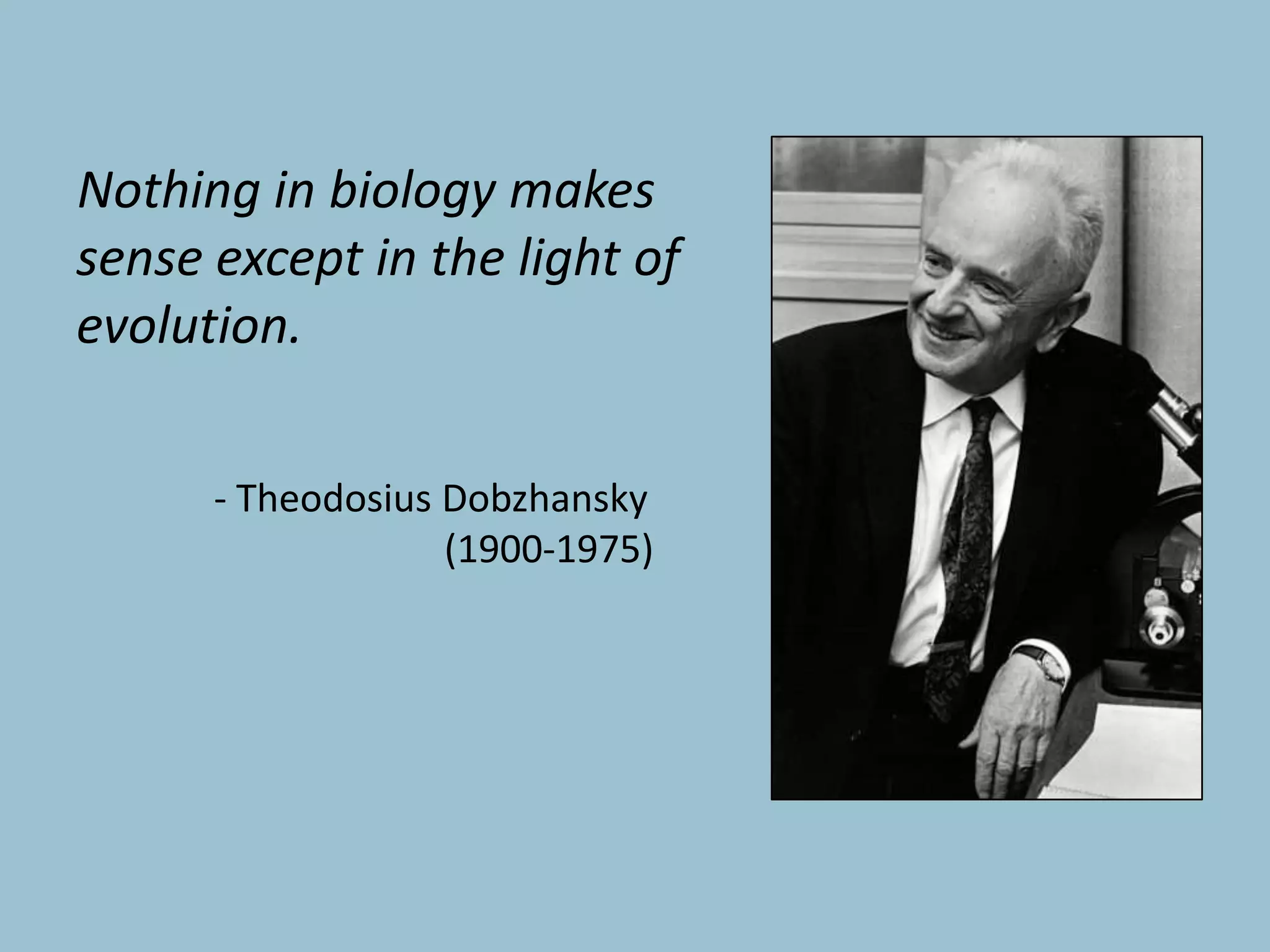
Nothing in biology makes
sense except in the light of
evolution.
- Theodosius Dobzhansky
(1900-1975)
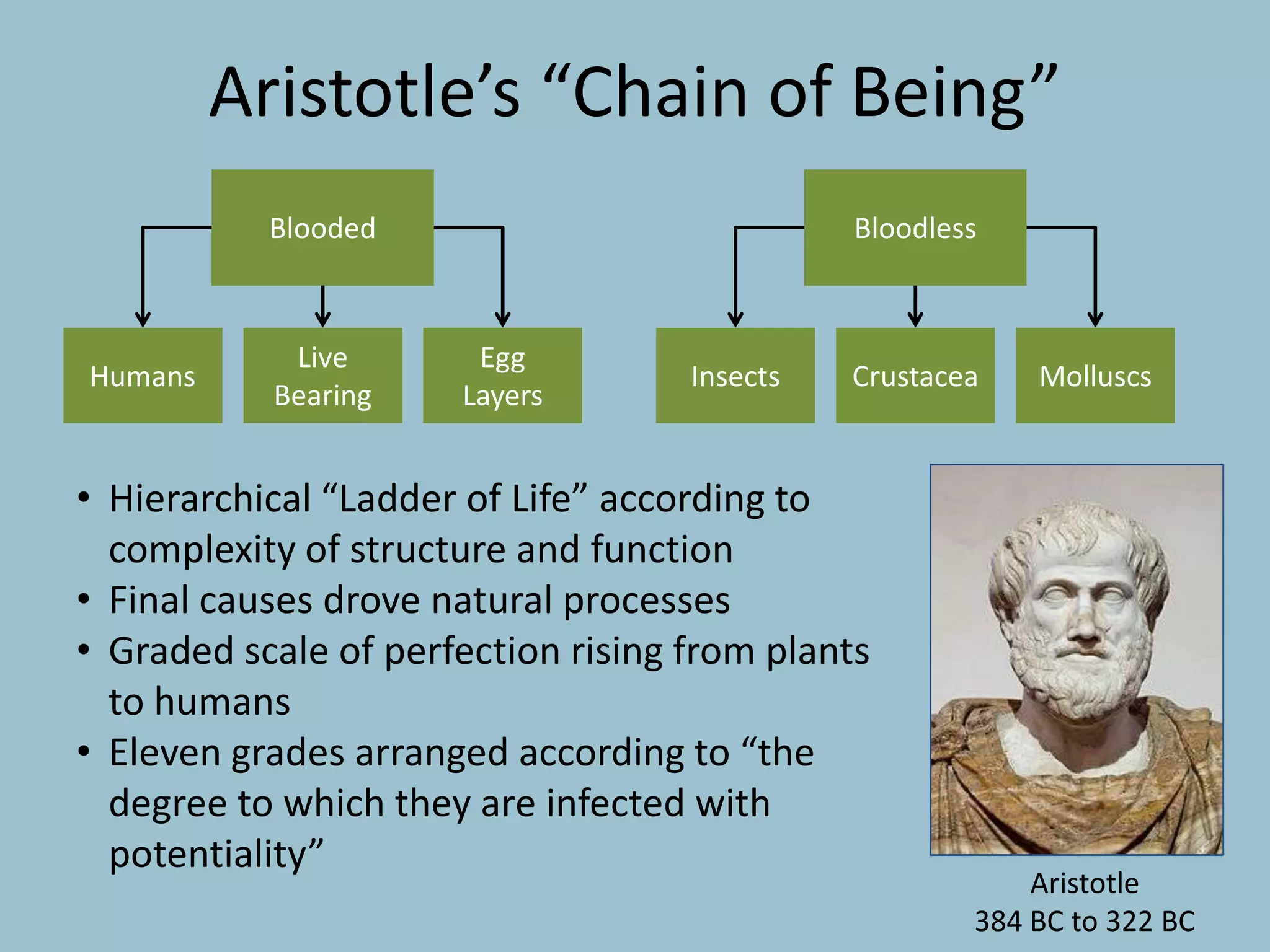
Aristotle’s “Chain of Being”
Blooded
Humans
Live
Bearing
Egg
Layers
Bloodless
Insects Crustacea Molluscs
• Hierarchical “Ladder of Life” according to
complexity of structure and function
• Final causes drove natural processes
• Graded scale of perfection rising from plants
to humans
• Eleven grades arranged according to “the
degree to which they are infected with
potentiality”
Aristotle
384 BC to 322 BC
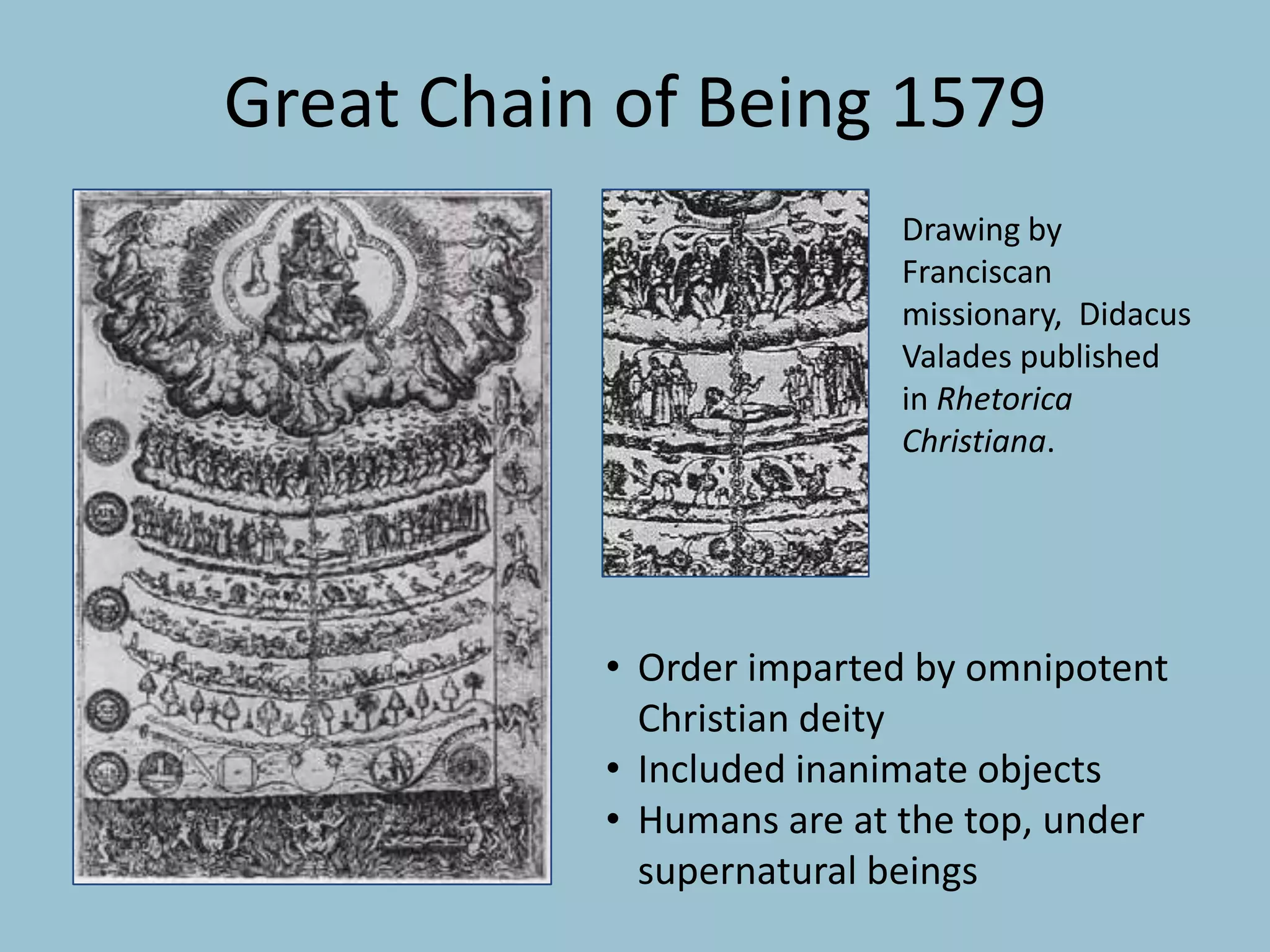
Drawing by
Franciscan
missionary, Didacus
Valades published
in Rhetorica
Christiana.
Great Chain of Being 1579
• Order imparted by omnipotent
Christian deity
• Included inanimate objects
• Humans are at the top, under
supernatural beings
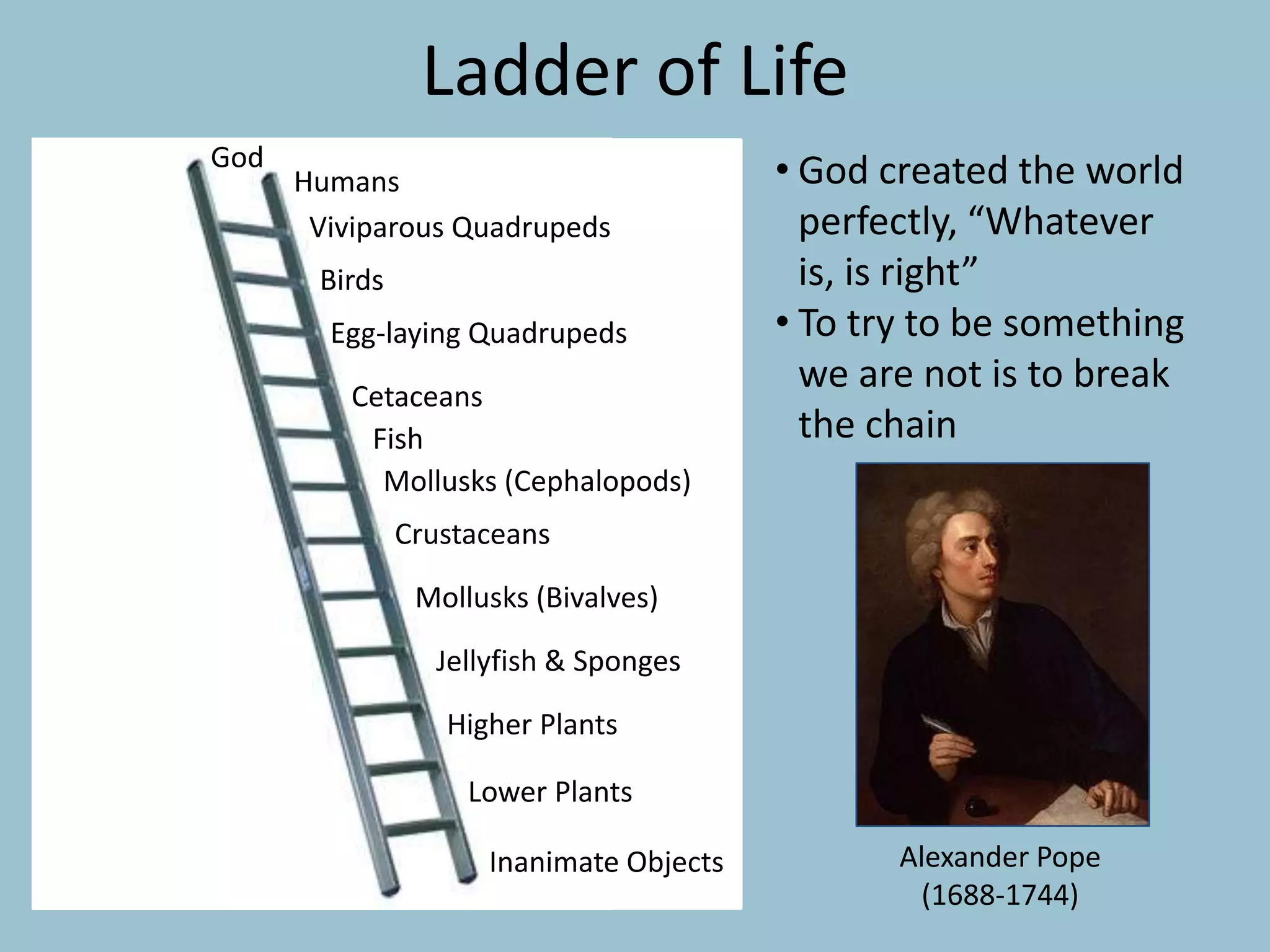
• God created the world
perfectly, “Whatever
is, is right”
• To try to be something
we are not is to break
the chain
Ladder of Life
Humans
Viviparous Quadrupeds
Birds
Egg-laying Quadrupeds
Cetaceans
Fish
Mollusks (Cephalopods)
Crustaceans
Mollusks (Bivalves)
Jellyfish & Sponges
Higher Plants
Lower Plants
Inanimate Objects Alexander Pope
(1688-1744)
God
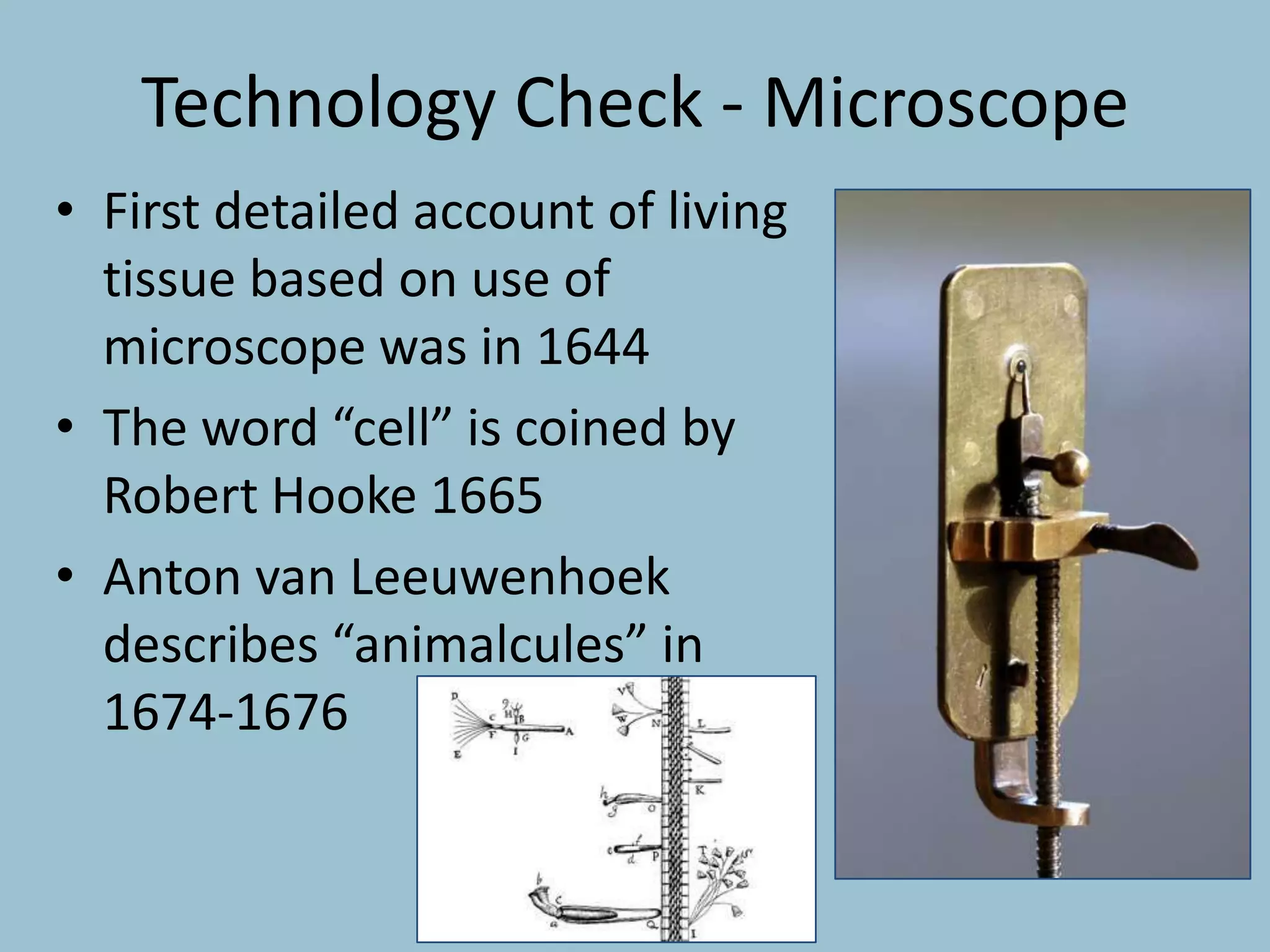
Technology Check - Microscope
• First detailed account of living
tissue based on use of
microscope was in 1644
• The word “cell” is coined by
Robert Hooke 1665
• Anton van Leeuwenhoek
describes “animalcules” in
1674-1676
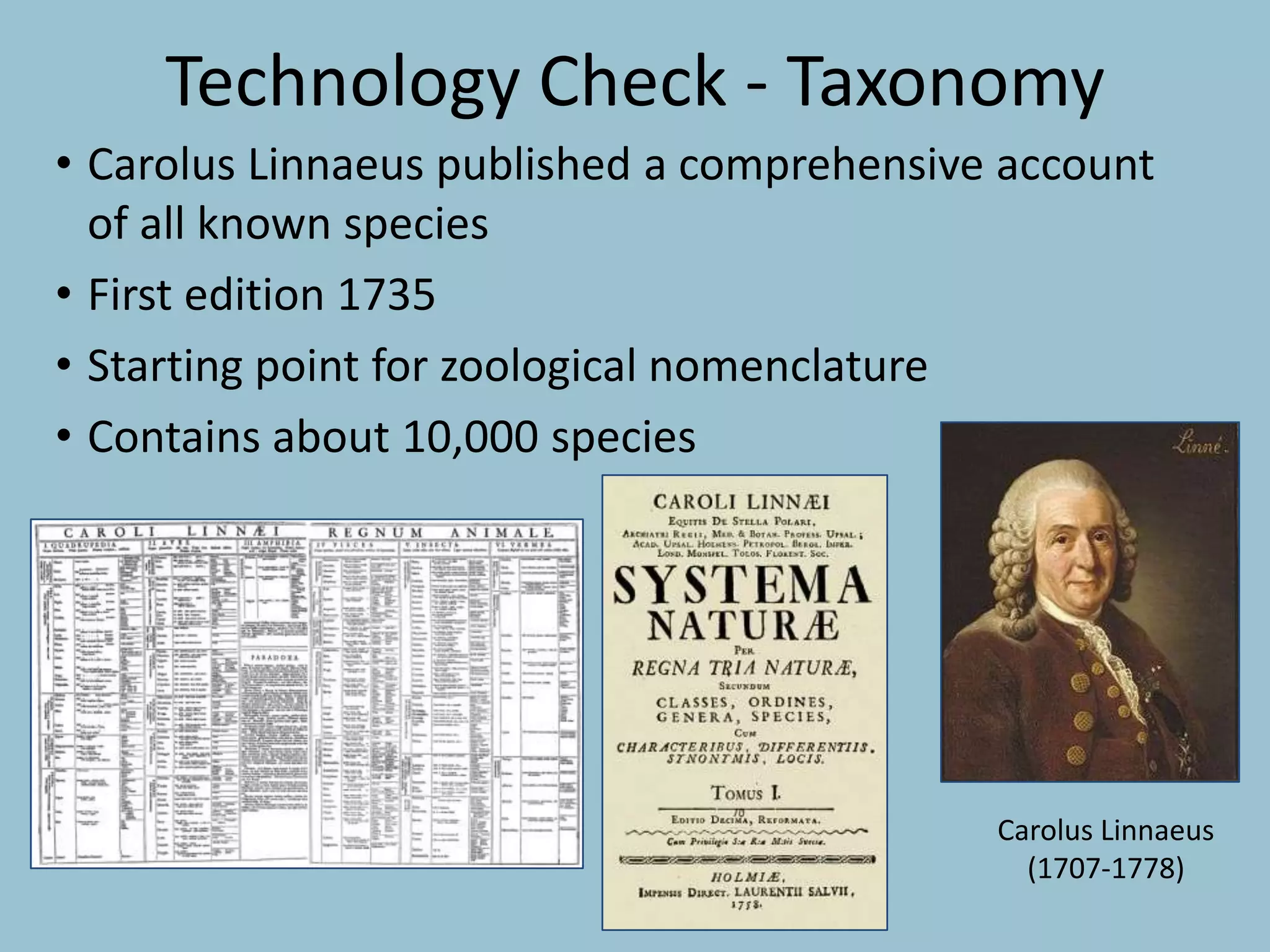
Technology Check - Taxonomy
• Carolus Linnaeus published a comprehensive account
of all known species
• First edition 1735
• Starting point for zoological nomenclature
• Contains about 10,000 species
Carolus Linnaeus
(1707-1778)
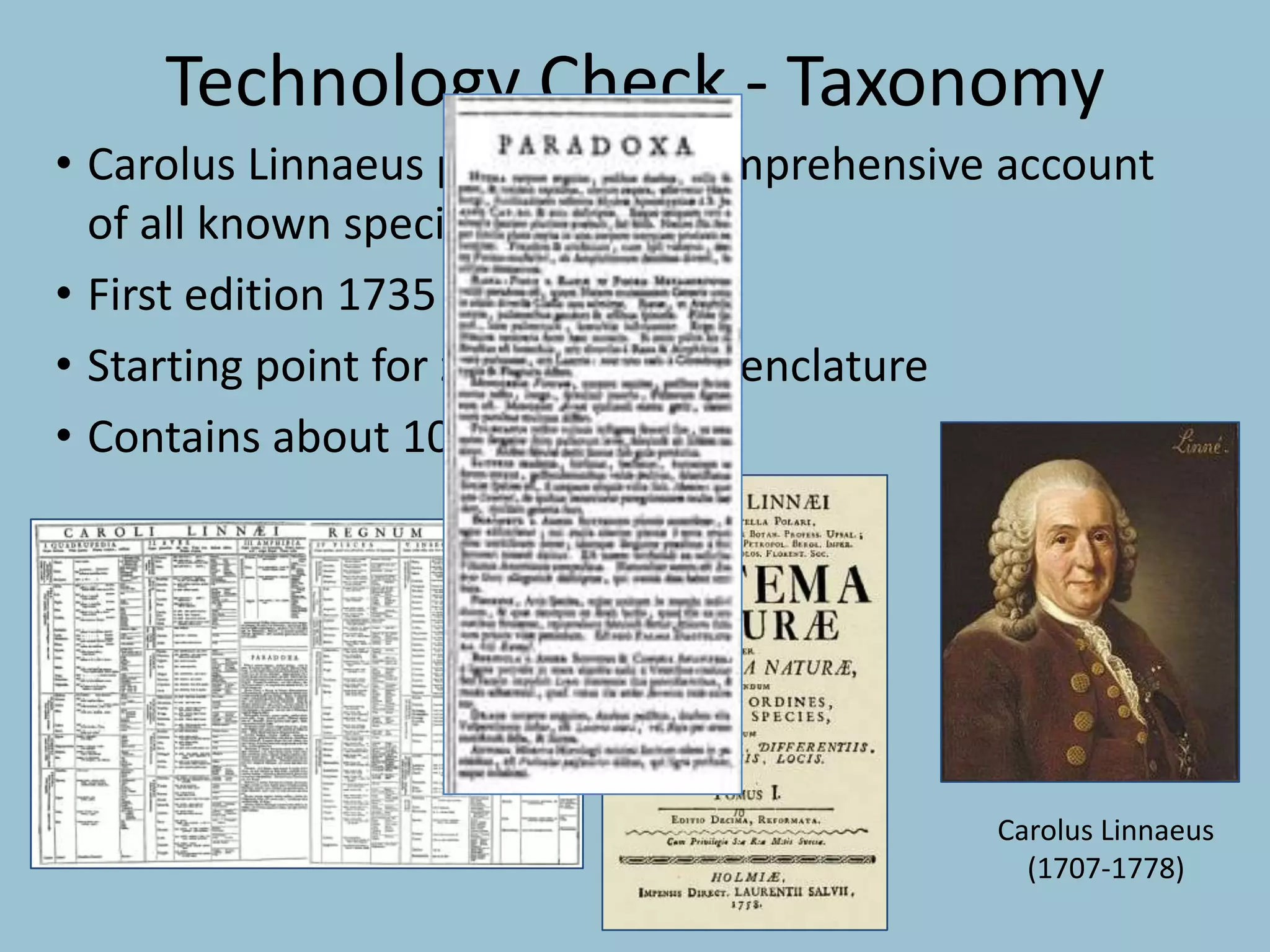
Technology Check - Taxonomy
• Carolus Linnaeus published a comprehensive account
of all known species
• First edition 1735
• Starting point for zoological nomenclature
• Contains about 10,000 species
Carolus Linnaeus
(1707-1778)
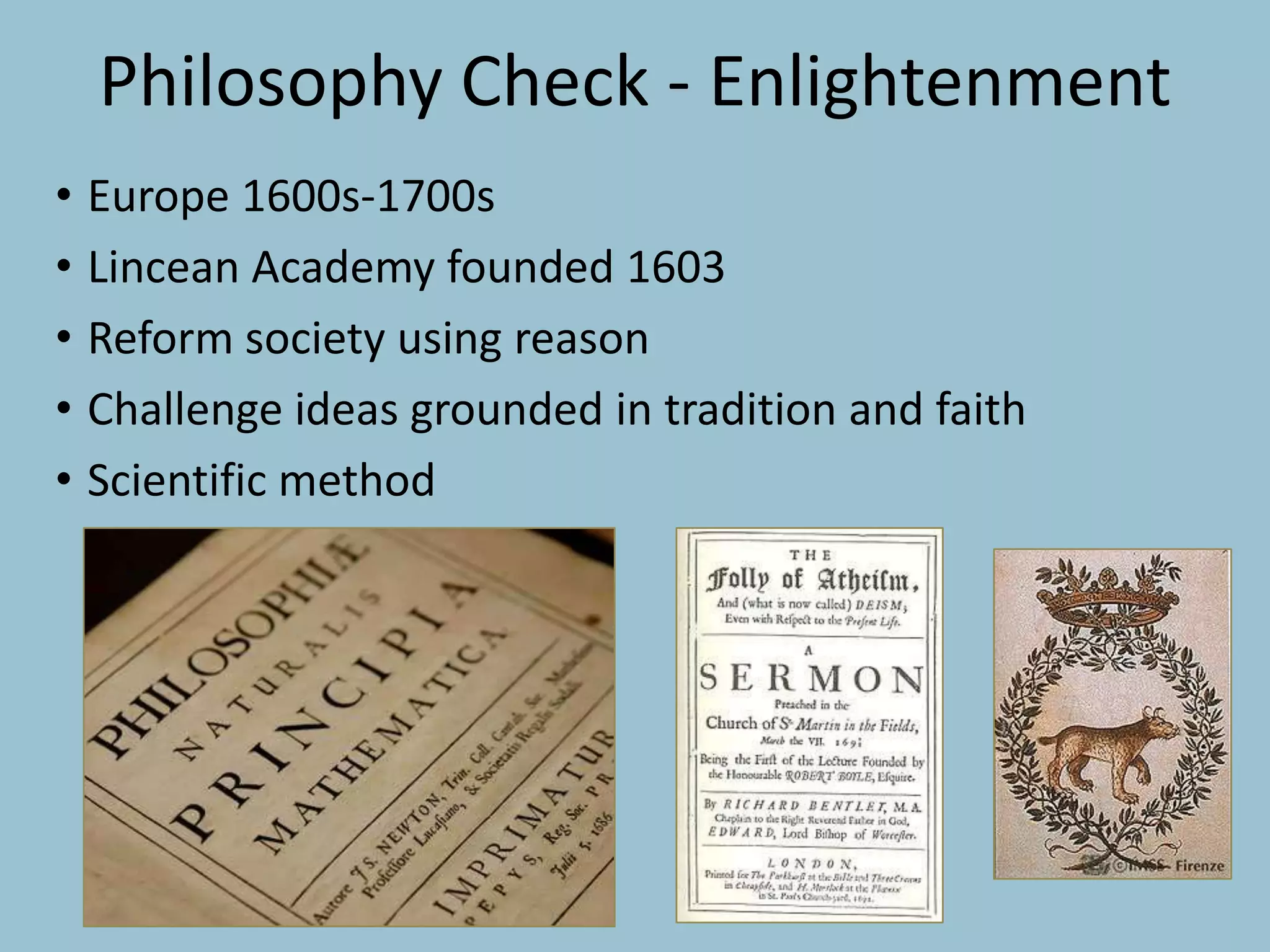
Philosophy Check - Enlightenment
• Europe 1600s-1700s
• Lincean Academy founded 1603
• Reform society using reason
• Challenge ideas grounded in tradition and faith
• Scientific method
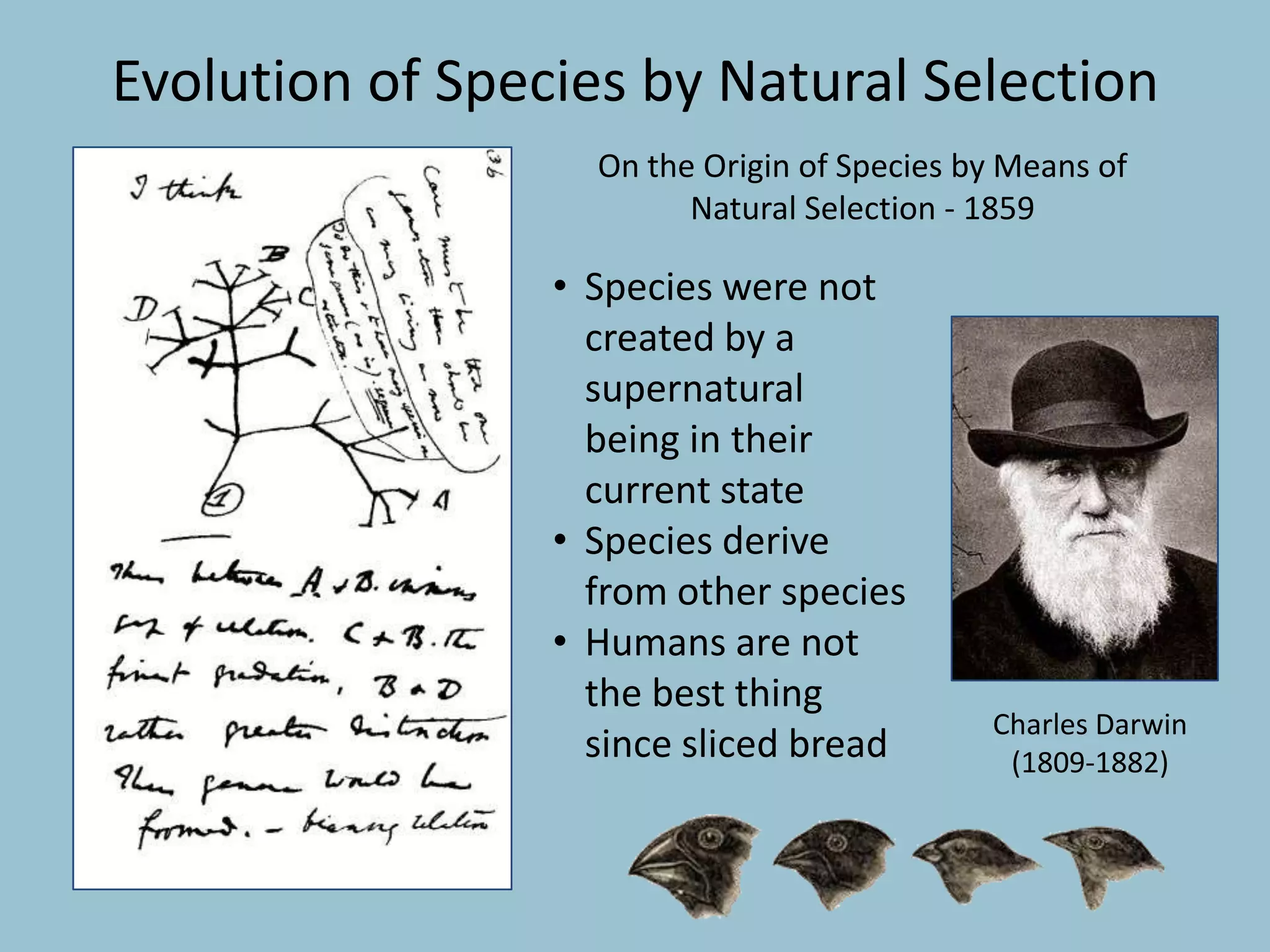
Evolution of Species by Natural Selection
Charles Darwin
(1809-1882)
On the Origin of Species by Means of
Natural Selection - 1859
• Species were not
created by a
supernatural
being in their
current state
• Species derive
from other species
• Humans are not
the best thing
since sliced bread
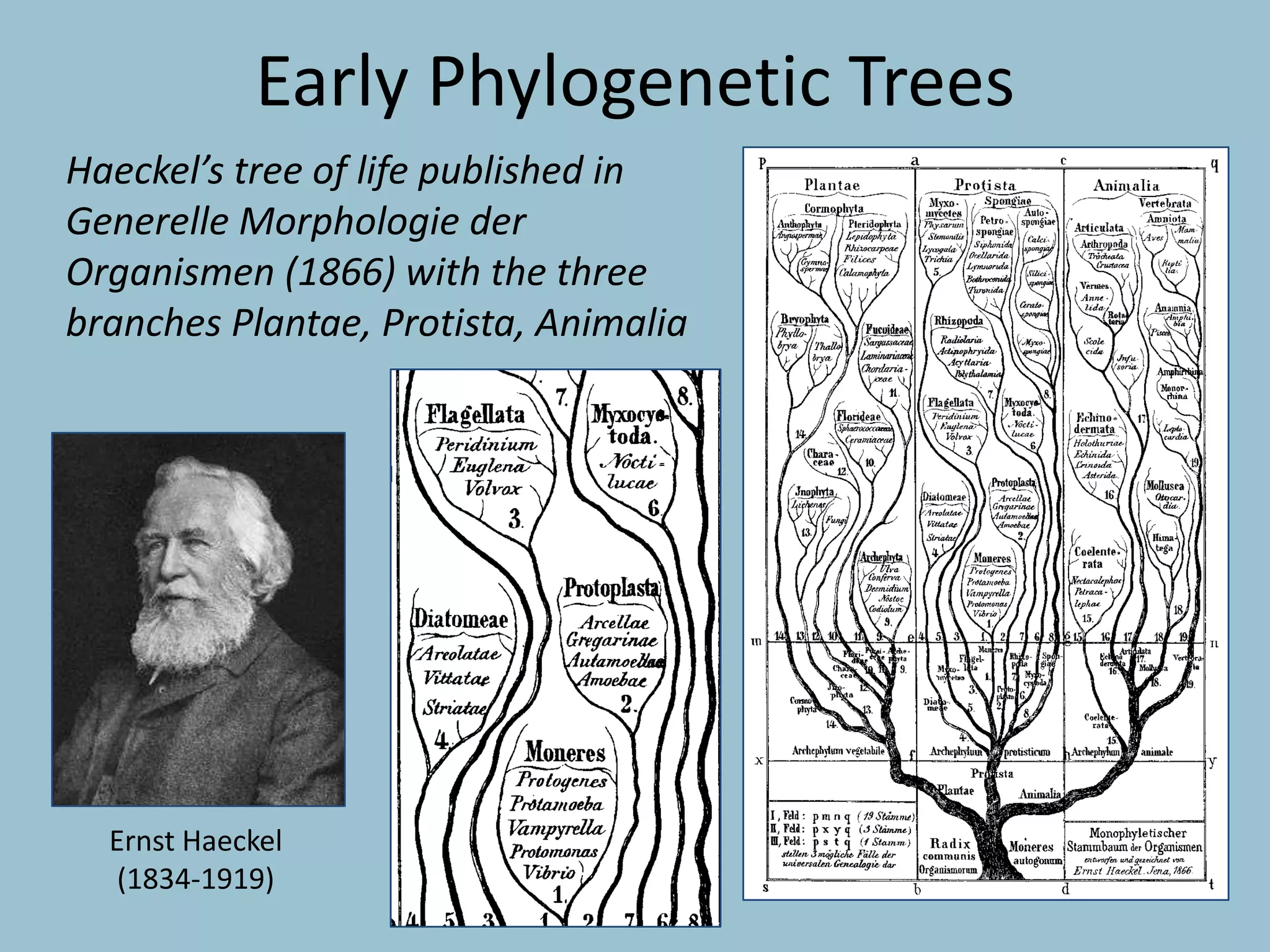
Haeckel’s tree of life published in
Generelle Morphologie der
Organismen (1866) with the three
branches Plantae, Protista, Animalia
Early Phylogenetic Trees
Ernst Haeckel
(1834-1919)
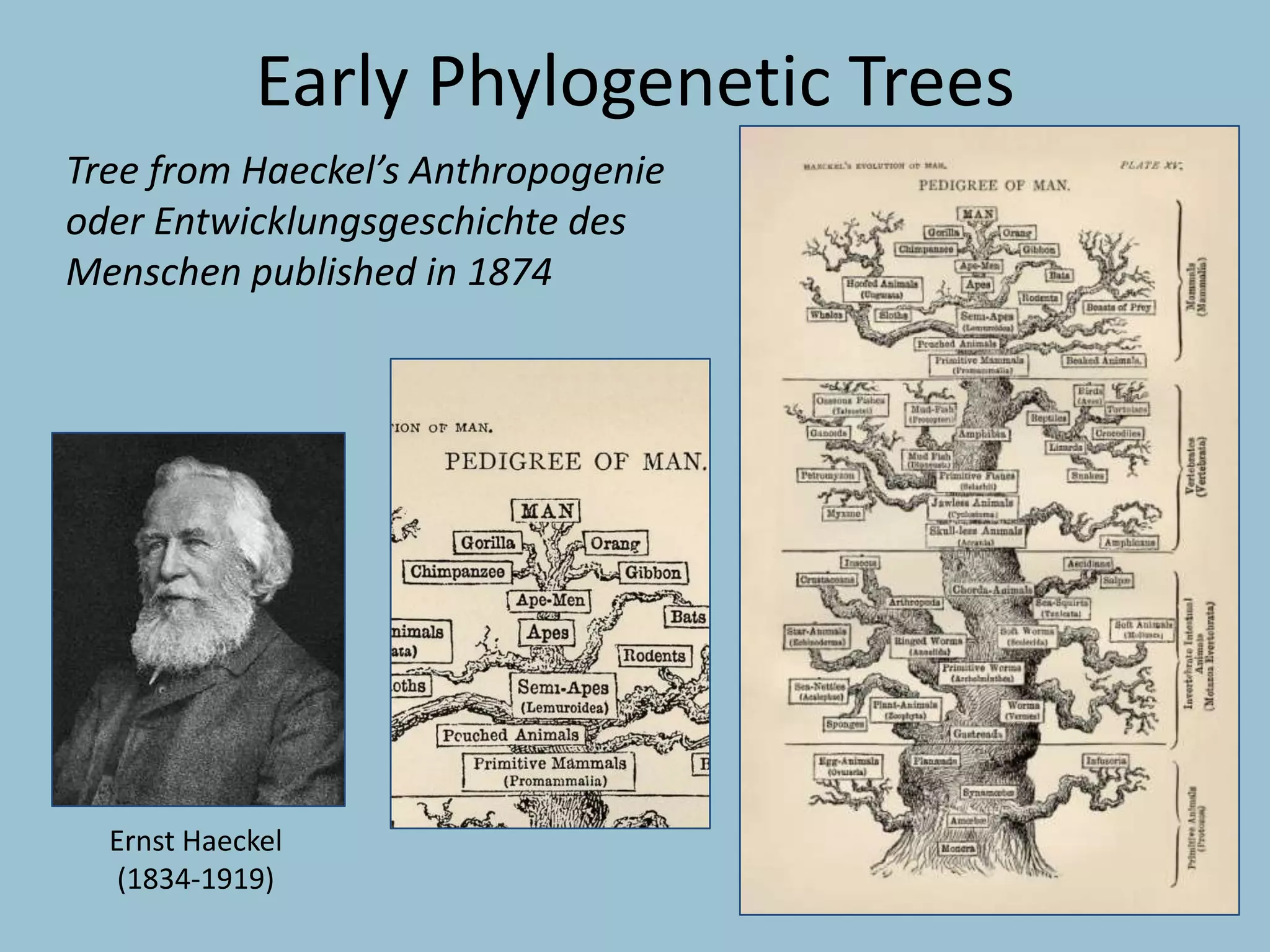
Tree from Haeckel’s Anthropogenie
oder Entwicklungsgeschichte des
Menschen published in 1874
Early Phylogenetic Trees
Ernst Haeckel
(1834-1919)
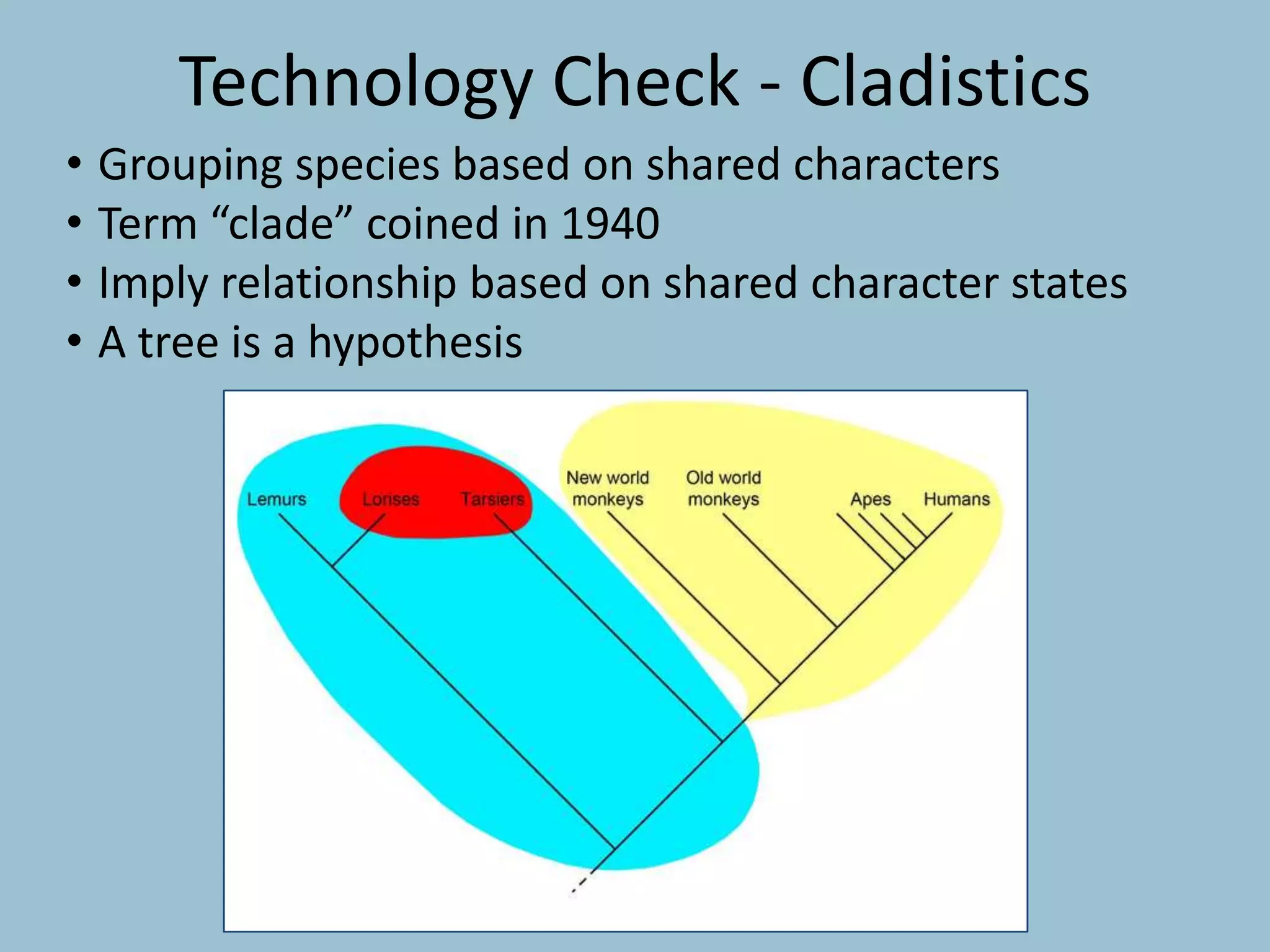
• Grouping species based on shared characters
• Term “clade” coined in 1940
• Imply relationship based on shared character states
• A tree is a hypothesis
Technology Check - Cladistics
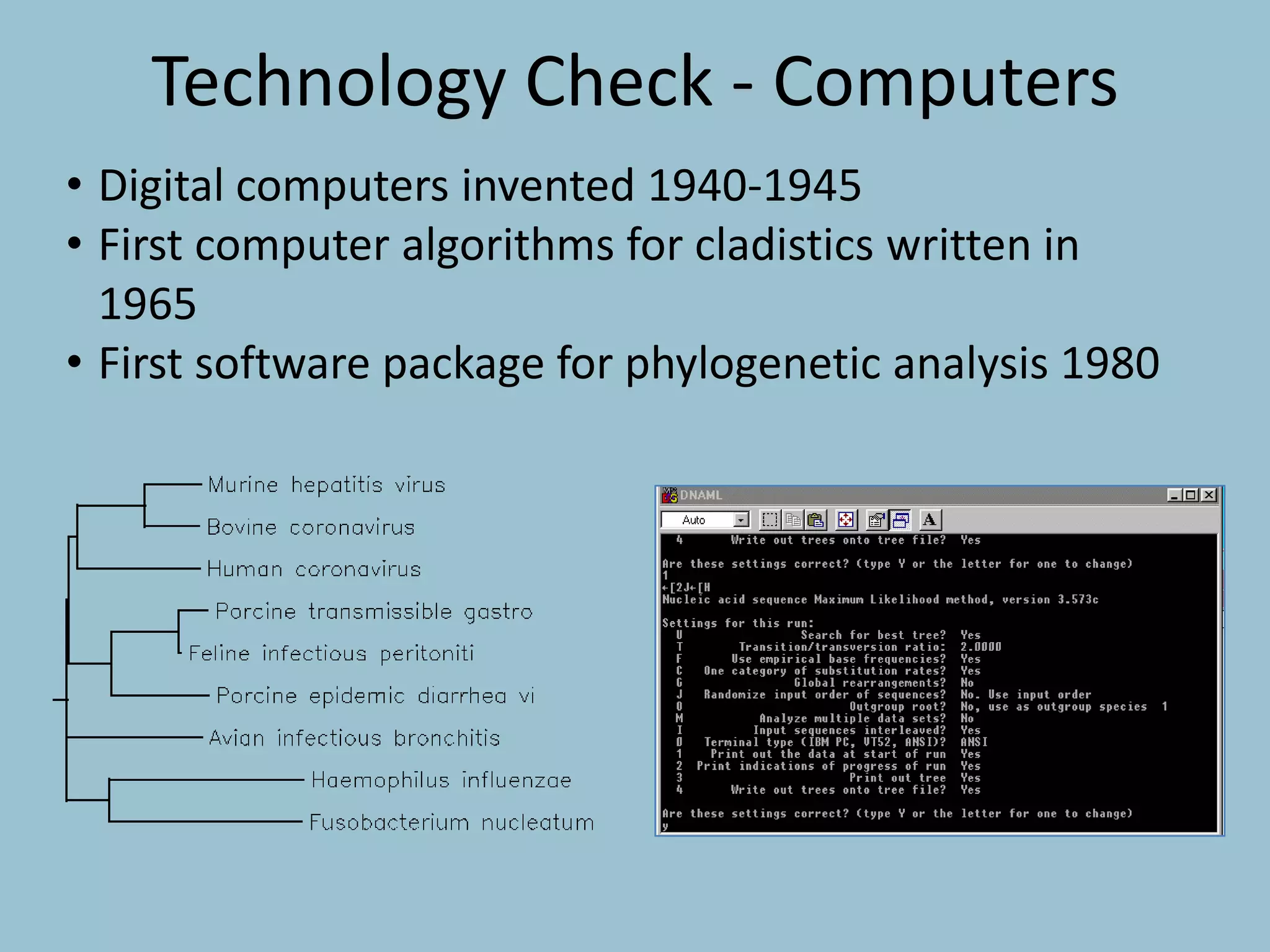
• Digital computers invented 1940-1945
• First computer algorithms for cladistics written in
1965
• First software package for phylogenetic analysis 1980
Technology Check - Computers
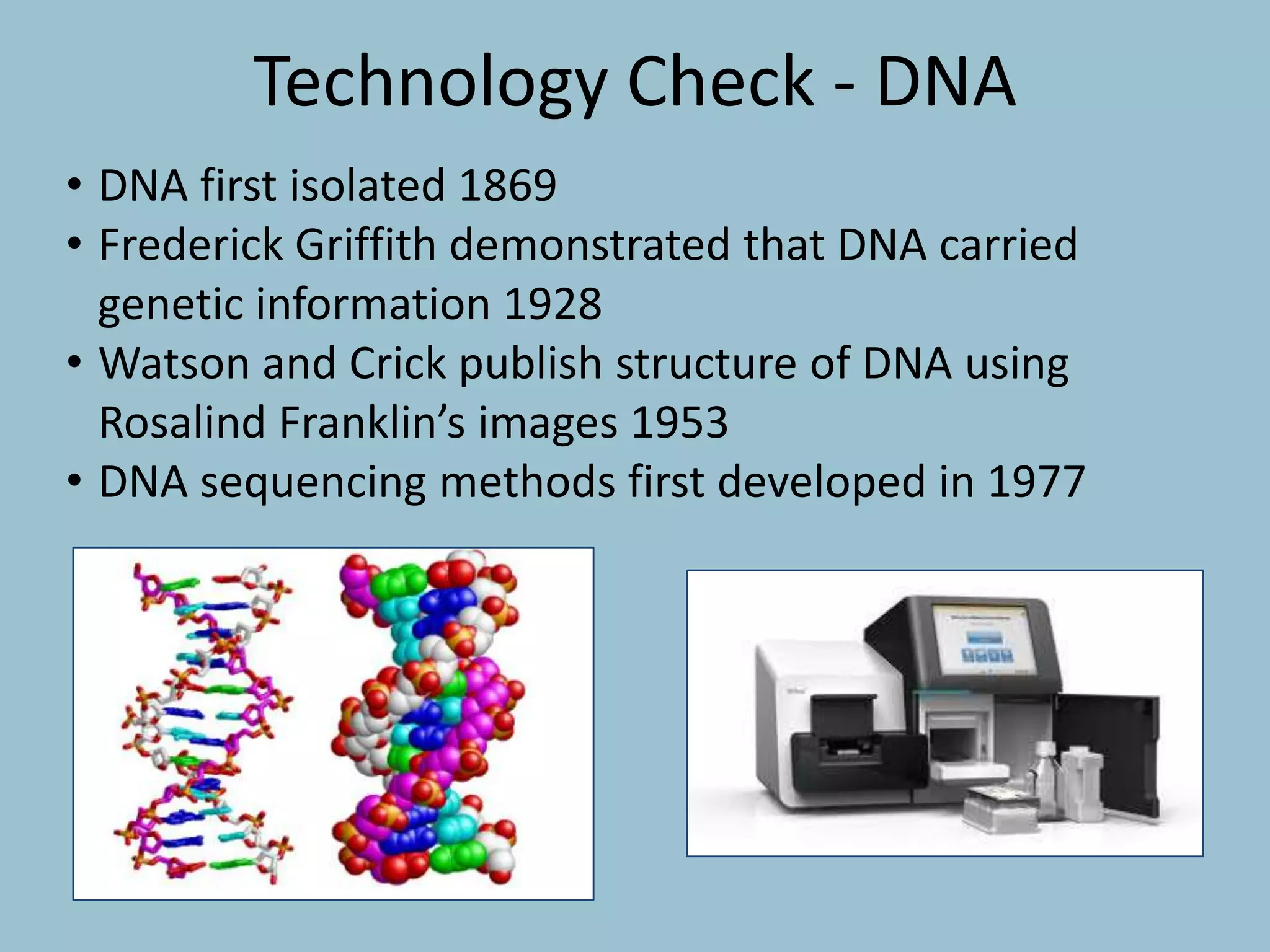
• DNA first isolated 1869
• Frederick Griffith demonstrated that DNA carried
genetic information 1928
• Watson and Crick publish structure of DNA using
Rosalind Franklin’s images 1953
• DNA sequencing methods first developed in 1977
Technology Check - DNA
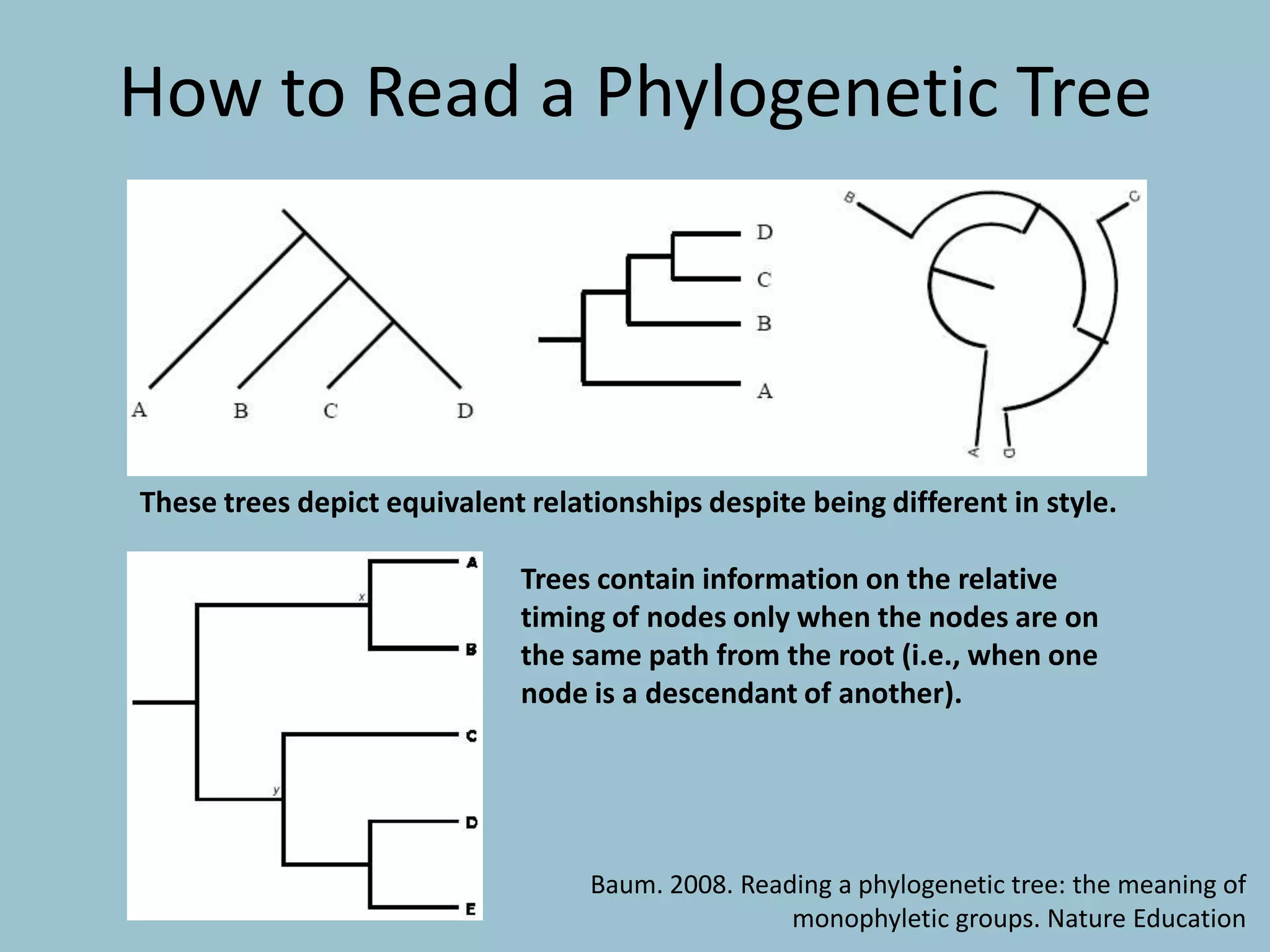
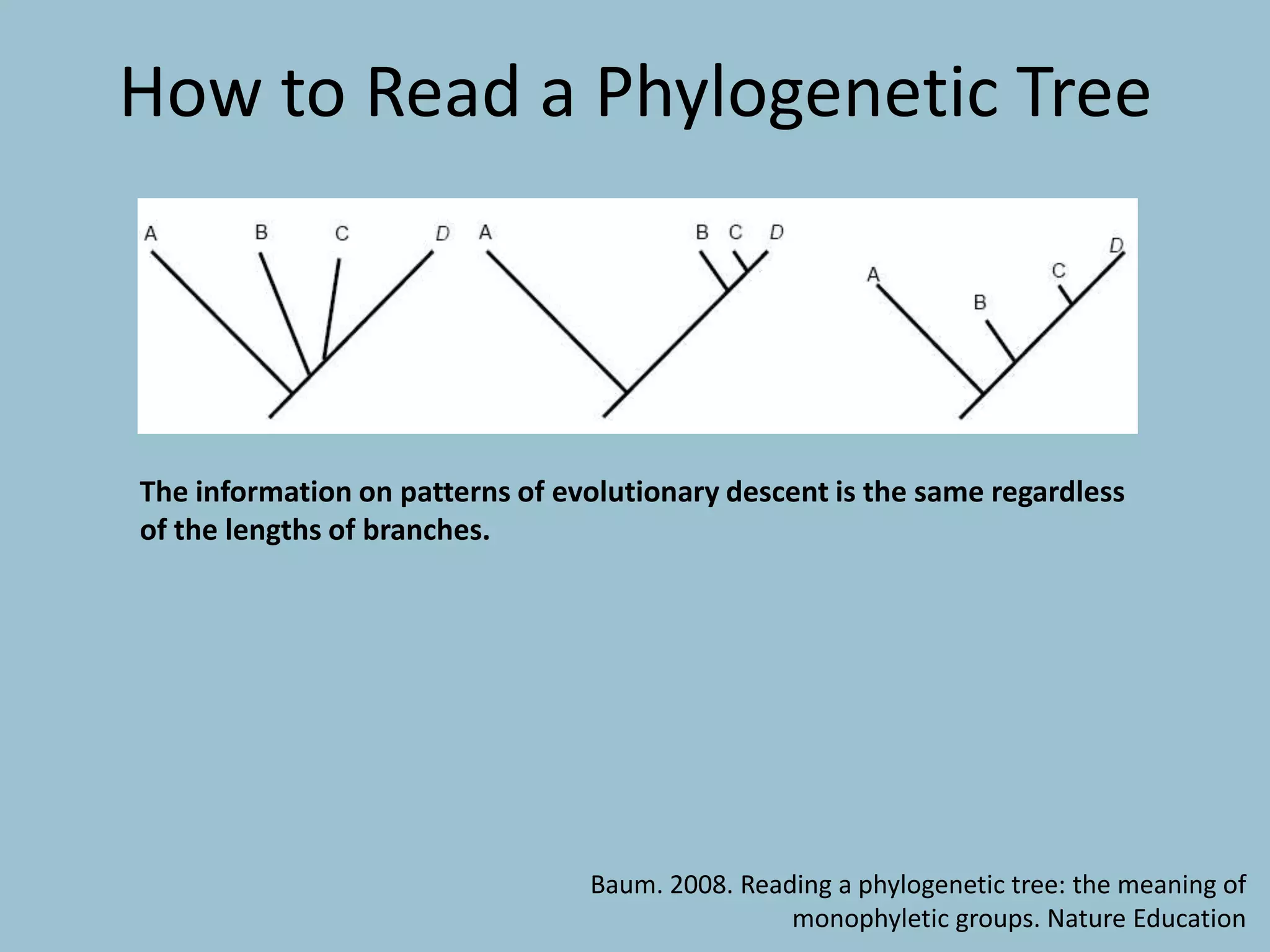
Trees contain information on the relative
timing of nodes only when the nodes are on
the same path from the root (i.e., when one
node is a descendant of another).
These trees depict equivalent relationships despite being different in style.
How to Read a Phylogenetic Tree
Baum. 2008. Reading a phylogenetic tree: the meaning of
monophyletic groups. Nature Education
How to Read a Phylogenetic Tree
Baum. 2008. Reading a phylogenetic tree: the meaning of
monophyletic groups. Nature Education
The information on patterns of evolutionary descent is the same regardless
of the lengths of branches.
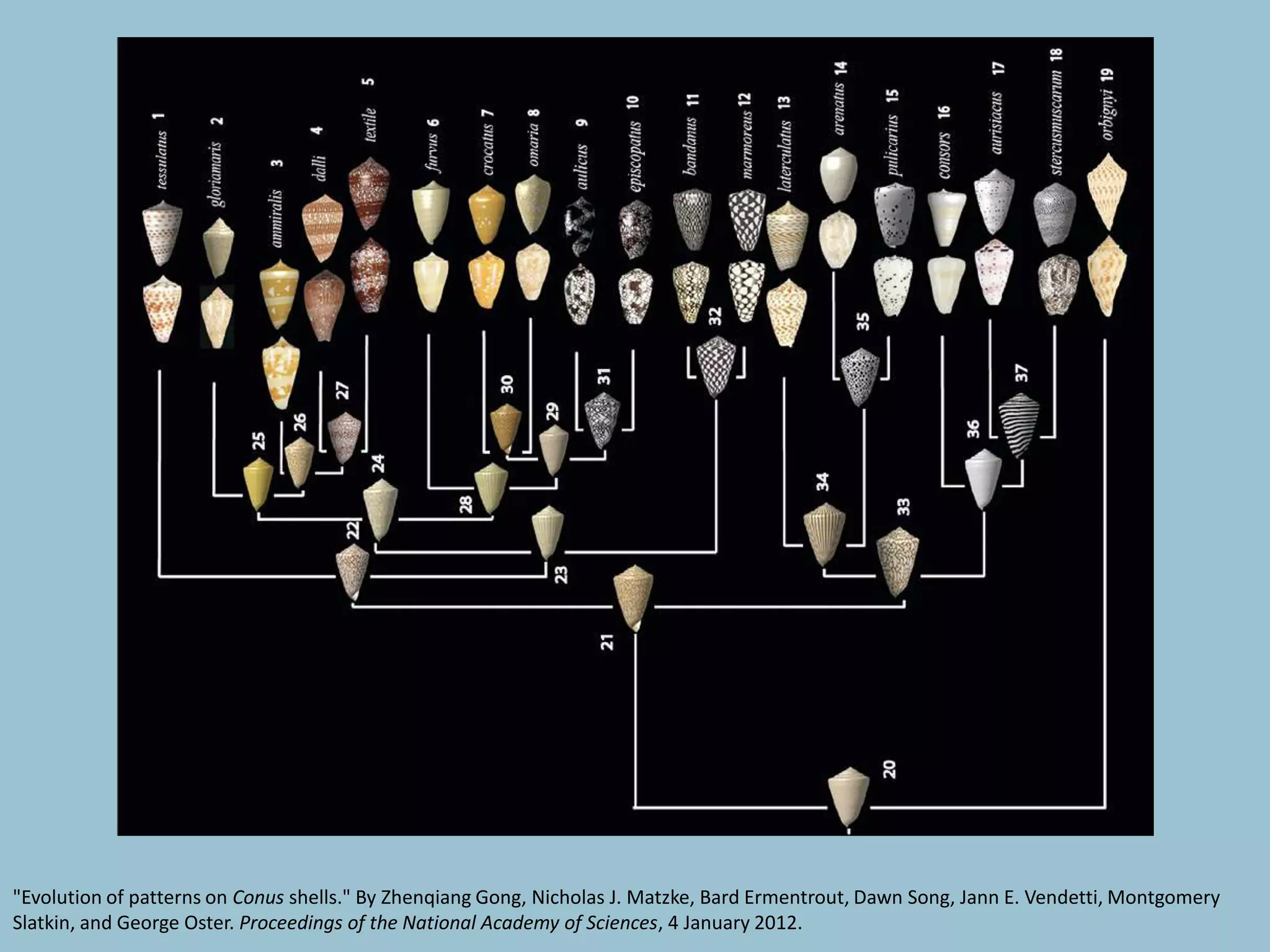
"Evolution of patterns on Conus shells." By Zhenqiang Gong, Nicholas J. Matzke, Bard Ermentrout, Dawn Song, Jann E. Vendetti, Montgomery
Slatkin, and George Oster. Proceedings of the National Academy of Sciences, 4 January 2012.
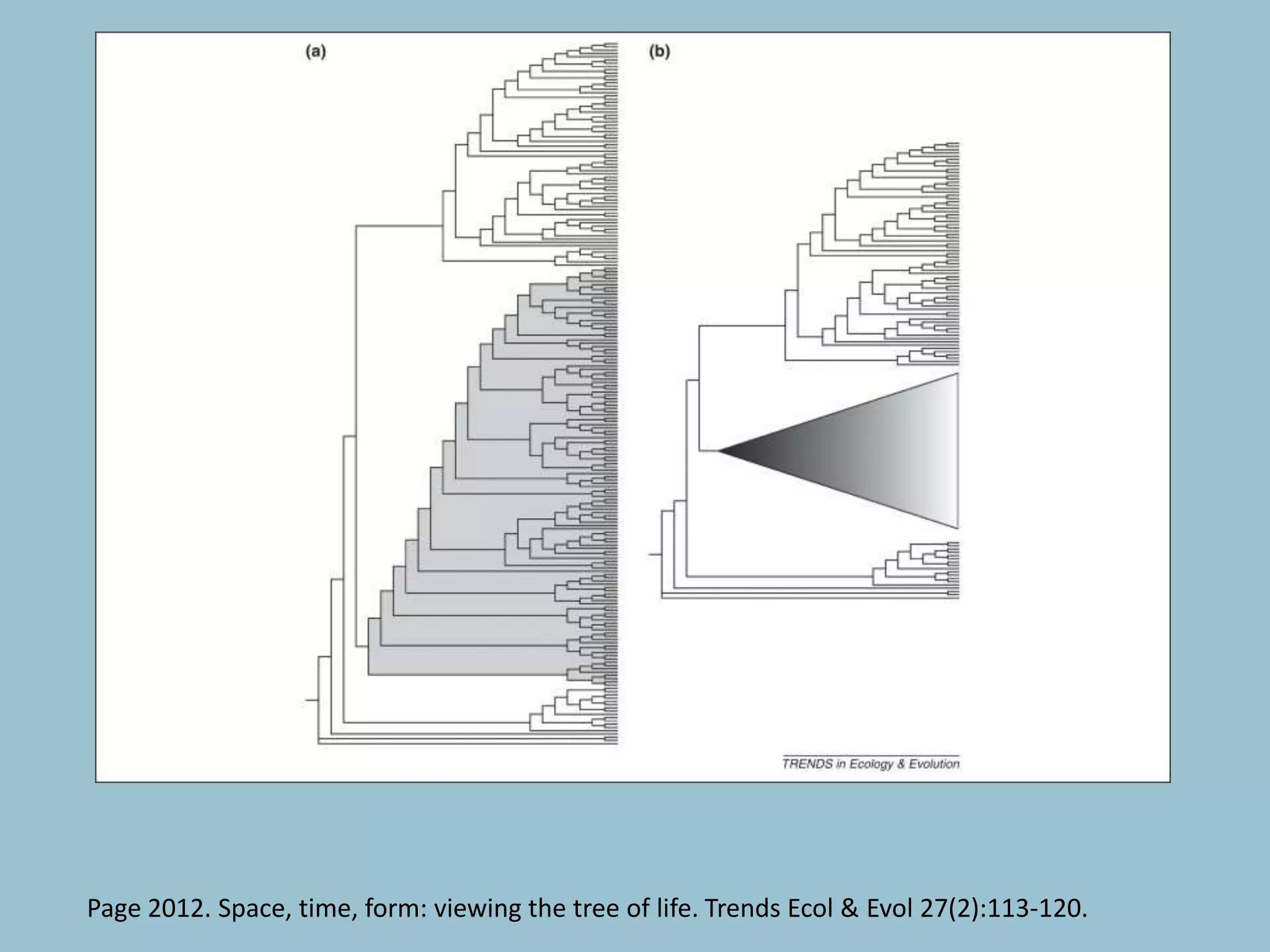
Page 2012. Space, time, form: viewing the tree of life. Trends Ecol & Evol 27(2):113-120.
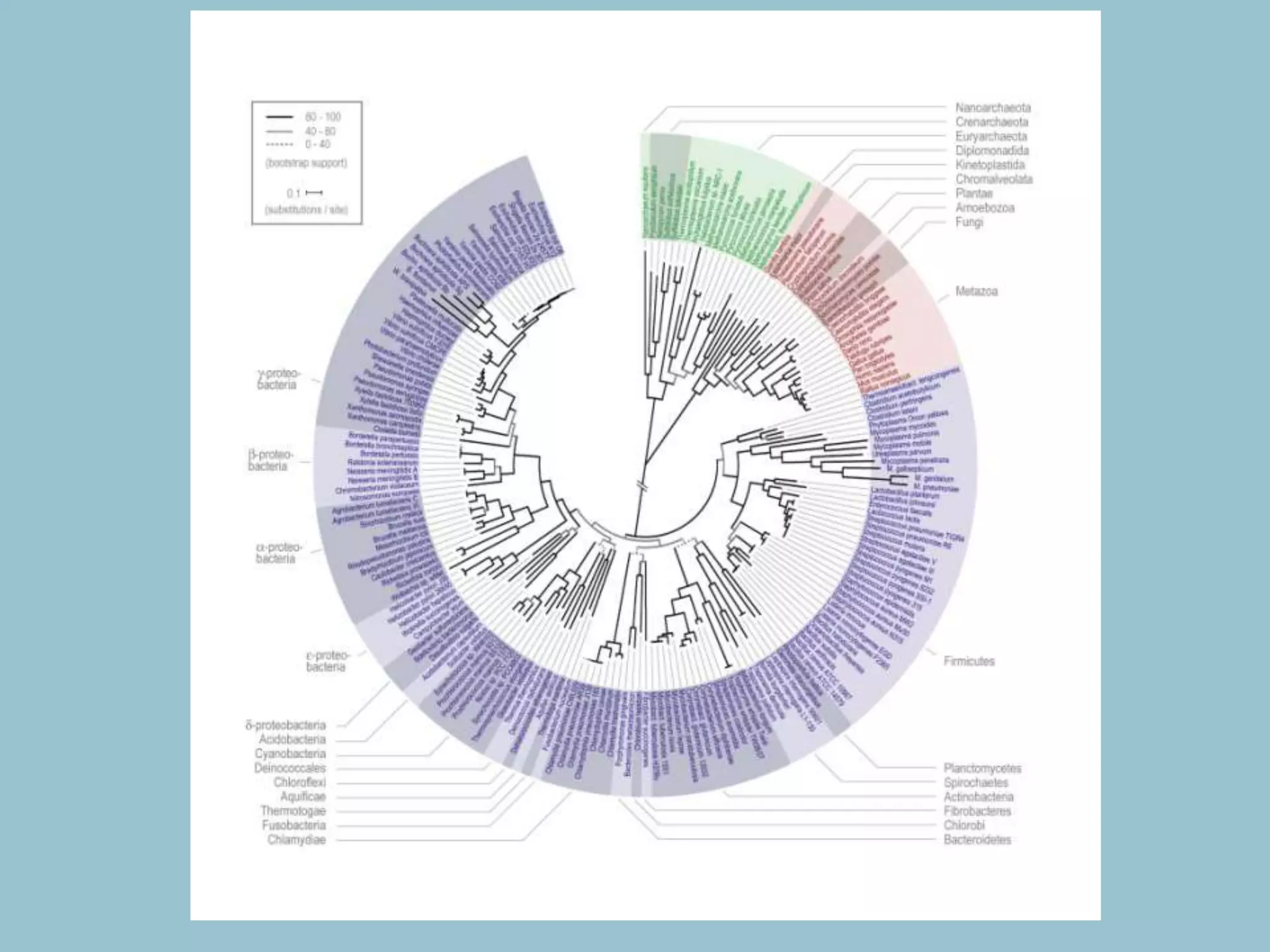
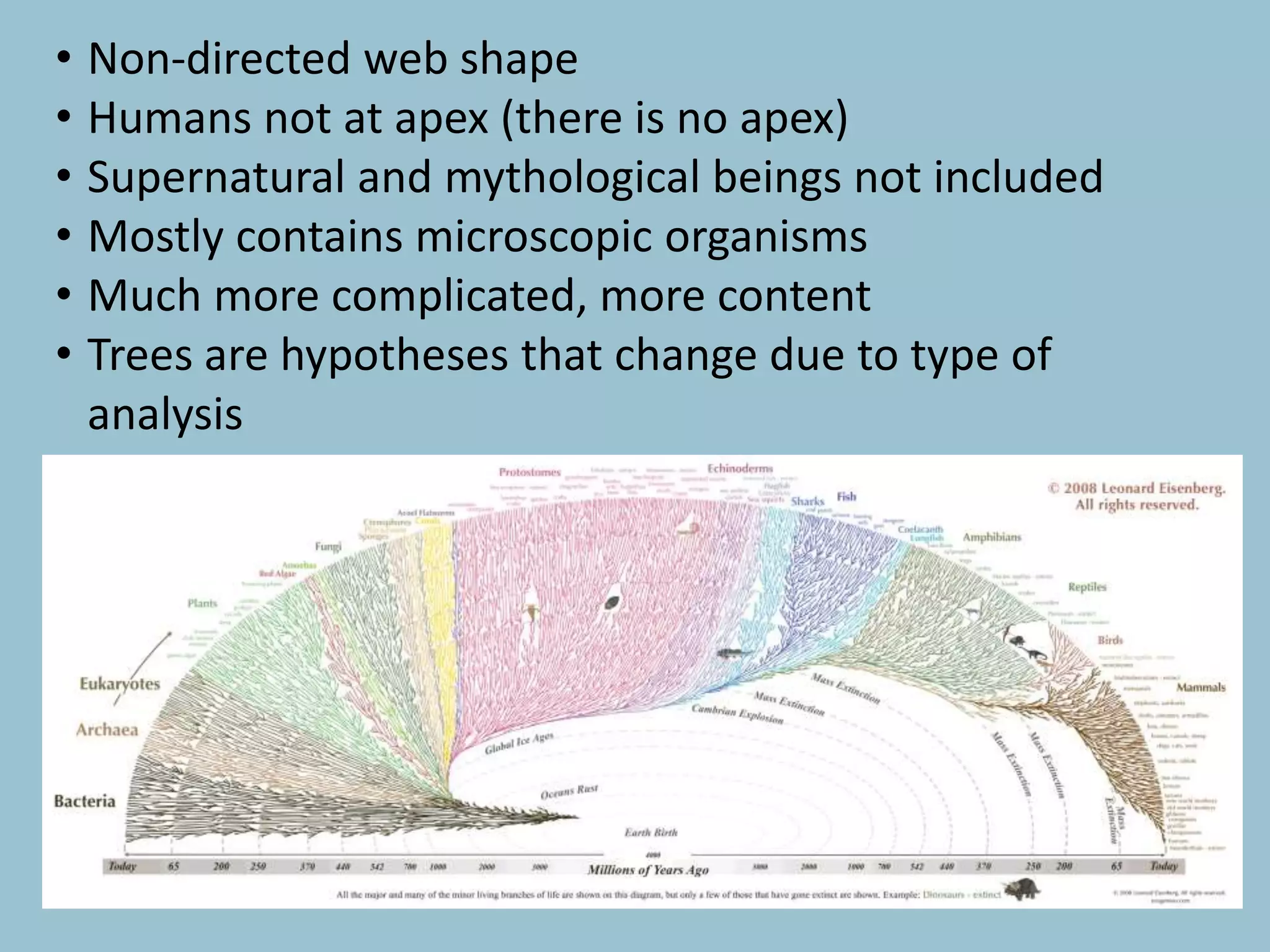
• Non-directed web shape
• Humans not at apex (there is no apex)
• Supernatural and mythological beings not included
• Mostly contains microscopic organisms
• Much more complicated, more content
• Trees are hypotheses that change due to type of
analysis
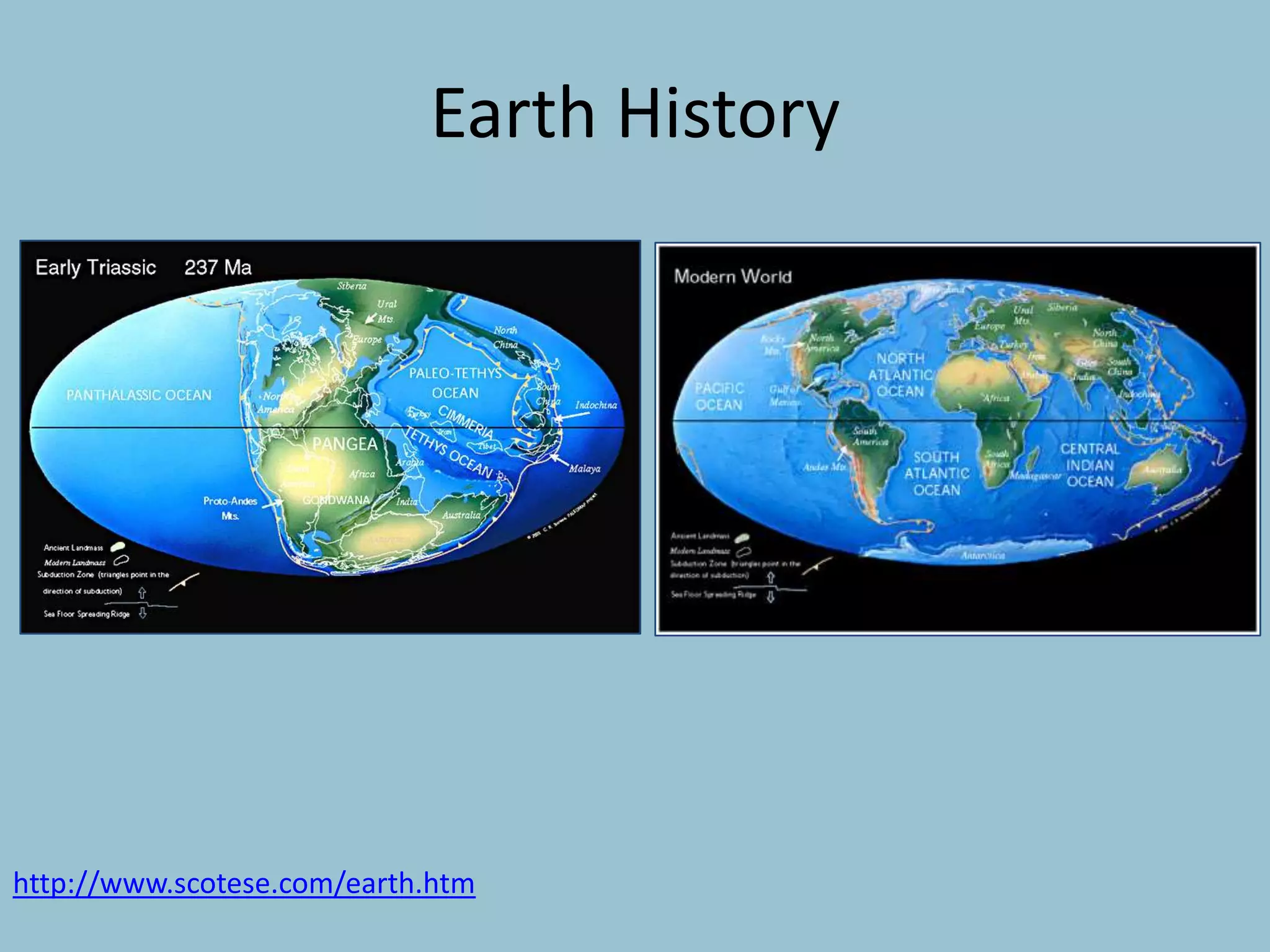
Earth History
http://www.scotese.com/earth.htm
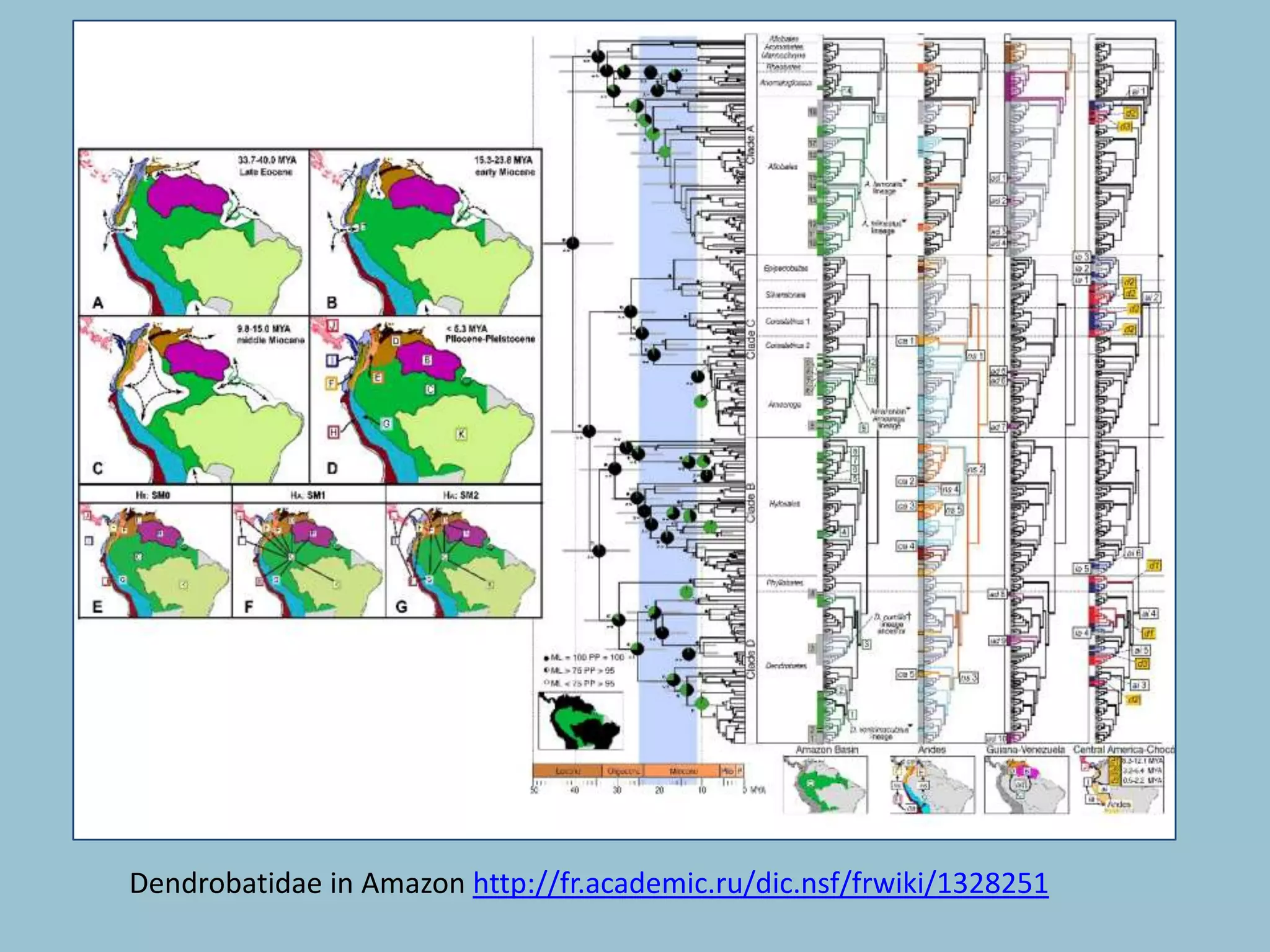
Dendrobatidae in Amazon http://fr.academic.ru/dic.nsf/frwiki/1328251
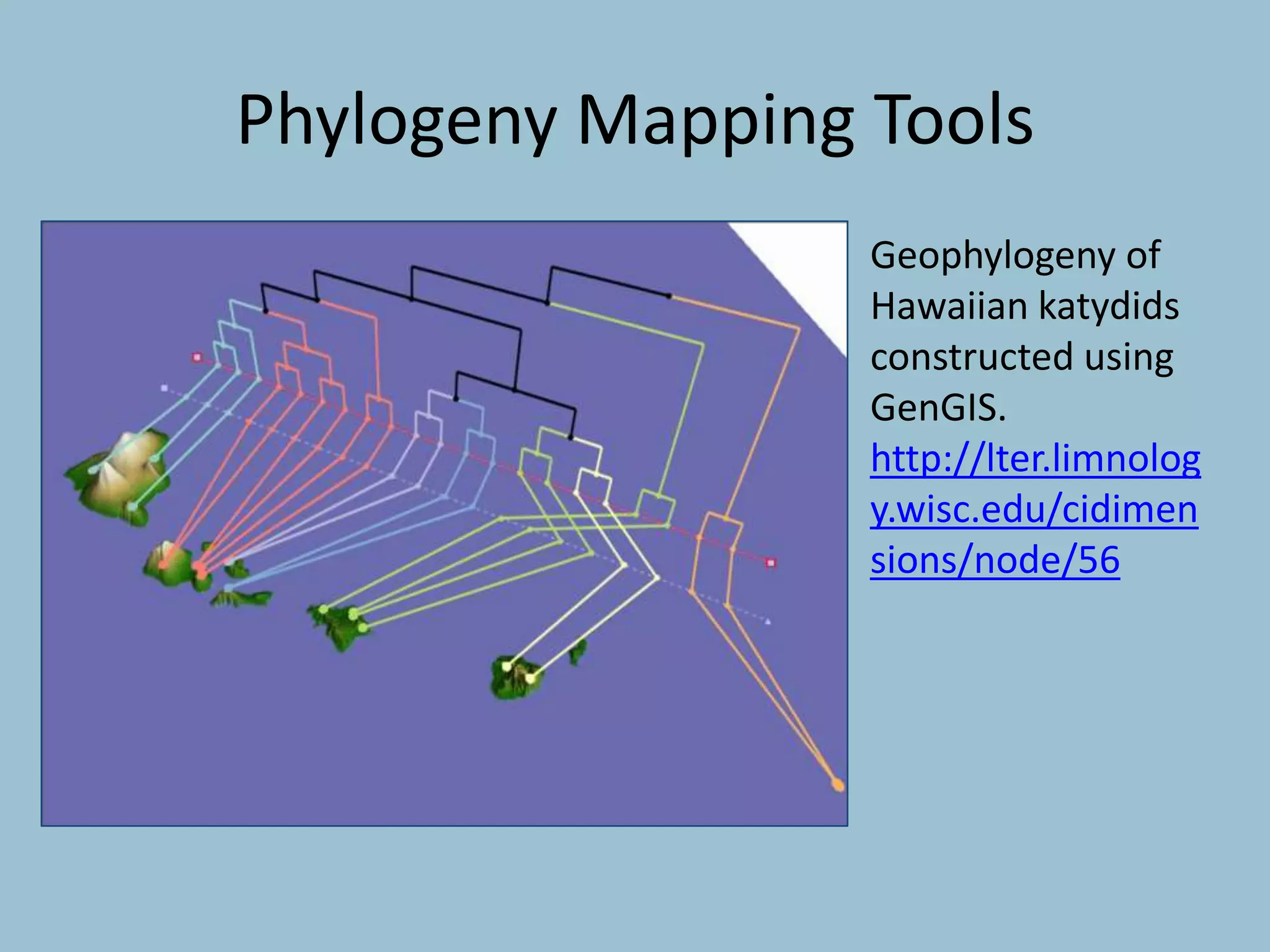
Geophylogeny of
Hawaiian katydids
constructed using
GenGIS.
http://lter.limnolog
y.wisc.edu/cidimen
sions/node/56
Phylogeny Mapping Tools
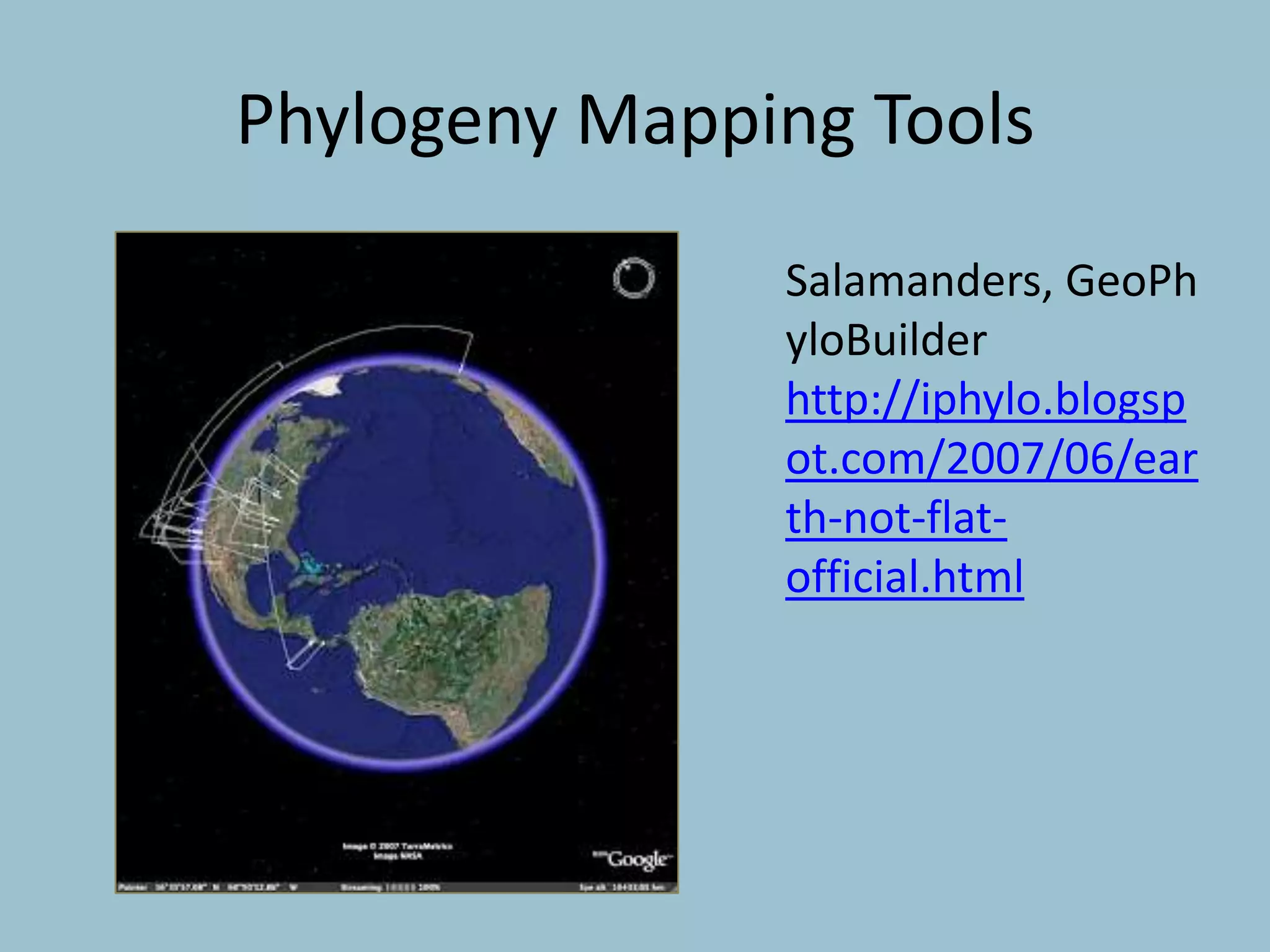
Salamanders, GeoPh
yloBuilder
http://iphylo.blogsp
ot.com/2007/06/ear
th-not-flat-
official.html
Phylogeny Mapping Tools
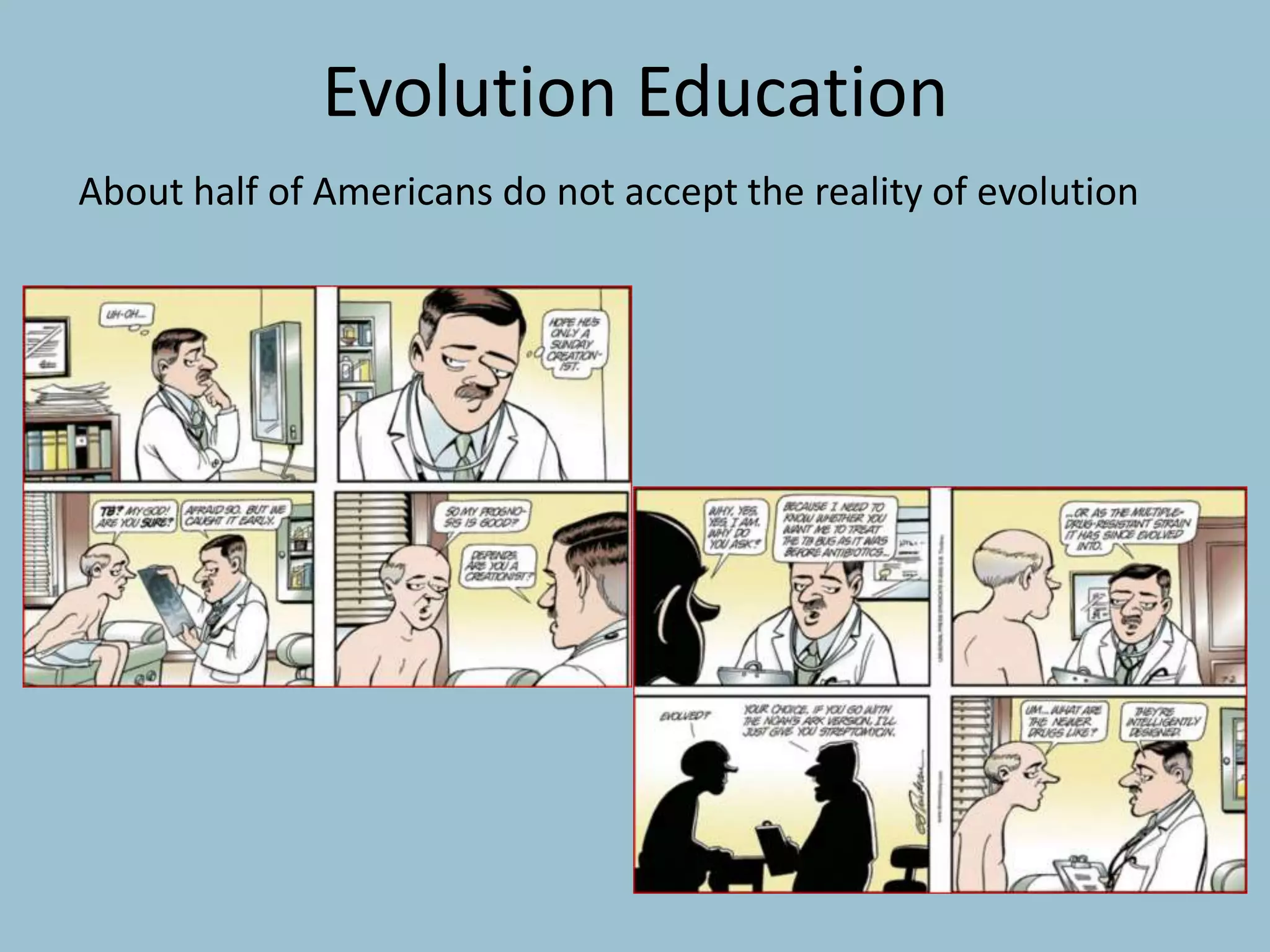
Evolution Education
About half of Americans do not accept the reality of evolution
Common Evolution Misconceptions
• Everything wants to be human
• Individuals evolve
• Evolution is random
• Less complex organisms have evolved less than
more complex organisms
• Humans came from monkeys
• Microevolution is different from macroevolution
• Linnaean taxonomy = genetics
http://darwinbookcats.wordpress.com/2011/04/18/phylogenies-and-evolution-tree-thinking/
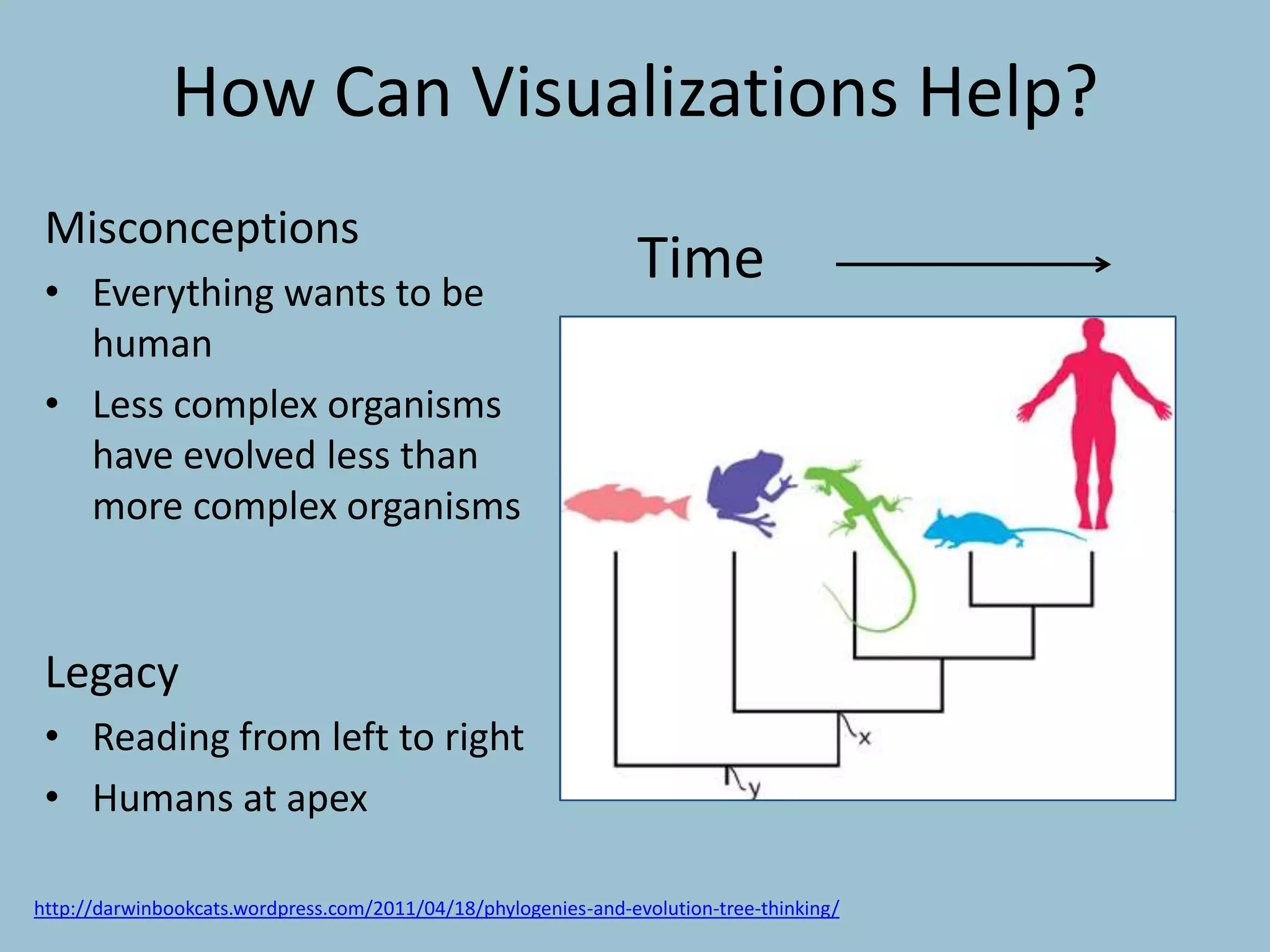
How Can Visualizations Help?
Time
Misconceptions
• Everything wants to be
human
• Less complex organisms
have evolved less than
more complex organisms
Legacy
• Reading from left to right
• Humans at apex
http://darwinbookcats.wordpress.com/2011/04/18/phylogenies-and-evolution-tree-thinking/
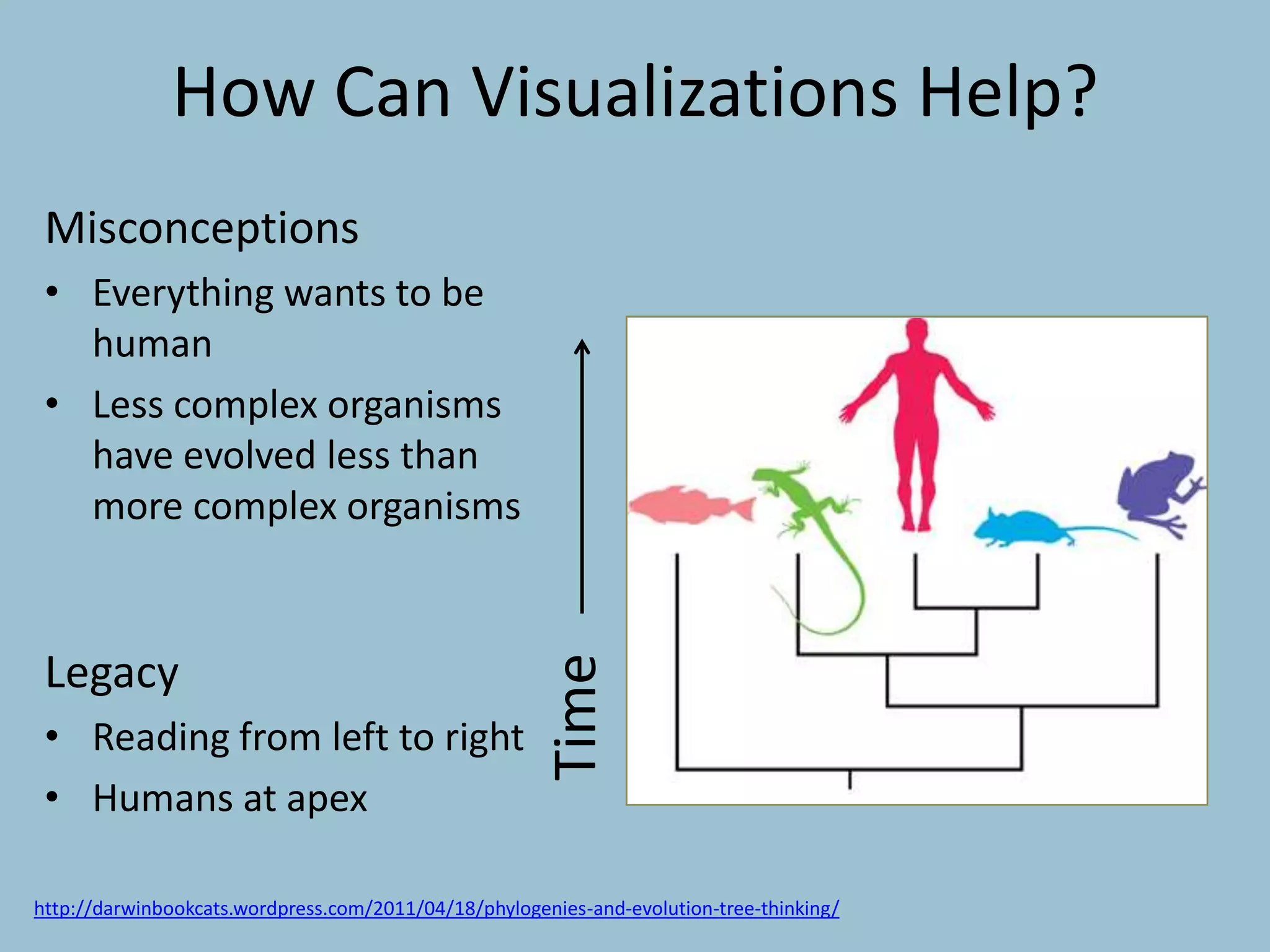
How Can Visualizations Help?
Time
Misconceptions
• Everything wants to be
human
• Less complex organisms
have evolved less than
more complex organisms
Legacy
• Reading from left to right
• Humans at apex
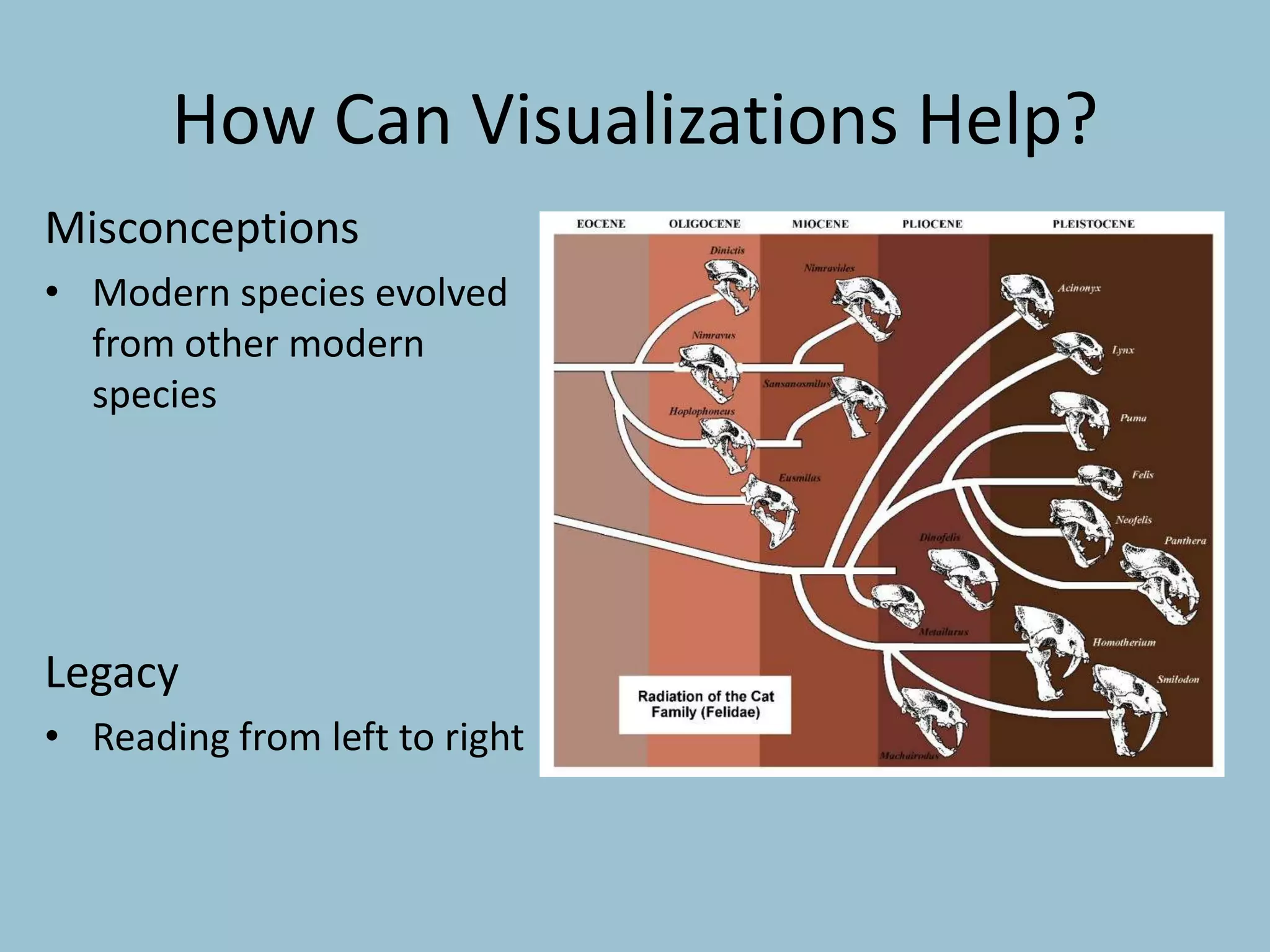
How Can Visualizations Help?
Misconceptions
• Modern species evolved
from other modern
species
Legacy
• Reading from left to right
How Can Visualizations Help?
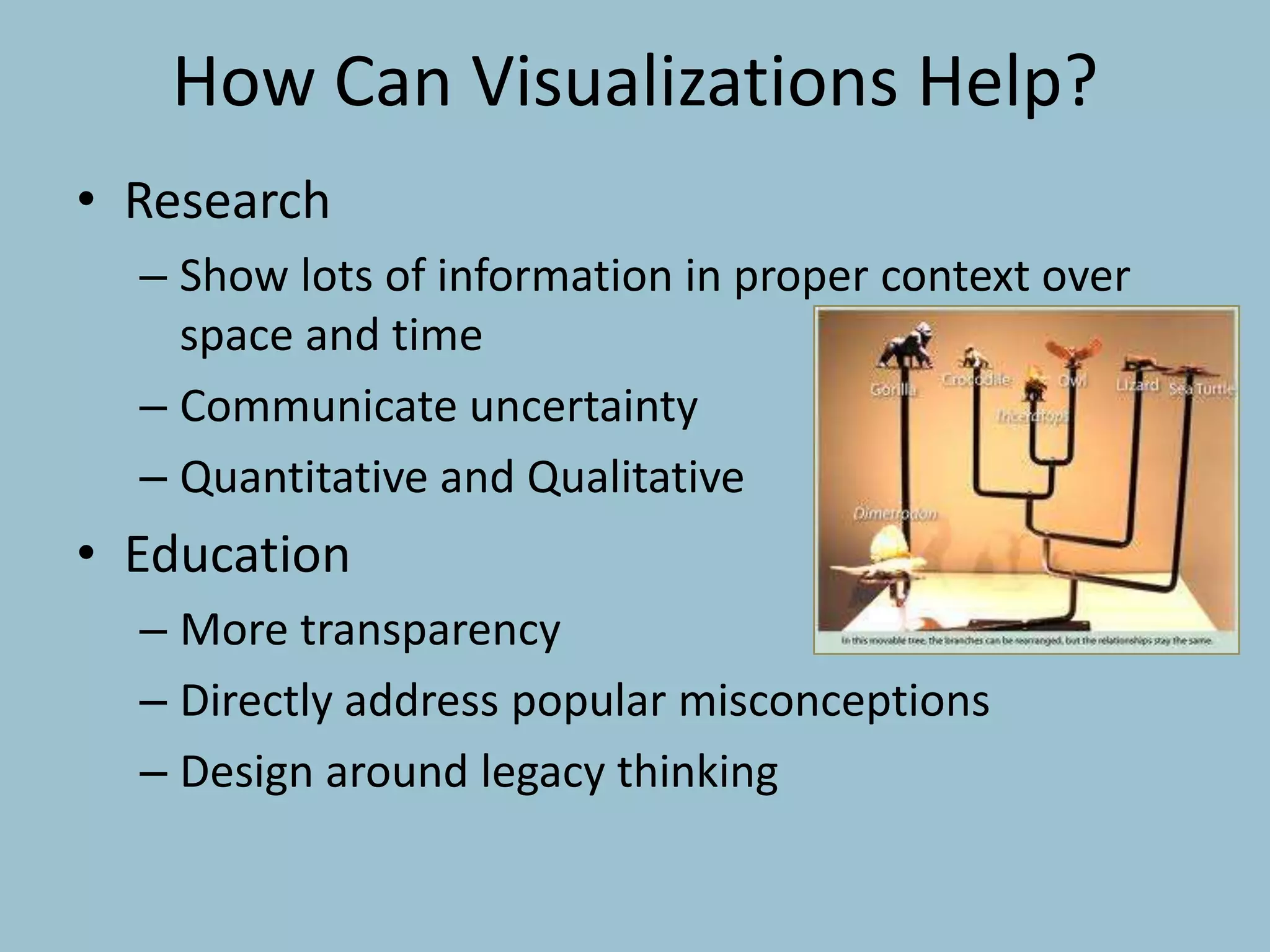
• Research
– Show lots of information in proper context over
space and time
– Communicate uncertainty
– Quantitative and Qualitative
• Education
– More transparency
– Directly address popular misconceptions
– Design around legacy thinking
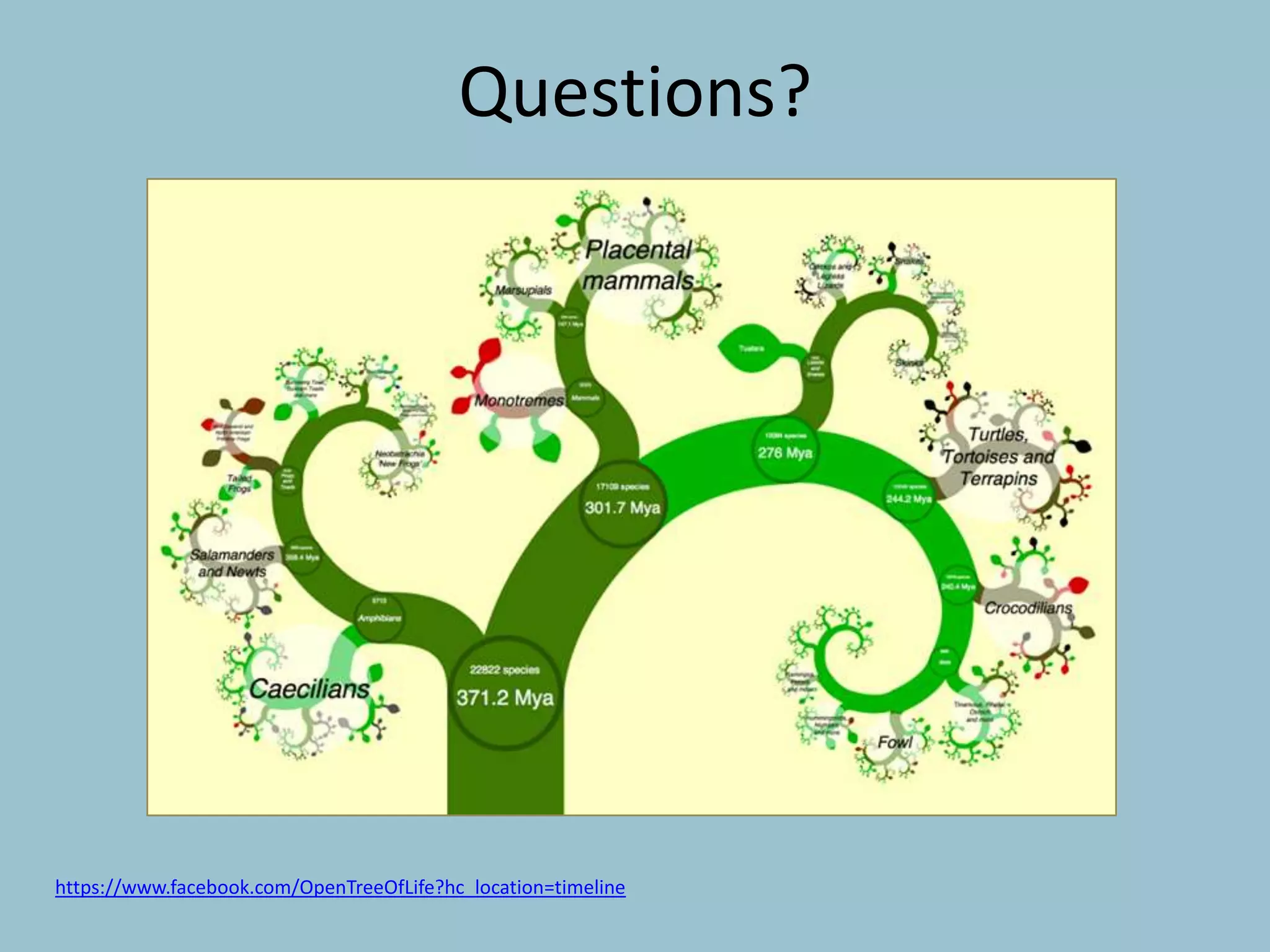
https://www.facebook.com/OpenTreeOfLife?hc_location=timeline
Questions?

Visualizing Evolution

  • 1.
  • 2.
    Nothing in biologymakes sense except in the light of evolution. - Theodosius Dobzhansky (1900-1975)
  • 3.
    Aristotle’s “Chain ofBeing” Blooded Humans Live Bearing Egg Layers Bloodless Insects Crustacea Molluscs • Hierarchical “Ladder of Life” according to complexity of structure and function • Final causes drove natural processes • Graded scale of perfection rising from plants to humans • Eleven grades arranged according to “the degree to which they are infected with potentiality” Aristotle 384 BC to 322 BC
  • 4.
    Drawing by Franciscan missionary, Didacus Valadespublished in Rhetorica Christiana. Great Chain of Being 1579 • Order imparted by omnipotent Christian deity • Included inanimate objects • Humans are at the top, under supernatural beings
  • 5.
    • God createdthe world perfectly, “Whatever is, is right” • To try to be something we are not is to break the chain Ladder of Life Humans Viviparous Quadrupeds Birds Egg-laying Quadrupeds Cetaceans Fish Mollusks (Cephalopods) Crustaceans Mollusks (Bivalves) Jellyfish & Sponges Higher Plants Lower Plants Inanimate Objects Alexander Pope (1688-1744) God
  • 6.
    Technology Check -Microscope • First detailed account of living tissue based on use of microscope was in 1644 • The word “cell” is coined by Robert Hooke 1665 • Anton van Leeuwenhoek describes “animalcules” in 1674-1676
  • 7.
    Technology Check -Taxonomy • Carolus Linnaeus published a comprehensive account of all known species • First edition 1735 • Starting point for zoological nomenclature • Contains about 10,000 species Carolus Linnaeus (1707-1778)
  • 8.
    Technology Check -Taxonomy • Carolus Linnaeus published a comprehensive account of all known species • First edition 1735 • Starting point for zoological nomenclature • Contains about 10,000 species Carolus Linnaeus (1707-1778)
  • 9.
    Philosophy Check -Enlightenment • Europe 1600s-1700s • Lincean Academy founded 1603 • Reform society using reason • Challenge ideas grounded in tradition and faith • Scientific method
  • 10.
    Evolution of Speciesby Natural Selection Charles Darwin (1809-1882) On the Origin of Species by Means of Natural Selection - 1859 • Species were not created by a supernatural being in their current state • Species derive from other species • Humans are not the best thing since sliced bread
  • 11.
    Haeckel’s tree oflife published in Generelle Morphologie der Organismen (1866) with the three branches Plantae, Protista, Animalia Early Phylogenetic Trees Ernst Haeckel (1834-1919)
  • 12.
    Tree from Haeckel’sAnthropogenie oder Entwicklungsgeschichte des Menschen published in 1874 Early Phylogenetic Trees Ernst Haeckel (1834-1919)
  • 13.
    • Grouping speciesbased on shared characters • Term “clade” coined in 1940 • Imply relationship based on shared character states • A tree is a hypothesis Technology Check - Cladistics
  • 14.
    • Digital computersinvented 1940-1945 • First computer algorithms for cladistics written in 1965 • First software package for phylogenetic analysis 1980 Technology Check - Computers
  • 15.
    • DNA firstisolated 1869 • Frederick Griffith demonstrated that DNA carried genetic information 1928 • Watson and Crick publish structure of DNA using Rosalind Franklin’s images 1953 • DNA sequencing methods first developed in 1977 Technology Check - DNA
  • 16.
    Trees contain informationon the relative timing of nodes only when the nodes are on the same path from the root (i.e., when one node is a descendant of another). These trees depict equivalent relationships despite being different in style. How to Read a Phylogenetic Tree Baum. 2008. Reading a phylogenetic tree: the meaning of monophyletic groups. Nature Education
  • 17.
    How to Reada Phylogenetic Tree Baum. 2008. Reading a phylogenetic tree: the meaning of monophyletic groups. Nature Education The information on patterns of evolutionary descent is the same regardless of the lengths of branches.
  • 18.
    "Evolution of patternson Conus shells." By Zhenqiang Gong, Nicholas J. Matzke, Bard Ermentrout, Dawn Song, Jann E. Vendetti, Montgomery Slatkin, and George Oster. Proceedings of the National Academy of Sciences, 4 January 2012.
  • 19.
    Page 2012. Space,time, form: viewing the tree of life. Trends Ecol & Evol 27(2):113-120.
  • 23.
    • Non-directed webshape • Humans not at apex (there is no apex) • Supernatural and mythological beings not included • Mostly contains microscopic organisms • Much more complicated, more content • Trees are hypotheses that change due to type of analysis
  • 24.
  • 25.
    Dendrobatidae in Amazonhttp://fr.academic.ru/dic.nsf/frwiki/1328251
  • 26.
    Geophylogeny of Hawaiian katydids constructedusing GenGIS. http://lter.limnolog y.wisc.edu/cidimen sions/node/56 Phylogeny Mapping Tools
  • 27.
  • 28.
    Evolution Education About halfof Americans do not accept the reality of evolution
  • 29.
    Common Evolution Misconceptions •Everything wants to be human • Individuals evolve • Evolution is random • Less complex organisms have evolved less than more complex organisms • Humans came from monkeys • Microevolution is different from macroevolution • Linnaean taxonomy = genetics
  • 30.
    http://darwinbookcats.wordpress.com/2011/04/18/phylogenies-and-evolution-tree-thinking/ How Can VisualizationsHelp? Time Misconceptions • Everything wants to be human • Less complex organisms have evolved less than more complex organisms Legacy • Reading from left to right • Humans at apex
  • 31.
    http://darwinbookcats.wordpress.com/2011/04/18/phylogenies-and-evolution-tree-thinking/ How Can VisualizationsHelp? Time Misconceptions • Everything wants to be human • Less complex organisms have evolved less than more complex organisms Legacy • Reading from left to right • Humans at apex
  • 32.
    How Can VisualizationsHelp? Misconceptions • Modern species evolved from other modern species Legacy • Reading from left to right
  • 33.
    How Can VisualizationsHelp? • Research – Show lots of information in proper context over space and time – Communicate uncertainty – Quantitative and Qualitative • Education – More transparency – Directly address popular misconceptions – Design around legacy thinking
  • 34.