Adulteration of crude Drugs
Adulteration it is a practice of substituting the original crude drug partially or
fully with other substances which is either free from or inferior in therapeutic
and chemical properties or addition of low grade or spoiled drugs or entirely
different drug similar to that of original drug substituted with an intention of
enhancement of profits.
adulteration may be defined as mixing or substituting the original drug
material with other spurious, inferior, defective, spoiled, useless other parts of
same or different plant or harmful substances or drug which do not confirm
with the official standards
Adulteration may takes place by two ways:
- Direct or intentional adulteration
- Indirect or unintentional adulteration
Adulteration caused a variety of adverse effects from mild (allergic reactions,
fatigue, gastrointestinal upset, mood disturbances or muscle weakness,
nausea, pain, and respiratory complaints) to moderate (confusion,
convulsions, dermatitis, lethargy or seizures, leucopoenia, sensory
disturbances, vomiting) to severe (carcinomas, cerebral oedema, coma,
intracerebral haemorrhage, poisoning, metabolic acidosis, multi-organ
failure, nephrotoxicity, perinatal stroke, renal or liver failure or death) life
threatening effects.
Adulteration involves a number of different conditions:
inferiority, spoilage, deterioration, admixture, sophistication and substitution.
Inferior material with intends to defraud. For example, addition of yellow
colored starch powder in Zingiber officinale (ginger) powder and Carica
papaya seeds in Piper nigrum (black pepper) fruit.
Spoilage is produced by microbial or other pest infestation. It makes a product
unfit for consumption. It can be avoid by careful drying and storage conditions.
Many examples of spoilage are found in the food industry, particularly in fresh
fruits, vegetables, meats, fish and seafood.
Admixture is the addition of one article to another through accident or
carelessness. Inclusion of soil / stones on an underground part (roots, rhizome)
by carelessness / ignorance and accidental and co-collection of two similar
species are examples.
Deterioration is a destruction of valuable drug constituents by bad treatment or
aging or deliberate extraction of constituents and sale the residue as original
drug.
1- Whole cloves from which part of the volatile oil has been removed by
distillation "spent cloves".
2- Ground linseed from which part of the fixed oil has been expressed "linseed
cake".
3- Lard in which the fats have to some extend decomposed to form fatty acids"
rancid lard".
4- Powdered squill that has hardened through absorption of moisture.
5- Coffee that has largely lost its caffeine through over roasting.
Sophistication is the deliberate addition of spurious / inferior material with
intends to defraud. For example, addition of yellow colored starch powder in
Zingiber officinale (ginger) powder and Carica papaya seeds in Piper nigrum
(black pepper) fruit.
The addition of wheat flour to powdered ginger, with enough capsicum to
restore or enhance the pungency and enough curcuma to maintain the color,
would represent a typical example of sophistication (which is sometimes
referred to as true adulteration).
substitution is the addition of an entirely different article in place of that
which is required. Supply of cheap cotton seed oil in place of pure olive oil is
one of the example
Substitution with inferior commercial verities
It is the use of morphologically resemble, different inferior commercial
verities (may or may not have any chemical or therapeutic potential as that of
original natural drug). Example are
Arabian senna (Cassia angustifolia), dog senna (Cassia obovata) and
ovaram senna (Cassia auriculata) have been used to adulterate Senna (Cassia
senna).
Japanese ginger (Zingiber mioga) have been used to adulterate medicinal
ginger (Zingiber officinale).
Capsicum annum have been used to adulterate Capsicum minimum.
Piper nigrum fruit is adulterated by Carica papaya seeds.
Substitution with artificially manufactured drug
Artificially manufactured substances use as a substitute of the original drug.
Artificial sugar for honey, yellow colored paraffin wax for bees wax,
compressed Chicory in place of coffee and properly cut and shaved basswood
for nutmeg (Jaifal) are examples.
Substitution by addition of worthless or heavy materials Examples
Large mass of stone mixed with Glycyrrhiza glabra (liquorice root).
Pieces of lime stone mixed with Ferula assa-foetida (Asafoetida).
Lead shot mixed with pieces of Papaver somniferum (opium)
Substitution by exhausted drugs
Same plant material is mixed with drug having no active medicinal
components as they have already been extracted out
Examples
Volatile oil containing drugs : Foeniculum vulgare (fruit / fennel) , Syzygium
aromaticum (flowering buds / clove) , Coriandrum sativum (fruit / coriander) ,
Carum carvi (fruit / caraway / siahjeera) , Cascara sagrada(Sacred Bark /
jamal gota) and Zingiber officinale (roots / ginger).
Coloring matter containing drugs: In case of loss of coloring material during
exhaustion the residue is recolored with artificial dye. Examples: Rosa macdub
(Red rose petal) and Crocus sativus (stigma of flowers / saffron), Camellia
sinensis (leaves / tea).
Substitution by superficially similar but cheaper natural substances
Adulterated product has no relation with genuine material, may or may not
have any therapeutic or chemical component.
As Ailanthus altissima (Ailanthus) are substituted for Atropa belladonna
(Belladonna), Cassia acutifolia (senna) , Mentha longifolia (mint) etc.;
Leaves of Phytolacca americana (pokeweed) and Scopolia japonica, (Japanese
belladonna) for Atropa belladonna (Belladonna);
Leaves of Xanthium strumarium for stramonium and dandelion Anethum sowa
(Indian dill) with Anethum graveolens (Europian dill) or Carum carvi
(caraway).
Addition of synthetic principles
It is the use of synthetic chemicals to enhance the natural character. Addition of
benzyl benzoate to peru balsam, citral to citrus oils and lemon oil to orange oil.
Many herbal products contain undisclosed prescription or over-the-counter
drugs and heavy metals.
The drugs most frequently found were ephedrine, chlorpheniramine,
methyltestosterone, and phenacetin; 10 to 15 percent contained lead, mercury,
or arsenic. The FDA and other investigators have also reported the presence of
prescription drugs, including glyburide, sildenafil, colchicine, adrenal steroids,
alprazolam, phenylbutazone, and fenfluramine.
Addition of benzyl benzoate to balsam of Peru.
citral to citrus oils like oil of lemon and orange oil etc.
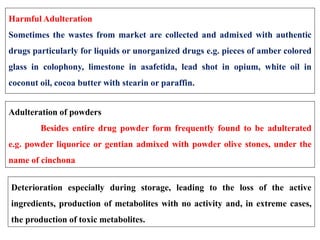
Harmful Adulteration
Sometimes the wastes from market are collected and admixed with authentic
drugs particularly for liquids or unorganized drugs e.g. pieces of amber colored
glass in colophony, limestone in asafetida, lead shot in opium, white oil in
coconut oil, cocoa butter with stearin or paraffin.
Adulteration of powders
Besides entire drug powder form frequently found to be adulterated
e.g. powder liquorice or gentian admixed with powder olive stones, under the
name of cinchona
Deterioration especially during storage, leading to the loss of the active
ingredients, production of metabolites with no activity and, in extreme cases,
the production of toxic metabolites.
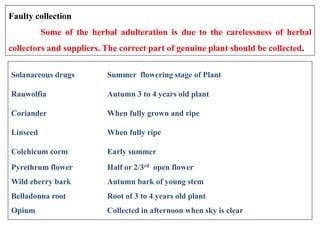
Solanaceous drugs Summer flowering stage of Plant
Rauwolfia Autumn 3 to 4 years old plant
Coriander When fully grown and ripe
Linseed When fully ripe
Colchicum corm Early summer
Pyrethrum flower Half or 2/3rd open flower
Wild cherry bark Autumn bark of young stem
Belladonna root Root of 3 to 4 years old plant
Opium Collected in afternoon when sky is clear
Faulty collection
Some of the herbal adulteration is due to the carelessness of herbal
collectors and suppliers. The correct part of genuine plant should be collected.
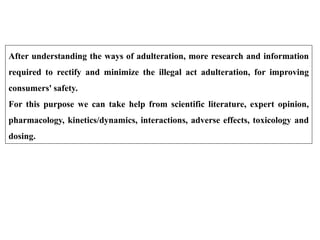
After understanding the ways of adulteration, more research and information
required to rectify and minimize the illegal act adulteration, for improving
consumers' safety.
For this purpose we can take help from scientific literature, expert opinion,
pharmacology, kinetics/dynamics, interactions, adverse effects, toxicology and
dosing.
Adulteration

Adulteration

  • 1.
  • 2.
    Adulteration it isa practice of substituting the original crude drug partially or fully with other substances which is either free from or inferior in therapeutic and chemical properties or addition of low grade or spoiled drugs or entirely different drug similar to that of original drug substituted with an intention of enhancement of profits. adulteration may be defined as mixing or substituting the original drug material with other spurious, inferior, defective, spoiled, useless other parts of same or different plant or harmful substances or drug which do not confirm with the official standards Adulteration may takes place by two ways: - Direct or intentional adulteration - Indirect or unintentional adulteration
  • 3.
    Adulteration caused avariety of adverse effects from mild (allergic reactions, fatigue, gastrointestinal upset, mood disturbances or muscle weakness, nausea, pain, and respiratory complaints) to moderate (confusion, convulsions, dermatitis, lethargy or seizures, leucopoenia, sensory disturbances, vomiting) to severe (carcinomas, cerebral oedema, coma, intracerebral haemorrhage, poisoning, metabolic acidosis, multi-organ failure, nephrotoxicity, perinatal stroke, renal or liver failure or death) life threatening effects. Adulteration involves a number of different conditions: inferiority, spoilage, deterioration, admixture, sophistication and substitution.
  • 4.
    Inferior material withintends to defraud. For example, addition of yellow colored starch powder in Zingiber officinale (ginger) powder and Carica papaya seeds in Piper nigrum (black pepper) fruit. Spoilage is produced by microbial or other pest infestation. It makes a product unfit for consumption. It can be avoid by careful drying and storage conditions. Many examples of spoilage are found in the food industry, particularly in fresh fruits, vegetables, meats, fish and seafood. Admixture is the addition of one article to another through accident or carelessness. Inclusion of soil / stones on an underground part (roots, rhizome) by carelessness / ignorance and accidental and co-collection of two similar species are examples.
  • 5.
    Deterioration is adestruction of valuable drug constituents by bad treatment or aging or deliberate extraction of constituents and sale the residue as original drug. 1- Whole cloves from which part of the volatile oil has been removed by distillation "spent cloves". 2- Ground linseed from which part of the fixed oil has been expressed "linseed cake". 3- Lard in which the fats have to some extend decomposed to form fatty acids" rancid lard". 4- Powdered squill that has hardened through absorption of moisture. 5- Coffee that has largely lost its caffeine through over roasting.
  • 6.
    Sophistication is thedeliberate addition of spurious / inferior material with intends to defraud. For example, addition of yellow colored starch powder in Zingiber officinale (ginger) powder and Carica papaya seeds in Piper nigrum (black pepper) fruit. The addition of wheat flour to powdered ginger, with enough capsicum to restore or enhance the pungency and enough curcuma to maintain the color, would represent a typical example of sophistication (which is sometimes referred to as true adulteration). substitution is the addition of an entirely different article in place of that which is required. Supply of cheap cotton seed oil in place of pure olive oil is one of the example
  • 7.
    Substitution with inferiorcommercial verities It is the use of morphologically resemble, different inferior commercial verities (may or may not have any chemical or therapeutic potential as that of original natural drug). Example are Arabian senna (Cassia angustifolia), dog senna (Cassia obovata) and ovaram senna (Cassia auriculata) have been used to adulterate Senna (Cassia senna). Japanese ginger (Zingiber mioga) have been used to adulterate medicinal ginger (Zingiber officinale). Capsicum annum have been used to adulterate Capsicum minimum. Piper nigrum fruit is adulterated by Carica papaya seeds.
  • 8.
    Substitution with artificiallymanufactured drug Artificially manufactured substances use as a substitute of the original drug. Artificial sugar for honey, yellow colored paraffin wax for bees wax, compressed Chicory in place of coffee and properly cut and shaved basswood for nutmeg (Jaifal) are examples. Substitution by addition of worthless or heavy materials Examples Large mass of stone mixed with Glycyrrhiza glabra (liquorice root). Pieces of lime stone mixed with Ferula assa-foetida (Asafoetida). Lead shot mixed with pieces of Papaver somniferum (opium)
  • 9.
    Substitution by exhausteddrugs Same plant material is mixed with drug having no active medicinal components as they have already been extracted out Examples Volatile oil containing drugs : Foeniculum vulgare (fruit / fennel) , Syzygium aromaticum (flowering buds / clove) , Coriandrum sativum (fruit / coriander) , Carum carvi (fruit / caraway / siahjeera) , Cascara sagrada(Sacred Bark / jamal gota) and Zingiber officinale (roots / ginger). Coloring matter containing drugs: In case of loss of coloring material during exhaustion the residue is recolored with artificial dye. Examples: Rosa macdub (Red rose petal) and Crocus sativus (stigma of flowers / saffron), Camellia sinensis (leaves / tea).
  • 10.
    Substitution by superficiallysimilar but cheaper natural substances Adulterated product has no relation with genuine material, may or may not have any therapeutic or chemical component. As Ailanthus altissima (Ailanthus) are substituted for Atropa belladonna (Belladonna), Cassia acutifolia (senna) , Mentha longifolia (mint) etc.; Leaves of Phytolacca americana (pokeweed) and Scopolia japonica, (Japanese belladonna) for Atropa belladonna (Belladonna); Leaves of Xanthium strumarium for stramonium and dandelion Anethum sowa (Indian dill) with Anethum graveolens (Europian dill) or Carum carvi (caraway).
  • 11.
    Addition of syntheticprinciples It is the use of synthetic chemicals to enhance the natural character. Addition of benzyl benzoate to peru balsam, citral to citrus oils and lemon oil to orange oil. Many herbal products contain undisclosed prescription or over-the-counter drugs and heavy metals. The drugs most frequently found were ephedrine, chlorpheniramine, methyltestosterone, and phenacetin; 10 to 15 percent contained lead, mercury, or arsenic. The FDA and other investigators have also reported the presence of prescription drugs, including glyburide, sildenafil, colchicine, adrenal steroids, alprazolam, phenylbutazone, and fenfluramine. Addition of benzyl benzoate to balsam of Peru. citral to citrus oils like oil of lemon and orange oil etc.
  • 12.
    Harmful Adulteration Sometimes thewastes from market are collected and admixed with authentic drugs particularly for liquids or unorganized drugs e.g. pieces of amber colored glass in colophony, limestone in asafetida, lead shot in opium, white oil in coconut oil, cocoa butter with stearin or paraffin. Adulteration of powders Besides entire drug powder form frequently found to be adulterated e.g. powder liquorice or gentian admixed with powder olive stones, under the name of cinchona Deterioration especially during storage, leading to the loss of the active ingredients, production of metabolites with no activity and, in extreme cases, the production of toxic metabolites.
  • 13.
    Solanaceous drugs Summerflowering stage of Plant Rauwolfia Autumn 3 to 4 years old plant Coriander When fully grown and ripe Linseed When fully ripe Colchicum corm Early summer Pyrethrum flower Half or 2/3rd open flower Wild cherry bark Autumn bark of young stem Belladonna root Root of 3 to 4 years old plant Opium Collected in afternoon when sky is clear Faulty collection Some of the herbal adulteration is due to the carelessness of herbal collectors and suppliers. The correct part of genuine plant should be collected.
  • 14.
    After understanding theways of adulteration, more research and information required to rectify and minimize the illegal act adulteration, for improving consumers' safety. For this purpose we can take help from scientific literature, expert opinion, pharmacology, kinetics/dynamics, interactions, adverse effects, toxicology and dosing.