BUREAU OF INDIAN
STANDARDS
Presented by:-
Sridhar S
1st M.Pharmacy
Pharmaceutical regulatory affairs
JSS college of pharmacy
Mysore-570015
Presented to:-
Dr.Balamuralidara V
Regulatory affairs group
Dept. of pharmaceutics
JSS college of pharmacy
Mysore-570015
1
INTRODUCTION
 The Bureau of Indian Standards (BIS) is the national Standards
Body of India working under the aegis of Ministry of Consumer
Affairs, Food & Public Distribution, Government of India
 It is established by the Bureau of Indian Standards Act, 1986 which
came into effect on 23 December 1986.
 The Minister in charge of the Ministry or Department having
administrative control of the BIS is the ex-officio President of the
BIS.
2
 The organisation was formerly the Indian Standards Institution
(ISI), set up under the Resolution of the then Department of
Industries and Supplies dated 3 September 1946. The ISI was
registered under the Societies Registration Act, 1860.
 As a corporate body, it has 25 members drawn from Central or State
Governments, industry, scientific and research institutions, and
consumer organisations
 Its headquarters are in New Delhi, with regional offices in Kolkata,
Chennai, Mumbai, Chandigarh and Delhi and 20 branch offices. It
also works as WTO-TBT enquiry point for India
3
ORIGIN OF BIS
 In the twilight years of British rule in India, when the country was
faced with the gigantic task of building up the industrial
infrastructure, it was the Institution of Engineers (India), which
prepared the first draft of the Constitution of an Institution which
could take up the task of formulation of National Standards.
 This led to the Department of Industries and Supplies issuing a
memorandum on 03 September 1946, formally announcing the
setting of an organization called the “Indian Standards Institution”.
The Indian Standards Institution (ISI) came into being on the 06
January 1947 and in June 1947 Dr. Lal C. Verman took over as its
first Director.
4
BIS ACT, RULES AND REGULATIONS
 The BIS Act, 2016, notified for general information and yet to be
implemented
 The BIS Act, 1986
 The BIS Rules, 1987
 The BIS (Appointment, Terms and Conditions of Service of
Director-General) Rules, 1987
 The BIS (Recognition of Consumers' Associations) Rules, 1991
 The BIS (Powers and Duties of Director-General) Regulations, 1987
5
 The BIS (Advisory Committees) Regulations, 1987
 The BIS (Certification) Regulations, 1988
 The BIS (Recruitment to Scientific Cadre) Regulations, 2002
 The BIS (Recruitment to Laboratory Technical Posts) Regulations,
2007
 The BIS (Terms and Conditions of Service of Employees),
Regulations, 2007
 The BIS (Recruitment to Administration, Finance and Other Posts)
Regulations, 2007
6
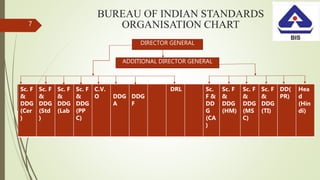
BUREAU OF INDIAN STANDARDS
ORGANISATION CHART
DIRECTOR GENERAL
ADDITIONAL DIRECTOR GENERAL
Sc. F
&
DDG
(Cer
)
Sc. F
&
DDG
(Std
)
Sc. F
&
DDG
(Lab
Sc. F
&
DDG
(PP
C)
C.V.
O DDG
A
DDG
F
DRL Sc.
F &
DD
G
(CA
)
Sc. F
&
DDG
(HM)
Sc. F
&
DDG
(MS
C)
Sc. F
&
DDG
(TI)
DD(
PR)
Hea
d
(Hin
di)
7
Product Certification
 The Product Certification Scheme of BIS aims at providing Third Party
Guarantee of quality, safety and reliability of products to the customer.
 Presence of ISI certification mark, known as Standard Mark, on a
product is an assurance of conformity to the specifications.
 The manufacturer is permitted to self certify the licenced products after
ascertaining its conformity to the Standard.
 In order to safeguard the interest of consumers against spurious
marking/misuse of ISI mark, penal provision exists in BIS Act 1986 under
section 33(1), as per which any person who contravenes the provisions of
Section 11, Section 12, Section 14 or Section 15 shall be punishable with
imprisonment for a term which may extend upto one year or with a fine
which may extend upto Rs. 50,000 or with both.
8
HALMARKING
 Hallmarking is the accurate determination and official recording of
the proportionate content of precious metal in precious metal
articles.
 Hallmarks are thus official marks used in many countries as a
guarantee of purity or fineness of precious metal articles.
 The BIS Hallmarking Scheme has been aligned with International
criteria on hallmarking. As per this scheme, licence is granted to the
jewellers by BIS under Hallmarking Scheme.
 The recognition of an Assaying and Hallmarking Centre is done
against IS 15820:2009.
9
ASSOCIATION WITH INTERNATIONAL
STANDARDS BODIES
 BIS is a founder member of International Organisation for
Standardization (ISO)
 It represents India in the International Organization for
Standardization (ISO), the International Electro technical
Commission (IEC) and the World Standards Service Network
(WSSN).
10
BIS IS ENGAGED IN FORMULATION OF
INDIAN STANDARDS FOR THE FOLLOWING
SECTORS:
 Chemicals
 Civil Engineering
 Electronics and Information Technology
 Electro technical
 Food and Agriculture
 Mechanical Engineering
 Management and Systems
 Medical Equipment and Hospital Planning
11
 Metallurgical Engineering
 Petroleum Coal and Related Products
 Production & General Engineering
 Transport Engineering
 Textile
 Water Resources
 Each of these sectors has a Division Council to oversee and
supervise its work.
12
LABORATORIES
 To support the activities of product certification, BIS has a chain of
8 laboratories. These laboratories have established testing facilities
for products of chemical, food, electrical and mechanical
disciplines. Approximately
 25000 samples are being tested in the BIS laboratories every year.
 All the other labs are NABL (National Accreditation Board for
Testing and Calibration Laboratories) accredited. It operates a
laboratory recognition scheme also.
13
PRODUCT CERTIFICATION SCHEME
 Product Certifications are to be obtained voluntarily. For, some of
the products like Milk powder, Drinking Water, LPG Cylinders, etc.,
certification is mandatory. Because these products are concerned
with health and safety.
 For foreign manufacturers
 All foreign manufacturers of products who intend to export to India
are required to obtain a BIS product certification license.
14
 Under the provisions of this scheme, foreign manufacturers can seek
certification from BIS for marking their product(s) with BIS
Standard Mark. If or otherwise, the foreign manufacturer has not
signed an MoU with BIS, it has to set up a liaison office in India
with the permission of Reserve Bank of India. Otherwise, an
authorised representative or agent needs to be appointed by the
foreign firm.
15
MANAGEMENT SYSTEM CERTIFICATION
 Management System Certification Scheme IS/ISO 9001.
 Environmental Management System Certification Scheme IS/ISO
14001.
 Occupational Health and Safety Management System Certification
Scheme IS 18001.
 Hazard Analysis and Critical Control Scheme IS/ISO 22000.
 Service Quality Management System Certification Scheme IS
15700.
16
Management System Certification Scheme
IS/ISO 9001
 Scope
As an ISO 9001 certified organization you will have implemented
Quality Management System requirements for all areas of the
business, including:
 Facilities
 People
 Training
 Services
 Equipment
17
 ISO 9001 is the world's most widely recognized Quality
Management System (QMS).
 An ISO 9001 quality management system will help you to
continually monitor and manage quality across all operations, and
outlines ways to achieve, as well as benchmark, consistent
performance and service. Internationally
18
BENEFITS TO THE CERTIFIED FIRM
 The firm with BIS Quality Management Systems Certification license provides:
 i) clear indication of its capabilities
 ii) strong evidence of its commitment to quality
 iii) assurance of consistency in quality of product/ service with timely delivery;
 Reduces the incidence of product failure, in-turn improves credibility of the firm.
 Leads to less material wastage, production down time, rework, etc. through an
increase in `quality know-how' and efficiency.
 Being internationally recognized, the firm's quality will have world-wide
acceptance.
 Better choice and monitoring of the firm's supplies.
 Puts all operations on a scientific basis.
19
WHAT IS THE ROLE OF BIS IN ISO 9000
 BIS is the National Standards Body of India and is a founder
member of ISO.
 BIS represents India, in ISO.
 The Technical Committee (TC) number 176 (ISO/TC 176), and its
Sub-committees of ISO are responsible for the development of ISO
9000 standards.
 Quality and industry experts from India including BIS officers
nominated by BIS participate in the meetings of the Technical
Committee ISO/TC 176 and its Sub-committees.
20
WHY IS/ISO 9001 STANDARD?
 It is identical to internationally accepted ISO 9001 standard for Quality
Management Systems;
 It helps in gaining a competitive edge in domestic as well as global
market;
 For saving money - quality management system ensures efficient and
sound procedures
 For ensuring optimum utilization of plant and reducing scrap and time
consuming rework and repairs;
 It is a tool to ensure consistent quality improvement apart from achieving
quality control/quality assurance;
 It brings confidence to the customer;
 It makes the system transparent through quality records;
21
Environmental Management System Certification
Scheme IS/ISO 14001.
 The ISO 14000 family includes most notably the ISO 14001
standard, which represents the core set of standards used by
organizations for designing and implementing an effective
Environmental Management System (EMS).
 environmental management that exists to help organizations
 (a) minimize how their operations (processes, etc.) negatively affect
the environment (i.e., cause adverse changes to air, water, or land)
 (b) comply with applicable laws, regulations, and other
environmentally oriented requirements and
 (c) continually improve in the above.
22
ROLE OF BIS IN ISO 14000
 BIS is the National Standards Body of India and is a founder
member of ISO.
 BIS represents India, in ISO.
 The Technical Committee (TC) number 207 (ISO/TC 207), and its
Sub-committees of ISO are responsible for the development of ISO
14000 standards.
 Industry experts from India including BIS officers nominated by
BIS participate in the meetings of the Technical Committee ISO/TC
207 and its Sub-committees.
23
OCCUPATIONAL HEALTH AND SAFETY
MANAGEMENT SYSTEM CERTIFICATION
SCHEME IS 18001.
 OHSAS 18001, Occupational Health and Safety Assessment Series,
(officially BS OHSAS 18001) is an internationally applied British
Standard for occupational health and safety management systems
 Its supporters claim that an occupational health and safety
management system (OHSMS) promotes a safe and healthy working
environment by providing a framework that helps organizations
 Identify and control health and safety risks
 Reduce the potential for accidents
 Aid legal compliance
 Improve overall performance
24
HAZARD ANALYSIS AND CRITICAL CONTROL
SCHEME IS/ISO 22000.
 ISO 22000 is a standard developed by the International
Organization for Standardization dealing with food safety. It is a
general derivative of ISO 9000.
 Since food safety hazards can occur at any stage in the food chain it
is essential that adequate control be in place. Therefore, a combined
effort of all parties through the food chain is required.
 Communication along the food chain is essential to ensure that all
relevant food safety hazards are identified and adequately controlled
at each step within the food chain.
25
ISO 9001 VS ISO 22000
 In comparison with ISO 9001, the standard is a more procedural
orientated guidance than a principle based one. Apart from that, ISO
22000 is an industrial-specific risk management system for any type
of food processing and marketing,
 Which can be closely incorporated with the quality management
system of ISO 9001. The detailed similarities and differences of the
two standards can be found elsewhere
26
ROLE OF BIS IN ISO 22000
 The Technical Committee (TC) and its Sub-committees of ISO are
responsible for the development of ISO 22000 standard.
 Experts from food sector from Indian industry including BIS
officers nominated by BIS participate in the meetings of the
Technical Committee and its Sub-committees for developing the
standard.
 Organizations willing to implement the Food Safety Management
System as per IS/ISO 22000 may refer to IS/ISO/TS 22004 – Food
Safety Management System
27
SERVICE QUALITY MANAGEMENT SYSTEM
CERTIFICATION SCHEME IS 15700
 IS 15700:2005 may be implemented by public service organizations
to demonstrate their ability to consistently provide effective and
efficient services which meets customer and applicable legal,
statutory and regulatory requirements, to enhance customer
satisfaction and for continual improvement in their services and
service delivery processes.
 Public service organizations including Government Ministries and
Departments, Regulatory Bodies, Public Utility Service Provider,
etc. which are either directly providing service to society at large or
those which through their policies, directives, regulations, etc.
indirectly affect the services being provided by these service
providers, are eligible for certification under this scheme.
28
 For example
 Government Ministries/Departments, Public transport services,
Public water supply services, Public distribution services, Insurance
companies, Public health care services, Postal services,
Telecommunication Services, Education services, Regulatory
bodies, etc.
29
REFERENCE
 http://www.bis.org.in/index.asp
 http://www.bis.org.in/mscdweb/mscd_sqms.asp
 http://www.bis.org.in/cert/15700.htm
 http://www.bis.org.in/other/consumer_affairs.asp
 http://www.bis.org.in/cert/about_Hm.asp
 http://www.bis.org.in/lab/lab_overview.asp
30
31

Bis standards

  • 1.
    BUREAU OF INDIAN STANDARDS Presentedby:- Sridhar S 1st M.Pharmacy Pharmaceutical regulatory affairs JSS college of pharmacy Mysore-570015 Presented to:- Dr.Balamuralidara V Regulatory affairs group Dept. of pharmaceutics JSS college of pharmacy Mysore-570015 1
  • 2.
    INTRODUCTION  The Bureauof Indian Standards (BIS) is the national Standards Body of India working under the aegis of Ministry of Consumer Affairs, Food & Public Distribution, Government of India  It is established by the Bureau of Indian Standards Act, 1986 which came into effect on 23 December 1986.  The Minister in charge of the Ministry or Department having administrative control of the BIS is the ex-officio President of the BIS. 2
  • 3.
     The organisationwas formerly the Indian Standards Institution (ISI), set up under the Resolution of the then Department of Industries and Supplies dated 3 September 1946. The ISI was registered under the Societies Registration Act, 1860.  As a corporate body, it has 25 members drawn from Central or State Governments, industry, scientific and research institutions, and consumer organisations  Its headquarters are in New Delhi, with regional offices in Kolkata, Chennai, Mumbai, Chandigarh and Delhi and 20 branch offices. It also works as WTO-TBT enquiry point for India 3
  • 4.
    ORIGIN OF BIS In the twilight years of British rule in India, when the country was faced with the gigantic task of building up the industrial infrastructure, it was the Institution of Engineers (India), which prepared the first draft of the Constitution of an Institution which could take up the task of formulation of National Standards.  This led to the Department of Industries and Supplies issuing a memorandum on 03 September 1946, formally announcing the setting of an organization called the “Indian Standards Institution”. The Indian Standards Institution (ISI) came into being on the 06 January 1947 and in June 1947 Dr. Lal C. Verman took over as its first Director. 4
  • 5.
    BIS ACT, RULESAND REGULATIONS  The BIS Act, 2016, notified for general information and yet to be implemented  The BIS Act, 1986  The BIS Rules, 1987  The BIS (Appointment, Terms and Conditions of Service of Director-General) Rules, 1987  The BIS (Recognition of Consumers' Associations) Rules, 1991  The BIS (Powers and Duties of Director-General) Regulations, 1987 5
  • 6.
     The BIS(Advisory Committees) Regulations, 1987  The BIS (Certification) Regulations, 1988  The BIS (Recruitment to Scientific Cadre) Regulations, 2002  The BIS (Recruitment to Laboratory Technical Posts) Regulations, 2007  The BIS (Terms and Conditions of Service of Employees), Regulations, 2007  The BIS (Recruitment to Administration, Finance and Other Posts) Regulations, 2007 6
  • 7.
    BUREAU OF INDIANSTANDARDS ORGANISATION CHART DIRECTOR GENERAL ADDITIONAL DIRECTOR GENERAL Sc. F & DDG (Cer ) Sc. F & DDG (Std ) Sc. F & DDG (Lab Sc. F & DDG (PP C) C.V. O DDG A DDG F DRL Sc. F & DD G (CA ) Sc. F & DDG (HM) Sc. F & DDG (MS C) Sc. F & DDG (TI) DD( PR) Hea d (Hin di) 7
  • 8.
    Product Certification  TheProduct Certification Scheme of BIS aims at providing Third Party Guarantee of quality, safety and reliability of products to the customer.  Presence of ISI certification mark, known as Standard Mark, on a product is an assurance of conformity to the specifications.  The manufacturer is permitted to self certify the licenced products after ascertaining its conformity to the Standard.  In order to safeguard the interest of consumers against spurious marking/misuse of ISI mark, penal provision exists in BIS Act 1986 under section 33(1), as per which any person who contravenes the provisions of Section 11, Section 12, Section 14 or Section 15 shall be punishable with imprisonment for a term which may extend upto one year or with a fine which may extend upto Rs. 50,000 or with both. 8
  • 9.
    HALMARKING  Hallmarking isthe accurate determination and official recording of the proportionate content of precious metal in precious metal articles.  Hallmarks are thus official marks used in many countries as a guarantee of purity or fineness of precious metal articles.  The BIS Hallmarking Scheme has been aligned with International criteria on hallmarking. As per this scheme, licence is granted to the jewellers by BIS under Hallmarking Scheme.  The recognition of an Assaying and Hallmarking Centre is done against IS 15820:2009. 9
  • 10.
    ASSOCIATION WITH INTERNATIONAL STANDARDSBODIES  BIS is a founder member of International Organisation for Standardization (ISO)  It represents India in the International Organization for Standardization (ISO), the International Electro technical Commission (IEC) and the World Standards Service Network (WSSN). 10
  • 11.
    BIS IS ENGAGEDIN FORMULATION OF INDIAN STANDARDS FOR THE FOLLOWING SECTORS:  Chemicals  Civil Engineering  Electronics and Information Technology  Electro technical  Food and Agriculture  Mechanical Engineering  Management and Systems  Medical Equipment and Hospital Planning 11
  • 12.
     Metallurgical Engineering Petroleum Coal and Related Products  Production & General Engineering  Transport Engineering  Textile  Water Resources  Each of these sectors has a Division Council to oversee and supervise its work. 12
  • 13.
    LABORATORIES  To supportthe activities of product certification, BIS has a chain of 8 laboratories. These laboratories have established testing facilities for products of chemical, food, electrical and mechanical disciplines. Approximately  25000 samples are being tested in the BIS laboratories every year.  All the other labs are NABL (National Accreditation Board for Testing and Calibration Laboratories) accredited. It operates a laboratory recognition scheme also. 13
  • 14.
    PRODUCT CERTIFICATION SCHEME Product Certifications are to be obtained voluntarily. For, some of the products like Milk powder, Drinking Water, LPG Cylinders, etc., certification is mandatory. Because these products are concerned with health and safety.  For foreign manufacturers  All foreign manufacturers of products who intend to export to India are required to obtain a BIS product certification license. 14
  • 15.
     Under theprovisions of this scheme, foreign manufacturers can seek certification from BIS for marking their product(s) with BIS Standard Mark. If or otherwise, the foreign manufacturer has not signed an MoU with BIS, it has to set up a liaison office in India with the permission of Reserve Bank of India. Otherwise, an authorised representative or agent needs to be appointed by the foreign firm. 15
  • 16.
    MANAGEMENT SYSTEM CERTIFICATION Management System Certification Scheme IS/ISO 9001.  Environmental Management System Certification Scheme IS/ISO 14001.  Occupational Health and Safety Management System Certification Scheme IS 18001.  Hazard Analysis and Critical Control Scheme IS/ISO 22000.  Service Quality Management System Certification Scheme IS 15700. 16
  • 17.
    Management System CertificationScheme IS/ISO 9001  Scope As an ISO 9001 certified organization you will have implemented Quality Management System requirements for all areas of the business, including:  Facilities  People  Training  Services  Equipment 17
  • 18.
     ISO 9001is the world's most widely recognized Quality Management System (QMS).  An ISO 9001 quality management system will help you to continually monitor and manage quality across all operations, and outlines ways to achieve, as well as benchmark, consistent performance and service. Internationally 18
  • 19.
    BENEFITS TO THECERTIFIED FIRM  The firm with BIS Quality Management Systems Certification license provides:  i) clear indication of its capabilities  ii) strong evidence of its commitment to quality  iii) assurance of consistency in quality of product/ service with timely delivery;  Reduces the incidence of product failure, in-turn improves credibility of the firm.  Leads to less material wastage, production down time, rework, etc. through an increase in `quality know-how' and efficiency.  Being internationally recognized, the firm's quality will have world-wide acceptance.  Better choice and monitoring of the firm's supplies.  Puts all operations on a scientific basis. 19
  • 20.
    WHAT IS THEROLE OF BIS IN ISO 9000  BIS is the National Standards Body of India and is a founder member of ISO.  BIS represents India, in ISO.  The Technical Committee (TC) number 176 (ISO/TC 176), and its Sub-committees of ISO are responsible for the development of ISO 9000 standards.  Quality and industry experts from India including BIS officers nominated by BIS participate in the meetings of the Technical Committee ISO/TC 176 and its Sub-committees. 20
  • 21.
    WHY IS/ISO 9001STANDARD?  It is identical to internationally accepted ISO 9001 standard for Quality Management Systems;  It helps in gaining a competitive edge in domestic as well as global market;  For saving money - quality management system ensures efficient and sound procedures  For ensuring optimum utilization of plant and reducing scrap and time consuming rework and repairs;  It is a tool to ensure consistent quality improvement apart from achieving quality control/quality assurance;  It brings confidence to the customer;  It makes the system transparent through quality records; 21
  • 22.
    Environmental Management SystemCertification Scheme IS/ISO 14001.  The ISO 14000 family includes most notably the ISO 14001 standard, which represents the core set of standards used by organizations for designing and implementing an effective Environmental Management System (EMS).  environmental management that exists to help organizations  (a) minimize how their operations (processes, etc.) negatively affect the environment (i.e., cause adverse changes to air, water, or land)  (b) comply with applicable laws, regulations, and other environmentally oriented requirements and  (c) continually improve in the above. 22
  • 23.
    ROLE OF BISIN ISO 14000  BIS is the National Standards Body of India and is a founder member of ISO.  BIS represents India, in ISO.  The Technical Committee (TC) number 207 (ISO/TC 207), and its Sub-committees of ISO are responsible for the development of ISO 14000 standards.  Industry experts from India including BIS officers nominated by BIS participate in the meetings of the Technical Committee ISO/TC 207 and its Sub-committees. 23
  • 24.
    OCCUPATIONAL HEALTH ANDSAFETY MANAGEMENT SYSTEM CERTIFICATION SCHEME IS 18001.  OHSAS 18001, Occupational Health and Safety Assessment Series, (officially BS OHSAS 18001) is an internationally applied British Standard for occupational health and safety management systems  Its supporters claim that an occupational health and safety management system (OHSMS) promotes a safe and healthy working environment by providing a framework that helps organizations  Identify and control health and safety risks  Reduce the potential for accidents  Aid legal compliance  Improve overall performance 24
  • 25.
    HAZARD ANALYSIS ANDCRITICAL CONTROL SCHEME IS/ISO 22000.  ISO 22000 is a standard developed by the International Organization for Standardization dealing with food safety. It is a general derivative of ISO 9000.  Since food safety hazards can occur at any stage in the food chain it is essential that adequate control be in place. Therefore, a combined effort of all parties through the food chain is required.  Communication along the food chain is essential to ensure that all relevant food safety hazards are identified and adequately controlled at each step within the food chain. 25
  • 26.
    ISO 9001 VSISO 22000  In comparison with ISO 9001, the standard is a more procedural orientated guidance than a principle based one. Apart from that, ISO 22000 is an industrial-specific risk management system for any type of food processing and marketing,  Which can be closely incorporated with the quality management system of ISO 9001. The detailed similarities and differences of the two standards can be found elsewhere 26
  • 27.
    ROLE OF BISIN ISO 22000  The Technical Committee (TC) and its Sub-committees of ISO are responsible for the development of ISO 22000 standard.  Experts from food sector from Indian industry including BIS officers nominated by BIS participate in the meetings of the Technical Committee and its Sub-committees for developing the standard.  Organizations willing to implement the Food Safety Management System as per IS/ISO 22000 may refer to IS/ISO/TS 22004 – Food Safety Management System 27
  • 28.
    SERVICE QUALITY MANAGEMENTSYSTEM CERTIFICATION SCHEME IS 15700  IS 15700:2005 may be implemented by public service organizations to demonstrate their ability to consistently provide effective and efficient services which meets customer and applicable legal, statutory and regulatory requirements, to enhance customer satisfaction and for continual improvement in their services and service delivery processes.  Public service organizations including Government Ministries and Departments, Regulatory Bodies, Public Utility Service Provider, etc. which are either directly providing service to society at large or those which through their policies, directives, regulations, etc. indirectly affect the services being provided by these service providers, are eligible for certification under this scheme. 28
  • 29.
     For example Government Ministries/Departments, Public transport services, Public water supply services, Public distribution services, Insurance companies, Public health care services, Postal services, Telecommunication Services, Education services, Regulatory bodies, etc. 29
  • 30.
    REFERENCE  http://www.bis.org.in/index.asp  http://www.bis.org.in/mscdweb/mscd_sqms.asp http://www.bis.org.in/cert/15700.htm  http://www.bis.org.in/other/consumer_affairs.asp  http://www.bis.org.in/cert/about_Hm.asp  http://www.bis.org.in/lab/lab_overview.asp 30
  • 31.