1
USFDA
BY
M.SADHANA REDDY
M.Pharm Pharmaceutics & DRA
Krishna Teja Pharmacy College, Tirupati
The Food and Drug Administration (FDA),
established in 1930 as a part of the US Department of
Health and Human Services (DHHS),regulates
products accounting for roughly 25% of the United
States gross national product.
2
The U.S. Food and Drug Administration (FDA) is
an agency of the US Department of Health and
Human Services (DHHS) that is responsible for the
safety regulation of:
◦ most types of foods
◦ drugs
◦ vaccines
◦ blood products
◦ medical devices
◦ dietary supplements
◦ biological medical products
◦ radiation-emitting devices
◦ veterinary products
◦ cosmetics
3
The FDA has its headquarters at White Oak,
Maryland. The agency also has 223 field offices and
13 laboratories located throughout the 50 states,
the United States Virgin Islands, and Puerto Rico.
In 2008, the FDA started opening offices in foreign
countries, including China, India,
CostaRica, Chile, Belgium, and the United Kingdom.
4
5
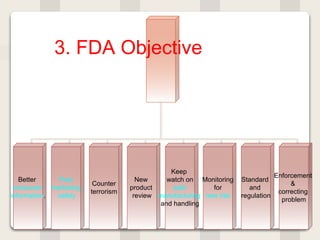
3. FDA Objective
Better
consumer
information.
Post
marketing
safety
Counter
terrorism
New
product
review
Keep
watch on
safe
manufacturing
and handling
Monitoring
for
new risk
Standard
and
regulation
Enforcement
&
correcting
problem
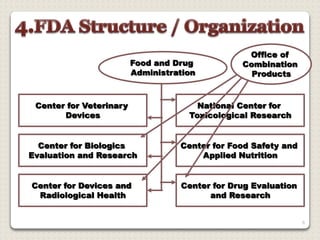
Center for Veterinary
Devices
Food and Drug
Administration
Center for Biologics
Evaluation and Research
Center for Devices and
Radiological Health
National Center for
Toxicological Research
Center for Food Safety and
Applied Nutrition
Center for Drug Evaluation
and Research
Office of
Combination
Products
6
7
8
What is the need?
The Food and Drug Modernization Act states that
the FDA has 4 goals:
 Goal 1: Strengthen FDA for Today and Tomorrow
 Goal 2: Improve Patient and Consumer Safety
 Goal 3: Increase Access to New Medical and Food Products
 Goal 4: Improve the Quality and Safety of Manufactured
Products and the Supply Chain
9
10
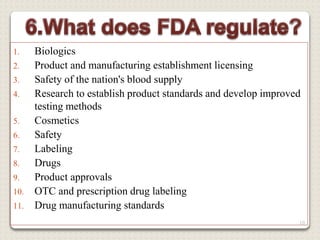
1. Biologics
2. Product and manufacturing establishment licensing
3. Safety of the nation's blood supply
4. Research to establish product standards and develop improved
testing methods
5. Cosmetics
6. Safety
7. Labeling
8. Drugs
9. Product approvals
10. OTC and prescription drug labeling
11. Drug manufacturing standards
11
12. Safety of all food products
13. Medical devices
14. Manufacturing and performance standards
15. Tracking reports of device malfunctioning and serious adverse
reactions
16. Radiation-emitting electronic products
17. Radiation safety performance standards for microwave ovens,
television receivers, diagnostic
18. X-ray equipment, cabinet x-ray systems (such as baggage x-
rays at airports), laser products,
19. Ultrasonic therapy equipment, mercury vapor lamps, and
sunlamps
20. Veterinary products
 advertising (except for prescription drugs, medical
devices, and tobacco products).
 alcoholic beverages
 some consumer products, such as paint, child-
resistant packages, baby toys, and household
appliances (except for those that give off radiation)
 illegal drugs of abuse, such as heroin and marijuana.
 health insurance.
 meat and poultry (except for game meats, such as
venison, ostrich, and snake).
 Restaurants and grocery stores.
Water
12
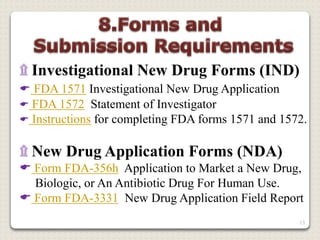
۩ Investigational New Drug Forms (IND)
 FDA 1571 Investigational New Drug Application
 FDA 1572 Statement of Investigator
 Instructions for completing FDA forms 1571 and 1572.
۩ New Drug Application Forms (NDA)
 Form FDA-356h Application to Market a New Drug,
Biologic, or An Antibiotic Drug For Human Use.
 Form FDA-3331 New Drug Application Field Report
13
Form FDA-356h Application to Market a New
Drug, Biologic or An Antibiotic Drug For
Human Use.
 Guidance for industry: providing regulatory
submissions in electronic format –general
consideration.
۩ Abbreviated New Drug Application Forms
(ANDA) for Generic Drug Products
14
۩ Orphan Drug Products (for rare diseases and
disorders)
There is no form, but there is a prescribed format for
application for orphan drug status. The section from the
regulations that describes the format can be found on
this website on the The Orphan Drug Act and Related
Law and Regulation page.
۩ Electronic Regulatory Submission & Review (ERSR)
 Regulation and Instructions For Submitting Drug
Application Electronic This webpage provides for
information on CDER's program to enable the electronic
submission of regulatory information to the Center and
the review of it by CDER staff.
.
15
16
THANK YOU

Usfda

  • 1.
    1 USFDA BY M.SADHANA REDDY M.Pharm Pharmaceutics& DRA Krishna Teja Pharmacy College, Tirupati
  • 2.
    The Food andDrug Administration (FDA), established in 1930 as a part of the US Department of Health and Human Services (DHHS),regulates products accounting for roughly 25% of the United States gross national product. 2
  • 3.
    The U.S. Foodand Drug Administration (FDA) is an agency of the US Department of Health and Human Services (DHHS) that is responsible for the safety regulation of: ◦ most types of foods ◦ drugs ◦ vaccines ◦ blood products ◦ medical devices ◦ dietary supplements ◦ biological medical products ◦ radiation-emitting devices ◦ veterinary products ◦ cosmetics 3
  • 4.
    The FDA hasits headquarters at White Oak, Maryland. The agency also has 223 field offices and 13 laboratories located throughout the 50 states, the United States Virgin Islands, and Puerto Rico. In 2008, the FDA started opening offices in foreign countries, including China, India, CostaRica, Chile, Belgium, and the United Kingdom. 4
  • 5.
    5 3. FDA Objective Better consumer information. Post marketing safety Counter terrorism New product review Keep watchon safe manufacturing and handling Monitoring for new risk Standard and regulation Enforcement & correcting problem
  • 6.
    Center for Veterinary Devices Foodand Drug Administration Center for Biologics Evaluation and Research Center for Devices and Radiological Health National Center for Toxicological Research Center for Food Safety and Applied Nutrition Center for Drug Evaluation and Research Office of Combination Products 6
  • 7.
  • 8.
  • 9.
    The Food andDrug Modernization Act states that the FDA has 4 goals:  Goal 1: Strengthen FDA for Today and Tomorrow  Goal 2: Improve Patient and Consumer Safety  Goal 3: Increase Access to New Medical and Food Products  Goal 4: Improve the Quality and Safety of Manufactured Products and the Supply Chain 9
  • 10.
    10 1. Biologics 2. Productand manufacturing establishment licensing 3. Safety of the nation's blood supply 4. Research to establish product standards and develop improved testing methods 5. Cosmetics 6. Safety 7. Labeling 8. Drugs 9. Product approvals 10. OTC and prescription drug labeling 11. Drug manufacturing standards
  • 11.
    11 12. Safety ofall food products 13. Medical devices 14. Manufacturing and performance standards 15. Tracking reports of device malfunctioning and serious adverse reactions 16. Radiation-emitting electronic products 17. Radiation safety performance standards for microwave ovens, television receivers, diagnostic 18. X-ray equipment, cabinet x-ray systems (such as baggage x- rays at airports), laser products, 19. Ultrasonic therapy equipment, mercury vapor lamps, and sunlamps 20. Veterinary products
  • 12.
     advertising (exceptfor prescription drugs, medical devices, and tobacco products).  alcoholic beverages  some consumer products, such as paint, child- resistant packages, baby toys, and household appliances (except for those that give off radiation)  illegal drugs of abuse, such as heroin and marijuana.  health insurance.  meat and poultry (except for game meats, such as venison, ostrich, and snake).  Restaurants and grocery stores. Water 12
  • 13.
    ۩ Investigational NewDrug Forms (IND)  FDA 1571 Investigational New Drug Application  FDA 1572 Statement of Investigator  Instructions for completing FDA forms 1571 and 1572. ۩ New Drug Application Forms (NDA)  Form FDA-356h Application to Market a New Drug, Biologic, or An Antibiotic Drug For Human Use.  Form FDA-3331 New Drug Application Field Report 13
  • 14.
    Form FDA-356h Applicationto Market a New Drug, Biologic or An Antibiotic Drug For Human Use.  Guidance for industry: providing regulatory submissions in electronic format –general consideration. ۩ Abbreviated New Drug Application Forms (ANDA) for Generic Drug Products 14
  • 15.
    ۩ Orphan DrugProducts (for rare diseases and disorders) There is no form, but there is a prescribed format for application for orphan drug status. The section from the regulations that describes the format can be found on this website on the The Orphan Drug Act and Related Law and Regulation page. ۩ Electronic Regulatory Submission & Review (ERSR)  Regulation and Instructions For Submitting Drug Application Electronic This webpage provides for information on CDER's program to enable the electronic submission of regulatory information to the Center and the review of it by CDER staff. . 15
  • 16.