RCH, ICDS & JSSY
Reproductive and child
health program
Introduction
The reproductive and child health
program was formally launched by
government of India on 15 Oct 1997.
As per recommendation of
international conference on
population and development held in
Cairo in 1994
Definition
A state in which people have the ability to
reproduce and regulate their fertility are
able to go through pregnancy and child
birth , the outcome of pregnancy is
successful in terms of maternal and infant
survival and well being and couples are
able to have sexual relation free of the fear
of pregnancy and of contracting disease.
Objective
1. To promote the health of the mothers
and children to ensure safe motherhood
and child survival
2. The intermediate objective is to reduce
IMR and MMR
3.The ultimate objective is population
stabilization ,through responsible
reproductive behaviour.
RCH PROGRAMME PHASE 1
Under the RCH Programme phase 1 , various
provision were made to improve the status of
maternal and child health. These include :-
-provision of essential & emergency care
-provision of equipment and drug kits to selected
PHCs and selected FRUs in all districts
-provision for additional ANM, Staff nurse and
laboratory technicians for selected districts.
-provision for 24hours delivery services at PHCs
and CHCs
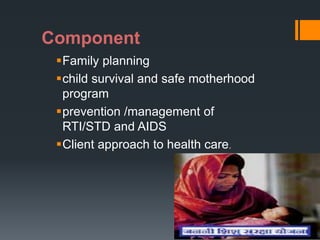
Component
Family planning
child survival and safe motherhood
program
prevention /management of
RTI/STD and AIDS
Client approach to health care.
RCH PACKAGE FOR VARIOUS
SERVICES
1. For maternal services (safe
motherhood )
2. For child services (child survival )
3. Reproductive health
4. Other services
-referral transport in case of obstetric
complication
-immunization and oral rehydration therapy
-prevention and control of vitamin A deficiency
in children.
integrated management of childhood illness.
district surveys for focused intervention to
reduce IMR and MMR.
New initiative undertaken during
phase of RCH are :
Setting up of blood storage units at FRUs.
Training of MBBS doctor in anesthetic skills
for emergency obstetric care at FRUs.
RCH 2
RCH 2 was started from 1st APRIL 2005
up to 2009. The RCH 2 vision articulates,
"improving access, use and quality of RCH
services , especially for the poor and
underserved population
AIM OF RCH 2
To reduce infant mortality rate
 to reduce maternal mortality rate
total fertility rate and to increase couple
protection rate and immunization coverage
specially in rural areas.
OBJECTIVES OF RCH2
* To improve the management
performance.
* To expand RCH services to tribal
areas also.
* To monitor and evaluate the services.
* To improve the quality , coverage and
effectiveness of the existing family
welfare services and essential RCH
services.
Components of RCH 2
Population stabilization
Maternal health
New born care
Child health
Adolescent health
Control of RTI / STIs
Urban health
Tribal health
Monitoring & evaluate
Other priority areas.
Integrated child
development
services
ICDS
The ICDS program was started on 2nd
October 1975 under the ministry of social &
women's welfare. The ICDS program was
initiated for the welfare of children &
development of human resources . It is
designed for both preventive &
development effort through a integrated
package services .
Objectives :-
1. Improve the nutritional & health status of
children in the age group of 0-6 yr.
2. To lay the foundation for proper
psychological , physical ,& social
development of the child .
3. Effective coordination & implementation of
policy among the various department.
4. To enhance the capability of the mother to
look after the normal health & nutrition &
health education .
5. To reduce the mortality, morbidity,
malnutrition & school drop out .
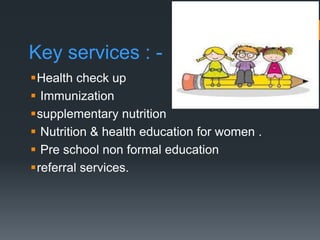
Health check up
 Immunization
supplementary nutrition
 Nutrition & health education for women .
 Pre school non formal education
referral services.
Key services : -
ICDS package services : -
1.For the child less then 3 year
2.For children in age group 3-6 Year
3.For adolescent girl 11-18 Year
4.For pregnant women
5.For nursing mother
6.Woman 15-45 Year of age
JSSY
[Janani shishu surakhsha yojna]
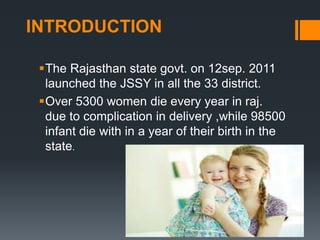
INTRODUCTION
The Rajasthan state govt. on 12sep. 2011
launched the JSSY in all the 33 district.
Over 5300 women die every year in raj.
due to complication in delivery ,while 98500
infant die with in a year of their birth in the
state.
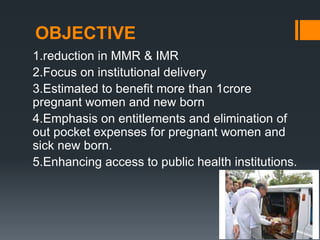
OBJECTIVE
1.reduction in MMR & IMR
2.Focus on institutional delivery
3.Estimated to benefit more than 1crore
pregnant women and new born
4.Emphasis on entitlements and elimination of
out pocket expenses for pregnant women and
sick new born.
5.Enhancing access to public health institutions.
Entitlement for pregnant
women
Fee delivery & C section.
Free drug & consumables before, during & till
6 months after the delivery .
Free diagnosis( blood, urine tests &
ultrasonography)
Free diet during stay
Free transport
Entitlements for sick newborn
till 30 days after birth
Free & zero expense treatment
Free drug & consumables
Free diagnosis
Free provision of blood
Free transport from home to health institution,
between health institution in case of referrals &
drop back home.
Exemption from all kinds of user charges.
Rch

Rch

  • 1.
  • 2.
  • 3.
    Introduction The reproductive andchild health program was formally launched by government of India on 15 Oct 1997. As per recommendation of international conference on population and development held in Cairo in 1994
  • 4.
    Definition A state inwhich people have the ability to reproduce and regulate their fertility are able to go through pregnancy and child birth , the outcome of pregnancy is successful in terms of maternal and infant survival and well being and couples are able to have sexual relation free of the fear of pregnancy and of contracting disease.
  • 5.
    Objective 1. To promotethe health of the mothers and children to ensure safe motherhood and child survival 2. The intermediate objective is to reduce IMR and MMR 3.The ultimate objective is population stabilization ,through responsible reproductive behaviour.
  • 6.
    RCH PROGRAMME PHASE1 Under the RCH Programme phase 1 , various provision were made to improve the status of maternal and child health. These include :- -provision of essential & emergency care -provision of equipment and drug kits to selected PHCs and selected FRUs in all districts -provision for additional ANM, Staff nurse and laboratory technicians for selected districts. -provision for 24hours delivery services at PHCs and CHCs
  • 7.
    Component Family planning child survivaland safe motherhood program prevention /management of RTI/STD and AIDS Client approach to health care.
  • 8.
    RCH PACKAGE FORVARIOUS SERVICES 1. For maternal services (safe motherhood ) 2. For child services (child survival ) 3. Reproductive health 4. Other services
  • 9.
    -referral transport incase of obstetric complication -immunization and oral rehydration therapy -prevention and control of vitamin A deficiency in children. integrated management of childhood illness. district surveys for focused intervention to reduce IMR and MMR.
  • 10.
    New initiative undertakenduring phase of RCH are : Setting up of blood storage units at FRUs. Training of MBBS doctor in anesthetic skills for emergency obstetric care at FRUs.
  • 11.
    RCH 2 RCH 2was started from 1st APRIL 2005 up to 2009. The RCH 2 vision articulates, "improving access, use and quality of RCH services , especially for the poor and underserved population
  • 12.
    AIM OF RCH2 To reduce infant mortality rate  to reduce maternal mortality rate total fertility rate and to increase couple protection rate and immunization coverage specially in rural areas.
  • 13.
    OBJECTIVES OF RCH2 *To improve the management performance. * To expand RCH services to tribal areas also. * To monitor and evaluate the services. * To improve the quality , coverage and effectiveness of the existing family welfare services and essential RCH services.
  • 14.
    Components of RCH2 Population stabilization Maternal health New born care Child health Adolescent health Control of RTI / STIs Urban health Tribal health Monitoring & evaluate Other priority areas.
  • 15.
  • 16.
    ICDS The ICDS programwas started on 2nd October 1975 under the ministry of social & women's welfare. The ICDS program was initiated for the welfare of children & development of human resources . It is designed for both preventive & development effort through a integrated package services .
  • 17.
    Objectives :- 1. Improvethe nutritional & health status of children in the age group of 0-6 yr. 2. To lay the foundation for proper psychological , physical ,& social development of the child . 3. Effective coordination & implementation of policy among the various department. 4. To enhance the capability of the mother to look after the normal health & nutrition & health education . 5. To reduce the mortality, morbidity, malnutrition & school drop out .
  • 18.
    Health check up Immunization supplementary nutrition  Nutrition & health education for women .  Pre school non formal education referral services. Key services : -
  • 19.
    ICDS package services: - 1.For the child less then 3 year 2.For children in age group 3-6 Year 3.For adolescent girl 11-18 Year 4.For pregnant women 5.For nursing mother 6.Woman 15-45 Year of age
  • 20.
  • 21.
    INTRODUCTION The Rajasthan stategovt. on 12sep. 2011 launched the JSSY in all the 33 district. Over 5300 women die every year in raj. due to complication in delivery ,while 98500 infant die with in a year of their birth in the state.
  • 22.
    OBJECTIVE 1.reduction in MMR& IMR 2.Focus on institutional delivery 3.Estimated to benefit more than 1crore pregnant women and new born 4.Emphasis on entitlements and elimination of out pocket expenses for pregnant women and sick new born. 5.Enhancing access to public health institutions.
  • 23.
    Entitlement for pregnant women Feedelivery & C section. Free drug & consumables before, during & till 6 months after the delivery . Free diagnosis( blood, urine tests & ultrasonography) Free diet during stay Free transport
  • 24.
    Entitlements for sicknewborn till 30 days after birth Free & zero expense treatment Free drug & consumables Free diagnosis Free provision of blood Free transport from home to health institution, between health institution in case of referrals & drop back home. Exemption from all kinds of user charges.