Traffic Light System
at
Arvind Active Wear &
Radnik Exports
End-Term Jury
Lean Manufacturing
By: Bittu Singh
Shubham Singh
Radhe Kumar 1
Introduction
• Traffic Light System ( TLS ) is a quality system
designed to identify problems and involve
help from management to solve the
problems.
• This is a “Pareto” based system which
focusing on solving the 3 highest occurring
faults on a daily basis.
• The system incorporates the key
fundamentals necessary to any system
successful :
1. Clear standards and tolerance.
2. The ability to track a problem back to the
source.
3. Reporting and process discipline.
• TLS will transit the vendor to a Right First
Time (RFT ) mentality and culture.
2
Style Introduction/Line Setup
• Technician & Production Supervisor take the operator through the details
of his/her operation and teach him/her to perform the operation in the
best effective way to achieve high efficiency with right quality.
• Operator should be educated on
– Purpose of this operation.
– Key quality problems that may expected from this operation.
– What impact it has on other operations and final quality of the
finished garment, if the operation is incorrect.
– All the important measurements, guide settings, trim off allowance,
needle size/type, SPI and any other relevant specifications.
• In-line Auditor ( Quality Monitor ) should prepare the “Style File” before
start the Pilot Run.
3
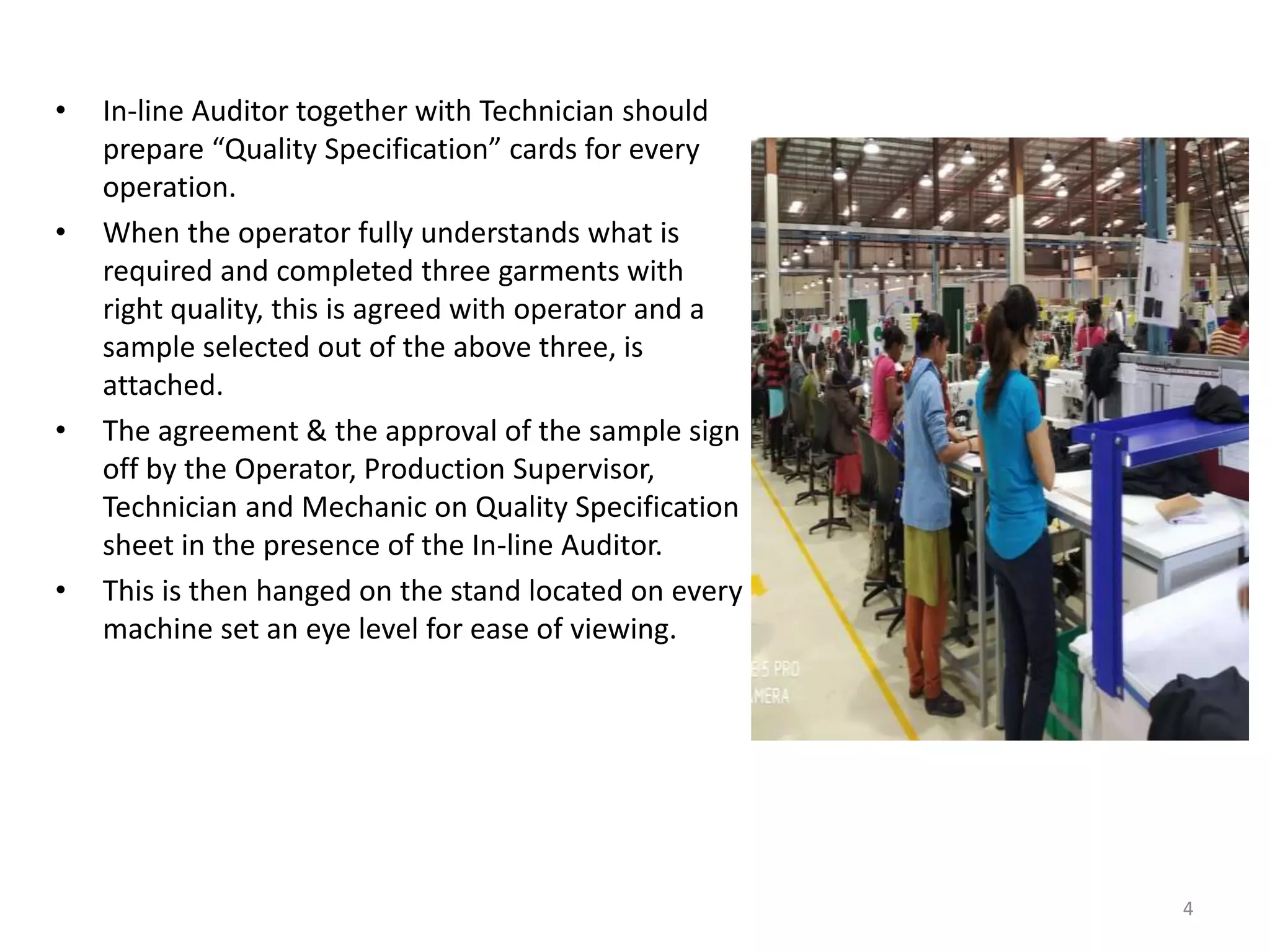
• In-line Auditor together with Technician should
prepare “Quality Specification” cards for every
operation.
• When the operator fully understands what is
required and completed three garments with
right quality, this is agreed with operator and a
sample selected out of the above three, is
attached.
• The agreement & the approval of the sample sign
off by the Operator, Production Supervisor,
Technician and Mechanic on Quality Specification
sheet in the presence of the In-line Auditor.
• This is then hanged on the stand located on every
machine set an eye level for ease of viewing.
4
In-Line Audit( Procedure/Rules of TLS )
• In-line Auditor ( Quality Monitor ) starts the day work with “Patrol Inspection”
of which he/she checks 3 components / pieces from each and every operation.
• The Patrol Inspection should be completed within fifteen ( 15 ) minutes of
starting the day.
• Symbols of Patrol Inspection
√ - Ok, Production should start
X– Change Machine, Machine needs maintenance
- - There is no fabric placed under the pressure foot
• In-line Auditor turns the Traffic Light Cards ( TL Cards ) into respective colours
according to the result of the Patrol Inspection.
• Colour Code :
Zero defects - Green
One defect - Yellow
Two or more defects - Red
5
• Actions:
• Green Appreciate & ask to continue the
operation
• Yellow Inform to operator & Production
Supervisor to increase the attention &
the level of her own inspection
• Red Stop the operation. Inform to
Operator, Production Supervisor to
identify the problem & solve it with the
help of Mechanic & Technician.
• The result is marked on the Traffic Light Chart or Daily In-line Audit Sheet.
• In-line Auditor makes the normal random audit route as follows by
considering the 3 highest defect making operations / Critical operations
on the previous day.
6
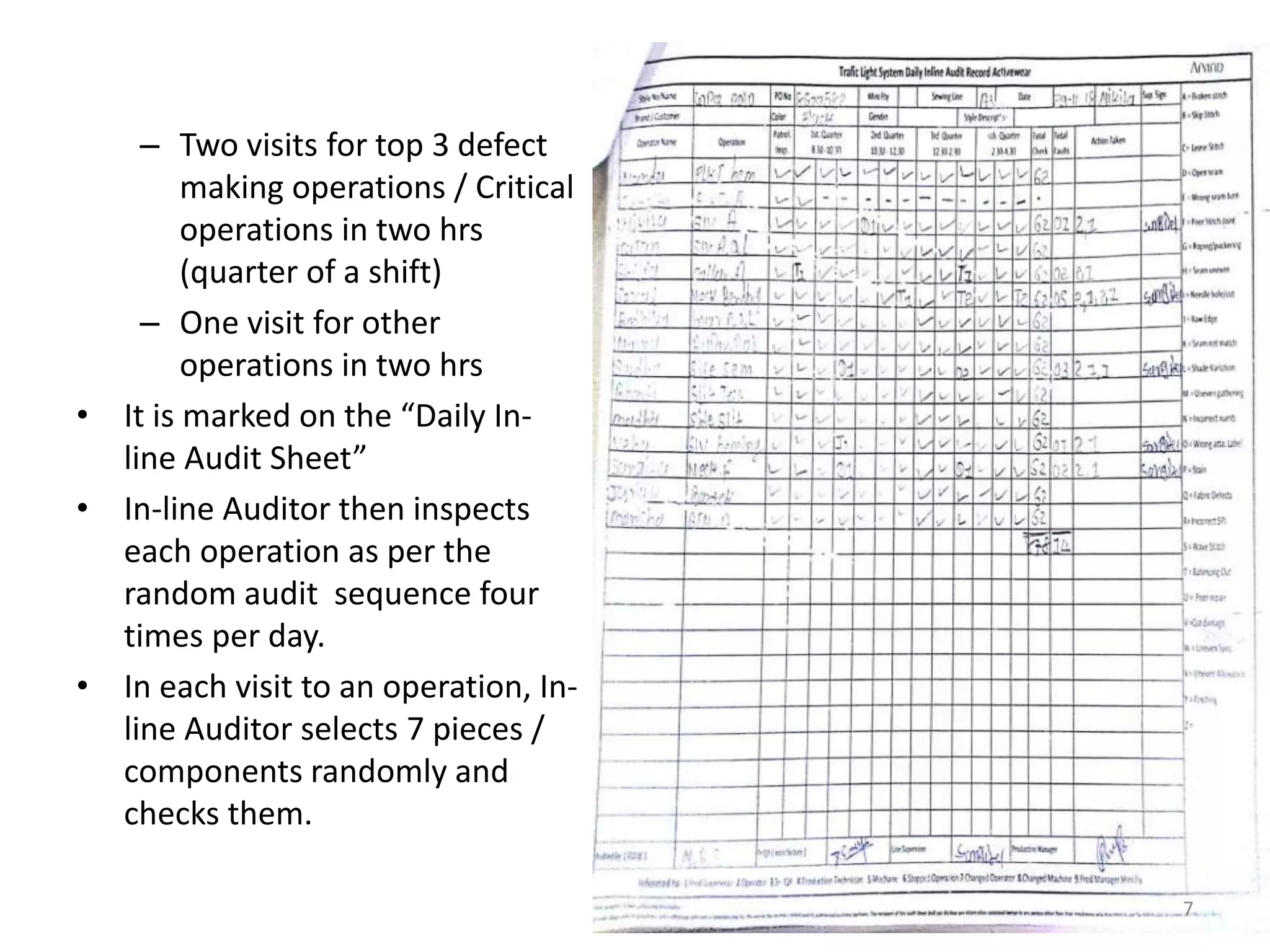
– Two visits for top 3 defect
making operations / Critical
operations in two hrs
(quarter of a shift)
– One visit for other
operations in two hrs
• It is marked on the “Daily In-
line Audit Sheet”
• In-line Auditor then inspects
each operation as per the
random audit sequence four
times per day.
• In each visit to an operation, In-
line Auditor selects 7 pieces /
components randomly and
checks them.
7
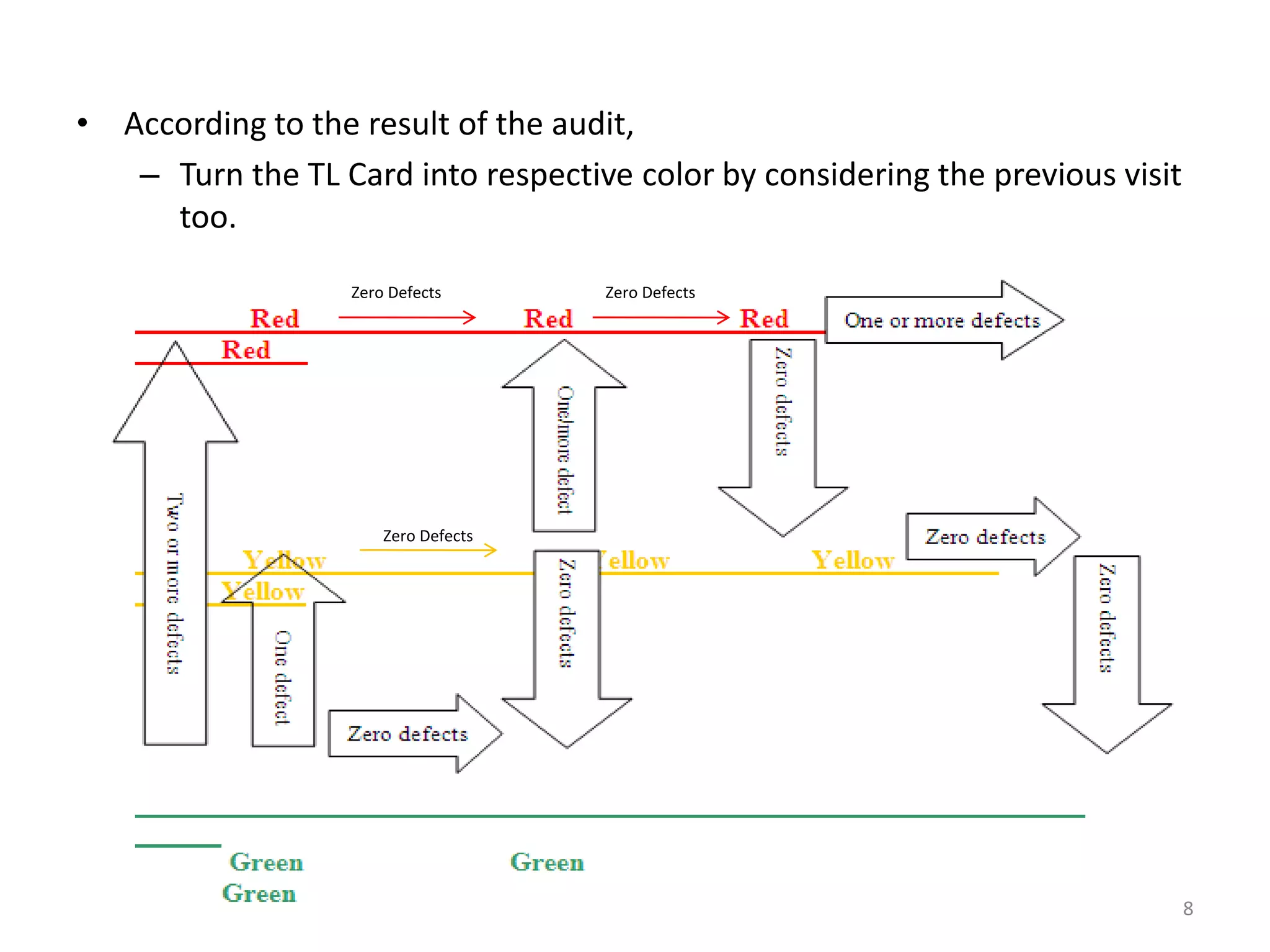
• According to the result of the audit,
– Turn the TL Card into respective color by considering the previous visit
too.
Zero Defects
Zero Defects Zero Defects
8
• The Traffic Light Chart ( TL Chart ) is updated with the color given
for the visit.
• The relevant record is made on the “Daily In-line Audit sheet” with
fault code.
– No. defects out of 7 checked components, Mark as “  ”.
• Actions taken for Red dots by the Supervisor / Technician and the
team are noted down on the reverse side of the “Daily In-line Audit
Sheet”.
• If any operation gets a Red dot, In-line Auditor makes a 2nd visit to
audit the relevant operation again in the same quarter.
• At the end of the day, In-line Auditor summarizes the quality
performance of the operation and it is marked on the “In-line
Quality Performance” board hanged in front of the line.
• The top three (3) operations that made highest no. of defectives,
are marked together with relevant fault code on the “Daily In-line
Audit Sheet” and “RFT Meeting Minute” as inputs for the RFT
meeting.
9
• In-line Auditor provides following information
– No. of Red dots for the shift / day with fault code.
– No. of defectives found & no of components audited at the In-line
Audit.
– Top three operations making highest no of defectives with fault codes
as per the In-line audit result.
– Top three operations making highest no. of defectives with fault codes
as per the End-line inspection result.
– No. of seconds garments
10
End Line Inspection
• End-line checker carries out 100% garment inspection at the end of
the line.
• In-line Auditor provide all necessary measurements ( measurement
strips for the checking table ), “How to measure” sheet, approved
garment spec, Quality Specification sheet with inspection guidance,
Inspection procedure, Reject Analysis Record sheet, Label
information.
• If End-checker finds any defective garment, the place of the defect
is marked and sends back to relevant operator through In-line
Auditor for repairing.
• The record is made against the relevant operation with fault code
on the “Reject Analysis Record” using Five-Bar-Gate method.
• End checker informs to In-line Auditor when no. of defectives for a
specific operation reaches to 5 and the In-line auditor informs it to
Production Supervisor & Quality Supervisor to take corrective
action.
11
• The action taken is written down on the “Action Taken for Defect
Makers” sheet ( reverse side of the “Reject Analysis Record” ) by
Production Supervisor.
• If the defective garment is non-repairable, In-line Auditor seconds
the garment after consulting Quality Supervisor & Quality Executive
if necessary and record is made on the “Reject Analysis Record”
• The Seconded garments are kept under In-line Auditor custody in
the demarcated area until they are handed over to QA dept. at the
end of the shift / day.
• After finishing the necessary calculations & marking the top three
operation made highest no. of defectives , End-checker hands over
the “Reject Analysis Record” to In-line Auditor at the end of the
shift / day.
12
TRAFFIC LIGHT SYSTEM
IMPLEMENTED IN THE FACTORY
DURING APPAREL INTERNSHIP
13
TRAFFIC LIGHT SYSTEM OPERATION
PROCEDURE
The QC will check every operation on the line
(manual or sewing) in a random order.
The QC only examines the work for the
operation specified on the clipboard.
If any of the garments are rejected then the
bundle is considered reject and is held back.
The QC will instruct the operator to re-check all
the garments within that bundle and repair any
garments that are not to the correct standard
for that operation.
14
 The TRAFFIC LIGHT CHART & DAILY IN-LINE INSPECTION REPORT
should be updated using the correct fault code letter and colour
sequence identification before leaving the operation.
Defect
found
Colou
r code
Frequency
of QC visit
Action required
None Green Once per
hour
None
One Yellow Twice per
hour
Inform Operator Supervisor, Line Chief Production
Manager to make necessary correction of the process.
Two or
more
Red 3 times per
hour
1. Show the correction method to the operator.
2. Involve the mechanic to solve sewing machine
problem.
3. If Operator cannot reach the quality level of the
process, sewing operator change is required.
4. If sewing machine trouble cannot be solved, need to15
TRAFFIC
LIGHT
SYSTEM
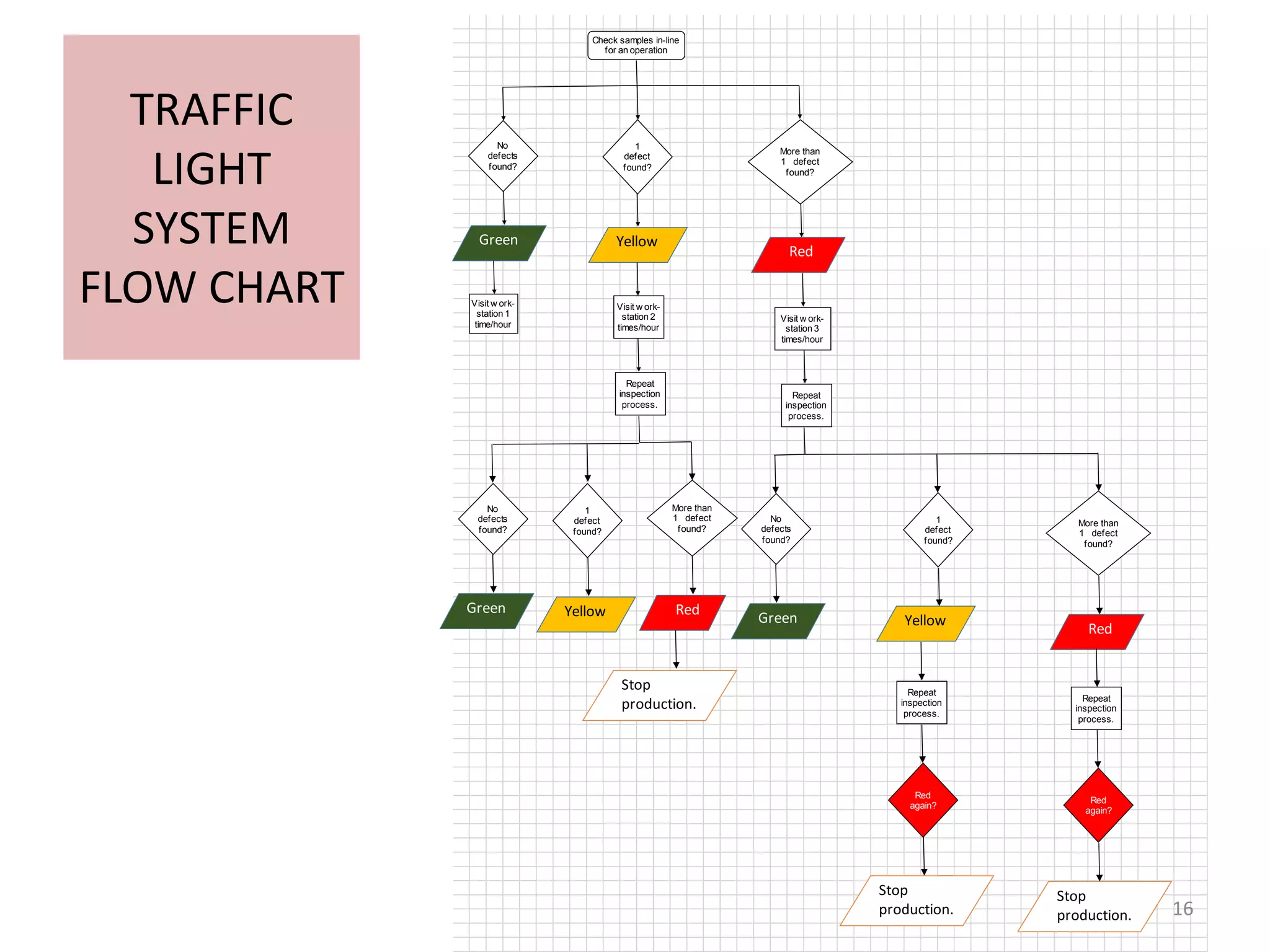
FLOW CHART
Check samples in-line
for an operation
No
defects
found?
Green
1
defect
found?
More than
1 defect
found?
Yellow
Red
Visit w ork-
station 2
times/hour
Visit w ork-
station 3
times/hour
Repeat
inspection
process.
Repeat
inspection
process.
No
defects
found?
1
defect
found?
More than
1 defect
found?
No
defects
found?
1
defect
found?
More than
1 defect
found?
Green
GreenYellow
Yellow
Red
Red
Repeat
inspection
process.
Repeat
inspection
process.
Stop
production.
Red
again?
Red
again?
Stop
production.
Stop
production.
Visit w ork-
station 1
time/hour
16
TRAFFIC
LIGHT
SYSTEM
FORMAT
Day 1-
Day 2-
Day 3-
7pieces Colour No defect 1defect
2nd Code
Defect Codes :- 1 5
2 6
3 7
4 8
Day 1 1 2 3 4 1 2 3 4 1 2 3 4 1 2 3 4
5 6 7 8 5 6 7 8 5 6 7 8 5 6 7 8
Day 2 1 2 3 4 1 2 3 4 1 2 3 4 1 2 3 4
5 6 7 8 5 6 7 8 5 6 7 8 5 6 7 8
Day 3 1 2 3 4 1 2 3 4 1 2 3 4 1 2 3 4
5 6 7 8 5 6 7 8 5 6 7 8 5 6 7 8
Day 1 1 2 3 4 1 2 3 4 1 2 3 4 1 2 3 4
5 6 7 8 5 6 7 8 5 6 7 8 5 6 7 8
Day 2 1 2 3 4 1 2 3 4 1 2 3 4 1 2 3 4
5 6 7 8 5 6 7 8 5 6 7 8 5 6 7 8
Day 3 1 2 3 4 1 2 3 4 1 2 3 4 1 2 3 4
5 6 7 8 5 6 7 8 5 6 7 8 5 6 7 8
1:30- 2:00
Time
Standard Sample Size
2:00- 3:00 3:00- 4:00 4:00- 5:0012:30- 1:00
Time
Traffic Light Audit System
8:30- 9:30 9:30- 10:30 10:30- 11:30 11:30- 12:30
Instruction :- Refer flow chart for inspection procedure.
Floor
Line
Operation
Operator
More than 1defect
Incharge :-
Day 1 Day 2 Day 3Signature of Quality
17
TRAFFIC
LIGHT
SYSTEM
FORMAT
18
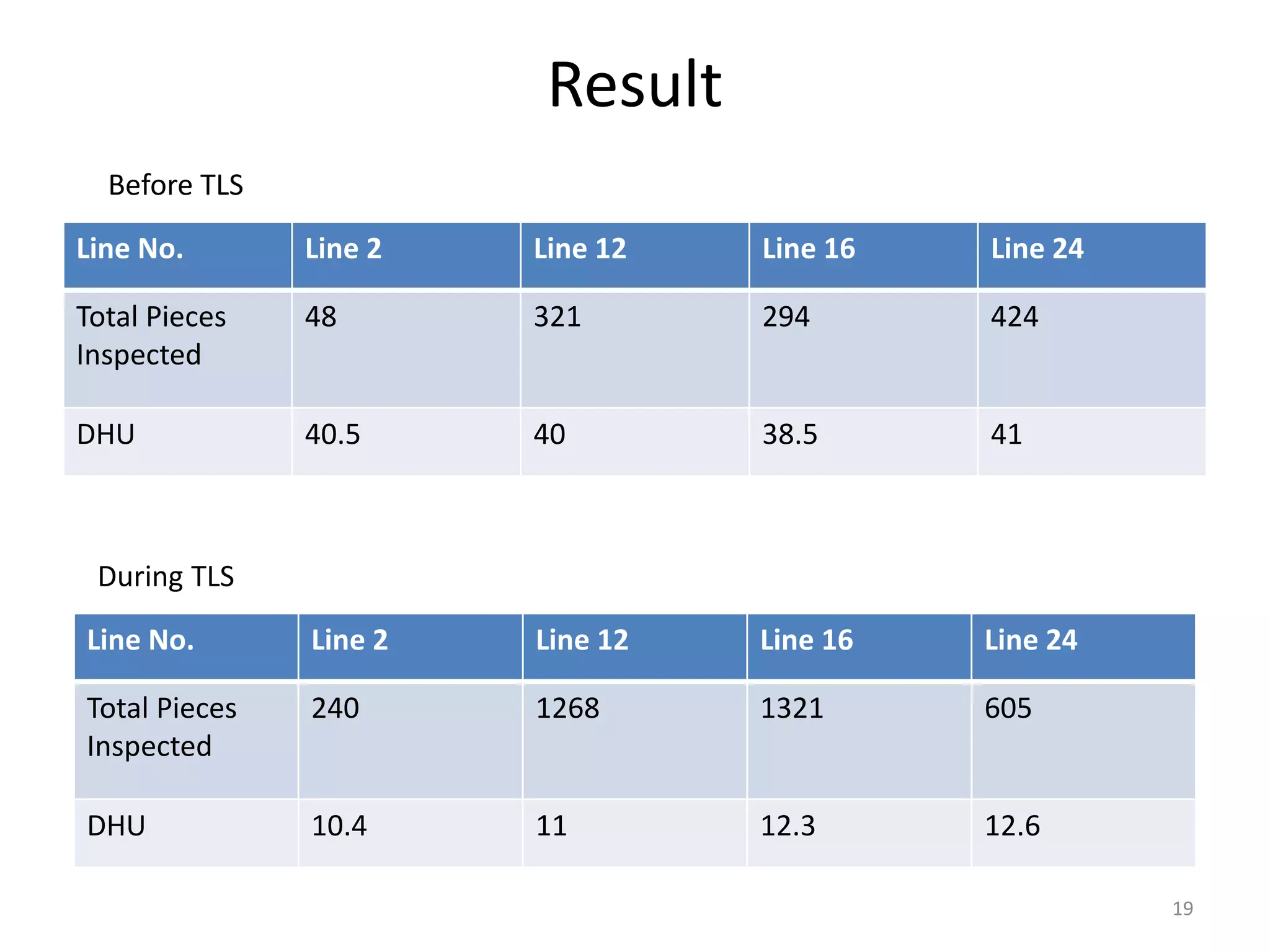
Result
Line No. Line 2 Line 12 Line 16 Line 24
Total Pieces
Inspected
48 321 294 424
DHU 40.5 40 38.5 41
Before TLS
During TLS
Line No. Line 2 Line 12 Line 16 Line 24
Total Pieces
Inspected
240 1268 1321 605
DHU 10.4 11 12.3 12.6
19
Synopsis
• Objective – To monitor the level of quality in
sewing lines through a different approach to
Traffic Light System
• Scope - Every garment factory aims to achieve
the minimum DHU level possible. Thus, such a
TLS system can prove to be a boon for apparel
manufacturing.
20
Synopsis - Background
• Quality department has fixed number of
manpower.
• The ratio of Quality Control personnel who
conduct inspection for TLS to the number of lines
is generally 1:3.
• 1 quality inspector is allotted for every 3 lines.
• It becomes very difficult for the Quality Control
personnel to visit each and every machine in the
given time limits according to the prescribed
system of TLS.
21
Synopsis - Background
• Thus, to fulfill their duty, quality inspectors tend
to fill the formats without proper inspection
leading to incorrect DHU level of the lines.
• So instead of going to every workstation,
inspection can be carried out through a 2-way
strategy.
• 1 – Training the operators to evaluate their work
themselves after every certain period of time.
With responsibility, workers feel empowered and
tend to become process owners.
22
Synopsis - Background
• The operators should themselves place the
appropriate flag on their machines.
• 2 – The QC should keep a direct eye on the
number of defects of every operation that turns
up at the in-line & end-line inspection table.
• The QC can then find the most defect generating
operations through processes 1 & 2. Then, he will
pay close attention to those operations and help
them reduce the number of defects.
23
Synopsis
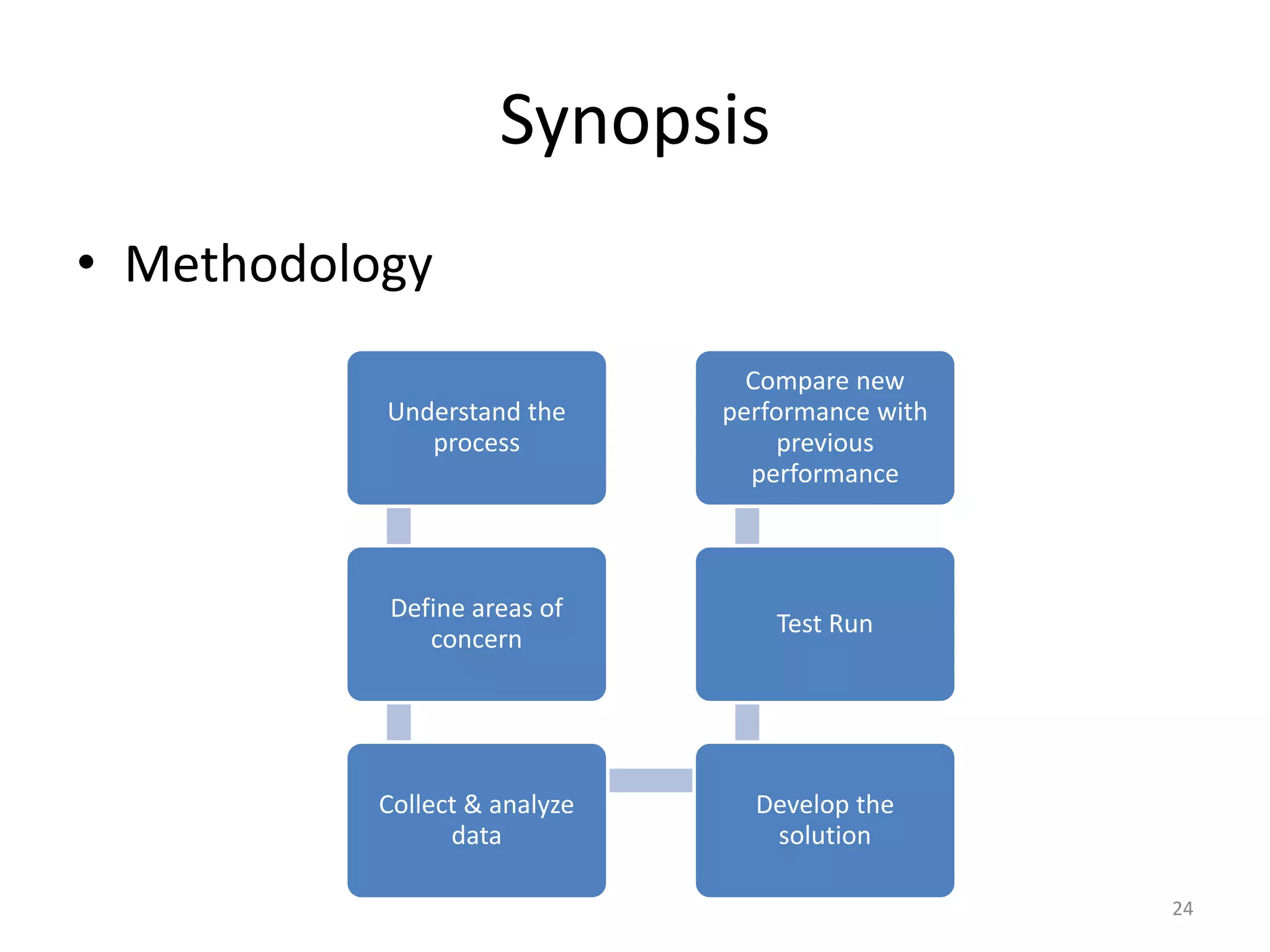
• Methodology
Understand the
process
Define areas of
concern
Collect & analyze
data
Develop the
solution
Test Run
Compare new
performance with
previous
performance
24
Synopsis
• Deliverable – A new framework of TLS which
helps to reduce the work-pressure on quality
department and improving the level of quality
in sewing lines at the same time.
25
Thank You!
26

Traffic Light System

  • 1.
    Traffic Light System at ArvindActive Wear & Radnik Exports End-Term Jury Lean Manufacturing By: Bittu Singh Shubham Singh Radhe Kumar 1
  • 2.
    Introduction • Traffic LightSystem ( TLS ) is a quality system designed to identify problems and involve help from management to solve the problems. • This is a “Pareto” based system which focusing on solving the 3 highest occurring faults on a daily basis. • The system incorporates the key fundamentals necessary to any system successful : 1. Clear standards and tolerance. 2. The ability to track a problem back to the source. 3. Reporting and process discipline. • TLS will transit the vendor to a Right First Time (RFT ) mentality and culture. 2
  • 3.
    Style Introduction/Line Setup •Technician & Production Supervisor take the operator through the details of his/her operation and teach him/her to perform the operation in the best effective way to achieve high efficiency with right quality. • Operator should be educated on – Purpose of this operation. – Key quality problems that may expected from this operation. – What impact it has on other operations and final quality of the finished garment, if the operation is incorrect. – All the important measurements, guide settings, trim off allowance, needle size/type, SPI and any other relevant specifications. • In-line Auditor ( Quality Monitor ) should prepare the “Style File” before start the Pilot Run. 3
  • 4.
    • In-line Auditortogether with Technician should prepare “Quality Specification” cards for every operation. • When the operator fully understands what is required and completed three garments with right quality, this is agreed with operator and a sample selected out of the above three, is attached. • The agreement & the approval of the sample sign off by the Operator, Production Supervisor, Technician and Mechanic on Quality Specification sheet in the presence of the In-line Auditor. • This is then hanged on the stand located on every machine set an eye level for ease of viewing. 4
  • 5.
    In-Line Audit( Procedure/Rulesof TLS ) • In-line Auditor ( Quality Monitor ) starts the day work with “Patrol Inspection” of which he/she checks 3 components / pieces from each and every operation. • The Patrol Inspection should be completed within fifteen ( 15 ) minutes of starting the day. • Symbols of Patrol Inspection √ - Ok, Production should start X– Change Machine, Machine needs maintenance - - There is no fabric placed under the pressure foot • In-line Auditor turns the Traffic Light Cards ( TL Cards ) into respective colours according to the result of the Patrol Inspection. • Colour Code : Zero defects - Green One defect - Yellow Two or more defects - Red 5
  • 6.
    • Actions: • GreenAppreciate & ask to continue the operation • Yellow Inform to operator & Production Supervisor to increase the attention & the level of her own inspection • Red Stop the operation. Inform to Operator, Production Supervisor to identify the problem & solve it with the help of Mechanic & Technician. • The result is marked on the Traffic Light Chart or Daily In-line Audit Sheet. • In-line Auditor makes the normal random audit route as follows by considering the 3 highest defect making operations / Critical operations on the previous day. 6
  • 7.
    – Two visitsfor top 3 defect making operations / Critical operations in two hrs (quarter of a shift) – One visit for other operations in two hrs • It is marked on the “Daily In- line Audit Sheet” • In-line Auditor then inspects each operation as per the random audit sequence four times per day. • In each visit to an operation, In- line Auditor selects 7 pieces / components randomly and checks them. 7
  • 8.
    • According tothe result of the audit, – Turn the TL Card into respective color by considering the previous visit too. Zero Defects Zero Defects Zero Defects 8
  • 9.
    • The TrafficLight Chart ( TL Chart ) is updated with the color given for the visit. • The relevant record is made on the “Daily In-line Audit sheet” with fault code. – No. defects out of 7 checked components, Mark as “  ”. • Actions taken for Red dots by the Supervisor / Technician and the team are noted down on the reverse side of the “Daily In-line Audit Sheet”. • If any operation gets a Red dot, In-line Auditor makes a 2nd visit to audit the relevant operation again in the same quarter. • At the end of the day, In-line Auditor summarizes the quality performance of the operation and it is marked on the “In-line Quality Performance” board hanged in front of the line. • The top three (3) operations that made highest no. of defectives, are marked together with relevant fault code on the “Daily In-line Audit Sheet” and “RFT Meeting Minute” as inputs for the RFT meeting. 9
  • 10.
    • In-line Auditorprovides following information – No. of Red dots for the shift / day with fault code. – No. of defectives found & no of components audited at the In-line Audit. – Top three operations making highest no of defectives with fault codes as per the In-line audit result. – Top three operations making highest no. of defectives with fault codes as per the End-line inspection result. – No. of seconds garments 10
  • 11.
    End Line Inspection •End-line checker carries out 100% garment inspection at the end of the line. • In-line Auditor provide all necessary measurements ( measurement strips for the checking table ), “How to measure” sheet, approved garment spec, Quality Specification sheet with inspection guidance, Inspection procedure, Reject Analysis Record sheet, Label information. • If End-checker finds any defective garment, the place of the defect is marked and sends back to relevant operator through In-line Auditor for repairing. • The record is made against the relevant operation with fault code on the “Reject Analysis Record” using Five-Bar-Gate method. • End checker informs to In-line Auditor when no. of defectives for a specific operation reaches to 5 and the In-line auditor informs it to Production Supervisor & Quality Supervisor to take corrective action. 11
  • 12.
    • The actiontaken is written down on the “Action Taken for Defect Makers” sheet ( reverse side of the “Reject Analysis Record” ) by Production Supervisor. • If the defective garment is non-repairable, In-line Auditor seconds the garment after consulting Quality Supervisor & Quality Executive if necessary and record is made on the “Reject Analysis Record” • The Seconded garments are kept under In-line Auditor custody in the demarcated area until they are handed over to QA dept. at the end of the shift / day. • After finishing the necessary calculations & marking the top three operation made highest no. of defectives , End-checker hands over the “Reject Analysis Record” to In-line Auditor at the end of the shift / day. 12
  • 13.
    TRAFFIC LIGHT SYSTEM IMPLEMENTEDIN THE FACTORY DURING APPAREL INTERNSHIP 13
  • 14.
    TRAFFIC LIGHT SYSTEMOPERATION PROCEDURE The QC will check every operation on the line (manual or sewing) in a random order. The QC only examines the work for the operation specified on the clipboard. If any of the garments are rejected then the bundle is considered reject and is held back. The QC will instruct the operator to re-check all the garments within that bundle and repair any garments that are not to the correct standard for that operation. 14
  • 15.
     The TRAFFICLIGHT CHART & DAILY IN-LINE INSPECTION REPORT should be updated using the correct fault code letter and colour sequence identification before leaving the operation. Defect found Colou r code Frequency of QC visit Action required None Green Once per hour None One Yellow Twice per hour Inform Operator Supervisor, Line Chief Production Manager to make necessary correction of the process. Two or more Red 3 times per hour 1. Show the correction method to the operator. 2. Involve the mechanic to solve sewing machine problem. 3. If Operator cannot reach the quality level of the process, sewing operator change is required. 4. If sewing machine trouble cannot be solved, need to15
  • 16.
    TRAFFIC LIGHT SYSTEM FLOW CHART Check samplesin-line for an operation No defects found? Green 1 defect found? More than 1 defect found? Yellow Red Visit w ork- station 2 times/hour Visit w ork- station 3 times/hour Repeat inspection process. Repeat inspection process. No defects found? 1 defect found? More than 1 defect found? No defects found? 1 defect found? More than 1 defect found? Green GreenYellow Yellow Red Red Repeat inspection process. Repeat inspection process. Stop production. Red again? Red again? Stop production. Stop production. Visit w ork- station 1 time/hour 16
  • 17.
    TRAFFIC LIGHT SYSTEM FORMAT Day 1- Day 2- Day3- 7pieces Colour No defect 1defect 2nd Code Defect Codes :- 1 5 2 6 3 7 4 8 Day 1 1 2 3 4 1 2 3 4 1 2 3 4 1 2 3 4 5 6 7 8 5 6 7 8 5 6 7 8 5 6 7 8 Day 2 1 2 3 4 1 2 3 4 1 2 3 4 1 2 3 4 5 6 7 8 5 6 7 8 5 6 7 8 5 6 7 8 Day 3 1 2 3 4 1 2 3 4 1 2 3 4 1 2 3 4 5 6 7 8 5 6 7 8 5 6 7 8 5 6 7 8 Day 1 1 2 3 4 1 2 3 4 1 2 3 4 1 2 3 4 5 6 7 8 5 6 7 8 5 6 7 8 5 6 7 8 Day 2 1 2 3 4 1 2 3 4 1 2 3 4 1 2 3 4 5 6 7 8 5 6 7 8 5 6 7 8 5 6 7 8 Day 3 1 2 3 4 1 2 3 4 1 2 3 4 1 2 3 4 5 6 7 8 5 6 7 8 5 6 7 8 5 6 7 8 1:30- 2:00 Time Standard Sample Size 2:00- 3:00 3:00- 4:00 4:00- 5:0012:30- 1:00 Time Traffic Light Audit System 8:30- 9:30 9:30- 10:30 10:30- 11:30 11:30- 12:30 Instruction :- Refer flow chart for inspection procedure. Floor Line Operation Operator More than 1defect Incharge :- Day 1 Day 2 Day 3Signature of Quality 17
  • 18.
  • 19.
    Result Line No. Line2 Line 12 Line 16 Line 24 Total Pieces Inspected 48 321 294 424 DHU 40.5 40 38.5 41 Before TLS During TLS Line No. Line 2 Line 12 Line 16 Line 24 Total Pieces Inspected 240 1268 1321 605 DHU 10.4 11 12.3 12.6 19
  • 20.
    Synopsis • Objective –To monitor the level of quality in sewing lines through a different approach to Traffic Light System • Scope - Every garment factory aims to achieve the minimum DHU level possible. Thus, such a TLS system can prove to be a boon for apparel manufacturing. 20
  • 21.
    Synopsis - Background •Quality department has fixed number of manpower. • The ratio of Quality Control personnel who conduct inspection for TLS to the number of lines is generally 1:3. • 1 quality inspector is allotted for every 3 lines. • It becomes very difficult for the Quality Control personnel to visit each and every machine in the given time limits according to the prescribed system of TLS. 21
  • 22.
    Synopsis - Background •Thus, to fulfill their duty, quality inspectors tend to fill the formats without proper inspection leading to incorrect DHU level of the lines. • So instead of going to every workstation, inspection can be carried out through a 2-way strategy. • 1 – Training the operators to evaluate their work themselves after every certain period of time. With responsibility, workers feel empowered and tend to become process owners. 22
  • 23.
    Synopsis - Background •The operators should themselves place the appropriate flag on their machines. • 2 – The QC should keep a direct eye on the number of defects of every operation that turns up at the in-line & end-line inspection table. • The QC can then find the most defect generating operations through processes 1 & 2. Then, he will pay close attention to those operations and help them reduce the number of defects. 23
  • 24.
    Synopsis • Methodology Understand the process Defineareas of concern Collect & analyze data Develop the solution Test Run Compare new performance with previous performance 24
  • 25.
    Synopsis • Deliverable –A new framework of TLS which helps to reduce the work-pressure on quality department and improving the level of quality in sewing lines at the same time. 25
  • 26.