BIOETHANOL PRODUCTION
Delivered by
Shruti Pathania
F-12-24-D
Bioethanol production
Delivered by
Shruti Pathania
F-12-24-D
INTRODUCTION
NOT NECESSARILY A NEW IDEA…
ā€œWe can get fuel from fruit, from
that shrub by the roadside, or from
apples, weeds, saw-dust—almost
anything! There is fuel in every bit
of vegetable matter that can be
fermented … And it remains for
someone to find out how this fuel
can be produced commercially—
better fuel at a cheaper price than
we know now.ā€
~ Henry Ford, 1925
ļƒ’ In 1980, Brazilian government launched the
Proalcohol program that ethanol made a come
back in market.
ļƒ’ In 1973 and 1979 the Carter administration in
USA established government policies to provide
alternative energy sources.
FUEL PROPERTIES OF BIOETHANOL
ļƒ’ Bioethanol is a liquid biofuel (ETOH), colorless,
ļƒ’ Renewable bio-based resource and flammable
oxygenated hydrocarbons
ļƒ’ Molecular formula of C2H5OH
ļƒ’ Ethanol may be of :
ļƒ’ Synthetic alcohol and Agricultural alcohol
ļƒ’ Anhydrous alcohol and hydrous alcohol
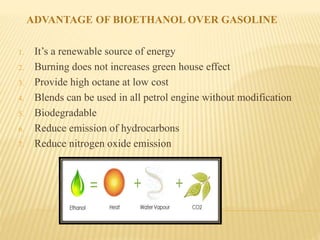
ADVANTAGE OF BIOETHANOL OVER GASOLINE
1. It’s a renewable source of energy
2. Burning does not increases green house effect
3. Provide high octane at low cost
4. Blends can be used in all petrol engine without modification
5. Biodegradable
6. Reduce emission of hydrocarbons
7. Reduce nitrogen oxide emission
INDUSTRIALTECHNOLOGY
FOR BIOETHANOL
PRODUCTION
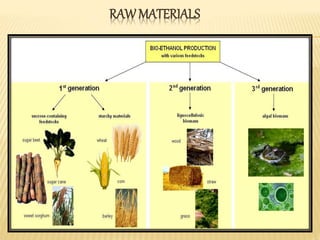
RAWMATERIALS
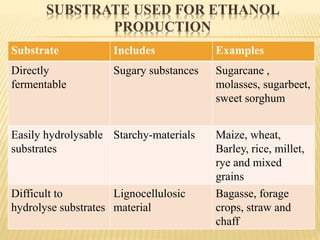
SUBSTRATE USED FOR ETHANOL
PRODUCTION
Substrate Includes Examples
Directly
fermentable
Sugary substances Sugarcane ,
molasses, sugarbeet,
sweet sorghum
Easily hydrolysable
substrates
Starchy-materials Maize, wheat,
Barley, rice, millet,
rye and mixed
grains
Difficult to
hydrolyse substrates
Lignocellulosic
material
Bagasse, forage
crops, straw and
chaff
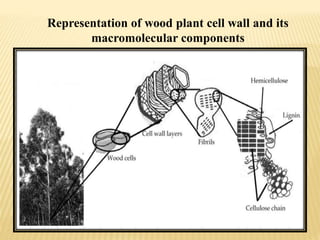
Representation of wood plant cell wall and its
macromolecular components
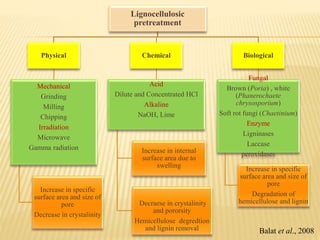
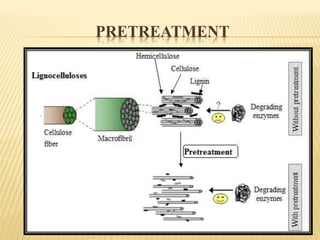
Lignocellulosic
pretreatment
Physical
Mechanical
Grinding
Milling
Chipping
Irradiation
Microwave
Gamma radiation
Increase in specific
surface area and size of
pore
Decrease in crystalinity
Chemical
Acid
Dilute and Concentrated HCl
Alkaline
NaOH, Lime
Increase in internal
surface area due to
swelling
Decraese in crystalinity
and pororsity
Hemicellulose degredtion
and lignin removal
Biological
Fungal
Brown (Poria) , white
(Phanerochaete
chrysosporium)
Soft rot fungi (Chaetinium)
Enzyme
Ligninases
Laccase
peroxidases
Increase in specific
surface area and size of
pore
Degradation of
hemicellulose and lignin
Balat et al., 2008
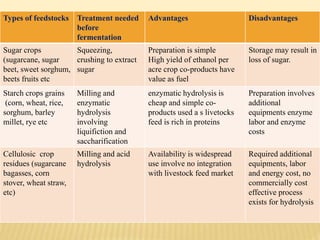
Types of feedstocks Treatment needed
before
fermentation
Advantages Disadvantages
Sugar crops
(sugarcane, sugar
beet, sweet sorghum,
beets fruits etc
Squeezing,
crushing to extract
sugar
Preparation is simple
High yield of ethanol per
acre crop co-products have
value as fuel
Storage may result in
loss of sugar.
Starch crops grains
(corn, wheat, rice,
sorghum, barley
millet, rye etc
Milling and
enzymatic
hydrolysis
involving
liquifiction and
saccharification
enzymatic hydrolysis is
cheap and simple co-
products used a s livetocks
feed is rich in proteins
Preparation involves
additional
equipments enzyme
labor and enzyme
costs
Cellulosic crop
residues (sugarcane
bagasses, corn
stover, wheat straw,
etc)
Milling and acid
hydrolysis
Availability is widespread
use involve no integration
with livestock feed market
Required additional
equipments, labor
and energy cost, no
commercially cost
effective process
exists for hydrolysis
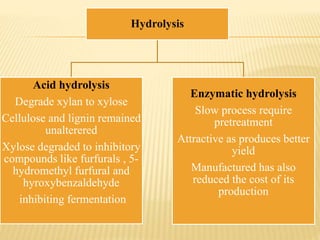
Hydrolysis
Acid hydrolysis
Degrade xylan to xylose
Cellulose and lignin remained
unalterered
Xylose degraded to inhibitory
compounds like furfurals , 5-
hydromethyl furfural and
hyroxybenzaldehyde
inhibiting fermentation
Enzymatic hydrolysis
Slow process require
pretreatment
Attractive as produces better
yield
Manufactured has also
reduced the cost of its
production
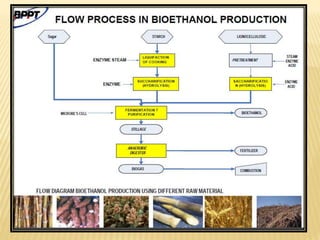
PRETREATMENT
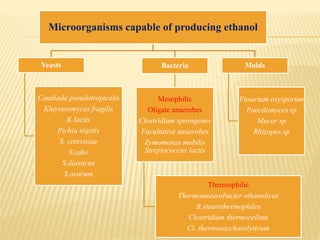
Microorganisms capable of producing ethanol
Yeasts
Candiada pseudotropicalis
Kluyveromyces fragilis
K.lactis
Pichia stipitis
S. cerevisiae
S.sake
S.diasticus
S.ovarum
Bacteria
Mesophilic
Oligate anaerobes
Clostridium sporogenes
Facultative anaerobes
Zymomonas mobilis
Streptococcus lactis
Thermophilic
Thermoanaerobacter ethanolicus
B.stearothermophiles
Clostridium thermocellum
Cl. thermosaccharolyticum
Molds
Fusarium oxysporum
Paecilomyces sp
Mucor sp
Rhizopus sp
FERMENTATION
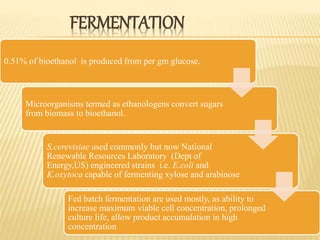
0.51% of bioethanol is produced from per gm glucose.
Microorganisms termed as ethanologens convert sugars
from biomass to bioethanol.
S.cerevisiae used commonly but now National
Renewable Resources Laboratory (Dept of
Energy,US) engineered strains i.e. E.coli and
K.oxytoca capable of fermenting xylose and arabinose
Fed batch fermentation are used mostly, as ability to
increase maximum viable cell concentration, prolonged
culture life, allow product accumulation in high
concentration
RECOVERY OF PRODUCTS
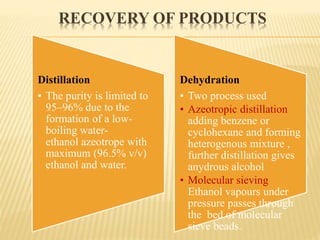
Distillation
• The purity is limited to
95–96% due to the
formation of a low-
boiling water-
ethanol azeotrope with
maximum (96.5% v/v)
ethanol and water.
Dehydration
• Two process used
• Azeotropic distillation
adding benzene or
cyclohexane and forming
heterogenous mixture ,
further distillation gives
anydrous alcohol
• Molecular sieving
Ethanol vapours under
pressure passes through
the bed of molecular
sieve beads.
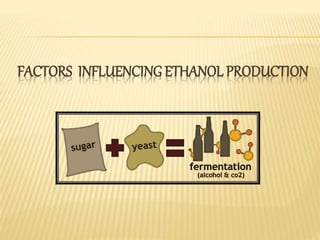
FACTORS INFLUENCING ETHANOL PRODUCTION
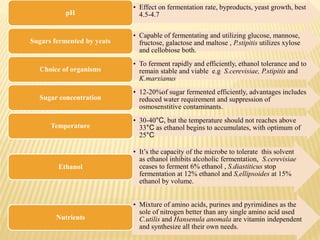
• Effect on fermentation rate, byproducts, yeast growth, best
4.5-4.7pH
• Capable of fermentating and utilizing glucose, mannose,
fructose, galactose and maltose , P.stipitis utilizes xylose
and cellobiose both.
Sugars fermented by yeats
• To ferment rapidly and efficiently, ethanol tolerance and to
remain stable and viable e.g S.cerevisiae, P.stipitis and
K.marxianus
Choice of organisms
• 12-20%of sugar fermented efficiently, advantages includes
reduced water requirement and suppression of
osmosenstitive contaminants.
Sugar concentration
• 30-40°C, but the temperature should not reaches above
33°C as ethanol begins to accumulates, with optimum of
25°C
Temperature
• It’s the capacity of the microbe to tolerate this solvent
as ethanol inhibits alcoholic fermentation, S.cerevisiae
ceases to ferment 6% ethanol , S.diastiticus stop
fermentation at 12% ethanol and S,ellipsoides at 15%
ethanol by volume.
Ethanol
• Mixture of amino acids, purines and pyrimidines as the
sole of nitrogen better than any single amino acid used
C.utilis and Hansenula anomala are vitamin independent
and synthesize all their own needs.
Nutrients
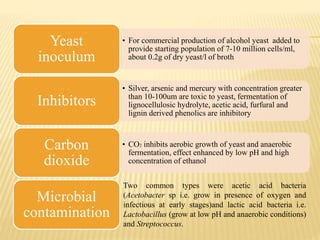
• For commercial production of alcohol yeast added to
provide starting population of 7-10 million cells/ml,
about 0.2g of dry yeast/l of broth
Yeast
inoculum
• Silver, arsenic and mercury with concentration greater
than 10-100um are toxic to yeast, fermentation of
lignocellulosic hydrolyte, acetic acid, furfural and
lignin derived phenolics are inhibitory
Inhibitors
• CO2 inhibits aerobic growth of yeast and anaerobic
fermentation, effect enhanced by low pH and high
concentration of ethanol
Carbon
dioxide
Microbial
contamination
Two common types were acetic acid bacteria
(Acetobacter sp i.e. grow in presence of oxygen and
infectious at early stages)and lactic acid bacteria i.e.
Lactobacillus (grow at low pH and anaerobic conditions)
and Streptococcus.
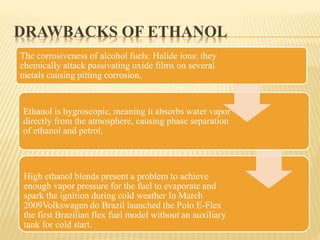
DRAWBACKS OF ETHANOL
The corrosiveness of alcohol fuels: Halide ions: they
chemically attack passivating oxide films on several
metals causing pitting corrosion,
Ethanol is hygroscopic, meaning it absorbs water vapor
directly from the atmosphere, causing phase separation
of ethanol and petrol.
High ethanol blends present a problem to achieve
enough vapor pressure for the fuel to evaporate and
spark the ignition during cold weather In March
2009Volkswagen do Brazil launched the Polo E-Flex
the first Brazilian flex fuel model without an auxiliary
tank for cold start.
CURRENT STATUS AND POTENTIAL
PRODUCTION OF BIOETHANOL IN
WORLD
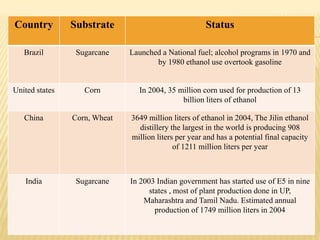
Country Substrate Status
Brazil Sugarcane Launched a National fuel; alcohol programs in 1970 and
by 1980 ethanol use overtook gasoline
United states Corn In 2004, 35 million corn used for production of 13
billion liters of ethanol
China Corn, Wheat 3649 million liters of ethanol in 2004, The Jilin ethanol
distillery the largest in the world is producing 908
million liters per year and has a potential final capacity
of 1211 million liters per year
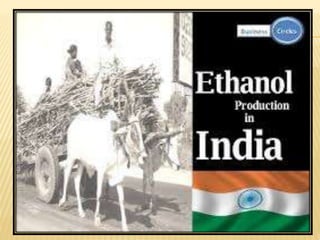
India Sugarcane In 2003 Indian government has started use of E5 in nine
states , most of plant production done in UP,
Maharashtra and Tamil Nadu. Estimated annual
production of 1749 million liters in 2004
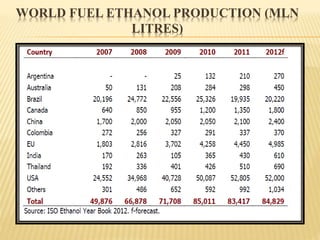
WORLD FUEL ETHANOL PRODUCTION (MLN
LITRES)
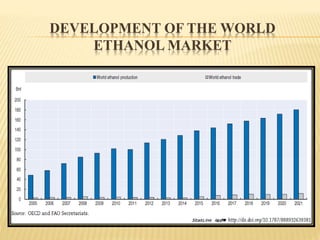
DEVELOPMENT OF THE WORLD
ETHANOL MARKET
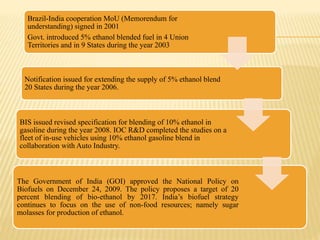
Brazil-India cooperation MoU (Memorendum for
understanding) signed in 2001
Govt. introduced 5% ethanol blended fuel in 4 Union
Territories and in 9 States during the year 2003
Notification issued for extending the supply of 5% ethanol blend
20 States during the year 2006.
BIS issued revised specification for blending of 10% ethanol in
gasoline during the year 2008. IOC R&D completed the studies on a
fleet of in-use vehicles using 10% ethanol gasoline blend in
collaboration with Auto Industry.
The Government of India (GOI) approved the National Policy on
Biofuels on December 24, 2009. The policy proposes a target of 20
percent blending of bio-ethanol by 2017. India’s biofuel strategy
continues to focus on the use of non-food resources; namely sugar
molasses for production of ethanol.
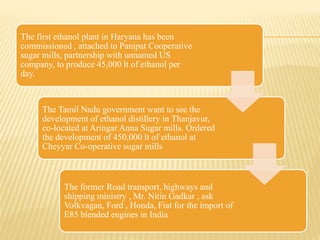
The first ethanol plant in Haryana has been
commissioned , attached to Panipat Cooperative
sugar mills, partnership with unnamed US
company, to produce 45,000 lt of ethanol per
day.
The Tamil Nadu government want to see the
development of ethanol distillery in Thanjavur,
co-located at Aringar Anna Sugar mills. Ordered
the development of 450,000 lt of ethanol at
Cheyyar Co-operative sugar mills
The former Road transport, highways and
shipping ministry , Mr. Nitin Gadkar , ask
Volkvagan, Ford , Honda, Fiat for the import of
E85 blended engines in India
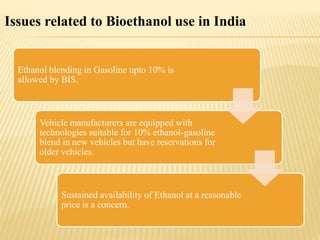
Issues related to Bioethanol use in India
Ethanol blending in Gasoline upto 10% is
allowed by BIS.
Vehicle manufacturers are equipped with
technologies suitable for 10% ethanol-gasoline
blend in new vehicles but have reservations for
older vehicles.
Sustained availability of Ethanol at a reasonable
price is a concern.
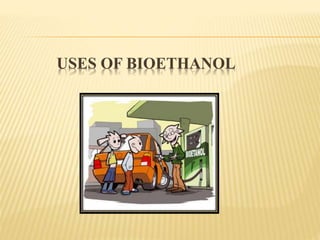
USES OF BIOETHANOL
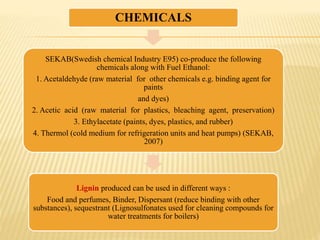
CHEMICALS
SEKAB(Swedish chemical Industry E95) co-produce the following
chemicals along with Fuel Ethanol:
1. Acetaldehyde (raw material for other chemicals e.g. binding agent for
paints
and dyes)
2. Acetic acid (raw material for plastics, bleaching agent, preservation)
3. Ethylacetate (paints, dyes, plastics, and rubber)
4. Thermol (cold medium for refrigeration units and heat pumps) (SEKAB,
2007)
Lignin produced can be used in different ways :
Food and perfumes, Binder, Dispersant (reduce binding with other
substances), sequestrant (Lignosulfonates used for cleaning compounds for
water treatments for boilers)
TRANSPORT FUEL
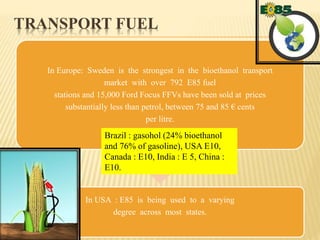
In Europe: Sweden is the strongest in the bioethanol transport
market with over 792 E85 fuel
stations and 15,000 Ford Focus FFVs have been sold at prices
substantially less than petrol, between 75 and 85 € cents
per litre.
In USA : E85 is being used to a varying
degree across most states.
Brazil : gasohol (24% bioethanol
and 76% of gasoline), USA E10,
Canada : E10, India : E 5, China :
E10.
Manufacturers of
bioethanol
fuelling vehicles:
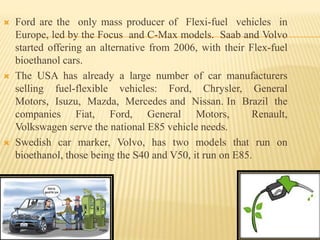
ļƒ’ Ford are the only mass producer of Flexi-fuel vehicles in
Europe, led by the Focus and C-Max models. Saab and Volvo
started offering an alternative from 2006, with their Flex-fuel
bioethanol cars.
ļƒ’ The USA has already a large number of car manufacturers
selling fuel-flexible vehicles: Ford, Chrysler, General
Motors, Isuzu, Mazda, Mercedes and Nissan. In Brazil the
companies Fiat, Ford, General Motors, Renault,
Volkswagen serve the national E85 vehicle needs.
ļƒ’ Swedish car marker, Volvo, has two models that run on
bioethanol, those being the S40 and V50, it run on E85.
CONCLUSION
Manufacture of bioethanol would considerably improve the
country energy security by reducing its reliance on foreign oil.
A growing ethanol industry will provide jobs in plant
operations, maintenance and contribute to rural economic
development.
Lignocellulosic waste is one of the most-likely used as a raw
material for industrial production of bioethanol.
The industry and the authorities are very close to reaching an
agreement over a viable framework of support for fuel ethanol.
A new partnership in between the producers and importers will
be created to provide the significant funds required to facilitate
growth. A future market is required to provide the possibility
hedge against price fluctuations.
Biofuel production

Biofuel production

  • 1.
    BIOETHANOL PRODUCTION Delivered by ShrutiPathania F-12-24-D Bioethanol production Delivered by Shruti Pathania F-12-24-D
  • 2.
  • 3.
    NOT NECESSARILY ANEW IDEA… ā€œWe can get fuel from fruit, from that shrub by the roadside, or from apples, weeds, saw-dust—almost anything! There is fuel in every bit of vegetable matter that can be fermented … And it remains for someone to find out how this fuel can be produced commercially— better fuel at a cheaper price than we know now.ā€ ~ Henry Ford, 1925
  • 4.
    ļƒ’ In 1980,Brazilian government launched the Proalcohol program that ethanol made a come back in market. ļƒ’ In 1973 and 1979 the Carter administration in USA established government policies to provide alternative energy sources.
  • 5.
    FUEL PROPERTIES OFBIOETHANOL ļƒ’ Bioethanol is a liquid biofuel (ETOH), colorless, ļƒ’ Renewable bio-based resource and flammable oxygenated hydrocarbons ļƒ’ Molecular formula of C2H5OH ļƒ’ Ethanol may be of : ļƒ’ Synthetic alcohol and Agricultural alcohol ļƒ’ Anhydrous alcohol and hydrous alcohol
  • 6.
    ADVANTAGE OF BIOETHANOLOVER GASOLINE 1. It’s a renewable source of energy 2. Burning does not increases green house effect 3. Provide high octane at low cost 4. Blends can be used in all petrol engine without modification 5. Biodegradable 6. Reduce emission of hydrocarbons 7. Reduce nitrogen oxide emission
  • 7.
  • 9.
  • 10.
    SUBSTRATE USED FORETHANOL PRODUCTION Substrate Includes Examples Directly fermentable Sugary substances Sugarcane , molasses, sugarbeet, sweet sorghum Easily hydrolysable substrates Starchy-materials Maize, wheat, Barley, rice, millet, rye and mixed grains Difficult to hydrolyse substrates Lignocellulosic material Bagasse, forage crops, straw and chaff
  • 11.
    Representation of woodplant cell wall and its macromolecular components
  • 12.
    Lignocellulosic pretreatment Physical Mechanical Grinding Milling Chipping Irradiation Microwave Gamma radiation Increase inspecific surface area and size of pore Decrease in crystalinity Chemical Acid Dilute and Concentrated HCl Alkaline NaOH, Lime Increase in internal surface area due to swelling Decraese in crystalinity and pororsity Hemicellulose degredtion and lignin removal Biological Fungal Brown (Poria) , white (Phanerochaete chrysosporium) Soft rot fungi (Chaetinium) Enzyme Ligninases Laccase peroxidases Increase in specific surface area and size of pore Degradation of hemicellulose and lignin Balat et al., 2008
  • 13.
    Types of feedstocksTreatment needed before fermentation Advantages Disadvantages Sugar crops (sugarcane, sugar beet, sweet sorghum, beets fruits etc Squeezing, crushing to extract sugar Preparation is simple High yield of ethanol per acre crop co-products have value as fuel Storage may result in loss of sugar. Starch crops grains (corn, wheat, rice, sorghum, barley millet, rye etc Milling and enzymatic hydrolysis involving liquifiction and saccharification enzymatic hydrolysis is cheap and simple co- products used a s livetocks feed is rich in proteins Preparation involves additional equipments enzyme labor and enzyme costs Cellulosic crop residues (sugarcane bagasses, corn stover, wheat straw, etc) Milling and acid hydrolysis Availability is widespread use involve no integration with livestock feed market Required additional equipments, labor and energy cost, no commercially cost effective process exists for hydrolysis
  • 14.
    Hydrolysis Acid hydrolysis Degrade xylanto xylose Cellulose and lignin remained unalterered Xylose degraded to inhibitory compounds like furfurals , 5- hydromethyl furfural and hyroxybenzaldehyde inhibiting fermentation Enzymatic hydrolysis Slow process require pretreatment Attractive as produces better yield Manufactured has also reduced the cost of its production
  • 15.
  • 16.
    Microorganisms capable ofproducing ethanol Yeasts Candiada pseudotropicalis Kluyveromyces fragilis K.lactis Pichia stipitis S. cerevisiae S.sake S.diasticus S.ovarum Bacteria Mesophilic Oligate anaerobes Clostridium sporogenes Facultative anaerobes Zymomonas mobilis Streptococcus lactis Thermophilic Thermoanaerobacter ethanolicus B.stearothermophiles Clostridium thermocellum Cl. thermosaccharolyticum Molds Fusarium oxysporum Paecilomyces sp Mucor sp Rhizopus sp
  • 17.
    FERMENTATION 0.51% of bioethanolis produced from per gm glucose. Microorganisms termed as ethanologens convert sugars from biomass to bioethanol. S.cerevisiae used commonly but now National Renewable Resources Laboratory (Dept of Energy,US) engineered strains i.e. E.coli and K.oxytoca capable of fermenting xylose and arabinose Fed batch fermentation are used mostly, as ability to increase maximum viable cell concentration, prolonged culture life, allow product accumulation in high concentration
  • 18.
    RECOVERY OF PRODUCTS Distillation •The purity is limited to 95–96% due to the formation of a low- boiling water- ethanol azeotrope with maximum (96.5% v/v) ethanol and water. Dehydration • Two process used • Azeotropic distillation adding benzene or cyclohexane and forming heterogenous mixture , further distillation gives anydrous alcohol • Molecular sieving Ethanol vapours under pressure passes through the bed of molecular sieve beads.
  • 19.
  • 20.
    • Effect onfermentation rate, byproducts, yeast growth, best 4.5-4.7pH • Capable of fermentating and utilizing glucose, mannose, fructose, galactose and maltose , P.stipitis utilizes xylose and cellobiose both. Sugars fermented by yeats • To ferment rapidly and efficiently, ethanol tolerance and to remain stable and viable e.g S.cerevisiae, P.stipitis and K.marxianus Choice of organisms • 12-20%of sugar fermented efficiently, advantages includes reduced water requirement and suppression of osmosenstitive contaminants. Sugar concentration • 30-40°C, but the temperature should not reaches above 33°C as ethanol begins to accumulates, with optimum of 25°C Temperature • It’s the capacity of the microbe to tolerate this solvent as ethanol inhibits alcoholic fermentation, S.cerevisiae ceases to ferment 6% ethanol , S.diastiticus stop fermentation at 12% ethanol and S,ellipsoides at 15% ethanol by volume. Ethanol • Mixture of amino acids, purines and pyrimidines as the sole of nitrogen better than any single amino acid used C.utilis and Hansenula anomala are vitamin independent and synthesize all their own needs. Nutrients
  • 21.
    • For commercialproduction of alcohol yeast added to provide starting population of 7-10 million cells/ml, about 0.2g of dry yeast/l of broth Yeast inoculum • Silver, arsenic and mercury with concentration greater than 10-100um are toxic to yeast, fermentation of lignocellulosic hydrolyte, acetic acid, furfural and lignin derived phenolics are inhibitory Inhibitors • CO2 inhibits aerobic growth of yeast and anaerobic fermentation, effect enhanced by low pH and high concentration of ethanol Carbon dioxide Microbial contamination Two common types were acetic acid bacteria (Acetobacter sp i.e. grow in presence of oxygen and infectious at early stages)and lactic acid bacteria i.e. Lactobacillus (grow at low pH and anaerobic conditions) and Streptococcus.
  • 22.
    DRAWBACKS OF ETHANOL Thecorrosiveness of alcohol fuels: Halide ions: they chemically attack passivating oxide films on several metals causing pitting corrosion, Ethanol is hygroscopic, meaning it absorbs water vapor directly from the atmosphere, causing phase separation of ethanol and petrol. High ethanol blends present a problem to achieve enough vapor pressure for the fuel to evaporate and spark the ignition during cold weather In March 2009Volkswagen do Brazil launched the Polo E-Flex the first Brazilian flex fuel model without an auxiliary tank for cold start.
  • 23.
    CURRENT STATUS ANDPOTENTIAL PRODUCTION OF BIOETHANOL IN WORLD
  • 24.
    Country Substrate Status BrazilSugarcane Launched a National fuel; alcohol programs in 1970 and by 1980 ethanol use overtook gasoline United states Corn In 2004, 35 million corn used for production of 13 billion liters of ethanol China Corn, Wheat 3649 million liters of ethanol in 2004, The Jilin ethanol distillery the largest in the world is producing 908 million liters per year and has a potential final capacity of 1211 million liters per year India Sugarcane In 2003 Indian government has started use of E5 in nine states , most of plant production done in UP, Maharashtra and Tamil Nadu. Estimated annual production of 1749 million liters in 2004
  • 25.
    WORLD FUEL ETHANOLPRODUCTION (MLN LITRES)
  • 26.
    DEVELOPMENT OF THEWORLD ETHANOL MARKET
  • 28.
    Brazil-India cooperation MoU(Memorendum for understanding) signed in 2001 Govt. introduced 5% ethanol blended fuel in 4 Union Territories and in 9 States during the year 2003 Notification issued for extending the supply of 5% ethanol blend 20 States during the year 2006. BIS issued revised specification for blending of 10% ethanol in gasoline during the year 2008. IOC R&D completed the studies on a fleet of in-use vehicles using 10% ethanol gasoline blend in collaboration with Auto Industry. The Government of India (GOI) approved the National Policy on Biofuels on December 24, 2009. The policy proposes a target of 20 percent blending of bio-ethanol by 2017. India’s biofuel strategy continues to focus on the use of non-food resources; namely sugar molasses for production of ethanol.
  • 29.
    The first ethanolplant in Haryana has been commissioned , attached to Panipat Cooperative sugar mills, partnership with unnamed US company, to produce 45,000 lt of ethanol per day. The Tamil Nadu government want to see the development of ethanol distillery in Thanjavur, co-located at Aringar Anna Sugar mills. Ordered the development of 450,000 lt of ethanol at Cheyyar Co-operative sugar mills The former Road transport, highways and shipping ministry , Mr. Nitin Gadkar , ask Volkvagan, Ford , Honda, Fiat for the import of E85 blended engines in India
  • 30.
    Issues related toBioethanol use in India Ethanol blending in Gasoline upto 10% is allowed by BIS. Vehicle manufacturers are equipped with technologies suitable for 10% ethanol-gasoline blend in new vehicles but have reservations for older vehicles. Sustained availability of Ethanol at a reasonable price is a concern.
  • 31.
  • 32.
    CHEMICALS SEKAB(Swedish chemical IndustryE95) co-produce the following chemicals along with Fuel Ethanol: 1. Acetaldehyde (raw material for other chemicals e.g. binding agent for paints and dyes) 2. Acetic acid (raw material for plastics, bleaching agent, preservation) 3. Ethylacetate (paints, dyes, plastics, and rubber) 4. Thermol (cold medium for refrigeration units and heat pumps) (SEKAB, 2007) Lignin produced can be used in different ways : Food and perfumes, Binder, Dispersant (reduce binding with other substances), sequestrant (Lignosulfonates used for cleaning compounds for water treatments for boilers)
  • 33.
    TRANSPORT FUEL In Europe:Sweden is the strongest in the bioethanol transport market with over 792 E85 fuel stations and 15,000 Ford Focus FFVs have been sold at prices substantially less than petrol, between 75 and 85 € cents per litre. In USA : E85 is being used to a varying degree across most states. Brazil : gasohol (24% bioethanol and 76% of gasoline), USA E10, Canada : E10, India : E 5, China : E10.
  • 34.
  • 35.
    ļƒ’ Ford arethe only mass producer of Flexi-fuel vehicles in Europe, led by the Focus and C-Max models. Saab and Volvo started offering an alternative from 2006, with their Flex-fuel bioethanol cars. ļƒ’ The USA has already a large number of car manufacturers selling fuel-flexible vehicles: Ford, Chrysler, General Motors, Isuzu, Mazda, Mercedes and Nissan. In Brazil the companies Fiat, Ford, General Motors, Renault, Volkswagen serve the national E85 vehicle needs. ļƒ’ Swedish car marker, Volvo, has two models that run on bioethanol, those being the S40 and V50, it run on E85.
  • 36.
    CONCLUSION Manufacture of bioethanolwould considerably improve the country energy security by reducing its reliance on foreign oil. A growing ethanol industry will provide jobs in plant operations, maintenance and contribute to rural economic development. Lignocellulosic waste is one of the most-likely used as a raw material for industrial production of bioethanol. The industry and the authorities are very close to reaching an agreement over a viable framework of support for fuel ethanol. A new partnership in between the producers and importers will be created to provide the significant funds required to facilitate growth. A future market is required to provide the possibility hedge against price fluctuations.