Highway Engineering
Importance and Classification of Roads
Mr. Shrikant S. Ingale
HoD, Civil Dept., Diploma Wing,
Rajarambapu Institute of technology, Rajaramnagar
Importance of Transportation
• Role of Transportation
• Economic Activity and Transport
• Social Effect of Transportation
• Sectionalism
• Concentration of population in urban areas.
• Aspect of safety, law and order.
• Role of Transportation in Rural Development
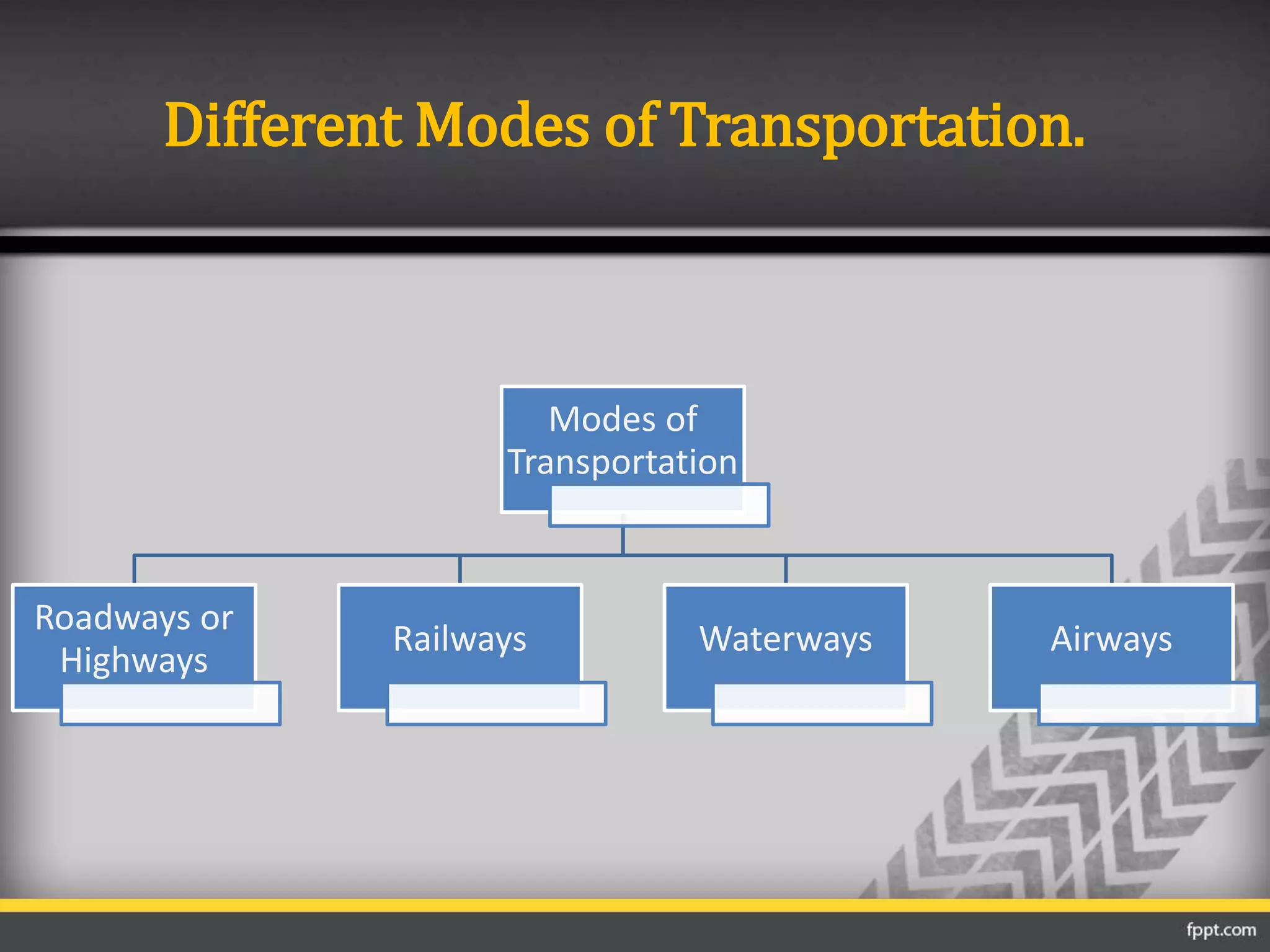
Different Modes of Transportation.
Modes of
Transportation
Roadways or
Highways
Railways Waterways Airways
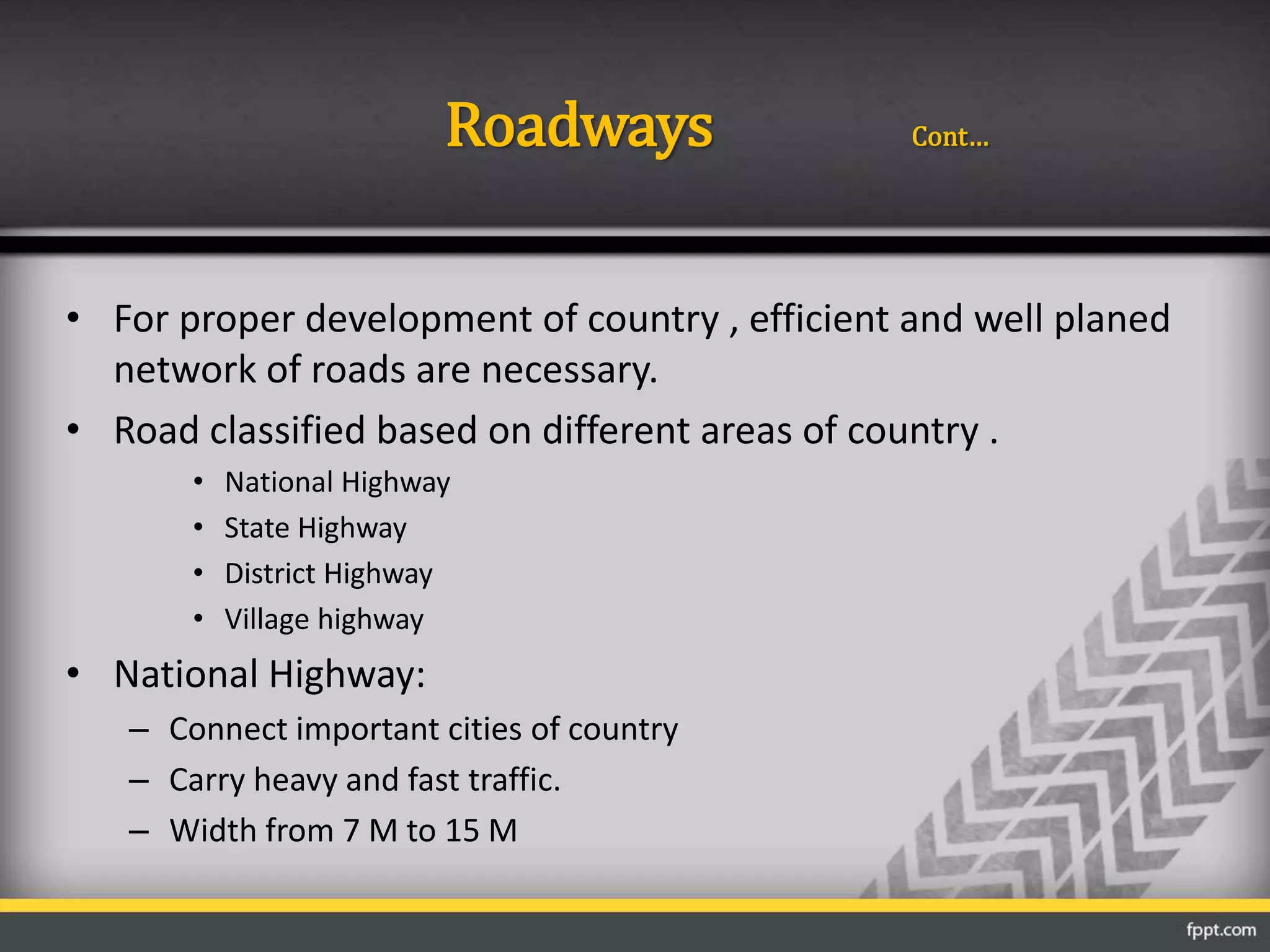
Roadways Cont…
• For proper development of country , efficient and well planed
network of roads are necessary.
• Road classified based on different areas of country .
• National Highway
• State Highway
• District Highway
• Village highway
• National Highway:
– Connect important cities of country
– Carry heavy and fast traffic.
– Width from 7 M to 15 M
Roadways
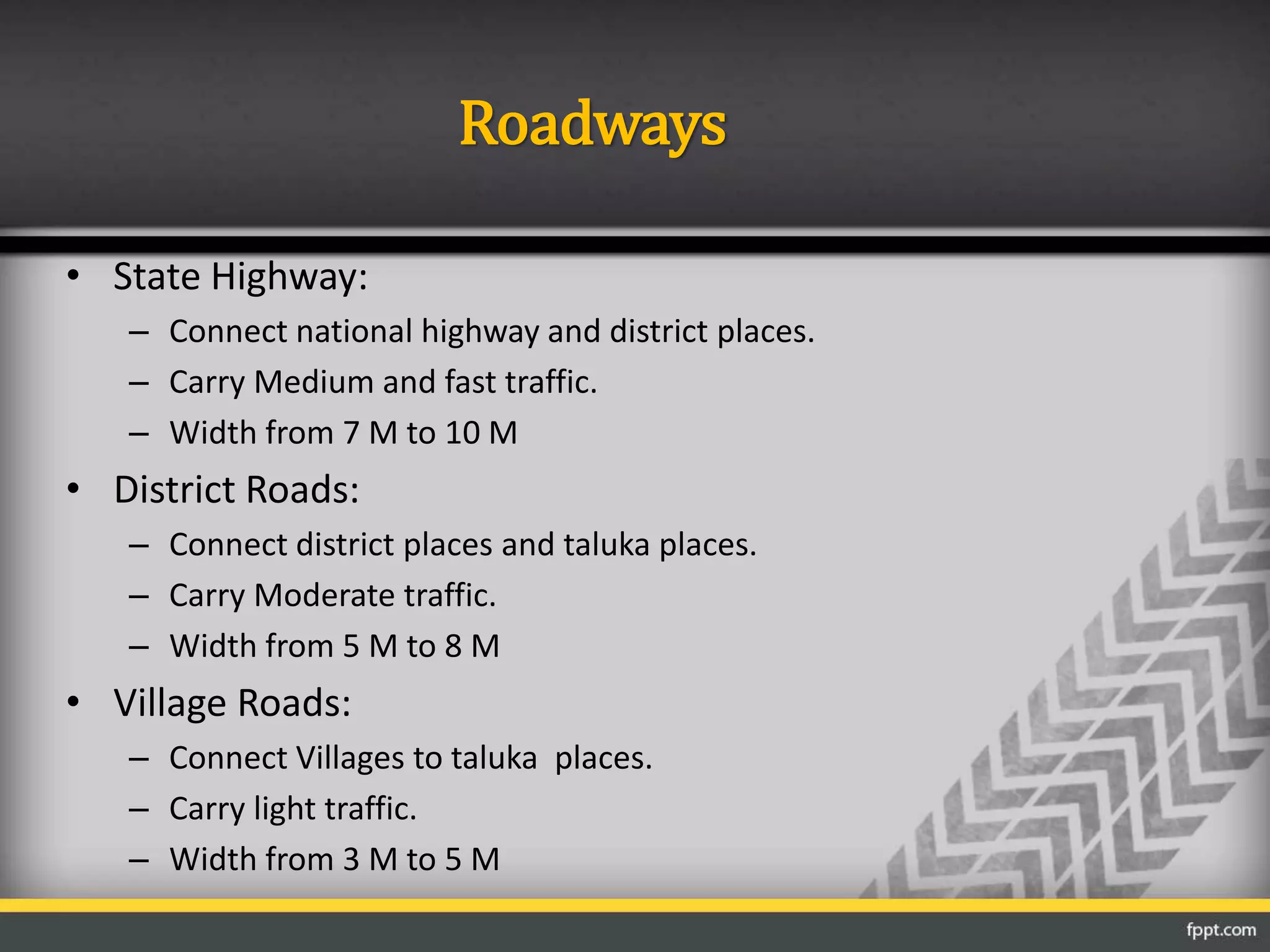
• State Highway:
– Connect national highway and district places.
– Carry Medium and fast traffic.
– Width from 7 M to 10 M
• District Roads:
– Connect district places and taluka places.
– Carry Moderate traffic.
– Width from 5 M to 8 M
• Village Roads:
– Connect Villages to taluka places.
– Carry light traffic.
– Width from 3 M to 5 M
Types of Pavement
TypesofPavement
Flexible
Pavements
Rigid Pavement
– Top surface takes the shape of Sub- Surface.
– Example: Earthen, Gravel, WBM, Bituminous
Roads.
– More Stiff and Thick.
– Example: Concrete road.
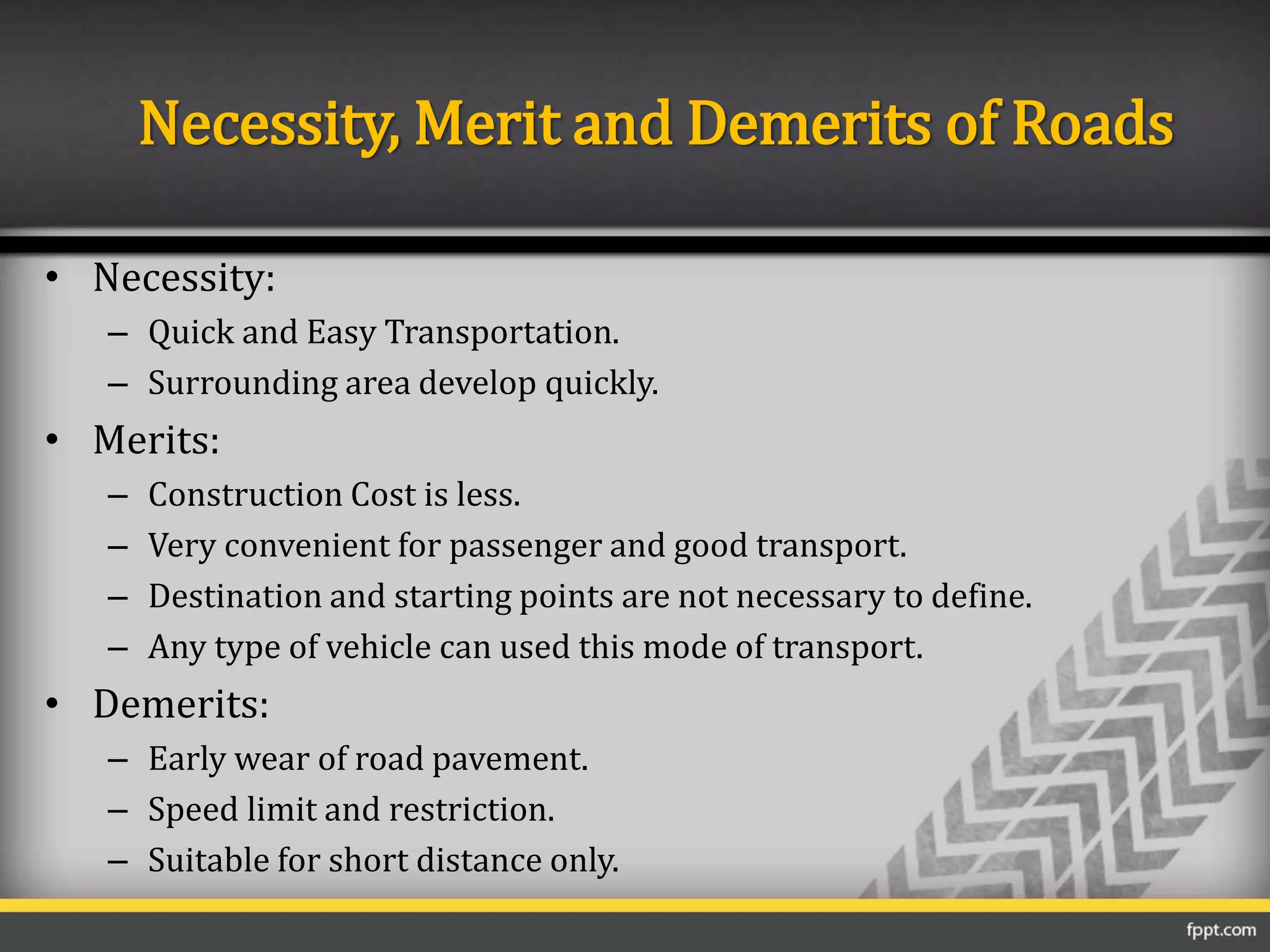
Necessity, Merit and Demerits of Roads
• Necessity:
– Quick and Easy Transportation.
– Surrounding area develop quickly.
• Merits:
– Construction Cost is less.
– Very convenient for passenger and good transport.
– Destination and starting points are not necessary to define.
– Any type of vehicle can used this mode of transport.
• Demerits:
– Early wear of road pavement.
– Speed limit and restriction.
– Suitable for short distance only.
Railways
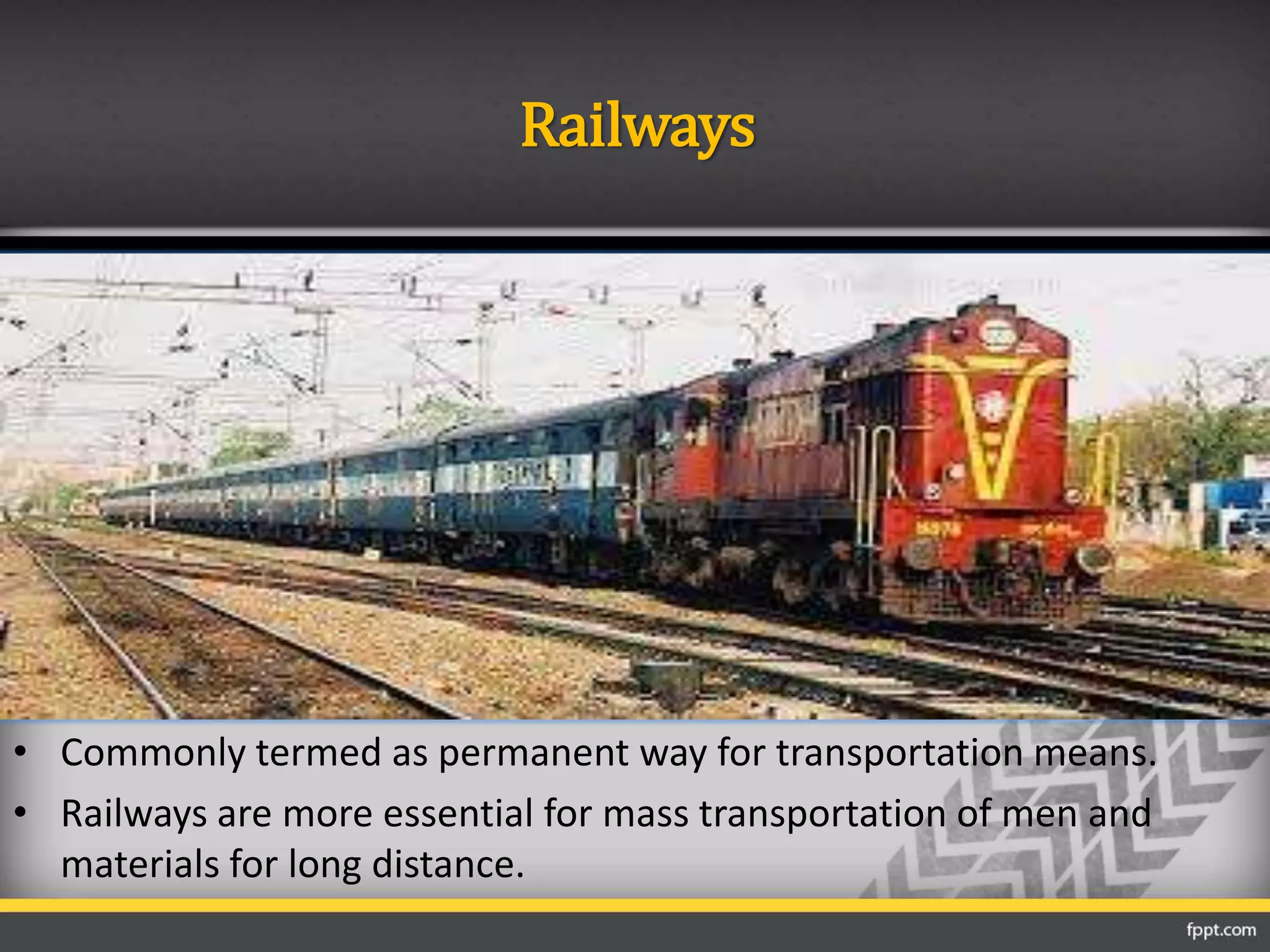
• Commonly termed as permanent way for transportation means.
• Railways are more essential for mass transportation of men and
materials for long distance.
Railways
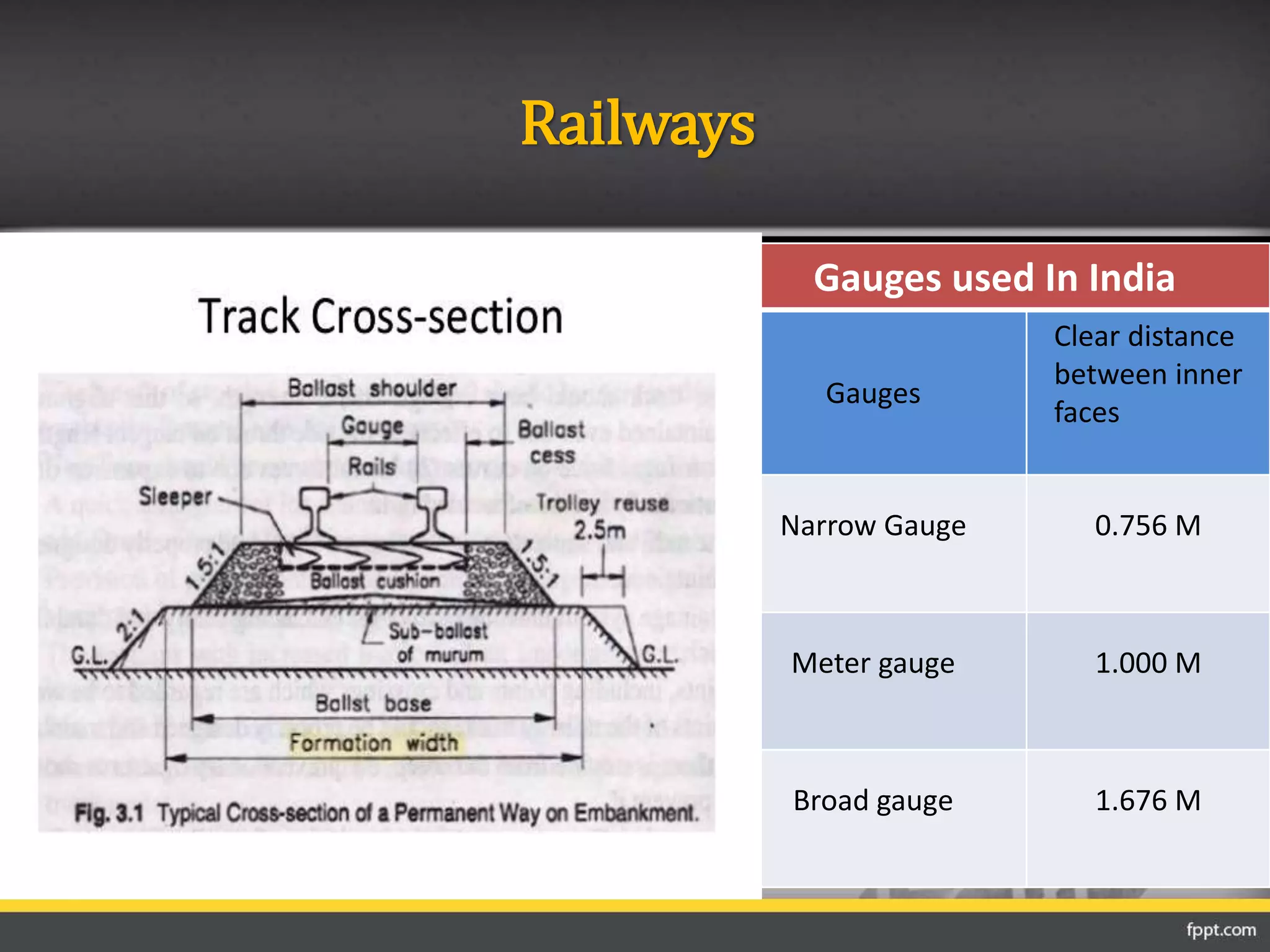
Gauges used In India
Gauges
Clear distance
between inner
faces
Narrow Gauge 0.756 M
Meter gauge 1.000 M
Broad gauge 1.676 M
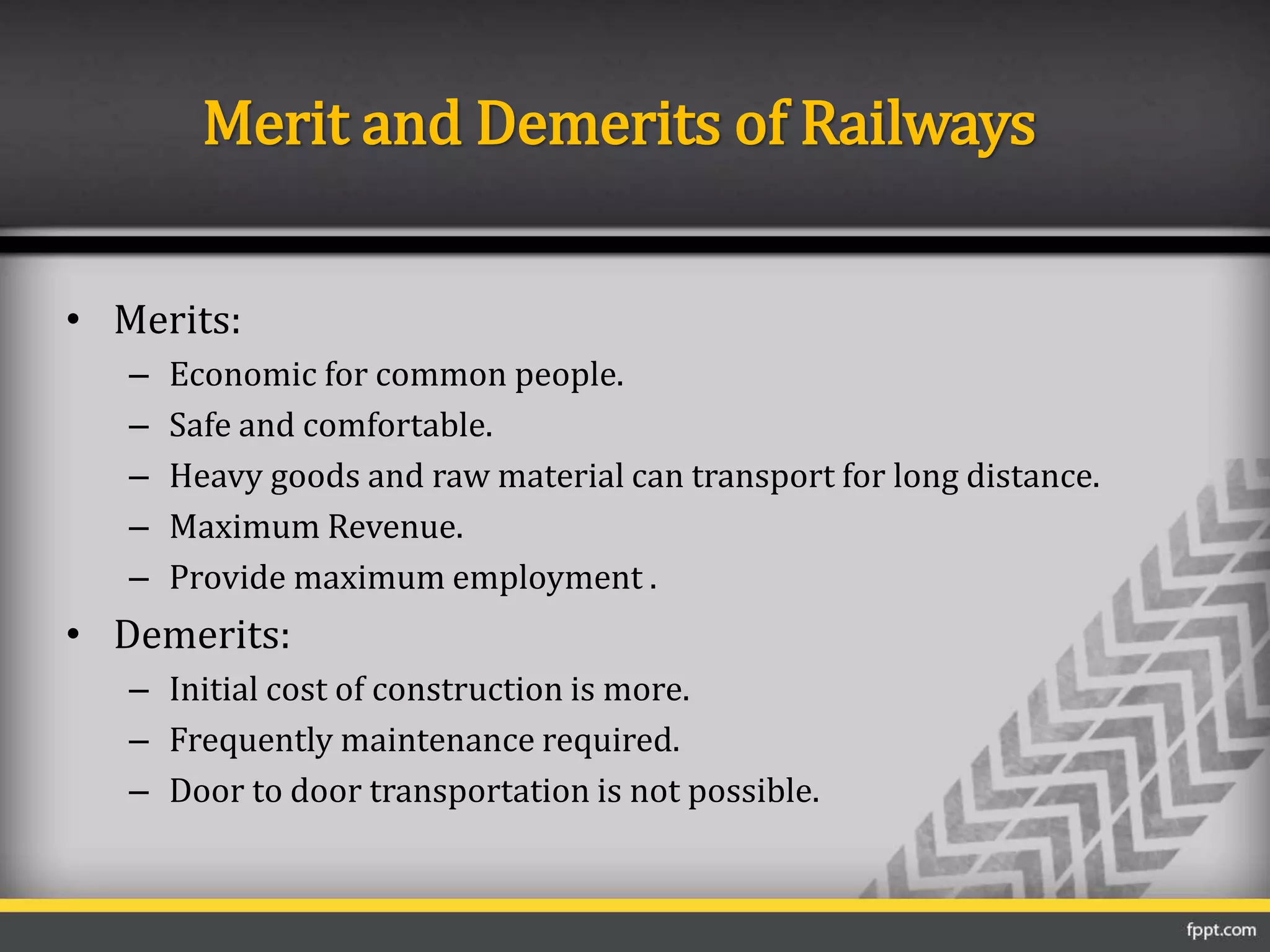
Merit and Demerits of Railways
• Merits:
– Economic for common people.
– Safe and comfortable.
– Heavy goods and raw material can transport for long distance.
– Maximum Revenue.
– Provide maximum employment .
• Demerits:
– Initial cost of construction is more.
– Frequently maintenance required.
– Door to door transportation is not possible.
Airways
• It is fastest mode of transport
• Classification:
– International Airport
– Domestic Airport
– Military Aerodromes
• Limitations:
– Operating expenses.
– Capacity
– Weather Condition
Classification and Limitation of Airways
Water ways
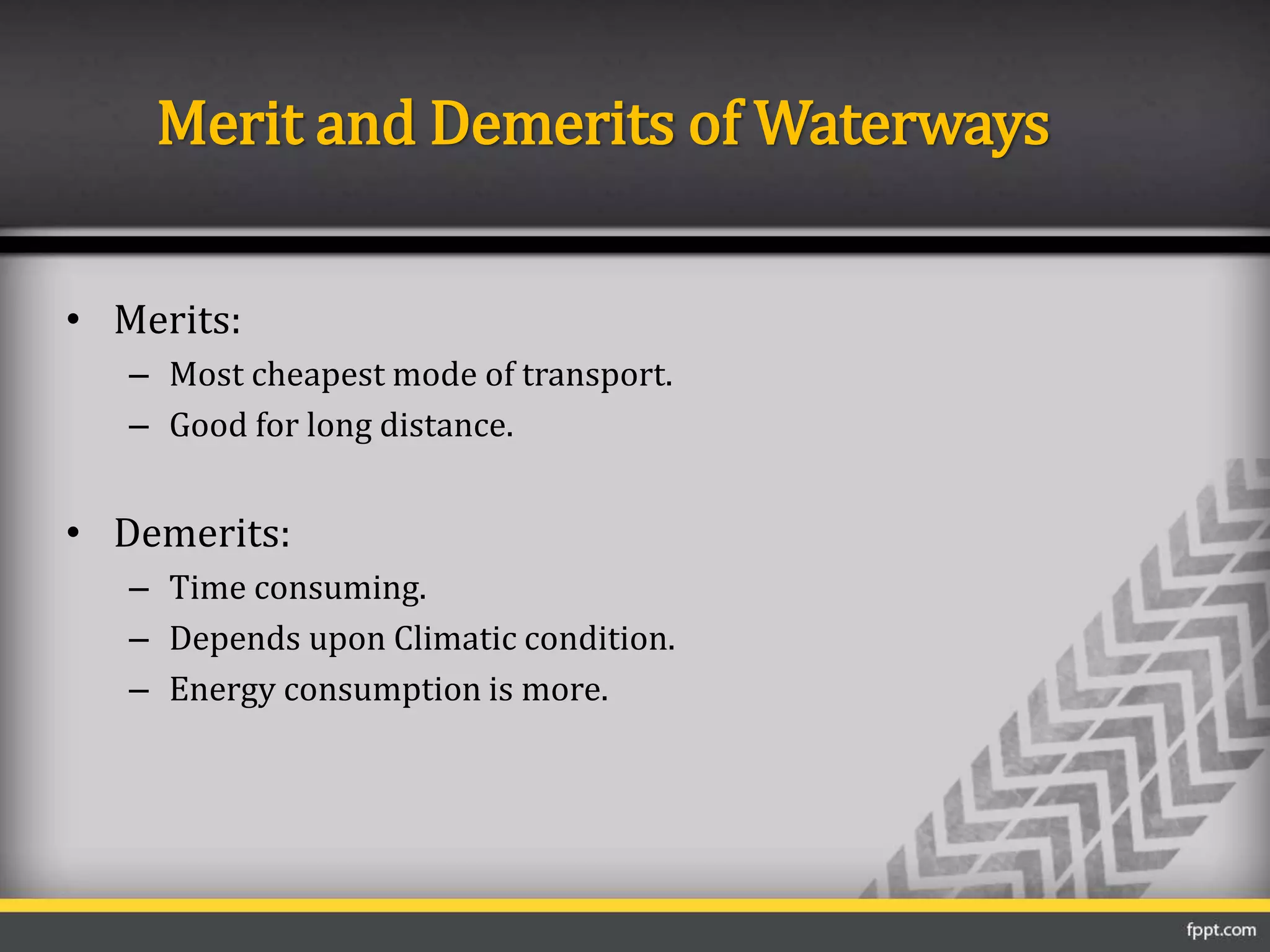
Merit and Demerits of Waterways
• Merits:
– Most cheapest mode of transport.
– Good for long distance.
• Demerits:
– Time consuming.
– Depends upon Climatic condition.
– Energy consumption is more.
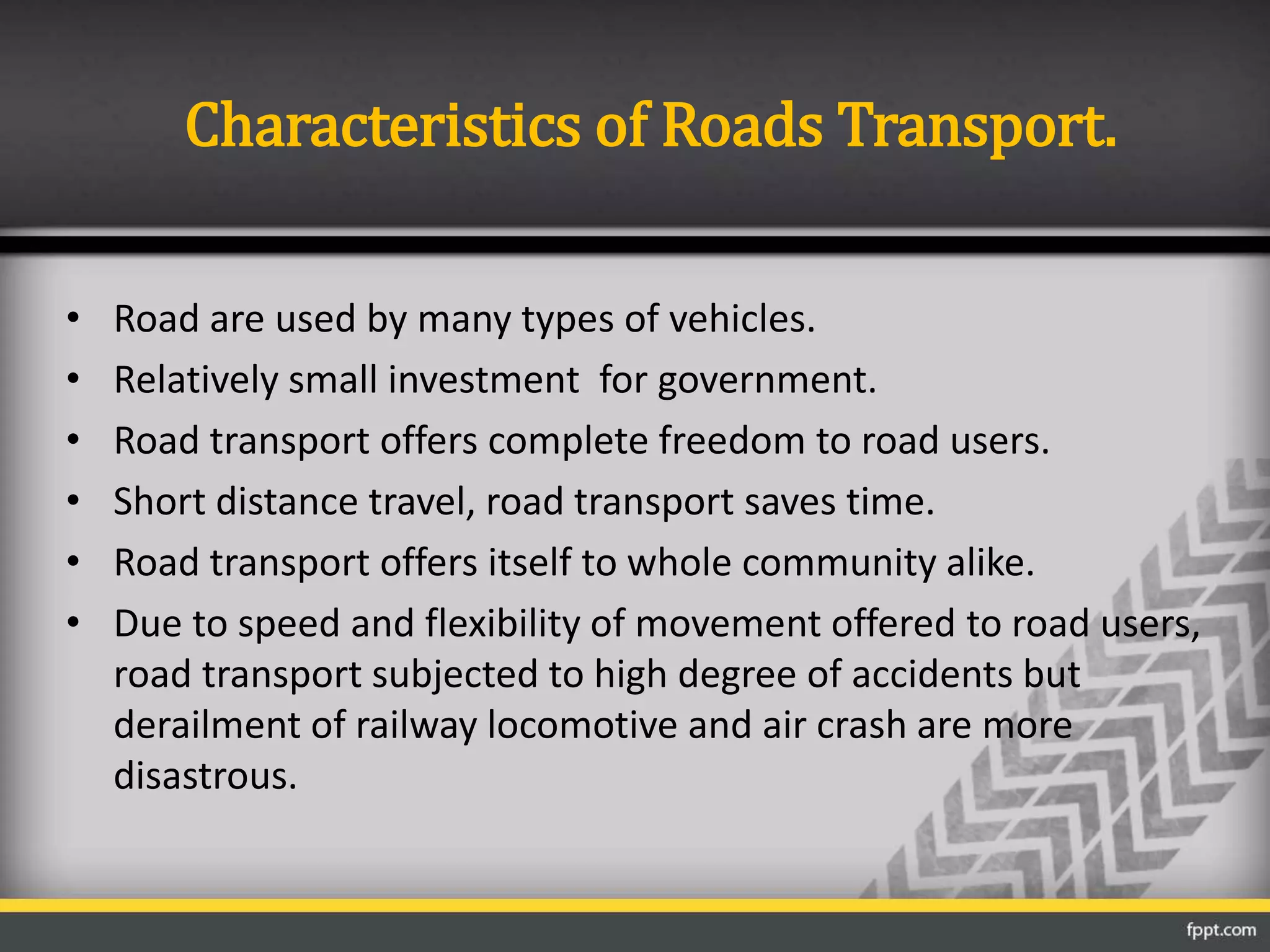
Characteristics of Roads Transport.
• Road are used by many types of vehicles.
• Relatively small investment for government.
• Road transport offers complete freedom to road users.
• Short distance travel, road transport saves time.
• Road transport offers itself to whole community alike.
• Due to speed and flexibility of movement offered to road users,
road transport subjected to high degree of accidents but
derailment of railway locomotive and air crash are more
disastrous.
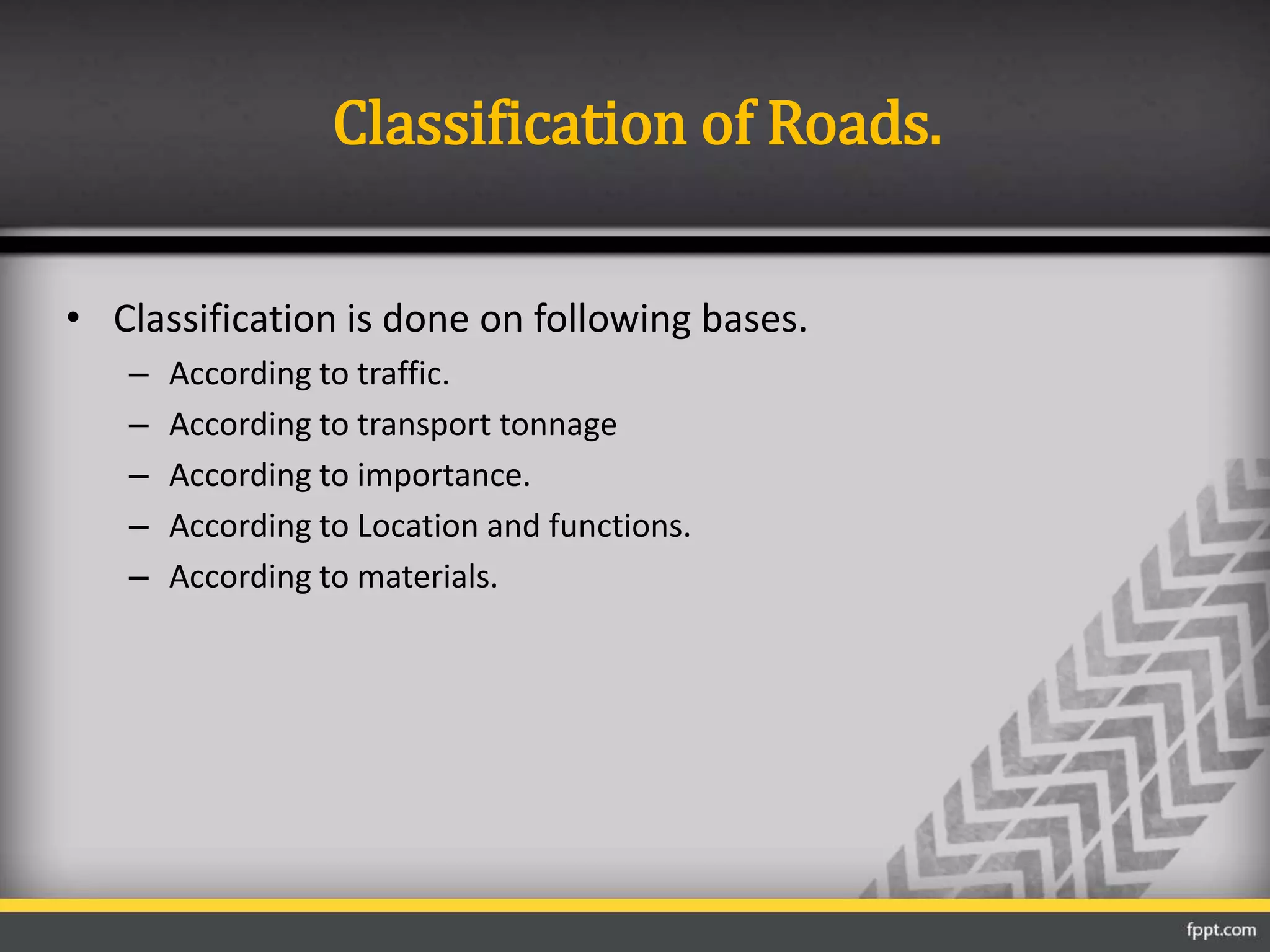
Classification of Roads.
• Classification is done on following bases.
– According to traffic.
– According to transport tonnage
– According to importance.
– According to Location and functions.
– According to materials.
Classification of Roads.
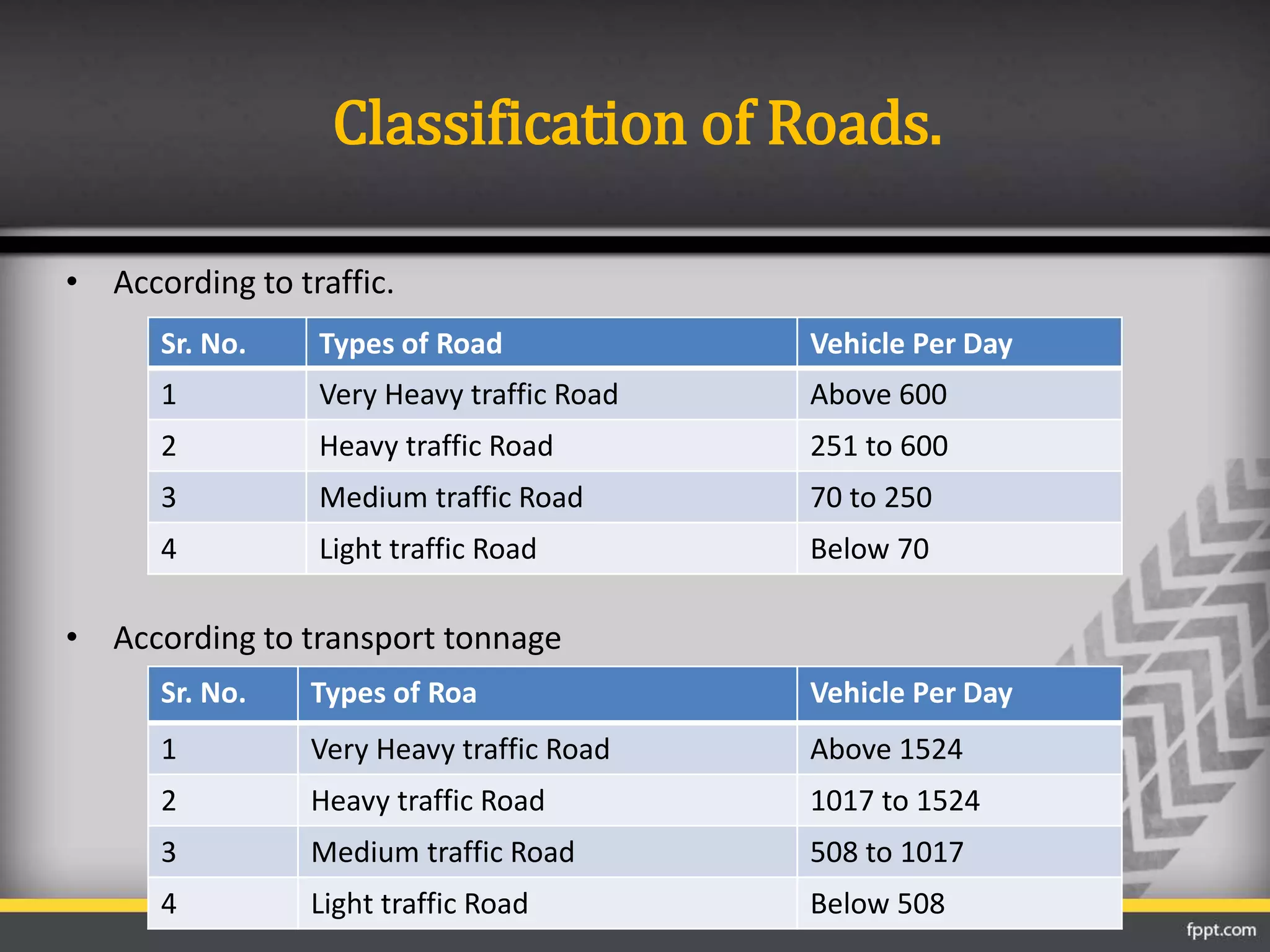
• According to traffic.
• According to transport tonnage
Sr. No. Types of Road Vehicle Per Day
1 Very Heavy traffic Road Above 600
2 Heavy traffic Road 251 to 600
3 Medium traffic Road 70 to 250
4 Light traffic Road Below 70
Sr. No. Types of Roa Vehicle Per Day
1 Very Heavy traffic Road Above 1524
2 Heavy traffic Road 1017 to 1524
3 Medium traffic Road 508 to 1017
4 Light traffic Road Below 508
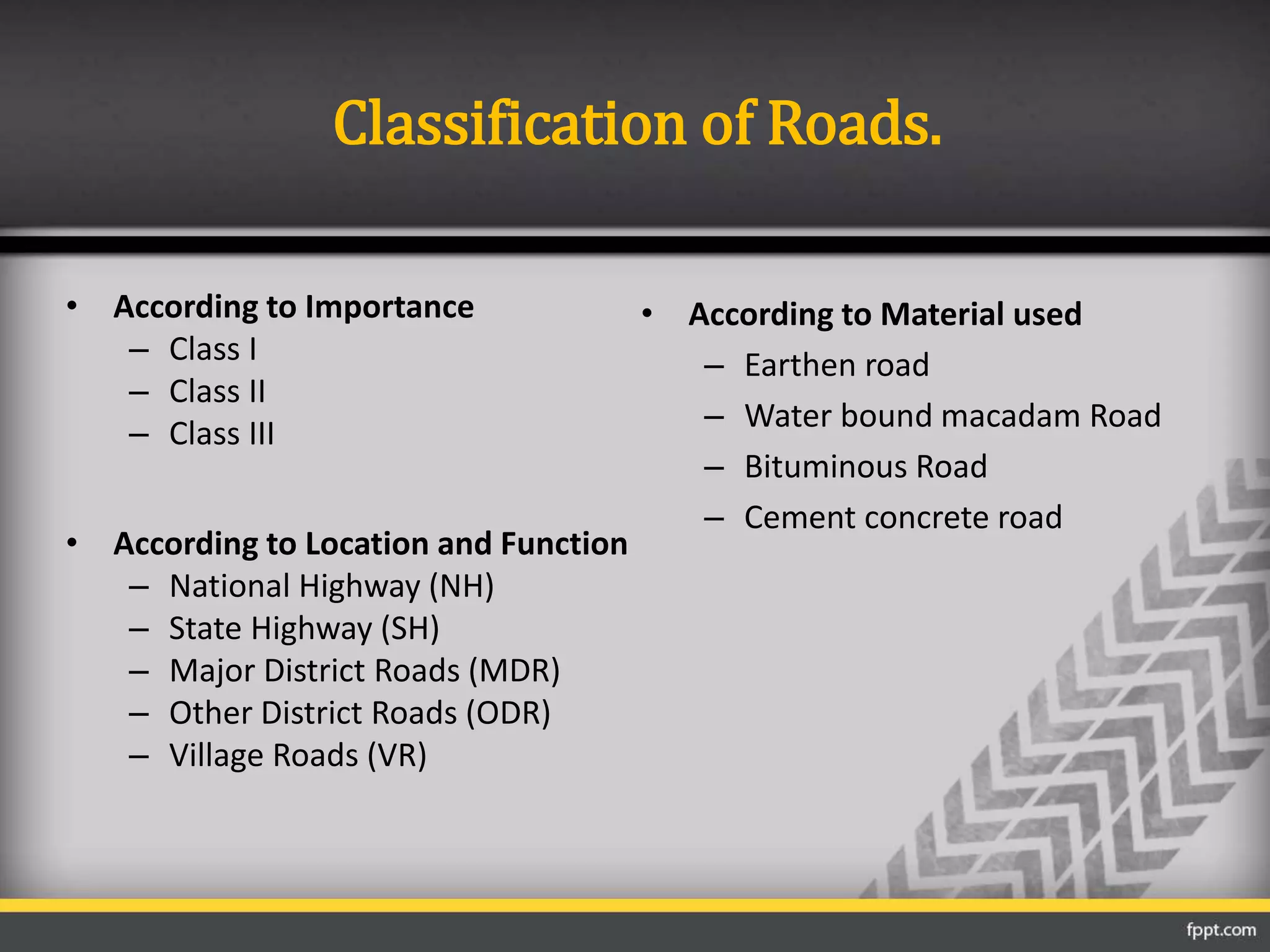
• According to Importance
– Class I
– Class II
– Class III
• According to Location and Function
– National Highway (NH)
– State Highway (SH)
– Major District Roads (MDR)
– Other District Roads (ODR)
– Village Roads (VR)
Classification of Roads.
• According to Material used
– Earthen road
– Water bound macadam Road
– Bituminous Road
– Cement concrete road
Classification of Roads.
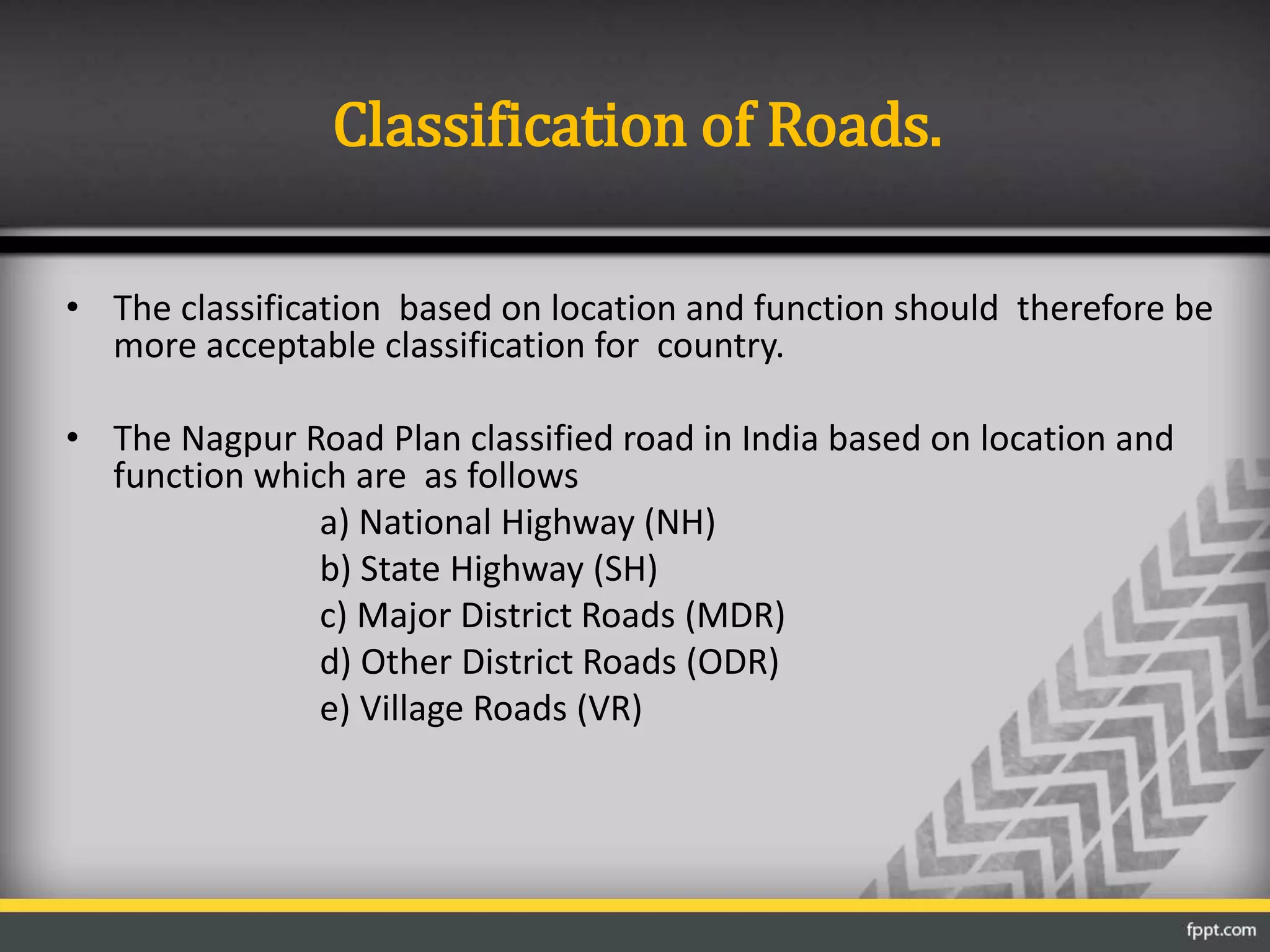
• The classification based on location and function should therefore be
more acceptable classification for country.
• The Nagpur Road Plan classified road in India based on location and
function which are as follows
a) National Highway (NH)
b) State Highway (SH)
c) Major District Roads (MDR)
d) Other District Roads (ODR)
e) Village Roads (VR)
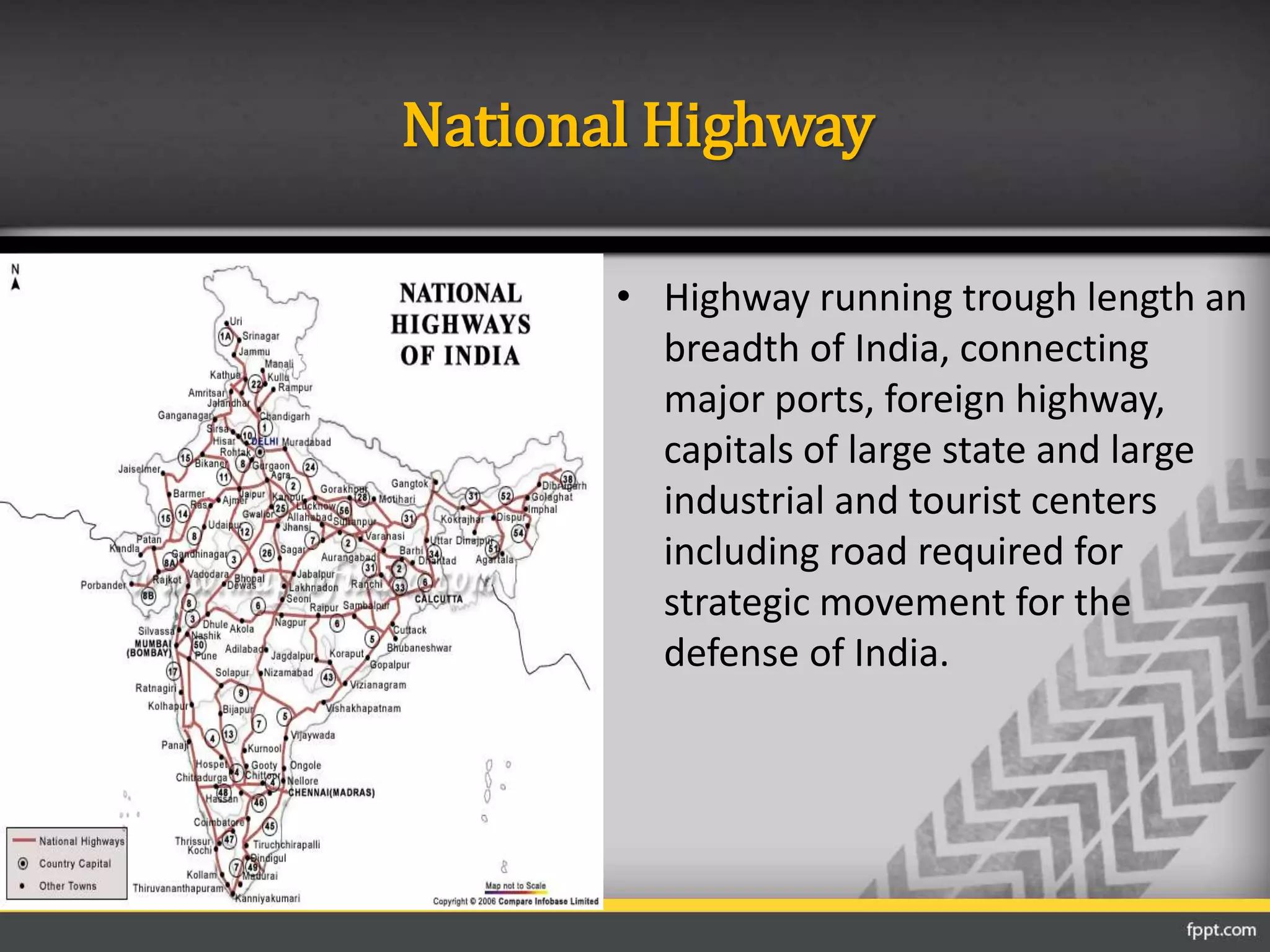
National Highway
• Highway running trough length an
breadth of India, connecting
major ports, foreign highway,
capitals of large state and large
industrial and tourist centers
including road required for
strategic movement for the
defense of India.
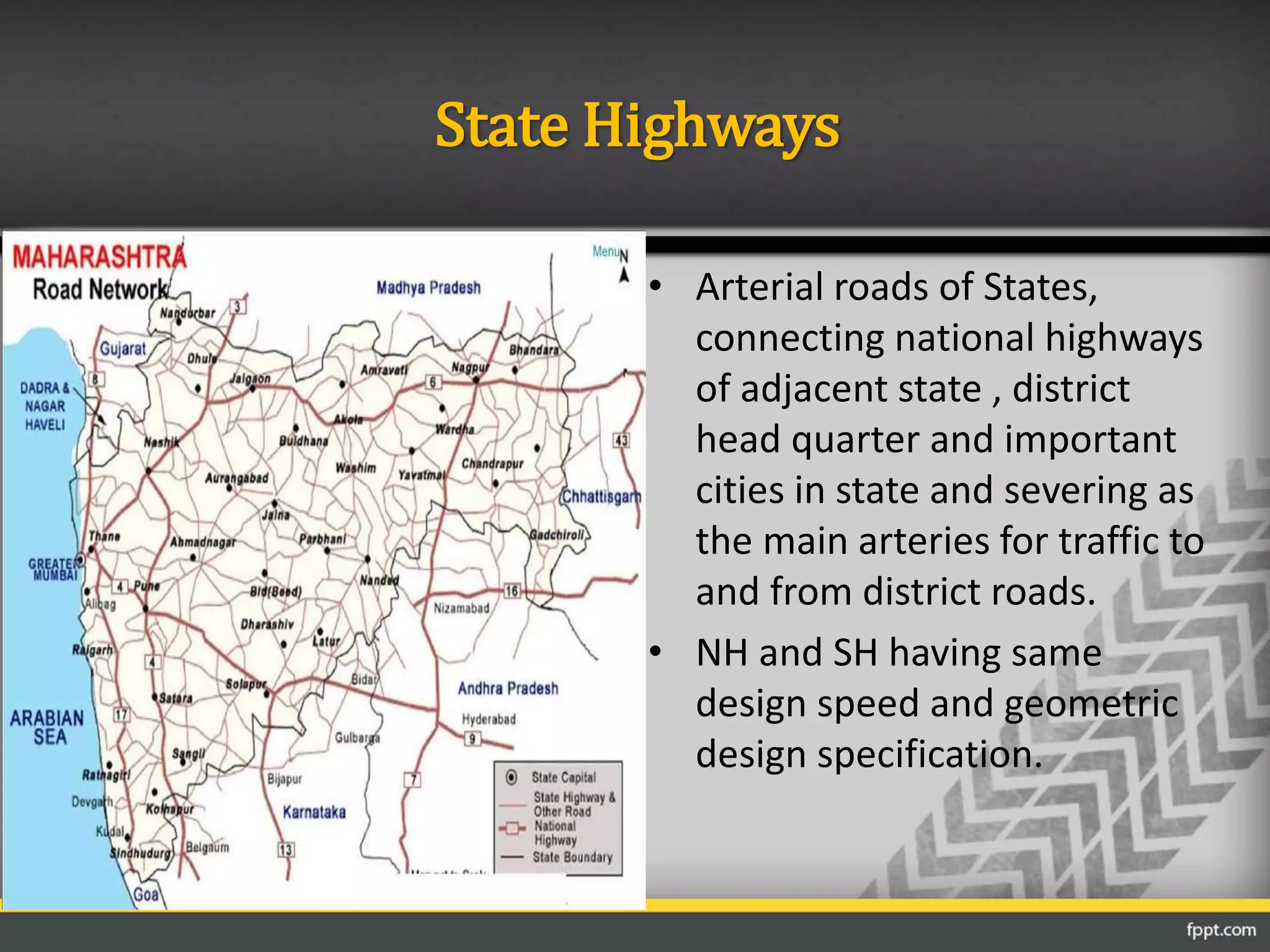
State Highways
• Arterial roads of States,
connecting national highways
of adjacent state , district
head quarter and important
cities in state and severing as
the main arteries for traffic to
and from district roads.
• NH and SH having same
design speed and geometric
design specification.
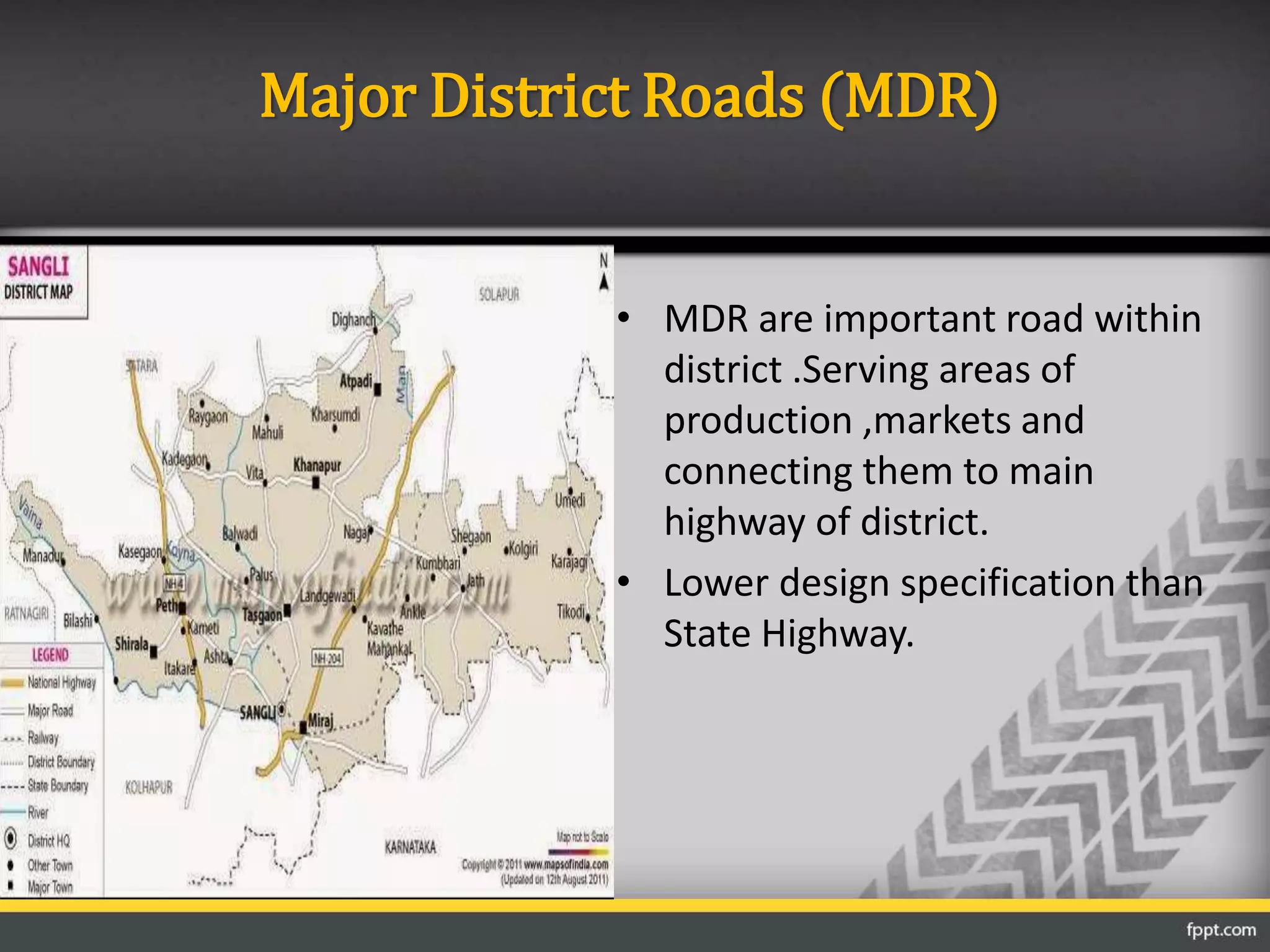
Major District Roads (MDR)
• MDR are important road within
district .Serving areas of
production ,markets and
connecting them to main
highway of district.
• Lower design specification than
State Highway.
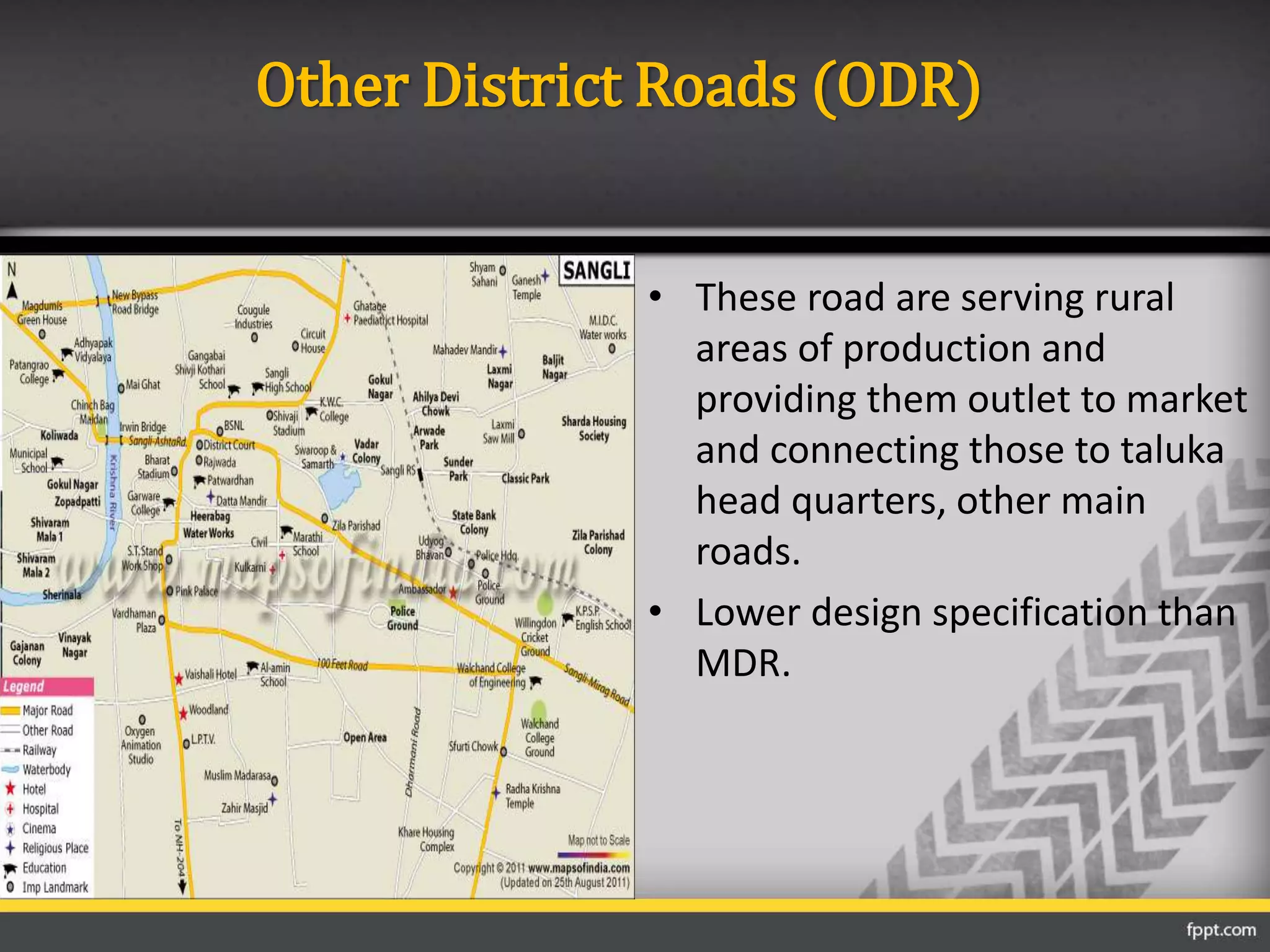
Other District Roads (ODR)
• These road are serving rural
areas of production and
providing them outlet to market
and connecting those to taluka
head quarters, other main
roads.
• Lower design specification than
MDR.
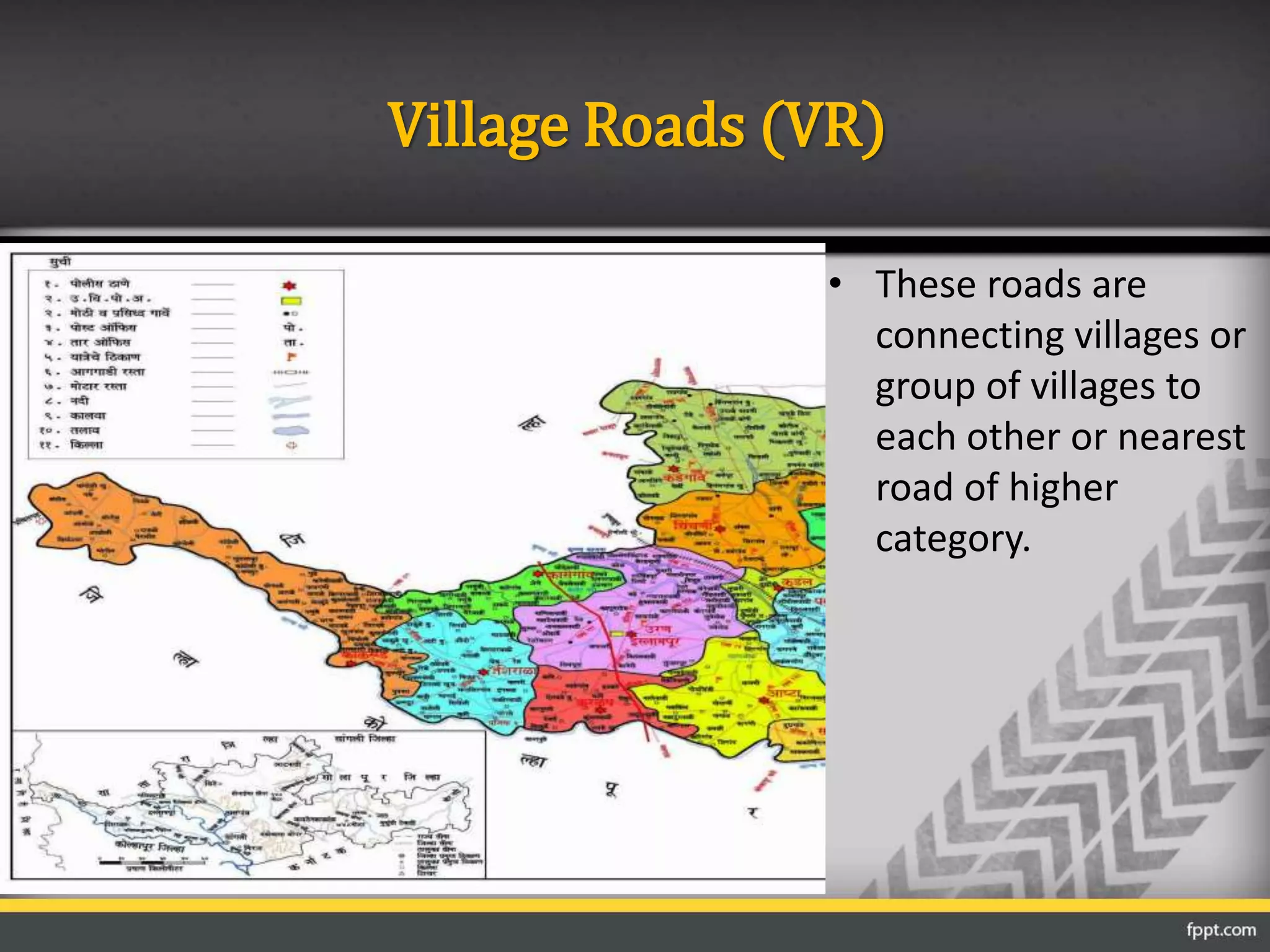
Village Roads (VR)
• These roads are
connecting villages or
group of villages to
each other or nearest
road of higher
category.
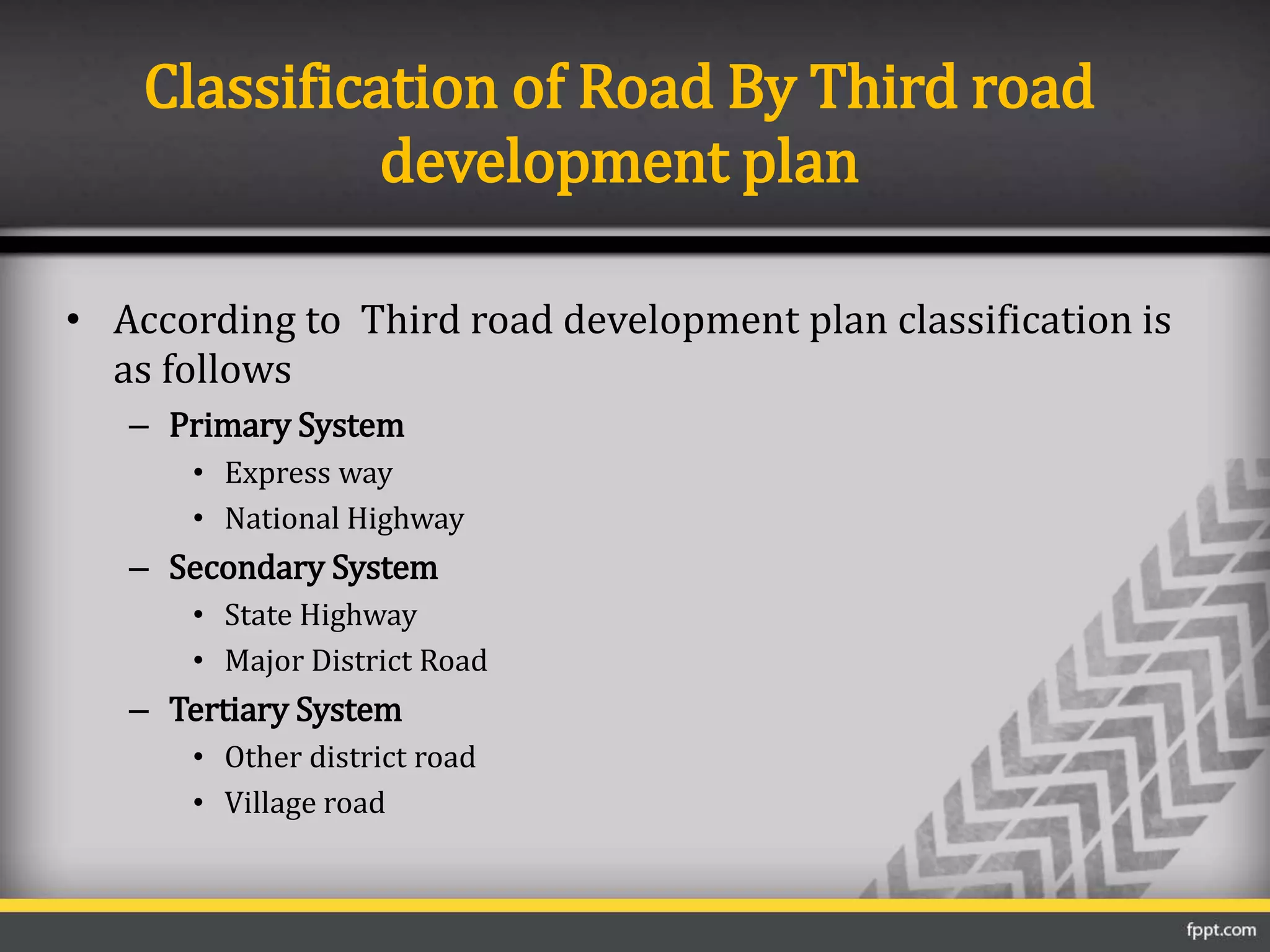
Classification of Road By Third road
development plan
• According to Third road development plan classification is
as follows
– Primary System
• Express way
• National Highway
– Secondary System
• State Highway
• Major District Road
– Tertiary System
• Other district road
• Village road
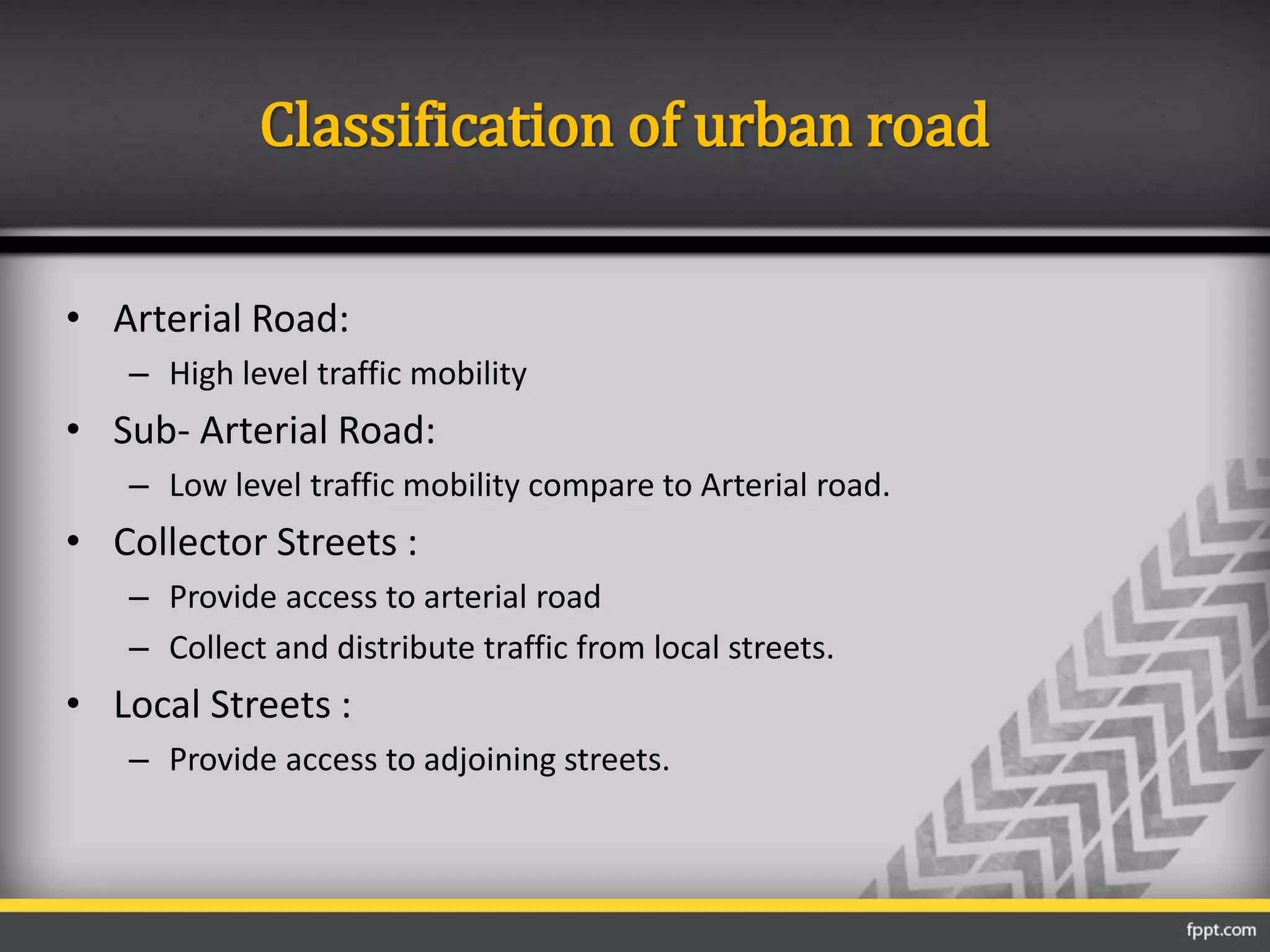
Classification of urban road
• Arterial Road:
– High level traffic mobility
• Sub- Arterial Road:
– Low level traffic mobility compare to Arterial road.
• Collector Streets :
– Provide access to arterial road
– Collect and distribute traffic from local streets.
• Local Streets :
– Provide access to adjoining streets.
Thank You

Importance and Classification of Road

  • 1.
    Highway Engineering Importance andClassification of Roads Mr. Shrikant S. Ingale HoD, Civil Dept., Diploma Wing, Rajarambapu Institute of technology, Rajaramnagar
  • 2.
    Importance of Transportation •Role of Transportation • Economic Activity and Transport • Social Effect of Transportation • Sectionalism • Concentration of population in urban areas. • Aspect of safety, law and order. • Role of Transportation in Rural Development
  • 3.
    Different Modes ofTransportation. Modes of Transportation Roadways or Highways Railways Waterways Airways
  • 4.
    Roadways Cont… • Forproper development of country , efficient and well planed network of roads are necessary. • Road classified based on different areas of country . • National Highway • State Highway • District Highway • Village highway • National Highway: – Connect important cities of country – Carry heavy and fast traffic. – Width from 7 M to 15 M
  • 5.
    Roadways • State Highway: –Connect national highway and district places. – Carry Medium and fast traffic. – Width from 7 M to 10 M • District Roads: – Connect district places and taluka places. – Carry Moderate traffic. – Width from 5 M to 8 M • Village Roads: – Connect Villages to taluka places. – Carry light traffic. – Width from 3 M to 5 M
  • 6.
    Types of Pavement TypesofPavement Flexible Pavements RigidPavement – Top surface takes the shape of Sub- Surface. – Example: Earthen, Gravel, WBM, Bituminous Roads. – More Stiff and Thick. – Example: Concrete road.
  • 7.
    Necessity, Merit andDemerits of Roads • Necessity: – Quick and Easy Transportation. – Surrounding area develop quickly. • Merits: – Construction Cost is less. – Very convenient for passenger and good transport. – Destination and starting points are not necessary to define. – Any type of vehicle can used this mode of transport. • Demerits: – Early wear of road pavement. – Speed limit and restriction. – Suitable for short distance only.
  • 8.
    Railways • Commonly termedas permanent way for transportation means. • Railways are more essential for mass transportation of men and materials for long distance.
  • 9.
    Railways Gauges used InIndia Gauges Clear distance between inner faces Narrow Gauge 0.756 M Meter gauge 1.000 M Broad gauge 1.676 M
  • 10.
    Merit and Demeritsof Railways • Merits: – Economic for common people. – Safe and comfortable. – Heavy goods and raw material can transport for long distance. – Maximum Revenue. – Provide maximum employment . • Demerits: – Initial cost of construction is more. – Frequently maintenance required. – Door to door transportation is not possible.
  • 11.
    Airways • It isfastest mode of transport
  • 12.
    • Classification: – InternationalAirport – Domestic Airport – Military Aerodromes • Limitations: – Operating expenses. – Capacity – Weather Condition Classification and Limitation of Airways
  • 13.
  • 14.
    Merit and Demeritsof Waterways • Merits: – Most cheapest mode of transport. – Good for long distance. • Demerits: – Time consuming. – Depends upon Climatic condition. – Energy consumption is more.
  • 15.
    Characteristics of RoadsTransport. • Road are used by many types of vehicles. • Relatively small investment for government. • Road transport offers complete freedom to road users. • Short distance travel, road transport saves time. • Road transport offers itself to whole community alike. • Due to speed and flexibility of movement offered to road users, road transport subjected to high degree of accidents but derailment of railway locomotive and air crash are more disastrous.
  • 16.
    Classification of Roads. •Classification is done on following bases. – According to traffic. – According to transport tonnage – According to importance. – According to Location and functions. – According to materials.
  • 17.
    Classification of Roads. •According to traffic. • According to transport tonnage Sr. No. Types of Road Vehicle Per Day 1 Very Heavy traffic Road Above 600 2 Heavy traffic Road 251 to 600 3 Medium traffic Road 70 to 250 4 Light traffic Road Below 70 Sr. No. Types of Roa Vehicle Per Day 1 Very Heavy traffic Road Above 1524 2 Heavy traffic Road 1017 to 1524 3 Medium traffic Road 508 to 1017 4 Light traffic Road Below 508
  • 18.
    • According toImportance – Class I – Class II – Class III • According to Location and Function – National Highway (NH) – State Highway (SH) – Major District Roads (MDR) – Other District Roads (ODR) – Village Roads (VR) Classification of Roads. • According to Material used – Earthen road – Water bound macadam Road – Bituminous Road – Cement concrete road
  • 19.
    Classification of Roads. •The classification based on location and function should therefore be more acceptable classification for country. • The Nagpur Road Plan classified road in India based on location and function which are as follows a) National Highway (NH) b) State Highway (SH) c) Major District Roads (MDR) d) Other District Roads (ODR) e) Village Roads (VR)
  • 20.
    National Highway • Highwayrunning trough length an breadth of India, connecting major ports, foreign highway, capitals of large state and large industrial and tourist centers including road required for strategic movement for the defense of India.
  • 21.
    State Highways • Arterialroads of States, connecting national highways of adjacent state , district head quarter and important cities in state and severing as the main arteries for traffic to and from district roads. • NH and SH having same design speed and geometric design specification.
  • 22.
    Major District Roads(MDR) • MDR are important road within district .Serving areas of production ,markets and connecting them to main highway of district. • Lower design specification than State Highway.
  • 23.
    Other District Roads(ODR) • These road are serving rural areas of production and providing them outlet to market and connecting those to taluka head quarters, other main roads. • Lower design specification than MDR.
  • 24.
    Village Roads (VR) •These roads are connecting villages or group of villages to each other or nearest road of higher category.
  • 25.
    Classification of RoadBy Third road development plan • According to Third road development plan classification is as follows – Primary System • Express way • National Highway – Secondary System • State Highway • Major District Road – Tertiary System • Other district road • Village road
  • 26.
    Classification of urbanroad • Arterial Road: – High level traffic mobility • Sub- Arterial Road: – Low level traffic mobility compare to Arterial road. • Collector Streets : – Provide access to arterial road – Collect and distribute traffic from local streets. • Local Streets : – Provide access to adjoining streets.
  • 27.