

Soft Skills
1
Shashank Varun
How will this training help me ?
2
Understand soft skill techniques
You will have the tools needed to incorporate soft
skills during every customer interaction.
Why soft skills are very important
3
• To handle interpersonal relations
• To take appropriate decisions
• To communicate effectively
• To have good impression and impact to gain professional
development
Communication skill as soft skill
4
• Communication skills form the Corner stone of soft
skill
• Every human being has to essentially & effectively
communicate with others
• Using the right word in the right order
Communication is the sending and receiving of a message. Communication can occur between
one or many different people.
Written communication Skill
5
• -> Writing evaluates a person’s proficiency indications,
spelling grammar etc…
• -> Good visual presentation using graphics, colour,
balanced design layout- adds so much to written
communication.
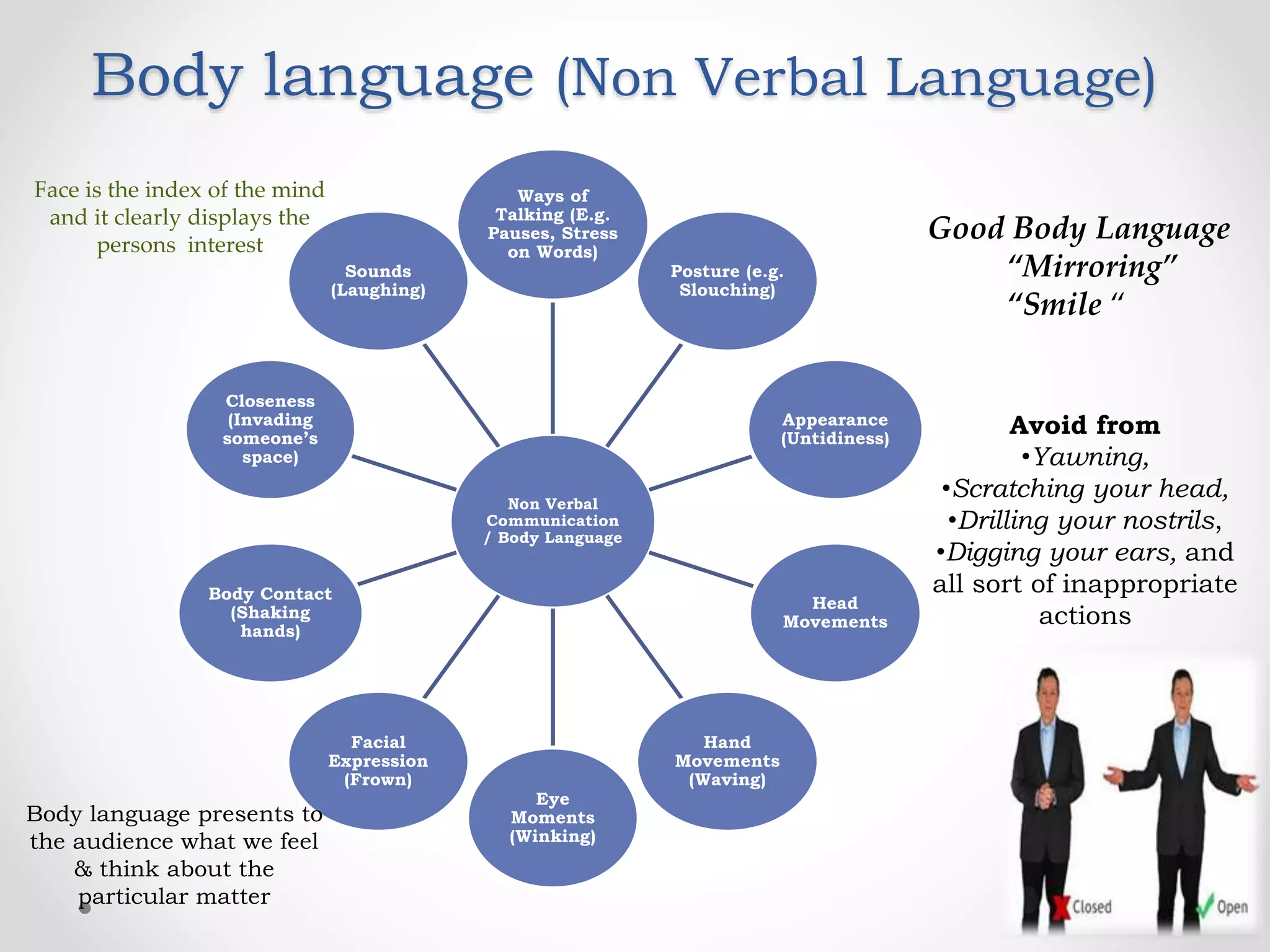
Body language (Non Verbal Language)
6
Non Verbal
Communication
/ Body Language
Ways of
Talking (E.g.
Pauses, Stress
on Words)
Posture (e.g.
Slouching)
Appearance
(Untidiness)
Head
Movements
Hand
Movements
(Waving)
Eye
Moments
(Winking)
Facial
Expression
(Frown)
Body Contact
(Shaking
hands)
Closeness
(Invading
someone’s
space)
Sounds
(Laughing)
Face is the index of the mind
and it clearly displays the
persons interest
Body language presents to
the audience what we feel
& think about the
particular matter
Good Body Language
“Mirroring”
“Smile “
Avoid from
•Yawning,
•Scratching your head,
•Drilling your nostrils,
•Digging your ears, and
all sort of inappropriate
actions
SELF APPEARANCE
7
 The way you dress
 Cleanliness
 Color of your dress
 Ornaments
 Body smell
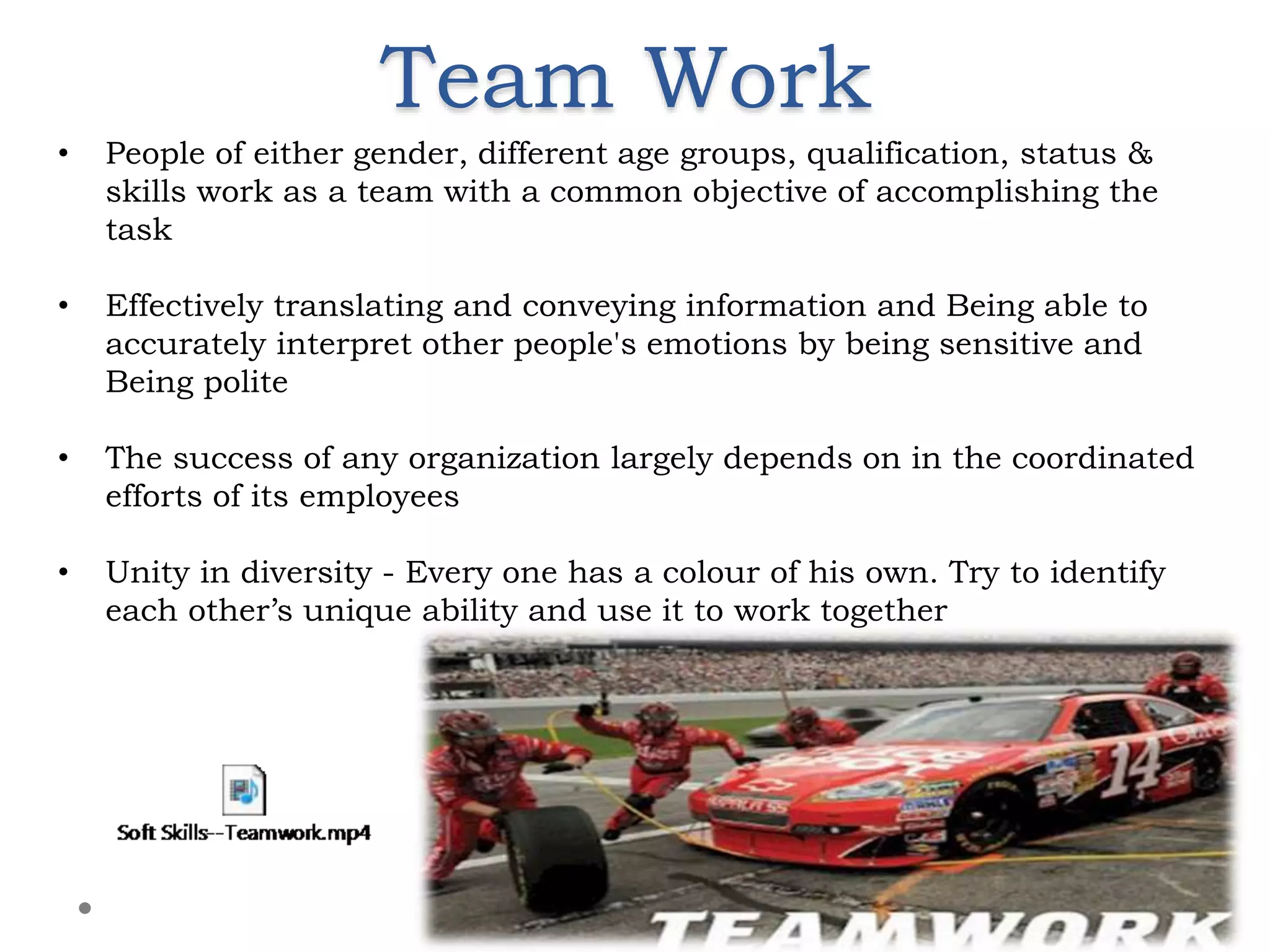
Team Work
8
• People of either gender, different age groups, qualification, status &
skills work as a team with a common objective of accomplishing the
task
• Effectively translating and conveying information and Being able to
accurately interpret other people's emotions by being sensitive and
Being polite
• The success of any organization largely depends on in the coordinated
efforts of its employees
• Unity in diversity - Every one has a colour of his own. Try to identify
each other’s unique ability and use it to work together
Presentation Skills
9
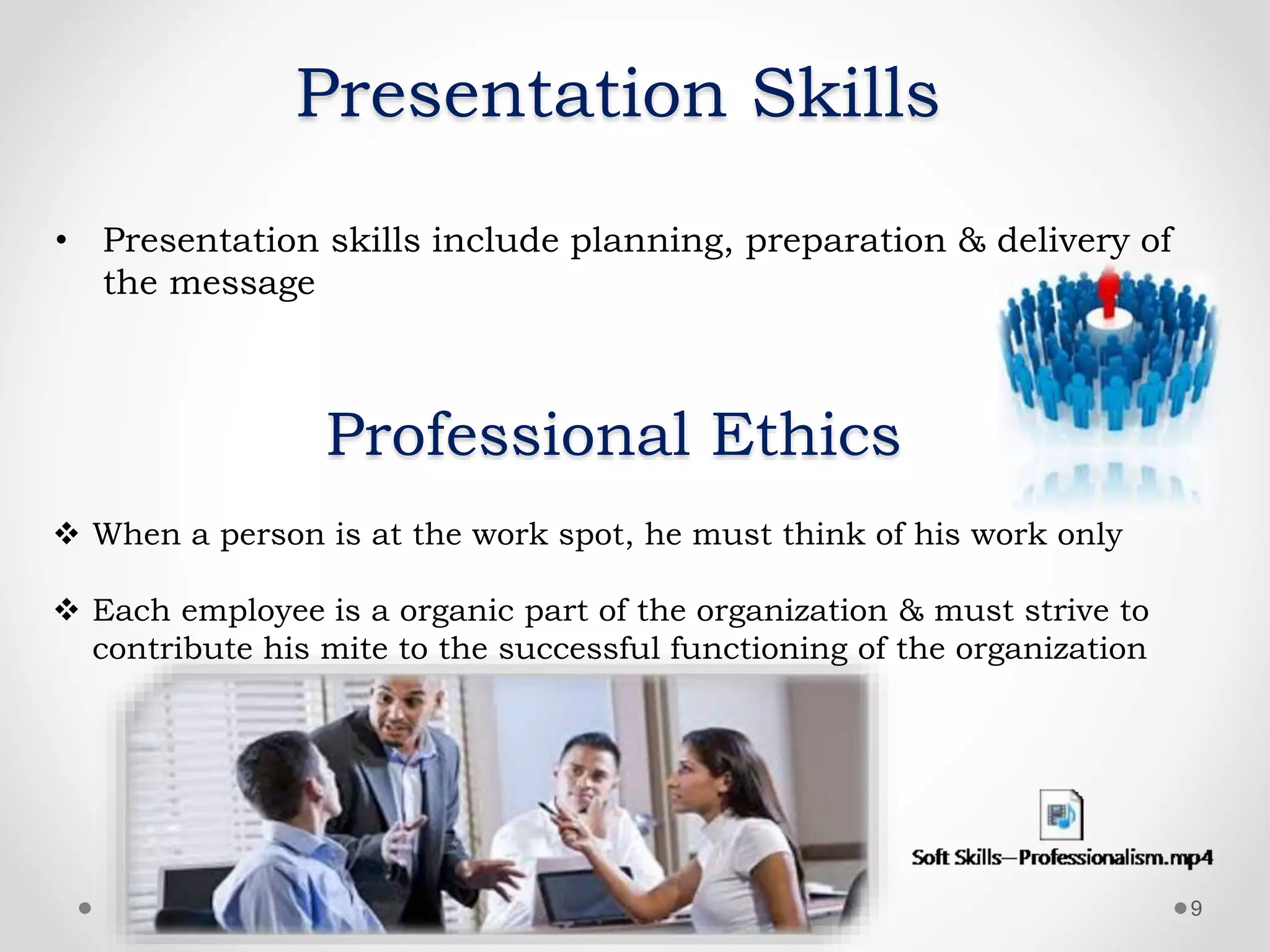
• Presentation skills include planning, preparation & delivery of
the message
 When a person is at the work spot, he must think of his work only
 Each employee is a organic part of the organization & must strive to
contribute his mite to the successful functioning of the organization
Professional Ethics
Interpersonal Skills
10
• Man is a social animal & his success in life largely
depends on his relationship & interaction with
others
• We must respect the views & sentiments of others.
• When we want to differ their views, we must very
politely give hints to them without wondering their
feelings.
• Understands teamwork and works with others
Intrapersonal Skills
11
To develop interpersonal skills
• Understand differences between you and others
• Understand why others react to you the way they do
• Adapt your communication behaviors to others’ reactions
Intrapersonal skills are those skills and communications that occur within a
person's own mind
Visualization / Recognizing Negativity / Positive Decision Making / Adaptability
Time & Stress Management
12
• Prioritize the work & schedule your time accordingly
• Important work should be allotted more time & taken up first
• Burnout Syndrome - Listening to music & practicing Yoga will
considerably reduce this.
• Instead of coffee, drink water, juice, or electrolyte infused drinks.
Dehydration often is the cause of fatigue. Coffee and soft drinks
that contain caffeine may seem to “keep you going”, but in
reality they add to stress and don’t keep your body hydrated
The Art of Listening
13
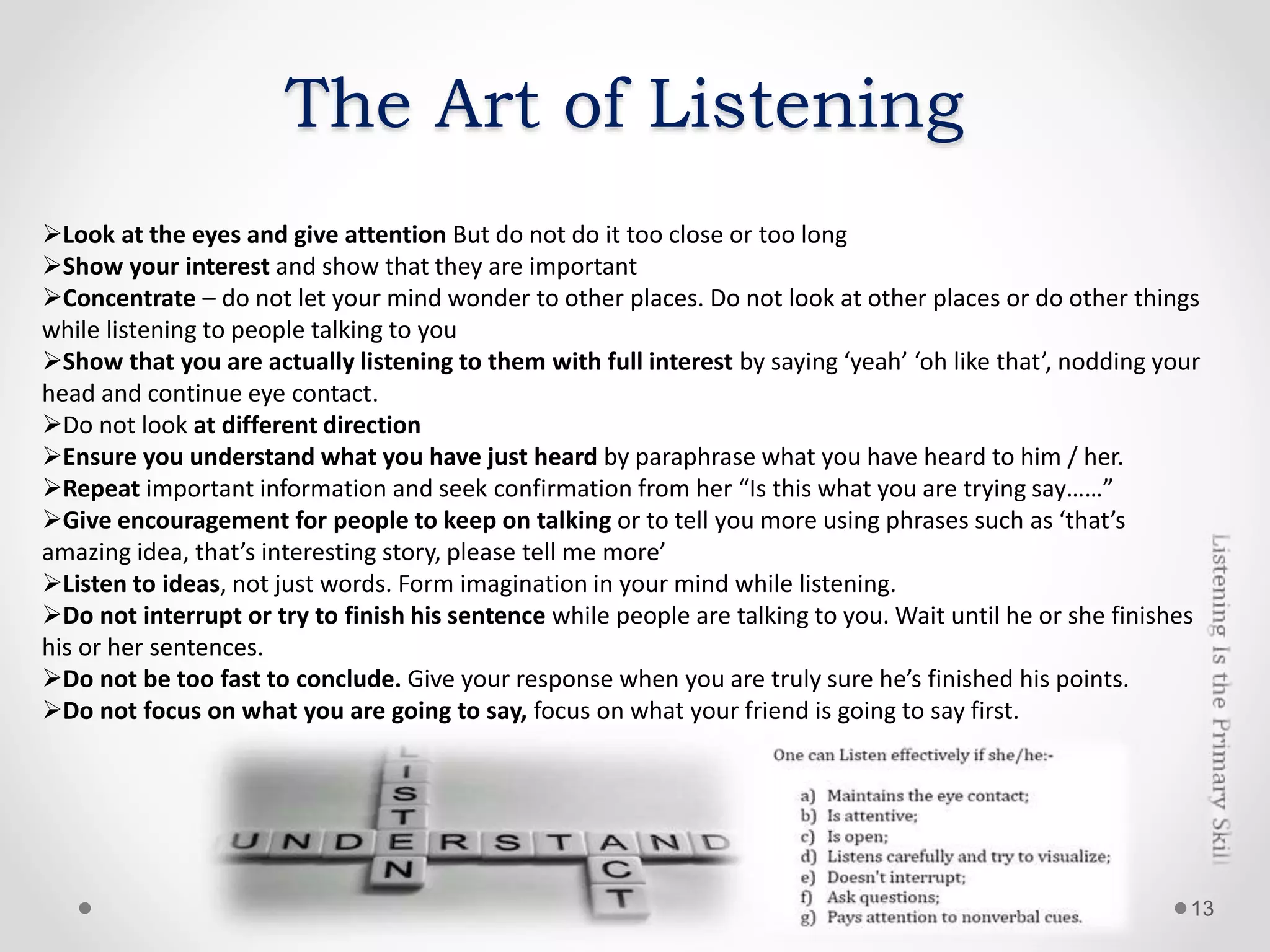
Look at the eyes and give attention But do not do it too close or too long
Show your interest and show that they are important
Concentrate – do not let your mind wonder to other places. Do not look at other places or do other things
while listening to people talking to you
Show that you are actually listening to them with full interest by saying ‘yeah’ ‘oh like that’, nodding your
head and continue eye contact.
Do not look at different direction
Ensure you understand what you have just heard by paraphrase what you have heard to him / her.
Repeat important information and seek confirmation from her “Is this what you are trying say……”
Give encouragement for people to keep on talking or to tell you more using phrases such as ‘that’s
amazing idea, that’s interesting story, please tell me more’
Listen to ideas, not just words. Form imagination in your mind while listening.
Do not interrupt or try to finish his sentence while people are talking to you. Wait until he or she finishes
his or her sentences.
Do not be too fast to conclude. Give your response when you are truly sure he’s finished his points.
Do not focus on what you are going to say, focus on what your friend is going to say first.
Empathy – What is it?
14
• Showing empathy means understanding, and being
sensitive to, the feelings, thoughts, and experiences of
the customer. It doesn’t mean you have to agree with
someone who is expressing negative thoughts. It just
means that you recognize that point of view.
Pro-Active Service = Going an extra mile to delight
• Pro-active service is demonstrated when you
anticipate the customer’s needs or expectations and
respond to them in advance of being asked.
Q & A
15
Thank You
16

Soft Skills Presentation

  • 1.
  • 2.
    How will thistraining help me ? 2 Understand soft skill techniques You will have the tools needed to incorporate soft skills during every customer interaction.
  • 3.
    Why soft skillsare very important 3 • To handle interpersonal relations • To take appropriate decisions • To communicate effectively • To have good impression and impact to gain professional development
  • 4.
    Communication skill assoft skill 4 • Communication skills form the Corner stone of soft skill • Every human being has to essentially & effectively communicate with others • Using the right word in the right order Communication is the sending and receiving of a message. Communication can occur between one or many different people.
  • 5.
    Written communication Skill 5 •-> Writing evaluates a person’s proficiency indications, spelling grammar etc… • -> Good visual presentation using graphics, colour, balanced design layout- adds so much to written communication.
  • 6.
    Body language (NonVerbal Language) 6 Non Verbal Communication / Body Language Ways of Talking (E.g. Pauses, Stress on Words) Posture (e.g. Slouching) Appearance (Untidiness) Head Movements Hand Movements (Waving) Eye Moments (Winking) Facial Expression (Frown) Body Contact (Shaking hands) Closeness (Invading someone’s space) Sounds (Laughing) Face is the index of the mind and it clearly displays the persons interest Body language presents to the audience what we feel & think about the particular matter Good Body Language “Mirroring” “Smile “ Avoid from •Yawning, •Scratching your head, •Drilling your nostrils, •Digging your ears, and all sort of inappropriate actions
  • 7.
    SELF APPEARANCE 7  Theway you dress  Cleanliness  Color of your dress  Ornaments  Body smell
  • 8.
    Team Work 8 • Peopleof either gender, different age groups, qualification, status & skills work as a team with a common objective of accomplishing the task • Effectively translating and conveying information and Being able to accurately interpret other people's emotions by being sensitive and Being polite • The success of any organization largely depends on in the coordinated efforts of its employees • Unity in diversity - Every one has a colour of his own. Try to identify each other’s unique ability and use it to work together
  • 9.
    Presentation Skills 9 • Presentationskills include planning, preparation & delivery of the message  When a person is at the work spot, he must think of his work only  Each employee is a organic part of the organization & must strive to contribute his mite to the successful functioning of the organization Professional Ethics
  • 10.
    Interpersonal Skills 10 • Manis a social animal & his success in life largely depends on his relationship & interaction with others • We must respect the views & sentiments of others. • When we want to differ their views, we must very politely give hints to them without wondering their feelings. • Understands teamwork and works with others
  • 11.
    Intrapersonal Skills 11 To developinterpersonal skills • Understand differences between you and others • Understand why others react to you the way they do • Adapt your communication behaviors to others’ reactions Intrapersonal skills are those skills and communications that occur within a person's own mind Visualization / Recognizing Negativity / Positive Decision Making / Adaptability
  • 12.
    Time & StressManagement 12 • Prioritize the work & schedule your time accordingly • Important work should be allotted more time & taken up first • Burnout Syndrome - Listening to music & practicing Yoga will considerably reduce this. • Instead of coffee, drink water, juice, or electrolyte infused drinks. Dehydration often is the cause of fatigue. Coffee and soft drinks that contain caffeine may seem to “keep you going”, but in reality they add to stress and don’t keep your body hydrated
  • 13.
    The Art ofListening 13 Look at the eyes and give attention But do not do it too close or too long Show your interest and show that they are important Concentrate – do not let your mind wonder to other places. Do not look at other places or do other things while listening to people talking to you Show that you are actually listening to them with full interest by saying ‘yeah’ ‘oh like that’, nodding your head and continue eye contact. Do not look at different direction Ensure you understand what you have just heard by paraphrase what you have heard to him / her. Repeat important information and seek confirmation from her “Is this what you are trying say……” Give encouragement for people to keep on talking or to tell you more using phrases such as ‘that’s amazing idea, that’s interesting story, please tell me more’ Listen to ideas, not just words. Form imagination in your mind while listening. Do not interrupt or try to finish his sentence while people are talking to you. Wait until he or she finishes his or her sentences. Do not be too fast to conclude. Give your response when you are truly sure he’s finished his points. Do not focus on what you are going to say, focus on what your friend is going to say first.
  • 14.
    Empathy – Whatis it? 14 • Showing empathy means understanding, and being sensitive to, the feelings, thoughts, and experiences of the customer. It doesn’t mean you have to agree with someone who is expressing negative thoughts. It just means that you recognize that point of view. Pro-Active Service = Going an extra mile to delight • Pro-active service is demonstrated when you anticipate the customer’s needs or expectations and respond to them in advance of being asked.
  • 15.
  • 16.

Editor's Notes

  • #5 Why Comm skill as soft skill