Unit-1:
BEHAVIOURAL SKILLS: Effective
listening, non-verbal communication,
Social skills. Paraphrasing, SWOT
analysis, Role plays of guest handling.
Interpersonal relationships. Cross-
cultural communications.
B.Sc. DEGREE INHOSPITALITY & HOTEL
ADMINISTRATION
BHA108
EMPLOYABILITY SKILLS
National Council for Hotel Management
And Catering Technology
Noida
(NCHMCT)
And
Jawaharlal Nehru University
(JNU)
20/06/2025 Employability Skills/ Bonophool Banerjee 2
Employability Skills:
Behavioral Skills
"Behavioral skills are the real game changers; they
turn potential into performance and drive
personal and professional growth"
BB Bonophool Banerjee
20/06/2025 Employability Skills/ Bonophool Banerjee 3
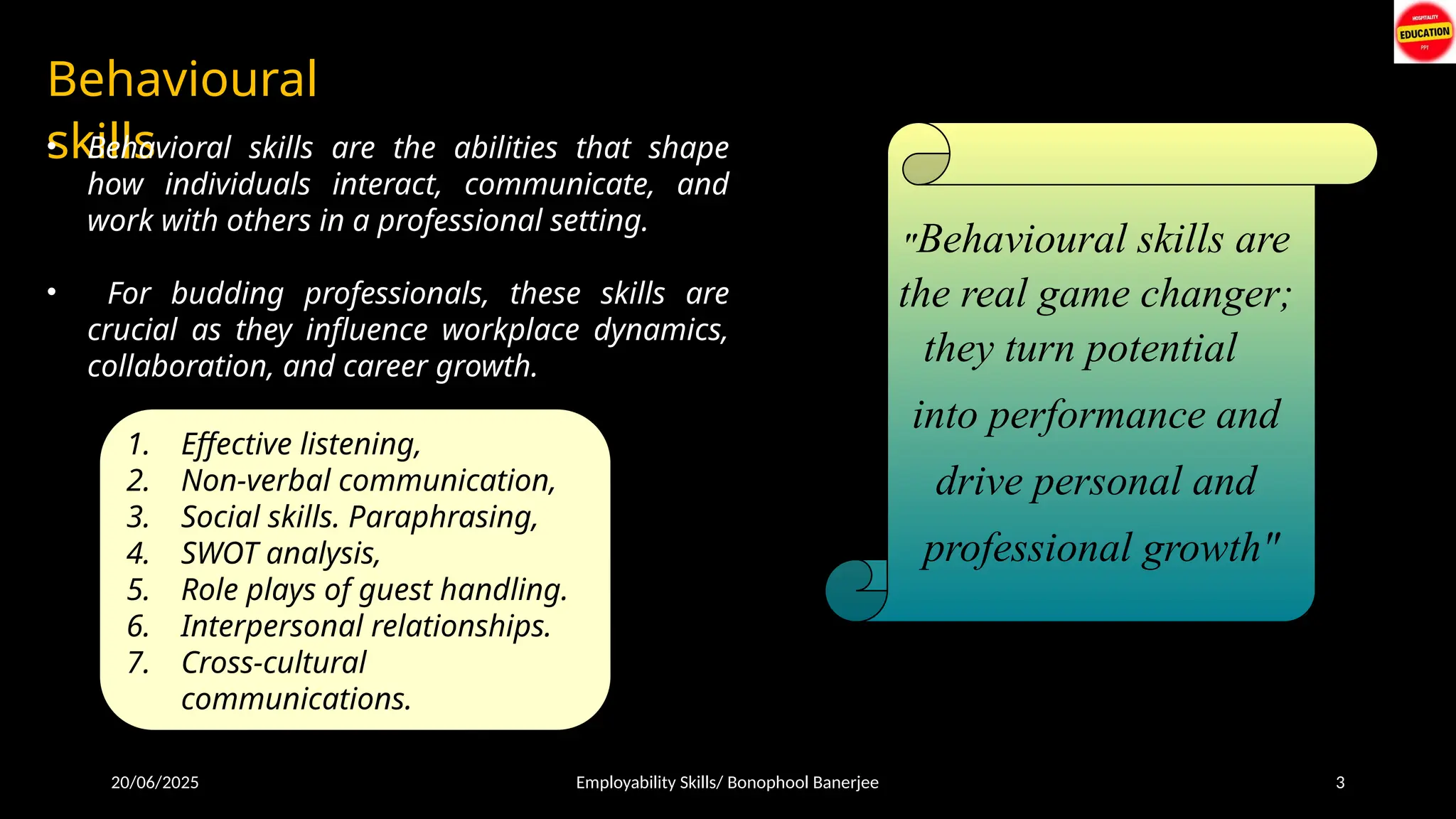
Behavioural
skills
"Behavioural skills are
the real game changer;
they turn potential
into performance and
drive personal and
professional growth"
• Behavioral skills are the abilities that shape
how individuals interact, communicate, and
work with others in a professional setting.
• For budding professionals, these skills are
crucial as they influence workplace dynamics,
collaboration, and career growth.
1. Effective listening,
2. Non-verbal communication,
3. Social skills. Paraphrasing,
4. SWOT analysis,
5. Role plays of guest handling.
6. Interpersonal relationships.
7. Cross-cultural
communications.
20/06/2025 Employability Skills/ Bonophool Banerjee 4
Effective Listening
Effective listening involves
actively paying attention to what
the speaker is saying,
understanding the message, and
responding thoughtfully.
It is essential for building
rapport, resolving conflicts, and
fostering collaboration.
Importance of Effective Listening:
•Builds Strong Relationships – Helps in fostering
trust and understanding in professional and
personal interactions.
•Enhances Learning – Allows individuals to absorb
new information and improve skills.
•Improves Workplace Efficiency – Reduces
misunderstandings, leading to better collaboration
and productivity.
•Strengthens Problem-Solving – Helps in identifying
issues and finding solutions effectively.
20/06/2025 Employability Skills/ Bonophool Banerjee 5
Components of Effective
Listening
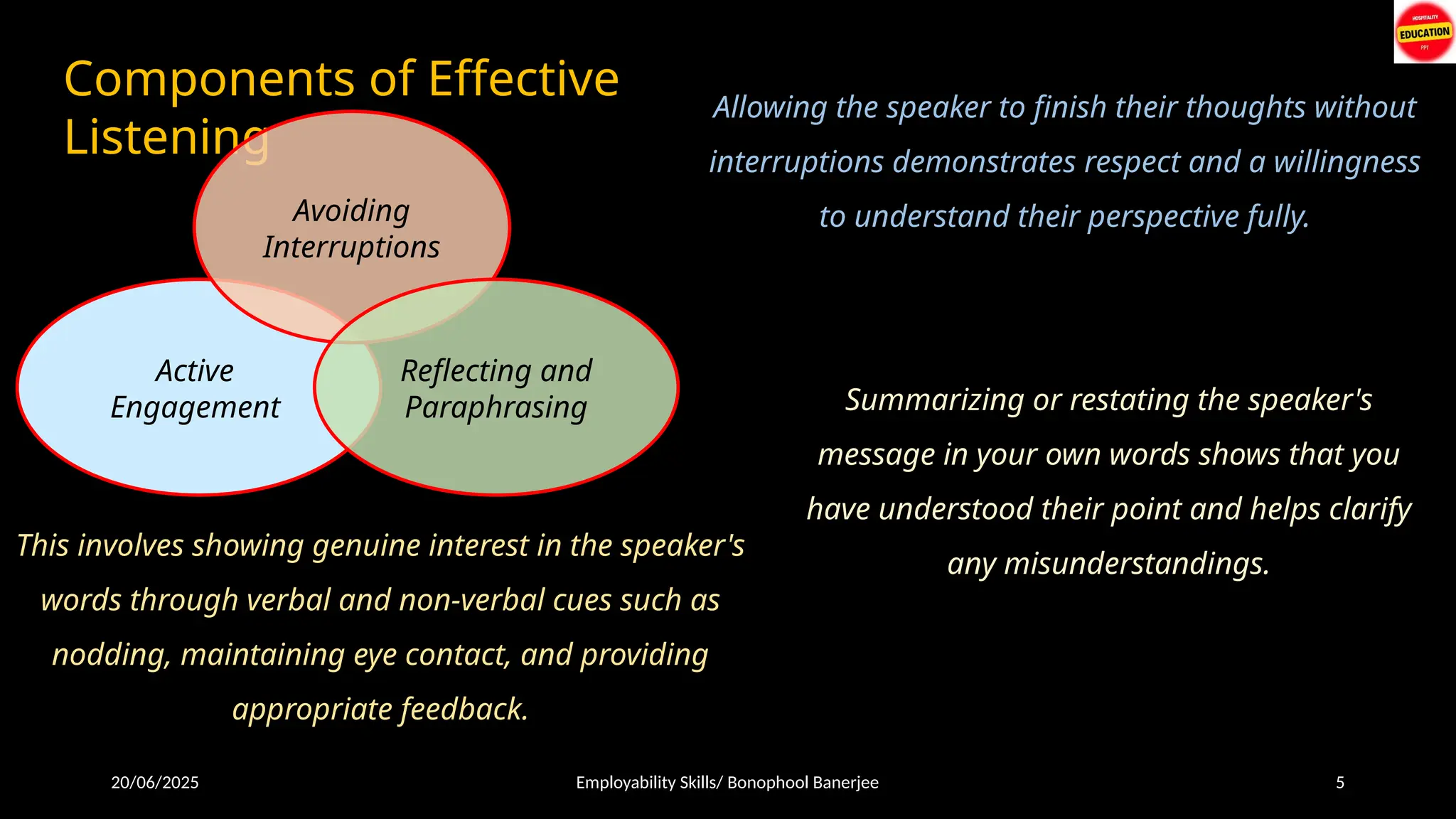
Active
Engagement
Avoiding
Interruptions
Reflecting and
Paraphrasing
This involves showing genuine interest in the speaker's
words through verbal and non-verbal cues such as
nodding, maintaining eye contact, and providing
appropriate feedback.
Allowing the speaker to finish their thoughts without
interruptions demonstrates respect and a willingness
to understand their perspective fully.
Summarizing or restating the speaker's
message in your own words shows that you
have understood their point and helps clarify
any misunderstandings.
A
Barriers to Effective
Listening
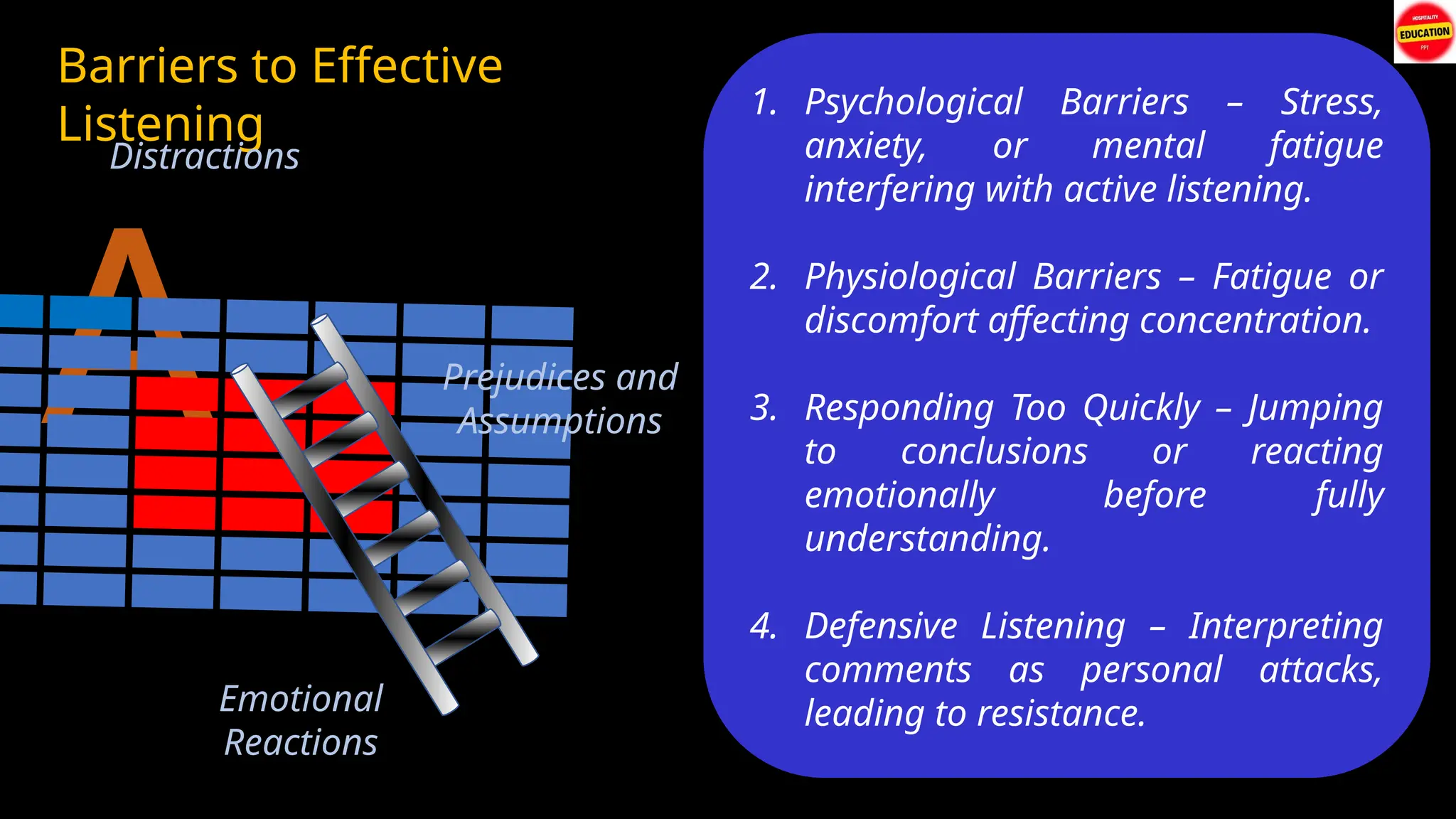
Distractions
Prejudices and
Assumptions
Emotional
Reactions
1. Physical Barriers – Background
noise, poor audio, or other external
interruptions.
2. Environmental Barriers –
Uncomfortable settings, frequent
disruptions, or overcrowding.
3. Information Overload – Too much
data at once, leading to cognitive
fatigue.
4. Multitasking – Dividing attention
between multiple activities,
reducing focus.
1. Prejudice and Bias – Judging the
speaker based on stereotypes or
preconceived opinions.
2. Cultural and Language Barriers –
Differences in dialects, accents, or
cultural references affecting
understanding.
3. Egocentrism – Assuming one knows
more than the speaker, leading to
dismissiveness.
4. Lack of Interest – Disengagement
due to assumptions about the
speaker or topic.
1. Psychological Barriers – Stress,
anxiety, or mental fatigue
interfering with active listening.
2. Physiological Barriers – Fatigue or
discomfort affecting concentration.
3. Responding Too Quickly – Jumping
to conclusions or reacting
emotionally before fully
understanding.
4. Defensive Listening – Interpreting
comments as personal attacks,
leading to resistance.
Maintain
Focus
Show
Empathy
Ask
Questions
Techniques to Enhance Effective
Listening
• Active Listening – Concentrate
fully on the speaker and avoid
distractions.
• Maintain Eye Contact – Shows
attentiveness and helps
understand non-verbal cues.
• Avoid Distractions – Put away
devices and minimize external
interruptions.
• Be Patient and Open-Minded –
Allow the speaker to express
their thoughts completely.
• Control Emotional Responses –
Stay neutral and listen without
reacting impulsively.
• Paraphrase and Summarize –
Confirm understanding and
show that you value the
speaker’s perspective.
• Use Affirmative Cues – Nod,
smile, or give verbal
acknowledgments like “I see” to
encourage the speaker.
• Ask Clarifying Questions –
Helps ensure accurate
understanding of the message.
• Encourage Further Discussion –
Use open-ended questions like
“Can you elaborate?” to gain
deeper insights.
• Seek Speaker’s Perspective –
Questions like “What do you
think?” foster meaningful
conversations.
20/06/2025 Employability Skills/ Bonophool Banerjee
8
Benefits of Effective
Listening
1. Improved Relationships
2. Enhanced Problem
solving
3. Increased Efficiency
• Strengthens Relationships – Builds trust and
rapport with colleagues, friends, and family.
• Boosts Emotional Intelligence – Helps in
understanding emotions and perspectives,
fostering empathy.
• Reduces Stress and Miscommunication – Prevents
conflicts by ensuring clarity and support in
conversations.
• Encourages Personal Growth – Develops patience,
focus, and mindfulness, improving decision-
making.
• Improves Learning and Knowledge Retention –
Helps absorb information effectively for smarter
problem-solving.
• Enhances Workplace Productivity – Leads to better
collaboration, teamwork, and decision-making.
• Reduces Stress and Miscommunication – Saves
time by avoiding misunderstandings.
• Encourages Continuous Learning – Helps in
retaining key insights that improve efficiency in
tasks.
• Strengthens Leadership and Interpersonal Skills –
Allows professionals to navigate challenges
effectively.
20/06/2025 Employability Skills/ Bonophool Banerjee 9
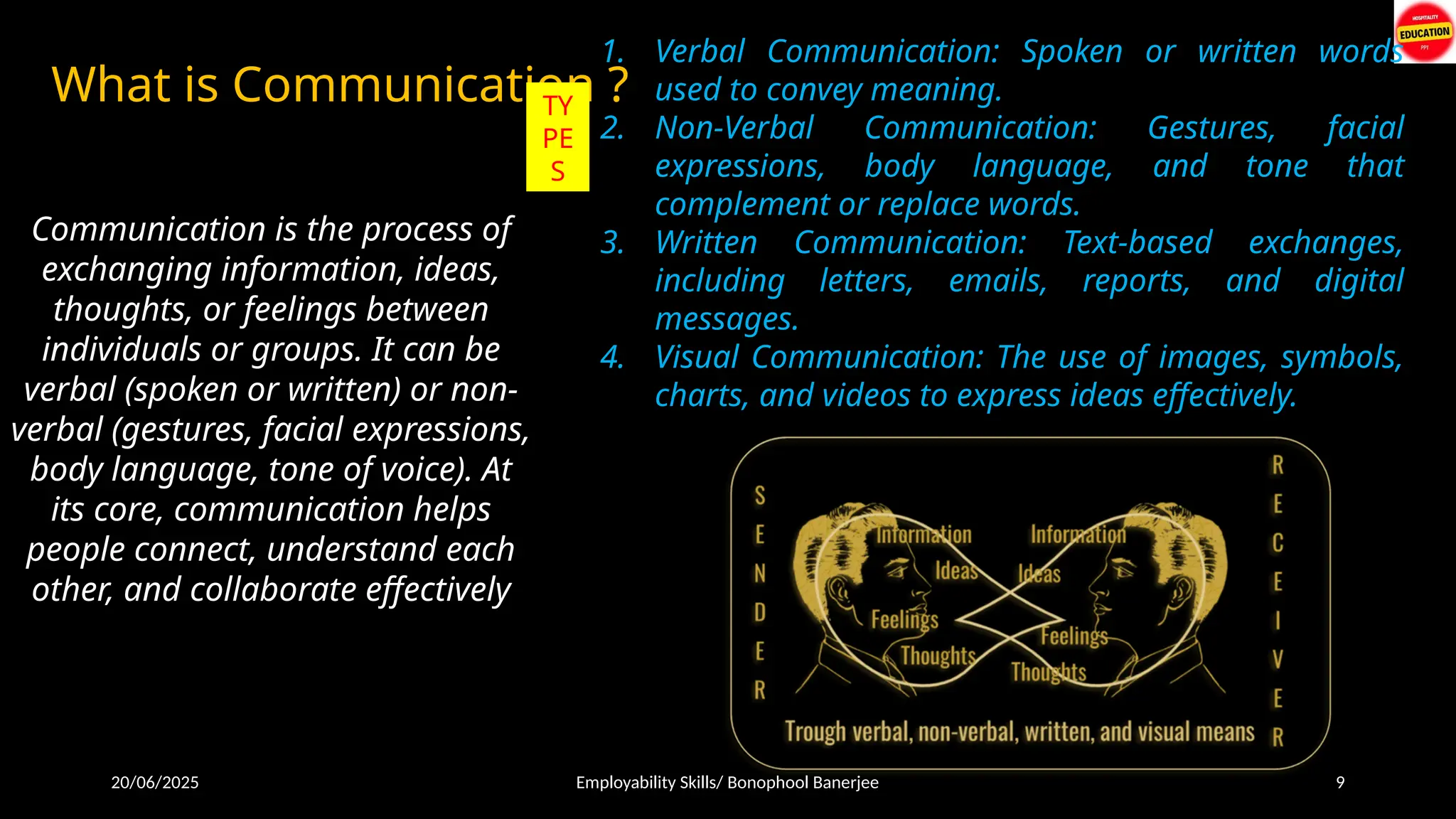
What is Communication ?
Communication is the process of
exchanging information, ideas,
thoughts, or feelings between
individuals or groups. It can be
verbal (spoken or written) or non-
verbal (gestures, facial expressions,
body language, tone of voice). At
its core, communication helps
people connect, understand each
other, and collaborate effectively
1. Verbal Communication: Spoken or written words
used to convey meaning.
2. Non-Verbal Communication: Gestures, facial
expressions, body language, and tone that
complement or replace words.
3. Written Communication: Text-based exchanges,
including letters, emails, reports, and digital
messages.
4. Visual Communication: The use of images, symbols,
charts, and videos to express ideas effectively.
TY
PE
S
20/06/2025 Employability Skills/ Bonophool Banerjee 10
Non-Verbal
Communication
• Non-verbal communication is the transmission of meaning through gestures, facial
expressions, posture, tone, and other non-verbal cues—without relying on spoken or written
words.
• It plays a crucial role in human interaction, shaping perceptions, emotions, and
relationships.
• This form of communication can be intentional or subconscious, reinforcing verbal
messages or conveying emotions that words may fail to express.
• Whether it's a reassuring smile, a firm handshake, or a subtle shift in body language, non-
verbal cues often speak louder than words.
20/06/2025 Employability Skills/ Bonophool Banerjee 11
Types of Non-
verbal
Communication
Facial Expressions – A smile, frown, or raised eyebrow
can express emotions more powerfully than words.
Gestures – Movements of hands, arms, or head, like waving or
pointing, help emphasize meaning.
Body Language – Posture, stance, and movement can
indicate confidence, nervousness, or openness.
Eye Contact – The way people look at each other
can signal interest, trust, or discomfort.
Paralanguage – Tone, pitch, volume, and speed of speech
influence how a message is perceived.
20/06/2025 Employability Skills/ Bonophool Banerjee 12
Types of Non-
verbal
Communication
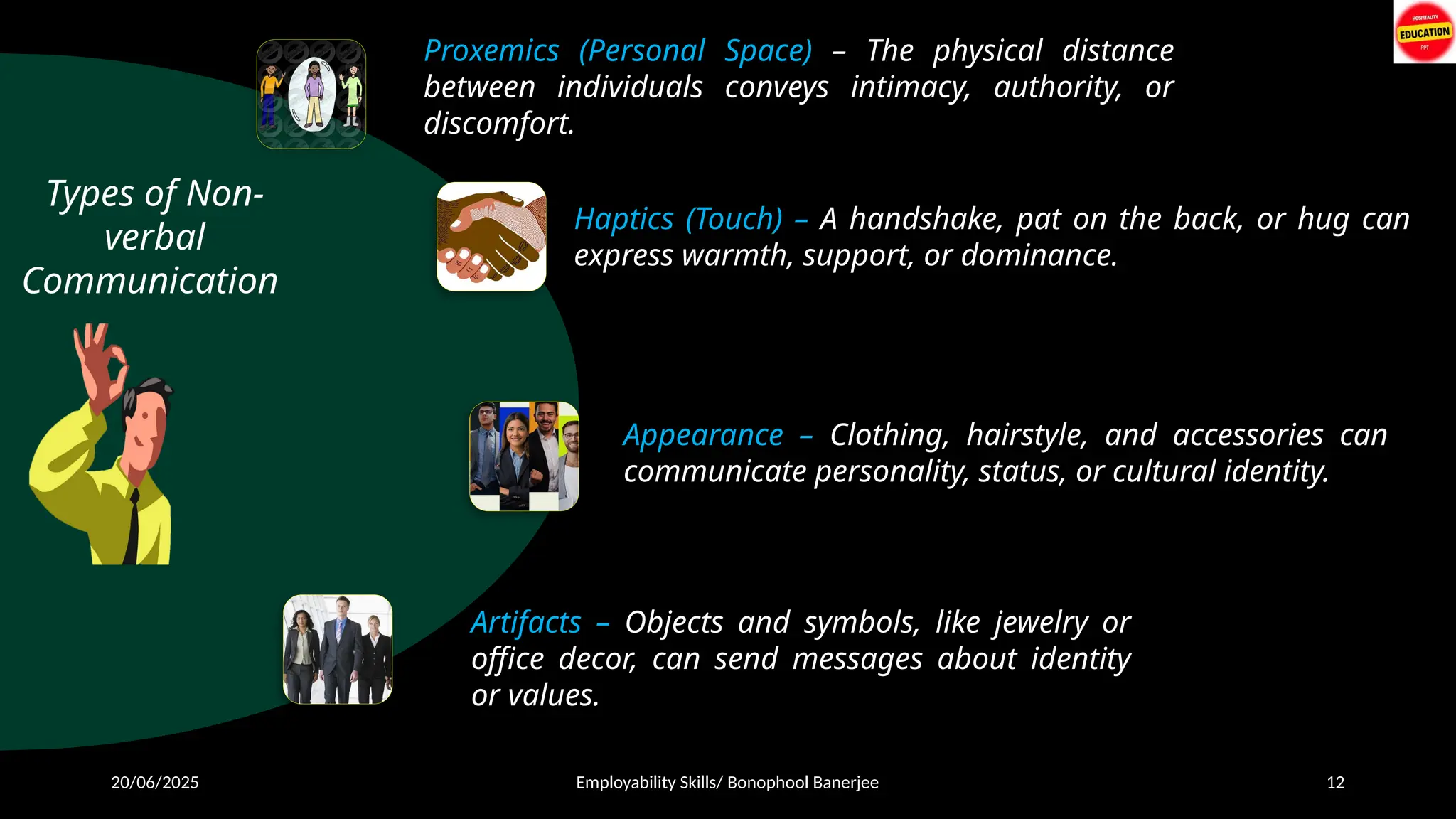
Proxemics (Personal Space) – The physical distance
between individuals conveys intimacy, authority, or
discomfort.
Haptics (Touch) – A handshake, pat on the back, or hug can
express warmth, support, or dominance.
Appearance – Clothing, hairstyle, and accessories can
communicate personality, status, or cultural identity.
Artifacts – Objects and symbols, like jewelry or
office decor, can send messages about identity
or values.
20/06/2025 Employability Skills/ Bonophool Banerjee 13
Proxemics (Personal
Space)
Proxemics is the study of how
people use space in
communication and social
interactions.
It was introduced by
anthropologist Edward T. Hall
in the 1960s.
Categories of Personal Space:
Hall identified four distinct zones of personal space, commonly
used in Western cultures:
1. Intimate Space (0–45 cm / 0–18 inches) Reserved for close
relationships such as family, close friends, and romantic
partners.
2. Personal Space (45 cm – 1.2 m / 18 inches – 4 feet) Used in
conversations with friends, colleagues, and acquaintances.
3. Social Space (1.2–3.6 m / 4–12 feet) Suitable for interactions
in group settings, such as workplaces or casual public
interactions.
4. Public Space (3.6 m+ / 12 feet+) Used for speeches,
performances, or large social gatherings where direct
interaction is minimal.
Cultural Variations
Different cultures have varying norms regarding personal
space:
High-contact cultures (e.g., Latin America, Middle East)
tend to stand closer and feel comfortable with touch.
Low-contact cultures (e.g., Japan, Northern Europe) prefer
more physical distance in interactions.
Impact on Communication
Personal space affects nonverbal communication:
• Standing too close may feel intrusive or aggressive.
• Being too far away may seem distant or uninterested.
• Adjusting space appropriately enhances comfort and
trust in interactions.
20/06/2025 Employability Skills/ Bonophool Banerjee 14
Eye Contact
Eye contact is a powerful form of
nonverbal communication that occurs
when two people look into each other's
eyes at the same time. It plays a crucial
role in social interactions, conveying
emotions, confidence, and
attentiveness.
Significance of Eye Contact
Builds Connection: Maintains engagement and fosters trust in
conversations.
Shows Confidence: Strong eye contact can indicate self-
assurance and credibility.
Expresses Emotions: Happiness, sadness, interest, or
discomfort can be conveyed through eye contact.
Enhances Communication: Helps in understanding social cues
and intentions.
Cultural Differences
In
Western cultures, maintaining eye contact is
often seen as a sign of honesty and
confidence.
In some Asian cultures, prolonged eye contact
may be considered disrespectful, especially
with elders or authority figures.
Psychological Effects
Too much eye contact can feel intimidating or aggressive.
Too little eye contact may be perceived as disinterest or
insecurity.
Balanced eye contact fosters positive interactions and mutual
understanding.
The ideal duration for eye contact in a conversation is around 3 to 3.3
seconds
. Studies suggest that most people feel comfortable with eye contact
lasting between 2 to 5 seconds.
Holding eye contact for too long (beyond 4–5 seconds) can feel intense
or intimidating, while too little eye contact may seem disengaged or
uninterested.
A good approach is to maintain eye contact for about 3 seconds, then
briefly look away before re-engaging. This creates a natural rhythm and
keeps interactions comfortable.
20/06/2025 Employability Skills/ Bonophool Banerjee 15
Importance of Non-verbal
Communication
1. Enhances Understanding – Facial
expressions, gestures, and body language
help clarify spoken words and provide
deeper meaning.
2. Expresses Emotions – Non-verbal cues like
tone of voice and posture reveal feelings
that words may not fully express.
3. Builds Trust & Connection – Maintaining
appropriate eye contact and open body
language fosters trust and engagement in
conversations.
4. Supports Verbal Communication – Gestures
and expressions reinforce spoken words,
making communication more impactful.
5. Crosses Language Barriers – Non-verbal
signals are universal and can help people
communicate across different languages and
cultures.
6. Influences Perception – The way someone
presents themselves through body language
and appearance affects how they are perceived
by others.
Psychologist Albert Mehrabian conducted
studies in the 1960s to understand how people
interpret communication. His findings suggest
that:
7%
38%
55%
Mehrabian's 7-38-55 Rule
Spoken Words
Tone of Voice
Fecial Expression & Body Language
20/06/2025 Employability Skills/ Bonophool Banerjee 16
Social Skills
Social skills are a crucial
component of behavioral
skills, as they enable
individuals to interact
effectively in various social
and professional settings.
Behavioral skills encompass
a wide range of abilities that
influence how people
respond to situations,
manage relationships, and
communicate with others.
1. Communication
2. Team work &
Collaboration
3. Empathy
4. Adaptability
5. Listening skills
6. Networking
7. Negotiation skills
8. Problem solving
Communication
Effective communication is the foundation of
social skills. It includes:
• Verbal communication – Expressing
thoughts clearly and confidently.
• Non-verbal communication – Using body
language, facial expressions, and tone of
voice.
• Active listening – Understanding and
responding appropriately to
conversations.
Teamwork & Collaboration
Working well with others requires:
• Cooperation – Sharing responsibilities and
supporting team members.
• Conflict resolution – Addressing
disagreements constructively.
• Trust-building – Establishing reliability and
mutual respect.
Empathy
Empathy allows individuals to understand
and relate to others' emotions:
• Emotional intelligence – Recognizing and
managing emotions effectively.
• Perspective-taking – Seeing situations
from others' viewpoints.
• Compassion – Offering support and
encouragement.
Adaptability
Being flexible in different situations is crucial:
• Handling change – Adjusting to new
environments and challenges.
• Problem-solving – Finding creative
solutions in dynamic situations.
• Resilience – Overcoming setbacks with a
positive mindset.
Listening Skills
Good listening enhances relationships and
understanding:
• Active listening – Paying full attention and
responding thoughtfully.
• Feedback processing – Understanding and
applying constructive criticism.
• Patience – Allowing others to express
themselves without interruption.
Networking
Building and maintaining professional and
social connections involves:
• Relationship-building – Establishing
meaningful connections.
• Effective communication – Engaging in
conversations confidently.
• Mutual support – Helping others while
receiving guidance.
Negotiation Skills
Negotiation is key in resolving conflicts and
making agreements:
• Persuasion – Convincing others with
logical reasoning.
• Compromise – Finding solutions that
benefit all parties.
• Decision-making – Evaluating options and
choosing the best course of action.
Problem-Solving
Critical thinking and decision-making are
essential for overcoming challenges:
• Analyzing situations – Identifying issues
and possible solutions.
• Creativity – Thinking outside the box for
innovative solutions.
• Decision-making – Choosing the best
approach based on available information.
20/06/2025 Employability Skills/ Bonophool Banerjee 17
What is Verbal
Communication?
Verbal communication is the
process of exchanging
information through spoken or
written words.
It plays a crucial role in human
interaction, allowing individuals
to express thoughts, emotions,
and ideas effectively.
Types
Of
Communication
Intrapersonal Communication
Interpersonal Communication
Small Group Communication
Public Communication
Written Communication
Mass Communication
20/06/2025 Employability Skills/ Bonophool Banerjee 18
Intrapersonal
Communication
This is communication that occurs
within an individual.
It includes self-talk, internal
reflection, and personal thoughts.
Example: Thinking through a problem
or practicing a speech in your mind.
Interpersonal
Communication
This involves direct communication
between two individuals.
It can be formal or informal,
depending on the relationship.
Example: A conversation between
friends, colleagues, or family
members.
Small Group Communication
This occurs when a small number of
people (typically 3–10) engage in
discussion.
It is used in teamwork, brainstorming
sessions, and meetings.
Example: A project discussion among
team members.
Public Communication
This involves one speaker addressing
a large audience.
It is used in speeches, presentations,
and public events.
Example: A politician giving a speech
or a professor lecturing a class.
Written Communication
This includes communication through
written words, such as emails,
reports, and letters.
It is essential for documentation and
formal communication.
Example: Writing a business proposal
or sending an official email.
Mass Communication
This is communication directed at a
large audience through media
channels.
It includes television, radio,
newspapers, and social media.
Example: A news broadcast or an
advertisement campaign.
TYP
ES
20/06/2025 Employability Skills/ Bonophool Banerjee 19
Paraphrasin
g
Paraphrasing is the act of
restating information in your
own words while preserving
the original meaning.
It allows you to express ideas
differently, making content
clearer and more accessible
As a behavioral skill,
paraphrasing plays a crucial
role in effective
communication.
Importance
1. Enhance
understanding
2. Builds Trust &
Rapport
3. Improves
Conflict
Resolution
• When you paraphrase, you rephrase
information in your own words,
ensuring clarity and comprehension.
• It helps in grasping complex ideas,
allowing for better retention and
engagement.
• Example: If a colleague says, "This
project is quite overwhelming due to the
deadlines," you might paraphrase as,
"So, you're feeling pressured because of
the tight schedule?" This confirms
understanding and fosters a productive
discussion.
• Paraphrasing demonstrates that you are
actively listening and valuing the
speaker’s thoughts.
• It encourages open dialogue, making
others feel heard and respected.
• Example: In a conversation with a friend
who expresses frustration, paraphrasing
their concerns conveys empathy—"It
sounds like you're really upset about
what happened. I can understand why."
This strengthens trust and emotional
connection.
• In disagreements, paraphrasing helps
de-escalate tensions by ensuring all
parties feel understood.
• It reduces misinterpretation and
prevents unnecessary arguments.
• Example: If two team members disagree,
you can paraphrase their points to
highlight common ground—"So, both of
you want to improve efficiency, but you
have different approaches to achieving
it?" This shifts the focus from
confrontation to collaboration.
20/06/2025 Employability Skills/ Bonophool Banerjee 20
SWOT Analysis
• SWOT Analysis is a strategic planning tool used to identify and evaluate the internal
and external factors that can influence an individual's or organization's success.
• It stands for Strengths, Weaknesses, Opportunities, and Threats.
• SWOT Analysis was invented by Albert Humphrey, a management consultant and
business researcher. During the 1960s and 1970s, Humphrey and his research team at
the Stanford Research Institute developed this strategic planning tool to help
businesses identify their Strengths, Weaknesses, Opportunities, and Threats.
• In the context of job employability, SWOT Analysis serves as a behavioral skill that helps
individuals understand their capabilities, identify areas for improvement, and develop
strategies to achieve their career goals.
20/06/2025 Employability Skills/ Bonophool Banerjee 21
SWOT Analysis
Matrix
STRENGTHS
These are internal
attributes that provide
a competitive
advantage.
WEEKNESSES
Internal factors that
may hinder success or
growth.
OPPORTUNITIES
External factors that
can be leveraged for
growth and success.
THREATS
External elements that
pose challenges or
risks.
Examples: Strong leadership,
specialized skills, financial
stability, brand reputation.
In job employability, strengths
could include technical
expertise, communication
skills, or a strong professional
network.
Examples: Lack of experience,
poor time management,
limited resources.
Identifying weaknesses helps
individuals and organizations
work on areas that need
improvement.
Examples: Industry trends,
technological advancements,
networking opportunities.
In career planning,
opportunities could include
job openings, skill
development programs, or
mentorship.
Examples: Economic
downturns, competition,
changing regulations.
For individuals, threats could
include job market instability
or skill obsolescence.
20/06/2025 Employability Skills/ Bonophool Banerjee 22
Role-playing of guest
handling scenarios is an
effective way to develop
behavioral skills
essential for hospitality,
customer service, and
professional interactions.
The different aspects are:
Effective
Communication
Empathy and
Emotional
Intelligence
Problem-Solving
and Conflict
Resolution
Adaptability and
Decision-Making
Building Rapport
and Customer
Satisfaction
Effective Communication
• Practicing polite greetings, active
listening, and clear responses
enhances verbal and non-verbal
communication.
• Example: A hotel receptionist role-
playing a welcoming interaction
with a guest, ensuring clarity and
warmth.
Empathy and Emotional Intelligence
• Understanding guests' concerns
and responding with empathy
builds trust and satisfaction.
• Example: A restaurant staff
member role-playing a situation
where a guest is unhappy with
their meal, offering a solution
with a calm and understanding
approach.
Problem-Solving and Conflict
Resolution
• Handling complaints and difficult
situations professionally ensures
smooth guest experiences.
• Example: A front desk employee
role-playing a scenario where a
guest’s reservation is missing,
finding an alternative solution
while maintaining composure.
Adaptability and Decision-Making
• Role plays help employees think
on their feet and make quick,
effective decisions.
• Example: A flight attendant
practicing how to assist a nervous
passenger, adapting their
approach based on the guest’s
needs.
Building Rapport and Customer
Satisfaction
• Engaging in friendly
conversations and anticipating
guest needs fosters positive
relationships.
• Example: A tour guide role-
playing interactions with tourists,
ensuring they feel welcomed and
valued.
20/06/2025 Employability Skills/ Bonophool Banerjee 23
Interpersonal
Relationships
Interpersonal relationships are a
crucial part of Employability
Skills, as they determine how
effectively individuals interact,
collaborate, and communicate in
the workplace.
These skills, often referred to as
soft skills or people skills, help
professionals build strong
connections, foster teamwork,
and navigate workplace
dynamics successfully.
Why Are Interpersonal Relationships Important for
Employability?
• Effective Communication – Being able to express ideas
clearly and listen actively improves workplace
interactions.
• Teamwork & Collaboration – Working well with
colleagues enhances productivity and fosters a positive
work environment.
• Conflict Resolution – Handling disagreements
professionally ensures smooth operations and
maintains harmony.
• Empathy & Emotional Intelligence – Understanding
others' perspectives strengthens relationships and
improves leadership abilities.
• Adaptability & Flexibility – Adjusting to different
personalities and work styles makes professionals more
valuable in diverse teams.
• Builds Professional Relationships – Developing trust and
rapport with colleagues, clients, and supervisors
enhances career opportunities and long-term success.
• Improves Job Performance – Strong interpersonal skills
contribute to better teamwork, clearer communication,
and a more positive work atmosphere, leading to
improved productivity and efficiency.
20/06/2025 Employability Skills/ Bonophool Banerjee 24
Communication
Empathy
Active
Listening
Conflict
Resolution
Adaptability
Teamwork &
Collaboration
Emotional
Intelligence
Networking
Negotiation
Skills
Positive Attitude
Key
Skills
Communication
Clear and effective
communication helps in
expressing ideas, listening
actively, and avoiding
misunderstandings.
Empathy
Understanding others'
emotions and perspectives
strengthens relationships
and builds trust.
Active Listening
Paying attention, asking
relevant questions, and
responding thoughtfully
improves interactions.
Conflict Resolution
Handling disagreements
professionally ensures
smooth teamwork and
workplace harmony.
Adaptability
Being flexible in different
situations helps in working
with diverse teams and
personalities.
Teamwork & Collaboration
Working well with others
enhances productivity and
fosters a positive work
culture.
Emotional Intelligence
Managing emotions
effectively improves
decision-making and
leadership abilities.
Networking
Building professional
connections opens up
opportunities for career
growth and development.
Negotiation Skills
Finding mutually beneficial
solutions strengthens
relationships and improves
outcomes.
Positive Attitude
Maintaining optimism and
enthusiasm encourages a
supportive and motivating
environment.
20/06/2025 Employability Skills/ Bonophool Banerjee 25
Cross-Cultural
Communication
Cross-cultural communication
refers to the ability to effectively
interact with individuals from
different cultural backgrounds.
In the modern workplace, where
globalization has led to diverse
teams, mastering cross-cultural
communication is an essential
employability skill.
It ensures smooth collaboration,
minimizes misunderstandings,
and fosters inclusivity.
Key Aspects
1
2
3
4
5
Understanding Cultural Differences – Recognizing variations in
communication styles, gestures, and workplace norms.
Effective Verbal & Non-Verbal Communication – Adjusting tone,
language, and body language to suit diverse audiences.
Active Listening & Empathy – Being open to different perspectives
and avoiding assumptions.
Adaptability & Open-Mindedness – Flexibility in working with
different cultural expectations and practices.
Conflict Resolution Across Cultures – Handling disagreements with
sensitivity and respect for cultural differences.
20/06/2025 Employability Skills/ Bonophool Banerjee 26
Importance of Cross-Cultural Communication in
Employability
1 2 3 4 5
Enhances
Workplace
Collaboration
Helps
professionals
work
efficiently in
diverse teams.
Boosts Career
Opportunities
Employers
value
individuals
who can
navigate
global
business
environments.
Improves
Customer
Relations
Essential for
businesses
dealing with
international
clients.
Reduces
Miscommunic
ation &
Conflicts
Prevents
misunderstan
dings that
arise due to
cultural
differences.
Encourages
Inclusivity &
Innovation
Diverse
perspectives
lead to
creative
problem-
solving and
innovation.
20/06/2025 Employability Skills/ Bonophool Banerjee 27
1. Effective Listening – Being fully present in conversations, avoiding distractions, and
acknowledging the speaker’s perspective fosters strong understanding and trust in professional
settings.
2.Non-Verbal Communication – Body language, facial expressions, tone of voice, and gestures
influence interactions just as much as spoken words, making awareness crucial for effective workplace
communication.
3.Social Skills & Paraphrasing – Actively engaging in conversations and paraphrasing responses
ensures clarity, strengthens mutual understanding, and demonstrates attentiveness in professional
exchanges.
4.SWOT Analysis – Identifying personal Strengths, Weaknesses, Opportunities, and Threats helps in
career planning, self-improvement, and informed decision-making.
5.Role Plays of Guest Handling – Practicing real-life interactions through role-playing enhances
confidence, refines customer service etiquette, and prepares professionals for handling diverse guest
needs effectively.
6.Interpersonal Relationships – Building rapport through empathy, respect, and effective
communication contributes to a positive workplace culture and ensures successful teamwork.
7.Cross-Cultural Communication – Understanding diverse cultural norms, values, and
communication styles fosters inclusive interactions and prevents misunderstandings in global
workplaces.
Key Take-aways
20/06/2025 Employability Skills/ Bonophool Banerjee
28
Thank
You
Bonophool Banerjee
bonophool22@gmail.com
You Tube Channel:
Hospitality Education PPT
CONTACT
Behavioral Skills / Employability Skills

  • 1.
    Unit-1: BEHAVIOURAL SKILLS: Effective listening,non-verbal communication, Social skills. Paraphrasing, SWOT analysis, Role plays of guest handling. Interpersonal relationships. Cross- cultural communications. B.Sc. DEGREE INHOSPITALITY & HOTEL ADMINISTRATION BHA108 EMPLOYABILITY SKILLS National Council for Hotel Management And Catering Technology Noida (NCHMCT) And Jawaharlal Nehru University (JNU)
  • 2.
    20/06/2025 Employability Skills/Bonophool Banerjee 2 Employability Skills: Behavioral Skills "Behavioral skills are the real game changers; they turn potential into performance and drive personal and professional growth" BB Bonophool Banerjee
  • 3.
    20/06/2025 Employability Skills/Bonophool Banerjee 3 Behavioural skills "Behavioural skills are the real game changer; they turn potential into performance and drive personal and professional growth" • Behavioral skills are the abilities that shape how individuals interact, communicate, and work with others in a professional setting. • For budding professionals, these skills are crucial as they influence workplace dynamics, collaboration, and career growth. 1. Effective listening, 2. Non-verbal communication, 3. Social skills. Paraphrasing, 4. SWOT analysis, 5. Role plays of guest handling. 6. Interpersonal relationships. 7. Cross-cultural communications.
  • 4.
    20/06/2025 Employability Skills/Bonophool Banerjee 4 Effective Listening Effective listening involves actively paying attention to what the speaker is saying, understanding the message, and responding thoughtfully. It is essential for building rapport, resolving conflicts, and fostering collaboration. Importance of Effective Listening: •Builds Strong Relationships – Helps in fostering trust and understanding in professional and personal interactions. •Enhances Learning – Allows individuals to absorb new information and improve skills. •Improves Workplace Efficiency – Reduces misunderstandings, leading to better collaboration and productivity. •Strengthens Problem-Solving – Helps in identifying issues and finding solutions effectively.
  • 5.
    20/06/2025 Employability Skills/Bonophool Banerjee 5 Components of Effective Listening Active Engagement Avoiding Interruptions Reflecting and Paraphrasing This involves showing genuine interest in the speaker's words through verbal and non-verbal cues such as nodding, maintaining eye contact, and providing appropriate feedback. Allowing the speaker to finish their thoughts without interruptions demonstrates respect and a willingness to understand their perspective fully. Summarizing or restating the speaker's message in your own words shows that you have understood their point and helps clarify any misunderstandings.
  • 6.
    A Barriers to Effective Listening Distractions Prejudicesand Assumptions Emotional Reactions 1. Physical Barriers – Background noise, poor audio, or other external interruptions. 2. Environmental Barriers – Uncomfortable settings, frequent disruptions, or overcrowding. 3. Information Overload – Too much data at once, leading to cognitive fatigue. 4. Multitasking – Dividing attention between multiple activities, reducing focus. 1. Prejudice and Bias – Judging the speaker based on stereotypes or preconceived opinions. 2. Cultural and Language Barriers – Differences in dialects, accents, or cultural references affecting understanding. 3. Egocentrism – Assuming one knows more than the speaker, leading to dismissiveness. 4. Lack of Interest – Disengagement due to assumptions about the speaker or topic. 1. Psychological Barriers – Stress, anxiety, or mental fatigue interfering with active listening. 2. Physiological Barriers – Fatigue or discomfort affecting concentration. 3. Responding Too Quickly – Jumping to conclusions or reacting emotionally before fully understanding. 4. Defensive Listening – Interpreting comments as personal attacks, leading to resistance.
  • 7.
    Maintain Focus Show Empathy Ask Questions Techniques to EnhanceEffective Listening • Active Listening – Concentrate fully on the speaker and avoid distractions. • Maintain Eye Contact – Shows attentiveness and helps understand non-verbal cues. • Avoid Distractions – Put away devices and minimize external interruptions. • Be Patient and Open-Minded – Allow the speaker to express their thoughts completely. • Control Emotional Responses – Stay neutral and listen without reacting impulsively. • Paraphrase and Summarize – Confirm understanding and show that you value the speaker’s perspective. • Use Affirmative Cues – Nod, smile, or give verbal acknowledgments like “I see” to encourage the speaker. • Ask Clarifying Questions – Helps ensure accurate understanding of the message. • Encourage Further Discussion – Use open-ended questions like “Can you elaborate?” to gain deeper insights. • Seek Speaker’s Perspective – Questions like “What do you think?” foster meaningful conversations.
  • 8.
    20/06/2025 Employability Skills/Bonophool Banerjee 8 Benefits of Effective Listening 1. Improved Relationships 2. Enhanced Problem solving 3. Increased Efficiency • Strengthens Relationships – Builds trust and rapport with colleagues, friends, and family. • Boosts Emotional Intelligence – Helps in understanding emotions and perspectives, fostering empathy. • Reduces Stress and Miscommunication – Prevents conflicts by ensuring clarity and support in conversations. • Encourages Personal Growth – Develops patience, focus, and mindfulness, improving decision- making. • Improves Learning and Knowledge Retention – Helps absorb information effectively for smarter problem-solving. • Enhances Workplace Productivity – Leads to better collaboration, teamwork, and decision-making. • Reduces Stress and Miscommunication – Saves time by avoiding misunderstandings. • Encourages Continuous Learning – Helps in retaining key insights that improve efficiency in tasks. • Strengthens Leadership and Interpersonal Skills – Allows professionals to navigate challenges effectively.
  • 9.
    20/06/2025 Employability Skills/Bonophool Banerjee 9 What is Communication ? Communication is the process of exchanging information, ideas, thoughts, or feelings between individuals or groups. It can be verbal (spoken or written) or non- verbal (gestures, facial expressions, body language, tone of voice). At its core, communication helps people connect, understand each other, and collaborate effectively 1. Verbal Communication: Spoken or written words used to convey meaning. 2. Non-Verbal Communication: Gestures, facial expressions, body language, and tone that complement or replace words. 3. Written Communication: Text-based exchanges, including letters, emails, reports, and digital messages. 4. Visual Communication: The use of images, symbols, charts, and videos to express ideas effectively. TY PE S
  • 10.
    20/06/2025 Employability Skills/Bonophool Banerjee 10 Non-Verbal Communication • Non-verbal communication is the transmission of meaning through gestures, facial expressions, posture, tone, and other non-verbal cues—without relying on spoken or written words. • It plays a crucial role in human interaction, shaping perceptions, emotions, and relationships. • This form of communication can be intentional or subconscious, reinforcing verbal messages or conveying emotions that words may fail to express. • Whether it's a reassuring smile, a firm handshake, or a subtle shift in body language, non- verbal cues often speak louder than words.
  • 11.
    20/06/2025 Employability Skills/Bonophool Banerjee 11 Types of Non- verbal Communication Facial Expressions – A smile, frown, or raised eyebrow can express emotions more powerfully than words. Gestures – Movements of hands, arms, or head, like waving or pointing, help emphasize meaning. Body Language – Posture, stance, and movement can indicate confidence, nervousness, or openness. Eye Contact – The way people look at each other can signal interest, trust, or discomfort. Paralanguage – Tone, pitch, volume, and speed of speech influence how a message is perceived.
  • 12.
    20/06/2025 Employability Skills/Bonophool Banerjee 12 Types of Non- verbal Communication Proxemics (Personal Space) – The physical distance between individuals conveys intimacy, authority, or discomfort. Haptics (Touch) – A handshake, pat on the back, or hug can express warmth, support, or dominance. Appearance – Clothing, hairstyle, and accessories can communicate personality, status, or cultural identity. Artifacts – Objects and symbols, like jewelry or office decor, can send messages about identity or values.
  • 13.
    20/06/2025 Employability Skills/Bonophool Banerjee 13 Proxemics (Personal Space) Proxemics is the study of how people use space in communication and social interactions. It was introduced by anthropologist Edward T. Hall in the 1960s. Categories of Personal Space: Hall identified four distinct zones of personal space, commonly used in Western cultures: 1. Intimate Space (0–45 cm / 0–18 inches) Reserved for close relationships such as family, close friends, and romantic partners. 2. Personal Space (45 cm – 1.2 m / 18 inches – 4 feet) Used in conversations with friends, colleagues, and acquaintances. 3. Social Space (1.2–3.6 m / 4–12 feet) Suitable for interactions in group settings, such as workplaces or casual public interactions. 4. Public Space (3.6 m+ / 12 feet+) Used for speeches, performances, or large social gatherings where direct interaction is minimal. Cultural Variations Different cultures have varying norms regarding personal space: High-contact cultures (e.g., Latin America, Middle East) tend to stand closer and feel comfortable with touch. Low-contact cultures (e.g., Japan, Northern Europe) prefer more physical distance in interactions. Impact on Communication Personal space affects nonverbal communication: • Standing too close may feel intrusive or aggressive. • Being too far away may seem distant or uninterested. • Adjusting space appropriately enhances comfort and trust in interactions.
  • 14.
    20/06/2025 Employability Skills/Bonophool Banerjee 14 Eye Contact Eye contact is a powerful form of nonverbal communication that occurs when two people look into each other's eyes at the same time. It plays a crucial role in social interactions, conveying emotions, confidence, and attentiveness. Significance of Eye Contact Builds Connection: Maintains engagement and fosters trust in conversations. Shows Confidence: Strong eye contact can indicate self- assurance and credibility. Expresses Emotions: Happiness, sadness, interest, or discomfort can be conveyed through eye contact. Enhances Communication: Helps in understanding social cues and intentions. Cultural Differences In Western cultures, maintaining eye contact is often seen as a sign of honesty and confidence. In some Asian cultures, prolonged eye contact may be considered disrespectful, especially with elders or authority figures. Psychological Effects Too much eye contact can feel intimidating or aggressive. Too little eye contact may be perceived as disinterest or insecurity. Balanced eye contact fosters positive interactions and mutual understanding. The ideal duration for eye contact in a conversation is around 3 to 3.3 seconds . Studies suggest that most people feel comfortable with eye contact lasting between 2 to 5 seconds. Holding eye contact for too long (beyond 4–5 seconds) can feel intense or intimidating, while too little eye contact may seem disengaged or uninterested. A good approach is to maintain eye contact for about 3 seconds, then briefly look away before re-engaging. This creates a natural rhythm and keeps interactions comfortable.
  • 15.
    20/06/2025 Employability Skills/Bonophool Banerjee 15 Importance of Non-verbal Communication 1. Enhances Understanding – Facial expressions, gestures, and body language help clarify spoken words and provide deeper meaning. 2. Expresses Emotions – Non-verbal cues like tone of voice and posture reveal feelings that words may not fully express. 3. Builds Trust & Connection – Maintaining appropriate eye contact and open body language fosters trust and engagement in conversations. 4. Supports Verbal Communication – Gestures and expressions reinforce spoken words, making communication more impactful. 5. Crosses Language Barriers – Non-verbal signals are universal and can help people communicate across different languages and cultures. 6. Influences Perception – The way someone presents themselves through body language and appearance affects how they are perceived by others. Psychologist Albert Mehrabian conducted studies in the 1960s to understand how people interpret communication. His findings suggest that: 7% 38% 55% Mehrabian's 7-38-55 Rule Spoken Words Tone of Voice Fecial Expression & Body Language
  • 16.
    20/06/2025 Employability Skills/Bonophool Banerjee 16 Social Skills Social skills are a crucial component of behavioral skills, as they enable individuals to interact effectively in various social and professional settings. Behavioral skills encompass a wide range of abilities that influence how people respond to situations, manage relationships, and communicate with others. 1. Communication 2. Team work & Collaboration 3. Empathy 4. Adaptability 5. Listening skills 6. Networking 7. Negotiation skills 8. Problem solving Communication Effective communication is the foundation of social skills. It includes: • Verbal communication – Expressing thoughts clearly and confidently. • Non-verbal communication – Using body language, facial expressions, and tone of voice. • Active listening – Understanding and responding appropriately to conversations. Teamwork & Collaboration Working well with others requires: • Cooperation – Sharing responsibilities and supporting team members. • Conflict resolution – Addressing disagreements constructively. • Trust-building – Establishing reliability and mutual respect. Empathy Empathy allows individuals to understand and relate to others' emotions: • Emotional intelligence – Recognizing and managing emotions effectively. • Perspective-taking – Seeing situations from others' viewpoints. • Compassion – Offering support and encouragement. Adaptability Being flexible in different situations is crucial: • Handling change – Adjusting to new environments and challenges. • Problem-solving – Finding creative solutions in dynamic situations. • Resilience – Overcoming setbacks with a positive mindset. Listening Skills Good listening enhances relationships and understanding: • Active listening – Paying full attention and responding thoughtfully. • Feedback processing – Understanding and applying constructive criticism. • Patience – Allowing others to express themselves without interruption. Networking Building and maintaining professional and social connections involves: • Relationship-building – Establishing meaningful connections. • Effective communication – Engaging in conversations confidently. • Mutual support – Helping others while receiving guidance. Negotiation Skills Negotiation is key in resolving conflicts and making agreements: • Persuasion – Convincing others with logical reasoning. • Compromise – Finding solutions that benefit all parties. • Decision-making – Evaluating options and choosing the best course of action. Problem-Solving Critical thinking and decision-making are essential for overcoming challenges: • Analyzing situations – Identifying issues and possible solutions. • Creativity – Thinking outside the box for innovative solutions. • Decision-making – Choosing the best approach based on available information.
  • 17.
    20/06/2025 Employability Skills/Bonophool Banerjee 17 What is Verbal Communication? Verbal communication is the process of exchanging information through spoken or written words. It plays a crucial role in human interaction, allowing individuals to express thoughts, emotions, and ideas effectively. Types Of Communication Intrapersonal Communication Interpersonal Communication Small Group Communication Public Communication Written Communication Mass Communication
  • 18.
    20/06/2025 Employability Skills/Bonophool Banerjee 18 Intrapersonal Communication This is communication that occurs within an individual. It includes self-talk, internal reflection, and personal thoughts. Example: Thinking through a problem or practicing a speech in your mind. Interpersonal Communication This involves direct communication between two individuals. It can be formal or informal, depending on the relationship. Example: A conversation between friends, colleagues, or family members. Small Group Communication This occurs when a small number of people (typically 3–10) engage in discussion. It is used in teamwork, brainstorming sessions, and meetings. Example: A project discussion among team members. Public Communication This involves one speaker addressing a large audience. It is used in speeches, presentations, and public events. Example: A politician giving a speech or a professor lecturing a class. Written Communication This includes communication through written words, such as emails, reports, and letters. It is essential for documentation and formal communication. Example: Writing a business proposal or sending an official email. Mass Communication This is communication directed at a large audience through media channels. It includes television, radio, newspapers, and social media. Example: A news broadcast or an advertisement campaign. TYP ES
  • 19.
    20/06/2025 Employability Skills/Bonophool Banerjee 19 Paraphrasin g Paraphrasing is the act of restating information in your own words while preserving the original meaning. It allows you to express ideas differently, making content clearer and more accessible As a behavioral skill, paraphrasing plays a crucial role in effective communication. Importance 1. Enhance understanding 2. Builds Trust & Rapport 3. Improves Conflict Resolution • When you paraphrase, you rephrase information in your own words, ensuring clarity and comprehension. • It helps in grasping complex ideas, allowing for better retention and engagement. • Example: If a colleague says, "This project is quite overwhelming due to the deadlines," you might paraphrase as, "So, you're feeling pressured because of the tight schedule?" This confirms understanding and fosters a productive discussion. • Paraphrasing demonstrates that you are actively listening and valuing the speaker’s thoughts. • It encourages open dialogue, making others feel heard and respected. • Example: In a conversation with a friend who expresses frustration, paraphrasing their concerns conveys empathy—"It sounds like you're really upset about what happened. I can understand why." This strengthens trust and emotional connection. • In disagreements, paraphrasing helps de-escalate tensions by ensuring all parties feel understood. • It reduces misinterpretation and prevents unnecessary arguments. • Example: If two team members disagree, you can paraphrase their points to highlight common ground—"So, both of you want to improve efficiency, but you have different approaches to achieving it?" This shifts the focus from confrontation to collaboration.
  • 20.
    20/06/2025 Employability Skills/Bonophool Banerjee 20 SWOT Analysis • SWOT Analysis is a strategic planning tool used to identify and evaluate the internal and external factors that can influence an individual's or organization's success. • It stands for Strengths, Weaknesses, Opportunities, and Threats. • SWOT Analysis was invented by Albert Humphrey, a management consultant and business researcher. During the 1960s and 1970s, Humphrey and his research team at the Stanford Research Institute developed this strategic planning tool to help businesses identify their Strengths, Weaknesses, Opportunities, and Threats. • In the context of job employability, SWOT Analysis serves as a behavioral skill that helps individuals understand their capabilities, identify areas for improvement, and develop strategies to achieve their career goals.
  • 21.
    20/06/2025 Employability Skills/Bonophool Banerjee 21 SWOT Analysis Matrix STRENGTHS These are internal attributes that provide a competitive advantage. WEEKNESSES Internal factors that may hinder success or growth. OPPORTUNITIES External factors that can be leveraged for growth and success. THREATS External elements that pose challenges or risks. Examples: Strong leadership, specialized skills, financial stability, brand reputation. In job employability, strengths could include technical expertise, communication skills, or a strong professional network. Examples: Lack of experience, poor time management, limited resources. Identifying weaknesses helps individuals and organizations work on areas that need improvement. Examples: Industry trends, technological advancements, networking opportunities. In career planning, opportunities could include job openings, skill development programs, or mentorship. Examples: Economic downturns, competition, changing regulations. For individuals, threats could include job market instability or skill obsolescence.
  • 22.
    20/06/2025 Employability Skills/Bonophool Banerjee 22 Role-playing of guest handling scenarios is an effective way to develop behavioral skills essential for hospitality, customer service, and professional interactions. The different aspects are: Effective Communication Empathy and Emotional Intelligence Problem-Solving and Conflict Resolution Adaptability and Decision-Making Building Rapport and Customer Satisfaction Effective Communication • Practicing polite greetings, active listening, and clear responses enhances verbal and non-verbal communication. • Example: A hotel receptionist role- playing a welcoming interaction with a guest, ensuring clarity and warmth. Empathy and Emotional Intelligence • Understanding guests' concerns and responding with empathy builds trust and satisfaction. • Example: A restaurant staff member role-playing a situation where a guest is unhappy with their meal, offering a solution with a calm and understanding approach. Problem-Solving and Conflict Resolution • Handling complaints and difficult situations professionally ensures smooth guest experiences. • Example: A front desk employee role-playing a scenario where a guest’s reservation is missing, finding an alternative solution while maintaining composure. Adaptability and Decision-Making • Role plays help employees think on their feet and make quick, effective decisions. • Example: A flight attendant practicing how to assist a nervous passenger, adapting their approach based on the guest’s needs. Building Rapport and Customer Satisfaction • Engaging in friendly conversations and anticipating guest needs fosters positive relationships. • Example: A tour guide role- playing interactions with tourists, ensuring they feel welcomed and valued.
  • 23.
    20/06/2025 Employability Skills/Bonophool Banerjee 23 Interpersonal Relationships Interpersonal relationships are a crucial part of Employability Skills, as they determine how effectively individuals interact, collaborate, and communicate in the workplace. These skills, often referred to as soft skills or people skills, help professionals build strong connections, foster teamwork, and navigate workplace dynamics successfully. Why Are Interpersonal Relationships Important for Employability? • Effective Communication – Being able to express ideas clearly and listen actively improves workplace interactions. • Teamwork & Collaboration – Working well with colleagues enhances productivity and fosters a positive work environment. • Conflict Resolution – Handling disagreements professionally ensures smooth operations and maintains harmony. • Empathy & Emotional Intelligence – Understanding others' perspectives strengthens relationships and improves leadership abilities. • Adaptability & Flexibility – Adjusting to different personalities and work styles makes professionals more valuable in diverse teams. • Builds Professional Relationships – Developing trust and rapport with colleagues, clients, and supervisors enhances career opportunities and long-term success. • Improves Job Performance – Strong interpersonal skills contribute to better teamwork, clearer communication, and a more positive work atmosphere, leading to improved productivity and efficiency.
  • 24.
    20/06/2025 Employability Skills/Bonophool Banerjee 24 Communication Empathy Active Listening Conflict Resolution Adaptability Teamwork & Collaboration Emotional Intelligence Networking Negotiation Skills Positive Attitude Key Skills Communication Clear and effective communication helps in expressing ideas, listening actively, and avoiding misunderstandings. Empathy Understanding others' emotions and perspectives strengthens relationships and builds trust. Active Listening Paying attention, asking relevant questions, and responding thoughtfully improves interactions. Conflict Resolution Handling disagreements professionally ensures smooth teamwork and workplace harmony. Adaptability Being flexible in different situations helps in working with diverse teams and personalities. Teamwork & Collaboration Working well with others enhances productivity and fosters a positive work culture. Emotional Intelligence Managing emotions effectively improves decision-making and leadership abilities. Networking Building professional connections opens up opportunities for career growth and development. Negotiation Skills Finding mutually beneficial solutions strengthens relationships and improves outcomes. Positive Attitude Maintaining optimism and enthusiasm encourages a supportive and motivating environment.
  • 25.
    20/06/2025 Employability Skills/Bonophool Banerjee 25 Cross-Cultural Communication Cross-cultural communication refers to the ability to effectively interact with individuals from different cultural backgrounds. In the modern workplace, where globalization has led to diverse teams, mastering cross-cultural communication is an essential employability skill. It ensures smooth collaboration, minimizes misunderstandings, and fosters inclusivity. Key Aspects 1 2 3 4 5 Understanding Cultural Differences – Recognizing variations in communication styles, gestures, and workplace norms. Effective Verbal & Non-Verbal Communication – Adjusting tone, language, and body language to suit diverse audiences. Active Listening & Empathy – Being open to different perspectives and avoiding assumptions. Adaptability & Open-Mindedness – Flexibility in working with different cultural expectations and practices. Conflict Resolution Across Cultures – Handling disagreements with sensitivity and respect for cultural differences.
  • 26.
    20/06/2025 Employability Skills/Bonophool Banerjee 26 Importance of Cross-Cultural Communication in Employability 1 2 3 4 5 Enhances Workplace Collaboration Helps professionals work efficiently in diverse teams. Boosts Career Opportunities Employers value individuals who can navigate global business environments. Improves Customer Relations Essential for businesses dealing with international clients. Reduces Miscommunic ation & Conflicts Prevents misunderstan dings that arise due to cultural differences. Encourages Inclusivity & Innovation Diverse perspectives lead to creative problem- solving and innovation.
  • 27.
    20/06/2025 Employability Skills/Bonophool Banerjee 27 1. Effective Listening – Being fully present in conversations, avoiding distractions, and acknowledging the speaker’s perspective fosters strong understanding and trust in professional settings. 2.Non-Verbal Communication – Body language, facial expressions, tone of voice, and gestures influence interactions just as much as spoken words, making awareness crucial for effective workplace communication. 3.Social Skills & Paraphrasing – Actively engaging in conversations and paraphrasing responses ensures clarity, strengthens mutual understanding, and demonstrates attentiveness in professional exchanges. 4.SWOT Analysis – Identifying personal Strengths, Weaknesses, Opportunities, and Threats helps in career planning, self-improvement, and informed decision-making. 5.Role Plays of Guest Handling – Practicing real-life interactions through role-playing enhances confidence, refines customer service etiquette, and prepares professionals for handling diverse guest needs effectively. 6.Interpersonal Relationships – Building rapport through empathy, respect, and effective communication contributes to a positive workplace culture and ensures successful teamwork. 7.Cross-Cultural Communication – Understanding diverse cultural norms, values, and communication styles fosters inclusive interactions and prevents misunderstandings in global workplaces. Key Take-aways
  • 28.
    20/06/2025 Employability Skills/Bonophool Banerjee 28 Thank You Bonophool Banerjee bonophool22@gmail.com You Tube Channel: Hospitality Education PPT CONTACT