SAFE INJECTION PRACTICE
Sources: CDC, One and Only Campaign, www.southernnevadahealthdistrict.org
What is Injection Safety?
Injection safety includes practices intended to
prevent transmission of infectious diseases
between one patient and another, or between a
patient and healthcare provider, and also to
prevent harms such as needlestick injuries
A safe injection does not harm the recipient, does
not expose the provider to any risks and does not
result in waste that is dangerous for the
community
Safe Injection Practices

The CDC recommends the following apply to the
use of needles, cannulas that replace needles,
and, where applicable intravenous delivery
system
1. Use aseptic technique to avoid contamination of
sterile injection equipment
2. Do not administer medications from a syringe to
multiple patients, even if the needle or cannula
on the syringe is changed. Needles, cannulas,
and syringes are sterile, single-use items; they
should not be reused for another patient nor to
access a medication or solution that might be
used for a subsequent patient.
Safe Injection Practices
3. Use fluid infusion and administration sets (i.e.
intravenous bags, and connectors) for one
patient only and dispose appropriately after use.
Consider a syringe or needle/cannula
contaminated once it has been used to enter or
connect to a patient’s intravenous infusion bag
or administration set.
4. Use single-dose vials for parental medications
whenever possible
5. Do not administer medications from single-dose
vials or ampules to multiple patients or combine
leftover contents for later use.
Safe Injection Practices
6. If multi-dose vials must be used, both the
needle or cannula and syringe to access the
multi-dose vial must be sterile.
7. Do not keep multi-dose vials in the immediate
patient treatment area and store in
accordance with the manufacturer’s
recommendations; discard if sterility is
compromised or questionable.
8. Do not use bags or bottles of intravenous
solution as a common source of supply for
multiple patients.
Why follow Safe Injection Practices?
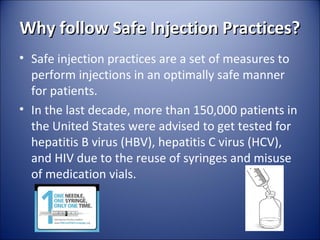
• Safe injection practices are a set of measures to
perform injections in an optimally safe manner
for patients.
• In the last decade, more than 150,000 patients in
the United States were advised to get tested for
hepatitis B virus (HBV), hepatitis C virus (HCV),
and HIV due to the reuse of syringes and misuse
of medication vials.
Why follow Safe Injection Practices?
• CDC reports 35 outbreaks of viral hepatitis
acquired by the action of healthcare providers
between 2008 - 2012. Of these 33 (94%)
occurred in a non-hospital setting.
– Hepatitis B (total 19 outbreaks, 153 outbreak
associated cases, > 10,000 persons notified for
screening
– Hepatitis C (total 16 outbreaks, 160 outbreak
associated case, > 90,000 at-risk persons notified
for screening)
Why follow Safe Injection
Practices?
• In ASC, single specialty endoscopy clinics,
there were 9 outbreak associated infections
and over 60,000 people were tested for
hepatitis and HIV. There were an additional
106 infections that could have been linked to
these centers.
• 1% to 3% of healthcare providers reuse the
same needle and/or syringe on multiple
patients.
How Does it Happen???
Understanding the basics of Transmission
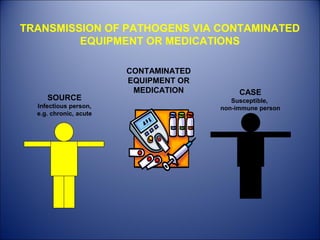
TRANSMISSION OF PATHOGENS VIA CONTAMINATED
EQUIPMENT OR MEDICATIONS

SOURCE
Infectious person,
e.g. chronic, acute

CONTAMINATED
EQUIPMENT OR
MEDICATION

CASE
Susceptible,
non-immune person
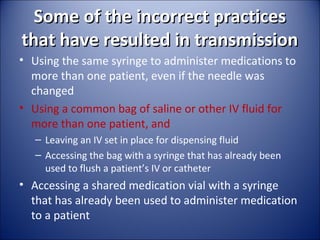
Some of the incorrect practices
that have resulted in transmission
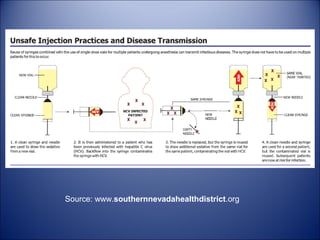
• Using the same syringe to administer medications to
more than one patient, even if the needle was
changed
• Using a common bag of saline or other IV fluid for
more than one patient, and
– Leaving an IV set in place for dispensing fluid
– Accessing the bag with a syringe that has already been
used to flush a patient’s IV or catheter

• Accessing a shared medication vial with a syringe
that has already been used to administer medication
to a patient
PREVENTION
• Healthcare providers should not provide any
avenue for transmission of bloodborne viruses
• Entirely preventable
– Standard Precautions / Aseptic Technique
• Aseptic techniques for handling parenteral
medications, administering injections, and sampling
blood
• Use aseptic technique to avoid contamination of sterile
injection equipment

• Use single-dose vials for parenteral
medications, whenever possible
ER
TT
A
TM
NO
ES
DO
IZE
S
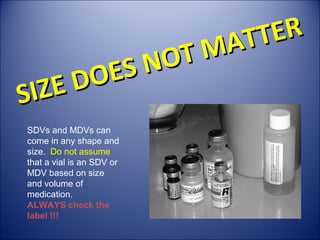
SDVs and MDVs can
come in any shape and
size. Do not assume
that a vial is an SDV or
MDV based on size
and volume of
medication.
ALWAYS check the
label !!!
Source: www.southernnevadahealthdistrict.org
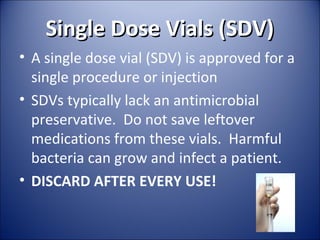
Single Dose Vials (SDV)
• A single dose vial (SDV) is approved for a
single procedure or injection
• SDVs typically lack an antimicrobial
preservative. Do not save leftover
medications from these vials. Harmful
bacteria can grow and infect a patient.
• DISCARD AFTER EVERY USE!
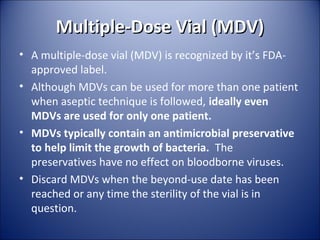
Multiple-Dose Vial (MDV)
• A multiple-dose vial (MDV) is recognized by it’s FDAapproved label.
• Although MDVs can be used for more than one patient
when aseptic technique is followed, ideally even
MDVs are used for only one patient.
• MDVs typically contain an antimicrobial preservative
to help limit the growth of bacteria. The
preservatives have no effect on bloodborne viruses.
• Discard MDVs when the beyond-use date has been
reached or any time the sterility of the vial is in
question.
D
A
E
R

E
TH

!
L
E
B
LA
PREVENTION
• Needles, cannulae and syringes are sterile, singleuse items; they should not be reused for another
patient nor to access a medication or solution
that might be used for a subsequent patient
• If you are using a SDV and it has already been
accessed (e.g. needle puncture) throw it away
• If it is MDV, double check the expiration date and
visually inspect to ensure there is no visual
contamination.

• When in doubt, throw it out!
PREVENTION
• Use a new needle and syringe for every
injection
• Be sure to clean your hands immediately
before handling any medication
• Disinfect the medication vial by rubbing the
top with alcohol before drawing up
medication
• Draw up the medication on a clean surface.
REALIZE WHAT IS AT STAKE
• A person’s life and well-being
• Business license
• Professional license or certification

• Accreditation status
Example right here at home

Oklahoma Pain Remediation Clinic
• Anesthetist filled single syringe with sedation
medication to treat up to 24 sequential patients
– Medication administered though heparin locks
• Look back investigation for entire two year time
period of clinic operation
– Serologic results for 795/908 (88% patients)
• 71 (9%) clinic-associated HCV infections
• 31 (4%) clinic-associated HBV infections
• US $25 million settlement
Oklahoma State Dept. of Health
Safe injection practice

Safe injection practice

  • 1.
    SAFE INJECTION PRACTICE Sources:CDC, One and Only Campaign, www.southernnevadahealthdistrict.org
  • 2.
    What is InjectionSafety? Injection safety includes practices intended to prevent transmission of infectious diseases between one patient and another, or between a patient and healthcare provider, and also to prevent harms such as needlestick injuries A safe injection does not harm the recipient, does not expose the provider to any risks and does not result in waste that is dangerous for the community
  • 4.
    Safe Injection Practices TheCDC recommends the following apply to the use of needles, cannulas that replace needles, and, where applicable intravenous delivery system 1. Use aseptic technique to avoid contamination of sterile injection equipment 2. Do not administer medications from a syringe to multiple patients, even if the needle or cannula on the syringe is changed. Needles, cannulas, and syringes are sterile, single-use items; they should not be reused for another patient nor to access a medication or solution that might be used for a subsequent patient.
  • 6.
    Safe Injection Practices 3.Use fluid infusion and administration sets (i.e. intravenous bags, and connectors) for one patient only and dispose appropriately after use. Consider a syringe or needle/cannula contaminated once it has been used to enter or connect to a patient’s intravenous infusion bag or administration set. 4. Use single-dose vials for parental medications whenever possible 5. Do not administer medications from single-dose vials or ampules to multiple patients or combine leftover contents for later use.
  • 7.
    Safe Injection Practices 6.If multi-dose vials must be used, both the needle or cannula and syringe to access the multi-dose vial must be sterile. 7. Do not keep multi-dose vials in the immediate patient treatment area and store in accordance with the manufacturer’s recommendations; discard if sterility is compromised or questionable. 8. Do not use bags or bottles of intravenous solution as a common source of supply for multiple patients.
  • 8.
    Why follow SafeInjection Practices? • Safe injection practices are a set of measures to perform injections in an optimally safe manner for patients. • In the last decade, more than 150,000 patients in the United States were advised to get tested for hepatitis B virus (HBV), hepatitis C virus (HCV), and HIV due to the reuse of syringes and misuse of medication vials.
  • 9.
    Why follow SafeInjection Practices? • CDC reports 35 outbreaks of viral hepatitis acquired by the action of healthcare providers between 2008 - 2012. Of these 33 (94%) occurred in a non-hospital setting. – Hepatitis B (total 19 outbreaks, 153 outbreak associated cases, > 10,000 persons notified for screening – Hepatitis C (total 16 outbreaks, 160 outbreak associated case, > 90,000 at-risk persons notified for screening)
  • 10.
    Why follow SafeInjection Practices? • In ASC, single specialty endoscopy clinics, there were 9 outbreak associated infections and over 60,000 people were tested for hepatitis and HIV. There were an additional 106 infections that could have been linked to these centers. • 1% to 3% of healthcare providers reuse the same needle and/or syringe on multiple patients.
  • 11.
    How Does itHappen??? Understanding the basics of Transmission
  • 12.
    TRANSMISSION OF PATHOGENSVIA CONTAMINATED EQUIPMENT OR MEDICATIONS SOURCE Infectious person, e.g. chronic, acute CONTAMINATED EQUIPMENT OR MEDICATION CASE Susceptible, non-immune person
  • 13.
    Some of theincorrect practices that have resulted in transmission • Using the same syringe to administer medications to more than one patient, even if the needle was changed • Using a common bag of saline or other IV fluid for more than one patient, and – Leaving an IV set in place for dispensing fluid – Accessing the bag with a syringe that has already been used to flush a patient’s IV or catheter • Accessing a shared medication vial with a syringe that has already been used to administer medication to a patient
  • 14.
    PREVENTION • Healthcare providersshould not provide any avenue for transmission of bloodborne viruses • Entirely preventable – Standard Precautions / Aseptic Technique • Aseptic techniques for handling parenteral medications, administering injections, and sampling blood • Use aseptic technique to avoid contamination of sterile injection equipment • Use single-dose vials for parenteral medications, whenever possible
  • 15.
    ER TT A TM NO ES DO IZE S SDVs and MDVscan come in any shape and size. Do not assume that a vial is an SDV or MDV based on size and volume of medication. ALWAYS check the label !!!
  • 16.
  • 17.
    Single Dose Vials(SDV) • A single dose vial (SDV) is approved for a single procedure or injection • SDVs typically lack an antimicrobial preservative. Do not save leftover medications from these vials. Harmful bacteria can grow and infect a patient. • DISCARD AFTER EVERY USE!
  • 18.
    Multiple-Dose Vial (MDV) •A multiple-dose vial (MDV) is recognized by it’s FDAapproved label. • Although MDVs can be used for more than one patient when aseptic technique is followed, ideally even MDVs are used for only one patient. • MDVs typically contain an antimicrobial preservative to help limit the growth of bacteria. The preservatives have no effect on bloodborne viruses. • Discard MDVs when the beyond-use date has been reached or any time the sterility of the vial is in question.
  • 19.
  • 20.
    PREVENTION • Needles, cannulaeand syringes are sterile, singleuse items; they should not be reused for another patient nor to access a medication or solution that might be used for a subsequent patient • If you are using a SDV and it has already been accessed (e.g. needle puncture) throw it away • If it is MDV, double check the expiration date and visually inspect to ensure there is no visual contamination. • When in doubt, throw it out!
  • 21.
    PREVENTION • Use anew needle and syringe for every injection • Be sure to clean your hands immediately before handling any medication • Disinfect the medication vial by rubbing the top with alcohol before drawing up medication • Draw up the medication on a clean surface.
  • 22.
    REALIZE WHAT ISAT STAKE • A person’s life and well-being • Business license • Professional license or certification • Accreditation status
  • 24.
    Example right hereat home Oklahoma Pain Remediation Clinic • Anesthetist filled single syringe with sedation medication to treat up to 24 sequential patients – Medication administered though heparin locks • Look back investigation for entire two year time period of clinic operation – Serologic results for 795/908 (88% patients) • 71 (9%) clinic-associated HCV infections • 31 (4%) clinic-associated HBV infections • US $25 million settlement
  • 25.

Editor's Notes

  • #8 What multi-dose medications are used at NEC? Lidocaine, Narcan When else should multi-dose vials be discarded? At NEC, we keep uncompromised MVI for 28 days.