GANGRENE
GANGRENE
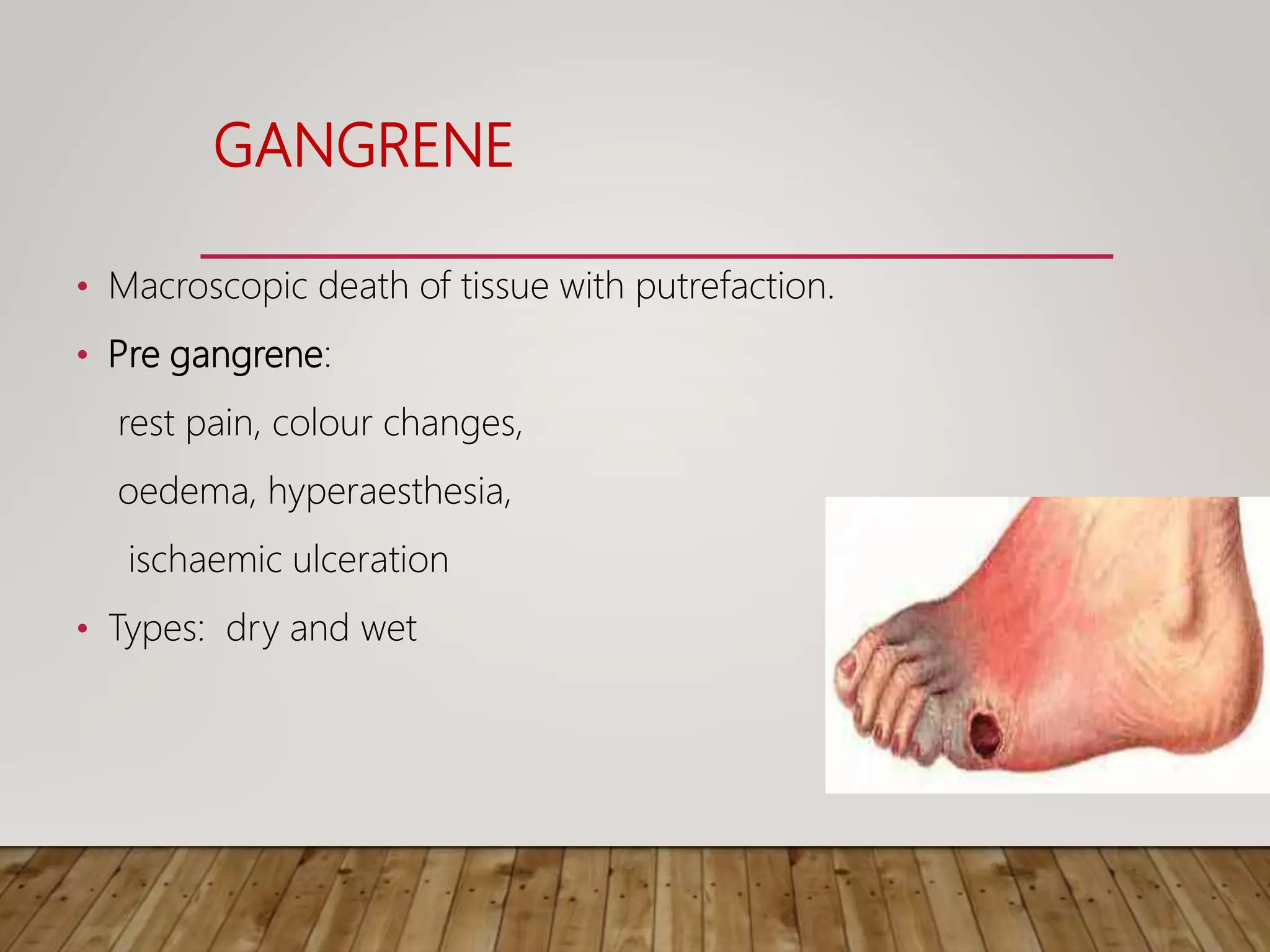
• Macroscopic death of tissue with putrefaction.
• Pre gangrene:
rest pain, colour changes,
oedema, hyperaesthesia,
ischaemic ulceration
• Types: dry and wet
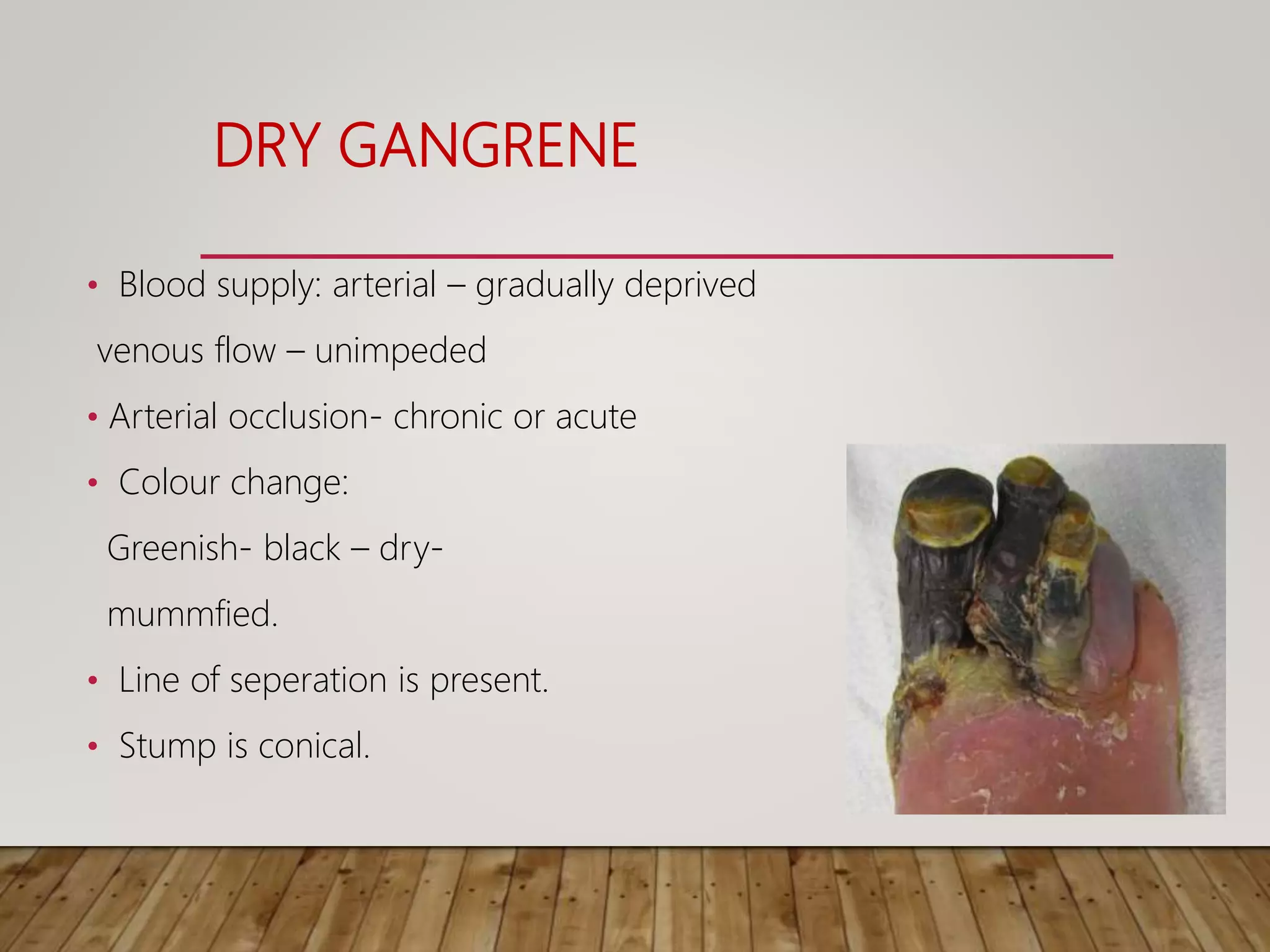
DRY GANGRENE
• Blood supply: arterial – gradually deprived
venous flow – unimpeded
• Arterial occlusion- chronic or acute
• Colour change:
Greenish- black – dry-
mummfied.
• Line of seperation is present.
• Stump is conical.
• Line of demarcation:
• dead tissue and living tissue.
• Band of Hyperemia
• layer of granulation
• Hyperesthesia
• seen in:
Senile, diabetic, buerger’s , raynaud’s, frost
bite, vascular occlusion, embolism, ligation
WET GANGRENE
• Arterial & venous block
• Infection and putrefaction.
• Cold , pulseless, swollen, oedematous, blebs
• Horrible odour
• No line of demarcation
• Constitutional symptoms present.
• Spreads faster
• Seen in : acute inflammation, venous thrombosis,
Gas gangrene, bed sores
DRY GANGRENE WET
GANGRENE
CAUSES
• ARTERIAL OCCLUSION: atherosclerosis, embolism,
raynaud’s, buerger’s, cervical rib, syphilitic
• VENOUS OBSTRUCTION: DVT
• NERVOUS DISEASE: peripheral neuritis,
tabes dorsalis, syringomyelia, leprosy, hemiplegia
• TRAUMATIC : Direct or indirect
• INFECTIVE: carbuncle, cancrum oris, gas gangrene,
fourniers gangrene
• DIABETIC GANGRENE
• PHYSICAL :
Heat- burns and scalds,
Cold – frost bite
corrosive - alkalis, acids
electricity
Irridiation
DIFFERENTIAL DIAGNOSIS
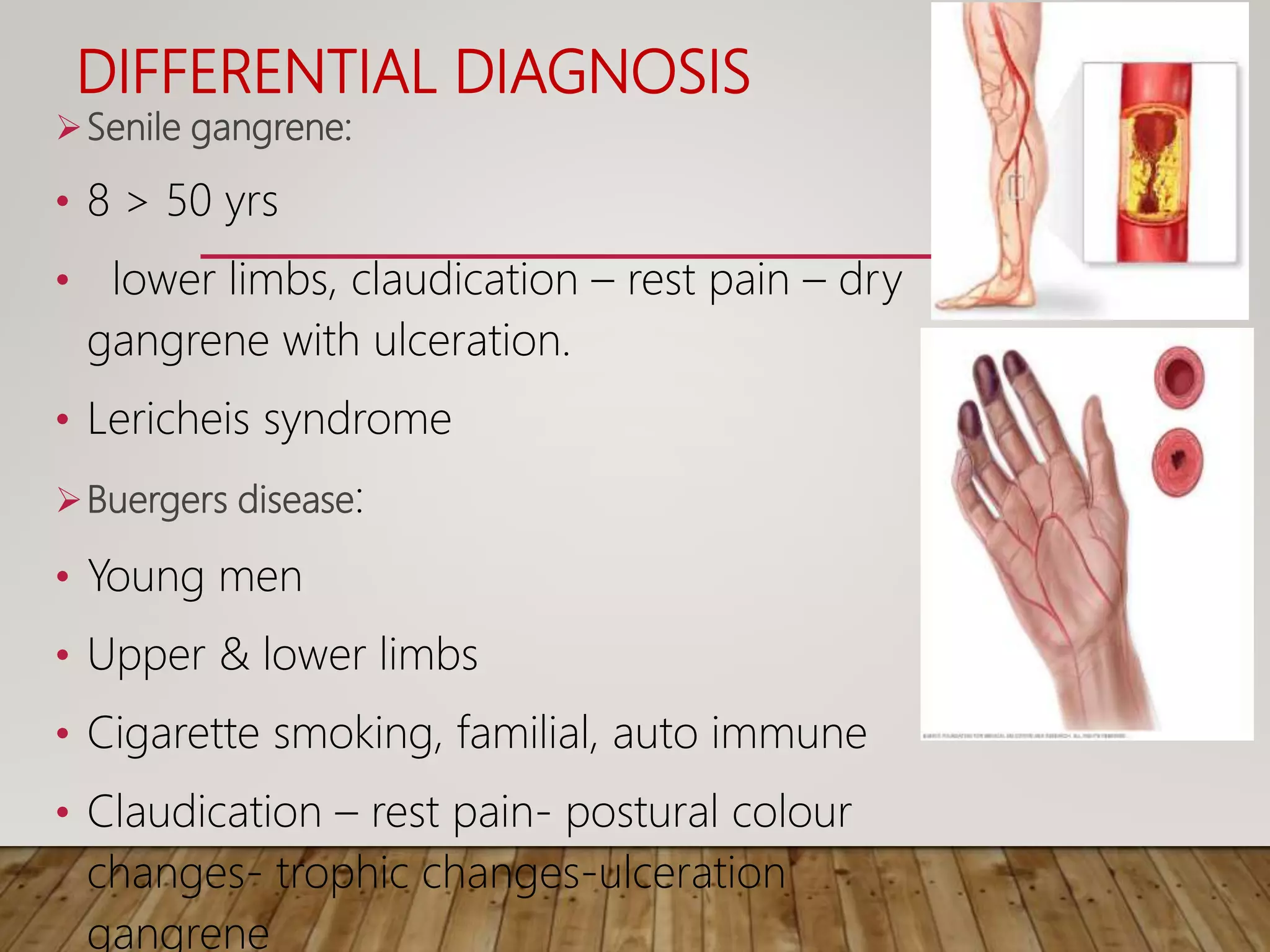
Senile gangrene:
• 8 > 50 yrs
• lower limbs, claudication – rest pain – dry
gangrene with ulceration.
• Lericheis syndrome
Buergers disease:
• Young men
• Upper & lower limbs
• Cigarette smoking, familial, auto immune
• Claudication – rest pain- postural colour
changes- trophic changes-ulceration
gangrene
Raynauds disease: young women, pulse
unaffected.
Embolic Gangrene: sudden, pain, cold and numb
limb, pulse less
 Syphilitic gangrene:
• rare , middle age, endarteritis obliterans, gummatous infiltration
• Dry type
 Venous gangrene:
• Plegmasia caerulosa dolens
• DVT of iliac and pelvic veins
• INFECTIVE GANGRENE:
Cancrum oris: toxaemic manifestation
• Stomatitis – ulceration –sloughing –
–gangrene
Carbuncle : staphylococcus, diabetes, nape of
neck, back
• Infective gangrene of skin and subcutaneous
tissue
 Fournier’s gangrene:
• vascular ,infective gangrene of scrotum
• Obliterative arteritis of scrotum – cutaneous
gangrene
 Gangrene of internal organs: bowel, gall bladder,
appendix etc.
• Wet type of gangrene
• Incarcerated hernia or volvulus
• sepsis
• POST OPERATIVE SYNERGISTIC GANGRENE:
• Post operative in suabdomen, empyema drainage
surgery for peritonitis.
• Spreading ulcer with destruction and burrowing
GAS GANGRENE
• Clostridium
• Trauma and ischaemia
• Exotoxins produced
• Necrosis with gas production – rapidly
• CF: pain , fever, swelling, Toxaemia, foul smell,
khaki brown skin, Crepitus
• Types : fulminant , massive, group ,
subcutaneous, single
• TREATMENT:
• INJ benzyl pencillin 20 lac IU 4hrly + metrinidazole
• Fresh blood transfusion
• Polyvalent antiserum 25000 units iv every 6hrs
• Hyperbaric oxygen
• Excision and debridement
• Rehydration and electrolyte management
• amputation8
DIABETIC GANGRENE
1. Atherosclerosis
2. Peripheral neuritis
3. Infection – hyperglycaemia
• Wet gangrene – young
• Dry gangrene- old, atherosclerotic
Neuropathic gangrene:
• Lost sensation , repeated trauma , pressure8
• Blood supply normal
• Painless, progressive
Bed sores:
• Pressure, anemia, malnutrition, sensory loss, moisture
• Wet gangrene.
Traumatic gangrene:
• Injury to artery - direct
• Crush injury - indirect
PHYSICAL GANGRENE
Frost bite: exposure to cold
• Damage to arteries-edema- blisters – gangrene
• Painless, waxy.
• Dry gangrene
BURNS GANGRENE:
ELECTRICAL GANGRENE:
CORROSIVE GANGRENE:
Drugs causing gangrene:
• Inadvertent injection of drugs
• Iatrogenic- intraarterial injection of
thiopentane
• Ergot preparations
•ICU GANGRENE:
• Sepsis, DIC, vasopressors
• Arterial punctures
• Symmetrical peripheral gangrene
• Pallor-cyanosis, bullae – blisters – gangrene
• Stop sepsis, vasopressors
• amputation
INVESTIGATION
1. Blood: routine examination
WR – Syphilis
sugar- diabetes, TG, cholesterol.
urea, electrolytes
2. Urine: sugar , renovascular insufficiency
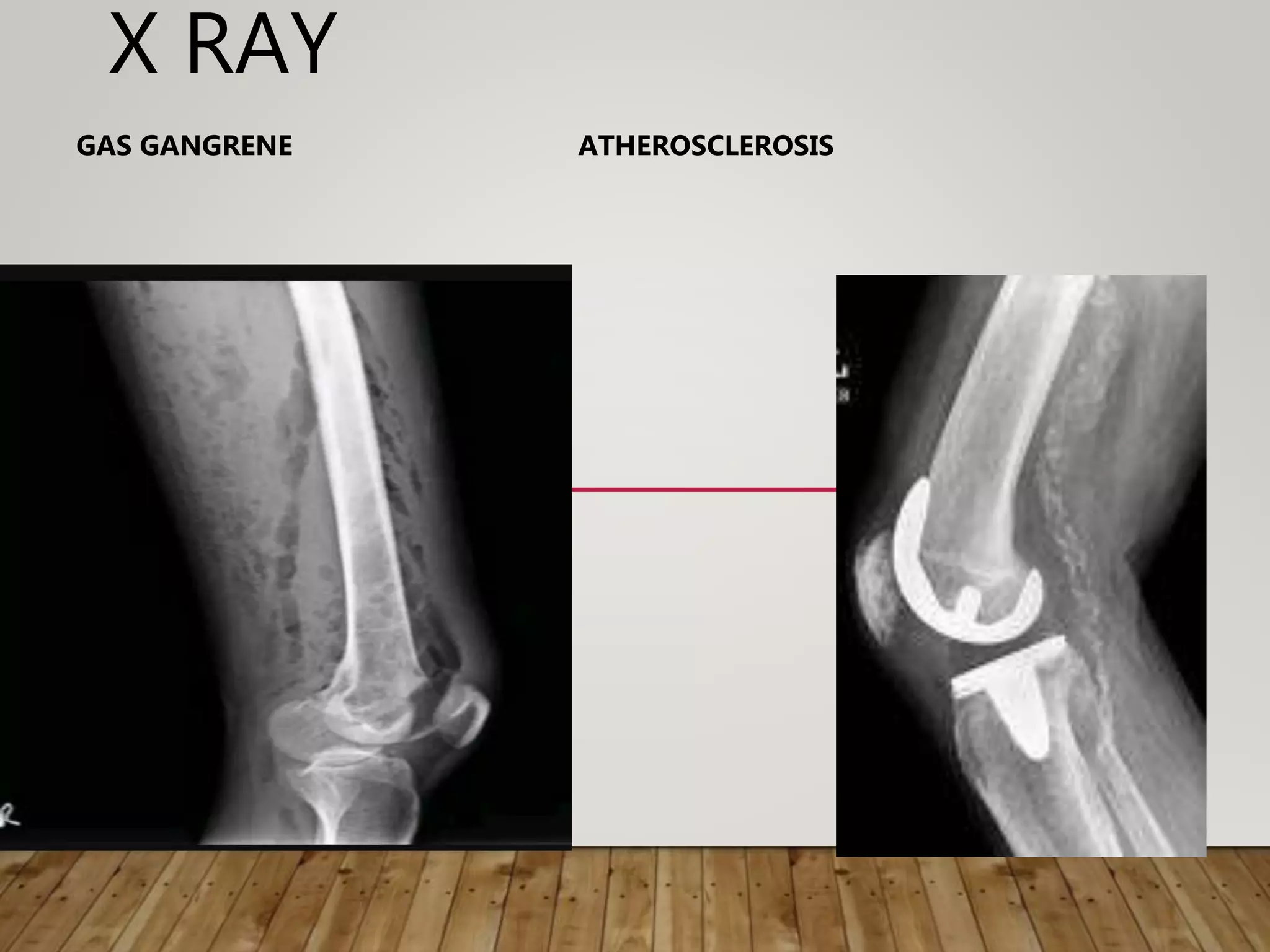
3. X ray: atherosclerosis , aneursym,
gas –gas gangrene, bone erosion in gangrene
4. ECG- Cardiac status
5. USG – ABDOMEN
6. Pus - culture
X RAY
GAS GANGRENE ATHEROSCLEROSIS
8
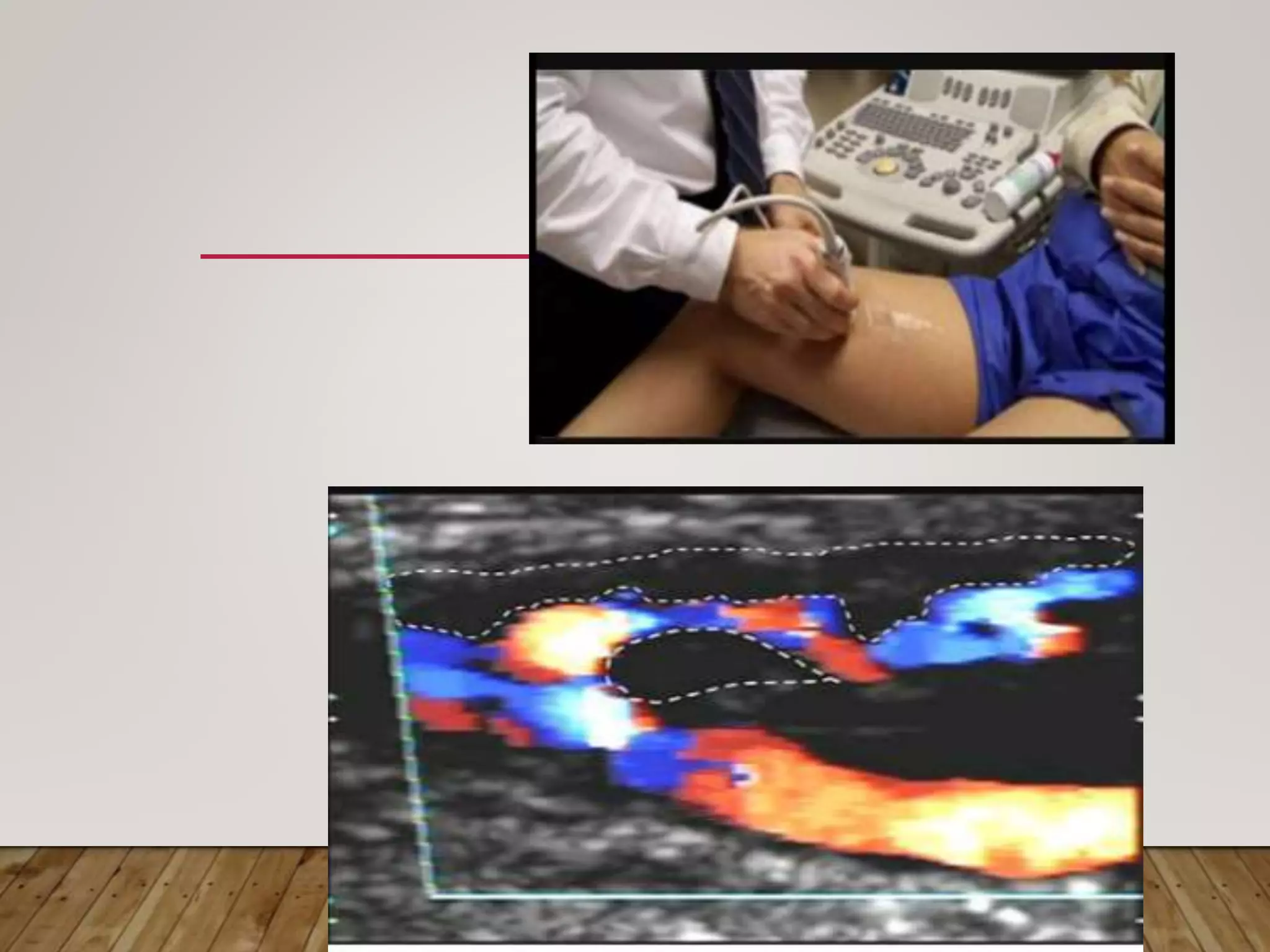
7. Doppler:
 Duplex scan: b mode usg & doppler
Arterial flow , flow rate, velocity, stenosis, block.
 Ankle brachial pressure index: <0.3 severe ischemia – gangrene
8. SEGMENTAL PRESSURE:
9. PLETHYSMOGRAPHY:
• Segmental plethysmography is introduced by placing venous occlusion cuffs
around thigh, calf, ankle
• Cuffs inflated to 65mmhg and pulsation is quantitative measure of arterial
diseases.
10. Arteriography:
• Contrast – Hyphaque 45( sodium diatriozoate)
 Direct arterial puncture: failure of retrograde method.
• aortoiliac / femoropopliteal arteriography.
 Retrograde percutaneous catherterization:
• Seldinger’s technique
• X rays taken
• TAO – CORK SCREW
• May ppt gangrene
SELDINGERS
TECHNIQUE
12. CT/ MRI Angiogram:
13.OSCILLOMETRY: we can assess level amputation
• Gas gangrene: culture, x ray, LFT, CT,
Sr urea, creatinine
8
ELECTRO MAGNETIC FLOW METER
ISOTOPE TECNIQUE
• Xenon133 IM
• Technetium 99
• Recent IV injection of isotope has been used to get
direct arterial visualisation
• Gamma camera used to picturise blood flow
BROWNS VASO MOTOR
INDEX:
Method : nerve block with local
anesthesia or spinal anesthesia is
given and any rise in skin temperature
is recorded and compared with rise of
mouth temperature
Browns vasomotor index > 3.5 or more
operation is advisable
TREATMENT
LIMB SAVING METHODS:
• DRUGS:
Antibiotics
Vasodilators
Pentoxiphylline, dipyridamole, aspirin, toclpidine.
Care of foot:
• Dry
• Foot wear- MCR
• Nutrition
• Avoid injury, pressure, warming
• Pus drainage
• Control diabetes
• Treat cause
Surgeries:
• Lumbar sympathectomy
• omentoplasty
• Profundaplasty
• Endarterioectomy
• Femoropopliteal thrombectomy
• Arterial bypass graft
SYMPATHECTOMY
PROFUNDOPLASTY
EMBOLECTOMY BYPASS
GRAFT
ENDARTECTOMY
OMENTOPLASTY
•Life saving
procedure:
• AMPUTATION:
• Ray amputation
• Below knee amputation
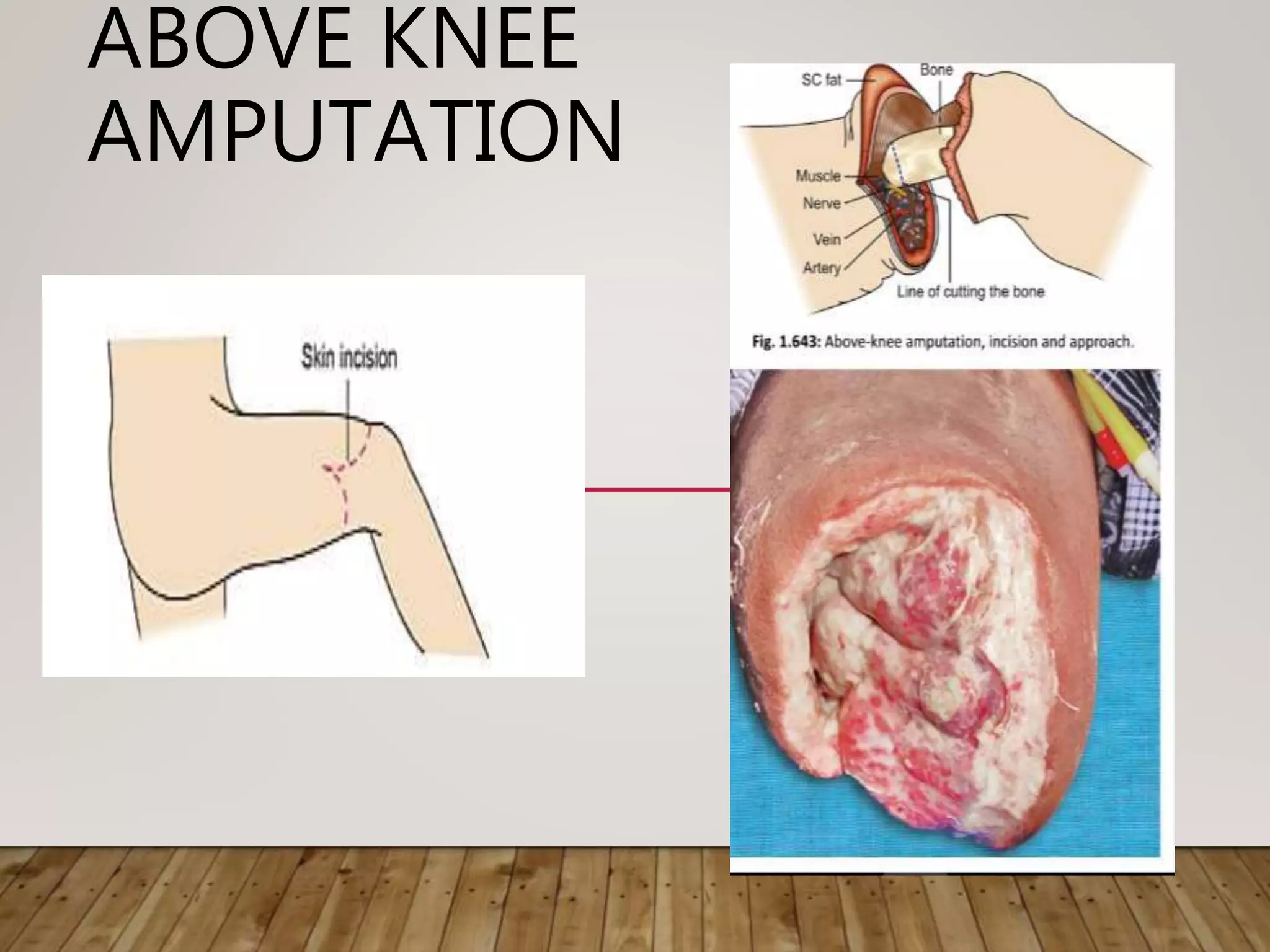
• Above knee amputation:
• Trans condylar –Gritti stokes amputation:
• Modified syme’s:
RAY AMPUTATION
ABOVE KNEE
AMPUTATION
GULLITON AMPUTATION
• Lisfranc’s amputation:
• Choparts amputation:
• Transmetatarsal amputation
Gangrene

Gangrene

  • 1.
  • 2.
    GANGRENE • Macroscopic deathof tissue with putrefaction. • Pre gangrene: rest pain, colour changes, oedema, hyperaesthesia, ischaemic ulceration • Types: dry and wet
  • 3.
    DRY GANGRENE • Bloodsupply: arterial – gradually deprived venous flow – unimpeded • Arterial occlusion- chronic or acute • Colour change: Greenish- black – dry- mummfied. • Line of seperation is present. • Stump is conical.
  • 4.
    • Line ofdemarcation: • dead tissue and living tissue. • Band of Hyperemia • layer of granulation • Hyperesthesia • seen in: Senile, diabetic, buerger’s , raynaud’s, frost bite, vascular occlusion, embolism, ligation
  • 5.
    WET GANGRENE • Arterial& venous block • Infection and putrefaction. • Cold , pulseless, swollen, oedematous, blebs • Horrible odour • No line of demarcation • Constitutional symptoms present. • Spreads faster • Seen in : acute inflammation, venous thrombosis, Gas gangrene, bed sores
  • 7.
  • 8.
    CAUSES • ARTERIAL OCCLUSION:atherosclerosis, embolism, raynaud’s, buerger’s, cervical rib, syphilitic • VENOUS OBSTRUCTION: DVT • NERVOUS DISEASE: peripheral neuritis, tabes dorsalis, syringomyelia, leprosy, hemiplegia • TRAUMATIC : Direct or indirect • INFECTIVE: carbuncle, cancrum oris, gas gangrene, fourniers gangrene
  • 9.
    • DIABETIC GANGRENE •PHYSICAL : Heat- burns and scalds, Cold – frost bite corrosive - alkalis, acids electricity Irridiation
  • 10.
    DIFFERENTIAL DIAGNOSIS Senile gangrene: •8 > 50 yrs • lower limbs, claudication – rest pain – dry gangrene with ulceration. • Lericheis syndrome Buergers disease: • Young men • Upper & lower limbs • Cigarette smoking, familial, auto immune • Claudication – rest pain- postural colour changes- trophic changes-ulceration gangrene
  • 11.
    Raynauds disease: youngwomen, pulse unaffected. Embolic Gangrene: sudden, pain, cold and numb limb, pulse less
  • 12.
     Syphilitic gangrene: •rare , middle age, endarteritis obliterans, gummatous infiltration • Dry type  Venous gangrene: • Plegmasia caerulosa dolens • DVT of iliac and pelvic veins
  • 13.
    • INFECTIVE GANGRENE: Cancrumoris: toxaemic manifestation • Stomatitis – ulceration –sloughing – –gangrene Carbuncle : staphylococcus, diabetes, nape of neck, back • Infective gangrene of skin and subcutaneous tissue
  • 14.
     Fournier’s gangrene: •vascular ,infective gangrene of scrotum • Obliterative arteritis of scrotum – cutaneous gangrene  Gangrene of internal organs: bowel, gall bladder, appendix etc. • Wet type of gangrene • Incarcerated hernia or volvulus • sepsis
  • 15.
    • POST OPERATIVESYNERGISTIC GANGRENE: • Post operative in suabdomen, empyema drainage surgery for peritonitis. • Spreading ulcer with destruction and burrowing
  • 16.
    GAS GANGRENE • Clostridium •Trauma and ischaemia • Exotoxins produced • Necrosis with gas production – rapidly • CF: pain , fever, swelling, Toxaemia, foul smell, khaki brown skin, Crepitus • Types : fulminant , massive, group , subcutaneous, single
  • 17.
    • TREATMENT: • INJbenzyl pencillin 20 lac IU 4hrly + metrinidazole • Fresh blood transfusion • Polyvalent antiserum 25000 units iv every 6hrs • Hyperbaric oxygen • Excision and debridement • Rehydration and electrolyte management • amputation8
  • 18.
    DIABETIC GANGRENE 1. Atherosclerosis 2.Peripheral neuritis 3. Infection – hyperglycaemia • Wet gangrene – young • Dry gangrene- old, atherosclerotic
  • 20.
    Neuropathic gangrene: • Lostsensation , repeated trauma , pressure8 • Blood supply normal • Painless, progressive Bed sores: • Pressure, anemia, malnutrition, sensory loss, moisture • Wet gangrene. Traumatic gangrene: • Injury to artery - direct • Crush injury - indirect
  • 21.
    PHYSICAL GANGRENE Frost bite:exposure to cold • Damage to arteries-edema- blisters – gangrene • Painless, waxy. • Dry gangrene
  • 22.
  • 23.
    Drugs causing gangrene: •Inadvertent injection of drugs • Iatrogenic- intraarterial injection of thiopentane • Ergot preparations
  • 24.
    •ICU GANGRENE: • Sepsis,DIC, vasopressors • Arterial punctures • Symmetrical peripheral gangrene • Pallor-cyanosis, bullae – blisters – gangrene • Stop sepsis, vasopressors • amputation
  • 25.
    INVESTIGATION 1. Blood: routineexamination WR – Syphilis sugar- diabetes, TG, cholesterol. urea, electrolytes 2. Urine: sugar , renovascular insufficiency 3. X ray: atherosclerosis , aneursym, gas –gas gangrene, bone erosion in gangrene 4. ECG- Cardiac status 5. USG – ABDOMEN 6. Pus - culture
  • 26.
    X RAY GAS GANGRENEATHEROSCLEROSIS
  • 27.
    8 7. Doppler:  Duplexscan: b mode usg & doppler Arterial flow , flow rate, velocity, stenosis, block.  Ankle brachial pressure index: <0.3 severe ischemia – gangrene 8. SEGMENTAL PRESSURE: 9. PLETHYSMOGRAPHY: • Segmental plethysmography is introduced by placing venous occlusion cuffs around thigh, calf, ankle • Cuffs inflated to 65mmhg and pulsation is quantitative measure of arterial diseases.
  • 29.
    10. Arteriography: • Contrast– Hyphaque 45( sodium diatriozoate)  Direct arterial puncture: failure of retrograde method. • aortoiliac / femoropopliteal arteriography.  Retrograde percutaneous catherterization: • Seldinger’s technique • X rays taken • TAO – CORK SCREW • May ppt gangrene
  • 30.
  • 31.
    12. CT/ MRIAngiogram: 13.OSCILLOMETRY: we can assess level amputation • Gas gangrene: culture, x ray, LFT, CT, Sr urea, creatinine
  • 32.
  • 33.
    ISOTOPE TECNIQUE • Xenon133IM • Technetium 99 • Recent IV injection of isotope has been used to get direct arterial visualisation • Gamma camera used to picturise blood flow
  • 34.
    BROWNS VASO MOTOR INDEX: Method: nerve block with local anesthesia or spinal anesthesia is given and any rise in skin temperature is recorded and compared with rise of mouth temperature Browns vasomotor index > 3.5 or more operation is advisable
  • 35.
    TREATMENT LIMB SAVING METHODS: •DRUGS: Antibiotics Vasodilators Pentoxiphylline, dipyridamole, aspirin, toclpidine.
  • 36.
    Care of foot: •Dry • Foot wear- MCR • Nutrition • Avoid injury, pressure, warming • Pus drainage • Control diabetes • Treat cause
  • 37.
    Surgeries: • Lumbar sympathectomy •omentoplasty • Profundaplasty • Endarterioectomy • Femoropopliteal thrombectomy • Arterial bypass graft
  • 38.
  • 39.
  • 40.
  • 41.
    •Life saving procedure: • AMPUTATION: •Ray amputation • Below knee amputation • Above knee amputation: • Trans condylar –Gritti stokes amputation: • Modified syme’s:
  • 42.
  • 43.
  • 44.
  • 45.
    • Lisfranc’s amputation: •Choparts amputation: • Transmetatarsal amputation