
ORGANOPHOSPHORUS
OP compounds are widely used as pesticides, especially in
developing countries.
 Nerve agents developed for chemical warfare are derived
from OP insecticides but are much more toxic.
Physical Appearance
These compounds are available as dusts, granules or
liquids.
Some products need to be diluted with water before use,
and some are burnt to make smoke that kills insects.
Toxicokinetics
Organophosphates are absorbed by any route including
transdermal, transconjunctival, inhalational, across the
GI and GU mucosa and through direct injection.
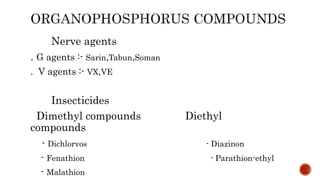
Nerve agents
. G agents :- Sarin,Tabun,Soman
. V agents :- VX,VE
Insecticides
Dimethyl compounds Diethyl
compounds
- Dichlorvos - Diazinon
- Fenathion - Parathion-ethyl
- Malathion
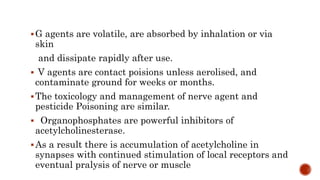
G agents are volatile, are absorbed by inhalation or via
skin
and dissipate rapidly after use.
 V agents are contact poisions unless aerolised, and
contaminate ground for weeks or months.
The toxicology and management of nerve agent and
pesticide Poisoning are similar.
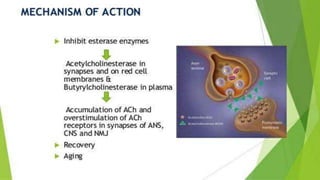
 Organophosphates are powerful inhibitors of
acetylcholinesterase.
As a result there is accumulation of acetylcholine in
synapses with continued stimulation of local receptors and
eventual pralysis of nerve or muscle
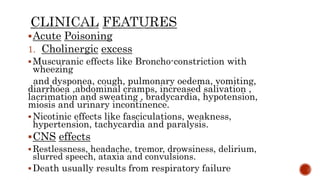
Acute Poisoning
1. Cholinergic excess
Muscuranic effects like Broncho-constriction with
wheezing
and dysponea, cough, pulmonary oedema, vomiting,
diarrhoea ,abdominal cramps, increased salivation ,
lacrimation and sweating , bradycardia, hypotension,
miosis and urinary incontinence.
Nicotinic effects like fasciculations, weakness,
hypertension, tachycardia and paralysis.
CNS effects
 Restlessness, headache, tremor, drowsiness, delirium,
slurred speech, ataxia and convulsions.
Death usually results from respiratory failure
.
 A characteristic kerosene-like odour is often perceptible in
the vicinity of the patient since the solvent used in many
organophosphate insecticides is some petroleum derivative
such as aromax.
 There may be either tachycardia or bradycardia.
 Miosis while being a characteristic feature, may not be
apparent in the early stages. In fact, maydriasis is often
present and hence treatment should not be delayed if there
is absence of pupillary constriction.
 While respiratory failure is the commonest cause of death
other causes may contribute including hypoxia due to
seizures, hyperthermia, renal failure and hepatic failure.
Intermediate Syndrome :-
 Occurs one to four days after poisioning due to long lasting
Cholinesterase inhibition and muscle necrosis , main features
include paralysis characterised by motor cranial nerve palasy .
 It may be due to inadequate treatment of the acute episode
especially involving sub-therapeutic assisted ventilation.
 Intermediate Syndrome have to be managed by supportive
measures, since it does not respond to oximes or atropine.
Delayed Syndrome:-
 Occurs one to four weeks after poisioning due to nerve
demyelination and is characterized by flaccid weakness and
atrophy of distal limb muscles or spasticity and ataxia
 These Syndrome also does not respond to either oximes or
atropine.
Chronic poisioning:-
It is usually occurs as an occupational hazard in
agriculturists, especially those who engaged in pesticide
spraying of crops.
Route of exposure is usually inhalation or contamination
of skin. The following are the main features :-
Polyneuropathy:-Paraesthesias, muscle cramps, weakness,
gait disorders.
CNS Effects:-Drowsiness, Confusion, irritability, anxiety,
psychiatric manifestations.
Depression of Cholinesterase activity
If the RBC Cholinesterase level is less than 50% of
normal, it indicates organophosphate toxicity.
Disadvantages:-
A very low Cholinesterase level does not always correlate
with clinical illness.
False depression of RBC Cholinesterase level is seen in
perinicious anaemia, hemoglobinopathies, anti- Malarial
treatment.
Depression of plasma Cholinesterase level is less reliable
indicator of organophosphate toxicity , but is easier to
assay and more commonly done.
P-Nitrophenol Test:-
P-Nitrophenol is a metabolite of some organophosphates
and is excreted in the urine .
Procedure:-
Steam distilled 10mL of urine and collect the disitillate.
Add sodium hydroxide (2pellates) and heat on a water
bath for 10 minutes.
Production of yellow colour indicates the presence of P-
NITROPHENOL.
1. Decontamination
2. Antidote administration
3. Supportive measures
4. Prevention of further exposure
If skin spillage has occured ,it is imperative that the
patient be stripped and washed with soap and water.
If ocular exposure has occured, copius eye irrigation
should be done with normal Saline or tap water.
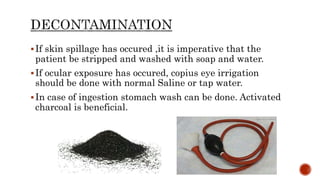
In case of ingestion stomach wash can be done. Activated
charcoal is beneficial.
Atropine- a competitive antagonist to acetylcholine at the
muscuranic post synaptic membrane and in the CNS, will
block muscuranic manifestations of organophosphate
poisioning.
Oximes- help to regenerate acetylcholinesterase at
muscuranic, nicotinic, and CNS sites.
The commonest oxime used in India is PRALIDOXIME.
Administration of iv fluids to replave the losses.
Oxygenation/intubation/positive pressure ventilation.
Following drugs are contraindicated like
parasympathomimitics, phenothiazines, antihistamines,
and opiates.
After the patient has recovered, he should not be re-
exposed to organophosphates for atleast a few weeks since
he is likely to suffer serious harm from a dose that
normally would be harmless owing to alteration of body
chemistry.
External
1. Characterstic odur (garliky or kerosene-like)
2. Frothing at mouse and mouth and nose.
3. Cyanosis of extremities
4. Constricted pupils
Internal
1. Congestion of GI tract:garliky or kerosene-like odur of
contents.
2. Pulmonary and cerebral odema
3. Genaralised visceral congestion.
Op poisioning

Op poisioning

  • 2.
    ORGANOPHOSPHORUS OP compounds arewidely used as pesticides, especially in developing countries.  Nerve agents developed for chemical warfare are derived from OP insecticides but are much more toxic.
  • 3.
    Physical Appearance These compoundsare available as dusts, granules or liquids. Some products need to be diluted with water before use, and some are burnt to make smoke that kills insects. Toxicokinetics Organophosphates are absorbed by any route including transdermal, transconjunctival, inhalational, across the GI and GU mucosa and through direct injection.
  • 4.
    Nerve agents . Gagents :- Sarin,Tabun,Soman . V agents :- VX,VE Insecticides Dimethyl compounds Diethyl compounds - Dichlorvos - Diazinon - Fenathion - Parathion-ethyl - Malathion
  • 5.
    G agents arevolatile, are absorbed by inhalation or via skin and dissipate rapidly after use.  V agents are contact poisions unless aerolised, and contaminate ground for weeks or months. The toxicology and management of nerve agent and pesticide Poisoning are similar.  Organophosphates are powerful inhibitors of acetylcholinesterase. As a result there is accumulation of acetylcholine in synapses with continued stimulation of local receptors and eventual pralysis of nerve or muscle
  • 7.
    Acute Poisoning 1. Cholinergicexcess Muscuranic effects like Broncho-constriction with wheezing and dysponea, cough, pulmonary oedema, vomiting, diarrhoea ,abdominal cramps, increased salivation , lacrimation and sweating , bradycardia, hypotension, miosis and urinary incontinence. Nicotinic effects like fasciculations, weakness, hypertension, tachycardia and paralysis. CNS effects  Restlessness, headache, tremor, drowsiness, delirium, slurred speech, ataxia and convulsions. Death usually results from respiratory failure .
  • 8.
     A characteristickerosene-like odour is often perceptible in the vicinity of the patient since the solvent used in many organophosphate insecticides is some petroleum derivative such as aromax.  There may be either tachycardia or bradycardia.  Miosis while being a characteristic feature, may not be apparent in the early stages. In fact, maydriasis is often present and hence treatment should not be delayed if there is absence of pupillary constriction.  While respiratory failure is the commonest cause of death other causes may contribute including hypoxia due to seizures, hyperthermia, renal failure and hepatic failure.
  • 9.
    Intermediate Syndrome :- Occurs one to four days after poisioning due to long lasting Cholinesterase inhibition and muscle necrosis , main features include paralysis characterised by motor cranial nerve palasy .  It may be due to inadequate treatment of the acute episode especially involving sub-therapeutic assisted ventilation.  Intermediate Syndrome have to be managed by supportive measures, since it does not respond to oximes or atropine. Delayed Syndrome:-  Occurs one to four weeks after poisioning due to nerve demyelination and is characterized by flaccid weakness and atrophy of distal limb muscles or spasticity and ataxia  These Syndrome also does not respond to either oximes or atropine.
  • 10.
    Chronic poisioning:- It isusually occurs as an occupational hazard in agriculturists, especially those who engaged in pesticide spraying of crops. Route of exposure is usually inhalation or contamination of skin. The following are the main features :- Polyneuropathy:-Paraesthesias, muscle cramps, weakness, gait disorders. CNS Effects:-Drowsiness, Confusion, irritability, anxiety, psychiatric manifestations.
  • 11.
    Depression of Cholinesteraseactivity If the RBC Cholinesterase level is less than 50% of normal, it indicates organophosphate toxicity. Disadvantages:- A very low Cholinesterase level does not always correlate with clinical illness. False depression of RBC Cholinesterase level is seen in perinicious anaemia, hemoglobinopathies, anti- Malarial treatment. Depression of plasma Cholinesterase level is less reliable indicator of organophosphate toxicity , but is easier to assay and more commonly done.
  • 12.
    P-Nitrophenol Test:- P-Nitrophenol isa metabolite of some organophosphates and is excreted in the urine . Procedure:- Steam distilled 10mL of urine and collect the disitillate. Add sodium hydroxide (2pellates) and heat on a water bath for 10 minutes. Production of yellow colour indicates the presence of P- NITROPHENOL.
  • 13.
    1. Decontamination 2. Antidoteadministration 3. Supportive measures 4. Prevention of further exposure
  • 14.
    If skin spillagehas occured ,it is imperative that the patient be stripped and washed with soap and water. If ocular exposure has occured, copius eye irrigation should be done with normal Saline or tap water. In case of ingestion stomach wash can be done. Activated charcoal is beneficial.
  • 15.
    Atropine- a competitiveantagonist to acetylcholine at the muscuranic post synaptic membrane and in the CNS, will block muscuranic manifestations of organophosphate poisioning. Oximes- help to regenerate acetylcholinesterase at muscuranic, nicotinic, and CNS sites. The commonest oxime used in India is PRALIDOXIME.
  • 16.
    Administration of ivfluids to replave the losses. Oxygenation/intubation/positive pressure ventilation. Following drugs are contraindicated like parasympathomimitics, phenothiazines, antihistamines, and opiates.
  • 17.
    After the patienthas recovered, he should not be re- exposed to organophosphates for atleast a few weeks since he is likely to suffer serious harm from a dose that normally would be harmless owing to alteration of body chemistry.
  • 18.
    External 1. Characterstic odur(garliky or kerosene-like) 2. Frothing at mouse and mouth and nose. 3. Cyanosis of extremities 4. Constricted pupils
  • 19.
    Internal 1. Congestion ofGI tract:garliky or kerosene-like odur of contents. 2. Pulmonary and cerebral odema 3. Genaralised visceral congestion.