Projection Md. Sahidul Islam Ripon Department of statistics  Rajshahi University Email: ripon.ru.statistics@gmail.com
Content Orthogonal vector Orthonormal vector Projection Gram-Schmidt orthogonalization
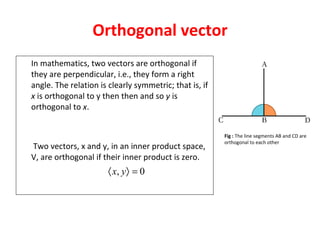
Orthogonal vector In mathematics, two vectors are orthogonal if they are perpendicular, i.e., they form a right angle. The relation is clearly symmetric; that is, if  x  is orthogonal to y then then and so  y  is orthogonal to  x .    Two vectors, x and y, in an inner product space, V, are orthogonal if their inner product is zero. Fig :  The line segments AB and CD are orthogonal to each other
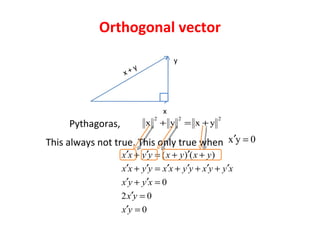
Orthogonal vector x y x + y Pythagoras,  This always not true. This only true when
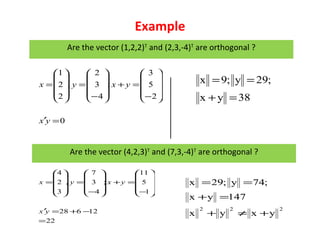
Example Are the vector (1,2,2) T  and (2,3,-4) T  are orthogonal ? Are the vector (4,2,3) T  and (7,3,-4) T  are orthogonal ?
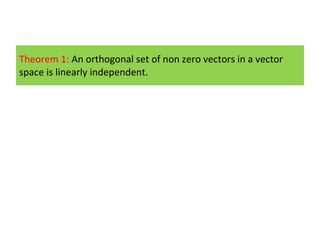
Theorem 1:  An orthogonal set of non zero vectors in a vector space is linearly independent.
Subspace S is orthogonal to subspace T How??? row space is orthogonal to null space Orthogonal Subspace
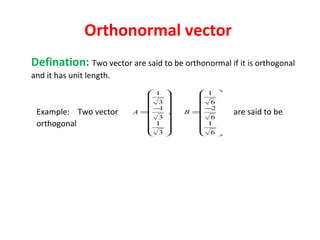
Orthonormal vector  Defination:  Two vector are said to be orthonormal if it is orthogonal and it has unit length. Example:  Two vector   are said to be orthogonal
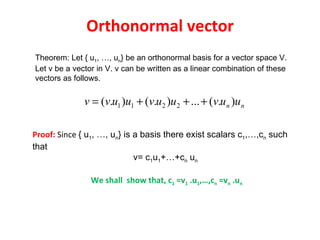
Orthonormal vector Theorem: Let { u 1 , …, u n } be an orthonormal basis for a vector space V. Let v be a vector in V. v can be written as a linear combination of these vectors as follows.  Proof:  Since  { u 1 , …, u n } is a basis there exist scalars c 1 ,…,c n  such that  v= c 1 u 1 +…+c n  u n   We shall  show that, c 1  =v 1  .u 1 ,…,c n  =v n  .u n
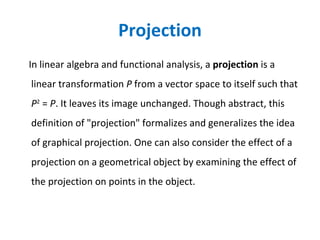
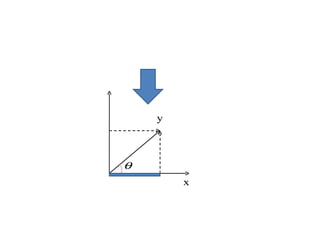
Projection In linear algebra and functional analysis, a  projection  is a linear transformation  P  from a vector space to itself such that  P 2  =  P . It leaves its image unchanged. Though abstract, this definition of "projection" formalizes and generalizes the idea of graphical projection. One can also consider the effect of a projection on a geometrical object by examining the effect of the projection on points in the object.
Projection Orthogonal Projection Oblique projection
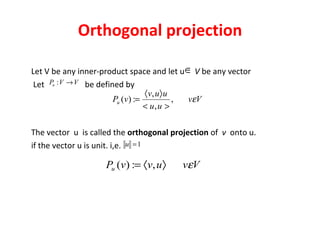
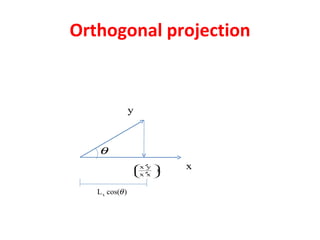
Orthogonal projection Let V be any inner-product space and let u  V  be any vector   Let  be defined by The vector  u  is called the  orthogonal projection  of   v    onto u. if the vector u is unit. i,e.
 
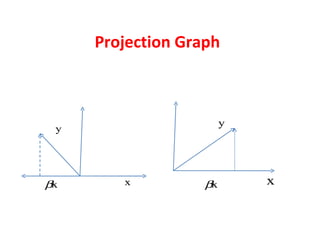
Projection Graph
Orthogonal projection
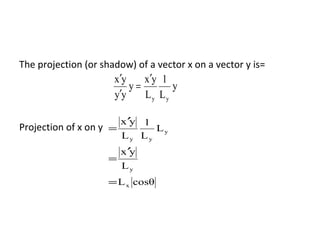
The projection (or shadow) of a vector x on a vector y is= Projection of x on y
Why projection? Beause Ax=b may have no solution. That is when the system of equations are Inconsistent.
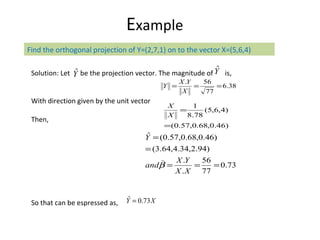
E xample Solution: Let  be the projection vector. The magnitude of  is, With direction given by the unit vector Then, So that can be espressed as, Find the orthogonal projection of Y=(2,7,1) on to the vector X=(5,6,4)
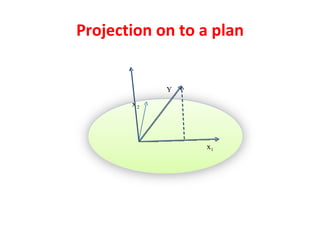
Projection on to a plan
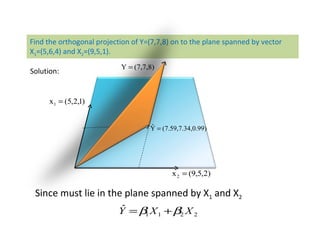
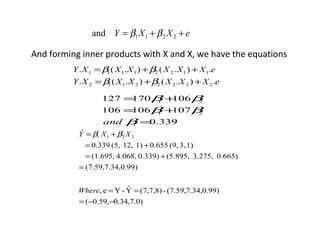
Find the orthogonal projection of Y=(7,7,8) on to the plane spanned by vector X 1 =(5,6,4) and X 2 =(9,5,1). Solution:  Since must lie in the plane spanned by X 1  and X 2
And forming inner products with X and X, we have the equations
Application 1. Gram –schmidt orthogonalization  2. Curve fitting by ordinary least square method. 3. The area of a parallelogram
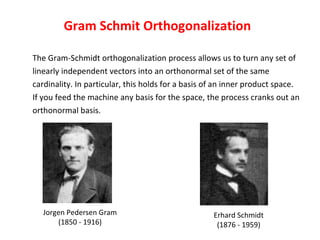
Gram Schmit Orthogonalization The Gram-Schmidt orthogonalization process allows us to turn any set of  linearly independent vectors into an orthonormal set of the same  cardinality. In particular, this holds for a basis of an inner product space.  If you feed the machine any basis for the space, the process cranks out an  orthonormal basis. Jorgen Pedersen Gram (1850 - 1916) Erhard Schmidt (1876 - 1959)
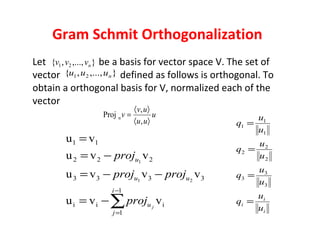
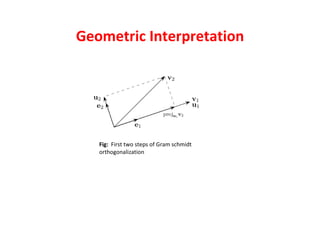
Gram Schmit Orthogonalization Let  be a basis for vector space V. The set of vector  defined as follows is orthogonal. To obtain a orthogonal basis for V, normalized each of the vector
Fig:  First two steps of Gram schmidt orthogonalization Geometric Interpretation
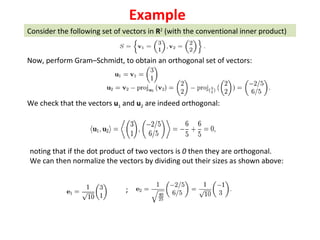
Consider the following set of vectors in  R 2  (with the conventional inner product) Now, perform Gram–Schmidt, to obtain an orthogonal set of vectors: We check that the vectors  u 1  and  u 2  are indeed orthogonal: noting that if the dot product of two vectors is  0  then they are orthogonal. We can then normalize the vectors by dividing out their sizes as shown above: ; Example
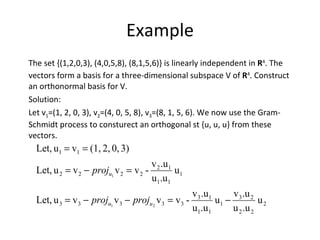
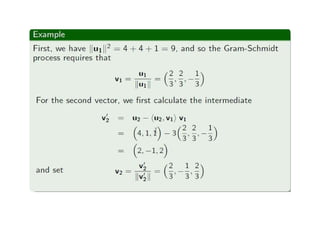
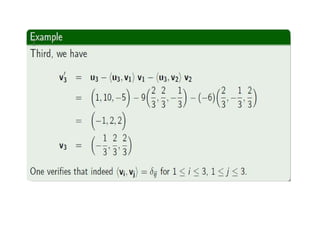
Example The set {(1,2,0,3), (4,0,5,8), (8,1,5,6)} is linearly independent in  R 4 . The vectors form a basis for a three-dimensional subspace V of  R 4 . Construct an orthonormal basis for V.  Solution: Let v 1 =(1, 2, 0, 3), v 2 =(4, 0, 5, 8), v 3 =(8, 1, 5, 6). We now use the Gram- Schmidt process to consturect an orthogonal st {u, u, u} from these vectors.


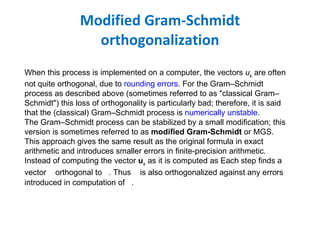
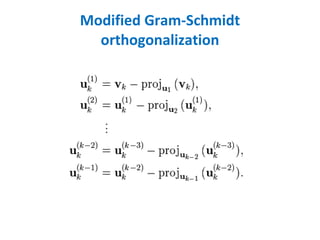
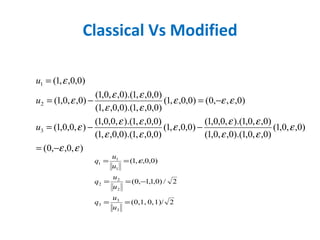
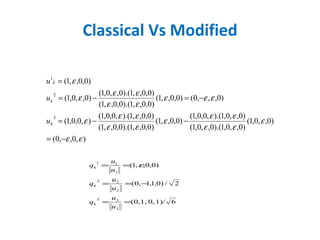
Modified Gram-Schmidt orthogonalization When this process is implemented on a computer, the vectors  u k  are often not quite orthogonal, due to  rounding errors . For the Gram–Schmidt process as described above (sometimes referred to as "classical Gram–Schmidt") this loss of orthogonality is particularly bad; therefore, it is said that the (classical) Gram–Schmidt process is  numerically unstable . The Gram–Schmidt process can be stabilized by a small modification; this version is sometimes referred to as  modified Gram-Schmidt  or MGS. This approach gives the same result as the original formula in exact arithmetic and introduces smaller errors in finite-precision arithmetic. Instead of computing the vector  u k  as it is computed as Each step finds a vector  orthogonal to  .  Thus  is also orthogonalized against any errors introduced in computation of  .
Modified Gram-Schmidt orthogonalization
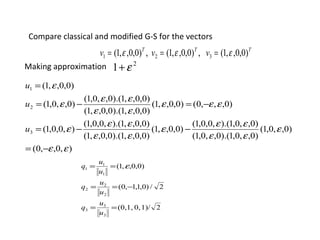
Compare classical and modified G-S for the vectors Making approximation
Classical Vs Modified
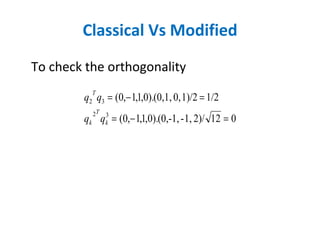
Classical Vs Modified To check the orthogonality
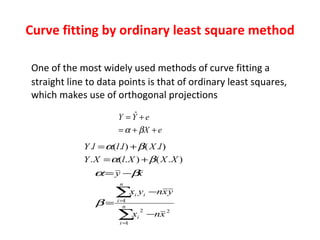
Curve fitting by ordinary least square method One of the most widely used methods of curve fitting a straight line to data points is that of ordinary least squares, which makes use of orthogonal projections
Refference Applied linear algebra in the statistical sciences. -by Alexander Basilevsky. 2.  Lecture on linear Algebra. (Gilbert Strange) Institute of MIT. Applied Multivariate analysis. -by R. A. Johnson, D. W. Wichern. Linear Algebra Theory and Application (2003) -by Ward Cheney and David Kincaid Linear Algebra with Application (2007) - by Granth Williams
Thank You

Orthogonal porjection in statistics

  • 1.
    Projection Md. SahidulIslam Ripon Department of statistics Rajshahi University Email: ripon.ru.statistics@gmail.com
  • 2.
    Content Orthogonal vectorOrthonormal vector Projection Gram-Schmidt orthogonalization
  • 3.
    Orthogonal vector Inmathematics, two vectors are orthogonal if they are perpendicular, i.e., they form a right angle. The relation is clearly symmetric; that is, if x is orthogonal to y then then and so y is orthogonal to x . Two vectors, x and y, in an inner product space, V, are orthogonal if their inner product is zero. Fig : The line segments AB and CD are orthogonal to each other
  • 4.
    Orthogonal vector xy x + y Pythagoras, This always not true. This only true when
  • 5.
    Example Are thevector (1,2,2) T and (2,3,-4) T are orthogonal ? Are the vector (4,2,3) T and (7,3,-4) T are orthogonal ?
  • 6.
    Theorem 1: An orthogonal set of non zero vectors in a vector space is linearly independent.
  • 7.
    Subspace S isorthogonal to subspace T How??? row space is orthogonal to null space Orthogonal Subspace
  • 8.
    Orthonormal vector Defination: Two vector are said to be orthonormal if it is orthogonal and it has unit length. Example: Two vector are said to be orthogonal
  • 9.
    Orthonormal vector Theorem:Let { u 1 , …, u n } be an orthonormal basis for a vector space V. Let v be a vector in V. v can be written as a linear combination of these vectors as follows. Proof: Since { u 1 , …, u n } is a basis there exist scalars c 1 ,…,c n such that v= c 1 u 1 +…+c n u n We shall show that, c 1 =v 1 .u 1 ,…,c n =v n .u n
  • 10.
    Projection In linearalgebra and functional analysis, a projection is a linear transformation P from a vector space to itself such that P 2 = P . It leaves its image unchanged. Though abstract, this definition of "projection" formalizes and generalizes the idea of graphical projection. One can also consider the effect of a projection on a geometrical object by examining the effect of the projection on points in the object.
  • 11.
  • 12.
    Orthogonal projection LetV be any inner-product space and let u V be any vector Let be defined by The vector u  is called the orthogonal projection of   v   onto u. if the vector u is unit. i,e.
  • 13.
  • 14.
  • 15.
  • 16.
    The projection (orshadow) of a vector x on a vector y is= Projection of x on y
  • 17.
    Why projection? BeauseAx=b may have no solution. That is when the system of equations are Inconsistent.
  • 18.
    E xample Solution:Let be the projection vector. The magnitude of is, With direction given by the unit vector Then, So that can be espressed as, Find the orthogonal projection of Y=(2,7,1) on to the vector X=(5,6,4)
  • 19.
  • 20.
    Find the orthogonalprojection of Y=(7,7,8) on to the plane spanned by vector X 1 =(5,6,4) and X 2 =(9,5,1). Solution: Since must lie in the plane spanned by X 1 and X 2
  • 21.
    And forming innerproducts with X and X, we have the equations
  • 22.
    Application 1. Gram–schmidt orthogonalization 2. Curve fitting by ordinary least square method. 3. The area of a parallelogram
  • 23.
    Gram Schmit OrthogonalizationThe Gram-Schmidt orthogonalization process allows us to turn any set of linearly independent vectors into an orthonormal set of the same cardinality. In particular, this holds for a basis of an inner product space. If you feed the machine any basis for the space, the process cranks out an orthonormal basis. Jorgen Pedersen Gram (1850 - 1916) Erhard Schmidt (1876 - 1959)
  • 24.
    Gram Schmit OrthogonalizationLet be a basis for vector space V. The set of vector defined as follows is orthogonal. To obtain a orthogonal basis for V, normalized each of the vector
  • 25.
    Fig: Firsttwo steps of Gram schmidt orthogonalization Geometric Interpretation
  • 26.
    Consider the followingset of vectors in R 2 (with the conventional inner product) Now, perform Gram–Schmidt, to obtain an orthogonal set of vectors: We check that the vectors u 1 and u 2 are indeed orthogonal: noting that if the dot product of two vectors is 0 then they are orthogonal. We can then normalize the vectors by dividing out their sizes as shown above: ; Example
  • 27.
    Example The set{(1,2,0,3), (4,0,5,8), (8,1,5,6)} is linearly independent in R 4 . The vectors form a basis for a three-dimensional subspace V of R 4 . Construct an orthonormal basis for V. Solution: Let v 1 =(1, 2, 0, 3), v 2 =(4, 0, 5, 8), v 3 =(8, 1, 5, 6). We now use the Gram- Schmidt process to consturect an orthogonal st {u, u, u} from these vectors.
  • 28.
  • 29.
  • 30.
  • 31.
    Modified Gram-Schmidt orthogonalizationWhen this process is implemented on a computer, the vectors u k are often not quite orthogonal, due to rounding errors . For the Gram–Schmidt process as described above (sometimes referred to as "classical Gram–Schmidt") this loss of orthogonality is particularly bad; therefore, it is said that the (classical) Gram–Schmidt process is numerically unstable . The Gram–Schmidt process can be stabilized by a small modification; this version is sometimes referred to as modified Gram-Schmidt or MGS. This approach gives the same result as the original formula in exact arithmetic and introduces smaller errors in finite-precision arithmetic. Instead of computing the vector u k as it is computed as Each step finds a vector orthogonal to . Thus is also orthogonalized against any errors introduced in computation of .
  • 32.
  • 33.
    Compare classical andmodified G-S for the vectors Making approximation
  • 34.
  • 35.
  • 36.
    Classical Vs ModifiedTo check the orthogonality
  • 37.
    Curve fitting byordinary least square method One of the most widely used methods of curve fitting a straight line to data points is that of ordinary least squares, which makes use of orthogonal projections
  • 38.
    Refference Applied linearalgebra in the statistical sciences. -by Alexander Basilevsky. 2. Lecture on linear Algebra. (Gilbert Strange) Institute of MIT. Applied Multivariate analysis. -by R. A. Johnson, D. W. Wichern. Linear Algebra Theory and Application (2003) -by Ward Cheney and David Kincaid Linear Algebra with Application (2007) - by Granth Williams
  • 39.