What is Electroporation!?
• A method used to apply an electric current
across a cell membrane resulting in temporary
“pore” formation enabling the uptake of
exogenous molecules found in the medium to
either the cytoplasm or into the nucleus,
thereby transfecting or transforming the cell.
What is electroporation cont…
• Electroporation is a process that is used to
introduce foreign genes into a host cell.
• Electric shocks are used as a mechanism for
introducing new DNA into a host cell by creating
new pores in the plasma membrane of the host
cell.
• The new DNA enters the host cell through the
new pores and is incorporated into the genome
of the new cell.
Electroporation Cell Process
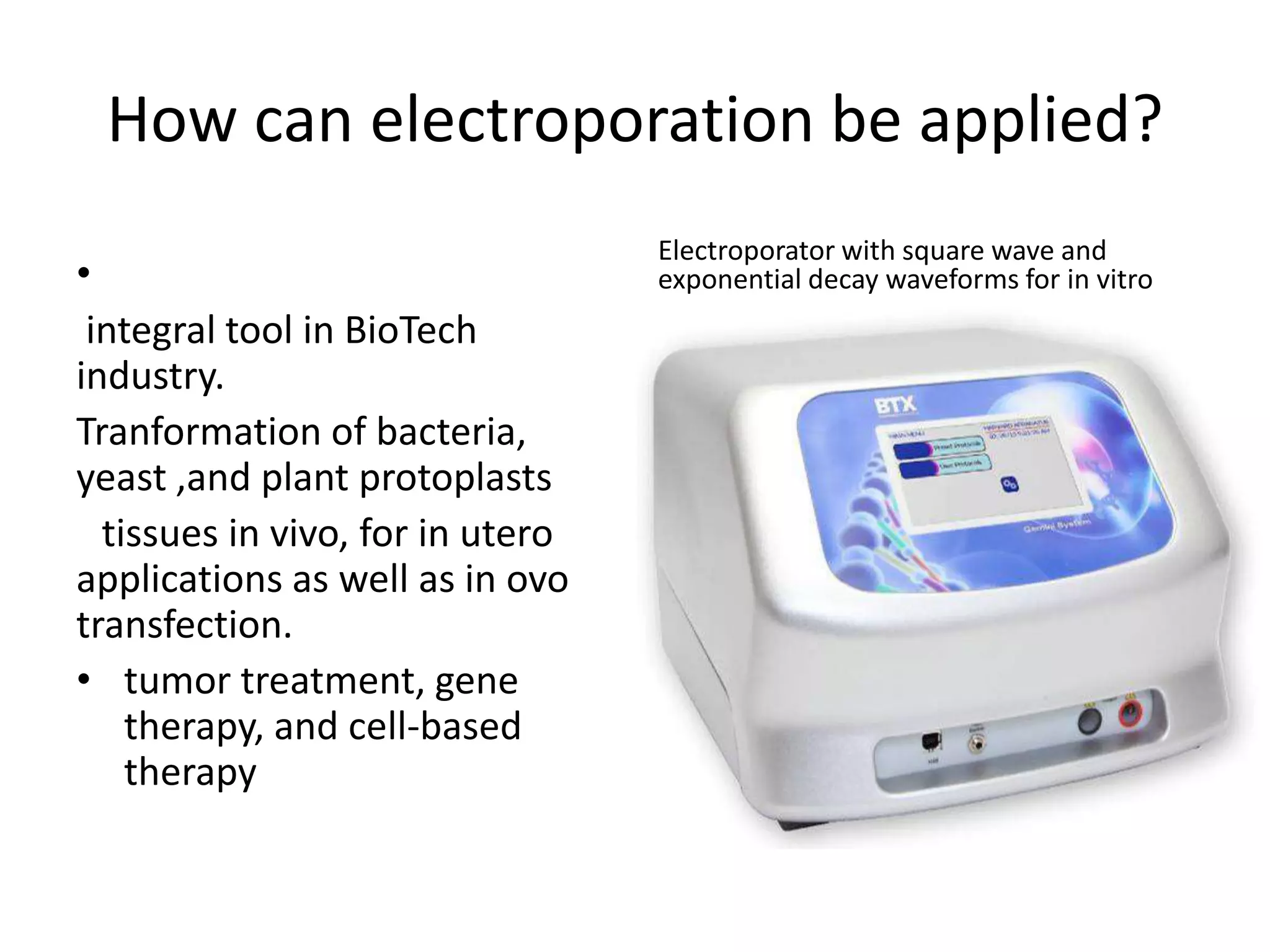
How can electroporation be applied?
•
integral tool in BioTech
industry.
Tranformation of bacteria,
yeast ,and plant protoplasts
tissues in vivo, for in utero
applications as well as in ovo
transfection.
• tumor treatment, gene
therapy, and cell-based
therapy
Electroporator with square wave and
exponential decay waveforms for in vitro
Example: Inovio’s Electroporation
Technology
Electroporation uses controlled, millisecond
electrical pulses to create temporary pores in the
cell membrane and allow dramatic cellular uptake
of a synthetic DNA vaccine previously injected into
muscle or skin.
• Technology allows to safely and effectively deliver
DNA-based vaccines.
• Numerous human studies demonstrated best in
class immune responses from DNA vaccines.
Inovio’s Electroporation Process
No electroporation
vs. With
electroporation
Green Light
displays the
proteins created
by the DNA
vaccines delivered
using
electroporation
Considerations
• Cell Size
• Temperature
• Composition of Electrodes
Optimizing Process
• Use 8 pulses of 100 microseconds
• Increasing voltage slowly because
cell death can occur
Advantages vs. Disadvantages
Advantages:
• Versatility: Electroporation is effective
with nearly all cell and species types .
• Efficiency: A large majority of cells take in
the target DNA or molecule. In a study on
electro transformation of E. coli, for
example, 80% of the cells received the
foreign DNA .
• Small Scale: The amount of DNA required
is smaller than for other methods
• In vivo: The procedure may be performed
with intact tissue . A paper published
in Developmental Biology showed the
successful transfer of a DNA construct
with a fluorescent reporter gene into
intact mouse brain tissue.
•
• Image of in
vivo electroporation in a
mouse brain. The mouse
brains (telencephalons) in
these images are expressing
reporter genes (EYFP)
introduced in gene
constructs by
electroporation.
Disadvantages
• Cell Damage: If the pulses are of the wrong
length or intensity, some pores may become too
large or fail to close after membrane discharge
causing cell damage or rupture
• Nonspecific Transport: The transport of material
into and out of the cell during the time of electro-
permeability is relatively nonspecific. This may
result in an ion imbalance that could later lead to
improper cell function and cell death
Applications to
Medical Field
• Chemotherapy
• Gene Therapy
• Transdermal Drug
Delivery
Electrochemotherapy
• Specialized drug
delivery to affected site
in organism
• First study in 1991
• Bleomycin
• Cisplatin
http://www.jove.com/video/1038/electroche
motherapy-of-tumours

Electroporation

  • 2.
    What is Electroporation!? •A method used to apply an electric current across a cell membrane resulting in temporary “pore” formation enabling the uptake of exogenous molecules found in the medium to either the cytoplasm or into the nucleus, thereby transfecting or transforming the cell.
  • 3.
    What is electroporationcont… • Electroporation is a process that is used to introduce foreign genes into a host cell. • Electric shocks are used as a mechanism for introducing new DNA into a host cell by creating new pores in the plasma membrane of the host cell. • The new DNA enters the host cell through the new pores and is incorporated into the genome of the new cell.
  • 4.
  • 5.
    How can electroporationbe applied? • integral tool in BioTech industry. Tranformation of bacteria, yeast ,and plant protoplasts tissues in vivo, for in utero applications as well as in ovo transfection. • tumor treatment, gene therapy, and cell-based therapy Electroporator with square wave and exponential decay waveforms for in vitro
  • 6.
    Example: Inovio’s Electroporation Technology Electroporationuses controlled, millisecond electrical pulses to create temporary pores in the cell membrane and allow dramatic cellular uptake of a synthetic DNA vaccine previously injected into muscle or skin. • Technology allows to safely and effectively deliver DNA-based vaccines. • Numerous human studies demonstrated best in class immune responses from DNA vaccines.
  • 7.
  • 8.
    No electroporation vs. With electroporation GreenLight displays the proteins created by the DNA vaccines delivered using electroporation
  • 9.
    Considerations • Cell Size •Temperature • Composition of Electrodes
  • 10.
    Optimizing Process • Use8 pulses of 100 microseconds • Increasing voltage slowly because cell death can occur
  • 11.
    Advantages vs. Disadvantages Advantages: •Versatility: Electroporation is effective with nearly all cell and species types . • Efficiency: A large majority of cells take in the target DNA or molecule. In a study on electro transformation of E. coli, for example, 80% of the cells received the foreign DNA . • Small Scale: The amount of DNA required is smaller than for other methods • In vivo: The procedure may be performed with intact tissue . A paper published in Developmental Biology showed the successful transfer of a DNA construct with a fluorescent reporter gene into intact mouse brain tissue. • • Image of in vivo electroporation in a mouse brain. The mouse brains (telencephalons) in these images are expressing reporter genes (EYFP) introduced in gene constructs by electroporation.
  • 12.
    Disadvantages • Cell Damage:If the pulses are of the wrong length or intensity, some pores may become too large or fail to close after membrane discharge causing cell damage or rupture • Nonspecific Transport: The transport of material into and out of the cell during the time of electro- permeability is relatively nonspecific. This may result in an ion imbalance that could later lead to improper cell function and cell death
  • 13.
    Applications to Medical Field •Chemotherapy • Gene Therapy • Transdermal Drug Delivery
  • 14.
    Electrochemotherapy • Specialized drug deliveryto affected site in organism • First study in 1991 • Bleomycin • Cisplatin http://www.jove.com/video/1038/electroche motherapy-of-tumours