ASTHMA
Saad Bin Zafar Mahmood
Ziauddin University
Definition
• Reversible obstruction of airways due to hyper
responsiveness to various immunologic and
non-immunologic stimuli
Epidemiology
• Common chronic lung disease in children
• Boys > Girls (Before puberty)
• More severe in young children
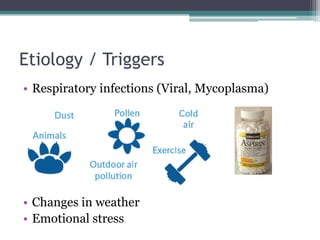
Etiology / Triggers
• Respiratory infections (Viral, Mycoplasma)
• Changes in weather
• Emotional stress
Types of Asthma
• Extrinsic Asthma
▫ Related to environmental exposures
▫ Inc. conc of IgE antibodies
• Intrinsic Asthma
▫ No IgE antibodies
▫ Often in the first 2 years of life
Pathophysiology
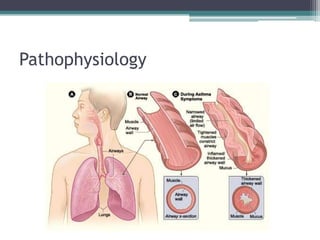
• Asthma is characterized by airway inflammation
and bronchospasm
• Pathologic components’
▫ Bronchospasm
▫ Mucus production
▫ Edema
▫ Infiltration of inflammatory cells
▫ Desquamation of epithelial and inflammatory cells
Pathophysiology
Pathophysiology
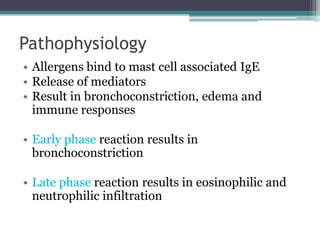
• Allergens bind to mast cell associated IgE
• Release of mediators
• Result in bronchoconstriction, edema and
immune responses
• Early phase reaction results in
bronchoconstriction
• Late phase reaction results in eosinophilic and
neutrophilic infiltration
Risk factors
• Poverty
• Small Home / Large family
• Frequent respiratory infections
• Intense allergenic exposure in infancy
• Poor compliance to therapy
Clinical presentation
• History
▫ Cough
▫ Shortness of breath
▫ Exercise intolerance
▫ Night time symptoms
▫ Agitation
▫ Lethargy
▫ Inability to speak
▫ Decreased appetite
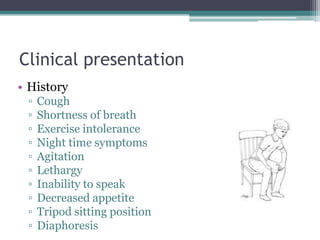
▫ Tripod sitting position
▫ Diaphoresis
Examination
• WHEEZING
• Central cyanosis
• Tachypnea
• Tachycardia
• Pulsus paradoxus
• Flaring of nostrils, use of accessory muscle of
respiration and intercostal recessions
• Barrel shaped chest
• Harrison sulci
• In severe asthmatic attack (respiratory failure)
▫ Wheezing may disappear
▫ Bradycardia
▫ No pulsus paradoxus
Diagnosis / Investigations
• Mainly clinical
• CBC
• CXR
• ABGs
• Radio-allergo-sorbent testing (RAST)
• PFTs
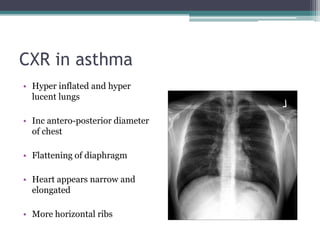
CXR in asthma
• Hyper inflated and hyper
lucent lungs
• Inc antero-posterior diameter
of chest
• Flattening of diaphragm
• Heart appears narrow and
elongated
• More horizontal ribs
PFTs
• PEFR decreased
• FEV1 reduced
• FEV1 / FVC reduced
• RV, FRC and TLC increase
• Diurnal variation in PEFR is characteristic of
asthma
PEFR
Differential diagnosis
• Acute bronchiolitis
• Foreign body in the airway
• Cystic fibrosis
• Congenital malformations – Vascular ring
• Cardiac asthma
• Pnemonia, croup and pertussis
Complications
• Delayed maturation
• Below average weight and height
• Pnemothorax
• Pneumomediastinum
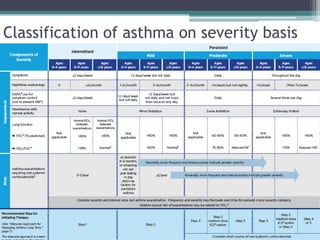
Classification of asthma on severity basis
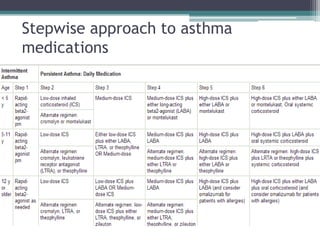
Stepwise approach to asthma
medications
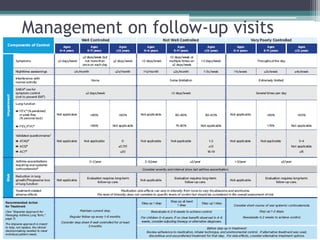
Management on follow-up visits
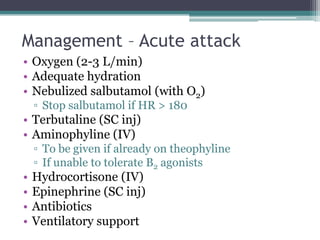
Management – Acute attack
• Oxygen (2-3 L/min)
• Adequate hydration
• Nebulized salbutamol (with O2)
▫ Stop salbutamol if HR > 180
• Terbutaline (SC inj)
• Aminophyline (IV)
▫ To be given if already on theophyline
▫ If unable to tolerate B2 agonists
• Hydrocortisone (IV)
• Epinephrine (SC inj)
• Antibiotics
• Ventilatory support
Status asthmaticus
• Continuous respiratory distress despite
administration of sympathomimetic drugs with
or without theophyline
• Management
▫ Admit in ICU
▫ Investigations done immediately
▫ Same management as acute except
 Steroids given initially
 Ipratropium can also be used
Management – Chronic asthma
• Four main components
▫ Assessment and monitoring
▫ Patient education
▫ Avoidance of triggers
▫ Pharmacologic therapy
Patient education
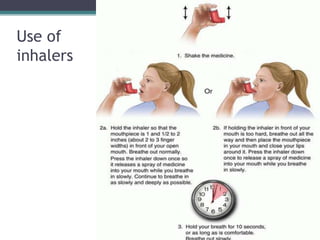
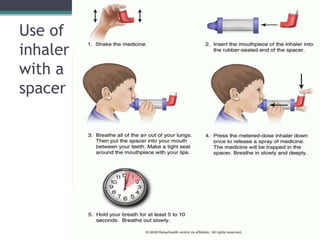
• Improving patient skills in use of inhaler
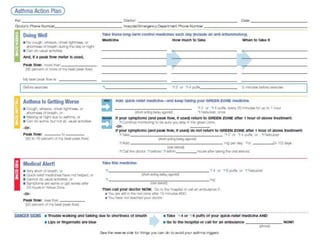
• Use of peak flow monitoring
• Information about medications
• When and how to respond to changes
Use of
inhalers
Use of
inhaler
with a
spacer
Pharmacologic therapy
• Beta 2 agonits (Short and long acting)
• Theophyline
• Ipratropium (used along with Beta 2 agonists)
• Cromolyn and nedocromil
• Leukotriene antagonists
• Inhaled corticosteroids
• Oral corticosteroids (short courses)
Prognosis
• Good prognosis with early aggressive treatment
• 50 % of asthmatic children are free of symptoms
by 10-20 years
• 5 % experience severe disease
• In severe asthma (chronic steroid dependant
disease + hospitalizations) 95% become
asthmatic adults
Prevention
• Reduce the risk of developing allergies
• Breast feeding
▫ Reduces wheezing
▫ Protection lasts for up to 6 years
• Avoidance of triggers
Asthma

Asthma

  • 1.
    ASTHMA Saad Bin ZafarMahmood Ziauddin University
  • 2.
    Definition • Reversible obstructionof airways due to hyper responsiveness to various immunologic and non-immunologic stimuli
  • 3.
    Epidemiology • Common chroniclung disease in children • Boys > Girls (Before puberty) • More severe in young children
  • 4.
    Etiology / Triggers •Respiratory infections (Viral, Mycoplasma) • Changes in weather • Emotional stress
  • 5.
    Types of Asthma •Extrinsic Asthma ▫ Related to environmental exposures ▫ Inc. conc of IgE antibodies • Intrinsic Asthma ▫ No IgE antibodies ▫ Often in the first 2 years of life
  • 6.
    Pathophysiology • Asthma ischaracterized by airway inflammation and bronchospasm • Pathologic components’ ▫ Bronchospasm ▫ Mucus production ▫ Edema ▫ Infiltration of inflammatory cells ▫ Desquamation of epithelial and inflammatory cells
  • 7.
  • 8.
    Pathophysiology • Allergens bindto mast cell associated IgE • Release of mediators • Result in bronchoconstriction, edema and immune responses • Early phase reaction results in bronchoconstriction • Late phase reaction results in eosinophilic and neutrophilic infiltration
  • 9.
    Risk factors • Poverty •Small Home / Large family • Frequent respiratory infections • Intense allergenic exposure in infancy • Poor compliance to therapy
  • 10.
    Clinical presentation • History ▫Cough ▫ Shortness of breath ▫ Exercise intolerance ▫ Night time symptoms ▫ Agitation ▫ Lethargy ▫ Inability to speak ▫ Decreased appetite ▫ Tripod sitting position ▫ Diaphoresis
  • 11.
    Examination • WHEEZING • Centralcyanosis • Tachypnea • Tachycardia • Pulsus paradoxus • Flaring of nostrils, use of accessory muscle of respiration and intercostal recessions • Barrel shaped chest • Harrison sulci
  • 12.
    • In severeasthmatic attack (respiratory failure) ▫ Wheezing may disappear ▫ Bradycardia ▫ No pulsus paradoxus
  • 13.
    Diagnosis / Investigations •Mainly clinical • CBC • CXR • ABGs • Radio-allergo-sorbent testing (RAST) • PFTs
  • 14.
    CXR in asthma •Hyper inflated and hyper lucent lungs • Inc antero-posterior diameter of chest • Flattening of diaphragm • Heart appears narrow and elongated • More horizontal ribs
  • 15.
    PFTs • PEFR decreased •FEV1 reduced • FEV1 / FVC reduced • RV, FRC and TLC increase • Diurnal variation in PEFR is characteristic of asthma
  • 16.
  • 17.
    Differential diagnosis • Acutebronchiolitis • Foreign body in the airway • Cystic fibrosis • Congenital malformations – Vascular ring • Cardiac asthma • Pnemonia, croup and pertussis
  • 18.
    Complications • Delayed maturation •Below average weight and height • Pnemothorax • Pneumomediastinum
  • 19.
    Classification of asthmaon severity basis
  • 20.
    Stepwise approach toasthma medications
  • 21.
  • 22.
    Management – Acuteattack • Oxygen (2-3 L/min) • Adequate hydration • Nebulized salbutamol (with O2) ▫ Stop salbutamol if HR > 180 • Terbutaline (SC inj) • Aminophyline (IV) ▫ To be given if already on theophyline ▫ If unable to tolerate B2 agonists • Hydrocortisone (IV) • Epinephrine (SC inj) • Antibiotics • Ventilatory support
  • 23.
    Status asthmaticus • Continuousrespiratory distress despite administration of sympathomimetic drugs with or without theophyline • Management ▫ Admit in ICU ▫ Investigations done immediately ▫ Same management as acute except  Steroids given initially  Ipratropium can also be used
  • 24.
    Management – Chronicasthma • Four main components ▫ Assessment and monitoring ▫ Patient education ▫ Avoidance of triggers ▫ Pharmacologic therapy
  • 25.
    Patient education • Improvingpatient skills in use of inhaler • Use of peak flow monitoring • Information about medications • When and how to respond to changes
  • 26.
  • 27.
  • 29.
    Pharmacologic therapy • Beta2 agonits (Short and long acting) • Theophyline • Ipratropium (used along with Beta 2 agonists) • Cromolyn and nedocromil • Leukotriene antagonists • Inhaled corticosteroids • Oral corticosteroids (short courses)
  • 30.
    Prognosis • Good prognosiswith early aggressive treatment • 50 % of asthmatic children are free of symptoms by 10-20 years • 5 % experience severe disease • In severe asthma (chronic steroid dependant disease + hospitalizations) 95% become asthmatic adults
  • 31.
    Prevention • Reduce therisk of developing allergies • Breast feeding ▫ Reduces wheezing ▫ Protection lasts for up to 6 years • Avoidance of triggers