11
Mission-Specific
Competencies:
Product Control
11

             Objectives (1 of 4)
• Describe and identify the control options
  available to operations level responders
• Describe and identify the control options
  available for flammable liquid and
  flammable gas incidents
11

            Objectives (2 of 4)
• Describe purpose, equipment, precautions
  associated with control options
• Describe the applicability and
  characteristics of aqueous film-forming
  foam, alcohol-resistant concentrates,
  fluoroprotein foams, protein foams, and
  high-expansion foams
11

            Objectives (3 of 4)
• Identify the location and describe the use
  of emergency remote shut-off devices on
  MC/DOT-306/406, MC/DOT-307/407, and
  MC-331 cargo tanks containing flammable
  liquids or gases
11

            Objectives (4 of 4)
• Describe the recovery phase, and the
  transition from emergency to clean-up
11

              Confinement
• Keeps hazardous material within area of
  release
• Done by
  – Damming
  – Diking
  – Confining vapors
11

               Containment
• Stops material from leaking from
  container
• Examples
  – Patching container
  – Righting overturned container
11

            Control Options
• Solution must be quick and safe
• Should minimize negative effects on
  – People
  – Property
  – Environment
• Use risk-based thought process
11
  Sometimes No Action Is Safest
          Course (1 of 2)
• Create safe perimeter
  – Be aware of natural control points
• Let problem stabilize on its own
• Protect exposures
11
   Sometimes No Action Is Safest
           Course (2 of 2)


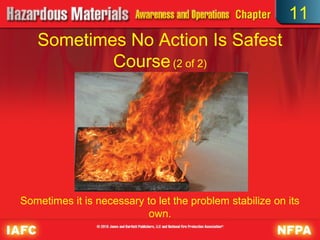
Sometimes it is necessary to let the problem stabilize on its
                           own.
11

             Absorption (1 of 5)
• Absorbent material soaks up liquid release
  – Vermiculite
  – Clay
  – Peat moss
  – Spill pads
11

               Absorption (2 of 5)


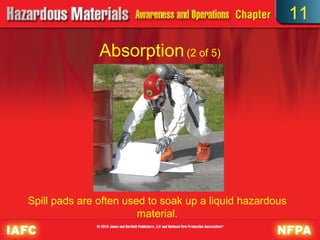
Spill pads are often used to soak up a liquid hazardous
                        material.
11

              Absorption (3 of 5)
•   Effective only on flat surfaces
•   Disposal of used material is necessary
•   Requires close proximity to spill
•   Adds volume to spill
11

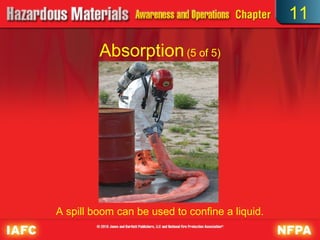
             Absorption (4 of 5)
• Some materials repel water while
  absorbing spilled liquid
• Useful to contain oil spill on body of water
• Spill booms used on water or land
11

         Absorption (5 of 5)


A spill boom can be used to confine a liquid.
11

                Adsorption
• Contaminant adheres to surface of
  material
  – Silica
  – Activated carbon
• Can generate heat
• Functions like Velcro—sticks to product
11

               Damming
• Used when liquid flows in channel
• Progress is stopped by blocking channel
• Three kinds of dam
  – Complete dam
  – Overflow dam
  – Underflow dam
11

             Complete Dam
• Placed across small stream or ditch
• Completely stops flow of material
• Used for
  – Basically dry stream or ditch
  – Small amount of hazardous material
11

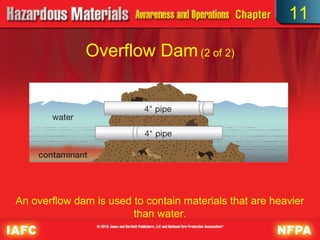
          Overflow Dam (1 of 2)
• Contains materials heavier than water
• Pipe through dam allows water flow
11

              Overflow Dam (2 of 2)


An overflow dam is used to contain materials that are heavier
                        than water.
11

         Underflow Dam (1 of 2)
• Contains materials lighter than water
• Pipe through dam allows water flow
11

              Underflow Dam (2 of 2)


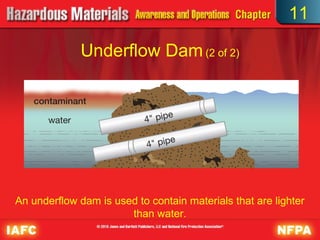
An underflow dam is used to contain materials that are lighter
                       than water.
11

                  Diking
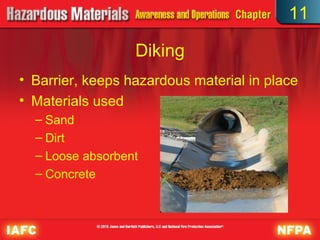
• Barrier, keeps hazardous material in place
• Materials used
  – Sand
  – Dirt
  – Loose absorbent
  – Concrete
11

                   Dilution
•   Addition of water or another substance
•   Weakens strength of hazardous material
•   Typically used for corrosives
•   Increases volume
    – May overwhelm containment measures
11

                Diversion (1 of 2)
• Redirects flow from endangered area
  – Existing curbs
  – Curvature of roadway
  – Dirt berms
  – Spill booms
  – Plastic tarps filled with sand, dirt, or clay
11

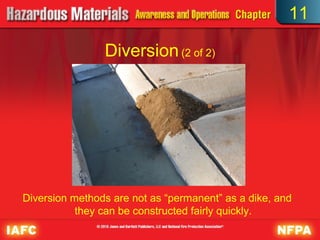
                Diversion (2 of 2)


Diversion methods are not as “permanent” as a dike, and
           they can be constructed fairly quickly.
11

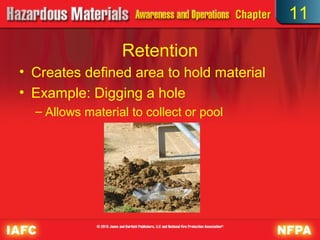
                  Retention
• Creates defined area to hold material
• Example: Digging a hole
  – Allows material to collect or pool
11

        Remote Valve Shut-off
• Pre-existing shutdown device in system
• Found in
  – Chemical processes
  – Piped systems that carry chemicals
  – Cargo tanks
11

MC-306/DOT-406 Cargo Tank (1 of 2)
• Carries flammable liquids, explosives,
  poisons
• Has various safety features
• Has remote shut-off valve
11

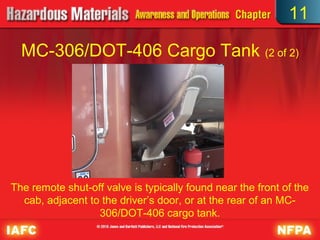
  MC-306/DOT-406 Cargo Tank (2 of 2)


The remote shut-off valve is typically found near the front of the
  cab, adjacent to the driver’s door, or at the rear of an MC-
                  306/DOT-406 cargo tank.
11

MC-307/DOT-407 Cargo Tank (1 of 2)
• Carries low-pressure chemicals
  – Flammables
  – Combustible liquids
  – Mild corrosives
  – Poisons
• Has remote shut-off valve
11

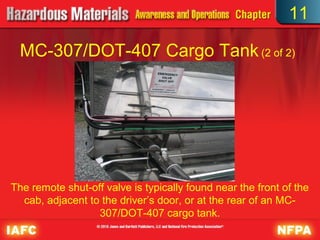
  MC-307/DOT-407 Cargo Tank (2 of 2)


The remote shut-off valve is typically found near the front of the
  cab, adjacent to the driver’s door, or at the rear of an MC-
                  307/DOT-407 cargo tank.
11

      MC-331 Cargo Tank (1 of 2)
• Carries compressed liquefied gases
  – Anhydrous ammonia
  – Propane
  – Butane
  – Liquefied petroleum gas (LPG)
• Has remote shut-off valves
11

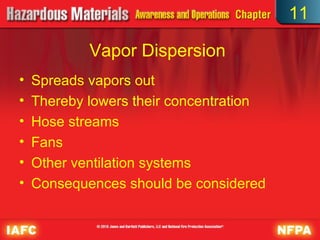
          MC-331 Cargo Tank (2 of 2)


The MC-331 cargo tank has remote shut-off valves at both ends
  of the tank, internal shut-off valves, a rotary gauge depicting
          product pressure, and two top-mounted vents.
11

            Vapor Dispersion
•   Spreads vapors out
•   Thereby lowers their concentration
•   Hose streams
•   Fans
•   Other ventilation systems
•   Consequences should be considered
11

           Vapor Suppression
•   Controls fumes given off by materials
•   Particularly for flammable liquids
•   Example: Gasoline
•   Uses blanket of foam
•   Reducing temperature may also suppress
    vapor
11

Foams Used in Vapor Suppression
•   Aqueous film-forming foam (AFFF)
•   Alcohol-resistant concentrates
•   Fluoroprotein foam
•   Protein foam
•   High-expansion foam
11

         Applying Foam (1 of 4)
• Several ways to apply foam
  – Bounce-off method
  – Rain-down method
  – Roll-in method
11

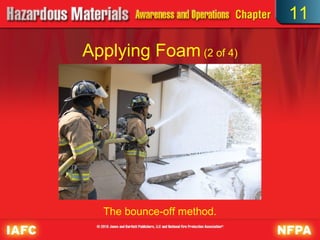
Applying Foam (2 of 4)


  The bounce-off method.
11

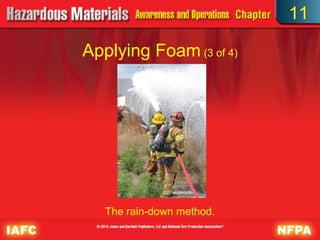
Applying Foam (3 of 4)


   The rain-down method.
11

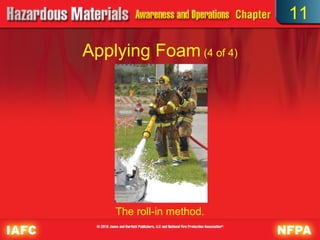
Applying Foam (4 of 4)


    The roll-in method.
11

         Recovery Phase (1 of 3)
• Danger has passed or is controlled
  – Danger to people
  – Danger to property
  – Danger to the environment
• Clean-up begins
• Can be lengthy in large-scale incidents
11

           Recovery Phase (2 of 3)


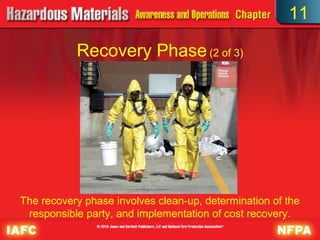
The recovery phase involves clean-up, determination of the
 responsible party, and implementation of cost recovery.
11

         Recovery Phase (3 of 3)
• Initial responders may also perform clean-
  up
• Commercial companies may perform
  clean-up
• Returns exposure area to original
  condition
11

              Summary (1 of 2)
• Various factors must be evaluated to
  choose a control option
• Sometimes safe perimeter can be created
  and the problem left to stabilize on its own
• Control techniques contain, redirect, or
  lower concentration of hazardous material
11

             Summary (2 of 2)
• Options include absorption, diversion,
  damming, diking, shut-off valves, special
  foams
• Recovery phase returns exposure area to
  original condition

HazMat Ch11

  • 1.
  • 2.
    11 Objectives (1 of 4) • Describe and identify the control options available to operations level responders • Describe and identify the control options available for flammable liquid and flammable gas incidents
  • 3.
    11 Objectives (2 of 4) • Describe purpose, equipment, precautions associated with control options • Describe the applicability and characteristics of aqueous film-forming foam, alcohol-resistant concentrates, fluoroprotein foams, protein foams, and high-expansion foams
  • 4.
    11 Objectives (3 of 4) • Identify the location and describe the use of emergency remote shut-off devices on MC/DOT-306/406, MC/DOT-307/407, and MC-331 cargo tanks containing flammable liquids or gases
  • 5.
    11 Objectives (4 of 4) • Describe the recovery phase, and the transition from emergency to clean-up
  • 6.
    11 Confinement • Keeps hazardous material within area of release • Done by – Damming – Diking – Confining vapors
  • 7.
    11 Containment • Stops material from leaking from container • Examples – Patching container – Righting overturned container
  • 8.
    11 Control Options • Solution must be quick and safe • Should minimize negative effects on – People – Property – Environment • Use risk-based thought process
  • 9.
    11 SometimesNo Action Is Safest Course (1 of 2) • Create safe perimeter – Be aware of natural control points • Let problem stabilize on its own • Protect exposures
  • 10.
    11 Sometimes No Action Is Safest Course (2 of 2) Sometimes it is necessary to let the problem stabilize on its own.
  • 11.
    11 Absorption (1 of 5) • Absorbent material soaks up liquid release – Vermiculite – Clay – Peat moss – Spill pads
  • 12.
    11 Absorption (2 of 5) Spill pads are often used to soak up a liquid hazardous material.
  • 13.
    11 Absorption (3 of 5) • Effective only on flat surfaces • Disposal of used material is necessary • Requires close proximity to spill • Adds volume to spill
  • 14.
    11 Absorption (4 of 5) • Some materials repel water while absorbing spilled liquid • Useful to contain oil spill on body of water • Spill booms used on water or land
  • 15.
    11 Absorption (5 of 5) A spill boom can be used to confine a liquid.
  • 16.
    11 Adsorption • Contaminant adheres to surface of material – Silica – Activated carbon • Can generate heat • Functions like Velcro—sticks to product
  • 17.
    11 Damming • Used when liquid flows in channel • Progress is stopped by blocking channel • Three kinds of dam – Complete dam – Overflow dam – Underflow dam
  • 18.
    11 Complete Dam • Placed across small stream or ditch • Completely stops flow of material • Used for – Basically dry stream or ditch – Small amount of hazardous material
  • 19.
    11 Overflow Dam (1 of 2) • Contains materials heavier than water • Pipe through dam allows water flow
  • 20.
    11 Overflow Dam (2 of 2) An overflow dam is used to contain materials that are heavier than water.
  • 21.
    11 Underflow Dam (1 of 2) • Contains materials lighter than water • Pipe through dam allows water flow
  • 22.
    11 Underflow Dam (2 of 2) An underflow dam is used to contain materials that are lighter than water.
  • 23.
    11 Diking • Barrier, keeps hazardous material in place • Materials used – Sand – Dirt – Loose absorbent – Concrete
  • 24.
    11 Dilution • Addition of water or another substance • Weakens strength of hazardous material • Typically used for corrosives • Increases volume – May overwhelm containment measures
  • 25.
    11 Diversion (1 of 2) • Redirects flow from endangered area – Existing curbs – Curvature of roadway – Dirt berms – Spill booms – Plastic tarps filled with sand, dirt, or clay
  • 26.
    11 Diversion (2 of 2) Diversion methods are not as “permanent” as a dike, and they can be constructed fairly quickly.
  • 27.
    11 Retention • Creates defined area to hold material • Example: Digging a hole – Allows material to collect or pool
  • 28.
    11 Remote Valve Shut-off • Pre-existing shutdown device in system • Found in – Chemical processes – Piped systems that carry chemicals – Cargo tanks
  • 29.
    11 MC-306/DOT-406 Cargo Tank(1 of 2) • Carries flammable liquids, explosives, poisons • Has various safety features • Has remote shut-off valve
  • 30.
    11 MC-306/DOT-406Cargo Tank (2 of 2) The remote shut-off valve is typically found near the front of the cab, adjacent to the driver’s door, or at the rear of an MC- 306/DOT-406 cargo tank.
  • 31.
    11 MC-307/DOT-407 Cargo Tank(1 of 2) • Carries low-pressure chemicals – Flammables – Combustible liquids – Mild corrosives – Poisons • Has remote shut-off valve
  • 32.
    11 MC-307/DOT-407Cargo Tank (2 of 2) The remote shut-off valve is typically found near the front of the cab, adjacent to the driver’s door, or at the rear of an MC- 307/DOT-407 cargo tank.
  • 33.
    11 MC-331 Cargo Tank (1 of 2) • Carries compressed liquefied gases – Anhydrous ammonia – Propane – Butane – Liquefied petroleum gas (LPG) • Has remote shut-off valves
  • 34.
    11 MC-331 Cargo Tank (2 of 2) The MC-331 cargo tank has remote shut-off valves at both ends of the tank, internal shut-off valves, a rotary gauge depicting product pressure, and two top-mounted vents.
  • 35.
    11 Vapor Dispersion • Spreads vapors out • Thereby lowers their concentration • Hose streams • Fans • Other ventilation systems • Consequences should be considered
  • 36.
    11 Vapor Suppression • Controls fumes given off by materials • Particularly for flammable liquids • Example: Gasoline • Uses blanket of foam • Reducing temperature may also suppress vapor
  • 37.
    11 Foams Used inVapor Suppression • Aqueous film-forming foam (AFFF) • Alcohol-resistant concentrates • Fluoroprotein foam • Protein foam • High-expansion foam
  • 38.
    11 Applying Foam (1 of 4) • Several ways to apply foam – Bounce-off method – Rain-down method – Roll-in method
  • 39.
    11 Applying Foam (2of 4) The bounce-off method.
  • 40.
    11 Applying Foam (3of 4) The rain-down method.
  • 41.
    11 Applying Foam (4of 4) The roll-in method.
  • 42.
    11 Recovery Phase (1 of 3) • Danger has passed or is controlled – Danger to people – Danger to property – Danger to the environment • Clean-up begins • Can be lengthy in large-scale incidents
  • 43.
    11 Recovery Phase (2 of 3) The recovery phase involves clean-up, determination of the responsible party, and implementation of cost recovery.
  • 44.
    11 Recovery Phase (3 of 3) • Initial responders may also perform clean- up • Commercial companies may perform clean-up • Returns exposure area to original condition
  • 45.
    11 Summary (1 of 2) • Various factors must be evaluated to choose a control option • Sometimes safe perimeter can be created and the problem left to stabilize on its own • Control techniques contain, redirect, or lower concentration of hazardous material
  • 46.
    11 Summary (2 of 2) • Options include absorption, diversion, damming, diking, shut-off valves, special foams • Recovery phase returns exposure area to original condition

Editor's Notes

  • #13 Image: Photographed by Glen E. Ellman.
  • #16 Image: Photographed by Glen E. Ellman.
  • #24 Image: Photographed by Glen E. Ellman.
  • #27 Image: Photographed by Glen E. Ellman.
  • #28 Image: Photographed by Glen E. Ellman.
  • #31 Image: Courtesy of Glen Rudner
  • #33 Image: Courtesy of Glen Rudner
  • #35 Image: Courtesy of Rob Schnepp
  • #40 Image: Photographed by Glen E. Ellman.
  • #41 Image: Photographed by Glen E. Ellman.
  • #42 Image: Photographed by Glen E. Ellman.
  • #44 Image: Courtesy of Captain David Jackson, Saginaw Township Fire Department