Building Construction
Related to the Fire Service

    Chapter 1 — Building
   Construction and the Fire
           Service
Learning Objective 1


  Recognize the significance of methods
  and materials historically used in
  building construction, as well as the
  importance of the age of the building
  itself.

            Building Construction
                     1–2
History of Building
Construction

•   Roman Times
•   Native Americans
•   Colonial America
•   Mid-Nineteenth Century
•   Late 19th/Early 20th Century
•   20th/Early 21st Century


                 Building Construction
                          1–3
Learning Objective 2


 Discuss building variables as they
 relate to the work of firefighters.


              Building Construction
                       1–4
Age of the Building

• Can be indication of potential hazards
• Affects occurrence and behavior of fire
• Effects not uniform; some buildings
  undergo gentrification
• Some buildings have greater structural
  mass resulting in greater stability during
  fire

               Building Construction
                        1–5
Automatic Fire
Suppression Systems

• Fire line of defense when a fire occurs
• Incipient fires are promptly detected
 and controlled


               Building Construction
                        1–6
Occupancy

• Affects the ways building occupants
  behave under fire conditions
• The exposure of fire to structural
  components will vary
• Fuel loading will vary
• May change over time, impacting
  construction features and fire safety

               Building Construction
                        1–7
Type of Construction

• Materials used in construction are
  fundamental to a building and its
  behavior during a fire
• Buildings are classified by their
  construction type
• Traditional construction classifications

                                       (Continued)

               Building Construction
                        1–8
Type of Construction

• Numerical designations
• Firefighters need to be able to
  recognize construction types to predict
  fire behavior
• A building may have multiple
  construction types


               Building Construction
                        1–9
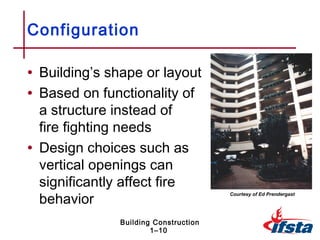
Configuration

• Building’s shape or layout
• Based on functionality of
  a structure instead of
  fire fighting needs
• Design choices such as
  vertical openings can
  significantly affect fire
  behavior
                                       Courtesy of Ed Prendergast


               Building Construction
                       1–10
Building Access

• Primary factor for fire department
  operations
• Aspects of terrain and built-out
  environment affect fire department
  access
• Circumstances may affect fire fighting
  tactics

               Building Construction
                       1–11
Learning Objective 3


 Explain communication of fire and the
 ways in which it occurs.


             Building Construction
                     1–12
Communication of Fire

• Exposure – Structure or separate part of
  fireground to which fire could spread
• Conflagration – Uncontrollable fire covering
  considerable area and crossing natural fire
  barriers
• Wildland/Urban interface – Line or area where
  structures and human development
  meet/intermingle with undeveloped wildland
  fuels
                Building Construction
                        1–13
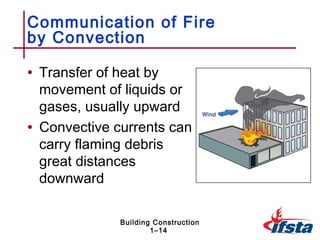
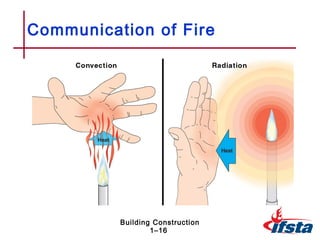
Communication of Fire
by Convection

• Transfer of heat by
  movement of liquids or
  gases, usually upward
• Convective currents can
  carry flaming debris
  great distances
  downward

              Building Construction
                      1–14
Communication of Fire
by Radiation

• Thermal radiation – Transfer of heat
  through space by electromagnetic
  waves
• Horizontal transfer of energy from
  building of higher temperature to
  building of lower temperature


              Building Construction
                      1–15
Communication of Fire


          Building Construction
                  1–16
Learning Objective 4


 Describe factors that affect
 communication of fire and methods
 used to protect buildings from exposing
 fires.


             Building Construction
                     1–17
Factors that Affect
Communication of Fire

• Flame temperature
• Area of exposing flame
• NFPA® 80A® describes three levels of
 exposure
  – Light
  – Moderate
  – Severe

               Building Construction
                       1–18
Methods to Protect Building
from Exposing Fires

• Clear spaces between buildings
• Fire suppression systems
• Blank walls of noncombustible
  construction
• Self-supporting barrier walls between
  fire building and exposure
• Parapets on exterior masonry walls  (Continued)

              Building Construction
                      1–19
Methods to Protect Building
from Exposing Fires

• Automatic outside deluge systems
• Elimination of openings in exterior walls
• Glass block panels in openings
• Wire glass in steel sash windows
• Automatic fire shutters/dampers on wall
  openings
• Automatic fire doors on door openings
               Building Construction
                       1–20
Learning Objective 5


 Discuss building failure, structural
 integrity, building systems, and design
 deficiencies as building design
 considerations.


              Building Construction
                      1–21
Building Failure

• Failure – No longer performing its
  required function in a satisfactory
  manner
• Potential sources of building failure
  under fire conditions


               Building Construction
                       1–22
Structural Integrity

• Under fire conditions is related to fire
  resistance and combustibility of the
  construction materials
• Combustible materials may possess
  some initial fire resistance
• Noncombustible materials may retain
  structural integrity at first but will fail
  from effects of heat
                 Building Construction
                         1–23
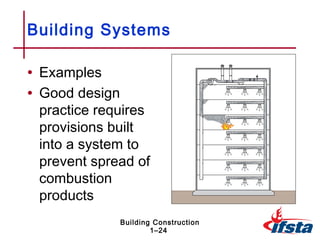
Building Systems

• Examples
• Good design
 practice requires
 provisions built
 into a system to
 prevent spread of
 combustion
 products
                Building Construction
                        1–24
Design Deficiencies

• Failure to provide level of fire safety
  appropriate to ultimate use of building
• Heavy reliance placed on codes and
  standards, but:
  – Writers cannot anticipate every situation
  – Subject to political process
  – Provide a “reasonable” level of protection
    for the most common situations
                Building Construction
                        1–25
Learning Objective 6


 Explain the principles of design and
 why buildings are built.


              Building Construction
                      1–26
Principles of Design

• Buildings not designed to collapse,
  catch fire, burn, or restrict egress
• However, fire and life safety are not
  most prominent design considerations
  to owners or designers
• Buildings are a complex of many
  diverse elements and systems

              Building Construction
                      1–27
Why Buildings are Built

• Security from physical and social forces
• Investments
• Cultural desires


              Building Construction
                      1–28
Learning Objective 7


 Discuss design considerations.


             Building Construction
                     1–29
Cost and Building Use

• Cost
  – Design and individual details determined
    by available funds
• Building Use
  – Design must facilitate end use
  – End use dictates subtle requirements
  – Renovating older buildings for a chance of
    occupancy may be unsuitable under code
                 Building Construction
                         1–30
Aesthetics

• Deals with the nature of beauty, art, and
  taste
• Major force in architecture
• Frequently clashes with fire safety
  concerns


               Building Construction
                       1–31
Building Codes

• Bodies of law that determine minimum
  standards that buildings must meet in
  interest of community safety and health
• Jurisdictions typically adopt all or
  portion of “model code”
• Most widely used
  – International Building Code®
  – Companion, International Fire Code®
               Building Construction
                       1–32
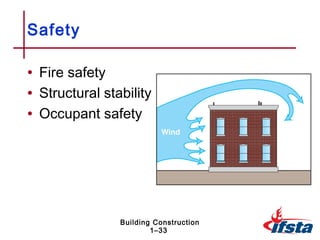
Safety

• Fire safety
• Structural stability
• Occupant safety


                Building Construction
                        1–33
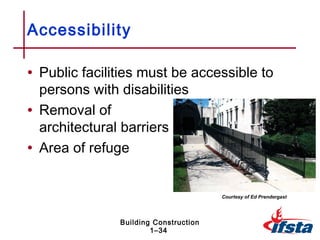
Accessibility

• Public facilities must be accessible to
  persons with disabilities
• Removal of
  architectural barriers
• Area of refuge

                                       Courtesy of Ed Prendergast


               Building Construction
                       1–34
Utilities and Climate

• Utilities
   – Availability of water
   – Public sewers
• Climate
   – Effects of snow, rain, heating and cooling
     needs


                  Building Construction
                          1–35
Energy Conservation

• Reduce greenhouse gas emissions
  from burning heating fuel
• Increase energy efficiency with less
  electrical power, dual pane windows,
  tighter doors and seals
• Reduce water consumption


              Building Construction
                      1–36
Soil Conditions

• Soil strength, strain resistance, and
  stability are important in foundation
  design
• Affected by frost, water content, seismic
  shock, organic decomposition, etc.


               Building Construction
                       1–37
Other Design Considerations

• Physical laws of engineering
  – Proposed design and the loads and forces
    exerted upon it must be matched to the
    strength of building materials and the
    mathematics of structural mechanics
• Owner’s needs and desires
  – Final design involves balance of what is
    desired, what is needed, and what is
    practical
                Building Construction
                        1–38
Learning Objective 8


 Describe the design and construction
 process.


             Building Construction
                     1–39
Learning Objective 9


 Recognize the role of the building
 permit process and preincident planning
 in the construction of a building.


             Building Construction
                     1–40
Design and Construction
Process

•   Concept
•   Design product
•   Financing
•   Documentation and permits
•   Renovation and remodeling permits
•   Construction
•   Inspection/Testing
               Building Construction
                       1–41
Building Construction and
Preincident Planning

• Methods for firefighters to develop
 knowledge of building construction in
 their jurisdiction
  – Information through permit process
  – Preincident planning to gather information
    about a building’s construction


                                          (Continued)

                Building Construction
                        1–42
Building Construction and
Preincident Planning

• Preincident plans include information
 about:
  –   Occupancy
  –   Industrial process
  –   Hazardous materials
  –   Fire protection systems
  –   Building access
  –   Utilities                          (Continued)

                 Building Construction
                         1–43
Building Construction and
Preincident Planning

• Geographic information systems (GIS)
  – Means of obtaining, analyzing, and using
    data based on location
  – Allow large projects to be divided into
    smaller areas or sectors
  – Make projects more manageable
  – Provide means for determining the exact
    locations necessary for placement of
    critical building elements              (Continued)

                 Building Construction
                         1–44
Building Construction and
Preincident Planning

• Preincident planning information about
 building construction to gather includes:
  –   Construction type
  –   Location of fire walls
  –   Vertical openings
  –   Roof construction
  –   Exits
  –   Smoke control system
                  Building Construction
                          1–45
Summary

• Fire behavior in buildings varies greatly
  depending on building construction.
• Firefighters have little or no control over
  design variables.
• The tactical firefighters should
  understand the design, construction,
  and functioning of a building for
  effective operations.
               Building Construction
                       1–46
Review Questions

  1.     What types of building
  configuration issues can significantly
  affect fire behavior?
  2.     How is fire communicated by
  radiation?
  3.     What are three potential
  sources of building failure under fire
  conditions?                         (Continued)

              Building Construction
                      1–47
Review Questions

  4.    How do the accessibility
  requirements of the Americans with
  Disabilities Act (ADA) affect building
  construction?
  5.     What is Green Design?


             Building Construction
                     1–48

Bldg Construction Chapter 01

  • 1.
    Building Construction Related tothe Fire Service Chapter 1 — Building Construction and the Fire Service
  • 2.
    Learning Objective 1 Recognize the significance of methods and materials historically used in building construction, as well as the importance of the age of the building itself. Building Construction 1–2
  • 3.
    History of Building Construction • Roman Times • Native Americans • Colonial America • Mid-Nineteenth Century • Late 19th/Early 20th Century • 20th/Early 21st Century Building Construction 1–3
  • 4.
    Learning Objective 2 Discuss building variables as they relate to the work of firefighters. Building Construction 1–4
  • 5.
    Age of theBuilding • Can be indication of potential hazards • Affects occurrence and behavior of fire • Effects not uniform; some buildings undergo gentrification • Some buildings have greater structural mass resulting in greater stability during fire Building Construction 1–5
  • 6.
    Automatic Fire Suppression Systems •Fire line of defense when a fire occurs • Incipient fires are promptly detected and controlled Building Construction 1–6
  • 7.
    Occupancy • Affects theways building occupants behave under fire conditions • The exposure of fire to structural components will vary • Fuel loading will vary • May change over time, impacting construction features and fire safety Building Construction 1–7
  • 8.
    Type of Construction •Materials used in construction are fundamental to a building and its behavior during a fire • Buildings are classified by their construction type • Traditional construction classifications (Continued) Building Construction 1–8
  • 9.
    Type of Construction •Numerical designations • Firefighters need to be able to recognize construction types to predict fire behavior • A building may have multiple construction types Building Construction 1–9
  • 10.
    Configuration • Building’s shapeor layout • Based on functionality of a structure instead of fire fighting needs • Design choices such as vertical openings can significantly affect fire behavior Courtesy of Ed Prendergast Building Construction 1–10
  • 11.
    Building Access • Primaryfactor for fire department operations • Aspects of terrain and built-out environment affect fire department access • Circumstances may affect fire fighting tactics Building Construction 1–11
  • 12.
    Learning Objective 3 Explain communication of fire and the ways in which it occurs. Building Construction 1–12
  • 13.
    Communication of Fire •Exposure – Structure or separate part of fireground to which fire could spread • Conflagration – Uncontrollable fire covering considerable area and crossing natural fire barriers • Wildland/Urban interface – Line or area where structures and human development meet/intermingle with undeveloped wildland fuels Building Construction 1–13
  • 14.
    Communication of Fire byConvection • Transfer of heat by movement of liquids or gases, usually upward • Convective currents can carry flaming debris great distances downward Building Construction 1–14
  • 15.
    Communication of Fire byRadiation • Thermal radiation – Transfer of heat through space by electromagnetic waves • Horizontal transfer of energy from building of higher temperature to building of lower temperature Building Construction 1–15
  • 16.
    Communication of Fire Building Construction 1–16
  • 17.
    Learning Objective 4 Describe factors that affect communication of fire and methods used to protect buildings from exposing fires. Building Construction 1–17
  • 18.
    Factors that Affect Communicationof Fire • Flame temperature • Area of exposing flame • NFPA® 80A® describes three levels of exposure – Light – Moderate – Severe Building Construction 1–18
  • 19.
    Methods to ProtectBuilding from Exposing Fires • Clear spaces between buildings • Fire suppression systems • Blank walls of noncombustible construction • Self-supporting barrier walls between fire building and exposure • Parapets on exterior masonry walls (Continued) Building Construction 1–19
  • 20.
    Methods to ProtectBuilding from Exposing Fires • Automatic outside deluge systems • Elimination of openings in exterior walls • Glass block panels in openings • Wire glass in steel sash windows • Automatic fire shutters/dampers on wall openings • Automatic fire doors on door openings Building Construction 1–20
  • 21.
    Learning Objective 5 Discuss building failure, structural integrity, building systems, and design deficiencies as building design considerations. Building Construction 1–21
  • 22.
    Building Failure • Failure– No longer performing its required function in a satisfactory manner • Potential sources of building failure under fire conditions Building Construction 1–22
  • 23.
    Structural Integrity • Underfire conditions is related to fire resistance and combustibility of the construction materials • Combustible materials may possess some initial fire resistance • Noncombustible materials may retain structural integrity at first but will fail from effects of heat Building Construction 1–23
  • 24.
    Building Systems • Examples •Good design practice requires provisions built into a system to prevent spread of combustion products Building Construction 1–24
  • 25.
    Design Deficiencies • Failureto provide level of fire safety appropriate to ultimate use of building • Heavy reliance placed on codes and standards, but: – Writers cannot anticipate every situation – Subject to political process – Provide a “reasonable” level of protection for the most common situations Building Construction 1–25
  • 26.
    Learning Objective 6 Explain the principles of design and why buildings are built. Building Construction 1–26
  • 27.
    Principles of Design •Buildings not designed to collapse, catch fire, burn, or restrict egress • However, fire and life safety are not most prominent design considerations to owners or designers • Buildings are a complex of many diverse elements and systems Building Construction 1–27
  • 28.
    Why Buildings areBuilt • Security from physical and social forces • Investments • Cultural desires Building Construction 1–28
  • 29.
    Learning Objective 7 Discuss design considerations. Building Construction 1–29
  • 30.
    Cost and BuildingUse • Cost – Design and individual details determined by available funds • Building Use – Design must facilitate end use – End use dictates subtle requirements – Renovating older buildings for a chance of occupancy may be unsuitable under code Building Construction 1–30
  • 31.
    Aesthetics • Deals withthe nature of beauty, art, and taste • Major force in architecture • Frequently clashes with fire safety concerns Building Construction 1–31
  • 32.
    Building Codes • Bodiesof law that determine minimum standards that buildings must meet in interest of community safety and health • Jurisdictions typically adopt all or portion of “model code” • Most widely used – International Building Code® – Companion, International Fire Code® Building Construction 1–32
  • 33.
    Safety • Fire safety •Structural stability • Occupant safety Building Construction 1–33
  • 34.
    Accessibility • Public facilitiesmust be accessible to persons with disabilities • Removal of architectural barriers • Area of refuge Courtesy of Ed Prendergast Building Construction 1–34
  • 35.
    Utilities and Climate •Utilities – Availability of water – Public sewers • Climate – Effects of snow, rain, heating and cooling needs Building Construction 1–35
  • 36.
    Energy Conservation • Reducegreenhouse gas emissions from burning heating fuel • Increase energy efficiency with less electrical power, dual pane windows, tighter doors and seals • Reduce water consumption Building Construction 1–36
  • 37.
    Soil Conditions • Soilstrength, strain resistance, and stability are important in foundation design • Affected by frost, water content, seismic shock, organic decomposition, etc. Building Construction 1–37
  • 38.
    Other Design Considerations •Physical laws of engineering – Proposed design and the loads and forces exerted upon it must be matched to the strength of building materials and the mathematics of structural mechanics • Owner’s needs and desires – Final design involves balance of what is desired, what is needed, and what is practical Building Construction 1–38
  • 39.
    Learning Objective 8 Describe the design and construction process. Building Construction 1–39
  • 40.
    Learning Objective 9 Recognize the role of the building permit process and preincident planning in the construction of a building. Building Construction 1–40
  • 41.
    Design and Construction Process • Concept • Design product • Financing • Documentation and permits • Renovation and remodeling permits • Construction • Inspection/Testing Building Construction 1–41
  • 42.
    Building Construction and PreincidentPlanning • Methods for firefighters to develop knowledge of building construction in their jurisdiction – Information through permit process – Preincident planning to gather information about a building’s construction (Continued) Building Construction 1–42
  • 43.
    Building Construction and PreincidentPlanning • Preincident plans include information about: – Occupancy – Industrial process – Hazardous materials – Fire protection systems – Building access – Utilities (Continued) Building Construction 1–43
  • 44.
    Building Construction and PreincidentPlanning • Geographic information systems (GIS) – Means of obtaining, analyzing, and using data based on location – Allow large projects to be divided into smaller areas or sectors – Make projects more manageable – Provide means for determining the exact locations necessary for placement of critical building elements (Continued) Building Construction 1–44
  • 45.
    Building Construction and PreincidentPlanning • Preincident planning information about building construction to gather includes: – Construction type – Location of fire walls – Vertical openings – Roof construction – Exits – Smoke control system Building Construction 1–45
  • 46.
    Summary • Fire behaviorin buildings varies greatly depending on building construction. • Firefighters have little or no control over design variables. • The tactical firefighters should understand the design, construction, and functioning of a building for effective operations. Building Construction 1–46
  • 47.
    Review Questions 1. What types of building configuration issues can significantly affect fire behavior? 2. How is fire communicated by radiation? 3. What are three potential sources of building failure under fire conditions? (Continued) Building Construction 1–47
  • 48.
    Review Questions 4. How do the accessibility requirements of the Americans with Disabilities Act (ADA) affect building construction? 5. What is Green Design? Building Construction 1–48