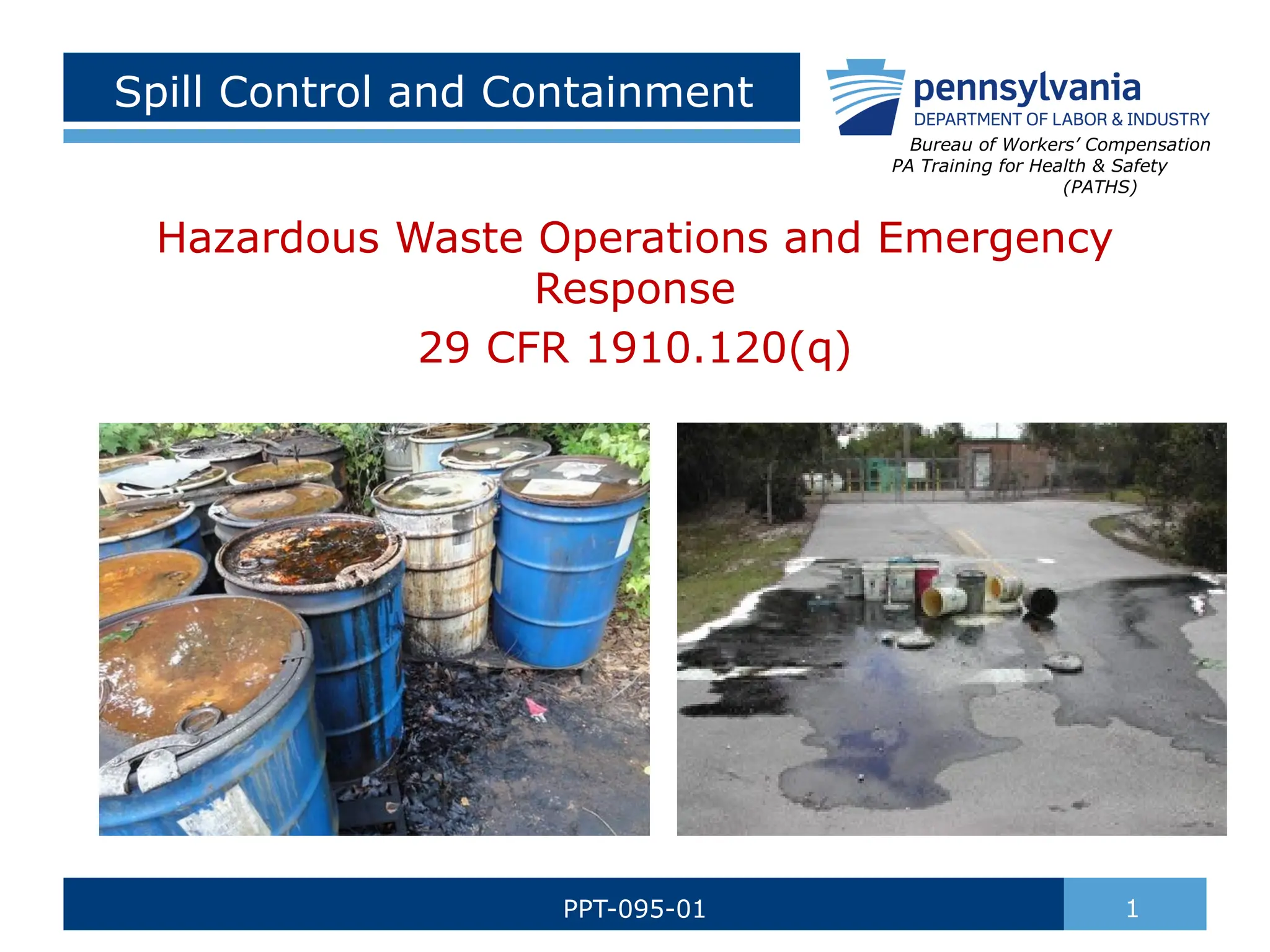
Spill Control and Containment
Hazardous Waste Operations and Emergency
Response
29 CFR 1910.120(q)
1
PPT-095-01
Bureau of Workers’ Compensation
PA Training for Health & Safety
(PATHS)
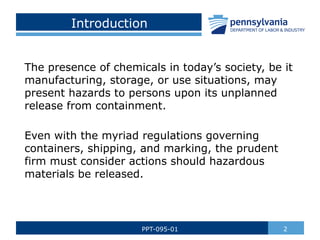
Introduction
The presence of chemicals in today’s society, be it
manufacturing, storage, or use situations, may
present hazards to persons upon its unplanned
release from containment.
Even with the myriad regulations governing
containers, shipping, and marking, the prudent
firm must consider actions should hazardous
materials be released.
2
PPT-095-01
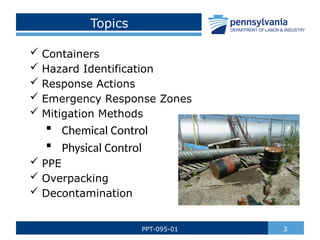
Topics
 Containers
 Hazard Identification
 Response Actions
 Emergency Response Zones
 Mitigation Methods
 Chemical Control
 Physical Control
 PPE
 Overpacking
 Decontamination
3
PPT-095-01
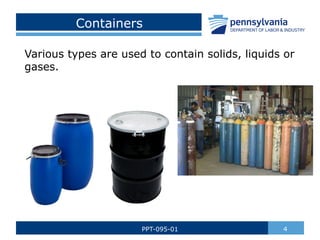
Containers
Various types are used to contain solids, liquids or
gases.
4
PPT-095-01
Containers
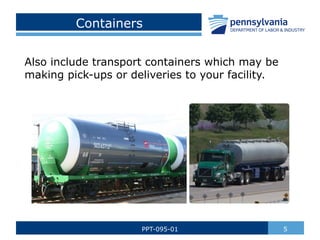
Also include transport containers which may be
making pick-ups or deliveries to your facility.
5
PPT-095-01
Containers
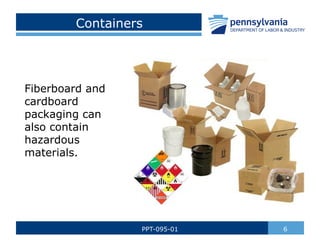
Fiberboard and
cardboard
packaging can
also contain
hazardous
materials.
6
PPT-095-01
Containers
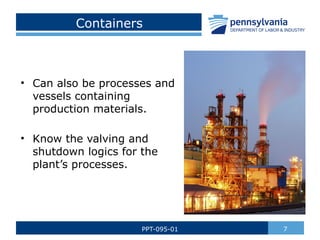
• Can also be processes and
vessels containing
production materials.
• Know the valving and
shutdown logics for the
plant’s processes.
7
PPT-095-01
Hazard Identification
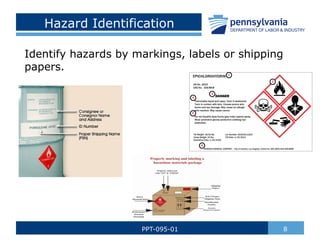
Identify hazards by markings, labels or shipping
papers.
8
PPT-095-01
Hazard Identification
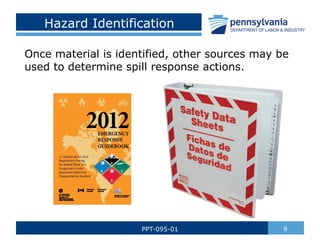
Once material is identified, other sources may be
used to determine spill response actions.
9
PPT-095-01
Hazard Identification
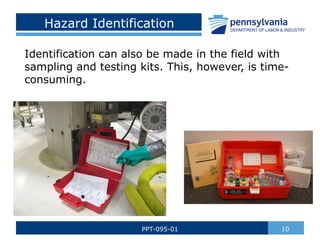
Identification can also be made in the field with
sampling and testing kits. This, however, is time-
consuming.
10
PPT-095-01
Hazard Identification
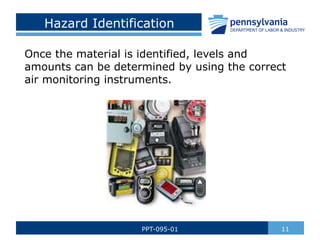
Once the material is identified, levels and
amounts can be determined by using the correct
air monitoring instruments.
11
PPT-095-01
Containment: Defined
Act or process of containing and/or preventing
the expansion of a substance.
Purpose:
 Prevent contaminating surrounding areas
 Prevent material entering sewers or waterways
 Reduce contamination of adjacent chemicals
 Reduce extent of hazard to human life
 Ensure responders practice A.L.A.R.A. concept
(As Low As Reasonably Achievable)
12
PPT-095-01
A.L.A.R.A. Concept
A concept used during control and clean-up is
borrowed from the nuclear industry:
The A. L. A. R. A. Concept - “As Low As
Reasonably Achievable.”
This means that in all actions we should attempt
to minimize exposure, contact, and contamination
as well as the amount of waste generated by the
control operation
13
PPT-095-01
Loss of Containment
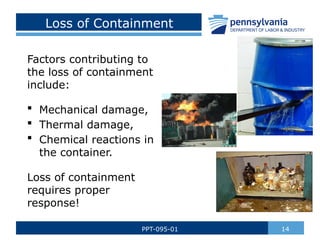
Factors contributing to
the loss of containment
include:
 Mechanical damage,
 Thermal damage,
 Chemical reactions in
the container.
Loss of containment
requires proper
response!
14
PPT-095-01
Types of Contaminants
Something which contaminates or “makes
impure, unclean, or corrupt by contact; to
corrupt; to pollute; to sully; to tarnish; to taint.”
Precautions are taken to minimize exposure:
 Proper size-up of situation
 Proper PPE
 Understanding hazards of materials involved
 Physical state of release and resulting
complications.
15
PPT-095-01
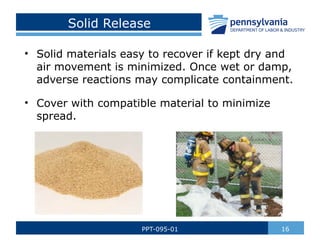
Solid Release
• Solid materials easy to recover if kept dry and
air movement is minimized. Once wet or damp,
adverse reactions may complicate containment.
• Cover with compatible material to minimize
spread.
16
PPT-095-01
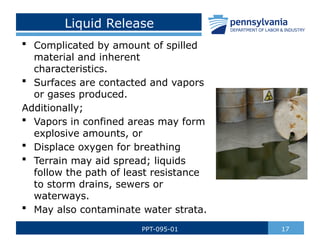
Liquid Release
 Complicated by amount of spilled
material and inherent
characteristics.
 Surfaces are contacted and vapors
or gases produced.
Additionally;
 Vapors in confined areas may form
explosive amounts, or
 Displace oxygen for breathing
 Terrain may aid spread; liquids
follow the path of least resistance
to storm drains, sewers or
waterways.
 May also contaminate water strata.
17
PPT-095-01
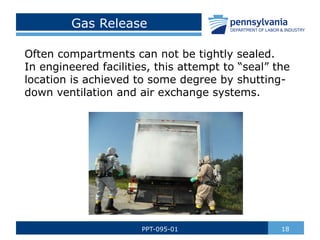
Gas Release
Often compartments can not be tightly sealed.
In engineered facilities, this attempt to “seal” the
location is achieved to some degree by shutting-
down ventilation and air exchange systems.
18
PPT-095-01
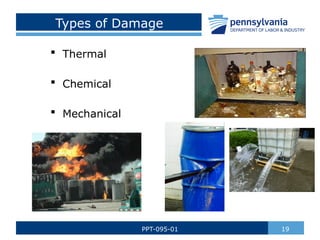
Types of Damage
 Thermal
 Chemical
 Mechanical
19
PPT-095-01
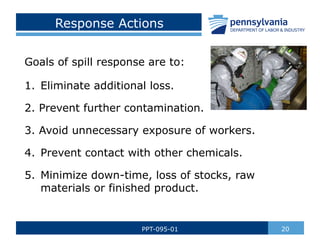
Response Actions
Goals of spill response are to:
1. Eliminate additional loss.
2. Prevent further contamination.
3. Avoid unnecessary exposure of workers.
4. Prevent contact with other chemicals.
5. Minimize down-time, loss of stocks, raw
materials or finished product.
20
PPT-095-01
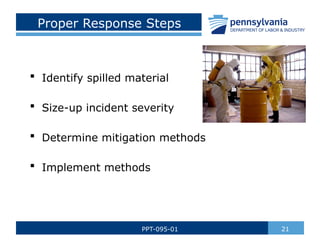
Proper Response Steps
 Identify spilled material
 Size-up incident severity
 Determine mitigation methods
 Implement methods
21
PPT-095-01
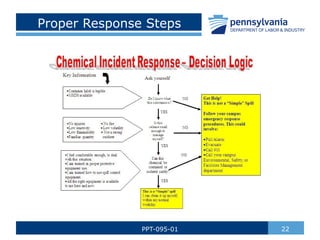
Proper Response Steps
22
PPT-095-01
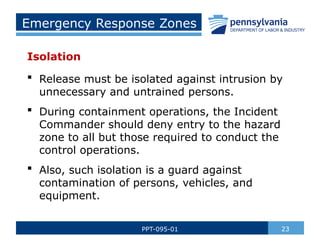
Emergency Response Zones
Isolation
 Release must be isolated against intrusion by
unnecessary and untrained persons.
 During containment operations, the Incident
Commander should deny entry to the hazard
zone to all but those required to conduct the
control operations.
 Also, such isolation is a guard against
contamination of persons, vehicles, and
equipment.
23
PPT-095-01
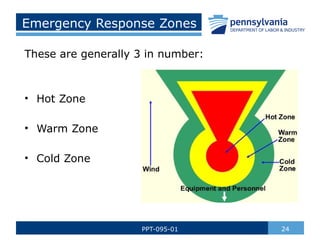
Emergency Response Zones
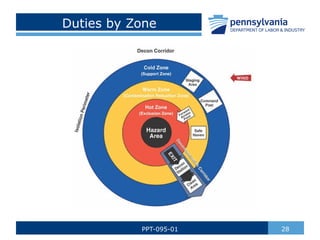
These are generally 3 in number:
• Hot Zone
• Warm Zone
• Cold Zone
24
PPT-095-01
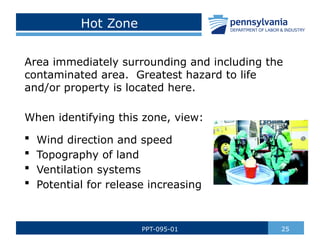
Hot Zone
Area immediately surrounding and including the
contaminated area. Greatest hazard to life
and/or property is located here.
When identifying this zone, view:
 Wind direction and speed
 Topography of land
 Ventilation systems
 Potential for release increasing
25
PPT-095-01
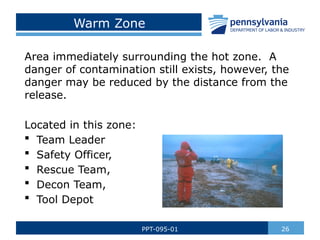
Warm Zone
Area immediately surrounding the hot zone. A
danger of contamination still exists, however, the
danger may be reduced by the distance from the
release.
Located in this zone:
 Team Leader
 Safety Officer,
 Rescue Team,
 Decon Team,
 Tool Depot
26
PPT-095-01
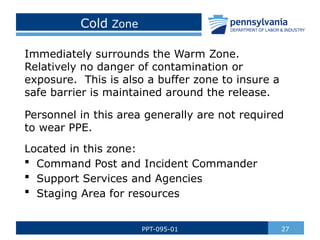
Cold Zone
Immediately surrounds the Warm Zone.
Relatively no danger of contamination or
exposure. This is also a buffer zone to insure a
safe barrier is maintained around the release.
Personnel in this area generally are not required
to wear PPE.
Located in this zone:
 Command Post and Incident Commander
 Support Services and Agencies
 Staging Area for resources
27
PPT-095-01
Duties by Zone
28
PPT-095-01
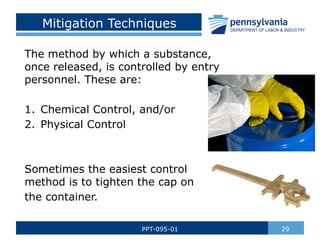
Mitigation Techniques
The method by which a substance,
once released, is controlled by entry
personnel. These are:
1. Chemical Control, and/or
2. Physical Control
Sometimes the easiest control
method is to tighten the cap on
the container.
29
PPT-095-01
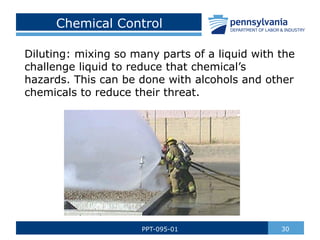
Chemical Control
Diluting: mixing so many parts of a liquid with the
challenge liquid to reduce that chemical’s
hazards. This can be done with alcohols and other
chemicals to reduce their threat.
30
PPT-095-01
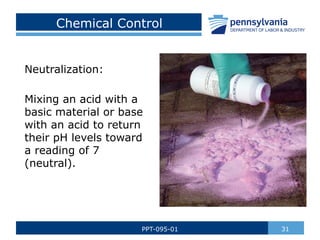
Chemical Control
Neutralization:
Mixing an acid with a
basic material or base
with an acid to return
their pH levels toward
a reading of 7
(neutral).
31
PPT-095-01
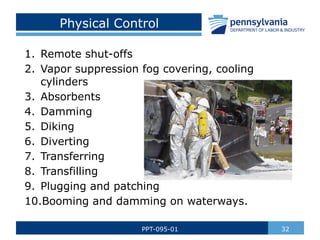
Physical Control
1. Remote shut-offs
2. Vapor suppression fog covering, cooling
cylinders
3. Absorbents
4. Damming
5. Diking
6. Diverting
7. Transferring
8. Transfilling
9. Plugging and patching
10.Booming and damming on waterways.
32
PPT-095-01
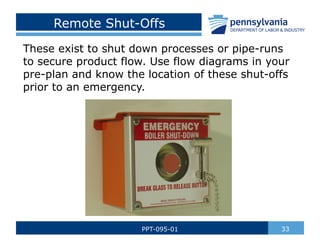
Remote Shut-Offs
These exist to shut down processes or pipe-runs
to secure product flow. Use flow diagrams in your
pre-plan and know the location of these shut-offs
prior to an emergency.
33
PPT-095-01
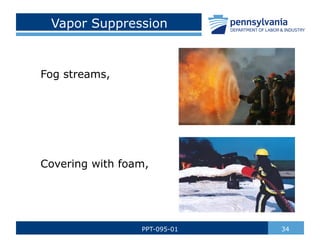
Vapor Suppression
Fog streams,
Covering with foam,
34
PPT-095-01
Vapor Suppression
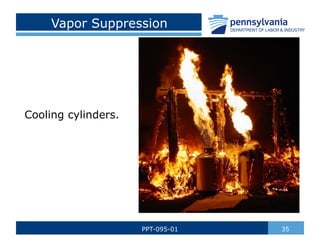
Cooling cylinders.
35
PPT-095-01
Absorbents
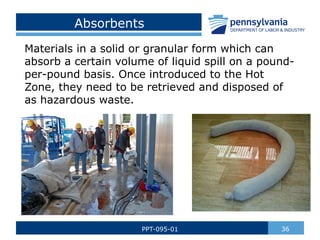
Materials in a solid or granular form which can
absorb a certain volume of liquid spill on a pound-
per-pound basis. Once introduced to the Hot
Zone, they need to be retrieved and disposed of
as hazardous waste.
36
PPT-095-01
Damming
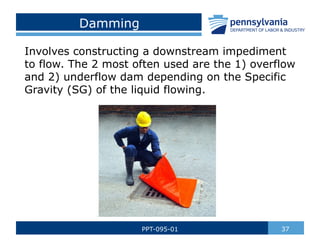
Involves constructing a downstream impediment
to flow. The 2 most often used are the 1) overflow
and 2) underflow dam depending on the Specific
Gravity (SG) of the liquid flowing.
37
PPT-095-01
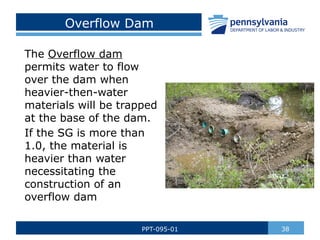
Overflow Dam
The Overflow dam
permits water to flow
over the dam when
heavier-then-water
materials will be trapped
at the base of the dam.
If the SG is more than
1.0, the material is
heavier than water
necessitating the
construction of an
overflow dam
38
PPT-095-01
Underflow Dam
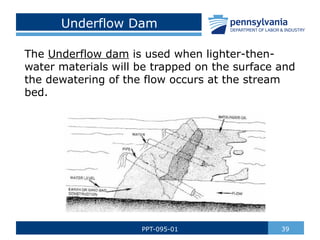
The Underflow dam is used when lighter-then-
water materials will be trapped on the surface and
the dewatering of the flow occurs at the stream
bed.
39
PPT-095-01
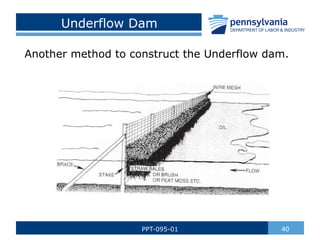
Underflow Dam
Another method to construct the Underflow dam.
40
PPT-095-01
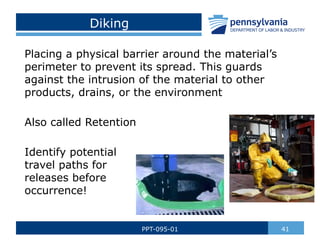
Diking
Placing a physical barrier around the material’s
perimeter to prevent its spread. This guards
against the intrusion of the material to other
products, drains, or the environment
Also called Retention
Identify potential
travel paths for
releases before an
occurrence!
41
PPT-095-01
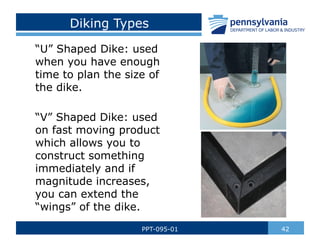
Diking Types
“U” Shaped Dike: used
when you have enough
time to plan the size of
the dike.
“V” Shaped Dike: used
on fast moving product
which allows you to
construct something
immediately and if
magnitude increases,
you can extend the
“wings” of the dike.
42
PPT-095-01
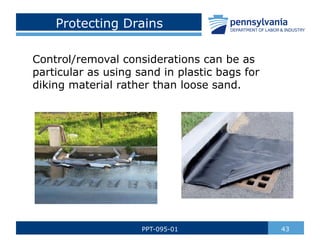
Protecting Drains
Control/removal considerations can be as
particular as using sand in plastic bags for
diking material rather than loose sand.
43
PPT-095-01
Protecting Drains
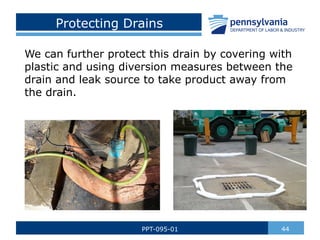
We can further protect this drain by covering with
plastic and using diversion measures between the
drain and leak source to take product away from
the drain.
44
PPT-095-01
Diverting
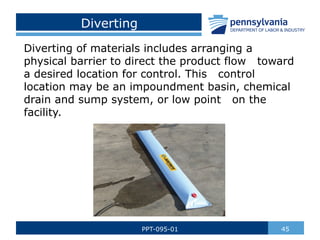
Diverting of materials includes arranging a
physical barrier to direct the product flow toward
a desired location for control. This control
location may be an impoundment basin, chemical
drain and sump system, or low point on the
facility.
45
PPT-095-01
Transferring
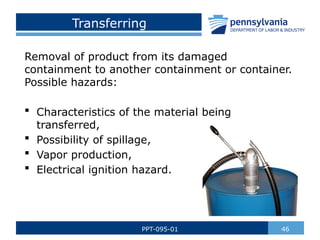
Removal of product from its damaged
containment to another containment or container.
Possible hazards:
 Characteristics of the material being
transferred,
 Possibility of spillage,
 Vapor production,
 Electrical ignition hazard.
46
PPT-095-01
Transfilling
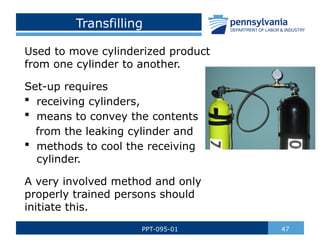
Used to move cylinderized product
from one cylinder to another.
Set-up requires
 receiving cylinders,
 means to convey the contents
from the leaking cylinder and
 methods to cool the receiving
cylinder.
A very involved method and only
properly trained persons should
initiate this.
47
PPT-095-01
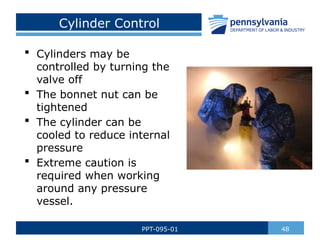
Cylinder Control
 Cylinders may be
controlled by turning the
valve off
 The bonnet nut can be
tightened
 The cylinder can be
cooled to reduce internal
pressure
 Extreme caution is
required when working
around any pressure
vessel.
48
PPT-095-01
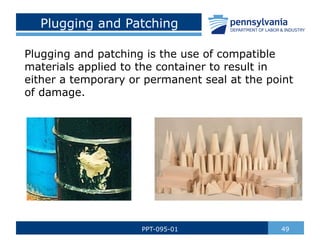
Plugging and Patching
Plugging and patching is the use of compatible
materials applied to the container to result in
either a temporary or permanent seal at the point
of damage.
49
PPT-095-01
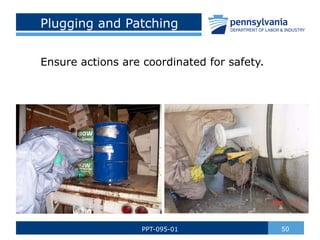
Plugging and Patching
Ensure actions are coordinated for safety.
50
PPT-095-01
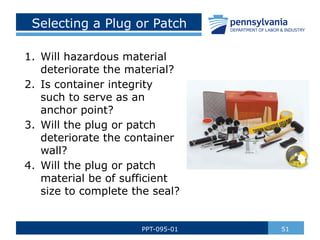
Selecting a Plug or Patch
1. Will hazardous material
deteriorate the material?
2. Is container integrity
such to serve as an
anchor point?
3. Will the plug or patch
deteriorate the container
wall?
4. Will the plug or patch
material be of sufficient
size to complete the seal?
51
PPT-095-01
Booming
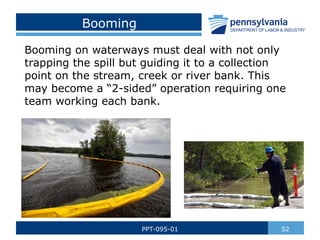
Booming on waterways must deal with not only
trapping the spill but guiding it to a collection
point on the stream, creek or river bank. This
may become a “2-sided” operation requiring one
team working each bank.
52
PPT-095-01
Booming
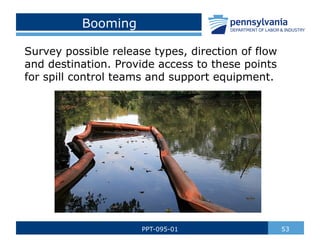
Survey possible release types, direction of flow
and destination. Provide access to these points
for spill control teams and support equipment.
53
PPT-095-01
Booming
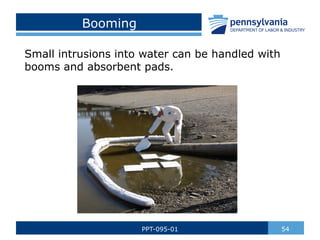
Small intrusions into water can be handled with
booms and absorbent pads.
54
PPT-095-01
Other Mitigation Methods
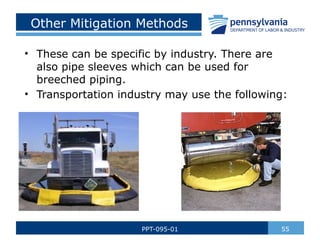
• These can be specific by industry. There are
also pipe sleeves which can be used for
breeched piping.
• Transportation industry may use the following:
55
PPT-095-01
Responder Levels and Actions
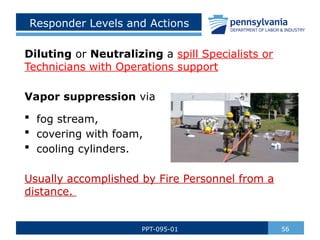
Diluting or Neutralizing a spill Specialists or
Technicians with Operations support
Vapor suppression via
 fog stream,
 covering with foam,
 cooling cylinders.
Usually accomplished by Fire Personnel from a
distance.
56
PPT-095-01
Responder Levels and Actions
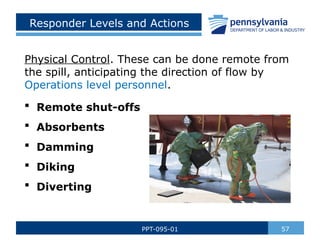
Physical Control. These can be done remote from
the spill, anticipating the direction of flow by
Operations level personnel.
 Remote shut-offs
 Absorbents
 Damming
 Diking
 Diverting
57
PPT-095-01
Responder Levels and Actions
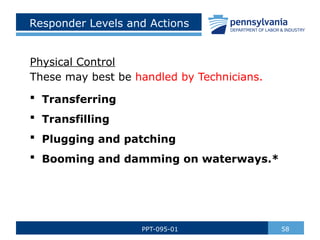
Physical Control
These may best be handled by Technicians.
 Transferring
 Transfilling
 Plugging and patching
 Booming and damming on waterways.*
58
PPT-095-01
PPE
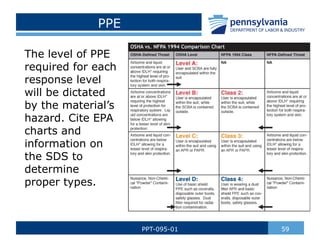
The level of PPE
required for each
response level
will be dictated
by the material’s
hazard. Cite EPA
charts and
information on
the SDS to
determine
proper types.
59
PPT-095-01
PPE
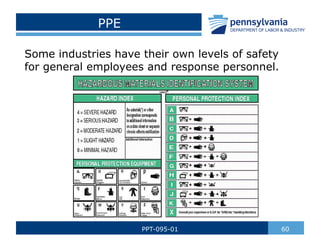
Some industries have their own levels of safety
for general employees and response personnel.
60
PPT-095-01
Overpacking
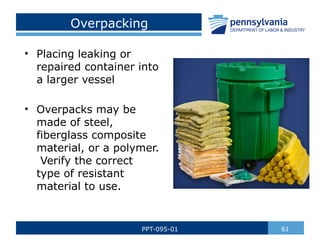
• Placing leaking or
repaired container into
a larger vessel
• Overpacks may be
made of steel,
fiberglass composite
material, or a polymer.
Verify the correct
type of resistant
material to use.
61
PPT-095-01
Overpacking: Inverting
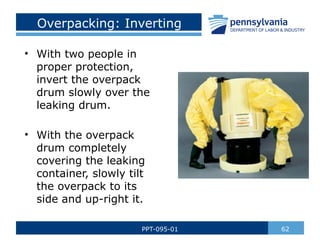
• With two people in
proper protection,
invert the overpack
drum slowly over the
leaking drum.
• With the overpack
drum completely
covering the leaking
container, slowly tilt
the overpack to its
side and up-right it.
62
PPT-095-01
Overpacking: Mechanical Lifting
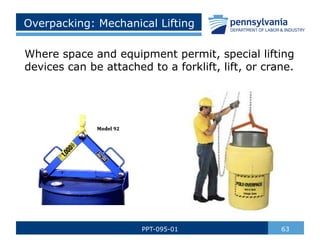
Where space and equipment permit, special lifting
devices can be attached to a forklift, lift, or crane.
63
PPT-095-01
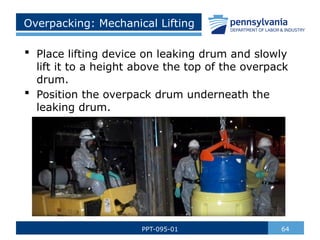
Overpacking: Mechanical Lifting
 Place lifting device on leaking drum and slowly
lift it to a height above the top of the overpack
drum.
 Position the overpack drum underneath the
leaking drum.
64
PPT-095-01
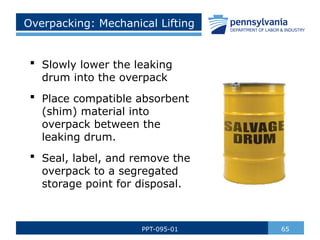
Overpacking: Mechanical Lifting
 Slowly lower the leaking
drum into the overpack
 Place compatible absorbent
(shim) material into
overpack between the
leaking drum.
 Seal, label, and remove the
overpack to a segregated
storage point for disposal.
65
PPT-095-01
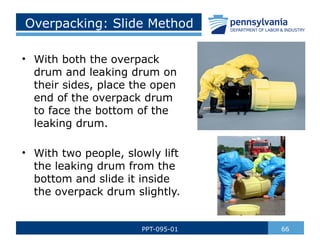
Overpacking: Slide Method
• With both the overpack
drum and leaking drum on
their sides, place the open
end of the overpack drum
to face the bottom of the
leaking drum.
• With two people, slowly lift
the leaking drum from the
bottom and slide it inside
the overpack drum slightly.
66
PPT-095-01
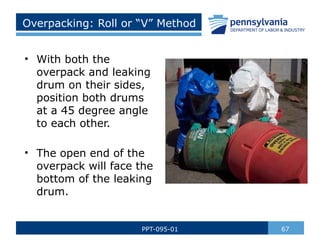
Overpacking: Roll or “V” Method
• With both the
overpack and leaking
drum on their sides,
position both drums
at a 45 degree angle
to each other.
• The open end of the
overpack will face the
bottom of the leaking
drum.
67
PPT-095-01
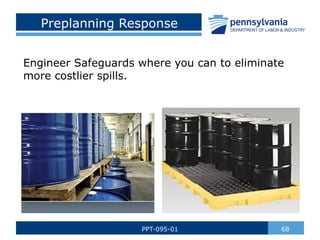
Preplanning Response
Engineer Safeguards where you can to eliminate
more costlier spills.
68
PPT-095-01
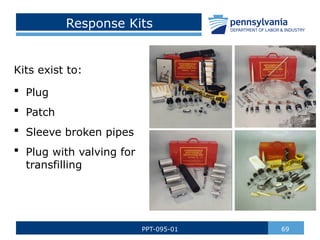
Response Kits
Kits exist to:
 Plug
 Patch
 Sleeve broken pipes
 Plug with valving for
transfilling
69
PPT-095-01
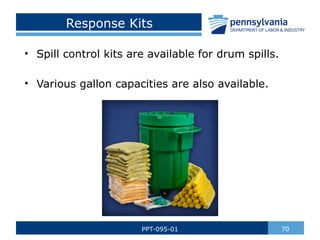
Response Kits
• Spill control kits are available for drum spills.
• Various gallon capacities are also available.
70
PPT-095-01
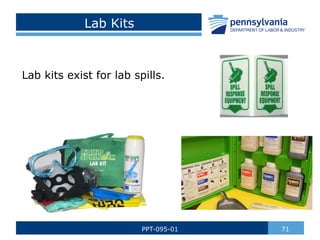
Lab Kits
Lab kits exist for lab spills.
71
PPT-095-01
Policies
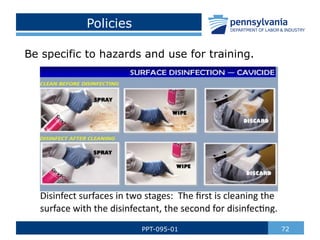
Be specific to hazards and use for training.
72
PPT-095-01
Policies
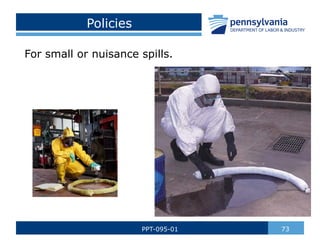
For small or nuisance spills.
73
PPT-095-01
Policies
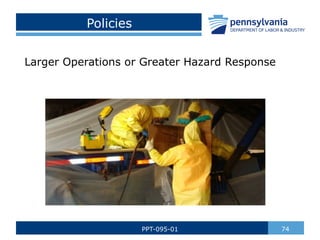
Larger Operations or Greater Hazard Response
74
PPT-095-01
Policies
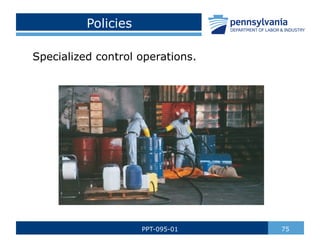
Specialized control operations.
75
PPT-095-01
Policies
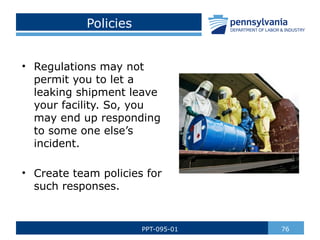
• Regulations may not
permit you to let a
leaking shipment leave
your facility. So, you
may end up responding
to some one else’s
incident.
• Create team policies for
such responses.
76
PPT-095-01
Removal and Disposal
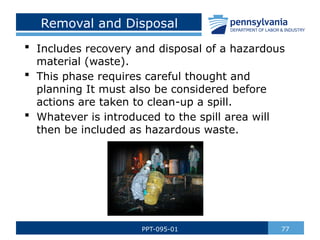
 Includes recovery and disposal of a hazardous
material (waste).
 This phase requires careful thought and
planning It must also be considered before
actions are taken to clean-up a spill.
 Whatever is introduced to the spill area will
then be included as hazardous waste.
77
PPT-095-01
Decontamination
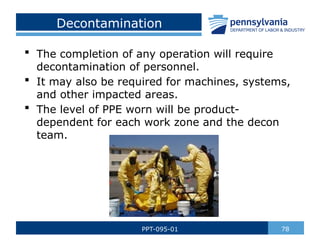
 The completion of any operation will require
decontamination of personnel.
 It may also be required for machines, systems,
and other impacted areas.
 The level of PPE worn will be product-
dependent for each work zone and the decon
team.
78
PPT-095-01
Documentation
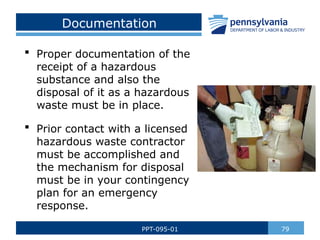
 Proper documentation of the
receipt of a hazardous
substance and also the
disposal of it as a hazardous
waste must be in place.
 Prior contact with a licensed
hazardous waste contractor
must be accomplished and
the mechanism for disposal
must be in your contingency
plan for an emergency
response.
79
PPT-095-01
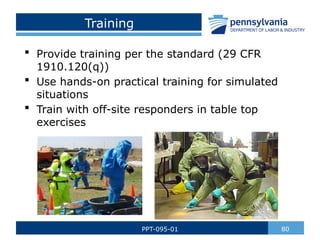
Training
 Provide training per the standard (29 CFR
1910.120(q))
 Use hands-on practical training for simulated
situations
 Train with off-site responders in table top
exercises
80
PPT-095-01
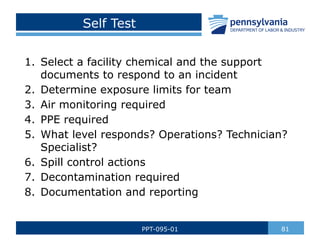
Self Test
1. Select a facility chemical and the support
documents to respond to an incident
2. Determine exposure limits for team
3. Air monitoring required
4. PPE required
5. What level responds? Operations? Technician?
Specialist?
6. Spill control actions
7. Decontamination required
8. Documentation and reporting
81
PPT-095-01
Summary
 Determine your need for a spill control team
 Will it be self-reliant or depend on off-site
responders? Partially or totally?
 Assign team members if you have a team
 Train your team to the level of response
expectations
 Provide required PPE, spill control equipment,
air monitoring equipment as required
 Determine type of decon and provide that
equipment
 Ensure your program meets safety and
regulatory requirements
82
PPT-095-01
Bibliography
NFPA 471, “Recommended Practice for
Responding to Hazardous Material Incidents,”
National Fire Protection Association, 1
Batterymarch Park, Quincy, MA 02169-7471.
NFPA 472, “Standard for Professional Competence
of Responders to Hazardous Material Incidents,”
National Fire Protection Association, 1
Batterymarch Park, Quincy, MA 02169-7471.
83
PPT-095-01
Bibliography
Code of Federal Regulations, 29 CFR 1910120(q)
Hazardous Waste Operations and Emergency
Response, (HAZWOPER), March 6, 1990.
29 CFR 1910.120, Appendix E Training Curriculum
Guidelines, C. Emergency response training, C,b, (1),
(2), (3), (4) and (5)
Emergency Response Training Manual for Hazardous
Materials Technician, Lori P. Andrews, P.E., et.al,
Center for Labor Education and Research, Van
Nostrand Reinhold, New York, 1992
84
PPT-095-01
Bibliography
Neutralization of Corrosive Materials, AFR 71-4,
A-15, TM 38-250/NAVSUP PUB 505 (Rev)/MCO
P4030.19D/DSAM 4145.3/Atch 5/22, March, 1976
(as an example)
Hazardous Materials Response Handbook, Jerry
Laughlin and David G. Trebisacci, editors, NFPA,
4th
Edition, 2002.
85
PPT-095-01
Contact Information
Health & Safety Training Specialists
1171 South Cameron Street, Room 324
Harrisburg, PA 17104-2501
(717) 772-1635
RA-LI-BWC-PATHS@pa.gov
86
PPT-095-01
Other Power Points of Interest
You may also wish to view our other Power Points to create
your own in-house training program for this topic. Supporting
PowerPoint programs include:
 Basic Air Monitoring
 HazMat PPE
 Hazard Communication + GHS
 Hazardous Materials Awareness
 Hazardous Waste Management
 Decontamination
Find them on our website at www.dli.state.pa.us/PATHS then
click Training Resources in the left column. If not on our web,
request our list of programs at RA-LI-BWC-SAFETY@pa.gov
87
PPT-095-01

Spill Control and Containment ETHICS.pptx

  • 1.
    Spill Control andContainment Hazardous Waste Operations and Emergency Response 29 CFR 1910.120(q) 1 PPT-095-01 Bureau of Workers’ Compensation PA Training for Health & Safety (PATHS)
  • 2.
    Introduction The presence ofchemicals in today’s society, be it manufacturing, storage, or use situations, may present hazards to persons upon its unplanned release from containment. Even with the myriad regulations governing containers, shipping, and marking, the prudent firm must consider actions should hazardous materials be released. 2 PPT-095-01
  • 3.
    Topics  Containers  HazardIdentification  Response Actions  Emergency Response Zones  Mitigation Methods  Chemical Control  Physical Control  PPE  Overpacking  Decontamination 3 PPT-095-01
  • 4.
    Containers Various types areused to contain solids, liquids or gases. 4 PPT-095-01
  • 5.
    Containers Also include transportcontainers which may be making pick-ups or deliveries to your facility. 5 PPT-095-01
  • 6.
    Containers Fiberboard and cardboard packaging can alsocontain hazardous materials. 6 PPT-095-01
  • 7.
    Containers • Can alsobe processes and vessels containing production materials. • Know the valving and shutdown logics for the plant’s processes. 7 PPT-095-01
  • 8.
    Hazard Identification Identify hazardsby markings, labels or shipping papers. 8 PPT-095-01
  • 9.
    Hazard Identification Once materialis identified, other sources may be used to determine spill response actions. 9 PPT-095-01
  • 10.
    Hazard Identification Identification canalso be made in the field with sampling and testing kits. This, however, is time- consuming. 10 PPT-095-01
  • 11.
    Hazard Identification Once thematerial is identified, levels and amounts can be determined by using the correct air monitoring instruments. 11 PPT-095-01
  • 12.
    Containment: Defined Act orprocess of containing and/or preventing the expansion of a substance. Purpose:  Prevent contaminating surrounding areas  Prevent material entering sewers or waterways  Reduce contamination of adjacent chemicals  Reduce extent of hazard to human life  Ensure responders practice A.L.A.R.A. concept (As Low As Reasonably Achievable) 12 PPT-095-01
  • 13.
    A.L.A.R.A. Concept A conceptused during control and clean-up is borrowed from the nuclear industry: The A. L. A. R. A. Concept - “As Low As Reasonably Achievable.” This means that in all actions we should attempt to minimize exposure, contact, and contamination as well as the amount of waste generated by the control operation 13 PPT-095-01
  • 14.
    Loss of Containment Factorscontributing to the loss of containment include:  Mechanical damage,  Thermal damage,  Chemical reactions in the container. Loss of containment requires proper response! 14 PPT-095-01
  • 15.
    Types of Contaminants Somethingwhich contaminates or “makes impure, unclean, or corrupt by contact; to corrupt; to pollute; to sully; to tarnish; to taint.” Precautions are taken to minimize exposure:  Proper size-up of situation  Proper PPE  Understanding hazards of materials involved  Physical state of release and resulting complications. 15 PPT-095-01
  • 16.
    Solid Release • Solidmaterials easy to recover if kept dry and air movement is minimized. Once wet or damp, adverse reactions may complicate containment. • Cover with compatible material to minimize spread. 16 PPT-095-01
  • 17.
    Liquid Release  Complicatedby amount of spilled material and inherent characteristics.  Surfaces are contacted and vapors or gases produced. Additionally;  Vapors in confined areas may form explosive amounts, or  Displace oxygen for breathing  Terrain may aid spread; liquids follow the path of least resistance to storm drains, sewers or waterways.  May also contaminate water strata. 17 PPT-095-01
  • 18.
    Gas Release Often compartmentscan not be tightly sealed. In engineered facilities, this attempt to “seal” the location is achieved to some degree by shutting- down ventilation and air exchange systems. 18 PPT-095-01
  • 19.
    Types of Damage Thermal  Chemical  Mechanical 19 PPT-095-01
  • 20.
    Response Actions Goals ofspill response are to: 1. Eliminate additional loss. 2. Prevent further contamination. 3. Avoid unnecessary exposure of workers. 4. Prevent contact with other chemicals. 5. Minimize down-time, loss of stocks, raw materials or finished product. 20 PPT-095-01
  • 21.
    Proper Response Steps Identify spilled material  Size-up incident severity  Determine mitigation methods  Implement methods 21 PPT-095-01
  • 22.
  • 23.
    Emergency Response Zones Isolation Release must be isolated against intrusion by unnecessary and untrained persons.  During containment operations, the Incident Commander should deny entry to the hazard zone to all but those required to conduct the control operations.  Also, such isolation is a guard against contamination of persons, vehicles, and equipment. 23 PPT-095-01
  • 24.
    Emergency Response Zones Theseare generally 3 in number: • Hot Zone • Warm Zone • Cold Zone 24 PPT-095-01
  • 25.
    Hot Zone Area immediatelysurrounding and including the contaminated area. Greatest hazard to life and/or property is located here. When identifying this zone, view:  Wind direction and speed  Topography of land  Ventilation systems  Potential for release increasing 25 PPT-095-01
  • 26.
    Warm Zone Area immediatelysurrounding the hot zone. A danger of contamination still exists, however, the danger may be reduced by the distance from the release. Located in this zone:  Team Leader  Safety Officer,  Rescue Team,  Decon Team,  Tool Depot 26 PPT-095-01
  • 27.
    Cold Zone Immediately surroundsthe Warm Zone. Relatively no danger of contamination or exposure. This is also a buffer zone to insure a safe barrier is maintained around the release. Personnel in this area generally are not required to wear PPE. Located in this zone:  Command Post and Incident Commander  Support Services and Agencies  Staging Area for resources 27 PPT-095-01
  • 28.
  • 29.
    Mitigation Techniques The methodby which a substance, once released, is controlled by entry personnel. These are: 1. Chemical Control, and/or 2. Physical Control Sometimes the easiest control method is to tighten the cap on the container. 29 PPT-095-01
  • 30.
    Chemical Control Diluting: mixingso many parts of a liquid with the challenge liquid to reduce that chemical’s hazards. This can be done with alcohols and other chemicals to reduce their threat. 30 PPT-095-01
  • 31.
    Chemical Control Neutralization: Mixing anacid with a basic material or base with an acid to return their pH levels toward a reading of 7 (neutral). 31 PPT-095-01
  • 32.
    Physical Control 1. Remoteshut-offs 2. Vapor suppression fog covering, cooling cylinders 3. Absorbents 4. Damming 5. Diking 6. Diverting 7. Transferring 8. Transfilling 9. Plugging and patching 10.Booming and damming on waterways. 32 PPT-095-01
  • 33.
    Remote Shut-Offs These existto shut down processes or pipe-runs to secure product flow. Use flow diagrams in your pre-plan and know the location of these shut-offs prior to an emergency. 33 PPT-095-01
  • 34.
  • 35.
  • 36.
    Absorbents Materials in asolid or granular form which can absorb a certain volume of liquid spill on a pound- per-pound basis. Once introduced to the Hot Zone, they need to be retrieved and disposed of as hazardous waste. 36 PPT-095-01
  • 37.
    Damming Involves constructing adownstream impediment to flow. The 2 most often used are the 1) overflow and 2) underflow dam depending on the Specific Gravity (SG) of the liquid flowing. 37 PPT-095-01
  • 38.
    Overflow Dam The Overflowdam permits water to flow over the dam when heavier-then-water materials will be trapped at the base of the dam. If the SG is more than 1.0, the material is heavier than water necessitating the construction of an overflow dam 38 PPT-095-01
  • 39.
    Underflow Dam The Underflowdam is used when lighter-then- water materials will be trapped on the surface and the dewatering of the flow occurs at the stream bed. 39 PPT-095-01
  • 40.
    Underflow Dam Another methodto construct the Underflow dam. 40 PPT-095-01
  • 41.
    Diking Placing a physicalbarrier around the material’s perimeter to prevent its spread. This guards against the intrusion of the material to other products, drains, or the environment Also called Retention Identify potential travel paths for releases before an occurrence! 41 PPT-095-01
  • 42.
    Diking Types “U” ShapedDike: used when you have enough time to plan the size of the dike. “V” Shaped Dike: used on fast moving product which allows you to construct something immediately and if magnitude increases, you can extend the “wings” of the dike. 42 PPT-095-01
  • 43.
    Protecting Drains Control/removal considerationscan be as particular as using sand in plastic bags for diking material rather than loose sand. 43 PPT-095-01
  • 44.
    Protecting Drains We canfurther protect this drain by covering with plastic and using diversion measures between the drain and leak source to take product away from the drain. 44 PPT-095-01
  • 45.
    Diverting Diverting of materialsincludes arranging a physical barrier to direct the product flow toward a desired location for control. This control location may be an impoundment basin, chemical drain and sump system, or low point on the facility. 45 PPT-095-01
  • 46.
    Transferring Removal of productfrom its damaged containment to another containment or container. Possible hazards:  Characteristics of the material being transferred,  Possibility of spillage,  Vapor production,  Electrical ignition hazard. 46 PPT-095-01
  • 47.
    Transfilling Used to movecylinderized product from one cylinder to another. Set-up requires  receiving cylinders,  means to convey the contents from the leaking cylinder and  methods to cool the receiving cylinder. A very involved method and only properly trained persons should initiate this. 47 PPT-095-01
  • 48.
    Cylinder Control  Cylindersmay be controlled by turning the valve off  The bonnet nut can be tightened  The cylinder can be cooled to reduce internal pressure  Extreme caution is required when working around any pressure vessel. 48 PPT-095-01
  • 49.
    Plugging and Patching Pluggingand patching is the use of compatible materials applied to the container to result in either a temporary or permanent seal at the point of damage. 49 PPT-095-01
  • 50.
    Plugging and Patching Ensureactions are coordinated for safety. 50 PPT-095-01
  • 51.
    Selecting a Plugor Patch 1. Will hazardous material deteriorate the material? 2. Is container integrity such to serve as an anchor point? 3. Will the plug or patch deteriorate the container wall? 4. Will the plug or patch material be of sufficient size to complete the seal? 51 PPT-095-01
  • 52.
    Booming Booming on waterwaysmust deal with not only trapping the spill but guiding it to a collection point on the stream, creek or river bank. This may become a “2-sided” operation requiring one team working each bank. 52 PPT-095-01
  • 53.
    Booming Survey possible releasetypes, direction of flow and destination. Provide access to these points for spill control teams and support equipment. 53 PPT-095-01
  • 54.
    Booming Small intrusions intowater can be handled with booms and absorbent pads. 54 PPT-095-01
  • 55.
    Other Mitigation Methods •These can be specific by industry. There are also pipe sleeves which can be used for breeched piping. • Transportation industry may use the following: 55 PPT-095-01
  • 56.
    Responder Levels andActions Diluting or Neutralizing a spill Specialists or Technicians with Operations support Vapor suppression via  fog stream,  covering with foam,  cooling cylinders. Usually accomplished by Fire Personnel from a distance. 56 PPT-095-01
  • 57.
    Responder Levels andActions Physical Control. These can be done remote from the spill, anticipating the direction of flow by Operations level personnel.  Remote shut-offs  Absorbents  Damming  Diking  Diverting 57 PPT-095-01
  • 58.
    Responder Levels andActions Physical Control These may best be handled by Technicians.  Transferring  Transfilling  Plugging and patching  Booming and damming on waterways.* 58 PPT-095-01
  • 59.
    PPE The level ofPPE required for each response level will be dictated by the material’s hazard. Cite EPA charts and information on the SDS to determine proper types. 59 PPT-095-01
  • 60.
    PPE Some industries havetheir own levels of safety for general employees and response personnel. 60 PPT-095-01
  • 61.
    Overpacking • Placing leakingor repaired container into a larger vessel • Overpacks may be made of steel, fiberglass composite material, or a polymer. Verify the correct type of resistant material to use. 61 PPT-095-01
  • 62.
    Overpacking: Inverting • Withtwo people in proper protection, invert the overpack drum slowly over the leaking drum. • With the overpack drum completely covering the leaking container, slowly tilt the overpack to its side and up-right it. 62 PPT-095-01
  • 63.
    Overpacking: Mechanical Lifting Wherespace and equipment permit, special lifting devices can be attached to a forklift, lift, or crane. 63 PPT-095-01
  • 64.
    Overpacking: Mechanical Lifting Place lifting device on leaking drum and slowly lift it to a height above the top of the overpack drum.  Position the overpack drum underneath the leaking drum. 64 PPT-095-01
  • 65.
    Overpacking: Mechanical Lifting Slowly lower the leaking drum into the overpack  Place compatible absorbent (shim) material into overpack between the leaking drum.  Seal, label, and remove the overpack to a segregated storage point for disposal. 65 PPT-095-01
  • 66.
    Overpacking: Slide Method •With both the overpack drum and leaking drum on their sides, place the open end of the overpack drum to face the bottom of the leaking drum. • With two people, slowly lift the leaking drum from the bottom and slide it inside the overpack drum slightly. 66 PPT-095-01
  • 67.
    Overpacking: Roll or“V” Method • With both the overpack and leaking drum on their sides, position both drums at a 45 degree angle to each other. • The open end of the overpack will face the bottom of the leaking drum. 67 PPT-095-01
  • 68.
    Preplanning Response Engineer Safeguardswhere you can to eliminate more costlier spills. 68 PPT-095-01
  • 69.
    Response Kits Kits existto:  Plug  Patch  Sleeve broken pipes  Plug with valving for transfilling 69 PPT-095-01
  • 70.
    Response Kits • Spillcontrol kits are available for drum spills. • Various gallon capacities are also available. 70 PPT-095-01
  • 71.
    Lab Kits Lab kitsexist for lab spills. 71 PPT-095-01
  • 72.
    Policies Be specific tohazards and use for training. 72 PPT-095-01
  • 73.
    Policies For small ornuisance spills. 73 PPT-095-01
  • 74.
    Policies Larger Operations orGreater Hazard Response 74 PPT-095-01
  • 75.
  • 76.
    Policies • Regulations maynot permit you to let a leaking shipment leave your facility. So, you may end up responding to some one else’s incident. • Create team policies for such responses. 76 PPT-095-01
  • 77.
    Removal and Disposal Includes recovery and disposal of a hazardous material (waste).  This phase requires careful thought and planning It must also be considered before actions are taken to clean-up a spill.  Whatever is introduced to the spill area will then be included as hazardous waste. 77 PPT-095-01
  • 78.
    Decontamination  The completionof any operation will require decontamination of personnel.  It may also be required for machines, systems, and other impacted areas.  The level of PPE worn will be product- dependent for each work zone and the decon team. 78 PPT-095-01
  • 79.
    Documentation  Proper documentationof the receipt of a hazardous substance and also the disposal of it as a hazardous waste must be in place.  Prior contact with a licensed hazardous waste contractor must be accomplished and the mechanism for disposal must be in your contingency plan for an emergency response. 79 PPT-095-01
  • 80.
    Training  Provide trainingper the standard (29 CFR 1910.120(q))  Use hands-on practical training for simulated situations  Train with off-site responders in table top exercises 80 PPT-095-01
  • 81.
    Self Test 1. Selecta facility chemical and the support documents to respond to an incident 2. Determine exposure limits for team 3. Air monitoring required 4. PPE required 5. What level responds? Operations? Technician? Specialist? 6. Spill control actions 7. Decontamination required 8. Documentation and reporting 81 PPT-095-01
  • 82.
    Summary  Determine yourneed for a spill control team  Will it be self-reliant or depend on off-site responders? Partially or totally?  Assign team members if you have a team  Train your team to the level of response expectations  Provide required PPE, spill control equipment, air monitoring equipment as required  Determine type of decon and provide that equipment  Ensure your program meets safety and regulatory requirements 82 PPT-095-01
  • 83.
    Bibliography NFPA 471, “RecommendedPractice for Responding to Hazardous Material Incidents,” National Fire Protection Association, 1 Batterymarch Park, Quincy, MA 02169-7471. NFPA 472, “Standard for Professional Competence of Responders to Hazardous Material Incidents,” National Fire Protection Association, 1 Batterymarch Park, Quincy, MA 02169-7471. 83 PPT-095-01
  • 84.
    Bibliography Code of FederalRegulations, 29 CFR 1910120(q) Hazardous Waste Operations and Emergency Response, (HAZWOPER), March 6, 1990. 29 CFR 1910.120, Appendix E Training Curriculum Guidelines, C. Emergency response training, C,b, (1), (2), (3), (4) and (5) Emergency Response Training Manual for Hazardous Materials Technician, Lori P. Andrews, P.E., et.al, Center for Labor Education and Research, Van Nostrand Reinhold, New York, 1992 84 PPT-095-01
  • 85.
    Bibliography Neutralization of CorrosiveMaterials, AFR 71-4, A-15, TM 38-250/NAVSUP PUB 505 (Rev)/MCO P4030.19D/DSAM 4145.3/Atch 5/22, March, 1976 (as an example) Hazardous Materials Response Handbook, Jerry Laughlin and David G. Trebisacci, editors, NFPA, 4th Edition, 2002. 85 PPT-095-01
  • 86.
    Contact Information Health &Safety Training Specialists 1171 South Cameron Street, Room 324 Harrisburg, PA 17104-2501 (717) 772-1635 RA-LI-BWC-PATHS@pa.gov 86 PPT-095-01
  • 87.
    Other Power Pointsof Interest You may also wish to view our other Power Points to create your own in-house training program for this topic. Supporting PowerPoint programs include:  Basic Air Monitoring  HazMat PPE  Hazard Communication + GHS  Hazardous Materials Awareness  Hazardous Waste Management  Decontamination Find them on our website at www.dli.state.pa.us/PATHS then click Training Resources in the left column. If not on our web, request our list of programs at RA-LI-BWC-SAFETY@pa.gov 87 PPT-095-01

Editor's Notes

  • #1 In the industrial setting, worker safety is contingent on the stability of the containment vessel as well as the integrity of processes. Containers are closely regulated by various state and federal agencies concerning construction and markings. Based on the history of events, these agencies have compiled results from testing of specific materials to insure that, under normal conditions, the substance named will not chemically weaken the container designed for the material. However, occasionally, accidents happen.
  • #2 The presence of chemicals in today’s society, be it manufacturing, storage, or use situations, may present hazards to persons upon its unplanned release from containment. Even with the myriad regulations governing containers, shipping, and marking, the prudent firm must consider actions should hazardous materials be released.
  • #4 The type of container will be based on the material’s physical state, i.e. solid, liquid or gas as well as its pressure. Other characteristics, such as corrosivity, will dictate the container material.
  • #5 Large containers, such as tank cars and tank trucks, are used for economy to ship large volumes of materials. A spill from one of these conveyances can be extreme and require a large response effort of specialists and time to stabilize.
  • #6 Fiberboard and cardboard packaging can also contain hazardous materials. Each will be properly marked according to DOT requirements. An SDS may or may not accompany the shipment.
  • #7 Containers can also be processes and vessels containing production materials. Know the valve line-ups and shutdown logics for the plant’s processes to isolate leaks.
  • #8 During an emergency (although practicality dictates such identification should take place during pre-planning), hazards can be identified by markings, labels or shipping papers. The physical state may also be an indication; color of vapor-if such is produced or color of liquid spills. Labels as shown will provide product name, Danger or Warning indication, Precautionary and Hazard Statements as well as manufacturer information.
  • #9 Once material is identified, other sources may be used to determine spill response actions. If you have an in-house spill response team, obtain an Emergency Response Guidebook for your Response Library. This indicates first-line defensive actions to promote safety for team members and other staff. Please see our PPT, “Hazard Communication including GHS.”
  • #10 Identification can also be made in the field with sampling and testing kits. This, however, is time-consuming. Often used by hazmat teams called to incidents presenting unknown materials.
  • #11 Please see our PPT program “Basic Air Monitoring.”
  • #12 ALARA concerns exposure to persons, environment and equipment. Purpose: Prevent contaminating surrounding areas Prevent material entering sewers or waterways Reduce contamination of adjacent chemicals Reduce extent of hazard to human life Ensure responders practice A.L.A.R.A. concept (As Low As Reasonably Achievable)
  • #13 This means that in all actions we should attempt to minimize exposure, contact, and contamination as well as the amount of waste generated by the control operation
  • #14 Factors contributing to the loss of containment include: Mechanical damage, Thermal damage, Chemical reactions in the container. Loss of containment requires proper response to minimize additional damage or injury.
  • #15 Contaminants are defined as: Something which contaminates or “makes impure, unclean, or corrupt by contact; to corrupt; to pollute; to sully; to tarnish; to taint.” Contaminants can come in various physical states. Precautions are taken to minimize exposure: Proper size-up of situation Proper PPE Understanding hazards of materials involved Physical state of release and resulting complications. Check the TLVs (Threshold Limit Values) for chemicals with which you work as well as the PELs (Permissible Exposure Limits) for unprotected persons. Realize a release may permit more exposure which exceeds allowable limits. This would necessitate using PPE and monitoring.
  • #16 Some solids, if moistened, will product various gases and/or uncontrolled reactions. These could endanger responders. Some materials can act as a catalyst, causing further dangers. If incompatible liquids combine, violent reactions are possible. Some are delayed while others are immediate and devastating. Adding water to sulfuric acid causes an immediate reaction. Some metals, reacting with acids evolve hydrogen gas which is explosive. Acetylene mixing with chlorine gas will result in a large fire with toxic fumes being released
  • #17 Liquid Release Complicated by amount of spilled material and inherent characteristics. Surfaces are contacted and vapors or gases produced. Additionally; Vapors in confined areas may form explosive amounts, or Displace oxygen for breathing Terrain may aid spread; liquids follow the path of least resistance to storm drains, sewers or waterways. May also contaminate water strata.
  • #18 Gas Releases may occur from cylinders or from processes. Often compartments can not be tightly sealed in trucks. In engineered facilities, this attempt to “seal” the location is achieved to some degree by shutting-down ventilation and air exchange systems.
  • #19 Types of damage causing releases include: Thermal: impinged upon by fire. Chemical reactions inside a container or by mixing with other materials upon release. Mechanical due to punctures by forklifts or by being dropped in transit.
  • #20 Response goals include: Eliminate additional loss. Prevent further contamination. Avoid unnecessary exposure of workers. Prevent contact with other chemicals. Minimize down-time, loss of stocks, raw materials or finished product.
  • #21 Proper response requires the responder to: Identify spilled material Size-up incident severity Determine mitigation methods Implement correct control/mitigation methods
  • #22 Create Decision Logics for the chemicals you have on-site. This will safely speed your response and can be used as a training tool.
  • #23 Emergency Zones determine what actions by which team members will take place in each zone.
  • #24 Industrial and emergency services responders, for standardization during combined operations, call these the HOT, WARM, AND COLD ZONES. (NFPA 471) The EPA has other designations which may confuse responders.
  • #25 No persons shall be permitted in this zone without wearing the required level of PPE for that release.
  • #26 The Emergency Response Guidebook indicates distances for certain materials which also include a safety factor.) This zone also includes the entry corridor for entry and rescue personnel (in the same level PPE as the entry party) as well as the decontamination corridor. A Safe Haven is also established should entrants need to quickly go to a point of safety. Those located in this zone may be evaluated as needing either the same level of PPE or one level less.
  • #27 The configuration or contour of these zones will depend upon the type of material and amount released, as well as topography and wind characteristics.   Only after the area has been isolated and these zones established, should further containment measures begin. Those in this zone have the least chance of being contaminated by the event.
  • #28 The types of duties, by zone, are shown. Although configured as a circle, these zones may take on the configuration of your event. Example, there have been inside events where these configurations were square or rectangular making use of the “built environment” to include walls.
  • #29 The method by which a substance, once released, is controlled by entry personnel are designated as either, Chemical Control, and/or Physical Control Sometimes the easiest control method is to tighten the cap on the container. Make sure you have the proper wrench to do the job.
  • #30 Chemical control also involves Dilution. Diluting involves mixing so many parts of a liquid (usually water) with the challenge liquid to reduce that chemical’s hazards. This can be done with alcohols and other chemicals to reduce their threat. Research those chemicals you work with which will permit this method. Caution: 1 gallon of a liquid usually generates a 20 square foot spill. If the required dilution is a 5:1 mix, you will end up with 5 gallons of water (100 square feet) added to the 1 gallon (20 square feet) of spill. This will result in a spill area of 120 square feet! Will this result in over riding the freeboard of your entrapment area? Will it create a larger hazardous waste concern? Perhaps absorbents would better work to your advantage.
  • #31 Premixed materials are available for this. Laboratories will generally have, “A” kits used on Acid spills, “B” kits used on Basic (alkaline or caustic) spills, and “Universal” kits used on either. This method should only be accomplished by trained or qualified persons since this process will generate heat. Neutralization should not be performed on human skin or on entry suits; skin can be chemically burned and suits may be degraded. pH of 1 to 6 is acidic; pH of 8 to 14 is basic (also called caustic or alkaline) pH of 7 is neutral which is sought during this process.
  • #32 Physical control is using materials or equipment to interrupt the flow of a liquid spill. Some methods can also be used on powdered material. Gas or vapor releases can be reduced through physical means such as capping with specialty kits. Often, cylinders can be cooled thereby reducing their pressures and reducing their release. Some of these methods are labor-intensive and may require numbers of persons and types of equipment you should have available prior to an event. Other methods are available from bioremediation, chemical dispersion, and biological degradation.
  • #33 If remote shut-offs exist outside the threatened area, this option should be considered during pre-planning and actual response. Such an option will assist in personnel safety by prohibiting entry to the hot zone and permit additional time for the Incident Commander to size-up response options. This option may also reduce the amount of material released thereby reducing the amount to be diluted, neutralized, or recovered.
  • #34 Fog is used for cooling containers to reduce vapor production or to keep cylinders cool thus reducing their internal pressure. Liquid spills can be covered with compatible foam to reduce vapor production and spread. These 2 actions are usually accomplished by Fire Personnel from a distance.
  • #35 Fog also disperses gases and vapor to keep the gas below its LEL % (Lower Explosive Limit). The potential threat of pressure vessel ruptures is understood in regulations which segregate materials as well as requirements for sprinkler protection to cool cylinders and adjacent exposures.
  • #36 These are materials in a solid or granular form which can absorb a certain volume of liquid spill on a pound-per-pound basis. Once introduced to the Hot Zone, they need to be retrieved and disposed of as hazardous waste. When planning your response, plan for the safety of all involved, however, you should also consider economic issues.
  • #37 Damming involves constructing a downstream impediment to flow. The 2 most often used are the 1) overflow and 2) underflow dam depending on the Specific Gravity (SG) of the liquid flowing. You can also completely dam the flow of a moving product. This is difficult to do on streams and may increase the upstream hazard. Plan all the points on your facility where a spill could enter a waterway or storm drains. Make plans and provisions to impede or stop such intrusions.
  • #38 The Overflow dam permits water to flow over the dam when heavier-then-water materials will be trapped at the base of the dam. If the SG is more than 1.0, the material is heavier than water necessitating the construction of an overflow dam. When constructing an earthen dam, cover the dirt with plastic to eliminate erosion by upstream flowing water.
  • #39 Therefore, during the analysis of the threat, one should know if the liquid flowing has a specific gravity less than 1.0 (which is assigned to water). Liquids with a SG less than 1.0 will float on the surface (necessitating the construction of an underflow dam). These dewater from beneath the floating material. You will note that these constructions can be labor-intensive, requiring many people delivering the dam material to the location. Some facilities anticipate where the spill will go and create interceptors within the course of travel. Pre-fabricated, fewer people are required to install them.
  • #40 Another method to construct the Underflow dam and simultaneously absorb the floating contaminant. Some materials may mix completely with water which means the flow may need to be stopped completely; impounded. Research the control requirements for your on-site chemicals before an event occurs.
  • #41 While barriers are created to impede a liquid flow, the responder should always be aware of potential vapors from the product. The generation of vapors or gases may require additional steps such as spreading a compatible covering (tarp) or foam over the material. This will serve as a vapor seal or blanket. Liquid spills inside a building will follow the floor contours. In industrial settings, floors are generally pitched toward the floor drains. Also, doors may be elevated due to containment curbing constructed into the room or zone. Further vapor travel will be dependent upon the vapor density of the material as well as engineered ventilation systems and air exchanges. Other turbulences at doors, windows, and other openings may be the result of outside building contours and “drag” factors created due to the facility’s location and predominant wind factors or weather conditions. Liquids, vapors, gases, and smoke will follow the path of least resistance
  • #42 “U” Shaped Dike: used when you have enough time to plan the size of the dike. “V” Shaped Dike: used on fast moving product which allows you to construct something immediately and if magnitude increases, you can extend the “wings” of the dike. These types can be used in labs, loading docks and other surfaces. Exterior incidents may require they be constructed with dirt or gravel. This would necessitate digging equipment; shovels and tarps to construct the dike. As shown, pre-fabricated diking materials exist.
  • #43 Control/removal considerations can be as particular as using sand in plastic bags for diking rather than loose sand. The plastic bags would be exposed to the product, but not necessarily the sand. Therefore, rather than disposing of bulk contaminated sand, only the plastic bags would be treated as contaminated. And, the plastic bags might be decontaminated and not included as waste! Commercial, pre-assembled damming products are available from vendors. Many actions include, Cover the drain with plastic, Surround with a berm of absorbent materials, Divert spill away from drain. If the liquid is lighter than water, some have put a water covering over the plastic. If the spill breaks through the diking material, it will flood on the water surface for retrieval.
  • #44 Left slide: a submersible pump is used to pump-off product before it inundates the dam. Right slide: reinforce this drain with a plastic covering as well as diverting the spill away from the drain. Covering with sheet plastic works best with liquids that float on water. Some have put a water cover over the plastic that if any product breaches the dike, it will float on the water and not go down the drain. If you know the flow schematic for the drain, go down range and use absorbent materials to limit the distance the spill travels in the piping network. (Create an interceptor system.)
  • #45 If a decision is made to divert a product to a given location, actions must also be considered once it has arrived at that point. Will you use absorbent materials? Neutralizing agents? Dilution techniques? How accessible is the location to which you’ve diverted the product? What hazard does it now pose to adjacent properties, products, or systems? Diverting of materials includes arranging a physical barrier to direct the product flow toward a desired location for control. This control location may be an impoundment basin, chemical drain and sump system or low point on the facility.
  • #46 Transferring is the removal of product from its damaged containment to another containment or container. Possible hazards: Characteristics of the material being transferred, Possibility of spillage, Vapor production, and Electrical ignition hazard Planning should include the potential equipment needs to relocate the damaged container, pumps and siphoning equipment, protective diking around the container to be emptied and the new receiving container. Also, a determination of grounding and bonding of containers should be made.
  • #47 Transfilling is used to move cylinderized product from one cylinder to another. Some gas companies move leakers to a cubical and allow gas to vent up through filters and thus be “scrubbed.” If a cylinder is to be transfilled, drilling of leaking cylinder can be done. Set-up requires receiving cylinders, means to convey the contents from the leaking cylinder and methods to cool the receiving cylinder. A very involved method and only properly trained persons should initiate this.
  • #48 Cylinders may be controlled by turning the valve off The bonnet nut can be tightened The cylinder can be cooled to reduce internal pressure Extreme caution is required when working around any pressure vessel. Commercial kits also exist to control cylinderized leaks. Special Chlorine kits rated “A”, “B” and “C” kits are for: “A” for controlling cylinders up to 100 lbs; “B” for 1 ton cylinders, and “C” kits for tank car operations. Pressurized gases can also be reduced (eliminated) by burning in-place, called “flaring.” This is very dangerous and requires specialized personnel.
  • #49 This operation is usually performed on non-pressurized drums or other containers. Before plugging or patching, evaluate the container to determine the condition of the area around the leak. If the leak is due to a chemical reaction weakening the shell, then plugging or patching may be a wasted effort due to the entire shell being affected. If the leak is due to mechanical forces (puncture, tear, impact) then plugging or patching can be accomplished if enough of the original container shell is available to serve as an anchor point for the plug or patch. Remember: If you use plugs, you may have to saw them off as close to the damaged drum wall as possible so the damaged container will fit into the overpack drum.
  • #50 Wooden plugs and commercially available plugs in kits may not clear the interior side walls of recovery drums. Ensure actions are coordinated for safety.
  • #51 Commercial kits exist to make your control job easier. Completely cover the leak area with a patch which has a 20% overage to extend well beyond the edges of the breech. Before affixing a patching compound to the container, reduce the flow by rolling the container so the level of the material is below the leak area, or b) closing a valve to slow the flow. DO NOT remove the bung or vent opening on a drum, it will allow product to more rapidly flow. If the material must be disposed, use an overpack drum and ensure it is properly labeled and segregated for disposal. This requires enacting Hazardous Waste provisions for disposal in: 40 CFR Part 261-274 49 CFR 171-173 or HM-181 for marking and transport Check our ppt program “Hazardous Waste Management” for additional information pertaining to 1) conditionally exempt small quantity generators, 2) small quantity generators and 3) large quantity generators.
  • #52 Booming spills on waterways must deal with not only trapping the spill but guiding it to a collection point on the pond, stream, creek or river bank. This may become a “2-sided” operation requiring one team working each bank of the stream or creek. If the spill is on a lake, boats may be required as well as personal flotation devices for responder safety. These operations will require greater numbers of personnel and specialty equipment. They may also require hours, days or weeks to stabilize depending upon the material spilled. If your team will be required to create dams or dikes by shoveling dirt, gravel and other containment materials, consider pre-constructed control materials. Ask yourself; “How many shovels-full and people would be required to construct something that one person could deploy?” This may well be a job for a professional contractor.
  • #53 Survey possible release types, direction of flow and destination. Provide access to these points for spill control teams and support equipment. Some companies use skimmers which float on the surface and vacuum up the liquid spill. For heavier than water materials, pumps can be used as well as weighted skimmers to extract material from the floor of the water source.
  • #54 Small intrusions into water can be handled with booms and absorbent pads. Booms are made to overlap to contain the product. The ones shown have clips at each end to permit their locking together to shape the arrangement and minimize the material bypassing through the booms. They allow minimizing the spread and aid in “herding” the spill to a collection point. If you concentrate on creating a major stop point, have a team construct smaller catchalls or stoppage points between this large stop point and the spill. This will help to minimize the total amount which could break through the major stop point.
  • #55 This is a pre-fabricated berm or collection pool to collect on-board product. The slide on the right shows a berm or pool to more specifically capture saddle (fuel) tank leaks. Whenever attempting to catch drippage, determine if static electricity could build up from the free falling fuel. This will require grounding and bonding to be enacted.
  • #56 Specific duties are delineated for each level of responder in NFPA Standard 472. When planning your response resources, if you wish to reinforce your plant’s team, many volunteer fire companies require their personnel to be certified in Level 2-Operations as a minimum to respond to HazMat events. Check the qualifications of the off-site responders who will assist you. If specialty training is required for them to assist you, consider providing this training.
  • #57 Remember, if you can put distance between the hazard and responders, this will have a bearing on the level of PPE which may be required. Example: Your on-site team is told a spill will enter the on-site creek in 10 minutes and will hit the plant boundary in another 10 minutes. Your team will have 20 minutes (approximately) to construct damming and diking downstream at the plant boundary wearing their normal work uniform. As the spill gets closer to their location, they will need to withdraw to a safe location or wear the proper level of PPE to continue with their efforts. If such is elected, someone upstream should be monitoring to determine the material’s location to warn the damming or diking team when to withdraw.
  • #58 *This can also be done by Operations Level personnel if properly trained and equipped.
  • #59 The level of PPE required for each response level will be dictated by the material’s hazard. Cite EPA charts and information on the SDS to determine proper types. Indicate in your Action Plan which agency you’ve elected to follow; OSHA or NFPA. If you are regulated by OSHA, your question is already answered; you’ll comply with OSHA.
  • #60 Some industries have their own levels of safety for general employees and response personnel. The above wallet card shows the determined work clothing required by this facility based on the hazard of the material. The “X” in the lower right column is usually used to direct staff to emergency requirements in PPE and actions for a material.
  • #61 Incompatible materials will deteriorate the overpack drum shell and permit the product to escape the container. Ensure the container to be overpacked has no protrusions that would obstruct overpacking or create damage to the plug or patch. Determine if special overpack polyethylene liners are needed and available to insert into the overpack prior to placing the leaking container inside. Depending upon the specific gravity of the liquid and the drum’s volume, a drum may weigh between 450 and 740 pounds! Placing the damaged drum into an overpack may require rolling at an angle into the overpack, using a forklift with drum gripper, grappler, or picker arrangement, or using a forklift to ease the drum into the overpack. Provide lifting equipment to eliminate strains and sprains in your team.
  • #62 With two people in proper protection, invert the overpack drum slowly over the leaking drum. With the overpack drum completely covering the leaking container, slowly tilt the overpack to its side and up-right it. This is NOT the preferred method! Hazardous materials waste remediation firms do NOT like receiving drums like this. It makes their job more difficult to extract and treat the Hazardous Waste.
  • #63 Where space and equipment permit, special lifting devices can be attached to a forklift, lift, or crane. Place the lifting device on the leaking drum and slowly lift it to a height above the top of the overpack drum. Position the overpack drum underneath the leaking drum. Slowly lower the leaking drum into the overpack drum. Place compatible absorbent (shim) material into the overpack between the leaking drum. Seal, label, and remove the overpack to a segregated storage point for disposal. You only want to move the drum 1 time if possible to solve your problem.
  • #64 Mechanical lifting entails using a lifting device on a leaking drum and to slowly lift it to a height above the top of the overpack drum. Position the overpack drum underneath the leaking drum. Slowly insert the damaged drum into the overpack.
  • #65 Place compatible absorbent (shim) material into the overpack between the leaking drum. This will cushion the internal drum and absorb whatever small amount of leakage may issue from the damaged drum. Seal, label, and remove the overpack to a segregated storage point for disposal.
  • #66 With both the overpack drum and leaking drum on their sides, place the open end of the overpack drum to face the bottom of the leaking drum. With two people, slowly lift the leaking drum from the bottom and slide it inside the overpack drum slightly. While one persons holds the overpack from sliding, the other person gently slides the leaking drum inside. When it is completely inside the overpack, slowly upright the overpack. A wedge of wood 2” x 4” can be used as a pivot. Lay the wood perpendicular to the overpack opening. Roll the leaking drum onto the wood. This will permit the leaking drum to sit above the overpack lip. Match the overpack opening to the bottom of the drum and slide it into the overpack.
  • #67 A wooden wedge may be initially required to get the leaking drum up into the overpack. With both the overpack and leaking drum on their sides, position both drums at a 45 degree angle to each other. The open end of the overpack will face the bottom of the leaking drum. Seal, label and segregate the overpack. Use compatible absorbent (shim) material between the leaking drum and overpack interior walls. When placing the lid onto the overpack, ensure the gasket is in place and the ring contacts both the lid and overpack lip. If there are bungs on the overpack lid, it may be wise to loosen to relieve any pressure inside the overpack. Properly complete a hazardous waste label and affix it to the overpack. Fulfill all other provisions required for the storage and transport of hazardous waste per salient laws and regulations.
  • #68 Engineer Safeguards where you can to eliminate more costlier spills. These come in the form of prefabricated drum pallets all the way to constructing a room so the dimensions can hold one third of the product in the room. (Containment rooms.) Example: a room of 55 gallon drums with a net cubic volume at grade, (measuring 20 ft by 20 ft with a 1 foot freeboard). This equals 20 x 20 x 1=400 cubic feet (gross volume). Knowing there are 7.48 gallons per cubic foot, this room, at grade, should hold, 7.48 (round off to 7.5 gallons) 7.5 gallons per cubic foot x 400 cubic feet= 3,000 gallons. With a 55 gallon drum: 3,000 gallons / 55 gallons= 54.5 drums could be held in this room. BUT, since the room’s gross volume is 400 cubic feet and the net volume is 20% of the gross, this leaves 80 cubic feet for spillage. 80 cu ft x 7.48 gals per cubic foot=598.4 gallons volume divided by 55 gallons = 10.8 drums capacity can be held by the net volume of the room. If the room is protected by a sprinkler system, recalculate total volume that could be held based on number of sprinkler heads operating and the GPM per sprinkler head per minute. The preplanning process can reveal those aspects which will work to your benefit during a spill or be detrimental.
  • #69 Evaluate the possible future needs for your facility. Purchase (or some have constructed their own kits) as deemed necessary.
  • #70 Response Kits are a result of pre-planning. Spill control kits are available for drum spills. Various gallon capacities are also available.
  • #71 Lab kits exist for lab spills.
  • #72 Let your policies be specific to your in-house and on-site hazards and use the policies for training. Healthcare facilities find this especially helpful in training their staff.
  • #73 Although these slides show a single individual performing control, teams should respond to provide support and respond to any accidents or injuries which may occur to team members. The left slide shows a small arrangement for retention of a spill. Right slide shows damming accomplished for a small nuisance spill to keep it out of the storm sewer.
  • #74 Mercury spill control. Larger operations or materials creating a higher magnitude of hazard will require specialty response. What if a liquid-carrying pipe is broken under 50 PSI pressure? How many gallons per minute will this 1 inch pipe contribute to the spill? GPM= 30 c d2 then times the square root of the Pressure. GPM= 30 times the c or coefficient of discharge (assign .9)= 30 x .9 x d, the diameter of the pipe squared; 30 x .9 x 1 squared Then the square root of the pressure (50 PSI) is close to 7. 30 x 9= 27 x 12= 27 x 7 = 189 gallons per minute. If this leak occurs for 30 minutes, it will introduce 30 x 189 gallons=5,670 gallons to the spill area. If this spill is not contained, it will create square feet area of 113,400. If pooled, this spill may well measure 336 x 336 feet.
  • #75 Clean-up operations after an event would be an example of a specialized control operation. It may require equipment you don’t have or even if you could rent it, would require special training for your site personnel.
  • #76 Regulations may not permit you to let a leaking shipment leave your facility. So, you may end up responding to some one else’s incident. This has occurred where carriers (trucks) delivering to one client, found another client’s product leaking on the truck. Regulations generally only permit the movement of a truck to a safe distance on the facility. Create team policies for such responses.
  • #77 Removal and disposal of materials Includes Recovery and disposal of a hazardous material (waste). This phase requires careful thought and planning. It must also be considered before actions are taken to clean-up a spill. Whatever is introduced to the spill area will then be included as hazardous waste. You may wish to contract with a cleanup agency rather than to assume the costs and possible liabilities of such an event. If you assume the clean-up, you also assume any liabilities from damages or injuries occurring once you claim “ownership.”
  • #78 The type and level of decon will be hazard- or product-dependent. Please see our PowerPoint program “Decontamination” on our website to supplement this program. PPT can be found at www.dli.state.pa.us/PATHS then on the left column, click Training Resources which will bring up our menu.
  • #79 Other alternatives for the disposal of a hazardous waste must also be considered. If the material is unchanged and not contaminated, the material might be reused in your regular process for that specific material.   The key to all segments, including containment, is the establishment and compliance with your facility’s emergency response contingency plan. Please see our PPT “Hazardous Waste Management,” for more information.
  • #80 Training recommendations may be found in the standard at 29 CFR 1910.120, Appendix E Training Curriculum Guidelines, C. Emergency response training, C,b, (1), (2), (3), (4) and (5)
  • #82 In your determinations for response, remember to promote safety first. If it is beyond your staff’s ability or too expensive to create your own team, establish who will be called to respond to your incidents.
  • #86 For more information on webinars and free training at your location, we invite you to contact us.