12

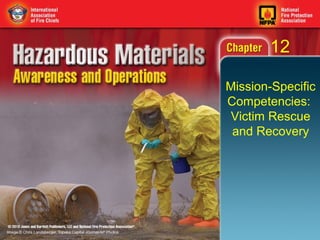
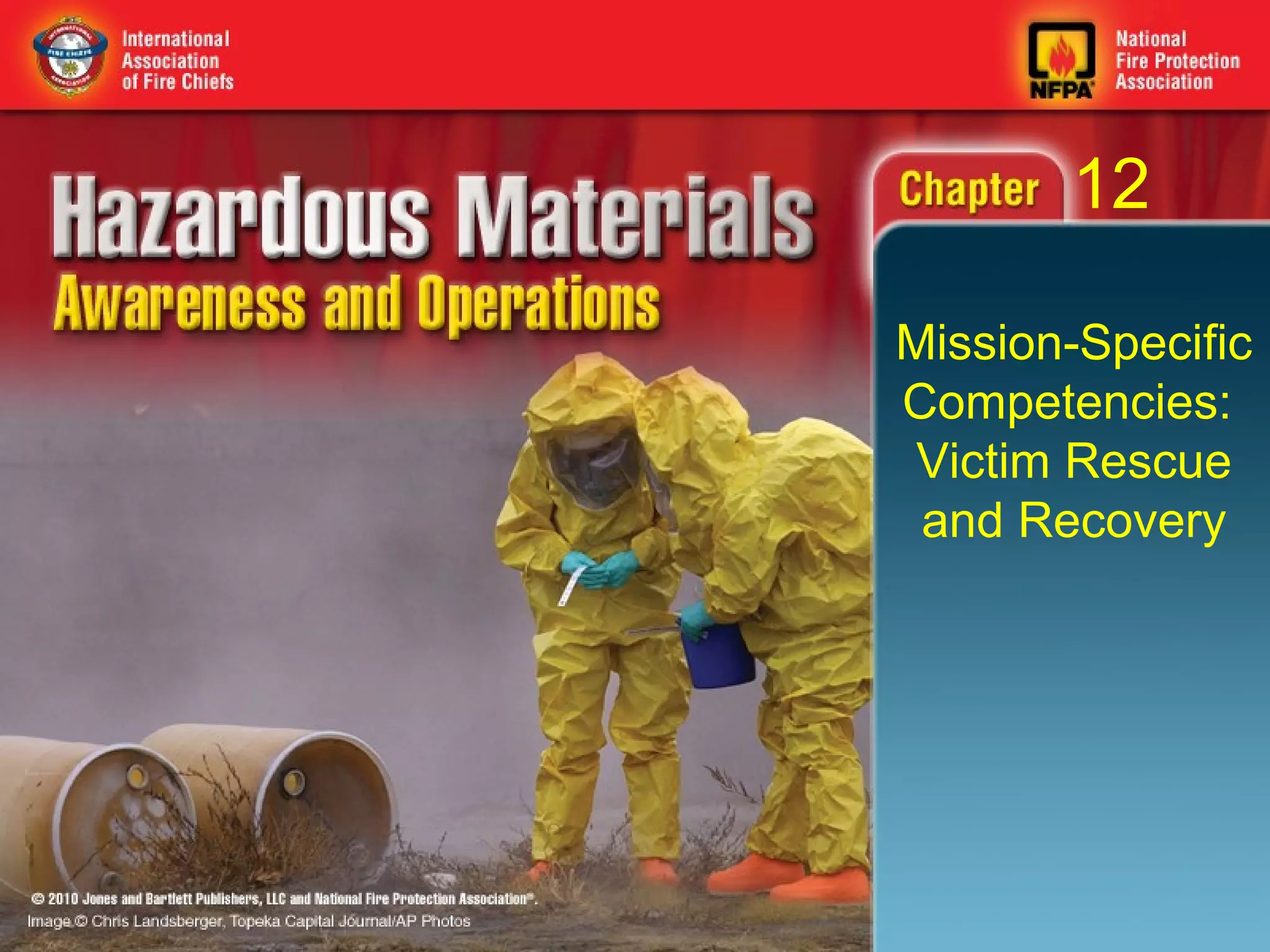
Mission-Specific
Competencies:
 Victim Rescue
 and Recovery
12

            Objectives (1 of 4)
• Describe tactical considerations such as
  attempting to make a rescue without the
  proper PPE or without backup personnel,
  or deciding whether a rescue attempt has
  a good chance of success
12

            Objectives (2 of 4)
• Describe entry team and backup team
  responsibilities
• Describe the difference between
  ambulatory and nonambulatory victims,
  and considerations for each
12

            Objectives (3 of 4)
• Describe the difference between rescue
  mode and recovery mode
• Describe considerations in providing
  medical care and/or decontamination to
  victims during rescue mode or recovery
  mode
12

            Objectives (4 of 4)
• Describe the equipment needed for
  search, rescue and recovery operations
• Describe the assists, lifts, and carries
  commonly used during rescue operations
• Describe the benefits of sheltering-in-
  place
• Describe the process of triage
12

          Protecting Life (1 of 2)
• Responder’s job is to protect life
• Risk to responder may outweigh benefit
• Decision based on
  – Sound information
  – Training
  – PPE and enough trained personnel
12

          Protecting Life (2 of 2)
• May have to attempt rescue without
  resources
  – Without adequate training
  – Without proper PPE (or any PPE)
• Making a victim rescue is a choice
  – Choose wisely
12

     Tactical Considerations (1 of 3)
•   First, ensure enough responders are on
    scene.
•   Do not attempt a rescue alone.
•   Take time to size up the scene and
    understand the hazards present before
    responding.
12

     Tactical Considerations (2 of 3)
• Generally at least five responders are
  needed.
  – Two on entry team
  – Two on backup team
  – One to staff emergency decontamination
• Victim viability is an important factor.
12

Tactical Considerations (3 of 3)


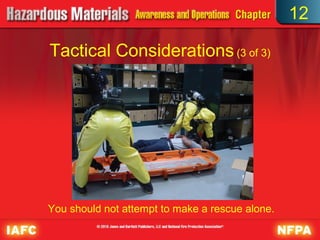
You should not attempt to make a rescue alone.
12

              Entry Team
• Two or more appropriately trained
  responders
• Proper level and type of PPE
• Equipped with radio communications
• With appropriate tools
• Operating under direction of supervisor
12

    Entry Team Responsibilities (1 of 4)
•   Reconnaissance
•   Mapping
•   Search and rescue
•   Triaging victims
•   Directing victims out of contaminated
    environment
12

Entry Team Responsibilities (2 of 4)


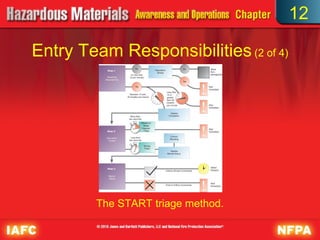
         The START triage method.
12

    Entry Team Responsibilities (3 of 4)
• Non-line-of-sight situations
    – Require searching before rescue
•   Ambulatory victims (able to walk)
•   Nonambulatory victims (unable to walk)
•   Carrying adult victims is physically taxing
•   Decontamination necessary for all victims
12

Entry Team Responsibilities (4 of 4)


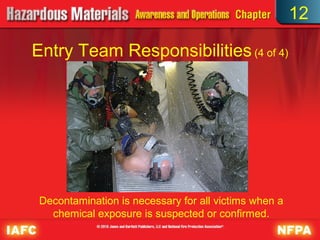
 Decontamination is necessary for all victims when a
   chemical exposure is suspected or confirmed.
12

               Triage (1 of 3)
• Essential at all mass-casualty incidents
• Rescue live victims with best chance of
  survival
• Pointless to rescue the dead
  – Dead are recovered later
• Follow AHJ-approved triage method
12

                Triage (2 of 3)
• START (Simple Triage And Rapid
  Treatment) system
• Assesses:
  – Breathing rate
  – Pulse rate
  – Mental status
12

                Triage (3 of 3)
• Use color-coding system to classify
  victims
• Shows priority for treatment and removal
  – Red-tagged victims are first priority
  – Yellow-tagged victims are second priority
  – Green- or black-tagged victims are lowest
    priority
12

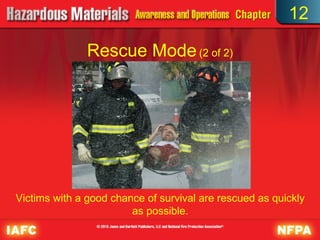
          Rescue Mode (1 of 2)
• Victims are present
• Victims determined to have good chance
  of survival
• Rescue as quickly as possible
• May transition to recovery mode
12

               Rescue Mode (2 of 2)


Victims with a good chance of survival are rescued as quickly
                        as possible.
12

           Recovery Mode
• No chance remains of rescuing victims
  alive
• Systematic search
• Removal of bodies
• Decontamination may still be necessary
• Evidence collection
12

             Medical Care
• Generally not rendered during rescue
  mode
• Decontamination required
• Medical care outside the hot or warm zone
• No absolutes—always exceptions
12

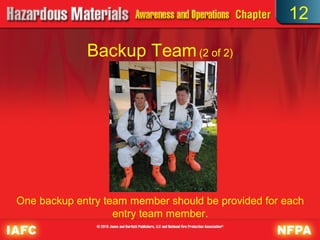
            Backup Team (1 of 2)
•   One person for each entry team member
•   Dressed in same level of PPE
•   Staged at same access point
•   Ready to deploy in seconds
12

             Backup Team (2 of 2)


One backup entry team member should be provided for each
                   entry team member.
12

    Emergency Decontamination (1 of 2)
•   Rapidly removes bulk of contamination
•   Removal of clothing
•   Dousing of victim
•   Addressing contaminated runoff if there is
    time
12

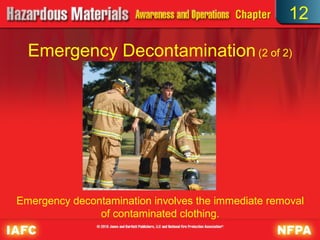
  Emergency Decontamination (2 of 2)


Emergency decontamination involves the immediate removal
               of contaminated clothing.
12
    Search, Rescue, and Recovery
                    (1 of 2)
•   Time-consuming
•   Dangerous
•   Labor-intensive
•   Stressful
•   PPE causes physical problems
12
  Search, Rescue, and Recovery
                   (2 of 2)
• “Work smarter, not harder.”
• Primary team could pass on information to
  secondary team
• Each incident has unique factors
12
  Search, Rescue, and Recovery
         Equipment (1 of 3)
• Wear full PPE, and SCBA if necessary
• Carry proper rescue supplies and tools
  – Portable radio
  – Hand light or flashlight
  – Forcible-entry (-exit) tools
  – Thermal imaging devices (if available)
12
  Search, Rescue, and Recovery
         Equipment (2 of 3)
  – Long rope(s) in some cases
  – Tubular webbing or short rope (16–24 feet)
• For victims:
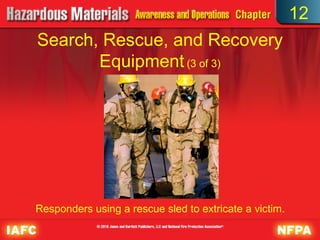
  – Rescue sleds (see next slide), stretchers
  – Evacuation chairs, spine boards
  – Wheeled carts
12
Search, Rescue, and Recovery
       Equipment (3 of 3)


Responders using a rescue sled to extricate a victim.
12
    Search, Rescue, and Recovery
             Safety Tips
• Work from a single plan
• Maintain radio contact with IC
• Monitor environmental conditions
• Adhere to personal accountability system
  of AHJ
• Stay with a partner
12

            Rescue Methods
• Assists, carries, drags
  – Should be practiced ahead of time
• Direct or remove victim to safe area
• Use safest means of egress
12

          Sheltering-in-Place
• Sometimes safer to shelter than remove
• Conscious victim
• Located in adequately protected part of
  building
• When not feasible, rescue is required
12

               Exit Assist
• One-person walking assist
• Two-person walking assist
12

               Victim Carries
•   Two-person extremity carry
•   Two-person seat carry
•   Two-person chair carry
•   Cradle-in-arms carry
12

         Emergency Drags (1 of 2)
•   Clothes drag
•   Blanket drag
•   Standing drag
•   Webbing sling drag
12

       Emergency Drags (2 of 2)
• Fire fighter drag
• Emergency drag from a vehicle
• Long backboard rescue
12

             Summary (1 of 2)
• Rescue feasibility is not exact science
• Rescue attempts should be based on
  sound information, good training,
  adequate PPE, and enough available
  personnel
• Reasonable expectation of a positive
  outcome is important
12

             Summary (2 of 2)
• Team of five trained responders (not
  including supervisor) is recommended
• Use assists, carries, drags to aid victims
• All on scene should know when incident
  switches from rescue to recovery mode
• A decontamination plan must be in place

HazMat Ch12

  • 1.
  • 2.
    12 Objectives (1 of 4) • Describe tactical considerations such as attempting to make a rescue without the proper PPE or without backup personnel, or deciding whether a rescue attempt has a good chance of success
  • 3.
    12 Objectives (2 of 4) • Describe entry team and backup team responsibilities • Describe the difference between ambulatory and nonambulatory victims, and considerations for each
  • 4.
    12 Objectives (3 of 4) • Describe the difference between rescue mode and recovery mode • Describe considerations in providing medical care and/or decontamination to victims during rescue mode or recovery mode
  • 5.
    12 Objectives (4 of 4) • Describe the equipment needed for search, rescue and recovery operations • Describe the assists, lifts, and carries commonly used during rescue operations • Describe the benefits of sheltering-in- place • Describe the process of triage
  • 6.
    12 Protecting Life (1 of 2) • Responder’s job is to protect life • Risk to responder may outweigh benefit • Decision based on – Sound information – Training – PPE and enough trained personnel
  • 7.
    12 Protecting Life (2 of 2) • May have to attempt rescue without resources – Without adequate training – Without proper PPE (or any PPE) • Making a victim rescue is a choice – Choose wisely
  • 8.
    12 Tactical Considerations (1 of 3) • First, ensure enough responders are on scene. • Do not attempt a rescue alone. • Take time to size up the scene and understand the hazards present before responding.
  • 9.
    12 Tactical Considerations (2 of 3) • Generally at least five responders are needed. – Two on entry team – Two on backup team – One to staff emergency decontamination • Victim viability is an important factor.
  • 10.
    12 Tactical Considerations (3of 3) You should not attempt to make a rescue alone.
  • 11.
    12 Entry Team • Two or more appropriately trained responders • Proper level and type of PPE • Equipped with radio communications • With appropriate tools • Operating under direction of supervisor
  • 12.
    12 Entry Team Responsibilities (1 of 4) • Reconnaissance • Mapping • Search and rescue • Triaging victims • Directing victims out of contaminated environment
  • 13.
    12 Entry Team Responsibilities(2 of 4) The START triage method.
  • 14.
    12 Entry Team Responsibilities (3 of 4) • Non-line-of-sight situations – Require searching before rescue • Ambulatory victims (able to walk) • Nonambulatory victims (unable to walk) • Carrying adult victims is physically taxing • Decontamination necessary for all victims
  • 15.
    12 Entry Team Responsibilities(4 of 4) Decontamination is necessary for all victims when a chemical exposure is suspected or confirmed.
  • 16.
    12 Triage (1 of 3) • Essential at all mass-casualty incidents • Rescue live victims with best chance of survival • Pointless to rescue the dead – Dead are recovered later • Follow AHJ-approved triage method
  • 17.
    12 Triage (2 of 3) • START (Simple Triage And Rapid Treatment) system • Assesses: – Breathing rate – Pulse rate – Mental status
  • 18.
    12 Triage (3 of 3) • Use color-coding system to classify victims • Shows priority for treatment and removal – Red-tagged victims are first priority – Yellow-tagged victims are second priority – Green- or black-tagged victims are lowest priority
  • 19.
    12 Rescue Mode (1 of 2) • Victims are present • Victims determined to have good chance of survival • Rescue as quickly as possible • May transition to recovery mode
  • 20.
    12 Rescue Mode (2 of 2) Victims with a good chance of survival are rescued as quickly as possible.
  • 21.
    12 Recovery Mode • No chance remains of rescuing victims alive • Systematic search • Removal of bodies • Decontamination may still be necessary • Evidence collection
  • 22.
    12 Medical Care • Generally not rendered during rescue mode • Decontamination required • Medical care outside the hot or warm zone • No absolutes—always exceptions
  • 23.
    12 Backup Team (1 of 2) • One person for each entry team member • Dressed in same level of PPE • Staged at same access point • Ready to deploy in seconds
  • 24.
    12 Backup Team (2 of 2) One backup entry team member should be provided for each entry team member.
  • 25.
    12 Emergency Decontamination (1 of 2) • Rapidly removes bulk of contamination • Removal of clothing • Dousing of victim • Addressing contaminated runoff if there is time
  • 26.
    12 EmergencyDecontamination (2 of 2) Emergency decontamination involves the immediate removal of contaminated clothing.
  • 27.
    12 Search, Rescue, and Recovery (1 of 2) • Time-consuming • Dangerous • Labor-intensive • Stressful • PPE causes physical problems
  • 28.
    12 Search,Rescue, and Recovery (2 of 2) • “Work smarter, not harder.” • Primary team could pass on information to secondary team • Each incident has unique factors
  • 29.
    12 Search,Rescue, and Recovery Equipment (1 of 3) • Wear full PPE, and SCBA if necessary • Carry proper rescue supplies and tools – Portable radio – Hand light or flashlight – Forcible-entry (-exit) tools – Thermal imaging devices (if available)
  • 30.
    12 Search,Rescue, and Recovery Equipment (2 of 3) – Long rope(s) in some cases – Tubular webbing or short rope (16–24 feet) • For victims: – Rescue sleds (see next slide), stretchers – Evacuation chairs, spine boards – Wheeled carts
  • 31.
    12 Search, Rescue, andRecovery Equipment (3 of 3) Responders using a rescue sled to extricate a victim.
  • 32.
    12 Search, Rescue, and Recovery Safety Tips • Work from a single plan • Maintain radio contact with IC • Monitor environmental conditions • Adhere to personal accountability system of AHJ • Stay with a partner
  • 33.
    12 Rescue Methods • Assists, carries, drags – Should be practiced ahead of time • Direct or remove victim to safe area • Use safest means of egress
  • 34.
    12 Sheltering-in-Place • Sometimes safer to shelter than remove • Conscious victim • Located in adequately protected part of building • When not feasible, rescue is required
  • 35.
    12 Exit Assist • One-person walking assist • Two-person walking assist
  • 36.
    12 Victim Carries • Two-person extremity carry • Two-person seat carry • Two-person chair carry • Cradle-in-arms carry
  • 37.
    12 Emergency Drags (1 of 2) • Clothes drag • Blanket drag • Standing drag • Webbing sling drag
  • 38.
    12 Emergency Drags (2 of 2) • Fire fighter drag • Emergency drag from a vehicle • Long backboard rescue
  • 39.
    12 Summary (1 of 2) • Rescue feasibility is not exact science • Rescue attempts should be based on sound information, good training, adequate PPE, and enough available personnel • Reasonable expectation of a positive outcome is important
  • 40.
    12 Summary (2 of 2) • Team of five trained responders (not including supervisor) is recommended • Use assists, carries, drags to aid victims • All on scene should know when incident switches from rescue to recovery mode • A decontamination plan must be in place

Editor's Notes

  • #11 Image: Courtesy of Rob Schnepp
  • #16 Image: Courtesy of 1st Lt. Toni Tones/U.S. Air Force
  • #21 Image: Courtesy of Journalist 3rd Class Ryan C. McGinley/U.S. Navy
  • #25 Image: Photographed by Glen E. Ellman.
  • #27 Image: Courtesy of MIEMSS.
  • #32 Image: Courtesy of Mass Communications Specialist 2nd Class Kirk Worley/U.S. Navy