6

Terrorism
6

             Objectives (1 of 4)
• Describe the threat posed by terrorism
• Understand the definition of terrorism from
  a broad perspective
• Describe various types of potential
  terrorist targets
6

            Objectives (2 of 4)
• Understand the dangers posed by
  explosive devices and secondary
  explosive devices
• Define weapons of mass destruction
6

              Objectives (3 of 4)
• Understand the basic differences and
  indicators of chemical, biological, and
  radiological threats
• Describe operations considerations at a
  terrorism event, including initial actions,
  interagency coordination,
  decontamination, mass casualties, and
  triage
6

              Objectives (4 of 4)
• Identify the different levels distinguished in
  the Homeland Security Threat Level chart
6

           Terrorism Basics
• Response based on hazardous materials
  response
• Terrorism’s goal: Produce feelings of fear
• Domestic terrorism
• International terrorism
6

 Responding to Terrorist Incidents
• Same procedure as in other emergencies
• Differences
  – Landscape where incident is handled
  – Numerous agencies are involved
  – Training and working together are important
6

          Targets and Tactics
• Symbolic targets often chosen
• Often possible to predict likely targets
• Methods of attack vary
6

          Types of Targets (1 of 6)
• Infrastructure targets, including:
  – Bridges
  – Tunnels
  – Subways
  – Hospitals
6

                Types of Targets (2 of 6)


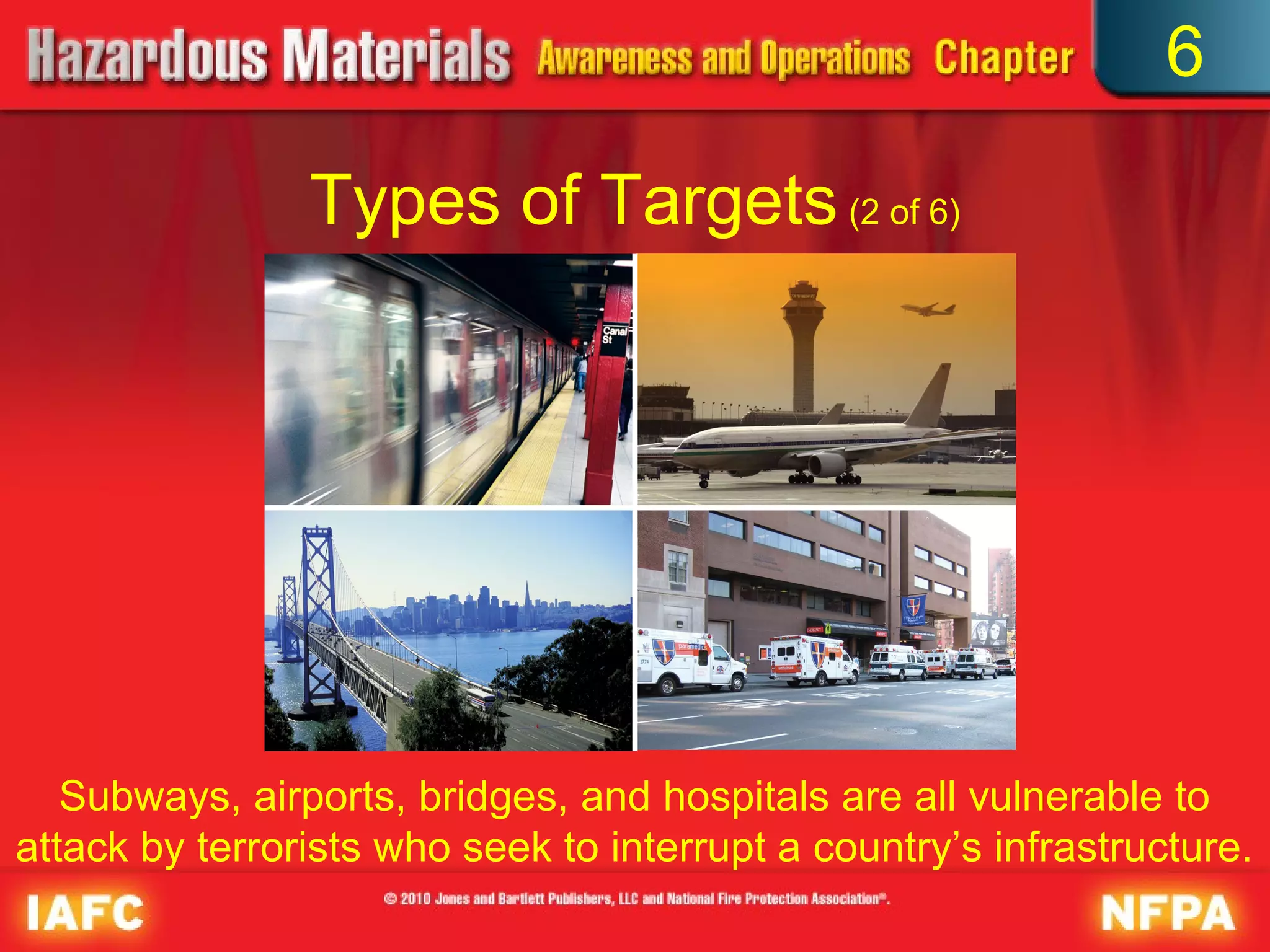
   Subways, airports, bridges, and hospitals are all vulnerable to
attack by terrorists who seek to interrupt a country’s infrastructure.
6

         Types of Targets (3 of 6)
• Symbolic targets
  – Symbols of national pride
  – Military bases
  – Embassies
  – Religious institutions
6

           Types of Targets (4 of 6)


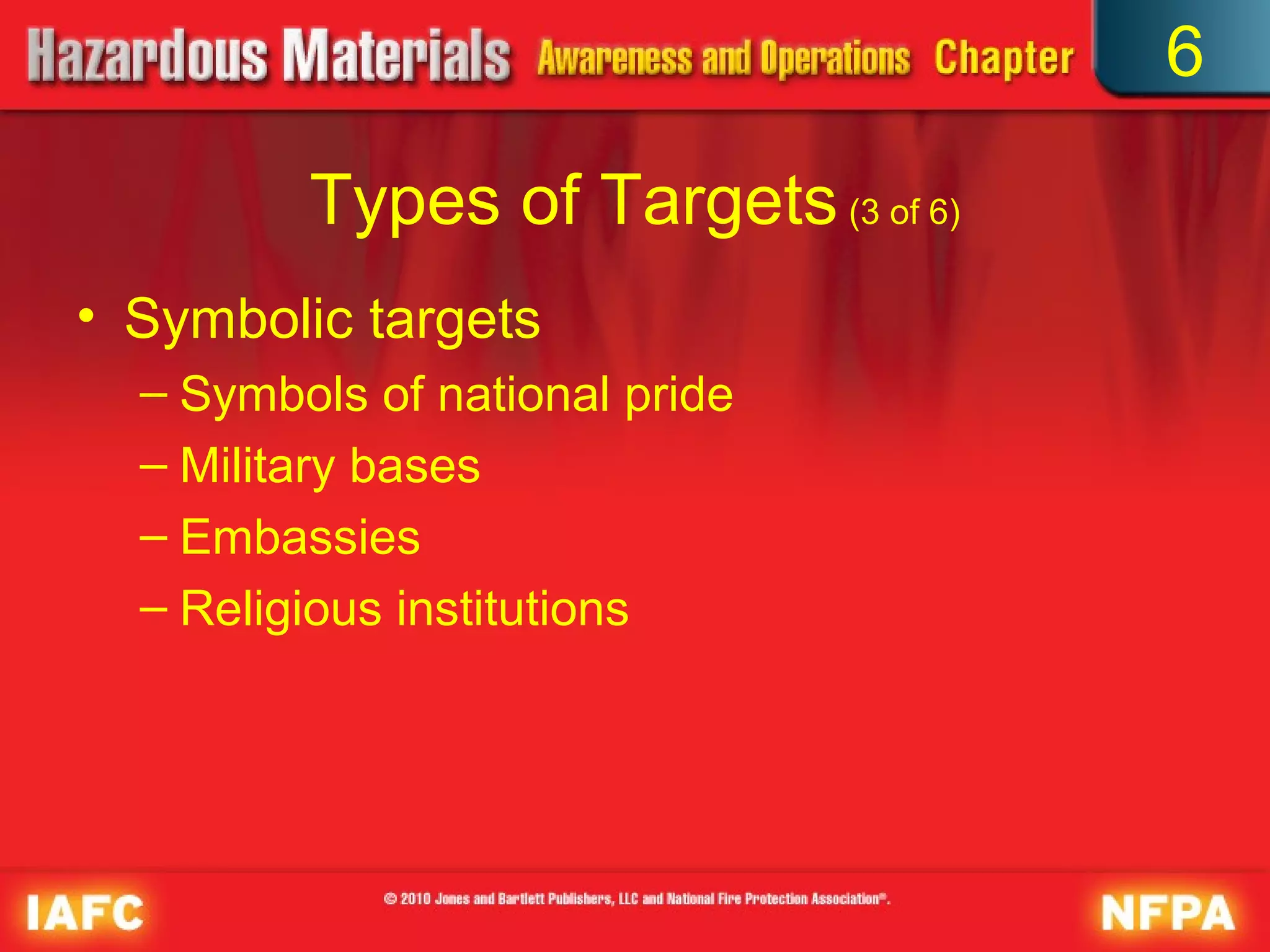
Terrorists might attempt to destroy visible national icons.
6

          Types of Targets (5 of 6)
• Civilian targets
  – Shopping malls
  – Airports
  – Schools
  – Sports stadiums
6

               Types of Targets (6 of 6)


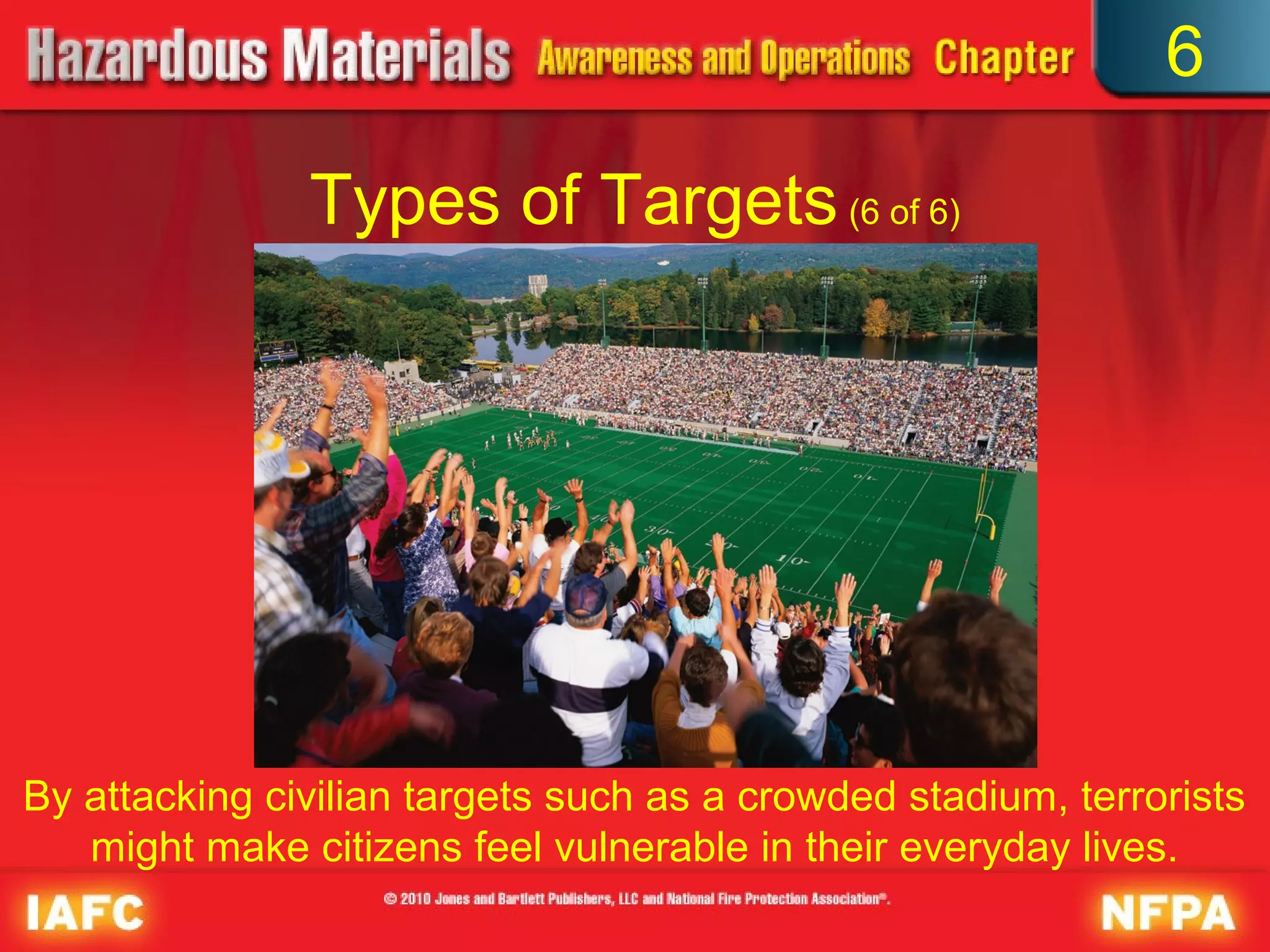
By attacking civilian targets such as a crowded stadium, terrorists
   might make citizens feel vulnerable in their everyday lives.
6

               Ecoterrorism
• Committed by groups supporting
  environmental causes
• Examples:
  – Spiking trees to disrupt logging
  – Vandalizing animal research laboratories
  – Firebombing store that sells fur coats
6

           Agroterrorism (1 of 2)
• Uses chemical or biological agents
• Attacks agricultural industry or food supply
6

                Agroterrorism (2 of 2)


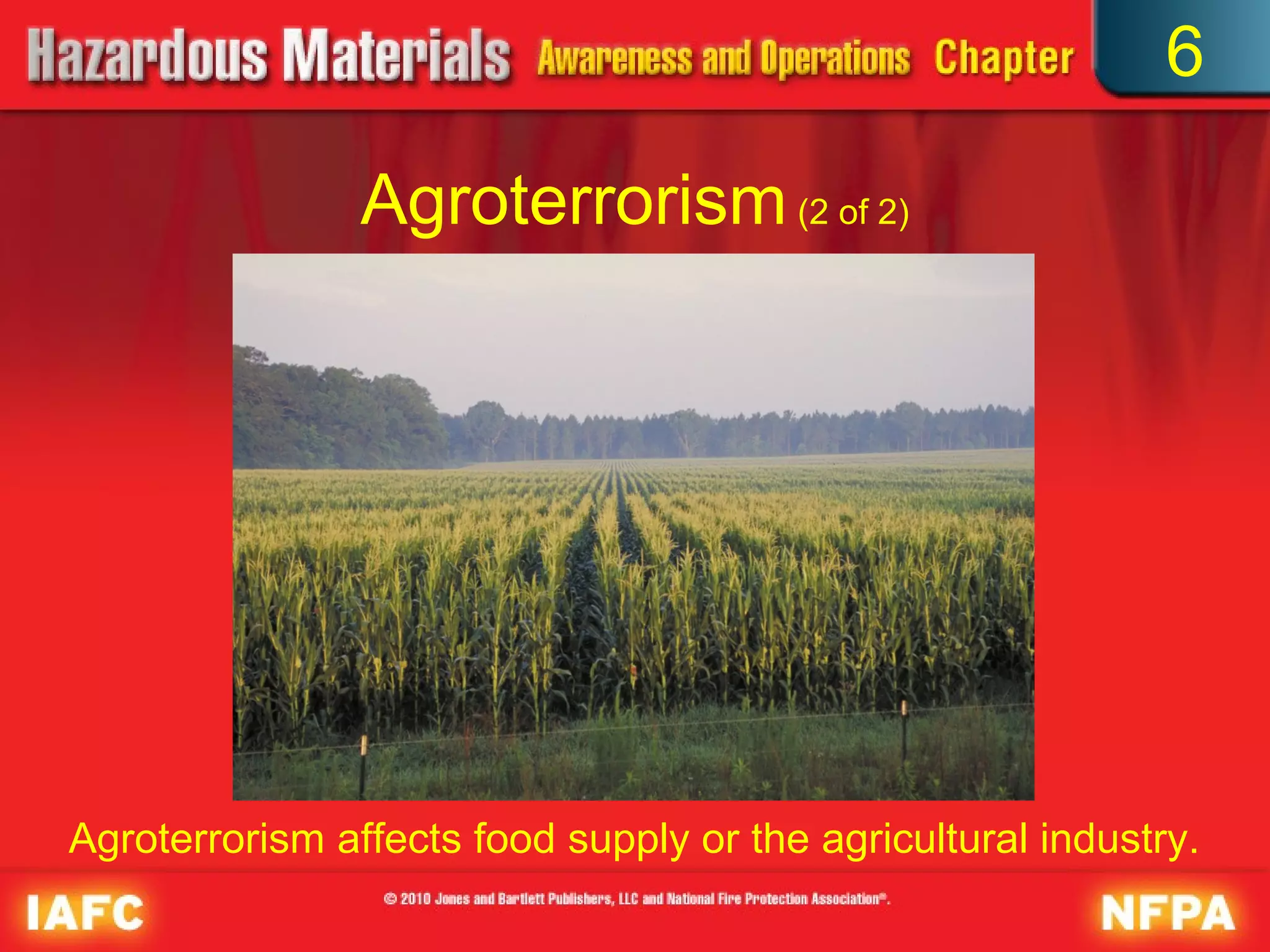
Agroterrorism affects food supply or the agricultural industry.
6

            Cyberterrorism
• Electronically disrupting computer systems
  – Government computer systems
  – Private computer systems
  – The Internet
6

         Types of Devices (1 of 2)
• Ordinary objects can become powerful
  weapons
  – Gasoline tankers
  – Commercial airliners
• Bombs are most frequent
6

         Types of Devices (2 of 2)
• Shooting into a crowd
• Release of biological agent
• Computer virus
6

                 Explosives
• Thousands of pounds stolen each year
• Can also be created with commonly
  available materials:
  – Improvised explosive device (IED)
  – Ammonium nitrate fertilizer and fuel oil
    (ANFO)
6

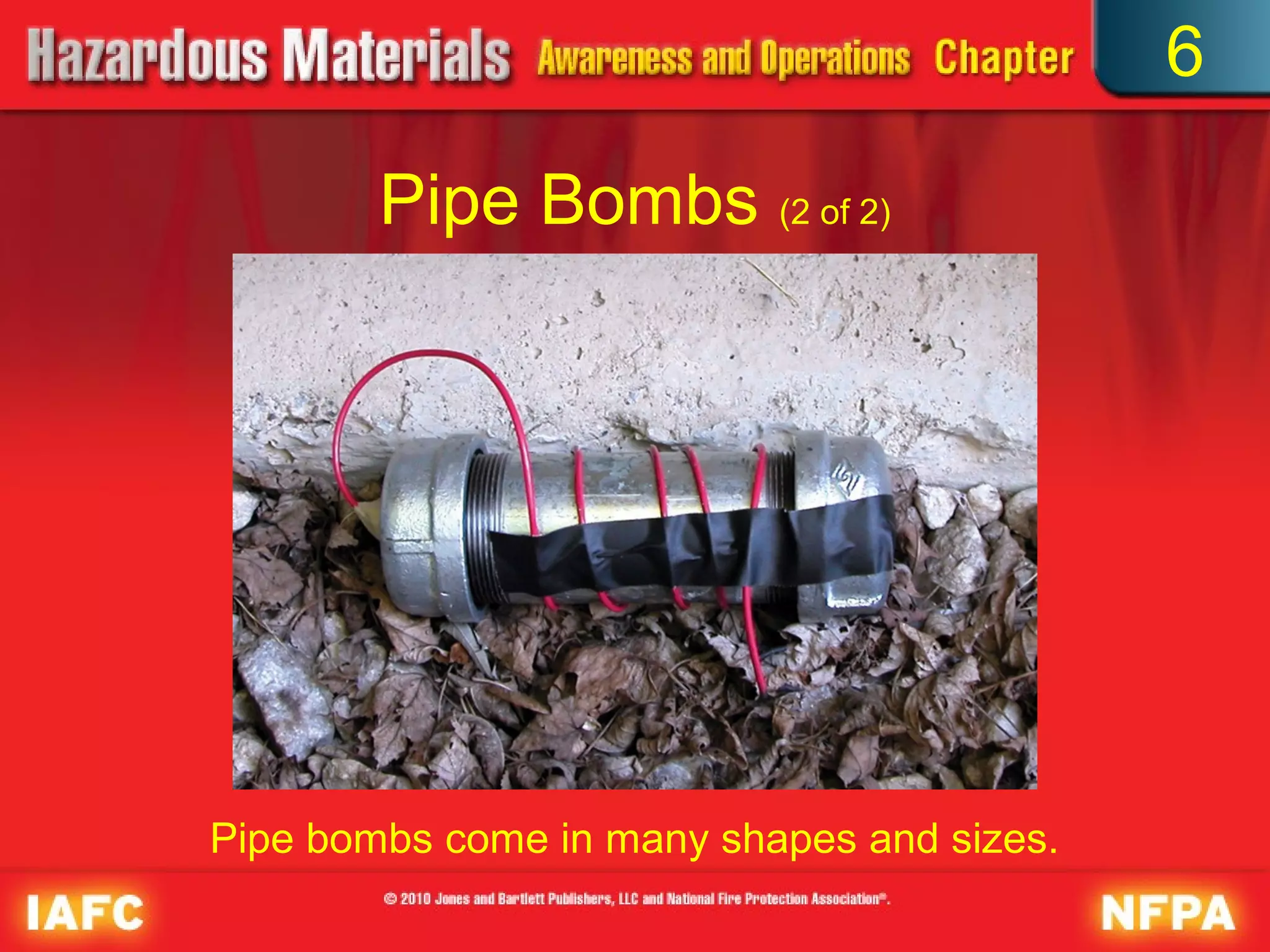
           Pipe Bombs (1 of 2)
• Pipe bombs are most common IED
• Length of pipe filled with explosive
  substance
• Chemical/biological agents can be added
• Nails can be added
• Detonator like a hobby fuse
6

        Pipe Bombs (2 of 2)


Pipe bombs come in many shapes and sizes.
6

          Secondary Devices
• Placed in area where initial event occurred
• Intended to kill:
  – Emergency responders
  – Law enforcement personnel
  – Spectators
  – News reporters
6

      Potentially Explosive Device
•   A device that has not yet exploded
•   Remove civilians from area
•   Establish perimeter at safe distance
•   Explosive ordnance disposal (EOD)
    personnel handle
6

     Actions Following an Explosion
•   Ensure your own safety
•   Ensure safety of scene
•   Follow departmental procedures
•   Consider possibility of secondary device
•   Qualified personnel should check for other
    contaminants (biological, radiological)
6
     Work with Other Agencies
       Following Explosion
• Local, state, and federal agencies
• FBI
• Bureau of Alcohol, Tobacco, Firearms and
  Explosives
• Military EOD units
6

    Weapons of Mass Destruction (WMD)
•   Chemical agents
•   Biological agents
•   Radiological agents
•   NFPA 472 annex provides specific
    information about terrorist attack agents
6

         Chemical Agents (1 of 3)
• Kill or injure large numbers of people
• Readily available
• Can be distributed in different ways:
  – Releasing gas from storage tank
  – Adding to explosive device
  – Crop-dusting aircraft
6

            Chemical Agents (2 of 3)


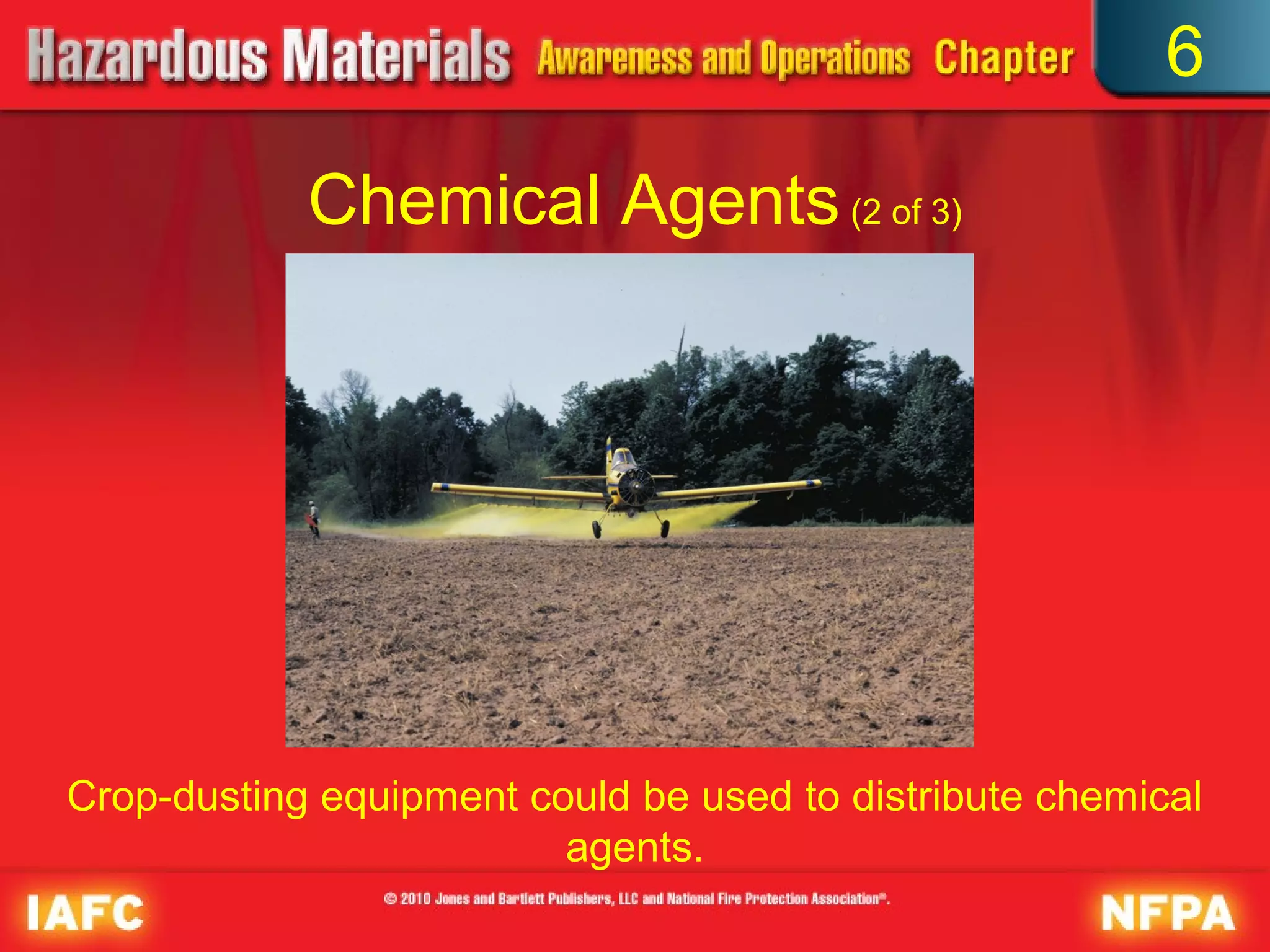
Crop-dusting equipment could be used to distribute chemical
                         agents.
6

         Chemical Agents (3 of 3)
• Include:
  – Nerve agents
  – Blistering agents
  – Pulmonary agents
  – Blood agents
6

            Nerve Agents (1 of 2)
•   Toxic chemical agents
•   Attack nervous system
•   Examples: Sarin, V-agent (VX)
•   Antidotes exist
6

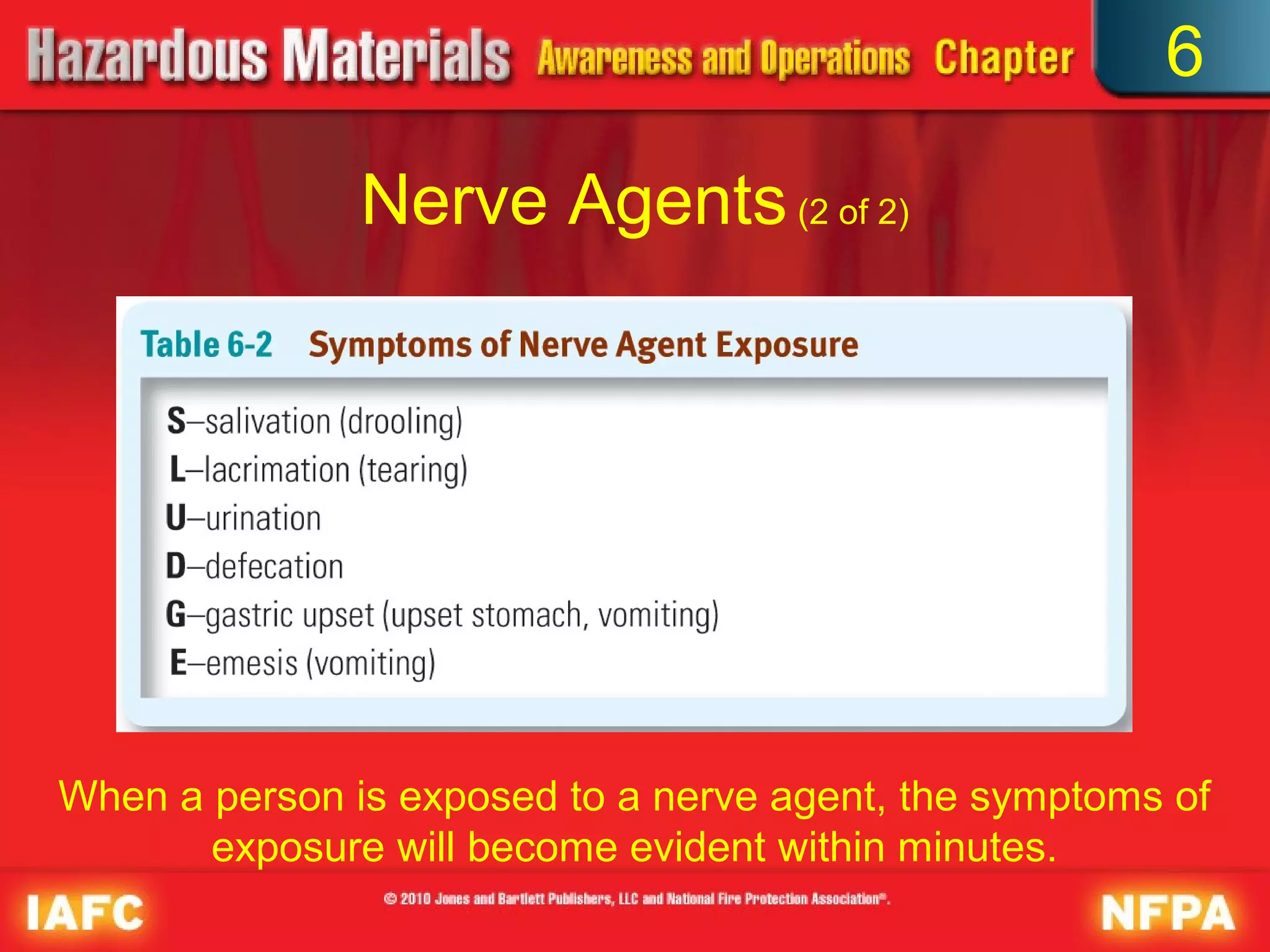
               Nerve Agents (2 of 2)


When a person is exposed to a nerve agent, the symptoms of
       exposure will become evident within minutes.
6

         Blistering Agents (1 of 2)
• Contact causes skin to blister
• Examples:
  – Sulfur mustard
  – Lewisite
6

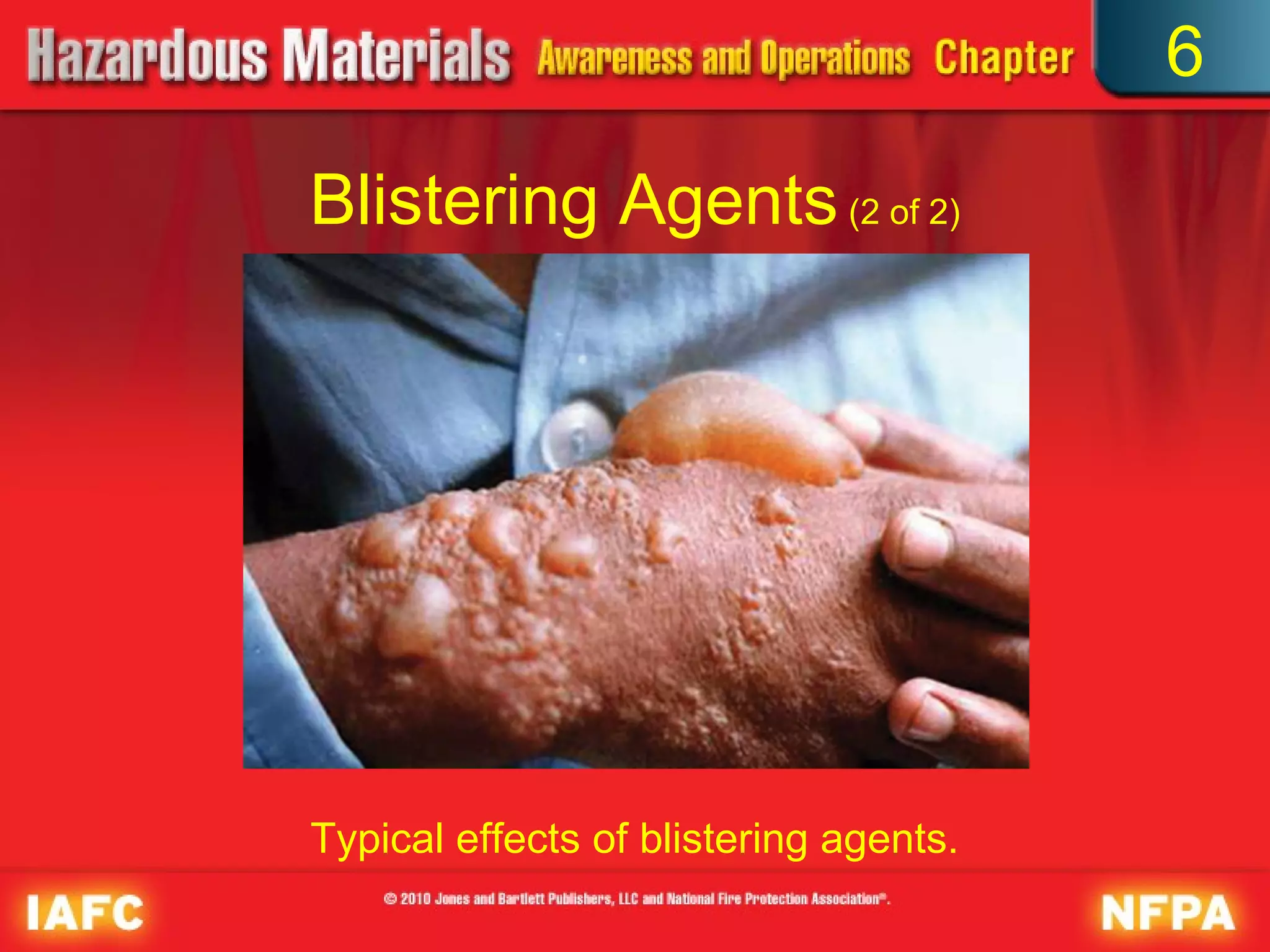
Blistering Agents (2 of 2)


Typical effects of blistering agents.
6

         Pulmonary Agents
• Choking agents
• Examples:
  – Phosgene
  – Chlorine
6

              Blood Agents
• Interfere with use of oxygen by cells
• Example: Cyanide
• Can be inhaled or ingested
6
 Protection from Chemical Agents
                   (1 of 2)

• Use PPE
• Use self-contained breathing apparatus
  (SCBA)
6
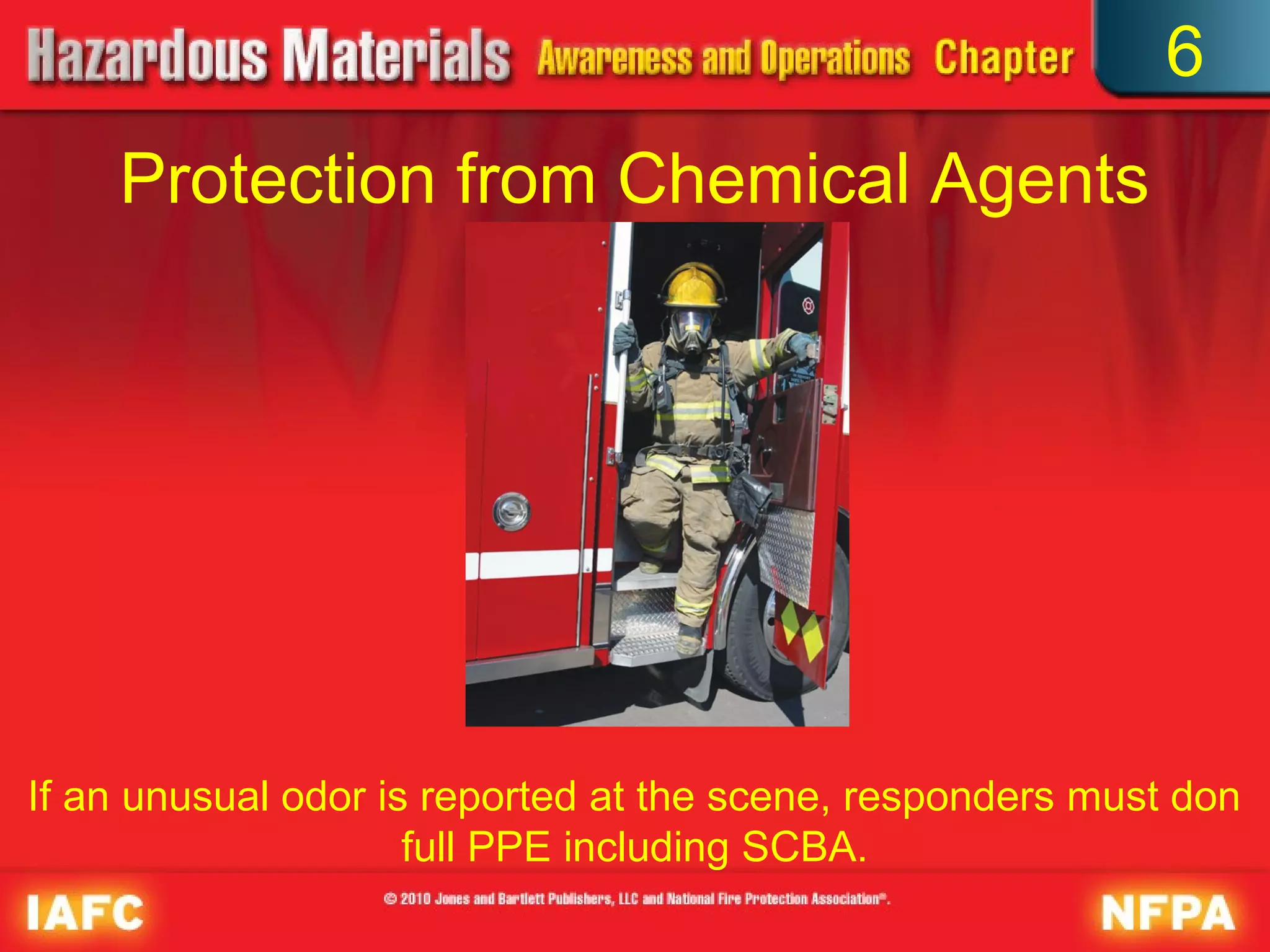
    Protection from Chemical Agents
                             (2 of 2)


If an unusual odor is reported at the scene, responders must don
                     full PPE including SCBA.
6

           Biological Agents
• Organisms that cause disease
• Examples
  – Anthrax
  – Plague
  – Smallpox
6
 Protection from Biological Agents
                     (1 of 2)

• Responders unlikely to recognize signs
  – Due to incubation period
• Recognition likely to come from
  – Centers for Disease Control and Prevention
    (CDC)
  – Area hospitals
6
 Protection from Biological Agents
                     (2 of 2)

• Once threat recognized, wear appropriate:
  – Gloves
  – Masks with HEPA filters
  – Eye protection
  – Surgical gowns when treating patients
• Seek medical care for flu-like symptoms
6

         Radiological Agents
• Different threat from nuclear detonation
• Energy released in form of waves or
  particles:
  – Alpha particles
  – Beta particles
  – Gamma radiation
6
      Protection from Radiological
                Agents
•   Limit exposure time
•   Stay as far away as possible
•   Personal dosimeter
•   Appropriate PPE
•   Shielding
6

               Dirty Bomb
• Radiation dispersal device (RDD)
• Dissemination of radioactive material
• No nuclear detonation
6

                    Operations
• Initial actions
  – Approach like hazardous materials incident
• Interagency coordination
• Decontamination
• Mass casualties
6

       Mass Decontamination
• Master stream devices from engine
  companies
• Aerial apparatus to create showers
• Allows rapid decontamination
6

           Mass Casualties
• Special mass-casualty plan essential
• Decontamination must be addressed
• Triage
6

        Additional Resources
• FBI
• FEMA
• Department of Homeland Security
6
 Department of Homeland Security
                   (1 of 2)

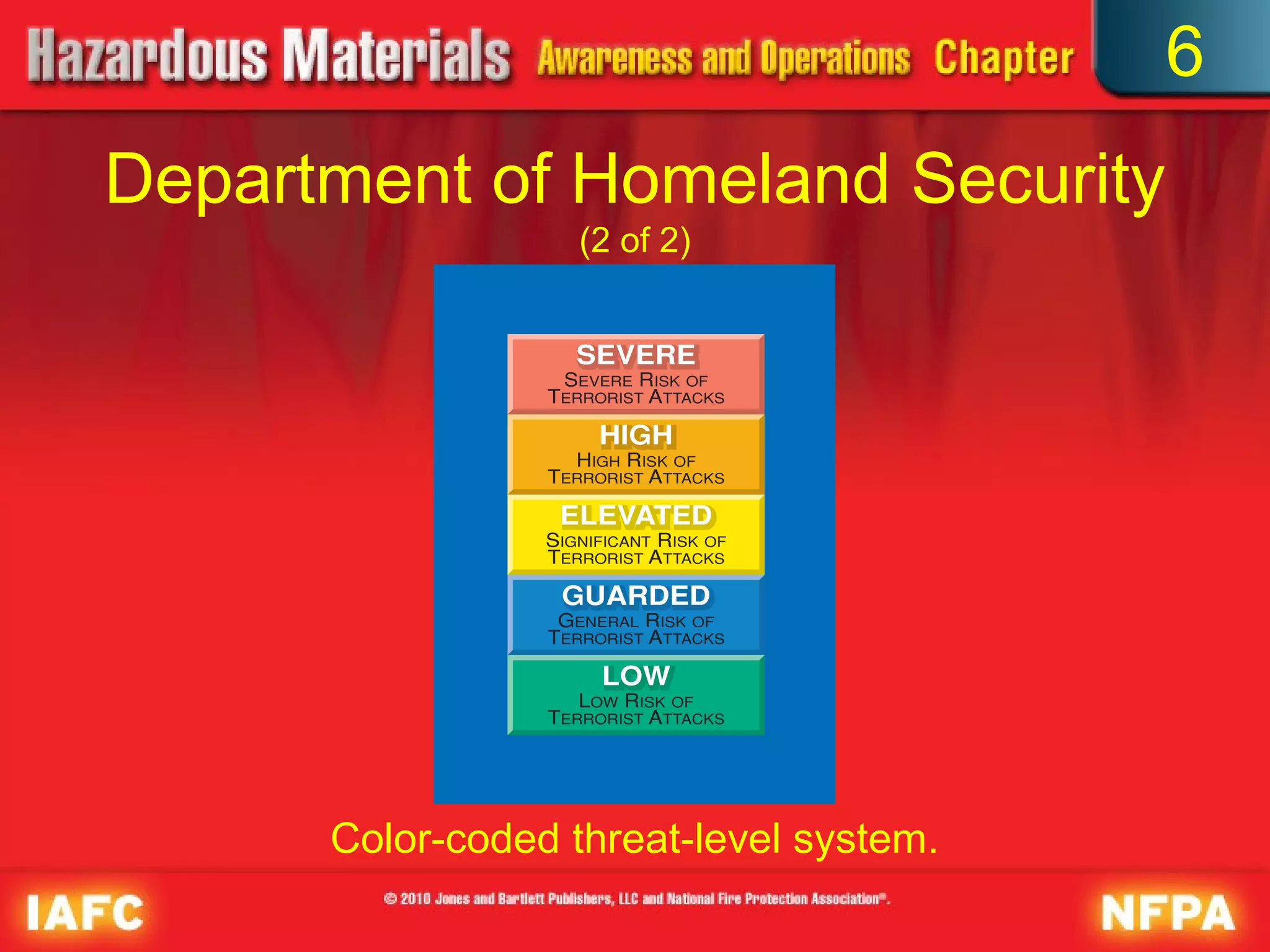
• Homeland Security Threat Advisories
• Homeland Security Information Bulletins
• Color-coded threat-level system
6
Department of Homeland Security
                   (2 of 2)


      Color-coded threat-level system.
6

              Summary (1 of 3)
• Goal of terrorism is to produce fear
• Terrorism can occur in any community
• Ordinary objects can be turned into
  weapons
• Secondary devices explode after initial
  device
6

             Summary (2 of 3)
• Weapons of mass destruction include:
  – Chemical agents
  – Biological agents
  – Radiological agents
  – Conventional weapons and explosives
6

             Summary (3 of 3)
• Important to identify type of agent
• Establish staging area at safe distance
• Interagency coordination important part of
  response

HazMat Ch06

  • 1.
  • 2.
    6 Objectives (1 of 4) • Describe the threat posed by terrorism • Understand the definition of terrorism from a broad perspective • Describe various types of potential terrorist targets
  • 3.
    6 Objectives (2 of 4) • Understand the dangers posed by explosive devices and secondary explosive devices • Define weapons of mass destruction
  • 4.
    6 Objectives (3 of 4) • Understand the basic differences and indicators of chemical, biological, and radiological threats • Describe operations considerations at a terrorism event, including initial actions, interagency coordination, decontamination, mass casualties, and triage
  • 5.
    6 Objectives (4 of 4) • Identify the different levels distinguished in the Homeland Security Threat Level chart
  • 6.
    6 Terrorism Basics • Response based on hazardous materials response • Terrorism’s goal: Produce feelings of fear • Domestic terrorism • International terrorism
  • 7.
    6 Responding toTerrorist Incidents • Same procedure as in other emergencies • Differences – Landscape where incident is handled – Numerous agencies are involved – Training and working together are important
  • 8.
    6 Targets and Tactics • Symbolic targets often chosen • Often possible to predict likely targets • Methods of attack vary
  • 9.
    6 Types of Targets (1 of 6) • Infrastructure targets, including: – Bridges – Tunnels – Subways – Hospitals
  • 10.
    6 Types of Targets (2 of 6) Subways, airports, bridges, and hospitals are all vulnerable to attack by terrorists who seek to interrupt a country’s infrastructure.
  • 11.
    6 Types of Targets (3 of 6) • Symbolic targets – Symbols of national pride – Military bases – Embassies – Religious institutions
  • 12.
    6 Types of Targets (4 of 6) Terrorists might attempt to destroy visible national icons.
  • 13.
    6 Types of Targets (5 of 6) • Civilian targets – Shopping malls – Airports – Schools – Sports stadiums
  • 14.
    6 Types of Targets (6 of 6) By attacking civilian targets such as a crowded stadium, terrorists might make citizens feel vulnerable in their everyday lives.
  • 15.
    6 Ecoterrorism • Committed by groups supporting environmental causes • Examples: – Spiking trees to disrupt logging – Vandalizing animal research laboratories – Firebombing store that sells fur coats
  • 16.
    6 Agroterrorism (1 of 2) • Uses chemical or biological agents • Attacks agricultural industry or food supply
  • 17.
    6 Agroterrorism (2 of 2) Agroterrorism affects food supply or the agricultural industry.
  • 18.
    6 Cyberterrorism • Electronically disrupting computer systems – Government computer systems – Private computer systems – The Internet
  • 19.
    6 Types of Devices (1 of 2) • Ordinary objects can become powerful weapons – Gasoline tankers – Commercial airliners • Bombs are most frequent
  • 20.
    6 Types of Devices (2 of 2) • Shooting into a crowd • Release of biological agent • Computer virus
  • 21.
    6 Explosives • Thousands of pounds stolen each year • Can also be created with commonly available materials: – Improvised explosive device (IED) – Ammonium nitrate fertilizer and fuel oil (ANFO)
  • 22.
    6 Pipe Bombs (1 of 2) • Pipe bombs are most common IED • Length of pipe filled with explosive substance • Chemical/biological agents can be added • Nails can be added • Detonator like a hobby fuse
  • 23.
    6 Pipe Bombs (2 of 2) Pipe bombs come in many shapes and sizes.
  • 24.
    6 Secondary Devices • Placed in area where initial event occurred • Intended to kill: – Emergency responders – Law enforcement personnel – Spectators – News reporters
  • 25.
    6 Potentially Explosive Device • A device that has not yet exploded • Remove civilians from area • Establish perimeter at safe distance • Explosive ordnance disposal (EOD) personnel handle
  • 26.
    6 Actions Following an Explosion • Ensure your own safety • Ensure safety of scene • Follow departmental procedures • Consider possibility of secondary device • Qualified personnel should check for other contaminants (biological, radiological)
  • 27.
    6 Work with Other Agencies Following Explosion • Local, state, and federal agencies • FBI • Bureau of Alcohol, Tobacco, Firearms and Explosives • Military EOD units
  • 28.
    6 Weapons of Mass Destruction (WMD) • Chemical agents • Biological agents • Radiological agents • NFPA 472 annex provides specific information about terrorist attack agents
  • 29.
    6 Chemical Agents (1 of 3) • Kill or injure large numbers of people • Readily available • Can be distributed in different ways: – Releasing gas from storage tank – Adding to explosive device – Crop-dusting aircraft
  • 30.
    6 Chemical Agents (2 of 3) Crop-dusting equipment could be used to distribute chemical agents.
  • 31.
    6 Chemical Agents (3 of 3) • Include: – Nerve agents – Blistering agents – Pulmonary agents – Blood agents
  • 32.
    6 Nerve Agents (1 of 2) • Toxic chemical agents • Attack nervous system • Examples: Sarin, V-agent (VX) • Antidotes exist
  • 33.
    6 Nerve Agents (2 of 2) When a person is exposed to a nerve agent, the symptoms of exposure will become evident within minutes.
  • 34.
    6 Blistering Agents (1 of 2) • Contact causes skin to blister • Examples: – Sulfur mustard – Lewisite
  • 35.
    6 Blistering Agents (2of 2) Typical effects of blistering agents.
  • 36.
    6 Pulmonary Agents • Choking agents • Examples: – Phosgene – Chlorine
  • 37.
    6 Blood Agents • Interfere with use of oxygen by cells • Example: Cyanide • Can be inhaled or ingested
  • 38.
    6 Protection fromChemical Agents (1 of 2) • Use PPE • Use self-contained breathing apparatus (SCBA)
  • 39.
    6 Protection from Chemical Agents (2 of 2) If an unusual odor is reported at the scene, responders must don full PPE including SCBA.
  • 40.
    6 Biological Agents • Organisms that cause disease • Examples – Anthrax – Plague – Smallpox
  • 41.
    6 Protection fromBiological Agents (1 of 2) • Responders unlikely to recognize signs – Due to incubation period • Recognition likely to come from – Centers for Disease Control and Prevention (CDC) – Area hospitals
  • 42.
    6 Protection fromBiological Agents (2 of 2) • Once threat recognized, wear appropriate: – Gloves – Masks with HEPA filters – Eye protection – Surgical gowns when treating patients • Seek medical care for flu-like symptoms
  • 43.
    6 Radiological Agents • Different threat from nuclear detonation • Energy released in form of waves or particles: – Alpha particles – Beta particles – Gamma radiation
  • 44.
    6 Protection from Radiological Agents • Limit exposure time • Stay as far away as possible • Personal dosimeter • Appropriate PPE • Shielding
  • 45.
    6 Dirty Bomb • Radiation dispersal device (RDD) • Dissemination of radioactive material • No nuclear detonation
  • 46.
    6 Operations • Initial actions – Approach like hazardous materials incident • Interagency coordination • Decontamination • Mass casualties
  • 47.
    6 Mass Decontamination • Master stream devices from engine companies • Aerial apparatus to create showers • Allows rapid decontamination
  • 48.
    6 Mass Casualties • Special mass-casualty plan essential • Decontamination must be addressed • Triage
  • 49.
    6 Additional Resources • FBI • FEMA • Department of Homeland Security
  • 50.
    6 Department ofHomeland Security (1 of 2) • Homeland Security Threat Advisories • Homeland Security Information Bulletins • Color-coded threat-level system
  • 51.
    6 Department of HomelandSecurity (2 of 2) Color-coded threat-level system.
  • 52.
    6 Summary (1 of 3) • Goal of terrorism is to produce fear • Terrorism can occur in any community • Ordinary objects can be turned into weapons • Secondary devices explode after initial device
  • 53.
    6 Summary (2 of 3) • Weapons of mass destruction include: – Chemical agents – Biological agents – Radiological agents – Conventional weapons and explosives
  • 54.
    6 Summary (3 of 3) • Important to identify type of agent • Establish staging area at safe distance • Interagency coordination important part of response

Editor's Notes

  • #11 Images: (top left) © Arthur S. Aubry/Photodisc/Getty Images; (top right) © Steve Allen/Brand X Pictures/Alamy Images; (bottom left) © AbleStock
  • #13 Image: © James P. Blair/Photodisc/Getty Images
  • #15 Image: © Photodisc/Getty Images
  • #18 Image: © Larry Rana/USDA
  • #24 Image: Courtesy of Captain David Jackson, Saginaw Township Fire Department
  • #31 Image: © Tim McCabe/USDA
  • #36 Image: Courtesy of Dr. Saeed Keshavarz/RCCI (Research Center of Chemical Injuries)/IRAN
  • #52 Image: Courtesy of U.S. Department of Homeland Security