10
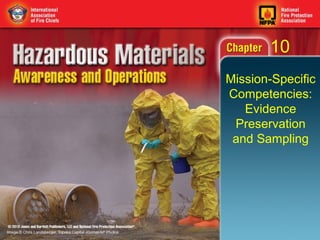
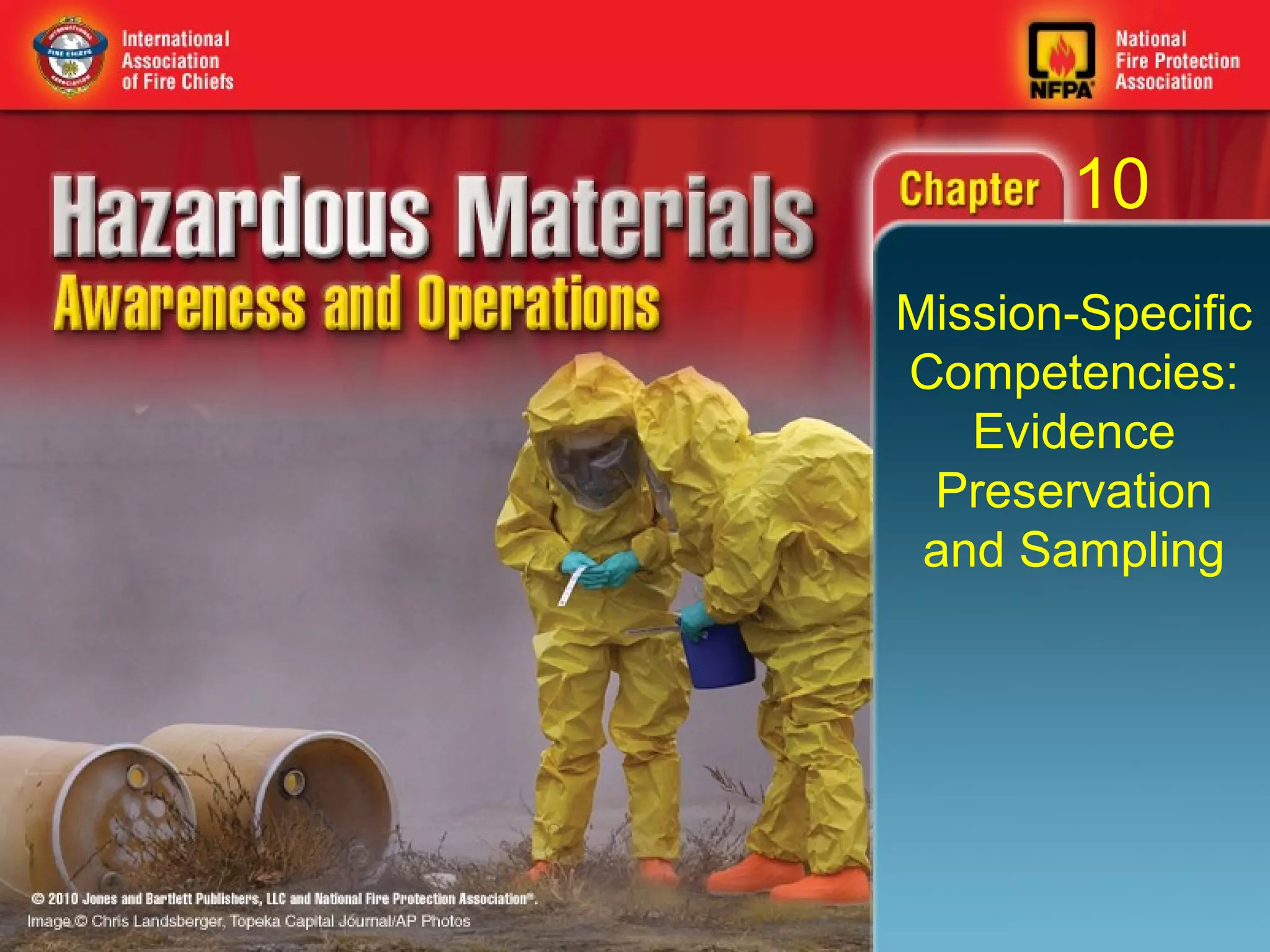
Mission-Specific
Competencies:
   Evidence
 Preservation
 and Sampling
10

             Objectives (1 of 3)
• Understand the role that all first
  responders have in preserving evidence
• Identify when a hazardous material/WMD
  incident could be a violation of criminal law
• Identify the law enforcement agencies that
  could be involved in an investigation
10

            Objectives (2 of 3)
• Describe the various types of evidence
  including physical and trace evidence
• Understand the difference between
  evidence preservation and sampling
• Describe the chain-of-custody and its
  importance
10

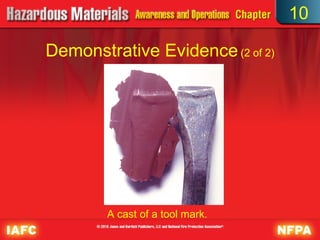
            Objectives (3 of 3)
• Understand how witnesses are identified
• Describe the key concepts to be taken into
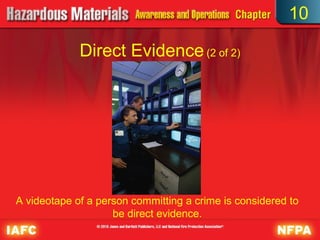
  consideration when analyzing, planning,
  and implementing an evidence
  preservation and sampling response
10

             Evidence (1 of 2)
• Information gathered to help determine
  cause of incident
• Forensic evidence is used in legal process
• Strict procedures must be followed
10

              Evidence (2 of 2)
• Important for identifying person(s)
  responsible for event
• Evidence preservation should never
  impede:
  – Fire suppression
  – Life-saving operations
10
General Indicators That a Crime Is
             Involved
• Anonymous threats before incident
• Nearby notes or graffiti claiming
  responsibility
• Suspicious activity on scene
10

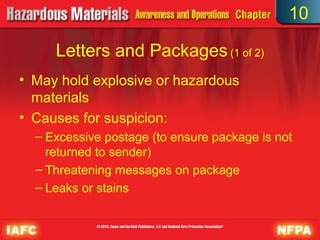
     Letters and Packages (1 of 2)
• May hold explosive or hazardous
  materials
• Causes for suspicion:
  – Excessive postage (to ensure package is not
    returned to sender)
  – Threatening messages on package
  – Leaks or stains
10

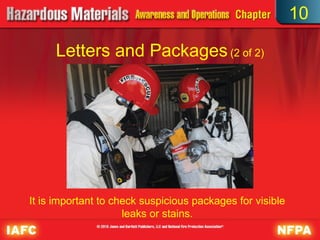
     Letters and Packages (2 of 2)


It is important to check suspicious packages for visible
                     leaks or stains.
10

       Illicit Laboratories (1 of 2)
• Produce methamphetamine and other
  drugs
• Construct explosive devices
• Manufacture chemical agents
• Culture biological agents
10

        Illicit Laboratories (2 of 2)
• Causes for suspicion:
  – Fences
  – Excessive window coverings
  – Enhanced ventilation/filtration systems
  – Chemical storage cylinders
  – Lab equipment
10

     Environmental Crimes (1 of 3)
• Intentional release or disposal of
  hazardous materials
  – Air
  – Ground
  – Water systems
10

     Environmental Crimes (2 of 3)
• Causes for suspicion:
  – Containers discarded at site
  – Staining or odors near street drainage
    systems
  – Dead or dying plants, insects, animals nearby
10

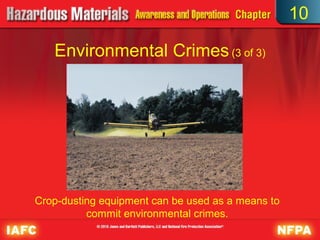
   Environmental Crimes (3 of 3)


Crop-dusting equipment can be used as a means to
          commit environmental crimes.
10

     If No Crime Was Committed
• Evidence collection is still important
• Basis for lawsuits victims may file
10

   Investigative Jurisdictions (1 of 2)
• Criminal investigations start with Authority
  Having Jurisdiction (AHJ)
• It determines who has investigative
  authority
• Multiagency task forces may be formed
10

   Investigative Jurisdictions (2 of 2)
• Agencies that may be involved:
  – Postal Inspection Service
  – Drug Enforcement Administration
  – Federal Bureau of Investigation
  – Environmental Protection Agency
10

            Types of Evidence
•   Physical evidence
•   Trace (transfer) evidence
•   Demonstrative evidence
•   Direct evidence
•   Circumstantial evidence
10

         Physical Evidence (1 of 2)
•   Observed
•   Photographed
•   Measured
•   Collected
•   Examined in a laboratory
•   Presented in court
10

Physical Evidence (2 of 2)


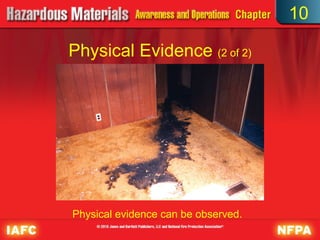
Physical evidence can be observed.
10

   Trace (Transfer) Evidence (1 of 2)
• Minute quantity of physical evidence
• Conveyed from one place to another
10

      Trace (Transfer) Evidence (2 of 2)


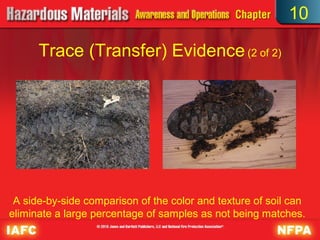
 A side-by-side comparison of the color and texture of soil can
eliminate a large percentage of samples as not being matches.
10

    Demonstrative Evidence (1 of 2)
• Used to validate a theory
• To show how something could have
  occurred
• Example: Cast of tool mark found at scene
10

Demonstrative Evidence (2 of 2)


        A cast of a tool mark.
10

           Direct Evidence (1 of 2)
•   Facts observed or reported firsthand
•   Statements
•   Videotape
•   Can include physical evidence
10

             Direct Evidence (2 of 2)


A videotape of a person committing a crime is considered to
                    be direct evidence.
10

       Circumstantial Evidence
• Based on facts observed firsthand
• Can be used to prove a theory
• Common at fire scenes
10

        Evidence Preservation
• Process of protecting potential evidence
• Until it can be documented, sampled,
  collected
• Responders should leave it in place
• Move no more debris than necessary
• Cover to protect if necessary
10

             Contamination
• Evidence should not be contaminated
• Use new tools to collect each piece of
  evidence
• Investigators use special containers to
  store evidence
10

        Chain of Custody (1 of 3)
• Other terms
  – Chain of evidence
  – Chain of possession
• Continuous possession and control of
  evidence
• From discovery until presented in court
10

        Chain of Custody (2 of 3)
• Every transfer of possession must be
  documented
• Leave evidence where you find it
• Report to a senior official
10

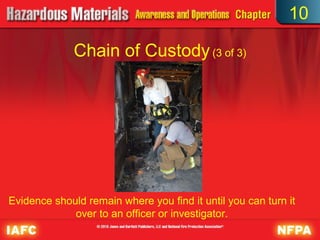
              Chain of Custody (3 of 3)


Evidence should remain where you find it until you can turn it
             over to an officer or investigator.
10

         Identifying Witnesses
• Interviews conducted by:
  – Incident investigator
  – Law enforcement officer
• If neither is present:
  – Get witness’s name, address, phone number
  – Give to investigator
10

        Rumors and Reporters
• State opinions on probable cause only to
  investigator
  – Rumors circulate easily
• Statements to reporters are made by
  official spokesperson
  – After investigator and IC agree on accuracy
10
  12 Steps of Evidence Sampling
                    (1 of 2)
1. Preparation
2. Approach the scene
3. Secure and protect the scene
4. Initiate a preliminary survey
5. Evaluate physical evidence possibilities
6. Prepare a narrative description
10
  12 Steps of Evidence Sampling
                   (2 of 2)
7. Describe the scene photographically
8. Prepare a diagram or sketch of the scene
9. Conduct a detailed search
10. Record and collect physical evidence
11. Conduct the final survey
12. Release the scene
10

            Sampling Team
• Consists of three people
  – Sampler
  – Assistant
  – Documenter
10
   Securing, Characterizing, and
      Preserving the Scene
• Necessary as soon as incident identified
  as criminal
• Limit access
• Early characterization of the scene
• Preserve evidence
• Notify law enforcement agency
10
  Document Personnel and Scene
            Activity
• Document identity/purpose of personnel
  – Present when you arrive
  – Who enter after crime scene is so
    characterized
• “Tag in/tag out” records work
• Record initial on-scene observations
10

              Notification
• Explosive ordnance disposal (EOD)
  personnel
• Law enforcement agency having
  jurisdiction
10

Identifying Samples to Be Collected
• Indicate where evidence is located
• Colored cones or tape
• Nondestructive markings or identification
10

          Collecting Samples
• Collecting all potential evidence may be
  too much
• Use various sampling techniques
• Nondestructive field screening methods
• Prevent secondary contamination
10

     Documentation of Evidence
• Document sampling/collection process
  – Photographs
  – Videotape
• Note name of person sampling
• Note location, time sample was collected
• Note physical state, quantity, container
10
   Sampling and Field Screening
             Protocol
• Plan must be followed
• Ensure that evidence is safe before it
  enters laboratory
10
      Labeling, Packaging, and
         Decontamination
• Place in appropriate container
• Label as to type of hazard
• Perform technical decontamination
10

             Summary (1 of 2)
• Responders need to consider calls they
  respond to might be the result of criminal
  activities
• Local law enforcement must be notified
• Preserve, sample, and collect evidence so
  that it can be used in prosecution
10

             Summary (2 of 2)
• Types of evidence are physical, trace,
  demonstrative, direct, and circumstantial
  evidence
• Sampling, preservation, and
  documentation must be given due
  attention

HazMat Ch10

  • 1.
    10 Mission-Specific Competencies: Evidence Preservation and Sampling
  • 2.
    10 Objectives (1 of 3) • Understand the role that all first responders have in preserving evidence • Identify when a hazardous material/WMD incident could be a violation of criminal law • Identify the law enforcement agencies that could be involved in an investigation
  • 3.
    10 Objectives (2 of 3) • Describe the various types of evidence including physical and trace evidence • Understand the difference between evidence preservation and sampling • Describe the chain-of-custody and its importance
  • 4.
    10 Objectives (3 of 3) • Understand how witnesses are identified • Describe the key concepts to be taken into consideration when analyzing, planning, and implementing an evidence preservation and sampling response
  • 5.
    10 Evidence (1 of 2) • Information gathered to help determine cause of incident • Forensic evidence is used in legal process • Strict procedures must be followed
  • 6.
    10 Evidence (2 of 2) • Important for identifying person(s) responsible for event • Evidence preservation should never impede: – Fire suppression – Life-saving operations
  • 7.
    10 General Indicators Thata Crime Is Involved • Anonymous threats before incident • Nearby notes or graffiti claiming responsibility • Suspicious activity on scene
  • 8.
    10 Letters and Packages (1 of 2) • May hold explosive or hazardous materials • Causes for suspicion: – Excessive postage (to ensure package is not returned to sender) – Threatening messages on package – Leaks or stains
  • 9.
    10 Letters and Packages (2 of 2) It is important to check suspicious packages for visible leaks or stains.
  • 10.
    10 Illicit Laboratories (1 of 2) • Produce methamphetamine and other drugs • Construct explosive devices • Manufacture chemical agents • Culture biological agents
  • 11.
    10 Illicit Laboratories (2 of 2) • Causes for suspicion: – Fences – Excessive window coverings – Enhanced ventilation/filtration systems – Chemical storage cylinders – Lab equipment
  • 12.
    10 Environmental Crimes (1 of 3) • Intentional release or disposal of hazardous materials – Air – Ground – Water systems
  • 13.
    10 Environmental Crimes (2 of 3) • Causes for suspicion: – Containers discarded at site – Staining or odors near street drainage systems – Dead or dying plants, insects, animals nearby
  • 14.
    10 Environmental Crimes (3 of 3) Crop-dusting equipment can be used as a means to commit environmental crimes.
  • 15.
    10 If No Crime Was Committed • Evidence collection is still important • Basis for lawsuits victims may file
  • 16.
    10 Investigative Jurisdictions (1 of 2) • Criminal investigations start with Authority Having Jurisdiction (AHJ) • It determines who has investigative authority • Multiagency task forces may be formed
  • 17.
    10 Investigative Jurisdictions (2 of 2) • Agencies that may be involved: – Postal Inspection Service – Drug Enforcement Administration – Federal Bureau of Investigation – Environmental Protection Agency
  • 18.
    10 Types of Evidence • Physical evidence • Trace (transfer) evidence • Demonstrative evidence • Direct evidence • Circumstantial evidence
  • 19.
    10 Physical Evidence (1 of 2) • Observed • Photographed • Measured • Collected • Examined in a laboratory • Presented in court
  • 20.
    10 Physical Evidence (2of 2) Physical evidence can be observed.
  • 21.
    10 Trace (Transfer) Evidence (1 of 2) • Minute quantity of physical evidence • Conveyed from one place to another
  • 22.
    10 Trace (Transfer) Evidence (2 of 2) A side-by-side comparison of the color and texture of soil can eliminate a large percentage of samples as not being matches.
  • 23.
    10 Demonstrative Evidence (1 of 2) • Used to validate a theory • To show how something could have occurred • Example: Cast of tool mark found at scene
  • 24.
    10 Demonstrative Evidence (2of 2) A cast of a tool mark.
  • 25.
    10 Direct Evidence (1 of 2) • Facts observed or reported firsthand • Statements • Videotape • Can include physical evidence
  • 26.
    10 Direct Evidence (2 of 2) A videotape of a person committing a crime is considered to be direct evidence.
  • 27.
    10 Circumstantial Evidence • Based on facts observed firsthand • Can be used to prove a theory • Common at fire scenes
  • 28.
    10 Evidence Preservation • Process of protecting potential evidence • Until it can be documented, sampled, collected • Responders should leave it in place • Move no more debris than necessary • Cover to protect if necessary
  • 29.
    10 Contamination • Evidence should not be contaminated • Use new tools to collect each piece of evidence • Investigators use special containers to store evidence
  • 30.
    10 Chain of Custody (1 of 3) • Other terms – Chain of evidence – Chain of possession • Continuous possession and control of evidence • From discovery until presented in court
  • 31.
    10 Chain of Custody (2 of 3) • Every transfer of possession must be documented • Leave evidence where you find it • Report to a senior official
  • 32.
    10 Chain of Custody (3 of 3) Evidence should remain where you find it until you can turn it over to an officer or investigator.
  • 33.
    10 Identifying Witnesses • Interviews conducted by: – Incident investigator – Law enforcement officer • If neither is present: – Get witness’s name, address, phone number – Give to investigator
  • 34.
    10 Rumors and Reporters • State opinions on probable cause only to investigator – Rumors circulate easily • Statements to reporters are made by official spokesperson – After investigator and IC agree on accuracy
  • 35.
    10 12Steps of Evidence Sampling (1 of 2) 1. Preparation 2. Approach the scene 3. Secure and protect the scene 4. Initiate a preliminary survey 5. Evaluate physical evidence possibilities 6. Prepare a narrative description
  • 36.
    10 12Steps of Evidence Sampling (2 of 2) 7. Describe the scene photographically 8. Prepare a diagram or sketch of the scene 9. Conduct a detailed search 10. Record and collect physical evidence 11. Conduct the final survey 12. Release the scene
  • 37.
    10 Sampling Team • Consists of three people – Sampler – Assistant – Documenter
  • 38.
    10 Securing, Characterizing, and Preserving the Scene • Necessary as soon as incident identified as criminal • Limit access • Early characterization of the scene • Preserve evidence • Notify law enforcement agency
  • 39.
    10 DocumentPersonnel and Scene Activity • Document identity/purpose of personnel – Present when you arrive – Who enter after crime scene is so characterized • “Tag in/tag out” records work • Record initial on-scene observations
  • 40.
    10 Notification • Explosive ordnance disposal (EOD) personnel • Law enforcement agency having jurisdiction
  • 41.
    10 Identifying Samples toBe Collected • Indicate where evidence is located • Colored cones or tape • Nondestructive markings or identification
  • 42.
    10 Collecting Samples • Collecting all potential evidence may be too much • Use various sampling techniques • Nondestructive field screening methods • Prevent secondary contamination
  • 43.
    10 Documentation of Evidence • Document sampling/collection process – Photographs – Videotape • Note name of person sampling • Note location, time sample was collected • Note physical state, quantity, container
  • 44.
    10 Sampling and Field Screening Protocol • Plan must be followed • Ensure that evidence is safe before it enters laboratory
  • 45.
    10 Labeling, Packaging, and Decontamination • Place in appropriate container • Label as to type of hazard • Perform technical decontamination
  • 46.
    10 Summary (1 of 2) • Responders need to consider calls they respond to might be the result of criminal activities • Local law enforcement must be notified • Preserve, sample, and collect evidence so that it can be used in prosecution
  • 47.
    10 Summary (2 of 2) • Types of evidence are physical, trace, demonstrative, direct, and circumstantial evidence • Sampling, preservation, and documentation must be given due attention

Editor's Notes

  • #10 Image: Photographed by Glen E. Ellman.
  • #15 Image: Courtesy of Tim McCabe/USDA
  • #21 Image: Courtesy of Unified Investigations & Sciences, Inc.
  • #25 Image: Courtesy of Sirchie Finger Print Labs, Inc.
  • #27 Image: © Corbis