Cloning Vectors
Introduction
In molecular cloning, a vector is a DNA molecule used as a
vehicle to artificially carry foreign genetic material into another
cell, where it can be replicated and/or expressed
Cloning vectors share three important features:
i. An origin of replication
ii. A region of DNA that bears unique restriction sites, called a
multicloning site (MCS) or polylinker
iii. A selectable marker
The different types of vectors available for cloning are plasmids,
phage vectors, cosmids and artificial chromosomes
1- Plasmids
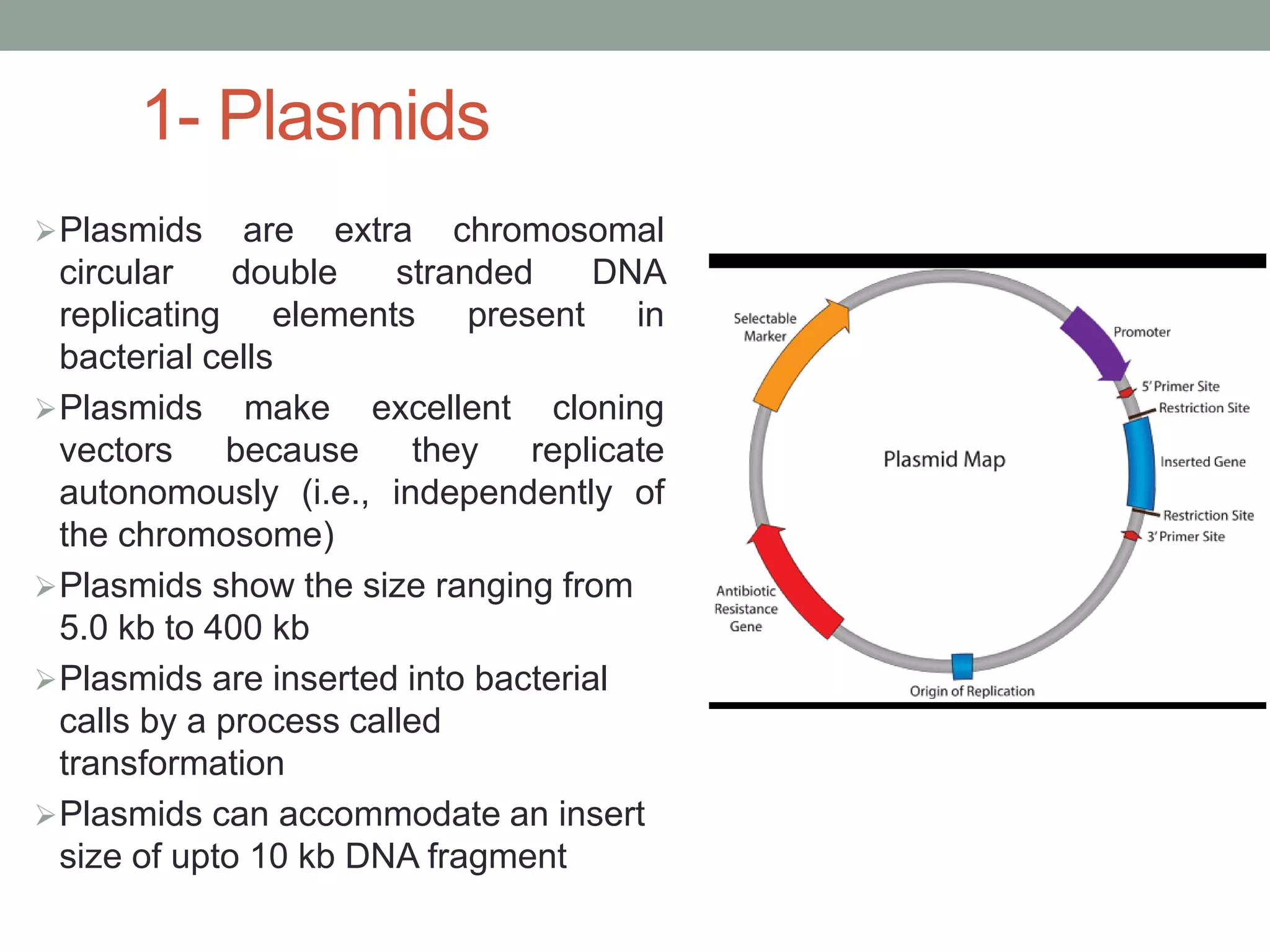
Plasmids are extra chromosomal
circular double stranded DNA
replicating elements present in
bacterial cells
Plasmids make excellent cloning
vectors because they replicate
autonomously (i.e., independently of
the chromosome)
Plasmids show the size ranging from
5.0 kb to 400 kb
Plasmids are inserted into bacterial
calls by a process called
transformation
Plasmids can accommodate an insert
size of upto 10 kb DNA fragment
Origin of Replication
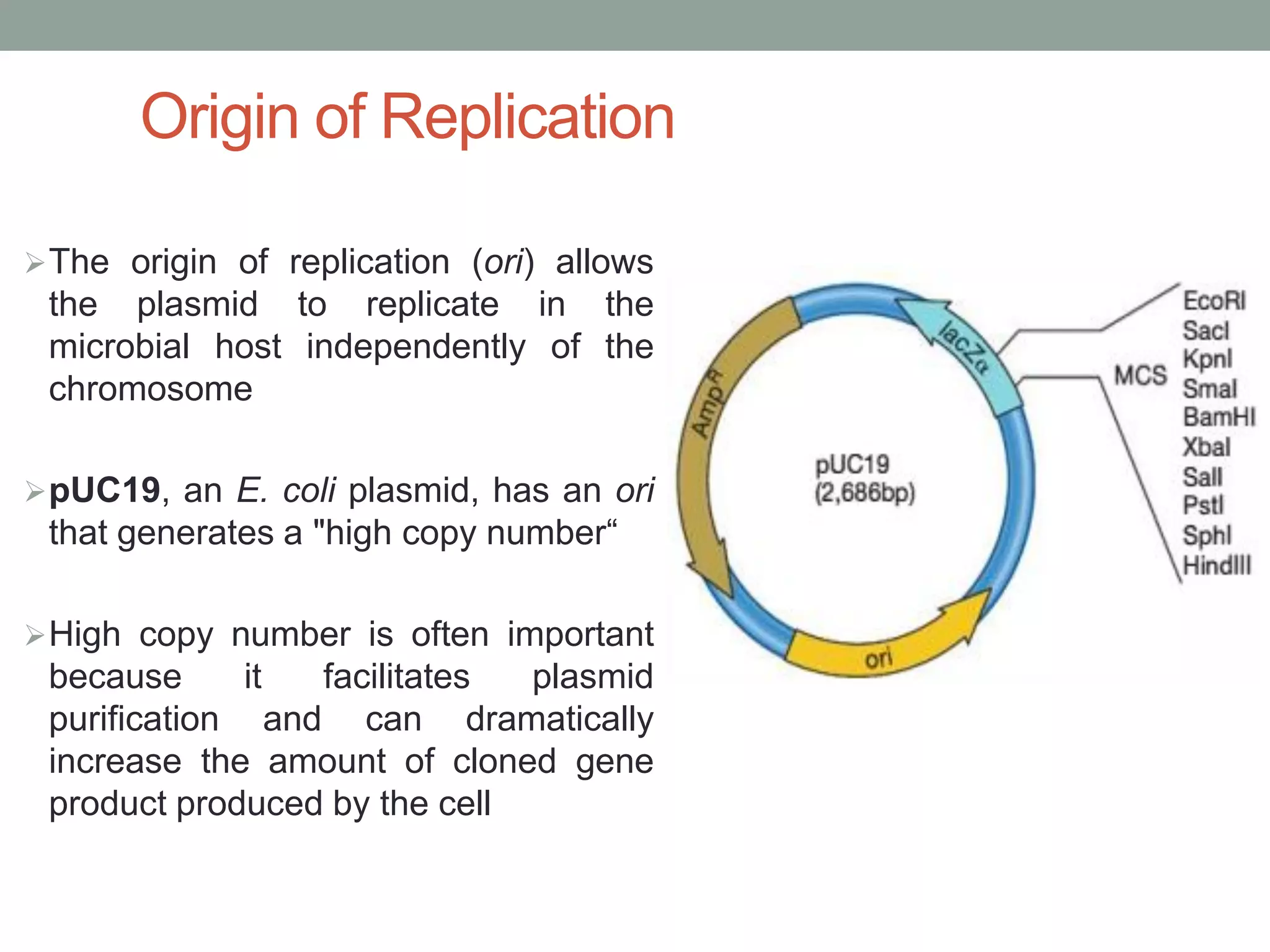
The origin of replication (ori) allows
the plasmid to replicate in the
microbial host independently of the
chromosome
pUC19, an E. coli plasmid, has an ori
that generates a "high copy number“
High copy number is often important
because it facilitates plasmid
purification and can dramatically
increase the amount of cloned gene
product produced by the cell
Some plasmids have two origins of
replication, each recognized by different
host organisms. These plasmids are called
shuttle vectors because they can move, or
"shuttle," from one host to another
YEp24 is a shuttle vector that can
replicate in yeast (Saccharomyces
cerevisiae) and in E. coli because it has
the 2μl circle yeast replication element and
the E. coli origin of replication
Selectable Marker
The uptake of vector by host cells, it is
necessary to discriminate between cells that
successfully obtained vector (transformants)
from those that did not (nontransformants)
Selective conditions for the presence of
plasmid must be maintained, otherwise the
host cell may stop replicating it
This is achieved by the presence of a gene
that encodes a protein that is needed for the
cell to survive under certain, selective
conditions. Such a gene is called a
selectable marker
In pUC19, the selectable marker encodes the ampicillin-
resistance enzyme (ampR, sometimes called bla, for β-
lactamase)
The shuttle vector YEp24 bears both the ampR gene for selection
in E. coli and URA3, which encodes a protein essential for uracil
biosynthesis in yeast
Therefore this plasmid will only be maintained by strains of S.
cerevisiae that are uracil auxotrophs
Selectable Marker
Multicloning Site or Polylinker
 To clone a fragment of DNA into a plasmid, both the fragment and plasmid
are cut with the same restriction enzyme so that compatible sticky ends
are generated
 It is essential that these restriction enzymes cut at only one place in the
plasmid
 Cleavage at a unique restriction site generates a linear plasmid
 Alternatively, two different, unique sites may be cleaved and the DNA
sequence between the two sites replaced with cloned DNA
 Plasmids used for cloning have been designed with many unique
restriction sites clustered in a single region called the multicloning site
(MCS)
2- Phage Vectors
Consist of an essentially complete phage genome
Once DNA has been inserted, the recombinant phage genome
is packaged into viral capsids and used to infect host cells
The resulting phage lysate consists of thousands of phage
particles that carry cloned DNA as well as the genes needed
for host lysis
Two commonly used vectors are derived from the E. coli
bacteriophages T7 and lambda (λ), both of which have double-
stranded DNA genomes
Phage vectors have been engineered for a number of different
bacterial host species
3- Cosmids
Cosmids can maintain fragments of cloned
DNA that are too large for plasmids and
phage vectors
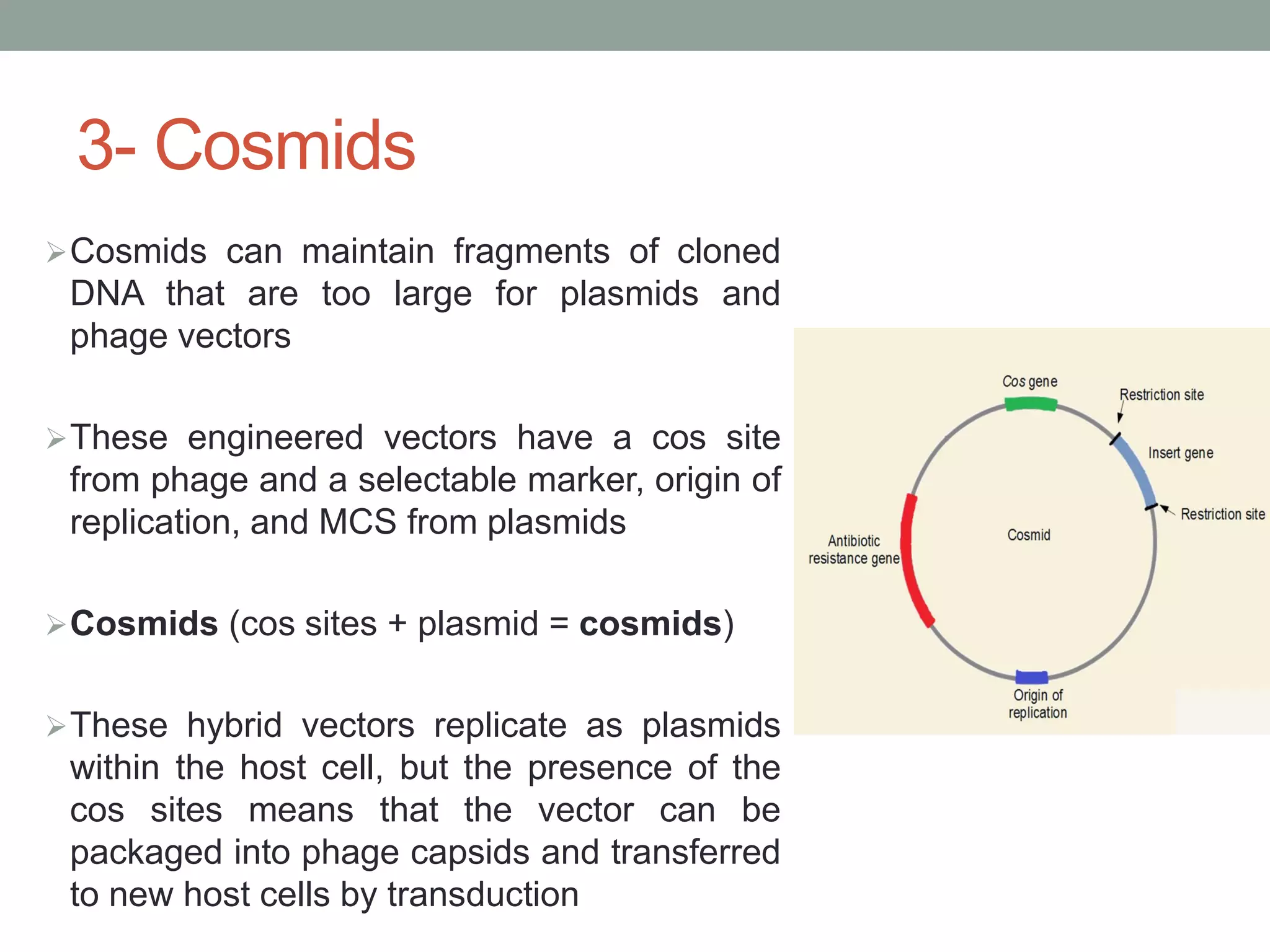
These engineered vectors have a cos site
from phage and a selectable marker, origin of
replication, and MCS from plasmids
Cosmids (cos sites + plasmid = cosmids)
These hybrid vectors replicate as plasmids
within the host cell, but the presence of the
cos sites means that the vector can be
packaged into phage capsids and transferred
to new host cells by transduction
4- Artifcial Chromosomes
Artificial chromosomes are special cloning vectors used when
particularly large fragments of DNA must be cloned, as when
constructing a genomic library or sequencing an organism's
entire genome
Artifcial chromosomes further divided into two
I. Bacterial artificial chromosomes (BACs)
II. Yeast artifcial chromosomes (YACs)
• Bacterial artificial chromosomes (BACs) were crucial to the
timely completion of the human genome project and the
construction of a synthetic genome
• Yeast artifcial chromosomes (YACs) were developed first and
consist of a yeast telomere (TEL) at each end, a centromere
sequence (CEN), a yeast origin of replication (ARS,
autonomously replicating sequence), a selectable marker such
as URA3, and an MCS to facilitate the insertion of foreign DNA
YACs are used when extraordinarily large DNA pieces (up to
1,000 kb) are to be cloned
BACs were developed, in part, because YACs tend to be
unstable and may recombine with host chromosomes, causing
mutations and rearrangement of the cloned DNA
Although BACs accept smaller DNA inserts than do YACs (up
to 300 kb), they are generally more stable
DNA Cloning Vectors

Cloning Vectors.pdf

  • 1.
  • 2.
    Introduction In molecular cloning,a vector is a DNA molecule used as a vehicle to artificially carry foreign genetic material into another cell, where it can be replicated and/or expressed Cloning vectors share three important features: i. An origin of replication ii. A region of DNA that bears unique restriction sites, called a multicloning site (MCS) or polylinker iii. A selectable marker The different types of vectors available for cloning are plasmids, phage vectors, cosmids and artificial chromosomes
  • 3.
    1- Plasmids Plasmids areextra chromosomal circular double stranded DNA replicating elements present in bacterial cells Plasmids make excellent cloning vectors because they replicate autonomously (i.e., independently of the chromosome) Plasmids show the size ranging from 5.0 kb to 400 kb Plasmids are inserted into bacterial calls by a process called transformation Plasmids can accommodate an insert size of upto 10 kb DNA fragment
  • 4.
    Origin of Replication Theorigin of replication (ori) allows the plasmid to replicate in the microbial host independently of the chromosome pUC19, an E. coli plasmid, has an ori that generates a "high copy number“ High copy number is often important because it facilitates plasmid purification and can dramatically increase the amount of cloned gene product produced by the cell
  • 5.
    Some plasmids havetwo origins of replication, each recognized by different host organisms. These plasmids are called shuttle vectors because they can move, or "shuttle," from one host to another YEp24 is a shuttle vector that can replicate in yeast (Saccharomyces cerevisiae) and in E. coli because it has the 2μl circle yeast replication element and the E. coli origin of replication
  • 6.
    Selectable Marker The uptakeof vector by host cells, it is necessary to discriminate between cells that successfully obtained vector (transformants) from those that did not (nontransformants) Selective conditions for the presence of plasmid must be maintained, otherwise the host cell may stop replicating it This is achieved by the presence of a gene that encodes a protein that is needed for the cell to survive under certain, selective conditions. Such a gene is called a selectable marker
  • 7.
    In pUC19, theselectable marker encodes the ampicillin- resistance enzyme (ampR, sometimes called bla, for β- lactamase) The shuttle vector YEp24 bears both the ampR gene for selection in E. coli and URA3, which encodes a protein essential for uracil biosynthesis in yeast Therefore this plasmid will only be maintained by strains of S. cerevisiae that are uracil auxotrophs Selectable Marker
  • 8.
    Multicloning Site orPolylinker  To clone a fragment of DNA into a plasmid, both the fragment and plasmid are cut with the same restriction enzyme so that compatible sticky ends are generated  It is essential that these restriction enzymes cut at only one place in the plasmid  Cleavage at a unique restriction site generates a linear plasmid  Alternatively, two different, unique sites may be cleaved and the DNA sequence between the two sites replaced with cloned DNA  Plasmids used for cloning have been designed with many unique restriction sites clustered in a single region called the multicloning site (MCS)
  • 9.
    2- Phage Vectors Consistof an essentially complete phage genome Once DNA has been inserted, the recombinant phage genome is packaged into viral capsids and used to infect host cells The resulting phage lysate consists of thousands of phage particles that carry cloned DNA as well as the genes needed for host lysis Two commonly used vectors are derived from the E. coli bacteriophages T7 and lambda (λ), both of which have double- stranded DNA genomes Phage vectors have been engineered for a number of different bacterial host species
  • 10.
    3- Cosmids Cosmids canmaintain fragments of cloned DNA that are too large for plasmids and phage vectors These engineered vectors have a cos site from phage and a selectable marker, origin of replication, and MCS from plasmids Cosmids (cos sites + plasmid = cosmids) These hybrid vectors replicate as plasmids within the host cell, but the presence of the cos sites means that the vector can be packaged into phage capsids and transferred to new host cells by transduction
  • 11.
    4- Artifcial Chromosomes Artificialchromosomes are special cloning vectors used when particularly large fragments of DNA must be cloned, as when constructing a genomic library or sequencing an organism's entire genome Artifcial chromosomes further divided into two I. Bacterial artificial chromosomes (BACs) II. Yeast artifcial chromosomes (YACs)
  • 12.
    • Bacterial artificialchromosomes (BACs) were crucial to the timely completion of the human genome project and the construction of a synthetic genome • Yeast artifcial chromosomes (YACs) were developed first and consist of a yeast telomere (TEL) at each end, a centromere sequence (CEN), a yeast origin of replication (ARS, autonomously replicating sequence), a selectable marker such as URA3, and an MCS to facilitate the insertion of foreign DNA
  • 13.
    YACs are usedwhen extraordinarily large DNA pieces (up to 1,000 kb) are to be cloned BACs were developed, in part, because YACs tend to be unstable and may recombine with host chromosomes, causing mutations and rearrangement of the cloned DNA Although BACs accept smaller DNA inserts than do YACs (up to 300 kb), they are generally more stable
  • 14.