cloning vector
Step 3-Splice (or ligate) DNA into a cloning vector to create a
recombinant DNA molecule
Six different types of cloning vectors:
1. Plasmid cloning vectors
2. Phage  cloning vectors
3. Cosmid cloning vectors
4. Shuttle vectors
5. Yeast artificial chromosomes (YACs)
6. Bacterial artificial chromosomes (BACs)
Genetics from mendale to microchip array
Plasmid Cloning Vectors:
✓ Bacterial plasmids, naturally occurring, circular double-stranded
extrachromosomal DNA elements capable of replicating autonomously
within a cell.
✓ Plasmid vectors engineered from bacterial plasmids for use in cloning.
✓ Required features (e.g., E. coli plasmid vectors):
1. Origin sequence (ori) required for replication.
2. Selectable trait that enables E. coli that carry the plasmid to be
separated from E. coli that do not (e.g., antibiotic resistance, grow
cells on antibiotic; only those cells with the anti-biotic resistance
grow in colony).
3. Unique restriction site such that an enzyme cuts the plasmid DNA
only once. A fragment of DNA cut with the same enzyme can then
be inserted into the plasmid restriction site.
4. Simple marker that allows you to distinguish plasmids that contain
inserts from those that do not (e.g., lacZ+ gene)
Genetics from mendale to microchip array
Molecular Genetics
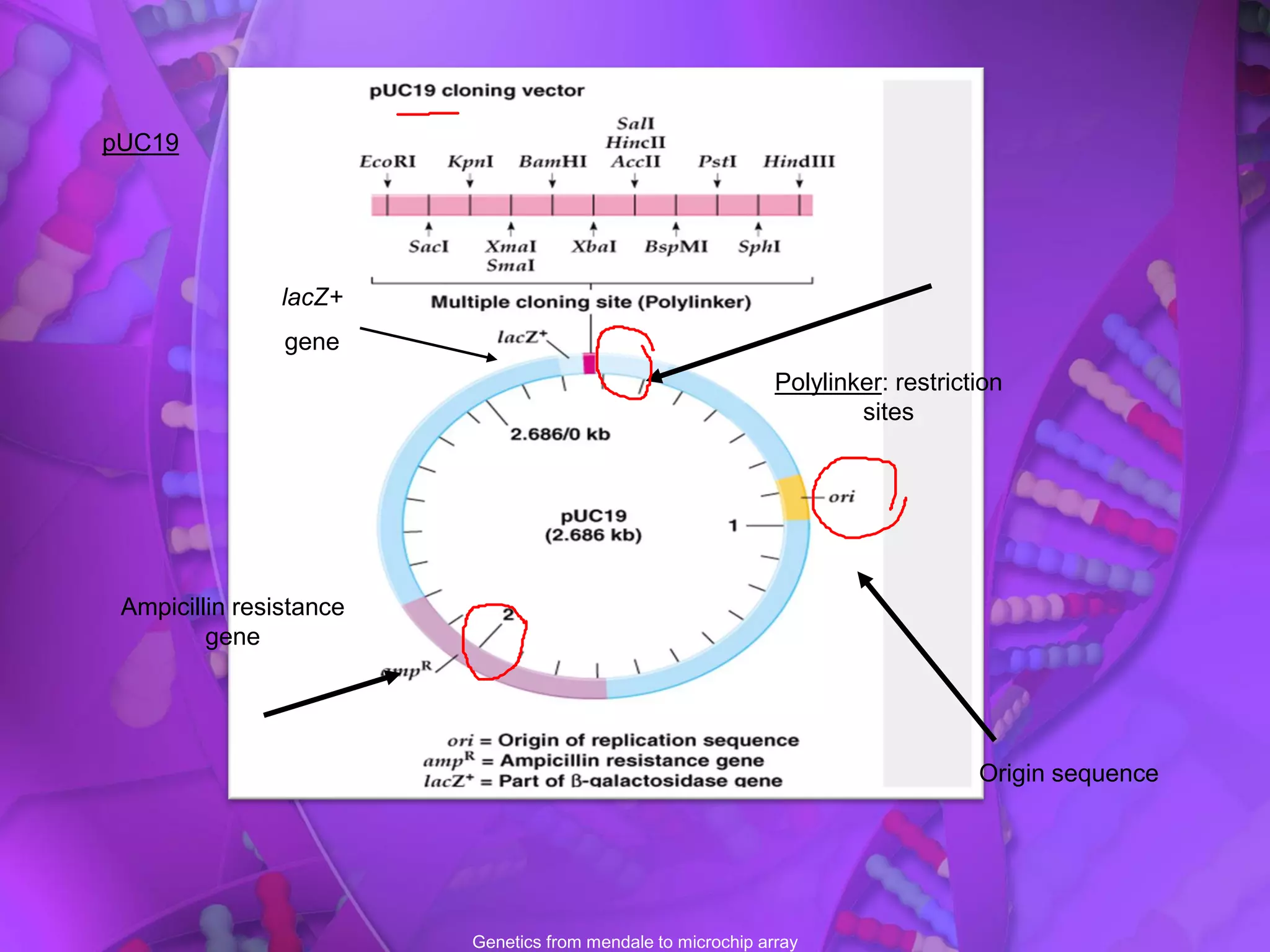
pUC19
Polylinker: restriction
sites
Origin sequence
Ampicillin resistance
gene
lacZ+
gene
Genetics from mendale to microchip array
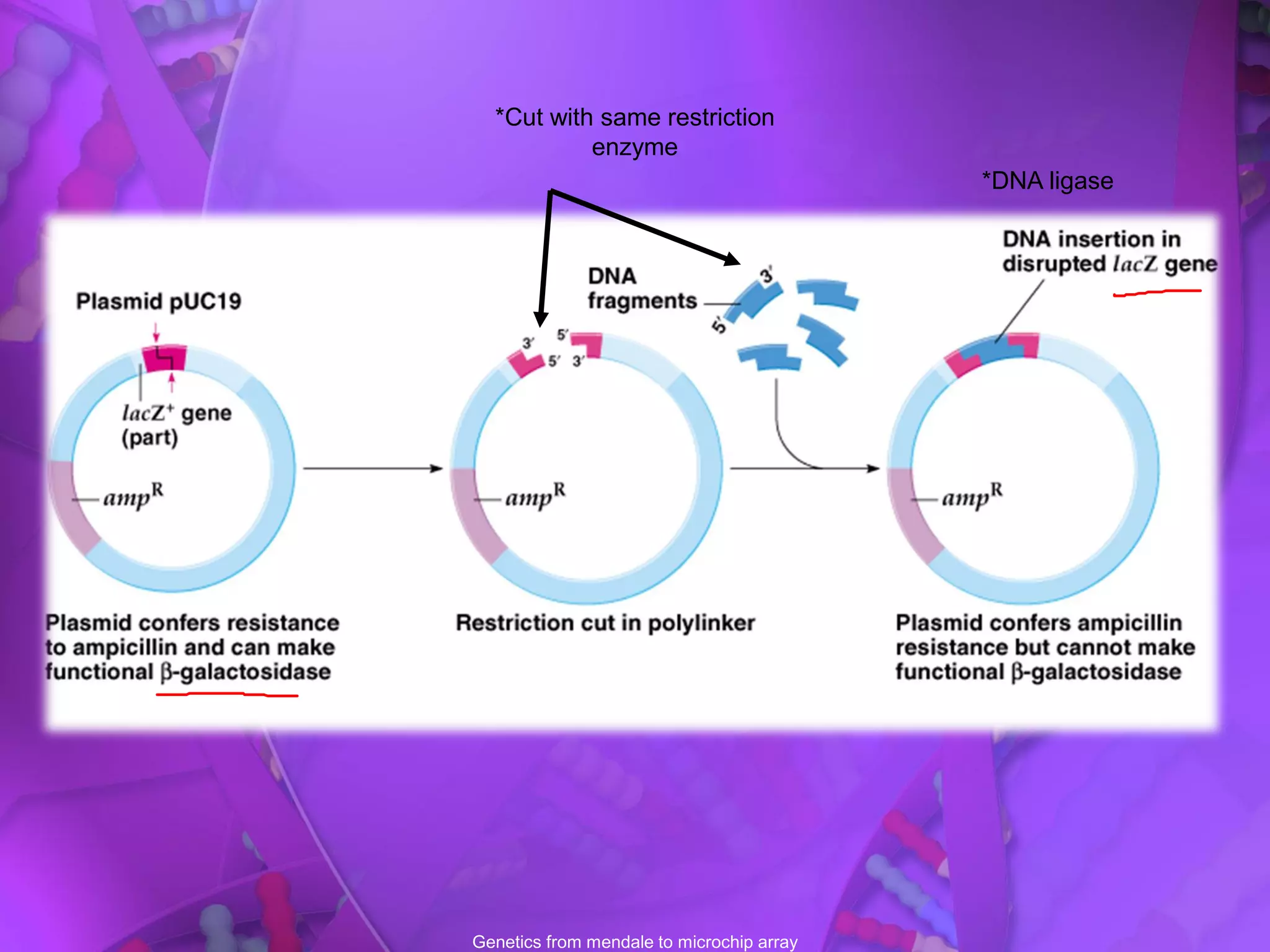
Some features of pUC19:
1. High copy number in E. coli, ~100 copies/cell, provides high yield.
2. Selectable marker is ampR. Ampicillin in growth medium prevents growth of
all other E. coli.
3. Cluster of restriction sites called a polylinker occurs in the lacZ (-
galactosidase) gene.
4. Cloned DNA disrupts reading frame and -galactosidase production.
5. Add X-gal to medium; turns blue in presence of -galactosidase.
6. Plaque growth: blue = no inserted DNA and white = inserted DNA.
7. Some % of digested vectors will reanneal with no insert. Remove 5’
phosphates with alkaline phosphatase to prevent recircularization (this also
eliminates some blue plaques).
8. Plasmids are transformed into E. coli by chemical incubation or
electroporation (electrical shock disrupts the cell membrane).
9. Cloned inserts >5-10 kb typically are unstable; good for <10kb.
Genetics from mendale to microchip array
Molecular Genetics
*Cut with same restriction
enzyme
*DNA ligase
Genetics from mendale to microchip array
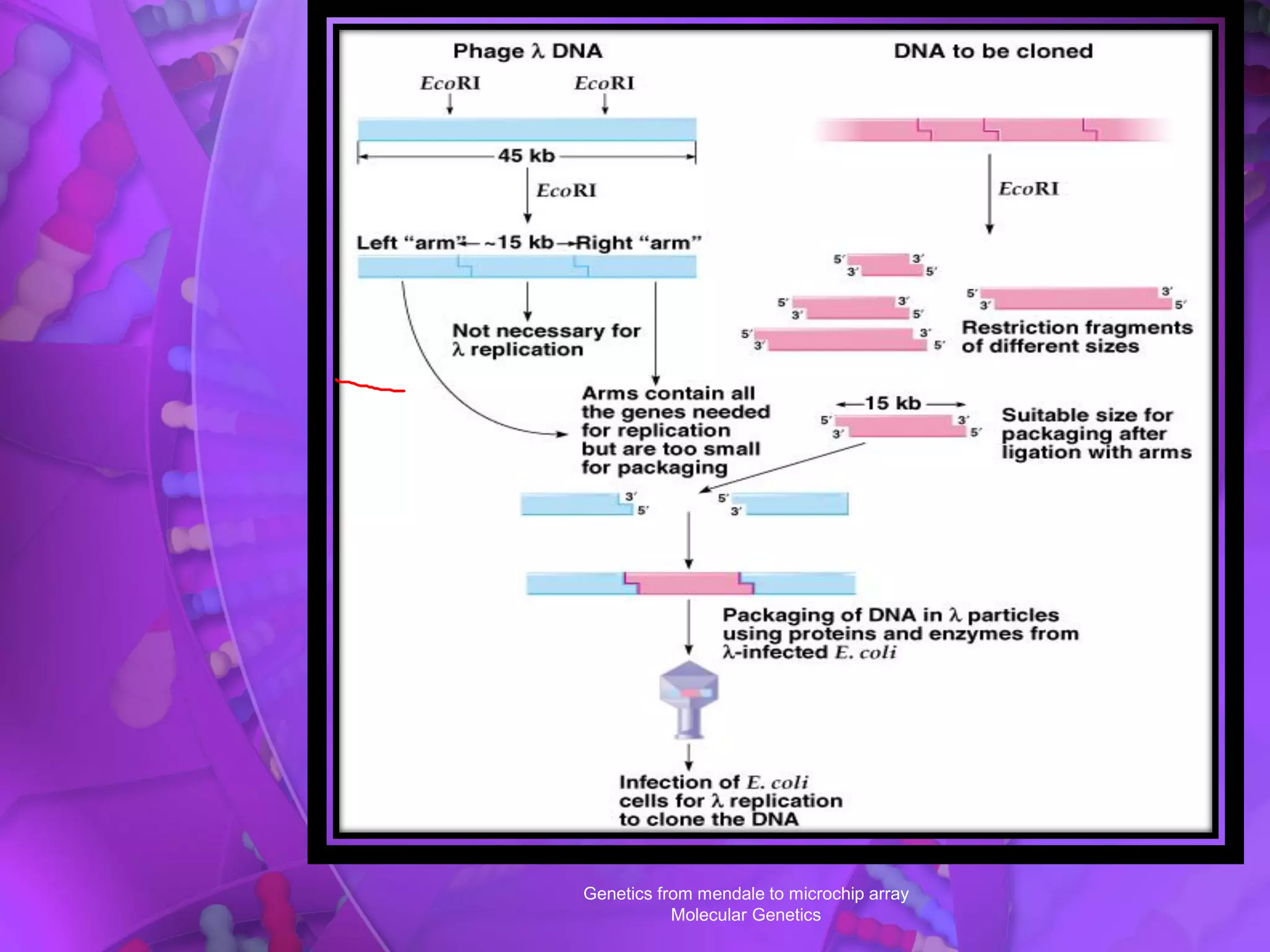
Phage  cloning vectors:
1. Engineered version of bacteriophage  (infects E. coli).
2. Central region of the  chromosome (linear) is cut with a restriction
enzyme and digested DNA is inserted.
3. DNA is packaged in phage heads to form virus particles.
4. Phages with both ends of the  chormosome and a 37-52 kb insert
replicate by infecting E. coli.
5. Phages replicate using E. coli and the lytic cycle (see Fig. 3.13).
6. Produces large quantities of 37-52 kb cloned DNA.
7. Like plasmid vectors, large number of restriction sites available; useful
for larger DNA fragments than pUC19.
Genetics from mendale to microchip array
Molecular Genetics
Genetics from mendale to microchip array
Molecular Genetics
Genetics from mendale to microchip array
Molecular Genetics
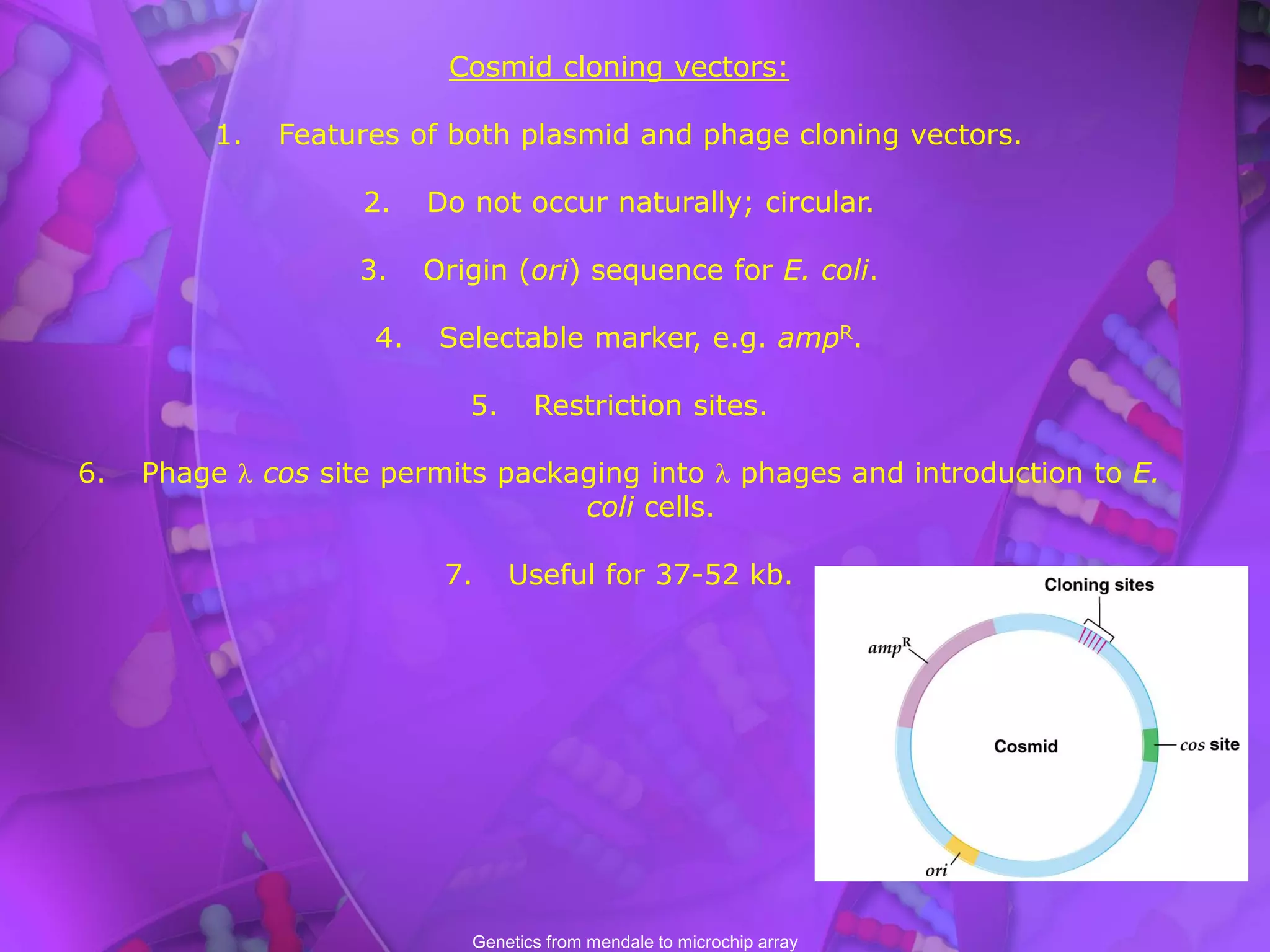
Cosmid cloning vectors:
1. Features of both plasmid and phage cloning vectors.
2. Do not occur naturally; circular.
3. Origin (ori) sequence for E. coli.
4. Selectable marker, e.g. ampR.
5. Restriction sites.
6. Phage  cos site permits packaging into  phages and introduction to E.
coli cells.
7. Useful for 37-52 kb.
Genetics from mendale to microchip array
Shuttle vectors:
1. Capable of replicating in two or more types of hosts..
2. Replicate autonomously, or integrate into the host genome and replicate
when the host replicates.
3. Commonly used for transporting genes from one organism to another
(i.e., transforming animal and plant cells).
Example:
*Insert firefly luciferase gene
into plasmid and transform Agrobacterium.
*Grow Agrobacterium in large quantities and infect
tobacco plant.
Genetics from mendale to microchip array
Molecular Genetics
Yeast Artificial Chromosomes (YACs):
Vectors that enable artificial chromosomes to be created and cloned into
yeast.
Features:
1. Yeast telomere at each end.
2. Yeast centromere sequence.
3. Selectable marker (amino acid dependence, etc.) on each arm.
4. Autonomously replicating sequence (ARS) for replication.
5. Restriction sites (for DNA ligation).
6. Useful for cloning very large DNA fragments up to 500 kb; useful for
very large DNA fragments.
Genetics from mendale to microchip array
Molecular Genetics
Bacterial Artificial Chromosomes (BACs):
Vectors that enable artificial chromosomes to be created and cloned into E.
coli.
Features:
1. Useful for cloning up to 200 kb, but can be handled like regular bacterial
plasmid vectors.
2. Useful for sequencing large stretches of chromosomal DNA; frequently
used in genome sequencing projects.
3. Like other vectors, BACs contain:
1. Origin (ori) sequence derived from an E. coli plasmid called the F
factor.
2. Multiple cloning sites (restriction sites).
3. Selectable markers (antibiotic resistance).
Genetics from mendale to microchip array

cloning vectors.pdf

  • 1.
  • 2.
    Step 3-Splice (orligate) DNA into a cloning vector to create a recombinant DNA molecule Six different types of cloning vectors: 1. Plasmid cloning vectors 2. Phage  cloning vectors 3. Cosmid cloning vectors 4. Shuttle vectors 5. Yeast artificial chromosomes (YACs) 6. Bacterial artificial chromosomes (BACs) Genetics from mendale to microchip array
  • 3.
    Plasmid Cloning Vectors: ✓Bacterial plasmids, naturally occurring, circular double-stranded extrachromosomal DNA elements capable of replicating autonomously within a cell. ✓ Plasmid vectors engineered from bacterial plasmids for use in cloning. ✓ Required features (e.g., E. coli plasmid vectors): 1. Origin sequence (ori) required for replication. 2. Selectable trait that enables E. coli that carry the plasmid to be separated from E. coli that do not (e.g., antibiotic resistance, grow cells on antibiotic; only those cells with the anti-biotic resistance grow in colony). 3. Unique restriction site such that an enzyme cuts the plasmid DNA only once. A fragment of DNA cut with the same enzyme can then be inserted into the plasmid restriction site. 4. Simple marker that allows you to distinguish plasmids that contain inserts from those that do not (e.g., lacZ+ gene) Genetics from mendale to microchip array Molecular Genetics
  • 4.
    pUC19 Polylinker: restriction sites Origin sequence Ampicillinresistance gene lacZ+ gene Genetics from mendale to microchip array
  • 5.
    Some features ofpUC19: 1. High copy number in E. coli, ~100 copies/cell, provides high yield. 2. Selectable marker is ampR. Ampicillin in growth medium prevents growth of all other E. coli. 3. Cluster of restriction sites called a polylinker occurs in the lacZ (- galactosidase) gene. 4. Cloned DNA disrupts reading frame and -galactosidase production. 5. Add X-gal to medium; turns blue in presence of -galactosidase. 6. Plaque growth: blue = no inserted DNA and white = inserted DNA. 7. Some % of digested vectors will reanneal with no insert. Remove 5’ phosphates with alkaline phosphatase to prevent recircularization (this also eliminates some blue plaques). 8. Plasmids are transformed into E. coli by chemical incubation or electroporation (electrical shock disrupts the cell membrane). 9. Cloned inserts >5-10 kb typically are unstable; good for <10kb. Genetics from mendale to microchip array Molecular Genetics
  • 6.
    *Cut with samerestriction enzyme *DNA ligase Genetics from mendale to microchip array
  • 7.
    Phage  cloningvectors: 1. Engineered version of bacteriophage  (infects E. coli). 2. Central region of the  chromosome (linear) is cut with a restriction enzyme and digested DNA is inserted. 3. DNA is packaged in phage heads to form virus particles. 4. Phages with both ends of the  chormosome and a 37-52 kb insert replicate by infecting E. coli. 5. Phages replicate using E. coli and the lytic cycle (see Fig. 3.13). 6. Produces large quantities of 37-52 kb cloned DNA. 7. Like plasmid vectors, large number of restriction sites available; useful for larger DNA fragments than pUC19. Genetics from mendale to microchip array Molecular Genetics
  • 8.
    Genetics from mendaleto microchip array Molecular Genetics
  • 9.
    Genetics from mendaleto microchip array Molecular Genetics
  • 10.
    Cosmid cloning vectors: 1.Features of both plasmid and phage cloning vectors. 2. Do not occur naturally; circular. 3. Origin (ori) sequence for E. coli. 4. Selectable marker, e.g. ampR. 5. Restriction sites. 6. Phage  cos site permits packaging into  phages and introduction to E. coli cells. 7. Useful for 37-52 kb. Genetics from mendale to microchip array
  • 11.
    Shuttle vectors: 1. Capableof replicating in two or more types of hosts.. 2. Replicate autonomously, or integrate into the host genome and replicate when the host replicates. 3. Commonly used for transporting genes from one organism to another (i.e., transforming animal and plant cells). Example: *Insert firefly luciferase gene into plasmid and transform Agrobacterium. *Grow Agrobacterium in large quantities and infect tobacco plant. Genetics from mendale to microchip array Molecular Genetics
  • 12.
    Yeast Artificial Chromosomes(YACs): Vectors that enable artificial chromosomes to be created and cloned into yeast. Features: 1. Yeast telomere at each end. 2. Yeast centromere sequence. 3. Selectable marker (amino acid dependence, etc.) on each arm. 4. Autonomously replicating sequence (ARS) for replication. 5. Restriction sites (for DNA ligation). 6. Useful for cloning very large DNA fragments up to 500 kb; useful for very large DNA fragments. Genetics from mendale to microchip array Molecular Genetics
  • 13.
    Bacterial Artificial Chromosomes(BACs): Vectors that enable artificial chromosomes to be created and cloned into E. coli. Features: 1. Useful for cloning up to 200 kb, but can be handled like regular bacterial plasmid vectors. 2. Useful for sequencing large stretches of chromosomal DNA; frequently used in genome sequencing projects. 3. Like other vectors, BACs contain: 1. Origin (ori) sequence derived from an E. coli plasmid called the F factor. 2. Multiple cloning sites (restriction sites). 3. Selectable markers (antibiotic resistance). Genetics from mendale to microchip array