Rod Bugawan
February 26, 2015
Lispcomb College of Pharmacy
Nashville, TN
Outline
Patient Background
Disease State
Supporting Study
Patient Treatment
Pharmacy Recommendations
Patient Background
CC: left leg pain and erythema.
HPI: 51 yo white male with PMH of Crohn’s, GERD, migratory
polyarthritis, migraines, and lower back pain presents with LLE
pain for 2 weeks. Patient denies any Hx of blood clots, recent
travel, trauma to the legs, animal bites or scratches to the legs.
ROS: negative for unintentional weight loss, fevers or chills, chest
pain/tightness/discomfort, dyspnea, abdominal pain,
diarrhea/constipation, bloody or melenic BMs, unusual changes
to UO, dysuria, hematuria, or focal neurologic symptoms
FMH: Father died from a blood clot.
Patient Vitals, Labs, Outpt Meds
Labs
Active Outpatient Meds
 Mesalamine 500mg 2 caps BID
 Prednisone 10mg, 1 tab daily x 2-3 weeks, then taper
Temp
98.5
HR
83
RR
16
BP
129/86
191 lbs
(86.8kg)
NA
141
K
4.0
Cl
102
CO2
26
BUN
18
Cr
0.90
Glu
173 H
Patient Assessment
DDx for DVT cause in relatively healthy active male:
 Malignancy
 Buerger’s – disease or arteries and veins
 Factor 5 Leiden – genetically inherited,
hypercoagulability
 Other thrombotic cause
Superficial Thromobophlebitis
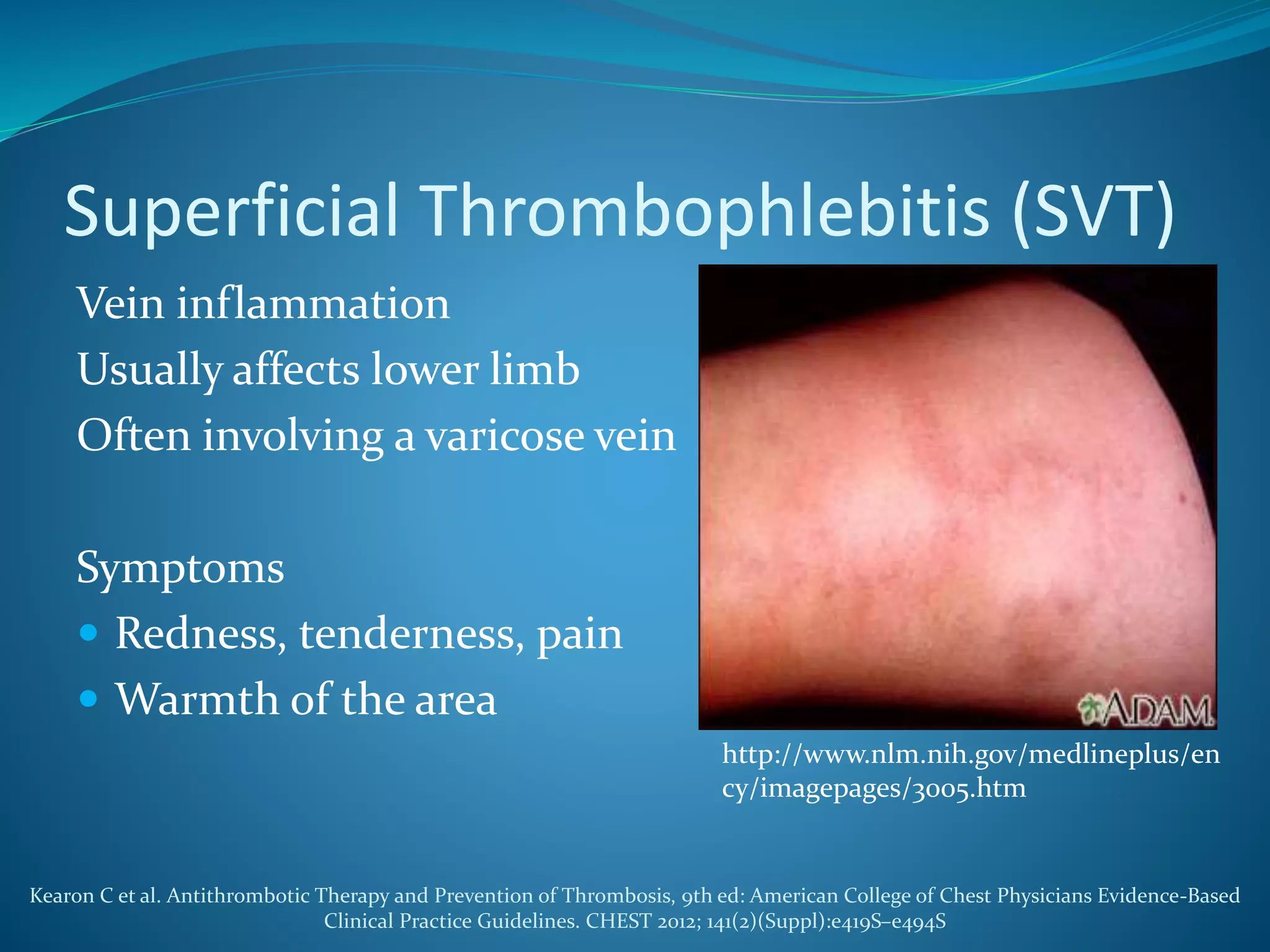
Superficial Thrombophlebitis (SVT)
Vein inflammation
Usually affects lower limb
Often involving a varicose vein
Symptoms
 Redness, tenderness, pain
 Warmth of the area
http://www.nlm.nih.gov/medlineplus/en
cy/imagepages/3005.htm
Kearon C et al. Antithrombotic Therapy and Prevention of Thrombosis, 9th ed: American College of Chest Physicians Evidence-Based
Clinical Practice Guidelines. CHEST 2012; 141(2)(Suppl):e419S–e494S
Characteristics and Risk Factors
Female proportion between 55-70%
Mean Age approx 60 years old
Risk factors similar to venous thromboembolism
 Varicose veins, inherited and acquired conditions,
autoimmune diseases, hormonal replacement therapy
 pregnancy; obesity; prolonged immobilization
 Recent surgery; trauma; sclerotherapy; history VTE
 drugs (e.g., diazepam, amiodarone, vancomycin,
heroin)
Marchiori A, Mosena L, Prandoni P. Superficial vein thrombosis: risk factors, diagnosis, and treatment. Semin Thromb Hemost.
2006;32(7):737-43.
Consequence of SVT
A prospective study of 844 patients, acute SVT > 5 cm:
4% with symptomatic pulmonary embolism,
10% proximal deep vein thrombosis (DVT)
13% distal DVT
Without VTE at presentation, despite 90% treated
3.1% developed symptomatic VTE
1.9% had recurrent VTE
3.3% had extension of the VTE (same location)
CHEST 2012
Treatment of SVT
Based on CALISTO study , guidelines recommend
2.5 mg fondaparinux for 45 days (Grade 2B)
Decousus H, Prandoni P, Mismetti P, et al. Fondaparinux for the treatment of superficial-vein thrombosis in the legs. N Engl J Med.
2010;363(13):1222-32.
Comparison of Arixtra in Lower Limb
Superficial Vein Thrombosis
(CALISTO) Trial
 Randomized , double blind, placeb0-controlled trial of
3002 patients with SVT > 5 cm in length
 Treatments for 45 days of either
- fondaparinux 2.5mg daily (1502 patients)
or
- placebo (1500 patients)
 Primary outcome: death, symptomatic PE,
symptomatic DVT, or symptomatic extension,
symptomatic recurrence
N Engl J Med. 2010;363(13):1222-32
Baseline Characteristics
N Engl J Med. 2010;363(13):1222-32
Results
Fondaparinux 2.5mg per day x 45 days
 5% absolute risk reduction
 85% reduction of symptomatic thromboembolic
complications or death
 Statistically and clinically significant reductions in risk
of primary efficacy outcome (death, symptomatic PE,
symptomatic DVT, symptomatic extension, or
symptomatic recurrence)
N Engl J Med. 2010;363(13):1222-32
Results
Placebo
Thrombotic complications occurred more often if
 SVT involved the greater saphenous vein (92% patients
in control group)
 Extended to within 10 cm from the saphenofemoral
junction (9% of patients)
 Involved veins above the knee (46% of patients)
 If VTE (7% of patients) or SVT (12% of patients) had
occurred previously.
N Engl J Med. 2010;363(13):1222-32
Results
Number need to treat (NNT) to prevent one primary
efficacy outcome. NNT = 20
Recall primary outcome: death symptomatic PE,
symptomatic DVT, symptomatic extension, or
symptomatic recurrence
NNT = 80, to prevent DVT or PE
N Engl J Med. 2010;363(13):1222-32
Additional Treatments
 Graduated compressions stockings (83% in CALISTO)
 Topical NSAIDs may reduce symptoms
CHEST 2012
CALISTO - Strengths/Limitations
Strengths
 Patients representative of what is seen in general clinics
 First randomized trial to address optimal dose and duration
Limitations
 Primary efficacy outcomes giving equal weight
 Not an active comparator
 Fondaparinux not cost effective $500,000 per QALY gained
 45 day course treatment is not common and therefore may not
be used in a clinical setting
 Majority of patients in study were women, different demographic
than VA
Patient – Day 1
Diagnosed with SVT
 Initiated PO enoxaparin 40mg daily QHS
 Initiated empiric Abx therapy
- vancomycin 1250mg Q12hrs
- and ceftriaxone 1g Q24hrs
 Warm compress, NSAIDs, ambulating 3x daily
Patient – Day 2
 Continued enoxaparin 40mg daily
 Continued empiric Abx therapy
- vancomycin 1250mg Q12hrs
- and ceftriaxone 1g Q24hrs
 Continued IBU 200mg Q6hrs PRN for pain
Patient – Day 3 (Discharge)
 Continued enoxaparin 40mg for 30 days
- CHEST Guidelines recommend fondaparinux 2.5mg
or prophylactic dose of LWMH for 45 days.
- MD abbreviated course for compliance
 Negative cultures - discontinued Abx
 New medication - diclofenac gel for pain
Cause of Patient’s SVT
Hx of Crohn’s disease
Multiple biopsies with last colonoscopy on 5/2014
Hypercoagulability from malignancy may be the origin
Pharmacist’s Role with
the Medical Team
Discuss with clinical team guideline recommendations
along with supporting studies
Duration of treatment
- 30 day vs 45 day treatment.
- 2 largest studies evaluating LMWH
 Suggest that 30 day treatment is too short
 Most symptomatic thromboembolic complications
occurring after treatment period.
Pharmacist’s Role with the Patient
Educate patients on:
- Dosing and administration of enoxaparin
- Signs and symptoms of bleeding
- Assess patient understanding via teach back
method
- common SE: nausea, diarrhea, fever, injxn irritation
References
 Marchiori A, Mosena L, Prandoni P. Superficial vein
thrombosis: risk factors, diagnosis, and treatment.
Semin Thromb Hemost. 2006;32(7):737-43.
 Kearon C et al. Antithrombotic Therapy and
Prevention of Thrombosis, 9th ed: American College
of Chest Physicians Evidence-Based Clinical Practice
Guidelines. CHEST 2012; 141(2)(Suppl):e419S–e494S
 Decousus H, Prandoni P, Mismetti P, et al.
Fondaparinux for the treatment of superficial-vein
thrombosis in the legs. N Engl J Med.
2010;363(13):1222-32.

Superficial vein thrombosis

  • 1.
    Rod Bugawan February 26,2015 Lispcomb College of Pharmacy Nashville, TN
  • 2.
    Outline Patient Background Disease State SupportingStudy Patient Treatment Pharmacy Recommendations
  • 3.
    Patient Background CC: leftleg pain and erythema. HPI: 51 yo white male with PMH of Crohn’s, GERD, migratory polyarthritis, migraines, and lower back pain presents with LLE pain for 2 weeks. Patient denies any Hx of blood clots, recent travel, trauma to the legs, animal bites or scratches to the legs. ROS: negative for unintentional weight loss, fevers or chills, chest pain/tightness/discomfort, dyspnea, abdominal pain, diarrhea/constipation, bloody or melenic BMs, unusual changes to UO, dysuria, hematuria, or focal neurologic symptoms FMH: Father died from a blood clot.
  • 4.
    Patient Vitals, Labs,Outpt Meds Labs Active Outpatient Meds  Mesalamine 500mg 2 caps BID  Prednisone 10mg, 1 tab daily x 2-3 weeks, then taper Temp 98.5 HR 83 RR 16 BP 129/86 191 lbs (86.8kg) NA 141 K 4.0 Cl 102 CO2 26 BUN 18 Cr 0.90 Glu 173 H
  • 5.
    Patient Assessment DDx forDVT cause in relatively healthy active male:  Malignancy  Buerger’s – disease or arteries and veins  Factor 5 Leiden – genetically inherited, hypercoagulability  Other thrombotic cause Superficial Thromobophlebitis
  • 6.
    Superficial Thrombophlebitis (SVT) Veininflammation Usually affects lower limb Often involving a varicose vein Symptoms  Redness, tenderness, pain  Warmth of the area http://www.nlm.nih.gov/medlineplus/en cy/imagepages/3005.htm Kearon C et al. Antithrombotic Therapy and Prevention of Thrombosis, 9th ed: American College of Chest Physicians Evidence-Based Clinical Practice Guidelines. CHEST 2012; 141(2)(Suppl):e419S–e494S
  • 7.
    Characteristics and RiskFactors Female proportion between 55-70% Mean Age approx 60 years old Risk factors similar to venous thromboembolism  Varicose veins, inherited and acquired conditions, autoimmune diseases, hormonal replacement therapy  pregnancy; obesity; prolonged immobilization  Recent surgery; trauma; sclerotherapy; history VTE  drugs (e.g., diazepam, amiodarone, vancomycin, heroin) Marchiori A, Mosena L, Prandoni P. Superficial vein thrombosis: risk factors, diagnosis, and treatment. Semin Thromb Hemost. 2006;32(7):737-43.
  • 8.
    Consequence of SVT Aprospective study of 844 patients, acute SVT > 5 cm: 4% with symptomatic pulmonary embolism, 10% proximal deep vein thrombosis (DVT) 13% distal DVT Without VTE at presentation, despite 90% treated 3.1% developed symptomatic VTE 1.9% had recurrent VTE 3.3% had extension of the VTE (same location) CHEST 2012
  • 9.
    Treatment of SVT Basedon CALISTO study , guidelines recommend 2.5 mg fondaparinux for 45 days (Grade 2B) Decousus H, Prandoni P, Mismetti P, et al. Fondaparinux for the treatment of superficial-vein thrombosis in the legs. N Engl J Med. 2010;363(13):1222-32.
  • 10.
    Comparison of Arixtrain Lower Limb Superficial Vein Thrombosis (CALISTO) Trial  Randomized , double blind, placeb0-controlled trial of 3002 patients with SVT > 5 cm in length  Treatments for 45 days of either - fondaparinux 2.5mg daily (1502 patients) or - placebo (1500 patients)  Primary outcome: death, symptomatic PE, symptomatic DVT, or symptomatic extension, symptomatic recurrence N Engl J Med. 2010;363(13):1222-32
  • 11.
    Baseline Characteristics N EnglJ Med. 2010;363(13):1222-32
  • 12.
    Results Fondaparinux 2.5mg perday x 45 days  5% absolute risk reduction  85% reduction of symptomatic thromboembolic complications or death  Statistically and clinically significant reductions in risk of primary efficacy outcome (death, symptomatic PE, symptomatic DVT, symptomatic extension, or symptomatic recurrence) N Engl J Med. 2010;363(13):1222-32
  • 13.
    Results Placebo Thrombotic complications occurredmore often if  SVT involved the greater saphenous vein (92% patients in control group)  Extended to within 10 cm from the saphenofemoral junction (9% of patients)  Involved veins above the knee (46% of patients)  If VTE (7% of patients) or SVT (12% of patients) had occurred previously. N Engl J Med. 2010;363(13):1222-32
  • 14.
    Results Number need totreat (NNT) to prevent one primary efficacy outcome. NNT = 20 Recall primary outcome: death symptomatic PE, symptomatic DVT, symptomatic extension, or symptomatic recurrence NNT = 80, to prevent DVT or PE N Engl J Med. 2010;363(13):1222-32
  • 15.
    Additional Treatments  Graduatedcompressions stockings (83% in CALISTO)  Topical NSAIDs may reduce symptoms CHEST 2012
  • 16.
    CALISTO - Strengths/Limitations Strengths Patients representative of what is seen in general clinics  First randomized trial to address optimal dose and duration Limitations  Primary efficacy outcomes giving equal weight  Not an active comparator  Fondaparinux not cost effective $500,000 per QALY gained  45 day course treatment is not common and therefore may not be used in a clinical setting  Majority of patients in study were women, different demographic than VA
  • 17.
    Patient – Day1 Diagnosed with SVT  Initiated PO enoxaparin 40mg daily QHS  Initiated empiric Abx therapy - vancomycin 1250mg Q12hrs - and ceftriaxone 1g Q24hrs  Warm compress, NSAIDs, ambulating 3x daily
  • 18.
    Patient – Day2  Continued enoxaparin 40mg daily  Continued empiric Abx therapy - vancomycin 1250mg Q12hrs - and ceftriaxone 1g Q24hrs  Continued IBU 200mg Q6hrs PRN for pain
  • 19.
    Patient – Day3 (Discharge)  Continued enoxaparin 40mg for 30 days - CHEST Guidelines recommend fondaparinux 2.5mg or prophylactic dose of LWMH for 45 days. - MD abbreviated course for compliance  Negative cultures - discontinued Abx  New medication - diclofenac gel for pain
  • 20.
    Cause of Patient’sSVT Hx of Crohn’s disease Multiple biopsies with last colonoscopy on 5/2014 Hypercoagulability from malignancy may be the origin
  • 21.
    Pharmacist’s Role with theMedical Team Discuss with clinical team guideline recommendations along with supporting studies Duration of treatment - 30 day vs 45 day treatment. - 2 largest studies evaluating LMWH  Suggest that 30 day treatment is too short  Most symptomatic thromboembolic complications occurring after treatment period.
  • 22.
    Pharmacist’s Role withthe Patient Educate patients on: - Dosing and administration of enoxaparin - Signs and symptoms of bleeding - Assess patient understanding via teach back method - common SE: nausea, diarrhea, fever, injxn irritation
  • 23.
    References  Marchiori A,Mosena L, Prandoni P. Superficial vein thrombosis: risk factors, diagnosis, and treatment. Semin Thromb Hemost. 2006;32(7):737-43.  Kearon C et al. Antithrombotic Therapy and Prevention of Thrombosis, 9th ed: American College of Chest Physicians Evidence-Based Clinical Practice Guidelines. CHEST 2012; 141(2)(Suppl):e419S–e494S  Decousus H, Prandoni P, Mismetti P, et al. Fondaparinux for the treatment of superficial-vein thrombosis in the legs. N Engl J Med. 2010;363(13):1222-32.