ORATOR: RAYAZ AHMAD BHAT
STUDENT NIPER, GUWAHATI, ASSAM
MODERATOR: DR. (Mrs.) MANGALA LAHKAR
CAC, NIPER, GUWAHATI, ASSAM
MENTOR HOSPITAL: GUWAHATI MEDICAL COLLEGE AND HOSPITAL
CASE: NEPHROTIC SYNDROME
Deptt. Of Nephrology
Guwahati Medical College And Hospital
Assam
PATIENT DETAILS
NAME: XYZ
SEX: MALE
AGE: 82yrs
DOA: 10/09/2016
Deptt. Regd. No: 4654/16
BED NO. 04
MRD NO. 59868
CHIEF COMPLAINTS
Swelling of both legs from last 2 months
Lower urinary tract symptoms from last 15 days
Respiratory difficulty with on/off cough from last
15 days
PATIENT HISTORY
SOCIAL HISTORY
SMOKER: NO
ALCOHOLIC: NO
MEDICAL HISTORY
No history of T2DM or Hypertension
H/o of pain killer for knee joint pain (B/L) 1 month prior
to swelling
No H/o intake of herbal medication
No H/o Haematemesis or Melena
No H/o renal calculi, burning micturation or fever.
ON PHYSICAL EXAMINATIOM
PULSE RATE: 86/MIN
CVS : S1 S2 -Normal
PALLOR: +
OEDEMA: +
CHEST: VESICULAR BREATH SOUNDS were audible
Bp: 110/80
LAB INVESTIGATIONS
INVESTIGATION
NORMAL
VALUE/RANGE
10/09/16
D1
12/09/1
6
D3
15/09/16
D6
20/09/1
6
D11
Sodium 137-145 mmol/l 127 128 124
Potassium 3.5-5.1 mmol/l 3.7 2.4 3.2
Calcium(total) 8.4-10.2 mg/dl 6.9 6.6
AST 17-59 u/l 61
ALT 21-72 u/l 40
WBC 4000-11000 7900 8500
Hemoglobin 13-17 g/dl 10.1 9.0
Neutrophills 37-72 % 46 87.3
Lymphocytes 20 -40 % 35 10
INVESTIGATION NORMAL VALUE/RANGE D1 D3 D6 D11
Monocytes 2 – 10 % 7 2.1
Eosinophills 1 – 6 % 12 6
Prothrombin
time/INR
12-16 sec/.8-1.5 18.7/1.7
TSH 0.465-4.68mIU/L 300
Cholesterol <200mg/dl 369
Triglycerides 50-150mg/dl 401
Albumin 3.5-5mg/dl 1.8 1.5
Total Protein 6-8g/dl 4.84
Urea 10-45mg/dl 48.3 1O2.
9
Creatinine 0.80-1.50 mg/dl 2.06 2.83
Iron 65-180ug/dl 55
TIBC 240-450 mcg/dl 183
INVESTIGATION NORMAL
VALUE/RANGE
D1 D3 D6
Random
Glucose
79-140mg/dl 124.4
Fasting
Glucose
70-110mg/dl 95
Hb1Ac 0-6% 5.50
tPSA 0-4ng/dl 0.365
Urine
Protein
(24hr)
24-
141mg/24hrs
336
CPK 55-170u/l 439
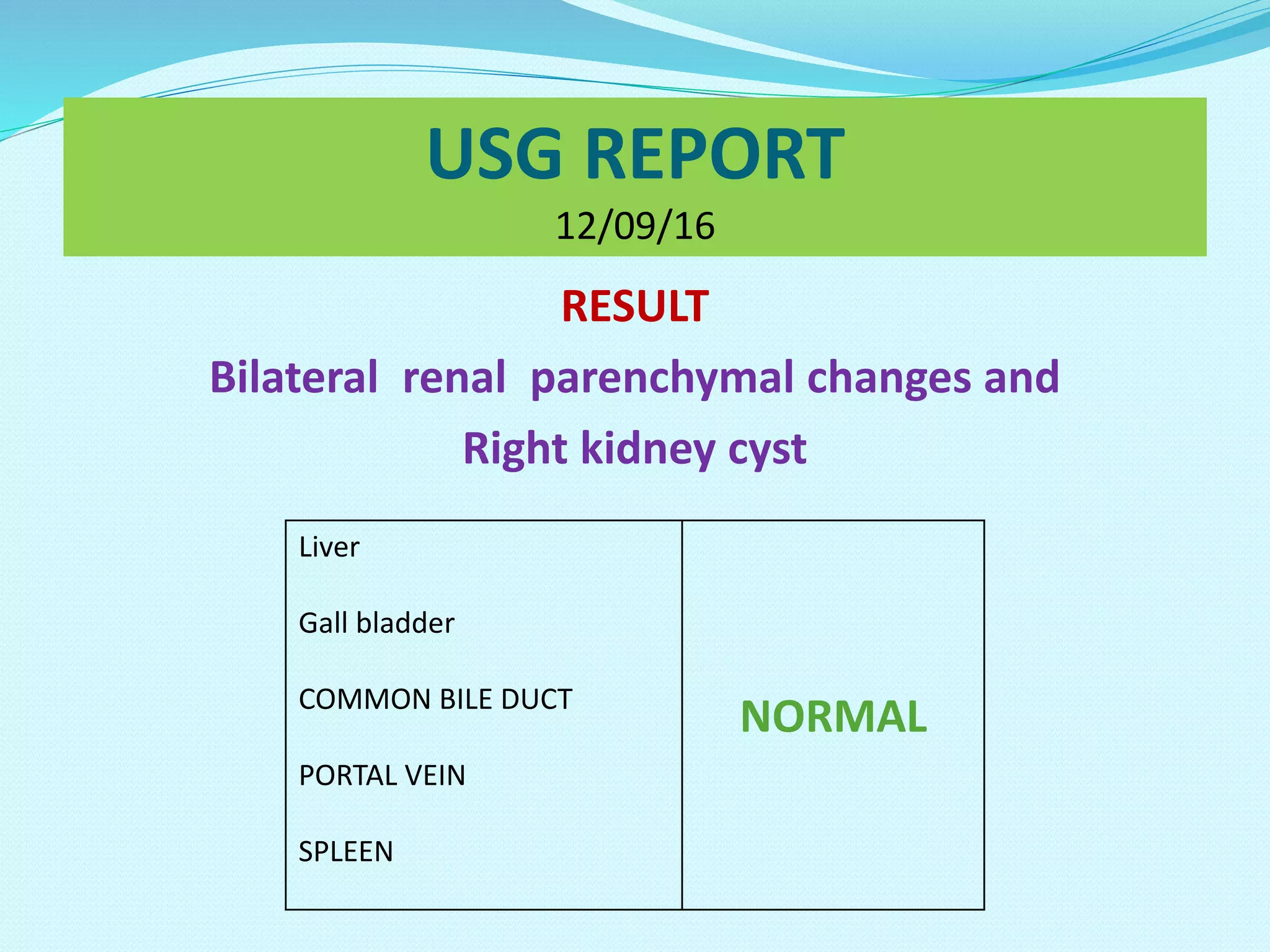
USG REPORT
12/09/16
RESULT
Bilateral renal parenchymal changes and
Right kidney cyst
Liver
Gall bladder
COMMON BILE DUCT
PORTAL VEIN
SPLEEN
NORMAL
SERUM PROTEIN ELECTROPHORESIS
SHOWED
HYPERGAMAGLOBULINEMIA (POLYCLONAL)
Other Tests
HIV-I and II-------Non-reactive
Hep-B and C------Non-reactive
RENAL BIOPSY (NEEDLE) REPORT
25/09/16
RESULT
RENAL AMYLOIDOSIS WITH GLOMERULAR AND
VASCULAR DEPOSITION OF AMYLOID
DIAGNOSIS
NEPHROTIC SYNDROME
EPIDEMIOLOGY
Nephrotic syndrome is relatively rare but important
manifestation of kidney disease with a incidence of 3
new cases per 100,000 each year in adults and has
serious complications , caused by a number of
primary and secondary glomerular diseases
Reference : PatientPLUS , Document ID-2505(v24)
MEDICATIONS CHART
DRUG ROA DOSE RREQ DAYS 10/09/16 0nwards
1 2 3 4 5 6 7 8 9 10 11 12 13 14 15 16
TORASEMIDE
(DYTOR)
ORAL 10mg BD  
PANTOPRAZOLE
SODIUM
(PANTACID)
ORAL 40mg ODAC                
ATORVASTATIN
AND
FENOFIBRATE
(ATORLIP-F)
ORAL 10/160
mg
OD HS             
FUROSEMIDE
(LASIX)
I.V 60mg BD               
PIPERACILLIN
AND
TAZOBACTAM
(PIPZO)
I.V 4/0.5g OD               
DRUG ROA DOSE RREQ DAYS 10/09/16 0NWARDS
1 2 3 4 5 6 7 8 9 10 11 12 13 14 15 16
TRYPSIN,
BROMELAIN
AND RUTOSIDE
(ENZOMAC)
ORAL 40mg,
90mg,
100mg
TD               
TRAMADOL
I.M 50mg S0S 
LEVOTHYROXINE
(THYRONORM)
ORAL 50mg OD AC               
TRANEXIMIC
ACID
(TRANOSTAT)
I.V 1 AMP STATIM 
DRUG ROA DOSE RREQ DAYS
1 2 3 4 5 6 7 8 9 10 11 12 13 14 15 16
PREDNISOLONE
(OMNACORTIL)
ORAL 10mg BD        
CALCIUM
CARBONATE
AND VITAMIN D
(SHELCAL)
ORAL 500mg OD       
ATORVASTATIN
(ATORLIP)
ORAL 10mg OD
HS
  
Patient was discharged on
request on 26/09/16
DISCHARGE MEDICATIONS
 TABLET OMNACORTIL (PREDNISOLONE) 20mg 2 tab for
one week
• Followed by 20mg 1 and half tab for 0ne week
• Followed by20 mg 1 tab for 1 week
• Followed by 10mg 1 tab for 10 days
 TABLET THYRONORM 75mg OD
 TABLET PANTACID 40mg OD BBF
 TABLET ATORLIP 20mg OD
 TABLET LASIX 60mg BD till swelling subsides
FOLLOW UP
HEMATOLOGY AND NEPHROLOGY OPD EVERY 2 WEEKS
PHARMACEUTICAL ISSUES AND SUGGESSIONS
 Concurrent use of statins and fibrates increase the risk of
Rhabdomyolysis and Myopathy and the risk is more in eldery
and renal disease patients
SUGGESTION
CREATINE KINASE levels should be monitored regularly
 As a general rule any patient given a statin and fibrate should
be told to report any signs of myopathy and possible
RHABDOMYOLYSIS( unexplained muscle pain, tenderness,
weakness or dark urine)
 If Myopathy does occur the statin should be stopped
immediately or dose adjusted and monitored closely.
 Generally a lower dose of statin with fibrate is recommended
•CYP3A4 inhibitors like macrolide antibiotics ,
azole antifungals if required should be prescribed
very cautiously for a patient on statins –High risk
of rhabdomyolysis
 Monitoring of liver function is recommended
for all statins to rule out any toxicity to liver
 High dose of any corticosteriod can produce
hypokalemia via mineralocorticoid action which is
further increased by concurrent administration of
Ferusemide and may produce symptoms of
muscle pain/cramps, confusion , dizziness etc
SUGGESTION
• Increase dietary intake of potassium
• Supplements of Potassium chloride
• Concurrent use of Potassium sparing diuretic
• Dose adjustment
PREDNISOLONE may elevate serum TG and LDL levels if used
for prolonged period
SUGGESTION
Close monitoring of lipid levels and dose titration
 PREDNISOLONE may also increases blood
coagulability
SUGGESTION
Since the patient is already at risk of
thromboembolism due to loss of anthithrombin-III
close monitoring of PT is necessary to prevent any
complication
Response to Prednisolone should be closely
monitored because there are variations in
response to Corticosteroids which include:
Corticosteroid sensitive patients
Corticosteroid resistant patients or Late steroid
responders
Corticosteroid intolerant patients
Corticosteroid dependent patients
One of the complication of disease is immune
deficiency due to leakage of immunoglobulin's
and loss of proteins in general making the patient
prone to infections ,so, the patient should be
prescribed appropriate antibiotics and should not
stop taking antibiotic unless told because the
patient is taking PREDNISOLONE which has
IMMUNOSUPRESSANT action further increasing
risk of infections.
Concurrent administration of Levothyroxine
with calcium containing products (SHELCAL)
reduces its oral bioavailability by nonspecific
adsorption of levothyroxine to calcium carbonate
at acidic pH
SUGGESTION
Patient should be advised to take Levothyroxine with
a gap of at least 4 hours after or before any calcium
and iron containing products, sucralfate,PPIs
Patient was given Tranostat I.V after renal
biopsy to watch for haematuria
SUGGESTION
TRANSTAT being antifibrinolytic and given I.V may
increases the risk of thrombus formation since the
patient is already at risk of thromboembolism
therefore it should be given cautiously and the
patient should be monitored closely for any
thromboembolic complication.
Other Suggestions
Chances of embolism increases at rest so, Doctor should
consider this
Patient could be recommended DOPPLER ULTRASOUND to check
any thromboembolic complication
Growth retardation occurs due to loss of proteins and steroid
therapy so the patient should be prescribed suitable
supplements
LIFE STYLE MODIFICATIONS
 Low fat , low cholesterol diet
 limitation of saturated and trans fats
 salt restriction
 Lean sources of protein
 Exercise to prevent thromboembolic complications
 Patient should be advised not to take any other medication
without doctors or pharmacists consultation since there are various
complications of the SYNDROME which restricts the use or require
close monitoring of various drugs
Case on nephrotic syndrome

Case on nephrotic syndrome

  • 1.
    ORATOR: RAYAZ AHMADBHAT STUDENT NIPER, GUWAHATI, ASSAM MODERATOR: DR. (Mrs.) MANGALA LAHKAR CAC, NIPER, GUWAHATI, ASSAM MENTOR HOSPITAL: GUWAHATI MEDICAL COLLEGE AND HOSPITAL
  • 2.
    CASE: NEPHROTIC SYNDROME Deptt.Of Nephrology Guwahati Medical College And Hospital Assam
  • 3.
    PATIENT DETAILS NAME: XYZ SEX:MALE AGE: 82yrs DOA: 10/09/2016 Deptt. Regd. No: 4654/16 BED NO. 04 MRD NO. 59868
  • 4.
    CHIEF COMPLAINTS Swelling ofboth legs from last 2 months Lower urinary tract symptoms from last 15 days Respiratory difficulty with on/off cough from last 15 days
  • 5.
    PATIENT HISTORY SOCIAL HISTORY SMOKER:NO ALCOHOLIC: NO MEDICAL HISTORY No history of T2DM or Hypertension H/o of pain killer for knee joint pain (B/L) 1 month prior to swelling No H/o intake of herbal medication No H/o Haematemesis or Melena No H/o renal calculi, burning micturation or fever.
  • 6.
    ON PHYSICAL EXAMINATIOM PULSERATE: 86/MIN CVS : S1 S2 -Normal PALLOR: + OEDEMA: + CHEST: VESICULAR BREATH SOUNDS were audible Bp: 110/80
  • 7.
    LAB INVESTIGATIONS INVESTIGATION NORMAL VALUE/RANGE 10/09/16 D1 12/09/1 6 D3 15/09/16 D6 20/09/1 6 D11 Sodium 137-145mmol/l 127 128 124 Potassium 3.5-5.1 mmol/l 3.7 2.4 3.2 Calcium(total) 8.4-10.2 mg/dl 6.9 6.6 AST 17-59 u/l 61 ALT 21-72 u/l 40 WBC 4000-11000 7900 8500 Hemoglobin 13-17 g/dl 10.1 9.0 Neutrophills 37-72 % 46 87.3 Lymphocytes 20 -40 % 35 10
  • 8.
    INVESTIGATION NORMAL VALUE/RANGED1 D3 D6 D11 Monocytes 2 – 10 % 7 2.1 Eosinophills 1 – 6 % 12 6 Prothrombin time/INR 12-16 sec/.8-1.5 18.7/1.7 TSH 0.465-4.68mIU/L 300 Cholesterol <200mg/dl 369 Triglycerides 50-150mg/dl 401 Albumin 3.5-5mg/dl 1.8 1.5 Total Protein 6-8g/dl 4.84 Urea 10-45mg/dl 48.3 1O2. 9 Creatinine 0.80-1.50 mg/dl 2.06 2.83 Iron 65-180ug/dl 55 TIBC 240-450 mcg/dl 183
  • 9.
    INVESTIGATION NORMAL VALUE/RANGE D1 D3D6 Random Glucose 79-140mg/dl 124.4 Fasting Glucose 70-110mg/dl 95 Hb1Ac 0-6% 5.50 tPSA 0-4ng/dl 0.365 Urine Protein (24hr) 24- 141mg/24hrs 336 CPK 55-170u/l 439
  • 10.
    USG REPORT 12/09/16 RESULT Bilateral renalparenchymal changes and Right kidney cyst Liver Gall bladder COMMON BILE DUCT PORTAL VEIN SPLEEN NORMAL
  • 11.
  • 12.
    Other Tests HIV-I andII-------Non-reactive Hep-B and C------Non-reactive
  • 13.
    RENAL BIOPSY (NEEDLE)REPORT 25/09/16 RESULT RENAL AMYLOIDOSIS WITH GLOMERULAR AND VASCULAR DEPOSITION OF AMYLOID
  • 14.
  • 15.
    EPIDEMIOLOGY Nephrotic syndrome isrelatively rare but important manifestation of kidney disease with a incidence of 3 new cases per 100,000 each year in adults and has serious complications , caused by a number of primary and secondary glomerular diseases Reference : PatientPLUS , Document ID-2505(v24)
  • 16.
    MEDICATIONS CHART DRUG ROADOSE RREQ DAYS 10/09/16 0nwards 1 2 3 4 5 6 7 8 9 10 11 12 13 14 15 16 TORASEMIDE (DYTOR) ORAL 10mg BD   PANTOPRAZOLE SODIUM (PANTACID) ORAL 40mg ODAC                 ATORVASTATIN AND FENOFIBRATE (ATORLIP-F) ORAL 10/160 mg OD HS              FUROSEMIDE (LASIX) I.V 60mg BD                PIPERACILLIN AND TAZOBACTAM (PIPZO) I.V 4/0.5g OD               
  • 17.
    DRUG ROA DOSERREQ DAYS 10/09/16 0NWARDS 1 2 3 4 5 6 7 8 9 10 11 12 13 14 15 16 TRYPSIN, BROMELAIN AND RUTOSIDE (ENZOMAC) ORAL 40mg, 90mg, 100mg TD                TRAMADOL I.M 50mg S0S  LEVOTHYROXINE (THYRONORM) ORAL 50mg OD AC                TRANEXIMIC ACID (TRANOSTAT) I.V 1 AMP STATIM 
  • 18.
    DRUG ROA DOSERREQ DAYS 1 2 3 4 5 6 7 8 9 10 11 12 13 14 15 16 PREDNISOLONE (OMNACORTIL) ORAL 10mg BD         CALCIUM CARBONATE AND VITAMIN D (SHELCAL) ORAL 500mg OD        ATORVASTATIN (ATORLIP) ORAL 10mg OD HS   
  • 19.
    Patient was dischargedon request on 26/09/16
  • 20.
    DISCHARGE MEDICATIONS  TABLETOMNACORTIL (PREDNISOLONE) 20mg 2 tab for one week • Followed by 20mg 1 and half tab for 0ne week • Followed by20 mg 1 tab for 1 week • Followed by 10mg 1 tab for 10 days  TABLET THYRONORM 75mg OD  TABLET PANTACID 40mg OD BBF  TABLET ATORLIP 20mg OD  TABLET LASIX 60mg BD till swelling subsides FOLLOW UP HEMATOLOGY AND NEPHROLOGY OPD EVERY 2 WEEKS
  • 21.
    PHARMACEUTICAL ISSUES ANDSUGGESSIONS  Concurrent use of statins and fibrates increase the risk of Rhabdomyolysis and Myopathy and the risk is more in eldery and renal disease patients SUGGESTION CREATINE KINASE levels should be monitored regularly  As a general rule any patient given a statin and fibrate should be told to report any signs of myopathy and possible RHABDOMYOLYSIS( unexplained muscle pain, tenderness, weakness or dark urine)  If Myopathy does occur the statin should be stopped immediately or dose adjusted and monitored closely.  Generally a lower dose of statin with fibrate is recommended
  • 22.
    •CYP3A4 inhibitors likemacrolide antibiotics , azole antifungals if required should be prescribed very cautiously for a patient on statins –High risk of rhabdomyolysis  Monitoring of liver function is recommended for all statins to rule out any toxicity to liver
  • 23.
     High doseof any corticosteriod can produce hypokalemia via mineralocorticoid action which is further increased by concurrent administration of Ferusemide and may produce symptoms of muscle pain/cramps, confusion , dizziness etc SUGGESTION • Increase dietary intake of potassium • Supplements of Potassium chloride • Concurrent use of Potassium sparing diuretic • Dose adjustment
  • 24.
    PREDNISOLONE may elevateserum TG and LDL levels if used for prolonged period SUGGESTION Close monitoring of lipid levels and dose titration  PREDNISOLONE may also increases blood coagulability SUGGESTION Since the patient is already at risk of thromboembolism due to loss of anthithrombin-III close monitoring of PT is necessary to prevent any complication
  • 25.
    Response to Prednisoloneshould be closely monitored because there are variations in response to Corticosteroids which include: Corticosteroid sensitive patients Corticosteroid resistant patients or Late steroid responders Corticosteroid intolerant patients Corticosteroid dependent patients
  • 26.
    One of thecomplication of disease is immune deficiency due to leakage of immunoglobulin's and loss of proteins in general making the patient prone to infections ,so, the patient should be prescribed appropriate antibiotics and should not stop taking antibiotic unless told because the patient is taking PREDNISOLONE which has IMMUNOSUPRESSANT action further increasing risk of infections.
  • 27.
    Concurrent administration ofLevothyroxine with calcium containing products (SHELCAL) reduces its oral bioavailability by nonspecific adsorption of levothyroxine to calcium carbonate at acidic pH SUGGESTION Patient should be advised to take Levothyroxine with a gap of at least 4 hours after or before any calcium and iron containing products, sucralfate,PPIs
  • 28.
    Patient was givenTranostat I.V after renal biopsy to watch for haematuria SUGGESTION TRANSTAT being antifibrinolytic and given I.V may increases the risk of thrombus formation since the patient is already at risk of thromboembolism therefore it should be given cautiously and the patient should be monitored closely for any thromboembolic complication.
  • 29.
    Other Suggestions Chances ofembolism increases at rest so, Doctor should consider this Patient could be recommended DOPPLER ULTRASOUND to check any thromboembolic complication Growth retardation occurs due to loss of proteins and steroid therapy so the patient should be prescribed suitable supplements
  • 30.
    LIFE STYLE MODIFICATIONS Low fat , low cholesterol diet  limitation of saturated and trans fats  salt restriction  Lean sources of protein  Exercise to prevent thromboembolic complications  Patient should be advised not to take any other medication without doctors or pharmacists consultation since there are various complications of the SYNDROME which restricts the use or require close monitoring of various drugs