CASE PRESENTATION ON
NEPHROTIC SYNDROME
PRESENTED BY,
KAVIYA AP
RA1522281010017
PHARM D INTERN
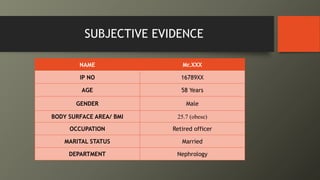
SUBJECTIVE EVIDENCE
NAME Mr.XXX
IP NO 16789XX
AGE 58 Years
GENDER Male
BODY SURFACE AREA/ BMI 25.7 (obese)
OCCUPATION Retired officer
MARITAL STATUS Married
DEPARTMENT Nephrology
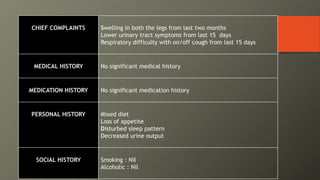
CHIEF COMPLAINTS Swelling in both the legs from last two months
Lower urinary tract symptoms from last 15 days
Respiratory difficulty with on/off cough from last 15 days
MEDICAL HISTORY No significant medical history
MEDICATION HISTORY No significant medication history
PERSONAL HISTORY Mixed diet
Loss of appetite
Disturbed sleep pattern
Decreased urine output
SOCIAL HISTORY Smoking : Nil
Alcoholic : Nil
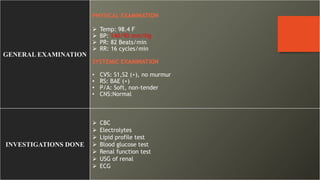
GENERAL EXAMINATION
PHYSICAL EXAMINATION
 Temp: 98.4 F
 BP: 140/90 mm/Hg
 PR: 82 Beats/min
 RR: 16 cycles/min
SYSTEMIC EXAMINATION
• CVS: S1,S2 (+), no murmur
• RS: BAE (+)
• P/A: Soft, non-tender
• CNS:Normal
INVESTIGATIONS DONE
 CBC
 Electrolytes
 Lipid profile test
 Blood glucose test
 Renal function test
 USG of renal
 ECG
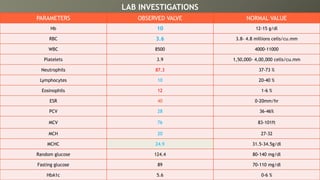
LAB INVESTIGATIONS
PARAMETERS OBSERVED VALVE NORMAL VALUE
Hb 10 12-15 g/dl
RBC 3.6 3.8- 4.8 millions cells/cu.mm
WBC 8500 4000-11000
Platelets 3.9 1,50,000- 4,00,000 cells/cu.mm
Neutrophils 87.3 37-73 %
Lymphocytes 10 20-40 %
Eosinophils 12 1-6 %
ESR 40 0-20mm/hr
PCV 28 36-46%
MCV 76 83-101ft
MCH 20 27-32
MCHC 24.9 31.5-34.5g/dl
Random glucose 124.4 80-140 mg/dl
Fasting glucose 89 70-110 mg/dl
HbA1c 5.6 0-6 %
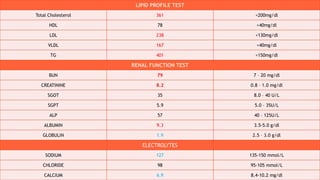
LIPID PROFILE TEST
Total Cholesterol 361 <200mg/dl
HDL 78 >40mg/dl
LDL 238 <130mg/dl
VLDL 167 <40mg/dl
TG 401 <150mg/dl
RENAL FUNCTION TEST
BUN 79 7 – 20 mg/dl
CREATININE 8.2 0.8 – 1.0 mg/dl
SGOT 35 8.0 – 40 U/L
SGPT 5.9 5.0 – 35U/L
ALP 57 40 – 125U/L
ALBUMIN 9.3 3.5-5.0 g/dl
GLOBULIN 1.9 2.5 – 3.0 g/dl
ELECTROLYTES
SODIUM 127 135-150 mmol/L
CHLORIDE 98 95-105 mmol/L
CALCIUM 6.9 8.4-10.2 mg/dl
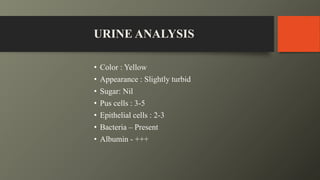
URINE ANALYSIS
• Color : Yellow
• Appearance : Slightly turbid
• Sugar: Nil
• Pus cells : 3-5
• Epithelial cells : 2-3
• Bacteria – Present
• Albumin - +++
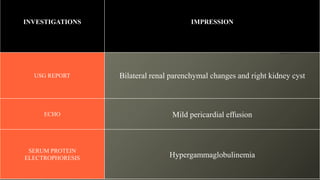
INVESTIGATIONS IMPRESSION
USG REPORT Bilateral renal parenchymal changes and right kidney cyst
ECHO Mild pericardial effusion
SERUM PROTEIN
ELECTROPHORESIS Hypergammaglobulinemia
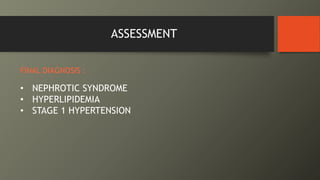
ASSESSMENT
FINAL DIAGNOSIS :
• NEPHROTIC SYNDROME
• HYPERLIPIDEMIA
• STAGE 1 HYPERTENSION
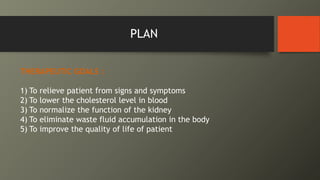
PLAN
THERAPEUTIC GOALS :
1) To relieve patient from signs and symptoms
2) To lower the cholesterol level in blood
3) To normalize the function of the kidney
4) To eliminate waste fluid accumulation in the body
5) To improve the quality of life of patient
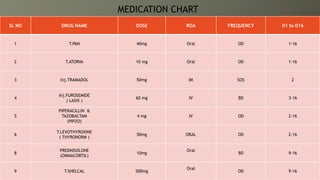
SL NO DRUG NAME DOSE ROA FREQUENCY D1 to D16
1 T.PAN 40mg Oral OD 1-16
2 T.ATORVA 10 mg Oral OD 1-16
3 Inj.TRAMADOL 50mg IM SOS 2
4
Inj.FUROSEMIDE
( LASIX )
60 mg IV BD 3-16
5
PIPERACILLIN &
TAZOBACTAM
(PIPZO)
4 mg IV OD 2-16
6
T.LEVOTHYROXINE
( THYRONORM )
50mg ORAL OD 2-16
8
PREDNISOLONE
(OMNACORTIL)
10mg
Oral
BD 9-16
9 T.SHELCAL 500mg
Oral
OD 9-16
MEDICATION CHART
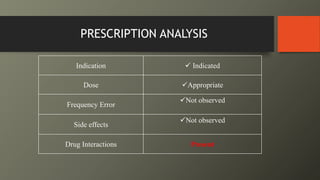
Indication  Indicated
Dose Appropriate
Frequency Error
Not observed
Side effects
Not observed
Drug Interactions Present
PRESCRIPTION ANALYSIS
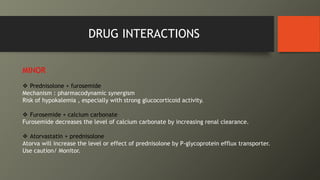
DRUG INTERACTIONS
MINOR
 Prednisolone + furosemide
Mechanism : pharmacodynamic synergism
Risk of hypokalemia , especially with strong glucocorticoid activity.
 Furosemide + calcium carbonate
Furosemide decreases the level of calcium carbonate by increasing renal clearance.
 Atorvastatin + prednisolone
Atorva will increase the level or effect of prednisolone by P-glycoprotein efflux transporter.
Use caution/ Monitor.
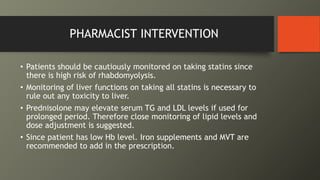
PHARMACIST INTERVENTION
• Patients should be cautiously monitored on taking statins since
there is high risk of rhabdomyolysis.
• Monitoring of liver functions on taking all statins is necessary to
rule out any toxicity to liver.
• Prednisolone may elevate serum TG and LDL levels if used for
prolonged period. Therefore close monitoring of lipid levels and
dose adjustment is suggested.
• Since patient has low Hb level. Iron supplements and MVT are
recommended to add in the prescription.
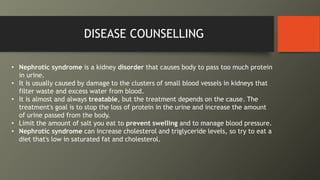
DISEASE COUNSELLING
• Nephrotic syndrome is a kidney disorder that causes body to pass too much protein
in urine.
• It is usually caused by damage to the clusters of small blood vessels in kidneys that
filter waste and excess water from blood.
• It is almost and always treatable, but the treatment depends on the cause. The
treatment's goal is to stop the loss of protein in the urine and increase the amount
of urine passed from the body.
• Limit the amount of salt you eat to prevent swelling and to manage blood pressure.
• Nephrotic syndrome can increase cholesterol and triglyceride levels, so try to eat a
diet that's low in saturated fat and cholesterol.
DRUG COUNSELLING
1. Follow 4S in drug meditation : Do not share , stop, skip and sum the doses of the
prescribed drugs.
2. A pill organizer or pill container is best way for medication adherence and keeping
alarm can help patient to take medications at correct time.
3. T.Tramadol can be taken with or without food but take this medication same way
each time.
4. T.Pan should be taken 30 mins before a meal.
5. Do not intake alcohol with any medication it may cause dangerous side effects.
6. Take medicines as prescribed by physician. Do not exceed the limit of any
antibiotics or painkillers it may produce undesirable effect.
7. If any side effects seen report immediately to the physician and stop the usage of
drug.
DIET COUNSELLING
• Eat 5-6 parts of fresh fruits everyday
• Egg yolks are very nutritious, they contain high amounts of phosphorus, making egg whites a
better choice for people following a renal diet. Egg whites provide a high quality, kidney-
friendly source of protein.
• Vegetables like cabbage, cauliflower,onion,garlic,bellpepper are healthy foods to repair kidney
disease.
• Avoid fried and canned foods.
• Bananas are a rich source of potassium and may need to be limited on a renal diet. Pineapple
is a kidney-friendly fruit, as it contains much less potassium than certain other tropical fruits.
• Lemon, orange, and melon juice all contain citric acid, or citrate. Citrate helps prevent kidney
stone formation by binding with calcium in urine.
• Caffeine causes a short but sudden increase in blood pressure. Research has not shown that
drinking 3-4 cups of coffee a day increases the risk of kidney disease or increases rate of
decline of kidney function. However, moderating how much coffee you drink is a good idea.
LIFESTYLE MODIFICATIONS
1.Eat right and lose excess weight.
2.Intake of oats may have a beneficial effect on serum albumin and serum potassium in
patients with CKD.
3.Choose soy, almond, cashew, or rice milk for less phosphorus and less potassium than
cow's milk. Avoid cow's milk substitutes that are "Enriched" or have the word phosphorus
or "phos" in the ingredient list.
4.Exercise regularly.
5.Do meditation or yoga and manage stress.
‣ Medscape
‣ Micromedex
‣ BNF 72
‣ Aphasia.org
‣ Stroke.org
‣ Davidson’s Principle & Practice of Medicine.
‣ Dipiro
‣ Journals ( Pubmed)
REFERENCES

Nephrotic syndrome

  • 1.
    CASE PRESENTATION ON NEPHROTICSYNDROME PRESENTED BY, KAVIYA AP RA1522281010017 PHARM D INTERN
  • 2.
    SUBJECTIVE EVIDENCE NAME Mr.XXX IPNO 16789XX AGE 58 Years GENDER Male BODY SURFACE AREA/ BMI 25.7 (obese) OCCUPATION Retired officer MARITAL STATUS Married DEPARTMENT Nephrology
  • 3.
    CHIEF COMPLAINTS Swellingin both the legs from last two months Lower urinary tract symptoms from last 15 days Respiratory difficulty with on/off cough from last 15 days MEDICAL HISTORY No significant medical history MEDICATION HISTORY No significant medication history PERSONAL HISTORY Mixed diet Loss of appetite Disturbed sleep pattern Decreased urine output SOCIAL HISTORY Smoking : Nil Alcoholic : Nil
  • 4.
    GENERAL EXAMINATION PHYSICAL EXAMINATION Temp: 98.4 F  BP: 140/90 mm/Hg  PR: 82 Beats/min  RR: 16 cycles/min SYSTEMIC EXAMINATION • CVS: S1,S2 (+), no murmur • RS: BAE (+) • P/A: Soft, non-tender • CNS:Normal INVESTIGATIONS DONE  CBC  Electrolytes  Lipid profile test  Blood glucose test  Renal function test  USG of renal  ECG
  • 5.
    LAB INVESTIGATIONS PARAMETERS OBSERVEDVALVE NORMAL VALUE Hb 10 12-15 g/dl RBC 3.6 3.8- 4.8 millions cells/cu.mm WBC 8500 4000-11000 Platelets 3.9 1,50,000- 4,00,000 cells/cu.mm Neutrophils 87.3 37-73 % Lymphocytes 10 20-40 % Eosinophils 12 1-6 % ESR 40 0-20mm/hr PCV 28 36-46% MCV 76 83-101ft MCH 20 27-32 MCHC 24.9 31.5-34.5g/dl Random glucose 124.4 80-140 mg/dl Fasting glucose 89 70-110 mg/dl HbA1c 5.6 0-6 %
  • 6.
    LIPID PROFILE TEST TotalCholesterol 361 <200mg/dl HDL 78 >40mg/dl LDL 238 <130mg/dl VLDL 167 <40mg/dl TG 401 <150mg/dl RENAL FUNCTION TEST BUN 79 7 – 20 mg/dl CREATININE 8.2 0.8 – 1.0 mg/dl SGOT 35 8.0 – 40 U/L SGPT 5.9 5.0 – 35U/L ALP 57 40 – 125U/L ALBUMIN 9.3 3.5-5.0 g/dl GLOBULIN 1.9 2.5 – 3.0 g/dl ELECTROLYTES SODIUM 127 135-150 mmol/L CHLORIDE 98 95-105 mmol/L CALCIUM 6.9 8.4-10.2 mg/dl
  • 7.
    URINE ANALYSIS • Color: Yellow • Appearance : Slightly turbid • Sugar: Nil • Pus cells : 3-5 • Epithelial cells : 2-3 • Bacteria – Present • Albumin - +++
  • 8.
    INVESTIGATIONS IMPRESSION USG REPORTBilateral renal parenchymal changes and right kidney cyst ECHO Mild pericardial effusion SERUM PROTEIN ELECTROPHORESIS Hypergammaglobulinemia
  • 9.
    ASSESSMENT FINAL DIAGNOSIS : •NEPHROTIC SYNDROME • HYPERLIPIDEMIA • STAGE 1 HYPERTENSION
  • 10.
    PLAN THERAPEUTIC GOALS : 1)To relieve patient from signs and symptoms 2) To lower the cholesterol level in blood 3) To normalize the function of the kidney 4) To eliminate waste fluid accumulation in the body 5) To improve the quality of life of patient
  • 11.
    SL NO DRUGNAME DOSE ROA FREQUENCY D1 to D16 1 T.PAN 40mg Oral OD 1-16 2 T.ATORVA 10 mg Oral OD 1-16 3 Inj.TRAMADOL 50mg IM SOS 2 4 Inj.FUROSEMIDE ( LASIX ) 60 mg IV BD 3-16 5 PIPERACILLIN & TAZOBACTAM (PIPZO) 4 mg IV OD 2-16 6 T.LEVOTHYROXINE ( THYRONORM ) 50mg ORAL OD 2-16 8 PREDNISOLONE (OMNACORTIL) 10mg Oral BD 9-16 9 T.SHELCAL 500mg Oral OD 9-16 MEDICATION CHART
  • 12.
    Indication  Indicated DoseAppropriate Frequency Error Not observed Side effects Not observed Drug Interactions Present PRESCRIPTION ANALYSIS
  • 13.
    DRUG INTERACTIONS MINOR  Prednisolone+ furosemide Mechanism : pharmacodynamic synergism Risk of hypokalemia , especially with strong glucocorticoid activity.  Furosemide + calcium carbonate Furosemide decreases the level of calcium carbonate by increasing renal clearance.  Atorvastatin + prednisolone Atorva will increase the level or effect of prednisolone by P-glycoprotein efflux transporter. Use caution/ Monitor.
  • 14.
    PHARMACIST INTERVENTION • Patientsshould be cautiously monitored on taking statins since there is high risk of rhabdomyolysis. • Monitoring of liver functions on taking all statins is necessary to rule out any toxicity to liver. • Prednisolone may elevate serum TG and LDL levels if used for prolonged period. Therefore close monitoring of lipid levels and dose adjustment is suggested. • Since patient has low Hb level. Iron supplements and MVT are recommended to add in the prescription.
  • 15.
    DISEASE COUNSELLING • Nephroticsyndrome is a kidney disorder that causes body to pass too much protein in urine. • It is usually caused by damage to the clusters of small blood vessels in kidneys that filter waste and excess water from blood. • It is almost and always treatable, but the treatment depends on the cause. The treatment's goal is to stop the loss of protein in the urine and increase the amount of urine passed from the body. • Limit the amount of salt you eat to prevent swelling and to manage blood pressure. • Nephrotic syndrome can increase cholesterol and triglyceride levels, so try to eat a diet that's low in saturated fat and cholesterol.
  • 16.
    DRUG COUNSELLING 1. Follow4S in drug meditation : Do not share , stop, skip and sum the doses of the prescribed drugs. 2. A pill organizer or pill container is best way for medication adherence and keeping alarm can help patient to take medications at correct time. 3. T.Tramadol can be taken with or without food but take this medication same way each time. 4. T.Pan should be taken 30 mins before a meal. 5. Do not intake alcohol with any medication it may cause dangerous side effects. 6. Take medicines as prescribed by physician. Do not exceed the limit of any antibiotics or painkillers it may produce undesirable effect. 7. If any side effects seen report immediately to the physician and stop the usage of drug.
  • 17.
    DIET COUNSELLING • Eat5-6 parts of fresh fruits everyday • Egg yolks are very nutritious, they contain high amounts of phosphorus, making egg whites a better choice for people following a renal diet. Egg whites provide a high quality, kidney- friendly source of protein. • Vegetables like cabbage, cauliflower,onion,garlic,bellpepper are healthy foods to repair kidney disease. • Avoid fried and canned foods. • Bananas are a rich source of potassium and may need to be limited on a renal diet. Pineapple is a kidney-friendly fruit, as it contains much less potassium than certain other tropical fruits. • Lemon, orange, and melon juice all contain citric acid, or citrate. Citrate helps prevent kidney stone formation by binding with calcium in urine. • Caffeine causes a short but sudden increase in blood pressure. Research has not shown that drinking 3-4 cups of coffee a day increases the risk of kidney disease or increases rate of decline of kidney function. However, moderating how much coffee you drink is a good idea.
  • 18.
    LIFESTYLE MODIFICATIONS 1.Eat rightand lose excess weight. 2.Intake of oats may have a beneficial effect on serum albumin and serum potassium in patients with CKD. 3.Choose soy, almond, cashew, or rice milk for less phosphorus and less potassium than cow's milk. Avoid cow's milk substitutes that are "Enriched" or have the word phosphorus or "phos" in the ingredient list. 4.Exercise regularly. 5.Do meditation or yoga and manage stress.
  • 20.
    ‣ Medscape ‣ Micromedex ‣BNF 72 ‣ Aphasia.org ‣ Stroke.org ‣ Davidson’s Principle & Practice of Medicine. ‣ Dipiro ‣ Journals ( Pubmed) REFERENCES