ARM: Programmer’s
Model
(Chapter 3 in ARM-datasheet)
Ravikumar Tiwari
Assistant Professor
Dept. of Electronics, GHRCE
ravikumar.tiwari@raisoni.net
www.facebook.com/rravik
www.twitter.com/Ravi6096
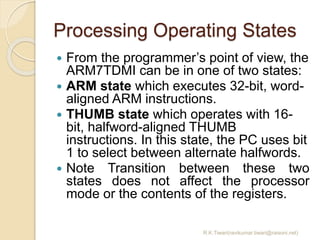
Processing Operating States
 From the programmer’s point of view, the
ARM7TDMI can be in one of two states:
 ARM state which executes 32-bit, word-
aligned ARM instructions.
 THUMB state which operates with 16-
bit, halfword-aligned THUMB
instructions. In this state, the PC uses bit
1 to select between alternate halfwords.
 Note Transition between these two
states does not affect the processor
mode or the contents of the registers.
R.K.Tiwari(ravikumar.tiwari@raisoni.net)
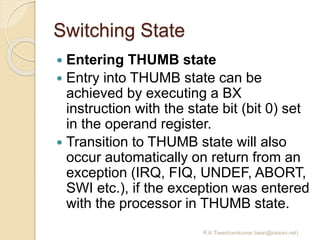
Switching State
 Entering THUMB state
 Entry into THUMB state can be
achieved by executing a BX
instruction with the state bit (bit 0) set
in the operand register.
 Transition to THUMB state will also
occur automatically on return from an
exception (IRQ, FIQ, UNDEF, ABORT,
SWI etc.), if the exception was entered
with the processor in THUMB state.
R.K.Tiwari(ravikumar.tiwari@raisoni.net)
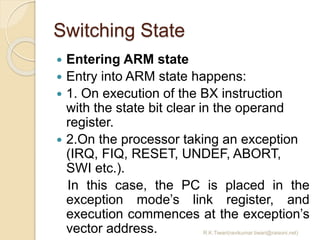
Switching State
 Entering ARM state
 Entry into ARM state happens:
 1. On execution of the BX instruction
with the state bit clear in the operand
register.
 2.On the processor taking an exception
(IRQ, FIQ, RESET, UNDEF, ABORT,
SWI etc.).
In this case, the PC is placed in the
exception mode’s link register, and
execution commences at the exception’s
vector address. R.K.Tiwari(ravikumar.tiwari@raisoni.net)
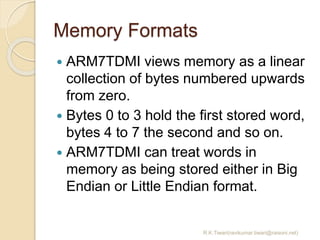
Memory Formats
 ARM7TDMI views memory as a linear
collection of bytes numbered upwards
from zero.
 Bytes 0 to 3 hold the first stored word,
bytes 4 to 7 the second and so on.
 ARM7TDMI can treat words in
memory as being stored either in Big
Endian or Little Endian format.
R.K.Tiwari(ravikumar.tiwari@raisoni.net)
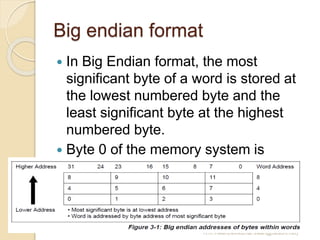
Big endian format
 In Big Endian format, the most
significant byte of a word is stored at
the lowest numbered byte and the
least significant byte at the highest
numbered byte.
 Byte 0 of the memory system is
therefore connected to data lines 31
through 24.
R.K.Tiwari(ravikumar.tiwari@raisoni.net)
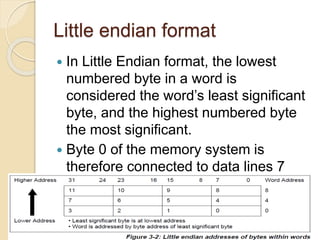
Little endian format
 In Little Endian format, the lowest
numbered byte in a word is
considered the word’s least significant
byte, and the highest numbered byte
the most significant.
 Byte 0 of the memory system is
therefore connected to data lines 7
through 0.
R.K.Tiwari(ravikumar.tiwari@raisoni.net)
Instruction Length
 Instructions are either 32 bits long (in
ARM state) or 16 bits long (in THUMB
state)
 Data Types
ARM7TDMI supports byte (8-bit),
halfword (16-bit) and word (32-bit)
data types.
Words must be aligned to four-byte
boundaries and half words to two-byte
boundaries.
R.K.Tiwari(ravikumar.tiwari@raisoni.net)
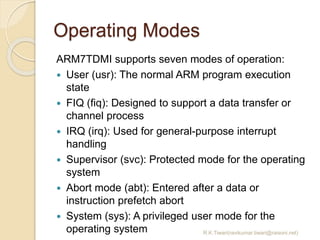
Operating Modes
ARM7TDMI supports seven modes of operation:
 User (usr): The normal ARM program execution
state
 FIQ (fiq): Designed to support a data transfer or
channel process
 IRQ (irq): Used for general-purpose interrupt
handling
 Supervisor (svc): Protected mode for the operating
system
 Abort mode (abt): Entered after a data or
instruction prefetch abort
 System (sys): A privileged user mode for the
operating system R.K.Tiwari(ravikumar.tiwari@raisoni.net)
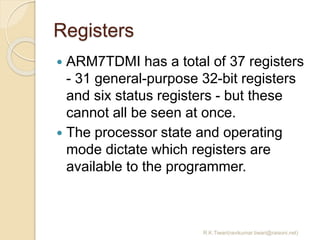
Registers
 ARM7TDMI has a total of 37 registers
- 31 general-purpose 32-bit registers
and six status registers - but these
cannot all be seen at once.
 The processor state and operating
mode dictate which registers are
available to the programmer.
R.K.Tiwari(ravikumar.tiwari@raisoni.net)
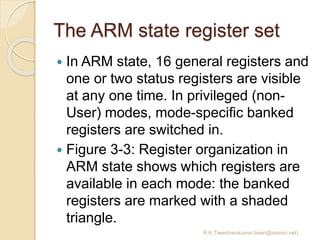
The ARM state register set
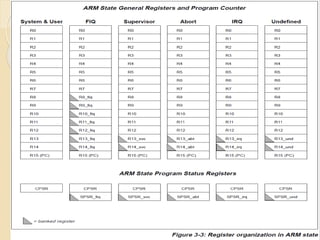
 In ARM state, 16 general registers and
one or two status registers are visible
at any one time. In privileged (non-
User) modes, mode-specific banked
registers are switched in.
 Figure 3-3: Register organization in
ARM state shows which registers are
available in each mode: the banked
registers are marked with a shaded
triangle.
R.K.Tiwari(ravikumar.tiwari@raisoni.net)
The ARM state register set
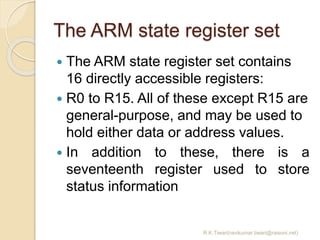
 The ARM state register set contains
16 directly accessible registers:
 R0 to R15. All of these except R15 are
general-purpose, and may be used to
hold either data or address values.
 In addition to these, there is a
seventeenth register used to store
status information
R.K.Tiwari(ravikumar.tiwari@raisoni.net)
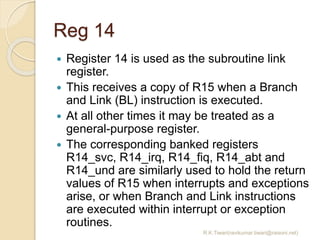
Reg 14
 Register 14 is used as the subroutine link
register.
 This receives a copy of R15 when a Branch
and Link (BL) instruction is executed.
 At all other times it may be treated as a
general-purpose register.
 The corresponding banked registers
R14_svc, R14_irq, R14_fiq, R14_abt and
R14_und are similarly used to hold the return
values of R15 when interrupts and exceptions
arise, or when Branch and Link instructions
are executed within interrupt or exception
routines.
R.K.Tiwari(ravikumar.tiwari@raisoni.net)
Reg 15
 Register 15 holds the Program
Counter (PC).
 In ARM state, bits [1:0] of R15 are
zero and bits [31:2] contain the PC. In
THUMB state, bit [0] is zero and bits
[31:1] contain the PC.
R.K.Tiwari(ravikumar.tiwari@raisoni.net)
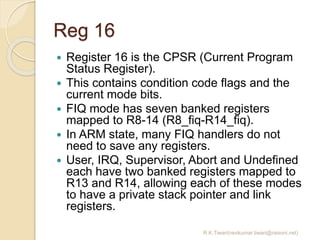
Reg 16
 Register 16 is the CPSR (Current Program
Status Register).
 This contains condition code flags and the
current mode bits.
 FIQ mode has seven banked registers
mapped to R8-14 (R8_fiq-R14_fiq).
 In ARM state, many FIQ handlers do not
need to save any registers.
 User, IRQ, Supervisor, Abort and Undefined
each have two banked registers mapped to
R13 and R14, allowing each of these modes
to have a private stack pointer and link
registers.
R.K.Tiwari(ravikumar.tiwari@raisoni.net)
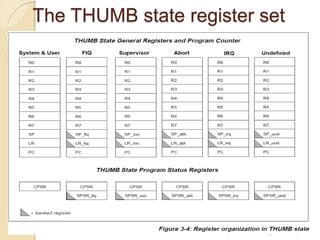
The THUMB state register set
R.K.Tiwari(ravikumar.tiwari@raisoni.net)
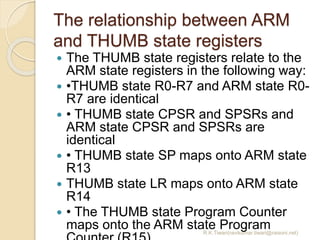
The relationship between ARM
and THUMB state registers
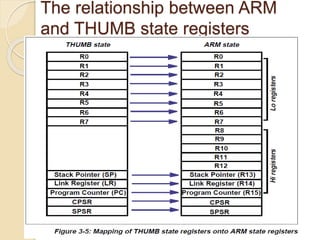
 The THUMB state registers relate to the
ARM state registers in the following way:
 •THUMB state R0-R7 and ARM state R0-
R7 are identical
 • THUMB state CPSR and SPSRs and
ARM state CPSR and SPSRs are
identical
 • THUMB state SP maps onto ARM state
R13
 THUMB state LR maps onto ARM state
R14
 • The THUMB state Program Counter
maps onto the ARM state ProgramR.K.Tiwari(ravikumar.tiwari@raisoni.net)
The relationship between ARM
and THUMB state registers
R.K.Tiwari(ravikumar.tiwari@raisoni.net)
The Program Status
Registers
 The ARM7TDMI contains a Current
Program Status Register (CPSR), plus
five Saved Program Status Registers
(SPSRs) for use by exception
handlers.
These registers
• hold information about the most
recently performed ALU operation
• control the enabling and disabling of
interrupts
• set the processor operating modeR.K.Tiwari(ravikumar.tiwari@raisoni.net)
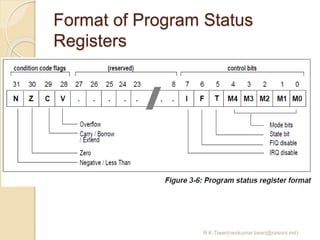
Format of Program Status
Registers
R.K.Tiwari(ravikumar.tiwari@raisoni.net)
Program Status Registers
 The condition code flags
 The N, Z, C and V bits are the
condition code flags. These may be
changed as a result
 of arithmetic and logical operations,
and may be tested to determine
whether an
 instruction should be executed.
R.K.Tiwari(ravikumar.tiwari@raisoni.net)
Program Status Registers
 The control bits
 The bottom 8 bits of a PSR
(incorporating I, F, T and M[4:0]) are
known collectively as the control bits.
 These will change when an exception
arises.
 If the processor is operating in a
privileged mode, they can also be
manipulated by software.
R.K.Tiwari(ravikumar.tiwari@raisoni.net)
Program Status Registers
 The T bit
 This reflects the operating state. When
this bit is set, the processor is executing
in THUMB state, otherwise it is executing
in ARM state.
 This is reflected on the TBIT external
signal.
 **Note that the software must never
change the state of the TBIT in the
CPSR. If this happens, the processor
will enter an unpredictable state.
R.K.Tiwari(ravikumar.tiwari@raisoni.net)
Program Status Registers
 Interrupt disable bits
 The I and F bits are the interrupt
disable bits.
 When set,these disable the IRQ and
FIQ interrupts respectively.
R.K.Tiwari(ravikumar.tiwari@raisoni.net)
PSR(The mode bits)
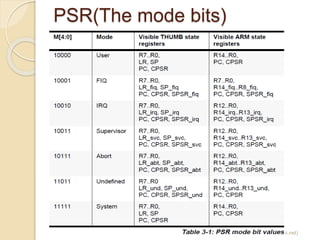
 The M4, M3, M2, M1 and M0 bits (M[4:0]) are
the mode bits.
 These determine the processor’s operating
mode, as shown in òTable 3-1: PSR mode bit
values on page 3-9.
 Not all combinations of the mode bits define a
valid processor mode. Only those explicitly
described shall be used.
 The user should be aware that if any illegal
value is programmed into the mode bits,
M[4:0], then the processor will enter an
unrecoverable state.
 If this occurs, reset should be applied.
R.K.Tiwari(ravikumar.tiwari@raisoni.net)
PSR(The mode bits)
R.K.Tiwari(ravikumar.tiwari@raisoni.net)
PSR(Reserve bits)
 The remaining bits in the PSRs are
reserved.
 When changing a PSR’s flag or
control bits, you must ensure that
these unused bits are not altered.
 Also, your program should not rely on
them containing specific values, since
in future processors they may read as
one or zero.
R.K.Tiwari(ravikumar.tiwari@raisoni.net)
Exception
 Exceptions arise whenever the normal
flow of a program has to be halted
temporarily, for example to service an
interrupt from a peripheral.
 Before an exception can be handled,
the current processor state must be
preserved so that the original program
can resume when the handler routine
has finished.
R.K.Tiwari(ravikumar.tiwari@raisoni.net)
Exception
 It is possible for several exceptions to
arise at the same time.
 If this happens, they are dealt with in a
fixed order
R.K.Tiwari(ravikumar.tiwari@raisoni.net)
Action on entering an
exception
When handling an exception, the
ARM7TDMI..
 Preserves the address of the next
instruction in the appropriate Link
Register. If the exception has been
entered from ARM state, then the
address of the next instruction is
copied into the Link Register
 Copies the CPSR into the appropriate
SPSR
R.K.Tiwari(ravikumar.tiwari@raisoni.net)
Action on entering an
exception
 Forces the CPSR mode bits to a value
which depends on the exception
 Forces the PC to fetch the next
instruction from the relevant exception
vector
R.K.Tiwari(ravikumar.tiwari@raisoni.net)
Action on leaving an
exception
 On completion, the exception handler:
 1 Moves the Link Register, minus an
offset where appropriate, to the PC.
(The
 offset will vary depending on the type
of exception.)
 2 Copies the SPSR back to the CPSR
 3 Clears the interrupt disable flags, if
they were set on entry
R.K.Tiwari(ravikumar.tiwari@raisoni.net)
Exception priorities
When multiple exceptions arise at the
same time, a fixed priority system
determines the order in which they are
handled
R.K.Tiwari(ravikumar.tiwari@raisoni.net)
Exception priorities
 Highest priority:
1 Reset
2 Data abort
3 FIQ
4 IRQ
5 Prefetch abort
 Lowest priority:
6 Undefined Instruction, Software interrupt.
 *Not all exceptions can occur at once:
Undefined Instruction and Software Interrupt are
mutually exclusive, since they each correspond
to particular (non-overlapping) decodings of the
current instruction.
R.K.Tiwari(ravikumar.tiwari@raisoni.net)
Reset
 When the nRESET signal goes LOW,
ARM7TDMI abandons the executing
instruction and then continues to fetch
instructions from incrementing word
addresses.
R.K.Tiwari(ravikumar.tiwari@raisoni.net)
Reset
When nRESET goes HIGH again,
ARM7TDMI:
 1 Overwrites R14_svc and SPSR_svc by
copying the current values of the PC
 and CPSR into them. The value of the
saved PC and SPSR is not defined.
 2 Forces M[4:0] to 10011 (Supervisor
mode), sets the I and F bits in the CPSR,
 and clears the CPSR’s T bit.
 3 Forces the PC to fetch the next
instruction from address 0x00.
 4 Execution resumes in ARM state.
R.K.Tiwari(ravikumar.tiwari@raisoni.net)

ARM- Programmer's Model

  • 1.
    ARM: Programmer’s Model (Chapter 3in ARM-datasheet) Ravikumar Tiwari Assistant Professor Dept. of Electronics, GHRCE ravikumar.tiwari@raisoni.net www.facebook.com/rravik www.twitter.com/Ravi6096
  • 2.
    Processing Operating States From the programmer’s point of view, the ARM7TDMI can be in one of two states:  ARM state which executes 32-bit, word- aligned ARM instructions.  THUMB state which operates with 16- bit, halfword-aligned THUMB instructions. In this state, the PC uses bit 1 to select between alternate halfwords.  Note Transition between these two states does not affect the processor mode or the contents of the registers. R.K.Tiwari(ravikumar.tiwari@raisoni.net)
  • 3.
    Switching State  EnteringTHUMB state  Entry into THUMB state can be achieved by executing a BX instruction with the state bit (bit 0) set in the operand register.  Transition to THUMB state will also occur automatically on return from an exception (IRQ, FIQ, UNDEF, ABORT, SWI etc.), if the exception was entered with the processor in THUMB state. R.K.Tiwari(ravikumar.tiwari@raisoni.net)
  • 4.
    Switching State  EnteringARM state  Entry into ARM state happens:  1. On execution of the BX instruction with the state bit clear in the operand register.  2.On the processor taking an exception (IRQ, FIQ, RESET, UNDEF, ABORT, SWI etc.). In this case, the PC is placed in the exception mode’s link register, and execution commences at the exception’s vector address. R.K.Tiwari(ravikumar.tiwari@raisoni.net)
  • 5.
    Memory Formats  ARM7TDMIviews memory as a linear collection of bytes numbered upwards from zero.  Bytes 0 to 3 hold the first stored word, bytes 4 to 7 the second and so on.  ARM7TDMI can treat words in memory as being stored either in Big Endian or Little Endian format. R.K.Tiwari(ravikumar.tiwari@raisoni.net)
  • 6.
    Big endian format In Big Endian format, the most significant byte of a word is stored at the lowest numbered byte and the least significant byte at the highest numbered byte.  Byte 0 of the memory system is therefore connected to data lines 31 through 24. R.K.Tiwari(ravikumar.tiwari@raisoni.net)
  • 7.
    Little endian format In Little Endian format, the lowest numbered byte in a word is considered the word’s least significant byte, and the highest numbered byte the most significant.  Byte 0 of the memory system is therefore connected to data lines 7 through 0. R.K.Tiwari(ravikumar.tiwari@raisoni.net)
  • 8.
    Instruction Length  Instructionsare either 32 bits long (in ARM state) or 16 bits long (in THUMB state)  Data Types ARM7TDMI supports byte (8-bit), halfword (16-bit) and word (32-bit) data types. Words must be aligned to four-byte boundaries and half words to two-byte boundaries. R.K.Tiwari(ravikumar.tiwari@raisoni.net)
  • 9.
    Operating Modes ARM7TDMI supportsseven modes of operation:  User (usr): The normal ARM program execution state  FIQ (fiq): Designed to support a data transfer or channel process  IRQ (irq): Used for general-purpose interrupt handling  Supervisor (svc): Protected mode for the operating system  Abort mode (abt): Entered after a data or instruction prefetch abort  System (sys): A privileged user mode for the operating system R.K.Tiwari(ravikumar.tiwari@raisoni.net)
  • 10.
    Registers  ARM7TDMI hasa total of 37 registers - 31 general-purpose 32-bit registers and six status registers - but these cannot all be seen at once.  The processor state and operating mode dictate which registers are available to the programmer. R.K.Tiwari(ravikumar.tiwari@raisoni.net)
  • 11.
    The ARM stateregister set  In ARM state, 16 general registers and one or two status registers are visible at any one time. In privileged (non- User) modes, mode-specific banked registers are switched in.  Figure 3-3: Register organization in ARM state shows which registers are available in each mode: the banked registers are marked with a shaded triangle. R.K.Tiwari(ravikumar.tiwari@raisoni.net)
  • 12.
    The ARM stateregister set  The ARM state register set contains 16 directly accessible registers:  R0 to R15. All of these except R15 are general-purpose, and may be used to hold either data or address values.  In addition to these, there is a seventeenth register used to store status information R.K.Tiwari(ravikumar.tiwari@raisoni.net)
  • 13.
    Reg 14  Register14 is used as the subroutine link register.  This receives a copy of R15 when a Branch and Link (BL) instruction is executed.  At all other times it may be treated as a general-purpose register.  The corresponding banked registers R14_svc, R14_irq, R14_fiq, R14_abt and R14_und are similarly used to hold the return values of R15 when interrupts and exceptions arise, or when Branch and Link instructions are executed within interrupt or exception routines. R.K.Tiwari(ravikumar.tiwari@raisoni.net)
  • 14.
    Reg 15  Register15 holds the Program Counter (PC).  In ARM state, bits [1:0] of R15 are zero and bits [31:2] contain the PC. In THUMB state, bit [0] is zero and bits [31:1] contain the PC. R.K.Tiwari(ravikumar.tiwari@raisoni.net)
  • 15.
    Reg 16  Register16 is the CPSR (Current Program Status Register).  This contains condition code flags and the current mode bits.  FIQ mode has seven banked registers mapped to R8-14 (R8_fiq-R14_fiq).  In ARM state, many FIQ handlers do not need to save any registers.  User, IRQ, Supervisor, Abort and Undefined each have two banked registers mapped to R13 and R14, allowing each of these modes to have a private stack pointer and link registers. R.K.Tiwari(ravikumar.tiwari@raisoni.net)
  • 16.
  • 17.
    The THUMB stateregister set R.K.Tiwari(ravikumar.tiwari@raisoni.net)
  • 18.
    The relationship betweenARM and THUMB state registers  The THUMB state registers relate to the ARM state registers in the following way:  •THUMB state R0-R7 and ARM state R0- R7 are identical  • THUMB state CPSR and SPSRs and ARM state CPSR and SPSRs are identical  • THUMB state SP maps onto ARM state R13  THUMB state LR maps onto ARM state R14  • The THUMB state Program Counter maps onto the ARM state ProgramR.K.Tiwari(ravikumar.tiwari@raisoni.net)
  • 19.
    The relationship betweenARM and THUMB state registers R.K.Tiwari(ravikumar.tiwari@raisoni.net)
  • 20.
    The Program Status Registers The ARM7TDMI contains a Current Program Status Register (CPSR), plus five Saved Program Status Registers (SPSRs) for use by exception handlers. These registers • hold information about the most recently performed ALU operation • control the enabling and disabling of interrupts • set the processor operating modeR.K.Tiwari(ravikumar.tiwari@raisoni.net)
  • 21.
    Format of ProgramStatus Registers R.K.Tiwari(ravikumar.tiwari@raisoni.net)
  • 22.
    Program Status Registers The condition code flags  The N, Z, C and V bits are the condition code flags. These may be changed as a result  of arithmetic and logical operations, and may be tested to determine whether an  instruction should be executed. R.K.Tiwari(ravikumar.tiwari@raisoni.net)
  • 23.
    Program Status Registers The control bits  The bottom 8 bits of a PSR (incorporating I, F, T and M[4:0]) are known collectively as the control bits.  These will change when an exception arises.  If the processor is operating in a privileged mode, they can also be manipulated by software. R.K.Tiwari(ravikumar.tiwari@raisoni.net)
  • 24.
    Program Status Registers The T bit  This reflects the operating state. When this bit is set, the processor is executing in THUMB state, otherwise it is executing in ARM state.  This is reflected on the TBIT external signal.  **Note that the software must never change the state of the TBIT in the CPSR. If this happens, the processor will enter an unpredictable state. R.K.Tiwari(ravikumar.tiwari@raisoni.net)
  • 25.
    Program Status Registers Interrupt disable bits  The I and F bits are the interrupt disable bits.  When set,these disable the IRQ and FIQ interrupts respectively. R.K.Tiwari(ravikumar.tiwari@raisoni.net)
  • 26.
    PSR(The mode bits) The M4, M3, M2, M1 and M0 bits (M[4:0]) are the mode bits.  These determine the processor’s operating mode, as shown in òTable 3-1: PSR mode bit values on page 3-9.  Not all combinations of the mode bits define a valid processor mode. Only those explicitly described shall be used.  The user should be aware that if any illegal value is programmed into the mode bits, M[4:0], then the processor will enter an unrecoverable state.  If this occurs, reset should be applied. R.K.Tiwari(ravikumar.tiwari@raisoni.net)
  • 27.
  • 28.
    PSR(Reserve bits)  Theremaining bits in the PSRs are reserved.  When changing a PSR’s flag or control bits, you must ensure that these unused bits are not altered.  Also, your program should not rely on them containing specific values, since in future processors they may read as one or zero. R.K.Tiwari(ravikumar.tiwari@raisoni.net)
  • 29.
    Exception  Exceptions arisewhenever the normal flow of a program has to be halted temporarily, for example to service an interrupt from a peripheral.  Before an exception can be handled, the current processor state must be preserved so that the original program can resume when the handler routine has finished. R.K.Tiwari(ravikumar.tiwari@raisoni.net)
  • 30.
    Exception  It ispossible for several exceptions to arise at the same time.  If this happens, they are dealt with in a fixed order R.K.Tiwari(ravikumar.tiwari@raisoni.net)
  • 31.
    Action on enteringan exception When handling an exception, the ARM7TDMI..  Preserves the address of the next instruction in the appropriate Link Register. If the exception has been entered from ARM state, then the address of the next instruction is copied into the Link Register  Copies the CPSR into the appropriate SPSR R.K.Tiwari(ravikumar.tiwari@raisoni.net)
  • 32.
    Action on enteringan exception  Forces the CPSR mode bits to a value which depends on the exception  Forces the PC to fetch the next instruction from the relevant exception vector R.K.Tiwari(ravikumar.tiwari@raisoni.net)
  • 33.
    Action on leavingan exception  On completion, the exception handler:  1 Moves the Link Register, minus an offset where appropriate, to the PC. (The  offset will vary depending on the type of exception.)  2 Copies the SPSR back to the CPSR  3 Clears the interrupt disable flags, if they were set on entry R.K.Tiwari(ravikumar.tiwari@raisoni.net)
  • 34.
    Exception priorities When multipleexceptions arise at the same time, a fixed priority system determines the order in which they are handled R.K.Tiwari(ravikumar.tiwari@raisoni.net)
  • 35.
    Exception priorities  Highestpriority: 1 Reset 2 Data abort 3 FIQ 4 IRQ 5 Prefetch abort  Lowest priority: 6 Undefined Instruction, Software interrupt.  *Not all exceptions can occur at once: Undefined Instruction and Software Interrupt are mutually exclusive, since they each correspond to particular (non-overlapping) decodings of the current instruction. R.K.Tiwari(ravikumar.tiwari@raisoni.net)
  • 36.
    Reset  When thenRESET signal goes LOW, ARM7TDMI abandons the executing instruction and then continues to fetch instructions from incrementing word addresses. R.K.Tiwari(ravikumar.tiwari@raisoni.net)
  • 37.
    Reset When nRESET goesHIGH again, ARM7TDMI:  1 Overwrites R14_svc and SPSR_svc by copying the current values of the PC  and CPSR into them. The value of the saved PC and SPSR is not defined.  2 Forces M[4:0] to 10011 (Supervisor mode), sets the I and F bits in the CPSR,  and clears the CPSR’s T bit.  3 Forces the PC to fetch the next instruction from address 0x00.  4 Execution resumes in ARM state. R.K.Tiwari(ravikumar.tiwari@raisoni.net)