Textual Aids
Mr. Ranie Livero O. Villamin, MEd-English
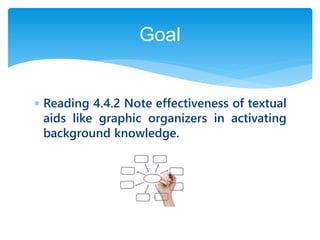
 Reading 4.4.2 Note effectiveness of textual
aids like graphic organizers in activating
background knowledge.
Goal
 Viewing
Activity 1
GRAPHIC ORGANIZERS
 Graphic organizers are visual displays of key
content information designed to benefit
learners who have difficulty organizing
information (Fisher & Schumaker, 1995).
 Graphic organizers are meant to help
students clearly visualize how ideas are
organized within a text or surrounding a
concept.
 Graphic organizers provide students with a
structure for abstract ideas.
 Graphic organizers can be categorized in
many ways according to the way they
arrange information:
 hierarchical,
 conceptual,
 sequential, or
 cyclical
Kinds of Graphic Organizers
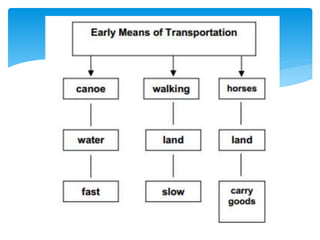
 A concept map is a general organizer that shows a
central idea with its corresponding characteristics.
 Concept maps can take many different shapes and
can be used to show any type of relationship that
can be labeled.
 Maps are excellent for brainstorming, activating
prior knowledge, or generating synonyms.
 Maps can be used to show hierarchical
relationships with the most important concepts
placed at the top.
Concept Map
 A flow diagram or sequence chart shows a series of steps
or events in the order in which they take place.
 Any concept that has a distinct order can be displayed in
this type of organizer.
 It is an excellent tool for teaching students the steps
necessary to reach a final point.
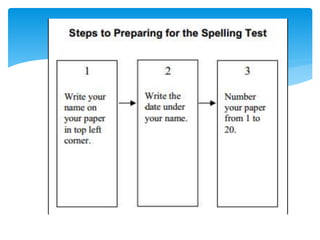
 The following examples illustrate the many uses of flow
diagrams or sequence charts.
 In reading, sequence charts can be used to outline the key
events in a story or chapter.
 In science, they can serve as the procedures section in the
scientific process.
 In history, they can be created as a timeline.
Flow Diagram or Sequence Chart
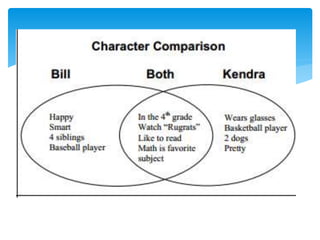
 A compare/contrast or Venn diagram is
used to identify the similarities and
differences between two or more concepts.
 The most commonly used organizer, this
instructional tool is found in textbooks, on
standardized tests, and in teacher resource
materials.
Compare/Contrast or
Venn Diagram
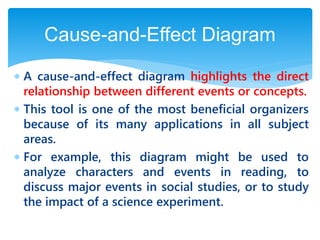
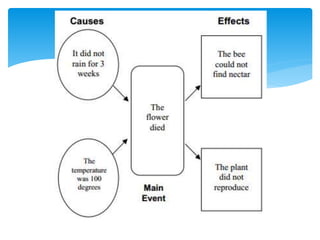
 A cause-and-effect diagram highlights the direct
relationship between different events or concepts.
 This tool is one of the most beneficial organizers
because of its many applications in all subject
areas.
 For example, this diagram might be used to
analyze characters and events in reading, to
discuss major events in social studies, or to study
the impact of a science experiment.
Cause-and-Effect Diagram
Activity 2
 Read the following
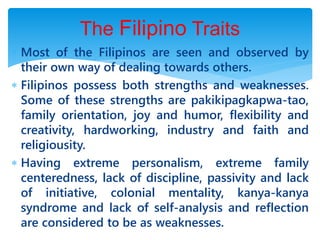
 Most of the Filipinos are seen and observed by
their own way of dealing towards others.
 Filipinos possess both strengths and weaknesses.
Some of these strengths are pakikipagkapwa-tao,
family orientation, joy and humor, flexibility and
creativity, hardworking, industry and faith and
religiousity.
 Having extreme personalism, extreme family
centeredness, lack of discipline, passivity and lack
of initiative, colonial mentality, kanya-kanya
syndrome and lack of self-analysis and reflection
are considered to be as weaknesses.
The Filipino Traits
 Make a presentation on Filipino Traits
using the chosen graphic organizer.
Activity 3
With your group, present
a commercial showing
good/positive values.
Agreement
Textual Aids

Textual Aids

  • 1.
    Textual Aids Mr. RanieLivero O. Villamin, MEd-English
  • 2.
     Reading 4.4.2Note effectiveness of textual aids like graphic organizers in activating background knowledge. Goal
  • 3.
  • 4.
  • 5.
     Graphic organizersare visual displays of key content information designed to benefit learners who have difficulty organizing information (Fisher & Schumaker, 1995).  Graphic organizers are meant to help students clearly visualize how ideas are organized within a text or surrounding a concept.  Graphic organizers provide students with a structure for abstract ideas.
  • 6.
     Graphic organizerscan be categorized in many ways according to the way they arrange information:  hierarchical,  conceptual,  sequential, or  cyclical Kinds of Graphic Organizers
  • 7.
     A conceptmap is a general organizer that shows a central idea with its corresponding characteristics.  Concept maps can take many different shapes and can be used to show any type of relationship that can be labeled.  Maps are excellent for brainstorming, activating prior knowledge, or generating synonyms.  Maps can be used to show hierarchical relationships with the most important concepts placed at the top. Concept Map
  • 9.
     A flowdiagram or sequence chart shows a series of steps or events in the order in which they take place.  Any concept that has a distinct order can be displayed in this type of organizer.  It is an excellent tool for teaching students the steps necessary to reach a final point.  The following examples illustrate the many uses of flow diagrams or sequence charts.  In reading, sequence charts can be used to outline the key events in a story or chapter.  In science, they can serve as the procedures section in the scientific process.  In history, they can be created as a timeline. Flow Diagram or Sequence Chart
  • 11.
     A compare/contrastor Venn diagram is used to identify the similarities and differences between two or more concepts.  The most commonly used organizer, this instructional tool is found in textbooks, on standardized tests, and in teacher resource materials. Compare/Contrast or Venn Diagram
  • 13.
     A cause-and-effectdiagram highlights the direct relationship between different events or concepts.  This tool is one of the most beneficial organizers because of its many applications in all subject areas.  For example, this diagram might be used to analyze characters and events in reading, to discuss major events in social studies, or to study the impact of a science experiment. Cause-and-Effect Diagram
  • 15.
    Activity 2  Readthe following
  • 16.
     Most ofthe Filipinos are seen and observed by their own way of dealing towards others.  Filipinos possess both strengths and weaknesses. Some of these strengths are pakikipagkapwa-tao, family orientation, joy and humor, flexibility and creativity, hardworking, industry and faith and religiousity.  Having extreme personalism, extreme family centeredness, lack of discipline, passivity and lack of initiative, colonial mentality, kanya-kanya syndrome and lack of self-analysis and reflection are considered to be as weaknesses. The Filipino Traits
  • 17.
     Make apresentation on Filipino Traits using the chosen graphic organizer. Activity 3
  • 18.
    With your group,present a commercial showing good/positive values. Agreement