Stock Audit

By
CA. Rajkumar S Adukia
To receive regular updates on various professional issues kindly send
test mail to rajkumarfca-subscribe@yahoogroups.com
www.caaa.in

1
Meaning of Stock
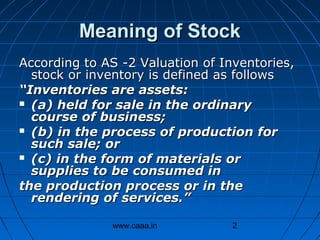
According to AS -2 Valuation of Inventories,
stock or inventory is defined as follows
“Inventories are assets:
 (a) held for sale in the ordinary
course of business;
 (b) in the process of production for
such sale; or
 (c) in the form of materials or
supplies to be consumed in
the production process or in the
rendering of services.”
www.caaa.in

2
Meaning of Stock
Inventories thus normally comprises of
 stores,
 spares parts,
 loose tools,
 maintenance supplies,
 raw materials including components,
 work in process,
 finished goods including by-products,
 waste or by-products, etc.
www.caaa.in

3
Meaning of Debtors
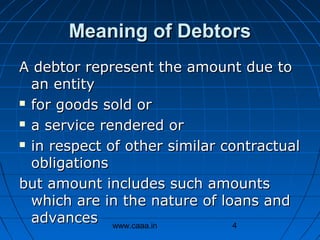
A debtor represent the amount due to
an entity
 for goods sold or
 a service rendered or
 in respect of other similar contractual
obligations
but amount includes such amounts
which are in the nature of loans and
advances www.caaa.in
4
Inventory & Receivables






Maintenance of inventory is a major
part of working capital
requirement of any unit.
Essential components, of the total
assets of an entity in general and
current assets in particular are
Inventories and Debtors.
Stock and Debtors indicate the
health of a company
www.caaa.in

5
Valuation of Inventories






Different methods of valuation are
adopted, depending upon the type of
Inventories, in particular and the type of
the business in general.
The Inventories should be valued at cost
or market price, whichever is lower.
The fundamental concept is that provision
for losses should be made and unrealized
profits should not be considered
www.caaa.in

6
Method of Valuation




The Institute of Chartered Accountants has
prescribed the methods that are
mandatory for the valuation of inventories,
by means of the Accounting Standard – 2,
which deals with the valuation of
inventories.
These methods are Specific Identification
method, First-in-First-out method and
Weighted Average Method.
www.caaa.in

7
Valuation of Different Types of
Inventories




The Institute of Chartered
Accountants of India defines,
Inventories to include, stores, spare
parts, loose tools, raw materials,
materials in process, finished
products, waste or by products, etc
Each type of Inventories entails
different methods of valuation
www.caaa.in
depending on their unique 8
Valuation of Different Types of
Inventories


For computing accumulation of huge inventories the number of days
holding of Inventories etc, the following method may be followed:
•

For Raw Material:

•

For Inventories in Process:

•

For Finished Goods:

•

For sundry debtors:

•

for sundry creditors



=





=





=





=






=

Actual Holding_ X 365 ____
Annual Raw Material Consumed
Actual holding
X 365____
Annual cost of production
Actual holding
X 365____
Annual cost sales

Actual outstanding debtor’s
Annual sales
Actual sundry creditors’
Annual purchases

www.caaa.in

X 365____
X 365____

9
Bank Borrowing


Entities obtain loans from banks in
the form of cash credit against
hypothecation of Inventories and
Debtors

www.caaa.in

10
Consortium Lending

(a)
(b)

(c)

(d)
(e)
(f)

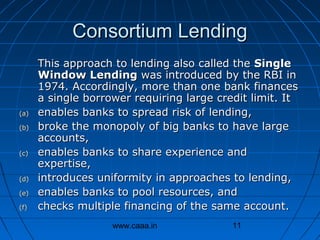
This approach to lending also called the Single
Window Lending was introduced by the RBI in
1974. Accordingly, more than one bank finances
a single borrower requiring large credit limit. It
enables banks to spread risk of lending,
broke the monopoly of big banks to have large
accounts,
enables banks to share experience and
expertise,
introduces uniformity in approaches to lending,
enables banks to pool resources, and
checks multiple financing of the same account.
www.caaa.in

11
Cash Credit Facility






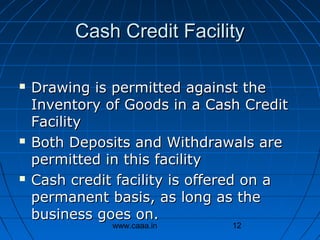
Drawing is permitted against the
Inventory of Goods in a Cash Credit
Facility
Both Deposits and Withdrawals are
permitted in this facility
Cash credit facility is offered on a
permanent basis, as long as the
business goes on.
www.caaa.in

12
Types of Cash Credit Facility
Cash credit facility is of two types based on the nature of
charge on goods taken as security by bank.
(i) Cash credit - Pledge: When the possession of the goods
is with the bank. The physical control of the goods is
exercised by the bank.
(ii) Cash credit- Hypothecation: When the possession of
the goods remains with the borrower and a floating charge
over the inventories is created in favour of the bank. The
borrower has complete control over the goods and the
drawings in the account are permitted on the basis of
Inventories statements submitted by the borrower.

www.caaa.in

13
Inventory Audit
Inventories audit is about the
authentication of





quantity,
quality,
composition and
valuation

of the inventories and debtors.
www.caaa.in

14
Stock Audit Cycle
The five stages in any audit are:
 Pre-engagement
 Understanding the entity
 Audit planning
 Substantive procedures
 Reporting

www.caaa.in

15
Inventories Audit in Banks
The term Inventories Audit in the context of
banks refers to
 verification and valuation of the entire
gamut of current assets, current liabilities,
loans and advances, diversion of funds,
application of funds,
 accuracy of Inventories statements,
 arriving at the revised drawing power and
 any other matter connected with the credit
administration by the banks.
www.caaa.in

16
Inventories Audit in Banks




The main purpose of audit in banks
is to get an assurance on the quality
and quantity of loan security.
Inventories Audit in Bank verifies the
following
• Physical Verification of the Security
• Valuation of Security
• Security of the Security
www.caaa.in

17
Meaning of Mortgage
Sec 58(a) of the Transfer of Property Act 1882 deals with
mortgage. Accordingly, the necessary ingredients of a
mortgage are: 1. Transfer of interest in specific immovable property
2. Transfer is for the purpose of securing the payment of
money advanced or to be advanced by way of loan.
3. It may be existing and future debt.
4. It may be also for performance of an engagement, which
may lead to financial liability.

www.caaa.in

18
Need for Inventory Audit


An Inventories audit is essential for the
following purposes:
To give the bankers an assurance
regarding the following:

• That a suitable environment for preservation of
Inventories exists
• That a responsible person for safeguarding the
Inventories is always present
• That degraded Inventories have been written
off
• That adequate safeguards exist against fire
and natural calamities
www.caaa.in

19
Need for Inventory Audit
•
•
•
•
•


That physical inventories tally with the
Inventories statements submitted to bank
That the pledged/hypothecated Inventories is
realizable
That Inventories is owned by the borrower
That all sanction terms have been adhered to
That inventories are not stagnating and
becoming obsolete

To investigate, wherever the party is not
submitting periodic Inventories
statements regularly.
www.caaa.in

20
Need for Inventory Audit






To investigate, where the accounts
have been marked as substandard.
To find out reasons when there are
too many qualifying remarks about
inventories and receivables in the
Auditor’s report on the Balance
Sheet of the borrower
To find out suspect dealing in
lending procedure
www.caaa.in

21
Need for Inventory Audit




To make the banks aware of their
right of enforcement of the security
interest provided in the
Securitization and Reconstruction of
Financial Assets and enforcement of
Security Interest Act, 2002.
To fulfill Head Office requirement

www.caaa.in

22
Scope of Inventory Audit




The scope of the audit covers all the
aspects that have a direct impact on the
working capital of the unit as well as the
aspects relating to Inventories that have a
bearing on the bank finance.
It encompasses the following aspects:
•
•
•

Physical verification of inventories
Verification of condition of storage
Valuation of inventories and pointing out
variances
www.caaa.in

23
Scope of Inventory Audit
•
•
•
•

•

Valuation of obsolete / non-moving
Inventories
Age-wise categorization of inventories
Evaluation of the Inventories management by
the company
Reconciliation of Inventories statements
submitted with the accounting records
maintained by borrowers particularly, relating
to quantity, rate, value of inventories, age,
marketability, etc
Verification and evaluation of sundry
creditors indicating separately those relating
to Inventories and their relationship with
bank finance
www.caaa.in

24
Scope of Inventory Audit
•

•
•
•
•
•

commenting upon the sources of the raw
materials, i.e., whether any credit is available
for the material and which of the items are
available against cash payments
Review of the Inventories valuation system
Age-wise and value-wise qualification of
debtors
Determination of the drawing power
Determining adequacy of the insurance cover
Verification of documents/ securities
www.caaa.in

25
Scope of Inventory Audit
• Commenting upon the comparative
Profitability and Inventories ratio
• Ensuring that the compliance of the
terms and conditions of limit sanctioned
• Verification of transactions with sister
concerns, unsecured Loans to Directors
and others
• Any other matters of interest to the
bank
www.caaa.in

26
When to perform Stock Audit









Where there are over dues in term loans
or other accounts, where the banks’
stake is high.
Where there is evidence of pressure on
the borrower from the creditors
Where the inventories are stagnating.
Where party is not submitting periodic
Inventories statements regularly
Where there are grounds to suspect that
the position of chargeable current assets
indicated may not be correct.
www.caaa.in

27
When to perform Stock Audit











Where there are too many qualifying remarks
about inventories and receivables in the auditors
report on the balance sheet of a borrower
Where the accounts is marked as sub-standard
Suspect dealings in lending procedure,
jeopardizing advances given
An errant borrower, where Inventories audit is
needed to supplement actions of the branches for
recovery.
Any other valid reason such as mismanagement,
heavy losses, lockout, strikes etc
Fulfilling the criteria fixed by the head office to
get done Inventories audit.
www.caaa.in

28
Non Performing Assets




•
•

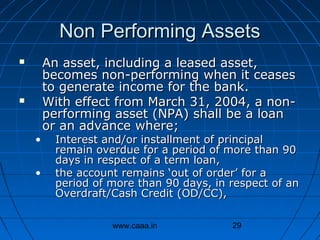
An asset, including a leased asset,
becomes non-performing when it ceases
to generate income for the bank.
With effect from March 31, 2004, a nonperforming asset (NPA) shall be a loan
or an advance where;

Interest and/or installment of principal
remain overdue for a period of more than 90
days in respect of a term loan,
the account remains ‘out of order’ for a
period of more than 90 days, in respect of an
Overdraft/Cash Credit (OD/CC),
www.caaa.in

29
Non Performing Assets
•

•

•

the bill remains overdue for a period of more
than 90 days in the case of bills purchased
and discounted,
interest and/or installment of principal
remains overdue for two harvest seasons but
for a period not exceeding two half years in
the case of an advance granted for
agricultural purposes, and
Any amount to be received remains overdue
for a period of more than 90 days in respect
of other accounts.
www.caaa.in

30
Special Points on Stock Audit
•

•

If the stock statement as shown in the
hypothecation statement does not tally with
the stocks as in the balance sheet , then
appropriate action should be taken to find
reasons for the differences
It should be seen that the stocks have been
properly valued, after considering the
relevant accounting principles, Accounting
standards (AS) and Engagement Standards
[ earlier Known as Auditing and Assurance
standards (AAS)]
www.caaa.in

31
Special Points on Stock Audit
•
•
•

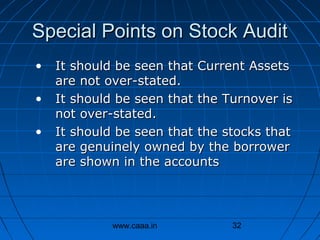
It should be seen that Current Assets
are not over-stated.
It should be seen that the Turnover is
not over-stated.
It should be seen that the stocks that
are genuinely owned by the borrower
are shown in the accounts

www.caaa.in

32
ICAI Pronouncements


There are no guidance notes or
standards prescribed for Inventories
audit, the auditors should conduct
the audit based on the generally
accepted auditing practices and to
the best of his judgment and ability.

www.caaa.in

33
Relevant Standards



AS 2 – Valuation of Inventories
IAS 2 – Accounting for Inventories

www.caaa.in

34
Relevant RBI Notifications




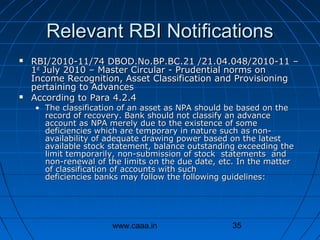
RBI/2010-11/74 DBOD.No.BP.BC.21 /21.04.048/2010-11 –
1st July 2010 – Master Circular - Prudential norms on
Income Recognition, Asset Classification and Provisioning
pertaining to Advances
According to Para 4.2.4
• The classification of an asset as NPA should be based on the
record of recovery. Bank should not classify an advance
account as NPA merely due to the existence of some
deficiencies which are temporary in nature such as nonavailability of adequate drawing power based on the latest
available stock statement, balance outstanding exceeding the
limit temporarily, non-submission of stock statements and
non-renewal of the limits on the due date, etc. In the matter
of classification of accounts with such
deficiencies banks may follow the following guidelines:

www.caaa.in

35
Relevant RBI Notifications
• i) Banks should ensure that drawings in the
working capital accounts are covered by the
adequacy of current assets, since current
assets are first appropriated in times of
distress. Drawing power is required to be
arrived at based on the stock statement which
is current. However, considering the
difficulties of large borrowers, stock
statements relied upon by the banks for
determining drawing power should not be older
than three months. The outstanding in the
account based on drawing power calculated
from stock statements older than three
months, would be deemed as irregular.
www.caaa.in

36
Relevant RBI Notifications


A working capital borrowal account
will become NPA if such irregular
drawings are permitted in the
account for a continuous period of 90
days even though the unit may be
working or the borrower's financial
position is satisfactory.

www.caaa.in

37
Relevant RBI Notification


ii) Regular and ad hoc credit limits need to be
reviewed/ regularised not later than three
months from the due date/date of ad
hoc sanction. In case of constraints such as nonavailability of financial statements and other data
from the borrowers, the branch should furnish
evidence to show that renewal/ review of credit
limits is already on and would be completed soon.
In any case, delay beyond six months is not
considered desirable as a general discipline.
Hence, an account where the regular/ ad
hoc credit limits have not been reviewed/
renewed within 180 days from the due date/ date
of ad hoc sanction will be treated as NPA.
www.caaa.in

38
Relevant RBI Notification
Para 5.3 on Doubtful Assets –
With a view to bringing down divergence arising out
of difference in assessment of the value of
security, in cases of NPAs with balance of Rs. 5
crore and above stock audit at annual intervals by
external agencies appointed as per the
guidelines approved by the Board would be
mandatory in order to enhance the reliability on
stock valuation. Collaterals such as immovable
properties charged in favour of the bank should
be got valued once in three
years by valuers appointed as per the
guidelines approved by the Board of Directors


www.caaa.in

39
Relevant RBI Notification


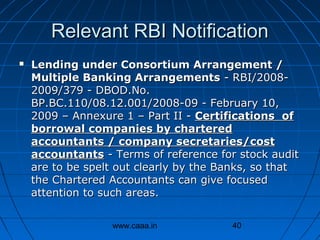
Lending under Consortium Arrangement /
Multiple Banking Arrangements - RBI/20082009/379 - DBOD.No.
BP.BC.110/08.12.001/2008-09 - February 10,
2009 – Annexure 1 – Part II - Certifications of
borrowal companies by chartered
accountants / company secretaries/cost
accountants - Terms of reference for stock audit
are to be spelt out clearly by the Banks, so that
the Chartered Accountants can give focused
attention to such areas.
www.caaa.in

40
Relevant RBI Notification


Lending under Consortium
Arrangement / Multiple Banking
Arrangements - RBI/2008-2009/379 DBOD.No. BP.BC.110/08.12.001/2008-09
- February 10, 2009 – Annexure II –
Revised Format under Multiple Banking
Arrangement Credit Information Exchange
– Part IV – Credit Information Report –
III. Compliance with Financial Covenants
– Stock Statement/ Financial Data
www.caaa.in

41
Stock Audit Report




Format for stock audit report may vary from bank
to bank.
A stock audit report should cover the following
aspects
• Compliance with terms and conditions of sanction.
• Timely & adequate submission of stock statements &
other important financial information.
• Account operations – overdrawing, credit summation
and cash withdrawals.
• Drawing power calculations by banks and by the
auditors & discrepancies, if any along with the reasons.

www.caaa.in

42
Stock Audit Report
• Physical maintenance and storage of stock and
adequacy of facilities at the borrowers place.
• Systems / procedures implemented by
borrower to identify the slow and non-moving
stock items.
• Borrower’s Management information system,
its adequacy & Internal controls to safeguard
stock.
• Method of valuation of stock, time interval for
valuation and adequacy & sufficiency of
procedures thereof.
• Insurance of stock.
• Verification of Debtors.
www.caaa.in

43
About the Author








CA. Rajkumar S Adukia is an eminent business
consultant, academician, writer, and speaker. He is
the senior partner of Adukia & Associates.
In addition to being a Chartered Accountant, Company
Secretary, Cost Accountant, MBA, Dip IFR (UK), Mr.
Adukia also holds a Degree in Law and Diploma in
Labor Laws and IPR.
Mr. Adukia, a rank holder from Bombay University
completed the Chartered Accountancy examination with 1st
Rank in Inter CA & 6th Rank in Final CA, and 3rd Rank in
Final Cost Accountancy Course in 1983.
He started his practice as a Chartered Accountant on 1st
July 1983, in the three decades following which he left no
stone unturned, be it academic expertise or professional
development.
www.caaa.in

44
About the Author






He has been coordinating with various Professional
Institutions, Associations, Universities, University Grants
Commission and other Educational Institutions.

Authored more than 50 books on a vast range of
topics including Internal Audit, Bank Audit, SEZ,
CARO, PMLA, Anti-dumping, Income Tax Search,
Survey and Seizure, IFRS, LLP, Labour Laws, Real
estate, ERM, Inbound and Outbound Investments,
Green Audit etc.
The author can be reached at rajkumarfca@gmail.com. For
more details log on to www.caaa.in
www.caaa.in

45
www.caaa.in

46

08 Stock Audit

  • 1.
    Stock Audit By CA. RajkumarS Adukia To receive regular updates on various professional issues kindly send test mail to rajkumarfca-subscribe@yahoogroups.com www.caaa.in 1
  • 2.
    Meaning of Stock Accordingto AS -2 Valuation of Inventories, stock or inventory is defined as follows “Inventories are assets:  (a) held for sale in the ordinary course of business;  (b) in the process of production for such sale; or  (c) in the form of materials or supplies to be consumed in the production process or in the rendering of services.” www.caaa.in 2
  • 3.
    Meaning of Stock Inventoriesthus normally comprises of  stores,  spares parts,  loose tools,  maintenance supplies,  raw materials including components,  work in process,  finished goods including by-products,  waste or by-products, etc. www.caaa.in 3
  • 4.
    Meaning of Debtors Adebtor represent the amount due to an entity  for goods sold or  a service rendered or  in respect of other similar contractual obligations but amount includes such amounts which are in the nature of loans and advances www.caaa.in 4
  • 5.
    Inventory & Receivables    Maintenanceof inventory is a major part of working capital requirement of any unit. Essential components, of the total assets of an entity in general and current assets in particular are Inventories and Debtors. Stock and Debtors indicate the health of a company www.caaa.in 5
  • 6.
    Valuation of Inventories    Differentmethods of valuation are adopted, depending upon the type of Inventories, in particular and the type of the business in general. The Inventories should be valued at cost or market price, whichever is lower. The fundamental concept is that provision for losses should be made and unrealized profits should not be considered www.caaa.in 6
  • 7.
    Method of Valuation   TheInstitute of Chartered Accountants has prescribed the methods that are mandatory for the valuation of inventories, by means of the Accounting Standard – 2, which deals with the valuation of inventories. These methods are Specific Identification method, First-in-First-out method and Weighted Average Method. www.caaa.in 7
  • 8.
    Valuation of DifferentTypes of Inventories   The Institute of Chartered Accountants of India defines, Inventories to include, stores, spare parts, loose tools, raw materials, materials in process, finished products, waste or by products, etc Each type of Inventories entails different methods of valuation www.caaa.in depending on their unique 8
  • 9.
    Valuation of DifferentTypes of Inventories  For computing accumulation of huge inventories the number of days holding of Inventories etc, the following method may be followed: • For Raw Material: • For Inventories in Process: • For Finished Goods: • For sundry debtors: • for sundry creditors  =   =   =   =    = Actual Holding_ X 365 ____ Annual Raw Material Consumed Actual holding X 365____ Annual cost of production Actual holding X 365____ Annual cost sales Actual outstanding debtor’s Annual sales Actual sundry creditors’ Annual purchases www.caaa.in X 365____ X 365____ 9
  • 10.
    Bank Borrowing  Entities obtainloans from banks in the form of cash credit against hypothecation of Inventories and Debtors www.caaa.in 10
  • 11.
    Consortium Lending (a) (b) (c) (d) (e) (f) This approachto lending also called the Single Window Lending was introduced by the RBI in 1974. Accordingly, more than one bank finances a single borrower requiring large credit limit. It enables banks to spread risk of lending, broke the monopoly of big banks to have large accounts, enables banks to share experience and expertise, introduces uniformity in approaches to lending, enables banks to pool resources, and checks multiple financing of the same account. www.caaa.in 11
  • 12.
    Cash Credit Facility    Drawingis permitted against the Inventory of Goods in a Cash Credit Facility Both Deposits and Withdrawals are permitted in this facility Cash credit facility is offered on a permanent basis, as long as the business goes on. www.caaa.in 12
  • 13.
    Types of CashCredit Facility Cash credit facility is of two types based on the nature of charge on goods taken as security by bank. (i) Cash credit - Pledge: When the possession of the goods is with the bank. The physical control of the goods is exercised by the bank. (ii) Cash credit- Hypothecation: When the possession of the goods remains with the borrower and a floating charge over the inventories is created in favour of the bank. The borrower has complete control over the goods and the drawings in the account are permitted on the basis of Inventories statements submitted by the borrower. www.caaa.in 13
  • 14.
    Inventory Audit Inventories auditis about the authentication of     quantity, quality, composition and valuation of the inventories and debtors. www.caaa.in 14
  • 15.
    Stock Audit Cycle Thefive stages in any audit are:  Pre-engagement  Understanding the entity  Audit planning  Substantive procedures  Reporting www.caaa.in 15
  • 16.
    Inventories Audit inBanks The term Inventories Audit in the context of banks refers to  verification and valuation of the entire gamut of current assets, current liabilities, loans and advances, diversion of funds, application of funds,  accuracy of Inventories statements,  arriving at the revised drawing power and  any other matter connected with the credit administration by the banks. www.caaa.in 16
  • 17.
    Inventories Audit inBanks   The main purpose of audit in banks is to get an assurance on the quality and quantity of loan security. Inventories Audit in Bank verifies the following • Physical Verification of the Security • Valuation of Security • Security of the Security www.caaa.in 17
  • 18.
    Meaning of Mortgage Sec58(a) of the Transfer of Property Act 1882 deals with mortgage. Accordingly, the necessary ingredients of a mortgage are: 1. Transfer of interest in specific immovable property 2. Transfer is for the purpose of securing the payment of money advanced or to be advanced by way of loan. 3. It may be existing and future debt. 4. It may be also for performance of an engagement, which may lead to financial liability. www.caaa.in 18
  • 19.
    Need for InventoryAudit  An Inventories audit is essential for the following purposes: To give the bankers an assurance regarding the following: • That a suitable environment for preservation of Inventories exists • That a responsible person for safeguarding the Inventories is always present • That degraded Inventories have been written off • That adequate safeguards exist against fire and natural calamities www.caaa.in 19
  • 20.
    Need for InventoryAudit • • • • •  That physical inventories tally with the Inventories statements submitted to bank That the pledged/hypothecated Inventories is realizable That Inventories is owned by the borrower That all sanction terms have been adhered to That inventories are not stagnating and becoming obsolete To investigate, wherever the party is not submitting periodic Inventories statements regularly. www.caaa.in 20
  • 21.
    Need for InventoryAudit    To investigate, where the accounts have been marked as substandard. To find out reasons when there are too many qualifying remarks about inventories and receivables in the Auditor’s report on the Balance Sheet of the borrower To find out suspect dealing in lending procedure www.caaa.in 21
  • 22.
    Need for InventoryAudit   To make the banks aware of their right of enforcement of the security interest provided in the Securitization and Reconstruction of Financial Assets and enforcement of Security Interest Act, 2002. To fulfill Head Office requirement www.caaa.in 22
  • 23.
    Scope of InventoryAudit   The scope of the audit covers all the aspects that have a direct impact on the working capital of the unit as well as the aspects relating to Inventories that have a bearing on the bank finance. It encompasses the following aspects: • • • Physical verification of inventories Verification of condition of storage Valuation of inventories and pointing out variances www.caaa.in 23
  • 24.
    Scope of InventoryAudit • • • • • Valuation of obsolete / non-moving Inventories Age-wise categorization of inventories Evaluation of the Inventories management by the company Reconciliation of Inventories statements submitted with the accounting records maintained by borrowers particularly, relating to quantity, rate, value of inventories, age, marketability, etc Verification and evaluation of sundry creditors indicating separately those relating to Inventories and their relationship with bank finance www.caaa.in 24
  • 25.
    Scope of InventoryAudit • • • • • • commenting upon the sources of the raw materials, i.e., whether any credit is available for the material and which of the items are available against cash payments Review of the Inventories valuation system Age-wise and value-wise qualification of debtors Determination of the drawing power Determining adequacy of the insurance cover Verification of documents/ securities www.caaa.in 25
  • 26.
    Scope of InventoryAudit • Commenting upon the comparative Profitability and Inventories ratio • Ensuring that the compliance of the terms and conditions of limit sanctioned • Verification of transactions with sister concerns, unsecured Loans to Directors and others • Any other matters of interest to the bank www.caaa.in 26
  • 27.
    When to performStock Audit      Where there are over dues in term loans or other accounts, where the banks’ stake is high. Where there is evidence of pressure on the borrower from the creditors Where the inventories are stagnating. Where party is not submitting periodic Inventories statements regularly Where there are grounds to suspect that the position of chargeable current assets indicated may not be correct. www.caaa.in 27
  • 28.
    When to performStock Audit       Where there are too many qualifying remarks about inventories and receivables in the auditors report on the balance sheet of a borrower Where the accounts is marked as sub-standard Suspect dealings in lending procedure, jeopardizing advances given An errant borrower, where Inventories audit is needed to supplement actions of the branches for recovery. Any other valid reason such as mismanagement, heavy losses, lockout, strikes etc Fulfilling the criteria fixed by the head office to get done Inventories audit. www.caaa.in 28
  • 29.
    Non Performing Assets   • • Anasset, including a leased asset, becomes non-performing when it ceases to generate income for the bank. With effect from March 31, 2004, a nonperforming asset (NPA) shall be a loan or an advance where; Interest and/or installment of principal remain overdue for a period of more than 90 days in respect of a term loan, the account remains ‘out of order’ for a period of more than 90 days, in respect of an Overdraft/Cash Credit (OD/CC), www.caaa.in 29
  • 30.
    Non Performing Assets • • • thebill remains overdue for a period of more than 90 days in the case of bills purchased and discounted, interest and/or installment of principal remains overdue for two harvest seasons but for a period not exceeding two half years in the case of an advance granted for agricultural purposes, and Any amount to be received remains overdue for a period of more than 90 days in respect of other accounts. www.caaa.in 30
  • 31.
    Special Points onStock Audit • • If the stock statement as shown in the hypothecation statement does not tally with the stocks as in the balance sheet , then appropriate action should be taken to find reasons for the differences It should be seen that the stocks have been properly valued, after considering the relevant accounting principles, Accounting standards (AS) and Engagement Standards [ earlier Known as Auditing and Assurance standards (AAS)] www.caaa.in 31
  • 32.
    Special Points onStock Audit • • • It should be seen that Current Assets are not over-stated. It should be seen that the Turnover is not over-stated. It should be seen that the stocks that are genuinely owned by the borrower are shown in the accounts www.caaa.in 32
  • 33.
    ICAI Pronouncements  There areno guidance notes or standards prescribed for Inventories audit, the auditors should conduct the audit based on the generally accepted auditing practices and to the best of his judgment and ability. www.caaa.in 33
  • 34.
    Relevant Standards   AS 2– Valuation of Inventories IAS 2 – Accounting for Inventories www.caaa.in 34
  • 35.
    Relevant RBI Notifications   RBI/2010-11/74DBOD.No.BP.BC.21 /21.04.048/2010-11 – 1st July 2010 – Master Circular - Prudential norms on Income Recognition, Asset Classification and Provisioning pertaining to Advances According to Para 4.2.4 • The classification of an asset as NPA should be based on the record of recovery. Bank should not classify an advance account as NPA merely due to the existence of some deficiencies which are temporary in nature such as nonavailability of adequate drawing power based on the latest available stock statement, balance outstanding exceeding the limit temporarily, non-submission of stock statements and non-renewal of the limits on the due date, etc. In the matter of classification of accounts with such deficiencies banks may follow the following guidelines: www.caaa.in 35
  • 36.
    Relevant RBI Notifications •i) Banks should ensure that drawings in the working capital accounts are covered by the adequacy of current assets, since current assets are first appropriated in times of distress. Drawing power is required to be arrived at based on the stock statement which is current. However, considering the difficulties of large borrowers, stock statements relied upon by the banks for determining drawing power should not be older than three months. The outstanding in the account based on drawing power calculated from stock statements older than three months, would be deemed as irregular. www.caaa.in 36
  • 37.
    Relevant RBI Notifications  Aworking capital borrowal account will become NPA if such irregular drawings are permitted in the account for a continuous period of 90 days even though the unit may be working or the borrower's financial position is satisfactory. www.caaa.in 37
  • 38.
    Relevant RBI Notification  ii)Regular and ad hoc credit limits need to be reviewed/ regularised not later than three months from the due date/date of ad hoc sanction. In case of constraints such as nonavailability of financial statements and other data from the borrowers, the branch should furnish evidence to show that renewal/ review of credit limits is already on and would be completed soon. In any case, delay beyond six months is not considered desirable as a general discipline. Hence, an account where the regular/ ad hoc credit limits have not been reviewed/ renewed within 180 days from the due date/ date of ad hoc sanction will be treated as NPA. www.caaa.in 38
  • 39.
    Relevant RBI Notification Para5.3 on Doubtful Assets – With a view to bringing down divergence arising out of difference in assessment of the value of security, in cases of NPAs with balance of Rs. 5 crore and above stock audit at annual intervals by external agencies appointed as per the guidelines approved by the Board would be mandatory in order to enhance the reliability on stock valuation. Collaterals such as immovable properties charged in favour of the bank should be got valued once in three years by valuers appointed as per the guidelines approved by the Board of Directors  www.caaa.in 39
  • 40.
    Relevant RBI Notification  Lendingunder Consortium Arrangement / Multiple Banking Arrangements - RBI/20082009/379 - DBOD.No. BP.BC.110/08.12.001/2008-09 - February 10, 2009 – Annexure 1 – Part II - Certifications of borrowal companies by chartered accountants / company secretaries/cost accountants - Terms of reference for stock audit are to be spelt out clearly by the Banks, so that the Chartered Accountants can give focused attention to such areas. www.caaa.in 40
  • 41.
    Relevant RBI Notification  Lendingunder Consortium Arrangement / Multiple Banking Arrangements - RBI/2008-2009/379 DBOD.No. BP.BC.110/08.12.001/2008-09 - February 10, 2009 – Annexure II – Revised Format under Multiple Banking Arrangement Credit Information Exchange – Part IV – Credit Information Report – III. Compliance with Financial Covenants – Stock Statement/ Financial Data www.caaa.in 41
  • 42.
    Stock Audit Report   Formatfor stock audit report may vary from bank to bank. A stock audit report should cover the following aspects • Compliance with terms and conditions of sanction. • Timely & adequate submission of stock statements & other important financial information. • Account operations – overdrawing, credit summation and cash withdrawals. • Drawing power calculations by banks and by the auditors & discrepancies, if any along with the reasons. www.caaa.in 42
  • 43.
    Stock Audit Report •Physical maintenance and storage of stock and adequacy of facilities at the borrowers place. • Systems / procedures implemented by borrower to identify the slow and non-moving stock items. • Borrower’s Management information system, its adequacy & Internal controls to safeguard stock. • Method of valuation of stock, time interval for valuation and adequacy & sufficiency of procedures thereof. • Insurance of stock. • Verification of Debtors. www.caaa.in 43
  • 44.
    About the Author     CA.Rajkumar S Adukia is an eminent business consultant, academician, writer, and speaker. He is the senior partner of Adukia & Associates. In addition to being a Chartered Accountant, Company Secretary, Cost Accountant, MBA, Dip IFR (UK), Mr. Adukia also holds a Degree in Law and Diploma in Labor Laws and IPR. Mr. Adukia, a rank holder from Bombay University completed the Chartered Accountancy examination with 1st Rank in Inter CA & 6th Rank in Final CA, and 3rd Rank in Final Cost Accountancy Course in 1983. He started his practice as a Chartered Accountant on 1st July 1983, in the three decades following which he left no stone unturned, be it academic expertise or professional development. www.caaa.in 44
  • 45.
    About the Author    Hehas been coordinating with various Professional Institutions, Associations, Universities, University Grants Commission and other Educational Institutions. Authored more than 50 books on a vast range of topics including Internal Audit, Bank Audit, SEZ, CARO, PMLA, Anti-dumping, Income Tax Search, Survey and Seizure, IFRS, LLP, Labour Laws, Real estate, ERM, Inbound and Outbound Investments, Green Audit etc. The author can be reached at rajkumarfca@gmail.com. For more details log on to www.caaa.in www.caaa.in 45
  • 46.